Digital India
Power to Empower
Introduction
• Ministry of Electronics & Information Technology, Government of India.
• Flagship programme of the GOI with a vision to transform India into a
digitally empowered society and knowledge economy.
• It is an Umbrella Programme – covering many departments.
• Putting a large number of ideas and thoughts into a single, comprehensive
vision so that each of them is seen as part of a larger goal.
• Each individual element stands on its own. But is also part of the larger
picture.
• Putting things together makes the Mission transformative in totality
Objectives (Centered on 3 key areas )
• Digital Infrastructure as a Utility to Every Citizen –
• High speed internet as a core utility
• Mobile phone & Bank account enabling participation in digital &
financial space
• Easy access to a Common Service Centre
• Shareable private space on a public cloud
• Safe and secure Cyber-space
Objectives (Centered on 3 key areas )
• Governance & Services on Demand –
• Seamlessly integrated across departments or jurisdictions
• Services available in real time from online &mobile platform
• All citizen entitlements to be available on the cloud
• Services digitally transformed for improving Ease of Doing Business.
• Making financial transactions electronic & cashless.
Objectives (Centered on 3 key areas )
• Digital Empowerment of Citizens –
• Universal Digital Literacy
• Universally accessible digital resources
• All documents/ certificates to be available on cloud
• Availability of digital resources / services in Indian languages
• Collaborative digital platforms for participative governance
• Portability of all entitlements through cloud
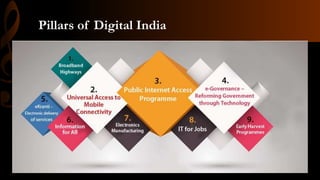
Pillars of Digital India
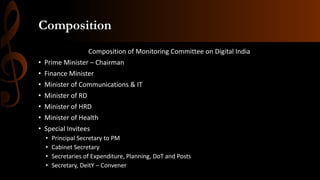
Composition
Composition of Monitoring Committee on Digital India
• Prime Minister – Chairman
• Finance Minister
• Minister of Communications & IT
• Minister of RD
• Minister of HRD
• Minister of Health
• Special Invitees
• Principal Secretary to PM
• Cabinet Secretary
• Secretaries of Expenditure, Planning, DoT and Posts
• Secretary, DeitY – Convener
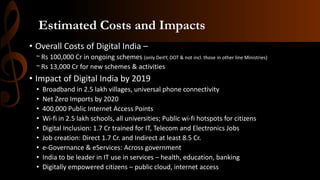
Estimated Costs and Impacts
• Overall Costs of Digital India –
~ Rs 100,000 Cr in ongoing schemes (only DeitY, DOT & not incl. those in other line Ministries)
~ Rs 13,000 Cr for new schemes & activities
• Impact of Digital India by 2019
• Broadband in 2.5 lakh villages, universal phone connectivity
• Net Zero Imports by 2020
• 400,000 Public Internet Access Points
• Wi-fi in 2.5 lakh schools, all universities; Public wi-fi hotspots for citizens
• Digital Inclusion: 1.7 Cr trained for IT, Telecom and Electronics Jobs
• Job creation: Direct 1.7 Cr. and Indirect at least 8.5 Cr.
• e-Governance & eServices: Across government
• India to be leader in IT use in services – health, education, banking
• Digitally empowered citizens – public cloud, internet access
Challenges & Changes Needed
• Program on this scale never conceived
• Each Pillar/program has own challenges
• Human Resource Issues
• Financial Resource Issues
• Coordination Issues

Digital india

  • 1.
  • 2.
    Introduction • Ministry ofElectronics & Information Technology, Government of India. • Flagship programme of the GOI with a vision to transform India into a digitally empowered society and knowledge economy. • It is an Umbrella Programme – covering many departments. • Putting a large number of ideas and thoughts into a single, comprehensive vision so that each of them is seen as part of a larger goal. • Each individual element stands on its own. But is also part of the larger picture. • Putting things together makes the Mission transformative in totality
  • 3.
    Objectives (Centered on3 key areas ) • Digital Infrastructure as a Utility to Every Citizen – • High speed internet as a core utility • Mobile phone & Bank account enabling participation in digital & financial space • Easy access to a Common Service Centre • Shareable private space on a public cloud • Safe and secure Cyber-space
  • 4.
    Objectives (Centered on3 key areas ) • Governance & Services on Demand – • Seamlessly integrated across departments or jurisdictions • Services available in real time from online &mobile platform • All citizen entitlements to be available on the cloud • Services digitally transformed for improving Ease of Doing Business. • Making financial transactions electronic & cashless.
  • 5.
    Objectives (Centered on3 key areas ) • Digital Empowerment of Citizens – • Universal Digital Literacy • Universally accessible digital resources • All documents/ certificates to be available on cloud • Availability of digital resources / services in Indian languages • Collaborative digital platforms for participative governance • Portability of all entitlements through cloud
  • 6.
  • 7.
    Composition Composition of MonitoringCommittee on Digital India • Prime Minister – Chairman • Finance Minister • Minister of Communications & IT • Minister of RD • Minister of HRD • Minister of Health • Special Invitees • Principal Secretary to PM • Cabinet Secretary • Secretaries of Expenditure, Planning, DoT and Posts • Secretary, DeitY – Convener
  • 8.
    Estimated Costs andImpacts • Overall Costs of Digital India – ~ Rs 100,000 Cr in ongoing schemes (only DeitY, DOT & not incl. those in other line Ministries) ~ Rs 13,000 Cr for new schemes & activities • Impact of Digital India by 2019 • Broadband in 2.5 lakh villages, universal phone connectivity • Net Zero Imports by 2020 • 400,000 Public Internet Access Points • Wi-fi in 2.5 lakh schools, all universities; Public wi-fi hotspots for citizens • Digital Inclusion: 1.7 Cr trained for IT, Telecom and Electronics Jobs • Job creation: Direct 1.7 Cr. and Indirect at least 8.5 Cr. • e-Governance & eServices: Across government • India to be leader in IT use in services – health, education, banking • Digitally empowered citizens – public cloud, internet access
  • 9.
    Challenges & ChangesNeeded • Program on this scale never conceived • Each Pillar/program has own challenges • Human Resource Issues • Financial Resource Issues • Coordination Issues