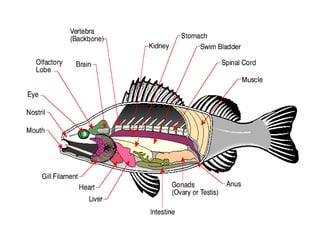
Digestion
• Digestive systemis responsible for all phases of feeding and nutrition, from
ingestion to egestion (defecation) in order to be used for growth and maintenance
of body structures.
•Collectively, fishes are opportunists in terms of food and feeding and show a high
degree of variability both within and among species in capturing and processing
food.
• Thus, fishes can be classified according to the type of feeding mechanism use (e.g.
biting, suction feeders), the kinds of food they consume (e.g., herbivores,
canivores), their position in the food chain (e.g., primary consumer, secondary
consumers), or even to the way in which the food is indigested (way of ingestion)
(e.g., fishes with muscular stomachs or with hindgut fermentation chambers).
(Evans, 1998)
•Very little known about the physiology of digestion in the cultivated indigeneous
carps
•Trypsinogen is formed in pancreas & erepsin & enterokinase are secreted by
intestine.
•Lipase is extracted by liver & pancreas. And maltose & lipase is present in intestinal
extracts of several species of fish…..
3.
MECHANISM OF FEEDING
•Once they have detected and located prey, fishes use a wide range of
behaviors and mechanical actions to catch and shallow their food.
• Various efforts have been made to categorize fish feeding according to actions
of the jaws and mouth, to body shapes of the fishs, to particular types of
behaviour, to the size of prey, and to the types of food consumed.
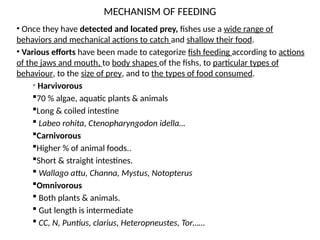
• Harvivorous
70 % algae, aquatic plants & animals
Long & coiled intestine
Labeo rohita, Ctenopharyngodon idella…
Carnivorous
Higher % of animal foods..
Short & straight intestines.
Wallago attu, Channa, Mystus, Notopterus
Omnivorous
Both plants & animals.
Gut length is intermediate
CC, N, Puntius, clarius, Heteropneustes, Tor……
4.
JAW AND MOUTHACTION
Based on functional or ecomorphological analysis, feeding methods of fishes can be divided into three
major types:
Biting Type
In biting, the oral jaws are used to remove a portion of a larger organism or tear the attached prey from the
substratum. The essential elements here are relatively robust jaws with cutting teeth, restricted jaw mobility,
and enlarged adductor muscles. Examples of food items obtained by biting include macroalgae attached to
rocks, sedentary polychaetes, coral polyps, and clam siphon.
Ram Feeding
In ram feeding, the fish opens its mouth and swims through a concentration of prey. Specialization for ram
feeding includes a large mouth area, a large ratio of mouth area to buccal cavity volume, and body
morphology suited to acceleration, which involves a moderately elongate trunk. Examples of food items most
vulnerable to ram feeding are those preys that are elusive because they are adept at swimming and include
fishes, shrimps, and calanoid copepods.
Suction Feeding
In suction feeding, the fish expands its buccal cavity to create subambient pressure, which draws in a jet of
water along with the prey. Suction feeding is a feature of most teleost fishes and considered to be the most
versatile type of feeding known among vertebrates. Specialization for a suction feeding include a small mouth
area, a small ratio of mouth area to buccal cavity volume, and a body morphology suited for maneuverability,
which involves a laterally compressed, relatively deep body and laterally compressed, relatively deep body and
laterally positioned pectoral fins for fine tuning the fish's position before strike. Examples of food items most
vulnerable to suction feeding are those preys that grasp the substratum such as limpets, isopods, and crabs.
Both ram and suction feeders are specialized for speed over force, having less robust but flexible jaws
equipped with holding rather than cutting teeth and equal development of abductor and adductor jaw
muscles……..
5.
BODY SHAPES ANDFEEDING BEHAVIOUR
Most fishes fall into one of six broad and overlapping categories of body shape and these are related to food capture
and diet.
(a) Rover-predators
These are streamlined fishes with a terminal mouth, narrow caudal peduncle, and forked tail. These species swim
constantly, searching for and pursuing prey and include tunas, mackerel, billfishes, and some minnows.
(b) Lie-in-Wait predators
These are elongate, torpedo shaped fishes often with a flattened head, large mouth, and pointed teeth. The posteriorly
placed anal, dorsal and large caudal fin help provide the thrust for ambushing fast-moving prey. These fishes include
gars, pikes, needle fish, and barracudas.
Surface oriented fishes
These fishes are usually small in size, with a fusiform body, broad flattened head, and an upwardly directed mouth.
These species are suited for capturing plankton and small nekton near the surface or insects that land on the surface
and include atherinomorphs such as killifishes, mosquito fishes, and flying fishes.
• Bottom feeders
Bottom fishes vary widely in body shape, but all spend much of their time in contact with the substratum. These
species include skates and rays, certain sharks, sturgeons, some catfishes, cusk-eels, grenadiers, gobies, clingfishes and
darters. Flat fishes, which lie on their side and have both eyes on the same side of the head, are most extremely
specialized of bottom fishes.
• Deep-bodied fishes
Deep bodied fish are laterally compressed species with pectoral fins high on the body and pelvic fins immediately below
them. The small, protrusible mouth and large eyes are suited for picking small invertebrates from the water column or
off the bottom. These species include butterfly fishes and damselfishes in temperate fresh waters.
• Eel-shaped fishes
These species have elongate, flexible bodies, blunt or somewhat pointed heads, and rounded or tapering tails. Eel like
fishes specialized mainly for living in the holes, and crevices of hard substrata or burrowing into soft substrata and
feeding on the macroalgae or invertebrates associated with these benthic habitats……….
6.
TYPES OF FOODCONSUMED
(a) Herbivorous fishes: consume benthic plants- macroalgae, diatoms, or angiosperms. They consume about 70% unicellular
algae, filamentous algae and aquatic plants. In addition to plant material these fishes also consume 1-10% of animal food and
mud. Labeo species Osphronemus goramy, Sarotherodon mossambicus etc. Among teleosts, about 26% are herbivorous. long
and coiled intestine (S.Kumar et al, 1998).They typically have short, blunt snouts with closely set teeth that form a cropping,
scrapping, excavating, or even brushing edge(Evans,1998).
(b) Carnivorous fishes: shorter gut, the intestine is straight, very little coils are present. Some of the carnivores possess
intestinal caecae.They prey on small organisms and consume high percentage of animals such as copepods, daphnia and
insects. The examples of carnivorous fishes are Walago attu, Mystus seenghala, Mystus cavassius, Channa spp., Notopterus
chitala, Rira rita etc. Among teleosts, about 12.5% are carnivorous (S.Kumar et al, 1998).Wallago attu, they prey is caught by
the formidable jaws, gripped by the pharyngeal teeth and is gulped in. Its passage to the stomach is facilitated by lubrication
with the mucus of the pharynx and oesophagus (Sinha, 1986).
(c) Omnivorous fishes: cyprinus carpio, Cirrhina mrigala, Puntius, Clarias etc. are consuming both plants and animals. The
rotifers, mud and sand are also found in the alimentary canal. Their gut length is between carnivorous and herbivorous fishes
(S.Kumar et al, 1998)
Herbivorous or Plankton feeder
They consume detritus along with zooplanktons and phytoplanktons.The arrangements of gill raker are such that it filters
them from water. The examples are Catla catla, Cirrhina reba, Hypopthalmichthys molitrix. They are both omnivorous and
carnivorous.
The fishes can also be named on the basis of modification of buccopharynx:
Predators: They possess a well developed grasping and holding teeth e.g. sharks, pike and gars etc.
Grazers: They take food by bite. These fishes feed on plankton and on bottom organisms, e.g. blue gill, parrot fish and butterfly
fish.
Strainers: They have efficient straining or filtering adaptation due to the arrangement of gill raker forming sieve for straining
the food material. They are plankton feeders.
Suckers: The fishes have inferior mouth and sucking lips. The response depends upon stimulus of touch e.g. sturgeons, Labeo,
Osteochilus etc.
Parasites: Amongest fishes, the deep sea eel (Simenchelys parasiticus) is parasitic in nature. Lamprey and hag fish are parasitic
but belong to cyclostomata……….
7.
3. STIMULI FORFEEDING
There are generally several kinds of stimuli for feeding. The common factors affecting the
internal motivation or drive for feeding include season, time of the day, light intensity, time
and nature of last feeding, temperature and any internal rhythm.
The visual, chemical, taste and lateral line system also control the momentary feeding act.
The interaction of these groups of factor determines when and how a fish will feed and what it
will feed upon?........
8.
Steps of digestivesystem
Ingestion: Receive ingested food
(Temporary food storage)
Digestion :Mechanical and chemical food breakdown
nutrients
Absorption nutrients and water
Elimination: Elimination of undigested food and excretory
wastes / by-products
10.
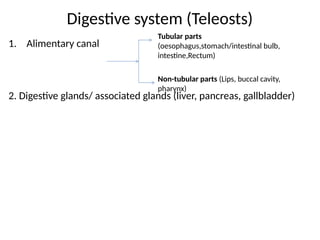
Digestive system (Teleosts)
1.Alimentary canal
2. Digestive glands/ associated glands (liver, pancreas, gallbladder)
Tubular parts
(oesophagus,stomach/intestinal bulb,
intestine,Rectum)
Non-tubular parts (Lips, buccal cavity,
pharynx)
11.
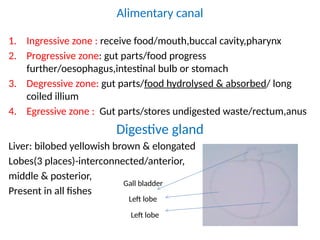
Alimentary canal
1. Ingressivezone : receive food/mouth,buccal cavity,pharynx
2. Progressive zone: gut parts/food progress
further/oesophagus,intestinal bulb or stomach
3. Degressive zone: gut parts/food hydrolysed & absorbed/ long
coiled illium
4. Egressive zone : Gut parts/stores undigested waste/rectum,anus
Digestive gland
Liver: bilobed yellowish brown & elongated
Lobes(3 places)-interconnected/anterior,
middle & posterior,
Present in all fishes
Gall bladder
Left lobe
Left lobe
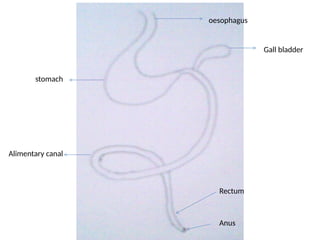
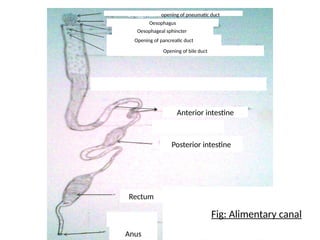
ALIMENTARY Fig: Alimentarycanal
Gjdgjskdskopening of pneumatic duct
Oesophagus
Oesophageal sphincter
Opening of pancreatic duct
Opening of bile duct
Anterior intestine
Posterior intestine
Rectum
Anus
14.
4. Modifications ofAlimentary canal
Mouth:
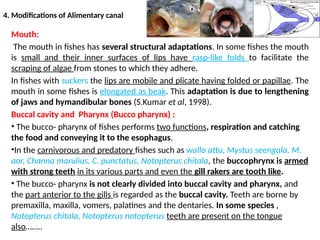
The mouth in fishes has several structural adaptations. In some fishes the mouth
is small and their inner surfaces of lips have rasp-like folds to facilitate the
scraping of algae from stones to which they adhere.
In fishes with suckers the lips are mobile and plicate having folded or papillae. The
mouth in some fishes is elongated as beak. This adaptation is due to lengthening
of jaws and hymandibular bones (S.Kumar et al, 1998).
Buccal cavity and Pharynx (Bucco pharynx) :
• The bucco- pharynx of fishes performs two functions, respiration and catching
the food and conveying it to the esophagus.
•In the carnivorous and predatory fishes such as wallo attu, Mystus seengala, M.
aor, Channa marulius, C. punctatus, Notopterus chitala, the buccophrynx is armed
with strong teeth in its various parts and even the gill rakers are tooth like.
• The bucco- pharynx is not clearly divided into buccal cavity and pharynx, and
the part anterior to the gills is regarded as the buccal cavity. Teeth are borne by
premaxilla, maxilla, vomers, palatines and the dentaries. In some species ,
Notopterus chitala, Notopterus notopterus teeth are present on the tongue
also……..
15.
Buccal cavity andPharynx (Bucco pharynx) ……..
Pharyngeal teeth are present on the gill arches and are distinguished as superior or inferior
pharyngeal teeth. Teeth may be inciform, canine like, molariform or as blunt knobs. They are
generally sharp, pointing backwards and are not masticatory in function. The pharyngeal teeth
prevent regurgitation of food and also serve as rasping organ.
In herbivorous fishes such as Labeo rohita, L. calbasu and several omnivorous fish species the
buccopharynx is divided into two parts, an interior respiratory region and posterior part which is very
narrow and masticatory in function. In these fishes, teeth are completely absent from the jaws and
palate but well developed inferior pharyngeal teeth are present. These teeth are used for crushing
the prey before it descends into the stomach.
The omnivorous fishes are intermediate condition. In some species like Tor tor, Puntius carana, Catla
catla, teeth are not present on the jaws and palate, and the bucco-pharyngeal cavity resembles that
of the herbivorous species.
Plankton feeders like Hisla hisla, Gadusia chapra have completely edentulous buccopharynx (Khanna,
2000) ……….
16.
Gill Raker
The primaryfunction of the gill raker is to protect the gill filamentous from injury but they help the
fishes in feeding also.
•In the carnivorous species, gill rakers are generally long, hard and teeth like forming rasping organs
as in wallo attu, Mystus seengala, Channa marulius,, Notopterus chitala , but in few species they may
be reduced to small protuberances as in Trichiurus or completely absent as in Muraenesox. In the
generalized omnivorous species like Tor tor, Puntius sarana, P. ticto they are short and stumpy. In
herbivorous form like Labeo rohita, Cirrhina mrigala gill rakers form a broad sieve like structure
across the gill slits for filtering the water in order to retain the food in the bucco-pharynx. This
function is best developed in plankton feeders like Hisla ilisha and Engraulis japonicum, in which the
gill rakers are long and thin and form a perfect sieve so as to retain zoo- and phyto-plankton in the
buccal cavity.
Thus the gill rakers help the fish in filtering the food materials and prevent its escape from the buccal
cavity through gill slits. There is remarkable correlation between the structure of the gill rakers and
feeding habit of the fish. The filtering efficiency increases considerably from carnivorous to
omnivorous fishes and is maximum in herbivorous fishes. The gill rakers vary in number and size not
only in the fishes of different feeding habits, but in the individuals of the same species also due to
differences in the ecological niches of the fish. (Khanna, 2000)……..
17.
TASTE BUDS ANDMUCUS-SECRETING CELLS
Numerous taste buds are present on the lips and buccopharynx of a number of species as Catla
catla, Tor tor, Cirrhina mrigala, Schizothorax plagiostomus, Puntius sophore, but much less in other
species like Channa gachuwa, C. striatus, Mystus vittatus, and may be absent from others. It
appears that the presence or absence of taste buds depends on the mode of feeding of fishes.
Many carnivorous and predaceous fishes (Harpodon nehereus, Muraenesox telabon) feed by sight
and taste buds are rare in their buccopharynx.
Some species (Tot tor, Catla catla, Cirrhina mrigala) depend more on their gustatory faculty for
feeding and possess a large number of taste buds.
Mucus secreting cells are present into the buccal-pharynx of all the teleosts and secrete a large
amount of mucus to lubricate food for easy swallowing.
Taste buds and mucus- secreting cells are found on the lips, oral valves and barbells of a number of
fishes which help in sorting out food (Khanna, 2000)………
18.
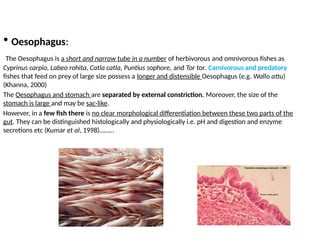
• Oesophagus:
The Oesophagusis a short and narrow tube in a number of herbivorous and omnivorous fishes as
Cyprinus carpio, Labeo rohita, Catla catla, Puntius sophore, and Tor tor. Carnivorous and predatory
fishes that feed on prey of large size possess a longer and distensible Oesophagus (e.g. Wallo attu)
(Khanna, 2000)
The Oesophagus and stomach are separated by external constriction. Moreover, the size of the
stomach is large and may be sac-like.
However, in a few fish there is no clear morphological differentiation between these two parts of the
gut. They can be distinguished histologically and physiologically i.e. pH and digestion and enzyme
secretions etc (Kumar et al, 1998)………
19.
Alimentary canal…
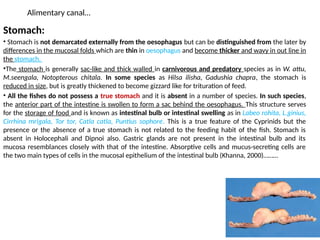
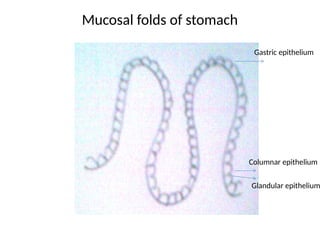
Stomach:
• Stomachis not demarcated externally from the oesophagus but can be distinguished from the later by
differences in the mucosal folds which are thin in oesophagus and become thicker and wavy in out line in
the stomach.
•The stomach is generally sac-like and thick walled in carnivorous and predatory species as in W. attu,
M.seengala, Notopterous chitala. In some species as Hilsa ilisha, Gadushia chapra, the stomach is
reduced in size, but is greatly thickened to become gizzard like for trituration of feed.
• All the fishes do not possess a true stomach and it is absent in a number of species. In such species,
the anterior part of the intestine is swollen to form a sac behind the oesophagus. This structure serves
for the storage of food and is known as intestinal bulb or intestinal swelling as in Labeo rohita, L.ginius,
Cirrhina mrigala, Tor tor, Catla catla, Puntius sophore. This is a true feature of the Cyprinids but the
presence or the absence of a true stomach is not related to the feeding habit of the fish. Stomach is
absent in Holocephali and Dipnoi also. Gastric glands are not present in the intestinal bulb and its
mucosa resemblances closely with that of the intestine. Absorptive cells and mucus-secreting cells are
the two main types of cells in the mucosal epithelium of the intestinal bulb (Khanna, 2000)………
20.
PYLORIC OR INTESTINALCAECA
A number of fingers like outgrowths develop from the pylorus or the anterior part of the intestine and are
called the pyloric caeca or intestinal caeca. They are present in Notoprerous, Hisla, Harpodon, and Channa
and in a large number of other species.
•Their number varies from one to several hundred.
•These appendages may be called intestinal caeca and they serve as accessory food reservoirs. Histologically,
they resemble the intestine and probably serve to increase its absorptive area. They are not found in
stomachless fishes and have no taxonomic value. They are present in all the three feeding types; herbivores,
omnivores, and carnivores (Khanna, 2000).
•beginning of the large intestine. It receives faecal material from the ileum, and connects to the ascending
colon of the large intestine.
DIGESTIVE GLANDS
Liver is a bilobed gland. The liver is a large vital organ present in all fish. It helps in detoxification, protein
synthesis, and production of biochemicals necessary for digestion. Pancreas is generally a diffused structure
in the body cavity among the coils of the intestine. It also extends into the liver forming a hepto-pancrease.
The exocrine cells are of large size and columnar or cuboidal in shape with a large nucleus. They are arranged
round the blood capillaries or may form acini. Each exocrine cell has a basal portion containing homogeneous
cytoplasm and an apical part containing a large number of zymogen granules. In Labeo rohita, Cirrhina
mrigala and Catla catla, the exocrine cells are present between the tissues of the spleen also (Khanna, 2000)
Gall bladder: small hollow organ where bile is stored and concentrated before it is released into the small
intestine. digestion of fats in food
………..
21.
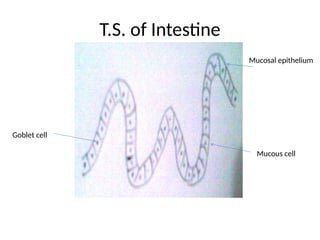
Intestine :
The lengthof the intestine varies in different species. Generally, intestine is short and nearly
straight in carnivorous fishes, but long, thin walled and highly coiled in herbivores species(Labeo
rohita, Cirrhina mrigala), while the omnivorous forms show an intermediate condition.(Khanna,
2000).
The intestine is provided in some fish with spiral valve. The spiral valve makes 4-50 or more turns,
depending upon species. It helps in increase the surface area of the intestine, to increase nutrient
absorption. Provisory the proximal part of the intestine is known as duodenum, the middle the
ileum while the distal end is rectum. However, intestine in fishes is one continuous organ and its
parts are usually differentiated histologically only by gradual changes in the nature of mucosal
layer (S.Kumar et al, 1998).
Rectum:
The rectum is not generally distinguishable externally but an ileo-rectal valve is present in some
species to demarcate it from the intestine as in Sciana, Tetrodon and Muraenosox. The mucosal
folds of the rectum differ from those of the intestine in being shorter and broader; possess a larger
number of mucus-secreting cells and a thicker muscularis. Large number of mucus secreting cells
produces copious mucus to lubricate food and help in easy defeacation (Khanna, 2000)………
Stomach Physiology
Receives, stores,liquefies, mixes food
Most gastric secretions come from the goblet cells which make
mucus to protect the lining of the stomach from its contents
25.
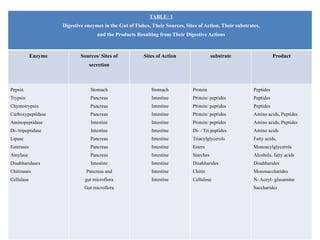
TABLE: 1
Digestive enzymesin the Gut of Fishes, Their Sources, Sites of Action, Their substrates,
and the Products Resulting from Their Digestive Actions
Enzyme Sources/ Sites of
secretion
Sites of Action substrate Product
Pepsin
Trypsin
Chymotrypsin
Carboxypeptidase
Aminopeptidase
Di-/tripeptidase
Lipase
Esterases
Amylase
Disahharidases
Chitinases
Cellulase
Stomach
Pancreas
Pancreas
Pancreas
Intestine
Intestine
Pancreas
Pancreas
Pancreas
Intestine
Pancreas and
gut microflora
Gut microflora
Stomach
Intestine
Intestine
Intestine
Intestine
Intestine
Intestine
Intestine
Intestine
Intestine
Intestine
Intestine
Protein
Protein/ peptides
Protein/ peptides
Protein/ peptides
Protein/ peptides
Di- / Tri peptides
Triacylglycerols
Esters
Starches
Disahharides
Chitin
Cellulose
Peptides
Peptides
Peptides
Amino acids, Peptides
Amino acids, Peptides
Amino acids
Fatty acids,
Monoacylglycerols
Alcohols, fatty acids
Disahharides
Monosaccharides
N- Aceyl- glusamine
Saccharides
#2 Trypsinogen-protein digestion
Erepsin-digest peptones into amino acids. it degrades food proteins into peptides
Enterokinas-changes the inactive pancreatic secretion trypsinogen into trypsin, one of the enzymes that digest proteins.
Lipase-Lipase is an enzyme that breaks down dietary fatsinto smaller molecules called fatty acids and glycerol.
#17 gustatory faculty - ability of a fish to locate food,
#18 Oesophagus: -Its function is to absorb water from the remaining indigestible food matter, and then to pass useless waste material from the body. In fish, there is no true large intestine, but simply a short rectum connecting the end of the digestive part of the gut to the cloaca.
#19 A mucosal fold refers to a fold in any mucous membrane in the body. This may refer to: Gastric fold of the gastric mucosa. Transverse folds of rectum in the anal canal
#20 Detoxification- physiological or medicinal removal of toxic substances from a living organism,
#23 A mucosal fold refers to a fold in any mucous membrane in the body. This may refer to: Gastric fold of the gastric mucosa. Transverse folds of rectum in the anal canal.