Mary Rose V. Ronquillo
Santo Tomas ES-Calauan District
Process by which food is eaten or broken down to its simplest
components
CARBOHYDRATES → Glucose
PROTEINS→ Amino Acids
FATS AND OIL→ Fatty Acids
1.Mechanical Digestion
 The breaking down of foods
into chewable pieces
2. Chemical Digestion
 breakdown of food in the
mouth, stomach and
intestines through the use
of acids and enzymes
Alimentary Canal-digestive
tract
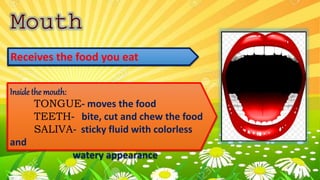
Receives the food you eat
Inside the mouth:
TONGUE- moves the food
TEETH- bite, cut and chew the food
SALIVA- sticky fluid with colorless
and
watery appearance
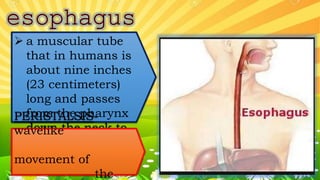
 a muscular tube
that in humans is
about nine inches
(23 centimeters)
long and passes
from the pharynx
down the neck to
the stomach
PERISTALSIS-
wavelike
movement of
the
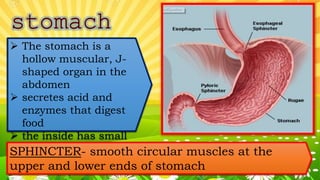
 The stomach is a
hollow muscular, J-
shaped organ in the
abdomen
 secretes acid and
enzymes that digest
food
 the inside has small
folds called rugaeSPHINCTER- smooth circular muscles at the
upper and lower ends of stomach
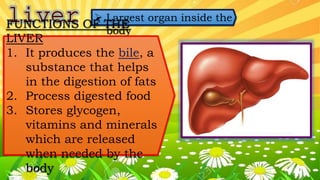
 Largest organ inside the
body
FUNCTIONS OF THE
LIVER
1. It produces the bile, a
substance that helps
in the digestion of fats
2. Process digested food
3. Stores glycogen,
vitamins and minerals
which are released
when needed by the
body
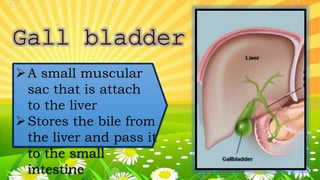
A small muscular
sac that is attach
to the liver
Stores the bile from
the liver and pass it
to the small
intestine
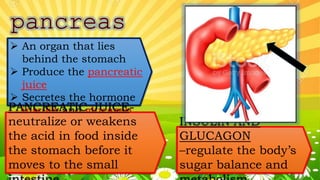
 An organ that lies
behind the stomach
 Produce the pancreatic
juice
 Secretes the hormone
insulin and glucagonPANCREATIC JUICE-
neutralize or weakens
the acid in food inside
the stomach before it
moves to the small
INSULIN AND
GLUCAGON
–regulate the body’s
sugar balance and
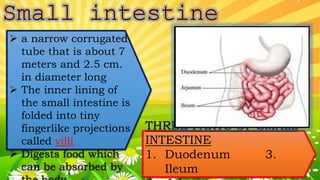
 a narrow corrugated
tube that is about 7
meters and 2.5 cm.
in diameter long
 The inner lining of
the small intestine is
folded into tiny
fingerlike projections
called villi
 Digests food which
can be absorbed by
THREE PARTS OF SMALL
INTESTINE
1. Duodenum 3.
Ileum
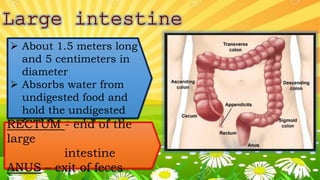
 About 1.5 meters long
and 5 centimeters in
diameter
 Absorbs water from
undigested food and
hold the undigested
food for a while and
then excrete it as feces
RECTUM - end of the
large
intestine
ANUS – exit of feces
Digestive system and its parts

Digestive system and its parts

  • 1.
    Mary Rose V.Ronquillo Santo Tomas ES-Calauan District
  • 2.
    Process by whichfood is eaten or broken down to its simplest components CARBOHYDRATES → Glucose PROTEINS→ Amino Acids FATS AND OIL→ Fatty Acids 1.Mechanical Digestion  The breaking down of foods into chewable pieces 2. Chemical Digestion  breakdown of food in the mouth, stomach and intestines through the use of acids and enzymes Alimentary Canal-digestive tract
  • 3.
    Receives the foodyou eat Inside the mouth: TONGUE- moves the food TEETH- bite, cut and chew the food SALIVA- sticky fluid with colorless and watery appearance
  • 4.
     a musculartube that in humans is about nine inches (23 centimeters) long and passes from the pharynx down the neck to the stomach PERISTALSIS- wavelike movement of the
  • 5.
     The stomachis a hollow muscular, J- shaped organ in the abdomen  secretes acid and enzymes that digest food  the inside has small folds called rugaeSPHINCTER- smooth circular muscles at the upper and lower ends of stomach
  • 6.
     Largest organinside the body FUNCTIONS OF THE LIVER 1. It produces the bile, a substance that helps in the digestion of fats 2. Process digested food 3. Stores glycogen, vitamins and minerals which are released when needed by the body
  • 7.
    A small muscular sacthat is attach to the liver Stores the bile from the liver and pass it to the small intestine
  • 8.
     An organthat lies behind the stomach  Produce the pancreatic juice  Secretes the hormone insulin and glucagonPANCREATIC JUICE- neutralize or weakens the acid in food inside the stomach before it moves to the small INSULIN AND GLUCAGON –regulate the body’s sugar balance and
  • 9.
     a narrowcorrugated tube that is about 7 meters and 2.5 cm. in diameter long  The inner lining of the small intestine is folded into tiny fingerlike projections called villi  Digests food which can be absorbed by THREE PARTS OF SMALL INTESTINE 1. Duodenum 3. Ileum
  • 10.
     About 1.5meters long and 5 centimeters in diameter  Absorbs water from undigested food and hold the undigested food for a while and then excrete it as feces RECTUM - end of the large intestine ANUS – exit of feces