Different Information
Sources
Books
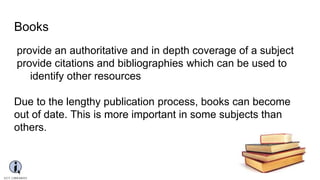
provide an authoritative and in depth coverage of a subject
provide citations and bibliographies which can be used to
identify other resources
Due to the lengthy publication process, books can become
out of date. This is more important in some subjects than
others.
Journals
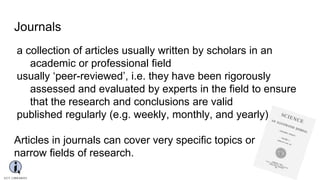
a collection of articles usually written by scholars in an
academic or professional field
usually ‘peer-reviewed’, i.e. they have been rigorously
assessed and evaluated by experts in the field to ensure
that the research and conclusions are valid
published regularly (e.g. weekly, monthly, and yearly)
Articles in journals can cover very specific topics or
narrow fields of research.
Newspapers
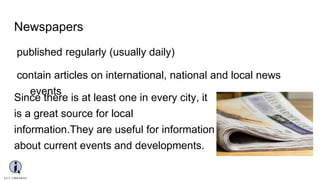
published regularly (usually daily)
contain articles on international, national and local news
events
Since there is at least one in every city, it
is a great source for local
information.They are useful for information
about current events and developments.
Reference material
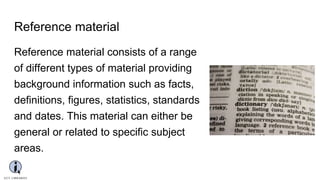
Reference material consists of a range
of different types of material providing
background information such as facts,
definitions, figures, statistics, standards
and dates. This material can either be
general or related to specific subject
areas.
Reference material: dictionaries and encyclopaedias
Dictionaries are useful to find definitions of terms, subjects or
topics. Subject-specific dictionaries provide definitions of
specialist terms.
Encyclopedias provide a collection of concise overviews
often written by different contributors who are
knowledgeable about the topic. Subject encyclopedias
contain in-depth entries focusing on one field of study.

Different information sources

  • 1.
  • 2.
    Books provide an authoritativeand in depth coverage of a subject provide citations and bibliographies which can be used to identify other resources Due to the lengthy publication process, books can become out of date. This is more important in some subjects than others.
  • 3.
    Journals a collection ofarticles usually written by scholars in an academic or professional field usually ‘peer-reviewed’, i.e. they have been rigorously assessed and evaluated by experts in the field to ensure that the research and conclusions are valid published regularly (e.g. weekly, monthly, and yearly) Articles in journals can cover very specific topics or narrow fields of research.
  • 4.
    Newspapers published regularly (usuallydaily) contain articles on international, national and local news events Since there is at least one in every city, it is a great source for local information.They are useful for information about current events and developments.
  • 5.
    Reference material Reference materialconsists of a range of different types of material providing background information such as facts, definitions, figures, statistics, standards and dates. This material can either be general or related to specific subject areas.
  • 6.
    Reference material: dictionariesand encyclopaedias Dictionaries are useful to find definitions of terms, subjects or topics. Subject-specific dictionaries provide definitions of specialist terms. Encyclopedias provide a collection of concise overviews often written by different contributors who are knowledgeable about the topic. Subject encyclopedias contain in-depth entries focusing on one field of study.