Differences between future
progressive and future perfect
Eleventh
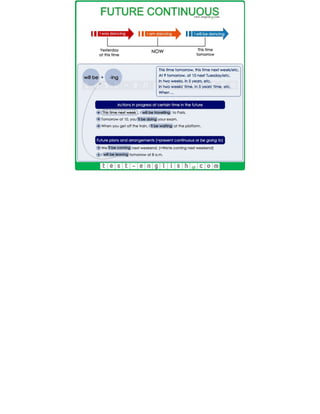
Future continuous – Use
We use the future continuous for situations or actions that will be in progress at a
certain time in the future.
This time next week, we‘ll be travelling to Paris.
Tomorrow at 10, you‘ll be doing your exam.
When you get off the train, I‘ll be waiting on the platform.
In two months’ time, we‘ll be lying on the beach and drinking a mojito.
Actions in progress in the future
Future arrangements (=present continuous)
We use the future continuous instead of the present continuous for future events
that have already been planned or decided.
We’ll be coming next weekend.
We’ll be leaving at 8 a.m. tomorrow.
Future perfect – Use
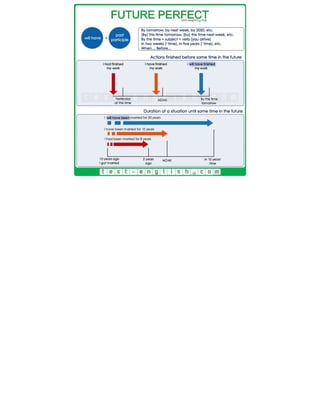
We use the future perfect for actions that will be finished before certain time in the
future.
By 2050, researchers will have found a cure for cancer.
By this time next year, I’ll have graduated.
When you arrive tomorrow, we’ll have left.
Actions finished in the future
Duration until some time in the future
We use the future perfect to talk about the duration of a situation until a certain
time in the future.
By the time I leave, I will have been in England for 6 months.
In 2 years, we will have been married for 20 years.
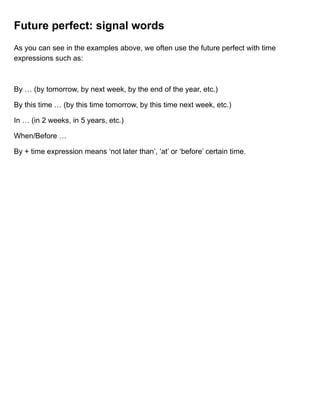
Future perfect: signal words
As you can see in the examples above, we often use the future perfect with time
expressions such as:
By … (by tomorrow, by next week, by the end of the year, etc.)
By this time … (by this time tomorrow, by this time next week, etc.)
In … (in 2 weeks, in 5 years, etc.)
When/Before …
By + time expression means ‘not later than’, ‘at’ or ‘before’ certain time.

Differences between future perfect and future progressive

  • 1.
    Differences between future progressiveand future perfect Eleventh
  • 3.
    Future continuous –Use We use the future continuous for situations or actions that will be in progress at a certain time in the future. This time next week, we‘ll be travelling to Paris. Tomorrow at 10, you‘ll be doing your exam. When you get off the train, I‘ll be waiting on the platform. In two months’ time, we‘ll be lying on the beach and drinking a mojito. Actions in progress in the future
  • 4.
    Future arrangements (=presentcontinuous) We use the future continuous instead of the present continuous for future events that have already been planned or decided. We’ll be coming next weekend. We’ll be leaving at 8 a.m. tomorrow.
  • 6.
    Future perfect –Use We use the future perfect for actions that will be finished before certain time in the future. By 2050, researchers will have found a cure for cancer. By this time next year, I’ll have graduated. When you arrive tomorrow, we’ll have left. Actions finished in the future
  • 7.
    Duration until sometime in the future We use the future perfect to talk about the duration of a situation until a certain time in the future. By the time I leave, I will have been in England for 6 months. In 2 years, we will have been married for 20 years.
  • 8.
    Future perfect: signalwords As you can see in the examples above, we often use the future perfect with time expressions such as: By … (by tomorrow, by next week, by the end of the year, etc.) By this time … (by this time tomorrow, by this time next week, etc.) In … (in 2 weeks, in 5 years, etc.) When/Before … By + time expression means ‘not later than’, ‘at’ or ‘before’ certain time.