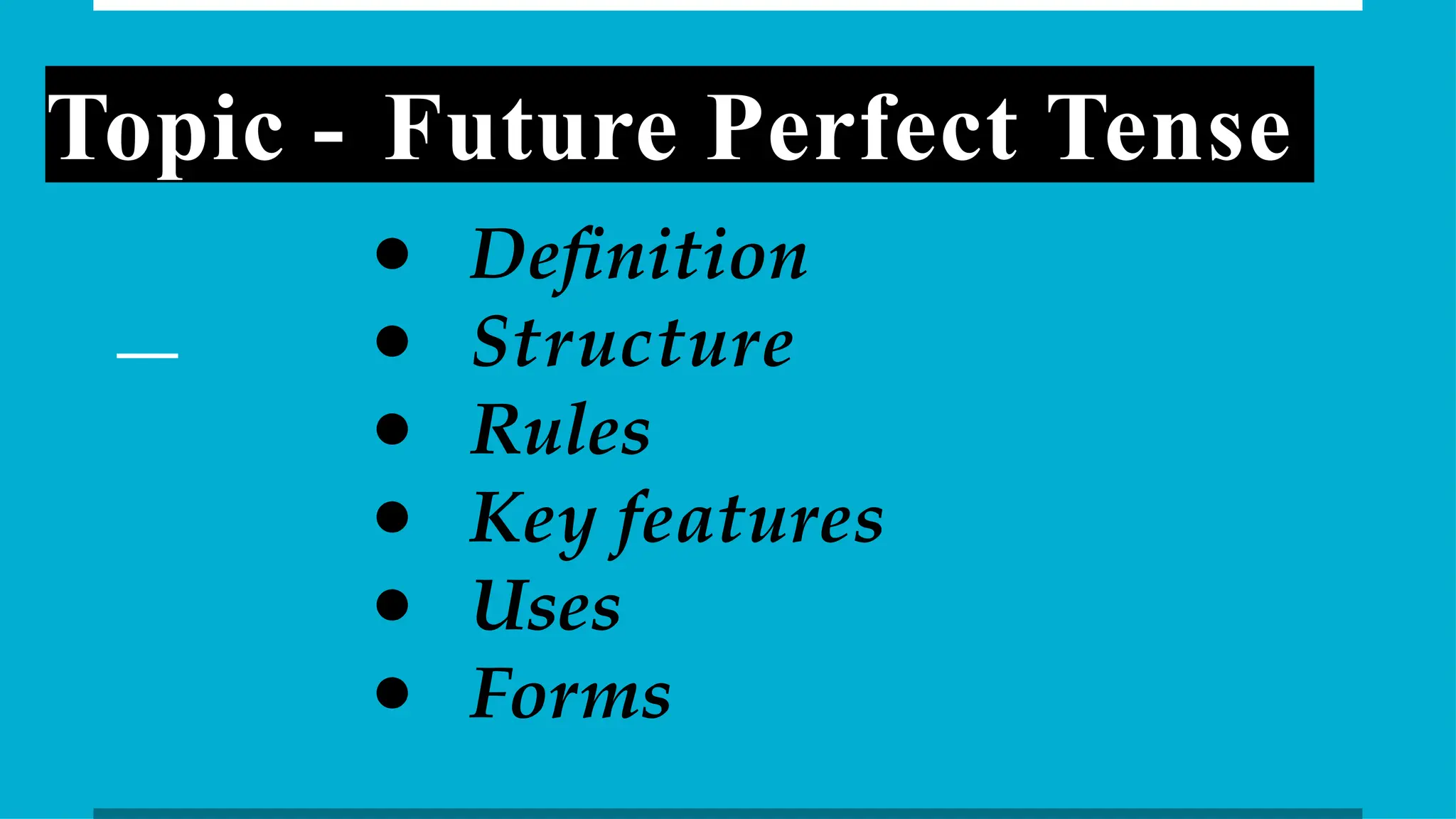
Topic - Future Perfect Tense
● Definition
● Structure
● Rules
● Key features
● Uses
● Forms
Definition
● Future perfect tense is used to express an action that
will be completed
Before a certain time in the future
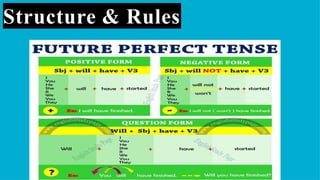
Structure & Rules
Structure (Example)
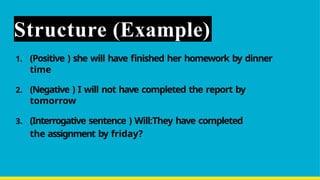
1. (Positive ) she will have finished her homework by dinner
time
2. (Negative ) I will not have completed the report by
tomorrow
3. (Interrogative sentence ) Will:They have completed
the assignment by friday?
Rules
1. Affirmative
Sentence:
Subject + will have + past participle (V3) +
object.
Example:
She will have finished the report by
tomorrow.
Rules
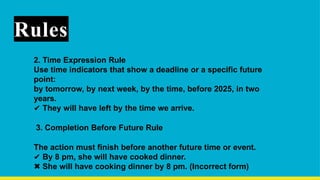
2. Time Expression Rule
Use time indicators that show a deadline or a specific future
point:
by tomorrow, by next week, by the time, before 2025, in two
years.
✔ They will have left by the time we arrive.
3. Completion Before Future Rule
The action must finish before another future time or event.
✔ By 8 pm, she will have cooked dinner.
✖ She will have cooking dinner by 8 pm. (Incorrect form)
Features
1.Shows an action
completed before a future
time
Example: By next year, I will
have completed my degree.
2.Uses “will have” +
past participle
Example: They will have
eaten dinner by 8 pm.
Features
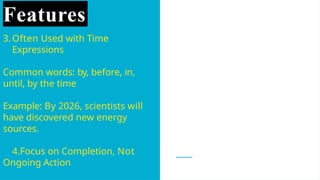
3.Often Used with Time
Expressions
Common words: by, before, in,
until, by the time
Example: By 2026, scientists will
have discovered new energy
sources.
4.Focus on Completion, Not
Ongoing Action
Features
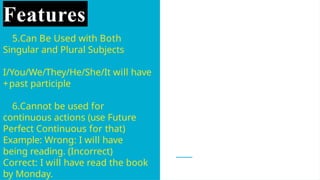
5.Can Be Used with Both
Singular and Plural Subjects
I/You/We/They/He/She/It will have
+past participle
6.Cannot be used for
continuous actions (use Future
Perfect Continuous for that)
Example: Wrong: I will have
being reading. (Incorrect)
Correct: I will have read the book
by Monday.
(Uses)
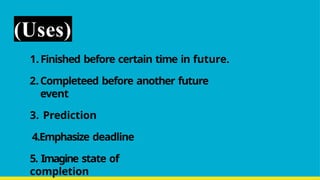
1.Finished before certain time in future.
2.Completeed before another future
event
3. Prediction
4.Emphasize deadline
5. Imagine state of
completion
Forms
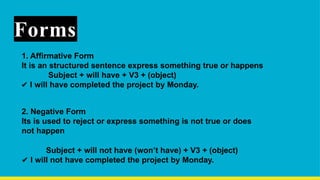
1. Affirmative Form
It is an structured sentence express something true or happens
Subject + will have + V3 + (object)
✔ I will have completed the project by Monday.
2. Negative Form
Its is used to reject or express something is not true or does
not happen
Subject + will not have (won’t have) + V3 + (object)
✔ I will not have completed the project by Monday.
Forms
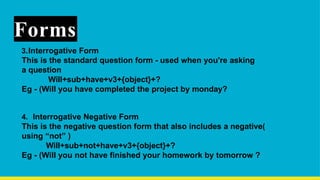
3.Interrogative Form
This is the standard question form - used when you're asking
a question
Will+sub+have+v3+{object}+?
Eg - (Will you have completed the project by monday?
4. Interrogative Negative Form
This is the negative question form that also includes a negative(
using “not” )
Will+sub+not+have+v3+{object}+?
Eg - (Will you not have finished your homework by tomorrow ?

Future Perfect Tense - sample document ppt

  • 1.
    Topic - FuturePerfect Tense ● Definition ● Structure ● Rules ● Key features ● Uses ● Forms
  • 2.
    Definition ● Future perfecttense is used to express an action that will be completed Before a certain time in the future
  • 3.
  • 4.
    Structure (Example) 1. (Positive) she will have finished her homework by dinner time 2. (Negative ) I will not have completed the report by tomorrow 3. (Interrogative sentence ) Will:They have completed the assignment by friday?
  • 5.
    Rules 1. Affirmative Sentence: Subject +will have + past participle (V3) + object. Example: She will have finished the report by tomorrow.
  • 6.
    Rules 2. Time ExpressionRule Use time indicators that show a deadline or a specific future point: by tomorrow, by next week, by the time, before 2025, in two years. ✔ They will have left by the time we arrive. 3. Completion Before Future Rule The action must finish before another future time or event. ✔ By 8 pm, she will have cooked dinner. ✖ She will have cooking dinner by 8 pm. (Incorrect form)
  • 7.
    Features 1.Shows an action completedbefore a future time Example: By next year, I will have completed my degree. 2.Uses “will have” + past participle Example: They will have eaten dinner by 8 pm.
  • 8.
    Features 3.Often Used withTime Expressions Common words: by, before, in, until, by the time Example: By 2026, scientists will have discovered new energy sources. 4.Focus on Completion, Not Ongoing Action
  • 9.
    Features 5.Can Be Usedwith Both Singular and Plural Subjects I/You/We/They/He/She/It will have +past participle 6.Cannot be used for continuous actions (use Future Perfect Continuous for that) Example: Wrong: I will have being reading. (Incorrect) Correct: I will have read the book by Monday.
  • 10.
    (Uses) 1.Finished before certaintime in future. 2.Completeed before another future event 3. Prediction 4.Emphasize deadline 5. Imagine state of completion
  • 11.
    Forms 1. Affirmative Form Itis an structured sentence express something true or happens Subject + will have + V3 + (object) ✔ I will have completed the project by Monday. 2. Negative Form Its is used to reject or express something is not true or does not happen Subject + will not have (won’t have) + V3 + (object) ✔ I will not have completed the project by Monday.
  • 12.
    Forms 3.Interrogative Form This isthe standard question form - used when you're asking a question Will+sub+have+v3+{object}+? Eg - (Will you have completed the project by monday? 4. Interrogative Negative Form This is the negative question form that also includes a negative( using “not” ) Will+sub+not+have+v3+{object}+? Eg - (Will you not have finished your homework by tomorrow ?