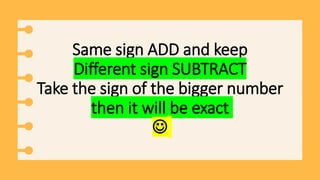
Same sign ADD and keep
Different sign SUBTRACT
Take the sign of the bigger number
then it will be exact

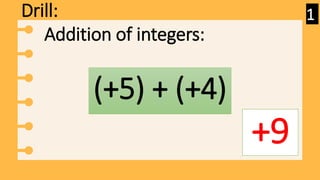
Drill:
(+5) + (+4)
+9
Addition of integers:
1
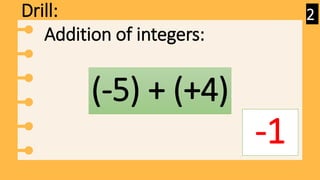
Drill:
(-5) + (+4)
-1
Addition of integers:
2
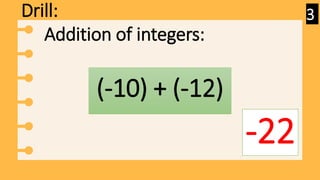
Drill:
(-10) + (-12)
-22
Addition of integers:
3
Drill:
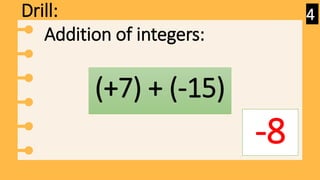
(+7) + (-15)
-8
Addition of integers:
4
Drill:
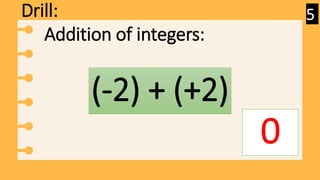
(-2) + (+2)
0
Addition of integers:
5
Drill:
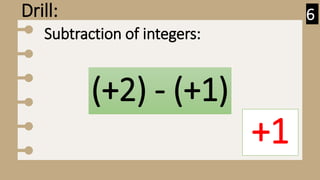
(+2) - (+1)
+1
Subtraction of integers:
6
Drill:
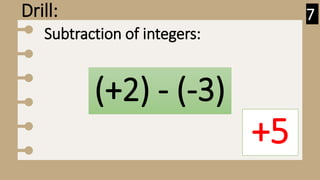
(+2) - (-3)
+5
Subtraction of integers:
7
Drill:
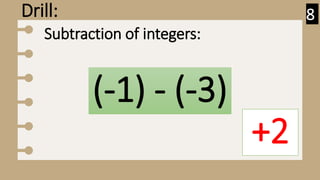
(-1) - (-3)
+2
Subtraction of integers:
8
Drill:
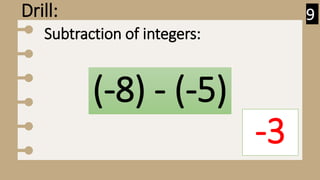
(-8) - (-5)
-3
Subtraction of integers:
9
Drill:
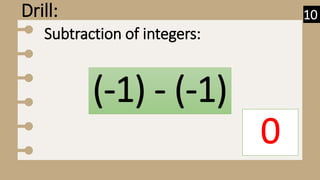
(-1) - (-1)
0
Subtraction of integers:
10
Drill:
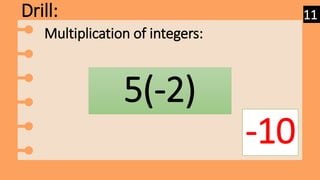
5(-2)
-10
Multiplication of integers:
11
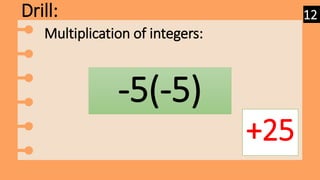
Drill:
-5(-5)
+25
Multiplication of integers:
12
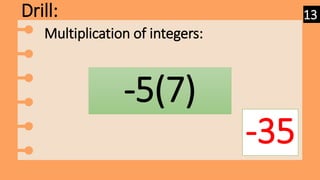
Drill:
-5(7)
-35
Multiplication of integers:
13
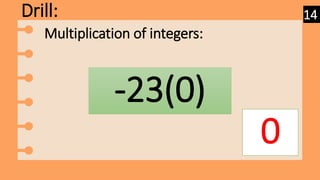
Drill:
-23(0)
0
Multiplication of integers:
14
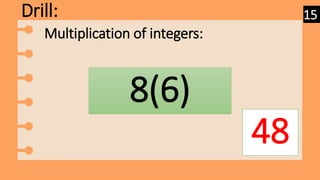
Drill:
8(6)
48
Multiplication of integers:
15
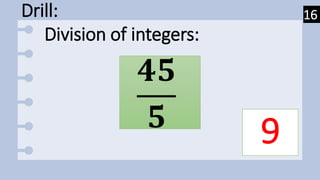
Drill:
𝟒𝟓
𝟓 9
Division of integers:
16
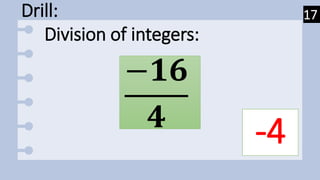
Drill:
−𝟏𝟔
𝟒 -4
Division of integers:
17
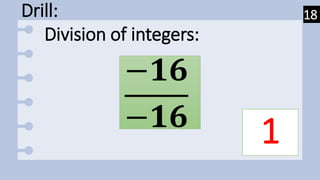
Drill:
−𝟏𝟔
−𝟏𝟔 1
Division of integers:
18
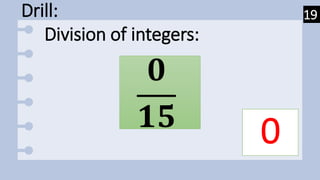
Drill:
𝟎
𝟏𝟓 0
Division of integers:
19
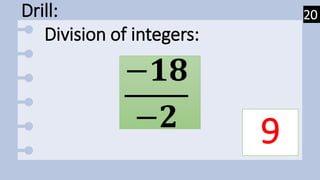
Drill:
−𝟏𝟖
−𝟐 9
Division of integers:
20
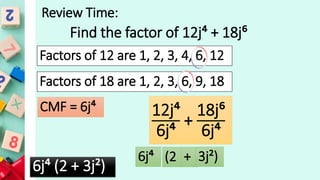
Review Time:
Find the factor of 12j⁴ + 18j⁶
Factors of 12 are 1, 2, 3, 4, 6, 12
Factors of 18 are 1, 2, 3, 6, 9, 18
CMF = 6j⁴ 12j⁴
6j⁴
+
18j⁶
6j⁴
6j⁴ (2 + 3j²)
6j⁴ (2 + 3j²)
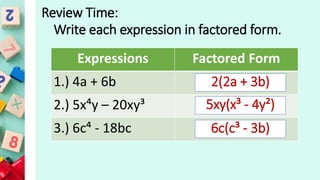
Expressions Factored Form
1.) 4a + 6b
2.) 5x⁴y – 20xy³
3.) 6c⁴ - 18bc
Review Time:
Write each expression in factored form.
2(2a + 3b)
5xy(x³ - 4y²)
6c(c³ - 3b)
Difference of Two Squares
Objectives for today;
1. Factor the difference of two squares.
2. Enjoy while learning
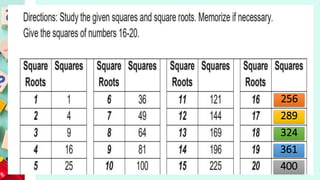
256
289
324
361
400
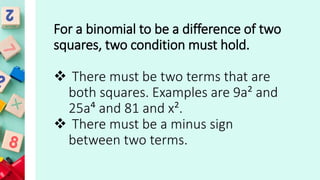
For a binomial to be a difference of two
squares, two condition must hold.
 There must be two terms that are
both squares. Examples are 9a² and
25a⁴ and 81 and x².
 There must be a minus sign
between two terms.
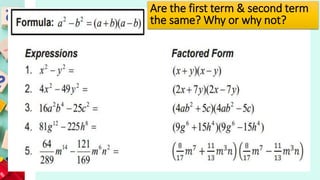
Are the first term & second term
the same? Why or why not?
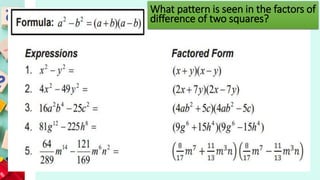
What pattern is seen in the factors of
difference of two squares?
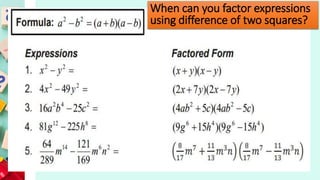
When can you factor expressions
using difference of two squares?
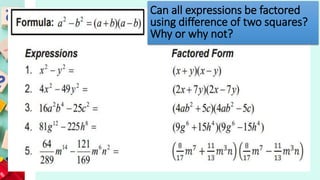
Can all expressions be factored
using difference of two squares?
Why or why not?
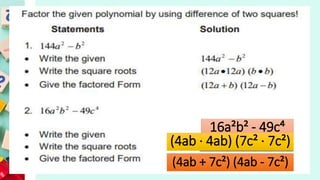
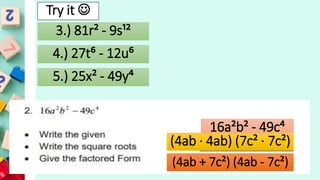
16a²b² - 49c⁴
(4ab · 4ab) (7c² · 7c²)
(4ab + 7c²) (4ab - 7c²)
16a²b² - 49c⁴
(4ab · 4ab) (7c² · 7c²)
(4ab + 7c²) (4ab - 7c²)
3.) 81r² - 9s¹²
4.) 27t⁶ - 12u⁶
5.) 25x² - 49y⁴
Try it 
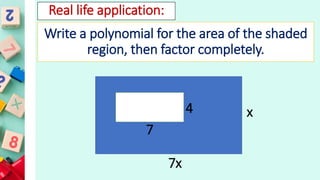
Real life application:
Write a polynomial for the area of the shaded
region, then factor completely.
x
7x
4
7
x
7x
4
7
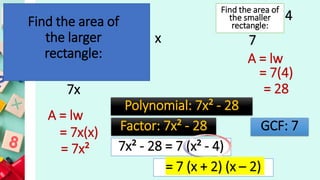
Find the area of
the larger
rectangle:
Find the area of
the smaller
rectangle:
A = lw
= 7x(x)
= 7x²
A = lw
= 7(4)
= 28
Polynomial: 7x² - 28
Factor: 7x² - 28 GCF: 7
7x² - 28 = 7 (x² - 4)
= 7 (x + 2) (x – 2)
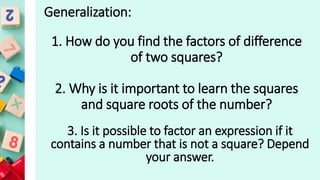
Generalization:
1. How do you find the factors of difference
of two squares?
2. Why is it important to learn the squares
and square roots of the number?
3. Is it possible to factor an expression if it
contains a number that is not a square? Depend
your answer.
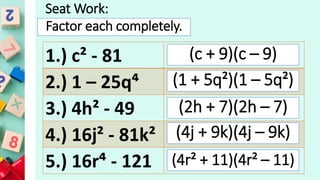
1.) c² - 81
2.) 1 – 25q⁴
3.) 4h² - 49
4.) 16j² - 81k²
5.) 16r⁴ - 121
Seat Work:
Factor each completely.
(c + 9)(c – 9)
(1 + 5q²)(1 – 5q²)
(2h + 7)(2h – 7)
(4j + 9k)(4j – 9k)
(4r² + 11)(4r² – 11)
Difference of two squares.pptx

Difference of two squares.pptx

Editor's Notes

  • #31 For you to have a better understanding about this lesson, observe how the expressions below are factored, observe how each terms relates with each other.
  • #36 Students will answer on the board.
  • #38 Since we are finding for the area of the shaded region, Subtract the area of the smaller rectangle from the area of the larger rectangle.