KRISTINE
KRISTINE S. ARELLANO
• Graduate of Bachelor of Secondary Education
Major in English at West Coast College
• Academic Excellence Awardee
a. differentiate salary and wage
b. express the importance of knowing
how to compute salaries and wages
c. compute using prorating annual
salary, time basis pay, and piece-rate
pay.
OBJECTIVES
PICTURE
CHARADES
Direction:
Group yourselves into four. Guess the word which the
pictures and letters describe. Every item, choose one
representative who will go to the board and write the
answer. You have 10 points each group for your initial
scores. Every wrong answer, 2 points will be deducted
in your scores and your representative will sip a
lemon. The group with lowest score will dance a paro-
paro G challenge.
EXAMPLE: 2 words category
1ST word 2nd word
NESS
ANSWER: BUSINESS MATH
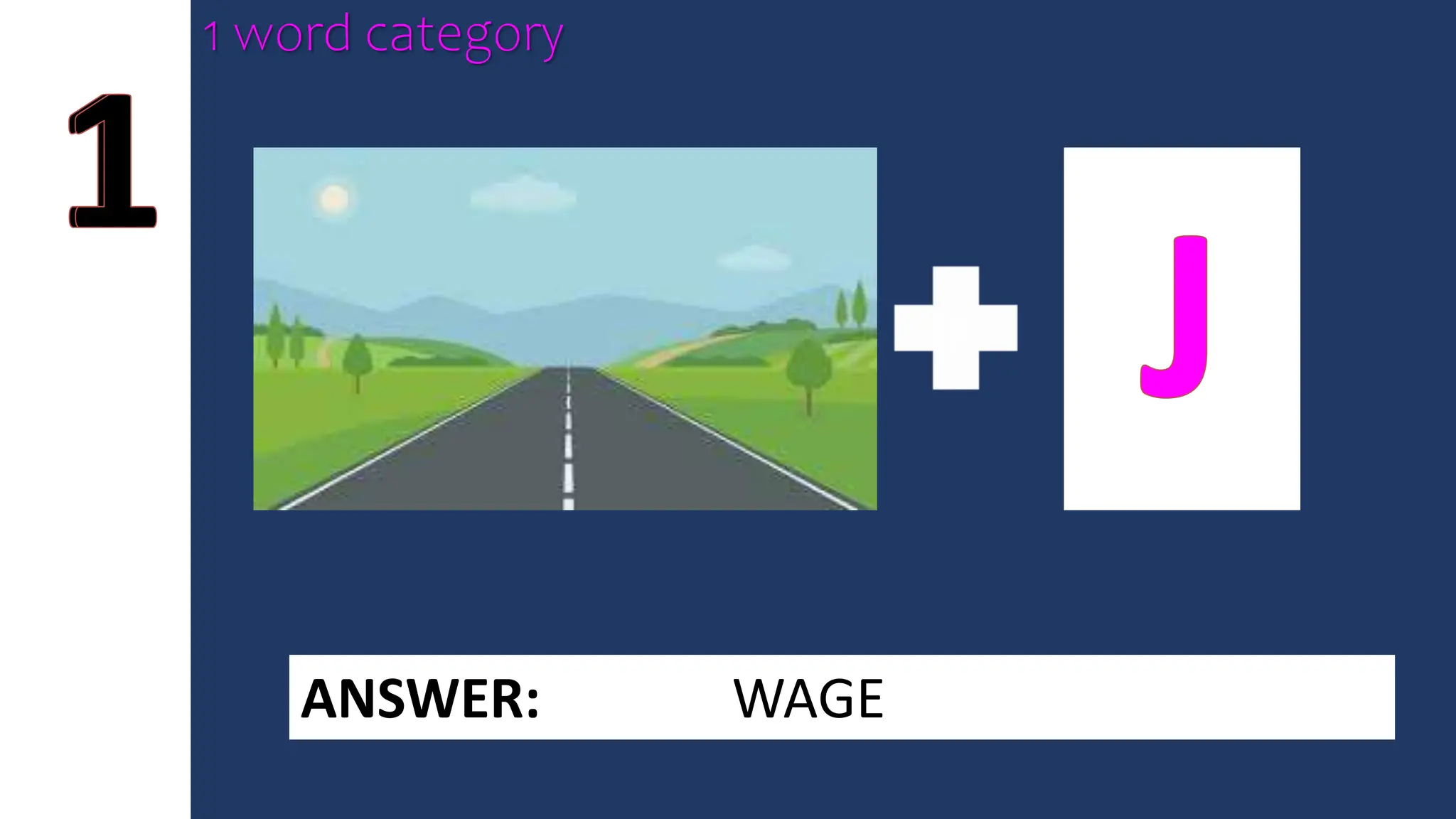
1 word category
ANSWER: WAGE
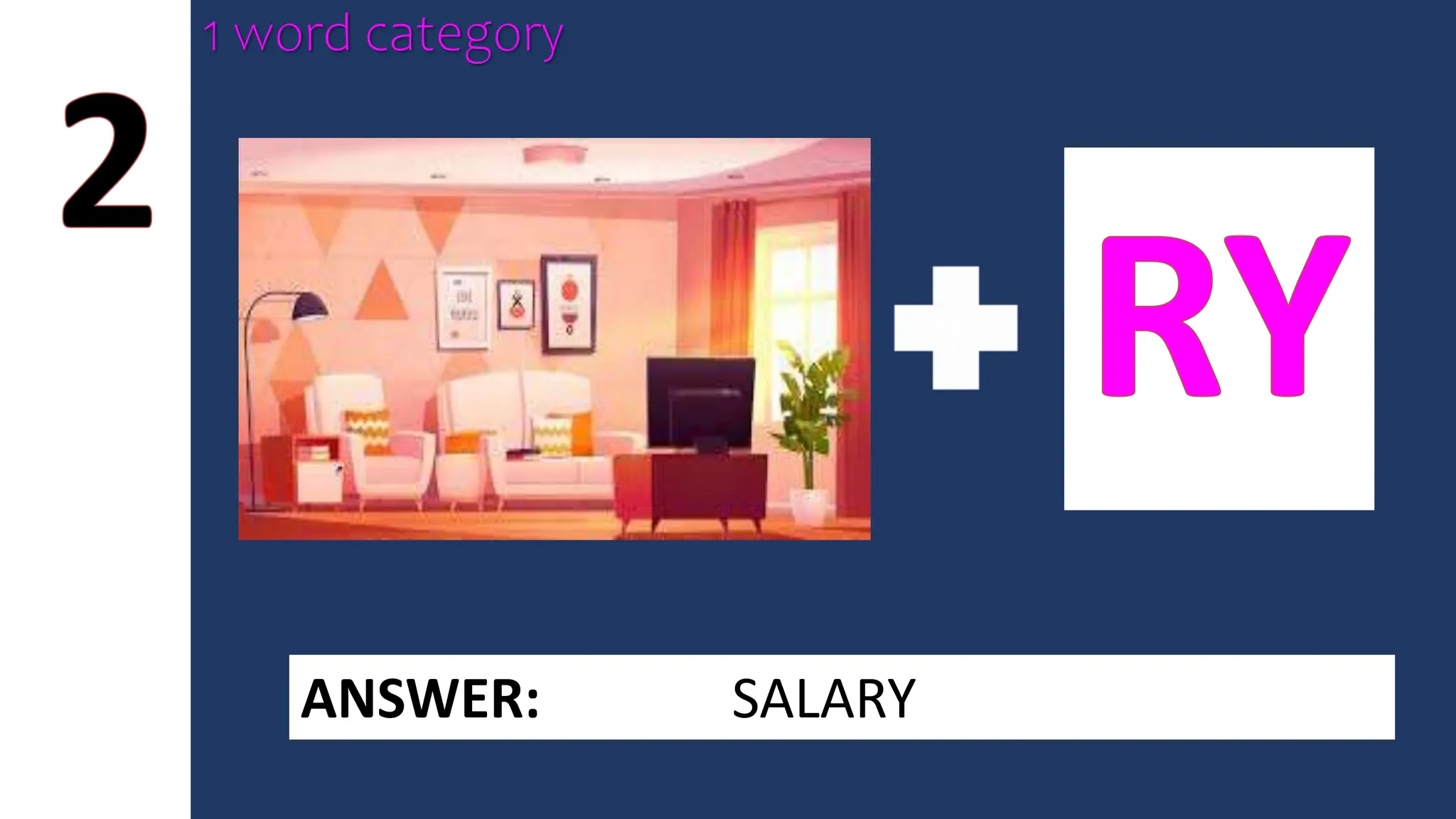
1 word category
ANSWER: SALARY
1 word category
ANSWER: PAYROLL
2 words category
1st word 2nd word
ANSWER: GROSS PAY
1 word category
SATION
ANSWER: COMPENSATION
 is a way to provide
monetary value to
employees in
exchange of their
work/service
performed. It is usually
presented in payroll.
COMPENSATION
 is the total amount required
to pay workers and
employees during a week,
month or other period. It is
also defined as a total sum
of money to be paid out to
employees at a given time.
PAYROLL
 is a total amount of
employee’s earnings before
deductions have been made
by the employer. It may be in
the form of salary or wage,
on either a time-rate or
piece-rate and other forms
of remuneration.
GROSS PAY (GROSS EARNINGS)
SALARIES
AND
WAGES
is a fixed weekly or
monthly wage. It can
also be computed in
a prorating annual
salary or time basis
pay or by piecework.
SALARY
 is the monetary
remuneration
computed on hourly,
daily, weekly, or
piece work basis.
WAGE
FORMS
OF
REMUNERATION
Companies usually pay
employees weekly,
biweekly, semi-
monthly, or monthly.
PRORATING
ANNUAL SALARY
Employee’s earnings are
based on time worked.
The compensation is
usually stated as specific
rate per hour, day, week,
month, or year.
TIME BASIS PAY
Workers on factories and
industries are often paid
according to the number of
pieces/unit they produce
which is usually called as
piecework or piece-rate pay.
PIECE-RATE PAY
A worker is being paid the
guaranteed wage (i.e. hourly,
daily, weekly, or monthly) for
producing the standard quota
of units and is also paid at the
same rate for producing/selling
extra units within the standard
work period.
PIECE-RATE PAY
FORM
“SALARIES
AND
WAGES”
Direction:
Remain with your group. Solve the following
problems with the given formula to form the clause
“SALARIES AND WAGES”. Round off to the nearest
cent. Get the briefcase with your corresponding
answer on the board and place them according to
your group order. Choose one representative who
will present your work. You have 5 minutes to
answer.
Problem: For an employee who earns
an annual of ₱260,000, compute the
weekly salary.
PRORATING ANNUAL SALARY
Weekly salary
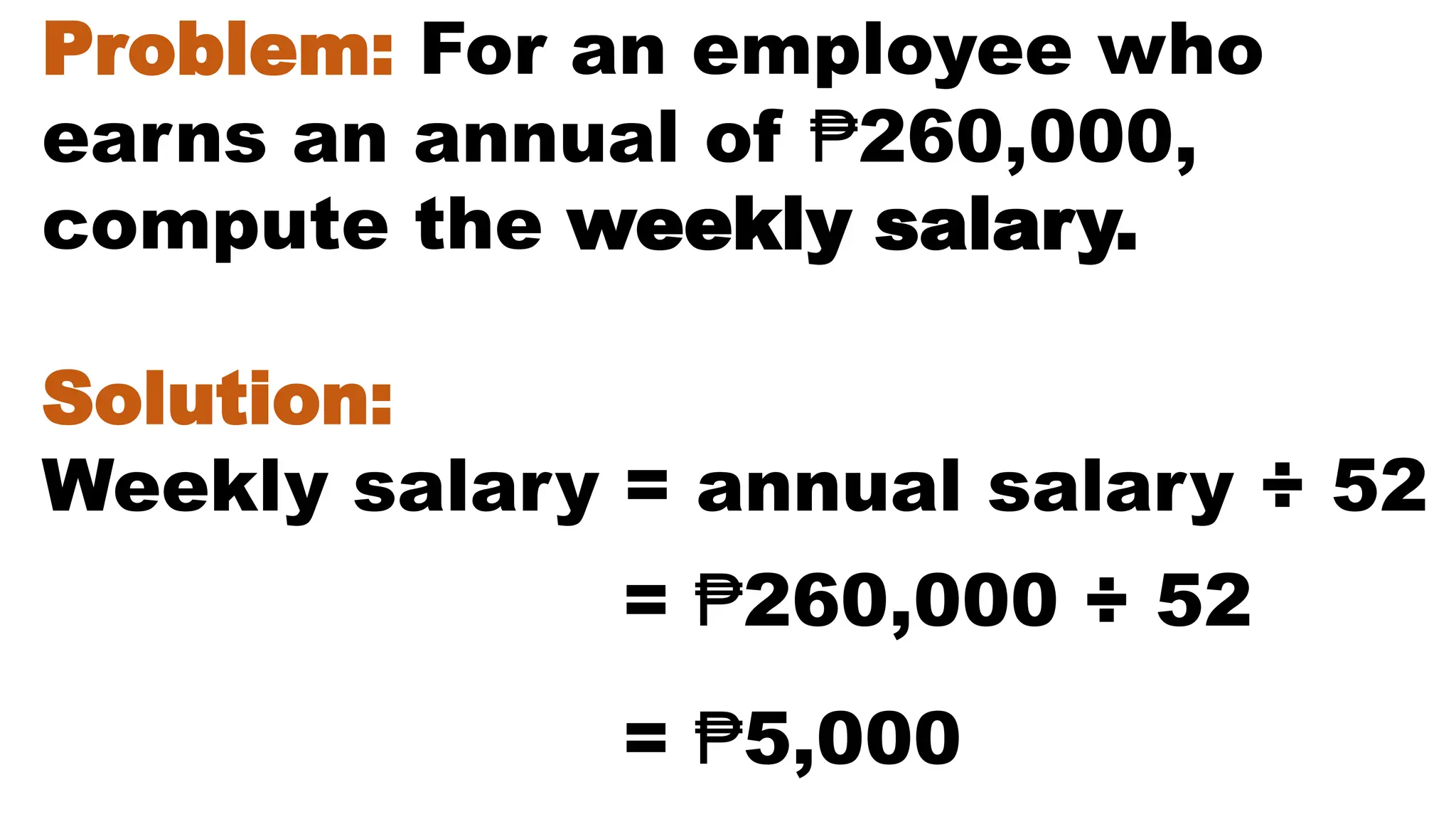
Problem: For an employee who
earns an annual of ₱260,000,
compute the weekly salary.
Solution:
Weekly salary = annual salary ÷ 52
= ₱5,000
= ₱260,000 ÷ 52
Problem: For an employee who earns
an annual of ₱260,000, compute the
biweekly salary.
PRORATING ANNUAL SALARY
Biweekly salary
Problem: For an employee who
earns an annual of ₱260,000,
compute the biweekly salary.
Solution:
Biweekly salary = annual salary ÷ 26
= ₱10,000
= ₱260,000 ÷ 26
Problem: For an employee who earns
an annual of ₱260,000, compute the
semi-monthly salary.
PRORATING ANNUAL SALARY
Semi-monthly salary
Problem: For an employee who
earns an annual of ₱260,000,
compute the semi-monthly salary.
Solution:
Semi-monthly salary = annual salary ÷ 24
= ₱10,833.33
= ₱260,000 ÷ 24
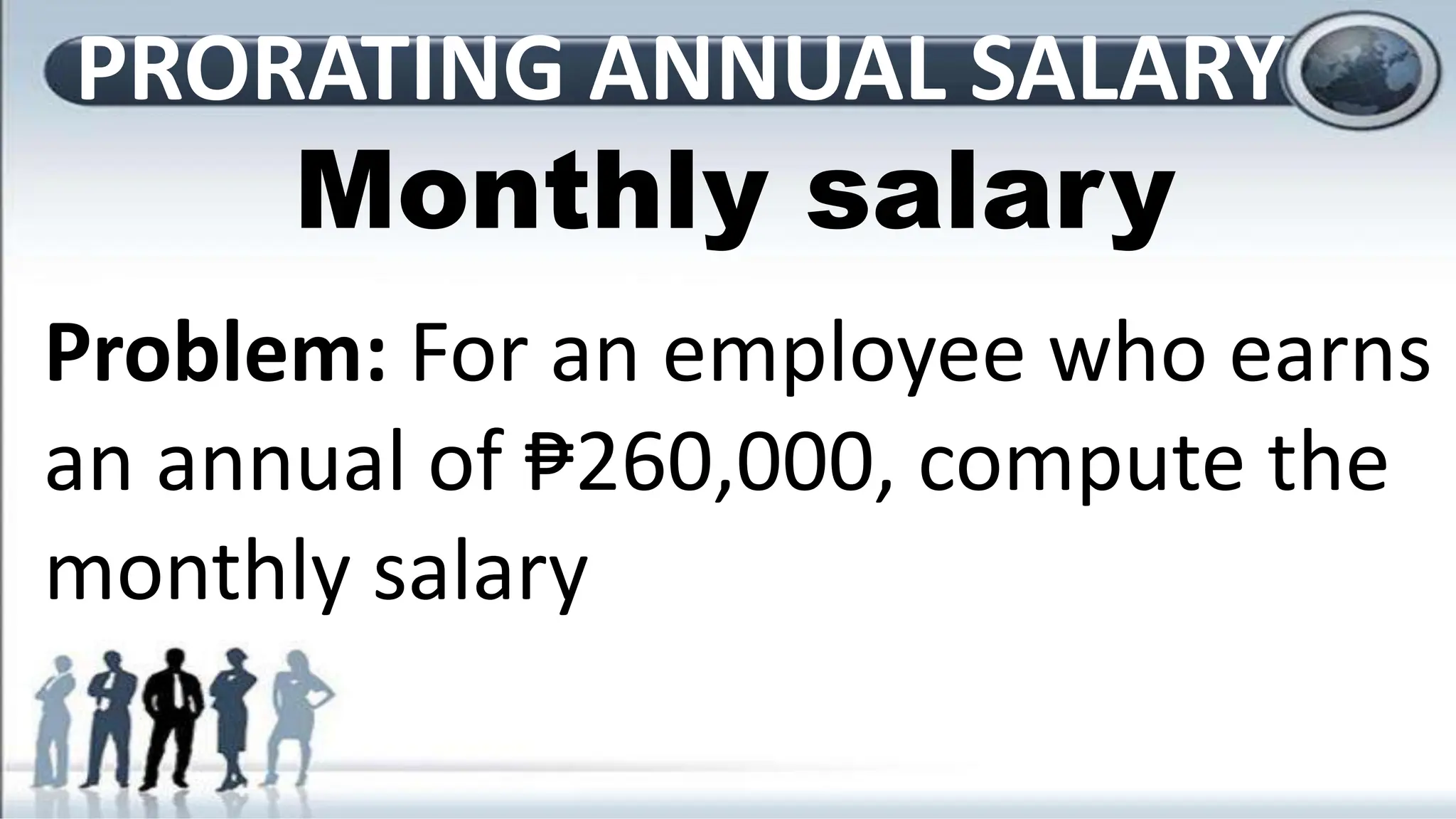
Problem: For an employee who earns
an annual of ₱260,000, compute the
monthly salary
PRORATING ANNUAL SALARY
Monthly salary
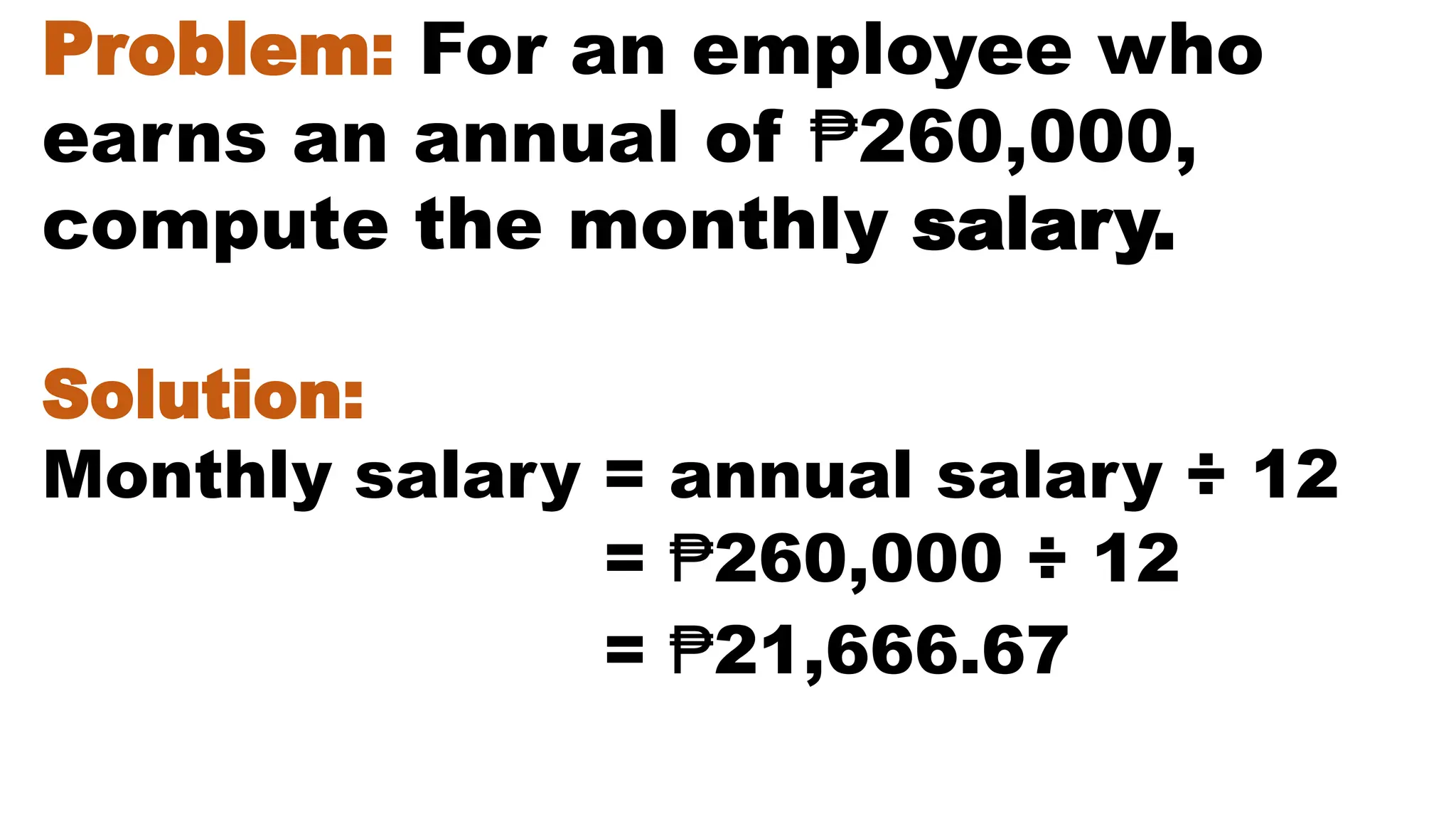
Problem: For an employee who
earns an annual of ₱260,000,
compute the monthly salary.
Solution:
Monthly salary = annual salary ÷ 12
= ₱21,666.67
= ₱260,000 ÷ 12
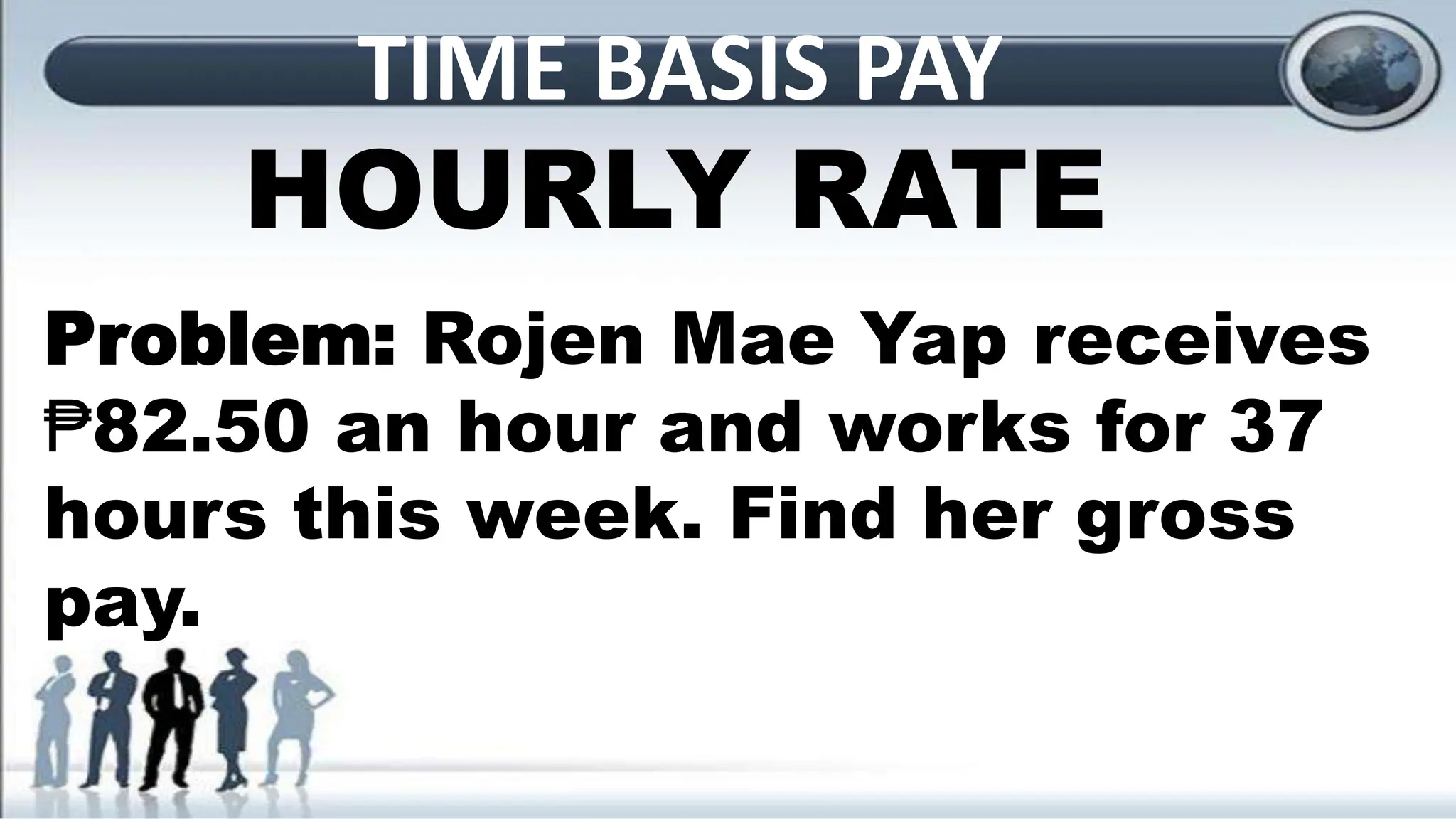
Problem: Rojen Mae Yap receives
₱82.50 an hour and works for 37
hours this week. Find her gross
pay.
TIME BASIS PAY
HOURLY RATE
Problem: Rojen Mae Yap receives ₱82.50 an
hour and works for 37 hours this week. Find her
gross pay.
Given: Hourly rate = ₱82.50
Number of hours worked = 37
Solution:
Regular Pay = No. of hours worked x hourly rate
= ₱3,052.50
= 37 x ₱82.50
Problem: Dexter receives a daily
wage of ₱521.60. How much does he
earn in a week if he worked for 5
days?
TIME BASIS PAY
DAILY RATE
Problem: Dexter receives a daily wage of
₱521.60. How much does he earn in a week if
he worked for 5 days?
Given: Daily rate = ₱521.60
Number of days worked = 5
Solution:
Regular Pay = No. of days worked x daily rate
= ₱2,608
= 5 x ₱521.60
Note: If production/sale does not meet or
exceed the quota, only the standard wage
is paid. If it exceeded the quota the
worker will receive a standard pay and a
premium for the extra units.
PIECE-RATE PAY
Formula:
• Standard pay = No. of working hours x rate per hour
• Standard pay = No. of units produced x rate per unit
• Premium pay = (Extra units ÷ Quota units) x standard
pay
Total pay = standard pay + premium pay
PIECE-RATE PAY
Problem: Gregorio’s daily production is 105 units
during an 8-hour work for which he is paid ₱86.20
an hour. He receives a premium for the extra units
he produces during the day of work. Find his gross
pay for (A) a day when he produced 100 units, and
(B) another day when he produced 130 units.
PIECE-RATE PAY
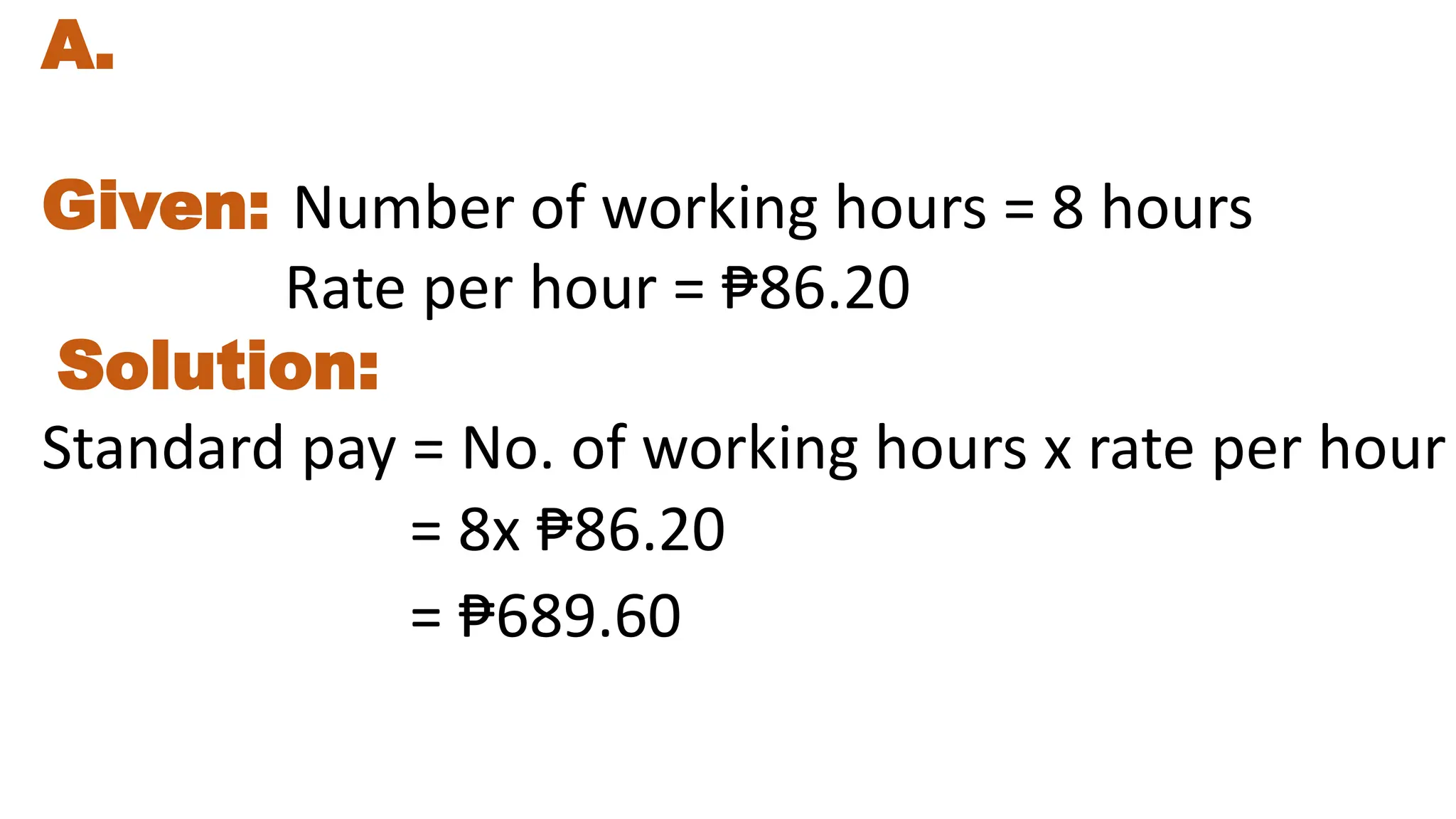
A.
Given: Number of working hours = 8 hours
Rate per hour = ₱86.20
Solution:
Standard pay = No. of working hours x rate per hour
= ₱689.60
= 8x ₱86.20
B. Note: Don’t round off during division. In final
answer, round off to the nearest cent.
Given: Quota units = 105 units
No. of units produced = 130
Extra units= 25
Premium pay = (Extra units ÷ Quota units) x standard pay
Total Pay = Standard pay + Premium pay
= (25 ÷ 105) x ₱689.60
= ₱164.19
= ₱689.60 + ₱164.19
= ₱853.79

Difference between Salary and wages.pptx

  • 1.
    KRISTINE KRISTINE S. ARELLANO •Graduate of Bachelor of Secondary Education Major in English at West Coast College • Academic Excellence Awardee
  • 2.
    a. differentiate salaryand wage b. express the importance of knowing how to compute salaries and wages c. compute using prorating annual salary, time basis pay, and piece-rate pay. OBJECTIVES
  • 3.
  • 4.
    Direction: Group yourselves intofour. Guess the word which the pictures and letters describe. Every item, choose one representative who will go to the board and write the answer. You have 10 points each group for your initial scores. Every wrong answer, 2 points will be deducted in your scores and your representative will sip a lemon. The group with lowest score will dance a paro- paro G challenge.
  • 5.
    EXAMPLE: 2 wordscategory 1ST word 2nd word NESS ANSWER: BUSINESS MATH
  • 6.
  • 7.
  • 8.
  • 9.
    2 words category 1stword 2nd word ANSWER: GROSS PAY
  • 10.
  • 11.
     is away to provide monetary value to employees in exchange of their work/service performed. It is usually presented in payroll. COMPENSATION
  • 12.
     is thetotal amount required to pay workers and employees during a week, month or other period. It is also defined as a total sum of money to be paid out to employees at a given time. PAYROLL
  • 13.
     is atotal amount of employee’s earnings before deductions have been made by the employer. It may be in the form of salary or wage, on either a time-rate or piece-rate and other forms of remuneration. GROSS PAY (GROSS EARNINGS)
  • 14.
  • 15.
    is a fixedweekly or monthly wage. It can also be computed in a prorating annual salary or time basis pay or by piecework. SALARY
  • 16.
     is themonetary remuneration computed on hourly, daily, weekly, or piece work basis. WAGE
  • 17.
  • 18.
    Companies usually pay employeesweekly, biweekly, semi- monthly, or monthly. PRORATING ANNUAL SALARY
  • 19.
    Employee’s earnings are basedon time worked. The compensation is usually stated as specific rate per hour, day, week, month, or year. TIME BASIS PAY
  • 20.
    Workers on factoriesand industries are often paid according to the number of pieces/unit they produce which is usually called as piecework or piece-rate pay. PIECE-RATE PAY
  • 21.
    A worker isbeing paid the guaranteed wage (i.e. hourly, daily, weekly, or monthly) for producing the standard quota of units and is also paid at the same rate for producing/selling extra units within the standard work period. PIECE-RATE PAY
  • 22.
  • 23.
    Direction: Remain with yourgroup. Solve the following problems with the given formula to form the clause “SALARIES AND WAGES”. Round off to the nearest cent. Get the briefcase with your corresponding answer on the board and place them according to your group order. Choose one representative who will present your work. You have 5 minutes to answer.
  • 24.
    Problem: For anemployee who earns an annual of ₱260,000, compute the weekly salary. PRORATING ANNUAL SALARY Weekly salary
  • 25.
    Problem: For anemployee who earns an annual of ₱260,000, compute the weekly salary. Solution: Weekly salary = annual salary ÷ 52 = ₱5,000 = ₱260,000 ÷ 52
  • 26.
    Problem: For anemployee who earns an annual of ₱260,000, compute the biweekly salary. PRORATING ANNUAL SALARY Biweekly salary
  • 27.
    Problem: For anemployee who earns an annual of ₱260,000, compute the biweekly salary. Solution: Biweekly salary = annual salary ÷ 26 = ₱10,000 = ₱260,000 ÷ 26
  • 28.
    Problem: For anemployee who earns an annual of ₱260,000, compute the semi-monthly salary. PRORATING ANNUAL SALARY Semi-monthly salary
  • 29.
    Problem: For anemployee who earns an annual of ₱260,000, compute the semi-monthly salary. Solution: Semi-monthly salary = annual salary ÷ 24 = ₱10,833.33 = ₱260,000 ÷ 24
  • 30.
    Problem: For anemployee who earns an annual of ₱260,000, compute the monthly salary PRORATING ANNUAL SALARY Monthly salary
  • 31.
    Problem: For anemployee who earns an annual of ₱260,000, compute the monthly salary. Solution: Monthly salary = annual salary ÷ 12 = ₱21,666.67 = ₱260,000 ÷ 12
  • 32.
    Problem: Rojen MaeYap receives ₱82.50 an hour and works for 37 hours this week. Find her gross pay. TIME BASIS PAY HOURLY RATE
  • 33.
    Problem: Rojen MaeYap receives ₱82.50 an hour and works for 37 hours this week. Find her gross pay. Given: Hourly rate = ₱82.50 Number of hours worked = 37 Solution: Regular Pay = No. of hours worked x hourly rate = ₱3,052.50 = 37 x ₱82.50
  • 34.
    Problem: Dexter receivesa daily wage of ₱521.60. How much does he earn in a week if he worked for 5 days? TIME BASIS PAY DAILY RATE
  • 35.
    Problem: Dexter receivesa daily wage of ₱521.60. How much does he earn in a week if he worked for 5 days? Given: Daily rate = ₱521.60 Number of days worked = 5 Solution: Regular Pay = No. of days worked x daily rate = ₱2,608 = 5 x ₱521.60
  • 36.
    Note: If production/saledoes not meet or exceed the quota, only the standard wage is paid. If it exceeded the quota the worker will receive a standard pay and a premium for the extra units. PIECE-RATE PAY
  • 37.
    Formula: • Standard pay= No. of working hours x rate per hour • Standard pay = No. of units produced x rate per unit • Premium pay = (Extra units ÷ Quota units) x standard pay Total pay = standard pay + premium pay PIECE-RATE PAY
  • 38.
    Problem: Gregorio’s dailyproduction is 105 units during an 8-hour work for which he is paid ₱86.20 an hour. He receives a premium for the extra units he produces during the day of work. Find his gross pay for (A) a day when he produced 100 units, and (B) another day when he produced 130 units. PIECE-RATE PAY
  • 39.
    A. Given: Number ofworking hours = 8 hours Rate per hour = ₱86.20 Solution: Standard pay = No. of working hours x rate per hour = ₱689.60 = 8x ₱86.20
  • 40.
    B. Note: Don’tround off during division. In final answer, round off to the nearest cent. Given: Quota units = 105 units No. of units produced = 130 Extra units= 25 Premium pay = (Extra units ÷ Quota units) x standard pay Total Pay = Standard pay + Premium pay = (25 ÷ 105) x ₱689.60 = ₱164.19 = ₱689.60 + ₱164.19 = ₱853.79