Business
Mathematics
Chapter 4 : SALARIES AND
WAGES
Lesson 1 : Employee
Compensation
Lesson Objectives
1. Employee compensation;
2. Differentiate salary, wage and income;
3. Solve problem related to piece rate earner,
and hourly paid earners including overtime
pay;
4. Enumerate and define the different benefits
given to an employee
Lesson Pre-assessment
1. Rolando earns P30.00 per hour. For the
week, he worked at a total of 35 hours.
How much did he earn?
2. Pearl works as a dressmaker. She is
paid P150.00 for every dress that she
finishes. For the week, Pearl finished 5
dresses. How much did she earn?
Salary
A fixed regular payment typically paid
on a monthly or bi-weekly basis but
often expressed as an annual sum,
made by an employer to an employee,
especially a professional or white-
collar worker
Earning of employees paid on a
monthly or annual basis is generally
referred to as salary. It is sometimes
necessary to convert salaries on
annual basis into monthly, weekly to
monthly, monthly to semi-monthly,. In
these case we should always
remember that:
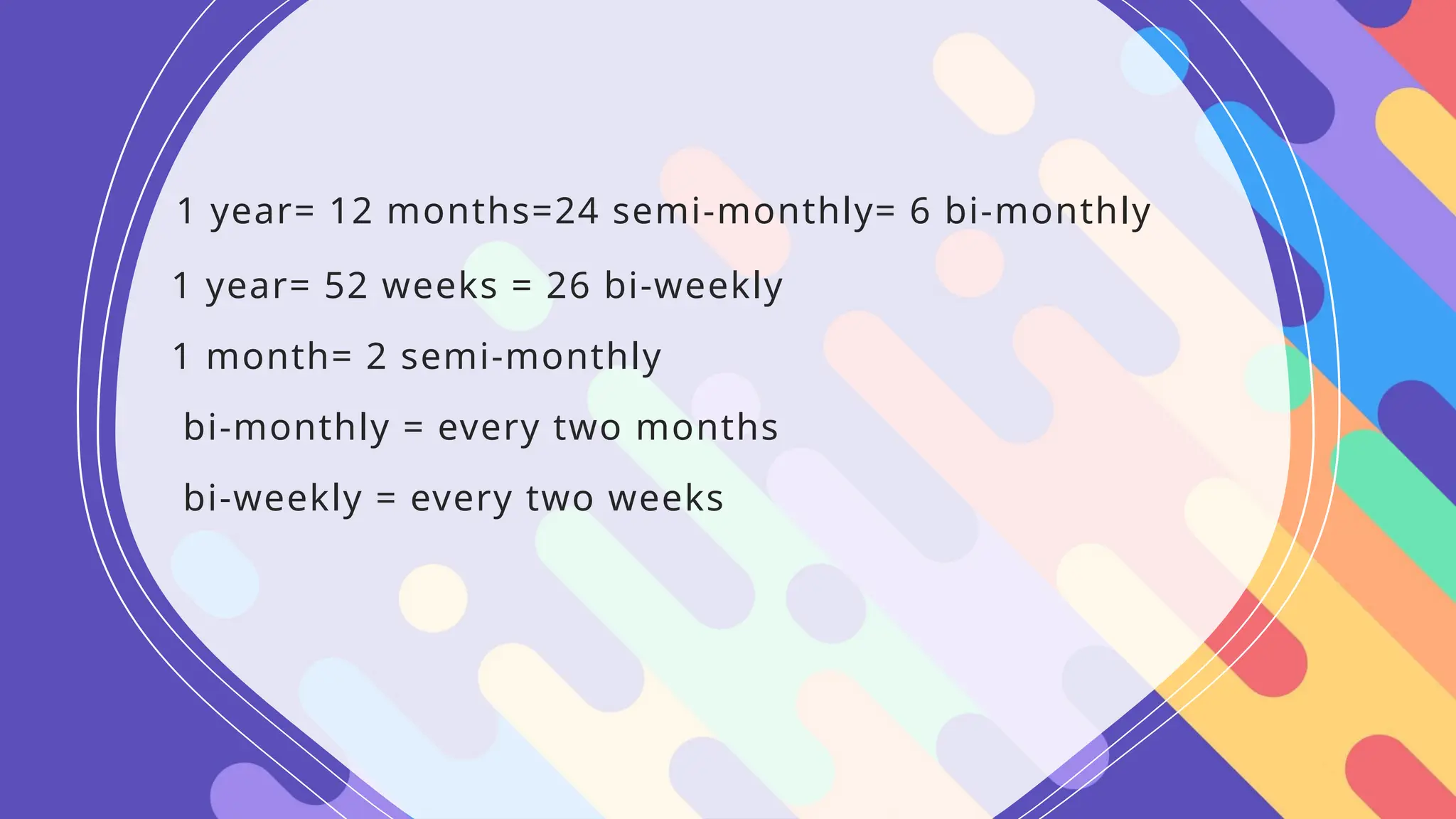
1 year= 12 months=24 semi-monthly= 6 bi-monthly
1 year= 52 weeks = 26 bi-weekly
1 month= 2 semi-monthly
bi-monthly = every two months
bi-weekly = every two weeks
Let us try;
Assuming an annual salary of
P72,000
1. Monthly salary ?
2. Semi-monthly ?
3. Weekly salary ?
4. Bi-weekly salary ?
Let us try;
Assuming an annual salary of
P72,000
1. Monthly salary = P6,000
2. Semi-monthly = P3,000
3. Weekly salary = P1,384.62
4. Bi-weekly salary = P2,769.24
Wages
refer to the earnings received by a
worker on a piece rate, hourly
rate, or daily rate.
Piece Rate
A worker employed on a
“piecework” basis is paid in
proportion to the quantity of work
he or she finishes.
The rate used can be fixed
irrespective of the quantity
produced, in which case it is called
a fixed piece-rate plan. On the
other hand it can be graduated
increasing as the quantity
produced increases, in which case
it is called differential piece-work
plan.
Example:
Annie is paid on a per piece basis
at the rate of P1.20 per piece. If
she finishes 360 a week, how much
is her total earnings?
Example:
Annie is paid on a per piece basis at
the rate of P1.20 per piece. If she
finishes 360 a week, how much is her
total earnings?
Total earnings= Quantity x rate
=360 x P1.20
= P432.00
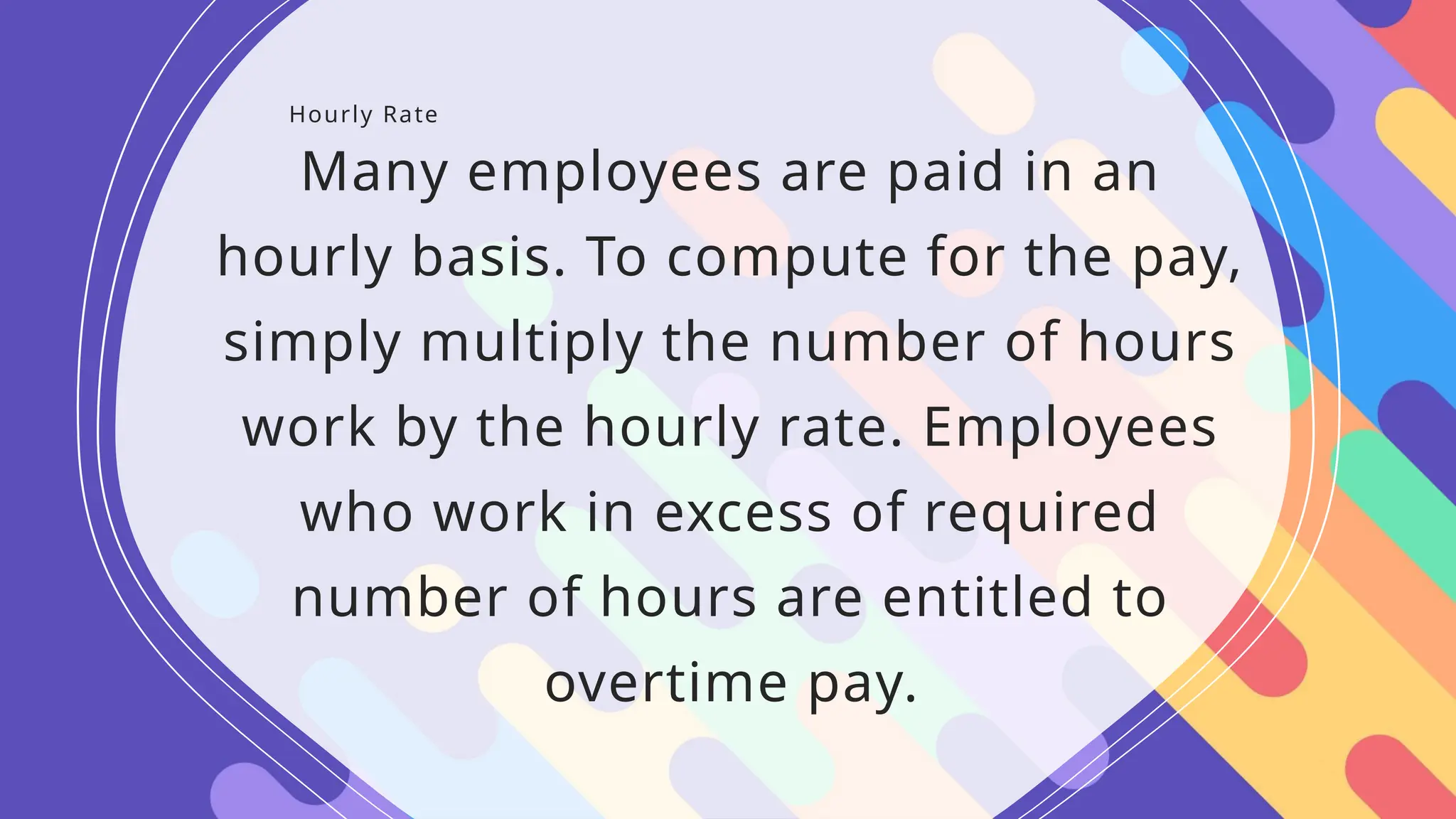
Hourly Rate
Many employees are paid in an
hourly basis. To compute for the pay,
simply multiply the number of hours
work by the hourly rate. Employees
who work in excess of required
number of hours are entitled to
overtime pay.
Articles; Labor Code on relevant hours and
overtime work
Article 83 of the Labor Code enunciates that the
normal hour of work of any employee shall not
exceed eight (8) hours a day. This exclusive of
the one (1) hour break. Article 85 provides that
subject to such regulations as the secretary of
Labor may prescribe, it shall be the duty of every
employer to give employees not less than sixty
(60) minutes time off for their regular meals.
Articles; Labor Code on relevant hours and
overtime work
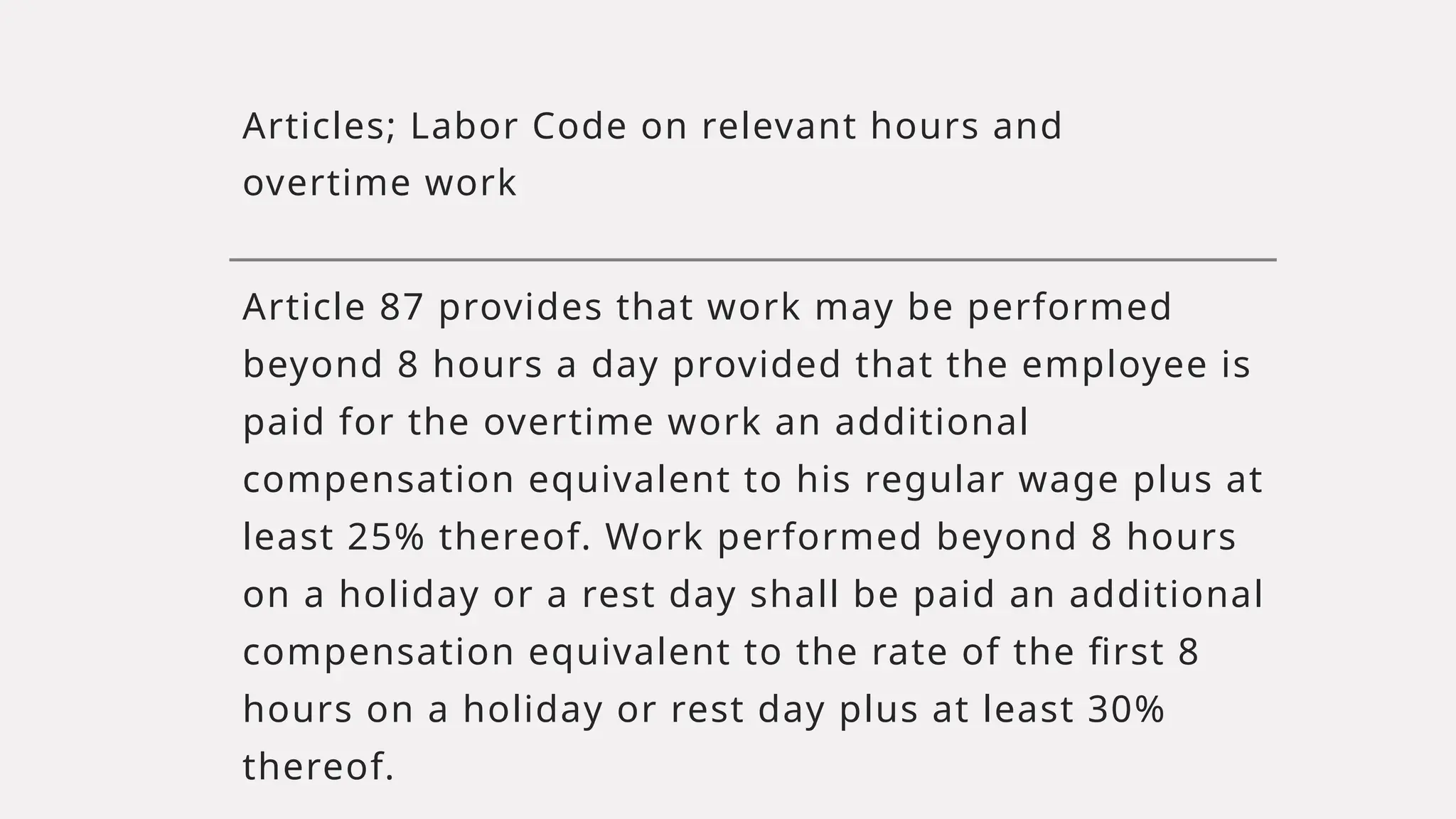
Article 87 provides that work may be performed
beyond 8 hours a day provided that the employee is
paid for the overtime work an additional
compensation equivalent to his regular wage plus at
least 25% thereof. Work performed beyond 8 hours
on a holiday or a rest day shall be paid an additional
compensation equivalent to the rate of the first 8
hours on a holiday or rest day plus at least 30%
thereof.
Articles; Labor Code on relevant hours and
overtime work
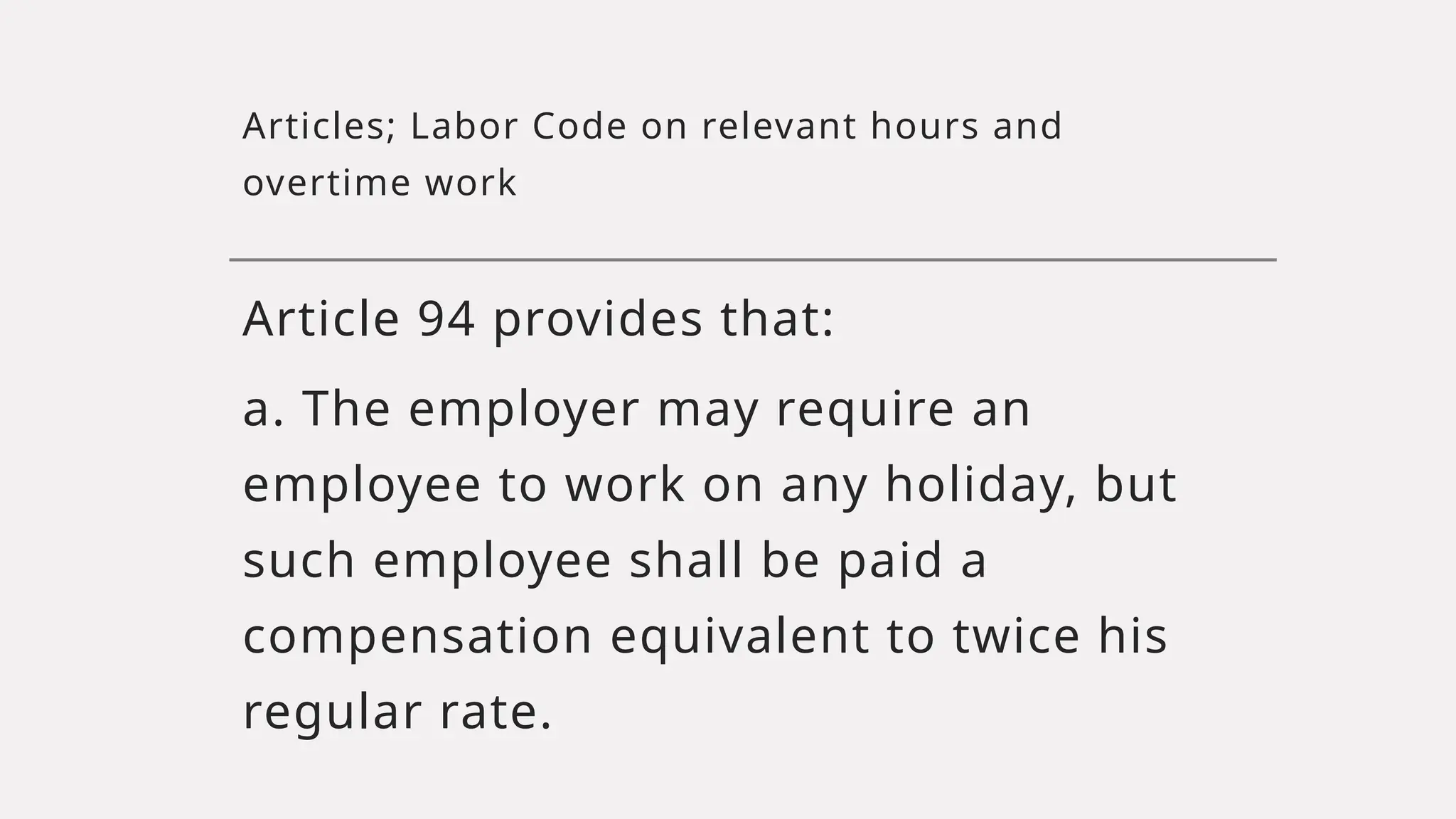
Article 94 provides that:
a. The employer may require an
employee to work on any holiday, but
such employee shall be paid a
compensation equivalent to twice his
regular rate.
Articles; Labor Code on relevant hours and
overtime work
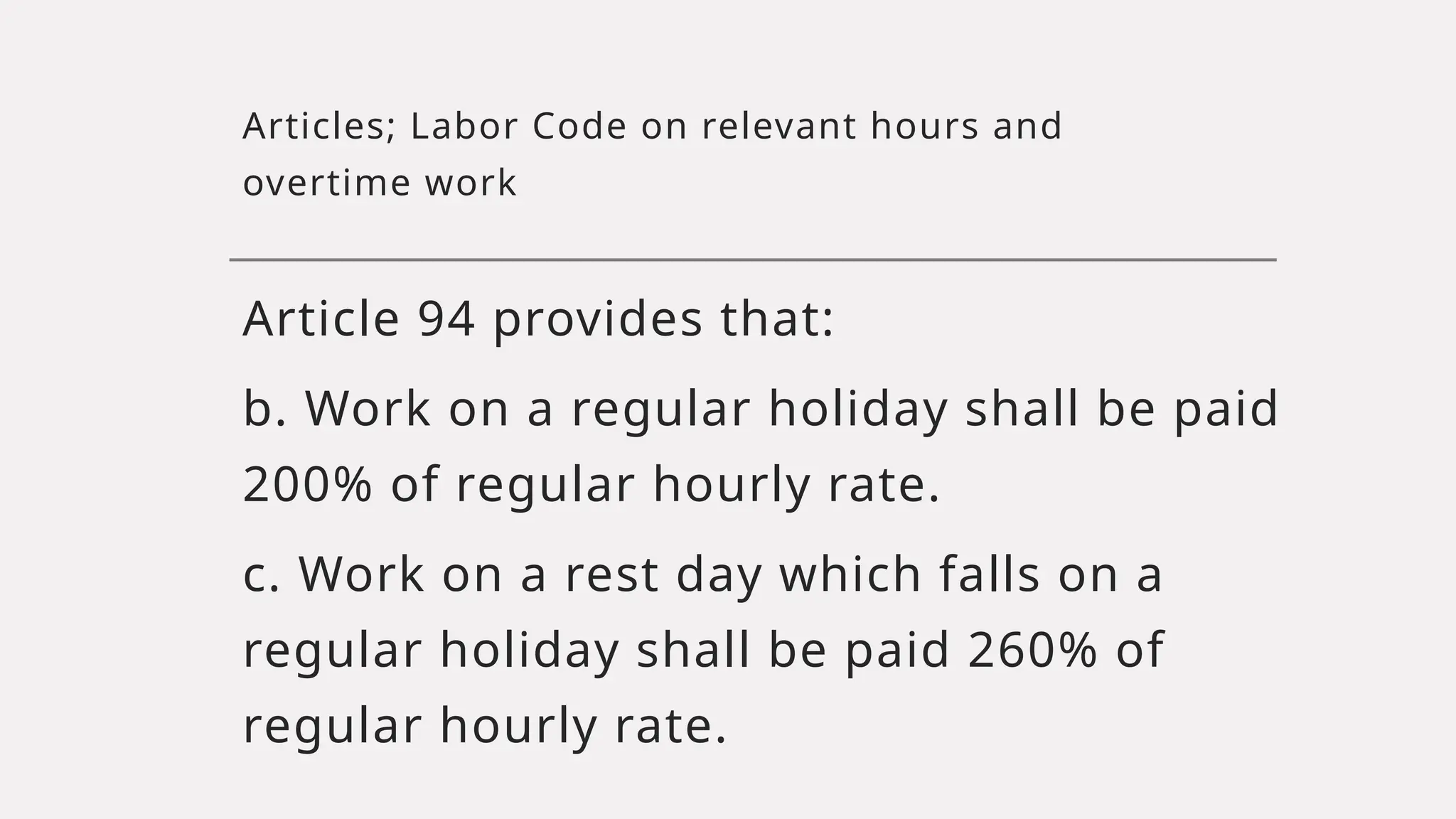
Article 94 provides that:
b. Work on a regular holiday shall be paid
200% of regular hourly rate.
c. Work on a rest day which falls on a
regular holiday shall be paid 260% of
regular hourly rate.
“Labor Codes”Dole gov.Retrieved April 30, 2015 from
http:www.dole.gov.ph/labor_codes/view/4
“Business Mathematics by Norma D. Lopez-Mariano, PhD”_Chapter
4-Salaries and Wages
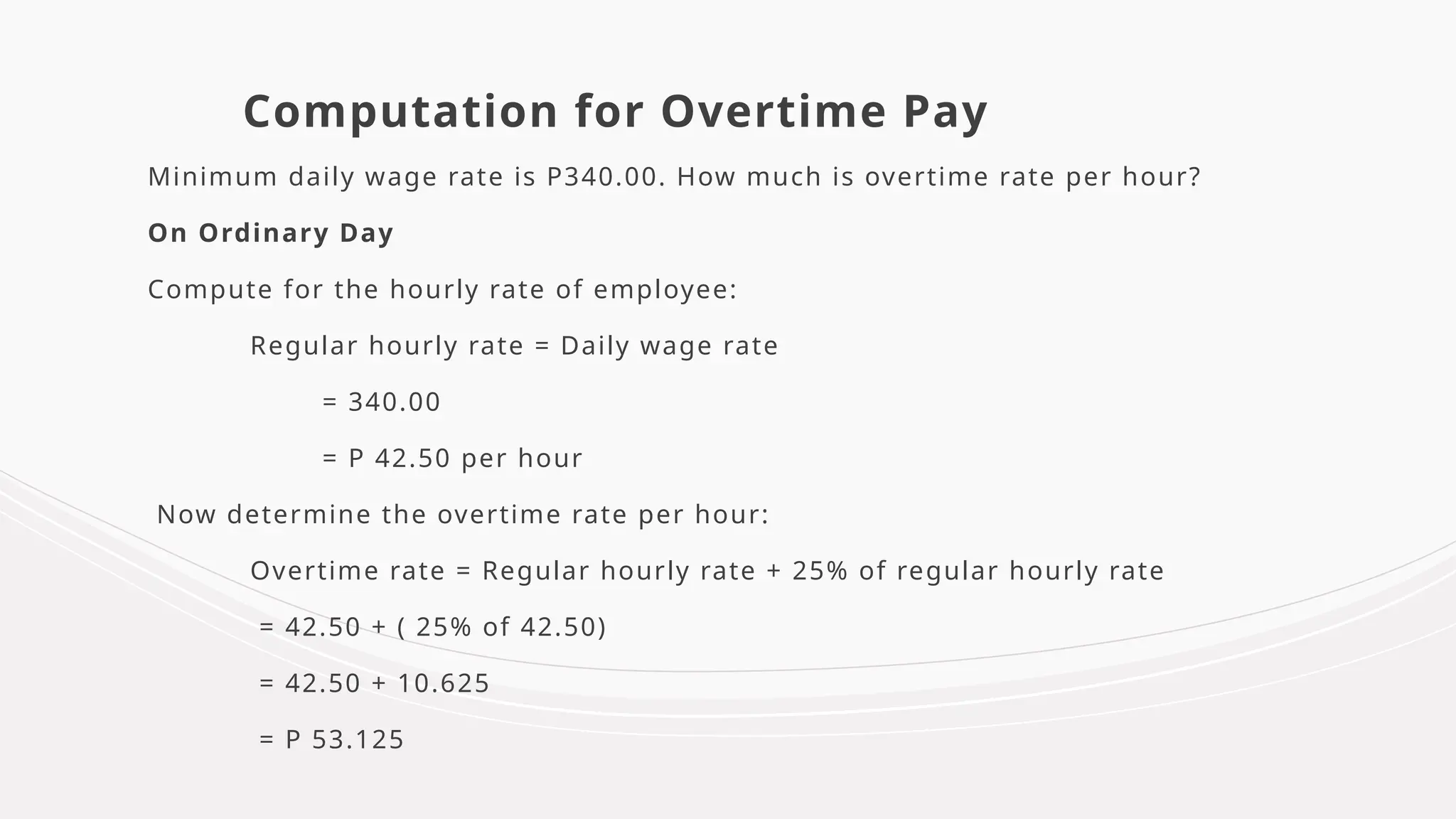
Computation for Overtime Pay
Minimum daily wage rate is P340.00. How much is overtime rate per hour?
On Ordinary Day
Compute for the hourly rate of employee:
Regular hourly rate = Daily wage rate
= 340.00
= P 42.50 per hour
Now determine the overtime rate per hour:
Overtime rate = Regular hourly rate + 25% of regular hourly rate
= 42.50 + ( 25% of 42.50)
= 42.50 + 10.625
= P 53.125
Minimum daily wage rate is P340.00. How much is overtime rate per hour?
On a Regular Holiday
Compute for the hourly rate on regular holiday:
Hourly rate (on regular holiday) = 200% of regular hourly rate
= 200% x 42.50
= P85.00 per hour
to determine the overtime rate per hour:
Overtime rate = hourly rate on regular holiday + 30% of regular hourly rate
on regular holiday
= 85.00 + ( 30% of 85.00)
= 85.00 + 25.50
= P 110.50
Income
Wages and salaries are income to the person receiving it. However for people who are not
employees their income may not be in a form of salaries and wages, they can be commission
income, rental income, investment income, etc.
Employees Benefits covers remuneration other than basic pay, it includes vacation and sick
leave, maternity leave, medical and hospitalization benefit, meal allowance, transportation
allowance, clothing allowance, 13th
month pay, bonuses, etc.
• Vacation Leave: Thirteen vacation day, with additional one vacation day every year
starting 2nd
year of service and convertible to cash at the end of each year. Maximum
vacation leave is 18 days.
• Sick Leave: Twelve days per year for the first two years of service. With additional one day
sick leave every year, starting on 2nd
year of service. Maximum total sick leave is 15 days.
• Maternity Leave: benefit received by the pregnant employee to time off from a
job to give birth and to take care of a new born baby.
• Meal allowance or so called food allowance, is a set amount of money given to
employees for them to use to purchase food.
• 13th
month: is a mandatory benefit given to employee, pursuant to presidential
decree No. 851, employee shall be grant 13th
month pay, employee should be
receive 13th
month pay not later than December 24.
How to compute
13th
month pay = Basic Salary x Employment length
Lesson 2: PAYROLL DEDUCTIONS
An employee’s gross earning are not what he or she take home. The take
home pay of an employee is his or her gross earning less certain payroll
deduction. These are certain deductions from gross earning to arrive at or
compute for an employee’s net pay.
1. Employee’s SSS contribution for private employees
2. Employee’s GSIS contribution for government employees
3. PhilHealth contribution for all employees
4. Withholding taxes for all employees
5. Salary advances and Union dues
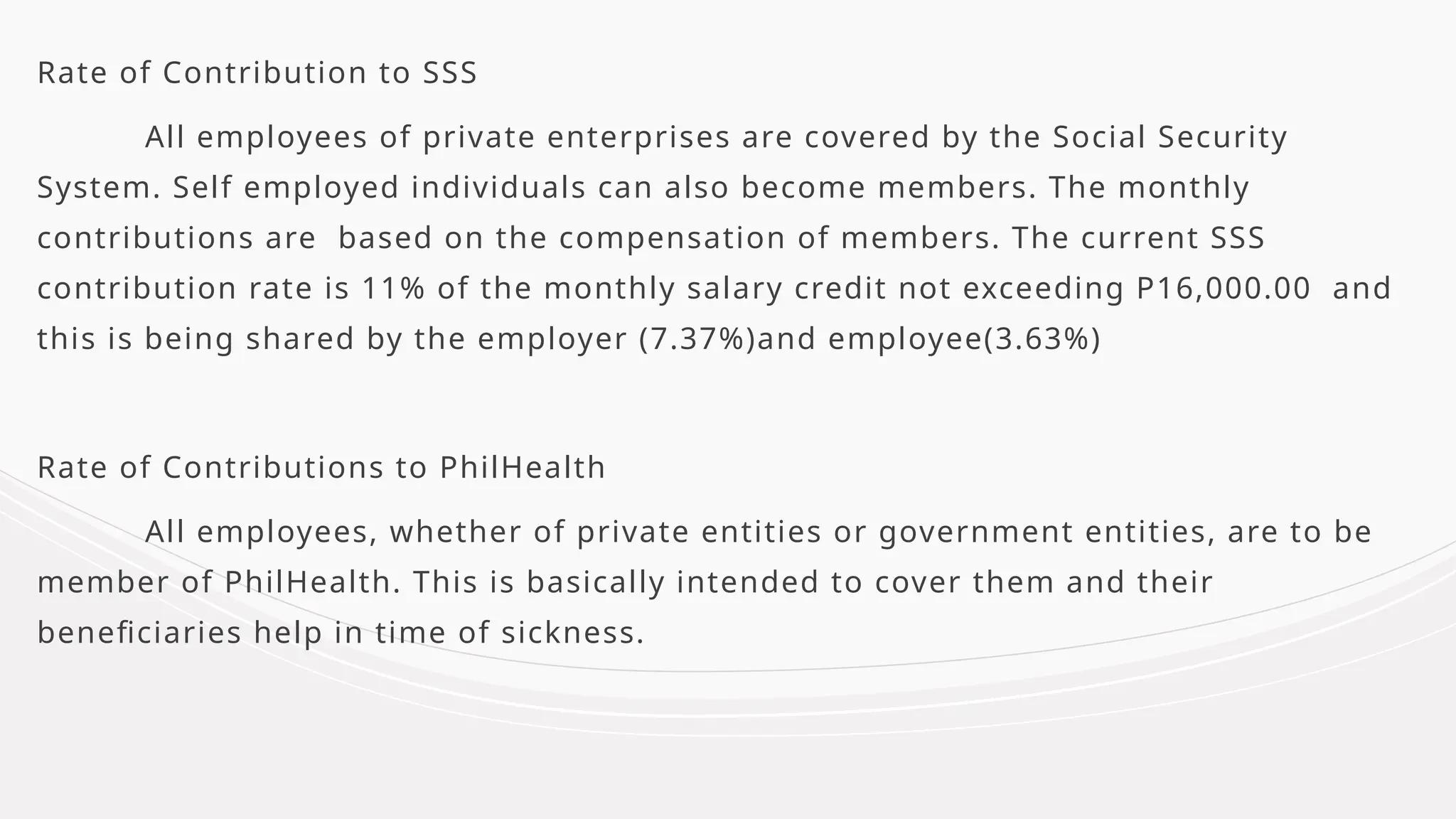
Rate of Contribution to SSS
All employees of private enterprises are covered by the Social Security
System. Self employed individuals can also become members. The monthly
contributions are based on the compensation of members. The current SSS
contribution rate is 11% of the monthly salary credit not exceeding P16,000.00 and
this is being shared by the employer (7.37%)and employee(3.63%)
Rate of Contributions to PhilHealth
All employees, whether of private entities or government entities, are to be
member of PhilHealth. This is basically intended to cover them and their
beneficiaries help in time of sickness.
Rate of Contribution to GSIS
All government employees holding permanent and non permanent position
are member of GSIS. Premium contributions are based on monthly compensation.
There are two types of insurance coverage.
1. Regular – refer to compulsory premium payments on life insurance and
retirement benefits
2. Employees Compensation Fund – refer to a premium payment paid by your
government agency so you get full coverage in case of a work related accident
B_M_3 (1).pptx.BusinessMathematics Lesson

B_M_3 (1).pptx.BusinessMathematics Lesson

  • 1.
  • 2.
    Chapter 4 :SALARIES AND WAGES
  • 3.
    Lesson 1 :Employee Compensation
  • 4.
    Lesson Objectives 1. Employeecompensation; 2. Differentiate salary, wage and income; 3. Solve problem related to piece rate earner, and hourly paid earners including overtime pay; 4. Enumerate and define the different benefits given to an employee
  • 5.
    Lesson Pre-assessment 1. Rolandoearns P30.00 per hour. For the week, he worked at a total of 35 hours. How much did he earn? 2. Pearl works as a dressmaker. She is paid P150.00 for every dress that she finishes. For the week, Pearl finished 5 dresses. How much did she earn?
  • 6.
    Salary A fixed regularpayment typically paid on a monthly or bi-weekly basis but often expressed as an annual sum, made by an employer to an employee, especially a professional or white- collar worker
  • 7.
    Earning of employeespaid on a monthly or annual basis is generally referred to as salary. It is sometimes necessary to convert salaries on annual basis into monthly, weekly to monthly, monthly to semi-monthly,. In these case we should always remember that:
  • 8.
    1 year= 12months=24 semi-monthly= 6 bi-monthly 1 year= 52 weeks = 26 bi-weekly 1 month= 2 semi-monthly bi-monthly = every two months bi-weekly = every two weeks
  • 9.
    Let us try; Assumingan annual salary of P72,000 1. Monthly salary ? 2. Semi-monthly ? 3. Weekly salary ? 4. Bi-weekly salary ?
  • 10.
    Let us try; Assumingan annual salary of P72,000 1. Monthly salary = P6,000 2. Semi-monthly = P3,000 3. Weekly salary = P1,384.62 4. Bi-weekly salary = P2,769.24
  • 11.
    Wages refer to theearnings received by a worker on a piece rate, hourly rate, or daily rate.
  • 12.
    Piece Rate A workeremployed on a “piecework” basis is paid in proportion to the quantity of work he or she finishes.
  • 13.
    The rate usedcan be fixed irrespective of the quantity produced, in which case it is called a fixed piece-rate plan. On the other hand it can be graduated increasing as the quantity produced increases, in which case it is called differential piece-work plan.
  • 14.
    Example: Annie is paidon a per piece basis at the rate of P1.20 per piece. If she finishes 360 a week, how much is her total earnings?
  • 15.
    Example: Annie is paidon a per piece basis at the rate of P1.20 per piece. If she finishes 360 a week, how much is her total earnings? Total earnings= Quantity x rate =360 x P1.20 = P432.00
  • 16.
    Hourly Rate Many employeesare paid in an hourly basis. To compute for the pay, simply multiply the number of hours work by the hourly rate. Employees who work in excess of required number of hours are entitled to overtime pay.
  • 17.
    Articles; Labor Codeon relevant hours and overtime work Article 83 of the Labor Code enunciates that the normal hour of work of any employee shall not exceed eight (8) hours a day. This exclusive of the one (1) hour break. Article 85 provides that subject to such regulations as the secretary of Labor may prescribe, it shall be the duty of every employer to give employees not less than sixty (60) minutes time off for their regular meals.
  • 18.
    Articles; Labor Codeon relevant hours and overtime work Article 87 provides that work may be performed beyond 8 hours a day provided that the employee is paid for the overtime work an additional compensation equivalent to his regular wage plus at least 25% thereof. Work performed beyond 8 hours on a holiday or a rest day shall be paid an additional compensation equivalent to the rate of the first 8 hours on a holiday or rest day plus at least 30% thereof.
  • 19.
    Articles; Labor Codeon relevant hours and overtime work Article 94 provides that: a. The employer may require an employee to work on any holiday, but such employee shall be paid a compensation equivalent to twice his regular rate.
  • 20.
    Articles; Labor Codeon relevant hours and overtime work Article 94 provides that: b. Work on a regular holiday shall be paid 200% of regular hourly rate. c. Work on a rest day which falls on a regular holiday shall be paid 260% of regular hourly rate.
  • 21.
    “Labor Codes”Dole gov.RetrievedApril 30, 2015 from http:www.dole.gov.ph/labor_codes/view/4 “Business Mathematics by Norma D. Lopez-Mariano, PhD”_Chapter 4-Salaries and Wages
  • 22.
    Computation for OvertimePay Minimum daily wage rate is P340.00. How much is overtime rate per hour? On Ordinary Day Compute for the hourly rate of employee: Regular hourly rate = Daily wage rate = 340.00 = P 42.50 per hour Now determine the overtime rate per hour: Overtime rate = Regular hourly rate + 25% of regular hourly rate = 42.50 + ( 25% of 42.50) = 42.50 + 10.625 = P 53.125
  • 23.
    Minimum daily wagerate is P340.00. How much is overtime rate per hour? On a Regular Holiday Compute for the hourly rate on regular holiday: Hourly rate (on regular holiday) = 200% of regular hourly rate = 200% x 42.50 = P85.00 per hour to determine the overtime rate per hour: Overtime rate = hourly rate on regular holiday + 30% of regular hourly rate on regular holiday = 85.00 + ( 30% of 85.00) = 85.00 + 25.50 = P 110.50
  • 24.
    Income Wages and salariesare income to the person receiving it. However for people who are not employees their income may not be in a form of salaries and wages, they can be commission income, rental income, investment income, etc. Employees Benefits covers remuneration other than basic pay, it includes vacation and sick leave, maternity leave, medical and hospitalization benefit, meal allowance, transportation allowance, clothing allowance, 13th month pay, bonuses, etc. • Vacation Leave: Thirteen vacation day, with additional one vacation day every year starting 2nd year of service and convertible to cash at the end of each year. Maximum vacation leave is 18 days. • Sick Leave: Twelve days per year for the first two years of service. With additional one day sick leave every year, starting on 2nd year of service. Maximum total sick leave is 15 days.
  • 25.
    • Maternity Leave:benefit received by the pregnant employee to time off from a job to give birth and to take care of a new born baby. • Meal allowance or so called food allowance, is a set amount of money given to employees for them to use to purchase food. • 13th month: is a mandatory benefit given to employee, pursuant to presidential decree No. 851, employee shall be grant 13th month pay, employee should be receive 13th month pay not later than December 24. How to compute 13th month pay = Basic Salary x Employment length
  • 26.
    Lesson 2: PAYROLLDEDUCTIONS An employee’s gross earning are not what he or she take home. The take home pay of an employee is his or her gross earning less certain payroll deduction. These are certain deductions from gross earning to arrive at or compute for an employee’s net pay. 1. Employee’s SSS contribution for private employees 2. Employee’s GSIS contribution for government employees 3. PhilHealth contribution for all employees 4. Withholding taxes for all employees 5. Salary advances and Union dues
  • 27.
    Rate of Contributionto SSS All employees of private enterprises are covered by the Social Security System. Self employed individuals can also become members. The monthly contributions are based on the compensation of members. The current SSS contribution rate is 11% of the monthly salary credit not exceeding P16,000.00 and this is being shared by the employer (7.37%)and employee(3.63%) Rate of Contributions to PhilHealth All employees, whether of private entities or government entities, are to be member of PhilHealth. This is basically intended to cover them and their beneficiaries help in time of sickness.
  • 28.
    Rate of Contributionto GSIS All government employees holding permanent and non permanent position are member of GSIS. Premium contributions are based on monthly compensation. There are two types of insurance coverage. 1. Regular – refer to compulsory premium payments on life insurance and retirement benefits 2. Employees Compensation Fund – refer to a premium payment paid by your government agency so you get full coverage in case of a work related accident