D.I.E.G.O. TOOL D esign  I nterface for  E nergy  G eneration  O ptions Innovative solution for a more sustainable built environment BSE Division: Diego Calandrino Name: Entrant Information
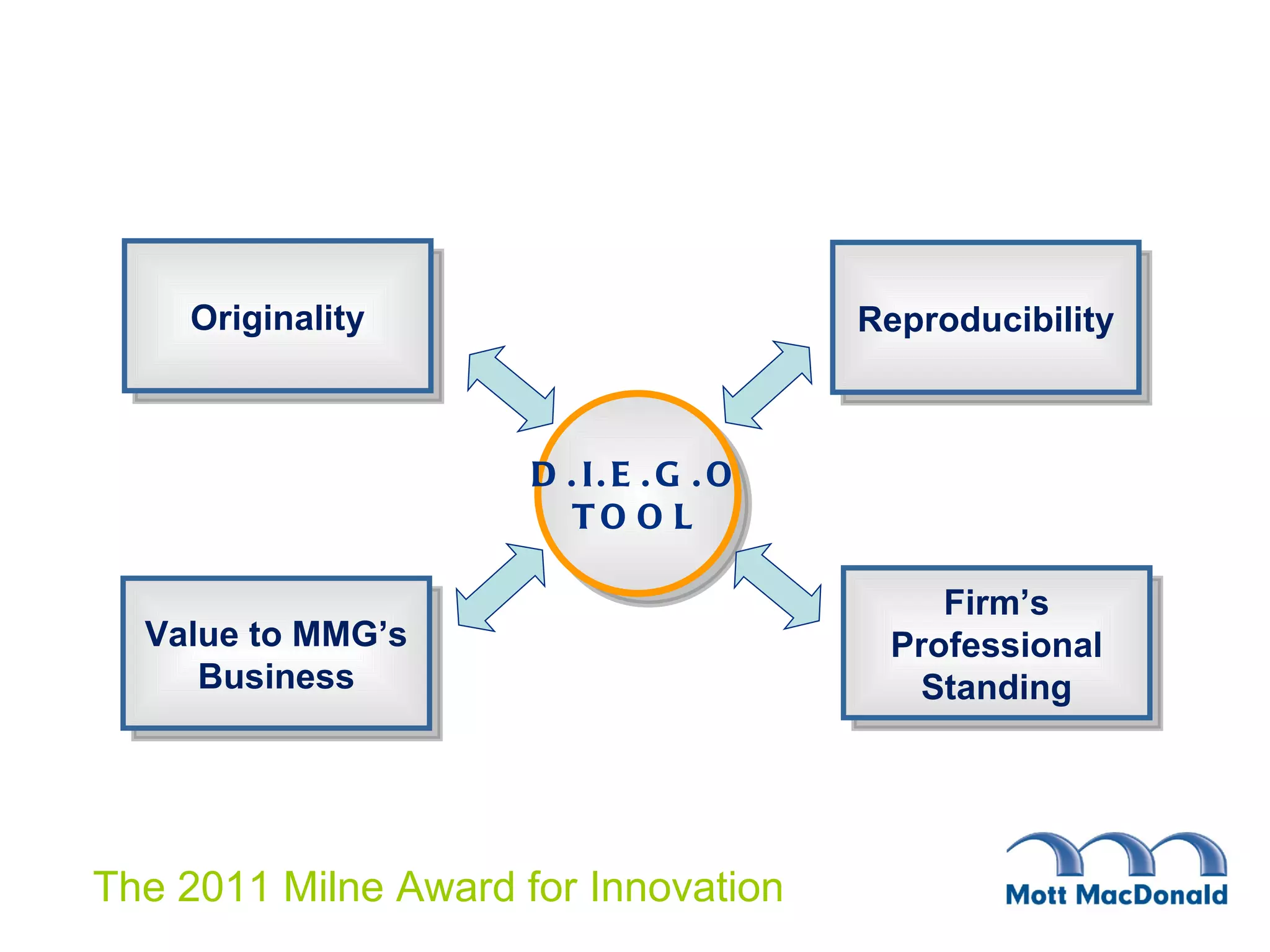
D.I.E.G.O TOOL Originality Reproducibility Value to MMG’s Business Firm’s Professional Standing
Originality Why? What?
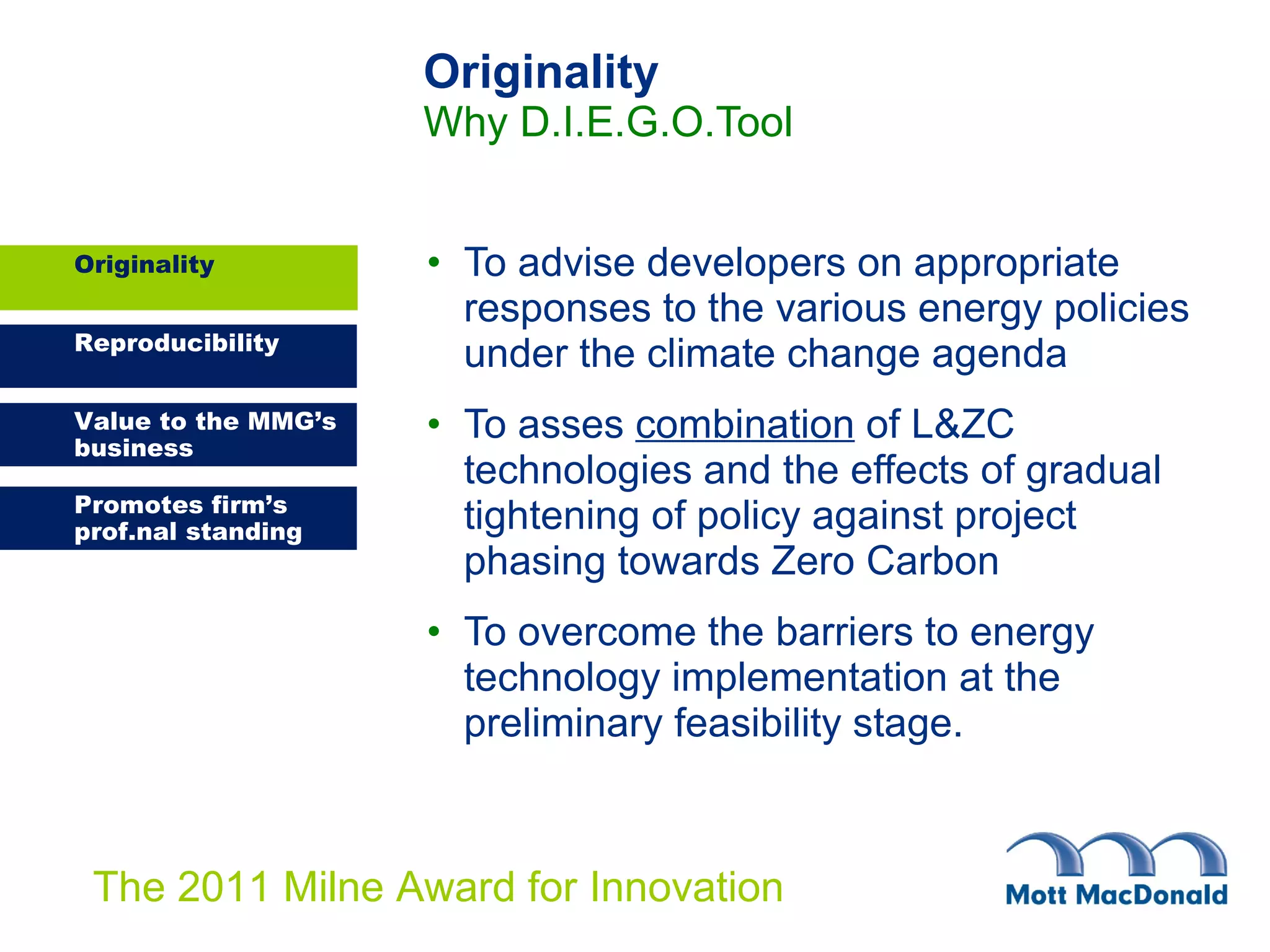
Originality Why D.I.E.G.O.Tool To advise developers on appropriate responses to the various energy policies under the climate change agenda To asses  combination  of  L&ZC technologies and the effects of gradual tightening of policy against project phasing towards Zero Carbon To overcome the barriers to energy technology implementation at the preliminary feasibility stage. Originality
Originality What is D.I.E.G.O.Tool In summary the tool is: An options appraisal tool that generates best energy strategy for multiple buildings or multi-phased masterplans Designed to provide energy strategy before individual building designs have developed beyond accommodation schedules Typically deployed as part of outline planning stage Very well suited to phased developments Helps engineers understand scope, cross-sell services, and   avoid scope-creep Originality
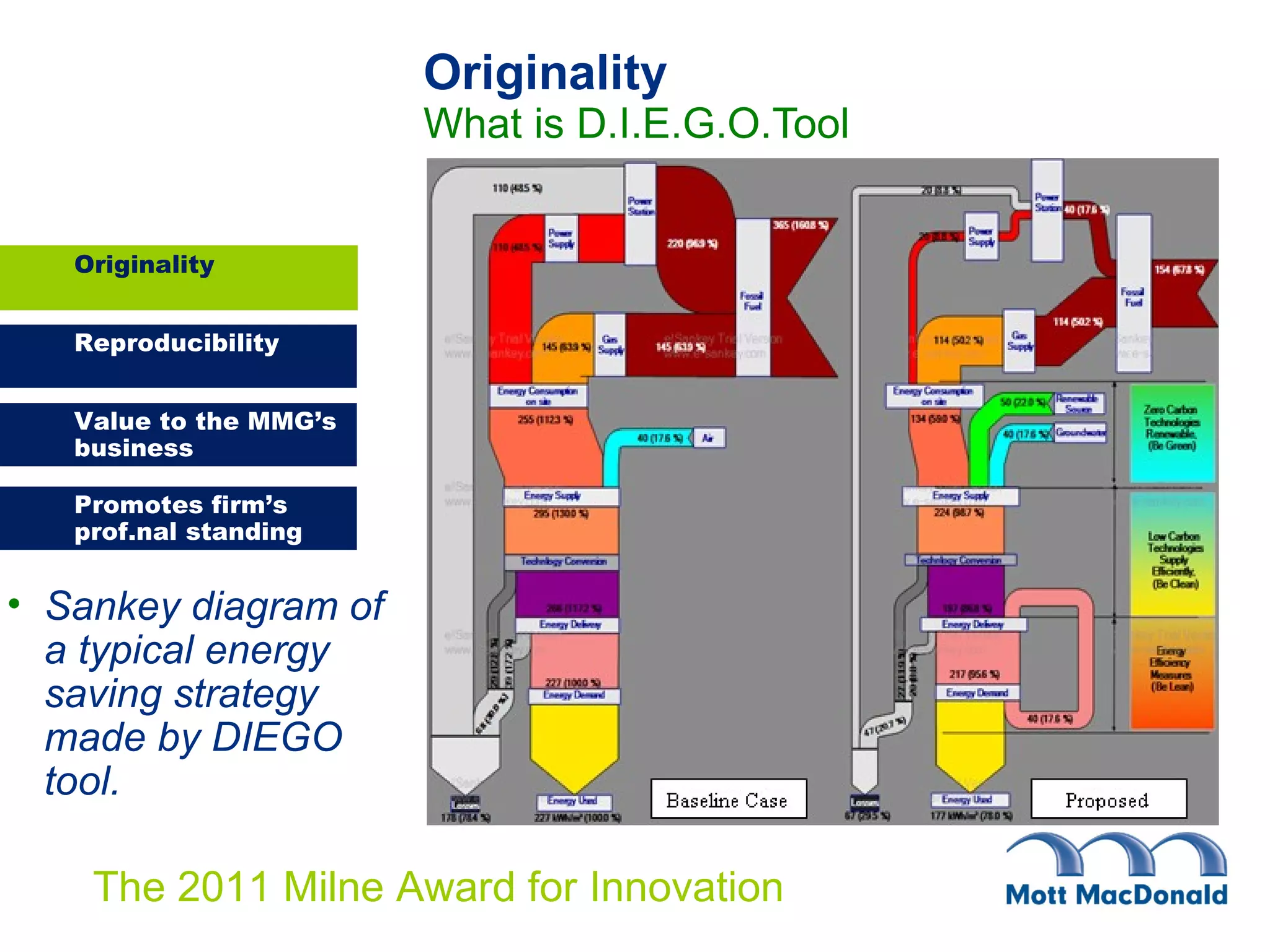
Originality What is D.I.E.G.O.Tool Originality Sankey diagram of a typical energy saving strategy made by DIEGO tool.
Reproducibility How Works?
The model was designed with standardisation and robustness in mind.  A 5 step standard analysis procedure is used to evaluate  the energy production, pre-sizing and carbon dioxide emission reductions for various types of proposed energy efficient and  renewable energy technologies.   Reproducibility Reproducibility How D.I.E.G.O.Tool works
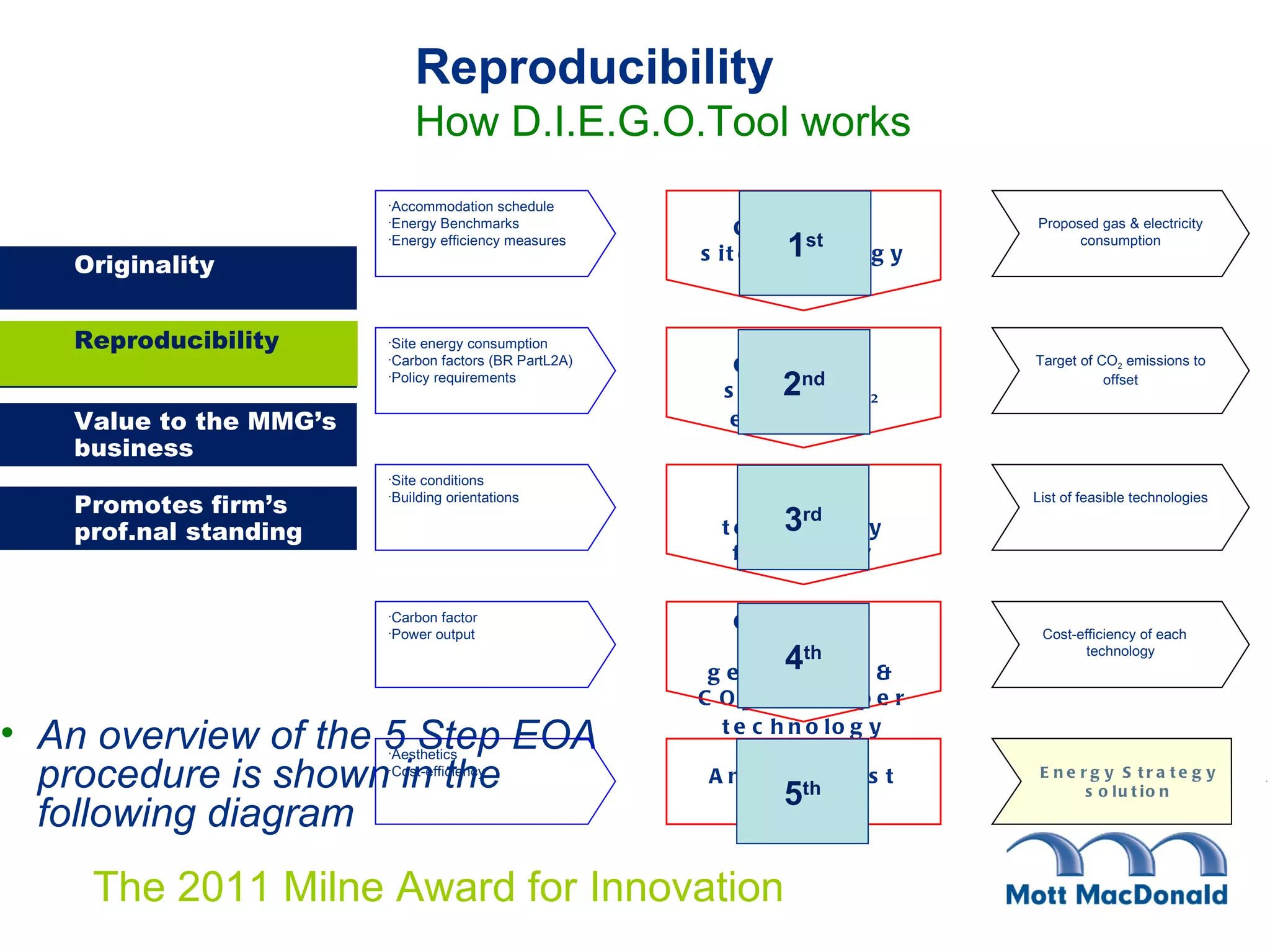
An overview of the 5 Step EOA procedure is shown in the following diagram 1 st 2 nd 3 rd 4 th 5 th Reproducibility Reproducibility How D.I.E.G.O.Tool works Accommodation schedule Energy Benchmarks Energy efficiency measures Calculate site’s energy demand Proposed gas & electricity consumption Site energy consumption Carbon factors (BR PartL2A) Policy requirements Calculate site’s CO 2  emissions Target of CO 2  emissions to offset Site conditions  Building orientations Assess technology feasibility List of feasible technologies Carbon factor Power output Calculate energy generation & CO 2  offset per technology Cost-efficiency of each  technology Aesthetics Cost-efficiency Analyse best options Energy Strategy solution
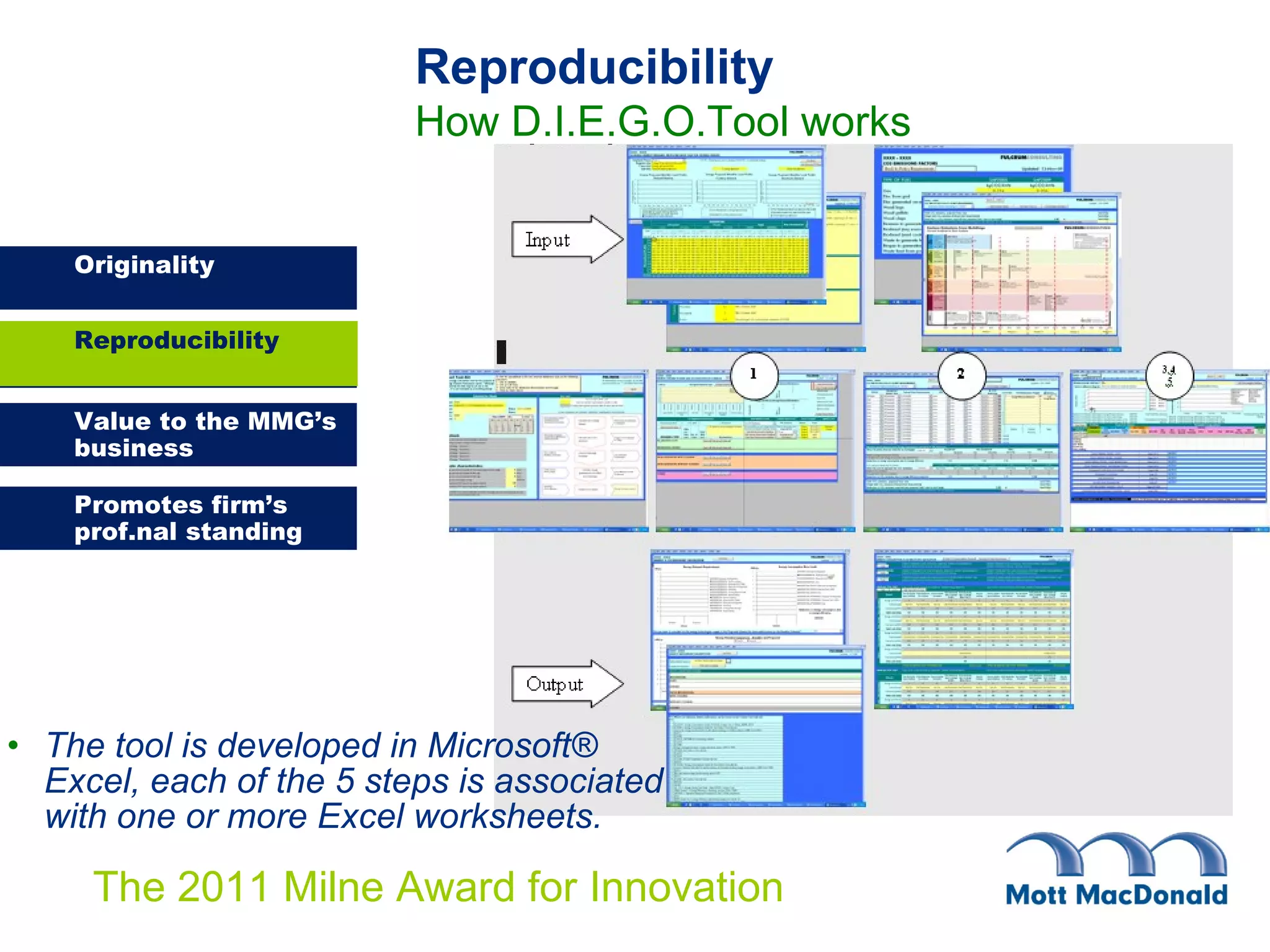
The tool is developed in Microsoft® Excel, each of the 5 steps is associated with one or more Excel worksheets. Reproducibility Reproducibility How D.I.E.G.O.Tool works
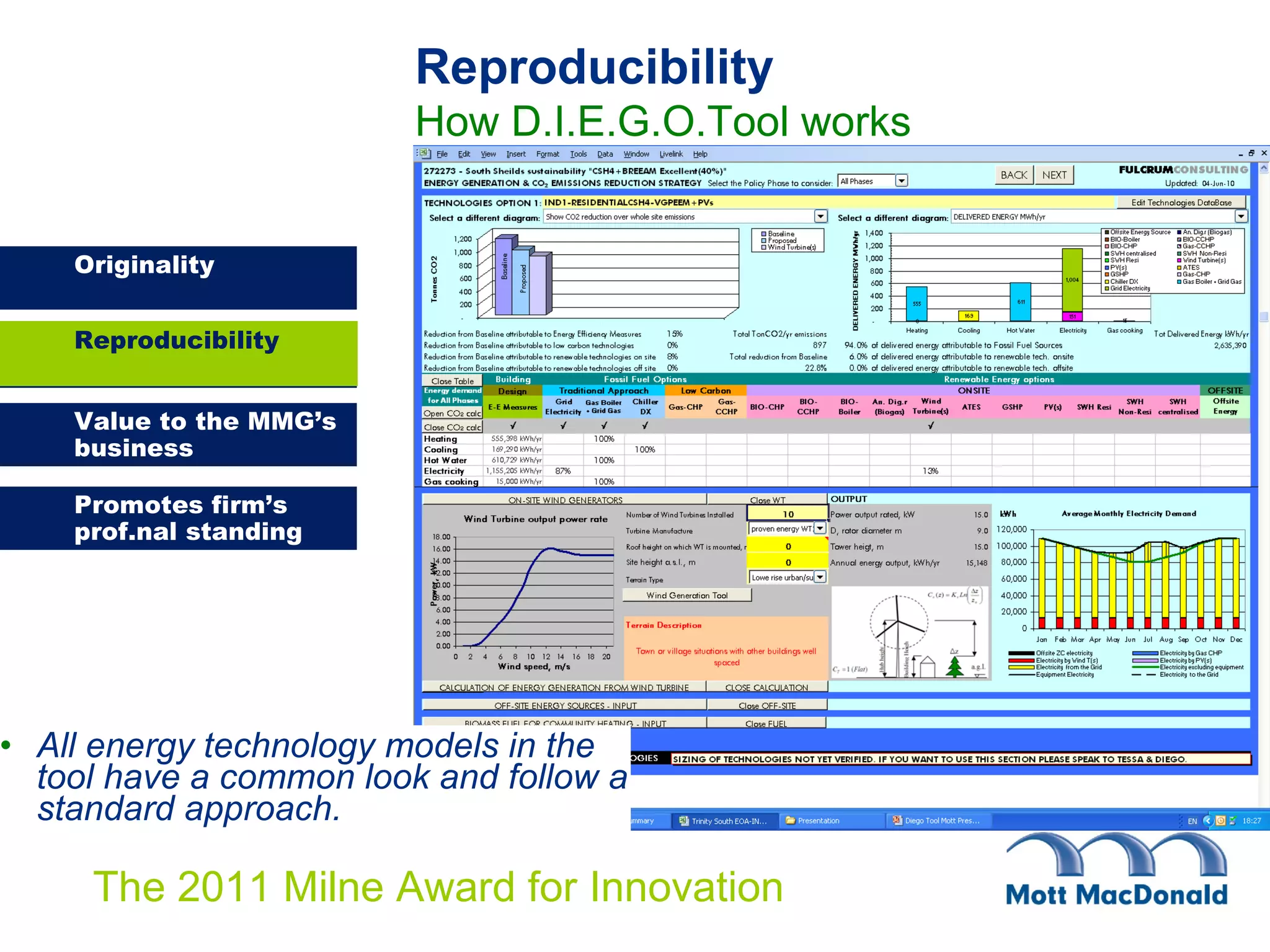
All energy technology models in the tool have a common look and follow a standard approach. Reproducibility Reproducibility How D.I.E.G.O.Tool works
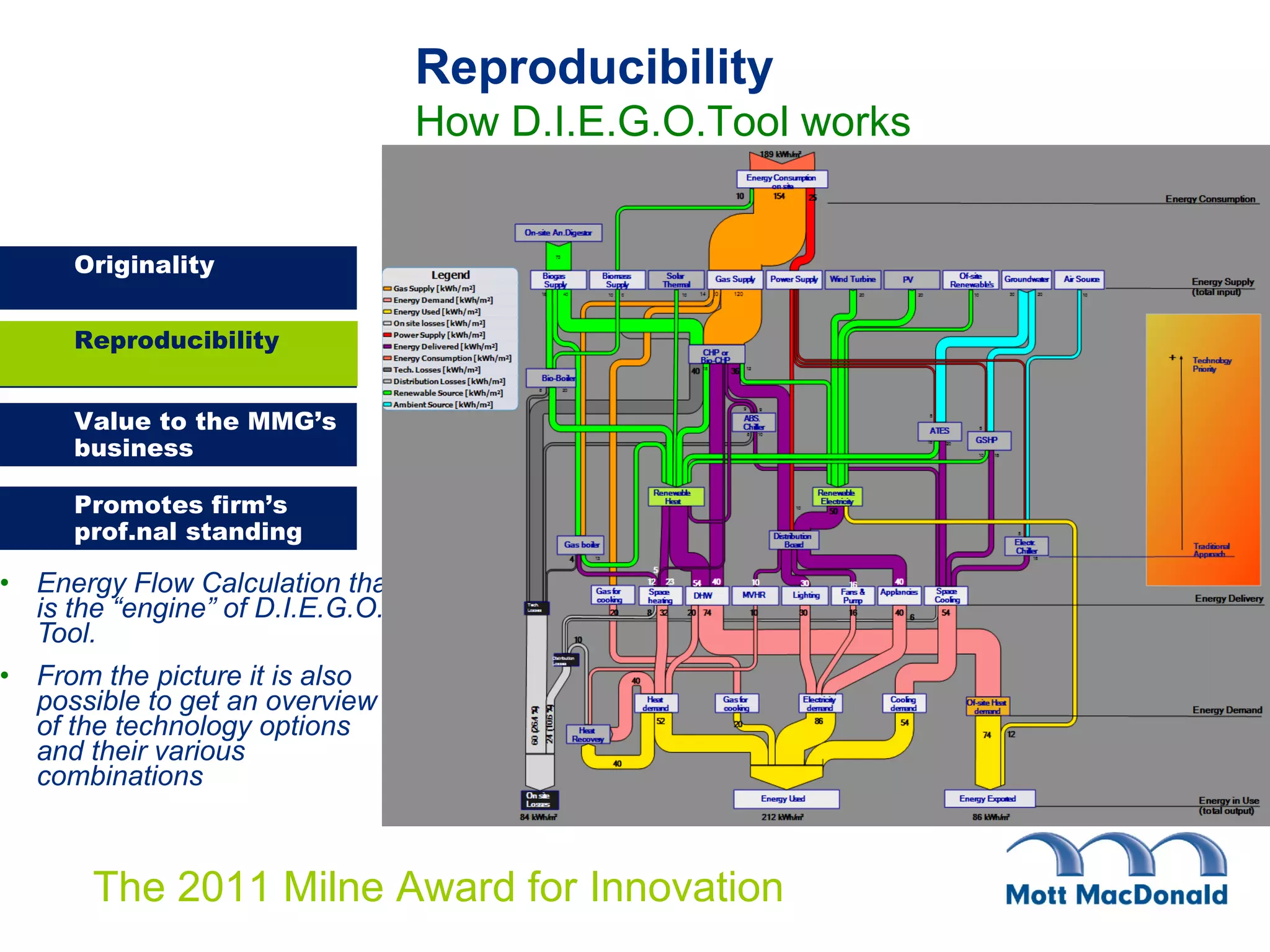
Energy Flow Calculation that is the “engine” of D.I.E.G.O. Tool. From the picture it is also possible to get an overview of the technology options and their various combinations   Reproducibility Reproducibility How D.I.E.G.O.Tool works
Value to MMG’s Business How helps? When helps? Where helps?
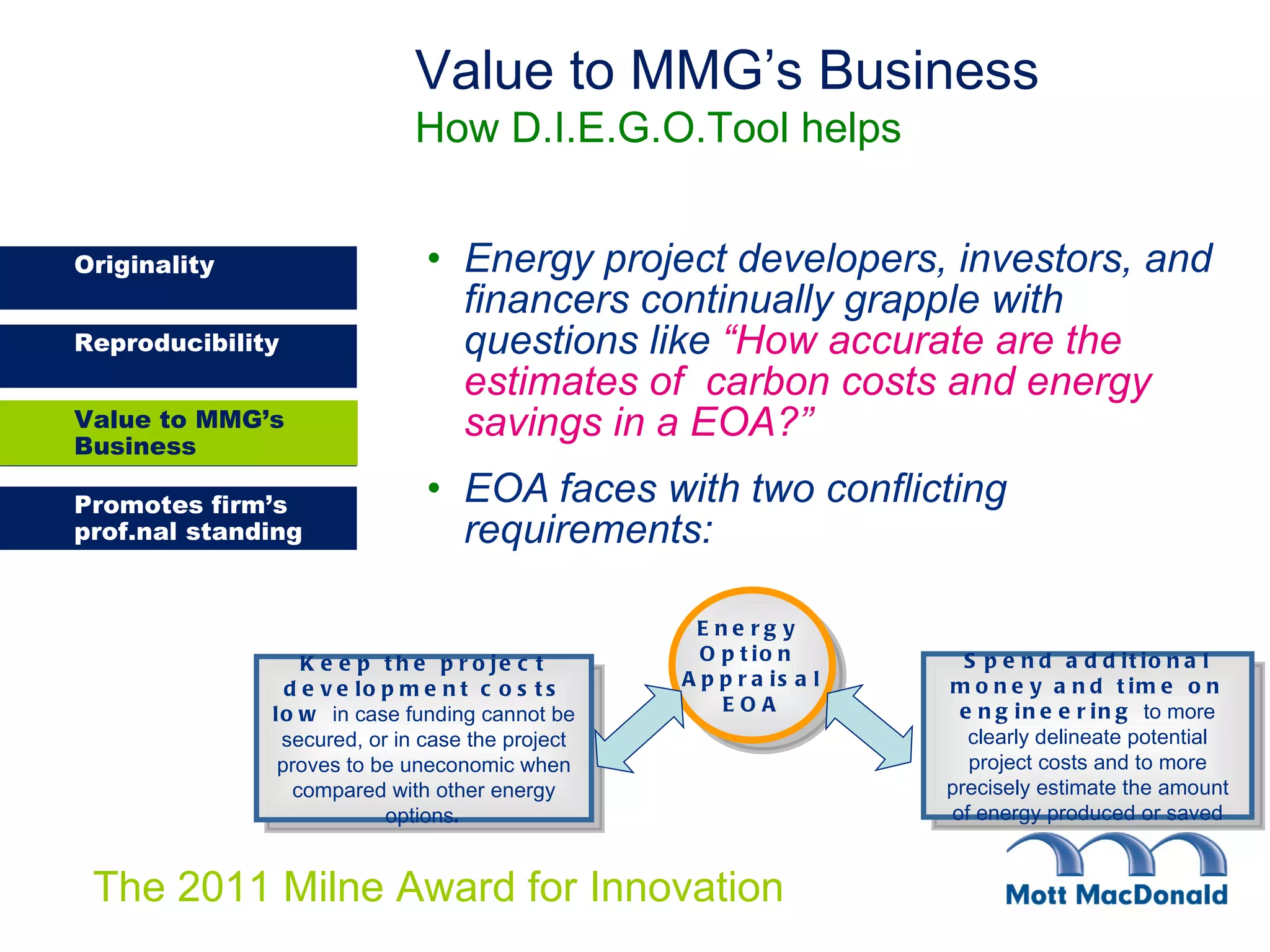
Energy project developers, investors, and financers continually grapple with questions like   “How accurate are the estimates of  carbon costs and energy savings in a EOA?” EOA faces with two conflicting requirements:   Value to MMG’s Business How D.I.E.G.O.Tool helps Value to MMG’s Business Energy  Option  Appraisal EOA Keep the project development costs low  in case funding cannot be secured, or in case the project proves to be uneconomic when compared with other energy options . Spend additional money and time on engineering  to more clearly delineate potential project costs and to more precisely estimate the amount of energy produced or saved
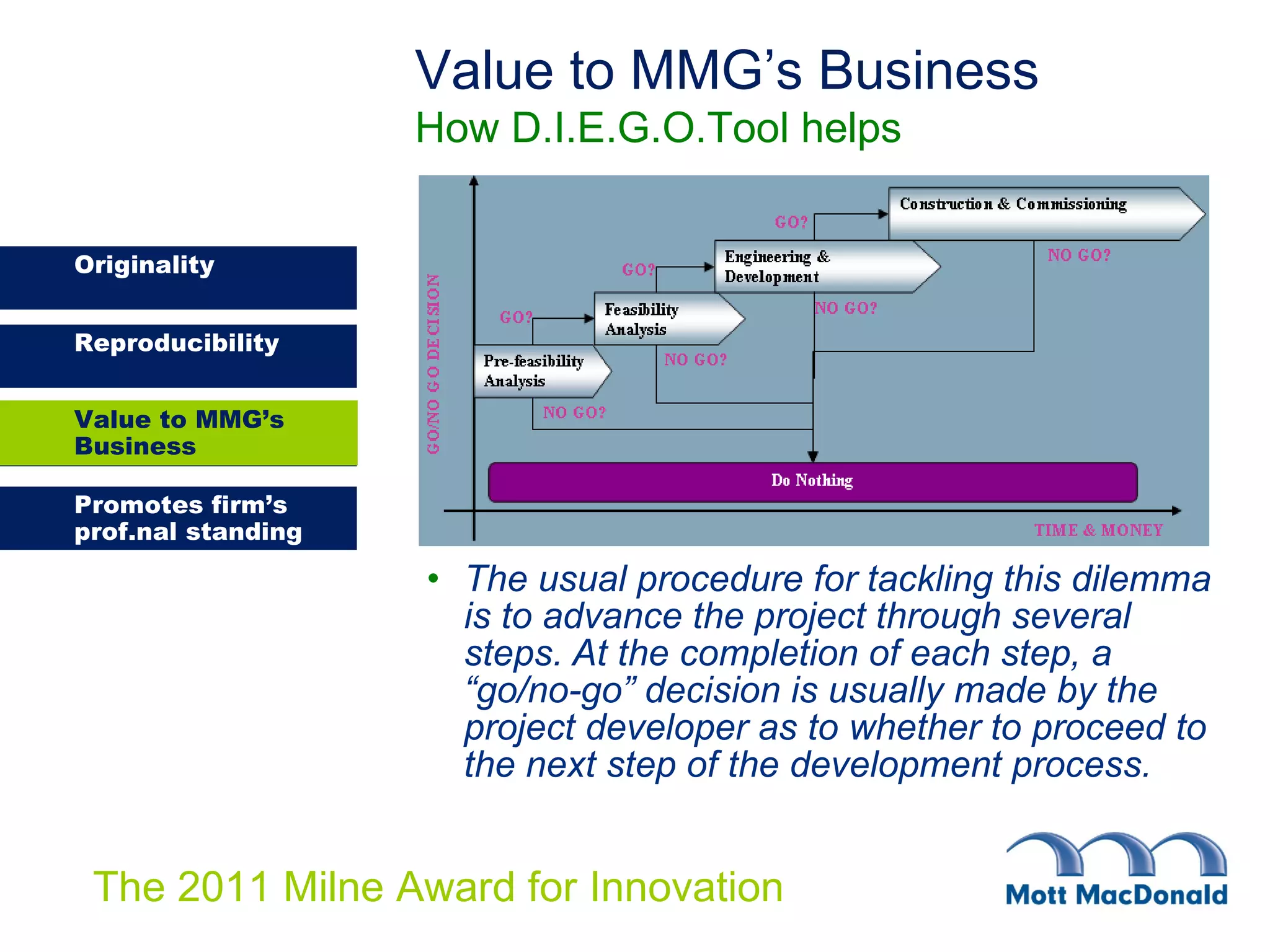
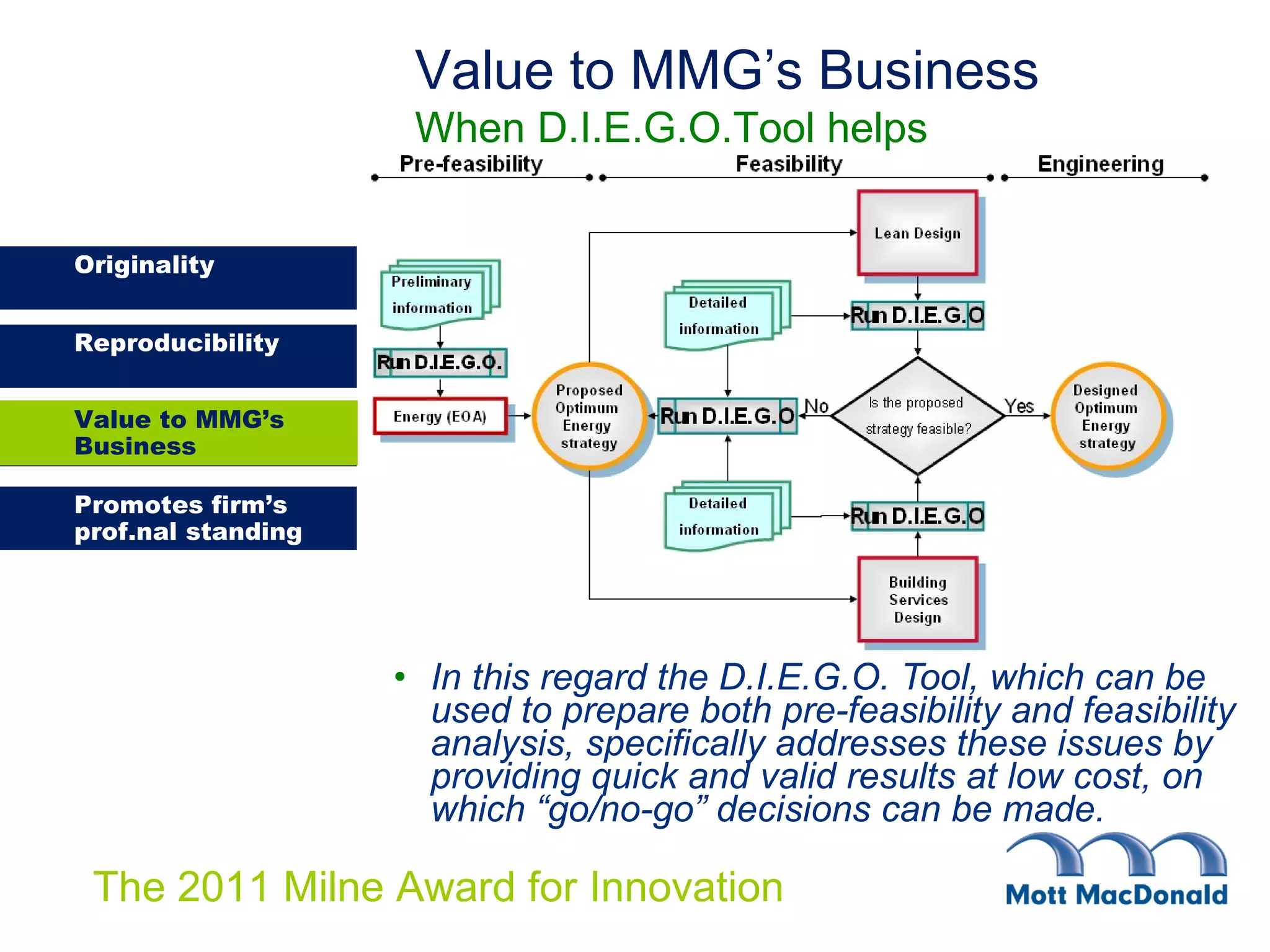
The usual procedure for tackling this dilemma is to advance the project through several steps. At the completion of each step, a “go/no-go” decision is usually made by the project developer as to whether to proceed to the next step of the development process. Value to MMG’s Business How D.I.E.G.O.Tool helps Value to MMG’s Business
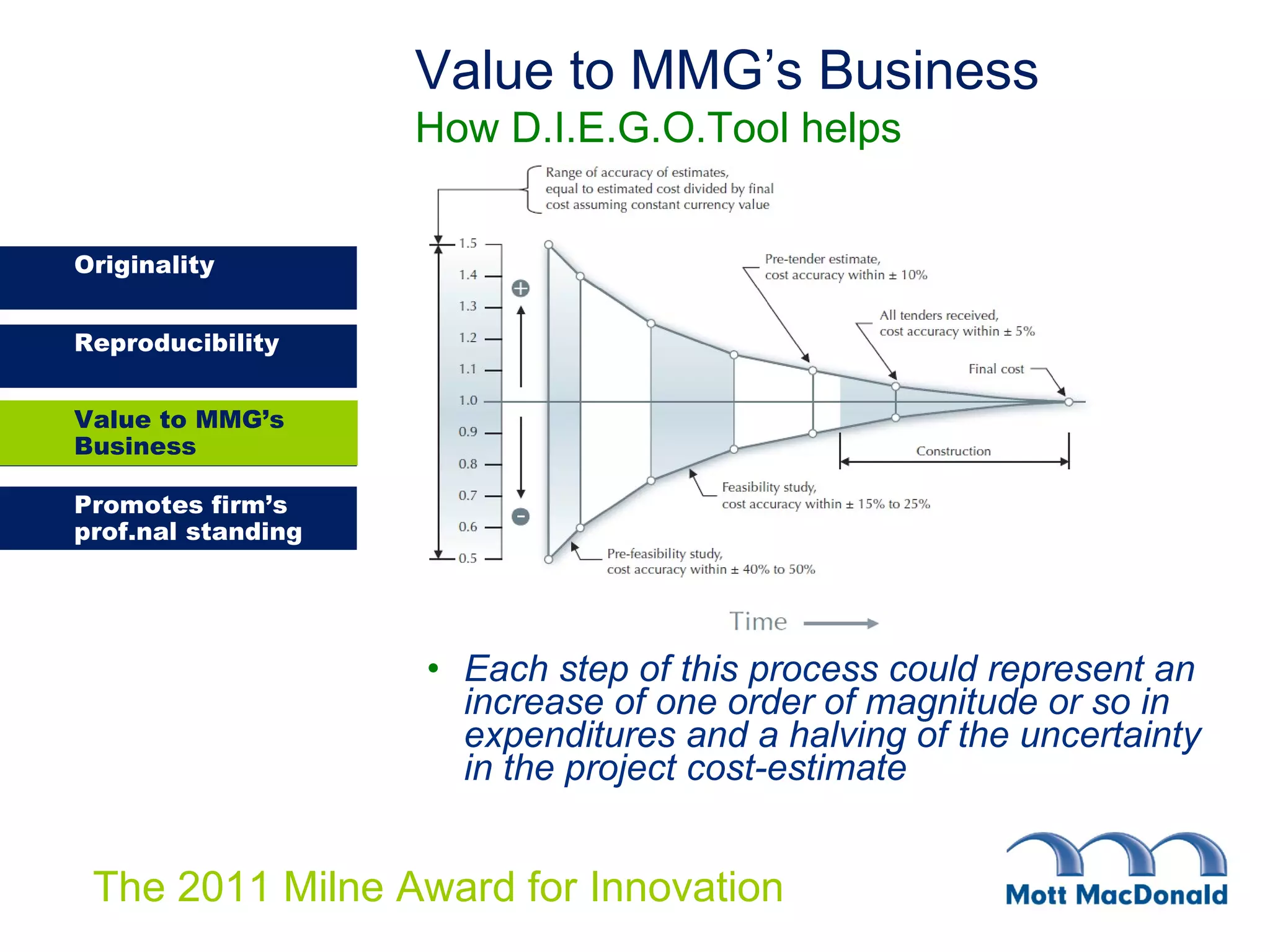
Each step of this process could represent an increase of one order of magnitude or so in expenditures and a halving of the uncertainty in the project cost-estimate Value to MMG’s Business How D.I.E.G.O.Tool helps Value to MMG’s Business
MMG’s ability to provide clients with high quality, low-cost pre-feasibility and feasibility studies is critical to helping them achieve cost and risk certainty, by “screening out” projects that do not make financial sense. Promotes firm’s professional standing   How D.I.E.G.O.Tool helps Value to MMG’s Business
In this regard the D.I.E.G.O. Tool, which can be used to prepare both pre-feasibility and feasibility analysis, specifically addresses these issues by providing quick and valid results at low cost, on which “go/no-go” decisions can be made.   Value to MMG’s Business When D.I.E.G.O.Tool helps Value to MMG’s Business
The Sustainability Masterplanning team have used the resulting tool in  every  sustainability masterplanning project on its books since the tool's creation. Use of the tool on the South Shields project for Turner and Townsend enabled the Sheffield project team to complete the energy strategy commission well within the budget. The tool was included in the Newcastle Science Central bid as one of our USP’s, and we subsequently won the next project phase over the incumbent engineers, Arup. The tool has contributed to the fact that we are one of the preferred consultants for the well known developer Crest Nicholson, from whom BFL had £600k of turnover since 2005. Value to MMG’s Business Where D.I.E.G.O.Tool has been used Value to MMG’s Business
Promotes firm’s professional standing What innovation?
CIBSE - currently being considered as the basis for an industry wide LZC technology toolkit Leading edge in the market  – there are no proprietary tools on the market that even come close to the level of analysis made possible by the D.I.E.G.O. Tool. BIM -  can be adopted as part of the integrated multidisciplinary technologies used to produce a BIM. In fact, it generates information such as the energy-carbon life cycle which represents one of the essential quantities encompassed by BIM.  Promotes firm’s professional standing     How D.I.E.G.O.Tool helps Promotes firm’s prof.nal standing
Any questions?
 

Diego Tool Milne Award 2011 Presentation1

  • 1.
    D.I.E.G.O. TOOL Design I nterface for E nergy G eneration O ptions Innovative solution for a more sustainable built environment BSE Division: Diego Calandrino Name: Entrant Information
  • 2.
    D.I.E.G.O TOOL OriginalityReproducibility Value to MMG’s Business Firm’s Professional Standing
  • 3.
  • 4.
    Originality Why D.I.E.G.O.ToolTo advise developers on appropriate responses to the various energy policies under the climate change agenda To asses combination of L&ZC technologies and the effects of gradual tightening of policy against project phasing towards Zero Carbon To overcome the barriers to energy technology implementation at the preliminary feasibility stage. Originality
  • 5.
    Originality What isD.I.E.G.O.Tool In summary the tool is: An options appraisal tool that generates best energy strategy for multiple buildings or multi-phased masterplans Designed to provide energy strategy before individual building designs have developed beyond accommodation schedules Typically deployed as part of outline planning stage Very well suited to phased developments Helps engineers understand scope, cross-sell services, and avoid scope-creep Originality
  • 6.
    Originality What isD.I.E.G.O.Tool Originality Sankey diagram of a typical energy saving strategy made by DIEGO tool.
  • 7.
  • 8.
    The model wasdesigned with standardisation and robustness in mind. A 5 step standard analysis procedure is used to evaluate the energy production, pre-sizing and carbon dioxide emission reductions for various types of proposed energy efficient and renewable energy technologies. Reproducibility Reproducibility How D.I.E.G.O.Tool works
  • 9.
    An overview ofthe 5 Step EOA procedure is shown in the following diagram 1 st 2 nd 3 rd 4 th 5 th Reproducibility Reproducibility How D.I.E.G.O.Tool works Accommodation schedule Energy Benchmarks Energy efficiency measures Calculate site’s energy demand Proposed gas & electricity consumption Site energy consumption Carbon factors (BR PartL2A) Policy requirements Calculate site’s CO 2 emissions Target of CO 2 emissions to offset Site conditions Building orientations Assess technology feasibility List of feasible technologies Carbon factor Power output Calculate energy generation & CO 2 offset per technology Cost-efficiency of each technology Aesthetics Cost-efficiency Analyse best options Energy Strategy solution
  • 10.
    The tool isdeveloped in Microsoft® Excel, each of the 5 steps is associated with one or more Excel worksheets. Reproducibility Reproducibility How D.I.E.G.O.Tool works
  • 11.
    All energy technologymodels in the tool have a common look and follow a standard approach. Reproducibility Reproducibility How D.I.E.G.O.Tool works
  • 12.
    Energy Flow Calculationthat is the “engine” of D.I.E.G.O. Tool. From the picture it is also possible to get an overview of the technology options and their various combinations Reproducibility Reproducibility How D.I.E.G.O.Tool works
  • 13.
    Value to MMG’sBusiness How helps? When helps? Where helps?
  • 14.
    Energy project developers,investors, and financers continually grapple with questions like “How accurate are the estimates of carbon costs and energy savings in a EOA?” EOA faces with two conflicting requirements: Value to MMG’s Business How D.I.E.G.O.Tool helps Value to MMG’s Business Energy Option Appraisal EOA Keep the project development costs low in case funding cannot be secured, or in case the project proves to be uneconomic when compared with other energy options . Spend additional money and time on engineering to more clearly delineate potential project costs and to more precisely estimate the amount of energy produced or saved
  • 15.
    The usual procedurefor tackling this dilemma is to advance the project through several steps. At the completion of each step, a “go/no-go” decision is usually made by the project developer as to whether to proceed to the next step of the development process. Value to MMG’s Business How D.I.E.G.O.Tool helps Value to MMG’s Business
  • 16.
    Each step ofthis process could represent an increase of one order of magnitude or so in expenditures and a halving of the uncertainty in the project cost-estimate Value to MMG’s Business How D.I.E.G.O.Tool helps Value to MMG’s Business
  • 17.
    MMG’s ability toprovide clients with high quality, low-cost pre-feasibility and feasibility studies is critical to helping them achieve cost and risk certainty, by “screening out” projects that do not make financial sense. Promotes firm’s professional standing How D.I.E.G.O.Tool helps Value to MMG’s Business
  • 18.
    In this regardthe D.I.E.G.O. Tool, which can be used to prepare both pre-feasibility and feasibility analysis, specifically addresses these issues by providing quick and valid results at low cost, on which “go/no-go” decisions can be made. Value to MMG’s Business When D.I.E.G.O.Tool helps Value to MMG’s Business
  • 19.
    The Sustainability Masterplanningteam have used the resulting tool in every sustainability masterplanning project on its books since the tool's creation. Use of the tool on the South Shields project for Turner and Townsend enabled the Sheffield project team to complete the energy strategy commission well within the budget. The tool was included in the Newcastle Science Central bid as one of our USP’s, and we subsequently won the next project phase over the incumbent engineers, Arup. The tool has contributed to the fact that we are one of the preferred consultants for the well known developer Crest Nicholson, from whom BFL had £600k of turnover since 2005. Value to MMG’s Business Where D.I.E.G.O.Tool has been used Value to MMG’s Business
  • 20.
    Promotes firm’s professionalstanding What innovation?
  • 21.
    CIBSE - currentlybeing considered as the basis for an industry wide LZC technology toolkit Leading edge in the market – there are no proprietary tools on the market that even come close to the level of analysis made possible by the D.I.E.G.O. Tool. BIM - can be adopted as part of the integrated multidisciplinary technologies used to produce a BIM. In fact, it generates information such as the energy-carbon life cycle which represents one of the essential quantities encompassed by BIM. Promotes firm’s professional standing How D.I.E.G.O.Tool helps Promotes firm’s prof.nal standing
  • 22.
  • 23.

Editor's Notes

  • #2 (Introduction) Good afternoon everyone, and thank you for giving me the opportunity to present my work. I am Diego Calandrino, I work in the master-planning team in the BSE division. The topic of my presentation is an in-house developed energy modelling toolkit that for some strange reason has been named after me, D.I.E.G.O. where the name is an acronym that stands for Digital, Interface, Energy, Generation, Options .
  • #3 The presentation is intended to show the tool in the light of its innovation and applications against the 4 judging Criteria of: - Originality, - Reproducibility - Values to MMG’s Business, and - Its promotion to the firm’s Professional Standing
  • #5 The DIEGO tool was developed by myself in order to advise developers on appropriate responses to the various national, regional and local energy policies being introduced for the built environment under the climate change agenda. Its predecessor, developed by Tessa Parnell, allowed individual low and zero carbon technology solutions to be assessed against the typical ‘percentage renewables’ policies being introduced by local authorities into planning policy. However the government’s declared stepped trajectory towards zero carbon for new buildings meant that something more sophisticated was required to assess combinations of technologies and the effects of gradual tightening of policy against project phasing. The beauty of the tool is that it can be applied to a project with nothing more than a land use budget available. As a result we have been able to illustrate to clients what a ‘zero carbon’ energy strategy looks like to a detail that allows realistic discussions on technical viability, land take and cost certainty, in fact often showing them several options that their particular site could support and helping them commit to a particular solution in an informed manner.
  • #6 In summary the tool is: 1. An options appraisal tool that generates best energy strategy for multiple buildings or multi-phased masterplans 2. Designed to provide energy strategy before individual building designs have developed beyond accommodation schedules 3. Typically deployed as part of outline planning stage 4. Very well suited to phased developments 5. Helps engineers understand scope, cross-sell services, and avoid scope-creep.
  • #7 Sankey diagram of a typical energy saving strategy made by DIEGO tool and comparison between a “Base-case” and “Proposed-case”:
  • #9 The model was designed with standardisation and robustness in mind. A five step standard analysis procedure is used to evaluate the energy production, pre-sizing and carbon dioxide emission reductions for various types of proposed energy efficient and renewable energy technologies.
  • #10 A summary of the five steps is as follows: Use current benchmarks or modelled energy demand data (whichever is available) Predict energy consumption and CO2 emissions for developments (single buildings to multi-phase mixed-use sites) Calculate the CO2 emission reductions from any combination of Low and Zero Carbon (L&ZC) options Compare CO2 emission reductions against planning requirements (and provide a standard approach for this analysis) Test the technical viability of different L&ZC technologies against the project requirements. Each model helps to dramatically reduce the time and costs associated with preparing pre-feasibility studies.
  • #11 As a result, the user who has learned how to use D.I.E.G.O. with one technology should have no problem using it for another. Since the D.I.E.G.O. Tool is developed in Microsoft® Excel, each of the five steps in the standardised analysis procedure is associated with one or more Excel worksheets.
  • #12 All energy technology models in the tool have a common look and follow a standard approach to facilitate decision making – with reliable results. The sheets include guidance notes and contain toggle options for the common user manipulated variables. A user manual is under development.
  • #13 The following Picture shows the Energy Flow Calculation that is the “engine” of D.I.E.G.O. Tool. From the picture it is also possible to get an overview of the technology options and their various combinations
  • #15 Energy project developers, investors, and financers continually grapple with questions like “How accurate are the estimates of costs and energy savings or production and what are the possibilities for cost over-runs and how does the project compare financially with other competitive options?” These are very difficult to answer with any degree of confidence, since whoever prepared the estimate would have been faced with two conflicting requirements: Keep the project development costs low in case funding cannot be secured, or in case the project proves to be uneconomic when compared with other energy options. Spend additional money and time on engineering to more clearly delineate potential project costs and to more precisely estimate the amount of energy produced or energy saved.
  • #16 The usual procedure for tackling this dilemma is to advance the project through several steps as shown in the slide. At the completion of each step, a “go/no-go” decision is usually made by the project developer as to whether to proceed to the next step of the development process.
  • #17 Each step of this process could represent an increase of one order of magnitude or so in expenditures and a halving of the uncertainty in the project cost-estimate. This is illustrated in Figure for hydro projects where the level of uncertainty in estimates decreases from ±50% to 0% while the project process is progressing from the prefeasibility to the commissioning stages.
  • #18 MMG’s ability to provide clients with high quality, low-cost pre-feasibility and feasibility studies is critical to helping them achieve cost and risk certainty, by “screening out” projects that do not make financial sense.
  • #19 In this regard the D.I.E.G.O. Tool, which can be used to prepare both pre-feasibility and feasibility analysis, specifically addresses these issues by providing quick and valid results at low cost, on which “go/no-go” decisions can be made. The analyst can therefore focus on the pre-feasibility study, rather than developing the methodology
  • #20 The Sustainability Masterplanning team have used the resulting tool in every sustainability masterplanning project on its books since the tool's creation. Use of the tool on the South Shields project for Turner and Townsend enabled the Sheffield project team to complete the energy strategy commission well within the budget. The tool was included in the Newcastle Science Central bid as one of our USP’s, and we subsequently won the next project phase over the incumbent engineers, Arup. The tool has contributed to the fact that we are one of the preferred consultants for the well known developer Crest Nicholson, from whom BFL had £600k of turnover since 2005.
  • #22 The tool is currently being considered by CIBSE as the basis for an industry wide LZC technology toolkit, CIBSE having recognised that a standardised industry methodology would provide clients with greater certainty and stabilise the regulatory environment. The methodology for each technology has been carefully researched and the detail of analysis possible is remarkable. Although our competitors may have developed their own options appraisal tools, there are no proprietary tools on the market that even come close to the level of analysis made possible by the D.I.E.G.O. Tool. Since its robustness and accuracy the tool can be adopted as part of the integrated multidisciplinary technologies used to produce a Building Information Model. In fact, it generates information such as the energy-carbon life cycle which represents one of the essential quantities encompassed by BIM.