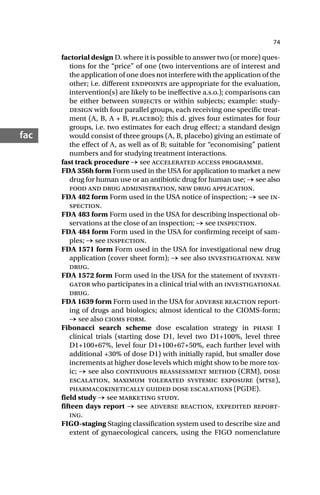
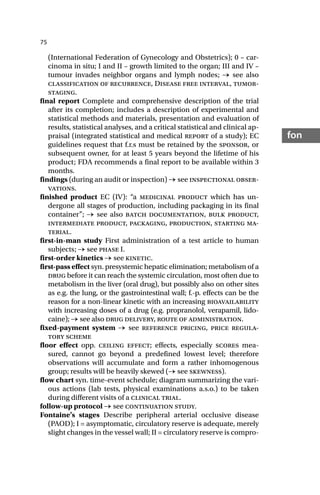
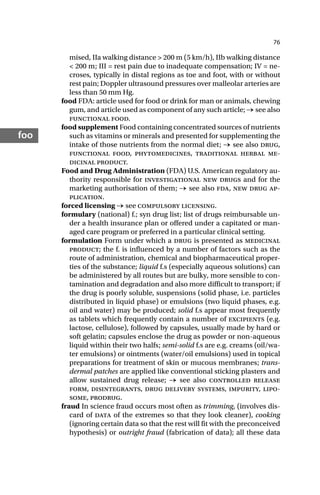
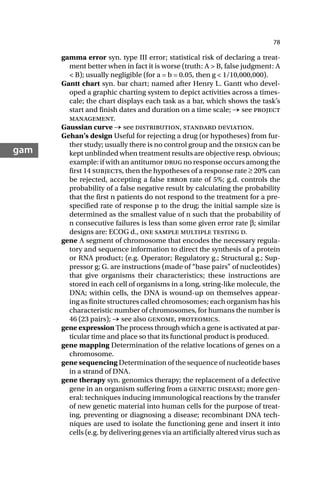
SpringerWienNewYork
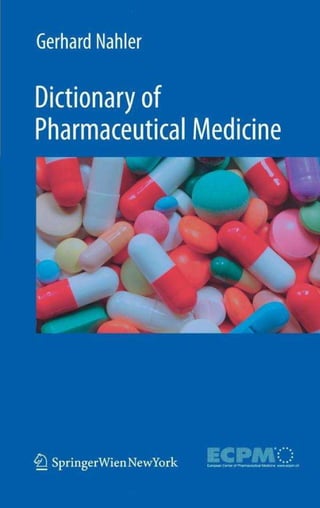
Gerhard Nahler
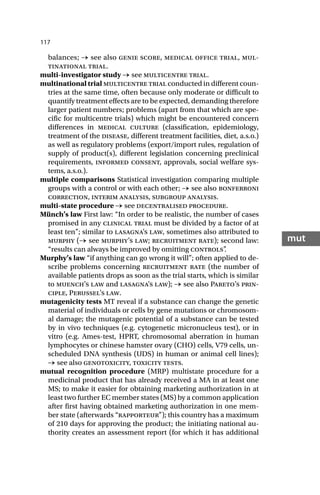
Dictionary of
Pharmaceutical Medicine
second revised and enlarged edition
With contribution by Annette Mollet
Dr.med. Dr.phil. Gerhard Nahler
Clinical Investigation Support Pharmaforschung
Vienna, Austria
With contribution by Dr. Annette Mollet
European Center of Pharmaceutical Medicine
This work is subject to copyright.
All rights are reserved, whether the whole or part of the material
is concerned, specifically those of translation, reprinting, re-use
of illustrations, broadcasting, reproduction by photocopying
machines or similar means, and storage in data banks.
Product Liability: The publisher can give no guarantee for all
the information contained in this book. This does also refer to
information about drug dosage and application thereof. In every
individual case the respective user must check its accuracy by
consulting other pharmaceutical literature. The use of registered
names, trademarks, etc. in this publication does not imply, even
in the absence of a specific statement, that such names are exempt
from the relevant protective laws and regulations and therefore
free for general use.
© 2009 Springer-Verlag/Wien
Printed in Germany
SpringerWienNewYork is a part of
Springer Science + Business Media
springer.at
Coverphoto: Andrzej Tokarski/istockphoto
Typesetting: Composition & Design Services, Minsk 220027, Belarus
Printing: Strauss GmbH, 69509 Mörlenbach, Germany
Printed on acid-free and chlorine-free bleached paper
SPIN: 12573943
Library of Congress Control Number: 2009920676
ISBN 978-3-211-89835-2
SpringerWienNewYork
ISBN 3-211-82557-6 1. Edition SpringerWienNewYork
Foreword
In the beginning was the word – and the foreword. Words are com-
bined to sentences and eventually language. Words are listed in a
dictionary and their meaning in building language are explained in
a lexicon. In the life sciences – e.g. drug development sciences and
pharmaceutical medicine – the analogies are evidenced by the ge-
nomic library and patho-physiological function as the lexicon. In this
transition from code to function integrated lexica pay a pivotal role
for a faster understanding. The present updated version of this books
combines dictionary and lexicon and provides the translational un-
derstanding of the complex drug development process. With a large
number of new terms, their abbreviations and explanations in this
complex interdisciplinary process a great number of different disci-
plines and specialists need to be informed: they include physicians,
pharmacists, biologists, chemists, biostatisticians, data managers, in-
formation specialists, business developers, marketing experts as well
as regulators, financing specialists, healthcare providers and insur-
ers in a continuous professional development mode. This lexicon is
therefore a most suitable and economical tool for fast and conclusive
information for all key-players in the development of medicines at
the working place, in postgraduate training as well as during graduate
education. This book is an indispensible aid in any medical library.
Prof. Dr. med. Dr. h.c. Fritz R. Bühler
Director, European Center of Pharmaceutical Medicine, ECPM
at the Medical Faculty and the PharmaCenter, University of Basel
Co-ordinator, Pharmaceutical Medicine Training Programme of the
Innovative Medicines Initiative, IMI, Joint Undertaking of EC and
EFPIA
Preface
The Gospel according to St. John declares that the word was in the be-
ginning, and that the word was with God. Our book here is no bible,
but it tries to fight the Babylonian disarray of language.
Have we not observed new English or German terms coming into
use, with almost as many connotations that the famous CRA (Clinical
research Associate) has had? Have we not seen IRB literally translated
into something like “Institutionelles Aufsichtsgremium” or worse?
Therefore Dr. Nahler’s renewed attempt to collect and associate
all those terms, abbreviations, and acronyms is more than applaud-
able. Too many discussions are held leading to controversies just in
the absence of a reliable lexicon which also shows the ambiguity of
words which we use as if everybody should understand them the
same way. While is will be hard to use the dictionary in a live dis-
cussion, its prolonged use may sensitise many to those issues, and
it is hoped that in books on the subject the use of terms will be “sup-
ported” by Dr. Nahler’s attempt to better define them.
I wish this book a broad use, including those that may browse
through it having many “aha!” experiences. And, I am sure, due to
its quality and the many changes in our profession, in a few years we
shall have a new edition of it equally thorough and good to read.
Michael Herschel, M.D., Ph.D., MBA, FFPM
Director Clinical research
GlaxoSmithKline GmbH&Co. KG
Foreword of the 1st edition
The evolution of pharmaceutical medicine, clinical pharmacology
and drug therapy has over the last few years led to the creation of a
large number of new terms and their abbreviations with the result
that physicians and pharmacists are at a loss when confronted with
these terms. This is also due to the fact that everything connected
with pharmaceutical medicine is based on interdisciplinary knowl-
edge introduced by specialists in widely differing fields.
The present book is most welcome, as it gives short and precise
information on nearly all questions. Statistics, clinical pharmacology
with its different branches, issues of clinical drug investigation and
pharmacotherapy as such are dealt with. Definitions of individual
terms reflect, of course, the present state and will need to be con-
tinuously updated as to their meaning.
This book is therefore most suitable for students of pharmacy and
medicine as well as pharmacists and physicians as a source of quick
and conclusive information. I therefore hope that this publication
will meet with success and widespread approval.
Univ.-Prof. Dr. Gerhart Hitzenberger
Österreichische Arbeitsgemeinschaft
für Klinische Pharmakologie
Preface of the 1st edition
Pharmaceutical medicine nowadays is a multidisciplinary area com-
prising aspects of toxicology, pharmacology, statistics, drug-regula-
tory and legal affairs, medicine and a number of other disciplines.
Therefore it is necessary to acquire additional knowledge to whatever
one has studied or done at the beginning. Although post-graduate
formation is offered by an increasing number of institutions, train-
ing in the field of pharmaceutical medicine is largely “on the job” and
done mainly by the pharmaceutical industry or contract research
organisations. Many years of experience with new colleagues showed
me how useful some sort of booklet might be, that would give them
a better understanding of some of the less familiar technical terms
and their context. In this dictionary, containing at present more
than 800 keywords, the attention of the user is drawn to such rela-
tionships by cross-references printed in small capitals.
In addition, it is always a difficult decision as to whether to in-
clude citations or not and there was a great temptation to make
references throughout the text to important publications especially
those of health authorities. However, this would certainly have been
beyond the scope of a brief dictionary intended for daily use and I
find it absolutely necessary that the user familiarises him- or herself
with original, complete texts and specific, original literature for fur-
ther information and not only with a compilation of citations. As a
consequence, some important documents are listed in the back mat-
ter of this book. It was after all these deliberations that the idea of
producing this particular type of short dictionary in its present form
was born.
As is the problem with almost all dictionaries, information given
therein must be short. Furthermore, the discipline of pharmaceuti-
cal medicine is in permanent evolution and growing. This makes it
difficult to keep such a dictionary “complete” and up-to-date. In addi-
tion, this dynamic process also leads to differences in an individual’s
understanding and utilisation of one and the same term. It will cer-
tainly occur that one person, also among readers, might interpret
or define some terms differently from another. I beg therefore the
user’s indulgence of these aspects and invite their comments.
A further important aspect is the utilisation of abbreviations.
Technical jargon usually tends to create its own abbreviations, and
this is also true for the field of pharmaceutical medicine. A separate
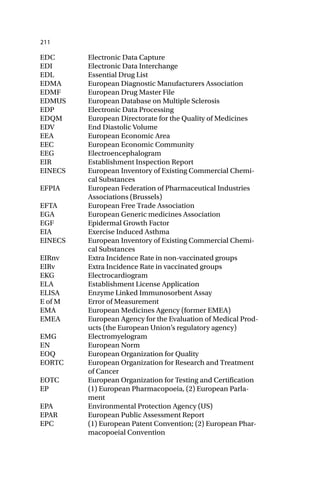
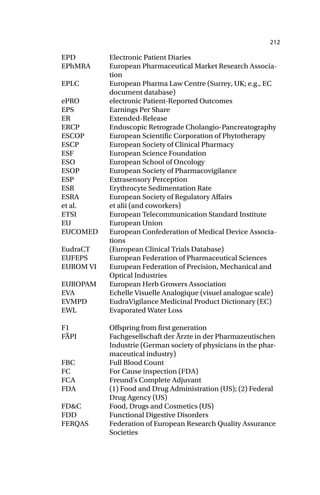
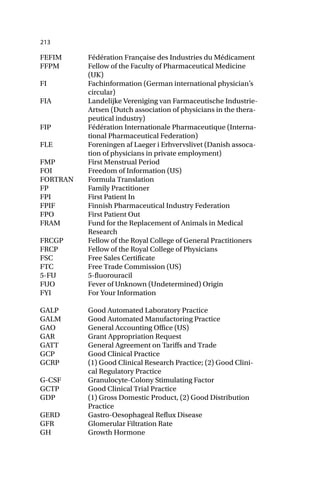
register of more than 800 frequently used abbreviations is therefore
included.
IX Preface of the 1st edition
Finally a directory of important national and international bod-
ies and organisations as well as authorities completes the back mat-
ter. This may help to establish contacts and to get further informa-
tion.
This dictionary is aimed primarily at the beginner entering this
discipline or coming into occasional contact with pharmaceutical
medicine as part of his/her daily work, as is the case with investi-
gators, researchers in the pharmaceutical industry, people in mar-
keting departments, drug regulatory affairs or governments. I hope
however that the content will also be of interest to experienced col-
leagues in departments engaged in clinical development.
As everybody knows, it is impossible to write such a dictionary with-
out the helpful criticism of experienced colleagues and friends. I
wish therefore to acknowledge many of comments and useful dis-
cussions with Dr Dominique B., Dr Bob Nolan and Dr Axel Wenzel in
the initial stages of this book. I should also like to thank for the per-
mission to reproduce some of the definitions and addresses cited
in this book.
Gerhard Nahler
Contents
Dictionary of pharmaceutical medicine................................................1
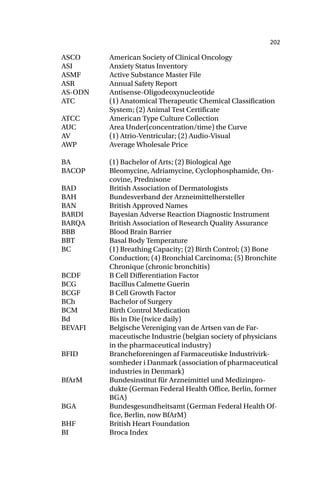
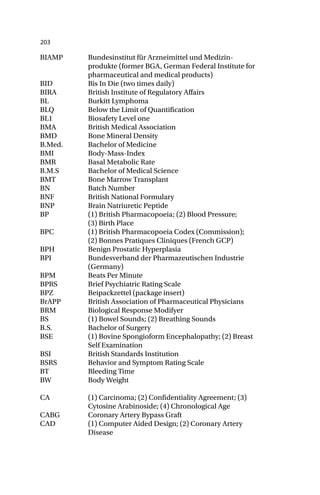
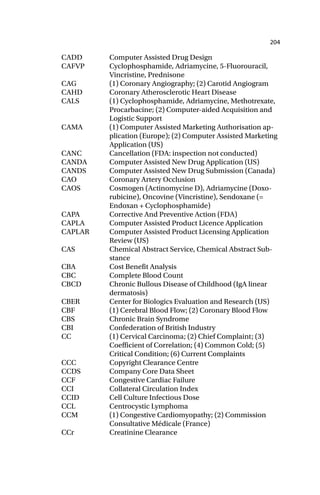
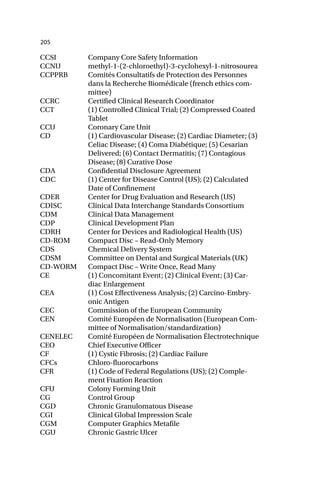
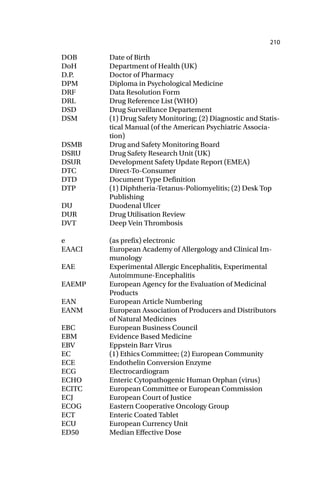
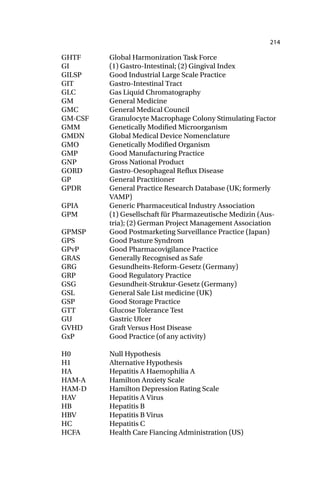
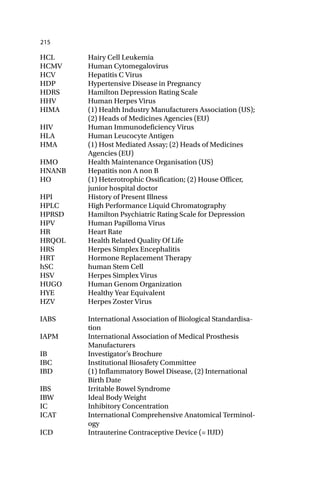
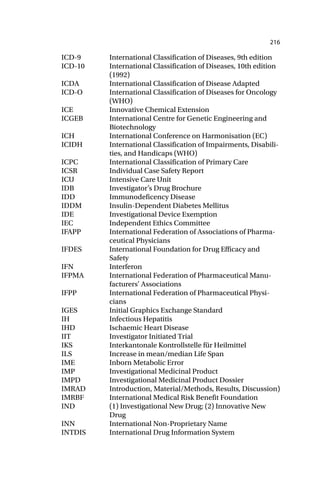
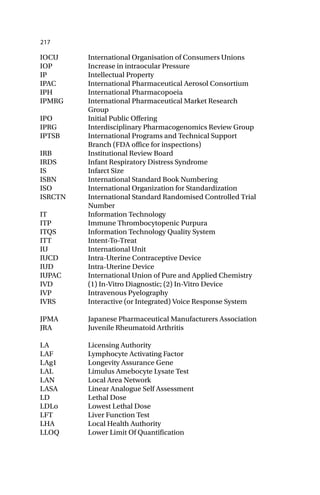
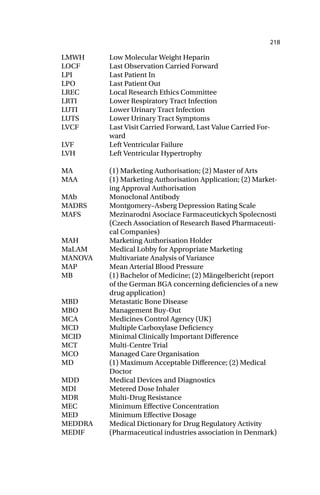
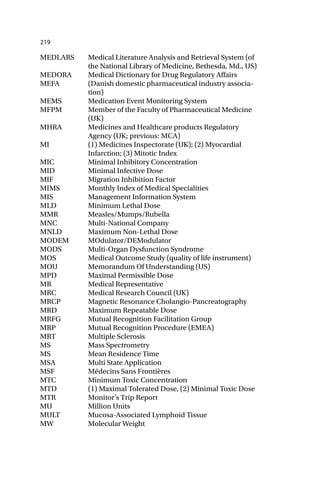
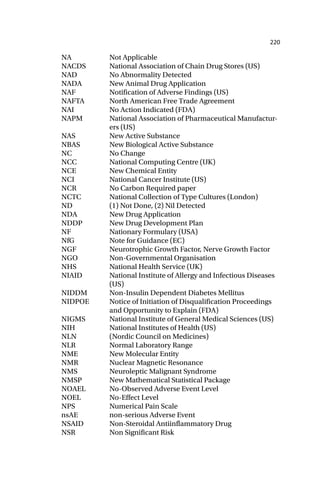
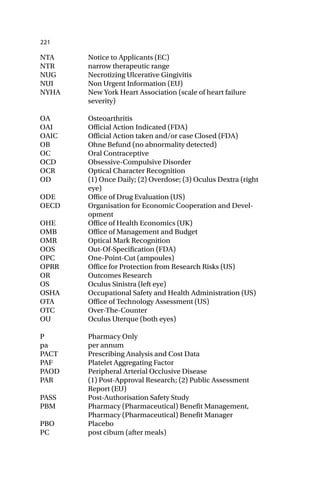
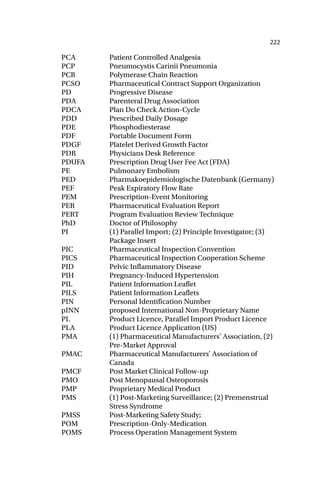
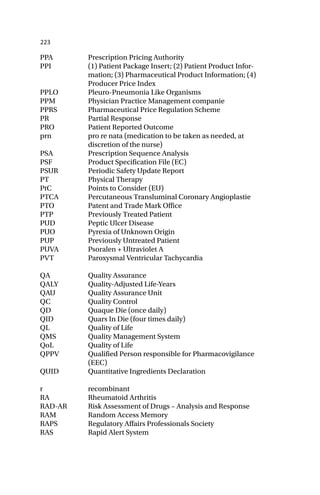
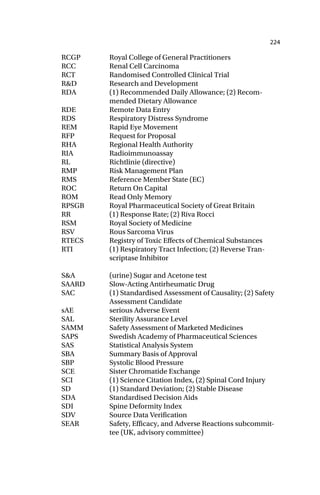
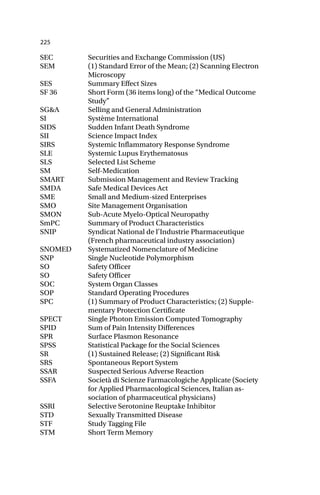
Abbreviations/acronyms ...................................................................199
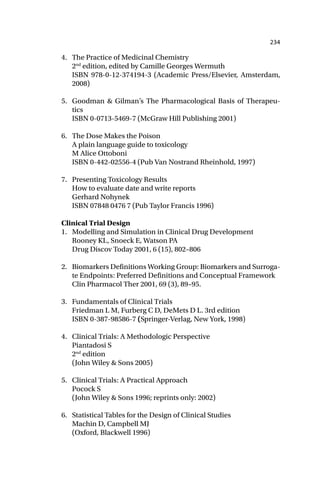
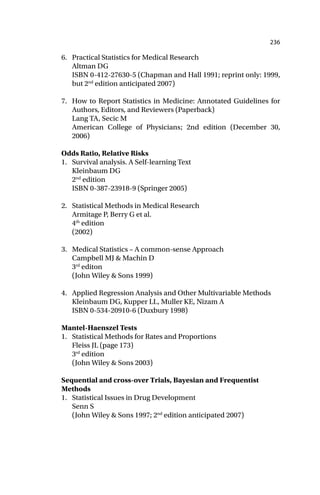
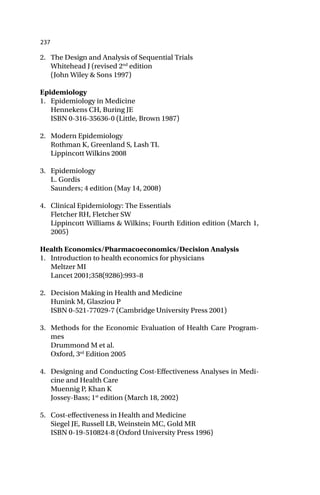
Selected bibliography.........................................................................228
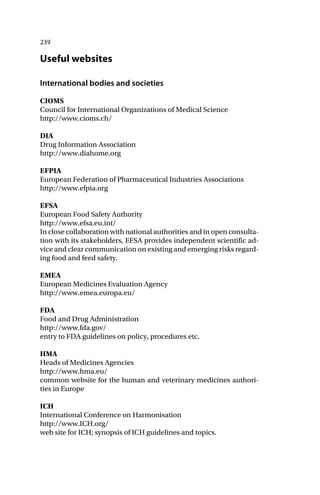
Useful websites...................................................................................239
1
acc
abbreviated new drug application Application for marketing autho-
risation if a drug has already received approval under a previous
conventional NDA; important drug properties as e.g. toxicity and
safety have therefore already been documented.
Aberdeen drug coding system → see code.
abriged application EC: “the applicant shall not be required to pro-
vide the results of pharmacological and toxicological tests or the
results of clinical trials if he can demonstrate: (i) either that the
proprietary medicinal product is essentially similar to a product
authorized … and that the person responsible for the marketing of
the original product has consented to the … references contained
in the file being used … (ii) or by detailed references to published
scientific literature … (iii) or that the product is essentially similar
to a product which has been authorized within the Community …
for not less than 6 (10) years and is marketed in the Member State
for which the application is made …; … where the … product is in-
tended for a different therapeutic use from that of the other products
marketed or is to be administered by different routes or doses, the
results of appropriate pharmacological and toxicological tests and/
or clinical trials must be provided”; → see also hybrid procedure.
absolute bioavailability → see bioavailability.
absolute risk → see risk.
absorption Process by which a drug enters the body; enteral absorp-
tion is most readily with non-ionized lipid-soluble drugs (e.g. etha-
nol), weak acids with pKa >3 and weak bases with pKa <7.8 are also
very well absorbed; absorption in the stomach becomes critical,
if the drug has a very low solubility in water (< 5mg/ml) or a low
lipid/water partition coefficient, or if the disintegration-/dissolu-
tion time is low; → see adme, administration, disintegration
test, pKa, route of administration.
accelerated approval program syn. fast track procedure; approval
of therapies “that provide a meaningful therapeutic benefit for pa-
tients with serious illness” (FDA) will be accelerated; a similar pro-
cedure exist in the EC; in this case, approval relies solely or in part
on surrogate endpoints for evidence of effectiveness; the average
duration for marketing authorisation in the US takes more than 20
months; in an accelerated approval program substances are clas-
sified according to their therapeutic potential in P (priority) and S
(standard) substances; → see approval, new drug application,
surrogate endpoint.
accelerated testing → see stress testing.
acceptable daily intake (ADI) Maximal amount of trace element,
mineral and other substances which can be taken lifelong without
any harm to health; → see also defined daily dose.
2
acc acceptable quality level (AQL) defined as the maximum percent of
errors that, for purposes of controls or sampling, can be consid-
ered satisfactory as an average of the total system or process; → see
also audit.
accrual rate → see recruitment rate.
accuracy Extent to which a measurement agrees with the “true”
value (which is never known) of the analyte being assayed; a. re-
flects the extent of a systematic error; the result obtained with the
method in question is usually compared with values obtained by
an acceptable reference method; results may be accurate, i.e. lying
within acceptable boundaries, but still imprecise, because they are
widely scattered; → see measurement properties, precision.
acid dissociation constant → see pKa.
acknowledgements Authors of publications frequently use a. to
thank persons who made technical or intellectual contributions to
a study which were not deemed sufficient to qualify for author-
ship; it may be questionable if a. should also include people who
simply did their daily jobs without any special contributions.
action letter Official letter of the FDA to a sponsor company, inform-
ing e.g. on an NDA decision by the agency; three types exist: (i)
an approval letter which allows marketing of the product, (ii) an
approvable letter which lists minor issues to be resolved before
a definite approval, (iii) a not approvable letter which describes
important deficiencies that preclude approval unless corrected;
→ see also new drug application.
active implantable medical device → see medical device.
active (pharmaceutical) ingredient (API) Pharmacologically active
part(s) of a formulation; in case of a salt, the active ingredient
should be understood to include both, the therapeutic moiety and
the appended portion of the molecule; the maximum acceptable
deviation in the a.i. content of a finished product must not ex-
ceed ±5% at the time of manufacture → see also drug, medicinal
product.
active medical device → see medical device.
active site The part of a protein that must be maintained in a spe-
cific shape if the protein is to be functional, for example, the part
to which the substrate binds in an enzyme or, resp., the part of an
enzyme where the actual enzymatic function is performed.
active substance syn. drug substance; → see drug, medicinal product.
activities of daily living (ADL) Include typically the following activi-
ties: sitting, putting on socks and shoes, getting in/out of a chair/
car, standing, walking; in general these activities are scored using
an ordinal scale, ranging from e.g. “0”
, no impairment, to “4”
, to-
tal inability to perform the activity.
3
adv
actual-treated analysis syn. as-treated analysis; opposite to intent-
to-treat a.; → see intent-to-treat analysis, per-protocol
analysis.
actuarial method → see survival analysis.
acute toxicity syn. single dose toxicity; → see toxicity.
adaptation In the evolutionary sense, some heritable feature of an
individual’s phenotype that improves its chances of survival and
reproduction in the existing environment.
addendum “minor” change to a protocol of a clinical trial (with-
out consequences on ethical aspects); → see also amendment.
additive effect → see interaction of drugs, error.
adjuvant chemotherapy Systemic chemotherapy administered after
theuseofdefinitiveloco-regionaltreatment(resectionofallknown
tumor); histological assessment of the resected tumor specimen
allows allocation of a pathological stage, thus predication of likely
outcome without further intervention; → see also neoadjuvant
chemotherapy.
ADME abbr. absorption, distribution, metabolism, and/or elimi-
nation of a drug as a guide to the design of early clinical trials
in phase i and definitive pharmacokinetic studies.
administration of a substance can be enteral (directly into the gas-
trointestinal tract), i.e. oral, rectal, sublingual, nasal or parenteral
(bypassing the gastrointestinal tract), i.e. intravenous, intramuscu-
lar, subcutaneous, intraarterial, intraperitoneal etc.; → see adme,
route of administration.
admission criteria → see eligibility criteria.
adverse drug event (ADE) → see adverse reaction, concomitant
event, drug injury, pharmacovigilance, rule-of-three.
adverse drug experience (ADE) Can either be expected (labeled)
which means that the event is listed in the current (FDA-) ap-
proved labeling for the drug as a possible complication of drug use
or unexpected (unlabeled), the latter term includes an event that
may differ from a labeled reaction because of greater severity or
specificity (e.g. abnormal liver function vs. hepatic necrosis); re-
ports of death from an ADE are considered unlabeled unless the
possibility of a fatal outcome from that ADE is stated in the label-
ing; → see also adverse drug event, labeling.
adverse drug reaction (ADR) ICH: (pre-approval clinical experi-
ence): “all noxious and unintended responses to a medicinal prod-
uct related to any dose shoud be considered adverse drug reac-
tion”; WHO/ICH (marketed medicinal product): “a response to a
drug which is noxious and unintended and which occurs at doses
normally used in man for prophylaxis, diagnosis, or therapy of dis-
ease or for modification of physiological function”; CIOMS (coun-
4
adv cil for international organisation of medical science)
reports always refer to a suspect reaction (in contrast to event or
experience), which implies that a physician or other professional
health care worker has judged it a reasonable possibility that an
observed clinical occurrence has been caused by a drug; some au-
thorities (e.g. Japan) recommend to document a sufficient number
of subjects to detect ADRs with an incidence of 0.1%; → see also
adverse reaction, drug injury, expedited reporting, treat-
ment emergent signs and symptoms, (un)listed adverse drug
reaction, spontaneous adverse drug reaction report.
adverse event (AE) ICH: “any untoward medical occurrence in a
patient or clinical investigation subject administered a pharma-
ceutical product and which does not necessarily have to have a
causal relationship with this treatment”; any undesirable experi-
ence occurring to a subject during a clinical treatment, whether
or not considered related to the (investigational) product(s); ex-
pected AE = event which is already known from previous experi-
ences and described in the investigator’s brochure or package
insert; techniques to evaluate AEs are e.g.: case control stud-
ies, post-marketing surveillance programmes, prescription-
event monitoring, prescription-sequence analyses etc.; when
an AE has been assessed (→ see standardised assessment of
causality) and there are reasonable grounds for the suspicion
that it is causally related to the (investigational) drug(s), it must
be considered as an adverse drug reaction; for regulatory re-
porting purposes, if an event is spontaneously reported, even if the
relationship is unknown or unstated, it meets the definition of an
ADR; → see also adverse experience, adverse reaction, blind-
ing, concomitant event, incident, medical device reporting,
pharmacovigilance, rule of three, safety update report,
significant adverse event, unexpected adverse event.
adverse event of special interest AE (serious or non-serious) of sci-
entific and medical concern specific to the sponsor’s product or
programme, for which ongoing monitoring and rapid communi-
cation by the investigator to the sponsor could be appropriate (ICH
E2F); → see adverse event.
adverse event report format → see CIOMS Form.
adverse experience (AE) Term used mainly in US; considered inter-
changeable with adverse event.
adverse reaction (ADR) Reaction which seems to be causally related
to intake of a pharmaceutical product and which is “noxious, un-
intended, and which occurs at doses normally used in man for the
prophylaxis,diagnosis,ortherapyofdisease,orforthemodification
of physiological function”; intensity rating scale: mild = awareness
5
adv
of a sign or symptom which is easily tolerated and reversible, mod-
erate = reversible, but discomfort is enough to cause interference
with usual activity, severe = incapacitating with inability to work or
undertake usual activity; seriousness: ICH: “a serious adverse event
(experience) or reaction is any untoward medical occurrence that
at any dose (I) results in death, (ii) is life-threatening (i.e. an event
in which the patient was at risk of death at the time of the event; it
does not refer to an event which hypothetically might have caused
death if it were more severe), (iii) requires inpatient hospitalisation
or prolongation of existing hospitalisation, (iv) results in persistent
or significant disability/incapacity, (v) is a congenital anomaly/
birth defect, or is an other medically important condition” (e.g. in-
crease in the rate of occurrence of an expected sAE, significant haz-
ard such as lack of efficacy, major safety finding from a new animal
study); FDA: serious = ADR which is “life-threatening, requires
inpatient hospitalization, prolongs hospitalization, permanently
or severly disabling, or requires prescription drug therapy: the
following types are always considered serious: death, congenital
anomaly, cancer, or overdose”; serious (EC) = ADR which is “fatal,
life-threatening, disabling, incapacitating, or which results in
or prolongs hospitalisation or is a congenital anomaly/birth de-
fect”; classification of reaction: type A = “augmented”
, reactions of
a predictable nature, following a known response pattern; type B
= “bizarre”
, effects that are unpredictable (hypersensitivity or id-
iosyncratic reactions); type C = “chronic”
, effects that occure with
long term use of a drug (cataract with corticosteroids); type D =
“delayed”
, effects that occure remote from use (vaginal cancer in fe-
male offsprings of women who took diethylstilbestrol during preg-
nancy); type E = “exit”
, rare reactions after stopping a medication
(e.g., myocardial ischemia after sudden stop of ß-blockers); type
F = “failure”
, a treatment effect that can reasonably be expected is
not observed, e.g., no antibodies formed after vaccination; timing
(ICH): “acute” <1hour, sub-acute < 1 day, latent > 1 day; EC regula-
tions foresee reporting of (spontaneous) serious ADRs (labelled or
unlabelled/unexpected)tothecompetentauthorityassoonaspos-
sible but not later than 7 calendar days after first knowledge by the
sponsor (for which the cioms-form is recognised by a number of
EC-member states; other regulatory report forms are the fda 
(US) and the yellow card in UK), followed by a written report as
complete as possible within 8 additional calendar days (FDA: 15
working days, “fifteen days report”), including assessment of cau-
sality; a second type of report are periodic reports (EC: half-yearly
for the first two years of marketing and annually thereafter for the
first 5 years, than every 3rd
year; FDA: quarterly for the first three
6
age years and annually thereafter); outcome: unchanged; recovered =
patient returned to his previous health status with no subsequent
problems; not yet recovered = patient has not yet returned to his
previous health status and continues to be followed for the ad-
verse event, but is expected to recover without sequelae; sequelae
= patient has a permanent change in health status subsequent to
the ADR; fatal = patient died (indication of date, cause, if an au-
topsy was performed and autopsy report); unknown = outcome of
event unknown; unexpected (unlabelled, unknown) ADR = that is
“not listed in the current labelling for the drug (EC: SPC) as having
been reported or associated with the use of the drug” (FDA); ICH:
“an adverse reaction, the nature or severity of which is not con-
sistent with the applicable product information (e.g. investigator’s
brochure for an unapproved investigational medicinal product)”;
this includes an ADR that may be symptomatically or patho-physi-
ologically related to a known ADR, but differing in nature, severity
or incidence (frequency) with regard to information given in the
current labelling, e.g. package insert, investigator’s brochure,
in the general investigator’s plan, or elsewhere; methods for as-
sessments are e.g. spontaneous (voluntary) reporting, intensive
(hospital-based) drug surveillance, record linkage or case-control
studies; incidence (ICH): very common: >10%, common: 1–10%,
uncommon: 0.1–1%, rare: 0.01–0.1%, very rare: <0.01%; → see also
adverse event, causality, core data sheet, critical term list,
drug abuse, drug injury, expedited reporting, incidence,
misuse, parent-child/foetus report, periodic safety update
report, significant overdose, who collaborating center for
international drug monitoring, s- report, who-adverse re-
action terminology, who-drug reference list.
age → see geriatric population.
age-specific rate def.: rate of an outcome calculated for a certain age
group; only individuals in the designated age range are included in
the numerator and denominator; → see also incidence, outcome
measurement, prevalence rate.
air-lock EC (IV): “An enclosed space with two or more doors, and
which is interposed between two or more rooms, e.g. of differing
class of cleanliness, for the purpose of controlling the air-flow be-
tween those rooms when they need to be entered; an a.-l. is de-
signed for and used by either people or goods.”
AJCC Staging (= American Joint Committee of Cancer) → see TNM.
ALCOA → see data quality.
algorithm Procedure permitting various choices among alternative
decisions to reach a result.
allele Any of several alternative forms of a given gene.
7
ame
allele frequency Often called gene frequency; a measure of how
common an allele is in a population; the proportion of all alleles at
one gene locus that are of one specific type in a population.
allelic exclusion A process whereby only one immunoglobulin light
chain and one heavy chain gene are transcribed in any one cell; the
other genes are repressed.
allergen product EC (I): “any product which is intended to identify
or to induce a specific acquired alteration in the immunological
response to an allergizing agent”; → see also biological medici-
nal product.
allocation → see randomisation.
allogenic Of the same species, but with a different genotype.
allosteric regulation Regulation of an enzyme’s activity by binding
of a small molecule at a site that does not overlap the active site
region.
allotype The protein product (or the result of its activity) of an allele
which may be detected as an antigen in another member of the
same species. (eg histocompatibility antigens, immunoglobulins),
obeying the rules of simple Mendelian inheritance.
alpha error syn. type I error; statistical risk of saying there is a differ-
ence between treatments when there is none (“false alarm”; truth: A
= B, false judgment: A > or < B); usually called p-value with p < 0.05;
error of falsely rejecting a null hypothesis; → see also beta error,
bonferroni correction, gamma error, interim analysis.
alternative hypothesis (Ha) Postulate of a clinically important (treat-
ment-) difference or degree of association between two groups; →
see also beta error, delta value, null hypothesis.
alternative medicine syn. complementary or non-conventional or
traditional or natural medicine; health care practices that are not
integrated into the dominant health care system; usually treat-
ments have not been objectively tested according to accepted
standards of conventional medicine.
alternative splicing Various ways of splicing out introns in eukary-
otic pre-mRNAs resulting in one gene producing several different
mRNAs and protein products.
amendment Term often used for “major” change(s) to a protocol
relating to ethical aspects as e.g. a new risk/benefit relation by an
increase in treatment duration or doses and needing therefore re-
submission and approval by an ethics committee in contrast to
an addendum (= minor change without consequences on ethical
aspects).
Ames test a widely used test to detect possible chemical carcinogens;
based on mutagenicity in the bacterium Salmonella; → see Muta-
genicity test.
8
ami amino acids molecules that build up peptides and proteins; there are
twenty common (essential) amino acids: alanine, arginine, aspar-
agine, aspartic acid, cysteine, glutamic acid, glutamine, glycine,
histidine, isoleucine, leucine, lysine, methionine, phenylalanine,
proline, serine, threonine, tryptophan, tyrosine, and valine.
analysis → see Bioanalytical method, ecological fallacy, ex-
planatory trial, extender a., intent-to-treat a., per-proto-
col a, standardized response mean, effect size.
analysis certificate → see release certificate.
analysis of study results Analysis of study results may be done in
different ways, whether all patients are considered or not; the in-
tent-to-treat a. (1) considers statistical analysis of data from all
randomised patients, whether they were in full compliance with
the study protocol or not, that is without omitting defaulters; the
last values available from all patients are pooled for analysis (Last
Visit Carried Forward – technique); although this procedure is ar-
tificial, results are less likely to be disturbed by drop-outs espe-
cially if they are similar frequent in the groups to be compared; in
contrast, the as-treated a. (2) considers drop-outs, missed doses,
erroneous doses, wrong diagnosis a.s.o.; all data of all patients are
included as they are available (evaluable); analysis of subjects “as
eligible” (3) excludes patients violating the selection criteria; other
possibilities of analyses are: (4) a. of “completers” only, where there
is a risk that results are distorted by drop outs, and a. “per proto-
col” (5) which excludes major protocol violators; (6): sometimes it
may be justified to exclude those patients who dropped-out during
a run-in period (“all subjects dosed” a.), usually at least two types
of analyses are provided for randomised clinical trials: ITT-
analysis and an additional a. of one of the types mentioned which
should give comparable results; all a. excluding patients are more
likely to be subject to bias due to selection mechanisms which may
antagonise randomisation.
anatomical therapeutic chemical classification system (ATC) Rec-
ommended by the WHO for use in drug utilisation studies; drugs
are divided into different groups and codified according to their
main site of action as well as therapeutic and chemical character-
istics; the first 1-digit represents the anatomo-physiological class,
the second 2-digits represent the pharmacological class, the third
1-digit represents the pharmacological sub-class, the last 1-digit
represents the therapeutic class; ATC-codes may be updated; use-
ful also as basis for setting up therapeutic groups for reimburse-
ment; → see also who-drug reference list.
anchored visual analogue scale syn. “categorized” VAS; → see Lik-
ert scale, visual Analogue cale.
9
aph
anecdotal study → see observational study.
aneugen Substance causing toxic effects upon genetic material (DNA)
of cells, inducing permanent and transmissible genomic mutations
(numerical aberrations with changes – gain or loss – of chromo-
somes); → see also clastogen, genotoxicity, toxicity tests.
animal pharmacology Before the first application of new drugs in
men they usually undergo extensive testing in various animal spe-
cies; → see also pharmacology.
annual safety update report → see development safety update
report.
antagonism → see interaction of drugs.
antibiotic Chemical substance formed as a metabolic byproduct in
bacteria or fungi and used to treat bacterial infections; antibiot-
ics can be produced naturally by fermentation, using microorgan-
isms, or synthetically.
antibody A protein produced by the immune system in response to
an antigen (a molecule that is perceived to be foreign); antibodies
bind specifically to their target antigen to help the immune system
destroy the foreign entity.
anticodon Triplet of nucleotide cases (codon) in transfer RNA that
pairs with (is complementary to) a triplet in messenger RNA; for
example, if the codon is UCG, the anticodon might be AGC.
antigen A substance to which an antibody will bind specifically.
antioxidant Substances (e.g. ascorbic acid, sulphites, ascorbyl
palmitate, alkyl gallate, hydrochinone, tocopherols) used in phar-
maceutical formulations to inhibit the reaction with oxygen in
the surrounding atmosphere; they can react with free radicals to
forme stable or metastable products, thus terminating the oxida-
tion reaction; → see excipients, disintegrants, formulation,
preservatives.
antisense drug → see antisense oligonucleotide.
antisense oligonucleotides (AS-ODNs) Class of new therapeutics
planned for the treatment of viral infections, autoimmune disease,
endocrine disease and cancers; AS-ODNs are small synthetic mol-
ecules of single-stranded DNA that suppress gene expression by
binding to RNA templates in a sequence-specific manner, thus
suppressing gene expression, mRNA translation and therefore the
production of disease-causing proteins; → see gene therapy, ri-
bozyme.
antiseptic substance compound which is designed for application
to living tissues and which destroys a microorganism; → see also
minimum inhibitory concentration.
apheresis (Extracorporal) removal of potentially harmful com-
pounds by technical devices; → see plasmapheresis.
10
app application within the EC several categories of a. for marketing au-
thorisation exist, each demanding a different documentation sta-
tus, e.g. (categories of abriged a.): bibliographic, essentially
similar and hybrid applications); → see also abriged applica-
tion, application fees, generic application, proprietary me-
dicinal products, well-established medicinal use.
application fee → see marketing authorisation.
appointment log book → see monitor’s visit log list.
approval Authorisation for marketing a new product; → see also
accelerated approval program, committee for proprietary
medicinal products.
archiving According to EC guidelines, the following documents per-
tinent to a clinical trial have to be archived by the investigator for
at least 15 years after completion of the trial: patient identification
list, correspondence with the ethics committee and sponsor com-
pany, protocol including addenda/amendments, copies of CRFs
(case record forms); the sponsor has to archive the trial mas-
ter file for lifetime of the product, reports 5 years beyond lifetime
of the product; according to US regulations “an investigator shall
retain records required to be maintained … for a period of 2 years
following the date a marketing application is approved for the
drug for the indication for which it is being investigated; or if the
application is not approved for such indication, until 2 years after
the investigation is discontinued and FDA is notified”
.
area under the curve (AUC) Area under the concentration/time
curve of a substance in pharmacokinetic investigations; de-
scribes the extent of the bioavailability of a drug.
assay Technique for measuring a biological response.
assessement report (AR) EC: “document exchanged between mem-
ber states in the mutual recognition procedure and which forms
part of the opinion in the centralised procedure”; key docu-
ment explaining why a marketing authorisation and each of
the proposed indications have been approved or rejected and de-
tailing the risk-to-benefit considerations for the product.
association study Investigates associations between one (indepen-
dent) variable (e.g. the cause) and another (dependent) variable
(e.g. the effect); useful statistical tests are e.g. odds ratio for nomi-
nal data, Spearman’s ratio for ordinal data, and Pearson’s ratio
for continuous data.
as-treated analysis → see actual-treated a., per protocol a.
ATC exemption scheme Scheme similar to the clinical trial ex-
emption scheme for animal health products.
attack rate def.: number of individuals exposed to a risk factor (or in-
fection) who became ill compared with the number of individuals
11
aud
exposed to the risk factor (more correct: a proportion, not a rate; re-
fers usually to infectious diseases); → see also incidence, outcome
measurement, prevalence rate, secondary attack rate.
attributable risk → see risk.
audit Inspection of facilities, documentation and procedures of clini-
cal investigator, sponsor, contract research organisation,
ethics committee etc; audits are made to ensure that either the
internal system or a trial is performed in accordance with good
clinical practice (GCP)/GXP and national law, including ethi-
cal considerations as well as that raw data and associated records
have been accurately reported, and to establish whether practices
were employed in the development of data that would impair their
validity; audits are part of a quality assurance system; audits or
inspections usually start with an opening meeting and end with a
closingmeeting(→seeexitinterview);typesofa.:officialexternal
a. = inspection by a supervisory authority, unofficial external a. =
visit by a service company contract service organisation, CRO
on request by the sponsor, unofficial internal a. = carried out by
an internal structure (e.g. quality assurance department, parent
company) EC (III): “An internal a. independent of those participat-
ing in the trial should be conducted by or on behalf of the sponsor
to assure the integrity of the quality control system”; “the spon-
sor is responsible for conducting an internal a. of the trial” and for
assuring “the investigators’ acceptance of verification procedures,
audit, and inspection”; a. are performed either as “during-study” a.
or as “post-study” a.; usually the written final “Evaluation Report”
reveals only findings e.g. deficiencies; an a. is not a scientific evalu-
ation of the data of a study; a trial audit is a comparison of raw data
and associated records with the interim or final report; a regulatory
a. is the verification of the credibility of data and the evaluation
of the design, planning, conduct, monitoring and reporting of a
clinical trial against regulatory requirements; further types of
audits are: management a. = evaluates the efficiency and economy
of a given operation in terms of accounting, purchasing, produc-
ing, personnel and research; program a. = evaluates effectiveness
by a higher level of authority; a. can also be performed on produc-
tion plants and laboratory facilities to ensure adherence to good
manufacturing practice (GMP) or good laboratory practice
(GLP) respectively; → see also acceptable quality level, con-
fidentiality, data quality, establishment inspection report,
exit interview, iso/dis -, medical a.
audit certificate Document which certifies that an audit has taken
place; has to be stored together with the audit report in the trial
master file; → see also data trail.
12
aud audit trail → see data trail.
authorisation form Form used by the investigator and monitor
to document that other persons than the investigator, e.g. a study
nurse or a subinvestigator, are authorised to make entries or cor-
rections in the case record forms, or othercritical trial-related
procedures; → see subinvestigator.
authorship According to the criteria formulated by the International
Committee of Medical Journal Editors “authorship credit should
be based only on substantial contributions to (a) conception and
design, or analysis and interpretation of data; and to (b) drafting
the article or revising it critically for important intellectual content;
and on (c) final approval of the version to be published. Conditions
a, b, c must all be met” (International Committee of Medical Jour-
nal Editors. Uniform requirements for manuscripts submitted to
biomedical journals. N Engl J Med 1991, 324: 1415–1417).
autoimmune disease A disease in which the body produces anti-
bodies against its own tissues.
autoimmunity Condition in which the body mounts an immune re-
sponse against one of its own organs or tissues.
average → see weighted average.
13
bay
bacterium Any of a large group of microscopic, single-cell organisms
with a very simple cell structure; some manufacture their own food
from inorganic precursors alone, some live as parasites on other
organisms, and some live on decaying matter.
balanced study Trial in which numbers of patients and their charac-
teristics are equally distributed between groups e.g. similar num-
ber of males/females, above 65 years a.s.o.; → see also stratifica-
tion.
bar chart → see gantt chart.
bar code Codification system using a number of vertical black lines
the relative widths of which encode a specific information; used
also for automated form reading by optical mark recognition;
→ see also code.
baseline variables Characteristics of a patient and of his/her disease
measured before the start (as soon as measurements are con-
stant) of protocol treatment (baseline period); → see also run-
in-phase; b.v. are important for the evaluation of the results of a
clinical trial to avoid regression to the mean or learning ef-
fects; → see also placebo effect.
batch syn. lot; EC (IV): “a defined quantity of starting material, pack-
aging material or product processed in one process or series of
processes so that it could be expected to be homogeneous”; FDA:
“specific quantity of a drug or other material that is intended to
have uniform character and quality, within specific limits, and is
produced according to a single manufacturing order during the
same cycle of manufacture”; for stability testing batches should
be selected at random, with not less than 3 batches to be taken
for assessment of batch-to-batch variability; in order to be GMP-
compliant a batch must have a minimal size of 100,000 units (e.g.,
vials); → see also batch documentation, lot.
batch documentation EC: set of documents making possible to trace
the history of the manufacture of a batch; b.d. needs to be retained
for at least 1 year after the expiry date of the batch to which it re-
lates or at least 5 years after the certification, whichever is longer;
samples of each batch must be retained for at least 1 year after the
expiry date, samples of starting materials (other than solvents,
gases and water) used must be retained for at least 2 years after the
release of the product; → see also finished product.
batch number EC (IV): “a distinctive combination of numbers and/
or letters which specifically identifies a batch”; NLN: “a designa-
tion given by the manufacturer to a batch for the purpose of its
identification”
.
Bayesian adverse reaction diagnostic instrument (BARDI) Bayes-
ian based approach for assessing drug-induced illness; the goal is
14
ben
to calculate the posterior odds in favor of a particular drug being
the cause of the adverse event; the posterior odds are calculated
by considering 6 assessment subsets: “prior odds” as background
epidemiological and clinical trials information, and 5 other deal-
ing with case-specific information of possible differential diagnos-
tic value (“likelihood ratios”); → see also adverse drug reaction,
standardized assessment of causality (SAC).
benefit-risk analysis → see decision analysis.
Berkson’s bias There is an increased chance that hospitalised pa-
tients will have other comorbid conditions in addition to the dis-
ease of interest, compared with the decreased chance that non-
hospitalised patients will have more than one condition; → see
also bias.
beta error syn. type II error; “missed difference”; statistical risk
of saying there is no difference between two treatments A and B
when actually there is one (error of falsely accepting the null hy-
pothesis Ho; truth (one-sided): A > or < B, false judgment: A = B);
therefore β is the probability of failing to detect, by mere chance, a
treatment difference at least as large as the degree specified (delta
value) by the alternative hypothesis Ha; 1-b is usually referred
to as the power of the statistical test, the probability of detecting
the specified difference and, therefore, the probability of rejecting
Ho when Ha is true; the probability for a β-error increases with a
lower delta, smaller sample size and larger variance of the mea-
sured (continuous) variables; → see also alpha error, gamma
error.
between-subject design opp. within-patient d.; → see design.
bias Errors due to incorrect assumptions (ICH E9: “systematic ten-
dency of any aspect of the design, conduct, analysis, and interpreta-
tion of the results of clinical trials to make the estimate of a treatment
effect to deviate from its true value”; frequent examples for bias are:
recall b. = the more often a subject is asked the same question, the
more likely are differences in the answer due to more intensive re-
flections or due to a better memory for findings which were impor-
tant for the subject (which is not necessarily the case for controls,
e.g. diagnosis or treatments in cancer); allocation b. = even drugs
of the same substance class and being nearly identical may not be
“allocated” by prescribing physicians in exactly the same way, new
drugs are more likely to find their principle first uses in patients
who have not responded satisfactorily to previously available
drugs; attrition b. = biased occurrence and handling of protocol
deviations and losses to follow-up; changing pattern b. = methods
of diagnosis, techniques, treatments a.s.o. may change over time;
confounding b. = one or more variable associated, independently
15
bio
of exposure, both with exposure and outcome; detection b. = bi-
ased outcome assessment; performance b. = unequal provision of
care apart from the treatment under investigation; publication (in-
formation) b. = studies with positive, statistically significant results
are more likely to be published, which may result in overestimation
of treatment results; reverse causality b. = study outcome preceded
and caused actually the exposure; selection (sample distortion) b.
= selected cases may not represent adequately the whole popu-
lation or baseline characteristics may be different between two
populations; principal b. reducing techniques are blinding and
randomization; b. can also be induced by dropouts because
they rarely occur fully independent of the treatments being tested;
→ see also berkson’s bias, drug channelling, ecological fal-
lacy, error, hawthorne effect intent-to-treat a., labelling
phenomenon, life event data, Neyman fallacy, placebo ef-
fect, regression paradox, sequence effect.
bibliographical application EC: abriged application made by ref-
erence to published scientific literature; relevance and quality of
these data should be stressed; → see also application.
binary outcomes → see data.
bioanalytical method particular method used for quantitative mea-
surement of analytes in a given biological matrix, e.g., blood, plas-
ma, serum, or urine; → see analysis.
bioavailability EC: rate and extent to which the active substance or
therapeutic moiety is absorbed from a pharmaceutical form and
becomes available at the site of action; absolute b.: bioavailability
of a given pharmaceutical form as compared with that (100%) fol-
lowing intravenous administration; relative b.: bioavailability of a
given pharmaceutical form administered by any route other than
intravenous; b. is usually determined by blood level and/or uri-
nary excretion data; examples of factors on which the b. depends
are: disintegration-, dissolution rate, crystalline form, state of hy-
dration, of ionisation, chemical stability in (gastric) fluids, surface
area, presence or competition with food or drugs, drug binding to
biological constituents as plasma protein or red blood cells, dis-
ease states, demographic characteristics (age, sex, race), first-
pass effect a.s.o.; → see also dissolution test, formulation,
pharmacokinetic, steady state study, suprabioavailability.
biobank Collection of tissue samples that may be used for a person-
alized therapy.
bioequivalence Equivalent doses of different dosage forms deliver
the same amount of drug (e.g. 3x100mg vs. 1x300mg tablets);
drugs whose rate and extent of absorption differ by ≤20% (with the
same bioavailability) are generally are considered as bioequiva-
16
bio
lent; FDA: “bioequivalent drug products means pharmaceuti-
cal equivalents or pharmaceutical alternatives whose rate and
extent of absorption do not show a significant difference when
administered at the same molar dose of the therapeutic moiety un-
der similar experimental conditions, either single dose or multiple
dose”; → see also drug comparability study, biologic equiva-
lent, pharmaceutical equivalent, rule /, therapeutic
equivalent.
bioinformatics The discipline encompassing the development and
utilization of computational facilities to store, analyze and inter-
pret biological data.
biologic equivalent Dosage form that results in similar bioavail-
ability regardless of the pharmaceutical formulation; → see
also essentially similar product, pharmaceutical equiva-
lent, therapeutic equivalent.
biological medicinal products Products such as vaccines, serums,
toxins, allergen products and medicinal products derived from
human blood or plasma; → see also biopharmaceutical, estab-
lishment licence application.
biological products Clinical trials with blood or biological products
as well as their registration are subject to special regulations in or-
der to assure absence of infectious contaminants (e.g. mandatory
screening of blood donors).
biological rhythm → see chronotherapy.
biomarker Def (NIH): “characteristic that is objectively measured
and evaluated as an indicator of biologic processes, pathogenic
processes or pharmacological response to a therapeutic interven-
tion”; → see also surrogate.
biopharmaceutical Therapeutic product involving biotechnology,
e.g. genetic engineering; product of biotechnological origin such
as antisense, genetic engineering, transgenics, involving manipu-
lation of living organisms; → see also biological medicinal
product, biotechnology.
biorepository → see biobank.
biotechnology (Biotech) Development of products by a biological
process. Production may be carried out by using intact organisms,
such as yeasts and bacteria, or by using natural substances (e.g. en-
zymes) from organisms; techniques involving manipulation of liv-
ing organisms or substances made by living organisms, particularly
at the molecular genetic level; according to the U.S. Office of Science
and Technology Policy, the term covers also “recently developed
and newly emerging genetic manipulation techniques, such as re-
combinant DNA (rDNA), recombinant RNA (rRNA), and cell fusion,
that are sometimes referred to as genetic engineering”; → see also
17
bli
biological medicinal product, biopharmaceutical, immuno-
therapy, transgenic drug, xenotransplantation.
birth control Methods considered to be highly effective (failure rate
<1% per year) are the following (ICH consensus guideline CPMP/
ICH286/95): implants, injectables, combined oral contraceptives,
some IUDs, sexual abstinence or vasectomised partner.
birth date → see Development International Birth Date, har-
monised birth date, international birth date.
black list (1) List produced by the FDA which contains the names of
investigators who are “ineligible to receive investigational prod-
ucts” (Feb. 1993: 79 names, Sep. 2008: 114 names); an additional
list contains the names of “investigators agreeing to some restric-
tion of their use of investigational products” (Feb. 1993: 28 names,
Sep. 2008: 14 names); in 1996, the “golden memory” of FÄPI, an
unofficial black list of the German association of physicians in
the industry, listed some 114 physicians, some named up to eight
times; a similar referral system is run in UK for the ABPI; → see
also fraud, investigational drug. () syn. negative list; phar-
maceutical products which cannot be prescribed either by brand
name or generic name on the National Health Services; → see also
negative list, positive list, reimbursement.
blinding syn. masking; to avoid bias in controlled clinical trials,
treatment should be concealed from both patient and physician
(double-b., doubly masked) or at least from one of them (single-b.)
– most often from the patient; if treatment is also concealed from
the evaluator (if not identical with the investigator) treatment
allocation is triple-b. (also “treble b.”); in some cases e.g. surgery,
assessment of devices, blind assessment of response may be the
only practical way for blinding (partial b.); as a general rule, moni-
tors and data management must be kept blind as well; blindness,
however desirable, may not always be possible (tablets differing
e.g. in taste and smell, obvious treatment/side effects, breaking of
codes a.s.o.) especially for long lasting trials; the “weaker” the end-
points (i.e. the more likely results are influenced by the patient or
physician) the more important will be ensurance of b.; in reporting
adverse events “there may be disadvantages to maintain b.: by
retaining the blind, placebo and comparator (usually a marketed
product) cases are filed unnecessarily and notifying relevant par-
ties in a blinded fashion is inappropriate and possibly misleading;
breaking the blind for a single patient usually has little or no sig-
nificant implications for the conduct of a clinical investigation or
on the analysis of the final data (except when a serious or fatal out-
come is the primary endpoint)” (ICH); → see also double-dummy
technique; disclosure procedure, expedited reporting.
18
blo
block size Size of consecutive groups of patients in which random-
ization to treatments is balanced i.e. for each treatment the same
number of subjects is foreseen; b.s. should not exceed 25% of the
total patient number and should also not be too small (< 6) to avoid
bias.
blood products → see biological products.
body-mass-index (BMI) syn. quetelet-index; for calculating the ide-
al weight; BMI = body weight (in kg) divided by (height ∞ height) (in
square m) should be between (depending on age and sex) around
20 to 25; example: w = 76 kg, h = 1.82 m; 1.82 ∞ 1.82 = 3.3; 76/3.3 = 23;
common categories are: underweight <18.5, normal 18.5–24.9, over-
weight 25.0–29.9, obese 30.0 and more; → see also broca-formula,
lorentz-formula, waist circumference, weight.
body surface (BSA) The body surface area a (in m2
) can be calculated
by the following formula of Du Bois and Du Bois: log a = 0.425 log
w (body weight in kg) + 0.725 log h (body height in cm) – 2.144;
the standard value for a man with 70 kg and 180 cm is 1.73 m2
. A
simplified formula, only valid for well-proportioned infants and
children between the weights of 3 and 30 kg, is the following: BSA
= (Wt. + 4)/30, weight being in kilograms and BSA being in square
meters.
body water The body water is about 60% of the body weight, ap-
proximately 42 liters in an average 70-kg adult (plasma volume 3L,
blood volume 5.5L, extracellular fluids outside plasma 12L); higher
values of b.w. are found in infants (77%) and lower in elderly sub-
jects; → see also adme, geriatric evaluations.
body weight → see body-mass-index, broca-formula, lorentz-
formula, weight.
Bonferroni correction In order to avoid errors by repeated signifi-
cance testing the significance level is divided by the number of
comparisons (“Hochberg correction”; e.g. if five analyses are done
the significance level should be 0.01 i.e. 0.05/5); more correct, the
alpha (type I) error rate increases, if a p-value of 5% is accepted,
after 5 independent and repeated tests to: (1 – (0.95)5
) = 0.2262 or
23%; the B. inequality states that the experiment-wise error rate
cannot exceed the sum of the error rates of each test considered
individually; apart from the B. correction, other formula for cor-
rections for multiple tests exist; → see also interim analysis.
boundary value Value that corresponds to a minimum or maximum
value specified for a variable.
brand name Usually based on a registered trade mark; → see also
trade name.
bridging study Agreement between ICH-countries: Phase I pharma-
cokinetic data generated anywhere in the three main regions of
19
bul
ICH, Japan and Asia Pacific, Europe and the USA are acceptable, as
long as it can be demonstrated that the pharmacokinetic behaviour
of the drug is the same; a similar bridging approach is applicable
for paediatric indications, if it can be demonstrated that pharma-
cokinetics in children are essentially the same as in adults.
Broca-formula formula used for calculating the “ideal weight”:
height (cm) – 100 = ideal weight (kg); → see also body mass index,
lorentz formula, weight.
bug error (fault) in a software; → see also error.
bug log List of problems encountered with a system; it includes date/
time of problems, origin, corrective measures taken, etc.; → see
also computerised system.
bulk drug substance → see bulk product.
bulk product EC (IV): “any product which has completed all process-
ing stages up to, but not including, final packaging” (i.e. pharma-
cologically active component of a drug before formulation); →
see also finished product, intermediate product, medicinal
product, packaging.
20
cac
cachexia def. unintended and progressive weight loss that is often ac-
companied by weakness, fever, nutritional deficiencies, diarrhea,
and usually with a disproportionate muscle wasting. It occurs in
many chronic illnesses and diseases such as cancer, in particular
advanced stage cancer, but also Alzheimer’s disease, chronic heart
failure, chronic lung disease, congestive heart failure, cystic fibro-
sis, Crohn’s disease, renal failure, rheumatoid arthritis, tuberculo-
sis, liver cirrhosis, heart surgery, sepsis and sarcopenia; there is no
universally accepted definition but the 95% CIs for change in body
weight in healthy adults is ±2% in 1 month and ±5% in 6 months;
→ see weight.
calibration EC (IV): “the set of operations which establish, under
specified conditions, the relationship between values indicated
by a measuring instrument or measuring system, or values repre-
sented by a material measure, and the corresponding known val-
ues of a reference standard”
.
CAMA Computer assisted marketing authorisation (Europe), where-
by the information on the new drug is submitted in electronic
form; → see canda.
CANDA Computer assisted new drug application (US), whereby the
information on the new drug is submitted in electronic form, e.g.
on optical disks of WORM-type (write once, read many); no univer-
sal recommendations exist at the time being; → see also damos.
CAPA → see corrective and preventive actions.
Capability Maturity Model (CMM) According to the “Capability Ma-
turity Model” there are five maturity levels: (1) Initial: The software
process is characterised as ad hoc, and occasionally even chaotic;
few processes are defined, and success depends on individual ef-
fort and heroics. (2) Repeatable: Basic project management proc-
esses are established to track cost, schedule, and functionality; the
necessary process discipline is in place to repeat earlier successes
on projects with similar applications. (3) Defined: The software
process for both management and engineering activities is docu-
mented, standardised and integrated into a standard software
process for the organisation; all projects use an approved, tailored
version of the organisation’s standard software process for devel-
oping and maintaining software. (4) Managed: Detailed measures
of the software process and product quality are collected; both the
software process and products are quantitatively understood and
controlled. (5) Optimising: Continuous process improvement is
enabled by quantitative feedback from the process and from pilot-
ing innovative ideas and technologies.
CAPLA Computer assisted product license application; → see can-
da.
21
cas
CAPLAR Computer assisted product licensing application review
(USA); → see canda.
carcinogen Cancer-causing agent.
carcinogenicity tests Such t. are normally required for substances
likely to be applied in man longer than 3 months or having a close
chemical analogy with known (co-)carcinogenic compounds or in
respect to substances which showed suspicious changes in long-
term toxicological, mutagenicity or other short term tests; typical
tests may require e.g. 500 rats exposed over 24 months; → see tox-
icity tests.
cardiac index hemodynamic parameter (L/min)/(m2); normal val-
ues: 2.6–4.2 L/min; → see also ejection fraction.
carry-over effect → see sequence effect.
carrier-based drug delivery → see drug delivery systems, for-
mulation.
case-control study Retrospective study which investigates, from
outcome to exposure, potential associations between a drug and
adverse events or, more generally, between a variable and the
onset of a disease; a study in which patients who already have a
certain condition are compared to people who do not. E.g: lung
cancer patients are asked how much they smoked in the past;
answers are then compared with a sample of the general popula-
tion; c.c.s. are often the design of choice when outcome is rare and
when random sampling is therefore far less efficient than selection
by outcome; the use of a drug by patients with a specific disease
(“cases”) is compared with that of a group of patients without
the disease but otherwise similar (the “controls”); if use is higher
among cases than controls, then it may be possible to infer an as-
sociation between the drug and the disease; example: subjects suf-
fering from lung cancer are selected as “cases” and another group
of non-diseased subjects as the “controls”; than the frequency of
smokers in both groups is determined in order to clarify a rela-
tionship between smoking habits and lung cancer (in a cohort
study one would draw a sample of smokers and nonsmokers and
compare the frequency of lung cancer); advantages: smaller num-
ber of patients, shorter duration, reduced costs; can elucidate risk
factors; useful when there is considerable latency between use of
drug and emergence of adverse events; disadvantages are bias
as: selected cases may not be representative but a specific sub-
group (e.g. hospitalised and with a more severe form of disease),
the controls may not be identical to cases in any way other than
the absence of disease, collection of data on preceding drug use
may be biased (e.g. women with breast cancer may be more aware
of their previous use of oral contraceptives than non-breast can-
22
cas
cer patients); the method for choosing the control group should
always be established before the study begins; it may also be useful
to select an additional control group from the general population
to reduce the likelihood of false conclusions; → see also cohort
study, cross-sectional study, design, nested case-control
studies.
case-fatality rate Number of subjects who die of a specific disease,
within a given number of person-years of follow-up, divided by the
number of subjects developing this disease (more correct: a pro-
portion, not a rate); → see also lethality.
case record form → see case report form (CRF).
case report form (CRF) syn. case record form, data collection form;
record of data or other information on subjects in a clinical
trial as defined by the protocol; data may be recorded by hard
(e.g. NCR (no carbon required) paper) copies, electronic or opti-
cal disk methods or any other means, ensuring accurate input and
allowing verification against raw data; CRFs are to be considered
as documents; EC: “CRFs may be requested by Member States and
should therefore always be available”; → see also data transfer,
patient diary, electronic CRF, electronic data, raw data.
case series Study of case patients only; there are no control subjects;
→ see designe.
case-surveillance Study of patients with diseases which are likely to
be caused by drug exposure; → see also post-marketing safety
study, post-marketing surveillance.
categorical data → see data, visual analogue scale.
causality syn. imputability; in some countries (e.g. US, France) a c.
assessment of adverse reactions, in addition to reports, is man-
datory; in Germany, but also within the EC, a c. assessment is cur-
rently not required, despite that a classification system with three
categories has been adopted by the member states (“A – probable”:
reasons and documentation given are sufficient to assume a causal
relationship, in the sense of plausible, conceivable, likely, but not
necessarily highly probable; “B – possible”: information in the re-
port is sufficient to accept the possibility of a causal relationship, in
the sense of not being impossible or unlikely, although the connec-
tion is uncertain or doubtful, because of, e.g. missing data or poor
documentation; “O – unclassified”: reports where causality is, for
one reason or another, not assessable, e.g. because of insufficient
evidence, poor documentation or conflicting data); a frequently
used classification system is that according to Karch and Lasagna:
definite = adverse reaction (ADR) that follows a reasonable tempo-
ral sequence from administration of the drug or in which the drug
level has been established in body fluids or tissues, that follows a
23
cel
known response pattern, that is confirmed by dechallenge and
rechallenge; probable = ADR as above but that has not been con-
firmed by rechallenge and that could not be reasonably explained
by the known characteristics of the patient’s clinical state; possible =
ADR that follows a reasonable temporal sequence from administra-
tion, a known response pattern, but that could have been produced
by the patient’s clinical state or other modes of therapy; conditional
= ADR as above but that does not follow a known response pattern
to the suspected drug and that could not be reasonably explained
by the patient’s clinical state; doubtful = any reaction that does not
meet the criteria above; insufficient = there is insufficient data avail-
able to make a comment; categories of the WHO are also widely
used (Certain – reasons and documentation given are sufficient to
be sure of a causal relationship (e.g. same reaction on re-exposure);
Probable – reasons and documentation given are sufficient to as-
sume a causal relationship, in the sense of plausible, conceivable,
likely, but not necessarily highly probable; Possible – information
in the report is sufficient to accept the possibility of a causal rela-
tionship, in the sense of not being impossible or unlikely, although
the connection is uncertain or doubtful; Impossible/Unrelated – no
reasonable temporal sequence from administration of the drug;
event is clearly produced by the patient’s clinical state or other
modes of therapy; Unclassified/Unassessable – reports where cau-
sality is, for one reason or another, not assessable, e.g. because of
insufficient evidence, poor documentation or conflicting data; the
French Ministry of Health demands use of an own, five-point cau-
sality assessment method; in order to reduce inter-rater variances
which occur when c. assessment is done by ante mortem methods
standardized decision aids (SDA) have been developed; → see
alsoDrugInteractionProbabilityScale,Naranjonomogram,
standardized assessment of causality.
ceiling effect opp. floor effect; treatment effects or scores (e.g.
grip strength) that can be reached are limited, even when dosage
or treatment duration a.s.o. is increased (e.g. analgesics); results
will be heavily skewed (→ see skewness).
cell The smallest structural unit of living organisms that is able to
grow and reproduce independently.
cell culture Growth of a collection of cells, usually of just one geno-
type, under laboratory conditions.
cell cycle The term given to the series of tightly regulated steps that a
cell goes through between its creation and its division to form two
daughter cells.
cell line Cells which grow and replicate continuously in cell culture
outside the living organism.
24
cem
CE marking (of a medical device) The CE marking of conformity
must appear in a visible, legible and indelible form on the device
or its sterile pack (where practicable and appropriate), and on the
instructions for use. where applicable, the CE marking must also
appear on the sales packaging. The CE marking must be accompa-
nied by the identification number of the notified body responsible
for implementation of the respective quality and conformity pro-
cedures; for devices which are custom-made or devices intended
for clinical investigations special regulations will be established;
these devices do not bear the CE marking; → see also ec type-
examination certificate.
censored data Values which are not known at the time of analysis,
but which have a known minimum value (e.g. survival).
central ethics committee syn. Lead Ethics Committee; ethics com-
mittee reviewing a protocol for different institutions, e.g. in a
multicentre or multinational trial; in the EU the vote of one EC
per country is (legally) sufficient, frequently however, the formal
approval by the ethics committee of each participating hospital is
requested in addition; in other countries, e.g. France, approval by
one central e.c. is sufficient.
centralised procedure former: concertation procedure, former
high technology procedure; mandatory procedure in the EC for
getting marketing authorization for all biotechnology products
(products developed by recombinant DNA technology, mono-
clonal antibody methods, gene and cell therapies, etc.), optional
for other biotech products and new chemical entities (products
of significant therapeutic interest or innovation); presentation to
the commitee for proprietary medicinal products (CPMP) is
a must unless the application is accompanied by a signed declara-
tion that no other application has been made during the preced-
ing or will be made during the next 5 years resp.); presentation to
the european medicines evaluation agency (EMEA) and CPMP
resp. is undertaken by the company, the rapporteur member
state will be appointed by the CPMP after discussion with the
company; the CPMP has 210 days for examination and to reach its
opinion which is then send to the Commission, member states and
the applicant, including the assessment report, the summary of
product characteristics, the labelling and the package in-
sert; the Commission has then 30 days for decision, after which
the member states have 28 days for raising questions; then the
application goes to the standing committee (with representatives
from the member states) and becomes a final Commission’s deci-
sion if the majority is in favour; the total time to approval should
be max. 300 days, the final decision will be binding for all member
25
chr
states; products will automatically benefit from a ten year period
of protection of innovation against use of the submitted data by
second parties in the event of there being no effective patent cover;
→ see also decentralised procedure.
certificate of destruction Unused or returned medication is usually
destroyed either by the sponsor or by the hospital pharmacy; for
drug accountability reasons this process has to be documented
with date, quantity, and identification of drugs incl. the batch
number.
certified copy → see electronic data.
changing pattern → see bias, cusum plot.
chemical equivalents → see pharmaceutical equivalents.
chemokins Biological substances acting as chemo-attractants, e.g.
such as eotaxin which attracts eosinophils.
chemosensitizerSubstancewithmodulatoryactivitiesonmultidrug
resistant cells; the magnitude of it’s effect is described by the ratio
of the IC50
value for a cytotoxic drug in the absence and presence of
a non-toxic, fixed concentration of the chemosensitizer.
chirality Drugs with a carbon atom to which 4 different other at-
oms bind (asymmetric carbon atom) can exist in two different,
nonsuper-imposable stereochemical versions (stereoisomers,
enantiomers), similar to mirror images of each other, and which
show under suitable conditions optical activity (i.e. ability to ro-
tate the plane of plane-polarized light in a polarimeter either to
right “R” or to left “S”); biological systems usually produce only
one version, e.g. l-aminoacids; chemical synthesis, however, re-
sults in 50:50 mixtures of both types of stereoisomeres, so called
racemates; there are many examples that l- and d-forms can act
differently in organisms (e.g. d-aminoacids are usually toxic in
contrast to l-forms which may be even essential for life, l-sotalol
is a β-blocker whereas d-sotalol is an anti-arhythmic, l-thyroxin
is a hormone whereas d-thyroxin is a lipid-lowering substance, r-
albuterol is an antiasthmatic but l-albuterol increases intensity of
asthmatic bronchospasms; only r-thalidomid causes embryotoxic
effects, the L-form produces a sedative effect, a.s.o.); it is still un-
clear to which extent this aspect may be important also for other
drugs; health authorities (e.g. FDA) may request studies with the
racemate as well as with the isomers; however there exist also ex-
amples where the racemate has synergistic properties (e.g. trama-
dol in analgesia) or where the enantiomer has been found to be
inverted by the human organism to the racemate (e.g. L- thalido-
mid); → see also distomer, enantiomer, eutomer.
chromosomes Subcellular structures which convey the genetic ma-
terial of an organism; threadlike components in the cell that con-
26
chr
tain DNA and proteins; genes are carried on the chromosomes;
→ see gene.
chronic toxicity → see toxicity.
chronotherapy Treatment optimising desired effects and minimis-
ing undesired ones by administering medications at the appropri-
ate time according to the body’s biological rhythms, e.g. adminis-
tration of methyl-prednisolon in the morning; signs and symptoms
of many diseases vary over a 24-hour period, e.g. asthma symp-
toms may be more than 100-fold greater during sleep, myocardial
infarction is more frequent during the initial hours of activity, hy-
pertension is most prominent around noon, ulcer disease is wors-
ening during early hours of sleep; in cancer treatment, hypothesis
of chronotherapy is that normal tissues conform to a circadian
growth cycle, while malignant cell divisions occur randomly;
→ see also circadian rhythm.
CIOMS International, non-governmental, non-profit organisation,
which was set up in 1949 under the auspices of the WHO and
UNESCO; its prime functions include acting as sound board for
capturing and disseminating informed opinion on new develop-
ments in biology and medicine, and to explore their social, ethical,
moral, administrative, and legal implications.
CIOMS I form Reporting form for adverse reactions; as a minimum
they should contain the following information: identifiable source,
patient identification, a suspect drug, a suspect reaction; manu-
facturers should submit completed CIOMS (council for inter-
national organisation of medical sciences) report forms to
regulatory authorities as soon as they are received but not later
than 15 working days after their receipt; this period begins as soon
as a company, or any part or affiliate of a company, receives the
report; many regulatory authorities including of Eastern Europe
accept this format for reporting, e.g. Australia, France, Italy, Po-
land, Russia, Slovenia, United Kingdom; → see also adverse drug
reaction.
circadian rhythm Functional cycle of cells and organs conforming to
24-hour cycle of activity; → see chronotherapy.
citation style many journals use the “AMA Citation Style” (Ameri-
can Medical Association Manual of Style, 9th edition), examples:
(Book) Okuda M, Okuda D. Star Trek Chronology: The History of
the Future. New York: Pocket Books; 1993. (Journal or Magazine
Article – with volume numbers) Wilcox RV. Shifting roles and syn-
thetic women in Star trek: the next generation. Stud Pop Culture.
1991;13:53–65. (Newspaper, Magazine or Journal Article – without
volume numbers) Di Rado A. Trekking through college: classes
explore modern society using the world of Star trek. Los Angeles
27
cle
Times. March 15, 1995:A3. (Encyclopedia Article) Sturgeon T. Sci-
ence fiction. In: Lorimer LT, editorial director; Cummings C, ed-
in-chief; Leish KW, managing ed. The Encyclopedia Americana.
Vol 24. International ed. Danbury, Conn: Grolier Incorporated;
1995:390–392. (Book Article or Chapter) James NE. Two sides of
paradise: the Eden myth according to Kirk and Spock. In: Palumbo
D, ed. Spectrum of the Fantastic. Westport, Conn: Greenwood;
1988:219–223. (ERIC Document) Fuss-Reineck M. Sibling Com-
munication in Star Trek: The Next Generation: Conflicts Between
Brothers. Miami, Fla: Annual Meeting of the Speech Communi-
cation Association; 1993. ERIC Document Reproduction Service
ED364932. (Website) Lynch T. DSN trials and tribble-ations review.
Psi Phi: Bradley’s Science Fiction Club Web site. 1996. Available at:
http://www.bradley.edu/campusorg/psiphi/DS9/ep/503r.htm.
Accessed October 8, 1997. (Journal Article on the Internet) McCoy
LH. Respiratory changes in Vulcans during pon farr. J Extr Med [se-
rial online]. 1999;47:237–247. Available at: http://infotrac.galegroup.
com/itweb/nysl_li_liu. Accessed April 7,1999; there are other com-
mon styles such as of the “International Committee of Medical
Journal Editors, Uniform Requirements for Manuscripts Submitted
to Biomedical Journals”
, example: Halpern SD, Ubel PA, Caplan AL.
Solid-organ transplantation in HIV-infected patients. N Engl J Med.
2002 Jul 25;347(4):284–7.; → see Havard style, Vancouver style.
clastogen Substance causing toxic effects upon genetic material
(chromosomes) of cells, inducing permanent and transmissible
damages with microscopically detectable structural alterations
of chromosomes; → see also aneugen, genotoxicity, toxicity
tests.
classification of recurrence Classification system used for describ-
ing recurrence of tumors after therapy: a = alive, without recur-
rence, B = alive with recurrence, C = alive, recurrence unknown,
D = dead without recurrence, E = dead with recurrence, F = dead,
recurrence unknown, G = lost, without recurrence; → see also tu-
mor staging.
clean area EC (IV): “an area with defined environmental control of
particulate and microbial contamination, constructed and used in
such a way as to reduce the introduction, generation and retention
of contaminants within the area”; → see also cross contamina-
tion.
clearance (Cl) rate of drug elimination from the body (volume of
blood cleared of a drug per minute: Cl = 0.693 (Vd
)/(t½) = ml/min)
where the volume of distribution (Vd
) is expressed in ml/kg and
the half-life (t½) in minutes or hours; → see also creatinine
clearance, elimination, pharmacokinetic.
28
cle
clerical error syn. key-punch error; c.e. are mainly those of trans-
ferring information, e.g. person or instrument to document, docu-
ment to punch cards or computers, computer output to reports,
typing mistakes a.s.o.; → see also bias.
clinical development plan Plan for clinical development of a new
drug, from first application in man to drug registration; such a plan
usually includes e.g.: overview of the therapeutic indication(s),
target product profile, profile of competitive drugs, properties of
the new substance, justification for development, overview of
principle clinical trials with design and size, drug supplies, staffing
requirements and financial resources; → see study list.
clinical hold FDA: “A c.h. is an order issued by FDA to the sponsor
to delay a proposed clinical investigation or to suspend an ongoing
investigation.”
clinical investigation → see clinical trial.
clinical program outline → see study list.
clinical research assistant (CRA) → see clinical research associ-
ate.
clinical research associate (CRA) syn. clinical research assistant;
person performing mainly the “on-site” monitoring activity of a
trial; also called “home based CRA” or local CRA if based outside
of the office of a company; some of these activities may be also del-
egated to a “study nurse”; → see also monitor.
clinical research coordinator (CRC) → see clinical trial coordi-
nator, Study Coordinator.
clinical research executive (CRE) Member of the clinical research
staff, e.g. a monitor.
clinical research manager (CRM) syn. clinical trial manager; re-
sponsible person for a clinical project, including the supervision of
monitoring; nominated by the sponsor; → see also clinical trial
coordinator.
clinical research organisation (CRO) → see contract research
organisation.
clinical significance → see delta value.
clinical study → see clinical trial.
clinical trial (CT) syn. clinical investigation, clinical study; “any sys-
tematic and carefully designed study on medicinal products in
human subjects whether in patients or non-patient volunteers”;
the aim of a CT is to discover or verify the effects of, and identify
any adverse reaction to (investigational) products and to study
their absorption, distribution, metabolism and excretion in order
to ascertain the efficacy and safety of the product; a CT can be
either prospective (nonrandomized observational cohort, ran-
domized controlled – frequently double-blind –, withdrawal,
29
cli
rechallenge, etc.) or retrospective (historical control, case-
control study, cross-sectional study); activities concerning
CTs are usually divided into 4 stages: a planning or set-up phase,
requiring about a few weeks to several months for protocol and
case record form preparation, packaging, labelling and regula-
tory review incl. by an ethical committee, a patient treatment or
monitoring phase (including follow-up) and finally the analysis
as well as the reporting phase, requiring also a few weeks to several
months for data clean-up, quality assurance, statistical analy-
sis and report writing; → see also design, medical office trial,
megatrial, multicentre trial, non-alpha site, postmarket-
ing surveillance, run-in phase.
clinical trial authorisation (CTA) Formal approval to do studies; in
some countries formal approval by health authorities to do studies
esp. with experimental drugs is requested (at least for genetically
modified organisms or the very first application of a new drug in
man), e.g. US, UK, France, most countries in Eastern Europe a.s.o.;
other countries have less strict regulations and only notification
to the health authority is necessary, e.g. Australia, Germany a.s.o.;
→ see also clinical trial certificate, clinical trial exemption.
clinical trial certificate (CTC) Formal approval to do studies in the
UK; valid for 2 years, renewable; → see also clinical trial autho-
risation, clinical trial exemption.
clinical trial compensation guidelines Guidelines produced by the
ABPI; according to which compensation should be paid when the
injury was attributable to the medicinal product or any procedure
provided for by the protocol, for the more serious injury of an en-
during and disabling character (not for temporary pain or discom-
fort), for injuries caused by procedures adopted to deal with ad-
verse reactions to a product under trial, regardless of whether the
reaction was foreseeable or predictable or whether the patient is
able to prove negligence of the company; → see also insurance.
clinical trial coordinator (CTC) syn. clinical coordinator, trial c.,
study c., research c.; in large and complex trials it may be suitable
to nominate a person acting as liaison between sponsor and in-
vestigator and for administrative responsibilities, e.g. who coor-
dinates dates for visits, investigations a.s.o. but reviews also data
and records before monitor’s visit; → see also clinical research
manager, study coordinator, study nurse.
clinical trial data base (CTDB) Public data base that lists planned or
ongoing clinical trials; editors of biomedical journals request that a
clinical trial has been listed in a CTDB in order to be considered for
publication (International Committee of Medical Journal Editors:
Uniform requirements for manuscripts submitted to biomedical
30
cli
journals: Writing and editing for biomedical publication; updated
October 2007); accepted databases are: www.actr.org.au, www.
clinicaltrials.gov, www.ISRCTN.org, www.umin.ac.jp/ctr/index/
htm, www.trialregister.nl; → see also data base.
clinical trial exemption (CTX) Exemption from the need to gain
formal approval to perform clinical studies in the UK; → see also
clinical trial authorisation, clinical trial certificate.
clinical trial manager → see clinical research manager.
clinical trial manual → see trial master file.
clinical trial notification (CTN) → see clinical trial authorisa-
tion.
clinical trial report → see report.
clinical trial status report Gives (in case of a multicentre trial for
each centre) the current status of a particular trial, including de-
tails on the number of patients recruited/completed/lost, serious
adverse events, a.s.o.; → see also report.
clinical trial supplies Test and comparator substances for a specific
trial, usually produced and labelled by the production unit of the
sponsor company; in some countries there exist specific regula-
tions for importation of test drugs; → see also blinding, double-
dummy technique, labelling.
clone A group of genes, cells, or organisms derived from a common
ancestor. Because there is no combining of genetic material (as
in sexual reproduction), the members of the clone are genetically
identical or nearly identical to the parent.
cloning Technique of reproducing organisms with identical proper-
ties;cloningofanimalsinvolvesreplacingthenucleusofanembryo
with that of a cell of another animal; → see also gene therapy.
close down → see termination visit.
closed system opposite to open system; FDA: “computerized system
whereby access is controlled by persons responsible for the con-
tent of electronic records that are on the system”; → see also
open systems, electronic signature, computerised system.
close out visit → see termination visit.
closing meeting → see exit interview, audit.
clusters Occurrence of “more cases than expected” in space and time
which may indicate that an etiological factor was introduced into
the environment; → see also incidence rate.
Cockcroft formula → see creatinine clearance.
code Numeric value assigned to textual data; e.g. for diagnoses:
SNOMED (of the College of American Pathologists), ICD- c.,
ICD- c., read clinical classification for diagnoses, signs,
symptoms and history; for adverse events: who-adverse reac-
tion terminology/who-adverse reaction dictionary or FDA’s
31
coh
COSTART (Coding System for a Thesaurus of Adverse Reaction
Terms); for coding medications or treatments resp.: who-drug
dictionary and drug reference list resp., WHO-International
Nonproprietary Names for Pharmaceutical Substances Classi-
fication, Nutley System Glossary c., anatomical therapeutic
chemical classification system (ATC), and its derived EPhMRA
system, the Aberdeen Drug Coding System, International Classi-
fication of Primary Care, ICDA, Medical Dictionary for Drug
Regulatory Activity (MEDDRA) a.s.o.; electrocardiograms can
be classified according to the Minnesota c., malignant diseases by
the icd-o and so on; outcome is also often codified separately, e.g.
as: adverse event, treatment failure, early improvement, refused
treatment, death during study, lost to follow-up, did not cooperate,
protocol violation, entry violation, intercurrent illness, complet-
ed according to protocol a.s.o.
code breaking procedures → see disclosure procedure.
codes of practice In order to harmonise activities of public interest
the pharmaceutical industry has issued a number of voluntary and
self-limiting regulations e.g. the clinical trial compensation
guidelines, the “Code of Practice for the Clinical Assessment of
Licensed Medicinal Products in General Practice”
, issued by the
ABPI (UK), or the ifpma code of pharmaceutical marketing
practices.
codon a sequence of three nucleotide bases in a DNA or RNA mol-
ecule that in the process of protein synthesis codes for one amino
acid or provides a signal to stop or start protein synthesis (transla-
tion).
coefficient of variation (CV) standard deviation SD divided by
the arithmetic mean x¯ and expressed as a percentage (CV (%) =
SD/x¯ ∞ 100); it permits the relative comparison of totally differ-
ent sets of data (“apples vs. oranges”); → see also correlation
coefficient.
coenzyme An organic compound that is necessary for the function-
ing of an enzyme. Coenzymes are smaller than the enzymes them-
selves and may be tightly or loosely attached to the enzyme protein
molecule.
cohort Group of subjects with a common characteristic who are fol-
lowed prospectively.
cohort study Investigates, e.g. a drug effect, prospectively, from ex-
posure to outcome, in a group of patients without, or with appro-
priate control data (experimental c.s., observational c.s.); study in
which subjects who presently have a certain condition and/or re-
ceive a particular treatment are followed over time and compared
with another group who are not affected by the condition/have not
32
coi
this treatment (e.g. to follow the effect of smoking on health); in
experimental c.s. (syn. randomized controlled clinical trial):
cohorts of patients are prospectively and randomly allocated to
treatment or control and effects (or adverse effects, AE) are
monitored; advantages: resistance to bias, great definitive power;
disadvantages: time consuming, expensive, brief study length
identifies only short term AEs, size of study normally not large
enough to permit identification of rare AEs; observational c.s.:
relies on the follow-up of patients and controls; patients are non-
randomly assigned a treatment, a comparable group (control) is
selected and assigned to either no treatment or another treatment;
both groups are then followed prospectively to determine the out-
come; advantages: less expensive than experimental c.s., identifies
new hazards even when they occur with a long latency, can estimate
the risk; disadvantages: appropriate control group may be difficult
to define, follow-up is often incomplete, bias may be introduced by
choice of patients for different treatment according to the charac-
teristics of the individual drugs (e.g. evaluation of gastrointestinal
AEs with non-steroidal anti-inflammatory drugs might be biased by
allocation of patients with a pre-existing problem to drugs reputed
to have the least effect on the GI tract); → see also case control
study, cross-sectional study, nested case-control studies.
coinvestigator → see investigator.
COLA design Stands for Change to Open Label design; subjects are
included in a conventional randomised, controlled, blinded clini-
cal trial as long as they agree to the treatment; primary endpoint
is the time when the patient decides to withdraw and to follow an
open label treatment; → see also design.
co-marketing → see co-promotion.
combining of lab data → see pooling of lab data.
Committee for Proprietary Medicinal Products (CPMP) Commit-
tee of the EC formed by representatives of national registration au-
thorities; members have to assess new applications for biotechnol-
ogy and other novel medicines as well as to settle disputes between
member states when they disagree as to whether a product may be
licensed for use in their territory; for “high-technology” products
the CPMP is the chosen but not mandatory approval route; → see
also multistate procedure, centralised procedure.
Committee on Safety of Medicines (CSM) Committee preceding the
medicines control agency (MCA); official body concerned with
efficacy and safety aspects of new medicinal products.
Committee for Veterinary Medicinal Products (CVMP) Official body
within the EC similar to committee for proprietary medicinal
products.
33
com
Common Technical Document (CTD) Harmonised format of docu-
mentation to be submitted for marketing applications in the three
ICH-regions; Module 1 contains the administrative and prescribing
information documents specific to each regional regulatory agency;
Module 2 contains the quality overall summary, the nonclinical
overview and the clinical overview followed by nonclinical written
summaries and the clinical summary. A one-page introduction of
the pharmaceutical description should be provided; Module 3 pro-
vides the chemical-pharmaceutical and biological information for
both chemically active substances and biological medicinal prod-
ucts; Module 4 and 5 contain the nonclinical and clinical study re-
ports, respectively; each Module is preceded by a table of contents.
community based trials As part of an expedited drug develop-
ment program simple, large, low-tech trials can be planned that
collect less stringent data, generally on patients not eligible for
standard trials.
Company Core Data Sheet (CCDS) ICH: “A document prepared by
the marketing authorisation holder containing, in addition to all
relevant safety information, material relating to indications, dos-
ing, pharmacology and other areas that are not necessarily safety
related” (ICHe2c); syn. international prescribing information,
“virtual SPC”
, core data sheet (CDS); central document that may
be prepared by the marketing authorisation holder concerning a
medicinal product covering material relating to safety, indications,
dosing, pharmacology, and other information as a reference; syn-
thesis of general information for prescribers on the correct use of
a drug including risks; it is the reference document by which ex-
pected and unexpected adverse drug reactions are determined
and is therefore always included in a drug safety update report; if
there is an EC SPC this will take the place of the CCDS; the safety
information contained within its central document (CCDS) would
be referred to as “Company Core Safety Information” (CCSI) →
see also drug safety updates, summary of product charac-
teristics (SPC), patient information leaflet (PIL), Periodic
Safety Update Report (PSUR).
Company Core Safety Information (CCSI) syn. Core Safety Profile;
ICH: “All relevant safety information contained in the Company
Core Data Sheet prepared by the marketing authorisation holder
(MAH) and which the MAH requires to be listed in all countries
where the company markets the drug, except when the local regu-
latory authority specifically requires a modification. It is the refer-
ence information by which listed and unlisted are determined for
the purpose of periodic reporting for marketed products, but not
by which expected and unexpected are determined for expedited
34
com
reporting”; → see also see Company Core Data Sheet, listed
adverse drug reaction, unlisted adverse drug reaction.
comparator product EC: “an investigational or marketed product
(i.e. active control), or placebo, used as a reference in a clinical
trial”; → see also control, design, evaluation technique.
compassionate investigational new drug Also called treatment
ind; exemption from some of the FDA regulations to facilitate
treatment of patients when alternate therapy is not available or is
less effective.
compassionate use Also compassionate IND, single, named patient
treatment; “pilot” application of a drug; first look to test a medical
hypothesis, involving a very small number of, in most cases just
a single patient; because it is so early in the development of the
idea, there can be little specific evidentiary or other requirements
governing such a use, other than early safety data; there must be
very careful observations and reporting on outcome made; → see
also expanded-access program, treatment ind.
compensation for drug induced injury According to the EC guide-
lines on good clinical practice (III) “patients/healthy volun-
teers taking part in a clinical trial should be satisfactorily insured
against any injury caused by the trial”; usual maximal sums are in
the order of € 500,000.00 per patient or of € 10,000,000.00 per trial
respectively; → see also clinical trial compensation guide-
lines, indemnification, insurance, product liability.
competition laws EC legislation prohibits agreements between un-
dertakings designed to prevent or distort competition within the
EC and which may affect trade between EC member states; the
EC Commission can impose fines of up to 10% of a group’s annual
worldwide turnover on each company involved in a breach; sums
areintheorderofDM500,000.00perpatientorofDM10,000,000.00
per trial respectively; competition rules apply also discounting and
gifts; EC: “no gifts, pecuniary advantages, or benefits in kind may
be supplied, offered, or promised to prescribers or suppliers, un-
less they are inexpensive and relevant to the practice of medicine
or pharmacy”; → see also co promotion, joint marketing.
complementary medicine syn. alternative or non-conventional or
traditional medicine; → see alternative medicine.
complete review letter The FDA Center for Biologics Evaluation and
Research issues crl instead of “approvable” or “non-approvable”
letters; this means that all data and information has been reviewed,
but that it is not sufficient to support approval; deficiencies are de-
scribed together with suggested remedial actions.
compliance Degree of cooperativeness and adherence of a patient
to therapeutic advice or the dosage schedule resp.; about half to
35
com
2/3 of the patients (non-compliers) do not take medications as
prescribed (time, frequency, dose, duration, not filling a prescrip-
tion/not taking the drug at all, inappropriate use with other drugs
or alcohol, a.s.o.) which causes enormous burdens to health care
systems by direct costs such as costs resulting from increased hos-
pitalisation and interventions, but also indirect costs such as from
lost productivity and premature deaths; compliance must be con-
sidered on a disease-by-disease basis and is also dependent on the
age of patients with elderly being less compliant; a statement on
compliance must be included in the final report of a clinical study
as appropriate; increasing numbers of prescribed items are likely
to cause decreasing compliance; methods for controlling c. are e.g.
drug measurements in urine (e.g. colorimetric test on isoniazide)
or blood, pill-counting, interviews and comments by the treating
physician a.s.o.; regardless of the degree of compliance all patients
initially included in studies should be reported (intent-to-treat
principle); compliance can be increased with appropriate dose
formulations (e.g. transdermal patches), low dosing frequency,
pill calendars (or other forms of medication packaging), reminder
devices (e.g. electronic pill boxes, counter caps, prescription label
scratch-offs); → see also drug holidays.
composite variable Combines multiple measurements into a single
new endpoint, so called composite variable, using a pre-defined
algorithm; this avoids the problem of adjustment to the type I er-
ror due to multiple testing; in case rating scales are used, content
validity, inter- and intra-rater reliability and responsiveness for de-
tecting changes in the severity is particularly important; → see also
global assessment variable, variable.
compulsory licensing (CL) syn. forced licensing; in some countries
(e.g. Germany, Japan) health authorities can grant CL for a drug
on a specific therapeutic area for public interest reasons or e.g.
when a patented invention is not used by the originator during
several years; use of the invention by a firm induces payment of a
royalty to the patent owner.
computer assisted new drug application → see canda.
computer assisted product licence application → see capla.
computer assisted product licensing application review → see ca-
plar.
computerised system OECD: “A group of hardware components and
associated software designed and assembled to perform a specific
function or group of functions … Where computerised systems are
used to capture, process, report or store raw data electronically,
system design should always provide for the retention of full audit
trails to show all changes to the data without obscuring the origi-
36
con
nal data. It should be possible to associate all changes to data with
the person making those changes by use of timed and dated (elec-
tronic) signatures. Reasons for change should be given … Formal
acceptance testing requires the conduct of tests following a pre-
defined plan and retention of documented evidence of all testing
procedures, test data, test results, a formal summary of testing and
a record of formal acceptance”; → see also closed systems, elec-
tronic signature, open systems.
concertation procedure → see centralised procedure.
concomitant event (CE) Event during treatment with a drug with-
out anticipating relationship to the drug itself; → see also adverse
reaction.
concomitant medication Medication taken during treatment with a
test drug; → see also drug channelling.
condition (EU) In the context of orphan drugs, c. is defined as “any
deviation(s) from the normal structure or function of the body, as
manifested by a characteristic set of signs and symptoms (typically
a recognised distinct disease or a syndrome)”; → see also disease,
illness.
conditional approval (EU) syn. restricted marketing authorization
under exceptional circumstances, similar to the accelerated ap-
proval of new drugs for serious or life-threatening illnesses in the
US; usually a time-limited approval on surrogate endpoints,
historical controls or other type of limited information; further
clinical studies (e.g. post-marketing surveillance) may be a
condition of marketing approval and required by health authori-
ties; c.a. may be applied for by the sponsor if: (i) the indications
for which the product in question is intended are encountered so
rarely that the applicant cannot reasonably be expected to pro-
vide comprehensive evidence; (ii) in the present state of scientific
knowledge comprehensive information cannot be provided; (iii) it
would be contrary to generally accepted principles of medical eth-
ics to collect such information.
confidence interval Measure of the range which is likely to contain
the true value of the parameter of interest; it indicates how large a
true treatment difference may exist with a reasonable likelihood
(usually 95%); c.i. give an indication of the degree of imprecision
of the sample value as an estimate of the population value; the
width of a c.i. is a measure of this imprecision and is the differ-
ence between the upper and lower confidence limits; the larger
the sample size, the narrower the width of the c.i. (all else being
equal); c. limits for the results of a trial give the range of figures of
the true response rate that are compatible or consistent resp. with
the observed result for a given probability; the degree of consis-
37
con
tency is determined by the confidence level (e.g. 95%); confidence
limits (CL) should always be reported in case of “negative” trials;
95% CL = mean difference ± 1.96 ∞ standard error (difference);
90% CL = mean difference ± 1.64 ∞ standard error (difference);
→ see also rule of three.
confidence limits Upper and lower limit of the range of a confi-
dence interval.
confidentialdisclosureagreement(CDA)syn.confidentialityagree-
ment, secrecy agreement; mutual written agreement between two
parties concerning confidentiality of provided information; such
documents are routinely used between pharmaceutical compa-
nies, companies and contract research organisations, or in-
vestigators.
confidentiality Regarding trial subjects, EC (III): “maintenance of
the privacy of trial subjects including their personal identity and
all medical information; if data verification procedures demand
inspection of such details, this may only be done by a properly au-
thorized person; identifiable personal details must always be kept
in confidence; the trial subject’s consent to the use of records for
data verification purposes should be obtained prior to the trial and
assurance should be given that c. will be maintained”; – regard-
ing material from the sponsor, EC: “maintenance of secrecy of
confidential information from the sponsor in connection with the
planning, execution, reviewing, auditing or evaluation of a clini-
cal trial”
.
confidentiality agreement → see confidential disclosure agree-
ment.
confidentiality of personal data According to the EC guidelines on
good clinical practice (III) it ranks among the responsibilities
of the investigator to “ensure that the confidentiality of all infor-
mation about subjects is respected by all persons involved …”
.
configuration → see design.
confounder syn. confounding variable, nuisance v., interfering v.;
variable that is related to both the outcome and exposure under
study in such a way that it can create a false association or mask
a real one, e.g. coronary artery disease increases the risk of sud-
den death, older patients or patients with a longer duration of dis-
ease may have a worse prognosis, a non-experimental study with
a β-blocker might demonstrate an excess of sudden deaths, or the
labelling phenomenon; thus, even if the drug were efficacious
(beneficial), it might appear harmful; in the absence of random-
ization, i.e. in a non-experimental study, to control for confound-
ing v., one must be able to measure them; c. are not simply effect
modifiers (which, in contrast, do not bias the overall estimate
38
con
of exposure-outcome associations); → see also placebo effect,
learning effect.
consent → see informed consent.
consent form Form used to obtain written or oral consent; in the lat-
ter case this form is not only signed and dated by the investigator
but also the witness; these forms need to be approved by the re-
sponsible ethics committee; in some countries health authorities
do not accept oral consent, e.g. Hungary; → see also informed
consent.
consistency of data Degree of association among items, plausibility;
examples for c. checks: male patient who is pregnant, a patient’s
aging by more than one year over a one year period a.s.o.; → see
also measurement properties.
consumption → see medical culture.
Container closure system → see packaging system.
contingency fees Legal fees contingent or conditional on the suc-
cessful outcome of the plaintiff’s case.
contingency table Tabulated data which are categorical, and mu-
tually exclusive; entries into categories are actual numbers or
counts.
continuation study Study with patients initially treated in a con-
trolled clinical trial; the character of such studies is usually
observational and a separate extension or follow-up protocol is
used; → see also cohort study.
continuous data syn. parametric data; data having an (theoretically)
unlimited number of equally spaced data points, e.g. blood pres-
surevaluesandmostclinicallaboratorymeasurements;suitablesta-
tistical tests are for two groups, unpaired samples the t-test, for two
groups, paired samples Paired t-test, for multiple groups, unpaired
samples F-test followed by pair-wise comparisons and for multiple
groups, paired samples the modified F-test; → see also data.
continuous reassessment method (CRM) Complex dose escala-
tion model which uses all available data for calculating probablity
distribution for response vs. toxic dose; → see also dose escala-
tion, Fibonacci search scheme, maximum tolerated systemic
exposure (mtse), pharmacokinetically guided dose escala-
tions (pgde).
contract CRA Sometimes clinical research associates may be
hired by a contract research organisation or rarely by a phar-
maceutical company only for the duration of a specific project or
for a specific time.
contract house → see contract research organisation.
contract research organisation (CRO) Sometimes also called con-
tract house, clinical research organisation (overall term: trial man-
39
con
agement organisation), third party service; EC (III): “scientific body
(commercial or academic) to which a sponsor may transfer respon-
sibility for some of its tasks or obligations”; FDA: “If a sponsor has
transferred any obligations for the conduct of any clinical study to
a CRO, a statement containing the name and address of the CRO,
identification of the clinical study, and a listing of the obligations
transferred may be submitted” (with a new drug application);
→ see also site management organisation.
contraindication History or condition of a patient that indicates that
a drug/treatment should not be used; absolute c.: treatment should
not be used and under no circumstances; relative c.: when risks
can be minimised e.g. by careful examination, monitoring a.s.o.
control Comparison with another treatment, either a concurrent
treatment (internal or concurrent c.) or not (external c., often his-
torical c.); → see also comparator product, design, evalu-
ation technique, evidence based medicine, matched pair,
münch’s law, neighborhood control subjects.
controlledclinicaltrial (CCT) syn. experimental t., experimental co-
hort study; opp. non-experimental t., observational t.; any pro-
spective clinical trial with one or more further groups of indi-
viduals (control) for direct comparison of outcome of a treatment;
it is desirable to select at random the patients with the disease
process from the entire population with that disease (especially if
extrapolations to the entire population are to be made) as well as
to allocate the patients to groups at random; before randomiza-
tion patients may be stratified into different categories of risk
or prognosis; assessment of treatment should ideally be double-
blind; if a control group is compared with more than one active
treatment the control needs to be larger in order to gain maximum
power for a given sample size (as a rule of thumb the number of
subjects for the control group is multiplied by the square root of
the number of active treatments); → see also design; non-com-
parative study.
controlled drug Drugs known for inducing dependence such as
e.g. morphine, methadone, barbiturates, codeine, amphetamines
a.s.o.; usually special arrangements apply to the prescribing of
such drugs; in some countries, e.g. UK, only physicians holding a
special license may be allowed to prescribe a c.d.; → see also gen-
eral sale list medicine, pharmacy drug, prescription only
medicine, gras-list.
controlled release form (CR) syn. slow release; oral dosage form
designed to release drug(s) slowly in the gastrointestinal tract;
such formulations frequently use e.g., polymer coatings, polymer/
drug-extrudate preparations (usually drug crystals embedded in a
40
coo
polymer matrix), wax matrices, or osmotic pump devices; → see
formulation, modified release.
cooperativeness → see compliance.
co-payment Patients pay a fixed sum or a percentage for pharmaceu-
ticals prescribed by their doctor or for hospital stays, or for other
health services, the rest is paid by the health insurers; → see reim-
bursement systems black list, negative list, positive list.
co-promotion syn. co-marketing; one drug is promoted by two or
more companies under a single trademark; c.-p. achieves greater
visibility in the marketplace and makes entry of new competitive
drugs more difficult; → see also competition law, joint-market-
ing.
core protocol Clinical trial protocol defining basic and important is-
sues for a particular trial.
core safety profile (CSP) syn. Company Core Safety Information;
→ see Company Core Data Sheet.
correction → see corrective and preventive action.
correction log → see data resolution form.
correction of errors In a case record form corrections should be
made by the investigator as follows: (1) draw a single line through
the error so that the original entry remains visible; (2) enter new
value alongside (preferably with a black ball point pen); (3) initial
(initials of the investigator); (4) date; (5) give reasons for correction.
corrective and preventive actions (CAPA) During inspections, in-
spectors expect to → see a program how deviations from quality
are handled by a company; corrective action is defined by the FDA
as “action taken to eliminate the causes of an existing non-confor-
mity defect or other undesirable situation in order to prevent recur-
rence”; in contrast “correction” refers to repair of an existing non-
conformity; → see also inspection, quality control.
correlation coefficient syn. Pearson correlation coefficient; de-
scriptive statistic; indicates relationship (extent of linear correla-
tion) between two continuous variables; the better comparable
the data resulting from two different methods are (i.e. the closer
the correlation is) the more the r value approaches the value 1,
whereby 0 represents no correlation, –1 a perfect inverse correla-
tion (negatively sloping line) and +1 a perfect positive correlation;
as a rule of thumb data should always be visualized as scatter-plot
before reporting linear correlation; the square of r signifies the
proportion of the variation explained (thus, a r of 0.2 means that
the supposed relationship only explains 4% of the variation); r is
defined mathematically as:
r = Σ (xi
– x¯) (yi
– y¯)/⎟ Σ (xi
– x¯)2
Σ (yi
– y¯)2
;
41
cos
→ see also coefficient of variation, linear regression.
cosmetic FDA: “articles intended to be rubbed, poured, sprinkled, or
sprayed on, introduced into, or otherwise applied to the human
body or any part thereof for cleansing, beautifying, promoting at-
tractiveness, or altering the appearance; articles intended for use
as component of any such articles, except that such term shall not
include soap”; → see also emollient.
costs → see drug consumtpion, health care costs, health care
services, marketing authorisation, pharmaceutical market,
price regulatory scheme, prescription, research and devel-
opment.
COSTART → see code.
cost/benefit analysis (CBA) Sometimes used as overall term for eco-
nomic analyses such as cost/effectiveness a., cost/utility a.,
and quality of life studies; in a narrower sense the term CBA
is confined to studies where both the resources used and the ben-
efit a treatment yields can be expressed in monetary terms (e.g. a
specific treatment avoids later costs of surgery or hospitalisation,
money saved/lost when medications exert beneficial/adverse
health effects); a treatment is most cost-beneficial if the economic
return exceeds the treatment costs (highest net benefit) or if it has
a higher ratio of benefits to costs (B/C); economic analyses require
specification of the treated populations and treatment procedures;
depend therefore on the social context, on the indications for
which the drug is prescribed, on the characteristics of the treated
population and on the dosage schedules; for the manufacturer
they may be useful to demonstrate therapeutic advantages also of
marginally innovative products and to support price negotiations
or rationalise reimbursement decisions; economic analyses are
rarely required by health authorities (e.g. in Australia and Canada,
but not by the FDA); → see also delta value.
cost/consequence analysis (CCA) Lists advantages and disadvan-
tages, without giving a bottom line total, leaving the adding up and
wheighting of the data to the decision maker.
cost/effectiveness analysis (CEA) Measures effectiveness of a treat-
ment in natural, not monetary units, e.g. days off work, years of life
gained; shows the least cost per outcome measure gained, com-
paring the costs of achieving the desired outcome (effect) by a
variety of treatment methods; CEA shows therefore how to spend
resources most effectively given a particular desired objective; (e.g.
cost per pound lost for measuring c./e. of weight loss programs,
cost of means of avoiding an infant death per year of life gained);
most appropriate for comparison of treatments not producing an
equivalent likelihood of clinical outcome; cost/effectiveness data
42
cos
are increasingly used to facilitate regulatory approval, justify pric-
ing and influence reimbursement; Australia and Canada request
economic data to support product application and reimbursement
listing since 1993, in France CEA and quality of life data are ex-
plicit criteria for determining prices and reimbursement; it is likely
that other European authorities will follow; → see also economic
analysis, effectiveness.
cost/minimisation analysis (CMA) Compares net costs of treat-
ments which have identical medical outcomes (patient outcomes
are all the same); not to be confounded with a cost-of-illness study,
where total costs (direct and indirect) attributable to a given illness
are calculated.
cost/utility analysis (CUA) Synthesizes simultaneously multiple
outcomes (e.g. on both morbidity and mortality, pain and phys-
ical function, but also quality) into a single measure; the basis for
this type of analysis is that each outcome is weighted by a person’s
preference (“utility”) for experiencing the outcome; CUA relates
therefore the costs of different procedures to the increased utility
which they produce e.g. in terms of quality-adjusted life-years
(QUALY) gained; the treatment with the lowest costs per QALY is to
be preferred; → see also utility measurement, quality of life.
Council for International Organisation of Medical Sciences
(CIOMS) International, non-governmental, non-profit organisa-
tion; set up under the auspices of the WHO and UNESCO; acts as
sounding board for capturing and disseminating informed opinion
on new developments in biology and medicine, but explores also
their social ethical, moral, administrative and legal implications;
well known is also the so called cioms I-form for reporting sus-
pect adverse reactions to the WHO centre in Uppsala and which
is accepted as report form by a number of health authorities, e.g.
in Germany, France, Italy, Ireland, The Netherlands and UK; this
form is almost identical with the form fda  and accepted by
the US authority.
counterfeit medicine a medicine that is deliberately and fraudu-
lently mislabeled with respect to identity and/or content and/or
source.
covariate variable assumed to be related to the treatment re-
sponse.
creatinineclearance(CCr)Awidelyacceptedformulaforcalculating
the CCr from the serum creatinine Cr is that put forth by Cockcroft
and Gault (Nephron 1976, 16: 31–41): male CCr = (body weight [kg]
∞ (140 – age)) divided by (72 ∞ Cr [mg/100 ml]); female CCr = 0.85
∞ above; → see also clearance, glomerular filtration rate.
CRF correction log → see data resolution form.
43
cul
critical path method (CPM) Project management technique
which calculates total duration of a project based on individual
task durations and dependencies, and identifies which tasks are
time-critical.
critical term list WHO-originating list of about 50 selected adverse re-
actionswhichareconsideredindicativeofmoreseriousclinicalprob-
lems; → see who-adverse reaction terminology.
cross contamination EC (IV): “contamination of a starting material
of a product with another material or product”; → see also clean
area.
crossing over Exchange of genes between two paired chromosomes.
crossover Two period (two-way), three period (three-way), four pe-
riod or multi-period comparison (within- or between-subject);
each subject receives two treatments one after the other (or si-
multanously e.g. left vs right for topical treatments), the order of
treatment being decided randomly; although this is acommon
design to demonstrate bioequivalence, clinical studies with such a
design are infrequent (only for agents with prompt onset and rapid
offset of effects and diseases with a stable course); → see design,
heaton-ward effect.
cross-sectional study Provides a “snapshot” of the frequency and
characteristics of a disease in a population at a particular single
point in time; basically identical to case-control study except
that the variable assumed to be the cause of an event (or disease)
is measured at the same time as the assignment of the patient to
the event/disease category. In a cross-sectional survey, a specific
group is looked at to → see if a substance or activity, say smok-
ing, is related to the health effect being investigated – for example,
lung cancer. If a significantly greater number of smokers already
have lung cancer than those who don’t smoke, this would sup-
port the hypothesis that lung cancer is caused by smoking; c.s.s.
usually measure prevalent outcomes, dropouts, fatal cases, mi-
grants a.s.o. are not counted (example: assumption of a relation-
ship between deep vein thrombosis and pills for birth control; if
a true relationship exists the patient was taking the pill at the time
when the thrombosis occurred; a history of pill-taking in the past
would be much less conclusive); best suited for chronic, nonfatal
conditions; disadvantages: frequently c.s.s. are unable to distin-
guish cause from effect, possibility for selection bias; → see also
cohort study, case-control study.
CTX-scheme → see clinical trial exemption.
cultural background Term is used by FDA to encompass such so-
cio-economic characteristics as age, ethnic origin and economic
status.
44
cum
cumulative incidence Number of patients diagnosed with the dis-
ease of interest in a fixed (initial) population observed for a speci-
fied time (proportion, not a rate); → see also incidence rate.
cure Elimination of an abnormal condition, in the best case also of
the cause of this condition, as a result of a specific treatment (e.g.
by a physician); → see also healing.
CUSUM plot From “cumulative sum”; a method which is employed
for examining if there is a drift in the results in long term trials or
laboratory results; for each measurement during the trial the dif-
ference is calculated between this figure and the initial mean re-
sult; the cumulative sum is calculated during the course and plot-
ted against the time; → see also bias, sequence effect.
cut-off date → see date lock-point.
cytotoxic Able to cause cell death; a cytotoxic substance usually is
more subtle in its action than is a biocide.
45
dat
DAMOS (Drug Application Methodology with Optical Storage) Stan-
dardised interface between pharmaceutical companies and regu-
latory authorities for transferring information, e.g. documents for
registration.
data Types of data (variables) are: either continuous (quantitative,
dimensional, parametric, interval) d.: have an almost unlim-
ited number of equally spaced data points, expressed in integers,
decimals or fractions e.g. body temperature, blood pressure, pulse
rates, age, number of events, and most clinical laboratory measure-
ments; suitable statistical tests for normally distributed continu-
ous d. are t-tests and analysis of variance; or categorical (qualita-
tive, discrete, proportional) d.: entity measured fits either into one
of two categories (= dichotomous (binary-, paired) d.) e.g. yes/no,
female/male, dead/alive, worsened/improved, percentage cured
or dead a.s.o. (suitable is e.g. chi-square test; when examining
the change in a proportion over time in the same subjects (within
group comparison), then an analysis suitable for paired d. could
be performed, e.g. Mc Nemar’s test) or in more than two categories
(= polychotomous d.) e.g. taste, race, colour, study centre location
(= nominal d. with no ordered relationship), or with an ordered
relationship to one another and which can be ranked into three or
more categories (= ordinal d.) e.g. pain- or adverse event scales
(mild, moderate, severe), psychiatric scales (often pseudocon-
tinuous i.e. the difference between +1 and +2 is not the same as be-
tween +3 and +4), complete, partial, no response or progression,
a.s.o.; include also many of the subjective measurements such as
visual analogue scales; “hard” (opposite soft) data = d. which
do not depend on observer errors and are precisely measured;
→ see also distribution, outliers, raw d., electronic data.
data analyst → see data manager.
data archiving → see archiving.
data audit trail → see data trail.
data base → see relational data base.
data capture document Document for recording data; → see case
record form, source data.
data clarification form (DCF) → see data resolution form.
data coding → see code.
data collection form (DCF) → see case record form.
data dictionary Electronic or written information for each type of
data or element containing the name, definition, size, type, (nor-
mal) range, where and how it is used, its relationship to other data
a.s.o.; the d.d. discribes the data base and ensures consistency
across individual databases; such a repository does, however, not
contain the actual data itself.
46
dat
data dredging Multiple, exhaustive analysis of data until the (want-
ed) result has been found; → see also bonferroni correction,
multiple comparisons.
data edit form → see data resolution form.
data editing syn. data monitoring; checking of each recorded an-
swer to every question of a questionnaire to ascertain whether the
collected data are valid with respect to range (outliers), format,
content, completeness, accuracy, legibility, plausibility (logical
inconsistencies as e.g. male sex and gravidity), and consistency
(e.g. a patient suffering from diabetes at the time of recruitment
must also have a diabetes at the end of the study), as well as the
process of transformation of these data; e.g. into new units, which
make them comparable with the same type of data of another trial;
d.e. can be made at any step after receipt of the case record form
(before or after data entry); part of such verification processes
can be made by special computer programs; to detect doubtful
data, descriptive statistics are useful, especially on important vari-
ables; → see also pooling of lab data.
data entry Transfer of observations, usually from a case record
form (CRF) or another written document to an electronic me-
dium; this is achieved either by single d.e., normally checked by
proofreading (at least for the primary variables), or by double d.e.
(enters made by one operator are checked against that of a sec-
ond in order to reduce key-punch errors to a minimum, whereby
most often operators will be kept “blind”); in interactive d.e., range
and cross-checks on the figures entered are executed immediately,
which has major advantages: the investigator is warned of errors
immediately, time spent later on data checking is reduced, retriev-
al of the patient’s file at a later date to answer inconsistencies is
avoided, data integrity is assured; at the beginn of the d.e. process
a data entry screen, matching the CRF as close as possible, has to
be prepared; other possibilities of d.e. are continuous, ongoing d.e.
(opposite: batch input), automated reading (with optical mark or
optical character recognition, and facsimile transmission; → see
also remote data entry, Web-based data entry.
data handling manual Manual describing what must be done with
data of a clinical trial, beginning when they are received by the bio-
metric department till closure of the data base; → see also data
coding, d. editing, d. entry, d. lock-point, d. manager, d. res-
olution, d. trail, d. validation.
date lock-point (DLP) syn. data cut-off date; ICH: “The date des-
ignated as the cut-off date for data to be included in a periodic
safety update report. It is based on the international birth
date and should be in six-monthly increments”; date at which a
47
dat
data base is “frozen” or “closed” in order to follow development of
stored information, e.g. for statistical analysis, or every 6 months
for the first two years subsequently to the date of the first approval
by the first regulatory authority for a particular drug; → see also
periodic safety update report.
data manager Responsible person for the data and administrative
activities of a clinical research process from the very beginning
till the generation of the final report; she/he designs trial forms,
ensures that randomization and data collection are conducted ac-
cording to the protocol, ensures correct data entry, logic checks
(e.g. blood pressures, heart rates, etc. checked for certain accept-
able values) and editing, as well as documentation in a data master
file within a data center, ready for use by the statistician; the d.m. is
also responsible for data base creation, its structure, and mainte-
nance; together with the monitor she/he is responsible for resolv-
ing data queries; a data analyst may assist the d.m.
data mining Process of sorting through large amounts of data and
picking out relevant information; statistical and logical analysis of
large sets of data, looking for patterns that can aid decision mak-
ing (useful: visual exploration of relationships with e.g., shift table/
transition matrix, histograms, distribution curves, etc.); used for
signal detection in pharmacovigilance.
data monitoring → see data editing.
data protection act In most countries the storage of personal data in
electronically processed form is regulated by law; companies stor-
ing information must be registered in a national Data Registrar.
data quality In order to be acceptable, data must be attributable,
legible, contemporaneous, original and accurate (ALCOA). These
quality and integrity criteria are applicable to all data, whether
they are collected on paper or recorded electronically; → see also
electronic data, raw data, source data.
data resolution form (DRF) syn. CRF correction log, data clarifica-
tion form, data edit form, notice-of-change form, query log, query
resolution form; form used by monitors or clinical research
associates to collect missing or to correct illegible, wrong or im-
plausible entries in case record form (CRF); once collected, CRF
never go back to the investigator; → see data manager.
data and safety monitoring board (DSMB) Group of independent
researchers who review data from blinded, controlled clinical tri-
als; → see also safety analysis, steering committee.
data sheet → see summary of product characteristics.
data trail syn. audit trail; integrity of the documentation record
which allows a monitor, auditor or inspector to follow the pro-
cess of events from patient record to new drug application and
48
dat
to confirm that the correct procedures were followed; record of all
changes made to data after the data were originally entered.
data transfer data can be transferred to the data management centre
either by hard-copy CRFs, faxed copies of CRFs, diskettes or tapes,
or electronic data files via modem; → see also case record form
(CRF).
data validation Process to ensure that data in the data base or final
report accurately reflect data in the case record forms.
dead line Ultimate date till e.g. a clinical trial has to be finished.
Dear Doctor letter syn. ‘Dear Health-care Professional’ letter, → see
risk management system.
death rate → see mortality rate.
debriefing meeting syn. closing meeting; → see exit interview.
decentralised procedure – multistate procedure, applicable in cases
where an authorisation does not yet exist in any of the Member
States (MS); identical dossiers will be submitted in all MS where a
marketing authorisation is sought; reference MS, selected by the
applicant, will prepare draft assessment documents within 120
days and send them to the concerned MS. They, in turn, will either
approve the assessment or the application will continue into arbi-
tration procedures; → see also centralised procedure, mutual
recognition prosedure.
dechallenge Improvement of an adverse reaction after stopping
the drug; → see also causality, rechallenge.
decision analysis syn. benefit-risk a.; systematic strategy by which
the ramifications of each possible decision are compared for all
relevant outcomes; the most common approach is in general to
construct a decision tree, estimate the probabilities of its branches
and assign utilities to its possible final outcomes; other strategies
are e.g. the “minmax” strategy (decision with the minimum proba-
bility of the maximum loss, opposite: “gambling” approach – deci-
sion with the maximum possibility of the most favorable outcome)
or a more scientific approach where decisions are made according
to results of investigations in the past which show “significant” dif-
ferences in favour of one decision.
decision tree → see decision analysis.
Declaration of Helsinki Comprises recommendations of the World
Medical Assembly, guiding physicians in biomedical research
involving human subjects; adopted in Helsinki, Finland (1964),
amended in Tokyo, Japan (1975), Venice, Italy (1983), Hong Kong
(1989), at the 48th General Assembly, Somerset West, Rep. of
South Africa, Oct. 1996, at the 52nd
WMA General Assembly, Ed-
inburgh, Scotland, October 2000 and at the 59th
WMA General As-
sembly, Seoul, Oct. 2008; → see also Nuremberg Code.
49
des
defined daily dose (DDD) Assumed average dose per day for a drug
used in its main indication in adults; basis for cost comparison of
medicinal products for reimbursement; → see also acceptable
daily intake, overdose.
delayed release modified release product in which the release of
the active substance is delayed for a finite “lag time”
, after which
release is unhindered (e.g., enteric coated or gastro-resistant oral
tablets or capsules which remain intact in the stomach and only
disintegrate in the higher pH of the small intestine); delayed re-
lease results in a longer Tmax but with Tmax and elimination half
life unchanged (European Pharmacopoeia, EudraLex 3AQ19a:
Quality of prolonged release oral solid dosage forms, Nov. 1992);
→ see also controlled release, prolonged release.
delta value syn. minimum relevant difference, smallest clinically
meaningful difference; size of a clinically or therapeutically mean-
ingful difference (e.g. improvement in outcome, tolerance, costs)
that a trial is designed to detect; in experimental trials delta should
be set to define an improvement that is great enough that most
people would select the new treatment despite its potential un-
known hazards; → see also alternative hypothesis, beta error,
sample size estimation.
demographic data Data describing basic characteristics of subjects
in a clinical trial, e.g. age, sex distribution, ethnic origin, length of
current disease, number of subjects treated de novo a.s.o.
descriptive statistics Presentation of results by their median, arith-
metric mean, standard deviation, mode, distribution of data with
min. max. values a.s.o.; → see also inference statistics.
design Cross-over d. (opp. parallel) = two period or multi-period
comparison (within- or between-subject); each subject receives
two treatments one after the other (or simultaneously e.g. left vs
right for topical treatments), the order of treatment being decid-
ed randomly; this d. is appropriate when the disease process or
subject is relatively stable (e.g. bioequivalence studies in healthy
volunteers, M. Parkinson, myasthenia a.s.o.), when treatments are
not curative, when periods of treatment are short, when there is no
interaction or order effect and when the number of dropouts
and withdrawals can be kept low; within-subject studies allow
in general a more precise comparison of treatments and require a
smaller number of subjects than between-subject studies; a wash-
out period is usually essential between treatments to eliminate
drug or drug-effect carry-over; special types of cross-over d. are
latin square d., and graeco-latin square d.; a factorial d. can
be planned either as cross-over or as parallel d. and answers two
questions at the “price” of one; parallel d. = simultaneous group-
50
dev
comparison, e.g. two group parallel d.; in this simple, standard d.
subjects are randomised to either the test treatment (experimen-
tal group) or to a control (placebo, no treatment, active treatment
or positive control, dose comparison); positive results reported in
open studies without control (i.e. without further parallel group(s)
for direct comparison) should be confirmed by controlled clinical
trials later on; fixed sample size (closed) d. = the number of subjects
is defined according to a specified difference between treatments;
opposite: open d. = sample size is allowed to increase indefinitely;
if the control group has not been treated simultaneously but some-
where in the past, this is called a historical comparison; fixed
sample size variance trials, rechallenge trial: the hypothesis is
that a patient will, if repeatedly exposed, experience once more
a beneficial or, more frequently, an adverse reaction to a specific
medication; most often this is done on a single patient who serves
as his own control (single case experiment); withdrawal trial
= patients on a specific treatment due to a specific disease (e.g.
chronic treatment with anticonvulsives or digitalis) are randomly
assigned to either a control (e.g. placebo) or an experimental
group; natural endpoints are the (predefined) worsening using
standard time-to-occurrence statistical tests or a comparison of
proportion of outcomes; → see also association study = investi-
gates associations between one variable and another (e.g. cause-
effect rather than size and significance of differences) in groups
treated with one intervention versus another; → see also case
series, cola design, gehan’s design, non-comparative study,
observational study, one sample multiple testing design,
randomized consent d., repeated measures d., sequential d.,
steady state study.
development Relates often to the improvement of a product; in the
pharmaceuticalindustrythed.stagecanbeseenastheclinicalpart
of the research process; in other industries distinction between d.
and research can be problematic and may implicate financial con-
sequences (tax authorities may refuse tax relief on expenditures
which they define as development, i.e. improvement of an already
marketed product, rather than research); → see research and de-
velopment.
development international birth date (DIBD) “Date of first approv-
al (or authorisation) for conducting an interventional clinical trial
in any country” (ICH E2F); → see also birth date, international
birth date.
development safety update report (DSUR) syn. EU Annual Safety
Report, US IND Annual Report; report that provides safety infor-
mation of an investigational drug from all ongoing clinical trials
51
dia
that the sponsor is conducting or has completed during the review
period; the main objective of a DSUR is to (1) summarise the cur-
rent understanding and management of identified and potential
risks; (2) describe new safety issues that could have an impact on
the protection of clinical trial subjects; (3) examine whether the
information obtained by the sponsor during the reporting period
is in accord with previous knowledge of the product’s safety; and
(4) provide an update on the status of the clinical investigation/
development programme (ICH E2F); reference safety information
for a DSUR is the Investigator’s Brochure or the Summary of
Products Characteristics (package insert in Japan and USA);
the DSUR overlaps with the PSUR; → see also Periodic Safety
Update Report.
device FDA: “instrument, apparatus, machine, implement, contriv-
ance, implant, in vitro reagent, or other similar or related article,
including any component, part or accessory, which is (1) recog-
nized in the Official National Formulary, or the US Pharmacopoe-
ia, (2) intended for use in the diagnosis, treatment or prevention
of disease, (3) intended to affect the structure or any function of
the body of man or animals and which does not achieve its pur-
poses through chemical action within the body and which is not
dependent upon being metabolized”; in the US, devices are placed
in three classes, all of which are subject to regulatory aspects
such as premarket notification, registration and listing, prohibi-
tions against adulteration and misbranding, and rules for good
manufacturing practices; in addition, class II d. also need per-
formance standards, and class III d. need premarket approval; ex-
amples for class I d.: needles for injections; examples for class II d.:
electrocardiographs, powered aspirators to remove blood, loose
bone chips a.s.o. during surgery, haemodialysers; examples for
class III d.: heart valves, inflatable penile implant, electrohydrolic
lithotripter; → see also device master record, medical device.
device master record (DMR) FDA: “compilation of records contain-
ing the design, formulation, specifications, complete manufactur-
ing procedures, quality assurance requirements and labeling of a
finished device”; overall documentation required to manufacture
devices (e.g. general documents such as standard operating
procedures, but also documents for procurement, processing,
labeling, packaging, tests or inspections); an individual must be
designated to prepare, date, sign, and approve the DMRs and au-
thorize changes; according to the FDA, all records pertaining to a
device must be retained for at least 2 years from the date of release
for commercial distribution; → see also device, medical device.
diagnosis → see code, labelling phenomenon, staging.
52
dia
diagnostic A product used for the diagnosis of disease or medical
condition; both monoclonal antibodies and DNA probes are use-
ful diagnostic products.
diagnosticindexFrequencyofpatientswithaspecificdiseaseamong
the total number of patients seen at a trial centre; such lists or esti-
mates are important for assessments of the recruitment potential;
→ see also recruitment rate.
dialysis Removal of substances from circulation by extracorporeal
measures; drugs with small volume of distribution and low
protein binding are usually well dialysable; → see adme.
diary card → see patient diary.
diastereoisomers are stereoisomers that are not enantiomers;
→ see also chirality.
dichotomous data → see nominal data.
digital signature FDA “a type of electronic signature based upon
cryptographic methods of originator authentication, computed by
a set of rules and a set of parameters that permit verification of the
signer’s identity and the data’s integrity” (21 CFR 11); → see also
computerised systems, electronic signature.
diluants → see excipients.
diploma in pharmaceutical medicine In some countries (e.g. Bel-
gium, Mexico, Spain, UK) postgraduate education in ph.m. is of-
fered with the possibility to get a master’s degree, a diploma, or a
PhD; → see also international federation of pharmaceutical
physicians.
directive Term used for documents in the EC which are legally bind-
ing in contrast to a guideline; directives are binding for Member
States as regards the objective to be achieved but leave it to the
national authorities to decide on how the agreed Community ob-
jective is to be incorporated into their domestic legal systems; in
contrast to a regulation, the aim is not the unification of the
law, but its harmonisation in order to remove contradictions
and conflicts between national laws; d. oblige Member States to
adapt their national law in line with Community rules; → see EC
law.
direct medical costs Fixed and variable costs associated directly
with a health care intervention (e.g. payments for drugs, treat-
ments, laboratory and other medical services, costs for staying in
the hospital, honoraries); → see economic analysis.
direct non-medical costs Costs associated with provision of medical
services (e.g. costs for transport of a patient to a hospital, payments
for a housekeeper); → see economic analysis.
direct-to-consumer (DTC) In most countries DTC-advertising of
prescription drugs mandate prior approval of the content by
53
dis
regulatory authorities or are regulated in other ways resp. to pro-
tect consumers from false or misleading advertising.
disabilities WHO: “restrictions or lack of ability to perform an activity
in a manner or within a range considered normal for a human be-
ing”; → see also disease, handicap, health, illness, impairment.
disclosure procedure Also: code breaking procedure; NLN: “proce-
dure designed to identify, in the event of an emergency, the nature
of the treatment given to a subject”; d. is rarely justified in clinical
trials (availability of a drug-specific antidote, reassessment of safe-
ty profile); reasons for code breaking as well as when and by whom
should always be stated in the case record form; after breaking
the code the trialist is not blinded any more and the patient must
be withdrawn from the study; → see also blinding.
discontinuation criteria → see stopping rules.
disease Abnormal, scientifically verifiable process occurring in the
body; WHO recommends that consequences of diseases be classi-
fied according to “impairments” (neurologic abnormalities), “dis-
abilities” (physical incapacity), and “handicaps” (societal impact);
→ see also condition, illness.
disease free interval (DFI) syn. Disease free survival (DFS); term
recommended to describe the period during which there is no evi-
dence of disease activity; it is calculated from the day of surgery to
the first day of recurrence; → see also tumor staging.
disease free survival (DFS) → see disease free interval.
disease management syn. medical management, therapy manage-
ment, disease-state management; sometimes also called popu-
lation-based care, systems management; strategic approach to
healthcare for a disease state that attempts to optimise health out-
comes within available resources (best medical practice with the
least expenditure); model of care directed to prevent or to manage
treatment of a disease by maximising the effectiveness and efficacy
of care delivery and minimising expenditures of money, time and
effort; → see also disease, Nairobi principle, outcome mea-
surement, outcomes research, quality of life.
outcomes research Research into health behaviour that reveals best
medical practice based on evidence; → see also disease manage-
ment, outcome measurement, quality of life.
disintegrants substances with swelling properties in water (e.g.
carboxymethylcelluloses),which are used in small amounts to
improve tablet disintegration and dissolution; → see also disinte-
gration test, dissolution test, excipients, formulation.
disintegration test In vitro test measuring time to disintegration of
tablets under standardized conditions; → see also dissolution
test, formulation.
54
dis
disqualification rate → see inevaluability rate.
dissolution test In vitro test measuring time to dissolution of tablets
or capsules under standardized conditions, e.g. artificial gastric
juice; dissolution rates correlate with in vivo availability of drug
ingredient(s); → see also bioavailability, disintegration test,
formulation.
distomer → see chirality, enantiomer.
distribution → see volume of distribution.
distribution of data Dependent on the frequency, data can be dis-
tributed either normally (i.e. symmetrically around the arithmetic
mean, in a bell-shaped or Gaussian curve) or skewed (i.e. with a
right-/left-hand tail of higher/lower values); examples for roughly
normally distributed data (continuous quantitative measure-
ments): haematocrit, haemoglobin, platelet, blood sugar, heart
rate a.s.o., for positively skewed data (to the right): plasma urea,
creatinine, catecholamines a.s.o., for negatively skewed data:
plasma albumin a.s.o.; frequently statistical tests require normally
distributed data (e.g. F-test, t-test); if tests of distribution show that
data are not normally distributed, then logarithmic transformation
can render data often more normal; otherwise data are analysed
by nonparametric statistical techniques (e.g. Spearman rank cor-
relation, Mann–Whitney U-test); in normally or symmetrically dis-
tributed data description by the mean and standard deviation is
appropriate; for skewed data the median is a better measure of the
center of the distribution and as a measure of the spread the range
itself or the interquartile range (percentile r.) should be used.
documentation EC (III): “all records in any form (including docu-
ments, magnetic or optical records) describing methods and con-
duct of the trial, factors affecting the trial and the action taken;
these include protocol, copies of submissions and approvals
from the authorities and the ethics committee, investigator(s),
curriculum vitae, consent forms, monitor reports, audit certifi-
cates, relevant letters, reference ranges, raw data, completed case
record forms and the final report”; other relevant documents
as e.g. product analysis certificates must also be considered.
dosage regimen Number of prescribed doses (e.g. in capsules of a
specified strength, mg or ampoules, ml) within a given time pe-
riod.
dose escalation study syn. dose titration study; application of increas-
ing doses of a new substance in human subjects in phase I trials;
a widely accepted technique uses a modified fibonacci search
scheme with initially rapid, but smaller dose increments at higher
dose levels which might show to be more toxic; e.g. in oncology, the
maximally tolerated dose (MTD) is usually reached with such a
55
dro
scheme in about 9 escalations (e.g.: 1, 2, 3.3, 5, 7, 9, 12, 16 mg/m2
);
other dose escalation schemes proposed are: the maximum toler-
ated systemic exposure (mtse), pharmacokinetically guided
dose escalations (PGDE), and the continuous reassessment
method (CRM); generally about 3 subjects are treated at each non-
toxic dose level; to avoid problems of eventual cumulative effects,
subjects are usually exposed to not more than one dose level.
dose proportionality study Study which purpose is to demonstrate
linearity (or lack of it) of bioavailability of a drug with increasing
doses.
dose response relationship In general, the effect of a drug can
be considered to be proportional to its dose; the documentation
of such a relationship is important in early investigations of drug
effects; effects with biological substances as e.g. interferons may
go through an optimum, i.e. decreasing with increasing doses;
→ see also phase i.
dose titration study → see dose escalation study.
dosing schedule → see treatment schedule.
double blind → see blinding.
double data entry → see data entry.
double-dummy technique When drugs cannot be formulated in a
way that galenical forms result which are identical in size, shape,
colour, taste, smell a.s.o. then placebo forms identical to each
active drug may be produced; disadvantage: the number of e.g.
tablets is increased, reducing compliance of patients; → see also
blinding.
double masked → see blinding.
draize tests Single exposure irritancy test for topical drug prepara-
tions and cosmetics, usually applied on rabbit skin or eyes; → see
also toxicity tests.
dropouts Subjects not finishing a clinical study for other reasons
than such which are clearly study related (e.g. subject revokes con-
sent, transfer to other unit, intercurrent illness, unrelated death,
emigration etc), in contrast to withdrawals (study related) or
loss to follow-up (premature termination, no reason known);
in long-term trials the d-o. rate will be at least 4% per annum but
the overall d.-o. rate/loss to follow-up rate should not exceed 20%;
in a three month trial the number of dropouts should be less than
10%; the higher the dropout rate the greater the chance that some
variable related both to dropping out and to the outcome in ques-
tion may bias study findings; there is always the risk of a preferen-
tial d-o of worsening patients; → see also bias, extender analy-
sis, inevaluability rate, intent-to-treat, loss to follow-up,
run-in period, withdrawals.
56
dru
drug FDA: (1) substance recognized in the Official US Pharmacopoeia,
Official Homeopathic Pharmacopoeia, or Official National Formu-
lary, or any supplement of them; (2) article intended for use in diag-
nosis, treatment or prevention of disease, (3) article intended to affect
the structure or any function of the body of man or animals, (4) article
intendedforuseasacomponentofanyarticlespecifiedin(1),(2),(3);
the term “drug” is frequently preferred for describing products with a
single (active) component, otherwise the term “product” is used; in
European regulations, the term medicinal product or investigational
medicinal product is used synonymously to drug and covers both,
pharmaceutical and biological medicinal products; → see also new
drug development plan, ethical drug, old substance.
drug abuse EC: “persistent or sporadic, excessive use of drugs in-
consistent or unrelated to the recommendation on the summary
of product characteristics or acceptable medicinal practice”;
→ see also misuse.
drug accountability Written account of clinical supply use (i.e. re-
ceipt date and quantity, date and quantity dispensed, identifi-
cation of subject who received it, date and quantity returned to
sponsor or alternate disposition – in this case a copy of authori-
zation received from sponsor is necessary – who is authorized to
administer the drug, storage conditions etc.); in general detailed
calculations are avoided unless it is apparent that improprieties
are involved; records may also be useful in case of product recall;
→ see also reconciliation.
drug channeling Selective or high prescription of a drug in a particu-
lar subset of patients, e.g. with special prognostic characteristics or
degrees of disease severity; examples are: channeling of NSAIDs
to patients with peptic ulcer disease, preferential use of certain in-
haled beta-2 agonists in patients with more severe asthma a.s.o.;
d.c. can cause serious bias (allocation bias) in case-control
studies; → see also prescription-sequence analysis.
drug comparability study Study similar to bioequivalence study,
except that the purpose is to demonstrate the lack of equivalence
of two formulations.
drug consumption The approximate number of drug packages per
inhabitant were in 2007 (1995): Austria 23 (19), Belgium 22 (23),
Denmark 15 (11), Finland 17 (18), France 52 (51), Germany 18 (21),
Greece 34 (22), Italy 29 (25), Ireland 23 (12), The Netherlands 14
(11), Portugal 25 (21), Spain 27 (25), Sweden, 17 (15), United King-
dom 23 (14), → see also costs, medical culture, pharmaceuti-
cal expenditure.
drug delivery The process by which a formulated drug is administered
to the patient; traditional routes have been orally or by intravenous
57
dru
perfusion; new methods that are being developed are through the
skin by application of a transdermal patch or across the nasal mem-
brane by administration of a specially formulated aerosol spray.
drug delivery systems (DDS) Systems which are designed e.g. for
improving poor absorption, non-compliance of patients, or inac-
curate targeting of therapeutic agents, e.g. topical release systems
such as transdermal patches (having the advantage that they are
not subject to first-pass metabolism) or iontophoresis, paren-
teral drug delivery (depot injections, osmotic pumps, pulse infu-
sion pumps, bio-degradable polymer carriers), inhalation therapy
(such as powder inhalers), carrier based delivery (e.g. lipid
based systems, liposomes, gene therapy, monoclonal antibodies),
or photodynamic therapy to treat cancer; → see also medical
device, first pass effect, formulation, transdermal patch,
route of administration.
drug dependence WHO: “a state, psychic and sometimes physical,
resulting from the interaction between a living organism and a
drug, characterised by behavioral and other responses that always
include a compulsion to take the drug in a continuous or periodic
basis in order to experience its psychic effects, and sometimes to
avoid the discomfort of its absence”
.
drug error → see medication error.
drug evaluation cost → see new drug application; → see also
marketing authorisation.
drug experience report Report on an adverse reaction; → see also
report.
drug holiday Non-compliance; the patient interrupts a prescribed
treatment for a couple of days or longer without telling his physi-
cian; → see compliance.
drug injury It is estimated that around 1 in 100 prescriptions leads
to moderate, 1 in 2.000 to severe side effects and 1 in 1.500.000
to fatalities; women are more often affected than men and older
patients more often than younger subjects; → see adverse reac-
tion.
druginteractionprobabilityscale(DIPS) Scale to estimate the prob-
ability that an adverse reaction was caused by an interaction (IA) of
the drugs in question; according to the total score of 10 questions
the relationship is doubtful (<2), possible (2–4) or probable (5–8;
(Horn JR, Hansten PD, Chan LN. Proposal for a new tool to evalu-
ate drug interaction cases. Ann Pharmacother. 2007;41:674–680);
→ see also Naranjo nomogram.
drug list → see formulary.
drug master file (DMF) Detailed information on a new substance
submitted to regulatory authorities for obtaining marketing ap-
58
dru
proval; contains e.g. also important know-how concerning the
individual steps of the manufacturing method such as reaction
conditions, temperature, validation and evaluation data for certain
critical steps of the manufacturing method, and on quality control
during manufacture.
drug monitoring (1) continuous measurements of drug concentra-
tions in biological fluids or tissues for therapeutic or safety reasons;
(2) registry enrolling patients who are subject of a specific treat-
ment (e.g. every American treated with thalidomide for leprosy is
required to enroll in a government/FDA-monitored registry); (3)
→ see post-marketing surveillance.
drug product Finished dosage form (e.g. tablet, capsule, solution,
etc.) that contains an active drug ingredient generally, but not nec-
Table 1
Determining the Probability of Interaction yes no Score
Are there previous credible reports of this interac-
tion (IA) in humans?
+1 –1
Is the observed IA consistent with the known
interactive properties of the precipitant drug?
+1 –1
Is the observed IA consistent with the known
interactive properties of the object drug?
+1 –1
Is the event consistent with the known or reason-
able time course of the IA (onset and/or offset)?
+1 –1
Did the IA remit upon dechallenge of the precipi-
tant drug with no change in the object drug?
+1 –2
Did the IA reappear when the precipitant drug
was readministered in the presence of continuous
use of the object drug?
+2 –1
Are there reasonable alternative causes for the
event?
–1 +1
Was the object drug detected in the blood or
other fluids in concentrations consistent with the
proposed IA?
+1 0
Was the IA confirmed by any objective evidence
consistent with the effects on the object drug
(other than drug concentrations from question 8)?
+1 0
Was the IA greater when the precipitant drug dose
was increased or less when it was decreased?
+1 –1
Total Score: doubtful (<2), possible (2–4), probable (5–8); highly prob-
able >8;
59
dub
essarily, in association with inactive ingredients; → see also for-
mulation.
drug registration fees → see marketing authorisation.
drug safety monitoring (DSM) Active surveillance for drug safety
(in contrast to spontaneous report system); active surveillance
systems usually have higher response rates than “passive” systems
such as the yellow card programme; → see also post-market-
ing surveillance, prescription-event monitoring.
drug sales Drug sales (in million US$) in the top seven European
pharmaceutical markets were in 1995 as follows: Germany 16.4,
France 14.3, Italy 7.5, UK 6.0, Spain 4.6, Netherlands 2.0, Belgium
1.9; US: 52.5, Canada: 3.4, Japan: 26.8; the five leading therapeutic
category in the seven top European markets are cardiovasculars
(11.7), alimentary/metabolism (9.1), CNS (6.2), anti-infectives
(5.3), and respiratory agents (5.2).
drug safety unit (DSU) Department within a pharmaceutical com-
pany which is responsible for collecting and processing of adverse
reaction reports.
drug substance syn. active substance; → see drug.
drug safety updates periodic document prepared by the marketing
authorisation (MA) holder, containing all relevant safety informa-
tion; it should fulfill the following format and content: introduc-
tion, core data sheet, the drug’s licensed status for marketing,
update of regulatory or manufacturer actions taken for safety
reasons, patient exposure, individual case histories, older stud-
ies, overall safety evaluation, important information received af-
ter data lock-point; drug safety updates are to be prepared for
all authorised medicines at the following intervals: 6-monthly for
the first 2 years after authorisation, annually for the subsequent 3
years, thereafter 3-yearly at the time of renewal (EC); → see peri-
odic safety update reports (PSUR).
drug utilisation review (DUR) Process where the use of drugs in
individual patients is reviewed by specially trained physicians or
other personnel in order to support rational drug therapy.
drug utilisation study Study to establish how rational are drug pre-
scriptions (how a drug is marketed, prescribed, and used in a pop-
ulation, and how these factors influence outcomes, including clin-
ical, social, and economic outcome); → see also medical audit.
Du Bois formula → see body surface.
60
ecb
EC birth date First date on which the first EC authority (national,
EMEA) has authorised a new product for marketing within the EC;
→ see also harmonised birth date.
EC declaration of conformity Depending on the classification of a
medical device, the manufacturer must ensure application of a
quality assurance system; for class I devices, with a low level of
vulnerability, conformity assessment procedures can be carried
out under the sole responsibility of the manufacturer; for class IIa
devices, the intervention of a notified body should be compulsory
at the production stage; for devices falling within classes IIb and
III which constitute a high risk potential, inspection by a notified
body is required with regard to the design and manufacture of the
devices; whereas class III is set aside for the most critical devices
for which explicit prior authorization with regard to conformity is
required for them to be placed on the market; approved for the
design, manufacture and final inspection of the products con-
cerned and is subject to audit as well as to Community surveil-
lance; the declaration of conformity is the part of the procedure
whereby the manufacturer who fulfills the obligations mentioned
above ensures and declares that the products concerned conform
to the type described in the ec type-examination certificate;
the declaration must cover quality examination of each product
or a representative sample of each batch (product quality assur-
ance), quality assurance techniques at the manufacturing stage
particularly as regards sterilization (production quality assurance)
or quality assurance at every stage (full quality assurance); among
other things, the declaration contains a technical documentation
(general description of the product, results of risk analysis, de-
scription of ensuring sterile conditions – if applicable, results of
inspections, test reports, clinical data, label, instructions for use,
etc.) in order to allow assessment of conformity; → see also ec
type-examination.
EC law Differentiates between directives and regulations; d. need to
be implemented in the national law of each member state before
having any force of law (e.g. guidelines on good clinical prac-
tice are “directives”), whereas r. have direct and immediate force
of law in all member states. Notes for guidance, guidelines, agree-
ments, decisions, etc. have no legally binding character at all.
ECOG performance status → see performance.
ecological fallacy Error in interpreting associations between eco-
logical indices; it is committed by mistakenly assuming that be-
cause the majority of the group has the characteristic, the charac-
teristic is related to the health state that is common in the group;
→ see also bias, ecological studies.
61
ecv
ecological study Study comparing the extent of disease and exposure
in different populations; interpretation of associations between
disease and exposure may result in ecological fallacy.
economic analysis syn. pharmacoeconomic study; overall term for
analyses such as cost/effectiveness a., cost/utility a., and
quality of life studies; outcomes measured are e.g. direct medi-
cal costs such as payments for drugs, treatments, laboratory and
other medical services, direct non-medical costs (related to ill-
ness) such as payments for transportation or housekeeper, indi-
rect costs such as lost of earnings due to morbidity and mortality,
and intangible costs such as those associated with pain and suf-
fering; examples for cost-effective medical decisions are vaccina-
tions against viral infections or introduction of inhaled steroids for
asthma treatment which decreased overall treatment costs by 22%;
some health authorities require economic data to support product
application and reimbursement by the national formularies e.g.
Australia (since January 1993) and Canada (“Ontario Guidelines”
,
since 1994), European regulatory authorities are expected to fol-
low (guidelines under development e.g. in Italy, Spain, UK, US); in
France, cost/effectiveness and quality of life are decisive criteria
for determining prices and reimbursement; economic evaluations
may be seen differently by authorities, (e.g. Australia favorises eval-
uations where indirect costs are excluded); in monetary terms, the
contribution of a subject living in a OECD country with a life ex-
pectancy of 25 years to the gross national product was estimated by
the world trade bank (1995) to amount to 20.000$, contrary to 333$
of a subject of the third world with a life expectancy of 15 years;
→ see also health care costs, marginal costs, time trade-off,
willingness to pay.
ecotoxicity Potential toxic effects of man-made chemicals upon the
environment; → see also toxicity.
EC type-examination (of a medical device) Procedure “whereby a
notified body ascertains and certifies that a representative sample
of the production covered fulfils the relevant provisions of the
Council Directive 93/42/EEC”; → see also ec type-examination
certificate.
EC type-examination certificate (of a medical device) Document
issued by an authority summarizing the conclusions of an inspec-
tion, the conditions of validity and the data needed for identifi-
cation of the type of devices approved. The relevant parts of the
documentation must be annexed to the certificate. A copy is kept
by the notified body; → see also ec type-examination.
EC verification Procedure whereby the manufacturer or his au-
thorized representative established in the European Community
62
ef
ensures and declares that the medical devices which have been
subject to conformity examinations and tests (among other things,
examination of every product or statistical control of products by
random sampling) conform to the type described in the EC type-
examination certificate.
effect Result of a drug or treatment on a specific pharmacological or
biological parameter; → see also effectiveness, efficacy.
effectiveness Therapeutic utility of a drug or treatment when used
by the public at large under uncontrolled, real world conditions,
e.g. survival in cancer; → see also cost-effectiveness, effect,
efficacy.
effectiveness analysis → see intent-to-treat analysis.
effect modifier Variable which increases or weakens an effect, but –
in contrast to confounders – does not bias the overall estimate
of exposure-outcome associations (e.g. living/hygienic conditions,
immune status for developing tuberculosis in addition to exposure
to Mycobacterium tuberculosis); → see also learning effect,
placebo effect.
effect size Differences in outcome measurements between two or
more groups, e.g. in standard deviation units, which then are
usually calculated by dividing the differences in post-treatment
scores between the groups by the standard deviation of the con-
trol group scores; in “pre-post” evaluations the difference between
pre- and post-mean scores is divided by the pretreatment standard
deviation; in broad terms, e.s. above placebo (or no treatment) of
<0.5 are associated with weak treatments, needing sample sizes of
more than 50 to reach statistical significance; e.s. between 0.5 and
2.0 are associated with the usual range of effective treatments and
samples of about 20 subjects will generate p-values of less than
0.05; e.s. >2.0 are associated with large treatment benefits obvious
to most of the observers; 5–10 subjects will normally be sufficient
to generate significant results; → see also q-value, sample size
estimation.
effect size (SRM) Calculated by dividing the mean change by the
standard deviation of the baseline score; emphasizes the magni-
tude of change; → see analysis, standardized response mean.
efficacy Individual (in contrast to effectiveness) therapeutic or
pharmacological result of a drug or treatment in a controlled clin-
ical situation; assessment of e. needs (EC): “specification of the ef-
fect parameters to be used, description of how e. are measured and
recorded, times and periods of e. recording, description of special
analyses and/or tests to be carried out (pharmacokinetic, clinical,
laboratory, radiological, etc.)”; e. measurements should be done
by objective criteria, and subjective rating such as from “mark-
63
ele
edly improved” to “aggravated”
, although still popular in Japan, are
more and more abandoned; → see also effect, effectiveness.
ejection fraction Volume of blood ejected with each beat by the
left ventricle, in relation to enddiastolic volume; normal: 50–80%;
→ see also cardiac index.
elderly Subjects equal or older than 65 years (EC); there is evidence
of a number of physiological changes in elderly subjects: lean mus-
cle mass decreases whereas fat increases by about 20% compared
with the second decade of life; total body water decreases by 17%,
extracellular water by 40%, plasma volume by 8%, organ blood
flow decreases, as does the cardiac index; renal plasma flow and
glomerular filtration decrease by about 50% between ages 40
and 80 years; multimorbidity becomes also more prominent: the
mean number of diseases in patients over the age of 65 years is es-
timated to be between 3 and 4 in industrialised countries; → see
also geriatric evaluations, health care costs, prescription.
electronic case report form (eCRF) data may be recorded either
from source documents or the eCRF may be used as the primary
source document; in any case, data must always remain under the
control of the investigator and systems as well as procedures must
be in place to guarantee that the data are not changed or manipu-
lated; → see also data transfer, electronic CRF, electronic
data, raw data, source data.
electronicdata Electronic data can be recorded on a durable electronic
medium such as a hard disk, floppy disk, zip disk, CD-Rom, or tape
but also on non-durable media such as personal digital assistants;
volatile data are lost when battery power expires; usually a print-out
cannot fully substitute for electronic files as metadata may be lost
(e.g., author of the data); a certified copy may be acceptable if it is
created before the data leave the control of the investigator; → see
also computerised systems, remote data entry, source data.
electronic data capture (e-DC) synonymously used with remote
data entry; collecting data in (permanent) electronic form by sys-
tems that are modem-, web-based or that involve optical character
recognition, audio text, Interactive Voice Response, graphical-
clinical laboratory or other interfaces with or without a human
interface; any changes to such data must be subject of a complete
audit trail; → see also computerised systems, remote data en-
try, source data, Web-based data entry.
electronic record FDA: “any combination of text, graphics, data, au-
dio, pictorial, or other information representation in digital form
that is created, modified, maintained, archived, retrieved, or dis-
tributed by a computer system” (21 CFR 11); → see also comput-
erised systems.
64
ele
electronic signature OECD: “The entry in the form of magnetic im-
pulses or computer data compilation of any symbol or series of
symbols, executed, adapted or authorized by a person to be equiv-
alent to the person’s handwritten signature”; FDA “a computer
data compilation of any symbol or series of symbols executed,
adopted, or authorized by an individual to be the legally binding
equivalent of the individual’s signature” (21 CFR 11); → see also
computerised systems, digital signature.
eligibility checklist Contains detailed questions which establish a
patient’s e. for registration on a protocol; the checklist is created
by the biometric department; items included are e.g. demographic
information, confirmation of disease (inclusion criteria), lab
values, performance status, exclusion criteria, date of signed
informed consent, etc.
eligibility criteria syn. admission c., entry (entrance) c., selection c.;
criteria for defining and selecting subjects suitable for a clinical
trial; a “strict” approach is used to reduce biological inter-patient
variability, variance of outcome variables and to select patients
where maximal effects can be expected (often a more pronounced
disease state); a strict approach will therefore increase homogene-
ity of a study population; a “broad” approach however is usually fol-
lowed when only small treatment differences between groups with
poor or good prognosis or a small percentage of patients less likely to
respond are expected and when speeding up of recruitment rates
is essential; “loose” e.c. are also often chosen in phase iv studies to
→ see how drugs behave on the market under conditions of daily
practice; usually e.c. vary considerably according to the indication
and the phase of a clinical trial (tight during early phases of de-
velopment, loose in late phases, tight for indications which have a
higher chance for spontaneous cure); protocols demanding rigid
adherence may yield un-interpretable results because of dropouts
and noncompliance emanating from patients and investigator intol-
erance of the requirements; → see also inclusion c., exclusion c.
elimination → see, excretion, → see also clearance, half-life,
kinetic.
emergency consent waiver → see emergency use, informed con-
sent.
emergencyuseUseofatestarticleonahumansubjectinalife-threat-
ening situation in which no standard acceptable treatment is avail-
able, and in which there is not sufficient time to obtain informed
consent from the patient or legal representative or institutional
review board (IRB) approval; FDA regulations require that e.u. is
reported to the IRB within 5 working days; any subsequent use of the
test article at the institution is subject to IRB review.
65
env
emollient Substance used in topical formulations for increasing the
hydration of skin, therefore smoothing the surface; → see also cos-
metic, formulation.
empiric recurrence risk Risk for family members to develop the
same disease/trait as the index patient; risks based on observed
data rather than theoretical models; → see also risk.
EN 29000 → see iso .
enantiomer Stereoisomers which are similar to mirror images of
each other having identical physicochemical properties except
that they rotate the plane of polarised light in opposite directions
by equal amounts; enantiomers which are pharmacologically
active are called distomers, those which are inactive, eutomers;
→ see also chirality, racemate, stereoisomer.
endocannabinoides Group of neuromodulators (arachidonate-
based lipids, e.g. anandamide) that bind to cannabinoid receptors
(CB1, CB2 receptors; these receptors mediate also the psychoac-
tive effects of cannabis); E are involved in a variety of physiological
processes, including appetite, immune- and inflammatory pro-
cesses, pain, motor neuron activity, etc.
endorphins E are endogenous opioid polypeptide compounds. They
are produced by the pituitary gland and the hypothalamus in ver-
tebrates during strenuous exercise, excitement, and orgasm; and
they resemble the opiates in their abilities to produce analgesia
and a sense of well-being. E work as “natural fever relievers”
, whose
effects may be enhanced by other medications.
endotoxin test → see limulus amebocyte lysate test.
endpoint syn. outcome variable, outcome measurement; → see
primary endpoints, surrogate endpoints.
enrolment log List to “document chronological enrolment of subjects
by trial number” (ICH E6, GCP); → see also subject identifica-
tion code list, subject screening log.
enteral administration Opposite: parenteral a.; → see administra-
tion.
enteric coated tablet (ECT) → see enteric coating, formulation.
enteric coating Coating for oral formulations in order to prevent
disintegration or inactivation of a drug in the acidic conditions of
the stomach.
enterohepatic circulation Drugs which are excreted via bile can be
reabsorbed in the jejunum, which increases the bioavailability;
→ see also first pass effect.
entry criteria → see eligibility criteria.
environmental risk assessment – consists of two phases. The first
phase (Phase I) assesses the exposure of the environment to the ac-
tive substance and/or its metabolites. In a second phase (Phase II),
66
enz
information about the physical/chemical, pharmacological and/
or toxicological properties are obtained and assessed in relation
to the extent of exposure of the environment. Phase II is divided in
two parts: Tier A begins with an evaluation of the possible fate and
effects of the active substance and/or its metabolites. If within Tier
A, no risk is detected, there is no need to proceed to Tier B. If a risk
is detected, then the fate and effects of the active substance and/or
its metabolites in the relevant compartment should be adequately
investigated in Tier B. (EMEA 2005, CPMP/SWP/4447/00); → see
also predicted environmental concentration.
enzyme A protein catalyst that facilitates specific chemical or meta-
bolic reactions necessary for cell growth and reproduction.
epidemic Occurrence of a disease on a higher rate than expected,
based on past experience; → see also epidemiology.
epidemiology def.: study of the distribution of diseases or adverse
events in human populations, and of the factors which influence
this distribution; → see also evaluation technique, extra inci-
dence rate of non-vaccinated groups, matched pair, neigh-
borhood control subjects, yellow card scheme.
equipoise Situation where a trialist is uncertain about which treat-
ment in a parallel design would be therapeutically superior; → see
blinding.
error Most frequent origin of unreliable data; if e.g. errors occur with
a frequency of 2% at each of the following levels: misinterpretation,
entry on case record form, data entry in computers, processing,
and presentation in reports, only 88.56% of them would be reliable;
other types of e.: sampling e. (improper sample processing, e.g.
phlebotomy, non-fasting condition, sample storage/transport);
systematic e. (i.e. non-random unidirectional e., e.g. due to sample
deterioration, changes of the instrument response or measuring
conditions with time); random e. (variations affecting precision
of methods at random such as errors of measurement); clerical e.
(key-punch e.) (conc. data entry or transfer) systematic technolo-
gist/observer e. (different technicians never perform a manual
procedure in exactly the same way); laboratory bias (e. which arise
from basic differences between laboratories that involve reagents,
instrumentation, environment and methods); in clinical trials
erroneous data arise most often from protocol-violations (wrong
inclusion, unauthorised co-therapy, dosing errors, broken blind-
ness, multiple admission, treatment discontinuation, wrong allo-
cation, poor adherers a.s.o.), rarely also from fraudulent practices;
→ see also alpha e., beta e., gamma e., bug, data, ecological
fallacy, medication e., neyman fallacy, programmatic error,
raw-data, sampling error, outliers.
67
est
error of measurement (E of M) → see error. escape medication.
escape medication → see rescue medication.
essential documents Documents absolutely necessary according to
GCP for the correct and complete documentation of a clinical trial
and kept in the Trial Master File.
essential drug list (EDL) List of pharmaceutical products deemed
absolutely necessary for treatment of patients; issued by national
governments (non-listed products may be banned!), but also by
the who.
essential requirements (ERs) Requirements to be fulfilled by a med-
ical device before the CE-marking can be affixed.
essentially similar products (EC): “A proprietary medicinal prod-
uct will be regarded as essentially similar to another product if it
has the same qualitative and quantitative composition in terms of
active principles (substances), and the pharmaceutical form is the
same and, when necessary, bioequivalence with the first product
has been demonstrated by appropriate bioavailability studies
carried out”; this applies also to different oral forms for immedi-
ate release, e.g. tablets and capsules (however there is no support
for using indications, doses or dosing schedules as additional cri-
terion); → see also pharmaceutical equivalent, therapeutic
equivalent; either the original manufacturer has to give permis-
sion or the second applicant must be able to show that its “similar”
product makes a significant contribution to patient care; this other
product must have received marketing authorisation in the EU
more than 6 or 10 years ago in the concerned member states in the
applied pharmaceutical forms, strengths and route of administra-
tion; → see also market exclusivity.
establishment licence application (ELA) US term for application
for marketing authorisation of well-characterised biotechnology
products; → see also new drug application.
establishment inspection report (EIR) Result after a FDA-inspec-
tion; reports are classified as NAI (no action indicated) = the in-
vestigator is in compliance, VAI-1 (voluntary action indicated) =
objectionable condition or practice was corrected during the in-
spection and the conditions had minimal effect on the integrity
(validity of data or rights of research subjects) of the study, VAI-2
= objectionable condition or practice has not been corrected dur-
ing the inspection and the conditions had minimal effect on the
integrity of the study; VAI-2C only deficiency found was related to
an inadequate consent form; VAI-3 = response to a letter of adverse
findings requested or a follow-up inspection initiated; VAI-3R re-
sponse to a letter of adverse findings has been received and ac-
cepted; VAI-3F a follow-up “for cause” inspection initiated; OAI =
68
eth
official action indicated; OAIC = official action taken and/or case
closed; WASH = washout, full inspection not conducted; CANC =
cancellation, inspection not conducted; → see also audit, inspec-
tion.
ethical drug signified drugs advertised only to doctors; the expres-
sion refers to the original 1847 code of ethics of the AMA, which
deemed advertising directly to the public to be unethical; over
time, the term came to mean legal drugs (FDA Glossary); → see
prescription drug.
ethics committee (EC) Committee of independent (medical) profes-
sionals and non-medical members to which a trial plan is submit-
ted to ensure the rights, safety and integrity of the participants are
protected thereby providing public reassurance; according to the
EC (III) the e.c. “should be constituted and operated so that the
suitability of the investigators, facilities, protocols, eligibility of
trial subject groups, and adequacy of confidentiality safeguards
may be objectively and impartially assessed independently of the
investigator, sponsor and relevant authorities”
. “The composition
should be, and a description of its working procedures including
response times must be, publicly available. The legal status, consti-
tution, and regulatory requirements may differ among countries”;
→ see also institutional review board, steering committee.
ethnic differences human populations can show differences with
regard to disease susceptibility, rate of metabolism (extensive/
slow/poor metabolism), presentation and metabolism of drugs;
e.g. sickle cell anemia is much more frequent in people of african
origin than kaukasians, chinese people are more susceptible to
haloperidol than white patients; average interethnic differences in
pharmacokinetic or pharmacodynamic results however are low;
→ see metabolism, pharmacogenetics.
etiologic fraction (EF) syn. population attributable risk; proportion
of all cases with a specific outcome and attributable to exposure of
a target population; EF = (Rt – Re)/Rt whereby Rt = risk of outcome
in the target population, Re = risk in an unexposed population.
EU birth date (EBD): “date of first marketing authorisation granted
for the medicinal product in any EU member state to the Market-
ing Authorisation Holder (MAH)”; the MAH may use the IBD to
determine the dates of the datalock points for Periodic Safety
Update Reports (PSUR) submission schedule, provided that
the first datalock point falls within 6 months following the EBD;
(EUDRALEX Vol 9A); → see also harmonised birth date, inter-
national birth date.
EudraCT EMEA’s reporting program for clinical trials; all clinical
trials conducted in the EC must be registered in the EudaCT data
69
exc
base (http://eudract.emea.europa.eu); the website provides also
access to directives, guidelines and user documentation.
EudraVigilance EMEA’s reporting program for adverse reactions
(EVWEB), mandatory since November 2005; the data set should be
sent to the EudraVigilance team either via email (eudravigilance@
emea.europa.eu) or using physical media (CD-rom) by post (to the
attention of the Deputy Head of Sector for Pharmacovigilance and
Post-authorization Safety and Efficacy, EMEA, 7 Westferry Circus,
Canary Wharf, London E14 4HB, UK). One can also create an XML
file and submit it to the above email address or post it as WEB trad-
er user. Finally, the data will be exported directly from the MAH’s
database to the EudraVigilance database; the Eudra Vigilance pro-
gram consists of two modules, (i) the EVPM –post marketing/post
authorisation module related to ICSRs that need to be reported
according to Regulation (EC) No. 726/2004, Directive 2004/27/EC
and taking into account Volume 9A and (ii) the EVCT-clinical trial
module, for all SUSARs that need to be reported (by the company)
in accordance with Directive 2001/20/EC and Volume 10.
European Medicines Evaluation Agency (EMEA) Registration au-
thority within the EC and coordinating centre for the centralised
procedure, renamed to European Medicines Agency, sited in
London; → see also expert détaché.
European Pharmacopoeia (Eur Ph) Pharmacopoeia published by
the Council of Europe; → see Pharmacopoeia.
European Public Assessment Report (EPAR) Report which summa-
rizes the regulatory decisions made by the European Commission
(the legal authority for EMEA authorisations) concerning market-
ing authorisation of a new drug.
eutomer → see chirality, enantiomer.
evaluation report → see audit.
event timing → see incidence.
evidence based medicine (EBM) Conscientious, explicit and judi-
cious use of current best evidence in making decisions about the
care of individual patients (Brit Med J 1996:312:71–72); → see out-
comes research.
evidence based prescribing An approach to practising medicine
whereby care to patients is based on what research says is most
effective, rather than tradition, instinct or other factors.
excipient Substances used in powder formulations in order to im-
prove physical properties of the active ingredient; excipients are
diluents (providing plug-forming properties, e.g. lactose, man-
nitol, sucrose, glucose, icing sugar), lubricants (reducing powder/
metal adhesion, e.g. stearats, dimethicone, hydrogenated vegetable
oils, liquid paraffin, polyethylene glycol, sodium stearyl fumarate),
70
exc
glidants (improving powder flow e.g. for capsule-filling machines,
e.g. colloidal silicon dioxide, Ca silicate), wetting agents (improv-
ing water penetration, e.g. sodium lauryl sulfate, lecithin, polysor-
bate, polyoxyethylene stearate, sorbitan mono-oleate, polyethyl-
ene glycol 6000), disintegrants (producing disruption of powder
mass, e.g. sodium starch glycolate, alginic acid, croscarmellose,
crospovidone, carmellose calcium, sodium carboxyaminopectin)
and stabilizers (improving product stability, e.g. ascorbic acid,
ascorbyl palmitate, malic acid, propyl gallate, sodium metabisul-
phite); → see antioxidants, disintegrants, formulation, pre-
servatives.
exclusion criteria Criteria whereby an individual patient should not
be eligible for a specific treatment in a clinical trial; e.c. should
be used mainly to exclude patients likely to be harmed by one of
the treatments or with conditons that may invalidate the results;
→ see also inclusion criteria, eligibility checklist.
excretion Elimination of a drug, either as metabolites or in un-
changed form; the kidneys are the most important route for wa-
ter soluble substances (polar or ionized); some drugs are excreted
into bile and excreted via feces, some however can be reabsorbed
into the blood (enterohepatic circulation); volatile substances
(anesthetics, toxic gases) can be excreted through the lungs; ad-
ditional routes of excretion include sweat, saliva, tears, nasal se-
cretions and milk; → see also adme, clearance, half-life, first-
pass effect, glomerular filtration rate, kinetic.
expanded-access program Many health authorities regulate for-
mally the conditions under which a larger population of patients
could gain expanded access to promising, new investigational
drugs, early in the development process, e.g. for treatment of can-
cer or AIDS; programs as available in the US are, e.g. treatment
ind for serious or life-threatening diseases, compassionate use,
emergency/investigator IND, open-label protocol (under an IND,
to collect safety data); → see also orphan drugs; accelerated reg-
istration procedures may also exist.
expected (listed) adverse event → see unexpected adverse
event.
expedited drug development Alternative to standard drug develop-
ment in order to make promising therapies available sooner; espe-
cially for patients who can neither take standard therapy nor par-
ticipate in controlled clinical trials; e.d.d. is intended to speed up
clinical development, evaluation and marketing approval of new
therapies for patients with life-threatening or severely debilitating
illnesses, especially where no satisfactory alternative exists; → see
also community based trials, parallel track, treatment ind.
71
exp
expedited reporting EU: All ARs received from Healthcare Profes-
sionals, either spontaneously or through post-authorisation stud-
ies, should be reported, regardless of whether or not the medicinal
product (MP) was used in accordance with the authorised Sum-
mary of Product Characteristics (SPC) within 15 days; ICH: “all ad-
verse drug reactions (ADRs) that are both serious and unexpected
are subject to expedited reporting …; the sponsor should expedite
the reporting to all concerned investigator(s)/institution(s), to the
IRB(s)/IEC(s), where required, and to the regulatory authority(ies)
of all adverse drug reactions (ADRs) that are both serious and
unexpected …; e.r. of reactions which are serious but expected will
ordinarily be inappropriate …; e.r. is also inappropriate for serious
events from clinical investigations that are considered not related
to study product, whether the event is expected or not”; “when a
serious adverse event is judged reportable on an expedited basis,
it is recommended that the blind be broken only for that specific
patient by the sponsor even if the investigator has not broken the
blind”; → see also adverse drug reaction, blinding, individu-
al case safety report.
expedited review FDA allows e.r. for certain kinds of research involv-
ing no more than minimal risk (e.g. recording data from adults by
noninvasive procedures, blood sampling, study of existing data
etc.), and for minor changes in research already approved by an
institutional review board IRB; the e.r. may be carried out by
the IRB chairperson or by one or more experienced reviewers des-
ignated by the chairperson among members of the IRB; all mem-
bers have to be kept informed about proposals approved under
e.r.
experimental drug Drug which is under clinical development and
therefore not registered by any health authority; → see also inves-
tigational drug, research and development.
experimental trial → see controlled clinical trial.
expert détaché expert who facilitates cooperation between EMEA
and the national authority.
expert report Each EC decentralised/multistate or high-tech
application for marketing authorization shall contain three e.r.,
both critically evaluating and providing an overview on the chemi-
cal/biological/pharmaceutical part, the toxicological/pharmaco-
logical and clinical part of the file; it consists of a critical evaluation
of the quality of the product and the investigations carried out and
enables the reader to obtain a good understanding of, inter alia,
the properties, safety, efficacy, advantages and disadvantages of
the product; EC (!): “all important data shall be summarized in an
appendix to the e.r., whenever possible including report formats
72
exp
in tabular or in graphic form” (with cross references, signed, nor-
mally less than 25 pages); these e.r. of the past have been replaced
by the module 2 of the Common Technical Document that is
now standard.
expert system syn. knowledge-based system; decision support pro-
gram that helps less experienced people to make decisions at or
near the level of experts; the basis of such decision-making pro-
cesses is expertise or knowledge stored in data structures called
knowledge bases containing “if–then” rules; these rules are then
interpreted by another part of the system called an inference en-
gine that contains predefined logic.
expiration date syn. expiry date; FDA: “date placed on the imme-
diate container label of a drug product that designates the date
through which the product is expected to remain within speci-
fications; if the e.d. includes only month and year, it is expected
that the product will meet specifications through the last day of
the month”; for investigational products the original e.d. may be
extended, even during a clinical trial, strictly following the re-
spective standard operating procedures; → see also retest
date, stability tests, sterility.
expiration dating period FDA: “interval that a drug product is ex-
pected to remain within the approved specifications after manu-
facture”
.
expiry date syn. expiration date; NLN: “date given by the manufac-
turer in uncoded form, based on the stability of the pharmaceuti-
cal product, beyond which it shall not be used”
.
exit interview syn. closing meeting, debriefing meeting; meeting
of an auditor or inspector with the auditees at the end of an audit/
inspection where findings and consequences are discussed.
explanatory trial Is the usual attempt to examine the magnitude of
treatment effects and to explain observations (either treatment
may be superior; A > B, A = B, A < B); → see also pragmatic/deci-
sion-making trial; pilot study.
expression In genetics, manifestation of a characteristic that is speci-
fied by a gene; with hereditary diseases, for example, a person can
carry the gene for the disease but not actually have the disease in
which case the gene is present but not expressed; in molecular bi-
ology and industrial biotechnology, the term is often used to mean
the production of a protein by a gene that has been inserted into a
new host organism.
extended release form → see controlled release form.
extender analysis A. of data of drop-outs according to the intent-
to-treat principle; e.a. is done with data of the last time of ob-
servation (last-value-carried-forward); → see also analysis.
73
ext
extension application → see marketing authorisation.
extension protocol → see continuation study.
external audit Independent audit by a third party; → see audit.
extra incidence rate in non-vaccinated groups (EIRnv) Param-
eter used in vaccination studies in order to assess efficacy of a
vaccine; usually compared with the incidence rate in vaccinated
groups; → see also epidemiology, extra incidence rate in vac-
cinated groups, incidence rate.
extra incidence rate in vaccinated groups (EIRv) Increased rate of
a disease in a vaccinated population; → see also extra incidence
rate in non-vaccinated groups, incidence rate.
74
fac
factorial design D. where it is possible to answer two (or more) ques-
tions for the “price” of one (two interventions are of interest and
the application of one does not interfere with the application of the
other; i.e. different endpoints are appropriate for the evaluation,
intervention(s) are likely to be ineffective a.s.o.); comparisons can
be either between subjects or within subjects; example: study-
design with four parallel groups, each receiving one specific treat-
ment (A, B, A + B, placebo); this d. gives four estimates for four
groups, i.e. two estimates for each drug effect; a standard design
would consist of three groups (A, B, placebo) giving an estimate of
the effect of A, as well as of B; suitable for “economising” patient
numbers and for studying treatment interactions.
fast track procedure → see accelerated access programme.
FDA 356h form Form used in the USA for application to market a new
drug for human use or an antibiotic drug for human use; → see also
food and drug administration, new drug application.
FDA 482 form Form used in the USA notice of inspection; → see in-
spection.
FDA 483 form Form used in the USA for describing inspectional ob-
servations at the close of an inspection; → see inspection.
FDA 484 form Form used in the USA for confirming receipt of sam-
ples; → see inspection.
FDA 1571 form Form used in the USA for investigational new drug
application (cover sheet form); → see also investigational new
drug.
FDA 1572 form Form used in the USA for the statement of investi-
gator who participates in a clinical trial with an investigational
drug.
FDA 1639 form Form used in the USA for adverse reaction report-
ing of drugs and biologics; almost identical to the CIOMS-form;
→ see also cioms form.
Fibonacci search scheme dose escalation strategy in phase I
clinical trials (starting dose D1, level two D1+100%, level three
D1+100+67%, level four D1+100+67+50%, each further level with
additional +30% of dose D1) with initially rapid, but smaller dose
increments at higher dose levels which might show to be more tox-
ic; → see also continuous reassessment method (CRM), dose
escalation, maximum tolerated systemic exposure (mtse),
pharmacokinetically guided dose escalations (PGDE).
field study → see marketing study.
fifteen days report → see adverse reaction, expedited report-
ing.
FIGO-staging Staging classification system used to describe size and
extent of gynaecological cancers, using the FIGO nomenclature
75
fon
(International Federation of Gynecology and Obstetrics); 0 – car-
cinoma in situ; I and II – growth limited to the organ; III and IV –
tumour invades neighbor organs and lymph nodes; → see also
classification of recurrence, Disease free interval, tumor-
staging.
final report Complete and comprehensive description of the trial
after its completion; includes a description of experimental and
statistical methods and materials, presentation and evaluation of
results, statistical analyses, and a critical statistical and clinical ap-
praisal (integrated statistical and medical report of a study); EC
guidelines request that f.r.s must be retained by the sponsor, or
subsequent owner, for at least 5 years beyond the lifetime of his
product; FDA recommends a final report to be available within 3
months.
findings (during an audit or inspection) → see inspectional obser-
vations.
finished product EC (IV): “a medicinal product which has un-
dergone all stages of production, including packaging in its final
container”; → see also batch documentation, bulk product,
intermediate product, packaging, production, starting ma-
terial.
first-in-man study First administration of a test article to human
subjects; → see phase I.
first-order kinetics → see kinetic.
first-pass effect syn. presystemic hepatic elimination; metabolism of a
drug before it can reach the systemic circulation, most often due to
metabolism in the liver (oral drug), but possibly also on other sites
as e.g. the lung, or the gastrointestinal wall; f.-p. effects can be the
reason for a non-linear kinetic with an increasing bioavailability
with increasing doses of a drug (e.g. propranolol, verapamil, lido-
caine); → see also drug delivery, route of administration.
fixed-payment system → see reference pricing, price regula-
tory scheme
floor effect opp. ceiling effect; effects, especially scores mea-
sured, cannot go beyond a predefined lowest level; therefore
observations will accumulate and form a rather inhomogenous
group; results will be heavily skewed (→ see skewness).
flow chart syn. time-event schedule; diagram summarizing the vari-
ous actions (lab tests, physical examinations a.s.o.) to be taken
during different visits of a clinical trial.
follow-up protocol → see continuation study.
Fontaine’s stages Describe peripheral arterial occlusive disease
(PAOD); I = asymptomatic, circulatory reserve is adequate, merely
slight changes in the vessel wall; II = circulatory reserve is compro-
76
foo
mised, IIa walking distance > 200 m (5 km/h), IIb walking distance
< 200 m; III = rest pain due to inadequate compensation; IV = ne-
croses, typically in distal regions as toe and foot, with or without
rest pain; Doppler ultrasound pressures over malleolar arteries are
less than 50 mm Hg.
food FDA: article used for food or drink for man or animals, chewing
gum, and article used as component of any such article; → see also
functional food.
food supplement Food containing concentrated sources of nutrients
such as vitamins or minerals and presented for supplementing the
intake of those nutrients from the normal diet; → see also drug,
functional food, phytomedicines, traditional herbal me-
dicinal product.
Food and Drug Administration (FDA) U.S. American regulatory au-
thority responsible for investigational new drugs and for the
marketing authorisation of them; → see also fda, new drug ap-
plication.
forced licensing → see compulsory licensing.
formulary (national) f.; syn drug list; list of drugs reimbursable un-
der a health insurance plan or offered under a capitated or man-
aged care program or preferred in a particular clinical setting.
formulation Form under which a drug is presented as medicinal
product; the f. is influenced by a number of factors such as the
route of administration, chemical and biopharmaceutical proper-
ties of the substance; liquid f.s (especially aqueous solutions) can
be administered by all routes but are bulky, more sensible to con-
tamination and degradation and also more difficult to transport; if
the drug is poorly soluble, suspensions (solid phase, i.e. particles
distributed in liquid phase) or emulsions (two liquid phases, e.g.
oil and water) may be produced; solid f.s appear most frequently
as tablets which frequently contain a number of excipients (e.g.
lactose, cellulose), followed by capsules, usually made by hard or
soft gelatin; capsules enclose the drug as powder or non-aqueous
liquid within their two halfs; semi-solid f.s are e.g. creams (oil/wa-
ter emulsions) or ointments (water/oil emulsions) used in topical
preparations for treatment of skin or mucous membranes; trans-
dermal patches are applied like conventional sticking plasters and
allow sustained drug release; → see also controlled release
form, disintegrants, drug delivery systems, impurity, lipo-
some, prodrug.
fraud In science fraud occurs most often as trimming, (involves dis-
card of data of the extremes so that they look cleaner), cooking
(ignoring certain data so that the rest will fit with the preconceived
hypothesis) or outright fraud (fabrication of data); all these data
77
fun
may appear spurious when controlled by the monitor or data
manager; → see also black list, data dredging.
freezing of data base → see data lock-point.
functionalfoodFoodandfoodcomponentsthataresupposedtopro-
vide a health benefit beyond basic nutrition (“health claims”);
this includes conventional food, fortified, enriched, or enhanced
food and dietary supplements; examples: blueberry, broccoli, saw
palmetto and tomato concentrates or minerals such as selen, to
reduce the risk of cancer; → see also traditional herbal medici-
nal products.
78
gam
gamma error syn. type III error; statistical risk of declaring a treat-
ment better when in fact it is worse (truth: A > B, false judgment: A
< B); usually negligible (for a = b = 0.05, then g < 1/10,000,000).
Gantt chart syn. bar chart; named after Henry L. Gantt who devel-
oped a graphic charting system to depict activities across a times-
cale; the chart displays each task as a bar, which shows the task’s
start and finish dates and duration on a time scale; → see project
management.
Gaussian curve → see distribution, standard deviation.
Gehan’s design Useful for rejecting a drug (or hypotheses) from fur-
ther study; usually there is no control group and the design can be
kept unblinded when treatment results are objective resp. obvious;
example: if with an antitumor drug no response occurs among the
first 14 subjects, then the hypotheses of a response rate ≥ 20% can
be rejected, accepting a false error rate of 5%; g.d. controls the
probability of a false negative result by calculating the probability
that the first n patients do not respond to the treatment for a pre-
specified rate of response p to the drug; the initial sample size is
determined as the smallest value of n such that the probability of
n consecutive failures is less than some given error rate β; similar
designs are: ECOG d., one sample multiple testing d.
gene A segment of chromosome that encodes the necessary regula-
tory and sequence information to direct the synthesis of a protein
or RNA product; (e.g. Operator; Regulatory g.; Structural g.; Sup-
pressor g; G. are instructions (made of “base pairs” of nucleotides)
that give organisms their characteristics; these instructions are
stored in each cell of organisms in a long, string-like molecule, the
DNA; within cells, the DNA is wound-up on themselves appear-
ing as finite structures called chromosomes; each organism has his
characteristic number of chromosomes, for humans the number is
46 (23 pairs); → see also genome, proteomics.
gene expression The process through which a gene is activated at par-
ticular time and place so that its functional product is produced.
gene mapping Determination of the relative locations of genes on a
chromosome.
gene sequencing Determination of the sequence of nucleotide bases
in a strand of DNA.
gene therapy syn. genomics therapy; the replacement of a defective
gene in an organism suffering from a genetic disease; more gen-
eral: techniques inducing immunological reactions by the transfer
of new genetic material into human cells for the purpose of treat-
ing, preventing or diagnosing a disease; recombinant DNA tech-
niques are used to isolate the functioning gene and insert it into
cells (e.g. by delivering genes via an artificially altered virus such as
79
gen
herpesviruses or retroviruses, the DISC virus (disabled infectious
single cycle viral vector), or AAV (adeno-associated virus), e.g. in
case of patients with cystic fibrosis, which functions as vector, con-
taining a functioning copy of the gene to correct that defect, or that
stimulate the immune system to combat diseases such as cancer
(defective p53 gene in about 50% of cancers) or chronic/persisting
virus infections; instead of adding a gene to a cell, inhibiting gene
expression may be an alternative; over three hundred single gene
genetic disorders have been identified in humans, a significant
percentage of these may be amenable to gene therapy; → see also
antisense oligonucleotides, biological medicinal product,
biopharmaceutical, biotechnology, cloning, ethnic differ-
ences, genomics, immunotherapy, metabolism, pharmacoge-
netics, ribozyme, transgenic drug.
genetic disease Disease linked to a genetic defect such as a mutated
gene; there are about 4,000 to 5,000 genetic diseases known to
medical science such as cystic fibrosis, Down syndrome, sickle cell
anemia, haemophilia, Gilles de la Tourette syndrome or Fabry’s
disease; → see also gene therapy, orphan diseases.
general sale list medicine (GSL) Drug which may be sold at any
shop without supervision from a pharmacist or a doctor (UK);
→ see also controlled drug, gras-list, pharmacy drug, pre-
scription only medicine.
generic Short term for a drug containing the same active ingredi-
ent as a drug already approved and which is interchangeable with
the original product which is no longer covered by patents or other
legal regulations; opp. proprietary medicinal product; → see
also essentially similar product.
generic application EMEA: “application for a product essentially
similar to a so called reference product; “the applicant is not re-
quested to provide the results of toxicological and pharmacological
tests or of clinical trials”; can only be placed on the market 10 (11)
years after the authorization of the reference medicinal product;
a g.a. can also be submitted in a MS where the reference medici-
nal product has never been authorized; → see also application,
bibliographical application, informed consent application,
mutual recognition procedure.
generic medicinal product A medicinal product which has (i)
the same qualitative and quantitative composition in active
substance(s) as the reference product; (ii) the same pharmaceuti-
cal form; (iii) whose bioequivalence with the reference medicinal
product has been demonstrated; different salts or derivates shall
be considered to be the same active substance; → see also generic
application.
80
gen
generic name syn. international non-proprietary name; opp.
(registered) trade mark, trade name, brand name.
genetic code The mechanism by which genetic information is stored
in living organisms. The code uses sets of three nucleotide bases
(codons) to make the amino aids that, in turn, constitute proteins.
genetic engineering A technology used to alter the genetic material
of living cells in order to make them capable of producing new sub-
stances or performing new functions; → see biotechnology.
genie score Score constructed with laboratory data which belong to
a functional group (i.e. values that are related to a particular body
function, e.g. SGOT, SGPT, LDH, alkaline phosphate, bilirubin are
indicative of liver function); g.s. are used to study laboratory ab-
normality profiles of drugs for assessments of safety; g.s. from dif-
ferent body functions can also be combined to produce an overall
abnormality index.
genome The total hereditary material of a cell, comprising the entire
chromosomal set found in each nucleus of a given species; the hu-
man g. has approximately 2.9 billion bases corresponding to ap-
prox. 25,500 genes; the genomes of human and chimpanzees are
98.5% identical; human individuals share on average 99.7 – 99.9%
of their genetic identity; a large part in making one human be-
ing genetically different from another is due to single nucleotide
polymorphisms (SNPs); it is estimated that approximately 750,000
SNPs exist; they account for variations such as height or eye colour
but determine also the patients response to phamaceutical inter-
vention; → see also gene.
genomics Science that studies the genomes (i. e., the complete genetic
information) of living beings. This commonly entails the analysis of
DNA sequence data and the identification of genes; used for identi-
fying genes which can be linked to a particular disease; human cells
have approximately 25,000 genes of which more than 60 have been
linked to diseases up to now; → see also gene therapy.
genomics therapy → see gene therapy, proteomics.
genotoxicity Toxic effects upon genetic material (DNA) of cells, in-
ducing permanent and transmissible damages in the amount and/
or structure of the DNA (chromosomes); changes can occur as:
point mutations (with changes – substitution, addition or dele-
tion – in one or a few base pairs within a gene), as chromosomal
mutations (with microscopically detectable structural alterations)
or as genomic mutations (numerical aberrations with changes –
gain or loss – of chromosomes); → see also aneugen, clastogen,
micronucleus test, mutagenicity test, toxicity tests.
genotype Genetic make-up (configuration) of an individual or group;
→ see also phenotype.
81
goo
geriatric evaluations (GCP) Elderly people (above 65 years) are often
classified according to age: 66–75 “young-old”
, 76–85 “middle-old”
and > 85 “old-old” or “oldest old”; regulations concerning licensing
of drugs for elderly people frequently request specific pharmacoki-
netic testing, adequate labelling, maintenance of a representative
database, and reasonable numbers of patients included in phase
iii trials as a minimum; → see also volume of distribution.
geriatric population ICH: “patients aged 65 years or older”; “
… the
geriatric p. should be represented sufficiently to permit the com-
parison of drug response in them to that of younger patients; for
drugs used in diseases not unique to, but present in, the elderly a
minimum of 100 patients would usually allow detection of clini-
cally important differences”; in 2003, the population 65+ repre-
sents between 12.4% (US) and 18.6% of the overall population in
industrialized countries and may progress to 18.2% and 28.0% in
2025; annual pharmaceutical expenditure for the population 65+
is about 2.5 times higher than for non-seniors; → see also compli-
ance, prescription.
glidants → see excipients.
global assessment variable Variable to measure overall efficacy
or tolerance; it integrates overall impression about the state and
change of the state of a subject; usually a scale of ordered cat-
egorical ratings that have some subjective component; example:
CGI – Clinical Global Impression scale; → see also composite
variable.
glomerular filtration rate (GFR) Glomerular membranes of the kid-
ney filtrate about 130 ml of plasma/min or 190 L/day; about 1.8 L of
this volume is excreted as urine, the remainder reabsorbed in the
renal tubules; it can be calculated by the formula of Jelliffe (Ann
Int Med 79:604–605, 1973); GFR = (98 – 0.8(age-20)) × body surface
area/(serum creatinine × 1.73); the result is to be multiplied with
0.9 for females and 1.0 for males; → see also creatinine clear-
ance, excretion.
good clinical practice (GCP) syn. good clinical regulatory practice,
good clinical research practice, good clinical trial practice; EC (III):
“A standard by which clinical trials are designed, implemented
and reported so that there is public assurance that the data are
credible, and that the rights, integrity and confidentiality of
subjects are protected”; FDA does not give an official definition
of GCP; within the EC the guidelines for GCP came into force 1
July 1991 and are mandatory for the member states since 1 January
1992; → see also good clinical trial practice.
good clinical regulatory practice (GCRP) syn. good clinical prac-
tice; term used by Australian health authorities.
82
goo
good clinical research practice (GCRP) syn. good clinical prac-
tice; term used in UK.
good clinical trial practice (GCTP) syn. good clinical practice,
term used by the Nordic Guidelines, prepared by the Nordic Coun-
cil on Medicines in collaboration with the drug regulatory authori-
ties of Denmark, Finland, Iceland, Norway and Sweden (first edi-
tion 1989).
good laboratory practice (GLP) Standards for laboratory investiga-
tions; GLP principles are defined by the EC (I) as: “principles of
good laboratory practice, that are consistent with the OECD prin-
ciples of good laboratory practice as adopted in article 1 of direc-
tive 87/18/EEC”
.
good manufacturing practice (GMP) EC (IV): “The part of the
pharmaceutical quality assurance which ensures that products
are consistently produced and controlled to the quality standards
appropriate for their intended use and as required by the product
specification”; the FDA had 269 recalls in 1994, 248 in 1993, and 339
in 1992 for quality problems; according to the FDA, a firm must have
the following records required by their GMP regulations: device
master records, device history records, maintenance schedules
and records, complaint files/failed device or component files, audit
reports, distribution records, personnel training records; → see also
hygiene program, iso , product recall, qualified person.
good postmarketing surveillance practice (GPMSP) In some coun-
tries (e.g. Japan) guidelines for monitoring prescription drugs,
new chemical entities, new indications, combinations of drugs,
routes of administration, dosages a.s.o. exist, which make it nec-
essary for companies to establish a dedicated postmarketing
surveillance management department, appoint suitable edu-
cated and trained staff, and designate a manager responsible for
forwarding relevant information to the national health authority.
good regulatory practice (GRP) Standards for regulatory practices.
GP trial → see medical office trial.
GGRADE → see TNM-staging.
Graeco-Latin square Special cross-over design; employs both
Latin and Greek letters and allows, in comparison with the latin
square d., equalisation of variations for an additional source of
variation, e.g. for the administration route; e.g. three groups receive
sequentially three treatments A, B, C, administered orally (alpha),
intramuscularly (beta) and intravenously (gamma); then group 1
receives Aα, Bβ, Cγ, group 2 Bγ, Cα, Aβ and group 3 Cβ, Aγ, Bα.
GRAS-list List of drugs generally regarded as safe by the FDA; these
substances are permitted to be manufactured and sold over-the-
counter without prior FDA approval; → see also controlled
83
gxp
drug, general sale list medicines, pharmacy drug, prescrip-
tion only medicine.
Gross Domestic Product (GDP) Final consumption + gross capital
formation + net exports; actual final consumption of households
includes those goods and services used by households or the com-
munity in order to satisfy their individual wants and social needs.
(Actual final consumption expenditure includes final consump-
tion expenditure of households, general government and non-
profit institutions serving households.)
guidance syn. guideline, note for guidance; → see ec law.
guide syn. guideline, note for guidance; → see ec law.
guideline syn. guide, note for guidance; term used for documents
which are not legally binding, in contrast to a directive; repre-
sents the agency’s (e.g., EC, FDA) current thinking; an alternative
approach may be used if such approach satisfies the requirements
of the applicable statutes, regulations or both; → see Directive,
Regulation, ec law.
GXP Quality standards for any practice.
84
hal
half life (t1/2
) Time within which half of a substance has been elimi-
nated from the body (time taken for plasma concentrations to fall
by 50%); → see clearance, elimination, kinetic, pharmacoki-
netic, treatment schedule.
harmonised standard European Norm (EN) that has been accepted
by all member states and published in the Official Journal of the
EC.
handicap WHO: “a disadvantage for a given individual resulting from
an impairment or a disability, that limits or prevents the fulfill-
ment of a role that is normal for that individual”; → see also dis-
ease, health, illness.
Havard style of citation Style of citations in scientific journals; refer-
ences should be listed in alphabetical order and then by year. For
example: (i) Fazekas, F., Deisenhammer, F., Strasser-Fuchs, S., Nahler,
G., Mamoli, B. for the Austrian Immunoglobulin in Multiple Sclerosis
StudyGroup.(1997)RandomisedPlacebo-ControlledTrialofMonthly
Intravenous Immunoglobulin Therapy in Relapsing-Remitting Mul-
tiple Sclerosis, Lancet 349: 589–593. (ii) Nahler, G. (1994) Dictionary
of Pharmaceutical Medicine, Springer Publishing Co., Wien, New
York, Austria. (iii) Nahler, G. (1996) “International Medical Device
Registration. Austria” Donawa M.E., eds.), pp. 33–58, Interpharm
Press, Buffalo Grove, IL. (iv) USP XVI (1960) The United States
Pharmacopoeia, pp. 817–819, Mack Publishing Co., Easton, P.A.
→ see also Vancouver style.
Hawthorne effect Study participation per se affects the outcome (it
makes patients to feel “important”
, thus producing a psychological
stimulus and a better outcome), especially behavioral measures
are subject to this effect (e.g., Alzheimer’s Disease Assessment
Scale – ADAS). The Hawthorne Effect was first reported following
a research programme investigating methods of increasing pro-
ductivity in the Western Electrical Company’s Hawthorne Works
in Chicago during the 1920s and 30s. The finding of enduring in-
terest was that no matter what change was introduced to working
conditions, the result was increased productivity. For example,
improving or reducing the lighting in the production areas under
test produced similar effects. Subsequently the definition has been
broadened; in clinical research it refers to treatment response;
→ see also bias, labelling phenomenon, placebo effect, white-coat
hypertension.
hazard ratio Ratio of expected medians of time-to-event distribu-
tions in the two treatment arms when these data follow an expo-
nential distribution.
healing Elimination of an abnormal condition either with or without
(medical) intervention; → see also cure.
85
hea
health WHO: “a state of complete physical, mental and social well-
being and not merely the absence of disease or infirmity”; → see
also disability, disease, handicap, illness, impairments.
health care expenditure The total expenditure on health measures
the final consumption of health goods and services (i.e. current
health expenditure) plus capital investment in health care in-
frastructure. This includes spending by both public and private
sources (including households) on medical services and goods,
public health and prevention programmes and administration.
Excluded are health-related expenditure such as training, research
and environmental health. The two major components of total
current health expenditure are: expenditure on personal health
care and expenditure on collective services. In 2005, the health ex-
penditure per capita, public and private, was (US $, OECD, Health
at a glance 2007): Austria 3,519, France 3,374, Germany 3,287, Italy
2,532, Japan 2,358, Norway 4,364, Spain 2,331, Switzerland 4,177,
UK 2,724, US 6,401; the health expenditure as a share of the gross
domestic product, was (in % of GDP, OECD, Health at a glance
2007): Austria 10.2%, France 11.1, Germany 10.7, Italy 8.9, Japan
8.0, Norway 9.1, Spain 8.2, Switzerland 11.6, UK 8.3, US 15.3%; in
western countries about 35 to 50% of these costs are expended for
the elderly; in 2000, about 1.4% of the GDP of the EU have been
expended for pharmaceutical, and costs for pharmaceuticals have
represented about 16% of overall costs for health care; → see also
drug consumption, economic analyses, health care ser-
vices, medical culture, pharmaceutical expenditure, price
regulatory scheme, prescription.
health care services densities of doctors per inhabitants vary widely,
e.g. 1/248 in Austria, 1/293 in Germany, 1/299 in Belgium, 1/328 in
France, 1/420 in The Netherlands and 1/472 in the US (figures of
1995 to 1996); densities of beds per population of 1,000 inhabitants
vary between 3.8 (USA), 4.1 (Netherlands, Sweden), 5.3 (France),
6.3 (Switzerland), 6.8 (Austria) and 7.3 (Germany; figures of 1989);
→ see also medical culture.
health claims Claims made in commercial communications con-
cerning foods as having a nutritional, physiological or other health
advantage over similar or other products to which such nutrients
and other substances are not added; claims are authorised only
after harmonised scientific assessment of such claims by the Eu-
ropean Food Safety Authority (Regulation (EC) No 1924/2006);
→ see functional food.
health expenditures → see health care costs.
health profile Instrument for measuring quality of life, often over-
lapping with quality of life scale, well-being scale; health
86
hea
profiles are designed for a wide variety of conditions and can be
used to compare the effects of interventions in different diseases;
examples for h.p.s are: Sickness Impact Profile, McMaster Health
Index, Nottingham Health Profile, Hamilton’s rating scale for
anxiety states, Taylor’s Manifest Anxiety Scale, Eysenck Personal-
ity Inventory (measuring whether or not a subject has a neurotic
personality), a.s.o.
health-related quality of life (HRQOL) Narrower term than quality
of life; it includes that well being of a patient is influenced also by
factors unrelated to disease or treatment e.g. education, environ-
ment a.s.o.
health utilities index (HUI) Index for classification of the health sta-
tus of an individual; attributes to this index are: seeing, hearing,
speaking, walking, use of fingers and hands, feelings, memory and
thinking, and pain and discomfort; → see also quality of life.
healthy-year equivalent (HYE) → see quality adjusted life year.
Heaton–Ward effect Subjective assessments can be severely biased
by violation of blinding or the expectation of the observer: in a
supposed cross-over trial the observer is likely to report a dete-
rioration after cross-over if he initially assumed an improvement
and an improvement in those he first imagined had not occurred;
→ see also bias, blinding, design.
heart insufficiency score → see New York Heart Association.
Helsinki declaration → see declaration of helsinki.
herbal medicines → see phytomedicines, traditional herbal
medicinal product.
heterocygote Different alleles at a specific locus; → see also homo-
cygote.
high level term → see WHO adverse reaction terminology.
high-tech medicinal products EC (I): “A): medicinal products de-
veloped by means of the following biotechnological processes: (1)
recombinant DNA technology, (2) controlled expression of genes
coding for biologically active proteins in prokaryotes and eukary-
otes, including transformed mammalian cells, (3) hybridoma
and monoclonal antibody methods; B): other high-technology
medicinal products: (1) other biotechnological processes which,
in the opinion of the competent authority concerned, constitute
a significant innovation, (2) medicinal products ad-ministered by
means of new delivery systems which, in the opinion of the com-
petent authority concerned, constitute a significant innovation,
(3) medicinal products containing a new substance or an entirely
new indication which, in the opinion of the competent authority
concerned, is of significant therapeutic interest, (4) new medici-
nal products based on radio-isotopes which, in the opinion of the
87
hyg
competent authority concerned, are of significant therapeutic in-
terest, (5) medicinal products the manufacture of which employs
processes which, in the opinion of the competent authority con-
cerned, demonstrate a significant technical advance such as two-
dimensional electrophoresis under micro-gravity”; → see also
centralised procedure.
high-tech procedure → see centralised procedure.
historical control Group of patients who had received – often within
the same organisation – a standard treatment in the past and with
which a new treatment is compared; in literature controls this
group is made up of patients treated elsewhere and previously
reported in the medical literature; conclusions made from com-
parisons with h.c. however may be subject to severe bias due to
differences in patient selection, diagnostic techniques, environ-
mental conditions a.s.o.; → see also bias, control, minimization,
matched pairs.
Hochberg correction In order to avoid errors by repeated signifi-
cance testing the significance level is divided by the number of
comparisons; → see also Bonferroni correction.
home based CRA → see clinical research associate.
homocygote Identical allels at a specific locus; → see also hetero-
cygote.
hospital file → see patient file.
Huriet → see loi huriet.
hybrid procedure Submission of additional documentation in the
form of certain pharmacological or toxicological tests or clinical
trials by an applicant in order to demonstrate that his product is
“essentially similar” to the reference product does not preclude an
abridged application procedure.
Hygiene program procedures relating to health, hygiene and cloth-
ing of personnel during manufacturing; → see good manufac-
turing practice, loi huriet.
88
icd
ICD-9 code International Classification of Diseases, 9th
edition;
→ see code.
ICD-10 code International Classification of Diseases, 10th
edition;
(free access: http://www.dimdi.de); → see code.
ideal body weight → see lorentz formula.
IEEE Standard 1062-1993 Standard on the “Recommended practice
for software acquisition”
, published by the Institute of Electrical
and Electronic Engineers; → see also iso standard -, in-
terrnational organization for standardization.
IFAPP → see international federation of pharmaceutical phy-
sicians.
IFPMA → see international federation of pharmaceutical
manufacturers association.
IFPMA code of pharmaceutical marketing practices Voluntary and
self-limiting regulations of the IFPMA member companies; prin-
ciples of this code are e.g. that “no public communication shall be
made with the intent of promoting a pharmaceutical product as
safe and effective for any use before the required approval of the
pharmaceutical product for marketing for such use is obtained”;
“statements in promotional communications should be based
upon substantial scientific evidence or other responsible medi-
cal opinion”; “promotional communications should have medi-
cal clearance or, where appropriate, clearance by the responsible
pharmacist, before their release”; → see also code of practice.
illness Subjective feeling of not feeling well or normal; i. can be con-
sidered at four different levels: disability, impairment, handicap
and pathology; → see also disease, health.
immediate release form (IR) opposite: slow release form; → see
controlled release form, formulation.
immune system The aggregation of cells, biological substances (such
as antibodies), and cellular activities that work together to provide
resistance to disease; → see also biological medicinal product,
biopharmaceutical, biotechnology, gene therapy.
immunity Nonsusceptibility to a disease or to the toxic effects of
antigenic material; active immunity is when the organism pro-
duces antibodies against a specific agent e.g. by exposition (natu-
ral acquired a.i.) or vaccination (artificially acquired a.i.); a. i. is
long lasting or even permanent in contrast to passive immunity is
short-term immunization usually by the injection of antibodies,
such as gamma globulin, that are not produced by the recipient’s
cells. Naturally acquired passive immunity occurs during preg-
nancy, in which certain antibodies are passed from the maternal
into the foetal bloodstream; cell-mediated immunity is an immune
response that does not involve antibodies or complement but
89
imp
rather involves the activation of macrophages, natural killer cells
(NK), antigen-specific cytotoxic T-lymphocytes, and the release of
various cytokines in response to an antigen; humoral immunity is
mediated by secreted antibodies (as opposed to cell-mediated im-
munity which involves T lymphocytes) produced in the cells of the
B lymphocyte lineage (B cell). Secreted antibodies bind to antigens
on the surfaces of invading microbes (such as viruses or bacteria),
which flags them for destruction.
immunology Study of all phenomena related the body’s response to
antigenic challenge (i.e., immunity, sensitivity, and allergy).
immunmodulators A diverse class of proteins that boost the immune
system. Many are cell growth factors that accelerate the produc-
tion of specific cells that are important in mounting an immune
response in the body. These proteins are being investigated for use
in possible cures for cancer.
immunotherapy Techniques inducing immunological reactions for
therapeutic purposes; (e.g. by delivering genes via an artificially
altered virus such as the disabled infectious single cycle viral vec-
tor or DISC virus) that stimulate the immune system to combat
diseases such as cancer or chronic/persisting virus infections;
→ see also biological medicinal product, biopharmaceuti-
cal, biotechnology, gene therapy.
immunotoxicity substances can have untoward effects on the im-
mune system; experimental models used to investigate such ef-
fects are e.g. macrophagic cytolytic activity, occluded batch tests,
lymphocyte proliferative response to mitogens, mixed lymphocyte
reaction, delayed type hypersensitivity, a.s.o.; → see also toxic-
ity.
impact factor of journals The journal impact factor is the most
widely cited bibliometric tool used to characterise journals. It was
originally proposed 50 years ago as a measure of the impact that
individual articles have on the research community, but it is now
more commonly used across all articles published by a journal
to provide a measure of a journal’s impact on the research com-
munity rather than the impact of an individual article. The journal
impact factor is thus calculated as the number of citations a jour-
nal has received in the last complete year for articles published in
the two preceding years, divided by the total number of articles the
journal published in the two preceding years. So it gives an average
number of citations of published articles, without giving any un-
fair advantage to the larger or more frequently published journals.
Such journal citation reports are used widely as the basis for as-
sessing research output. They are used by funding bodies to gauge
the quality of publications, by researchers to assess which journals
90
imp
they choose to submit manuscripts to, and as a basis for journals to
attract new subscriptions and advertising.
impairments WHO: “abnormalities of body structure and appear-
ance and organ or system function, resulting from any cause”;
includes e.g. loss of limbs, limitations in range of motion, mental
i. a.s.o.; → see also disability, disease, handicap, health, ill-
ness.
impurity I. in drug products can be classified as degradation prod-
ucts of the active ingredient, reaction products of the active ingre-
dient with an excipient and/or immediate container/closure sys-
tem; baseline duty for drug makers is to cover all I. ≤0.1% except if
they are particularly toxic; I. that appear only sporadically have to
be included in the profile as well; → see formulation.
imputabilty → see causality.
IMRAD Common structure for reports (introduction, material/
methods, results, analysis of results, discussion).
incidenceratedef.:numberofsubjectswho,overaspecifictime,de-
velop a specific attribute/total number of subjects at risk (person-
years), e.g. number of new cases of a disease per year; definitions
based on ICH: very common >10%, common 1–10%, uncommon
0.1–1%, rare 0.01–0.1%, very rare <0.01%; acute < 1hour, sub-acute
<1 day, latent > 1day; → see also age-specific rate, attack rate,
clusters, cumulative incidence, prevalence rate.
incident → see medical device reporting.
included term → see WHO adverse reaction terminology.
inclusion criteria Criteria defining a disease (stage, group of sub-
jects) as close as possible; i.c. and exclusion c. form the entry cri-
teria (eligibility c.) of a clinical trial.
inclusion period → see recruitment period.
incubation period Time between exposure to an infectious agent
and development of clinical signs and symptoms of infection;
→ see also latent period, secondary attack rate.
index patient The first affected family member through whom the
family was first identified; → see also empiric recurrence risk,
incidence rate.
IND safety report FDA: “The sponsor shall notify FDA and all par-
ticipating investigators in a written investigational new drug
(IND) s.r. of any adverse experience associated with use of the
drug that is both serious and unexpected. Such notification shall
be made as soon as possible and in no event later than 10 work-
ing days after the sponsor’s initial receipt of the information … The
sponsor shall also notify the FDA by telephone of any unexpected
fatal or life threatening experience associated with the use of
the drug in the clinical studies conducted under the IND no later
91
inf
than 3 working days (5 for trials conducted outside the US) after
receipt of the information …”; → see also investigational drug.
independent ethics committee (IEC) → see ethics committee.
indemnification Insurance provided by a sponsor to an investiga-
tor to cover the costs which may arise from a law suit carried on by
a patient; acts of negligence however would only be covered by the
medical insurance of the investigator; → see also compensation
for drug induced injury, insurance, product liability.
index Inventory providing a single number to characterise a set of
item responses by a simple cumulative score; → see also scale.
individual case safety report (ICSR) a notification from a health
professional regarding a patient with a disorder that is suspected to
be drug-related; → see also adverse reaction, EudraVigilance,
expedited reporting.
inevaluability rate syn. disqualification rate; as a rule of thumb, the
percentage of patients considered inevaluable for response or oth-
er primary endpoint due to missing data, protocol violations,
loss to follow-up a.s.o. should not exceed 15 to 20%; higher figures
reflect poor monitoring, poor study conduct and/or inappropri-
ate patient selection or evaluation criteria; results are in general
not sufficiently reliable, when the i.r. approaches the magnitude
of the difference in outcomes being tested; → see also drop-out,
intent-to-treat analysis, withdrawal.
inference statistics Exploratory or confirmatory statistical tests;
→ see also descriptive statistics.
informed consent EC (III): “the voluntary confirmation of a sub-
ject’s willingness to participate in a particular trial and the docu-
mentation thereof; this information should only be sought after
information has been given about the trial including an explana-
tion of its objectives, potential benefits and risks and inconve-
niences, and of the subject’s rights and responsibilities in accor-
dance with the declaration of helsinki”; the possibility of third
party review (monitor, health authority, insurance companies,
contract houses) of patient records should also be disclosed;
doctor’s failure to obtain i.c. may result at least in a finding of li-
ability for negligence when injury occurs; i.c. is an absolute re-
quirement except in an emergency situation or in a situation in
which the patient is a child (in older children, that are able to read
and write, both parents and the child may give their consent in
writing) or incompetent, in which case consent is either implied
or sought from a legal guardian; information and consent forms
must be in a language that subjects understand and approved by
an institutional review board (IRB); the consent form should
be signed by the subject or its legally representative; a copy should
92
inf
be given to the person signing; oral consent is possible if testified
by signature of the witness; forms however represent only one part
of the entire consent process and do not preclude detailed oral
explanations; GCP requires the following basic elements: state-
ment that study involves research, identification of experimental
procedures amongst other procedures, expected duration, risks or
discomforts, benefits, extent of confidentiality of records, compen-
sation and medical treatments if injury occurs, whom to contact
for questions, statement that participation is voluntary and that
participation can be discontinued at any time without loss of ben-
efits; the following additional elements apply when appropriate:
unforeseeable risks (to fetus, embryo), participation terminated by
investigator, additional costs to the subject, provision of significant
new findings, approximate number of subjects involved, no pre-
emption of other relevant laws, no limitation of other emergency
medical care; FDA permits an IRB to waive the requirement to sign
a written i.c. if: the research presents not more than minimal risk
of harm to subjects, or involves only procedures for which writ-
ten consent is not normally required outside the research context;
→ see also emergency consent waiver, legally acceptable
representative, patient information sheet, randomized con-
sent design.
informed consent application EMEA: “(abriged) application for a
product essentially similar to an authorised product where consent
has been given by the existing marketing authorisation holder to
use their data in support of this application; complete administra-
tive and quality data should be provided with consent to preclini-
cal and clinical data”; → see also bibliographical application,
generic application, mutual recognition procedure.
initiation visit This visit finalises preparatory activities at a centre;
the monitor or clinical research associate discusses with the
investigator and his coworkers details of the study conduct, ex-
plains the use of the different forms (case record forms, drug ac-
countability forms, informed consent forms a.s.o.), and leaves all
necessary materials so that recruitment can be started right after-
wards; → see also prestudy visit.
innovative chemical extension (ICE) Chemical variant of an already
existing drug, usually with some extra therapeutic benefit; some-
times misleadingly called mee-too.
innovative new drug (IND) → see new chemical entity.
inpatient Patient requiring hospitalisation for treatment (opp. out-
patient).
in-process control EC (IV): “checks performed during production in
order to monitor and if necessary to adjust the process to ensure
93
ins
that the product conforms to its specification; the control of the
environment or equipment may also be regarded as a part of the
i.-p. control”
.
inspection Relevant authorities may conduct official inspections
e.g., of clinical investigators, sponsors, institutional review
boards and laboratories in order to verify adherence to regula-
tions and GxP incl. good clinical practice and whether data
submitted to authorities are substantiated by records; → see au-
dit; types of i. are (FDA): “for cause” = as result of prior knowledge
or suspicion (e.g. study outside the speciality of the investigator,
results inconsistent with those of other studies, study has been
publicized, sponsor alerts the agency, etc.) of alleged violations of
regulations or when studies which are truly pivotal before the FDA
are conducted outside the US; “expedited data audit” = directed at
those studies under current review in the Division of Biopharma-
ceutics, but no decision has been made on the approvability of the
applications the study support; “routine surveillance and assesse-
ment” = directed at those facilities not previously inspected; the
result of the inspection is the establishment inspection report;
→ see also corrective and preventive actions, data quality,
FDA  form, FDA  form, memorandum of understand-
ing, quality assurance profile, self inspection.
inspectional observations Observations (findings) during an in-
spection are usually classified into three categories: (i) “critical o.”
– i.e. Conditions, practices or processes that adversely affect the
rights, safety or well being of the subjects and/or the quality and
integrity of data. (ii) “major o.” – i.e. Conditions, practices or proc-
esses that might adversely affect the rights, safety or well-being of
the subjects and/or the quality and integrity of data. Major obser-
vations are serious deficiencies and are direct violations of GCP
principles; (iii) “other or minor o.” – i.e. Conditions, practices or
processes that would not be expected to adversely affect the rights,
safety or well being of the subjects and/or the quality and integrity
of data; → see also audit, inspection.
institution Any public or private entity or agency.
institutional review board (IRB) Sometimes also institutional re-
view committee; American term for ethics committee; any board
or other group formally designated by an institution to review
biomedical research involving humans as subject, to approve the
initiation of and conduct periodic review of such research (inves-
tigators have also to report all changes in research activity and all
unanticipated problems involving risks to subjects); to meet FDA
requirements an IRB shall have at least 5 members, with varying
backgrounds, possessing the necessary professional competence,
94
ins
including at least one member from a nonscientific area (lawyer,
ethicist, clergy) and who is not otherwise affiliated with the insti-
tution; the IRB must consist of both sexes and no member may
review a project in which it has conflicting interests; → see also
expedited review.
insurance EC (III): it is the responsibility of the sponsor to “pro-
vide adequate compensation/treatment for subjects in the event
of trial related injury or death, and provide indemnity (legal and
financial cover) for the investigator, except for claims resulting
from malpractice and/or negligence”; clinical trial insurance is
internationally not harmonized; at present usual limits for indem-
nity are in Germany € 500,000 for each research subject (examples
for max. amount of coverage: Germany: € 1,000,000/event, UK:
£ 5,000,000.00); liability can be on a “fault-based system (an injured
subject must prove that the investigator and/or drug manufacturer
was at fault during the study) or based on a “no-fault system” or
on a strict liability system (investigator or drug manufacturer must
compensate an injured subject without regard whether either of
party was at fault); → see also compensation for drug induced
injury, indemnification, product liability.
intangible costs Costs for pain and suffering; → see economic anal-
ysis.
integrated report Report of a clinical trial which integrates clinical
and statistical descriptions, presentations, and analyses as well as
information of the investigational plan and ethical procedures into
a single report; → see also report.
intensive research design → see single case study.
intent-to-treat analysis (ITT-analysis) syn. intention-to-treat a.,
pragmatic a., management a., effectiveness a.; opp. actual-treated
a., as-treated a; on (randomised) treatment a.; statistical analysis of
data from all randomised patients, whether they were in full com-
pliance with the study protocol or not, that is without omitting
defaulters; the last values available from all patients are pooled for
analysis (Last Visit Carried Forward – technique); ITT analysis ig-
nores, in contrast to “as-treated” a., drop-outs (e.g. for ineffective-
ness), missed doses, erroneous doses, wrong diagnosis a.s.o. and
may lead therefore to inaccurate estimates of efficacy and toxicity;
usually both types of analyses are provided for randomised clini-
cal trials; per-protocol a. are more likely to be subject to bias; oth-
er possibilities for analysis of results are a. of all dosed subjects
or all eligible patients; → see also analysis of study results,
explanatory trial, inevaluability rate, per-protocol a.
intent-to-treat list syn. patient or subject screening log; continu-
ous list of patients which seem to be – at least theoretically and at
95
int
first glance – suitable for inclusion in a trial (although, in fact, only
part of the subjects will give their consent or meet all inclusion
and exclusion criteria); comments, why they were not eligible
should be included in such a list; helpful for judgments concern-
ing generalization of results (= external validity – degree to which
the results valid in one patient population can be generalized to
another) and for adjusting selection criteria in case recruitment is
too slow; → see also enrolment log, sampling error.
interaction of drugs If two or more drugs are given at the same time
the resulting effect(s) can either be the sum of the individual ef-
fects (additive e., no interaction), greater than the expected sum
(multiplicative e., positive e., synergism) or less then expected
(negative e., antagonism); designs suitable to detect interactions
or to study two or more treatments simultaneously are e.g. facto-
rial designs, cross-over designs, a.s.o.
interaction study Clinical (pharmacokinetic) study exploring the
effects of one drug on the activity or properties of another drug.
Interactive (or Integrated) Voice Response System.
interactive voice response system (IVRS) Computerised method
of randomisation, tracking drug assignment to patients, drug use,
and maintenance of drug inventory at clinical sites as well as at
distribution centres; when a site needs to enroll a patient, the IVRS
is contacted by public phone; the IVRS (which has a record of drug
packages at the site) instructs the site to assign pack number NN
and patient number MM to the patient; → see also computer-
ised systems, electronic data capture, remote data entry,
source data.
interfering variable → see confounder.
interim analysis Statistical analysis which is performed before the
planned, total number of patients is recruited; for practical reasons
i.a. should not be done before at least 50 (–75)% of the total num-
ber of planned cases are available; i.a. should always be planned in
advance, since the likelihood of a false positive result (alpha er-
ror) increases with the number of repeated tests (e.g. 10 repeated
tests on accumulating data at the 1% level of significance during a
trial will be about the same as an overall test for the trial at the 5%
level or 3 tests at the 5% level will change the overall significance
level to 11%); i.a. demands therefore higher numbers of subjects;
→ see also bonferroni correction, multiple comparisons.
inter-individual comparison → see between-patient compari-
son.
intermediate product EC (IV): “partly processed material which must
undergo further manufacturing steps before it becomes a bulk
product”; → see also finished product, medicinal product.
96
int
internal audit → see audit.
international birth date (IBD) ICH: “The date of first marketing au-
thorisation for a company’s new medicinal product in any country
in the world”; date on which the first regulatory authority granted
marketing authorisation of a new drug; the “EU birth date” is the
date it was first was authorised in the EU (these may be the same
date); the “birth date” triggers the submission schedule for Peri-
odic Safety Update Reports; → see also development inter-
national birth date, harmonised birth date, marketing ex-
clusivity.
International Classification of Diseases (ICD-9, ICD-10 – 9th
, 10th
edition of) the four digit WHO code for diseases; → see also Med-
DRA.
International Conference on Harmonisation (ICH) ICH was or-
ganised to provide an opportunity for tripartite harmonisation
initiatives to be developed with input from both regulatory and
industry representatives; ICH is concerned with harmonisation
of technical requirements for the registration of pharmaceutical
products among three regions: The European Union, Japan and
the United States; the six ICH sponsors are: The European Com-
mission, the European Federation of Pharmaceutical Industries
Association, the Japanese Ministry of Health and Welfare, the Japa-
nese Pharmaceutical Manufacturers Association, the Centers for
Drug Evaluation and Research and Biologics Evaluation and Re-
search, FDA, and the Pharmaceutical Research and Manufacturers
of America; the ICH Secretariat, which coordinates the prepara-
tion of documentation, is provided by the International Federa-
tion of Pharmaceutical Manufacturers Associations (IFPMA); the
ICH Steering Committee includes representatives from each of the
ICH sponsors and the IFPMA, as well as observers from the World
Health Organisation, the Canadian Health Protection Branch, and
the European Free Trade Area.
International Federation of Pharmaceutical Manufacturers As-
sociation (IFPMA) Federation founded 1968; it counts at present
members from about 50 countries; one of the objects of the federa-
tion is to “promote and support continuous development through-
out the pharmaceutical industry of ethical principles and practices
voluntarily agreed on”; → see also ifpma code of pharmaceuti-
cal marketing practices.
International Federation of Pharmaceutical Physicians (IFAPP) The
federation acts among other things as forum for cooperation be-
tween member associations and for dissemination of information
on the speciality of pharmaceutical medicine as well as on the de-
velopment and use of medicines; from its beginnings in 1972 to
97
inv
now over 30 national associations from countries all over the world
have become members of IFAPP.
international non-proprietary name (INN) Name for a given drug
(syn. generic name, opp. trade name); recommended by the
WHO; at present more than 8,000 INNs have been published (in
1991 this WHO-list contained 6,085 INNs, and 5,520 in 1988); INNs
are, with some rare exceptions, identical to national names, e.g.
local official names as British Approved Names (BAN), Dénomi-
nations Communes Françaises (DCF), Japanese Adopted Names
(JAN), United States Accepted Names (USAN), etc.
International Organization for Standardization (ISO) Worldwide
federation of national standards bodies (ISO members), whereby
members (governmental and non-governmental organizations)
have the right to be represented on such committees; approval
of ISO procedures requires at least 75% approval by the members
voting; standards are prepared by technical committees; appro-
priate standard to apply depends on activities of the company;
→ see therefore iso , iso -, iso , iso , iso ,
iso -.
international prescribing information → see core data sheet.
inter-observer reliability Degree to which one observer classified
observations in the same way as other observers; → see also in-
ter-observer reliability, Κ statistic.
interval scale Scale with measurements in definite units e.g. liters or
ml, kg, etc; → see also data.
intervention trial syn. prevention trial; trial studying prevention of
disease, either primary or secondary (e.g. reinfarction after infarc-
tion).
intra-individual comparison → see within-patient comparison;
Κ statistic.
intra-observer reliability Degree to which one observer classified
observations in the same way at different points in time; → see also
inter-observer reliability, Κ statistic.
invented name of a medicinal product, → see trade name.
inventory → see drug accountability.
investigational device exemption (IDE) Allows manufacturers to
ship and use imported devices intended solely for investigational
use in human subjects, without having to first meet some FDA
requirements; the IDE applies to all clinical studies that are under-
taken to gather safety and effectiveness data about a medical
device; only sponsors of studies involving devices with a signifi-
cant risk (as determined by the local institutional review board)
are required to submit an IDE application to the FDA (CDRH) for
approval.
98
inv
investigational drug syn. investigational product; any active ingredi-
ent, medicinal product or placebo being tested or used in a clini-
cal study; → see also experimental drug, fda h form.
investigational drug brochure → see investigator’s brochure.
investigational drug labelling The package of an investigational new
drug intended for human use has to bear a label with a statement
specific for the national regulations; EC: name and address of the
company, identification of the substance or code, date of expiry/
retest, lot number, name of the responsible physician, to be used
for clinical trials; US: “caution: new drug – limited by federal
law to investigational use”
.
investigational new drug (IND) syn. notice-of-claimed investiga-
tional exemption for a new drug; FDA: “An IND application is an
application to start clinical trials with a new active ingredient”;
→ see also clinical trial certificate, clinical trial exemp-
tion, fda  form.
investigational medicinal product (IMP) → see drug.
investigational medicinal product dossier (IMPD) The IMPD (full
or simplified) gives information to justify the quality of any IMP to
be used in the clinical trial, including reference products/compar-
ators and placebos and includes summaries of information related
to the quality, manufacture and control of the investigational me-
dicinal product, data from non-clinical studies and from its clinical
use; it is the basis for approval of clinical trials by the competent
authorities in the EU; → see also investigator’s brochure.
investigational plan → see protocol.
investigator syn. trialist; clinician(s) responsible for the practical
performance of a clinical trial and for the integrity, health and wel-
fare of the subjects during the trial; he must be legally allowed to
practice, trained and experienced in research/performing clini-
cal trials (in some countries a minimum experience with trials of
two years is required, e.g. Germany), familiar with the background
of the drug and the requirements of the study, reputated to have
high ethical standards and professional integrity; the legal status of
persons authorised to act as investigators differs between states;
coordinating i.: of a multicentre study, one single person who su-
pervises or coordinates a trial and who is responsible for the medi-
cal and scientific conduct; primary (or principal) i.: one single per-
son who supervises the medical conduct at an investigational site;
the p.i. might not actually also conduct the investigation (→ see
co-investigator, sub-investigator) or dispense the test article in
the event of an investigation conducted by a team of individuals;
the p.i. is the responsible leader of that team, only one p.i. should
be listed in item 1 Form fda ; co-investigator means equal and
99
iso
shared responsibility for the conduct, control, and completion of a
study; each coi. completes his own Form FDA 1572, item 1; sub-in-
vestigator means individuals assisting the investigator in conduct
of the clinical investigation (examples: research fellows, residents,
andassociates;anyphysicianwhoassistsinastudyshouldbelisted
as a subi. in item 6 on Form FDA 1572; responsibilities EC (III): “to
be familiar with the product, to ensure that he has sufficient time,
adequate staff and appropriate facilities, to provide retrospective
data, to submit a curriculum vitae, notification/application to rel-
evant bodies and to the ethics committee, to obtain informed
consent, to record of drug deliveries (drug accountability), to
ensure dispension of drugs only to trial subjects, to work accord-
ing to the protocol and good clinical practice, to accept con-
trol procedures (monitoring, audit) to ensure confidentiality, to
follow-up of subjects, to comment upon laboratory values outside
a clinically accepted reference range …”; → see also physician in-
vestigator, statement of investigator, study coordinator.
investigator’s brochure (IB) syn. investigational drug brochure,
clinical investigator’s manual, investigator’s drug brochure, in-
vestigator’s manual; summary of all relevant information of an
investigational product prior to the onset of a clinical trial by
a clinician (preclinical data as chemical-, pharmaceutical-, toxi-
cological-, pharmacokinetic-, pharmacodynamic data in animals
and results of earlier clinical trials); the information must be up-
dated in yearly intervals during the course of the trial and if new
important data arise; → see also Development Safety Update
Report, pre-trial data.
investigator’s drug brochure → see investigator’s brochure.
investigator initiated trial (IIT) → see non-commercial clinical
trial, sponsor -investigator.
investigator’s manual → see investigator’s brochure.
investigator’s meeting → see prestudy meeting.
ion trapping weak bases (e.g. alkaloids such as cocaine, amphet-
amine, narcotics) accumulate in the stomach even when given by
parenteral route; at equilibrium across a membrane the concen-
tration of the non-ionised moiety is the same on both sides (blood,
gastric fluid) but more total drug is on the side on which the degree
of ionisation is greater; → see partition coefficient, pKa.
ISO 9000/EN 29000 Specifies a worldwide quality management sys-
tem (identical to the European EN 29000 and the British BS 5750);
compliance with increases competition and decreases risk of pro-
fessional liability; the ISO 9000 series consists of five parts of stan-
dards providing a generalised model for an organizational struc-
ture, responsibilities, procedures, and resources for implementing
100
iso
quality intentions concerning the production of pharmaceuticals,
medical devices etc. or provision of services; EN 29000 is the iden-
tical European copy of the international standard ISO 9000; ISO
9000 standards must be followed in order to trade freely within
the EC nations; companies that are not ISO 9000 accredited may
need to undergo quality audits by every other company with which
they trade; both ISO 9000 and FDA’s good manufacturing practice
regulations follow the same general guidelines; registration to ISO
9000 follows from satisfactory audit by certification bodies (e.g.
BSI Quality Assurance, Lloyds Register Quality Assurance) with an
initial total assessment (repeated every 3rd
year), followed by six
monthly partial assessments; → see also audit, good manufac-
turing practice, international organization for standard-
ization, quality assurance, total quality management.
ISO 9000-3 Standard on quality management and quality assur-
ance for the development, supply, and maintenance of computer
software, published by the International Organization for Stan-
dardization (ISO) in Geneva 1991; → see also ieee standard -
, interrnational organization for standardization.
ISO 9001 Quality systems – model for quality assurance in design
development, production, installation and servicing; for use when
conformance to specified requirements is to be assured by the
supplier during several stages which may include design/devel-
opment, production, installation and servicing; first edition 1987;
→ see also interrnational organization for standardiza-
tion.
ISO 9002 Quality systems – Model for quality assurance in produc-
tion and installation; for use when conformance to specified re-
quirements is to be assured by the supplier during production and
installation; → see also interrnational organization for stan-
dardization.
ISO 9003 Quality systems – Model for quality assurance in final in-
spection and test; for use when conformance to specified require-
ments is to be assured by the supplier solely at final inspection and
test; → see also interrnational organization for standard-
ization.
ISO/DIS 10011-2 Guidelines for auditing quality systems – qualifica-
tion criteria for auditors (1989); → see also interrnational orga-
nization for standardization, audit.
101
joi
joint-marketing One product is sold by two companies under two
trademarks; → see also competition law, co-promotion.
joint-venture → see: strategic alliance
102
kap
Kaplan–Meier method syn. product-limit method; → see survival
analysis.
Karch and Lasagna classification → see causality; → see also
standardised assessment of causality.
Karnofsky performance status scale which was devised for use in
trials of chemotherapeutic agents for carcinoma; 100% = normal,
no complaints, no evidence of disease; 90% = able to carry on nor-
mal activity, minor signs or symptoms of disease; 80% = normal
activity with effort, some signs or symptoms of disease; 70% = cares
for self, unable to carry on normal activity or to do active work;
60% = requires occasional assistance but is able to care for most
of his needs; 50% = requires considerable assistance and frequent
medical care; 40% = disabled, requires special care and assistance;
30% = severly disabled, hospitalisation is indicated although death
is not imminent; 20% = very sick, hospitalisation necessary, active
supportive treatment necessary; 10% = moribund, fatal processes
progressing rapidly; 0% = dead; this scale however has never been
validated; → see also performance status.
Keith–Wagener classification Describes the degree of retinopathy in
hypertensive and arteriosclerotic patients (I–IV).
key efficacy criteria → see primary endpoints.
key-punch error → see clerical error.
kick-off symposium Marketing expression for a symposium ar-
ranged for launching of a new product.
kinetic Drugs are usually eliminated in one of three ways: zero order
kinetics, first order kinetics, or a combination of both (Michaelis-
Menten k.); zero order k. is a process whereby the rate of elimi-
nation is independent of the concentration of the drug, a fixed
amount is eliminated over a period of time (capacitiy limited, dose
dependent decrease), therefore small increments in dose may pro-
duce large increases in plasma concentration; frequently seen with
drugs where liver enzymes are responsible for metabolism and
which become saturated (examples: ethanol, acetylsalicylic acid,
phenytoin); first order k.: the rate of drug elimination depends on
the amount (concentration) of a drug present at a specific time; as
the concentration falls, the process proceeds with a slower rate; the
half-life of elimination however remains constant; most drugs
follow this process within their therapeutic ranges; Michaelis-
Menten k.: refers to a mixed drug elimination pattern of both, zero-
and first order k.
Korotkoff sound 1st
sound: first appearance of faint clear tapping
sounds which gradually increase in intensity (the systolic pres-
sure is heard for two consecutive beats and this correlates well
with intra-arterial pressures; also the pressure at which pulse of
103
kos
arteria radialis/brachialis reappears); 4th
sound: point of muffling
of sounds, i.e. when the sounds stop to have a tapping character;
5th
sound: complete disappearance of the sound (recorded as dia-
stolic pressure).
Koseisho Japanese health ministry.
κ
κ statistic Statistic used to measure interobserver or intraobserver
agreement.
104
lab
labelling FDA: “all labels and other written, printed or graphic matter
upon any article or any of its containers or wrappers – or accom-
panying such article”; → see also misbranded drug; labelling of
investigational drug samples for clinical trials requires, accord-
ing to EC guidelines of good clinical practice (III), the following
minimal amount of information: “For clinical trial”
, name of the
responsible physician (investigator), identification-code of the
trial, substance or patient code, expiry/retest date, producer (im-
porter if manufacturer is outside the EU); for clinical trials of me-
dicinal products for use before and during pregnancy: within the
EC the following categories for labelling are used: A – product has
been assessed, no harmful effects are known; B1 – safety not estab-
lished, animal studies do not indicate harmful effects; B2 – safety
not established, animal studies are insufficient to assess safety; B3
– safety not established, animal studies have shown reproductive
toxicity; C – product does not increase spontaneous incidence of
birth defects, but has potential hazardous pharmacological effects
with respect to the course of pregnancy; D – product is known or
suspect to cause birth defects and/or irreversible adverse effects
on pregnancy outcome; it may also have potential hazardous phar-
macological effects with respect to the course of pregnancy; → see
also adverse drug experience, investigational drug label-
ling, label text.
labelling phenomenon Means that the patient experiences an in-
creased number of subjective symptoms (depression of mood,
tiredness, anxiety etc.) after being informed of his/her diagnosis of
e.g. hypertension or carcinoma; in general, the number of days of
absence from work will also increase after being “labelled”; l.p. may
be a considerable confounder in clinical trials; → see also haw-
thorne effect, placebo effect, white-coat hypertension.
label text Requirements for label texts of medicinal products differ
somewhat between countries; the following information has to be
given routinely or may be requested in addition: name of drug or
code, dosage, dosage form, route of administration, directions for
use, quantity/volume, special storage conditions, special state-
ments as: “keep out of reach of children”
, “for clinical trial only”
,
caution statements etc., lot no., expiry date, bottle no., study no.,
patient no., name of investigator, name of manufacturer, address of
manufacturer; texts must be in the local language if the medication
is handed out to the patient; → see also labelling.
label use American term for use of a drug for its approved indica-
tions.
laboratory normal range syn. reference range (preferred term), each
laboratory has its own ranges within which values or results of a
105
lif
specific test can be considered as “normal”
, i.e. not pathologic; it is
particularly important to have these ranges of each laboratory for
the final interpretation of data; → see also pooling of lab data.
La Fontaine stages → see fontaine’s stages.
Lasagna’s law The incidence of patient availability sharply decreases
when a study begins and returns to its original level as soon as a
study is completed (because most trialists overestimate the num-
ber of eligible patients); similar to muench’s law, murphy’s law,
Pareto’s principle.
last value carried forward (LVCF) syn. last visit carried forward; bio-
metric technique whereby all data of all patients available are used
for analysis; → see also extender analysis, intent-to-treat
analysis.
last visit carried forward (LVCF) → see last-value-carried-forward.
latent period Time between exposure and development of clinical
signs and symptoms; → see also incubation period.
Latin square Cross-over design, where each of n patients (or of
n groups of subjects) receives n treatments in a randomised or-
der (represented by n × n squares); e.g. for three groups and three
treatments: group 1: A, B, C; group 2: B, C, A; group 3: C, A, B; this
design allows three different sources of variation to be equalised
(three treatments, three groups of subjects, three orders); such a
design can balance out any sequence (or site) effects as well as
between-subject variances; frequently used e.g. in phase i, iia or
bioequivalence trials, but also for assessing observer variations;
→ see also graeco-latin square.
Lead Ethics Committee → see Central ethics committee.
learning effect syn. practice e.; → see sequence effect; → see also
bias, confounder, placebo effect, labelling phenomenon.
legally acceptable representative Individual, juridical or other
person authorised under applicable law to consent on behalf of a
subject to it’s participation in a clinical trial; → see informed con-
sent.
lethality Number of subjects dying from a specific disease divided
by the number of subjects suffering from this disease; → see also
morbidity, mortality, case fatality rate.
LD-10 Dose (e.g. in mg/m2
) that is lethal in 10% of the animals of the
species treated; LD-50 tests of the past have now been replaced by
increasing dose tolerance studies (→ see maximum non-lethal
dose).
liability → see product liability.
life-cycle management The classic life cycle phases of a pharmaceu-
tical product are: introduction in major markets, expansion, matu-
rity and decline as a result of competitive drugs and loss of patent
106
lif
protection; since costs of launching and establishing a new prod-
uct are far greater than the costs of maintaining one already on
the market there is a strong case for consciously extending the life
of a product for as long as possible; increasing costs for R&D and
budget pressure on public health systems tend also to favour well-
established drugs for standard therapy; potency and side effects
are often acceptable, whereas delivery and bioavailability may be
less satisfactory; major extension strategies are: acceptance s. The
customer/doctor is encouraged to use the product (important:
scientific and medical evidence); use expansion s. Broadening in-
dications, providing evidence for safe use in other patient groups/
higher dosages, line extension a.s.o.; profile enhancement s. En-
hancement of the product-image; competitor response s. Predic-
tion of and counteraction on competitor responses; cost-effective-
ness s. Optimisation of effectiveness, minimisation of costs; → see
also formulation, innovative chemical entity, new chemical
entity, research and development.
life event Major life events (such as illness, marriage, pregnancy,
death of relatives, children, new job, quarrels with superiors, move
to a new home, vacations, loans taken, private bankruptcy etc.),
can have effects on clinical outcomes and can bias results, esp. in
quality of life studies; → see also bias.
life-table analysis → see survival analysis.
life-threatening FDA: “The patient was, in the view of the investiga-
tor, at immediate (emphasis added) risk of death from the reaction
as it occurred, i.e., it does not include a reaction that, had it oc-
curred in a more serious form, might have caused death.”
Likert scale Usually a 3 or 5 point scale for categorical data (e.g.
mild-moderate-sever); → see also visual analogue scale.
Limulus Amebocyte lysate test (LAL) Test on the presence of bacte-
rial endotoxins in drugs or devices in order to show effectiveness of
depyrogenation techniques.
linear analogue self assessment (LASA) → see visual analogue
scale.
linear correlation coefficient → see correlation coefficient.
linear regression Process of fitting a straight line to two continuous
variables; mathematically: y = a + bx; b = regression coefficient;
predicts, in contrast to correlation coefficient r, value of y from a
value of x; → see also correlation coefficient.
line extension New commercial form of a marketed product, e.g. new
dosage or application form, new galenical formulation a.s.o.; strat-
egy used for life cycle management of a pharmaceutical product.
liposome Vesicle constructed of phospholipid bilayers that allow the
vesicles to mimic biological membranes; they contain aqueous
107
lot
phases between their bilayers; single-layered liposomes are gener-
ally < 0.1–0.2 µm in size and good carriers of water-soluble drugs;
their small size generally reduces their rate of elimination; multi-
layered vesicles range from about 1–5 µm; with a higher proportion
of lipid to aqueous phases due to multiple lipid bilayers, they are
suitable for transporting lipophilic drugs; they are more rapidly
cleared from the body than single-layered l.; → see also drug de-
livery systems, formulation.
listed adverse drug reaction ICH: “An adverse reaction whose
nature and severity are consistent with the information included
in the Company Core Safety Information; → see also unlisted
adverse drug reaction.
literature controls → see historical control.
loading dose syn. priming dose; initial dose of a drug which is
higher than the maintenance dose; the concept being to achieve
a therapeutic concentration more rapidly in case of drugs with a
slow elimination rate (e.g. therapy with tetracyclins, amiodarone,
digitalis glycosides).
local CRA → see clinical research associate.
local delivery → see route of administration.
log sheet Record of documents such as e.g. case record form, test ar-
ticle accountability form.
loi DMOS abbr. “Diverses Mesures d’Ordre Social”; French law con-
cerning financial benefits offered by the pharmaceutical industry
to physicians and all other members of medical professions.
loi Huriet syn. Loi Huriet-Serusclat; French Medicines Act which
came into operation in December 1988.
long-term use EC: “where the medicine is likely to be administered
regularly over a substantial period of life, i.e. continuously during
a minimum period of 6 months or frequently in an intermittant
manner so that the total exposure is similar”
.
Lorentz-formula For calculating the ideal body-weight (w) of a
subject; for men: w = (height [cm] – 100) – ((height – 150)/4); for
women: w = (height – 100) – ((height – 150)/2); → see also body-
mass-index.
loss to follow-up Patients lost to a clinical trial without knowing the
reasons; sometimes also used to describe the total number of pa-
tients lost, i.e. not finishing a particular clinical trial (premature
termination; the FDA (Clinical Guidance Document, 1994) sug-
gests that loss to follow-up should be less than 20%; → see also
drop-out, withdrawal.
lot FDA: “batch, or a specific identified portion of a batch, having
uniform character and quality within specified limits; or, in case
of a drug product produced by continuous process, it is a specific
108
lub
identified amount produced in a unit of time or quantity in a man-
ner that assures its having uniform character and quality within
specific limits”; for stability information, a further characterisation
as research-, pilot-, or production-lot, together with the lot num-
ber and the manufacturing date is generally requested.
lubricants → see excipients.
109
mas
magistral formula EC (I): “any medicinal product prepared in a
pharmacy in accordance with a prescription for an individual pa-
tient”; → see also officinal formula.
maintenance dose Dose which should achieve an almost constant
effect without marked fluctuations in plasma concentrations;
→ see loading dose.
Managed Care Organisation (MCO) Middleman in the insurance-
based US health system; acts like a loss-adjuster on behalf of the
insurance company or employer, to control and optimise the
healthcare expenditure of the insured.
manufacture EC (IV): “all operations of purchase of materials and
products, production, quality control, release, storage, distri-
bution of medicinal products and the related controls”
.
manufacturer EC (IV): “holder of a manufacturing authorisation as
described in article 16 of directive 75/319/EEC”
.
marginal costs Costs for one extra unit of product or service deliv-
ered; → see economic analysis.
market → see pharmaceutical market.
marketing application syn. Product Licence Application; → see
new drug application.
marketing authorisation Standard fees for obtaining m.a. (1 sub-
stance, 1 strength, 1 pharmaceutical form, 1996) are USA: US$
896,200 (2007); between 1990 and 2004 the FDA approved 1,284
new drugs including 431 new molecular entities; → see also com-
plete review letter, drug evaluation cost, new drug appli-
cation, product licence application, renewal.
marketing exclusivity Within the EC products registered by the
centralised procedure will automatically benefit from a 10 year
period of protection of innovation against use of the submitted
data by second parties; an extension to 11 years is granted if one
or more new indications have received authorisation during this
period; in the event of there being no effective patent cover; a com-
pany’s market share may decrease by 35% in the first and by 50%
in the second year after the introduction of a competitive generic
product; → see also essentially similar medicinal product,
high-tech medicinal products, international birth date,
orphan drug, joint-marketing, parallel import.
marketing study Studies which are conducted in order to promote
a product; such studies are more and more subject of regula-
tions or codes of practice; esp. studies of phase iiib and iv are
frequently under the responsibility of marketing departments;
→ see also ifpma code of pharmaceutical marketing practic-
es, medical office trial, post-marketing study.
masking → see blinding.
110
mas
master file → see Drug Master File, Trial Master File.
master plan → see study list.
master record → see device master record.
matched pairs → see minimization, randomisation.
maximum acceptable deviation (active ingredient content) → see
active ingredient, radiopharmaceutical.
maximum acceptable difference (MD) Largest true difference be-
tween treatments that a subject in the trial should be expected to
accept and yet continue in the trial.
maximum non-lethal dose (MNLD) Highest single dose which does
not induce death in animals; has replaced calculation of LD-
values.
maximum repeatable dose (MRD) Dose which provides the first
evidence of significant toxicity whereby the substance is admin-
istered in increasingly larger dosages – each three to four days – to
the same group of animals; → see also toxicity tests.
maximum tolerated dose (MTD) Dose which provides the first
evidence of treatment limiting toxicity; refers to: (1) moderate de-
crease in weight gain of animals, not exceeding 10%, and usually
determined on the base of results of 90 day studies; (2) anticancer
drug evaluated in phase i patient trials in oncology; → see noel,
toxicity tests.
maximumtoleratedsystemicexposure(MTSE)Doseescalationstrat-
egy in phase I clinical trials for drugs likely to have a clear concen-
tration-effect relationship; → see also continuous reassessment
method (CRM), dose escalation, fibonacci search scheme,
pharmacokinetically guided dose escalations (PGDE).
mean Arithmetic mean: average of a number of values (the sum of
the values divided by the number of observations, X = (x1+x2+ …
xn)/n; the geometric mean is defined as the n-root of the product
of the values, lgX = (lgx1+lgx2+ … lgxn)/n; if the data are normally
distributed the mean and median coincide; → see also mode, dis-
tribution, standard error.
mean blood pressure (MBP) → see mean arterial blood pres-
sure.
mean arterial blood pressure (MAP) defined as: diastolic BP +
1/3x(systolic – diastolic BP).
measurement properties Accuracy, consistency, precision, re-
liability, reproducibility, validity, variability.
median midmost value of a distribution; 50% of n observations have
higher, and 50% lower values, therefore = (n + 1)/2; → see also
mean, mode, distribution.
medical audit Systematic, critical analysis of the quality of medical
care, including the procedures used for diagnosis and treatment,
111
med
the use of resources, the resulting outcome and the quality of
life for the patients; → see also drug utilisation study.
medical culture Differences in medical culture and traditions are
especially important when running multinational trials or
when comparing their results; examples for such differences and
influence factors: prevalence of diseases, pharmaceutical expendi-
tures, drug utilisation and self medication (OTC, herbal products),
diagnostics, nutrition etc.; → see also bias, health care services,
prescription.
medical device def. (EC): “any instrument, apparatus, appliance,
material or other article, including software, whether used alone
or in combination, intended by the manufacturer to be used for
human beings solely or principally for the purposes of: diagnosis,
prevention, monitoring, treatment or alleviation of disease, in-
jury or handicap, investigation, replacement or modification of
the anatomy or of a physiological process, control of conception,
and which does not achieve its principal intended action in or on
the human body by pharmacological, immunological or metabolic
means, but which may be assisted in its function by such means”;
active m.d. means “any m.d. relying for its functioning on a source
of electrical energy or any source of power other than that directly
generated by the human body or gravity”; active implantable m.d.
means “any active medical device which is intended to be totally or
partially introduced, surgically or medically, into the human body
or by medical intervention into a natural orifice, and which is in-
tended to remain after the procedure”; depending on the level of
vulnerability, m.ds. are divided in 4 classes, class I, IIa, IIb and III
(with increasing risk potential), for which different conformity and
quality assessment procedures are requested; → see ce marking,
device, drug delivery systems, ec type-examination, ec type-
examination certificate, investigational device exemption,
medical device reporting.
medical device reporting (MDR) Most regulations require that
manufacturers, distributors or importers of devices report
to regulatory authorities when they become aware of informa-
tion that one of their devices may have caused or contributed
to a death or serious injury, or when a recurrent malfunction is
likely to cause death or serious injury; EC: as “incidents” are con-
sidered “any malfunction or deterioration in the characteristics
and/or performance of a device, as well as any inadequacy in the
labelling or the instructions for the use” as well as “any techni-
cal or medical reason in relation to the characteristics or perfor-
mance of a device … leading to systematic recall of devices of the
same type”; reporting of death or serious injury has to be done
112
med
to the FDA by phone as soon as possible, but not later than 5 cal-
endar days, followed by a written report within 15 working days
after initial receipt of information; → see also device, investiga-
tional device exemption.
medical dictionary for drug regulatory activity (MedDRA) Inter-
national standard for use in the entry, retrieval, analysis, presen-
tation and communication of medical data in the regulatory con-
text, for recording medical history and adverse events in clinical
trials, registration dossiers, labelling and summaries of product
characteristics, post-marketing safety surveillance, the expe-
dited reporting of adverse reactions and periodic safety update
reports; to be used in all phases of the lifecycle of a medicinal
product; → see also code.
medical management → see disease management.
medical office trial syn. GP trial, usually a multicentre trial, done
in general practice or other non-hospital units.
medical registry → see registry.
medication error Patients can receive either the wrong drug, the
wrong dose, the wrong route of administration or the right drug at
the wrong time; in addition there can be simply omissions and ex-
tra doses as well as documentation errors in the medical records;
it is estimated that this occurs in at least 5 to 15 to 20% of the cases;
→ see also error.
medication guide (US) → see patient information leaflet.
medicinal gas EC: medicinal gases are classified as medicinal prod-
ucts; → see also drug.
medicinal product EC (I): “any substance or combination of sub-
stances presented for treating or preventing disease in human be-
ings or animals”; syn. to the term drug (drug product) preferred by
US regulations; → see also bulk product, drug, finished prod-
uct, intermediate product, packaging material, procedures,
production.
Medicines Control Agency (MCA) UK licensing authority, part of the
Department of Health; responsible for safeguarding public health
by ensuring that all medicines meet acceptable standards; respon-
sible also for clinical trial exemption or clinical trial cer-
tificate; supported by other committees as the CSM, SEAR.
medwatch (US) The FDA safety information and adverse event re-
porting program of marketed medicinal products (http://www.
fda.gov/medwatch/); → see also adverse events.
mee-too syn. non-new molecular entities; → see innovative chemi-
cal extension.
megatrial Controlled clinical trial enrolling very large numbers of
subjects, usually over 10.000; → see also clinical trial.
113
mic
memorandum of understanding (MOU) FDA: allows mutual recog-
nition of inspections.
meta-analysis syn. pooled analysis, overview analysis; statisti-
cal analysis combining or integrating data from two or more
independent trials of the same treatment, with similar selection
criteria, and measuring identical parameters by comparable
methods; in general m.a. are performed for drawing global con-
clusions concerning safety and efficacy; when selecting studies
from the literature, m.a. can be subject to severe publication bias;
selection for inclusion in this kind of analysis should therefore
proceed according to preset standards; a list of all included as
well as excluded studies should always be presented and the
sensitivity of the results of the m.a. against inclusion or exclu-
sion of specific studies demonstrated; dangers: m.a. may invite
false confidence in results where data differing in quality and
patient groups differing in properties are combined; relationship
between frequencies can be presented either as difference or as
ratio (odds ratio).
meta-data data about data.
metabolism All biochemical activities carried out by an organism to
maintain life; biochemical transformation of a drug; usually the
body makes a drug more water soluble so the drug can be elimi-
nated more rapidly via kidney and urine; common reactions of bi-
otransformation include oxidation/hydroxylation, reduction and
hydrolysis, or synthetic processes such as conjugation; for some
enzymes genetic polymorphism has been described; e.g. for 4 out
of approximately 8 isoenzymes of cytochrome P-450 (among Afri-
can-Americans, 1.9% lack debrisoquine hydroxylase CYP2D6 and
18.5% mephenytoin hydroxylase CYPmp
, essential for metabolisa-
tion of psychotropics) compared with 0–2.4% (17.4–22%) Asians
and 3–8.9% (2.5–6.7%) Caucasians; important differences have
also been reported for N-acetytransferase activity (NAT-2): 62%
of African-Americans lack the enzyme and are poor metabolisers
compared to 5–21% Asians and 49–74% Caucasians; in these sub-
jects for example isoniazid, a drug used in treating tuberculosis,
causes a high incidence of peripheral neuropathy; → see adme,
ethnic differences, pharmacogenetics, poor metaboliser.
metabolite A substance produced during or taking part in metabo-
lism.
Michaelis-Menten kinetics → see kinetic.
microbiology Study of living organisms and viruses, which can be
seen only under a microscope; → see also bacterium.
micronucleus test Short term in vivo assay in rodent bone marrow
in order to detect chromosomal damage to the mitotic apparatus
114
mic
by chemicals; → see also aneugen, clastogen, genotoxicity,
toxicity tests.
microRNA Short RNAs of about 22 nucleotides that negatively regu-
late target gene expression at the post-transcriptional level; they
are implicated in the regulation of biological processes such as cell
growth, differentiation and apoptosis; deregulation is involved in a
number of diseases such as cancer and inflammatory diseases.
migration study Study design in which disease occurrence in indi-
viduals who migrate to or from an area is compared with disease
occurrence in individuals who do not migrate, in an attempt to
separate genetic susceptibility from an environmental risk factor;
since migrants are frequently different from those who stay in an
area, and the number of individuals migrating who develop the
disease is usually small, such studies are rarely informative; → see
also risk.
minimal clinically important difference (MCID) → see delta val-
ue.
minimal bactericidal concentration (MBC) Minimal concentration
(usually in mg/l) of an antibiotic which kills an organism; → see
also minimal inhibitory concentration.
minimal inhibitory concentration (MIC) Minimal concentration
(usually in mg/l) of an antibiotic inhibiting growth of an organism;
→ see also minimal bactericidal concentration.
minimal risk Risks or harm anticipated in the proposed research that
are not greater, considering probability and magnitude, than those
ordinarily encountered in daily life or during the performance of
routine physical or psychological examinations or tests.
minimal toxic dose (MTD) Dose which just shows toxic effects;
→ see noel, toxicity tests.
minimization Method in which patients are assigned to treatment
groups so that the differences in known prognostic variables are
minimized (“matched pairs”); e.g. in m. for the factors age (≤50
or >50), duration of disease (≤1 or >1 year) and pretreatment (yes
or no) each patient appears once for each factor; then one adds
together the number of patients in the corresponding three rows
for treatment A as well as for B and assigns a new patient so that
the difference between A and B is minimized; sometimes, e.g. in
single centre trials, it may however be useful to introduce some
element of chance by assigning the treatment with the smallest to-
tal sum with a probability <1 (e.g. ¾); used in comparisons to (his-
toric) controls, rarely also as alternative to randomization.
minimum effective dosage (MED) Finding the MED by individual
titration reduces costs and minimises adverse events; dosage
however should not be reduced to subtherapeutic levels as this
115
mon
has a detrimental effect on therapeutic effectiveness and cost
effectiveness.
minimum inhibitory concentration (MIC) lowest concentration of
an antibacterial agent that inhibits visible growth of a specific mi-
croorganism; → see also antiseptic.
minimum relevant difference (MIREDIF) → see delta value.
minorities → see women.
Minnesota code Code which can be up to three digits long and
which is used for classifying electrocardiograms; published by the
WHO.
misbranded drug Drug or device with false or misleading label-
ling.
misuse EC: “use of a medicinal product in way which is not recom-
mended in the summary of product characteristics”; → see
also drug abuse.
mode Most frequent single value of a range of data; distribution of
data can be unimodal, bimodal a.s.o.; seldom used to describe
frequency distributions, because it is not readily manipulated;
→ see also mean, median.
modified release modification of the rate or place at which the active
substance is released; principal types include delayed release
and prolonged release products (European Pharmacopoeia,
EudraLex 3AQ19a: Quality of prolonged release oral solid dosage
forms, Nov. 1992); → see also controlled release.
monitor Appropriately trained person appointed by the sponsor or
a contract research organisation (CRO) to be responsible to
thesponsororCROfortheperformance,supervisionandreporting
on the progress of a clinical trial and for the verification of data;
EC: “the m. must have qualifications and experience to enable a
knowledgeable supervision of a particular trial”; trained technical
assistants may help the m. in collection of documentation and
subsequent processing; → see also clinical research associate;
responsibilities EC: “to control adherence to protocol, record of
data and receipt of informed consent, to ensure information and
communication, to check case report form entries with source
documents, to check the facilities of investigator, documenta-
tion of supply of product(s) (drug accountability), to assist the
investigator in any necessary notification/application procedure
and reporting, to submit written reports to the sponsor after each
contact (monitoring report, audit paper trail, data trail) …”;
roughly estimated a monitor may have the capacity to run about
6–12 centres in parallel or 6 studies or 200 case report forms per
year according to good clinical practice.
monitoring log list → see monitor’s visit log list.
116
mon
monitor’s visit log list syn. appointment log book, site visit log, mon-
itoring log list; list kept by the investigator in which each visit by
the monitor or clinical research associate is entered and usually
also signed off.
monoclonal antibody Highly specific, purified antibody that is de-
rived from only one clone of cells and recognizes only one antigen;
such antibodies are also produced naturally during haematologi-
cal malignancies (e.g., B-cell malignancies).
morbidity Number of subjects suffering from a specific disease di-
vided by total number of the population; usually given in number
of cases/100,000; → see also lethality, mortality.
mortality Number of subjects dying from a specific disease divided
by the overall number of the population; usually given in number
of cases/100,000; → see also lethality, morbidity.
mortality rate syn. death rate; number of subjects in a specific group
who die within a given number of person-years of follow-up.
Muench’s law → see münch’s law.
multidose injection ICH draft discourages the use of multidose in-
jections; exceptions are insulins, allergens and rDNA human so-
matotropin.
multidrug resistance (MDR) ability of cells to develop resistance to
a broad range of structurally and functionally unrelated drugs after
exposure to a single drug; → see also chemosensitizer.
multicentre trial (MCT) syn. multi-investigator study; opp. single
centre trial, single-site trial; clinical trial conducted ac-
cording to one single protocol in which the trial is identified
as taking place at different investigational sites, therefore car-
ried out by more than one investigator, but following the same
practical details; advantages versus single c.t.: better access to
necessary sample size, shorter duration, research errors are
less likely, better generalizability of results; a single centralised
review of the scientific design is always recommended; risks of
m.c.t. concern bias caused especially by site differences (in train-
ing, medical tradition, patient population, a.s.o.); m.c.t.s gener-
ally require a larger total number of subjects per treatment group
to achieve the same power as that obtained in a single c.t. be-
cause of additional sources of variation; m.c.t.s are more complex
concerning organization of meetings, elaboration of the proto-
col, standardization of methods for evaluation, e.g. rating scales,
randomization, data collection, laboratory analyses, standard-
ization (or transformation) of lab values with different reference
ranges (or organization of a centralised analysis), drafting of the
final report, a.s.o.; care must also be given, that disproportions
in the number of recruited subjects do not lead to statistical im-
117
mut
balances; → see also genie score, medical office trial, mul-
tinational trial.
multi-investigator study → see multicentre trial.
multinational trial multicentre trial conducted in different coun-
tries at the same time, often because only moderate or difficult to
quantify treatment effects are to be expected, demanding therefore
larger patient numbers; problems (apart from that which are spe-
cific for multicentre trials) which might be encountered concern
differences in medical culture (classification, epidemiology,
treatment of the disease, different treatment facilities, diet, a.s.o.)
as well as regulatory problems (export/import rules, regulation of
supply of product(s), different legislation concerning preclinical
requirements, informed consent, approvals, social welfare sys-
tems, a.s.o.).
multiple comparisons Statistical investigation comparing multiple
groups with a control or with each other; → see also bonferroni
correction, interim analysis, subgroup analysis.
multi-state procedure → see decentralised procedure.
Münch’s law First law: “In order to be realistic, the number of cases
promised in any clinical trial must be divided by a factor of at
least ten”; similar to lasagna’s law, sometimes also attributed to
murphy (→ see murphy’s law; recruitment rate); second law:
“results can always be improved by omitting controls”
.
Murphy’s law “if anything can go wrong it will”; often applied to de-
scribe problems concerning recruitment rate (the number of
available patients drops as soon as the trial starts, which is similar
to muench’s law and lasagna’s law); → see also Pareto’s prin-
ciple, Perussel’s law.
mutagenicity tests MT reveal if a substance can change the genetic
material of individuals or cells by gene mutations or chromosom-
al damage; the mutagenic potential of a substance can be tested
by in vivo techniques (e.g. cytogenetic micronucleus test), or in
vitro (e.g. Ames-test, HPRT, chromosomal aberration in human
lymphocytes or chinese hamster ovary (CHO) cells, V79 cells, un-
scheduled DNA synthesis (UDS) in human or animal cell lines);
→ see also genotoxicity, toxicity tests.
mutual recognition procedure (MRP) multistate procedure for a
medicinal product that has already received a MA in at least one
MS; to make it easier for obtaining marketing authorization in at
least two further EC member states (MS) by a common application
after first having obtained marketing authorization in one mem-
ber state (afterwards “rapporteur”); this country has a maximum
of 210 days for approving the product; the initiating national au-
thority creates an assessment report (for which it has additional
118
mut
90 days), certifies the dossier and the SPC and submits it to other
member states which have 90 days to recognise the decision; the
maximum period is expected to be 390 days; the committee for
proprietary medicinal products (CPMP) acts as arbiter if an-
other member state will not recognise the first country’s licens-
ing decision; this multi-state procedure relates only to medicinal
products authorised in accordance with the criteria laid down by
the directives of the EC; → see also decentralised procedure.
119
nar
NAFTA → see north american free trade agreement.
Nairobi principles Define rational drug use as “to ensure that the
right drug is given to the right patient, at the right dose, and at af-
fordable costs” (WHO-meeting in Nairobi, 1985); → see also dis-
ease Management.
named patient use → see treatment ind.
nanoparticles Nanoparticles are ultrafine particles sized between
1–100 nanometers thus similar to biological molecules such as
proteins; they are able to pass through cell membranes in organ-
isms; their interactions with biological systems present possible
dangers, both medically and environmentally which are relatively
unknown; np are used e.g. in the cosmetic and textile industry.
national formulary → see formulary.
Naranjo nomogram Scale to estimate the probability that an adverse
reaction was caused by the drug in question; according to the to-
tal score of 10 questions the relationship is doubtful (<2), possible
(2–4) or probable (5–8; Naranjo CA, Busto U, Sellers EM, et al. A
method for estimating the probability of adverse drug reactions.
Clin Pharmacol Ther 1981;30:239–245); → see also drug interac-
tion probability scale, standardised assessment of causality.
Table 2
Determining Causality yes no Score
Are there previous conclusive reports of this reaction? +1 0
Did the ADR appear after the suspected drug was
administered?
+2 –1
Did the ADR improve when the drug was discon-
tinued?
+1 0
Did the ADR reappear when the drug was readmin-
istered?
+2 –1
Are there alternative causes that could, on their
own, have caused the ADR?
–1 +2
Did the ADR reappear when a placebo was given? –1 +1
Was the drug detected in the blood or other fluids
in known toxic concentrations?
+1 0
Was the ADR more severe with increased doses/less
severe with decreased doses?
+1 0
Did the patient have a similar reaction to the same/
similar drugs in previous exposures?
+1 0
Was the ADR confirmed by any objective evidence? +1 0
Total Score: doubtful (<2), possible (2–4), probable (5–8);
120
nat
national drug list syn. national formulary; compendium of drugs
available in a specific country, e.g. Austria Codex (Austria), Dic-
tionnaire Vidal (France), FASS (Sweden), L’Informatore Farmaceu-
tico (Italy), Rote Liste (Germany).
negative list syn. black list (UK), opposite: positive List; list of
medicines which are excluded from reimbursement by national
healthcare or insurance systems resp, existing in a number of
countries such as France, Germany, Ireland, Italy, The Nether-
lands, Portugal, Spain and UK; → see price control.
neighborhood control subjects Control subjects who are not hos-
pitalised but live in the proximity to the hospital (“community
controls”); such subjects may be found by door-to-door searches
in close proximity to the residence of the case patient; → see con-
trol, epidemiology, matched pair, evaluation technique.
neoadjuvant chemotherapy Systemic chemotherapy administered
before the use of definitive locoregional treatment; this allows, if
successful, tumor shrinking and reduces the risk of seeding of me-
tastases by surgery; → see also adjuvant chemotherapy.
nested case-control studies Case-control studies that are “nested”
within a cohort study compare exposures in case patients (pa-
tients in the cohort who develop disease) and a sample of individ-
uals in the cohort who have not developed disease; n.c.c. studies
retain many of the advantages of cohort studies over case-control
studies and are more cost-effective than cohort studies; → see
control, design, epidemiology, matched pair, evaluation
technique.
network chart → see program evaluation technique.
networking → see strategic alliance.
new active substance (NAS) → see new chemical entity.
new chemical entity (NCE) syn. new active substance, new molec-
ular entity; in 1990, it was estimated that the average NCE takes
12 years from synthesis to marketing approval, costs $231 million
(DiMasi JA et al., J Health Econ 1991; 10:107–142), and needs 19
years of worldwide sales to recover research and development
investment; according to estimates of 2004, development costs
were around 1,150 million US$ and may increase to around 2 bil-
lion US$ in 2009; 75% of NCEs however fail to recoup their break-
even point; in 1990, truly innovative NCEs accounted for roughly
10–30% of all new registered drugs, the rest were “mee-toos”; be-
tween 1975 and 1986 (12 years) more than 600 NCEs have been
launched in Europe and the US; the proportion of compounds
synthesized to one NCE marketed is about 2,000:1 to 6,000:1; from
over 50 NCE-approvals by the FDA in 1996 the number has steadily
decreased to 24 in 2002 and fluctuates around 15 to 20 per year;
121
noe
→ see also innovative chemical extension, life cycle manage-
ment, research and development.
new drug application (NDA) Application for marketing approval
(US); FDA requests at least 2 independent, well-controlled clini-
cal trials providing “substantial evidence” to gain approval, but ap-
proval has also been granted on the basis of one well-controlled
clinical trial and confirmatory evidence form preclinical and clini-
cal trials; the typical NDA approved in the mid-1990s came in with
data from more than 80 clinical trials, but only 3–14 of them provid-
ing substantial evidence, and with 9% to 65% being “failed” stud-
ies; review for NDA by the FDA takes about 20 months and costs
which are charged by the FDA may be in the order of ~900,000.00
$ (~500,000 in 1994); → see also establishment licence applica-
tion, fda h form, product licence application, more and
more electronic submission schemes are also coming in use such
as SMART (Submission Management and Review Tracking) of the
FDA and the CANDA (Computer Assisted New Drug Application);
the basic fee for a nda is € 242 600 (EMEA 2008, single strength,
one pharmaceutical form, one presentation); → see also market-
ing authorisation.
new drug development plan (NDDP) Defines key elements and ac-
tivities (requirements) for new drug development as well as speci-
fications that are in effect during the product development (US);
→ see also drug.
new molecular entity (NME) → see new chemical entity.
New York Heart Association classification (NYHA) Classification of
heart failure; I = no limitation of physical activity; II = slight limita-
tion of physical activity; III = marked limitation of physical activity;
IV = inability to carry out any physical activity without discomfort.
Neyman fallacy Error committed by using prevalent cases rather
than newly diagnosed cases; this may lead to evaluation of expo-
sures that are associated with survival rather than cause of disease;
→ see also bias.
NLN → see nordic council of medicines.
NOAEL abbr. no-observe adverse event level in repeated dose toxic-
ity studies with animals, i.e. highest tested dose without toxic ef-
fects; → see noel.
N of 1 study → see single case experiment.
no carbon required paper (NCR) Paper that automatically makes
copies; often used for case record forms and adverse experi-
ence reports.
no-effect level → see noel.
NOEL syn. NOAEL; abbr. no-effect level in chronic toxicity studies
with animals, i.e. highest tested dose without toxic effects.
122
nof
no-fault insurance syn.: no-fault compensation (opposite: fault sys-
tem); guarantees compensation for persons injured, distressed or
subjected to unnecessary pain or suffering as a result of activities
comprising the clinical trial independently of the legal liabil-
ity of the person or body making payment and without regard to
a causal relationship to the investigational drug; the patient or
non-patient volunteer would thus not have to seek recompense
through proving negligence but would only have to show that the
trial protocol was being adhered to; compensation for death or
injury which arise from a departure from the protocol or is attrib-
utable to the fault of negligence of a third party or of a patient will
be excluded from such policies; → see also indemnity, insur-
ance, liability.
nominal data syn. categorical d., dichotomous d.; data fitting into
one of two (or more) categories, whereby categories of the re-
sponses are assumed not to be overlapping for the analysis, e.g.
alive or dead or responses to multiple choice questions; suitable
statistical tests for unpaired samples can be Fischer’s exact test or
chi-square test with Yate’s correction, for paired samples Sign or
McNemar’s test; other non-parametric methods of analysis which
may be suitable are e.g. Wilcoxon test, Friedmans or chi-squared
goodness of fit tests; → see data.
non-alpha site syn. non-academic site; clinical trial site which is e.g.
a GP or a specialist outside of a teaching or university hospital;
involving of such sites in clinical trials increases a study findings’
applicability to the entire population because of differences in the
patient population; → see postmarketing surveillance.
non-commercial clinical trial EU: Clinical trials conducted by re-
searchers without the participation of the pharmaceutical indus-
try; to take prescription drugs properly; syn. sponsor-investigator
trial (ICH), investigator-initiated study; actually less then 15% of
the clinical trials notified to EUDRACT are non-c.CTs; → see phy-
sician investigator, sponsor-investigator.
non-comparative study unblinded (open) study without control
group; although lack of controls will most often lead to the prob-
lem of confounding by the indication, comparative studies are not
always necessary/ethically justified to evaluate drug efficacy esp.
in the following examples: (1) drug effect is very dramatic (e.g.
prompt awakening of a patient who is comatose from an overdose
of methadone when naloxone is administered), (2) predictable,
invariable, progressive disease without therapy (e.g. scurvy, if vita-
min C is not administered), (3) disease without spontaneous cure
(e.g. gonorrhea, treatment with suitable antibiotic); → see also
clinical trial.
123
nui
non-compliance Failure to take prescription drugs properly; → see
compliance.
non-conventional medicine syn. alternative or complementary or
traditional medicine; → see alternative medicine.
non-evaluable patient At the end of clinical trials there are almost
regularly good arguments to exclude data of some patients for
parts of the efficacy analyses, e.g. for the following reasons: early
drop-out, non-responder with progression of disease, violation of
inclusion or exclusion criteria, lack of compliance, intercur-
rent illness, comedication which was not allowed by the protocol,
a.s.o.; → see also intent-to-treat analysis.
non-experimental trial → see non-interventional trial.
non-interventional trial syn. non-experimental trial; EU: “a clinical
trial where the selection of subjects or the attribution of medici-
nal products or the examinations carried out or medical and bio-
logical follow-up of subjects falls within current medical practice”;
→ see also post marketing surveillance.
non-new molecular entities (non-NME), → see mee-too.
non-prescription drug → see over-the-counter.
non-renewal → see withdrawal.
non-therapeutic study Study without any therapeutic benefit for the
subject; → see also phase i.
Nordic Council on Medicines (NLN) Forum of cooperation on drug
affaires between Denmark, Finland, Iceland, Norway, and Swe-
den which was set up in 1975 and produced the Nordic Guide-
lines on good clinical practice; → see also good clinical trial
practice.
Nordic Guidelines Guidelines on good clinical practice produced by
the NLN and published first in 1989 one year before the EC guide-
lines; → see good clinical trial practice.
normal distribution → see distribution.
normal range → see laboratory normal range.
North American Free Trade Agreement (NAFTA) Agreement be-
tween the US, Canada and Mexico for a free trade area with approx.
360 million people and an annual economy of around 6,000,000
million US $.
note for guidance syn. guide, guideline; → see ec law.
notice-of-change form → see data resolution form.
notice-of-claimed investigational exemption for a new drug → see
investigational new drug.
no-treatment-control Design comparing active treatment vs. no-
treatment; can be subject to severe bias due to the placebo- or
hawthorne effect.
nuisance variable → see confounder.
124
nul
null-hypothesis (Ho) Statistical term for assuming no difference be-
tween treatments; when rejecting Ho there is still a risk of commit-
ting an alpha error, when accepting Ho a beta error can occur.
number of observations (n) The sample size n of normally distrib-
uted data can be small, about 2–3 (e.g. measurements of blood
pressure for one subject at one time), in case of symmetric but not
bell-shaped data about 10–15, for skewed data 50–100.
number of patients → see sample size estimation.
numerical pain scale (NPS) → see visual analogue scale.
Nuremberg Code (German: Nürnberg) Code on ethical consider-
ations for conducting research on human beings; most regula-
tory codes and medical research policies throughout the world are
based on these 10 conditions set forth in the N.C. in 1947 (volun-
tary consent of subjects, fruitful results for the good of society, ex-
periment justified on results in animals, avoiding injury, risk never
exceeding humanitarian importance, protection of the subject,
scientifically qualified investigators, liberty to withdraw consent,
termination of the experiment if subjects are likely to be harmed);
→ see also declaration of helsinki.
Nutley system glossary → see code.
125
onc
obesity → see body-mass-index (quetelet’s index), lorentz for-
mula, rohrer index, waist circumference, weight.
objective endpoint → see primary endpoint.
observational study Non-experimental, open label, uncontrolled
study, usually done in phase iv (post-marketing observational
study); they may be useful to study how doctors actually practice,
and how drugs actually perform because patient selection in con-
trolled clinical trials often limits generalisation of results; such
o.s. are indicated when practical or ethical considerations render
randomized clinical trials infeasible, e.g. in surgery; objec-
tions made frequently are that results provided by such a design
can easily be manipulated; → see also case series, design, non-
comparative study.
odds The o. of a specific event is the ratio of the probability of its oc-
currence divided by its probability of nonoccurrence; → see meta-
analysis.
odds ratio Ratio of two odds i.e. of probabilities of occurrences; o.r.
is a good estimate of the true relative risk of exposure in the target
population, provided outcome is rare; → see meta-analysis.
officinal formula EC (I): “any medicinal product which is prepared
in a pharmacy in accordance with the prescriptions of a pharmaco-
poeia and is intended to be supplied directly to the patients served
by the pharmacy in question”; → see also magistral formula.
off-label syn. off-licence; American term for use of a drug in other
than approved indications (opp. label use).
off-licence → see off-label use.
ointment → see formulation.
old → see geriatric evaluations.
oldest old individuals >85 years; → see elderly, geriatric evalu-
ations.
old substance For substances with a long-term marketing experi-
ence, e.g. Penicillin or acetylsalicylic acid, the CPMP has recom-
mended that requirements for toxicological and clinical testing
can be limited to areas of new scientific developments.
oncogene Any of a family of cellular DNA sequences which possess
the potential to become malignant by undergoing alteration. There
are 4 groups of viral and non-viral oncogenes: protein kinases, GT-
Pases, nuclear proteins, and growth factors.
oncogenicity studies syn. carcinogenicity tests; lifetime studies con-
ducted in animals to detect whether a compound can cause neo-
plastic changes in tissues or not; such tests are usually required as
part of the clinical development of a drug when: (1) the substance
will be used continuously for long periods (USA: over 6 weeks) or
have a frequent intermittent use, (2) the chemical structure sug-
126
onc
gests carcinogenic potential, (3) special findings with other com-
pounds of this class or with metabolites indicate such a potential;
→ see also genotoxicity, toxicity tests.
oncology Science on tumours.
one sample multiple testing design D. controlling rejection of a
drug or hypothesis from further study similar to gehan’s design;
example: 15 patients are treated – if no response occurred, the
probability of a success is < 20%, accepting an error rate of 5%; if at
least 4 responses occurred, the hypothesis of a success rate > 20%
is accepted; in a second stage the number of treated individuals
can be raised to 25, where the drug can be rejected when 3 or fewer
responses have been observed.
one-sided test → see one-tailed test.
one-tailed test syn. one-sided test; opp. two-tailed test; some-
times used in studies in which the difference in outcome is said
to be of interest in one direction only, e.g. when the experimental
treatment entails greater risks or costs than the standard treatment
and would therefore be recommended only in case of a proven ad-
vantage; one-tailed tests are often appropriate when comparisons
of surgical vs. medical treatments are made, because in general the
medical treatment would be preferred.
onset-adjusted incidence rate Number of new disease onsets (de-
fined by date of onset of symptoms, not diagnosis) in a fixed popu-
lation; → see incidence rate, onset-adjusted prevalence.
onset adjusted prevalence Number of individuals with disease (de-
fined by date of onset of symptoms, not diagnosis) in a population
on a specific date; → see incidence rate, onset-adjusted inci-
dence rate, prevalence rate.
on-site audit → see audit.
open study any study where subjects and investigators are not blind
to treatment assignment; → see bias, design, non-comparative
study, unblinded study, uncontrolled study.
open system opposite to closed system; FDA: “computerized sys-
tem whereby access is not controlled by persons responsible
for the content of electronic records that are on the system”;
→ see also closed systems, electronic signature, computer-
ised system.
optical activity → see chirality.
optical character recognition → see Electronic Data Capture.
optical mark recognition → see bare code.
order effect → see sequence effect.
ordinal data Data which have finite boundaries, e.g. quasi-quanti-
tative data or data which include subjective measurements such
as visual analogue scales or which can be ranked into three or
127
orp
more categories, e.g. mild, moderate, severe; suitable statistical
tests are e.g. for two groups, unpaired samples the Mann–Whitney
U or median test, for two groups, paired samples Wilcoxon signed-
ranks test, for multiple groups, unpaired samples Kruskal–Wallis
one way analysis of variance and for multiple groups, paired sam-
ples Friedman two-way analysis of variance; → see data.
ordinal scale Scales frequently used in clinical trials to quan-
tify phenomena or outcomes which are non-dimensional, either
as a “single state” s. (scale is designed to measure patients at a
single point in time, e.g. patients state at entry and at the trial’s
conclusion, such as the who-performance status, the keith–
wagener classification for hypertensive retinopathy, the Kurtzke
score in multiple sclerosis or the ritchie index in rheumatol-
ogy, or as “transition” s. (measuring magnitude and direction of
changes directly and symmetrically, without baseline – time 1 as-
sessment – e.g. –2 much worse, –1 worse, 0 the same, +1 better, +2
much better); when using o.s. a few rules should be followed: (1)
individual elements of the s. should be clearly defined, and must
assess the same phenomena; (2) ranks should be discrete, non-
overlapping (mutually exclusive) and in a reasonable, hierarchi-
cal order; (3) scale scores should be placed in a clinical context
and should detect both improvement and deterioration without
clustering subjects at one extreme on the s.; (4) correct analyses
should be concentrated on within-patient changes, concordance
(similar, correlating trends) with other outcome measures should
be shown; finally, increments from one rank to the next are usu-
ally far from linear and (++) does not mean twice as good or worse
than (+); although scales can be made more sensitive by increas-
ing the number of levels of severity this is usually accompanied by
reduced reliability; → see also quality of life scale, scale,
score, validity, visual analog scale.
original medical record → see source data.
orphan diseases WHO: pathological conditions affecting 65 to
100/100,000 of the general population; FDA: incidence <20/100,000;
EC: ≤50/100,000; many o.d. have a genetic origin; → see also ge-
netic diseases.
orphan drug Drug or medical equipment for a narrow indication;
in US a drug may be designated and registered as o.d., receiving
a seven years marketing exclusivity if the number of patients will
not exceed an estimated maximum of 200,000 cases in a year, i.e.
a prevalence <1/1,250; EC: 10 years marketing exclusivity if the
prevalence does not exceed 5/10,000 of the EU population, (i.e.
188,800 persons of an estimated population of 377.6 million in the
Community as per 1 January 2001); similar incentives have been
128
out
introduced in Japan (limit: Japan: 50,000 cases/year), Singapore
and Australia; the estimated number of such “rare” diseases is
about 5,000; in Japan regulations will facilitate also development
of o.d.s and medical devices if the target population is estimated
to be less than 50,000 cases and development medically necessary
(special tax incentives, preferential regulatory review, re-examina-
tion period for post-marketing surveillance and adverse re-
action data extended from up to 6 years to up to 10 years therefore
giving a longer period of marketing exclusivity); in US, drugs for
diseases affecting more than 200,000 subjects may receive orphan
drug status if there is no reasonable expectation that the costs of
developing and making available in the US a drug for such dis-
ease or condition will be recovered in the US; in most countries,
application fees can be waived or are considerably reduced for
o.d.; in some countries, there are also tax reductions as incentives;
→ see also expanded-access program, marketing authorisa-
tion, prevalence rate.
outcome measurement syn. outcome variable; → see age-specific
rate, endpoint, pharmacoeconomics.
outcomes research Research into health behaviour that reveals best
medical practice based on evidence (evidence based medicine);
→ see also disease management, outcome measurement, qual-
ity of life, surrogate.
outliers Data that have been incorrectly recorded; usually all data
which are out of a range of twice the standard deviation are
carefully looked at; care must be taken that only true errors in
measurement are removed in order to rectify any data; as a rule of
thumb only one o. may be excluded for each group of 40 samples,
otherwise the method should be suspect; data are checked by ex-
amining the frequency distribution for impossible or outlying
values; doubtful o. should be subject of a blind review process;
→ see also data, errors, fraud, raw-data.
outpatient Patient who is not hospitalized for treatment (opp. inpa-
tient); considerable ingenuity is necessary in the design and ex-
ecution of outpatient studies to circumvent typical difficulties as
e.g. observations at less frequent intervals requiring substantial
retrospection on the part of the patient, less tight control for in-
take of interfering medications or compliance with prescription,
higher rates of drop-outs, a.s.o.; some of the difficulties may be
overcome by utilisation of patient report forms.
overdose → see adverse reaction, defined daily dose, signifi-
cant overdose.
overhead Regular expenses needed to operate a business, including
the costs of rent, utilities, up-keep, and taxes.
129
ove
over-the-counter (OTC) syn. non-prescription drug; according to
the EC, drugs are available without any prescription unless they
are likely to present a risk if used without medical supervision,
are frequently and to a wide extent used incorrectly, contain sub-
stances requiring further investigation, or are normally prescribed
by a doctor to be administered parenterally; OTC drugs are gener-
ally recognized as safe and effective; they are often used for self-
medication; → see also controlled drug, general sale list
medicines, self-medication, pharmacy drug, prescription
only medicine, gras-list.
overweight → see weight.
130
pac
package insert → see patient information leaflet; → see also
Development Safety Update Report, Summary of Product
Characterisitcs.
packaging EC (IV): “all operations, including filling and labelling,
which a bulk product has to undergo in order to become a fin-
ished product”; → see also quarantine.
packaging material EC (IV): “any material employed in the packag-
ing of a medicinal product, excluding any outer packaging used
for transportation or shipment; packaging materials are referred
to as primary or secondary according to whether or not they are
intended to be in direct contact with the product”
.
packaging system syyn. Container closure system, (US): “sum of
packaging components that together contain and protect the drug
substance”
.
pairing → see matched pairs, randomisation.
paper trail Integrity of the documentation record which allows a
monitor or inspector to follow the process of events and confirm
that the correct procedures were followed.
parallel design → see design.
parallel import Patented substances are supplied by the holder of
the patent to low priced countries for their domestic needs, manu-
factured locally, and then reimported to the high price country of
the originator, thus lowering it’s revenues; → see also marketing
exclusivity, patent protection.
parallel track policy As part of an expedited drug development
program trials without concurrent control group may be conduct-
ed in parallel with controlled clinical trials for collection of
additional safety and toxicity data; → see also non-compara-
tive trial.
parallel trade → see parallel import.
parametric test Statistical test assuming a defined distribution of the
data, e.g. a normal distribution.
parent-child/foetus report ICH: “Report in which the administra-
tion of medicines to a parent results in a suspected reaction/event
in a child/foetus”
.
parenteral administration Opposite: enteral a.; → see administra-
tion.
Pareto’s principle is also known as the “80:20 rule”; end of the 19th
century, the Italian economist Vilfredo Pareto observed that 80% of
the land was owned by 20% of the population; 20% of the peapods
in his garden produced 80% of the peas, etc. and led to far-reaching
theories; this principle has been applied to management as well,
e.g., 80% of the time of meetings is devoted to 20% of the business,
80% of the profit comes from 20% of the sales; → see also muench’s
131
pat
law, Murphy’s law, and lasagna’s law); → see also muench’s
law, Murphy’s law, and lasagna’s law, Perussel’s law.
partition coefficient Ratio of concentration of a substance in the lip-
id phase to the concentration in the aqueous phase when the sub-
stance is allowed to come to equilibrium in a two phase system;
is a measure of lipid solubility of a drug; determines the uptake
under un-ionised conditions; → see also absorption, pharma-
cokinetic, pKa.
past medical history Especially important for chronic diseases;
→ see also patient file.
patent protection Most nations of the western hemisphere permit
protection of patent for a period of 20 years after the date of filing;
→ see also marketing exclusivity, centralised procedure, in-
ternational birth date, parallel import.
pathogen Disease-causing organism.
patient → see subject.
patient diary syn. patient report form; form on which patients record
their subjective observations concerning a treatment; sometimes
used in outpatient studies; as many as 89% of all paper diaries
may be either back- or forward-filled by patients; → see also case
record form.
patient entry card Card which is sent by the investigator to the spon-
sor or contract research organisation as soon as a new pa-
tient has been recruited.
patient file File containing demographic and medical information
about a patient, subject or volunteer (e.g. hospital file, medical
record, consultation record, special subject file); such files are
necessary for the verification of the authenticity of the information
presented in the case report form; they can be completed or cor-
rected when new information is obtained.
patient identification list → see subject identification code
list.
patient information leaflet (PIL) syn. medication guide, patient
package insert, patient product information; provides gen-
eral information for patients on the correct use of a drug written in
language easily understood; in most countries PILs are compulso-
ry and controlled by the health authorities; contents and texts are
different between PILs for patients and summaries of product
characteristics for doctors.
patient information sheet As part of the informed consent process
an information sheet can be handed out to the patient participat-
ing in a trial; this sheet summarizes the information given to the
patient on the particular study; → see also informed consent.
patient log book → see subject identification code list.
132
pat
patient log list → see subject identification code list.
patient numbers → see sample size estimation.
patient package insert (PPI) → see patient information leaflet.
patient product information (PPI) Information on pharmaceutical
products, such as patient package inserts or e.g. the annually
published Physician’s Desk Reference; → see also patient infor-
mation leaflet.
patient register → see patient identification list.
patient report form (PRF) → see patient diary.
patient screening log → see subject screening log, intent-to-
treat list.
Parouzzi principle “Given a bad start, trouble will increase at an ex-
ponential rate.”
PDCA-cycle abbr. plan-do-check-action cycle; activities in clinical
development are frequently done according to this scheme, where
e.g. the clinical development plan is followed by the conduct of the
study, the quality assurance step and finally by actions of manage-
ment.
peak to trough concentration Ratio of peak concentration of a drug
to it’s average concentration; used for characterising properties of
slow release formulations; → see formulation.
Pearson correlation coefficient → see correlation coefficient.
Pediatric population according to the ICH guideline E11, age groups
of p.p. are the following: (i) preterm newborn infants <36 weeks
gestation; (ii) term newborn infants 0–27 days; (iii) infants and tod-
dlers 28 days – 23 months; (iv) children 2–11 years; (v) adolescents
12–16 or 12–18 years, depending on regions. → see consent.
percentile range Interval between two specified percentile points,
e.g. the inner 90% range includes all values between the 5th
and
the 95th
percentiles, the inner quartile range values between 25th
and 75th
percentiles; the median is the 50th
percentile point; → see
also distribution.
performance assessment OECD: “Formal review of a system at pe-
riodic intervals to ensure that it continues to meet stated perfor-
mance criteria, e.g. reliability, responsiveness, capacity”; → see
also iso , pharmaceutical quality assurance, quality
control, total quality management.
performance status syn. ECOG- performance status, scale after Zu-
brod; WHO 5-grade ordinal scale for describing characteristics
esp. of tumour patients whereby: 0 = able to carry out all normal
activity without restriction, 1 = restricted in physically strenuous
activity but ambulatory and able to carry out light work; 2 = ambu-
latory and capable of all selfcare but unable to carry out any work
up and about more than 50% of waking hours; 3 = capable of only
133
per
limited self-care, confined to bed or chair more than 50% of wak-
ing hours; 4 = completely disabled, cannot carry on any self-care,
totally confined to bed or chair; → see also karnofsky perfor-
mance status, quality of life scale, response. → see also iso
, pharmaceutical quality assurance, quality control,
total quality management.
periodic drug safety update report → see periodic safety update
report.
periodic safety update report (PSUR) syn. drug safety updates;
ICH: “report which presents the worldwide safety experience of a
medicinal product at defined times post-authorisation, in order
to (I) report all the relevant new information from appropriate
sources, (ii) relate these data to patient exposure, (iii) summarise
Table 3
ECOG-Zubrod Karnofsky
Grade Description Index Description
0 normal physical activity;
not requiring special
care
100%
90%
normal, no complaints
able to carry on normal
activities; minor signs or
symptoms of disease
1 slightly restricted physi-
cal activity; light work
possible; not bedridden
80%
70%
normal activity with
effort;
cares for self; unable to
carry on normal activity
or to do active work
2 incapable of working;
mostly independent
conduct of life; requires
special care and sup-
port; bedridden for
<50% of normal day;
60%
50%
requires occasional as-
sistance but able to care
for most of his needs;
requires considerable
assistance and frequent
medical care;
3 cannot care for self;
continuous care or hos-
pitalisation; bedridden
for >50% of normal day;
40%
30%
disabled; requires special
care and assistance;
severely disabled;
hospitalisation indicated
though death not im-
minent;
4 bedfast due to disease 20%
10%
0%
very sick; hospitalisation
necessary; active support
treatment necessary;
moribund;
dead:
134
per
the market authorisation status in different countries and any
significant variations related to safety, (iv) create periodically the
opportunity for an overall safety reevaluation, (v) decide whether
changes should be made to product information in order to opti-
mise the use of the product; … the marketing authorisation holder
should submit a PSUR within 60 days of the data lock point; … the
company core data sheet should be appended to the PSUR”;
most regulatory authorities (e.g. EC) request regular collection of
adverse drug reactions (foreign and domestic, at both pre- and
post-marketing stages) and periodic updates concerning risk as-
sessment of marketed products in order to maintain registration;
according to recommendations of the working group of the coun-
cil for international organisations of medical sciences, in
EC countries such PSURs should be periodically prepared, within
60 calendar days of the data lock-point, for all new chemical
entities licensed for the first time in 1992 and thereafter; reports
should be prepared for all authorised medicines at the following
intervals: 6-monthly for the first 2 years after authorisation, annu-
ally for the subsequent 3 years (US: quarterly reports during the
first 3 years, then annual reports; Japan: annually cohort surveys
of a few thousand patients for 6 years, unlabeled non-serious AEs
must be reported every 6 months for 3 years and annually there-
after), thereafter in 3- (former 5-) yearly intervals; the following
information should be included: increased frequency of known
origin, drug interactions, overdose and its treatment, drug abuse,
positive and negative experiences during pregnancy or lactation,
effects of long term treatment, any safety issues relating to special
patient groups such as the elderly or the very young; → see also
adverse event, benefit-risk analysis, date lock-point, devel-
opment safety update report, drug safety updates, inter-
national birth date, pharmacovigilance, risk management
plan, transition matrix.
periodic site visit syn. routine monitoring visit; usually the monitor
or clinical research associate visits the trial site every 4 to 8
weeks, with more frequent visits at the beginning of a trial; this fre-
quency depends also on the intervals of controls scheduled in the
protocol; all visits or contacts with the trialist have to be docu-
mented in order to comply with good clinical practice.
per-protocol analysis syn. Valid case a.; only patients finishing the
study according to the protocol, without major protocol violations,
are analysed, drop-outs and withdrawals are excluded; opp. in-
tent-to-treat analysis; → see also analysis of study results.
Perussel’s law “There is no job so simple that it cannot be done
wrong”; → see also murphy’s law.
135
pha
pharmaceutical benefit manager (PBM) Middleman in the US sys-
tem, concentrating on the control of prescription medicines via
drug lists, prices and also pharmacy procedure.
pharmaceutical company The oldest ph.c. in the world is Tanabe
Seiyaku, established in 1678 in Japan, the oldest in Europe is Bayer,
established in 1863, the oldest in the US is Procter & Gamble, es-
tablished in 1837.
pharmaceutical equivalent syn. chemical e.; dosage form contain-
ing the same active ingredient(s) in the same amount(s) but pos-
sibly different inactive ingredients, while still meeting standards of
a pharmacopoeia; → see also therapeutic equivalent.
pharmaceutical evaluation report (PER) Scheme for the mutual
recognition of evaluation reports of pharmaceutical products by
health authorities.
pharmaceutical expenditure Spending on medical goods, in par-
ticular pharmaceuticals; it covers spending on prescription medi-
cines and self-medication (“over-the-counter products”), as
well as other medical non-durable goods. It also includes pharma-
cists’ remuneration when the latter is separate from the price of
medicines. Pharmaceuticals consumed in hospitals are excluded.
Final expenditure on pharmaceuticals includes wholesale and re-
tail margins and value-added tax. In 2005, the pharmaceutical ex-
penditure per capita, public and private, was (US $, OECD, Health
at a glance 2007): Austria 409, France 554, Germany 498, Italy 509,
Japan 449, Norway 398, Spain 517, Switzerland 436, US 792; → see
drug consumption, health care expenditure, medical cul-
ture.
Pharmaceutical Inspection Convention (PIC) Provides exchange of
such information between members (to date more than 15 mainly
European health authorities) as is necessary for a member import-
er to recognise inspections carried out by the authorities in the
member country where the drugs are manufactured (information
about standards of manufacture as good manufacturing prac-
tice, control of drug products to be imported a.s.o.).
PharmaceuticalManufacturersAssociation(PMA)Nonprofitscien-
tific, professional, and trade organization consisting of more than
140 firms engaged primarily in the manufacture of prescription
pharmaceutical, medical device, and diagnostic products; these
firms account for more than 90% of US industry sales of human
dosage drugs; globally, by 2002 the 10 largest drug firms accounted
for 48% of pharmaceutical sales worldwide (1985: 20%); 8 of 10 are
the product of mergers since 1989; → see manufacturer.
pharmaceutical market The value of worldwide p.m. was valued at
$406 billion in 2002 ($284 billion in 1995) at the manufacturer sell-
136
pha
ing price (USA 42%, Western and Central Europe 25%, Japan 11%,
Latin America & Caribbean 8%, South-East Asia & China 5%); as-
suming an annual growth rate around 8% the market will increase
to 1040 billion US$ in 2012; → see also research and develop-
ment.
pharmaceutical medicine IFAPP: “Medical scientific discipline con-
cerned with the discovery, development, evaluation, registration,
monitoring, and medical aspects of marketing of medicines for the
benefit of patients and the public health”
.
pharmaceutical quality assurance EC: “ the sum total of the orga-
nized arrangements made with the object of ensuring that medici-
nal products are of the quality required for their intended use”;
→ see also quality assurance.
pharmacodynamic Science dealing with the (pharmacologic) mech-
anism of drug action once it reaches the target organ(s); (relation-
ships between the concentration of a drug at its site(s) of action
and the magnitude of the biological or physiological effect that is
achieved); primary ph. studies are studies on the mode of action
and/or effects of a substance in relation to its desired therapeutic
target (in contrast to secondary ph. studies).
pharmacoeconomic study → see economic analysis.
pharmacoepidemiology Science of systematic or observational
studies of drug effects in populations receiving the drug through
usual clinical practice; objectives are, e.g., to detect unrecognised
risks especially after long term administration and under widening
conditions of use; p. includes the following main types of studies:
prescription (utilisation) studies, which verify to what extent clini-
cians follow official recommendations and therapeutic indications
stated e.g. by summaries of product characteristics for doc-
tors; studies on the therapeutic benefit, and studies of risk dealing
with two main aspects: identification of events, and imputability
of specific effects to the use of a given drug (still taking into ac-
count effects and interactions which might have been caused by
concomitant treatments as well as by the natural course of dis-
eases as e.g. concerning exposure, outcome, bias, confounding,
generalizability, statistical stability a.s.o.); classical methods are:
case-control-, cohort-, cross-sectional studies; → see also
post-marketing-surveillance.
pharmacogenetics Science studying genetic response to a drug and
people with unusual metabolism; → see also ethnic differenc-
es, metabolism, pharmacogenomics, single nucleotide poly-
morphism.
pharmacogenomics The identification of the genes that influence
individual variation in the efficacy or toxicity of therapeutic agents,
137
pha
and the application of this information in clinical practice; science
studying genetic basis for diseases such as the correlation between
genes, phenotypes and diseases; currently only the function of
about 2,000 genes is known out of the potential of 100,000; → see
also ethnic differences, gene therapy, genomics, metabo-
lism, pharmacogenetics.
pharmacokinetic Science dealing with the absorption, distribution,
metabolism, and excretion (adme) of drugs in the body, usually
conducted as single dose studies or steady state study; popula-
tion pharmacokinetics takes into account that drugs behave differ-
ently in different populations, e.g children or old persons; → see
also area under the curve, bioavailability, clearance, first-
pass effect, half life, kinetic, partition coefficient, protein
binding, volume of distribution.
pharmacokinetically guided dose escalations (PGDE) Dose esca-
lation strategy in phase I oncological trials; it is based on the hy-
pothesis that the area under the plasma concentration-time curve
(AUC) at the LD-10 in mice and at the MTD in man are similar (pa-
tient’s AUCs must be measured and be available rapidly); → see
also continuous reassessment method (CRM), dose escala-
tion, fibonacci search scheme, maximum tolerated systemic
exposure (mtse).
pharmacology Science dealing with effects of a drug on organs or
body systems; this covers the mutual interaction of chemical
agents and biological systems, the nature of the action (i.e., the
nature of the altered bodily response), the site of action, and the
mechanism involved.
pharmacopoeia Regularly updated information on drugs in book
form (standards of quality specifications such as purity, iden-
tity a.s.o.); quality of commercialized medicinal products must
comply with these standards; examples: British P., British Ho-
moeopathic P., US P., European P; the European P. has been elabo-
rated by over 20 European countries including Member States of
the European Community and has binding character, reinforced
by EC directives.
pharmacovigilance Def.: “science and activities relating to the de-
tection, assessment, understanding, and prevention of adverse
effects or any other drug related problems” (WHO); “the process
of monitoring, evaluating and improving the safety of medicines
in use” (EMEA); confounded sometimes with post-marketing
surveillance; system for collecting spontaneous reports on
adverse reactions, assessing causality and risks; major meth-
ods are: spontaneous, voluntary reporting schemes (e.g. yellow
card system), intensive hospital monitoring, use of official statis-
138
pha
tics and observational, non-experimental studies such as case-
controlled studies, cohort studies, prescription-event
monitoring, prescription sequence analysis; adverse reaction
frequencies are expressed as cases per treatment or per month of
treatment sold or per prescriptions; knowledge of drug sales is es-
sential; although spontaneous reporting is the most commonly
used method, whereby either the physician reports to the health
authority (common in e.g. Austria, France, Italy) or the pharma-
ceutical company (Germany, USA); one of the major drawbacks is
underreporting of events, causing underestimation, loss of statis-
tical power and therefore erroneous conclusions; in some coun-
tries (e.g. France) a combined system of spontaneous reporting
and semi-intensive hospital surveillance with regional centres is
in use; → see also data mining, drug safety monitoring, post-
marketing surveillance, safety officer, yellow card.
pharmacy dispensing records List of experimental drugs dis-
pensed by and returned to a pharmacy during a clinical trial;
→ see also drug accountability.
pharmacy drug (P) Drug which can only be sold over the counter un-
der the supervision of a pharmacist (UK); → see also controlled
drug, general sale list medicine, gras-list, prescription
only medicines, over-the-counter.
phase I First trials during clinical development of a new active in-
gredient in man, often in healthy volunteers; the purpose is to
establish a preliminary evaluation of safety and a first outline of
the pharmacokinetic/-dynamic profile of the active ingredient in
humans, associated with increasing doses (usually until an acute
“effect” dose is reached), to permit the design of well-controlled,
scientifically valid phase II studies; the total number of subjects is
generally in the range of 20 to 80, the mean development time 16
months (1987); commonly used target doses in phase I trials are
e.g. 1/3 of the toxic dose level (TDL) in the most sensitive large
animal species, or 1/10 of the LD- (mg/m2
) in the mouse and 1/3
of the TDL in dogs, or 1/3 of the LD-10 in mice; → see also adme,
dose escalation, fibonacci search scheme, latin square de-
sign.
phase II Therapeutic pilot studies; the purpose is to demonstrate
biologic activity (often called phase IIa or early phase II) and later
therapeutic effects (phase IIb, late phase II), in addition to short-
term safety, of the active ingredient in patients suffering from a
disease or condition for which the active ingredient is intended;
the trials are performed in a limited number of subjects, usually
some hundreds, and often, at a later stage, in a comparative (e.g.
placebo controlled) design; this phase also aims at the deter-
139
pha
mination of appropriate dose ranges/regimens and (if possible)
clarification of dose/response relationships in order to provide an
optimal background for the design of wider therapeutic trials; the
mean duration of phase II programs is about 24 months; → see
also gehan’s design, latin square design, one sample multi-
ple testing design.
phase III Trials in larger (and possibly varied) patient groups with
the purpose of determining the short and long-term safety/ef-
ficacy balance of formulations of the active ingredient, as well as
to assess its overall and relative therapeutic value; the pattern and
profile of more frequent adverse reactions must be investigated
and special features of the product must be explored (e.g. clini-
cally relevant drug interactions, factors leading to differences such
as age etc.); the design of trials should preferably be randomized
double-blind, but other designs may be acceptable for long-term
safety studies; usually several hundred to several thousand sub-
jects are included in multicentric, often multinational studies;
generally the circumstances of the trials should be as close as pos-
sible to normal conditions of use; the mean duration for a phase III
program is about 36 months; trials performed after submission of
a new drug application are often called phase IIIb in contrast to
earlier phase IIIa studies.
phase IV Investigations conducted, often as multicentre trials,
after approval of a new drug in approved indications, forms and
dosages; def. EC: “studies performed after marketing of the final
medicinal product(s), … according to the circumstances, phase
IV studies require trial conditions (including at least a protocol)
such as described for premarketing studies. After a product has
been placed on the market, clinical trials exploring e.g. new indi-
cations, new methods of administration or new combinations, are
considered as trials for new medicinal products”; EC guidelines
subject therefore phase IV studies to the same controls as earlier
clinical trials e.g. good clinical practice standards, informed
consent, review by an ethical committee etc. (the FDA does
not give a definition for phase IV); purposes of phase IV are e.g.: to
delineate additional information about the drug’s effectiveness,
benefits, risks, and optimal use (different doses or schedules) in
special (sub)groups of patients, other stages of disease or use of
the drug over longer periods of time, comparison with other drugs
to assess therapeutic values (including safety, synergism/antago-
nism, cost/benefit or quality of life aspects), new treatment
hypotheses or strategies a.s.o. including both experimental and
observational (open label, uncontrolled) studies or simply to
see how doctors actually prescribe the drug or how the drug works
140
phe
under non-trial conditions; term is often used interchangeable
with the term post-marketing surveillance, but also for simple,
non-blinded anecdotal, observational or promotional studies;
trials exploring new methods of administration, new combina-
tions, new indications etc. are considered within the EC as trials for
new medicinal products; → see also post-approval research.
phenotype The observed (physical) expression of the genotype of
an organism, such as its morphology, development, biochemical
or physiological properties, or behavior. Phenotypes result from
the expression of an organism’s genes as well as the influence of
environmental factors and possible interactions between the two;
this contrasts with the genotype of an organism (inherited in-
structions it carries within its genetic code). Not all organisms with
the same genotype look or act the same way, because appearance
and behavior are modified by environmental and developmental
conditions. Also in the same way, not all organisms that look alike
necessarily have the same genotype.
physician investigator Physician taking a dual role as researcher and
investigator in academic studies; → see also investigator, spon-
sor investigator.
phytomedicines syn. herbal medicines; medicines derived from
plants; some health authorities review p. on the basis of single
plants (e.g. Germany) as well as of combinations (e.g. France), oth-
er authorities on the basis of single products (e.g. UK); in Europe,
Germany is at present the largest market for p. covering about
70% of the total consumption followed by France; within the EEC
around 1,400 herbal drugs are used, roughly half of them are POM;
about 25% of OTC products are herbal medicines; → see also food
supplement, functional food, self-medication, traditional
herbal medicinal product.
pill-counting → see compliance.
pilot study syn. preliminary study, exploratory study; often per-
formed to estimate treatment effects or recruitment rates, to
test out the practicability of new methods and the feasibility or
suitability resp. of a protocol to a larger clinical project, in order
to select the most suitable design and to ensure adequate recruit-
ment; sometimes studies with a poor design are also called p.s. in
order to avoid criticism; → see also explanatory trial, pivotal
study.
pivotal data Data from clinical trial reports providing substan-
tive evidence of efficacy and safety on which a new drug ap-
plication can be judged; → see also supportive data.
pivotal study Key study for primary evidence of efficacy; → see also
pilot study, supportive data.
141
pol
pKa Negative logarithm of the acid dissociation constant; pH at
which a substance exists half in ionised and half in the non-ionised
form; pKa helps to predict absorption and whether excretion of
a substance can be increased by manipulating urinary pH (sub-
stances are more readily excreted in ionised form); alkalinisation
of the urine with sodium bicarbonate can be used to hasten e.g. the
excretion of phenobarbital and salicylates (acidification e.g. with
amphetamines is no longer recommended); → see also adme, ion
trapping, partition coefficient, route of administration.
placebo Experimental preparation which has the same appearance
as the active drug but which contains no pharmacologic active
substance(s); a p. should not be used when an established treat-
ment, proven to be effective, is available and when the patient
needs immediate treatment.
placebo effect Any effect(s) attributable to a pill, potion, or procedure,
but not to its pharmacodynamic or specific properties; positive but
also untoward p.e.s (“nocebo e.”) can be observed in up to 40% of pa-
tientswithvarioussymptomse.g.pain;it’smagnitudeisinfluencedby
anumberoffactorse.g.numberofcapsules,colour,tasteetc.;patients
(or family members) may mistakenly attribute events to the medi-
cation as opposed to the illness, just because they start to attend to
symptomsthattheypreviouslydeniedorbecauseofexpectations;on-
set is almost immediately lasting up to several weeks; p.e.s and effects
of a better general care, e.g. due to hospitalization (“hospitalization-
effect”), are powerful sources of bias in medical research; → see also
baseline variable, confounder, hawthorne effect, labelling
phenomenon, regression paradox, white-coat hypertension.
placing on the market means (EC): “first making available in return
for payment or free of charge of a medicinal product/device other
than intended for clinical investigation, with a view to distribution
and/or use on the Community market”; (regardless whether the
device is new or fully refurbished).
plasmapheresis Nonselective removal of potentially harmful com-
pounds from the plasma such as toxins by technical devices; → see
apheresis.
plausibility check → see data editing.
play-the-winner allocation If a treatment is followed by success the
next patient also receives this treatment; in case of failure the next
patient receives the alternative treatment; only possible if results
are known quickly (before recruitment of the next subject) and if
hard endpoints are used; disadvantage: treatment allocation can-
not be kept blind; → see also randomization.
polymerase chain reaction (PCR) A technique used for enzymatic
in vitro amplification of specific DNA sequences without utiliz-
142
poo
ing conventional procedures of molecular cloning. It allows the
amplification of a DNA region situated between two convergent
primers and utilizes oligonucleotide primers that hybridize to
opposite strands. Primer extension proceeds inward across the
region between the two primers. The product of DNA synthesis
of one primer serves as a template for the other primer; repeated
cycles of DNA denaturation, annealing of primers, and extension
result in an exponential increase in the number of copies of the
region bounded by the primers. The process mimics in vitro the
natural process of DNA replication occurring in all cellular organ-
isms, where the DNA molecules of a cell are duplicated prior to cell
division. The original DNA molecules serve as templates to build
daughter molecules of identical sequence.
pooled analysis → see meta-analysis.
pooling of lab data In order to combine laboratory data from centres
or studies with different reference ranges data must be converted;
a simple method for standardization is to express data as multiples
of the upper/lower reference value; more sophisticated methods
are described by the following formula: new, standardised value =
(old value – lower reference)/(upper reference – lower reference);
if the lower limit is not specified it can be set 0; → see also labora-
tory normal ranges.
poor metaboliser Subject lacking a specific enzyme because of al-
terations of the DNA; → see ethnic differences, metabolism,
pharmacogenetics, slow metaboliser.
population attributable risk → see etiologic fraction.
population pharmacokinetics → see pharmacokinetic.
positive list Opposite: negative list; list of medicines which are re-
imbursed by national healthcare or insurance systems resp, exist-
ing in a number of countries such as Belgium, Denmark, France,
Greece, Italy, The Netherlands, Portugal and Spain; → see price
control, reimbursement.
post-approval research (PAR) syn. post registration studies; studies on
new chemical entities (NCE) requested by health authorities as a
condition of approval and to define e.g. more clearly the incidence of
knownadversereactions(ADR)inactualconditionsofuse(riskas-
sessment studies), to look for unexpected ADR or to collect other im-
portant additional data, e.g. on bioavailability/-equivalence, drug/
drug interactions, dosage a.s.o.; due to the absence of legislation, per-
forming PAR is a “voluntary act” of the sponsoring firm; in USA 12 to
45% of NCEs approved between 1970 and 1987 had PAR requests, the
trend is increasing; → see also post-marketing surveillance.
post-authorisation study (PAS) Any study conducted within the
conditions of the approved Summary of Product Characteris-
143
pos
tics or under normal conditions of use; a PAS may sometimes also
fall within the definition of PASS; → see: observational study,
post-approval research.
post-authorisation safety study (PASS) syn. post-marketing safety
study; EC: “formal investigation conducted for the purpose of
assessing the clinical safety of marketed medicine(s) in routine
clinical practice; any study of a marketed medicine which has the
evaluation of clinical safety as a specific objective is included”; the
study must be such that the numbers of patients to be included
will add significantly to the existing safety data; a pharmacoepide-
miological study or a clinical trial carried out in accordance with
the terms of marketing authorisation, conducted with the aim of
identifying or quantifying a safety hazard relating to an authorised
medicinal product; → see: observational study, post-market-
ing surveillance.
post-marketing observational study → see: observational study.
post-marketing safety study → see post-authorisation safety
study.
post-marketing surveillance (PMS) syn. drug monitoring, pharma-
coepidemiology; involves the collection of clinical data on mar-
keted medicines, primarily on drug safety (incidence of esp. rare
side effects, new hazards, specific risk factors, risk/benefit analy-
sis) but also on unexpected benefits, and their scientific evalua-
tion or cost/benefit aspects, and to evaluate if drugs are prescribed
as directed; often the approach is retrospective which might then
cause severe bias; surveillance can be “passive”
, i.e. spontaneous
reporting of ADRs to National Authority, Event Monitoring, ICSR,
or “active/”solicited”“
, i.e. as studies by industry or academic in-
stitutions (safety follow-up, ph IV, observational st., „sentinel”
sites, prescription-event monitoring, …); true PMS technique
should tap the results of field use of a medicine without disturbing
prescribing decision or patient selection; for marketing, PMS pro-
vides therefore information on the performance of the drug in gen-
eral use, often on the base of automated record linkage rather
than in data sheet use, and may be an alternative to megatrials or
long-term follow-up; in some EC member states, e.g. Austria, Bel-
gium, France, Germany, Ireland, PMS studies may be a condition
of marketing approval (restricted marketing authorisation)
and required by health authorities (post-approval research); in
Australia PMS study proposals should be notified to the ADRAC-
APMA; in some countries (e.g. US) PMS is also required for medi-
cal devices such as permanent implants, devices which are in-
tended for use in supporting or sustaining human life or which
present a potential serious risk to health, especially when failure
144
pow
occurs; → see also Individual Case Safety Report, non-alpha
site, non-interventional trial, pharmacovigilance.
powder inhaler drug delivery systems which are specifically de-
signed for the delivery of drugs to the lungs, either using a dose
premetered at the factory (metered and dispensed in a sealed unit)
or a volumetric metering system which is activated by the patient
for every dose; particles must be in the respirable range of <5.8 µm;
→ see also drug delivery systems, formulation.
power Statistical term for 1-b; probability of avoiding a type II (beta)
error; chance of obtaining a significant result if the real effect is
as great or greater than the smallest worthwhile difference (delta
value) specified; typical choices are powers of 90% or 80%; → see
also sample size calculation.
practice effect → see sequence effect.
pragmatic analysis → see intent-to-treat analysis.
pragmatic/decision-making trial Trial where only the superiority
of one treatment over the other (A > B) is important, not equality;
→ see also explanatory trial.
precision Often used synonymously to repeatability and variabil-
ity; p. of a method is expressed by the standard deviation of re-
peated measurements, obtained under identical conditions; when
deviation is high, results are widely scattered and measurements
are imprecise; → see also accuracy, measurement properties.
preclinical safety → see adverse reaction, s- report.
predicted environmental concentration (PEC) – if the PEC of a
medicinal product is ≥0.01µg/L surface water an environmental
risk assessment must be performed.
predictive value Proportion of those patients with a positive (nega-
tive) test who are diseased (not diseased), → see also sensitivity,
specificity.
preferred term → see WHO adverse reaction terminology.
pregnancy → see labelling, women.
preinvestigation visit → see prestudy visit.
prelicensing agreement (PLA) Equivalent of a new drug applica-
tion by the Center for Biologic Evaluation and Research (US).
premarketing trial → see phase iiib.
premarketing agreement (PMA) Equivalent of a new drug appli-
cation by the Center for Devices and Radiological Health (US).
premature termination EU: Termination of a clinical trial before the
(planned) end has to be communicated to the relevant health au-
thorities within 15 days, including the reason for early termination;
→ see also drop-out, loss to follow-up, withdrawal.
premedication Medication taken till start of therapy with a study
drug.
145
pre
prescription → see medical culture, over-the counter, phar-
maceutical expenditure, prescription only medication.
prescription-event monitoring (PEM) Multiple cohort scheme; tech-
nique collecting actively data from field use of a medicine with-
out disturbing prescribing decisions or patient selection; after
introduction of a new medication, a defined number of patients,
e.g., 10,000, is followed. Physicians prescribing the new medica-
tion are contacted and asked to report all observations, regardless
of whether they are suspected AEs (full data sets, anonymised)
(common in UK); PEM is an accepted method for post-marketing
surveillance; → see also drug safety monitoring, spontaneous
reporting scheme, yellow card system.
prescription only medication (POM, Rx) (UK) syn. ethical drug,
prescription-drug, prescription medicine, general term: medicinal
product (EC-term); opp. self-medication, non-prescription drug,
over-the-counter (OTC); drug which can only be received in a
pharmacy and with a prescription of a physician; → see also con-
trolled drug, general sale list medicine, gras-list, pharma-
cy drug, self-medication.
prescription-sequence analysis (PSA) Technique to assess quickly
the extent of the risk of side effects of marketed drugs; investigates
whether patients treated with the drug under review have sequen-
tially started on a different therapy to treat the reported side-effect;
PSA is possible only when the adverse reaction at issue causes the
prescribing of other drugs and if complete dispensing records from
health maintenance organisations or insurance systems are avail-
able; also useful to detect “drug channelling”
.
prescription study → see pharmacoepidemiology.
preservatives Substances (e.g. alcohols, benzalkonium chloride,
chlorocresol, thiomersal) included in pharmaceutical formula-
tions to inhibit the growth or kill micro-organisms inadvertently
introduced during manufacture or use; → see also antioxidants,
disintegrants, excipients, formulation.
prestudy documentation syn. pretrial documentation; before a
study can start the following documents must be available: proto-
col incl. appendices (as e.g. the case record forms, consent forms,
patient information sheet) authorisation to conduct the clinical
trial, approval by the responsible ethics committee(s), curriculum
vitae of all participating trialists, contract with the trialists, labora-
tory normal ranges.
prestudy meeting syn. investigators meeting, start-up meeting;
especially in multicentre trials, the monitor has not only to
make sure that investigators and their staff have understood the
protocol and the isssues of the study but also that methods of
146
pre
assessments are harmonised (e.g. ordinal scales or other subjec-
tive measurements).
prestudy visit syn. preinvestigation visit, pretrial visit; visit to a po-
tential trial centre in order to explore if prerequisites to conduct a
clinical trial are met (numbers of patients, manpower, equip-
ment, competing trials, experience of the trialist a.s.o.); according
to good clinical practice such visits have to be documented;
→ see also initiation visit.
presystemic hepatic elimination → see first-pass effect.
pretreatment phase → see run-in phase.
pretrial data EC (III): “chemical, pharmaceutical, animal pharma-
cological and toxicological data on the substance and/or the phar-
maceutical form in question must be available and professionally
evaluated before a new product is subject to clinical trials; the
sponsor’s responsibility for providing exhaustive, complete and
relevant material, e.g. by means of an investigator’s brochure,
is emphasized”
.
pretrial documentation → see prestudy documentation.
pretrial visit → see prestudy visit.
prevalence rate def.: number of subjects, at a single point in time,
with a specific attribute (disease) divided by the total number of
subjects (total population); the p. of a disease can change over
time (e.g. HIV infections); → see also age-specific rate, inci-
dence rate, Neyman fallacy, onset-adjusted incidence rate,
onset-adjusted prevalence, prevalence, orphan drug.
prevention trial → see intervention trial.
price control Prices of medicinal products are controlled by almost
all health authorities; products must have their own realistic pric-
es, calculated on the basis of their real costs and using transpar-
ent methods of calculation; a number of governments have intro-
duced pricing controls and cost-containment measures such as
negative/positive lists, profit controls (price regulatory
scheme), reference pricing, the right for substitution of doctor’s
prescription by a cheaper (generic) product by the pharmacist
(The Netherlands) or simply price cuts; → see also health care
costs.
price regulatory scheme (PPRS) prices of medicinal products are
heavily but not uniformly regulated; in UK, voluntary agreement
between the governmental Department of Health (DoH) and the
industry association (ABPI) to limit national health spending on
pharmaceuticals; the principle of this scheme is to control overall
profitability of pharmaceutical companies as measured by the re-
turn on capital (ROC) which is set to be between 17 to 21%; com-
panies which fall below their target of ROC by 25% or more are eli-
147
pro
gible to apply for a price increase, those exceeding the upper limit
by 25% must either pay back the excess to the DoH or reduce the
prices; the PPRS caps also selling and promotion expenditures to
9% and information expenditures to 1.6% of overall sales; → see
also health care costs, reference pricing.
primary endpoint Also called key data, key (efficacy) criteria; vari-
able used for sample size calculation; usually hard endpoints,
objective endpoints; outcome variables which are considered as
especially important for postulating a clinically meaningful dif-
ference (death, stroke, reinfarction, time to relapse, infection rate
etc. or biological markers specific for the underlying disease as e.g.
antigen levels, which can be used as surrogate endpoints); ide-
ally they should also be easy to measure with both precision and
accuracy, and clearly important to the patient.
priming dose → see loading dose.
principal investigator (PI) → see investigator.
prion Postulated since 1969, but unproven causative agent of trans-
missible spongioform encephalopathies (TSE), such as Creutzfeld-
Jakob disease (CJD) in humans, bovine spongioform encephalop-
athy (BSE) in cattle, and scrapie in sheep.
probability → see significance level.
procedures EC: “description of the operations to be carried out, the
precautions to be taken and the measures to be applied directly or
indirectly related to the manufacture of a medicinal product”
.
prodrug Pharmacologically inactive form of a drug in an oral phar-
maceutical formulation; after contact with intestinal secretions
the active form is released by splitting of chemical bonds; e.g. es-
ter-groups in bacampicillin (prodrug of ampicillin, an antibiotic)
or ramipril (an ACE-inhibitor); prodrugs have in general a better
bioavailability than the parent substances and therefore less
gastrointestinal side effects.
production EC: “all operations involved in the preparation of a me-
dicinal product, from receipt of materials, through processing
and packaging, to its completion as a finished product”
.
product → see drug, proprietary medicinal product, essential-
ly similar product, therapeutic equivalent.
product liability EC (I): the producer of a medicinal product “shall
be liable caused by a defect in his product”; “the injured person
shall be required to prove the damage, the defect and the causal
relationship between defect and damage”; → see also compensa-
tion for drug induced injury, indemnification, insurance.
product licence (PL) Approval to advertise, supply and sell a medici-
nal product; products that have been granted a licence carry a
number beginning with the letters PL on the manufacturer’s pack.
148
pro
product licence application (PLA) European term for application
for marketing authorisation; → see also establishment licence
application, new drug application.
product-limit method → see kaplan–meier method.
product recall A firm’s removal or correction of a marketed product
to avoid legal action; the manufacturer must implement a system
for recalling and reviewing complaints together with an effective
system for recalling promptly and at any time the medicinal prod-
ucts in the distribution network; → see also withdrawal.
productspecificationfileEC:“referencefilecontainingalltheinforma-
tion necessary to draft the detailed written instructions on process-
ing, packaging, quality control testing, batch release and shipping”
.
programmatic error is a medical incident that was caused by some
error in transportation, storage, handling or administration of
vaccines.
program evaluation technique (PERT) syn. network chart; program
management technique which uses statistical probabilities to cal-
culate expected durations of activities; today it refers mainly to the
graphic representation of task relationships or dependencies in a
project.
project management Stresses that priorities are set, that schedules
are rigidly adhered to, that specifications are clear, and that activities
are carefully monitored; examples of major p.m. techniques are the
critical path method (CPM), program evaluation technique
(PERT), gantt chart, work breakdown structure (WBS), pareto
chart, fishbone chart a.s.o.
projectplanAs a program or functional plan it should contain the fol-
lowing information: long-term goal that should be reached, objec-
tives specifying precisely the “what and when” of intended accom-
plishments, strategies based on resource statement of personnel,
equipment, and facilities required, and what program evaluation
will be set up (input/output measure, work-load m., benefit m.).
project book note → see trial master file.
prolonged release syn. slow release; a product in which the rate of
release of active substance from the formulation after administra-
tion has been reduced in order to maintain therapeutic activity, to
reduce toxic effects, or for some other therapeutic purpose (Euro-
pean Pharmacopoeia, EudraLex 3AQ19a: Quality of prolonged re-
lease oral solid dosage forms, Nov. 1992); → see also controlled
release, delayed release.
promoter → see sponsor.
promotional trial → see marketing trial.
proportion The numerator contains a subset of the individuals con-
tained in the denominator; → see also rate.
149
pva
proprietary medicinal product (PMP) opp. generic.
proprietary name → see trade name.
prospective study opposite: restrospective study; trial in which sub-
jects are documented and monitored in accordance with a proto-
col which has been set-up before recruitment.
protein Proteins are biological effector molecules encoded by an or-
ganism’s genome. A protein consists of one or more polypeptide
chains of amino acid subunits. The functional action of a protein
depends on its three dimensional structure, which is determined
by its amino acid composition and any post-transcriptional modi-
fications; → see also protein binding.
protein binding Many drugs bind to plasma proteins but only the
unbound fraction is available for diffusion to the site of action;
drugs with a high p.b. have a small volume of distribution; they
do not easily penetrate the cerebrospinal fluid and are also not eas-
ily removed by extracorporeal dialysis; acidic substances bind to
albumin, basic substances to alpha-1-glycoprotein; p.b. can be af-
fected by diseases (e.g. hypoalbuminaemia increases the unbound
fraction) but also by comedication (displacement of a drug by an-
other drug which binds stronger); → see also pharmacokinetic.
proteomics The development and application of techniques used to
investigate the protein products of the genome and how they in-
teract to determine biological functions; science of “proteoms” i.e.
looking at the entire set of proteins, protein structure and function
of an organism; applications are in the identification of disease
markers for diagnose and drug targets; → see also gene, genom-
ics, gene therapy.
protocol syn. study plan, investigational plan; a document or manual
of operation resp. which states the rational, objectives, statistical
design,methodologyetc.ofatrial,withtheconditionsunderwhich
it is to be performed and managed; EC (III): “The p. must, where
relevant, contain the following … items: general information, justi-
fication and objectives, ethics, general time schedule, general de-
sign, subject selection, treatment, assessment of efficacy, adverse
events, practicalities, handling of records, evaluation, statistics,
financing, reporting, approvals, insurance, etc., summary, supple-
ments, references”; → see also addendum, amendment.
protocol deviation Usually minor non-compliances with the proto-
col in contrast to protocol violations.
protocol violation Usually major deviations from a protocol in con-
trast to protocol deviations.
p-value (p) Chance of obtaining the observed result or one more ex-
treme if one assumes that the effects of the treatments are equal;
p is therefore the confidence with which the null-hypothesis is
150
pyr
rejected and not the confidence with which one accepts that the
difference is exactly zero; if p = 0.05, the null-hypothesis is rejected
with a probability of 5% and one accepts that the effects are dif-
ferent, or, the other way round, we accept an error rate (of falsely
rejecting the null-hypothesis) of 1 in 20 cases; non-significant p-
values only imply that the data remain consistent with the null-hy-
pothesis of treatment equality and not that equivalence has been
demonstrated (!); → see also alpha error, confidence interval,
power.
pyrogenicity test → see limulus amebocyte lysate test.
151
qua
qualification EC (IV): “action of proving that any equipment works
correctly and actually leads to the expected results; the word vali-
dation is sometimes widened to incorporate the concept of quali-
fication”
.
qualified person (QP) In order to be eligible for manufacturing au-
thorization pharmaceutical firms must employ the following key
personal: a production manager, a control manager (responsible
for quality control/drug testing), a sales manager; companies dis-
tributing medicinal products must have a Qualified Person Phar-
macovigilance (QPPV); they may be the same person in special
cases; proof of the expert knowledge is generally requested; → see
also good manufacturing practice.
qualitative variable → see data.
quality-adjusted life-years (QALY) syn. healthy-year equivalent
(HYE); QALYs are calculated by multiplying the time spent in each
health state by the value assigned to the particular health state; to
calculate QALYs, numerical judgments of the desirability of vari-
ous outcomes must be determined; these values are called “utili-
ties” (with values between 0-death and 1-perfect health; very poor
health states may have even negative values; → see cost/utility
analysis.
quality assurance (QA) EC (III): “systems and processes established
to ensure that a trial is performed and the data are generated in
compliance with good clinical practice including procedures
for ethical conduct, standard operating procedure (SOP), re-
porting, personal qualifications etc.; this is validated through in-
process quality control and in- and post-process auditing, both
being applied to the clinical trial process as well as to the data”;
“personal involved in q.a. audit must be independent of those in-
volved in or managing a particular trial”; (inhouse) q.a.-personal is
in general responsible for identifying q.a. problems, recommend-
ing and providing solutions and for verifying implementation of
such solutions (e. g. ensuring and validating systems concerning
training, SOPs, development planning, ethics committee review,
regulatory review, internal approvals, monitoring, auditing a.s.o.);
the existence of q.a.-units is not required by current regulations;
→ see also iso , pharmaceutical quality assurance, qual-
ity control, total quality management.
quality assurance profile Computerised information system used
by the FDA to track the compliance status of all drug and medical
device manufacturers, repackers, relablers, contract testing labo-
ratories and contract sterilizers; → see also inspection.
quality control Operational techniques and activities to ensure that
a trial is in compliance with the principles of good clinical prac-
152
qua
tice; it operates upon all members of the investigational team
(clinical staff, sponsor, contract research organisation etc.)
involved with planning, conducting, monitoring, evaluating, and
reporting a trial including data processing, with the objective to
establish and protect the credibility of data, to improve the ethi-
cal, scientific and technical quality of a trial, to avoid false conclu-
sions being drawn from unreliable data and to avoid exposure of
trial subjects to unnecessary risks; elements of q.c. are e.g. source
data verification, data trail, internal and external audits; q.c.
applies also to the manufacture and analytical processes of me-
dicinal products; q.c. is therefore comparable to the “monitor-
ing” of clinical research, whereas quality assurance compares
with the “auditing” of clinical research; → see also performance
assessment.
quality of life (QL, QoL) Measurements relating the use of healthcare
resources to various aspects of the improved well-being of pa-
tients; main components of QL assessments are: physical and oc-
cupational functions (functional capacities), psychological state,
emotional life and social interaction, and somatic sensation; this
definition is therefore based on both subjective (symptoms, gen-
eral well-being) and objective judgments (signs, welfare as dura-
tion of hospitalisation, need for assistance, amount of drugs used
a.s.o.); especially important for marketed products which: extend
life only at the expense of reduction in QL (e.g. in oncology), when
the disease itself causes little complaints in contrast to treatments
chosen to prevent complications (e.g. hypertension, diabetes type
II), when treatment is life-long but therapeutic gain, if any, small,
when assessment of improvement of QL may be the best way of
demonstrating the efficacy of a medicine, and when a regulatory
authority has to make difficult decisions relating to the balance of
benefit and risk of a new medicine; in Japan QL data will become a
formal criterion for anticancer drugs, in France QL (and cost/ef-
fectiveness) data are explicit criteria for determining prices and
reimbursement; major instruments for QL assessments are: qual-
ity of life scales, health profiles, utility measurements and
specific, disease-oriented measurements; methods are e.g. linear
analogue self assessment, time without symptoms, time trade-
off etc.; besides the clinical perspective QL has also an economic
perspective: utility measurement; → see also health-related
quality of life, health utilities index, life event, perfor-
mance status, cost/benefit analysis, well-being scale.
quality of life scale Examples are: generic instruments such as the
SF-36 (generic QL instrument, 36 item short form of the Medical
Outcome Study MOS-20/MOS-9), Sickness Impact Profile (SIP,
153
qva
esp. for more healthy people), Nottingham Health Profile (NHP),
or more specific instruments such as the Spitzer’s Quality of Life
Index (QLI, for patients with cancer and chronic diseases), Inca-
pacity Status Scale (ISS), Profile of Mood States (POMS), Psycho-
logical General Well-Being Index (PGWB, for the emotional do-
main of quality of life), karnofsky performance status, EORTC
Quality of Life Questionnaire (EORTC-QLQ), Environmental Status
Scale (ESS), Anamnestic Comparative Self Anchoring Scale (ACSA,
where the patient describes the current situation with reference to
her/his best or worst life time on a scale ranging from –5/worst to
+5/best), a.s.o.
quality of life studies Three study designs are commonly used: (I) a
cross-sectional or nonrandomised longitudinal design which de-
scribes predictors of QL (e.g primary care vs. speciality) and where
usually large numbers of patients (over 500/group) are needed; (ii)
a randomised interventional study, where measures clearly reflect
the nature of the disease and changes; (iii) a cost effectiveness or
cost benefit analysis measuring incremental costs of a treatment
program vs. incremental effects on health, e.g. measured as sur-
vival or quality adjusted life years; → see also cost/effectiveness
analysis.
quantitative variable → see data.
quarantine EC (IV): “the status of starting of packaging materials,
intermediate, bulk or finished products isolated physically or
by other effective means whilst awaiting a decision on their release
or refusal”
.
query log → see data resolution form.
query resolution → see data manager.
query resolution form → see data resolution form.
Quetelet index syn. body mass index; Weight (kg) divided by the
square of height (m); → see also weight.
quorum Minimum number of members of an ethics committee
(usually five) which have to be present for a votum on a trial pro-
tocol.
Q-value Ratio of the improvement from baseline by the study drug
divided by the improvement from baseline by the control drug; ef-
ficacy can be considered when a q-value exceeds 0.6; → see also
effect size, sample size estimation.
154
rac
racemate equimolar mixture of enantiomers; → see also chirality,
enantiomers, stereoisomer.
racial differences → see ethnic differences, genome.
radiopharmaceutical EC (I): “any medicinal product which, when
ready for use, contains one or more radionuclides (radioactive iso-
topes) included for a medicinal purpose”; for content of radioac-
tivity, the deviation from that stated on the label should not exceed
±10%.
randomization Subjects are allocated to two or more treatments
by mere chance; appropriate methods are: computer generated
random numbers, tables of random numbers, allocation in sealed
(opaque!) envelopes; inappropriate are: allocation by date of birth
or admission, identification number, initial letter of the subject’s
name, flipping coins, drawing cards etc.; procedures as just men-
tioned do not allow any external control, the trialist is not “blind”
,
but can choose between subjects if they are present at the same
time and may be seduced after e.g. a long series of treatment A to
“modify” the process of chance etc.; in case of simple r. each treat-
ment assignment is completely unpredictable (favorite procedure
when treatment allocation cannot be kept blind); in clinical tri-
als of finite size, simple r. however can end up with unequal treat-
ment numbers (for a total number of 50 patients the probability
for an imbalance as large as 18:32 is _ 0.05); it is often preferable
to stratify patients prior to grouping them in order to avoid imbal-
ances (r. within strata; → see stratification); for balancing num-
bers, esp. in case of small groups, it is often suitable to restrict ran-
domization e.g. in random permuted blocks (restricted r., block r.);
→ see also block size, minimization; in variable block r., a modi-
fied version of block r., the investigator does not know the num-
ber of patients to be recruited before balance is achieved (variable
block sizes); it is advisable not to inform the investigator of block
sizes; in the biased coin method one observes continuously which
treatment has the least patients so far; that treatment is then as-
signed with a probability >1/2 (e.g. ¾) to the next patient; if little
is known about a new treatment in contrast to a control treatment,
esp. if this is placebo, then unequal r. may be an attractive, case
saving alternative (e.g. in phase ii or rare diseases), whereby for
every patient e.g. in the control group two patients are allocated to
the new treatment; such a 2:1 allocation would be equivalent (in
terms of power) to perform a 1:1 allocation and eliminating about
10% of the patients from the trial; unequal r. should however not
exceed a 3:1 ratio in order to avoid a considerable loss of power; a
similar r. strategy is followed in the play-the-winner allocation;
unequal r. might also be desirable when more than one treatment
155
rap
group is to be compared with a standard control, increasing the
relative number receiving the control treatment; → see also ran-
domized consent design, square-root rule.
randomization code Code according to which treatments are allo-
cated to patients in a controlled clinical trial; under blinded
conditions the trialist must be able to break the code in emer-
gency cases (serious adverse events) in order to identify the
treatment; usually codes for each patient are contained in separate
envelopes; → see also disclosure procedures.
randomized consent design Here, in contrast to the common proce-
dure, randomization takes place before seeking informed con-
sent of patients to treatment; this results apparently in three, rath-
er than two groups: a standard treatment group as control (without
consent) and the study group which is asked for consent to the new
treatment; those patients not giving consent to the new treatment
are ultimately combined with the control group mentioned
previously; a prerequisite for the successful implementation of a
r.c.d. is that the percentage of patients in the seek consent group
and who accept the study treatment will be close to 100%; such a
design may be considered in surgical trials when it would be dif-
ficult to assign a patient at random to a more radical operation in
comparison with e.g. a standard chemotherapy; ethical problems
concerning the group “without consent” may however arise when
protocols require e.g. invasive diagnostic or other procedures be-
ing not necessarily part of a “standard” treatment.
randomized controlled clinical trial → see controlled clinical
trial.
range Interval between the lowest and the highest value within a dis-
tribution of data; → see percentile range, standard devia-
tion.
rapporteur Original member state (reference member state or
expert of a member state) within the EC, in which a marketing
authorization for a medicinal product has been obtained accord-
ing to the criteria laid down by the EC directives or first member
state to which a high-tech procedure application (decentra-
lised procedure application) has been addressed by a company
or expert selected by the committee for proprietary medicinal
products(CPMP)/committee for veterinary medicinal prod-
ucts (CVMP) or expert designated by national authorities; the r.
notifies the CPMP of the application, prepares an evaluation re-
port with questions, circulates it to all member states and the com-
pany, makes a compilation of all eventual objections (which are
discussed/filtered by the appropriate working party and CPMP),
and sends the resulting list of objections to the company and to
156
rar
all member states; after the answer of the company to all member
states the r. collects again the conclusions on the answers to the
questions raised and applies for the opinion of the CPMP; then the
r. as well as the member states concerned notify the Commission
of the European Community of their decision on the action to be
taken following the opinion of the CPMP; if there were no serious
objections the Commission would adopt a decision to implement
the opinion of the CPMP, if there were objections the Council
would reach a decision; if however no decision is reached by the
Council after 3 months the application would be considered to
have been rejected; → see also decentralised procedure.
rare diseases → see orphan diseases.
rate A numerical statement of the frequency of an event, expressed in
terms of person-time; differences and rates are common summary
measures; → see also proportion.
rating scale scale with a set of numerical categories; → see scale.
raw data Records or certified copies of the original clinical and labora-
tory findings from the trial; term is sometimes used as a synonym for
data in case record forms; → see also source data verification.
reaction → see adverse reaction.
Read clinical classification (RCC) System using five character al-
phanumeric codes for codifying diseases, diagnoses, diagnostic
procedures, examination findings, signs, symptoms, patients his-
tory, drugs, treatment, laboratory results, environmental and so-
cial conditions, administrative procedures, outcome and severity
measurements within a hierarchical dictionary containing more
than 30,000 terms.
rebound effect Reappearance of a sign or symptom after abrupt
withdrawal of a drug e.g. after stopping antihypertensive treatment
with clonidine blood pressure may “overshoot” in rare cases.
recall → see product recall, GMP, withdrawal.
rechallenge Reappearance of an adverse reaction on repeated expo-
sure (ethically justified only when benefits outweigh the risks); to
avoid false positive r. tests due to placebo effects or a flare-up of
the disease immediately before, the r. must be carefully planned
and performed; → see dechallenge, single case experiment.
rechallenge trial → see design.
recommended daily allowances (USRDA) values for vitamins and
minerals, established by the FDA (US) for labeling purposes; → see
recommended dietary allowances.
recommended dietary allowances (RDA) values for vitamins and
minerals, determined by the Food and Nutrition Board of the
National Research Council (US); intake of the RDA will provide
adequate nutrition in most healthy persons under usual environ-
157
ref
mental stresses; they are not minimum requirements; → see rec-
ommended daily allowances.
reconciliation EC (IV): “a comparison, making due allowance for
normal variation, between the amount of product or materials
theoretically and actually produced or used”
.
recordkeeping In USA records of a clinical trial have to be retained
for a period of 2 years following the date on which: a) the test article
is approved by the FDA for marketing for the purposes which were
the subject of the trial, b) the entire trial is discontinued or termi-
nated; records of institutional review boards must be kept for a
minimum of 3 years after completion of the research; EC: retention
of patient identification codes, patient files and other source data
by investigator for at least 15 years, all relevant documentation
by sponsor or subsequent owner for the lifetime of the product,
the final report for 5 years beyond the lifetime of the product; ar-
chived data may be held on microfiche or electronic record.
record linkage System where all health data of an individual are
recorded, from birth to death; source of information for pharma-
covigilance programs.
record retention → see archiving.
recovery EC (IV): “the introduction of all or part of previous batch-
es of the required quality into another batch at a defined stage of
manufacture”
.
recruitment period syn. inclusion period; period until the number
of patients as planned in the protocol is included in the study.
recruitment rate syn. accrual rate; it is a common phenomenon
(lasagna’s law, muench’s law, murphy’s law), that as soon as
clinical trial starts, the number of available patients dramati-
cally drops and increases again at the end of the study; reasons are
e.g.: tight eligibility criteria, overestimation of patient num-
bers, impracticability of technical parts of protocols, problems in
obtaining informed consent a.s.o.; for counteracting, loosening
of entry criteria, availability of intent-to-treat lists, retrospective
analyses of the number of suitable patients, and checks for ongoing
suitability (facilities) of the centre are helpful, investigations and
additional work for trialists should be kept to a minimum; complex
protocols may require a precedent pilot study to ensure feasibil-
ity; (EC: “responsibilities of the investigator: to provide retro-
spective data on numbers of patients who would have satisfied the
proposed entrance criteria during preceding time periods in order
to assure an adequate recruitment rate”); emphasis should be put
on detecting low r.r. early to allow timely adjustments.
reference member state syn. rapporteur; → see also decentralised
procedure, price control, price regulatory scheme.
158
ref
reference pricing syn. fixed payment system; the patient is reim-
bursed a fixed amount of money (which is defined by the thera-
peutic class), irrespective of the selling price of the drug; such pay-
ment system exists in a number of countries such as Germany, The
Netherlands, Denmark, Sweden and Belgium; → see also price
control, price regulatory scheme.
reference safety information → see Development Safety Update
Report.
registry basically a list of patients with the same characteristics, e.g.
a disease (disease registry) or the same treatment (drug registry;
ICH E2E); registries are repositories where data, records or labora-
tory samples are kept and may be made available for research or
comparative studies. E.g., physicians may maintain lists of patients
who share a characteristic, such as a medical condition or medi-
cation regimen. Safety registries capture and document ongoing
safety and outcomes data in patient populations under real-world
treatment conditions. Other types of registries include disease reg-
istries (e.g., HIV), drug registries and pregnancy registries.
reference range → see laboratory normal range.
regression coefficient → see linear regression.
regression paradox syn. regression toward the mean, statistical re-
gression; spontaneous variations of symptoms or diseases make
judgments of drug effects virtually impossible, e.g. a patient with
recurrent headaches is most likely to seek medical help when his
headaches are most severe or frequent; the spontaneous return to
a baseline pattern would appear to be an improvement; if the pa-
tient is treated, this regression will create an appearance of drug
efficacy even if, in fact, the drug is completely inactive; another ex-
ample: an antihypertensive treatment seems to be more effective
in severe hypertension (artifact of r.p.: the higher the blood pres-
sure the further it can fall!); it is also more likely that an extremely
high or low value is a measurement error which, when repeated,
will be much closer to the intermediate; therefore tendency toward
a less extreme repeat value is always greater than tendency for an
intermediate value to become more extreme; regression to the
mean is also a rationale for run-in phases; → see also baseline
variable, placebo effect.
regression to the mean → see regression paradox.
regulations – are legal acts that enable the Community institutions to
encroach furthest on the domestic legal systems in the EC; they lay
down the same law throughout the Community, regardless of in-
ternational borders, and apply in full in all Member States (“com-
munity character”); in contrast to directives the legal acts do not
have to be transposed into national law but confer rights or impose
159
rep
duties on the Community citizen in the same way as national law;
the Member States and their governing institutions and courts are
bound directly by community law and have to comply with in the
same way as with national law (“direct applicability”); in contrast
to guidelines, r. are legally enforceable; → see ec law.
reimbursement → see Black list, copayment, cost/effective-
ness, defined daily dose, anatomical therapeutic chemical
classification system, negative list, positive list, quality of
life.
relational data base Special, structured d.b. whereby data are man-
aged and stored with an a priori logical relationship between the
data; → see also data manager.
relative bioavailability → see bioavailability.
relative risk → see risk.
release certificate Certificate documenting that adequate quality
controls have been performed and that the investigational me-
dicinal product has been released by a qualified individual prior
to being used in clinical trials; r.c. must be available in the trial
master file.
reliability Usually determined by the extent that a score has repeat-
ability between identical or equivalent tests, therefore by: inter-
person r. = consistency of scoring between different individuals,
test re-test r. = consistency of scoring over a short period of time
when subjects have not changed, and internal r. = correlation of
individual items to the total score; → see also measurement prop-
erties, validity.
remote data entry Capturing data at site where they are generated,
e.g. at the investigational centre; the electronic data can than be
either stored locally and transferred later or can be transferred on-
line; → see also computerised systems, data entry, electronic
data capture, remote data entry, source data, Web-based
data entry.
renewal Marketing Authorisations (MA) granted in the European
Community have an initial duration of 5 years; at least 6 months
before the authorization ceases the MA holder must provide the
competent authority with a consolidated version of the file in re-
spect of quality, safety and efficacy in order to maintain MA; once
renewed the MA shall be valid for an unlimited period; → see also
marketing authorisation, sunset clause.
repeatability Level of agreement between replicate measurements
made in the same subject; → see also measurement properties.
repeated dose toxicity → see toxicity.
repeated looks on data → see interim-analysis, multiple com-
parisons.
160
rep
repeated measures design D. with multiple measurement periods
instead of simple pre-/post-evaluations; usually equal sample siz-
es at each measurement period and complex statistical techniques
are needed (e.g. multivariate repeated measures analyses of vari-
ance).
repeated significance testing → see interim-analysis, multiple
comparisons.
repeat study → see replication study.
replication study syn. repeat s.; additional study to a research ques-
tion; some authorities require studies to be replicated in their
country.
report Essential elements are e.g. summary: brief description (ca. 1
page) of the study objective(s), methods, main findings and general
conclusions;introduction:withthemainreasonsforconductingthis
trial in the particular way; methods/subjects/patients: description of
selection criteria, design, blinding, statistical methods etc; results:
with baseline comparison of treatment groups, number of subjects
randomized,analysesofefficacyandsafetyaccordingtointent-
to-treat principle, number of subjects which might be excluded
from analyses and reasons, estimation of (group) differences, p-val-
ues, confidence intervals, evaluation of centre by treatment in-
teraction (for multicentre trials); discussion/conclusions: critical
comparison with published or other existing information; according
to EC guidelines of good clinical practice (III) r. of clinical trials have
to be archived 5 years beyond the life time of the product; → see
also development safety update report, expedited reporting,
final report, integrated report, imrad, parent-child/foetus
report, periodic safety update report, s- report.
reprocessing EC (IV): “the reworking of all or part of a batch of
product of an unacceptable quality from a defined stage of produc-
tion so that its quality may be rendered acceptable by one or more
additional operations”
.
reproducibility Often used synonymously to precision and vari-
ability; extent to which the same result is obtained (or would have
been obtained) when a measurement is repeated; the better the r. of
measurements, the lower the standard deviation and therefore
the variance; → see also accuracy, measurement properties.
reproductive toxicity Toxic effects upon reproduction of mammals;
studies investigate possible adverse effects of substances on male
or female fertility and general reproductive performance (“seg-
ment I”), teratogenicity (“segment II”), and peri- or postnatal ef-
fects resp. such as physical and functional development in the off-
spring (“segment III”); → see also genotoxicity, toxicity tests,
labelling.
161
res
rescue medication also called escape medication; medicines identi-
fied in a study protocol as those that may be administered to the
patients when the efficacy of the investigational medicinal product
(IMP) is not satisfactory, or the effect of the IMP is too great and
is likely to cause a hazard (adverse reaction) to the patient, or to
manage an emergency situation).
research and development (R&D) The average new chemical en-
tity (NCE) costs about 802 million US $ (2002) (estim. 1990: $ 231
million) and takes about 12 years, with little changes since 1987,
from synthesis to marketing approval (about 3 years in the 1960s);
this includes costs of failed projects and time costs (mean develop-
ment times: long-term animal studies 3.5 years, phase I 1.5 years,
phase II 2 years, phase III 3.5 years, new drug application review
by FDA 1.5 years); to bring 10 NCEs on the market, it is estimated
that researchers must evaluate 100,000 compounds of which com-
panies can put about 100 products into clinical trials – but only
two of the 10 NCE will be profitable for the discovering company;
worldwide R&D expenses were about 49 billion US$ in 2004 (esti-
mate of the PhRMA) (after 15,000 million US $ in 1988, 24,500 mil-
lion in 1992 and 33,700 million in 1995), with about 15–20 NCEs
approved each year (35 in 1989); each additional week of clinical
development accounts for a loss of sales revenues in the order of
$ 1–10 million US $; worldwide ethical pharmaceutical sales were
in the order of $ 400,000 in 2002 (112.000 million in 1988); R&D ori-
ented companies expend about 10–20% of their revenues for R&D
and 20–30% for marketing; → see also development, health care
costs, life cycle management, new chemical entity, market-
ing authorisation, pharmaceutical market.
research coordinator → see clinical trial coordinator
research nurse → see study nurse.
response R. can be presented in different ways, e.g. as difference
(value before – value after), as ratio (value after/value before), as
percentage change [(value after/value before – 1) × 100], percentage
of patients with a defined value at a given moment, a.s.o.
response (cancer treatment) For reporting results of cancer treat-
ment the following definitions (WHO) of objective response are
used (separately!): (I) measurable disease: complete response (CR)
= disappearance of all known disease, determined by 2 observa-
tions not less than 4 weeks apart; partial r. (PR) = 50% or more
decrease in total tumour size of the lesions which have been mea-
sured to determine the effect of therapy by 2 observations not less
than 4 weeks apart (there can be no appearance of new lesions or
progression of any lesion); no change (NC) = 50% decrease in total
tumour size cannot be established nor has a 25% increase in the
162
res
size of one or more measurable lesions been demonstrated; pro-
gressive disease (PD) = 25% or more increase in the size of one or
more measurable lesions, or the appearance of new lesions; (II)
unmeasurable disease: complete r. (CR) = complete disappearance
of all known disease for at least 4 weeks; partial r. (PR) = estimated
decrease in tumour size of 50% or more for at least 4 weeks; no
change (NC) = no significant change for at least 4 weeks; this in-
cludes stable disease, estimated decrease of less than 50%, and
lesions with estimated increase of less than 25%; progressive dis-
ease (PD) = appearance of any new lesion not previously identified
or estimated increase of 25% or more in existent lesions; (III) re-
sponse criteria for bone metastases: complete r. (CR) = complete
disappearance of all lesions on X-ray or scan for at least 4 weeks;
partial r. (PR) = partial decrease in size of lytic lesions, recalcifica-
tion of lytic lesions, or decreased density of blastic lesions or ob-
servation of any progression for at least 4 weeks; no change (NC) =
because of the slow response of bone lesions the designation “no
change” should not be applied until at least 8 weeks have passed
from the start of therapy; progressive disease (PD) = increase in
size of existent lesions or appearance of new lesions; duration: CR
lasts from the date of its first record to the date of first observation
of progression; overall r. lasts from the first day of treatment to the
date of first observation of progression; → see also performance
status.
restricted marketing authorization → see conditional approval,
post-marketing surveillance.
retain samples In some countries (e.g. in Germany) national regula-
tions request that samples of drugs used in clinical trials are kept
for control purposes beyond termination of the trial.
retest date In clinical trials with new substances data on long term
stability are frequently not available; in these cases a provisional
expiry date is given that may be prolonged as soon as new stability
data become available; → see also expiry date.
retrospective study opposite: prospective study; → see prospective
study.
return EC (IV): “sending back to the manufacturer or distributor
of a medicinal product which may or may not present a quality
defect”
.
ribozyme Ribonucleic enzymes; class of new therapeutics planned
for the treatment of viral infections, autoimmune disease, endo-
crine disease and cancers; like antisense oligonucleotides they
suppress gene expression by binding to mRNA templates, thus
suppressing mRNA translation and therefore the production of
disease-causing proteins; → see, gene therapy, ribozyme.
163
rou
risk “combination of probability of harm and severity of that harm”
(Source: ISO Guide 51; ICH Q9step4, QRM); Absolute r. = r. of de-
veloping the condition (disease) or outcome/response (e.g. cure,
adverse effect) if the subject participates in/takes the putative
cause; in the control group this is the r. of developing the condi-
tion/outcome if the subject did not participate/take the cause; rel-
ative r. = r. of developing the condition if the subject participates,
divided by the r. of developing that condition if the subject does
not participate (or if the risk factor is not used; usually estimated
in cohort studies); attributable r. = r. of developing the condition
if the risk factor is present minus the r. of developing the condition
if the risk factor is absent divided by the r. of developing the condi-
tion if the risk factor is present; → see also association trial, em-
piric recurrence risk, migration study, environmental risk
assessment, risk management.
risk-benefit analysis → see decision analysis.
risk factor Independent variable in association studies; the r.f.
often precedes the outcome (dependent variable).
risk management plan (RMP) A summary of the safety profile, im-
portant identified risks (e.g, populations at risk) and important
missing information (e.g, populations where the product might be
used) concerning a medicinal product; it consists of a non-clinical
part and a clinical part, and it includes a description of (planned)
risk minimisation activities, if applicable.
risk management system (RMS) “a set of pharmacovigilance activi-
ties and interventions designed to identify, characterise, prevent or
minimise risks relating to medicinal products, and the assessment of
the effectiveness of those interventions” (EMEA, Vol.9A, Part I, 3.2);
examples of such activities are: (i) risk assessment (hazard analy-
sis), (ii) risk control (e.g., pharmacovigilance systems, PASS), (iii)
risk review (e.g., Periodic Safety Update Report), (iv) risk com-
munication (e.g.: “Dear Doctor Letter”).
Ritchie index Index used in rheumatology, measuring tenderness
and inflammation of joints where 0 = not tender, 1 = tender, 2 =
tender and winces, 3 = tender, winces and withdraws; → see also
ordinal scale.
Rohrerindex Index used to describe the relationship between weight
(body mass M) and height (L) in order to allow categorisation of
subjects according to obesity; R = M/L3
; → see body-mass-index
(quetelet’s index), lorentz formula, weight.
route of administration oral: absorption is most readily with non-
ionized lipid-soluble drugs (e.g. ethanol), a first-pass effect is
observed with some drugs; food can prolong absorption; some
drugs (e.g. acetylsalicylic acid, barbiturates, ethanol) decrease
164
rou
gastric emtying; dermal: lipid-soluble drugs are readily absorbed
through the skin, reduced blood flow reduces also absorption; in-
halation: water soluble gases are almost immediately absorbed;
particles less then 1 mcm in diameter can easily penetrate the low-
er airways; intramuscular: high variability from patient to patient;
intravenous: most rapid and most reliable route of administration;
nasal: most drugs with a molecular weight <300 DA penetrate the
nasal epithelium with ease; benefits for nasal delivery of systemi-
cally acting drugs can include improved patient compliance, rapid
onset of action, avoidance of first pass metabolism, improved bio-
availability and increased cost-effectiveness; rectal: erratic absorp-
tion is frequent; drugs do not pass through liver before entering
the general circulation; → see absorption, adme.
routine monitoring visit → see periodic site visit.
rule 80/125 FDA bioequivalence guidance for log-transformed data;
the 80/125 rule concludes bioequivalence if µT
/µR
falls within
(80%, 125%) with 90% assurance (µR
, µT
– average of the phar-
macokinetic response of interest, say AUC or Cmax of test and
reference substance); this rule is accepted by all major health au-
thorities including the European CPMP and the Canadian Health
Protection Branch; → see also drug comparability study, bio-
logical equivalent, pharmaceutical equivalent, therapeu-
tic equivalent.
rule of three The upper 95% confidence interval (CI) of the es-
timate of the rate of an event can be easily calculated from the so
called rule of three, whereby the value of 3 is an approximation for
2.996 (natural logarithm of 0.05 x –1): upper 95% confidence in-
terval CI = 3/number observed; a study with a NSAID that follows
e.g. 300 patients and that shows no development of gastric ulcer
would have a best estimate of a rate of zero, with an upper 95%
CI of 1 in 100; the arbitrary ‘rule of three’ is based on the experi-
ence that for any given adverse effect approximately threefold the
number of patients need to be treated and observed for the side ef-
fect to become manifest and reliably linked with the drug, assum-
ing a background incidence of zero of the effect being observed or
a clear, unambigous causal association with the drug; → see also
adverse event.
run-in phase Phase prior to administration of a new drug or treat-
ment; often a pretreatment phase (before any medication) in
clinical trials; is useful e.g. for assessing baseline variables,
elimination of non-compliers, reducing variability and with-
drawals, familiarisation with techniques of measurements to
avoid sequence effects a.s.o.; often patients shall also have been
off previous drugs before a new treatment starts, esp. if the previ-
165
run
ous drug has a prolonged duration of action; usually 2 to 4 weeks
will be acceptable (wash-out period); on the other hand, run-in
phases result in selection of subjects and the trial population may
therefore no longer be representative of all patients; furthermore,
it may not be possible to leave patients untreated or to give placebo
for a longer period of time by ethical reasons; → see also regres-
sion paradox.
166
saf
safety alert Voluntary communication by a manufacturer, distributor
or health authority to inform health professionals of an unreason-
able risk to the public health by a commercialised medicinal prod-
uct or device intended for human use.
safety analysis Comprehensive summary of adverse effects (AE);
includes close examination of patients who either died during the
study or left the study because of AEs; a common form for presen-
tation of data are transition scales/shift tables; in addition,
tabulating the number of events in each category which may be
a body system (e.g., cardiovascular), an organ (e.g., liver) or class
(e.g., allergic) sometimes called System-Organ Class Frequency
and/or analysis of time trends, may be a useful approach; → see
also data and safety review board, who-adverse reaction
terminology; → see qualified person.
safety officer EC proposals foresee that each company has a perma-
nent person in a member state responsible for pharmacovigi-
lance.
safety tests Toxico-pharmacological test, as well as tests on sterility,
bacterial endotoxin, pyrogenicity, and local tolerance.
safety update report → see periodic safety update report.
sales reps Sales representatives of pharmaceutical companies; in
some countries (e.g. Austria, France) professional training of s.r.
is regulated, requiring formal certificates of successful training; in
France it is also requested that badges be worn with the name of
the s.r. and the company.
sample size estimation The number of subjects necessary in a study
depends on the variance, the magnitude of difference to be de-
tected (delta value), and the desired power; in order to comply
with EC guidelines “the potential for reaching sound conclusions
with the smallest possible exposure of subjects” has to be consid-
ered in trial protocols; for s.s.e. the “hypothesis testing approach”
is most common, which determines whether some appropriate
comparative measure (such as the difference between means or
a relative risk) is significantly different from its null value (e.g. a
mean difference of zero or a relative risk of one); a “confidence
interval approach” however would concentrate on an estimation
of the comparative measure together with its confidence inter-
vals.
sampling error Error introduced by the chance difference between
an estimate obtained from a sample and the true value in the
population from which the sample was drawn; → see intent-to-
treat list.
sanctions Regulatory actions that apply to devices, their manufactur-
ers and distributors, when they are discovered to be in violation of
167
sen
FDA requirements: detention, seizure, FDA initiated or voluntary
recall, regulatory letter, citation, injunction, and prosecution.
scales Instruments for measuring “hard-to-quantify” variables, i.e.
non-dimensional, ordinal data; a number of different types ex-
ist, e.g. Alzheimer’s Disease Assessment Scale – ADAS; likert scale,
Mini-MentalStateExamination–MMSE,facess.,visualanalogue
s., ladder s., pictorial s., “faces” s., delighted-terrible s., a.s.o.; scales
are commonly used for assessing e.g. the performance status,
health profile, quality of life, well-being, a.s.o.; scales (and
results) differ whether they are intended to be used by a trained
interviewer, by a physician, by family members or as self-report/
self-administered s.; → see also Hawthorne effect, index, or-
dinal scale, quality of life scale, staging, well-being scale.
science impact index (SII) Reflects scientific merit of an author; it
represents the different researchers (or research groups) world-
wide who annually quote a paper of a specific author (as revealed
by the Science Citation Index).
score Basic requirements for a score are: high sensitivity, reliabili-
ty, good repeatability (both inter- and intra-observer), validity and
good correlation with other tests; → see index, scales, staging.
secondary attack rate The number of exposed people in whom the
disease develops within the range of the incubation period com-
pared with the number of individuals exposed to the primary pa-
tient; s.a.r. is a proportion, not a rate; s.a.r. are used to determine
whether a disease of unknown etiology is communicable and thus
may indicate a transmissible etiology; → see attack rate.
secrecy agreement → see confidential disclosure agreement.
seeding activity → see marketing study.
selected list scheme (SLS) List of pharmaceuticals which are ex-
empted from reimbursement by national health services.
selection criteria → see eligibility c.
self-inspection part of a quality assurance system in order to monitor
the implementation and respect of e.g GMP or GCP and to propose
any necessary corrective measures; → see also inspection.
self-medication opp. prescription-only medication (POM); use of
non-prescription medicines (OTC) by people on their own initia-
tive; in most countries OTCs are not subject of price control (in Eu-
rope all countries except Austria and Hungary); in 1994, average
European OTC sales in percent of POM sales were approx. 25%,
with values up to 45% (Poland) or as low as 10% (Austria, Hunga-
ry); → see also over-the-counter.
self-regulatory industry control → see codes of practice.
sensitivity Number of positive cases in patients with the disease, i.e.
number of true positive results of a test divided by the total number
168
ser
of true positive plus false negative test results; → see also specific-
ity, predictive value.
serious adverse reaction ~ 320,000 suspected serious adverse reac-
tion reports are managed annually at Community level; → see ad-
verse reaction.
sequence effect Types are: carry-over e.: (biological) effect continues
after the treatment is withdrawn and after complete disappearance
of the drug from the body; order e.: if diagnoses, observations, as-
sessments, techniques a.s.o. become (gradually) more precise as
result of a training or learning process e.g. of the observer; (esp.
important in surgical trials); time-treatment interaction: if different
results occur in one treatment period compared with another one;
e.g. placebo may be more effective when given first to lower blood
pressure or when given last to relieve a painful condition that is im-
proving with time; any s.e. will compromise particularly cross-over
designs; also important with respect to run-in phases of trials.
sequential design In this design the conduct of the trial depends at
any stage on the results so far obtained; in contrast to most other
designs patients are usually entered simultaneously in pairs, one
patient receiving A and the other B (comparison between sub-
jects), but comparison within subjects may also be possible; re-
sponse is assessed in sequential order, therefore allowing termina-
tion as soon as the predefined boundaries of significance (A better,
equal, worse than B) are reached; special types: group sequential
d., full sequential d.; such designs can be useful e.g. for the evalu-
ation of cough suppressants, analgesics, preferences of taste a.s.o.,
whenever the response is obvious soon after treatment and when
bias can be ruled out.
shelf life → see expiration date.
shift table syn. Transition matrix; table showing the number of pa-
tients who are low, normal, or high at baseline and at selected time
intervals; shift tables are of particular importance in reports; → see
also transition matrix.
side effect a response to a (registered) drug which occurs when used
as indicated in the current labelling; this would exclude, e.g. over-
dose (EU Dir 2001/20); this term is used in various ways (e.g. WHO:
“Any unintended effect of a pharmaceutical product occurring at
doses normally used in man which is related to the pharmacological
properties of the drug”), usually to describe negative or unfavour-
able effects but also positive effects; → see adverse drug reac-
tions, data and safety review board, drug injury, individual
case safety report.
signal def. (WHO): reported information on a possible causal rela-
tionship between an adverse event and a drug, the relationship
169
sin
being unknown or incompletely documented previously; usually
more than a single report is required to generate a signal, de-
pending upon the seriousness of the event and the quality of the
information; examples of signals: new, previously unrecognized
adverse events; increase in frequency of known events; increase in
severity or specificity of known events; drug interactions, food or
dietary supplements, lack of efficacy, concomitant diseases, etc.;
product use issues (e.g. off label administrations, misuse, medica-
tion errors); risk in special populations.
signal detection Part of routine safety monitoring activities; it in-
cludes the interpretation of safety data from all sources, preclini-
cal, clinical, post approval and externally; it is directed towards the
identification and evaluation of safety risks from reported adverse
events & potential risk factors for this adverse event; → see also
pharmacovigilance.
signal transduction The molecular pathways mechanism through
which a cell senses changes in its external environment and
changes its gene expression patterns in response.
significance level Probability of a type I (alpha) error, statistical
significance should always be seen in the light of clinical relevance;
→ see also delta value.
significant adverse event: Event leading to discontinuation or dose
modification; such event is considered to be a (immediately) re-
portable (to the sponsor) adverse event. Significant AEs have to
be reported separately in the integrated report.
significant overdose Cases in which the dose taken is greatly in ex-
cess (>5 times) of the recommended maximum dose in the sum-
mary of products characteristics, whether intentionally or unin-
tentionally (EC); → see also adverse reaction.
signs Visible, palpable, audible or objectively measurable forms of
manifestation of a disease, e.g. enlarged lymph nodes, enhanced
erythrocyte sedimentation rate a.s.o.; → see also symptoms.
sign test Simple, nonparametric statistical test for specific sets of data
(characteristic quality is present or not).
single-blind → see blinding.
single case experiment Also N of 1 study, intensive research design;
investigation with a sample size n = 1, whereby a single subject
receives effective treatment and placebo (or a control therapy) se-
quentially and at random (usually several of such paired treatment
periods) to determine whether a treatment is beneficial (causing
side effects) or not; patient and clinician should be kept blind; only
applicable if the clinical condition is fundamentally stable and if
improvement and deterioration occur rapidly with respect to treat-
ment changes; → see also design.
170
sin
single-dose toxicity syn. acute toxicity; → see toxicity.
single nucleotide polymorphism (SNP, pronounced “snips”) varia-
tion at just a single base of a four-bases (syn. nucleotides) long
codon; it is assumed that SNPs predispose individuals to develop
certain diseases but also to respond or not to certain drugs; → see
also genom, pharmacogenetics.
single-site trial syn. single center study; trial conducted at only one
centre; advantages versus a multicentre trial: easier to control,
lower costs, effect size may be larger due to more pronounced
homogeneity, decision making is more efficient.
site audit → see audit.
site management organisation (SMO) Trial management organisa-
tion integrating clinical project management and study conduct
activities; → see clinical research organisation.
site visit log → see monitor’s visit log list.
skewness Asymmetry of the distribution of data; a distribution is
skewed to the right, when the mean exceeds the median and the
right tail is therefore longer than the left (typical for variables with
a fixed lower but without upper bound, e.g. number of episodes);
opp. normal distribution; → see also ceiling effect, floor ef-
fect.
slow metaboliser Subject with a variant gene of a specific enzyme
(not totally inactivating the activities) because of alterations of the
DNA; → see ethnic differences, metabolism, pharmacoge-
netics, poor metaboliser.
slow release formulation (SR) opposite: immediate release form;
→ see controlled release form, formulation.
SNOMED Systematized Nomenclature of Medicine, → see code.
source data syn. original medical record, source document; patient
files, original recordings from automated instruments, tracings
(ECG, EEG), X-ray films, laboratory notes, patient diaries, a.s.o., in
short: place where information is first recorded; s.d. can also be the
original electronic file (preferably recorded on a durable electronic
medium); source data is the responsibility of the investigator who
must maintain full (also archival) control of them; → see also data
quality, electronic data, raw data.
source data verification (SDV) Also s.d. validation; procedures to
ensure that data contained in the case record form (CRF) and
later in the final report match original observations; these pro-
cedures (audit, inspection, quality control) may apply to raw
data, hard copies, electronic CRFs, computer printouts, statistical
analyses, tables etc.; s.d.v. should be carried out on key data items
(patient identification, consent form, eligibility criteria, drug
administration, efficacy, safety) to an extent of 100% and on other
171
spo
items of data to an extent of about 20%; should however errors ap-
pear at a frequency of greater than 15% intensive s.d.v. will gener-
ally be required; EC: “statistically controlled sampling may be an
acceptable method of data verification”; ICH guideline on GCP
requests “direct access to the subject’s original medical records”;
the interview-technique or back-to-back method across the table
is no longer acceptable from 17. January 1997 onwards; → see also
data quality.
source document → see case record form, data capture docu-
ment, source data.
specificity Number of negative cases in patients free of disease, i.e.
true negative results of a test divided by the total number of true
negative plus false positive test results; → see also sensitivity,
predictive value.
sponsor syn. promoter; organization or individual who takes respon-
sibility for the initiation, management and/or financing of a trial;
responsibilities (FDA): “
… for selecting qualified investigators,
providing them with the information they need to conduct an in-
vestigation properly, ensuring that the investigation is conducted
in accordance with the general investigational plan and proto-
cols contained in the IND (investigational new drug), main-
taining an effective IND with respect to the investigations, and
ensuring that FDA and all participating investigators are promptly
informed of significant new adverse experiences or risks…”;
(EC): “to establish detailed standard operating procedures,
to appoint and train monitors, to prepare reports irrespectively
whether the trial is completed or not, to provide adequate com-
pensation for subjects in case of injury or death and indemnity for
the investigator, to inform investigator and relevant authorities, to
maintain records of products supplied (drug accountability), to
conduct an internal audit, to ensure identification of all data and
accuracy when transforming data”
.
sponsor-investigator Individual who both initiates and actually
conducts, alone or with others, a clinical investigation (investiga-
tor initiated trial, sponsor-investigator study), i.e., under whose
immediate direction the test article is administered or dispensed
to, or used involving a subject; the term includes no other person
than an individual, e.g. corporation or agency; in US this individual
can get a personal IND (investigational new drug); → see also
non-commercial clinical trial, physician investigator.
spontaneous adverse drug reaction report ICH: “An unsolicited
communication to a company, regulatory authority or other or-
ganisation that describes an adverse medical reaction in a patient
given one or more medicinal products and which does not de-
172
spo
rive from a study or any organised data collection scheme”; → see
also individual case safety report.
spontaneous notification → see spontaneous adverse drug re-
action report.
spontaneous reporting scheme syn. spontaneous report system,
e.g. the yellow card programme in UK, Sweden, Norway or the
blue card system in Australia; either a voluntary or mandatory
reporting of usually serious adverse events (AE), in some coun-
tries directly to manufacturers (majority of all such reports e.g. in
US, Japan, Germany), whereas in other countries they are initially
received by a health authority; advantages: clinical immediacy,
low cost, application to all drugs in use at all time, generates the
initial alert; disadvantages: lack of control data, inability to
quantify AEs in relation to drug use (under-reporting), bias intro-
duced by inconsistency in level of under-reporting (it is estimated
that only about one case out of 10 to one out of 1.000 is actually
reported, severe AEs are much more likely to be reported than
minor reactions); the amount of information obtained is also very
limited, e.g. there is no recording of the ethnic origin in the cioms-
form or yellow card; beside spontaneous reports of AEs, some
countries request notification of all events, including reports e.g.
in literature; → see also drug safety monitoring, drug injury,
prescription-event monitoring.
spontaneous report system → see spontaneous reporting
scheme.
spurious data → see fraud.
square-root rule When costs of treatment vary, unequal random-
ization may be employed: when it costs r times as much to study
a subject on treatment A than on B then one should allocate = +r
times as many patients to B than to A.
s-2 report Report to be submitted by the sponsor to the FDA, if seri-
ous adverse effects are observed in preclinical safety studies being
conducted after the initial investigational new drug (IND) submis-
sion; notification must be made as soon as possible but not later
than 10 days after the sponsor is aware of the information; → see
also adverse reaction.
stability test Data on the long term stability are required when sub-
mitting a pharmaceutical product for marketing approval; such
test has to be conducted usually at 25 ± 2°C, at 60 ± 5% relative hu-
midity, with 3 batches, and for a minimum of 12 months; → see
stress testing.
stabilizer → see excipients.
staging Assessment systems used to classify patients with respect to
severity of disease, treatment strategies, and prognostic categories;
173
sta
→ see classification of recurrence, disease free intervall,
tnm-staging, tumor staging, scales, score.
standard deviation (SD) Square root of the sum of squares of devia-
tion divided by one less than the number of squares in the sum;
when data are normally (symmetrically) distributed (observa-
tions are equally likely to be above or below the mean and more
likely to be near the mean than far away, Gaussian curve), 68.2%
of them will fall within ± one, 95.5% within two and 99.7% within
three standard deviations; → see also distribution, outliers.
standard error Measure of the inherent variability of the estimate;
the standard error of the mean (SEM) = standard deviation of the
raw data divided by square root of the number of observations.
standard gamble Instrument for utility or quality of life mea-
surements; patients are asked to choose between their own
health status and a gamble in which they may die immediately or
achieve full health for the remainder of their lives; numeric values
are determined by the choices patients make as the probabilities of
immediate death or full health are varied.
standardizedassessmentofcausality(SAC)Algorithmfortheobjec-
tive determination of a putative relationship between an adverse
effect and a given drug; it consists of a series of questions which
can be either answered by “yes”
, “no” or “unknown” or for which
plus or minus point scores are given; at the end a causality as-
sessment is made by calculating the number of points; depending
on the point score, the strength of a causal relationship is then con-
sidered such as “definite, probable, possible or unlikely”; results of
SAC show most often only very little inter-observer variability in
contrast to causality assessments after WHO or Karch & Lasagna;
examples of algorithms utilized are the Kramer a. (56 questions to
answer), the Jones a. (6 questions), and the Naranjo a. (10 ques-
tions); inclusion of diagnostic criteria set by experts or the Bayes-
ian approach may also be a suitable method; → see adverse drug
reaction, bayesian adverse reaction diagnostic instrument
(BARDI), causality, drug interaction probability scale.
standardized decision aids (SDA) Methods that pose a series of pre-
determined questions which are usually answered by “yes”
, “no”
or “unknown”; used also for causality assessments of adverse
reactions; → see standardized assessment of causality.
standardized response mean (SRM) Calculated by dividing the
mean change by the standard deviation of the change; → see
analysis, effect size.
standard operating procedures (SOP) Pre-established, systematic
written procedures for the management, organisation, conduct,
data collection, documentation and verification especially of clin-
174
sta
ical trials; SOP should describe the step-by-step actions neces-
sary to initiate and complete the task required in each job descrip-
tion; SOP assure correctness, consistency and completeness in an
operation and shorten training periods; EC guidelines request that
sponsors “establish detailed SOPs to comply with good clinical
practice” (or good laboratory practice, good manufactur-
ing practice resp.) and that the monitor “works according a pre-
determined SOP”
.
starting material EC: “any substance used in the production of a me-
dicinal product, but excluding packaging materials”; → see
also batch documentation, finished product.
start-up meeting → see prestudy meeting.
statement of investigator EC: “administrative document maintained
for each centre in the trial master file”; elements contain an
identification (name, address) of the investigator, other research
personnel assisting, site of centre, laboratory used, ethics commit-
tee responsible, title and protocol; the st.of I. must also contain a
list of obligations, e.g. agreement to comply with the procedures set
forh in the protocol, to have read and understood the investigational
drug brochure, to personally conduct, supervise and dedicate suf-
ficient time to the study, to adequately inform subjects and obtain
their consent, to report immediately to the sponsor all serious and
unexpected adverse events, to maintain adequate and accurate re-
cords, to submit protocol, amendments, and material for informed
consent to the ethics committee, that all personnel involved are in-
formed about their obligations etc; → see also investigator.
statistical test → see data.
steady state study Special design of a bioavailability study; re-
quested when plasma concentration cannot be determined
precisely, e.g. due to problems of sensitivity after single dose,
intra-individual variability in plasma concentrations, dose- or
time-dependent pharmacokinetics, extended release products
a.s.o.
steering committee Trials which are likely to have a major impact
on treatment habits are frequently “supervised” by a s.c.; this com-
mittee is scientifically responsible for the study plan, ev. decisions
concerning stopping the trial prematurely and interpretation of
study results; → see also data and safety monitoring board.
stem cell therapy (Immortalised) foetal cells can be transplanted
into damaged tissue and effect repair; research concentrates e.g.,
on diseases of the central nervous system, namely Parkinson’s dis-
ease, stroke, Huntington’s chorea.
stereoisomer Molecules differing only in their three-dimensional
(geometric) structure (spatial orientation of the atoms or groups
175
str
of atoms) but not in their chemical composition and formula; di-
astereoisomers are stereoisomers that are not enantiomers; → see
chirality, enantiomer.
sterilisation Physical (e.g. by heat or steam) or chemical (e.g. by alco-
hol, ethylene oxide, formaldehyde, hydrogen peroxide) process to
eliminate viable organisms.
sterility EC (IV): “absence of living organisms”; (conditions of the
sterility test are given in the European Pharmacopoeia); ICH is
likely to mandate that the maximum shelf life for sterile drugs after
first opening or following reconstitution should be 28 days.
stochastic variable Variable involving random possibilities, chance
or probability; → see data.
stopping rules Study discontinuation criteria usually defined in the
protocol; a trial should be stopped if e.g. substantial evidence
(maximum acceptable difference) of the superiority of one
treatment (in terms of efficacy or safety) emerges, when the pre-
determined number of patients has been admitted and followed
for a given length of time or when there is no hope of recruiting
the required numbers for a given amount of time or money a.s.o.;
→ see also interim analysis.
stratification Method of ensuring that treatment groups will be bal-
anced for prognostic factors known or strongly suspected to influ-
ence treatment outcome; after these factors (e.g. sex, age, sever-
ity or duration of disease, concomitant diseases etc.) are decided
upon, subjects with these variables are then distributed between
the treatment groups or, more often, are randomized (stratified
randomization) to treatment groups within each of these sepa-
rate strata; this implicates separate randomization lists e.g. for
males and females in case of s. according to sex; s. is of special im-
portance in small trials with patient numbers considerably below
100–200 in each group since imbalances by mere chance become
more likely; s. reduces bias, allows the assessment of treatment ef-
fects separately for different subgroups, and enhances precision
of the study; excessive s. (overstratification) however is defeating
and creates imbalances (rule of thumb: number of strata should
not exceed the square root of the number of subjects).
strategic alliance Term used for describing a variety of interfunction-
al cooperative arrangements between individual companies, e.g.
know-how exchange: such as cross-licensing, exchange of patent
rights, mutual second-sourcing of raw material a.s.o.; collabora-
tive R&D: companies whether competitors or not, share scientific,
technological or other kind of information for mutual benefit; R&D
joint ventures: creation of a separate corporate entity by at least two
companies for pursuing a distinctive research program.
176
str
strength of medication; amount of active pharmaceutical ingre-
dient per unit (e.g., “50 mg tablet”); → see also dosage regimen,
drug, medicinal product.
stress testing syn. accelerated testing; studies designed to increase
the rate of chemical or physical degradation of a drug substance
or drug product by using exaggerated storage conditions; the
purpose is to determine kinetic parameters, and to predict the
tentative expiration dating period/stability of a drug; stress testing
conditions usually include temperature (e.g. 5°C, 50°C, 75°C), hu-
midity (e.g. 75% or greater), and exposure to various wavelengths
of electromagnetic radiation (e.g. 190–780 nm, i.e. ultraviolet and
visible ranges), preferable in open containers where applicable;
usual stress testing conditions are 40 ± 2°C, and 75 ± 5% relative
humidity, with analyses done every third month during the first
year, every 6 month in the second, and then yearly; further stability
studies may include: pH < or > 7.0, high oxygen atmosphere, pres-
ence of additives as considered in final formulation; degradation
products should be identified and quantitatively assessed.
strict liability; → see insurance.
study coordinator EC (III): “appropriately experienced person
nominated by the investigator to assist administering the trial
at the investigational site”; most often this will be a physician who
takes care of and who coordinates the trial in terms of medical ap-
proach; she/he may also be the ultimate responsible person for the
protocol, for observation of regulatory aspects, for the progress of
the study, and finally for analysing and reporting the results.
study duration sum of recruitment duration + treatment duration (+
observation period, if applicable).
study identification code syn. study number; to each study a unique
code should be assigned which is printed on all respective docu-
ments as e.g. case record forms, protocol, contracts a.s.o.
study list syn. masterplan, clinical program outline; table where all
studies (according to a pre-established project plan) are listed
with study numbers for their identification, fields for a short infor-
mation concerning the indication, trialists and centres resp., dose
and forms used, projected patient numbers, phase, type and de-
sign of the trial, time lines, status a.s.o.; → see also clinical de-
velopment plan.
study (site) coordinator On the investigational site, the study coor-
dinator’s activity (“study site coordinator”
, SSC) is often overlap-
ping with the activities of a study nurse; → see also clinical
trial coordinator.
study nurse syn. research nurse; nurse who is responsible for the on-
site activity of a clinical trial; she is usually member of the staff of
177
sub
the trialist; she may enter the data into the case record forms,
organise investigations for patients, dates for visits, cooperate di-
rectly with the monitor of the company a.s.o.; → see also clinical
research associate, clinical trial coordinator.
study plan → see protocol.
study progress report syn. study status report; relevant regula-
tory authorities or ethics committees should be informed about
the progress of a study (post-marketing safety study) every 6–12
months or as requested by the authorities/regulations; → see also
report.
study status report → see study progress report.
study supplies All material needed for the proper conduct of a clini-
cal trial, e.g. case record forms, drug supplies, protocol, informed
consent forms a.s.o.
subacute toxicity → see toxicity.
subgroup analysis Analysis performed when there is a particular in-
terestintheresultsofacertainsectionofthetrialparticipants(anal-
ysis according to sex, age groups, prognostic factors a.s.o.), usually
in order to test or formulate new hypotheses; in pre-planned s.a.
patients are randomized within strata (outlined in the protocol)
to avoid unequal distribution; “post-hoc” s.a. however can cause
severe bias by counterbalancing randomization, and by increas-
ing the likelihood of a “significant” result by mere chance, which is
proportional to the number of analysed subgroups (e.g. for 5 sub-
groups such as male/female, age _ 65/> 65, concomitant disease
yes/no, severity of disease below/above average, pretreated yes/no
there is a 85% probability to have a significant effect with p < 0.05 in
one subgroup); situations in which a treatment seems to be highly
effective in only one subgroup, with a marginal or even unsignifi-
cant overall effect, should always be interpreted with caution; s.a.
deal with fewer patients and will normally tend to produce less
statistically significant results; → see also interim analysis, mul-
tiple comparisons.
subinvestigator → see authorisation form, investigator.
subject Any individual participating as a volunteer in a clinical inves-
tigation, either as a recipient of the test article or as a control; a
subject may be either a healthy human or a patient; frequently, the
term patient is preferred in clinical studies.
subject enrolment log syn. enrolment log list; to document chrono-
logical enrolment of subjects by trial number.
subject identification code Unique identifier used in lieu of the
subject’s name (usually a alpha-numeric code) assigned by the in-
vestigator or sponsor to each trial subject to protect the subject’s
identity.
178
sub
subject identification code list syn. patient log list, patient log book;
code used in lieu of the subject’s name; “to document that inves-
tigator/institution keeps a confidential list of names of all subjects
allocated to trial numbers on enrolling in the trial” and “to permit
identification of all subjects enrolled in the trial in case follow-up
is required. The list should be kept in a confidential manner” (ICH
E6, GCP); confidential list of names of all subjects allocated to trial
numbers on enrolling in the trial, kept by the investigator, to permit
identification of all subjects enrolled in the trial in case follow-up is
required; the investigator must be able to identify the patient by its
code; it is necessary therefore to have a (confidential) list exhibiting
the codes as well as the complete identification of each patient (sur-
name, given name, date of birth, usually also the sex); EC guidelines
request that the participation of a patient is marked in the medical
records; → see investigator, patient identification list.
subject screening log syn. intent-to treat log; to document sub-
jects that entered pre-treatment screening but that did not receive
the study medication; (“It may be relevant to provide the number
of patients screened for inclusion and a breakdown of the reasons
for excluding patients during screening …” ICH E3, Structure and
content of clinical study reports).
substance → see old substance.
substantial evidence FDA: “evidence consisting of adequate and
well-controlled investigations by experts qualified by scientific
training and experience to evaluate the effectiveness of the drug
involved, on the basis of which it could fairly and responsibly be
concluded by such experts that the drug will have the effect it pur-
ports or is represented to have under the conditions of use pre-
scribed, recommended, or suggested in the proposed labelling”
.
summary of product characteristics (SPC, SmPC) syn. data sheet;
general information for prescribers on the correct use of a drug in-
cluding risks; necessary for marketing authorisation within the EC
and annexed to the Periodic Safety Update Report; the SmPC
includes the name of the proprietary product, qualitative and
quantitative composition (ingredients, excipients), international
nonproprietary name, the pharmaceutical form, pharmacological
properties, therapeutic indications and contra-indications, warn-
ings, shelf-life, storage conditions, and other particulars; → see
also company core data sheet, patient information leaflet.
sunset clause Marketing authorization of a product expires if the me-
dicinal product is not on the market for more than 3 years; → see
also renewal.
supplementary protection certificate (SPC) Certificate for extend-
ing patent life of innovative pharmaceutical products, based on
179
sur
the date of their first marketing authorisation; (e.g. for additional
5 years in US, Japan) usually up to a total length of 14 years; in EC
countries products can get a 5 year certificate, and a 15 years pro-
tection period; transition periods are variable and start between 1
January 1982 and 1 January 1988; there is no unitary European spc,
but national ones only.
supportive data Information on efficacy and safety not accepted as
pivotal and therefore not central to new drug application.
suppressor gene A gene that can reverse the effect of a mutation in
other genes.
suprabioavailability The new product displays a bioavailability ap-
preciably larger than the approved product; reformulation to a
lower dosage strength assuring therapeutic equivalence will be
necessary; → see also pharmacokinetic, bioavailability.
surface → see body surface.
surrogate FDA: non-clinical measure that can reliably predict clini-
cal changes within a reasonable amount of time; → see also bio-
marker, outcomes research, surrogate endpoint, surrogate
marker.
surrogate endpoint = substitute/prognostic parameter for a clini-
cal endpoint; instead of the (clinical) event itself an event directly
related to it is recorded that indicates presence or worsening of a
clinical condition in a clinical trial, e.g. cataract surgery instead
of the diagnose cataract, dispensing of an antidepressant for de-
pressive illness, specific markers or abnormal lab values reflecting
progress, a.s.o.; s.e. are measured to get faster results in clinical
trials, whereby the presence in a high percentage of the patients
is a prerequisite; surrogate endpoints are frequently used in early
phase of clinical development, e.g., phase IIa; → see also acceler-
ated approval program, surrogate marker, surrogate.
surrogate marker Measurement of a biological variable instead of
the clinical condition, e.g. Magnetic Resonance Imaging instead of
patient’s disability in multiple sclerosis, tumor markers instead of
lesions, forced expiratory volume in 1 second/FEV1
in lung diseas-
es, CRP or ESR in inflammatory diseases; → see also surrogate
endpoint.
surveillance → see prescription-event monitoring, spontane-
ous reporting.
survival analysis syn. life-table analysis; statistical technique for
calculating the probability of developing a given outcome (death,
relapse, medical intervention, a.s.o.), taking into account the dura-
tion of follow-up; s.a. can be used to examine the distribution of
time to occurrence of any dichotomous outcome and applies to
both observational and experimental clinical trials; most common
180
sus
methods of s.a. are the actuarial method and the Kaplan–Meier
method; the actuarial method assumes a constant risk within (but
not necessarily also between) each interval defining the life table,
and computes cumulative survival rates for these regular time in-
tervals in contrast to exact times as in the Kaplan–Meier method;
the K.–M. method yields therefore a (less regular) curve with steps,
each step representing the time of an “event” for each subject; the
advantage of life-table a. is the possibility for calculating overall
5-year survival for an entire cohort even though only one patient
was followed for 5 or more years; other methods to summarize sur-
vival are e.g. mean/median duration of survival, direct calculation
of 1- or 5-year survival rates or events per person-year.
sustained release → see drug delivery.
switch Change of the status of a drug from prescription only medi-
cation to non-prescription drug (over-the-counter (OTC)
drug).
symptoms Subjective indicators of a disease as e.g. pain, tiredness,
loss of appetite, anxiety a.s.o.; → see also signs.
synergism → see effect modifiers, interaction of drugs.
systematic error → see error.
system-organ classes → see WHO adverse reaction terminol-
ogy.
system-organ-class frequency (SOC) → see WHO adverse reac-
tion terminology.
181
the
tablet → see formulation.
tablet excipients In addition to the active drug, medicinal prod-
ucts often contain a number of other substances, e.g. for improv-
ing bioavailability such as disintegrants (e.g. starch), for taste
masking and lubrication to ease swallowing (e.g. coats of sugar,
cellulose, polymers in film-coated tablets), or simply substances
which facilitate production such as binders (e.g. cellulose deriva-
tives), glidants (colloidal silica) or diluents (lactose, crystalline cel-
lulose); → see also formulation.
tachyphylaxis Decreasing response to a drug with repeated doses;
this develops, in contrast to tolerance, within a very short time
(minutes or hours) as e.g. for histamine.
temporality Exposure to a cause must preceed the effect of the ex-
posure.
termination visit syn. close out visit; last visit of a monitor or clini-
cal research associate to a centre in order to collect all remain-
ing case report forms (CRF), drug samples, unused CRFs or
consent forms and usually also the investigator’s brochure; at
this occasion also financial and analysis/reporting aspects may be
discussed with the trialist and her/his staff.
test article Any substance or device for human use which is subject
to premarket approval; although regulations differ between coun-
tries most of them exclude e.g. cosmetics from national drug regu-
lations.
test article accountability (TAA) American term for drug account-
ability.
test-retest Use of the same or questionnaire in the same patient at
different periods of time to assess validity of measurement of ex-
posure.
therapeutic equivalent Dosage form exhibiting the same efficacy
(toxicity) when administered in the same appropriate dosage regi-
men; EC: “A medicinal product is therapeutically equivalent with
another product if it contains the same active substance or thera-
peutic moiety and clinically shows the same efficacy and safety
as that product, whose efficacy and safety has been established”;
→ see also biologic equivalent, essentially similar product,
pharmaceutical equivalent.
therapeutic index Ratio of the therapeutic dose (ED50
) to the toxic
dose (LD50
); → see also toxicity tests.
therapeutic potential Some health authorities provide accelerated
approval programs for new drugs, depending on their therapeutic
or innovative potential; for the FDA classification as “P” (priority)
or “S” (standard) does exist.
therapy management → see disease management.
182
thr
three-way crossover design → see crossover, design.
time-event schedule → see flow chart.
time trade-off (TTO) Technique for measuring utility or quality
of life; patients are asked about the number of years in their pres-
ent health state they would be willing to trade for a shorter life
span in full health.
time-treatment interaction → see carry-over effect.
TNM-staging Stands for tumour-node-metastasis; widely used clas-
sification system of the Unio Internationalis Contra Cancrum,
UICC (Union International contre le Cancer, Unio Internationalis
Contra Cancrum) which is based on the size of the primary tu-
mour T (To–no evidence of primary tumour, T4-tumour invades
adjacent organs and vessels, TIS, Tx), degree of local spread to
lymphnodes N (No–N3, N4 if applicable, Nx) and distant spread
of metastases M (Mo–M1, Mx); histopathologic grading is also of
prognostic importance (Histopathologic Grade G: Gx – grade can-
not be assessed; G1 – well differentiated; G2 – moderately differen-
tiated; G3 – poorly differentiated; G4 – undifferentiated; → see also
tumour staging.
tolerance Reduction in the response of a drug treatment in a particu-
lar patient, e.g. by induction of enzymes as in the case of barbitu-
rates; → see also tachyphylaxis.
total organ carbon (TOC) Analysis of the Total Organ Carbon is a
method used to test pure water and to validate it’s quality or clean-
ing procedures.
total quality management (TQM) In clinical research, TQM is en-
sured by strict adherence to GCP, GLP, and GMP, including various
Table 4
AJCC/UICC Dukes
Stage 0 Tis N0 M0
Stage I T1 N0 M0 A
T2 N0 M0
Stage II T3 N0 M0 B
T4 N0 M0
Stage III any T N1 M0
any T N2 M0 C
any T N3 M0
Stage IV any T any N M1 D
Dukes B, C is composed of better and worse prognostic groups;
183
tox
additional standards such as e.g ISO  and EN 45000; → see
also qality assurance.
toxic dose level (TDL) Lowest dose that produces haematological,
chemical or other drug induced changes in the animal such that
doubling the dose is not lethal; → see also noel.
toxicity tests Single dose t. (acute tests) are used to establish the
lethal dose of a compound in at least two different species by at
least two different routes of administration (incl. usually intrave-
nously and route planned for application in man); increasing dos-
es are administered till an end-point, usually death, is reached;
test animals are observed usually for a period of 14 but not less
than 7 days; in repeat-dose t. (sub-acute t./less than 1 months
duration, subchronic t. 1–3 months, chronic t./>3 months) the
top dose is chosen so that it produces some minimal adverse
effect (e.g. reduction in rate of body-weight gain) and dose/re-
sponse relationship can be examined (2 species of mammals,
one of which must be a non-rodent); for products to be admin-
istered once only to humans, a test lasting 2 to 4 weeks shall be
performed; reproductive toxicity t. investigate potential adverse
effects during production and fertilization of gametes; embryo/
foetal and perinatal t. investigates effects of a drug administered
to the female during pregnancy or embryogenesis resp. (“fetal
toxicity” or “teratology”) or during birth and subsequent devel-
opment; mutagenicity t. reveal changes in the genetic material of
individuals or cells; carcinogenicity t. are normally required for
substances likely to be applied in man longer than 3 months; in-
tensive toxicity tests are especially important for products likely
to be administered regularly over a prolonged time of a patient’s
life; as example for the correlation between planned duration of
human treatment and necessary toxicity testing the following
overview can be given:
Table 5
Human treatment Toxicity studies (in two species, one
non-rodent)
one/several doses, 1 day 2 weeks
repeated doses up to 14 days 4 weeks
repeated doses up to 1 month 1 month
up to 3 months 3 months
>3 months up to 6 months 6 months
above 6 months 6 months
184
tox
the FDA still requests 12 months chronic toxicity tests for drugs
intended to be used for longer than 6 months; a complete toxicity
program costs about 5 to 10 million US$ and may use about 5,000
animals; → see also carcinogenicity tests, ecotoxicity, geno-
toxicity, immunotoxicity, ld-, maximum tolerated dose,
minimal toxic dose, Mutagenicity test, no-toxic-effect-lev-
el, old substance, therapeutic index.
toxicokinetic Relates body drug concentrations and their kinetics to
toxicological findings.
trade name syn. proprietary name, brand name, invented name;
name used together with a trade mark or the name of the manu-
facturer (opp. international non-proprietary name, generic
name); relates to a finished product and identifies the manufac-
turer; for a commercially available medicinal product; within the
EC it is recommended to use the same t.n. throughout the Com-
munity, unless a justification to do otherwise is given; in most
countries the t.n. is liable to revocation after 3–5 years of non-use.
EMEA states “if there is a minimum of 3 distinguishing letters, it is
unlikely that it will be considered that there is a risk of confusion in
writing” (“3-letter rule”).
traditional herbal medicinal product EU: Medicinal product of
herbal origin that has been in medicinal use throughout a period
of at least 30 years preceding the date of application, including at
least 15 years within the European Community; claimed indica-
tions must be appropriate without the supervision of a medical
practitioner; → see also functional food, phytomedicines.
transdermal delivery system (TDDS) syn.: transdermal delivery de-
vice (TDD); → see transdermal patch, drug delivery.
transdermal patch Special formulation where the drug is absorbed
through the skin, e.g. nitroglycerin, nicotin a.s.o.; in passive patch-
es, the drug diffuses into the skin as a result of a gradient in either
the drug concentration or solubility; in active patches, external
forces are used; transdermal delivery is limited by the size of the
drug (upper limit around 500 Dalton), the water and lipid solubil-
ity and the pharmacologically effective dose to be delivered; po-
tential irritation/sensitisation of the drug towards the skin must be
excluded; hair follicles can act also as an entry portal for both an-
tigens and DNA to the skin; penetration enhancer are: liposomes
and ethanol; physical methods are also used such as iontophore-
sis.
transgenic drug Drug (usually a protein) which is manufactured
from transgenic animals (e.g. by introducing a human gene such
as for antithrombin III in a cow which then excrets the drug with
the milk); → see biotechnology, gene therapy.
185
tre
transition matrix Frequently used format for presentation of e.g. labo-
ratory data (example given for a total of 170 subjects, x-axis: number
of subjects with observations as specified after treatment, y-axis:
number of observations before treatment); → see also shift table.
transplantation over 28.000 human-to-human organ transplants
were carried out in 2006 in the U.S (1994: 18.200); over 1 million
people worldwide has received allograft organs and some of them
have already survived more than 25 years; 5-years survival rates
for most organ transplant programmes are around 70%; demand
for organs outstrips supply; → see also allogenic, biological
medicinal product, biopharmaceutical, biotechnology, im-
munotherapy, xenotransplantation.
treatment emergent signs and symptoms (TESS) ICH: Signs and
symptoms not seen at baseline (i.e. before starting a new treatment
or a clinical trial) and that worsened even if present at baseline;
→ see also adverse drug reaction.
treatment IND syn. treatment use, named patient use; FDA: “A t.IND
is a special case of an IND (investigational new drug) where
the only protocol under the IND is the treatment protocol. … A
treatment protocol allows use … of a promising new agent direct-
ed primarily at patient care by physicians who agree to follow the
protocol.” t.IND criteria: treatment of a serious or immediately
life-threatening disease, no satisfactory alternative treatment
available, the drug is under investigation in a controlled clini-
cal trial under an IND, sponsor is actively pursuing marketing
approval; in contrast to a compassionate use a t.IND is based on
at least enough data to provide a reasonable expectation that the
drug may be useful and will not be unduly harmful; the t. protocol
or t.IND covers an unspecified number of patients (anyone meet-
ing the entry criteria) which would not be the case with other pro-
tocols under an IND; → see also expanded-access program.
treatment schedule Frequency with which a specific drug should be
taken by patients, e.g. once daily to several times daily; this depends
Table 6
Before After
lowered normal raised total
lowered 9 5 0 14
normal 27 29 14 70
raised 0 45 41 86
total 36 79 55 170
186
tre
on how long the desired effect lasts which is very much depending
on the half life of the substance but also organ functions; → see
also loading dose, maintenance dose, pharmacokinetic.
treatment use → see treatment ind.
trial → see clinical trial.
trial design → see design.
trialist → see investigator.
trial management organisation → see clinical research organi-
sation, site management organisation.
trial master file (TMF) syn. clinical trial manual, project book note,
study file; hard copy of all the documentation relating to a clini-
cal trial; includes e.g. also audit certificates and reports, data
on adverse events.
tumour staging Classification systems used to describe size of a tu-
mor and extent of disease; classification systems which are widely
used are e.g. according Dukes, or the TNM- (UICC-, AJCC-) stag-
ing, FIGO-staging; → see TMN-staging, classification of re-
currence, Disease free interval.
tumor suppressor gene Any of a category of genes that can suppress
transformation or tumorigenicity (probably ordinarily involved in
normal control of cell growth and division).
turbo-haler → see powder inhaler.
two-stage design → see gehan’s design.
two-tailed test syn. two-sided t.; opposite: one-tailed t.; used to de-
tect differences in either of two directions (e.g. experimental treat-
ment is either superior or worse than control treatment); a two-
tailed t. is most appropriate when the two treatments are roughly
equivalent (e.g. in terms of risks or costs); two-tailed t. require
larger sample sizes.
two-way crossover design → see crossover, design.
type I error → see alpha error.
type II error → see beta error.
type II variation variation to a marketing authorisation not deemed
to be minor (type IA and IB), e.g. updates to the information pro-
vided in the description of the pharmacovigilance system (CPMP/
QMP/576/96 Rev.1; EMEA/CVMP/373/04, 19 May 2005); → see
also extension application.
type III error → see gamma error.
type of reaction → see adverse reaction.
187
uti
unblinded study syn. open s.; study where both physician and pa-
tient know the treatment; → see design, open study.
uncontrolled study Study without control group (automatically
also not blinded), e.g., as pilot study for collecting very first experi-
ences or as open extension or follow-up study of a controlled clini-
cal study; → see also design.
underweight → see cachexia, weight.
unexpected adverse event ICH: “
… is one, the nature or severity of
which is not consistent with information in the relevant source
document(s). Until source documents are amended, expedited
reporting is required for additional occurrences of the reaction”
.
unlisted adverse drug reaction ICH: “An adverse reaction, the
nature or severity of which is not consistent with the information
included in the Company Core Safety Information; → see also
listed adverse drug reaction.
utilisation study → see pharmacoepidemiology.
utility measurement Economic perspective of quality of life mea-
surements; u. reflects here the degree of satisfaction or amount
of well-being of a patient with a specific treatment, independent
of what the treatment actually costs or whether it produces any
financial gain; u. is standardized relative to states of health and
provides a synthetic assessment of quality of life; it takes into
account patient’s preferences which are translated into monetary
terms esp. costs (for visits, hospitalizations, lab tests, additional
drugs or treatments, days out of work; different rating methods can
be used to obtain utility values (e.g. time trade-off, standard
gamble, well-being scale); → see also cost/utility analysis,
quality-adjusted life-years.
188
vac
vaccine A preparation that contains an antigen consisting of whole
disease-causing organisms (killed or weakened), or parts of such
organisms, and is used to confer immunity against the disease that
the organism cause. Vaccine preparation can be natural, synthetic,
or derived by recombinant DNA technology; v. are agents stimulat-
ing an immune response for prophylactic or therapeutic purposes;
several types of vaccines are known, e.g. subunit v. (without the
potential dangers of incompletely killed pathogens or attenuated
strains that have reverted to a virulent state), peptide v. (contain
several antigen determinants), DNA v. (contain gene-encoding an-
tigens), vector v. (live, nonpathogenic viruses with antigen genes
inserted into the viral genome).
validation EC: “action of proving, in accordance with the principles
of good manufacturing practice, that any procedure, process,
equipment, material, activity or system actually leads to the ex-
pected results”; FDA “documented evidence and assurance that
computer systems that touch a process perform in a reliable and
repeatable manner “ (21 CFR 11); → see also computerised sys-
tem, qualification.
valid case analysis (VC-analysis) syn. per-protocol a; → see actu-
al-treated a., analysis of study results, explanatory trial,
inevaluability rate,.
validity Extent to which an instrument (test) measures what is in-
tended to be measured (agreement between the measure and the
“true” value or a designated “gold” standard or criterion resp.);
when evaluating v. three aspects should be considered: criterion
v., which refers to the extent that the same results as a gold stan-
dard are produced, content v., which refers to the judgement that
the items included in the scale are representative of the domain
measured, and construct v., which refers to the variation explained
by other constructs or tests; usually a test is only valid with respect
to a specific purpose, range, and sample; external v. = degree to
which results valid in one population can be generalized to an-
other; internal v. = extent to which the analytic inference derived
from the study sample is correct for the target population (extent
to which the results of a study are impaired by analytic bias);
→ see also measurement properties, reliability, qualifica-
tion, test-retest.
Vancouver style of citation Health authorities, but also many scientific
journals have agreed to accept papers submitted according to the
format described in the “Vancouver Declaration” of 1997; → see
paper: “Uniform requirements for manuscripts submitted to bio-
medical journals” BMJ 1991, 302: 338–34. Examples of citations:
(i) Fazekas F, Deisenhammer F, Strasser-Fuchs S, Nahler G, Mamoli B
189
vol
for the Austrian Immunoglobulin in Multiple Sclerosis Study Group:
Randomised placebo-controlled trial of monthly intravenous immu-
noglobulin therapy in relapsing-remitting multiple sclerosis. Lancet
1997; 349: 589–593. (ii) Nahler G: International medical device
registration – Austria, in Donawa ME, eds: International Medical
Device Registration. Buffalo Grove, IL, Interpharm Press, 1996, pp
33–58. See also Havard style.
variability Often used synonymously to reproducibility and pre-
cision; extent of differences between repeated measurements; v.
results from alterations of measurement conditions as (inter/in-
tra-) observer error, machine error, a.s.o.; → see also accuracy,
measurement properties.
variable syn. parameter; event, characteristic or attribute that is
measured in a study; → see composite variable, confounder,
covariate, global assessment variable, data.
variance Describes the spread (variability) of measurements; e.g.
differences among subjects within the same group (intragroup
v.); square of the standard deviation (SD × SD); → see also re-
producibility, variability, variation.
variation → see coefficient of variation.
variation procedure → see extension application, type II varia-
tion.
virus A submicroscopic organism that contains genetic information
but cannot reproduce itself. To replicate, it must invade another
cell and use parts of that cell’s reproductive machinery.
visit log list List in which the date of each visit of the monitor/clini-
cal research associate at the trial site is entered (usually by the
trialist).
visual analogue scale (VAS) syn. linear analogue self assessment
(LASA); scale with finite boundaries at 0 and 100 mm (end of the
scale) for the conventional 10 cm line presentation; in general
such scales are more reliable and sensitive but also more difficult
to explain to patients than e.g. a Numerical Pain Scale (NPS, dis-
continuous 0 to 10 data collection between the same boundaries)
ordinal scales; an “anchored” or “categorized” VAS has the ad-
dition of one or more intermediate marks positioned along the
line with reference terms assigned to each mark to help subjects
to identify the locations between the ends of the scale; → see also
scale, quality of life scale.
volume of distribution (Vd
) Apparent (hypothetical) volume of body
fluid (given in L or L/kg) into which a drug would distribute at
equilibrium; Vd=
= dose (mg/kg)/peak concentration (mg/L) = L/
kg; the Vd
does not represent a real volume but is rather the size of
the pool of body fluids that would be required if the drug behaves
190
vol
as ideal drug and is distributed equally throughout all portions of
the body; the Vd
cannot (theoretically) exceed total body water
and is markedly effected by the binding of the drug, e.g. to serum
proteins but also by the proportion of body fat, sex, subject’s age,
and disease; when the Vd
is large, the tissue concentration is also
large and the plasma concentration small; when the Vd
is small,
most of the drug remains in the plasma; Vd
can be used to estimate
peak blood concentrations and the amount of drug ingested in
case of intoxication; → see also ADME, geriatric evaluations,
pharmacokinetic.
volunteer A subject participating in a phase i clinical trial is usually
called a healthy volunteer.
voluntary reporting (VR) → see yellow card.
191
wel
waist circumference Circumference around the bare abdomen, just
above the hip bone (parallel to the floor, exhaled); excess weight,
as measured by BMI, is not the only risk to health but the location
of fat. Fat mainly around the waist is more likely to cause health
problems than if localised mainly in hips and thighs. This is true
even if the BMI falls within the normal range. Women with a waist
measurement of more than 90 cm or men with a waist measure-
ment of more than 100 cm may have a higher disease risk than
people with smaller waist measurements; → see also obesity.
waiver Acceptance by the FDA of a procedure at variance with their
regulations.
wash-out period Period after stopping a treatment with a drug and
in which the patient usually undergoes no further therapy; this al-
lows previous drug or treatment effects to dissipate before a new
treatment starts (normally about five times the half-life); → see
also run-in phase.
Web-based data entry Data is transacted and stored directly, online,
and in real-time, on a server via the internet, usually at the sponsor
or CRO facility; thus, separate source data may be necessary; usu-
ally there is no e-DC specific software installed on the local com-
puter of the investigator; → see also data entry, electronic Data
Capture, remote data entry.
weight a number of different indices are in use to describe the rela-
tionship between weight (body mass) and height in order to allow
categorisation of subjects according to obesity (thin: ≤80% of the
standard of a population, underweight ≤90%, overweigth ≥110%,
obese ≥120%, superobese >159%, and morbid obesity >200%);
w. changes ≥7% are considered as abnormal; an adult who has a
BMI between 25–29.9 is considered overweight (≥30 obese); → see
body-mass-index (quetelet’s index), broca-formula, cachex-
ia, lorentz formula, rohrer index.
weighted average Gives different weights to each component of the
average.
welfare External factors, e.g. duration of hospitalisation, need for as-
sistance in daily life activities, consumption of medicines, length of
sick leave a.s.o., influencing quality of life.
well-being Exclusively subjective parameter which reflects the in-
dividual’s own qualitative evaluation of his/her physical and/or
mental condition often in relation to treatments; → see also qual-
ity of life.
well-being scale Instrument for utility measurements; patients
are asked a number of questions about their function and are then
classified into one of a number of categories on the basis of their
responses; each category has a value assigned to it that has been
192
wel
established in previous ratings by another group (e.g. a random
sample of the general population); → see also quality of life
scale, health profile.
well-established medicinal use EC: Refers to medicinal products
with “a recognized efficacy and an acceptable level of safety by
means of a detailed scientific bibliography”; the period of time for
establishing a “well-established use” may differ between products
but must not be less than 10 years from the first systematic and
documented use of that substance in the EC; a detailed description
of the strategy used for the search of published literature and jus-
tification for inclusion of references in the application is required;
→ see also application.
wetting agent → see excipients.
white-coat hypertension About 20% of patients with persistently
raised blood pressure are normotensive when their blood pressure
is measured away from physician’s room; → see also hawthorne
effect, placebo effect.
WHO-adverse reaction dictionary (WHO-ARD) Computerised dic-
tionary; → see who-adverse reaction terminology.
WHO-adverse reaction terminology (WHO-ART) Created 1968;
open-ended terminology for coding of adverse reaction terms; it ex-
ists in several languages and is used by drug regulatory agencies and
pharmaceutical companies, with new terms added as necessary;
WHO-ART is built up as a tree structure (“system-organ class”
, “high
level term”
, “preferred term”); it comprises approx. 1,600 preferred
terms, i.e., terms used to describe adverse drug reactions reported
to the WHO system; input to computer files is usually made at the
preferred term level); synonyms to preferred terms are often pro-
vided by the reporting site and are included at the input side (“in-
cluded terms” around 2,000) in order to find the right preferred term
more easily; terms pertaining to the same body organ are grouped
into a system-organ class, e.g. cardiovascular system, respiratory sys-
tem a.s.o. whereby a preferred term can be allocated up to a maxi-
mum of three different system-organ classes; system-organ classes
are groups of adverse reaction preferred terms pertaining to the
same system-organ; they are used on the output side; all together
over 30 system-organ classes exist; preferred terms are grouped
into high level terms (approx. 150) which are more general terms
for qualitatively similar conditions (e.g., thrombophlebitis leg and
thrombophlebitis arm represent two different preferred terms but
are grouped under thrombophlebitis as a high level term and are
grouped under “cardiovascular system disorders” and/or “platelet,
bleeding and clotting system” and/or “vascular (extracardial) sys-
tem” as system-organ class); the WHO-ART is the basis for an index
193
who
(WHO-Adverse Reaction Terminology List) with 7-digit codes, 1–4:
preferred term, 5–7: included term with up to 3 organ classes (4 dig-
its) for each adverse reaction; preferred terms (PT) are always as-
signed the sequence number 001, included terms (IT) get the same
record number as their preferred terms, but with a higher sequence
number 00n; a high level term (HLT) is always in itself also a pre-
ferred term; example: acidosis: the PT has the adverse reaction num-
ber (ARECNO) 0363 001, IT are acidosis metabolic with the ARCNO
0363 003, or bicarbonate reserve decrease with the ARECNO 0363
004, the HLT is acidosis with the high level link 0363.
WHO-adverse reaction terminology list (WHO-ARTL) → see who-
adverse reaction terminology.
WHO collaborating centre for international drug monitoring Sys-
tem for collecting spontaneous reports on adverse reactions which
are sent by the physician (also dentist or coroner) or company to
national centres, usually health authorities, and by them at three
month intervals, to the WHO Collaborating Centre in Uppsala; up
to now, this system which started in 1968, operates in more than
41 countries, mainly in Europe (e.g. in GB, S, N, D); number of re-
ports/million inhabitants and year are quite different: around 200–
400 in Denmark in comparison with 10–20 in Italy; reporting by
pharmaceutical companies is based on the cioms-form of adverse
reactions; other regulatory report forms are the fda  (US) and
the “yellow card” of the Committee on Safety of Medicines (CSM)
in UK; → see also yellow card programme.
WHO-drug dictionary (WHO-DD) (former Drug Reference List);
index of all drug names and substances; in 2008 the dictionary
contained 194 885 unique names, 1,472 631 different medicinal
products, trade names with for example form and strength infor-
mation added and 10 049 different ingredients mentioned in these
products; a computerised dictionary is available on magnetic tape
or diskette; updatings are on a quarterly basis; → see who-drug
reference list.
WHO-drug reference list (WHO-DRL) → see WHO Drug Dictionary;
Printed version of the who-drug dictionary with a cross index of
all drug names and substances listed in alphabetical order which
have occurred on adverse reaction reports submitted to the who
collaborating centre for international drug monitoring
from 1968 onwards; it includes by 1992 26,750 different drug trade
names of which 10,426 are multiple ingredient drugs; this corre-
sponds to over 7,000 chemical substances; about 2,000 drug names
are added yearly; the WHO-DRL is issued annually.
WHO-essential drug list (WHO-EDL) Contains more than 280 drugs
either in the main listings or as “complementary” drugs, i.e. drugs
194
who
which can be used because drugs on the main list cannot be made
available or are known to be ineffective/inappropriate in a given
individual (e.g. reserve antibiotics) or which are used in rare disor-
ders or in exceptional circumstances.
WHO performance status scale syn. ECOG-Zubrod scale; → see
performance status; → see also ordinal scale.
WHO-toxicity scale A 5-grade system (0–4) for reporting of acute
and subacute toxic effects of cancer treatment.
willingness to pay (WTP) Maximum amount that a person is willing
to pay to achieve a particular good health state or outcome, or to
avoid a particular bad health state or outcome, or to decrease its
probability; → see economic analysis.
withdrawals (1) subjects not finishing a clinical trial for study
related reasons and which are therefore excluded by the trialist,
e.g. due to adverse effects, treatment failure or deterioration of
patient’s condition resp. or major protocol violations, e.g. non-
compliance, “no-shower” for clinical appointments, pregnancy
or other conditions which render patients ineligible, included be-
cause they were already ineligible to enter and should have been
excluded initially; together with dropouts they represent a con-
siderable source of bias in a trial; a standard “withdrawal form” ex-
ploring reasons and circumstances should therefore be an integral
part of each CRF; there should always be a follow-up of patients
withdrawn; furthermore statistical analysis should include all sub-
jects entering a study (intent-to-treat principle); → see also
disclosure procedure, loss to follow-up, run-in period; (2)
pharmaceutical products withdrawn from sale (voluntary) or MA
has not been renewed; between 1961 and 2007 at least 120 drugs
have been withdrawn for safety reasons (about 2 to 7 per year, 50%
within 5 years post marketing authorization); in the EC (EMEA), a
total of 31 medicinal products was withdrawn or MA was not re-
newed between 2001 and 2005; → see also rebound effect, re-
call.
withdrawal trial → see design.
within-subject design syn. within patient comparison, intra-indi-
vidual comparison; opp. between-subject d.; each subject (pa-
tient) serves as his own control, e.g. in cross-over d. or single
case studies; furthermore measuring changes from baseline
(run-in phase) usually reduces drastically the number of patients
required, e.g. pretreatment blood pressure measurements in anit-
hypertensive trials; → see also design.
women Most drug laws regulate the inclusion of w. in clinical tri-
als, discouraging recruitment in child bearing age, at least until
teratogenicity data from animal studies are available; revised NIH-
195
wor
guidelines (1994) require among others that “women and minori-
ties and their subpopulations are included in all human subject
research”
, and that they are “included in phase III clinical trials
so that valid analysis of differences in intervention effect can be
performed”; most laws require now pregnancy testing before and
in regular intervals, verification of contraceptive use, and detailed
information in the informed consent procedure; despite gender
differences in drug action, analyses of data by sex are still rarely
requested; → see also labelling.
work breakdown structure (WBS) Hierarchical organisation of
tasks; → see also project management.
World Health Organisation (WHO) Currently more than 180 states
are members of the WHO.
196
xen
xenotransplantation Animal-to-human organ or tissue transplanta-
tion, may also include materials of transgenetically-altered animal
donors (e.g. pigs) as alternative source to human organs; there may
be some risk of transmitting hitherto unknown xenogeneic diseas-
es to the recepient but also for the population at large; → see also
biological medicinal product, biopharmaceutical, biotech-
nology, immunotherapy, transplantation.
xenogeneic disease Animal-to-human transmitted disease; → see
xenotransplantation.
197
yel
yellow card programme Reporting of suspected adverse reactions
to drugs in the UK; Spontaneous reporting scheme (reporting
primarily by patients in contrast to active drug safety monitor-
ing, prescription-event monitoring by health professionals)
established 1964 and operated by the MHRA in UK; the system is
completely voluntary whereby physicians but also dentists, coro-
nors and patients are encouraged to report (other countries accept
only reporting of side effects by health care professionals); incom-
plete information provided often limit it’s use; → see also case-
control study, epidemiology, EudraVigilance, MedWatch,
pharmacovigilance, who collaborating centre for interna-
tional drug monitoring.
198
zer
zero order kinetics → see kinetic.
Zubrod performance status syn. WHO performance status scale;
→ see performance status.
199
Abbreviations/acronyms
AA Application Area
āā ana partes aequales (to identical parts)
AAA (1) Acute Anxiety Attack; (2) Alcoholics Anonymous
Association; (3) Abdominal Aortic Aneurysm
AAC Antibiotic-Associated Colitis Application
AADA Abbreviated Antibiotic Drug Application (FDA)
AAMI Association for the Advancement of Medical Instru-
mentation (US)
AAPCC American Association of Poison Control Centers (US)
AAPP American Academy of Pharmaceutical Physicians
(US)
AAPS American Association of Pharmaceutical Sciences
(US)
Ab (1) Antibody; (2) Abortus
ABEMIP Association Belge des Médecins de l’Industrie
Pharmaceutique (also BEVAFI) (Belgian society of
physicians in the pharmaceutical industry)
ABHI Association of British Health-Care Industries
ABMT Autologous Bone Marrow Transplant
ABP Arterial Blood Pressure
ABPI Association of the British Pharmaceutical Industry
AC ante cibos (medication to be taken before meal)
ACCME Accreditation Council for Continuing Medical Educa-
tion (US)
ACE Angiotensin-Converting Enzyme
ACPP/ACMIP Association of Canadian Pharmaceutical Physicians/
Association Canadienne des Médecins de l’Industrie
Pharmaceutique
ACRPI Association for Clinical Research in the Pharmaceuti-
cal Industry
AD (1) Alzheimer’s Disease; (2) Arteriosclerotic Disease;
(3) Atopical Dermatitis
ADD Attention Deficit Disorder
ADE (1) Adverse Drug Event, Adverse Drug Experience;
(2) Acute Disseminated Encephalitis
ADEPT Antibody-Directed Enzyme Prodrug Therapy
ADHD Attention Deficit Hyperactivity Disorder
ADL Activities of Daily Living
ADME Absorption, Distribution, Metabolism, Excretion
ADP Automated Data Processing
ADPL Average Daily Patient Load
200
ADR Adverse Reaction, Adverse Drug Reaction
ADRAC Adverse Drug Reactions Advisory Committee
ADROIT Adverse Drug Reaction On-line Information Tracking
(UK)
ADRRS Adverse Drug Reaction Reporting System
ADs Advertisements
AdS Académie des Sciences (France)
ADT (1) Alternate Day Treatment; (2) Accident du Travail
AE Adverse Event, Adverse Experience
AEAIC Académie Européenne d’ Allergologie et Immunolo-
gie Clinique
AED Anti-Epileptic Drug
AEFI (Association of Industrial Pharmacists, Spain)
AESAL Académie Européenne des Sciences, des Arts et des
Lettres
AESGP Association Européenne des Spécialités Pharmaceu-
tiques Grand Public (European Proprietary Medici-
nes Manufacturers’ Association, Paris)
AF Atrial Fibrillation
AFAQ Association Française pour l’Assurance Qualité
(French Association for Quality Assurance)
AFEC Association Française pour l’Etude du Cancer (Paris)
AFSSAPS Agence Française de Sécurité Sanitaire des Produits
de Santé
Ag Antigen
AGIM Association Générale de l’Industrie du Médicament
AHA (1) American Heart Association; (2) Area Health
Authority
AHCPR Agency for Health Care Policy and Research (US)
AHF Antihaemophilic Factor
AI Artificial Intelligence
AICRC Association of Independent Clinical Research Con-
tractors
AIDS Aquired Immune Deficiency Syndrome
AIM Active Ingredient Manufacturer
AIMD (1) Active Implantable Medical Device; (2) Active
Ingredient Manufacturer
AIMS Arthritis Impact Measurement Scale
AINS Antiinflammatoire Non-Stéroidique (= NSAID)
AJCC American Joint Committee on Cancer
AL Acute Leukaemia
ALGOL Algorithmic Language
ALI Annual Limit of Intake
ALL Acute Lymphatic Leukaemia
201
ALS Amyotrophic Lateral Sclerosis
a.m. (1) ante meridiem (before noon); (2) ante menstrua-
tionem (before menstruation); (3) ante mortem
(before death)
AMA American Medical Association
AMAPI Association of Medical Advisers in the Pharmaceuti-
cal Industry (UK)
AMC Academic Medical Center
AMG Arzneimittelgesetz (Medicines Act, Austria, Ger-
many)
AMI Acute Myocardial Infarction
AMIP Association des Médecins de l’Industrie Pharmaceu-
tique
AML Acute Myelogenous Leukaemia
AMM Authorisation de Mise sur le Marché
ANCOVA Analysis of Co-Variance (covariate adjustment)
ANDA Abbreviated New Drug Application
ANF Antinuclear Factor
ANOVA Analysis of Variance
AOA American Osteophathic Association
AOD Arterial Occlusive Disease
APA American Psychiatric Association
APACHE Acute Physiology and Chronic Health Evaluation
APhA American Pharmaceutical Association
API Active Pharmaceutical Ingredient (EC)
APMA Australian Pharmaceutical Manufacturers Associa-
tion
API Active Pharmaceutical Ingredient
APPA Australian Pharmaceutical Physicians Association
APUA Alliance for the Prudent Use of Antibiotics
AQL Acceptable Quality Level
AR (1) Airway Resistance; (2) Assessment Report (EC)
ARC (1) AIDS Related Complex; (2) Assistant de la Recher-
che Clinique (syn. CRA)
ARCNO Adverse Reaction Number (WHO Arverse Reaction
Terminology))
ARDS Adult Respiratory Distress Syndrome
ARF (1) Acute Respiratory Failure; (2) Acute Renal Failure
ART Adverse Reaction Terminology (WHO)
A-SAA Acute phase Serum Amyloid A
ASA (1) Acetyl Salicylic Acid; (2) Adam Stokes Attack;
(3) American Society of Anesthesiologists
ASC Altered State of Consciousness
ASCII American Standard Code for Information Interchange
202
ASCO American Society of Clinical Oncology
ASI Anxiety Status Inventory
ASMF Active Substance Master File
ASR Annual Safety Report
AS-ODN Antisense-Oligodeoxynucleotide
ATC (1) Anatomical Therapeutic Chemical Classification
System; (2) Animal Test Certificate
ATCC American Type Culture Collection
AUC Area Under(concentration/time) the Curve
AV (1) Atrio-Ventricular; (2) Audio-Visual
AWP Average Wholesale Price
BA (1) Bachelor of Arts; (2) Biological Age
BACOP Bleomycine, Adriamycine, Cyclophosphamide, On-
covine, Prednisone
BAD British Association of Dermatologists
BAH Bundesverband der Arzneimittelhersteller
BAN British Approved Names
BARDI Bayesian Adverse Reaction Diagnostic Instrument
BARQA British Association of Research Quality Assurance
BBB Blood Brain Barrier
BBT Basal Body Temperature
BC (1) Breathing Capacity; (2) Birth Control; (3) Bone
Conduction; (4) Bronchial Carcinoma; (5) Bronchite
Chronique (chronic bronchitis)
BCDF B Cell Differentiation Factor
BCG Bacillus Calmette Guerin
BCGF B Cell Growth Factor
BCh Bachelor of Surgery
BCM Birth Control Medication
Bd Bis in Die (twice daily)
BEVAFI Belgische Vereniging van de Artsen van de Far-
maceutische Industrie (belgian society of physicians
in the pharmaceutical industry)
BFID Brancheforeningen af Farmaceutiske Industrivirk-
somheder i Danmark (association of pharmaceutical
industries in Denmark)
BfArM Bundesinstitut für Arzneimittel und Medizinpro-
dukte (German Federal Health Office, Berlin, former
BGA)
BGA Bundesgesundheitsamt (German Federal Health Of-
fice, Berlin, now BfArM)
BHF British Heart Foundation
BI Broca Index
203
BIAMP Bundesinstitut für Arzneimittel und Medizin-
produkte (former BGA, German Federal Institute for
pharmaceutical and medical products)
BID Bis In Die (two times daily)
BIRA British Institute of Regulatory Affairs
BL Burkitt Lymphoma
BLQ Below the Limit of Quantification
BL1 Biosafety Level one
BMA British Medical Association
BMD Bone Mineral Density
B.Med. Bachelor of Medicine
BMI Body-Mass-Index
BMR Basal Metabolic Rate
B.M.S Bachelor of Medical Science
BMT Bone Marrow Transplant
BN Batch Number
BNF British National Formulary
BNP Brain Natriuretic Peptide
BP (1) British Pharmacopoeia; (2) Blood Pressure;
(3) Birth Place
BPC (1) British Pharmacopoeia Codex (Commission);
(2) Bonnes Pratiques Cliniques (French GCP)
BPH Benign Prostatic Hyperplasia
BPI Bundesverband der Pharmazeutischen Industrie
(Germany)
BPM Beats Per Minute
BPRS Brief Psychiatric Rating Scale
BPZ Beipackzettel (package insert)
BrAPP British Association of Pharmaceutical Physicians
BRM Biological Response Modifyer
BS (1) Bowel Sounds; (2) Breathing Sounds
B.S. Bachelor of Surgery
BSE (1) Bovine Spongioform Encephalopathy; (2) Breast
Self Examination
BSI British Standards Institution
BSRS Behavior and Symptom Rating Scale
BT Bleeding Time
BW Body Weight
CA (1) Carcinoma; (2) Confidentiality Agreement; (3)
Cytosine Arabinoside; (4) Chronological Age
CABG Coronary Artery Bypass Graft
CAD (1) Computer Aided Design; (2) Coronary Artery
Disease
204
CADD Computer Assisted Drug Design
CAFVP Cyclophosphamide, Adriamycine, 5-Fluorouracil,
Vincristine, Prednisone
CAG (1) Coronary Angiography; (2) Carotid Angiogram
CAHD Coronary Atherosclerotic Heart Disease
CALS (1) Cyclophosphamide, Adriamycine, Methotrexate,
Procarbacine; (2) Computer-aided Acquisition and
Logistic Support
CAMA (1) Computer Assisted Marketing Authorisation ap-
plication (Europe); (2) Computer Assisted Marketing
Application (US)
CANC Cancellation (FDA: inspection not conducted)
CANDA Computer Assisted New Drug Application (US)
CANDS Computer Assisted New Drug Submission (Canada)
CAO Coronary Artery Occlusion
CAOS Cosmogen (Actinomycine D), Adriamycine (Doxo-
rubicine), Oncovine (Vincristine), Sendoxane (=
Endoxan + Cyclophosphamide)
CAPA Corrective And Preventive Action (FDA)
CAPLA Computer Assisted Product Licence Application
CAPLAR Computer Assisted Product Licensing Application
Review (US)
CAS Chemical Abstract Service, Chemical Abstract Sub-
stance
CBA Cost Benefit Analysis
CBC Complete Blood Count
CBCD Chronic Bullous Disease of Childhood (IgA linear
dermatosis)
CBER Center for Biologics Evaluation and Research (US)
CBF (1) Cerebral Blood Flow; (2) Coronary Blood Flow
CBS Chronic Brain Syndrome
CBI Confederation of British Industry
CC (1) Cervical Carcinoma; (2) Chief Complaint; (3)
Coefficient of Correlation; (4) Common Cold; (5)
Critical Condition; (6) Current Complaints
CCC Copyright Clearance Centre
CCDS Company Core Data Sheet
CCF Congestive Cardiac Failure
CCI Collateral Circulation Index
CCID Cell Culture Infectious Dose
CCL Centrocystic Lymphoma
CCM (1) Congestive Cardiomyopathy; (2) Commission
Consultative Médicale (France)
CCr Creatinine Clearance
205
CCSI Company Core Safety Information
CCNU methyl-1-(2-chloroethyl)-3-cyclohexyl-1-nitrosourea
CCPPRB Comités Consultatifs de Protection des Personnes
dans la Recherche Biomédicale (french ethics com-
mittee)
CCRC Certified Clinical Research Coordinator
CCT (1) Controlled Clinical Trial; (2) Compressed Coated
Tablet
CCU Coronary Care Unit
CD (1) Cardiovascular Disease; (2) Cardiac Diameter; (3)
Celiac Disease; (4) Coma Diabétique; (5) Cesarian
Delivered; (6) Contact Dermatitis; (7) Contagious
Disease; (8) Curative Dose
CDA Confidential Disclosure Agreement
CDC (1) Center for Disease Control (US); (2) Calculated
Date of Confinement
CDER Center for Drug Evaluation and Research (US)
CDISC Clinical Data Interchange Standards Consortium
CDM Clinical Data Management
CDP Clinical Development Plan
CDRH Center for Devices and Radiological Health (US)
CD-ROM Compact Disc – Read-Only Memory
CDS Chemical Delivery System
CDSM Committee on Dental and Surgical Materials (UK)
CD-WORM Compact Disc – Write Once, Read Many
CE (1) Concomitant Event; (2) Clinical Event; (3) Car-
diac Enlargement
CEA (1) Cost Effectiveness Analysis; (2) Carcino-Embry-
onic Antigen
CEC Commission of the European Community
CEN Comité Européen de Normalisation (European Com-
mittee of Normalisation/standardization)
CENELEC Comité Européen de Normalisation Électrotechnique
CEO Chief Executive Officer
CF (1) Cystic Fibrosis; (2) Cardiac Failure
CFCs Chloro-fluorocarbons
CFR (1) Code of Federal Regulations (US); (2) Comple-
ment Fixation Reaction
CFU Colony Forming Unit
CG Control Group
CGD Chronic Granulomatous Disease
CGI Clinical Global Impression Scale
CGM Computer Graphics Metafile
CGU Chronic Gastric Ulcer
206
ChB Batchelor of Surgery
CHD (1) Coronary Heart Disease; (2) Chediak Higashi
Disease; (3) Childhood Disease
CHF Congestive Heart Failure
CHMP Committee for Human Medicinal Products
CHO Chinese Hamster Ovary
CHOP Cyclophosphamide, Doxorubicin, Vincristine, Pred-
nisone
CI (1) Cardiac Index; (2) Capacité Inspiratoire; (3) Car-
diac Infarction; (4) Coronary Insufficiency; (5) Contre
Indication
CIB Clinical Investigators’ Brochure
CIM Computer-Integrated Manufacturing
CIOMS Council for International Organisation of Medical
Sciences
CIS (1) Commonwealth of Independent States; (2) Carci-
noma In Situ; (3) Chemical Information System
CJD Creutzfeldt Jakob Disease
CL (1) Compulsory Licensing; (2) Clearance
CLL Chronic Lymphatic Leukaemia
CM Causa Mortis (reason of death)
CMA Cost Minimisation Analysis
Cmax Maximum Drug Concentration
CM&C Chemical, Manufacture & Control
CMC Chemistry, Manufacturing and Controls
CME Continued Medical Education
CMFP Cyclophosphamide, Methotrexate, 5-Fluorouracile,
Prednisone
CMFV Cyclophosphamide, Methotrexate, 5-Fluorouracile,
Vincristine
CMFVP Cyclophosphamide, Methotrexate, 5-Fluorouracile,
Vincristine, Prednisone
CMI Concentration Minimale Inhibitrice
CML Chronic Myelogenous Leukaemia
CMO Chief Medical Officer
CMR Client Meeting Report
CMS Concerned Member State (EC)
CMV (1) Cytomegalovirus; (2) Controlled Mechanical
Ventilation
CNAMTS (French Health Insurance Agency)
CNIL Commission Nationale de l’Informatique et des
Libertés (French commission to which each clinical
study, including full details concerning trialist, num-
ber of patients a.s.o., has to be notified)
207
CNOM Conseil National de l’Ordre des Médecins (France)
CO (1) Cardiac Output; (2) Carbon Monoxide
COA Condition On Admission
COAD Chronic Obstructive Airway Disease
COBOL Common Business Oriented Language
COC Combined Oral Contraceptives
COCIR Coordination Committee of the Radiological and
Electromedical Industries
COLD Chronic Obstructive Lung Disease
COMPASS Computerised On-line Medicaid Pharmaceutical
Analysis and Surveillance System
COO Chief Operating Officer
COPD Chronic Obstructive Pulmonary Disease
COPP Cyclophosphamide, Vincristine, Procarbazine, Pred-
nisone
COPS Cost of Producing Sales
COSTART Codification of Standard Terminology for Adverse
Reaction Terms, Coding System for a Thesaurus of
Adverse Reaction Terms
COTS Commercial Off-The-Shelf
COX-2 Cyclooxygenase-2
CP Cor Pulmonale, coeur pulmonaire
CPA (1) Commonwealth Pharmaceutical Association (2)
Clinical Pathology Accreditation
CPI Consumer Price Index
CPM Critical Path Method
CPMP Committee for Proprietary Medicinal Products
CPR Cardio Pulmonary Resusication
CR (1) Clinical Records; (2) Complete Response; (3)
Controlled Release
CRA Clinical Research Associate, Clinical Research Assistant
CRC Clinical Research Coordinator
CRD (1) Chronic Renal Disease; (2) Chronic Respiratory
Disease
CRE Clinical Research Executive
CREST Scientific and Technical Research Committee
CRF (1) Case Record Form, Case Report Form, Clinical
Record Form; (2) Corticotropin-Releasing Factor
CRIOC Consumer Organisations Research and Information
Centre (Brussels)
CRM (1) Clinical Research Manager; (2) Committee on the
Review of Medicines (UK advisory committee)
CRO Contract Research Organisation
CRP C-reactive Protein
208
CRU Clinical Research Unit
CS (1) Clinical Staging; (2) Complete Stroke
CSA Clinical Study Authorisation
CSD Committee on Safety of Drugs (“Dunlop Committee”
,
UK)
CSM Committee on Safety of Medicines (UK)
CSR Clinical Study Report
CSP Core Safety Profile
CT (1) Clinical Trial; (2) Computer Tomography
CTA Clinical Trial Authorisation
CTC (1) Common Toxicity Criteria, (2) Clinical Trial Cer-
tificate
CTD Common Technical Document document used to
apply for marketing authorisation
CTE Clinical Trial Exemption
CTFA Cosmetic, Toiletry and Fragrance Association
CTN Clinical Trial Notification
CTR Clinical Trial Report
CTS Clinical Trial Supplies
CTX Clinical Trial Exemption (UK)
CUA Cost Utility Analysis
CUP Carcinoma of Unknown Primary
CV (1) Coefficient of Variation; (2) Curriculum Vitae;
(3) Cardio Vascular
CVA (1) Cerebro Vascular Accident; (2) Cardio Vascular
Accident
CVD (1) Cardiovascular Disease; (2) Cerebrovascular
Disease
CVMP Committee for Veterinary Medicinal Products
CVPP Cyclophosphamide, Vinblastine, Procarbazine, Pred-
nisone
CXR Chest X Ray
CYP Cytochrome P450
DA (1) Data Audit (FDA); (2) Delayed Action (of a drug);
(3) Drug Abuser
DAD Dispense as Directed
DAMOS Dokumentation zu Arzneimitteln auf optischen
Speichern (Germany)
DASS Dezentrales Auftrags-Steuerungs System
DB Double Blind
DBP Diastolic Blood Pressure
DBT Double Blind Trial
DC Death Certificate
209
D&C (1) Dilation and Curettage; (2) Drugs and Cosmetics
DCF Data Collection Form
DCH Delayed Cutaneous Hypersensitivity
D.Ch. Doctor Chirurgiae
DCP. Decentralised Procedure (= Mutual Recognition
Procedure, MRP)
DDA Dangerous Drug Act (US)
DDD Defined Daily Dose
DDG Degenerative Disc Disease
DDH Delayed Dermal Hypersensitivity
DDX Doctor’s and Dentist’s Exemption scheme (from the
need to obtain formal approval to do clinical trials in
the UK)
DESI Drug Efficacy Study Implementation (FDA program)
DEA Drug Enforcement Agency (US)
DFI Disease Free Interval
DFS Disease Free Survival
DG Director General
DGSF (Italian Drugs Directorate)
DHHS Department of Health and Human Services (US)
DHPC Direct Healthcare Professional Communication (EU)
DHT Delayed Type Hypersensitivity
DIA Drug Information Association
DIBD Development International Birth Date (EMEA)
DIC Disseminated Intravascular Coagulation
DIMDI Deutsches Institut für Medizinische Dokumentation
und Information
DIN Deutsche Industrie-Norm (Deutsches Institut für
Normung e.V.)
DIPS Drug Interaction Probability Scale
DISC Disabled Infectious Single Cycle Viral Vector
DJD Degenerative Joint Disease
DLP Data Lock-Point
DM Disease Management
DMAC Division of Drug Marketing, Advertising and Com-
munications (FDA)
DMARD Disease Modifying Antirheumatic Drug
DMD (1) Disease Modifying Drug; (2) Duchenne Muscular
Dystrophy
DME Drug Metabolism Enzyme
DMF Drug Master File
DMOS Diverses Mesures d’Ordre Social (French law con-
cerning financial benefits of physicians offered by the
pharmaceutical industry)
210
DOB Date of Birth
DoH Department of Health (UK)
D.P. Doctor of Pharmacy
DPM Diploma in Psychological Medicine
DRF Data Resolution Form
DRL Drug Reference List (WHO)
DSD Drug Surveillance Departement
DSM (1) Drug Safety Monitoring; (2) Diagnostic and Statis-
tical Manual (of the American Psychiatric Associa-
tion)
DSMB Drug and Safety Monitoring Board
DSRU Drug Safety Research Unit (UK)
DSUR Development Safety Update Report (EMEA)
DTC Direct-To-Consumer
DTD Document Type Definition
DTP (1) Diphtheria-Tetanus-Poliomyelitis; (2) Desk Top
Publishing
DU Duodenal Ulcer
DUR Drug Utilisation Review
DVT Deep Vein Thrombosis
e (as prefix) electronic
EAACI European Academy of Allergology and Clinical Im-
munology
EAE Experimental Allergic Encephalitis, Experimental
Autoimmune-Encephalitis
EAEMP European Agency for the Evaluation of Medicinal
Products
EAN European Article Numbering
EANM European Association of Producers and Distributors
of Natural Medicines
EBC European Business Council
EBM Evidence Based Medicine
EBV Eppstein Barr Virus
EC (1) Ethics Committee; (2) European Community
ECE Endothelin Conversion Enzyme
ECG Electrocardiogram
ECHO Enteric Cytopathogenic Human Orphan (virus)
ECITC European Committee or European Commission
ECJ European Court of Justice
ECOG Eastern Cooperative Oncology Group
ECT Enteric Coated Tablet
ECU European Currency Unit
ED50 Median Effective Dose
211
EDC Electronic Data Capture
EDI Electronic Data Interchange
EDL Essential Drug List
EDMA European Diagnostic Manufacturers Association
EDMF European Drug Master File
EDMUS European Database on Multiple Sclerosis
EDP Electronic Data Processing
EDQM European Directorate for the Quality of Medicines
EDV End Diastolic Volume
EEA European Economic Area
EEC European Economic Community
EEG Electroencephalogram
EIR Establishment Inspection Report
EINECS European Inventory of Existing Commercial Chemi-
cal Substances
EFPIA European Federation of Pharmaceutical Industries
Associations (Brussels)
EFTA European Free Trade Association
EGA European Generic medicines Association
EGF Epidermal Growth Factor
EIA Exercise Induced Asthma
EINECS European Inventory of Existing Commercial Chemi-
cal Substances
EIRnv Extra Incidence Rate in non-vaccinated groups
EIRv Extra Incidence Rate in vaccinated groups
EKG Electrocardiogram
ELA Establishment License Application
ELISA Enzyme Linked Immunosorbent Assay
E of M Error of Measurement
EMA European Medicines Agency (former EMEA)
EMEA European Agency for the Evaluation of Medical Prod-
ucts (the European Union’s regulatory agency)
EMG Electromyelogram
EN European Norm
EOQ European Organization for Quality
EORTC European Organization for Research and Treatment
of Cancer
EOTC European Organization for Testing and Certification
EP (1) European Pharmacopoeia, (2) European Parla-
ment
EPA Environmental Protection Agency (US)
EPAR European Public Assessment Report
EPC (1) European Patent Convention; (2) European Phar-
macopoeial Convention
212
EPD Electronic Patient Diaries
EPhMRA European Pharmaceutical Market Research Associa-
tion
EPLC European Pharma Law Centre (Surrey, UK; e.g., EC
document database)
ePRO electronic Patient-Reported Outcomes
EPS Earnings Per Share
ER Extended-Release
ERCP Endoscopic Retrograde Cholangio-Pancreatography
ESCOP European Scientific Corporation of Phytotherapy
ESCP European Society of Clinical Pharmacy
ESF European Science Foundation
ESO European School of Oncology
ESOP European Society of Pharmacovigilance
ESP Extrasensory Perception
ESR Erythrocyte Sedimentation Rate
ESRA European Society of Regulatory Affairs
et al. et alii (and coworkers)
ETSI European Telecommunication Standard Institute
EU European Union
EUCOMED European Confederation of Medical Device Associa-
tions
EudraCT (European Clinical Trials Database)
EUFEPS European Federation of Pharmaceutical Sciences
EUROM VI European Federation of Precision, Mechanical and
Optical Industries
EUROPAM European Herb Growers Association
EVA Echelle Visuelle Analogique (visuel analogue scale)
EVMPD EudraVigilance Medicinal Product Dictionary (EC)
EWL Evaporated Water Loss
F1 Offspring from first generation
FÄPI Fachgesellschaft der Ärzte in der Pharmazeutischen
Industrie (German society of physicians in the phar-
maceutical industry)
FBC Full Blood Count
FC For Cause inspection (FDA)
FCA Freund’s Complete Adjuvant
FDA (1) Food and Drug Administration (US); (2) Federal
Drug Agency (US)
FD&C Food, Drugs and Cosmetics (US)
FDD Functional Digestive Disorders
FERQAS Federation of European Research Quality Assurance
Societies
213
FEFIM Fédération Française des Industries du Médicament
FFPM Fellow of the Faculty of Pharmaceutical Medicine
(UK)
FI Fachinformation (German international physician’s
circular)
FIA Landelijke Vereniging van Farmaceutische Industrie-
Artsen (Dutch association of physicians in the thera-
peutical industry)
FIP Fédération Internationale Pharmaceutique (Interna-
tional Pharmaceutical Federation)
FLE Foreningen af Laeger i Erhvervslivet (Danish assoca-
tion of physicians in private employment)
FMP First Menstrual Period
FOI Freedom of Information (US)
FORTRAN Formula Translation
FP Family Practitioner
FPI First Patient In
FPIF Finnish Pharmaceutical Industry Federation
FPO First Patient Out
FRAM Fund for the Replacement of Animals in Medical
Research
FRCGP Fellow of the Royal College of General Practitioners
FRCP Fellow of the Royal College of Physicians
FSC Free Sales Certificate
FTC Free Trade Commission (US)
5-FU 5-fluorouracil
FUO Fever of Unknown (Undetermined) Origin
FYI For Your Information
GALP Good Automated Laboratory Practice
GALM Good Automated Manufactoring Practice
GAO General Accounting Office (US)
GAR Grant Appropriation Request
GATT General Agreement on Tariffs and Trade
GCP Good Clinical Practice
GCRP (1) Good Clinical Research Practice; (2) Good Clini-
cal Regulatory Practice
G-CSF Granulocyte-Colony Stimulating Factor
GCTP Good Clinical Trial Practice
GDP (1) Gross Domestic Product, (2) Good Distribution
Practice
GERD Gastro-Oesophageal Reflux Disease
GFR Glomerular Filtration Rate
GH Growth Hormone
214
GHTF Global Harmonization Task Force
GI (1) Gastro-Intestinal; (2) Gingival Index
GILSP Good Industrial Large Scale Practice
GIT Gastro-Intestinal Tract
GLC Gas Liquid Chromatography
GM General Medicine
GMC General Medical Council
GM-CSF Granulocyte Macrophage Colony Stimulating Factor
GMM Genetically Modified Microorganism
GMDN Global Medical Device Nomenclature
GMO Genetically Modified Organism
GMP Good Manufacturing Practice
GNP Gross National Product
GORD Gastro-Oesophageal Reflux Disease
GP General Practitioner
GPDR General Practice Research Database (UK; formerly
VAMP)
GPIA Generic Pharmaceutical Industry Association
GPM (1) Gesellschaft für Pharmazeutische Medizin (Aus-
tria); (2) German Project Management Association
GPMSP Good Postmarketing Surveillance Practice (Japan)
GPS Good Pasture Syndrom
GPvP Good Pharmacovigilance Practice
GRAS Generally Recognised as Safe
GRG Gesundheits-Reform-Gesetz (Germany)
GRP Good Regulatory Practice
GSG Gesundheit-Struktur-Gesetz (Germany)
GSL General Sale List medicine (UK)
GSP Good Storage Practice
GTT Glucose Tolerance Test
GU Gastric Ulcer
GVHD Graft Versus Host Disease
GxP Good Practice (of any activity)
H0 Null Hypothesis
H1 Alternative Hypothesis
HA Hepatitis A Haemophilia A
HAM-A Hamilton Anxiety Scale
HAM-D Hamilton Depression Rating Scale
HAV Hepatitis A Virus
HB Hepatitis B
HBV Hepatitis B Virus
HC Hepatitis C
HCFA Health Care Fiancing Administration (US)
215
HCL Hairy Cell Leukemia
HCMV Human Cytomegalovirus
HCV Hepatitis C Virus
HDP Hypertensive Disease in Pregnancy
HDRS Hamilton Depression Rating Scale
HHV Human Herpes Virus
HIMA (1) Health Industry Manufacturers Association (US);
(2) Heads of Medicines Agencies (EU)
HIV Human Immunodeficiency Virus
HLA Human Leucocyte Antigen
HMA (1) Host Mediated Assay; (2) Heads of Medicines
Agencies (EU)
HMO Health Maintenance Organisation (US)
HNANB Hepatitis non A non B
HO (1) Heterotrophic Ossification; (2) House Officer,
junior hospital doctor
HPI History of Present Illness
HPLC High Performance Liquid Chromatography
HPRSD Hamilton Psychiatric Rating Scale for Depression
HPV Human Papilloma Virus
HR Heart Rate
HRQOL Health Related Quality Of Life
HRS Herpes Simplex Encephalitis
HRT Hormone Replacement Therapy
hSC human Stem Cell
HSV Herpes Simplex Virus
HUGO Human Genom Organization
HYE Healthy Year Equivalent
HZV Herpes Zoster Virus
IABS International Association of Biological Standardisa-
tion
IAPM International Association of Medical Prosthesis
Manufacturers
IB Investigator’s Brochure
IBC Institutional Biosafety Committee
IBD (1) Inflammatory Bowel Disease, (2) International
Birth Date
IBS Irritable Bowel Syndrome
IBW Ideal Body Weight
IC Inhibitory Concentration
ICAT International Comprehensive Anatomical Terminol-
ogy
ICD Intrauterine Contraceptive Device (= IUD)
216
ICD-9 International Classification of Diseases, 9th edition
ICD-10 International Classification of Diseases, 10th edition
(1992)
ICDA International Classification of Disease Adapted
ICD-O International Classification of Diseases for Oncology
(WHO)
ICE Innovative Chemical Extension
ICGEB International Centre for Genetic Engineering and
Biotechnology
ICH International Conference on Harmonisation (EC)
ICIDH International Classification of Impairments, Disabili-
ties, and Handicaps (WHO)
ICPC International Classification of Primary Care
ICSR Individual Case Safety Report
ICU Intensive Care Unit
IDB Investigator’s Drug Brochure
IDD Immunodeficency Disease
IDDM Insulin-Dependent Diabetes Mellitus
IDE Investigational Device Exemption
IEC Independent Ethics Committee
IFAPP International Federation of Associations of Pharma-
ceutical Physicians
IFDES International Foundation for Drug Efficacy and
Safety
IFN Interferon
IFPMA International Federation of Pharmaceutical Manu-
facturers’ Associations
IFPP International Federation of Pharmaceutical Physi-
cians
IGES Initial Graphics Exchange Standard
IH Infectious Hepatitis
IHD Ischaemic Heart Disease
IIT Investigator Initiated Trial
IKS Interkantonale Kontrollstelle für Heilmittel
ILS Increase in mean/median Life Span
IME Inborn Metabolic Error
IMP Investigational Medicinal Product
IMPD Investigational Medicinal Product Dossier
IMRAD Introduction, Material/Methods, Results, Discussion)
IMRBF International Medical Risk Benefit Foundation
IND (1) Investigational New Drug; (2) Innovative New
Drug
INN International Non-Proprietary Name
INTDIS International Drug Information System
217
IOCU International Organisation of Consumers Unions
IOP Increase in intraocular Pressure
IP Intellectual Property
IPAC International Pharmaceutical Aerosol Consortium
IPH International Pharmacopoeia
IPMRG International Pharmaceutical Market Research
Group
IPO Initial Public Offering
IPRG Interdisciplinary Pharmacogenomics Review Group
IPTSB International Programs and Technical Support
Branch (FDA office for inspections)
IRB Institutional Review Board
IRDS Infant Respiratory Distress Syndrome
IS Infarct Size
ISBN International Standard Book Numbering
ISO International Organization for Standardization
ISRCTN International Standard Randomised Controlled Trial
Number
IT Information Technology
ITP Immune Thrombocytopenic Purpura
ITQS Information Technology Quality System
ITT Intent-To-Treat
IU International Unit
IUCD Intra-Uterine Contraceptive Device
IUD Intra-Uterine Device
IUPAC International Union of Pure and Applied Chemistry
IVD (1) In-Vitro Diagnostic; (2) In-Vitro Device
IVP Intravenous Pyelography
IVRS Interactive (or Integrated) Voice Response System
JPMA Japanese Pharmaceutical Manufacturers Association
JRA Juvenile Rheumatoid Arthritis
LA Licensing Authority
LAF Lymphocyte Activating Factor
LAg1 Longevity Assurance Gene
LAL Limulus Amebocyte Lysate Test
LAN Local Area Network
LASA Linear Analogue Self Assessment
LD Lethal Dose
LDLo Lowest Lethal Dose
LFT Liver Function Test
LHA Local Health Authority
LLOQ Lower Limit Of Quantification
218
LMWH Low Molecular Weight Heparin
LOCF Last Observation Carried Forward
LPI Last Patient In
LPO Last Patient Out
LREC Local Research Ethics Committee
LRTI Lower Respiratory Tract Infection
LUTI Lower Urinary Tract Infection
LUTS Lower Urinary Tract Symptoms
LVCF Last Visit Carried Forward, Last Value Carried For-
ward
LVF Left Ventricular Failure
LVH Left Ventricular Hypertrophy
MA (1) Marketing Authorisation; (2) Master of Arts
MAA (1) Marketing Authorisation Application; (2) Market-
ing Approval Authorisation
MAb Monoclonal Antibody
MADRS Montgomery–Asberg Depression Rating Scale
MAFS Mezinarodni Asociace Farmaceutickych Spolecnosti
(Czech Association of Research Based Pharmaceuti-
cal Companies)
MAH Marketing Authorisation Holder
MaLAM Medical Lobby for Appropriate Marketing
MANOVA Multivariate Analysis of Variance
MAP Mean Arterial Blood Pressure
MB (1) Bachelor of Medicine; (2) Mängelbericht (report
of the German BGA concerning deficiencies of a new
drug application)
MBD Metastatic Bone Disease
MBO Management Buy-Out
MCA Medicines Control Agency (UK)
MCD Multiple Carboxylase Deficiency
MCID Minimal Clinically Important Difference
MCT Multi-Centre Trial
MCO Managed Care Organisation
MD (1) Maximum Acceptable Difference; (2) Medical
Doctor
MDD Medical Devices and Diagnostics
MDI Metered Dose Inhaler
MDR Multi-Drug Resistance
MEC Minimum Effective Concentration
MED Minimum Effective Dosage
MEDDRA Medical Dictionary for Drug Regulatory Activity
MEDIF (Pharmaceutical industries association in Denmark)
219
MEDLARS Medical Literature Analysis and Retrieval System (of
the National Library of Medicine, Bethesda, Md., US)
MEDORA Medical Dictionary for Drug Regulatory Affairs
MEFA (Danish domestic pharmaceutical industry associa-
tion)
MEMS Medication Event Monitoring System
MFPM Member of the Faculty of Pharmaceutical Medicine
(UK)
MHRA Medicines and Healthcare products Regulatory
Agency (UK; previous: MCA)
MI (1) Medicines Inspectorate (UK); (2) Myocardial
Infarction; (3) Mitotic Index
MIC Minimal Inhibitory Concentration
MID Minimal Infective Dose
MIF Migration Inhibition Factor
MIMS Monthly Index of Medical Specialities
MIS Management Information System
MLD Minimum Lethal Dose
MMR Measles/Mumps/Rubella
MNC Multi-National Company
MNLD Maximum Non-Lethal Dose
MODEM MOdulator/DEModulator
MODS Multi-Organ Dysfunction Syndrome
MOS Medical Outcome Study (quality of life instrument)
MOU Memorandum Of Understanding (US)
MPD Maximal Permissible Dose
MR Medical Representative
MRC Medical Research Council (UK)
MRCP Magnetic Resonance Cholangio-Pancreatography
MRD Maximum Repeatable Dose
MRFG Mutual Recognition Facilitation Group
MRP Mutual Recognition Procedure (EMEA)
MRT Multiple Sclerosis
MS Mass Spectrometry
MS Mean Residence Time
MSA Multi State Application
MSF Médecins Sans Frontières
MTC Minimum Toxic Concentration
MTD (1) Maximal Tolerated Dose, (2) Minimal Toxic Dose
MTR Monitor’s Trip Report
MU Million Units
MULT Mucosa-Associated Lymphoid Tissue
MW Molecular Weight
220
NA Not Applicable
NACDS National Association of Chain Drug Stores (US)
NAD No Abnormality Detected
NADA New Animal Drug Application
NAF Notification of Adverse Findings (US)
NAFTA North American Free Trade Agreement
NAI No Action Indicated (FDA)
NAPM National Association of Pharmaceutical Manufactur-
ers (US)
NAS New Active Substance
NBAS New Biological Active Substance
NC No Change
NCC National Computing Centre (UK)
NCE New Chemical Entity
NCI National Cancer Institute (US)
NCR No Carbon Required paper
NCTC National Collection of Type Cultures (London)
ND (1) Not Done, (2) Nil Detected
NDA New Drug Application
NDDP New Drug Development Plan
NF Nationary Formulary (USA)
NfG Note for Guidance (EC)
NGF Neurotrophic Growth Factor, Nerve Growth Factor
NGO Non-Governmental Organisation
NHS National Health Service (UK)
NIAID National Institute of Allergy and Infectious Diseases
(US)
NIDDM Non-Insulin Dependent Diabetes Mellitus
NIDPOE Notice of Initiation of Disqualification Proceedings
and Opportunity to Explain (FDA)
NIGMS National Institute of General Medical Sciences (US)
NIH National Institutes of Health (US)
NLN (Nordic Council on Medicines)
NLR Normal Laboratory Range
NME New Molecular Entity
NMR Nuclear Magnetic Resonance
NMS Neuroleptic Malignant Syndrome
NMSP New Mathematical Statistical Package
NOAEL No-Observed Adverse Event Level
NOEL No-Effect Level
NPS Numerical Pain Scale
nsAE non-serious Adverse Event
NSAID Non-Steroidal Antiinflammatory Drug
NSR Non Significant Risk
221
NTA Notice to Applicants (EC)
NTR narrow therapeutic range
NUG Necrotizing Ulcerative Gingivitis
NUI Non Urgent Information (EU)
NYHA New York Heart Association (scale of heart failure
severity)
OA Osteoarthritis
OAI Official Action Indicated (FDA)
OAIC Official Action taken and/or case Closed (FDA)
OB Ohne Befund (no abnormality detected)
OC Oral Contraceptive
OCD Obsessive-Compulsive Disorder
OCR Optical Character Recognition
OD (1) Once Daily; (2) Overdose; (3) Oculus Dextra (right
eye)
ODE Office of Drug Evaluation (US)
OECD Organisation for Economic Cooperation and Devel-
opment
OHE Office of Health Economics (UK)
OMB Office of Management and Budget
OMR Optical Mark Recognition
OOS Out-Of-Specification (FDA)
OPC One-Point-Cut (ampoules)
OPRR Office for Protection from Research Risks (US)
OR Outcomes Research
OS Oculus Sinistra (left eye)
OSHA Occupational Safety and Health Administration (US)
OTA Office of Technology Assessment (US)
OTC Over-The-Counter
OU Oculus Uterque (both eyes)
P Pharmacy Only
pa per annum
PACT Prescribing Analysis and Cost Data
PAF Platelet Aggregating Factor
PAOD Peripheral Arterial Occlusive Disease
PAR (1) Post-Approval Research; (2) Public Assessment
Report (EU)
PASS Post-Authorisation Safety Study
PBM Pharmacy (Pharmaceutical) Benefit Management,
Pharmacy (Pharmaceutical) Benefit Manager
PBO Placebo
PC post cibum (after meals)
222
PCA Patient Controlled Analgesia
PCP Pneumocystis Carinii Pneumonia
PCR Polymerase Chain Reaction
PCSO Pharmaceutical Contract Support Organization
PD Progressive Disease
PDA Parenteral Drug Association
PDCA Plan Do Check Action-Cycle
PDD Prescribed Daily Dosage
PDE Phosphodiesterase
PDF Portable Document Form
PDGF Platelet Derived Growth Factor
PDR Physicians Desk Reference
PDUFA Prescription Drug User Fee Act (FDA)
PE Pulmonary Embolism
PED Pharmakoepidemiologische Datenbank (Germany)
PEF Peak Expiratory Flow Rate
PEM Prescription-Event Monitoring
PER Pharmaceutical Evaluation Report
PERT Program Evaluation Review Technique
PhD Doctor of Philosophy
PI (1) Parallel Import; (2) Principle Investigator; (3)
Package Insert
PIC Pharmaceutical Inspection Convention
PICS Pharmaceutical Inspection Cooperation Scheme
PID Pelvic Inflammatory Disease
PIH Pregnancy-Induced Hypertension
PIL Patient Information Leaflet
PILS Patient Information Leaflets
PIN Personal Identification Number
pINN proposed International Non-Proprietary Name
PL Product Licence, Parallel Import Product Licence
PLA Product Licence Application (US)
PMA (1) Pharmaceutical Manufacturers’ Association, (2)
Pre-Market Approval
PMAC Pharmaceutical Manufacturers’ Association of
Canada
PMCF Post Market Clinical Follow-up
PMO Post Menopausal Osteoporosis
PMP Proprietary Medical Product
PMS (1) Post-Marketing Surveillance; (2) Premenstrual
Stress Syndrome
PMSS Post-Marketing Safety Study;
POM Prescription-Only-Medication
POMS Process Operation Management System
223
PPA Prescription Pricing Authority
PPI (1) Patient Package Insert; (2) Patient Product Infor-
mation; (3) Pharmaceutical Product Information; (4)
Producer Price Index
PPLO Pleuro-Pneumonia Like Organisms
PPM Physician Practice Management companie
PPRS Pharmaceutical Price Regulation Scheme
PR Partial Response
PRO Patient Reported Outcome
prn pro re nata (medication to be taken as needed, at
discretion of the nurse)
PSA Prescription Sequence Analysis
PSF Product Specification File (EC)
PSUR Periodic Safety Update Report
PT Physical Therapy
PtC Points to Consider (EU)
PTCA Percutaneous Transluminal Coronary Angioplastie
PTO Patent and Trade Mark Office
PTP Previously Treated Patient
PUD Peptic Ulcer Disease
PUO Pyrexia of Unknown Origin
PUP Previously Untreated Patient
PUVA Psoralen + Ultraviolet A
PVT Paroxysmal Ventricular Tachycardia
QA Quality Assurance
QALY Quality-Adjusted Life-Years
QAU Quality Assurance Unit
QC Quality Control
QD Quaque Die (once daily)
QID Quars In Die (four times daily)
QL Quality of Life
QMS Quality Management System
QoL Quality of Life
QPPV Qualified Person responsible for Pharmacovigilance
(EEC)
QUID Quantitative Ingredients Declaration
r recombinant
RA Rheumatoid Arthritis
RAD-AR Risk Assessment of Drugs – Analysis and Response
RAM Random Access Memory
RAPS Regulatory Affairs Professionals Society
RAS Rapid Alert System
224
RCGP Royal College of General Practitioners
RCC Renal Cell Carcinoma
RCT Randomised Controlled Clinical Trial
R&D Research and Development
RDA (1) Recommended Daily Allowance; (2) Recom-
mended Dietary Allowance
RDE Remote Data Entry
RDS Respiratory Distress Syndrome
REM Rapid Eye Movement
RFP Request for Proposal
RHA Regional Health Authority
RIA Radioimmunoassay
RL Richtlinie (directive)
RMP Risk Management Plan
RMS Reference Member State (EC)
ROC Return On Capital
ROM Read Only Memory
RPSGB Royal Pharmaceutical Society of Great Britain
RR (1) Response Rate; (2) Riva Rocci
RSM Royal Society of Medicine
RSV Rous Sarcoma Virus
RTECS Registry of Toxic Effects of Chemical Substances
RTI (1) Respiratory Tract Infection; (2) Reverse Tran-
scriptase Inhibitor
S&A (urine) Sugar and Acetone test
SAARD Slow-Acting Antirheumatic Drug
SAC (1) Standardised Assessment of Causality; (2) Safety
Assessment Candidate
sAE serious Adverse Event
SAL Sterility Assurance Level
SAMM Safety Assessment of Marketed Medicines
SAPS Swedish Academy of Pharmaceutical Sciences
SAS Statistical Analysis System
SBA Summary Basis of Approval
SBP Systolic Blood Pressure
SCE Sister Chromatide Exchange
SCI (1) Science Citation Index, (2) Spinal Cord Injury
SD (1) Standard Deviation; (2) Stable Disease
SDA Standardised Decision Aids
SDI Spine Deformity Index
SDV Source Data Verification
SEAR Safety, Efficacy, and Adverse Reactions subcommit-
tee (UK, advisory committee)
225
SEC Securities and Exchange Commission (US)
SEM (1) Standard Error of the Mean; (2) Scanning Electron
Microscopy
SES Summary Effect Sizes
SF 36 Short Form (36 items long) of the “Medical Outcome
Study”
SG&A Selling and General Administration
SI Système International
SIDS Sudden Infant Death Syndrome
SII Science Impact Index
SIRS Systemic Inflammatory Response Syndrome
SLE Systemic Lupus Erythematosus
SLS Selected List Scheme
SM Self-Medication
SMART Submission Management and Review Tracking
SMDA Safe Medical Devices Act
SME Small and Medium-sized Enterprises
SMO Site Management Organisation
SMON Sub-Acute Myelo-Optical Neuropathy
SmPC Summary of Product Characteristics
SNIP Syndicat National de l’Industrie Pharmaceutique
(French pharmaceutical industry association)
SNOMED Systematized Nomenclature of Medicine
SNP Single Nucleotide Polymorphism
SO Safety Officer
SO Safety Officer
SOC System Organ Classes
SOP Standard Operating Procedures
SPC (1) Summary of Product Characteristics; (2) Supple-
mentary Protection Certificate
SPECT Single Photon Emission Computed Tomography
SPID Sum of Pain Intensity Differences
SPR Surface Plasmon Resonance
SPSS Statistical Package for the Social Sciences
SR (1) Sustained Release; (2) Significant Risk
SRS Spontaneous Report System
SSAR Suspected Serious Adverse Reaction
SSFA Società di Scienze Farmacologiche Applicate (Society
for Applied Pharmacological Sciences, Italian as-
sociation of pharmaceutical physicians)
SSRI Selective Serotonine Reuptake Inhibitor
STD Sexually Transmitted Disease
STF Study Tagging File
STM Short Term Memory
226
Stp Status post
SUR Safety Update Report
SUSAR Suspected Unexpected Serious Adverse Reaction
Susp Suspicion of
SVT Supraventricular Tachycardia
TAA Test Article Accountability (US)
TAP Transporter associated with Antigen Processing
TB Tuberculosis
TBI Traumatic Brain Injury
TCID Tissue Culture Infectious Dose
TdP Torsades de Pointes
TEN Toxic Epidermal Necrolysis
TESS Treatment Emergent Signs and Symptoms
TCE Time and Cost Estimate
TGA Therapeutic Goods Administration (Australia)
TGF Transforming Growth Factor
TIA Transitory Ischaemic Attack
TID Tres In Die (three times daily)
TIF T lymphocyte-targeted Immunofusion protein
TIND Treatment IND
TMF Trial Master File
TMO Trial Management Organisation
TNF Tumor Necrosis Factor
TNM Tumor Node Metastase (assessments in tumor pa-
tient)
TOC Total Organ Carbon analysis
TOTPAR Total Area under the Pain Relief curve
TPN Total Parenteral Nutrition
TQM Total Quality Management
TRIC Trachoma and Inclusion Conjunctivitis
TRIPS Trade-Related Intellectual Property (talks)
TSCA Toxic Substance Control Act (US)
TSE Transmissible Spongioform Encephalopathie
TTO Time Trade-Off
TUR-P Trans-Urethral Resection of the Prostate
UDS Unscheduled DNA repair Synthesis
UFAW United Federation of Animal Welfare
UICC Unio Internationalis Contra Cancrum
UGT UDP-glucuronosyltransferase
UMDNS Universal Medical Device Nomenclature System
UML Unified Modeling Language
UMLS Unified Medical Language System
227
UNDP United Nations Development Programme
UNICEF United Nations International Children’s Emergency
Fund
UNIDO United Nations Industrial Development Organization
UPDRS Unified Parkinson Disease Rating Scale
URTI Upper Respiratory Tract Infection
USAN United States Adopted Names
USP United States Pharmacopoeia
USPDI United States Pharmacopoeia Dispensing Informa-
tion
USTR US Trade Representative
UTI Urinary Tract Infection
UUTI Upper Urinary Tract Infection
VA Veterans Administration
VAI Voluntary Action Indicated (FDA)
VAS Visual Analogue Scale
VAT Value Added Tax
VD (1) Volume of Distribution; (2) Venereal Disease
VDGS Voluntary Genomic Data Submission
VDP Visual Display Unit
VFA Verband Forschender Arzneimittelhersteller (Germa-
ny)
VO Verordnung (regulation)
VPC Veterinary Products Committee (UK)
VT Ventricular Tachycardia
WBS Work Breakdown Structure
WDLL Well Differentiated Lymphocytic Lymphoma
WFPMM World Federation of Proprietary Medicine Manufac-
turers
WHO World Health Organisation
WHO-ARD Adverse Reaction Dictionary (WHO)
WHO-ART Adverse Reaction Terminology (WHO)
WHO-DD Drug Dictionary (WHO)
WHO-DRL Drug Reference List (WHO)
WMA World Medical Association
WORM Write Once Read Many
WTO World Trade Organisation
WTP Willingness to Pay
XML Exentsible Markup Language
228
Selected bibliography
European Commission, EudraLex volume 1–10,
Vol 1 : Legislation Human
Vol 2 : Notice to applicants Human
Vol 3 : Guidelines Human
Vol 4 : GMP Human & Veterinary
Vol 5 : Legislation Veterinary
Vol 6 : Notice to applicants Veterinary
Vol 7 : Medicinal products Veterinary
Vol 8 : MRL Veterinary
Vol 9 : Pharmacovigilance Human & Veterinary
Vol 10 : Clinical trials
Mainpage:http://ec.europa.eu/enterprise/pharmaceuticals/eudral-
ex/eudralex_en.htm
EMEA
Detailed guidance on the collection, verification and presentation
of adverse reaction reports arising from clinical trials on medicinal
products for human use (ENTR/CT 3, Revision 1, April 2004)
Directive 2001/20/EC of the European Parliament and of the Coun-
cil of 4-April-2001 on the approximation of the laws, regulations and
administrative provisions of the member states relating to the imple-
mentation of good clinical practice in the conduct of clinical trials on
medicinal products for human use. Official Journal L 121, 01/05/2001
P. 0034–0044.
Commission Directive 2001/83/EC of 06. November 2001 on the
Community code relating to medicinal products for human use; Of-
ficial Journal L 311, 28/11/2001 P. 0067–0128.
Commission Directive 2003/63/EC of 25. June 2003, amending direc-
tive 2001/83/EC on the Community code relating to medicinal prod-
ucts for human use; Official Journal L 159, 27/6/2003 P. 046–094.
Commission Directive 2005/28/EC of 08. April 2005, laying down
principles and detailed guidelines for good clinical practice as re-
gards investigational medicinal products for human use, as well as
the requirements for authorisation of the manufacturing or importa-
tion of such products; Official Journal L 91, 9/4/2005 P. 013–019.
229
Detailed guidance on the collection, verification and presentation
of adverse reaction reports arising from clinical trials on medicinal
products for human use, Rev.2, Apr.2006,
Good Manufacturing Practices, Annex 13, Revision 1, manufacture of
investigational medicinal products, July 2003 (14 pages).
Main page: http://www.emea.europa.eu/
ICH
ICH Guideline E2A step4, Note for guidance on Clinical Safety Data
Management: Definitions and standards for expedited reporting
(CPMP/ICS/377/95) Nov. 1994.
ICH Guideline E2F step3, Note for guidance on development safety
update report (EMEA/CHMP/ICH/309348/2008) June 2008.
ICH E3Step 4, Harmonised Tripartite Guideline on Structure and
Content of Clinical Study Reports (CPMP/ICH/137/95 – adopted
Dec. 95).
ICH E6 step5, Harmonised Tripartite Guideline for Good Clinical
Practice. Recommended by the ICH Steering Committee for adop-
tion to the regulatory bodies of the European Union, Japan and USA
at Step 4 of the ICH Process on 1 May 1996 (CPMP/ICH/135/95); fi-
nal approval by CPMP 17-July-1996, date for coming into operation/
studies commencing after: 17-jan-1997; revision: ICH E6 (R1) step 5
of July 2002, CPMP/ICH/135/95.
Official website: http://www.ich.org/cache/compo/276-254-1.html
WHO
WHO Uppsala Monitoring Centre: Definitions Side effect – adverse
reaction, as adopted by National Centres participating in the WHO
International Drug Monitoring Programme, September 1991.
Guidelines for ATC classification. WHO Collaborating Centre for
Drug Statistics Methodology. WHO Regional Office for Europe, Oslo
(annually updated).
Handbook for reporting results of cancer treatment; WHO offset pub-
lication no. 48. WHO, Geneva, 1979.
230
WHO
Adverse reaction dictionary. WHO Collaborating Centre for Interna-
tional Drug Monitoring, Uppsala (regularly updated).
Drug dictionary. WHO Collaborating Centre for International Drug
Monitoring, Uppsala (regularly updated).
Guidelines for good clinical research practice (GCP) for trials on
pharmaceutical products, draft September 1992. WHO Division of
Drug Management and Policies, Geneva, 1992.
International statistical classification of diseases and related health
problems (ICD-10), 10th revision. WHO, Geneva, 1992.
International classification of diseases for oncology (ICD-O-3). WHO,
Geneva, 1976, last change 2000.
WHO: ICIDH, International classification of Impairments, disabili-
ties, and handicaps, 1980.
WHO: ICIDH-2, International classification of Impairments, activi-
ties, and participation, 2002.
Main page: http://www.who.int/en/
CIOMS
International reporting of adverse drug reactions. Final report of
CIOMS working group; Council for International Organizations of
Medical Sciences, Geneva, 1990.
International reporting of periodic drug-safety update summaries.
Final report of CIOMS working group II; Council for International Or-
ganizations of Medical Sciences, Geneva, 1992.
Main page: http://www.cioms.ch/
United States of America
Code of Federal Regulations, published by the Office of the Federal
Register National Archives and Records Administration:
21 CFR part 50 – Protection of human subjects;
21 CFR part 56 – Institutional review boards;
21 CFR part 312 – Investigational new drug application;
231
21 CFR part 314 – Applications for FDA approval to market a new
drug or an antibiotic drug.
FDA compliance program guidance manual; Bernan Associates, Lan-
ham, Md.:
Clinical Investigators (CP 7348.811), 1991;
Sponsors,contractresearchorganizationsandmonitors(CP7348.810),
1991;
Institutional review boards (CP 7348.808), 1991;
In vivo bioequivalence (CP 7348.001), 1991.
Guideline for the format and content of the clinical and statistical
sections of new drug applications. U.S. Department of Health and
Human Services, Public Health Service, Food and Drug Administra-
tion, Center for Drug Evaluation and Research, Rockville, Md., July
1988.
Guideline for the format and content of the human pharmacokinet-
ics and bioavailability section of an applications. U.S. Department of
Health and Human Services, Public Health Service, Food and Drug
Administration, Center for Drugs and Biologics, Rockville, Md., Feb-
ruary 1987.
Guideline for postmarketing reporting of adverse drug experiences.
U.S. Department of Health and Human Services, Public Health Ser-
vice, Food and Drug Administration, Center for Drug Evaluation and
Research, Rockville, Md., March 1992.
Main page: http://www.gpoaccess.gov/cfr/index.html
Recommended Reading
Standard Textbooks in Pharmaceutical Medicine
1. Principles and Practice of Pharmaceutical Medicine
2nd
Edition
Edwards, Lionel D; Fletcher, Andrew J; Fox, Anthony W; Stonier
Peter
ISBN 978-0-470-09313-9 (John Wiley & Sons 2007)
2. The Textbook of Pharmaceutical Medicine
J.P. Griffin; J.G. O’Grady
ISBN 0-7279-1523-1 (2002, Publ. BMJ Books)
232
Drug Research & Development
1. Pharma 2020: The Vision which Path will you take?
Price WaterhouseCoopers (2007) via web www.pwc.com/pharma
2. The Future of Pharma R&D; Challenges and Trends
Harald Pacl, Gunter Festel, Günther Wess (Eds.)
ISBN 3-00-014012-3 (Festel Capital, 2004)
3. Guide to Drug Development. A Comprehensive Review and As-
sessment
Spilker Bert
ISBN 10-7817-7424-1
(Lippincott Williams and Wilkins, 2009)
4. IBM Global Services: Pharma 2010: The Threshold of Innovation
Arlington S et al. (2004) via Web www.ccm/bcs/pharma 2010
5. The Investigators Guide to Clinical Research.
A step by step guide to becoming a successful clinical investigator
David Gisberg/Robert Whitaker
ISBN 1-930-62430-1 (Pub Center Watch Publications 2002)
6. Fraud and Misconduct in Biomedical Research
Wells Frank, Farthing Michael (4th
edition, Royal Society of Medi-
cine Press, 2008)
7. A Guide to the Global Pharmaceutical Industry
Mark Greener
ISBN 1-85978-498-4 (Informa Publishing Group Limited 2001)
8. A Guide to Clinical Drug Research
Cohen Adam M. & Posner John
2nd
edition
ISBN 0-792-36172-5 (Publ Kluwer Academic Publishers 2000)
9. Expediting Drug & Biologics Development: A Strategic Approach
Ed. Steve Linberg
ISBN 978-1882615766
Pharmaindustry and Biotech Industry
1. From Alchemy to IPO: The Business of Biotechnology
Robbins-Roth C.
Basic Books; 1st
edition (April 10, 2001)
233
2. Drugs-From Discovery to Approval
Ng, R
Wiley-Liss; 1st
edition (January 2, 2004)
3. Science Business: The Promise, the Reality, and the Future of Bio-
tech
Pisano G.
Harvard Business School Press; 1st
edition (November 14, 2006)
4. The Business of Healthcare Innovation
Burns LR
Cambridge University Press; 1st
edition (September 19, 2005)
5. Inside the FDA: The Business and Politics Behind the Drugs We
Take and the Food We Eat
Hawthorne F
Wiley; 1st
edition (February 25, 2005)
6. Building Biotechnology: Starting, Managing, and Understanding
Biotechnology Companies – Business Development, Entrepre-
neurship, Careers, Investing, Science, Patents and Regulations
Friedman Y
Thinkbiotech; 2nd
edition (August 1, 2006)
7. Science Lessons: What the Business of Biotech Taught Me About
Management
Binder G, Bashe P
Harvard Business School Press (April 15, 2008)
Pharmacology & Toxicology
1. Clinical Pharmacokinetics: Concepts & Clinical Applications
Rowland M
(3rd
edition, Lippincott, Williams & Wilkins, Baltimore, March
2006)
2. Introduction to Pharmacokinetics and Pharmacodynamics
Tozer TN, Rowland M
ISBN 0781-75149-7 (Lippincott Williams & Wilkins, February
2006)
3. Good Practice of Clinical Drug Trials
Spriet A, Dupin-Spriet P
3rd
edition, revised and expanded
ISBN 3-8055-77249 (Karger Publishers, 2005)
234
4. The Practice of Medicinal Chemistry
2nd
edition, edited by Camille Georges Wermuth
ISBN 978-0-12-374194-3 (Academic Press/Elsevier, Amsterdam,
2008)
5. Goodman & Gilman’s The Pharmacological Basis of Therapeu-
tics
ISBN 0-0713-5469-7 (McGraw Hill Publishing 2001)
6. The Dose Makes the Poison
A plain language guide to toxicology
M Alice Ottoboni
ISBN 0-442-02556-4 (Pub Van Nostrand Rheinhold, 1997)
7. Presenting Toxicology Results
How to evaluate date and write reports
Gerhard Nohynek
ISBN 07848 0476 7 (Pub Taylor Francis 1996)
Clinical Trial Design
1. Modelling and Simulation in Clinical Drug Development
Rooney KL, Snoeck E, Watson PA
Drug Discov Today 2001, 6 (15), 802–806
2. Biomarkers Definitions Working Group: Biomarkers and Surroga-
te Endpoints: Preferred Definitions and Conceptual Framework
Clin Pharmacol Ther 2001, 69 (3), 89–95.
3. Fundamentals of Clinical Trials
Friedman L M, Furberg C D, DeMets D L. 3rd edition
ISBN 0-387-98586-7 (Springer-Verlag, New York, 1998)
4. Clinical Trials: A Methodologic Perspective
Piantadosi S
2nd
edition
(John Wiley & Sons 2005)
5. Clinical Trials: A Practical Approach
Pocock S
(John Wiley & Sons 1996; reprints only: 2002)
6. Statistical Tables for the Design of Clinical Studies
Machin D, Campbell MJ
(Oxford, Blackwell 1996)
235
7. Guide to Clinical Trials
Spilker B
(Lippincott Williamns & Wilkins 1991; reprint only 2000)
8. The Use of Computer Assisted Design to Support Good Clinical
Trials
Snoeck E & Watson MB
Good Clinical Practice Journal Vol 6, No 5
9. Randomised Controlled Trials: Questions, Answers and Musings,
2nd Edition
Jadad AR, Enkin MW
BMJ Books 2007
10. Designing Clinical Research; An epidemiologic approach
Hulley SB at al.
Lippincott William Wilkins 3rd
Ed. 2006
11. Principles and Practice of Clinical Research, Second Edition
(Principles & Practice of Clinical Research)
Gallin JI, Ognibene F
Academic Press; 2nd
edition (May 8, 2007)
Introduction to Biostatistics
1. Primer of Biostatistics
Stanton A. Glantz (McGraw-Hill Medical Publishing 2005)
2. Systematic Reviews in Health Care. Meta-analysis in context
Egger M, Smith GD, Altman DG
ISBN 0-7279-1488-X (2nd
edition, BMJ Books 2001)
3. Statistical Principles for Clinical Trials
(ICH E9 step 5, Feb. 1998) via Web
4. FAQ’s on Statistics in Clinical Trials
Grieve AP
(Brookwood Medical Publications 1998)
5. Using and Understanding Medical Statistics
Matthews DE, Farewell VT
3rd
edition
ISBN 3-8055-6276
(Karger Publishers 1996)
236
6. Practical Statistics for Medical Research
Altman DG
ISBN 0-412-27630-5 (Chapman and Hall 1991; reprint only: 1999,
but 2nd
edition anticipated 2007)
7. How to Report Statistics in Medicine: Annotated Guidelines for
Authors, Editors, and Reviewers (Paperback)
Lang TA, Secic M
American College of Physicians; 2nd edition (December 30,
2006)
Odds Ratio, Relative Risks
1. Survival analysis. A Self-learning Text
Kleinbaum DG
2nd
edition
ISBN 0-387-23918-9 (Springer 2005)
2. Statistical Methods in Medical Research
Armitage P, Berry G et al.
4th
edition
(2002)
3. Medical Statistics – A common-sense Approach
Campbell MJ & Machin D
3rd
editon
(John Wiley & Sons 1999)
4. Applied Regression Analysis and Other Multivariable Methods
Kleinbaum DG, Kupper LL, Muller KE, Nizam A
ISBN 0-534-20910-6 (Duxbury 1998)
Mantel-Haenszel Tests
1. Statistical Methods for Rates and Proportions
Fleiss JL (page 173)
3rd
edition
(John Wiley & Sons 2003)
Sequential and cross-over Trials, Bayesian and Frequentist
Methods
1. Statistical Issues in Drug Development
Senn S
(John Wiley & Sons 1997; 2nd
edition anticipated 2007)
237
2. The Design and Analysis of Sequential Trials
Whitehead J (revised 2nd
edition
(John Wiley & Sons 1997)
Epidemiology
1. Epidemiology in Medicine
Hennekens CH, Buring JE
ISBN 0-316-35636-0 (Little, Brown 1987)
2. Modern Epidemiology
Rothman K, Greenland S, Lash TL
Lippincott Wilkins 2008
3. Epidemiology
L. Gordis
Saunders; 4 edition (May 14, 2008)
4. Clinical Epidemiology: The Essentials
Fletcher RH, Fletcher SW
Lippincott Williams & Wilkins; Fourth Edition edition (March 1,
2005)
Health Economics/Pharmacoeconomics/Decision Analysis
1. Introduction to health economics for physicians
Meltzer MI
Lancet 2001;358(9286):993–8
2. Decision Making in Health and Medicine
Hunink M, Glasziou P
ISBN 0-521-77029-7 (Cambridge University Press 2001)
3. Methods for the Economic Evaluation of Health Care Program-
mes
Drummond M et al.
Oxford, 3rd
Edition 2005
4. Designing and Conducting Cost-Effectiveness Analyses in Medi-
cine and Health Care
Muennig P, Khan K
Jossey-Bass; 1st
edition (March 18, 2002)
5. Cost-effectiveness in Health and Medicine
Siegel JE, Russell LB, Weinstein MC, Gold MR
ISBN 0-19-510824-8 (Oxford University Press 1996)
238
6. Medical Decision Making
Sox H.
The American College of Physicians; 1st
edition (November 15,
2006)
7. Meta-Analysis, Decision Analysis, and Cost-Effectiveness Analy-
sis: Methods for Quantitative Synthesis in Medicine
Petitti DB
Oxford University Press, USA; 2nd
edition (January 15, 2000)
239
Useful websites
International bodies and societies
CIOMS
Council for International Organizations of Medical Science
http://www.cioms.ch/
DIA
Drug Information Association
http://www.diahome.org
EFPIA
European Federation of Pharmaceutical Industries Associations
http://www.efpia.org
EFSA
European Food Safety Authority
http://www.efsa.eu.int/
In close collaboration with national authorities and in open consulta-
tion with its stakeholders, EFSA provides independent scientific ad-
vice and clear communication on existing and emerging risks regard-
ing food and feed safety.
EMEA
European Medicines Evaluation Agency
http://www.emea.europa.eu/
FDA
Food and Drug Administration
http://www.fda.gov/
entry to FDA guidelines on policy, procedures etc.
HMA
Heads of Medicines Agencies
http://www.hma.eu/
common website for the human and veterinary medicines authori-
ties in Europe
ICH
International Conference on Harmonisation
http://www.ICH.org/
web site for ICH; synopsis of ICH guidelines and topics.
240
IFAPP
International Federation of Associations of Pharmaceutical Physi-
cians
http://www.ifapp.org
ISO
International Organization for Standardization
http://www.ICH.org/
OECD
Organization for Economic Co-Operation and Development
http://www.oecd.org/ehs/
RAPS
Regulatory Affairs Professionals Society Europe
www.raps.org
WHO
World Health Organisation
http://www.who.int/
World Health Organisation, headquarter home page
Regional Office for Europe
http://www.who.ch/
http://www.who.dk
WHO Collaborating Centre for International Drug Monitoring Upp-
sala, Sweden
http://www.who-umc.org
WMA
World Medical Association Inc.
(Declaration of Helsinki)
http://www.wma.net
Schools and bodies providing postgraduate training for
pharmaceutical physicians
ACRP
Association of Clinical Research Professionals
www.acrpnet.org
Cardiff University, BrAPP course
http://www.cardiff.ac.uk/phrmy/degreeprogrammes/postgraduate/
pharmaceuticalmedicine/index.html
http://www.cardiff.ac.uk/pharmy/index
241
DGPM
Deutsche Gesellschaft für Pharmazeutische Medizin
(former FÄPI, Fachgesellschaft der Ärzte in der Pharmazeutischen
Industrie)
www.dgpharmed.de
ECPM
European Center of Pharmaceutical Medicine
http://www.ecpm.ch/
GPM
Gesellschaft für Pharmazeutische Medizin e.V.
http://www.gpmed.at
homepage of the Society for Pharmaceutical Medicine (Austria)
MEGRA
Mitteleuropäische Gesellschaft für Regulatory Affairs e.V.
http://megra.org
SGPM/SwAPP
Schweiziersche Gesellschaft für Pharmazeutische Medizin
www.sgpm.ch and www.swapp.ch
ULB
Université Libre de Bruxelles/Vrije Universiteit Brussel
http://medinfo.ulb.ac.be/pharmed
Medical websites, dictionaries, codes and other science
oriented web sites
http://invention.swmed.edu/argh
acronyms and abbreviations; world’s largest and most comprehen-
sive catalogue of biomedical acronyms and abbreviations with nearly
260,000 entries;
http://www.pharma-lexicon.com
acronyms and abbreviations; contains around 200.000 abbreviations
and acronyms, but also links to search engines like allhealthnet.com,
web sides of pharmaceutical companies, hospitals, professional as-
sociations, health ministries, directories, journals, and consulting
companies with e-mail, fax- and phone numbers or other useful in-
formation.
242
http://www.infobiogen.fr/services/chromcancer/index.html
atlas on chromosomes involved in cancer;
http://www.reviewscience.com
antimicrobial database about antimicrobial activities of pharma-
ceutical drugs and of compounds occurring in nature; AMICBASE(-
EssOil) displays the antimicrobial spectra of drugs, antibiotics, com-
pounds produced by higher plants etc.
http://www.madgc.org
autoimmune diseases; website maintained by a group of leading ge-
netic researchers who have joined efforts to identify and understand
the genes that autoimmune diseases have in common;
http://www.dimdi.de/germ/klassi/icdg/fr-icdg.htm
classification of diseases (ICD); website of DIMDI (Deutsches Insitut
für Medizinische Dokumentation und Information) with access to
the International Classification of Diseases ICD-10 (in German) and
all older versions of the ICD (downloadable);
http://www.cochrane.org
The Cochrane Collaboration, an international not-for-profit organi-
zation, providing up-to-date information about the effects of health
care;
http://dietary-supplements.info.nih.gov/Health_Information/IBIDS.
aspx
dietary supplements data base; over 700,000 citations on dietary sup-
plements; source of information on vitamin, mineral, phytochemi-
cal, botanical, and herbal supplements in human nutrition;
http://afen.onelook.com
dictionary; 13,090,565 words in 1100 dictionaries indexed, including
special medical terms, glossary of oncology terms, etc.
http://www.yourdictionary.com
dictionary with definitions, thesaurus entries, spelling, pronunciation,
and etymology results; one can browse the English dictionary alpha-
betically or by related terms to find meanings and synonyms. In addi-
tion, YourDictionary provides resources to find the best dictionary and
translation sites for French, Spanish, Italian, German and hundreds of
other languages; about every language on the world can be found here,
from Bengali to Lithuanian; the site includes both language and spe-
cialised dictionaries (medicine, law etc.) and 96 grammars;
243
http://www.hyperdictionary.com/medical/
Medical Dictionary providing explanations of various medical terms
and diseases.
http://www.cancer.gov/dictionary/
Dictionary of Cancer Terms; contains more than 4,000 terms related
to cancer and medicine
http://www.virtualhealthlibrary.org/php/index.php?lang=en
homepage of the Virtual Health Library; provides access to databases
of Medline, Cochrane etc.
http://www.merck.com/mrkshared/mmanual/
Merck Manual; searchable access to The Merck Manual with a lot of
information such as normal laboratory values, disease,
http://rxlist.com
medicinal products; a very complete searchable crossindex of almost
5,000 US prescription products, OTCs and nurtraceuticals; permits
fuzzy search for generic or brand name drug but also for NDC code
search and medical abbreviations.
http://www.hardlink.com/~tsute/bacteria/index.html
microbiology; information on many aspects of microbiology incl.
bacterial genera
http://www.bacterio.cict.fr
microbiology; list of prokaryotic names with standing in nomencla-
ture (LPSN); hyperlinked information such as descriptions of a par-
ticular species/genus and references;
http://www.oecd.org/
OECD, Organisation for Economic Co-operation and Development
http://www.lenntech.com/periodic-chart.htm
periodic table – chart of all chemical elements;
http://www.geocities.com/RodeoDrive/Mall/4992/medmain.html
plants; information on the medicinal use of millions of plants of
North America;
http://www.mhc.com/Cytochromes/Links.HTML
P450 and P-glycoprotein Drug Interactions Web Sites;
244
http://medicine.iupui.edu/flockhart/
P450 Drug Interactions table;
http://www.rarediseases.org
website of the National Organisation for Rare Disorders (NORD) with
information on 1,150 diseases that can be accessed in a free or sub-
scription version;
http://medicine.wustl.edu/%7Evirology
viruses; information on viruses, incl. structure and biology;
IMPORTANT GUIDELINES
– Code of Federal Regulations
http://www.gpoaccess.gov/CFR/
European Clinical Trials Directive
Directive 2001/20/EC
http://ec.europa.eu/enterprise/pharmaceuticals/pharmacos/dir
200120ec.htm
– Declaration of Helsinki
http://www.wma.net/e/policy/b3.htm
– Common Toxicity Criteria
http://ctep.cancer.gov/reporting/ctc.htm
– Drug Development and Drug Interactions
http://ctep.cancer.gov/reporting/ctc.html
– Common Technical Document
http://www.ich.org/cache/compo/1325-272-1.html
– http://www.fda.gov/cber/gollns/m4ctd.pdf

Dictionary_of_Pharmaceutical_Medicine (1).pdf

  • 3.
    SpringerWienNewYork Gerhard Nahler Dictionary of PharmaceuticalMedicine second revised and enlarged edition With contribution by Annette Mollet
  • 4.
    Dr.med. Dr.phil. GerhardNahler Clinical Investigation Support Pharmaforschung Vienna, Austria With contribution by Dr. Annette Mollet European Center of Pharmaceutical Medicine This work is subject to copyright. All rights are reserved, whether the whole or part of the material is concerned, specifically those of translation, reprinting, re-use of illustrations, broadcasting, reproduction by photocopying machines or similar means, and storage in data banks. Product Liability: The publisher can give no guarantee for all the information contained in this book. This does also refer to information about drug dosage and application thereof. In every individual case the respective user must check its accuracy by consulting other pharmaceutical literature. The use of registered names, trademarks, etc. in this publication does not imply, even in the absence of a specific statement, that such names are exempt from the relevant protective laws and regulations and therefore free for general use. © 2009 Springer-Verlag/Wien Printed in Germany SpringerWienNewYork is a part of Springer Science + Business Media springer.at Coverphoto: Andrzej Tokarski/istockphoto Typesetting: Composition & Design Services, Minsk 220027, Belarus Printing: Strauss GmbH, 69509 Mörlenbach, Germany Printed on acid-free and chlorine-free bleached paper SPIN: 12573943 Library of Congress Control Number: 2009920676 ISBN 978-3-211-89835-2 SpringerWienNewYork ISBN 3-211-82557-6 1. Edition SpringerWienNewYork
  • 5.
    Foreword In the beginningwas the word – and the foreword. Words are com- bined to sentences and eventually language. Words are listed in a dictionary and their meaning in building language are explained in a lexicon. In the life sciences – e.g. drug development sciences and pharmaceutical medicine – the analogies are evidenced by the ge- nomic library and patho-physiological function as the lexicon. In this transition from code to function integrated lexica pay a pivotal role for a faster understanding. The present updated version of this books combines dictionary and lexicon and provides the translational un- derstanding of the complex drug development process. With a large number of new terms, their abbreviations and explanations in this complex interdisciplinary process a great number of different disci- plines and specialists need to be informed: they include physicians, pharmacists, biologists, chemists, biostatisticians, data managers, in- formation specialists, business developers, marketing experts as well as regulators, financing specialists, healthcare providers and insur- ers in a continuous professional development mode. This lexicon is therefore a most suitable and economical tool for fast and conclusive information for all key-players in the development of medicines at the working place, in postgraduate training as well as during graduate education. This book is an indispensible aid in any medical library. Prof. Dr. med. Dr. h.c. Fritz R. Bühler Director, European Center of Pharmaceutical Medicine, ECPM at the Medical Faculty and the PharmaCenter, University of Basel Co-ordinator, Pharmaceutical Medicine Training Programme of the Innovative Medicines Initiative, IMI, Joint Undertaking of EC and EFPIA
  • 6.
    Preface The Gospel accordingto St. John declares that the word was in the be- ginning, and that the word was with God. Our book here is no bible, but it tries to fight the Babylonian disarray of language. Have we not observed new English or German terms coming into use, with almost as many connotations that the famous CRA (Clinical research Associate) has had? Have we not seen IRB literally translated into something like “Institutionelles Aufsichtsgremium” or worse? Therefore Dr. Nahler’s renewed attempt to collect and associate all those terms, abbreviations, and acronyms is more than applaud- able. Too many discussions are held leading to controversies just in the absence of a reliable lexicon which also shows the ambiguity of words which we use as if everybody should understand them the same way. While is will be hard to use the dictionary in a live dis- cussion, its prolonged use may sensitise many to those issues, and it is hoped that in books on the subject the use of terms will be “sup- ported” by Dr. Nahler’s attempt to better define them. I wish this book a broad use, including those that may browse through it having many “aha!” experiences. And, I am sure, due to its quality and the many changes in our profession, in a few years we shall have a new edition of it equally thorough and good to read. Michael Herschel, M.D., Ph.D., MBA, FFPM Director Clinical research GlaxoSmithKline GmbH&Co. KG
  • 7.
    Foreword of the1st edition The evolution of pharmaceutical medicine, clinical pharmacology and drug therapy has over the last few years led to the creation of a large number of new terms and their abbreviations with the result that physicians and pharmacists are at a loss when confronted with these terms. This is also due to the fact that everything connected with pharmaceutical medicine is based on interdisciplinary knowl- edge introduced by specialists in widely differing fields. The present book is most welcome, as it gives short and precise information on nearly all questions. Statistics, clinical pharmacology with its different branches, issues of clinical drug investigation and pharmacotherapy as such are dealt with. Definitions of individual terms reflect, of course, the present state and will need to be con- tinuously updated as to their meaning. This book is therefore most suitable for students of pharmacy and medicine as well as pharmacists and physicians as a source of quick and conclusive information. I therefore hope that this publication will meet with success and widespread approval. Univ.-Prof. Dr. Gerhart Hitzenberger Österreichische Arbeitsgemeinschaft für Klinische Pharmakologie
  • 8.
    Preface of the1st edition Pharmaceutical medicine nowadays is a multidisciplinary area com- prising aspects of toxicology, pharmacology, statistics, drug-regula- tory and legal affairs, medicine and a number of other disciplines. Therefore it is necessary to acquire additional knowledge to whatever one has studied or done at the beginning. Although post-graduate formation is offered by an increasing number of institutions, train- ing in the field of pharmaceutical medicine is largely “on the job” and done mainly by the pharmaceutical industry or contract research organisations. Many years of experience with new colleagues showed me how useful some sort of booklet might be, that would give them a better understanding of some of the less familiar technical terms and their context. In this dictionary, containing at present more than 800 keywords, the attention of the user is drawn to such rela- tionships by cross-references printed in small capitals. In addition, it is always a difficult decision as to whether to in- clude citations or not and there was a great temptation to make references throughout the text to important publications especially those of health authorities. However, this would certainly have been beyond the scope of a brief dictionary intended for daily use and I find it absolutely necessary that the user familiarises him- or herself with original, complete texts and specific, original literature for fur- ther information and not only with a compilation of citations. As a consequence, some important documents are listed in the back mat- ter of this book. It was after all these deliberations that the idea of producing this particular type of short dictionary in its present form was born. As is the problem with almost all dictionaries, information given therein must be short. Furthermore, the discipline of pharmaceuti- cal medicine is in permanent evolution and growing. This makes it difficult to keep such a dictionary “complete” and up-to-date. In addi- tion, this dynamic process also leads to differences in an individual’s understanding and utilisation of one and the same term. It will cer- tainly occur that one person, also among readers, might interpret or define some terms differently from another. I beg therefore the user’s indulgence of these aspects and invite their comments. A further important aspect is the utilisation of abbreviations. Technical jargon usually tends to create its own abbreviations, and this is also true for the field of pharmaceutical medicine. A separate register of more than 800 frequently used abbreviations is therefore included.
  • 9.
    IX Preface ofthe 1st edition Finally a directory of important national and international bod- ies and organisations as well as authorities completes the back mat- ter. This may help to establish contacts and to get further informa- tion. This dictionary is aimed primarily at the beginner entering this discipline or coming into occasional contact with pharmaceutical medicine as part of his/her daily work, as is the case with investi- gators, researchers in the pharmaceutical industry, people in mar- keting departments, drug regulatory affairs or governments. I hope however that the content will also be of interest to experienced col- leagues in departments engaged in clinical development. As everybody knows, it is impossible to write such a dictionary with- out the helpful criticism of experienced colleagues and friends. I wish therefore to acknowledge many of comments and useful dis- cussions with Dr Dominique B., Dr Bob Nolan and Dr Axel Wenzel in the initial stages of this book. I should also like to thank for the per- mission to reproduce some of the definitions and addresses cited in this book. Gerhard Nahler
  • 10.
    Contents Dictionary of pharmaceuticalmedicine................................................1 Abbreviations/acronyms ...................................................................199 Selected bibliography.........................................................................228 Useful websites...................................................................................239
  • 11.
    1 acc abbreviated new drugapplication Application for marketing autho- risation if a drug has already received approval under a previous conventional NDA; important drug properties as e.g. toxicity and safety have therefore already been documented. Aberdeen drug coding system → see code. abriged application EC: “the applicant shall not be required to pro- vide the results of pharmacological and toxicological tests or the results of clinical trials if he can demonstrate: (i) either that the proprietary medicinal product is essentially similar to a product authorized … and that the person responsible for the marketing of the original product has consented to the … references contained in the file being used … (ii) or by detailed references to published scientific literature … (iii) or that the product is essentially similar to a product which has been authorized within the Community … for not less than 6 (10) years and is marketed in the Member State for which the application is made …; … where the … product is in- tended for a different therapeutic use from that of the other products marketed or is to be administered by different routes or doses, the results of appropriate pharmacological and toxicological tests and/ or clinical trials must be provided”; → see also hybrid procedure. absolute bioavailability → see bioavailability. absolute risk → see risk. absorption Process by which a drug enters the body; enteral absorp- tion is most readily with non-ionized lipid-soluble drugs (e.g. etha- nol), weak acids with pKa >3 and weak bases with pKa <7.8 are also very well absorbed; absorption in the stomach becomes critical, if the drug has a very low solubility in water (< 5mg/ml) or a low lipid/water partition coefficient, or if the disintegration-/dissolu- tion time is low; → see adme, administration, disintegration test, pKa, route of administration. accelerated approval program syn. fast track procedure; approval of therapies “that provide a meaningful therapeutic benefit for pa- tients with serious illness” (FDA) will be accelerated; a similar pro- cedure exist in the EC; in this case, approval relies solely or in part on surrogate endpoints for evidence of effectiveness; the average duration for marketing authorisation in the US takes more than 20 months; in an accelerated approval program substances are clas- sified according to their therapeutic potential in P (priority) and S (standard) substances; → see approval, new drug application, surrogate endpoint. accelerated testing → see stress testing. acceptable daily intake (ADI) Maximal amount of trace element, mineral and other substances which can be taken lifelong without any harm to health; → see also defined daily dose.
  • 12.
    2 acc acceptable qualitylevel (AQL) defined as the maximum percent of errors that, for purposes of controls or sampling, can be consid- ered satisfactory as an average of the total system or process; → see also audit. accrual rate → see recruitment rate. accuracy Extent to which a measurement agrees with the “true” value (which is never known) of the analyte being assayed; a. re- flects the extent of a systematic error; the result obtained with the method in question is usually compared with values obtained by an acceptable reference method; results may be accurate, i.e. lying within acceptable boundaries, but still imprecise, because they are widely scattered; → see measurement properties, precision. acid dissociation constant → see pKa. acknowledgements Authors of publications frequently use a. to thank persons who made technical or intellectual contributions to a study which were not deemed sufficient to qualify for author- ship; it may be questionable if a. should also include people who simply did their daily jobs without any special contributions. action letter Official letter of the FDA to a sponsor company, inform- ing e.g. on an NDA decision by the agency; three types exist: (i) an approval letter which allows marketing of the product, (ii) an approvable letter which lists minor issues to be resolved before a definite approval, (iii) a not approvable letter which describes important deficiencies that preclude approval unless corrected; → see also new drug application. active implantable medical device → see medical device. active (pharmaceutical) ingredient (API) Pharmacologically active part(s) of a formulation; in case of a salt, the active ingredient should be understood to include both, the therapeutic moiety and the appended portion of the molecule; the maximum acceptable deviation in the a.i. content of a finished product must not ex- ceed ±5% at the time of manufacture → see also drug, medicinal product. active medical device → see medical device. active site The part of a protein that must be maintained in a spe- cific shape if the protein is to be functional, for example, the part to which the substrate binds in an enzyme or, resp., the part of an enzyme where the actual enzymatic function is performed. active substance syn. drug substance; → see drug, medicinal product. activities of daily living (ADL) Include typically the following activi- ties: sitting, putting on socks and shoes, getting in/out of a chair/ car, standing, walking; in general these activities are scored using an ordinal scale, ranging from e.g. “0” , no impairment, to “4” , to- tal inability to perform the activity.
  • 13.
    3 adv actual-treated analysis syn.as-treated analysis; opposite to intent- to-treat a.; → see intent-to-treat analysis, per-protocol analysis. actuarial method → see survival analysis. acute toxicity syn. single dose toxicity; → see toxicity. adaptation In the evolutionary sense, some heritable feature of an individual’s phenotype that improves its chances of survival and reproduction in the existing environment. addendum “minor” change to a protocol of a clinical trial (with- out consequences on ethical aspects); → see also amendment. additive effect → see interaction of drugs, error. adjuvant chemotherapy Systemic chemotherapy administered after theuseofdefinitiveloco-regionaltreatment(resectionofallknown tumor); histological assessment of the resected tumor specimen allows allocation of a pathological stage, thus predication of likely outcome without further intervention; → see also neoadjuvant chemotherapy. ADME abbr. absorption, distribution, metabolism, and/or elimi- nation of a drug as a guide to the design of early clinical trials in phase i and definitive pharmacokinetic studies. administration of a substance can be enteral (directly into the gas- trointestinal tract), i.e. oral, rectal, sublingual, nasal or parenteral (bypassing the gastrointestinal tract), i.e. intravenous, intramuscu- lar, subcutaneous, intraarterial, intraperitoneal etc.; → see adme, route of administration. admission criteria → see eligibility criteria. adverse drug event (ADE) → see adverse reaction, concomitant event, drug injury, pharmacovigilance, rule-of-three. adverse drug experience (ADE) Can either be expected (labeled) which means that the event is listed in the current (FDA-) ap- proved labeling for the drug as a possible complication of drug use or unexpected (unlabeled), the latter term includes an event that may differ from a labeled reaction because of greater severity or specificity (e.g. abnormal liver function vs. hepatic necrosis); re- ports of death from an ADE are considered unlabeled unless the possibility of a fatal outcome from that ADE is stated in the label- ing; → see also adverse drug event, labeling. adverse drug reaction (ADR) ICH: (pre-approval clinical experi- ence): “all noxious and unintended responses to a medicinal prod- uct related to any dose shoud be considered adverse drug reac- tion”; WHO/ICH (marketed medicinal product): “a response to a drug which is noxious and unintended and which occurs at doses normally used in man for prophylaxis, diagnosis, or therapy of dis- ease or for modification of physiological function”; CIOMS (coun-
  • 14.
    4 adv cil forinternational organisation of medical science) reports always refer to a suspect reaction (in contrast to event or experience), which implies that a physician or other professional health care worker has judged it a reasonable possibility that an observed clinical occurrence has been caused by a drug; some au- thorities (e.g. Japan) recommend to document a sufficient number of subjects to detect ADRs with an incidence of 0.1%; → see also adverse reaction, drug injury, expedited reporting, treat- ment emergent signs and symptoms, (un)listed adverse drug reaction, spontaneous adverse drug reaction report. adverse event (AE) ICH: “any untoward medical occurrence in a patient or clinical investigation subject administered a pharma- ceutical product and which does not necessarily have to have a causal relationship with this treatment”; any undesirable experi- ence occurring to a subject during a clinical treatment, whether or not considered related to the (investigational) product(s); ex- pected AE = event which is already known from previous experi- ences and described in the investigator’s brochure or package insert; techniques to evaluate AEs are e.g.: case control stud- ies, post-marketing surveillance programmes, prescription- event monitoring, prescription-sequence analyses etc.; when an AE has been assessed (→ see standardised assessment of causality) and there are reasonable grounds for the suspicion that it is causally related to the (investigational) drug(s), it must be considered as an adverse drug reaction; for regulatory re- porting purposes, if an event is spontaneously reported, even if the relationship is unknown or unstated, it meets the definition of an ADR; → see also adverse experience, adverse reaction, blind- ing, concomitant event, incident, medical device reporting, pharmacovigilance, rule of three, safety update report, significant adverse event, unexpected adverse event. adverse event of special interest AE (serious or non-serious) of sci- entific and medical concern specific to the sponsor’s product or programme, for which ongoing monitoring and rapid communi- cation by the investigator to the sponsor could be appropriate (ICH E2F); → see adverse event. adverse event report format → see CIOMS Form. adverse experience (AE) Term used mainly in US; considered inter- changeable with adverse event. adverse reaction (ADR) Reaction which seems to be causally related to intake of a pharmaceutical product and which is “noxious, un- intended, and which occurs at doses normally used in man for the prophylaxis,diagnosis,ortherapyofdisease,orforthemodification of physiological function”; intensity rating scale: mild = awareness
  • 15.
    5 adv of a signor symptom which is easily tolerated and reversible, mod- erate = reversible, but discomfort is enough to cause interference with usual activity, severe = incapacitating with inability to work or undertake usual activity; seriousness: ICH: “a serious adverse event (experience) or reaction is any untoward medical occurrence that at any dose (I) results in death, (ii) is life-threatening (i.e. an event in which the patient was at risk of death at the time of the event; it does not refer to an event which hypothetically might have caused death if it were more severe), (iii) requires inpatient hospitalisation or prolongation of existing hospitalisation, (iv) results in persistent or significant disability/incapacity, (v) is a congenital anomaly/ birth defect, or is an other medically important condition” (e.g. in- crease in the rate of occurrence of an expected sAE, significant haz- ard such as lack of efficacy, major safety finding from a new animal study); FDA: serious = ADR which is “life-threatening, requires inpatient hospitalization, prolongs hospitalization, permanently or severly disabling, or requires prescription drug therapy: the following types are always considered serious: death, congenital anomaly, cancer, or overdose”; serious (EC) = ADR which is “fatal, life-threatening, disabling, incapacitating, or which results in or prolongs hospitalisation or is a congenital anomaly/birth de- fect”; classification of reaction: type A = “augmented” , reactions of a predictable nature, following a known response pattern; type B = “bizarre” , effects that are unpredictable (hypersensitivity or id- iosyncratic reactions); type C = “chronic” , effects that occure with long term use of a drug (cataract with corticosteroids); type D = “delayed” , effects that occure remote from use (vaginal cancer in fe- male offsprings of women who took diethylstilbestrol during preg- nancy); type E = “exit” , rare reactions after stopping a medication (e.g., myocardial ischemia after sudden stop of ß-blockers); type F = “failure” , a treatment effect that can reasonably be expected is not observed, e.g., no antibodies formed after vaccination; timing (ICH): “acute” <1hour, sub-acute < 1 day, latent > 1 day; EC regula- tions foresee reporting of (spontaneous) serious ADRs (labelled or unlabelled/unexpected)tothecompetentauthorityassoonaspos- sible but not later than 7 calendar days after first knowledge by the sponsor (for which the cioms-form is recognised by a number of EC-member states; other regulatory report forms are the fda  (US) and the yellow card in UK), followed by a written report as complete as possible within 8 additional calendar days (FDA: 15 working days, “fifteen days report”), including assessment of cau- sality; a second type of report are periodic reports (EC: half-yearly for the first two years of marketing and annually thereafter for the first 5 years, than every 3rd year; FDA: quarterly for the first three
  • 16.
    6 age years andannually thereafter); outcome: unchanged; recovered = patient returned to his previous health status with no subsequent problems; not yet recovered = patient has not yet returned to his previous health status and continues to be followed for the ad- verse event, but is expected to recover without sequelae; sequelae = patient has a permanent change in health status subsequent to the ADR; fatal = patient died (indication of date, cause, if an au- topsy was performed and autopsy report); unknown = outcome of event unknown; unexpected (unlabelled, unknown) ADR = that is “not listed in the current labelling for the drug (EC: SPC) as having been reported or associated with the use of the drug” (FDA); ICH: “an adverse reaction, the nature or severity of which is not con- sistent with the applicable product information (e.g. investigator’s brochure for an unapproved investigational medicinal product)”; this includes an ADR that may be symptomatically or patho-physi- ologically related to a known ADR, but differing in nature, severity or incidence (frequency) with regard to information given in the current labelling, e.g. package insert, investigator’s brochure, in the general investigator’s plan, or elsewhere; methods for as- sessments are e.g. spontaneous (voluntary) reporting, intensive (hospital-based) drug surveillance, record linkage or case-control studies; incidence (ICH): very common: >10%, common: 1–10%, uncommon: 0.1–1%, rare: 0.01–0.1%, very rare: <0.01%; → see also adverse event, causality, core data sheet, critical term list, drug abuse, drug injury, expedited reporting, incidence, misuse, parent-child/foetus report, periodic safety update report, significant overdose, who collaborating center for international drug monitoring, s- report, who-adverse re- action terminology, who-drug reference list. age → see geriatric population. age-specific rate def.: rate of an outcome calculated for a certain age group; only individuals in the designated age range are included in the numerator and denominator; → see also incidence, outcome measurement, prevalence rate. air-lock EC (IV): “An enclosed space with two or more doors, and which is interposed between two or more rooms, e.g. of differing class of cleanliness, for the purpose of controlling the air-flow be- tween those rooms when they need to be entered; an a.-l. is de- signed for and used by either people or goods.” AJCC Staging (= American Joint Committee of Cancer) → see TNM. ALCOA → see data quality. algorithm Procedure permitting various choices among alternative decisions to reach a result. allele Any of several alternative forms of a given gene.
  • 17.
    7 ame allele frequency Oftencalled gene frequency; a measure of how common an allele is in a population; the proportion of all alleles at one gene locus that are of one specific type in a population. allelic exclusion A process whereby only one immunoglobulin light chain and one heavy chain gene are transcribed in any one cell; the other genes are repressed. allergen product EC (I): “any product which is intended to identify or to induce a specific acquired alteration in the immunological response to an allergizing agent”; → see also biological medici- nal product. allocation → see randomisation. allogenic Of the same species, but with a different genotype. allosteric regulation Regulation of an enzyme’s activity by binding of a small molecule at a site that does not overlap the active site region. allotype The protein product (or the result of its activity) of an allele which may be detected as an antigen in another member of the same species. (eg histocompatibility antigens, immunoglobulins), obeying the rules of simple Mendelian inheritance. alpha error syn. type I error; statistical risk of saying there is a differ- ence between treatments when there is none (“false alarm”; truth: A = B, false judgment: A > or < B); usually called p-value with p < 0.05; error of falsely rejecting a null hypothesis; → see also beta error, bonferroni correction, gamma error, interim analysis. alternative hypothesis (Ha) Postulate of a clinically important (treat- ment-) difference or degree of association between two groups; → see also beta error, delta value, null hypothesis. alternative medicine syn. complementary or non-conventional or traditional or natural medicine; health care practices that are not integrated into the dominant health care system; usually treat- ments have not been objectively tested according to accepted standards of conventional medicine. alternative splicing Various ways of splicing out introns in eukary- otic pre-mRNAs resulting in one gene producing several different mRNAs and protein products. amendment Term often used for “major” change(s) to a protocol relating to ethical aspects as e.g. a new risk/benefit relation by an increase in treatment duration or doses and needing therefore re- submission and approval by an ethics committee in contrast to an addendum (= minor change without consequences on ethical aspects). Ames test a widely used test to detect possible chemical carcinogens; based on mutagenicity in the bacterium Salmonella; → see Muta- genicity test.
  • 18.
    8 ami amino acidsmolecules that build up peptides and proteins; there are twenty common (essential) amino acids: alanine, arginine, aspar- agine, aspartic acid, cysteine, glutamic acid, glutamine, glycine, histidine, isoleucine, leucine, lysine, methionine, phenylalanine, proline, serine, threonine, tryptophan, tyrosine, and valine. analysis → see Bioanalytical method, ecological fallacy, ex- planatory trial, extender a., intent-to-treat a., per-proto- col a, standardized response mean, effect size. analysis certificate → see release certificate. analysis of study results Analysis of study results may be done in different ways, whether all patients are considered or not; the in- tent-to-treat a. (1) considers statistical analysis of data from all randomised patients, whether they were in full compliance with the study protocol or not, that is without omitting defaulters; the last values available from all patients are pooled for analysis (Last Visit Carried Forward – technique); although this procedure is ar- tificial, results are less likely to be disturbed by drop-outs espe- cially if they are similar frequent in the groups to be compared; in contrast, the as-treated a. (2) considers drop-outs, missed doses, erroneous doses, wrong diagnosis a.s.o.; all data of all patients are included as they are available (evaluable); analysis of subjects “as eligible” (3) excludes patients violating the selection criteria; other possibilities of analyses are: (4) a. of “completers” only, where there is a risk that results are distorted by drop outs, and a. “per proto- col” (5) which excludes major protocol violators; (6): sometimes it may be justified to exclude those patients who dropped-out during a run-in period (“all subjects dosed” a.), usually at least two types of analyses are provided for randomised clinical trials: ITT- analysis and an additional a. of one of the types mentioned which should give comparable results; all a. excluding patients are more likely to be subject to bias due to selection mechanisms which may antagonise randomisation. anatomical therapeutic chemical classification system (ATC) Rec- ommended by the WHO for use in drug utilisation studies; drugs are divided into different groups and codified according to their main site of action as well as therapeutic and chemical character- istics; the first 1-digit represents the anatomo-physiological class, the second 2-digits represent the pharmacological class, the third 1-digit represents the pharmacological sub-class, the last 1-digit represents the therapeutic class; ATC-codes may be updated; use- ful also as basis for setting up therapeutic groups for reimburse- ment; → see also who-drug reference list. anchored visual analogue scale syn. “categorized” VAS; → see Lik- ert scale, visual Analogue cale.
  • 19.
    9 aph anecdotal study →see observational study. aneugen Substance causing toxic effects upon genetic material (DNA) of cells, inducing permanent and transmissible genomic mutations (numerical aberrations with changes – gain or loss – of chromo- somes); → see also clastogen, genotoxicity, toxicity tests. animal pharmacology Before the first application of new drugs in men they usually undergo extensive testing in various animal spe- cies; → see also pharmacology. annual safety update report → see development safety update report. antagonism → see interaction of drugs. antibiotic Chemical substance formed as a metabolic byproduct in bacteria or fungi and used to treat bacterial infections; antibiot- ics can be produced naturally by fermentation, using microorgan- isms, or synthetically. antibody A protein produced by the immune system in response to an antigen (a molecule that is perceived to be foreign); antibodies bind specifically to their target antigen to help the immune system destroy the foreign entity. anticodon Triplet of nucleotide cases (codon) in transfer RNA that pairs with (is complementary to) a triplet in messenger RNA; for example, if the codon is UCG, the anticodon might be AGC. antigen A substance to which an antibody will bind specifically. antioxidant Substances (e.g. ascorbic acid, sulphites, ascorbyl palmitate, alkyl gallate, hydrochinone, tocopherols) used in phar- maceutical formulations to inhibit the reaction with oxygen in the surrounding atmosphere; they can react with free radicals to forme stable or metastable products, thus terminating the oxida- tion reaction; → see excipients, disintegrants, formulation, preservatives. antisense drug → see antisense oligonucleotide. antisense oligonucleotides (AS-ODNs) Class of new therapeutics planned for the treatment of viral infections, autoimmune disease, endocrine disease and cancers; AS-ODNs are small synthetic mol- ecules of single-stranded DNA that suppress gene expression by binding to RNA templates in a sequence-specific manner, thus suppressing gene expression, mRNA translation and therefore the production of disease-causing proteins; → see gene therapy, ri- bozyme. antiseptic substance compound which is designed for application to living tissues and which destroys a microorganism; → see also minimum inhibitory concentration. apheresis (Extracorporal) removal of potentially harmful com- pounds by technical devices; → see plasmapheresis.
  • 20.
    10 app application withinthe EC several categories of a. for marketing au- thorisation exist, each demanding a different documentation sta- tus, e.g. (categories of abriged a.): bibliographic, essentially similar and hybrid applications); → see also abriged applica- tion, application fees, generic application, proprietary me- dicinal products, well-established medicinal use. application fee → see marketing authorisation. appointment log book → see monitor’s visit log list. approval Authorisation for marketing a new product; → see also accelerated approval program, committee for proprietary medicinal products. archiving According to EC guidelines, the following documents per- tinent to a clinical trial have to be archived by the investigator for at least 15 years after completion of the trial: patient identification list, correspondence with the ethics committee and sponsor com- pany, protocol including addenda/amendments, copies of CRFs (case record forms); the sponsor has to archive the trial mas- ter file for lifetime of the product, reports 5 years beyond lifetime of the product; according to US regulations “an investigator shall retain records required to be maintained … for a period of 2 years following the date a marketing application is approved for the drug for the indication for which it is being investigated; or if the application is not approved for such indication, until 2 years after the investigation is discontinued and FDA is notified” . area under the curve (AUC) Area under the concentration/time curve of a substance in pharmacokinetic investigations; de- scribes the extent of the bioavailability of a drug. assay Technique for measuring a biological response. assessement report (AR) EC: “document exchanged between mem- ber states in the mutual recognition procedure and which forms part of the opinion in the centralised procedure”; key docu- ment explaining why a marketing authorisation and each of the proposed indications have been approved or rejected and de- tailing the risk-to-benefit considerations for the product. association study Investigates associations between one (indepen- dent) variable (e.g. the cause) and another (dependent) variable (e.g. the effect); useful statistical tests are e.g. odds ratio for nomi- nal data, Spearman’s ratio for ordinal data, and Pearson’s ratio for continuous data. as-treated analysis → see actual-treated a., per protocol a. ATC exemption scheme Scheme similar to the clinical trial ex- emption scheme for animal health products. attack rate def.: number of individuals exposed to a risk factor (or in- fection) who became ill compared with the number of individuals
  • 21.
    11 aud exposed to therisk factor (more correct: a proportion, not a rate; re- fers usually to infectious diseases); → see also incidence, outcome measurement, prevalence rate, secondary attack rate. attributable risk → see risk. audit Inspection of facilities, documentation and procedures of clini- cal investigator, sponsor, contract research organisation, ethics committee etc; audits are made to ensure that either the internal system or a trial is performed in accordance with good clinical practice (GCP)/GXP and national law, including ethi- cal considerations as well as that raw data and associated records have been accurately reported, and to establish whether practices were employed in the development of data that would impair their validity; audits are part of a quality assurance system; audits or inspections usually start with an opening meeting and end with a closingmeeting(→seeexitinterview);typesofa.:officialexternal a. = inspection by a supervisory authority, unofficial external a. = visit by a service company contract service organisation, CRO on request by the sponsor, unofficial internal a. = carried out by an internal structure (e.g. quality assurance department, parent company) EC (III): “An internal a. independent of those participat- ing in the trial should be conducted by or on behalf of the sponsor to assure the integrity of the quality control system”; “the spon- sor is responsible for conducting an internal a. of the trial” and for assuring “the investigators’ acceptance of verification procedures, audit, and inspection”; a. are performed either as “during-study” a. or as “post-study” a.; usually the written final “Evaluation Report” reveals only findings e.g. deficiencies; an a. is not a scientific evalu- ation of the data of a study; a trial audit is a comparison of raw data and associated records with the interim or final report; a regulatory a. is the verification of the credibility of data and the evaluation of the design, planning, conduct, monitoring and reporting of a clinical trial against regulatory requirements; further types of audits are: management a. = evaluates the efficiency and economy of a given operation in terms of accounting, purchasing, produc- ing, personnel and research; program a. = evaluates effectiveness by a higher level of authority; a. can also be performed on produc- tion plants and laboratory facilities to ensure adherence to good manufacturing practice (GMP) or good laboratory practice (GLP) respectively; → see also acceptable quality level, con- fidentiality, data quality, establishment inspection report, exit interview, iso/dis -, medical a. audit certificate Document which certifies that an audit has taken place; has to be stored together with the audit report in the trial master file; → see also data trail.
  • 22.
    12 aud audit trail→ see data trail. authorisation form Form used by the investigator and monitor to document that other persons than the investigator, e.g. a study nurse or a subinvestigator, are authorised to make entries or cor- rections in the case record forms, or othercritical trial-related procedures; → see subinvestigator. authorship According to the criteria formulated by the International Committee of Medical Journal Editors “authorship credit should be based only on substantial contributions to (a) conception and design, or analysis and interpretation of data; and to (b) drafting the article or revising it critically for important intellectual content; and on (c) final approval of the version to be published. Conditions a, b, c must all be met” (International Committee of Medical Jour- nal Editors. Uniform requirements for manuscripts submitted to biomedical journals. N Engl J Med 1991, 324: 1415–1417). autoimmune disease A disease in which the body produces anti- bodies against its own tissues. autoimmunity Condition in which the body mounts an immune re- sponse against one of its own organs or tissues. average → see weighted average.
  • 23.
    13 bay bacterium Any ofa large group of microscopic, single-cell organisms with a very simple cell structure; some manufacture their own food from inorganic precursors alone, some live as parasites on other organisms, and some live on decaying matter. balanced study Trial in which numbers of patients and their charac- teristics are equally distributed between groups e.g. similar num- ber of males/females, above 65 years a.s.o.; → see also stratifica- tion. bar chart → see gantt chart. bar code Codification system using a number of vertical black lines the relative widths of which encode a specific information; used also for automated form reading by optical mark recognition; → see also code. baseline variables Characteristics of a patient and of his/her disease measured before the start (as soon as measurements are con- stant) of protocol treatment (baseline period); → see also run- in-phase; b.v. are important for the evaluation of the results of a clinical trial to avoid regression to the mean or learning ef- fects; → see also placebo effect. batch syn. lot; EC (IV): “a defined quantity of starting material, pack- aging material or product processed in one process or series of processes so that it could be expected to be homogeneous”; FDA: “specific quantity of a drug or other material that is intended to have uniform character and quality, within specific limits, and is produced according to a single manufacturing order during the same cycle of manufacture”; for stability testing batches should be selected at random, with not less than 3 batches to be taken for assessment of batch-to-batch variability; in order to be GMP- compliant a batch must have a minimal size of 100,000 units (e.g., vials); → see also batch documentation, lot. batch documentation EC: set of documents making possible to trace the history of the manufacture of a batch; b.d. needs to be retained for at least 1 year after the expiry date of the batch to which it re- lates or at least 5 years after the certification, whichever is longer; samples of each batch must be retained for at least 1 year after the expiry date, samples of starting materials (other than solvents, gases and water) used must be retained for at least 2 years after the release of the product; → see also finished product. batch number EC (IV): “a distinctive combination of numbers and/ or letters which specifically identifies a batch”; NLN: “a designa- tion given by the manufacturer to a batch for the purpose of its identification” . Bayesian adverse reaction diagnostic instrument (BARDI) Bayes- ian based approach for assessing drug-induced illness; the goal is
  • 24.
    14 ben to calculate theposterior odds in favor of a particular drug being the cause of the adverse event; the posterior odds are calculated by considering 6 assessment subsets: “prior odds” as background epidemiological and clinical trials information, and 5 other deal- ing with case-specific information of possible differential diagnos- tic value (“likelihood ratios”); → see also adverse drug reaction, standardized assessment of causality (SAC). benefit-risk analysis → see decision analysis. Berkson’s bias There is an increased chance that hospitalised pa- tients will have other comorbid conditions in addition to the dis- ease of interest, compared with the decreased chance that non- hospitalised patients will have more than one condition; → see also bias. beta error syn. type II error; “missed difference”; statistical risk of saying there is no difference between two treatments A and B when actually there is one (error of falsely accepting the null hy- pothesis Ho; truth (one-sided): A > or < B, false judgment: A = B); therefore β is the probability of failing to detect, by mere chance, a treatment difference at least as large as the degree specified (delta value) by the alternative hypothesis Ha; 1-b is usually referred to as the power of the statistical test, the probability of detecting the specified difference and, therefore, the probability of rejecting Ho when Ha is true; the probability for a β-error increases with a lower delta, smaller sample size and larger variance of the mea- sured (continuous) variables; → see also alpha error, gamma error. between-subject design opp. within-patient d.; → see design. bias Errors due to incorrect assumptions (ICH E9: “systematic ten- dency of any aspect of the design, conduct, analysis, and interpreta- tion of the results of clinical trials to make the estimate of a treatment effect to deviate from its true value”; frequent examples for bias are: recall b. = the more often a subject is asked the same question, the more likely are differences in the answer due to more intensive re- flections or due to a better memory for findings which were impor- tant for the subject (which is not necessarily the case for controls, e.g. diagnosis or treatments in cancer); allocation b. = even drugs of the same substance class and being nearly identical may not be “allocated” by prescribing physicians in exactly the same way, new drugs are more likely to find their principle first uses in patients who have not responded satisfactorily to previously available drugs; attrition b. = biased occurrence and handling of protocol deviations and losses to follow-up; changing pattern b. = methods of diagnosis, techniques, treatments a.s.o. may change over time; confounding b. = one or more variable associated, independently
  • 25.
    15 bio of exposure, bothwith exposure and outcome; detection b. = bi- ased outcome assessment; performance b. = unequal provision of care apart from the treatment under investigation; publication (in- formation) b. = studies with positive, statistically significant results are more likely to be published, which may result in overestimation of treatment results; reverse causality b. = study outcome preceded and caused actually the exposure; selection (sample distortion) b. = selected cases may not represent adequately the whole popu- lation or baseline characteristics may be different between two populations; principal b. reducing techniques are blinding and randomization; b. can also be induced by dropouts because they rarely occur fully independent of the treatments being tested; → see also berkson’s bias, drug channelling, ecological fal- lacy, error, hawthorne effect intent-to-treat a., labelling phenomenon, life event data, Neyman fallacy, placebo ef- fect, regression paradox, sequence effect. bibliographical application EC: abriged application made by ref- erence to published scientific literature; relevance and quality of these data should be stressed; → see also application. binary outcomes → see data. bioanalytical method particular method used for quantitative mea- surement of analytes in a given biological matrix, e.g., blood, plas- ma, serum, or urine; → see analysis. bioavailability EC: rate and extent to which the active substance or therapeutic moiety is absorbed from a pharmaceutical form and becomes available at the site of action; absolute b.: bioavailability of a given pharmaceutical form as compared with that (100%) fol- lowing intravenous administration; relative b.: bioavailability of a given pharmaceutical form administered by any route other than intravenous; b. is usually determined by blood level and/or uri- nary excretion data; examples of factors on which the b. depends are: disintegration-, dissolution rate, crystalline form, state of hy- dration, of ionisation, chemical stability in (gastric) fluids, surface area, presence or competition with food or drugs, drug binding to biological constituents as plasma protein or red blood cells, dis- ease states, demographic characteristics (age, sex, race), first- pass effect a.s.o.; → see also dissolution test, formulation, pharmacokinetic, steady state study, suprabioavailability. biobank Collection of tissue samples that may be used for a person- alized therapy. bioequivalence Equivalent doses of different dosage forms deliver the same amount of drug (e.g. 3x100mg vs. 1x300mg tablets); drugs whose rate and extent of absorption differ by ≤20% (with the same bioavailability) are generally are considered as bioequiva-
  • 26.
    16 bio lent; FDA: “bioequivalentdrug products means pharmaceuti- cal equivalents or pharmaceutical alternatives whose rate and extent of absorption do not show a significant difference when administered at the same molar dose of the therapeutic moiety un- der similar experimental conditions, either single dose or multiple dose”; → see also drug comparability study, biologic equiva- lent, pharmaceutical equivalent, rule /, therapeutic equivalent. bioinformatics The discipline encompassing the development and utilization of computational facilities to store, analyze and inter- pret biological data. biologic equivalent Dosage form that results in similar bioavail- ability regardless of the pharmaceutical formulation; → see also essentially similar product, pharmaceutical equiva- lent, therapeutic equivalent. biological medicinal products Products such as vaccines, serums, toxins, allergen products and medicinal products derived from human blood or plasma; → see also biopharmaceutical, estab- lishment licence application. biological products Clinical trials with blood or biological products as well as their registration are subject to special regulations in or- der to assure absence of infectious contaminants (e.g. mandatory screening of blood donors). biological rhythm → see chronotherapy. biomarker Def (NIH): “characteristic that is objectively measured and evaluated as an indicator of biologic processes, pathogenic processes or pharmacological response to a therapeutic interven- tion”; → see also surrogate. biopharmaceutical Therapeutic product involving biotechnology, e.g. genetic engineering; product of biotechnological origin such as antisense, genetic engineering, transgenics, involving manipu- lation of living organisms; → see also biological medicinal product, biotechnology. biorepository → see biobank. biotechnology (Biotech) Development of products by a biological process. Production may be carried out by using intact organisms, such as yeasts and bacteria, or by using natural substances (e.g. en- zymes) from organisms; techniques involving manipulation of liv- ing organisms or substances made by living organisms, particularly at the molecular genetic level; according to the U.S. Office of Science and Technology Policy, the term covers also “recently developed and newly emerging genetic manipulation techniques, such as re- combinant DNA (rDNA), recombinant RNA (rRNA), and cell fusion, that are sometimes referred to as genetic engineering”; → see also
  • 27.
    17 bli biological medicinal product,biopharmaceutical, immuno- therapy, transgenic drug, xenotransplantation. birth control Methods considered to be highly effective (failure rate <1% per year) are the following (ICH consensus guideline CPMP/ ICH286/95): implants, injectables, combined oral contraceptives, some IUDs, sexual abstinence or vasectomised partner. birth date → see Development International Birth Date, har- monised birth date, international birth date. black list (1) List produced by the FDA which contains the names of investigators who are “ineligible to receive investigational prod- ucts” (Feb. 1993: 79 names, Sep. 2008: 114 names); an additional list contains the names of “investigators agreeing to some restric- tion of their use of investigational products” (Feb. 1993: 28 names, Sep. 2008: 14 names); in 1996, the “golden memory” of FÄPI, an unofficial black list of the German association of physicians in the industry, listed some 114 physicians, some named up to eight times; a similar referral system is run in UK for the ABPI; → see also fraud, investigational drug. () syn. negative list; phar- maceutical products which cannot be prescribed either by brand name or generic name on the National Health Services; → see also negative list, positive list, reimbursement. blinding syn. masking; to avoid bias in controlled clinical trials, treatment should be concealed from both patient and physician (double-b., doubly masked) or at least from one of them (single-b.) – most often from the patient; if treatment is also concealed from the evaluator (if not identical with the investigator) treatment allocation is triple-b. (also “treble b.”); in some cases e.g. surgery, assessment of devices, blind assessment of response may be the only practical way for blinding (partial b.); as a general rule, moni- tors and data management must be kept blind as well; blindness, however desirable, may not always be possible (tablets differing e.g. in taste and smell, obvious treatment/side effects, breaking of codes a.s.o.) especially for long lasting trials; the “weaker” the end- points (i.e. the more likely results are influenced by the patient or physician) the more important will be ensurance of b.; in reporting adverse events “there may be disadvantages to maintain b.: by retaining the blind, placebo and comparator (usually a marketed product) cases are filed unnecessarily and notifying relevant par- ties in a blinded fashion is inappropriate and possibly misleading; breaking the blind for a single patient usually has little or no sig- nificant implications for the conduct of a clinical investigation or on the analysis of the final data (except when a serious or fatal out- come is the primary endpoint)” (ICH); → see also double-dummy technique; disclosure procedure, expedited reporting.
  • 28.
    18 blo block size Sizeof consecutive groups of patients in which random- ization to treatments is balanced i.e. for each treatment the same number of subjects is foreseen; b.s. should not exceed 25% of the total patient number and should also not be too small (< 6) to avoid bias. blood products → see biological products. body-mass-index (BMI) syn. quetelet-index; for calculating the ide- al weight; BMI = body weight (in kg) divided by (height ∞ height) (in square m) should be between (depending on age and sex) around 20 to 25; example: w = 76 kg, h = 1.82 m; 1.82 ∞ 1.82 = 3.3; 76/3.3 = 23; common categories are: underweight <18.5, normal 18.5–24.9, over- weight 25.0–29.9, obese 30.0 and more; → see also broca-formula, lorentz-formula, waist circumference, weight. body surface (BSA) The body surface area a (in m2 ) can be calculated by the following formula of Du Bois and Du Bois: log a = 0.425 log w (body weight in kg) + 0.725 log h (body height in cm) – 2.144; the standard value for a man with 70 kg and 180 cm is 1.73 m2 . A simplified formula, only valid for well-proportioned infants and children between the weights of 3 and 30 kg, is the following: BSA = (Wt. + 4)/30, weight being in kilograms and BSA being in square meters. body water The body water is about 60% of the body weight, ap- proximately 42 liters in an average 70-kg adult (plasma volume 3L, blood volume 5.5L, extracellular fluids outside plasma 12L); higher values of b.w. are found in infants (77%) and lower in elderly sub- jects; → see also adme, geriatric evaluations. body weight → see body-mass-index, broca-formula, lorentz- formula, weight. Bonferroni correction In order to avoid errors by repeated signifi- cance testing the significance level is divided by the number of comparisons (“Hochberg correction”; e.g. if five analyses are done the significance level should be 0.01 i.e. 0.05/5); more correct, the alpha (type I) error rate increases, if a p-value of 5% is accepted, after 5 independent and repeated tests to: (1 – (0.95)5 ) = 0.2262 or 23%; the B. inequality states that the experiment-wise error rate cannot exceed the sum of the error rates of each test considered individually; apart from the B. correction, other formula for cor- rections for multiple tests exist; → see also interim analysis. boundary value Value that corresponds to a minimum or maximum value specified for a variable. brand name Usually based on a registered trade mark; → see also trade name. bridging study Agreement between ICH-countries: Phase I pharma- cokinetic data generated anywhere in the three main regions of
  • 29.
    19 bul ICH, Japan andAsia Pacific, Europe and the USA are acceptable, as long as it can be demonstrated that the pharmacokinetic behaviour of the drug is the same; a similar bridging approach is applicable for paediatric indications, if it can be demonstrated that pharma- cokinetics in children are essentially the same as in adults. Broca-formula formula used for calculating the “ideal weight”: height (cm) – 100 = ideal weight (kg); → see also body mass index, lorentz formula, weight. bug error (fault) in a software; → see also error. bug log List of problems encountered with a system; it includes date/ time of problems, origin, corrective measures taken, etc.; → see also computerised system. bulk drug substance → see bulk product. bulk product EC (IV): “any product which has completed all process- ing stages up to, but not including, final packaging” (i.e. pharma- cologically active component of a drug before formulation); → see also finished product, intermediate product, medicinal product, packaging.
  • 30.
    20 cac cachexia def. unintendedand progressive weight loss that is often ac- companied by weakness, fever, nutritional deficiencies, diarrhea, and usually with a disproportionate muscle wasting. It occurs in many chronic illnesses and diseases such as cancer, in particular advanced stage cancer, but also Alzheimer’s disease, chronic heart failure, chronic lung disease, congestive heart failure, cystic fibro- sis, Crohn’s disease, renal failure, rheumatoid arthritis, tuberculo- sis, liver cirrhosis, heart surgery, sepsis and sarcopenia; there is no universally accepted definition but the 95% CIs for change in body weight in healthy adults is ±2% in 1 month and ±5% in 6 months; → see weight. calibration EC (IV): “the set of operations which establish, under specified conditions, the relationship between values indicated by a measuring instrument or measuring system, or values repre- sented by a material measure, and the corresponding known val- ues of a reference standard” . CAMA Computer assisted marketing authorisation (Europe), where- by the information on the new drug is submitted in electronic form; → see canda. CANDA Computer assisted new drug application (US), whereby the information on the new drug is submitted in electronic form, e.g. on optical disks of WORM-type (write once, read many); no univer- sal recommendations exist at the time being; → see also damos. CAPA → see corrective and preventive actions. Capability Maturity Model (CMM) According to the “Capability Ma- turity Model” there are five maturity levels: (1) Initial: The software process is characterised as ad hoc, and occasionally even chaotic; few processes are defined, and success depends on individual ef- fort and heroics. (2) Repeatable: Basic project management proc- esses are established to track cost, schedule, and functionality; the necessary process discipline is in place to repeat earlier successes on projects with similar applications. (3) Defined: The software process for both management and engineering activities is docu- mented, standardised and integrated into a standard software process for the organisation; all projects use an approved, tailored version of the organisation’s standard software process for devel- oping and maintaining software. (4) Managed: Detailed measures of the software process and product quality are collected; both the software process and products are quantitatively understood and controlled. (5) Optimising: Continuous process improvement is enabled by quantitative feedback from the process and from pilot- ing innovative ideas and technologies. CAPLA Computer assisted product license application; → see can- da.
  • 31.
    21 cas CAPLAR Computer assistedproduct licensing application review (USA); → see canda. carcinogen Cancer-causing agent. carcinogenicity tests Such t. are normally required for substances likely to be applied in man longer than 3 months or having a close chemical analogy with known (co-)carcinogenic compounds or in respect to substances which showed suspicious changes in long- term toxicological, mutagenicity or other short term tests; typical tests may require e.g. 500 rats exposed over 24 months; → see tox- icity tests. cardiac index hemodynamic parameter (L/min)/(m2); normal val- ues: 2.6–4.2 L/min; → see also ejection fraction. carry-over effect → see sequence effect. carrier-based drug delivery → see drug delivery systems, for- mulation. case-control study Retrospective study which investigates, from outcome to exposure, potential associations between a drug and adverse events or, more generally, between a variable and the onset of a disease; a study in which patients who already have a certain condition are compared to people who do not. E.g: lung cancer patients are asked how much they smoked in the past; answers are then compared with a sample of the general popula- tion; c.c.s. are often the design of choice when outcome is rare and when random sampling is therefore far less efficient than selection by outcome; the use of a drug by patients with a specific disease (“cases”) is compared with that of a group of patients without the disease but otherwise similar (the “controls”); if use is higher among cases than controls, then it may be possible to infer an as- sociation between the drug and the disease; example: subjects suf- fering from lung cancer are selected as “cases” and another group of non-diseased subjects as the “controls”; than the frequency of smokers in both groups is determined in order to clarify a rela- tionship between smoking habits and lung cancer (in a cohort study one would draw a sample of smokers and nonsmokers and compare the frequency of lung cancer); advantages: smaller num- ber of patients, shorter duration, reduced costs; can elucidate risk factors; useful when there is considerable latency between use of drug and emergence of adverse events; disadvantages are bias as: selected cases may not be representative but a specific sub- group (e.g. hospitalised and with a more severe form of disease), the controls may not be identical to cases in any way other than the absence of disease, collection of data on preceding drug use may be biased (e.g. women with breast cancer may be more aware of their previous use of oral contraceptives than non-breast can-
  • 32.
    22 cas cer patients); themethod for choosing the control group should always be established before the study begins; it may also be useful to select an additional control group from the general population to reduce the likelihood of false conclusions; → see also cohort study, cross-sectional study, design, nested case-control studies. case-fatality rate Number of subjects who die of a specific disease, within a given number of person-years of follow-up, divided by the number of subjects developing this disease (more correct: a pro- portion, not a rate); → see also lethality. case record form → see case report form (CRF). case report form (CRF) syn. case record form, data collection form; record of data or other information on subjects in a clinical trial as defined by the protocol; data may be recorded by hard (e.g. NCR (no carbon required) paper) copies, electronic or opti- cal disk methods or any other means, ensuring accurate input and allowing verification against raw data; CRFs are to be considered as documents; EC: “CRFs may be requested by Member States and should therefore always be available”; → see also data transfer, patient diary, electronic CRF, electronic data, raw data. case series Study of case patients only; there are no control subjects; → see designe. case-surveillance Study of patients with diseases which are likely to be caused by drug exposure; → see also post-marketing safety study, post-marketing surveillance. categorical data → see data, visual analogue scale. causality syn. imputability; in some countries (e.g. US, France) a c. assessment of adverse reactions, in addition to reports, is man- datory; in Germany, but also within the EC, a c. assessment is cur- rently not required, despite that a classification system with three categories has been adopted by the member states (“A – probable”: reasons and documentation given are sufficient to assume a causal relationship, in the sense of plausible, conceivable, likely, but not necessarily highly probable; “B – possible”: information in the re- port is sufficient to accept the possibility of a causal relationship, in the sense of not being impossible or unlikely, although the connec- tion is uncertain or doubtful, because of, e.g. missing data or poor documentation; “O – unclassified”: reports where causality is, for one reason or another, not assessable, e.g. because of insufficient evidence, poor documentation or conflicting data); a frequently used classification system is that according to Karch and Lasagna: definite = adverse reaction (ADR) that follows a reasonable tempo- ral sequence from administration of the drug or in which the drug level has been established in body fluids or tissues, that follows a
  • 33.
    23 cel known response pattern,that is confirmed by dechallenge and rechallenge; probable = ADR as above but that has not been con- firmed by rechallenge and that could not be reasonably explained by the known characteristics of the patient’s clinical state; possible = ADR that follows a reasonable temporal sequence from administra- tion, a known response pattern, but that could have been produced by the patient’s clinical state or other modes of therapy; conditional = ADR as above but that does not follow a known response pattern to the suspected drug and that could not be reasonably explained by the patient’s clinical state; doubtful = any reaction that does not meet the criteria above; insufficient = there is insufficient data avail- able to make a comment; categories of the WHO are also widely used (Certain – reasons and documentation given are sufficient to be sure of a causal relationship (e.g. same reaction on re-exposure); Probable – reasons and documentation given are sufficient to as- sume a causal relationship, in the sense of plausible, conceivable, likely, but not necessarily highly probable; Possible – information in the report is sufficient to accept the possibility of a causal rela- tionship, in the sense of not being impossible or unlikely, although the connection is uncertain or doubtful; Impossible/Unrelated – no reasonable temporal sequence from administration of the drug; event is clearly produced by the patient’s clinical state or other modes of therapy; Unclassified/Unassessable – reports where cau- sality is, for one reason or another, not assessable, e.g. because of insufficient evidence, poor documentation or conflicting data; the French Ministry of Health demands use of an own, five-point cau- sality assessment method; in order to reduce inter-rater variances which occur when c. assessment is done by ante mortem methods standardized decision aids (SDA) have been developed; → see alsoDrugInteractionProbabilityScale,Naranjonomogram, standardized assessment of causality. ceiling effect opp. floor effect; treatment effects or scores (e.g. grip strength) that can be reached are limited, even when dosage or treatment duration a.s.o. is increased (e.g. analgesics); results will be heavily skewed (→ see skewness). cell The smallest structural unit of living organisms that is able to grow and reproduce independently. cell culture Growth of a collection of cells, usually of just one geno- type, under laboratory conditions. cell cycle The term given to the series of tightly regulated steps that a cell goes through between its creation and its division to form two daughter cells. cell line Cells which grow and replicate continuously in cell culture outside the living organism.
  • 34.
    24 cem CE marking (ofa medical device) The CE marking of conformity must appear in a visible, legible and indelible form on the device or its sterile pack (where practicable and appropriate), and on the instructions for use. where applicable, the CE marking must also appear on the sales packaging. The CE marking must be accompa- nied by the identification number of the notified body responsible for implementation of the respective quality and conformity pro- cedures; for devices which are custom-made or devices intended for clinical investigations special regulations will be established; these devices do not bear the CE marking; → see also ec type- examination certificate. censored data Values which are not known at the time of analysis, but which have a known minimum value (e.g. survival). central ethics committee syn. Lead Ethics Committee; ethics com- mittee reviewing a protocol for different institutions, e.g. in a multicentre or multinational trial; in the EU the vote of one EC per country is (legally) sufficient, frequently however, the formal approval by the ethics committee of each participating hospital is requested in addition; in other countries, e.g. France, approval by one central e.c. is sufficient. centralised procedure former: concertation procedure, former high technology procedure; mandatory procedure in the EC for getting marketing authorization for all biotechnology products (products developed by recombinant DNA technology, mono- clonal antibody methods, gene and cell therapies, etc.), optional for other biotech products and new chemical entities (products of significant therapeutic interest or innovation); presentation to the commitee for proprietary medicinal products (CPMP) is a must unless the application is accompanied by a signed declara- tion that no other application has been made during the preced- ing or will be made during the next 5 years resp.); presentation to the european medicines evaluation agency (EMEA) and CPMP resp. is undertaken by the company, the rapporteur member state will be appointed by the CPMP after discussion with the company; the CPMP has 210 days for examination and to reach its opinion which is then send to the Commission, member states and the applicant, including the assessment report, the summary of product characteristics, the labelling and the package in- sert; the Commission has then 30 days for decision, after which the member states have 28 days for raising questions; then the application goes to the standing committee (with representatives from the member states) and becomes a final Commission’s deci- sion if the majority is in favour; the total time to approval should be max. 300 days, the final decision will be binding for all member
  • 35.
    25 chr states; products willautomatically benefit from a ten year period of protection of innovation against use of the submitted data by second parties in the event of there being no effective patent cover; → see also decentralised procedure. certificate of destruction Unused or returned medication is usually destroyed either by the sponsor or by the hospital pharmacy; for drug accountability reasons this process has to be documented with date, quantity, and identification of drugs incl. the batch number. certified copy → see electronic data. changing pattern → see bias, cusum plot. chemical equivalents → see pharmaceutical equivalents. chemokins Biological substances acting as chemo-attractants, e.g. such as eotaxin which attracts eosinophils. chemosensitizerSubstancewithmodulatoryactivitiesonmultidrug resistant cells; the magnitude of it’s effect is described by the ratio of the IC50 value for a cytotoxic drug in the absence and presence of a non-toxic, fixed concentration of the chemosensitizer. chirality Drugs with a carbon atom to which 4 different other at- oms bind (asymmetric carbon atom) can exist in two different, nonsuper-imposable stereochemical versions (stereoisomers, enantiomers), similar to mirror images of each other, and which show under suitable conditions optical activity (i.e. ability to ro- tate the plane of plane-polarized light in a polarimeter either to right “R” or to left “S”); biological systems usually produce only one version, e.g. l-aminoacids; chemical synthesis, however, re- sults in 50:50 mixtures of both types of stereoisomeres, so called racemates; there are many examples that l- and d-forms can act differently in organisms (e.g. d-aminoacids are usually toxic in contrast to l-forms which may be even essential for life, l-sotalol is a β-blocker whereas d-sotalol is an anti-arhythmic, l-thyroxin is a hormone whereas d-thyroxin is a lipid-lowering substance, r- albuterol is an antiasthmatic but l-albuterol increases intensity of asthmatic bronchospasms; only r-thalidomid causes embryotoxic effects, the L-form produces a sedative effect, a.s.o.); it is still un- clear to which extent this aspect may be important also for other drugs; health authorities (e.g. FDA) may request studies with the racemate as well as with the isomers; however there exist also ex- amples where the racemate has synergistic properties (e.g. trama- dol in analgesia) or where the enantiomer has been found to be inverted by the human organism to the racemate (e.g. L- thalido- mid); → see also distomer, enantiomer, eutomer. chromosomes Subcellular structures which convey the genetic ma- terial of an organism; threadlike components in the cell that con-
  • 36.
    26 chr tain DNA andproteins; genes are carried on the chromosomes; → see gene. chronic toxicity → see toxicity. chronotherapy Treatment optimising desired effects and minimis- ing undesired ones by administering medications at the appropri- ate time according to the body’s biological rhythms, e.g. adminis- tration of methyl-prednisolon in the morning; signs and symptoms of many diseases vary over a 24-hour period, e.g. asthma symp- toms may be more than 100-fold greater during sleep, myocardial infarction is more frequent during the initial hours of activity, hy- pertension is most prominent around noon, ulcer disease is wors- ening during early hours of sleep; in cancer treatment, hypothesis of chronotherapy is that normal tissues conform to a circadian growth cycle, while malignant cell divisions occur randomly; → see also circadian rhythm. CIOMS International, non-governmental, non-profit organisation, which was set up in 1949 under the auspices of the WHO and UNESCO; its prime functions include acting as sound board for capturing and disseminating informed opinion on new develop- ments in biology and medicine, and to explore their social, ethical, moral, administrative, and legal implications. CIOMS I form Reporting form for adverse reactions; as a minimum they should contain the following information: identifiable source, patient identification, a suspect drug, a suspect reaction; manu- facturers should submit completed CIOMS (council for inter- national organisation of medical sciences) report forms to regulatory authorities as soon as they are received but not later than 15 working days after their receipt; this period begins as soon as a company, or any part or affiliate of a company, receives the report; many regulatory authorities including of Eastern Europe accept this format for reporting, e.g. Australia, France, Italy, Po- land, Russia, Slovenia, United Kingdom; → see also adverse drug reaction. circadian rhythm Functional cycle of cells and organs conforming to 24-hour cycle of activity; → see chronotherapy. citation style many journals use the “AMA Citation Style” (Ameri- can Medical Association Manual of Style, 9th edition), examples: (Book) Okuda M, Okuda D. Star Trek Chronology: The History of the Future. New York: Pocket Books; 1993. (Journal or Magazine Article – with volume numbers) Wilcox RV. Shifting roles and syn- thetic women in Star trek: the next generation. Stud Pop Culture. 1991;13:53–65. (Newspaper, Magazine or Journal Article – without volume numbers) Di Rado A. Trekking through college: classes explore modern society using the world of Star trek. Los Angeles
  • 37.
    27 cle Times. March 15,1995:A3. (Encyclopedia Article) Sturgeon T. Sci- ence fiction. In: Lorimer LT, editorial director; Cummings C, ed- in-chief; Leish KW, managing ed. The Encyclopedia Americana. Vol 24. International ed. Danbury, Conn: Grolier Incorporated; 1995:390–392. (Book Article or Chapter) James NE. Two sides of paradise: the Eden myth according to Kirk and Spock. In: Palumbo D, ed. Spectrum of the Fantastic. Westport, Conn: Greenwood; 1988:219–223. (ERIC Document) Fuss-Reineck M. Sibling Com- munication in Star Trek: The Next Generation: Conflicts Between Brothers. Miami, Fla: Annual Meeting of the Speech Communi- cation Association; 1993. ERIC Document Reproduction Service ED364932. (Website) Lynch T. DSN trials and tribble-ations review. Psi Phi: Bradley’s Science Fiction Club Web site. 1996. Available at: http://www.bradley.edu/campusorg/psiphi/DS9/ep/503r.htm. Accessed October 8, 1997. (Journal Article on the Internet) McCoy LH. Respiratory changes in Vulcans during pon farr. J Extr Med [se- rial online]. 1999;47:237–247. Available at: http://infotrac.galegroup. com/itweb/nysl_li_liu. Accessed April 7,1999; there are other com- mon styles such as of the “International Committee of Medical Journal Editors, Uniform Requirements for Manuscripts Submitted to Biomedical Journals” , example: Halpern SD, Ubel PA, Caplan AL. Solid-organ transplantation in HIV-infected patients. N Engl J Med. 2002 Jul 25;347(4):284–7.; → see Havard style, Vancouver style. clastogen Substance causing toxic effects upon genetic material (chromosomes) of cells, inducing permanent and transmissible damages with microscopically detectable structural alterations of chromosomes; → see also aneugen, genotoxicity, toxicity tests. classification of recurrence Classification system used for describ- ing recurrence of tumors after therapy: a = alive, without recur- rence, B = alive with recurrence, C = alive, recurrence unknown, D = dead without recurrence, E = dead with recurrence, F = dead, recurrence unknown, G = lost, without recurrence; → see also tu- mor staging. clean area EC (IV): “an area with defined environmental control of particulate and microbial contamination, constructed and used in such a way as to reduce the introduction, generation and retention of contaminants within the area”; → see also cross contamina- tion. clearance (Cl) rate of drug elimination from the body (volume of blood cleared of a drug per minute: Cl = 0.693 (Vd )/(t½) = ml/min) where the volume of distribution (Vd ) is expressed in ml/kg and the half-life (t½) in minutes or hours; → see also creatinine clearance, elimination, pharmacokinetic.
  • 38.
    28 cle clerical error syn.key-punch error; c.e. are mainly those of trans- ferring information, e.g. person or instrument to document, docu- ment to punch cards or computers, computer output to reports, typing mistakes a.s.o.; → see also bias. clinical development plan Plan for clinical development of a new drug, from first application in man to drug registration; such a plan usually includes e.g.: overview of the therapeutic indication(s), target product profile, profile of competitive drugs, properties of the new substance, justification for development, overview of principle clinical trials with design and size, drug supplies, staffing requirements and financial resources; → see study list. clinical hold FDA: “A c.h. is an order issued by FDA to the sponsor to delay a proposed clinical investigation or to suspend an ongoing investigation.” clinical investigation → see clinical trial. clinical program outline → see study list. clinical research assistant (CRA) → see clinical research associ- ate. clinical research associate (CRA) syn. clinical research assistant; person performing mainly the “on-site” monitoring activity of a trial; also called “home based CRA” or local CRA if based outside of the office of a company; some of these activities may be also del- egated to a “study nurse”; → see also monitor. clinical research coordinator (CRC) → see clinical trial coordi- nator, Study Coordinator. clinical research executive (CRE) Member of the clinical research staff, e.g. a monitor. clinical research manager (CRM) syn. clinical trial manager; re- sponsible person for a clinical project, including the supervision of monitoring; nominated by the sponsor; → see also clinical trial coordinator. clinical research organisation (CRO) → see contract research organisation. clinical significance → see delta value. clinical study → see clinical trial. clinical trial (CT) syn. clinical investigation, clinical study; “any sys- tematic and carefully designed study on medicinal products in human subjects whether in patients or non-patient volunteers”; the aim of a CT is to discover or verify the effects of, and identify any adverse reaction to (investigational) products and to study their absorption, distribution, metabolism and excretion in order to ascertain the efficacy and safety of the product; a CT can be either prospective (nonrandomized observational cohort, ran- domized controlled – frequently double-blind –, withdrawal,
  • 39.
    29 cli rechallenge, etc.) orretrospective (historical control, case- control study, cross-sectional study); activities concerning CTs are usually divided into 4 stages: a planning or set-up phase, requiring about a few weeks to several months for protocol and case record form preparation, packaging, labelling and regula- tory review incl. by an ethical committee, a patient treatment or monitoring phase (including follow-up) and finally the analysis as well as the reporting phase, requiring also a few weeks to several months for data clean-up, quality assurance, statistical analy- sis and report writing; → see also design, medical office trial, megatrial, multicentre trial, non-alpha site, postmarket- ing surveillance, run-in phase. clinical trial authorisation (CTA) Formal approval to do studies; in some countries formal approval by health authorities to do studies esp. with experimental drugs is requested (at least for genetically modified organisms or the very first application of a new drug in man), e.g. US, UK, France, most countries in Eastern Europe a.s.o.; other countries have less strict regulations and only notification to the health authority is necessary, e.g. Australia, Germany a.s.o.; → see also clinical trial certificate, clinical trial exemption. clinical trial certificate (CTC) Formal approval to do studies in the UK; valid for 2 years, renewable; → see also clinical trial autho- risation, clinical trial exemption. clinical trial compensation guidelines Guidelines produced by the ABPI; according to which compensation should be paid when the injury was attributable to the medicinal product or any procedure provided for by the protocol, for the more serious injury of an en- during and disabling character (not for temporary pain or discom- fort), for injuries caused by procedures adopted to deal with ad- verse reactions to a product under trial, regardless of whether the reaction was foreseeable or predictable or whether the patient is able to prove negligence of the company; → see also insurance. clinical trial coordinator (CTC) syn. clinical coordinator, trial c., study c., research c.; in large and complex trials it may be suitable to nominate a person acting as liaison between sponsor and in- vestigator and for administrative responsibilities, e.g. who coor- dinates dates for visits, investigations a.s.o. but reviews also data and records before monitor’s visit; → see also clinical research manager, study coordinator, study nurse. clinical trial data base (CTDB) Public data base that lists planned or ongoing clinical trials; editors of biomedical journals request that a clinical trial has been listed in a CTDB in order to be considered for publication (International Committee of Medical Journal Editors: Uniform requirements for manuscripts submitted to biomedical
  • 40.
    30 cli journals: Writing andediting for biomedical publication; updated October 2007); accepted databases are: www.actr.org.au, www. clinicaltrials.gov, www.ISRCTN.org, www.umin.ac.jp/ctr/index/ htm, www.trialregister.nl; → see also data base. clinical trial exemption (CTX) Exemption from the need to gain formal approval to perform clinical studies in the UK; → see also clinical trial authorisation, clinical trial certificate. clinical trial manager → see clinical research manager. clinical trial manual → see trial master file. clinical trial notification (CTN) → see clinical trial authorisa- tion. clinical trial report → see report. clinical trial status report Gives (in case of a multicentre trial for each centre) the current status of a particular trial, including de- tails on the number of patients recruited/completed/lost, serious adverse events, a.s.o.; → see also report. clinical trial supplies Test and comparator substances for a specific trial, usually produced and labelled by the production unit of the sponsor company; in some countries there exist specific regula- tions for importation of test drugs; → see also blinding, double- dummy technique, labelling. clone A group of genes, cells, or organisms derived from a common ancestor. Because there is no combining of genetic material (as in sexual reproduction), the members of the clone are genetically identical or nearly identical to the parent. cloning Technique of reproducing organisms with identical proper- ties;cloningofanimalsinvolvesreplacingthenucleusofanembryo with that of a cell of another animal; → see also gene therapy. close down → see termination visit. closed system opposite to open system; FDA: “computerized system whereby access is controlled by persons responsible for the con- tent of electronic records that are on the system”; → see also open systems, electronic signature, computerised system. close out visit → see termination visit. closing meeting → see exit interview, audit. clusters Occurrence of “more cases than expected” in space and time which may indicate that an etiological factor was introduced into the environment; → see also incidence rate. Cockcroft formula → see creatinine clearance. code Numeric value assigned to textual data; e.g. for diagnoses: SNOMED (of the College of American Pathologists), ICD- c., ICD- c., read clinical classification for diagnoses, signs, symptoms and history; for adverse events: who-adverse reac- tion terminology/who-adverse reaction dictionary or FDA’s
  • 41.
    31 coh COSTART (Coding Systemfor a Thesaurus of Adverse Reaction Terms); for coding medications or treatments resp.: who-drug dictionary and drug reference list resp., WHO-International Nonproprietary Names for Pharmaceutical Substances Classi- fication, Nutley System Glossary c., anatomical therapeutic chemical classification system (ATC), and its derived EPhMRA system, the Aberdeen Drug Coding System, International Classi- fication of Primary Care, ICDA, Medical Dictionary for Drug Regulatory Activity (MEDDRA) a.s.o.; electrocardiograms can be classified according to the Minnesota c., malignant diseases by the icd-o and so on; outcome is also often codified separately, e.g. as: adverse event, treatment failure, early improvement, refused treatment, death during study, lost to follow-up, did not cooperate, protocol violation, entry violation, intercurrent illness, complet- ed according to protocol a.s.o. code breaking procedures → see disclosure procedure. codes of practice In order to harmonise activities of public interest the pharmaceutical industry has issued a number of voluntary and self-limiting regulations e.g. the clinical trial compensation guidelines, the “Code of Practice for the Clinical Assessment of Licensed Medicinal Products in General Practice” , issued by the ABPI (UK), or the ifpma code of pharmaceutical marketing practices. codon a sequence of three nucleotide bases in a DNA or RNA mol- ecule that in the process of protein synthesis codes for one amino acid or provides a signal to stop or start protein synthesis (transla- tion). coefficient of variation (CV) standard deviation SD divided by the arithmetic mean x¯ and expressed as a percentage (CV (%) = SD/x¯ ∞ 100); it permits the relative comparison of totally differ- ent sets of data (“apples vs. oranges”); → see also correlation coefficient. coenzyme An organic compound that is necessary for the function- ing of an enzyme. Coenzymes are smaller than the enzymes them- selves and may be tightly or loosely attached to the enzyme protein molecule. cohort Group of subjects with a common characteristic who are fol- lowed prospectively. cohort study Investigates, e.g. a drug effect, prospectively, from ex- posure to outcome, in a group of patients without, or with appro- priate control data (experimental c.s., observational c.s.); study in which subjects who presently have a certain condition and/or re- ceive a particular treatment are followed over time and compared with another group who are not affected by the condition/have not
  • 42.
    32 coi this treatment (e.g.to follow the effect of smoking on health); in experimental c.s. (syn. randomized controlled clinical trial): cohorts of patients are prospectively and randomly allocated to treatment or control and effects (or adverse effects, AE) are monitored; advantages: resistance to bias, great definitive power; disadvantages: time consuming, expensive, brief study length identifies only short term AEs, size of study normally not large enough to permit identification of rare AEs; observational c.s.: relies on the follow-up of patients and controls; patients are non- randomly assigned a treatment, a comparable group (control) is selected and assigned to either no treatment or another treatment; both groups are then followed prospectively to determine the out- come; advantages: less expensive than experimental c.s., identifies new hazards even when they occur with a long latency, can estimate the risk; disadvantages: appropriate control group may be difficult to define, follow-up is often incomplete, bias may be introduced by choice of patients for different treatment according to the charac- teristics of the individual drugs (e.g. evaluation of gastrointestinal AEs with non-steroidal anti-inflammatory drugs might be biased by allocation of patients with a pre-existing problem to drugs reputed to have the least effect on the GI tract); → see also case control study, cross-sectional study, nested case-control studies. coinvestigator → see investigator. COLA design Stands for Change to Open Label design; subjects are included in a conventional randomised, controlled, blinded clini- cal trial as long as they agree to the treatment; primary endpoint is the time when the patient decides to withdraw and to follow an open label treatment; → see also design. co-marketing → see co-promotion. combining of lab data → see pooling of lab data. Committee for Proprietary Medicinal Products (CPMP) Commit- tee of the EC formed by representatives of national registration au- thorities; members have to assess new applications for biotechnol- ogy and other novel medicines as well as to settle disputes between member states when they disagree as to whether a product may be licensed for use in their territory; for “high-technology” products the CPMP is the chosen but not mandatory approval route; → see also multistate procedure, centralised procedure. Committee on Safety of Medicines (CSM) Committee preceding the medicines control agency (MCA); official body concerned with efficacy and safety aspects of new medicinal products. Committee for Veterinary Medicinal Products (CVMP) Official body within the EC similar to committee for proprietary medicinal products.
  • 43.
    33 com Common Technical Document(CTD) Harmonised format of docu- mentation to be submitted for marketing applications in the three ICH-regions; Module 1 contains the administrative and prescribing information documents specific to each regional regulatory agency; Module 2 contains the quality overall summary, the nonclinical overview and the clinical overview followed by nonclinical written summaries and the clinical summary. A one-page introduction of the pharmaceutical description should be provided; Module 3 pro- vides the chemical-pharmaceutical and biological information for both chemically active substances and biological medicinal prod- ucts; Module 4 and 5 contain the nonclinical and clinical study re- ports, respectively; each Module is preceded by a table of contents. community based trials As part of an expedited drug develop- ment program simple, large, low-tech trials can be planned that collect less stringent data, generally on patients not eligible for standard trials. Company Core Data Sheet (CCDS) ICH: “A document prepared by the marketing authorisation holder containing, in addition to all relevant safety information, material relating to indications, dos- ing, pharmacology and other areas that are not necessarily safety related” (ICHe2c); syn. international prescribing information, “virtual SPC” , core data sheet (CDS); central document that may be prepared by the marketing authorisation holder concerning a medicinal product covering material relating to safety, indications, dosing, pharmacology, and other information as a reference; syn- thesis of general information for prescribers on the correct use of a drug including risks; it is the reference document by which ex- pected and unexpected adverse drug reactions are determined and is therefore always included in a drug safety update report; if there is an EC SPC this will take the place of the CCDS; the safety information contained within its central document (CCDS) would be referred to as “Company Core Safety Information” (CCSI) → see also drug safety updates, summary of product charac- teristics (SPC), patient information leaflet (PIL), Periodic Safety Update Report (PSUR). Company Core Safety Information (CCSI) syn. Core Safety Profile; ICH: “All relevant safety information contained in the Company Core Data Sheet prepared by the marketing authorisation holder (MAH) and which the MAH requires to be listed in all countries where the company markets the drug, except when the local regu- latory authority specifically requires a modification. It is the refer- ence information by which listed and unlisted are determined for the purpose of periodic reporting for marketed products, but not by which expected and unexpected are determined for expedited
  • 44.
    34 com reporting”; → seealso see Company Core Data Sheet, listed adverse drug reaction, unlisted adverse drug reaction. comparator product EC: “an investigational or marketed product (i.e. active control), or placebo, used as a reference in a clinical trial”; → see also control, design, evaluation technique. compassionate investigational new drug Also called treatment ind; exemption from some of the FDA regulations to facilitate treatment of patients when alternate therapy is not available or is less effective. compassionate use Also compassionate IND, single, named patient treatment; “pilot” application of a drug; first look to test a medical hypothesis, involving a very small number of, in most cases just a single patient; because it is so early in the development of the idea, there can be little specific evidentiary or other requirements governing such a use, other than early safety data; there must be very careful observations and reporting on outcome made; → see also expanded-access program, treatment ind. compensation for drug induced injury According to the EC guide- lines on good clinical practice (III) “patients/healthy volun- teers taking part in a clinical trial should be satisfactorily insured against any injury caused by the trial”; usual maximal sums are in the order of € 500,000.00 per patient or of € 10,000,000.00 per trial respectively; → see also clinical trial compensation guide- lines, indemnification, insurance, product liability. competition laws EC legislation prohibits agreements between un- dertakings designed to prevent or distort competition within the EC and which may affect trade between EC member states; the EC Commission can impose fines of up to 10% of a group’s annual worldwide turnover on each company involved in a breach; sums areintheorderofDM500,000.00perpatientorofDM10,000,000.00 per trial respectively; competition rules apply also discounting and gifts; EC: “no gifts, pecuniary advantages, or benefits in kind may be supplied, offered, or promised to prescribers or suppliers, un- less they are inexpensive and relevant to the practice of medicine or pharmacy”; → see also co promotion, joint marketing. complementary medicine syn. alternative or non-conventional or traditional medicine; → see alternative medicine. complete review letter The FDA Center for Biologics Evaluation and Research issues crl instead of “approvable” or “non-approvable” letters; this means that all data and information has been reviewed, but that it is not sufficient to support approval; deficiencies are de- scribed together with suggested remedial actions. compliance Degree of cooperativeness and adherence of a patient to therapeutic advice or the dosage schedule resp.; about half to
  • 45.
    35 com 2/3 of thepatients (non-compliers) do not take medications as prescribed (time, frequency, dose, duration, not filling a prescrip- tion/not taking the drug at all, inappropriate use with other drugs or alcohol, a.s.o.) which causes enormous burdens to health care systems by direct costs such as costs resulting from increased hos- pitalisation and interventions, but also indirect costs such as from lost productivity and premature deaths; compliance must be con- sidered on a disease-by-disease basis and is also dependent on the age of patients with elderly being less compliant; a statement on compliance must be included in the final report of a clinical study as appropriate; increasing numbers of prescribed items are likely to cause decreasing compliance; methods for controlling c. are e.g. drug measurements in urine (e.g. colorimetric test on isoniazide) or blood, pill-counting, interviews and comments by the treating physician a.s.o.; regardless of the degree of compliance all patients initially included in studies should be reported (intent-to-treat principle); compliance can be increased with appropriate dose formulations (e.g. transdermal patches), low dosing frequency, pill calendars (or other forms of medication packaging), reminder devices (e.g. electronic pill boxes, counter caps, prescription label scratch-offs); → see also drug holidays. composite variable Combines multiple measurements into a single new endpoint, so called composite variable, using a pre-defined algorithm; this avoids the problem of adjustment to the type I er- ror due to multiple testing; in case rating scales are used, content validity, inter- and intra-rater reliability and responsiveness for de- tecting changes in the severity is particularly important; → see also global assessment variable, variable. compulsory licensing (CL) syn. forced licensing; in some countries (e.g. Germany, Japan) health authorities can grant CL for a drug on a specific therapeutic area for public interest reasons or e.g. when a patented invention is not used by the originator during several years; use of the invention by a firm induces payment of a royalty to the patent owner. computer assisted new drug application → see canda. computer assisted product licence application → see capla. computer assisted product licensing application review → see ca- plar. computerised system OECD: “A group of hardware components and associated software designed and assembled to perform a specific function or group of functions … Where computerised systems are used to capture, process, report or store raw data electronically, system design should always provide for the retention of full audit trails to show all changes to the data without obscuring the origi-
  • 46.
    36 con nal data. Itshould be possible to associate all changes to data with the person making those changes by use of timed and dated (elec- tronic) signatures. Reasons for change should be given … Formal acceptance testing requires the conduct of tests following a pre- defined plan and retention of documented evidence of all testing procedures, test data, test results, a formal summary of testing and a record of formal acceptance”; → see also closed systems, elec- tronic signature, open systems. concertation procedure → see centralised procedure. concomitant event (CE) Event during treatment with a drug with- out anticipating relationship to the drug itself; → see also adverse reaction. concomitant medication Medication taken during treatment with a test drug; → see also drug channelling. condition (EU) In the context of orphan drugs, c. is defined as “any deviation(s) from the normal structure or function of the body, as manifested by a characteristic set of signs and symptoms (typically a recognised distinct disease or a syndrome)”; → see also disease, illness. conditional approval (EU) syn. restricted marketing authorization under exceptional circumstances, similar to the accelerated ap- proval of new drugs for serious or life-threatening illnesses in the US; usually a time-limited approval on surrogate endpoints, historical controls or other type of limited information; further clinical studies (e.g. post-marketing surveillance) may be a condition of marketing approval and required by health authori- ties; c.a. may be applied for by the sponsor if: (i) the indications for which the product in question is intended are encountered so rarely that the applicant cannot reasonably be expected to pro- vide comprehensive evidence; (ii) in the present state of scientific knowledge comprehensive information cannot be provided; (iii) it would be contrary to generally accepted principles of medical eth- ics to collect such information. confidence interval Measure of the range which is likely to contain the true value of the parameter of interest; it indicates how large a true treatment difference may exist with a reasonable likelihood (usually 95%); c.i. give an indication of the degree of imprecision of the sample value as an estimate of the population value; the width of a c.i. is a measure of this imprecision and is the differ- ence between the upper and lower confidence limits; the larger the sample size, the narrower the width of the c.i. (all else being equal); c. limits for the results of a trial give the range of figures of the true response rate that are compatible or consistent resp. with the observed result for a given probability; the degree of consis-
  • 47.
    37 con tency is determinedby the confidence level (e.g. 95%); confidence limits (CL) should always be reported in case of “negative” trials; 95% CL = mean difference ± 1.96 ∞ standard error (difference); 90% CL = mean difference ± 1.64 ∞ standard error (difference); → see also rule of three. confidence limits Upper and lower limit of the range of a confi- dence interval. confidentialdisclosureagreement(CDA)syn.confidentialityagree- ment, secrecy agreement; mutual written agreement between two parties concerning confidentiality of provided information; such documents are routinely used between pharmaceutical compa- nies, companies and contract research organisations, or in- vestigators. confidentiality Regarding trial subjects, EC (III): “maintenance of the privacy of trial subjects including their personal identity and all medical information; if data verification procedures demand inspection of such details, this may only be done by a properly au- thorized person; identifiable personal details must always be kept in confidence; the trial subject’s consent to the use of records for data verification purposes should be obtained prior to the trial and assurance should be given that c. will be maintained”; – regard- ing material from the sponsor, EC: “maintenance of secrecy of confidential information from the sponsor in connection with the planning, execution, reviewing, auditing or evaluation of a clini- cal trial” . confidentiality agreement → see confidential disclosure agree- ment. confidentiality of personal data According to the EC guidelines on good clinical practice (III) it ranks among the responsibilities of the investigator to “ensure that the confidentiality of all infor- mation about subjects is respected by all persons involved …” . configuration → see design. confounder syn. confounding variable, nuisance v., interfering v.; variable that is related to both the outcome and exposure under study in such a way that it can create a false association or mask a real one, e.g. coronary artery disease increases the risk of sud- den death, older patients or patients with a longer duration of dis- ease may have a worse prognosis, a non-experimental study with a β-blocker might demonstrate an excess of sudden deaths, or the labelling phenomenon; thus, even if the drug were efficacious (beneficial), it might appear harmful; in the absence of random- ization, i.e. in a non-experimental study, to control for confound- ing v., one must be able to measure them; c. are not simply effect modifiers (which, in contrast, do not bias the overall estimate
  • 48.
    38 con of exposure-outcome associations);→ see also placebo effect, learning effect. consent → see informed consent. consent form Form used to obtain written or oral consent; in the lat- ter case this form is not only signed and dated by the investigator but also the witness; these forms need to be approved by the re- sponsible ethics committee; in some countries health authorities do not accept oral consent, e.g. Hungary; → see also informed consent. consistency of data Degree of association among items, plausibility; examples for c. checks: male patient who is pregnant, a patient’s aging by more than one year over a one year period a.s.o.; → see also measurement properties. consumption → see medical culture. Container closure system → see packaging system. contingency fees Legal fees contingent or conditional on the suc- cessful outcome of the plaintiff’s case. contingency table Tabulated data which are categorical, and mu- tually exclusive; entries into categories are actual numbers or counts. continuation study Study with patients initially treated in a con- trolled clinical trial; the character of such studies is usually observational and a separate extension or follow-up protocol is used; → see also cohort study. continuous data syn. parametric data; data having an (theoretically) unlimited number of equally spaced data points, e.g. blood pres- surevaluesandmostclinicallaboratorymeasurements;suitablesta- tistical tests are for two groups, unpaired samples the t-test, for two groups, paired samples Paired t-test, for multiple groups, unpaired samples F-test followed by pair-wise comparisons and for multiple groups, paired samples the modified F-test; → see also data. continuous reassessment method (CRM) Complex dose escala- tion model which uses all available data for calculating probablity distribution for response vs. toxic dose; → see also dose escala- tion, Fibonacci search scheme, maximum tolerated systemic exposure (mtse), pharmacokinetically guided dose escala- tions (pgde). contract CRA Sometimes clinical research associates may be hired by a contract research organisation or rarely by a phar- maceutical company only for the duration of a specific project or for a specific time. contract house → see contract research organisation. contract research organisation (CRO) Sometimes also called con- tract house, clinical research organisation (overall term: trial man-
  • 49.
    39 con agement organisation), thirdparty service; EC (III): “scientific body (commercial or academic) to which a sponsor may transfer respon- sibility for some of its tasks or obligations”; FDA: “If a sponsor has transferred any obligations for the conduct of any clinical study to a CRO, a statement containing the name and address of the CRO, identification of the clinical study, and a listing of the obligations transferred may be submitted” (with a new drug application); → see also site management organisation. contraindication History or condition of a patient that indicates that a drug/treatment should not be used; absolute c.: treatment should not be used and under no circumstances; relative c.: when risks can be minimised e.g. by careful examination, monitoring a.s.o. control Comparison with another treatment, either a concurrent treatment (internal or concurrent c.) or not (external c., often his- torical c.); → see also comparator product, design, evalu- ation technique, evidence based medicine, matched pair, münch’s law, neighborhood control subjects. controlledclinicaltrial (CCT) syn. experimental t., experimental co- hort study; opp. non-experimental t., observational t.; any pro- spective clinical trial with one or more further groups of indi- viduals (control) for direct comparison of outcome of a treatment; it is desirable to select at random the patients with the disease process from the entire population with that disease (especially if extrapolations to the entire population are to be made) as well as to allocate the patients to groups at random; before randomiza- tion patients may be stratified into different categories of risk or prognosis; assessment of treatment should ideally be double- blind; if a control group is compared with more than one active treatment the control needs to be larger in order to gain maximum power for a given sample size (as a rule of thumb the number of subjects for the control group is multiplied by the square root of the number of active treatments); → see also design; non-com- parative study. controlled drug Drugs known for inducing dependence such as e.g. morphine, methadone, barbiturates, codeine, amphetamines a.s.o.; usually special arrangements apply to the prescribing of such drugs; in some countries, e.g. UK, only physicians holding a special license may be allowed to prescribe a c.d.; → see also gen- eral sale list medicine, pharmacy drug, prescription only medicine, gras-list. controlled release form (CR) syn. slow release; oral dosage form designed to release drug(s) slowly in the gastrointestinal tract; such formulations frequently use e.g., polymer coatings, polymer/ drug-extrudate preparations (usually drug crystals embedded in a
  • 50.
    40 coo polymer matrix), waxmatrices, or osmotic pump devices; → see formulation, modified release. cooperativeness → see compliance. co-payment Patients pay a fixed sum or a percentage for pharmaceu- ticals prescribed by their doctor or for hospital stays, or for other health services, the rest is paid by the health insurers; → see reim- bursement systems black list, negative list, positive list. co-promotion syn. co-marketing; one drug is promoted by two or more companies under a single trademark; c.-p. achieves greater visibility in the marketplace and makes entry of new competitive drugs more difficult; → see also competition law, joint-market- ing. core protocol Clinical trial protocol defining basic and important is- sues for a particular trial. core safety profile (CSP) syn. Company Core Safety Information; → see Company Core Data Sheet. correction → see corrective and preventive action. correction log → see data resolution form. correction of errors In a case record form corrections should be made by the investigator as follows: (1) draw a single line through the error so that the original entry remains visible; (2) enter new value alongside (preferably with a black ball point pen); (3) initial (initials of the investigator); (4) date; (5) give reasons for correction. corrective and preventive actions (CAPA) During inspections, in- spectors expect to → see a program how deviations from quality are handled by a company; corrective action is defined by the FDA as “action taken to eliminate the causes of an existing non-confor- mity defect or other undesirable situation in order to prevent recur- rence”; in contrast “correction” refers to repair of an existing non- conformity; → see also inspection, quality control. correlation coefficient syn. Pearson correlation coefficient; de- scriptive statistic; indicates relationship (extent of linear correla- tion) between two continuous variables; the better comparable the data resulting from two different methods are (i.e. the closer the correlation is) the more the r value approaches the value 1, whereby 0 represents no correlation, –1 a perfect inverse correla- tion (negatively sloping line) and +1 a perfect positive correlation; as a rule of thumb data should always be visualized as scatter-plot before reporting linear correlation; the square of r signifies the proportion of the variation explained (thus, a r of 0.2 means that the supposed relationship only explains 4% of the variation); r is defined mathematically as: r = Σ (xi – x¯) (yi – y¯)/⎟ Σ (xi – x¯)2 Σ (yi – y¯)2 ;
  • 51.
    41 cos → see alsocoefficient of variation, linear regression. cosmetic FDA: “articles intended to be rubbed, poured, sprinkled, or sprayed on, introduced into, or otherwise applied to the human body or any part thereof for cleansing, beautifying, promoting at- tractiveness, or altering the appearance; articles intended for use as component of any such articles, except that such term shall not include soap”; → see also emollient. costs → see drug consumtpion, health care costs, health care services, marketing authorisation, pharmaceutical market, price regulatory scheme, prescription, research and devel- opment. COSTART → see code. cost/benefit analysis (CBA) Sometimes used as overall term for eco- nomic analyses such as cost/effectiveness a., cost/utility a., and quality of life studies; in a narrower sense the term CBA is confined to studies where both the resources used and the ben- efit a treatment yields can be expressed in monetary terms (e.g. a specific treatment avoids later costs of surgery or hospitalisation, money saved/lost when medications exert beneficial/adverse health effects); a treatment is most cost-beneficial if the economic return exceeds the treatment costs (highest net benefit) or if it has a higher ratio of benefits to costs (B/C); economic analyses require specification of the treated populations and treatment procedures; depend therefore on the social context, on the indications for which the drug is prescribed, on the characteristics of the treated population and on the dosage schedules; for the manufacturer they may be useful to demonstrate therapeutic advantages also of marginally innovative products and to support price negotiations or rationalise reimbursement decisions; economic analyses are rarely required by health authorities (e.g. in Australia and Canada, but not by the FDA); → see also delta value. cost/consequence analysis (CCA) Lists advantages and disadvan- tages, without giving a bottom line total, leaving the adding up and wheighting of the data to the decision maker. cost/effectiveness analysis (CEA) Measures effectiveness of a treat- ment in natural, not monetary units, e.g. days off work, years of life gained; shows the least cost per outcome measure gained, com- paring the costs of achieving the desired outcome (effect) by a variety of treatment methods; CEA shows therefore how to spend resources most effectively given a particular desired objective; (e.g. cost per pound lost for measuring c./e. of weight loss programs, cost of means of avoiding an infant death per year of life gained); most appropriate for comparison of treatments not producing an equivalent likelihood of clinical outcome; cost/effectiveness data
  • 52.
    42 cos are increasingly usedto facilitate regulatory approval, justify pric- ing and influence reimbursement; Australia and Canada request economic data to support product application and reimbursement listing since 1993, in France CEA and quality of life data are ex- plicit criteria for determining prices and reimbursement; it is likely that other European authorities will follow; → see also economic analysis, effectiveness. cost/minimisation analysis (CMA) Compares net costs of treat- ments which have identical medical outcomes (patient outcomes are all the same); not to be confounded with a cost-of-illness study, where total costs (direct and indirect) attributable to a given illness are calculated. cost/utility analysis (CUA) Synthesizes simultaneously multiple outcomes (e.g. on both morbidity and mortality, pain and phys- ical function, but also quality) into a single measure; the basis for this type of analysis is that each outcome is weighted by a person’s preference (“utility”) for experiencing the outcome; CUA relates therefore the costs of different procedures to the increased utility which they produce e.g. in terms of quality-adjusted life-years (QUALY) gained; the treatment with the lowest costs per QALY is to be preferred; → see also utility measurement, quality of life. Council for International Organisation of Medical Sciences (CIOMS) International, non-governmental, non-profit organisa- tion; set up under the auspices of the WHO and UNESCO; acts as sounding board for capturing and disseminating informed opinion on new developments in biology and medicine, but explores also their social ethical, moral, administrative and legal implications; well known is also the so called cioms I-form for reporting sus- pect adverse reactions to the WHO centre in Uppsala and which is accepted as report form by a number of health authorities, e.g. in Germany, France, Italy, Ireland, The Netherlands and UK; this form is almost identical with the form fda  and accepted by the US authority. counterfeit medicine a medicine that is deliberately and fraudu- lently mislabeled with respect to identity and/or content and/or source. covariate variable assumed to be related to the treatment re- sponse. creatinineclearance(CCr)Awidelyacceptedformulaforcalculating the CCr from the serum creatinine Cr is that put forth by Cockcroft and Gault (Nephron 1976, 16: 31–41): male CCr = (body weight [kg] ∞ (140 – age)) divided by (72 ∞ Cr [mg/100 ml]); female CCr = 0.85 ∞ above; → see also clearance, glomerular filtration rate. CRF correction log → see data resolution form.
  • 53.
    43 cul critical path method(CPM) Project management technique which calculates total duration of a project based on individual task durations and dependencies, and identifies which tasks are time-critical. critical term list WHO-originating list of about 50 selected adverse re- actionswhichareconsideredindicativeofmoreseriousclinicalprob- lems; → see who-adverse reaction terminology. cross contamination EC (IV): “contamination of a starting material of a product with another material or product”; → see also clean area. crossing over Exchange of genes between two paired chromosomes. crossover Two period (two-way), three period (three-way), four pe- riod or multi-period comparison (within- or between-subject); each subject receives two treatments one after the other (or si- multanously e.g. left vs right for topical treatments), the order of treatment being decided randomly; although this is acommon design to demonstrate bioequivalence, clinical studies with such a design are infrequent (only for agents with prompt onset and rapid offset of effects and diseases with a stable course); → see design, heaton-ward effect. cross-sectional study Provides a “snapshot” of the frequency and characteristics of a disease in a population at a particular single point in time; basically identical to case-control study except that the variable assumed to be the cause of an event (or disease) is measured at the same time as the assignment of the patient to the event/disease category. In a cross-sectional survey, a specific group is looked at to → see if a substance or activity, say smok- ing, is related to the health effect being investigated – for example, lung cancer. If a significantly greater number of smokers already have lung cancer than those who don’t smoke, this would sup- port the hypothesis that lung cancer is caused by smoking; c.s.s. usually measure prevalent outcomes, dropouts, fatal cases, mi- grants a.s.o. are not counted (example: assumption of a relation- ship between deep vein thrombosis and pills for birth control; if a true relationship exists the patient was taking the pill at the time when the thrombosis occurred; a history of pill-taking in the past would be much less conclusive); best suited for chronic, nonfatal conditions; disadvantages: frequently c.s.s. are unable to distin- guish cause from effect, possibility for selection bias; → see also cohort study, case-control study. CTX-scheme → see clinical trial exemption. cultural background Term is used by FDA to encompass such so- cio-economic characteristics as age, ethnic origin and economic status.
  • 54.
    44 cum cumulative incidence Numberof patients diagnosed with the dis- ease of interest in a fixed (initial) population observed for a speci- fied time (proportion, not a rate); → see also incidence rate. cure Elimination of an abnormal condition, in the best case also of the cause of this condition, as a result of a specific treatment (e.g. by a physician); → see also healing. CUSUM plot From “cumulative sum”; a method which is employed for examining if there is a drift in the results in long term trials or laboratory results; for each measurement during the trial the dif- ference is calculated between this figure and the initial mean re- sult; the cumulative sum is calculated during the course and plot- ted against the time; → see also bias, sequence effect. cut-off date → see date lock-point. cytotoxic Able to cause cell death; a cytotoxic substance usually is more subtle in its action than is a biocide.
  • 55.
    45 dat DAMOS (Drug ApplicationMethodology with Optical Storage) Stan- dardised interface between pharmaceutical companies and regu- latory authorities for transferring information, e.g. documents for registration. data Types of data (variables) are: either continuous (quantitative, dimensional, parametric, interval) d.: have an almost unlim- ited number of equally spaced data points, expressed in integers, decimals or fractions e.g. body temperature, blood pressure, pulse rates, age, number of events, and most clinical laboratory measure- ments; suitable statistical tests for normally distributed continu- ous d. are t-tests and analysis of variance; or categorical (qualita- tive, discrete, proportional) d.: entity measured fits either into one of two categories (= dichotomous (binary-, paired) d.) e.g. yes/no, female/male, dead/alive, worsened/improved, percentage cured or dead a.s.o. (suitable is e.g. chi-square test; when examining the change in a proportion over time in the same subjects (within group comparison), then an analysis suitable for paired d. could be performed, e.g. Mc Nemar’s test) or in more than two categories (= polychotomous d.) e.g. taste, race, colour, study centre location (= nominal d. with no ordered relationship), or with an ordered relationship to one another and which can be ranked into three or more categories (= ordinal d.) e.g. pain- or adverse event scales (mild, moderate, severe), psychiatric scales (often pseudocon- tinuous i.e. the difference between +1 and +2 is not the same as be- tween +3 and +4), complete, partial, no response or progression, a.s.o.; include also many of the subjective measurements such as visual analogue scales; “hard” (opposite soft) data = d. which do not depend on observer errors and are precisely measured; → see also distribution, outliers, raw d., electronic data. data analyst → see data manager. data archiving → see archiving. data audit trail → see data trail. data base → see relational data base. data capture document Document for recording data; → see case record form, source data. data clarification form (DCF) → see data resolution form. data coding → see code. data collection form (DCF) → see case record form. data dictionary Electronic or written information for each type of data or element containing the name, definition, size, type, (nor- mal) range, where and how it is used, its relationship to other data a.s.o.; the d.d. discribes the data base and ensures consistency across individual databases; such a repository does, however, not contain the actual data itself.
  • 56.
    46 dat data dredging Multiple,exhaustive analysis of data until the (want- ed) result has been found; → see also bonferroni correction, multiple comparisons. data edit form → see data resolution form. data editing syn. data monitoring; checking of each recorded an- swer to every question of a questionnaire to ascertain whether the collected data are valid with respect to range (outliers), format, content, completeness, accuracy, legibility, plausibility (logical inconsistencies as e.g. male sex and gravidity), and consistency (e.g. a patient suffering from diabetes at the time of recruitment must also have a diabetes at the end of the study), as well as the process of transformation of these data; e.g. into new units, which make them comparable with the same type of data of another trial; d.e. can be made at any step after receipt of the case record form (before or after data entry); part of such verification processes can be made by special computer programs; to detect doubtful data, descriptive statistics are useful, especially on important vari- ables; → see also pooling of lab data. data entry Transfer of observations, usually from a case record form (CRF) or another written document to an electronic me- dium; this is achieved either by single d.e., normally checked by proofreading (at least for the primary variables), or by double d.e. (enters made by one operator are checked against that of a sec- ond in order to reduce key-punch errors to a minimum, whereby most often operators will be kept “blind”); in interactive d.e., range and cross-checks on the figures entered are executed immediately, which has major advantages: the investigator is warned of errors immediately, time spent later on data checking is reduced, retriev- al of the patient’s file at a later date to answer inconsistencies is avoided, data integrity is assured; at the beginn of the d.e. process a data entry screen, matching the CRF as close as possible, has to be prepared; other possibilities of d.e. are continuous, ongoing d.e. (opposite: batch input), automated reading (with optical mark or optical character recognition, and facsimile transmission; → see also remote data entry, Web-based data entry. data handling manual Manual describing what must be done with data of a clinical trial, beginning when they are received by the bio- metric department till closure of the data base; → see also data coding, d. editing, d. entry, d. lock-point, d. manager, d. res- olution, d. trail, d. validation. date lock-point (DLP) syn. data cut-off date; ICH: “The date des- ignated as the cut-off date for data to be included in a periodic safety update report. It is based on the international birth date and should be in six-monthly increments”; date at which a
  • 57.
    47 dat data base is“frozen” or “closed” in order to follow development of stored information, e.g. for statistical analysis, or every 6 months for the first two years subsequently to the date of the first approval by the first regulatory authority for a particular drug; → see also periodic safety update report. data manager Responsible person for the data and administrative activities of a clinical research process from the very beginning till the generation of the final report; she/he designs trial forms, ensures that randomization and data collection are conducted ac- cording to the protocol, ensures correct data entry, logic checks (e.g. blood pressures, heart rates, etc. checked for certain accept- able values) and editing, as well as documentation in a data master file within a data center, ready for use by the statistician; the d.m. is also responsible for data base creation, its structure, and mainte- nance; together with the monitor she/he is responsible for resolv- ing data queries; a data analyst may assist the d.m. data mining Process of sorting through large amounts of data and picking out relevant information; statistical and logical analysis of large sets of data, looking for patterns that can aid decision mak- ing (useful: visual exploration of relationships with e.g., shift table/ transition matrix, histograms, distribution curves, etc.); used for signal detection in pharmacovigilance. data monitoring → see data editing. data protection act In most countries the storage of personal data in electronically processed form is regulated by law; companies stor- ing information must be registered in a national Data Registrar. data quality In order to be acceptable, data must be attributable, legible, contemporaneous, original and accurate (ALCOA). These quality and integrity criteria are applicable to all data, whether they are collected on paper or recorded electronically; → see also electronic data, raw data, source data. data resolution form (DRF) syn. CRF correction log, data clarifica- tion form, data edit form, notice-of-change form, query log, query resolution form; form used by monitors or clinical research associates to collect missing or to correct illegible, wrong or im- plausible entries in case record form (CRF); once collected, CRF never go back to the investigator; → see data manager. data and safety monitoring board (DSMB) Group of independent researchers who review data from blinded, controlled clinical tri- als; → see also safety analysis, steering committee. data sheet → see summary of product characteristics. data trail syn. audit trail; integrity of the documentation record which allows a monitor, auditor or inspector to follow the pro- cess of events from patient record to new drug application and
  • 58.
    48 dat to confirm thatthe correct procedures were followed; record of all changes made to data after the data were originally entered. data transfer data can be transferred to the data management centre either by hard-copy CRFs, faxed copies of CRFs, diskettes or tapes, or electronic data files via modem; → see also case record form (CRF). data validation Process to ensure that data in the data base or final report accurately reflect data in the case record forms. dead line Ultimate date till e.g. a clinical trial has to be finished. Dear Doctor letter syn. ‘Dear Health-care Professional’ letter, → see risk management system. death rate → see mortality rate. debriefing meeting syn. closing meeting; → see exit interview. decentralised procedure – multistate procedure, applicable in cases where an authorisation does not yet exist in any of the Member States (MS); identical dossiers will be submitted in all MS where a marketing authorisation is sought; reference MS, selected by the applicant, will prepare draft assessment documents within 120 days and send them to the concerned MS. They, in turn, will either approve the assessment or the application will continue into arbi- tration procedures; → see also centralised procedure, mutual recognition prosedure. dechallenge Improvement of an adverse reaction after stopping the drug; → see also causality, rechallenge. decision analysis syn. benefit-risk a.; systematic strategy by which the ramifications of each possible decision are compared for all relevant outcomes; the most common approach is in general to construct a decision tree, estimate the probabilities of its branches and assign utilities to its possible final outcomes; other strategies are e.g. the “minmax” strategy (decision with the minimum proba- bility of the maximum loss, opposite: “gambling” approach – deci- sion with the maximum possibility of the most favorable outcome) or a more scientific approach where decisions are made according to results of investigations in the past which show “significant” dif- ferences in favour of one decision. decision tree → see decision analysis. Declaration of Helsinki Comprises recommendations of the World Medical Assembly, guiding physicians in biomedical research involving human subjects; adopted in Helsinki, Finland (1964), amended in Tokyo, Japan (1975), Venice, Italy (1983), Hong Kong (1989), at the 48th General Assembly, Somerset West, Rep. of South Africa, Oct. 1996, at the 52nd WMA General Assembly, Ed- inburgh, Scotland, October 2000 and at the 59th WMA General As- sembly, Seoul, Oct. 2008; → see also Nuremberg Code.
  • 59.
    49 des defined daily dose(DDD) Assumed average dose per day for a drug used in its main indication in adults; basis for cost comparison of medicinal products for reimbursement; → see also acceptable daily intake, overdose. delayed release modified release product in which the release of the active substance is delayed for a finite “lag time” , after which release is unhindered (e.g., enteric coated or gastro-resistant oral tablets or capsules which remain intact in the stomach and only disintegrate in the higher pH of the small intestine); delayed re- lease results in a longer Tmax but with Tmax and elimination half life unchanged (European Pharmacopoeia, EudraLex 3AQ19a: Quality of prolonged release oral solid dosage forms, Nov. 1992); → see also controlled release, prolonged release. delta value syn. minimum relevant difference, smallest clinically meaningful difference; size of a clinically or therapeutically mean- ingful difference (e.g. improvement in outcome, tolerance, costs) that a trial is designed to detect; in experimental trials delta should be set to define an improvement that is great enough that most people would select the new treatment despite its potential un- known hazards; → see also alternative hypothesis, beta error, sample size estimation. demographic data Data describing basic characteristics of subjects in a clinical trial, e.g. age, sex distribution, ethnic origin, length of current disease, number of subjects treated de novo a.s.o. descriptive statistics Presentation of results by their median, arith- metric mean, standard deviation, mode, distribution of data with min. max. values a.s.o.; → see also inference statistics. design Cross-over d. (opp. parallel) = two period or multi-period comparison (within- or between-subject); each subject receives two treatments one after the other (or simultaneously e.g. left vs right for topical treatments), the order of treatment being decid- ed randomly; this d. is appropriate when the disease process or subject is relatively stable (e.g. bioequivalence studies in healthy volunteers, M. Parkinson, myasthenia a.s.o.), when treatments are not curative, when periods of treatment are short, when there is no interaction or order effect and when the number of dropouts and withdrawals can be kept low; within-subject studies allow in general a more precise comparison of treatments and require a smaller number of subjects than between-subject studies; a wash- out period is usually essential between treatments to eliminate drug or drug-effect carry-over; special types of cross-over d. are latin square d., and graeco-latin square d.; a factorial d. can be planned either as cross-over or as parallel d. and answers two questions at the “price” of one; parallel d. = simultaneous group-
  • 60.
    50 dev comparison, e.g. twogroup parallel d.; in this simple, standard d. subjects are randomised to either the test treatment (experimen- tal group) or to a control (placebo, no treatment, active treatment or positive control, dose comparison); positive results reported in open studies without control (i.e. without further parallel group(s) for direct comparison) should be confirmed by controlled clinical trials later on; fixed sample size (closed) d. = the number of subjects is defined according to a specified difference between treatments; opposite: open d. = sample size is allowed to increase indefinitely; if the control group has not been treated simultaneously but some- where in the past, this is called a historical comparison; fixed sample size variance trials, rechallenge trial: the hypothesis is that a patient will, if repeatedly exposed, experience once more a beneficial or, more frequently, an adverse reaction to a specific medication; most often this is done on a single patient who serves as his own control (single case experiment); withdrawal trial = patients on a specific treatment due to a specific disease (e.g. chronic treatment with anticonvulsives or digitalis) are randomly assigned to either a control (e.g. placebo) or an experimental group; natural endpoints are the (predefined) worsening using standard time-to-occurrence statistical tests or a comparison of proportion of outcomes; → see also association study = investi- gates associations between one variable and another (e.g. cause- effect rather than size and significance of differences) in groups treated with one intervention versus another; → see also case series, cola design, gehan’s design, non-comparative study, observational study, one sample multiple testing design, randomized consent d., repeated measures d., sequential d., steady state study. development Relates often to the improvement of a product; in the pharmaceuticalindustrythed.stagecanbeseenastheclinicalpart of the research process; in other industries distinction between d. and research can be problematic and may implicate financial con- sequences (tax authorities may refuse tax relief on expenditures which they define as development, i.e. improvement of an already marketed product, rather than research); → see research and de- velopment. development international birth date (DIBD) “Date of first approv- al (or authorisation) for conducting an interventional clinical trial in any country” (ICH E2F); → see also birth date, international birth date. development safety update report (DSUR) syn. EU Annual Safety Report, US IND Annual Report; report that provides safety infor- mation of an investigational drug from all ongoing clinical trials
  • 61.
    51 dia that the sponsoris conducting or has completed during the review period; the main objective of a DSUR is to (1) summarise the cur- rent understanding and management of identified and potential risks; (2) describe new safety issues that could have an impact on the protection of clinical trial subjects; (3) examine whether the information obtained by the sponsor during the reporting period is in accord with previous knowledge of the product’s safety; and (4) provide an update on the status of the clinical investigation/ development programme (ICH E2F); reference safety information for a DSUR is the Investigator’s Brochure or the Summary of Products Characteristics (package insert in Japan and USA); the DSUR overlaps with the PSUR; → see also Periodic Safety Update Report. device FDA: “instrument, apparatus, machine, implement, contriv- ance, implant, in vitro reagent, or other similar or related article, including any component, part or accessory, which is (1) recog- nized in the Official National Formulary, or the US Pharmacopoe- ia, (2) intended for use in the diagnosis, treatment or prevention of disease, (3) intended to affect the structure or any function of the body of man or animals and which does not achieve its pur- poses through chemical action within the body and which is not dependent upon being metabolized”; in the US, devices are placed in three classes, all of which are subject to regulatory aspects such as premarket notification, registration and listing, prohibi- tions against adulteration and misbranding, and rules for good manufacturing practices; in addition, class II d. also need per- formance standards, and class III d. need premarket approval; ex- amples for class I d.: needles for injections; examples for class II d.: electrocardiographs, powered aspirators to remove blood, loose bone chips a.s.o. during surgery, haemodialysers; examples for class III d.: heart valves, inflatable penile implant, electrohydrolic lithotripter; → see also device master record, medical device. device master record (DMR) FDA: “compilation of records contain- ing the design, formulation, specifications, complete manufactur- ing procedures, quality assurance requirements and labeling of a finished device”; overall documentation required to manufacture devices (e.g. general documents such as standard operating procedures, but also documents for procurement, processing, labeling, packaging, tests or inspections); an individual must be designated to prepare, date, sign, and approve the DMRs and au- thorize changes; according to the FDA, all records pertaining to a device must be retained for at least 2 years from the date of release for commercial distribution; → see also device, medical device. diagnosis → see code, labelling phenomenon, staging.
  • 62.
    52 dia diagnostic A productused for the diagnosis of disease or medical condition; both monoclonal antibodies and DNA probes are use- ful diagnostic products. diagnosticindexFrequencyofpatientswithaspecificdiseaseamong the total number of patients seen at a trial centre; such lists or esti- mates are important for assessments of the recruitment potential; → see also recruitment rate. dialysis Removal of substances from circulation by extracorporeal measures; drugs with small volume of distribution and low protein binding are usually well dialysable; → see adme. diary card → see patient diary. diastereoisomers are stereoisomers that are not enantiomers; → see also chirality. dichotomous data → see nominal data. digital signature FDA “a type of electronic signature based upon cryptographic methods of originator authentication, computed by a set of rules and a set of parameters that permit verification of the signer’s identity and the data’s integrity” (21 CFR 11); → see also computerised systems, electronic signature. diluants → see excipients. diploma in pharmaceutical medicine In some countries (e.g. Bel- gium, Mexico, Spain, UK) postgraduate education in ph.m. is of- fered with the possibility to get a master’s degree, a diploma, or a PhD; → see also international federation of pharmaceutical physicians. directive Term used for documents in the EC which are legally bind- ing in contrast to a guideline; directives are binding for Member States as regards the objective to be achieved but leave it to the national authorities to decide on how the agreed Community ob- jective is to be incorporated into their domestic legal systems; in contrast to a regulation, the aim is not the unification of the law, but its harmonisation in order to remove contradictions and conflicts between national laws; d. oblige Member States to adapt their national law in line with Community rules; → see EC law. direct medical costs Fixed and variable costs associated directly with a health care intervention (e.g. payments for drugs, treat- ments, laboratory and other medical services, costs for staying in the hospital, honoraries); → see economic analysis. direct non-medical costs Costs associated with provision of medical services (e.g. costs for transport of a patient to a hospital, payments for a housekeeper); → see economic analysis. direct-to-consumer (DTC) In most countries DTC-advertising of prescription drugs mandate prior approval of the content by
  • 63.
    53 dis regulatory authorities orare regulated in other ways resp. to pro- tect consumers from false or misleading advertising. disabilities WHO: “restrictions or lack of ability to perform an activity in a manner or within a range considered normal for a human be- ing”; → see also disease, handicap, health, illness, impairment. disclosure procedure Also: code breaking procedure; NLN: “proce- dure designed to identify, in the event of an emergency, the nature of the treatment given to a subject”; d. is rarely justified in clinical trials (availability of a drug-specific antidote, reassessment of safe- ty profile); reasons for code breaking as well as when and by whom should always be stated in the case record form; after breaking the code the trialist is not blinded any more and the patient must be withdrawn from the study; → see also blinding. discontinuation criteria → see stopping rules. disease Abnormal, scientifically verifiable process occurring in the body; WHO recommends that consequences of diseases be classi- fied according to “impairments” (neurologic abnormalities), “dis- abilities” (physical incapacity), and “handicaps” (societal impact); → see also condition, illness. disease free interval (DFI) syn. Disease free survival (DFS); term recommended to describe the period during which there is no evi- dence of disease activity; it is calculated from the day of surgery to the first day of recurrence; → see also tumor staging. disease free survival (DFS) → see disease free interval. disease management syn. medical management, therapy manage- ment, disease-state management; sometimes also called popu- lation-based care, systems management; strategic approach to healthcare for a disease state that attempts to optimise health out- comes within available resources (best medical practice with the least expenditure); model of care directed to prevent or to manage treatment of a disease by maximising the effectiveness and efficacy of care delivery and minimising expenditures of money, time and effort; → see also disease, Nairobi principle, outcome mea- surement, outcomes research, quality of life. outcomes research Research into health behaviour that reveals best medical practice based on evidence; → see also disease manage- ment, outcome measurement, quality of life. disintegrants substances with swelling properties in water (e.g. carboxymethylcelluloses),which are used in small amounts to improve tablet disintegration and dissolution; → see also disinte- gration test, dissolution test, excipients, formulation. disintegration test In vitro test measuring time to disintegration of tablets under standardized conditions; → see also dissolution test, formulation.
  • 64.
    54 dis disqualification rate →see inevaluability rate. dissolution test In vitro test measuring time to dissolution of tablets or capsules under standardized conditions, e.g. artificial gastric juice; dissolution rates correlate with in vivo availability of drug ingredient(s); → see also bioavailability, disintegration test, formulation. distomer → see chirality, enantiomer. distribution → see volume of distribution. distribution of data Dependent on the frequency, data can be dis- tributed either normally (i.e. symmetrically around the arithmetic mean, in a bell-shaped or Gaussian curve) or skewed (i.e. with a right-/left-hand tail of higher/lower values); examples for roughly normally distributed data (continuous quantitative measure- ments): haematocrit, haemoglobin, platelet, blood sugar, heart rate a.s.o., for positively skewed data (to the right): plasma urea, creatinine, catecholamines a.s.o., for negatively skewed data: plasma albumin a.s.o.; frequently statistical tests require normally distributed data (e.g. F-test, t-test); if tests of distribution show that data are not normally distributed, then logarithmic transformation can render data often more normal; otherwise data are analysed by nonparametric statistical techniques (e.g. Spearman rank cor- relation, Mann–Whitney U-test); in normally or symmetrically dis- tributed data description by the mean and standard deviation is appropriate; for skewed data the median is a better measure of the center of the distribution and as a measure of the spread the range itself or the interquartile range (percentile r.) should be used. documentation EC (III): “all records in any form (including docu- ments, magnetic or optical records) describing methods and con- duct of the trial, factors affecting the trial and the action taken; these include protocol, copies of submissions and approvals from the authorities and the ethics committee, investigator(s), curriculum vitae, consent forms, monitor reports, audit certifi- cates, relevant letters, reference ranges, raw data, completed case record forms and the final report”; other relevant documents as e.g. product analysis certificates must also be considered. dosage regimen Number of prescribed doses (e.g. in capsules of a specified strength, mg or ampoules, ml) within a given time pe- riod. dose escalation study syn. dose titration study; application of increas- ing doses of a new substance in human subjects in phase I trials; a widely accepted technique uses a modified fibonacci search scheme with initially rapid, but smaller dose increments at higher dose levels which might show to be more toxic; e.g. in oncology, the maximally tolerated dose (MTD) is usually reached with such a
  • 65.
    55 dro scheme in about9 escalations (e.g.: 1, 2, 3.3, 5, 7, 9, 12, 16 mg/m2 ); other dose escalation schemes proposed are: the maximum toler- ated systemic exposure (mtse), pharmacokinetically guided dose escalations (PGDE), and the continuous reassessment method (CRM); generally about 3 subjects are treated at each non- toxic dose level; to avoid problems of eventual cumulative effects, subjects are usually exposed to not more than one dose level. dose proportionality study Study which purpose is to demonstrate linearity (or lack of it) of bioavailability of a drug with increasing doses. dose response relationship In general, the effect of a drug can be considered to be proportional to its dose; the documentation of such a relationship is important in early investigations of drug effects; effects with biological substances as e.g. interferons may go through an optimum, i.e. decreasing with increasing doses; → see also phase i. dose titration study → see dose escalation study. dosing schedule → see treatment schedule. double blind → see blinding. double data entry → see data entry. double-dummy technique When drugs cannot be formulated in a way that galenical forms result which are identical in size, shape, colour, taste, smell a.s.o. then placebo forms identical to each active drug may be produced; disadvantage: the number of e.g. tablets is increased, reducing compliance of patients; → see also blinding. double masked → see blinding. draize tests Single exposure irritancy test for topical drug prepara- tions and cosmetics, usually applied on rabbit skin or eyes; → see also toxicity tests. dropouts Subjects not finishing a clinical study for other reasons than such which are clearly study related (e.g. subject revokes con- sent, transfer to other unit, intercurrent illness, unrelated death, emigration etc), in contrast to withdrawals (study related) or loss to follow-up (premature termination, no reason known); in long-term trials the d-o. rate will be at least 4% per annum but the overall d.-o. rate/loss to follow-up rate should not exceed 20%; in a three month trial the number of dropouts should be less than 10%; the higher the dropout rate the greater the chance that some variable related both to dropping out and to the outcome in ques- tion may bias study findings; there is always the risk of a preferen- tial d-o of worsening patients; → see also bias, extender analy- sis, inevaluability rate, intent-to-treat, loss to follow-up, run-in period, withdrawals.
  • 66.
    56 dru drug FDA: (1)substance recognized in the Official US Pharmacopoeia, Official Homeopathic Pharmacopoeia, or Official National Formu- lary, or any supplement of them; (2) article intended for use in diag- nosis, treatment or prevention of disease, (3) article intended to affect the structure or any function of the body of man or animals, (4) article intendedforuseasacomponentofanyarticlespecifiedin(1),(2),(3); the term “drug” is frequently preferred for describing products with a single (active) component, otherwise the term “product” is used; in European regulations, the term medicinal product or investigational medicinal product is used synonymously to drug and covers both, pharmaceutical and biological medicinal products; → see also new drug development plan, ethical drug, old substance. drug abuse EC: “persistent or sporadic, excessive use of drugs in- consistent or unrelated to the recommendation on the summary of product characteristics or acceptable medicinal practice”; → see also misuse. drug accountability Written account of clinical supply use (i.e. re- ceipt date and quantity, date and quantity dispensed, identifi- cation of subject who received it, date and quantity returned to sponsor or alternate disposition – in this case a copy of authori- zation received from sponsor is necessary – who is authorized to administer the drug, storage conditions etc.); in general detailed calculations are avoided unless it is apparent that improprieties are involved; records may also be useful in case of product recall; → see also reconciliation. drug channeling Selective or high prescription of a drug in a particu- lar subset of patients, e.g. with special prognostic characteristics or degrees of disease severity; examples are: channeling of NSAIDs to patients with peptic ulcer disease, preferential use of certain in- haled beta-2 agonists in patients with more severe asthma a.s.o.; d.c. can cause serious bias (allocation bias) in case-control studies; → see also prescription-sequence analysis. drug comparability study Study similar to bioequivalence study, except that the purpose is to demonstrate the lack of equivalence of two formulations. drug consumption The approximate number of drug packages per inhabitant were in 2007 (1995): Austria 23 (19), Belgium 22 (23), Denmark 15 (11), Finland 17 (18), France 52 (51), Germany 18 (21), Greece 34 (22), Italy 29 (25), Ireland 23 (12), The Netherlands 14 (11), Portugal 25 (21), Spain 27 (25), Sweden, 17 (15), United King- dom 23 (14), → see also costs, medical culture, pharmaceuti- cal expenditure. drug delivery The process by which a formulated drug is administered to the patient; traditional routes have been orally or by intravenous
  • 67.
    57 dru perfusion; new methodsthat are being developed are through the skin by application of a transdermal patch or across the nasal mem- brane by administration of a specially formulated aerosol spray. drug delivery systems (DDS) Systems which are designed e.g. for improving poor absorption, non-compliance of patients, or inac- curate targeting of therapeutic agents, e.g. topical release systems such as transdermal patches (having the advantage that they are not subject to first-pass metabolism) or iontophoresis, paren- teral drug delivery (depot injections, osmotic pumps, pulse infu- sion pumps, bio-degradable polymer carriers), inhalation therapy (such as powder inhalers), carrier based delivery (e.g. lipid based systems, liposomes, gene therapy, monoclonal antibodies), or photodynamic therapy to treat cancer; → see also medical device, first pass effect, formulation, transdermal patch, route of administration. drug dependence WHO: “a state, psychic and sometimes physical, resulting from the interaction between a living organism and a drug, characterised by behavioral and other responses that always include a compulsion to take the drug in a continuous or periodic basis in order to experience its psychic effects, and sometimes to avoid the discomfort of its absence” . drug error → see medication error. drug evaluation cost → see new drug application; → see also marketing authorisation. drug experience report Report on an adverse reaction; → see also report. drug holiday Non-compliance; the patient interrupts a prescribed treatment for a couple of days or longer without telling his physi- cian; → see compliance. drug injury It is estimated that around 1 in 100 prescriptions leads to moderate, 1 in 2.000 to severe side effects and 1 in 1.500.000 to fatalities; women are more often affected than men and older patients more often than younger subjects; → see adverse reac- tion. druginteractionprobabilityscale(DIPS) Scale to estimate the prob- ability that an adverse reaction was caused by an interaction (IA) of the drugs in question; according to the total score of 10 questions the relationship is doubtful (<2), possible (2–4) or probable (5–8; (Horn JR, Hansten PD, Chan LN. Proposal for a new tool to evalu- ate drug interaction cases. Ann Pharmacother. 2007;41:674–680); → see also Naranjo nomogram. drug list → see formulary. drug master file (DMF) Detailed information on a new substance submitted to regulatory authorities for obtaining marketing ap-
  • 68.
    58 dru proval; contains e.g.also important know-how concerning the individual steps of the manufacturing method such as reaction conditions, temperature, validation and evaluation data for certain critical steps of the manufacturing method, and on quality control during manufacture. drug monitoring (1) continuous measurements of drug concentra- tions in biological fluids or tissues for therapeutic or safety reasons; (2) registry enrolling patients who are subject of a specific treat- ment (e.g. every American treated with thalidomide for leprosy is required to enroll in a government/FDA-monitored registry); (3) → see post-marketing surveillance. drug product Finished dosage form (e.g. tablet, capsule, solution, etc.) that contains an active drug ingredient generally, but not nec- Table 1 Determining the Probability of Interaction yes no Score Are there previous credible reports of this interac- tion (IA) in humans? +1 –1 Is the observed IA consistent with the known interactive properties of the precipitant drug? +1 –1 Is the observed IA consistent with the known interactive properties of the object drug? +1 –1 Is the event consistent with the known or reason- able time course of the IA (onset and/or offset)? +1 –1 Did the IA remit upon dechallenge of the precipi- tant drug with no change in the object drug? +1 –2 Did the IA reappear when the precipitant drug was readministered in the presence of continuous use of the object drug? +2 –1 Are there reasonable alternative causes for the event? –1 +1 Was the object drug detected in the blood or other fluids in concentrations consistent with the proposed IA? +1 0 Was the IA confirmed by any objective evidence consistent with the effects on the object drug (other than drug concentrations from question 8)? +1 0 Was the IA greater when the precipitant drug dose was increased or less when it was decreased? +1 –1 Total Score: doubtful (<2), possible (2–4), probable (5–8); highly prob- able >8;
  • 69.
    59 dub essarily, in associationwith inactive ingredients; → see also for- mulation. drug registration fees → see marketing authorisation. drug safety monitoring (DSM) Active surveillance for drug safety (in contrast to spontaneous report system); active surveillance systems usually have higher response rates than “passive” systems such as the yellow card programme; → see also post-market- ing surveillance, prescription-event monitoring. drug sales Drug sales (in million US$) in the top seven European pharmaceutical markets were in 1995 as follows: Germany 16.4, France 14.3, Italy 7.5, UK 6.0, Spain 4.6, Netherlands 2.0, Belgium 1.9; US: 52.5, Canada: 3.4, Japan: 26.8; the five leading therapeutic category in the seven top European markets are cardiovasculars (11.7), alimentary/metabolism (9.1), CNS (6.2), anti-infectives (5.3), and respiratory agents (5.2). drug safety unit (DSU) Department within a pharmaceutical com- pany which is responsible for collecting and processing of adverse reaction reports. drug substance syn. active substance; → see drug. drug safety updates periodic document prepared by the marketing authorisation (MA) holder, containing all relevant safety informa- tion; it should fulfill the following format and content: introduc- tion, core data sheet, the drug’s licensed status for marketing, update of regulatory or manufacturer actions taken for safety reasons, patient exposure, individual case histories, older stud- ies, overall safety evaluation, important information received af- ter data lock-point; drug safety updates are to be prepared for all authorised medicines at the following intervals: 6-monthly for the first 2 years after authorisation, annually for the subsequent 3 years, thereafter 3-yearly at the time of renewal (EC); → see peri- odic safety update reports (PSUR). drug utilisation review (DUR) Process where the use of drugs in individual patients is reviewed by specially trained physicians or other personnel in order to support rational drug therapy. drug utilisation study Study to establish how rational are drug pre- scriptions (how a drug is marketed, prescribed, and used in a pop- ulation, and how these factors influence outcomes, including clin- ical, social, and economic outcome); → see also medical audit. Du Bois formula → see body surface.
  • 70.
    60 ecb EC birth dateFirst date on which the first EC authority (national, EMEA) has authorised a new product for marketing within the EC; → see also harmonised birth date. EC declaration of conformity Depending on the classification of a medical device, the manufacturer must ensure application of a quality assurance system; for class I devices, with a low level of vulnerability, conformity assessment procedures can be carried out under the sole responsibility of the manufacturer; for class IIa devices, the intervention of a notified body should be compulsory at the production stage; for devices falling within classes IIb and III which constitute a high risk potential, inspection by a notified body is required with regard to the design and manufacture of the devices; whereas class III is set aside for the most critical devices for which explicit prior authorization with regard to conformity is required for them to be placed on the market; approved for the design, manufacture and final inspection of the products con- cerned and is subject to audit as well as to Community surveil- lance; the declaration of conformity is the part of the procedure whereby the manufacturer who fulfills the obligations mentioned above ensures and declares that the products concerned conform to the type described in the ec type-examination certificate; the declaration must cover quality examination of each product or a representative sample of each batch (product quality assur- ance), quality assurance techniques at the manufacturing stage particularly as regards sterilization (production quality assurance) or quality assurance at every stage (full quality assurance); among other things, the declaration contains a technical documentation (general description of the product, results of risk analysis, de- scription of ensuring sterile conditions – if applicable, results of inspections, test reports, clinical data, label, instructions for use, etc.) in order to allow assessment of conformity; → see also ec type-examination. EC law Differentiates between directives and regulations; d. need to be implemented in the national law of each member state before having any force of law (e.g. guidelines on good clinical prac- tice are “directives”), whereas r. have direct and immediate force of law in all member states. Notes for guidance, guidelines, agree- ments, decisions, etc. have no legally binding character at all. ECOG performance status → see performance. ecological fallacy Error in interpreting associations between eco- logical indices; it is committed by mistakenly assuming that be- cause the majority of the group has the characteristic, the charac- teristic is related to the health state that is common in the group; → see also bias, ecological studies.
  • 71.
    61 ecv ecological study Studycomparing the extent of disease and exposure in different populations; interpretation of associations between disease and exposure may result in ecological fallacy. economic analysis syn. pharmacoeconomic study; overall term for analyses such as cost/effectiveness a., cost/utility a., and quality of life studies; outcomes measured are e.g. direct medi- cal costs such as payments for drugs, treatments, laboratory and other medical services, direct non-medical costs (related to ill- ness) such as payments for transportation or housekeeper, indi- rect costs such as lost of earnings due to morbidity and mortality, and intangible costs such as those associated with pain and suf- fering; examples for cost-effective medical decisions are vaccina- tions against viral infections or introduction of inhaled steroids for asthma treatment which decreased overall treatment costs by 22%; some health authorities require economic data to support product application and reimbursement by the national formularies e.g. Australia (since January 1993) and Canada (“Ontario Guidelines” , since 1994), European regulatory authorities are expected to fol- low (guidelines under development e.g. in Italy, Spain, UK, US); in France, cost/effectiveness and quality of life are decisive criteria for determining prices and reimbursement; economic evaluations may be seen differently by authorities, (e.g. Australia favorises eval- uations where indirect costs are excluded); in monetary terms, the contribution of a subject living in a OECD country with a life ex- pectancy of 25 years to the gross national product was estimated by the world trade bank (1995) to amount to 20.000$, contrary to 333$ of a subject of the third world with a life expectancy of 15 years; → see also health care costs, marginal costs, time trade-off, willingness to pay. ecotoxicity Potential toxic effects of man-made chemicals upon the environment; → see also toxicity. EC type-examination (of a medical device) Procedure “whereby a notified body ascertains and certifies that a representative sample of the production covered fulfils the relevant provisions of the Council Directive 93/42/EEC”; → see also ec type-examination certificate. EC type-examination certificate (of a medical device) Document issued by an authority summarizing the conclusions of an inspec- tion, the conditions of validity and the data needed for identifi- cation of the type of devices approved. The relevant parts of the documentation must be annexed to the certificate. A copy is kept by the notified body; → see also ec type-examination. EC verification Procedure whereby the manufacturer or his au- thorized representative established in the European Community
  • 72.
    62 ef ensures and declaresthat the medical devices which have been subject to conformity examinations and tests (among other things, examination of every product or statistical control of products by random sampling) conform to the type described in the EC type- examination certificate. effect Result of a drug or treatment on a specific pharmacological or biological parameter; → see also effectiveness, efficacy. effectiveness Therapeutic utility of a drug or treatment when used by the public at large under uncontrolled, real world conditions, e.g. survival in cancer; → see also cost-effectiveness, effect, efficacy. effectiveness analysis → see intent-to-treat analysis. effect modifier Variable which increases or weakens an effect, but – in contrast to confounders – does not bias the overall estimate of exposure-outcome associations (e.g. living/hygienic conditions, immune status for developing tuberculosis in addition to exposure to Mycobacterium tuberculosis); → see also learning effect, placebo effect. effect size Differences in outcome measurements between two or more groups, e.g. in standard deviation units, which then are usually calculated by dividing the differences in post-treatment scores between the groups by the standard deviation of the con- trol group scores; in “pre-post” evaluations the difference between pre- and post-mean scores is divided by the pretreatment standard deviation; in broad terms, e.s. above placebo (or no treatment) of <0.5 are associated with weak treatments, needing sample sizes of more than 50 to reach statistical significance; e.s. between 0.5 and 2.0 are associated with the usual range of effective treatments and samples of about 20 subjects will generate p-values of less than 0.05; e.s. >2.0 are associated with large treatment benefits obvious to most of the observers; 5–10 subjects will normally be sufficient to generate significant results; → see also q-value, sample size estimation. effect size (SRM) Calculated by dividing the mean change by the standard deviation of the baseline score; emphasizes the magni- tude of change; → see analysis, standardized response mean. efficacy Individual (in contrast to effectiveness) therapeutic or pharmacological result of a drug or treatment in a controlled clin- ical situation; assessment of e. needs (EC): “specification of the ef- fect parameters to be used, description of how e. are measured and recorded, times and periods of e. recording, description of special analyses and/or tests to be carried out (pharmacokinetic, clinical, laboratory, radiological, etc.)”; e. measurements should be done by objective criteria, and subjective rating such as from “mark-
  • 73.
    63 ele edly improved” to“aggravated” , although still popular in Japan, are more and more abandoned; → see also effect, effectiveness. ejection fraction Volume of blood ejected with each beat by the left ventricle, in relation to enddiastolic volume; normal: 50–80%; → see also cardiac index. elderly Subjects equal or older than 65 years (EC); there is evidence of a number of physiological changes in elderly subjects: lean mus- cle mass decreases whereas fat increases by about 20% compared with the second decade of life; total body water decreases by 17%, extracellular water by 40%, plasma volume by 8%, organ blood flow decreases, as does the cardiac index; renal plasma flow and glomerular filtration decrease by about 50% between ages 40 and 80 years; multimorbidity becomes also more prominent: the mean number of diseases in patients over the age of 65 years is es- timated to be between 3 and 4 in industrialised countries; → see also geriatric evaluations, health care costs, prescription. electronic case report form (eCRF) data may be recorded either from source documents or the eCRF may be used as the primary source document; in any case, data must always remain under the control of the investigator and systems as well as procedures must be in place to guarantee that the data are not changed or manipu- lated; → see also data transfer, electronic CRF, electronic data, raw data, source data. electronicdata Electronic data can be recorded on a durable electronic medium such as a hard disk, floppy disk, zip disk, CD-Rom, or tape but also on non-durable media such as personal digital assistants; volatile data are lost when battery power expires; usually a print-out cannot fully substitute for electronic files as metadata may be lost (e.g., author of the data); a certified copy may be acceptable if it is created before the data leave the control of the investigator; → see also computerised systems, remote data entry, source data. electronic data capture (e-DC) synonymously used with remote data entry; collecting data in (permanent) electronic form by sys- tems that are modem-, web-based or that involve optical character recognition, audio text, Interactive Voice Response, graphical- clinical laboratory or other interfaces with or without a human interface; any changes to such data must be subject of a complete audit trail; → see also computerised systems, remote data en- try, source data, Web-based data entry. electronic record FDA: “any combination of text, graphics, data, au- dio, pictorial, or other information representation in digital form that is created, modified, maintained, archived, retrieved, or dis- tributed by a computer system” (21 CFR 11); → see also comput- erised systems.
  • 74.
    64 ele electronic signature OECD:“The entry in the form of magnetic im- pulses or computer data compilation of any symbol or series of symbols, executed, adapted or authorized by a person to be equiv- alent to the person’s handwritten signature”; FDA “a computer data compilation of any symbol or series of symbols executed, adopted, or authorized by an individual to be the legally binding equivalent of the individual’s signature” (21 CFR 11); → see also computerised systems, digital signature. eligibility checklist Contains detailed questions which establish a patient’s e. for registration on a protocol; the checklist is created by the biometric department; items included are e.g. demographic information, confirmation of disease (inclusion criteria), lab values, performance status, exclusion criteria, date of signed informed consent, etc. eligibility criteria syn. admission c., entry (entrance) c., selection c.; criteria for defining and selecting subjects suitable for a clinical trial; a “strict” approach is used to reduce biological inter-patient variability, variance of outcome variables and to select patients where maximal effects can be expected (often a more pronounced disease state); a strict approach will therefore increase homogene- ity of a study population; a “broad” approach however is usually fol- lowed when only small treatment differences between groups with poor or good prognosis or a small percentage of patients less likely to respond are expected and when speeding up of recruitment rates is essential; “loose” e.c. are also often chosen in phase iv studies to → see how drugs behave on the market under conditions of daily practice; usually e.c. vary considerably according to the indication and the phase of a clinical trial (tight during early phases of de- velopment, loose in late phases, tight for indications which have a higher chance for spontaneous cure); protocols demanding rigid adherence may yield un-interpretable results because of dropouts and noncompliance emanating from patients and investigator intol- erance of the requirements; → see also inclusion c., exclusion c. elimination → see, excretion, → see also clearance, half-life, kinetic. emergency consent waiver → see emergency use, informed con- sent. emergencyuseUseofatestarticleonahumansubjectinalife-threat- ening situation in which no standard acceptable treatment is avail- able, and in which there is not sufficient time to obtain informed consent from the patient or legal representative or institutional review board (IRB) approval; FDA regulations require that e.u. is reported to the IRB within 5 working days; any subsequent use of the test article at the institution is subject to IRB review.
  • 75.
    65 env emollient Substance usedin topical formulations for increasing the hydration of skin, therefore smoothing the surface; → see also cos- metic, formulation. empiric recurrence risk Risk for family members to develop the same disease/trait as the index patient; risks based on observed data rather than theoretical models; → see also risk. EN 29000 → see iso . enantiomer Stereoisomers which are similar to mirror images of each other having identical physicochemical properties except that they rotate the plane of polarised light in opposite directions by equal amounts; enantiomers which are pharmacologically active are called distomers, those which are inactive, eutomers; → see also chirality, racemate, stereoisomer. endocannabinoides Group of neuromodulators (arachidonate- based lipids, e.g. anandamide) that bind to cannabinoid receptors (CB1, CB2 receptors; these receptors mediate also the psychoac- tive effects of cannabis); E are involved in a variety of physiological processes, including appetite, immune- and inflammatory pro- cesses, pain, motor neuron activity, etc. endorphins E are endogenous opioid polypeptide compounds. They are produced by the pituitary gland and the hypothalamus in ver- tebrates during strenuous exercise, excitement, and orgasm; and they resemble the opiates in their abilities to produce analgesia and a sense of well-being. E work as “natural fever relievers” , whose effects may be enhanced by other medications. endotoxin test → see limulus amebocyte lysate test. endpoint syn. outcome variable, outcome measurement; → see primary endpoints, surrogate endpoints. enrolment log List to “document chronological enrolment of subjects by trial number” (ICH E6, GCP); → see also subject identifica- tion code list, subject screening log. enteral administration Opposite: parenteral a.; → see administra- tion. enteric coated tablet (ECT) → see enteric coating, formulation. enteric coating Coating for oral formulations in order to prevent disintegration or inactivation of a drug in the acidic conditions of the stomach. enterohepatic circulation Drugs which are excreted via bile can be reabsorbed in the jejunum, which increases the bioavailability; → see also first pass effect. entry criteria → see eligibility criteria. environmental risk assessment – consists of two phases. The first phase (Phase I) assesses the exposure of the environment to the ac- tive substance and/or its metabolites. In a second phase (Phase II),
  • 76.
    66 enz information about thephysical/chemical, pharmacological and/ or toxicological properties are obtained and assessed in relation to the extent of exposure of the environment. Phase II is divided in two parts: Tier A begins with an evaluation of the possible fate and effects of the active substance and/or its metabolites. If within Tier A, no risk is detected, there is no need to proceed to Tier B. If a risk is detected, then the fate and effects of the active substance and/or its metabolites in the relevant compartment should be adequately investigated in Tier B. (EMEA 2005, CPMP/SWP/4447/00); → see also predicted environmental concentration. enzyme A protein catalyst that facilitates specific chemical or meta- bolic reactions necessary for cell growth and reproduction. epidemic Occurrence of a disease on a higher rate than expected, based on past experience; → see also epidemiology. epidemiology def.: study of the distribution of diseases or adverse events in human populations, and of the factors which influence this distribution; → see also evaluation technique, extra inci- dence rate of non-vaccinated groups, matched pair, neigh- borhood control subjects, yellow card scheme. equipoise Situation where a trialist is uncertain about which treat- ment in a parallel design would be therapeutically superior; → see blinding. error Most frequent origin of unreliable data; if e.g. errors occur with a frequency of 2% at each of the following levels: misinterpretation, entry on case record form, data entry in computers, processing, and presentation in reports, only 88.56% of them would be reliable; other types of e.: sampling e. (improper sample processing, e.g. phlebotomy, non-fasting condition, sample storage/transport); systematic e. (i.e. non-random unidirectional e., e.g. due to sample deterioration, changes of the instrument response or measuring conditions with time); random e. (variations affecting precision of methods at random such as errors of measurement); clerical e. (key-punch e.) (conc. data entry or transfer) systematic technolo- gist/observer e. (different technicians never perform a manual procedure in exactly the same way); laboratory bias (e. which arise from basic differences between laboratories that involve reagents, instrumentation, environment and methods); in clinical trials erroneous data arise most often from protocol-violations (wrong inclusion, unauthorised co-therapy, dosing errors, broken blind- ness, multiple admission, treatment discontinuation, wrong allo- cation, poor adherers a.s.o.), rarely also from fraudulent practices; → see also alpha e., beta e., gamma e., bug, data, ecological fallacy, medication e., neyman fallacy, programmatic error, raw-data, sampling error, outliers.
  • 77.
    67 est error of measurement(E of M) → see error. escape medication. escape medication → see rescue medication. essential documents Documents absolutely necessary according to GCP for the correct and complete documentation of a clinical trial and kept in the Trial Master File. essential drug list (EDL) List of pharmaceutical products deemed absolutely necessary for treatment of patients; issued by national governments (non-listed products may be banned!), but also by the who. essential requirements (ERs) Requirements to be fulfilled by a med- ical device before the CE-marking can be affixed. essentially similar products (EC): “A proprietary medicinal prod- uct will be regarded as essentially similar to another product if it has the same qualitative and quantitative composition in terms of active principles (substances), and the pharmaceutical form is the same and, when necessary, bioequivalence with the first product has been demonstrated by appropriate bioavailability studies carried out”; this applies also to different oral forms for immedi- ate release, e.g. tablets and capsules (however there is no support for using indications, doses or dosing schedules as additional cri- terion); → see also pharmaceutical equivalent, therapeutic equivalent; either the original manufacturer has to give permis- sion or the second applicant must be able to show that its “similar” product makes a significant contribution to patient care; this other product must have received marketing authorisation in the EU more than 6 or 10 years ago in the concerned member states in the applied pharmaceutical forms, strengths and route of administra- tion; → see also market exclusivity. establishment licence application (ELA) US term for application for marketing authorisation of well-characterised biotechnology products; → see also new drug application. establishment inspection report (EIR) Result after a FDA-inspec- tion; reports are classified as NAI (no action indicated) = the in- vestigator is in compliance, VAI-1 (voluntary action indicated) = objectionable condition or practice was corrected during the in- spection and the conditions had minimal effect on the integrity (validity of data or rights of research subjects) of the study, VAI-2 = objectionable condition or practice has not been corrected dur- ing the inspection and the conditions had minimal effect on the integrity of the study; VAI-2C only deficiency found was related to an inadequate consent form; VAI-3 = response to a letter of adverse findings requested or a follow-up inspection initiated; VAI-3R re- sponse to a letter of adverse findings has been received and ac- cepted; VAI-3F a follow-up “for cause” inspection initiated; OAI =
  • 78.
    68 eth official action indicated;OAIC = official action taken and/or case closed; WASH = washout, full inspection not conducted; CANC = cancellation, inspection not conducted; → see also audit, inspec- tion. ethical drug signified drugs advertised only to doctors; the expres- sion refers to the original 1847 code of ethics of the AMA, which deemed advertising directly to the public to be unethical; over time, the term came to mean legal drugs (FDA Glossary); → see prescription drug. ethics committee (EC) Committee of independent (medical) profes- sionals and non-medical members to which a trial plan is submit- ted to ensure the rights, safety and integrity of the participants are protected thereby providing public reassurance; according to the EC (III) the e.c. “should be constituted and operated so that the suitability of the investigators, facilities, protocols, eligibility of trial subject groups, and adequacy of confidentiality safeguards may be objectively and impartially assessed independently of the investigator, sponsor and relevant authorities” . “The composition should be, and a description of its working procedures including response times must be, publicly available. The legal status, consti- tution, and regulatory requirements may differ among countries”; → see also institutional review board, steering committee. ethnic differences human populations can show differences with regard to disease susceptibility, rate of metabolism (extensive/ slow/poor metabolism), presentation and metabolism of drugs; e.g. sickle cell anemia is much more frequent in people of african origin than kaukasians, chinese people are more susceptible to haloperidol than white patients; average interethnic differences in pharmacokinetic or pharmacodynamic results however are low; → see metabolism, pharmacogenetics. etiologic fraction (EF) syn. population attributable risk; proportion of all cases with a specific outcome and attributable to exposure of a target population; EF = (Rt – Re)/Rt whereby Rt = risk of outcome in the target population, Re = risk in an unexposed population. EU birth date (EBD): “date of first marketing authorisation granted for the medicinal product in any EU member state to the Market- ing Authorisation Holder (MAH)”; the MAH may use the IBD to determine the dates of the datalock points for Periodic Safety Update Reports (PSUR) submission schedule, provided that the first datalock point falls within 6 months following the EBD; (EUDRALEX Vol 9A); → see also harmonised birth date, inter- national birth date. EudraCT EMEA’s reporting program for clinical trials; all clinical trials conducted in the EC must be registered in the EudaCT data
  • 79.
    69 exc base (http://eudract.emea.europa.eu); thewebsite provides also access to directives, guidelines and user documentation. EudraVigilance EMEA’s reporting program for adverse reactions (EVWEB), mandatory since November 2005; the data set should be sent to the EudraVigilance team either via email (eudravigilance@ emea.europa.eu) or using physical media (CD-rom) by post (to the attention of the Deputy Head of Sector for Pharmacovigilance and Post-authorization Safety and Efficacy, EMEA, 7 Westferry Circus, Canary Wharf, London E14 4HB, UK). One can also create an XML file and submit it to the above email address or post it as WEB trad- er user. Finally, the data will be exported directly from the MAH’s database to the EudraVigilance database; the Eudra Vigilance pro- gram consists of two modules, (i) the EVPM –post marketing/post authorisation module related to ICSRs that need to be reported according to Regulation (EC) No. 726/2004, Directive 2004/27/EC and taking into account Volume 9A and (ii) the EVCT-clinical trial module, for all SUSARs that need to be reported (by the company) in accordance with Directive 2001/20/EC and Volume 10. European Medicines Evaluation Agency (EMEA) Registration au- thority within the EC and coordinating centre for the centralised procedure, renamed to European Medicines Agency, sited in London; → see also expert détaché. European Pharmacopoeia (Eur Ph) Pharmacopoeia published by the Council of Europe; → see Pharmacopoeia. European Public Assessment Report (EPAR) Report which summa- rizes the regulatory decisions made by the European Commission (the legal authority for EMEA authorisations) concerning market- ing authorisation of a new drug. eutomer → see chirality, enantiomer. evaluation report → see audit. event timing → see incidence. evidence based medicine (EBM) Conscientious, explicit and judi- cious use of current best evidence in making decisions about the care of individual patients (Brit Med J 1996:312:71–72); → see out- comes research. evidence based prescribing An approach to practising medicine whereby care to patients is based on what research says is most effective, rather than tradition, instinct or other factors. excipient Substances used in powder formulations in order to im- prove physical properties of the active ingredient; excipients are diluents (providing plug-forming properties, e.g. lactose, man- nitol, sucrose, glucose, icing sugar), lubricants (reducing powder/ metal adhesion, e.g. stearats, dimethicone, hydrogenated vegetable oils, liquid paraffin, polyethylene glycol, sodium stearyl fumarate),
  • 80.
    70 exc glidants (improving powderflow e.g. for capsule-filling machines, e.g. colloidal silicon dioxide, Ca silicate), wetting agents (improv- ing water penetration, e.g. sodium lauryl sulfate, lecithin, polysor- bate, polyoxyethylene stearate, sorbitan mono-oleate, polyethyl- ene glycol 6000), disintegrants (producing disruption of powder mass, e.g. sodium starch glycolate, alginic acid, croscarmellose, crospovidone, carmellose calcium, sodium carboxyaminopectin) and stabilizers (improving product stability, e.g. ascorbic acid, ascorbyl palmitate, malic acid, propyl gallate, sodium metabisul- phite); → see antioxidants, disintegrants, formulation, pre- servatives. exclusion criteria Criteria whereby an individual patient should not be eligible for a specific treatment in a clinical trial; e.c. should be used mainly to exclude patients likely to be harmed by one of the treatments or with conditons that may invalidate the results; → see also inclusion criteria, eligibility checklist. excretion Elimination of a drug, either as metabolites or in un- changed form; the kidneys are the most important route for wa- ter soluble substances (polar or ionized); some drugs are excreted into bile and excreted via feces, some however can be reabsorbed into the blood (enterohepatic circulation); volatile substances (anesthetics, toxic gases) can be excreted through the lungs; ad- ditional routes of excretion include sweat, saliva, tears, nasal se- cretions and milk; → see also adme, clearance, half-life, first- pass effect, glomerular filtration rate, kinetic. expanded-access program Many health authorities regulate for- mally the conditions under which a larger population of patients could gain expanded access to promising, new investigational drugs, early in the development process, e.g. for treatment of can- cer or AIDS; programs as available in the US are, e.g. treatment ind for serious or life-threatening diseases, compassionate use, emergency/investigator IND, open-label protocol (under an IND, to collect safety data); → see also orphan drugs; accelerated reg- istration procedures may also exist. expected (listed) adverse event → see unexpected adverse event. expedited drug development Alternative to standard drug develop- ment in order to make promising therapies available sooner; espe- cially for patients who can neither take standard therapy nor par- ticipate in controlled clinical trials; e.d.d. is intended to speed up clinical development, evaluation and marketing approval of new therapies for patients with life-threatening or severely debilitating illnesses, especially where no satisfactory alternative exists; → see also community based trials, parallel track, treatment ind.
  • 81.
    71 exp expedited reporting EU:All ARs received from Healthcare Profes- sionals, either spontaneously or through post-authorisation stud- ies, should be reported, regardless of whether or not the medicinal product (MP) was used in accordance with the authorised Sum- mary of Product Characteristics (SPC) within 15 days; ICH: “all ad- verse drug reactions (ADRs) that are both serious and unexpected are subject to expedited reporting …; the sponsor should expedite the reporting to all concerned investigator(s)/institution(s), to the IRB(s)/IEC(s), where required, and to the regulatory authority(ies) of all adverse drug reactions (ADRs) that are both serious and unexpected …; e.r. of reactions which are serious but expected will ordinarily be inappropriate …; e.r. is also inappropriate for serious events from clinical investigations that are considered not related to study product, whether the event is expected or not”; “when a serious adverse event is judged reportable on an expedited basis, it is recommended that the blind be broken only for that specific patient by the sponsor even if the investigator has not broken the blind”; → see also adverse drug reaction, blinding, individu- al case safety report. expedited review FDA allows e.r. for certain kinds of research involv- ing no more than minimal risk (e.g. recording data from adults by noninvasive procedures, blood sampling, study of existing data etc.), and for minor changes in research already approved by an institutional review board IRB; the e.r. may be carried out by the IRB chairperson or by one or more experienced reviewers des- ignated by the chairperson among members of the IRB; all mem- bers have to be kept informed about proposals approved under e.r. experimental drug Drug which is under clinical development and therefore not registered by any health authority; → see also inves- tigational drug, research and development. experimental trial → see controlled clinical trial. expert détaché expert who facilitates cooperation between EMEA and the national authority. expert report Each EC decentralised/multistate or high-tech application for marketing authorization shall contain three e.r., both critically evaluating and providing an overview on the chemi- cal/biological/pharmaceutical part, the toxicological/pharmaco- logical and clinical part of the file; it consists of a critical evaluation of the quality of the product and the investigations carried out and enables the reader to obtain a good understanding of, inter alia, the properties, safety, efficacy, advantages and disadvantages of the product; EC (!): “all important data shall be summarized in an appendix to the e.r., whenever possible including report formats
  • 82.
    72 exp in tabular orin graphic form” (with cross references, signed, nor- mally less than 25 pages); these e.r. of the past have been replaced by the module 2 of the Common Technical Document that is now standard. expert system syn. knowledge-based system; decision support pro- gram that helps less experienced people to make decisions at or near the level of experts; the basis of such decision-making pro- cesses is expertise or knowledge stored in data structures called knowledge bases containing “if–then” rules; these rules are then interpreted by another part of the system called an inference en- gine that contains predefined logic. expiration date syn. expiry date; FDA: “date placed on the imme- diate container label of a drug product that designates the date through which the product is expected to remain within speci- fications; if the e.d. includes only month and year, it is expected that the product will meet specifications through the last day of the month”; for investigational products the original e.d. may be extended, even during a clinical trial, strictly following the re- spective standard operating procedures; → see also retest date, stability tests, sterility. expiration dating period FDA: “interval that a drug product is ex- pected to remain within the approved specifications after manu- facture” . expiry date syn. expiration date; NLN: “date given by the manufac- turer in uncoded form, based on the stability of the pharmaceuti- cal product, beyond which it shall not be used” . exit interview syn. closing meeting, debriefing meeting; meeting of an auditor or inspector with the auditees at the end of an audit/ inspection where findings and consequences are discussed. explanatory trial Is the usual attempt to examine the magnitude of treatment effects and to explain observations (either treatment may be superior; A > B, A = B, A < B); → see also pragmatic/deci- sion-making trial; pilot study. expression In genetics, manifestation of a characteristic that is speci- fied by a gene; with hereditary diseases, for example, a person can carry the gene for the disease but not actually have the disease in which case the gene is present but not expressed; in molecular bi- ology and industrial biotechnology, the term is often used to mean the production of a protein by a gene that has been inserted into a new host organism. extended release form → see controlled release form. extender analysis A. of data of drop-outs according to the intent- to-treat principle; e.a. is done with data of the last time of ob- servation (last-value-carried-forward); → see also analysis.
  • 83.
    73 ext extension application →see marketing authorisation. extension protocol → see continuation study. external audit Independent audit by a third party; → see audit. extra incidence rate in non-vaccinated groups (EIRnv) Param- eter used in vaccination studies in order to assess efficacy of a vaccine; usually compared with the incidence rate in vaccinated groups; → see also epidemiology, extra incidence rate in vac- cinated groups, incidence rate. extra incidence rate in vaccinated groups (EIRv) Increased rate of a disease in a vaccinated population; → see also extra incidence rate in non-vaccinated groups, incidence rate.
  • 84.
    74 fac factorial design D.where it is possible to answer two (or more) ques- tions for the “price” of one (two interventions are of interest and the application of one does not interfere with the application of the other; i.e. different endpoints are appropriate for the evaluation, intervention(s) are likely to be ineffective a.s.o.); comparisons can be either between subjects or within subjects; example: study- design with four parallel groups, each receiving one specific treat- ment (A, B, A + B, placebo); this d. gives four estimates for four groups, i.e. two estimates for each drug effect; a standard design would consist of three groups (A, B, placebo) giving an estimate of the effect of A, as well as of B; suitable for “economising” patient numbers and for studying treatment interactions. fast track procedure → see accelerated access programme. FDA 356h form Form used in the USA for application to market a new drug for human use or an antibiotic drug for human use; → see also food and drug administration, new drug application. FDA 482 form Form used in the USA notice of inspection; → see in- spection. FDA 483 form Form used in the USA for describing inspectional ob- servations at the close of an inspection; → see inspection. FDA 484 form Form used in the USA for confirming receipt of sam- ples; → see inspection. FDA 1571 form Form used in the USA for investigational new drug application (cover sheet form); → see also investigational new drug. FDA 1572 form Form used in the USA for the statement of investi- gator who participates in a clinical trial with an investigational drug. FDA 1639 form Form used in the USA for adverse reaction report- ing of drugs and biologics; almost identical to the CIOMS-form; → see also cioms form. Fibonacci search scheme dose escalation strategy in phase I clinical trials (starting dose D1, level two D1+100%, level three D1+100+67%, level four D1+100+67+50%, each further level with additional +30% of dose D1) with initially rapid, but smaller dose increments at higher dose levels which might show to be more tox- ic; → see also continuous reassessment method (CRM), dose escalation, maximum tolerated systemic exposure (mtse), pharmacokinetically guided dose escalations (PGDE). field study → see marketing study. fifteen days report → see adverse reaction, expedited report- ing. FIGO-staging Staging classification system used to describe size and extent of gynaecological cancers, using the FIGO nomenclature
  • 85.
    75 fon (International Federation ofGynecology and Obstetrics); 0 – car- cinoma in situ; I and II – growth limited to the organ; III and IV – tumour invades neighbor organs and lymph nodes; → see also classification of recurrence, Disease free interval, tumor- staging. final report Complete and comprehensive description of the trial after its completion; includes a description of experimental and statistical methods and materials, presentation and evaluation of results, statistical analyses, and a critical statistical and clinical ap- praisal (integrated statistical and medical report of a study); EC guidelines request that f.r.s must be retained by the sponsor, or subsequent owner, for at least 5 years beyond the lifetime of his product; FDA recommends a final report to be available within 3 months. findings (during an audit or inspection) → see inspectional obser- vations. finished product EC (IV): “a medicinal product which has un- dergone all stages of production, including packaging in its final container”; → see also batch documentation, bulk product, intermediate product, packaging, production, starting ma- terial. first-in-man study First administration of a test article to human subjects; → see phase I. first-order kinetics → see kinetic. first-pass effect syn. presystemic hepatic elimination; metabolism of a drug before it can reach the systemic circulation, most often due to metabolism in the liver (oral drug), but possibly also on other sites as e.g. the lung, or the gastrointestinal wall; f.-p. effects can be the reason for a non-linear kinetic with an increasing bioavailability with increasing doses of a drug (e.g. propranolol, verapamil, lido- caine); → see also drug delivery, route of administration. fixed-payment system → see reference pricing, price regula- tory scheme floor effect opp. ceiling effect; effects, especially scores mea- sured, cannot go beyond a predefined lowest level; therefore observations will accumulate and form a rather inhomogenous group; results will be heavily skewed (→ see skewness). flow chart syn. time-event schedule; diagram summarizing the vari- ous actions (lab tests, physical examinations a.s.o.) to be taken during different visits of a clinical trial. follow-up protocol → see continuation study. Fontaine’s stages Describe peripheral arterial occlusive disease (PAOD); I = asymptomatic, circulatory reserve is adequate, merely slight changes in the vessel wall; II = circulatory reserve is compro-
  • 86.
    76 foo mised, IIa walkingdistance > 200 m (5 km/h), IIb walking distance < 200 m; III = rest pain due to inadequate compensation; IV = ne- croses, typically in distal regions as toe and foot, with or without rest pain; Doppler ultrasound pressures over malleolar arteries are less than 50 mm Hg. food FDA: article used for food or drink for man or animals, chewing gum, and article used as component of any such article; → see also functional food. food supplement Food containing concentrated sources of nutrients such as vitamins or minerals and presented for supplementing the intake of those nutrients from the normal diet; → see also drug, functional food, phytomedicines, traditional herbal me- dicinal product. Food and Drug Administration (FDA) U.S. American regulatory au- thority responsible for investigational new drugs and for the marketing authorisation of them; → see also fda, new drug ap- plication. forced licensing → see compulsory licensing. formulary (national) f.; syn drug list; list of drugs reimbursable un- der a health insurance plan or offered under a capitated or man- aged care program or preferred in a particular clinical setting. formulation Form under which a drug is presented as medicinal product; the f. is influenced by a number of factors such as the route of administration, chemical and biopharmaceutical proper- ties of the substance; liquid f.s (especially aqueous solutions) can be administered by all routes but are bulky, more sensible to con- tamination and degradation and also more difficult to transport; if the drug is poorly soluble, suspensions (solid phase, i.e. particles distributed in liquid phase) or emulsions (two liquid phases, e.g. oil and water) may be produced; solid f.s appear most frequently as tablets which frequently contain a number of excipients (e.g. lactose, cellulose), followed by capsules, usually made by hard or soft gelatin; capsules enclose the drug as powder or non-aqueous liquid within their two halfs; semi-solid f.s are e.g. creams (oil/wa- ter emulsions) or ointments (water/oil emulsions) used in topical preparations for treatment of skin or mucous membranes; trans- dermal patches are applied like conventional sticking plasters and allow sustained drug release; → see also controlled release form, disintegrants, drug delivery systems, impurity, lipo- some, prodrug. fraud In science fraud occurs most often as trimming, (involves dis- card of data of the extremes so that they look cleaner), cooking (ignoring certain data so that the rest will fit with the preconceived hypothesis) or outright fraud (fabrication of data); all these data
  • 87.
    77 fun may appear spuriouswhen controlled by the monitor or data manager; → see also black list, data dredging. freezing of data base → see data lock-point. functionalfoodFoodandfoodcomponentsthataresupposedtopro- vide a health benefit beyond basic nutrition (“health claims”); this includes conventional food, fortified, enriched, or enhanced food and dietary supplements; examples: blueberry, broccoli, saw palmetto and tomato concentrates or minerals such as selen, to reduce the risk of cancer; → see also traditional herbal medici- nal products.
  • 88.
    78 gam gamma error syn.type III error; statistical risk of declaring a treat- ment better when in fact it is worse (truth: A > B, false judgment: A < B); usually negligible (for a = b = 0.05, then g < 1/10,000,000). Gantt chart syn. bar chart; named after Henry L. Gantt who devel- oped a graphic charting system to depict activities across a times- cale; the chart displays each task as a bar, which shows the task’s start and finish dates and duration on a time scale; → see project management. Gaussian curve → see distribution, standard deviation. Gehan’s design Useful for rejecting a drug (or hypotheses) from fur- ther study; usually there is no control group and the design can be kept unblinded when treatment results are objective resp. obvious; example: if with an antitumor drug no response occurs among the first 14 subjects, then the hypotheses of a response rate ≥ 20% can be rejected, accepting a false error rate of 5%; g.d. controls the probability of a false negative result by calculating the probability that the first n patients do not respond to the treatment for a pre- specified rate of response p to the drug; the initial sample size is determined as the smallest value of n such that the probability of n consecutive failures is less than some given error rate β; similar designs are: ECOG d., one sample multiple testing d. gene A segment of chromosome that encodes the necessary regula- tory and sequence information to direct the synthesis of a protein or RNA product; (e.g. Operator; Regulatory g.; Structural g.; Sup- pressor g; G. are instructions (made of “base pairs” of nucleotides) that give organisms their characteristics; these instructions are stored in each cell of organisms in a long, string-like molecule, the DNA; within cells, the DNA is wound-up on themselves appear- ing as finite structures called chromosomes; each organism has his characteristic number of chromosomes, for humans the number is 46 (23 pairs); → see also genome, proteomics. gene expression The process through which a gene is activated at par- ticular time and place so that its functional product is produced. gene mapping Determination of the relative locations of genes on a chromosome. gene sequencing Determination of the sequence of nucleotide bases in a strand of DNA. gene therapy syn. genomics therapy; the replacement of a defective gene in an organism suffering from a genetic disease; more gen- eral: techniques inducing immunological reactions by the transfer of new genetic material into human cells for the purpose of treat- ing, preventing or diagnosing a disease; recombinant DNA tech- niques are used to isolate the functioning gene and insert it into cells (e.g. by delivering genes via an artificially altered virus such as
  • 89.
    79 gen herpesviruses or retroviruses,the DISC virus (disabled infectious single cycle viral vector), or AAV (adeno-associated virus), e.g. in case of patients with cystic fibrosis, which functions as vector, con- taining a functioning copy of the gene to correct that defect, or that stimulate the immune system to combat diseases such as cancer (defective p53 gene in about 50% of cancers) or chronic/persisting virus infections; instead of adding a gene to a cell, inhibiting gene expression may be an alternative; over three hundred single gene genetic disorders have been identified in humans, a significant percentage of these may be amenable to gene therapy; → see also antisense oligonucleotides, biological medicinal product, biopharmaceutical, biotechnology, cloning, ethnic differ- ences, genomics, immunotherapy, metabolism, pharmacoge- netics, ribozyme, transgenic drug. genetic disease Disease linked to a genetic defect such as a mutated gene; there are about 4,000 to 5,000 genetic diseases known to medical science such as cystic fibrosis, Down syndrome, sickle cell anemia, haemophilia, Gilles de la Tourette syndrome or Fabry’s disease; → see also gene therapy, orphan diseases. general sale list medicine (GSL) Drug which may be sold at any shop without supervision from a pharmacist or a doctor (UK); → see also controlled drug, gras-list, pharmacy drug, pre- scription only medicine. generic Short term for a drug containing the same active ingredi- ent as a drug already approved and which is interchangeable with the original product which is no longer covered by patents or other legal regulations; opp. proprietary medicinal product; → see also essentially similar product. generic application EMEA: “application for a product essentially similar to a so called reference product; “the applicant is not re- quested to provide the results of toxicological and pharmacological tests or of clinical trials”; can only be placed on the market 10 (11) years after the authorization of the reference medicinal product; a g.a. can also be submitted in a MS where the reference medici- nal product has never been authorized; → see also application, bibliographical application, informed consent application, mutual recognition procedure. generic medicinal product A medicinal product which has (i) the same qualitative and quantitative composition in active substance(s) as the reference product; (ii) the same pharmaceuti- cal form; (iii) whose bioequivalence with the reference medicinal product has been demonstrated; different salts or derivates shall be considered to be the same active substance; → see also generic application.
  • 90.
    80 gen generic name syn.international non-proprietary name; opp. (registered) trade mark, trade name, brand name. genetic code The mechanism by which genetic information is stored in living organisms. The code uses sets of three nucleotide bases (codons) to make the amino aids that, in turn, constitute proteins. genetic engineering A technology used to alter the genetic material of living cells in order to make them capable of producing new sub- stances or performing new functions; → see biotechnology. genie score Score constructed with laboratory data which belong to a functional group (i.e. values that are related to a particular body function, e.g. SGOT, SGPT, LDH, alkaline phosphate, bilirubin are indicative of liver function); g.s. are used to study laboratory ab- normality profiles of drugs for assessments of safety; g.s. from dif- ferent body functions can also be combined to produce an overall abnormality index. genome The total hereditary material of a cell, comprising the entire chromosomal set found in each nucleus of a given species; the hu- man g. has approximately 2.9 billion bases corresponding to ap- prox. 25,500 genes; the genomes of human and chimpanzees are 98.5% identical; human individuals share on average 99.7 – 99.9% of their genetic identity; a large part in making one human be- ing genetically different from another is due to single nucleotide polymorphisms (SNPs); it is estimated that approximately 750,000 SNPs exist; they account for variations such as height or eye colour but determine also the patients response to phamaceutical inter- vention; → see also gene. genomics Science that studies the genomes (i. e., the complete genetic information) of living beings. This commonly entails the analysis of DNA sequence data and the identification of genes; used for identi- fying genes which can be linked to a particular disease; human cells have approximately 25,000 genes of which more than 60 have been linked to diseases up to now; → see also gene therapy. genomics therapy → see gene therapy, proteomics. genotoxicity Toxic effects upon genetic material (DNA) of cells, in- ducing permanent and transmissible damages in the amount and/ or structure of the DNA (chromosomes); changes can occur as: point mutations (with changes – substitution, addition or dele- tion – in one or a few base pairs within a gene), as chromosomal mutations (with microscopically detectable structural alterations) or as genomic mutations (numerical aberrations with changes – gain or loss – of chromosomes); → see also aneugen, clastogen, micronucleus test, mutagenicity test, toxicity tests. genotype Genetic make-up (configuration) of an individual or group; → see also phenotype.
  • 91.
    81 goo geriatric evaluations (GCP)Elderly people (above 65 years) are often classified according to age: 66–75 “young-old” , 76–85 “middle-old” and > 85 “old-old” or “oldest old”; regulations concerning licensing of drugs for elderly people frequently request specific pharmacoki- netic testing, adequate labelling, maintenance of a representative database, and reasonable numbers of patients included in phase iii trials as a minimum; → see also volume of distribution. geriatric population ICH: “patients aged 65 years or older”; “ … the geriatric p. should be represented sufficiently to permit the com- parison of drug response in them to that of younger patients; for drugs used in diseases not unique to, but present in, the elderly a minimum of 100 patients would usually allow detection of clini- cally important differences”; in 2003, the population 65+ repre- sents between 12.4% (US) and 18.6% of the overall population in industrialized countries and may progress to 18.2% and 28.0% in 2025; annual pharmaceutical expenditure for the population 65+ is about 2.5 times higher than for non-seniors; → see also compli- ance, prescription. glidants → see excipients. global assessment variable Variable to measure overall efficacy or tolerance; it integrates overall impression about the state and change of the state of a subject; usually a scale of ordered cat- egorical ratings that have some subjective component; example: CGI – Clinical Global Impression scale; → see also composite variable. glomerular filtration rate (GFR) Glomerular membranes of the kid- ney filtrate about 130 ml of plasma/min or 190 L/day; about 1.8 L of this volume is excreted as urine, the remainder reabsorbed in the renal tubules; it can be calculated by the formula of Jelliffe (Ann Int Med 79:604–605, 1973); GFR = (98 – 0.8(age-20)) × body surface area/(serum creatinine × 1.73); the result is to be multiplied with 0.9 for females and 1.0 for males; → see also creatinine clear- ance, excretion. good clinical practice (GCP) syn. good clinical regulatory practice, good clinical research practice, good clinical trial practice; EC (III): “A standard by which clinical trials are designed, implemented and reported so that there is public assurance that the data are credible, and that the rights, integrity and confidentiality of subjects are protected”; FDA does not give an official definition of GCP; within the EC the guidelines for GCP came into force 1 July 1991 and are mandatory for the member states since 1 January 1992; → see also good clinical trial practice. good clinical regulatory practice (GCRP) syn. good clinical prac- tice; term used by Australian health authorities.
  • 92.
    82 goo good clinical researchpractice (GCRP) syn. good clinical prac- tice; term used in UK. good clinical trial practice (GCTP) syn. good clinical practice, term used by the Nordic Guidelines, prepared by the Nordic Coun- cil on Medicines in collaboration with the drug regulatory authori- ties of Denmark, Finland, Iceland, Norway and Sweden (first edi- tion 1989). good laboratory practice (GLP) Standards for laboratory investiga- tions; GLP principles are defined by the EC (I) as: “principles of good laboratory practice, that are consistent with the OECD prin- ciples of good laboratory practice as adopted in article 1 of direc- tive 87/18/EEC” . good manufacturing practice (GMP) EC (IV): “The part of the pharmaceutical quality assurance which ensures that products are consistently produced and controlled to the quality standards appropriate for their intended use and as required by the product specification”; the FDA had 269 recalls in 1994, 248 in 1993, and 339 in 1992 for quality problems; according to the FDA, a firm must have the following records required by their GMP regulations: device master records, device history records, maintenance schedules and records, complaint files/failed device or component files, audit reports, distribution records, personnel training records; → see also hygiene program, iso , product recall, qualified person. good postmarketing surveillance practice (GPMSP) In some coun- tries (e.g. Japan) guidelines for monitoring prescription drugs, new chemical entities, new indications, combinations of drugs, routes of administration, dosages a.s.o. exist, which make it nec- essary for companies to establish a dedicated postmarketing surveillance management department, appoint suitable edu- cated and trained staff, and designate a manager responsible for forwarding relevant information to the national health authority. good regulatory practice (GRP) Standards for regulatory practices. GP trial → see medical office trial. GGRADE → see TNM-staging. Graeco-Latin square Special cross-over design; employs both Latin and Greek letters and allows, in comparison with the latin square d., equalisation of variations for an additional source of variation, e.g. for the administration route; e.g. three groups receive sequentially three treatments A, B, C, administered orally (alpha), intramuscularly (beta) and intravenously (gamma); then group 1 receives Aα, Bβ, Cγ, group 2 Bγ, Cα, Aβ and group 3 Cβ, Aγ, Bα. GRAS-list List of drugs generally regarded as safe by the FDA; these substances are permitted to be manufactured and sold over-the- counter without prior FDA approval; → see also controlled
  • 93.
    83 gxp drug, general salelist medicines, pharmacy drug, prescrip- tion only medicine. Gross Domestic Product (GDP) Final consumption + gross capital formation + net exports; actual final consumption of households includes those goods and services used by households or the com- munity in order to satisfy their individual wants and social needs. (Actual final consumption expenditure includes final consump- tion expenditure of households, general government and non- profit institutions serving households.) guidance syn. guideline, note for guidance; → see ec law. guide syn. guideline, note for guidance; → see ec law. guideline syn. guide, note for guidance; term used for documents which are not legally binding, in contrast to a directive; repre- sents the agency’s (e.g., EC, FDA) current thinking; an alternative approach may be used if such approach satisfies the requirements of the applicable statutes, regulations or both; → see Directive, Regulation, ec law. GXP Quality standards for any practice.
  • 94.
    84 hal half life (t1/2 )Time within which half of a substance has been elimi- nated from the body (time taken for plasma concentrations to fall by 50%); → see clearance, elimination, kinetic, pharmacoki- netic, treatment schedule. harmonised standard European Norm (EN) that has been accepted by all member states and published in the Official Journal of the EC. handicap WHO: “a disadvantage for a given individual resulting from an impairment or a disability, that limits or prevents the fulfill- ment of a role that is normal for that individual”; → see also dis- ease, health, illness. Havard style of citation Style of citations in scientific journals; refer- ences should be listed in alphabetical order and then by year. For example: (i) Fazekas, F., Deisenhammer, F., Strasser-Fuchs, S., Nahler, G., Mamoli, B. for the Austrian Immunoglobulin in Multiple Sclerosis StudyGroup.(1997)RandomisedPlacebo-ControlledTrialofMonthly Intravenous Immunoglobulin Therapy in Relapsing-Remitting Mul- tiple Sclerosis, Lancet 349: 589–593. (ii) Nahler, G. (1994) Dictionary of Pharmaceutical Medicine, Springer Publishing Co., Wien, New York, Austria. (iii) Nahler, G. (1996) “International Medical Device Registration. Austria” Donawa M.E., eds.), pp. 33–58, Interpharm Press, Buffalo Grove, IL. (iv) USP XVI (1960) The United States Pharmacopoeia, pp. 817–819, Mack Publishing Co., Easton, P.A. → see also Vancouver style. Hawthorne effect Study participation per se affects the outcome (it makes patients to feel “important” , thus producing a psychological stimulus and a better outcome), especially behavioral measures are subject to this effect (e.g., Alzheimer’s Disease Assessment Scale – ADAS). The Hawthorne Effect was first reported following a research programme investigating methods of increasing pro- ductivity in the Western Electrical Company’s Hawthorne Works in Chicago during the 1920s and 30s. The finding of enduring in- terest was that no matter what change was introduced to working conditions, the result was increased productivity. For example, improving or reducing the lighting in the production areas under test produced similar effects. Subsequently the definition has been broadened; in clinical research it refers to treatment response; → see also bias, labelling phenomenon, placebo effect, white-coat hypertension. hazard ratio Ratio of expected medians of time-to-event distribu- tions in the two treatment arms when these data follow an expo- nential distribution. healing Elimination of an abnormal condition either with or without (medical) intervention; → see also cure.
  • 95.
    85 hea health WHO: “astate of complete physical, mental and social well- being and not merely the absence of disease or infirmity”; → see also disability, disease, handicap, illness, impairments. health care expenditure The total expenditure on health measures the final consumption of health goods and services (i.e. current health expenditure) plus capital investment in health care in- frastructure. This includes spending by both public and private sources (including households) on medical services and goods, public health and prevention programmes and administration. Excluded are health-related expenditure such as training, research and environmental health. The two major components of total current health expenditure are: expenditure on personal health care and expenditure on collective services. In 2005, the health ex- penditure per capita, public and private, was (US $, OECD, Health at a glance 2007): Austria 3,519, France 3,374, Germany 3,287, Italy 2,532, Japan 2,358, Norway 4,364, Spain 2,331, Switzerland 4,177, UK 2,724, US 6,401; the health expenditure as a share of the gross domestic product, was (in % of GDP, OECD, Health at a glance 2007): Austria 10.2%, France 11.1, Germany 10.7, Italy 8.9, Japan 8.0, Norway 9.1, Spain 8.2, Switzerland 11.6, UK 8.3, US 15.3%; in western countries about 35 to 50% of these costs are expended for the elderly; in 2000, about 1.4% of the GDP of the EU have been expended for pharmaceutical, and costs for pharmaceuticals have represented about 16% of overall costs for health care; → see also drug consumption, economic analyses, health care ser- vices, medical culture, pharmaceutical expenditure, price regulatory scheme, prescription. health care services densities of doctors per inhabitants vary widely, e.g. 1/248 in Austria, 1/293 in Germany, 1/299 in Belgium, 1/328 in France, 1/420 in The Netherlands and 1/472 in the US (figures of 1995 to 1996); densities of beds per population of 1,000 inhabitants vary between 3.8 (USA), 4.1 (Netherlands, Sweden), 5.3 (France), 6.3 (Switzerland), 6.8 (Austria) and 7.3 (Germany; figures of 1989); → see also medical culture. health claims Claims made in commercial communications con- cerning foods as having a nutritional, physiological or other health advantage over similar or other products to which such nutrients and other substances are not added; claims are authorised only after harmonised scientific assessment of such claims by the Eu- ropean Food Safety Authority (Regulation (EC) No 1924/2006); → see functional food. health expenditures → see health care costs. health profile Instrument for measuring quality of life, often over- lapping with quality of life scale, well-being scale; health
  • 96.
    86 hea profiles are designedfor a wide variety of conditions and can be used to compare the effects of interventions in different diseases; examples for h.p.s are: Sickness Impact Profile, McMaster Health Index, Nottingham Health Profile, Hamilton’s rating scale for anxiety states, Taylor’s Manifest Anxiety Scale, Eysenck Personal- ity Inventory (measuring whether or not a subject has a neurotic personality), a.s.o. health-related quality of life (HRQOL) Narrower term than quality of life; it includes that well being of a patient is influenced also by factors unrelated to disease or treatment e.g. education, environ- ment a.s.o. health utilities index (HUI) Index for classification of the health sta- tus of an individual; attributes to this index are: seeing, hearing, speaking, walking, use of fingers and hands, feelings, memory and thinking, and pain and discomfort; → see also quality of life. healthy-year equivalent (HYE) → see quality adjusted life year. Heaton–Ward effect Subjective assessments can be severely biased by violation of blinding or the expectation of the observer: in a supposed cross-over trial the observer is likely to report a dete- rioration after cross-over if he initially assumed an improvement and an improvement in those he first imagined had not occurred; → see also bias, blinding, design. heart insufficiency score → see New York Heart Association. Helsinki declaration → see declaration of helsinki. herbal medicines → see phytomedicines, traditional herbal medicinal product. heterocygote Different alleles at a specific locus; → see also homo- cygote. high level term → see WHO adverse reaction terminology. high-tech medicinal products EC (I): “A): medicinal products de- veloped by means of the following biotechnological processes: (1) recombinant DNA technology, (2) controlled expression of genes coding for biologically active proteins in prokaryotes and eukary- otes, including transformed mammalian cells, (3) hybridoma and monoclonal antibody methods; B): other high-technology medicinal products: (1) other biotechnological processes which, in the opinion of the competent authority concerned, constitute a significant innovation, (2) medicinal products ad-ministered by means of new delivery systems which, in the opinion of the com- petent authority concerned, constitute a significant innovation, (3) medicinal products containing a new substance or an entirely new indication which, in the opinion of the competent authority concerned, is of significant therapeutic interest, (4) new medici- nal products based on radio-isotopes which, in the opinion of the
  • 97.
    87 hyg competent authority concerned,are of significant therapeutic in- terest, (5) medicinal products the manufacture of which employs processes which, in the opinion of the competent authority con- cerned, demonstrate a significant technical advance such as two- dimensional electrophoresis under micro-gravity”; → see also centralised procedure. high-tech procedure → see centralised procedure. historical control Group of patients who had received – often within the same organisation – a standard treatment in the past and with which a new treatment is compared; in literature controls this group is made up of patients treated elsewhere and previously reported in the medical literature; conclusions made from com- parisons with h.c. however may be subject to severe bias due to differences in patient selection, diagnostic techniques, environ- mental conditions a.s.o.; → see also bias, control, minimization, matched pairs. Hochberg correction In order to avoid errors by repeated signifi- cance testing the significance level is divided by the number of comparisons; → see also Bonferroni correction. home based CRA → see clinical research associate. homocygote Identical allels at a specific locus; → see also hetero- cygote. hospital file → see patient file. Huriet → see loi huriet. hybrid procedure Submission of additional documentation in the form of certain pharmacological or toxicological tests or clinical trials by an applicant in order to demonstrate that his product is “essentially similar” to the reference product does not preclude an abridged application procedure. Hygiene program procedures relating to health, hygiene and cloth- ing of personnel during manufacturing; → see good manufac- turing practice, loi huriet.
  • 98.
    88 icd ICD-9 code InternationalClassification of Diseases, 9th edition; → see code. ICD-10 code International Classification of Diseases, 10th edition; (free access: http://www.dimdi.de); → see code. ideal body weight → see lorentz formula. IEEE Standard 1062-1993 Standard on the “Recommended practice for software acquisition” , published by the Institute of Electrical and Electronic Engineers; → see also iso standard -, in- terrnational organization for standardization. IFAPP → see international federation of pharmaceutical phy- sicians. IFPMA → see international federation of pharmaceutical manufacturers association. IFPMA code of pharmaceutical marketing practices Voluntary and self-limiting regulations of the IFPMA member companies; prin- ciples of this code are e.g. that “no public communication shall be made with the intent of promoting a pharmaceutical product as safe and effective for any use before the required approval of the pharmaceutical product for marketing for such use is obtained”; “statements in promotional communications should be based upon substantial scientific evidence or other responsible medi- cal opinion”; “promotional communications should have medi- cal clearance or, where appropriate, clearance by the responsible pharmacist, before their release”; → see also code of practice. illness Subjective feeling of not feeling well or normal; i. can be con- sidered at four different levels: disability, impairment, handicap and pathology; → see also disease, health. immediate release form (IR) opposite: slow release form; → see controlled release form, formulation. immune system The aggregation of cells, biological substances (such as antibodies), and cellular activities that work together to provide resistance to disease; → see also biological medicinal product, biopharmaceutical, biotechnology, gene therapy. immunity Nonsusceptibility to a disease or to the toxic effects of antigenic material; active immunity is when the organism pro- duces antibodies against a specific agent e.g. by exposition (natu- ral acquired a.i.) or vaccination (artificially acquired a.i.); a. i. is long lasting or even permanent in contrast to passive immunity is short-term immunization usually by the injection of antibodies, such as gamma globulin, that are not produced by the recipient’s cells. Naturally acquired passive immunity occurs during preg- nancy, in which certain antibodies are passed from the maternal into the foetal bloodstream; cell-mediated immunity is an immune response that does not involve antibodies or complement but
  • 99.
    89 imp rather involves theactivation of macrophages, natural killer cells (NK), antigen-specific cytotoxic T-lymphocytes, and the release of various cytokines in response to an antigen; humoral immunity is mediated by secreted antibodies (as opposed to cell-mediated im- munity which involves T lymphocytes) produced in the cells of the B lymphocyte lineage (B cell). Secreted antibodies bind to antigens on the surfaces of invading microbes (such as viruses or bacteria), which flags them for destruction. immunology Study of all phenomena related the body’s response to antigenic challenge (i.e., immunity, sensitivity, and allergy). immunmodulators A diverse class of proteins that boost the immune system. Many are cell growth factors that accelerate the produc- tion of specific cells that are important in mounting an immune response in the body. These proteins are being investigated for use in possible cures for cancer. immunotherapy Techniques inducing immunological reactions for therapeutic purposes; (e.g. by delivering genes via an artificially altered virus such as the disabled infectious single cycle viral vec- tor or DISC virus) that stimulate the immune system to combat diseases such as cancer or chronic/persisting virus infections; → see also biological medicinal product, biopharmaceuti- cal, biotechnology, gene therapy. immunotoxicity substances can have untoward effects on the im- mune system; experimental models used to investigate such ef- fects are e.g. macrophagic cytolytic activity, occluded batch tests, lymphocyte proliferative response to mitogens, mixed lymphocyte reaction, delayed type hypersensitivity, a.s.o.; → see also toxic- ity. impact factor of journals The journal impact factor is the most widely cited bibliometric tool used to characterise journals. It was originally proposed 50 years ago as a measure of the impact that individual articles have on the research community, but it is now more commonly used across all articles published by a journal to provide a measure of a journal’s impact on the research com- munity rather than the impact of an individual article. The journal impact factor is thus calculated as the number of citations a jour- nal has received in the last complete year for articles published in the two preceding years, divided by the total number of articles the journal published in the two preceding years. So it gives an average number of citations of published articles, without giving any un- fair advantage to the larger or more frequently published journals. Such journal citation reports are used widely as the basis for as- sessing research output. They are used by funding bodies to gauge the quality of publications, by researchers to assess which journals
  • 100.
    90 imp they choose tosubmit manuscripts to, and as a basis for journals to attract new subscriptions and advertising. impairments WHO: “abnormalities of body structure and appear- ance and organ or system function, resulting from any cause”; includes e.g. loss of limbs, limitations in range of motion, mental i. a.s.o.; → see also disability, disease, handicap, health, ill- ness. impurity I. in drug products can be classified as degradation prod- ucts of the active ingredient, reaction products of the active ingre- dient with an excipient and/or immediate container/closure sys- tem; baseline duty for drug makers is to cover all I. ≤0.1% except if they are particularly toxic; I. that appear only sporadically have to be included in the profile as well; → see formulation. imputabilty → see causality. IMRAD Common structure for reports (introduction, material/ methods, results, analysis of results, discussion). incidenceratedef.:numberofsubjectswho,overaspecifictime,de- velop a specific attribute/total number of subjects at risk (person- years), e.g. number of new cases of a disease per year; definitions based on ICH: very common >10%, common 1–10%, uncommon 0.1–1%, rare 0.01–0.1%, very rare <0.01%; acute < 1hour, sub-acute <1 day, latent > 1day; → see also age-specific rate, attack rate, clusters, cumulative incidence, prevalence rate. incident → see medical device reporting. included term → see WHO adverse reaction terminology. inclusion criteria Criteria defining a disease (stage, group of sub- jects) as close as possible; i.c. and exclusion c. form the entry cri- teria (eligibility c.) of a clinical trial. inclusion period → see recruitment period. incubation period Time between exposure to an infectious agent and development of clinical signs and symptoms of infection; → see also latent period, secondary attack rate. index patient The first affected family member through whom the family was first identified; → see also empiric recurrence risk, incidence rate. IND safety report FDA: “The sponsor shall notify FDA and all par- ticipating investigators in a written investigational new drug (IND) s.r. of any adverse experience associated with use of the drug that is both serious and unexpected. Such notification shall be made as soon as possible and in no event later than 10 work- ing days after the sponsor’s initial receipt of the information … The sponsor shall also notify the FDA by telephone of any unexpected fatal or life threatening experience associated with the use of the drug in the clinical studies conducted under the IND no later
  • 101.
    91 inf than 3 workingdays (5 for trials conducted outside the US) after receipt of the information …”; → see also investigational drug. independent ethics committee (IEC) → see ethics committee. indemnification Insurance provided by a sponsor to an investiga- tor to cover the costs which may arise from a law suit carried on by a patient; acts of negligence however would only be covered by the medical insurance of the investigator; → see also compensation for drug induced injury, insurance, product liability. index Inventory providing a single number to characterise a set of item responses by a simple cumulative score; → see also scale. individual case safety report (ICSR) a notification from a health professional regarding a patient with a disorder that is suspected to be drug-related; → see also adverse reaction, EudraVigilance, expedited reporting. inevaluability rate syn. disqualification rate; as a rule of thumb, the percentage of patients considered inevaluable for response or oth- er primary endpoint due to missing data, protocol violations, loss to follow-up a.s.o. should not exceed 15 to 20%; higher figures reflect poor monitoring, poor study conduct and/or inappropri- ate patient selection or evaluation criteria; results are in general not sufficiently reliable, when the i.r. approaches the magnitude of the difference in outcomes being tested; → see also drop-out, intent-to-treat analysis, withdrawal. inference statistics Exploratory or confirmatory statistical tests; → see also descriptive statistics. informed consent EC (III): “the voluntary confirmation of a sub- ject’s willingness to participate in a particular trial and the docu- mentation thereof; this information should only be sought after information has been given about the trial including an explana- tion of its objectives, potential benefits and risks and inconve- niences, and of the subject’s rights and responsibilities in accor- dance with the declaration of helsinki”; the possibility of third party review (monitor, health authority, insurance companies, contract houses) of patient records should also be disclosed; doctor’s failure to obtain i.c. may result at least in a finding of li- ability for negligence when injury occurs; i.c. is an absolute re- quirement except in an emergency situation or in a situation in which the patient is a child (in older children, that are able to read and write, both parents and the child may give their consent in writing) or incompetent, in which case consent is either implied or sought from a legal guardian; information and consent forms must be in a language that subjects understand and approved by an institutional review board (IRB); the consent form should be signed by the subject or its legally representative; a copy should

  • 102.
    92 inf be given tothe person signing; oral consent is possible if testified by signature of the witness; forms however represent only one part of the entire consent process and do not preclude detailed oral explanations; GCP requires the following basic elements: state- ment that study involves research, identification of experimental procedures amongst other procedures, expected duration, risks or discomforts, benefits, extent of confidentiality of records, compen- sation and medical treatments if injury occurs, whom to contact for questions, statement that participation is voluntary and that participation can be discontinued at any time without loss of ben- efits; the following additional elements apply when appropriate: unforeseeable risks (to fetus, embryo), participation terminated by investigator, additional costs to the subject, provision of significant new findings, approximate number of subjects involved, no pre- emption of other relevant laws, no limitation of other emergency medical care; FDA permits an IRB to waive the requirement to sign a written i.c. if: the research presents not more than minimal risk of harm to subjects, or involves only procedures for which writ- ten consent is not normally required outside the research context; → see also emergency consent waiver, legally acceptable representative, patient information sheet, randomized con- sent design. informed consent application EMEA: “(abriged) application for a product essentially similar to an authorised product where consent has been given by the existing marketing authorisation holder to use their data in support of this application; complete administra- tive and quality data should be provided with consent to preclini- cal and clinical data”; → see also bibliographical application, generic application, mutual recognition procedure. initiation visit This visit finalises preparatory activities at a centre; the monitor or clinical research associate discusses with the investigator and his coworkers details of the study conduct, ex- plains the use of the different forms (case record forms, drug ac- countability forms, informed consent forms a.s.o.), and leaves all necessary materials so that recruitment can be started right after- wards; → see also prestudy visit. innovative chemical extension (ICE) Chemical variant of an already existing drug, usually with some extra therapeutic benefit; some- times misleadingly called mee-too. innovative new drug (IND) → see new chemical entity. inpatient Patient requiring hospitalisation for treatment (opp. out- patient). in-process control EC (IV): “checks performed during production in order to monitor and if necessary to adjust the process to ensure
  • 103.
    93 ins that the productconforms to its specification; the control of the environment or equipment may also be regarded as a part of the i.-p. control” . inspection Relevant authorities may conduct official inspections e.g., of clinical investigators, sponsors, institutional review boards and laboratories in order to verify adherence to regula- tions and GxP incl. good clinical practice and whether data submitted to authorities are substantiated by records; → see au- dit; types of i. are (FDA): “for cause” = as result of prior knowledge or suspicion (e.g. study outside the speciality of the investigator, results inconsistent with those of other studies, study has been publicized, sponsor alerts the agency, etc.) of alleged violations of regulations or when studies which are truly pivotal before the FDA are conducted outside the US; “expedited data audit” = directed at those studies under current review in the Division of Biopharma- ceutics, but no decision has been made on the approvability of the applications the study support; “routine surveillance and assesse- ment” = directed at those facilities not previously inspected; the result of the inspection is the establishment inspection report; → see also corrective and preventive actions, data quality, FDA  form, FDA  form, memorandum of understand- ing, quality assurance profile, self inspection. inspectional observations Observations (findings) during an in- spection are usually classified into three categories: (i) “critical o.” – i.e. Conditions, practices or processes that adversely affect the rights, safety or well being of the subjects and/or the quality and integrity of data. (ii) “major o.” – i.e. Conditions, practices or proc- esses that might adversely affect the rights, safety or well-being of the subjects and/or the quality and integrity of data. Major obser- vations are serious deficiencies and are direct violations of GCP principles; (iii) “other or minor o.” – i.e. Conditions, practices or processes that would not be expected to adversely affect the rights, safety or well being of the subjects and/or the quality and integrity of data; → see also audit, inspection. institution Any public or private entity or agency. institutional review board (IRB) Sometimes also institutional re- view committee; American term for ethics committee; any board or other group formally designated by an institution to review biomedical research involving humans as subject, to approve the initiation of and conduct periodic review of such research (inves- tigators have also to report all changes in research activity and all unanticipated problems involving risks to subjects); to meet FDA requirements an IRB shall have at least 5 members, with varying backgrounds, possessing the necessary professional competence,
  • 104.
    94 ins including at leastone member from a nonscientific area (lawyer, ethicist, clergy) and who is not otherwise affiliated with the insti- tution; the IRB must consist of both sexes and no member may review a project in which it has conflicting interests; → see also expedited review. insurance EC (III): it is the responsibility of the sponsor to “pro- vide adequate compensation/treatment for subjects in the event of trial related injury or death, and provide indemnity (legal and financial cover) for the investigator, except for claims resulting from malpractice and/or negligence”; clinical trial insurance is internationally not harmonized; at present usual limits for indem- nity are in Germany € 500,000 for each research subject (examples for max. amount of coverage: Germany: € 1,000,000/event, UK: £ 5,000,000.00); liability can be on a “fault-based system (an injured subject must prove that the investigator and/or drug manufacturer was at fault during the study) or based on a “no-fault system” or on a strict liability system (investigator or drug manufacturer must compensate an injured subject without regard whether either of party was at fault); → see also compensation for drug induced injury, indemnification, product liability. intangible costs Costs for pain and suffering; → see economic anal- ysis. integrated report Report of a clinical trial which integrates clinical and statistical descriptions, presentations, and analyses as well as information of the investigational plan and ethical procedures into a single report; → see also report. intensive research design → see single case study. intent-to-treat analysis (ITT-analysis) syn. intention-to-treat a., pragmatic a., management a., effectiveness a.; opp. actual-treated a., as-treated a; on (randomised) treatment a.; statistical analysis of data from all randomised patients, whether they were in full com- pliance with the study protocol or not, that is without omitting defaulters; the last values available from all patients are pooled for analysis (Last Visit Carried Forward – technique); ITT analysis ig- nores, in contrast to “as-treated” a., drop-outs (e.g. for ineffective- ness), missed doses, erroneous doses, wrong diagnosis a.s.o. and may lead therefore to inaccurate estimates of efficacy and toxicity; usually both types of analyses are provided for randomised clini- cal trials; per-protocol a. are more likely to be subject to bias; oth- er possibilities for analysis of results are a. of all dosed subjects or all eligible patients; → see also analysis of study results, explanatory trial, inevaluability rate, per-protocol a. intent-to-treat list syn. patient or subject screening log; continu- ous list of patients which seem to be – at least theoretically and at
  • 105.
    95 int first glance –suitable for inclusion in a trial (although, in fact, only part of the subjects will give their consent or meet all inclusion and exclusion criteria); comments, why they were not eligible should be included in such a list; helpful for judgments concern- ing generalization of results (= external validity – degree to which the results valid in one patient population can be generalized to another) and for adjusting selection criteria in case recruitment is too slow; → see also enrolment log, sampling error. interaction of drugs If two or more drugs are given at the same time the resulting effect(s) can either be the sum of the individual ef- fects (additive e., no interaction), greater than the expected sum (multiplicative e., positive e., synergism) or less then expected (negative e., antagonism); designs suitable to detect interactions or to study two or more treatments simultaneously are e.g. facto- rial designs, cross-over designs, a.s.o. interaction study Clinical (pharmacokinetic) study exploring the effects of one drug on the activity or properties of another drug. Interactive (or Integrated) Voice Response System. interactive voice response system (IVRS) Computerised method of randomisation, tracking drug assignment to patients, drug use, and maintenance of drug inventory at clinical sites as well as at distribution centres; when a site needs to enroll a patient, the IVRS is contacted by public phone; the IVRS (which has a record of drug packages at the site) instructs the site to assign pack number NN and patient number MM to the patient; → see also computer- ised systems, electronic data capture, remote data entry, source data. interfering variable → see confounder. interim analysis Statistical analysis which is performed before the planned, total number of patients is recruited; for practical reasons i.a. should not be done before at least 50 (–75)% of the total num- ber of planned cases are available; i.a. should always be planned in advance, since the likelihood of a false positive result (alpha er- ror) increases with the number of repeated tests (e.g. 10 repeated tests on accumulating data at the 1% level of significance during a trial will be about the same as an overall test for the trial at the 5% level or 3 tests at the 5% level will change the overall significance level to 11%); i.a. demands therefore higher numbers of subjects; → see also bonferroni correction, multiple comparisons. inter-individual comparison → see between-patient compari- son. intermediate product EC (IV): “partly processed material which must undergo further manufacturing steps before it becomes a bulk product”; → see also finished product, medicinal product.
  • 106.
    96 int internal audit →see audit. international birth date (IBD) ICH: “The date of first marketing au- thorisation for a company’s new medicinal product in any country in the world”; date on which the first regulatory authority granted marketing authorisation of a new drug; the “EU birth date” is the date it was first was authorised in the EU (these may be the same date); the “birth date” triggers the submission schedule for Peri- odic Safety Update Reports; → see also development inter- national birth date, harmonised birth date, marketing ex- clusivity. International Classification of Diseases (ICD-9, ICD-10 – 9th , 10th edition of) the four digit WHO code for diseases; → see also Med- DRA. International Conference on Harmonisation (ICH) ICH was or- ganised to provide an opportunity for tripartite harmonisation initiatives to be developed with input from both regulatory and industry representatives; ICH is concerned with harmonisation of technical requirements for the registration of pharmaceutical products among three regions: The European Union, Japan and the United States; the six ICH sponsors are: The European Com- mission, the European Federation of Pharmaceutical Industries Association, the Japanese Ministry of Health and Welfare, the Japa- nese Pharmaceutical Manufacturers Association, the Centers for Drug Evaluation and Research and Biologics Evaluation and Re- search, FDA, and the Pharmaceutical Research and Manufacturers of America; the ICH Secretariat, which coordinates the prepara- tion of documentation, is provided by the International Federa- tion of Pharmaceutical Manufacturers Associations (IFPMA); the ICH Steering Committee includes representatives from each of the ICH sponsors and the IFPMA, as well as observers from the World Health Organisation, the Canadian Health Protection Branch, and the European Free Trade Area. International Federation of Pharmaceutical Manufacturers As- sociation (IFPMA) Federation founded 1968; it counts at present members from about 50 countries; one of the objects of the federa- tion is to “promote and support continuous development through- out the pharmaceutical industry of ethical principles and practices voluntarily agreed on”; → see also ifpma code of pharmaceuti- cal marketing practices. International Federation of Pharmaceutical Physicians (IFAPP) The federation acts among other things as forum for cooperation be- tween member associations and for dissemination of information on the speciality of pharmaceutical medicine as well as on the de- velopment and use of medicines; from its beginnings in 1972 to
  • 107.
    97 inv now over 30national associations from countries all over the world have become members of IFAPP. international non-proprietary name (INN) Name for a given drug (syn. generic name, opp. trade name); recommended by the WHO; at present more than 8,000 INNs have been published (in 1991 this WHO-list contained 6,085 INNs, and 5,520 in 1988); INNs are, with some rare exceptions, identical to national names, e.g. local official names as British Approved Names (BAN), Dénomi- nations Communes Françaises (DCF), Japanese Adopted Names (JAN), United States Accepted Names (USAN), etc. International Organization for Standardization (ISO) Worldwide federation of national standards bodies (ISO members), whereby members (governmental and non-governmental organizations) have the right to be represented on such committees; approval of ISO procedures requires at least 75% approval by the members voting; standards are prepared by technical committees; appro- priate standard to apply depends on activities of the company; → see therefore iso , iso -, iso , iso , iso , iso -. international prescribing information → see core data sheet. inter-observer reliability Degree to which one observer classified observations in the same way as other observers; → see also in- ter-observer reliability, Κ statistic. interval scale Scale with measurements in definite units e.g. liters or ml, kg, etc; → see also data. intervention trial syn. prevention trial; trial studying prevention of disease, either primary or secondary (e.g. reinfarction after infarc- tion). intra-individual comparison → see within-patient comparison; Κ statistic. intra-observer reliability Degree to which one observer classified observations in the same way at different points in time; → see also inter-observer reliability, Κ statistic. invented name of a medicinal product, → see trade name. inventory → see drug accountability. investigational device exemption (IDE) Allows manufacturers to ship and use imported devices intended solely for investigational use in human subjects, without having to first meet some FDA requirements; the IDE applies to all clinical studies that are under- taken to gather safety and effectiveness data about a medical device; only sponsors of studies involving devices with a signifi- cant risk (as determined by the local institutional review board) are required to submit an IDE application to the FDA (CDRH) for approval.
  • 108.
    98 inv investigational drug syn.investigational product; any active ingredi- ent, medicinal product or placebo being tested or used in a clini- cal study; → see also experimental drug, fda h form. investigational drug brochure → see investigator’s brochure. investigational drug labelling The package of an investigational new drug intended for human use has to bear a label with a statement specific for the national regulations; EC: name and address of the company, identification of the substance or code, date of expiry/ retest, lot number, name of the responsible physician, to be used for clinical trials; US: “caution: new drug – limited by federal law to investigational use” . investigational new drug (IND) syn. notice-of-claimed investiga- tional exemption for a new drug; FDA: “An IND application is an application to start clinical trials with a new active ingredient”; → see also clinical trial certificate, clinical trial exemp- tion, fda  form. investigational medicinal product (IMP) → see drug. investigational medicinal product dossier (IMPD) The IMPD (full or simplified) gives information to justify the quality of any IMP to be used in the clinical trial, including reference products/compar- ators and placebos and includes summaries of information related to the quality, manufacture and control of the investigational me- dicinal product, data from non-clinical studies and from its clinical use; it is the basis for approval of clinical trials by the competent authorities in the EU; → see also investigator’s brochure. investigational plan → see protocol. investigator syn. trialist; clinician(s) responsible for the practical performance of a clinical trial and for the integrity, health and wel- fare of the subjects during the trial; he must be legally allowed to practice, trained and experienced in research/performing clini- cal trials (in some countries a minimum experience with trials of two years is required, e.g. Germany), familiar with the background of the drug and the requirements of the study, reputated to have high ethical standards and professional integrity; the legal status of persons authorised to act as investigators differs between states; coordinating i.: of a multicentre study, one single person who su- pervises or coordinates a trial and who is responsible for the medi- cal and scientific conduct; primary (or principal) i.: one single per- son who supervises the medical conduct at an investigational site; the p.i. might not actually also conduct the investigation (→ see co-investigator, sub-investigator) or dispense the test article in the event of an investigation conducted by a team of individuals; the p.i. is the responsible leader of that team, only one p.i. should be listed in item 1 Form fda ; co-investigator means equal and
  • 109.
    99 iso shared responsibility forthe conduct, control, and completion of a study; each coi. completes his own Form FDA 1572, item 1; sub-in- vestigator means individuals assisting the investigator in conduct of the clinical investigation (examples: research fellows, residents, andassociates;anyphysicianwhoassistsinastudyshouldbelisted as a subi. in item 6 on Form FDA 1572; responsibilities EC (III): “to be familiar with the product, to ensure that he has sufficient time, adequate staff and appropriate facilities, to provide retrospective data, to submit a curriculum vitae, notification/application to rel- evant bodies and to the ethics committee, to obtain informed consent, to record of drug deliveries (drug accountability), to ensure dispension of drugs only to trial subjects, to work accord- ing to the protocol and good clinical practice, to accept con- trol procedures (monitoring, audit) to ensure confidentiality, to follow-up of subjects, to comment upon laboratory values outside a clinically accepted reference range …”; → see also physician in- vestigator, statement of investigator, study coordinator. investigator’s brochure (IB) syn. investigational drug brochure, clinical investigator’s manual, investigator’s drug brochure, in- vestigator’s manual; summary of all relevant information of an investigational product prior to the onset of a clinical trial by a clinician (preclinical data as chemical-, pharmaceutical-, toxi- cological-, pharmacokinetic-, pharmacodynamic data in animals and results of earlier clinical trials); the information must be up- dated in yearly intervals during the course of the trial and if new important data arise; → see also Development Safety Update Report, pre-trial data. investigator’s drug brochure → see investigator’s brochure. investigator initiated trial (IIT) → see non-commercial clinical trial, sponsor -investigator. investigator’s manual → see investigator’s brochure. investigator’s meeting → see prestudy meeting. ion trapping weak bases (e.g. alkaloids such as cocaine, amphet- amine, narcotics) accumulate in the stomach even when given by parenteral route; at equilibrium across a membrane the concen- tration of the non-ionised moiety is the same on both sides (blood, gastric fluid) but more total drug is on the side on which the degree of ionisation is greater; → see partition coefficient, pKa. ISO 9000/EN 29000 Specifies a worldwide quality management sys- tem (identical to the European EN 29000 and the British BS 5750); compliance with increases competition and decreases risk of pro- fessional liability; the ISO 9000 series consists of five parts of stan- dards providing a generalised model for an organizational struc- ture, responsibilities, procedures, and resources for implementing
  • 110.
    100 iso quality intentions concerningthe production of pharmaceuticals, medical devices etc. or provision of services; EN 29000 is the iden- tical European copy of the international standard ISO 9000; ISO 9000 standards must be followed in order to trade freely within the EC nations; companies that are not ISO 9000 accredited may need to undergo quality audits by every other company with which they trade; both ISO 9000 and FDA’s good manufacturing practice regulations follow the same general guidelines; registration to ISO 9000 follows from satisfactory audit by certification bodies (e.g. BSI Quality Assurance, Lloyds Register Quality Assurance) with an initial total assessment (repeated every 3rd year), followed by six monthly partial assessments; → see also audit, good manufac- turing practice, international organization for standard- ization, quality assurance, total quality management. ISO 9000-3 Standard on quality management and quality assur- ance for the development, supply, and maintenance of computer software, published by the International Organization for Stan- dardization (ISO) in Geneva 1991; → see also ieee standard - , interrnational organization for standardization. ISO 9001 Quality systems – model for quality assurance in design development, production, installation and servicing; for use when conformance to specified requirements is to be assured by the supplier during several stages which may include design/devel- opment, production, installation and servicing; first edition 1987; → see also interrnational organization for standardiza- tion. ISO 9002 Quality systems – Model for quality assurance in produc- tion and installation; for use when conformance to specified re- quirements is to be assured by the supplier during production and installation; → see also interrnational organization for stan- dardization. ISO 9003 Quality systems – Model for quality assurance in final in- spection and test; for use when conformance to specified require- ments is to be assured by the supplier solely at final inspection and test; → see also interrnational organization for standard- ization. ISO/DIS 10011-2 Guidelines for auditing quality systems – qualifica- tion criteria for auditors (1989); → see also interrnational orga- nization for standardization, audit.
  • 111.
    101 joi joint-marketing One productis sold by two companies under two trademarks; → see also competition law, co-promotion. joint-venture → see: strategic alliance
  • 112.
    102 kap Kaplan–Meier method syn.product-limit method; → see survival analysis. Karch and Lasagna classification → see causality; → see also standardised assessment of causality. Karnofsky performance status scale which was devised for use in trials of chemotherapeutic agents for carcinoma; 100% = normal, no complaints, no evidence of disease; 90% = able to carry on nor- mal activity, minor signs or symptoms of disease; 80% = normal activity with effort, some signs or symptoms of disease; 70% = cares for self, unable to carry on normal activity or to do active work; 60% = requires occasional assistance but is able to care for most of his needs; 50% = requires considerable assistance and frequent medical care; 40% = disabled, requires special care and assistance; 30% = severly disabled, hospitalisation is indicated although death is not imminent; 20% = very sick, hospitalisation necessary, active supportive treatment necessary; 10% = moribund, fatal processes progressing rapidly; 0% = dead; this scale however has never been validated; → see also performance status. Keith–Wagener classification Describes the degree of retinopathy in hypertensive and arteriosclerotic patients (I–IV). key efficacy criteria → see primary endpoints. key-punch error → see clerical error. kick-off symposium Marketing expression for a symposium ar- ranged for launching of a new product. kinetic Drugs are usually eliminated in one of three ways: zero order kinetics, first order kinetics, or a combination of both (Michaelis- Menten k.); zero order k. is a process whereby the rate of elimi- nation is independent of the concentration of the drug, a fixed amount is eliminated over a period of time (capacitiy limited, dose dependent decrease), therefore small increments in dose may pro- duce large increases in plasma concentration; frequently seen with drugs where liver enzymes are responsible for metabolism and which become saturated (examples: ethanol, acetylsalicylic acid, phenytoin); first order k.: the rate of drug elimination depends on the amount (concentration) of a drug present at a specific time; as the concentration falls, the process proceeds with a slower rate; the half-life of elimination however remains constant; most drugs follow this process within their therapeutic ranges; Michaelis- Menten k.: refers to a mixed drug elimination pattern of both, zero- and first order k. Korotkoff sound 1st sound: first appearance of faint clear tapping sounds which gradually increase in intensity (the systolic pres- sure is heard for two consecutive beats and this correlates well with intra-arterial pressures; also the pressure at which pulse of
  • 113.
    103 kos arteria radialis/brachialis reappears);4th sound: point of muffling of sounds, i.e. when the sounds stop to have a tapping character; 5th sound: complete disappearance of the sound (recorded as dia- stolic pressure). Koseisho Japanese health ministry. κ κ statistic Statistic used to measure interobserver or intraobserver agreement.
  • 114.
    104 lab labelling FDA: “alllabels and other written, printed or graphic matter upon any article or any of its containers or wrappers – or accom- panying such article”; → see also misbranded drug; labelling of investigational drug samples for clinical trials requires, accord- ing to EC guidelines of good clinical practice (III), the following minimal amount of information: “For clinical trial” , name of the responsible physician (investigator), identification-code of the trial, substance or patient code, expiry/retest date, producer (im- porter if manufacturer is outside the EU); for clinical trials of me- dicinal products for use before and during pregnancy: within the EC the following categories for labelling are used: A – product has been assessed, no harmful effects are known; B1 – safety not estab- lished, animal studies do not indicate harmful effects; B2 – safety not established, animal studies are insufficient to assess safety; B3 – safety not established, animal studies have shown reproductive toxicity; C – product does not increase spontaneous incidence of birth defects, but has potential hazardous pharmacological effects with respect to the course of pregnancy; D – product is known or suspect to cause birth defects and/or irreversible adverse effects on pregnancy outcome; it may also have potential hazardous phar- macological effects with respect to the course of pregnancy; → see also adverse drug experience, investigational drug label- ling, label text. labelling phenomenon Means that the patient experiences an in- creased number of subjective symptoms (depression of mood, tiredness, anxiety etc.) after being informed of his/her diagnosis of e.g. hypertension or carcinoma; in general, the number of days of absence from work will also increase after being “labelled”; l.p. may be a considerable confounder in clinical trials; → see also haw- thorne effect, placebo effect, white-coat hypertension. label text Requirements for label texts of medicinal products differ somewhat between countries; the following information has to be given routinely or may be requested in addition: name of drug or code, dosage, dosage form, route of administration, directions for use, quantity/volume, special storage conditions, special state- ments as: “keep out of reach of children” , “for clinical trial only” , caution statements etc., lot no., expiry date, bottle no., study no., patient no., name of investigator, name of manufacturer, address of manufacturer; texts must be in the local language if the medication is handed out to the patient; → see also labelling. label use American term for use of a drug for its approved indica- tions. laboratory normal range syn. reference range (preferred term), each laboratory has its own ranges within which values or results of a
  • 115.
    105 lif specific test canbe considered as “normal” , i.e. not pathologic; it is particularly important to have these ranges of each laboratory for the final interpretation of data; → see also pooling of lab data. La Fontaine stages → see fontaine’s stages. Lasagna’s law The incidence of patient availability sharply decreases when a study begins and returns to its original level as soon as a study is completed (because most trialists overestimate the num- ber of eligible patients); similar to muench’s law, murphy’s law, Pareto’s principle. last value carried forward (LVCF) syn. last visit carried forward; bio- metric technique whereby all data of all patients available are used for analysis; → see also extender analysis, intent-to-treat analysis. last visit carried forward (LVCF) → see last-value-carried-forward. latent period Time between exposure and development of clinical signs and symptoms; → see also incubation period. Latin square Cross-over design, where each of n patients (or of n groups of subjects) receives n treatments in a randomised or- der (represented by n × n squares); e.g. for three groups and three treatments: group 1: A, B, C; group 2: B, C, A; group 3: C, A, B; this design allows three different sources of variation to be equalised (three treatments, three groups of subjects, three orders); such a design can balance out any sequence (or site) effects as well as between-subject variances; frequently used e.g. in phase i, iia or bioequivalence trials, but also for assessing observer variations; → see also graeco-latin square. Lead Ethics Committee → see Central ethics committee. learning effect syn. practice e.; → see sequence effect; → see also bias, confounder, placebo effect, labelling phenomenon. legally acceptable representative Individual, juridical or other person authorised under applicable law to consent on behalf of a subject to it’s participation in a clinical trial; → see informed con- sent. lethality Number of subjects dying from a specific disease divided by the number of subjects suffering from this disease; → see also morbidity, mortality, case fatality rate. LD-10 Dose (e.g. in mg/m2 ) that is lethal in 10% of the animals of the species treated; LD-50 tests of the past have now been replaced by increasing dose tolerance studies (→ see maximum non-lethal dose). liability → see product liability. life-cycle management The classic life cycle phases of a pharmaceu- tical product are: introduction in major markets, expansion, matu- rity and decline as a result of competitive drugs and loss of patent
  • 116.
    106 lif protection; since costsof launching and establishing a new prod- uct are far greater than the costs of maintaining one already on the market there is a strong case for consciously extending the life of a product for as long as possible; increasing costs for R&D and budget pressure on public health systems tend also to favour well- established drugs for standard therapy; potency and side effects are often acceptable, whereas delivery and bioavailability may be less satisfactory; major extension strategies are: acceptance s. The customer/doctor is encouraged to use the product (important: scientific and medical evidence); use expansion s. Broadening in- dications, providing evidence for safe use in other patient groups/ higher dosages, line extension a.s.o.; profile enhancement s. En- hancement of the product-image; competitor response s. Predic- tion of and counteraction on competitor responses; cost-effective- ness s. Optimisation of effectiveness, minimisation of costs; → see also formulation, innovative chemical entity, new chemical entity, research and development. life event Major life events (such as illness, marriage, pregnancy, death of relatives, children, new job, quarrels with superiors, move to a new home, vacations, loans taken, private bankruptcy etc.), can have effects on clinical outcomes and can bias results, esp. in quality of life studies; → see also bias. life-table analysis → see survival analysis. life-threatening FDA: “The patient was, in the view of the investiga- tor, at immediate (emphasis added) risk of death from the reaction as it occurred, i.e., it does not include a reaction that, had it oc- curred in a more serious form, might have caused death.” Likert scale Usually a 3 or 5 point scale for categorical data (e.g. mild-moderate-sever); → see also visual analogue scale. Limulus Amebocyte lysate test (LAL) Test on the presence of bacte- rial endotoxins in drugs or devices in order to show effectiveness of depyrogenation techniques. linear analogue self assessment (LASA) → see visual analogue scale. linear correlation coefficient → see correlation coefficient. linear regression Process of fitting a straight line to two continuous variables; mathematically: y = a + bx; b = regression coefficient; predicts, in contrast to correlation coefficient r, value of y from a value of x; → see also correlation coefficient. line extension New commercial form of a marketed product, e.g. new dosage or application form, new galenical formulation a.s.o.; strat- egy used for life cycle management of a pharmaceutical product. liposome Vesicle constructed of phospholipid bilayers that allow the vesicles to mimic biological membranes; they contain aqueous
  • 117.
    107 lot phases between theirbilayers; single-layered liposomes are gener- ally < 0.1–0.2 µm in size and good carriers of water-soluble drugs; their small size generally reduces their rate of elimination; multi- layered vesicles range from about 1–5 µm; with a higher proportion of lipid to aqueous phases due to multiple lipid bilayers, they are suitable for transporting lipophilic drugs; they are more rapidly cleared from the body than single-layered l.; → see also drug de- livery systems, formulation. listed adverse drug reaction ICH: “An adverse reaction whose nature and severity are consistent with the information included in the Company Core Safety Information; → see also unlisted adverse drug reaction. literature controls → see historical control. loading dose syn. priming dose; initial dose of a drug which is higher than the maintenance dose; the concept being to achieve a therapeutic concentration more rapidly in case of drugs with a slow elimination rate (e.g. therapy with tetracyclins, amiodarone, digitalis glycosides). local CRA → see clinical research associate. local delivery → see route of administration. log sheet Record of documents such as e.g. case record form, test ar- ticle accountability form. loi DMOS abbr. “Diverses Mesures d’Ordre Social”; French law con- cerning financial benefits offered by the pharmaceutical industry to physicians and all other members of medical professions. loi Huriet syn. Loi Huriet-Serusclat; French Medicines Act which came into operation in December 1988. long-term use EC: “where the medicine is likely to be administered regularly over a substantial period of life, i.e. continuously during a minimum period of 6 months or frequently in an intermittant manner so that the total exposure is similar” . Lorentz-formula For calculating the ideal body-weight (w) of a subject; for men: w = (height [cm] – 100) – ((height – 150)/4); for women: w = (height – 100) – ((height – 150)/2); → see also body- mass-index. loss to follow-up Patients lost to a clinical trial without knowing the reasons; sometimes also used to describe the total number of pa- tients lost, i.e. not finishing a particular clinical trial (premature termination; the FDA (Clinical Guidance Document, 1994) sug- gests that loss to follow-up should be less than 20%; → see also drop-out, withdrawal. lot FDA: “batch, or a specific identified portion of a batch, having uniform character and quality within specified limits; or, in case of a drug product produced by continuous process, it is a specific
  • 118.
    108 lub identified amount producedin a unit of time or quantity in a man- ner that assures its having uniform character and quality within specific limits”; for stability information, a further characterisation as research-, pilot-, or production-lot, together with the lot num- ber and the manufacturing date is generally requested. lubricants → see excipients.
  • 119.
    109 mas magistral formula EC(I): “any medicinal product prepared in a pharmacy in accordance with a prescription for an individual pa- tient”; → see also officinal formula. maintenance dose Dose which should achieve an almost constant effect without marked fluctuations in plasma concentrations; → see loading dose. Managed Care Organisation (MCO) Middleman in the insurance- based US health system; acts like a loss-adjuster on behalf of the insurance company or employer, to control and optimise the healthcare expenditure of the insured. manufacture EC (IV): “all operations of purchase of materials and products, production, quality control, release, storage, distri- bution of medicinal products and the related controls” . manufacturer EC (IV): “holder of a manufacturing authorisation as described in article 16 of directive 75/319/EEC” . marginal costs Costs for one extra unit of product or service deliv- ered; → see economic analysis. market → see pharmaceutical market. marketing application syn. Product Licence Application; → see new drug application. marketing authorisation Standard fees for obtaining m.a. (1 sub- stance, 1 strength, 1 pharmaceutical form, 1996) are USA: US$ 896,200 (2007); between 1990 and 2004 the FDA approved 1,284 new drugs including 431 new molecular entities; → see also com- plete review letter, drug evaluation cost, new drug appli- cation, product licence application, renewal. marketing exclusivity Within the EC products registered by the centralised procedure will automatically benefit from a 10 year period of protection of innovation against use of the submitted data by second parties; an extension to 11 years is granted if one or more new indications have received authorisation during this period; in the event of there being no effective patent cover; a com- pany’s market share may decrease by 35% in the first and by 50% in the second year after the introduction of a competitive generic product; → see also essentially similar medicinal product, high-tech medicinal products, international birth date, orphan drug, joint-marketing, parallel import. marketing study Studies which are conducted in order to promote a product; such studies are more and more subject of regula- tions or codes of practice; esp. studies of phase iiib and iv are frequently under the responsibility of marketing departments; → see also ifpma code of pharmaceutical marketing practic- es, medical office trial, post-marketing study. masking → see blinding.
  • 120.
    110 mas master file →see Drug Master File, Trial Master File. master plan → see study list. master record → see device master record. matched pairs → see minimization, randomisation. maximum acceptable deviation (active ingredient content) → see active ingredient, radiopharmaceutical. maximum acceptable difference (MD) Largest true difference be- tween treatments that a subject in the trial should be expected to accept and yet continue in the trial. maximum non-lethal dose (MNLD) Highest single dose which does not induce death in animals; has replaced calculation of LD- values. maximum repeatable dose (MRD) Dose which provides the first evidence of significant toxicity whereby the substance is admin- istered in increasingly larger dosages – each three to four days – to the same group of animals; → see also toxicity tests. maximum tolerated dose (MTD) Dose which provides the first evidence of treatment limiting toxicity; refers to: (1) moderate de- crease in weight gain of animals, not exceeding 10%, and usually determined on the base of results of 90 day studies; (2) anticancer drug evaluated in phase i patient trials in oncology; → see noel, toxicity tests. maximumtoleratedsystemicexposure(MTSE)Doseescalationstrat- egy in phase I clinical trials for drugs likely to have a clear concen- tration-effect relationship; → see also continuous reassessment method (CRM), dose escalation, fibonacci search scheme, pharmacokinetically guided dose escalations (PGDE). mean Arithmetic mean: average of a number of values (the sum of the values divided by the number of observations, X = (x1+x2+ … xn)/n; the geometric mean is defined as the n-root of the product of the values, lgX = (lgx1+lgx2+ … lgxn)/n; if the data are normally distributed the mean and median coincide; → see also mode, dis- tribution, standard error. mean blood pressure (MBP) → see mean arterial blood pres- sure. mean arterial blood pressure (MAP) defined as: diastolic BP + 1/3x(systolic – diastolic BP). measurement properties Accuracy, consistency, precision, re- liability, reproducibility, validity, variability. median midmost value of a distribution; 50% of n observations have higher, and 50% lower values, therefore = (n + 1)/2; → see also mean, mode, distribution. medical audit Systematic, critical analysis of the quality of medical care, including the procedures used for diagnosis and treatment,
  • 121.
    111 med the use ofresources, the resulting outcome and the quality of life for the patients; → see also drug utilisation study. medical culture Differences in medical culture and traditions are especially important when running multinational trials or when comparing their results; examples for such differences and influence factors: prevalence of diseases, pharmaceutical expendi- tures, drug utilisation and self medication (OTC, herbal products), diagnostics, nutrition etc.; → see also bias, health care services, prescription. medical device def. (EC): “any instrument, apparatus, appliance, material or other article, including software, whether used alone or in combination, intended by the manufacturer to be used for human beings solely or principally for the purposes of: diagnosis, prevention, monitoring, treatment or alleviation of disease, in- jury or handicap, investigation, replacement or modification of the anatomy or of a physiological process, control of conception, and which does not achieve its principal intended action in or on the human body by pharmacological, immunological or metabolic means, but which may be assisted in its function by such means”; active m.d. means “any m.d. relying for its functioning on a source of electrical energy or any source of power other than that directly generated by the human body or gravity”; active implantable m.d. means “any active medical device which is intended to be totally or partially introduced, surgically or medically, into the human body or by medical intervention into a natural orifice, and which is in- tended to remain after the procedure”; depending on the level of vulnerability, m.ds. are divided in 4 classes, class I, IIa, IIb and III (with increasing risk potential), for which different conformity and quality assessment procedures are requested; → see ce marking, device, drug delivery systems, ec type-examination, ec type- examination certificate, investigational device exemption, medical device reporting. medical device reporting (MDR) Most regulations require that manufacturers, distributors or importers of devices report to regulatory authorities when they become aware of informa- tion that one of their devices may have caused or contributed to a death or serious injury, or when a recurrent malfunction is likely to cause death or serious injury; EC: as “incidents” are con- sidered “any malfunction or deterioration in the characteristics and/or performance of a device, as well as any inadequacy in the labelling or the instructions for the use” as well as “any techni- cal or medical reason in relation to the characteristics or perfor- mance of a device … leading to systematic recall of devices of the same type”; reporting of death or serious injury has to be done
  • 122.
    112 med to the FDAby phone as soon as possible, but not later than 5 cal- endar days, followed by a written report within 15 working days after initial receipt of information; → see also device, investiga- tional device exemption. medical dictionary for drug regulatory activity (MedDRA) Inter- national standard for use in the entry, retrieval, analysis, presen- tation and communication of medical data in the regulatory con- text, for recording medical history and adverse events in clinical trials, registration dossiers, labelling and summaries of product characteristics, post-marketing safety surveillance, the expe- dited reporting of adverse reactions and periodic safety update reports; to be used in all phases of the lifecycle of a medicinal product; → see also code. medical management → see disease management. medical office trial syn. GP trial, usually a multicentre trial, done in general practice or other non-hospital units. medical registry → see registry. medication error Patients can receive either the wrong drug, the wrong dose, the wrong route of administration or the right drug at the wrong time; in addition there can be simply omissions and ex- tra doses as well as documentation errors in the medical records; it is estimated that this occurs in at least 5 to 15 to 20% of the cases; → see also error. medication guide (US) → see patient information leaflet. medicinal gas EC: medicinal gases are classified as medicinal prod- ucts; → see also drug. medicinal product EC (I): “any substance or combination of sub- stances presented for treating or preventing disease in human be- ings or animals”; syn. to the term drug (drug product) preferred by US regulations; → see also bulk product, drug, finished prod- uct, intermediate product, packaging material, procedures, production. Medicines Control Agency (MCA) UK licensing authority, part of the Department of Health; responsible for safeguarding public health by ensuring that all medicines meet acceptable standards; respon- sible also for clinical trial exemption or clinical trial cer- tificate; supported by other committees as the CSM, SEAR. medwatch (US) The FDA safety information and adverse event re- porting program of marketed medicinal products (http://www. fda.gov/medwatch/); → see also adverse events. mee-too syn. non-new molecular entities; → see innovative chemi- cal extension. megatrial Controlled clinical trial enrolling very large numbers of subjects, usually over 10.000; → see also clinical trial.
  • 123.
    113 mic memorandum of understanding(MOU) FDA: allows mutual recog- nition of inspections. meta-analysis syn. pooled analysis, overview analysis; statisti- cal analysis combining or integrating data from two or more independent trials of the same treatment, with similar selection criteria, and measuring identical parameters by comparable methods; in general m.a. are performed for drawing global con- clusions concerning safety and efficacy; when selecting studies from the literature, m.a. can be subject to severe publication bias; selection for inclusion in this kind of analysis should therefore proceed according to preset standards; a list of all included as well as excluded studies should always be presented and the sensitivity of the results of the m.a. against inclusion or exclu- sion of specific studies demonstrated; dangers: m.a. may invite false confidence in results where data differing in quality and patient groups differing in properties are combined; relationship between frequencies can be presented either as difference or as ratio (odds ratio). meta-data data about data. metabolism All biochemical activities carried out by an organism to maintain life; biochemical transformation of a drug; usually the body makes a drug more water soluble so the drug can be elimi- nated more rapidly via kidney and urine; common reactions of bi- otransformation include oxidation/hydroxylation, reduction and hydrolysis, or synthetic processes such as conjugation; for some enzymes genetic polymorphism has been described; e.g. for 4 out of approximately 8 isoenzymes of cytochrome P-450 (among Afri- can-Americans, 1.9% lack debrisoquine hydroxylase CYP2D6 and 18.5% mephenytoin hydroxylase CYPmp , essential for metabolisa- tion of psychotropics) compared with 0–2.4% (17.4–22%) Asians and 3–8.9% (2.5–6.7%) Caucasians; important differences have also been reported for N-acetytransferase activity (NAT-2): 62% of African-Americans lack the enzyme and are poor metabolisers compared to 5–21% Asians and 49–74% Caucasians; in these sub- jects for example isoniazid, a drug used in treating tuberculosis, causes a high incidence of peripheral neuropathy; → see adme, ethnic differences, pharmacogenetics, poor metaboliser. metabolite A substance produced during or taking part in metabo- lism. Michaelis-Menten kinetics → see kinetic. microbiology Study of living organisms and viruses, which can be seen only under a microscope; → see also bacterium. micronucleus test Short term in vivo assay in rodent bone marrow in order to detect chromosomal damage to the mitotic apparatus
  • 124.
    114 mic by chemicals; →see also aneugen, clastogen, genotoxicity, toxicity tests. microRNA Short RNAs of about 22 nucleotides that negatively regu- late target gene expression at the post-transcriptional level; they are implicated in the regulation of biological processes such as cell growth, differentiation and apoptosis; deregulation is involved in a number of diseases such as cancer and inflammatory diseases. migration study Study design in which disease occurrence in indi- viduals who migrate to or from an area is compared with disease occurrence in individuals who do not migrate, in an attempt to separate genetic susceptibility from an environmental risk factor; since migrants are frequently different from those who stay in an area, and the number of individuals migrating who develop the disease is usually small, such studies are rarely informative; → see also risk. minimal clinically important difference (MCID) → see delta val- ue. minimal bactericidal concentration (MBC) Minimal concentration (usually in mg/l) of an antibiotic which kills an organism; → see also minimal inhibitory concentration. minimal inhibitory concentration (MIC) Minimal concentration (usually in mg/l) of an antibiotic inhibiting growth of an organism; → see also minimal bactericidal concentration. minimal risk Risks or harm anticipated in the proposed research that are not greater, considering probability and magnitude, than those ordinarily encountered in daily life or during the performance of routine physical or psychological examinations or tests. minimal toxic dose (MTD) Dose which just shows toxic effects; → see noel, toxicity tests. minimization Method in which patients are assigned to treatment groups so that the differences in known prognostic variables are minimized (“matched pairs”); e.g. in m. for the factors age (≤50 or >50), duration of disease (≤1 or >1 year) and pretreatment (yes or no) each patient appears once for each factor; then one adds together the number of patients in the corresponding three rows for treatment A as well as for B and assigns a new patient so that the difference between A and B is minimized; sometimes, e.g. in single centre trials, it may however be useful to introduce some element of chance by assigning the treatment with the smallest to- tal sum with a probability <1 (e.g. ¾); used in comparisons to (his- toric) controls, rarely also as alternative to randomization. minimum effective dosage (MED) Finding the MED by individual titration reduces costs and minimises adverse events; dosage however should not be reduced to subtherapeutic levels as this
  • 125.
    115 mon has a detrimentaleffect on therapeutic effectiveness and cost effectiveness. minimum inhibitory concentration (MIC) lowest concentration of an antibacterial agent that inhibits visible growth of a specific mi- croorganism; → see also antiseptic. minimum relevant difference (MIREDIF) → see delta value. minorities → see women. Minnesota code Code which can be up to three digits long and which is used for classifying electrocardiograms; published by the WHO. misbranded drug Drug or device with false or misleading label- ling. misuse EC: “use of a medicinal product in way which is not recom- mended in the summary of product characteristics”; → see also drug abuse. mode Most frequent single value of a range of data; distribution of data can be unimodal, bimodal a.s.o.; seldom used to describe frequency distributions, because it is not readily manipulated; → see also mean, median. modified release modification of the rate or place at which the active substance is released; principal types include delayed release and prolonged release products (European Pharmacopoeia, EudraLex 3AQ19a: Quality of prolonged release oral solid dosage forms, Nov. 1992); → see also controlled release. monitor Appropriately trained person appointed by the sponsor or a contract research organisation (CRO) to be responsible to thesponsororCROfortheperformance,supervisionandreporting on the progress of a clinical trial and for the verification of data; EC: “the m. must have qualifications and experience to enable a knowledgeable supervision of a particular trial”; trained technical assistants may help the m. in collection of documentation and subsequent processing; → see also clinical research associate; responsibilities EC: “to control adherence to protocol, record of data and receipt of informed consent, to ensure information and communication, to check case report form entries with source documents, to check the facilities of investigator, documenta- tion of supply of product(s) (drug accountability), to assist the investigator in any necessary notification/application procedure and reporting, to submit written reports to the sponsor after each contact (monitoring report, audit paper trail, data trail) …”; roughly estimated a monitor may have the capacity to run about 6–12 centres in parallel or 6 studies or 200 case report forms per year according to good clinical practice. monitoring log list → see monitor’s visit log list.
  • 126.
    116 mon monitor’s visit loglist syn. appointment log book, site visit log, mon- itoring log list; list kept by the investigator in which each visit by the monitor or clinical research associate is entered and usually also signed off. monoclonal antibody Highly specific, purified antibody that is de- rived from only one clone of cells and recognizes only one antigen; such antibodies are also produced naturally during haematologi- cal malignancies (e.g., B-cell malignancies). morbidity Number of subjects suffering from a specific disease di- vided by total number of the population; usually given in number of cases/100,000; → see also lethality, mortality. mortality Number of subjects dying from a specific disease divided by the overall number of the population; usually given in number of cases/100,000; → see also lethality, morbidity. mortality rate syn. death rate; number of subjects in a specific group who die within a given number of person-years of follow-up. Muench’s law → see münch’s law. multidose injection ICH draft discourages the use of multidose in- jections; exceptions are insulins, allergens and rDNA human so- matotropin. multidrug resistance (MDR) ability of cells to develop resistance to a broad range of structurally and functionally unrelated drugs after exposure to a single drug; → see also chemosensitizer. multicentre trial (MCT) syn. multi-investigator study; opp. single centre trial, single-site trial; clinical trial conducted ac- cording to one single protocol in which the trial is identified as taking place at different investigational sites, therefore car- ried out by more than one investigator, but following the same practical details; advantages versus single c.t.: better access to necessary sample size, shorter duration, research errors are less likely, better generalizability of results; a single centralised review of the scientific design is always recommended; risks of m.c.t. concern bias caused especially by site differences (in train- ing, medical tradition, patient population, a.s.o.); m.c.t.s gener- ally require a larger total number of subjects per treatment group to achieve the same power as that obtained in a single c.t. be- cause of additional sources of variation; m.c.t.s are more complex concerning organization of meetings, elaboration of the proto- col, standardization of methods for evaluation, e.g. rating scales, randomization, data collection, laboratory analyses, standard- ization (or transformation) of lab values with different reference ranges (or organization of a centralised analysis), drafting of the final report, a.s.o.; care must also be given, that disproportions in the number of recruited subjects do not lead to statistical im-
  • 127.
    117 mut balances; → seealso genie score, medical office trial, mul- tinational trial. multi-investigator study → see multicentre trial. multinational trial multicentre trial conducted in different coun- tries at the same time, often because only moderate or difficult to quantify treatment effects are to be expected, demanding therefore larger patient numbers; problems (apart from that which are spe- cific for multicentre trials) which might be encountered concern differences in medical culture (classification, epidemiology, treatment of the disease, different treatment facilities, diet, a.s.o.) as well as regulatory problems (export/import rules, regulation of supply of product(s), different legislation concerning preclinical requirements, informed consent, approvals, social welfare sys- tems, a.s.o.). multiple comparisons Statistical investigation comparing multiple groups with a control or with each other; → see also bonferroni correction, interim analysis, subgroup analysis. multi-state procedure → see decentralised procedure. Münch’s law First law: “In order to be realistic, the number of cases promised in any clinical trial must be divided by a factor of at least ten”; similar to lasagna’s law, sometimes also attributed to murphy (→ see murphy’s law; recruitment rate); second law: “results can always be improved by omitting controls” . Murphy’s law “if anything can go wrong it will”; often applied to de- scribe problems concerning recruitment rate (the number of available patients drops as soon as the trial starts, which is similar to muench’s law and lasagna’s law); → see also Pareto’s prin- ciple, Perussel’s law. mutagenicity tests MT reveal if a substance can change the genetic material of individuals or cells by gene mutations or chromosom- al damage; the mutagenic potential of a substance can be tested by in vivo techniques (e.g. cytogenetic micronucleus test), or in vitro (e.g. Ames-test, HPRT, chromosomal aberration in human lymphocytes or chinese hamster ovary (CHO) cells, V79 cells, un- scheduled DNA synthesis (UDS) in human or animal cell lines); → see also genotoxicity, toxicity tests. mutual recognition procedure (MRP) multistate procedure for a medicinal product that has already received a MA in at least one MS; to make it easier for obtaining marketing authorization in at least two further EC member states (MS) by a common application after first having obtained marketing authorization in one mem- ber state (afterwards “rapporteur”); this country has a maximum of 210 days for approving the product; the initiating national au- thority creates an assessment report (for which it has additional
  • 128.
    118 mut 90 days), certifiesthe dossier and the SPC and submits it to other member states which have 90 days to recognise the decision; the maximum period is expected to be 390 days; the committee for proprietary medicinal products (CPMP) acts as arbiter if an- other member state will not recognise the first country’s licens- ing decision; this multi-state procedure relates only to medicinal products authorised in accordance with the criteria laid down by the directives of the EC; → see also decentralised procedure.
  • 129.
    119 nar NAFTA → seenorth american free trade agreement. Nairobi principles Define rational drug use as “to ensure that the right drug is given to the right patient, at the right dose, and at af- fordable costs” (WHO-meeting in Nairobi, 1985); → see also dis- ease Management. named patient use → see treatment ind. nanoparticles Nanoparticles are ultrafine particles sized between 1–100 nanometers thus similar to biological molecules such as proteins; they are able to pass through cell membranes in organ- isms; their interactions with biological systems present possible dangers, both medically and environmentally which are relatively unknown; np are used e.g. in the cosmetic and textile industry. national formulary → see formulary. Naranjo nomogram Scale to estimate the probability that an adverse reaction was caused by the drug in question; according to the to- tal score of 10 questions the relationship is doubtful (<2), possible (2–4) or probable (5–8; Naranjo CA, Busto U, Sellers EM, et al. A method for estimating the probability of adverse drug reactions. Clin Pharmacol Ther 1981;30:239–245); → see also drug interac- tion probability scale, standardised assessment of causality. Table 2 Determining Causality yes no Score Are there previous conclusive reports of this reaction? +1 0 Did the ADR appear after the suspected drug was administered? +2 –1 Did the ADR improve when the drug was discon- tinued? +1 0 Did the ADR reappear when the drug was readmin- istered? +2 –1 Are there alternative causes that could, on their own, have caused the ADR? –1 +2 Did the ADR reappear when a placebo was given? –1 +1 Was the drug detected in the blood or other fluids in known toxic concentrations? +1 0 Was the ADR more severe with increased doses/less severe with decreased doses? +1 0 Did the patient have a similar reaction to the same/ similar drugs in previous exposures? +1 0 Was the ADR confirmed by any objective evidence? +1 0 Total Score: doubtful (<2), possible (2–4), probable (5–8);
  • 130.
    120 nat national drug listsyn. national formulary; compendium of drugs available in a specific country, e.g. Austria Codex (Austria), Dic- tionnaire Vidal (France), FASS (Sweden), L’Informatore Farmaceu- tico (Italy), Rote Liste (Germany). negative list syn. black list (UK), opposite: positive List; list of medicines which are excluded from reimbursement by national healthcare or insurance systems resp, existing in a number of countries such as France, Germany, Ireland, Italy, The Nether- lands, Portugal, Spain and UK; → see price control. neighborhood control subjects Control subjects who are not hos- pitalised but live in the proximity to the hospital (“community controls”); such subjects may be found by door-to-door searches in close proximity to the residence of the case patient; → see con- trol, epidemiology, matched pair, evaluation technique. neoadjuvant chemotherapy Systemic chemotherapy administered before the use of definitive locoregional treatment; this allows, if successful, tumor shrinking and reduces the risk of seeding of me- tastases by surgery; → see also adjuvant chemotherapy. nested case-control studies Case-control studies that are “nested” within a cohort study compare exposures in case patients (pa- tients in the cohort who develop disease) and a sample of individ- uals in the cohort who have not developed disease; n.c.c. studies retain many of the advantages of cohort studies over case-control studies and are more cost-effective than cohort studies; → see control, design, epidemiology, matched pair, evaluation technique. network chart → see program evaluation technique. networking → see strategic alliance. new active substance (NAS) → see new chemical entity. new chemical entity (NCE) syn. new active substance, new molec- ular entity; in 1990, it was estimated that the average NCE takes 12 years from synthesis to marketing approval, costs $231 million (DiMasi JA et al., J Health Econ 1991; 10:107–142), and needs 19 years of worldwide sales to recover research and development investment; according to estimates of 2004, development costs were around 1,150 million US$ and may increase to around 2 bil- lion US$ in 2009; 75% of NCEs however fail to recoup their break- even point; in 1990, truly innovative NCEs accounted for roughly 10–30% of all new registered drugs, the rest were “mee-toos”; be- tween 1975 and 1986 (12 years) more than 600 NCEs have been launched in Europe and the US; the proportion of compounds synthesized to one NCE marketed is about 2,000:1 to 6,000:1; from over 50 NCE-approvals by the FDA in 1996 the number has steadily decreased to 24 in 2002 and fluctuates around 15 to 20 per year;
  • 131.
    121 noe → see alsoinnovative chemical extension, life cycle manage- ment, research and development. new drug application (NDA) Application for marketing approval (US); FDA requests at least 2 independent, well-controlled clini- cal trials providing “substantial evidence” to gain approval, but ap- proval has also been granted on the basis of one well-controlled clinical trial and confirmatory evidence form preclinical and clini- cal trials; the typical NDA approved in the mid-1990s came in with data from more than 80 clinical trials, but only 3–14 of them provid- ing substantial evidence, and with 9% to 65% being “failed” stud- ies; review for NDA by the FDA takes about 20 months and costs which are charged by the FDA may be in the order of ~900,000.00 $ (~500,000 in 1994); → see also establishment licence applica- tion, fda h form, product licence application, more and more electronic submission schemes are also coming in use such as SMART (Submission Management and Review Tracking) of the FDA and the CANDA (Computer Assisted New Drug Application); the basic fee for a nda is € 242 600 (EMEA 2008, single strength, one pharmaceutical form, one presentation); → see also market- ing authorisation. new drug development plan (NDDP) Defines key elements and ac- tivities (requirements) for new drug development as well as speci- fications that are in effect during the product development (US); → see also drug. new molecular entity (NME) → see new chemical entity. New York Heart Association classification (NYHA) Classification of heart failure; I = no limitation of physical activity; II = slight limita- tion of physical activity; III = marked limitation of physical activity; IV = inability to carry out any physical activity without discomfort. Neyman fallacy Error committed by using prevalent cases rather than newly diagnosed cases; this may lead to evaluation of expo- sures that are associated with survival rather than cause of disease; → see also bias. NLN → see nordic council of medicines. NOAEL abbr. no-observe adverse event level in repeated dose toxic- ity studies with animals, i.e. highest tested dose without toxic ef- fects; → see noel. N of 1 study → see single case experiment. no carbon required paper (NCR) Paper that automatically makes copies; often used for case record forms and adverse experi- ence reports. no-effect level → see noel. NOEL syn. NOAEL; abbr. no-effect level in chronic toxicity studies with animals, i.e. highest tested dose without toxic effects.
  • 132.
    122 nof no-fault insurance syn.:no-fault compensation (opposite: fault sys- tem); guarantees compensation for persons injured, distressed or subjected to unnecessary pain or suffering as a result of activities comprising the clinical trial independently of the legal liabil- ity of the person or body making payment and without regard to a causal relationship to the investigational drug; the patient or non-patient volunteer would thus not have to seek recompense through proving negligence but would only have to show that the trial protocol was being adhered to; compensation for death or injury which arise from a departure from the protocol or is attrib- utable to the fault of negligence of a third party or of a patient will be excluded from such policies; → see also indemnity, insur- ance, liability. nominal data syn. categorical d., dichotomous d.; data fitting into one of two (or more) categories, whereby categories of the re- sponses are assumed not to be overlapping for the analysis, e.g. alive or dead or responses to multiple choice questions; suitable statistical tests for unpaired samples can be Fischer’s exact test or chi-square test with Yate’s correction, for paired samples Sign or McNemar’s test; other non-parametric methods of analysis which may be suitable are e.g. Wilcoxon test, Friedmans or chi-squared goodness of fit tests; → see data. non-alpha site syn. non-academic site; clinical trial site which is e.g. a GP or a specialist outside of a teaching or university hospital; involving of such sites in clinical trials increases a study findings’ applicability to the entire population because of differences in the patient population; → see postmarketing surveillance. non-commercial clinical trial EU: Clinical trials conducted by re- searchers without the participation of the pharmaceutical indus- try; to take prescription drugs properly; syn. sponsor-investigator trial (ICH), investigator-initiated study; actually less then 15% of the clinical trials notified to EUDRACT are non-c.CTs; → see phy- sician investigator, sponsor-investigator. non-comparative study unblinded (open) study without control group; although lack of controls will most often lead to the prob- lem of confounding by the indication, comparative studies are not always necessary/ethically justified to evaluate drug efficacy esp. in the following examples: (1) drug effect is very dramatic (e.g. prompt awakening of a patient who is comatose from an overdose of methadone when naloxone is administered), (2) predictable, invariable, progressive disease without therapy (e.g. scurvy, if vita- min C is not administered), (3) disease without spontaneous cure (e.g. gonorrhea, treatment with suitable antibiotic); → see also clinical trial.
  • 133.
    123 nui non-compliance Failure totake prescription drugs properly; → see compliance. non-conventional medicine syn. alternative or complementary or traditional medicine; → see alternative medicine. non-evaluable patient At the end of clinical trials there are almost regularly good arguments to exclude data of some patients for parts of the efficacy analyses, e.g. for the following reasons: early drop-out, non-responder with progression of disease, violation of inclusion or exclusion criteria, lack of compliance, intercur- rent illness, comedication which was not allowed by the protocol, a.s.o.; → see also intent-to-treat analysis. non-experimental trial → see non-interventional trial. non-interventional trial syn. non-experimental trial; EU: “a clinical trial where the selection of subjects or the attribution of medici- nal products or the examinations carried out or medical and bio- logical follow-up of subjects falls within current medical practice”; → see also post marketing surveillance. non-new molecular entities (non-NME), → see mee-too. non-prescription drug → see over-the-counter. non-renewal → see withdrawal. non-therapeutic study Study without any therapeutic benefit for the subject; → see also phase i. Nordic Council on Medicines (NLN) Forum of cooperation on drug affaires between Denmark, Finland, Iceland, Norway, and Swe- den which was set up in 1975 and produced the Nordic Guide- lines on good clinical practice; → see also good clinical trial practice. Nordic Guidelines Guidelines on good clinical practice produced by the NLN and published first in 1989 one year before the EC guide- lines; → see good clinical trial practice. normal distribution → see distribution. normal range → see laboratory normal range. North American Free Trade Agreement (NAFTA) Agreement be- tween the US, Canada and Mexico for a free trade area with approx. 360 million people and an annual economy of around 6,000,000 million US $. note for guidance syn. guide, guideline; → see ec law. notice-of-change form → see data resolution form. notice-of-claimed investigational exemption for a new drug → see investigational new drug. no-treatment-control Design comparing active treatment vs. no- treatment; can be subject to severe bias due to the placebo- or hawthorne effect. nuisance variable → see confounder.
  • 134.
    124 nul null-hypothesis (Ho) Statisticalterm for assuming no difference be- tween treatments; when rejecting Ho there is still a risk of commit- ting an alpha error, when accepting Ho a beta error can occur. number of observations (n) The sample size n of normally distrib- uted data can be small, about 2–3 (e.g. measurements of blood pressure for one subject at one time), in case of symmetric but not bell-shaped data about 10–15, for skewed data 50–100. number of patients → see sample size estimation. numerical pain scale (NPS) → see visual analogue scale. Nuremberg Code (German: Nürnberg) Code on ethical consider- ations for conducting research on human beings; most regula- tory codes and medical research policies throughout the world are based on these 10 conditions set forth in the N.C. in 1947 (volun- tary consent of subjects, fruitful results for the good of society, ex- periment justified on results in animals, avoiding injury, risk never exceeding humanitarian importance, protection of the subject, scientifically qualified investigators, liberty to withdraw consent, termination of the experiment if subjects are likely to be harmed); → see also declaration of helsinki. Nutley system glossary → see code.
  • 135.
    125 onc obesity → seebody-mass-index (quetelet’s index), lorentz for- mula, rohrer index, waist circumference, weight. objective endpoint → see primary endpoint. observational study Non-experimental, open label, uncontrolled study, usually done in phase iv (post-marketing observational study); they may be useful to study how doctors actually practice, and how drugs actually perform because patient selection in con- trolled clinical trials often limits generalisation of results; such o.s. are indicated when practical or ethical considerations render randomized clinical trials infeasible, e.g. in surgery; objec- tions made frequently are that results provided by such a design can easily be manipulated; → see also case series, design, non- comparative study. odds The o. of a specific event is the ratio of the probability of its oc- currence divided by its probability of nonoccurrence; → see meta- analysis. odds ratio Ratio of two odds i.e. of probabilities of occurrences; o.r. is a good estimate of the true relative risk of exposure in the target population, provided outcome is rare; → see meta-analysis. officinal formula EC (I): “any medicinal product which is prepared in a pharmacy in accordance with the prescriptions of a pharmaco- poeia and is intended to be supplied directly to the patients served by the pharmacy in question”; → see also magistral formula. off-label syn. off-licence; American term for use of a drug in other than approved indications (opp. label use). off-licence → see off-label use. ointment → see formulation. old → see geriatric evaluations. oldest old individuals >85 years; → see elderly, geriatric evalu- ations. old substance For substances with a long-term marketing experi- ence, e.g. Penicillin or acetylsalicylic acid, the CPMP has recom- mended that requirements for toxicological and clinical testing can be limited to areas of new scientific developments. oncogene Any of a family of cellular DNA sequences which possess the potential to become malignant by undergoing alteration. There are 4 groups of viral and non-viral oncogenes: protein kinases, GT- Pases, nuclear proteins, and growth factors. oncogenicity studies syn. carcinogenicity tests; lifetime studies con- ducted in animals to detect whether a compound can cause neo- plastic changes in tissues or not; such tests are usually required as part of the clinical development of a drug when: (1) the substance will be used continuously for long periods (USA: over 6 weeks) or have a frequent intermittent use, (2) the chemical structure sug-
  • 136.
    126 onc gests carcinogenic potential,(3) special findings with other com- pounds of this class or with metabolites indicate such a potential; → see also genotoxicity, toxicity tests. oncology Science on tumours. one sample multiple testing design D. controlling rejection of a drug or hypothesis from further study similar to gehan’s design; example: 15 patients are treated – if no response occurred, the probability of a success is < 20%, accepting an error rate of 5%; if at least 4 responses occurred, the hypothesis of a success rate > 20% is accepted; in a second stage the number of treated individuals can be raised to 25, where the drug can be rejected when 3 or fewer responses have been observed. one-sided test → see one-tailed test. one-tailed test syn. one-sided test; opp. two-tailed test; some- times used in studies in which the difference in outcome is said to be of interest in one direction only, e.g. when the experimental treatment entails greater risks or costs than the standard treatment and would therefore be recommended only in case of a proven ad- vantage; one-tailed tests are often appropriate when comparisons of surgical vs. medical treatments are made, because in general the medical treatment would be preferred. onset-adjusted incidence rate Number of new disease onsets (de- fined by date of onset of symptoms, not diagnosis) in a fixed popu- lation; → see incidence rate, onset-adjusted prevalence. onset adjusted prevalence Number of individuals with disease (de- fined by date of onset of symptoms, not diagnosis) in a population on a specific date; → see incidence rate, onset-adjusted inci- dence rate, prevalence rate. on-site audit → see audit. open study any study where subjects and investigators are not blind to treatment assignment; → see bias, design, non-comparative study, unblinded study, uncontrolled study. open system opposite to closed system; FDA: “computerized sys- tem whereby access is not controlled by persons responsible for the content of electronic records that are on the system”; → see also closed systems, electronic signature, computer- ised system. optical activity → see chirality. optical character recognition → see Electronic Data Capture. optical mark recognition → see bare code. order effect → see sequence effect. ordinal data Data which have finite boundaries, e.g. quasi-quanti- tative data or data which include subjective measurements such as visual analogue scales or which can be ranked into three or
  • 137.
    127 orp more categories, e.g.mild, moderate, severe; suitable statistical tests are e.g. for two groups, unpaired samples the Mann–Whitney U or median test, for two groups, paired samples Wilcoxon signed- ranks test, for multiple groups, unpaired samples Kruskal–Wallis one way analysis of variance and for multiple groups, paired sam- ples Friedman two-way analysis of variance; → see data. ordinal scale Scales frequently used in clinical trials to quan- tify phenomena or outcomes which are non-dimensional, either as a “single state” s. (scale is designed to measure patients at a single point in time, e.g. patients state at entry and at the trial’s conclusion, such as the who-performance status, the keith– wagener classification for hypertensive retinopathy, the Kurtzke score in multiple sclerosis or the ritchie index in rheumatol- ogy, or as “transition” s. (measuring magnitude and direction of changes directly and symmetrically, without baseline – time 1 as- sessment – e.g. –2 much worse, –1 worse, 0 the same, +1 better, +2 much better); when using o.s. a few rules should be followed: (1) individual elements of the s. should be clearly defined, and must assess the same phenomena; (2) ranks should be discrete, non- overlapping (mutually exclusive) and in a reasonable, hierarchi- cal order; (3) scale scores should be placed in a clinical context and should detect both improvement and deterioration without clustering subjects at one extreme on the s.; (4) correct analyses should be concentrated on within-patient changes, concordance (similar, correlating trends) with other outcome measures should be shown; finally, increments from one rank to the next are usu- ally far from linear and (++) does not mean twice as good or worse than (+); although scales can be made more sensitive by increas- ing the number of levels of severity this is usually accompanied by reduced reliability; → see also quality of life scale, scale, score, validity, visual analog scale. original medical record → see source data. orphan diseases WHO: pathological conditions affecting 65 to 100/100,000 of the general population; FDA: incidence <20/100,000; EC: ≤50/100,000; many o.d. have a genetic origin; → see also ge- netic diseases. orphan drug Drug or medical equipment for a narrow indication; in US a drug may be designated and registered as o.d., receiving a seven years marketing exclusivity if the number of patients will not exceed an estimated maximum of 200,000 cases in a year, i.e. a prevalence <1/1,250; EC: 10 years marketing exclusivity if the prevalence does not exceed 5/10,000 of the EU population, (i.e. 188,800 persons of an estimated population of 377.6 million in the Community as per 1 January 2001); similar incentives have been
  • 138.
    128 out introduced in Japan(limit: Japan: 50,000 cases/year), Singapore and Australia; the estimated number of such “rare” diseases is about 5,000; in Japan regulations will facilitate also development of o.d.s and medical devices if the target population is estimated to be less than 50,000 cases and development medically necessary (special tax incentives, preferential regulatory review, re-examina- tion period for post-marketing surveillance and adverse re- action data extended from up to 6 years to up to 10 years therefore giving a longer period of marketing exclusivity); in US, drugs for diseases affecting more than 200,000 subjects may receive orphan drug status if there is no reasonable expectation that the costs of developing and making available in the US a drug for such dis- ease or condition will be recovered in the US; in most countries, application fees can be waived or are considerably reduced for o.d.; in some countries, there are also tax reductions as incentives; → see also expanded-access program, marketing authorisa- tion, prevalence rate. outcome measurement syn. outcome variable; → see age-specific rate, endpoint, pharmacoeconomics. outcomes research Research into health behaviour that reveals best medical practice based on evidence (evidence based medicine); → see also disease management, outcome measurement, qual- ity of life, surrogate. outliers Data that have been incorrectly recorded; usually all data which are out of a range of twice the standard deviation are carefully looked at; care must be taken that only true errors in measurement are removed in order to rectify any data; as a rule of thumb only one o. may be excluded for each group of 40 samples, otherwise the method should be suspect; data are checked by ex- amining the frequency distribution for impossible or outlying values; doubtful o. should be subject of a blind review process; → see also data, errors, fraud, raw-data. outpatient Patient who is not hospitalized for treatment (opp. inpa- tient); considerable ingenuity is necessary in the design and ex- ecution of outpatient studies to circumvent typical difficulties as e.g. observations at less frequent intervals requiring substantial retrospection on the part of the patient, less tight control for in- take of interfering medications or compliance with prescription, higher rates of drop-outs, a.s.o.; some of the difficulties may be overcome by utilisation of patient report forms. overdose → see adverse reaction, defined daily dose, signifi- cant overdose. overhead Regular expenses needed to operate a business, including the costs of rent, utilities, up-keep, and taxes.
  • 139.
    129 ove over-the-counter (OTC) syn.non-prescription drug; according to the EC, drugs are available without any prescription unless they are likely to present a risk if used without medical supervision, are frequently and to a wide extent used incorrectly, contain sub- stances requiring further investigation, or are normally prescribed by a doctor to be administered parenterally; OTC drugs are gener- ally recognized as safe and effective; they are often used for self- medication; → see also controlled drug, general sale list medicines, self-medication, pharmacy drug, prescription only medicine, gras-list. overweight → see weight.
  • 140.
    130 pac package insert →see patient information leaflet; → see also Development Safety Update Report, Summary of Product Characterisitcs. packaging EC (IV): “all operations, including filling and labelling, which a bulk product has to undergo in order to become a fin- ished product”; → see also quarantine. packaging material EC (IV): “any material employed in the packag- ing of a medicinal product, excluding any outer packaging used for transportation or shipment; packaging materials are referred to as primary or secondary according to whether or not they are intended to be in direct contact with the product” . packaging system syyn. Container closure system, (US): “sum of packaging components that together contain and protect the drug substance” . pairing → see matched pairs, randomisation. paper trail Integrity of the documentation record which allows a monitor or inspector to follow the process of events and confirm that the correct procedures were followed. parallel design → see design. parallel import Patented substances are supplied by the holder of the patent to low priced countries for their domestic needs, manu- factured locally, and then reimported to the high price country of the originator, thus lowering it’s revenues; → see also marketing exclusivity, patent protection. parallel track policy As part of an expedited drug development program trials without concurrent control group may be conduct- ed in parallel with controlled clinical trials for collection of additional safety and toxicity data; → see also non-compara- tive trial. parallel trade → see parallel import. parametric test Statistical test assuming a defined distribution of the data, e.g. a normal distribution. parent-child/foetus report ICH: “Report in which the administra- tion of medicines to a parent results in a suspected reaction/event in a child/foetus” . parenteral administration Opposite: enteral a.; → see administra- tion. Pareto’s principle is also known as the “80:20 rule”; end of the 19th century, the Italian economist Vilfredo Pareto observed that 80% of the land was owned by 20% of the population; 20% of the peapods in his garden produced 80% of the peas, etc. and led to far-reaching theories; this principle has been applied to management as well, e.g., 80% of the time of meetings is devoted to 20% of the business, 80% of the profit comes from 20% of the sales; → see also muench’s
  • 141.
    131 pat law, Murphy’s law,and lasagna’s law); → see also muench’s law, Murphy’s law, and lasagna’s law, Perussel’s law. partition coefficient Ratio of concentration of a substance in the lip- id phase to the concentration in the aqueous phase when the sub- stance is allowed to come to equilibrium in a two phase system; is a measure of lipid solubility of a drug; determines the uptake under un-ionised conditions; → see also absorption, pharma- cokinetic, pKa. past medical history Especially important for chronic diseases; → see also patient file. patent protection Most nations of the western hemisphere permit protection of patent for a period of 20 years after the date of filing; → see also marketing exclusivity, centralised procedure, in- ternational birth date, parallel import. pathogen Disease-causing organism. patient → see subject. patient diary syn. patient report form; form on which patients record their subjective observations concerning a treatment; sometimes used in outpatient studies; as many as 89% of all paper diaries may be either back- or forward-filled by patients; → see also case record form. patient entry card Card which is sent by the investigator to the spon- sor or contract research organisation as soon as a new pa- tient has been recruited. patient file File containing demographic and medical information about a patient, subject or volunteer (e.g. hospital file, medical record, consultation record, special subject file); such files are necessary for the verification of the authenticity of the information presented in the case report form; they can be completed or cor- rected when new information is obtained. patient identification list → see subject identification code list. patient information leaflet (PIL) syn. medication guide, patient package insert, patient product information; provides gen- eral information for patients on the correct use of a drug written in language easily understood; in most countries PILs are compulso- ry and controlled by the health authorities; contents and texts are different between PILs for patients and summaries of product characteristics for doctors. patient information sheet As part of the informed consent process an information sheet can be handed out to the patient participat- ing in a trial; this sheet summarizes the information given to the patient on the particular study; → see also informed consent. patient log book → see subject identification code list.
  • 142.
    132 pat patient log list→ see subject identification code list. patient numbers → see sample size estimation. patient package insert (PPI) → see patient information leaflet. patient product information (PPI) Information on pharmaceutical products, such as patient package inserts or e.g. the annually published Physician’s Desk Reference; → see also patient infor- mation leaflet. patient register → see patient identification list. patient report form (PRF) → see patient diary. patient screening log → see subject screening log, intent-to- treat list. Parouzzi principle “Given a bad start, trouble will increase at an ex- ponential rate.” PDCA-cycle abbr. plan-do-check-action cycle; activities in clinical development are frequently done according to this scheme, where e.g. the clinical development plan is followed by the conduct of the study, the quality assurance step and finally by actions of manage- ment. peak to trough concentration Ratio of peak concentration of a drug to it’s average concentration; used for characterising properties of slow release formulations; → see formulation. Pearson correlation coefficient → see correlation coefficient. Pediatric population according to the ICH guideline E11, age groups of p.p. are the following: (i) preterm newborn infants <36 weeks gestation; (ii) term newborn infants 0–27 days; (iii) infants and tod- dlers 28 days – 23 months; (iv) children 2–11 years; (v) adolescents 12–16 or 12–18 years, depending on regions. → see consent. percentile range Interval between two specified percentile points, e.g. the inner 90% range includes all values between the 5th and the 95th percentiles, the inner quartile range values between 25th and 75th percentiles; the median is the 50th percentile point; → see also distribution. performance assessment OECD: “Formal review of a system at pe- riodic intervals to ensure that it continues to meet stated perfor- mance criteria, e.g. reliability, responsiveness, capacity”; → see also iso , pharmaceutical quality assurance, quality control, total quality management. performance status syn. ECOG- performance status, scale after Zu- brod; WHO 5-grade ordinal scale for describing characteristics esp. of tumour patients whereby: 0 = able to carry out all normal activity without restriction, 1 = restricted in physically strenuous activity but ambulatory and able to carry out light work; 2 = ambu- latory and capable of all selfcare but unable to carry out any work up and about more than 50% of waking hours; 3 = capable of only
  • 143.
    133 per limited self-care, confinedto bed or chair more than 50% of wak- ing hours; 4 = completely disabled, cannot carry on any self-care, totally confined to bed or chair; → see also karnofsky perfor- mance status, quality of life scale, response. → see also iso , pharmaceutical quality assurance, quality control, total quality management. periodic drug safety update report → see periodic safety update report. periodic safety update report (PSUR) syn. drug safety updates; ICH: “report which presents the worldwide safety experience of a medicinal product at defined times post-authorisation, in order to (I) report all the relevant new information from appropriate sources, (ii) relate these data to patient exposure, (iii) summarise Table 3 ECOG-Zubrod Karnofsky Grade Description Index Description 0 normal physical activity; not requiring special care 100% 90% normal, no complaints able to carry on normal activities; minor signs or symptoms of disease 1 slightly restricted physi- cal activity; light work possible; not bedridden 80% 70% normal activity with effort; cares for self; unable to carry on normal activity or to do active work 2 incapable of working; mostly independent conduct of life; requires special care and sup- port; bedridden for <50% of normal day; 60% 50% requires occasional as- sistance but able to care for most of his needs; requires considerable assistance and frequent medical care; 3 cannot care for self; continuous care or hos- pitalisation; bedridden for >50% of normal day; 40% 30% disabled; requires special care and assistance; severely disabled; hospitalisation indicated though death not im- minent; 4 bedfast due to disease 20% 10% 0% very sick; hospitalisation necessary; active support treatment necessary; moribund; dead:
  • 144.
    134 per the market authorisationstatus in different countries and any significant variations related to safety, (iv) create periodically the opportunity for an overall safety reevaluation, (v) decide whether changes should be made to product information in order to opti- mise the use of the product; … the marketing authorisation holder should submit a PSUR within 60 days of the data lock point; … the company core data sheet should be appended to the PSUR”; most regulatory authorities (e.g. EC) request regular collection of adverse drug reactions (foreign and domestic, at both pre- and post-marketing stages) and periodic updates concerning risk as- sessment of marketed products in order to maintain registration; according to recommendations of the working group of the coun- cil for international organisations of medical sciences, in EC countries such PSURs should be periodically prepared, within 60 calendar days of the data lock-point, for all new chemical entities licensed for the first time in 1992 and thereafter; reports should be prepared for all authorised medicines at the following intervals: 6-monthly for the first 2 years after authorisation, annu- ally for the subsequent 3 years (US: quarterly reports during the first 3 years, then annual reports; Japan: annually cohort surveys of a few thousand patients for 6 years, unlabeled non-serious AEs must be reported every 6 months for 3 years and annually there- after), thereafter in 3- (former 5-) yearly intervals; the following information should be included: increased frequency of known origin, drug interactions, overdose and its treatment, drug abuse, positive and negative experiences during pregnancy or lactation, effects of long term treatment, any safety issues relating to special patient groups such as the elderly or the very young; → see also adverse event, benefit-risk analysis, date lock-point, devel- opment safety update report, drug safety updates, inter- national birth date, pharmacovigilance, risk management plan, transition matrix. periodic site visit syn. routine monitoring visit; usually the monitor or clinical research associate visits the trial site every 4 to 8 weeks, with more frequent visits at the beginning of a trial; this fre- quency depends also on the intervals of controls scheduled in the protocol; all visits or contacts with the trialist have to be docu- mented in order to comply with good clinical practice. per-protocol analysis syn. Valid case a.; only patients finishing the study according to the protocol, without major protocol violations, are analysed, drop-outs and withdrawals are excluded; opp. in- tent-to-treat analysis; → see also analysis of study results. Perussel’s law “There is no job so simple that it cannot be done wrong”; → see also murphy’s law.
  • 145.
    135 pha pharmaceutical benefit manager(PBM) Middleman in the US sys- tem, concentrating on the control of prescription medicines via drug lists, prices and also pharmacy procedure. pharmaceutical company The oldest ph.c. in the world is Tanabe Seiyaku, established in 1678 in Japan, the oldest in Europe is Bayer, established in 1863, the oldest in the US is Procter & Gamble, es- tablished in 1837. pharmaceutical equivalent syn. chemical e.; dosage form contain- ing the same active ingredient(s) in the same amount(s) but pos- sibly different inactive ingredients, while still meeting standards of a pharmacopoeia; → see also therapeutic equivalent. pharmaceutical evaluation report (PER) Scheme for the mutual recognition of evaluation reports of pharmaceutical products by health authorities. pharmaceutical expenditure Spending on medical goods, in par- ticular pharmaceuticals; it covers spending on prescription medi- cines and self-medication (“over-the-counter products”), as well as other medical non-durable goods. It also includes pharma- cists’ remuneration when the latter is separate from the price of medicines. Pharmaceuticals consumed in hospitals are excluded. Final expenditure on pharmaceuticals includes wholesale and re- tail margins and value-added tax. In 2005, the pharmaceutical ex- penditure per capita, public and private, was (US $, OECD, Health at a glance 2007): Austria 409, France 554, Germany 498, Italy 509, Japan 449, Norway 398, Spain 517, Switzerland 436, US 792; → see drug consumption, health care expenditure, medical cul- ture. Pharmaceutical Inspection Convention (PIC) Provides exchange of such information between members (to date more than 15 mainly European health authorities) as is necessary for a member import- er to recognise inspections carried out by the authorities in the member country where the drugs are manufactured (information about standards of manufacture as good manufacturing prac- tice, control of drug products to be imported a.s.o.). PharmaceuticalManufacturersAssociation(PMA)Nonprofitscien- tific, professional, and trade organization consisting of more than 140 firms engaged primarily in the manufacture of prescription pharmaceutical, medical device, and diagnostic products; these firms account for more than 90% of US industry sales of human dosage drugs; globally, by 2002 the 10 largest drug firms accounted for 48% of pharmaceutical sales worldwide (1985: 20%); 8 of 10 are the product of mergers since 1989; → see manufacturer. pharmaceutical market The value of worldwide p.m. was valued at $406 billion in 2002 ($284 billion in 1995) at the manufacturer sell-
  • 146.
    136 pha ing price (USA42%, Western and Central Europe 25%, Japan 11%, Latin America & Caribbean 8%, South-East Asia & China 5%); as- suming an annual growth rate around 8% the market will increase to 1040 billion US$ in 2012; → see also research and develop- ment. pharmaceutical medicine IFAPP: “Medical scientific discipline con- cerned with the discovery, development, evaluation, registration, monitoring, and medical aspects of marketing of medicines for the benefit of patients and the public health” . pharmaceutical quality assurance EC: “ the sum total of the orga- nized arrangements made with the object of ensuring that medici- nal products are of the quality required for their intended use”; → see also quality assurance. pharmacodynamic Science dealing with the (pharmacologic) mech- anism of drug action once it reaches the target organ(s); (relation- ships between the concentration of a drug at its site(s) of action and the magnitude of the biological or physiological effect that is achieved); primary ph. studies are studies on the mode of action and/or effects of a substance in relation to its desired therapeutic target (in contrast to secondary ph. studies). pharmacoeconomic study → see economic analysis. pharmacoepidemiology Science of systematic or observational studies of drug effects in populations receiving the drug through usual clinical practice; objectives are, e.g., to detect unrecognised risks especially after long term administration and under widening conditions of use; p. includes the following main types of studies: prescription (utilisation) studies, which verify to what extent clini- cians follow official recommendations and therapeutic indications stated e.g. by summaries of product characteristics for doc- tors; studies on the therapeutic benefit, and studies of risk dealing with two main aspects: identification of events, and imputability of specific effects to the use of a given drug (still taking into ac- count effects and interactions which might have been caused by concomitant treatments as well as by the natural course of dis- eases as e.g. concerning exposure, outcome, bias, confounding, generalizability, statistical stability a.s.o.); classical methods are: case-control-, cohort-, cross-sectional studies; → see also post-marketing-surveillance. pharmacogenetics Science studying genetic response to a drug and people with unusual metabolism; → see also ethnic differenc- es, metabolism, pharmacogenomics, single nucleotide poly- morphism. pharmacogenomics The identification of the genes that influence individual variation in the efficacy or toxicity of therapeutic agents,
  • 147.
    137 pha and the applicationof this information in clinical practice; science studying genetic basis for diseases such as the correlation between genes, phenotypes and diseases; currently only the function of about 2,000 genes is known out of the potential of 100,000; → see also ethnic differences, gene therapy, genomics, metabo- lism, pharmacogenetics. pharmacokinetic Science dealing with the absorption, distribution, metabolism, and excretion (adme) of drugs in the body, usually conducted as single dose studies or steady state study; popula- tion pharmacokinetics takes into account that drugs behave differ- ently in different populations, e.g children or old persons; → see also area under the curve, bioavailability, clearance, first- pass effect, half life, kinetic, partition coefficient, protein binding, volume of distribution. pharmacokinetically guided dose escalations (PGDE) Dose esca- lation strategy in phase I oncological trials; it is based on the hy- pothesis that the area under the plasma concentration-time curve (AUC) at the LD-10 in mice and at the MTD in man are similar (pa- tient’s AUCs must be measured and be available rapidly); → see also continuous reassessment method (CRM), dose escala- tion, fibonacci search scheme, maximum tolerated systemic exposure (mtse). pharmacology Science dealing with effects of a drug on organs or body systems; this covers the mutual interaction of chemical agents and biological systems, the nature of the action (i.e., the nature of the altered bodily response), the site of action, and the mechanism involved. pharmacopoeia Regularly updated information on drugs in book form (standards of quality specifications such as purity, iden- tity a.s.o.); quality of commercialized medicinal products must comply with these standards; examples: British P., British Ho- moeopathic P., US P., European P; the European P. has been elabo- rated by over 20 European countries including Member States of the European Community and has binding character, reinforced by EC directives. pharmacovigilance Def.: “science and activities relating to the de- tection, assessment, understanding, and prevention of adverse effects or any other drug related problems” (WHO); “the process of monitoring, evaluating and improving the safety of medicines in use” (EMEA); confounded sometimes with post-marketing surveillance; system for collecting spontaneous reports on adverse reactions, assessing causality and risks; major meth- ods are: spontaneous, voluntary reporting schemes (e.g. yellow card system), intensive hospital monitoring, use of official statis-
  • 148.
    138 pha tics and observational,non-experimental studies such as case- controlled studies, cohort studies, prescription-event monitoring, prescription sequence analysis; adverse reaction frequencies are expressed as cases per treatment or per month of treatment sold or per prescriptions; knowledge of drug sales is es- sential; although spontaneous reporting is the most commonly used method, whereby either the physician reports to the health authority (common in e.g. Austria, France, Italy) or the pharma- ceutical company (Germany, USA); one of the major drawbacks is underreporting of events, causing underestimation, loss of statis- tical power and therefore erroneous conclusions; in some coun- tries (e.g. France) a combined system of spontaneous reporting and semi-intensive hospital surveillance with regional centres is in use; → see also data mining, drug safety monitoring, post- marketing surveillance, safety officer, yellow card. pharmacy dispensing records List of experimental drugs dis- pensed by and returned to a pharmacy during a clinical trial; → see also drug accountability. pharmacy drug (P) Drug which can only be sold over the counter un- der the supervision of a pharmacist (UK); → see also controlled drug, general sale list medicine, gras-list, prescription only medicines, over-the-counter. phase I First trials during clinical development of a new active in- gredient in man, often in healthy volunteers; the purpose is to establish a preliminary evaluation of safety and a first outline of the pharmacokinetic/-dynamic profile of the active ingredient in humans, associated with increasing doses (usually until an acute “effect” dose is reached), to permit the design of well-controlled, scientifically valid phase II studies; the total number of subjects is generally in the range of 20 to 80, the mean development time 16 months (1987); commonly used target doses in phase I trials are e.g. 1/3 of the toxic dose level (TDL) in the most sensitive large animal species, or 1/10 of the LD- (mg/m2 ) in the mouse and 1/3 of the TDL in dogs, or 1/3 of the LD-10 in mice; → see also adme, dose escalation, fibonacci search scheme, latin square de- sign. phase II Therapeutic pilot studies; the purpose is to demonstrate biologic activity (often called phase IIa or early phase II) and later therapeutic effects (phase IIb, late phase II), in addition to short- term safety, of the active ingredient in patients suffering from a disease or condition for which the active ingredient is intended; the trials are performed in a limited number of subjects, usually some hundreds, and often, at a later stage, in a comparative (e.g. placebo controlled) design; this phase also aims at the deter-
  • 149.
    139 pha mination of appropriatedose ranges/regimens and (if possible) clarification of dose/response relationships in order to provide an optimal background for the design of wider therapeutic trials; the mean duration of phase II programs is about 24 months; → see also gehan’s design, latin square design, one sample multi- ple testing design. phase III Trials in larger (and possibly varied) patient groups with the purpose of determining the short and long-term safety/ef- ficacy balance of formulations of the active ingredient, as well as to assess its overall and relative therapeutic value; the pattern and profile of more frequent adverse reactions must be investigated and special features of the product must be explored (e.g. clini- cally relevant drug interactions, factors leading to differences such as age etc.); the design of trials should preferably be randomized double-blind, but other designs may be acceptable for long-term safety studies; usually several hundred to several thousand sub- jects are included in multicentric, often multinational studies; generally the circumstances of the trials should be as close as pos- sible to normal conditions of use; the mean duration for a phase III program is about 36 months; trials performed after submission of a new drug application are often called phase IIIb in contrast to earlier phase IIIa studies. phase IV Investigations conducted, often as multicentre trials, after approval of a new drug in approved indications, forms and dosages; def. EC: “studies performed after marketing of the final medicinal product(s), … according to the circumstances, phase IV studies require trial conditions (including at least a protocol) such as described for premarketing studies. After a product has been placed on the market, clinical trials exploring e.g. new indi- cations, new methods of administration or new combinations, are considered as trials for new medicinal products”; EC guidelines subject therefore phase IV studies to the same controls as earlier clinical trials e.g. good clinical practice standards, informed consent, review by an ethical committee etc. (the FDA does not give a definition for phase IV); purposes of phase IV are e.g.: to delineate additional information about the drug’s effectiveness, benefits, risks, and optimal use (different doses or schedules) in special (sub)groups of patients, other stages of disease or use of the drug over longer periods of time, comparison with other drugs to assess therapeutic values (including safety, synergism/antago- nism, cost/benefit or quality of life aspects), new treatment hypotheses or strategies a.s.o. including both experimental and observational (open label, uncontrolled) studies or simply to see how doctors actually prescribe the drug or how the drug works
  • 150.
    140 phe under non-trial conditions;term is often used interchangeable with the term post-marketing surveillance, but also for simple, non-blinded anecdotal, observational or promotional studies; trials exploring new methods of administration, new combina- tions, new indications etc. are considered within the EC as trials for new medicinal products; → see also post-approval research. phenotype The observed (physical) expression of the genotype of an organism, such as its morphology, development, biochemical or physiological properties, or behavior. Phenotypes result from the expression of an organism’s genes as well as the influence of environmental factors and possible interactions between the two; this contrasts with the genotype of an organism (inherited in- structions it carries within its genetic code). Not all organisms with the same genotype look or act the same way, because appearance and behavior are modified by environmental and developmental conditions. Also in the same way, not all organisms that look alike necessarily have the same genotype. physician investigator Physician taking a dual role as researcher and investigator in academic studies; → see also investigator, spon- sor investigator. phytomedicines syn. herbal medicines; medicines derived from plants; some health authorities review p. on the basis of single plants (e.g. Germany) as well as of combinations (e.g. France), oth- er authorities on the basis of single products (e.g. UK); in Europe, Germany is at present the largest market for p. covering about 70% of the total consumption followed by France; within the EEC around 1,400 herbal drugs are used, roughly half of them are POM; about 25% of OTC products are herbal medicines; → see also food supplement, functional food, self-medication, traditional herbal medicinal product. pill-counting → see compliance. pilot study syn. preliminary study, exploratory study; often per- formed to estimate treatment effects or recruitment rates, to test out the practicability of new methods and the feasibility or suitability resp. of a protocol to a larger clinical project, in order to select the most suitable design and to ensure adequate recruit- ment; sometimes studies with a poor design are also called p.s. in order to avoid criticism; → see also explanatory trial, pivotal study. pivotal data Data from clinical trial reports providing substan- tive evidence of efficacy and safety on which a new drug ap- plication can be judged; → see also supportive data. pivotal study Key study for primary evidence of efficacy; → see also pilot study, supportive data.
  • 151.
    141 pol pKa Negative logarithmof the acid dissociation constant; pH at which a substance exists half in ionised and half in the non-ionised form; pKa helps to predict absorption and whether excretion of a substance can be increased by manipulating urinary pH (sub- stances are more readily excreted in ionised form); alkalinisation of the urine with sodium bicarbonate can be used to hasten e.g. the excretion of phenobarbital and salicylates (acidification e.g. with amphetamines is no longer recommended); → see also adme, ion trapping, partition coefficient, route of administration. placebo Experimental preparation which has the same appearance as the active drug but which contains no pharmacologic active substance(s); a p. should not be used when an established treat- ment, proven to be effective, is available and when the patient needs immediate treatment. placebo effect Any effect(s) attributable to a pill, potion, or procedure, but not to its pharmacodynamic or specific properties; positive but also untoward p.e.s (“nocebo e.”) can be observed in up to 40% of pa- tientswithvarioussymptomse.g.pain;it’smagnitudeisinfluencedby anumberoffactorse.g.numberofcapsules,colour,tasteetc.;patients (or family members) may mistakenly attribute events to the medi- cation as opposed to the illness, just because they start to attend to symptomsthattheypreviouslydeniedorbecauseofexpectations;on- set is almost immediately lasting up to several weeks; p.e.s and effects of a better general care, e.g. due to hospitalization (“hospitalization- effect”), are powerful sources of bias in medical research; → see also baseline variable, confounder, hawthorne effect, labelling phenomenon, regression paradox, white-coat hypertension. placing on the market means (EC): “first making available in return for payment or free of charge of a medicinal product/device other than intended for clinical investigation, with a view to distribution and/or use on the Community market”; (regardless whether the device is new or fully refurbished). plasmapheresis Nonselective removal of potentially harmful com- pounds from the plasma such as toxins by technical devices; → see apheresis. plausibility check → see data editing. play-the-winner allocation If a treatment is followed by success the next patient also receives this treatment; in case of failure the next patient receives the alternative treatment; only possible if results are known quickly (before recruitment of the next subject) and if hard endpoints are used; disadvantage: treatment allocation can- not be kept blind; → see also randomization. polymerase chain reaction (PCR) A technique used for enzymatic in vitro amplification of specific DNA sequences without utiliz-
  • 152.
    142 poo ing conventional proceduresof molecular cloning. It allows the amplification of a DNA region situated between two convergent primers and utilizes oligonucleotide primers that hybridize to opposite strands. Primer extension proceeds inward across the region between the two primers. The product of DNA synthesis of one primer serves as a template for the other primer; repeated cycles of DNA denaturation, annealing of primers, and extension result in an exponential increase in the number of copies of the region bounded by the primers. The process mimics in vitro the natural process of DNA replication occurring in all cellular organ- isms, where the DNA molecules of a cell are duplicated prior to cell division. The original DNA molecules serve as templates to build daughter molecules of identical sequence. pooled analysis → see meta-analysis. pooling of lab data In order to combine laboratory data from centres or studies with different reference ranges data must be converted; a simple method for standardization is to express data as multiples of the upper/lower reference value; more sophisticated methods are described by the following formula: new, standardised value = (old value – lower reference)/(upper reference – lower reference); if the lower limit is not specified it can be set 0; → see also labora- tory normal ranges. poor metaboliser Subject lacking a specific enzyme because of al- terations of the DNA; → see ethnic differences, metabolism, pharmacogenetics, slow metaboliser. population attributable risk → see etiologic fraction. population pharmacokinetics → see pharmacokinetic. positive list Opposite: negative list; list of medicines which are re- imbursed by national healthcare or insurance systems resp, exist- ing in a number of countries such as Belgium, Denmark, France, Greece, Italy, The Netherlands, Portugal and Spain; → see price control, reimbursement. post-approval research (PAR) syn. post registration studies; studies on new chemical entities (NCE) requested by health authorities as a condition of approval and to define e.g. more clearly the incidence of knownadversereactions(ADR)inactualconditionsofuse(riskas- sessment studies), to look for unexpected ADR or to collect other im- portant additional data, e.g. on bioavailability/-equivalence, drug/ drug interactions, dosage a.s.o.; due to the absence of legislation, per- forming PAR is a “voluntary act” of the sponsoring firm; in USA 12 to 45% of NCEs approved between 1970 and 1987 had PAR requests, the trend is increasing; → see also post-marketing surveillance. post-authorisation study (PAS) Any study conducted within the conditions of the approved Summary of Product Characteris-
  • 153.
    143 pos tics or undernormal conditions of use; a PAS may sometimes also fall within the definition of PASS; → see: observational study, post-approval research. post-authorisation safety study (PASS) syn. post-marketing safety study; EC: “formal investigation conducted for the purpose of assessing the clinical safety of marketed medicine(s) in routine clinical practice; any study of a marketed medicine which has the evaluation of clinical safety as a specific objective is included”; the study must be such that the numbers of patients to be included will add significantly to the existing safety data; a pharmacoepide- miological study or a clinical trial carried out in accordance with the terms of marketing authorisation, conducted with the aim of identifying or quantifying a safety hazard relating to an authorised medicinal product; → see: observational study, post-market- ing surveillance. post-marketing observational study → see: observational study. post-marketing safety study → see post-authorisation safety study. post-marketing surveillance (PMS) syn. drug monitoring, pharma- coepidemiology; involves the collection of clinical data on mar- keted medicines, primarily on drug safety (incidence of esp. rare side effects, new hazards, specific risk factors, risk/benefit analy- sis) but also on unexpected benefits, and their scientific evalua- tion or cost/benefit aspects, and to evaluate if drugs are prescribed as directed; often the approach is retrospective which might then cause severe bias; surveillance can be “passive” , i.e. spontaneous reporting of ADRs to National Authority, Event Monitoring, ICSR, or “active/”solicited”“ , i.e. as studies by industry or academic in- stitutions (safety follow-up, ph IV, observational st., „sentinel” sites, prescription-event monitoring, …); true PMS technique should tap the results of field use of a medicine without disturbing prescribing decision or patient selection; for marketing, PMS pro- vides therefore information on the performance of the drug in gen- eral use, often on the base of automated record linkage rather than in data sheet use, and may be an alternative to megatrials or long-term follow-up; in some EC member states, e.g. Austria, Bel- gium, France, Germany, Ireland, PMS studies may be a condition of marketing approval (restricted marketing authorisation) and required by health authorities (post-approval research); in Australia PMS study proposals should be notified to the ADRAC- APMA; in some countries (e.g. US) PMS is also required for medi- cal devices such as permanent implants, devices which are in- tended for use in supporting or sustaining human life or which present a potential serious risk to health, especially when failure
  • 154.
    144 pow occurs; → seealso Individual Case Safety Report, non-alpha site, non-interventional trial, pharmacovigilance. powder inhaler drug delivery systems which are specifically de- signed for the delivery of drugs to the lungs, either using a dose premetered at the factory (metered and dispensed in a sealed unit) or a volumetric metering system which is activated by the patient for every dose; particles must be in the respirable range of <5.8 µm; → see also drug delivery systems, formulation. power Statistical term for 1-b; probability of avoiding a type II (beta) error; chance of obtaining a significant result if the real effect is as great or greater than the smallest worthwhile difference (delta value) specified; typical choices are powers of 90% or 80%; → see also sample size calculation. practice effect → see sequence effect. pragmatic analysis → see intent-to-treat analysis. pragmatic/decision-making trial Trial where only the superiority of one treatment over the other (A > B) is important, not equality; → see also explanatory trial. precision Often used synonymously to repeatability and variabil- ity; p. of a method is expressed by the standard deviation of re- peated measurements, obtained under identical conditions; when deviation is high, results are widely scattered and measurements are imprecise; → see also accuracy, measurement properties. preclinical safety → see adverse reaction, s- report. predicted environmental concentration (PEC) – if the PEC of a medicinal product is ≥0.01µg/L surface water an environmental risk assessment must be performed. predictive value Proportion of those patients with a positive (nega- tive) test who are diseased (not diseased), → see also sensitivity, specificity. preferred term → see WHO adverse reaction terminology. pregnancy → see labelling, women. preinvestigation visit → see prestudy visit. prelicensing agreement (PLA) Equivalent of a new drug applica- tion by the Center for Biologic Evaluation and Research (US). premarketing trial → see phase iiib. premarketing agreement (PMA) Equivalent of a new drug appli- cation by the Center for Devices and Radiological Health (US). premature termination EU: Termination of a clinical trial before the (planned) end has to be communicated to the relevant health au- thorities within 15 days, including the reason for early termination; → see also drop-out, loss to follow-up, withdrawal. premedication Medication taken till start of therapy with a study drug.
  • 155.
    145 pre prescription → seemedical culture, over-the counter, phar- maceutical expenditure, prescription only medication. prescription-event monitoring (PEM) Multiple cohort scheme; tech- nique collecting actively data from field use of a medicine with- out disturbing prescribing decisions or patient selection; after introduction of a new medication, a defined number of patients, e.g., 10,000, is followed. Physicians prescribing the new medica- tion are contacted and asked to report all observations, regardless of whether they are suspected AEs (full data sets, anonymised) (common in UK); PEM is an accepted method for post-marketing surveillance; → see also drug safety monitoring, spontaneous reporting scheme, yellow card system. prescription only medication (POM, Rx) (UK) syn. ethical drug, prescription-drug, prescription medicine, general term: medicinal product (EC-term); opp. self-medication, non-prescription drug, over-the-counter (OTC); drug which can only be received in a pharmacy and with a prescription of a physician; → see also con- trolled drug, general sale list medicine, gras-list, pharma- cy drug, self-medication. prescription-sequence analysis (PSA) Technique to assess quickly the extent of the risk of side effects of marketed drugs; investigates whether patients treated with the drug under review have sequen- tially started on a different therapy to treat the reported side-effect; PSA is possible only when the adverse reaction at issue causes the prescribing of other drugs and if complete dispensing records from health maintenance organisations or insurance systems are avail- able; also useful to detect “drug channelling” . prescription study → see pharmacoepidemiology. preservatives Substances (e.g. alcohols, benzalkonium chloride, chlorocresol, thiomersal) included in pharmaceutical formula- tions to inhibit the growth or kill micro-organisms inadvertently introduced during manufacture or use; → see also antioxidants, disintegrants, excipients, formulation. prestudy documentation syn. pretrial documentation; before a study can start the following documents must be available: proto- col incl. appendices (as e.g. the case record forms, consent forms, patient information sheet) authorisation to conduct the clinical trial, approval by the responsible ethics committee(s), curriculum vitae of all participating trialists, contract with the trialists, labora- tory normal ranges. prestudy meeting syn. investigators meeting, start-up meeting; especially in multicentre trials, the monitor has not only to make sure that investigators and their staff have understood the protocol and the isssues of the study but also that methods of
  • 156.
    146 pre assessments are harmonised(e.g. ordinal scales or other subjec- tive measurements). prestudy visit syn. preinvestigation visit, pretrial visit; visit to a po- tential trial centre in order to explore if prerequisites to conduct a clinical trial are met (numbers of patients, manpower, equip- ment, competing trials, experience of the trialist a.s.o.); according to good clinical practice such visits have to be documented; → see also initiation visit. presystemic hepatic elimination → see first-pass effect. pretreatment phase → see run-in phase. pretrial data EC (III): “chemical, pharmaceutical, animal pharma- cological and toxicological data on the substance and/or the phar- maceutical form in question must be available and professionally evaluated before a new product is subject to clinical trials; the sponsor’s responsibility for providing exhaustive, complete and relevant material, e.g. by means of an investigator’s brochure, is emphasized” . pretrial documentation → see prestudy documentation. pretrial visit → see prestudy visit. prevalence rate def.: number of subjects, at a single point in time, with a specific attribute (disease) divided by the total number of subjects (total population); the p. of a disease can change over time (e.g. HIV infections); → see also age-specific rate, inci- dence rate, Neyman fallacy, onset-adjusted incidence rate, onset-adjusted prevalence, prevalence, orphan drug. prevention trial → see intervention trial. price control Prices of medicinal products are controlled by almost all health authorities; products must have their own realistic pric- es, calculated on the basis of their real costs and using transpar- ent methods of calculation; a number of governments have intro- duced pricing controls and cost-containment measures such as negative/positive lists, profit controls (price regulatory scheme), reference pricing, the right for substitution of doctor’s prescription by a cheaper (generic) product by the pharmacist (The Netherlands) or simply price cuts; → see also health care costs. price regulatory scheme (PPRS) prices of medicinal products are heavily but not uniformly regulated; in UK, voluntary agreement between the governmental Department of Health (DoH) and the industry association (ABPI) to limit national health spending on pharmaceuticals; the principle of this scheme is to control overall profitability of pharmaceutical companies as measured by the re- turn on capital (ROC) which is set to be between 17 to 21%; com- panies which fall below their target of ROC by 25% or more are eli-
  • 157.
    147 pro gible to applyfor a price increase, those exceeding the upper limit by 25% must either pay back the excess to the DoH or reduce the prices; the PPRS caps also selling and promotion expenditures to 9% and information expenditures to 1.6% of overall sales; → see also health care costs, reference pricing. primary endpoint Also called key data, key (efficacy) criteria; vari- able used for sample size calculation; usually hard endpoints, objective endpoints; outcome variables which are considered as especially important for postulating a clinically meaningful dif- ference (death, stroke, reinfarction, time to relapse, infection rate etc. or biological markers specific for the underlying disease as e.g. antigen levels, which can be used as surrogate endpoints); ide- ally they should also be easy to measure with both precision and accuracy, and clearly important to the patient. priming dose → see loading dose. principal investigator (PI) → see investigator. prion Postulated since 1969, but unproven causative agent of trans- missible spongioform encephalopathies (TSE), such as Creutzfeld- Jakob disease (CJD) in humans, bovine spongioform encephalop- athy (BSE) in cattle, and scrapie in sheep. probability → see significance level. procedures EC: “description of the operations to be carried out, the precautions to be taken and the measures to be applied directly or indirectly related to the manufacture of a medicinal product” . prodrug Pharmacologically inactive form of a drug in an oral phar- maceutical formulation; after contact with intestinal secretions the active form is released by splitting of chemical bonds; e.g. es- ter-groups in bacampicillin (prodrug of ampicillin, an antibiotic) or ramipril (an ACE-inhibitor); prodrugs have in general a better bioavailability than the parent substances and therefore less gastrointestinal side effects. production EC: “all operations involved in the preparation of a me- dicinal product, from receipt of materials, through processing and packaging, to its completion as a finished product” . product → see drug, proprietary medicinal product, essential- ly similar product, therapeutic equivalent. product liability EC (I): the producer of a medicinal product “shall be liable caused by a defect in his product”; “the injured person shall be required to prove the damage, the defect and the causal relationship between defect and damage”; → see also compensa- tion for drug induced injury, indemnification, insurance. product licence (PL) Approval to advertise, supply and sell a medici- nal product; products that have been granted a licence carry a number beginning with the letters PL on the manufacturer’s pack.
  • 158.
    148 pro product licence application(PLA) European term for application for marketing authorisation; → see also establishment licence application, new drug application. product-limit method → see kaplan–meier method. product recall A firm’s removal or correction of a marketed product to avoid legal action; the manufacturer must implement a system for recalling and reviewing complaints together with an effective system for recalling promptly and at any time the medicinal prod- ucts in the distribution network; → see also withdrawal. productspecificationfileEC:“referencefilecontainingalltheinforma- tion necessary to draft the detailed written instructions on process- ing, packaging, quality control testing, batch release and shipping” . programmatic error is a medical incident that was caused by some error in transportation, storage, handling or administration of vaccines. program evaluation technique (PERT) syn. network chart; program management technique which uses statistical probabilities to cal- culate expected durations of activities; today it refers mainly to the graphic representation of task relationships or dependencies in a project. project management Stresses that priorities are set, that schedules are rigidly adhered to, that specifications are clear, and that activities are carefully monitored; examples of major p.m. techniques are the critical path method (CPM), program evaluation technique (PERT), gantt chart, work breakdown structure (WBS), pareto chart, fishbone chart a.s.o. projectplanAs a program or functional plan it should contain the fol- lowing information: long-term goal that should be reached, objec- tives specifying precisely the “what and when” of intended accom- plishments, strategies based on resource statement of personnel, equipment, and facilities required, and what program evaluation will be set up (input/output measure, work-load m., benefit m.). project book note → see trial master file. prolonged release syn. slow release; a product in which the rate of release of active substance from the formulation after administra- tion has been reduced in order to maintain therapeutic activity, to reduce toxic effects, or for some other therapeutic purpose (Euro- pean Pharmacopoeia, EudraLex 3AQ19a: Quality of prolonged re- lease oral solid dosage forms, Nov. 1992); → see also controlled release, delayed release. promoter → see sponsor. promotional trial → see marketing trial. proportion The numerator contains a subset of the individuals con- tained in the denominator; → see also rate.
  • 159.
    149 pva proprietary medicinal product(PMP) opp. generic. proprietary name → see trade name. prospective study opposite: restrospective study; trial in which sub- jects are documented and monitored in accordance with a proto- col which has been set-up before recruitment. protein Proteins are biological effector molecules encoded by an or- ganism’s genome. A protein consists of one or more polypeptide chains of amino acid subunits. The functional action of a protein depends on its three dimensional structure, which is determined by its amino acid composition and any post-transcriptional modi- fications; → see also protein binding. protein binding Many drugs bind to plasma proteins but only the unbound fraction is available for diffusion to the site of action; drugs with a high p.b. have a small volume of distribution; they do not easily penetrate the cerebrospinal fluid and are also not eas- ily removed by extracorporeal dialysis; acidic substances bind to albumin, basic substances to alpha-1-glycoprotein; p.b. can be af- fected by diseases (e.g. hypoalbuminaemia increases the unbound fraction) but also by comedication (displacement of a drug by an- other drug which binds stronger); → see also pharmacokinetic. proteomics The development and application of techniques used to investigate the protein products of the genome and how they in- teract to determine biological functions; science of “proteoms” i.e. looking at the entire set of proteins, protein structure and function of an organism; applications are in the identification of disease markers for diagnose and drug targets; → see also gene, genom- ics, gene therapy. protocol syn. study plan, investigational plan; a document or manual of operation resp. which states the rational, objectives, statistical design,methodologyetc.ofatrial,withtheconditionsunderwhich it is to be performed and managed; EC (III): “The p. must, where relevant, contain the following … items: general information, justi- fication and objectives, ethics, general time schedule, general de- sign, subject selection, treatment, assessment of efficacy, adverse events, practicalities, handling of records, evaluation, statistics, financing, reporting, approvals, insurance, etc., summary, supple- ments, references”; → see also addendum, amendment. protocol deviation Usually minor non-compliances with the proto- col in contrast to protocol violations. protocol violation Usually major deviations from a protocol in con- trast to protocol deviations. p-value (p) Chance of obtaining the observed result or one more ex- treme if one assumes that the effects of the treatments are equal; p is therefore the confidence with which the null-hypothesis is
  • 160.
    150 pyr rejected and notthe confidence with which one accepts that the difference is exactly zero; if p = 0.05, the null-hypothesis is rejected with a probability of 5% and one accepts that the effects are dif- ferent, or, the other way round, we accept an error rate (of falsely rejecting the null-hypothesis) of 1 in 20 cases; non-significant p- values only imply that the data remain consistent with the null-hy- pothesis of treatment equality and not that equivalence has been demonstrated (!); → see also alpha error, confidence interval, power. pyrogenicity test → see limulus amebocyte lysate test.
  • 161.
    151 qua qualification EC (IV):“action of proving that any equipment works correctly and actually leads to the expected results; the word vali- dation is sometimes widened to incorporate the concept of quali- fication” . qualified person (QP) In order to be eligible for manufacturing au- thorization pharmaceutical firms must employ the following key personal: a production manager, a control manager (responsible for quality control/drug testing), a sales manager; companies dis- tributing medicinal products must have a Qualified Person Phar- macovigilance (QPPV); they may be the same person in special cases; proof of the expert knowledge is generally requested; → see also good manufacturing practice. qualitative variable → see data. quality-adjusted life-years (QALY) syn. healthy-year equivalent (HYE); QALYs are calculated by multiplying the time spent in each health state by the value assigned to the particular health state; to calculate QALYs, numerical judgments of the desirability of vari- ous outcomes must be determined; these values are called “utili- ties” (with values between 0-death and 1-perfect health; very poor health states may have even negative values; → see cost/utility analysis. quality assurance (QA) EC (III): “systems and processes established to ensure that a trial is performed and the data are generated in compliance with good clinical practice including procedures for ethical conduct, standard operating procedure (SOP), re- porting, personal qualifications etc.; this is validated through in- process quality control and in- and post-process auditing, both being applied to the clinical trial process as well as to the data”; “personal involved in q.a. audit must be independent of those in- volved in or managing a particular trial”; (inhouse) q.a.-personal is in general responsible for identifying q.a. problems, recommend- ing and providing solutions and for verifying implementation of such solutions (e. g. ensuring and validating systems concerning training, SOPs, development planning, ethics committee review, regulatory review, internal approvals, monitoring, auditing a.s.o.); the existence of q.a.-units is not required by current regulations; → see also iso , pharmaceutical quality assurance, qual- ity control, total quality management. quality assurance profile Computerised information system used by the FDA to track the compliance status of all drug and medical device manufacturers, repackers, relablers, contract testing labo- ratories and contract sterilizers; → see also inspection. quality control Operational techniques and activities to ensure that a trial is in compliance with the principles of good clinical prac-
  • 162.
    152 qua tice; it operatesupon all members of the investigational team (clinical staff, sponsor, contract research organisation etc.) involved with planning, conducting, monitoring, evaluating, and reporting a trial including data processing, with the objective to establish and protect the credibility of data, to improve the ethi- cal, scientific and technical quality of a trial, to avoid false conclu- sions being drawn from unreliable data and to avoid exposure of trial subjects to unnecessary risks; elements of q.c. are e.g. source data verification, data trail, internal and external audits; q.c. applies also to the manufacture and analytical processes of me- dicinal products; q.c. is therefore comparable to the “monitor- ing” of clinical research, whereas quality assurance compares with the “auditing” of clinical research; → see also performance assessment. quality of life (QL, QoL) Measurements relating the use of healthcare resources to various aspects of the improved well-being of pa- tients; main components of QL assessments are: physical and oc- cupational functions (functional capacities), psychological state, emotional life and social interaction, and somatic sensation; this definition is therefore based on both subjective (symptoms, gen- eral well-being) and objective judgments (signs, welfare as dura- tion of hospitalisation, need for assistance, amount of drugs used a.s.o.); especially important for marketed products which: extend life only at the expense of reduction in QL (e.g. in oncology), when the disease itself causes little complaints in contrast to treatments chosen to prevent complications (e.g. hypertension, diabetes type II), when treatment is life-long but therapeutic gain, if any, small, when assessment of improvement of QL may be the best way of demonstrating the efficacy of a medicine, and when a regulatory authority has to make difficult decisions relating to the balance of benefit and risk of a new medicine; in Japan QL data will become a formal criterion for anticancer drugs, in France QL (and cost/ef- fectiveness) data are explicit criteria for determining prices and reimbursement; major instruments for QL assessments are: qual- ity of life scales, health profiles, utility measurements and specific, disease-oriented measurements; methods are e.g. linear analogue self assessment, time without symptoms, time trade- off etc.; besides the clinical perspective QL has also an economic perspective: utility measurement; → see also health-related quality of life, health utilities index, life event, perfor- mance status, cost/benefit analysis, well-being scale. quality of life scale Examples are: generic instruments such as the SF-36 (generic QL instrument, 36 item short form of the Medical Outcome Study MOS-20/MOS-9), Sickness Impact Profile (SIP,
  • 163.
    153 qva esp. for morehealthy people), Nottingham Health Profile (NHP), or more specific instruments such as the Spitzer’s Quality of Life Index (QLI, for patients with cancer and chronic diseases), Inca- pacity Status Scale (ISS), Profile of Mood States (POMS), Psycho- logical General Well-Being Index (PGWB, for the emotional do- main of quality of life), karnofsky performance status, EORTC Quality of Life Questionnaire (EORTC-QLQ), Environmental Status Scale (ESS), Anamnestic Comparative Self Anchoring Scale (ACSA, where the patient describes the current situation with reference to her/his best or worst life time on a scale ranging from –5/worst to +5/best), a.s.o. quality of life studies Three study designs are commonly used: (I) a cross-sectional or nonrandomised longitudinal design which de- scribes predictors of QL (e.g primary care vs. speciality) and where usually large numbers of patients (over 500/group) are needed; (ii) a randomised interventional study, where measures clearly reflect the nature of the disease and changes; (iii) a cost effectiveness or cost benefit analysis measuring incremental costs of a treatment program vs. incremental effects on health, e.g. measured as sur- vival or quality adjusted life years; → see also cost/effectiveness analysis. quantitative variable → see data. quarantine EC (IV): “the status of starting of packaging materials, intermediate, bulk or finished products isolated physically or by other effective means whilst awaiting a decision on their release or refusal” . query log → see data resolution form. query resolution → see data manager. query resolution form → see data resolution form. Quetelet index syn. body mass index; Weight (kg) divided by the square of height (m); → see also weight. quorum Minimum number of members of an ethics committee (usually five) which have to be present for a votum on a trial pro- tocol. Q-value Ratio of the improvement from baseline by the study drug divided by the improvement from baseline by the control drug; ef- ficacy can be considered when a q-value exceeds 0.6; → see also effect size, sample size estimation.
  • 164.
    154 rac racemate equimolar mixtureof enantiomers; → see also chirality, enantiomers, stereoisomer. racial differences → see ethnic differences, genome. radiopharmaceutical EC (I): “any medicinal product which, when ready for use, contains one or more radionuclides (radioactive iso- topes) included for a medicinal purpose”; for content of radioac- tivity, the deviation from that stated on the label should not exceed ±10%. randomization Subjects are allocated to two or more treatments by mere chance; appropriate methods are: computer generated random numbers, tables of random numbers, allocation in sealed (opaque!) envelopes; inappropriate are: allocation by date of birth or admission, identification number, initial letter of the subject’s name, flipping coins, drawing cards etc.; procedures as just men- tioned do not allow any external control, the trialist is not “blind” , but can choose between subjects if they are present at the same time and may be seduced after e.g. a long series of treatment A to “modify” the process of chance etc.; in case of simple r. each treat- ment assignment is completely unpredictable (favorite procedure when treatment allocation cannot be kept blind); in clinical tri- als of finite size, simple r. however can end up with unequal treat- ment numbers (for a total number of 50 patients the probability for an imbalance as large as 18:32 is _ 0.05); it is often preferable to stratify patients prior to grouping them in order to avoid imbal- ances (r. within strata; → see stratification); for balancing num- bers, esp. in case of small groups, it is often suitable to restrict ran- domization e.g. in random permuted blocks (restricted r., block r.); → see also block size, minimization; in variable block r., a modi- fied version of block r., the investigator does not know the num- ber of patients to be recruited before balance is achieved (variable block sizes); it is advisable not to inform the investigator of block sizes; in the biased coin method one observes continuously which treatment has the least patients so far; that treatment is then as- signed with a probability >1/2 (e.g. ¾) to the next patient; if little is known about a new treatment in contrast to a control treatment, esp. if this is placebo, then unequal r. may be an attractive, case saving alternative (e.g. in phase ii or rare diseases), whereby for every patient e.g. in the control group two patients are allocated to the new treatment; such a 2:1 allocation would be equivalent (in terms of power) to perform a 1:1 allocation and eliminating about 10% of the patients from the trial; unequal r. should however not exceed a 3:1 ratio in order to avoid a considerable loss of power; a similar r. strategy is followed in the play-the-winner allocation; unequal r. might also be desirable when more than one treatment
  • 165.
    155 rap group is tobe compared with a standard control, increasing the relative number receiving the control treatment; → see also ran- domized consent design, square-root rule. randomization code Code according to which treatments are allo- cated to patients in a controlled clinical trial; under blinded conditions the trialist must be able to break the code in emer- gency cases (serious adverse events) in order to identify the treatment; usually codes for each patient are contained in separate envelopes; → see also disclosure procedures. randomized consent design Here, in contrast to the common proce- dure, randomization takes place before seeking informed con- sent of patients to treatment; this results apparently in three, rath- er than two groups: a standard treatment group as control (without consent) and the study group which is asked for consent to the new treatment; those patients not giving consent to the new treatment are ultimately combined with the control group mentioned previously; a prerequisite for the successful implementation of a r.c.d. is that the percentage of patients in the seek consent group and who accept the study treatment will be close to 100%; such a design may be considered in surgical trials when it would be dif- ficult to assign a patient at random to a more radical operation in comparison with e.g. a standard chemotherapy; ethical problems concerning the group “without consent” may however arise when protocols require e.g. invasive diagnostic or other procedures be- ing not necessarily part of a “standard” treatment. randomized controlled clinical trial → see controlled clinical trial. range Interval between the lowest and the highest value within a dis- tribution of data; → see percentile range, standard devia- tion. rapporteur Original member state (reference member state or expert of a member state) within the EC, in which a marketing authorization for a medicinal product has been obtained accord- ing to the criteria laid down by the EC directives or first member state to which a high-tech procedure application (decentra- lised procedure application) has been addressed by a company or expert selected by the committee for proprietary medicinal products(CPMP)/committee for veterinary medicinal prod- ucts (CVMP) or expert designated by national authorities; the r. notifies the CPMP of the application, prepares an evaluation re- port with questions, circulates it to all member states and the com- pany, makes a compilation of all eventual objections (which are discussed/filtered by the appropriate working party and CPMP), and sends the resulting list of objections to the company and to
  • 166.
    156 rar all member states;after the answer of the company to all member states the r. collects again the conclusions on the answers to the questions raised and applies for the opinion of the CPMP; then the r. as well as the member states concerned notify the Commission of the European Community of their decision on the action to be taken following the opinion of the CPMP; if there were no serious objections the Commission would adopt a decision to implement the opinion of the CPMP, if there were objections the Council would reach a decision; if however no decision is reached by the Council after 3 months the application would be considered to have been rejected; → see also decentralised procedure. rare diseases → see orphan diseases. rate A numerical statement of the frequency of an event, expressed in terms of person-time; differences and rates are common summary measures; → see also proportion. rating scale scale with a set of numerical categories; → see scale. raw data Records or certified copies of the original clinical and labora- tory findings from the trial; term is sometimes used as a synonym for data in case record forms; → see also source data verification. reaction → see adverse reaction. Read clinical classification (RCC) System using five character al- phanumeric codes for codifying diseases, diagnoses, diagnostic procedures, examination findings, signs, symptoms, patients his- tory, drugs, treatment, laboratory results, environmental and so- cial conditions, administrative procedures, outcome and severity measurements within a hierarchical dictionary containing more than 30,000 terms. rebound effect Reappearance of a sign or symptom after abrupt withdrawal of a drug e.g. after stopping antihypertensive treatment with clonidine blood pressure may “overshoot” in rare cases. recall → see product recall, GMP, withdrawal. rechallenge Reappearance of an adverse reaction on repeated expo- sure (ethically justified only when benefits outweigh the risks); to avoid false positive r. tests due to placebo effects or a flare-up of the disease immediately before, the r. must be carefully planned and performed; → see dechallenge, single case experiment. rechallenge trial → see design. recommended daily allowances (USRDA) values for vitamins and minerals, established by the FDA (US) for labeling purposes; → see recommended dietary allowances. recommended dietary allowances (RDA) values for vitamins and minerals, determined by the Food and Nutrition Board of the National Research Council (US); intake of the RDA will provide adequate nutrition in most healthy persons under usual environ-
  • 167.
    157 ref mental stresses; theyare not minimum requirements; → see rec- ommended daily allowances. reconciliation EC (IV): “a comparison, making due allowance for normal variation, between the amount of product or materials theoretically and actually produced or used” . recordkeeping In USA records of a clinical trial have to be retained for a period of 2 years following the date on which: a) the test article is approved by the FDA for marketing for the purposes which were the subject of the trial, b) the entire trial is discontinued or termi- nated; records of institutional review boards must be kept for a minimum of 3 years after completion of the research; EC: retention of patient identification codes, patient files and other source data by investigator for at least 15 years, all relevant documentation by sponsor or subsequent owner for the lifetime of the product, the final report for 5 years beyond the lifetime of the product; ar- chived data may be held on microfiche or electronic record. record linkage System where all health data of an individual are recorded, from birth to death; source of information for pharma- covigilance programs. record retention → see archiving. recovery EC (IV): “the introduction of all or part of previous batch- es of the required quality into another batch at a defined stage of manufacture” . recruitment period syn. inclusion period; period until the number of patients as planned in the protocol is included in the study. recruitment rate syn. accrual rate; it is a common phenomenon (lasagna’s law, muench’s law, murphy’s law), that as soon as clinical trial starts, the number of available patients dramati- cally drops and increases again at the end of the study; reasons are e.g.: tight eligibility criteria, overestimation of patient num- bers, impracticability of technical parts of protocols, problems in obtaining informed consent a.s.o.; for counteracting, loosening of entry criteria, availability of intent-to-treat lists, retrospective analyses of the number of suitable patients, and checks for ongoing suitability (facilities) of the centre are helpful, investigations and additional work for trialists should be kept to a minimum; complex protocols may require a precedent pilot study to ensure feasibil- ity; (EC: “responsibilities of the investigator: to provide retro- spective data on numbers of patients who would have satisfied the proposed entrance criteria during preceding time periods in order to assure an adequate recruitment rate”); emphasis should be put on detecting low r.r. early to allow timely adjustments. reference member state syn. rapporteur; → see also decentralised procedure, price control, price regulatory scheme.
  • 168.
    158 ref reference pricing syn.fixed payment system; the patient is reim- bursed a fixed amount of money (which is defined by the thera- peutic class), irrespective of the selling price of the drug; such pay- ment system exists in a number of countries such as Germany, The Netherlands, Denmark, Sweden and Belgium; → see also price control, price regulatory scheme. reference safety information → see Development Safety Update Report. registry basically a list of patients with the same characteristics, e.g. a disease (disease registry) or the same treatment (drug registry; ICH E2E); registries are repositories where data, records or labora- tory samples are kept and may be made available for research or comparative studies. E.g., physicians may maintain lists of patients who share a characteristic, such as a medical condition or medi- cation regimen. Safety registries capture and document ongoing safety and outcomes data in patient populations under real-world treatment conditions. Other types of registries include disease reg- istries (e.g., HIV), drug registries and pregnancy registries. reference range → see laboratory normal range. regression coefficient → see linear regression. regression paradox syn. regression toward the mean, statistical re- gression; spontaneous variations of symptoms or diseases make judgments of drug effects virtually impossible, e.g. a patient with recurrent headaches is most likely to seek medical help when his headaches are most severe or frequent; the spontaneous return to a baseline pattern would appear to be an improvement; if the pa- tient is treated, this regression will create an appearance of drug efficacy even if, in fact, the drug is completely inactive; another ex- ample: an antihypertensive treatment seems to be more effective in severe hypertension (artifact of r.p.: the higher the blood pres- sure the further it can fall!); it is also more likely that an extremely high or low value is a measurement error which, when repeated, will be much closer to the intermediate; therefore tendency toward a less extreme repeat value is always greater than tendency for an intermediate value to become more extreme; regression to the mean is also a rationale for run-in phases; → see also baseline variable, placebo effect. regression to the mean → see regression paradox. regulations – are legal acts that enable the Community institutions to encroach furthest on the domestic legal systems in the EC; they lay down the same law throughout the Community, regardless of in- ternational borders, and apply in full in all Member States (“com- munity character”); in contrast to directives the legal acts do not have to be transposed into national law but confer rights or impose
  • 169.
    159 rep duties on theCommunity citizen in the same way as national law; the Member States and their governing institutions and courts are bound directly by community law and have to comply with in the same way as with national law (“direct applicability”); in contrast to guidelines, r. are legally enforceable; → see ec law. reimbursement → see Black list, copayment, cost/effective- ness, defined daily dose, anatomical therapeutic chemical classification system, negative list, positive list, quality of life. relational data base Special, structured d.b. whereby data are man- aged and stored with an a priori logical relationship between the data; → see also data manager. relative bioavailability → see bioavailability. relative risk → see risk. release certificate Certificate documenting that adequate quality controls have been performed and that the investigational me- dicinal product has been released by a qualified individual prior to being used in clinical trials; r.c. must be available in the trial master file. reliability Usually determined by the extent that a score has repeat- ability between identical or equivalent tests, therefore by: inter- person r. = consistency of scoring between different individuals, test re-test r. = consistency of scoring over a short period of time when subjects have not changed, and internal r. = correlation of individual items to the total score; → see also measurement prop- erties, validity. remote data entry Capturing data at site where they are generated, e.g. at the investigational centre; the electronic data can than be either stored locally and transferred later or can be transferred on- line; → see also computerised systems, data entry, electronic data capture, remote data entry, source data, Web-based data entry. renewal Marketing Authorisations (MA) granted in the European Community have an initial duration of 5 years; at least 6 months before the authorization ceases the MA holder must provide the competent authority with a consolidated version of the file in re- spect of quality, safety and efficacy in order to maintain MA; once renewed the MA shall be valid for an unlimited period; → see also marketing authorisation, sunset clause. repeatability Level of agreement between replicate measurements made in the same subject; → see also measurement properties. repeated dose toxicity → see toxicity. repeated looks on data → see interim-analysis, multiple com- parisons.
  • 170.
    160 rep repeated measures designD. with multiple measurement periods instead of simple pre-/post-evaluations; usually equal sample siz- es at each measurement period and complex statistical techniques are needed (e.g. multivariate repeated measures analyses of vari- ance). repeated significance testing → see interim-analysis, multiple comparisons. repeat study → see replication study. replication study syn. repeat s.; additional study to a research ques- tion; some authorities require studies to be replicated in their country. report Essential elements are e.g. summary: brief description (ca. 1 page) of the study objective(s), methods, main findings and general conclusions;introduction:withthemainreasonsforconductingthis trial in the particular way; methods/subjects/patients: description of selection criteria, design, blinding, statistical methods etc; results: with baseline comparison of treatment groups, number of subjects randomized,analysesofefficacyandsafetyaccordingtointent- to-treat principle, number of subjects which might be excluded from analyses and reasons, estimation of (group) differences, p-val- ues, confidence intervals, evaluation of centre by treatment in- teraction (for multicentre trials); discussion/conclusions: critical comparison with published or other existing information; according to EC guidelines of good clinical practice (III) r. of clinical trials have to be archived 5 years beyond the life time of the product; → see also development safety update report, expedited reporting, final report, integrated report, imrad, parent-child/foetus report, periodic safety update report, s- report. reprocessing EC (IV): “the reworking of all or part of a batch of product of an unacceptable quality from a defined stage of produc- tion so that its quality may be rendered acceptable by one or more additional operations” . reproducibility Often used synonymously to precision and vari- ability; extent to which the same result is obtained (or would have been obtained) when a measurement is repeated; the better the r. of measurements, the lower the standard deviation and therefore the variance; → see also accuracy, measurement properties. reproductive toxicity Toxic effects upon reproduction of mammals; studies investigate possible adverse effects of substances on male or female fertility and general reproductive performance (“seg- ment I”), teratogenicity (“segment II”), and peri- or postnatal ef- fects resp. such as physical and functional development in the off- spring (“segment III”); → see also genotoxicity, toxicity tests, labelling.
  • 171.
    161 res rescue medication alsocalled escape medication; medicines identi- fied in a study protocol as those that may be administered to the patients when the efficacy of the investigational medicinal product (IMP) is not satisfactory, or the effect of the IMP is too great and is likely to cause a hazard (adverse reaction) to the patient, or to manage an emergency situation). research and development (R&D) The average new chemical en- tity (NCE) costs about 802 million US $ (2002) (estim. 1990: $ 231 million) and takes about 12 years, with little changes since 1987, from synthesis to marketing approval (about 3 years in the 1960s); this includes costs of failed projects and time costs (mean develop- ment times: long-term animal studies 3.5 years, phase I 1.5 years, phase II 2 years, phase III 3.5 years, new drug application review by FDA 1.5 years); to bring 10 NCEs on the market, it is estimated that researchers must evaluate 100,000 compounds of which com- panies can put about 100 products into clinical trials – but only two of the 10 NCE will be profitable for the discovering company; worldwide R&D expenses were about 49 billion US$ in 2004 (esti- mate of the PhRMA) (after 15,000 million US $ in 1988, 24,500 mil- lion in 1992 and 33,700 million in 1995), with about 15–20 NCEs approved each year (35 in 1989); each additional week of clinical development accounts for a loss of sales revenues in the order of $ 1–10 million US $; worldwide ethical pharmaceutical sales were in the order of $ 400,000 in 2002 (112.000 million in 1988); R&D ori- ented companies expend about 10–20% of their revenues for R&D and 20–30% for marketing; → see also development, health care costs, life cycle management, new chemical entity, market- ing authorisation, pharmaceutical market. research coordinator → see clinical trial coordinator research nurse → see study nurse. response R. can be presented in different ways, e.g. as difference (value before – value after), as ratio (value after/value before), as percentage change [(value after/value before – 1) × 100], percentage of patients with a defined value at a given moment, a.s.o. response (cancer treatment) For reporting results of cancer treat- ment the following definitions (WHO) of objective response are used (separately!): (I) measurable disease: complete response (CR) = disappearance of all known disease, determined by 2 observa- tions not less than 4 weeks apart; partial r. (PR) = 50% or more decrease in total tumour size of the lesions which have been mea- sured to determine the effect of therapy by 2 observations not less than 4 weeks apart (there can be no appearance of new lesions or progression of any lesion); no change (NC) = 50% decrease in total tumour size cannot be established nor has a 25% increase in the
  • 172.
    162 res size of oneor more measurable lesions been demonstrated; pro- gressive disease (PD) = 25% or more increase in the size of one or more measurable lesions, or the appearance of new lesions; (II) unmeasurable disease: complete r. (CR) = complete disappearance of all known disease for at least 4 weeks; partial r. (PR) = estimated decrease in tumour size of 50% or more for at least 4 weeks; no change (NC) = no significant change for at least 4 weeks; this in- cludes stable disease, estimated decrease of less than 50%, and lesions with estimated increase of less than 25%; progressive dis- ease (PD) = appearance of any new lesion not previously identified or estimated increase of 25% or more in existent lesions; (III) re- sponse criteria for bone metastases: complete r. (CR) = complete disappearance of all lesions on X-ray or scan for at least 4 weeks; partial r. (PR) = partial decrease in size of lytic lesions, recalcifica- tion of lytic lesions, or decreased density of blastic lesions or ob- servation of any progression for at least 4 weeks; no change (NC) = because of the slow response of bone lesions the designation “no change” should not be applied until at least 8 weeks have passed from the start of therapy; progressive disease (PD) = increase in size of existent lesions or appearance of new lesions; duration: CR lasts from the date of its first record to the date of first observation of progression; overall r. lasts from the first day of treatment to the date of first observation of progression; → see also performance status. restricted marketing authorization → see conditional approval, post-marketing surveillance. retain samples In some countries (e.g. in Germany) national regula- tions request that samples of drugs used in clinical trials are kept for control purposes beyond termination of the trial. retest date In clinical trials with new substances data on long term stability are frequently not available; in these cases a provisional expiry date is given that may be prolonged as soon as new stability data become available; → see also expiry date. retrospective study opposite: prospective study; → see prospective study. return EC (IV): “sending back to the manufacturer or distributor of a medicinal product which may or may not present a quality defect” . ribozyme Ribonucleic enzymes; class of new therapeutics planned for the treatment of viral infections, autoimmune disease, endo- crine disease and cancers; like antisense oligonucleotides they suppress gene expression by binding to mRNA templates, thus suppressing mRNA translation and therefore the production of disease-causing proteins; → see, gene therapy, ribozyme.
  • 173.
    163 rou risk “combination ofprobability of harm and severity of that harm” (Source: ISO Guide 51; ICH Q9step4, QRM); Absolute r. = r. of de- veloping the condition (disease) or outcome/response (e.g. cure, adverse effect) if the subject participates in/takes the putative cause; in the control group this is the r. of developing the condi- tion/outcome if the subject did not participate/take the cause; rel- ative r. = r. of developing the condition if the subject participates, divided by the r. of developing that condition if the subject does not participate (or if the risk factor is not used; usually estimated in cohort studies); attributable r. = r. of developing the condition if the risk factor is present minus the r. of developing the condition if the risk factor is absent divided by the r. of developing the condi- tion if the risk factor is present; → see also association trial, em- piric recurrence risk, migration study, environmental risk assessment, risk management. risk-benefit analysis → see decision analysis. risk factor Independent variable in association studies; the r.f. often precedes the outcome (dependent variable). risk management plan (RMP) A summary of the safety profile, im- portant identified risks (e.g, populations at risk) and important missing information (e.g, populations where the product might be used) concerning a medicinal product; it consists of a non-clinical part and a clinical part, and it includes a description of (planned) risk minimisation activities, if applicable. risk management system (RMS) “a set of pharmacovigilance activi- ties and interventions designed to identify, characterise, prevent or minimise risks relating to medicinal products, and the assessment of the effectiveness of those interventions” (EMEA, Vol.9A, Part I, 3.2); examples of such activities are: (i) risk assessment (hazard analy- sis), (ii) risk control (e.g., pharmacovigilance systems, PASS), (iii) risk review (e.g., Periodic Safety Update Report), (iv) risk com- munication (e.g.: “Dear Doctor Letter”). Ritchie index Index used in rheumatology, measuring tenderness and inflammation of joints where 0 = not tender, 1 = tender, 2 = tender and winces, 3 = tender, winces and withdraws; → see also ordinal scale. Rohrerindex Index used to describe the relationship between weight (body mass M) and height (L) in order to allow categorisation of subjects according to obesity; R = M/L3 ; → see body-mass-index (quetelet’s index), lorentz formula, weight. route of administration oral: absorption is most readily with non- ionized lipid-soluble drugs (e.g. ethanol), a first-pass effect is observed with some drugs; food can prolong absorption; some drugs (e.g. acetylsalicylic acid, barbiturates, ethanol) decrease
  • 174.
    164 rou gastric emtying; dermal:lipid-soluble drugs are readily absorbed through the skin, reduced blood flow reduces also absorption; in- halation: water soluble gases are almost immediately absorbed; particles less then 1 mcm in diameter can easily penetrate the low- er airways; intramuscular: high variability from patient to patient; intravenous: most rapid and most reliable route of administration; nasal: most drugs with a molecular weight <300 DA penetrate the nasal epithelium with ease; benefits for nasal delivery of systemi- cally acting drugs can include improved patient compliance, rapid onset of action, avoidance of first pass metabolism, improved bio- availability and increased cost-effectiveness; rectal: erratic absorp- tion is frequent; drugs do not pass through liver before entering the general circulation; → see absorption, adme. routine monitoring visit → see periodic site visit. rule 80/125 FDA bioequivalence guidance for log-transformed data; the 80/125 rule concludes bioequivalence if µT /µR falls within (80%, 125%) with 90% assurance (µR , µT – average of the phar- macokinetic response of interest, say AUC or Cmax of test and reference substance); this rule is accepted by all major health au- thorities including the European CPMP and the Canadian Health Protection Branch; → see also drug comparability study, bio- logical equivalent, pharmaceutical equivalent, therapeu- tic equivalent. rule of three The upper 95% confidence interval (CI) of the es- timate of the rate of an event can be easily calculated from the so called rule of three, whereby the value of 3 is an approximation for 2.996 (natural logarithm of 0.05 x –1): upper 95% confidence in- terval CI = 3/number observed; a study with a NSAID that follows e.g. 300 patients and that shows no development of gastric ulcer would have a best estimate of a rate of zero, with an upper 95% CI of 1 in 100; the arbitrary ‘rule of three’ is based on the experi- ence that for any given adverse effect approximately threefold the number of patients need to be treated and observed for the side ef- fect to become manifest and reliably linked with the drug, assum- ing a background incidence of zero of the effect being observed or a clear, unambigous causal association with the drug; → see also adverse event. run-in phase Phase prior to administration of a new drug or treat- ment; often a pretreatment phase (before any medication) in clinical trials; is useful e.g. for assessing baseline variables, elimination of non-compliers, reducing variability and with- drawals, familiarisation with techniques of measurements to avoid sequence effects a.s.o.; often patients shall also have been off previous drugs before a new treatment starts, esp. if the previ-
  • 175.
    165 run ous drug hasa prolonged duration of action; usually 2 to 4 weeks will be acceptable (wash-out period); on the other hand, run-in phases result in selection of subjects and the trial population may therefore no longer be representative of all patients; furthermore, it may not be possible to leave patients untreated or to give placebo for a longer period of time by ethical reasons; → see also regres- sion paradox.
  • 176.
    166 saf safety alert Voluntarycommunication by a manufacturer, distributor or health authority to inform health professionals of an unreason- able risk to the public health by a commercialised medicinal prod- uct or device intended for human use. safety analysis Comprehensive summary of adverse effects (AE); includes close examination of patients who either died during the study or left the study because of AEs; a common form for presen- tation of data are transition scales/shift tables; in addition, tabulating the number of events in each category which may be a body system (e.g., cardiovascular), an organ (e.g., liver) or class (e.g., allergic) sometimes called System-Organ Class Frequency and/or analysis of time trends, may be a useful approach; → see also data and safety review board, who-adverse reaction terminology; → see qualified person. safety officer EC proposals foresee that each company has a perma- nent person in a member state responsible for pharmacovigi- lance. safety tests Toxico-pharmacological test, as well as tests on sterility, bacterial endotoxin, pyrogenicity, and local tolerance. safety update report → see periodic safety update report. sales reps Sales representatives of pharmaceutical companies; in some countries (e.g. Austria, France) professional training of s.r. is regulated, requiring formal certificates of successful training; in France it is also requested that badges be worn with the name of the s.r. and the company. sample size estimation The number of subjects necessary in a study depends on the variance, the magnitude of difference to be de- tected (delta value), and the desired power; in order to comply with EC guidelines “the potential for reaching sound conclusions with the smallest possible exposure of subjects” has to be consid- ered in trial protocols; for s.s.e. the “hypothesis testing approach” is most common, which determines whether some appropriate comparative measure (such as the difference between means or a relative risk) is significantly different from its null value (e.g. a mean difference of zero or a relative risk of one); a “confidence interval approach” however would concentrate on an estimation of the comparative measure together with its confidence inter- vals. sampling error Error introduced by the chance difference between an estimate obtained from a sample and the true value in the population from which the sample was drawn; → see intent-to- treat list. sanctions Regulatory actions that apply to devices, their manufactur- ers and distributors, when they are discovered to be in violation of
  • 177.
    167 sen FDA requirements: detention,seizure, FDA initiated or voluntary recall, regulatory letter, citation, injunction, and prosecution. scales Instruments for measuring “hard-to-quantify” variables, i.e. non-dimensional, ordinal data; a number of different types ex- ist, e.g. Alzheimer’s Disease Assessment Scale – ADAS; likert scale, Mini-MentalStateExamination–MMSE,facess.,visualanalogue s., ladder s., pictorial s., “faces” s., delighted-terrible s., a.s.o.; scales are commonly used for assessing e.g. the performance status, health profile, quality of life, well-being, a.s.o.; scales (and results) differ whether they are intended to be used by a trained interviewer, by a physician, by family members or as self-report/ self-administered s.; → see also Hawthorne effect, index, or- dinal scale, quality of life scale, staging, well-being scale. science impact index (SII) Reflects scientific merit of an author; it represents the different researchers (or research groups) world- wide who annually quote a paper of a specific author (as revealed by the Science Citation Index). score Basic requirements for a score are: high sensitivity, reliabili- ty, good repeatability (both inter- and intra-observer), validity and good correlation with other tests; → see index, scales, staging. secondary attack rate The number of exposed people in whom the disease develops within the range of the incubation period com- pared with the number of individuals exposed to the primary pa- tient; s.a.r. is a proportion, not a rate; s.a.r. are used to determine whether a disease of unknown etiology is communicable and thus may indicate a transmissible etiology; → see attack rate. secrecy agreement → see confidential disclosure agreement. seeding activity → see marketing study. selected list scheme (SLS) List of pharmaceuticals which are ex- empted from reimbursement by national health services. selection criteria → see eligibility c. self-inspection part of a quality assurance system in order to monitor the implementation and respect of e.g GMP or GCP and to propose any necessary corrective measures; → see also inspection. self-medication opp. prescription-only medication (POM); use of non-prescription medicines (OTC) by people on their own initia- tive; in most countries OTCs are not subject of price control (in Eu- rope all countries except Austria and Hungary); in 1994, average European OTC sales in percent of POM sales were approx. 25%, with values up to 45% (Poland) or as low as 10% (Austria, Hunga- ry); → see also over-the-counter. self-regulatory industry control → see codes of practice. sensitivity Number of positive cases in patients with the disease, i.e. number of true positive results of a test divided by the total number
  • 178.
    168 ser of true positiveplus false negative test results; → see also specific- ity, predictive value. serious adverse reaction ~ 320,000 suspected serious adverse reac- tion reports are managed annually at Community level; → see ad- verse reaction. sequence effect Types are: carry-over e.: (biological) effect continues after the treatment is withdrawn and after complete disappearance of the drug from the body; order e.: if diagnoses, observations, as- sessments, techniques a.s.o. become (gradually) more precise as result of a training or learning process e.g. of the observer; (esp. important in surgical trials); time-treatment interaction: if different results occur in one treatment period compared with another one; e.g. placebo may be more effective when given first to lower blood pressure or when given last to relieve a painful condition that is im- proving with time; any s.e. will compromise particularly cross-over designs; also important with respect to run-in phases of trials. sequential design In this design the conduct of the trial depends at any stage on the results so far obtained; in contrast to most other designs patients are usually entered simultaneously in pairs, one patient receiving A and the other B (comparison between sub- jects), but comparison within subjects may also be possible; re- sponse is assessed in sequential order, therefore allowing termina- tion as soon as the predefined boundaries of significance (A better, equal, worse than B) are reached; special types: group sequential d., full sequential d.; such designs can be useful e.g. for the evalu- ation of cough suppressants, analgesics, preferences of taste a.s.o., whenever the response is obvious soon after treatment and when bias can be ruled out. shelf life → see expiration date. shift table syn. Transition matrix; table showing the number of pa- tients who are low, normal, or high at baseline and at selected time intervals; shift tables are of particular importance in reports; → see also transition matrix. side effect a response to a (registered) drug which occurs when used as indicated in the current labelling; this would exclude, e.g. over- dose (EU Dir 2001/20); this term is used in various ways (e.g. WHO: “Any unintended effect of a pharmaceutical product occurring at doses normally used in man which is related to the pharmacological properties of the drug”), usually to describe negative or unfavour- able effects but also positive effects; → see adverse drug reac- tions, data and safety review board, drug injury, individual case safety report. signal def. (WHO): reported information on a possible causal rela- tionship between an adverse event and a drug, the relationship
  • 179.
    169 sin being unknown orincompletely documented previously; usually more than a single report is required to generate a signal, de- pending upon the seriousness of the event and the quality of the information; examples of signals: new, previously unrecognized adverse events; increase in frequency of known events; increase in severity or specificity of known events; drug interactions, food or dietary supplements, lack of efficacy, concomitant diseases, etc.; product use issues (e.g. off label administrations, misuse, medica- tion errors); risk in special populations. signal detection Part of routine safety monitoring activities; it in- cludes the interpretation of safety data from all sources, preclini- cal, clinical, post approval and externally; it is directed towards the identification and evaluation of safety risks from reported adverse events & potential risk factors for this adverse event; → see also pharmacovigilance. signal transduction The molecular pathways mechanism through which a cell senses changes in its external environment and changes its gene expression patterns in response. significance level Probability of a type I (alpha) error, statistical significance should always be seen in the light of clinical relevance; → see also delta value. significant adverse event: Event leading to discontinuation or dose modification; such event is considered to be a (immediately) re- portable (to the sponsor) adverse event. Significant AEs have to be reported separately in the integrated report. significant overdose Cases in which the dose taken is greatly in ex- cess (>5 times) of the recommended maximum dose in the sum- mary of products characteristics, whether intentionally or unin- tentionally (EC); → see also adverse reaction. signs Visible, palpable, audible or objectively measurable forms of manifestation of a disease, e.g. enlarged lymph nodes, enhanced erythrocyte sedimentation rate a.s.o.; → see also symptoms. sign test Simple, nonparametric statistical test for specific sets of data (characteristic quality is present or not). single-blind → see blinding. single case experiment Also N of 1 study, intensive research design; investigation with a sample size n = 1, whereby a single subject receives effective treatment and placebo (or a control therapy) se- quentially and at random (usually several of such paired treatment periods) to determine whether a treatment is beneficial (causing side effects) or not; patient and clinician should be kept blind; only applicable if the clinical condition is fundamentally stable and if improvement and deterioration occur rapidly with respect to treat- ment changes; → see also design.
  • 180.
    170 sin single-dose toxicity syn.acute toxicity; → see toxicity. single nucleotide polymorphism (SNP, pronounced “snips”) varia- tion at just a single base of a four-bases (syn. nucleotides) long codon; it is assumed that SNPs predispose individuals to develop certain diseases but also to respond or not to certain drugs; → see also genom, pharmacogenetics. single-site trial syn. single center study; trial conducted at only one centre; advantages versus a multicentre trial: easier to control, lower costs, effect size may be larger due to more pronounced homogeneity, decision making is more efficient. site audit → see audit. site management organisation (SMO) Trial management organisa- tion integrating clinical project management and study conduct activities; → see clinical research organisation. site visit log → see monitor’s visit log list. skewness Asymmetry of the distribution of data; a distribution is skewed to the right, when the mean exceeds the median and the right tail is therefore longer than the left (typical for variables with a fixed lower but without upper bound, e.g. number of episodes); opp. normal distribution; → see also ceiling effect, floor ef- fect. slow metaboliser Subject with a variant gene of a specific enzyme (not totally inactivating the activities) because of alterations of the DNA; → see ethnic differences, metabolism, pharmacoge- netics, poor metaboliser. slow release formulation (SR) opposite: immediate release form; → see controlled release form, formulation. SNOMED Systematized Nomenclature of Medicine, → see code. source data syn. original medical record, source document; patient files, original recordings from automated instruments, tracings (ECG, EEG), X-ray films, laboratory notes, patient diaries, a.s.o., in short: place where information is first recorded; s.d. can also be the original electronic file (preferably recorded on a durable electronic medium); source data is the responsibility of the investigator who must maintain full (also archival) control of them; → see also data quality, electronic data, raw data. source data verification (SDV) Also s.d. validation; procedures to ensure that data contained in the case record form (CRF) and later in the final report match original observations; these pro- cedures (audit, inspection, quality control) may apply to raw data, hard copies, electronic CRFs, computer printouts, statistical analyses, tables etc.; s.d.v. should be carried out on key data items (patient identification, consent form, eligibility criteria, drug administration, efficacy, safety) to an extent of 100% and on other
  • 181.
    171 spo items of datato an extent of about 20%; should however errors ap- pear at a frequency of greater than 15% intensive s.d.v. will gener- ally be required; EC: “statistically controlled sampling may be an acceptable method of data verification”; ICH guideline on GCP requests “direct access to the subject’s original medical records”; the interview-technique or back-to-back method across the table is no longer acceptable from 17. January 1997 onwards; → see also data quality. source document → see case record form, data capture docu- ment, source data. specificity Number of negative cases in patients free of disease, i.e. true negative results of a test divided by the total number of true negative plus false positive test results; → see also sensitivity, predictive value. sponsor syn. promoter; organization or individual who takes respon- sibility for the initiation, management and/or financing of a trial; responsibilities (FDA): “ … for selecting qualified investigators, providing them with the information they need to conduct an in- vestigation properly, ensuring that the investigation is conducted in accordance with the general investigational plan and proto- cols contained in the IND (investigational new drug), main- taining an effective IND with respect to the investigations, and ensuring that FDA and all participating investigators are promptly informed of significant new adverse experiences or risks…”; (EC): “to establish detailed standard operating procedures, to appoint and train monitors, to prepare reports irrespectively whether the trial is completed or not, to provide adequate com- pensation for subjects in case of injury or death and indemnity for the investigator, to inform investigator and relevant authorities, to maintain records of products supplied (drug accountability), to conduct an internal audit, to ensure identification of all data and accuracy when transforming data” . sponsor-investigator Individual who both initiates and actually conducts, alone or with others, a clinical investigation (investiga- tor initiated trial, sponsor-investigator study), i.e., under whose immediate direction the test article is administered or dispensed to, or used involving a subject; the term includes no other person than an individual, e.g. corporation or agency; in US this individual can get a personal IND (investigational new drug); → see also non-commercial clinical trial, physician investigator. spontaneous adverse drug reaction report ICH: “An unsolicited communication to a company, regulatory authority or other or- ganisation that describes an adverse medical reaction in a patient given one or more medicinal products and which does not de-
  • 182.
    172 spo rive from astudy or any organised data collection scheme”; → see also individual case safety report. spontaneous notification → see spontaneous adverse drug re- action report. spontaneous reporting scheme syn. spontaneous report system, e.g. the yellow card programme in UK, Sweden, Norway or the blue card system in Australia; either a voluntary or mandatory reporting of usually serious adverse events (AE), in some coun- tries directly to manufacturers (majority of all such reports e.g. in US, Japan, Germany), whereas in other countries they are initially received by a health authority; advantages: clinical immediacy, low cost, application to all drugs in use at all time, generates the initial alert; disadvantages: lack of control data, inability to quantify AEs in relation to drug use (under-reporting), bias intro- duced by inconsistency in level of under-reporting (it is estimated that only about one case out of 10 to one out of 1.000 is actually reported, severe AEs are much more likely to be reported than minor reactions); the amount of information obtained is also very limited, e.g. there is no recording of the ethnic origin in the cioms- form or yellow card; beside spontaneous reports of AEs, some countries request notification of all events, including reports e.g. in literature; → see also drug safety monitoring, drug injury, prescription-event monitoring. spontaneous report system → see spontaneous reporting scheme. spurious data → see fraud. square-root rule When costs of treatment vary, unequal random- ization may be employed: when it costs r times as much to study a subject on treatment A than on B then one should allocate = +r times as many patients to B than to A. s-2 report Report to be submitted by the sponsor to the FDA, if seri- ous adverse effects are observed in preclinical safety studies being conducted after the initial investigational new drug (IND) submis- sion; notification must be made as soon as possible but not later than 10 days after the sponsor is aware of the information; → see also adverse reaction. stability test Data on the long term stability are required when sub- mitting a pharmaceutical product for marketing approval; such test has to be conducted usually at 25 ± 2°C, at 60 ± 5% relative hu- midity, with 3 batches, and for a minimum of 12 months; → see stress testing. stabilizer → see excipients. staging Assessment systems used to classify patients with respect to severity of disease, treatment strategies, and prognostic categories;
  • 183.
    173 sta → see classificationof recurrence, disease free intervall, tnm-staging, tumor staging, scales, score. standard deviation (SD) Square root of the sum of squares of devia- tion divided by one less than the number of squares in the sum; when data are normally (symmetrically) distributed (observa- tions are equally likely to be above or below the mean and more likely to be near the mean than far away, Gaussian curve), 68.2% of them will fall within ± one, 95.5% within two and 99.7% within three standard deviations; → see also distribution, outliers. standard error Measure of the inherent variability of the estimate; the standard error of the mean (SEM) = standard deviation of the raw data divided by square root of the number of observations. standard gamble Instrument for utility or quality of life mea- surements; patients are asked to choose between their own health status and a gamble in which they may die immediately or achieve full health for the remainder of their lives; numeric values are determined by the choices patients make as the probabilities of immediate death or full health are varied. standardizedassessmentofcausality(SAC)Algorithmfortheobjec- tive determination of a putative relationship between an adverse effect and a given drug; it consists of a series of questions which can be either answered by “yes” , “no” or “unknown” or for which plus or minus point scores are given; at the end a causality as- sessment is made by calculating the number of points; depending on the point score, the strength of a causal relationship is then con- sidered such as “definite, probable, possible or unlikely”; results of SAC show most often only very little inter-observer variability in contrast to causality assessments after WHO or Karch & Lasagna; examples of algorithms utilized are the Kramer a. (56 questions to answer), the Jones a. (6 questions), and the Naranjo a. (10 ques- tions); inclusion of diagnostic criteria set by experts or the Bayes- ian approach may also be a suitable method; → see adverse drug reaction, bayesian adverse reaction diagnostic instrument (BARDI), causality, drug interaction probability scale. standardized decision aids (SDA) Methods that pose a series of pre- determined questions which are usually answered by “yes” , “no” or “unknown”; used also for causality assessments of adverse reactions; → see standardized assessment of causality. standardized response mean (SRM) Calculated by dividing the mean change by the standard deviation of the change; → see analysis, effect size. standard operating procedures (SOP) Pre-established, systematic written procedures for the management, organisation, conduct, data collection, documentation and verification especially of clin-
  • 184.
    174 sta ical trials; SOPshould describe the step-by-step actions neces- sary to initiate and complete the task required in each job descrip- tion; SOP assure correctness, consistency and completeness in an operation and shorten training periods; EC guidelines request that sponsors “establish detailed SOPs to comply with good clinical practice” (or good laboratory practice, good manufactur- ing practice resp.) and that the monitor “works according a pre- determined SOP” . starting material EC: “any substance used in the production of a me- dicinal product, but excluding packaging materials”; → see also batch documentation, finished product. start-up meeting → see prestudy meeting. statement of investigator EC: “administrative document maintained for each centre in the trial master file”; elements contain an identification (name, address) of the investigator, other research personnel assisting, site of centre, laboratory used, ethics commit- tee responsible, title and protocol; the st.of I. must also contain a list of obligations, e.g. agreement to comply with the procedures set forh in the protocol, to have read and understood the investigational drug brochure, to personally conduct, supervise and dedicate suf- ficient time to the study, to adequately inform subjects and obtain their consent, to report immediately to the sponsor all serious and unexpected adverse events, to maintain adequate and accurate re- cords, to submit protocol, amendments, and material for informed consent to the ethics committee, that all personnel involved are in- formed about their obligations etc; → see also investigator. statistical test → see data. steady state study Special design of a bioavailability study; re- quested when plasma concentration cannot be determined precisely, e.g. due to problems of sensitivity after single dose, intra-individual variability in plasma concentrations, dose- or time-dependent pharmacokinetics, extended release products a.s.o. steering committee Trials which are likely to have a major impact on treatment habits are frequently “supervised” by a s.c.; this com- mittee is scientifically responsible for the study plan, ev. decisions concerning stopping the trial prematurely and interpretation of study results; → see also data and safety monitoring board. stem cell therapy (Immortalised) foetal cells can be transplanted into damaged tissue and effect repair; research concentrates e.g., on diseases of the central nervous system, namely Parkinson’s dis- ease, stroke, Huntington’s chorea. stereoisomer Molecules differing only in their three-dimensional (geometric) structure (spatial orientation of the atoms or groups
  • 185.
    175 str of atoms) butnot in their chemical composition and formula; di- astereoisomers are stereoisomers that are not enantiomers; → see chirality, enantiomer. sterilisation Physical (e.g. by heat or steam) or chemical (e.g. by alco- hol, ethylene oxide, formaldehyde, hydrogen peroxide) process to eliminate viable organisms. sterility EC (IV): “absence of living organisms”; (conditions of the sterility test are given in the European Pharmacopoeia); ICH is likely to mandate that the maximum shelf life for sterile drugs after first opening or following reconstitution should be 28 days. stochastic variable Variable involving random possibilities, chance or probability; → see data. stopping rules Study discontinuation criteria usually defined in the protocol; a trial should be stopped if e.g. substantial evidence (maximum acceptable difference) of the superiority of one treatment (in terms of efficacy or safety) emerges, when the pre- determined number of patients has been admitted and followed for a given length of time or when there is no hope of recruiting the required numbers for a given amount of time or money a.s.o.; → see also interim analysis. stratification Method of ensuring that treatment groups will be bal- anced for prognostic factors known or strongly suspected to influ- ence treatment outcome; after these factors (e.g. sex, age, sever- ity or duration of disease, concomitant diseases etc.) are decided upon, subjects with these variables are then distributed between the treatment groups or, more often, are randomized (stratified randomization) to treatment groups within each of these sepa- rate strata; this implicates separate randomization lists e.g. for males and females in case of s. according to sex; s. is of special im- portance in small trials with patient numbers considerably below 100–200 in each group since imbalances by mere chance become more likely; s. reduces bias, allows the assessment of treatment ef- fects separately for different subgroups, and enhances precision of the study; excessive s. (overstratification) however is defeating and creates imbalances (rule of thumb: number of strata should not exceed the square root of the number of subjects). strategic alliance Term used for describing a variety of interfunction- al cooperative arrangements between individual companies, e.g. know-how exchange: such as cross-licensing, exchange of patent rights, mutual second-sourcing of raw material a.s.o.; collabora- tive R&D: companies whether competitors or not, share scientific, technological or other kind of information for mutual benefit; R&D joint ventures: creation of a separate corporate entity by at least two companies for pursuing a distinctive research program.
  • 186.
    176 str strength of medication;amount of active pharmaceutical ingre- dient per unit (e.g., “50 mg tablet”); → see also dosage regimen, drug, medicinal product. stress testing syn. accelerated testing; studies designed to increase the rate of chemical or physical degradation of a drug substance or drug product by using exaggerated storage conditions; the purpose is to determine kinetic parameters, and to predict the tentative expiration dating period/stability of a drug; stress testing conditions usually include temperature (e.g. 5°C, 50°C, 75°C), hu- midity (e.g. 75% or greater), and exposure to various wavelengths of electromagnetic radiation (e.g. 190–780 nm, i.e. ultraviolet and visible ranges), preferable in open containers where applicable; usual stress testing conditions are 40 ± 2°C, and 75 ± 5% relative humidity, with analyses done every third month during the first year, every 6 month in the second, and then yearly; further stability studies may include: pH < or > 7.0, high oxygen atmosphere, pres- ence of additives as considered in final formulation; degradation products should be identified and quantitatively assessed. strict liability; → see insurance. study coordinator EC (III): “appropriately experienced person nominated by the investigator to assist administering the trial at the investigational site”; most often this will be a physician who takes care of and who coordinates the trial in terms of medical ap- proach; she/he may also be the ultimate responsible person for the protocol, for observation of regulatory aspects, for the progress of the study, and finally for analysing and reporting the results. study duration sum of recruitment duration + treatment duration (+ observation period, if applicable). study identification code syn. study number; to each study a unique code should be assigned which is printed on all respective docu- ments as e.g. case record forms, protocol, contracts a.s.o. study list syn. masterplan, clinical program outline; table where all studies (according to a pre-established project plan) are listed with study numbers for their identification, fields for a short infor- mation concerning the indication, trialists and centres resp., dose and forms used, projected patient numbers, phase, type and de- sign of the trial, time lines, status a.s.o.; → see also clinical de- velopment plan. study (site) coordinator On the investigational site, the study coor- dinator’s activity (“study site coordinator” , SSC) is often overlap- ping with the activities of a study nurse; → see also clinical trial coordinator. study nurse syn. research nurse; nurse who is responsible for the on- site activity of a clinical trial; she is usually member of the staff of
  • 187.
    177 sub the trialist; shemay enter the data into the case record forms, organise investigations for patients, dates for visits, cooperate di- rectly with the monitor of the company a.s.o.; → see also clinical research associate, clinical trial coordinator. study plan → see protocol. study progress report syn. study status report; relevant regula- tory authorities or ethics committees should be informed about the progress of a study (post-marketing safety study) every 6–12 months or as requested by the authorities/regulations; → see also report. study status report → see study progress report. study supplies All material needed for the proper conduct of a clini- cal trial, e.g. case record forms, drug supplies, protocol, informed consent forms a.s.o. subacute toxicity → see toxicity. subgroup analysis Analysis performed when there is a particular in- terestintheresultsofacertainsectionofthetrialparticipants(anal- ysis according to sex, age groups, prognostic factors a.s.o.), usually in order to test or formulate new hypotheses; in pre-planned s.a. patients are randomized within strata (outlined in the protocol) to avoid unequal distribution; “post-hoc” s.a. however can cause severe bias by counterbalancing randomization, and by increas- ing the likelihood of a “significant” result by mere chance, which is proportional to the number of analysed subgroups (e.g. for 5 sub- groups such as male/female, age _ 65/> 65, concomitant disease yes/no, severity of disease below/above average, pretreated yes/no there is a 85% probability to have a significant effect with p < 0.05 in one subgroup); situations in which a treatment seems to be highly effective in only one subgroup, with a marginal or even unsignifi- cant overall effect, should always be interpreted with caution; s.a. deal with fewer patients and will normally tend to produce less statistically significant results; → see also interim analysis, mul- tiple comparisons. subinvestigator → see authorisation form, investigator. subject Any individual participating as a volunteer in a clinical inves- tigation, either as a recipient of the test article or as a control; a subject may be either a healthy human or a patient; frequently, the term patient is preferred in clinical studies. subject enrolment log syn. enrolment log list; to document chrono- logical enrolment of subjects by trial number. subject identification code Unique identifier used in lieu of the subject’s name (usually a alpha-numeric code) assigned by the in- vestigator or sponsor to each trial subject to protect the subject’s identity.
  • 188.
    178 sub subject identification codelist syn. patient log list, patient log book; code used in lieu of the subject’s name; “to document that inves- tigator/institution keeps a confidential list of names of all subjects allocated to trial numbers on enrolling in the trial” and “to permit identification of all subjects enrolled in the trial in case follow-up is required. The list should be kept in a confidential manner” (ICH E6, GCP); confidential list of names of all subjects allocated to trial numbers on enrolling in the trial, kept by the investigator, to permit identification of all subjects enrolled in the trial in case follow-up is required; the investigator must be able to identify the patient by its code; it is necessary therefore to have a (confidential) list exhibiting the codes as well as the complete identification of each patient (sur- name, given name, date of birth, usually also the sex); EC guidelines request that the participation of a patient is marked in the medical records; → see investigator, patient identification list. subject screening log syn. intent-to treat log; to document sub- jects that entered pre-treatment screening but that did not receive the study medication; (“It may be relevant to provide the number of patients screened for inclusion and a breakdown of the reasons for excluding patients during screening …” ICH E3, Structure and content of clinical study reports). substance → see old substance. substantial evidence FDA: “evidence consisting of adequate and well-controlled investigations by experts qualified by scientific training and experience to evaluate the effectiveness of the drug involved, on the basis of which it could fairly and responsibly be concluded by such experts that the drug will have the effect it pur- ports or is represented to have under the conditions of use pre- scribed, recommended, or suggested in the proposed labelling” . summary of product characteristics (SPC, SmPC) syn. data sheet; general information for prescribers on the correct use of a drug in- cluding risks; necessary for marketing authorisation within the EC and annexed to the Periodic Safety Update Report; the SmPC includes the name of the proprietary product, qualitative and quantitative composition (ingredients, excipients), international nonproprietary name, the pharmaceutical form, pharmacological properties, therapeutic indications and contra-indications, warn- ings, shelf-life, storage conditions, and other particulars; → see also company core data sheet, patient information leaflet. sunset clause Marketing authorization of a product expires if the me- dicinal product is not on the market for more than 3 years; → see also renewal. supplementary protection certificate (SPC) Certificate for extend- ing patent life of innovative pharmaceutical products, based on
  • 189.
    179 sur the date oftheir first marketing authorisation; (e.g. for additional 5 years in US, Japan) usually up to a total length of 14 years; in EC countries products can get a 5 year certificate, and a 15 years pro- tection period; transition periods are variable and start between 1 January 1982 and 1 January 1988; there is no unitary European spc, but national ones only. supportive data Information on efficacy and safety not accepted as pivotal and therefore not central to new drug application. suppressor gene A gene that can reverse the effect of a mutation in other genes. suprabioavailability The new product displays a bioavailability ap- preciably larger than the approved product; reformulation to a lower dosage strength assuring therapeutic equivalence will be necessary; → see also pharmacokinetic, bioavailability. surface → see body surface. surrogate FDA: non-clinical measure that can reliably predict clini- cal changes within a reasonable amount of time; → see also bio- marker, outcomes research, surrogate endpoint, surrogate marker. surrogate endpoint = substitute/prognostic parameter for a clini- cal endpoint; instead of the (clinical) event itself an event directly related to it is recorded that indicates presence or worsening of a clinical condition in a clinical trial, e.g. cataract surgery instead of the diagnose cataract, dispensing of an antidepressant for de- pressive illness, specific markers or abnormal lab values reflecting progress, a.s.o.; s.e. are measured to get faster results in clinical trials, whereby the presence in a high percentage of the patients is a prerequisite; surrogate endpoints are frequently used in early phase of clinical development, e.g., phase IIa; → see also acceler- ated approval program, surrogate marker, surrogate. surrogate marker Measurement of a biological variable instead of the clinical condition, e.g. Magnetic Resonance Imaging instead of patient’s disability in multiple sclerosis, tumor markers instead of lesions, forced expiratory volume in 1 second/FEV1 in lung diseas- es, CRP or ESR in inflammatory diseases; → see also surrogate endpoint. surveillance → see prescription-event monitoring, spontane- ous reporting. survival analysis syn. life-table analysis; statistical technique for calculating the probability of developing a given outcome (death, relapse, medical intervention, a.s.o.), taking into account the dura- tion of follow-up; s.a. can be used to examine the distribution of time to occurrence of any dichotomous outcome and applies to both observational and experimental clinical trials; most common
  • 190.
    180 sus methods of s.a.are the actuarial method and the Kaplan–Meier method; the actuarial method assumes a constant risk within (but not necessarily also between) each interval defining the life table, and computes cumulative survival rates for these regular time in- tervals in contrast to exact times as in the Kaplan–Meier method; the K.–M. method yields therefore a (less regular) curve with steps, each step representing the time of an “event” for each subject; the advantage of life-table a. is the possibility for calculating overall 5-year survival for an entire cohort even though only one patient was followed for 5 or more years; other methods to summarize sur- vival are e.g. mean/median duration of survival, direct calculation of 1- or 5-year survival rates or events per person-year. sustained release → see drug delivery. switch Change of the status of a drug from prescription only medi- cation to non-prescription drug (over-the-counter (OTC) drug). symptoms Subjective indicators of a disease as e.g. pain, tiredness, loss of appetite, anxiety a.s.o.; → see also signs. synergism → see effect modifiers, interaction of drugs. systematic error → see error. system-organ classes → see WHO adverse reaction terminol- ogy. system-organ-class frequency (SOC) → see WHO adverse reac- tion terminology.
  • 191.
    181 the tablet → seeformulation. tablet excipients In addition to the active drug, medicinal prod- ucts often contain a number of other substances, e.g. for improv- ing bioavailability such as disintegrants (e.g. starch), for taste masking and lubrication to ease swallowing (e.g. coats of sugar, cellulose, polymers in film-coated tablets), or simply substances which facilitate production such as binders (e.g. cellulose deriva- tives), glidants (colloidal silica) or diluents (lactose, crystalline cel- lulose); → see also formulation. tachyphylaxis Decreasing response to a drug with repeated doses; this develops, in contrast to tolerance, within a very short time (minutes or hours) as e.g. for histamine. temporality Exposure to a cause must preceed the effect of the ex- posure. termination visit syn. close out visit; last visit of a monitor or clini- cal research associate to a centre in order to collect all remain- ing case report forms (CRF), drug samples, unused CRFs or consent forms and usually also the investigator’s brochure; at this occasion also financial and analysis/reporting aspects may be discussed with the trialist and her/his staff. test article Any substance or device for human use which is subject to premarket approval; although regulations differ between coun- tries most of them exclude e.g. cosmetics from national drug regu- lations. test article accountability (TAA) American term for drug account- ability. test-retest Use of the same or questionnaire in the same patient at different periods of time to assess validity of measurement of ex- posure. therapeutic equivalent Dosage form exhibiting the same efficacy (toxicity) when administered in the same appropriate dosage regi- men; EC: “A medicinal product is therapeutically equivalent with another product if it contains the same active substance or thera- peutic moiety and clinically shows the same efficacy and safety as that product, whose efficacy and safety has been established”; → see also biologic equivalent, essentially similar product, pharmaceutical equivalent. therapeutic index Ratio of the therapeutic dose (ED50 ) to the toxic dose (LD50 ); → see also toxicity tests. therapeutic potential Some health authorities provide accelerated approval programs for new drugs, depending on their therapeutic or innovative potential; for the FDA classification as “P” (priority) or “S” (standard) does exist. therapy management → see disease management.
  • 192.
    182 thr three-way crossover design→ see crossover, design. time-event schedule → see flow chart. time trade-off (TTO) Technique for measuring utility or quality of life; patients are asked about the number of years in their pres- ent health state they would be willing to trade for a shorter life span in full health. time-treatment interaction → see carry-over effect. TNM-staging Stands for tumour-node-metastasis; widely used clas- sification system of the Unio Internationalis Contra Cancrum, UICC (Union International contre le Cancer, Unio Internationalis Contra Cancrum) which is based on the size of the primary tu- mour T (To–no evidence of primary tumour, T4-tumour invades adjacent organs and vessels, TIS, Tx), degree of local spread to lymphnodes N (No–N3, N4 if applicable, Nx) and distant spread of metastases M (Mo–M1, Mx); histopathologic grading is also of prognostic importance (Histopathologic Grade G: Gx – grade can- not be assessed; G1 – well differentiated; G2 – moderately differen- tiated; G3 – poorly differentiated; G4 – undifferentiated; → see also tumour staging. tolerance Reduction in the response of a drug treatment in a particu- lar patient, e.g. by induction of enzymes as in the case of barbitu- rates; → see also tachyphylaxis. total organ carbon (TOC) Analysis of the Total Organ Carbon is a method used to test pure water and to validate it’s quality or clean- ing procedures. total quality management (TQM) In clinical research, TQM is en- sured by strict adherence to GCP, GLP, and GMP, including various Table 4 AJCC/UICC Dukes Stage 0 Tis N0 M0 Stage I T1 N0 M0 A T2 N0 M0 Stage II T3 N0 M0 B T4 N0 M0 Stage III any T N1 M0 any T N2 M0 C any T N3 M0 Stage IV any T any N M1 D Dukes B, C is composed of better and worse prognostic groups;
  • 193.
    183 tox additional standards suchas e.g ISO  and EN 45000; → see also qality assurance. toxic dose level (TDL) Lowest dose that produces haematological, chemical or other drug induced changes in the animal such that doubling the dose is not lethal; → see also noel. toxicity tests Single dose t. (acute tests) are used to establish the lethal dose of a compound in at least two different species by at least two different routes of administration (incl. usually intrave- nously and route planned for application in man); increasing dos- es are administered till an end-point, usually death, is reached; test animals are observed usually for a period of 14 but not less than 7 days; in repeat-dose t. (sub-acute t./less than 1 months duration, subchronic t. 1–3 months, chronic t./>3 months) the top dose is chosen so that it produces some minimal adverse effect (e.g. reduction in rate of body-weight gain) and dose/re- sponse relationship can be examined (2 species of mammals, one of which must be a non-rodent); for products to be admin- istered once only to humans, a test lasting 2 to 4 weeks shall be performed; reproductive toxicity t. investigate potential adverse effects during production and fertilization of gametes; embryo/ foetal and perinatal t. investigates effects of a drug administered to the female during pregnancy or embryogenesis resp. (“fetal toxicity” or “teratology”) or during birth and subsequent devel- opment; mutagenicity t. reveal changes in the genetic material of individuals or cells; carcinogenicity t. are normally required for substances likely to be applied in man longer than 3 months; in- tensive toxicity tests are especially important for products likely to be administered regularly over a prolonged time of a patient’s life; as example for the correlation between planned duration of human treatment and necessary toxicity testing the following overview can be given: Table 5 Human treatment Toxicity studies (in two species, one non-rodent) one/several doses, 1 day 2 weeks repeated doses up to 14 days 4 weeks repeated doses up to 1 month 1 month up to 3 months 3 months >3 months up to 6 months 6 months above 6 months 6 months
  • 194.
    184 tox the FDA stillrequests 12 months chronic toxicity tests for drugs intended to be used for longer than 6 months; a complete toxicity program costs about 5 to 10 million US$ and may use about 5,000 animals; → see also carcinogenicity tests, ecotoxicity, geno- toxicity, immunotoxicity, ld-, maximum tolerated dose, minimal toxic dose, Mutagenicity test, no-toxic-effect-lev- el, old substance, therapeutic index. toxicokinetic Relates body drug concentrations and their kinetics to toxicological findings. trade name syn. proprietary name, brand name, invented name; name used together with a trade mark or the name of the manu- facturer (opp. international non-proprietary name, generic name); relates to a finished product and identifies the manufac- turer; for a commercially available medicinal product; within the EC it is recommended to use the same t.n. throughout the Com- munity, unless a justification to do otherwise is given; in most countries the t.n. is liable to revocation after 3–5 years of non-use. EMEA states “if there is a minimum of 3 distinguishing letters, it is unlikely that it will be considered that there is a risk of confusion in writing” (“3-letter rule”). traditional herbal medicinal product EU: Medicinal product of herbal origin that has been in medicinal use throughout a period of at least 30 years preceding the date of application, including at least 15 years within the European Community; claimed indica- tions must be appropriate without the supervision of a medical practitioner; → see also functional food, phytomedicines. transdermal delivery system (TDDS) syn.: transdermal delivery de- vice (TDD); → see transdermal patch, drug delivery. transdermal patch Special formulation where the drug is absorbed through the skin, e.g. nitroglycerin, nicotin a.s.o.; in passive patch- es, the drug diffuses into the skin as a result of a gradient in either the drug concentration or solubility; in active patches, external forces are used; transdermal delivery is limited by the size of the drug (upper limit around 500 Dalton), the water and lipid solubil- ity and the pharmacologically effective dose to be delivered; po- tential irritation/sensitisation of the drug towards the skin must be excluded; hair follicles can act also as an entry portal for both an- tigens and DNA to the skin; penetration enhancer are: liposomes and ethanol; physical methods are also used such as iontophore- sis. transgenic drug Drug (usually a protein) which is manufactured from transgenic animals (e.g. by introducing a human gene such as for antithrombin III in a cow which then excrets the drug with the milk); → see biotechnology, gene therapy.
  • 195.
    185 tre transition matrix Frequentlyused format for presentation of e.g. labo- ratory data (example given for a total of 170 subjects, x-axis: number of subjects with observations as specified after treatment, y-axis: number of observations before treatment); → see also shift table. transplantation over 28.000 human-to-human organ transplants were carried out in 2006 in the U.S (1994: 18.200); over 1 million people worldwide has received allograft organs and some of them have already survived more than 25 years; 5-years survival rates for most organ transplant programmes are around 70%; demand for organs outstrips supply; → see also allogenic, biological medicinal product, biopharmaceutical, biotechnology, im- munotherapy, xenotransplantation. treatment emergent signs and symptoms (TESS) ICH: Signs and symptoms not seen at baseline (i.e. before starting a new treatment or a clinical trial) and that worsened even if present at baseline; → see also adverse drug reaction. treatment IND syn. treatment use, named patient use; FDA: “A t.IND is a special case of an IND (investigational new drug) where the only protocol under the IND is the treatment protocol. … A treatment protocol allows use … of a promising new agent direct- ed primarily at patient care by physicians who agree to follow the protocol.” t.IND criteria: treatment of a serious or immediately life-threatening disease, no satisfactory alternative treatment available, the drug is under investigation in a controlled clini- cal trial under an IND, sponsor is actively pursuing marketing approval; in contrast to a compassionate use a t.IND is based on at least enough data to provide a reasonable expectation that the drug may be useful and will not be unduly harmful; the t. protocol or t.IND covers an unspecified number of patients (anyone meet- ing the entry criteria) which would not be the case with other pro- tocols under an IND; → see also expanded-access program. treatment schedule Frequency with which a specific drug should be taken by patients, e.g. once daily to several times daily; this depends Table 6 Before After lowered normal raised total lowered 9 5 0 14 normal 27 29 14 70 raised 0 45 41 86 total 36 79 55 170
  • 196.
    186 tre on how longthe desired effect lasts which is very much depending on the half life of the substance but also organ functions; → see also loading dose, maintenance dose, pharmacokinetic. treatment use → see treatment ind. trial → see clinical trial. trial design → see design. trialist → see investigator. trial management organisation → see clinical research organi- sation, site management organisation. trial master file (TMF) syn. clinical trial manual, project book note, study file; hard copy of all the documentation relating to a clini- cal trial; includes e.g. also audit certificates and reports, data on adverse events. tumour staging Classification systems used to describe size of a tu- mor and extent of disease; classification systems which are widely used are e.g. according Dukes, or the TNM- (UICC-, AJCC-) stag- ing, FIGO-staging; → see TMN-staging, classification of re- currence, Disease free interval. tumor suppressor gene Any of a category of genes that can suppress transformation or tumorigenicity (probably ordinarily involved in normal control of cell growth and division). turbo-haler → see powder inhaler. two-stage design → see gehan’s design. two-tailed test syn. two-sided t.; opposite: one-tailed t.; used to de- tect differences in either of two directions (e.g. experimental treat- ment is either superior or worse than control treatment); a two- tailed t. is most appropriate when the two treatments are roughly equivalent (e.g. in terms of risks or costs); two-tailed t. require larger sample sizes. two-way crossover design → see crossover, design. type I error → see alpha error. type II error → see beta error. type II variation variation to a marketing authorisation not deemed to be minor (type IA and IB), e.g. updates to the information pro- vided in the description of the pharmacovigilance system (CPMP/ QMP/576/96 Rev.1; EMEA/CVMP/373/04, 19 May 2005); → see also extension application. type III error → see gamma error. type of reaction → see adverse reaction.
  • 197.
    187 uti unblinded study syn.open s.; study where both physician and pa- tient know the treatment; → see design, open study. uncontrolled study Study without control group (automatically also not blinded), e.g., as pilot study for collecting very first experi- ences or as open extension or follow-up study of a controlled clini- cal study; → see also design. underweight → see cachexia, weight. unexpected adverse event ICH: “ … is one, the nature or severity of which is not consistent with information in the relevant source document(s). Until source documents are amended, expedited reporting is required for additional occurrences of the reaction” . unlisted adverse drug reaction ICH: “An adverse reaction, the nature or severity of which is not consistent with the information included in the Company Core Safety Information; → see also listed adverse drug reaction. utilisation study → see pharmacoepidemiology. utility measurement Economic perspective of quality of life mea- surements; u. reflects here the degree of satisfaction or amount of well-being of a patient with a specific treatment, independent of what the treatment actually costs or whether it produces any financial gain; u. is standardized relative to states of health and provides a synthetic assessment of quality of life; it takes into account patient’s preferences which are translated into monetary terms esp. costs (for visits, hospitalizations, lab tests, additional drugs or treatments, days out of work; different rating methods can be used to obtain utility values (e.g. time trade-off, standard gamble, well-being scale); → see also cost/utility analysis, quality-adjusted life-years.
  • 198.
    188 vac vaccine A preparationthat contains an antigen consisting of whole disease-causing organisms (killed or weakened), or parts of such organisms, and is used to confer immunity against the disease that the organism cause. Vaccine preparation can be natural, synthetic, or derived by recombinant DNA technology; v. are agents stimulat- ing an immune response for prophylactic or therapeutic purposes; several types of vaccines are known, e.g. subunit v. (without the potential dangers of incompletely killed pathogens or attenuated strains that have reverted to a virulent state), peptide v. (contain several antigen determinants), DNA v. (contain gene-encoding an- tigens), vector v. (live, nonpathogenic viruses with antigen genes inserted into the viral genome). validation EC: “action of proving, in accordance with the principles of good manufacturing practice, that any procedure, process, equipment, material, activity or system actually leads to the ex- pected results”; FDA “documented evidence and assurance that computer systems that touch a process perform in a reliable and repeatable manner “ (21 CFR 11); → see also computerised sys- tem, qualification. valid case analysis (VC-analysis) syn. per-protocol a; → see actu- al-treated a., analysis of study results, explanatory trial, inevaluability rate,. validity Extent to which an instrument (test) measures what is in- tended to be measured (agreement between the measure and the “true” value or a designated “gold” standard or criterion resp.); when evaluating v. three aspects should be considered: criterion v., which refers to the extent that the same results as a gold stan- dard are produced, content v., which refers to the judgement that the items included in the scale are representative of the domain measured, and construct v., which refers to the variation explained by other constructs or tests; usually a test is only valid with respect to a specific purpose, range, and sample; external v. = degree to which results valid in one population can be generalized to an- other; internal v. = extent to which the analytic inference derived from the study sample is correct for the target population (extent to which the results of a study are impaired by analytic bias); → see also measurement properties, reliability, qualifica- tion, test-retest. Vancouver style of citation Health authorities, but also many scientific journals have agreed to accept papers submitted according to the format described in the “Vancouver Declaration” of 1997; → see paper: “Uniform requirements for manuscripts submitted to bio- medical journals” BMJ 1991, 302: 338–34. Examples of citations: (i) Fazekas F, Deisenhammer F, Strasser-Fuchs S, Nahler G, Mamoli B
  • 199.
    189 vol for the AustrianImmunoglobulin in Multiple Sclerosis Study Group: Randomised placebo-controlled trial of monthly intravenous immu- noglobulin therapy in relapsing-remitting multiple sclerosis. Lancet 1997; 349: 589–593. (ii) Nahler G: International medical device registration – Austria, in Donawa ME, eds: International Medical Device Registration. Buffalo Grove, IL, Interpharm Press, 1996, pp 33–58. See also Havard style. variability Often used synonymously to reproducibility and pre- cision; extent of differences between repeated measurements; v. results from alterations of measurement conditions as (inter/in- tra-) observer error, machine error, a.s.o.; → see also accuracy, measurement properties. variable syn. parameter; event, characteristic or attribute that is measured in a study; → see composite variable, confounder, covariate, global assessment variable, data. variance Describes the spread (variability) of measurements; e.g. differences among subjects within the same group (intragroup v.); square of the standard deviation (SD × SD); → see also re- producibility, variability, variation. variation → see coefficient of variation. variation procedure → see extension application, type II varia- tion. virus A submicroscopic organism that contains genetic information but cannot reproduce itself. To replicate, it must invade another cell and use parts of that cell’s reproductive machinery. visit log list List in which the date of each visit of the monitor/clini- cal research associate at the trial site is entered (usually by the trialist). visual analogue scale (VAS) syn. linear analogue self assessment (LASA); scale with finite boundaries at 0 and 100 mm (end of the scale) for the conventional 10 cm line presentation; in general such scales are more reliable and sensitive but also more difficult to explain to patients than e.g. a Numerical Pain Scale (NPS, dis- continuous 0 to 10 data collection between the same boundaries) ordinal scales; an “anchored” or “categorized” VAS has the ad- dition of one or more intermediate marks positioned along the line with reference terms assigned to each mark to help subjects to identify the locations between the ends of the scale; → see also scale, quality of life scale. volume of distribution (Vd ) Apparent (hypothetical) volume of body fluid (given in L or L/kg) into which a drug would distribute at equilibrium; Vd= = dose (mg/kg)/peak concentration (mg/L) = L/ kg; the Vd does not represent a real volume but is rather the size of the pool of body fluids that would be required if the drug behaves
  • 200.
    190 vol as ideal drugand is distributed equally throughout all portions of the body; the Vd cannot (theoretically) exceed total body water and is markedly effected by the binding of the drug, e.g. to serum proteins but also by the proportion of body fat, sex, subject’s age, and disease; when the Vd is large, the tissue concentration is also large and the plasma concentration small; when the Vd is small, most of the drug remains in the plasma; Vd can be used to estimate peak blood concentrations and the amount of drug ingested in case of intoxication; → see also ADME, geriatric evaluations, pharmacokinetic. volunteer A subject participating in a phase i clinical trial is usually called a healthy volunteer. voluntary reporting (VR) → see yellow card.
  • 201.
    191 wel waist circumference Circumferencearound the bare abdomen, just above the hip bone (parallel to the floor, exhaled); excess weight, as measured by BMI, is not the only risk to health but the location of fat. Fat mainly around the waist is more likely to cause health problems than if localised mainly in hips and thighs. This is true even if the BMI falls within the normal range. Women with a waist measurement of more than 90 cm or men with a waist measure- ment of more than 100 cm may have a higher disease risk than people with smaller waist measurements; → see also obesity. waiver Acceptance by the FDA of a procedure at variance with their regulations. wash-out period Period after stopping a treatment with a drug and in which the patient usually undergoes no further therapy; this al- lows previous drug or treatment effects to dissipate before a new treatment starts (normally about five times the half-life); → see also run-in phase. Web-based data entry Data is transacted and stored directly, online, and in real-time, on a server via the internet, usually at the sponsor or CRO facility; thus, separate source data may be necessary; usu- ally there is no e-DC specific software installed on the local com- puter of the investigator; → see also data entry, electronic Data Capture, remote data entry. weight a number of different indices are in use to describe the rela- tionship between weight (body mass) and height in order to allow categorisation of subjects according to obesity (thin: ≤80% of the standard of a population, underweight ≤90%, overweigth ≥110%, obese ≥120%, superobese >159%, and morbid obesity >200%); w. changes ≥7% are considered as abnormal; an adult who has a BMI between 25–29.9 is considered overweight (≥30 obese); → see body-mass-index (quetelet’s index), broca-formula, cachex- ia, lorentz formula, rohrer index. weighted average Gives different weights to each component of the average. welfare External factors, e.g. duration of hospitalisation, need for as- sistance in daily life activities, consumption of medicines, length of sick leave a.s.o., influencing quality of life. well-being Exclusively subjective parameter which reflects the in- dividual’s own qualitative evaluation of his/her physical and/or mental condition often in relation to treatments; → see also qual- ity of life. well-being scale Instrument for utility measurements; patients are asked a number of questions about their function and are then classified into one of a number of categories on the basis of their responses; each category has a value assigned to it that has been
  • 202.
    192 wel established in previousratings by another group (e.g. a random sample of the general population); → see also quality of life scale, health profile. well-established medicinal use EC: Refers to medicinal products with “a recognized efficacy and an acceptable level of safety by means of a detailed scientific bibliography”; the period of time for establishing a “well-established use” may differ between products but must not be less than 10 years from the first systematic and documented use of that substance in the EC; a detailed description of the strategy used for the search of published literature and jus- tification for inclusion of references in the application is required; → see also application. wetting agent → see excipients. white-coat hypertension About 20% of patients with persistently raised blood pressure are normotensive when their blood pressure is measured away from physician’s room; → see also hawthorne effect, placebo effect. WHO-adverse reaction dictionary (WHO-ARD) Computerised dic- tionary; → see who-adverse reaction terminology. WHO-adverse reaction terminology (WHO-ART) Created 1968; open-ended terminology for coding of adverse reaction terms; it ex- ists in several languages and is used by drug regulatory agencies and pharmaceutical companies, with new terms added as necessary; WHO-ART is built up as a tree structure (“system-organ class” , “high level term” , “preferred term”); it comprises approx. 1,600 preferred terms, i.e., terms used to describe adverse drug reactions reported to the WHO system; input to computer files is usually made at the preferred term level); synonyms to preferred terms are often pro- vided by the reporting site and are included at the input side (“in- cluded terms” around 2,000) in order to find the right preferred term more easily; terms pertaining to the same body organ are grouped into a system-organ class, e.g. cardiovascular system, respiratory sys- tem a.s.o. whereby a preferred term can be allocated up to a maxi- mum of three different system-organ classes; system-organ classes are groups of adverse reaction preferred terms pertaining to the same system-organ; they are used on the output side; all together over 30 system-organ classes exist; preferred terms are grouped into high level terms (approx. 150) which are more general terms for qualitatively similar conditions (e.g., thrombophlebitis leg and thrombophlebitis arm represent two different preferred terms but are grouped under thrombophlebitis as a high level term and are grouped under “cardiovascular system disorders” and/or “platelet, bleeding and clotting system” and/or “vascular (extracardial) sys- tem” as system-organ class); the WHO-ART is the basis for an index
  • 203.
    193 who (WHO-Adverse Reaction TerminologyList) with 7-digit codes, 1–4: preferred term, 5–7: included term with up to 3 organ classes (4 dig- its) for each adverse reaction; preferred terms (PT) are always as- signed the sequence number 001, included terms (IT) get the same record number as their preferred terms, but with a higher sequence number 00n; a high level term (HLT) is always in itself also a pre- ferred term; example: acidosis: the PT has the adverse reaction num- ber (ARECNO) 0363 001, IT are acidosis metabolic with the ARCNO 0363 003, or bicarbonate reserve decrease with the ARECNO 0363 004, the HLT is acidosis with the high level link 0363. WHO-adverse reaction terminology list (WHO-ARTL) → see who- adverse reaction terminology. WHO collaborating centre for international drug monitoring Sys- tem for collecting spontaneous reports on adverse reactions which are sent by the physician (also dentist or coroner) or company to national centres, usually health authorities, and by them at three month intervals, to the WHO Collaborating Centre in Uppsala; up to now, this system which started in 1968, operates in more than 41 countries, mainly in Europe (e.g. in GB, S, N, D); number of re- ports/million inhabitants and year are quite different: around 200– 400 in Denmark in comparison with 10–20 in Italy; reporting by pharmaceutical companies is based on the cioms-form of adverse reactions; other regulatory report forms are the fda  (US) and the “yellow card” of the Committee on Safety of Medicines (CSM) in UK; → see also yellow card programme. WHO-drug dictionary (WHO-DD) (former Drug Reference List); index of all drug names and substances; in 2008 the dictionary contained 194 885 unique names, 1,472 631 different medicinal products, trade names with for example form and strength infor- mation added and 10 049 different ingredients mentioned in these products; a computerised dictionary is available on magnetic tape or diskette; updatings are on a quarterly basis; → see who-drug reference list. WHO-drug reference list (WHO-DRL) → see WHO Drug Dictionary; Printed version of the who-drug dictionary with a cross index of all drug names and substances listed in alphabetical order which have occurred on adverse reaction reports submitted to the who collaborating centre for international drug monitoring from 1968 onwards; it includes by 1992 26,750 different drug trade names of which 10,426 are multiple ingredient drugs; this corre- sponds to over 7,000 chemical substances; about 2,000 drug names are added yearly; the WHO-DRL is issued annually. WHO-essential drug list (WHO-EDL) Contains more than 280 drugs either in the main listings or as “complementary” drugs, i.e. drugs
  • 204.
    194 who which can beused because drugs on the main list cannot be made available or are known to be ineffective/inappropriate in a given individual (e.g. reserve antibiotics) or which are used in rare disor- ders or in exceptional circumstances. WHO performance status scale syn. ECOG-Zubrod scale; → see performance status; → see also ordinal scale. WHO-toxicity scale A 5-grade system (0–4) for reporting of acute and subacute toxic effects of cancer treatment. willingness to pay (WTP) Maximum amount that a person is willing to pay to achieve a particular good health state or outcome, or to avoid a particular bad health state or outcome, or to decrease its probability; → see economic analysis. withdrawals (1) subjects not finishing a clinical trial for study related reasons and which are therefore excluded by the trialist, e.g. due to adverse effects, treatment failure or deterioration of patient’s condition resp. or major protocol violations, e.g. non- compliance, “no-shower” for clinical appointments, pregnancy or other conditions which render patients ineligible, included be- cause they were already ineligible to enter and should have been excluded initially; together with dropouts they represent a con- siderable source of bias in a trial; a standard “withdrawal form” ex- ploring reasons and circumstances should therefore be an integral part of each CRF; there should always be a follow-up of patients withdrawn; furthermore statistical analysis should include all sub- jects entering a study (intent-to-treat principle); → see also disclosure procedure, loss to follow-up, run-in period; (2) pharmaceutical products withdrawn from sale (voluntary) or MA has not been renewed; between 1961 and 2007 at least 120 drugs have been withdrawn for safety reasons (about 2 to 7 per year, 50% within 5 years post marketing authorization); in the EC (EMEA), a total of 31 medicinal products was withdrawn or MA was not re- newed between 2001 and 2005; → see also rebound effect, re- call. withdrawal trial → see design. within-subject design syn. within patient comparison, intra-indi- vidual comparison; opp. between-subject d.; each subject (pa- tient) serves as his own control, e.g. in cross-over d. or single case studies; furthermore measuring changes from baseline (run-in phase) usually reduces drastically the number of patients required, e.g. pretreatment blood pressure measurements in anit- hypertensive trials; → see also design. women Most drug laws regulate the inclusion of w. in clinical tri- als, discouraging recruitment in child bearing age, at least until teratogenicity data from animal studies are available; revised NIH-
  • 205.
    195 wor guidelines (1994) requireamong others that “women and minori- ties and their subpopulations are included in all human subject research” , and that they are “included in phase III clinical trials so that valid analysis of differences in intervention effect can be performed”; most laws require now pregnancy testing before and in regular intervals, verification of contraceptive use, and detailed information in the informed consent procedure; despite gender differences in drug action, analyses of data by sex are still rarely requested; → see also labelling. work breakdown structure (WBS) Hierarchical organisation of tasks; → see also project management. World Health Organisation (WHO) Currently more than 180 states are members of the WHO.
  • 206.
    196 xen xenotransplantation Animal-to-human organor tissue transplanta- tion, may also include materials of transgenetically-altered animal donors (e.g. pigs) as alternative source to human organs; there may be some risk of transmitting hitherto unknown xenogeneic diseas- es to the recepient but also for the population at large; → see also biological medicinal product, biopharmaceutical, biotech- nology, immunotherapy, transplantation. xenogeneic disease Animal-to-human transmitted disease; → see xenotransplantation.
  • 207.
    197 yel yellow card programmeReporting of suspected adverse reactions to drugs in the UK; Spontaneous reporting scheme (reporting primarily by patients in contrast to active drug safety monitor- ing, prescription-event monitoring by health professionals) established 1964 and operated by the MHRA in UK; the system is completely voluntary whereby physicians but also dentists, coro- nors and patients are encouraged to report (other countries accept only reporting of side effects by health care professionals); incom- plete information provided often limit it’s use; → see also case- control study, epidemiology, EudraVigilance, MedWatch, pharmacovigilance, who collaborating centre for interna- tional drug monitoring.
  • 208.
    198 zer zero order kinetics→ see kinetic. Zubrod performance status syn. WHO performance status scale; → see performance status.
  • 209.
    199 Abbreviations/acronyms AA Application Area āāana partes aequales (to identical parts) AAA (1) Acute Anxiety Attack; (2) Alcoholics Anonymous Association; (3) Abdominal Aortic Aneurysm AAC Antibiotic-Associated Colitis Application AADA Abbreviated Antibiotic Drug Application (FDA) AAMI Association for the Advancement of Medical Instru- mentation (US) AAPCC American Association of Poison Control Centers (US) AAPP American Academy of Pharmaceutical Physicians (US) AAPS American Association of Pharmaceutical Sciences (US) Ab (1) Antibody; (2) Abortus ABEMIP Association Belge des Médecins de l’Industrie Pharmaceutique (also BEVAFI) (Belgian society of physicians in the pharmaceutical industry) ABHI Association of British Health-Care Industries ABMT Autologous Bone Marrow Transplant ABP Arterial Blood Pressure ABPI Association of the British Pharmaceutical Industry AC ante cibos (medication to be taken before meal) ACCME Accreditation Council for Continuing Medical Educa- tion (US) ACE Angiotensin-Converting Enzyme ACPP/ACMIP Association of Canadian Pharmaceutical Physicians/ Association Canadienne des Médecins de l’Industrie Pharmaceutique ACRPI Association for Clinical Research in the Pharmaceuti- cal Industry AD (1) Alzheimer’s Disease; (2) Arteriosclerotic Disease; (3) Atopical Dermatitis ADD Attention Deficit Disorder ADE (1) Adverse Drug Event, Adverse Drug Experience; (2) Acute Disseminated Encephalitis ADEPT Antibody-Directed Enzyme Prodrug Therapy ADHD Attention Deficit Hyperactivity Disorder ADL Activities of Daily Living ADME Absorption, Distribution, Metabolism, Excretion ADP Automated Data Processing ADPL Average Daily Patient Load
  • 210.
    200 ADR Adverse Reaction,Adverse Drug Reaction ADRAC Adverse Drug Reactions Advisory Committee ADROIT Adverse Drug Reaction On-line Information Tracking (UK) ADRRS Adverse Drug Reaction Reporting System ADs Advertisements AdS Académie des Sciences (France) ADT (1) Alternate Day Treatment; (2) Accident du Travail AE Adverse Event, Adverse Experience AEAIC Académie Européenne d’ Allergologie et Immunolo- gie Clinique AED Anti-Epileptic Drug AEFI (Association of Industrial Pharmacists, Spain) AESAL Académie Européenne des Sciences, des Arts et des Lettres AESGP Association Européenne des Spécialités Pharmaceu- tiques Grand Public (European Proprietary Medici- nes Manufacturers’ Association, Paris) AF Atrial Fibrillation AFAQ Association Française pour l’Assurance Qualité (French Association for Quality Assurance) AFEC Association Française pour l’Etude du Cancer (Paris) AFSSAPS Agence Française de Sécurité Sanitaire des Produits de Santé Ag Antigen AGIM Association Générale de l’Industrie du Médicament AHA (1) American Heart Association; (2) Area Health Authority AHCPR Agency for Health Care Policy and Research (US) AHF Antihaemophilic Factor AI Artificial Intelligence AICRC Association of Independent Clinical Research Con- tractors AIDS Aquired Immune Deficiency Syndrome AIM Active Ingredient Manufacturer AIMD (1) Active Implantable Medical Device; (2) Active Ingredient Manufacturer AIMS Arthritis Impact Measurement Scale AINS Antiinflammatoire Non-Stéroidique (= NSAID) AJCC American Joint Committee on Cancer AL Acute Leukaemia ALGOL Algorithmic Language ALI Annual Limit of Intake ALL Acute Lymphatic Leukaemia
  • 211.
    201 ALS Amyotrophic LateralSclerosis a.m. (1) ante meridiem (before noon); (2) ante menstrua- tionem (before menstruation); (3) ante mortem (before death) AMA American Medical Association AMAPI Association of Medical Advisers in the Pharmaceuti- cal Industry (UK) AMC Academic Medical Center AMG Arzneimittelgesetz (Medicines Act, Austria, Ger- many) AMI Acute Myocardial Infarction AMIP Association des Médecins de l’Industrie Pharmaceu- tique AML Acute Myelogenous Leukaemia AMM Authorisation de Mise sur le Marché ANCOVA Analysis of Co-Variance (covariate adjustment) ANDA Abbreviated New Drug Application ANF Antinuclear Factor ANOVA Analysis of Variance AOA American Osteophathic Association AOD Arterial Occlusive Disease APA American Psychiatric Association APACHE Acute Physiology and Chronic Health Evaluation APhA American Pharmaceutical Association API Active Pharmaceutical Ingredient (EC) APMA Australian Pharmaceutical Manufacturers Associa- tion API Active Pharmaceutical Ingredient APPA Australian Pharmaceutical Physicians Association APUA Alliance for the Prudent Use of Antibiotics AQL Acceptable Quality Level AR (1) Airway Resistance; (2) Assessment Report (EC) ARC (1) AIDS Related Complex; (2) Assistant de la Recher- che Clinique (syn. CRA) ARCNO Adverse Reaction Number (WHO Arverse Reaction Terminology)) ARDS Adult Respiratory Distress Syndrome ARF (1) Acute Respiratory Failure; (2) Acute Renal Failure ART Adverse Reaction Terminology (WHO) A-SAA Acute phase Serum Amyloid A ASA (1) Acetyl Salicylic Acid; (2) Adam Stokes Attack; (3) American Society of Anesthesiologists ASC Altered State of Consciousness ASCII American Standard Code for Information Interchange
  • 212.
    202 ASCO American Societyof Clinical Oncology ASI Anxiety Status Inventory ASMF Active Substance Master File ASR Annual Safety Report AS-ODN Antisense-Oligodeoxynucleotide ATC (1) Anatomical Therapeutic Chemical Classification System; (2) Animal Test Certificate ATCC American Type Culture Collection AUC Area Under(concentration/time) the Curve AV (1) Atrio-Ventricular; (2) Audio-Visual AWP Average Wholesale Price BA (1) Bachelor of Arts; (2) Biological Age BACOP Bleomycine, Adriamycine, Cyclophosphamide, On- covine, Prednisone BAD British Association of Dermatologists BAH Bundesverband der Arzneimittelhersteller BAN British Approved Names BARDI Bayesian Adverse Reaction Diagnostic Instrument BARQA British Association of Research Quality Assurance BBB Blood Brain Barrier BBT Basal Body Temperature BC (1) Breathing Capacity; (2) Birth Control; (3) Bone Conduction; (4) Bronchial Carcinoma; (5) Bronchite Chronique (chronic bronchitis) BCDF B Cell Differentiation Factor BCG Bacillus Calmette Guerin BCGF B Cell Growth Factor BCh Bachelor of Surgery BCM Birth Control Medication Bd Bis in Die (twice daily) BEVAFI Belgische Vereniging van de Artsen van de Far- maceutische Industrie (belgian society of physicians in the pharmaceutical industry) BFID Brancheforeningen af Farmaceutiske Industrivirk- somheder i Danmark (association of pharmaceutical industries in Denmark) BfArM Bundesinstitut für Arzneimittel und Medizinpro- dukte (German Federal Health Office, Berlin, former BGA) BGA Bundesgesundheitsamt (German Federal Health Of- fice, Berlin, now BfArM) BHF British Heart Foundation BI Broca Index
  • 213.
    203 BIAMP Bundesinstitut fürArzneimittel und Medizin- produkte (former BGA, German Federal Institute for pharmaceutical and medical products) BID Bis In Die (two times daily) BIRA British Institute of Regulatory Affairs BL Burkitt Lymphoma BLQ Below the Limit of Quantification BL1 Biosafety Level one BMA British Medical Association BMD Bone Mineral Density B.Med. Bachelor of Medicine BMI Body-Mass-Index BMR Basal Metabolic Rate B.M.S Bachelor of Medical Science BMT Bone Marrow Transplant BN Batch Number BNF British National Formulary BNP Brain Natriuretic Peptide BP (1) British Pharmacopoeia; (2) Blood Pressure; (3) Birth Place BPC (1) British Pharmacopoeia Codex (Commission); (2) Bonnes Pratiques Cliniques (French GCP) BPH Benign Prostatic Hyperplasia BPI Bundesverband der Pharmazeutischen Industrie (Germany) BPM Beats Per Minute BPRS Brief Psychiatric Rating Scale BPZ Beipackzettel (package insert) BrAPP British Association of Pharmaceutical Physicians BRM Biological Response Modifyer BS (1) Bowel Sounds; (2) Breathing Sounds B.S. Bachelor of Surgery BSE (1) Bovine Spongioform Encephalopathy; (2) Breast Self Examination BSI British Standards Institution BSRS Behavior and Symptom Rating Scale BT Bleeding Time BW Body Weight CA (1) Carcinoma; (2) Confidentiality Agreement; (3) Cytosine Arabinoside; (4) Chronological Age CABG Coronary Artery Bypass Graft CAD (1) Computer Aided Design; (2) Coronary Artery Disease
  • 214.
    204 CADD Computer AssistedDrug Design CAFVP Cyclophosphamide, Adriamycine, 5-Fluorouracil, Vincristine, Prednisone CAG (1) Coronary Angiography; (2) Carotid Angiogram CAHD Coronary Atherosclerotic Heart Disease CALS (1) Cyclophosphamide, Adriamycine, Methotrexate, Procarbacine; (2) Computer-aided Acquisition and Logistic Support CAMA (1) Computer Assisted Marketing Authorisation ap- plication (Europe); (2) Computer Assisted Marketing Application (US) CANC Cancellation (FDA: inspection not conducted) CANDA Computer Assisted New Drug Application (US) CANDS Computer Assisted New Drug Submission (Canada) CAO Coronary Artery Occlusion CAOS Cosmogen (Actinomycine D), Adriamycine (Doxo- rubicine), Oncovine (Vincristine), Sendoxane (= Endoxan + Cyclophosphamide) CAPA Corrective And Preventive Action (FDA) CAPLA Computer Assisted Product Licence Application CAPLAR Computer Assisted Product Licensing Application Review (US) CAS Chemical Abstract Service, Chemical Abstract Sub- stance CBA Cost Benefit Analysis CBC Complete Blood Count CBCD Chronic Bullous Disease of Childhood (IgA linear dermatosis) CBER Center for Biologics Evaluation and Research (US) CBF (1) Cerebral Blood Flow; (2) Coronary Blood Flow CBS Chronic Brain Syndrome CBI Confederation of British Industry CC (1) Cervical Carcinoma; (2) Chief Complaint; (3) Coefficient of Correlation; (4) Common Cold; (5) Critical Condition; (6) Current Complaints CCC Copyright Clearance Centre CCDS Company Core Data Sheet CCF Congestive Cardiac Failure CCI Collateral Circulation Index CCID Cell Culture Infectious Dose CCL Centrocystic Lymphoma CCM (1) Congestive Cardiomyopathy; (2) Commission Consultative Médicale (France) CCr Creatinine Clearance
  • 215.
    205 CCSI Company CoreSafety Information CCNU methyl-1-(2-chloroethyl)-3-cyclohexyl-1-nitrosourea CCPPRB Comités Consultatifs de Protection des Personnes dans la Recherche Biomédicale (french ethics com- mittee) CCRC Certified Clinical Research Coordinator CCT (1) Controlled Clinical Trial; (2) Compressed Coated Tablet CCU Coronary Care Unit CD (1) Cardiovascular Disease; (2) Cardiac Diameter; (3) Celiac Disease; (4) Coma Diabétique; (5) Cesarian Delivered; (6) Contact Dermatitis; (7) Contagious Disease; (8) Curative Dose CDA Confidential Disclosure Agreement CDC (1) Center for Disease Control (US); (2) Calculated Date of Confinement CDER Center for Drug Evaluation and Research (US) CDISC Clinical Data Interchange Standards Consortium CDM Clinical Data Management CDP Clinical Development Plan CDRH Center for Devices and Radiological Health (US) CD-ROM Compact Disc – Read-Only Memory CDS Chemical Delivery System CDSM Committee on Dental and Surgical Materials (UK) CD-WORM Compact Disc – Write Once, Read Many CE (1) Concomitant Event; (2) Clinical Event; (3) Car- diac Enlargement CEA (1) Cost Effectiveness Analysis; (2) Carcino-Embry- onic Antigen CEC Commission of the European Community CEN Comité Européen de Normalisation (European Com- mittee of Normalisation/standardization) CENELEC Comité Européen de Normalisation Électrotechnique CEO Chief Executive Officer CF (1) Cystic Fibrosis; (2) Cardiac Failure CFCs Chloro-fluorocarbons CFR (1) Code of Federal Regulations (US); (2) Comple- ment Fixation Reaction CFU Colony Forming Unit CG Control Group CGD Chronic Granulomatous Disease CGI Clinical Global Impression Scale CGM Computer Graphics Metafile CGU Chronic Gastric Ulcer
  • 216.
    206 ChB Batchelor ofSurgery CHD (1) Coronary Heart Disease; (2) Chediak Higashi Disease; (3) Childhood Disease CHF Congestive Heart Failure CHMP Committee for Human Medicinal Products CHO Chinese Hamster Ovary CHOP Cyclophosphamide, Doxorubicin, Vincristine, Pred- nisone CI (1) Cardiac Index; (2) Capacité Inspiratoire; (3) Car- diac Infarction; (4) Coronary Insufficiency; (5) Contre Indication CIB Clinical Investigators’ Brochure CIM Computer-Integrated Manufacturing CIOMS Council for International Organisation of Medical Sciences CIS (1) Commonwealth of Independent States; (2) Carci- noma In Situ; (3) Chemical Information System CJD Creutzfeldt Jakob Disease CL (1) Compulsory Licensing; (2) Clearance CLL Chronic Lymphatic Leukaemia CM Causa Mortis (reason of death) CMA Cost Minimisation Analysis Cmax Maximum Drug Concentration CM&C Chemical, Manufacture & Control CMC Chemistry, Manufacturing and Controls CME Continued Medical Education CMFP Cyclophosphamide, Methotrexate, 5-Fluorouracile, Prednisone CMFV Cyclophosphamide, Methotrexate, 5-Fluorouracile, Vincristine CMFVP Cyclophosphamide, Methotrexate, 5-Fluorouracile, Vincristine, Prednisone CMI Concentration Minimale Inhibitrice CML Chronic Myelogenous Leukaemia CMO Chief Medical Officer CMR Client Meeting Report CMS Concerned Member State (EC) CMV (1) Cytomegalovirus; (2) Controlled Mechanical Ventilation CNAMTS (French Health Insurance Agency) CNIL Commission Nationale de l’Informatique et des Libertés (French commission to which each clinical study, including full details concerning trialist, num- ber of patients a.s.o., has to be notified)
  • 217.
    207 CNOM Conseil Nationalde l’Ordre des Médecins (France) CO (1) Cardiac Output; (2) Carbon Monoxide COA Condition On Admission COAD Chronic Obstructive Airway Disease COBOL Common Business Oriented Language COC Combined Oral Contraceptives COCIR Coordination Committee of the Radiological and Electromedical Industries COLD Chronic Obstructive Lung Disease COMPASS Computerised On-line Medicaid Pharmaceutical Analysis and Surveillance System COO Chief Operating Officer COPD Chronic Obstructive Pulmonary Disease COPP Cyclophosphamide, Vincristine, Procarbazine, Pred- nisone COPS Cost of Producing Sales COSTART Codification of Standard Terminology for Adverse Reaction Terms, Coding System for a Thesaurus of Adverse Reaction Terms COTS Commercial Off-The-Shelf COX-2 Cyclooxygenase-2 CP Cor Pulmonale, coeur pulmonaire CPA (1) Commonwealth Pharmaceutical Association (2) Clinical Pathology Accreditation CPI Consumer Price Index CPM Critical Path Method CPMP Committee for Proprietary Medicinal Products CPR Cardio Pulmonary Resusication CR (1) Clinical Records; (2) Complete Response; (3) Controlled Release CRA Clinical Research Associate, Clinical Research Assistant CRC Clinical Research Coordinator CRD (1) Chronic Renal Disease; (2) Chronic Respiratory Disease CRE Clinical Research Executive CREST Scientific and Technical Research Committee CRF (1) Case Record Form, Case Report Form, Clinical Record Form; (2) Corticotropin-Releasing Factor CRIOC Consumer Organisations Research and Information Centre (Brussels) CRM (1) Clinical Research Manager; (2) Committee on the Review of Medicines (UK advisory committee) CRO Contract Research Organisation CRP C-reactive Protein
  • 218.
    208 CRU Clinical ResearchUnit CS (1) Clinical Staging; (2) Complete Stroke CSA Clinical Study Authorisation CSD Committee on Safety of Drugs (“Dunlop Committee” , UK) CSM Committee on Safety of Medicines (UK) CSR Clinical Study Report CSP Core Safety Profile CT (1) Clinical Trial; (2) Computer Tomography CTA Clinical Trial Authorisation CTC (1) Common Toxicity Criteria, (2) Clinical Trial Cer- tificate CTD Common Technical Document document used to apply for marketing authorisation CTE Clinical Trial Exemption CTFA Cosmetic, Toiletry and Fragrance Association CTN Clinical Trial Notification CTR Clinical Trial Report CTS Clinical Trial Supplies CTX Clinical Trial Exemption (UK) CUA Cost Utility Analysis CUP Carcinoma of Unknown Primary CV (1) Coefficient of Variation; (2) Curriculum Vitae; (3) Cardio Vascular CVA (1) Cerebro Vascular Accident; (2) Cardio Vascular Accident CVD (1) Cardiovascular Disease; (2) Cerebrovascular Disease CVMP Committee for Veterinary Medicinal Products CVPP Cyclophosphamide, Vinblastine, Procarbazine, Pred- nisone CXR Chest X Ray CYP Cytochrome P450 DA (1) Data Audit (FDA); (2) Delayed Action (of a drug); (3) Drug Abuser DAD Dispense as Directed DAMOS Dokumentation zu Arzneimitteln auf optischen Speichern (Germany) DASS Dezentrales Auftrags-Steuerungs System DB Double Blind DBP Diastolic Blood Pressure DBT Double Blind Trial DC Death Certificate
  • 219.
    209 D&C (1) Dilationand Curettage; (2) Drugs and Cosmetics DCF Data Collection Form DCH Delayed Cutaneous Hypersensitivity D.Ch. Doctor Chirurgiae DCP. Decentralised Procedure (= Mutual Recognition Procedure, MRP) DDA Dangerous Drug Act (US) DDD Defined Daily Dose DDG Degenerative Disc Disease DDH Delayed Dermal Hypersensitivity DDX Doctor’s and Dentist’s Exemption scheme (from the need to obtain formal approval to do clinical trials in the UK) DESI Drug Efficacy Study Implementation (FDA program) DEA Drug Enforcement Agency (US) DFI Disease Free Interval DFS Disease Free Survival DG Director General DGSF (Italian Drugs Directorate) DHHS Department of Health and Human Services (US) DHPC Direct Healthcare Professional Communication (EU) DHT Delayed Type Hypersensitivity DIA Drug Information Association DIBD Development International Birth Date (EMEA) DIC Disseminated Intravascular Coagulation DIMDI Deutsches Institut für Medizinische Dokumentation und Information DIN Deutsche Industrie-Norm (Deutsches Institut für Normung e.V.) DIPS Drug Interaction Probability Scale DISC Disabled Infectious Single Cycle Viral Vector DJD Degenerative Joint Disease DLP Data Lock-Point DM Disease Management DMAC Division of Drug Marketing, Advertising and Com- munications (FDA) DMARD Disease Modifying Antirheumatic Drug DMD (1) Disease Modifying Drug; (2) Duchenne Muscular Dystrophy DME Drug Metabolism Enzyme DMF Drug Master File DMOS Diverses Mesures d’Ordre Social (French law con- cerning financial benefits of physicians offered by the pharmaceutical industry)
  • 220.
    210 DOB Date ofBirth DoH Department of Health (UK) D.P. Doctor of Pharmacy DPM Diploma in Psychological Medicine DRF Data Resolution Form DRL Drug Reference List (WHO) DSD Drug Surveillance Departement DSM (1) Drug Safety Monitoring; (2) Diagnostic and Statis- tical Manual (of the American Psychiatric Associa- tion) DSMB Drug and Safety Monitoring Board DSRU Drug Safety Research Unit (UK) DSUR Development Safety Update Report (EMEA) DTC Direct-To-Consumer DTD Document Type Definition DTP (1) Diphtheria-Tetanus-Poliomyelitis; (2) Desk Top Publishing DU Duodenal Ulcer DUR Drug Utilisation Review DVT Deep Vein Thrombosis e (as prefix) electronic EAACI European Academy of Allergology and Clinical Im- munology EAE Experimental Allergic Encephalitis, Experimental Autoimmune-Encephalitis EAEMP European Agency for the Evaluation of Medicinal Products EAN European Article Numbering EANM European Association of Producers and Distributors of Natural Medicines EBC European Business Council EBM Evidence Based Medicine EBV Eppstein Barr Virus EC (1) Ethics Committee; (2) European Community ECE Endothelin Conversion Enzyme ECG Electrocardiogram ECHO Enteric Cytopathogenic Human Orphan (virus) ECITC European Committee or European Commission ECJ European Court of Justice ECOG Eastern Cooperative Oncology Group ECT Enteric Coated Tablet ECU European Currency Unit ED50 Median Effective Dose
  • 221.
    211 EDC Electronic DataCapture EDI Electronic Data Interchange EDL Essential Drug List EDMA European Diagnostic Manufacturers Association EDMF European Drug Master File EDMUS European Database on Multiple Sclerosis EDP Electronic Data Processing EDQM European Directorate for the Quality of Medicines EDV End Diastolic Volume EEA European Economic Area EEC European Economic Community EEG Electroencephalogram EIR Establishment Inspection Report EINECS European Inventory of Existing Commercial Chemi- cal Substances EFPIA European Federation of Pharmaceutical Industries Associations (Brussels) EFTA European Free Trade Association EGA European Generic medicines Association EGF Epidermal Growth Factor EIA Exercise Induced Asthma EINECS European Inventory of Existing Commercial Chemi- cal Substances EIRnv Extra Incidence Rate in non-vaccinated groups EIRv Extra Incidence Rate in vaccinated groups EKG Electrocardiogram ELA Establishment License Application ELISA Enzyme Linked Immunosorbent Assay E of M Error of Measurement EMA European Medicines Agency (former EMEA) EMEA European Agency for the Evaluation of Medical Prod- ucts (the European Union’s regulatory agency) EMG Electromyelogram EN European Norm EOQ European Organization for Quality EORTC European Organization for Research and Treatment of Cancer EOTC European Organization for Testing and Certification EP (1) European Pharmacopoeia, (2) European Parla- ment EPA Environmental Protection Agency (US) EPAR European Public Assessment Report EPC (1) European Patent Convention; (2) European Phar- macopoeial Convention
  • 222.
    212 EPD Electronic PatientDiaries EPhMRA European Pharmaceutical Market Research Associa- tion EPLC European Pharma Law Centre (Surrey, UK; e.g., EC document database) ePRO electronic Patient-Reported Outcomes EPS Earnings Per Share ER Extended-Release ERCP Endoscopic Retrograde Cholangio-Pancreatography ESCOP European Scientific Corporation of Phytotherapy ESCP European Society of Clinical Pharmacy ESF European Science Foundation ESO European School of Oncology ESOP European Society of Pharmacovigilance ESP Extrasensory Perception ESR Erythrocyte Sedimentation Rate ESRA European Society of Regulatory Affairs et al. et alii (and coworkers) ETSI European Telecommunication Standard Institute EU European Union EUCOMED European Confederation of Medical Device Associa- tions EudraCT (European Clinical Trials Database) EUFEPS European Federation of Pharmaceutical Sciences EUROM VI European Federation of Precision, Mechanical and Optical Industries EUROPAM European Herb Growers Association EVA Echelle Visuelle Analogique (visuel analogue scale) EVMPD EudraVigilance Medicinal Product Dictionary (EC) EWL Evaporated Water Loss F1 Offspring from first generation FÄPI Fachgesellschaft der Ärzte in der Pharmazeutischen Industrie (German society of physicians in the phar- maceutical industry) FBC Full Blood Count FC For Cause inspection (FDA) FCA Freund’s Complete Adjuvant FDA (1) Food and Drug Administration (US); (2) Federal Drug Agency (US) FD&C Food, Drugs and Cosmetics (US) FDD Functional Digestive Disorders FERQAS Federation of European Research Quality Assurance Societies
  • 223.
    213 FEFIM Fédération Françaisedes Industries du Médicament FFPM Fellow of the Faculty of Pharmaceutical Medicine (UK) FI Fachinformation (German international physician’s circular) FIA Landelijke Vereniging van Farmaceutische Industrie- Artsen (Dutch association of physicians in the thera- peutical industry) FIP Fédération Internationale Pharmaceutique (Interna- tional Pharmaceutical Federation) FLE Foreningen af Laeger i Erhvervslivet (Danish assoca- tion of physicians in private employment) FMP First Menstrual Period FOI Freedom of Information (US) FORTRAN Formula Translation FP Family Practitioner FPI First Patient In FPIF Finnish Pharmaceutical Industry Federation FPO First Patient Out FRAM Fund for the Replacement of Animals in Medical Research FRCGP Fellow of the Royal College of General Practitioners FRCP Fellow of the Royal College of Physicians FSC Free Sales Certificate FTC Free Trade Commission (US) 5-FU 5-fluorouracil FUO Fever of Unknown (Undetermined) Origin FYI For Your Information GALP Good Automated Laboratory Practice GALM Good Automated Manufactoring Practice GAO General Accounting Office (US) GAR Grant Appropriation Request GATT General Agreement on Tariffs and Trade GCP Good Clinical Practice GCRP (1) Good Clinical Research Practice; (2) Good Clini- cal Regulatory Practice G-CSF Granulocyte-Colony Stimulating Factor GCTP Good Clinical Trial Practice GDP (1) Gross Domestic Product, (2) Good Distribution Practice GERD Gastro-Oesophageal Reflux Disease GFR Glomerular Filtration Rate GH Growth Hormone
  • 224.
    214 GHTF Global HarmonizationTask Force GI (1) Gastro-Intestinal; (2) Gingival Index GILSP Good Industrial Large Scale Practice GIT Gastro-Intestinal Tract GLC Gas Liquid Chromatography GM General Medicine GMC General Medical Council GM-CSF Granulocyte Macrophage Colony Stimulating Factor GMM Genetically Modified Microorganism GMDN Global Medical Device Nomenclature GMO Genetically Modified Organism GMP Good Manufacturing Practice GNP Gross National Product GORD Gastro-Oesophageal Reflux Disease GP General Practitioner GPDR General Practice Research Database (UK; formerly VAMP) GPIA Generic Pharmaceutical Industry Association GPM (1) Gesellschaft für Pharmazeutische Medizin (Aus- tria); (2) German Project Management Association GPMSP Good Postmarketing Surveillance Practice (Japan) GPS Good Pasture Syndrom GPvP Good Pharmacovigilance Practice GRAS Generally Recognised as Safe GRG Gesundheits-Reform-Gesetz (Germany) GRP Good Regulatory Practice GSG Gesundheit-Struktur-Gesetz (Germany) GSL General Sale List medicine (UK) GSP Good Storage Practice GTT Glucose Tolerance Test GU Gastric Ulcer GVHD Graft Versus Host Disease GxP Good Practice (of any activity) H0 Null Hypothesis H1 Alternative Hypothesis HA Hepatitis A Haemophilia A HAM-A Hamilton Anxiety Scale HAM-D Hamilton Depression Rating Scale HAV Hepatitis A Virus HB Hepatitis B HBV Hepatitis B Virus HC Hepatitis C HCFA Health Care Fiancing Administration (US)
  • 225.
    215 HCL Hairy CellLeukemia HCMV Human Cytomegalovirus HCV Hepatitis C Virus HDP Hypertensive Disease in Pregnancy HDRS Hamilton Depression Rating Scale HHV Human Herpes Virus HIMA (1) Health Industry Manufacturers Association (US); (2) Heads of Medicines Agencies (EU) HIV Human Immunodeficiency Virus HLA Human Leucocyte Antigen HMA (1) Host Mediated Assay; (2) Heads of Medicines Agencies (EU) HMO Health Maintenance Organisation (US) HNANB Hepatitis non A non B HO (1) Heterotrophic Ossification; (2) House Officer, junior hospital doctor HPI History of Present Illness HPLC High Performance Liquid Chromatography HPRSD Hamilton Psychiatric Rating Scale for Depression HPV Human Papilloma Virus HR Heart Rate HRQOL Health Related Quality Of Life HRS Herpes Simplex Encephalitis HRT Hormone Replacement Therapy hSC human Stem Cell HSV Herpes Simplex Virus HUGO Human Genom Organization HYE Healthy Year Equivalent HZV Herpes Zoster Virus IABS International Association of Biological Standardisa- tion IAPM International Association of Medical Prosthesis Manufacturers IB Investigator’s Brochure IBC Institutional Biosafety Committee IBD (1) Inflammatory Bowel Disease, (2) International Birth Date IBS Irritable Bowel Syndrome IBW Ideal Body Weight IC Inhibitory Concentration ICAT International Comprehensive Anatomical Terminol- ogy ICD Intrauterine Contraceptive Device (= IUD)
  • 226.
    216 ICD-9 International Classificationof Diseases, 9th edition ICD-10 International Classification of Diseases, 10th edition (1992) ICDA International Classification of Disease Adapted ICD-O International Classification of Diseases for Oncology (WHO) ICE Innovative Chemical Extension ICGEB International Centre for Genetic Engineering and Biotechnology ICH International Conference on Harmonisation (EC) ICIDH International Classification of Impairments, Disabili- ties, and Handicaps (WHO) ICPC International Classification of Primary Care ICSR Individual Case Safety Report ICU Intensive Care Unit IDB Investigator’s Drug Brochure IDD Immunodeficency Disease IDDM Insulin-Dependent Diabetes Mellitus IDE Investigational Device Exemption IEC Independent Ethics Committee IFAPP International Federation of Associations of Pharma- ceutical Physicians IFDES International Foundation for Drug Efficacy and Safety IFN Interferon IFPMA International Federation of Pharmaceutical Manu- facturers’ Associations IFPP International Federation of Pharmaceutical Physi- cians IGES Initial Graphics Exchange Standard IH Infectious Hepatitis IHD Ischaemic Heart Disease IIT Investigator Initiated Trial IKS Interkantonale Kontrollstelle für Heilmittel ILS Increase in mean/median Life Span IME Inborn Metabolic Error IMP Investigational Medicinal Product IMPD Investigational Medicinal Product Dossier IMRAD Introduction, Material/Methods, Results, Discussion) IMRBF International Medical Risk Benefit Foundation IND (1) Investigational New Drug; (2) Innovative New Drug INN International Non-Proprietary Name INTDIS International Drug Information System
  • 227.
    217 IOCU International Organisationof Consumers Unions IOP Increase in intraocular Pressure IP Intellectual Property IPAC International Pharmaceutical Aerosol Consortium IPH International Pharmacopoeia IPMRG International Pharmaceutical Market Research Group IPO Initial Public Offering IPRG Interdisciplinary Pharmacogenomics Review Group IPTSB International Programs and Technical Support Branch (FDA office for inspections) IRB Institutional Review Board IRDS Infant Respiratory Distress Syndrome IS Infarct Size ISBN International Standard Book Numbering ISO International Organization for Standardization ISRCTN International Standard Randomised Controlled Trial Number IT Information Technology ITP Immune Thrombocytopenic Purpura ITQS Information Technology Quality System ITT Intent-To-Treat IU International Unit IUCD Intra-Uterine Contraceptive Device IUD Intra-Uterine Device IUPAC International Union of Pure and Applied Chemistry IVD (1) In-Vitro Diagnostic; (2) In-Vitro Device IVP Intravenous Pyelography IVRS Interactive (or Integrated) Voice Response System JPMA Japanese Pharmaceutical Manufacturers Association JRA Juvenile Rheumatoid Arthritis LA Licensing Authority LAF Lymphocyte Activating Factor LAg1 Longevity Assurance Gene LAL Limulus Amebocyte Lysate Test LAN Local Area Network LASA Linear Analogue Self Assessment LD Lethal Dose LDLo Lowest Lethal Dose LFT Liver Function Test LHA Local Health Authority LLOQ Lower Limit Of Quantification
  • 228.
    218 LMWH Low MolecularWeight Heparin LOCF Last Observation Carried Forward LPI Last Patient In LPO Last Patient Out LREC Local Research Ethics Committee LRTI Lower Respiratory Tract Infection LUTI Lower Urinary Tract Infection LUTS Lower Urinary Tract Symptoms LVCF Last Visit Carried Forward, Last Value Carried For- ward LVF Left Ventricular Failure LVH Left Ventricular Hypertrophy MA (1) Marketing Authorisation; (2) Master of Arts MAA (1) Marketing Authorisation Application; (2) Market- ing Approval Authorisation MAb Monoclonal Antibody MADRS Montgomery–Asberg Depression Rating Scale MAFS Mezinarodni Asociace Farmaceutickych Spolecnosti (Czech Association of Research Based Pharmaceuti- cal Companies) MAH Marketing Authorisation Holder MaLAM Medical Lobby for Appropriate Marketing MANOVA Multivariate Analysis of Variance MAP Mean Arterial Blood Pressure MB (1) Bachelor of Medicine; (2) Mängelbericht (report of the German BGA concerning deficiencies of a new drug application) MBD Metastatic Bone Disease MBO Management Buy-Out MCA Medicines Control Agency (UK) MCD Multiple Carboxylase Deficiency MCID Minimal Clinically Important Difference MCT Multi-Centre Trial MCO Managed Care Organisation MD (1) Maximum Acceptable Difference; (2) Medical Doctor MDD Medical Devices and Diagnostics MDI Metered Dose Inhaler MDR Multi-Drug Resistance MEC Minimum Effective Concentration MED Minimum Effective Dosage MEDDRA Medical Dictionary for Drug Regulatory Activity MEDIF (Pharmaceutical industries association in Denmark)
  • 229.
    219 MEDLARS Medical LiteratureAnalysis and Retrieval System (of the National Library of Medicine, Bethesda, Md., US) MEDORA Medical Dictionary for Drug Regulatory Affairs MEFA (Danish domestic pharmaceutical industry associa- tion) MEMS Medication Event Monitoring System MFPM Member of the Faculty of Pharmaceutical Medicine (UK) MHRA Medicines and Healthcare products Regulatory Agency (UK; previous: MCA) MI (1) Medicines Inspectorate (UK); (2) Myocardial Infarction; (3) Mitotic Index MIC Minimal Inhibitory Concentration MID Minimal Infective Dose MIF Migration Inhibition Factor MIMS Monthly Index of Medical Specialities MIS Management Information System MLD Minimum Lethal Dose MMR Measles/Mumps/Rubella MNC Multi-National Company MNLD Maximum Non-Lethal Dose MODEM MOdulator/DEModulator MODS Multi-Organ Dysfunction Syndrome MOS Medical Outcome Study (quality of life instrument) MOU Memorandum Of Understanding (US) MPD Maximal Permissible Dose MR Medical Representative MRC Medical Research Council (UK) MRCP Magnetic Resonance Cholangio-Pancreatography MRD Maximum Repeatable Dose MRFG Mutual Recognition Facilitation Group MRP Mutual Recognition Procedure (EMEA) MRT Multiple Sclerosis MS Mass Spectrometry MS Mean Residence Time MSA Multi State Application MSF Médecins Sans Frontières MTC Minimum Toxic Concentration MTD (1) Maximal Tolerated Dose, (2) Minimal Toxic Dose MTR Monitor’s Trip Report MU Million Units MULT Mucosa-Associated Lymphoid Tissue MW Molecular Weight
  • 230.
    220 NA Not Applicable NACDSNational Association of Chain Drug Stores (US) NAD No Abnormality Detected NADA New Animal Drug Application NAF Notification of Adverse Findings (US) NAFTA North American Free Trade Agreement NAI No Action Indicated (FDA) NAPM National Association of Pharmaceutical Manufactur- ers (US) NAS New Active Substance NBAS New Biological Active Substance NC No Change NCC National Computing Centre (UK) NCE New Chemical Entity NCI National Cancer Institute (US) NCR No Carbon Required paper NCTC National Collection of Type Cultures (London) ND (1) Not Done, (2) Nil Detected NDA New Drug Application NDDP New Drug Development Plan NF Nationary Formulary (USA) NfG Note for Guidance (EC) NGF Neurotrophic Growth Factor, Nerve Growth Factor NGO Non-Governmental Organisation NHS National Health Service (UK) NIAID National Institute of Allergy and Infectious Diseases (US) NIDDM Non-Insulin Dependent Diabetes Mellitus NIDPOE Notice of Initiation of Disqualification Proceedings and Opportunity to Explain (FDA) NIGMS National Institute of General Medical Sciences (US) NIH National Institutes of Health (US) NLN (Nordic Council on Medicines) NLR Normal Laboratory Range NME New Molecular Entity NMR Nuclear Magnetic Resonance NMS Neuroleptic Malignant Syndrome NMSP New Mathematical Statistical Package NOAEL No-Observed Adverse Event Level NOEL No-Effect Level NPS Numerical Pain Scale nsAE non-serious Adverse Event NSAID Non-Steroidal Antiinflammatory Drug NSR Non Significant Risk
  • 231.
    221 NTA Notice toApplicants (EC) NTR narrow therapeutic range NUG Necrotizing Ulcerative Gingivitis NUI Non Urgent Information (EU) NYHA New York Heart Association (scale of heart failure severity) OA Osteoarthritis OAI Official Action Indicated (FDA) OAIC Official Action taken and/or case Closed (FDA) OB Ohne Befund (no abnormality detected) OC Oral Contraceptive OCD Obsessive-Compulsive Disorder OCR Optical Character Recognition OD (1) Once Daily; (2) Overdose; (3) Oculus Dextra (right eye) ODE Office of Drug Evaluation (US) OECD Organisation for Economic Cooperation and Devel- opment OHE Office of Health Economics (UK) OMB Office of Management and Budget OMR Optical Mark Recognition OOS Out-Of-Specification (FDA) OPC One-Point-Cut (ampoules) OPRR Office for Protection from Research Risks (US) OR Outcomes Research OS Oculus Sinistra (left eye) OSHA Occupational Safety and Health Administration (US) OTA Office of Technology Assessment (US) OTC Over-The-Counter OU Oculus Uterque (both eyes) P Pharmacy Only pa per annum PACT Prescribing Analysis and Cost Data PAF Platelet Aggregating Factor PAOD Peripheral Arterial Occlusive Disease PAR (1) Post-Approval Research; (2) Public Assessment Report (EU) PASS Post-Authorisation Safety Study PBM Pharmacy (Pharmaceutical) Benefit Management, Pharmacy (Pharmaceutical) Benefit Manager PBO Placebo PC post cibum (after meals)
  • 232.
    222 PCA Patient ControlledAnalgesia PCP Pneumocystis Carinii Pneumonia PCR Polymerase Chain Reaction PCSO Pharmaceutical Contract Support Organization PD Progressive Disease PDA Parenteral Drug Association PDCA Plan Do Check Action-Cycle PDD Prescribed Daily Dosage PDE Phosphodiesterase PDF Portable Document Form PDGF Platelet Derived Growth Factor PDR Physicians Desk Reference PDUFA Prescription Drug User Fee Act (FDA) PE Pulmonary Embolism PED Pharmakoepidemiologische Datenbank (Germany) PEF Peak Expiratory Flow Rate PEM Prescription-Event Monitoring PER Pharmaceutical Evaluation Report PERT Program Evaluation Review Technique PhD Doctor of Philosophy PI (1) Parallel Import; (2) Principle Investigator; (3) Package Insert PIC Pharmaceutical Inspection Convention PICS Pharmaceutical Inspection Cooperation Scheme PID Pelvic Inflammatory Disease PIH Pregnancy-Induced Hypertension PIL Patient Information Leaflet PILS Patient Information Leaflets PIN Personal Identification Number pINN proposed International Non-Proprietary Name PL Product Licence, Parallel Import Product Licence PLA Product Licence Application (US) PMA (1) Pharmaceutical Manufacturers’ Association, (2) Pre-Market Approval PMAC Pharmaceutical Manufacturers’ Association of Canada PMCF Post Market Clinical Follow-up PMO Post Menopausal Osteoporosis PMP Proprietary Medical Product PMS (1) Post-Marketing Surveillance; (2) Premenstrual Stress Syndrome PMSS Post-Marketing Safety Study; POM Prescription-Only-Medication POMS Process Operation Management System
  • 233.
    223 PPA Prescription PricingAuthority PPI (1) Patient Package Insert; (2) Patient Product Infor- mation; (3) Pharmaceutical Product Information; (4) Producer Price Index PPLO Pleuro-Pneumonia Like Organisms PPM Physician Practice Management companie PPRS Pharmaceutical Price Regulation Scheme PR Partial Response PRO Patient Reported Outcome prn pro re nata (medication to be taken as needed, at discretion of the nurse) PSA Prescription Sequence Analysis PSF Product Specification File (EC) PSUR Periodic Safety Update Report PT Physical Therapy PtC Points to Consider (EU) PTCA Percutaneous Transluminal Coronary Angioplastie PTO Patent and Trade Mark Office PTP Previously Treated Patient PUD Peptic Ulcer Disease PUO Pyrexia of Unknown Origin PUP Previously Untreated Patient PUVA Psoralen + Ultraviolet A PVT Paroxysmal Ventricular Tachycardia QA Quality Assurance QALY Quality-Adjusted Life-Years QAU Quality Assurance Unit QC Quality Control QD Quaque Die (once daily) QID Quars In Die (four times daily) QL Quality of Life QMS Quality Management System QoL Quality of Life QPPV Qualified Person responsible for Pharmacovigilance (EEC) QUID Quantitative Ingredients Declaration r recombinant RA Rheumatoid Arthritis RAD-AR Risk Assessment of Drugs – Analysis and Response RAM Random Access Memory RAPS Regulatory Affairs Professionals Society RAS Rapid Alert System
  • 234.
    224 RCGP Royal Collegeof General Practitioners RCC Renal Cell Carcinoma RCT Randomised Controlled Clinical Trial R&D Research and Development RDA (1) Recommended Daily Allowance; (2) Recom- mended Dietary Allowance RDE Remote Data Entry RDS Respiratory Distress Syndrome REM Rapid Eye Movement RFP Request for Proposal RHA Regional Health Authority RIA Radioimmunoassay RL Richtlinie (directive) RMP Risk Management Plan RMS Reference Member State (EC) ROC Return On Capital ROM Read Only Memory RPSGB Royal Pharmaceutical Society of Great Britain RR (1) Response Rate; (2) Riva Rocci RSM Royal Society of Medicine RSV Rous Sarcoma Virus RTECS Registry of Toxic Effects of Chemical Substances RTI (1) Respiratory Tract Infection; (2) Reverse Tran- scriptase Inhibitor S&A (urine) Sugar and Acetone test SAARD Slow-Acting Antirheumatic Drug SAC (1) Standardised Assessment of Causality; (2) Safety Assessment Candidate sAE serious Adverse Event SAL Sterility Assurance Level SAMM Safety Assessment of Marketed Medicines SAPS Swedish Academy of Pharmaceutical Sciences SAS Statistical Analysis System SBA Summary Basis of Approval SBP Systolic Blood Pressure SCE Sister Chromatide Exchange SCI (1) Science Citation Index, (2) Spinal Cord Injury SD (1) Standard Deviation; (2) Stable Disease SDA Standardised Decision Aids SDI Spine Deformity Index SDV Source Data Verification SEAR Safety, Efficacy, and Adverse Reactions subcommit- tee (UK, advisory committee)
  • 235.
    225 SEC Securities andExchange Commission (US) SEM (1) Standard Error of the Mean; (2) Scanning Electron Microscopy SES Summary Effect Sizes SF 36 Short Form (36 items long) of the “Medical Outcome Study” SG&A Selling and General Administration SI Système International SIDS Sudden Infant Death Syndrome SII Science Impact Index SIRS Systemic Inflammatory Response Syndrome SLE Systemic Lupus Erythematosus SLS Selected List Scheme SM Self-Medication SMART Submission Management and Review Tracking SMDA Safe Medical Devices Act SME Small and Medium-sized Enterprises SMO Site Management Organisation SMON Sub-Acute Myelo-Optical Neuropathy SmPC Summary of Product Characteristics SNIP Syndicat National de l’Industrie Pharmaceutique (French pharmaceutical industry association) SNOMED Systematized Nomenclature of Medicine SNP Single Nucleotide Polymorphism SO Safety Officer SO Safety Officer SOC System Organ Classes SOP Standard Operating Procedures SPC (1) Summary of Product Characteristics; (2) Supple- mentary Protection Certificate SPECT Single Photon Emission Computed Tomography SPID Sum of Pain Intensity Differences SPR Surface Plasmon Resonance SPSS Statistical Package for the Social Sciences SR (1) Sustained Release; (2) Significant Risk SRS Spontaneous Report System SSAR Suspected Serious Adverse Reaction SSFA Società di Scienze Farmacologiche Applicate (Society for Applied Pharmacological Sciences, Italian as- sociation of pharmaceutical physicians) SSRI Selective Serotonine Reuptake Inhibitor STD Sexually Transmitted Disease STF Study Tagging File STM Short Term Memory
  • 236.
    226 Stp Status post SURSafety Update Report SUSAR Suspected Unexpected Serious Adverse Reaction Susp Suspicion of SVT Supraventricular Tachycardia TAA Test Article Accountability (US) TAP Transporter associated with Antigen Processing TB Tuberculosis TBI Traumatic Brain Injury TCID Tissue Culture Infectious Dose TdP Torsades de Pointes TEN Toxic Epidermal Necrolysis TESS Treatment Emergent Signs and Symptoms TCE Time and Cost Estimate TGA Therapeutic Goods Administration (Australia) TGF Transforming Growth Factor TIA Transitory Ischaemic Attack TID Tres In Die (three times daily) TIF T lymphocyte-targeted Immunofusion protein TIND Treatment IND TMF Trial Master File TMO Trial Management Organisation TNF Tumor Necrosis Factor TNM Tumor Node Metastase (assessments in tumor pa- tient) TOC Total Organ Carbon analysis TOTPAR Total Area under the Pain Relief curve TPN Total Parenteral Nutrition TQM Total Quality Management TRIC Trachoma and Inclusion Conjunctivitis TRIPS Trade-Related Intellectual Property (talks) TSCA Toxic Substance Control Act (US) TSE Transmissible Spongioform Encephalopathie TTO Time Trade-Off TUR-P Trans-Urethral Resection of the Prostate UDS Unscheduled DNA repair Synthesis UFAW United Federation of Animal Welfare UICC Unio Internationalis Contra Cancrum UGT UDP-glucuronosyltransferase UMDNS Universal Medical Device Nomenclature System UML Unified Modeling Language UMLS Unified Medical Language System
  • 237.
    227 UNDP United NationsDevelopment Programme UNICEF United Nations International Children’s Emergency Fund UNIDO United Nations Industrial Development Organization UPDRS Unified Parkinson Disease Rating Scale URTI Upper Respiratory Tract Infection USAN United States Adopted Names USP United States Pharmacopoeia USPDI United States Pharmacopoeia Dispensing Informa- tion USTR US Trade Representative UTI Urinary Tract Infection UUTI Upper Urinary Tract Infection VA Veterans Administration VAI Voluntary Action Indicated (FDA) VAS Visual Analogue Scale VAT Value Added Tax VD (1) Volume of Distribution; (2) Venereal Disease VDGS Voluntary Genomic Data Submission VDP Visual Display Unit VFA Verband Forschender Arzneimittelhersteller (Germa- ny) VO Verordnung (regulation) VPC Veterinary Products Committee (UK) VT Ventricular Tachycardia WBS Work Breakdown Structure WDLL Well Differentiated Lymphocytic Lymphoma WFPMM World Federation of Proprietary Medicine Manufac- turers WHO World Health Organisation WHO-ARD Adverse Reaction Dictionary (WHO) WHO-ART Adverse Reaction Terminology (WHO) WHO-DD Drug Dictionary (WHO) WHO-DRL Drug Reference List (WHO) WMA World Medical Association WORM Write Once Read Many WTO World Trade Organisation WTP Willingness to Pay XML Exentsible Markup Language
  • 238.
    228 Selected bibliography European Commission,EudraLex volume 1–10, Vol 1 : Legislation Human Vol 2 : Notice to applicants Human Vol 3 : Guidelines Human Vol 4 : GMP Human & Veterinary Vol 5 : Legislation Veterinary Vol 6 : Notice to applicants Veterinary Vol 7 : Medicinal products Veterinary Vol 8 : MRL Veterinary Vol 9 : Pharmacovigilance Human & Veterinary Vol 10 : Clinical trials Mainpage:http://ec.europa.eu/enterprise/pharmaceuticals/eudral- ex/eudralex_en.htm EMEA Detailed guidance on the collection, verification and presentation of adverse reaction reports arising from clinical trials on medicinal products for human use (ENTR/CT 3, Revision 1, April 2004) Directive 2001/20/EC of the European Parliament and of the Coun- cil of 4-April-2001 on the approximation of the laws, regulations and administrative provisions of the member states relating to the imple- mentation of good clinical practice in the conduct of clinical trials on medicinal products for human use. Official Journal L 121, 01/05/2001 P. 0034–0044. Commission Directive 2001/83/EC of 06. November 2001 on the Community code relating to medicinal products for human use; Of- ficial Journal L 311, 28/11/2001 P. 0067–0128. Commission Directive 2003/63/EC of 25. June 2003, amending direc- tive 2001/83/EC on the Community code relating to medicinal prod- ucts for human use; Official Journal L 159, 27/6/2003 P. 046–094. Commission Directive 2005/28/EC of 08. April 2005, laying down principles and detailed guidelines for good clinical practice as re- gards investigational medicinal products for human use, as well as the requirements for authorisation of the manufacturing or importa- tion of such products; Official Journal L 91, 9/4/2005 P. 013–019.
  • 239.
    229 Detailed guidance onthe collection, verification and presentation of adverse reaction reports arising from clinical trials on medicinal products for human use, Rev.2, Apr.2006, Good Manufacturing Practices, Annex 13, Revision 1, manufacture of investigational medicinal products, July 2003 (14 pages). Main page: http://www.emea.europa.eu/ ICH ICH Guideline E2A step4, Note for guidance on Clinical Safety Data Management: Definitions and standards for expedited reporting (CPMP/ICS/377/95) Nov. 1994. ICH Guideline E2F step3, Note for guidance on development safety update report (EMEA/CHMP/ICH/309348/2008) June 2008. ICH E3Step 4, Harmonised Tripartite Guideline on Structure and Content of Clinical Study Reports (CPMP/ICH/137/95 – adopted Dec. 95). ICH E6 step5, Harmonised Tripartite Guideline for Good Clinical Practice. Recommended by the ICH Steering Committee for adop- tion to the regulatory bodies of the European Union, Japan and USA at Step 4 of the ICH Process on 1 May 1996 (CPMP/ICH/135/95); fi- nal approval by CPMP 17-July-1996, date for coming into operation/ studies commencing after: 17-jan-1997; revision: ICH E6 (R1) step 5 of July 2002, CPMP/ICH/135/95. Official website: http://www.ich.org/cache/compo/276-254-1.html WHO WHO Uppsala Monitoring Centre: Definitions Side effect – adverse reaction, as adopted by National Centres participating in the WHO International Drug Monitoring Programme, September 1991. Guidelines for ATC classification. WHO Collaborating Centre for Drug Statistics Methodology. WHO Regional Office for Europe, Oslo (annually updated). Handbook for reporting results of cancer treatment; WHO offset pub- lication no. 48. WHO, Geneva, 1979.
  • 240.
    230 WHO Adverse reaction dictionary.WHO Collaborating Centre for Interna- tional Drug Monitoring, Uppsala (regularly updated). Drug dictionary. WHO Collaborating Centre for International Drug Monitoring, Uppsala (regularly updated). Guidelines for good clinical research practice (GCP) for trials on pharmaceutical products, draft September 1992. WHO Division of Drug Management and Policies, Geneva, 1992. International statistical classification of diseases and related health problems (ICD-10), 10th revision. WHO, Geneva, 1992. International classification of diseases for oncology (ICD-O-3). WHO, Geneva, 1976, last change 2000. WHO: ICIDH, International classification of Impairments, disabili- ties, and handicaps, 1980. WHO: ICIDH-2, International classification of Impairments, activi- ties, and participation, 2002. Main page: http://www.who.int/en/ CIOMS International reporting of adverse drug reactions. Final report of CIOMS working group; Council for International Organizations of Medical Sciences, Geneva, 1990. International reporting of periodic drug-safety update summaries. Final report of CIOMS working group II; Council for International Or- ganizations of Medical Sciences, Geneva, 1992. Main page: http://www.cioms.ch/ United States of America Code of Federal Regulations, published by the Office of the Federal Register National Archives and Records Administration: 21 CFR part 50 – Protection of human subjects; 21 CFR part 56 – Institutional review boards; 21 CFR part 312 – Investigational new drug application;
  • 241.
    231 21 CFR part314 – Applications for FDA approval to market a new drug or an antibiotic drug. FDA compliance program guidance manual; Bernan Associates, Lan- ham, Md.: Clinical Investigators (CP 7348.811), 1991; Sponsors,contractresearchorganizationsandmonitors(CP7348.810), 1991; Institutional review boards (CP 7348.808), 1991; In vivo bioequivalence (CP 7348.001), 1991. Guideline for the format and content of the clinical and statistical sections of new drug applications. U.S. Department of Health and Human Services, Public Health Service, Food and Drug Administra- tion, Center for Drug Evaluation and Research, Rockville, Md., July 1988. Guideline for the format and content of the human pharmacokinet- ics and bioavailability section of an applications. U.S. Department of Health and Human Services, Public Health Service, Food and Drug Administration, Center for Drugs and Biologics, Rockville, Md., Feb- ruary 1987. Guideline for postmarketing reporting of adverse drug experiences. U.S. Department of Health and Human Services, Public Health Ser- vice, Food and Drug Administration, Center for Drug Evaluation and Research, Rockville, Md., March 1992. Main page: http://www.gpoaccess.gov/cfr/index.html Recommended Reading Standard Textbooks in Pharmaceutical Medicine 1. Principles and Practice of Pharmaceutical Medicine 2nd Edition Edwards, Lionel D; Fletcher, Andrew J; Fox, Anthony W; Stonier Peter ISBN 978-0-470-09313-9 (John Wiley & Sons 2007) 2. The Textbook of Pharmaceutical Medicine J.P. Griffin; J.G. O’Grady ISBN 0-7279-1523-1 (2002, Publ. BMJ Books)
  • 242.
    232 Drug Research &Development 1. Pharma 2020: The Vision which Path will you take? Price WaterhouseCoopers (2007) via web www.pwc.com/pharma 2. The Future of Pharma R&D; Challenges and Trends Harald Pacl, Gunter Festel, Günther Wess (Eds.) ISBN 3-00-014012-3 (Festel Capital, 2004) 3. Guide to Drug Development. A Comprehensive Review and As- sessment Spilker Bert ISBN 10-7817-7424-1 (Lippincott Williams and Wilkins, 2009) 4. IBM Global Services: Pharma 2010: The Threshold of Innovation Arlington S et al. (2004) via Web www.ccm/bcs/pharma 2010 5. The Investigators Guide to Clinical Research. A step by step guide to becoming a successful clinical investigator David Gisberg/Robert Whitaker ISBN 1-930-62430-1 (Pub Center Watch Publications 2002) 6. Fraud and Misconduct in Biomedical Research Wells Frank, Farthing Michael (4th edition, Royal Society of Medi- cine Press, 2008) 7. A Guide to the Global Pharmaceutical Industry Mark Greener ISBN 1-85978-498-4 (Informa Publishing Group Limited 2001) 8. A Guide to Clinical Drug Research Cohen Adam M. & Posner John 2nd edition ISBN 0-792-36172-5 (Publ Kluwer Academic Publishers 2000) 9. Expediting Drug & Biologics Development: A Strategic Approach Ed. Steve Linberg ISBN 978-1882615766 Pharmaindustry and Biotech Industry 1. From Alchemy to IPO: The Business of Biotechnology Robbins-Roth C. Basic Books; 1st edition (April 10, 2001)
  • 243.
    233 2. Drugs-From Discoveryto Approval Ng, R Wiley-Liss; 1st edition (January 2, 2004) 3. Science Business: The Promise, the Reality, and the Future of Bio- tech Pisano G. Harvard Business School Press; 1st edition (November 14, 2006) 4. The Business of Healthcare Innovation Burns LR Cambridge University Press; 1st edition (September 19, 2005) 5. Inside the FDA: The Business and Politics Behind the Drugs We Take and the Food We Eat Hawthorne F Wiley; 1st edition (February 25, 2005) 6. Building Biotechnology: Starting, Managing, and Understanding Biotechnology Companies – Business Development, Entrepre- neurship, Careers, Investing, Science, Patents and Regulations Friedman Y Thinkbiotech; 2nd edition (August 1, 2006) 7. Science Lessons: What the Business of Biotech Taught Me About Management Binder G, Bashe P Harvard Business School Press (April 15, 2008) Pharmacology & Toxicology 1. Clinical Pharmacokinetics: Concepts & Clinical Applications Rowland M (3rd edition, Lippincott, Williams & Wilkins, Baltimore, March 2006) 2. Introduction to Pharmacokinetics and Pharmacodynamics Tozer TN, Rowland M ISBN 0781-75149-7 (Lippincott Williams & Wilkins, February 2006) 3. Good Practice of Clinical Drug Trials Spriet A, Dupin-Spriet P 3rd edition, revised and expanded ISBN 3-8055-77249 (Karger Publishers, 2005)
  • 244.
    234 4. The Practiceof Medicinal Chemistry 2nd edition, edited by Camille Georges Wermuth ISBN 978-0-12-374194-3 (Academic Press/Elsevier, Amsterdam, 2008) 5. Goodman & Gilman’s The Pharmacological Basis of Therapeu- tics ISBN 0-0713-5469-7 (McGraw Hill Publishing 2001) 6. The Dose Makes the Poison A plain language guide to toxicology M Alice Ottoboni ISBN 0-442-02556-4 (Pub Van Nostrand Rheinhold, 1997) 7. Presenting Toxicology Results How to evaluate date and write reports Gerhard Nohynek ISBN 07848 0476 7 (Pub Taylor Francis 1996) Clinical Trial Design 1. Modelling and Simulation in Clinical Drug Development Rooney KL, Snoeck E, Watson PA Drug Discov Today 2001, 6 (15), 802–806 2. Biomarkers Definitions Working Group: Biomarkers and Surroga- te Endpoints: Preferred Definitions and Conceptual Framework Clin Pharmacol Ther 2001, 69 (3), 89–95. 3. Fundamentals of Clinical Trials Friedman L M, Furberg C D, DeMets D L. 3rd edition ISBN 0-387-98586-7 (Springer-Verlag, New York, 1998) 4. Clinical Trials: A Methodologic Perspective Piantadosi S 2nd edition (John Wiley & Sons 2005) 5. Clinical Trials: A Practical Approach Pocock S (John Wiley & Sons 1996; reprints only: 2002) 6. Statistical Tables for the Design of Clinical Studies Machin D, Campbell MJ (Oxford, Blackwell 1996)
  • 245.
    235 7. Guide toClinical Trials Spilker B (Lippincott Williamns & Wilkins 1991; reprint only 2000) 8. The Use of Computer Assisted Design to Support Good Clinical Trials Snoeck E & Watson MB Good Clinical Practice Journal Vol 6, No 5 9. Randomised Controlled Trials: Questions, Answers and Musings, 2nd Edition Jadad AR, Enkin MW BMJ Books 2007 10. Designing Clinical Research; An epidemiologic approach Hulley SB at al. Lippincott William Wilkins 3rd Ed. 2006 11. Principles and Practice of Clinical Research, Second Edition (Principles & Practice of Clinical Research) Gallin JI, Ognibene F Academic Press; 2nd edition (May 8, 2007) Introduction to Biostatistics 1. Primer of Biostatistics Stanton A. Glantz (McGraw-Hill Medical Publishing 2005) 2. Systematic Reviews in Health Care. Meta-analysis in context Egger M, Smith GD, Altman DG ISBN 0-7279-1488-X (2nd edition, BMJ Books 2001) 3. Statistical Principles for Clinical Trials (ICH E9 step 5, Feb. 1998) via Web 4. FAQ’s on Statistics in Clinical Trials Grieve AP (Brookwood Medical Publications 1998) 5. Using and Understanding Medical Statistics Matthews DE, Farewell VT 3rd edition ISBN 3-8055-6276 (Karger Publishers 1996)
  • 246.
    236 6. Practical Statisticsfor Medical Research Altman DG ISBN 0-412-27630-5 (Chapman and Hall 1991; reprint only: 1999, but 2nd edition anticipated 2007) 7. How to Report Statistics in Medicine: Annotated Guidelines for Authors, Editors, and Reviewers (Paperback) Lang TA, Secic M American College of Physicians; 2nd edition (December 30, 2006) Odds Ratio, Relative Risks 1. Survival analysis. A Self-learning Text Kleinbaum DG 2nd edition ISBN 0-387-23918-9 (Springer 2005) 2. Statistical Methods in Medical Research Armitage P, Berry G et al. 4th edition (2002) 3. Medical Statistics – A common-sense Approach Campbell MJ & Machin D 3rd editon (John Wiley & Sons 1999) 4. Applied Regression Analysis and Other Multivariable Methods Kleinbaum DG, Kupper LL, Muller KE, Nizam A ISBN 0-534-20910-6 (Duxbury 1998) Mantel-Haenszel Tests 1. Statistical Methods for Rates and Proportions Fleiss JL (page 173) 3rd edition (John Wiley & Sons 2003) Sequential and cross-over Trials, Bayesian and Frequentist Methods 1. Statistical Issues in Drug Development Senn S (John Wiley & Sons 1997; 2nd edition anticipated 2007)
  • 247.
    237 2. The Designand Analysis of Sequential Trials Whitehead J (revised 2nd edition (John Wiley & Sons 1997) Epidemiology 1. Epidemiology in Medicine Hennekens CH, Buring JE ISBN 0-316-35636-0 (Little, Brown 1987) 2. Modern Epidemiology Rothman K, Greenland S, Lash TL Lippincott Wilkins 2008 3. Epidemiology L. Gordis Saunders; 4 edition (May 14, 2008) 4. Clinical Epidemiology: The Essentials Fletcher RH, Fletcher SW Lippincott Williams & Wilkins; Fourth Edition edition (March 1, 2005) Health Economics/Pharmacoeconomics/Decision Analysis 1. Introduction to health economics for physicians Meltzer MI Lancet 2001;358(9286):993–8 2. Decision Making in Health and Medicine Hunink M, Glasziou P ISBN 0-521-77029-7 (Cambridge University Press 2001) 3. Methods for the Economic Evaluation of Health Care Program- mes Drummond M et al. Oxford, 3rd Edition 2005 4. Designing and Conducting Cost-Effectiveness Analyses in Medi- cine and Health Care Muennig P, Khan K Jossey-Bass; 1st edition (March 18, 2002) 5. Cost-effectiveness in Health and Medicine Siegel JE, Russell LB, Weinstein MC, Gold MR ISBN 0-19-510824-8 (Oxford University Press 1996)
  • 248.
    238 6. Medical DecisionMaking Sox H. The American College of Physicians; 1st edition (November 15, 2006) 7. Meta-Analysis, Decision Analysis, and Cost-Effectiveness Analy- sis: Methods for Quantitative Synthesis in Medicine Petitti DB Oxford University Press, USA; 2nd edition (January 15, 2000)
  • 249.
    239 Useful websites International bodiesand societies CIOMS Council for International Organizations of Medical Science http://www.cioms.ch/ DIA Drug Information Association http://www.diahome.org EFPIA European Federation of Pharmaceutical Industries Associations http://www.efpia.org EFSA European Food Safety Authority http://www.efsa.eu.int/ In close collaboration with national authorities and in open consulta- tion with its stakeholders, EFSA provides independent scientific ad- vice and clear communication on existing and emerging risks regard- ing food and feed safety. EMEA European Medicines Evaluation Agency http://www.emea.europa.eu/ FDA Food and Drug Administration http://www.fda.gov/ entry to FDA guidelines on policy, procedures etc. HMA Heads of Medicines Agencies http://www.hma.eu/ common website for the human and veterinary medicines authori- ties in Europe ICH International Conference on Harmonisation http://www.ICH.org/ web site for ICH; synopsis of ICH guidelines and topics.
  • 250.
    240 IFAPP International Federation ofAssociations of Pharmaceutical Physi- cians http://www.ifapp.org ISO International Organization for Standardization http://www.ICH.org/ OECD Organization for Economic Co-Operation and Development http://www.oecd.org/ehs/ RAPS Regulatory Affairs Professionals Society Europe www.raps.org WHO World Health Organisation http://www.who.int/ World Health Organisation, headquarter home page Regional Office for Europe http://www.who.ch/ http://www.who.dk WHO Collaborating Centre for International Drug Monitoring Upp- sala, Sweden http://www.who-umc.org WMA World Medical Association Inc. (Declaration of Helsinki) http://www.wma.net Schools and bodies providing postgraduate training for pharmaceutical physicians ACRP Association of Clinical Research Professionals www.acrpnet.org Cardiff University, BrAPP course http://www.cardiff.ac.uk/phrmy/degreeprogrammes/postgraduate/ pharmaceuticalmedicine/index.html http://www.cardiff.ac.uk/pharmy/index
  • 251.
    241 DGPM Deutsche Gesellschaft fürPharmazeutische Medizin (former FÄPI, Fachgesellschaft der Ärzte in der Pharmazeutischen Industrie) www.dgpharmed.de ECPM European Center of Pharmaceutical Medicine http://www.ecpm.ch/ GPM Gesellschaft für Pharmazeutische Medizin e.V. http://www.gpmed.at homepage of the Society for Pharmaceutical Medicine (Austria) MEGRA Mitteleuropäische Gesellschaft für Regulatory Affairs e.V. http://megra.org SGPM/SwAPP Schweiziersche Gesellschaft für Pharmazeutische Medizin www.sgpm.ch and www.swapp.ch ULB Université Libre de Bruxelles/Vrije Universiteit Brussel http://medinfo.ulb.ac.be/pharmed Medical websites, dictionaries, codes and other science oriented web sites http://invention.swmed.edu/argh acronyms and abbreviations; world’s largest and most comprehen- sive catalogue of biomedical acronyms and abbreviations with nearly 260,000 entries; http://www.pharma-lexicon.com acronyms and abbreviations; contains around 200.000 abbreviations and acronyms, but also links to search engines like allhealthnet.com, web sides of pharmaceutical companies, hospitals, professional as- sociations, health ministries, directories, journals, and consulting companies with e-mail, fax- and phone numbers or other useful in- formation.
  • 252.
    242 http://www.infobiogen.fr/services/chromcancer/index.html atlas on chromosomesinvolved in cancer; http://www.reviewscience.com antimicrobial database about antimicrobial activities of pharma- ceutical drugs and of compounds occurring in nature; AMICBASE(- EssOil) displays the antimicrobial spectra of drugs, antibiotics, com- pounds produced by higher plants etc. http://www.madgc.org autoimmune diseases; website maintained by a group of leading ge- netic researchers who have joined efforts to identify and understand the genes that autoimmune diseases have in common; http://www.dimdi.de/germ/klassi/icdg/fr-icdg.htm classification of diseases (ICD); website of DIMDI (Deutsches Insitut für Medizinische Dokumentation und Information) with access to the International Classification of Diseases ICD-10 (in German) and all older versions of the ICD (downloadable); http://www.cochrane.org The Cochrane Collaboration, an international not-for-profit organi- zation, providing up-to-date information about the effects of health care; http://dietary-supplements.info.nih.gov/Health_Information/IBIDS. aspx dietary supplements data base; over 700,000 citations on dietary sup- plements; source of information on vitamin, mineral, phytochemi- cal, botanical, and herbal supplements in human nutrition; http://afen.onelook.com dictionary; 13,090,565 words in 1100 dictionaries indexed, including special medical terms, glossary of oncology terms, etc. http://www.yourdictionary.com dictionary with definitions, thesaurus entries, spelling, pronunciation, and etymology results; one can browse the English dictionary alpha- betically or by related terms to find meanings and synonyms. In addi- tion, YourDictionary provides resources to find the best dictionary and translation sites for French, Spanish, Italian, German and hundreds of other languages; about every language on the world can be found here, from Bengali to Lithuanian; the site includes both language and spe- cialised dictionaries (medicine, law etc.) and 96 grammars;
  • 253.
    243 http://www.hyperdictionary.com/medical/ Medical Dictionary providingexplanations of various medical terms and diseases. http://www.cancer.gov/dictionary/ Dictionary of Cancer Terms; contains more than 4,000 terms related to cancer and medicine http://www.virtualhealthlibrary.org/php/index.php?lang=en homepage of the Virtual Health Library; provides access to databases of Medline, Cochrane etc. http://www.merck.com/mrkshared/mmanual/ Merck Manual; searchable access to The Merck Manual with a lot of information such as normal laboratory values, disease, http://rxlist.com medicinal products; a very complete searchable crossindex of almost 5,000 US prescription products, OTCs and nurtraceuticals; permits fuzzy search for generic or brand name drug but also for NDC code search and medical abbreviations. http://www.hardlink.com/~tsute/bacteria/index.html microbiology; information on many aspects of microbiology incl. bacterial genera http://www.bacterio.cict.fr microbiology; list of prokaryotic names with standing in nomencla- ture (LPSN); hyperlinked information such as descriptions of a par- ticular species/genus and references; http://www.oecd.org/ OECD, Organisation for Economic Co-operation and Development http://www.lenntech.com/periodic-chart.htm periodic table – chart of all chemical elements; http://www.geocities.com/RodeoDrive/Mall/4992/medmain.html plants; information on the medicinal use of millions of plants of North America; http://www.mhc.com/Cytochromes/Links.HTML P450 and P-glycoprotein Drug Interactions Web Sites;
  • 254.
    244 http://medicine.iupui.edu/flockhart/ P450 Drug Interactionstable; http://www.rarediseases.org website of the National Organisation for Rare Disorders (NORD) with information on 1,150 diseases that can be accessed in a free or sub- scription version; http://medicine.wustl.edu/%7Evirology viruses; information on viruses, incl. structure and biology; IMPORTANT GUIDELINES – Code of Federal Regulations http://www.gpoaccess.gov/CFR/ European Clinical Trials Directive Directive 2001/20/EC http://ec.europa.eu/enterprise/pharmaceuticals/pharmacos/dir 200120ec.htm – Declaration of Helsinki http://www.wma.net/e/policy/b3.htm – Common Toxicity Criteria http://ctep.cancer.gov/reporting/ctc.htm – Drug Development and Drug Interactions http://ctep.cancer.gov/reporting/ctc.html – Common Technical Document http://www.ich.org/cache/compo/1325-272-1.html – http://www.fda.gov/cber/gollns/m4ctd.pdf