Drugs for diarrhoea and
constipation
Anti-diarrhoeal agents
• Diarrhoea: frequent passage of liquid or semisolid
stools is called diarrhoea.
• Causes: enteric infection, food toxins, malnutrition,
inflammation, drugs like reserpine, prostaglandins,
metoclopramide, domperidome, cholinergic drugs,
quinidine and purgatives.
• Dysentery: abdominal pain and passage of bloody
stools and mucous due to infection or inflammation.
Agents can cause diarrhoea
Non specific agents:
1. Fear
2. Anxiety or apprehension
3. Ingestion
4. Traveling
• Acute diarrhoea
• Chronic diarrhoea
Management of diarrhoea
1. Non-specific therapy:
a) Oral and parenteral rehydration
b) Anti-motility and anti-secretory agents:
i) Opioids: codeine, diphenoxylate, loperaminde
ii) α-adrenergic receptor agonist: clonidine
iii) Octreotide.
2. Specific therapy: Antimicrobial agents
3. Antispasmodics: Atropine & oxyphenonium
(antrenyl)
4. Adsorbants: Kaolin, pectin and chalk, bismuth
subsalicylate
Non-specific therapy
Oral rehydration solution (ORS):
2.6 g NaCl, 1.5 g KCl, 2.9 g sodium citrate,
13.5 g glucose dissolved in 1 liter of water.
Super ORS:
(boiled rice powder used instead of
glucose)-also decreases frequency of
diarrhoea along with rehydration.
Antimotility and antisecretory agents
• Codeine: opium alkaloid, reduces GI motility, also
have antisecretory effects.
• Diphenoxylate: structurally related to pethidine,
combined with small doses with atropine, side effects
are constipation, paralytic ileus, banned in many
countries.
• Loperamide: opiate analogue and importantant
antidiarroeal than morphine.
• Interact with µ-receptor in the gut, reduces GI
motility and increase anal sphincter tone.
Antimotility and antisecretory….
• loperamide poorly penetrates BBB and has no
abuse potential. Can use in acute and chronic
and traveller’s diarrhoea.
Adverse reactions:
• Skin rashes, headache, and paralytic ileus,
should not be used in children <4 years of age.
Should be avoided in infectious diarrhoeas,
avoided in IBD.
Antimotility and antisecretory…
• Clonidine: it has antimotility and antisecretory
activities, used in diabetics with autonomic
neuropathy,
• Octreotide: analogue of somatostatin, inhibits 5-HT &
VIP, gastrin, used in refractory diarrhoea in patients
with AIDS.
• Racecadotril: inhibits degradation of enkephalins,
used in acute secretory diarrhoeas.
• Side effects: nausea, vomiting, drowsiness.
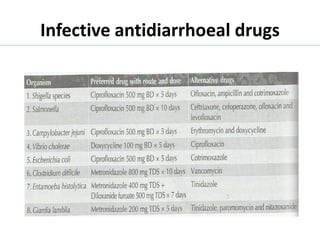
Infective antidiarrhoeal drugs
Pharmacotherapy of IBD
• IBD includes crohn’s disease and ulcerative colitis ,
characterized by diarrhoea, bleeding, abdominal discomfort,
anaemia and weight loss.
• Aminosalicylates: sulphasalazine, mesalamine, olsalazine,
balsalazide.
• Antibiotics: metronidazole, ciprofloxacin, clarithromycin.
• Glucocorticoids: prednisolone, methylprednisolone,
hydrocortisone, budesonide.
• Immunomodulators: azathioprine, 6-mercaptopurine,
methotrexate.
• Biological response modifiers: infliximab.
Pharmacotherapy of IBD…
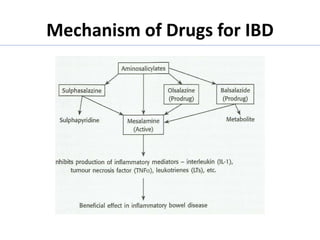
• Sulphasalazine: prodrug composed of
sulphapyridine and 5- aminosalicylic acid (5-
ASA), acts locally by inhibiting production of
inflammatory mediators.
• Sulphapyridine get absorbed and causes side
effects like nausea, vomiting, skin rashes,
headache, fever, pancreatitis, pneumonitis,
etc.
Pharmacotherapy of IBD…
• Mesalamine: 5-ASA, can administerd as
suppository and enema.
• Osalazine: 2 molecule of 5-ASA with azo
linkage, poorly absorbed after oral
administration; in colon it cleaved into 2
molecules of 5-ASA by colonic bacteria.
• Basalazide: split into 5-ASA and metabolized
in colon.
Mechanism of Drugs for IBD
Pharmacotherapy of IBD…
• Glucocorticoids: used in moderate to severe
IBD, prolong use can leads to adrenal
suppression and numerous systemic side
effects.
• Antibiotics: metranidazole, ciprofloxacin,
clarithromycin.
• Immunosuppressants:
• Biological response modefier:
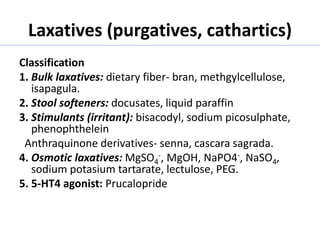
Laxatives (purgatives, cathartics)
Classification
1. Bulk laxatives: dietary fiber- bran, methgylcellulose,
isapagula.
2. Stool softeners: docusates, liquid paraffin
3. Stimulants (irritant): bisacodyl, sodium picosulphate,
phenophthelein
Anthraquinone derivatives- senna, cascara sagrada.
4. Osmotic laxatives: MgSO4
-, MgOH, NaPO4-, NaSO4,
sodium potasium tartarate, lectulose, PEG.
5. 5-HT4 agonist: Prucalopride
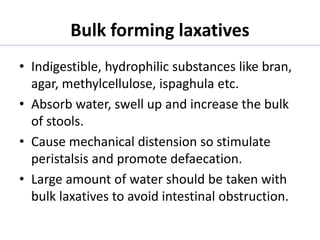
Bulk forming laxatives
• Indigestible, hydrophilic substances like bran,
agar, methylcellulose, ispaghula etc.
• Absorb water, swell up and increase the bulk
of stools.
• Cause mechanical distension so stimulate
peristalsis and promote defaecation.
• Large amount of water should be taken with
bulk laxatives to avoid intestinal obstruction.
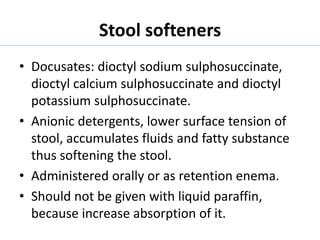
Stool softeners
• Docusates: dioctyl sodium sulphosuccinate,
dioctyl calcium sulphosuccinate and dioctyl
potassium sulphosuccinate.
• Anionic detergents, lower surface tension of
stool, accumulates fluids and fatty substance
thus softening the stool.
• Administered orally or as retention enema.
• Should not be given with liquid paraffin,
because increase absorption of it.
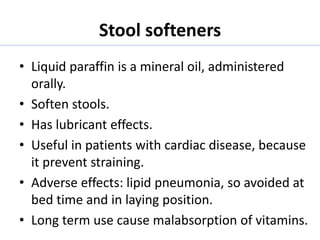
Stool softeners
• Liquid paraffin is a mineral oil, administered
orally.
• Soften stools.
• Has lubricant effects.
• Useful in patients with cardiac disease, because
it prevent straining.
• Adverse effects: lipid pneumonia, so avoided at
bed time and in laying position.
• Long term use cause malabsorption of vitamins.
Stimulant laxatives
• Phenophtaelein, bisacodyl, sodium picosulfate,
anthraquinone derivatives,
• These agents have direct action on enteric
neurons and GI mucosa.
• Increase prostaglandin and cAMP levels, inhibit
Na+, K+-ATPase activity in intestinal mucosa.
• Increase secretion of water and electrolytes by
intestinal (colon) mucosa thus stimulating
peristalsis.
• Contraindicated in pregnancy.
Osmotic/saline laxatives
• Most powerful and rapid acting laxatives.
• Salts of magnesium, sodium or potassium.
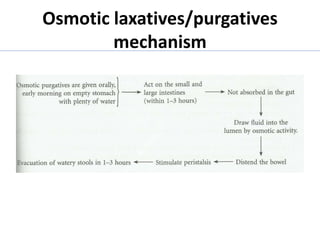
• Given orally, not absorbed from gut, remain in
lumen and exert osmotic effect, draw water in
lumen, distend the bowel, stimulates
peristalsis.
• Sodium phosphate used in enema before
surgery.
• Should be avoided in cardiac patients.
Osmotic laxatives/purgatives
mechanism
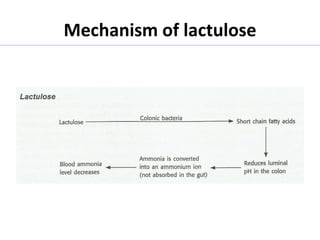
Mechanism of lactulose
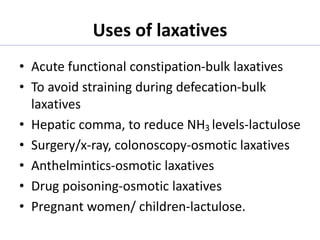
Uses of laxatives
• Acute functional constipation-bulk laxatives
• To avoid straining during defecation-bulk
laxatives
• Hepatic comma, to reduce NH3 levels-lactulose
• Surgery/x-ray, colonoscopy-osmotic laxatives
• Anthelmintics-osmotic laxatives
• Drug poisoning-osmotic laxatives
• Pregnant women/ children-lactulose.
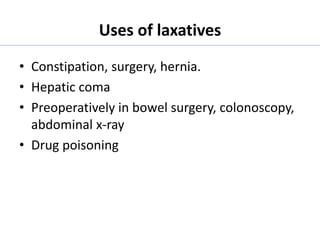
Uses of laxatives
• Constipation, surgery, hernia.
• Hepatic coma
• Preoperatively in bowel surgery, colonoscopy,
abdominal x-ray
• Drug poisoning

Diarrhea and constipation

  • 1.
    Drugs for diarrhoeaand constipation
  • 2.
    Anti-diarrhoeal agents • Diarrhoea:frequent passage of liquid or semisolid stools is called diarrhoea. • Causes: enteric infection, food toxins, malnutrition, inflammation, drugs like reserpine, prostaglandins, metoclopramide, domperidome, cholinergic drugs, quinidine and purgatives. • Dysentery: abdominal pain and passage of bloody stools and mucous due to infection or inflammation.
  • 3.
    Agents can causediarrhoea Non specific agents: 1. Fear 2. Anxiety or apprehension 3. Ingestion 4. Traveling • Acute diarrhoea • Chronic diarrhoea
  • 4.
    Management of diarrhoea 1.Non-specific therapy: a) Oral and parenteral rehydration b) Anti-motility and anti-secretory agents: i) Opioids: codeine, diphenoxylate, loperaminde ii) α-adrenergic receptor agonist: clonidine iii) Octreotide. 2. Specific therapy: Antimicrobial agents 3. Antispasmodics: Atropine & oxyphenonium (antrenyl) 4. Adsorbants: Kaolin, pectin and chalk, bismuth subsalicylate
  • 5.
    Non-specific therapy Oral rehydrationsolution (ORS): 2.6 g NaCl, 1.5 g KCl, 2.9 g sodium citrate, 13.5 g glucose dissolved in 1 liter of water. Super ORS: (boiled rice powder used instead of glucose)-also decreases frequency of diarrhoea along with rehydration.
  • 6.
    Antimotility and antisecretoryagents • Codeine: opium alkaloid, reduces GI motility, also have antisecretory effects. • Diphenoxylate: structurally related to pethidine, combined with small doses with atropine, side effects are constipation, paralytic ileus, banned in many countries. • Loperamide: opiate analogue and importantant antidiarroeal than morphine. • Interact with µ-receptor in the gut, reduces GI motility and increase anal sphincter tone.
  • 7.
    Antimotility and antisecretory…. •loperamide poorly penetrates BBB and has no abuse potential. Can use in acute and chronic and traveller’s diarrhoea. Adverse reactions: • Skin rashes, headache, and paralytic ileus, should not be used in children <4 years of age. Should be avoided in infectious diarrhoeas, avoided in IBD.
  • 8.
    Antimotility and antisecretory… •Clonidine: it has antimotility and antisecretory activities, used in diabetics with autonomic neuropathy, • Octreotide: analogue of somatostatin, inhibits 5-HT & VIP, gastrin, used in refractory diarrhoea in patients with AIDS. • Racecadotril: inhibits degradation of enkephalins, used in acute secretory diarrhoeas. • Side effects: nausea, vomiting, drowsiness.
  • 9.
  • 10.
    Pharmacotherapy of IBD •IBD includes crohn’s disease and ulcerative colitis , characterized by diarrhoea, bleeding, abdominal discomfort, anaemia and weight loss. • Aminosalicylates: sulphasalazine, mesalamine, olsalazine, balsalazide. • Antibiotics: metronidazole, ciprofloxacin, clarithromycin. • Glucocorticoids: prednisolone, methylprednisolone, hydrocortisone, budesonide. • Immunomodulators: azathioprine, 6-mercaptopurine, methotrexate. • Biological response modifiers: infliximab.
  • 11.
    Pharmacotherapy of IBD… •Sulphasalazine: prodrug composed of sulphapyridine and 5- aminosalicylic acid (5- ASA), acts locally by inhibiting production of inflammatory mediators. • Sulphapyridine get absorbed and causes side effects like nausea, vomiting, skin rashes, headache, fever, pancreatitis, pneumonitis, etc.
  • 12.
    Pharmacotherapy of IBD… •Mesalamine: 5-ASA, can administerd as suppository and enema. • Osalazine: 2 molecule of 5-ASA with azo linkage, poorly absorbed after oral administration; in colon it cleaved into 2 molecules of 5-ASA by colonic bacteria. • Basalazide: split into 5-ASA and metabolized in colon.
  • 13.
  • 14.
    Pharmacotherapy of IBD… •Glucocorticoids: used in moderate to severe IBD, prolong use can leads to adrenal suppression and numerous systemic side effects. • Antibiotics: metranidazole, ciprofloxacin, clarithromycin. • Immunosuppressants: • Biological response modefier:
  • 15.
    Laxatives (purgatives, cathartics) Classification 1.Bulk laxatives: dietary fiber- bran, methgylcellulose, isapagula. 2. Stool softeners: docusates, liquid paraffin 3. Stimulants (irritant): bisacodyl, sodium picosulphate, phenophthelein Anthraquinone derivatives- senna, cascara sagrada. 4. Osmotic laxatives: MgSO4 -, MgOH, NaPO4-, NaSO4, sodium potasium tartarate, lectulose, PEG. 5. 5-HT4 agonist: Prucalopride
  • 16.
    Bulk forming laxatives •Indigestible, hydrophilic substances like bran, agar, methylcellulose, ispaghula etc. • Absorb water, swell up and increase the bulk of stools. • Cause mechanical distension so stimulate peristalsis and promote defaecation. • Large amount of water should be taken with bulk laxatives to avoid intestinal obstruction.
  • 17.
    Stool softeners • Docusates:dioctyl sodium sulphosuccinate, dioctyl calcium sulphosuccinate and dioctyl potassium sulphosuccinate. • Anionic detergents, lower surface tension of stool, accumulates fluids and fatty substance thus softening the stool. • Administered orally or as retention enema. • Should not be given with liquid paraffin, because increase absorption of it.
  • 18.
    Stool softeners • Liquidparaffin is a mineral oil, administered orally. • Soften stools. • Has lubricant effects. • Useful in patients with cardiac disease, because it prevent straining. • Adverse effects: lipid pneumonia, so avoided at bed time and in laying position. • Long term use cause malabsorption of vitamins.
  • 19.
    Stimulant laxatives • Phenophtaelein,bisacodyl, sodium picosulfate, anthraquinone derivatives, • These agents have direct action on enteric neurons and GI mucosa. • Increase prostaglandin and cAMP levels, inhibit Na+, K+-ATPase activity in intestinal mucosa. • Increase secretion of water and electrolytes by intestinal (colon) mucosa thus stimulating peristalsis. • Contraindicated in pregnancy.
  • 20.
    Osmotic/saline laxatives • Mostpowerful and rapid acting laxatives. • Salts of magnesium, sodium or potassium. • Given orally, not absorbed from gut, remain in lumen and exert osmotic effect, draw water in lumen, distend the bowel, stimulates peristalsis. • Sodium phosphate used in enema before surgery. • Should be avoided in cardiac patients.
  • 21.
  • 22.
  • 23.
    Uses of laxatives •Acute functional constipation-bulk laxatives • To avoid straining during defecation-bulk laxatives • Hepatic comma, to reduce NH3 levels-lactulose • Surgery/x-ray, colonoscopy-osmotic laxatives • Anthelmintics-osmotic laxatives • Drug poisoning-osmotic laxatives • Pregnant women/ children-lactulose.
  • 24.
    Uses of laxatives •Constipation, surgery, hernia. • Hepatic coma • Preoperatively in bowel surgery, colonoscopy, abdominal x-ray • Drug poisoning