25/06/1441 Diaphragm Dr Mostafa Kandil 1
25/06/1441 Diaphragm Dr Mostafa Kandil 2
Diaphragm
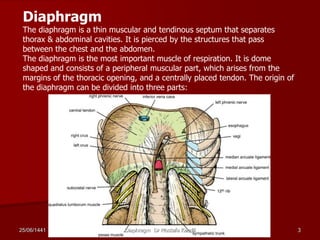
The diaphragm is a thin muscular and tendinous septum that separates
thorax & abdominal cavities. It is pierced by the structures that pass
between the chest and the abdomen.
The diaphragm is the most important muscle of respiration. It is dome
shaped and consists of a peripheral muscular part, which arises from the
margins of the thoracic opening, and a centrally placed tendon. The origin of
the diaphragm can be divided into three parts:
25/06/1441 Diaphragm Dr Mostafa Kandil 3
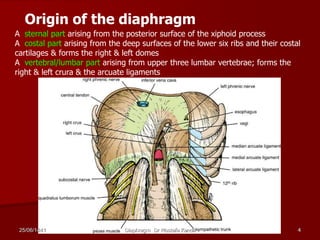
A sternal part arising from the posterior surface of the xiphoid process
A costal part arising from the deep surfaces of the lower six ribs and their costal
cartilages & forms the right & left domes
A vertebral/lumbar part arising from upper three lumbar vertebrae; forms the
right & left crura & the arcuate ligaments
Origin of the diaphragm
25/06/1441 Diaphragm Dr Mostafa Kandil 4
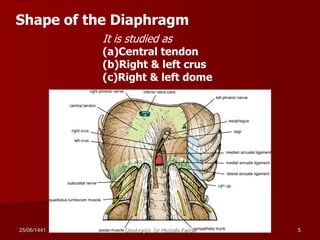
Shape of the Diaphragm
It is studied as
(a)Central tendon
(b)Right & left crus
(c)Right & left dome
25/06/1441 Diaphragm Dr Mostafa Kandil 5
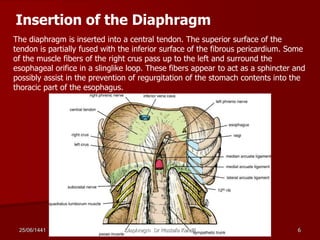
The diaphragm is inserted into a central tendon. The superior surface of the
tendon is partially fused with the inferior surface of the fibrous pericardium. Some
of the muscle fibers of the right crus pass up to the left and surround the
esophageal orifice in a slinglike loop. These fibers appear to act as a sphincter and
possibly assist in the prevention of regurgitation of the stomach contents into the
thoracic part of the esophagus.
Insertion of the Diaphragm
25/06/1441 Diaphragm Dr Mostafa Kandil 6
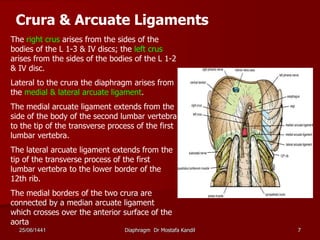
The right crus arises from the sides of the
bodies of the L 1-3 & IV discs; the left crus
arises from the sides of the bodies of the L 1-2
& IV disc.
Lateral to the crura the diaphragm arises from
the medial & lateral arcuate ligament.
The medial arcuate ligament extends from the
side of the body of the second lumbar vertebra
to the tip of the transverse process of the first
lumbar vertebra.
The lateral arcuate ligament extends from the
tip of the transverse process of the first
lumbar vertebra to the lower border of the
12th rib.
The medial borders of the two crura are
connected by a median arcuate ligament
which crosses over the anterior surface of the
aorta
Crura & Arcuate Ligaments
25/06/1441 Diaphragm Dr Mostafa Kandil 7
Functions of the Diaphragm
Muscle of inspiration: On contraction the diaphragm pulls its central tendon down
and increases the vertical diameter of the thorax. The diaphragm is the most
important muscle used in inspiration.
Muscle of abdominal straining: The contraction of the diaphragm assists the
contraction of the muscles of the anterior abdominal wall in raising the intra-
abdominal pressure for micturition, defecation, and parturition.
Weight lifting muscle: In a person taking a deep breath and holding it (fixing the
diaphragm), the diaphragm assists the muscles of the anterior abdominal wall in
raising the intra-abdominal pressure. Before doing this make sure that a person
have adequate sphincteric control of the bladder and anal canal under these
circumstances.
Thoracoaabdominal pump: The descent of the diaphragm decreases the
intrathoracic pressure & increases the intra-abdominal pressure. This compresses
the blood in the inferior vena cava and forces it upward into the right atrium of the
heart. Within the abdominal lymph vessels is also compressed, and its passage
upward within the thoracic duct is aided by the negative intrathoracic pressure.
The presence of valves within the thoracic duct prevents backflow.
25/06/1441 Diaphragm Dr Mostafa Kandil 8
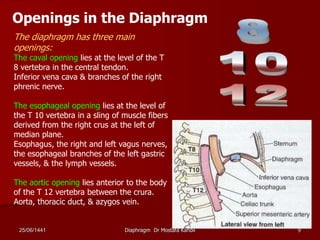
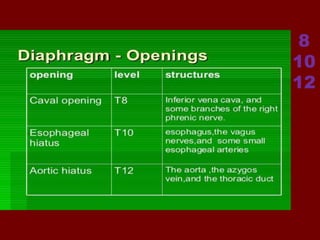
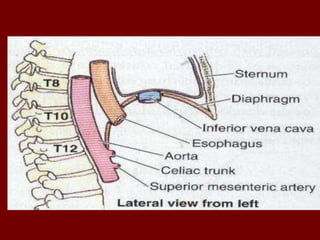
The diaphragm has three main
openings:
The caval opening lies at the level of the T
8 vertebra in the central tendon.
Inferior vena cava & branches of the right
phrenic nerve.
The esophageal opening lies at the level of
the T 10 vertebra in a sling of muscle fibers
derived from the right crus at the left of
median plane.
Esophagus, the right and left vagus nerves,
the esophageal branches of the left gastric
vessels, & the lymph vessels.
The aortic opening lies anterior to the body
of the T 12 vertebra between the crura.
Aorta, thoracic duct, & azygos vein.
Openings in the Diaphragm
25/06/1441 Diaphragm Dr Mostafa Kandil 9
Nerve Supply of the Diaphragm
Motor nerve supply:
The right and left phrenic nerves (C3, 4, 5)
Sensory nerve supply:
The parietal pleura and peritoneum covering the central surfaces of the
diaphragm are from the phrenic nerve and the periphery of the diaphragm
is from the lower six intercostal nerves.
25/06/1441 Diaphragm Dr Mostafa Kandil 10
Hiccup
Hiccup is the involuntary spasmodic contraction of the diaphragm It is a
common condition in normal individuals and occurs after eating or drinking as
a result of gastric irritation of the vagus nerve endings.
It may, however, be a symptom of disease such as pleurisy, peritonitis,
pericarditis, or uremia.
Paralysis of the Diaphragm
A single dome of the diaphragm may be paralyzed by crushing or sectioning of
the phrenic nerve in the neck.
Penetrating Injuries of the Diaphragm
Any penetrating wound to the chest below the level of the nipples should be
suspected of causing damage to the diaphragm until proved otherwise.
Clinical Notes
25/06/1441 Diaphragm Dr Mostafa Kandil 11
25/06/1441 Diaphragm Dr Mostafa Kandil 12
25/06/1441 Diaphragm Dr Mostafa Kandil 13
25/06/1441 Diaphragm Dr Mostafa Kandil 14
8
10
12
Other minor openings
• Sympathetic trunk (pass posterior to the medial
arcuate ligament on both sides).
• Superior epigastric vessels (pass between the
sterna and costal origins of the diaphragm on
each side).
• Left phrenic nerve (pierces the left dome of
diaphragm)
• Neurovascular bundles of lower six intercostal spaces
(pass between the muscular slips of costal origin of
diaphragm)
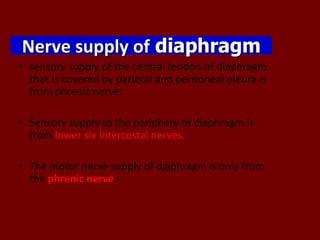
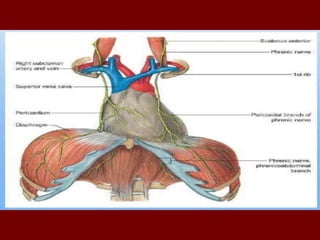
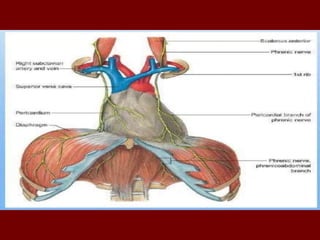
Nerve supply of diaphragm
• sensory supply of the central tendon of diaphragm
that is covered by parietal and peritoneal pleura is
from phrenic nerve.
• Sensory supply to the periphery of diaphragm is
from lower six intercostal nerves.
• The motor nerve supply of diaphragm is only from
the phrenic nerve.
25/06/1441 Diaphragm Dr Mostafa Kandil 22
25/06/1441 Diaphragm Dr Mostafa Kandil 23
References
1. Gray's Anatomy for Students- Second edition.
2. Clinically Oriented Anatomy , Keith L. Moore- Sixth
edition.
3. Snell clinical anatomy system by system student
10th edition .
25/06/1441 Diaphragm Dr Mostafa Kandil 24

Diaphragm l4 dr kandil

  • 1.
    25/06/1441 Diaphragm DrMostafa Kandil 1
  • 2.
    25/06/1441 Diaphragm DrMostafa Kandil 2
  • 3.
    Diaphragm The diaphragm isa thin muscular and tendinous septum that separates thorax & abdominal cavities. It is pierced by the structures that pass between the chest and the abdomen. The diaphragm is the most important muscle of respiration. It is dome shaped and consists of a peripheral muscular part, which arises from the margins of the thoracic opening, and a centrally placed tendon. The origin of the diaphragm can be divided into three parts: 25/06/1441 Diaphragm Dr Mostafa Kandil 3
  • 4.
    A sternal partarising from the posterior surface of the xiphoid process A costal part arising from the deep surfaces of the lower six ribs and their costal cartilages & forms the right & left domes A vertebral/lumbar part arising from upper three lumbar vertebrae; forms the right & left crura & the arcuate ligaments Origin of the diaphragm 25/06/1441 Diaphragm Dr Mostafa Kandil 4
  • 5.
    Shape of theDiaphragm It is studied as (a)Central tendon (b)Right & left crus (c)Right & left dome 25/06/1441 Diaphragm Dr Mostafa Kandil 5
  • 6.
    The diaphragm isinserted into a central tendon. The superior surface of the tendon is partially fused with the inferior surface of the fibrous pericardium. Some of the muscle fibers of the right crus pass up to the left and surround the esophageal orifice in a slinglike loop. These fibers appear to act as a sphincter and possibly assist in the prevention of regurgitation of the stomach contents into the thoracic part of the esophagus. Insertion of the Diaphragm 25/06/1441 Diaphragm Dr Mostafa Kandil 6
  • 7.
    The right crusarises from the sides of the bodies of the L 1-3 & IV discs; the left crus arises from the sides of the bodies of the L 1-2 & IV disc. Lateral to the crura the diaphragm arises from the medial & lateral arcuate ligament. The medial arcuate ligament extends from the side of the body of the second lumbar vertebra to the tip of the transverse process of the first lumbar vertebra. The lateral arcuate ligament extends from the tip of the transverse process of the first lumbar vertebra to the lower border of the 12th rib. The medial borders of the two crura are connected by a median arcuate ligament which crosses over the anterior surface of the aorta Crura & Arcuate Ligaments 25/06/1441 Diaphragm Dr Mostafa Kandil 7
  • 8.
    Functions of theDiaphragm Muscle of inspiration: On contraction the diaphragm pulls its central tendon down and increases the vertical diameter of the thorax. The diaphragm is the most important muscle used in inspiration. Muscle of abdominal straining: The contraction of the diaphragm assists the contraction of the muscles of the anterior abdominal wall in raising the intra- abdominal pressure for micturition, defecation, and parturition. Weight lifting muscle: In a person taking a deep breath and holding it (fixing the diaphragm), the diaphragm assists the muscles of the anterior abdominal wall in raising the intra-abdominal pressure. Before doing this make sure that a person have adequate sphincteric control of the bladder and anal canal under these circumstances. Thoracoaabdominal pump: The descent of the diaphragm decreases the intrathoracic pressure & increases the intra-abdominal pressure. This compresses the blood in the inferior vena cava and forces it upward into the right atrium of the heart. Within the abdominal lymph vessels is also compressed, and its passage upward within the thoracic duct is aided by the negative intrathoracic pressure. The presence of valves within the thoracic duct prevents backflow. 25/06/1441 Diaphragm Dr Mostafa Kandil 8
  • 9.
    The diaphragm hasthree main openings: The caval opening lies at the level of the T 8 vertebra in the central tendon. Inferior vena cava & branches of the right phrenic nerve. The esophageal opening lies at the level of the T 10 vertebra in a sling of muscle fibers derived from the right crus at the left of median plane. Esophagus, the right and left vagus nerves, the esophageal branches of the left gastric vessels, & the lymph vessels. The aortic opening lies anterior to the body of the T 12 vertebra between the crura. Aorta, thoracic duct, & azygos vein. Openings in the Diaphragm 25/06/1441 Diaphragm Dr Mostafa Kandil 9
  • 10.
    Nerve Supply ofthe Diaphragm Motor nerve supply: The right and left phrenic nerves (C3, 4, 5) Sensory nerve supply: The parietal pleura and peritoneum covering the central surfaces of the diaphragm are from the phrenic nerve and the periphery of the diaphragm is from the lower six intercostal nerves. 25/06/1441 Diaphragm Dr Mostafa Kandil 10
  • 11.
    Hiccup Hiccup is theinvoluntary spasmodic contraction of the diaphragm It is a common condition in normal individuals and occurs after eating or drinking as a result of gastric irritation of the vagus nerve endings. It may, however, be a symptom of disease such as pleurisy, peritonitis, pericarditis, or uremia. Paralysis of the Diaphragm A single dome of the diaphragm may be paralyzed by crushing or sectioning of the phrenic nerve in the neck. Penetrating Injuries of the Diaphragm Any penetrating wound to the chest below the level of the nipples should be suspected of causing damage to the diaphragm until proved otherwise. Clinical Notes 25/06/1441 Diaphragm Dr Mostafa Kandil 11
  • 12.
    25/06/1441 Diaphragm DrMostafa Kandil 12
  • 13.
    25/06/1441 Diaphragm DrMostafa Kandil 13
  • 14.
    25/06/1441 Diaphragm DrMostafa Kandil 14
  • 15.
  • 17.
    Other minor openings •Sympathetic trunk (pass posterior to the medial arcuate ligament on both sides). • Superior epigastric vessels (pass between the sterna and costal origins of the diaphragm on each side).
  • 18.
    • Left phrenicnerve (pierces the left dome of diaphragm) • Neurovascular bundles of lower six intercostal spaces (pass between the muscular slips of costal origin of diaphragm)
  • 19.
    Nerve supply ofdiaphragm • sensory supply of the central tendon of diaphragm that is covered by parietal and peritoneal pleura is from phrenic nerve. • Sensory supply to the periphery of diaphragm is from lower six intercostal nerves. • The motor nerve supply of diaphragm is only from the phrenic nerve.
  • 22.
    25/06/1441 Diaphragm DrMostafa Kandil 22
  • 23.
    25/06/1441 Diaphragm DrMostafa Kandil 23 References 1. Gray's Anatomy for Students- Second edition. 2. Clinically Oriented Anatomy , Keith L. Moore- Sixth edition. 3. Snell clinical anatomy system by system student 10th edition .
  • 24.
    25/06/1441 Diaphragm DrMostafa Kandil 24