Talk: Harshad Devarbhavi
Chairpersons: Banumathi Ramakrishna,
Rukmini Mridula, Ujjal Poddar
Diagnostic challenges in Wilson disease:
do scoring systems help?
Diagnostic Challenges: Do
Scoring systems help?
Prof. Harshad Devarbhavi, MD,DM
St. Johns Medical College Hospital
Bangalore
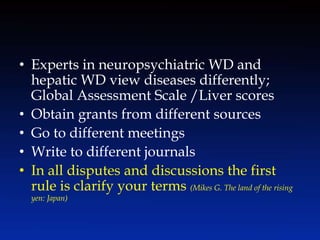
• Experts in neuropsychiatric WD and
hepatic WD view diseases differently;
Global Assessment Scale /Liver scores
• Obtain grants from different sources
• Go to different meetings
• Write to different journals
• In all disputes and discussions the first
rule is clarify your terms (Mikes G. The land of the rising
yen: Japan)
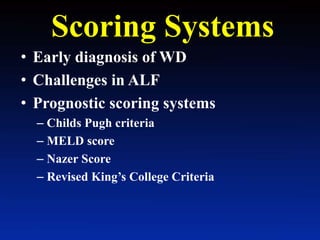
Scoring Systems
• Early diagnosis of WD
• Challenges in ALF
• Prognostic scoring systems
– Childs Pugh criteria
– MELD score
– Nazer Score
– Revised King’s College Criteria
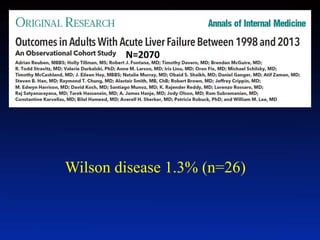
Wilson disease 1.3% (n=26)
N=2070
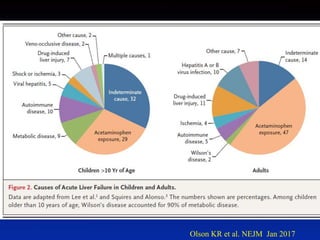
Olson KR et al. NEJM Jan 2017
0
100
200
300
400
500
600
HAV HBV HEV Dual
Acute
Only
Chronic
ATT Non-A,
Non-E
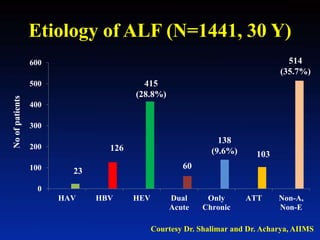
23
60
415
(28.8%)
126
138
(9.6%)
514
(35.7%)
103
Etiology of ALF (N=1441, 30 Y)
Noofpatients
Courtesy Dr. Shalimar and Dr. Acharya, AIIMS
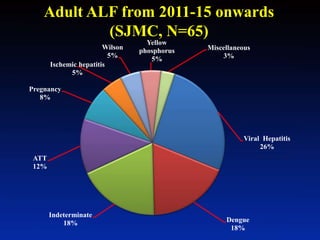
Adult ALF from 2011-15 onwards
(SJMC, N=65)
Viral Hepatitis
26%
Dengue
18%
Indeterminate
18%
ATT
12%
Pregnancy
8%
Ischemic hepatitis
5%
Wilson
5%
Yellow
phosphorus
5%
Miscellaneous
3%
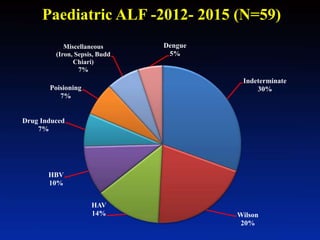
Paediatric ALF -2012- 2015 (N=59)
Indeterminate
30%
Wilson
20%
HAV
14%
HBV
10%
Drug Induced
7%
Poisioning
7%
Miscellaneous
(Iron, Sepsis, Budd
Chiari)
7%
Dengue
5%
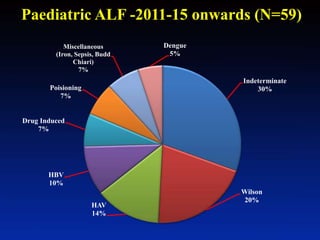
Paediatric ALF -2011-15 onwards (N=59)
Indeterminate
30%
Wilson
20%
HAV
14%
HBV
10%
Drug Induced
7%
Poisioning
7%
Miscellaneous
(Iron, Sepsis, Budd
Chiari)
7%
Dengue
5%
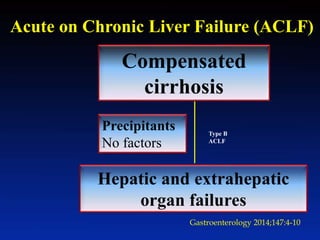
Compensated
cirrhosis
Precipitants
No factors
Type B
ACLF
Hepatic and extrahepatic
organ failures
Gastroenterology 2014;147:4-10
Acute on Chronic Liver Failure (ACLF)
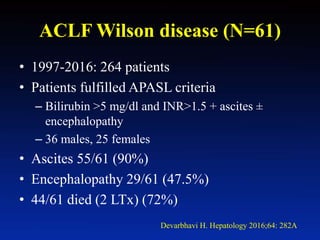
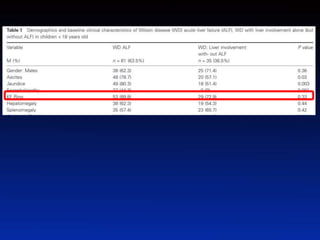
ACLF Wilson disease (N=61)
• 1997-2016: 264 patients
• Patients fulfilled APASL criteria
– Bilirubin >5 mg/dl and INR>1.5 + ascites ±
encephalopathy
– 36 males, 25 females
• Ascites 55/61 (90%)
• Encephalopathy 29/61 (47.5%)
• 44/61 died (2 LTx) (72%)
Devarbhavi H. Hepatology 2016;64: 282A
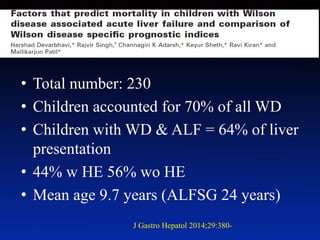
• Total number: 230
• Children accounted for 70% of all WD
• Children with WD & ALF = 64% of liver
presentation
• 44% w HE 56% wo HE
• Mean age 9.7 years (ALFSG 24 years)
J Gastro Hepatol 2014;29:380-
WD: N=3+6 vs Control =5
Findings: younger, KF+(7/9), high: S. Cr, U Cu, L Cu.
Less pronounced AST, ALT elevation, high T. Bilirubin, low HB
McCullough AJ et al. GE 1983;84:161
WD: N=6 (Mean age 18.5y) vs Control n=43 Non WD FHF
•ALP/TB <2 (100% sensitivity/specificity)
•AST/ALT >4
Berman DH et al. GE 1991;100:1129-34
Nazer H. Gut 1986;27:1377(N=34 (6-33y) pediatric and chronic cases; score>7 )
1 2 3 4
Serum bilirubin
[µmol/L] [mg/dL)
100-150
(5.8-8.7)
15-200
(8.7-11.6)
201-300
(11.7-17.5)
>300
(17.55)
AST [U/L] 100-150 151-300 301-400 >400
INR 1.3-1.6 1.7-1.9 2.0-2.4 >2.4
WBC [109/L] 6.8-8.3 8.4-10.3 10.4-15.3 >15.3
Albumin [g/L] 34-44 25-33 21-24 <21
Dhawan et al. Liver Tx 2005;11:441 (Score >11 death/LTx, Age 12-13.2y)
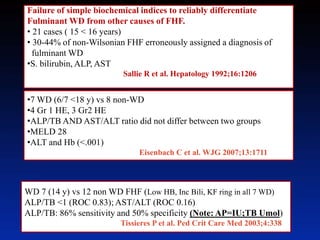
Failure of simple biochemical indices to reliably differentiate
Fulminant WD from other causes of FHF.
• 21 cases ( 15 < 16 years)
• 30-44% of non-Wilsonian FHF erroneously assigned a diagnosis of
fulminant WD
•S. bilirubin, ALP, AST
Sallie R et al. Hepatology 1992;16:1206
WD 7 (14 y) vs 12 non WD FHF (Low HB, Inc Bili, KF ring in all 7 WD)
ALP/TB <1 (ROC 0.83); AST/ALT (ROC 0.16)
ALP/TB: 86% sensitivity and 50% specificity (Note: AP=IU;TB Umol)
Tissieres P et al. Ped Crit Care Med 2003;4:338
•7 WD (6/7 <18 y) vs 8 non-WD
•4 Gr 1 HE, 3 Gr2 HE
•ALP/TB AND AST/ALT ratio did not differ between two groups
•MELD 28
•ALT and Hb (<.001)
Eisenbach C et al. WJG 2007;13:1711
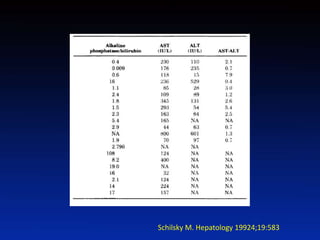
Schilsky M. Hepatology 19924;19:583
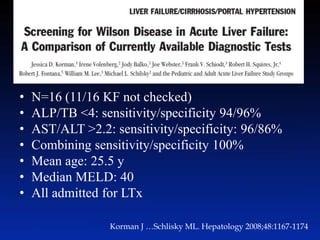
• N=16 (11/16 KF not checked)
• ALP/TB <4: sensitivity/specificity 94/96%
• AST/ALT >2.2: sensitivity/specificity: 96/86%
• Combining sensitivity/specificity 100%
• Mean age: 25.5 y
• Median MELD: 40
• All admitted for LTx
Korman J …Schlisky ML. Hepatology 2008;48:1167-1174
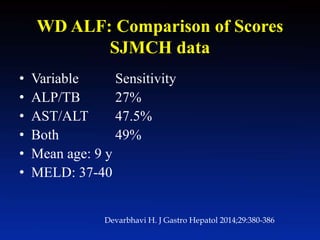
WD ALF: Comparison of Scores
SJMCH data
• Variable Sensitivity
• ALP/TB 27%
• AST/ALT 47.5%
• Both 49%
• Mean age: 9 y
• MELD: 37-40
Devarbhavi H. J Gastro Hepatol 2014;29:380-386
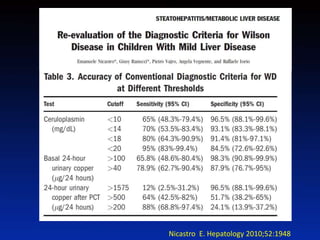
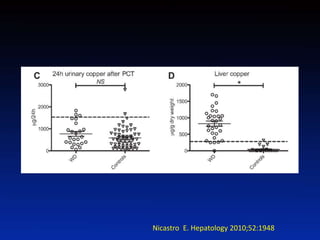
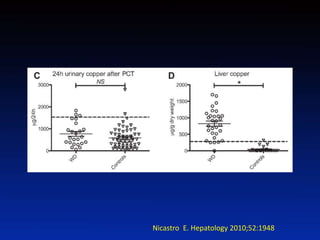
Nicastro E. Hepatology 2010;52:1948
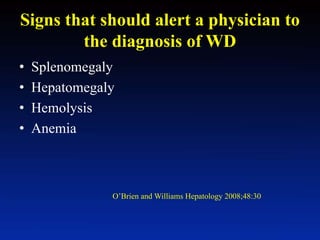
Signs that should alert a physician to
the diagnosis of WD
• Splenomegaly
• Hepatomegaly
• Hemolysis
• Anemia
O’Brien and Williams Hepatology 2008;48:30
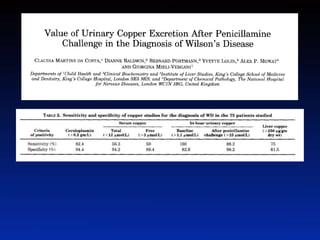
Penicillamine Challenge Test (PCT)
• PCT 88% sensitive and 98% specific (Hep
1992;15:609)
• “Although helpful, the test is cumbersone and difficult
to perform in severely ill children”(Dhawan Ltx 2005)
– “we were unable to do it in any of the children who died or
required urgent Ltx. In addition, the PCT gave normal
results in 9/29 tested children who presented with less
severe disease”
• Schilsky “Therefore, along with the data data collected
by Dhawan et al, Nicastro et al.’s data imply that we
should lay the PCT to rest and rely on basal urine Cu
excretion with lower cut off values” (Hep
2010;52:1872)
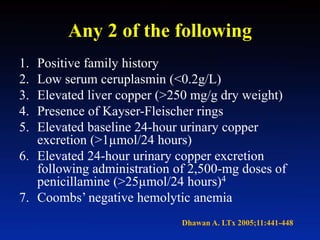
Any 2 of the following
1. Positive family history
2. Low serum ceruplasmin (<0.2g/L)
3. Elevated liver copper (>250 mg/g dry weight)
4. Presence of Kayser-Fleischer rings
5. Elevated baseline 24-hour urinary copper
excretion (>1µmol/24 hours)
6. Elevated 24-hour urinary copper excretion
following administration of 2,500-mg doses of
penicillamine (>25µmol/24 hours)4
7. Coombs’ negative hemolytic anemia
Dhawan A. LTx 2005;11:441-448
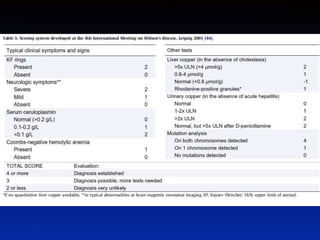
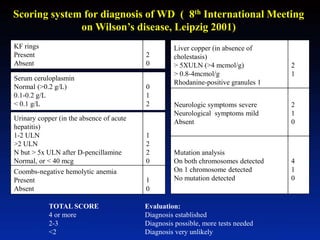
Scoring system for diagnosis of WD ( 8th International Meeting
on Wilson’s disease, Leipzig 2001)
KF rings
Present
Absent
2
0
Liver copper (in absence of
cholestasis)
> 5XULN (>4 mcmol/g)
> 0.8-4mcmol/g
Rhodanine-positive granules 1
2
1
TOTAL SCORE Evaluation:
4 or more Diagnosis established
2-3 Diagnosis possible, more tests needed
<2 Diagnosis very unlikely
Serum ceruloplasmin
Normal (>0.2 g/L)
0.1-0.2 g/L
< 0.1 g/L
0
1
2
Urinary copper (in the absence of acute
hepatitis)
1-2 ULN
>2 ULN
N but > 5x ULN after D-pencillamine
Normal, or < 40 mcg
1
2
2
0
Coombs-negative hemolytic anemia
Present
Absent
1
0
Neurologic symptoms severe
Neurological symptoms mild
Absent
2
1
0
Mutation analysis
On both chromosomes detected
On 1 chromosome detected
No mutation detected
4
1
0
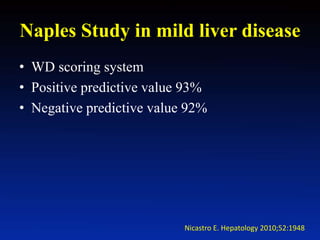
Naples Study in mild liver disease
• WD scoring system
• Positive predictive value 93%
• Negative predictive value 92%
Nicastro E. Hepatology 2010;52:1948
Typical clinical symptoms
(extra pyramidal symptoms, KFR, CPL)
Score 0-1 Score 2-3 Score ≥ 4
Diagnosis
established
Urinary copper
>1.6µmol/d*
Urinary copper
>1.6µmol/d*
Hepatic copper
Normal or <4 µmol/g
>4 µmol/g
Mutation analysis
Score ≤3
2 mutations
1 mutation
0 mutation
Fig. 1. Diagnostic algorithms for Wilson’s disease based on the Leipzig Score [44]. *In
children the cut off can be lowered to 0.64 µmol/d.
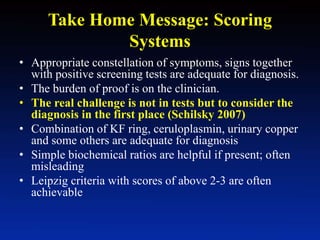
Take Home Message: Scoring
Systems
• Appropriate constellation of symptoms, signs together
with positive screening tests are adequate for diagnosis.
• The burden of proof is on the clinician.
• The real challenge is not in tests but to consider the
diagnosis in the first place (Schilsky 2007)
• Combination of KF ring, ceruloplasmin, urinary copper
and some others are adequate for diagnosis
• Simple biochemical ratios are helpful if present; often
misleading
• Leipzig criteria with scores of above 2-3 are often
achievable

Diagnostic challenges in Wilson disease: do scoring systems help? - Dr Harshad Devarbhavi

  • 1.
    Talk: Harshad Devarbhavi Chairpersons:Banumathi Ramakrishna, Rukmini Mridula, Ujjal Poddar Diagnostic challenges in Wilson disease: do scoring systems help?
  • 2.
    Diagnostic Challenges: Do Scoringsystems help? Prof. Harshad Devarbhavi, MD,DM St. Johns Medical College Hospital Bangalore
  • 3.
    • Experts inneuropsychiatric WD and hepatic WD view diseases differently; Global Assessment Scale /Liver scores • Obtain grants from different sources • Go to different meetings • Write to different journals • In all disputes and discussions the first rule is clarify your terms (Mikes G. The land of the rising yen: Japan)
  • 4.
    Scoring Systems • Earlydiagnosis of WD • Challenges in ALF • Prognostic scoring systems – Childs Pugh criteria – MELD score – Nazer Score – Revised King’s College Criteria
  • 5.
    Wilson disease 1.3%(n=26) N=2070
  • 6.
    Olson KR etal. NEJM Jan 2017
  • 7.
    0 100 200 300 400 500 600 HAV HBV HEVDual Acute Only Chronic ATT Non-A, Non-E 23 60 415 (28.8%) 126 138 (9.6%) 514 (35.7%) 103 Etiology of ALF (N=1441, 30 Y) Noofpatients Courtesy Dr. Shalimar and Dr. Acharya, AIIMS
  • 8.
    Adult ALF from2011-15 onwards (SJMC, N=65) Viral Hepatitis 26% Dengue 18% Indeterminate 18% ATT 12% Pregnancy 8% Ischemic hepatitis 5% Wilson 5% Yellow phosphorus 5% Miscellaneous 3%
  • 9.
    Paediatric ALF -2012-2015 (N=59) Indeterminate 30% Wilson 20% HAV 14% HBV 10% Drug Induced 7% Poisioning 7% Miscellaneous (Iron, Sepsis, Budd Chiari) 7% Dengue 5%
  • 10.
    Paediatric ALF -2011-15onwards (N=59) Indeterminate 30% Wilson 20% HAV 14% HBV 10% Drug Induced 7% Poisioning 7% Miscellaneous (Iron, Sepsis, Budd Chiari) 7% Dengue 5%
  • 11.
    Compensated cirrhosis Precipitants No factors Type B ACLF Hepaticand extrahepatic organ failures Gastroenterology 2014;147:4-10 Acute on Chronic Liver Failure (ACLF)
  • 12.
    ACLF Wilson disease(N=61) • 1997-2016: 264 patients • Patients fulfilled APASL criteria – Bilirubin >5 mg/dl and INR>1.5 + ascites ± encephalopathy – 36 males, 25 females • Ascites 55/61 (90%) • Encephalopathy 29/61 (47.5%) • 44/61 died (2 LTx) (72%) Devarbhavi H. Hepatology 2016;64: 282A
  • 13.
    • Total number:230 • Children accounted for 70% of all WD • Children with WD & ALF = 64% of liver presentation • 44% w HE 56% wo HE • Mean age 9.7 years (ALFSG 24 years) J Gastro Hepatol 2014;29:380-
  • 14.
    WD: N=3+6 vsControl =5 Findings: younger, KF+(7/9), high: S. Cr, U Cu, L Cu. Less pronounced AST, ALT elevation, high T. Bilirubin, low HB McCullough AJ et al. GE 1983;84:161 WD: N=6 (Mean age 18.5y) vs Control n=43 Non WD FHF •ALP/TB <2 (100% sensitivity/specificity) •AST/ALT >4 Berman DH et al. GE 1991;100:1129-34 Nazer H. Gut 1986;27:1377(N=34 (6-33y) pediatric and chronic cases; score>7 ) 1 2 3 4 Serum bilirubin [µmol/L] [mg/dL) 100-150 (5.8-8.7) 15-200 (8.7-11.6) 201-300 (11.7-17.5) >300 (17.55) AST [U/L] 100-150 151-300 301-400 >400 INR 1.3-1.6 1.7-1.9 2.0-2.4 >2.4 WBC [109/L] 6.8-8.3 8.4-10.3 10.4-15.3 >15.3 Albumin [g/L] 34-44 25-33 21-24 <21 Dhawan et al. Liver Tx 2005;11:441 (Score >11 death/LTx, Age 12-13.2y)
  • 15.
    Failure of simplebiochemical indices to reliably differentiate Fulminant WD from other causes of FHF. • 21 cases ( 15 < 16 years) • 30-44% of non-Wilsonian FHF erroneously assigned a diagnosis of fulminant WD •S. bilirubin, ALP, AST Sallie R et al. Hepatology 1992;16:1206 WD 7 (14 y) vs 12 non WD FHF (Low HB, Inc Bili, KF ring in all 7 WD) ALP/TB <1 (ROC 0.83); AST/ALT (ROC 0.16) ALP/TB: 86% sensitivity and 50% specificity (Note: AP=IU;TB Umol) Tissieres P et al. Ped Crit Care Med 2003;4:338 •7 WD (6/7 <18 y) vs 8 non-WD •4 Gr 1 HE, 3 Gr2 HE •ALP/TB AND AST/ALT ratio did not differ between two groups •MELD 28 •ALT and Hb (<.001) Eisenbach C et al. WJG 2007;13:1711
  • 16.
  • 17.
    • N=16 (11/16KF not checked) • ALP/TB <4: sensitivity/specificity 94/96% • AST/ALT >2.2: sensitivity/specificity: 96/86% • Combining sensitivity/specificity 100% • Mean age: 25.5 y • Median MELD: 40 • All admitted for LTx Korman J …Schlisky ML. Hepatology 2008;48:1167-1174
  • 18.
    WD ALF: Comparisonof Scores SJMCH data • Variable Sensitivity • ALP/TB 27% • AST/ALT 47.5% • Both 49% • Mean age: 9 y • MELD: 37-40 Devarbhavi H. J Gastro Hepatol 2014;29:380-386
  • 22.
  • 23.
  • 24.
  • 25.
    Signs that shouldalert a physician to the diagnosis of WD • Splenomegaly • Hepatomegaly • Hemolysis • Anemia O’Brien and Williams Hepatology 2008;48:30
  • 27.
    Penicillamine Challenge Test(PCT) • PCT 88% sensitive and 98% specific (Hep 1992;15:609) • “Although helpful, the test is cumbersone and difficult to perform in severely ill children”(Dhawan Ltx 2005) – “we were unable to do it in any of the children who died or required urgent Ltx. In addition, the PCT gave normal results in 9/29 tested children who presented with less severe disease” • Schilsky “Therefore, along with the data data collected by Dhawan et al, Nicastro et al.’s data imply that we should lay the PCT to rest and rely on basal urine Cu excretion with lower cut off values” (Hep 2010;52:1872)
  • 28.
    Any 2 ofthe following 1. Positive family history 2. Low serum ceruplasmin (<0.2g/L) 3. Elevated liver copper (>250 mg/g dry weight) 4. Presence of Kayser-Fleischer rings 5. Elevated baseline 24-hour urinary copper excretion (>1µmol/24 hours) 6. Elevated 24-hour urinary copper excretion following administration of 2,500-mg doses of penicillamine (>25µmol/24 hours)4 7. Coombs’ negative hemolytic anemia Dhawan A. LTx 2005;11:441-448
  • 30.
    Scoring system fordiagnosis of WD ( 8th International Meeting on Wilson’s disease, Leipzig 2001) KF rings Present Absent 2 0 Liver copper (in absence of cholestasis) > 5XULN (>4 mcmol/g) > 0.8-4mcmol/g Rhodanine-positive granules 1 2 1 TOTAL SCORE Evaluation: 4 or more Diagnosis established 2-3 Diagnosis possible, more tests needed <2 Diagnosis very unlikely Serum ceruloplasmin Normal (>0.2 g/L) 0.1-0.2 g/L < 0.1 g/L 0 1 2 Urinary copper (in the absence of acute hepatitis) 1-2 ULN >2 ULN N but > 5x ULN after D-pencillamine Normal, or < 40 mcg 1 2 2 0 Coombs-negative hemolytic anemia Present Absent 1 0 Neurologic symptoms severe Neurological symptoms mild Absent 2 1 0 Mutation analysis On both chromosomes detected On 1 chromosome detected No mutation detected 4 1 0
  • 31.
    Naples Study inmild liver disease • WD scoring system • Positive predictive value 93% • Negative predictive value 92% Nicastro E. Hepatology 2010;52:1948
  • 32.
    Typical clinical symptoms (extrapyramidal symptoms, KFR, CPL) Score 0-1 Score 2-3 Score ≥ 4 Diagnosis established Urinary copper >1.6µmol/d* Urinary copper >1.6µmol/d* Hepatic copper Normal or <4 µmol/g >4 µmol/g Mutation analysis Score ≤3 2 mutations 1 mutation 0 mutation Fig. 1. Diagnostic algorithms for Wilson’s disease based on the Leipzig Score [44]. *In children the cut off can be lowered to 0.64 µmol/d.
  • 33.
    Take Home Message:Scoring Systems • Appropriate constellation of symptoms, signs together with positive screening tests are adequate for diagnosis. • The burden of proof is on the clinician. • The real challenge is not in tests but to consider the diagnosis in the first place (Schilsky 2007) • Combination of KF ring, ceruloplasmin, urinary copper and some others are adequate for diagnosis • Simple biochemical ratios are helpful if present; often misleading • Leipzig criteria with scores of above 2-3 are often achievable