(With Dagger2)
Dependency Injection
Hi There!
● Software Developer for three years
○ Medical Research
○ eCommerce
● Android Developer at heart and profession
● Software Developer at Gett
Game Plan*
●What’s in it for me?
●Dependency Injection Principles
●Dagger2
*To the best of our ability :)
What’s in it for me?
●Testable Code
○ “If I were to plug this code somewhere else, is it guaranteed to work the same
way?”
●Maintainable Code
○ “How many ‘what the..’ moments am I having while reading this code?”
Testable And Maintainable Code?
public class SomeClass {
private SomeOtherClass someOtherClass;
public SomeClass() {
someOtherClass = new SomeOtherClass;
}
}
Testable And Maintainable Code!
public class Customer {
private Breakfast breakfast;
public Customer(Breakfast breakfast) {
this.breakfast = breakfast;
}
}
Game Plan
●What’s in it for me?
●Dependency Injection Principles
●Dagger2
Breakfast!
Breakfast!
Breakfast
Coffee OmeletteBreadJuice Salad
Water SugarMilk VeggiesSaltEggs Olive OilFruit
What is a Dependency?
●A state in which an object uses a function of another object
○ Class A is dependent on class B if and only if A needs B in order to function
●Defined by “import” statements
So how do we use dependencies?
●new statements
○ this.breakfast = new Breakfast();
●Singleton objects
○ this.breakfast = Breakfast.getInstance();
●Through constructors and methods
○ this.breakfast = breakfastParameter;
●Inversion Of Control
What is Dependency Injection?
●A technique whereby one object supplies the dependencies of
another object (wikipedia)
●A technique whereby one object supplies the dependencies of
another object (wikipedia)
●There are many ways to do it
○ We just saw four ways!
●DI acronym
Ready for some extremely difficult code?
Extremely difficult code ahead!
// Constructor
public Customer(Breakfast breakfast) {
// Save the reference to the dependency as passed in by the creator
this.mBreakfast = breakfast;
}
// Setter Method
public void setBreakfast(Breakfast breakfast) {
// Save the reference to the dependency as passed in by the creator
this.mBreakfast = breakfast;
}
Okay great, can we go now?
Just one question
How should we create our Breakfast object?
How do we create a breakfast object?
// .. Some code above
Breakfast breakfast = new Breakfast(
new Coffee(
// Dependencies go here..
), new Juice(
// Dependencies go here..
// Some more initializations
);
// Give the client their breakfast
How do we create a breakfast object?
// .. Some code above
Breakfast breakfast = new Breakfast(
new BlackCoffee(Coffee(
// Dependencies go here..
), new Juice(
// Dependencies go here..
// Some more initializations
);
// Give the client their breakfast
How do we create a breakfast object?
// .. Some code above
Breakfast breakfast = new Breakfast(
new BlackCoffee(Coffee(
new Sugarless,
new Skimlesss(new Milk()
// Dependencies go here..
), new Juice(
// Dependencies go here..
// Some more initializations
);
// Give the client their breakfast
Some questions to consider
●What if Breakfast is a supertype of other breakfast types?
○ Factories could work
●What if Breakfast is a singleton in the system?
○ Sure, but singletons are difficult to test
●Can we share breakfast instances with different clients?
○ Kind of, but it’s difficult to maintain
Dependency Injection - A Technique
●A technique whereby one object supplies the dependencies of
another object (wikipedia)
●Just like breakfast, I could do it myself
●But sometimes I want a restaurant to do it for me
○ Because I’m lazy
○ Because they make it better
○ [Insert whatever reason you want here]
Examples
Game Plan*
●Purpose
●Dependency Injection Principles
●Dagger2
*To the best of our ability :)
Why Dagger2?
●Designed for low-end devices
●Generates new code in your application
○ No Reflection
How Do Restaurants Work?
How Does Dagger2 Work?
Modules Component Clients
Module - The Supplier
●Goal
○ Provides dependencies
○ Providing your dependencies context
Modules At A High Level
●A supplier supplies materials
●It declares what it supplies as a contract
○ The restaurant can only get what the supplier supplies
●May depend on material it can supply
●May depend on material it cannot supply
BreakfastSupplierModule example
@Module
public class BreakfastSupplierModule {
@Provides
Omelette provideOmelette(Eggs eggs) { // The eggs will be supplied from the method below
return new ScrambledOmelette();
}
@Provides
Coffee provideCoffee() { // Method name does not matter
return new BlackCoffee();
}
@Provides
Eggs provideEggs() {
return new Eggs();
}
}
Modules - Some FAQ
●Unless stated otherwise
○ The module recreates each object it provides
○ Read on @Singleton for single-instance
●May depend on other module’s dependencies
●May depend on its own dependencies
Components - The Restaurants
●Goal
○ Bridges between the suppliers and the customers
○ Handles the final touches of the “basic materials”
Components At a High Level
●Gathers all of the ingredients from all its suppliers
●Serves a defined set of customers
RestaurantComponent example
@Component(modules = {BreakfastSupplierModule.class})
public interface RestaurantComponent {
// injection methods
void inject(Customer aCustomer);
}
Client Classes
●Use the @Inject annotation to get what they need
●Are supplied through the component
@Inject example
public class Customer {
@Inject Omelette omelette;
@Inject Coffee coffee;
// More code goes here...
}
And Now we “Build”
Component Usage
●The customer depends on the component
●The customer asks the component to serve itself
Component Usage - One way
@Inject Omellete omelette;
@Inject Coffee coffee;
public Customer()
DaggerRestaurantComponent.builder()
.build().breakfastSupplierModule(new BreakfastSupplierModule)
.inject(this);
}
Component Usage - Better way
@Inject Omellete omelette;
@Inject Coffee coffee;
public Customer(BreakfastSupplierModule breakfastModule) {
DaggerRestaurantComponent.builder()
.build().breakfastSupplierModule(breakfastModule)
.inject(this);
}
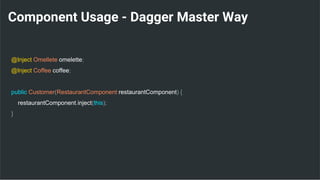
Component Usage - Dagger Master Way
@Inject Omellete omelette;
@Inject Coffee coffee;
public Customer(RestaurantComponent restaurantComponent) {
restaurantComponent.inject(this);
}
Best Practices
Dos and Don’ts
Don’t @Inject constructor
You don’t know where you’ll find yourself
Seriously… Just don’t use @Inject constructor...
Law of Demeter
Don’t talk to strangers
Don’t!
public class MenuManager {
private SharedPreferences sharedPreferences;
public MenuManager(Context context) {
this.sharedPreferences = context.getSharedPreferences(PREFERENCES_NAME,
Context.MODE_PRIVATE);
}
}
Do!
public class MenuManager {
private SharedPreferences sharedPreferences;
public MenuManager(SharedPreferences sharedPreferences) {
this.sharedPreferences = sharedPreferences;
}
}
Verdict
●Testing is difficult
●Context can do too much for its own good
●I can just pass the SharedPreferences, right?
The client should just reflect its API through
its dependencies
Constructor Injection
My dependencies are created before me, and my creation can still be controlled
Don’t!
public class Customer {
// Another Way simply initialize
public Customer() {
this.breakfast = new Breakfast();
}
}
Don’t!
public class Customer {
// One Way - Inject through component
@Inject Breakfast breakfast;
}
Do!
public class Customer {
private Breakfast breakfast;
public SomeClient(Breakfast breakfast) {
mSomeService = someService;
}
}
Verdict
●Difficult to test
●Client does not reflect its API
●What if Breakfast has dependencies?
If we can create the object on our own, we’ll
just pass the dependencies through the
Constructor
Setter Method Injection
My dependencies are created after me, but my creation can still be controlled
Don’t!
public class MenuView extends LinearLayout {
// Another Way
public Breakfast() {
breakfast = new Breakfast()
}
}
Don’t!
public class MenuView extends LinearLayout {
// One Way
@Inject Breakfast breakfast;
}
Kind of works, but not really...
public class MenuView extends LinearLayout {
public MenuView(Context context, Breakfast breakfast) {
this.breakfast = breakfast;
}
}
Do!
public class MenuView extends LinearLayout {
private Breakfast breakfast;
public void setBreakfast(Breakfast breakfast) {
this.breakfast = breakfast;
}
}
Verdict
●Difficult to test
●View does not reflect its API
●What if Breakfast has dependencies?
●Usage may be limited
If the object may be created by the system,
and not us, but we have access to it through
a pointer, we’ll use setter methods to inject
dependencies
@Inject for Framework Components
The user can’t create me, and can only use me
Don’t!
public class BreakfastActivity extends AppCompatActivity {
private Breakfast breakfast;
public void onCreate(Bundle savedInstanceState) {
this.breakfast = new Breakfast(savedInstanceState);
}
}
Do!
public class BreakfastActivity extends AppCompatActivity {
@Inject Breakfast breakfast;
public SomeClient() {
getActivityComponent().inject(this);
}
}
Verdict
●System components are only interactable through callbacks
○ We cannot hold references to them, or create them
●Use @Inject to declare their needed dependencies
●Use statically created components to inject them
○ Testability comes through modules
○ Testability comes through extension (TestableObject <- Object)
If the object may only be created by the
system, and we may not reference it, we’ll
use dagger’s @Inject feature
Other Tips
●Look at the generated code
○ It’s code that is added to your application
●Use separate @Modules for each feature
○ Modules are classes that can be constructed
○ Provide clarity and customization
BreakfastSupplierModule - Broken Up
@Module
public class OmeletteModule {
@Provides
Omelette provideOmelette(Eggs eggs) { // The eggs will be supplied from
the method below
return new ScrambledOmelette();
}
@Provides
Eggs provideEggs() {
return new Eggs();
}
}
BreakfastSupplierModule - Broken Up
@Module
public class CoffeeModule {
@Provides
Omelette provideCoffee() {
return new BlackCoffee();
}
}
RestaurantComponent Result
@Component(modules = {OmeletteModule.class, CoffeeModule.class})
public interface RestaurantComponent {
// injection methods
void inject(Customer aCustomer);
}
Other Tips
●Look at the generated code
○ It’s code that is added to your application
●Use separate @Modules for each feature● Read on Dagger2’s many (many) features
● Kotlin users beware
Thank yous
●https://www.techyourchance.com
○ Inspiration, ideas and overall thank yous
Thank you

Di &amp; dagger

  • 1.
  • 3.
    Hi There! ● SoftwareDeveloper for three years ○ Medical Research ○ eCommerce ● Android Developer at heart and profession ● Software Developer at Gett
  • 4.
    Game Plan* ●What’s init for me? ●Dependency Injection Principles ●Dagger2 *To the best of our ability :)
  • 5.
    What’s in itfor me? ●Testable Code ○ “If I were to plug this code somewhere else, is it guaranteed to work the same way?” ●Maintainable Code ○ “How many ‘what the..’ moments am I having while reading this code?”
  • 6.
    Testable And MaintainableCode? public class SomeClass { private SomeOtherClass someOtherClass; public SomeClass() { someOtherClass = new SomeOtherClass; } }
  • 7.
    Testable And MaintainableCode! public class Customer { private Breakfast breakfast; public Customer(Breakfast breakfast) { this.breakfast = breakfast; } }
  • 8.
    Game Plan ●What’s init for me? ●Dependency Injection Principles ●Dagger2
  • 9.
  • 10.
    Breakfast! Breakfast Coffee OmeletteBreadJuice Salad WaterSugarMilk VeggiesSaltEggs Olive OilFruit
  • 11.
    What is aDependency? ●A state in which an object uses a function of another object ○ Class A is dependent on class B if and only if A needs B in order to function ●Defined by “import” statements
  • 12.
    So how dowe use dependencies?
  • 13.
    So how dowe use dependencies? ●new statements ○ this.breakfast = new Breakfast(); ●Singleton objects ○ this.breakfast = Breakfast.getInstance(); ●Through constructors and methods ○ this.breakfast = breakfastParameter; ●Inversion Of Control
  • 14.
    What is DependencyInjection? ●A technique whereby one object supplies the dependencies of another object (wikipedia) ●A technique whereby one object supplies the dependencies of another object (wikipedia) ●There are many ways to do it ○ We just saw four ways! ●DI acronym
  • 15.
    Ready for someextremely difficult code?
  • 16.
    Extremely difficult codeahead! // Constructor public Customer(Breakfast breakfast) { // Save the reference to the dependency as passed in by the creator this.mBreakfast = breakfast; } // Setter Method public void setBreakfast(Breakfast breakfast) { // Save the reference to the dependency as passed in by the creator this.mBreakfast = breakfast; }
  • 17.
    Okay great, canwe go now?
  • 18.
    Just one question Howshould we create our Breakfast object?
  • 19.
    How do wecreate a breakfast object? // .. Some code above Breakfast breakfast = new Breakfast( new Coffee( // Dependencies go here.. ), new Juice( // Dependencies go here.. // Some more initializations ); // Give the client their breakfast
  • 20.
    How do wecreate a breakfast object? // .. Some code above Breakfast breakfast = new Breakfast( new BlackCoffee(Coffee( // Dependencies go here.. ), new Juice( // Dependencies go here.. // Some more initializations ); // Give the client their breakfast
  • 21.
    How do wecreate a breakfast object? // .. Some code above Breakfast breakfast = new Breakfast( new BlackCoffee(Coffee( new Sugarless, new Skimlesss(new Milk() // Dependencies go here.. ), new Juice( // Dependencies go here.. // Some more initializations ); // Give the client their breakfast
  • 22.
    Some questions toconsider ●What if Breakfast is a supertype of other breakfast types? ○ Factories could work ●What if Breakfast is a singleton in the system? ○ Sure, but singletons are difficult to test ●Can we share breakfast instances with different clients? ○ Kind of, but it’s difficult to maintain
  • 23.
    Dependency Injection -A Technique ●A technique whereby one object supplies the dependencies of another object (wikipedia) ●Just like breakfast, I could do it myself ●But sometimes I want a restaurant to do it for me ○ Because I’m lazy ○ Because they make it better ○ [Insert whatever reason you want here]
  • 24.
  • 25.
    Game Plan* ●Purpose ●Dependency InjectionPrinciples ●Dagger2 *To the best of our ability :)
  • 26.
    Why Dagger2? ●Designed forlow-end devices ●Generates new code in your application ○ No Reflection
  • 27.
  • 28.
    How Does Dagger2Work? Modules Component Clients
  • 29.
    Module - TheSupplier ●Goal ○ Provides dependencies ○ Providing your dependencies context
  • 30.
    Modules At AHigh Level ●A supplier supplies materials ●It declares what it supplies as a contract ○ The restaurant can only get what the supplier supplies ●May depend on material it can supply ●May depend on material it cannot supply
  • 31.
    BreakfastSupplierModule example @Module public classBreakfastSupplierModule { @Provides Omelette provideOmelette(Eggs eggs) { // The eggs will be supplied from the method below return new ScrambledOmelette(); } @Provides Coffee provideCoffee() { // Method name does not matter return new BlackCoffee(); } @Provides Eggs provideEggs() { return new Eggs(); } }
  • 32.
    Modules - SomeFAQ ●Unless stated otherwise ○ The module recreates each object it provides ○ Read on @Singleton for single-instance ●May depend on other module’s dependencies ●May depend on its own dependencies
  • 33.
    Components - TheRestaurants ●Goal ○ Bridges between the suppliers and the customers ○ Handles the final touches of the “basic materials”
  • 34.
    Components At aHigh Level ●Gathers all of the ingredients from all its suppliers ●Serves a defined set of customers
  • 35.
    RestaurantComponent example @Component(modules ={BreakfastSupplierModule.class}) public interface RestaurantComponent { // injection methods void inject(Customer aCustomer); }
  • 36.
    Client Classes ●Use the@Inject annotation to get what they need ●Are supplied through the component
  • 37.
    @Inject example public classCustomer { @Inject Omelette omelette; @Inject Coffee coffee; // More code goes here... }
  • 38.
    And Now we“Build”
  • 39.
    Component Usage ●The customerdepends on the component ●The customer asks the component to serve itself
  • 40.
    Component Usage -One way @Inject Omellete omelette; @Inject Coffee coffee; public Customer() DaggerRestaurantComponent.builder() .build().breakfastSupplierModule(new BreakfastSupplierModule) .inject(this); }
  • 41.
    Component Usage -Better way @Inject Omellete omelette; @Inject Coffee coffee; public Customer(BreakfastSupplierModule breakfastModule) { DaggerRestaurantComponent.builder() .build().breakfastSupplierModule(breakfastModule) .inject(this); }
  • 42.
    Component Usage -Dagger Master Way @Inject Omellete omelette; @Inject Coffee coffee; public Customer(RestaurantComponent restaurantComponent) { restaurantComponent.inject(this); }
  • 43.
  • 44.
    Don’t @Inject constructor Youdon’t know where you’ll find yourself Seriously… Just don’t use @Inject constructor...
  • 45.
    Law of Demeter Don’ttalk to strangers
  • 46.
    Don’t! public class MenuManager{ private SharedPreferences sharedPreferences; public MenuManager(Context context) { this.sharedPreferences = context.getSharedPreferences(PREFERENCES_NAME, Context.MODE_PRIVATE); } }
  • 47.
    Do! public class MenuManager{ private SharedPreferences sharedPreferences; public MenuManager(SharedPreferences sharedPreferences) { this.sharedPreferences = sharedPreferences; } }
  • 48.
    Verdict ●Testing is difficult ●Contextcan do too much for its own good ●I can just pass the SharedPreferences, right?
  • 49.
    The client shouldjust reflect its API through its dependencies
  • 50.
    Constructor Injection My dependenciesare created before me, and my creation can still be controlled
  • 51.
    Don’t! public class Customer{ // Another Way simply initialize public Customer() { this.breakfast = new Breakfast(); } }
  • 52.
    Don’t! public class Customer{ // One Way - Inject through component @Inject Breakfast breakfast; }
  • 53.
    Do! public class Customer{ private Breakfast breakfast; public SomeClient(Breakfast breakfast) { mSomeService = someService; } }
  • 54.
    Verdict ●Difficult to test ●Clientdoes not reflect its API ●What if Breakfast has dependencies?
  • 55.
    If we cancreate the object on our own, we’ll just pass the dependencies through the Constructor
  • 56.
    Setter Method Injection Mydependencies are created after me, but my creation can still be controlled
  • 57.
    Don’t! public class MenuViewextends LinearLayout { // Another Way public Breakfast() { breakfast = new Breakfast() } }
  • 58.
    Don’t! public class MenuViewextends LinearLayout { // One Way @Inject Breakfast breakfast; }
  • 59.
    Kind of works,but not really... public class MenuView extends LinearLayout { public MenuView(Context context, Breakfast breakfast) { this.breakfast = breakfast; } }
  • 60.
    Do! public class MenuViewextends LinearLayout { private Breakfast breakfast; public void setBreakfast(Breakfast breakfast) { this.breakfast = breakfast; } }
  • 61.
    Verdict ●Difficult to test ●Viewdoes not reflect its API ●What if Breakfast has dependencies? ●Usage may be limited
  • 62.
    If the objectmay be created by the system, and not us, but we have access to it through a pointer, we’ll use setter methods to inject dependencies
  • 63.
    @Inject for FrameworkComponents The user can’t create me, and can only use me
  • 64.
    Don’t! public class BreakfastActivityextends AppCompatActivity { private Breakfast breakfast; public void onCreate(Bundle savedInstanceState) { this.breakfast = new Breakfast(savedInstanceState); } }
  • 65.
    Do! public class BreakfastActivityextends AppCompatActivity { @Inject Breakfast breakfast; public SomeClient() { getActivityComponent().inject(this); } }
  • 66.
    Verdict ●System components areonly interactable through callbacks ○ We cannot hold references to them, or create them ●Use @Inject to declare their needed dependencies ●Use statically created components to inject them ○ Testability comes through modules ○ Testability comes through extension (TestableObject <- Object)
  • 67.
    If the objectmay only be created by the system, and we may not reference it, we’ll use dagger’s @Inject feature
  • 68.
    Other Tips ●Look atthe generated code ○ It’s code that is added to your application ●Use separate @Modules for each feature ○ Modules are classes that can be constructed ○ Provide clarity and customization
  • 69.
    BreakfastSupplierModule - BrokenUp @Module public class OmeletteModule { @Provides Omelette provideOmelette(Eggs eggs) { // The eggs will be supplied from the method below return new ScrambledOmelette(); } @Provides Eggs provideEggs() { return new Eggs(); } }
  • 70.
    BreakfastSupplierModule - BrokenUp @Module public class CoffeeModule { @Provides Omelette provideCoffee() { return new BlackCoffee(); } }
  • 71.
    RestaurantComponent Result @Component(modules ={OmeletteModule.class, CoffeeModule.class}) public interface RestaurantComponent { // injection methods void inject(Customer aCustomer); }
  • 72.
    Other Tips ●Look atthe generated code ○ It’s code that is added to your application ●Use separate @Modules for each feature● Read on Dagger2’s many (many) features ● Kotlin users beware
  • 73.
  • 74.

Editor's Notes

  • #5 Here’s what we’re going to cover
  • #9 The following is a list of High-Level Concepts in computer science that led to the postulation of Dependency Injection pattern These are guidelines that can actually turn into work ethics. These are still guidelines
  • #10 Talk about Breakfast metaphor (“Let’s make breakfast”) First you need to create coffee. To do so you need a machine, water, a capsul and milk. Ok great Let’s make eggs. You need a pan, eggs, and maybe salt and pepper. Almost there Let’s make pancakes. You need milk, eggs, batter, and sugar. Let’s make orange juice. For it you just need oranges and sugar. Lastly, let’s cut some veggies. That’s dependency injection at its finest
  • #11 Talk about Breakfast metaphor (“Let’s make breakfast”) First you need to create coffee. To do so you need a machine, water, a capsul and milk. Ok great Let’s make eggs. You need a pan, eggs, and maybe salt and pepper. Almost there Let’s make pancakes. You need milk, eggs, batter, and sugar. Let’s make orange juice. For it you just need oranges and sugar. Lastly, let’s cut some veggies. That’s dependency injection at its finest
  • #15 dependency injection is a technique whereby one object supplies the dependencies of another object
  • #25 There are tons more Note - there are some languages and frameworks that do not need dependency injection frameworks. We use Java, so naturally we need it. (Think about why)
  • #28 High level description
  • #29 High level description
  • #31 High level description
  • #33 High level description
  • #36 The names of the methods again don’t matter The target is declared as the parameter of the inject method The modules are declared in the @Component annotation Base classes do not count - we need concrete implementations
  • #38 The example shows an activity, but this can be done in any class really. Note the Injector class section - we will talk about this in the next slide
  • #44 I would urge you to take these following tips and tricks with a grain of salt, but from my experience this is what helped me organize my code the best
  • #54  Client Reflects its api We don’t care what DI Frameworks we use