
DABHOL
A POWER DEBACLE
Presentation By: Group 3
Anurag Singh Dushyant Singh Devvrat
Raiyani
Anay Rekhde Arpit Modi
Abhimanyu Singh Gavesha Beekray
INDIA’S POWER SCENARIO THEN
 India’s power needs were set to grow in 1992
 Energy deficits of 18% was recorded leading to
frequent power cuts
 Emphasis on attracting private investments on
power in 8th five year plan(1992-1997)
 Export/Import reforms were enacted to bring down
costs in the power sector
INDIA’S POWER REGULATORY STRUCTURE
 The Industry was regulated at the Central or
National Level
 Power Sector - subject of concurrent list
 State governments responsible for managing and
operating state utility companies
 Central Government’s Ministry of Power is
responsible for regulating and is in charge of
decisions on:
 Capacity additions
 Pricing/Tariffs
 Power-related investments
ENTRY OF ENRON
 Enron – world-leading multinational firm in the
natural gas industry
 Enron saw huge opportunities in India
 To provide power
 To earn profits
 To obtain more projects if they were successful with
their first one
 India fit in nicely with their global objectives at that
time
 Enron proposed to build most modern power plant
at a time when most foreign players could not
conceive such risk
WHY IN MAHARASHTRA?
 MSEB was profitable and this reduced the revenue
risk - the state board could pay Enron for power
generated
 „A large demand for power existed in the state
 Maharashtra already generated close to 10,000MW
(12% of India’s generation capacity)
 „Location was close to a port making it easy to
transport fuel for the power plant.
 „Maharashtra was one of India’s more developed
states –institutional risks were comparatively lesser
BEST ALTERNATIVE – INDIA'S PERSPECTIVE
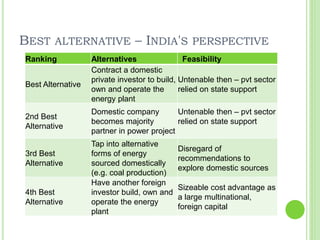
Ranking Alternatives Feasibility
Best Alternative
Contract a domestic
private investor to build,
own and operate the
energy plant
Untenable then – pvt sector
relied on state support
2nd Best
Alternative
Domestic company
becomes majority
partner in power project
Untenable then – pvt sector
relied on state support
3rd Best
Alternative
Tap into alternative
forms of energy
sourced domestically
(e.g. coal production)
Disregard of
recommendations to
explore domestic sources
4th Best
Alternative
Have another foreign
investor build, own and
operate the energy
plant
Sizeable cost advantage as
a large multinational,
foreign capital
BEST ALTERNATIVE – ENRON'S
PERSPECTIVE
 At the time, ENRON was negotiating deal in Qatar
with state owned Qatar Gas & Pipeline Company to
create a LNG facility
 To avoid financial setbacks, ENRON needed to find
large supply of consumers for the LNG
 Israel, India and Pakistan were prime candidates
 Israel had retracted from its commitment to lift 3 mn
tones of LNG
 Situation in Pakistan was volatile
 This left India as the only possible destination
THE CONTRACT
 A Power Purchase Agreement (PPA) was drawn up
wherein MSEB agreed to purchase a certain
quantity of power from the Enron-led Dabhol Power
Corporation (DPC) at a certain tariff.
 DPC Ensured that adequate power will be made
available
 MSEB took care of demand risks with PPA.
 Initial price was Rs 2.4/KwH
 20 year renewable concession was signed
 Dispute resolution was to be done through
international arbitration – not part of PPA but DPC
shareholders agreement
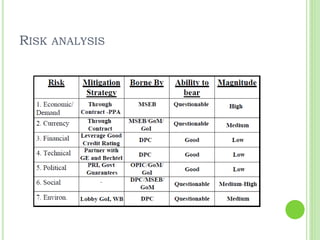
RISK ANALYSIS
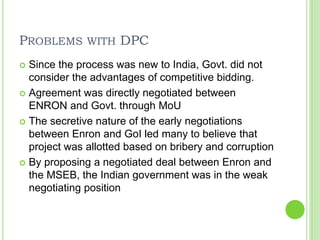
PROBLEMS WITH DPC
 Since the process was new to India, Govt. did not
consider the advantages of competitive bidding.
 Agreement was directly negotiated between
ENRON and Govt. through MoU
 The secretive nature of the early negotiations
between Enron and GoI led many to believe that
project was allotted based on bribery and corruption
 By proposing a negotiated deal between Enron and
the MSEB, the Indian government was in the weak
negotiating position
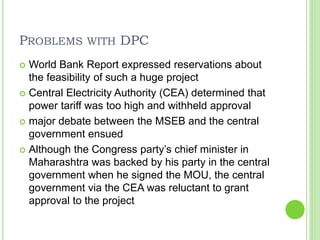
PROBLEMS WITH DPC
 World Bank Report expressed reservations about
the feasibility of such a huge project
 Central Electricity Authority (CEA) determined that
power tariff was too high and withheld approval
 major debate between the MSEB and the central
government ensued
 Although the Congress party’s chief minister in
Maharashtra was backed by his party in the central
government when he signed the MOU, the central
government via the CEA was reluctant to grant
approval to the project
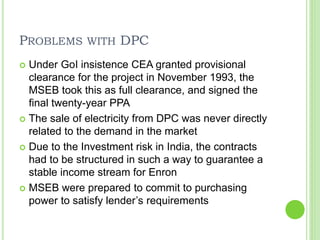
PROBLEMS WITH DPC
 Under GoI insistence CEA granted provisional
clearance for the project in November 1993, the
MSEB took this as full clearance, and signed the
final twenty-year PPA
 The sale of electricity from DPC was never directly
related to the demand in the market
 Due to the Investment risk in India, the contracts
had to be structured in such a way to guarantee a
stable income stream for Enron
 MSEB were prepared to commit to purchasing
power to satisfy lender’s requirements
THE SAGA UNFOLDS
 Bharatiya Janata Party (BJP), a right-wing party
defeats the Congress and comes to power in 1995
 BJP makes lots of nationalistic noise. Their leader
says “we will not be dictated by foreign power
giants”
 Committee prepares a report on DPC
 Project is cancelled in August 1995
REASONS FOR CANCELLATION
 Lack of transparency and competition in the bid
process
 Some clearances were ignored based on the ‘fast-
track’ nature of the project
 Cost of the project was greater than comparable
projects
 Enron cost Rs 4.49 Cr per MW
 Comparable projects cost Rs 3.6 Cr per MW
 Tariffs were too high
 Environmental concerns and concerns raised in a
World Bank report were not addressed
BEST ALTERNATIVE - GOM
 The alternative of soliciting another investor to take
over a project which had become highly
scandalized and plagued with financial
uncertainties was improbable
 Alternative of extracting domestic sources of energy
to meet growing demand was also negligible
 Throwing away the deal was also not advisable as
it would give the impression of instability in the
country and also have GoI confronting bill of nearly
$300 million and bound by its guarantee for liability
of non-payments
 Thus renegotiating the deal was best alternative
BEST ALTERNATIVE - ENRON
 ENRON was aware that cost of International arbitration
was greater than procedure for renegotiating the
agreement
 ENRON had serious cash flow problems with DPC
 Furthermore, if the project was terminated, Enron’s goal
of sourcing a large supply of consumers for its LNG
facilities over a long period of time would never
materialize
 Enron had little choice but to negotiate with the
Governments of India and Maharashtra instead of
lobbying for policy, judicial and economic reform since
there is no unified consortium of private investors or
businesses in India with which a multinational could join
forces and lobby
 Specifically, Enron’s efforts to lobby the GOI to exert
pressure on the GOM and the MSEB on the issue of
default payments, quickly deteriorated vis-à-vis external
events influencing American foreign policy
RENEGOTIATED DEAL
 ENRON was ready to renegotiate the deal, after
having realized that it would have to work with local
politicians in order to move ahead
 After review of the modified agreement, the
government had reversed its position and accepted
the renegotiated deal
 Although elected to office based on cancellation of
deal, GoM still had to solve problem of inadequate
supply in energy sector
 ENRON agreed to change from distillate fuel to
Indian Naphtha fuel and made MSEB a 15% equity
partner
IMMEDIATE POLICY CHANGES
 Revised project documents were immediately made
public so that the cost base of the project was
transparent
 As a result of the controversy over corruption, the
government ruled that future power sector contracts
would no longer follow the MOU process as with
Enron, but would be replaced with mandatory
competitive bidding
TRANSFER OF RISK FROM ENRON TO GOI,
GOM
 Given the tenuous nature of the MSEB’s financial
position, the project lenders and Enron required a
counter-guarantee of payment from the state
government
 The solvency of the state government was
questionable, so Enron required that this insurance
be further backed by a guarantee from the central
government
 This sovereign guarantee was controversial
because the credit rating of the whole of India
became dependent on non-payment by one state,
on one project
 Deal not signed until Atal Bihari Vajpayee’s13-day
ENRON INFLUENCE ON GOM, GOI
 Combination of a take-or-pay contract and a
sovereign guarantee meant that Enron would be
paid for the electricity without taking on the risk of
reduced market demand or nonpayment by the
MSEB
 When ENRON came to India there was little
regulatory structure for project approval process
 Enron made many recommendations to the GoI as
to how it could improve the process for foreign
investors
 Laws were passed as a result of Enron’s
experience with Dabhol
 All other projects in the country were benchmarked
THE ARBITRATION STORY
 After the MSEB failed to remit payment government
paid the MSEB’s arrears
 MSEB argued that the central government should
not pay the latest arrears because the bills needed
correction, and Enron claimed that the MSEB was
trying to renege on its contractual obligations
 Enron invoked the political force majeure clause for
non fulfillment of the MSEB’s contractual
obligations and issued arbitration notice to the
central government to collect the December bill
 MSEB stopped payment on electricity from Dabhol,
and issued notice to scrap the PPA
THE ARBITRATION STORY
 First, the dispute under the Power Purchase Agreement
was referred by the DPC to arbitration in London
 Second, Bechtel, as a co-owner of the DPC, referred a
claim under the DPC Shareholders Agreement to the
ICC Arbitration in New York
 Third, claims for about $1.3 billion in compensation were
reportedly launched by Bechtel and General Electric
under India’s bilateral investment treaties with Mauritius
and the Netherlands
 Fourth, in a state-to-state arbitration, the U.S.
government brought a claim against India after OPIC
was required, in an American Arbitration Association
proceeding in the U.S., to pay about $110 million to
Enron, Bechtel, General Electric, and Bank of America
in risk insurance for the Dabhol project
THE ARBITRATION STORY
 Of these four arbitrations, only the ICC Arbitration
led to a known and publicly available award. This is
partly because, in 2005, an overall settlement was
reached between the U.S. and Indian governments,
as well as U.S. firms, which terminated outstanding
arbitrations and court actions
 The ICC arbitration allowed tribunal’s decisions to
expand the arbitration beyond the parties to the
relevant contract and apply a variety of legal
sources besides that contract, offered reasons to
suspect regime bias and was indicative of wider
conflict between Western and Third World interests
LEARNING FROM THE EPISODE
 A surplus of power is as harmful as a shortage of power
 It is imperative to examine the tariff implications
 DSM must be included as an option with Integrated
Resource Planning (Least Cost Planning) to arrive at the
cheapest mix of supply and saving options.
 Competitive bidding procedures rather than MoUs and
counter-guarantees
 The sector must pursue the goal of universal access to
affordable electricity
 Protection against exchange rate volatility and
strengthening of BHEL
 Not only competitive bidding but transparency,
accountability and participation
 The right to information
POSSIBLE MEASURES FOR FUTURE
 Technical advisers must be appointed
 NGOs may act to ensure that peoples’ views reach
policymakers
 Consumers need to be more vocal so as to play a
part in decision making
 View of opposition party must be taken into
consideration
 Renegotiation of agreement, though not advisable,
but could have been done in this case
To conclude, trust and relationship and perhaps some
initiative and flexible contracts might have been
more successful than relying purely on contract
Dhabol PPT power debacle

Dhabol PPT power debacle

  • 1.
    DABHOL A POWER DEBACLE PresentationBy: Group 3 Anurag Singh Dushyant Singh Devvrat Raiyani Anay Rekhde Arpit Modi Abhimanyu Singh Gavesha Beekray
  • 2.
    INDIA’S POWER SCENARIOTHEN  India’s power needs were set to grow in 1992  Energy deficits of 18% was recorded leading to frequent power cuts  Emphasis on attracting private investments on power in 8th five year plan(1992-1997)  Export/Import reforms were enacted to bring down costs in the power sector
  • 3.
    INDIA’S POWER REGULATORYSTRUCTURE  The Industry was regulated at the Central or National Level  Power Sector - subject of concurrent list  State governments responsible for managing and operating state utility companies  Central Government’s Ministry of Power is responsible for regulating and is in charge of decisions on:  Capacity additions  Pricing/Tariffs  Power-related investments
  • 4.
    ENTRY OF ENRON Enron – world-leading multinational firm in the natural gas industry  Enron saw huge opportunities in India  To provide power  To earn profits  To obtain more projects if they were successful with their first one  India fit in nicely with their global objectives at that time  Enron proposed to build most modern power plant at a time when most foreign players could not conceive such risk
  • 5.
    WHY IN MAHARASHTRA? MSEB was profitable and this reduced the revenue risk - the state board could pay Enron for power generated  „A large demand for power existed in the state  Maharashtra already generated close to 10,000MW (12% of India’s generation capacity)  „Location was close to a port making it easy to transport fuel for the power plant.  „Maharashtra was one of India’s more developed states –institutional risks were comparatively lesser
  • 6.
    BEST ALTERNATIVE –INDIA'S PERSPECTIVE Ranking Alternatives Feasibility Best Alternative Contract a domestic private investor to build, own and operate the energy plant Untenable then – pvt sector relied on state support 2nd Best Alternative Domestic company becomes majority partner in power project Untenable then – pvt sector relied on state support 3rd Best Alternative Tap into alternative forms of energy sourced domestically (e.g. coal production) Disregard of recommendations to explore domestic sources 4th Best Alternative Have another foreign investor build, own and operate the energy plant Sizeable cost advantage as a large multinational, foreign capital
  • 7.
    BEST ALTERNATIVE –ENRON'S PERSPECTIVE  At the time, ENRON was negotiating deal in Qatar with state owned Qatar Gas & Pipeline Company to create a LNG facility  To avoid financial setbacks, ENRON needed to find large supply of consumers for the LNG  Israel, India and Pakistan were prime candidates  Israel had retracted from its commitment to lift 3 mn tones of LNG  Situation in Pakistan was volatile  This left India as the only possible destination
  • 8.
    THE CONTRACT  APower Purchase Agreement (PPA) was drawn up wherein MSEB agreed to purchase a certain quantity of power from the Enron-led Dabhol Power Corporation (DPC) at a certain tariff.  DPC Ensured that adequate power will be made available  MSEB took care of demand risks with PPA.  Initial price was Rs 2.4/KwH  20 year renewable concession was signed  Dispute resolution was to be done through international arbitration – not part of PPA but DPC shareholders agreement
  • 9.
  • 10.
    PROBLEMS WITH DPC Since the process was new to India, Govt. did not consider the advantages of competitive bidding.  Agreement was directly negotiated between ENRON and Govt. through MoU  The secretive nature of the early negotiations between Enron and GoI led many to believe that project was allotted based on bribery and corruption  By proposing a negotiated deal between Enron and the MSEB, the Indian government was in the weak negotiating position
  • 11.
    PROBLEMS WITH DPC World Bank Report expressed reservations about the feasibility of such a huge project  Central Electricity Authority (CEA) determined that power tariff was too high and withheld approval  major debate between the MSEB and the central government ensued  Although the Congress party’s chief minister in Maharashtra was backed by his party in the central government when he signed the MOU, the central government via the CEA was reluctant to grant approval to the project
  • 12.
    PROBLEMS WITH DPC Under GoI insistence CEA granted provisional clearance for the project in November 1993, the MSEB took this as full clearance, and signed the final twenty-year PPA  The sale of electricity from DPC was never directly related to the demand in the market  Due to the Investment risk in India, the contracts had to be structured in such a way to guarantee a stable income stream for Enron  MSEB were prepared to commit to purchasing power to satisfy lender’s requirements
  • 13.
    THE SAGA UNFOLDS Bharatiya Janata Party (BJP), a right-wing party defeats the Congress and comes to power in 1995  BJP makes lots of nationalistic noise. Their leader says “we will not be dictated by foreign power giants”  Committee prepares a report on DPC  Project is cancelled in August 1995
  • 14.
    REASONS FOR CANCELLATION Lack of transparency and competition in the bid process  Some clearances were ignored based on the ‘fast- track’ nature of the project  Cost of the project was greater than comparable projects  Enron cost Rs 4.49 Cr per MW  Comparable projects cost Rs 3.6 Cr per MW  Tariffs were too high  Environmental concerns and concerns raised in a World Bank report were not addressed
  • 15.
    BEST ALTERNATIVE -GOM  The alternative of soliciting another investor to take over a project which had become highly scandalized and plagued with financial uncertainties was improbable  Alternative of extracting domestic sources of energy to meet growing demand was also negligible  Throwing away the deal was also not advisable as it would give the impression of instability in the country and also have GoI confronting bill of nearly $300 million and bound by its guarantee for liability of non-payments  Thus renegotiating the deal was best alternative
  • 16.
    BEST ALTERNATIVE -ENRON  ENRON was aware that cost of International arbitration was greater than procedure for renegotiating the agreement  ENRON had serious cash flow problems with DPC  Furthermore, if the project was terminated, Enron’s goal of sourcing a large supply of consumers for its LNG facilities over a long period of time would never materialize  Enron had little choice but to negotiate with the Governments of India and Maharashtra instead of lobbying for policy, judicial and economic reform since there is no unified consortium of private investors or businesses in India with which a multinational could join forces and lobby  Specifically, Enron’s efforts to lobby the GOI to exert pressure on the GOM and the MSEB on the issue of default payments, quickly deteriorated vis-à-vis external events influencing American foreign policy
  • 17.
    RENEGOTIATED DEAL  ENRONwas ready to renegotiate the deal, after having realized that it would have to work with local politicians in order to move ahead  After review of the modified agreement, the government had reversed its position and accepted the renegotiated deal  Although elected to office based on cancellation of deal, GoM still had to solve problem of inadequate supply in energy sector  ENRON agreed to change from distillate fuel to Indian Naphtha fuel and made MSEB a 15% equity partner
  • 18.
    IMMEDIATE POLICY CHANGES Revised project documents were immediately made public so that the cost base of the project was transparent  As a result of the controversy over corruption, the government ruled that future power sector contracts would no longer follow the MOU process as with Enron, but would be replaced with mandatory competitive bidding
  • 19.
    TRANSFER OF RISKFROM ENRON TO GOI, GOM  Given the tenuous nature of the MSEB’s financial position, the project lenders and Enron required a counter-guarantee of payment from the state government  The solvency of the state government was questionable, so Enron required that this insurance be further backed by a guarantee from the central government  This sovereign guarantee was controversial because the credit rating of the whole of India became dependent on non-payment by one state, on one project  Deal not signed until Atal Bihari Vajpayee’s13-day
  • 20.
    ENRON INFLUENCE ONGOM, GOI  Combination of a take-or-pay contract and a sovereign guarantee meant that Enron would be paid for the electricity without taking on the risk of reduced market demand or nonpayment by the MSEB  When ENRON came to India there was little regulatory structure for project approval process  Enron made many recommendations to the GoI as to how it could improve the process for foreign investors  Laws were passed as a result of Enron’s experience with Dabhol  All other projects in the country were benchmarked
  • 21.
    THE ARBITRATION STORY After the MSEB failed to remit payment government paid the MSEB’s arrears  MSEB argued that the central government should not pay the latest arrears because the bills needed correction, and Enron claimed that the MSEB was trying to renege on its contractual obligations  Enron invoked the political force majeure clause for non fulfillment of the MSEB’s contractual obligations and issued arbitration notice to the central government to collect the December bill  MSEB stopped payment on electricity from Dabhol, and issued notice to scrap the PPA
  • 22.
    THE ARBITRATION STORY First, the dispute under the Power Purchase Agreement was referred by the DPC to arbitration in London  Second, Bechtel, as a co-owner of the DPC, referred a claim under the DPC Shareholders Agreement to the ICC Arbitration in New York  Third, claims for about $1.3 billion in compensation were reportedly launched by Bechtel and General Electric under India’s bilateral investment treaties with Mauritius and the Netherlands  Fourth, in a state-to-state arbitration, the U.S. government brought a claim against India after OPIC was required, in an American Arbitration Association proceeding in the U.S., to pay about $110 million to Enron, Bechtel, General Electric, and Bank of America in risk insurance for the Dabhol project
  • 23.
    THE ARBITRATION STORY Of these four arbitrations, only the ICC Arbitration led to a known and publicly available award. This is partly because, in 2005, an overall settlement was reached between the U.S. and Indian governments, as well as U.S. firms, which terminated outstanding arbitrations and court actions  The ICC arbitration allowed tribunal’s decisions to expand the arbitration beyond the parties to the relevant contract and apply a variety of legal sources besides that contract, offered reasons to suspect regime bias and was indicative of wider conflict between Western and Third World interests
  • 24.
    LEARNING FROM THEEPISODE  A surplus of power is as harmful as a shortage of power  It is imperative to examine the tariff implications  DSM must be included as an option with Integrated Resource Planning (Least Cost Planning) to arrive at the cheapest mix of supply and saving options.  Competitive bidding procedures rather than MoUs and counter-guarantees  The sector must pursue the goal of universal access to affordable electricity  Protection against exchange rate volatility and strengthening of BHEL  Not only competitive bidding but transparency, accountability and participation  The right to information
  • 25.
    POSSIBLE MEASURES FORFUTURE  Technical advisers must be appointed  NGOs may act to ensure that peoples’ views reach policymakers  Consumers need to be more vocal so as to play a part in decision making  View of opposition party must be taken into consideration  Renegotiation of agreement, though not advisable, but could have been done in this case
  • 26.
    To conclude, trustand relationship and perhaps some initiative and flexible contracts might have been more successful than relying purely on contract