Theme “Major Challenges to Contemporary World”
March 19th
, 2015
Anna A. Dekalchuk,
Lecturer at the Department of Applied Politics,
Higher School of Economics – St. Petersburg
DG 9.
Hard and Soft Security
DG outline
1.8-minute test
1.What is security?
1.Realism and neo-realism tradition
1.Neo-liberalism
1.Collective economic security
1.Alternative approaches to security
1. Multiple Choice Test
8 minutes, 10 questions, only
one correct answer per question
2. What is security?
Security is a freedom from (the
absence of) threats to core
values
Core values:
o survival;
o a certain political and social autonomy as a group
(independence and sovereignty);
o a degree of political status as a group;
o some minimal expected level of economic
welfare.
2. What is security?
Security is a freedom from (the
absence of) threats to core
values
Different securities (Buzan 1983):
o military;
o political;
o economic;
o societal;
o environmental.
How do we define economic security?
What is societal security about?
2. What is security?
Security is a freedom from (the
absence of) threats to core
values
Levels of security:
o individual;
o national (military terms);
o international;
o global. What is global security about?
But what are then hard and soft securities?
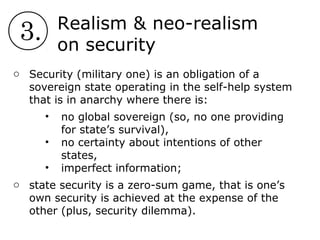
3. Realism & neo-realism
on security
o Security (military one) is an obligation of a
sovereign state operating in the self-help system
that is in anarchy where there is:
• no global sovereign (so, no one providing
for state’s survival),
• no certainty about intentions of other
states,
• imperfect information;
o state security is a zero-sum game, that is one’s
own security is achieved at the expense of the
other (plus, security dilemma).
3. Realism & neo-realism:
why is cooperation difficult?
o Problem of cheating and credibility of the commitment
(uncertainty);
o Relative vs. absolute (joint) gains (zero-sum game vs.
non-zero sum game).
4. Neo-liberals on security and
cooperation
Importance of institutions:
o neo-realists see them only as a product of state
interest and constraints;
o neo-liberals (Keohane and Martin 1995) view
them as mechanisms:
• providing information,
• reducing transactional costs,
• making commitments more credible,
• establishing focal points for coordination,
• facilitating the operation of reciprocity.
How do neo-realists and neo-liberals view institutions?
4. Nye on collective economic
security
What is collective security in general?
A political-military arrangement in which the unlawful
use of military force would be deterred or
repulsed by the combined force of all other states.
But security is not only about military stuff (not only
physical survival) => economy and economic
interdependence also matter.
What is economic security?
The absence of threat of severe deprivation of
economic welfare
4. Nye on collective economic
security

DG9. Hard & Soft Security

  • 1.
    Theme “Major Challengesto Contemporary World” March 19th , 2015 Anna A. Dekalchuk, Lecturer at the Department of Applied Politics, Higher School of Economics – St. Petersburg DG 9. Hard and Soft Security
  • 2.
    DG outline 1.8-minute test 1.Whatis security? 1.Realism and neo-realism tradition 1.Neo-liberalism 1.Collective economic security 1.Alternative approaches to security
  • 3.
    1. Multiple ChoiceTest 8 minutes, 10 questions, only one correct answer per question
  • 4.
    2. What issecurity? Security is a freedom from (the absence of) threats to core values Core values: o survival; o a certain political and social autonomy as a group (independence and sovereignty); o a degree of political status as a group; o some minimal expected level of economic welfare.
  • 5.
    2. What issecurity? Security is a freedom from (the absence of) threats to core values Different securities (Buzan 1983): o military; o political; o economic; o societal; o environmental. How do we define economic security? What is societal security about?
  • 6.
    2. What issecurity? Security is a freedom from (the absence of) threats to core values Levels of security: o individual; o national (military terms); o international; o global. What is global security about? But what are then hard and soft securities?
  • 7.
    3. Realism &neo-realism on security o Security (military one) is an obligation of a sovereign state operating in the self-help system that is in anarchy where there is: • no global sovereign (so, no one providing for state’s survival), • no certainty about intentions of other states, • imperfect information; o state security is a zero-sum game, that is one’s own security is achieved at the expense of the other (plus, security dilemma).
  • 8.
    3. Realism &neo-realism: why is cooperation difficult? o Problem of cheating and credibility of the commitment (uncertainty); o Relative vs. absolute (joint) gains (zero-sum game vs. non-zero sum game).
  • 9.
    4. Neo-liberals onsecurity and cooperation Importance of institutions: o neo-realists see them only as a product of state interest and constraints; o neo-liberals (Keohane and Martin 1995) view them as mechanisms: • providing information, • reducing transactional costs, • making commitments more credible, • establishing focal points for coordination, • facilitating the operation of reciprocity. How do neo-realists and neo-liberals view institutions?
  • 10.
    4. Nye oncollective economic security What is collective security in general? A political-military arrangement in which the unlawful use of military force would be deterred or repulsed by the combined force of all other states. But security is not only about military stuff (not only physical survival) => economy and economic interdependence also matter. What is economic security? The absence of threat of severe deprivation of economic welfare
  • 11.
    4. Nye oncollective economic security