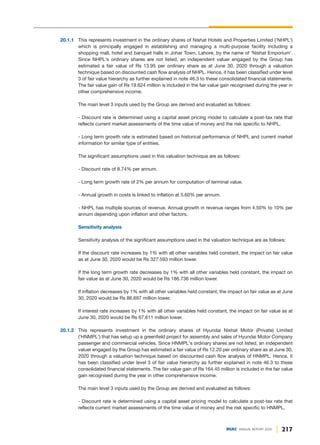
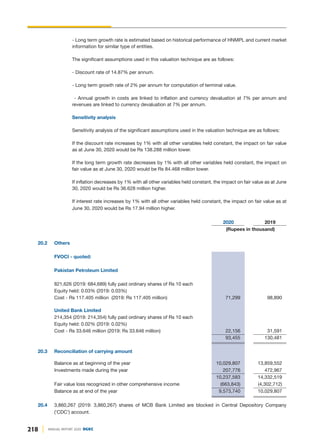
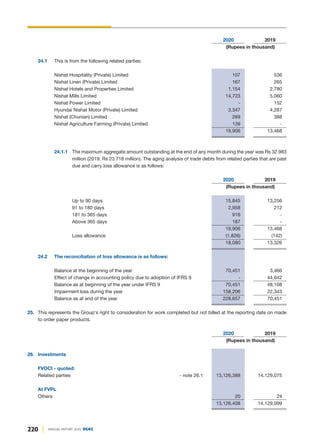
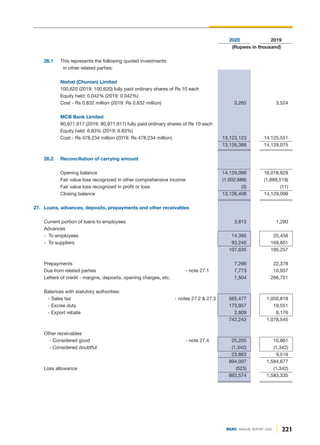
D.G. KHAN CEMENT
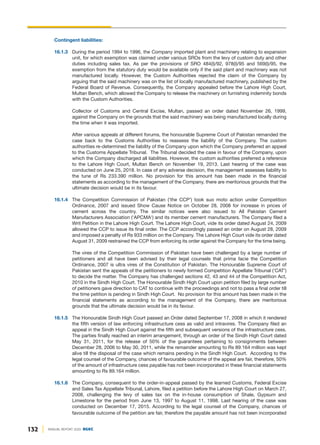
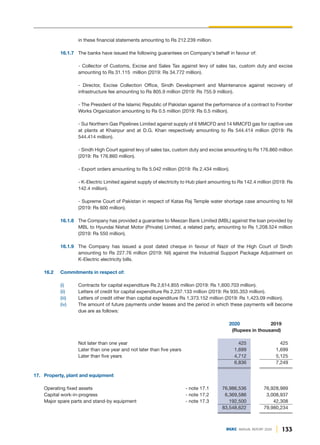
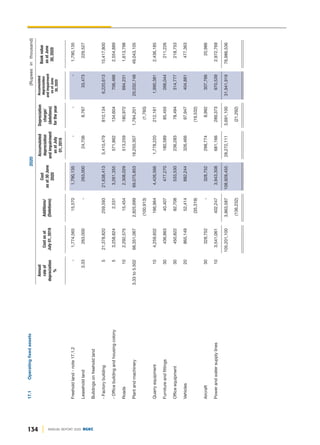
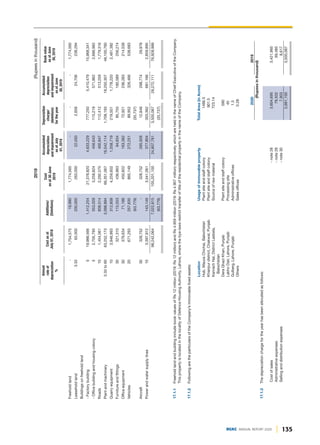
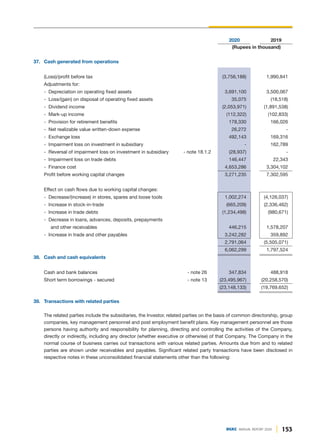
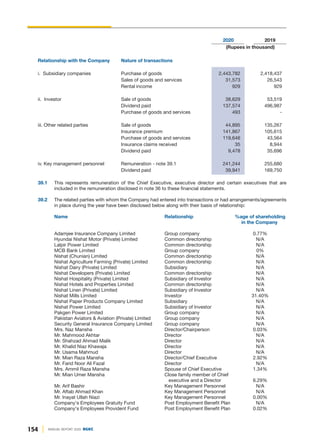
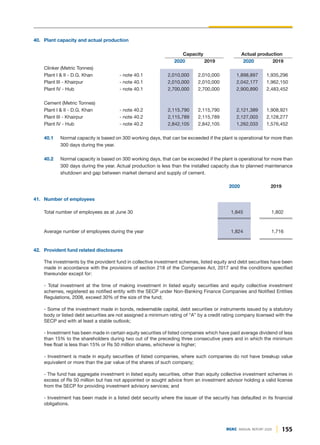
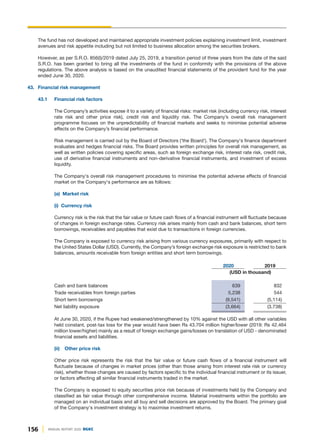
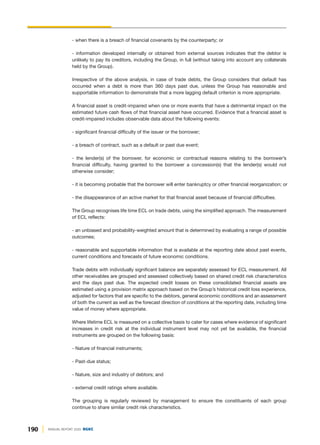
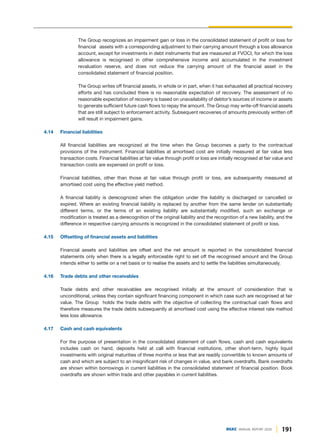
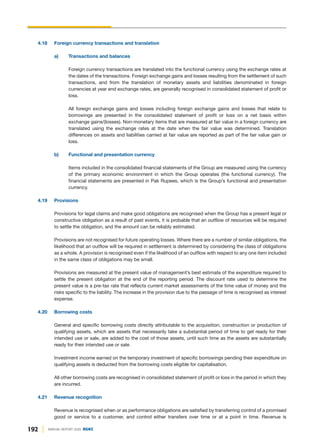
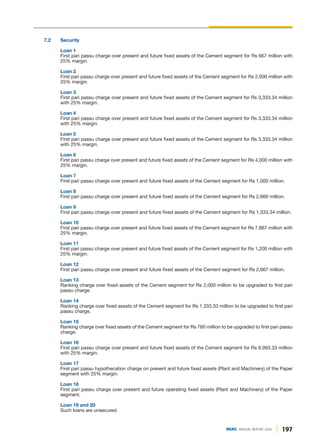
COMPANY LIMITED
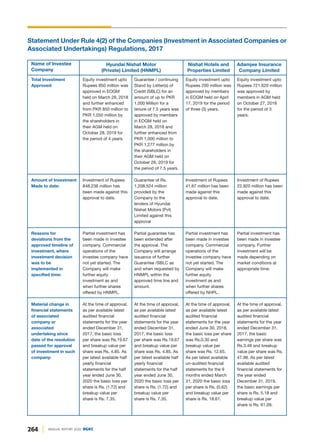
REPORT
2020
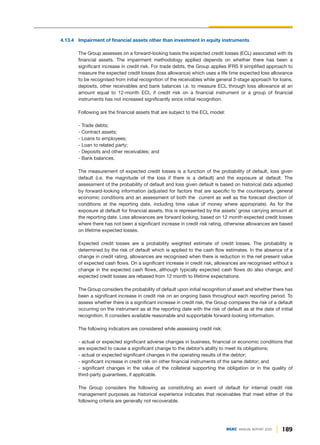
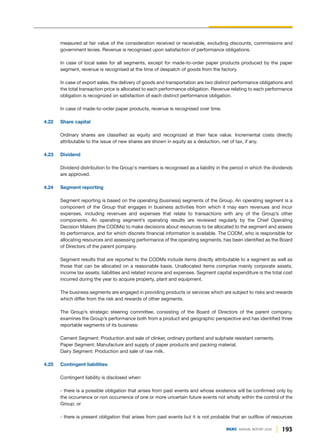
ANNUAL
For Investors’ Relations:
Mr. Inayat Ullah Niazi – Chief Financial Officer
iniazi@dgcement.com
Mr. Khalid Mahmood Chohan – Company
Secretary
kchohan@dgcement.com
D.G. Khan Cement Company Limited
Head Office
Nishat House, 53-A,
Lawrence Road,
Lahore,
Pakistan
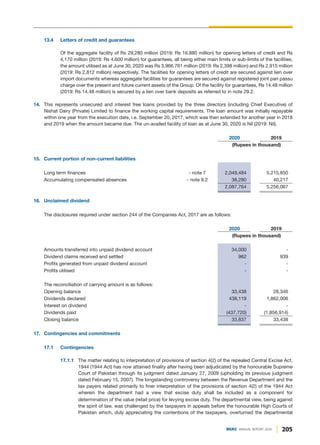
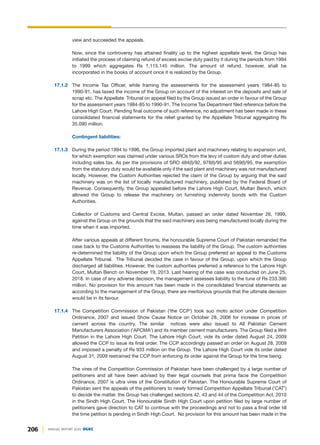
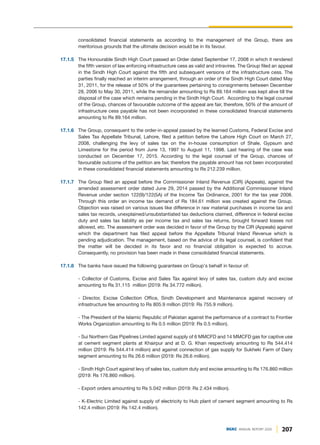
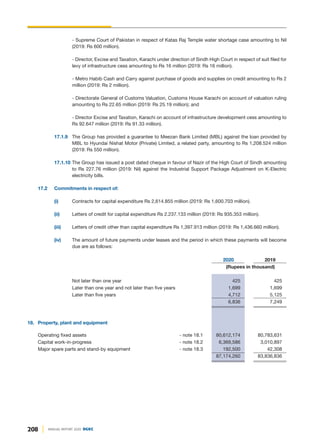
UAN: +92-42-111 11 33 33
Phone: +92-42-36360154
Fax: +92-42-36367414
Email: info@dgcement.com
Vision & Mission 4
Overall Strategic Objectives 4
Our Values 5
Company Information 8
Management Structure And Organogram 9
Profiles of Directors and Management 12
Group Profile 15
Group Companies 16
DGKC-Group Cross Investments 16
Company Profile 17
Subsidiaries 18
Geographical Presence in Pakistan 19
Product Features & Quality Standards 20
Production Facilities 21
Culture at DGKC 22
Special Tribute 27
1
Group and Company
Information
Code of Conduct 30
Business Continuity Plan 30
IT Governance Policy 31
Investor Grievance Policy 31
Safety of Records Policy 31
Human Resource Management Policy 32
Speak Up (Whistle-blowing Policy) 33
Environmental, Heath & Safety Policy 34
Corporate Social Reponsibility (CSR) 35
Pattern of Share Holding 36
Categories of Shareholders 38
Additional Information 39
Board and Its Commitees’ Performance 41
Chairperson’s Review Report
on Board Performance 42
Terms of Reference of Audit Committee 43
Terms of Reference of Human Resource
and Remuneration Committee 43
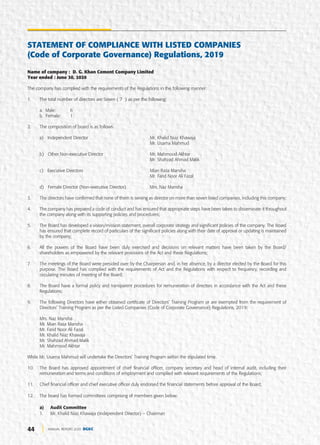
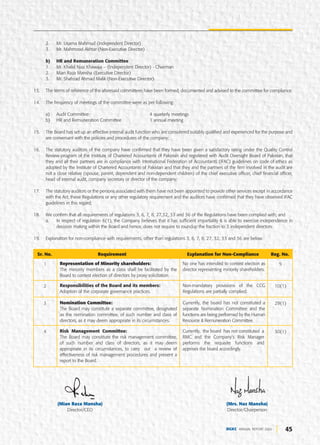
Statement of Compliance
with Code of Listed Companies 44
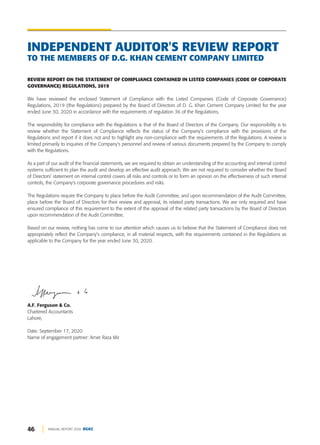
Independent Auditor's Review Report 46
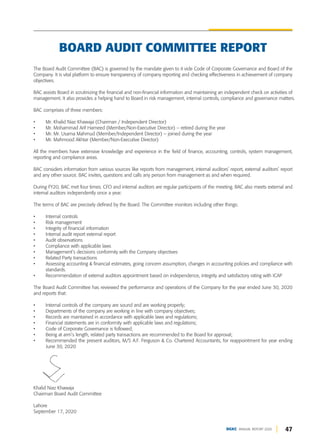
Board Audit Committee Report 47
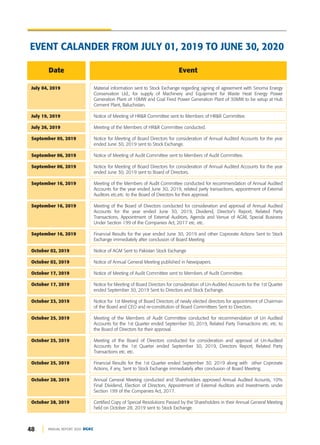
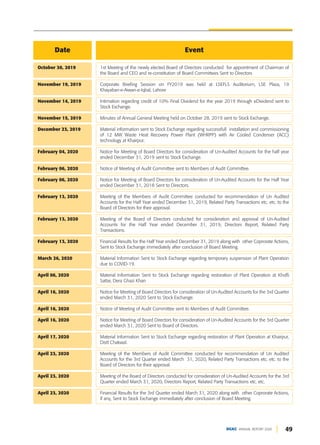
Event Calander 48
2
Corporate Governance
And Reporting
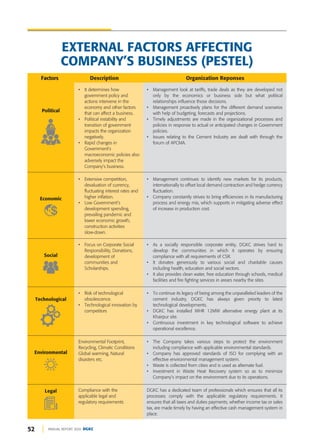
External Factors Affecting
Company’s Business (PESTEL) 52
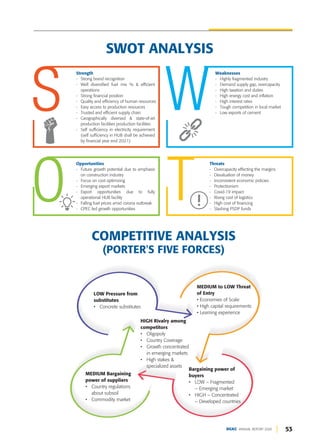
SWOT Analysis 53
Competitive Analysis 53
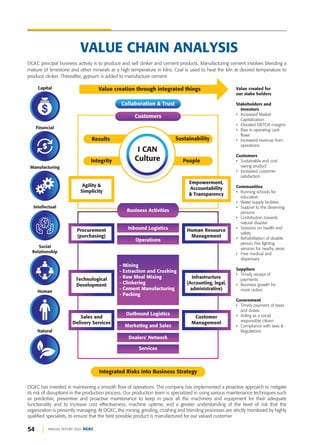
Value Chain Analysis 54
Effect of Seasonality on Business: 57
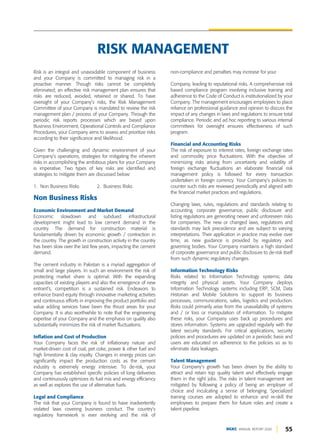
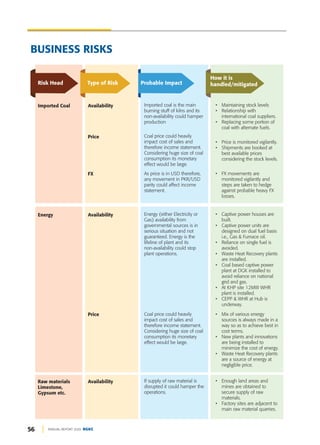
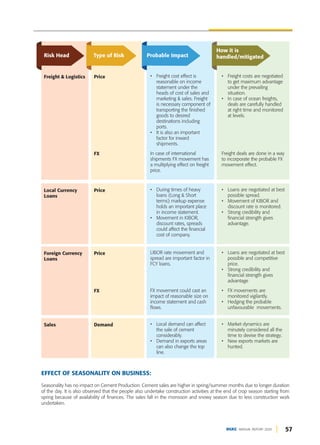
Business Risks 56
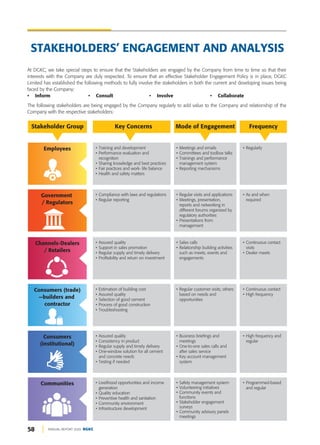
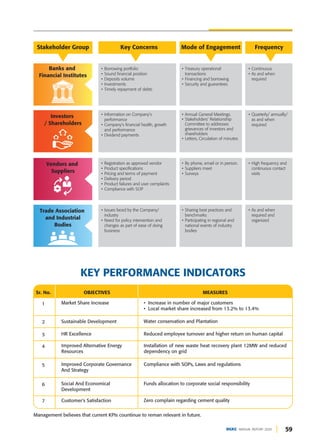
Stakeholders’ Engagement And Analysis 58
Key Performance Indicators 59
3
External and Internal
Analysis
Key Highlights 2019-20 Unconsolidated 62
Key Highlights 2019-20 Consolidated 63
Chairperson’s Message 65
Chief Executive’s Review 67
Global Economy 68
Cement Sector In Pakistan 71
Company Performance 72
Financial Statements Analysis 74
Forward Looking Statement 80
Quarterly Analysis 81
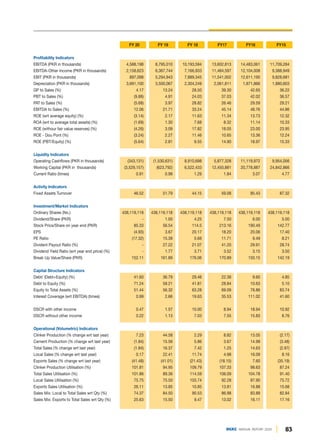
Six Years at A Glance 82
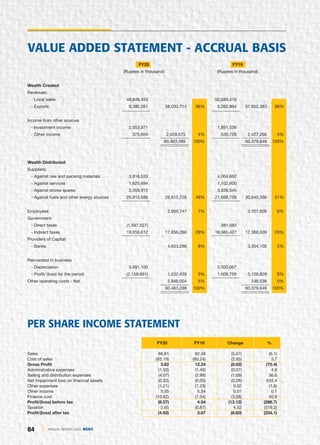
Value Added Statement - Accrual Basis 84
Per Share Income Statement 84
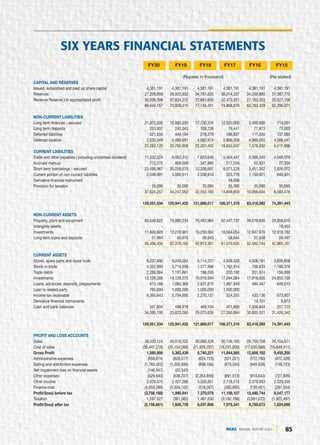
Six Years Financial Statements 85
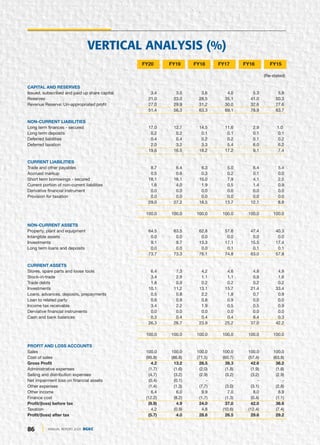
Vertical Analysis 86
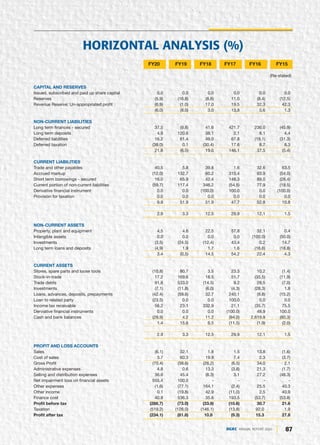
Horizontal Analysis 87
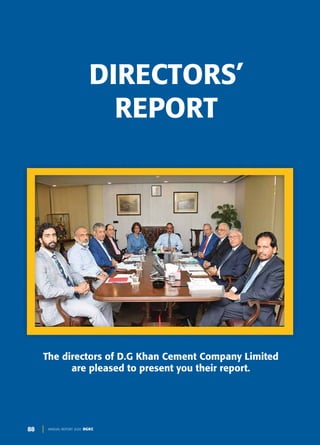
Directors’ Report 88
4
Business Performance
Review
Unconsolidated Financial Statements
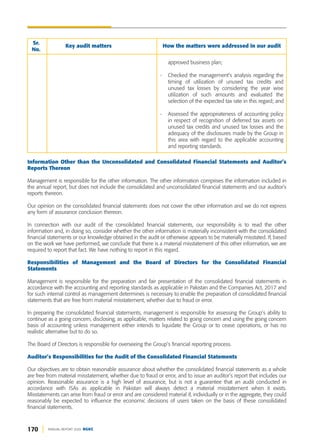
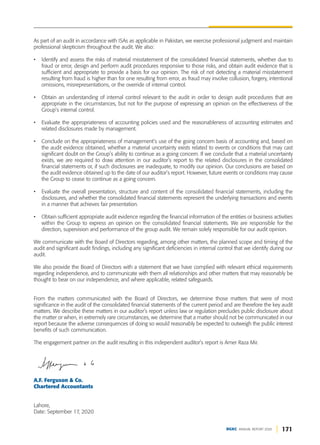
Independent Auditor’s Report 96
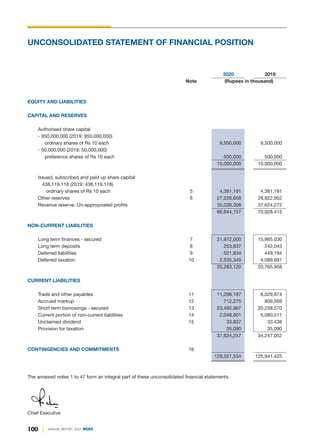
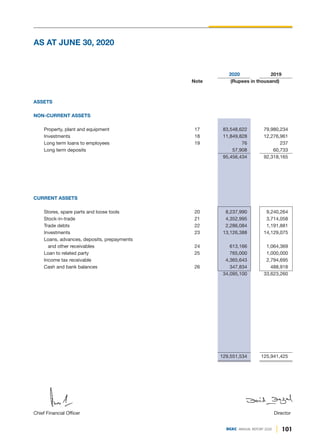
Unconsolidated Statement of Financial Position 100
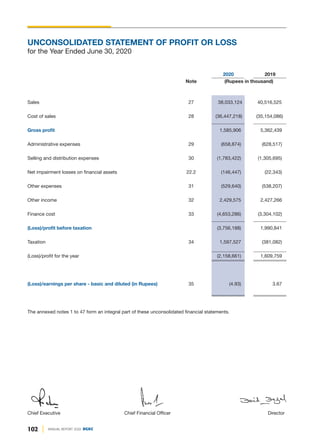
Unconsolidated Statement of Profit or Loss 102
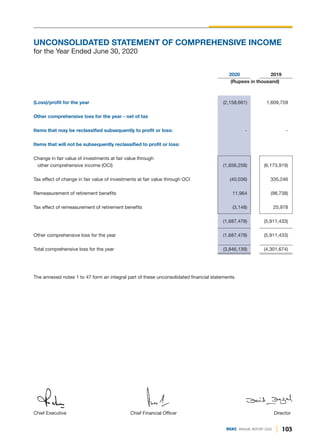
Unconsolidated Statement of Comprehensive
Income 103
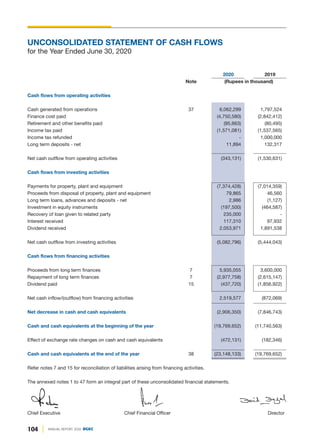
Unconsolidated Statement of Cash Flow 104
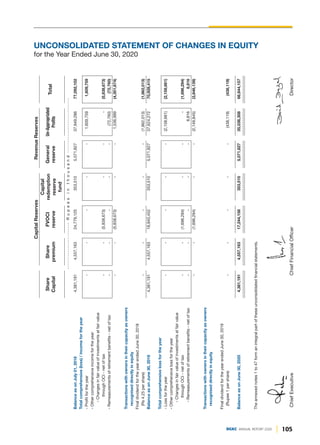
Unconsolidated Statement of Changes in Equity 105
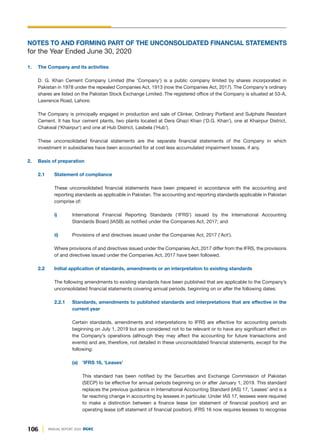
Notes to and Forming Part of the
Unconsolidated Financial Statements 106
Consolidated Financial Statements
Independent Auditor’s Report 168
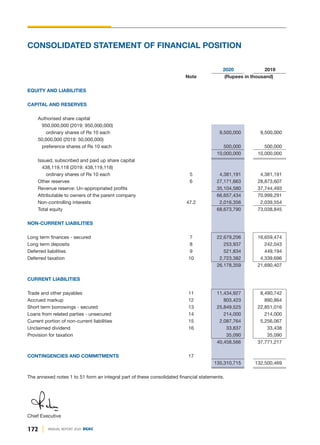
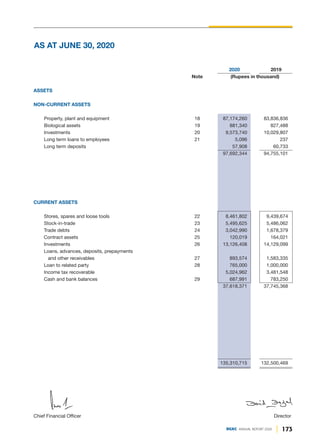
Consolidated Statement of Financial Position 172
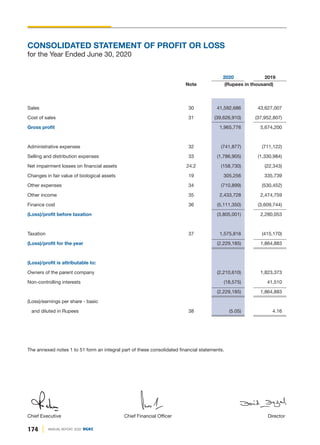
Consolidated Statement of Profit or Loss 174
Consolidated Statement of Comprehensive
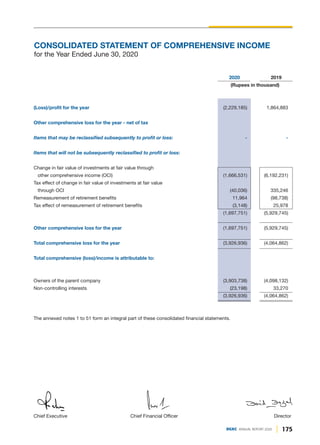
Income 175
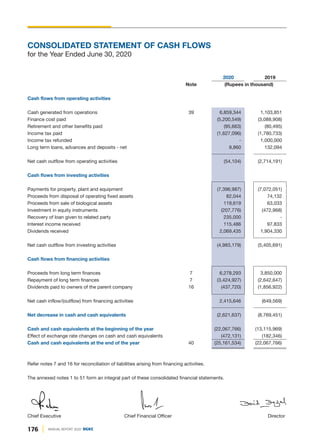
Consolidated Statement of Cash Flow 176
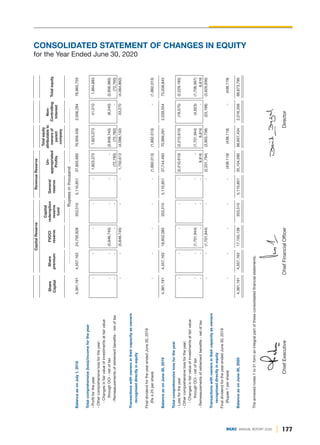
Consolidated Statement of Changes in Equity 177
Notes to and Forming Part of the
Consolidated Financial Statements 178
Glossary of Terms 249
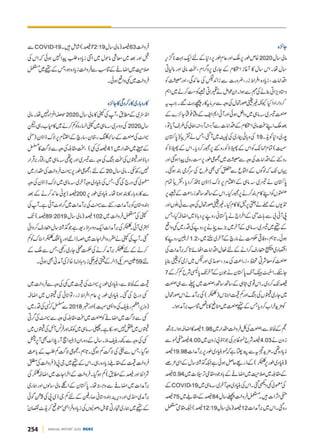
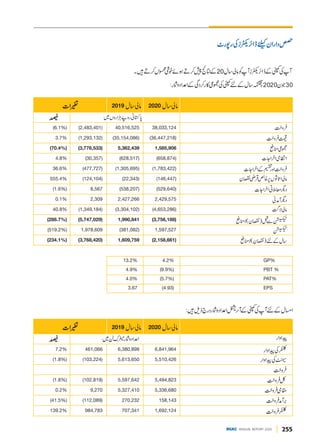
DGKC Directors’ Report in Urdu 255
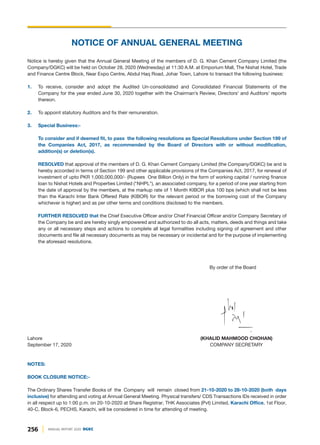
Notice of Annual General Meeting 256
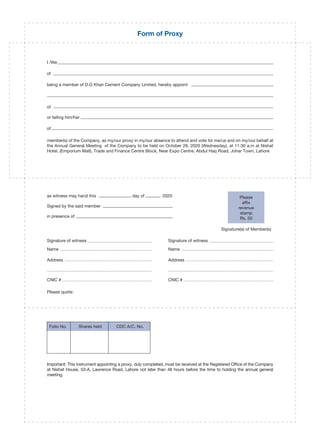
Form of Proxy 265
5
Financial Statements
4 ANNUAL REPORT 2020 DGKC
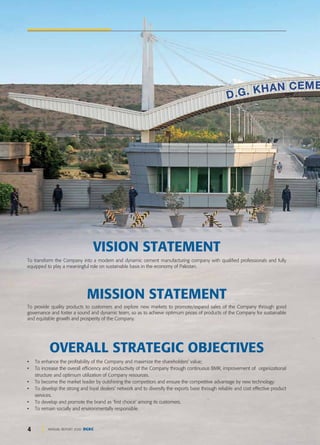
VISION STATEMENT
To transform the Company into a modern and dynamic cement manufacturing company with qualified professionals and fully
equipped to play a meaningful role on sustainable basis in the economy of Pakistan.
MISSION STATEMENT
To provide quality products to customers and explore new markets to promote/expand sales of the Company through good
governance and foster a sound and dynamic team, so as to achieve optimum prices of products of the Company for sustainable
and equitable growth and prosperity of the Company.
• To enhance the profitability of the Company and maximize the shareholders' value;
• To increase the overall efficiency and productivity of the Company through continuous BMR, improvement of organizational
structure and optimum utilization of Company resources.
• To become the market leader by outshining the competitors and ensure the competitive advantage by new technology.
• To develop the strong and loyal dealers' network and to diversify the exports base through reliable and cost effective product
services.
• To develop and promote the brand as 'first choice' among its customers.
• To remain socially and environmentally responsible.
OVERALL STRATEGIC OBJECTIVES
5
DGKC ANNUAL REPORT 2020 5
OUR VALUES
Inspiring, Motivating & Compelling
We're ambitious and innovative. We get excited about
our work. We bring energy and imagination to our
work in order to achieve a level of performance, not
achieved before. We achieve a higher standard of
excellence.
Competence
We can see things from different perspectives; we are
open to change and not bounded by how we have
done things in the past. We can respond rapidly and
adjust our mode of operation to meet stakeholders'
needs and achieve our goals.
Commitment
Shareholders – Create sustainable economic value for
our shareholders by utilizing an honest and efficient
business methodology.
Community – Committed to serve the society through
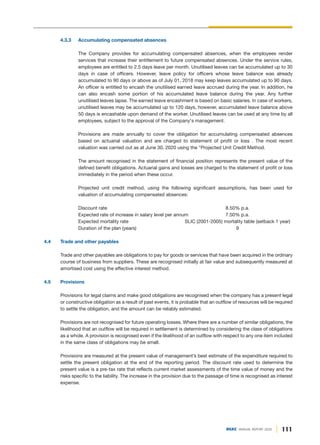
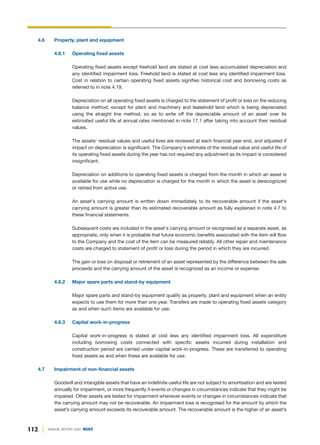
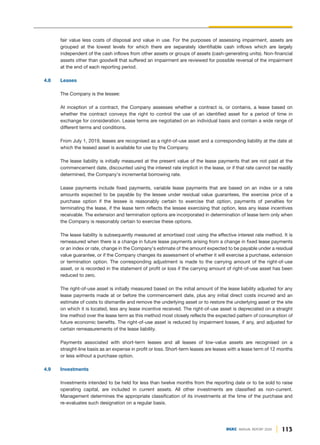
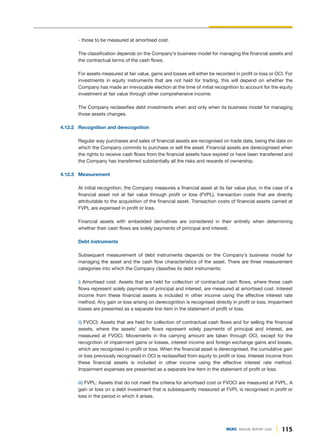
employment creation, support community projects &
events, and be a responsible corporate citizen.
Customers – Render service to our customers by using
state-of-the-art technology, offering diversified
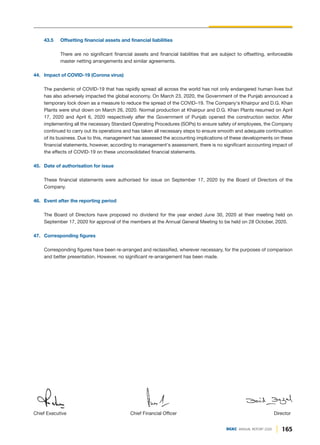
products and aspiring to fulfil their needs to the best
of our abilities.
Employees – Be reliant on the inherent merit of the
employees and honour our relationships. Work
together to celebrate and reward the unique
backgrounds, viewpoints, skills, and talents of
everyone at the work place, at each level.
Be Respectful
We respect our customers, shareholders & others
stakeholders and want to fulfil their needs. We always
appreciate comments & suggestions from our
stakeholders.
Accountability and Keep Promises
We are accountable for providing quality products &
excellent services along with meeting the strict
requirements of regulatory standards and ethical
business practices.
Everything we do, should work perfectly. We maintain
integrity & excellence. We believe in actions, not in
words.
6 ANNUAL REPORT 2020 DGKC
7
DGKC ANNUAL REPORT 2020
GROUP PROFILE AND
COMPANY INFORMATION
8 ANNUAL REPORT 2020 DGKC
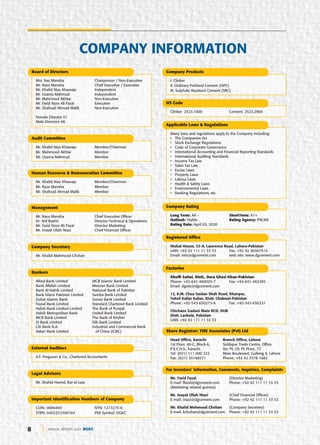
Mrs. Naz Mansha Chairperson / Non-Executive
Mr. Raza Mansha Chief Executive / Executive
Mr. Khalid Niaz Khawaja Independent
Mr. Usama Mahmud Independent
Mr. Mahmood Akhtar Non-Executive
Mr. Farid Noor Ali Fazal Executive
Mr. Shahzad Ahmad Malik Non-Executive
Female Director 01
Male Directors 06
Board of Directors
Allied Bank Limited MCB Islamic Bank Limited
Bank Alfalah Limited Meezan Bank Limited
Bank Al-Habib Limited National Bank of Pakistan
Bank Islami Pakistan Limited Samba Bank Limited
Dubai Islamic Bank Soneri Bank Limited
Faysal Bank Limited Standard Chartered Bank Limited
Habib Bank Limited Limited The Bank of Punjab
Habib Metropolitan Bank United Bank Limited
MCB Bank Limited The Bank of Khyber
JS Bank Limited Silk Bank Limited
Citi Bank N.A. Industrial and Commercial Bank
Askari Bank Limited of China (ICBC)
Bankers
Mr. Khalid Niaz Khawaja Member/Chairman
Mr. Mahmood Akhtar Member
Mr. Usama Mahmud Member
Audit Committee
CUIN: 0006469 NTN: 1213275-6
STRN: 0402252300164 PSX Symbol: DGKC
Important Identification Numbers of Company
Mr. Khalid Niaz Khawaja Member/Chairman
Mr. Raza Mansha Member
Mr. Shahzad Ahmad Malik Member
Human Resource & Remuneration Committee
Mr. Raza Mansha Chief Executive Officer
Dr. Arif Bashir Director Technical & Operations
Mr. Farid Noor Ali Fazal Director Marketing
Mr. Inayat Ullah Niazi Chief Financial Officer
Management
Mr. Khalid Mahmood Chohan
Company Secretary
A.F. Ferguson & Co., Chartered Accountants
External Auditors
Mr. Shahid Hamid, Bar-at-Law
Legal Advisors
Many laws and regulations apply to the Company including:
• The Companies Act
• Stock Exchange Regulations
• Code of Corporate Governance
• International Accounting and Financial Reporting Standards
• International Auditing Standards
• Income Tax Law
• Sales Tax Law
• Excise Laws
• Property Laws
• Labour Laws
• Health & Safety Laws
• Environmental Laws
• Banking Regulations, etc.
Applicable Laws & Regulations
Head Office, Karachi Branch Office, Lahore
1st Floor, 40-C, Block-6, Siddique Trade Centre, Office
P.E.C.H.S., Karachi. No. PL-29, PL Floor, 72
Tel: (021) 111 000 322 Main Boulevard, Gulberg II, Lahore
Fax: (021) 34168271 Phone: +92 42 3578 1682
Share Registrar: THK Associates (Pvt) Ltd
Mr. Farid Fazal (Director Marketing)
E-mail: ffazal@dgcement.com Phone: +92 42 111 11 33 33
(Marketing related queries)
Mr. Inayat Ullah Niazi (Chief Financial Officer)
E-mail: iniazi@dgcement.com Phone: +92 42 111 11 33 33
Mr. Khalid Mehmood Chohan (Company Secretary)
E-mail: kchohan@dgcement.com Phone: +92 42 111 11 33 33
For Investors’ Information, Comments, Inquiries, Complaints
I. Clinker
II. Ordinary Portland Cement (OPC)
III. Sulphate Resistant Cement (SRC)
Company Products
Long Term: AA - ShortTerm: A1+
Outlook: Stable Rating Agency: PACRA
Rating Date: April 03, 2020
Company Rating
Nishat House, 53-A, Lawrence Road, Lahore-Pakistan
UAN: +92 42 111 11 33 33 Fax: +92 42 36367414
Email: info@dgcement.com web site: www.dgcement.com
Registered Office
Khofli Sattai, Distt., Dera Ghazi Khan-Pakistan
Phone: +92-641-460025-7 Fax: +92-641-462392
Email: dgsite@dgcement.com
12, K.M. Choa Saidan Shah Road, Khairpur,
Tehsil Kallar Kahar, Distt. Chakwal-Pakistan
Phone: +92-543-650215-8 Fax: +92-543-650231
Chichaee Gadani Main RCD, HUB
Distt. Lasbela, Pakistan
UAN: +92 42 111 11 33 33
Factories
Clinker: 2523.1000 Cement: 2523.2900
HS Code
COMPANY INFORMATION
9
DGKC ANNUAL REPORT 2020
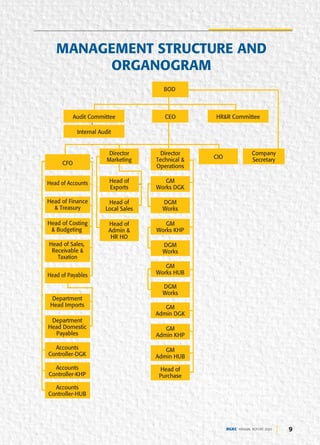
MANAGEMENT STRUCTURE AND
ORGANOGRAM
BOD: Board of Directors
CEO: Chief Executive Officer
CFO: Chief Financial Officer
CIO: Chief Information Officer
GM: General Manager
DGM: Deputy General Manager
HR&R Committee
Audit Committee
Internal Audit
CEO
Director
Marketing CIO
Company
Secretary
GM
Works DGK
DGM
Works
DGM
Works
DGM
Works
GM
Admin DGK
GM
Admin KHP
GM
Admin HUB
Head of
Purchase
GM
Works HUB
GM
Works KHP
Director
Technical &
Operations
Head of
Exports
Head of
Local Sales
Head of
Admin &
HR HO
CFO
Head of Accounts
Head of Finance
& Treasury
Head of Sales,
Receivable &
Taxation
Department
Head Imports
Accounts
Controller-DGK
Accounts
Controller-KHP
Accounts
Controller-HUB
Department
Head Domestic
Payables
Head of Payables
Head of Costing
& Budgeting
BOD
10 ANNUAL REPORT 2020 DGKC
11
DGKC ANNUAL REPORT 2020
12 ANNUAL REPORT 2020 DGKC
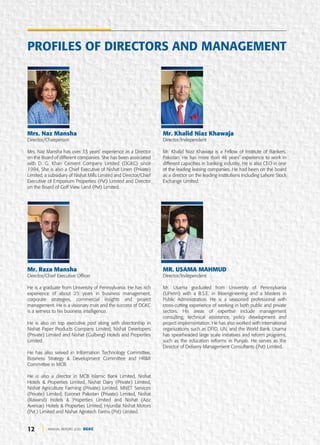
Mrs. Naz Mansha
Director/Chairperson
Mrs. Naz Mansha has over 33 years’ experience as a Director
on the Board of different companies. She has been associated
with D. G. Khan Cement Company Limited (DGKC) since
1994, She is also a Chief Executive of Nishat Linen (Private)
Limited, a subsidiary of Nishat Mills Limited and Director/Chief
Executive of Emporium Properties (Pvt) Limited and Director
on the Board of Golf View Land (Pvt) Limited.
Mr. Raza Mansha
Director/Chief Executive Officer
He is a graduate from University of Pennsylvania. He has rich
experience of about 25 years in business management,
corporate strategies, commercial insights and project
management. He is a visionary man and the success of DGKC
is a witness to his business intelligence.
He is also on top executive post along with directorship in
Nishat Paper Products Company Limited, Nishat Developers
(Private) Limited and Nishat (Gulberg) Hotels and Properties
Limited.
He has also served in Information Technology Committee,
Business Strategy & Development Committee and HR&R
Committee in MCB.
He is also a director in MCB Islamic Bank Limited, Nishat
Hotels & Properties Limited, Nishat Dairy (Private) Limited,
Nishat Agriculture Farming (Private) Limited, MNET Services
(Private) Limited, Euronet Pakistan (Private) Limited, Nishat
(Raiwind) Hotels & Properties Limited and Nishat (Aziz
Avenue) Hotels & Properties Limited, Hyundai Nishat Motors
(Pvt.) Limited and Nishat Agrotech Farms (Pvt) Limited.
Mr. Khalid Niaz Khawaja
Director/Independent
Mr. Khalid Niaz Khawaja is a Fellow of Institute of Bankers,
Pakistan. He has more than 46 years’ experience to work in
different capacities in banking industry. He is also CEO in one
of the leading leasing companies. He had been on the board
as a director on the leading institutions Including Lahore Stock
Exchange Limited.
MR. USAMA MAHMUD
Director/Independent
Mr. Usama graduated from University of Pennsylvania
(UPenn) with a B.S.E. in Bioengineering and a Masters in
Public Administration. He is a seasoned professional with
cross-cutting experience of working in both public and private
sectors. His areas of expertise include management
consulting, technical assistance, policy development and
project implementation. He has also worked with international
organizations such as DFID, UN, and the World Bank. Usama
has spearheaded large scale initiatives and reform programs,
such as the education reforms in Punjab. He serves as the
Director of Delivery Management Consultants (Pvt) Limited.
PROFILES OF DIRECTORS AND MANAGEMENT
13
DGKC ANNUAL REPORT 2020
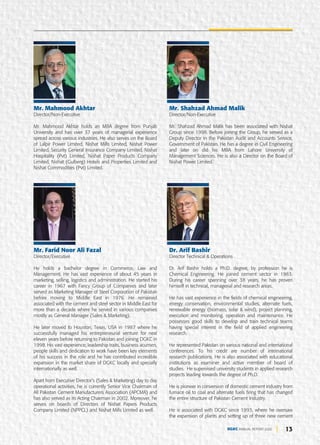
Mr. Mahmood Akhtar
Director/Non-Executive
Mr. Mahmood Akhtar holds an MBA degree from Punjab
University and has over 37 years of managerial experience
spread across various industries. He also serves on the Board
of Lalpir Power Limited, Nishat Mills Limited, Nishat Power
Limited, Security General Insurance Company Limited, Nishat
Hospitality (Pvt) Limited, Nishat Paper Products Company
Limited, Nishat (Gulberg) Hotels and Properties Limited and
Nishat Commodities (Pvt) Limited.
Mr. Farid Noor Ali Fazal
Director/Executive
He holds a bachelor degree in Commerce, Law and
Management. He has vast experience of about 45 years in
marketing, selling, logistics and administration. He started his
career in 1967 with Fancy Group of Companies and later
served as Marketing Manager of Steel Corporation of Pakistan
before moving to Middle East in 1976. He remained
associated with the cement and steel sector in Middle East for
more than a decade where he served in various companies
mostly as General Manager (Sales & Marketing).
He later moved to Houston, Texas, USA in 1987 where he
successfully managed his entrepreneurial venture for next
eleven years before returning to Pakistan and joining DGKC in
1998. His vast experience, leadership traits, business acumen,
people skills and dedication to work have been key elements
of his success in the role and he has contributed incredible
expansion in the market share of DGKC locally and specially
internationally as well.
Apart from Executive Director’s (Sales & Marketing) day to day
operational activities, he is currently Senior Vice Chairman of
All Pakistan Cement Manufacturers Association (APCMA) and
has also served as its Acting Chairman in 2002. Moreover, he
serves on boards of Directors of Nishat Papers Products
Company Limited (NPPCL) and Nishat Mills Limited as well.
Mr. Shahzad Ahmad Malik
Director/Non-Executive
Mr. Shahzad Ahmad Malik has been associated with Nishat
Group since 1998. Before joining the Group, he served as a
Deputy Director in the Pakistan Audit and Accounts Service,
Government of Pakistan. He has a degree in Civil Engineering
and later on did his MBA from Lahore University of
Management Sciences. He is also a Director on the Board of
Nishat Power Limited.
Dr. Arif Bashir
Director Technical & Operations
Dr. Arif Bashir holds a Ph.D. degree, by profession he is
Chemical Engineering. He joined cement sector in 1983.
During his career spanning over 38 years, he has proven
himself in technical, managerial and research areas.
He has vast experience in the fields of chemical engineering,
energy conservation, environmental studies, alternate fuels,
renewable energy (biomass, solar & wind), project planning,
execution and monitoring, operation and maintenance. He
possesses good skills to develop and train technical teams
having special interest in the field of applied engineering
research.
He represented Pakistan on various national and international
conferences. To his credit are number of international
research publications. He is also associated with educational
institutions as examiner and active member of board of
studies. He supervised university students in applied research
projects leading towards the degree of Ph.D.
He is pioneer in conversion of domestic cement industry from
furnace oil to coal and alternate fuels firing that has changed
the entire structure of Pakistan Cement Industry.
He is associated with DGKC since 1993, where he oversaw
the expansion of plants and setting up of three new cement
14 ANNUAL REPORT 2020 DGKC
production lines with number of optimizing projects. In 2004,
he was given challenging responsibility to set up state of the
art greenfield 7000 tpd Khairpur project which was
successfully completed in 2007. In 2011 he was posted on
the top technical post of the Company as Director (Technical
& Operations). He was also heading technical team who
completed Pakistan largest 10,000 tpd Cement project in
2018 at Hub, district Lasbela Balochistan.
His technical expertise and leadership have been instrumental
in vertical growth of the Company. He played a pivotal role in
training and development of skilled professional team of
engineers and technicians. He also serves on the boards of
directors of Pakgen Power Limited and Nishat Paper Products
Company Limited.
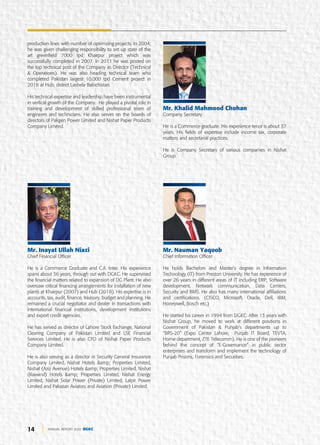
Mr. Inayat Ullah Niazi
Chief Financial Officer
He is a Commerce Graduate and C.A. Inter. His experience
spans about 36 years, through out with DGKC. He supervised
the financial matters related to expansion of DG Plant. He also
oversaw critical financing arrangements for installation of new
plants at Khairpur (2007) and Hub (2018). His expertise is in
accounts, tax, audit, finance, treasury, budget and planning. He
remained a crucial negotiator and dealer in transactions with
international financial institutions, development institutions
and export credit agencies.
He has served as director of Lahore Stock Exchange, National
Clearing Company of Pakistan Limited and LSE Financial
Services Limited. He is also CFO of Nishat Paper Products
Company Limited.
He is also serving as a director in Security General Insurance
Company Limited, Nishat Hotels & Properties Limited,
Nishat (Aziz Avenue) Hotels & Properties Limited, Nishat
(Raiwind) Hotels & Properties Limited, Nishat Energy
Limited, Nishat Solar Power (Private) Limited, Lalpir Power
Limited and Pakistan Aviators and Aviation (Private) Limited.
Mr. Khalid Mahmood Chohan
Company Secretary
He is a Commerce graduate. His experience tenor is about 37
years. His fields of expertise include income tax, corporate
matters and secretarial practices.
He is Company Secretary of various companies in Nishat
Group.
Mr. Nauman Yaqoob
Chief Information Officer
He holds Bachelors and Master’s degree in Information
Technology (IT) from Preston University. He has experience of
over 26 years in different areas of IT including ERP, Software
development, Network communication, Data Centers,
Security and BMS. He also has many international affiliations
and certifications. (CISCO, Microsoft, Oracle, Dell, IBM,
Honeywell, Bosch etc.)
He started his career in 1994 from DGKC. After 13 years with
Nishat Group, he moved to work at different positions in
Government of Pakistan & Punjab’s departments up to
“BPS-20” (Expo Center Lahore, Punjab IT Board, TEVTA,
Home department, ZTE Telecomm). He is one of the pioneers
behind the concept of “E-Governance” in public sector
enterprises and transform and implement the technology of
Punjab Prisons, Forensics and Securities.
2 0 1 6
Installation of 30 MW Coal Fired
Power Plant at DG Khan site
2 0 1 8
Addition of new plant at HUB
enhanced the clinker capacity to
22,400 TPD
2 0 2 0
Addition of 12 MW new waste
heat recovery power plant at
Khairpur site
15
DGKC ANNUAL REPORT 2020
About Founder:
Mian Mohammad Yahya, the founding father, was born in
1918 in Chiniot. In 1947 when he was running a leather
business in Calcutta, he witnessed the momentous changes
that swept the Indo-Pak sub-continent and culminated in the
emergence of Pakistan. This is a story of success through
sheer hard work and an undaunted spirit of entrepreneurship.
Beginning with a cotton export house, he soon branched out
into ginning, cotton and jute textiles. He was elected
Chairman of All Pakistan Textile Mills Association, the prime
textile body in the country.
He died in 1969, at the age of 51 having achieved so much
in so short time. After him, Mian Mohammad Mansha, like
his father, continues the spirit of entrepreneurship, and has
led the Group to become a multi-dimensional corporation,
with wide ranging interests. Nishat has grown from a cotton
export house into the premier business group of the country.
Nishat is a Pakistani business conglomerate group. It
has a diversified presence in various sectors. All its entities are
run by professionals on update business practices in
compliance with national and international regulations.
Its Market Capitalization as on June 30, 2020 is about PKR
285 billion (about USD 1.7 billion). The Group regular
employees are more than 41,000. As on June 30, 2020,
67.3% of group market capitalization was occupied by
banking sector, cement 13.1%, textile 9.6%, power 5.9%,
and insurance 4.1%.
The Group has notable presence in following business
sectors:
• Banking & Financial Services • Insurance
• Cement • Textiles
• Hospitality & Hotels • Energy
• Aviation • Automobiles
• Paper packing products • Real Estate
• Agriculture & Farming, Livestock & Dairy
GROUP PROFILE
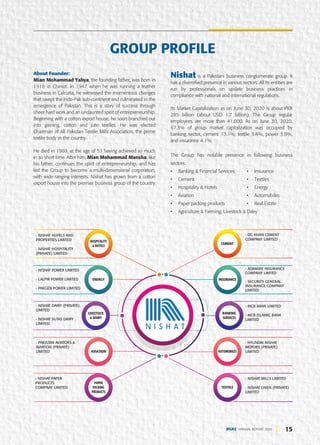
- NISHAT POWER LIMITED
- LALPIR POWER LIMITED
- PAKGEN POWER LIMITED
- ADAMJEE INSURANCE
COMPANY LIMTED
- SECURITY GENERAL
INSURANCE COMPANY
LIMITED
- NISHAT HOTELS AND
PROPERTIES LIMITED
- NISHAT HOSPITALITY
(PRIVATE) LIMITED
- DG KHAN CEMENT
COMPANY LIMITED
- PAKISTAN AVIATORS &
AVIATION (PRIVATE)
LIMITED
- HYUNDAI NISHAT
MOTORS (PRIVATE)
LIMITED
- NISHAT DAIRY (PRIVATE)
LIMITED
- NISHAT SUTAS DAIRY
LIMITED
- MCB BANK LIMITED
- MCB ISLAMIC BANK
LIMITED
- NISHAT PAPER
PRODUCTS
COMPNAY LIMITED
- NISHAT MILLS LIMITED
- NISHAT LINEN (PRIVATE)
LIMITED
HOSPITALITY
& HOTELS
ENERGY
LIVESTOCK
& DAIRY
AVIATION
PAPER
PACKING
PRODUCTS
CEMENT
INSURANCE
BANKING
SERVICES
AUTOMOBILES
TEXTILE
16 ANNUAL REPORT 2020 DGKC
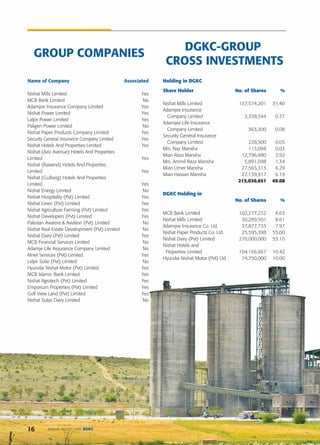
Holding in DGKC
Share Holder No. of Shares %
Nishat Mills Limited 137,574,201 31.40
Adamjee Insurance
Company Limited 3,358,344 0.77
Adamjee Life Insurance
Company Limited 363,300 0.08
Security General Insurance
Company Limited 228,500 0.05
Mrs. Naz Mansha 113,098 0.03
Mian Raza Mansha 12,796,880 2.92
Mrs. Ammil Raza Mansha 5,891,098 1.34
Mian Umer Mansha 27,565,313 6.29
Mian Hassan Mansha 27,139,917 6.19
215,030,651 49.08
DGKC Holding in
No. of Shares %
MCB Bank Limited 102,277,232 8.63
Nishat Mills Limited 30,289,501 8.61
Adamjee Insurance Co. Ltd. 27,877,735 7.97
Nishat Paper Products Co. Ltd. 25,595,398 55.00
Nishat Dairy (Pvt) Limited 270,000,000 55.10
Nishat Hotels and
Properties Limited 104,166,667 10.42
Hyundai Nishat Motor (Pvt) Ltd. 74,750,000 10.00
Name of Company Associated
Nishat Mills Limited Yes
MCB Bank Limited No
Adamjee Insurance Company Limited Yes
Nishat Power Limited Yes
Lalpir Power Limited Yes
Pakgen Power Limited No
Nishat Paper Products Company Limited Yes
Security General Insurance Company Limited Yes
Nishat Hotels And Properties Limited Yes
Nishat (Aziz Avenue) Hotels And Properties
Limited Yes
Nishat (Raiwind) Hotels And Properties
Limited Yes
Nishat (Gulberg) Hotels And Properties
Limited Yes
Nishat Energy Limited No
Nishat Hospitality (Pvt) Limited Yes
Nishat Linen (Pvt) Limited Yes
Nishat Agriculture Farming (Pvt) Limited Yes
Nishat Developers (Pvt) Limited Yes
Pakistan Aviators & Aviation (Pvt) Limited No
Nishat Real Estate Development (Pvt) Limited No
Nishat Dairy (Pvt) Limited Yes
MCB Financial Services Limited No
Adamje Life Assurance Company Limited No
Mnet Services (Pvt) Limited Yes
Lalpir Solar (Pvt) Limited No
Hyundai Nishat Motor (Pvt) Limited Yes
MCB Islamic Bank Limited Yes
Nishat Agrotech (Pvt) Limited Yes
Emporium Properties (Pvt) Limited Yes
Golf View Land (Pvt) Limited Yes
Nishat Sutas Dairy Limited No
DGKC-GROUP
CROSS INVESTMENTS
GROUP COMPANIES
17
DGKC ANNUAL REPORT 2020
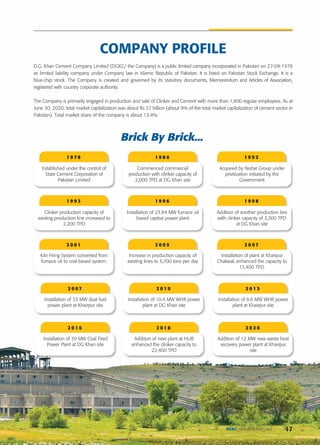
2 0 0 7
Installation of 33 MW dual fuel
power plant at Khairpur site
2 0 1 0
Installation of 10.4 MW WHR power
plant at DG Khan site
2 0 1 3
Installation of 8.6 MW WHR power
plant at Khairpur site
2 0 1 6
Installation of 30 MW Coal Fired
Power Plant at DG Khan site
2 0 1 8
Addition of new plant at HUB
enhanced the clinker capacity to
22,400 TPD
2 0 2 0
Addition of 12 MW new waste heat
recovery power plant at Khairpur
site
1 9 7 8
Established under the control of
State Cement Corporation of
Pakistan Limited
1 9 8 6
Commenced commercial
production with clinker capacity of
2,000 TPD at DG Khan site
1 9 9 2
Acquired by Nishat Group under
privitization initiated by the
Government
1 9 9 3
Clinker production capacity of
existing production line increased to
2,200 TPD
1 9 9 6
Installation of 23.84 MW furnace oil
based captive power plant
1 9 9 8
Addition of another production line
with clinker capacity of 3,300 TPD
at DG Khan site
2 0 0 1
Kiln Firing System converted from
furnace oil to coal-based system.
2 0 0 5
Increase in production capacity of
existing lines to 6,700 tons per day
2 0 0 7
Installation of plant at Khairpur
Chakwal, enhanced the capacity to
13,400 TPD.
Brick By Brick...
D.G. Khan Cement Company Limited (DGKC/ the Company) is a public limited company incorporated in Pakistan on 27-09-1978
as limited liability company under Company law in Islamic Republic of Pakistan. It is listed on Pakistan Stock Exchange. It is a
blue-chip stock. The Company is created and governed by its statutory documents, Memorandum and Articles of Association,
registered with country corporate authority.
The Company is primarily engaged in production and sale of Clinker and Cement with more than 1,800 regular employees. As at
June 30, 2020; total market capitalization was about Rs 37 billion (about 9% of the total market capitalization of cement sector in
Pakistan). Total market share of the company is about 13.4%.
COMPANY PROFILE
18 ANNUAL REPORT 2020 DGKC
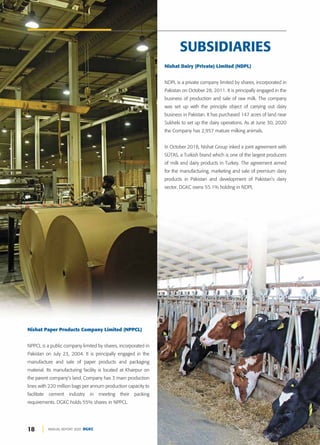
Nishat Paper Products Company Limited (NPPCL)
NPPCL is a public company limited by shares, incorporated in
Pakistan on July 23, 2004. It is principally engaged in the
manufacture and sale of paper products and packaging
material. Its manufacturing facility is located at Khairpur on
the parent company's land. Company has 3 main production
lines with 220 million bags per annum production capacity to
facilitate cement industry in meeting their packing
requirements. DGKC holds 55% shares in NPPCL.
Nishat Dairy (Private) Limited (NDPL)
NDPL is a private company limited by shares, incorporated in
Pakistan on October 28, 2011. It is principally engaged in the
business of production and sale of raw milk. The company
was set up with the principle object of carrying out dairy
business in Pakistan. It has purchased 147 acres of land near
Sukheki to set up the dairy operations. As at June 30, 2020
the Company has 2,957 mature milking animals.
In October 2018, Nishat Group inked a joint agreement with
SÜTAS, a Turkish brand which is one of the largest producers
of milk and dairy products in Turkey. The agreement aimed
for the manufacturing, marketing and sale of premium dairy
products in Pakistan and development of Pakistan’s dairy
sector. DGKC owns 55.1% holding in NDPL
SUBSIDIARIES
19
DGKC ANNUAL REPORT 2020
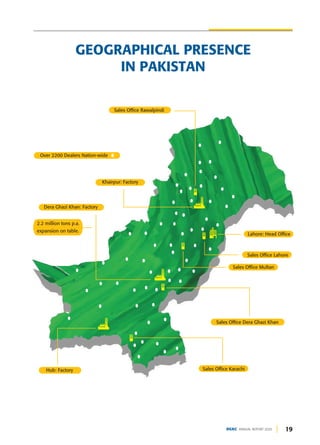
GEOGRAPHICAL PRESENCE
IN PAKISTAN
Sales Office Lahore
Sales Office Dera Ghazi Khan
Sales Office Multan
Sales Office Karachi
Sales Office Rawalpindi
Lahore: Head Office
Dera Ghazi Khan: Factory
Khairpur: Factory
Over 2200 Dealers Nation-wide
2.2 million tons p.a.
expansion on table.
Hub: Factory
20 ANNUAL REPORT 2020 DGKC
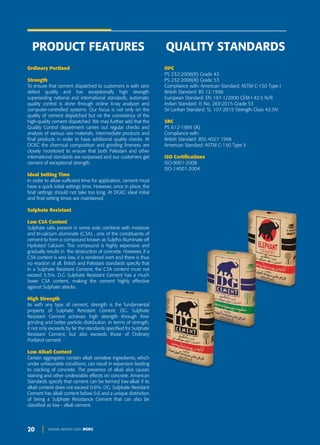
Ordinary Portland
Strength
To ensure that cement dispatched to customers is with zero
defect quality and has exceptionally high strength
superseding national and international standards, automatic
quality control is done through online X-ray analyzer and
computer-controlled systems. Our focus is not only on the
quality of cement dispatched but on the consistency of the
high-quality cement dispatched. We may further add that the
Quality Control department carries out regular checks and
analysis of various raw materials, intermediate products and
final products in order to have additional quality checks. At
DGKC the chemical composition and grinding fineness are
closely monitored to ensure that both Pakistani and other
international standards are surpassed and our customers get
cement of exceptional strength.
Ideal Setting Time
In order to allow sufficient time for application, cement must
have a quick initial settings time. However, once in place, the
final settings should not take too long. At DGKC ideal initial
and final setting times are maintained.
Sulphate Resistant
Low C3A Content
Sulphate salts present in some soils combine with moisture
and tri-calcium aluminate (C3A) , one of the constituents of
cement to form a compound known as Sulpho Aluminate off
Hydrated Calcium. This compound is highly expensive and
gradually results in the destruction of concrete. However, if a
C3A content is very low, it is rendered inert and there is thus
no reaction at all. British and Pakistani standards specify that
in a Sulphate Resistant Cement, the C3A content must not
exceed 3.5%. D.G Sulphate Resistant Cement has a much
lower C3A content, making the cement highly effective
against Sulphate attacks.
High Strength
As with any type of cement, strength is the fundamental
property of Sulphate Resistant Cement. DG. Sulphate
Resistant Cement achieves high strength through finer
grinding and better particle distribution. In terms of strength,
it not only exceeds by far the standards specified for Sulphate
Resistant Cement, but also exceeds those of Ordinary
Portland cement.
Low Alkali Content
Certain aggregates contain alkali sensitive ingredients, which
under unfavorable conditions, can result in expansion leading
to cracking of concrete. The presence of alkali also causes
staining and other undesirable effects on concrete. American
Standards specify that cement can be termed low-alkali if its
alkali content does not exceed 0.6%. DG. Sulphate Resistant
Cement has alkali content below 0.6 and a unique distinction
of being a Sulphate Resistance Cement that can also be
classified as low - alkali cement.
PRODUCT FEATURES
OPC
PS 232:2008(R) Grade 43
PS 232:2008(R) Grade 53
Compliance with: American Standard: ASTM C-150 Type I
British Standard: BS 12:1996
European Standard: EN 197-1/2000 CEM I 42.5 N/R
Indian Standard: IS No. 269:2015 Grade 53
Sri Lankan Standard: SL 107:2015 Strength Class 42.5N
SRC
PS 612-1989 (R)
Compliance with:
British Standard: BSS 4027 1996
American Standard: ASTM C-150 Type V
ISO Certifications
ISO-9001-2008
ISO-14001-2004
QUALITY STANDARDS
21
DGKC ANNUAL REPORT 2020
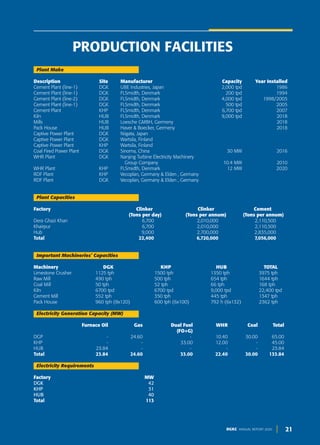
Plant Make
Description Site Manufacturer Capacity Year Installed
Cement Plant (line-1) DGK UBE Industries, Japan 2,000 tpd 1986
Cement Plant (line-1) DGK FLSmidth, Denmark 200 tpd 1994
Cement Plant (line-2) DGK FLSmidth, Denmark 4,000 tpd 1998/2005
Cement Plant (line-1) DGK FLSmidth, Denmark 500 tpd 2005
Cement Plant KHP FLSmidth, Denmark 6,700 tpd 2007
Kiln HUB FLSmidth, Denmark 9,000 tpd 2018
Mills HUB Loesche GMBH, Germeny 2018
Pack House HUB Haver & Boecker, Germeny 2018
Captive Power Plant DGK Niigata, Japan
Captive Power Plant DGK Wartsila, Finland
Captive Power Plant KHP Wartsila, Finland
Coal Fired Power Plant DGK Sinoma, China 30 MW 2016
WHR Plant DGK Nanjing Turbine Electricity Machinery
Group Company 10.4 MW 2010
WHR Plant KHP FLSmidth, Denmark 12 MW 2020
RDF Plant KHP Vecoplan, Germany & Elden , Germany
RDF Plant DGK Vecoplan, Germany & Elden , Germany
Plant Capacities
Factory Clinker Clinker Cement
(Tons per day) (Tons per annum) (Tons per annum)
Dera Ghazi Khan 6,700 2,010,000 2,110,500
Khairpur 6,700 2,010,000 2,110,500
Hub 9,000 2,700,000 2,835,000
Total 22,400 6,720,000 7,056,000
Important Machineries’ Capacities
Machinery DGK KHP HUB TOTAL
Limestone Crusher 1125 tph 1500 tph 1350 tph 3975 tph
Raw Mill 490 tph 500 tph 654 tph 1644 tph
Coal Mill 50 tph 52 tph 66 tph 168 tph
Kiln 6700 tpd 6700 tpd 9,000 tpd 22,400 tpd
Cement Mill 552 tph 350 tph 445 tph 1347 tph
Pack House 960 tph (8x120) 600 tph (6x100) 792 h (6x132) 2362 tph
Electricity Generation Capacity (MW)
Furnace Oil Gas Dual Fuel WHR Coal Total
(FO+G)
DGP - 24.60 - 10.40 30.00 65.00
KHP - - 33.00 12.00 - 45.00
HUB 23.84 - - - - 23.84
Total 23.84 24.60 33.00 22.40 30.00 133.84
Electricity Requirements
Factory MW
DGK 42
KHP 31
HUB 40
Total 113
PRODUCTION FACILITIES
22 ANNUAL REPORT 2020 DGKC
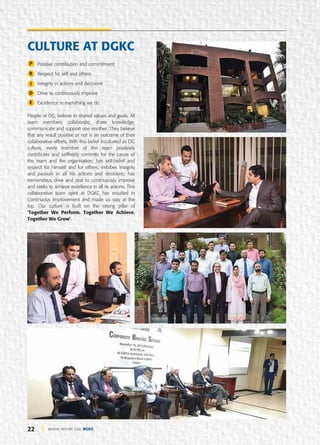
Positive contribution and commitment
Respect for self and others
Integrity in actions and decisions
Drive to continuously improve
Excellence in everything we do
People at DG, believe in shared values and goals. All
team members collaborate, share knowledge,
communicate and support one another. They believe
that any result positive or not is an outcome of their
collaborative efforts. With this belief inculcated as DG
culture, every member of the team positively
contributes and selflessly commits for the cause of
the team and the organisation; has self-belief and
respect for himself and for others; imbibes integrity
and passion in all his actions and decisions; has
tremendous drive and zeal to continuously improve
and seeks to achieve excellence in all its actions. This
collaborative team spirit at DGKC has resulted in
Continuous Improvement and made us stay at the
top. Our culture is built on the strong pillar of
‘Together We Perform. Together We Achieve.
Together We Grow’.
CULTURE AT DGKC
P
R
I
D
E
23
DGKC ANNUAL REPORT 2020
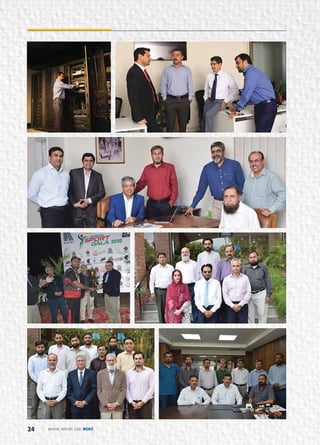
24 ANNUAL REPORT 2020 DGKC
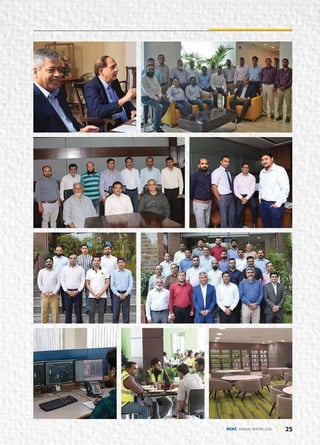
25
DGKC ANNUAL REPORT 2020
27
DGKC ANNUAL REPORT 2020
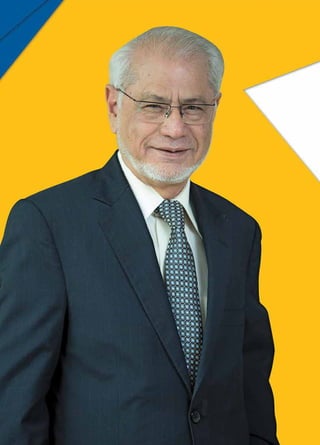
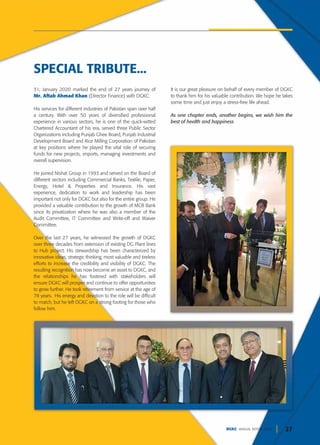
31, January 2020 marked the end of 27 years journey of
Mr. Aftab Ahmad Khan (Director Finance) with DGKC.
His services for different industries of Pakistan span over half
a century. With over 50 years of diversified professional
experience in various sectors, he is one of the quick-witted
Chartered Accountant of his era, served three Public Sector
Organizations including Punjab Ghee Board, Punjab Industrial
Development Board and Rice Milling Corporation of Pakistan
at key positions where he played the vital role of securing
funds for new projects, imports, managing investments and
overall supervision.
He joined Nishat Group in 1993 and served on the Board of
different sectors including Commercial Banks, Textile, Paper,
Energy, Hotel & Properties and Insurance. His vast
experience, dedication to work and leadership has been
important not only for DGKC but also for the entire group. He
provided a valuable contribution to the growth of MCB Bank
since its privatization where he was also a member of the
Audit Committee, IT Committee and Write-off and Waiver
Committee.
Over the last 27 years, he witnessed the growth of DGKC
over three decades from extension of existing DG Plant lines
to Hub project. His stewardship has been characterized by
innovative ideas, strategic thinking, most valuable and tireless
efforts to increase the credibility and visibility of DGKC. The
resulting recognition has now become an asset to DGKC, and
the relationships he has fostered with stakeholders will
ensure DGKC will prosper and continue to offer opportunities
to grow further. He took retirement from service at the age of
78 years. His energy and devotion to the role will be difficult
to match, but he left DGKC on a strong footing for those who
follow him.
It is our great pleasure on behalf of every member of DGKC
to thank him for his valuable contribution. We hope he takes
some time and just enjoy a stress-free life ahead.
As one chapter ends, another begins, we wish him the
best of health and happiness
SPECIAL TRIBUTE...
28 ANNUAL REPORT 2020 DGKC
29
DGKC ANNUAL REPORT 2020
CORPORATE
GOVERNANCE
AND
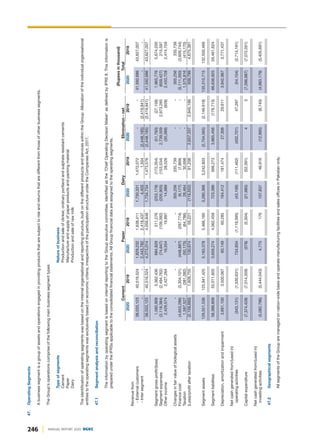
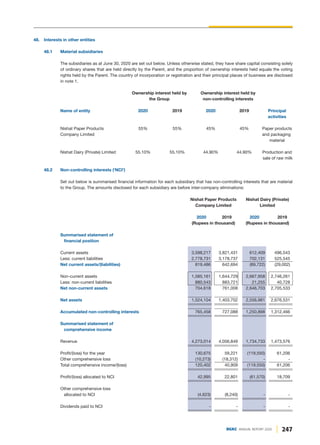
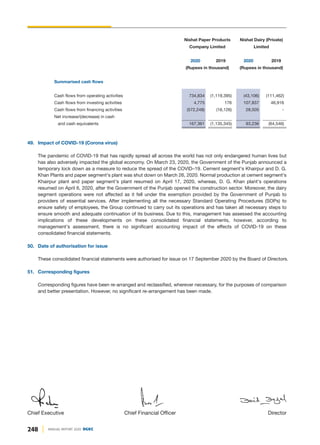
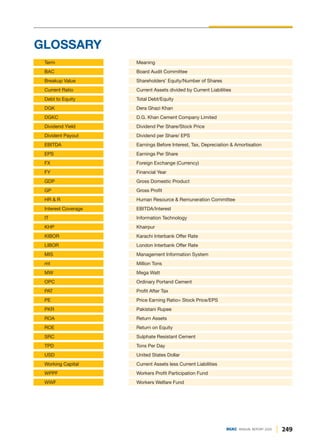
REPORTING
30 ANNUAL REPORT 2020 DGKC
DG Khan Cement Company Limited continues to hold in high esteem the best practices of corporate governance and believes in
widely propagating its values and ethics for strict adherence by all employees, contractors, suppliers and others while doing
business for the Company. The Company’s commitment to encouraging ethical and responsible practices is demonstrated by the
fact that DG Khan Cement Company Limited had a comprehensive Code of Conduct in place well before the introduction of the
Stock Exchange requirement. In order to apprise employees of the Code of Conduct, the Company organises training programmes
within the Company on a periodic basis to ensure compliance at all levels. Furthermore, upon joining the Company, all employees
are required to read and understand the Code of Conduct, and sign a declaration of compliance with it. As a refresher on the Code,
renewal of the declaration is also carried out electronically on a regular basis. (Approved Code of conduct for directors and
employees are shown on website in detail).
Salient Features of Code of Conduct
Compliance Officer: The Company has designated Company Secretary/ HR department respectively, as its Compliance Officer
to administer this Code.
Compliance with Law: Directors/Employees must comply with all of the laws, rules, and regulations of Pakistan and other
countries applicable to either Company or its business.
Conflict of Interest: Any director/employee who becomes aware of a conflict or potential conflict of interest is expected to bring
it to the attention of the Chairman of the Board or the Compliance Officer/ HR department.
Confidentiality: All directors/employees must maintain the confidentiality of confidential information entrusted to them by either
Company, except when the applicable Company authorizes disclosure or disclosure is required by laws, regulations, or legal
proceedings.
Fair Dealing: Each director/employee is expected to deal fairly with the respective customer of the Company, suppliers,
competitors, officers, and employees.
Protection and Paper Use of Company Assets: All directors/employees are expected to exercise their business judgment in
a manner that protects the assets of the Company and promotes their efficient use.
Reporting Any Illegal or Unethical Behaviour: Every director/employee of the Company is encouraged to promptly contact
the Chairman of the Board or the Compliance Officer/ HR department if he or she has observed a violation of this Code, illegal or
unethical behaviour.
Public Company Reporting: The Company expects directors/employees to provide prompt and accurate answers to enquiries
relating to its public disclosure requirements.
Disclosure of Interest: Directors/Employees are also required to disclose their interest, at the time of appointment and on an
annual basis the directorships and/or memberships they hold in other companies.
Insider Trading: No director/employee shall, directly or indirectly, deal in the shares of the Company in any manner during the
Closed Period prior to the announcement of financial results.
Amendment, Modification and Waiver: This Code may be amended, modified or waived only by the Company’s Board of
Directors and must be publicly disclosed if required by any applicable law or regulation. As a general Policy, the Board will not grant
waivers to the Code.
BUSINESS CONTINUITY PLAN
Operational continuity is of paramount importance for the long-term success and viability of any Company. DGKC has developed
business continuity plans which also provide a mechanism for disaster recovery in the respective areas. The Company has arranged
the security of all the factory sites by hiring well-trained security personnel on its payroll. All the physical assets are properly
safeguarded and insured. Back up of virtual assets such as IT programs and software are regularly arranged. Very efficient and
effective firefighting systems have been in place at all our manufacturing facilities. Standard Operating Procedures for all the
processes have been devised and documented according to the best practices prevailing in the industry. All transactions and affairs
of the Company are properly documented; and these documents are appropriately preserved according to our Policy for safety of
records.
CODE OF CONDUCT
31
DGKC ANNUAL REPORT 2020
Information Technology (IT) Governance is an integral part of enterprise governance and consists of the leadership and
organizational structures and processes that ensure the sustenance and extension of the Company’s strategies and
objectives.
IT Governance provides a structured decision making process around IT investment decisions and promotes accountability,
due diligence, and efficient and economic delivery of IT services to the users in the Company. Cheif Information Officer's
Department enables and supports the corporate objectives of the Company by playing a crucial role in IT governance by
aligning decisions of IT investments with the Company’s mission.
Cheif Information Officer Department’s supportive role in IT governance at the Company includes but is not limited to the
following:
• To develop effective and appropriate IT governance framework for investments in IT infrastructures;
• To support the strategic planning and administration of IT infrastructure and resources;
• To develop and assess IT capital planning and investment control activities;
• To develop IT management tools and training methodologies;
• To conduct special projects and initiatives to promote new concepts and techniques relating to IT.
Investors’ service is an important imperative for sustained business growth of an organization, therefore, the organization
should ensure that investors receive exemplary service across different touch points of the organization. DGKC has developed
an effective investor grievance policy to actively address and resolve the issues being faced by the investors and to fulfill the
legal requirements. The Chief Financial Officer and Company Secretary of the Company are responsible for implementing the
policy. The policy follows the following principles:
• Investors are treated fairly at all times;
• Complaints raised by investors are dealt with courtesy and in a timely manner;
• Investors are informed of avenues to raise their complaints within the Company, and their rights if they are not satisfied
with the resolution of their complaints;
• Complaints are treated efficiently and fairly;
• The Company’s employees work in good faith and without prejudice, towards the interests of the Investors.
INVESTOR GRIEVANCE POLICY
DGKC pursues an effective policy for the safety of its records to affirm its commitment to ensure that authentic, reliable and
usable records are created, captured and managed to meet the standard of best practices and to meet the Company’s
business and statutory requirements.
The policy ensures that:
• A full and accurate record of the transactions of the Company is created, captured and maintained physically and in
systems along with proper backup;
• Records are to be maintained in conditions suitable for the length of time to cater for the Company’s needs and statutory
requirements;
• Records and archives will be available within the constraints of security, confidentiality, privacy and archival access
conditions;
• Records are destroyed or disposed of in accordance with the disposal policies, procedures and guidelines of the
Company in accordance with law;
• Ownership of the records and archives is with the Company and not with an individual or any team.
SAFETY OF RECORDS POLICY
IT GOVERNANCE POLICY
32 ANNUAL REPORT 2020 DGKC
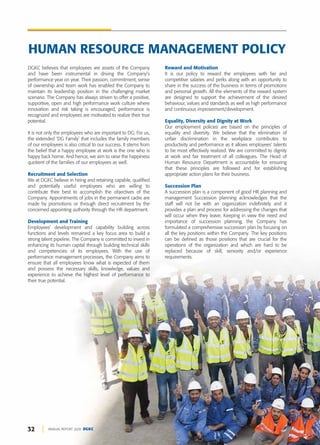
DGKC believes that employees are assets of the Company
and have been instrumental in driving the Company’s
performance year on year. Their passion, commitment, sense
of ownership and team work has enabled the Company to
maintain its leadership position in the challenging market
scenario. The Company has always striven to offer a positive,
supportive, open and high performance work culture where
innovation and risk taking is encouraged, performance is
recognized and employees are motivated to realize their true
potential.
It is not only the employees who are important to DG. For us,
the extended ‘DG Family’ that includes the family members
of our employees is also critical to our success. It stems from
the belief that a happy employee at work is the one who is
happy back home. And hence, we aim to raise the happiness
quotient of the families of our employees as well.
Recruitment and Selection
We at DGKC believe in hiring and retaining capable, qualified
and potentially useful employees who are willing to
contribute their best to accomplish the objectives of the
Company. Appointments of jobs in the permanent cadre are
made by promotions or through direct recruitment by the
concerned appointing authority through the HR department.
Development and Training
Employees’ development and capability building across
functions and levels remained a key focus area to build a
strong talent pipeline. The Company is committed to invest in
enhancing its human capital through building technical skills
and competencies of its employees. With the use of
performance management processes, the Company aims to
ensure that all employees know what is expected of them
and possess the necessary skills, knowledge, values and
experience to achieve the highest level of performance to
their true potential.
Reward and Motivation
It is our policy to reward the employees with fair and
competitive salaries and perks along with an opportunity to
share in the success of the business in terms of promotions
and personal growth. All the elements of the reward system
are designed to support the achievement of the desired
behaviour, values and standards as well as high performance
and continuous improvement/development.
Equality, Diversity and Dignity at Work
Our employment policies are based on the principles of
equality and diversity. We believe that the elimination of
unfair discrimination in the workplace contributes to
productivity and performance as it allows employees’ talents
to be most effectively realized. We are committed to dignity
at work and fair treatment of all colleagues. The Head of
Human Resource Department is accountable for ensuring
that these principles are followed and for establishing
appropriate action plans for their business.
Succession Plan
A succession plan is a component of good HR planning and
management Succession planning acknowledges that the
staff will not be with an organization indefinitely and it
provides a plan and process for addressing the changes that
will occur when they leave. Keeping in view the need and
importance of succession planning, the Company has
formulated a comprehensive succession plan by focusing on
all the key positions within the Company. The key positions
can be defined as those positions that are crucial for the
operations of the organization and which are hard to be
replaced because of skill, seniority and/or experience
requirements.
HUMAN RESOURCE MANAGEMENT POLICY
33
DGKC ANNUAL REPORT 2020
Procedures for raising concerns are provided below:
Informal reporting: Voice concern with line manager or any
other senior manager.
Formal reporting: Report the matter formally for
investigation with line manager or any of the designated
officer either verbally or in writing.
Designated Officer: Referred to by the individual directly or
by the line manager for investigation but matter is kept
confidential.
Anonymous reports: Individuals may wish to raise
concerns anonymously.
Reporting a wrongdoing: If you have a concern you wish
to raise, you may write to any of the Designated Officers or
contact them via telephone or fax. The designated officers
are:
• Director Marketing
• Chief Financial Officer
• GM HR & Admin
All employees of DGKC are made aware of this Policy and the
safeguards it provides to the whistle-blower.
SPEAK UP (WHISTLE-BLOWING POLICY)
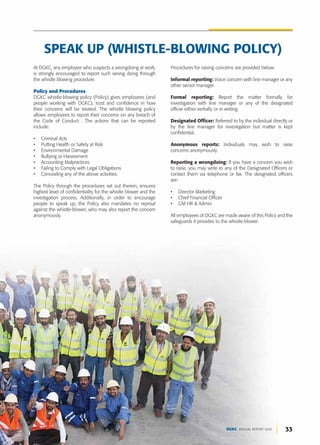
At DGKC, any employee who suspects a wrongdoing at work,
is strongly encouraged to report such wrong doing through
the whistle blowing procedure.
Policy and Procedures
DGKC whistle-blowing policy (Policy) gives employees (and
people working with DGKC), trust and confidence in how
their concerns will be treated. The whistle blowing policy
allows employees to report their concerns on any breach of
the Code of Conduct . The actions that can be reported
include:
• Criminal Acts
• Putting Health or Safety at Risk
• Environmental Damage
• Bullying or Harassment
• Accounting Malpractices
• Failing to Comply with Legal Obligations
• Concealing any of the above activities.
The Policy through the procedures set out therein, ensures
highest level of confidentiality for the whistle blower and the
investigation process. Additionally, in order to encourage
people to speak up, the Policy also mandates no reprisal
against the whistle-blower, who may also report the concern
anonymously.
34 ANNUAL REPORT 2020 DGKC
For DGKC, reaching environmental excellence is a main
objective. We dedicate significant efforts to address key
sustainability-related issues, from biodiversity and
conservation to renewable energy, climate change and
emissions monitoring.
At DGKC managing our environmental footprint is an integral
part of our business philosophy. We are fully committed to
carrying out our business activities in an environmentally
responsible and sustainable manner and to minimize the
environmental implications of our activities.
To meet this we:
• Actively pursue a policy of pollution prevention.
• Comply with company policies and procedures and all
applicable local laws and regulations. Make strategic
efforts to maximize our energy and resource efficiency,
lower our carbon intensity and reduce emissions by
managing our usage of energy, water consumption and
waste generation.
• Responsibly manage the land within our operations to
protect ecosystems and biodiversity and to maximize
our contribution to nature conservation.
• Maintain open and effective communication channels
with our employees, contractors, customers, the
community and all those who work with us.
• Provide the necessary resources for instruction, training
and supervision to appropriately manage the
environmental aspects of our operations.
• Plan, review and assess our environmental
performance against measurable targets and industry
best practices to drive continuous improvement.
• Investigate, monitor and openly report our
environmental performance.
• Set corporate requirements to assess the sustainability
attributes of our suppliers and subcontractors.
Everyone who works for the company is responsible for
demonstrating correct environmental behaviors and reporting
potential environmental risks, including among others
employees, suppliers, contractors, third parties, and
out-sourcing partners. Managers are accountable for clearly
defining environmental roles and responsibilities, providing
appropriate resources, and measuring, reviewing and
continuously improving DGKC environmental performance.
We comply through following plan of actions:
- Environmental Management System (EMS)
- KPIs and standard protocols follow up
- Emissions monitoring and reporting
- Waste and water management
- Regulation updates, trends and new technologies
- Promotion of best practices throughout our operation
ENVIRONMENTAL, HEATH & SAFETY POLICY
35
DGKC ANNUAL REPORT 2020
Being a part of one of the largest conglomerates in Pakistan, DGKC has always been a purpose driven Organization. We aspire to
exceed the expectations of business goals and endeavour to fulfil sustainable social goals. This vision is demonstrated by our CSR
wing which strives to improve the lives of people living in low-income communities with impact investments.
DGKC community engagement initiatives including social investments and business inclusive projects, combining financial and
managerial resources to enrich lives and pave the way for sustainable living.
These initiatives are based on following pillars:
- Education and capability development for employability
- Sustainable and resilient infrastructure and mobility
- Charity, Social welfare and reduction of poverty from society
- Culture of environmental protection, health and safety
- Reduction of carbon footprints
We aspire to positively impact Pakistan and to achieve this we undertook, but not limited to, the following activities during the
current year:
• Created job opportunities for the local community and provided the platform to train technical staff at all levels particularly to
fresh diploma holder and graduate engineers.
• Two schools at DG Khan Site are functional, also providing great opportunity to the local community.
• Free medical services to local community by establishing free dispensary at sites.
• Free factory ambulance for local patients 24/7 in case of emergencies.
• Free fire-fighting service for nearby areas in extreme emergencies.
• Majority of unskilled labor is engaged from local population.
• For Gaddani Jail district Lasbella Baluchistan, provided mattresses, freezer & free medicines, developed ladies waiting area
along with wash room, renovation/upgradation of Kitchen, appointed qualified dispenser and doctor and provided free
medicines.
• Developed several washrooms facilities for adjoining population.
• Provided water to adjoining communities on need basis.
• Developed approach road, construction of shed/entrance path, water tank flooring and supply of fans at LIEDA Main Mosque
for benefit of local population.
• Construction of 248 cubic meter Water Tank at Bawani Islamic Institute, Baluchistan
• Repair and maintenance of SAROONA Ambulance as per instruction of District Management.
• Construction of Office Room at Labour Court Hub, Baluchistan
• Construction of By Pass -Jarrar Peer Road, Baluchistan
• Donation in shape of supply of food for flood victims of District Lasbella.
• Donations to boost sports activities in District Lasbella from time to time.
• Installation of 5.5 KW Solar System for Bore Well of Ramzan Goth, Baluchistan
• Food Distribution for Corona effectives during Lockdown in April 2020.
• Established a setup of medicines to OPD at Basic Health Unit Winder as per directive of Chief Justice, Baluchistan-High Court.
• Provision of Text Books up to 12th standard students at Municipal Library Hub as per instruction of Assistant Commissioner
Hub.
• Provided food to needy and poor people of adjoining areas
• Provided facilities in the shape of equipment and manpower to combat natural disasters.
• Establishment of University of Engineering and Technology (UET) Chakwal Campus and provided research facilities
• Provided technical support to the students of Training Centre, Katas
• Constructed road and maintaining it for local community
• Provided internships to large number of university students
• Collaboration with universities to carry on applied research projects
CORPORATE SOCIAL REPONSIBILITY (CSR)
36 ANNUAL REPORT 2020 DGKC
PATTERN OF SHARE HOLDING AS ON 30/06/2020
1630 1 100 79125 0.0181
2408 101 500 899506 0.2053
1579 501 1000 1414361 0.3228
2290 1001 5000 6073992 1.3864
582 5001 10000 4627415 1.0562
200 10001 15000 2570713 0.5868
119 15001 20000 2179734 0.4975
75 20001 25000 1743024 0.3978
47 25001 30000 1334791 0.3047
50 30001 35000 1639059 0.3741
37 35001 40000 1422396 0.3247
23 40001 45000 984495 0.2247
35 45001 50000 1721828 0.3930
17 50001 55000 895341 0.2044
22 55001 60000 1295500 0.2957
13 60001 65000 814350 0.1859
21 65001 70000 1450193 0.3310
11 70001 75000 801902 0.1830
9 75001 80000 707000 0.1614
12 80001 85000 995203 0.2272
9 85001 90000 804806 0.1837
10 90001 95000 929171 0.2121
21 95001 100000 2091000 0.4773
5 100001 105000 518906 0.1184
7 105001 110000 756209 0.1726
5 110001 115000 570600 0.1302
7 115001 120000 822500 0.1877
5 120001 125000 618223 0.1411
1 125001 130000 126500 0.0289
8 130001 135000 1070000 0.2442
3 135001 140000 413500 0.0944
3 140001 145000 428500 0.0978
8 145001 150000 1194500 0.2726
4 150001 155000 606979 0.1385
5 155001 160000 789300 0.1802
1 160001 165000 161000 0.0367
5 165001 170000 835500 0.1907
3 170001 175000 516982 0.1180
1 190001 195000 195000 0.0445
6 195001 200000 1200000 0.2739
3 200001 205000 609500 0.1391
2 205001 210000 417500 0.0953
3 215001 220000 651500 0.1487
3 220001 225000 673400 0.1537
4 225001 230000 913830 0.2086
1 230001 235000 234000 0.0534
3 235001 240000 717000 0.1637
8 245001 250000 1993000 0.4549
2 250001 255000 508000 0.1160
2 255001 260000 519200 0.1185
3 265001 270000 806500 0.1841
4 270001 275000 1095900 0.2501
1 275001 280000 279500 0.0638
6 295001 300000 1796000 0.4099
2 335001 340000 672338 0.1535
2 345001 350000 700000 0.1598
3 355001 360000 1074000 0.2451
3 360001 365000 1087000 0.2481
1 365001 370000 368000 0.0840
2 370001 375000 745100 0.1701
1 375001 380000 380000 0.0867
1 385001 390000 387000 0.0883
1 390001 395000 391000 0.0892
Continued
No. of
Shareholders
Percentage
Shares Held
To
From
Having Shares
37
DGKC ANNUAL REPORT 2020
5 395001 400000 1995500 0.4555
3 410001 415000 1243500 0.2838
1 415001 420000 416200 0.0950
1 425001 430000 427000 0.0975
1 430001 435000 435000 0.0993
1 485001 490000 488500 0.1115
2 495001 500000 1000000 0.2282
1 500001 505000 500618 0.1143
2 505001 510000 1017500 0.2322
1 520001 525000 521140 0.1189
1 525001 530000 527000 0.1203
1 535001 540000 535200 0.1222
1 550001 555000 555000 0.1267
1 585001 590000 588900 0.1344
2 595001 600000 1199000 0.2737
2 625001 630000 1257700 0.2871
1 640001 645000 644848 0.1472
1 650001 655000 651086 0.1486
1 660001 665000 661000 0.1509
2 670001 675000 1350000 0.3081
1 695001 700000 700000 0.1598
1 740001 745000 743600 0.1697
1 745001 750000 750000 0.1712
1 755001 760000 760000 0.1735
1 795001 800000 799500 0.1825
1 895001 900000 900000 0.2054
1 900001 905000 905000 0.2066
1 945001 950000 950000 0.2168
1 960001 965000 964159 0.2201
1 975001 980000 977500 0.2231
1 980001 985000 981849 0.2241
2 985001 990000 1973500 0.4504
3 995001 1000000 3000000 0.6847
1 1005001 1010000 1009000 0.2303
1 1045001 1050000 1047500 0.2391
1 1110001 1115000 1112400 0.2539
1 1135001 1140000 1140000 0.2602
1 1175001 1180000 1177000 0.2686
1 1210001 1215000 1213500 0.2770
1 1215001 1220000 1219200 0.2783
1 1335001 1340000 1338300 0.3055
1 1365001 1370000 1369300 0.3125
1 1420001 1425000 1425000 0.3253
1 1480001 1485000 1480756 0.3380
1 1485001 1490000 1486900 0.3394
4 1495001 1500000 5996500 1.3687
1 1570001 1575000 1571700 0.3587
1 1655001 1660000 1656500 0.3781
1 1745001 1750000 1750000 0.3994
1 1795001 1800000 1800000 0.4108
1 1825001 1830000 1826600 0.4169
1 1895001 1900000 1896000 0.4328
1 1915001 1920000 1917100 0.4376
1 1955001 1960000 1956760 0.4466
1 2020001 2025000 2020181 0.4611
1 2095001 2100000 2100000 0.4793
1 2185001 2190000 2187000 0.4992
1 2240001 2245000 2244746 0.5124
1 2595001 2600000 2596500 0.5926
1 2975001 2980000 2980000 0.6802
1 3065001 3070000 3069500 0.7006
1 3080001 3085000 3082500 0.7036
1 3105001 3110000 3108070 0.7094
1 3355001 3360000 3358344 0.7665
1 3410001 3415000 3414932 0.7795
1 3625001 3630000 3630000 0.8285
Continued
No. of
Shareholders
Percentage
Shares Held
To
From
Having Shares
38 ANNUAL REPORT 2020 DGKC
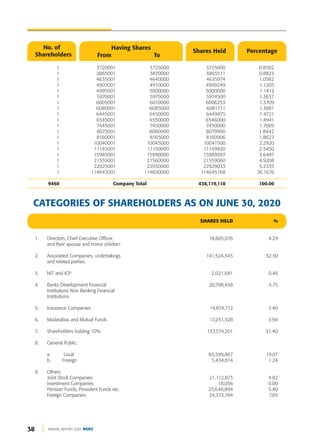
1 3720001 3725000 3725000 0.8502
1 3865001 3870000 3865511 0.8823
1 4635001 4640000 4635974 1.0582
1 4905001 4910000 4909249 1.1205
1 4995001 5000000 5000000 1.1412
1 5970001 5975000 5974500 1.3637
1 6005001 6010000 6006253 1.3709
1 6080001 6085000 6081711 1.3881
1 6445001 6450000 6449475 1.4721
1 6545001 6550000 6546000 1.4941
1 7445001 7450000 7450000 1.7005
1 8075001 8080000 8079900 1.8442
1 8160001 8165000 8160906 1.8627
1 10040001 10045000 10041500 2.2920
1 11145001 11150000 11149920 2.5450
1 15985001 15990000 15989997 3.6497
1 21555001 21560000 21559060 4.9208
1 22925001 22930000 22929033 5.2335
1 114645001 114650000 114645168 26.1676
9460 Company Total 438,119,118 100.00
SHARES HELD %
1. Directors, Chief Executive Officer, 18,805,076 4.29
and their spouse and minor children
2. Associated Companies, undertakings 141,524,345 32.30
and related parties.
3. NIT and ICP 2,021,681 0.46
4. Banks Development Financial 20,798,458 4.75
Institutions Non Banking Financial
Institutions.
5. Insurance Companies 14,874,712 3.40
6. Modarabas and Mutual Funds 17,251,328 3.94
7. Shareholders holding 10% 137,574,201 31.40
8. General Public:
a. Local 83,549,867 19.07
b. Foreign 5,434,814 1.24
9. Others
Joint Stock Companies 21,112,873 4.82
Investment Companies 18,056 0.00
Pension Funds, Provident Funds etc. 23,648,894 5.40
Foreign Companies 34,373,784 7.85
CATEGORIES OF SHAREHOLDERS AS ON JUNE 30, 2020
No. of
Shareholders
Percentage
Shares Held
To
From
Having Shares
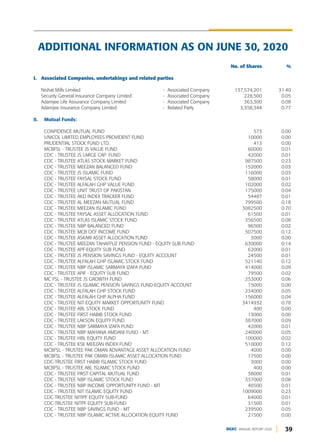
No. of Shares %
I. Associated Companies, undertakings and related parties
Nishat Mills Limited - Associated Company 137,574,201 31.40
Security General Insurance Company Limited - Associated Company 228,500 0.05
Adamjee Life Assurance Company Limited - Associated Company 363,300 0.08
Adamjee Insurance Company Limited - Related Party 3,358,344 0.77
II. Mutual Funds:
CONFIDENCE MUTUAL FUND 573 0.00
UNICOL LIMITED EMPLOYEES PROVIDENT FUND 10000 0.00
PRUDENTIAL STOCK FUND LTD. 413 0.00
MCBFSL - TRUSTEE JS VALUE FUND 60000 0.01
CDC - TRUSTEE JS LARGE CAP. FUND 42000 0.01
CDC - TRUSTEE ATLAS STOCK MARKET FUND 987500 0.23
CDC - TRUSTEE MEEZAN BALANCED FUND 152000 0.03
CDC - TRUSTEE JS ISLAMIC FUND 116000 0.03
CDC - TRUSTEE FAYSAL STOCK FUND 58000 0.01
CDC - TRUSTEE ALFALAH GHP VALUE FUND 102000 0.02
CDC - TRUSTEE UNIT TRUST OF PAKISTAN 175000 0.04
CDC - TRUSTEE AKD INDEX TRACKER FUND 54487 0.01
CDC - TRUSTEE AL MEEZAN MUTUAL FUND 799500 0.18
CDC - TRUSTEE MEEZAN ISLAMIC FUND 3082500 0.70
CDC - TRUSTEE FAYSAL ASSET ALLOCATION FUND 61500 0.01
CDC - TRUSTEE ATLAS ISLAMIC STOCK FUND 356500 0.08
CDC - TRUSTEE NBP BALANCED FUND 96500 0.02
CDC - TRUSTEE MCB DCF INCOME FUND 507500 0.12
CDC - TRUSTEE ASKARI ASSET ALLOCATION FUND 3000 0.00
CDC - TRUSTEE MEEZAN TAHAFFUZ PENSION FUND - EQUITY SUB FUND 630000 0.14
CDC - TRUSTEE APF-EQUITY SUB FUND 62000 0.01
CDC - TRUSTEE JS PENSION SAVINGS FUND - EQUITY ACCOUNT 24500 0.01
CDC - TRUSTEE ALFALAH GHP ISLAMIC STOCK FUND 521140 0.12
CDC - TRUSTEE NBP ISLAMIC SARMAYA IZAFA FUND 414000 0.09
CDC - TRUSTEE APIF - EQUITY SUB FUND 79500 0.02
MC FSL - TRUSTEE JS GROWTH FUND 253000 0.06
CDC - TRUSTEE JS ISLAMIC PENSION SAVINGS FUND-EQUITY ACCOUNT 15000 0.00
CDC - TRUSTEE ALFALAH GHP STOCK FUND 234000 0.05
CDC - TRUSTEE ALFALAH GHP ALPHA FUND 156000 0.04
CDC - TRUSTEE NIT-EQUITY MARKET OPPORTUNITY FUND 3414932 0.78
CDC - TRUSTEE ABL STOCK FUND 400 0.00
CDC - TRUSTEE FIRST HABIB STOCK FUND 13000 0.00
CDC - TRUSTEE LAKSON EQUITY FUND 387000 0.09
CDC - TRUSTEE NBP SARMAYA IZAFA FUND 42000 0.01
CDC - TRUSTEE NBP MAHANA AMDANI FUND - MT 240000 0.05
CDC - TRUSTEE HBL EQUITY FUND 100000 0.02
CDC - TRUSTEE KSE MEEZAN INDEX FUND 510000 0.12
MCBFSL - TRUSTEE PAK OMAN ADVANTAGE ASSET ALLOCATION FUND 4000 0.00
MCBFSL - TRUSTEE PAK OMAN ISLAMIC ASSET ALLOCATION FUND 17500 0.00
CDC-TRUSTEE FIRST HABIB ISLAMIC STOCK FUND 3000 0.00
MCBFSL - TRUSTEE ABL ISLAMIC STOCK FUND 400 0.00
CDC - TRUSTEE FIRST CAPITAL MUTUAL FUND 38000 0.01
CDC - TRUSTEE NBP ISLAMIC STOCK FUND 337000 0.08
CDC - TRUSTEE NBP INCOME OPPORTUNITY FUND - MT 40500 0.01
CDC - TRUSTEE NIT ISLAMIC EQUITY FUND 1009000 0.23
CDC-TRUSTEE NITIPF EQUITY SUB-FUND 64000 0.01
CDC-TRUSTEE NITPF EQUITY SUB-FUND 31500 0.01
CDC - TRUSTEE NBP SAVINGS FUND - MT 239500 0.05
CDC - TRUSTEE NBP ISLAMIC ACTIVE ALLOCATION EQUITY FUND 21500 0.00
39
DGKC ANNUAL REPORT 2020
ADDITIONAL INFORMATION AS ON JUNE 30, 2020
CDC - TRUSTEE FAYSAL MTS FUND - MT 488500 0.11
CDC - TRUSTEE MEEZAN ASSET ALLOCATION FUND 151000 0.03
CDC - TRUSTEE LAKSON TACTICAL FUND 47300 0.01
CDC - TRUSTEE LAKSON ISLAMIC TACTICAL FUND 20500 0.00
CDC - TRUSTEE ALFALAH GHP ISLAMIC DEDICATED EQUITY FUND 88260 0.02
CDC TRUSTEE - MEEZAN DEDICATED EQUITY FUND 81000 0.02
CDC - TRUSTEE FIRST HABIB ASSET ALLOCATION FUND 25000 0.01
CDC - TRUSTEE JS ISLAMIC DEDICATED EQUITY FUND (JSIDEF) 4000 0.00
CDC - TRUSTEE NBP ISLAMIC REGULAR INCOME FUND 8700 0.00
CDC - TRUSTEE ATLAS ISLAMIC DEDICATED STOCK FUND 71500 0.02
CDC - TRUSTEE FAYSAL ISLAMIC DEDICATED EQUITY FUND 391000 0.09
CDC - TRUSTEE NIT ASSET ALLOCATION FUND 224000 0.05
No. of Shares %
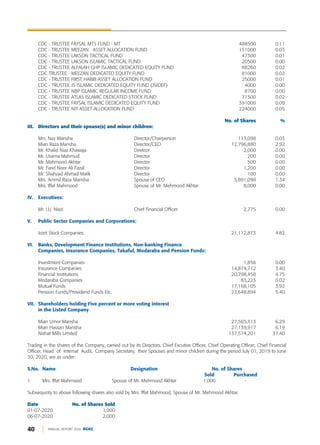
III. Directors and their spouse(s) and minor children:
Mrs. Naz Mansha Director/Chairperson 113,098 0.03
Mian Raza Mansha Director/CEO 12,796,880 2.92
Mr. Khalid Niaz Khawaja Diretcor 2,000 0.00
Mr. Usama Mahmud Director 200 0.00
Mr. Mahmood Akhtar Director 500 0.00
Mr. Farid Noor Ali Fazal Director 1,200 0.00
Mr. Shahzad Ahmad Malik Director 100 0.00
Mrs. Ammil Raza Mansha Spouse of CEO 5,891,098 1.34
Mrs. Iffat Mahmood Spouse of Mr. Mehmood Akhtar 8,000 0.00
IV. Executives:
Mr. I.U. Niazi Chief Financial Officer 2,775 0.00
V. Public Sector Companies and Corporations:
Joint Stock Companies 21,112,873 4.82
VI. Banks, Development Finance Institutions, Non-banking Finance
Companies, Insurance Companies, Takaful, Modaraba and Pension Funds:
Investment Companies 1,856 0.00
Insurance Companies 14,874,712 3.40
Financial Institutions 20,798,458 4.75
Modaraba Companies 83,223 0.02
Mutual Funds 17,168,105 3.92
Pension Funds/Providend Funds Etc. 23,648,894 5.40
VII. Shareholders holding Five percent or more voting interest
in the Listed Company
Mian Umer Mansha 27,565,313 6.29
Mian Hassan Mansha 27,139,917 6.19
Nishat Mills Limited 137,574,201 31.40
Trading in the shares of the Company, carried out by its Directors, Chief Excutive Officer, Chief Operating Officer, Chief Financial
Officer, Head of Internal Audit, Company Secretary, their Spouses and minor children during the period July 01, 2019 to June
30, 2020, are as under:
S.No. Name Designation No. of Shares
Sold Purchased
1 Mrs. Iffat Mahmood Spouse of Mr. Mehmood Akhtar 1,000 -
Subsequinty to above following shares also sold by Mrs. Iffat Mahmood, Spouse of Mr. Mehmood Akhtar.
Date No. of Shares Sold
01-07-2020 1,000
06-07-2020 2,000
40 ANNUAL REPORT 2020 DGKC
41
DGKC ANNUAL REPORT 2020
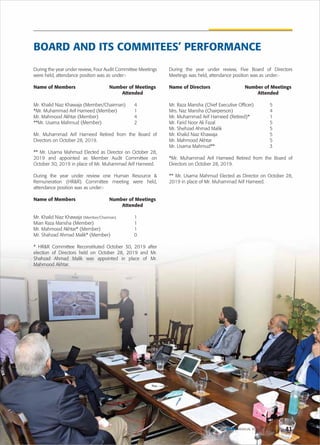
During the year under review, Four Audit Committee Meetings
were held, attendance position was as under:-
Name of Members Number of Meetings
Attended
Mr. Khalid Niaz Khawaja (Member/Chairman) 4
*Mr. Muhammad Arif Hameed (Member) 1
Mr. Mahmood Akhtar (Member) 4
**Mr. Usama Mahmud (Member) 2
Mr. Muhammad Arif Hameed Retired from the Board of
Directors on October 28, 2019.
** Mr. Usama Mahmud Elected as Director on October 28,
2019 and appointed as Member Audit Committee on
October 30, 2019 in place of Mr. Muhammad Arif Hameed.
During the year under review one Human Resource &
Remuneration (HR&R) Committee meeting were held,
attendance position was as under:-
Name of Members Number of Meetings
Attended
Mr. Khalid Niaz Khawaja (Member/Chairman) 1
Mian Raza Mansha (Member) 1
Mr. Mahmood Akhtar* (Member) 1
Mr. Shahzad Ahmad Malik* (Member) 0
* HR&R Committee Reconstituted October 30, 2019 after
election of Directors held on October 28, 2019 and Mr.
Shahzad Ahmad Malik was appointed in place of Mr.
Mahmood Akhtar.
During the year under review, Five Board of Directors
Meetings was held, attendance position was as under:-
Name of Directors Number of Meetings
Attended
Mr. Raza Mansha (Chief Executive Officer) 5
Mrs. Naz Mansha (Chairperson) 4
Mr. Muhammad Arif Hameed (Retired)* 1
Mr. Farid Noor Ali Fazal 5
Mr. Shehzad Ahmad Malik 5
Mr. Khalid Niaz Khawaja 5
Mr. Mahmood Akhtar 5
Mr. Usama Mahmud** 3
*Mr. Muhammad Arif Hameed Retired from the Board of
Directors on October 28, 2019.
** Mr. Usama Mahmud Elected as Director on October 28,
2019 in place of Mr. Muhammad Arif Hameed.
BOARD AND ITS COMMITEES’ PERFORMANCE
42 ANNUAL REPORT 2020 DGKC
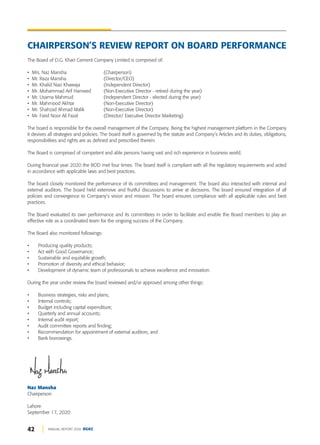
The Board of D.G. Khan Cement Company Limited is comprised of:
• Mrs. Naz Mansha (Chairperson)
• Mr. Raza Mansha (Director/CEO)
• Mr. Khalid Niaz Khawaja (Independent Director)
• Mr. Mohammad Arif Hameed (Non-Executive Director - retired during the year)
• Mr. Usama Mahmud (Independent Director - elected during the year)
• Mr. Mahmood Akhtar (Non-Executive Director)
• Mr. Shahzad Ahmad Malik (Non-Executive Director)
• Mr. Farid Noor Ali Fazal (Director/ Executive Director Marketing)
The board is responsible for the overall management of the Company. Being the highest management platform in the Company
it devises all strategies and policies. The board itself is governed by the statute and Company’s Articles and its duties, obligations,
responsibilities and rights are as defined and prescribed therein.
The Board is comprised of competent and able persons having vast and rich experience in business world.
During financial year 2020 the BOD met four times. The board itself is compliant with all the regulatory requirements and acted
in accordance with applicable laws and best practices.
The board closely monitored the performance of its committees and management. The board also interacted with internal and
external auditors. The board held extensive and fruitful discussions to arrive at decisions. The board ensured integration of all
policies and convergence to Company’s vision and mission. The board ensures compliance with all applicable rules and best
practices.
The Board evaluated its own performance and its committees in order to facilitate and enable the Board members to play an
effective role as a coordinated team for the ongoing success of the Company.
The Board also monitored followings:
• Producing quality products;
• Act with Good Governance;
• Sustainable and equitable growth;
• Promotion of diversity and ethical behavior;
• Development of dynamic team of professionals to achieve excellence and innovation.
During the year under review the board reviewed and/or approved among other things:
• Business strategies, risks and plans;
• Internal controls;
• Budget including capital expenditure;
• Quarterly and annual accounts;
• Internal audit report;
• Audit committee reports and finding;
• Recommendation for appointment of external auditors; and
• Bank borrowings.
Naz Mansha
Chairperson
Lahore
September 17, 2020
CHAIRPERSON’S REVIEW REPORT ON BOARD PERFORMANCE
43
DGKC ANNUAL REPORT 2020
other investigations on any matter specified by the Board
of Directors, in consultation with the CEO and to consider
remittance of any matter to the external auditors or to any
other external body;
(l) determination of compliance with relevant statutory
requirements;
(m) monitoring compliance with the best practices of
corporate governance and identification of significant
violations thereof; and
(n) consideration of any other issue or matter as may be
assigned by the Board of Directors.
(i) Recommending Human Resource Management Policies
to the Board.
(ii) Recommending to the Board the Selection, evaluation,
compensation (including retirement benefits) and
succession planning of the Chief Executive Officer.
(iii) Recommending to the Board the Selection, evaluation,
compensation (including retirement benefits) and
succession planning of the Chief Financial Officer,
Company Secretary and Head of Internal Audit.
(iv) Consideration and approval on recommendations of CEO
on such matters for Key management positions who
directly report to Chief executive officer.
(v) Consideration of any other issue or matter as may be
assigned by the Board of Directors.
TERMS OF REFERENCE
OF AUDIT COMMITTEE
TERMS OF REFERENCE OF
HUMAN RESOURCE AND
REMUNERATION
COMMITTEE
The Audit Committee shall, inter alia, recommend to the Board
of Directors the appointment of external auditors, their
removal, audit fees, the provision by the external auditors of
any service to the company in addition to audit of its financial
statements. The Board of Directors shall give due consideration
to the recommendations of the Audit Committee in all these
matters and where it acts otherwise, it shall record the reasons
thereof.
The terms of reference of the Audit Committee shall also
include the following:
(a) determination of appropriate measures to safeguard the
company’s assets;
(b) review of quarterly, half-yearly and annual financial
statements of the listed company, prior to their approval
by the Board of Directors, focusing on:
• major judgmental areas;
• significant adjustments resulting from the audit;
• the going concern assumption;
• any changes in accounting policies and practices;
• compliance with applicable accounting standards;
• compliance with listing regulations and other
statutory and regulatory requirements; and
• significant related party transactions.
(c) review of preliminary announcements of results prior to
publication;
(d) facilitating the external audit and discussion with external
auditors of major observations arising from interim and
final audits and any matter that the auditors may wish to
highlight (in the absence of management, where
necessary);
(e) review of management letter issued by external auditors
and management’s response thereto;
(f) ensuring coordination between the internal and external
auditors of the company;
(g) review of the scope and extent of internal audit and
ensuring that the internal audit function has adequate
resources and is appropriately placed within the
company;
(h) consideration of major findings of internal investigations
of activities characterized by fraud, corruption and abuse
of power and management's response thereto;
(i) ascertaining that the internal control systems including
financial and operational controls, accounting systems for
timely and appropriate recording of purchases and sales,
receipts and payments, assets and liabilities and the
reporting structure are adequate and effective;
(j) review of the company’s statement on internal control
systems prior to endorsement by the Board of Directors
and internal audit reports;
(k) instituting special projects, value for money studies or
44 ANNUAL REPORT 2020 DGKC
STATEMENT OF COMPLIANCE WITH LISTED COMPANIES
(Code of Corporate Governance) Regulations, 2019
Name of company : D. G. Khan Cement Company Limited
Year ended : June 30, 2020
The company has complied with the requirements of the Regulations in the following manner:
1. The total number of directors are Seven ( 7 ) as per the following:
a. Male: 6
b. Female: 1
2. The composition of board is as follows:
a) Independent Director Mr. Khalid Niaz Khawaja
Mr. Usama Mahmud
b) Other Non-executive Director Mr. Mahmood Akhtar
Mr. Shahzad Ahmad Malik
c) Executive Directors Mian Raza Mansha
Mr. Farid Noor Ali Fazal
d) Female Director (Non-executive Director) Mrs. Naz Mansha
3. The directors have confirmed that none of them is serving as director on more than seven listed companies, including this company;
4. The company has prepared a code of conduct and has ensured that appropriate steps have been taken to disseminate it throughout
the company along with its supporting policies and procedures;
5. The Board has developed a vision/mission statement, overall corporate strategy and significant policies of the company. The Board
has ensured that complete record of particulars of the significant policies along with their date of approval or updating is maintained
by the company;
6. All the powers of the Board have been duly exercised and decisions on relevant matters have been taken by the Board/
shareholders as empowered by the relevant provisions of the Act and these Regulations;
7. The meetings of the Board were presided over by the Chairperson and, in her absence, by a director elected by the Board for this
purpose. The Board has complied with the requirements of Act and the Regulations with respect to frequency, recording and
circulating minutes of meeting of the Board;
8. The Board have a formal policy and transparent procedures for remuneration of directors in accordance with the Act and these
Regulations;
9. The following Directors have either obtained certificate of Directors’ Training Program or are exempted from the requirement of
Directors’ Training Program as per the Listed Companies (Code of Corporate Governance) Regulations, 2019:
Mrs. Naz Mansha
Mr. Mian Raza Mansha
Mr. Farid Noor Ali Fazal
Mr. Khalid Niaz Khawaja
Mr. Shahzad Ahmad Malik
Mr. Mahmood Akhtar
While Mr. Usama Mahmud will undertake the Directors’ Training Program within the stipulated time.
10. The Board has approved appointment of chief financial officer, company secretary and head of internal audit, including their
remuneration and terms and conditions of employment and complied with relevant requirements of the Regulations;
11. Chief financial officer and chief executive officer duly endorsed the financial statements before approval of the Board;
12. The board has formed committees comprising of members given below:
a) Audit Committee
1. Mr. Khalid Niaz Khawaja (Independent Director) – Chairman
45
DGKC ANNUAL REPORT 2020
2. Mr. Usama Mahmud (Independent Director)
3. Mr. Mahmood Akhtar (Non-Executive Director)
b) HR and Remuneration Committee
1. Mr. Khalid Niaz Khawaja – (Independent Director) - Chairman
2. Mian Raza Mansha (Executive Director)
3. Mr. Shahzad Ahmad Malik (Non-Executive Director)
13. The terms of reference of the aforesaid committees have been formed, documented and advised to the committee for compliance.
14. The frequency of meetings of the committee were as per following:
a) Audit Committee 4 quarterly meetings
b) HR and Remuneration Committee 1 annual meeting
15. The Board has set up an effective internal audit function who are considered suitably qualified and experienced for the purpose and
are conversant with the policies and procedures of the company;
16. The statutory auditors of the company have confirmed that they have been given a satisfactory rating under the Quality Control
Review program of the Institute of Chartered Accountants of Pakistan and registered with Audit Oversight Board of Pakistan, that
they and all their partners are in compliance with International Federation of Accountants (IFAC) guidelines on code of ethics as
adopted by the Institute of Chartered Accountants of Pakistan and that they and the partners of the firm involved in the audit are
not a close relative (spouse, parent, dependent and non-dependent children) of the chief executive officer, chief financial officer,
head of internal audit, company secretary or director of the company;
17. The statutory auditors or the persons associated with them have not been appointed to provide other services except in accordance
with the Act, these Regulations or any other regulatory requirement and the auditors have confirmed that they have observed IFAC
guidelines in this regard;
18. We confirm that all requirements of regulations 3, 6, 7, 8, 27,32, 33 and 36 of the Regulations have been complied with; and
a. In respect of regulation 6(1), the Company believes that it has sufficient impartiality & is able to exercise independence in
decision making within the Board and hence, does not require to roundup the fraction to 3 independent directors.
19. Explanation for non-compliance with requirements, other than regulations 3, 6, 7, 8, 27, 32, 33 and 36 are below:
(Mian Raza Mansha) (Mrs. Naz Mansha)
Director/CEO Director/Chairperson
Representation of Minority shareholders:
The minority members as a class shall be facilitated by the
Board to contest election of directors by proxy solicitation.
No one has intended to contest election as
director representing minority shareholders.
Sr. No. Requirement Reg. No.
5
1
Responsibilities of the Board and its members:
Adoption of the corporate governance practices.
Non-mandatory provisions of the CCG
Regulations are partially complied.
10(1)
2
Nomination Committee:
The Board may constitute a separate committee, designated
as the nomination committee, of such number and class of
directors, as it may deem appropriate in its circumstances.
Currently, the board has not constituted a
separate Nomination Committee and the
functions are being performed by the Human
Resource & Remuneration Committee.
29(1)
3
Risk Management Committee:
The Board may constitute the risk management committee,
of such number and class of directors, as it may deem
appropriate in its circumstances, to carry out a review of
effectiveness of risk management procedures and present a
report to the Board.
Currently, the board has not constituted a
RMC and the Company's Risk Manager
performs the requisite functions and
apprises the board accordingly.
30(1)
4
Explanation for Non-Compliance
46 ANNUAL REPORT 2020 DGKC
INDEPENDENT AUDITOR'S REVIEW REPORT
TO THE MEMBERS OF D.G. KHAN CEMENT COMPANY LIMITED
REVIEW REPORT ON THE STATEMENT OF COMPLIANCE CONTAINED IN LISTED COMPANIES (CODE OF CORPORATE
GOVERNANCE) REGULATIONS, 2019
We have reviewed the enclosed Statement of Compliance with the Listed Companies (Code of Corporate Governance)
Regulations, 2019 (the Regulations) prepared by the Board of Directors of D. G. Khan Cement Company Limited for the year
ended June 30, 2020 in accordance with the requirements of regulation 36 of the Regulations.
The responsibility for compliance with the Regulations is that of the Board of Directors of the Company. Our responsibility is to
review whether the Statement of Compliance reflects the status of the Company's compliance with the provisions of the
Regulations and report if it does not and to highlight any non-compliance with the requirements of the Regulations. A review is
limited primarily to inquiries of the Company's personnel and review of various documents prepared by the Company to comply
with the Regulations.
As a part of our audit of the financial statements, we are required to obtain an understanding of the accounting and internal control
systems sufficient to plan the audit and develop an effective audit approach. We are not required to consider whether the Board
of Directors' statement on internal control covers all risks and controls or to form an opinion on the effectiveness of such internal
controls, the Company's corporate governance procedures and risks.
The Regulations require the Company to place before the Audit Committee, and upon recommendation of the Audit Committee,
place before the Board of Directors for their review and approval, its related party transactions. We are only required and have
ensured compliance of this requirement to the extent of the approval of the related party transactions by the Board of Directors
upon recommendation of the Audit Committee.
Based on our review, nothing has come to our attention which causes us to believe that the Statement of Compliance does not
appropriately reflect the Company's compliance, in all material respects, with the requirements contained in the Regulations as
applicable to the Company for the year ended June 30, 2020.
A.F. Ferguson & Co.
Chartered Accountants
Lahore,
Date: September 17, 2020
Name of engagement partner: Amer Raza Mir
47
DGKC ANNUAL REPORT 2020
The Board Audit Committee (BAC) is governed by the mandate given to it vide Code of Corporate Governance and Board of the
Company. It is vital platform to ensure transparency of company reporting and checking effectiveness in achievement of company
objectives.
BAC assists Board in scrutinizing the financial and non-financial information and maintaining an independent check on activities of
management. It also provides a helping hand to Board in risk management, internal controls, compliance and governance matters.
BAC comprises of three members:
• Mr. Khalid Niaz Khawaja (Chairman / Independent Director)
• Mr. Mohammad Arif Hameed (Member/Non-Executive Director) – retired during the year
• Mr. Mr. Usama Mahmud (Member/Independent Director) – joined during the year
• Mr. Mahmood Akhtar (Member/Non-Executive Director)
All the members have extensive knowledge and experience in the field of finance, accounting, controls, system management,
reporting and compliance areas.
BAC considers information from various sources like reports from management, internal auditors’ report, external auditors’ report
and any other source. BAC invites, questions and calls any person from management as and when required.
During FY20, BAC met four times. CFO and internal auditors are regular participants of the meeting. BAC also meets external and
internal auditors independently once a year.
The terms of BAC are precisely defined by the Board. The Committee monitors including other things:
• Internal controls
• Risk management
• Integrity of financial information
• Internal audit report external report
• Audit observations
• Compliance with applicable laws
• Management’s decisions conformity with the Company objectives
• Related Party transactions
• Assessing accounting & financial estimates, going concern assumption, changes in accounting policies and compliance with
standards.
• Recommendation of external auditors appointment based on independence, integrity and satisfactory rating with ICAP
The Board Audit Committee has reviewed the performance and operations of the Company for the year ended June 30, 2020
and reports that:
• Internal controls of the company are sound and are working properly;
• Departments of the company are working in line with company objectives;
• Records are maintained in accordance with applicable laws and regulations;
• Financial statements are in conformity with applicable laws and regulations;
• Code of Corporate Governance is followed;
• Being at arm’s length, related party transactions are recommended to the Board for approval;
• Recommended the present auditors, M/S A.F. Ferguson & Co. Chartered Accountants, for reappointment for year ending
June 30, 2020
Khalid Niaz Khawaja
Chairman Board Audit Committee
Lahore
September 17, 2020
BOARD AUDIT COMMITTEE REPORT
EVENT CALANDER FROM JULY 01, 2019 TO JUNE 30, 2020
Date Event
July 04, 2019 Material information sent to Stock Exchange regarding signing of agreement with Sinoma Energy
Conservation Ltd., for supply of Machinery and Equipment for Waste Heat Energy Power
Generation Plant of 10MW and Coal Fired Power Generation Plant of 30MW to be setup at Hub
Cement Plant, Baluchistan.
July 19, 2019 Notice of Meeting of HR&R Committee sent to Members of HR&R Committee.
July 26, 2019 Meeting of the Members of HR&R Committee conducted.
September 05, 2019 Notice for Meeting of Board Directors for consideration of Annual Audited Accounts for the year
ended June 30, 2019 sent to Stock Exchange.
September 06, 2019 Notice of Meeting of Audit Committee sent to Members of Audit Committee.
September 06, 2019 Notice for Meeting of Board Directors for consideration of Annual Audited Accounts for the year
ended June 30, 2019 sent to Board of Directors.
September 16, 2019 Meeting of the Members of Audit Committee conducted for recommendation of Annual Audited
Accounts for the year ended June 30, 2019, related party transactions, appointment of External
Auditors etc.etc. to the Board of Directors for their approval.
September 16, 2019 Meeting of the Board of Directors conducted for consideration and approval of Annual Audited
Accounts for the year ended June 30, 2019, Dividend, Director's Report, Related Party
Transactions, Appointment of External Auditors, Agenda and Venue of AGM, Special Business
Under Section 199 of the Companies Act, 2017 etc. etc.
September 16, 2019 Financial Results for the year ended June 30, 2019 and other Coprorate Actions Sent to Stock
Exchange immediately after conclusion of Board Meeting.
October 02, 2019 Notice of AGM Sent to Pakistan Stock Exchange
October 02, 2019 Notice of Annual General Meeting published in Newspapers.
October 17, 2019 Notice of Meeting of Audit Committee sent to Members of Audit Committee.
October 17, 2019 Notice for Meeting of Board Directors for consideration of Un-Audited Accounts for the 1st Quarter
ended September 30, 2019 Sent to Directors and Stock Exchange.
October 23, 2019 Notice for 1st Meeting of Board Directors of newly elected directors for appointment of Chairman
of the Board and CEO and re-constitution of Board Committees Sent to Directors.
October 25, 2019 Meeting of the Members of Audit Committee conducted for recommendation of Un Audited
Accounts for the 1st Quarter ended September 30, 2019, Related Party Transactions etc. etc. to
the Board of Directors for their approval.
October 25, 2019 Meeting of the Board of Directors conducted for consideration and approval of Un-Audited
Accounts for the 1st Quarter ended September 30, 2019, Directors Report, Related Party
Transactions etc. etc.
October 25, 2019 Financial Results for the 1st Quarter ended September 30, 2019 along with other Coprorate
Actions, if any, Sent to Stock Exchange immediately after conclusion of Board Meeting.
October 28, 2019 Annual General Meeting conducted and Shareholders approved Annual Audited Acounts, 10%
Final Dividend, Election of Directors, Appointment of External Auditors and Investments under
Section 199 of the Companies Act, 2017.
October 28, 2019 Certified Copy of Special Resolutions Passed by the Shareholders in their Annual General Meeting
held on October 28, 2019 sent to Stock Exchange.
48 ANNUAL REPORT 2020 DGKC
October 30, 2019 1st Meeting of the newly elected Board of Directors conducted for appointment of Chairman of
the Board and CEO and re-constitution of Board Committees Sent to Directors
November 19, 2019 Corporate Briefing Session on FY2019 was held at LSEFLS Auditorium, LSE Plaza, 19
Khayaban-e-Aiwan-e-Iqbal, Lahore
November 14, 2019 Intimation regarding credit of 10% Final Dividend for the year 2019 through eDividend sent to
Stock Exchange.
November 15, 2019 Minutes of Annual General Meeting held on October 28, 2019 sent to Stock Exchange.
December 23, 2019 Material information sent to Stock Exchange regarding successfull installation and commissioning
of 12 MW Waste Heat Recovery Power Plant (WHRPP) with Air Cooled Condenser (ACC)
technology at Khairpur.
February 04, 2020 Notice for Meeting of Board Directors for consideration of Un-Audited Accounts for the half year
ended December 31, 2019 sent to Stock Exchange.
February 06, 2020 Notice of Meeting of Audit Committee sent to Members of Audit Committee.
February 06, 2020 Notice for Meeting of Board Directors for consideration of Un-Audited Accounts for the Half Year
ended December 31, 2018 Sent to Directors.
February 13, 2020 Meeting of the Members of Audit Committee conducted for recommendation of Un Audited
Accounts for the Half Year ended December 31, 2019, Related Party Transactions etc. etc. to the
Board of Directors for their approval.
February 13, 2020 Meeting of the Board of Directors conducted for consideration and approval of Un-Audited
Accounts for the Half Year ended December 31, 2019, Directors Report, Related Party
Transactions.
February 13, 2020 Financial Results for the Half Year ended December 31, 2019 along with other Coprorate Actions,
Sent to Stock Exchange immediately after conclusion of Board Meeting.
March 26, 2020 Material Information Sent to Stock Exchange regarding temporary suspension of Plant Operation
due to COVID-19.
April 06, 2020 Material Information Sent to Stock Exchange regarding restoration of Plant Operation at Khofli
Sattai, Dera Ghazi Khan
April 16, 2020 Notice for Meeting of Board Directors for consideration of Un-Audited Accounts for the 3rd Quarter
ended March 31, 2020 Sent to Stock Exchange.
April 16, 2020 Notice of Meeting of Audit Committee sent to Members of Audit Committee.
April 16, 2020 Notice for Meeting of Board Directors for consideration of Un-Audited Accounts for the 3rd Quarter
ended March 31, 2020 Sent to Board of Directors.
April 17, 2020 Material Information Sent to Stock Exchange regarding restoration of Plant Operation at Khairpur,
Distt Chakwal.
April 23, 2020 Meeting of the Members of Audit Committee conducted for recommendation of Un Audited
Accounts for the 3rd Quarter ended March 31, 2020, Related Party Transactions etc. etc. to the
Board of Directors for their approval.
April 23, 2020 Meeting of the Board of Directors conducted for consideration of Un-Audited Accounts for the 3rd
Quarter ended March 31, 2020, Directors Report, Related Party Transactions etc. etc.
April 23, 2020 Financial Results for the 3rd Quarter ended March 31, 2020 along with other Coprorate Actions,
if any, Sent to Stock Exchange immediately after conclusion of Board Meeting.
Date Event
49
DGKC ANNUAL REPORT 2020
50 ANNUAL REPORT 2020 DGKC
51
DGKC ANNUAL REPORT 2020
EXTERNAL & INTERNAL
ANALYSIS
52 ANNUAL REPORT 2020 DGKC
Legal
Economic
• Management continues to identify new markets for its products,
internationally to offset local demand contraction and hedge currency
fluctuation.
• Company constantly strives to bring efficiencies in its manufacturing
process and energy mix, which supports in mitigating adverse effect
of increase in production cost.
• Extensive competition,
devaluation of currency,
fluctuating interest rates and
higher inflation.
• Low Government’s
development spending,
prevailing pandemic and
lower economic growth,
construction activities
slow-down.
Social
• As a socially responsible corporate entity, DGKC strives hard to
develop the communities in which it operates by ensuring
compliance with all requirements of CSR.
• It donates generously to various social and charitable causes
including health, education and social sectors.
• It also provides clean water, free education through schools, medical
facilities and fire fighting services in arears nearby the sites.
• Focus on Corporate Social
Responsibility, Donations,
development of
communities and
Scholarships.
Environmental
• The Company takes various steps to protect the environment
including compliance with applicable environmental standards.
• Company has approved standards of ISO for complying with an
effective environmental management system.
• Waste is collected from cities and is used as alternate fuel.
• Investment in Waste Heat Recovery system so as to minimize
Company’s impact on the environment due to its operations.
Environmental Footprint,
Recycling, Climatic Conditions
Global warming, Natural
disasters etc.
DGKC has a dedicated team of professionals which ensures that all its
processes comply with the applicable regulatory requirements. It
ensures that all taxes and duties payments, whether income tax or sales
tax, are made timely by having an effective cash management system in
place.
Compliance with the
applicable legal and
regulatory requirements
EXTERNAL FACTORS AFFECTING
COMPANY’S BUSINESS (PESTEL)
• To continue its legacy of being among the unparalleled leaders of the
cement industry, DGKC has always given priority to latest
technological developments.
• DGKC has installed WHR 12MW alternative energy plant at its
Khairpur site.
• Continuous investment in key technological software to achieve
operational excellence.
• Risk of technological
obsolescence.
• Technological innovation by
competitors
Technological
• Management look at tariffs, trade deals as they are developed not
only by the economics or business side but what political
relationships influence those decisions.
• Management proactively plans for the different demand scenarios
with help of budgeting, forecasts and projections.
• Timely adjustments are made in the organizational processes and
policies in response to actual or anticipated changes in Government
policies.
• Issues relating to the Cement Industry are dealt with through the
forum of APCMA.
• It determines how
government policy and
actions intervene in the
economy and other factors
that can affect a business.
• Political instability and
transition of government
impacts the organization
negatively.
• Rapid changes in
Government’s
macroeconomic policies also
adversely impact the
Company’s business.
Political
Factors Description Organization Reponses
53
DGKC ANNUAL REPORT 2020
SWOT ANALYSIS
COMPETITIVE ANALYSIS
(PORTER'S FIVE FORCES)
LOW Pressure from
substitutes
• Concrete substitutes
HIGH Rivalry among
competitors
• Oligopoly
• Country Coverage
• Growth concentrated
in emerging markets
• High stakes &
specialized assets
Bargaining power of
buyers
• LOW – Fragmented
– Emerging market
• HIGH – Concentrated
– Developed countries
MEDIUM to LOW Threat
of Entry
• Economies of Scale
• High capital requirements
• Learning experience
MEDIUM Bargaining
power of suppliers
• Country regulations
about subsoil
• Commodity market
W
Strength
- Strong brand recognition
- Well diversified fuel mix % & efficient
operations
- Strong financial position
- Quality and efficiency of human resources
- Easy access to production resources
- Trusted and efficient supply chain
- Geographically diversed & state-of-art
production facilities production facilities
- Self sufficiency in electricity requirement
(self sufficiency in HUB shall be achieved
by financial year end 2021)
S
Opportunities
- Future growth potential due to emphasis
on construction industry
- Focus on cost optimizing
- Emerging export markets
- Export opportunities due to fully
operational HUB facility
- Falling fuel prices amid corona outbreak
- CPEC led growth opportunities
O
Threats
- Overcapacity effecting the margins
- Devaluation of money
- Inconsistent economic policies
- Protectionism
- Covid-19 impact
- Rising cost of logistics
- High cost of financing
- Slashing PSDP funds
T
Weaknesses
- Highly fragmented industry
- Demand supply gap, overcapacity
- High taxation and duties
- High energy cost and inflation
- High interest rates
- Tough competition in local market
- Low exports of cement
54 ANNUAL REPORT 2020 DGKC
VALUE CHAIN ANALYSIS
Value created for
our stake holders
Stakeholders and
Investors
• Increased Market
Capitalization
• Elevated EBITDA margins
• Rise in operating cash
flows
• Increased revenue from
operations
Customers
• Sustainable and cost
saving product
• Increased customer
satisfaction
Communities
• Running schools for
education
• Water supply facilities
• Support to the deserving
persons
• Contribution towards
natural disaster
• Sessions on health and
safety
• Rehabilitation of disable
person Fire fighting
services for nearby areas
• Free medical and
dispensary
Suppliers
• Timely receipt of
payments
• Business growth for
more orders
Government
• Timely payment of taxes
and duties
• Acting as a social
responsible citizen
• Compliance with laws &
Regulations
Customers
Collaboration & Trust
I CAN
Culture
Sustainability
People
Results
Integrity
Business Activities
Value creation through integrated things
Integrated Risks into Business Strategy
Empowerment,
Accountability
& Transparency
Infrastructure
(Accounting, legal,
administrative)
Customer
Management
Human Resource
Management
Agility &
Simplicity
Technological
Development
Sales and
Delivery Services
Procurement
(purchasing)
Inbound Logistics
Operations
Outbound Logistics
Marketing and Sales
Dealers' Network
Services
- Mining
- Extraction and Crushing
- Raw Meal Mixing
- Clinkering
- Cement Manufacturing
- Packing
Financial
Manufacturing
Intellectual
Social
Relationship
Human
Natural
DGKC principal business activity is to produce and sell clinker and cement products. Manufacturing cement involves blending a
mixture of limestone and other minerals at a high temperature in kilns. Coal is used to heat the kiln at desired temperature to
produce clinker. Thereafter, gypsum is added to manufacture cement.
DGKC has invested in maintaining a smooth flow of operations. The company has implemented a proactive approach to mitigate
its risk of disruptions in the production process. Our production team is specialized in using various maintenance techniques such
as predictive, preventive and proactive maintenance to keep in pace all the machinery and equipment for their adequate
functionality and to increase cost effectiveness, machine uptime, and a greater understanding of the level of risk that the
organization is presently managing. At DGKC, the mining, grinding, crushing and blending processes are strictly monitored by highly
qualified specialists, to ensure that the best possible product is manufactured for our valued customer
Capital
55
DGKC ANNUAL REPORT 2020
Risk is an integral and unavoidable component of business
and your Company is committed to managing risk in a
proactive manner. Though risks cannot be completely
eliminated; an effective risk management plan ensures that
risks are reduced, avoided, retained or shared. To have
oversight of your Company’s risks, the Risk Management
Committee of your Company is mandated to review the risk
management plan / process of your Company. Through the
periodic risk reports processes which are based upon
Business Environment, Operational Controls and Compliance
Procedures, your Company aims to assess and prioritize risks
according to their significance and likelihood.
Given the challenging and dynamic environment of your
Company’s operations, strategies for mitigating the inherent
risks in accomplishing the ambitious plans for your Company
is imperative. Two types of key risks are identified and
strategies to mitigate them are discussed below:
1. Non Business Risks 2. Business Risks
Non Business Risks
Economic Environment and Market Demand
Economic slowdown and subdued infrastructural
development might lead to low cement demand in the
country. The demand for construction material is
fundamentally driven by economic growth / contraction in
the country. The growth in construction activity in the country
has been slow over the last few years, impacting the cement
demand.
The cement industry in Pakistan is a myriad aggregation of
small and large players. In such an environment the risk of
protecting market share is optimal. With the expanding
capacities of existing players and also the emergence of new
entrant’s, competition is a sustained risk. Endeavors to
enhance brand equity through innovative marketing activities
and continuous efforts in improving the product portfolio and
value adding services have been the thrust areas for your
Company. It is also worthwhile to note that the engineering
expertise of your Company and the emphasis on quality also
substantially minimizes the risk of market fluctuations.
Inflation and Cost of Production
Your Company faces the risk of inflationary nature and
market-driven cost of coal, pet coke, power & other fuel and
high limestone & clay royalty. Changes in energy prices can
significantly impact the production costs as the cement
industry is extremely energy intensive. To de-risk, your
Company has established specific policies of long deliveries
and continuously optimizes its fuel mix and energy efficiency
as well as explores the use of alternative fuels.
Legal and Compliance
The risk that your Company is found to have inadvertently
violated laws covering business conduct. The country’s
regulatory framework is ever evolving and the risk of
non-compliance and penalties may increase for your
Company, leading to reputational risks. A comprehensive risk
based compliance program involving inclusive training and
adherence to the Code of Conduct is institutionalized by your
Company. The management encourages employees to place
reliance on professional guidance and opinion to discuss the
impact of any changes in laws and regulations to ensure total
compliance. Periodic and ad hoc reporting to various internal
committees for oversight ensures effectiveness of such
program.
Financial and Accounting Risks
The risk of exposure to interest rates, foreign exchange rates
and commodity price fluctuations. With the objective of
minimizing risks arising from uncertainty and volatility of
foreign exchange fluctuations an elaborate financial risk
management policy is followed for every transaction
undertaken in foreign currency. Your Company’s policies to
counter such risks are reviewed periodically and aligned with
the financial market practices and regulations.
Changing laws, rules, regulations and standards relating to
accounting, corporate governance, public disclosure and
listing regulations are generating newer and unforeseen risks
for companies. The new or changed laws, regulations and
standards may lack precedence and are subject to varying
interpretations. Their application in practice may evolve over
time, as new guidance is provided by regulatory and
governing bodies. Your Company maintains a high standard
of corporate governance and public disclosure to de-risk itself
from such dynamic regulatory changes.
Information Technology Risks
Risks related to Information Technology systems; data
integrity and physical assets. Your Company deploys
Information Technology systems including ERP, SCM, Data
Historian and Mobile Solutions to support its business
processes, communications, sales, logistics and production.
Risks could primarily arise from the unavailability of systems
and / or loss or manipulation of information. To mitigate
these risks, your Company uses back up procedures and
stores information. Systems are upgraded regularly with the
latest security standards. For critical applications, security
policies and procedures are updated on a periodic basis and
users are educated on adherence to the policies so as to
eliminate data leakages.
Talent Management
Your Company’s growth has been driven by the ability to
attract and retain top quality talent and effectively engage
them in the right jobs. The risks in talent management are
mitigated by following a policy of being an employer of
choice and inculcating a sense of belonging. Specialized
training courses are adopted to enhance and re-skill the
employees to prepare them for future roles and create a
talent pipeline.
RISK MANAGEMENT
56 ANNUAL REPORT 2020 DGKC
BUSINESS RISKS
Risk Head Probable Impact
How it is
handled/mitigated
Type of Risk
Price Coal price could heavily
impact cost of sales and
therefore income statement.
Considering huge size of coal
consumption its monetary
effect would be large.
• Price is monitored vigilantly.
• Shipments are booked at
best available prices
considering the stock levels.
FX As price is in USD therefore,
any movement in PKR/USD
parity could affect income
statement.
• FX movements are
monitored vigilantly and
steps are taken to hedge
against probable heavy FX
losses.
Availability Imported coal is the main
burning stuff of kilns and its
non-availability could hamper
production
• Maintaining stock levels
• Relationship with
international coal suppliers.
• Replacing some portion of
coal with alternate fuels.
Imported Coal
Availability If supply of raw material is
disrupted it could hamper the
operations.
• Enough land areas and
mines are obtained to
secure supply of raw
materials.
• Factory sites are adjacent to
main raw material quarries.
Raw materials
Limestone,
Gypsum etc.
Price Coal price could heavily
impact cost of sales and
therefore income statement.
Considering huge size of coal
consumption its monetary
effect would be large.
• Mix of various energy
sources is always made in a
way so as to achieve best in
cost terms.
• New plants and innovations
are being installed to
minimize the cost of energy.
• Waste Heat Recovery plants
are a source of energy at
negligible price.
Availability Energy (either Electricity or
Gas) availability from
governmental sources is in
serious situation and not
guaranteed. Energy is the
lifeline of plant and its
non-availability could stop
plant operations.
• Captive power houses are
built.
• Captive power units are
designed on dual fuel basis
i.e., Gas & Furnace oil.
• Reliance on single fuel is
avoided.
• Waste Heat Recovery plants
are installed.
• Coal based captive power
plant at DGK installed to
avoid reliance on national
grid and gas.
• At KHP site 12MW WHR
plant is installed.
• CEPP & WHR at Hub is
underway.
Energy
57
DGKC ANNUAL REPORT 2020
Risk Head Type of Risk Probable Impact
How it is
handled/mitigated
FX In case of international
shipments FX movement has
a multiplying effect on freight
price.
Freight deals are done in a way
to incorporate the probable FX
movement effect.
FX FX movement could cast an
impact of reasonable size on
income statement and cash
flows.
• FX movements are
monitored vigilantly.
• Hedging the probable
unfavourable movements.
Price • Freight cost effect is
reasonable on income
statement under the
heads of cost of sales and
marketing & sales. Freight
is necessary component of
transporting the finished
goods to desired
destinations including
ports.
• It is also an important
factor for inward
shipments.
• Freight costs are negotiated
to get maximum advantage
under the prevailing
situation.
• In case of ocean freights,
deals are carefully handled
at right time and monitored
at levels.
Freight & Logistics
Price • During times of heavy
loans (Long & Short
terms) markup expense
holds an important place
in income statement.
• Movement in KIBOR,
discount rates, spreads
could affect the financial
cost of company.
• Loans are negotiated at best
possible spread.
• Movement of KIBOR and
discount rate is monitored.
• Strong credibility and
financial strength gives
advantage.
Local Currency
Loans
Price LIBOR rate movement and
spread are important factor in
FCY loans.
• Loans are negotiated at best
possible and competitive
price.
• Strong credibility and
financial strength gives
advantage
Foreign Currency
Loans
Demand • Local demand can affect
the sale of cement
considerably.
• Demand in exports areas
can also change the top
line.
• Market dynamics are
minutely considered all the
time to devise the strategy.
• New exports markets are
hunted.
Sales
EFFECT OF SEASONALITY ON BUSINESS:
Seasonality has no impact on Cement Production. Cement sales are higher in spring/summer months due to longer duration
of the day. It is also observed that the people also undertake construction activities at the end of crop season starting from
spring because of availability of finances. The sales fall in the monsoon and snowy season due to less construction work
undertaken.
58 ANNUAL REPORT 2020 DGKC
STAKEHOLDERS’ ENGAGEMENT AND ANALYSIS
Stakeholder Group Key Concerns Mode of Engagement Frequency
Employees • Training and development
• Performance evaluation and
recognition
• Sharing knowledge and best practices
• Fair practices and work- life balance
• Health and safety matters
• Meetings and emails
• Committees and toolbox talks
• Trainings and performance
management system
• Reporting mechanisms
• Regularly
Government
/ Regulators
• Compliance with laws and regulations
• Regular reporting
• Regular visits and applications
• Meetings, presentation,
reports and networking in
different forums organized by
regulatory authorities
• Presentations from
management
• As and when
required
Channels-Dealers
/ Retailers
• Assured quality
• Support in sales promotion
• Regular supply and timely delivery
• Profitability and return on investment
• Sales calls
• Relationship building activities
such as meets, events and
engagements
• Continuous contact
visits
• Dealer meets
Consumers (trade)
—builders and
contractor
• Estimation of building cost
• Assured quality
• Selection of good cement
• Process of good construction
• Troubleshooting
• Regular customer visits; others
based on needs and
opportunities
• Continuous contact
• High frequency
Consumers
(institutional)
• Assured quality
• Consistency in product
• Regular supply and timely delivery
• One-window solution for all cement
and concrete needs
• Testing if needed
• Business briefings and
meetings
• One-to-one sales calls and
after sales service
• Key account management
system
• High frequency and
regular
Communities • Livelihood opportunities and income
generation
• Quality education
• Preventive health and sanitation
• Community environment
• Infrastructure development
• Safety management system
• Volunteering initiatives
• Community events and
functions
• Stakeholder engagement
surveys
• Community advisory panels
meetings
• Programmed-based
and regular
At DGKC, we take special steps to ensure that the Stakeholders are engaged by the Company from time to time so that their
interests with the Company are duly respected. To ensure that an effective Stakeholder Engagement Policy is in place, DGKC
Limited has established the following methods to fully involve the stakeholders in both the current and developing issues being
faced by the Company:
• Inform • Consult • Involve • Collaborate
The following stakeholders are being engaged by the Company regularly to add value to the Company and relationship of the
Company with the respective stakeholders:
59
DGKC ANNUAL REPORT 2020
Stakeholder Group Key Concerns Mode of Engagement Frequency
Banks and
Financial Institutes
• Borrowing portfolio
• Sound financial position
• Deposits volume
• Investments
• Timely repayment of debts
• Treasury operational
transactions
• Financing and borrowing
• Security and guarantees
• Continuous
• As and when
required
Investors
/ Shareholders
• Information on Company’s
performance
• Company’s financial health, growth
and performance
• Dividend payments
• Annual General Meetings.
• Stakeholders’ Relationship
Committee to addresses
grievances of investors and
shareholders
• Letters, Circulation of minutes
• Quarterly/ annually/
as and when
required
Vendors and
Suppliers
• Registration as approved vendor
• Product specifications
• Pricing and terms of payment
• Delivery period
• Product failures and user complaints
• Compliance with SOP
• By phone, email or in person.
• Suppliers meet
• Surveys
• High frequency and
continuous contact
visits
Trade Association
and Industrial
Bodies
• Issues faced by the Company/
industry
• Need for policy intervention and
changes as part of ease of doing
business
• Sharing best practices and
benchmarks
• Participating in regional and
national events of industry
bodies
• As and when
required and
organized
KEY PERFORMANCE INDICATORS
Sr. No.
• Increase in number of major customers
• Local market share increased from 13.2% to 13.4%
Market Share Increase
1
Reduced employee turnover and higher return on human capital
HR Excellence
3
Installation of new waste heat recovery plant 12MW and reduced
dependency on grid
Improved Alternative Energy
Resources
4
Compliance with SOPs, Laws and regulations
Improved Corporate Governance
And Strategy
5
Funds allocation to corporate social responsibility
Social And Economical
Development
6
Water conservation and Plantation
Sustainable Development
2
Zero complain regarding cement quality
Customer's Satisfaction
7
Management believes that current KPIs countinue to reman relevant in future.
OBJECTIVES MEASURES
60 ANNUAL REPORT 2020 DGKC
61
DGKC ANNUAL REPORT 2020
BUSINESS
PERFORMANCE REVIEW
62 ANNUAL REPORT 2020 DGKC
KEY HIGHLIGHTS 2019-20
UNCONSOLIDATED
(Rupees in thousand)
Sales
2019 40,516,525
2020 38,033,124
Percentage -6%
Gross Profits
2019 5,362,439
2020 1,585,906
Percentage -70%
Profit/(loss) after tax
2019 1,609,759
2020 (2,158,661)
Percentage -2.3 times
Total Assets
2019 125,941,425
2020 129,551,534
Percentage 3%
Earning/(loss) per Share
2019 3.67
2020 (4.93)
Percentage -2.3 times
Dividend per Share
2019 1
2020 Nill
Percentage -100%
63
DGKC ANNUAL REPORT 2020
KEY HIGHLIGHTS 2019-20
CONSOLIDATED
(Rupees in thousand)
Sales
2019 43,627,007
2020 41,592,686
Percentage -5%
Gross Profits
2019 5,674,200
2020 1,965,776
Percentage -65%
Profit/(loss) after tax
2019 1,864,883
2020 (2,229,185)
Percentage -2.2 times
Total Assets
2019 132,500,469
2020 135,310,715
Percentage 2%
Earning/(loss) per Share
2019 4.16
2020 (5.05)
Percentage -2.2 times
65
DGKC ANNUAL REPORT 2020
I am delighted to share my views on occasion of presenting
the annual report of the Company.
Financial Year 2020 has seen the declining profitability in
cement industry showing dismal performance due to a
combination of factors, including tight fiscal consolidation,
dwindling local demand, rising cost of production and
global/country-wide slowdown of economy due to severe
lockdown measures. Border tensions with India since
February 2019 also resulted in decline in exports of cement
industry. As a result, overall utilization of the industry shrinked
to about 75% as compared to 84% in FY19. Due to fierce
competition resulting from increase in cement production
capacity in the country, rise in costs could not be fully passed
on to customers, affecting profitability.
Facing Covid-19 challenges, the Federal Government
announced special package for construction sector including
subsidies for low cost housing and speed up mega projects
under CPEC; hoping for new employment opportunities and
ultimate revival of economy. I expect better economic activity
in the coming years as Government is fully focused on
uplifting this sector of the economy. World economy is also at
rock bottom and may continue to remain there in the short
run. Beyond 2022, I expect overall world economy may
recover from depression. With CPEC entering into new phase
and new Free Trade Agreement with China, Pakistan is
becoming lucrative for investment.
I am hopeful that the Country will bounce back to make
significant progress. The industry will revive. The Company
will keep its values, maintain its policy of persistent struggle
and steer for continuous growth.
Mrs. Naz Mansha
Chairperson
Lahore
September 17, 2020
CHAIRPERSON’S MESSAGE
67
DGKC ANNUAL REPORT 2020
I am pleased to share with you my views on the industry and
your Company performance.
Industry numbers for growth are not encouraging for FY20.
The year was a bumpy ride for the cement sector in particular
and country in general. It witnessed high general inflation,
rising utility prices and tight fiscal consolidation affecting the
purchasing power of people. When the country began to
stabilize and Government was looking for growth driven
programs in third quarter, Covid-19 broke out in China and
spread to other parts of the world. In response, all the
countries, including Pakistan, enforced strict measures closing
almost all the business activities; affecting the last quarter of
FY20. Federal Government, seeking relief from IMF program,
announced special package for construction sector in July to
kick start the economic activity; financial impact of this will be
witnessed in the coming years.
The North region reported positive year on year growth which
was offset by the negative growth in South Zone. Swelled
exports of South Zone mainly comprised of clinker that is a
less value-added commodity than cement. High competition
due to increase in production capacity resulted in price war
that affected overall profitability of the industry.
Your Company capacity remained optimally utilized
throughout the year. Despite having less margin, your
Company exported clinker to contribute towards fixed costs
and earned valuable foreign exchange reserves of USD 59
million for the country. With upcoming new Waste Heat
Recovery plant and Coal Fired Power Plant at Hub site, these
margins would improve and would contribute towards overall
profitability. Discount rates dropped to 7% in June 2020
providing much needed breathing space for the industry. If
continue to remain low for FY21, it would improve
profitability/cashflows for the industry and speed up
circulation of wealth in the country. Federal Government
announced mega construction projects (dams, railway etc)
and subsidies for low cost housing. Stretched from North to
Centre to South, your Company is well placed to cater this
demand in the coming months. With fully operational facility
at Hub site, your Company is also looking for the new
avenues of export market.
Raza Mansha
Chief Executive Officer
Lahore
September 17, 2020
CHIEF EXECUTIVE’S REVIEW
68 ANNUAL REPORT 2020 DGKC
GLOBAL ECONOMY
World economy in the financial year 2019—20 was on a
roller-coaster ride facing many uncertainties. In the start of the
year, global growth was projected to rise from an estimated
2.9 percent in 2019 to 3.3 percent in 2020 and 3.4 percent
for 2021. Market sentiment were also boosted by tentative
signs that manufacturing activity and global trade were
bottoming out, a broad-based shift toward accommodative
monetary policy, initial favorable news on US-China trade
negotiations, and diminished fears of a no-deal Brexit, led to
some retreat from the risk-off environment.
In the mid of December 2019, a respiratory flu novel
Covid-19 broke out allegedly in China that spread out in other
parts of the world hitting almost all the countries. By the end
of January 2020, it was declared pandemic by World Health
Organization. Almost all the countries, to some extent,
enforced the draconian measures of shutting down normal
business activities, pushing people towards lock down. Fear
and chaos that led to decline in consumption pattern and
precautionary savings also added fuel to fire. Resultantly,
almost all the countries in the world moved towards recession
similar to the one world faced in 1930s. This coupled with
escalated trade war, protectionism and regional conflicts
aggravated the economic uncertainty. IMF projected the
downward growth of -4.9% for 2020. Countries world-wide
announced economic packages to support declining
consumption pattern. World economy is projected to bounce
back to 2019 level in 2021. Projected economy for 2020 and
2021 for different economies are as follows:
(International Monetary Fund l World Economic Outlook June 2020)
PAKISTAN ECONOMY
Review of Financial Year 2019-20
Pre-Covid-19 FY20 was looking better than FY19 for Pakistan's
economy. Government efforts of addressing structural issues
causing macroeconomic imbalances were bearing fruit.
Business confidence in Pakistan's economy improved and the
twin deficits were being tamed. Country saw a higher FDI
inflow, and green shoots of recovery were emerging in the
export sectors. While the quantum of exports in dollar terms
didn’t increase significantly, the export based diversified and
market share of exporters was increasing. IMF was of the view
that this would lead to economic recovery, putting Pakistan on
the track for sustainable growth. Ease of doing business score
for Pakistan also improved However, due to the Coronavirus
outbreak, the outlook of the economy changed. The growth
which was projected at 2.4% for FY20 and 3% for FY21 was
revised downwards. IMF predicts the economic growth for
FY20 to slow down to -0.4%, before recovering to 1.0% in
FY21. Pakistan’s economy is largely consumption driven and
due to the pandemic, many industries which rely on
consumer spending both in manufacturing and services
segments have been impacted.
To fight the invisible enemy, Government has introduced
different fiscal and monetary measures to respond the grave
challenge:
Fiscal measure of PKR 1.24 trillion mainly:
• elimination of import duties on emergency health
equipment
• relief to daily wage workers (PKR 200 billion)
• cash transfers to low-income families (PKR 150 billion)
• accelerated tax refunds to the export industry (PKR 100
billion)
• financial support to SMEs (PKR 100 billion)
• accelerated procurement of wheat (PKR 280 billion)
• financial support to utility stores (PKR 50 billion)
• relief in fuel prices (PKR 70 billion)
• support for health and food supplies (PKR 15 billion)
• electricity bill payments relief (PKR 110 billion)
• an emergency contingency fund (PKR 100 billion)
• a transfer to the National Disaster Management Authority
(NDMA) for the purchase of necessary equipment to
deal with the pandemic (PKR 25 billion)
Monetary & macro-financial policy measures include:
• SBP has responded to the crisis by cutting the policy rate
three times to 7.0%.
• SBP has introduced 3 refinancing facilities for:
›› supporting hospitals and medical centers to
purchase equipment to detect, contain, and treat
COVID-19
›› stimulating investment in new manufacturing
plants and machinery
›› incentivizing businesses to avoid laying off their
workers during the pandemic
• SBP introduced temporary regulatory measures to
maintain banking system soundness and sustain
economic activity. These include:
›› reducing the capital conservation buffer by 100
basis points to 1.5%,
›› incentivizing businesses to avoid laying off their
workers during the pandemic
›› increase the regulatory limit on extension ofcredit
to SMEs by 44% to PKR 180 million
›› relaxation of the debt burden ratio for consumer
loans from 50% to 60%
Countries 2019 2020 2021
(Actual) (Projected) (Projected)
Pakistan 1.9 (0.4) 1.0
India 4.2 (4.5) 6.0
China 6.1 1.0 8.2
Bangladesh 7.9 2.0 9.5
Russia 1.3 (6.6) 4.1
UK 1.4 (10.2) 6.3
USA 2.3 (8.0) 4.5
Germany 0.6 (7.8) 5.4
Japan 0.7 (5.8) 2.4
France 1.5 (12.5) 7.3
69
DGKC ANNUAL REPORT 2020
GDP Sub Sector Growth (%)
8
6
4
2
0
-2
-4
FY16 FY17 FY18 FY19 FY20
Agriculture Industrial Sector Services Sector
›› allowing banks to defer clients’ payment of
principal on loan obligations by one year
Key Performance Indicators for FY19-20 are as follows:
Source: Economic Survey of Pakistan 2019-20
The official assessments estimate an initial loss of PKR 3
trillion (around USD 15 billion) to the economy. A condensed
income for a vast part of the population will result in shrinking
the tax base. Tax collection which was growing at the rate
above 17 percent during July-February, witnessed a significant
decline in the last quarter. After the outbreak of COVID-19
pandemic, an average negative growth rate of 13.4 percent
was recorded during March 2020 and April 2020 as
compared to last year. Coupled with relief packages, fiscal
deficit was expected to increase and missed the initial
budgeted target. The Ministry of Commerce has estimated
that the exports losses may be as significant as USD 4 billion.
Sector wise share in GDP can be summarized as follows:
Source: Economic Survey of Pakistan 2019-20
Graphically, it can be represented as follows:
Agriculture sector showed growth of 2.67% due to increase in
production of wheat, rice and maize. Further, agriculture sector
largely remained unaffected by COVID due to timely govt
measures. Growth in agriculture sector was offset by negative
growth of 2.67 % in industrial sector primarily due to
COVID1-9 impact and after effects of fiscal and monetary
measures.
Parameters FY16 FY17 FY18 FY19 FY20
GDP ($ Bn) 279 305 321 290 264
GDP Growth % 5.6 5.2 5.5 3.3 -1.5
GDP per capita ($) 1,529 1,630 1,652 1,455 1,355
CPI%* 2.9 4.2 3.9 8.9 11.1
Import (US$ Bn) 41.3 48.7 55.7 52.0 42.4
Exports (US $ Bn) 22.0 22.0 24.8 24.3 22.5
Fiscal Deficit (% of GDP) 4.6 5.8 6.4 8.8 8.1
CAD (% of GDP) 1.7 4.1 6.3 4.8 1.7
Sector FY16 FY17 FY18 FY19 FY20
Agriculture 20 19 19 19 19
Industrial Sector 21 21 21 20 19
Services Sector 59 60 60 61 61
Fiscal and CAD Deficit (% of GDP)
10.0
9.0
8.0
7.0
6.0
5.0
4.0
3.0
2.0
1.0
-
Fiscal Deficit (% of GDP) CAD (% of GDP)
FY16 FY17 FY18 FY19 FY20
Sectoral Share in GDP (%)
70
60
50
40
30
20
10
-
Agriculture Industrial Sector Services Sector
FY16 FY17 FY18 FY19 FY20
GDP Growth (%)
6
4
2
0
-2
FY16
FY15
FY14
FY13
FY12
FY11
FY10 FY17 FY18 FY19 FY20
70 ANNUAL REPORT 2020 DGKC
Country / SE Stock Name %age Change
(Jul-Mar 20)
Vietnam Ho Chi Minh Stock index -29.33%
Hong Kong Hang Seng Index -18.34%
Bangkok Stock Exchange of Thai Index -35.45%
Bombay S&P BSE Sensex Index -25.48%
Jakarta Jakarta Composite Index -28.87%
China Shenzhen SE composite Index -9.07%
Pakistan KSE 100 Index -13.78%
50,000
45,000
40,000
35,000
30,000
25,000
20,000
15,000
10,000
5,000
-
1
-
J
u
l
-
1
9
1
-
A
u
g
-
1
9
1
-
S
e
p
-
1
9
1
-
F
e
b
-
2
0
1
-
O
c
t
-
1
9
1
-
N
o
v
-
1
9
1
-
D
e
c
-
1
9
1
-
J
a
n
-
2
0
1
-
M
a
r
-
2
0
1
-
A
p
r
-
2
0
1
-
J
u
n
-
2
0
1
-
M
a
y
-
2
0
KSE-100 Index
Budget 2020-21:
The Federal Budget 2020-21 has been approved in
extraordinary and unpredictable economic circumstances due
to prevalent COVID 19 pandemic. Total outlay of the budget
is Rs 7,137 billion and growth target is aimed at 2.0%. No
additional tax was imposed. The budget largely differed from
2019-2020 in providing incentives to construction sector in
the form of subsidies and lowering of tax, social protection
programs and to promote ‘Make in Pakistan brand’.
Salient features of budget 2020-21 are as follows:
Budgeted Budgeted
2020-21 2019-20
Rs in Billion
Federal Revenue
FBR taxes 4,963 5,555
Other Taxes 501 268
Non- Tax Revenue 1,109 894
6,573 6,717
Total Outlay of Federal Budget 7,137 7,022
Federal PSDP 650 701
Provincial Share in Federal Taxes 2,874 3,255
Markup Payment (Local and Foreign) 2,946 2,891
Fiscal Deficit % of GDP 7.00% 7.10%
Total budgeted national PSDP for the year FY 2020-21
is Rs 1,324 billion (including 650 billion Federal PSDP).
Pakistan Stock Exchange Performance:
In the first quarter of FY2020, Pakistan and the IMF agreed on
a $6 billion 39-Month Extended Fund Facility (EFF)
arrangement for Pakistan to reduce economic vulnerabilities
and generate balanced growth. The government took austerity
measures and the State Bank of Pakistan (SBP) adopted a
double-digit policy rate. The stabilization program slowed
down the growth and investment. The high interest rate
attracted foreign investors and capital began flowing in to the
Pakistan’s debt market. The fiscal year 2019‐20 started with
the stabilization measures and the SBP’s double digit policy
rate hurt the investors’ confidence in the first quarter of
FY2020. After the initial dip, the KSE-100 index exhibited an
upward trend as exchange rate stabilized and the economy
was on a path to recovery. The index opened at 33,902 points
on July 1st, reaching the year’s peak of 43,219 points on
January 13th, 2020. However, as the COVID-19 was engulfing
the world, capital began flowing out of the Pakistan’s stock
market. Between February 26th (the date when first
COVID-19 case was reported in Pakistan) and March 31st,
Pakistan’s KSE-100 index benchmark dived 23.75 percent.
Rupee depreciated by 8 percent against a strengthened dollar
between Feb 26 and Mar 31, which severely constrained the
spending power. However, in late March, government
announced a fiscal stimulus package of more than Rs 1.2
trillion and the State Bank of Pakistan cut the policy rate by
425 basis points to 9 percent to make up for the projected
loss. This was further reduced by 200 basis points to 7
percent by end of June. On June 30th, 2020, KSE-100 closed
at 34,422 points, (up by 17.8 percent since March 31st) and
market capitalization closed at Rs 6376.71 billion, gaining Rs
755.77 billion since March 31st. By the year end, KSE-100
index showed modest growth of 1.25%. Here, it is important
to mention that PSX has outperformed the MSCI Emerging
Market Index which fell by 19.61% during July-March.
Performance of Global Stock Market Indices:
During FY2020, on global front, protests in Hong Kong, trade
war between United States and China, departure of United
Kingdom from European Union, tensions between the United
States and Iran, falling oil prices because of Russia, and
COVID-19 pandemic drove the investors’ emotions. Facing
uncertainties on multiple fronts, almost all major global indices
registered a negative growth in the first nine months of
FY2020
71
DGKC ANNUAL REPORT 2020
CEMENT SECTOR IN PAKISTAN
According to Directory issued by Global Cement in 2018,
there were about 159 countries and territories that produced
cement. Of the 159, 141 produced clinker and 18 countries
only grinded imported clinker.
Pakistan Cement Industry is vibrant industry. It is one of
highest contributory industries to national exchequer in terms
of taxes. As per economic survey of Pakistan for FY 2019-20,
construction sector contributes 2.53% in GDP and grew by
8.06% as compared to last year. Pakistan unlike China, India,
United States, Iran, Turkey, Brazil, Russia, Saudi Arabia,
Indonesia and Vietnam may not be among the top ten
cement producing countries in the world, however, it is widely
accepted in the world that the quality of Pakistani cement is
second to none.
As per APCMA, existing capacity of Pakistan cement industry
fragmented in two zones are as follows:
Data from APCMA shows that the largest area of growth was in cement exports from southern Pakistan, up by 46% while northern
exports fell by 22%. Conversely, domestic dispatches fell by 29% in the south and rose by 6% in the north, thus constituting 72%
of total dispatches. Exports largely constitute of clinker sales from south up by 1.79 Mt (38%) from 4.74 Mt. while north region
suffer Indian export market due to imposition of import duties after Palwama incident.
Year wise local and export dispatches and capacity utilization% are shown below:
Year Operational Capacity Growth % Growth % Growth %
Capacity Dispatches (Tons) Utilization Total Local Export
(Tons) Local Export Total
2015-16 45,618,750 33,001,610 5,872,604 38,874,214 85.2% 9.82% 17.01% -18.38%
2016-17 46,752,750 35,651,612 4,663,569 40,315,181 86.2% 3.71% 8.03% -20.59%
2017-18 48,664,250 41,147,391 4,746,028 45,893,419 94.3% 13.84% 15.42% 1.77%
2018-19 55,995,625 40,344,392 6,540,604 46,884,996 83.7% 2.16% -1.95% 37.81%
2019-20 63,633,137 39,965,044 7,847,098 47,812,142 75.1% 1.98% -0.94% 19.98%
(Metric tons)
2019-20 2018-19 Variance % (Inc/ Dec)
Local
North 34,327,506 32,362,744 1,964,762 6%
South 5,637,538 7,981,648 (2,344,110) -29%
39,965,044 40,344,392 (379,348) -1%
Export
North 1,970,388 2,528,276 (557,888) -22%
South 5,876,710 4,012,328 1,864,382 46%
7,847,098 6,540,604 1,306,494 20%
Total Dispatches 47,812,142 46,884,996 927,146 2%
Zones No. of Units Cement Capacity
(MT p.a.)
North 19 48,368,999
South 6 15,264,137
Total 25 63,633,137
72 ANNUAL REPORT 2020 DGKC
COMPANY PERFORMANCE
Return on Equity
The Company’s Return on Equity for FY20 is -3.24% (FY19: 2.27%)
ROE (w.r.t average equity) fell to -3.14% in FY2020 from 2.17% in FY2019. Average ROE for last six years is 8.05% with highest
being 13.73% in 2016 and lowest in FY20. The fall in ROE is primarily due to fall in PAT in 2020.
FY20 FY19 FY18 FY17 FY16 FY15
ROE (wrt average equity) (%) (3.14) 2.17 11.63 11.34 13.73 12.32
ROA (wrt to average total assets) (%) (1.69) 1.30 7.68 8.32 11.14 10.33
ROE (without fair value reserves) (%) (4.26) 3.09 17.82 18.05 23.00 23.95
ROE (PBT/Equity) (%) (5.64) 2.81 9.55 14.90 18.97 15.33
ROE ratios for last six years with different variables are summarized in the following table
ROE
(3.24%)
FIXED ASSETS:
PKR 83,548,622
64.49%
LONG TERM
INVESTMENTS:
PKR 11,849,828
9.15%
CURRENT ASSETS:
PKR 34,095,100
26.32 %
OTHERS:
PKR 57,984
0.04%
PROFIT MARGIN
PAT: PKR (2,158,661)
(-5.68%)
COGS:
PKR 36,447,218
95.83%
ADMIN EXPENSE:
PKR 658,874
1.73%
SELLING EXPENSE:
PKR 1,783,722
469%
OTHER EXPENSE:
PKR 529,640
1.39%
FINANCE EXPENSE:
PKR 4,653,286
12.23%
TAXATION:
PKR (1,597,257)
(4.5%)
OTHER INCOME:
PKR (2,429,575)
(6.39%)
EQUITY MULTIPLIER
1.94 times
This includes fair value
reserve on investment
This includes investments
ASSETS TURNOVER
29.36%
NON CURRENT
LIABILITIES:
PKR 25,283,120
19.52%
CURRENT
LIABILITIES:
PKR 37,624,257
29.04%
ROE is calculated on year end total equity.
All PKR Figures are in ‘000.
73
DGKC ANNUAL REPORT 2020
The Company earned a GP margin of 4.17% (FY19: 13.24%) with a corresponding 29.36% (FY2019: 32.17%) healthy asset
turnover ratio, implying that the company is generating strong sales out of its assets making effective utilization of its resources.
However, return on assets (wrt average total assets) fell to -1.69% (FY19: 1.3%) due to net loss of the Company in the FY20.
Volumes & Production
For FY2020, clinker production showed positive growth as compared to cement production which declined YOY. Semi-Finished
product clinker export registered increase of 138.1% resulting in negative growth of cement production.
Cement exports to India halted due to imposition of 200% duty after Palwama Incident in February 2019. Local dispatches
witnessed modest decline as local sales dipped by 41% in the month of May due to Covd-19 measures.
Description FY20 FY19 Inc/(Dec)
Production: %
Clinker 6,841,964 6,380,898 461,066 7.2%
Cement 5,510,426 5,613,650 (103,224) -1.8%
Cement sales: 5,494,823 5,597,642 (102,819) -1.8%
Local 5,336,680 5,327,410 9,270 0.2%
Export 158,143 270,232 (112,089) -41.5%
Clinker Sale:
Local 8,000 - 8,000 100.0%
Export 1,684,124 707,341 976,783 138.1%
ROE - Dou Pont (%)
15.00
10.00
5.00
-
-5.00
FY16
FY17
FY18
FY19
FY20
ROE (wrt average equity) (%)
15.00
10.00
5.00
-
-5.00
FY16
FY17
FY18
FY19
FY20
Captive Power Generation (in million KWH)
Year CFPP WHR FO Gas Dual Fuel Solar Total
Generators
FY20 165,332 85,122 27,719 15,015 108,679 1,203 403,070
FY19 167,149 64,298 3,968 17,012 117,310 - 369,737
FY18 176,909 83,619 1,693 40,515 178,859 - 481,595
%age of total captive power units produced
Year CFPP WHR FO Gas Dual Fuel Solar Total
Generators
FY20 41.0% 21.1% 6.9% 3.7% 27.0% 0.3% 100%
FY19 45.2% 17.4% 1.1% 4.6% 31.7% 0.0% 100%
FY18 36.7% 17.4% 0.4% 8.4% 37.1% 0.0% 100%
FINANCIAL STATEMENTS ANALYSIS
Sales
In Pakistan, DGKC is the third largest cement manufacturer. It is the only Company having its production facilities stretched from
North to Center to South. It has wide ranging dealer network.
74 ANNUAL REPORT 2020 DGKC
Description FY20 FY19 Change
%
Cement Sales - Local (MT) 5,336,677 5,327,410 9,267 0.2%
Cement Sales - Export (MT) 158,143 270,232 (112,089) -41.5%
Clinker Sales - Local (MT) 8,000 - 8,000 100.0%
Clinker Sales - Export (MT) 1,684,124 707,341 976,783 138.09%
Cement Gross Local (PKR in '000) 48,590,859 52,689,418 (4,098,559) -7.8%
Clinker Gross Local (PKR in '000) 58,612 - 58,612 100.0%
Total Gross Local (PKR in '000) 48,649,471 52,689,418 (4,039,947) -7.7%
Net Local (PKR in '000) 28,824,524 35,329,206 (6,504,682) -18.4%
Cement Gross Exports (PKR in '000) 1,049,215 1,788,148 (738,933) -41.3%
Clinker Gross Exports (PKR in '000) 8,331,367 3,481,816 4,849,551 139.3%
Total Gross Export (PKR in '000) 9,380,582 5,269,964 4,110,618 78.0%
Net Exports (PKR in '000) 9,380,582 5,187,317 4,193,265 80.8%
Sales Value and Volume Analysis
Description FY20 FY19 Change
Rs/Ton Rs/Ton Rs/Ton %
Cement
Local - Average Gross Price 9,105 9,890 (785) -7.9%
Local - (excluding FED and Sales tax) 5,395 6,632 (1,237) -18.7%
Export - Average Gross Price 6,635 6,617 18 0.3%
Clinker
Local - Average Gross Price 7,327 - 7,327 100.0%
Export - Average Gross Price 4,947 4,922 25 0.5%
Average Per Ton Price Analysis
Year DGK 1 DGK 2 KHP HUB TOTAL
FY20 251 312 294 319 1,176
FY19 250 323 281 290 1,144
FY18 335 332 326 - 993
Kiln Operational Days
Analysis reveal that gross local cement sales registered decline due to decrease in local cement sales price. Local demand
contraction, covid-19 lockdown measures, and fierce price war in the industry due to capacity addition are the main driver for low
price. Gross export cement sales witnessed negative growth owing to decrease in volume. It is difficult for HUB plant to explore
new export market of cement due to slow down in global economy. Further, existing export to india also faced set back. In order
to achieve the optimum utilization of Hub plant and to contribute towards fixed costs, Company continued to export clinker earning
valuable foreign exchange reserves of USD 59 million for the country
75
DGKC ANNUAL REPORT 2020
Export Destination 2020 2019 Change
MT MT MT %
India - 208,481 (208,481) (100.0)
Afghanistan 35,827 27,276 8,551 31.3
Sri Lanka (Cement and clinker) 72,760 72,760 100.0
Madagascar 108,988 31,676 77,312 100.0
Seychelles 868 280 588 100.0
China (Clinker sale) 48,055 48,055 100.0
Bangladesh (Clinker sale) 1,574,369 707,341 867,028 100.0
Others 1,400 2,519 (1,119) 100.0
Total Export Dispatches 1,842,267 977,573 864,695 88.45
Country wise export quantity analysis is shown below:
Comparison of DGKC utilization against industry over five years is as follows:
Local Sales Exports Total
Industry DGKC Industry DGKC Industry DGKC
FY 20 62.81 75.75 12.33 26.11 75.14 101.86
FY 19 72.05 75.50 11.67 13.85 83.73 89.36
FY18 85.38 103.11 9.85 10.85 95.23 113.96
FY17 75.95 92.28 9.93 13.81 85.88 106.09
FY16 72.34 88.62 12.87 16.94 85.22 105.56
6,000,000
4,000,000
2,000,000
-
FY16
FY17
FY18
FY19
FY20
Total Cement Sales Local Cement Sales Export Cement Sales
Graph shows that the share of local cement sales quantity in
total sales quantity gradually increased over the period with
corresponding decline in export cement sales. With the HUB
plant of the Company near port, the Company eyes on new
exports avenue through sea routes. It will provide better
opportunity to handle exports orders with better margin
playing field in the future.
Local Sales Utilization %
120.00
100.00
80.00
60.00
40.00
20.00
-
Industrial DGKC
FY16
FY17
FY18
FY19
FY20
Export Sales Utilization
30.00
25.00
20.00
15.00
10.00
5.00
-
Industrial DGKC
FY16
FY17
FY18
FY19
FY20
Total Sales Utilization
120.00
100.00
80.00
60.00
40.00
20.00
-
Industrial DGKC
FY16
FY17
FY18
FY19
FY20
76 ANNUAL REPORT 2020 DGKC
Different sub-heads as percentage of Manufacturing Costs are
as follows:
Manufacturing Cost FY20 FY19 Change %
Raw and packing materials consumed 10.6 10.6 (0.1)
Salaries, wages and other benefits 9.2 8.5 8.2
Fuel and power 56.4 57.6 (2.1)
Stores and spares consumed 8.0 9.0 (11.3)
Depreciation 9.7 9.1 7.1
Others 6.1 5.3 17.0
GP to Sales %
45.00
40.00
35.00
30.00
25.00
20.00
15.00
10.00
5.00
-
FY16
FY17
FY18
FY19
FY20
Cost of Sales and Gross Profit
Cost of sales (%age of net sales) for the year increased to 95.83% against 86.76% in 2019 showing the increase of 10.45%,
continuing the increasing trend from 2017. This was the highest in the last ten years which had the average of 68.97%
Overall Cost of sales for cement per ton decreased by 6.84% to Rs 5,329/ton (FY19: Rs 5,720/ton). Salaries and wages and
depreciation are fixed cost in nature. Because of low cement production (under-utilization of cement mill) and increase in sale of
semi-finished product (clinker), their share in total manufacturing cost registered increase. Fuel and power share (constituting
major part of production cost) witnessed decline owing to new WHR power plant installed at Khairpur site, drop in coal and furnace
oil prices during world-wide Covid-19 lock down and Russia-gulf price war. These factors also offset the negative effect of rise in
electricity prices (rise in tariff and withdrawal of PM relief). Stores and spares consumption share dropped as number of shutdown
days for maintenance decreased. Plant remained in operations because of its good working condition and shutdown was
rescheduled to next financial year. Other production cost increased due to increase in royalty rates for limestone and clay in Punjab.
GP in absolute terms decreased by Rs 3,776 million whereas GP% fell from 13.2% to 4.2% reaching to last ten year low. Prices
remained low since last quarter of 2019 due to fierce competition. Slow down in construction sector and lock down measures
further compressed the demand. Consequently, net local sales price dipped by 18.6% YOY which was partially offset by decrease
in cost of sales /ton by only 6.84%.
% age of sales 2020 2019
Administrative expenses 1.73 1.55
Selling expenses 4.69 3.22
Financial Expenses (PKR in '000)
5,000,000
4,500,000
4,000,000
3,500,000
3,000,000
2,500,000
2,000,000
1,500,000
1,000,000
500,000
-
FY16
FY17
FY18
FY19
FY20
Selling and administrative expenses
Administrative expenses % to sales increased due to decrease
in sales value. In absolute terms, administrative expenses
increased by only 4.83% representing inflation effect. Selling
expenses % to sales increased relating to increase in clinker
export by 138.1%.
Financial expenses
Finance cost is directly linked to the level of borrowing and
interest rates prevailing. Borrowing level and average interest
rates both picked up during the FY2020.
Financial expenses increased by Rs 1,349 million, an increase
of 40.8%. Average KIBOR rate registered increase from
10.0%% to 12.51% in FY20, an increase of 25.1%. Finance
cost related to long term borrowing amounted to Rs 2,656
million that constituted about 57.1% of total financial
expenses. Markup on short term borrowing amounted to Rs
1,969 million an increase of 56.5%.
77
DGKC ANNUAL REPORT 2020
Other Income (PKR in '000)
3,500,000
3,000,000
2,500,000
2,000,000
1,500,000
1,000,000
500,000
-
FY16
FY17
FY18
FY19
FY20
Equity (PKR in ‘000) Balance sheet Footing (PKR in ‘000)
Fair Value Reserves (PKR in ‘000)
150,000,000
100,000,000
50,000,000
-
FY16
FY17
FY18
FY19
FY20
Stock Price/Share on year end (PKR)
Break Up Value/Share (PKR)
250.00
200.00
150.00
100.00
50.00
-
FY16 FY14
FY15
FY17
FY18
FY19
FY20
Other income
Other income remained almost same in FY20. Dividend
income increased by Rs 162 million (8.6%) owing to increase
in dividend from MCB. This increase was offset by one-off
transaction of reversal of unclaimed balances written back last
year.
Taxation
Finance Act 2019 fixed the corporate rate of 29% for
foreseeable future. Taxation for the year 2019 resulted in
lower average tax rate of 19.1% owing to capitalization of
machinery at Hub site that raised tax credit of Rs 170 million,
revaluation of deferred tax liability to 29% and prior period
effect of Rs 1,088 million. These adjustments resulted in the
net taxation expense of Rs 381 million.
As company registered loss before tax for FY 2020, there is
taxation income at corporate rate of 29% which is further
increased to 42.5% owing to prior period adjustment and
lower rate of dividend tax. The Company recorded taxation
income of Rs 1,597 million
Total Assets & Equity
The Company’s equity is eroded to 51.4% (FY19: 56.3%) of
total assets. Equity suffered decline by Rs 3,846 million owing
to net loss of Rs 2,159 million and decrease in market value
of investments by Rs 1,656 million (however market value of
investments partially recovered subsequent to year end). This
still represents optimum balance sheet structure. Breakup
value per share decreased to Rs 152.11 (FY19: Rs 161.89)
Borrowings
The Company’s borrowing, long and short term, reached all
time high. The combined borrowing as at close of FY20 was
Rs 47,478 million (FY 2019: Rs 41,284 million). Long term
loans, including current portion, amounted to Rs 23,983
million that registered increase of Rs 2,957 million (14.0%).
The is mainly related to replacement of short-term borrowing.
Short term borrowing increased by Rs 3,237 million (16.0%)
to Rs 23,496 million. Though in monetary terms the
borrowing is very high but the balance sheet of the Company
is strong enough to absorb this. In FY19, total debt to equity
was at about 41.6% (FY19: 36.8%). These ratios clearly show
the strength, safety and ample available further cushion in
Company’s balance sheet.
Debt/ (Debt+Equity) (%)
50.00
40.00
30.00
20.00
10.00
-
FY16
FY17
FY18
FY19
FY20
78 ANNUAL REPORT 2020 DGKC
Fixed assets
Fixed assets occupy about 64.5% of total assets as at close of
FY20, increase from 63.5% from FY19. On average, 56.0% of
total assets of the Company are fixed assets as per average
trend of last six years. As cement manufacturing process is a
capital-intensive venture, the same is reflected in this fact.
Besides, this also shows that Company is always looking to
keep the manufacturing facilities up to mark, innovative, state
of the art, environment friendly and efficient. A continuous
trend of capitalization shows that Company keeps on
upgrading its fixed assets to reap benefits. In FY20,
capitalization of Rs 3,864 million largely pertains to 12 MW
WHR power plant at KHP site. The plant is based on air cooling
system, first of its kind in Pakistan replacing expensive mode
of electricity from dual fuel engine or national grid.
Working Capital
Current assets account for 26.3% of total assets while current
liabilities increased to 29.0% as on FY20. On average for last
six years, current assets are 30.2% and current liabilities are
18.2% of total assets.
Net Working Capital for the year decreased to negative of Rs
3,529 million (FY19: Rs -624 million) due to rise in current
liabilities. Trade debts increased to Rs 2,286 million (FY19: Rs
1,192 million) due to increase in credit terms largely related
to new markets in South. Short term investment registered
decline of Rs 1,003 million as market share price of MCB
shares fell in stock market as at June 30, 2020. Some relief
was provided in terms of deferment of long term loan for one
year under State Bank Of Pakistan Scheme. Trade and other
payables also increased by Rs 3,268 million owing to increase
in advances from customers and trade creditors. Current ratio
dropped to 0.91 (FY19: 0.98) reaching to 10 year low.
Capitalisation
50,000,000
40,000,000
30,000,000
20,000,000
10,000,000
-
FY16
FY17
FY18
FY19
FY20
Current Assets Current Liabilities
40,000,000
35,000,000
30,000,000
25,000,000
20,000,000
15,000,000
10,000,000
5,000,000
-
FY16
FY17
FY18
FY19
FY20
No of Cost of MV of % of Stake % of total %age of Dividend
shares investment Investment in Company cost of total MV of (Rs in '000')
(Rs in '000') (Rs in '000') Portfolio investment
Nishat Paper Products Co. Ltd. 25,595,398 250,811 250,811 55.00% 3.3% 1.0% -
Nishat Dairy (Private) Limited 270,000,000 2,169,111 2,169,111 55.10% 28.5% 8.7% -
Nishat Hotels and Properties Limited 104,166,667 1,041,667 1,452,837 10.42% 13.7% 5.8% -
Hyundai Nishat Motor (Private) Ltd 74,750,000 747,500 911,950 10.00% 9.8% 3.7% -
Nishat Mills Ltd 30,289,501 1,326,559 2,362,884 8.61% 17.4% 9.5% 121,158
MCB Bank Ltd 102,277,232 604,068 16,576,075 8.63% 7.9% 66.4% 1,840,990
Adamjee Insurance Company 27,877,735 1,239,698 923,032 7.97% 16.3% 3.7% 69,694
Nishat (Chunian) Limited 7,274,602 76,396 236,061 3.03% 1.0% 0.9% 18,187
United Bank limited 214,354 33,646 22,156 0.02% 0.4% 0.1% 2,573
Pakistan Petroleum Ltd 821,626 117,405 71,299 0.03% 1.5% 0.3% 1,369
7,606,861 24,976,216 100.0% 100.0% 2,053,971
Investments (Non-current and current)
79
DGKC ANNUAL REPORT 2020
Current Assets 2020 2019
Stores, spare & loose tools 24.16 27.48
Stock-in-trade 12.77 11.05
Trade debts 6.71 3.54
Investments 38.50 42.02
Other receivables 1.80 3.17
Loan to related party 2.24 2.97
Income tax receivable 12.80 8.31
Cash and bank balances 1.02 1.45
Composition of current assets in % at year end is as follows:
Current liabilities 2020 2019
Trade and other payables 30.03 23.45
Accrued finance cost 1.89 2.36
Short term borrowings - secured 62.45 59.15
Current portion of
non-current liabilities 5.45 14.83
Unclaimed dividend 0.09 0.10
Provision for taxation 0.09 0.10
Composition of current liabilities in % at year end is as follows
2020 2019
Net Sales 41.59 43.63
Gross Profit 1.96 5.67
PBT (3.80) 2.28
PAT (2.23) 1.86
EPS (PKR/Share) (5.05) 20.25
PKR in billions
Company Shares % shareholding Business
NPPL 25,595,398 55.00 Manufacture & Sale
of Paper Products
(Packaging
Material)
NDL 270,000,000 55.10 Production of Raw
Milk
NPPL NDL
Net Sales (PKR in millions) – FY20 4,273 1,735
Net Sales (PKR in millions) – FY19 4,056 1,473
EPS – FY20 2.81 (0.24)
EPS – FY19 1.27 0.12
Gross Margin % - FY20 16.01 (14.59)
Gross Margin % - FY19 12.05 (11.70)
PAT Margin % - FY20 3.06 (6.89)
PAT Margin % – FY19 1.46 4.15
Financial highlights of subsidiaries’ individual performances are
as follows:
3.50
3.00
2.50
2.00
1.50
1.00
0.50
-
FY16
FY17
FY18
FY19
FY20
Current Ratio (times)
Subsidiaries Capacities and Actual Performance
NPPL
Bags Production Capacity: 220 million bags per annum
Actual Bags Produced in FY20: 128 million bags (approx.)
(FY19: 123 million bags (approx.))
Lower capacity utilization is due to the gap between demand
and supply of the product
NDL
Milk Production Capacity: 36.5 million liters per annum
Actual milk produced in FY20: 25.19 million liters (approx.)
(FY19: 24.1 million liters (approx.))
NDL has 2,957 mature milking animals and 2,670 immature
animals raised to produce milk as on June 30, 2020.
CONSOLIDATED RESULTS
The Company’s consolidated results are as follows:
80 ANNUAL REPORT 2020 DGKC
The overall economic outlook, global and domestic, remains
uncertain. It requires a well thought out and decisive policy
response to ensure stability in the tough phase ahead. It
remains of paramount importance for the Government to
assess the possible economic scenarios with limited fiscal
space and exogenous pressures, while concurrently
undertaking measures to promptly respond to the unfolding
developments. Inflation could fall further if economic activity
fails to pick up as projected for next fiscal year. On the other
hand, there are some upside risks from potential food-price
shocks associated with adverse agricultural conditions.
On a positive side, realization of financial support committed
by multilateral agencies shall assist in fulfilling the potential
financing gap along with extending imperative support to
foreign exchange reserves. The Government should
complement its current efforts with further structural reforms.
In effect, greater policy vigilance and more vigor are required
for the needed transition to growth. More recently, the
government has initiated a phased lifting of restrictions for
different economic sectors conditional on the future course
of the pandemic. If this easing proceeds smoothly, activity
should pick up in coming months. Once the economy regains
its balance, it is expected that it will resume its growth
momentum which would boost the demand for construction
material. The government has introduced an incentive
package for the construction industry in April 2020 which is
expected to help increase local cement consumption.
Package includes amnesty scheme, tax exemptions, Rs 30
billion subsidy for Naya Pakistan and lower interest rates for
low cost housing. Further, Construction sector has been given
the industry status. Two large dams; Diamar Bhasha and
Mehmand Dam kickstarted during the year. Construction of
many small dams are also in process. These factors
contributed towards positive sentiments. With a strong
pipeline of growth projects, supported by high performing
management, the Company is well positioned to grow its
market share and keep adding value to its stakeholders’
wealth.
FORWARD LOOKING STATEMENT
81
DGKC ANNUAL REPORT 2020
FY19 Q1 Q2 Q3 Q4 FY20
PKR in Thousands
Profit & loss Analysis
Sales- Net 40,516,525 9,069,445 11,818,812 9,682,526 7,462,341 38,033,124
Cost of Sales (35,154,086) (9,607,461) (10,259,310) (9,626,082) (6,954,365) (36,447,218)
Gross Profit 5,362,439 (538,016) 1,559,502 56,444 507,976 1,585,906
Administrative expenses (628,517) (150,574) (207,255) (159,776) (141,269) (658,874)
Selling and Distribution expenses (1,305,695) (485,417) (524,078) (436,056) (337,871 (1,783,422)
Net Impairment loss on financials assets (22,343) - (50,200) - (96,247) (146,447)
Other expenses (538,207) (2,010) (52,868) (504,551) 29,789 (529,640)
Other Income 2,427,266 553,097 631,849 611,557 633,072 2,429,575
Finance cost (3,304,102) (1,256,103) (1,199,560) (1,203,536) (994,087) (4,653,286)
Profit/(Loss) before tax 1,990,841 (1,879,023) 157,390 (1,635,918) (398,637 (3,756,188)
Taxation (381,082) 450,966 423,611 632,819 90,131 1,597,527
Profit/(Loss) after tax 1,609,759 (1,428,057) 581,001 (1,003,099) (308,506 (2,158,661)
Cash flow Analysis
Cash flow from operating activities (1,530,631) 5,256,778 (2,424,842) (2,772,267) (402,800) (343,131)
Cash flow from investing activities (5,444,043) (402,363) (32,339) (543,372) (4,104,722) (5,082,796)
Cash flow from Financing activities (872,069) (392,236) (704,638) 181,400 3,435,051 2,519,577
Balance sheet Analysis
Balance sheet footing 125,941,425 121,154,560 126,753,714 121,882,266 129,551,534 129,551,534
Equity 70,928,415 68,499,666 73,418,600 64,665,466 66,644,157 66,644,157
Non-current liabilities 20,765,958 19,171,704 18,914,610 20,464,953 25,283,120 25,283,120
Current liabilities 34,247,052 33,483,191 34,420,504 36,751,847 37,624,257 37,624,257
Non-Current assets 92,318,165 91,794,714 93,472,277 90,380,249 95,456,434 95,456,434
Current assets 33,623,260 29,359,846 33,281,437 31,508,017 34,095,100 34,095,100
Figures in Tons
Volumetric Analysis
Clinker production 6,380,898 1,394,951 1,959,036 1,732,092 1,755,885 6,841,964
Cement production 5,613,650 1,321,934 1,651,912 1,353,195 1,183,385 5,510,426
Total Cement sales 5,597,642 1,299,040 1,649,258 1,372,391 1,174,134 5,494,823
Local Cement sales 5,327,410 1,255,651 1,597,534 1,354,205 1,129,290 5,336,680
Export cement sales 270,232 43,389 51,724 18,186 44,844 158,143
Clinker sales 707,341 441,158 498,050 492,591 260,325 1,692,124
EPS (PKR) 3.67 (3.26) 1.33 (2.29) (0.70) (4.93)
QUARTERLY ANALYSIS
82 ANNUAL REPORT 2020 DGKC
FY 20 FY 19 FY 18 FY17 FY16 FY15
(MT)
Production:
Clinker 6,841,964 6,380,898 4,413,413 4,314,600 3,964,998 3,507,230
Cement 5,510,426 5,613,650 4,857,761 4,588,900 4,426,631 3,849,672
Cement sales: 5,494,823 5,597,642 4,810,250 4,478,065 4,422,691 3,858,070
Local (excluding own consumption) 5,336,680 5,327,410 4,352,185 3,895,042 3,710,393 3,196,103
Export 158,143 270,232 458,065 583,023 712,298 661,967
Clinker Sale: 1,692,124 707,341 26,576 - - -
Local 8,000 - 26,576 - - -
Export 1,684,124 707,341 - - - -
Clinker Purchase - - 39,997 - - -
(PKR in thousands)
Equity 66,644,157 70,928,415 77,134,421 74,868,879 65,783,429 62,296,071
Balance Sheet Footing 129,551,534 125,941,425 121,889,017 108,371,319 83,418,265 74,391,443
Fair Value Reserves 17,244,158 18,940,452 24,779,125 28,031,837 24,256,385 27,405,272
Equity without FV Reserves 49,399,999 51,987,963 52,355,296 46,837,042 41,527,044 34,890,799
Fixed Assets 83,548,622 79,980,234 76,493,984 62,447,737 39,576,830 29,958,970
Capitalisation 3,863,587 7,022,815 46,233,538 1,264,268 5,730,155 925,479
Long Term Loan 23,982,621 21,025,324 20,040,471 13,020,000 3,538,251 1,348,522
Short Term Loan 23,495,967 20,258,570 12,209,667 8,571,228 3,451,352 1,826,072
Current Assets 34,095,100 33,623,260 29,075,626 27,300,684 30,835,521 31,426,342
Current Liabilities 37,624,257 34,247,052 22,553,193 14,849,803 10,056,634 6,583,476
Gross Sales 58,033,714 57,952,383 43,407,770 40,384,740 37,045,715 32,468,621
Net Sales 38,033,124 40,516,525 30,668,428 30,136,165 29,703,758 26,104,611
Cost of Sales 36,447,218 35,154,086 21,928,207 18,291,600 17,035,566 16,649,411
GP 1,585,906 5,362,439 8,740,221 11,844,565 12,668,192 9,455,200
Administrative Expenses 658,874 628,517 624,725 551,221 572,780 472,326
Selling Expenses 1,783,422 1,305,695 898,156 979,045 949,628 746,723
Other Expenses 529,640 538,207 2,354,656 891,513 913,642 727,805
Financial Expenses 4,653,286 3,304,102 519,267 382,895 130,451 281,504
Other Income 2,429,575 2,427,266 3,026,661 2,118,216 2,379,053 2,320,335
PBT (3,756,188) 1,990,841 7,370,078 11,158,107 12,480,744 9,547,177
Taxation (1,597,527) 381,082 (1,467,530) 3,182,766 3,691,072 1,922,497
PAT (2,158,661) 1,609,759 8,837,608 7,975,341 8,789,672 7,624,680
PBT without Dividend (5,810,159) 99,303 5,435,293 9,214,053 10,610,827 7,843,711
PAT without Dividend (4,212,632) (281,779) 6,902,823 6,031,287 6,919,755 5,921,214
SIX YEARS AT A GLANCE
FY 20 FY 19 FY 18 FY17 FY16 FY15
Profitability Indicators
EBITDA (PKR in thousands) 4,588,198 8,795,010 10,193,594 13,602,813 14,483,061 11,709,284
EBITDA-Other Income (PKR in thousands) 2,158,623 6,367,744 7,166,933 11,484,597 12,104,008 9,388,949
EBIT (PKR in thousands) 897,098 5,294,943 7,889,345 11,541,002 12,611,195 9,828,681
Depreciation (PKR in thousands) 3,691,100 3,500,067 2,304,249 2,061,811 1,871,866 1,880,603
GP to Sales (%) 4.17 13.24 28.50 39.30 42.65 36.22
PBT to Sales (%) (9.88) 4.91 24.03 37.03 42.02 36.57
PAT to Sales (%) (5.68) 3.97 28.82 26.46 29.59 29.21
EBITDA to Sales (%) 12.06 21.71 33.24 45.14 48.76 44.86
ROE (wrt average equity) (%) (3.14) 2.17 11.63 11.34 13.73 12.32
ROA (wrt to average total assets) (%) (1.69) 1.30 7.68 8.32 11.14 10.33
ROE (withour fair value reserves) (%) (4.26) 3.09 17.82 18.05 23.00 23.95
ROE - Dou Pont (%) (3.24) 2.27 11.46 10.65 13.36 12.24
ROE (PBT/Equity) (%) (5.64) 2.81 9.55 14.90 18.97 15.33
Liquidity Indicators
Operating Cashflows (PKR in thousands) (343,131) (1,530,631) 8,910,698 5,877,328 11,119,972 9,954,056
Working Capital (PKR in thousands) (3,529,157) (623,792) 6,522,433 12,450,881 20,778,887 24,842,866
Current Ratio (times) 0.91 0.98 1.29 1.84 3.07 4.77
Activity Indicators
Fixed Assets Turnover 46.52 51.79 44.15 59.08 85.43 87.32
Investment/Market Indicators
Ordinary Shares (No.) 438,119,118 438,119,118 438,119,118 438,119,118 438,119,118 438,119,118
Dividend/Share (PKR) - 1.00 4.25 7.50 6.00 5.00
Stock Price/Share on year end (PKR) 85.33 56.54 114.5 213.16 190.49 142.77
EPS (4.93) 3.67 20.17 18.20 20.06 17.40
PE Ratio (17.32) 15.39 5.68 11.71 9.49 8.21
Divident Payout Ratio (%) - 27.22 21.07 41.20 29.91 28.74
Dividend Yield Ratio (wrt year end price) (%) - 1.77 3.71 3.52 3.15 3.50
Break Up Value/Share (PKR) 152.11 161.89 176.06 170.89 150.15 142.19
Capital Structure Indicators
Debt/ (Debt+Equity) (%) 41.60 36.79 29.48 22.38 9.60 4.85
Debt to Equity (%) 71.24 58.21 41.81 28.84 10.63 5.10
Equity to Total Assets (%) 51.44 56.32 63.28 69.09 78.86 83.74
Interest Coverage (wrt EBITDA) (times) 0.99 2.66 19.63 35.53 111.02 41.60
DSCR with other income 0.47 1.57 10.00 8.94 18.94 10.92
DSCR without other income 0.22 1.13 7.03 7.55 15.83 8.76
Operational (Volumetric) Indicators
Clinker Production (% change wrt last year) 7.23 44.58 2.29 8.82 13.05 (2.17)
Cement Production (% change wrt last year) (1.84) 15.56 5.86 3.67 14.99 (3.48)
Total Sales (% change wrt last year) (1.84) 16.37 7.42 1.25 14.63 (2.97)
Local Sales (% change wrt last year) 0.17 22.41 11.74 4.98 16.09 8.16
Exports Sales (% change wrt last year) (41.48) (41.01) (21.43) (18.15) 7.60 (35.19)
Clinker Production Utilisation (%) 101.81 94.95 109.79 107.33 98.63 87.24
Total Sales Utilisation (%) 101.86 89.36 114.59 106.09 104.78 91.40
Local Sales Utilisation (%) 75.75 75.50 103.74 92.28 87.90 75.72
Exports Sales Utilisation (%) 26.11 13.85 10.85 13.81 16.88 15.68
Sales Mix: Local to Total Sales wrt Qty (%) 74.37 84.50 90.53 86.98 83.89 82.84
Sales Mix: Exports to Total Sales wrt Qty (%) 25.63 15.50 9.47 13.02 16.11 17.16
83
DGKC ANNUAL REPORT 2020
84 ANNUAL REPORT 2020 DGKC
VALUE ADDED STATEMENT - ACCRUAL BASIS
FY20 FY19
(Rupees in thousand) (Rupees in thousand)
Wealth Created
Revenues:
- Local sales 48,648,453 52,689,419
- Exports 9,385,261 58,033,714 96% 5,262,964 57,952,383 96%
Income from other sources
- Investment income 2,053,971 1,891,538
- Other income 375,604 2,429,575 4% 535,728 2,427,266 4%
60,463,289 100% 60,379,649 100%
Wealth Distributed
Suppliers:
- Against raw and packing materials 3,916,533 4,004,662
- Against services 1,625,694 1,102,600
- Against stores spares 3,359,915 3,838,545
- Against fuels and other energy sources 20,913,586 29,815,728 49% 21,699,759 30,645,566 51%
Employees 3,959,747 7% 3,707,608 6%
Government:
- Direct taxes (1,597,527) 381,082
- Indirect taxes 19,253,612 17,656,286 29% 16,985,427 17,366,509 29%
Providers of Capital:
- Banks 4,653,286 8% 3,304,102 5%
Reinvested in business
- Depreciation 3,691,100 3,500,067
- Profit/ (loss) for the period (2,158,661) 1,532,439 3% 1,609,759 5,109,826 8%
Other operating costs - Net 2,846,004 5% 246,038 0%
60,463,289 100% 60,379,649 100%
PER SHARE INCOME STATEMENT
FY20 FY19 Change %
Sales 86.81 92.48 (5.67) (6.1)
Cost of sales (83.19) (80.24) (2.95) 3.7
Gross Profit 3.62 12.24 (8.62) (70.4)
Administrative expenses (1.50) (1.43) (0.07) 4.8
Selling and distribution expenses (4.07) (2.98) (1.09) 36.6
Net impairment loss on financial assets (0.33) (0.05) (0.28) 555.4
Other expenses (1.21) (1.23) 0.02 (1.6)
Other income 5.55 5.54 0.01 0.1
Finance cost (10.62) (7.54) (3.08) 40.8
Profit/(loss) before tax (8.57) 4.54 (13.12) (288.7)
Taxation 3.65 (0.87) 4.52 (519.2)
Profit/(loss) after tax (4.93) 3.67 (8.60) (234.1)
85
DGKC ANNUAL REPORT 2020
FY20 FY19 FY18 FY17 FY16 FY15
(Rupees in thousand) (Re-stated)
CAPITAL AND RESERVES
Issued, subscribed and paid up share capital 4,381,191 4,381,191 4,381,191 4,381,191 4,381,191 4,381,191
Reserves 27,226,658 28,922,952 34,761,625 38,014,337 34,238,885 37,387,772
Revenue Reserve: Un-appropriated profit 35,036,308 37,624,272 37,991,605 32,473,351 27,163,353 20,527,108
66,644,157 70,928,415 77,134,421 74,868,879 65,783,429 62,296,071
NON-CURRENT LIABILITIES
Long term finances - secured 21,972,000 15,985,030 17,730,324 12,520,000 2,400,000 714,261
Long term deposits 253,937 242,043 109,726 79,441 77,813 72,003
Deferred liabilities 521,834 449,194 278,379 186,837 111,334 137,585
Deferred taxation 2,535,349 4,089,691 4,082,974 5,866,359 4,989,055 4,588,047
25,283,120 20,765,958 22,201,403 18,652,637 7,578,202 5,511,896
CURRENT LIABILITIES
Trade and other payables ( including unclaimed dividend) 11,332,024 8,063,312 7,623,646 5,454,447 5,366,340 4,048,079
Accrued markup 712,275 809,569 347,880 217,204 52,931 27,304
Short term borrowings - secured 23,495,967 20,258,570 12,209,667 8,571,228 3,451,352 1,826,072
Current portion of non-current liabilities 2,048,901 5,080,511 2,336,910 523,778 1,150,921 646,931
Derivative financial instrument - - - 48,056 - -
Provision for taxation 35,090 35,090 35,090 35,090 35,090 35,090
37,624,257 34,247,052 22,553,193 14,849,803 10,056,634 6,583,476
129,551,534 125,941,425 121,889,017 108,371,319 83,418,265 74,391,443
NON-CURRENT ASSETS
Property, plant and equipment 83,548,622 79,980,234 76,493,984 62,447,737 39,576,830 29,958,970
Intangible assets - - - - - 18,452
Investments 11,849,828 12,276,961 16,259,564 18,564,054 12,947,976 12,918,182
Long term loans and deposits 57,984 60,970 59,843 58,844 57,938 69,497
95,456,434 92,318,165 92,813,391 81,070,635 52,582,744 42,965,101
CURRENT ASSETS
Stores, spare parts and loose tools 8,237,990 9,240,264 5,114,227 4,939,420 4,006,181 3,635,858
Stock-in-trade 4,352,995 3,714,058 1,377,596 1,162,914 766,633 1,188,376
Trade debts 2,286,084 1,191,881 188,293 220,182 201,574 156,899
Investments 13,126,388 14,129,075 16,018,594 17,044,084 17,819,005 24,855,796
Loans, advances, deposits, prepayments 613,166 1,064,369 2,637,675 1,987,849 584,447 648,010
Loan to related party 765,000 1,000,000 1,000,000 1,000,000 - -
Income tax receivable 4,365,643 2,794,695 2,270,137 524,355 433,136 673,807
Derviative financial instruments - - - - 14,701 9,873
Cash and bank balances 347,834 488,918 469,104 421,880 7,009,844 257,723
34,095,100 33,623,260 29,075,626 27,300,684 30,835,521 31,426,342
129,551,534 125,941,425 121,889,017 108,371,319 83,418,265 74,391,443
PROFIT AND LOSS ACCOUNTS
Sales 38,033,124 40,516,525 30,668,428 30,136,165 29,703,758 26,104,611
Cost of sales (36,447,218) (35,154,086) (21,928,207) (18,291,600) (17,035,566) (16,649,411)
Gross Profit 1,585,906 5,362,439 8,740,221 11,844,565 12,668,192 9,455,200
Administrative expenses (658,874) (628,517) (624,725) (551,221) (572,780) (472,326)
Selling and distribution expenses (1,783,422) (1,305,695) (898,156) (979,045) (949,628) (746,723)
Net impairment loss on financial assets (146,447) (22,343) - - - -
Other expenses (529,640) (538,207) (2,354,656) (891,513) (913,642) (727,805)
Other income 2,429,575 2,427,266 3,026,661 2,118,216 2,379,053 2,320,335
Finance cost (4,653,286) (3,304,102) (519,267) (382,895) (130,451) (281,504)
Profit/(loss) before tax (3,756,188) 1,990,841 7,370,078 11,158,107 12,480,744 9,547,177
Taxation 1,597,527 (381,082) 1,467,530 (3,182,766) (3,691,072) (1,922,497)
Profit/(loss) after tax (2,158,661) 1,609,759 8,837,608 7,975,341 8,789,672 7,624,680
SIX YEARS FINANCIAL STATEMENTS
86 ANNUAL REPORT 2020 DGKC
FY20 FY19 FY18 FY17 FY16 FY15
(Re-stated)
CAPITAL AND RESERVES
Issued, subscribed and paid up share capital 3.4 3.5 3.6 4.0 5.3 5.9
Reserves 21.0 23.0 28.5 35.1 41.0 50.3
Revenue Reserve: Un-appropriated profit 27.0 29.9 31.2 30.0 32.6 27.6
51.4 56.3 63.3 69.1 78.9 83.7
NON-CURRENT LIABILITIES
Long term finances - secured 17.0 12.7 14.5 11.6 2.9 1.0
Long term deposits 0.2 0.2 0.1 0.1 0.1 0.1
Deferred liabilities 0.4 0.4 0.2 0.2 0.1 0.2
Deferred taxation 2.0 3.2 3.3 5.4 6.0 6.2
19.6 16.5 18.2 17.2 9.1 7.4
CURRENT LIABILITIES
Trade and other payables 8.7 6.4 6.3 5.0 6.4 5.4
Accrued markup 0.5 0.6 0.3 0.2 0.1 0.0
Short term borrowings - secured 18.1 16.1 10.0 7.9 4.1 2.5
Current portion of non-current liabilities 1.6 4.0 1.9 0.5 1.4 0.9
Derivative financial instrument 0.0 0.0 0.0 0.0 0.0 0.0
Provision for taxation 0.0 0.0 0.0 0.0 0.0 0.0
29.0 27.2 18.5 13.7 12.1 8.8
100.0 100.0 100.0 100.0 100.0 100.0
NON-CURRENT ASSETS
Property, plant and equipment 64.5 63.5 62.8 57.6 47.4 40.3
Intangible assets 0.0 0.0 0.0 0.0 0.0 0.0
Investments 9.1 9.7 13.3 17.1 15.5 17.4
Long term loans and deposits 0.0 0.0 0.0 0.1 0.1 0.1
73.7 73.3 76.1 74.8 63.0 57.8
CURRENT ASSETS
Stores, spare parts and loose tools 6.4 7.3 4.2 4.6 4.8 4.9
Stock-in-trade 3.4 2.9 1.1 1.1 0.9 1.6
Trade debts 1.8 0.9 0.2 0.2 0.2 0.2
Investments 10.1 11.2 13.1 15.7 21.4 33.4
Loans, advances, deposits, prepayments 0.5 0.8 2.2 1.8 0.7 0.9
Loan to related party 0.6 0.8 0.8 0.9 0.0 0.0
Income tax receivable 3.4 2.2 1.9 0.5 0.5 0.9
Derviative financial instruments 0.0 0.0 0.0 0.0 0.0 0.0
Cash and bank balances 0.3 0.4 0.4 0.4 8.4 0.3
26.3 26.7 23.9 25.2 37.0 42.2
100.0 100.0 100.0 100.0 100.0 100.0
PROFIT AND LOSS ACCOUNTS
Sales 100.0 100.0 100.0 100.0 100.0 100.0
Cost of sales (95.8) (86.8) (71.5) (60.7) (57.4) (63.8)
Gross Profit 4.2 13.2 28.5 39.3 42.6 36.2
Administrative expenses (1.7) (1.6) (2.0) (1.8) (1.9) (1.8)
Selling and distribution expenses (4.7) (3.2) (2.9) (3.2) (3.2) (2.9)
Net impairment loss on financial assets (0.4) (0.1) - - - -
Other expenses (1.4) (1.3) (7.7) (3.0) (3.1) (2.8)
Other income 6.4 6.0 9.9 7.0 8.0 8.9
Finance cost (12.2) (8.2) (1.7) (1.3) (0.4) (1.1)
Profit/(loss) before tax (9.9) 4.9 24.0 37.0 42.0 36.6
Taxation 4.2 (0.9) 4.8 (10.6) (12.4) (7.4)
Profit/(loss) after tax (5.7) 4.0 28.8 26.5 29.6 29.2
VERTICAL ANALYSIS (%)
87
DGKC ANNUAL REPORT 2020
FY20 FY19 FY18 FY17 FY16 FY15
(Re-stated)
CAPITAL AND RESERVES
Issued, subscribed and paid up share capital 0.0 0.0 0.0 0.0 0.0 0.0
Reserves (5.9) (16.8) (8.6) 11.0 (8.4) (12.5)
Revenue Reserve: Un-appropriated profit (6.9) (1.0) 17.0 19.5 32.3 42.3
(6.0) (8.0) 3.0 13.8 5.6 1.3
NON-CURRENT LIABILITIES
Long term finances - secured 37.5 (9.8) 41.6 421.7 236.0 (45.9)
Long term deposits 4.9 120.6 38.1 2.1 8.1 4.4
Deferred liabilities 16.2 61.4 49.0 67.8 (19.1) (31.3)
Deferred taxation (38.0) 0.1 (30.4) 17.6 8.7 8.3
21.8 (6.5) 19.0 146.1 37.5 (5.4)
CURRENT LIABILITIES
Trade and other payables 40.5 5.8 39.8 1.6 32.6 63.5
Accrued markup (12.0) 132.7 60.2 310.4 93.9 (54.0)
Short term borrowings - secured 16.0 65.9 42.4 148.3 89.0 (28.4)
Current portion of non-current liabilities (59.7) 117.4 346.2 (54.5) 77.9 (19.5)
Derivative financial instrument 0.0 0.0 (100.0) 100.0 0.0 (100.0)
Provision for taxation 0.0 0.0 0.0 0.0 0.0 0.0
9.9 51.9 51.9 47.7 52.8 10.8
2.9 3.3 12.5 29.9 12.1 1.5
NON-CURRENT ASSETS
Property, plant and equipment 4.5 4.6 22.5 57.8 32.1 0.4
Intangible assets 0.0 0.0 0.0 0.0 (100.0) (50.0)
Investments (3.5) (24.5) (12.4) 43.4 0.2 14.7
Long term loans and deposits (4.9) 1.9 1.7 1.6 (16.6) (18.8)
3.4 (0.5) 14.5 54.2 22.4 4.3
CURRENT ASSETS
Stores, spare parts and loose tools (10.8) 80.7 3.5 23.3 10.2 (1.4)
Stock-in-trade 17.2 169.6 18.5 51.7 (35.5) (11.9)
Trade debts 91.8 533.0 (14.5) 9.2 28.5 (7.0)
Investments (7.1) (11.8) (6.0) (4.3) (28.3) 1.8
Loans, advances, deposits, prepayments (42.4) (59.6) 32.7 240.1 (9.8) (15.2)
Loan to related party (23.5) 0.0 0.0 100.0 0.0 0.0
Income tax receivable 56.2 23.1 332.9 21.1 (35.7) 75.5
Derviative financial instruments 0.0 0.0 0.0 (100.0) 48.9 100.0
Cash and bank balances (28.9) 4.2 11.2 (94.0) 2,619.9 (80.3)
1.4 15.6 6.5 (11.5) (1.9) (2.0)
2.9 3.3 12.5 29.9 12.1 1.5
PROFIT AND LOSS ACCOUNTS
Sales (6.1) 32.1 1.8 1.5 13.8 (1.6)
Cost of sales 3.7 60.3 19.9 7.4 2.3 (3.7)
Gross Profit (70.4) (38.6) (26.2) (6.5) 34.0 2.1
Administrative expenses 4.8 0.6 13.3 (3.8) 21.3 (1.7)
Selling and distribution expenses 36.6 45.4 (8.3) 3.1 27.2 (48.3)
Net impairment loss on financial assets 555.4 100.0 - - - -
Other expenses (1.6) (77.1) 164.1 (2.4) 25.5 40.3
Other income 0.1 (19.8) 42.9 (11.0) 2.5 40.9
Finance cost 40.8 536.3 35.6 193.5 (53.7) (53.8)
Profit before tax (288.7) (73.0) (33.9) (10.6) 30.7 21.6
Taxation (519.2) (126.0) (146.1) (13.8) 92.0 1.9
Profit after tax (234.1) (81.8) 10.8 (9.3) 15.3 27.8
HORIZONTAL ANALYSIS (%)
88 ANNUAL REPORT 2020 DGKC
DIRECTORS’
REPORT
The directors of D.G Khan Cement Company Limited
are pleased to present you their report.
89
DGKC ANNUAL REPORT 2020
Overview
FY20 was a very happening year for country in particular and
world in general. The year started with the ongoing
stabilization program, tight fiscal and monetary measures,
high inflation number, excessive taxation, and drive for
documentation of economy. These factors contributed
towards slowing down of construction sector as investors
pulled back due to uncertainty. As the industry moved
into the third quarter and country was slowly recovering from
its tight fiscal consolidation measures after IMF periodic
review, world was hit hard by pandemic flu of novel Covid-19,
forcing almost all the countries (including Pakistan) to push
for draconian measures to stop its spread. This led to overall
slow down of economy and even closure of any kind of
activity relating to assembly of people. Pakistan enforced
lockdown at the end of third quarter, forcing almost all the
industries to close down their operations. This combined with
FY20 FY19 Variance
Rupees in '000' %
Sales 38,033,124 40,516,525 (2,483,401) (6.1%)
Cost of sales (36,447,218) (35,154,086) (1,293,132) 3.7%
Gross profit 1,585,906 5,362,439 (3,776,533) (70.4%)
Administrative expenses (658,874) (628,517) (30,357) 4.8%
Selling and distribution expenses (1,783,422) (1,305,695) (477,727) 36.6%
Net Impairment loss on financial assets (146,447) (22,343) (124,104) 555.4%
Other operating expenses (529,640) (538,207) 8,567 (1.6%)
Other income 2,429,575 2,427,266 2,309 0.1%
Finance cost (4,653,286) (3,304,102) (1,349,184) 40.8%
(Loss)/profit before taxation (3,756,188) 1,990,841 (5,747,029) (288.7%)
Taxation 1,597,527 (381,082) 1,978,609 (519.2%)
(Loss)/profit for the year (2,158,661) 1,609,759 (3,768,420) (234.1%)
GP% 4.2% 13.2%
PBT % (9.9%) 4.9%
PAT% (5.7%) 4.0%
EPS (4.93) 3.67
The Company’s principal activity is manufacture and sale of cement. The performance numbers of your Company for the year
ended on June 30, 2020 are:
FY20 FY19 Variance
In MT %
Production:
Clinker 6,841,964 6,380,898 461,066 7.2%
Cement 5,510,426 5,613,650 (103,224) (1.8%)
Sales:
Total cement 5,494,823 5,597,642 (102,819) (1.8%)
Local cement (excluding own consumption) 5,336,680 5,327,410 9,270 0.2%
Export cement 158,143 270,232 (112,089) (41.5%)
Clinker Sale 1,692,124 707,341 984,783 139.2%
Production and Sales volumetric data is as under:
90 ANNUAL REPORT 2020 DGKC
locust attack on agriculture sector added fuel to fire. Outflow
of hot money from T-bills and PIBs due to uncertainty put
pressure on PKR, resulted in massive devaluation at the end
of the third quarter. However, Federal Government, in last
week of March, took proactive measures to introduce about
PKR 1.2 trillion economic package to ensure social protection,
agriculture support, subsidies and tax refund for export
industry. The State Bank of Pakistan also cut the policy rate to
7 percent by the end of June. Coupled with this national
disaster, already ongoing price war in the industry and export
of less valuable commodity (Clinker) worsened the situation
resulting in the poor profitability ratios in industry.
Cement Industry Analysis:
In volume terms, total sales quantity of industry witnessed
growth of 1.98%. North zone contributed growth of 4.03%
which was offset by negative growth of 4.00% in South Zone.
Further analysis shows that the growth was mainly driven by
exports 19.98% (mainly clinker) while local dispatches
showed modest decline of 0.94% despite capacity additions
as compared to corresponding period last year. This was
mainly due to negative impact of COVID-19 in the last
quarter. Sales utilization dropped to 75% against 84% last
year. It was contributed by exports 12% (FY19: 12%) against
the local sales utilization of 63% (FY19: 72%). Pre and post
Covid-19 economic environment did not create enough
demand for the industry to generate proportionate sales to
capacity additions, resulting in decline in sales utilization %.
Business Performance Review:
In line with the industry, FY20 of your Company was not
encouraging. The company able to reverse the loss in the
2nd quarter of the FY20 but could not maintain pace in 3rd
and 4rth quarter due to cycling trend of cement industry, lock
down at the end of March (quantity dropped by 41% in the
month of May), continuous cost pressure and tough price war
due to fierce competition. For the FY20, overall cement sales
quantity registered modest decline, mainly due to business
closure in the last quarter. Exports of cement declined mainly
from halt of exports to India after imposition of 200% duty.
Sales utilization of your Company improved to 102% (FY19:
89%). Clinker exports was another avenue introduced last
year. Your Company continued with strategy of exporting
clinker to contribute towards fixed costs and to reduce the
piling clinker stocks, also earning valuable foreign reserves of
USD 59 million for the country.
Sales, in value terms, registered decline primarily due to
decrease in cement price. Costs escalation mainly from
general inflation, rise in energy prices (including withdrawal of
PM Relief) and continuous currency devaluation since
September 2018 could not be absorbed in the falling
cement prices amid high competition in the industry. There
was some relief due to fall in coal and furnace oil prices in last
quarter. WHR plant also became operational during the year,
saving valuable energy cost. However, overall cost remained
neck-to-neck with demand driven sales price. This resulted in
fall in GP (in absolute terms and as %age of sales). Selling
expenses increase were associated with the rise in clinker
exports. Low GDP forecast for next financial years of Pakistan
and our export market and long-standing Indian customers
resulted in the high provision of our trade receivables in the
form of ‘Expected Credit loss’. The Company also had to
absorb the exchange loss on account of massive currency
devaluation since March 2020. Finance cost registered
increase mainly driven by hike in average discount rates as
compared to corresponding period last year and more
borrowings to finance the inflationary pressure on working
capital. However, this was slightly offset by the SBP measure
of lowering of discount rate in the last quarter. Your Company
availed the refinance scheme of SBP to finance salaries and
wages. Its financial effect shall be visible in the next financial
year. Honorable Supreme Court of Pakistan, in August, ruled in
favor of the Government regarding collection of outstanding
amount of GIDC payable without Late Payment Surcharge in
24 equal monthly installments. Cement prices are driven by
market forces of demand and supply. Your Company could
not be able to pass on the effect of GIDC to its customer.
Financial Performance – Consolidated
Summarized consolidated results of your Company are as
follows:
PKR in in thousands
Description FY20 FY19 Change %
Net Sales 41,592,686 43,627,007 (4.7%)
Gross Profit 1,965,776 5,674,200 (65.4%)
PBT (3,805,001) 2,280,053 (266.9%)
PAT (2,229,185) 1,864,883 (219.5%)
EPS (PKR/Share) (5.05) 4.16 (221.4%)
Decrease in PAT was mainly attributable to decrease in
profitability in cement segment. Individual dairy segment
faced loss of Rs 119 million against the profit of Rs 61 million
due to increase in feed cost. This was offset by profitability of
Rs 130 million in the individual paper segment due to
increase in paper prices.
Future Outlook
Covid-19 effect in Pakistan seem to decline since August and
Government of Pakistan has also opened up most of the
businesses, heading back to normalcy with precautionary
measures. This is positive news but with some cautions for
the second wave. Economic indicators in July and August
showed positive signs for the country. Package for
construction sector (primarily focusing on housing sector;
subsidy for Naya Pakistan Housing Scheme, tax relaxation
measures etc) announced recently may generate massive
demand in a year or two. Relief in the form of lowering of FED
by Rs 25/bag in Finance Act 2020 is an encouraging
development. PM along with Sindh Government announced
Karachi Transformation Plan for Rs 1.1 trillion. Ravi River Front
91
DGKC ANNUAL REPORT 2020
Urban Development Front Project (RRUDP) is also on the
table. However, uncertainty prevails regarding its execution.
Govt also seemed to be serious about Diamar-Bhasha,
Mehmand-Dam and Kohala River Dam projects. CPEC also
picked up speed in the last quarter of the year. These factors
would contribute massive demand for cement industry in the
long run.
In the short run, cement volumetric sales will continue to
remain under pressure. Revival of export industry after initial
Covid-19 hit and YOY growth in remittances will keep the
exchange rate stable. There is uncertainty regarding
availability of vaccine or second wave of Covid-19. Floods
have also hit the economic hub of Karachi in the month of
August and September. Agriculture sector also face the
persistent threat of locust attack. Consequently, Government
may not be able to meet revenue targets. PSDP funds could
be slashed down to meet the fiscal targets set by IMF. It is not
clear at the moment about the relaxation provided by IMF in
this regard. Government plan to focus on agriculture, social
protection and construction sector may keep the wealth in
circulation. Understanding with different IPPs and
Government will to focus on power distribution sector could
reduce energy cost in the long run. However, uncertainty
prevails regarding the final outcome. Coal prices shall remain
low and may ease pressure on cost. Oil prices hit rock bottom
during the year and is expected to remain on lower side in
near future during the time of pandemic. Discount rates shall
remain stable and remain on lower side. This may provide
some breathing space for the industry. This coupled with
deferral of principal repayment for a year may help in
meeting current liabilities. However, State Bank restriction on
banks regarding appropriation of dividend could affect our
stream of dividend income and may negatively affect our
earnings.
Projects – New and Ongoing
Your Company has entered into an agreement with Sinoma
Energy Conservation Ltd, China for supply of machinery and
equipment for WHR power generation of 10MW and Coal
Fired Power plant (CFPP) of 30MW at Hub Cement plant.
Machinery and equipment of both the power plants are
based on air cooling system that would reduce the water
consumption drastically, contributing towards Company
policy of maintaining clean environment. CFPP is the first of
its types in Pakistan energy conversant with “Reheat System”
consisting of two turbines. It is expected that coal
consumption per KWh is about 1% less than what we used
for our existing coal fired power plant. The Captive power
generation will give substantial yearly savings in power cost
and ensure uninterrupted plant operation.
World-wide restrictions on movement and trade due to
Covid-19 delayed the shipments for machinery for two
months. However, management intends to make up for the
delay. WHR is expected to be operational in third quarter of
FY21 where as CFPP is expected to be completed in first
quarter of FY22.
Appropriation
The Board keeping in view the profitability and capacity
expansion requirements, decided to recommend no dividend
for FY20.
Principal Risks
Principal activity of the Company is manufacture and sale of
cement and clinker and following are the principal risks the
Company face:
• Tight price market and tough competition
• Capacity utilization
• Interest rate
• Foreign currency fluctuations
• Shrinking cement exports market
Directors’ Remuneration
The Board of Directors has approved Directors’ Remuneration
Policy. The main features of the policy are as follows:
• The Company shall not pay remuneration of its
non-executive directors including independent directors
except for meeting fee for attending Board and its
Committee meetings.
• The Company will reimburse or incur expenses of
travelling and accommodation of Directors in relation to
attending of Board and its Committees meetings.
• The Directors’ Remuneration Policy will be reviewed and
approved by the Board of Directors from time to time.
Remuneration of directors & other executives are detailed in
financial statements.
Directors:
Following are the directors of the Company:
Mrs. Naz Mansha (Chairperson) Non- Executive
Mr. Raza Mansha Executive
Mr. Khalid Niaz Khawaja Independent
Mr. Usama Mahmud Independent
Mr. Mahmood Akhtar Non-Executive
Mr. Farid Noor Ali Fazal Executive
Mr. Shahzad Ahmad Malik Non-Executive
Female Directors: 01
Male Directors: 06
Audit Committee:
Mr. Khalid Niaz Khawaja Chairman
Mr. Usama Mahmud Member
Mr. Mahmood Akhtar Member
92 ANNUAL REPORT 2020 DGKC
Human Resource & Remuneration Committee:
Mr. Khalid Niaz Khawaja Chairman
Mr. Raza Mansha Member
Mr. Shahzad Malik Member
Principal activity of the Company
The principal activity of the Company is manufacture and sale
of cement and clinker. Information related to subsidiaries are
disclosed in annual report
Business Impact on Environment:
Our plants and operations are complying with international
and national environmental standards. Company has also
invested heavily in state-of-the-art machineries for producing
electricity from waste heat of plant and burning of industrial
and municipal wastes.
Post Balance Sheet Events:
There are no material post balance sheet events affecting the
period end position.
Corporate Social Responsibility:
DGKC is fully cognizant of its responsibility towards society
and welfare.
Education
The company runs two schools namely Bloomfield Hall
School and Cement Model trust School at DG Khan.
Medical & Fire Fighting
• Free Dispensary facility is available at DG Khan, Khairpur
and Hub sites. Dispensary facility is in use by people of
localities free of any charge.
• Free van transportation facility at site from and to
Dispensary and nearby villages
• Company runs free ambulance services for local
communities.
• Company also runs a free fire -fighting service for nearby
areas.
Water Supply and food distribution
• Company has also made arrangements for water supply
to local areas/villages close to our production facilities.
• Emergency and Disaster Help
• Company used to supply equipment and services on
need basis in case of any mishap/accident in adjoining
areas.
• Company used to contribute towards natural disasters
victims rehabilitation.
• Food distribution to Covid-19 affectees near plant sites
Awareness & HSE
• Company conducts various awareness sessions on
diseases and prevention there-from.
• Company conducts sessions on security, health and
safety and conduct mock exercises of emergency
situations.
• General
• Company supports deserving sports persons.
• Company also contributes in rehabilitation of disabled
persons.
• Company replaces the use of coal, to some extent, with
the waste collected from the city. The process, though
economically unviable but it contributed towards
Company policy of maintaining clean environment.
Othe CSR activities undertakes by the company are detailed
in other parts of annual report.
Significant Changes:
There are no changes that have occurred during the period
under review concerning the nature of the business of the
company or of its subsidiaries, or any other company in which
the company has interest.
Auditors:
The present auditors, M/S A.F. Ferguson & Co. Chartered
Accountants retire and offer themselves for reappointment.
The Board has recommended the appointment of M/S A.F.
Ferguson & Co. Chartered Accountants as auditors for the
ensuing year as suggested by the Audit Committee subject to
approval of the members in the forthcoming Annual General
Meeting.
Compliance with Listed Companies (Code of
Corporate Governance) Regulations 2019 (the
Regulations):
The requirements of the Regulations relevant for the year
ended June 30, 2020 have been adopted by the Company
and have been complied with. A Statement to this effect is
annexed to the Report.
Corporate reporting Framework:
The Directors of your company states that:
(a) The financial statements, prepared by the management
of the company, present its state of affairs fairly, the result
of its operations, cash flows and changes in equity;
(b) Proper books of account of the company have been
maintained;
(c) Appropriate accounting policies have been consistently
applied in preparation of financial statements and
93
DGKC ANNUAL REPORT 2020
(k) Significant plans and decisions, such as corporate
restructuring, business expansion and discontinuance of
operations, has been outlined along with future
prospects, risks and uncertainties surrounding the
company;
(l) The number of board and committees’ meetings held
during the year and attendance by each director is
annexed in this annual report;
m) The details of training programs attended by directors is
annexed in this annual report;
(n) The pattern of shareholding is annexed in this annual
report.
(o) The company is current in its all financial obligations.
(p) All trades in the shares of the company, carried out by its
directors, executives and their spouses and minor
children are annexed in this annual report.
(q) Cost of investments on the basis of unaudited accounts
of the Provident Fund is PKR 1,586 million (FY19: PKR
1,392 million) and of Gratuity is PKR 259 million (FY19:
PKR 361 million).
We thank all our stakeholders and admire efforts of our
employees.
accounting estimates are based on reasonable and
prudent judgment;
(d) The financial statements are prepared in conformity with
the Company Laws and International Financial Reporting
Standards, as applicable in Pakistan, have been
followedin preparation of financial statements and any
departures there from has been adequately disclosed
and explained;
(e) The system of internal control is sound in design and has
been effectively implemented and monitored;
(f) There are no significant doubts upon the company’s
ability to continue as a going concern;
(g) There has been no material departure from the best
practices of the Corporate Governance as detailed in the
Listing regulations.
(h) Significant deviations from last year in operating results of
the company are highlighted and reasoned in other parts
of Directors report/annual report. Other significant
business matters have been discussed in annual report.
(i) Key operating and financial data of last six years is
annexed in this annual report;
(j) Where any statutory payment on account of taxes, duties,
levies and charges is outstanding, the amount together
with a brief description and reasons for the same is
disclosed in the financial statements;
For and on behalf of the Board
Raza Mansha Farid Noor Ali Fazal
Chief Executive Officer Director
Lahore
September 17, 2020
94 ANNUAL REPORT 2020 DGKC
95
DGKC ANNUAL REPORT 2020
UNCONSOLIDATED
FINANCIAL STATEMENTS
96 ANNUAL REPORT 2020 DGKC
Independent Auditor’s Report
To the members of D.G. Khan Cement Company Limited
Report on the Audit of the Unconsolidated Financial Statements
Opinion
We have audited the annexed unconsolidated financial statements of D. G. Khan Cement Company Limited (the Company), which
comprise the unconsolidated statement of financial position as at June 30, 2020, and the unconsolidated statement of profit or
loss, the unconsolidated statement of comprehensive income, the unconsolidated statement of changes in equity, the
unconsolidated statement of cash flows for the year then ended, and notes to the unconsolidated financial statements, including
a summary of significant accounting policies and other explanatory information, and we state that we have obtained all the
information and explanations which, to the best of our knowledge and belief, were necessary for the purposes of the audit.
In our opinion and to the best of our information and according to the explanations given to us, the unconsolidated statement of
financial position, unconsolidated statement of profit or loss, unconsolidated statement of comprehensive income, the
unconsolidated statement of changes in equity and the unconsolidated statement of cash flows together with the notes forming
part thereof conform with the accounting and reporting standards as applicable in Pakistan and give the information required by
the Companies Act, 2017 (XIX of 2017), in the manner so required and respectively give a true and fair view of the state of the
Company's affairs as at June 30, 2020 and of the loss and other comprehensive loss, the changes in equity and its cash flows for
the year then ended.
Basis for Opinion
We conducted our audit in accordance with International Standards on Auditing (ISAs) as applicable in Pakistan. Our responsibilities
under those standards are further described in the Auditor’s Responsibilities for the Audit of the Unconsolidated Financial
Statements section of our report. We are independent of the Company in accordance with the International Ethics Standards Board
for Accountants’ Code of Ethics for Professional Accountants as adopted by the Institute of Chartered Accountants of Pakistan (the
Code) and we have fulfilled our other ethical responsibilities in accordance with the Code. We believe that the audit evidence we
have obtained is sufficient and appropriate to provide a basis for our opinion.
Key Audit Matters
Key audit matters are those matters that, in our professional judgment, were of most significance in our audit of the unconsolidated
financial statements of the current period. These matters were addressed in the context of our audit of the unconsolidated financial
statements as a whole, and in forming our opinion thereon, and we do not provide a separate opinion on these matters.
Following are the Key audit matters:
Our audit procedures included the following:
- Understood and evaluated the process by which the cash
flow forecasts were prepared and approved, including
confirming the mathematical accuracy of the underlying
calculations;
- Evaluated the cash flow forecasts by obtaining an
understanding of respective businesses of NHPL and
HNMPL;
Sr.
No.
Key audit matters How the matters were addressed in our audit
1. Investments measured at fair value
(Refer notes 18.1.4 and 18.1.5 to the annexed
unconsolidated financial statements)
The Company holds investments in equity
instruments of Nishat Hotels and Properties Limited
('NHPL') and Hyundai Nishat Motor (Private)
Limited ('HNMPL'). Due to NHPL and HNMPL
being non-listed companies, their shares do not
have a quoted price in an active market. Therefore,
fair values of their shares have been determined
Deferred taxation
(Refer note 10 to the annexed unconsolidated
financial statements)
The Company has recognized deferred tax in
respect of unused tax credits and unused tax losses.
Deferred tax assets on such items have been
recognized as it is probable that sufficient taxable
profits will be available in future, before their expiry,
for their utilization on the basis of the Company's
approved business plan.
Due to the significant level of judgement and
estimation required in preparing the business plan
for determining recoverability of deferred tax assets
and the significance of the amounts involved, we
consider it to be a key audit matter.
Our audit procedures included the following:
- Obtained an understanding of the Company's process of
preparing the deferred tax working and tested internal
controls over management's valuation of deferred tax
assets;
- Obtained an understanding regarding the relevant tax laws
with respect to availability of tax credits and unused tax
losses;
- Recalculated the amount of tax credits and unused tax
losses in accordance with the provisions of Income Tax
Ordinance, 2001;
- Involved internal tax specialists to check the income tax
computation for the year and assessed the management’s
conclusion on carry forward of the tax credits and unused
tax losses;
- Obtained the Company’s approved business plan and
evaluated the management’s assumptions used in the
preparation of business plan;
- Assessed the reasonableness of computation of taxable
income derived from the Company’s approved business
plan;
- Checked the management's analysis regarding the timing
of utilization of unused tax credits and unused tax losses
- Obtained an understanding of the work performed by the
management's expert on the models for the purpose of
valuations;
- Examined the professional qualification of management's
expert and assessed the independence, competence and
experience of the management's expert in the field;
- Obtained corroborating evidence relating to the values as
determined by the management's expert by challenging
key assumptions for the growth rates in the cash flow
forecasts by comparing them to historical results and
economic forecasts and challenging the discount rate by
independently estimating a range based on market data;
- Performed sensitivity analysis around key assumptions to
ascertain the extent of change individually in the values of
the investments; and
- Assessed the adequacy of the disclosures made by the
Company in this area with regard to applicable accounting
and reporting standards.
Sr.
No.
Key audit matters How the matters were addressed in our audit
2.
through valuation methodology based on
discounted cash flow method. This involves several
estimation techniques and management's
judgements to obtain reasonable expected future
cash flows of respective businesses and related
discount rates. Management involved an expert to
perform these valuations on its behalf.
Due to the significant level of judgment and
estimation required to determine the fair values of
the investments, we consider it to be a key audit
matter.
97
DGKC ANNUAL REPORT 2020
98 ANNUAL REPORT 2020 D.G CEMENT
Information Other than the Unconsolidated and Consolidated Financial Statements and Auditor’s Reports
Thereon
Management is responsible for the other information. The other information comprises the information included in the annual
report, but does not include the unconsolidated and consolidated financial statements and our auditor’s reports thereon.
Our opinion on the unconsolidated financial statements does not cover the other information and we do not express any form of
assurance conclusion thereon.
In connection with our audit of the unconsolidated financial statements, our responsibility is to read the other information and, in
doing so, consider whether the other information is materially inconsistent with the unconsolidated financial statements or our
knowledge obtained in the audit or otherwise appears to be materially misstated. If, based on the work we have performed, we
conclude that there is a material misstatement of this other information, we are required to report that fact. We have nothing to
report in this regard.
Responsibilities of Management and Board of Directors for the Unconsolidated Financial Statements
Management is responsible for the preparation and fair presentation of the unconsolidated financial statements in accordance with
the accounting and reporting standards as applicable in Pakistan and the requirements of Companies Act, 2017 (XIX of 2017) and
for such internal control as management determines is necessary to enable the preparation of unconsolidated financial statements
that are free from material misstatement, whether due to fraud or error.
In preparing the unconsolidated financial statements, management is responsible for assessing the Company’s ability to continue
as a going concern, disclosing, as applicable, matters related to going concern and using the going concern basis of accounting
unless management either intends to liquidate the Company or to cease operations, or has no realistic alternative but to do so.
Board of directors are responsible for overseeing the Company’s financial reporting process.
Auditor’s Responsibilities for the Audit of the Unconsolidated Financial Statements
Our objectives are to obtain reasonable assurance about whether the unconsolidated financial statements as a whole are free from
material misstatement, whether due to fraud or error, and to issue an auditor’s report that includes our opinion. Reasonable
assurance is a high level of assurance, but is not a guarantee that an audit conducted in accordance with ISAs as applicable in
Pakistan will always detect a material misstatement when it exists. Misstatements can arise from fraud or error and are considered
material if, individually or in the aggregate, they could reasonably be expected to influence the economic decisions of users taken
on the basis of these unconsolidated financial statements.
As part of an audit in accordance with ISAs as applicable in Pakistan, we exercise professional judgement and maintain professional
skepticism throughout the audit. We also:
• Identify and assess the risks of material misstatement of the unconsolidated financial statements, whether due to fraud or error,
design and perform audit procedures responsive to those risks, and obtain audit evidence that is sufficient and appropriate to
provide a basis for our opinion. The risk of not detecting a material misstatement resulting from fraud is higher than for one
resulting from error, as fraud may involve collusion, forgery, intentional omissions, misrepresentations, or the override of
internal control.
by considering the year wise utilization of such amounts
and evaluated the selection of the expected tax rate in this
regard; and
- Assessed the appropriateness of accounting policy in
respect of recognition of deferred tax assets on unused
tax credits and unused tax losses and the adequacy of the
disclosures made by the Company in this area with regard
to the applicable accounting and reporting standards.
Sr.
No.
Key audit matters How the matters were addressed in our audit
• Obtain an understanding of internal control relevant to the audit in order to design audit procedures that are appropriate in the
circumstances, but not for the purpose of expressing an opinion on the effectiveness of the Company’s internal control.
• Evaluate the appropriateness of accounting policies used and the reasonableness of accounting estimates and related
disclosures made by management.
• Conclude on the appropriateness of management’s use of the going concern basis of accounting and, based on the audit
evidence obtained, whether a material uncertainty exists related to events or conditions that may cast significant doubt on the
Company’s ability to continue as a going concern. If we conclude that a material uncertainty exists, we are required to draw
attention in our auditor’s report to the related disclosures in the unconsolidated financial statements or, if such disclosures are
inadequate, to modify our opinion. Our conclusions are based on the audit evidence obtained up to the date of our auditor’s
report. However, future events or conditions may cause the Company to cease to continue as a going concern.
• Evaluate the overall presentation, structure and content of the unconsolidated financial statements, including the disclosures,
and whether the unconsolidated financial statements represent the underlying transactions and events in a manner that
achieves fair presentation.
We communicate with the board of directors regarding, among other matters, the planned scope and timing of the audit and
significant audit findings, including any significant deficiencies in internal control that we identify during our audit.
We also provide the board of directors with a statement that we have complied with relevant ethical requirements regarding
independence, and to communicate with them all relationships and other matters that may reasonably be thought to bear on our
independence, and where applicable, related safeguards.
From the matters communicated with the board of directors, we determine those matters that were of most significance in the
audit of the unconsolidated financial statements of the current period and are therefore the key audit matters. We describe these
matters in our auditor’s report unless law or regulation precludes public disclosure about the matter or when, in extremely rare
circumstances, we determine that a matter should not be communicated in our report because the adverse consequences of
doing so would reasonably be expected to outweigh the public interest benefits of such communication.
Report on Other Legal and Regulatory Requirements
Based on our audit, we further report that in our opinion:
(a) proper books of account have been kept by the Company as required by the Companies Act, 2017 (XIX of 2017);
(b) the unconsolidated statement of financial position, the unconsolidated statement of profit or loss, the unconsolidated
statement of comprehensive income, the unconsolidated statement of changes in equity and the unconsolidated
statement of cash flows together with the notes thereon have been drawn up in conformity with the Companies Act, 2017
(XIX of 2017) and are in agreement with the books of account and returns;
(c) investments made, expenditure incurred and guarantees extended during the year were for the purpose of the Company’s
business; and
(d) zakat deductible at source under the Zakat and Ushr Ordinance, 1980 (XVIII of 1980), was deducted by the Company and
deposited in the Central Zakat Fund established under section 7 of that Ordinance .
The engagement partner on the audit resulting in this independent auditor’s report is Amer Raza Mir.
A.F. Ferguson & Co.
Chartered Accountants
Lahore,
Date: September 17, 2020
99
D.G CEMENT ANNUAL REPORT 2020
100 ANNUAL REPORT 2020 DGKC
2020 2019
Note (Rupees in thousand)
EQUITY AND LIABILITIES
CAPITAL AND RESERVES
Authorised share capital
- 950,000,000 (2019: 950,000,000)
ordinary shares of Rs 10 each 9,500,000 9,500,000
- 50,000,000 (2019: 50,000,000)
preference shares of Rs 10 each 500,000 500,000
10,000,000 10,000,000
Issued, subscribed and paid up share capital
438,119,118 (2019: 438,119,118)
ordinary shares of Rs 10 each 5 4,381,191 4,381,191
Other reserves 6 27,226,658 28,922,952
Revenue reserve: Un-appropriated profits 35,036,308 37,624,272
66,644,157 70,928,415
NON-CURRENT LIABILITIES
Long term finances - secured 7 21,972,000 15,985,030
Long term deposits 8 253,937 242,043
Deferred liabilities 9 521,834 449,194
Deferred taxation 10 2,535,349 4,089,691
25,283,120 20,765,958
CURRENT LIABILITIES
Trade and other payables 11 11,298,187 8,029,874
Accrued markup 12 712,275 809,569
Short term borrowings - secured 13 23,495,967 20,258,570
Current portion of non-current liabilities 14 2,048,901 5,080,511
Unclaimed dividend 15 33,837 33,438
Provision for taxation 35,090 35,090
37,624,257 34,247,052
CONTINGENCIES AND COMMITMENTS 16
129,551,534 125,941,425
The annexed notes 1 to 47 form an integral part of these unconsolidated financial statements.
UNCONSOLIDATED STATEMENT OF FINANCIAL POSITION
Chief Executive
101
DGKC ANNUAL REPORT 2020
2020 2019
Note (Rupees in thousand)
ASSETS
NON-CURRENT ASSETS
Property, plant and equipment 17 83,548,622 79,980,234
Investments 18 11,849,828 12,276,961
Long term loans to employees 19 76 237
Long term deposits 57,908 60,733
95,456,434 92,318,165
CURRENT ASSETS
Stores, spare parts and loose tools 20 8,237,990 9,240,264
Stock-in-trade 21 4,352,995 3,714,058
Trade debts 22 2,286,084 1,191,881
Investments 23 13,126,388 14,129,075
Loans, advances, deposits, prepayments
and other receivables 24 613,166 1,064,369
Loan to related party 25 765,000 1,000,000
Income tax receivable 4,365,643 2,794,695
Cash and bank balances 26 347,834 488,918
34,095,100 33,623,260
129,551,534 125,941,425
AS AT JUNE 30, 2020
Director
Chief Financial Officer
102 ANNUAL REPORT 2020 DGKC
2020 2019
Note (Rupees in thousand)
Sales 27 38,033,124 40,516,525
Cost of sales 28 (36,447,218) (35,154,086)
Gross profit 1,585,906 5,362,439
Administrative expenses 29 (658,874) (628,517)
Selling and distribution expenses 30 (1,783,422) (1,305,695)
Net impairment losses on financial assets 22.2 (146,447) (22,343)
Other expenses 31 (529,640) (538,207)
Other income 32 2,429,575 2,427,266
Finance cost 33 (4,653,286) (3,304,102)
(Loss)/profit before taxation (3,756,188) 1,990,841
Taxation 34 1,597,527 (381,082)
(Loss)/profit for the year (2,158,661) 1,609,759
(Loss)/earnings per share - basic and diluted (in Rupees) 35 (4.93) 3.67
The annexed notes 1 to 47 form an integral part of these unconsolidated financial statements.
UNCONSOLIDATED STATEMENT OF PROFIT OR LOSS
for the Year Ended June 30, 2020
Director
Chief Executive Chief Financial Officer
103
DGKC ANNUAL REPORT 2020
2020 2019
(Rupees in thousand)
(Loss)/profit for the year (2,158,661) 1,609,759
Other comprehensive loss for the year - net of tax
Items that may be reclassified subsequently to profit or loss: - -
Items that will not be subsequently reclassified to profit or loss:
Change in fair value of investments at fair value through
other comprehensive income (OCI) (1,656,258) (6,173,919)
Tax effect of change in fair value of investments at fair value through OCI (40,036) 335,246
Remeasurement of retirement benefits 11,964 (98,738)
Tax effect of remeasurement of retirement benefits (3,148) 25,978
(1,687,478) (5,911,433)
Other comprehensive loss for the year (1,687,478) (5,911,433)
Total comprehensive loss for the year (3,846,139) (4,301,674)
The annexed notes 1 to 47 form an integral part of these unconsolidated financial statements.
Director
Chief Executive Chief Financial Officer
UNCONSOLIDATED STATEMENT OF COMPREHENSIVE INCOME
for the Year Ended June 30, 2020
104 ANNUAL REPORT 2020 DGKC
2020 2019
Note (Rupees in thousand)
Cash flows from operating activities
Cash generated from operations 37 6,062,299 1,797,524
Finance cost paid (4,750,580) (2,842,412)
Retirement and other benefits paid (95,663) (80,495)
Income tax paid (1,571,081) (1,537,565)
Income tax refunded - 1,000,000
Long term deposits - net 11,894 132,317
Net cash outflow from operating activities (343,131) (1,530,631)
Cash flows from investing activities
Payments for property, plant and equipment (7,374,428) (7,014,359)
Proceeds from disposal of property, plant and equipment 79,865 46,560
Long term loans, advances and deposits - net 2,986 (1,127)
Investment in equity instruments (197,500) (464,587)
Recovery of loan given to related party 235,000 -
Interest received 117,310 97,932
Dividend received 2,053,971 1,891,538
Net cash outflow from investing activities (5,082,796) (5,444,043)
Cash flows from financing activities
Proceeds from long term finances 7 5,935,055 3,600,000
Repayment of long term finances 7 (2,977,758) (2,615,147)
Dividend paid 15 (437,720) (1,856,922)
Net cash inflow/(outflow) from financing activities 2,519,577 (872,069)
Net decrease in cash and cash equivalents (2,906,350) (7,846,743)
Cash and cash equivalents at the beginning of the year (19,769,652) (11,740,563)
Effect of exchange rate changes on cash and cash equivalents (472,131) (182,346)
Cash and cash equivalents at the end of the year 38 (23,148,133) (19,769,652)
Refer notes 7 and 15 for reconciliation of liabilities arising from financing activities.
The annexed notes 1 to 47 form an integral part of these unconsolidated financial statements.
Director
Chief Executive Chief Financial Officer
UNCONSOLIDATED STATEMENT OF CASH FLOWS
for the Year Ended June 30, 2020
Balance
as
on
July
01,
2018
4,381,191
4,557,163
24,779,125
353,510
5,071,827
37,949,286
77,092,102
Total
comprehensive
(loss)
/
income
for
the
year
-
Profit
for
the
year
-
-
-
-
-
1,609,759
1,609,759
-
Other
comprehensive
income
for
the
year
-
Changes
in
fair
value
of
investments
at
fair
value
through
OCI
-
net
of
tax
-
-
(5,838,673)
-
-
-
(5,838,673)
-
Remeasurements
of
retirement
benefits
-
net
of
tax
-
-
-
-
-
(72,760)
(72,760)
-
-
(5,838,673)
-
-
1,536,999
(4,301,674)
Transactions
with
owners
in
their
capacity
as
owners
recognised
directly
in
equity
Final
dividend
for
the
year
ended
June
30,
2018
(Rs
4.25
per
share)
-
-
-
-
-
(1,862,013)
(1,862,013)
Balance
as
on
June
30,
2019
4,381,191
4,557,163
18,940,452
353,510
5,071,827
37,624,272
70,928,415
Total
comprehensive
loss
for
the
year
-
Loss
for
the
year
-
-
-
-
-
(2,158,661)
(2,158,661)
-
Other
comprehensive
loss
for
the
year
-
Changes
in
fair
value
of
investments
at
fair
value
through
OCI
-
net
of
tax
-
-
(1,696,294)
-
-
-
(1,696,294)
-
Remeasurements
of
retirement
benefits
-
net
of
tax
-
-
-
-
-
8,816
8,816
-
-
(1,696,294)
-
-
(2,149,845)
(3,846,139)
Transactions
with
owners
in
their
capacity
as
owners
recognised
directly
in
equity
Final
dividend
for
the
year
ended
June
30,
2019
(Rupee
1
per
share)
-
-
-
-
-
(438,119)
(438,119)
Balance
as
on
June
30,
2020
4,381,191
4,557,163
17,244,158
353,510
5,071,827
35,036,308
66,644,157
The
annexed
notes
1
to
47
form
an
integral
part
of
these
unconsolidated
financial
statements.
Capital
Reserves
Revenue
Reserves
Share
Capital
Share
premium
FVOCI
reserve
Capital
redemption
reserve
fund
General
reserve
Un-Appropriated
Profits
Total
R
u
p
e
e
s
i
n
t
h
o
u
s
a
n
d
Director
Chief
Executive
Chief
Financial
Officer
UNCONSOLIDATED STATEMENT OF CHANGES IN EQUITY
for the Year Ended June 30, 2020
105
DGKC ANNUAL REPORT 2020
106 ANNUAL REPORT 2020 DGKC
NOTES TO AND FORMING PART OF THE UNCONSOLIDATED FINANCIAL STATEMENTS
for the Year Ended June 30, 2020
1. The Company and its activities
D. G. Khan Cement Company Limited (the 'Company') is a public company limited by shares incorporated in
Pakistan in 1978 under the repealed Companies Act, 1913 (now the Companies Act, 2017). The Company's ordinary
shares are listed on the Pakistan Stock Exchange Limited. The registered office of the Company is situated at 53-A,
Lawrence Road, Lahore.
The Company is principally engaged in production and sale of Clinker, Ordinary Portland and Sulphate Resistant
Cement. It has four cement plants, two plants located at Dera Ghazi Khan ('D.G. Khan'), one at Khairpur District,
Chakwal ('Khairpur') and one at Hub District, Lasbela ('Hub').
These unconsolidated financial statements are the separate financial statements of the Company in which
investment in subsidiaries have been accounted for at cost less accumulated impairment losses, if any.
2. Basis of preparation
2.1 Statement of compliance
These unconsolidated financial statements have been prepared in accordance with the accounting and
reporting standards as applicable in Pakistan. The accounting and reporting standards applicable in Pakistan
comprise of:
i) International Financial Reporting Standards ('IFRS') issued by the International Accounting
Standards Board (IASB) as notified under the Companies Act, 2017; and
ii) Provisions of and directives issued under the Companies Act, 2017 ('Act').
Where provisions of and directives issued under the Companies Act, 2017 differ from the IFRS, the provisions
of and directives issued under the Companies Act, 2017 have been followed.
2.2 Initial application of standards, amendments or an interpretation to existing standards
The following amendments to existing standards have been published that are applicable to the Company’s
unconsolidated financial statements covering annual periods, beginning on or after the following dates:
2.2.1 Standards, amendments to published standards and interpretations that are effective in the
current year
Certain standards, amendments and interpretations to IFRS are effective for accounting periods
beginning on July 1, 2019 but are considered not to be relevant or to have any significant effect on
the Company’s operations (although they may affect the accounting for future transactions and
events) and are, therefore, not detailed in these unconsolidated financial statements, except for the
following:
(a) 'IFRS 16, ‘Leases’
This standard has been notified by the Securities and Exchange Commission of Pakistan
(SECP) to be effective for annual periods beginning on or after January 1, 2019. This standard
replaces the previous guidance in International Accounting Standard (IAS) 17, ‘Leases’ and is a
far reaching change in accounting by lessees in particular. Under IAS 17, lessees were required
to make a distinction between a finance lease (on statement of financial position) and an
operating lease (off statement of financial position). IFRS 16 now requires lessees to recognise
107
DGKC ANNUAL REPORT 2020
a lease liability reflecting future lease payments and a ‘right-of-use asset’ for virtually all lease
contracts. The IASB has included an optional exemption for certain short-term leases and
leases of low-value assets; however, this exemption can only be applied by lessees. For lessors,
the accounting stays almost the same. However, as the IASB has updated the guidance on the
definition of a lease (as well as the guidance on the combination and separation of contracts),
lessors will also be affected by the new standard. At the very least, the new accounting model
for lessees is expected to impact negotiations between lessors and lessees. The Company has
assessed that the application of this standard does not have any material impact on these
unconsolidated financial statements.
2.2.2 Standards, amendments and interpretations to existing standards that are not yet effective
and have not been early adopted by the Company
There are certain standards, amendments to the approved accounting standards and interpretations
that are mandatory for the Company's accounting periods beginning on or after July 1, 2020, but are
considered not to be relevant or to have any significant effect on the Company's operations and are,
therefore, not detailed in these unconsolidated financial statements, except for the following:
a) Definition of Material – Amendments to IAS 1 and IAS 8: (effective for period beginning on
July 01, 2020)
The IASB has made amendments to IAS 1 'Presentation of Financial Statements' and IAS 8
'Accounting Policies, Changes in Accounting Estimates and Errors' which use a consistent
definition of materiality throughout International Financial Reporting Standards and the
Conceptual Framework for Financial Reporting, clarify when information is material and
incorporate some of the guidance in IAS 1 about immaterial information.
In particular, the amendments clarify:
- that the reference to obscuring information addresses situations in which the effect is similar
to omitting or misstating that information, and that an entity assesses materiality in the context
of the financial statements as a whole, and
- the meaning of ‘primary users of general purpose financial statements’ to whom those
financial statements are directed, by defining them as ‘existing and potential investors, lenders
and other creditors’ that must rely on general purpose financial statements for much of the
financial information they need.
The Company is yet to assess the impact of this amendment.
b) Revised Conceptual Framework for Financial Reporting: (effective for period beginning on
July 01, 2020)
The IASB has issued a revised Conceptual Framework which will be used in standard-setting
decisions with immediate effect.
Key changes include:
- increasing the prominence of stewardship in the objective of financial reporting
- reinstating prudence as a component of neutrality
- defining a reporting entity, which may be a legal entity, or a portion of an entity
- revising the definitions of an asset and a liability
- removing the probability threshold for recognition and adding guidance on derecognition
- adding guidance on different measurement basis, and
- stating that profit or loss is the primary performance indicator and that, in principle, income and
expenses in other comprehensive income should be recycled where this enhances the relevance or
108 ANNUAL REPORT 2020 DGKC
faithful representation of the financial statements.
No changes will be made to any of the current accounting standards. However, entities that rely
on the Framework in determining their accounting policies for transactions, events or conditions
that are not otherwise dealt with under the accounting standards will need to apply the revised
Framework from effective date. These entities will need to consider whether their accounting
policies are still appropriate under the revised Framework.
The Company is yet to assess the impact of this revised Conceptual Framework.
c) Classification of Liabilities as Current or Non-current – Amendments to IAS 1: (effective
for period beginning on July 01, 2022)
The narrow-scope amendments to IAS 1 'Presentation of Financial Statements' clarify that
liabilities are classified as either current or non-current, depending on the rights that exist at the
end of the reporting period. Classification is unaffected by the expectations of the entity or
events after the reporting date (e.g. the receipt of a waiver or a breach of covenant). The
amendments also clarify what IAS 1 means when it refers to the ‘settlement’ of a liability.
The amendments could affect the classification of liabilities, particularly for entities that
previously considered management’s intentions to determine classification and for some
liabilities that can be converted into equity.
They must be applied retrospectively in accordance with the normal requirements in IAS 8
'Accounting Policies, Changes in Accounting Estimates and Errors'.
The Company does not expect any significant impact of this amendment on its financial
statements.
3. Basis of measurement
3.1 These unconsolidated financial statements have been prepared under the historical cost convention except
for re-measurement of certain financial instruments at fair value and recognition of certain employee
retirement benefits at present value.
3.2 Critical accounting estimates and judgements
The preparation of unconsolidated financial statements requires the use of accounting estimates which, by
definition, will seldom equal the actual results. Management also needs to exercise judgement in applying the
Company’s accounting policies.
This note provides an overview of the areas that involved a higher degree of judgement or complexity, and of
items which are more likely to be materially adjusted due to the estimates and assumptions turning out to be
wrong. Detailed information about each of these estimates and judgements is included in other notes
together with information about the basis of calculation for each affected line item in the unconsolidated
financial statements.
a) Provision for taxation - notes 4.2 and 34
b) Deferred tax asset for carried-forward tax losses - note 10
c) Employee benefits - notes 4.3 and 9
d) Useful lives and residual values of property, plant and equipment - notes 4.6 and 17.1
e) Fair value of unquoted fair value through other comprehensive income ('FVOCI') investments - note 4.9
f) Impairment testing of investment in subsidiaries - note 4.9
g) Impairment of financial assets (other than investments in equity instruments) - note 4.12.4
Estimates and judgements are continually evaluated. They are based on historical experience and other
109
DGKC ANNUAL REPORT 2020
factors, including expectations of future events that may have a financial impact on the Company and that
are believed to be reasonable under the circumstances.
4. Significant accounting policies
The significant accounting policies adopted in the preparation of these unconsolidated financial statements are set
out below. These policies have been consistently applied to all the years presented, unless otherwise stated.
4.1 Borrowings
Borrowings are initially recognised at fair value, net of transaction costs incurred. Borrowings are
subsequently measured at amortised cost. Any difference between the proceeds (net of transaction costs)
and the redemption amount is recognised in profit or loss over the period of the borrowings using the
effective interest method.
Fees paid on the establishment of loan facilities are recognised as transaction costs of the loan to the extent
that it is probable that some or all of the facility will be drawn down. In this case, the fee is deferred until the
draw-down occurs. To the extent there is no evidence that it is probable that some or all of the facility will be
drawn down, the fee is capitalised as a prepayment for liquidity services and amortised over the period of the
facility to which it relates.
Borrowings are removed from the statement of financial position when the obligation specified in the contract
is discharged, cancelled or expired. The difference between the carrying amount of a financial liability that
has been extinguished or transferred to another party and the consideration paid, including any non-cash
assets transferred or liabilities assumed, is recognised in profit or loss as other income or finance costs.
Borrowings are classified as current liabilities unless the Company has an unconditional right to defer
settlement of the liability for at least 12 months after the reporting period.
4.2 Taxation
Income tax comprises current and deferred tax. Income tax is recognised in the statement of profit or loss
except to the extent that relates to items recognised directly in equity or other comprehensive income, in
which case it is recognised directly in equity or other comprehensive income.
Current
Provision of current tax is based on the taxable income for the year determined in accordance with the
prevailing law for taxation of income. The charge for current tax is calculated using prevailing tax rates or tax
rates expected to apply to profit for the year if enacted after taking into account tax credits, rebates and
exemptions, if any. The charge for current tax also includes adjustments, where considered necessary, to
provision for tax made in previous years arising from assessments framed during the year for such years.
Deferred
Deferred tax is accounted for using the balance sheet liability method in respect of all temporary differences
arising from differences between the carrying amount of assets and liabilities in the statement of financial
position and the corresponding tax bases used in the computation of the taxable profit. However, the
deferred tax is not accounted for if it arises from initial recognition of an asset or liability in a transaction other
than a business combination that at the time of transaction neither affects accounting nor taxable profit or
loss. Deferred tax liabilities are generally recognised for all taxable temporary differences and deferred tax
assets are recognised to the extent that it is probable that taxable profits will be available against which the
deductible temporary differences, unused tax losses and tax credits can be utilised.
Deferred tax is calculated at the rates that are expected to apply to the period when the differences reverse
based on the tax rates (and tax laws) that have been enacted or substantively enacted by the statement of
110 ANNUAL REPORT 2020 DGKC
reporting date. Deferred tax is charged or credited to the statement of profit or loss, except in the case of
items charged or credited directly to other comprehensive income or equity in which case it is included in the
statement of other comprehensive income or changes in equity.
4.3 Employee benefits
4.3.1 Short term obligations
Liabilities for wages and salaries, including non-monetary benefits and accumulating annual leaves
that are expected to be settled wholly within twelve months after the end of the period in which the
employees render the related service are recognised in respect of employees’ services up to the end
of the reporting period and are measured at the amounts expected to be paid when the liabilities are
settled. The liabilities are presented as current employee benefit obligations in the statement of
financial position.
4.3.2 Post employment benefits
(a) Defined benefit plan - Gratuity
The Company operates an approved funded defined benefit gratuity plan for all regular
employees having a service period of more than five years for officers and six months for
workers. Provisions are made in the unconsolidated financial statements to cover obligations on
the basis of actuarial valuations carried out annually. The most recent valuation was carried out
as at June 30, 2020 using the "Projected Unit Credit Method".
The actual return on plan assets represents the difference between the fair value of plan assets
at the beginning of the year and as at the end of the year after adjustments for contributions
made by the Company as reduced by benefits paid during the year.
The amount recognized in statement of financial position represents the present value of the
defined benefit obligation as reduced by the fair value of the plan assets.
Actuarial gains and losses arising from experience adjustments and changes in actuarial
assumptions are charged or credited to equity in other comprehensive income in the year in
which they arise. Past service costs are recognized immediately in the statement of profit or
loss.
The future contribution rate of the plan includes allowances for deficit and surplus. Projected
Unit Credit Method, using the following significant assumptions, is used for valuation of this
scheme:
Discount rate 8.50% p.a.
Expected increase in eligible salary level 7.50% p.a.
Duration of the plan (years) 8
The expected mortality rates assumed are based on the SLIC (2001-2005) mortality table set
back one year.
(b) Defined contribution plan
The Company operates a recognised provident fund for all its regular employees. Equal monthly
contributions are made to the fund both by the Company and the employees at the rate of 10%
of the basic salary for officers and 10% of basic salary plus cost of living allowance for workers.
The Company has no further payment obligations once the contributions have been paid.
Obligation for contributions to defined contribution plan is recognised as an expense in the
statement of profit or loss as and when incurred.
111
DGKC ANNUAL REPORT 2020
4.3.3 Accumulating compensated absences
The Company provides for accumulating compensated absences, when the employees render
services that increase their entitlement to future compensated absences. Under the service rules,
employees are entitled to 2.5 days leave per month. Unutilised leaves can be accumulated up to 30
days in case of officers. However, leave policy for officers whose leave balance was already
accumulated to 90 days or above as of July 01, 2018 may keep leaves accumulated up to 90 days.
An officer is entitled to encash the unutilised earned leave accrued during the year. In addition, he
can also encash some portion of his accumulated leave balance during the year. Any further
unutilised leaves lapse. The earned leave encashment is based on basic salaries. In case of workers,
unutilised leaves may be accumulated up to 120 days, however, accumulated leave balance above
50 days is encashable upon demand of the worker. Unutilised leaves can be used at any time by all
employees, subject to the approval of the Company's management.
Provisions are made annually to cover the obligation for accumulating compensated absences
based on actuarial valuation and are charged to statement of profit or loss . The most recent
valuation was carried out as at June 30, 2020 using the "Projected Unit Credit Method.
The amount recognised in the statement of financial position represents the present value of the
defined benefit obligations. Actuarial gains and losses are charged to the statement of profit or loss
immediately in the period when these occur.
Projected unit credit method, using the following significant assumptions, has been used for
valuation of accumulating compensated absences:
Discount rate 8.50% p.a.
Expected rate of increase in salary level per annum 7.50% p.a.
Expected mortality rate SLIC (2001-2005) mortality table (setback 1 year)
Duration of the plan (years) 9
4.4 Trade and other payables
Trade and other payables are obligations to pay for goods or services that have been acquired in the ordinary
course of business from suppliers. These are recognised initially at fair value and subsequently measured at
amortised cost using the effective interest method.
4.5 Provisions
Provisions for legal claims and make good obligations are recognised when the company has a present legal
or constructive obligation as a result of past events, it is probable that an outflow of resources will be required
to settle the obligation, and the amount can be reliably estimated.
Provisions are not recognised for future operating losses. Where there are a number of similar obligations, the
likelihood that an outflow will be required in settlement is determined by considering the class of obligations
as a whole. A provision is recognised even if the likelihood of an outflow with respect to any one item included
in the same class of obligations may be small.
Provisions are measured at the present value of management’s best estimate of the expenditure required to
settle the present obligation at the end of the reporting period. The discount rate used to determine the
present value is a pre-tax rate that reflects current market assessments of the time value of money and the
risks specific to the liability. The increase in the provision due to the passage of time is recognised as interest
expense.
112 ANNUAL REPORT 2020 DGKC
4.6 Property, plant and equipment
4.6.1 Operating fixed assets
Operating fixed assets except freehold land are stated at cost less accumulated depreciation and
any identified impairment loss. Freehold land is stated at cost less any identified impairment loss.
Cost in relation to certain operating fixed assets signifies historical cost and borrowing costs as
referred to in note 4.19.
Depreciation on all operating fixed assets is charged to the statement of profit or loss on the reducing
balance method, except for plant and machinery and leasehold land which is being depreciated
using the straight line method, so as to write off the depreciable amount of an asset over its
estimated useful life at annual rates mentioned in note 17.1 after taking into account their residual
values.
The assets' residual values and useful lives are reviewed at each financial year end, and adjusted if
impact on depreciation is significant. The Company's estimate of the residual value and useful life of
its operating fixed assets during the year has not required any adjustment as its impact is considered
insignificant.
Depreciation on additions to operating fixed assets is charged from the month in which an asset is
available for use while no depreciation is charged for the month in which the asset is derecognized
or retired from active use.
An asset's carrying amount is written down immediately to its recoverable amount if the asset's
carrying amount is greater than its estimated recoverable amount as fully explained in note 4.7 to
these financial statements.
Subsequent costs are included in the asset's carrying amount or recognised as a separate asset, as
appropriate, only when it is probable that future economic benefits associated with the item will flow
to the Company and the cost of the item can be measured reliably. All other repair and maintenance
costs are charged to statement of profit or loss during the period in which they are incurred.
The gain or loss on disposal or retirement of an asset represented by the difference between the sale
proceeds and the carrying amount of the asset is recognized as an income or expense.
4.6.2 Major spare parts and stand-by equipment
Major spare parts and stand-by equipment qualify as property, plant and equipment when an entity
expects to use them for more than one year. Transfers are made to operating fixed assets category
as and when such items are available for use.
4.6.3 Capital work-in-progress
Capital work-in-progress is stated at cost less any identified impairment loss. All expenditure
including borrowing costs connected with specific assets incurred during installation and
construction period are carried under capital work-in-progress. These are transferred to operating
fixed assets as and when these are available for use.
4.7 Impairment of non-financial assets
Goodwill and intangible assets that have an indefinite useful life are not subject to amortisation and are tested
annually for impairment, or more frequently if events or changes in circumstances indicate that they might be
impaired. Other assets are tested for impairment whenever events or changes in circumstances indicate that
the carrying amount may not be recoverable. An impairment loss is recognised for the amount by which the
asset’s carrying amount exceeds its recoverable amount. The recoverable amount is the higher of an asset’s
113
DGKC ANNUAL REPORT 2020
fair value less costs of disposal and value in use. For the purposes of assessing impairment, assets are
grouped at the lowest levels for which there are separately identifiable cash inflows which are largely
independent of the cash inflows from other assets or groups of assets (cash-generating units). Non-financial
assets other than goodwill that suffered an impairment are reviewed for possible reversal of the impairment
at the end of each reporting period.
4.8 Leases
The Company is the lessee:
At inception of a contract, the Company assesses whether a contract is, or contains, a lease based on
whether the contract conveys the right to control the use of an identified asset for a period of time in
exchange for consideration. Lease terms are negotiated on an individual basis and contain a wide range of
different terms and conditions.
From July 1, 2019, leases are recognised as a right-of-use asset and a corresponding liability at the date at
which the leased asset is available for use by the Company.
The lease liability is initially measured at the present value of the lease payments that are not paid at the
commencement date, discounted using the interest rate implicit in the lease, or if that rate cannot be readily
determined, the Company's incremental borrowing rate.
Lease payments include fixed payments, variable lease payments that are based on an index or a rate
amounts expected to be payable by the lessee under residual value guarantees, the exercise price of a
purchase option if the lessee is reasonably certain to exercise that option, payments of penalties for
terminating the lease, if the lease term reflects the lessee exercising that option, less any lease incentives
receivable. The extension and termination options are incorporated in determination of lease term only when
the Company is reasonably certain to exercise these options.
The lease liability is subsequently measured at amortised cost using the effective interest rate method. It is
remeasured when there is a change in future lease payments arising from a change in fixed lease payments
or an index or rate, change in the Company's estimate of the amount expected to be payable under a residual
value guarantee, or if the Company changes its assessment of whether it will exercise a purchase, extension
or termination option. The corresponding adjustment is made to the carrying amount of the right-of-use
asset, or is recorded in the statement of profit or loss if the carrying amount of right-of-use asset has been
reduced to zero.
The right-of-use asset is initially measured based on the initial amount of the lease liability adjusted for any
lease payments made at or before the commencement date, plus any initial direct costs incurred and an
estimate of costs to dismantle and remove the underlying asset or to restore the underlying asset or the site
on which it is located, less any lease incentive received. The right-of-use asset is depreciated on a straight
line method over the lease term as this method most closely reflects the expected pattern of consumption of
future economic benefits. The right-of-use asset is reduced by impairment losses, if any, and adjusted for
certain remeasurements of the lease liability.
Payments associated with short-term leases and all leases of low-value assets are recognised on a
straight-line basis as an expense in profit or loss. Short-term leases are leases with a lease term of 12 months
or less without a purchase option.
4.9 Investments
Investments intended to be held for less than twelve months from the reporting date or to be sold to raise
operating capital, are included in current assets. All other investments are classified as non-current.
Management determines the appropriate classification of its investments at the time of the purchase and
re-evaluates such designation on a regular basis.
114 ANNUAL REPORT 2020 DGKC
4.9.1 Investments in equity instruments of subsidiaries
Investment in equity instruments of subsidiary is measured at cost as per the requirements of IAS-27
"Separate Financial Statements". However, at subsequent reporting dates, the Company reviews the
carrying amount of the investment and its recoverability to determine whether there is an indication
that such investment has suffered an impairment loss. If any such indication exists, the carrying
amount of the investment is adjusted to the extent of impairment loss. Impairment losses are
recognised as an expense in the statement of profit or loss.
The Company assesses at the end of each reporting period whether there is any indication that a
previously recognised impairment loss may no longer exist or may have decreased. It assesses
whether there have been favourable events or changes in circumstances, since impairment loss was
recognised. If any such indication exists, the Company estimates the recoverable amount of that
investment and reverses the impairment loss. The amount of any reversal recognised is restricted to
increasing the carrying value of investment to the carrying value that would have been recognised if
the original impairment had not occurred.
The Company is required to issue consolidated financial statements along with its separate financial
statements in accordance with the requirements of IFRS 10, 'Consolidated financial statements' and
IAS 27, 'Separate financial statements'.
4.10 Stores, spare parts and loose tools
Stores, spare parts and loose tools are valued at moving weighted average cost except for items in transit
which are stated at invoice value plus other charges paid thereon till the reporting date. For items which are
slow moving and/or identified as obsolete, adequate provision is made for any excess book value over
estimated realizable value. The Company reviews the carrying amount of stores and spares on a regular basis
and provision is made for obsolescence.
4.11 Stock-in-trade
Stock of raw materials (except for those in transit), work-in-process and finished goods are valued principally
at the lower of weighted average cost and net realisable value ('NRV'). Stock of packing material is valued
principally at moving average cost. Cost of work-in-process and finished goods comprises cost of direct
materials, labour and related production overheads (based on normal operating capacity).
Materials in transit are stated at cost comprising invoice value plus other charges paid thereon.
Net realisable value is determined on the basis of estimated selling price of the product in the ordinary course
of business less estimated costs of completion and the estimated costs necessary to make the sale.
If the expected net realisable value is lower than the carrying amount, a write-down is recognised for the
amount by which the carrying amount exceeds its net realisable value. Provision is made in the
unconsolidated financial statements for obsolete and slow moving stock-in-trade based on management
estimate.
4.12 Financial assets
4.12.1 Classification
The Company classifies its financial assets other than investments in subsidiaries in the following
measurement categories:
- those to be measured subsequently at fair value [either through other comprehensive income
('OCI') or through profit or loss]; and
115
DGKC ANNUAL REPORT 2020
- those to be measured at amortised cost.
The classification depends on the Company’s business model for managing the financial assets and
the contractual terms of the cash flows.
For assets measured at fair value, gains and losses will either be recorded in profit or loss or OCI. For
investments in equity instruments that are not held for trading, this will depend on whether the
Company has made an irrevocable election at the time of initial recognition to account for the equity
investment at fair value through other comprehensive income.
The Company reclassifies debt investments when and only when its business model for managing
those assets changes.
4.12.2 Recognition and derecognition
Regular way purchases and sales of financial assets are recognised on trade date, being the date on
which the Company commits to purchase or sell the asset. Financial assets are derecognised when
the rights to receive cash flows from the financial assets have expired or have been transferred and
the Company has transferred substantially all the risks and rewards of ownership.
4.12.3 Measurement
At initial recognition, the Company measures a financial asset at its fair value plus, in the case of a
financial asset not at fair value through profit or loss (FVPL), transaction costs that are directly
attributable to the acquisition of the financial asset. Transaction costs of financial assets carried at
FVPL are expensed in profit or loss.
Financial assets with embedded derivatives are considered in their entirety when determining
whether their cash flows are solely payments of principal and interest.
Debt instruments
Subsequent measurement of debt instruments depends on the Company’s business model for
managing the asset and the cash flow characteristics of the asset. There are three measurement
categories into which the Company classifies its debt instruments:
i) Amortised cost: Assets that are held for collection of contractual cash flows, where those cash
flows represent solely payments of principal and interest, are measured at amortised cost. Interest
income from these financial assets is included in other income using the effective interest rate
method. Any gain or loss arising on derecognition is recognised directly in profit or loss. Impairment
losses are presented as a separate line item in the statement of profit or loss.
ii) FVOCI: Assets that are held for collection of contractual cash flows and for selling the financial
assets, where the assets’ cash flows represent solely payments of principal and interest, are
measured at FVOCI. Movements in the carrying amount are taken through OCI, except for the
recognition of impairment gains or losses, interest income and foreign exchange gains and losses,
which are recognised in profit or loss. When the financial asset is derecognised, the cumulative gain
or loss previously recognised in OCI is reclassified from equity to profit or loss. Interest income from
these financial assets is included in other income using the effective interest rate method.
Impairment expenses are presented as a separate line item in the statement of profit or loss.
iii) FVPL: Assets that do not meet the criteria for amortised cost or FVOCI are measured at FVPL. A
gain or loss on a debt investment that is subsequently measured at FVPL is recognised in profit or
loss in the period in which it arises.
116 ANNUAL REPORT 2020 DGKC
Equity instruments
The Company subsequently measures all equity investments except for investments in subsidiaries
at fair value through other comprehensive income. Where the Company’s management has elected
to present fair value gains and losses on equity investments in OCI, there is no subsequent
reclassification of fair value gains and losses to profit or loss following the derecognition of the
investment. Dividends from such investments continue to be recognised in profit or loss as other
income when the Company’s right to receive payments is established.
Changes in the fair value of financial assets at FVPL are recognised in the statement of profit or loss.
Impairment losses (and reversal of impairment losses) on equity investments measured at FVOCI are
not reported separately from other changes in fair value.
4.12.4 Impairment of financial assets other than investment in equity instruments
The Company assesses on a forward-looking basis the expected credit losses (ECL) associated with
its financial assets. The impairment methodology applied depends on whether there has been a
significant increase in credit risk. For trade debts, the Company applies IFRS 9 simplified approach
to measure the expected credit losses (loss allowance) which uses a life time expected loss
allowance to be recognised from initial recognition of the receivables while general 3-stage approach
for loans, deposits, other receivables and bank balances i.e. to measure ECL through loss allowance
at an amount equal to 12-month ECL if credit risk on a financial instrument or a group of financial
instruments has not increased significantly since initial recognition.
Following are the financial assets that are subject to the ECL model:
- Trade debts;
- Loans to employees;
- Loan to related party;
- Deposits and other receivables; and
- Bank balances.
The measurement of expected credit losses is a function of the probability of default, loss given
default (i.e. the magnitude of the loss if there is a default) and the exposure at default. The
assessment of the probability of default and loss given default is based on historical data adjusted
by forward-looking information (adjusted for factors that are specific to the counterparty, general
economic conditions and an assessment of both the current as well as the forecast direction of
conditions at the reporting date, including time value of money where appropriate). As for the
exposure at default for financial assets, this is represented by the assets’ gross carrying amount at
the reporting date. Loss allowances are forward looking, based on 12 month expected credit losses
where there has not been a significant increase in credit risk rating, otherwise allowances are based
on lifetime expected losses.
Expected credit losses are a probability weighted estimate of credit losses. The probability is
determined by the risk of default which is applied to the cash flow estimates. In the absence of a
change in credit rating, allowances are recognised when there is reduction in the net present value
of expected cash flows. On a significant increase in credit risk, allowances are recognised without a
change in the expected cash flows, although typically expected cash flows do also change; and
expected credit losses are rebased from 12 month to lifetime expectations.
The Company considers the probability of default upon initial recognition of asset and whether there
has been a significant increase in credit risk on an ongoing basis throughout each reporting period.
To assess whether there is a significant increase in credit risk, the Company compares the risk of a
default occurring on the instrument as at the reporting date with the risk of default as at the date of
initial recognition. It considers available reasonable and supportable forward-looking information.
117
DGKC ANNUAL REPORT 2020
The following indicators are considered while assessing credit risk:
-actual or expected significant adverse changes in business, financial or economic conditions that
are expected to cause a significant change to the debtor’s ability to meet its obligations;
-actual or expected significant changes in the operating results of the debtor;
-significant increase in credit risk on other financial instruments of the same debtor; and
-significant changes in the value of the collateral supporting the obligation or in the quality of
third-party guarantees, if applicable.
The Company considers the following as constituting an event of default for internal credit risk
management purposes as historical experience indicates that receivables that meet either of the
following criteria are generally not recoverable.
- when there is a breach of financial covenants by the counterparty; or
- information developed internally or obtained from external sources indicates that the debtor is
unlikely to pay its creditors, including the Company, in full (without taking into account any collaterals
held by the Company).
Irrespective of the above analysis, in case of trade debts, the Company considers that default has
occurred when a debt is more than 360 days past due, unless the Company has reasonable and
supportable information to demonstrate that a more lagging default criterion is more appropriate.
A financial asset is credit-impaired when one or more events that have a detrimental impact on the
estimated future cash flows of that financial asset have occurred. Evidence that a financial asset is
credit-impaired includes observable data about the following events:
- significant financial difficulty of the issuer or the borrower;
- a breach of contract, such as a default or past due event;
- the lender(s) of the borrower, for economic or contractual reasons relating to the borrower’s
financial difficulty, having granted to the borrower a concession(s) that the lender(s) would not
otherwise consider;
- it is becoming probable that the borrower will enter bankruptcy or other financial reorganization; or
- the disappearance of an active market for that financial asset because of financial difficulties.
The Company recognises life time ECL on trade debts, using the simplified approach. The
measurement of ECL reflects:
- an unbiased and probability-weighted amount that is determined by evaluating a range of possible
outcomes;
- reasonable and supportable information that is available at the reporting date about past events,
current conditions and forecasts of future economic conditions.
Trade debts with individually significant balance are separately assessed for ECL measurement. All
other receivables are grouped and assessed collectively based on shared credit risk characteristics
and the days past due. The expected credit losses on these financial assets are estimated using a
provision matrix approach based on the Company’s historical credit loss experience, adjusted for
factors that are specific to the debtors, general economic conditions and an assessment of both the
current as well as the forecast direction of conditions at the reporting date, including time value of
money where appropriate.
118 ANNUAL REPORT 2020 DGKC
Where lifetime ECL is measured on a collective basis to cater for cases where evidence of significant
increases in credit risk at the individual instrument level may not yet be available, the financial
instruments are grouped on the following basis:
- Nature of financial instruments;
- Past-due status;
- Nature, size and industry of debtors; and
- external credit ratings where available.
The grouping is regularly reviewed by management to ensure the constituents of each group
continue to share similar credit risk characteristics.
The Company recognizes an impairment gain or loss in the statement of profit or loss for financial
assets with a corresponding adjustment to their carrying amount through a loss allowance account,
except for investments in debt instruments that are measured at FVOCI, for which the loss allowance
is recognised in other comprehensive income and accumulated in the investment revaluation reserve,
and does not reduce the carrying amount of the financial asset in the statement of financial position.
The Company writes off financial assets, in whole or in part, when it has exhausted all practical
recovery efforts and has concluded there is no reasonable expectation of recovery. The assessment
of no reasonable expectation of recovery is based on unavailability of debtor’s sources of income or
assets to generate sufficient future cash flows to repay the amount. The Company may write-off
financial assets that are still subject to enforcement activity. Subsequent recoveries of amounts
previously written off will result in impairment gains.
4.13 Financial liabilities
All financial liabilities are recognized at the time when the Company becomes a party to the contractual
provisions of the instrument. Financial liabilities at amortised cost are initially measured at fair value less
transaction costs. Financial liabilities at fair value through profit or loss are initially recognised at fair value and
transaction costs are expensed on profit or loss.
Financial liabilities, other than those at fair value through profit or loss, are subsequently measured at
amortised cost using the effective yield method.
A financial liability is derecognized when the obligation under the liability is discharged or cancelled or
expired. Where an existing financial liability is replaced by another from the same lender on substantially
different terms, or the terms of an existing liability are substantially modified, such an exchange or
modification is treated as a derecognition of the original liability and the recognition of a new liability, and the
difference in respective carrying amounts is recognized in the statement of profit or loss.
4.14 Offsetting of financial assets and liabilities
Financial assets and liabilities are offset and the net amount is reported in the unconsolidated financial
statements only when there is a legally enforceable right to set off the recognised amount and the Company
intends either to settle on a net basis or to realise the assets and to settle the liabilities simultaneously.
4.15 Trade debts and other receivables
Trade debts and other receivables are recognised initially at the amount of consideration that is
unconditional, unless they contain significant financing component in which case such are recognised at fair
value. The Company holds the trade debts with the objective of collecting the contractual cash flows and
therefore measures the trade debts subsequently at amortised cost using the effective interest rate method
less loss allowance.
119
DGKC ANNUAL REPORT 2020
4.16 Cash and cash equivalents
For the purpose of presentation in the statement of cash flows, cash and cash equivalents includes cash on
hand, deposits held at call with financial institutions, other short-term, highly liquid investments with original
maturities of three months or less that are readily convertible to known amounts of cash and which are
subject to an insignificant risk of changes in value, and bank overdrafts. Bank overdrafts are shown within
borrowings in current liabilities in the statement of financial position. Book overdrafts are shown within trade
and other payables in current liabilities.
4.17 Contract asset and contract liability
A contract asset is recognised for the Company’s right to consideration in exchange for goods or services
that it has transferred to a customer. If the Company performs by transferring goods or services to a
customer before the customer pays consideration or before payment is due, the Company presents the
amount as a contract asset, excluding any amounts presented as a receivable.
A contract liability is recognised for the Company’s obligation to transfer goods or services to a customer for
which the Company has received consideration (or an amount of consideration is due) from the customer. If
a customer pays consideration, or the Company has a right to an amount of consideration that is
unconditional (i.e. a receivable), before the Company transfers a good or service to the customer, the entity
shall present the contract as a contract liability when the payment is made or the payment is due (whichever
is earlier).
4.18 Foreign currency transactions and translation
a) Transactions and balances
Foreign currency transactions are translated into the functional currency using the exchange rates at
the dates of the transactions. Foreign exchange gains and losses resulting from the settlement of
such transactions, and from the translation of monetary assets and liabilities denominated in foreign
currencies at year end exchange rates, are generally recognised in profit or loss.
All foreign exchange gains and losses including foreign exchange gains and losses that relate to
borrowings are presented in the statement of profit or loss on a net basis within exchange
gains/(losses). Non-monetary items that are measured at fair value in a foreign currency are
translated using the exchange rates at the date when the fair value was determined. Translation
differences on assets and liabilities carried at fair value are reported as part of the fair value gain or
loss.
b) Functional and presentation currency
Items included in the unconsolidated financial statements of the Company are measured using the
currency of the primary economic environment in which the Company operates (the functional
currency). The financial statements are presented in Pak Rupees, which is the Company’s functional
and presentation currency.
4.19 Borrowing costs
General and specific borrowing costs directly attributable to the acquisition, construction or production of
qualifying assets, which are assets that necessarily take a substantial period of time to get ready for their
intended use or sale, are added to the cost of those assets, until such time as the assets are substantially
ready for their intended use or sale.
Investment income earned on the temporary investment of specific borrowings pending their expenditure on
qualifying assets is deducted from the borrowing costs eligible for capitalisation.
120 ANNUAL REPORT 2020 DGKC
All other borrowing costs are recognised in statement of profit or loss in the period in which they are incurred.
4.20 Revenue recognition
Revenue is recognised when or as performance obligations are satisfied by transferring control of a promised
goods or service to a customer, and control either transfers over time or at a point in time. Revenue is
measured at fair value of the consideration received or receivable, excluding discounts, commissions and
government levies. Revenue is recognised upon satisfaction of performance obligations.
In case of local sales, revenue is recognised at the time of despatch of goods from the factory.
In case of export sales, the delivery of goods and transportation are two distinct performance obligations and
the total transaction price is allocated to each performance obligation. Revenue relating to each performance
obligation is recognized on satisfaction of each distinct performance obligation.
4.21 Share capital
Ordinary shares are classified as equity and recognized at their face value. Incremental costs directly
attributable to the issue of new shares are shown in equity as a deduction, net of tax, if any.
4.22 Dividend
Dividend distribution to the Company's members is recognised as a liability in the period in which dividends
are approved.
4.23 Contingent liabilities
Contingent liability is disclosed when:
- there is a possible obligation that arises from past events and whose existence will be confirmed only by
the occurrence or non occurrence of one or more uncertain future events not wholly within the control of the
Company; or
- there is present obligation that arises from past events but it is not probable that an outflow of resources
embodying economic benefits will be required to settle the obligation or the amount of the obligation cannot
be measured with sufficient reliability.
4.24 Rounding of amounts
All amounts disclosed in the financial statements and notes have been rounded off to the nearest thousand
Rupees unless otherwise stated.
5. Issued, subscribed and paid up capital
2020 2019 2020 2019
(Number of shares) (Rupees in thousand)
343,512,029 343,512,029 Ordinary shares of Rs 10 each fully
paid in cash 3,435,120 3,435,120
Ordinary shares of Rs 10 each issued
20,000,000 20,000,000 for consideration other than cash - note 5.2 200,000 200,000
Ordinary shares of Rs 10 each issued
74,607,089 74,607,089 as fully paid bonus shares 746,071 746,071
438,119,118 438,119,118 4,381,191 4,381,191
121
DGKC ANNUAL REPORT 2020
5.1 137,574,201 (2019: 137,574,201), 228,500 (2019: 228,500) and 3,358,344 (2019: 3,358,344) ordinary shares
of the Company are held by the following related parties; Nishat Mills Limited, Security General Insurance
Company Limited and Adamjee Insurance Company Limited respectively.
Nishat Mills Limited is an Investor as per International Accounting Standard ('IAS') 28, 'Investments in
Associates and Joint Ventures'.
5.2 20,000,000 ordinary shares of Rs 10 each were issued to the shareholders of D.G. Khan Electric Company
Limited upon its merger with D.G. Khan Cement Company Limited on 1st July 1999. These shares were
issued as consideration of merger against all assets, properties, rights, privileges, powers, bank accounts,
trade marks, patents, leaves and licenses of D.G. Khan Electric Company Limited.
2020 2019
(Rupees in thousand)
6. Other reserves
Movement in and composition of reserves is as follows:
Capital reserves
- Share premium - note 6.1 4,557,163 4,557,163
- FVOCI reserve - note 6.2 17,244,158 18,940,452
- Capital redemption reserve fund - note 6.3 353,510 353,510
22,154,831 23,851,125
Revenue reserve
- General reserve 5,071,827 5,071,827
27,226,658 28,922,952
6.1 This reserve can be utilised by the Company only for the purposes specified in section 81 of the Companies
Act, 2017.
6.2 This represents the unrealised gain on remeasurement of equity investments at FVOCI and is not available for
distribution.
6.3 The Capital redemption reserve fund represents fund created for redemption of preference shares and in
accordance with the terms of issue of preference shares, to ensure timely payments, the Company was
required to maintain a redemption fund with respect to preference shares. The Company had created a
redemption fund and appropriated Rs 7.4 million each month from the statement of profit or loss in order to
ensure that fund balance at redemption date was equal to the principal amount of the preference shares. The
preference shares were redeemed during the year ended June 30, 2007.
2020 2019
(Rupees in thousand)
7. Long term finances - secured
Long term loans - note 7.1 23,982,621 21,025,324
Current portion shown under current liabilities - note 14 (2,010,621) (5,040,294)
21,972,000 15,985,030
122 ANNUAL REPORT 2020 DGKC
7.1
Long
term
loans
-
secured
Lender
Number
of
instalments
outstanding
Mark-up
Payable
2020
2019
(Rupees
in
thousand)
Rete
of
mark-up
per
annum
Local
currency
Loan
1
The
Bank
of
Punjab
400,000
450,000
**
Base
rate
+
0.25%
8
equal
semi-annual
installments
ending
in
December
2024
Half
yearly
Loan
2
Habib
Bank
Limited
300,000
450,000
*
Base
rate
+
0.25%
4
equal
quarterly
installments
ending
in
December
2021
Quarterly
Loan
3
Habib
Bank
Limited
2,000,000
2,250,000
*
Base
rate
+
0.20%
8
equal
semi-annual
installments
ending
in
December
2024
Quarterly
Loan
4
Habib
Bank
Limited
1,999,844
2,249,824
*
Base
rate
+
0.3%
8
equal
semi-annual
installments
ending
in
December
2024
Quarterly
Loan
5
Bank
Alfalah
Limited
2,000,000
2,250,000
**
Base
rate
+
0.25%
8
equal
semi-annual
installments
ending
in
December
2024
Quarterly
Loan
6
National
Bank
of
Pakistan
2,242,500
2,541,500
*
Base
rate
+
0.25%
15
equal
quarterly
installments
ending
in
October
2024
Quarterly
Loan
7
Bank
Islami
Limited
100,000
300,000
**
Base
rate
+
0.2%
2
equal
quarterly
installments
ending
in
September
2021
Quarterly
Loan
8
Standard
Chartered
Bank
(Pakistan)
Limited
500,000
1,000,000
*
Base
rate
+
0.15%
3
equal
quarterly
installments
ending
in
December
2021
Quarterly
Loan
9
National
Bank
of
Pakistan-Islamic
1,000,000
1,000,000
**
Base
rate
+
0.25%
10
equal
semi
annual
payments
starting
in
June
2021
Half
yearly
Loan
10
Allied
Bank
Limited
5,230,222
5,884,000
*
Base
rate
+
0.2%
16
equal
quarterly
instalments
ending
in
March
2025
Quarterly
Loan
11
Allied
Bank
Limited
900,000
900,000
*
Base
rate
+
0.35%
20
equal
quarterly
installments
starting
in
August
2021
Quarterly
Loan
12
Bank
Alfalah
Limited
1,375,000
1,750,000
*
Base
rate
+
0.35%
11
equal
quarterly
instalments
ending
in
November
2023
Quaterly
Loan
13
Bank
Alfalah
Limited
1,500,000
-
*
Base
rate
+
0.75%
16
equal
quarterly
instalments
starting
in
March
2022
Quarterly
Loan
14
Allied
Bank
Limited
1,000,000
-
*
Base
rate
+
0.60%
12
equal
quarterly
instalments
starting
in
May
2022
Quarterly
Loan
15
Allied
Bank
Limited
570,338
-
***
Base
rate
+
0.5%
8
equal
quarterly
instalments
starting
in
January
2021
Quarterly
Loan
16
National
Bank
of
Pakistan
2,864,717
-
*
Base
rate
+
0.75%
20
equal
quarterly
instalments
starting
in
August
2022
Quaterly
23,982,621
21,025,324
*
Base
rate:
Average
ask
rate
of
three-month
Karachi
Inter-Bank
Offered
Rate
('KIBOR')
to
be
reset
for
each
mark-up
period.
**
Base
rate:
Average
ask
rate
of
six-month
KIBOR
to
be
reset
for
each
mark-up
period.
***
This
represents
long
term
financing
facility
availed
from
Allied
Bank
Limited
under
State
Bank
of
Pakistan's
(SBP)
Refinance
Scheme
for
Payment
of
Wages
and
Salaries
to
the
Workers
and
Employees
of
Business
Concerns
('Refinance
Scheme'),
subject
to
the
approval
of
SBP.
The
total
facility
available
amounts
to
Rs
575
million.
The
base
rate
applicable
during
the
year
is
three-month
KIBOR
to
be
reset
for
each
mark-up
period.
However,
subsequently
in
August
2020,
the
SBP
has
granted
approval
to
one
tranche
of
this
loan
amounting
Rs
187.004
million
under
the
Refinance
Scheme
resulting
in
changing
of
existing
base
rate
to
SBP
rate
which
is
0%.
123
DGKC ANNUAL REPORT 2020
7.2 Security
Loan 1
First pari passu charge over present and future fixed assets of the Company for Rs 667 million with 25% margin.
Loan 2
First pari passu charge over present and future fixed assets of the Company for Rs 2,000 million with 25% margin.
Loan 3
First pari passu charge over present and future fixed assets of the Company for Rs 3,333.34 million with 25% margin.
Loan 4
First pari passu charge over present and future fixed assets of the Company for Rs 3,333.34 million with 25% margin.
Loan 5
First pari passu charge over present and future fixed assets of the Company for Rs 3,333.34 million with 25% margin.
Loan 6
First pari passu charge over present and future fixed assets of the Company for Rs 4,000 million with 25% margin.
Loan 7
First pari passu charge over present and future fixed assets of the Company for Rs 1,000 million.
Loan 8
First pari passu charge over present and future fixed assets of the Company for Rs 2,666 million.
Loan 9
First pari passu charge over present and future fixed assets of the Company for Rs 1,333.34 million.
Loan 10
First pari passu charge over present and future fixed assets of the Company for Rs 7,867 million with 25% margin.
Loan 11
First pari passu charge over present and future fixed assets of the Company for Rs 1,200 million with 25% margin.
Loan 12
First pari passu charge over present and future fixed assets of the Company for Rs 2,667 million.
Loan 13
Ranking charge over fixed assets of the Company for Rs 2,000 million to be upgraded to first pari passu charge.
Loan 14
Ranking charge over fixed assets of the Company for Rs 1,333.33 million to be upgraded to first pari passu charge.
Loan 15
Ranking charge over fixed assets of the Company for Rs 760 million to be upgraded to first pari passu charge.
Loan 16
First pari passu charge over present and future fixed assets of the Company for Rs 6,993.33 million with 25% margin.
124 ANNUAL REPORT 2020 DGKC
2020 2019
(Rupees in thousand)
7.3 The reconciliation of the carrying amount is as follows:
Opening balance 21,025,324 20,040,471
Disbursements during the year 5,935,055 3,600,000
Repayments during the year (2,977,758) (2,615,147)
- note 7.1 23,982,621 21,025,324
Current portion shown under current liabilities - note 14 (2,010,621) (5,040,294)
21,972,000 15,985,030
8. Long term deposits
Customers 152,152 139,863
Others 101,785 102,180
253,937 242,043
These include interest free security deposits from stockists and suppliers and are repayable on
cancellation/withdrawal of the dealership or on cessation of business with the Company. As per the agreements
signed with these parties, the Company has the right to utilise the amounts for the furtherance of their business,
hence, the amounts are not required to be kept in a separate account maintained in a scheduled bank. Therefore, the
Company is in compliance with section 217 of Companies Act, 2017. These deposits have not been carried at
amortised cost since the effect of discounting is immaterial in the context of these financial statements.
2020 2019
(Rupees in thousand)
9. Deferred liabilities
Staff gratuity - note 9.1 362,292 298,240
Accumulating compensated absences - note 9.2 159,542 150,954
521,834 449,194
9.1 Staff gratuity
The amounts recognised in the statement of financial
position are as follows:
Present value of defined benefit obligation 798,510 708,876
Fair value of plan assets (436,218) (410,636)
Liability as at June 30 362,292 298,240
9.1.1 Movement in net liability for staff gratuity
Net liability as at beginning of the year 298,240 161,815
Current service cost 79,585 67,473
Net interest on defined benefit obligation 96,177 50,661
Return on plan assets during the year (57,093) (38,007)
118,669 80,127
Total remeasurements for the year (credited)/charged to
other comprehensive income (11,963) 98,738
Contributions made by the Company during the year (42,654) (42,440)
Net liability as at end of the year 362,292 298,240
125
DGKC ANNUAL REPORT 2020
2020 2019
(Rupees in thousand)
9.1.2 Movement in present value of defined benefit obligation
Present value of defined benefit obligation as at
beginning of the year 708,876 584,159
Current service cost 79,585 67,473
Interest cost 96,177 50,661
Benefits paid during the year (62,620) (42,522)
Remeasurements:
- Actuarial (gains)/losses from changes in financial assumptions (7,149) 5,656
- Experience adjustments (16,359) 43,449
(23,508) 49,105
Present value of defined benefit obligation as at end of the year 798,510 708,876
9.1.3 Movement in fair value of plan assets
Fair value of plan assets as at beginning of the year 410,636 422,344
Interest income on plan assets 57,093 38,007
Contributions during the year 42,654 42,440
Benefits paid during the year (62,620) (42,522)
Remeasurements in fair value of plan assets (11,545) (49,633)
Fair value of plan assets as at end of the year 436,218 410,636
9.1.4 Plan assets
Plan assets are comprised as follows:
2020 2019
(Rs in '000') Percentage (Rs in '000') Percentage
Plan assets
Cash and bank balances 66,033 15.14% 8,854 2.16%
Debt instruments 312,552 71.65% 264,525 64.42%
Special Savings Certificates
with accrued interest 57,633 13.21% 77,284 18.82%
Deposits - 0.00% 59,973 14.60%
436,218 100.00% 410,636 100.00%
2020 2019
(Rupees in thousand)
9.1.5 Charge for the year
Current service cost 79,585 67,473
Interest cost 96,177 50,661
Interest income on plan assets (57,093) (38,007)
Total expense for the year 118,669 80,127
126 ANNUAL REPORT 2020 DGKC
2020 2019
(Rupees in thousand)
9.1.6 Total remeasurements charged to other comprehensive
income
Actuarial (gains)/losses from changes in financial assumptions (7,149) 5,656
Experience adjustments (16,359) 43,449
(23,508) 49,105
Remeasurements in plan assets, excluding interest income 11,545 49,633
Total remeasurements (credited)/charged to other
comprehensive income (11,963) 98,738
9.1.7 Assumptions used for valuation of the defined benefit scheme for management and non-management
staff are as under:
2020 2019
Discount rate Per annum 8.50% 14.25%
Expected rate of increase in salary Per annum 7.50% 13.25%
Rate of interest income on plan assets Per annum 8.50% 14.25%
Duration of the plan Number of years 8 8
9.1.8 Year end sensitivity analysis (±100 bps) on defined benefit obligation is as follows:
Salary Salary
Discount rate Discount rate increase rate increase rate
+ 100 bps - 100 bps + 100 bps - 100 bps
(Rupees in thousand)
Present value of defined
benefit obligation 733,780 861,897 862,624 732,096
9.1.9 The Company expects to pay Rs 112.632 million in contributions to defined benefit plan during the
year ending June 30, 2021.
9.1.10 The Company faces the following risks on account of gratuity fund:
- Final salary risk (linked to inflation risk) – the risk that the final salary at the time of cessation of
service is greater than the assumed salary. Since the benefit is calculated on the final salary (which
will closely reflect inflation and other macroeconomic factors), the benefit amount increases as salary
increases.
- Mortality risk – the risk that the actual mortality experience is different than the assumed mortality.

This effect is more pronounced in schemes where the age and service distribution is on the higher
side.
- Withdrawal risk – the risk of actual withdrawals experience is different from assumed withdrawal
probability. The significance of the withdrawal risk varies with the age, service and the entitled
benefits of the beneficiary.
127
DGKC ANNUAL REPORT 2020
2020 2019
(Rupees in thousand)
9.2 Accumulating compensated absences
Opening liability 150,954 143,327
Charged to profit or loss 59,661 85,899
Payments made during the year (12,793) (38,055)
197,822 191,171
Current portion shown under current liabilities - note 14 (38,280) (40,217)
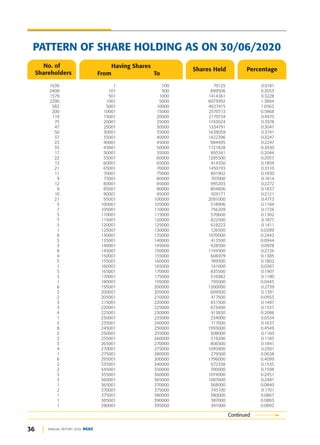
Liability as at year end 159,542 150,954
9.2.1 Movement in liability for accumulating
compensated absences
Present value of accumulating compensated absences
as at beginning of the year 150,954 143,327
Current service cost 53,353 48,693
Interest cost 17,872 9,377
Benefits due but not paid (38,280) (40,217)
Benefits paid during the year (12,793) (38,055)
Remeasurement in respect of experience adjustments (11,564) 27,829
Present value of accumulating compensated absences
as at year end 159,542 150,954
9.2.2 Charge for the year
Current service cost 53,353 48,693
Interest cost 17,872 9,377
Remeasurement during the year (11,564) 27,829
Total expense for the year 59,661 85,899
9.2.3 Assumptions used for valuation of the accumulating compensated absences are as under:
2020 2019
Discount rate Per annum 8.50% 14.25%
Expected rate of increase in salary Per annum 7.5% 13.25%
Duration of the plan Number of years 9 9
Expected withdrawal and early retirement rate SLIC 2001-2005 SLIC 2001-2005
mortality table mortality table
9.2.4 Year end sensitivity analysis (± 100 bps) on obligation:
Salary Salary
Discount rate Discount rate increase rate increase rate
+ 100 bps - 100 bps + 100 bps - 100 bps
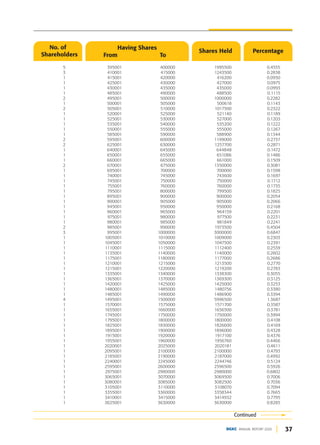
(Rupees in thousand)
Present value of obligation 146,495 174,733 174,557 146,425
128 ANNUAL REPORT 2020 DGKC
9.2.5 The Company faces the following risks on account of accumulating compensated absences:
- Final salary risk (linked to inflation risk) – the risk that the final salary at the time of cessation of
service is greater than the assumed salary. Since the benefit is calculated on the final salary (which
will closely reflect inflation and other macroeconomic factors), the benefit amount increases as salary
increases.
- Mortality risk – the risk that the actual mortality experience is different than the assumed mortality.

This effect is more pronounced in schemes where the age and service distribution is on the higher
side.
Withdrawal risk - the risk of actual withdrawals experience is different from assumed withdrawal
probability. The significance of the withdrawal risk varies with the age, service and the entitled
benefits of the beneficiary.
2020 2019
(Rupees in thousand)
10. Deferred taxation
The liability for deferred taxation comprises taxable/(deductible)
temporary differences relating to:
Deferred tax liability
Accelerated tax depreciation 10,256,805 9,850,456
Borrowing cost capitalised 7,346 -
Un-realised gain on investments - net 89,791 49,755
10,353,942 9,900,211
Deferred tax asset
Available unused tax credits (1,920,772) (2,316,183)
Available unused tax losses (5,713,170) (3,357,338)
Loss allowance on financial assets (37,260) (8,212)
Provision for retirement and other benefits (147,392) (128,787)
(7,818,594) (5,810,520)
2,535,348 4,089,691
The gross movement in net deferred tax liability during the year is as follows:
Opening balance 4,089,691 4,082,974
Charged/(credited) to other comprehensive income 43,184 (361,224)
(Credited)/charged to statement of profit or loss - note 34 (1,597,527) 367,941
Closing balance 2,535,348 4,089,691
Deferred tax assets have been recognized to the extent that the realisation of related tax benefits is probable from
reversal of existing taxable temporary differences and future taxable profits. Based on the Company's approved
business plan, it is probable that sufficient taxable profits will be available for utilization of deferred tax assets.
129
DGKC ANNUAL REPORT 2020
2020 2019
(Rupees in thousand)
11. Trade and other payables
Trade creditors - note 11.1 4,325,320 3,261,220
Infrastructure cess 89,164 89,164
Contract liability 1,546,864 555,107
Accrued liabilities - notes 11.2 & 11.6 4,078,887 3,556,867
Workers' profit participation fund - note 11.3 91,775 195,599
Withholding tax payable 9,185 12,866
Retention money payable 110,942 118,632
Export commission payable 97,640 52,268
Federal Excise Duty payable 874,586 33,936
Book overdraft - note 11.4 23,814 87,470
Others - note 11.5 50,010 66,745
11,298,187 8,029,874
11.1 Trade creditors include amounts due to following related parties:
Nishat Paper Products Company Limited 558,115 154,240
Security General Insurance Company Limited 1,616 10,729
Nishat Dairy (Private) Limited 88,071 80,613
647,802 245,582
11.2 Includes Gas Infrastructure Development Cess (GIDC) that was levied through GIDC Act, 2015. Subsequent
to the year end, the Supreme Court of Pakistan has upheld the GIDC Act, 2015 to be constitutional and
intravires. The Company intends to file a review against the said decision.
2020 2019
(Rupees in thousand)
11.3 Workers' profit participation fund
Opening balance 195,599 396,000
Provision for the year - note 31 - 104,781
Interest for the year - note 33 8,520 -
204,119 500,781
Payments made during the year (112,358) (305,182)
Closing balance 91,761 195,599
11.4 This represents book overdraft balances due to unpresented cheques in respect of saving bank accounts.
11.5 Includes payable to employees' provident fund amounting to Nil (2019: Rs 6.135 million). The maximum
aggregate amount outstanding at the end of any month during the year of employees' provident fund was Nil
(2019: Rs 670.13 million)
11.6 This includes reversal of excess provision in respect of previous years amounting to Rs 526.463 million.
130 ANNUAL REPORT 2020 DGKC
2020 2019
(Rupees in thousand)
12. Accrued markup
Accrued mark-up/interest on:
- Long term loans - secured 402,403 416,764
- Short term borrowings - secured 309,872 392,805
712,275 809,569
13. Short term borrowings - secured
Short term running finances - secured - note 13.1 13,638,030 11,115,650
Import finances - secured - note 13.2 5,974,437 7,852,920
Export finances - secured - note 13.3 3,883,500 1,290,000
23,495,967 20,258,570
13.1 Short term running finances - secured
Short term running finance facilities available from various commercial banks under mark-up arrangements
aggregate to Rs 26,438 million (2019: Rs 18,300 million). Such facilities are available at mark-up rates ranging
from one to three months Karachi Inter-Bank Offered Rate ('KIBOR') plus 0.05% to 1.25% per annum (2019:
one to three months KIBOR plus 0.05% to 1.00% per annum). The mark-up rate charged during the year on
the outstanding balance ranged from 8.41% to 14.86% (2019: 6.45% to 13.07%) per annum and mark-up is
payable monthly to quarterly. These are secured by first registered charge on all present and future current
assets of the Company wherever situated including stores and spares, stock in trade, trade debts,
investments and receivables.
13.2 Import finances - secured
Import finance facilities available from various commercial banks under mark-up arrangements aggregate to
Rs 13,500 million (2019: Rs 11,800 million). Such facilities are available at mark-up rates ranging from one to
six months KIBOR plus 0.010% to 0.2% per annum (2019: one to three months KIBOR plus 0.010% to 0.2%
per annum) and one to six months London Inter-Bank Offered Rate ('LIBOR') plus 0.75% per annum (2019:
one to six months LIBOR plus 0.5% per annum). The mark-up rate charged during the year on the
outstanding balance ranged from 1.74% to 13.91% (2019: 2.38% to 12.37%) per annum and mark-up is
payable on settlement. The aggregate import finances are secured by a registered charge on all present and
future current assets of the Company wherever situated including stores and spares, stock in trade, trade
debts, investments and other receivables.
13.3 Export finances - secured
Export finance facilities available from various commercial banks under mark-up arrangements aggregate to
Rs 10,650 million (2019: Rs 4,350 million). Such facilities are available at mark-up rate as per the State Bank
of Pakistan's (SBP) Export Finance Scheme plus 0.25% to 1.00% per annum (2019: mark-up rate as per
SBP's Export Finance Scheme plus 0.25% to 0.35% per annum). The Export Finance Scheme rate has
remained constant at 2% throughout the year, however, in respect of a certain facility, KIBOR plus 0.3% was
charged for a certain period. These loans are obtained for a period of 180 days and are secured against pari
passu hypothecation charge over current assets of the Company.
13.4 Letters of credit and guarantees
Of the aggregate facility of Rs 25,660 million (2019: Rs 13,810 million) for opening letters of credit and Rs
4,170 million (2019: Rs 4,600 million) for guarantees, all being either main limits or sub-limits of the facilities,
the amount utilised as at June 30, 2020 was Rs 3,610 million (2019: Rs 2,384 million) and Rs 2,915 million
(2019: Rs 2,812 million) respectively. The facilities for opening letters of credit are secured against lien over
import documents whereas aggregate facilities for guarantees are secured against registered joint pari passu
charge over the present and future current assets of the Company. Of the facility for guarantees, Rs 14.48
million (2019: Rs 14.48 million) is secured by a lien over bank deposits as referred to in note 26.2.
131
DGKC ANNUAL REPORT 2020
2020 2019
(Rupees in thousand)
14. Current portion of non-current liabilities
Long term finances - note 7 2,010,621 5,040,294
Accumulating compensated absences - note 9.2 38,280 40,217
2,048,901 5,080,511
15. Unclaimed dividend
The disclosures required under section 244 of the Companies Act, 2017 are as follows:
2020 2019
(Rupees in thousand)
Amounts transferred into unpaid dividend account 34,000 -
Dividend claims received and settled 962 939
Profits generated from unpaid dividend account - -
Profits utilised - -
The reconciliation of carrying amount is as follows:
Opening balance 33,438 28,346
Dividends declared 438,119 1,862,006
Interest on dividend - -
Dividends paid (437,720) (1,856,914)
Closing balance 33,837 33,438
16. Contingencies and commitments
16.1 Contingencies
Contingent assets:
16.1.1 The matter relating to interpretation of provisions of section 4(2) of the repealed Central Excise Act,
1944 (1944 Act) has now attained finality after having been adjudicated by the honourable Supreme
Court of Pakistan through its judgment dated 27 January 2009 (upholding its previous judgment
dated 15 February 2007). The longstanding controversy between the Revenue Department and the
tax payers related primarily to finer interpretation of the provisions of section 4(2) of the 1944 Act
wherein the department had a view that excise duty shall be included as a component for
determination of the value (retail price) for levying excise duty. The departmental view, being against
the spirit of law, was challenged by the taxpayers in appeals before the honourable High Courts of
Pakistan which, duly appreciating the contentions of the taxpayers, overturned the departmental
view and succeeded the appeals.
Now, since the controversy has attained finality up to the highest appellate level, the Company has
initiated the process of claiming refund of excess excise duty paid by it during the periods from 1994
to 1999 which aggregates Rs 1,115.145 million. The amount of refund, however, shall be
incorporated in the books of account once it is realized by the Company.
16.1.2 The Income Tax Officer, while framing the assessments for the assessment years 1984-85 to
1990-91, has taxed the income of the Company on account of the interest on the deposits and sale
of scrap etc. The Appellate Tribunal on appeal filed by the Company issued an order in favour of the
Company for the assessment years 1984-85 to 1990-91. The Income Tax Department filed reference
before the Lahore High Court. Pending final outcome of such reference, no adjustment has been
made in these financial statements for the relief granted by the Appellate Tribunal aggregating Rs
35.090 million.
132 ANNUAL REPORT 2020 DGKC
Contingent liabilities:
16.1.3 During the period 1994 to 1996, the Company imported plant and machinery relating to expansion
unit, for which exemption was claimed under various SROs from the levy of custom duty and other
duties including sales tax. As per the provisions of SRO 484(I)/92, 978(I)/95 and 569(I)/95, the
exemption from the statutory duty would be available only if the said plant and machinery was not
manufactured locally. However, the Custom Authorities rejected the claim of the Company by
arguing that the said machinery was on the list of locally manufactured machinery, published by the
Federal Board of Revenue. Consequently, the Company appealed before the Lahore High Court,
Multan Bench, which allowed the Company to release the machinery on furnishing indemnity bonds
with the Custom Authorities.
Collector of Customs and Central Excise, Multan, passed an order dated November 26, 1999,
against the Company on the grounds that the said machinery was being manufactured locally during
the time when it was imported.
After various appeals at different forums, the honourable Supreme Court of Pakistan remanded the
case back to the Customs Authorities to reassess the liability of the Company. The custom
authorities re-determined the liability of the Company upon which the Company preferred an appeal
to the Customs Appellate Tribunal. The Tribunal decided the case in favour of the Company, upon
which the Company discharged all liabilities. However, the custom authorities preferred a reference
to the Lahore High Court, Multan Bench on November 19, 2013. Last hearing of the case was
conducted on June 25, 2018. In case of any adverse decision, the management assesses liability to
the tune of Rs 233.390 million. No provision for this amount has been made in the financial
statements as according to the management of the Company, there are meritorious grounds that the
ultimate decision would be in its favour.
16.1.4 The Competition Commission of Pakistan ('the CCP') took suo moto action under Competition
Ordinance, 2007 and issued Show Cause Notice on October 28, 2008 for increase in prices of
cement across the country. The similar notices were also issued to All Pakistan Cement
Manufacturers Association ('APCMA') and its member cement manufacturers. The Company filed a
Writ Petition in the Lahore High Court. The Lahore High Court, vide its order dated August 24, 2009
allowed the CCP to issue its final order. The CCP accordingly passed an order on August 28, 2009
and imposed a penalty of Rs 933 million on the Company. The Lahore High Court vide its order dated
August 31, 2009 restrained the CCP from enforcing its order against the Company for the time being.
The vires of the Competition Commission of Pakistan have been challenged by a large number of
petitioners and all have been advised by their legal counsels that prima facie the Competition
Ordinance, 2007 is ultra vires of the Constitution of Pakistan. The Honourable Supreme Court of
Pakistan sent the appeals of the petitioners to newly formed Competition Appellate Tribunal ('CAT')
to decide the matter. The Company has challenged sections 42, 43 and 44 of the Competition Act,
2010 in the Sindh High Court. The Honourable Sindh High Court upon petition filed by large number
of petitioners gave direction to CAT to continue with the proceedings and not to pass a final order till
the time petition is pending in Sindh High Court. No provision for this amount has been made in the
financial statements as according to the management of the Company, there are meritorious
grounds that the ultimate decision would be in its favour.
16.1.5 The Honourable Sindh High Court passed an Order dated September 17, 2008 in which it rendered
the fifth version of law enforcing infrastructure cess as valid and intravires. The Company filed an
appeal in the Sindh High Court against the fifth and subsequent versions of the infrastructure cess.
The parties finally reached an interim arrangement, through an order of the Sindh High Court dated
May 31, 2011, for the release of 50% of the guarantees pertaining to consignments between
December 28, 2006 to May 30, 2011, while the remainder amounting to Rs 89.164 million was kept
alive till the disposal of the case which remains pending in the Sindh High Court. According to the
legal counsel of the Company, chances of favourable outcome of the appeal are fair, therefore, 50%
of the amount of infrastructure cess payable has not been incorporated in these financial statements
amounting to Rs 89.164 million.
16.1.6 The Company, consequent to the order-in-appeal passed by the learned Customs, Federal Excise
and Sales Tax Appellate Tribunal, Lahore, filed a petition before the Lahore High Court on March 27,
2008, challenging the levy of sales tax on the in-house consumption of Shale, Gypsum and
Limestone for the period from June 13, 1997 to August 11, 1998. Last hearing of the case was
conducted on December 17, 2015. According to the legal counsel of the Company, chances of
favourable outcome of the petition are fair, therefore the payable amount has not been incorporated
133
DGKC ANNUAL REPORT 2020
in these financial statements amounting to Rs 212.239 million.
16.1.7 The banks have issued the following guarantees on Company's behalf in favour of:
- Collector of Customs, Excise and Sales Tax against levy of sales tax, custom duty and excise
amounting to Rs 31.115 million (2019: Rs 34.772 million).
- Director, Excise Collection Office, Sindh Development and Maintenance against recovery of
infrastructure fee amounting to Rs 805.9 million (2019: Rs 755.9 million).
- The President of the Islamic Republic of Pakistan against the performance of a contract to Frontier
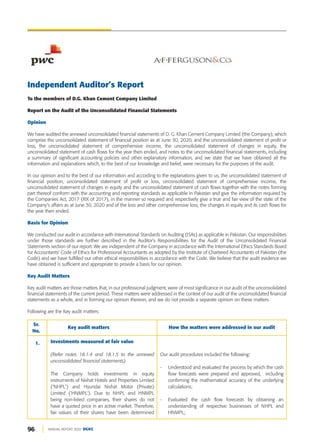
Works Organization amounting to Rs 0.5 million (2019: Rs 0.5 million).
- Sui Northern Gas Pipelines Limited against supply of 6 MMCFD and 14 MMCFD gas for captive use
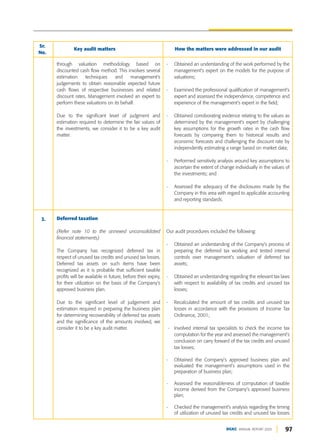
at plants at Khairpur and at D.G. Khan respectively amounting to Rs 544.414 million (2019: Rs
544.414 million).
- Sindh High Court against levy of sales tax, custom duty and excise amounting to Rs 176.860 million
(2019: Rs 176.860 million).
- Export orders amounting to Rs 5.042 million (2019: Rs 2.434 million).
- K-Electric Limited against supply of electricity to Hub plant amounting to Rs 142.4 million (2019: Rs
142.4 million).
- Supreme Court of Pakistan in respect of Katas Raj Temple water shortage case amounting to Nil
(2019: Rs 600 million).
16.1.8 The Company has provided a guarantee to Meezan Bank Limited (MBL) against the loan provided by
MBL to Hyundai Nishat Motor (Private) Limited, a related party, amounting to Rs 1,208.524 million
(2019: Rs 550 million).
16.1.9 The Company has issued a post dated cheque in favour of Nazir of the High Court of Sindh
amounting to Rs 227.76 million (2019: Nil) against the Industrial Support Package Adjustment on
K-Electric electricity bills.
16.2 Commitments in respect of:
(i) Contracts for capital expenditure Rs 2,614.855 million (2019: Rs 1,600.703 million).
(ii) Letters of credit for capital expenditure Rs 2,237.133 million (2019: Rs 935.353 million).
(iii) Letters of credit other than capital expenditure Rs 1,373.152 million (2019: Rs 1,423.09 million).
(iv) The amount of future payments under leases and the period in which these payments will become
due are as follows:
2020 2019
(Rupees in thousand)
Not later than one year 425 425
Later than one year and not later than five years 1,699 1,699
Later than five years 4,712 5,125
6,836 7,249
17. Property, plant and equipment
Operating fixed assets - note 17.1 76,986,536 76,928,989
Capital work-in-progress - note 17.2 6,369,586 3,008,937
Major spare parts and stand-by equipment - note 17.3 192,500 42,308
83,548,622 79,980,234
134 ANNUAL REPORT 2020 DGKC
Freehold
land
-
note
17.1.2
-
1,774,565
15,570
1,790,135
-
-
-
1,790,135
Leasehold
land
3.33
263,000
-
263,000
24,706
8,767
33,473
229,527
Buildings
on
freehold
land
-
Factory
building
5
21,378,820
259,593
21,638,413
5,410,479
810,134
6,220,613
15,417,800
-
Office
building
and
housing
colony
5
3,258,824
2,531
3,261,355
571,862
134,604
706,466
2,554,889
Roads
10
2,292,575
15,454
2,308,029
513,259
180,972
694,231
1,613,798
Plant
and
machinery
3.33
to
5.502
66,351,067
2,825,699
69,075,853
18,250,307
1,784,201
20,032,748
49,043,105
(100,913)
(1,760)
Quarry
equipment
10
4,259,602
166,964
4,426,566
1,778,220
212,161
1,990,381
2,436,185
Furniture
and
fittings
30
436,863
40,407
477,270
180,589
85,455
266,044
211,226
Office
equipment
30
450,822
82,708
533,530
236,283
78,494
314,777
218,753
Vehicles
20
865,149
52,414
882,244
326,466
97,947
404,881
477,363
(35,319)
(19,532)
Aircraft
30
328,752
-
328,752
298,774
8,992
307,766
20,986
Power
and
water
supply
lines
10
3,541,061
402,247
3,943,308
681,166
289,373
970,539
2,972,769
105,201,100
3,863,587
108,928,455
28,272,111
3,691,100
31,941,919
76,986,536
(136,232)
(21,292)
17.1
Operating
fixed
assets
Book
value
as
at
June
30,
2020
Accumulated
depreciation
and
impairment
as
at
July
01,
2019
Accumulated
depreciation
and
impairment
as
at
June
30,
2020
Depreciation
charge/
(deletions)
for
the
year
Cost
as
at
July
01,
2019
Cost
as
at
30
June
2020
Annual
rate
of
depreciation
%
Additions/
(Deletions)
2020
(Rupees
in
thousand)
135
DGKC ANNUAL REPORT 2020
Freehold
land
-
1,754,575
19,990
1,774,565
-
-
-
1,774,565
Leasehold
land
3.33
63,000
200,000
263,000
22,050
2,656
24,706
238,294
Buildings
on
freehold
land
-
Factory
building
5
19,966,566
1,412,254
21,378,820
4,633,229
777,250
5,410,479
15,968,341
-
Office
building
and
housing
colony
5
2,705,795
553,029
3,258,824
456,643
115,219
571,862
2,686,962
Roads
10
1,454,061
838,514
2,292,575
400,847
112,412
513,259
1,779,316
Plant
and
machinery
3.33
to
60
63,252,173
3,098,894
66,351,067
16,542,114
1,708,193
18,250,307
48,100,760
Quarry
equipment
10
3,946,993
312,609
4,259,602
1,558,719
219,501
1,778,220
2,481,382
Furniture
and
fittings
30
321,310
115,553
436,863
94,834
85,755
180,589
256,274
Office
equipment
30
379,634
71,188
450,822
163,362
72,921
236,283
214,539
Vehicles
20
671,293
257,635
865,149
272,251
89,952
326,466
538,683
(63,779)
(35,737)
Aircraft
30
328,752
-
328,752
285,928
12,846
298,774
29,978
Power
and
water
supply
lines
10
3,397,912
143,149
3,541,061
377,804
303,362
681,166
2,859,895
98,242,064
7,022,815
105,201,100
24,807,781
3,500,067
28,272,111
76,928,989
(63,779)
(35,737)
Book
value
as
at
June
30,
2019
Accumulated
depreciation
and
impairment
as
at
July
01,
2019
Accumulated
depreciation
and
impairment
as
at
June
30,
2019
Depreciation
charge/
(deletions)
for
the
year
Cost
as
at
July
01,
2018
Cost
as
at
30
June
2019
Annual
rate
of
depreciation
%
Additions/
(Deletions)
2019
(Rupees
in
thousand)
17.1.1
Freehold
land
and
building
include
book
values
of
Rs
12
million
(2019:
Rs
12
million)
and
Rs
4.959
million
(2019:
Rs
4.907
million)
respectively
which
are
held
in
the
name
of
Chief
Executive
of
the
Company.
This
property
is
located
in
the
locality
of
Defence
Housing
Authority,
Lahore,
where
the
bye-laws
restrict
transfer
of
title
of
the
residential
property
in
the
name
of
the
Company.
17.1.2
Following
are
the
particulars
of
the
Company’s
immovable
fixed
assets:
Location
Usage
of
immovable
property
Total
Area
(in
Acres)
Hub,
Mauza
Chichai,
Balochistan
Plant
site
and
staff
colony
1466.5
Khairpur
district,
Chakwal,
Punjab
Plant
site
and
staff
colony
901.5
Kanrach
Nai,
District
Lasbela,
Source
of
raw
material
723.14
Balochistan
Dera
Ghazi
Khan,
Punjab
Plant
site
and
staff
colony
590
Lakho
Dair,
Lahore,
Punjab
Processing
site
45
Gulberg,
Lahore,
Punjab
Administrative
offices
1.5
Others
Sales
offices
0.28
2020
2019
(Rupees
in
thousand)
17.1.3
The
depreciation
charge
for
the
year
has
been
allocated
as
follows:
Cost
of
sales
-
note
28
3,604,695
3,421,965
Administrative
expenses
-
note
29
78,502
69,485
Selling
and
distribution
expenses
-
note
30
7,903
8,617
3,691,100
3,500,067
136 ANNUAL REPORT 2020 DGKC
Plant
and
machinery
Izhar
Construction
(Private)
Limited
7,265
7,152
5,128
(2,024)
Negotiation
Izhar
Construction
(Private)
Limited
7,179
6,874
5,128
(1,746)
-do-
Izhar
Construction
(Private)
Limited
8,120
7,994
5,677
(2,317)
-do-
Izhar
Construction
(Private)
Limited
78,349
77,134
47,067
(30,067)
-do-
Vehicles
Employee
Muhammad
Alam
1,887
1,112
1,112
-
As
per
Company
policy
Aftab
Ahmad
Khan
(Key
Management
Personnel)
2,387
1,433
1,433
-
-do-
Aftab
Ahmad
Khan
(Key
Management
Personnel)
2,734
1,479
1,479
-
-do-
Nasir
Iqbal
2,396
1,950
-
(1,950)
-do-
Arif
Bashir
(Key
Management
Personnel)
2,521
1,318
2,237
919
-do-
Rana
Rasheed
Ahmad
1,786
869
869
-
-do-
Azam
Munir
1,771
912
912
-
-do-
Muhammad
Ghaffar
Rao
1,953
797
-
(797)
-do-
Ahson
Atta
2,503
1,067
1,067
-
-do-
Mazhar
ul
Haq
1,815
1,477
1,480
3
-do-
Outside
parties
Mrs.
Neham
Khalil
2,546
893
1,575
682
Auction
17.1.4
Sale
of
operating
fixed
assets
Detail
of
operating
fixed
assets
sold
during
the
year
is
as
follows:
Mode
of
sale
Gain
/
(Loss)
on
sale
Sale
proceeds
Book
value
Sold
to
Particulars
of
assets
Cost
2020
(Rupees
in
thousand)
137
DGKC ANNUAL REPORT 2020
Vehicles
Employees
Muhammad
Aslam
1,971
999
999
-
As
per
Company
policy
Mushtaq
Ahmed
1,786
1,123
1,123
-
-do-
Muhammad
Aslam
1,971
1,200
1,200
-
-do-
Zakki
Nasir
1,846
886
1,750
864
Negotiation
Outside
parties
Shafaqat
Ali
1,555
530
1,333
803
Auction
Nisar
Ahmed
Qureshi
2,483
1,655
1,655
-
-do-
Abdul
Hameed
1,555
562
1,328
766
-do-
Khurram
Imtiaz
1,971
902
2,020
1,118
-do-
Mehmood
Dasti
(ex-employee)
1,771
1,065
1,065
-
-do-
Mukhtar
Ahmad
1,971
1,002
1,016
14
-do-
Adnan
Qureshi
1,606
605
1,408
803
-do-
Muhammad
Asim
Mumtaz
2,521
1,563
1,563
-
-do-
Adnan
Naseer
1,715
1,116
1,650
534
-do-
Mohsin
Jamshed
2,095
1,492
2,277
785
-do-
Muhammad
Yousuf
1,673
538
1,290
752
-do-
Mode
of
sale
Gain
/
(loss)
on
sale
Sale
proceeds
Book
value
Sold
to
Particulars
of
assets
Cost
2019
(Rupees
in
thousand)
138 ANNUAL REPORT 2020 DGKC
17.2
Capital
work-in-progress
2020
(Rupees
in
thousand)
Civil
works
1,001,461
591,888
74,564
-
2,047,729
(3,072,849)
-
-
642,793
Plant
and
machinery
1,724,300
4,603,693
-
(11,511)
(2,024,670)
(7,054)
(435,020)
(71,118)
3,778,620
Advances
to
suppliers
and
contractors
236,442
534,575
-
-
(568,403)
-
-
-
202,614
Others
46,734
16,374
-
-
(46,494)
-
-
-
16,614
Expansion
Project:
-
Civil
works
-
397,735
-
-
568,402
-
-
-
966,137
-
Plant
and
machinery
-
573,559
27,917
-
23,436
-
-
-
624,912
-
Others
-
137,896
-
-
-
-
-
-
137,896
-
1,109,190
27,917
-
591,838
-
-
-
1,728,945
3,008,937
6,855,720
102,481
(11,511)
-
(3,079,903)
(435,020)
(71,118)
6,369,586
Balance
as
at
July
1,
2019
Capital
expenditure
incurred
during
the
year
Borrowing
cost
capitalized
during
the
year
Charged
off
during
the
year
Transfers
within
capital
work-in-progress
Transfers
to
operating
fixed
assets
Transfers
to
major
spare
parts
and
stand
by
equipment
Transfers
to
stores,
spare
parts
and
loose
tools
Balance
as
at
June
30,
2020
2019
(Rupees
in
thousand)
Civil
works
226,299
960,808
-
-
27,457
(213,103)
-
-
1,001,461
Plant
and
machinery
756,743
2,442,800
-
-
414,374
(1,125,577)
(764,040)
-
1,724,300
Advances
to
suppliers
and
contractors
8,954
816,782
-
-
(533,587)
-
(55,707)
-
236,442
Others
-
35,325
11,409
-
-
-
-
-
46,734
Expansion
Project:
-
Civil
works
496,086
1,293,880
-
(263)
262,146
(2,051,849)
-
-
-
-
Plant
and
machinery
304,763
211,847
-
-
1,004,700
(1,521,310)
-
-
-
-
Advances
to
suppliers
and
contractors
1,175,090
-
-
-
(1,175,090)
-
-
-
-
-
Others
-
764,884
-
-
-
(764,884)
-
-
-
1,975,939
2,270,611
-
(263)
91,756
(4,338,043)
-
-
-
2,967,935
6,526,326
11,409
(263)
-
(5,676,723)
(819,747)
-
3,008,937
Balance
as
at
July
1,
2019
Capital
expenditure
incurred
during
the
year
Borrowing
cost
capitalized
during
the
year
Charged
off
during
the
year
Transfers
within
capital
work-in-progress
Transfers
to
operating
fixed
assets
Transfers
to
major
spare
parts
and
stand
by
equipment
Transfers
to
stores,
spare
parts
and
loose
tools
Balance
as
at
June
30,
2020
139
DGKC ANNUAL REPORT 2020
2020 2019
(Rupees in thousand)
17.3 Major spare parts and stand-by equipment
The reconciliation of carrying amount is as follows:
Balance at the beginning of the year 42,308 91,766
Additions during the year 728,837 441,880
771,145 533,646
Transfers made during the year (578,645) (491,338)
Balance at the end of the year 192,500 42,308
17.4 All operating fixed assets are pledged as security against long term finances as referred to in note 7.
2020 2019
(Rupees in thousand)
18. Investments
These represent the long term investments in:
- Related parties - note 18.1 11,756,373 12,146,480
- Others - note 18.2 93,455 130,481
11,849,828 12,276,961
18.1 Related Parties
Subsidiaries - unquoted - at cost:
Nishat Paper Products Company Limited
25,595,398 (2019: 25,595,398) fully paid
ordinary shares of Rs 10 each
Equity held: 55% (2019: 55%)
Cost - Rs 250.811 million (2019: Rs 250.811 million) - notes 18.1.1 &
Cumulative impairment loss - Nil (2019: Rs 28.937 million) 18.1.2 250,811 221,874
Nishat Dairy (Private) Limited
270,000,000 (2019: 270,000,000) fully paid
ordinary shares of Rs 10 each
Equity held: 55.10% (2019: 55.10%)
Cost - Rs 2,331.900 million (2019: Rs 2,331.900 million)
Cumulative impairment loss - Rs 162.789 million
(2019: Rs 162.789 million) - note 18.1.3 2,169,111 2,169,111
sub-total 2,419,922 2,390,985
140 ANNUAL REPORT 2020 DGKC
2020 2019
(Rupees in thousand)
FVOCI - quoted:
Nishat (Chunian) Limited
7,173,982 (2019: 7,173,982) fully paid
ordinary shares of Rs 10 each
Equity held: 2.99% (2019: 2.99%)
Cost - Rs 75.565 million (2019: Rs 75.565 million) 232,796 251,233
MCB Bank Limited
21,305,315 (2019: 21,305,315) fully paid
ordinary shares of Rs 10 each
Equity held: 1.80% (2019: 1.80%)
Cost - Rs 125.834 million (2019: Rs 125.834 million) 3,452,952 3,716,712
Adamjee Insurance Company Limited
27,877,735 (2019: 27,877,735) fully paid
ordinary shares of Rs 10 each
Equity held: 7.97% (2019: 7.97%)
Cost - Rs 1,239.698 million (2019: Rs 1,239.698 million) 923,032 977,115
Nishat Mills Limited
30,289,501 (2019: 30,289,501) fully paid
ordinary shares of Rs 10 each
Equity held: 8.61% (2019: 8.61%)
Cost - Rs 1,326.559 million (2019: Rs 1,326.559 million) 2,362,884 2,827,222
sub-total 6,971,664 7,772,282
FVOCI - unquoted:
Nishat Hotels and Properties Limited
104,166,667 (2019: 104,166,667) fully paid
ordinary shares of Rs 10 each
Equity held: 10.42% (2019: 10.42%)
Cost - Rs 1,041.667 million (2019: Rs 1,041.667 million) - note 18.1.4 1,452,837 1,433,213
Hyundai Nishat Motor (Private) Limited
74,750,000 (2019: 55,000,000) fully paid
ordinary shares of Rs 10 each
Equity held: 10% (2019: 10%)
Cost - Rs 747.5 million (2019: Rs 550 million) - note 18.1.5 911,950 550,000
sub-total 2,364,787 1,983,213
11,756,373 12,146,480
18.1.1 Nishat Paper Products Company Limited is principally engaged in the manufacture and sale of paper
products (packaging material). The registered office of the subsidiary is situated at 53-A, Nishat
House, Lawrence Road, Lahore and the manufacturing facility is located at Khairpur, District
Chakwal on the Company's land.
18.1.2 The Company reviewed the carrying amount of its investment in equity instruments of Nishat Paper
Products Company Limited and its recoverability to determine whether there is an indication that
141
DGKC ANNUAL REPORT 2020
such investment has suffered an impairment loss. As a result of carrying out the aforementioned
assessment, the recoverable amount of the investment was determined to be higher than its carrying
amount and therefore the cumulative impairment loss charged to date amounting to Rs 28.937
million has been reversed which has been recognised as an income and included in 'Other income'.
18.1.3 The principal activity of Nishat Dairy (Private) Limited is to carry on the business of production of raw
milk. The registered office of the subsidiary is situated at 53-A, Nishat House, Lawrence Road,
Lahore and its production facility and factory is situated at 1- KM Sukheki Road, Pindi Bhattian.
18.1.4 This represents investment in the ordinary shares of Nishat Hotels and Properties Limited ('NHPL')
which is principally engaged in establishing and managing a multi-purpose facility including a
shopping mall, hotel and banquet halls in Johar Town, Lahore, by the name of 'Nishat Emporium'.
Since NHPL's ordinary shares are not listed, an independent valuer engaged by the Company has
estimated a fair value of Rs 13.95 per ordinary share as at June 30, 2020 through a valuation
technique based on discounted cash flow analysis of NHPL. Hence, it has been classified under level
3 of fair value hierarchy as further explained in note 43.3 to these financial statements. The fair value
gain of Rs 19.624 million is included in the fair value gain recognised during the year in other
comprehensive income.
The main level 3 inputs used by the Company are derived and evaluated as follows:
- Discount rate is determined using a capital asset pricing model to calculate a post-tax rate that
reflects current market assessments of the time value of money and the risk specific to NHPL.
- Long term growth rate is estimated based on historical performance of NHPL and current market
information for similar type of entities.
The significant assumptions used in this valuation technique are as follows:
- Discount rate of 8.74% per annum.
- Long term growth rate of 2% per annum for computation of terminal value.
- Annual growth in costs is linked to inflation at 5.60% per annum.
- NHPL has multiple sources of revenue. Annual growth in revenue ranges from 4.50% to 10% per
annum depending upon inflation and other factors.
Sensitivity analysis
Sensitivity analysis of the significant assumptions used in the valuation technique are as follows:
If the discount rate increases by 1% with all other variables held constant, the impact on fair value
as at June 30, 2020 would be Rs 327.593 million lower.
If the long term growth rate decreases by 1% with all other variables held constant, the impact on
fair value as at June 30, 2020 would be Rs 186.736 million lower.
If inflation decreases by 1% with all other variables held constant, the impact on fair value as at June
30, 2020 would be Rs 86.697 million lower.
If interest rate increases by 1% with all other variables held constant, the impact on fair value as at
June 30, 2020 would be Rs 67.611 million lower.
18.1.5 This represents investment in the ordinary shares of Hyundai Nishat Motor (Private) Limited
('HNMPL') that has setup up a greenfield project for assembly and sales of Hyundai Motor Company
passenger and commercial vehicles. Since HNMPL's ordinary shares are not listed, an independent
valuer engaged by the Company has estimated a fair value of Rs 12.20 per ordinary share as at June
30, 2020 through a valuation technique based on discounted cash flow analysis of HNMPL. Hence,
it has been classified under level 3 of fair value hierarchy as further explained in note 43.3 to these
financial statements. The fair value gain of Rs 164.45 million is included in the fair value gain
recognised during the year in other comprehensive income.
142 ANNUAL REPORT 2020 DGKC
The main level 3 inputs used by the Company are derived and evaluated as follows:
- Discount rate is determined using a capital asset pricing model to calculate a post-tax rate that
reflects current market assessments of the time value of money and the risk specific to HNMPL.
- Long term growth rate is estimated based on historical performance of HNMPL and current market
information for similar type of entities.
The significant assumptions used in this valuation technique are as follows:
- Discount rate of 14.87% per annum.
- Long term growth rate of 2% per annum for computation of terminal value.
- Annual growth in costs are linked to inflation and currency devaluation at 7% per annum and
revenues are linked to currency devaluation at 7% per annum.
Sensitivity analysis
Sensitivity analysis of the significant assumptions used in the valuation technique are as follows:
If the discount rate increases by 1% with all other variables held constant, the impact on fair value
as at June 30, 2020 would be Rs 138.288 million lower.
If the long term growth rate decreases by 1% with all other variables held constant, the impact on
fair value as at June 30, 2020 would be Rs 84.468 million lower.
If inflation decreases by 1% with all other variables held constant, the impact on fair value as at June
30, 2020 would be Rs 36.628 million higher.
If interest rate increases by 1% with all other variables held constant, the impact on fair value as at
June 30, 2020 would be Rs 17.94 million higher.
2020 2019
(Rupees in thousand)
18.2 Others
FVOCI - quoted:
Pakistan Petroleum Limited
821,626 (2019: 684,689) fully paid ordinary shares of Rs 10 each
Equity held: 0.03% (2019: 0.03%)
Cost - Rs 117.405 million (2019: Rs 117.405 million) 71,299 98,890
United Bank Limited
214,354 (2019: 214,354) fully paid ordinary shares of Rs 10 each
Equity held: 0.02% (2019: 0.02%)
Cost - Rs 33.646 million (2019: Rs 33.646 million) 22,156 31,591
93,455 130,481
18.3 Reconciliation of carrying amount
Balance as at beginning of the year 12,276,961 16,259,564
Investments made during the year 197,500 464,586
12,474,461 16,724,150
Impairment loss on equity instruments of subsidiary - note 31 - (162,789)
Impairment loss reversed during the year on equity
instruments of subsidiary - note 18.1.2 28,937 -
Fair value loss recognized in other comprehensive income (653,570) (4,284,400)
Balance as at end of the year 11,849,828 12,276,961
143
DGKC ANNUAL REPORT 2020
18.4 3,860,267 (2019: 3,860,267) shares of MCB Bank Limited are blocked in Central Depository Company
('CDC') account.
19. Long term loans to employees
These represent interest free loans given to employees for house building and purchase of motor vehicles and are
recoverable in equal monthly instalments over a period of 24 to 96 months. The loans are secured against the
employees' respective retirement benefits and are given as per Company's policy. These loans have not been carried
at amortised cost as the effect of discounting is not considered material.
2020 2019
(Rupees in thousand)
20. Stores, spare parts and loose tools
Stores [including in transit: Rs 16.973 million 2,469,974 4,565,609
(2019: Rs 5.563 million)]
Spare parts [including in transit Rs 277.493 million 5,710,691 4,628,854
(2019: Rs 188.185 million)]
Loose tools 57,325 45,801
8,237,990 9,240,264
20.1 Stores and spare parts include items which may result in fixed capital expenditure but are not distinguishable.
2020 2019
(Rupees in thousand)
21. Stock-in-trade
Raw materials 225,907 246,673
Packing material 353,699 236,287
Work-in-process - notes 21.1 & 21.2 3,361,646 2,802,481
Finished goods 411,743 428,617
4,352,995 3,714,058
21.1 Includes clinker costing Rs 263.423 million (2019: Nil) carried at its NRV amounting to Rs 237.15 million
(2019: Nil). The NRV write down expense of Rs 26.272 million (2019: Nil) has been charged to cost of sales.
21.2 Includes clinker having a carrying value of Rs 3,329.582 million (2019: Rs 2,755.69 million), some of which
may be sold in its current state but is not distinguishable.
2020 2019
(Rupees in thousand)
22. Trade debts
Secured 2,476,922 1,242,886
Unsecured - Related parties - note 22.1 20,271 13,657
2,497,193 1,256,543
Loss allowance - note 22.2 (211,109) (64,662)
2,286,084 1,191,881
2020 2019
(Rupees in thousand)
22.1 This is from the following related parties:
Nishat Mills Limited 14,723 5,060
Nishat Linen (Private) Limited 167 265
Nishat Hotels and Properties Limited 1,154 2,780
Nishat Hospitality (Private) Limited 107 536
Nishat (Chunian) Limited 269 388
Nishat Dairy (Private) Limited 365 189
Nishat Power Limited - 152
Hyundai Nishat Motor (Private) Limited 3,347 4,287
Nishat Agriculture Farming (Private) Limited 139 -
20,271 13,657
22.1.1 The maximum aggregate amount outstanding at the end of any month during the year was Rs 32.983
million (2019: Rs 23.718 million). The aging analysis of trade debts from related parties that are past
due and carry loss allowance is as follows:
2020 2019
(Rupees in thousand)
Up to 90 days 16,210 13,445
91 to 180 days 2,958 212
181 to 365 days 916 -
Above 365 days 187 -
20,271 13,657
Loss allowance (1,826) (142)
18,445 13,515
22.2 Loss allowance
The reconciliation of loss allowance is as follows:
Balance at the beginning of the year 64,662 -
Effect of change in accounting policy due to adoption of IFRS 9 - 42,319
Balance as at beginning of the year under IFRS 9 64,662 42,319
Impairment loss during the year 146,447 22,343
Balance as at end of the year 211,109 64,662
23. This represents the following quoted investments in related parties:
FVOCI: 2020 2019
(Rupees in thousand)
Nishat (Chunian) Limited
100,620 (2019: 100,620) fully paid ordinary shares of Rs 10 each
Equity held: 0.042% (2019: 0.042%)
Cost - Rs 0.832 million (2019: Rs 0.832 million) 3,265 3,524
MCB Bank Limited
80,971,917 (2019: 80,971,917) fully paid ordinary shares of Rs 10 each
Equity held: 6.83% (2019: 6.83%)
Cost - Rs 478.234 million (2019: Rs 478.234 million) 13,123,123 14,125,551
13,126,388 14,129,075
144 ANNUAL REPORT 2020 DGKC
2020 2019
(Rupees in thousand)
23.1 Reconciliation of carrying amount
Opening balance 14,129,075 16,018,594
Fair value loss recognized in other comprehensive income (1,002,687) (1,889,519)
Closing balance 13,126,388 14,129,075
24. Loans, advances, deposits, prepayments and other receivables
Current portion of loans to employees 1,132 1,290
Advances
- To employees 12,546 20,625
- To suppliers 86,617 160,746
99,163 181,371
Prepayments 3,340 21,070
Mark-up receivable from related party - note 24.1 5,850 10,838
Letters of credit - margins, deposits, opening charges etc. 1,504 2,433
Balances with statutory authorities:
- Sales tax - notes 24.2 & 24.3 454,696 813,511
- Excise duty 21,850 19,551
- Export rebate 2,809 8,176
479,355 841,238
Others - note 24.4 22,822 6,129
613,166 1,064,369
24.1 This represents mark-up receivable from Nishat Hotels and Properties Limited, a related party, on the loan
referred to in note 25. The maximum aggregate amount outstanding at the end of any month during the year
was Rs 14.326 million (2019: Rs 10.931 million). It is neither past due nor impaired.
24.2 Sales tax recoverable includes amounts which have been recovered by the sales tax department against
miscellaneous demands raised by it. The Company has filed appeals against the demands at different forums
as referred to in note 16.
24.3 The vires of section 8(h) and (i) of the Sales Tax Act, 1990 (the “Act”), in the context of disallowance of
adjustment of input tax on goods used for taxable services, was called in question by the Company. The
honourable Lahore High Court vide its order dated January 29, 2020 on the basis of its reading of sections 7
and 8 of the Act, observed that input tax paid on goods can be deducted or reclaimed, only if such goods are
used for the purpose of taxable supplies. Thus, in light of the said observation, the case was disposed of with
a direction to the tax authorities to determine each and every case on its merits and allow adjustment of input
tax on goods used for taxable supplies. Management is confident that the input tax already claimed shall not
be disallowed by the relevant tax authorities.
24.4 Includes provident fund contribution deposited in advance with employees' provident fund amounting to Rs
14.577 million (2019: Nil) and a receivable of Rs 7.92 million (2019: Nil) from Hyundai Nishat Motor (Private)
Limited, related party. The maximum aggregate amount deposited in advance with the employees' provident
fund at the end of any month during the year was Rs 52.882 million (2019: Nil), whereas, the maximum
aggregate amount outstanding at the end of any month during the year of Hyundai Nishat Motor (Private)
Limited, related party, was Rs 7.92 million (2019: Nil). These amounts are neither past due nor impaired.
145
DGKC ANNUAL REPORT 2020
146 ANNUAL REPORT 2020 DGKC
25. Loan to related party - considered good
This represents loan to Nishat Hotels and Properties Limited ('NHPL'), a related party, for meeting its working capital
requirements. The outstanding amount is due for repayment by October 27, 2020 in accordance with the extension
granted in Annual General Meeting of the Company held on October 28, 2019. It carried mark-up at the rate of 1
month KIBOR + 0.5% per annum till October 27, 2019, after which the rate changed to 1 month KIBOR + 1% per
annum. The loan is secured through corporate guarantee of 110% of the loan amount issued by NHPL in favour of
the Company. The effective mark-up rate charged during the period was 13.65% per annum which is above the
borrowing cost of the Company. In case of default in payment of principal or mark-up, NHPL shall be liable to pay
additional sum equivalent to 7.5% per annum of respective amount of default. Reconciliation of the carrying amount
is as follows:
2020 2019
(Rupees in thousand)
Opening balance 1,000,000 1,000,000
Recovery during the year (235,000) -
Closing balance 765,000 1,000,000
26. Cash and bank balances
At banks:
Savings accounts
Local currency - note 26.1 and 26.2 & 26.3 76,125 144,927
Foreign currency: US$ 638,856 (2019: US$ 832,288) 107,360 133,209
Current accounts 163,737 210,083
347,222 488,219
In hand 612 699
347,834 488,918
26.1 The balances in saving accounts bear mark-up ranging from 6.5% to 11.25% per annum (2019: 8% to
10.50% per annum).
26.2 Included in balances at banks on saving accounts are Rs 14.480 million (2019: Rs 14.480 million) which are
under lien to secure bank guarantees referred to in note 13.4.
26.3 Included in balances at banks in saving accounts is Rs 34 million (2019: Nil) which relates to unpaid dividend
held by the Company in compliance with section 244 of the Companies Act, 2017 referred to in note 15.
2020 2019
(Rupees in thousand)
27. Sales
Local sales 48,648,453 52,689,419
Export sales - note 27.1 9,385,261 5,262,964
58,033,714 57,952,383
Less:
Sales tax 8,545,392 8,958,822
Excise duty 10,708,220 8,026,605
Trade discount 570,316 -
Commission to stockists and export agents 176,662 450,431
20,000,590 17,435,858
38,033,124 40,516,525
27.1 Export sales include rebate on exports amounting to Rs 4.68 million (2019: Rs 8.41 million).
2020 2019
(Rupees in thousand)
28. Cost of sales
Raw and packing materials consumed 3,916,533 3,983,065
Salaries, wages and other benefits - note 28.1 3,403,005 3,195,280
Fuel and power 20,882,712 21,672,454
Stores and spares consumed 2,956,285 3,385,135
Repairs and maintenance 403,630 453,410
Insurance 117,183 97,079
Depreciation on operating fixed assets - note 17.1.3 3,604,695 3,421,965
Royalty - note 28.2 1,228,600 748,261
Excise duty 52,593 48,855
Vehicle running 134,749 105,328
Postage, telephone and telegram 12,051 10,515
Printing and stationery 14,371 22,588
Legal and professional charges 8,704 7,697
Travelling and conveyance 11,618 18,895
Plant cleaning and gardening expenses 34,876 35,857
Rent, rates and taxes - note 28.3 150,942 134,777
Freight charges 28,346 81,641
Water charges 21,492 124,438
Other expenses 57,464 93,968
37,039,849 37,641,208
Opening work-in-process - note 21 2,802,481 493,431
Closing work-in-process - note 21 (3,361,646) (2,802,481)
(559,165) (2,309,050)
Cost of goods manufactured 36,480,684 35,332,158
Opening stock of finished goods - note 21 428,617 385,626
Closing stock of finished goods - note 21 (411,743) (428,617)
16,874 (42,991)
Own consumption (50,340) (135,081)
36,447,218 35,154,086
28.1 Salaries, wages and other benefits include Rs 76.830 million (2019: Rs 67.202 million), Rs 92.812 million
(2019: Rs 62.238 million) and Rs 46.355 million (2019: Rs 66.694 million) respectively, in respect of provident
fund contribution by the Company, provision for gratuity and accumulating compensated absences as
detailed below.
2020 2019
(Rupees in thousand)
28.1.1 Salaries, wages and other benefits
Salaries, wages and other benefits include the following
in respect of retirement benefits:
Gratuity
Current service cost 62,244 52,409
Interest cost for the year 75,221 39,351
Interest income on plan assets (44,653) (29,522)
92,812 62,238
Accumulating compensated absences
Current service cost 41,454 37,806
Interest cost for the year 13,886 7,281
Remeasurements (8,985) 21,607
46,355 66,694
147
DGKC ANNUAL REPORT 2020
148 ANNUAL REPORT 2020 DGKC
28.2 This represents royalty to Governments of Punjab and Balochistan for extraction of raw materials as per
relevant laws.
28.3 This represents rentals of heavy machinery used at quarry site where raw materials i.e. clay and limestone,
are extracted.
2020 2019
(Rupees in thousand)
29. Administrative expenses
Salaries, wages and other benefits - note 29.1 343,779 341,858
Electricity, gas and water 28,134 24,393
Repairs and maintenance 8,179 4,184
Insurance 11,527 6,035
Depreciation on operating fixed assets - note 17.1.3 78,502 69,485
Vehicle running 13,197 14,287
Postage, telephone and telegram 6,820 8,578
Printing and stationery 21,844 8,523
Legal and professional services - note 29.2 22,331 24,287
Travelling and conveyance 42,890 41,050
Rent, rates and taxes 421 387
Entertainment 4,141 4,424
School expenses 38,057 34,589
Fee and subscription 29,724 27,665
Other expenses 9,328 18,772
658,874 628,517
29.1 Salaries, wages and other benefits include Rs 10.725 million (2019: Rs 10.254 million), Rs 16.007 million
(2019: Rs 11.442 million) and Rs 8.405 million (2019: Rs 12.269 million) respectively, in respect of provident
fund contribution by the Company, provision for gratuity and accumulating compensated absences as
detailed below.
2020 2019
(Rupees in thousand)
29.1.1 Salaries, wages and other benefits
Salaries, wages and other benefits include the following
in respect of retirement benefits:
Gratuity
Current service cost 10,735 9,635
Interest cost for the year 12,973 7,234
Interest income on plan assets (7,701) (5,427)
16,007 11,442
Accumulating compensated absences
Current service cost 7,516 6,955
Interest cost for the year 2,518 1,339
Remeasurements (1,629) 3,975
8,405 12,269
149
DGKC ANNUAL REPORT 2020
2020 2019
(Rupees in thousand)
29.2 Legal and professional charges
Legal and professional charges include the following
in respect of auditors' remuneration (excluding sales tax) for:
Statutory audit 3,038 3,038
Half-yearly review 850 806
Tax services 3,920 3,489
Certifications required under various regulations 470 295
Out of pocket expenses 790 1,396
9,068 9,024
30. Selling and distribution expenses
Salaries, wages and other benefits - note 30.1 212,963 187,007
Electricity, gas and water 2,740 2,912
Repairs and maintenance 1,437 737
Insurance 1,686 656
Depreciation on operating fixed assets - note 17.1.3 7,903 8,617
Vehicle running 6,274 5,971
Postage, telephone and telegram 4,001 3,564
Printing and stationery 1,938 2,285
Rent, rates and taxes - note 30.2 6,619 10,095
Travelling and conveyance 3,811 4,758
Entertainment 1,522 1,814
Advertisement and sales promotion 13,896 58,790
Freight and handling charges 1,495,298 998,830
Other expenses 23,334 19,659
1,783,422 1,305,695
30.1 Salaries, wages and other benefits include Rs 8.861 million (2019: Rs 7.498 million), Rs 9.85 million (2019: Rs
6.447 million) and Rs 4.901 million (2019: Rs 6.936 million) respectively, in respect of provident fund contribution
by the Company, provision for gratuity and accumulating compensated absences as detailed below.
2020 2019
(Rupees in thousand)
30.1.1 Salaries, wages and other benefits
Salaries, wages and other benefits include the following
in respect of retirement benefits:
Gratuity
Current service cost 6,606 5,429
Interest cost for the year 7,983 4,075
Interest income on plan assets (4,739) (3,057)
9,850 6,447
Accumulating compensated absences
Current service cost 4,383 3,932
Interest cost for the year 1,468 757
Remeasurements (950) 2,247
4,901 6,936
30.2 This includes lease rentals of Rs 5.636 million (2019: Rs 6.098 million).
2020 2019
(Rupees in thousand)
31. Other expenses
Workers' profit participation fund - note 11.3 - 104,781
Donations - note 31.1 2,410 101,254
Exchange loss - note 31.2 492,143 169,316
Loss on disposal of operating fixed assets - note 17.1.4 35,075 -
Impairment on investment in subsidiary - 162,789
Others 12 67
529,640 538,207
31.1 Includes donation amounting to Rs 1.5 million made to Pakistan Agricultural Coalition. None of the directors
or their spouses have any interest in the donee.
31.2 Includes exchange loss incurred on foreign currency short term borrowings amounting to Rs 481.55 million
(2019: Rs 140.207 million).
2020 2019
(Rupees in thousand)
32. Other income
Income on bank deposits 3,713 9,378
Mark-up on loan to related party - note 32.1 112,322 102,833
Dividend income from:
- Related parties - note 32.2 2,050,029 1,888,394
- Others 3,942 3,144
2,053,971 1,891,538
Rental income 1,522 1,466
Reversal of impairment on investment in subsidiary - note 18.1.2 28,937 -
Gain on disposal of operating fixed assets - 18,518
Scrap sales 229,018 233,047
Provisions and unclaimed balances written back - 148,359
Others 92 22,127
2,429,575 2,427,266
32.1 This is from Nishat Hotels and Properties Limited, a related party, on the loan as referred to in note 25.
2020 2019
(Rupees in thousand)
32.2 Dividend income from related parties
Nishat Mills Limited 121,158 143,875
Adamjee Insurance Company Limited 69,694 68,073
MCB Bank Limited 1,840,990 1,636,436
Nishat (Chunian) Limited 18,187 40,010
2,050,029 1,888,394
33. Finance cost
Interest and mark-up on:
- Long term loans - secured 2,656,273 2,014,012
- Short term borrowings - secured 1,969,078 1,258,370
- Workers profit participation fund - note 11.3 8,520 -
Guarantee commission - 11,283
Bank charges 19,415 20,437
4,653,286 3,304,102
150 ANNUAL REPORT 2020 DGKC
151
DGKC ANNUAL REPORT 2020
2020 2019
(Rupees in thousand)
34. Taxation
Current:
- For the year - -
- Prior years' - 13,141
- 13,141
Deferred - note 10 (1,597,527) 367,941
(1,597,527) 381,082
2020 2019
% %
34.1 Tax charge reconciliation
Numerical reconciliation between the average effective
tax rate and the applicable tax rate
Applicable tax rate as per Income Tax Ordinance, 2001 29.00 29.00
Tax effect of:
- Amounts that are not deductible for tax purposes - net (0.28) 3.21
- Change in prior years' tax 6.84 (54.69)
- Amounts that are allowable as tax credit - (8.55)
- Change in tax rate - 60.42
- Amounts allocated to Normal Tax Regime 1.63 (4.14)
- Income chargeable under Final Tax Regime 5.34 (6.11)
13.53 (9.86)
Average effective tax rate 42.53 19.14
34.2 A listed company that derives profit for a tax year but does not distribute at least 20% of its after tax profits
within six months of the end of the said tax year through cash, shall be liable to pay tax at the rate of 5% of
its accounting profit before tax. Liability in respect of such income tax, if any, is recognised when the
prescribed time period for distribution of dividend expires. The Company has distributed cash dividends in
excess of 20% of its after tax profits for the tax year 2019.
2020 2019
% %
35. Earnings per share
35.1 Earnings per share - Basic
(Loss) / profit for the year Rupees (2,158,661,000) 1,609,759,000
Weighted average number of ordinary shares Number 438,119,118 438,119,118
(Loss) / earnings per share - basic Rupees (4.93) 3.67
35.2 Earnings per share - Diluted
A diluted earnings per share has not been presented as the Company does not have any convertible
instruments in issue as at June 30, 2020, and June 30, 2019, which would have any effect on the earnings
per share if the option to convert is exercised.
152 ANNUAL REPORT 2020 DGKC
36.
Remuneration
of
Chief
Executive,
Directors
and
Executives
36.1
The
aggregate
amount
charged
in
the
financial
statements
for
the
year
for
remuneration,
including
certain
benefits,
to
the
Chief
Executive,
directors
and
executives
of
the
Company
are
as
follows:
(Rupees
in
thousand)
Chief
Executive
Executive
Director
Executives
2020
2019
2020
2019
2020
2019
Short
term
employee
benefits
Managerial
remuneration
25,898
23,544
19,380
17,256
480,549
433,338
Housing
270
270
335
335
166,534
145,849
Utilities
14,991
7,496
1,220
206
34,236
28,940
Leave
passage
-
-
2,261
959
14,874
11,450
Bonus
2,158
4,455
1,615
1,307
75,765
93,628
Medical
expenses
536
589
501
463
14,241
13,360
Others
16,996
15,426
710
981
121,682
112,133
Post
employment
benefits
Contributions
to
Provident
and
Gratuity
Fund
-
-
3,553
3,164
70,112
60,329
60,849
51,780
29,575
24,671
977,993
899,027
Number
of
persons
1
1
1
1
192
171
36.2
The
Company
also
provides
the
Chief
Executive,
certain
directors
and
executives
with
Company
maintained
cars,
travelling
and
utilities.
Certain
executives
are
provided
with
housing
facilities.
36.3
During
the
year,
the
Company
paid
meeting
fee
amounting
to
Rs
990,000
(2019:
Rs
750,000)
to
its
non-executive
directors.
The
number
of
non-executive
directors
is
5
(2019:
5).
153
DGKC ANNUAL REPORT 2020
2020 2019
(Rupees in thousand)
37. Cash generated from operations
(Loss)/profit before tax (3,756,188) 1,990,841
Adjustments for:
- Depreciation on operating fixed assets 3,691,100 3,500,067
- Loss/(gain) on disposal of operating fixed assets 35,075 (18,518)
- Dividend income (2,053,971) (1,891,538)
- Mark-up income (112,322) (102,833)
- Provision for retirement benefits 178,330 166,026
- Net realizable value written-down expense 26,272 -
- Exchange loss 492,143 169,316
- Impairment loss on investment in subsidiary - 162,789
- Reversal of impairment loss on investment in subsidiary - note 18.1.2 (28,937) -
- Impairment loss on trade debts 146,447 22,343
- Finance cost 4,653,286 3,304,102
Profit before working capital changes 3,271,235 7,302,595
Effect on cash flows due to working capital changes:
- Decrease/(increase) in stores, spares and loose tools 1,002,274 (4,126,037)
- Increase in stock-in-trade (665,209) (2,336,462)
- Increase in trade debts (1,234,498) (980,671)
- Decrease in loans, advances, deposits, prepayments
and other receivables 446,215 1,578,207
- Increase in trade and other payables 3,242,282 359,892
2,791,064 (5,505,071)
6,062,299 1,797,524
38. Cash and cash equivalents
Cash and bank balances - note 26 347,834 488,918
Short term borrowings - secured - note 13 (23,495,967) (20,258,570)
(23,148,133) (19,769,652)
39. Transactions with related parties
The related parties include the subsidiaries, the Investor, related parties on the basis of common directorship, group
companies, key management personnel and post employment benefit plans. Key management personnel are those
persons having authority and responsibility for planning, directing and controlling the activities of the Company,
directly or indirectly, including any director (whether executive or otherwise) of that Company. The Company in the
normal course of business carries out transactions with various related parties. Amounts due from and to related
parties are shown under receivables and payables. Significant related party transactions have been disclosed in
respective notes in these unconsolidated financial statements other than the following:
154 ANNUAL REPORT 2020 DGKC
2020 2019
(Rupees in thousand)
Relationship with the Company Nature of transactions
i. Subsidiary companies Purchase of goods 2,443,782 2,418,437
Sales of goods and services 31,573 26,543
Rental income 929 929
ii. Investor Sale of goods 38,629 53,519
Dividend paid 137,574 496,987
Purchase of goods and services 493 -
iii. Other related parties Sale of goods 44,895 135,267
Insurance premium 141,867 105,615
Purchase of goods and services 119,646 43,564
Insurance claims received 35 8,944
Dividend paid 9,478 35,696
iv. Key management personnel Remuneration - note 39.1 241,244 255,680
Dividend paid 39,941 169,750
39.1 This represents remuneration of the Chief Executive, executive director and certain executives that are
included in the remuneration disclosed in note 36 to these financial statements.
39.2 The related parties with whom the Company had entered into transactions or had arrangements/agreements
in place during the year have been disclosed below along with their basis of relationship:
Name Relationship %age of shareholding
in the Company
Adamjee Insurance Company Limited Group company 0.77%
Hyundai Nishat Motor (Private) Limited Common directorship N/A
Lalpir Power Limited Common directorship N/A
MCB Bank Limited Group company 0%
Nishat (Chunian) Limited Common directorship N/A
Nishat Agriculture Farming (Private) Limited Common directorship N/A
Nishat Dairy (Private) Limited Subsidiary N/A
Nishat Developers (Private) Limited Common directorship N/A
Nishat Hospitality (Private) Limited Subsidiary of Investor N/A
Nishat Hotels and Properties Limited Common directorship N/A
Nishat Linen (Private) Limited Subsidiary of Investor N/A
Nishat Mills Limited Investor 31.40%
Nishat Paper Products Company Limited Subsidiary N/A
Nishat Power Limited Subsidiary of Investor N/A
Pakgen Power Limited Group company N/A
Pakistan Aviators & Aviation (Private) Limited Group company N/A
Security General Insurance Company Limited Group company N/A
Mrs. Naz Mansha Director/Chairperson 0.03%
Mr. Mahmood Akhtar Director N/A
Mr. Shahzad Ahmad Malik Director N/A
Mr. Khalid Niaz Khawaja Director N/A
Mr. Usama Mahmud Director N/A
Mr. Mian Raza Mansha Director/Chief Executive 2.92%
Mr. Farid Noor Ali Fazal Director N/A
Mrs. Ammil Raza Mansha Spouse of Chief Executive 1.34%
Mr. Mian Umer Mansha Close family member of Chief
executive and a Director 6.29%
Mr. Arif Bashir Key Management Personnel N/A
Mr. Aftab Ahmad Khan Key Management Personnel N/A
Mr. Inayat Ullah Niazi Key Management Personnel 0.00%
Company's Employees Gratuity Fund Post Employment Benefit Plan N/A
Company's Employees Provident Fund Post Employment Benefit Plan 0.02%
155
DGKC ANNUAL REPORT 2020
40. Plant capacity and actual production
Capacity Actual production
2020 2019 2020 2019
Clinker (Metric Tonnes)
Plant I & II - D.G. Khan - note 40.1 2,010,000 2,010,000 1,898,897 1,935,296
Plant III - Khairpur - note 40.1 2,010,000 2,010,000 2,042,177 1,962,150
Plant IV - Hub - note 40.1 2,700,000 2,700,000 2,900,890 2,483,452
Cement (Metric Tonnes)
Plant I & II - D.G. Khan - note 40.2 2,115,790 2,115,790 2,121,389 1,908,921
Plant III - Khairpur - note 40.2 2,115,789 2,115,789 2,127,003 2,128,277
Plant IV - Hub - note 40.2 2,842,105 2,842,105 1,262,033 1,576,452
40.1 Normal capacity is based on 300 working days, that can be exceeded if the plant is operational for more than
300 days during the year.
40.2 Normal capacity is based on 300 working days, that can be exceeded if the plant is operational for more than
300 days during the year. Actual production is less than the installed capacity due to planned maintenance
shutdown and gap between market demand and supply of cement.
2020 2019
41. Number of employees
Total number of employees as at June 30 1,845 1,802
Average number of employees during the year 1,824 1,716
42. Provident fund related disclosures
The investments by the provident fund in collective investment schemes, listed equity and debt securities have been
made in accordance with the provisions of section 218 of the Companies Act, 2017 and the conditions specified
thereunder except for:
- Total investment at the time of making investment in listed equity securities and equity collective investment
schemes, registered as notified entity with the SECP under Non-Banking Finance Companies and Notified Entities
Regulations, 2008, exceed 30% of the size of the fund;
- Some of the investment made in bonds, redeemable capital, debt securities or instruments issued by a statutory
body or listed debt securities are not assigned a minimum rating of “A” by a credit rating company licensed with the
SECP and with at least a stable outlook;
- Investment has been made in certain equity securities of listed companies which have paid average dividend of less
than 15% to the shareholders during two out of the preceding three consecutive years and in which the minimum
free float is less than 15% or Rs 50 million shares, whichever is higher;
- Investment is made in equity securities of listed companies, where such companies do not have breakup value
equivalent or more than the par value of the shares of such company;
- The fund has aggregate investment in listed equity securities, other than equity collective investment schemes in
excess of Rs 50 million but has not appointed or sought advice from an investment advisor holding a valid license
from the SECP for providing investment advisory services; and
- Investment has been made in a listed debt security where the issuer of the security has defaulted in its financial
obligations.
156 ANNUAL REPORT 2020 DGKC
The fund has not developed and maintained appropriate investment policies explaining investment limit, investment
avenues and risk appetite including but not limited to business allocation among the securities brokers.
However, as per S.R.O. 856(I)/2019 dated July 25, 2019, a transition period of three years from the date of the said
S.R.O. has been granted to bring all the investments of the fund in conformity with the provisions of the above
regulations. The above analysis is based on the unaudited financial statements of the provident fund for the year
ended June 30, 2020.
43. Financial risk management
43.1 Financial risk factors
The Company’s activities expose it to a variety of financial risks: market risk (including currency risk, interest
rate risk and other price risk), credit risk and liquidity risk. The Company’s overall risk management
programme focuses on the unpredictability of financial markets and seeks to minimise potential adverse
effects on the Company’s financial performance.
Risk management is carried out by the Board of Directors ('the Board'). The Company's finance department
evaluates and hedges financial risks. The Board provides written principles for overall risk management, as
well as written policies covering specific areas, such as foreign exchange risk, interest rate risk, credit risk,
use of derivative financial instruments and non-derivative financial instruments, and investment of excess
liquidity.
The Company's overall risk management procedures to minimise the potential adverse effects of financial
market on the Company's performance are as follows:
(a) Market risk
(i) Currency risk
Currency risk is the risk that the fair value or future cash flows of a financial instrument will fluctuate because
of changes in foreign exchange rates. Currency risk arises mainly from cash and bank balances, short term
borrowings, receivables and payables that exist due to transactions in foreign currencies.
The Company is exposed to currency risk arising from various currency exposures, primarily with respect to
the United States Dollar (USD). Currently, the Company’s foreign exchange risk exposure is restricted to bank
balances, amounts receivable from foreign entities and short term borrowings.
2020 2019
(USD in thousand)
Cash and bank balances 639 832
Trade receivables from foreign parties 5,238 544
Short term borrowings (9,541) (5,114)
Net liability exposure (3,664) (3,738)
At June 30, 2020, if the Rupee had weakened/strengthened by 10% against the USD with all other variables
held constant, post-tax loss for the year would have been Rs 43.704 million higher/lower (2019: Rs 42.464
million lower/higher) mainly as a result of foreign exchange gains/losses on translation of USD - denominated
financial assets and liabilities.
(ii) Other price risk
Other price risk represents the risk that the fair value or future cash flows of a financial instrument will
fluctuate because of changes in market prices (other than those arising from interest rate risk or currency
risk), whether those changes are caused by factors specific to the individual financial instrument or its issuer,
or factors affecting all similar financial instruments traded in the market.
The Company is exposed to equity securities price risk because of investments held by the Company and
classified as fair value through other comprehensive income. Material investments within the portfolio are
managed on an individual basis and all buy and sell decisions are approved by the Board. The primary goal
of the Company's investment strategy is to maximise investment returns.
157
DGKC ANNUAL REPORT 2020
The Company’s certain investments in equity instruments are publicly traded on the Pakistan Stock
Exchange Limited.
The table below summarises the impact of increases/decreases of the KSE-100 index on the Company’s
pre-tax profit for the year and on equity. The analysis is based on the assumption that the KSE-100 index had
increased/decreased by 10% with all other variables held constant and all the Company’s equity investments
moved according to the historical correlation with the index:
Impact on pre-tax profit Impact on other components
of equity
2020 2019 2020 2019
(Rupees in thousand) (Rupees in thousand)
Pakistan Stock Exchange Limited - - 1,433,597 1,781,495
As at June 30, 2020, the Company had no investments classified as at fair value through profit or loss.
(iii) Interest rate risk
Interest rate risk represents the risk that the fair value or future cash flows of a financial instrument will
fluctuate because of changes in market interest rates.
The Company’s interest rate risk arises from loan to related party, short term and long-term borrowings.
These borrowings issued at variable rates expose the Company to cash flow interest rate risk.
The Company analyses its interest rate exposure on a dynamic basis. Various scenarios are simulated taking
into consideration refinancing, renewal of existing positions, alternative financing and hedging. Based on
these scenarios, the Company calculates the impact on profit or loss of a defined interest rate shift. The
scenarios are run only for liabilities that represent the major interest-bearing positions.
2020 2019
(Rupees in thousand)
Fixed rate instruments:
Financial assets
Bank balances - savings accounts 183,485 278,136
Financial liabilities
Export finances (3,883,500) (1,290,000)
Net exposure (3,700,015) (1,011,864)
Floating rate instruments:
Financial assets
Loan to related party 765,000 1,000,000
Financial liabilities
Long term finances (23,982,621) (21,025,324)
Short term borrowings (19,612,467) (18,968,570)
(43,595,088) (39,993,894)
Net exposure (42,830,088) (38,993,894)
158 ANNUAL REPORT 2020 DGKC
Fair value sensitivity analysis for fixed rate instruments
The Company does not account for any fixed rate financial assets and liabilities at fair value through profit or
loss. Therefore, a change in interest rate at the reporting date would not affect profit or loss of the Company.
Cash flow sensitivity analysis for variable rate instruments
At June 30, 2020, if interest rates on variable rate instruments had been 1% higher/lower with all other
variables held constant, post-tax loss for the year would have been Rs 304.094 million (2019: Rs 276.857
million) higher/lower, mainly as a result of higher/lower interest expense on floating rate instruments.
(b) Credit risk
Credit risk represents the risk that one party to a financial instrument will cause a financial loss for the other
party by failing to discharge an obligation.
Credit risk of the Company arises from deposits with banks and other financial institutions, as well as credit
exposures to customers, including outstanding receivables and committed transactions. The management
assesses the credit quality of the customers, taking into account their financial position, past experience and
other factors. Individual risk limits are set based on internal or external ratings in accordance with limits set
by the Board. For banks and financial institutions, only independently rated parties with a strong credit rating
are accepted.
(i) Exposure to credit risk
The carrying amount of financial assets represents the maximum credit exposure. The maximum exposure to
credit risk at the reporting date was as follows:
2020 2019
(Rupees in thousand)
Long term loans and deposits 57,984 60,970
Loan to related party 765,000 1,000,000
Trade debts 2,286,084 1,191,881
Loans, advances, deposits and other receivables 15,227 18,257
Balances with banks 347,222 488,219
3,471,517 2,759,327
(ii) Impairment of financial assets
The Company's financial assets, other than investments in equity instruments, are subject to the expected
credit losses model. While bank balances, loans to employees, loan to related party, deposits and other
receivables are also subject to the impairment requirements of IFRS 9, the identified impairment loss was
immaterial.
Trade debts
The Company applies the IFRS 9 simplified approach to measuring expected credit losses which uses a
lifetime expected loss allowance for all trade debts.
To measure the expected credit losses, trade receivables have been grouped based on shared credit risk
characteristics and the days past due. These trade receivables are netted off with the collateral obtained from
these customers to calculate the net exposure towards these customers. The Company has concluded that
the expected loss rates for trade debts against local sales are different from the expected loss rates for trade
debts against export sales.
The expected loss rates are based on the payment profiles of sales over a period of 12 months before June
30, 2020 and the corresponding historical credit losses experienced within this period. The historical loss
rates are adjusted to reflect current and forward-looking information on macroeconomic factors affecting the
ability of the customers to settle the receivables. The Company has identified the Gross Domestic Product
and the Consumer Price Index of the country in which it majorly sells its goods and services to be the most
relevant factors, and accordingly adjusts the historical loss rates based on expected changes in these
factors.
159
DGKC ANNUAL REPORT 2020
On that basis, the loss allowance as at June 30, 2020 and June 30, 2019 was determined as follows:
Local sales Export sales
Expected Trade debts Loss Expected Trade debts Loss
June 30, 2020 loss rate allowance loss rate allowance
% (Rupees in thousand) % (Rupees in thousand)
Up to 30 days 1.36% 677,390 9,194 0% 797,661 -
31 to 60 days 3.44% 198,992 6,847 0% - -
61 to 90 days 7.31% 175,909 12,858 0% - -
91 to 120 days 16.17% 130,985 21,181 0% - -
121 to 150 days 25.18% 101,068 25,452 0% - -
151 to 180 days 32.45% 86,813 28,174 0% 8 -
181 to 210 days 44.63% 15,613 6,968 0% - -
211 to 240 days 56.31% 1,966 1,107 0% - -
241 to 270 days 66.41% 1,152 765 0% - -
271 to 300 days 74.43% 2,663 1,982 0% - -
301 to 330 days 85.00% 1,027 873 0% - -
331 to 360 days 93.17% 2,783 2,593 0% - -
Above 360 days 100.00% 10,488 10,488 100% 82,627 82,627
1,406,849 128,482 880,296 82,627
Trade debts
against which 210,048 - - -
collateral is held
Gross Trade debts 1,616,897 128,482 880,296 82,627
Local sales Export sales
Expected Trade debts Loss Expected Trade debts Loss
June 30, 2019 loss rate allowance loss rate allowance
% (Rupees in thousand) % (Rupees in thousand)
Net trade debts*
Up to 90 days 1.52% 1,030,560 15,689 1.12% 24,356 273
91 to 180 days 6.77% 44,171 2,990 19.42% 28,556 5,547
181 to 270 days 22.42% 14,518 3,255 25.64% 4,969 1,274
270 to 365 days 64.61% 1,054 681 50.00% 18 9
365 days or more 100.00% 5,702 5,702 100.00% 29,242 29,242
1,096,005 28,317 87,141 36,345
Trade debts against which
collateral is held 73,397 - - -
Gross trade debts 1,169,402 28,317 87,141 36,345
* This represents amounts net of trade debts against which security deposits and inland letters of credit,
considered as collateral, are held amounting to Rs 169.048 million (2019: Rs 73.4 million) and Rs 41 million
(2019: Nil), respectively.
The amount of loss allowance that best represents maximum exposure to credit risk at the end of the
reporting period without taking into account any collateral is Rs 300.33 million (2019: Rs 71.693 million).
Default is triggered when more than 360 days have passed. The names of defaulting parties of outstanding
trade debts from export sales and their respective default amount is as follows:
2020 2019
(Rupees in thousand)
Nobel Translink Private Limited 20,086 4,480
Chempex Industries 3,937 3,748
Hizbullah & Saeed Ullah House Limited 393 374
Vikrant Traders 51,085 20,352
A A Middle East FZE 107 102
Taruna Trading Company 4,271 158
Sai Enterprises 305 -
Square Corporation 1,150 -
Société Kalfane Fils 190 -
Bulkcor 1,046 -
Others 57 28
82,627 29,242
(iii) Credit quality of financial assets
The credit quality of financial assets that are neither past due nor impaired (mainly bank balances) can be
assessed by reference to external credit ratings (if available) or to historical information about counterparty
default rate:
Rating Rating
Short term Long term Agency 2020 2019
(Rupees in thousand)
Bank Alfalah Limited A1+ AA+ PACRA 221,234 321,424
BankIslami Pakistan Limited A1 A+ PACRA 2,167 1,146
The Bank of Punjab A1+ AA PACRA 245 414
The Bank of Khyber A1 A PACRA 265 530
Citibank N.A. P-1 AA3 Moody's 12 12
Dubai Islamic Bank Pakistan Limited A-1+ AA JCR-VIS 2,685 596
MCB Bank Limited A1+ AAA PACRA 62,382 133,272
Habib Bank Limited A-1+ AAA JCR-VIS 0.01 -
Meezan Bank Limited A-1+ AA+ JCR-VIS 14 13
National Bank of Pakistan A1+ AAA PACRA 3,229 1,144
Silk Bank Limited A-2 A- JCR-VIS 5 5
Soneri Bank Limited A1+ AA- PACRA 6,551 -
Standard Chartered Bank (Pakistan) Limited A1+ AAA PACRA 121 564
United Bank Limited A-1+ AAA JCR-VIS 33,155 14,572
Habib Metropolitan Bank Limited A1+ AA+ PACRA 27 27
Faysal Bank Limited A1+ AA PACRA 662 5
JS Bank Limited A1+ AA- PACRA 12 12
332,766 473,736
160 ANNUAL REPORT 2020 DGKC
161
DGKC ANNUAL REPORT 2020
(c) Liquidity risk
Liquidity risk represents the risk that the Company shall encounter difficulties in meeting obligations associ-
ated with financial liabilities.
Prudent liquidity risk management implies maintaining sufficient cash and marketable securities, the
availability of funding through an adequate amount of committed credit facilities. Due to the dynamic nature
of the Company's businesses, the Company's finance department maintains flexibility in funding by main-
taining availability under committed credit lines. At June 30, 2020, the Company had Rs 26,438 million
available borrowing limits from financial institutions under mark up arrangements, Rs 13,500 million available
borrowing limits from financial institutions under import finance facilities and Rs 347.834 million in cash and
bank balances.
Management monitors the forecasts of the Company’s cash and cash equivalents (note 38 to these financial
statements) on the basis of expected cash flow. This is generally carried out in accordance with practice and
limits set by the Company. These limits vary by location to take into account the liquidity of the market in
which the entity operates. In addition, the Company's liquidity management policy involves projecting cash
flows in each quarter and considering the level of liquid assets necessary to meet its liabilities, monitoring
statement of financial position liquidity ratios against internal and external regulatory requirements and main-
taining debt financing plans.
The table below analyses the Company’s financial liabilities into relevant maturity groupings based on the
remaining period at the reporting date to the contractual maturity date.
(Rupees in thousand)
Total
July 01, 2020 Less than Between 1 2 to Over contractual Carrying
1 year and 2 years 5 years 5 years cashflows value
Long term finances 2,010,621 5,761,324 14,883,761 1,326,915 23,982,621 23,982,621
Trade and other payables 7,346,221 - - - 7,346,221 7,346,221
Long term deposits 20,975 93,957 6,932 132,073 253,937 253,937
Accrued mark-up 712,275 - - - 712,275 712,275
Short term borrowings
- secured 23,495,967 - - - 23,495,967 23,495,967
33,586,059 5,855,281 14,890,693 1,458,988 55,791,021 55,791,021
(Rupees in thousand)
Total
July 01, 2019 Less than Between 1 2 to Over contractual Carrying
1 year and 2 years 5 years 5 years cashflows value
Long term finances 5,040,294 9,304,366 6,680,664 - 21,025,324 21,025,324
Trade and other payables 7,144,896 - - - 7,144,896 7,144,896
Long term deposits 89,556 6,608 6,608 139,271 242,043 242,043
Accrued mark-up 809,569 - - - 809,569 809,569
Short term borrowings
- secured 20,258,570 - - - 20,258,570 20,258,570
33,342,885 9,310,974 6,687,272 139,271 49,480,402 49,480,402
162 ANNUAL REPORT 2020 DGKC
43.2 Capital management
The Company’s objectives when managing capital are to safeguard the Company’s ability to continue as a
going concern in order to provide returns for shareholders and benefits for other stakeholders and to
maintain an optimal capital structure to reduce the cost of capital.
The Company manages its capital structure and makes adjustments to it in the light of changes in economic
conditions. In order to maintain or adjust the capital structure, the Company may adjust the amount of
dividends paid to shareholders or issue new shares.
Consistent with others in the industry and the requirements of the lenders, the Company monitors the capital
structure on the basis of gearing ratio. This ratio is calculated as net debt divided by total equity (as shown
in the statement of financial position). Net debt is calculated as total borrowings (including current and
non-current borrowings) including bank overdraft less cash and bank balances and liquid investments.
The gearing ratios as at June 30, 2020 and 2019 were as follows:
2020 2019
(Rupees in thousand)
Borrowings - notes 7 and 13 47,478,588 41,283,894
Less: Cash and bank balances - note 26 347,834 488,918
Net debt 47,130,754 40,794,976
Total equity 66,644,157 70,928,415
Gearing ratio Percentage 71% 58%
In accordance with the terms of agreements with the lenders of long term finances (as referred to in note 7 to
these financial statements), the Company is required to comply with certain financial covenants. The
Company has complied with these covenants throughout the reporting period except for certain covenants
in respect of which the lenders have not raised any objection to the Company.
43.3 Fair value estimation
Fair value is the price that would be received to sell an asset or paid to transfer a liability in an orderly
transaction in the principal (or most advantageous) market at the measurement date under current market
conditions (i.e. an exit price) regardless of whether that price is directly observable or estimated using
another valuation technique.
The table below analyses the financial instruments carried at fair value, by valuation method. The different
levels have been defined as follows:
- Quoted prices (unadjusted) in active markets for identical assets or liabilities (Level 1).
- Inputs other than quoted prices included within level 1 that are observable for the asset or liability, either
directly (that is, as prices) or indirectly (that is, derived from prices) (Level 2).
- Inputs for the asset or liability that are not based on observable market data (that is, unobservable inputs)
(Level 3).
The following table presents the Company's assets and liabilities that are measured at fair value:
As at June 30, 2020 Level 1 Level 2 Level 3 Total
(Rupees in thousand)
Recurring fair value measurements
Assets
Investments - FVOCI 20,191,507 - 2,364,787 22,556,294
Total assets 20,191,507 - 2,364,787 22,556,294
Total liabilities - - - -
As at June 30, 2019
Recurring fair value measurements
Assets
Investments - FVOCI 22,031,838 - 1,983,213 24,015,051
22,031,838 - 1,983,213 24,015,051
Total liabilities - - - -
Movement in the above mentioned assets has been disclosed in notes 18 and 23 to these financial
statements and movement in fair value reserve has been disclosed in the statement of changes in equity.
There were no transfers between Levels 1 and 2 & Levels 2 and 3 during the year and there were no changes
in valuation techniques during the year. Since the ordinary shares of Nishat Hotels and Properties Limited and
Hyundai Nishat Motor (Private) Limited are not listed, an investment advisor engaged by the Company has
estimated fair values of Rs 13.95 and Rs 12.20 per ordinary share, respectively, as at June 30, 2020, through
a valuation technique based on discounted cash flow analysis. The Company’s policy is to recognise
transfers into and transfers out of fair value hierarchy levels as at the end of the reporting period. Changes in
level 2 and 3 fair values are analysed at the end of each reporting period during the annual valuation
discussion between the Chief Financial Officer and the investment advisor. As part of this discussion, the
investment advisor presents a report that explains the reason for the fair value movements.
The fair value of financial instruments traded in active markets is based on quoted market prices at the
reporting date. A market is regarded as active if quoted prices are readily and regularly available from an
exchange, dealer, broker, industry group, pricing service, or regulatory agency, and those prices represent
actual and regularly occurring market transactions on an arm’s length basis. The quoted market price used
for financial assets held by the Company is the current bid price. These instruments are included in Level 1.
The fair value of financial instruments that are not traded in an active market is determined by using valuation
techniques. These valuation techniques maximise the use of observable market data where it is available and
rely as little as possible on entity specific estimates. If all significant inputs required to fair value an instrument
are observable, the instrument is included in Level 2.
If one or more of the significant inputs is not based on observable market data, the instrument is included in
Level 3.
Specific valuation techniques used to value financial instruments include:
- Quoted market prices or dealer quotes for similar instruments.
- The fair value of interest rate swaps is calculated as the present value of the estimated future cash flows
based on observable yield curves.
- Other techniques, such as discounted cash flow analysis, are used to determine fair values for the
remaining financial instruments. An appropriate discount for lack of control and lack of marketability is also
applied, where relevant.
163
DGKC ANNUAL REPORT 2020
The carrying values of all financial assets and liabilities reflected in the financial statements approximate their
fair values.
43.4 Financial instruments by categories
At fair value
through other
comprehensive At amortised
income cost Total
(Rupees in thousand)
As at June 30, 2020
Assets as per statement of
financial position
Long term loans and deposits - 57,984 57,984
Trade debts - 2,286,084 2,286,084
Loans, advances, deposits and
other receivables - 15,227 15,227
Loan to related party - 765,000 765,000
Investments 22,556,294 - 22,556,294
Cash and bank balances - 347,834 347,834
22,556,294 3,472,129 26,028,423
At fair value
through other
comprehensive At amortised
income cost Total
(Rupees in thousand)
As at June 30, 2019
Assets as per statement of
financial position
Long term loans and deposits - 60,970 60,970
Trade debts - 1,191,881 1,191,881
Loans, advances, deposits and
other receivables - 18,257 18,257
Loan to related party - 1,000,000 1,000,000
Investments 24,015,051 - 24,015,051
Cash and bank balances - 488,918 488,918
24,015,051 2,760,026 26,775,077
Financial liabilities at
amortized cost
2020 2019
(Rupees in thousand)
Liabilities as per statement of financial position
Long term finances - secured 23,982,621 21,025,324
Long term deposits 253,937 242,043
Accrued mark-up 712,275 809,569
Trade and other payables 7,346,221 7,144,896
Short term borrowings - secured 23,495,967 20,258,570
55,791,021 49,480,402
164 ANNUAL REPORT 2020 DGKC
Director
Chief Executive Chief Financial Officer
43.5 Offsetting financial assets and financial liabilities
There are no significant financial assets and financial liabilities that are subject to offsetting, enforceable
master netting arrangements and similar agreements.
44. Impact of COVID-19 (Corona virus)
The pandemic of COVID-19 that has rapidly spread all across the world has not only endangered human lives but
has also adversely impacted the global economy. On March 23, 2020, the Government of the Punjab announced a
temporary lock down as a measure to reduce the spread of the COVID–19. The Company's Khairpur and D.G. Khan
Plants were shut down on March 26, 2020. Normal production at Khairpur and D.G. Khan Plants resumed on April
17, 2020 and April 6, 2020 respectively after the Government of Punjab opened the construction sector. After
implementing all the necessary Standard Operating Procedures (SOPs) to ensure safety of employees, the Company
continued to carry out its operations and has taken all necessary steps to ensure smooth and adequate continuation
of its business. Due to this, management has assessed the accounting implications of these developments on these
financial statements, however, according to management's assessment, there is no significant accounting impact of
the effects of COVID-19 on these unconsolidated financial statements.
45. Date of authorisation for issue
These financial statements were authorised for issue on September 17, 2020 by the Board of Directors of the
Company.
46. Event after the reporting period
The Board of Directors have proposed no dividend for the year ended June 30, 2020 at their meeting held on
September 17, 2020 for approval of the members at the Annual General Meeting to be held on 28 October, 2020.
47. Corresponding figures
Corresponding figures have been re-arranged and reclassified, wherever necessary, for the purposes of comparison
and better presentation. However, no significant re-arrangement has been made.
165
DGKC ANNUAL REPORT 2020
166 ANNUAL REPORT 2020 DGKC
167
DGKC ANNUAL REPORT 2020
CONSOLIDATED
FINANCIAL STATEMENTS
168 ANNUAL REPORT 2020 DGKC
Independent Auditor’s Report
To the members of D.G. Khan Cement Company Limited
Report on the Audit of the Consolidated Financial Statements
Opinion
We have audited the annexed consolidated financial statements of D. G. Khan Cement Company Limited and its
subsidiaries (the Group), which comprise the consolidated statement of financial position as at June 30, 2020, and
the consolidated statement of profit or loss, the consolidated statement of comprehensive income, the consolidated
statement of changes in equity and the consolidated statement of cash flows for the year then ended, and notes to
the consolidated financial statements, including a summary of significant accounting policies and other explanatory
information.
In our opinion, consolidated financial statements give a true and fair view of the consolidated financial position of the
Group as at June 30, 2020, and of its consolidated financial performance and its consolidated cash flows for the year
then ended in accordance with the accounting and reporting standards as applicable in Pakistan.
Basis for Opinion
We conducted our audit in accordance with International Standards on Auditing (ISAs) as applicable in Pakistan. Our
responsibilities under those standards are further described in the Auditor’s Responsibilities for the Audit of the
Consolidated Financial Statements section of our report. We are independent of the Group in accordance with the
International Ethics Standards Board for Accountants’ Code of Ethics for Professional Accountants as adopted by the
Institute of Chartered Accountants of Pakistan (the Code), and we have fulfilled our other ethical responsibilities in
accordance with the Code. We believe that the audit evidence we have obtained is sufficient and appropriate to
provide a basis for our opinion.
Key Audit Matters
Key audit matters are those matters that, in our professional judgment, were of most significance in our audit of the
consolidated financial statements of the current period. These matters were addressed in the context of our audit of
the consolidated financial statements as a whole, and in forming our opinion thereon, and we do not provide a
separate opinion on these matters.
Following are the Key audit matters:
Our audit procedures included the following:
- Understood and evaluated the process by which the
cash flow forecasts were prepared and approved,
including confirming the mathematical accuracy of
the underlying calculations;
- Evaluated the cash flow forecasts by obtaining an
understanding of respective businesses of NHPL
Sr.
No.
Key audit matters How the matters were addressed in our audit
1. Investments measured at fair value
(Refer notes 20.1.1 and 20.1.2 to the
annexed consolidated financial statements)
The Group holds investments in equity
instruments of Nishat Hotels and Properties
Limited ('NHPL') and Hyundai Nishat Motor
(Private) Limited ('HNMPL').
169
DGKC ANNUAL REPORT 2020
Deferred taxation
(Refer note 10 to the annexed consolidated
financial statements)
The Group has recognized deferred tax in
respect of unused tax credits and unused tax
losses. Deferred tax assets on such items have
been recognized as it is probable that sufficient
taxable profits will be available in future, before
their expiry, for their utilization on the basis of
the Cement segment's approved business
plan.
Due to the significant level of judgement and
estimation required in preparing the business
plan for determining recoverability of deferred
tax assets and the significance of the amounts
involved, we consider it to be a key audit
matter.
Our audit procedures included the following:
- Obtained an understanding of the Group's process
of preparing the deferred tax working and tested
internal controls over management's valuation of
deferred tax assets;
- Obtained an understanding regarding the relevant
tax laws with respect to availability of tax credits and
unused tax losses;
- Recalculated the amount of tax credits and unused
tax losses in accordance with the provisions of
Income Tax Ordinance, 2001;
- Involved internal tax specialists to check the income
tax computation for the year and assessed the
management’s conclusion on carry forward of the
tax credits and unused tax losses;
- Obtained the Cement segment’s approved business
plan and evaluated the management’s assumptions
used in the preparation of business plan;
- Assessed the reasonableness of computation of
taxable income derived from the Cement segment’s
and HNMPL;
- Obtained an understanding of the work performed
by the management's expert on the models for the
purpose of valuations;
- Examined the professional qualification of
management's expert and assessed the
independence, competence and experience of the
management's expert in the field;
- Obtained corroborating evidence relating to the
values as determined by the management's expert
by challenging key assumptions for the growth rates
in the cash flow forecasts by comparing them to
historical results and economic forecasts and
challenging the discount rate by independently
estimating a range based on market data;
- Performed sensitivity analysis around key
assumptions to ascertain the extent of change
individually in the values of the investments; and
- Assessed the adequacy of the disclosures made by
the Group in this area with regard to applicable
accounting and reporting standards.
Sr.
No.
Key audit matters How the matters were addressed in our audit
2.
Due to NHPL and HNMPL being non-listed
companies, their shares do not have a quoted
price in an active market. Therefore, fair values
of their shares have been determined through
valuation methodology based on discounted
cash flow method. This involves several
estimation techniques and management's
judgements to obtain reasonable expected
future cash flows of respective businesses and
related discount rates. Management involved
an expert to perform these valuations on its
behalf.
Due to the significant level of judgment and
estimation required to determine the fair value
of the investments, we consider it to be a key
audit matter.
170 ANNUAL REPORT 2020 DGKC
Information Other than the Unconsolidated and Consolidated Financial Statements and Auditor’s
Reports Thereon
Management is responsible for the other information. The other information comprises the information included in
the annual report, but does not include the consolidated and unconsolidated financial statements and our auditor’s
reports thereon.
Our opinion on the consolidated financial statements does not cover the other information and we do not express
any form of assurance conclusion thereon.
In connection with our audit of the consolidated financial statements, our responsibility is to read the other
information and, in doing so, consider whether the other information is materially inconsistent with the consolidated
financial statements or our knowledge obtained in the audit or otherwise appears to be materially misstated. If, based
on the work we have performed, we conclude that there is a material misstatement of this other information, we are
required to report that fact. We have nothing to report in this regard.
Responsibilities of Management and the Board of Directors for the Consolidated Financial
Statements
Management is responsible for the preparation and fair presentation of the consolidated financial statements in
accordance with the accounting and reporting standards as applicable in Pakistan and the Companies Act, 2017 and
for such internal control as management determines is necessary to enable the preparation of consolidated financial
statements that are free from material misstatement, whether due to fraud or error.
In preparing the consolidated financial statements, management is responsible for assessing the Group’s ability to
continue as a going concern, disclosing, as applicable, matters related to going concern and using the going concern
basis of accounting unless management either intends to liquidate the Group or to cease operations, or has no
realistic alternative but to do so.
The Board of Directors is responsible for overseeing the Group’s financial reporting process.
Auditor’s Responsibilities for the Audit of the Consolidated Financial Statements
Our objectives are to obtain reasonable assurance about whether the consolidated financial statements as a whole
are free from material misstatement, whether due to fraud or error, and to issue an auditor’s report that includes our
opinion. Reasonable assurance is a high level of assurance, but is not a guarantee that an audit conducted in
accordance with ISAs as applicable in Pakistan will always detect a material misstatement when it exists.
Misstatements can arise from fraud or error and are considered material if, individually or in the aggregate, they could
reasonably be expected to influence the economic decisions of users taken on the basis of these consolidated
financial statements.
approved business plan;
- Checked the management's analysis regarding the
timing of utilization of unused tax credits and
unused tax losses by considering the year wise
utilization of such amounts and evaluated the
selection of the expected tax rate in this regard; and
- Assessed the appropriateness of accounting policy
in respect of recognition of deferred tax assets on
unused tax credits and unused tax losses and the
adequacy of the disclosures made by the Group in
this area with regard to the applicable accounting
and reporting standards.
Sr.
No.
Key audit matters How the matters were addressed in our audit
171
DGKC ANNUAL REPORT 2020
As part of an audit in accordance with ISAs as applicable in Pakistan, we exercise professional judgment and maintain
professional skepticism throughout the audit. We also:
• Identify and assess the risks of material misstatement of the consolidated financial statements, whether due to
fraud or error, design and perform audit procedures responsive to those risks, and obtain audit evidence that is
sufficient and appropriate to provide a basis for our opinion. The risk of not detecting a material misstatement
resulting from fraud is higher than for one resulting from error, as fraud may involve collusion, forgery, intentional
omissions, misrepresentations, or the override of internal control.
• Obtain an understanding of internal control relevant to the audit in order to design audit procedures that are
appropriate in the circumstances, but not for the purpose of expressing an opinion on the effectiveness of the
Group’s internal control.
• Evaluate the appropriateness of accounting policies used and the reasonableness of accounting estimates and
related disclosures made by management.
• Conclude on the appropriateness of management’s use of the going concern basis of accounting and, based on
the audit evidence obtained, whether a material uncertainty exists related to events or conditions that may cast
significant doubt on the Group’s ability to continue as a going concern. If we conclude that a material uncertainty
exists, we are required to draw attention in our auditor’s report to the related disclosures in the consolidated
financial statements or, if such disclosures are inadequate, to modify our opinion. Our conclusions are based on
the audit evidence obtained up to the date of our auditor’s report. However, future events or conditions may cause
the Group to cease to continue as a going concern.
• Evaluate the overall presentation, structure and content of the consolidated financial statements, including the
disclosures, and whether the consolidated financial statements represent the underlying transactions and events
in a manner that achieves fair presentation.
• Obtain sufficient appropriate audit evidence regarding the financial information of the entities or business activities
within the Group to express an opinion on the consolidated financial statements. We are responsible for the
direction, supervision and performance of the group audit. We remain solely responsible for our audit opinion.
We communicate with the Board of Directors regarding, among other matters, the planned scope and timing of the
audit and significant audit findings, including any significant deficiencies in internal control that we identify during our
audit.
We also provide the Board of Directors with a statement that we have complied with relevant ethical requirements
regarding independence, and to communicate with them all relationships and other matters that may reasonably be
thought to bear on our independence, and where applicable, related safeguards.
From the matters communicated with the Board of Directors, we determine those matters that were of most
significance in the audit of the consolidated financial statements of the current period and are therefore the key audit
matters. We describe these matters in our auditor’s report unless law or regulation precludes public disclosure about
the matter or when, in extremely rare circumstances, we determine that a matter should not be communicated in our
report because the adverse consequences of doing so would reasonably be expected to outweigh the public interest
benefits of such communication.
The engagement partner on the audit resulting in this independent auditor’s report is Amer Raza Mir.
A.F. Ferguson & Co.
Chartered Accountants
Lahore,
Date: September 17, 2020
172 ANNUAL REPORT 2020 DGKC
2020 2019
Note (Rupees in thousand)
EQUITY AND LIABILITIES
CAPITAL AND RESERVES
Authorised share capital
950,000,000 (2019: 950,000,000)
ordinary shares of Rs 10 each 9,500,000 9,500,000
50,000,000 (2019: 50,000,000)
preference shares of Rs 10 each 500,000 500,000
10,000,000 10,000,000
Issued, subscribed and paid up share capital
438,119,118 (2019: 438,119,118)
ordinary shares of Rs 10 each 5 4,381,191 4,381,191
Other reserves 6 27,171,663 28,873,607
Revenue reserve: Un-appropriated profits 35,104,580 37,744,493
Attributable to owners of the parent company 66,657,434 70,999,291
Non-controlling interests 47.2 2,016,356 2,039,554
Total equity 68,673,790 73,038,845
NON-CURRENT LIABILITIES
Long term finances - secured 7 22,679,206 16,659,474
Long term deposits 8 253,937 242,043
Deferred liabilities 9 521,834 449,194
Deferred taxation 10 2,723,382 4,339,696
26,178,359 21,690,407
CURRENT LIABILITIES
Trade and other payables 11 11,434,927 8,490,742
Accrued markup 12 803,423 890,864
Short term borrowings - secured 13 25,849,525 22,851,016
Loans from related parties - unsecured 14 214,000 214,000
Current portion of non-current liabilities 15 2,087,764 5,256,067
Unclaimed dividend 16 33,837 33,438
Provision for taxation 35,090 35,090
40,458,566 37,771,217
CONTINGENCIES AND COMMITMENTS 17
135,310,715 132,500,469
The annexed notes 1 to 51 form an integral part of these consolidated financial statements.
CONSOLIDATED STATEMENT OF FINANCIAL POSITION
Chief Executive
173
DGKC ANNUAL REPORT 2020
2020 2019
Note (Rupees in thousand)
ASSETS
NON-CURRENT ASSETS
Property, plant and equipment 18 87,174,260 83,836,836
Biological assets 19 881,340 827,488
Investments 20 9,573,740 10,029,807
Long term loans to employees 21 5,096 237
Long term deposits 57,908 60,733
97,692,344 94,755,101
CURRENT ASSETS
Stores, spares and loose tools 22 8,461,802 9,439,674
Stock-in-trade 23 5,495,625 5,486,062
Trade debts 24 3,042,990 1,678,379
Contract assets 25 120,019 164,021
Investments 26 13,126,408 14,129,099
Loans, advances, deposits, prepayments
and other receivables 27 893,574 1,583,335
Loan to related party 28 765,000 1,000,000
Income tax recoverable 5,024,962 3,481,548
Cash and bank balances 29 687,991 783,250
37,618,371 37,745,368
135,310,715 132,500,469
AS AT JUNE 30, 2020
Director
Chief Financial Officer
174 ANNUAL REPORT 2020 DGKC
2020 2019
Note (Rupees in thousand)
Sales 30 41,592,686 43,627,007
Cost of sales 31 (39,626,910) (37,952,807)
Gross profit 1,965,776 5,674,200
Administrative expenses 32 (741,877) (711,122)
Selling and distribution expenses 33 (1,786,905) (1,330,984)
Net impairment losses on financial assets 24.2 (158,730) (22,343)
Changes in fair value of biological assets 19 305,256 335,739
Other expenses 34 (710,899) (530,452)
Other income 35 2,433,728 2,474,759
Finance cost 36 (5,111,350) (3,609,744)
(Loss)/profit before taxation (3,805,001) 2,280,053
Taxation 37 1,575,816 (415,170)
(Loss)/profit for the year (2,229,185) 1,864,883
(Loss)/profit is attributable to:
Owners of the parent company (2,210,610) 1,823,373
Non-controlling interests (18,575) 41,510
(2,229,185) 1,864,883
(Loss)/earnings per share - basic
and diluted in Rupees 38 (5.05) 4.16
The annexed notes 1 to 51 form an integral part of these consolidated financial statements.
Director
Chief Executive Chief Financial Officer
CONSOLIDATED STATEMENT OF PROFIT OR LOSS
for the Year Ended June 30, 2020
175
DGKC ANNUAL REPORT 2020
2020 2019
(Rupees in thousand)
(Loss)/profit for the year (2,229,185) 1,864,883
Other comprehensive loss for the year - net of tax
Items that may be reclassified subsequently to profit or loss: - -
Items that will not be subsequently reclassified to profit or loss:
Change in fair value of investments at fair value through
other comprehensive income (OCI) (1,666,531) (6,192,231)
Tax effect of change in fair value of investments at fair value
through OCI (40,036) 335,246
Remeasurement of retirement benefits 11,964 (98,738)
Tax effect of remeasurement of retirement benefits (3,148) 25,978
(1,697,751) (5,929,745)
Other comprehensive loss for the year (1,697,751) (5,929,745)
Total comprehensive loss for the year (3,926,936) (4,064,862)
Total comprehensive (loss)/income is attributable to:
Owners of the parent company (3,903,738) (4,098,132)
Non-controlling interests (23,198) 33,270
(3,926,936) (4,064,862)
The annexed notes 1 to 51 form an integral part of these consolidated financial statements.
Director
Chief Executive Chief Financial Officer
CONSOLIDATED STATEMENT OF COMPREHENSIVE INCOME
for the Year Ended June 30, 2020
2020 2019
Note (Rupees in thousand)
Cash flows from operating activities
Cash generated from operations 39 6,859,344 1,103,851
Finance cost paid (5,200,549) (3,088,908)
Retirement and other benefits paid (95,663) (80,495)
Income tax paid (1,627,096) (1,780,733)
Income tax refunded - 1,000,000
Long term loans, advances and deposits - net 9,860 132,094
Net cash outflow from operating activities (54,104) (2,714,191)
Cash flows from investing activities
Payments for property, plant and equipment (7,396,987) (7,072,051)
Proceeds from disposal of operating fixed assets 82,044 74,132
Proceeds from sale of biological assets 119,619 63,033
Investment in equity instruments (207,776) (472,968)
Recovery of loan given to related party 235,000 -
Interest income received 115,486 97,833
Dividends received 2,069,435 1,904,330
Net cash outflow from investing activities (4,983,179) (5,405,691)
Cash flows from financing activities
Proceeds from long term finances 7 6,278,293 3,850,000
Repayment of long term finances 7 (3,424,927) (2,642,647)
Dividends paid to owners of the parent company 16 (437,720) (1,856,922)
Net cash inflow/(outflow) from financing activities 2,415,646 (649,569)
Net decrease in cash and cash equivalents (2,621,637) (8,769,451)
Cash and cash equivalents at the beginning of the year (22,067,766) (13,115,969)
Effect of exchange rate changes on cash and cash equivalents (472,131) (182,346)
Cash and cash equivalents at the end of the year 40 (25,161,534) (22,067,766)
Refer notes 7 and 16 for reconciliation of liabilities arising from financing activities.
The annexed notes 1 to 51 form an integral part of these consolidated financial statements.
Director
Chief Executive Chief Financial Officer
CONSOLIDATED STATEMENT OF CASH FLOWS
for the Year Ended June 30, 2020
176 ANNUAL REPORT 2020 DGKC
177
DGKC ANNUAL REPORT 2020
Balance
as
on
July
1,
2018
4,381,191
4,557,163
24,700,828
353,510
5,110,851
37,855,893
76,959,436
2,006,284
78,965,720
Total
comprehensive
(loss)/income
for
the
year
-
Profit
for
the
year
-
-
-
-
-
1,823,373
1,823,373
41,510
1,864,883
-
Other
comprehensive
loss
for
the
year:
-
Changes
in
fair
value
of
investments
at
fair
value
through
OCI
-
net
of
tax
-
-
(5,848,745)
-
-
-
(5,848,745)
(8,240)
(5,856,985)
-
Remeasurements
of
retirement
benefits
-
net
of
tax
-
-
-
-
-
(72,760)
(72,760)
-
(72,760)
-
-
(5,848,745)
-
-
1,750,613
(4,098,132)
33,270
(4,064,862)
Transactions
with
owners
in
their
capacity
as
owners
recognised
directly
in
equity
Final
dividend
for
the
year
ended
June
30,
2018
(Rs
4.25
per
share)
-
-
-
-
-
(1,862,013)
(1,862,013)
-
(1,862,013)
Balance
as
on
June
30,
2019
4,381,191
4,557,163
18,852,083
353,510
5,110,851
37,744,493
70,999,291
2,039,554
73,038,845
Total
comprehensive
loss
for
the
year
-
Loss
for
the
year
-
-
-
-
-
(2,210,610)
(2,210,610)
(18,575)
(2,229,185)
-
Other
comprehensive
loss
for
the
year:
-
Changes
in
fair
value
of
investments
at
fair
value
through
OCI
-
net
of
tax
-
-
(1,701,944)
-
-
-
(1,701,944)
(4,623)
(1,706,567)
-
Remeasurements
of
retirement
benefits
-
net
of
tax
-
-
-
-
-
8,816
8,816
-
8,816
-
-
(1,701,944)
-
-
(2,201,794)
(3,903,738)
(23,198)
(3,926,936)
Transactions
with
owners
in
their
capacity
as
owners
recognised
directly
in
equity
Final
dividend
for
the
year
ended
June
30,
2019
(Rupee
1
per
share)
-
-
-
-
-
(438,119)
(438,119)
-
(438,119)
Balance
as
on
June
30,
2020
4,381,191
4,557,163
17,150,139
353,510
5,110,851
35,104,580
66,657,434
2,016,356
68,673,790
The
annexed
notes
1
to
51
form
an
integral
part
of
these
consolidated
financial
statements.
Capital
Reserve
Revenue
Reserve
Share
Capital
Share
premium
FVOCI
reserve
Non-
Controlling
Interest
Capital
redemption
reserve
fund
Total
equity
attributable
to
owners
of
parent
company
General
reserve
Un-
appropriated
Profits
Total
equity
Rupees
in
thousand
Director
Chief
Executive
Chief
Financial
Officer
CONSOLIDATED STATEMENT OF CHANGES IN EQUITY
for the Year Ended June 30, 2020
178 ANNUAL REPORT 2020 DGKC
1. Legal status and nature of business
The Group comprises of:
- D. G. Khan Cement Company Limited (the 'parent company');
- Nishat Paper Products Company Limited; and
- Nishat Dairy (Private) Limited.
D. G. Khan Cement Company Limited is a public company limited by shares, incorporated in Pakistan in 1978 under
the repealed Companies Act, 1913 (now, the Companies Act, 2017, hereinafter may be referred to as the 'Act'). Its
ordinary shares are listed on the Pakistan Stock Exchange Limited. It is principally engaged in production and sale
of Clinker, Ordinary Portland and Sulphate Resistant Cement (hereinafter referred to as the 'Cement segment'). It has
four cement plants; two plants located at Dera Ghazi Khan ('D. G. Khan'), one at Khairpur District, Chakwal
('Khairpur') and one at Hub District, Lasbela ('Hub').
Nishat Paper Products Company Limited is a public company limited by shares, incorporated in Pakistan on July 23,
2004 under the repealed Companies Ordinance, 1984 (now, the Act). It is principally engaged in the manufacture and
sale of paper products and packaging material (hereinafter referred to as the 'Paper segment'). Its manufacturing
facility is located at Khairpur on the parent company's land.
Nishat Dairy (Private) Limited is a private company limited by shares, incorporated in Pakistan on October 28, 2011
under the repealed Companies Ordinance, 1984 (now, the Act). It is principally engaged in the business of production
and sale of raw milk (hereinafter referred to as the 'Dairy segment'). Its production facility and factory is situated at
1- KM Sukheki Road, Pindi Bhattian.
The registered office of all the above companies is situated at 53-A, Nishat House, Lawrence Road, Lahore. The
parent company's holding in its subsidiaries is as follows:
Effective
percetage of holding
- Nishat Paper Products Company Limited 55.00%
- Nishat Dairy (Private) Limited 55.10%
2. Basis of preparation
2.1 Statement of compliance
These consolidated financial statements have been prepared in accordance with the accounting and
reporting standards as applicable in Pakistan. The accounting and reporting standards applicable in Pakistan
comprise of:
i) International Financial Reporting Standards ('IFRS') issued by the International Accounting
Standards Board ('IASB') as notified under the Companies Act, 2017; and
ii) Provisions of and directives issued under the Companies Act, 2017.
Where provisions of and directives issued under the Companies Act, 2017 differ from the IFRS, the provisions
of and directives issued under the Companies Act, 2017 have been followed.
2.2 Initial application of standards, amendments or an interpretation to existing standards
The following amendments to existing standards have been published that are applicable to the Group's
NOTES TO AND FORMING PART OF THE CONSOLIDATED FINANCIAL STATEMENTS
for the Year Ended June 30, 2020
179
DGKC ANNUAL REPORT 2020
consolidated financial statements covering annual periods, beginning on or after the following dates:
2.2.1 Standards, amendments to published standards and interpretations that are effective in the
current year
Certain standards, amendments and interpretations to IFRS are effective for accounting periods
beginning on July 1, 2019 but are considered not to be relevant or to have any significant effect on
the Group’s operations (although they may affect the accounting for future transactions and events)
and are, therefore, not detailed in these consolidated financial statements, except for the following:
(a) IFRS 16, ‘Leases’
This standard has been notified by the Securities and Exchange Commission of Pakistan
(SECP) to be effective for annual periods beginning on or after January 1, 2019. This standard
replaces the previous guidance in International Accounting Standard (IAS) 17, ‘Leases’ and is a
far reaching change in accounting by lessees in particular. Under IAS 17, lessees were required
to make a distinction between a finance lease (on statement of financial position) and an
operating lease (off statement of financial position). IFRS 16 now requires lessees to recognise
a lease liability reflecting future lease payments and a ‘right-of-use asset’ for virtually all lease
contracts. The IASB has included an optional exemption for certain short-term leases and
leases of low-value assets; however, this exemption can only be applied by lessees. For lessors,
the accounting stays almost the same. However, as the IASB has updated the guidance on the
definition of a lease (as well as the guidance on the combination and separation of contracts),
lessors will also be affected by the new standard. At the very least, the new accounting model
for lessees is expected to impact negotiations between lessors and lessees. The Group has
assessed that the application of this standard does not have any material impact on these
consolidated financial statements.
2.2.2 Standards, amendments and interpretations to existing standards that are not yet effective
and have not been early adopted by the Group
There are certain standards, amendments to the IFRS and interpretations that are mandatory for
Group's accounting periods beginning on or after July 1, 2020 but are considered not to be relevant
or to have any significant effect on the Group's operations and are, therefore, not detailed in these
consolidated financial statements, except for the following:
a) Definition of Material – Amendments to IAS 1 and IAS 8: (effective for period beginning on
July 01, 2020)
The IASB has made amendments to IAS 1 'Presentation of Financial Statements' and IAS 8
'Accounting Policies, Changes in Accounting Estimates and Errors' which use a consistent
definition of materiality throughout International Financial Reporting Standards and the
Conceptual Framework for Financial Reporting, clarify when information is material and
incorporate some of the guidance in IAS 1 about immaterial information.
In particular, the amendments clarify:
- that the reference to obscuring information addresses situations in which the effect is similar
to omitting or misstating that information, and that an entity assesses materiality in the context
of the consolidated financial statements as a whole, and
- the meaning of ‘primary users of general purpose financial statements’ to whom those
consolidated financial statements are directed, by defining them as ‘existing and potential
investors, lenders and other creditors’ that must rely on general purpose consolidated financial
statements for much of the financial information they need.
The Group is yet to assess the impact of this amendment.
180 ANNUAL REPORT 2020 DGKC
b) Revised Conceptual Framework for Financial Reporting: (effective for period beginning on
July 01, 2020)
The IASB has issued a revised Conceptual Framework which will be used in standard-setting
decisions with immediate effect.
Key changes include:
- increasing the prominence of stewardship in the objective of financial reporting;
- reinstating prudence as a component of neutrality;
- defining a reporting entity, which may be a legal entity, or a portion of an entity;
- revising the definitions of an asset and a liability;
- removing the probability threshold for recognition and adding guidance on derecognition;
- adding guidance on different measurement basis; and
- stating that profit or loss is the primary performance indicator and that, in principle, income
and expenses in other comprehensive income should be recycled where this enhances the
relevance or faithful representation of the consolidated financial statements.
No changes will be made to any of the current accounting standards. However, entities that rely
on the Framework in determining their accounting policies for transactions, events or conditions
that are not otherwise dealt with under the accounting standards will need to apply the revised
Framework from effective date. These entities will need to consider whether their accounting
policies are still appropriate under the revised Framework.
The Group is yet to assess the impact of this revised Conceptual Framework.
c) Classification of Liabilities as Current or Non-current – Amendments to IAS 1: (effective
for period beginning on July 01, 2022)
The narrow-scope amendments to IAS 1 'Presentation of Financial Statements' clarify that
liabilities are classified as either current or non-current, depending on the rights that exist at the
end of the reporting period. Classification is unaffected by the expectations of the entity or
events after the reporting date (e.g. the receipt of a waiver or a breach of covenant). The
amendments also clarify what IAS 1 means when it refers to the ‘settlement’ of a liability.
The amendments could affect the classification of liabilities, particularly for entities that
previously considered management’s intentions to determine classification and for some
liabilities that can be converted into equity.
They must be applied retrospectively in accordance with the normal requirements in IAS 8
'Accounting Policies, Changes in Accounting Estimates and Errors'.
The Group does not expect any significant impact of this amendment on its consolidated
financial statements.
d) Amendment to IFRS 3 ‘Business Combinations’ – Definition of a Business (effective for
business combinations for which the acquisition date is on or after the beginning of
annual period beginning on or after 01 January 2020).
The IASB has issued amendments aiming to resolve the difficulties that arise when an entity
determines whether it has acquired a business or a group of assets. The amendments clarify
that to be considered a business, an acquired set of activities and assets must include, at a
minimum, an input and a substantive process that together significantly contribute to the ability
to create outputs. The amendments include an election to use a concentration test. The
standard is effective for transactions in the future and therefore would not have an impact on
past financial statements.
The amendment is not likely to have an impact on the consolidated financial statements of the
Group.
181
DGKC ANNUAL REPORT 2020
3. Basis of measurement
3.1 These consolidated financial statements have been prepared under the historical cost convention except for
re-measurement of certain financial instruments at fair value and recognition of certain employee retirement
benefits at present value.
3.2 Critical accounting estimates and judgements
The preparation of consolidated financial statements requires the use of accounting estimates which, by
definition, will seldom equal the actual results. Management also needs to exercise judgement in applying the
Group’s accounting policies.
This note provides an overview of the areas that involved a higher degree of judgement or complexity, and of
items which are more likely to be materially adjusted due to the estimates and assumptions turning out to be
wrong. Detailed information about each of these estimates and judgements is included in other notes
together with information about the basis of calculation for each affected line item in the consolidated
financial statements.
a) Provision for taxation - notes 4.3 and 37
b) Deferred tax asset for carried-forward tax losses - note 10
c) Employee benefits - notes 4.4 and 9
d) Useful lives and residual values of property, plant and equipment - notes 4.6 and 18
e) Fair valuation of biological assets - notes 4.7 and 19
f) Fair value of unquoted fair value through other comprehensive income ('FVOCI') investments - note
4.10
g) Impairment of financial assets (other than investments in equity instruments) - note 4.13.4
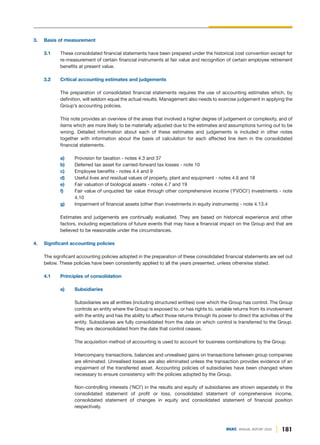
Estimates and judgements are continually evaluated. They are based on historical experience and other
factors, including expectations of future events that may have a financial impact on the Group and that are
believed to be reasonable under the circumstances.
4. Significant accounting policies
The significant accounting policies adopted in the preparation of these consolidated financial statements are set out
below. These policies have been consistently applied to all the years presented, unless otherwise stated.
4.1 Principles of consolidation
a) Subsidiaries
Subsidiaries are all entities (including structured entities) over which the Group has control. The Group
controls an entity where the Group is exposed to, or has rights to, variable returns from its involvement
with the entity and has the ability to affect those returns through its power to direct the activities of the
entity. Subsidiaries are fully consolidated from the date on which control is transferred to the Group.
They are deconsolidated from the date that control ceases.
The acquisition method of accounting is used to account for business combinations by the Group.
Intercompany transactions, balances and unrealised gains on transactions between group companies
are eliminated. Unrealised losses are also eliminated unless the transaction provides evidence of an
impairment of the transferred asset. Accounting policies of subsidiaries have been changed where
necessary to ensure consistency with the policies adopted by the Group.
Non-controlling interests ('NCI') in the results and equity of subsidiaries are shown separately in the
consolidated statement of profit or loss, consolidated statement of comprehensive income,
consolidated statement of changes in equity and consolidated statement of financial position
respectively.
182 ANNUAL REPORT 2020 DGKC
b) Changes in ownership interests
The Group treats transactions with non-controlling interests that do not result in a loss of control as
transactions with equity owners of the Group. A change in ownership interest results in an adjustment
between the carrying amounts of the controlling and non-controlling interests to reflect their relative
interests in the subsidiary. Any difference between the amount of the adjustment to non-controlling
interests and any consideration paid or received is recognised in a separate reserve within equity
attributable to owners of the Group.
When the Group ceases to consolidate because of a loss of control, any retained interest in the entity
is re-measured to its fair value, with the change in carrying amount recognised in consolidated
statement of profit or loss. This fair value becomes the initial carrying amount for the purposes of
subsequently accounting for the retained interest as an associate, joint venture or financial asset. In
addition, any amounts previously recognised in consolidated statement of comprehensive income in
respect of that entity are accounted for as if the Group had directly disposed of the related assets or
liabilities. This may mean that amounts previously recognised in consolidated statement of
comprehensive income are reclassified to consolidated statement of profit or loss.
4.2 Borrowings
Borrowings are initially recognised at fair value, net of transaction costs incurred. Borrowings are
subsequently measured at amortised cost. Any difference between the proceeds (net of transaction costs)
and the redemption amount is recognised in consolidated statement of profit or loss over the period of the
borrowings using the effective interest method.
Fees paid on the establishment of loan facilities are recognised as transaction costs of the loan to the extent
that it is probable that some or all of the facility will be drawn down. In this case, the fee is deferred until the
draw-down occurs. To the extent there is no evidence that it is probable that some or all of the facility will be
drawn down, the fee is capitalised as a prepayment for liquidity services and amortised over the period of the
facility to which it relates.
Borrowings are removed from the consolidated statement of financial position when the obligation specified
in the contract is discharged, cancelled or expired. The difference between the carrying amount of a financial
liability that has been extinguished or transferred to another party and the consideration paid, including any
non-cash assets transferred or liabilities assumed, is recognised in consolidated statement of profit or loss
as other income or finance costs.
Borrowings are classified as current liabilities unless the Group has an unconditional right to defer settlement
of the liability for at least 12 months after the reporting period.
4.3 Taxation
Income tax comprises current and deferred tax. Income tax is recognised in the consolidated statement of
profit or loss except to the extent that relates to items recognised directly in consolidated statement of
changes in equity or consolidated statement of comprehensive income, in which case it is recognised directly
in equity or consolidated statement of comprehensive income.
Current
Provision of current tax is based on the taxable income for the year determined in accordance with the
prevailing law for taxation of income. The charge for current tax is calculated using prevailing tax rates or tax
rates expected to apply to profit for the year if enacted after taking into account tax credits, rebates and
exemptions, if any. The charge for current tax also includes adjustments, where considered necessary, to
provision for tax made in previous years arising from assessments framed during the year for such years.
Deferred
Deferred tax is accounted for using the balance sheet liability method in respect of all temporary differences
183
DGKC ANNUAL REPORT 2020
arising from differences between the carrying amount of assets and liabilities in the consolidated financial
statements and the corresponding tax bases used in the computation of the taxable profit. However, the
deferred tax is not accounted for if it arises from initial recognition of an asset or liability in a transaction other
than a business combination that at the time of transaction neither affects accounting nor taxable profit or
loss. Deferred tax liabilities are generally recognised for all taxable temporary differences and deferred tax
assets are recognised to the extent that it is probable that taxable profits will be available against which the
deductible temporary differences, unused tax losses and tax credits can be utilised.
Deferred tax is calculated at the rates that are expected to apply to the period when differences reverse,
based on the tax rates (and tax laws) that have been enacted or substantively enacted by the statement of
reporting date. Deferred tax is charged or credited to the consolidated statement of profit or loss, except in
the case of items charged or credited to consolidated statement of comprehensive income or consolidated
statement of changes in equity in which case it is included in the consolidated statement of comprehensive
income or changes in equity.
4.4 Employee benefits
4.4.1 Short term obligations
Liabilities for wages and salaries, including non-monetary benefits and accumulating annual leaves
that are expected to be settled wholly within twelve months after the end of the period in which the
employees render the related service are recognised in respect of employees’ services up to the end
of the reporting period and are measured at the amounts expected to be paid when the liabilities are
settled. The liabilities are presented as current employee benefit obligations in the consolidated
statement of financial position.
4.4.2 Post employment benefits
(a) Defined benefit plan - Gratuity
The Cement segment operates an approved funded defined benefit gratuity plan for all regular
employees having a service period of more than five years for officers and six months for
workers. Provisions are made in the consolidated financial statements to cover obligations on
the basis of actuarial valuations carried out annually. The most recent valuation was carried out
as at June 30, 2020 using the "Projected Unit Credit Method".
The actual return on plan assets represents the difference between the fair value of plan assets
at the beginning of the year and as at the end of the year after adjustments for contributions
made by the Group as reduced by benefits paid during the year.
The amount recognized in consolidated statement of financial position represents the present
value of the defined benefit obligation as reduced by the fair value of the plan assets.
Actuarial gains and losses arising from experience adjustments and changes in actuarial
assumptions are charged or credited to equity in consolidated statement of comprehensive
income in the year in which they arise. Past service costs are recognized immediately in the
consolidated statement of profit or loss.
The future contribution rate of the plan includes allowances for deficit and surplus. Projected
Unit Credit Method, using the following significant assumptions, is used for valuation of this
scheme:
Discount rate 8.50% p.a.
Expected increase in eligible salary level 7.50% p.a.
Duration of the plan (years) 8
184 ANNUAL REPORT 2020 DGKC
The expected mortality rates assumed are based on the SLIC (2001-2005) mortality table set
back one year.
(b) Defined contribution plan
The Group operates a recognised provident fund for all its regular employees. Equal monthly
contributions are made to the fund both by the Group and the employees as follows:
Cement segment: at the rate of 10% of the basic salary for officers and 10% of basic salary plus
cost of living allowance for workers.
Paper segment: at the rate of 10% of the basic salary.
Dairy segment: at the rate of 9.5% of the basic salary.
The Group has no further payment obligations once the contributions have been paid. Obligation
for contributions to defined contribution plan is recognised as an expense in the consolidated
statement of profit or loss as and when incurred.
4.4.3 Accumulating compensated absences
The cement segment provides for accumulating compensated absences, when the employees
render services that increase their entitlement to future compensated absences. Under the service
rules, employees are entitled to 2.5 days leave per month. Unutilised leaves can be accumulated up
to 30 days in case of officers. However, leave policy for officers whose leave balance was already
accumulated to 90 days or above as of July 01, 2018 may keep leaves accumulated up to 90 days.
An officer is entitled to encash the unutilised earned leave accrued during the year. In addition, he
can also encash some portion of his accumulated leave balance during the year. Any further
unutilised leaves lapse. The earned leave encashment is based on basic salaries. In case of workers,
unutilised leaves may be accumulated up to 120 days, however, accumulated leave balance above
50 days is encashable upon demand of the worker. Unutilised leaves can be used at any time by all
employees, subject to the approval of the Group's management.
Provisions are made annually to cover the obligation for accumulating compensated absences
based on actuarial valuation and are charged to the consolidated statement of profit or loss . The
most recent valuation was carried out as at June 30, 2020 using the "Projected Unit Credit Method".
The amount recognised in the consolidated statement of financial position represents the present
value of the defined benefit obligations. Actuarial gains and losses are charged to the consolidated
statement of profit or loss immediately in the period when these occur.
Projected unit credit method, using the following significant assumptions, has been used for
valuation of accumulating compensated absences:
Discount rate 8.50% p.a.
Expected rate of increase in salary level per annum 7.50% p.a.
Expected mortality rate SLIC (2001-2005) mortality
table (setback 1 year)
Duration of the plan (years) 9
4.5 Trade and other payables
Trade and other payables are obligations to pay for goods or services that have been acquired in the ordinary
course of business from suppliers. These are recognised initially at fair value and subsequently measured at
amortised cost using the effective interest method.
185
DGKC ANNUAL REPORT 2020
4.6 Property, plant and equipment
4.6.1 Operating fixed assets
Operating fixed assets except freehold land are stated at cost less accumulated depreciation and
any identified impairment loss. Freehold land is stated at cost less any identified impairment loss.
Cost in relation to certain operating fixed assets signifies historical cost and borrowing costs as
referred to in note 4.20.
Depreciation on all operating fixed assets of the Group is charged to the consolidated statement of
profit or loss on the reducing balance method, except for plant and machinery and leasehold land of
the Cement and Paper segments, which are being depreciated using the straight line method, so as
to write off the depreciable amount of such assets over their estimated useful life at annual rates
mentioned in note 18.1 after taking into account their residual values.
The assets' residual values and useful lives are reviewed at each financial year end and adjusted if
impact on depreciation is significant. The Group's estimate of the residual value and useful life of its
operating fixed assets as at June 30, 2020 has not required any adjustment as its impact is
considered insignificant.
Depreciation on additions to operating fixed assets is charged from the month in which an asset is
available for use while no depreciation is charged for the month in which the asset is derecognised
or retired from active use.
An asset's carrying amount is written down immediately to its recoverable amount if the asset's
carrying amount is greater than its estimated recoverable amount as fully explained in note 4.8 to
these consolidated financial statements.
Subsequent costs are included in the asset's carrying amount or recognised as a separate asset, as
appropriate, only when it is probable that future economic benefits associated with the item shall
flow to the Group and the cost of the item can be measured reliably. All other repair and maintenance
costs are charged to consolidated statement of profit or loss during the period in which they are
incurred.
The gain or loss on disposal or retirement of an asset represented by the difference between the sale
proceeds and the carrying amount of the asset is recognised as an income or expense.
4.6.2 Major spare parts and stand-by equipment
Major spare parts and stand-by equipment qualify as property, plant and equipment when an entity
expects to use them for more than one year. Transfers are made to operating fixed assets category
as and when such items are available for use.
4.6.3 Capital work-in-progress
Capital work-in-progress is stated at cost less any identified impairment loss. All expenditure
including borrowing costs connected with specific assets incurred during installation and
construction period are carried under capital work-in-progress. These are transferred to operating
fixed assets as and when these are available for use.
4.7 Biological assets - Livestock
Livestock are measured at their fair value less estimated point-of-sale costs. Fair value of livestock is
determined by an independent valuer on the basis of best available estimates for livestock of similar
attributes. Milk is initially measured at its fair value less estimated point-of-sale costs at the time of milking.
The fair value of milk is determined based on market prices in the local area.
Gains or losses arising from changes in fair value less estimated point-of-sale costs of livestock is recognized
186 ANNUAL REPORT 2020 DGKC
in the consolidated statement of profit or loss.
Livestock are categorized as mature or immature. Mature livestock are those that have attained harvestable
specifications. Immature livestock have not yet reached that stage.
Farming cost such as feeding, labour cost, pasture maintenance, veterinary services and sheering are
expensed as incurred. The cost of purchase of cattle and transportation charges are capitalised as part of
biological assets.
4.8 Impairment of non-financial assets
Goodwill and intangible assets that have an indefinite useful life are not subject to amortisation and are tested
annually for impairment, or more frequently if events or changes in circumstances indicate that they might be
impaired. Other assets are tested for impairment whenever events or changes in circumstances indicate that
the carrying amount may not be recoverable. An impairment loss is recognised for the amount by which the
asset’s carrying amount exceeds its recoverable amount. The recoverable amount is the higher of an asset’s
fair value less costs of disposal and value in use. For the purposes of assessing impairment, assets are
grouped at the lowest levels for which there are separately identifiable cash inflows which are largely
independent of the cash inflows from other assets or groups of assets (cash-generating units). Non-financial
assets other than goodwill that suffered an impairment are reviewed for possible reversal of the impairment
at the end of each reporting period.
4.9 Leases
The Group is the lessee:
At inception of a contract, the Group assesses whether a contract is, or contains, a lease based on whether
the contract conveys the right to control the use of an identified asset for a period of time in exchange for
consideration. Lease terms are negotiated on an individual basis and contain a wide range of different terms
and conditions.
From July 1, 2019, leases are recognised as a right-of-use asset and a corresponding liability at the date at
which the leased asset is available for use by the Group.
The lease liability is initially measured at the present value of the lease payments that are not paid at the
commencement date, discounted using the interest rate implicit in the lease, or if that rate cannot be readily
determined, the Group's incremental borrowing rate.
Lease payments include fixed payments, variable lease payments that are based on an index or a rate
amounts expected to be payable by the lessee under residual value guarantees, the exercise price of a
purchase option if the lessee is reasonably certain to exercise that option, payments of penalties for
terminating the lease, if the lease term reflects the lessee exercising that option, less any lease incentives
receivable. The extension and termination options are incorporated in determination of lease term only when
the Group is reasonably certain to exercise these options.
The lease liability is subsequently measured at amortised cost using the effective interest rate method. It is
remeasured when there is a change in future lease payments arising from a change in fixed lease payments
or an index or rate, change in the Group's estimate of the amount expected to be payable under a residual
value guarantee, or if the Group changes its assessment of whether it will exercise a purchase, extension or
termination option. The corresponding adjustment is made to the carrying amount of the right-of-use asset,
or is recorded in the consolidated statement of profit or loss if the carrying amount of right-of-use asset has
been reduced to zero.
The right-of-use asset is initially measured based on the initial amount of the lease liability adjusted for any
lease payments made at or before the commencement date, plus any initial direct costs incurred and an
estimate of costs to dismantle and remove the underlying asset or to restore the underlying asset or the site
on which it is located, less any lease incentive received. The right-of-use asset is depreciated on a straight
line method over the lease term as this method most closely reflects the expected pattern of consumption of
187
DGKC ANNUAL REPORT 2020
future economic benefits. The right-of-use asset is reduced by impairment losses, if any, and adjusted for
certain remeasurements of the lease liability.
Payments associated with short-term leases and all leases of low-value assets are recognised on a
straight-line basis as an expense in the consolidated statement of profit or loss. Short-term leases are leases
with a lease term of 12 months or less without a purchase option.
4.10 Investments
Investments intended to be held for less than twelve months from the reporting date or to be sold to raise
operating capital, are included in current assets, all other investments are classified as non-current.
Management determines the appropriate classification of its investments at the time of the purchase and
re-evaluates such designation on a regular basis.
4.11 Stores, spares and loose tools
Stores, spare parts and loose tools are valued at moving weighted average cost except for items in transit
which are stated at invoice value plus other charges paid thereon till the reporting date. For items which are
slow moving and/or identified as obsolete, adequate provision is made for any excess book value over
estimated realizable value. The Group reviews the carrying amount of stores and spares on a regular basis
and provision is made for obsolescence.
4.12 Stock-in-trade
Stock of raw materials (except for those in transit), work in process and finished goods are valued principally
at the lower of weighted average cost and net realisable value ('NRV'). Stock of packing material is valued
principally at moving average cost. Cost of work-in-process and finished goods comprises cost of direct
materials, labour and related production overheads (based on normal operating capacity).
Materials in transit are stated at cost comprising invoice value plus other charges paid thereon.
Net realisable value is determined on the basis of estimated selling price of the product in the ordinary course
of business less estimated costs of completion and estimated cost necessary to make the sale.
If the expected net realisable value is lower than the carrying amount, a write-down is recognised for the
amount by which the carrying amount exceeds its net realisable value. Provision is made in the consolidated
financial statements for obsolete and slow moving stock-in-trade based on management estimate.
4.13 Financial assets
4.13.1 Classification
The Group classifies its financial assets in the following measurement categories:
- those to be measured subsequently at fair value [either through other comprehensive income
('OCI') or through profit or loss]; and
- those to be measured at amortised cost.
The classification depends on the Group’s business model for managing the financial assets and the
contractual terms of the cash flows.
For assets measured at fair value, gains and losses will either be recorded in profit or loss or OCI. For
investments in equity instruments that are not held for trading, this will depend on whether the Group
has made an irrevocable election at the time of initial recognition to account for the equity investment
at fair value through other comprehensive income.
The Group reclassifies debt investments when and only when its business model for managing those
188 ANNUAL REPORT 2020 DGKC
assets changes.
4.13.2 Recognition and derecognition
Regular way purchases and sales of financial assets are recognised on trade date, being the date on
which the Group commits to purchase or sell the asset. Financial assets are derecognised when the
rights to receive cash flows from the financial assets have expired or have been transferred and the
Group has transferred substantially all the risks and rewards of ownership.
4.13.3 Measurement
At initial recognition, the Group measures a financial asset at its fair value plus, in the case of a
financial asset not at fair value through profit or loss (FVPL), transaction costs that are directly
attributable to the acquisition of the financial asset. Transaction costs of financial assets carried at
FVPL are expensed in profit or loss.
Financial assets with embedded derivatives are considered in their entirety when determining
whether their cash flows are solely payments of principal and interest.
Debt instruments
Subsequent measurement of debt instruments depends on the Group’s business model for
managing the asset and the cash flow characteristics of the asset. There are three measurement
categories into which the Group classifies its debt instruments:
i) Amortised cost: Assets that are held for collection of contractual cash flows, where those cash
flows represent solely payments of principal and interest, are measured at amortised cost. Interest
income from these consolidated financial assets is included in other income using the effective
interest rate method. Any gain or loss arising on derecognition is recognised directly in profit or loss.
Impairment losses are presented as a separate line item in the consolidated statement of profit or
loss.
ii) FVOCI: Assets that are held for collection of contractual cash flows and for selling the financial
assets, where the assets’ cash flows represent solely payments of principal and interest, are
measured at FVOCI. Movements in the carrying amount are taken through OCI, except for the
recognition of impairment gains or losses, interest income and foreign exchange gains and losses,
which are recognised in profit or loss. When the financial asset is derecognised, the cumulative gain
or loss previously recognised in OCI is reclassified from equity to profit or loss. Interest income from
these consolidated financial assets is included in other income using the effective interest rate
method. Impairment expenses are presented as a separate line item in the consolidated statement
of profit or loss.
iii) FVPL: Assets that do not meet the criteria for amortised cost or FVOCI are measured at FVPL. A
gain or loss on a debt investment that is subsequently measured at FVPL is recognised in profit or
loss in the period in which it arises.
Equity instruments
The Group subsequently measures all equity investments at fair value. Where the Group’s
management has elected to present fair value gains and losses on equity investments in OCI, there
is no subsequent reclassification of fair value gains and losses to profit or loss following the
derecognition of the investment. Dividends from such investments continue to be recognised in
profit or loss as other income when the Group’s right to receive payments is established.
Changes in the fair value of financial assets at FVPL are recognised in the statement of profit or loss.
Impairment losses (and reversal of impairment losses) on equity investments measured at FVOCI are
not reported separately from other changes in fair value.
189
DGKC ANNUAL REPORT 2020
4.13.4 Impairment of financial assets other than investment in equity instruments
The Group assesses on a forward-looking basis the expected credit losses (ECL) associated with its
financial assets. The impairment methodology applied depends on whether there has been a
significant increase in credit risk. For trade debts, the Group applies IFRS 9 simplified approach to
measure the expected credit losses (loss allowance) which uses a life time expected loss allowance
to be recognised from initial recognition of the receivables while general 3-stage approach for loans,
deposits, other receivables and bank balances i.e. to measure ECL through loss allowance at an
amount equal to 12-month ECL if credit risk on a financial instrument or a group of financial
instruments has not increased significantly since initial recognition.
Following are the financial assets that are subject to the ECL model:
- Trade debts;
- Contract assets;
- Loans to employees;
- Loan to related party;
- Deposits and other receivables; and
- Bank balances.
The measurement of expected credit losses is a function of the probability of default, loss given
default (i.e. the magnitude of the loss if there is a default) and the exposure at default. The
assessment of the probability of default and loss given default is based on historical data adjusted
by forward-looking information (adjusted for factors that are specific to the counterparty, general
economic conditions and an assessment of both the current as well as the forecast direction of
conditions at the reporting date, including time value of money where appropriate). As for the
exposure at default for financial assets, this is represented by the assets’ gross carrying amount at
the reporting date. Loss allowances are forward looking, based on 12 month expected credit losses
where there has not been a significant increase in credit risk rating, otherwise allowances are based
on lifetime expected losses.
Expected credit losses are a probability weighted estimate of credit losses. The probability is
determined by the risk of default which is applied to the cash flow estimates. In the absence of a
change in credit rating, allowances are recognised when there is reduction in the net present value
of expected cash flows. On a significant increase in credit risk, allowances are recognised without a
change in the expected cash flows, although typically expected cash flows do also change; and
expected credit losses are rebased from 12 month to lifetime expectations.
The Group considers the probability of default upon initial recognition of asset and whether there has
been a significant increase in credit risk on an ongoing basis throughout each reporting period. To
assess whether there is a significant increase in credit risk, the Group compares the risk of a default
occurring on the instrument as at the reporting date with the risk of default as at the date of initial
recognition. It considers available reasonable and supportable forward-looking information.
The following indicators are considered while assessing credit risk:
- actual or expected significant adverse changes in business, financial or economic conditions that
are expected to cause a significant change to the debtor’s ability to meet its obligations;
- actual or expected significant changes in the operating results of the debtor;
- significant increase in credit risk on other financial instruments of the same debtor; and
- significant changes in the value of the collateral supporting the obligation or in the quality of
third-party guarantees, if applicable.
The Group considers the following as constituting an event of default for internal credit risk
management purposes as historical experience indicates that receivables that meet either of the
following criteria are generally not recoverable.
190 ANNUAL REPORT 2020 DGKC
- when there is a breach of financial covenants by the counterparty; or
- information developed internally or obtained from external sources indicates that the debtor is
unlikely to pay its creditors, including the Group, in full (without taking into account any collaterals
held by the Group).
Irrespective of the above analysis, in case of trade debts, the Group considers that default has
occurred when a debt is more than 360 days past due, unless the Group has reasonable and
supportable information to demonstrate that a more lagging default criterion is more appropriate.
A financial asset is credit-impaired when one or more events that have a detrimental impact on the
estimated future cash flows of that financial asset have occurred. Evidence that a financial asset is
credit-impaired includes observable data about the following events:
- significant financial difficulty of the issuer or the borrower;
- a breach of contract, such as a default or past due event;
- the lender(s) of the borrower, for economic or contractual reasons relating to the borrower’s
financial difficulty, having granted to the borrower a concession(s) that the lender(s) would not
otherwise consider;
- it is becoming probable that the borrower will enter bankruptcy or other financial reorganization; or
- the disappearance of an active market for that financial asset because of financial difficulties.
The Group recognises life time ECL on trade debts, using the simplified approach. The measurement
of ECL reflects:
- an unbiased and probability-weighted amount that is determined by evaluating a range of possible
outcomes;
- reasonable and supportable information that is available at the reporting date about past events,
current conditions and forecasts of future economic conditions.
Trade debts with individually significant balance are separately assessed for ECL measurement. All
other receivables are grouped and assessed collectively based on shared credit risk characteristics
and the days past due. The expected credit losses on these consolidated financial assets are
estimated using a provision matrix approach based on the Group’s historical credit loss experience,
adjusted for factors that are specific to the debtors, general economic conditions and an assessment
of both the current as well as the forecast direction of conditions at the reporting date, including time
value of money where appropriate.
Where lifetime ECL is measured on a collective basis to cater for cases where evidence of significant
increases in credit risk at the individual instrument level may not yet be available, the financial
instruments are grouped on the following basis:
- Nature of financial instruments;
- Past-due status;
- Nature, size and industry of debtors; and
- external credit ratings where available.
The grouping is regularly reviewed by management to ensure the constituents of each group
continue to share similar credit risk characteristics.
191
DGKC ANNUAL REPORT 2020
The Group recognizes an impairment gain or loss in the consolidated statement of profit or loss for
financial assets with a corresponding adjustment to their carrying amount through a loss allowance
account, except for investments in debt instruments that are measured at FVOCI, for which the loss
allowance is recognised in other comprehensive income and accumulated in the investment
revaluation reserve, and does not reduce the carrying amount of the financial asset in the
consolidated statement of financial position.
The Group writes off financial assets, in whole or in part, when it has exhausted all practical recovery
efforts and has concluded there is no reasonable expectation of recovery. The assessment of no
reasonable expectation of recovery is based on unavailability of debtor’s sources of income or assets
to generate sufficient future cash flows to repay the amount. The Group may write-off financial assets
that are still subject to enforcement activity. Subsequent recoveries of amounts previously written off
will result in impairment gains.
4.14 Financial liabilities
All financial liabilities are recognized at the time when the Group becomes a party to the contractual
provisions of the instrument. Financial liabilities at amortised cost are initially measured at fair value less
transaction costs. Financial liabilities at fair value through profit or loss are initially recognised at fair value and
transaction costs are expensed on profit or loss.
Financial liabilities, other than those at fair value through profit or loss, are subsequently measured at
amortised cost using the effective yield method.
A financial liability is derecognized when the obligation under the liability is discharged or cancelled or
expired. Where an existing financial liability is replaced by another from the same lender on substantially
different terms, or the terms of an existing liability are substantially modified, such an exchange or
modification is treated as a derecognition of the original liability and the recognition of a new liability, and the
difference in respective carrying amounts is recognized in the consolidated statement of profit or loss.
4.15 Offsetting of financial assets and liabilities
Financial assets and liabilities are offset and the net amount is reported in the consolidated financial
statements only when there is a legally enforceable right to set off the recognised amount and the Group
intends either to settle on a net basis or to realise the assets and to settle the liabilities simultaneously.
4.16 Trade debts and other receivables
Trade debts and other receivables are recognised initially at the amount of consideration that is
unconditional, unless they contain significant financing component in which case such are recognised at fair
value. The Group holds the trade debts with the objective of collecting the contractual cash flows and
therefore measures the trade debts subsequently at amortised cost using the effective interest rate method
less loss allowance.
4.17 Cash and cash equivalents
For the purpose of presentation in the consolidated statement of cash flows, cash and cash equivalents
includes cash on hand, deposits held at call with financial institutions, other short-term, highly liquid
investments with original maturities of three months or less that are readily convertible to known amounts of
cash and which are subject to an insignificant risk of changes in value, and bank overdrafts. Bank overdrafts
are shown within borrowings in current liabilities in the consolidated statement of financial position. Book
overdrafts are shown within trade and other payables in current liabilities.
192 ANNUAL REPORT 2020 DGKC
4.18 Foreign currency transactions and translation
a) Transactions and balances
Foreign currency transactions are translated into the functional currency using the exchange rates at
the dates of the transactions. Foreign exchange gains and losses resulting from the settlement of such
transactions, and from the translation of monetary assets and liabilities denominated in foreign
currencies at year end exchange rates, are generally recognised in consolidated statement of profit or
loss.
All foreign exchange gains and losses including foreign exchange gains and losses that relate to
borrowings are presented in the consolidated statement of profit or loss on a net basis within
exchange gains/(losses). Non-monetary items that are measured at fair value in a foreign currency are
translated using the exchange rates at the date when the fair value was determined. Translation
differences on assets and liabilities carried at fair value are reported as part of the fair value gain or
loss.
b) Functional and presentation currency
Items included in the consolidated financial statements of the Group are measured using the currency
of the primary economic environment in which the Group operates (the functional currency). The
financial statements are presented in Pak Rupees, which is the Group’s functional and presentation
currency.
4.19 Provisions
Provisions for legal claims and make good obligations are recognised when the Group has a present legal or
constructive obligation as a result of past events, it is probable that an outflow of resources will be required
to settle the obligation, and the amount can be reliably estimated.
Provisions are not recognised for future operating losses. Where there are a number of similar obligations, the
likelihood that an outflow will be required in settlement is determined by considering the class of obligations
as a whole. A provision is recognised even if the likelihood of an outflow with respect to any one item included
in the same class of obligations may be small.
Provisions are measured at the present value of management’s best estimate of the expenditure required to
settle the present obligation at the end of the reporting period. The discount rate used to determine the
present value is a pre-tax rate that reflects current market assessments of the time value of money and the
risks specific to the liability. The increase in the provision due to the passage of time is recognised as interest
expense.
4.20 Borrowing costs
General and specific borrowing costs directly attributable to the acquisition, construction or production of
qualifying assets, which are assets that necessarily take a substantial period of time to get ready for their
intended use or sale, are added to the cost of those assets, until such time as the assets are substantially
ready for their intended use or sale.
Investment income earned on the temporary investment of specific borrowings pending their expenditure on
qualifying assets is deducted from the borrowing costs eligible for capitalisation.
All other borrowing costs are recognised in consolidated statement of profit or loss in the period in which they
are incurred.
4.21 Revenue recognition
Revenue is recognised when or as performance obligations are satisfied by transferring control of a promised
good or service to a customer, and control either transfers over time or at a point in time. Revenue is
193
DGKC ANNUAL REPORT 2020
measured at fair value of the consideration received or receivable, excluding discounts, commissions and
government levies. Revenue is recognised upon satisfaction of performance obligations.
In case of local sales for all segments, except for made-to-order paper products produced by the paper
segment, revenue is recognised at the time of despatch of goods from the factory.
In case of export sales, the delivery of goods and transportation are two distinct performance obligations and
the total transaction price is allocated to each performance obligation. Revenue relating to each performance
obligation is recognized on satisfaction of each distinct performance obligation.
In case of made-to-order paper products, revenue is recognised over time.
4.22 Share capital
Ordinary shares are classified as equity and recognized at their face value. Incremental costs directly
attributable to the issue of new shares are shown in equity as a deduction, net of tax, if any.
4.23 Dividend
Dividend distribution to the Group's members is recognised as a liability in the period in which the dividends
are approved.
4.24 Segment reporting
Segment reporting is based on the operating (business) segments of the Group. An operating segment is a
component of the Group that engages in business activities from which it may earn revenues and incur
expenses, including revenues and expenses that relate to transactions with any of the Group’s other
components. An operating segment’s operating results are reviewed regularly by the Chief Operating
Decision Makers (the CODMs) to make decisions about resources to be allocated to the segment and assess
its performance, and for which discrete financial information is available. The CODM, who is responsible for
allocating resources and assessing performance of the operating segments, has been identified as the Board
of Directors of the parent pompany.
Segment results that are reported to the CODMs include items directly attributable to a segment as well as
those that can be allocated on a reasonable basis. Unallocated items comprise mainly corporate assets,
income tax assets, liabilities and related income and expenses. Segment capital expenditure is the total cost
incurred during the year to acquire property, plant and equipment.
The business segments are engaged in providing products or services which are subject to risks and rewards
which differ from the risk and rewards of other segments.
The Group’s strategic steering committee, consisting of the Board of Directors of the parent company,
examines the Group’s performance both from a product and geographic perspective and has identified three
reportable segments of its business:
Cement Segment: Production and sale of clinker, ordinary portland and sulphate resistant cements.
Paper Segment: Manufacture and supply of paper products and packing material.
Dairy Segment: Production and sale of raw milk.
4.25 Contingent liabilities
Contingent liability is disclosed when:
- there is a possible obligation that arises from past events and whose existence will be confirmed only by
the occurrence or non occurrence of one or more uncertain future events not wholly within the control of the
Group; or
- there is present obligation that arises from past events but it is not probable that an outflow of resources
194 ANNUAL REPORT 2020 DGKC
embodying economic benefits will be required to settle the obligation or the amount of the obligation cannot
be measured with sufficient reliability.
4.26 Contract asset and contract liability
A contract asset is recognised for the Group’s right to consideration in exchange for goods or services that
it has transferred to a customer. If the Group performs by transferring goods or services to a customer before
the customer pays consideration or before payment is due, the Group presents the amount as a contract
asset, excluding any amounts presented as a receivable.
A contract liability is recognised for the Group’s obligation to transfer goods or services to a customer for
which the Group has received consideration (or an amount of consideration is due) from the customer. If a
customer pays consideration, or the Group has a right to an amount of consideration that is unconditional
(i.e. a receivable), before the Group transfers a good or service to the customer, the entity shall present the
contract as a contract liability when the payment is made or the payment is due (whichever is earlier).
4.27 Rounding of amounts
All amounts disclosed in the consolidated financial statements and notes have been rounded off to the
nearest thousand Rupees unless otherwise stated.
5. Issued, subscribed and paid up share capital
2020 2019 2020 2019
(Number of shares) (Rupees in thousand)
343,512,029 343,512,029 Ordinary shares of Rs 10 each
fully paid in cash 3,435,120 3,435,120
20,000,000 20,000,000 Ordinary shares of Rs 10 each
issued for consideration other
than cash - note 5.2 200,000 200,000
74,607,089 74,607,089 Ordinary shares of Rs 10 each issued
as fully paid bonus shares 746,071 746,071
438,119,118 438,119,118 4,381,191 4,381,191
5.1 137,574,201 (2019: 137,574,201), 228,500 (2019: 228,500) and 3,358,344 (2019: 3,358,344) ordinary shares
of the parent company are held by the following related parties; Nishat Mills Limited, Security General
Insurance Company Limited and Adamjee Insurance Company Limited respectively.
Nishat Mills Limited is an Investor as per International Accounting Standard ('IAS') 28, 'Investments in
Associates and Joint Ventures'.
5.2 20,000,000 ordinary shares of Rs 10 each were issued to the shareholders of D. G. Khan Electric Company
Limited upon its merger with the Parent company on July 01, 1999. These shares were issued as
consideration of merger against all assets, properties, rights, privileges, powers, bank accounts, trade marks,
patents, leaves and licenses of D. G. Khan Electric Company Limited.
195
DGKC ANNUAL REPORT 2020
2020 2019
(Rupees in thousand)
6. Other reserves
Movement in and composition of reserves is as follows:
Capital reserves
- Share premium - note 6.1 4,557,163 4,557,163
- FVOCI reserve - note 6.2 17,150,139 18,852,083
- Capital redemption reserve fund - note 6.3 353,510 353,510
22,060,812 23,762,756
Revenue reserve
- General reserve 5,110,851 5,110,851
27,171,663 28,873,607
6.1 This reserve can be utilised by the Group only for the purposes specified in section 81 of the Companies Act,
2017.
6.2 This represents the unrealised gain on remeasurement of equity investments at FVOCI and is not available for
distribution.
6.3 The Capital redemption reserve fund represents fund created for redemption of preference shares. In
accordance with the terms of issue of preference shares, to ensure timely payments, the Group was required
to maintain a redemption fund with respect to preference shares. The Group had created a redemption fund
and appropriated Rs 7.4 million each month from the consolidated statement of profit or loss in order to
ensure that fund balance at redemption date was equal to the principal amount of the preference shares. The
preference shares were redeemed during the year ended June 30, 2007.
2020 2019
(Rupees in thousand)
7. Long term finances - secured
Long-term loans - notes 7.1 & 7.2 24,728,690 21,875,324
Current portion shown under current liabilities - note 15 (2,049,484) (5,215,850)
22,679,206 16,659,474
196 ANNUAL REPORT 2020 DGKC
Local
1
The
Bank
of
Punjab
400,000
450,000
**
Base
rate
+
0.25%
8
equal
semi-annual
instalments
ending
in
December
2024
Half
yearly
2
Habib
Bank
Limited
300,000
450,000
*
Base
rate
+
0.25%
4
equal
quarterly
instalments
ending
in
December
2021
Quarterly
3
Habib
Bank
Limited
2,000,000
2,250,000
*
Base
rate
+
0.20%
8
equal
semi-annual
instalments
ending
in
December
2024
Quarterly
4
Habib
Bank
Limited
1,999,844
2,249,824
*
Base
rate
+
0.3%
8
equal
semi-annual
instalments
ending
in
December
2024
Quarterly
5
Bank
Alfalah
Limited
2,000,000
2,250,000
**
Base
rate
+
0.25%
8
equal
semi-annual
instalments
ending
in
December
2024
Quarterly
6
National
Bank
of
Pakistan
2,242,500
2,541,500
*
Base
rate
+
0.25%
15
equal
quarterly
instalments
ending
in
October
2024
Quarterly
7
BankIslami
Pakistan
Limited
100,000
300,000
**
Base
rate
+
0.2%
2
equal
quarterly
instalments
ending
in
September
2021
Quarterly
8
Standard
Chartered
Bank
(Pakistan)
Limited
500,000
1,000,000
*
Base
rate
+
0.15%
3
equal
quarterly
instalments
ending
in
December
2021
Quarterly
9
National
Bank
of
Pakistan-Islamic
1,000,000
1,000,000
**
Base
rate
+
0.25%
10
equal
semi-annual
instalments
starting
in
June
2021
Half
yearly
10
Allied
Bank
Limited
5,230,222
5,884,000
*
Base
rate
+
0.2%
16
equal
quarterly
instalments
ending
in
March
2025
Quarterly
11
Allied
Bank
Limited
900,000
900,000
*
Base
rate
+
0.35%
20
equal
quarterly
instalments
starting
in
August
2021
Quarterly
12
Bank
Alfalah
Limited
1,375,000
1,750,000
*
Base
rate
+
0.35%
11
equal
quarterly
instalments
ending
in
November
2023
Quarterly
13
Bank
Alfalah
Limited
1,500,000
-
*
Base
rate
+
0.75%
16
equal
quarterly
instalments
starting
in
March
2022
Quarterly
14
Allied
Bank
Limited
1,000,000
-
*
Base
rate
+
0.60%
12
equal
quarterly
instalments
starting
in
May
2022
Quarterly
15
Allied
Bank
Limited
570,338
-
***
Base
rate
+
0.5%
8
equal
quarterly
instalments
starting
in
January
2021
Quarterly
16
National
Bank
of
Pakistan
2,864,717
-
*
Base
rate
+
0.75%
20
equal
quarterly
instalments
starting
in
August
2022
Quarterly
17
Habib
Bank
Limited
480,000
600,000
**
Base
rate
+
0.30%
10
equal
semi-annual
instalments
ending
in
February
2025
Half
yearly
18
The
Bank
of
Punjab
222,222
250,000
**
Base
rate
+0.2%
9
equal
semi-annual
instalments
ending
in
October
2024
Half
yearly
19
Bank
Alfalah
Limited
28,505
-
****
Base
rate
+
1.5%
8
equal
quarterly
instalments
starting
in
January
2021
Quarterly
20
Allied
Bank
Limited
15,342
-
****
Base
rate
+
0.5%
8
equal
quarterly
instalments
starting
in
January
2021
Quarterly
24,728,690
21,875,324
*
Base
rate:
Average
ask
rate
of
three-month
Karachi
Inter-Bank
Offered
Rate
('KIBOR')
to
be
reset
for
each
mark-up
period.
**
Base
rate:
Average
ask
rate
of
six-month
KIBOR
to
be
reset
for
each
mark-up
period.
***
This
represents
long
term
financing
facility
availed
from
Allied
Bank
Limited
under
State
Bank
of
Pakistan's
(SBP)
Refinance
Scheme
for
Payment
of
Wages
and
Salaries
to
the
Workers
and
Employees
of
Business
Concerns
('Refinance
Scheme'),
subject
to
the
approval
of
SBP.
The
total
facility
available
amounts
to
Rs
575
million.
The
base
rate
applicable
during
the
year
is
three-month
KIBOR
to
be
reset
for
each
mark-up
period.
However,
subsequently
in
August
2020,
the
SBP
has
granted
approval
to
one
tranche
of
this
loan
amounting
Rs
187.004
million
under
the
Refinance
Scheme
resulting
in
changing
of
existing
base
rate
to
SBP
rate
which
is
0%.
****
These
represent
long
term
financing
facilities
availed
under
State
Bank
of
Pakistan's
(SBP)
Refinance
Scheme
for
Payment
of
Wages
and
Salaries
to
the
Workers
and
Employees
of
Business
Concerns
('Refinance
Scheme'),
subject
to
the
approval
of
SBP.
The
total
facility
available
from
Bank
Alfalah
Limited
and
Allied
Bank
Limited
amounts
to
Rs
15.324
million
and
Rs
31.260
million,
respectively.
The
base
rate
applicable
during
the
year
is
SBP
rate
which
is
0%.
7.1
Long
term
loans
-
secured
Lender
Loan
Number
of
instalments
outstanding
Mark-up
payable
2020
2019
(Rupees
in
thousand)
Rate
of
mark-up
per
annum
197
DGKC ANNUAL REPORT 2020
7.2 Security
Loan 1
First pari passu charge over present and future fixed assets of the Cement segment for Rs 667 million with
25% margin.
Loan 2
First pari passu charge over present and future fixed assets of the Cement segment for Rs 2,000 million with
25% margin.
Loan 3
First pari passu charge over present and future fixed assets of the Cement segment for Rs 3,333.34 million
with 25% margin.
Loan 4
First pari passu charge over present and future fixed assets of the Cement segment for Rs 3,333.34 million
with 25% margin.
Loan 5
First pari passu charge over present and future fixed assets of the Cement segment for Rs 3,333.34 million
with 25% margin.
Loan 6
First pari passu charge over present and future fixed assets of the Cement segment for Rs 4,000 million with
25% margin.
Loan 7
First pari passu charge over present and future fixed assets of the Cement segment for Rs 1,000 million.
Loan 8
First pari passu charge over present and future fixed assets of the Cement segment for Rs 2,666 million.
Loan 9
First pari passu charge over present and future fixed assets of the Cement segment for Rs 1,333.34 million.
Loan 10
First pari passu charge over present and future fixed assets of the Cement segment for Rs 7,867 million with
25% margin.
Loan 11
First pari passu charge over present and future fixed assets of the Cement segment for Rs 1,200 million with
25% margin.
Loan 12
First pari passu charge over present and future fixed assets of the Cement segment for Rs 2,667 million.
Loan 13
Ranking charge over fixed assets of the Cement segment for Rs 2,000 million to be upgraded to first pari
passu charge.
Loan 14
Ranking charge over fixed assets of the Cement segment for Rs 1,333.33 million to be upgraded to first pari
passu charge.
Loan 15
Ranking charge over fixed assets of the Cement segment for Rs 760 million to be upgraded to first pari passu
charge.
Loan 16
First pari passu charge over present and future fixed assets of the Cement segment for Rs 6,993.33 million
with 25% margin.
Loan 17
First pari passu hypothecation charge on present and future fixed assets (Plant and Machinery) of the Paper
segment with 25% margin.
Loan 18
First pari passu charge over present and future operating fixed assets (Plant and Machinery) of the Paper
segment.
Loan 19 and 20
Such loans are unsecured.
198 ANNUAL REPORT 2020 DGKC
2020 2019
(Rupees in thousand)
7.3 The reconciliation of the carrying amount is as follows:
Opening balance 21,875,324 20,667,971
Disbursements during the year 6,278,293 3,850,000
Repayments during the year (3,424,927) (2,642,647)
- note 7.1 24,728,690 21,875,324
Current portion shown under current liabilities - note 15 (2,049,484) (5,215,850)
22,679,206 16,659,474
8. Long term deposits
Customers 152,152 139,863
Others 101,785 102,180
253,937 242,043
These include interest free security deposits from stockists and suppliers and are repayable on
cancellation/withdrawal of the dealership or on cessation of business with the Group. As per the agreements signed
with these parties, the Group has the right to utilise the amounts for the furtherance of their business, hence, the
amounts are not required to be kept in a separate account maintained in a scheduled bank. Therefore, the Group is
in compliance with section 217 of Companies Act, 2017. These deposits have not been carried at amortised cost
since the effect of discounting is immaterial in the context of these consolidated financial statements.
2020 2019
(Rupees in thousand)
9. Deferred liabilities
Staff gratuity - note 9.1 362,292 298,240
Accumulating compensated absences - note 9.2 159,542 150,954
521,834 449,194
9.1 Staff gratuity
The amounts recognised in the consolidated
statement of financial position are as follows:
Present value of defined benefit obligation 798,510 708,876
Fair value of plan assets (436,218) (410,636)
Liability as at June 30 362,292 298,240
9.1.1 Movement in net liability for staff gratuity
Net liability as at beginning of the year 298,240 161,815
Current service cost 79,585 67,473
Net interest on defined benefit obligation 96,177 50,661
Return on plan assets during the year (57,093) (38,007)
118,669 80,127
Total remeasurements for the year (credited)/charged to
consolidated statement of comprehensive income (11,963) 98,738
Contributions made by the Group during the year (42,654) (42,440)
Liability as at June 30 362,292 298,240
199
DGKC ANNUAL REPORT 2020
2020 2019
(Rupees in thousand)
9.1.2 Movement in present value of defined benefit obligation
Present value of defined benefit obligation as at
beginning of the year 708,876 584,159
Current service cost 79,585 67,473
Interest cost 96,177 50,661
Benefits paid during the year (62,620) (42,522)
Remeasurements:
- Actuarial (gains)/losses from changes in financial assumptions (7,149) 5,656
- Experience adjustments (16,359) 43,449
(23,508) 49,105
Present value of defined benefit obligation as at June 30 798,510 708,876
9.1.3 Movement in fair value of plan assets
Fair value of plan assets as at beginning of the year 410,636 422,344
Interest income on plan assets 57,093 38,007
Contributions during the year 42,654 42,440
Benefits paid during the year (62,620) (42,522)
Remeasurements in fair value of plan assets (11,545) (49,633)
Fair value of plan assets as at June 30 436,218 410,636
9.1.4 Plan assets
Plan assets are comprised as follows:
2020 2019
(Rs in '000') Percentage (Rs in '000') Percentage
Plan assets
Cash and bank balances 66,033 15.14% 8,854 2.16%
Debt instruments 312,552 71.65% 264,525 64.42%
Special Savings Certificates
with accrued interest 57,633 13.21% 77,284 18.82%
Deposits - 0.00% 59,973 14.60%
436,218 100.00% 410,636 100.00%
2020 2019
(Rupees in thousand)
9.1.5 Charge for the year
Current service cost 79,585 67,473
Interest cost 96,177 50,661
Interest income on plan assets (57,093) (38,007)
Total expense for the year 118,669 80,127
200 ANNUAL REPORT 2020 DGKC
2020 2019
(Rupees in thousand)
9.1.6 Total remeasurements charged to consolidated statement
of comprehensive income
Actuarial (gains)/losses from changes in financial assumptions (7,149) 5,656
Experience adjustments (16,359) 43,449
(23,508) 49,105
Remeasurements in plan assets, excluding interest income 11,545 49,633
Total remeasurements (credited) / charged to consolidated
statement of comprehensive income (11,963) 98,738
9.1.7 Assumptions used for valuation of the defined benefit scheme for management and
non-management staff are as under:
2020 2019
Discount rate Per annum 8.50% 14.25%
Expected rate of increase in salary Per annum 7.50% 13.25%
Rate of interest income on plan assets Per annum 8.50% 14.25%
Duration of the plan Number of years 8 8
9.1.8 Year end sensitivity analysis (±100 bps) on defined benefit obligation is as follows:
Salary Salary
Discount rate Discount rate increase rate increase rate
+ 100 bps 100 bps + 100 bps - 100 bps
(Rupees in thousand)
Present value of defined
benefit obligation 733,780 861,897 862,624 732,096
9.1.9 The Group expects to pay Rs 112.632 million in contributions to defined benefit plan during the year
ending June 30, 2021.
9.1.10 The Group faces the following risks on account of gratuity fund:
- Final salary risk (linked to inflation risk) – the risk that the final salary at the time of cessation of
service is greater than the assumed salary. Since the benefit is calculated on the final salary (which
will closely reflect inflation and other macroeconomic factors), the benefit amount increases as salary
increases.
- Mortality risk – the risk that the actual mortality experience is different than the assumed mortality.
This effect is more pronounced in schemes where the age and service distribution is on the higher
side.
- Withdrawal risk – the risk of actual withdrawals experience is different from assumed withdrawal
probability. The significance of the withdrawal risk varies with the age, service and the entitled
benefits of the beneficiary.
2020 2019
(Rupees in thousand)
9.2 Accumulating compensated absences
Opening balance 150,954 143,327
Charged to profit or loss 59,661 85,899
Payments made during the year (12,793) (38,055)
197,822 191,171
Current portion shown under current liabilities - note 15 (38,280) (40,217)
Closing balance 159,542 150,954
201
DGKC ANNUAL REPORT 2020
2020 2019
(Rupees in thousand)
9.2.1 Movement in liability for accumulating
compensated absences
Present value of accumulating compensated
absences as at beginning of the year 150,954 143,327
Current service cost 53,353 48,693
Interest cost 17,872 9,377
Benefits due but not paid (38,280) (40,217)
Benefits paid during the year (12,793) (38,055)
Remeasurement in respect of experience
adjustments (11,564) 27,829
Present value of accumulating compensated
absences as at June 30 159,542 150,954
9.2.2 Charge for the year
Current service cost 53,353 48,693
Interest cost 17,872 9,377
Remeasurement during the year (11,564) 27,829
Total expense for the year 59,661 85,899
9.2.3 Assumptions used for valuation of the accumulating compensated absences are as under:
2020 2019
Discount rate Per annum 8.50% 14.25%
Expected rate of increase in salary Per annum 7.50% 13.25%
Duration of the plan Number of years 9 9
Expected withdrawal and early retirement rate SLIC 2001-2005 SLIC 2001-2005
mortality table mortality table
9.2.4 Year end sensitivity analysis (± 100 bps) on obligation:
Salary Salary
Discount rate Discount rate increase rate increase rate
+ 100 bps - 100 bps + 100 bps - 100 bps
(Rupees in thousand)
Present value of obligation 146,495 174,733 174,557 146,425
9.2.5 The Group faces the following risks on account of accumulating compensated absences:
- Final salary risk (linked to inflation risk) – the risk that the final salary at the time of cessation of
service is greater than the assumed salary. Since the benefit is calculated on the final salary (which
will closely reflect inflation and other macroeconomic factors), the benefit amount increases as salary
increases.
- Mortality risk – the risk that the actual mortality experience is different than the assumed mortality.
This effect is more pronounced in schemes where the age and service distribution is on the higher
side.
- Withdrawal risk – the risk of actual withdrawals experience is different from assumed withdrawal
probability. The significance of the withdrawal risk varies with the age, service and the entitled
benefits of the beneficiary.
202 ANNUAL REPORT 2020 DGKC
2020 2019
(Rupees in thousand)
10. Deferred taxation
The liability for deferred taxation comprises taxable/(deductible)
temporary differences relating to:
Deferred tax liability
Accelerated tax depreciation 10,692,298 10,089,118
Borrowing cost capitalised 7,346 -
Un-realised gain on long term investment 89,791 51,164
Gain arising from changes in fair value of biological assets 185,888 97,364
10,975,323 10,237,646
Deferred tax assets
Available unused tax credits (1,993,723) (2,296,972)
Available unused tax losses (6,069,483) (3,459,113)
Loss allowance on financial assets (37,260) (8,212)
Provision for retirement and other benefits (147,392) (128,790)
Others (4,083) (4,863)
(8,251,941) (5,897,950)
2,723,382 4,339,696
The gross movement in net deferred tax liability during the year is as follows:
Opening balance 4,339,696 4,299,861
EEffect of initial application of IFRS 9 and IFRS 15 - 12,647
Charged/(credited) to other comprehensive income 43,184 (361,224)
(Credited)/charged to statement of profit or loss - note 37 (1,666,956) 388,439
Other adjustments 7,458 (27)
Closing balance 2,723,382 4,339,696
Deferred tax assets have been recognized to the extent that the realisation of related tax benefits is probable from
reversal of existing taxable temporary differences and future taxable profits. Based on the Cement segment's
approved business plan, it is probable that sufficient taxable profits will be available for utilization of deferred tax
assets. With respect to the Dairy segment, the tax losses available for carry forward at June 30, 2020 are estimated
at Rs 386.546 million (2019: Rs 402.261 million) and minimum tax available for carry forward under section 113 of the
Income Tax Ordinance, 2001 is estimated at Rs 43.132 million (2019: Rs 16.852 million). The Group has not
recognised deferred tax asset in respect of the above losses and minimum tax available for carry forward under
section 113 of the Income Tax Ordinance, 2001 as sufficient taxable profits would not be available to utilise these in
the foreseeable future and would expire as follows:
Accounting year to which Amount of unused tax loss Accounting year in which tax
tax loss tax relates (Rupees in '000) loss will expire
2020 289,541 2026
2019 97,005 2025
386,546
Accounting year to which Amount of minimum tax Accounting year in which
minimum tax relates (Rupees in '000) minimum tax will expire
2020 26,280 2025
2019 13,151 2024
2018 3,701 2023
43,132
2020 2019
(Rupees in thousand)
11. Trade and other payables
Trade creditors - note 11.1 4,007,304 3,285,085
Bills payable 154,946 269,518
Infrastructure cess 210,404 195,650
Contract liability 1,636,864 555,107
Accrued liabilities - note 11.2 & 11.6 4,125,247 3,603,737
Workers' profit participation fund - note 11.3 105,036 205,773
Workers' welfare fund 3,899 -
Sales tax payable 280 148
Federal excise duty payable 874,586 33,936
Withholding tax payable 9,185 12,866
Retention money payable 112,585 120,275
Export commission payable 97,640 52,268
Book overdraft - note 11.4 23,814 87,470
Others - note 11.5 73,137 68,909
11,434,927 8,490,742
11.1 Trade creditors includes amount due to the following related parties:
Nishat Agriculture Farming (Private) Limited 48,547 21,861
Security General Insurance Company Limited 1,616 10,729
50,163 32,590
11.2 Includes Gas Infrastructure Development Cess (GIDC) that was levied through GIDC Act, 2015. Subsequent
to the year end, the Supreme Court of Pakistan has upheld the GIDC Act, 2015 to be constitutional and
intravires. The Group intends to file a review against the said decision.
2020 2019
(Rupees in thousand)
11.3 Workers' profit participation fund
Opening balance 205,773 407,637
Provision for the year - note 34 9,747 112,078
Interest for the year - note 36 8,534 -
224,054 519,715
Payments made during the year (119,018) (313,942)
Closing balance 105,036 205,773
203
DGKC ANNUAL REPORT 2020
204 ANNUAL REPORT 2020 DGKC
11.4 This represents book overdraft balances due to unpresented cheques in respect of saving bank accounts.
11.5 Includes payable to employees' provident fund amounting to Rs 0.296 million (2019: Rs 6.62 million). The
maximum aggregate amount outstanding at the end of any month during the year of employees' provident
fund was Rs 0.296 million (2019: Rs 670.13 million)
11.6 This includes reversal of excess provision in respect of previous years amounting to Rs 526.463 million.
2020 2019
(Rupees in thousand)
12. Accrued markup
Accrued mark-up/interest on:
- Long term loans - secured 442,431 453,324
- Short term borrowings - secured 360,992 437,540
803,423 890,864
13. Short term borrowings - secured
Short term running finances - secured - note 13.1 15,482,467 13,636,227
Import finances - secured - note 13.2 6,483,558 7,924,789
Export finances - secured - note 13.3 3,883,500 1,290,000
25,849,525 22,851,016
13.1 Short term running finances - secured
Short term running finances available from various commercial banks under mark-up arrangements
aggregate to Rs 29,763 million (2019: Rs 23,075 million). Such facilities are available at mark-up rates ranging
from one to three months Karachi Inter-Bank Offered Rate ('KIBOR') plus 0.05% to 1.5% per annum (2019:
one to three months KIBOR plus 0.05% to 1.5% per annum). The mark-up rate charged during the year on
the outstanding balance ranged from 8.33% to 15.35% (2019: 6.45% to 13.6%) per annum and mark-up is
payable monthly to quarterly. These are secured by first registered charge on all present and future current
assets of the Group wherever situated including stores and spares, stock in trade, book debts, investments,
receivables.
13.2 Import finances - secured
Import finance facilities available from various commercial banks under mark-up arrangements aggregate to
Rs 17,170 million (2019: Rs 14,670 million). Such facilities are available at mark-up rates ranging from one to
six months KIBOR plus 0.010% to 0.2% per annum (2019: one to three months KIBOR plus 0.010% to 0.2%
per annum) and one to six months London Inter-Bank Offered Rate ('LIBOR') plus 0.75% per annum (2019:
one to six months LIBOR plus 0.5% per annum). The mark-up rate charged during the year on the
outstanding balance ranged from 1.74% to 14.67% (2019: 2.38% to 12.37%) per annum and mark-up is
payable on settlement. The aggregate import finances are secured by a registered charge on all present and
future current assets of the Cement segment and Paper segment, wherever situated, including stores and
spares, stock in trade, trade debts, investments and other receivables.
13.2 Export finances - secured
Export finance facilities available from various commercial banks under mark-up arrangements aggregate to
Rs 10,650 million (2019: Rs 4,350 million). Such facilities are available at mark-up rate as per the State Bank
of Pakistan's (SBP) Export Finance Scheme plus 0.25% to 1.00% per annum (2019: mark-up rate as per
SBP's Export Finance Scheme plus 0.25% to 0.35% per annum). The Export Finance Scheme rate has
remained constant at 2% throughout the year, however, in respect of a certain facility, KIBOR plus 0.3% was
charged for a certain period. These loans are obtained for a period of 180 days and are secured against pari
passu hypothecation charge over current assets of the Cement Segment.
13.4 Letters of credit and guarantees
Of the aggregate facility of Rs 29,280 million (2019: Rs 16,880 million) for opening letters of credit and Rs
4,170 million (2019: Rs 4,600 million) for guarantees, all being either main limits or sub-limits of the facilities,
the amount utilised as at June 30, 2020 was Rs 3,966.761 million (2019: Rs 2,398 million) and Rs 2,915 million
(2019: Rs 2,812 million) respectively. The facilities for opening letters of credit are secured against lien over
import documents whereas aggregate facilities for guarantees are secured against registered joint pari passu
charge over the present and future current assets of the Group. Of the facility for guarantees, Rs 14.48 million
(2019: Rs 14.48 million) is secured by a lien over bank deposits as referred to in note 29.2.
14. This represents unsecured and interest free loans provided by the three directors (including Chief Executive) of
Nishat Dairy (Private) Limited to finance the working capital requirements. The loan amount was initially repayable
within one year from the execution date, i.e. September 20, 2017, which was then extended for another year in 2018
and 2019 when the amount became due. The un-availed facility of loan as at June 30, 2020 is Nil (2019: Nil).
2020 2019
(Rupees in thousand)
15. Current portion of non-current liabilities
Long term finances - note 7 2,049,484 5,215,850
Accumulating compensated absences - note 9.2 38,280 40,217
2,087,764 5,256,067
16. Unclaimed dividend
The disclosures required under section 244 of the Companies Act, 2017 are as follows:
2020 2019
(Rupees in thousand)
Amounts transferred into unpaid dividend account 34,000 -
Dividend claims received and settled 962 939
Profits generated from unpaid dividend account - -
Profits utilised - -
The reconciliation of carrying amount is as follows:
Opening balance 33,438 28,346
Dividends declared 438,119 1,862,006
Interest on dividend - -
Dividends paid (437,720) (1,856,914)
Closing balance 33,837 33,438
17. Contingencies and commitments
17.1 Contingencies
17.1.1 The matter relating to interpretation of provisions of section 4(2) of the repealed Central Excise Act,
1944 (1944 Act) has now attained finality after having been adjudicated by the honourable Supreme
Court of Pakistan through its judgment dated January 27, 2009 (upholding its previous judgment
dated February 15, 2007). The longstanding controversy between the Revenue Department and the
tax payers related primarily to finer interpretation of the provisions of section 4(2) of the 1944 Act
wherein the department had a view that excise duty shall be included as a component for
determination of the value (retail price) for levying excise duty. The departmental view, being against
the spirit of law, was challenged by the taxpayers in appeals before the honourable High Courts of
Pakistan which, duly appreciating the contentions of the taxpayers, overturned the departmental
205
DGKC ANNUAL REPORT 2020
view and succeeded the appeals.
Now, since the controversy has attained finality up to the highest appellate level, the Group has
initiated the process of claiming refund of excess excise duty paid by it during the periods from 1994
to 1999 which aggregates Rs 1,115.145 million. The amount of refund, however, shall be
incorporated in the books of account once it is realized by the Group.
17.1.2 The Income Tax Officer, while framing the assessments for the assessment years 1984-85 to
1990-91, has taxed the income of the Group on account of the interest on the deposits and sale of
scrap etc. The Appellate Tribunal on appeal filed by the Group issued an order in favour of the Group
for the assessment years 1984-85 to 1990-91. The Income Tax Department filed reference before the
Lahore High Court. Pending final outcome of such reference, no adjustment has been made in these
consolidated financial statements for the relief granted by the Appellate Tribunal aggregating Rs
35.090 million.
Contingent liabilities:
17.1.3 During the period 1994 to 1996, the Group imported plant and machinery relating to expansion unit,
for which exemption was claimed under various SROs from the levy of custom duty and other duties
including sales tax. As per the provisions of SRO 484(I)/92, 978(I)/95 and 569(I)/95, the exemption
from the statutory duty would be available only if the said plant and machinery was not manufactured
locally. However, the Custom Authorities rejected the claim of the Group by arguing that the said
machinery was on the list of locally manufactured machinery, published by the Federal Board of
Revenue. Consequently, the Group appealed before the Lahore High Court, Multan Bench, which
allowed the Group to release the machinery on furnishing indemnity bonds with the Custom
Authorities.
Collector of Customs and Central Excise, Multan, passed an order dated November 26, 1999,
against the Group on the grounds that the said machinery was being manufactured locally during the
time when it was imported.
After various appeals at different forums, the honourable Supreme Court of Pakistan remanded the
case back to the Customs Authorities to reassess the liability of the Group. The custom authorities
re-determined the liability of the Group upon which the Group preferred an appeal to the Customs
Appellate Tribunal. The Tribunal decided the case in favour of the Group, upon which the Group
discharged all liabilities. However, the custom authorities preferred a reference to the Lahore High
Court, Multan Bench on November 19, 2013. Last hearing of the case was conducted on June 25,
2018. In case of any adverse decision, the management assesses liability to the tune of Rs 233.390
million. No provision for this amount has been made in the consolidated financial statements as
according to the management of the Group, there are meritorious grounds that the ultimate decision
would be in its favour.
17.1.4 The Competition Commission of Pakistan ('the CCP') took suo moto action under Competition
Ordinance, 2007 and issued Show Cause Notice on October 28, 2008 for increase in prices of
cement across the country. The similar notices were also issued to All Pakistan Cement
Manufacturers Association ('APCMA') and its member cement manufacturers. The Group filed a Writ
Petition in the Lahore High Court. The Lahore High Court, vide its order dated August 24, 2009
allowed the CCP to issue its final order. The CCP accordingly passed an order on August 28, 2009
and imposed a penalty of Rs 933 million on the Group. The Lahore High Court vide its order dated
August 31, 2009 restrained the CCP from enforcing its order against the Group for the time being.
The vires of the Competition Commission of Pakistan have been challenged by a large number of
petitioners and all have been advised by their legal counsels that prima facie the Competition
Ordinance, 2007 is ultra vires of the Constitution of Pakistan. The Honourable Supreme Court of
Pakistan sent the appeals of the petitioners to newly formed Competition Appellate Tribunal ('CAT')
to decide the matter. the Group has challenged sections 42, 43 and 44 of the Competition Act, 2010
in the Sindh High Court. The Honourable Sindh High Court upon petition filed by large number of
petitioners gave direction to CAT to continue with the proceedings and not to pass a final order till
the time petition is pending in Sindh High Court. No provision for this amount has been made in the
206 ANNUAL REPORT 2020 DGKC
consolidated financial statements as according to the management of the Group, there are
meritorious grounds that the ultimate decision would be in its favour.
17.1.5 The Honourable Sindh High Court passed an Order dated September 17, 2008 in which it rendered
the fifth version of law enforcing infrastructure cess as valid and intravires. The Group filed an appeal
in the Sindh High Court against the fifth and subsequent versions of the infrastructure cess. The
parties finally reached an interim arrangement, through an order of the Sindh High Court dated May
31, 2011, for the release of 50% of the guarantees pertaining to consignments between December
28, 2006 to May 30, 2011, while the remainder amounting to Rs 89.164 million was kept alive till the
disposal of the case which remains pending in the Sindh High Court. According to the legal counsel
of the Group, chances of favourable outcome of the appeal are fair, therefore, 50% of the amount of
infrastructure cess payable has not been incorporated in these consolidated financial statements
amounting to Rs 89.164 million.
17.1.6 The Group, consequent to the order-in-appeal passed by the learned Customs, Federal Excise and
Sales Tax Appellate Tribunal, Lahore, filed a petition before the Lahore High Court on March 27,
2008, challenging the levy of sales tax on the in-house consumption of Shale, Gypsum and
Limestone for the period from June 13, 1997 to August 11, 1998. Last hearing of the case was
conducted on December 17, 2015. According to the legal counsel of the Group, chances of
favourable outcome of the petition are fair, therefore the payable amount has not been incorporated
in these consolidated financial statements amounting to Rs 212.239 million.
17.1.7 The Group filed an appeal before the Commissioner Inland Revenue (CIR) (Appeals), against the
amended assessment order dated June 29, 2014 passed by the Additional Commissioner Inland
Revenue under section 122(9)/122(5A) of the Income Tax Ordinance, 2001 for the tax year 2008.
Through this order an income tax demand of Rs 184.61 million was created against the Group.
Objection was raised on various issues like difference in raw material purchases in income tax and
sales tax records, unexplained/unsubstantiated tax deductions claimed, difference in federal excise
duty and sales tax liability as per income tax and sales tax returns, brought forward losses not
allowed, etc. The assessment order was decided in favor of the Group by the CIR (Appeals) against
which the department has filed appeal before the Appellate Tribunal Inland Revenue which is
pending adjudication. The management, based on the advice of its legal counsel, is confident that
the matter will be decided in its favor and no financial obligation is expected to accrue.
Consequently, no provision has been made in these consolidated financial statements.
17.1.8 The banks have issued the following guarantees on Group's behalf in favour of:
- Collector of Customs, Excise and Sales Tax against levy of sales tax, custom duty and excise
amounting to Rs 31.115 million (2019: Rs 34.772 million).
- Director, Excise Collection Office, Sindh Development and Maintenance against recovery of
infrastructure fee amounting to Rs 805.9 million (2019: Rs 755.9 million).
- The President of the Islamic Republic of Pakistan against the performance of a contract to Frontier
Works Organization amounting to Rs 0.5 million (2019: Rs 0.5 million).
- Sui Northern Gas Pipelines Limited against supply of 6 MMCFD and 14 MMCFD gas for captive use
at cement segment plants at Khairpur and at D. G. Khan respectively amounting to Rs 544.414
million (2019: Rs 544.414 million) and against connection of gas supply for Sukheki Farm of Dairy
segment amounting to Rs 26.6 million (2019: Rs 26.6 million).
- Sindh High Court against levy of sales tax, custom duty and excise amounting to Rs 176.860 million
(2019: Rs 176.860 million).
- Export orders amounting to Rs 5.042 million (2019: Rs 2.434 million).
- K-Electric Limited against supply of electricity to Hub plant of cement segment amounting to Rs
142.4 million (2019: Rs 142.4 million).
207
DGKC ANNUAL REPORT 2020
- Supreme Court of Pakistan in respect of Katas Raj Temple water shortage case amounting to Nil
(2019: Rs 600 million).
- Director, Excise and Taxation, Karachi under direction of Sindh High Court in respect of suit filed for
levy of infrastructure cess amounting to Rs 16 million (2019: Rs 16 million).
- Metro Habib Cash and Carry against purchase of goods and supplies on credit amounting to Rs 2
million (2019: Rs 2 million).
- Directorate General of Customs Valuation, Customs House Karachi on account of valuation ruling
amounting to Rs 22.65 million (2019: Rs 25.19 million); and
- Director Excise and Taxation, Karachi on account of infrastructure development cess amounting to
Rs 92.647 million (2019: Rs 91.33 million).
17.1.9 The Group has provided a guarantee to Meezan Bank Limited (MBL) against the loan provided by
MBL to Hyundai Nishat Motor (Private) Limited, a related party, amounting to Rs 1,208.524 million
(2019: Rs 550 million).
17.1.10 The Group has issued a post dated cheque in favour of Nazir of the High Court of Sindh amounting
to Rs 227.76 million (2019: Nil) against the Industrial Support Package Adjustment on K-Electric
electricity bills.
17.2 Commitments in respect of:
(i) Contracts for capital expenditure Rs 2,614.855 million (2019: Rs 1,600.703 million).
(ii) Letters of credit for capital expenditure Rs 2.237.133 million (2019: Rs 935.353 million).
(iii) Letters of credit other than capital expenditure Rs 1,397.913 million (2019: Rs 1,436.660 million).
(iv) The amount of future payments under leases and the period in which these payments will become
due are as follows:
2020 2019
(Rupees in thousand)
Not later than one year 425 425
Later than one year and not later than five years 1,699 1,699
Later than five years 4,712 5,125
6,836 7,249
18. Property, plant and equipment
Operating fixed assets - note 18.1 80,612,174 80,783,631
Capital work-in-progress - note 18.2 6,369,586 3,010,897
Major spare parts and stand-by equipment - note 18.3 192,500 42,308
87,174,260 83,836,836
208 ANNUAL REPORT 2020 DGKC
Freehold
land
-
note
18.1.2
-
2,178,948
16,690
2,195,638
-
-
-
2,195,638
Leasehold
land
3.33
263,000
-
263,000
24,706
8,767
33,473
229,527
Buildings
on
freehold
land
-
Factory
building
5
to
10
23,345,324
103,223
23,448,547
6,041,943
923,366
6,965,309
16,483,238
-
Office
building
and
housing
colony
5
3,277,090
2,531
3,279,621
702,195
134,604
836,799
2,442,822
Roads
10
2,308,797
15,454
2,324,251
521,862
181,734
703,596
1,620,655
Plant
and
machinery
3
to
9
68,867,483
3,024,340
71,790,910
18,925,653
1,893,946
20,817,839
50,973,071
(100,913)
(1,760)
Factory
equipment
10
71,718
1,581
73,299
43,193
13,782
56,975
16,324
Quarry
equipment
10
4,421,134
130,767
4,551,901
1,778,220
212,161
1,990,381
2,561,520
Furniture,
fixture
and
office
equipment
10
to
30
932,999
123,972
1,056,462
440,152
167,159
607,087
449,375
(509)
(224)
Vehicles
20
966,946
67,301
996,489
374,341
109,083
462,474
534,015
(37,758)
(20,950)
Aircraft
30
328,752
-
328,752
298,723
8,992
307,715
21,037
Power
and
water
supply
lines
10
3,695,326
402,247
4,097,573
722,898
289,373
1,012,621
3,084,952
-
350
110,657,517
3,888,106
114,406,443
29,873,886
3,942,967
33,794,269
80,612,174
(139,180)
(22,584)
18.1
Operating
fixed
assets
Book
value
as
at
June
30,
2020
Accumulated
depreciation
as
at
July
01,
2019
Accumulated
depreciation
as
at
June
30,
2020
Depreciation
charge/
(deletions)
for
the
year
Cost
as
at
July
01,
2019
Cost
as
at
30
June
2020
Annual
rate
of
depreciation
%
Additions/
(Deletions)
2020
(Rupees
in
thousand)
209
DGKC ANNUAL REPORT 2020
210 ANNUAL REPORT 2020 DGKC
Freehold
land
-
2,125,019
53,929
2,178,948
-
-
-
2,178,948
Leasehold
land
3.33
63,000
200,000
263,000
22,050
2,656
24,706
238,294
Buildings
on
freehold
land
-
Factory
building
5
to
10
21,922,016
1,423,308
23,345,324
5,140,505
901,438
6,041,943
17,303,381
-
Office
building
and
housing
colony
5
2,724,061
553,029
3,277,090
586,955
115,240
702,195
2,574,895
Roads
10
1,470,283
838,514
2,308,797
408,603
113,259
521,862
1,786,935
Plant
and
machinery
3.33
to
60
65,955,749
2,941,956
68,867,483
17,114,675
1,824,009
18,925,653
49,941,830
(30,222)
(13,031)
Factory
equipment
10
68,369
3,349
71,718
27,755
15,438
43,193
28,525
Quarry
equipment
10
3,946,993
474,141
4,421,134
1,558,719
219,501
1,778,220
2,642,914
Furniture,
fixture
and
office
equipment
10
to
30
743,808
189,365
932,999
277,974
162,278
440,152
492,847
(174)
(100)
Vehicles
20
762,505
270,932
966,946
311,095
100,978
374,341
592,605
(66,491)
(37,732)
Aircraft
30
328,752
-
328,752
285,877
12,846
298,723
30,029
Power
and
water
supply
lines
10
3,552,177
143,149
3,695,326
419,104
303,794
722,898
2,972,428
103,662,732
7,091,672
110,657,517
26,153,312
3,771,437
29,873,886
80,783,631
(96,887)
(50,863)
18.1.1
Freehold
land
and
building
includes
book
values
of
Rs
12
million
(2019:
Rs
12
million)
and
Rs
4.959
million
(2019:
Rs
4.907
million)
respectively
which
are
held
in
the
name
of
Chief
Executive.
This
property
is
located
in
the
locality
of
Defence
Housing
Authority,
Lahore,
where
the
bye-laws
restrict
transfer
of
title
of
the
residential
property
in
the
name
of
a
company.
Book
value
as
at
June
30,
2019
Accumulated
depreciation
as
at
July
01,
2018
Accumulated
depreciation
as
at
June
30,
2019
Depreciation
charge/
(deletions)
for
the
year
Cost
as
at
July
01,
2018
Cost
as
at
30
June
2019
Annual
rate
of
depreciation
%
Additions/
(Deletions)
2019
(Rupees
in
thousand)
18.1.2
Following
are
the
particulars
of
the
Group’s
immovable
fixed
assets:
Cement
Segment
Location
Usage
of
immovable
property
Total
Area
(in
Acres)
Hub,
Mauza
Chichai,
Balochistan
Plant
site
and
staff
colony
1466.5
Khairpur
district,
Chakwal,
Punjab
Plant
site
and
staff
colony
901.5
Kanrach
Nai,
District
Lasbela,
Balochistan
Source
of
raw
material
723.14
Dera
Ghazi
Khan,
Punjab
Plant
site
and
staff
colony
590
Lakho
Dair,
Lahore,
Punjab
Processing
site
45
Gulberg,
Lahore,
Punjab
Administrative
offices
1.5
Others
Sales
offices
0.28
Dairy
segment
Moza
Katrani
Tehsil
Pindi
Bhattian,
District
Hafizabad,
Sukheki
Plant
site
214.57
Moza
Harsa
Attla
Tehsil
Pindi
Bhattian,
District
Hafizabad,
Sukheki
Plant
site
0.75
There
are
no
immoveable
fixed
assets
of
the
Paper
segment.
2020
2019
(Rupees
in
thousand)
18.1.3.
The
depreciation
charge
for
the
year
has
been
allocated
as
follows:
Cost
of
sales
-
note
31
3,851,776
3,688,264
Administrative
expenses
-
note
32
83,288
74,556
Selling
and
distribution
expenses
-
note
33
7,903
8,617
3,942,967
3,771,437
18.1.4
Book
values
of
operating
fixed
assets
consist
of
the
following
with
respect
to
operating
segments:
Cement
segment
Paper
segment
Dairy
segment
Total
2020
2019
2020
2019
2020
2019
2020
2019
(Rupees
in
thousand)
Plant
and
machinery
49,043,105
48,093,269
1,488,934
1,359,821
441,032
488,740
50,973,071
49,941,830
All
other
assets
27,943,431
28,835,719
132,560
331,319
1,563,112
1,674,763
29,639,103
30,841,801
Total
76,986,536
76,928,988
1,621,494
1,691,140
2,004,144
2,163,503
80,612,174
80,783,631
211
DGKC ANNUAL REPORT 2020
Plant
and
machinery
Outside
parties
Izhar
Construction
(Private)
Limited
7,265
7,152
5,128
(2,024)
Negotiation
Izhar
Construction
(Private)
Limited
7,179
6,874
5,128
(1,746)
-do-
Izhar
Construction
(Private)
Limited
8,120
7,994
5,677
(2,317)
-do-
Izhar
Construction
(Private)
Limited
78,349
77,134
47,067
(30,067)
-do-
Virk
International
11,932
7,361
3,700
(3,661)
-do-
Nishat
Mills
Limited
-
related
party
18,290
9,831
21,349
11,518
-do-
Vehicles
Employee
Muhammad
Alam
1,887
1,112
1,112
-
As
per
Group
policy
Aftab
Ahmad
Khan
(Key
Management
Personnel)
2,387
1,433
1,433
-
-do-
Aftab
Ahmad
Khan
(Key
Management
Personnel)
2,734
1,479
1,479
-
-do-
Nasir
Iqbal
2,396
1,950
-
(1,950)
-do-
Arif
Bashir
(Key
Management
Personnel)
2,521
1,318
2,237
919
-do-
Rana
Rasheed
Ahmad
1,786
869
869
-
-do-
Azam
Munir
1,771
912
912
-
-do-
Muhammad
Ghaffar
Rao
1,953
797
-
(797)
-do-
Ahson
Atta
2,503
1,067
1,067
-
-do-
Mazhar
ul
Haq
1,815
1,477
1,480
3
-do-
Outside
parties
Mrs.
Neham
Khalil
2,546
893
1,575
682
Auction
18.1.5
Sale
of
operating
fixed
assets
Detail
of
operating
fixed
assets
sold
off
during
the
year
is
as
follows:
Mode
of
disposal
Gain
/
(Loss)
on
disposal
Sales
proceeds
Book
value
Sold
to
Particulars
of
assets
Cost
2020
(Rupees
in
thousand)
212 ANNUAL REPORT 2020 DGKC
Plant
and
machinery
Outside
parties
Virk
International
11,932
7,361
3,700
(3,661)
Negotiation
Nishat
Mills
Limited
-
related
party
18,290
9,831
21,349
11,518
-do-
Vehicles
Employee
Muhammad
Aslam
1,971
999
999
-
As
per
Group
policy
Mushtaq
Ahmed
1,786
1,123
1,123
-
-do-
Muhammad
Aslam
1,971
1,200
1,200
-
-do-
Zakki
Nasir
1,846
886
1,750
864
Negotiation
Outside
parties
Shafaqat
Ali
1,555
530
1,333
803
Auction
Nisar
Ahmed
Qureshi
2,483
1,655
1,655
-
-do-
Abdul
Hameed
1,555
562
1,328
766
-do-
Khurram
Imtiaz
1,971
902
2,020
1,118
-do-
Mehmood
Dasti
(ex-employee)
1,771
1,065
1,065
-
-do-
Mukhtar
Ahmad
1,971
1,002
1,016
14
-do-
Adnan
Qureshi
1,606
605
1,408
803
-do-
Muhamamd
Asim
Mumtaz
2,521
1,563
1,563
-
-do-
Adnan
Naseer
1,715
1,116
1,650
534
-do-
Mohsin
Jamshed
2,095
1,492
2,277
785
-do-
Muhammad
Yousuf
1,673
538
1,290
752
-do-
Mode
of
sale
Gain
/
(Loss)
on
sale
Sales
proceeds
Book
value
Sold
to
Particulars
of
assets
Cost
2019
(Rupees
in
thousand)
213
DGKC ANNUAL REPORT 2020
214 ANNUAL REPORT 2020 DGKC
18.2
Capital
work-in-progress
2020
(Rupees
in
thousand)
Civil
works
997,839
592,425
74,564
(113)
2,047,729
(3,069,651)
-
-
642,793
Plant
and
machinery
1,728,297
4,603,693
-
(11,510)
(2,024,670)
(11,052)
(435,020)
(71,118)
3,778,620
Advances
to
suppliers
and
contractors
236,442
534,575
-
-
(568,403)
-
-
-
202,614
Others
48,319
16,374
-
-
(46,494)
(1,585)
-
-
16,614
Expansion
Project:
-
Civil
works
-
397,735
-
-
568,402
-
-
-
966,137
-
Plant
and
machinery
-
573,559
27,917
-
23,436
-
-
-
624,912
-
Others
-
137,896
-
-
-
-
-
137,896
-
1,109,190
27,917
-
591,838
-
-
-
1,728,945
3,010,897
6,856,257
102,481
(11,623)
-
(3,082,288)
(435,020)
(71,118)
6,369,586
Balance
as
at
July
1,
2019
Capital
expenditure
incurred
during
the
year
Borrowing
cost
capitalized
during
the
year
Charged
off
during
the
year
Transfers
within
capital
work-in-progress
Transfers
to
operating
fixed
assets
Transfers
to
major
spare
parts
and
stand
by
equipment
Transfers
to
stores,
spare
parts
and
loose
tools
Balance
as
at
June
30,
2020
2019
(Rupees
in
thousand)
Civil
works
224,683
974,048
-
-
27,457
(228,349)
-
-
997,839
Plant
and
machinery
761,287
2,442,800
-
-
414,374
(1,126,124)
(764,040)
-
1,728,297
Advances
to
suppliers
and
contractors
17,565
816,782
-
-
(533,587)
(8,611)
(55,707)
-
236,442
Others
1,585
35,325
11,409
-
-
-
-
-
48,319
Expansion
Project:
-
Civil
works
496,086
1,293,880
-
(263)
262,146
(2,051,849)
-
-
-
-
Plant
and
machinery
304,763
211,847
-
-
1,004,700
(1,521,310)
-
-
-
-
Advances
to
suppliers
and
contractors
1,175,090
-
-
-
(1,175,090)
-
-
-
-
-
Others
-
764,884
-
-
-
(764,884)
-
-
-
1,975,939
2,270,611
-
(263)
91,756
(4,338,043)
-
-
-
2,981,059
6,539,566
11,409
(263)
-
(5,701,127)
(819,747)
-
3,010,897
Balance
as
at
July
1,
2019
Capital
expenditure
incurred
during
the
year
Borrowing
cost
capitalized
during
the
year
Charged
off
during
the
year
Transfers
within
capital
work-in-progress
Transfers
to
operating
fixed
assets
Transfers
to
major
spare
parts
and
stand
by
equipment
Transfers
to
stores,
spare
parts
and
loose
tools
Balance
as
at
June
30,
2020
2020 2019
(Rupees in thousand)
18.3 Major spare parts and stand-by equipment
The reconciliation of carrying amount is as follows:
Balance at the beginning of the year 42,308 91,766
Additions during the year 728,837 441,880
771,145 533,646
Transfers made during the year (578,645) (491,338)
Balance at the end of the year 192,500 42,308
18.4 All operating fixed assets of cement and paper segments are pledged as security against long term finances
as referred to in note 7.
19. This represents dairy livestock. It consists of the following:
- Mature 664,297 628,302
- Immature 213,388 198,687
- Bulls 3,655 499
- note 19.1 881,340 827,488
19.1 Reconciliation of carrying amounts of dairy livestock
Opening balance 827,488 636,403
Fair value gain due to new births 90,347 77,658
Changes in fair value (due to price change, exchange
fluctuations and biological transformation) - notes 19.3 & 19.4 214,909 258,081
305,256 335,739
Decrease due to deaths/ livestock losses (45,217) (21,099)
Decrease due to sale of livestock (206,187) (123,555)
(251,404) (144,654)
Carrying amount at the end of the year which
approximates the fair value 881,340 827,488
19.2 As at June 30, 2020, the Group held 2,957 (2019: 2,959) mature assets able to produce milk and 2,670 (2019:
2,677) immature assets that are being raised to produce milk in the future. During the year, 1043 (2019: 890)
cows were sold. During the year, the Group produced approximately 25.159 million (2019: 24.143 million)
gross liters of milk from these biological assets. As at June 30, 2020, the Group also held 48 (2019: 45)
immature male calves.
19.3 The valuation of dairy livestock as at June 30, 2020 has been carried out by an independent valuer. In this
regard, the valuer examined the physical condition of the livestock, assessed the key assumptions and
estimates and relied on the representations made by the Group as at June 30, 2020. Further, in the absence
of an active market of the Group's dairy livestock in Pakistan, market and replacement values of similar live
stock from active markets in Netherlands and Australia, have been used as basis of valuation model by the
independent valuer. The cost of transportation to Pakistan is also considered. The milking animals have been
classified according to their lactations. As the number of lactations increase, the fair value keeps on
decreasing.
19.4 This includes exchange gain on translation amounting to Rs 44.512 million (2019: Rs 198.845 million).
215
DGKC ANNUAL REPORT 2020
2020 2019
(Rupees in thousand)
20. Investments
These represent the long term investments in:
- Related parties - note 20.1 9,480,285 9,899,326
- Others - note 20.2 93,455 130,481
9,573,740 10,029,807
20.1 Related parties
FVOCI - quoted:
Nishat (Chunian) Limited
7,173,982 (2019: 7,173,982) fully paid
ordinary shares of Rs 10 each
Equity held: 2.99% (2019: 2.99%)
Cost - Rs 75.565 million (2019: Rs 75.565 million) 232,796 251,233
MCB Bank Limited
22,192,793 (2019: 22,129,793) fully paid
ordinary shares of Rs 10 each
Equity held: 1.87% (2019: 1.87%)
Cost - Rs 305.113 million (2019: Rs 294.838 million) 3,596,786 3,860,543
Adamjee Insurance Company Limited
27,877,735 (2019: 27,877,735) fully paid
ordinary shares of Rs 10 each
Equity held: 7.97% (2019: 7.97%)
Cost - Rs 1,239.698 million (2019: Rs 1,239.698 million) 923,032 977,115
Nishat Mills Limited
30,289,501 (2019: 30,289,501) fully paid
ordinary shares of Rs 10 each
Equity held: 8.61% (2019: 8.61%)
Cost - Rs 1,326.559 million (2019: Rs 1,326.559 million) 2,362,884 2,827,222
sub-total 7,115,498 7,916,113
FVOCI - unquoted:
Nishat Hotels and Properties Limited
104,166,667 (2019: 104,166,667) fully paid
ordinary shares of Rs 10 each
Equity held: 10.42% (2019: 10.42%)
Cost - Rs 1,041.667 million (2019: Rs 1,041.667 million) - note 20.1.1 1,452,837 1,433,213
Hyundai Nishat Motor (Private) Limited
74,750,000 (2019: 55,000,000) fully paid
ordinary shares of Rs 10 each
Equity held: 10% (2019: 10%)
Cost - Rs 747.5 million (2019: Rs 550 million) - note 20.1.2 911,950 550,000
2,364,787 1,983,213
9,480,285 9,899,326
216 ANNUAL REPORT 2020 DGKC
20.1.1 This represents investment in the ordinary shares of Nishat Hotels and Properties Limited ('NHPL')
which is principally engaged in establishing and managing a multi-purpose facility including a
shopping mall, hotel and banquet halls in Johar Town, Lahore, by the name of 'Nishat Emporium'.
Since NHPL's ordinary shares are not listed, an independent valuer engaged by the Group has
estimated a fair value of Rs 13.95 per ordinary share as at June 30, 2020 through a valuation
technique based on discounted cash flow analysis of NHPL. Hence, it has been classified under level
3 of fair value hierarchy as further explained in note 46.3 to these consolidated financial statements.
The fair value gain of Rs 19.624 million is included in the fair value gain recognised during the year in
other comprehensive income.
The main level 3 inputs used by the Group are derived and evaluated as follows:
- Discount rate is determined using a capital asset pricing model to calculate a post-tax rate that
reflects current market assessments of the time value of money and the risk specific to NHPL.
- Long term growth rate is estimated based on historical performance of NHPL and current market
information for similar type of entities.
The significant assumptions used in this valuation technique are as follows:
- Discount rate of 8.74% per annum.
- Long term growth rate of 2% per annum for computation of terminal value.
- Annual growth in costs is linked to inflation at 5.60% per annum.
- NHPL has multiple sources of revenue. Annual growth in revenue ranges from 4.50% to 10% per
annum depending upon inflation and other factors.
Sensitivity analysis
Sensitivity analysis of the significant assumptions used in the valuation technique are as follows:
If the discount rate increases by 1% with all other variables held constant, the impact on fair value
as at June 30, 2020 would be Rs 327.593 million lower.
If the long term growth rate decreases by 1% with all other variables held constant, the impact on
fair value as at June 30, 2020 would be Rs 186.736 million lower.
If inflation decreases by 1% with all other variables held constant, the impact on fair value as at June
30, 2020 would be Rs 86.697 million lower.
If interest rate increases by 1% with all other variables held constant, the impact on fair value as at
June 30, 2020 would be Rs 67.611 million lower.
20.1.2 This represents investment in the ordinary shares of Hyundai Nishat Motor (Private) Limited
('HNMPL') that has setup up a greenfield project for assembly and sales of Hyundai Motor Company
passenger and commercial vehicles. Since HNMPL's ordinary shares are not listed, an independent
valuer engaged by the Group has estimated a fair value of Rs 12.20 per ordinary share as at June 30,
2020 through a valuation technique based on discounted cash flow analysis of HNMPL. Hence, it
has been classified under level 3 of fair value hierarchy as further explained in note 46.3 to these
consolidated financial statements. The fair value gain of Rs 164.45 million is included in the fair value
gain recognised during the year in other comprehensive income.
The main level 3 inputs used by the Group are derived and evaluated as follows:
- Discount rate is determined using a capital asset pricing model to calculate a post-tax rate that
reflects current market assessments of the time value of money and the risk specific to HNMPL.
217
DGKC ANNUAL REPORT 2020
- Long term growth rate is estimated based on historical performance of HNMPL and current market
information for similar type of entities.
The significant assumptions used in this valuation technique are as follows:
- Discount rate of 14.87% per annum.
- Long term growth rate of 2% per annum for computation of terminal value.
- Annual growth in costs are linked to inflation and currency devaluation at 7% per annum and
revenues are linked to currency devaluation at 7% per annum.
Sensitivity analysis
Sensitivity analysis of the significant assumptions used in the valuation technique are as follows:
If the discount rate increases by 1% with all other variables held constant, the impact on fair value
as at June 30, 2020 would be Rs 138.288 million lower.
If the long term growth rate decreases by 1% with all other variables held constant, the impact on
fair value as at June 30, 2020 would be Rs 84.468 million lower.
If inflation decreases by 1% with all other variables held constant, the impact on fair value as at June
30, 2020 would be Rs 36.628 million higher.
If interest rate increases by 1% with all other variables held constant, the impact on fair value as at
June 30, 2020 would be Rs 17.94 million higher.
2020 2019
(Rupees in thousand)
20.2 Others
FVOCI - quoted:
Pakistan Petroleum Limited
821,626 (2019: 684,689) fully paid ordinary shares of Rs 10 each
Equity held: 0.03% (2019: 0.03%)
Cost - Rs 117.405 million (2019: Rs 117.405 million) 71,299 98,890
United Bank Limited
214,354 (2019: 214,354) fully paid ordinary shares of Rs 10 each
Equity held: 0.02% (2019: 0.02%)
Cost - Rs 33.646 million (2019: Rs 33.646 million) 22,156 31,591
93,455 130,481
20.3 Reconciliation of carrying amount
Balance as at beginning of the year 10,029,807 13,859,552
Investments made during the year 207,776 472,967
10,237,583 14,332,519
Fair value loss recognized in other comprehensive income (663,843) (4,302,712)
Balance as at end of the year 9,573,740 10,029,807
20.4 3,860,267 (2019: 3,860,267) shares of MCB Bank Limited are blocked in Central Depository Company
('CDC') account.
218 ANNUAL REPORT 2020 DGKC
21. Long term loans to employees
These represent interest free loans given to employees for house building and purchase of motor vehicles and are
recoverable in equal monthly instalments over a period of 24 to 96 months. The loans are secured against the
employees' respective retirement benefits and are given as per Group's policy. These loans have not been carried at
amortised cost as the effect of discounting is not considered material.
2020 2019
(Rupees in thousand)
22. Stores, spares and loose tools
Stores [including in transit Rs 16.973 million
(2019: Rs 5.563 million)] 2,512,277 4,603,721
Spare parts [including in transit Rs 281.543 million
(2019: Rs 197.485 million)] 5,890,759 4,788,738
Loose tools 58,766 47,215
8,461,802 9,439,674
22.1 Stores and spares include items which may result in fixed capital expenditure but are not distinguishable.
2020 2019
(Rupees in thousand)
23. Stock-in-trade
Raw materials [including in transit Rs 225.540 million
(2019: Rs 469.870 million)] 933,730 1,677,549
Packing material 355,339 226,316
Animal forage 374,574 286,023
Work-in-process - notes 23.1 & 23.2 3,361,646 2,802,481
Finished goods 470,336 493,693
5,495,625 5,486,062
23.1 Includes clinker costing Rs 263.423 million (2019: Nil) carried at its NRV amounting to Rs 237.15 million
(2019: Nil). The NRV write down expense of Rs 26.272 million (2019: Nil) has been charged to cost of sales.
23.2 Includes clinker having a carrying value of Rs 3,329.582 million (2019: Rs 2,755.69 million), some of which
may be sold in its current state but is not distinguishable.
2020 2019
(Rupees in thousand)
24. Trade debts
Considered good
Secured 2,507,730 1,705,088
Unsecured
- Related parties - note 24.1 19,906 13,468
- Others 744,011 30,274
3,271,647 1,748,830
Loss allowance - note 24.2 (228,657) (70,451)
3,042,990 1,678,379
219
DGKC ANNUAL REPORT 2020
220 ANNUAL REPORT 2020 DGKC
2020 2019
(Rupees in thousand)
24.1 This is from the following related parties:
Nishat Hospitality (Private) Limited 107 536
Nishat Linen (Private) Limited 167 265
Nishat Hotels and Properties Limited 1,154 2,780
Nishat Mills Limited 14,723 5,060
Nishat Power Limited - 152
Hyundai Nishat Motor (Private) Limited 3,347 4,287
Nishat (Chunian) Limited 269 388
Nishat Agriculture Farming (Private) Limited 139 -
19,906 13,468
24.1.1 The maximum aggregate amount outstanding at the end of any month during the year was Rs 32.983
million (2019: Rs 23.718 million). The aging analysis of trade debts from related parties that are past
due and carry loss allowance is as follows:
2020 2019
(Rupees in thousand)
Up to 90 days 15,845 13,256
91 to 180 days 2,958 212
181 to 365 days 916 -
Above 365 days 187 -
19,906 13,468
Loss allowance (1,826) (142)
18,080 13,326
24.2 The reconciliation of loss allowance is as follows:
Balance at the beginning of the year 70,451 3,466
Effect of change in accounting policy due to adoption of IFRS 9 - 44,642
Balance as at beginning of the year under IFRS 9 70,451 48,108
Impairment loss during the year 158,206 22,343
Balance as at end of the year 228,657 70,451
25. This represents the Group's right to consideration for work completed but not billed at the reporting date on made
to order paper products.
2020 2019
(Rupees in thousand)
26. Investments
FVOCI - quoted:
Related parties - note 26.1 13,126,388 14,129,075
At FVPL
Others 20 24
13,126,408 14,129,099
221
DGKC ANNUAL REPORT 2020
2020 2019
(Rupees in thousand)
26.1 This represents the following quoted investments
in other related parties:
Nishat (Chunian) Limited
100,620 (2019: 100,620) fully paid ordinary shares of Rs 10 each
Equity held: 0.042% (2019: 0.042%)
Cost - Rs 0.832 million (2019: Rs 0.832 million) 3,265 3,524
MCB Bank Limited
80,971,917 (2019: 80,971,917) fully paid ordinary shares of Rs 10 each
Equity held: 6.83% (2019: 6.83%)
Cost - Rs 478.234 million (2019: Rs 478.234 million) 13,123,123 14,125,551
13,126,388 14,129,075
26.2 Reconciliation of carrying amount
Opening balance 14,129,099 16,018,629
Fair value loss recognized in other comprehensive income (1,002,688) (1,889,519)
Fair value loss recognized in profit or loss (3) (11)
Closing balance 13,126,408 14,129,099
27. Loans, advances, deposits, prepayments and other receivables
Current portion of loans to employees 3,813 1,290
Advances
- To employees 14,395 25,456
- To suppliers 93,240 169,801
107,635 195,257
Prepayments 7,266 22,378
Due from related parties - note 27.1 7,773 10,937
Letters of credit - margins, deposits, opening charges, etc. 1,504 266,751
Balances with statutory authorities:
- Sales tax - notes 27.2 & 27.3 565,477 1,050,818
- Excise duty 173,957 19,551
- Export rebate 2,809 8,176
742,243 1,078,545
Other receivables
- Considered good - note 27.4 25,205 10,861
- Considered doubtful (1,342) (1,342)
23,863 9,519
894,097 1,584,677
Loss allowance (523) (1,342)
893,574 1,583,335
222 ANNUAL REPORT 2020 DGKC
2020 2019
(Rupees in thousand)
27.1 Includes amounts due from the following related parties:
Nishat Hotels and Properties Limited 5,850 10,937
Nishat Linen (Private) Limited 1,624 -
Nishat Sutas Dairy Limited 232 -
Nishat Agriculture Farming (Private) Limited 67 -
7,773 10,937
27.1.1 The maximum aggregate amount outstanding at the end of any month during the year was 14.326
million (2019: Rs 10.937 million). The aging analysis of due from related parties that are past due is
as follows:
2020 2019
(Rupees in thousand)
Up to 90 days 6,149 10,937
91 to 180 days 1,624 -
7,773 10,937
27.2 Sales tax recoverable includes amounts which have been recovered by the sales tax department against
miscellaneous demands raised by it. The Group has filed appeals against the demands at different forums as
referred to in note 17.
27.3 The vires of section 8(h) and (i) of the Sales Tax Act, 1990 (the “Sales Tax Act”), in the context of disallowance
of adjustment of input tax on goods used for taxable services, was called in question by the Group. The
honourable Lahore High Court vide its order dated January 29, 2020 on the basis of its reading of sections 7
and 8 of the Sales Tax Act, observed that input tax paid on goods can be deducted or reclaimed, only if such
goods are used for the purpose of taxable supplies. Thus, in light of the said observation, the case was
disposed of with a direction to the tax authorities to determine each and every case on its merits and allow
adjustment of input tax on goods used for taxable supplies. Management is confident that the input tax
already claimed shall not be disallowed by the relevant tax authorities.
27.4 Includes provident fund contribution deposited in advance with employees' provident fund amounting to Rs
14.577 million (2019: Nil) and a receivable of Rs 7.92 million (2019: Nil) from Hyundai Nishat Motor (Private)
Limited, related party. The maximum aggregate amount deposited in advance with the employees' provident
fund at the end of any month during the year was Rs 52.882 million (2019: Nil), whereas, the maximum
aggregate amount outstanding at the end of any month during the year of Hyundai Nishat Motor (Private)
Limited, related party, was Rs 7.92 million (2019: Nil). These amounts are neither past due nor impaired.
28. Loan to related party - considered good
This represents loan to Nishat Hotels and Properties Limited ('NHPL'), a related party, for meeting its working capital
requirements. The outstanding amount is due for repayment by October 27, 2020 in accordance with the extension
granted in Annual General Meeting of the Group held on October 28, 2019. It carried mark-up at the rate of 1 month
KIBOR + 0.5% per annum till October 27, 2019, after which the rate changed to 1 month KIBOR + 1% per annum.
The loan is secured through corporate guarantee of 110% of the loan amount issued by NHPL in favour of the Group.
The effective mark-up rate charged during the period was 13.65% per annum which is above the borrowing cost of
the Group. In case of default in payment of principal or mark-up, NHPL shall be liable to pay additional sum
equivalent to 7.5% per annum of respective amount of default. Reconciliation of the carrying amount is as follows:
2020 2019
(Rupees in thousand)
Opening balance 1,000,000 1,000,000
Recovery during the year (235,000) -
Closing balance 765,000 1,000,000
2020 2019
(Rupees in thousand)
29. Cash and bank balances
At banks:
Saving accounts
Local currency - notes 29.1, 29.2 & 29.3 79,125 145,942
Foreign currency: US$ 638,856 (2019: US$ 832,288) 107,399 133,209
Current accounts 498,760 500,457
685,284 779,608
In hand 2,707 3,642
687,991 783,250
29.1 The balances in saving accounts bear mark-up ranging from 5.5% to 11.25% per annum (2019: 8% to
10.5% per annum).
29.2 Included in balances at banks on saving accounts are Rs 14.480 million (2019: Rs 14.480 million) which are
under lien to secure bank guarantees referred to in note 13.4.
29.3 Included in balances at banks in saving accounts is Rs 34 million (2019: Nil) which relates to unpaid dividend
held by the Group in compliance with section 244 of the Companies Act, 2017 referred to in note 16.
2020 2019
(Rupees in thousand)
30. Sales
Local sales 52,934,427 56,489,566
Export sales - note 30.1 9,385,261 5,262,964
62,319,688 61,752,530
Less:
Sales tax 9,271,804 9,648,487
Excise duty 10,708,220 8,026,605
Trade discount 570,316 -
Commission to stockists and export agents 176,662 450,431
20,727,002 18,125,523
41,592,686 43,627,007
30.1 Export sales include rebate on exports amounting to Rs 4.68 million (2019: Rs 8.41 million).
223
DGKC ANNUAL REPORT 2020
2020 2019
(Rupees in thousand)
31. Cost of sales
Raw and packing materials consumed 4,868,929 4,914,536
Forage 1,299,932 1,023,706
Medicines and related items 133,194 104,408
Salaries, wages and other benefits - note 31.1 3,581,363 3,361,149
Fuel and power 21,051,715 21,817,354
Stores and spares consumed 2,980,272 3,419,874
Repairs and maintenance 448,702 500,817
Insurance 125,516 105,724
Depreciation on operating fixed assets - note 18.1.3 3,851,776 3,688,264
Royalty - note 31.2 1,228,600 748,261
Excise duty 52,593 48,855
Vehicle running 136,039 106,766
Postage, telephone and telegram 13,867 12,316
Printing and stationery 14,371 22,588
Legal and professional charges 8,704 7,697
Travelling and conveyance 19,383 27,519
Plant cleaning and gardening 34,876 35,857
Rent, rates and taxes - note 31.3 171,265 150,322
Technical consultancy charges - 6,957
Freight charges 59,743 86,845
Water charges 21,492 124,438
Other expenses 110,727 130,874
40,213,059 40,445,127
Opening work-in-process - note 23 2,802,481 493,431
Closing work-in-process - note 23 (3,361,646) (2,802,481)
(559,165) (2,309,050)
Cost of goods manufactured 39,653,894 38,136,077
Opening stock of finished goods - note 23 493,693 447,008
Closing stock of finished goods - note 23 (470,336) (493,693)
23,357 (46,685)
Own consumption (50,341) (136,585)
39,626,910 37,952,807
31.1 Salaries, wages and other benefits include Rs 83.939 million (2019: Rs 73.196 million), Rs 92.812 million
(2019: Rs 62.238 million) and Rs 46.355 million (2019: Rs 66.694 million) in respect of provident fund
contribution by the Group, provision for gratuity and accumulating compensated absences respectively as
detailed below.
224 ANNUAL REPORT 2020 DGKC
2020 2019
(Rupees in thousand)
31.1.1 Salaries, wages and other benefits
Salaries, wages and other benefits include the
following in respect of retirement benefits:
Gratuity
Current service cost 62,244 52,409
Interest cost for the year 75,221 39,351
Interest income on plan assets (44,653) (29,522)
92,812 62,238
Accumulating compensated absences
Current service cost 41,454 37,806
Interest cost for the year 13,886 7,281
Remeasurements (8,985) 21,607
46,355 66,694
31.2 This represents royalty to Governments of Punjab and Balochistan for extraction of raw materials as per
relevant laws.
31.3 This includes rentals of heavy machinery used at quarry site where raw materials i.e. clay and limestone, are
extracted.
2020 2019
(Rupees in thousand)
32. Administrative expenses
Salaries, wages and other benefits - note 32.1 413,488 409,103
Electricity, gas and water 28,134 24,393
Repairs and maintenance 9,451 5,023
Insurance 12,045 6,160
Depreciation on operating fixed assets - note 18.1.3 83,288 74,556
Vehicle running 13,197 14,287
Postage, telephone and telegram 7,517 9,225
Printing and stationery 22,327 8,963
Legal and professional services - note 32.2 25,307 29,635
Travelling and conveyance 43,267 41,726
Rent, rates and taxes 421 387
Entertainment 4,341 4,494
School expenses 38,057 34,589
Fee and subscription 31,090 28,719
Other expenses 9,947 19,862
741,877 711,122
32.1 Salaries, wages and other benefits include Rs 13.796 million (2019: Rs 13.250 million), Rs 16.007 million
(2019: Rs 11.442 million) and Rs 8.405 million (2019: Rs 12.268 million) in respect of provident fund
contribution by the Group, provision for gratuity and accumulating compensated absences respectively as
detailed below.
225
DGKC ANNUAL REPORT 2020
2020 2019
(Rupees in thousand)
32.1.1 Salaries, wages and other benefits
Salaries, wages and other benefits include the
following in respect of retirement benefits:
Gratuity
Current service cost 10,735 9,635
Interest cost for the year 12,973 7,234
Interest income on plan assets (7,701) (5,427)
16,007 11,442
Accumulating compensated absences
Current service cost 7,516 6,955
Interest cost for the year 2,518 1,339
Remeasurements (1,629) 3,975
8,405 12,269
32.2 Legal and professional charges
Legal and professional charges include the following
in respect of auditors' remuneration (excluding sales tax) for:
Statutory audits 4,736 4,437
Half-yearly review 850 806
Tax services 4,558 5,459
Certifications required under various regulations 470 405
Out of pocket expenses 935 1,546
11,549 12,653
33. Selling and distribution expenses
Salaries, wages and other benefits - note 33.1 214,195 188,404
Electricity, gas and water 2,740 2,912
Repairs and maintenance 1,437 737
Insurance 3,484 2,700
Depreciation on operating fixed assets - note 18.1.3 7,903 8,617
Vehicle running 6,280 5,994
Postage, telephone and telegram 4,015 3,578
Printing and stationery 1,938 2,285
Rent, rates and taxes - note 33.2 6,619 10,095
Travelling and conveyance 3,811 4,856
Entertainment 1,522 1,814
Advertisement and sales promotion 13,909 58,813
Freight and handling charges 1,495,298 1,020,456
Other expenses 23,754 19,723
1,786,905 1,330,984
33.1 Salaries, wages and other benefits include Rs 8.92 million (2019: Rs 7.568 million), Rs 9.85 million (2019: Rs
6.447 million) and Rs 4.901 million (2019: Rs 6.936 million) in respect of provident fund contribution by the
Group, provision for gratuity and accumulating compensated absences respectively as detailed below.
226 ANNUAL REPORT 2020 DGKC
227
DGKC ANNUAL REPORT 2020
2020 2019
(Rupees in thousand)
33.1.1 Salaries, wages and other benefits
Salaries, wages and other benefits include the
following in respect of retirement benefits:
Gratuity
Current service cost 6,606 5,429
Interest cost for the year 7,983 4,075
Interest income on plan assets (4,739) (3,057)
9,850 6,447
Accumulating compensated absences
Current service cost 4,383 3,932
Interest cost for the year 1,468 757
Remeasurements (950) 2,247
4,901 6,936
33.2 This includes lease rentals of Rs 5.636 million (2019: Rs 6.098 million).
2020 2019
(Rupees in thousand)
34. Other expenses
Workers' profit participation fund - note 11.3 9,747 112,078
Workers' welfare fund 3,899 -
Donations - note 34.1 2,410 101,254
Exchange loss - note 34.2 526,828 235,427
Loss on disposal of operating fixed assets - note 18.1.5 34,552 -
Loss on disposal of biological assets 131,785 81,621
Loss on sale of store items 1,020 -
Advances written off 643 -
Fair value loss on investments at FVPL 3 11
Others 12 61
710,899 530,452
34.1 Includes donation amounting to Rs 1.5 million (2019: Nil) made to Pakistan Agricultural Coalition. None of the
directors or their spouses have any interest in the donee.
34.2 Includes exchange loss incurred on foreign currency short term borrowings amounting to Rs 502.145 million
(2019: Rs 179.433 million).
2020 2019
(Rupees in thousand)
35. Other income
Income on bank deposits 3,881 9,419
Provisions and unclaimed balances written back 1,758 158,671
Mark-up on loan to related party - note 35.1 112,322 102,833
Gain on disposal of operating fixed assets - 28,108
Gain on disposal of store items - 202
Dividend income from:
- Related parties - note 35.2 2,065,493 1,901,186
- Others 3,942 3,144
2,069,435 1,904,330
Scrap sales 234,894 238,644
Rental income 1,217 538
Sale of bull calves 9,338 9,730
Others 883 22,284
2,433,728 2,474,759
35.1 This is from Nishat Hotels and Properties Limited, a related party, on the loan as referred to in note 28.
2020 2019
(Rupees in thousand)
35.2 Dividend income from related parties
Nishat Mills Limited 121,158 143,875
MCB Bank Limited 1,856,454 1,649,228
Adamjee Insurance Company Limited 69,694 68,073
Nishat (Chunian) Limited 18,187 40,010
2,065,493 1,901,186
36. Finance cost
Interest and mark-up on:
- Long term loans - secured 2,756,652 2,087,648
- Short term borrowings - secured 2,324,669 1,486,731
- Workers profit participation fund - note 11.3 8,534 -
Guarantee commission 104 11,283
Bank charges 21,391 24,082
5,111,350 3,609,744
37. Taxation
Current
- For the year 92,751 15,397
- Prior years (1,611) 11,334
91,140 26,731
Deferred - note 10 (1,666,956) 388,439
(1,575,816) 415,170
228 ANNUAL REPORT 2020 DGKC
2020 2019
% %
37.1 Tax charge reconciliation
Numerical reconciliation between the average effective
tax rate and the applicable tax rate
Applicable tax rate as per Income Tax Ordinance, 2001 29.00 29.00
Tax effect of:
- Amounts that are not deductible for tax purposes - net (0.93) 1.11
- Change in prior years' tax 6.74 (47.75)
- Change in tax rate - 54.63
- Amounts that are allowable as tax credit - (6.03)
- Income chargeable under final tax regime 6.98 (9.08)
- Losses for which no deferred tax asset recognised (0.69) 0.62
- Deferred tax asset previously not recognised now recognised 0.19 (4.09)
- Deferred tax recognised on depreciation losses 0.12 -
- Others - (0.20)
12.41 (10.79)
Average effective tax rate 41.41 18.21
38. Earnings per share
38.1 (Loss)/earnings per share - basic
(Loss)/profit for the year - attributable to owners
of the parent company Rupees (2,210,610,000) 1,823,373,000
Weighted average number of ordinary shares Number 438,119,118 438,119,118
(Loss)/earnings per share - basic Rupees (5.05) 4.16
38.2 Earnings per share - Diluted
There is no dilution effect on the basic (loss)/earnings per share as the Group has no such commitments.
229
DGKC ANNUAL REPORT 2020
2020 2019
(Rupees in thousand)
39. Cash generated from operations
(Loss)/profit before tax (3,805,001) 2,280,053
Adjustments for:
- Depreciation on operating fixed assets 3,942,967 3,771,436
- Change in fair value of investments - FVPL 3 -
- Loss/(gain) on disposal of operating fixed assets 34,552 (28,108)
- Loss on disposal of biological assets 131,785 81,621
- Changes in fair value of biological assets (305,256) (335,739)
- Dividend income (2,069,435) (1,904,330)
- Mark-up income (112,322) (102,833)
- Provision for retirement benefits 178,330 166,026
- Net realizable value written-down expense 26,272 -
- Net impairment losses on financial assets 158,730 22,343
- Exchange loss 526,828 235,427
- Finance costs 5,111,350 3,609,744
Profit before working capital changes 3,818,803 7,795,640
Effect on cash flow due to working capital changes
- Decrease/(increase) in stores, spares and loose tools 977,872 (4,167,482)
- Increase in stock-in-trade (35,835) (3,057,862)
- Increase in trade debts (1,473,187) (1,274,272)
- Decrease in advances, deposits, prepayments
and other receivables 686,597 1,245,699
- Increase in trade and other payables 2,885,094 562,128
3,040,541 (6,691,789)
6,859,344 1,103,851
40. Cash and cash equivalents
Cash and bank balances - note 29 687,991 783,250
Short term borrowings - secured - note 13 (25,849,525) (22,851,016)
(25,161,534) (22,067,766)
230 ANNUAL REPORT 2020 DGKC
41.
Remuneration
of
Chief
Executive,
Directors
and
Executives
41.1
The
aggregate
amounts
charged
in
the
consolidated
financial
statements
for
the
year
for
remuneration,
including
certain
benefits,
to
the
Chief
Executive,
Executive
Director
and
Executives
are
as
follows:
(Rupees
in
thousand)
Chief
Executive
Executive
Directors
Executives
2020
2019
2020
2019
2020
2019
Short
term
employee
benefits
Managerial
remuneration
25,898
23,544
19,380
17,256
510,372
461,661
Housing
270
270
335
335
175,280
152,149
Utilities
14,991
7,496
1,220
206
36,566
30,870
Leave
passage
-
-
2,261
959
14,874
11,450
Bonus
2,158
4,455
1,615
1,307
76,439
93,852
Medical
expenses
536
589
501
463
16,571
15,290
Others
16,996
15,426
710
981
124,688
117,868
Post
employment
benefits
Contributions
to
Provident
and
Gratuity
Fund
-
-
3,553
3,164
72,680
62,357
60,849
51,780
29,575
24,671
1,027,470
945,497
Number
of
persons
1
1
1
1
205
185
41.2
The
Group
also
provides
the
Chief
Executive,
certain
directors
and
executives
with
company
maintained
cars,
travelling
and
utilities.
Certain
executives
are
provided
with
housing
facilities.
41.3
During
the
year,
the
Group
paid
meeting
fee
amounting
to
Rs
990,000
(2019:
Rs
750,000)
to
its
non-executive
directors.
The
number
of
non-executive
directors
is
5
(2019:
5).
231
DGKC ANNUAL REPORT 2020
42. Transactions with related parties
The related parties include the Investor, related parties on the basis of common directorship, group companies, key
management personnel including directors, other related parties and post employment benefit plans. Key
management personnel are those persons having authority and responsibility for planning, directing and controlling
the activities of the Group, directly or indirectly, including any director (whether executive or otherwise). The Group
in the normal course of business carries out transactions with various related parties. Amounts due from and to
related parties are shown under receivables and payables. Significant related party transactions have been disclosed
in respective notes in these consolidated financial statements other than the following:
2020 2019
(Rupees in thousand)
Relationship with the group Nature of transactions
i. Investor Sale of goods 38,629 53,519
Dividend paid 137,574 496,987
Purchase of goods 493 -
ii. Other related parties Sale of goods and services 45,518 135,267
Insurance premium 154,676 23,861
Purchase of goods and services 289,974 224,964
Insurance claims received 35 8,944
Dividend paid 9,478 35,696
Sale of fixed assets and store items 299 -
ii. Key management personnel Remuneration - note 41.1 252,090 255,680
Dividend paid 39,941 169,750
42.1 This represents remuneration of the Chief Executive, executive director and certain executives that are
included in the remuneration disclosed in note 41 to these consolidated financial statements.
42.2 The related parties with whom the Group had entered into transactions or had arrangements/agreements in
place during the year have been disclosed below along with their basis of relationship:
Name Basis of relationship %age of shareholding
in the parent Company
Nishat Mills Limited Investor 31.40%
Adamjee Insurance Company Limited Group company 0.77%
MCB Bank Limited Group company 0%
Pakgen Power Limited Group company N/A
Pakistan Aviators & Aviation (Private) Limited Group company N/A
Security General Insurance Company Limited Group company N/A
Hyundai Nishat Motor (Private) Limited Common directorship N/A
Lalpir Power Limited Common directorship N/A
Nishat (Chunian) Limited Common directorship N/A
Nishat Agriculture Farming (Private) Limited Common directorship N/A
Nishat Developers (Private) Limited Common directorship N/A
Nishat Hotels And Properties Limited Common directorship N/A
Nishat Hospitality (Private) Limited Subsidiary of Investor N/A
Nishat Linen (Private) Limited Subsidairy of Investor N/A
Nishat Power Limited Subsidiary of Investor N/A
Mrs. Naz Mansha Director/Chairperson 0.03%
Mr. Mahmood Akhtar Director N/A
Mr. Shahzad Ahmad Malik Director N/A
Mr. Khalid Niaz Khawaja Director N/A
Mr. Usama Mahmud Director N/A
Mr. Mian Raza Mansha Director/Chief Executive 2.92%
Mr. Farid Noor Ali Fazal Director N/A
Mrs. Ammil Raza Mansha Spouse of Chief Executive 1.34%
Mr. Mian Umer Mansha Close family member of
Chief executive and a Director 6.29%
Mr. Arif Bashir Key Management Personnel N/A
Mr. Aftab Ahmad Khan Key Management Personnel N/A
Mr. Inayat Ullah Niazi Key Management Personnel 0.00%
Company's Employees Gratuity Fund Post Employment Benefit Plan N/A
Company's Employees Provident Fund Post Employment Benefit Plan 0.02%
232 ANNUAL REPORT 2020 DGKC
43. Plant capacity and actual production
Capacity Actual production
2020 2019 2020 2019
Cement segment:
Clinker (Metric Tonnes)
Plant I & II - D. G. Khan - note 43.1 2,010,000 2,010,000 1,898,897 1,935,296
Plant III - Khairpur - note 43.1 2,010,000 2,010,000 2,042,177 1,962,150
Plant IV - Hub - note 43.1 2,700,000 2,700,000 2,900,890 2,483,452
Cement (Metric Tonnes)
Plant I & II - D. G. Khan - note 43.2 2,115,790 2,115,790 2,121,389 1,908,921
Plant III - Khairpur - note 43.2 2,115,789 2,115,789 2,127,003 2,128,277
Plant IV - Hub - note 43.2 2,842,105 2,842,105 1,262,033 1,576,452
Paper segment:
Cement bags (number of bags
in thousand) - note 43.3 220,000 220,000 128,014 123,360
Dairy segment:
Milk - litres - note 43.4 36,500,000 36,500,000 25,197,060 24,143,820
43.1 Normal capacity is based on 300 working days, that can be exceeded if the plant is operational for more than
300 days during the year.
43.2 Normal capacity is based on 300 working days, that can be exceeded if the plant is operational for more than
300 days during the year. Actual production is less than the installed capacity due to planned maintenance
shutdown and gap between market demand and supply of cement.
43.3 Lower capacity utilization is due to gap between demand and supply of the products.
43.4 Actual milk production is lower due to the mortality of milking cows and poor health of the animals.
2020 2019
44. Number of employees
Total number of employees as at June 30 2,212 2,177
Average number of employees during the year 2,193 2,058
45. Provident Fund related disclosures
45.1 Cement segment
The investments by the provident fund in collective investment schemes, listed equity and debt securities
have been made in accordance with the provisions of section 218 of the Companies Act, 2017 and the
conditions specified thereunder except for:
- Total investment at the time of making investment in listed equity securities and equity collective investment
schemes, registered as notified entity with the SECP under Non-Banking Finance Companies and Notified
Entities Regulations, 2008, exceed 30% of the size of the fund;
233
DGKC ANNUAL REPORT 2020
- Some of the investment made in bonds, redeemable capital, debt securities or instruments issued by a
statutory body or listed debt securities are not assigned a minimum rating of “A” by a credit rating company
licensed with the SECP and with at least a stable outlook;
- Investment has been made in certain equity securities of listed companies which have paid average
dividend of less than 15% to the shareholders during two out of the preceding three consecutive years and
in which the minimum free float is less than 15% or Rs 50 million shares, whichever is higher;
- Investment is made in equity securities of listed companies, where such companies do not have breakup
value equivalent or more than the par value of the shares of such company;
- The fund has aggregate investment in listed equity securities, other than equity collective investment
schemes in excess of Rs 50 million but has not appointed or sought advice from an investment advisor
holding a valid license from the SECP for providing investment advisory services; and
- Investment has been made in a listed debt security where the issuer of the security has defaulted in its
financial obligations.
The fund has not developed and maintained appropriate investment policies explaining investment limit,
investment avenues and risk appetite including but not limited to business allocation among the securities
brokers.
However, as per S.R.O. 856(I)/2019 dated July 25, 2019, a transition period of three years from the date of
the said S.R.O. has been granted to bring all the investments of the fund in conformity with the provisions of
the above regulations. The above analysis is based on the unaudited financial statements of the Provident
Fund for the year ended June 30, 2020.
45.2 Paper segment
The investments by the Provident Fund in collective investment schemes, listed equity and debt securities
have been made in accordance with the provisions of section 218 of the Act and the conditions specified
thereunder. The above analysis is based on the audited financial statements of the Provident Fund for the
year ended June 30, 2020.
45.3 Dairy segment
The investments by the provident fund in collective investment schemes, listed equity and debt securities
have been made in accordance with the provisions of section 218 of the Act and the conditions specified
thereunder. The above analysis is based on the unaudited financial statements of the Provident Fund for the
year ended June 30, 2020.
46. Financial risk management
46.1 Financial risk factors
The Group’s activities expose it to a variety of financial risks: market risk (including currency risk, interest rate
risk and other price risk), credit risk and liquidity risk. The Group’s overall risk management programme
focuses on the unpredictability of financial markets and seeks to minimise potential adverse effects on the
Group’s financial performance.
Risk management is carried out by the Board of Directors ('the Board'). The Group's finance department
evaluates and hedges financial risks. The Board provides written principles for overall risk management, as
well as written policies covering specific areas, such as foreign exchange risk, interest rate risk, credit risk,
use of derivative financial instruments and non-derivative financial instruments, and investment of excess
liquidity.
The Group's overall risk management procedures to minimise the potential adverse effects of financial
market on the Group's performance are as follows:
234 ANNUAL REPORT 2020 DGKC
(a) Market risk
(i) Currency risk
Currency risk is the risk that the fair value or future cash flows of a financial instrument will fluctuate because
of changes in foreign exchange rates. Currency risk arises mainly from cash and bank balances, short term
borrowings, receivables and payables that exist due to transactions in foreign currencies.
The Group is exposed to currency risk arising from various currency exposures, primarily with respect to the
United States Dollar (USD). Currently, the Group’s foreign exchange risk exposure is restricted to bank
balances and amounts receivable from foreign entities and short term borrowings.
2020 2019
(USD In thousand)
Financial assets
Cash and bank balances 639 832
Receivable against sales to foreign parties 5,238 544
5,877 1,376
Financial laibilities
Short term borrowings - secured (10,176) (5,114)
Mark-up payable (7) -
Trade and other payables - (636)
(10,183) (5,750)
Net liability exposure (4,306) (4,374)
2020 2019
(EURO In thousand)
Financial assets - -
Financial laibilities
Finances under mark-up arrangements (1,487) (1,063)
Mark-up payable (15) (2)
Trade and other payables (826) (876)
(2,328) (1,941)
Net liability exposure (2,328) (1,941)
At June 30, 2020, if the Rupee had strengthened/weakened by 10% against the USD with all other variables
held constant, post-tax loss for the year would have been Rs 51.362 million (2019: Rs 57.259 million)
lower/higher, mainly as a result of foreign exchange gains/losses on translation of USD-denominated
financial assets and liabilities.
At June 30, 2020, if the Rupee had strengthened/weakened by 10% against the Euro with all other variables
held constant, post-tax loss for the year would have been Rs 31.231 million (2019: Rs 12.958 million)
lower/higher, mainly as a result of foreign exchange gains/losses on translation of Euro-denominated
financial assets and liabilities.
(ii) Other price risk
Other price risk represents the risk that the fair value or future cash flows of a financial instrument will
fluctuate because of changes in market prices (other than those arising from interest rate risk or currency
risk), whether those changes are caused by factors specific to the individual financial instrument or its issuer,
or factors affecting all similar financial instruments traded in the market.
235
DGKC ANNUAL REPORT 2020
The Group is exposed to equity securities price risk because of investments held by the Group and classified
as FVOCI and at FVPL. Material investments within the portfolio are managed on an individual basis and all
buy and sell decisions are approved by the Board. The primary goal of the Group's investment strategy is to
maximise investment returns.
The Group’s certain investments in equity instruments of other entities are publicly traded on the Pakistan
Stock Exchange Limited.
The table below summarises the impact of increases/decreases of the KSE-100 index on the Group’s pre-tax
loss for the year and on equity. The analysis is based on the assumption that the KSE had
increased/decreased by 10% with all other variables held constant and all the Group’s equity instruments
moved according to the historical correlation with the index.
Impact on pre-tax profit Impact on other components
of equity
2020 2019 2020 2019
(Rupees in thousand) (Rupees in thousand)
Pakistan Stock Exchange Limited 2 2 1,443,810 1,803,161
Pre-tax loss for the year would increase/decrease as a result of losses/gains on equity securities classified as
at fair value through profit or loss and such impact is considered to be immaterial.
(iii) Interest rate risk
Interest rate risk represents the risk that the fair value or future cash flows of a financial instrument will
fluctuate because of changes in market interest rates.
The Group's interest rate risk arises from loan to related party, short term and long-term borrowings. These
borrowings issued at variable rates expose the Group to cash flow interest rate risk.
The Group analyses its interest rate exposure on a dynamic basis. Various scenarios are simulated taking into
consideration refinancing, renewal of existing positions, alternative financing and hedging. Based on these
scenarios, the Group calculates the impact on profit or loss of a defined interest rate shift. The scenarios are
run only for liabilities that represent the major interest-bearing positions.
2020 2019
(Rupees in thousand)
Fixed rate instruments:
Financial assets
Bank balances - savings accounts 186,524 279,151
Financial liabilities
Export finances (3,883,500) (1,290,000)
Net exposure (3,696,976) (1,010,849)
236 ANNUAL REPORT 2020 DGKC
2020 2019
(Rupees in thousand)
Floating rate instruments:
Financial assets
Loan to related party 765,000 1,000,000
Financial liabilities
Long term finances - secured (24,728,690) (21,875,324)
Short term borrowings - secured (21,966,025) (21,561,016)
(46,694,715) (43,436,340)
Net exposure (45,929,715) (42,436,340)
Fair value sensitivity analysis for fixed rate instruments
The Group does not account for any fixed rate financial assets and liabilities at fair value through profit or
loss. Therefore, a change in interest rate at the reporting date would not affect profit or loss of the Group.
Cash flow sensitivity analysis for variable rate instruments
At June 30, 2020, if interest rates on floating rate instruments had been 1% higher/lower with all other
variables held constant, post-tax loss for the year would have been Rs 325.101 million (2019: Rs 301.298
million) higher/lower, mainly as a result of higher/lower interest expense on floating rate borrowings.
(b) Credit risk
Credit risk represents the risk that one party to a financial instrument will cause a financial loss for the other
party by failing to discharge an obligation.
Credit risk of the Group arises from deposits with banks and other financial institutions, as well as credit
exposures to customers, including outstanding receivables and committed transactions. The management
assesses the credit quality of the customers, taking into account their financial position, past experience and
other factors. Individual risk limits are set based on internal or external ratings in accordance with limits set
by the Board. For banks and financial institutions, only independently rated parties with a strong credit rating
are accepted.
(i) Exposure to credit risk
The carrying amount of financial asssets represents the maximum credit exposure. The maximum exposure
to credit risk at the reporting date was as follows:
2020 2019
(Rupees in thousand)
Long term loans to employees 5,096 237
Long term deposits 57,908 60,733
Loan to related party 765,000 1,000,000
Trade debts 3,042,990 1,678,379
Contract assets 120,019 164,021
Deposits and other receivables 22,214 21,750
Balances with banks 685,284 779,608
4,698,511 3,704,728
237
DGKC ANNUAL REPORT 2020
238 ANNUAL REPORT 2020 DGKC
(ii) Impairment of financial assets
The Group's financial assets, other than investments in equity instruments, are subject to the expected credit
losses model. While bank balances, loans to employees, loan to related party, deposits and other receivables
are also subject to the impairment requirements of IFRS 9, the identified impairment loss was immaterial.
Trade debts
The Group applies the IFRS 9 simplified approach to measuring expected credit losses which uses a lifetime
expected loss allowance for all trade debts.
To measure the expected credit losses, trade receivables have been grouped based on shared credit risk
characteristics and the days past due. These trade receivables are netted off with the collateral obtained from
these customers to calculate the net exposure towards these customers. The Group has concluded that the
expected loss rates for trade debts against local sales are different from the expected loss rates for trade
debts against export sales.
The expected loss rates are based on the payment profiles of sales over a period of 12 months before June
30, 2020 and the corresponding historical credit losses experienced within this period. The historical loss
rates are adjusted to reflect current and forward-looking information on macroeconomic factors affecting the
ability of the customers to settle the receivables. The Group has identified the Gross Domestic Product and
the Consumer Price Index of the country in which it majorly sells its goods and services to be the most
relevant factors, and accordingly adjusts the historical loss rates based on expected changes in these
factors.
On that basis, the loss allowance as at June 30, 2020 and June 30, 2019 was determined as follows:
Local sales Export sales
Expected Trade Loss Expected Trade Loss
June 30, 2020 loss rate debts allowance loss rate debts allowance
% (Rupees in thousand) % (Rupees in thousand)
Net trade debts*
Up to 30 days 1.01% 913,800 9,194 0% 797,661 -
31 to 60 days 2.21% 312,171 6,884 0% - -
61 to 90 days 6.33% 429,002 27,139 0% - -
91 to 120 days 11.50% 184,254 21,181 0% - -
121 to 150 days 13.06% 219,571 28,682 0% - -
151 to 180 days 32.45% 86,813 28,174 0% 8 -
181 to 210 days 44.63% 15,613 6,968 0% - -
211 to 240 days 56.31% 1,966 1,107 0% - -
241 to 270 days 66.41% 1,152 765 0% - -
271 to 300 days 74.43% 2,663 1,982 0% - -
301 to 330 days 84.92% 1,028 873 0% - -
331 to 360 days 93.21% 2,782 2,593 0% - -
Above 360 days 100.00% 10,488 10,488 100% 82,627 82,627
2,181,303 146,030 880,296 82,627
Trade debts against
which collateral is held 210,048 - - -
Gross trade debts 2,391,351 146,030 880,296 82,627
239
DGKC ANNUAL REPORT 2020
Local sales Export sales
Expected Trade Loss Expected Trade Loss
June 30, 2019 loss rate debts allowance loss rate debts allowance
% (Rupees in thousand) % (Rupees in thousand)
Net trade debts*
Up to 90 days 1.06% 1,475,289 15,691 1.12% 24,356 273
91 to 180 days 4.37% 68,439 2,990 19.42% 28,556 5,547
181 to 270 days 10.16% 32,016 3,253 25.64% 4,969 1,274
270 to 365 days 64.67% 1,053 681 50.00% 18 9
365 days or more 100.00% 11,492 11,492 100.00% 29,242 29,242
1,588,289 34,107 87,141 36,345
Trade debts against
which collateral is held 73,400 - - -
Gross trade debts 1,661,689 34,107 87,141 36,345
* This represents amounts net of trade debts against which security deposits and inland letters of credit,
considered as collateral, are held amounting to Rs 169.048 million (2019: Rs 73.4 million) and Rs 41 million
(2019: Nil), respectively.
The amount of loss allowance that best represents maximum exposure to credit risk at the end of the
reporting period without taking into account any collateral is Rs 300.33 million (2019: Rs 71.693 million).
Default is triggered when more than 360 days have passed. The names of defaulting parties of outstanding
trade debts from export sales and their respective default amount is as follows:
2020 2019
(Rupees in thousand)
Nobel Translink Private Limited 20,086 4,480
Chempex Industries 3,937 3,748
Hizbullah & Saeed Ullah House Limited 393 374
Vikrant Traders 51,085 20,352
A A Middle East FZE 107 102
Taruna Trading Company 4,271 158
Sai Enterprises 305 -
Square Corporation 1,150 -
Société Kalfane Fils 190 -
Bulkcor 1,046 -
Others 57 28
82,627 29,242
240 ANNUAL REPORT 2020 DGKC
(iii) Credit quality of financial assets
The credit quality of financial assets that are neither past due nor impaired (mainly bank balances) can be
assessed by reference to external credit ratings (if available) or to historical information about counterparty
default rate:
Rating Rating
Short term Long term Agency 2020 2019
(Rupees in thousand)
Bank Alfalah Limited A1+ AA+ PACRA 221,273 321,460
BankIslami Pakistan Limited A1 A+ PACRA 2,167 1,146
The Bank of Punjab A1+ AA PACRA 1,634 1,394
The Bank of Khyber A1 A PACRA 265 530
Citibank N.A. P-1 AA3 Moody's 12 12
Dubai Islamic Bank Pakistan Limited A-1+ AA JCR-VIS 2,685 596
MCB Bank Limited A1+ AAA PACRA 299,581 434,168
Habib Bank Limited A-1+ AAA JCR-VIS 59,227 -
Meezan Bank Limited A-1+ AA+ JCR-VIS 14 13
National Bank of Pakistan A1+ AAA PACRA 3,732 1,598
Silk Bank Limited A-2 A- JCR-VIS 5 5
Soneri Bank Limited A1+ AA- PACRA 6,551 -
Standard Chartered Bank
(Pakistan) Limited A1+ AAA PACRA 121 564
United Bank Limited A-1+ AAA JCR-VIS 33,155 14,572
Habib Metropolitan Bank Limited A1+ AA+ PACRA 27 27
Faysal Bank Limited A1+ AA PACRA 735 56
JS Bank Limited A1+ AA- PACRA 12 2
MCB Islamic Bank Limited A1 A PACRA 768 3,451
Samba Bank Limited AA A-1 JCR-VIS 4 4
Bank Al-Habib Limited A1+ AA+ PACRA 53,316 -
685,284 779,608
(c) Liquidity risk
Liquidity risk represents the risk that the Group shall encounter difficulties in meeting obligations associated
with financial liabilities.
Prudent liquidity risk management implies maintaining sufficient cash and marketable securities, the
availability of funding through an adequate amount of committed credit facilities. Due to the dynamic nature
of the Group's businesses, the Group's finance department maintains flexibility in funding by maintaining
availability under committed credit lines. The Group's borrowing limits and cash and bank balances have
been disclosed in notes 13 and 29 to these consolidated financial statements.
Management monitors the forecasts of the Group’s cash and cash equivalents (note 40 to these consolidated
financial statements) on the basis of expected cash flow. This is generally carried out in accordance with
practice and limits set by the Group. These limits vary by location to take into account the liquidity of the
market in which the entity operates. In addition, the Group's liquidity management policy involves projecting
cash flows in each quarter and considering the level of liquid assets necessary to meet its liabilities,
monitoring consolidated statement of financial position liquidity ratios against internal and external regulatory
requirements and maintaining debt financing plans.
The table below analyses the Group’s financial liabilities into relevant maturity groupings based on the
remaining period at the reporting date to the contractual maturity date.
(Rupees in thousand)
Total
July 01, 2020 Less than Between 1 2 to Over contractual Carrying
1 year and 2 years 5 years 5 years cashflows value
Long term finances 2,049,484 5,923,449 15,573,672 1,182,085 24,728,690 24,728,690
Trade and other payables 8,805,077 - - - 8,805,077 8,805,077
Long term deposits 20,975 93,957 6,932 132,073 253,937 253,937
Accrued mark-up 803,423 - - - 803,423 803,423
Short term borrowings
- secured 25,849,525 - - - 25,849,525 25,849,525
Loans from related parties
- unsecured 214,000 - - - 214,000 214,000
37,742,484 6,017,406 15,580,604 1,314,158 60,654,652 60,654,652
(Rupees in thousand)
Total
July 01, 2019 Less than Between 1 2 to Over contractual Carrying
1 year and 2 years 5 years 5 years cashflows value
Long term finances 5,215,850 9,530,745 7,128,729 - 21,875,324 21,875,324
Trade and other payables 7,399,792 - - - 7,399,792 7,399,792
Long term deposits 89,556 6,608 6,608 139,271 242,043 242,043
Accrued mark-up 890,864 - - - 890,864 890,864
Short term borrowings
- secured 22,851,016 - - - 22,851,016 22,851,016
Loans from related parties
- unsecured 214,000 - - - 214,000 214,000
36,661,078 9,537,353 7,135,337 139,271 53,473,039 53,473,039
46.2 Capital management
The Group’s objectives when managing capital are to safeguard the Group’s ability to continue as a going
concern in order to provide returns for shareholders and benefits for other stakeholders and to maintain an
optimal capital structure to reduce the cost of capital.
The Group manages its capital structure and makes adjustments to it in the light of changes in economic
conditions. In order to maintain or adjust the capital structure, the Group may adjust the amount of dividends
paid to shareholders or issue new shares.
Consistent with others in the industry and the requirements of the lenders, the Group monitors the capital
structure on the basis of gearing ratio. This ratio is calculated as net debt divided by total equity (as shown
in the consolidated statement of financial position). Net debt is calculated as total borrowings (including
current and non-current borrowings) including bank overdraft less cash and bank balances and liquid
investments.
241
DGKC ANNUAL REPORT 2020
The gearing ratios as at June 30, 2020 and 2019 were as follows:
2020 2019
(Rupees in thousand)
Borrowings - notes 7, 13 & 14 50,792,215 44,940,340
Book overdraft 23,814 87,470
Cash and bank balances - note 29 (687,991) (783,250)
Liquid investments - at fair value through profit or loss - note 26 (20) (24)
Net debt 50,128,018 44,244,536
Total equity 68,673,790 73,038,845
Gearing ratio Percentage 73% 61%
In accordance with the terms of agreement with the lenders of long term finances (as referred to in note 7 to
these consolidated financial statements), the Group is required to comply with certain financial covenants.
The Group has complied with these covenants throughout the reporting period except for certain covenants
in respect of which the lenders have not raised any objection to the Group.
46.3 Fair value estimation
Fair value is the price that would be received to sell an asset or paid to transfer a liability in an orderly
transaction in the principal (or most advantageous) market at the measurement date under current market
conditions (i.e. an exit price) regardless of whether that price is directly observable or estimated using
another valuation technique.
The table below analyses the financial instruments carried at fair value, by valuation method. The different
levels have been defined as follows:
- Quoted prices (unadjusted) in active markets for identical assets or liabilities (Level 1).
- Inputs other than quoted prices included within level 1 that are observable for the asset or liability, either
directly (that is, as prices) or indirectly (that is, derived from prices) (Level 2).
- Inputs for the asset or liability that are not based on observable market data (that is, unobservable inputs)
(Level 3).
The following table presents the Group's assets and liabilities that are measured at fair value:
As at June 30, 2020 Level 1 Level 2 Level 3 Total
(Rupees in thousand)
Recurring fair value measurements
Assets
Investment - FVPL 20 - - 20
Investments - FVOCI 20,335,341 - 2,364,787 22,700,128
Biological assets - - 881,340 881,340
Total assets 20,335,361 - 3,246,127 23,581,488
Total liabilities - - - -
242 ANNUAL REPORT 2020 DGKC
As at June 30, 2019 Level 1 Level 2 Level 3 Total
(Rupees in thousand)
Recurring fair value measurements
Assets
Investment - FVPL 24 - - 24
Investments - FVOCI 22,031,838 - 1,983,213 24,015,051
Biological assets - - 827,488 827,488
Total assets 22,031,862 - 2,810,701 24,842,563
Total liabilities - - - -
Movement in the above mentioned assets has been disclosed in notes 19, 20 and 26 to these consolidated
financial statements and movement in fair value and FVOCI reserves has been disclosed in the consolidated
statement of changes in equity. The Group’s policy is to recognise transfers into and transfers out of fair value
hierarchy levels as at the end of the reporting period. Changes in level 2 and 3 fair values are analysed at the
end of each reporting period during the annual valuation discussion between the Chief Financial Officer and
the investment advisor. As part of this discussion, the investment advisor presents a report that explains the
reason for the fair value movements.
The fair value of financial instruments traded in active markets is based on quoted market prices at the
reporting date. A market is regarded as active if quoted prices are readily and regularly available from an
exchange, dealer, broker, industry group, pricing service, or regulatory agency, and those prices represent
actual and regularly occurring market transactions on an arm’s length basis. The quoted market price used
for financial assets held by the Group is the current bid price. These instruments are included in Level 1.
The fair value of financial instruments that are not traded in an active market is determined by using valuation
techniques. These valuation techniques maximise the use of observable market data where it is available and
rely as little as possible on entity specific estimates. If all significant inputs required to fair value an instrument
are observable, the instrument is included in Level 2.
If one or more of the significant inputs is not based on observable market data, the instrument is included in
Level 3.
Specific valuation techniques used to value financial instruments include:
- Quoted market prices or dealer quotes for similar instruments.
- The fair value of interest rate swaps is calculated as the present value of the estimated future cash flows
based on observable yield curves.
- Other techniques, such as discounted cash flow analysis, are used to determine fair value for the remaining
financial instruments. An appropriate discount for lack of control and lack of marketability is also applied,
where relevant.
The carrying values of all financial assets and liabilities reflected in the financial statements approximate their
fair values.
Valuation techniques used to measure level 3 assets
Investments - FVOCI
Since the ordinary shares of Nishat Hotels and Properties Limited and Hyundai Nishat Motor (Private) Limited
are not listed, an investment advisor engaged by the Group has estimated fair values of Rs 13.95 and Rs
12.20 per ordinary share, respectively, as at June 30, 2020, through a valuation technique based on
discounted cash flow analysis.
243
DGKC ANNUAL REPORT 2020
The method for calculation of fair value and valuation inputs including sensitivity analysis has been explained
in note 20.1.1 to these consolidated financial statements.
Biological assets
The fair value of these assets is determined by an independent professionally qualified valuer. Latest
valuation of these assets was carried out on June 30, 2020. Level 3 fair value of Biological assets has been
determined using a standard average values from the heifer with 14 months of age (time where can be
pregnant) as a starting point to define the values of the different categories of growing cattle and according
to the age of cows. From this point, the value of the cattle ageing between 14 months to 24 months (where
24 months is the theoretical age of calving) by adding the feed costs, salaries, medical cost, operational cost
and insemination cost required, to raise the heifer from this age to the specific age of calving calculated in 24
months. From this stage of 24 months, it also obtains the disposal values for an average mature cow
according to age.
The fair value is also dependent on the age of the cattle. The milking animals have been classified according
to their lactations. As the number of lactations increase, the fair value keeps on decreasing. To calculate the
fair value of growing and small cattles ageing less than 14 months, the feed costs, salaries, operational and
land rental costs are subtracted from the model used above. At the same time, a value was fixed on the calf
heifer recently born according to the estimation and in relation with referential values of the similar cattle
breeding in Pakistan.
When the cow arrives at 6 years i.e. 72 months of age or more (5th Lactation) and is considered an old cow
as is usual in Pakistan, and if the cow remains in the farm because she is profitable, normally this is the stage
of culling. The value of cow at this stage shall be kept constant.
To the international market value prices considered, need to add the cost of freight and internal
transportation in Pakistan. The cattle prices in the international market has remained constant over the past
year. The demand of the cattle in the Asian market has also remained approximately the same as last year.
a) Valuation inputs and relationship to fair value
The valuation inputs used in the calculation includes the farm cost to raise the heifer (as starting point) and
according to actual cost in the farm and the analysis of the average international market prices adding the
cost of shipping and transportation and other expenses to Pakistan. The market value of the heifers if sold in
the local market was also taken into consideration and compared with the fair values assigned to them.
The actual value of the similar heifers imported by the Group placed in Pakistan is determined according to
the quotation obtained from the cattle dealer's importers. However, the quotations available for these animals
are usually for pregnant heifers and with the insurance factor covered in the price. Both of these factors are
excluded when ascertaining the fair value of milking animals.
The milking performance for the Australian imported heifers, Dutch heifers and farm born heifers has been
almost same throughout the year and hence same values have been ascertained for all the milking animals
regardless of their categories but according to their lactation levels.
b) Fair value sensitivity analysis for biological assets
If the fair value of biological assets, at the year end date fluctuates by 1% higher/lower with all other variables
held constant, post tax profit for the year would have been Rs 8.813 million (2019: Rs 8.274 million)
higher/lower mainly as a result of higher/lower fair value gain/(loss) on biological assets.
The carrying values of all other financial assets and liabilities reflected in the consolidated financial
statements approximate their fair values. Fair value is determined on the basis of objective evidence at each
reporting date.
244 ANNUAL REPORT 2020 DGKC
46.4 Financial instruments by categories
At fair value
through At fair value At amortised
profit or loss through OCI cost Total
(Rupees in thousand)
As at June 30, 2020
Assets as per statement of
financial position
Long term loans to employees
and long term deposits - - 63,004 63,004
Trade debts - - 3,042,990 3,042,990
Deposits and other receivables - - 22,214 22,214
Loan to related party - - 765,000 765,000
Investments 20 22,700,128 - 22,700,148
Cash and bank balances - - 687,991 687,991
20 22,700,128 4,581,199 27,281,347
As at June 30, 2019
Assets as per statement of
financial position
Long term loans to employees
and long term deposits - - 60,970 60,970
Trade debts - - 1,678,379 1,678,379
Deposits and other receivables - - 21,750 21,750
Loan to related party - - 1,000,000 1,000,000
Investments 24 24,158,906 - 24,158,930
Cash and bank balances - - 783,250 783,250
24 24,158,906 3,544,349 27,703,279
Financial liabilities at
amortized cost
2020 2019
(Rupees in thousand)
Liabilities as per statement of financial position
Long term finances - secured 24,728,690 21,875,324
Long term deposits 253,937 242,043
Accrued markup 803,423 890,864
Trade and other payables 8,805,077 7,399,792
Short term borrowings 25,849,525 22,851,016
Loans from related parties - unsecured 214,000 214,000
60,654,652 53,473,039
46.5 Offsetting financial assets and financial liabilities
There are no significant financial assets and financial liabilities that are subject to offsetting, enforceable
master netting arrangements and similar agreements.
245
DGKC ANNUAL REPORT 2020
(Rupees
in
thousand)
Cement
Paper
Dairy
Elimination
-
net
Total
2020
2019
2020
2019
2020
2019
2020
2019
2020
2019
Revenue
from
-
External
customers
38,033,123
40,516,524
1,829,232
1,638,411
1,730,331
1,472,072
-
-
41,592,686
43,627,007
-
Inter
segment
-
-
2,443,782
2,418,437
4,403
1,504
(2,448,185)
(2,419,941)
-
-
38,033,123
40,516,524
4,273,014
4,056,848
1,734,734
1,473,576
(2,448,185)
(2,419,941)
41,592,686
43,627,007
Segment
gross
profit/(loss)
1,585,909
5,362,436
684,829
511,276
(253,179)
(172,354)
(51,783)
(27,158)
1,965,776
5,674,200
Segment
expenses
(3,118,384)
(2,494,762)
(74,647)
(109,392)
(205,905)
(153,534)
2,739,509
2,973,285
(659,427)
215,597
Other
income
2,429,574
2,427,264
19,554
19,897
14,989
28,526
(30,389)
(928)
2,433,728
2,474,759
Changes
in
fair
value
of
biological
assets
-
-
-
-
305,256
335,739
-
-
305,256
335,739
Finance
cost
(4,653,286)
(3,304,101)
(448,887)
(297,774)
(9,177)
(7,869)
-
-
(5,111,350)
(3,609,744)
Taxation
1,597,527
(381,082)
(50,175)
(64,786)
28,464
30,698
-
-
1,575,816
(415,170)
(Loss)/profit
after
taxation
(2,158,660)
1,609,755
130,674
59,221
(119,552)
61,206
2,657,337
2,945,199
509,799
4,675,381
Segment
assets
129,551,536
125,941,425
5,183,378
5,466,160
3,280,366
3,242,803
(2,704,565)
(2,149,919)
135,310,715
132,500,469
Segment
liabilities
58,388,809
55,011,605
3,659,274
4,062,459
723,386
566,273
3,865,456
(178,713)
66,636,925
59,461,624
Depreciation,
amortization
and
impairment
3,691,100
3,500,067
60,149
60,285
164,412
181,474
27,306
29,611
3,942,967
3,771,437
Net
cash
generated
from/(used
in)
operating
activities
(343,131)
(1,530,631)
734,834
(1,119,395)
(43,106)
(111,462)
(402,701)
47,297
(54,104)
(2,714,191)
Capital
expenditure
(7,374,428)
(7,014,359)
(578)
(5,304)
(21,985)
(52,391)
4
3
(7,396,987)
(7,072,051)
Net
cash
generated
from/(used
in)
investing
activities
(5,082,796)
(5,444,043)
4,775
176
107,837
46,916
(12,995)
(8,740)
(4,983,179)
(5,405,691)
47.2
Geographical
segments
All
segments
of
the
Group
are
managed
on
nation-wide
basis
and
operate
manufacturing
facilities
and
sales
offices
in
Pakistan
only.
47.
Operating
Segments
A
business
segment
is
a
group
of
assets
and
operations
engaged
in
providing
products
that
are
subject
to
risk
and
returns
that
are
different
from
those
of
other
business
segments.
The
Group's
operations
comprise
of
the
following
main
business
segment
types:
Type
of
segments
Nature
of
business
Cement
Production
and
sale
of
clinker,
ordinary
portland
and
sulphate
resistant
cements
Paper
Manufacture
and
supply
of
paper
products
and
packing
material
Dairy
Production
and
sale
of
raw
milk
The
identification
of
operating
segments
was
based
on
the
internal
organisational
and
reporting
structure,
built
on
the
different
products
and
services
within
the
Group.
Allocation
of
the
individual
organisational
entities
to
the
operating
segments
was
exclusively
based
on
economic
criteria,
irrespective
of
the
participation
structure
under
the
Companies
Act,
2017.
47.1
Segment
analysis
and
reconciliation
The
information
by
operating
segment
is
based
on
internal
reporting
to
the
Group
executive
committee,
identified
as
the
'Chief
Operating
Decision
Maker'
as
defined
by
IFRS
8.
This
information
is
prepared
under
the
IFRSs
applicable
to
the
consolidated
financial
statements.
All
Group
financial
data
are
assigned
to
the
operating
segments.
246 ANNUAL REPORT 2020 DGKC
48. Interests in other entities
48.1 Material subsidiaries
The subsidiaries as at June 30, 2020 are set out below. Unless otherwise stated, they have share capital consisting solely
of ordinary shares that are held directly by the Parent, and the proportion of ownership interests held equals the voting
rights held by the Parent. The country of incorporation or registration and their principal places of business are disclosed
in note 1.
Ownership interest held by Ownership interest held by
the Group non-controlling interests
Name of entity 2020 2019 2020 2019 Principal
activities
Nishat Paper Products 55% 55% 45% 45% Paper products
Company Limited and packaging
material
Nishat Dairy (Private) Limited 55.10% 55.10% 44.90% 44.90% Production and
sale of raw milk
48.2 Non-controlling interests ('NCI')
Set out below is summarised financial information for each subsidiary that has non-controlling interests that are material
to the Group. The amounts disclosed for each subsidiary are before inter-company eliminations:
Nishat Paper Products Nishat Dairy (Private)
Company Limited Limited
2020 2019 2020 2019
(Rupees in thousand) (Rupees in thousand)
Summarised statement of
financial position
Current assets 3,598,217 3,821,431 612,409 496,543
Less: current liabilities 2,778,731 3,178,737 702,131 525,545
Net current assets/(liabilities) 819,486 642,694 (89,722) (29,002)
Non-current assets 1,585,161 1,644,729 2,667,958 2,746,261
Less: non-current liabilities 880,543 883,721 21,255 40,728
Net non-current assets 704,618 761,008 2,646,703 2,705,533
Net assets 1,524,104 1,403,702 2,556,981 2,676,531
Accumulated non-controlling interests 765,458 727,088 1,250,898 1,312,466
Summarised statement of
comprehensive income
Revenue 4,273,014 4,056,849 1,734,733 1,473,576
Profit/(loss) for the year 130,675 59,221 (119,550) 61,206
Other comprehensive loss (10,273) (18,312) - -
Total comprehensive income/(loss) 120,402 40,909 (119,550) 61,206
Profit/(loss) allocated to NCI 42,995 22,801 (61,570) 18,709
Other comprehensive loss
allocated to NCI (4,623) (8,240) - -
Dividends paid to NCI - - - -
247
DGKC ANNUAL REPORT 2020
Director
Chief Executive Chief Financial Officer
Nishat Paper Products Nishat Dairy (Private)
Company Limited Limited
2020 2019 2020 2019
(Rupees in thousand) (Rupees in thousand)
Summarised cash flows
Cash flows from operating activities 734,834 (1,119,395) (43,106) (111,462)
Cash flows from investing activities 4,775 176 107,837 46,916
Cash flows from financing activities (572,248) (16,126) 28,505 -
Net increase/(decrease) in cash
and cash equivalents 167,361 (1,135,345) 93,236 (64,546)
49. Impact of COVID-19 (Corona virus)
The pandemic of COVID-19 that has rapidly spread all across the world has not only endangered human lives but
has also adversely impacted the global economy. On March 23, 2020, the Government of the Punjab announced a
temporary lock down as a measure to reduce the spread of the COVID–19. Cement segment's Khairpur and D. G.
Khan Plants and paper segment's plant was shut down on March 26, 2020. Normal production at cement segment's
Khairpur plant and paper segment's plant resumed on April 17, 2020, whereas, D. G. Khan plant's operations
resumed on April 6, 2020, after the Government of the Punjab opened the construction sector. Moreover, the dairy
segment operations were not affected as it fell under the exemption provided by the Government of Punjab to
providers of essential services. After implementing all the necessary Standard Operating Procedures (SOPs) to
ensure safety of employees, the Group continued to carry out its operations and has taken all necessary steps to
ensure smooth and adequate continuation of its business. Due to this, management has assessed the accounting
implications of these developments on these consolidated financial statements, however, according to
management's assessment, there is no significant accounting impact of the effects of COVID-19 on these
consolidated financial statements.
50. Date of authorisation for issue
These consolidated financial statements were authorised for issue on 17 September 2020 by the Board of Directors.
51. Corresponding figures
Corresponding figures have been re-arranged and reclassified, wherever necessary, for the purposes of comparison
and better presentation. However, no significant re-arrangement has been made.
248 ANNUAL REPORT 2020 DGKC
GLOSSARY
Term Meaning
BAC Board Audit Committee
Breakup Value Shareholders' Equity/Number of Shares
Current Ratio Current Assets divided by Current Liabilities
Debt to Equity Total Debt/Equity
DGK Dera Ghazi Khan
DGKC D.G. Khan Cement Company Limited
Dividend Yield Dividend Per Share/Stock Price
Divident Payout Dividend per Share/ EPS
EBITDA Earnings Before Interest, Tax, Depreciation & Amortisation
EPS Earnings Per Share
FX Foreign Exchange (Currency)
FY Financial Year
GDP Gross Domestic Product
GP Gross Profit
HR & R Human Resource & Remuneration Committee
Interest Coverage EBITDA/Interest
IT Information Technology
KHP Khairpur
KIBOR Karachi Interbank Offer Rate
LIBOR London Interbank Offer Rate
MIS Management Information System
mt Million Tons
MW Mega Watt
OPC Ordinary Portand Cement
PAT Profit After Tax
PE Price Earning Ratio= Stock Price/EPS
PKR Pakistani Rupee
ROA Return Assets
ROE Return on Equity
SRC Sulphate Resistant Cement
TPD Tons Per Day
USD United States Dollar
Working Capital Current Assets less Current Liabilities
WPPF Workers Profit Participation Fund
WWF Workers Welfare Fund
249
DGKC ANNUAL REPORT 2020
250 ANNUAL REPORT 2020 DGKC
251
DGKC ANNUAL REPORT 2020
252 ANNUAL REPORT 2020 DGKC
253
DGKC ANNUAL REPORT 2020
254 ANNUAL REPORT 2020 DGKC
255
DGKC ANNUAL REPORT 2020
13.2% 4.2% GP%
4.9% (9.9%) PBT %
4.0% (5.7%) PAT%
3.67 (4.93) EPS
(6.1%) (2,483,401) 40,516,525 38,033,124
3.7% (1,293,132) (35,154,086) (36,447,218)
(70.4%) (3,776,533) 5,362,439 1,585,906
4.8% (30,357) (628,517) (658,874)
36.6% (477,727) (1,305,695) (1,783,422)
555.4% (124,104) (22,343) (146,447)
(1.6%) 8,567 (538,207) (529,640)
0.1% 2,309 2,427,266 2,429,575
40.8% (1,349,184) (3,304,102) (4,653,286)
(288.7%) (5,747,029) 1,990,841 (3,756,188)
(519.2%) 1,978,609 (381,082) 1,597,527
(234.1%) (3,768,420) 1,609,759 (2,158,661)
2020
2019
7.2% 461,066 6,380,898 6,841,964
(1.8%) (103,224) 5,613,650 5,510,426
(1.8%) (102,819) 5,597,642 5,494,823
0.2% 9,270 5,327,410 5,336,680
(41.5%) (112,089) 270,232 158,143
139.2% 984,783 707,341 1,692,124
2020
2019
NOTICE OF ANNUAL GENERAL MEETING
Notice is hereby given that the Annual General Meeting of the members of D. G. Khan Cement Company Limited (the
Company/DGKC) will be held on October 28, 2020 (Wednesday) at 11:30 A.M. at Emporium Mall, The Nishat Hotel, Trade
and Finance Centre Block, Near Expo Centre, Abdul Haq Road, Johar Town, Lahore to transact the following business:
1. To receive, consider and adopt the Audited Un-consolidated and Consolidated Financial Statements of the
Company for the year ended June 30, 2020 together with the Chairman’s Review, Directors' and Auditors' reports
thereon.
2. To appoint statutory Auditors and fix their remuneration.
3. Special Business:-
To consider and if deemed fit, to pass the following resolutions as Special Resolutions under Section 199 of
the Companies Act, 2017, as recommended by the Board of Directors with or without modification,
addition(s) or deletion(s).
RESOLVED that approval of the members of D. G. Khan Cement Company Limited (the Company/DGKC) be and is
hereby accorded in terms of Section 199 and other applicable provisions of the Companies Act, 2017, for renewal of
investment of upto PKR 1,000,000,000/- (Rupees One Billion Only) in the form of working capital / running finance
loan to Nishat Hotels and Properties Limited ("NHPL"), an associated company, for a period of one year starting from
the date of approval by the members, at the markup rate of 1 Month KIBOR plus 100 bps (which shall not be less
than the Karachi Inter Bank Offered Rate (KIBOR) for the relevant period or the borrowing cost of the Company
whichever is higher) and as per other terms and conditions disclosed to the members.
FURTHER RESOLVED that the Chief Executive Officer and/or Chief Financial Officer and/or Company Secretary of
the Company be and are hereby singly empowered and authorized to do all acts, matters, deeds and things and take
any or all necessary steps and actions to complete all legal formalities including signing of agreement and other
documents and file all necessary documents as may be necessary or incidental and for the purpose of implementing
the aforesaid resolutions.
By order of the Board
Lahore (KHALID MAHMOOD CHOHAN)
September 17, 2020 COMPANY SECRETARY
NOTES:
BOOK CLOSURE NOTICE:-
The Ordinary Shares Transfer Books of the Company will remain closed from 21-10-2020 to 28-10-2020 (both days
inclusive) for attending and voting at Annual General Meeting. Physical transfers/ CDS Transactions IDs received in order
in all respect up to 1:00 p.m. on 20-10-2020 at Share Registrar, THK Associates (Pvt) Limited, Karachi Office, 1st Floor,
40-C, Block-6, PECHS, Karachi, will be considered in time for attending of meeting.
256 ANNUAL REPORT 2020 DGKC
Proxies
A member eligible to attend and vote at this meeting may appoint another member his / her proxy to attend and vote
instead of him/her. Proxies in order to be effective must reach the Company's registered office not less than 48 hours
before the time for holding the meeting. Proxies of the Members through CDC shall be accompanied with attested copies
of their CNIC. In case of corporate entity, the Board’s Resolution/power of attorney with specimen signature shall be
furnished along with proxy form to the Company. The shareholders through CDC are requested to bring original CNIC,
Account Number and Participant Account Number to produce at the time of attending the meeting. The proxy shall
produce his / her original valid CNIC or original passport at the time of meeting.
Shareholders are requested to immediately notify the Company of change in address, if any.
Members who have deposited their shares into Central Depository Company of Pakistan Limited (“CDC”) will further have
to follow the under mentioned guidelines as laid down by the Securities and Exchange Commission of Pakistan.
A. For Attending the Meeting
a. In case of Individuals, the account holder and/or sub-account holder and their registration details are uploaded
as per the CDC Regulations, shall authenticate his/her identity by showing his/her original CNIC or, original
Passport at the time of attending the Meeting.
b. In case of corporate entity, the Board’s resolution/power of attorney with specimen signature of the nominee
shall be produced (unless it has been provided earlier) at the time of the Meeting.
B. For Appointing Proxies
a. In case of individuals, the account holder and/or sub-account holder and their registration details are uploaded
as per the CDC Regulations, shall submit the proxy form as per above requirements.
b. The proxy form shall be witnessed by two persons, whose names, addresses and CNIC numbers shall be
mentioned on the form.
c. Attested copies of the CNIC or the passport of beneficial owners and the proxy shall be furnished with the
proxy form.
d. The proxy shall produce his original CNIC or original passport at the time of the Meeting.
In case of corporate entity, the Board’s resolution/power of attorney with specimen signature shall be furnished (unless it
has been provided earlier) along with proxy form to the Company.
Transmission of Annual Financial Statements through Email:
In pursuance of the directions given by the Securities and Exchange Commission of Pakistan (SECP) vide SRO 787
(I)/2014 dated September 8, 2014, those shareholders who desire to receive Annual Financial Statements in future
through email instead of receiving the same by post are advised to give their formal consent along with their valid email
address on a standard request form which is available at the Company’s website i.e. www.dgcement.com and send the
form, duly signed by the shareholder, along with copy of his/her CNIC to the Company’s Share Registrar M/s THK
Associates (Pvt) Limited.
Circulation of Annual Reports through Digital Storage
Pursuant to the SECP’s notification SRO 470(I) / 2016 dated 31st May, 2016 the Members of D. G. Khan Cement
Company Limited in AGM held on 28th October 2017 had accorded their consent for transmission of annual reports
including audited annual financial statements and other information contained therein of the Company through
CD/DVD/USB instead of transmitting the same in hard copies. The shareholders who wish to receive hard copies of the
aforesaid documents may send to the Company Secretary / Share registrar, the standard request form available on the
Company’s website and the Company will provide the aforesaid documents to the shareholders on demand, free of cost,
within one week of such demand.
257
DGKC ANNUAL REPORT 2020
Unclaimed Dividend / Shares
Shareholders who could not collect their dividend/physical shares are advised to contact our Share Registrar to
collect/enquire about their unclaimed dividend or shares, if any.
Video Conference Facility
In terms of the Companies Act, 2017, members residing in a city holding at least 10% of the total paid up share capital
may demand the facility of video-link for participating in the annual general meeting. The request for video-link facility
shall be received by the Share Registrar at the address given hereinabove at least 7 days prior to the date of the meeting
on the Standard Form placed in the annual report which is also available on the website of the Company.
E-voting and Postal Ballot Facility
The shareholders will be allowed to exercise their right to vote through e-voting and postal ballot subject to Section 142
and 143 of the Companies Act, 2017 and Regulation 11 of the Companies (Postal Ballot) Regulations, 2018.
STATEMENT OF MATERIAL FACTS
UNDER SECTION 134(3) OF THE COMPANIES ACT, 2017.
This statement sets out the material facts pertaining to the special business to be transacted at the Annual General
Meeting of the Company to be held on October 28, 2020.
NISHAT HOTELS AND PROPERTIES LIMITED RENEWAL OF WORKING CAPITAL LOAN OF RS. 1 BILLION.
D. G. Khan Cement Company Limited (“the Company”) has extended working capital loan of PKR 1 billion to Nishat
Hotels and Properties Limited (“NHPL”) as approved by the shareholders in their Annual General Meeting (AGM) held on
October 28, 2019 at the interest rate of 3 months KIBOR plus 100 bps for a period of one year starting from the date of
that AGM. The company has so far earned Rs. 321.90 million till June 30, 2020 as markup on said investment in last four
years.
Considering the average borrowing rate of the Company and the return offered by Banks on term deposits, the Directors
of the Company in their meeting held on September 17, 2020 has recommended renewal of above said working capital
loan of PKR 1 billion extended to NHPL at the interest rate of 1 Months KIBOR plus 100 bps (which shall not be less than
the Karachi Inter Bank Offered Rate (KIBOR) or borrowing cost of the Company whichever is higher) for a further period
of one year starting from the date of this AGM i.e. October 28, 2020 on the terms and conditions as disclosed to the
members.
Repayment of the principle amount of loan will be made within one year with payment of interest due on monthly basis.
The management expects better income for the Company through higher interest rates charged to NHPL which will
eventually enhance the return on investment to the shareholders of the Company.
Nishat Hotels and Properties Limited (NHPL) was incorporated on 04 October 2007 as a public company limited by
shares. Its authorized share capital is Rs. 12,000,000,000/- (Rupees Twelve Billion Only) divided into 1,200,000,000 (One
Billion Two Hundred Million) ordinary shares of PKR 10 each. Its main object is to carry on retail and hospitality business
in Pakistan. For the intended purpose, NHPL has acquired site of 119 Kanals, 6 Marlas and 73 SFT of Commercial Land
situated at Trade and Finance Block, Johar Town, Lahore, from Lahore Development Authority (LDA) – Urban
Development Wing and constructed Emporium Mall which is fully operational from September 2016. Hotel has been
opened from 20th May 2017 and 198 rooms are fully operational. The Building has a covered area of 2.742 Million Square
Feet comprising the following building components (3 basements, ground floor and 11 floors):
• 4 star Hotel with 198 rooms
• Banquet halls
• Carre Four
• Shopping Mall with following features:
o Retail
o Food courts
258 ANNUAL REPORT 2020 DGKC
Information Under Regulation 3 of The Companies’ (Investment in Associated Companies
or Associated Undertakings) Regulations, 2017.
(a) Disclosure for all types of investments:
(A) Disclosure regarding associated company
Name of Associated Company or
Associated Undertaking
Nishat Hotels and Properties Limited (NHPL)
(i)
Basis of Relationship Common Directorship
Sr. Year Earnings / (Loss) per share
Rs.
1. 9 Months ended (0.62)
31-Mar-2020
(Un-audited)
2. 2019 (audited) 1.42
3. 2018 (audited) (0.30)
4. 2017 (audited) (0.23)
(ii)
- PKR 18.09 per share as per Available audited financial
statements for the year ended 30 June 2019.
- PKR 17.00 per share as per latest available un-audited
financial statements for the 9 months ended 31 March
2020.
Break-up value per Share, based on last
audited financial statements
(iv)
Earnings / (Loss) per Share for the last three
years
(iii)
o Cineplex
o Fun Factory
o Health and Leisure Zones
o Two basements with 2,815 parking bays for cars and motorcycles.
All sectors of the world's economy are affected by the coronavirus outbreak, the hotel, leisure, retail and travel industries
have been hit particularly hard therefore, short term finance is needed by NHPL for meeting its working capital
requirements.
The directors of the Company have certified / undertake that the investment is made after due diligence and financial
health of NHPL is such that it has the ability to repay the loan as per agreement. The duly signed recommendation of the
due diligence report and directors undertaking/certificate shall be made available to the members for inspection at the
meeting.
NHPL is not a member of the Company. Its sponsors/directors are directors/members of the Company. They have no
interest except their directorship and to the extent of their shareholding in DGKC which is as follows:
Name % of Shareholding in DGKC
Mian Raza Mansha 2.90
Mian Umer Mansha 6.23
Mian Hassan Mansha 6.14
Spouse of Mian Raza Mansha 1.34
Mr. I.U. Niazi 0.00
259
DGKC ANNUAL REPORT 2020
(B) General Disclosures:
Maximum amount if investment to be made Upto PKR 1,000,000,000 (Pak Rupees One Billion Only)
(i)
Purpose:
Renewal of working capital loan.
Purpose, benefits likely to accrue to the
investing company and its members from
such investment and period of investment
(ii)
N/A
N/A
N/A
Audited financial statements as at 31 March, 2020:
Rs. in millions
Balance Sheet:
Assets
Non-current assets 34,072
Current assets 2,809
Total assets 36,881
Liabilities
Borrowings 8,929
Other liabilities 9,277
18,206
Equity 18,675
Profit & loss:
Sales 3,530
Gross Profit 1,386
Gross Profit Ratio 39.26%
Net Profit/(loss) after tax (624)
Net Profit after tax Ratio -17.68%
EPS (0.62)
In case of investment in relation to a project
of associated company or associated
undertaking that has not commenced
operations, following further information,
namely
(vi)
Description of the project and its
history since conceptualization
I
Starting date and expected date of
completion of work
II
N/A
Time by which such project shall
become commercially operational
III
N/A
Expected time by which the project
shall start paying return on
investment
IV
N/A
Funds invested or to be invested by
the promoters, sponsors, associated
company or associated undertaking
distinguishing between cash and
non-cash amounts
V
Financial position, including main items of
statement of financial position and profit and
loss account on the basis of its latest
(unaudited) financial statements as on 31
March, 2020.
(v)
260 ANNUAL REPORT 2020 DGKC
N/A
N/A
Followings are the salient features of loan agreement already
in existence:
Interest due on outstanding amount of loan shall be paid by
the associated company on monthly basis on 20th of every
month starting from the next month.
In case of delay in re-payment of principal and interest, an
additional sum equivalent to 7.50% per annum on the unpaid
amount for the period for which the payment is delayed, shall
be paid by Nishat Hotels and Properties Limited to D. G.
Khan Cement Company Limited in addition to the agreed
interest amount.
All payments under the loan agreement shall be made
through crossed cheque.
The associated company shall provide corporate guarantee
to secure extension of loan.
Salient features of the agreement(s), if any,
with associated company or associated
undertaking with regards to the proposed
investment
(iv)
Justification for investment through
borrowings
(I)
Detail of Collateral, guarantees
provided and assets pledged for
obtaining such funds
(II)
N/A
Cost of benefit analysis
(III)
Benefits:
The Company expects better income through higher interest
rates charged to NHPL which will eventually enhance the
return on investment of the shareholders of the Company.
The investment in NHPL will be for a period of one(1) year
and shall payable within one(1) year from the date of approval
by the members unless renewed by the members under
Section 199 of the Companies Act, 2017.
Company’s own funds.
Sources of funds to be utilized for
investment and where the investment is
intended to be made using borrowed funds:
(iii)
The interest, direct or indirect in the associated company and
the transaction under consideration is detailed as under:
The directors, sponsors and majority shareholders of D. G.
Khan Cement Company Limited (DGKC) and their relatives
holding shares of Nishat Hotels and Properties Limited
(NHPL) are interested to the extent of their shareholding in
NHPL as under:-
Direct or indirect interest of directors,
sponsors, majority shareholders and their
relatives, if any, in the associated company
or associated undertaking or the
transaction under consideration
(v)
261
DGKC ANNUAL REPORT 2020
The Company has invested in 104.167 million shares with
Rs.10/- per share face value in NHPL. Since NHPL's ordinary
shares are not listed, an independent valuer engaged by the
company has estimated a fair value of Rs 13.95 per ordinary
share as at June 30, 2020 through a valuation technique
based on discounted cash flow analysis of NHPL.
The Company has previously provided NHPL a loan of Rs.
765 million as working capital. The Company has already
earned Rs. 209.6 million as mark-up income on said loan.
The price for this loan would increase, subject to approval by
shareholders, in line with prevailing situation of financial
market.
In case any investment in associated
company or associated undertaking has
already been made, the performance review
of such investment including complete
information/justification for any impairment
or write offs
Directors: % of Shareholding
Mian Raza Mansha 21.69
(Common Director)
Sponsors:
Mian Umer Mansha 21.82
Mian Hassan Mansha 21.82
Both brothers of Mian Raza Mansha.
Majority Shareholders
Nishat Mills Limited 7.40
The directors, sponsors and majority shareholders of Nishat
Hotels and Properties Limited (NHPL) and their relatives
holding shares of D. G. Khan Cement Company Limited
(DGKC) are interested to the extent of their shareholding in
DGKC as under:-
Directors:
Name: % of Shareholding
Mian Raza Mansha 2.90
Mian Umer Mansha 6.23
Mian Hassan Mansha 6.14
Mr. I.U. Niazi 0.00
Majority Shareholders
Name: % of Shareholding
Nishat Mills Limited 31.40
Security General Insurance Co. Ltd. 0.05
(vi)
None
Any other important details necessary for
the members to understand the transaction
(vii)
262 ANNUAL REPORT 2020 DGKC
263
DGKC ANNUAL REPORT 2020
Corporate Guarantee of the associated company.
Particulars of collateral or security to be
obtained in relation to the proposed
investment
(iv)
Not applicable
If the investment carries conversion feature
i.e. it is convertible into securities, this fact
along with terms and conditions including
conversion formula, circumstances in which
the conversion may take place and the time
when the conversion may be exercisable.
(v)
Repayment of principal will be made within one year of the
approval by the shareholders while payment of interest due
will be made on monthly basis.
Repayment schedule and terms and
conditions of loans or advances to be given
to the associated company or associated
undertaking.
(vi)
Additional disclosure regarding investment in the form of Loan/Advance
Working Capital / Running Finance Loan upto PKR
1,000,000,000 (Pak Rupees One Billion Only).
Category-wise amount of investment
(i)
The current average borrowing cost of the Company as on
September 17, 2020 is 1-Month KIBOR +0.4%.
Average borrowing cost of the investing
company, the Karachi Inter Bank Offered
Rate (KIBOR) for the relevant period, rate of
return for Shariah compliant products and
rate of return unfunded facilities, as the
case may be, for the relevant period.
(ii)
1 Months KIBOR + 100 bps. (which shall not be less than the
Karachi Inter Bank Offered Rate (KIBOR) for the relevant
period or the borrowing cost of the company whichever is
higher)
1 Month KIBOR as on September 17, 2020 is 7.37%.
Rate of interest, mark up, profit, fees or
commission etc. to be charged by investing
company.
(iii)
Statement Under Rule 4(2) of the Companies (Investment in Associated Companies or
Associated Undertakings) Regulations, 2017
Total Investment
Approved:
Amount of Investment
Made to date:
Reasons for
deviations from the
approved timeline of
investment, where
investment decision
was to be
implemented in
specified time:
Material change in
financial statements
of associated
company or
associated
undertaking since
date of the resolution
passed for approval
of investment in such
company:
Equity investment upto
Rupees 721.620 million
was approved by
members in AGM held
on October 27, 2018
for the period of 3
years.
Investment of Rupees
22.920 million has been
made against this
approval to date.
Partial investment has
been made in investee
company. Further
investment will be
made depending on
market conditions at
appropriate time.
At the time of approval,
as per available latest
audited financial
statements for the year
ended December 31,
2017, the basic
earnings per share was
Rs.3.49 and breakup
value per share was Rs.
47.98. As per latest
available audited
financial statements for
the year ended
December 31, 2019,
the basic earnings per
share is Rs. 5.18 and
breakup value per
share is Rs. 61.09.
Equity investment upto
Rupees 200 million was
approved by members
in EOGM held on April
17, 2019 for the period
of three (3) years.
Investment of Rupees
41.67 million has been
made against this
approval to date.
Partial investment has
been made in investee
company. Commercial
operations of the
investee company have
not yet started. The
Company will make
further equity
investment as and
when further shares
offered by NHPL.
At the time of approval,
as per available latest
audited financial
statements for the year
ended June 30, 2018,
the basic loss per share
was Rs.0.30 and
breakup value per
share was Rs. 12.65.
As per latest available
un-audited financial
statements for the 9
months ended March
31, 2020 the basic loss
per share is Rs. (0.62)
and breakup value per
share is Rs. 18.61.
Guarantee / continuing
Stand by Letter(s) of
Credit (SBLC) for an
amount of up to PKR
1,000 Million for a
tenure of 7.5 years was
approved by members
in EOGM held on
March 28, 2018 and
further enhanced from
PKR 1,000 million to
PKR 1,277 million by
the shareholders in
their AGM held on
October 28, 2019 for
the period of 7.5 years.
Guarantee of Rs.
1,208.524 million
provided by the
Company to the
lenders of Hyundai
Nishat Motors (Pvt)
Limited against this
approval
Partial guarantee has
been extended after
the approval. The
Company will arrange
issuance of further
Guarantee /SBLC as
and when requested by
HNMPL within the
approved time line and
amount.
At the time of approval,
as per available latest
audited financial
statements for the year
ended December 31,
2017, the basic loss
per share was Rs.19.67
and breakup value per
share was Rs. 4.85. As
per latest available half
yearly financial
statements for the half
year ended June 30,
2020 the basic loss per
share is Rs. (1.72) and
breakup value per
share is Rs. 7.35.
Equity investment upto
Rupees 850 million was
approved in EOGM
held on March 28, 2018
and further enhanced
from PKR 850 million to
PKR 1,050 million by
the shareholders in
their AGM held on
October 28, 2019 for
the period of 4 years.
Investment of Rupees
848.238 million has
been made against this
approval to date.
Partial investment has
been made in investee
company. Commercial
operations of the
investee company have
not yet started. The
Company will make
further equity
investment as and
when further shares
offered by HNMPL.
At the time of approval,
as per available latest
audited financial
statements for the year
ended December 31,
2017, the basic loss
per share was Rs.19.67
and breakup value per
share was Rs. 4.85. As
per latest available half
yearly financial
statements for the half
year ended June 30,
2020 the basic loss per
share is Rs. (1.72) and
breakup value per
share is Rs. 7.35.
Hyundai Nishat Motor
(Private) Limited (HNMPL)
Nishat Hotels and
Properties Limited
Adamjee Insurance
Company Limited
Name of Investee
Company
264 ANNUAL REPORT 2020 DGKC
Form of Proxy
as witness may hand this day of 2020
Signed by the said member
in presence of
Signature of witness
Name
Address
CNIC #
Please quote:
Signature of witness
Name
Address
CNIC #
Please
affix
revenue
stamp
Rs. 50
Signature(s) of Member(s)
I /We
of
being a member of D.G Khan Cement Company Limited, hereby appoint
of
or failing him/her
of
member(s) of the Company, as my/our proxy in my/our absence to attend and vote for me/us and on my/our behalf at
the Annual General Meeting of the Company to be held on October 28, 2020 (Wednesday), at 11:30 a.m at Nishat
Hotel, (Emporium Mall), Trade and Finance Centre Block, Near Expo Centre, Abdul Haq Road, Johar Town, Lahore
Folio No. Shares held CDC A/C. No.
Important: This instrument appointing a proxy, duly completed, must be received at the Registered Office of the Company
at Nishat House, 53-A, Lawrence Road, Lahore not later than 48 hours before the time to holding the annual general
meeting.
AFFIX
CORRECT
POSTAGE
Nishat House, 53-A, Lawrence Road,
Lahore-Pakistan.
UAN:+92-42-111-11-33-33
D.G. KHAN CEMENT
COMPANY LIMITED
2020
11:30
AFFIX
CORRECT
POSTAGE
Nishat House, 53-A, Lawrence Road,
Lahore-Pakistan.
UAN:+92-42-111-11-33-33
D.G. KHAN CEMENT
COMPANY LIMITED
Nishat House, 53-A, Lawrence Road, Lahore-Pakistan.
UAN:+92-42-111-11-33-33
D.G. KHAN CEMENT COMPANY LIMITED
VERSATILE
Ph:
+92
42
3712
1920

Dg khan annual report

  • 1.
    D.G. KHAN CEMENT COMPANYLIMITED REPORT 2020 ANNUAL
  • 2.
    For Investors’ Relations: Mr.Inayat Ullah Niazi – Chief Financial Officer iniazi@dgcement.com Mr. Khalid Mahmood Chohan – Company Secretary kchohan@dgcement.com D.G. Khan Cement Company Limited Head Office Nishat House, 53-A, Lawrence Road, Lahore, Pakistan UAN: +92-42-111 11 33 33 Phone: +92-42-36360154 Fax: +92-42-36367414 Email: info@dgcement.com
  • 3.
    Vision & Mission4 Overall Strategic Objectives 4 Our Values 5 Company Information 8 Management Structure And Organogram 9 Profiles of Directors and Management 12 Group Profile 15 Group Companies 16 DGKC-Group Cross Investments 16 Company Profile 17 Subsidiaries 18 Geographical Presence in Pakistan 19 Product Features & Quality Standards 20 Production Facilities 21 Culture at DGKC 22 Special Tribute 27 1 Group and Company Information Code of Conduct 30 Business Continuity Plan 30 IT Governance Policy 31 Investor Grievance Policy 31 Safety of Records Policy 31 Human Resource Management Policy 32 Speak Up (Whistle-blowing Policy) 33 Environmental, Heath & Safety Policy 34 Corporate Social Reponsibility (CSR) 35 Pattern of Share Holding 36 Categories of Shareholders 38 Additional Information 39 Board and Its Commitees’ Performance 41 Chairperson’s Review Report on Board Performance 42 Terms of Reference of Audit Committee 43 Terms of Reference of Human Resource and Remuneration Committee 43 Statement of Compliance with Code of Listed Companies 44 Independent Auditor's Review Report 46 Board Audit Committee Report 47 Event Calander 48 2 Corporate Governance And Reporting External Factors Affecting Company’s Business (PESTEL) 52 SWOT Analysis 53 Competitive Analysis 53 Value Chain Analysis 54 Effect of Seasonality on Business: 57 Business Risks 56 Stakeholders’ Engagement And Analysis 58 Key Performance Indicators 59 3 External and Internal Analysis
  • 4.
    Key Highlights 2019-20Unconsolidated 62 Key Highlights 2019-20 Consolidated 63 Chairperson’s Message 65 Chief Executive’s Review 67 Global Economy 68 Cement Sector In Pakistan 71 Company Performance 72 Financial Statements Analysis 74 Forward Looking Statement 80 Quarterly Analysis 81 Six Years at A Glance 82 Value Added Statement - Accrual Basis 84 Per Share Income Statement 84 Six Years Financial Statements 85 Vertical Analysis 86 Horizontal Analysis 87 Directors’ Report 88 4 Business Performance Review Unconsolidated Financial Statements Independent Auditor’s Report 96 Unconsolidated Statement of Financial Position 100 Unconsolidated Statement of Profit or Loss 102 Unconsolidated Statement of Comprehensive Income 103 Unconsolidated Statement of Cash Flow 104 Unconsolidated Statement of Changes in Equity 105 Notes to and Forming Part of the Unconsolidated Financial Statements 106 Consolidated Financial Statements Independent Auditor’s Report 168 Consolidated Statement of Financial Position 172 Consolidated Statement of Profit or Loss 174 Consolidated Statement of Comprehensive Income 175 Consolidated Statement of Cash Flow 176 Consolidated Statement of Changes in Equity 177 Notes to and Forming Part of the Consolidated Financial Statements 178 Glossary of Terms 249 DGKC Directors’ Report in Urdu 255 Notice of Annual General Meeting 256 Form of Proxy 265 5 Financial Statements
  • 5.
    4 ANNUAL REPORT2020 DGKC VISION STATEMENT To transform the Company into a modern and dynamic cement manufacturing company with qualified professionals and fully equipped to play a meaningful role on sustainable basis in the economy of Pakistan. MISSION STATEMENT To provide quality products to customers and explore new markets to promote/expand sales of the Company through good governance and foster a sound and dynamic team, so as to achieve optimum prices of products of the Company for sustainable and equitable growth and prosperity of the Company. • To enhance the profitability of the Company and maximize the shareholders' value; • To increase the overall efficiency and productivity of the Company through continuous BMR, improvement of organizational structure and optimum utilization of Company resources. • To become the market leader by outshining the competitors and ensure the competitive advantage by new technology. • To develop the strong and loyal dealers' network and to diversify the exports base through reliable and cost effective product services. • To develop and promote the brand as 'first choice' among its customers. • To remain socially and environmentally responsible. OVERALL STRATEGIC OBJECTIVES
  • 6.
    5 DGKC ANNUAL REPORT2020 5 OUR VALUES Inspiring, Motivating & Compelling We're ambitious and innovative. We get excited about our work. We bring energy and imagination to our work in order to achieve a level of performance, not achieved before. We achieve a higher standard of excellence. Competence We can see things from different perspectives; we are open to change and not bounded by how we have done things in the past. We can respond rapidly and adjust our mode of operation to meet stakeholders' needs and achieve our goals. Commitment Shareholders – Create sustainable economic value for our shareholders by utilizing an honest and efficient business methodology. Community – Committed to serve the society through employment creation, support community projects & events, and be a responsible corporate citizen. Customers – Render service to our customers by using state-of-the-art technology, offering diversified products and aspiring to fulfil their needs to the best of our abilities. Employees – Be reliant on the inherent merit of the employees and honour our relationships. Work together to celebrate and reward the unique backgrounds, viewpoints, skills, and talents of everyone at the work place, at each level. Be Respectful We respect our customers, shareholders & others stakeholders and want to fulfil their needs. We always appreciate comments & suggestions from our stakeholders. Accountability and Keep Promises We are accountable for providing quality products & excellent services along with meeting the strict requirements of regulatory standards and ethical business practices. Everything we do, should work perfectly. We maintain integrity & excellence. We believe in actions, not in words.
  • 7.
    6 ANNUAL REPORT2020 DGKC
  • 8.
    7 DGKC ANNUAL REPORT2020 GROUP PROFILE AND COMPANY INFORMATION
  • 9.
    8 ANNUAL REPORT2020 DGKC Mrs. Naz Mansha Chairperson / Non-Executive Mr. Raza Mansha Chief Executive / Executive Mr. Khalid Niaz Khawaja Independent Mr. Usama Mahmud Independent Mr. Mahmood Akhtar Non-Executive Mr. Farid Noor Ali Fazal Executive Mr. Shahzad Ahmad Malik Non-Executive Female Director 01 Male Directors 06 Board of Directors Allied Bank Limited MCB Islamic Bank Limited Bank Alfalah Limited Meezan Bank Limited Bank Al-Habib Limited National Bank of Pakistan Bank Islami Pakistan Limited Samba Bank Limited Dubai Islamic Bank Soneri Bank Limited Faysal Bank Limited Standard Chartered Bank Limited Habib Bank Limited Limited The Bank of Punjab Habib Metropolitan Bank United Bank Limited MCB Bank Limited The Bank of Khyber JS Bank Limited Silk Bank Limited Citi Bank N.A. Industrial and Commercial Bank Askari Bank Limited of China (ICBC) Bankers Mr. Khalid Niaz Khawaja Member/Chairman Mr. Mahmood Akhtar Member Mr. Usama Mahmud Member Audit Committee CUIN: 0006469 NTN: 1213275-6 STRN: 0402252300164 PSX Symbol: DGKC Important Identification Numbers of Company Mr. Khalid Niaz Khawaja Member/Chairman Mr. Raza Mansha Member Mr. Shahzad Ahmad Malik Member Human Resource & Remuneration Committee Mr. Raza Mansha Chief Executive Officer Dr. Arif Bashir Director Technical & Operations Mr. Farid Noor Ali Fazal Director Marketing Mr. Inayat Ullah Niazi Chief Financial Officer Management Mr. Khalid Mahmood Chohan Company Secretary A.F. Ferguson & Co., Chartered Accountants External Auditors Mr. Shahid Hamid, Bar-at-Law Legal Advisors Many laws and regulations apply to the Company including: • The Companies Act • Stock Exchange Regulations • Code of Corporate Governance • International Accounting and Financial Reporting Standards • International Auditing Standards • Income Tax Law • Sales Tax Law • Excise Laws • Property Laws • Labour Laws • Health & Safety Laws • Environmental Laws • Banking Regulations, etc. Applicable Laws & Regulations Head Office, Karachi Branch Office, Lahore 1st Floor, 40-C, Block-6, Siddique Trade Centre, Office P.E.C.H.S., Karachi. No. PL-29, PL Floor, 72 Tel: (021) 111 000 322 Main Boulevard, Gulberg II, Lahore Fax: (021) 34168271 Phone: +92 42 3578 1682 Share Registrar: THK Associates (Pvt) Ltd Mr. Farid Fazal (Director Marketing) E-mail: ffazal@dgcement.com Phone: +92 42 111 11 33 33 (Marketing related queries) Mr. Inayat Ullah Niazi (Chief Financial Officer) E-mail: iniazi@dgcement.com Phone: +92 42 111 11 33 33 Mr. Khalid Mehmood Chohan (Company Secretary) E-mail: kchohan@dgcement.com Phone: +92 42 111 11 33 33 For Investors’ Information, Comments, Inquiries, Complaints I. Clinker II. Ordinary Portland Cement (OPC) III. Sulphate Resistant Cement (SRC) Company Products Long Term: AA - ShortTerm: A1+ Outlook: Stable Rating Agency: PACRA Rating Date: April 03, 2020 Company Rating Nishat House, 53-A, Lawrence Road, Lahore-Pakistan UAN: +92 42 111 11 33 33 Fax: +92 42 36367414 Email: info@dgcement.com web site: www.dgcement.com Registered Office Khofli Sattai, Distt., Dera Ghazi Khan-Pakistan Phone: +92-641-460025-7 Fax: +92-641-462392 Email: dgsite@dgcement.com 12, K.M. Choa Saidan Shah Road, Khairpur, Tehsil Kallar Kahar, Distt. Chakwal-Pakistan Phone: +92-543-650215-8 Fax: +92-543-650231 Chichaee Gadani Main RCD, HUB Distt. Lasbela, Pakistan UAN: +92 42 111 11 33 33 Factories Clinker: 2523.1000 Cement: 2523.2900 HS Code COMPANY INFORMATION
  • 10.
    9 DGKC ANNUAL REPORT2020 MANAGEMENT STRUCTURE AND ORGANOGRAM BOD: Board of Directors CEO: Chief Executive Officer CFO: Chief Financial Officer CIO: Chief Information Officer GM: General Manager DGM: Deputy General Manager HR&R Committee Audit Committee Internal Audit CEO Director Marketing CIO Company Secretary GM Works DGK DGM Works DGM Works DGM Works GM Admin DGK GM Admin KHP GM Admin HUB Head of Purchase GM Works HUB GM Works KHP Director Technical & Operations Head of Exports Head of Local Sales Head of Admin & HR HO CFO Head of Accounts Head of Finance & Treasury Head of Sales, Receivable & Taxation Department Head Imports Accounts Controller-DGK Accounts Controller-KHP Accounts Controller-HUB Department Head Domestic Payables Head of Payables Head of Costing & Budgeting BOD
  • 11.
  • 12.
  • 13.
    12 ANNUAL REPORT2020 DGKC Mrs. Naz Mansha Director/Chairperson Mrs. Naz Mansha has over 33 years’ experience as a Director on the Board of different companies. She has been associated with D. G. Khan Cement Company Limited (DGKC) since 1994, She is also a Chief Executive of Nishat Linen (Private) Limited, a subsidiary of Nishat Mills Limited and Director/Chief Executive of Emporium Properties (Pvt) Limited and Director on the Board of Golf View Land (Pvt) Limited. Mr. Raza Mansha Director/Chief Executive Officer He is a graduate from University of Pennsylvania. He has rich experience of about 25 years in business management, corporate strategies, commercial insights and project management. He is a visionary man and the success of DGKC is a witness to his business intelligence. He is also on top executive post along with directorship in Nishat Paper Products Company Limited, Nishat Developers (Private) Limited and Nishat (Gulberg) Hotels and Properties Limited. He has also served in Information Technology Committee, Business Strategy & Development Committee and HR&R Committee in MCB. He is also a director in MCB Islamic Bank Limited, Nishat Hotels & Properties Limited, Nishat Dairy (Private) Limited, Nishat Agriculture Farming (Private) Limited, MNET Services (Private) Limited, Euronet Pakistan (Private) Limited, Nishat (Raiwind) Hotels & Properties Limited and Nishat (Aziz Avenue) Hotels & Properties Limited, Hyundai Nishat Motors (Pvt.) Limited and Nishat Agrotech Farms (Pvt) Limited. Mr. Khalid Niaz Khawaja Director/Independent Mr. Khalid Niaz Khawaja is a Fellow of Institute of Bankers, Pakistan. He has more than 46 years’ experience to work in different capacities in banking industry. He is also CEO in one of the leading leasing companies. He had been on the board as a director on the leading institutions Including Lahore Stock Exchange Limited. MR. USAMA MAHMUD Director/Independent Mr. Usama graduated from University of Pennsylvania (UPenn) with a B.S.E. in Bioengineering and a Masters in Public Administration. He is a seasoned professional with cross-cutting experience of working in both public and private sectors. His areas of expertise include management consulting, technical assistance, policy development and project implementation. He has also worked with international organizations such as DFID, UN, and the World Bank. Usama has spearheaded large scale initiatives and reform programs, such as the education reforms in Punjab. He serves as the Director of Delivery Management Consultants (Pvt) Limited. PROFILES OF DIRECTORS AND MANAGEMENT
  • 14.
    13 DGKC ANNUAL REPORT2020 Mr. Mahmood Akhtar Director/Non-Executive Mr. Mahmood Akhtar holds an MBA degree from Punjab University and has over 37 years of managerial experience spread across various industries. He also serves on the Board of Lalpir Power Limited, Nishat Mills Limited, Nishat Power Limited, Security General Insurance Company Limited, Nishat Hospitality (Pvt) Limited, Nishat Paper Products Company Limited, Nishat (Gulberg) Hotels and Properties Limited and Nishat Commodities (Pvt) Limited. Mr. Farid Noor Ali Fazal Director/Executive He holds a bachelor degree in Commerce, Law and Management. He has vast experience of about 45 years in marketing, selling, logistics and administration. He started his career in 1967 with Fancy Group of Companies and later served as Marketing Manager of Steel Corporation of Pakistan before moving to Middle East in 1976. He remained associated with the cement and steel sector in Middle East for more than a decade where he served in various companies mostly as General Manager (Sales & Marketing). He later moved to Houston, Texas, USA in 1987 where he successfully managed his entrepreneurial venture for next eleven years before returning to Pakistan and joining DGKC in 1998. His vast experience, leadership traits, business acumen, people skills and dedication to work have been key elements of his success in the role and he has contributed incredible expansion in the market share of DGKC locally and specially internationally as well. Apart from Executive Director’s (Sales & Marketing) day to day operational activities, he is currently Senior Vice Chairman of All Pakistan Cement Manufacturers Association (APCMA) and has also served as its Acting Chairman in 2002. Moreover, he serves on boards of Directors of Nishat Papers Products Company Limited (NPPCL) and Nishat Mills Limited as well. Mr. Shahzad Ahmad Malik Director/Non-Executive Mr. Shahzad Ahmad Malik has been associated with Nishat Group since 1998. Before joining the Group, he served as a Deputy Director in the Pakistan Audit and Accounts Service, Government of Pakistan. He has a degree in Civil Engineering and later on did his MBA from Lahore University of Management Sciences. He is also a Director on the Board of Nishat Power Limited. Dr. Arif Bashir Director Technical & Operations Dr. Arif Bashir holds a Ph.D. degree, by profession he is Chemical Engineering. He joined cement sector in 1983. During his career spanning over 38 years, he has proven himself in technical, managerial and research areas. He has vast experience in the fields of chemical engineering, energy conservation, environmental studies, alternate fuels, renewable energy (biomass, solar & wind), project planning, execution and monitoring, operation and maintenance. He possesses good skills to develop and train technical teams having special interest in the field of applied engineering research. He represented Pakistan on various national and international conferences. To his credit are number of international research publications. He is also associated with educational institutions as examiner and active member of board of studies. He supervised university students in applied research projects leading towards the degree of Ph.D. He is pioneer in conversion of domestic cement industry from furnace oil to coal and alternate fuels firing that has changed the entire structure of Pakistan Cement Industry. He is associated with DGKC since 1993, where he oversaw the expansion of plants and setting up of three new cement
  • 15.
    14 ANNUAL REPORT2020 DGKC production lines with number of optimizing projects. In 2004, he was given challenging responsibility to set up state of the art greenfield 7000 tpd Khairpur project which was successfully completed in 2007. In 2011 he was posted on the top technical post of the Company as Director (Technical & Operations). He was also heading technical team who completed Pakistan largest 10,000 tpd Cement project in 2018 at Hub, district Lasbela Balochistan. His technical expertise and leadership have been instrumental in vertical growth of the Company. He played a pivotal role in training and development of skilled professional team of engineers and technicians. He also serves on the boards of directors of Pakgen Power Limited and Nishat Paper Products Company Limited. Mr. Inayat Ullah Niazi Chief Financial Officer He is a Commerce Graduate and C.A. Inter. His experience spans about 36 years, through out with DGKC. He supervised the financial matters related to expansion of DG Plant. He also oversaw critical financing arrangements for installation of new plants at Khairpur (2007) and Hub (2018). His expertise is in accounts, tax, audit, finance, treasury, budget and planning. He remained a crucial negotiator and dealer in transactions with international financial institutions, development institutions and export credit agencies. He has served as director of Lahore Stock Exchange, National Clearing Company of Pakistan Limited and LSE Financial Services Limited. He is also CFO of Nishat Paper Products Company Limited. He is also serving as a director in Security General Insurance Company Limited, Nishat Hotels & Properties Limited, Nishat (Aziz Avenue) Hotels & Properties Limited, Nishat (Raiwind) Hotels & Properties Limited, Nishat Energy Limited, Nishat Solar Power (Private) Limited, Lalpir Power Limited and Pakistan Aviators and Aviation (Private) Limited. Mr. Khalid Mahmood Chohan Company Secretary He is a Commerce graduate. His experience tenor is about 37 years. His fields of expertise include income tax, corporate matters and secretarial practices. He is Company Secretary of various companies in Nishat Group. Mr. Nauman Yaqoob Chief Information Officer He holds Bachelors and Master’s degree in Information Technology (IT) from Preston University. He has experience of over 26 years in different areas of IT including ERP, Software development, Network communication, Data Centers, Security and BMS. He also has many international affiliations and certifications. (CISCO, Microsoft, Oracle, Dell, IBM, Honeywell, Bosch etc.) He started his career in 1994 from DGKC. After 13 years with Nishat Group, he moved to work at different positions in Government of Pakistan & Punjab’s departments up to “BPS-20” (Expo Center Lahore, Punjab IT Board, TEVTA, Home department, ZTE Telecomm). He is one of the pioneers behind the concept of “E-Governance” in public sector enterprises and transform and implement the technology of Punjab Prisons, Forensics and Securities.
  • 16.
    2 0 16 Installation of 30 MW Coal Fired Power Plant at DG Khan site 2 0 1 8 Addition of new plant at HUB enhanced the clinker capacity to 22,400 TPD 2 0 2 0 Addition of 12 MW new waste heat recovery power plant at Khairpur site 15 DGKC ANNUAL REPORT 2020 About Founder: Mian Mohammad Yahya, the founding father, was born in 1918 in Chiniot. In 1947 when he was running a leather business in Calcutta, he witnessed the momentous changes that swept the Indo-Pak sub-continent and culminated in the emergence of Pakistan. This is a story of success through sheer hard work and an undaunted spirit of entrepreneurship. Beginning with a cotton export house, he soon branched out into ginning, cotton and jute textiles. He was elected Chairman of All Pakistan Textile Mills Association, the prime textile body in the country. He died in 1969, at the age of 51 having achieved so much in so short time. After him, Mian Mohammad Mansha, like his father, continues the spirit of entrepreneurship, and has led the Group to become a multi-dimensional corporation, with wide ranging interests. Nishat has grown from a cotton export house into the premier business group of the country. Nishat is a Pakistani business conglomerate group. It has a diversified presence in various sectors. All its entities are run by professionals on update business practices in compliance with national and international regulations. Its Market Capitalization as on June 30, 2020 is about PKR 285 billion (about USD 1.7 billion). The Group regular employees are more than 41,000. As on June 30, 2020, 67.3% of group market capitalization was occupied by banking sector, cement 13.1%, textile 9.6%, power 5.9%, and insurance 4.1%. The Group has notable presence in following business sectors: • Banking & Financial Services • Insurance • Cement • Textiles • Hospitality & Hotels • Energy • Aviation • Automobiles • Paper packing products • Real Estate • Agriculture & Farming, Livestock & Dairy GROUP PROFILE - NISHAT POWER LIMITED - LALPIR POWER LIMITED - PAKGEN POWER LIMITED - ADAMJEE INSURANCE COMPANY LIMTED - SECURITY GENERAL INSURANCE COMPANY LIMITED - NISHAT HOTELS AND PROPERTIES LIMITED - NISHAT HOSPITALITY (PRIVATE) LIMITED - DG KHAN CEMENT COMPANY LIMITED - PAKISTAN AVIATORS & AVIATION (PRIVATE) LIMITED - HYUNDAI NISHAT MOTORS (PRIVATE) LIMITED - NISHAT DAIRY (PRIVATE) LIMITED - NISHAT SUTAS DAIRY LIMITED - MCB BANK LIMITED - MCB ISLAMIC BANK LIMITED - NISHAT PAPER PRODUCTS COMPNAY LIMITED - NISHAT MILLS LIMITED - NISHAT LINEN (PRIVATE) LIMITED HOSPITALITY & HOTELS ENERGY LIVESTOCK & DAIRY AVIATION PAPER PACKING PRODUCTS CEMENT INSURANCE BANKING SERVICES AUTOMOBILES TEXTILE
  • 17.
    16 ANNUAL REPORT2020 DGKC Holding in DGKC Share Holder No. of Shares % Nishat Mills Limited 137,574,201 31.40 Adamjee Insurance Company Limited 3,358,344 0.77 Adamjee Life Insurance Company Limited 363,300 0.08 Security General Insurance Company Limited 228,500 0.05 Mrs. Naz Mansha 113,098 0.03 Mian Raza Mansha 12,796,880 2.92 Mrs. Ammil Raza Mansha 5,891,098 1.34 Mian Umer Mansha 27,565,313 6.29 Mian Hassan Mansha 27,139,917 6.19 215,030,651 49.08 DGKC Holding in No. of Shares % MCB Bank Limited 102,277,232 8.63 Nishat Mills Limited 30,289,501 8.61 Adamjee Insurance Co. Ltd. 27,877,735 7.97 Nishat Paper Products Co. Ltd. 25,595,398 55.00 Nishat Dairy (Pvt) Limited 270,000,000 55.10 Nishat Hotels and Properties Limited 104,166,667 10.42 Hyundai Nishat Motor (Pvt) Ltd. 74,750,000 10.00 Name of Company Associated Nishat Mills Limited Yes MCB Bank Limited No Adamjee Insurance Company Limited Yes Nishat Power Limited Yes Lalpir Power Limited Yes Pakgen Power Limited No Nishat Paper Products Company Limited Yes Security General Insurance Company Limited Yes Nishat Hotels And Properties Limited Yes Nishat (Aziz Avenue) Hotels And Properties Limited Yes Nishat (Raiwind) Hotels And Properties Limited Yes Nishat (Gulberg) Hotels And Properties Limited Yes Nishat Energy Limited No Nishat Hospitality (Pvt) Limited Yes Nishat Linen (Pvt) Limited Yes Nishat Agriculture Farming (Pvt) Limited Yes Nishat Developers (Pvt) Limited Yes Pakistan Aviators & Aviation (Pvt) Limited No Nishat Real Estate Development (Pvt) Limited No Nishat Dairy (Pvt) Limited Yes MCB Financial Services Limited No Adamje Life Assurance Company Limited No Mnet Services (Pvt) Limited Yes Lalpir Solar (Pvt) Limited No Hyundai Nishat Motor (Pvt) Limited Yes MCB Islamic Bank Limited Yes Nishat Agrotech (Pvt) Limited Yes Emporium Properties (Pvt) Limited Yes Golf View Land (Pvt) Limited Yes Nishat Sutas Dairy Limited No DGKC-GROUP CROSS INVESTMENTS GROUP COMPANIES
  • 18.
    17 DGKC ANNUAL REPORT2020 2 0 0 7 Installation of 33 MW dual fuel power plant at Khairpur site 2 0 1 0 Installation of 10.4 MW WHR power plant at DG Khan site 2 0 1 3 Installation of 8.6 MW WHR power plant at Khairpur site 2 0 1 6 Installation of 30 MW Coal Fired Power Plant at DG Khan site 2 0 1 8 Addition of new plant at HUB enhanced the clinker capacity to 22,400 TPD 2 0 2 0 Addition of 12 MW new waste heat recovery power plant at Khairpur site 1 9 7 8 Established under the control of State Cement Corporation of Pakistan Limited 1 9 8 6 Commenced commercial production with clinker capacity of 2,000 TPD at DG Khan site 1 9 9 2 Acquired by Nishat Group under privitization initiated by the Government 1 9 9 3 Clinker production capacity of existing production line increased to 2,200 TPD 1 9 9 6 Installation of 23.84 MW furnace oil based captive power plant 1 9 9 8 Addition of another production line with clinker capacity of 3,300 TPD at DG Khan site 2 0 0 1 Kiln Firing System converted from furnace oil to coal-based system. 2 0 0 5 Increase in production capacity of existing lines to 6,700 tons per day 2 0 0 7 Installation of plant at Khairpur Chakwal, enhanced the capacity to 13,400 TPD. Brick By Brick... D.G. Khan Cement Company Limited (DGKC/ the Company) is a public limited company incorporated in Pakistan on 27-09-1978 as limited liability company under Company law in Islamic Republic of Pakistan. It is listed on Pakistan Stock Exchange. It is a blue-chip stock. The Company is created and governed by its statutory documents, Memorandum and Articles of Association, registered with country corporate authority. The Company is primarily engaged in production and sale of Clinker and Cement with more than 1,800 regular employees. As at June 30, 2020; total market capitalization was about Rs 37 billion (about 9% of the total market capitalization of cement sector in Pakistan). Total market share of the company is about 13.4%. COMPANY PROFILE
  • 19.
    18 ANNUAL REPORT2020 DGKC Nishat Paper Products Company Limited (NPPCL) NPPCL is a public company limited by shares, incorporated in Pakistan on July 23, 2004. It is principally engaged in the manufacture and sale of paper products and packaging material. Its manufacturing facility is located at Khairpur on the parent company's land. Company has 3 main production lines with 220 million bags per annum production capacity to facilitate cement industry in meeting their packing requirements. DGKC holds 55% shares in NPPCL. Nishat Dairy (Private) Limited (NDPL) NDPL is a private company limited by shares, incorporated in Pakistan on October 28, 2011. It is principally engaged in the business of production and sale of raw milk. The company was set up with the principle object of carrying out dairy business in Pakistan. It has purchased 147 acres of land near Sukheki to set up the dairy operations. As at June 30, 2020 the Company has 2,957 mature milking animals. In October 2018, Nishat Group inked a joint agreement with SÜTAS, a Turkish brand which is one of the largest producers of milk and dairy products in Turkey. The agreement aimed for the manufacturing, marketing and sale of premium dairy products in Pakistan and development of Pakistan’s dairy sector. DGKC owns 55.1% holding in NDPL SUBSIDIARIES
  • 20.
    19 DGKC ANNUAL REPORT2020 GEOGRAPHICAL PRESENCE IN PAKISTAN Sales Office Lahore Sales Office Dera Ghazi Khan Sales Office Multan Sales Office Karachi Sales Office Rawalpindi Lahore: Head Office Dera Ghazi Khan: Factory Khairpur: Factory Over 2200 Dealers Nation-wide 2.2 million tons p.a. expansion on table. Hub: Factory
  • 21.
    20 ANNUAL REPORT2020 DGKC Ordinary Portland Strength To ensure that cement dispatched to customers is with zero defect quality and has exceptionally high strength superseding national and international standards, automatic quality control is done through online X-ray analyzer and computer-controlled systems. Our focus is not only on the quality of cement dispatched but on the consistency of the high-quality cement dispatched. We may further add that the Quality Control department carries out regular checks and analysis of various raw materials, intermediate products and final products in order to have additional quality checks. At DGKC the chemical composition and grinding fineness are closely monitored to ensure that both Pakistani and other international standards are surpassed and our customers get cement of exceptional strength. Ideal Setting Time In order to allow sufficient time for application, cement must have a quick initial settings time. However, once in place, the final settings should not take too long. At DGKC ideal initial and final setting times are maintained. Sulphate Resistant Low C3A Content Sulphate salts present in some soils combine with moisture and tri-calcium aluminate (C3A) , one of the constituents of cement to form a compound known as Sulpho Aluminate off Hydrated Calcium. This compound is highly expensive and gradually results in the destruction of concrete. However, if a C3A content is very low, it is rendered inert and there is thus no reaction at all. British and Pakistani standards specify that in a Sulphate Resistant Cement, the C3A content must not exceed 3.5%. D.G Sulphate Resistant Cement has a much lower C3A content, making the cement highly effective against Sulphate attacks. High Strength As with any type of cement, strength is the fundamental property of Sulphate Resistant Cement. DG. Sulphate Resistant Cement achieves high strength through finer grinding and better particle distribution. In terms of strength, it not only exceeds by far the standards specified for Sulphate Resistant Cement, but also exceeds those of Ordinary Portland cement. Low Alkali Content Certain aggregates contain alkali sensitive ingredients, which under unfavorable conditions, can result in expansion leading to cracking of concrete. The presence of alkali also causes staining and other undesirable effects on concrete. American Standards specify that cement can be termed low-alkali if its alkali content does not exceed 0.6%. DG. Sulphate Resistant Cement has alkali content below 0.6 and a unique distinction of being a Sulphate Resistance Cement that can also be classified as low - alkali cement. PRODUCT FEATURES OPC PS 232:2008(R) Grade 43 PS 232:2008(R) Grade 53 Compliance with: American Standard: ASTM C-150 Type I British Standard: BS 12:1996 European Standard: EN 197-1/2000 CEM I 42.5 N/R Indian Standard: IS No. 269:2015 Grade 53 Sri Lankan Standard: SL 107:2015 Strength Class 42.5N SRC PS 612-1989 (R) Compliance with: British Standard: BSS 4027 1996 American Standard: ASTM C-150 Type V ISO Certifications ISO-9001-2008 ISO-14001-2004 QUALITY STANDARDS
  • 22.
    21 DGKC ANNUAL REPORT2020 Plant Make Description Site Manufacturer Capacity Year Installed Cement Plant (line-1) DGK UBE Industries, Japan 2,000 tpd 1986 Cement Plant (line-1) DGK FLSmidth, Denmark 200 tpd 1994 Cement Plant (line-2) DGK FLSmidth, Denmark 4,000 tpd 1998/2005 Cement Plant (line-1) DGK FLSmidth, Denmark 500 tpd 2005 Cement Plant KHP FLSmidth, Denmark 6,700 tpd 2007 Kiln HUB FLSmidth, Denmark 9,000 tpd 2018 Mills HUB Loesche GMBH, Germeny 2018 Pack House HUB Haver & Boecker, Germeny 2018 Captive Power Plant DGK Niigata, Japan Captive Power Plant DGK Wartsila, Finland Captive Power Plant KHP Wartsila, Finland Coal Fired Power Plant DGK Sinoma, China 30 MW 2016 WHR Plant DGK Nanjing Turbine Electricity Machinery Group Company 10.4 MW 2010 WHR Plant KHP FLSmidth, Denmark 12 MW 2020 RDF Plant KHP Vecoplan, Germany & Elden , Germany RDF Plant DGK Vecoplan, Germany & Elden , Germany Plant Capacities Factory Clinker Clinker Cement (Tons per day) (Tons per annum) (Tons per annum) Dera Ghazi Khan 6,700 2,010,000 2,110,500 Khairpur 6,700 2,010,000 2,110,500 Hub 9,000 2,700,000 2,835,000 Total 22,400 6,720,000 7,056,000 Important Machineries’ Capacities Machinery DGK KHP HUB TOTAL Limestone Crusher 1125 tph 1500 tph 1350 tph 3975 tph Raw Mill 490 tph 500 tph 654 tph 1644 tph Coal Mill 50 tph 52 tph 66 tph 168 tph Kiln 6700 tpd 6700 tpd 9,000 tpd 22,400 tpd Cement Mill 552 tph 350 tph 445 tph 1347 tph Pack House 960 tph (8x120) 600 tph (6x100) 792 h (6x132) 2362 tph Electricity Generation Capacity (MW) Furnace Oil Gas Dual Fuel WHR Coal Total (FO+G) DGP - 24.60 - 10.40 30.00 65.00 KHP - - 33.00 12.00 - 45.00 HUB 23.84 - - - - 23.84 Total 23.84 24.60 33.00 22.40 30.00 133.84 Electricity Requirements Factory MW DGK 42 KHP 31 HUB 40 Total 113 PRODUCTION FACILITIES
  • 23.
    22 ANNUAL REPORT2020 DGKC Positive contribution and commitment Respect for self and others Integrity in actions and decisions Drive to continuously improve Excellence in everything we do People at DG, believe in shared values and goals. All team members collaborate, share knowledge, communicate and support one another. They believe that any result positive or not is an outcome of their collaborative efforts. With this belief inculcated as DG culture, every member of the team positively contributes and selflessly commits for the cause of the team and the organisation; has self-belief and respect for himself and for others; imbibes integrity and passion in all his actions and decisions; has tremendous drive and zeal to continuously improve and seeks to achieve excellence in all its actions. This collaborative team spirit at DGKC has resulted in Continuous Improvement and made us stay at the top. Our culture is built on the strong pillar of ‘Together We Perform. Together We Achieve. Together We Grow’. CULTURE AT DGKC P R I D E
  • 24.
  • 25.
  • 26.
  • 28.
    27 DGKC ANNUAL REPORT2020 31, January 2020 marked the end of 27 years journey of Mr. Aftab Ahmad Khan (Director Finance) with DGKC. His services for different industries of Pakistan span over half a century. With over 50 years of diversified professional experience in various sectors, he is one of the quick-witted Chartered Accountant of his era, served three Public Sector Organizations including Punjab Ghee Board, Punjab Industrial Development Board and Rice Milling Corporation of Pakistan at key positions where he played the vital role of securing funds for new projects, imports, managing investments and overall supervision. He joined Nishat Group in 1993 and served on the Board of different sectors including Commercial Banks, Textile, Paper, Energy, Hotel & Properties and Insurance. His vast experience, dedication to work and leadership has been important not only for DGKC but also for the entire group. He provided a valuable contribution to the growth of MCB Bank since its privatization where he was also a member of the Audit Committee, IT Committee and Write-off and Waiver Committee. Over the last 27 years, he witnessed the growth of DGKC over three decades from extension of existing DG Plant lines to Hub project. His stewardship has been characterized by innovative ideas, strategic thinking, most valuable and tireless efforts to increase the credibility and visibility of DGKC. The resulting recognition has now become an asset to DGKC, and the relationships he has fostered with stakeholders will ensure DGKC will prosper and continue to offer opportunities to grow further. He took retirement from service at the age of 78 years. His energy and devotion to the role will be difficult to match, but he left DGKC on a strong footing for those who follow him. It is our great pleasure on behalf of every member of DGKC to thank him for his valuable contribution. We hope he takes some time and just enjoy a stress-free life ahead. As one chapter ends, another begins, we wish him the best of health and happiness SPECIAL TRIBUTE...
  • 29.
  • 30.
    29 DGKC ANNUAL REPORT2020 CORPORATE GOVERNANCE AND REPORTING
  • 31.
    30 ANNUAL REPORT2020 DGKC DG Khan Cement Company Limited continues to hold in high esteem the best practices of corporate governance and believes in widely propagating its values and ethics for strict adherence by all employees, contractors, suppliers and others while doing business for the Company. The Company’s commitment to encouraging ethical and responsible practices is demonstrated by the fact that DG Khan Cement Company Limited had a comprehensive Code of Conduct in place well before the introduction of the Stock Exchange requirement. In order to apprise employees of the Code of Conduct, the Company organises training programmes within the Company on a periodic basis to ensure compliance at all levels. Furthermore, upon joining the Company, all employees are required to read and understand the Code of Conduct, and sign a declaration of compliance with it. As a refresher on the Code, renewal of the declaration is also carried out electronically on a regular basis. (Approved Code of conduct for directors and employees are shown on website in detail). Salient Features of Code of Conduct Compliance Officer: The Company has designated Company Secretary/ HR department respectively, as its Compliance Officer to administer this Code. Compliance with Law: Directors/Employees must comply with all of the laws, rules, and regulations of Pakistan and other countries applicable to either Company or its business. Conflict of Interest: Any director/employee who becomes aware of a conflict or potential conflict of interest is expected to bring it to the attention of the Chairman of the Board or the Compliance Officer/ HR department. Confidentiality: All directors/employees must maintain the confidentiality of confidential information entrusted to them by either Company, except when the applicable Company authorizes disclosure or disclosure is required by laws, regulations, or legal proceedings. Fair Dealing: Each director/employee is expected to deal fairly with the respective customer of the Company, suppliers, competitors, officers, and employees. Protection and Paper Use of Company Assets: All directors/employees are expected to exercise their business judgment in a manner that protects the assets of the Company and promotes their efficient use. Reporting Any Illegal or Unethical Behaviour: Every director/employee of the Company is encouraged to promptly contact the Chairman of the Board or the Compliance Officer/ HR department if he or she has observed a violation of this Code, illegal or unethical behaviour. Public Company Reporting: The Company expects directors/employees to provide prompt and accurate answers to enquiries relating to its public disclosure requirements. Disclosure of Interest: Directors/Employees are also required to disclose their interest, at the time of appointment and on an annual basis the directorships and/or memberships they hold in other companies. Insider Trading: No director/employee shall, directly or indirectly, deal in the shares of the Company in any manner during the Closed Period prior to the announcement of financial results. Amendment, Modification and Waiver: This Code may be amended, modified or waived only by the Company’s Board of Directors and must be publicly disclosed if required by any applicable law or regulation. As a general Policy, the Board will not grant waivers to the Code. BUSINESS CONTINUITY PLAN Operational continuity is of paramount importance for the long-term success and viability of any Company. DGKC has developed business continuity plans which also provide a mechanism for disaster recovery in the respective areas. The Company has arranged the security of all the factory sites by hiring well-trained security personnel on its payroll. All the physical assets are properly safeguarded and insured. Back up of virtual assets such as IT programs and software are regularly arranged. Very efficient and effective firefighting systems have been in place at all our manufacturing facilities. Standard Operating Procedures for all the processes have been devised and documented according to the best practices prevailing in the industry. All transactions and affairs of the Company are properly documented; and these documents are appropriately preserved according to our Policy for safety of records. CODE OF CONDUCT
  • 32.
    31 DGKC ANNUAL REPORT2020 Information Technology (IT) Governance is an integral part of enterprise governance and consists of the leadership and organizational structures and processes that ensure the sustenance and extension of the Company’s strategies and objectives. IT Governance provides a structured decision making process around IT investment decisions and promotes accountability, due diligence, and efficient and economic delivery of IT services to the users in the Company. Cheif Information Officer's Department enables and supports the corporate objectives of the Company by playing a crucial role in IT governance by aligning decisions of IT investments with the Company’s mission. Cheif Information Officer Department’s supportive role in IT governance at the Company includes but is not limited to the following: • To develop effective and appropriate IT governance framework for investments in IT infrastructures; • To support the strategic planning and administration of IT infrastructure and resources; • To develop and assess IT capital planning and investment control activities; • To develop IT management tools and training methodologies; • To conduct special projects and initiatives to promote new concepts and techniques relating to IT. Investors’ service is an important imperative for sustained business growth of an organization, therefore, the organization should ensure that investors receive exemplary service across different touch points of the organization. DGKC has developed an effective investor grievance policy to actively address and resolve the issues being faced by the investors and to fulfill the legal requirements. The Chief Financial Officer and Company Secretary of the Company are responsible for implementing the policy. The policy follows the following principles: • Investors are treated fairly at all times; • Complaints raised by investors are dealt with courtesy and in a timely manner; • Investors are informed of avenues to raise their complaints within the Company, and their rights if they are not satisfied with the resolution of their complaints; • Complaints are treated efficiently and fairly; • The Company’s employees work in good faith and without prejudice, towards the interests of the Investors. INVESTOR GRIEVANCE POLICY DGKC pursues an effective policy for the safety of its records to affirm its commitment to ensure that authentic, reliable and usable records are created, captured and managed to meet the standard of best practices and to meet the Company’s business and statutory requirements. The policy ensures that: • A full and accurate record of the transactions of the Company is created, captured and maintained physically and in systems along with proper backup; • Records are to be maintained in conditions suitable for the length of time to cater for the Company’s needs and statutory requirements; • Records and archives will be available within the constraints of security, confidentiality, privacy and archival access conditions; • Records are destroyed or disposed of in accordance with the disposal policies, procedures and guidelines of the Company in accordance with law; • Ownership of the records and archives is with the Company and not with an individual or any team. SAFETY OF RECORDS POLICY IT GOVERNANCE POLICY
  • 33.
    32 ANNUAL REPORT2020 DGKC DGKC believes that employees are assets of the Company and have been instrumental in driving the Company’s performance year on year. Their passion, commitment, sense of ownership and team work has enabled the Company to maintain its leadership position in the challenging market scenario. The Company has always striven to offer a positive, supportive, open and high performance work culture where innovation and risk taking is encouraged, performance is recognized and employees are motivated to realize their true potential. It is not only the employees who are important to DG. For us, the extended ‘DG Family’ that includes the family members of our employees is also critical to our success. It stems from the belief that a happy employee at work is the one who is happy back home. And hence, we aim to raise the happiness quotient of the families of our employees as well. Recruitment and Selection We at DGKC believe in hiring and retaining capable, qualified and potentially useful employees who are willing to contribute their best to accomplish the objectives of the Company. Appointments of jobs in the permanent cadre are made by promotions or through direct recruitment by the concerned appointing authority through the HR department. Development and Training Employees’ development and capability building across functions and levels remained a key focus area to build a strong talent pipeline. The Company is committed to invest in enhancing its human capital through building technical skills and competencies of its employees. With the use of performance management processes, the Company aims to ensure that all employees know what is expected of them and possess the necessary skills, knowledge, values and experience to achieve the highest level of performance to their true potential. Reward and Motivation It is our policy to reward the employees with fair and competitive salaries and perks along with an opportunity to share in the success of the business in terms of promotions and personal growth. All the elements of the reward system are designed to support the achievement of the desired behaviour, values and standards as well as high performance and continuous improvement/development. Equality, Diversity and Dignity at Work Our employment policies are based on the principles of equality and diversity. We believe that the elimination of unfair discrimination in the workplace contributes to productivity and performance as it allows employees’ talents to be most effectively realized. We are committed to dignity at work and fair treatment of all colleagues. The Head of Human Resource Department is accountable for ensuring that these principles are followed and for establishing appropriate action plans for their business. Succession Plan A succession plan is a component of good HR planning and management Succession planning acknowledges that the staff will not be with an organization indefinitely and it provides a plan and process for addressing the changes that will occur when they leave. Keeping in view the need and importance of succession planning, the Company has formulated a comprehensive succession plan by focusing on all the key positions within the Company. The key positions can be defined as those positions that are crucial for the operations of the organization and which are hard to be replaced because of skill, seniority and/or experience requirements. HUMAN RESOURCE MANAGEMENT POLICY
  • 34.
    33 DGKC ANNUAL REPORT2020 Procedures for raising concerns are provided below: Informal reporting: Voice concern with line manager or any other senior manager. Formal reporting: Report the matter formally for investigation with line manager or any of the designated officer either verbally or in writing. Designated Officer: Referred to by the individual directly or by the line manager for investigation but matter is kept confidential. Anonymous reports: Individuals may wish to raise concerns anonymously. Reporting a wrongdoing: If you have a concern you wish to raise, you may write to any of the Designated Officers or contact them via telephone or fax. The designated officers are: • Director Marketing • Chief Financial Officer • GM HR & Admin All employees of DGKC are made aware of this Policy and the safeguards it provides to the whistle-blower. SPEAK UP (WHISTLE-BLOWING POLICY) At DGKC, any employee who suspects a wrongdoing at work, is strongly encouraged to report such wrong doing through the whistle blowing procedure. Policy and Procedures DGKC whistle-blowing policy (Policy) gives employees (and people working with DGKC), trust and confidence in how their concerns will be treated. The whistle blowing policy allows employees to report their concerns on any breach of the Code of Conduct . The actions that can be reported include: • Criminal Acts • Putting Health or Safety at Risk • Environmental Damage • Bullying or Harassment • Accounting Malpractices • Failing to Comply with Legal Obligations • Concealing any of the above activities. The Policy through the procedures set out therein, ensures highest level of confidentiality for the whistle blower and the investigation process. Additionally, in order to encourage people to speak up, the Policy also mandates no reprisal against the whistle-blower, who may also report the concern anonymously.
  • 35.
    34 ANNUAL REPORT2020 DGKC For DGKC, reaching environmental excellence is a main objective. We dedicate significant efforts to address key sustainability-related issues, from biodiversity and conservation to renewable energy, climate change and emissions monitoring. At DGKC managing our environmental footprint is an integral part of our business philosophy. We are fully committed to carrying out our business activities in an environmentally responsible and sustainable manner and to minimize the environmental implications of our activities. To meet this we: • Actively pursue a policy of pollution prevention. • Comply with company policies and procedures and all applicable local laws and regulations. Make strategic efforts to maximize our energy and resource efficiency, lower our carbon intensity and reduce emissions by managing our usage of energy, water consumption and waste generation. • Responsibly manage the land within our operations to protect ecosystems and biodiversity and to maximize our contribution to nature conservation. • Maintain open and effective communication channels with our employees, contractors, customers, the community and all those who work with us. • Provide the necessary resources for instruction, training and supervision to appropriately manage the environmental aspects of our operations. • Plan, review and assess our environmental performance against measurable targets and industry best practices to drive continuous improvement. • Investigate, monitor and openly report our environmental performance. • Set corporate requirements to assess the sustainability attributes of our suppliers and subcontractors. Everyone who works for the company is responsible for demonstrating correct environmental behaviors and reporting potential environmental risks, including among others employees, suppliers, contractors, third parties, and out-sourcing partners. Managers are accountable for clearly defining environmental roles and responsibilities, providing appropriate resources, and measuring, reviewing and continuously improving DGKC environmental performance. We comply through following plan of actions: - Environmental Management System (EMS) - KPIs and standard protocols follow up - Emissions monitoring and reporting - Waste and water management - Regulation updates, trends and new technologies - Promotion of best practices throughout our operation ENVIRONMENTAL, HEATH & SAFETY POLICY
  • 36.
    35 DGKC ANNUAL REPORT2020 Being a part of one of the largest conglomerates in Pakistan, DGKC has always been a purpose driven Organization. We aspire to exceed the expectations of business goals and endeavour to fulfil sustainable social goals. This vision is demonstrated by our CSR wing which strives to improve the lives of people living in low-income communities with impact investments. DGKC community engagement initiatives including social investments and business inclusive projects, combining financial and managerial resources to enrich lives and pave the way for sustainable living. These initiatives are based on following pillars: - Education and capability development for employability - Sustainable and resilient infrastructure and mobility - Charity, Social welfare and reduction of poverty from society - Culture of environmental protection, health and safety - Reduction of carbon footprints We aspire to positively impact Pakistan and to achieve this we undertook, but not limited to, the following activities during the current year: • Created job opportunities for the local community and provided the platform to train technical staff at all levels particularly to fresh diploma holder and graduate engineers. • Two schools at DG Khan Site are functional, also providing great opportunity to the local community. • Free medical services to local community by establishing free dispensary at sites. • Free factory ambulance for local patients 24/7 in case of emergencies. • Free fire-fighting service for nearby areas in extreme emergencies. • Majority of unskilled labor is engaged from local population. • For Gaddani Jail district Lasbella Baluchistan, provided mattresses, freezer & free medicines, developed ladies waiting area along with wash room, renovation/upgradation of Kitchen, appointed qualified dispenser and doctor and provided free medicines. • Developed several washrooms facilities for adjoining population. • Provided water to adjoining communities on need basis. • Developed approach road, construction of shed/entrance path, water tank flooring and supply of fans at LIEDA Main Mosque for benefit of local population. • Construction of 248 cubic meter Water Tank at Bawani Islamic Institute, Baluchistan • Repair and maintenance of SAROONA Ambulance as per instruction of District Management. • Construction of Office Room at Labour Court Hub, Baluchistan • Construction of By Pass -Jarrar Peer Road, Baluchistan • Donation in shape of supply of food for flood victims of District Lasbella. • Donations to boost sports activities in District Lasbella from time to time. • Installation of 5.5 KW Solar System for Bore Well of Ramzan Goth, Baluchistan • Food Distribution for Corona effectives during Lockdown in April 2020. • Established a setup of medicines to OPD at Basic Health Unit Winder as per directive of Chief Justice, Baluchistan-High Court. • Provision of Text Books up to 12th standard students at Municipal Library Hub as per instruction of Assistant Commissioner Hub. • Provided food to needy and poor people of adjoining areas • Provided facilities in the shape of equipment and manpower to combat natural disasters. • Establishment of University of Engineering and Technology (UET) Chakwal Campus and provided research facilities • Provided technical support to the students of Training Centre, Katas • Constructed road and maintaining it for local community • Provided internships to large number of university students • Collaboration with universities to carry on applied research projects CORPORATE SOCIAL REPONSIBILITY (CSR)
  • 37.
    36 ANNUAL REPORT2020 DGKC PATTERN OF SHARE HOLDING AS ON 30/06/2020 1630 1 100 79125 0.0181 2408 101 500 899506 0.2053 1579 501 1000 1414361 0.3228 2290 1001 5000 6073992 1.3864 582 5001 10000 4627415 1.0562 200 10001 15000 2570713 0.5868 119 15001 20000 2179734 0.4975 75 20001 25000 1743024 0.3978 47 25001 30000 1334791 0.3047 50 30001 35000 1639059 0.3741 37 35001 40000 1422396 0.3247 23 40001 45000 984495 0.2247 35 45001 50000 1721828 0.3930 17 50001 55000 895341 0.2044 22 55001 60000 1295500 0.2957 13 60001 65000 814350 0.1859 21 65001 70000 1450193 0.3310 11 70001 75000 801902 0.1830 9 75001 80000 707000 0.1614 12 80001 85000 995203 0.2272 9 85001 90000 804806 0.1837 10 90001 95000 929171 0.2121 21 95001 100000 2091000 0.4773 5 100001 105000 518906 0.1184 7 105001 110000 756209 0.1726 5 110001 115000 570600 0.1302 7 115001 120000 822500 0.1877 5 120001 125000 618223 0.1411 1 125001 130000 126500 0.0289 8 130001 135000 1070000 0.2442 3 135001 140000 413500 0.0944 3 140001 145000 428500 0.0978 8 145001 150000 1194500 0.2726 4 150001 155000 606979 0.1385 5 155001 160000 789300 0.1802 1 160001 165000 161000 0.0367 5 165001 170000 835500 0.1907 3 170001 175000 516982 0.1180 1 190001 195000 195000 0.0445 6 195001 200000 1200000 0.2739 3 200001 205000 609500 0.1391 2 205001 210000 417500 0.0953 3 215001 220000 651500 0.1487 3 220001 225000 673400 0.1537 4 225001 230000 913830 0.2086 1 230001 235000 234000 0.0534 3 235001 240000 717000 0.1637 8 245001 250000 1993000 0.4549 2 250001 255000 508000 0.1160 2 255001 260000 519200 0.1185 3 265001 270000 806500 0.1841 4 270001 275000 1095900 0.2501 1 275001 280000 279500 0.0638 6 295001 300000 1796000 0.4099 2 335001 340000 672338 0.1535 2 345001 350000 700000 0.1598 3 355001 360000 1074000 0.2451 3 360001 365000 1087000 0.2481 1 365001 370000 368000 0.0840 2 370001 375000 745100 0.1701 1 375001 380000 380000 0.0867 1 385001 390000 387000 0.0883 1 390001 395000 391000 0.0892 Continued No. of Shareholders Percentage Shares Held To From Having Shares
  • 38.
    37 DGKC ANNUAL REPORT2020 5 395001 400000 1995500 0.4555 3 410001 415000 1243500 0.2838 1 415001 420000 416200 0.0950 1 425001 430000 427000 0.0975 1 430001 435000 435000 0.0993 1 485001 490000 488500 0.1115 2 495001 500000 1000000 0.2282 1 500001 505000 500618 0.1143 2 505001 510000 1017500 0.2322 1 520001 525000 521140 0.1189 1 525001 530000 527000 0.1203 1 535001 540000 535200 0.1222 1 550001 555000 555000 0.1267 1 585001 590000 588900 0.1344 2 595001 600000 1199000 0.2737 2 625001 630000 1257700 0.2871 1 640001 645000 644848 0.1472 1 650001 655000 651086 0.1486 1 660001 665000 661000 0.1509 2 670001 675000 1350000 0.3081 1 695001 700000 700000 0.1598 1 740001 745000 743600 0.1697 1 745001 750000 750000 0.1712 1 755001 760000 760000 0.1735 1 795001 800000 799500 0.1825 1 895001 900000 900000 0.2054 1 900001 905000 905000 0.2066 1 945001 950000 950000 0.2168 1 960001 965000 964159 0.2201 1 975001 980000 977500 0.2231 1 980001 985000 981849 0.2241 2 985001 990000 1973500 0.4504 3 995001 1000000 3000000 0.6847 1 1005001 1010000 1009000 0.2303 1 1045001 1050000 1047500 0.2391 1 1110001 1115000 1112400 0.2539 1 1135001 1140000 1140000 0.2602 1 1175001 1180000 1177000 0.2686 1 1210001 1215000 1213500 0.2770 1 1215001 1220000 1219200 0.2783 1 1335001 1340000 1338300 0.3055 1 1365001 1370000 1369300 0.3125 1 1420001 1425000 1425000 0.3253 1 1480001 1485000 1480756 0.3380 1 1485001 1490000 1486900 0.3394 4 1495001 1500000 5996500 1.3687 1 1570001 1575000 1571700 0.3587 1 1655001 1660000 1656500 0.3781 1 1745001 1750000 1750000 0.3994 1 1795001 1800000 1800000 0.4108 1 1825001 1830000 1826600 0.4169 1 1895001 1900000 1896000 0.4328 1 1915001 1920000 1917100 0.4376 1 1955001 1960000 1956760 0.4466 1 2020001 2025000 2020181 0.4611 1 2095001 2100000 2100000 0.4793 1 2185001 2190000 2187000 0.4992 1 2240001 2245000 2244746 0.5124 1 2595001 2600000 2596500 0.5926 1 2975001 2980000 2980000 0.6802 1 3065001 3070000 3069500 0.7006 1 3080001 3085000 3082500 0.7036 1 3105001 3110000 3108070 0.7094 1 3355001 3360000 3358344 0.7665 1 3410001 3415000 3414932 0.7795 1 3625001 3630000 3630000 0.8285 Continued No. of Shareholders Percentage Shares Held To From Having Shares
  • 39.
    38 ANNUAL REPORT2020 DGKC 1 3720001 3725000 3725000 0.8502 1 3865001 3870000 3865511 0.8823 1 4635001 4640000 4635974 1.0582 1 4905001 4910000 4909249 1.1205 1 4995001 5000000 5000000 1.1412 1 5970001 5975000 5974500 1.3637 1 6005001 6010000 6006253 1.3709 1 6080001 6085000 6081711 1.3881 1 6445001 6450000 6449475 1.4721 1 6545001 6550000 6546000 1.4941 1 7445001 7450000 7450000 1.7005 1 8075001 8080000 8079900 1.8442 1 8160001 8165000 8160906 1.8627 1 10040001 10045000 10041500 2.2920 1 11145001 11150000 11149920 2.5450 1 15985001 15990000 15989997 3.6497 1 21555001 21560000 21559060 4.9208 1 22925001 22930000 22929033 5.2335 1 114645001 114650000 114645168 26.1676 9460 Company Total 438,119,118 100.00 SHARES HELD % 1. Directors, Chief Executive Officer, 18,805,076 4.29 and their spouse and minor children 2. Associated Companies, undertakings 141,524,345 32.30 and related parties. 3. NIT and ICP 2,021,681 0.46 4. Banks Development Financial 20,798,458 4.75 Institutions Non Banking Financial Institutions. 5. Insurance Companies 14,874,712 3.40 6. Modarabas and Mutual Funds 17,251,328 3.94 7. Shareholders holding 10% 137,574,201 31.40 8. General Public: a. Local 83,549,867 19.07 b. Foreign 5,434,814 1.24 9. Others Joint Stock Companies 21,112,873 4.82 Investment Companies 18,056 0.00 Pension Funds, Provident Funds etc. 23,648,894 5.40 Foreign Companies 34,373,784 7.85 CATEGORIES OF SHAREHOLDERS AS ON JUNE 30, 2020 No. of Shareholders Percentage Shares Held To From Having Shares
  • 40.
    No. of Shares% I. Associated Companies, undertakings and related parties Nishat Mills Limited - Associated Company 137,574,201 31.40 Security General Insurance Company Limited - Associated Company 228,500 0.05 Adamjee Life Assurance Company Limited - Associated Company 363,300 0.08 Adamjee Insurance Company Limited - Related Party 3,358,344 0.77 II. Mutual Funds: CONFIDENCE MUTUAL FUND 573 0.00 UNICOL LIMITED EMPLOYEES PROVIDENT FUND 10000 0.00 PRUDENTIAL STOCK FUND LTD. 413 0.00 MCBFSL - TRUSTEE JS VALUE FUND 60000 0.01 CDC - TRUSTEE JS LARGE CAP. FUND 42000 0.01 CDC - TRUSTEE ATLAS STOCK MARKET FUND 987500 0.23 CDC - TRUSTEE MEEZAN BALANCED FUND 152000 0.03 CDC - TRUSTEE JS ISLAMIC FUND 116000 0.03 CDC - TRUSTEE FAYSAL STOCK FUND 58000 0.01 CDC - TRUSTEE ALFALAH GHP VALUE FUND 102000 0.02 CDC - TRUSTEE UNIT TRUST OF PAKISTAN 175000 0.04 CDC - TRUSTEE AKD INDEX TRACKER FUND 54487 0.01 CDC - TRUSTEE AL MEEZAN MUTUAL FUND 799500 0.18 CDC - TRUSTEE MEEZAN ISLAMIC FUND 3082500 0.70 CDC - TRUSTEE FAYSAL ASSET ALLOCATION FUND 61500 0.01 CDC - TRUSTEE ATLAS ISLAMIC STOCK FUND 356500 0.08 CDC - TRUSTEE NBP BALANCED FUND 96500 0.02 CDC - TRUSTEE MCB DCF INCOME FUND 507500 0.12 CDC - TRUSTEE ASKARI ASSET ALLOCATION FUND 3000 0.00 CDC - TRUSTEE MEEZAN TAHAFFUZ PENSION FUND - EQUITY SUB FUND 630000 0.14 CDC - TRUSTEE APF-EQUITY SUB FUND 62000 0.01 CDC - TRUSTEE JS PENSION SAVINGS FUND - EQUITY ACCOUNT 24500 0.01 CDC - TRUSTEE ALFALAH GHP ISLAMIC STOCK FUND 521140 0.12 CDC - TRUSTEE NBP ISLAMIC SARMAYA IZAFA FUND 414000 0.09 CDC - TRUSTEE APIF - EQUITY SUB FUND 79500 0.02 MC FSL - TRUSTEE JS GROWTH FUND 253000 0.06 CDC - TRUSTEE JS ISLAMIC PENSION SAVINGS FUND-EQUITY ACCOUNT 15000 0.00 CDC - TRUSTEE ALFALAH GHP STOCK FUND 234000 0.05 CDC - TRUSTEE ALFALAH GHP ALPHA FUND 156000 0.04 CDC - TRUSTEE NIT-EQUITY MARKET OPPORTUNITY FUND 3414932 0.78 CDC - TRUSTEE ABL STOCK FUND 400 0.00 CDC - TRUSTEE FIRST HABIB STOCK FUND 13000 0.00 CDC - TRUSTEE LAKSON EQUITY FUND 387000 0.09 CDC - TRUSTEE NBP SARMAYA IZAFA FUND 42000 0.01 CDC - TRUSTEE NBP MAHANA AMDANI FUND - MT 240000 0.05 CDC - TRUSTEE HBL EQUITY FUND 100000 0.02 CDC - TRUSTEE KSE MEEZAN INDEX FUND 510000 0.12 MCBFSL - TRUSTEE PAK OMAN ADVANTAGE ASSET ALLOCATION FUND 4000 0.00 MCBFSL - TRUSTEE PAK OMAN ISLAMIC ASSET ALLOCATION FUND 17500 0.00 CDC-TRUSTEE FIRST HABIB ISLAMIC STOCK FUND 3000 0.00 MCBFSL - TRUSTEE ABL ISLAMIC STOCK FUND 400 0.00 CDC - TRUSTEE FIRST CAPITAL MUTUAL FUND 38000 0.01 CDC - TRUSTEE NBP ISLAMIC STOCK FUND 337000 0.08 CDC - TRUSTEE NBP INCOME OPPORTUNITY FUND - MT 40500 0.01 CDC - TRUSTEE NIT ISLAMIC EQUITY FUND 1009000 0.23 CDC-TRUSTEE NITIPF EQUITY SUB-FUND 64000 0.01 CDC-TRUSTEE NITPF EQUITY SUB-FUND 31500 0.01 CDC - TRUSTEE NBP SAVINGS FUND - MT 239500 0.05 CDC - TRUSTEE NBP ISLAMIC ACTIVE ALLOCATION EQUITY FUND 21500 0.00 39 DGKC ANNUAL REPORT 2020 ADDITIONAL INFORMATION AS ON JUNE 30, 2020
  • 41.
    CDC - TRUSTEEFAYSAL MTS FUND - MT 488500 0.11 CDC - TRUSTEE MEEZAN ASSET ALLOCATION FUND 151000 0.03 CDC - TRUSTEE LAKSON TACTICAL FUND 47300 0.01 CDC - TRUSTEE LAKSON ISLAMIC TACTICAL FUND 20500 0.00 CDC - TRUSTEE ALFALAH GHP ISLAMIC DEDICATED EQUITY FUND 88260 0.02 CDC TRUSTEE - MEEZAN DEDICATED EQUITY FUND 81000 0.02 CDC - TRUSTEE FIRST HABIB ASSET ALLOCATION FUND 25000 0.01 CDC - TRUSTEE JS ISLAMIC DEDICATED EQUITY FUND (JSIDEF) 4000 0.00 CDC - TRUSTEE NBP ISLAMIC REGULAR INCOME FUND 8700 0.00 CDC - TRUSTEE ATLAS ISLAMIC DEDICATED STOCK FUND 71500 0.02 CDC - TRUSTEE FAYSAL ISLAMIC DEDICATED EQUITY FUND 391000 0.09 CDC - TRUSTEE NIT ASSET ALLOCATION FUND 224000 0.05 No. of Shares % III. Directors and their spouse(s) and minor children: Mrs. Naz Mansha Director/Chairperson 113,098 0.03 Mian Raza Mansha Director/CEO 12,796,880 2.92 Mr. Khalid Niaz Khawaja Diretcor 2,000 0.00 Mr. Usama Mahmud Director 200 0.00 Mr. Mahmood Akhtar Director 500 0.00 Mr. Farid Noor Ali Fazal Director 1,200 0.00 Mr. Shahzad Ahmad Malik Director 100 0.00 Mrs. Ammil Raza Mansha Spouse of CEO 5,891,098 1.34 Mrs. Iffat Mahmood Spouse of Mr. Mehmood Akhtar 8,000 0.00 IV. Executives: Mr. I.U. Niazi Chief Financial Officer 2,775 0.00 V. Public Sector Companies and Corporations: Joint Stock Companies 21,112,873 4.82 VI. Banks, Development Finance Institutions, Non-banking Finance Companies, Insurance Companies, Takaful, Modaraba and Pension Funds: Investment Companies 1,856 0.00 Insurance Companies 14,874,712 3.40 Financial Institutions 20,798,458 4.75 Modaraba Companies 83,223 0.02 Mutual Funds 17,168,105 3.92 Pension Funds/Providend Funds Etc. 23,648,894 5.40 VII. Shareholders holding Five percent or more voting interest in the Listed Company Mian Umer Mansha 27,565,313 6.29 Mian Hassan Mansha 27,139,917 6.19 Nishat Mills Limited 137,574,201 31.40 Trading in the shares of the Company, carried out by its Directors, Chief Excutive Officer, Chief Operating Officer, Chief Financial Officer, Head of Internal Audit, Company Secretary, their Spouses and minor children during the period July 01, 2019 to June 30, 2020, are as under: S.No. Name Designation No. of Shares Sold Purchased 1 Mrs. Iffat Mahmood Spouse of Mr. Mehmood Akhtar 1,000 - Subsequinty to above following shares also sold by Mrs. Iffat Mahmood, Spouse of Mr. Mehmood Akhtar. Date No. of Shares Sold 01-07-2020 1,000 06-07-2020 2,000 40 ANNUAL REPORT 2020 DGKC
  • 42.
    41 DGKC ANNUAL REPORT2020 During the year under review, Four Audit Committee Meetings were held, attendance position was as under:- Name of Members Number of Meetings Attended Mr. Khalid Niaz Khawaja (Member/Chairman) 4 *Mr. Muhammad Arif Hameed (Member) 1 Mr. Mahmood Akhtar (Member) 4 **Mr. Usama Mahmud (Member) 2 Mr. Muhammad Arif Hameed Retired from the Board of Directors on October 28, 2019. ** Mr. Usama Mahmud Elected as Director on October 28, 2019 and appointed as Member Audit Committee on October 30, 2019 in place of Mr. Muhammad Arif Hameed. During the year under review one Human Resource & Remuneration (HR&R) Committee meeting were held, attendance position was as under:- Name of Members Number of Meetings Attended Mr. Khalid Niaz Khawaja (Member/Chairman) 1 Mian Raza Mansha (Member) 1 Mr. Mahmood Akhtar* (Member) 1 Mr. Shahzad Ahmad Malik* (Member) 0 * HR&R Committee Reconstituted October 30, 2019 after election of Directors held on October 28, 2019 and Mr. Shahzad Ahmad Malik was appointed in place of Mr. Mahmood Akhtar. During the year under review, Five Board of Directors Meetings was held, attendance position was as under:- Name of Directors Number of Meetings Attended Mr. Raza Mansha (Chief Executive Officer) 5 Mrs. Naz Mansha (Chairperson) 4 Mr. Muhammad Arif Hameed (Retired)* 1 Mr. Farid Noor Ali Fazal 5 Mr. Shehzad Ahmad Malik 5 Mr. Khalid Niaz Khawaja 5 Mr. Mahmood Akhtar 5 Mr. Usama Mahmud** 3 *Mr. Muhammad Arif Hameed Retired from the Board of Directors on October 28, 2019. ** Mr. Usama Mahmud Elected as Director on October 28, 2019 in place of Mr. Muhammad Arif Hameed. BOARD AND ITS COMMITEES’ PERFORMANCE
  • 43.
    42 ANNUAL REPORT2020 DGKC The Board of D.G. Khan Cement Company Limited is comprised of: • Mrs. Naz Mansha (Chairperson) • Mr. Raza Mansha (Director/CEO) • Mr. Khalid Niaz Khawaja (Independent Director) • Mr. Mohammad Arif Hameed (Non-Executive Director - retired during the year) • Mr. Usama Mahmud (Independent Director - elected during the year) • Mr. Mahmood Akhtar (Non-Executive Director) • Mr. Shahzad Ahmad Malik (Non-Executive Director) • Mr. Farid Noor Ali Fazal (Director/ Executive Director Marketing) The board is responsible for the overall management of the Company. Being the highest management platform in the Company it devises all strategies and policies. The board itself is governed by the statute and Company’s Articles and its duties, obligations, responsibilities and rights are as defined and prescribed therein. The Board is comprised of competent and able persons having vast and rich experience in business world. During financial year 2020 the BOD met four times. The board itself is compliant with all the regulatory requirements and acted in accordance with applicable laws and best practices. The board closely monitored the performance of its committees and management. The board also interacted with internal and external auditors. The board held extensive and fruitful discussions to arrive at decisions. The board ensured integration of all policies and convergence to Company’s vision and mission. The board ensures compliance with all applicable rules and best practices. The Board evaluated its own performance and its committees in order to facilitate and enable the Board members to play an effective role as a coordinated team for the ongoing success of the Company. The Board also monitored followings: • Producing quality products; • Act with Good Governance; • Sustainable and equitable growth; • Promotion of diversity and ethical behavior; • Development of dynamic team of professionals to achieve excellence and innovation. During the year under review the board reviewed and/or approved among other things: • Business strategies, risks and plans; • Internal controls; • Budget including capital expenditure; • Quarterly and annual accounts; • Internal audit report; • Audit committee reports and finding; • Recommendation for appointment of external auditors; and • Bank borrowings. Naz Mansha Chairperson Lahore September 17, 2020 CHAIRPERSON’S REVIEW REPORT ON BOARD PERFORMANCE
  • 44.
    43 DGKC ANNUAL REPORT2020 other investigations on any matter specified by the Board of Directors, in consultation with the CEO and to consider remittance of any matter to the external auditors or to any other external body; (l) determination of compliance with relevant statutory requirements; (m) monitoring compliance with the best practices of corporate governance and identification of significant violations thereof; and (n) consideration of any other issue or matter as may be assigned by the Board of Directors. (i) Recommending Human Resource Management Policies to the Board. (ii) Recommending to the Board the Selection, evaluation, compensation (including retirement benefits) and succession planning of the Chief Executive Officer. (iii) Recommending to the Board the Selection, evaluation, compensation (including retirement benefits) and succession planning of the Chief Financial Officer, Company Secretary and Head of Internal Audit. (iv) Consideration and approval on recommendations of CEO on such matters for Key management positions who directly report to Chief executive officer. (v) Consideration of any other issue or matter as may be assigned by the Board of Directors. TERMS OF REFERENCE OF AUDIT COMMITTEE TERMS OF REFERENCE OF HUMAN RESOURCE AND REMUNERATION COMMITTEE The Audit Committee shall, inter alia, recommend to the Board of Directors the appointment of external auditors, their removal, audit fees, the provision by the external auditors of any service to the company in addition to audit of its financial statements. The Board of Directors shall give due consideration to the recommendations of the Audit Committee in all these matters and where it acts otherwise, it shall record the reasons thereof. The terms of reference of the Audit Committee shall also include the following: (a) determination of appropriate measures to safeguard the company’s assets; (b) review of quarterly, half-yearly and annual financial statements of the listed company, prior to their approval by the Board of Directors, focusing on: • major judgmental areas; • significant adjustments resulting from the audit; • the going concern assumption; • any changes in accounting policies and practices; • compliance with applicable accounting standards; • compliance with listing regulations and other statutory and regulatory requirements; and • significant related party transactions. (c) review of preliminary announcements of results prior to publication; (d) facilitating the external audit and discussion with external auditors of major observations arising from interim and final audits and any matter that the auditors may wish to highlight (in the absence of management, where necessary); (e) review of management letter issued by external auditors and management’s response thereto; (f) ensuring coordination between the internal and external auditors of the company; (g) review of the scope and extent of internal audit and ensuring that the internal audit function has adequate resources and is appropriately placed within the company; (h) consideration of major findings of internal investigations of activities characterized by fraud, corruption and abuse of power and management's response thereto; (i) ascertaining that the internal control systems including financial and operational controls, accounting systems for timely and appropriate recording of purchases and sales, receipts and payments, assets and liabilities and the reporting structure are adequate and effective; (j) review of the company’s statement on internal control systems prior to endorsement by the Board of Directors and internal audit reports; (k) instituting special projects, value for money studies or
  • 45.
    44 ANNUAL REPORT2020 DGKC STATEMENT OF COMPLIANCE WITH LISTED COMPANIES (Code of Corporate Governance) Regulations, 2019 Name of company : D. G. Khan Cement Company Limited Year ended : June 30, 2020 The company has complied with the requirements of the Regulations in the following manner: 1. The total number of directors are Seven ( 7 ) as per the following: a. Male: 6 b. Female: 1 2. The composition of board is as follows: a) Independent Director Mr. Khalid Niaz Khawaja Mr. Usama Mahmud b) Other Non-executive Director Mr. Mahmood Akhtar Mr. Shahzad Ahmad Malik c) Executive Directors Mian Raza Mansha Mr. Farid Noor Ali Fazal d) Female Director (Non-executive Director) Mrs. Naz Mansha 3. The directors have confirmed that none of them is serving as director on more than seven listed companies, including this company; 4. The company has prepared a code of conduct and has ensured that appropriate steps have been taken to disseminate it throughout the company along with its supporting policies and procedures; 5. The Board has developed a vision/mission statement, overall corporate strategy and significant policies of the company. The Board has ensured that complete record of particulars of the significant policies along with their date of approval or updating is maintained by the company; 6. All the powers of the Board have been duly exercised and decisions on relevant matters have been taken by the Board/ shareholders as empowered by the relevant provisions of the Act and these Regulations; 7. The meetings of the Board were presided over by the Chairperson and, in her absence, by a director elected by the Board for this purpose. The Board has complied with the requirements of Act and the Regulations with respect to frequency, recording and circulating minutes of meeting of the Board; 8. The Board have a formal policy and transparent procedures for remuneration of directors in accordance with the Act and these Regulations; 9. The following Directors have either obtained certificate of Directors’ Training Program or are exempted from the requirement of Directors’ Training Program as per the Listed Companies (Code of Corporate Governance) Regulations, 2019: Mrs. Naz Mansha Mr. Mian Raza Mansha Mr. Farid Noor Ali Fazal Mr. Khalid Niaz Khawaja Mr. Shahzad Ahmad Malik Mr. Mahmood Akhtar While Mr. Usama Mahmud will undertake the Directors’ Training Program within the stipulated time. 10. The Board has approved appointment of chief financial officer, company secretary and head of internal audit, including their remuneration and terms and conditions of employment and complied with relevant requirements of the Regulations; 11. Chief financial officer and chief executive officer duly endorsed the financial statements before approval of the Board; 12. The board has formed committees comprising of members given below: a) Audit Committee 1. Mr. Khalid Niaz Khawaja (Independent Director) – Chairman
  • 46.
    45 DGKC ANNUAL REPORT2020 2. Mr. Usama Mahmud (Independent Director) 3. Mr. Mahmood Akhtar (Non-Executive Director) b) HR and Remuneration Committee 1. Mr. Khalid Niaz Khawaja – (Independent Director) - Chairman 2. Mian Raza Mansha (Executive Director) 3. Mr. Shahzad Ahmad Malik (Non-Executive Director) 13. The terms of reference of the aforesaid committees have been formed, documented and advised to the committee for compliance. 14. The frequency of meetings of the committee were as per following: a) Audit Committee 4 quarterly meetings b) HR and Remuneration Committee 1 annual meeting 15. The Board has set up an effective internal audit function who are considered suitably qualified and experienced for the purpose and are conversant with the policies and procedures of the company; 16. The statutory auditors of the company have confirmed that they have been given a satisfactory rating under the Quality Control Review program of the Institute of Chartered Accountants of Pakistan and registered with Audit Oversight Board of Pakistan, that they and all their partners are in compliance with International Federation of Accountants (IFAC) guidelines on code of ethics as adopted by the Institute of Chartered Accountants of Pakistan and that they and the partners of the firm involved in the audit are not a close relative (spouse, parent, dependent and non-dependent children) of the chief executive officer, chief financial officer, head of internal audit, company secretary or director of the company; 17. The statutory auditors or the persons associated with them have not been appointed to provide other services except in accordance with the Act, these Regulations or any other regulatory requirement and the auditors have confirmed that they have observed IFAC guidelines in this regard; 18. We confirm that all requirements of regulations 3, 6, 7, 8, 27,32, 33 and 36 of the Regulations have been complied with; and a. In respect of regulation 6(1), the Company believes that it has sufficient impartiality & is able to exercise independence in decision making within the Board and hence, does not require to roundup the fraction to 3 independent directors. 19. Explanation for non-compliance with requirements, other than regulations 3, 6, 7, 8, 27, 32, 33 and 36 are below: (Mian Raza Mansha) (Mrs. Naz Mansha) Director/CEO Director/Chairperson Representation of Minority shareholders: The minority members as a class shall be facilitated by the Board to contest election of directors by proxy solicitation. No one has intended to contest election as director representing minority shareholders. Sr. No. Requirement Reg. No. 5 1 Responsibilities of the Board and its members: Adoption of the corporate governance practices. Non-mandatory provisions of the CCG Regulations are partially complied. 10(1) 2 Nomination Committee: The Board may constitute a separate committee, designated as the nomination committee, of such number and class of directors, as it may deem appropriate in its circumstances. Currently, the board has not constituted a separate Nomination Committee and the functions are being performed by the Human Resource & Remuneration Committee. 29(1) 3 Risk Management Committee: The Board may constitute the risk management committee, of such number and class of directors, as it may deem appropriate in its circumstances, to carry out a review of effectiveness of risk management procedures and present a report to the Board. Currently, the board has not constituted a RMC and the Company's Risk Manager performs the requisite functions and apprises the board accordingly. 30(1) 4 Explanation for Non-Compliance
  • 47.
    46 ANNUAL REPORT2020 DGKC INDEPENDENT AUDITOR'S REVIEW REPORT TO THE MEMBERS OF D.G. KHAN CEMENT COMPANY LIMITED REVIEW REPORT ON THE STATEMENT OF COMPLIANCE CONTAINED IN LISTED COMPANIES (CODE OF CORPORATE GOVERNANCE) REGULATIONS, 2019 We have reviewed the enclosed Statement of Compliance with the Listed Companies (Code of Corporate Governance) Regulations, 2019 (the Regulations) prepared by the Board of Directors of D. G. Khan Cement Company Limited for the year ended June 30, 2020 in accordance with the requirements of regulation 36 of the Regulations. The responsibility for compliance with the Regulations is that of the Board of Directors of the Company. Our responsibility is to review whether the Statement of Compliance reflects the status of the Company's compliance with the provisions of the Regulations and report if it does not and to highlight any non-compliance with the requirements of the Regulations. A review is limited primarily to inquiries of the Company's personnel and review of various documents prepared by the Company to comply with the Regulations. As a part of our audit of the financial statements, we are required to obtain an understanding of the accounting and internal control systems sufficient to plan the audit and develop an effective audit approach. We are not required to consider whether the Board of Directors' statement on internal control covers all risks and controls or to form an opinion on the effectiveness of such internal controls, the Company's corporate governance procedures and risks. The Regulations require the Company to place before the Audit Committee, and upon recommendation of the Audit Committee, place before the Board of Directors for their review and approval, its related party transactions. We are only required and have ensured compliance of this requirement to the extent of the approval of the related party transactions by the Board of Directors upon recommendation of the Audit Committee. Based on our review, nothing has come to our attention which causes us to believe that the Statement of Compliance does not appropriately reflect the Company's compliance, in all material respects, with the requirements contained in the Regulations as applicable to the Company for the year ended June 30, 2020. A.F. Ferguson & Co. Chartered Accountants Lahore, Date: September 17, 2020 Name of engagement partner: Amer Raza Mir
  • 48.
    47 DGKC ANNUAL REPORT2020 The Board Audit Committee (BAC) is governed by the mandate given to it vide Code of Corporate Governance and Board of the Company. It is vital platform to ensure transparency of company reporting and checking effectiveness in achievement of company objectives. BAC assists Board in scrutinizing the financial and non-financial information and maintaining an independent check on activities of management. It also provides a helping hand to Board in risk management, internal controls, compliance and governance matters. BAC comprises of three members: • Mr. Khalid Niaz Khawaja (Chairman / Independent Director) • Mr. Mohammad Arif Hameed (Member/Non-Executive Director) – retired during the year • Mr. Mr. Usama Mahmud (Member/Independent Director) – joined during the year • Mr. Mahmood Akhtar (Member/Non-Executive Director) All the members have extensive knowledge and experience in the field of finance, accounting, controls, system management, reporting and compliance areas. BAC considers information from various sources like reports from management, internal auditors’ report, external auditors’ report and any other source. BAC invites, questions and calls any person from management as and when required. During FY20, BAC met four times. CFO and internal auditors are regular participants of the meeting. BAC also meets external and internal auditors independently once a year. The terms of BAC are precisely defined by the Board. The Committee monitors including other things: • Internal controls • Risk management • Integrity of financial information • Internal audit report external report • Audit observations • Compliance with applicable laws • Management’s decisions conformity with the Company objectives • Related Party transactions • Assessing accounting & financial estimates, going concern assumption, changes in accounting policies and compliance with standards. • Recommendation of external auditors appointment based on independence, integrity and satisfactory rating with ICAP The Board Audit Committee has reviewed the performance and operations of the Company for the year ended June 30, 2020 and reports that: • Internal controls of the company are sound and are working properly; • Departments of the company are working in line with company objectives; • Records are maintained in accordance with applicable laws and regulations; • Financial statements are in conformity with applicable laws and regulations; • Code of Corporate Governance is followed; • Being at arm’s length, related party transactions are recommended to the Board for approval; • Recommended the present auditors, M/S A.F. Ferguson & Co. Chartered Accountants, for reappointment for year ending June 30, 2020 Khalid Niaz Khawaja Chairman Board Audit Committee Lahore September 17, 2020 BOARD AUDIT COMMITTEE REPORT
  • 49.
    EVENT CALANDER FROMJULY 01, 2019 TO JUNE 30, 2020 Date Event July 04, 2019 Material information sent to Stock Exchange regarding signing of agreement with Sinoma Energy Conservation Ltd., for supply of Machinery and Equipment for Waste Heat Energy Power Generation Plant of 10MW and Coal Fired Power Generation Plant of 30MW to be setup at Hub Cement Plant, Baluchistan. July 19, 2019 Notice of Meeting of HR&R Committee sent to Members of HR&R Committee. July 26, 2019 Meeting of the Members of HR&R Committee conducted. September 05, 2019 Notice for Meeting of Board Directors for consideration of Annual Audited Accounts for the year ended June 30, 2019 sent to Stock Exchange. September 06, 2019 Notice of Meeting of Audit Committee sent to Members of Audit Committee. September 06, 2019 Notice for Meeting of Board Directors for consideration of Annual Audited Accounts for the year ended June 30, 2019 sent to Board of Directors. September 16, 2019 Meeting of the Members of Audit Committee conducted for recommendation of Annual Audited Accounts for the year ended June 30, 2019, related party transactions, appointment of External Auditors etc.etc. to the Board of Directors for their approval. September 16, 2019 Meeting of the Board of Directors conducted for consideration and approval of Annual Audited Accounts for the year ended June 30, 2019, Dividend, Director's Report, Related Party Transactions, Appointment of External Auditors, Agenda and Venue of AGM, Special Business Under Section 199 of the Companies Act, 2017 etc. etc. September 16, 2019 Financial Results for the year ended June 30, 2019 and other Coprorate Actions Sent to Stock Exchange immediately after conclusion of Board Meeting. October 02, 2019 Notice of AGM Sent to Pakistan Stock Exchange October 02, 2019 Notice of Annual General Meeting published in Newspapers. October 17, 2019 Notice of Meeting of Audit Committee sent to Members of Audit Committee. October 17, 2019 Notice for Meeting of Board Directors for consideration of Un-Audited Accounts for the 1st Quarter ended September 30, 2019 Sent to Directors and Stock Exchange. October 23, 2019 Notice for 1st Meeting of Board Directors of newly elected directors for appointment of Chairman of the Board and CEO and re-constitution of Board Committees Sent to Directors. October 25, 2019 Meeting of the Members of Audit Committee conducted for recommendation of Un Audited Accounts for the 1st Quarter ended September 30, 2019, Related Party Transactions etc. etc. to the Board of Directors for their approval. October 25, 2019 Meeting of the Board of Directors conducted for consideration and approval of Un-Audited Accounts for the 1st Quarter ended September 30, 2019, Directors Report, Related Party Transactions etc. etc. October 25, 2019 Financial Results for the 1st Quarter ended September 30, 2019 along with other Coprorate Actions, if any, Sent to Stock Exchange immediately after conclusion of Board Meeting. October 28, 2019 Annual General Meeting conducted and Shareholders approved Annual Audited Acounts, 10% Final Dividend, Election of Directors, Appointment of External Auditors and Investments under Section 199 of the Companies Act, 2017. October 28, 2019 Certified Copy of Special Resolutions Passed by the Shareholders in their Annual General Meeting held on October 28, 2019 sent to Stock Exchange. 48 ANNUAL REPORT 2020 DGKC
  • 50.
    October 30, 20191st Meeting of the newly elected Board of Directors conducted for appointment of Chairman of the Board and CEO and re-constitution of Board Committees Sent to Directors November 19, 2019 Corporate Briefing Session on FY2019 was held at LSEFLS Auditorium, LSE Plaza, 19 Khayaban-e-Aiwan-e-Iqbal, Lahore November 14, 2019 Intimation regarding credit of 10% Final Dividend for the year 2019 through eDividend sent to Stock Exchange. November 15, 2019 Minutes of Annual General Meeting held on October 28, 2019 sent to Stock Exchange. December 23, 2019 Material information sent to Stock Exchange regarding successfull installation and commissioning of 12 MW Waste Heat Recovery Power Plant (WHRPP) with Air Cooled Condenser (ACC) technology at Khairpur. February 04, 2020 Notice for Meeting of Board Directors for consideration of Un-Audited Accounts for the half year ended December 31, 2019 sent to Stock Exchange. February 06, 2020 Notice of Meeting of Audit Committee sent to Members of Audit Committee. February 06, 2020 Notice for Meeting of Board Directors for consideration of Un-Audited Accounts for the Half Year ended December 31, 2018 Sent to Directors. February 13, 2020 Meeting of the Members of Audit Committee conducted for recommendation of Un Audited Accounts for the Half Year ended December 31, 2019, Related Party Transactions etc. etc. to the Board of Directors for their approval. February 13, 2020 Meeting of the Board of Directors conducted for consideration and approval of Un-Audited Accounts for the Half Year ended December 31, 2019, Directors Report, Related Party Transactions. February 13, 2020 Financial Results for the Half Year ended December 31, 2019 along with other Coprorate Actions, Sent to Stock Exchange immediately after conclusion of Board Meeting. March 26, 2020 Material Information Sent to Stock Exchange regarding temporary suspension of Plant Operation due to COVID-19. April 06, 2020 Material Information Sent to Stock Exchange regarding restoration of Plant Operation at Khofli Sattai, Dera Ghazi Khan April 16, 2020 Notice for Meeting of Board Directors for consideration of Un-Audited Accounts for the 3rd Quarter ended March 31, 2020 Sent to Stock Exchange. April 16, 2020 Notice of Meeting of Audit Committee sent to Members of Audit Committee. April 16, 2020 Notice for Meeting of Board Directors for consideration of Un-Audited Accounts for the 3rd Quarter ended March 31, 2020 Sent to Board of Directors. April 17, 2020 Material Information Sent to Stock Exchange regarding restoration of Plant Operation at Khairpur, Distt Chakwal. April 23, 2020 Meeting of the Members of Audit Committee conducted for recommendation of Un Audited Accounts for the 3rd Quarter ended March 31, 2020, Related Party Transactions etc. etc. to the Board of Directors for their approval. April 23, 2020 Meeting of the Board of Directors conducted for consideration of Un-Audited Accounts for the 3rd Quarter ended March 31, 2020, Directors Report, Related Party Transactions etc. etc. April 23, 2020 Financial Results for the 3rd Quarter ended March 31, 2020 along with other Coprorate Actions, if any, Sent to Stock Exchange immediately after conclusion of Board Meeting. Date Event 49 DGKC ANNUAL REPORT 2020
  • 51.
  • 52.
    51 DGKC ANNUAL REPORT2020 EXTERNAL & INTERNAL ANALYSIS
  • 53.
    52 ANNUAL REPORT2020 DGKC Legal Economic • Management continues to identify new markets for its products, internationally to offset local demand contraction and hedge currency fluctuation. • Company constantly strives to bring efficiencies in its manufacturing process and energy mix, which supports in mitigating adverse effect of increase in production cost. • Extensive competition, devaluation of currency, fluctuating interest rates and higher inflation. • Low Government’s development spending, prevailing pandemic and lower economic growth, construction activities slow-down. Social • As a socially responsible corporate entity, DGKC strives hard to develop the communities in which it operates by ensuring compliance with all requirements of CSR. • It donates generously to various social and charitable causes including health, education and social sectors. • It also provides clean water, free education through schools, medical facilities and fire fighting services in arears nearby the sites. • Focus on Corporate Social Responsibility, Donations, development of communities and Scholarships. Environmental • The Company takes various steps to protect the environment including compliance with applicable environmental standards. • Company has approved standards of ISO for complying with an effective environmental management system. • Waste is collected from cities and is used as alternate fuel. • Investment in Waste Heat Recovery system so as to minimize Company’s impact on the environment due to its operations. Environmental Footprint, Recycling, Climatic Conditions Global warming, Natural disasters etc. DGKC has a dedicated team of professionals which ensures that all its processes comply with the applicable regulatory requirements. It ensures that all taxes and duties payments, whether income tax or sales tax, are made timely by having an effective cash management system in place. Compliance with the applicable legal and regulatory requirements EXTERNAL FACTORS AFFECTING COMPANY’S BUSINESS (PESTEL) • To continue its legacy of being among the unparalleled leaders of the cement industry, DGKC has always given priority to latest technological developments. • DGKC has installed WHR 12MW alternative energy plant at its Khairpur site. • Continuous investment in key technological software to achieve operational excellence. • Risk of technological obsolescence. • Technological innovation by competitors Technological • Management look at tariffs, trade deals as they are developed not only by the economics or business side but what political relationships influence those decisions. • Management proactively plans for the different demand scenarios with help of budgeting, forecasts and projections. • Timely adjustments are made in the organizational processes and policies in response to actual or anticipated changes in Government policies. • Issues relating to the Cement Industry are dealt with through the forum of APCMA. • It determines how government policy and actions intervene in the economy and other factors that can affect a business. • Political instability and transition of government impacts the organization negatively. • Rapid changes in Government’s macroeconomic policies also adversely impact the Company’s business. Political Factors Description Organization Reponses
  • 54.
    53 DGKC ANNUAL REPORT2020 SWOT ANALYSIS COMPETITIVE ANALYSIS (PORTER'S FIVE FORCES) LOW Pressure from substitutes • Concrete substitutes HIGH Rivalry among competitors • Oligopoly • Country Coverage • Growth concentrated in emerging markets • High stakes & specialized assets Bargaining power of buyers • LOW – Fragmented – Emerging market • HIGH – Concentrated – Developed countries MEDIUM to LOW Threat of Entry • Economies of Scale • High capital requirements • Learning experience MEDIUM Bargaining power of suppliers • Country regulations about subsoil • Commodity market W Strength - Strong brand recognition - Well diversified fuel mix % & efficient operations - Strong financial position - Quality and efficiency of human resources - Easy access to production resources - Trusted and efficient supply chain - Geographically diversed & state-of-art production facilities production facilities - Self sufficiency in electricity requirement (self sufficiency in HUB shall be achieved by financial year end 2021) S Opportunities - Future growth potential due to emphasis on construction industry - Focus on cost optimizing - Emerging export markets - Export opportunities due to fully operational HUB facility - Falling fuel prices amid corona outbreak - CPEC led growth opportunities O Threats - Overcapacity effecting the margins - Devaluation of money - Inconsistent economic policies - Protectionism - Covid-19 impact - Rising cost of logistics - High cost of financing - Slashing PSDP funds T Weaknesses - Highly fragmented industry - Demand supply gap, overcapacity - High taxation and duties - High energy cost and inflation - High interest rates - Tough competition in local market - Low exports of cement
  • 55.
    54 ANNUAL REPORT2020 DGKC VALUE CHAIN ANALYSIS Value created for our stake holders Stakeholders and Investors • Increased Market Capitalization • Elevated EBITDA margins • Rise in operating cash flows • Increased revenue from operations Customers • Sustainable and cost saving product • Increased customer satisfaction Communities • Running schools for education • Water supply facilities • Support to the deserving persons • Contribution towards natural disaster • Sessions on health and safety • Rehabilitation of disable person Fire fighting services for nearby areas • Free medical and dispensary Suppliers • Timely receipt of payments • Business growth for more orders Government • Timely payment of taxes and duties • Acting as a social responsible citizen • Compliance with laws & Regulations Customers Collaboration & Trust I CAN Culture Sustainability People Results Integrity Business Activities Value creation through integrated things Integrated Risks into Business Strategy Empowerment, Accountability & Transparency Infrastructure (Accounting, legal, administrative) Customer Management Human Resource Management Agility & Simplicity Technological Development Sales and Delivery Services Procurement (purchasing) Inbound Logistics Operations Outbound Logistics Marketing and Sales Dealers' Network Services - Mining - Extraction and Crushing - Raw Meal Mixing - Clinkering - Cement Manufacturing - Packing Financial Manufacturing Intellectual Social Relationship Human Natural DGKC principal business activity is to produce and sell clinker and cement products. Manufacturing cement involves blending a mixture of limestone and other minerals at a high temperature in kilns. Coal is used to heat the kiln at desired temperature to produce clinker. Thereafter, gypsum is added to manufacture cement. DGKC has invested in maintaining a smooth flow of operations. The company has implemented a proactive approach to mitigate its risk of disruptions in the production process. Our production team is specialized in using various maintenance techniques such as predictive, preventive and proactive maintenance to keep in pace all the machinery and equipment for their adequate functionality and to increase cost effectiveness, machine uptime, and a greater understanding of the level of risk that the organization is presently managing. At DGKC, the mining, grinding, crushing and blending processes are strictly monitored by highly qualified specialists, to ensure that the best possible product is manufactured for our valued customer Capital
  • 56.
    55 DGKC ANNUAL REPORT2020 Risk is an integral and unavoidable component of business and your Company is committed to managing risk in a proactive manner. Though risks cannot be completely eliminated; an effective risk management plan ensures that risks are reduced, avoided, retained or shared. To have oversight of your Company’s risks, the Risk Management Committee of your Company is mandated to review the risk management plan / process of your Company. Through the periodic risk reports processes which are based upon Business Environment, Operational Controls and Compliance Procedures, your Company aims to assess and prioritize risks according to their significance and likelihood. Given the challenging and dynamic environment of your Company’s operations, strategies for mitigating the inherent risks in accomplishing the ambitious plans for your Company is imperative. Two types of key risks are identified and strategies to mitigate them are discussed below: 1. Non Business Risks 2. Business Risks Non Business Risks Economic Environment and Market Demand Economic slowdown and subdued infrastructural development might lead to low cement demand in the country. The demand for construction material is fundamentally driven by economic growth / contraction in the country. The growth in construction activity in the country has been slow over the last few years, impacting the cement demand. The cement industry in Pakistan is a myriad aggregation of small and large players. In such an environment the risk of protecting market share is optimal. With the expanding capacities of existing players and also the emergence of new entrant’s, competition is a sustained risk. Endeavors to enhance brand equity through innovative marketing activities and continuous efforts in improving the product portfolio and value adding services have been the thrust areas for your Company. It is also worthwhile to note that the engineering expertise of your Company and the emphasis on quality also substantially minimizes the risk of market fluctuations. Inflation and Cost of Production Your Company faces the risk of inflationary nature and market-driven cost of coal, pet coke, power & other fuel and high limestone & clay royalty. Changes in energy prices can significantly impact the production costs as the cement industry is extremely energy intensive. To de-risk, your Company has established specific policies of long deliveries and continuously optimizes its fuel mix and energy efficiency as well as explores the use of alternative fuels. Legal and Compliance The risk that your Company is found to have inadvertently violated laws covering business conduct. The country’s regulatory framework is ever evolving and the risk of non-compliance and penalties may increase for your Company, leading to reputational risks. A comprehensive risk based compliance program involving inclusive training and adherence to the Code of Conduct is institutionalized by your Company. The management encourages employees to place reliance on professional guidance and opinion to discuss the impact of any changes in laws and regulations to ensure total compliance. Periodic and ad hoc reporting to various internal committees for oversight ensures effectiveness of such program. Financial and Accounting Risks The risk of exposure to interest rates, foreign exchange rates and commodity price fluctuations. With the objective of minimizing risks arising from uncertainty and volatility of foreign exchange fluctuations an elaborate financial risk management policy is followed for every transaction undertaken in foreign currency. Your Company’s policies to counter such risks are reviewed periodically and aligned with the financial market practices and regulations. Changing laws, rules, regulations and standards relating to accounting, corporate governance, public disclosure and listing regulations are generating newer and unforeseen risks for companies. The new or changed laws, regulations and standards may lack precedence and are subject to varying interpretations. Their application in practice may evolve over time, as new guidance is provided by regulatory and governing bodies. Your Company maintains a high standard of corporate governance and public disclosure to de-risk itself from such dynamic regulatory changes. Information Technology Risks Risks related to Information Technology systems; data integrity and physical assets. Your Company deploys Information Technology systems including ERP, SCM, Data Historian and Mobile Solutions to support its business processes, communications, sales, logistics and production. Risks could primarily arise from the unavailability of systems and / or loss or manipulation of information. To mitigate these risks, your Company uses back up procedures and stores information. Systems are upgraded regularly with the latest security standards. For critical applications, security policies and procedures are updated on a periodic basis and users are educated on adherence to the policies so as to eliminate data leakages. Talent Management Your Company’s growth has been driven by the ability to attract and retain top quality talent and effectively engage them in the right jobs. The risks in talent management are mitigated by following a policy of being an employer of choice and inculcating a sense of belonging. Specialized training courses are adopted to enhance and re-skill the employees to prepare them for future roles and create a talent pipeline. RISK MANAGEMENT
  • 57.
    56 ANNUAL REPORT2020 DGKC BUSINESS RISKS Risk Head Probable Impact How it is handled/mitigated Type of Risk Price Coal price could heavily impact cost of sales and therefore income statement. Considering huge size of coal consumption its monetary effect would be large. • Price is monitored vigilantly. • Shipments are booked at best available prices considering the stock levels. FX As price is in USD therefore, any movement in PKR/USD parity could affect income statement. • FX movements are monitored vigilantly and steps are taken to hedge against probable heavy FX losses. Availability Imported coal is the main burning stuff of kilns and its non-availability could hamper production • Maintaining stock levels • Relationship with international coal suppliers. • Replacing some portion of coal with alternate fuels. Imported Coal Availability If supply of raw material is disrupted it could hamper the operations. • Enough land areas and mines are obtained to secure supply of raw materials. • Factory sites are adjacent to main raw material quarries. Raw materials Limestone, Gypsum etc. Price Coal price could heavily impact cost of sales and therefore income statement. Considering huge size of coal consumption its monetary effect would be large. • Mix of various energy sources is always made in a way so as to achieve best in cost terms. • New plants and innovations are being installed to minimize the cost of energy. • Waste Heat Recovery plants are a source of energy at negligible price. Availability Energy (either Electricity or Gas) availability from governmental sources is in serious situation and not guaranteed. Energy is the lifeline of plant and its non-availability could stop plant operations. • Captive power houses are built. • Captive power units are designed on dual fuel basis i.e., Gas & Furnace oil. • Reliance on single fuel is avoided. • Waste Heat Recovery plants are installed. • Coal based captive power plant at DGK installed to avoid reliance on national grid and gas. • At KHP site 12MW WHR plant is installed. • CEPP & WHR at Hub is underway. Energy
  • 58.
    57 DGKC ANNUAL REPORT2020 Risk Head Type of Risk Probable Impact How it is handled/mitigated FX In case of international shipments FX movement has a multiplying effect on freight price. Freight deals are done in a way to incorporate the probable FX movement effect. FX FX movement could cast an impact of reasonable size on income statement and cash flows. • FX movements are monitored vigilantly. • Hedging the probable unfavourable movements. Price • Freight cost effect is reasonable on income statement under the heads of cost of sales and marketing & sales. Freight is necessary component of transporting the finished goods to desired destinations including ports. • It is also an important factor for inward shipments. • Freight costs are negotiated to get maximum advantage under the prevailing situation. • In case of ocean freights, deals are carefully handled at right time and monitored at levels. Freight & Logistics Price • During times of heavy loans (Long & Short terms) markup expense holds an important place in income statement. • Movement in KIBOR, discount rates, spreads could affect the financial cost of company. • Loans are negotiated at best possible spread. • Movement of KIBOR and discount rate is monitored. • Strong credibility and financial strength gives advantage. Local Currency Loans Price LIBOR rate movement and spread are important factor in FCY loans. • Loans are negotiated at best possible and competitive price. • Strong credibility and financial strength gives advantage Foreign Currency Loans Demand • Local demand can affect the sale of cement considerably. • Demand in exports areas can also change the top line. • Market dynamics are minutely considered all the time to devise the strategy. • New exports markets are hunted. Sales EFFECT OF SEASONALITY ON BUSINESS: Seasonality has no impact on Cement Production. Cement sales are higher in spring/summer months due to longer duration of the day. It is also observed that the people also undertake construction activities at the end of crop season starting from spring because of availability of finances. The sales fall in the monsoon and snowy season due to less construction work undertaken.
  • 59.
    58 ANNUAL REPORT2020 DGKC STAKEHOLDERS’ ENGAGEMENT AND ANALYSIS Stakeholder Group Key Concerns Mode of Engagement Frequency Employees • Training and development • Performance evaluation and recognition • Sharing knowledge and best practices • Fair practices and work- life balance • Health and safety matters • Meetings and emails • Committees and toolbox talks • Trainings and performance management system • Reporting mechanisms • Regularly Government / Regulators • Compliance with laws and regulations • Regular reporting • Regular visits and applications • Meetings, presentation, reports and networking in different forums organized by regulatory authorities • Presentations from management • As and when required Channels-Dealers / Retailers • Assured quality • Support in sales promotion • Regular supply and timely delivery • Profitability and return on investment • Sales calls • Relationship building activities such as meets, events and engagements • Continuous contact visits • Dealer meets Consumers (trade) —builders and contractor • Estimation of building cost • Assured quality • Selection of good cement • Process of good construction • Troubleshooting • Regular customer visits; others based on needs and opportunities • Continuous contact • High frequency Consumers (institutional) • Assured quality • Consistency in product • Regular supply and timely delivery • One-window solution for all cement and concrete needs • Testing if needed • Business briefings and meetings • One-to-one sales calls and after sales service • Key account management system • High frequency and regular Communities • Livelihood opportunities and income generation • Quality education • Preventive health and sanitation • Community environment • Infrastructure development • Safety management system • Volunteering initiatives • Community events and functions • Stakeholder engagement surveys • Community advisory panels meetings • Programmed-based and regular At DGKC, we take special steps to ensure that the Stakeholders are engaged by the Company from time to time so that their interests with the Company are duly respected. To ensure that an effective Stakeholder Engagement Policy is in place, DGKC Limited has established the following methods to fully involve the stakeholders in both the current and developing issues being faced by the Company: • Inform • Consult • Involve • Collaborate The following stakeholders are being engaged by the Company regularly to add value to the Company and relationship of the Company with the respective stakeholders:
  • 60.
    59 DGKC ANNUAL REPORT2020 Stakeholder Group Key Concerns Mode of Engagement Frequency Banks and Financial Institutes • Borrowing portfolio • Sound financial position • Deposits volume • Investments • Timely repayment of debts • Treasury operational transactions • Financing and borrowing • Security and guarantees • Continuous • As and when required Investors / Shareholders • Information on Company’s performance • Company’s financial health, growth and performance • Dividend payments • Annual General Meetings. • Stakeholders’ Relationship Committee to addresses grievances of investors and shareholders • Letters, Circulation of minutes • Quarterly/ annually/ as and when required Vendors and Suppliers • Registration as approved vendor • Product specifications • Pricing and terms of payment • Delivery period • Product failures and user complaints • Compliance with SOP • By phone, email or in person. • Suppliers meet • Surveys • High frequency and continuous contact visits Trade Association and Industrial Bodies • Issues faced by the Company/ industry • Need for policy intervention and changes as part of ease of doing business • Sharing best practices and benchmarks • Participating in regional and national events of industry bodies • As and when required and organized KEY PERFORMANCE INDICATORS Sr. No. • Increase in number of major customers • Local market share increased from 13.2% to 13.4% Market Share Increase 1 Reduced employee turnover and higher return on human capital HR Excellence 3 Installation of new waste heat recovery plant 12MW and reduced dependency on grid Improved Alternative Energy Resources 4 Compliance with SOPs, Laws and regulations Improved Corporate Governance And Strategy 5 Funds allocation to corporate social responsibility Social And Economical Development 6 Water conservation and Plantation Sustainable Development 2 Zero complain regarding cement quality Customer's Satisfaction 7 Management believes that current KPIs countinue to reman relevant in future. OBJECTIVES MEASURES
  • 61.
  • 62.
    61 DGKC ANNUAL REPORT2020 BUSINESS PERFORMANCE REVIEW
  • 63.
    62 ANNUAL REPORT2020 DGKC KEY HIGHLIGHTS 2019-20 UNCONSOLIDATED (Rupees in thousand) Sales 2019 40,516,525 2020 38,033,124 Percentage -6% Gross Profits 2019 5,362,439 2020 1,585,906 Percentage -70% Profit/(loss) after tax 2019 1,609,759 2020 (2,158,661) Percentage -2.3 times Total Assets 2019 125,941,425 2020 129,551,534 Percentage 3% Earning/(loss) per Share 2019 3.67 2020 (4.93) Percentage -2.3 times Dividend per Share 2019 1 2020 Nill Percentage -100%
  • 64.
    63 DGKC ANNUAL REPORT2020 KEY HIGHLIGHTS 2019-20 CONSOLIDATED (Rupees in thousand) Sales 2019 43,627,007 2020 41,592,686 Percentage -5% Gross Profits 2019 5,674,200 2020 1,965,776 Percentage -65% Profit/(loss) after tax 2019 1,864,883 2020 (2,229,185) Percentage -2.2 times Total Assets 2019 132,500,469 2020 135,310,715 Percentage 2% Earning/(loss) per Share 2019 4.16 2020 (5.05) Percentage -2.2 times
  • 66.
    65 DGKC ANNUAL REPORT2020 I am delighted to share my views on occasion of presenting the annual report of the Company. Financial Year 2020 has seen the declining profitability in cement industry showing dismal performance due to a combination of factors, including tight fiscal consolidation, dwindling local demand, rising cost of production and global/country-wide slowdown of economy due to severe lockdown measures. Border tensions with India since February 2019 also resulted in decline in exports of cement industry. As a result, overall utilization of the industry shrinked to about 75% as compared to 84% in FY19. Due to fierce competition resulting from increase in cement production capacity in the country, rise in costs could not be fully passed on to customers, affecting profitability. Facing Covid-19 challenges, the Federal Government announced special package for construction sector including subsidies for low cost housing and speed up mega projects under CPEC; hoping for new employment opportunities and ultimate revival of economy. I expect better economic activity in the coming years as Government is fully focused on uplifting this sector of the economy. World economy is also at rock bottom and may continue to remain there in the short run. Beyond 2022, I expect overall world economy may recover from depression. With CPEC entering into new phase and new Free Trade Agreement with China, Pakistan is becoming lucrative for investment. I am hopeful that the Country will bounce back to make significant progress. The industry will revive. The Company will keep its values, maintain its policy of persistent struggle and steer for continuous growth. Mrs. Naz Mansha Chairperson Lahore September 17, 2020 CHAIRPERSON’S MESSAGE
  • 68.
    67 DGKC ANNUAL REPORT2020 I am pleased to share with you my views on the industry and your Company performance. Industry numbers for growth are not encouraging for FY20. The year was a bumpy ride for the cement sector in particular and country in general. It witnessed high general inflation, rising utility prices and tight fiscal consolidation affecting the purchasing power of people. When the country began to stabilize and Government was looking for growth driven programs in third quarter, Covid-19 broke out in China and spread to other parts of the world. In response, all the countries, including Pakistan, enforced strict measures closing almost all the business activities; affecting the last quarter of FY20. Federal Government, seeking relief from IMF program, announced special package for construction sector in July to kick start the economic activity; financial impact of this will be witnessed in the coming years. The North region reported positive year on year growth which was offset by the negative growth in South Zone. Swelled exports of South Zone mainly comprised of clinker that is a less value-added commodity than cement. High competition due to increase in production capacity resulted in price war that affected overall profitability of the industry. Your Company capacity remained optimally utilized throughout the year. Despite having less margin, your Company exported clinker to contribute towards fixed costs and earned valuable foreign exchange reserves of USD 59 million for the country. With upcoming new Waste Heat Recovery plant and Coal Fired Power Plant at Hub site, these margins would improve and would contribute towards overall profitability. Discount rates dropped to 7% in June 2020 providing much needed breathing space for the industry. If continue to remain low for FY21, it would improve profitability/cashflows for the industry and speed up circulation of wealth in the country. Federal Government announced mega construction projects (dams, railway etc) and subsidies for low cost housing. Stretched from North to Centre to South, your Company is well placed to cater this demand in the coming months. With fully operational facility at Hub site, your Company is also looking for the new avenues of export market. Raza Mansha Chief Executive Officer Lahore September 17, 2020 CHIEF EXECUTIVE’S REVIEW
  • 69.
    68 ANNUAL REPORT2020 DGKC GLOBAL ECONOMY World economy in the financial year 2019—20 was on a roller-coaster ride facing many uncertainties. In the start of the year, global growth was projected to rise from an estimated 2.9 percent in 2019 to 3.3 percent in 2020 and 3.4 percent for 2021. Market sentiment were also boosted by tentative signs that manufacturing activity and global trade were bottoming out, a broad-based shift toward accommodative monetary policy, initial favorable news on US-China trade negotiations, and diminished fears of a no-deal Brexit, led to some retreat from the risk-off environment. In the mid of December 2019, a respiratory flu novel Covid-19 broke out allegedly in China that spread out in other parts of the world hitting almost all the countries. By the end of January 2020, it was declared pandemic by World Health Organization. Almost all the countries, to some extent, enforced the draconian measures of shutting down normal business activities, pushing people towards lock down. Fear and chaos that led to decline in consumption pattern and precautionary savings also added fuel to fire. Resultantly, almost all the countries in the world moved towards recession similar to the one world faced in 1930s. This coupled with escalated trade war, protectionism and regional conflicts aggravated the economic uncertainty. IMF projected the downward growth of -4.9% for 2020. Countries world-wide announced economic packages to support declining consumption pattern. World economy is projected to bounce back to 2019 level in 2021. Projected economy for 2020 and 2021 for different economies are as follows: (International Monetary Fund l World Economic Outlook June 2020) PAKISTAN ECONOMY Review of Financial Year 2019-20 Pre-Covid-19 FY20 was looking better than FY19 for Pakistan's economy. Government efforts of addressing structural issues causing macroeconomic imbalances were bearing fruit. Business confidence in Pakistan's economy improved and the twin deficits were being tamed. Country saw a higher FDI inflow, and green shoots of recovery were emerging in the export sectors. While the quantum of exports in dollar terms didn’t increase significantly, the export based diversified and market share of exporters was increasing. IMF was of the view that this would lead to economic recovery, putting Pakistan on the track for sustainable growth. Ease of doing business score for Pakistan also improved However, due to the Coronavirus outbreak, the outlook of the economy changed. The growth which was projected at 2.4% for FY20 and 3% for FY21 was revised downwards. IMF predicts the economic growth for FY20 to slow down to -0.4%, before recovering to 1.0% in FY21. Pakistan’s economy is largely consumption driven and due to the pandemic, many industries which rely on consumer spending both in manufacturing and services segments have been impacted. To fight the invisible enemy, Government has introduced different fiscal and monetary measures to respond the grave challenge: Fiscal measure of PKR 1.24 trillion mainly: • elimination of import duties on emergency health equipment • relief to daily wage workers (PKR 200 billion) • cash transfers to low-income families (PKR 150 billion) • accelerated tax refunds to the export industry (PKR 100 billion) • financial support to SMEs (PKR 100 billion) • accelerated procurement of wheat (PKR 280 billion) • financial support to utility stores (PKR 50 billion) • relief in fuel prices (PKR 70 billion) • support for health and food supplies (PKR 15 billion) • electricity bill payments relief (PKR 110 billion) • an emergency contingency fund (PKR 100 billion) • a transfer to the National Disaster Management Authority (NDMA) for the purchase of necessary equipment to deal with the pandemic (PKR 25 billion) Monetary & macro-financial policy measures include: • SBP has responded to the crisis by cutting the policy rate three times to 7.0%. • SBP has introduced 3 refinancing facilities for: ›› supporting hospitals and medical centers to purchase equipment to detect, contain, and treat COVID-19 ›› stimulating investment in new manufacturing plants and machinery ›› incentivizing businesses to avoid laying off their workers during the pandemic • SBP introduced temporary regulatory measures to maintain banking system soundness and sustain economic activity. These include: ›› reducing the capital conservation buffer by 100 basis points to 1.5%, ›› incentivizing businesses to avoid laying off their workers during the pandemic ›› increase the regulatory limit on extension ofcredit to SMEs by 44% to PKR 180 million ›› relaxation of the debt burden ratio for consumer loans from 50% to 60% Countries 2019 2020 2021 (Actual) (Projected) (Projected) Pakistan 1.9 (0.4) 1.0 India 4.2 (4.5) 6.0 China 6.1 1.0 8.2 Bangladesh 7.9 2.0 9.5 Russia 1.3 (6.6) 4.1 UK 1.4 (10.2) 6.3 USA 2.3 (8.0) 4.5 Germany 0.6 (7.8) 5.4 Japan 0.7 (5.8) 2.4 France 1.5 (12.5) 7.3
  • 70.
    69 DGKC ANNUAL REPORT2020 GDP Sub Sector Growth (%) 8 6 4 2 0 -2 -4 FY16 FY17 FY18 FY19 FY20 Agriculture Industrial Sector Services Sector ›› allowing banks to defer clients’ payment of principal on loan obligations by one year Key Performance Indicators for FY19-20 are as follows: Source: Economic Survey of Pakistan 2019-20 The official assessments estimate an initial loss of PKR 3 trillion (around USD 15 billion) to the economy. A condensed income for a vast part of the population will result in shrinking the tax base. Tax collection which was growing at the rate above 17 percent during July-February, witnessed a significant decline in the last quarter. After the outbreak of COVID-19 pandemic, an average negative growth rate of 13.4 percent was recorded during March 2020 and April 2020 as compared to last year. Coupled with relief packages, fiscal deficit was expected to increase and missed the initial budgeted target. The Ministry of Commerce has estimated that the exports losses may be as significant as USD 4 billion. Sector wise share in GDP can be summarized as follows: Source: Economic Survey of Pakistan 2019-20 Graphically, it can be represented as follows: Agriculture sector showed growth of 2.67% due to increase in production of wheat, rice and maize. Further, agriculture sector largely remained unaffected by COVID due to timely govt measures. Growth in agriculture sector was offset by negative growth of 2.67 % in industrial sector primarily due to COVID1-9 impact and after effects of fiscal and monetary measures. Parameters FY16 FY17 FY18 FY19 FY20 GDP ($ Bn) 279 305 321 290 264 GDP Growth % 5.6 5.2 5.5 3.3 -1.5 GDP per capita ($) 1,529 1,630 1,652 1,455 1,355 CPI%* 2.9 4.2 3.9 8.9 11.1 Import (US$ Bn) 41.3 48.7 55.7 52.0 42.4 Exports (US $ Bn) 22.0 22.0 24.8 24.3 22.5 Fiscal Deficit (% of GDP) 4.6 5.8 6.4 8.8 8.1 CAD (% of GDP) 1.7 4.1 6.3 4.8 1.7 Sector FY16 FY17 FY18 FY19 FY20 Agriculture 20 19 19 19 19 Industrial Sector 21 21 21 20 19 Services Sector 59 60 60 61 61 Fiscal and CAD Deficit (% of GDP) 10.0 9.0 8.0 7.0 6.0 5.0 4.0 3.0 2.0 1.0 - Fiscal Deficit (% of GDP) CAD (% of GDP) FY16 FY17 FY18 FY19 FY20 Sectoral Share in GDP (%) 70 60 50 40 30 20 10 - Agriculture Industrial Sector Services Sector FY16 FY17 FY18 FY19 FY20 GDP Growth (%) 6 4 2 0 -2 FY16 FY15 FY14 FY13 FY12 FY11 FY10 FY17 FY18 FY19 FY20
  • 71.
    70 ANNUAL REPORT2020 DGKC Country / SE Stock Name %age Change (Jul-Mar 20) Vietnam Ho Chi Minh Stock index -29.33% Hong Kong Hang Seng Index -18.34% Bangkok Stock Exchange of Thai Index -35.45% Bombay S&P BSE Sensex Index -25.48% Jakarta Jakarta Composite Index -28.87% China Shenzhen SE composite Index -9.07% Pakistan KSE 100 Index -13.78% 50,000 45,000 40,000 35,000 30,000 25,000 20,000 15,000 10,000 5,000 - 1 - J u l - 1 9 1 - A u g - 1 9 1 - S e p - 1 9 1 - F e b - 2 0 1 - O c t - 1 9 1 - N o v - 1 9 1 - D e c - 1 9 1 - J a n - 2 0 1 - M a r - 2 0 1 - A p r - 2 0 1 - J u n - 2 0 1 - M a y - 2 0 KSE-100 Index Budget 2020-21: The Federal Budget 2020-21 has been approved in extraordinary and unpredictable economic circumstances due to prevalent COVID 19 pandemic. Total outlay of the budget is Rs 7,137 billion and growth target is aimed at 2.0%. No additional tax was imposed. The budget largely differed from 2019-2020 in providing incentives to construction sector in the form of subsidies and lowering of tax, social protection programs and to promote ‘Make in Pakistan brand’. Salient features of budget 2020-21 are as follows: Budgeted Budgeted 2020-21 2019-20 Rs in Billion Federal Revenue FBR taxes 4,963 5,555 Other Taxes 501 268 Non- Tax Revenue 1,109 894 6,573 6,717 Total Outlay of Federal Budget 7,137 7,022 Federal PSDP 650 701 Provincial Share in Federal Taxes 2,874 3,255 Markup Payment (Local and Foreign) 2,946 2,891 Fiscal Deficit % of GDP 7.00% 7.10% Total budgeted national PSDP for the year FY 2020-21 is Rs 1,324 billion (including 650 billion Federal PSDP). Pakistan Stock Exchange Performance: In the first quarter of FY2020, Pakistan and the IMF agreed on a $6 billion 39-Month Extended Fund Facility (EFF) arrangement for Pakistan to reduce economic vulnerabilities and generate balanced growth. The government took austerity measures and the State Bank of Pakistan (SBP) adopted a double-digit policy rate. The stabilization program slowed down the growth and investment. The high interest rate attracted foreign investors and capital began flowing in to the Pakistan’s debt market. The fiscal year 2019‐20 started with the stabilization measures and the SBP’s double digit policy rate hurt the investors’ confidence in the first quarter of FY2020. After the initial dip, the KSE-100 index exhibited an upward trend as exchange rate stabilized and the economy was on a path to recovery. The index opened at 33,902 points on July 1st, reaching the year’s peak of 43,219 points on January 13th, 2020. However, as the COVID-19 was engulfing the world, capital began flowing out of the Pakistan’s stock market. Between February 26th (the date when first COVID-19 case was reported in Pakistan) and March 31st, Pakistan’s KSE-100 index benchmark dived 23.75 percent. Rupee depreciated by 8 percent against a strengthened dollar between Feb 26 and Mar 31, which severely constrained the spending power. However, in late March, government announced a fiscal stimulus package of more than Rs 1.2 trillion and the State Bank of Pakistan cut the policy rate by 425 basis points to 9 percent to make up for the projected loss. This was further reduced by 200 basis points to 7 percent by end of June. On June 30th, 2020, KSE-100 closed at 34,422 points, (up by 17.8 percent since March 31st) and market capitalization closed at Rs 6376.71 billion, gaining Rs 755.77 billion since March 31st. By the year end, KSE-100 index showed modest growth of 1.25%. Here, it is important to mention that PSX has outperformed the MSCI Emerging Market Index which fell by 19.61% during July-March. Performance of Global Stock Market Indices: During FY2020, on global front, protests in Hong Kong, trade war between United States and China, departure of United Kingdom from European Union, tensions between the United States and Iran, falling oil prices because of Russia, and COVID-19 pandemic drove the investors’ emotions. Facing uncertainties on multiple fronts, almost all major global indices registered a negative growth in the first nine months of FY2020
  • 72.
    71 DGKC ANNUAL REPORT2020 CEMENT SECTOR IN PAKISTAN According to Directory issued by Global Cement in 2018, there were about 159 countries and territories that produced cement. Of the 159, 141 produced clinker and 18 countries only grinded imported clinker. Pakistan Cement Industry is vibrant industry. It is one of highest contributory industries to national exchequer in terms of taxes. As per economic survey of Pakistan for FY 2019-20, construction sector contributes 2.53% in GDP and grew by 8.06% as compared to last year. Pakistan unlike China, India, United States, Iran, Turkey, Brazil, Russia, Saudi Arabia, Indonesia and Vietnam may not be among the top ten cement producing countries in the world, however, it is widely accepted in the world that the quality of Pakistani cement is second to none. As per APCMA, existing capacity of Pakistan cement industry fragmented in two zones are as follows: Data from APCMA shows that the largest area of growth was in cement exports from southern Pakistan, up by 46% while northern exports fell by 22%. Conversely, domestic dispatches fell by 29% in the south and rose by 6% in the north, thus constituting 72% of total dispatches. Exports largely constitute of clinker sales from south up by 1.79 Mt (38%) from 4.74 Mt. while north region suffer Indian export market due to imposition of import duties after Palwama incident. Year wise local and export dispatches and capacity utilization% are shown below: Year Operational Capacity Growth % Growth % Growth % Capacity Dispatches (Tons) Utilization Total Local Export (Tons) Local Export Total 2015-16 45,618,750 33,001,610 5,872,604 38,874,214 85.2% 9.82% 17.01% -18.38% 2016-17 46,752,750 35,651,612 4,663,569 40,315,181 86.2% 3.71% 8.03% -20.59% 2017-18 48,664,250 41,147,391 4,746,028 45,893,419 94.3% 13.84% 15.42% 1.77% 2018-19 55,995,625 40,344,392 6,540,604 46,884,996 83.7% 2.16% -1.95% 37.81% 2019-20 63,633,137 39,965,044 7,847,098 47,812,142 75.1% 1.98% -0.94% 19.98% (Metric tons) 2019-20 2018-19 Variance % (Inc/ Dec) Local North 34,327,506 32,362,744 1,964,762 6% South 5,637,538 7,981,648 (2,344,110) -29% 39,965,044 40,344,392 (379,348) -1% Export North 1,970,388 2,528,276 (557,888) -22% South 5,876,710 4,012,328 1,864,382 46% 7,847,098 6,540,604 1,306,494 20% Total Dispatches 47,812,142 46,884,996 927,146 2% Zones No. of Units Cement Capacity (MT p.a.) North 19 48,368,999 South 6 15,264,137 Total 25 63,633,137
  • 73.
    72 ANNUAL REPORT2020 DGKC COMPANY PERFORMANCE Return on Equity The Company’s Return on Equity for FY20 is -3.24% (FY19: 2.27%) ROE (w.r.t average equity) fell to -3.14% in FY2020 from 2.17% in FY2019. Average ROE for last six years is 8.05% with highest being 13.73% in 2016 and lowest in FY20. The fall in ROE is primarily due to fall in PAT in 2020. FY20 FY19 FY18 FY17 FY16 FY15 ROE (wrt average equity) (%) (3.14) 2.17 11.63 11.34 13.73 12.32 ROA (wrt to average total assets) (%) (1.69) 1.30 7.68 8.32 11.14 10.33 ROE (without fair value reserves) (%) (4.26) 3.09 17.82 18.05 23.00 23.95 ROE (PBT/Equity) (%) (5.64) 2.81 9.55 14.90 18.97 15.33 ROE ratios for last six years with different variables are summarized in the following table ROE (3.24%) FIXED ASSETS: PKR 83,548,622 64.49% LONG TERM INVESTMENTS: PKR 11,849,828 9.15% CURRENT ASSETS: PKR 34,095,100 26.32 % OTHERS: PKR 57,984 0.04% PROFIT MARGIN PAT: PKR (2,158,661) (-5.68%) COGS: PKR 36,447,218 95.83% ADMIN EXPENSE: PKR 658,874 1.73% SELLING EXPENSE: PKR 1,783,722 469% OTHER EXPENSE: PKR 529,640 1.39% FINANCE EXPENSE: PKR 4,653,286 12.23% TAXATION: PKR (1,597,257) (4.5%) OTHER INCOME: PKR (2,429,575) (6.39%) EQUITY MULTIPLIER 1.94 times This includes fair value reserve on investment This includes investments ASSETS TURNOVER 29.36% NON CURRENT LIABILITIES: PKR 25,283,120 19.52% CURRENT LIABILITIES: PKR 37,624,257 29.04% ROE is calculated on year end total equity. All PKR Figures are in ‘000.
  • 74.
    73 DGKC ANNUAL REPORT2020 The Company earned a GP margin of 4.17% (FY19: 13.24%) with a corresponding 29.36% (FY2019: 32.17%) healthy asset turnover ratio, implying that the company is generating strong sales out of its assets making effective utilization of its resources. However, return on assets (wrt average total assets) fell to -1.69% (FY19: 1.3%) due to net loss of the Company in the FY20. Volumes & Production For FY2020, clinker production showed positive growth as compared to cement production which declined YOY. Semi-Finished product clinker export registered increase of 138.1% resulting in negative growth of cement production. Cement exports to India halted due to imposition of 200% duty after Palwama Incident in February 2019. Local dispatches witnessed modest decline as local sales dipped by 41% in the month of May due to Covd-19 measures. Description FY20 FY19 Inc/(Dec) Production: % Clinker 6,841,964 6,380,898 461,066 7.2% Cement 5,510,426 5,613,650 (103,224) -1.8% Cement sales: 5,494,823 5,597,642 (102,819) -1.8% Local 5,336,680 5,327,410 9,270 0.2% Export 158,143 270,232 (112,089) -41.5% Clinker Sale: Local 8,000 - 8,000 100.0% Export 1,684,124 707,341 976,783 138.1% ROE - Dou Pont (%) 15.00 10.00 5.00 - -5.00 FY16 FY17 FY18 FY19 FY20 ROE (wrt average equity) (%) 15.00 10.00 5.00 - -5.00 FY16 FY17 FY18 FY19 FY20 Captive Power Generation (in million KWH) Year CFPP WHR FO Gas Dual Fuel Solar Total Generators FY20 165,332 85,122 27,719 15,015 108,679 1,203 403,070 FY19 167,149 64,298 3,968 17,012 117,310 - 369,737 FY18 176,909 83,619 1,693 40,515 178,859 - 481,595 %age of total captive power units produced Year CFPP WHR FO Gas Dual Fuel Solar Total Generators FY20 41.0% 21.1% 6.9% 3.7% 27.0% 0.3% 100% FY19 45.2% 17.4% 1.1% 4.6% 31.7% 0.0% 100% FY18 36.7% 17.4% 0.4% 8.4% 37.1% 0.0% 100%
  • 75.
    FINANCIAL STATEMENTS ANALYSIS Sales InPakistan, DGKC is the third largest cement manufacturer. It is the only Company having its production facilities stretched from North to Center to South. It has wide ranging dealer network. 74 ANNUAL REPORT 2020 DGKC Description FY20 FY19 Change % Cement Sales - Local (MT) 5,336,677 5,327,410 9,267 0.2% Cement Sales - Export (MT) 158,143 270,232 (112,089) -41.5% Clinker Sales - Local (MT) 8,000 - 8,000 100.0% Clinker Sales - Export (MT) 1,684,124 707,341 976,783 138.09% Cement Gross Local (PKR in '000) 48,590,859 52,689,418 (4,098,559) -7.8% Clinker Gross Local (PKR in '000) 58,612 - 58,612 100.0% Total Gross Local (PKR in '000) 48,649,471 52,689,418 (4,039,947) -7.7% Net Local (PKR in '000) 28,824,524 35,329,206 (6,504,682) -18.4% Cement Gross Exports (PKR in '000) 1,049,215 1,788,148 (738,933) -41.3% Clinker Gross Exports (PKR in '000) 8,331,367 3,481,816 4,849,551 139.3% Total Gross Export (PKR in '000) 9,380,582 5,269,964 4,110,618 78.0% Net Exports (PKR in '000) 9,380,582 5,187,317 4,193,265 80.8% Sales Value and Volume Analysis Description FY20 FY19 Change Rs/Ton Rs/Ton Rs/Ton % Cement Local - Average Gross Price 9,105 9,890 (785) -7.9% Local - (excluding FED and Sales tax) 5,395 6,632 (1,237) -18.7% Export - Average Gross Price 6,635 6,617 18 0.3% Clinker Local - Average Gross Price 7,327 - 7,327 100.0% Export - Average Gross Price 4,947 4,922 25 0.5% Average Per Ton Price Analysis Year DGK 1 DGK 2 KHP HUB TOTAL FY20 251 312 294 319 1,176 FY19 250 323 281 290 1,144 FY18 335 332 326 - 993 Kiln Operational Days Analysis reveal that gross local cement sales registered decline due to decrease in local cement sales price. Local demand contraction, covid-19 lockdown measures, and fierce price war in the industry due to capacity addition are the main driver for low price. Gross export cement sales witnessed negative growth owing to decrease in volume. It is difficult for HUB plant to explore new export market of cement due to slow down in global economy. Further, existing export to india also faced set back. In order to achieve the optimum utilization of Hub plant and to contribute towards fixed costs, Company continued to export clinker earning valuable foreign exchange reserves of USD 59 million for the country
  • 76.
    75 DGKC ANNUAL REPORT2020 Export Destination 2020 2019 Change MT MT MT % India - 208,481 (208,481) (100.0) Afghanistan 35,827 27,276 8,551 31.3 Sri Lanka (Cement and clinker) 72,760 72,760 100.0 Madagascar 108,988 31,676 77,312 100.0 Seychelles 868 280 588 100.0 China (Clinker sale) 48,055 48,055 100.0 Bangladesh (Clinker sale) 1,574,369 707,341 867,028 100.0 Others 1,400 2,519 (1,119) 100.0 Total Export Dispatches 1,842,267 977,573 864,695 88.45 Country wise export quantity analysis is shown below: Comparison of DGKC utilization against industry over five years is as follows: Local Sales Exports Total Industry DGKC Industry DGKC Industry DGKC FY 20 62.81 75.75 12.33 26.11 75.14 101.86 FY 19 72.05 75.50 11.67 13.85 83.73 89.36 FY18 85.38 103.11 9.85 10.85 95.23 113.96 FY17 75.95 92.28 9.93 13.81 85.88 106.09 FY16 72.34 88.62 12.87 16.94 85.22 105.56 6,000,000 4,000,000 2,000,000 - FY16 FY17 FY18 FY19 FY20 Total Cement Sales Local Cement Sales Export Cement Sales Graph shows that the share of local cement sales quantity in total sales quantity gradually increased over the period with corresponding decline in export cement sales. With the HUB plant of the Company near port, the Company eyes on new exports avenue through sea routes. It will provide better opportunity to handle exports orders with better margin playing field in the future. Local Sales Utilization % 120.00 100.00 80.00 60.00 40.00 20.00 - Industrial DGKC FY16 FY17 FY18 FY19 FY20 Export Sales Utilization 30.00 25.00 20.00 15.00 10.00 5.00 - Industrial DGKC FY16 FY17 FY18 FY19 FY20 Total Sales Utilization 120.00 100.00 80.00 60.00 40.00 20.00 - Industrial DGKC FY16 FY17 FY18 FY19 FY20
  • 77.
    76 ANNUAL REPORT2020 DGKC Different sub-heads as percentage of Manufacturing Costs are as follows: Manufacturing Cost FY20 FY19 Change % Raw and packing materials consumed 10.6 10.6 (0.1) Salaries, wages and other benefits 9.2 8.5 8.2 Fuel and power 56.4 57.6 (2.1) Stores and spares consumed 8.0 9.0 (11.3) Depreciation 9.7 9.1 7.1 Others 6.1 5.3 17.0 GP to Sales % 45.00 40.00 35.00 30.00 25.00 20.00 15.00 10.00 5.00 - FY16 FY17 FY18 FY19 FY20 Cost of Sales and Gross Profit Cost of sales (%age of net sales) for the year increased to 95.83% against 86.76% in 2019 showing the increase of 10.45%, continuing the increasing trend from 2017. This was the highest in the last ten years which had the average of 68.97% Overall Cost of sales for cement per ton decreased by 6.84% to Rs 5,329/ton (FY19: Rs 5,720/ton). Salaries and wages and depreciation are fixed cost in nature. Because of low cement production (under-utilization of cement mill) and increase in sale of semi-finished product (clinker), their share in total manufacturing cost registered increase. Fuel and power share (constituting major part of production cost) witnessed decline owing to new WHR power plant installed at Khairpur site, drop in coal and furnace oil prices during world-wide Covid-19 lock down and Russia-gulf price war. These factors also offset the negative effect of rise in electricity prices (rise in tariff and withdrawal of PM relief). Stores and spares consumption share dropped as number of shutdown days for maintenance decreased. Plant remained in operations because of its good working condition and shutdown was rescheduled to next financial year. Other production cost increased due to increase in royalty rates for limestone and clay in Punjab. GP in absolute terms decreased by Rs 3,776 million whereas GP% fell from 13.2% to 4.2% reaching to last ten year low. Prices remained low since last quarter of 2019 due to fierce competition. Slow down in construction sector and lock down measures further compressed the demand. Consequently, net local sales price dipped by 18.6% YOY which was partially offset by decrease in cost of sales /ton by only 6.84%. % age of sales 2020 2019 Administrative expenses 1.73 1.55 Selling expenses 4.69 3.22 Financial Expenses (PKR in '000) 5,000,000 4,500,000 4,000,000 3,500,000 3,000,000 2,500,000 2,000,000 1,500,000 1,000,000 500,000 - FY16 FY17 FY18 FY19 FY20 Selling and administrative expenses Administrative expenses % to sales increased due to decrease in sales value. In absolute terms, administrative expenses increased by only 4.83% representing inflation effect. Selling expenses % to sales increased relating to increase in clinker export by 138.1%. Financial expenses Finance cost is directly linked to the level of borrowing and interest rates prevailing. Borrowing level and average interest rates both picked up during the FY2020. Financial expenses increased by Rs 1,349 million, an increase of 40.8%. Average KIBOR rate registered increase from 10.0%% to 12.51% in FY20, an increase of 25.1%. Finance cost related to long term borrowing amounted to Rs 2,656 million that constituted about 57.1% of total financial expenses. Markup on short term borrowing amounted to Rs 1,969 million an increase of 56.5%.
  • 78.
    77 DGKC ANNUAL REPORT2020 Other Income (PKR in '000) 3,500,000 3,000,000 2,500,000 2,000,000 1,500,000 1,000,000 500,000 - FY16 FY17 FY18 FY19 FY20 Equity (PKR in ‘000) Balance sheet Footing (PKR in ‘000) Fair Value Reserves (PKR in ‘000) 150,000,000 100,000,000 50,000,000 - FY16 FY17 FY18 FY19 FY20 Stock Price/Share on year end (PKR) Break Up Value/Share (PKR) 250.00 200.00 150.00 100.00 50.00 - FY16 FY14 FY15 FY17 FY18 FY19 FY20 Other income Other income remained almost same in FY20. Dividend income increased by Rs 162 million (8.6%) owing to increase in dividend from MCB. This increase was offset by one-off transaction of reversal of unclaimed balances written back last year. Taxation Finance Act 2019 fixed the corporate rate of 29% for foreseeable future. Taxation for the year 2019 resulted in lower average tax rate of 19.1% owing to capitalization of machinery at Hub site that raised tax credit of Rs 170 million, revaluation of deferred tax liability to 29% and prior period effect of Rs 1,088 million. These adjustments resulted in the net taxation expense of Rs 381 million. As company registered loss before tax for FY 2020, there is taxation income at corporate rate of 29% which is further increased to 42.5% owing to prior period adjustment and lower rate of dividend tax. The Company recorded taxation income of Rs 1,597 million Total Assets & Equity The Company’s equity is eroded to 51.4% (FY19: 56.3%) of total assets. Equity suffered decline by Rs 3,846 million owing to net loss of Rs 2,159 million and decrease in market value of investments by Rs 1,656 million (however market value of investments partially recovered subsequent to year end). This still represents optimum balance sheet structure. Breakup value per share decreased to Rs 152.11 (FY19: Rs 161.89) Borrowings The Company’s borrowing, long and short term, reached all time high. The combined borrowing as at close of FY20 was Rs 47,478 million (FY 2019: Rs 41,284 million). Long term loans, including current portion, amounted to Rs 23,983 million that registered increase of Rs 2,957 million (14.0%). The is mainly related to replacement of short-term borrowing. Short term borrowing increased by Rs 3,237 million (16.0%) to Rs 23,496 million. Though in monetary terms the borrowing is very high but the balance sheet of the Company is strong enough to absorb this. In FY19, total debt to equity was at about 41.6% (FY19: 36.8%). These ratios clearly show the strength, safety and ample available further cushion in Company’s balance sheet. Debt/ (Debt+Equity) (%) 50.00 40.00 30.00 20.00 10.00 - FY16 FY17 FY18 FY19 FY20
  • 79.
    78 ANNUAL REPORT2020 DGKC Fixed assets Fixed assets occupy about 64.5% of total assets as at close of FY20, increase from 63.5% from FY19. On average, 56.0% of total assets of the Company are fixed assets as per average trend of last six years. As cement manufacturing process is a capital-intensive venture, the same is reflected in this fact. Besides, this also shows that Company is always looking to keep the manufacturing facilities up to mark, innovative, state of the art, environment friendly and efficient. A continuous trend of capitalization shows that Company keeps on upgrading its fixed assets to reap benefits. In FY20, capitalization of Rs 3,864 million largely pertains to 12 MW WHR power plant at KHP site. The plant is based on air cooling system, first of its kind in Pakistan replacing expensive mode of electricity from dual fuel engine or national grid. Working Capital Current assets account for 26.3% of total assets while current liabilities increased to 29.0% as on FY20. On average for last six years, current assets are 30.2% and current liabilities are 18.2% of total assets. Net Working Capital for the year decreased to negative of Rs 3,529 million (FY19: Rs -624 million) due to rise in current liabilities. Trade debts increased to Rs 2,286 million (FY19: Rs 1,192 million) due to increase in credit terms largely related to new markets in South. Short term investment registered decline of Rs 1,003 million as market share price of MCB shares fell in stock market as at June 30, 2020. Some relief was provided in terms of deferment of long term loan for one year under State Bank Of Pakistan Scheme. Trade and other payables also increased by Rs 3,268 million owing to increase in advances from customers and trade creditors. Current ratio dropped to 0.91 (FY19: 0.98) reaching to 10 year low. Capitalisation 50,000,000 40,000,000 30,000,000 20,000,000 10,000,000 - FY16 FY17 FY18 FY19 FY20 Current Assets Current Liabilities 40,000,000 35,000,000 30,000,000 25,000,000 20,000,000 15,000,000 10,000,000 5,000,000 - FY16 FY17 FY18 FY19 FY20 No of Cost of MV of % of Stake % of total %age of Dividend shares investment Investment in Company cost of total MV of (Rs in '000') (Rs in '000') (Rs in '000') Portfolio investment Nishat Paper Products Co. Ltd. 25,595,398 250,811 250,811 55.00% 3.3% 1.0% - Nishat Dairy (Private) Limited 270,000,000 2,169,111 2,169,111 55.10% 28.5% 8.7% - Nishat Hotels and Properties Limited 104,166,667 1,041,667 1,452,837 10.42% 13.7% 5.8% - Hyundai Nishat Motor (Private) Ltd 74,750,000 747,500 911,950 10.00% 9.8% 3.7% - Nishat Mills Ltd 30,289,501 1,326,559 2,362,884 8.61% 17.4% 9.5% 121,158 MCB Bank Ltd 102,277,232 604,068 16,576,075 8.63% 7.9% 66.4% 1,840,990 Adamjee Insurance Company 27,877,735 1,239,698 923,032 7.97% 16.3% 3.7% 69,694 Nishat (Chunian) Limited 7,274,602 76,396 236,061 3.03% 1.0% 0.9% 18,187 United Bank limited 214,354 33,646 22,156 0.02% 0.4% 0.1% 2,573 Pakistan Petroleum Ltd 821,626 117,405 71,299 0.03% 1.5% 0.3% 1,369 7,606,861 24,976,216 100.0% 100.0% 2,053,971 Investments (Non-current and current)
  • 80.
    79 DGKC ANNUAL REPORT2020 Current Assets 2020 2019 Stores, spare & loose tools 24.16 27.48 Stock-in-trade 12.77 11.05 Trade debts 6.71 3.54 Investments 38.50 42.02 Other receivables 1.80 3.17 Loan to related party 2.24 2.97 Income tax receivable 12.80 8.31 Cash and bank balances 1.02 1.45 Composition of current assets in % at year end is as follows: Current liabilities 2020 2019 Trade and other payables 30.03 23.45 Accrued finance cost 1.89 2.36 Short term borrowings - secured 62.45 59.15 Current portion of non-current liabilities 5.45 14.83 Unclaimed dividend 0.09 0.10 Provision for taxation 0.09 0.10 Composition of current liabilities in % at year end is as follows 2020 2019 Net Sales 41.59 43.63 Gross Profit 1.96 5.67 PBT (3.80) 2.28 PAT (2.23) 1.86 EPS (PKR/Share) (5.05) 20.25 PKR in billions Company Shares % shareholding Business NPPL 25,595,398 55.00 Manufacture & Sale of Paper Products (Packaging Material) NDL 270,000,000 55.10 Production of Raw Milk NPPL NDL Net Sales (PKR in millions) – FY20 4,273 1,735 Net Sales (PKR in millions) – FY19 4,056 1,473 EPS – FY20 2.81 (0.24) EPS – FY19 1.27 0.12 Gross Margin % - FY20 16.01 (14.59) Gross Margin % - FY19 12.05 (11.70) PAT Margin % - FY20 3.06 (6.89) PAT Margin % – FY19 1.46 4.15 Financial highlights of subsidiaries’ individual performances are as follows: 3.50 3.00 2.50 2.00 1.50 1.00 0.50 - FY16 FY17 FY18 FY19 FY20 Current Ratio (times) Subsidiaries Capacities and Actual Performance NPPL Bags Production Capacity: 220 million bags per annum Actual Bags Produced in FY20: 128 million bags (approx.) (FY19: 123 million bags (approx.)) Lower capacity utilization is due to the gap between demand and supply of the product NDL Milk Production Capacity: 36.5 million liters per annum Actual milk produced in FY20: 25.19 million liters (approx.) (FY19: 24.1 million liters (approx.)) NDL has 2,957 mature milking animals and 2,670 immature animals raised to produce milk as on June 30, 2020. CONSOLIDATED RESULTS The Company’s consolidated results are as follows:
  • 81.
    80 ANNUAL REPORT2020 DGKC The overall economic outlook, global and domestic, remains uncertain. It requires a well thought out and decisive policy response to ensure stability in the tough phase ahead. It remains of paramount importance for the Government to assess the possible economic scenarios with limited fiscal space and exogenous pressures, while concurrently undertaking measures to promptly respond to the unfolding developments. Inflation could fall further if economic activity fails to pick up as projected for next fiscal year. On the other hand, there are some upside risks from potential food-price shocks associated with adverse agricultural conditions. On a positive side, realization of financial support committed by multilateral agencies shall assist in fulfilling the potential financing gap along with extending imperative support to foreign exchange reserves. The Government should complement its current efforts with further structural reforms. In effect, greater policy vigilance and more vigor are required for the needed transition to growth. More recently, the government has initiated a phased lifting of restrictions for different economic sectors conditional on the future course of the pandemic. If this easing proceeds smoothly, activity should pick up in coming months. Once the economy regains its balance, it is expected that it will resume its growth momentum which would boost the demand for construction material. The government has introduced an incentive package for the construction industry in April 2020 which is expected to help increase local cement consumption. Package includes amnesty scheme, tax exemptions, Rs 30 billion subsidy for Naya Pakistan and lower interest rates for low cost housing. Further, Construction sector has been given the industry status. Two large dams; Diamar Bhasha and Mehmand Dam kickstarted during the year. Construction of many small dams are also in process. These factors contributed towards positive sentiments. With a strong pipeline of growth projects, supported by high performing management, the Company is well positioned to grow its market share and keep adding value to its stakeholders’ wealth. FORWARD LOOKING STATEMENT
  • 82.
    81 DGKC ANNUAL REPORT2020 FY19 Q1 Q2 Q3 Q4 FY20 PKR in Thousands Profit & loss Analysis Sales- Net 40,516,525 9,069,445 11,818,812 9,682,526 7,462,341 38,033,124 Cost of Sales (35,154,086) (9,607,461) (10,259,310) (9,626,082) (6,954,365) (36,447,218) Gross Profit 5,362,439 (538,016) 1,559,502 56,444 507,976 1,585,906 Administrative expenses (628,517) (150,574) (207,255) (159,776) (141,269) (658,874) Selling and Distribution expenses (1,305,695) (485,417) (524,078) (436,056) (337,871 (1,783,422) Net Impairment loss on financials assets (22,343) - (50,200) - (96,247) (146,447) Other expenses (538,207) (2,010) (52,868) (504,551) 29,789 (529,640) Other Income 2,427,266 553,097 631,849 611,557 633,072 2,429,575 Finance cost (3,304,102) (1,256,103) (1,199,560) (1,203,536) (994,087) (4,653,286) Profit/(Loss) before tax 1,990,841 (1,879,023) 157,390 (1,635,918) (398,637 (3,756,188) Taxation (381,082) 450,966 423,611 632,819 90,131 1,597,527 Profit/(Loss) after tax 1,609,759 (1,428,057) 581,001 (1,003,099) (308,506 (2,158,661) Cash flow Analysis Cash flow from operating activities (1,530,631) 5,256,778 (2,424,842) (2,772,267) (402,800) (343,131) Cash flow from investing activities (5,444,043) (402,363) (32,339) (543,372) (4,104,722) (5,082,796) Cash flow from Financing activities (872,069) (392,236) (704,638) 181,400 3,435,051 2,519,577 Balance sheet Analysis Balance sheet footing 125,941,425 121,154,560 126,753,714 121,882,266 129,551,534 129,551,534 Equity 70,928,415 68,499,666 73,418,600 64,665,466 66,644,157 66,644,157 Non-current liabilities 20,765,958 19,171,704 18,914,610 20,464,953 25,283,120 25,283,120 Current liabilities 34,247,052 33,483,191 34,420,504 36,751,847 37,624,257 37,624,257 Non-Current assets 92,318,165 91,794,714 93,472,277 90,380,249 95,456,434 95,456,434 Current assets 33,623,260 29,359,846 33,281,437 31,508,017 34,095,100 34,095,100 Figures in Tons Volumetric Analysis Clinker production 6,380,898 1,394,951 1,959,036 1,732,092 1,755,885 6,841,964 Cement production 5,613,650 1,321,934 1,651,912 1,353,195 1,183,385 5,510,426 Total Cement sales 5,597,642 1,299,040 1,649,258 1,372,391 1,174,134 5,494,823 Local Cement sales 5,327,410 1,255,651 1,597,534 1,354,205 1,129,290 5,336,680 Export cement sales 270,232 43,389 51,724 18,186 44,844 158,143 Clinker sales 707,341 441,158 498,050 492,591 260,325 1,692,124 EPS (PKR) 3.67 (3.26) 1.33 (2.29) (0.70) (4.93) QUARTERLY ANALYSIS
  • 83.
    82 ANNUAL REPORT2020 DGKC FY 20 FY 19 FY 18 FY17 FY16 FY15 (MT) Production: Clinker 6,841,964 6,380,898 4,413,413 4,314,600 3,964,998 3,507,230 Cement 5,510,426 5,613,650 4,857,761 4,588,900 4,426,631 3,849,672 Cement sales: 5,494,823 5,597,642 4,810,250 4,478,065 4,422,691 3,858,070 Local (excluding own consumption) 5,336,680 5,327,410 4,352,185 3,895,042 3,710,393 3,196,103 Export 158,143 270,232 458,065 583,023 712,298 661,967 Clinker Sale: 1,692,124 707,341 26,576 - - - Local 8,000 - 26,576 - - - Export 1,684,124 707,341 - - - - Clinker Purchase - - 39,997 - - - (PKR in thousands) Equity 66,644,157 70,928,415 77,134,421 74,868,879 65,783,429 62,296,071 Balance Sheet Footing 129,551,534 125,941,425 121,889,017 108,371,319 83,418,265 74,391,443 Fair Value Reserves 17,244,158 18,940,452 24,779,125 28,031,837 24,256,385 27,405,272 Equity without FV Reserves 49,399,999 51,987,963 52,355,296 46,837,042 41,527,044 34,890,799 Fixed Assets 83,548,622 79,980,234 76,493,984 62,447,737 39,576,830 29,958,970 Capitalisation 3,863,587 7,022,815 46,233,538 1,264,268 5,730,155 925,479 Long Term Loan 23,982,621 21,025,324 20,040,471 13,020,000 3,538,251 1,348,522 Short Term Loan 23,495,967 20,258,570 12,209,667 8,571,228 3,451,352 1,826,072 Current Assets 34,095,100 33,623,260 29,075,626 27,300,684 30,835,521 31,426,342 Current Liabilities 37,624,257 34,247,052 22,553,193 14,849,803 10,056,634 6,583,476 Gross Sales 58,033,714 57,952,383 43,407,770 40,384,740 37,045,715 32,468,621 Net Sales 38,033,124 40,516,525 30,668,428 30,136,165 29,703,758 26,104,611 Cost of Sales 36,447,218 35,154,086 21,928,207 18,291,600 17,035,566 16,649,411 GP 1,585,906 5,362,439 8,740,221 11,844,565 12,668,192 9,455,200 Administrative Expenses 658,874 628,517 624,725 551,221 572,780 472,326 Selling Expenses 1,783,422 1,305,695 898,156 979,045 949,628 746,723 Other Expenses 529,640 538,207 2,354,656 891,513 913,642 727,805 Financial Expenses 4,653,286 3,304,102 519,267 382,895 130,451 281,504 Other Income 2,429,575 2,427,266 3,026,661 2,118,216 2,379,053 2,320,335 PBT (3,756,188) 1,990,841 7,370,078 11,158,107 12,480,744 9,547,177 Taxation (1,597,527) 381,082 (1,467,530) 3,182,766 3,691,072 1,922,497 PAT (2,158,661) 1,609,759 8,837,608 7,975,341 8,789,672 7,624,680 PBT without Dividend (5,810,159) 99,303 5,435,293 9,214,053 10,610,827 7,843,711 PAT without Dividend (4,212,632) (281,779) 6,902,823 6,031,287 6,919,755 5,921,214 SIX YEARS AT A GLANCE
  • 84.
    FY 20 FY19 FY 18 FY17 FY16 FY15 Profitability Indicators EBITDA (PKR in thousands) 4,588,198 8,795,010 10,193,594 13,602,813 14,483,061 11,709,284 EBITDA-Other Income (PKR in thousands) 2,158,623 6,367,744 7,166,933 11,484,597 12,104,008 9,388,949 EBIT (PKR in thousands) 897,098 5,294,943 7,889,345 11,541,002 12,611,195 9,828,681 Depreciation (PKR in thousands) 3,691,100 3,500,067 2,304,249 2,061,811 1,871,866 1,880,603 GP to Sales (%) 4.17 13.24 28.50 39.30 42.65 36.22 PBT to Sales (%) (9.88) 4.91 24.03 37.03 42.02 36.57 PAT to Sales (%) (5.68) 3.97 28.82 26.46 29.59 29.21 EBITDA to Sales (%) 12.06 21.71 33.24 45.14 48.76 44.86 ROE (wrt average equity) (%) (3.14) 2.17 11.63 11.34 13.73 12.32 ROA (wrt to average total assets) (%) (1.69) 1.30 7.68 8.32 11.14 10.33 ROE (withour fair value reserves) (%) (4.26) 3.09 17.82 18.05 23.00 23.95 ROE - Dou Pont (%) (3.24) 2.27 11.46 10.65 13.36 12.24 ROE (PBT/Equity) (%) (5.64) 2.81 9.55 14.90 18.97 15.33 Liquidity Indicators Operating Cashflows (PKR in thousands) (343,131) (1,530,631) 8,910,698 5,877,328 11,119,972 9,954,056 Working Capital (PKR in thousands) (3,529,157) (623,792) 6,522,433 12,450,881 20,778,887 24,842,866 Current Ratio (times) 0.91 0.98 1.29 1.84 3.07 4.77 Activity Indicators Fixed Assets Turnover 46.52 51.79 44.15 59.08 85.43 87.32 Investment/Market Indicators Ordinary Shares (No.) 438,119,118 438,119,118 438,119,118 438,119,118 438,119,118 438,119,118 Dividend/Share (PKR) - 1.00 4.25 7.50 6.00 5.00 Stock Price/Share on year end (PKR) 85.33 56.54 114.5 213.16 190.49 142.77 EPS (4.93) 3.67 20.17 18.20 20.06 17.40 PE Ratio (17.32) 15.39 5.68 11.71 9.49 8.21 Divident Payout Ratio (%) - 27.22 21.07 41.20 29.91 28.74 Dividend Yield Ratio (wrt year end price) (%) - 1.77 3.71 3.52 3.15 3.50 Break Up Value/Share (PKR) 152.11 161.89 176.06 170.89 150.15 142.19 Capital Structure Indicators Debt/ (Debt+Equity) (%) 41.60 36.79 29.48 22.38 9.60 4.85 Debt to Equity (%) 71.24 58.21 41.81 28.84 10.63 5.10 Equity to Total Assets (%) 51.44 56.32 63.28 69.09 78.86 83.74 Interest Coverage (wrt EBITDA) (times) 0.99 2.66 19.63 35.53 111.02 41.60 DSCR with other income 0.47 1.57 10.00 8.94 18.94 10.92 DSCR without other income 0.22 1.13 7.03 7.55 15.83 8.76 Operational (Volumetric) Indicators Clinker Production (% change wrt last year) 7.23 44.58 2.29 8.82 13.05 (2.17) Cement Production (% change wrt last year) (1.84) 15.56 5.86 3.67 14.99 (3.48) Total Sales (% change wrt last year) (1.84) 16.37 7.42 1.25 14.63 (2.97) Local Sales (% change wrt last year) 0.17 22.41 11.74 4.98 16.09 8.16 Exports Sales (% change wrt last year) (41.48) (41.01) (21.43) (18.15) 7.60 (35.19) Clinker Production Utilisation (%) 101.81 94.95 109.79 107.33 98.63 87.24 Total Sales Utilisation (%) 101.86 89.36 114.59 106.09 104.78 91.40 Local Sales Utilisation (%) 75.75 75.50 103.74 92.28 87.90 75.72 Exports Sales Utilisation (%) 26.11 13.85 10.85 13.81 16.88 15.68 Sales Mix: Local to Total Sales wrt Qty (%) 74.37 84.50 90.53 86.98 83.89 82.84 Sales Mix: Exports to Total Sales wrt Qty (%) 25.63 15.50 9.47 13.02 16.11 17.16 83 DGKC ANNUAL REPORT 2020
  • 85.
    84 ANNUAL REPORT2020 DGKC VALUE ADDED STATEMENT - ACCRUAL BASIS FY20 FY19 (Rupees in thousand) (Rupees in thousand) Wealth Created Revenues: - Local sales 48,648,453 52,689,419 - Exports 9,385,261 58,033,714 96% 5,262,964 57,952,383 96% Income from other sources - Investment income 2,053,971 1,891,538 - Other income 375,604 2,429,575 4% 535,728 2,427,266 4% 60,463,289 100% 60,379,649 100% Wealth Distributed Suppliers: - Against raw and packing materials 3,916,533 4,004,662 - Against services 1,625,694 1,102,600 - Against stores spares 3,359,915 3,838,545 - Against fuels and other energy sources 20,913,586 29,815,728 49% 21,699,759 30,645,566 51% Employees 3,959,747 7% 3,707,608 6% Government: - Direct taxes (1,597,527) 381,082 - Indirect taxes 19,253,612 17,656,286 29% 16,985,427 17,366,509 29% Providers of Capital: - Banks 4,653,286 8% 3,304,102 5% Reinvested in business - Depreciation 3,691,100 3,500,067 - Profit/ (loss) for the period (2,158,661) 1,532,439 3% 1,609,759 5,109,826 8% Other operating costs - Net 2,846,004 5% 246,038 0% 60,463,289 100% 60,379,649 100% PER SHARE INCOME STATEMENT FY20 FY19 Change % Sales 86.81 92.48 (5.67) (6.1) Cost of sales (83.19) (80.24) (2.95) 3.7 Gross Profit 3.62 12.24 (8.62) (70.4) Administrative expenses (1.50) (1.43) (0.07) 4.8 Selling and distribution expenses (4.07) (2.98) (1.09) 36.6 Net impairment loss on financial assets (0.33) (0.05) (0.28) 555.4 Other expenses (1.21) (1.23) 0.02 (1.6) Other income 5.55 5.54 0.01 0.1 Finance cost (10.62) (7.54) (3.08) 40.8 Profit/(loss) before tax (8.57) 4.54 (13.12) (288.7) Taxation 3.65 (0.87) 4.52 (519.2) Profit/(loss) after tax (4.93) 3.67 (8.60) (234.1)
  • 86.
    85 DGKC ANNUAL REPORT2020 FY20 FY19 FY18 FY17 FY16 FY15 (Rupees in thousand) (Re-stated) CAPITAL AND RESERVES Issued, subscribed and paid up share capital 4,381,191 4,381,191 4,381,191 4,381,191 4,381,191 4,381,191 Reserves 27,226,658 28,922,952 34,761,625 38,014,337 34,238,885 37,387,772 Revenue Reserve: Un-appropriated profit 35,036,308 37,624,272 37,991,605 32,473,351 27,163,353 20,527,108 66,644,157 70,928,415 77,134,421 74,868,879 65,783,429 62,296,071 NON-CURRENT LIABILITIES Long term finances - secured 21,972,000 15,985,030 17,730,324 12,520,000 2,400,000 714,261 Long term deposits 253,937 242,043 109,726 79,441 77,813 72,003 Deferred liabilities 521,834 449,194 278,379 186,837 111,334 137,585 Deferred taxation 2,535,349 4,089,691 4,082,974 5,866,359 4,989,055 4,588,047 25,283,120 20,765,958 22,201,403 18,652,637 7,578,202 5,511,896 CURRENT LIABILITIES Trade and other payables ( including unclaimed dividend) 11,332,024 8,063,312 7,623,646 5,454,447 5,366,340 4,048,079 Accrued markup 712,275 809,569 347,880 217,204 52,931 27,304 Short term borrowings - secured 23,495,967 20,258,570 12,209,667 8,571,228 3,451,352 1,826,072 Current portion of non-current liabilities 2,048,901 5,080,511 2,336,910 523,778 1,150,921 646,931 Derivative financial instrument - - - 48,056 - - Provision for taxation 35,090 35,090 35,090 35,090 35,090 35,090 37,624,257 34,247,052 22,553,193 14,849,803 10,056,634 6,583,476 129,551,534 125,941,425 121,889,017 108,371,319 83,418,265 74,391,443 NON-CURRENT ASSETS Property, plant and equipment 83,548,622 79,980,234 76,493,984 62,447,737 39,576,830 29,958,970 Intangible assets - - - - - 18,452 Investments 11,849,828 12,276,961 16,259,564 18,564,054 12,947,976 12,918,182 Long term loans and deposits 57,984 60,970 59,843 58,844 57,938 69,497 95,456,434 92,318,165 92,813,391 81,070,635 52,582,744 42,965,101 CURRENT ASSETS Stores, spare parts and loose tools 8,237,990 9,240,264 5,114,227 4,939,420 4,006,181 3,635,858 Stock-in-trade 4,352,995 3,714,058 1,377,596 1,162,914 766,633 1,188,376 Trade debts 2,286,084 1,191,881 188,293 220,182 201,574 156,899 Investments 13,126,388 14,129,075 16,018,594 17,044,084 17,819,005 24,855,796 Loans, advances, deposits, prepayments 613,166 1,064,369 2,637,675 1,987,849 584,447 648,010 Loan to related party 765,000 1,000,000 1,000,000 1,000,000 - - Income tax receivable 4,365,643 2,794,695 2,270,137 524,355 433,136 673,807 Derviative financial instruments - - - - 14,701 9,873 Cash and bank balances 347,834 488,918 469,104 421,880 7,009,844 257,723 34,095,100 33,623,260 29,075,626 27,300,684 30,835,521 31,426,342 129,551,534 125,941,425 121,889,017 108,371,319 83,418,265 74,391,443 PROFIT AND LOSS ACCOUNTS Sales 38,033,124 40,516,525 30,668,428 30,136,165 29,703,758 26,104,611 Cost of sales (36,447,218) (35,154,086) (21,928,207) (18,291,600) (17,035,566) (16,649,411) Gross Profit 1,585,906 5,362,439 8,740,221 11,844,565 12,668,192 9,455,200 Administrative expenses (658,874) (628,517) (624,725) (551,221) (572,780) (472,326) Selling and distribution expenses (1,783,422) (1,305,695) (898,156) (979,045) (949,628) (746,723) Net impairment loss on financial assets (146,447) (22,343) - - - - Other expenses (529,640) (538,207) (2,354,656) (891,513) (913,642) (727,805) Other income 2,429,575 2,427,266 3,026,661 2,118,216 2,379,053 2,320,335 Finance cost (4,653,286) (3,304,102) (519,267) (382,895) (130,451) (281,504) Profit/(loss) before tax (3,756,188) 1,990,841 7,370,078 11,158,107 12,480,744 9,547,177 Taxation 1,597,527 (381,082) 1,467,530 (3,182,766) (3,691,072) (1,922,497) Profit/(loss) after tax (2,158,661) 1,609,759 8,837,608 7,975,341 8,789,672 7,624,680 SIX YEARS FINANCIAL STATEMENTS
  • 87.
    86 ANNUAL REPORT2020 DGKC FY20 FY19 FY18 FY17 FY16 FY15 (Re-stated) CAPITAL AND RESERVES Issued, subscribed and paid up share capital 3.4 3.5 3.6 4.0 5.3 5.9 Reserves 21.0 23.0 28.5 35.1 41.0 50.3 Revenue Reserve: Un-appropriated profit 27.0 29.9 31.2 30.0 32.6 27.6 51.4 56.3 63.3 69.1 78.9 83.7 NON-CURRENT LIABILITIES Long term finances - secured 17.0 12.7 14.5 11.6 2.9 1.0 Long term deposits 0.2 0.2 0.1 0.1 0.1 0.1 Deferred liabilities 0.4 0.4 0.2 0.2 0.1 0.2 Deferred taxation 2.0 3.2 3.3 5.4 6.0 6.2 19.6 16.5 18.2 17.2 9.1 7.4 CURRENT LIABILITIES Trade and other payables 8.7 6.4 6.3 5.0 6.4 5.4 Accrued markup 0.5 0.6 0.3 0.2 0.1 0.0 Short term borrowings - secured 18.1 16.1 10.0 7.9 4.1 2.5 Current portion of non-current liabilities 1.6 4.0 1.9 0.5 1.4 0.9 Derivative financial instrument 0.0 0.0 0.0 0.0 0.0 0.0 Provision for taxation 0.0 0.0 0.0 0.0 0.0 0.0 29.0 27.2 18.5 13.7 12.1 8.8 100.0 100.0 100.0 100.0 100.0 100.0 NON-CURRENT ASSETS Property, plant and equipment 64.5 63.5 62.8 57.6 47.4 40.3 Intangible assets 0.0 0.0 0.0 0.0 0.0 0.0 Investments 9.1 9.7 13.3 17.1 15.5 17.4 Long term loans and deposits 0.0 0.0 0.0 0.1 0.1 0.1 73.7 73.3 76.1 74.8 63.0 57.8 CURRENT ASSETS Stores, spare parts and loose tools 6.4 7.3 4.2 4.6 4.8 4.9 Stock-in-trade 3.4 2.9 1.1 1.1 0.9 1.6 Trade debts 1.8 0.9 0.2 0.2 0.2 0.2 Investments 10.1 11.2 13.1 15.7 21.4 33.4 Loans, advances, deposits, prepayments 0.5 0.8 2.2 1.8 0.7 0.9 Loan to related party 0.6 0.8 0.8 0.9 0.0 0.0 Income tax receivable 3.4 2.2 1.9 0.5 0.5 0.9 Derviative financial instruments 0.0 0.0 0.0 0.0 0.0 0.0 Cash and bank balances 0.3 0.4 0.4 0.4 8.4 0.3 26.3 26.7 23.9 25.2 37.0 42.2 100.0 100.0 100.0 100.0 100.0 100.0 PROFIT AND LOSS ACCOUNTS Sales 100.0 100.0 100.0 100.0 100.0 100.0 Cost of sales (95.8) (86.8) (71.5) (60.7) (57.4) (63.8) Gross Profit 4.2 13.2 28.5 39.3 42.6 36.2 Administrative expenses (1.7) (1.6) (2.0) (1.8) (1.9) (1.8) Selling and distribution expenses (4.7) (3.2) (2.9) (3.2) (3.2) (2.9) Net impairment loss on financial assets (0.4) (0.1) - - - - Other expenses (1.4) (1.3) (7.7) (3.0) (3.1) (2.8) Other income 6.4 6.0 9.9 7.0 8.0 8.9 Finance cost (12.2) (8.2) (1.7) (1.3) (0.4) (1.1) Profit/(loss) before tax (9.9) 4.9 24.0 37.0 42.0 36.6 Taxation 4.2 (0.9) 4.8 (10.6) (12.4) (7.4) Profit/(loss) after tax (5.7) 4.0 28.8 26.5 29.6 29.2 VERTICAL ANALYSIS (%)
  • 88.
    87 DGKC ANNUAL REPORT2020 FY20 FY19 FY18 FY17 FY16 FY15 (Re-stated) CAPITAL AND RESERVES Issued, subscribed and paid up share capital 0.0 0.0 0.0 0.0 0.0 0.0 Reserves (5.9) (16.8) (8.6) 11.0 (8.4) (12.5) Revenue Reserve: Un-appropriated profit (6.9) (1.0) 17.0 19.5 32.3 42.3 (6.0) (8.0) 3.0 13.8 5.6 1.3 NON-CURRENT LIABILITIES Long term finances - secured 37.5 (9.8) 41.6 421.7 236.0 (45.9) Long term deposits 4.9 120.6 38.1 2.1 8.1 4.4 Deferred liabilities 16.2 61.4 49.0 67.8 (19.1) (31.3) Deferred taxation (38.0) 0.1 (30.4) 17.6 8.7 8.3 21.8 (6.5) 19.0 146.1 37.5 (5.4) CURRENT LIABILITIES Trade and other payables 40.5 5.8 39.8 1.6 32.6 63.5 Accrued markup (12.0) 132.7 60.2 310.4 93.9 (54.0) Short term borrowings - secured 16.0 65.9 42.4 148.3 89.0 (28.4) Current portion of non-current liabilities (59.7) 117.4 346.2 (54.5) 77.9 (19.5) Derivative financial instrument 0.0 0.0 (100.0) 100.0 0.0 (100.0) Provision for taxation 0.0 0.0 0.0 0.0 0.0 0.0 9.9 51.9 51.9 47.7 52.8 10.8 2.9 3.3 12.5 29.9 12.1 1.5 NON-CURRENT ASSETS Property, plant and equipment 4.5 4.6 22.5 57.8 32.1 0.4 Intangible assets 0.0 0.0 0.0 0.0 (100.0) (50.0) Investments (3.5) (24.5) (12.4) 43.4 0.2 14.7 Long term loans and deposits (4.9) 1.9 1.7 1.6 (16.6) (18.8) 3.4 (0.5) 14.5 54.2 22.4 4.3 CURRENT ASSETS Stores, spare parts and loose tools (10.8) 80.7 3.5 23.3 10.2 (1.4) Stock-in-trade 17.2 169.6 18.5 51.7 (35.5) (11.9) Trade debts 91.8 533.0 (14.5) 9.2 28.5 (7.0) Investments (7.1) (11.8) (6.0) (4.3) (28.3) 1.8 Loans, advances, deposits, prepayments (42.4) (59.6) 32.7 240.1 (9.8) (15.2) Loan to related party (23.5) 0.0 0.0 100.0 0.0 0.0 Income tax receivable 56.2 23.1 332.9 21.1 (35.7) 75.5 Derviative financial instruments 0.0 0.0 0.0 (100.0) 48.9 100.0 Cash and bank balances (28.9) 4.2 11.2 (94.0) 2,619.9 (80.3) 1.4 15.6 6.5 (11.5) (1.9) (2.0) 2.9 3.3 12.5 29.9 12.1 1.5 PROFIT AND LOSS ACCOUNTS Sales (6.1) 32.1 1.8 1.5 13.8 (1.6) Cost of sales 3.7 60.3 19.9 7.4 2.3 (3.7) Gross Profit (70.4) (38.6) (26.2) (6.5) 34.0 2.1 Administrative expenses 4.8 0.6 13.3 (3.8) 21.3 (1.7) Selling and distribution expenses 36.6 45.4 (8.3) 3.1 27.2 (48.3) Net impairment loss on financial assets 555.4 100.0 - - - - Other expenses (1.6) (77.1) 164.1 (2.4) 25.5 40.3 Other income 0.1 (19.8) 42.9 (11.0) 2.5 40.9 Finance cost 40.8 536.3 35.6 193.5 (53.7) (53.8) Profit before tax (288.7) (73.0) (33.9) (10.6) 30.7 21.6 Taxation (519.2) (126.0) (146.1) (13.8) 92.0 1.9 Profit after tax (234.1) (81.8) 10.8 (9.3) 15.3 27.8 HORIZONTAL ANALYSIS (%)
  • 89.
    88 ANNUAL REPORT2020 DGKC DIRECTORS’ REPORT The directors of D.G Khan Cement Company Limited are pleased to present you their report.
  • 90.
    89 DGKC ANNUAL REPORT2020 Overview FY20 was a very happening year for country in particular and world in general. The year started with the ongoing stabilization program, tight fiscal and monetary measures, high inflation number, excessive taxation, and drive for documentation of economy. These factors contributed towards slowing down of construction sector as investors pulled back due to uncertainty. As the industry moved into the third quarter and country was slowly recovering from its tight fiscal consolidation measures after IMF periodic review, world was hit hard by pandemic flu of novel Covid-19, forcing almost all the countries (including Pakistan) to push for draconian measures to stop its spread. This led to overall slow down of economy and even closure of any kind of activity relating to assembly of people. Pakistan enforced lockdown at the end of third quarter, forcing almost all the industries to close down their operations. This combined with FY20 FY19 Variance Rupees in '000' % Sales 38,033,124 40,516,525 (2,483,401) (6.1%) Cost of sales (36,447,218) (35,154,086) (1,293,132) 3.7% Gross profit 1,585,906 5,362,439 (3,776,533) (70.4%) Administrative expenses (658,874) (628,517) (30,357) 4.8% Selling and distribution expenses (1,783,422) (1,305,695) (477,727) 36.6% Net Impairment loss on financial assets (146,447) (22,343) (124,104) 555.4% Other operating expenses (529,640) (538,207) 8,567 (1.6%) Other income 2,429,575 2,427,266 2,309 0.1% Finance cost (4,653,286) (3,304,102) (1,349,184) 40.8% (Loss)/profit before taxation (3,756,188) 1,990,841 (5,747,029) (288.7%) Taxation 1,597,527 (381,082) 1,978,609 (519.2%) (Loss)/profit for the year (2,158,661) 1,609,759 (3,768,420) (234.1%) GP% 4.2% 13.2% PBT % (9.9%) 4.9% PAT% (5.7%) 4.0% EPS (4.93) 3.67 The Company’s principal activity is manufacture and sale of cement. The performance numbers of your Company for the year ended on June 30, 2020 are: FY20 FY19 Variance In MT % Production: Clinker 6,841,964 6,380,898 461,066 7.2% Cement 5,510,426 5,613,650 (103,224) (1.8%) Sales: Total cement 5,494,823 5,597,642 (102,819) (1.8%) Local cement (excluding own consumption) 5,336,680 5,327,410 9,270 0.2% Export cement 158,143 270,232 (112,089) (41.5%) Clinker Sale 1,692,124 707,341 984,783 139.2% Production and Sales volumetric data is as under:
  • 91.
    90 ANNUAL REPORT2020 DGKC locust attack on agriculture sector added fuel to fire. Outflow of hot money from T-bills and PIBs due to uncertainty put pressure on PKR, resulted in massive devaluation at the end of the third quarter. However, Federal Government, in last week of March, took proactive measures to introduce about PKR 1.2 trillion economic package to ensure social protection, agriculture support, subsidies and tax refund for export industry. The State Bank of Pakistan also cut the policy rate to 7 percent by the end of June. Coupled with this national disaster, already ongoing price war in the industry and export of less valuable commodity (Clinker) worsened the situation resulting in the poor profitability ratios in industry. Cement Industry Analysis: In volume terms, total sales quantity of industry witnessed growth of 1.98%. North zone contributed growth of 4.03% which was offset by negative growth of 4.00% in South Zone. Further analysis shows that the growth was mainly driven by exports 19.98% (mainly clinker) while local dispatches showed modest decline of 0.94% despite capacity additions as compared to corresponding period last year. This was mainly due to negative impact of COVID-19 in the last quarter. Sales utilization dropped to 75% against 84% last year. It was contributed by exports 12% (FY19: 12%) against the local sales utilization of 63% (FY19: 72%). Pre and post Covid-19 economic environment did not create enough demand for the industry to generate proportionate sales to capacity additions, resulting in decline in sales utilization %. Business Performance Review: In line with the industry, FY20 of your Company was not encouraging. The company able to reverse the loss in the 2nd quarter of the FY20 but could not maintain pace in 3rd and 4rth quarter due to cycling trend of cement industry, lock down at the end of March (quantity dropped by 41% in the month of May), continuous cost pressure and tough price war due to fierce competition. For the FY20, overall cement sales quantity registered modest decline, mainly due to business closure in the last quarter. Exports of cement declined mainly from halt of exports to India after imposition of 200% duty. Sales utilization of your Company improved to 102% (FY19: 89%). Clinker exports was another avenue introduced last year. Your Company continued with strategy of exporting clinker to contribute towards fixed costs and to reduce the piling clinker stocks, also earning valuable foreign reserves of USD 59 million for the country. Sales, in value terms, registered decline primarily due to decrease in cement price. Costs escalation mainly from general inflation, rise in energy prices (including withdrawal of PM Relief) and continuous currency devaluation since September 2018 could not be absorbed in the falling cement prices amid high competition in the industry. There was some relief due to fall in coal and furnace oil prices in last quarter. WHR plant also became operational during the year, saving valuable energy cost. However, overall cost remained neck-to-neck with demand driven sales price. This resulted in fall in GP (in absolute terms and as %age of sales). Selling expenses increase were associated with the rise in clinker exports. Low GDP forecast for next financial years of Pakistan and our export market and long-standing Indian customers resulted in the high provision of our trade receivables in the form of ‘Expected Credit loss’. The Company also had to absorb the exchange loss on account of massive currency devaluation since March 2020. Finance cost registered increase mainly driven by hike in average discount rates as compared to corresponding period last year and more borrowings to finance the inflationary pressure on working capital. However, this was slightly offset by the SBP measure of lowering of discount rate in the last quarter. Your Company availed the refinance scheme of SBP to finance salaries and wages. Its financial effect shall be visible in the next financial year. Honorable Supreme Court of Pakistan, in August, ruled in favor of the Government regarding collection of outstanding amount of GIDC payable without Late Payment Surcharge in 24 equal monthly installments. Cement prices are driven by market forces of demand and supply. Your Company could not be able to pass on the effect of GIDC to its customer. Financial Performance – Consolidated Summarized consolidated results of your Company are as follows: PKR in in thousands Description FY20 FY19 Change % Net Sales 41,592,686 43,627,007 (4.7%) Gross Profit 1,965,776 5,674,200 (65.4%) PBT (3,805,001) 2,280,053 (266.9%) PAT (2,229,185) 1,864,883 (219.5%) EPS (PKR/Share) (5.05) 4.16 (221.4%) Decrease in PAT was mainly attributable to decrease in profitability in cement segment. Individual dairy segment faced loss of Rs 119 million against the profit of Rs 61 million due to increase in feed cost. This was offset by profitability of Rs 130 million in the individual paper segment due to increase in paper prices. Future Outlook Covid-19 effect in Pakistan seem to decline since August and Government of Pakistan has also opened up most of the businesses, heading back to normalcy with precautionary measures. This is positive news but with some cautions for the second wave. Economic indicators in July and August showed positive signs for the country. Package for construction sector (primarily focusing on housing sector; subsidy for Naya Pakistan Housing Scheme, tax relaxation measures etc) announced recently may generate massive demand in a year or two. Relief in the form of lowering of FED by Rs 25/bag in Finance Act 2020 is an encouraging development. PM along with Sindh Government announced Karachi Transformation Plan for Rs 1.1 trillion. Ravi River Front
  • 92.
    91 DGKC ANNUAL REPORT2020 Urban Development Front Project (RRUDP) is also on the table. However, uncertainty prevails regarding its execution. Govt also seemed to be serious about Diamar-Bhasha, Mehmand-Dam and Kohala River Dam projects. CPEC also picked up speed in the last quarter of the year. These factors would contribute massive demand for cement industry in the long run. In the short run, cement volumetric sales will continue to remain under pressure. Revival of export industry after initial Covid-19 hit and YOY growth in remittances will keep the exchange rate stable. There is uncertainty regarding availability of vaccine or second wave of Covid-19. Floods have also hit the economic hub of Karachi in the month of August and September. Agriculture sector also face the persistent threat of locust attack. Consequently, Government may not be able to meet revenue targets. PSDP funds could be slashed down to meet the fiscal targets set by IMF. It is not clear at the moment about the relaxation provided by IMF in this regard. Government plan to focus on agriculture, social protection and construction sector may keep the wealth in circulation. Understanding with different IPPs and Government will to focus on power distribution sector could reduce energy cost in the long run. However, uncertainty prevails regarding the final outcome. Coal prices shall remain low and may ease pressure on cost. Oil prices hit rock bottom during the year and is expected to remain on lower side in near future during the time of pandemic. Discount rates shall remain stable and remain on lower side. This may provide some breathing space for the industry. This coupled with deferral of principal repayment for a year may help in meeting current liabilities. However, State Bank restriction on banks regarding appropriation of dividend could affect our stream of dividend income and may negatively affect our earnings. Projects – New and Ongoing Your Company has entered into an agreement with Sinoma Energy Conservation Ltd, China for supply of machinery and equipment for WHR power generation of 10MW and Coal Fired Power plant (CFPP) of 30MW at Hub Cement plant. Machinery and equipment of both the power plants are based on air cooling system that would reduce the water consumption drastically, contributing towards Company policy of maintaining clean environment. CFPP is the first of its types in Pakistan energy conversant with “Reheat System” consisting of two turbines. It is expected that coal consumption per KWh is about 1% less than what we used for our existing coal fired power plant. The Captive power generation will give substantial yearly savings in power cost and ensure uninterrupted plant operation. World-wide restrictions on movement and trade due to Covid-19 delayed the shipments for machinery for two months. However, management intends to make up for the delay. WHR is expected to be operational in third quarter of FY21 where as CFPP is expected to be completed in first quarter of FY22. Appropriation The Board keeping in view the profitability and capacity expansion requirements, decided to recommend no dividend for FY20. Principal Risks Principal activity of the Company is manufacture and sale of cement and clinker and following are the principal risks the Company face: • Tight price market and tough competition • Capacity utilization • Interest rate • Foreign currency fluctuations • Shrinking cement exports market Directors’ Remuneration The Board of Directors has approved Directors’ Remuneration Policy. The main features of the policy are as follows: • The Company shall not pay remuneration of its non-executive directors including independent directors except for meeting fee for attending Board and its Committee meetings. • The Company will reimburse or incur expenses of travelling and accommodation of Directors in relation to attending of Board and its Committees meetings. • The Directors’ Remuneration Policy will be reviewed and approved by the Board of Directors from time to time. Remuneration of directors & other executives are detailed in financial statements. Directors: Following are the directors of the Company: Mrs. Naz Mansha (Chairperson) Non- Executive Mr. Raza Mansha Executive Mr. Khalid Niaz Khawaja Independent Mr. Usama Mahmud Independent Mr. Mahmood Akhtar Non-Executive Mr. Farid Noor Ali Fazal Executive Mr. Shahzad Ahmad Malik Non-Executive Female Directors: 01 Male Directors: 06 Audit Committee: Mr. Khalid Niaz Khawaja Chairman Mr. Usama Mahmud Member Mr. Mahmood Akhtar Member
  • 93.
    92 ANNUAL REPORT2020 DGKC Human Resource & Remuneration Committee: Mr. Khalid Niaz Khawaja Chairman Mr. Raza Mansha Member Mr. Shahzad Malik Member Principal activity of the Company The principal activity of the Company is manufacture and sale of cement and clinker. Information related to subsidiaries are disclosed in annual report Business Impact on Environment: Our plants and operations are complying with international and national environmental standards. Company has also invested heavily in state-of-the-art machineries for producing electricity from waste heat of plant and burning of industrial and municipal wastes. Post Balance Sheet Events: There are no material post balance sheet events affecting the period end position. Corporate Social Responsibility: DGKC is fully cognizant of its responsibility towards society and welfare. Education The company runs two schools namely Bloomfield Hall School and Cement Model trust School at DG Khan. Medical & Fire Fighting • Free Dispensary facility is available at DG Khan, Khairpur and Hub sites. Dispensary facility is in use by people of localities free of any charge. • Free van transportation facility at site from and to Dispensary and nearby villages • Company runs free ambulance services for local communities. • Company also runs a free fire -fighting service for nearby areas. Water Supply and food distribution • Company has also made arrangements for water supply to local areas/villages close to our production facilities. • Emergency and Disaster Help • Company used to supply equipment and services on need basis in case of any mishap/accident in adjoining areas. • Company used to contribute towards natural disasters victims rehabilitation. • Food distribution to Covid-19 affectees near plant sites Awareness & HSE • Company conducts various awareness sessions on diseases and prevention there-from. • Company conducts sessions on security, health and safety and conduct mock exercises of emergency situations. • General • Company supports deserving sports persons. • Company also contributes in rehabilitation of disabled persons. • Company replaces the use of coal, to some extent, with the waste collected from the city. The process, though economically unviable but it contributed towards Company policy of maintaining clean environment. Othe CSR activities undertakes by the company are detailed in other parts of annual report. Significant Changes: There are no changes that have occurred during the period under review concerning the nature of the business of the company or of its subsidiaries, or any other company in which the company has interest. Auditors: The present auditors, M/S A.F. Ferguson & Co. Chartered Accountants retire and offer themselves for reappointment. The Board has recommended the appointment of M/S A.F. Ferguson & Co. Chartered Accountants as auditors for the ensuing year as suggested by the Audit Committee subject to approval of the members in the forthcoming Annual General Meeting. Compliance with Listed Companies (Code of Corporate Governance) Regulations 2019 (the Regulations): The requirements of the Regulations relevant for the year ended June 30, 2020 have been adopted by the Company and have been complied with. A Statement to this effect is annexed to the Report. Corporate reporting Framework: The Directors of your company states that: (a) The financial statements, prepared by the management of the company, present its state of affairs fairly, the result of its operations, cash flows and changes in equity; (b) Proper books of account of the company have been maintained; (c) Appropriate accounting policies have been consistently applied in preparation of financial statements and
  • 94.
    93 DGKC ANNUAL REPORT2020 (k) Significant plans and decisions, such as corporate restructuring, business expansion and discontinuance of operations, has been outlined along with future prospects, risks and uncertainties surrounding the company; (l) The number of board and committees’ meetings held during the year and attendance by each director is annexed in this annual report; m) The details of training programs attended by directors is annexed in this annual report; (n) The pattern of shareholding is annexed in this annual report. (o) The company is current in its all financial obligations. (p) All trades in the shares of the company, carried out by its directors, executives and their spouses and minor children are annexed in this annual report. (q) Cost of investments on the basis of unaudited accounts of the Provident Fund is PKR 1,586 million (FY19: PKR 1,392 million) and of Gratuity is PKR 259 million (FY19: PKR 361 million). We thank all our stakeholders and admire efforts of our employees. accounting estimates are based on reasonable and prudent judgment; (d) The financial statements are prepared in conformity with the Company Laws and International Financial Reporting Standards, as applicable in Pakistan, have been followedin preparation of financial statements and any departures there from has been adequately disclosed and explained; (e) The system of internal control is sound in design and has been effectively implemented and monitored; (f) There are no significant doubts upon the company’s ability to continue as a going concern; (g) There has been no material departure from the best practices of the Corporate Governance as detailed in the Listing regulations. (h) Significant deviations from last year in operating results of the company are highlighted and reasoned in other parts of Directors report/annual report. Other significant business matters have been discussed in annual report. (i) Key operating and financial data of last six years is annexed in this annual report; (j) Where any statutory payment on account of taxes, duties, levies and charges is outstanding, the amount together with a brief description and reasons for the same is disclosed in the financial statements; For and on behalf of the Board Raza Mansha Farid Noor Ali Fazal Chief Executive Officer Director Lahore September 17, 2020
  • 95.
  • 96.
    95 DGKC ANNUAL REPORT2020 UNCONSOLIDATED FINANCIAL STATEMENTS
  • 97.
    96 ANNUAL REPORT2020 DGKC Independent Auditor’s Report To the members of D.G. Khan Cement Company Limited Report on the Audit of the Unconsolidated Financial Statements Opinion We have audited the annexed unconsolidated financial statements of D. G. Khan Cement Company Limited (the Company), which comprise the unconsolidated statement of financial position as at June 30, 2020, and the unconsolidated statement of profit or loss, the unconsolidated statement of comprehensive income, the unconsolidated statement of changes in equity, the unconsolidated statement of cash flows for the year then ended, and notes to the unconsolidated financial statements, including a summary of significant accounting policies and other explanatory information, and we state that we have obtained all the information and explanations which, to the best of our knowledge and belief, were necessary for the purposes of the audit. In our opinion and to the best of our information and according to the explanations given to us, the unconsolidated statement of financial position, unconsolidated statement of profit or loss, unconsolidated statement of comprehensive income, the unconsolidated statement of changes in equity and the unconsolidated statement of cash flows together with the notes forming part thereof conform with the accounting and reporting standards as applicable in Pakistan and give the information required by the Companies Act, 2017 (XIX of 2017), in the manner so required and respectively give a true and fair view of the state of the Company's affairs as at June 30, 2020 and of the loss and other comprehensive loss, the changes in equity and its cash flows for the year then ended. Basis for Opinion We conducted our audit in accordance with International Standards on Auditing (ISAs) as applicable in Pakistan. Our responsibilities under those standards are further described in the Auditor’s Responsibilities for the Audit of the Unconsolidated Financial Statements section of our report. We are independent of the Company in accordance with the International Ethics Standards Board for Accountants’ Code of Ethics for Professional Accountants as adopted by the Institute of Chartered Accountants of Pakistan (the Code) and we have fulfilled our other ethical responsibilities in accordance with the Code. We believe that the audit evidence we have obtained is sufficient and appropriate to provide a basis for our opinion. Key Audit Matters Key audit matters are those matters that, in our professional judgment, were of most significance in our audit of the unconsolidated financial statements of the current period. These matters were addressed in the context of our audit of the unconsolidated financial statements as a whole, and in forming our opinion thereon, and we do not provide a separate opinion on these matters. Following are the Key audit matters: Our audit procedures included the following: - Understood and evaluated the process by which the cash flow forecasts were prepared and approved, including confirming the mathematical accuracy of the underlying calculations; - Evaluated the cash flow forecasts by obtaining an understanding of respective businesses of NHPL and HNMPL; Sr. No. Key audit matters How the matters were addressed in our audit 1. Investments measured at fair value (Refer notes 18.1.4 and 18.1.5 to the annexed unconsolidated financial statements) The Company holds investments in equity instruments of Nishat Hotels and Properties Limited ('NHPL') and Hyundai Nishat Motor (Private) Limited ('HNMPL'). Due to NHPL and HNMPL being non-listed companies, their shares do not have a quoted price in an active market. Therefore, fair values of their shares have been determined
  • 98.
    Deferred taxation (Refer note10 to the annexed unconsolidated financial statements) The Company has recognized deferred tax in respect of unused tax credits and unused tax losses. Deferred tax assets on such items have been recognized as it is probable that sufficient taxable profits will be available in future, before their expiry, for their utilization on the basis of the Company's approved business plan. Due to the significant level of judgement and estimation required in preparing the business plan for determining recoverability of deferred tax assets and the significance of the amounts involved, we consider it to be a key audit matter. Our audit procedures included the following: - Obtained an understanding of the Company's process of preparing the deferred tax working and tested internal controls over management's valuation of deferred tax assets; - Obtained an understanding regarding the relevant tax laws with respect to availability of tax credits and unused tax losses; - Recalculated the amount of tax credits and unused tax losses in accordance with the provisions of Income Tax Ordinance, 2001; - Involved internal tax specialists to check the income tax computation for the year and assessed the management’s conclusion on carry forward of the tax credits and unused tax losses; - Obtained the Company’s approved business plan and evaluated the management’s assumptions used in the preparation of business plan; - Assessed the reasonableness of computation of taxable income derived from the Company’s approved business plan; - Checked the management's analysis regarding the timing of utilization of unused tax credits and unused tax losses - Obtained an understanding of the work performed by the management's expert on the models for the purpose of valuations; - Examined the professional qualification of management's expert and assessed the independence, competence and experience of the management's expert in the field; - Obtained corroborating evidence relating to the values as determined by the management's expert by challenging key assumptions for the growth rates in the cash flow forecasts by comparing them to historical results and economic forecasts and challenging the discount rate by independently estimating a range based on market data; - Performed sensitivity analysis around key assumptions to ascertain the extent of change individually in the values of the investments; and - Assessed the adequacy of the disclosures made by the Company in this area with regard to applicable accounting and reporting standards. Sr. No. Key audit matters How the matters were addressed in our audit 2. through valuation methodology based on discounted cash flow method. This involves several estimation techniques and management's judgements to obtain reasonable expected future cash flows of respective businesses and related discount rates. Management involved an expert to perform these valuations on its behalf. Due to the significant level of judgment and estimation required to determine the fair values of the investments, we consider it to be a key audit matter. 97 DGKC ANNUAL REPORT 2020
  • 99.
    98 ANNUAL REPORT2020 D.G CEMENT Information Other than the Unconsolidated and Consolidated Financial Statements and Auditor’s Reports Thereon Management is responsible for the other information. The other information comprises the information included in the annual report, but does not include the unconsolidated and consolidated financial statements and our auditor’s reports thereon. Our opinion on the unconsolidated financial statements does not cover the other information and we do not express any form of assurance conclusion thereon. In connection with our audit of the unconsolidated financial statements, our responsibility is to read the other information and, in doing so, consider whether the other information is materially inconsistent with the unconsolidated financial statements or our knowledge obtained in the audit or otherwise appears to be materially misstated. If, based on the work we have performed, we conclude that there is a material misstatement of this other information, we are required to report that fact. We have nothing to report in this regard. Responsibilities of Management and Board of Directors for the Unconsolidated Financial Statements Management is responsible for the preparation and fair presentation of the unconsolidated financial statements in accordance with the accounting and reporting standards as applicable in Pakistan and the requirements of Companies Act, 2017 (XIX of 2017) and for such internal control as management determines is necessary to enable the preparation of unconsolidated financial statements that are free from material misstatement, whether due to fraud or error. In preparing the unconsolidated financial statements, management is responsible for assessing the Company’s ability to continue as a going concern, disclosing, as applicable, matters related to going concern and using the going concern basis of accounting unless management either intends to liquidate the Company or to cease operations, or has no realistic alternative but to do so. Board of directors are responsible for overseeing the Company’s financial reporting process. Auditor’s Responsibilities for the Audit of the Unconsolidated Financial Statements Our objectives are to obtain reasonable assurance about whether the unconsolidated financial statements as a whole are free from material misstatement, whether due to fraud or error, and to issue an auditor’s report that includes our opinion. Reasonable assurance is a high level of assurance, but is not a guarantee that an audit conducted in accordance with ISAs as applicable in Pakistan will always detect a material misstatement when it exists. Misstatements can arise from fraud or error and are considered material if, individually or in the aggregate, they could reasonably be expected to influence the economic decisions of users taken on the basis of these unconsolidated financial statements. As part of an audit in accordance with ISAs as applicable in Pakistan, we exercise professional judgement and maintain professional skepticism throughout the audit. We also: • Identify and assess the risks of material misstatement of the unconsolidated financial statements, whether due to fraud or error, design and perform audit procedures responsive to those risks, and obtain audit evidence that is sufficient and appropriate to provide a basis for our opinion. The risk of not detecting a material misstatement resulting from fraud is higher than for one resulting from error, as fraud may involve collusion, forgery, intentional omissions, misrepresentations, or the override of internal control. by considering the year wise utilization of such amounts and evaluated the selection of the expected tax rate in this regard; and - Assessed the appropriateness of accounting policy in respect of recognition of deferred tax assets on unused tax credits and unused tax losses and the adequacy of the disclosures made by the Company in this area with regard to the applicable accounting and reporting standards. Sr. No. Key audit matters How the matters were addressed in our audit
  • 100.
    • Obtain anunderstanding of internal control relevant to the audit in order to design audit procedures that are appropriate in the circumstances, but not for the purpose of expressing an opinion on the effectiveness of the Company’s internal control. • Evaluate the appropriateness of accounting policies used and the reasonableness of accounting estimates and related disclosures made by management. • Conclude on the appropriateness of management’s use of the going concern basis of accounting and, based on the audit evidence obtained, whether a material uncertainty exists related to events or conditions that may cast significant doubt on the Company’s ability to continue as a going concern. If we conclude that a material uncertainty exists, we are required to draw attention in our auditor’s report to the related disclosures in the unconsolidated financial statements or, if such disclosures are inadequate, to modify our opinion. Our conclusions are based on the audit evidence obtained up to the date of our auditor’s report. However, future events or conditions may cause the Company to cease to continue as a going concern. • Evaluate the overall presentation, structure and content of the unconsolidated financial statements, including the disclosures, and whether the unconsolidated financial statements represent the underlying transactions and events in a manner that achieves fair presentation. We communicate with the board of directors regarding, among other matters, the planned scope and timing of the audit and significant audit findings, including any significant deficiencies in internal control that we identify during our audit. We also provide the board of directors with a statement that we have complied with relevant ethical requirements regarding independence, and to communicate with them all relationships and other matters that may reasonably be thought to bear on our independence, and where applicable, related safeguards. From the matters communicated with the board of directors, we determine those matters that were of most significance in the audit of the unconsolidated financial statements of the current period and are therefore the key audit matters. We describe these matters in our auditor’s report unless law or regulation precludes public disclosure about the matter or when, in extremely rare circumstances, we determine that a matter should not be communicated in our report because the adverse consequences of doing so would reasonably be expected to outweigh the public interest benefits of such communication. Report on Other Legal and Regulatory Requirements Based on our audit, we further report that in our opinion: (a) proper books of account have been kept by the Company as required by the Companies Act, 2017 (XIX of 2017); (b) the unconsolidated statement of financial position, the unconsolidated statement of profit or loss, the unconsolidated statement of comprehensive income, the unconsolidated statement of changes in equity and the unconsolidated statement of cash flows together with the notes thereon have been drawn up in conformity with the Companies Act, 2017 (XIX of 2017) and are in agreement with the books of account and returns; (c) investments made, expenditure incurred and guarantees extended during the year were for the purpose of the Company’s business; and (d) zakat deductible at source under the Zakat and Ushr Ordinance, 1980 (XVIII of 1980), was deducted by the Company and deposited in the Central Zakat Fund established under section 7 of that Ordinance . The engagement partner on the audit resulting in this independent auditor’s report is Amer Raza Mir. A.F. Ferguson & Co. Chartered Accountants Lahore, Date: September 17, 2020 99 D.G CEMENT ANNUAL REPORT 2020
  • 101.
    100 ANNUAL REPORT2020 DGKC 2020 2019 Note (Rupees in thousand) EQUITY AND LIABILITIES CAPITAL AND RESERVES Authorised share capital - 950,000,000 (2019: 950,000,000) ordinary shares of Rs 10 each 9,500,000 9,500,000 - 50,000,000 (2019: 50,000,000) preference shares of Rs 10 each 500,000 500,000 10,000,000 10,000,000 Issued, subscribed and paid up share capital 438,119,118 (2019: 438,119,118) ordinary shares of Rs 10 each 5 4,381,191 4,381,191 Other reserves 6 27,226,658 28,922,952 Revenue reserve: Un-appropriated profits 35,036,308 37,624,272 66,644,157 70,928,415 NON-CURRENT LIABILITIES Long term finances - secured 7 21,972,000 15,985,030 Long term deposits 8 253,937 242,043 Deferred liabilities 9 521,834 449,194 Deferred taxation 10 2,535,349 4,089,691 25,283,120 20,765,958 CURRENT LIABILITIES Trade and other payables 11 11,298,187 8,029,874 Accrued markup 12 712,275 809,569 Short term borrowings - secured 13 23,495,967 20,258,570 Current portion of non-current liabilities 14 2,048,901 5,080,511 Unclaimed dividend 15 33,837 33,438 Provision for taxation 35,090 35,090 37,624,257 34,247,052 CONTINGENCIES AND COMMITMENTS 16 129,551,534 125,941,425 The annexed notes 1 to 47 form an integral part of these unconsolidated financial statements. UNCONSOLIDATED STATEMENT OF FINANCIAL POSITION Chief Executive
  • 102.
    101 DGKC ANNUAL REPORT2020 2020 2019 Note (Rupees in thousand) ASSETS NON-CURRENT ASSETS Property, plant and equipment 17 83,548,622 79,980,234 Investments 18 11,849,828 12,276,961 Long term loans to employees 19 76 237 Long term deposits 57,908 60,733 95,456,434 92,318,165 CURRENT ASSETS Stores, spare parts and loose tools 20 8,237,990 9,240,264 Stock-in-trade 21 4,352,995 3,714,058 Trade debts 22 2,286,084 1,191,881 Investments 23 13,126,388 14,129,075 Loans, advances, deposits, prepayments and other receivables 24 613,166 1,064,369 Loan to related party 25 765,000 1,000,000 Income tax receivable 4,365,643 2,794,695 Cash and bank balances 26 347,834 488,918 34,095,100 33,623,260 129,551,534 125,941,425 AS AT JUNE 30, 2020 Director Chief Financial Officer
  • 103.
    102 ANNUAL REPORT2020 DGKC 2020 2019 Note (Rupees in thousand) Sales 27 38,033,124 40,516,525 Cost of sales 28 (36,447,218) (35,154,086) Gross profit 1,585,906 5,362,439 Administrative expenses 29 (658,874) (628,517) Selling and distribution expenses 30 (1,783,422) (1,305,695) Net impairment losses on financial assets 22.2 (146,447) (22,343) Other expenses 31 (529,640) (538,207) Other income 32 2,429,575 2,427,266 Finance cost 33 (4,653,286) (3,304,102) (Loss)/profit before taxation (3,756,188) 1,990,841 Taxation 34 1,597,527 (381,082) (Loss)/profit for the year (2,158,661) 1,609,759 (Loss)/earnings per share - basic and diluted (in Rupees) 35 (4.93) 3.67 The annexed notes 1 to 47 form an integral part of these unconsolidated financial statements. UNCONSOLIDATED STATEMENT OF PROFIT OR LOSS for the Year Ended June 30, 2020 Director Chief Executive Chief Financial Officer
  • 104.
    103 DGKC ANNUAL REPORT2020 2020 2019 (Rupees in thousand) (Loss)/profit for the year (2,158,661) 1,609,759 Other comprehensive loss for the year - net of tax Items that may be reclassified subsequently to profit or loss: - - Items that will not be subsequently reclassified to profit or loss: Change in fair value of investments at fair value through other comprehensive income (OCI) (1,656,258) (6,173,919) Tax effect of change in fair value of investments at fair value through OCI (40,036) 335,246 Remeasurement of retirement benefits 11,964 (98,738) Tax effect of remeasurement of retirement benefits (3,148) 25,978 (1,687,478) (5,911,433) Other comprehensive loss for the year (1,687,478) (5,911,433) Total comprehensive loss for the year (3,846,139) (4,301,674) The annexed notes 1 to 47 form an integral part of these unconsolidated financial statements. Director Chief Executive Chief Financial Officer UNCONSOLIDATED STATEMENT OF COMPREHENSIVE INCOME for the Year Ended June 30, 2020
  • 105.
    104 ANNUAL REPORT2020 DGKC 2020 2019 Note (Rupees in thousand) Cash flows from operating activities Cash generated from operations 37 6,062,299 1,797,524 Finance cost paid (4,750,580) (2,842,412) Retirement and other benefits paid (95,663) (80,495) Income tax paid (1,571,081) (1,537,565) Income tax refunded - 1,000,000 Long term deposits - net 11,894 132,317 Net cash outflow from operating activities (343,131) (1,530,631) Cash flows from investing activities Payments for property, plant and equipment (7,374,428) (7,014,359) Proceeds from disposal of property, plant and equipment 79,865 46,560 Long term loans, advances and deposits - net 2,986 (1,127) Investment in equity instruments (197,500) (464,587) Recovery of loan given to related party 235,000 - Interest received 117,310 97,932 Dividend received 2,053,971 1,891,538 Net cash outflow from investing activities (5,082,796) (5,444,043) Cash flows from financing activities Proceeds from long term finances 7 5,935,055 3,600,000 Repayment of long term finances 7 (2,977,758) (2,615,147) Dividend paid 15 (437,720) (1,856,922) Net cash inflow/(outflow) from financing activities 2,519,577 (872,069) Net decrease in cash and cash equivalents (2,906,350) (7,846,743) Cash and cash equivalents at the beginning of the year (19,769,652) (11,740,563) Effect of exchange rate changes on cash and cash equivalents (472,131) (182,346) Cash and cash equivalents at the end of the year 38 (23,148,133) (19,769,652) Refer notes 7 and 15 for reconciliation of liabilities arising from financing activities. The annexed notes 1 to 47 form an integral part of these unconsolidated financial statements. Director Chief Executive Chief Financial Officer UNCONSOLIDATED STATEMENT OF CASH FLOWS for the Year Ended June 30, 2020
  • 106.
    Balance as on July 01, 2018 4,381,191 4,557,163 24,779,125 353,510 5,071,827 37,949,286 77,092,102 Total comprehensive (loss) / income for the year - Profit for the year - - - - - 1,609,759 1,609,759 - Other comprehensive income for the year - Changes in fair value of investments at fair value through OCI - net of tax - - (5,838,673) - - - (5,838,673) - Remeasurements of retirement benefits - net of tax - - - - - (72,760) (72,760) - - (5,838,673) - - 1,536,999 (4,301,674) Transactions with owners in their capacity as owners recognised directly in equity Final dividend for the year ended June 30, 2018 (Rs 4.25 per share) - - - - - (1,862,013) (1,862,013) Balance as on June 30, 2019 4,381,191 4,557,163 18,940,452 353,510 5,071,827 37,624,272 70,928,415 Total comprehensive loss for the year - Loss for the year - - - - - (2,158,661) (2,158,661) - Other comprehensive loss for the year - Changes in fair value of investments at fair value through OCI - net of tax - - (1,696,294) - - - (1,696,294) - Remeasurements of retirement benefits - net of tax - - - - - 8,816 8,816 - - (1,696,294) - - (2,149,845) (3,846,139) Transactions with owners in their capacity as owners recognised directly in equity Final dividend for the year ended June 30, 2019 (Rupee 1 per share) - - - - - (438,119) (438,119) Balance as on June 30, 2020 4,381,191 4,557,163 17,244,158 353,510 5,071,827 35,036,308 66,644,157 The annexed notes 1 to 47 form an integral part of these unconsolidated financial statements. Capital Reserves Revenue Reserves Share Capital Share premium FVOCI reserve Capital redemption reserve fund General reserve Un-Appropriated Profits Total R u p e e s i n t h o u s a n d Director Chief Executive Chief Financial Officer UNCONSOLIDATED STATEMENT OFCHANGES IN EQUITY for the Year Ended June 30, 2020 105 DGKC ANNUAL REPORT 2020
  • 107.
    106 ANNUAL REPORT2020 DGKC NOTES TO AND FORMING PART OF THE UNCONSOLIDATED FINANCIAL STATEMENTS for the Year Ended June 30, 2020 1. The Company and its activities D. G. Khan Cement Company Limited (the 'Company') is a public company limited by shares incorporated in Pakistan in 1978 under the repealed Companies Act, 1913 (now the Companies Act, 2017). The Company's ordinary shares are listed on the Pakistan Stock Exchange Limited. The registered office of the Company is situated at 53-A, Lawrence Road, Lahore. The Company is principally engaged in production and sale of Clinker, Ordinary Portland and Sulphate Resistant Cement. It has four cement plants, two plants located at Dera Ghazi Khan ('D.G. Khan'), one at Khairpur District, Chakwal ('Khairpur') and one at Hub District, Lasbela ('Hub'). These unconsolidated financial statements are the separate financial statements of the Company in which investment in subsidiaries have been accounted for at cost less accumulated impairment losses, if any. 2. Basis of preparation 2.1 Statement of compliance These unconsolidated financial statements have been prepared in accordance with the accounting and reporting standards as applicable in Pakistan. The accounting and reporting standards applicable in Pakistan comprise of: i) International Financial Reporting Standards ('IFRS') issued by the International Accounting Standards Board (IASB) as notified under the Companies Act, 2017; and ii) Provisions of and directives issued under the Companies Act, 2017 ('Act'). Where provisions of and directives issued under the Companies Act, 2017 differ from the IFRS, the provisions of and directives issued under the Companies Act, 2017 have been followed. 2.2 Initial application of standards, amendments or an interpretation to existing standards The following amendments to existing standards have been published that are applicable to the Company’s unconsolidated financial statements covering annual periods, beginning on or after the following dates: 2.2.1 Standards, amendments to published standards and interpretations that are effective in the current year Certain standards, amendments and interpretations to IFRS are effective for accounting periods beginning on July 1, 2019 but are considered not to be relevant or to have any significant effect on the Company’s operations (although they may affect the accounting for future transactions and events) and are, therefore, not detailed in these unconsolidated financial statements, except for the following: (a) 'IFRS 16, ‘Leases’ This standard has been notified by the Securities and Exchange Commission of Pakistan (SECP) to be effective for annual periods beginning on or after January 1, 2019. This standard replaces the previous guidance in International Accounting Standard (IAS) 17, ‘Leases’ and is a far reaching change in accounting by lessees in particular. Under IAS 17, lessees were required to make a distinction between a finance lease (on statement of financial position) and an operating lease (off statement of financial position). IFRS 16 now requires lessees to recognise
  • 108.
    107 DGKC ANNUAL REPORT2020 a lease liability reflecting future lease payments and a ‘right-of-use asset’ for virtually all lease contracts. The IASB has included an optional exemption for certain short-term leases and leases of low-value assets; however, this exemption can only be applied by lessees. For lessors, the accounting stays almost the same. However, as the IASB has updated the guidance on the definition of a lease (as well as the guidance on the combination and separation of contracts), lessors will also be affected by the new standard. At the very least, the new accounting model for lessees is expected to impact negotiations between lessors and lessees. The Company has assessed that the application of this standard does not have any material impact on these unconsolidated financial statements. 2.2.2 Standards, amendments and interpretations to existing standards that are not yet effective and have not been early adopted by the Company There are certain standards, amendments to the approved accounting standards and interpretations that are mandatory for the Company's accounting periods beginning on or after July 1, 2020, but are considered not to be relevant or to have any significant effect on the Company's operations and are, therefore, not detailed in these unconsolidated financial statements, except for the following: a) Definition of Material – Amendments to IAS 1 and IAS 8: (effective for period beginning on July 01, 2020) The IASB has made amendments to IAS 1 'Presentation of Financial Statements' and IAS 8 'Accounting Policies, Changes in Accounting Estimates and Errors' which use a consistent definition of materiality throughout International Financial Reporting Standards and the Conceptual Framework for Financial Reporting, clarify when information is material and incorporate some of the guidance in IAS 1 about immaterial information. In particular, the amendments clarify: - that the reference to obscuring information addresses situations in which the effect is similar to omitting or misstating that information, and that an entity assesses materiality in the context of the financial statements as a whole, and - the meaning of ‘primary users of general purpose financial statements’ to whom those financial statements are directed, by defining them as ‘existing and potential investors, lenders and other creditors’ that must rely on general purpose financial statements for much of the financial information they need. The Company is yet to assess the impact of this amendment. b) Revised Conceptual Framework for Financial Reporting: (effective for period beginning on July 01, 2020) The IASB has issued a revised Conceptual Framework which will be used in standard-setting decisions with immediate effect. Key changes include: - increasing the prominence of stewardship in the objective of financial reporting - reinstating prudence as a component of neutrality - defining a reporting entity, which may be a legal entity, or a portion of an entity - revising the definitions of an asset and a liability - removing the probability threshold for recognition and adding guidance on derecognition - adding guidance on different measurement basis, and - stating that profit or loss is the primary performance indicator and that, in principle, income and expenses in other comprehensive income should be recycled where this enhances the relevance or
  • 109.
    108 ANNUAL REPORT2020 DGKC faithful representation of the financial statements. No changes will be made to any of the current accounting standards. However, entities that rely on the Framework in determining their accounting policies for transactions, events or conditions that are not otherwise dealt with under the accounting standards will need to apply the revised Framework from effective date. These entities will need to consider whether their accounting policies are still appropriate under the revised Framework. The Company is yet to assess the impact of this revised Conceptual Framework. c) Classification of Liabilities as Current or Non-current – Amendments to IAS 1: (effective for period beginning on July 01, 2022) The narrow-scope amendments to IAS 1 'Presentation of Financial Statements' clarify that liabilities are classified as either current or non-current, depending on the rights that exist at the end of the reporting period. Classification is unaffected by the expectations of the entity or events after the reporting date (e.g. the receipt of a waiver or a breach of covenant). The amendments also clarify what IAS 1 means when it refers to the ‘settlement’ of a liability. The amendments could affect the classification of liabilities, particularly for entities that previously considered management’s intentions to determine classification and for some liabilities that can be converted into equity. They must be applied retrospectively in accordance with the normal requirements in IAS 8 'Accounting Policies, Changes in Accounting Estimates and Errors'. The Company does not expect any significant impact of this amendment on its financial statements. 3. Basis of measurement 3.1 These unconsolidated financial statements have been prepared under the historical cost convention except for re-measurement of certain financial instruments at fair value and recognition of certain employee retirement benefits at present value. 3.2 Critical accounting estimates and judgements The preparation of unconsolidated financial statements requires the use of accounting estimates which, by definition, will seldom equal the actual results. Management also needs to exercise judgement in applying the Company’s accounting policies. This note provides an overview of the areas that involved a higher degree of judgement or complexity, and of items which are more likely to be materially adjusted due to the estimates and assumptions turning out to be wrong. Detailed information about each of these estimates and judgements is included in other notes together with information about the basis of calculation for each affected line item in the unconsolidated financial statements. a) Provision for taxation - notes 4.2 and 34 b) Deferred tax asset for carried-forward tax losses - note 10 c) Employee benefits - notes 4.3 and 9 d) Useful lives and residual values of property, plant and equipment - notes 4.6 and 17.1 e) Fair value of unquoted fair value through other comprehensive income ('FVOCI') investments - note 4.9 f) Impairment testing of investment in subsidiaries - note 4.9 g) Impairment of financial assets (other than investments in equity instruments) - note 4.12.4 Estimates and judgements are continually evaluated. They are based on historical experience and other
  • 110.
    109 DGKC ANNUAL REPORT2020 factors, including expectations of future events that may have a financial impact on the Company and that are believed to be reasonable under the circumstances. 4. Significant accounting policies The significant accounting policies adopted in the preparation of these unconsolidated financial statements are set out below. These policies have been consistently applied to all the years presented, unless otherwise stated. 4.1 Borrowings Borrowings are initially recognised at fair value, net of transaction costs incurred. Borrowings are subsequently measured at amortised cost. Any difference between the proceeds (net of transaction costs) and the redemption amount is recognised in profit or loss over the period of the borrowings using the effective interest method. Fees paid on the establishment of loan facilities are recognised as transaction costs of the loan to the extent that it is probable that some or all of the facility will be drawn down. In this case, the fee is deferred until the draw-down occurs. To the extent there is no evidence that it is probable that some or all of the facility will be drawn down, the fee is capitalised as a prepayment for liquidity services and amortised over the period of the facility to which it relates. Borrowings are removed from the statement of financial position when the obligation specified in the contract is discharged, cancelled or expired. The difference between the carrying amount of a financial liability that has been extinguished or transferred to another party and the consideration paid, including any non-cash assets transferred or liabilities assumed, is recognised in profit or loss as other income or finance costs. Borrowings are classified as current liabilities unless the Company has an unconditional right to defer settlement of the liability for at least 12 months after the reporting period. 4.2 Taxation Income tax comprises current and deferred tax. Income tax is recognised in the statement of profit or loss except to the extent that relates to items recognised directly in equity or other comprehensive income, in which case it is recognised directly in equity or other comprehensive income. Current Provision of current tax is based on the taxable income for the year determined in accordance with the prevailing law for taxation of income. The charge for current tax is calculated using prevailing tax rates or tax rates expected to apply to profit for the year if enacted after taking into account tax credits, rebates and exemptions, if any. The charge for current tax also includes adjustments, where considered necessary, to provision for tax made in previous years arising from assessments framed during the year for such years. Deferred Deferred tax is accounted for using the balance sheet liability method in respect of all temporary differences arising from differences between the carrying amount of assets and liabilities in the statement of financial position and the corresponding tax bases used in the computation of the taxable profit. However, the deferred tax is not accounted for if it arises from initial recognition of an asset or liability in a transaction other than a business combination that at the time of transaction neither affects accounting nor taxable profit or loss. Deferred tax liabilities are generally recognised for all taxable temporary differences and deferred tax assets are recognised to the extent that it is probable that taxable profits will be available against which the deductible temporary differences, unused tax losses and tax credits can be utilised. Deferred tax is calculated at the rates that are expected to apply to the period when the differences reverse based on the tax rates (and tax laws) that have been enacted or substantively enacted by the statement of
  • 111.
    110 ANNUAL REPORT2020 DGKC reporting date. Deferred tax is charged or credited to the statement of profit or loss, except in the case of items charged or credited directly to other comprehensive income or equity in which case it is included in the statement of other comprehensive income or changes in equity. 4.3 Employee benefits 4.3.1 Short term obligations Liabilities for wages and salaries, including non-monetary benefits and accumulating annual leaves that are expected to be settled wholly within twelve months after the end of the period in which the employees render the related service are recognised in respect of employees’ services up to the end of the reporting period and are measured at the amounts expected to be paid when the liabilities are settled. The liabilities are presented as current employee benefit obligations in the statement of financial position. 4.3.2 Post employment benefits (a) Defined benefit plan - Gratuity The Company operates an approved funded defined benefit gratuity plan for all regular employees having a service period of more than five years for officers and six months for workers. Provisions are made in the unconsolidated financial statements to cover obligations on the basis of actuarial valuations carried out annually. The most recent valuation was carried out as at June 30, 2020 using the "Projected Unit Credit Method". The actual return on plan assets represents the difference between the fair value of plan assets at the beginning of the year and as at the end of the year after adjustments for contributions made by the Company as reduced by benefits paid during the year. The amount recognized in statement of financial position represents the present value of the defined benefit obligation as reduced by the fair value of the plan assets. Actuarial gains and losses arising from experience adjustments and changes in actuarial assumptions are charged or credited to equity in other comprehensive income in the year in which they arise. Past service costs are recognized immediately in the statement of profit or loss. The future contribution rate of the plan includes allowances for deficit and surplus. Projected Unit Credit Method, using the following significant assumptions, is used for valuation of this scheme: Discount rate 8.50% p.a. Expected increase in eligible salary level 7.50% p.a. Duration of the plan (years) 8 The expected mortality rates assumed are based on the SLIC (2001-2005) mortality table set back one year. (b) Defined contribution plan The Company operates a recognised provident fund for all its regular employees. Equal monthly contributions are made to the fund both by the Company and the employees at the rate of 10% of the basic salary for officers and 10% of basic salary plus cost of living allowance for workers. The Company has no further payment obligations once the contributions have been paid. Obligation for contributions to defined contribution plan is recognised as an expense in the statement of profit or loss as and when incurred.
  • 112.
    111 DGKC ANNUAL REPORT2020 4.3.3 Accumulating compensated absences The Company provides for accumulating compensated absences, when the employees render services that increase their entitlement to future compensated absences. Under the service rules, employees are entitled to 2.5 days leave per month. Unutilised leaves can be accumulated up to 30 days in case of officers. However, leave policy for officers whose leave balance was already accumulated to 90 days or above as of July 01, 2018 may keep leaves accumulated up to 90 days. An officer is entitled to encash the unutilised earned leave accrued during the year. In addition, he can also encash some portion of his accumulated leave balance during the year. Any further unutilised leaves lapse. The earned leave encashment is based on basic salaries. In case of workers, unutilised leaves may be accumulated up to 120 days, however, accumulated leave balance above 50 days is encashable upon demand of the worker. Unutilised leaves can be used at any time by all employees, subject to the approval of the Company's management. Provisions are made annually to cover the obligation for accumulating compensated absences based on actuarial valuation and are charged to statement of profit or loss . The most recent valuation was carried out as at June 30, 2020 using the "Projected Unit Credit Method. The amount recognised in the statement of financial position represents the present value of the defined benefit obligations. Actuarial gains and losses are charged to the statement of profit or loss immediately in the period when these occur. Projected unit credit method, using the following significant assumptions, has been used for valuation of accumulating compensated absences: Discount rate 8.50% p.a. Expected rate of increase in salary level per annum 7.50% p.a. Expected mortality rate SLIC (2001-2005) mortality table (setback 1 year) Duration of the plan (years) 9 4.4 Trade and other payables Trade and other payables are obligations to pay for goods or services that have been acquired in the ordinary course of business from suppliers. These are recognised initially at fair value and subsequently measured at amortised cost using the effective interest method. 4.5 Provisions Provisions for legal claims and make good obligations are recognised when the company has a present legal or constructive obligation as a result of past events, it is probable that an outflow of resources will be required to settle the obligation, and the amount can be reliably estimated. Provisions are not recognised for future operating losses. Where there are a number of similar obligations, the likelihood that an outflow will be required in settlement is determined by considering the class of obligations as a whole. A provision is recognised even if the likelihood of an outflow with respect to any one item included in the same class of obligations may be small. Provisions are measured at the present value of management’s best estimate of the expenditure required to settle the present obligation at the end of the reporting period. The discount rate used to determine the present value is a pre-tax rate that reflects current market assessments of the time value of money and the risks specific to the liability. The increase in the provision due to the passage of time is recognised as interest expense.
  • 113.
    112 ANNUAL REPORT2020 DGKC 4.6 Property, plant and equipment 4.6.1 Operating fixed assets Operating fixed assets except freehold land are stated at cost less accumulated depreciation and any identified impairment loss. Freehold land is stated at cost less any identified impairment loss. Cost in relation to certain operating fixed assets signifies historical cost and borrowing costs as referred to in note 4.19. Depreciation on all operating fixed assets is charged to the statement of profit or loss on the reducing balance method, except for plant and machinery and leasehold land which is being depreciated using the straight line method, so as to write off the depreciable amount of an asset over its estimated useful life at annual rates mentioned in note 17.1 after taking into account their residual values. The assets' residual values and useful lives are reviewed at each financial year end, and adjusted if impact on depreciation is significant. The Company's estimate of the residual value and useful life of its operating fixed assets during the year has not required any adjustment as its impact is considered insignificant. Depreciation on additions to operating fixed assets is charged from the month in which an asset is available for use while no depreciation is charged for the month in which the asset is derecognized or retired from active use. An asset's carrying amount is written down immediately to its recoverable amount if the asset's carrying amount is greater than its estimated recoverable amount as fully explained in note 4.7 to these financial statements. Subsequent costs are included in the asset's carrying amount or recognised as a separate asset, as appropriate, only when it is probable that future economic benefits associated with the item will flow to the Company and the cost of the item can be measured reliably. All other repair and maintenance costs are charged to statement of profit or loss during the period in which they are incurred. The gain or loss on disposal or retirement of an asset represented by the difference between the sale proceeds and the carrying amount of the asset is recognized as an income or expense. 4.6.2 Major spare parts and stand-by equipment Major spare parts and stand-by equipment qualify as property, plant and equipment when an entity expects to use them for more than one year. Transfers are made to operating fixed assets category as and when such items are available for use. 4.6.3 Capital work-in-progress Capital work-in-progress is stated at cost less any identified impairment loss. All expenditure including borrowing costs connected with specific assets incurred during installation and construction period are carried under capital work-in-progress. These are transferred to operating fixed assets as and when these are available for use. 4.7 Impairment of non-financial assets Goodwill and intangible assets that have an indefinite useful life are not subject to amortisation and are tested annually for impairment, or more frequently if events or changes in circumstances indicate that they might be impaired. Other assets are tested for impairment whenever events or changes in circumstances indicate that the carrying amount may not be recoverable. An impairment loss is recognised for the amount by which the asset’s carrying amount exceeds its recoverable amount. The recoverable amount is the higher of an asset’s
  • 114.
    113 DGKC ANNUAL REPORT2020 fair value less costs of disposal and value in use. For the purposes of assessing impairment, assets are grouped at the lowest levels for which there are separately identifiable cash inflows which are largely independent of the cash inflows from other assets or groups of assets (cash-generating units). Non-financial assets other than goodwill that suffered an impairment are reviewed for possible reversal of the impairment at the end of each reporting period. 4.8 Leases The Company is the lessee: At inception of a contract, the Company assesses whether a contract is, or contains, a lease based on whether the contract conveys the right to control the use of an identified asset for a period of time in exchange for consideration. Lease terms are negotiated on an individual basis and contain a wide range of different terms and conditions. From July 1, 2019, leases are recognised as a right-of-use asset and a corresponding liability at the date at which the leased asset is available for use by the Company. The lease liability is initially measured at the present value of the lease payments that are not paid at the commencement date, discounted using the interest rate implicit in the lease, or if that rate cannot be readily determined, the Company's incremental borrowing rate. Lease payments include fixed payments, variable lease payments that are based on an index or a rate amounts expected to be payable by the lessee under residual value guarantees, the exercise price of a purchase option if the lessee is reasonably certain to exercise that option, payments of penalties for terminating the lease, if the lease term reflects the lessee exercising that option, less any lease incentives receivable. The extension and termination options are incorporated in determination of lease term only when the Company is reasonably certain to exercise these options. The lease liability is subsequently measured at amortised cost using the effective interest rate method. It is remeasured when there is a change in future lease payments arising from a change in fixed lease payments or an index or rate, change in the Company's estimate of the amount expected to be payable under a residual value guarantee, or if the Company changes its assessment of whether it will exercise a purchase, extension or termination option. The corresponding adjustment is made to the carrying amount of the right-of-use asset, or is recorded in the statement of profit or loss if the carrying amount of right-of-use asset has been reduced to zero. The right-of-use asset is initially measured based on the initial amount of the lease liability adjusted for any lease payments made at or before the commencement date, plus any initial direct costs incurred and an estimate of costs to dismantle and remove the underlying asset or to restore the underlying asset or the site on which it is located, less any lease incentive received. The right-of-use asset is depreciated on a straight line method over the lease term as this method most closely reflects the expected pattern of consumption of future economic benefits. The right-of-use asset is reduced by impairment losses, if any, and adjusted for certain remeasurements of the lease liability. Payments associated with short-term leases and all leases of low-value assets are recognised on a straight-line basis as an expense in profit or loss. Short-term leases are leases with a lease term of 12 months or less without a purchase option. 4.9 Investments Investments intended to be held for less than twelve months from the reporting date or to be sold to raise operating capital, are included in current assets. All other investments are classified as non-current. Management determines the appropriate classification of its investments at the time of the purchase and re-evaluates such designation on a regular basis.
  • 115.
    114 ANNUAL REPORT2020 DGKC 4.9.1 Investments in equity instruments of subsidiaries Investment in equity instruments of subsidiary is measured at cost as per the requirements of IAS-27 "Separate Financial Statements". However, at subsequent reporting dates, the Company reviews the carrying amount of the investment and its recoverability to determine whether there is an indication that such investment has suffered an impairment loss. If any such indication exists, the carrying amount of the investment is adjusted to the extent of impairment loss. Impairment losses are recognised as an expense in the statement of profit or loss. The Company assesses at the end of each reporting period whether there is any indication that a previously recognised impairment loss may no longer exist or may have decreased. It assesses whether there have been favourable events or changes in circumstances, since impairment loss was recognised. If any such indication exists, the Company estimates the recoverable amount of that investment and reverses the impairment loss. The amount of any reversal recognised is restricted to increasing the carrying value of investment to the carrying value that would have been recognised if the original impairment had not occurred. The Company is required to issue consolidated financial statements along with its separate financial statements in accordance with the requirements of IFRS 10, 'Consolidated financial statements' and IAS 27, 'Separate financial statements'. 4.10 Stores, spare parts and loose tools Stores, spare parts and loose tools are valued at moving weighted average cost except for items in transit which are stated at invoice value plus other charges paid thereon till the reporting date. For items which are slow moving and/or identified as obsolete, adequate provision is made for any excess book value over estimated realizable value. The Company reviews the carrying amount of stores and spares on a regular basis and provision is made for obsolescence. 4.11 Stock-in-trade Stock of raw materials (except for those in transit), work-in-process and finished goods are valued principally at the lower of weighted average cost and net realisable value ('NRV'). Stock of packing material is valued principally at moving average cost. Cost of work-in-process and finished goods comprises cost of direct materials, labour and related production overheads (based on normal operating capacity). Materials in transit are stated at cost comprising invoice value plus other charges paid thereon. Net realisable value is determined on the basis of estimated selling price of the product in the ordinary course of business less estimated costs of completion and the estimated costs necessary to make the sale. If the expected net realisable value is lower than the carrying amount, a write-down is recognised for the amount by which the carrying amount exceeds its net realisable value. Provision is made in the unconsolidated financial statements for obsolete and slow moving stock-in-trade based on management estimate. 4.12 Financial assets 4.12.1 Classification The Company classifies its financial assets other than investments in subsidiaries in the following measurement categories: - those to be measured subsequently at fair value [either through other comprehensive income ('OCI') or through profit or loss]; and
  • 116.
    115 DGKC ANNUAL REPORT2020 - those to be measured at amortised cost. The classification depends on the Company’s business model for managing the financial assets and the contractual terms of the cash flows. For assets measured at fair value, gains and losses will either be recorded in profit or loss or OCI. For investments in equity instruments that are not held for trading, this will depend on whether the Company has made an irrevocable election at the time of initial recognition to account for the equity investment at fair value through other comprehensive income. The Company reclassifies debt investments when and only when its business model for managing those assets changes. 4.12.2 Recognition and derecognition Regular way purchases and sales of financial assets are recognised on trade date, being the date on which the Company commits to purchase or sell the asset. Financial assets are derecognised when the rights to receive cash flows from the financial assets have expired or have been transferred and the Company has transferred substantially all the risks and rewards of ownership. 4.12.3 Measurement At initial recognition, the Company measures a financial asset at its fair value plus, in the case of a financial asset not at fair value through profit or loss (FVPL), transaction costs that are directly attributable to the acquisition of the financial asset. Transaction costs of financial assets carried at FVPL are expensed in profit or loss. Financial assets with embedded derivatives are considered in their entirety when determining whether their cash flows are solely payments of principal and interest. Debt instruments Subsequent measurement of debt instruments depends on the Company’s business model for managing the asset and the cash flow characteristics of the asset. There are three measurement categories into which the Company classifies its debt instruments: i) Amortised cost: Assets that are held for collection of contractual cash flows, where those cash flows represent solely payments of principal and interest, are measured at amortised cost. Interest income from these financial assets is included in other income using the effective interest rate method. Any gain or loss arising on derecognition is recognised directly in profit or loss. Impairment losses are presented as a separate line item in the statement of profit or loss. ii) FVOCI: Assets that are held for collection of contractual cash flows and for selling the financial assets, where the assets’ cash flows represent solely payments of principal and interest, are measured at FVOCI. Movements in the carrying amount are taken through OCI, except for the recognition of impairment gains or losses, interest income and foreign exchange gains and losses, which are recognised in profit or loss. When the financial asset is derecognised, the cumulative gain or loss previously recognised in OCI is reclassified from equity to profit or loss. Interest income from these financial assets is included in other income using the effective interest rate method. Impairment expenses are presented as a separate line item in the statement of profit or loss. iii) FVPL: Assets that do not meet the criteria for amortised cost or FVOCI are measured at FVPL. A gain or loss on a debt investment that is subsequently measured at FVPL is recognised in profit or loss in the period in which it arises.
  • 117.
    116 ANNUAL REPORT2020 DGKC Equity instruments The Company subsequently measures all equity investments except for investments in subsidiaries at fair value through other comprehensive income. Where the Company’s management has elected to present fair value gains and losses on equity investments in OCI, there is no subsequent reclassification of fair value gains and losses to profit or loss following the derecognition of the investment. Dividends from such investments continue to be recognised in profit or loss as other income when the Company’s right to receive payments is established. Changes in the fair value of financial assets at FVPL are recognised in the statement of profit or loss. Impairment losses (and reversal of impairment losses) on equity investments measured at FVOCI are not reported separately from other changes in fair value. 4.12.4 Impairment of financial assets other than investment in equity instruments The Company assesses on a forward-looking basis the expected credit losses (ECL) associated with its financial assets. The impairment methodology applied depends on whether there has been a significant increase in credit risk. For trade debts, the Company applies IFRS 9 simplified approach to measure the expected credit losses (loss allowance) which uses a life time expected loss allowance to be recognised from initial recognition of the receivables while general 3-stage approach for loans, deposits, other receivables and bank balances i.e. to measure ECL through loss allowance at an amount equal to 12-month ECL if credit risk on a financial instrument or a group of financial instruments has not increased significantly since initial recognition. Following are the financial assets that are subject to the ECL model: - Trade debts; - Loans to employees; - Loan to related party; - Deposits and other receivables; and - Bank balances. The measurement of expected credit losses is a function of the probability of default, loss given default (i.e. the magnitude of the loss if there is a default) and the exposure at default. The assessment of the probability of default and loss given default is based on historical data adjusted by forward-looking information (adjusted for factors that are specific to the counterparty, general economic conditions and an assessment of both the current as well as the forecast direction of conditions at the reporting date, including time value of money where appropriate). As for the exposure at default for financial assets, this is represented by the assets’ gross carrying amount at the reporting date. Loss allowances are forward looking, based on 12 month expected credit losses where there has not been a significant increase in credit risk rating, otherwise allowances are based on lifetime expected losses. Expected credit losses are a probability weighted estimate of credit losses. The probability is determined by the risk of default which is applied to the cash flow estimates. In the absence of a change in credit rating, allowances are recognised when there is reduction in the net present value of expected cash flows. On a significant increase in credit risk, allowances are recognised without a change in the expected cash flows, although typically expected cash flows do also change; and expected credit losses are rebased from 12 month to lifetime expectations. The Company considers the probability of default upon initial recognition of asset and whether there has been a significant increase in credit risk on an ongoing basis throughout each reporting period. To assess whether there is a significant increase in credit risk, the Company compares the risk of a default occurring on the instrument as at the reporting date with the risk of default as at the date of initial recognition. It considers available reasonable and supportable forward-looking information.
  • 118.
    117 DGKC ANNUAL REPORT2020 The following indicators are considered while assessing credit risk: -actual or expected significant adverse changes in business, financial or economic conditions that are expected to cause a significant change to the debtor’s ability to meet its obligations; -actual or expected significant changes in the operating results of the debtor; -significant increase in credit risk on other financial instruments of the same debtor; and -significant changes in the value of the collateral supporting the obligation or in the quality of third-party guarantees, if applicable. The Company considers the following as constituting an event of default for internal credit risk management purposes as historical experience indicates that receivables that meet either of the following criteria are generally not recoverable. - when there is a breach of financial covenants by the counterparty; or - information developed internally or obtained from external sources indicates that the debtor is unlikely to pay its creditors, including the Company, in full (without taking into account any collaterals held by the Company). Irrespective of the above analysis, in case of trade debts, the Company considers that default has occurred when a debt is more than 360 days past due, unless the Company has reasonable and supportable information to demonstrate that a more lagging default criterion is more appropriate. A financial asset is credit-impaired when one or more events that have a detrimental impact on the estimated future cash flows of that financial asset have occurred. Evidence that a financial asset is credit-impaired includes observable data about the following events: - significant financial difficulty of the issuer or the borrower; - a breach of contract, such as a default or past due event; - the lender(s) of the borrower, for economic or contractual reasons relating to the borrower’s financial difficulty, having granted to the borrower a concession(s) that the lender(s) would not otherwise consider; - it is becoming probable that the borrower will enter bankruptcy or other financial reorganization; or - the disappearance of an active market for that financial asset because of financial difficulties. The Company recognises life time ECL on trade debts, using the simplified approach. The measurement of ECL reflects: - an unbiased and probability-weighted amount that is determined by evaluating a range of possible outcomes; - reasonable and supportable information that is available at the reporting date about past events, current conditions and forecasts of future economic conditions. Trade debts with individually significant balance are separately assessed for ECL measurement. All other receivables are grouped and assessed collectively based on shared credit risk characteristics and the days past due. The expected credit losses on these financial assets are estimated using a provision matrix approach based on the Company’s historical credit loss experience, adjusted for factors that are specific to the debtors, general economic conditions and an assessment of both the current as well as the forecast direction of conditions at the reporting date, including time value of money where appropriate.
  • 119.
    118 ANNUAL REPORT2020 DGKC Where lifetime ECL is measured on a collective basis to cater for cases where evidence of significant increases in credit risk at the individual instrument level may not yet be available, the financial instruments are grouped on the following basis: - Nature of financial instruments; - Past-due status; - Nature, size and industry of debtors; and - external credit ratings where available. The grouping is regularly reviewed by management to ensure the constituents of each group continue to share similar credit risk characteristics. The Company recognizes an impairment gain or loss in the statement of profit or loss for financial assets with a corresponding adjustment to their carrying amount through a loss allowance account, except for investments in debt instruments that are measured at FVOCI, for which the loss allowance is recognised in other comprehensive income and accumulated in the investment revaluation reserve, and does not reduce the carrying amount of the financial asset in the statement of financial position. The Company writes off financial assets, in whole or in part, when it has exhausted all practical recovery efforts and has concluded there is no reasonable expectation of recovery. The assessment of no reasonable expectation of recovery is based on unavailability of debtor’s sources of income or assets to generate sufficient future cash flows to repay the amount. The Company may write-off financial assets that are still subject to enforcement activity. Subsequent recoveries of amounts previously written off will result in impairment gains. 4.13 Financial liabilities All financial liabilities are recognized at the time when the Company becomes a party to the contractual provisions of the instrument. Financial liabilities at amortised cost are initially measured at fair value less transaction costs. Financial liabilities at fair value through profit or loss are initially recognised at fair value and transaction costs are expensed on profit or loss. Financial liabilities, other than those at fair value through profit or loss, are subsequently measured at amortised cost using the effective yield method. A financial liability is derecognized when the obligation under the liability is discharged or cancelled or expired. Where an existing financial liability is replaced by another from the same lender on substantially different terms, or the terms of an existing liability are substantially modified, such an exchange or modification is treated as a derecognition of the original liability and the recognition of a new liability, and the difference in respective carrying amounts is recognized in the statement of profit or loss. 4.14 Offsetting of financial assets and liabilities Financial assets and liabilities are offset and the net amount is reported in the unconsolidated financial statements only when there is a legally enforceable right to set off the recognised amount and the Company intends either to settle on a net basis or to realise the assets and to settle the liabilities simultaneously. 4.15 Trade debts and other receivables Trade debts and other receivables are recognised initially at the amount of consideration that is unconditional, unless they contain significant financing component in which case such are recognised at fair value. The Company holds the trade debts with the objective of collecting the contractual cash flows and therefore measures the trade debts subsequently at amortised cost using the effective interest rate method less loss allowance.
  • 120.
    119 DGKC ANNUAL REPORT2020 4.16 Cash and cash equivalents For the purpose of presentation in the statement of cash flows, cash and cash equivalents includes cash on hand, deposits held at call with financial institutions, other short-term, highly liquid investments with original maturities of three months or less that are readily convertible to known amounts of cash and which are subject to an insignificant risk of changes in value, and bank overdrafts. Bank overdrafts are shown within borrowings in current liabilities in the statement of financial position. Book overdrafts are shown within trade and other payables in current liabilities. 4.17 Contract asset and contract liability A contract asset is recognised for the Company’s right to consideration in exchange for goods or services that it has transferred to a customer. If the Company performs by transferring goods or services to a customer before the customer pays consideration or before payment is due, the Company presents the amount as a contract asset, excluding any amounts presented as a receivable. A contract liability is recognised for the Company’s obligation to transfer goods or services to a customer for which the Company has received consideration (or an amount of consideration is due) from the customer. If a customer pays consideration, or the Company has a right to an amount of consideration that is unconditional (i.e. a receivable), before the Company transfers a good or service to the customer, the entity shall present the contract as a contract liability when the payment is made or the payment is due (whichever is earlier). 4.18 Foreign currency transactions and translation a) Transactions and balances Foreign currency transactions are translated into the functional currency using the exchange rates at the dates of the transactions. Foreign exchange gains and losses resulting from the settlement of such transactions, and from the translation of monetary assets and liabilities denominated in foreign currencies at year end exchange rates, are generally recognised in profit or loss. All foreign exchange gains and losses including foreign exchange gains and losses that relate to borrowings are presented in the statement of profit or loss on a net basis within exchange gains/(losses). Non-monetary items that are measured at fair value in a foreign currency are translated using the exchange rates at the date when the fair value was determined. Translation differences on assets and liabilities carried at fair value are reported as part of the fair value gain or loss. b) Functional and presentation currency Items included in the unconsolidated financial statements of the Company are measured using the currency of the primary economic environment in which the Company operates (the functional currency). The financial statements are presented in Pak Rupees, which is the Company’s functional and presentation currency. 4.19 Borrowing costs General and specific borrowing costs directly attributable to the acquisition, construction or production of qualifying assets, which are assets that necessarily take a substantial period of time to get ready for their intended use or sale, are added to the cost of those assets, until such time as the assets are substantially ready for their intended use or sale. Investment income earned on the temporary investment of specific borrowings pending their expenditure on qualifying assets is deducted from the borrowing costs eligible for capitalisation.
  • 121.
    120 ANNUAL REPORT2020 DGKC All other borrowing costs are recognised in statement of profit or loss in the period in which they are incurred. 4.20 Revenue recognition Revenue is recognised when or as performance obligations are satisfied by transferring control of a promised goods or service to a customer, and control either transfers over time or at a point in time. Revenue is measured at fair value of the consideration received or receivable, excluding discounts, commissions and government levies. Revenue is recognised upon satisfaction of performance obligations. In case of local sales, revenue is recognised at the time of despatch of goods from the factory. In case of export sales, the delivery of goods and transportation are two distinct performance obligations and the total transaction price is allocated to each performance obligation. Revenue relating to each performance obligation is recognized on satisfaction of each distinct performance obligation. 4.21 Share capital Ordinary shares are classified as equity and recognized at their face value. Incremental costs directly attributable to the issue of new shares are shown in equity as a deduction, net of tax, if any. 4.22 Dividend Dividend distribution to the Company's members is recognised as a liability in the period in which dividends are approved. 4.23 Contingent liabilities Contingent liability is disclosed when: - there is a possible obligation that arises from past events and whose existence will be confirmed only by the occurrence or non occurrence of one or more uncertain future events not wholly within the control of the Company; or - there is present obligation that arises from past events but it is not probable that an outflow of resources embodying economic benefits will be required to settle the obligation or the amount of the obligation cannot be measured with sufficient reliability. 4.24 Rounding of amounts All amounts disclosed in the financial statements and notes have been rounded off to the nearest thousand Rupees unless otherwise stated. 5. Issued, subscribed and paid up capital 2020 2019 2020 2019 (Number of shares) (Rupees in thousand) 343,512,029 343,512,029 Ordinary shares of Rs 10 each fully paid in cash 3,435,120 3,435,120 Ordinary shares of Rs 10 each issued 20,000,000 20,000,000 for consideration other than cash - note 5.2 200,000 200,000 Ordinary shares of Rs 10 each issued 74,607,089 74,607,089 as fully paid bonus shares 746,071 746,071 438,119,118 438,119,118 4,381,191 4,381,191
  • 122.
    121 DGKC ANNUAL REPORT2020 5.1 137,574,201 (2019: 137,574,201), 228,500 (2019: 228,500) and 3,358,344 (2019: 3,358,344) ordinary shares of the Company are held by the following related parties; Nishat Mills Limited, Security General Insurance Company Limited and Adamjee Insurance Company Limited respectively. Nishat Mills Limited is an Investor as per International Accounting Standard ('IAS') 28, 'Investments in Associates and Joint Ventures'. 5.2 20,000,000 ordinary shares of Rs 10 each were issued to the shareholders of D.G. Khan Electric Company Limited upon its merger with D.G. Khan Cement Company Limited on 1st July 1999. These shares were issued as consideration of merger against all assets, properties, rights, privileges, powers, bank accounts, trade marks, patents, leaves and licenses of D.G. Khan Electric Company Limited. 2020 2019 (Rupees in thousand) 6. Other reserves Movement in and composition of reserves is as follows: Capital reserves - Share premium - note 6.1 4,557,163 4,557,163 - FVOCI reserve - note 6.2 17,244,158 18,940,452 - Capital redemption reserve fund - note 6.3 353,510 353,510 22,154,831 23,851,125 Revenue reserve - General reserve 5,071,827 5,071,827 27,226,658 28,922,952 6.1 This reserve can be utilised by the Company only for the purposes specified in section 81 of the Companies Act, 2017. 6.2 This represents the unrealised gain on remeasurement of equity investments at FVOCI and is not available for distribution. 6.3 The Capital redemption reserve fund represents fund created for redemption of preference shares and in accordance with the terms of issue of preference shares, to ensure timely payments, the Company was required to maintain a redemption fund with respect to preference shares. The Company had created a redemption fund and appropriated Rs 7.4 million each month from the statement of profit or loss in order to ensure that fund balance at redemption date was equal to the principal amount of the preference shares. The preference shares were redeemed during the year ended June 30, 2007. 2020 2019 (Rupees in thousand) 7. Long term finances - secured Long term loans - note 7.1 23,982,621 21,025,324 Current portion shown under current liabilities - note 14 (2,010,621) (5,040,294) 21,972,000 15,985,030
  • 123.
    122 ANNUAL REPORT2020 DGKC 7.1 Long term loans - secured Lender Number of instalments outstanding Mark-up Payable 2020 2019 (Rupees in thousand) Rete of mark-up per annum Local currency Loan 1 The Bank of Punjab 400,000 450,000 ** Base rate + 0.25% 8 equal semi-annual installments ending in December 2024 Half yearly Loan 2 Habib Bank Limited 300,000 450,000 * Base rate + 0.25% 4 equal quarterly installments ending in December 2021 Quarterly Loan 3 Habib Bank Limited 2,000,000 2,250,000 * Base rate + 0.20% 8 equal semi-annual installments ending in December 2024 Quarterly Loan 4 Habib Bank Limited 1,999,844 2,249,824 * Base rate + 0.3% 8 equal semi-annual installments ending in December 2024 Quarterly Loan 5 Bank Alfalah Limited 2,000,000 2,250,000 ** Base rate + 0.25% 8 equal semi-annual installments ending in December 2024 Quarterly Loan 6 National Bank of Pakistan 2,242,500 2,541,500 * Base rate + 0.25% 15 equal quarterly installments ending in October 2024 Quarterly Loan 7 Bank Islami Limited 100,000 300,000 ** Base rate + 0.2% 2 equal quarterly installments ending in September 2021 Quarterly Loan 8 Standard Chartered Bank (Pakistan) Limited 500,000 1,000,000 * Base rate + 0.15% 3 equal quarterly installments ending in December 2021 Quarterly Loan 9 National Bank of Pakistan-Islamic 1,000,000 1,000,000 ** Base rate + 0.25% 10 equal semi annual payments starting in June 2021 Half yearly Loan 10 Allied Bank Limited 5,230,222 5,884,000 * Base rate + 0.2% 16 equal quarterly instalments ending in March 2025 Quarterly Loan 11 Allied Bank Limited 900,000 900,000 * Base rate + 0.35% 20 equal quarterly installments starting in August 2021 Quarterly Loan 12 Bank Alfalah Limited 1,375,000 1,750,000 * Base rate + 0.35% 11 equal quarterly instalments ending in November 2023 Quaterly Loan 13 Bank Alfalah Limited 1,500,000 - * Base rate + 0.75% 16 equal quarterly instalments starting in March 2022 Quarterly Loan 14 Allied Bank Limited 1,000,000 - * Base rate + 0.60% 12 equal quarterly instalments starting in May 2022 Quarterly Loan 15 Allied Bank Limited 570,338 - *** Base rate + 0.5% 8 equal quarterly instalments starting in January 2021 Quarterly Loan 16 National Bank of Pakistan 2,864,717 - * Base rate + 0.75% 20 equal quarterly instalments starting in August 2022 Quaterly 23,982,621 21,025,324 * Base rate: Average ask rate of three-month Karachi Inter-Bank Offered Rate ('KIBOR') to be reset for each mark-up period. ** Base rate: Average ask rate of six-month KIBOR to be reset for each mark-up period. *** This represents long term financing facility availed from Allied Bank Limited under State Bank of Pakistan's (SBP) Refinance Scheme for Payment of Wages and Salaries to the Workers and Employees of Business Concerns ('Refinance Scheme'), subject to the approval of SBP. The total facility available amounts to Rs 575 million. The base rate applicable during the year is three-month KIBOR to be reset for each mark-up period. However, subsequently in August 2020, the SBP has granted approval to one tranche of this loan amounting Rs 187.004 million under the Refinance Scheme resulting in changing of existing base rate to SBP rate which is 0%.
  • 124.
    123 DGKC ANNUAL REPORT2020 7.2 Security Loan 1 First pari passu charge over present and future fixed assets of the Company for Rs 667 million with 25% margin. Loan 2 First pari passu charge over present and future fixed assets of the Company for Rs 2,000 million with 25% margin. Loan 3 First pari passu charge over present and future fixed assets of the Company for Rs 3,333.34 million with 25% margin. Loan 4 First pari passu charge over present and future fixed assets of the Company for Rs 3,333.34 million with 25% margin. Loan 5 First pari passu charge over present and future fixed assets of the Company for Rs 3,333.34 million with 25% margin. Loan 6 First pari passu charge over present and future fixed assets of the Company for Rs 4,000 million with 25% margin. Loan 7 First pari passu charge over present and future fixed assets of the Company for Rs 1,000 million. Loan 8 First pari passu charge over present and future fixed assets of the Company for Rs 2,666 million. Loan 9 First pari passu charge over present and future fixed assets of the Company for Rs 1,333.34 million. Loan 10 First pari passu charge over present and future fixed assets of the Company for Rs 7,867 million with 25% margin. Loan 11 First pari passu charge over present and future fixed assets of the Company for Rs 1,200 million with 25% margin. Loan 12 First pari passu charge over present and future fixed assets of the Company for Rs 2,667 million. Loan 13 Ranking charge over fixed assets of the Company for Rs 2,000 million to be upgraded to first pari passu charge. Loan 14 Ranking charge over fixed assets of the Company for Rs 1,333.33 million to be upgraded to first pari passu charge. Loan 15 Ranking charge over fixed assets of the Company for Rs 760 million to be upgraded to first pari passu charge. Loan 16 First pari passu charge over present and future fixed assets of the Company for Rs 6,993.33 million with 25% margin.
  • 125.
    124 ANNUAL REPORT2020 DGKC 2020 2019 (Rupees in thousand) 7.3 The reconciliation of the carrying amount is as follows: Opening balance 21,025,324 20,040,471 Disbursements during the year 5,935,055 3,600,000 Repayments during the year (2,977,758) (2,615,147) - note 7.1 23,982,621 21,025,324 Current portion shown under current liabilities - note 14 (2,010,621) (5,040,294) 21,972,000 15,985,030 8. Long term deposits Customers 152,152 139,863 Others 101,785 102,180 253,937 242,043 These include interest free security deposits from stockists and suppliers and are repayable on cancellation/withdrawal of the dealership or on cessation of business with the Company. As per the agreements signed with these parties, the Company has the right to utilise the amounts for the furtherance of their business, hence, the amounts are not required to be kept in a separate account maintained in a scheduled bank. Therefore, the Company is in compliance with section 217 of Companies Act, 2017. These deposits have not been carried at amortised cost since the effect of discounting is immaterial in the context of these financial statements. 2020 2019 (Rupees in thousand) 9. Deferred liabilities Staff gratuity - note 9.1 362,292 298,240 Accumulating compensated absences - note 9.2 159,542 150,954 521,834 449,194 9.1 Staff gratuity The amounts recognised in the statement of financial position are as follows: Present value of defined benefit obligation 798,510 708,876 Fair value of plan assets (436,218) (410,636) Liability as at June 30 362,292 298,240 9.1.1 Movement in net liability for staff gratuity Net liability as at beginning of the year 298,240 161,815 Current service cost 79,585 67,473 Net interest on defined benefit obligation 96,177 50,661 Return on plan assets during the year (57,093) (38,007) 118,669 80,127 Total remeasurements for the year (credited)/charged to other comprehensive income (11,963) 98,738 Contributions made by the Company during the year (42,654) (42,440) Net liability as at end of the year 362,292 298,240
  • 126.
    125 DGKC ANNUAL REPORT2020 2020 2019 (Rupees in thousand) 9.1.2 Movement in present value of defined benefit obligation Present value of defined benefit obligation as at beginning of the year 708,876 584,159 Current service cost 79,585 67,473 Interest cost 96,177 50,661 Benefits paid during the year (62,620) (42,522) Remeasurements: - Actuarial (gains)/losses from changes in financial assumptions (7,149) 5,656 - Experience adjustments (16,359) 43,449 (23,508) 49,105 Present value of defined benefit obligation as at end of the year 798,510 708,876 9.1.3 Movement in fair value of plan assets Fair value of plan assets as at beginning of the year 410,636 422,344 Interest income on plan assets 57,093 38,007 Contributions during the year 42,654 42,440 Benefits paid during the year (62,620) (42,522) Remeasurements in fair value of plan assets (11,545) (49,633) Fair value of plan assets as at end of the year 436,218 410,636 9.1.4 Plan assets Plan assets are comprised as follows: 2020 2019 (Rs in '000') Percentage (Rs in '000') Percentage Plan assets Cash and bank balances 66,033 15.14% 8,854 2.16% Debt instruments 312,552 71.65% 264,525 64.42% Special Savings Certificates with accrued interest 57,633 13.21% 77,284 18.82% Deposits - 0.00% 59,973 14.60% 436,218 100.00% 410,636 100.00% 2020 2019 (Rupees in thousand) 9.1.5 Charge for the year Current service cost 79,585 67,473 Interest cost 96,177 50,661 Interest income on plan assets (57,093) (38,007) Total expense for the year 118,669 80,127
  • 127.
    126 ANNUAL REPORT2020 DGKC 2020 2019 (Rupees in thousand) 9.1.6 Total remeasurements charged to other comprehensive income Actuarial (gains)/losses from changes in financial assumptions (7,149) 5,656 Experience adjustments (16,359) 43,449 (23,508) 49,105 Remeasurements in plan assets, excluding interest income 11,545 49,633 Total remeasurements (credited)/charged to other comprehensive income (11,963) 98,738 9.1.7 Assumptions used for valuation of the defined benefit scheme for management and non-management staff are as under: 2020 2019 Discount rate Per annum 8.50% 14.25% Expected rate of increase in salary Per annum 7.50% 13.25% Rate of interest income on plan assets Per annum 8.50% 14.25% Duration of the plan Number of years 8 8 9.1.8 Year end sensitivity analysis (±100 bps) on defined benefit obligation is as follows: Salary Salary Discount rate Discount rate increase rate increase rate + 100 bps - 100 bps + 100 bps - 100 bps (Rupees in thousand) Present value of defined benefit obligation 733,780 861,897 862,624 732,096 9.1.9 The Company expects to pay Rs 112.632 million in contributions to defined benefit plan during the year ending June 30, 2021. 9.1.10 The Company faces the following risks on account of gratuity fund: - Final salary risk (linked to inflation risk) – the risk that the final salary at the time of cessation of service is greater than the assumed salary. Since the benefit is calculated on the final salary (which will closely reflect inflation and other macroeconomic factors), the benefit amount increases as salary increases. - Mortality risk – the risk that the actual mortality experience is different than the assumed mortality. This effect is more pronounced in schemes where the age and service distribution is on the higher side. - Withdrawal risk – the risk of actual withdrawals experience is different from assumed withdrawal probability. The significance of the withdrawal risk varies with the age, service and the entitled benefits of the beneficiary.
  • 128.
    127 DGKC ANNUAL REPORT2020 2020 2019 (Rupees in thousand) 9.2 Accumulating compensated absences Opening liability 150,954 143,327 Charged to profit or loss 59,661 85,899 Payments made during the year (12,793) (38,055) 197,822 191,171 Current portion shown under current liabilities - note 14 (38,280) (40,217) Liability as at year end 159,542 150,954 9.2.1 Movement in liability for accumulating compensated absences Present value of accumulating compensated absences as at beginning of the year 150,954 143,327 Current service cost 53,353 48,693 Interest cost 17,872 9,377 Benefits due but not paid (38,280) (40,217) Benefits paid during the year (12,793) (38,055) Remeasurement in respect of experience adjustments (11,564) 27,829 Present value of accumulating compensated absences as at year end 159,542 150,954 9.2.2 Charge for the year Current service cost 53,353 48,693 Interest cost 17,872 9,377 Remeasurement during the year (11,564) 27,829 Total expense for the year 59,661 85,899 9.2.3 Assumptions used for valuation of the accumulating compensated absences are as under: 2020 2019 Discount rate Per annum 8.50% 14.25% Expected rate of increase in salary Per annum 7.5% 13.25% Duration of the plan Number of years 9 9 Expected withdrawal and early retirement rate SLIC 2001-2005 SLIC 2001-2005 mortality table mortality table 9.2.4 Year end sensitivity analysis (± 100 bps) on obligation: Salary Salary Discount rate Discount rate increase rate increase rate + 100 bps - 100 bps + 100 bps - 100 bps (Rupees in thousand) Present value of obligation 146,495 174,733 174,557 146,425
  • 129.
    128 ANNUAL REPORT2020 DGKC 9.2.5 The Company faces the following risks on account of accumulating compensated absences: - Final salary risk (linked to inflation risk) – the risk that the final salary at the time of cessation of service is greater than the assumed salary. Since the benefit is calculated on the final salary (which will closely reflect inflation and other macroeconomic factors), the benefit amount increases as salary increases. - Mortality risk – the risk that the actual mortality experience is different than the assumed mortality. This effect is more pronounced in schemes where the age and service distribution is on the higher side. Withdrawal risk - the risk of actual withdrawals experience is different from assumed withdrawal probability. The significance of the withdrawal risk varies with the age, service and the entitled benefits of the beneficiary. 2020 2019 (Rupees in thousand) 10. Deferred taxation The liability for deferred taxation comprises taxable/(deductible) temporary differences relating to: Deferred tax liability Accelerated tax depreciation 10,256,805 9,850,456 Borrowing cost capitalised 7,346 - Un-realised gain on investments - net 89,791 49,755 10,353,942 9,900,211 Deferred tax asset Available unused tax credits (1,920,772) (2,316,183) Available unused tax losses (5,713,170) (3,357,338) Loss allowance on financial assets (37,260) (8,212) Provision for retirement and other benefits (147,392) (128,787) (7,818,594) (5,810,520) 2,535,348 4,089,691 The gross movement in net deferred tax liability during the year is as follows: Opening balance 4,089,691 4,082,974 Charged/(credited) to other comprehensive income 43,184 (361,224) (Credited)/charged to statement of profit or loss - note 34 (1,597,527) 367,941 Closing balance 2,535,348 4,089,691 Deferred tax assets have been recognized to the extent that the realisation of related tax benefits is probable from reversal of existing taxable temporary differences and future taxable profits. Based on the Company's approved business plan, it is probable that sufficient taxable profits will be available for utilization of deferred tax assets.
  • 130.
    129 DGKC ANNUAL REPORT2020 2020 2019 (Rupees in thousand) 11. Trade and other payables Trade creditors - note 11.1 4,325,320 3,261,220 Infrastructure cess 89,164 89,164 Contract liability 1,546,864 555,107 Accrued liabilities - notes 11.2 & 11.6 4,078,887 3,556,867 Workers' profit participation fund - note 11.3 91,775 195,599 Withholding tax payable 9,185 12,866 Retention money payable 110,942 118,632 Export commission payable 97,640 52,268 Federal Excise Duty payable 874,586 33,936 Book overdraft - note 11.4 23,814 87,470 Others - note 11.5 50,010 66,745 11,298,187 8,029,874 11.1 Trade creditors include amounts due to following related parties: Nishat Paper Products Company Limited 558,115 154,240 Security General Insurance Company Limited 1,616 10,729 Nishat Dairy (Private) Limited 88,071 80,613 647,802 245,582 11.2 Includes Gas Infrastructure Development Cess (GIDC) that was levied through GIDC Act, 2015. Subsequent to the year end, the Supreme Court of Pakistan has upheld the GIDC Act, 2015 to be constitutional and intravires. The Company intends to file a review against the said decision. 2020 2019 (Rupees in thousand) 11.3 Workers' profit participation fund Opening balance 195,599 396,000 Provision for the year - note 31 - 104,781 Interest for the year - note 33 8,520 - 204,119 500,781 Payments made during the year (112,358) (305,182) Closing balance 91,761 195,599 11.4 This represents book overdraft balances due to unpresented cheques in respect of saving bank accounts. 11.5 Includes payable to employees' provident fund amounting to Nil (2019: Rs 6.135 million). The maximum aggregate amount outstanding at the end of any month during the year of employees' provident fund was Nil (2019: Rs 670.13 million) 11.6 This includes reversal of excess provision in respect of previous years amounting to Rs 526.463 million.
  • 131.
    130 ANNUAL REPORT2020 DGKC 2020 2019 (Rupees in thousand) 12. Accrued markup Accrued mark-up/interest on: - Long term loans - secured 402,403 416,764 - Short term borrowings - secured 309,872 392,805 712,275 809,569 13. Short term borrowings - secured Short term running finances - secured - note 13.1 13,638,030 11,115,650 Import finances - secured - note 13.2 5,974,437 7,852,920 Export finances - secured - note 13.3 3,883,500 1,290,000 23,495,967 20,258,570 13.1 Short term running finances - secured Short term running finance facilities available from various commercial banks under mark-up arrangements aggregate to Rs 26,438 million (2019: Rs 18,300 million). Such facilities are available at mark-up rates ranging from one to three months Karachi Inter-Bank Offered Rate ('KIBOR') plus 0.05% to 1.25% per annum (2019: one to three months KIBOR plus 0.05% to 1.00% per annum). The mark-up rate charged during the year on the outstanding balance ranged from 8.41% to 14.86% (2019: 6.45% to 13.07%) per annum and mark-up is payable monthly to quarterly. These are secured by first registered charge on all present and future current assets of the Company wherever situated including stores and spares, stock in trade, trade debts, investments and receivables. 13.2 Import finances - secured Import finance facilities available from various commercial banks under mark-up arrangements aggregate to Rs 13,500 million (2019: Rs 11,800 million). Such facilities are available at mark-up rates ranging from one to six months KIBOR plus 0.010% to 0.2% per annum (2019: one to three months KIBOR plus 0.010% to 0.2% per annum) and one to six months London Inter-Bank Offered Rate ('LIBOR') plus 0.75% per annum (2019: one to six months LIBOR plus 0.5% per annum). The mark-up rate charged during the year on the outstanding balance ranged from 1.74% to 13.91% (2019: 2.38% to 12.37%) per annum and mark-up is payable on settlement. The aggregate import finances are secured by a registered charge on all present and future current assets of the Company wherever situated including stores and spares, stock in trade, trade debts, investments and other receivables. 13.3 Export finances - secured Export finance facilities available from various commercial banks under mark-up arrangements aggregate to Rs 10,650 million (2019: Rs 4,350 million). Such facilities are available at mark-up rate as per the State Bank of Pakistan's (SBP) Export Finance Scheme plus 0.25% to 1.00% per annum (2019: mark-up rate as per SBP's Export Finance Scheme plus 0.25% to 0.35% per annum). The Export Finance Scheme rate has remained constant at 2% throughout the year, however, in respect of a certain facility, KIBOR plus 0.3% was charged for a certain period. These loans are obtained for a period of 180 days and are secured against pari passu hypothecation charge over current assets of the Company. 13.4 Letters of credit and guarantees Of the aggregate facility of Rs 25,660 million (2019: Rs 13,810 million) for opening letters of credit and Rs 4,170 million (2019: Rs 4,600 million) for guarantees, all being either main limits or sub-limits of the facilities, the amount utilised as at June 30, 2020 was Rs 3,610 million (2019: Rs 2,384 million) and Rs 2,915 million (2019: Rs 2,812 million) respectively. The facilities for opening letters of credit are secured against lien over import documents whereas aggregate facilities for guarantees are secured against registered joint pari passu charge over the present and future current assets of the Company. Of the facility for guarantees, Rs 14.48 million (2019: Rs 14.48 million) is secured by a lien over bank deposits as referred to in note 26.2.
  • 132.
    131 DGKC ANNUAL REPORT2020 2020 2019 (Rupees in thousand) 14. Current portion of non-current liabilities Long term finances - note 7 2,010,621 5,040,294 Accumulating compensated absences - note 9.2 38,280 40,217 2,048,901 5,080,511 15. Unclaimed dividend The disclosures required under section 244 of the Companies Act, 2017 are as follows: 2020 2019 (Rupees in thousand) Amounts transferred into unpaid dividend account 34,000 - Dividend claims received and settled 962 939 Profits generated from unpaid dividend account - - Profits utilised - - The reconciliation of carrying amount is as follows: Opening balance 33,438 28,346 Dividends declared 438,119 1,862,006 Interest on dividend - - Dividends paid (437,720) (1,856,914) Closing balance 33,837 33,438 16. Contingencies and commitments 16.1 Contingencies Contingent assets: 16.1.1 The matter relating to interpretation of provisions of section 4(2) of the repealed Central Excise Act, 1944 (1944 Act) has now attained finality after having been adjudicated by the honourable Supreme Court of Pakistan through its judgment dated 27 January 2009 (upholding its previous judgment dated 15 February 2007). The longstanding controversy between the Revenue Department and the tax payers related primarily to finer interpretation of the provisions of section 4(2) of the 1944 Act wherein the department had a view that excise duty shall be included as a component for determination of the value (retail price) for levying excise duty. The departmental view, being against the spirit of law, was challenged by the taxpayers in appeals before the honourable High Courts of Pakistan which, duly appreciating the contentions of the taxpayers, overturned the departmental view and succeeded the appeals. Now, since the controversy has attained finality up to the highest appellate level, the Company has initiated the process of claiming refund of excess excise duty paid by it during the periods from 1994 to 1999 which aggregates Rs 1,115.145 million. The amount of refund, however, shall be incorporated in the books of account once it is realized by the Company. 16.1.2 The Income Tax Officer, while framing the assessments for the assessment years 1984-85 to 1990-91, has taxed the income of the Company on account of the interest on the deposits and sale of scrap etc. The Appellate Tribunal on appeal filed by the Company issued an order in favour of the Company for the assessment years 1984-85 to 1990-91. The Income Tax Department filed reference before the Lahore High Court. Pending final outcome of such reference, no adjustment has been made in these financial statements for the relief granted by the Appellate Tribunal aggregating Rs 35.090 million.
  • 133.
    132 ANNUAL REPORT2020 DGKC Contingent liabilities: 16.1.3 During the period 1994 to 1996, the Company imported plant and machinery relating to expansion unit, for which exemption was claimed under various SROs from the levy of custom duty and other duties including sales tax. As per the provisions of SRO 484(I)/92, 978(I)/95 and 569(I)/95, the exemption from the statutory duty would be available only if the said plant and machinery was not manufactured locally. However, the Custom Authorities rejected the claim of the Company by arguing that the said machinery was on the list of locally manufactured machinery, published by the Federal Board of Revenue. Consequently, the Company appealed before the Lahore High Court, Multan Bench, which allowed the Company to release the machinery on furnishing indemnity bonds with the Custom Authorities. Collector of Customs and Central Excise, Multan, passed an order dated November 26, 1999, against the Company on the grounds that the said machinery was being manufactured locally during the time when it was imported. After various appeals at different forums, the honourable Supreme Court of Pakistan remanded the case back to the Customs Authorities to reassess the liability of the Company. The custom authorities re-determined the liability of the Company upon which the Company preferred an appeal to the Customs Appellate Tribunal. The Tribunal decided the case in favour of the Company, upon which the Company discharged all liabilities. However, the custom authorities preferred a reference to the Lahore High Court, Multan Bench on November 19, 2013. Last hearing of the case was conducted on June 25, 2018. In case of any adverse decision, the management assesses liability to the tune of Rs 233.390 million. No provision for this amount has been made in the financial statements as according to the management of the Company, there are meritorious grounds that the ultimate decision would be in its favour. 16.1.4 The Competition Commission of Pakistan ('the CCP') took suo moto action under Competition Ordinance, 2007 and issued Show Cause Notice on October 28, 2008 for increase in prices of cement across the country. The similar notices were also issued to All Pakistan Cement Manufacturers Association ('APCMA') and its member cement manufacturers. The Company filed a Writ Petition in the Lahore High Court. The Lahore High Court, vide its order dated August 24, 2009 allowed the CCP to issue its final order. The CCP accordingly passed an order on August 28, 2009 and imposed a penalty of Rs 933 million on the Company. The Lahore High Court vide its order dated August 31, 2009 restrained the CCP from enforcing its order against the Company for the time being. The vires of the Competition Commission of Pakistan have been challenged by a large number of petitioners and all have been advised by their legal counsels that prima facie the Competition Ordinance, 2007 is ultra vires of the Constitution of Pakistan. The Honourable Supreme Court of Pakistan sent the appeals of the petitioners to newly formed Competition Appellate Tribunal ('CAT') to decide the matter. The Company has challenged sections 42, 43 and 44 of the Competition Act, 2010 in the Sindh High Court. The Honourable Sindh High Court upon petition filed by large number of petitioners gave direction to CAT to continue with the proceedings and not to pass a final order till the time petition is pending in Sindh High Court. No provision for this amount has been made in the financial statements as according to the management of the Company, there are meritorious grounds that the ultimate decision would be in its favour. 16.1.5 The Honourable Sindh High Court passed an Order dated September 17, 2008 in which it rendered the fifth version of law enforcing infrastructure cess as valid and intravires. The Company filed an appeal in the Sindh High Court against the fifth and subsequent versions of the infrastructure cess. The parties finally reached an interim arrangement, through an order of the Sindh High Court dated May 31, 2011, for the release of 50% of the guarantees pertaining to consignments between December 28, 2006 to May 30, 2011, while the remainder amounting to Rs 89.164 million was kept alive till the disposal of the case which remains pending in the Sindh High Court. According to the legal counsel of the Company, chances of favourable outcome of the appeal are fair, therefore, 50% of the amount of infrastructure cess payable has not been incorporated in these financial statements amounting to Rs 89.164 million. 16.1.6 The Company, consequent to the order-in-appeal passed by the learned Customs, Federal Excise and Sales Tax Appellate Tribunal, Lahore, filed a petition before the Lahore High Court on March 27, 2008, challenging the levy of sales tax on the in-house consumption of Shale, Gypsum and Limestone for the period from June 13, 1997 to August 11, 1998. Last hearing of the case was conducted on December 17, 2015. According to the legal counsel of the Company, chances of favourable outcome of the petition are fair, therefore the payable amount has not been incorporated
  • 134.
    133 DGKC ANNUAL REPORT2020 in these financial statements amounting to Rs 212.239 million. 16.1.7 The banks have issued the following guarantees on Company's behalf in favour of: - Collector of Customs, Excise and Sales Tax against levy of sales tax, custom duty and excise amounting to Rs 31.115 million (2019: Rs 34.772 million). - Director, Excise Collection Office, Sindh Development and Maintenance against recovery of infrastructure fee amounting to Rs 805.9 million (2019: Rs 755.9 million). - The President of the Islamic Republic of Pakistan against the performance of a contract to Frontier Works Organization amounting to Rs 0.5 million (2019: Rs 0.5 million). - Sui Northern Gas Pipelines Limited against supply of 6 MMCFD and 14 MMCFD gas for captive use at plants at Khairpur and at D.G. Khan respectively amounting to Rs 544.414 million (2019: Rs 544.414 million). - Sindh High Court against levy of sales tax, custom duty and excise amounting to Rs 176.860 million (2019: Rs 176.860 million). - Export orders amounting to Rs 5.042 million (2019: Rs 2.434 million). - K-Electric Limited against supply of electricity to Hub plant amounting to Rs 142.4 million (2019: Rs 142.4 million). - Supreme Court of Pakistan in respect of Katas Raj Temple water shortage case amounting to Nil (2019: Rs 600 million). 16.1.8 The Company has provided a guarantee to Meezan Bank Limited (MBL) against the loan provided by MBL to Hyundai Nishat Motor (Private) Limited, a related party, amounting to Rs 1,208.524 million (2019: Rs 550 million). 16.1.9 The Company has issued a post dated cheque in favour of Nazir of the High Court of Sindh amounting to Rs 227.76 million (2019: Nil) against the Industrial Support Package Adjustment on K-Electric electricity bills. 16.2 Commitments in respect of: (i) Contracts for capital expenditure Rs 2,614.855 million (2019: Rs 1,600.703 million). (ii) Letters of credit for capital expenditure Rs 2,237.133 million (2019: Rs 935.353 million). (iii) Letters of credit other than capital expenditure Rs 1,373.152 million (2019: Rs 1,423.09 million). (iv) The amount of future payments under leases and the period in which these payments will become due are as follows: 2020 2019 (Rupees in thousand) Not later than one year 425 425 Later than one year and not later than five years 1,699 1,699 Later than five years 4,712 5,125 6,836 7,249 17. Property, plant and equipment Operating fixed assets - note 17.1 76,986,536 76,928,989 Capital work-in-progress - note 17.2 6,369,586 3,008,937 Major spare parts and stand-by equipment - note 17.3 192,500 42,308 83,548,622 79,980,234
  • 135.
    134 ANNUAL REPORT2020 DGKC Freehold land - note 17.1.2 - 1,774,565 15,570 1,790,135 - - - 1,790,135 Leasehold land 3.33 263,000 - 263,000 24,706 8,767 33,473 229,527 Buildings on freehold land - Factory building 5 21,378,820 259,593 21,638,413 5,410,479 810,134 6,220,613 15,417,800 - Office building and housing colony 5 3,258,824 2,531 3,261,355 571,862 134,604 706,466 2,554,889 Roads 10 2,292,575 15,454 2,308,029 513,259 180,972 694,231 1,613,798 Plant and machinery 3.33 to 5.502 66,351,067 2,825,699 69,075,853 18,250,307 1,784,201 20,032,748 49,043,105 (100,913) (1,760) Quarry equipment 10 4,259,602 166,964 4,426,566 1,778,220 212,161 1,990,381 2,436,185 Furniture and fittings 30 436,863 40,407 477,270 180,589 85,455 266,044 211,226 Office equipment 30 450,822 82,708 533,530 236,283 78,494 314,777 218,753 Vehicles 20 865,149 52,414 882,244 326,466 97,947 404,881 477,363 (35,319) (19,532) Aircraft 30 328,752 - 328,752 298,774 8,992 307,766 20,986 Power and water supply lines 10 3,541,061 402,247 3,943,308 681,166 289,373 970,539 2,972,769 105,201,100 3,863,587 108,928,455 28,272,111 3,691,100 31,941,919 76,986,536 (136,232) (21,292) 17.1 Operating fixed assets Book value as at June 30, 2020 Accumulated depreciation and impairment as at July 01, 2019 Accumulated depreciation and impairment as at June 30, 2020 Depreciation charge/ (deletions) for the year Cost as at July 01, 2019 Cost as at 30 June 2020 Annual rate of depreciation % Additions/ (Deletions) 2020 (Rupees in thousand)
  • 136.
    135 DGKC ANNUAL REPORT2020 Freehold land - 1,754,575 19,990 1,774,565 - - - 1,774,565 Leasehold land 3.33 63,000 200,000 263,000 22,050 2,656 24,706 238,294 Buildings on freehold land - Factory building 5 19,966,566 1,412,254 21,378,820 4,633,229 777,250 5,410,479 15,968,341 - Office building and housing colony 5 2,705,795 553,029 3,258,824 456,643 115,219 571,862 2,686,962 Roads 10 1,454,061 838,514 2,292,575 400,847 112,412 513,259 1,779,316 Plant and machinery 3.33 to 60 63,252,173 3,098,894 66,351,067 16,542,114 1,708,193 18,250,307 48,100,760 Quarry equipment 10 3,946,993 312,609 4,259,602 1,558,719 219,501 1,778,220 2,481,382 Furniture and fittings 30 321,310 115,553 436,863 94,834 85,755 180,589 256,274 Office equipment 30 379,634 71,188 450,822 163,362 72,921 236,283 214,539 Vehicles 20 671,293 257,635 865,149 272,251 89,952 326,466 538,683 (63,779) (35,737) Aircraft 30 328,752 - 328,752 285,928 12,846 298,774 29,978 Power and water supply lines 10 3,397,912 143,149 3,541,061 377,804 303,362 681,166 2,859,895 98,242,064 7,022,815 105,201,100 24,807,781 3,500,067 28,272,111 76,928,989 (63,779) (35,737) Book value as at June 30, 2019 Accumulated depreciation and impairment as at July 01, 2019 Accumulated depreciation and impairment as at June 30, 2019 Depreciation charge/ (deletions) for the year Cost as at July 01, 2018 Cost as at 30 June 2019 Annual rate of depreciation % Additions/ (Deletions) 2019 (Rupees in thousand) 17.1.1 Freehold land and building include book values of Rs 12 million (2019: Rs 12 million) and Rs 4.959 million (2019: Rs 4.907 million) respectively which are held in the name of Chief Executive of the Company. This property is located in the locality of Defence Housing Authority, Lahore, where the bye-laws restrict transfer of title of the residential property in the name of the Company. 17.1.2 Following are the particulars of the Company’s immovable fixed assets: Location Usage of immovable property Total Area (in Acres) Hub, Mauza Chichai, Balochistan Plant site and staff colony 1466.5 Khairpur district, Chakwal, Punjab Plant site and staff colony 901.5 Kanrach Nai, District Lasbela, Source of raw material 723.14 Balochistan Dera Ghazi Khan, Punjab Plant site and staff colony 590 Lakho Dair, Lahore, Punjab Processing site 45 Gulberg, Lahore, Punjab Administrative offices 1.5 Others Sales offices 0.28 2020 2019 (Rupees in thousand) 17.1.3 The depreciation charge for the year has been allocated as follows: Cost of sales - note 28 3,604,695 3,421,965 Administrative expenses - note 29 78,502 69,485 Selling and distribution expenses - note 30 7,903 8,617 3,691,100 3,500,067
  • 137.
    136 ANNUAL REPORT2020 DGKC Plant and machinery Izhar Construction (Private) Limited 7,265 7,152 5,128 (2,024) Negotiation Izhar Construction (Private) Limited 7,179 6,874 5,128 (1,746) -do- Izhar Construction (Private) Limited 8,120 7,994 5,677 (2,317) -do- Izhar Construction (Private) Limited 78,349 77,134 47,067 (30,067) -do- Vehicles Employee Muhammad Alam 1,887 1,112 1,112 - As per Company policy Aftab Ahmad Khan (Key Management Personnel) 2,387 1,433 1,433 - -do- Aftab Ahmad Khan (Key Management Personnel) 2,734 1,479 1,479 - -do- Nasir Iqbal 2,396 1,950 - (1,950) -do- Arif Bashir (Key Management Personnel) 2,521 1,318 2,237 919 -do- Rana Rasheed Ahmad 1,786 869 869 - -do- Azam Munir 1,771 912 912 - -do- Muhammad Ghaffar Rao 1,953 797 - (797) -do- Ahson Atta 2,503 1,067 1,067 - -do- Mazhar ul Haq 1,815 1,477 1,480 3 -do- Outside parties Mrs. Neham Khalil 2,546 893 1,575 682 Auction 17.1.4 Sale of operating fixed assets Detail of operating fixed assets sold during the year is as follows: Mode of sale Gain / (Loss) on sale Sale proceeds Book value Sold to Particulars of assets Cost 2020 (Rupees in thousand)
  • 138.
    137 DGKC ANNUAL REPORT2020 Vehicles Employees Muhammad Aslam 1,971 999 999 - As per Company policy Mushtaq Ahmed 1,786 1,123 1,123 - -do- Muhammad Aslam 1,971 1,200 1,200 - -do- Zakki Nasir 1,846 886 1,750 864 Negotiation Outside parties Shafaqat Ali 1,555 530 1,333 803 Auction Nisar Ahmed Qureshi 2,483 1,655 1,655 - -do- Abdul Hameed 1,555 562 1,328 766 -do- Khurram Imtiaz 1,971 902 2,020 1,118 -do- Mehmood Dasti (ex-employee) 1,771 1,065 1,065 - -do- Mukhtar Ahmad 1,971 1,002 1,016 14 -do- Adnan Qureshi 1,606 605 1,408 803 -do- Muhammad Asim Mumtaz 2,521 1,563 1,563 - -do- Adnan Naseer 1,715 1,116 1,650 534 -do- Mohsin Jamshed 2,095 1,492 2,277 785 -do- Muhammad Yousuf 1,673 538 1,290 752 -do- Mode of sale Gain / (loss) on sale Sale proceeds Book value Sold to Particulars of assets Cost 2019 (Rupees in thousand)
  • 139.
    138 ANNUAL REPORT2020 DGKC 17.2 Capital work-in-progress 2020 (Rupees in thousand) Civil works 1,001,461 591,888 74,564 - 2,047,729 (3,072,849) - - 642,793 Plant and machinery 1,724,300 4,603,693 - (11,511) (2,024,670) (7,054) (435,020) (71,118) 3,778,620 Advances to suppliers and contractors 236,442 534,575 - - (568,403) - - - 202,614 Others 46,734 16,374 - - (46,494) - - - 16,614 Expansion Project: - Civil works - 397,735 - - 568,402 - - - 966,137 - Plant and machinery - 573,559 27,917 - 23,436 - - - 624,912 - Others - 137,896 - - - - - - 137,896 - 1,109,190 27,917 - 591,838 - - - 1,728,945 3,008,937 6,855,720 102,481 (11,511) - (3,079,903) (435,020) (71,118) 6,369,586 Balance as at July 1, 2019 Capital expenditure incurred during the year Borrowing cost capitalized during the year Charged off during the year Transfers within capital work-in-progress Transfers to operating fixed assets Transfers to major spare parts and stand by equipment Transfers to stores, spare parts and loose tools Balance as at June 30, 2020 2019 (Rupees in thousand) Civil works 226,299 960,808 - - 27,457 (213,103) - - 1,001,461 Plant and machinery 756,743 2,442,800 - - 414,374 (1,125,577) (764,040) - 1,724,300 Advances to suppliers and contractors 8,954 816,782 - - (533,587) - (55,707) - 236,442 Others - 35,325 11,409 - - - - - 46,734 Expansion Project: - Civil works 496,086 1,293,880 - (263) 262,146 (2,051,849) - - - - Plant and machinery 304,763 211,847 - - 1,004,700 (1,521,310) - - - - Advances to suppliers and contractors 1,175,090 - - - (1,175,090) - - - - - Others - 764,884 - - - (764,884) - - - 1,975,939 2,270,611 - (263) 91,756 (4,338,043) - - - 2,967,935 6,526,326 11,409 (263) - (5,676,723) (819,747) - 3,008,937 Balance as at July 1, 2019 Capital expenditure incurred during the year Borrowing cost capitalized during the year Charged off during the year Transfers within capital work-in-progress Transfers to operating fixed assets Transfers to major spare parts and stand by equipment Transfers to stores, spare parts and loose tools Balance as at June 30, 2020
  • 140.
    139 DGKC ANNUAL REPORT2020 2020 2019 (Rupees in thousand) 17.3 Major spare parts and stand-by equipment The reconciliation of carrying amount is as follows: Balance at the beginning of the year 42,308 91,766 Additions during the year 728,837 441,880 771,145 533,646 Transfers made during the year (578,645) (491,338) Balance at the end of the year 192,500 42,308 17.4 All operating fixed assets are pledged as security against long term finances as referred to in note 7. 2020 2019 (Rupees in thousand) 18. Investments These represent the long term investments in: - Related parties - note 18.1 11,756,373 12,146,480 - Others - note 18.2 93,455 130,481 11,849,828 12,276,961 18.1 Related Parties Subsidiaries - unquoted - at cost: Nishat Paper Products Company Limited 25,595,398 (2019: 25,595,398) fully paid ordinary shares of Rs 10 each Equity held: 55% (2019: 55%) Cost - Rs 250.811 million (2019: Rs 250.811 million) - notes 18.1.1 & Cumulative impairment loss - Nil (2019: Rs 28.937 million) 18.1.2 250,811 221,874 Nishat Dairy (Private) Limited 270,000,000 (2019: 270,000,000) fully paid ordinary shares of Rs 10 each Equity held: 55.10% (2019: 55.10%) Cost - Rs 2,331.900 million (2019: Rs 2,331.900 million) Cumulative impairment loss - Rs 162.789 million (2019: Rs 162.789 million) - note 18.1.3 2,169,111 2,169,111 sub-total 2,419,922 2,390,985
  • 141.
    140 ANNUAL REPORT2020 DGKC 2020 2019 (Rupees in thousand) FVOCI - quoted: Nishat (Chunian) Limited 7,173,982 (2019: 7,173,982) fully paid ordinary shares of Rs 10 each Equity held: 2.99% (2019: 2.99%) Cost - Rs 75.565 million (2019: Rs 75.565 million) 232,796 251,233 MCB Bank Limited 21,305,315 (2019: 21,305,315) fully paid ordinary shares of Rs 10 each Equity held: 1.80% (2019: 1.80%) Cost - Rs 125.834 million (2019: Rs 125.834 million) 3,452,952 3,716,712 Adamjee Insurance Company Limited 27,877,735 (2019: 27,877,735) fully paid ordinary shares of Rs 10 each Equity held: 7.97% (2019: 7.97%) Cost - Rs 1,239.698 million (2019: Rs 1,239.698 million) 923,032 977,115 Nishat Mills Limited 30,289,501 (2019: 30,289,501) fully paid ordinary shares of Rs 10 each Equity held: 8.61% (2019: 8.61%) Cost - Rs 1,326.559 million (2019: Rs 1,326.559 million) 2,362,884 2,827,222 sub-total 6,971,664 7,772,282 FVOCI - unquoted: Nishat Hotels and Properties Limited 104,166,667 (2019: 104,166,667) fully paid ordinary shares of Rs 10 each Equity held: 10.42% (2019: 10.42%) Cost - Rs 1,041.667 million (2019: Rs 1,041.667 million) - note 18.1.4 1,452,837 1,433,213 Hyundai Nishat Motor (Private) Limited 74,750,000 (2019: 55,000,000) fully paid ordinary shares of Rs 10 each Equity held: 10% (2019: 10%) Cost - Rs 747.5 million (2019: Rs 550 million) - note 18.1.5 911,950 550,000 sub-total 2,364,787 1,983,213 11,756,373 12,146,480 18.1.1 Nishat Paper Products Company Limited is principally engaged in the manufacture and sale of paper products (packaging material). The registered office of the subsidiary is situated at 53-A, Nishat House, Lawrence Road, Lahore and the manufacturing facility is located at Khairpur, District Chakwal on the Company's land. 18.1.2 The Company reviewed the carrying amount of its investment in equity instruments of Nishat Paper Products Company Limited and its recoverability to determine whether there is an indication that
  • 142.
    141 DGKC ANNUAL REPORT2020 such investment has suffered an impairment loss. As a result of carrying out the aforementioned assessment, the recoverable amount of the investment was determined to be higher than its carrying amount and therefore the cumulative impairment loss charged to date amounting to Rs 28.937 million has been reversed which has been recognised as an income and included in 'Other income'. 18.1.3 The principal activity of Nishat Dairy (Private) Limited is to carry on the business of production of raw milk. The registered office of the subsidiary is situated at 53-A, Nishat House, Lawrence Road, Lahore and its production facility and factory is situated at 1- KM Sukheki Road, Pindi Bhattian. 18.1.4 This represents investment in the ordinary shares of Nishat Hotels and Properties Limited ('NHPL') which is principally engaged in establishing and managing a multi-purpose facility including a shopping mall, hotel and banquet halls in Johar Town, Lahore, by the name of 'Nishat Emporium'. Since NHPL's ordinary shares are not listed, an independent valuer engaged by the Company has estimated a fair value of Rs 13.95 per ordinary share as at June 30, 2020 through a valuation technique based on discounted cash flow analysis of NHPL. Hence, it has been classified under level 3 of fair value hierarchy as further explained in note 43.3 to these financial statements. The fair value gain of Rs 19.624 million is included in the fair value gain recognised during the year in other comprehensive income. The main level 3 inputs used by the Company are derived and evaluated as follows: - Discount rate is determined using a capital asset pricing model to calculate a post-tax rate that reflects current market assessments of the time value of money and the risk specific to NHPL. - Long term growth rate is estimated based on historical performance of NHPL and current market information for similar type of entities. The significant assumptions used in this valuation technique are as follows: - Discount rate of 8.74% per annum. - Long term growth rate of 2% per annum for computation of terminal value. - Annual growth in costs is linked to inflation at 5.60% per annum. - NHPL has multiple sources of revenue. Annual growth in revenue ranges from 4.50% to 10% per annum depending upon inflation and other factors. Sensitivity analysis Sensitivity analysis of the significant assumptions used in the valuation technique are as follows: If the discount rate increases by 1% with all other variables held constant, the impact on fair value as at June 30, 2020 would be Rs 327.593 million lower. If the long term growth rate decreases by 1% with all other variables held constant, the impact on fair value as at June 30, 2020 would be Rs 186.736 million lower. If inflation decreases by 1% with all other variables held constant, the impact on fair value as at June 30, 2020 would be Rs 86.697 million lower. If interest rate increases by 1% with all other variables held constant, the impact on fair value as at June 30, 2020 would be Rs 67.611 million lower. 18.1.5 This represents investment in the ordinary shares of Hyundai Nishat Motor (Private) Limited ('HNMPL') that has setup up a greenfield project for assembly and sales of Hyundai Motor Company passenger and commercial vehicles. Since HNMPL's ordinary shares are not listed, an independent valuer engaged by the Company has estimated a fair value of Rs 12.20 per ordinary share as at June 30, 2020 through a valuation technique based on discounted cash flow analysis of HNMPL. Hence, it has been classified under level 3 of fair value hierarchy as further explained in note 43.3 to these financial statements. The fair value gain of Rs 164.45 million is included in the fair value gain recognised during the year in other comprehensive income.
  • 143.
    142 ANNUAL REPORT2020 DGKC The main level 3 inputs used by the Company are derived and evaluated as follows: - Discount rate is determined using a capital asset pricing model to calculate a post-tax rate that reflects current market assessments of the time value of money and the risk specific to HNMPL. - Long term growth rate is estimated based on historical performance of HNMPL and current market information for similar type of entities. The significant assumptions used in this valuation technique are as follows: - Discount rate of 14.87% per annum. - Long term growth rate of 2% per annum for computation of terminal value. - Annual growth in costs are linked to inflation and currency devaluation at 7% per annum and revenues are linked to currency devaluation at 7% per annum. Sensitivity analysis Sensitivity analysis of the significant assumptions used in the valuation technique are as follows: If the discount rate increases by 1% with all other variables held constant, the impact on fair value as at June 30, 2020 would be Rs 138.288 million lower. If the long term growth rate decreases by 1% with all other variables held constant, the impact on fair value as at June 30, 2020 would be Rs 84.468 million lower. If inflation decreases by 1% with all other variables held constant, the impact on fair value as at June 30, 2020 would be Rs 36.628 million higher. If interest rate increases by 1% with all other variables held constant, the impact on fair value as at June 30, 2020 would be Rs 17.94 million higher. 2020 2019 (Rupees in thousand) 18.2 Others FVOCI - quoted: Pakistan Petroleum Limited 821,626 (2019: 684,689) fully paid ordinary shares of Rs 10 each Equity held: 0.03% (2019: 0.03%) Cost - Rs 117.405 million (2019: Rs 117.405 million) 71,299 98,890 United Bank Limited 214,354 (2019: 214,354) fully paid ordinary shares of Rs 10 each Equity held: 0.02% (2019: 0.02%) Cost - Rs 33.646 million (2019: Rs 33.646 million) 22,156 31,591 93,455 130,481 18.3 Reconciliation of carrying amount Balance as at beginning of the year 12,276,961 16,259,564 Investments made during the year 197,500 464,586 12,474,461 16,724,150 Impairment loss on equity instruments of subsidiary - note 31 - (162,789) Impairment loss reversed during the year on equity instruments of subsidiary - note 18.1.2 28,937 - Fair value loss recognized in other comprehensive income (653,570) (4,284,400) Balance as at end of the year 11,849,828 12,276,961
  • 144.
    143 DGKC ANNUAL REPORT2020 18.4 3,860,267 (2019: 3,860,267) shares of MCB Bank Limited are blocked in Central Depository Company ('CDC') account. 19. Long term loans to employees These represent interest free loans given to employees for house building and purchase of motor vehicles and are recoverable in equal monthly instalments over a period of 24 to 96 months. The loans are secured against the employees' respective retirement benefits and are given as per Company's policy. These loans have not been carried at amortised cost as the effect of discounting is not considered material. 2020 2019 (Rupees in thousand) 20. Stores, spare parts and loose tools Stores [including in transit: Rs 16.973 million 2,469,974 4,565,609 (2019: Rs 5.563 million)] Spare parts [including in transit Rs 277.493 million 5,710,691 4,628,854 (2019: Rs 188.185 million)] Loose tools 57,325 45,801 8,237,990 9,240,264 20.1 Stores and spare parts include items which may result in fixed capital expenditure but are not distinguishable. 2020 2019 (Rupees in thousand) 21. Stock-in-trade Raw materials 225,907 246,673 Packing material 353,699 236,287 Work-in-process - notes 21.1 & 21.2 3,361,646 2,802,481 Finished goods 411,743 428,617 4,352,995 3,714,058 21.1 Includes clinker costing Rs 263.423 million (2019: Nil) carried at its NRV amounting to Rs 237.15 million (2019: Nil). The NRV write down expense of Rs 26.272 million (2019: Nil) has been charged to cost of sales. 21.2 Includes clinker having a carrying value of Rs 3,329.582 million (2019: Rs 2,755.69 million), some of which may be sold in its current state but is not distinguishable. 2020 2019 (Rupees in thousand) 22. Trade debts Secured 2,476,922 1,242,886 Unsecured - Related parties - note 22.1 20,271 13,657 2,497,193 1,256,543 Loss allowance - note 22.2 (211,109) (64,662) 2,286,084 1,191,881
  • 145.
    2020 2019 (Rupees inthousand) 22.1 This is from the following related parties: Nishat Mills Limited 14,723 5,060 Nishat Linen (Private) Limited 167 265 Nishat Hotels and Properties Limited 1,154 2,780 Nishat Hospitality (Private) Limited 107 536 Nishat (Chunian) Limited 269 388 Nishat Dairy (Private) Limited 365 189 Nishat Power Limited - 152 Hyundai Nishat Motor (Private) Limited 3,347 4,287 Nishat Agriculture Farming (Private) Limited 139 - 20,271 13,657 22.1.1 The maximum aggregate amount outstanding at the end of any month during the year was Rs 32.983 million (2019: Rs 23.718 million). The aging analysis of trade debts from related parties that are past due and carry loss allowance is as follows: 2020 2019 (Rupees in thousand) Up to 90 days 16,210 13,445 91 to 180 days 2,958 212 181 to 365 days 916 - Above 365 days 187 - 20,271 13,657 Loss allowance (1,826) (142) 18,445 13,515 22.2 Loss allowance The reconciliation of loss allowance is as follows: Balance at the beginning of the year 64,662 - Effect of change in accounting policy due to adoption of IFRS 9 - 42,319 Balance as at beginning of the year under IFRS 9 64,662 42,319 Impairment loss during the year 146,447 22,343 Balance as at end of the year 211,109 64,662 23. This represents the following quoted investments in related parties: FVOCI: 2020 2019 (Rupees in thousand) Nishat (Chunian) Limited 100,620 (2019: 100,620) fully paid ordinary shares of Rs 10 each Equity held: 0.042% (2019: 0.042%) Cost - Rs 0.832 million (2019: Rs 0.832 million) 3,265 3,524 MCB Bank Limited 80,971,917 (2019: 80,971,917) fully paid ordinary shares of Rs 10 each Equity held: 6.83% (2019: 6.83%) Cost - Rs 478.234 million (2019: Rs 478.234 million) 13,123,123 14,125,551 13,126,388 14,129,075 144 ANNUAL REPORT 2020 DGKC
  • 146.
    2020 2019 (Rupees inthousand) 23.1 Reconciliation of carrying amount Opening balance 14,129,075 16,018,594 Fair value loss recognized in other comprehensive income (1,002,687) (1,889,519) Closing balance 13,126,388 14,129,075 24. Loans, advances, deposits, prepayments and other receivables Current portion of loans to employees 1,132 1,290 Advances - To employees 12,546 20,625 - To suppliers 86,617 160,746 99,163 181,371 Prepayments 3,340 21,070 Mark-up receivable from related party - note 24.1 5,850 10,838 Letters of credit - margins, deposits, opening charges etc. 1,504 2,433 Balances with statutory authorities: - Sales tax - notes 24.2 & 24.3 454,696 813,511 - Excise duty 21,850 19,551 - Export rebate 2,809 8,176 479,355 841,238 Others - note 24.4 22,822 6,129 613,166 1,064,369 24.1 This represents mark-up receivable from Nishat Hotels and Properties Limited, a related party, on the loan referred to in note 25. The maximum aggregate amount outstanding at the end of any month during the year was Rs 14.326 million (2019: Rs 10.931 million). It is neither past due nor impaired. 24.2 Sales tax recoverable includes amounts which have been recovered by the sales tax department against miscellaneous demands raised by it. The Company has filed appeals against the demands at different forums as referred to in note 16. 24.3 The vires of section 8(h) and (i) of the Sales Tax Act, 1990 (the “Act”), in the context of disallowance of adjustment of input tax on goods used for taxable services, was called in question by the Company. The honourable Lahore High Court vide its order dated January 29, 2020 on the basis of its reading of sections 7 and 8 of the Act, observed that input tax paid on goods can be deducted or reclaimed, only if such goods are used for the purpose of taxable supplies. Thus, in light of the said observation, the case was disposed of with a direction to the tax authorities to determine each and every case on its merits and allow adjustment of input tax on goods used for taxable supplies. Management is confident that the input tax already claimed shall not be disallowed by the relevant tax authorities. 24.4 Includes provident fund contribution deposited in advance with employees' provident fund amounting to Rs 14.577 million (2019: Nil) and a receivable of Rs 7.92 million (2019: Nil) from Hyundai Nishat Motor (Private) Limited, related party. The maximum aggregate amount deposited in advance with the employees' provident fund at the end of any month during the year was Rs 52.882 million (2019: Nil), whereas, the maximum aggregate amount outstanding at the end of any month during the year of Hyundai Nishat Motor (Private) Limited, related party, was Rs 7.92 million (2019: Nil). These amounts are neither past due nor impaired. 145 DGKC ANNUAL REPORT 2020
  • 147.
    146 ANNUAL REPORT2020 DGKC 25. Loan to related party - considered good This represents loan to Nishat Hotels and Properties Limited ('NHPL'), a related party, for meeting its working capital requirements. The outstanding amount is due for repayment by October 27, 2020 in accordance with the extension granted in Annual General Meeting of the Company held on October 28, 2019. It carried mark-up at the rate of 1 month KIBOR + 0.5% per annum till October 27, 2019, after which the rate changed to 1 month KIBOR + 1% per annum. The loan is secured through corporate guarantee of 110% of the loan amount issued by NHPL in favour of the Company. The effective mark-up rate charged during the period was 13.65% per annum which is above the borrowing cost of the Company. In case of default in payment of principal or mark-up, NHPL shall be liable to pay additional sum equivalent to 7.5% per annum of respective amount of default. Reconciliation of the carrying amount is as follows: 2020 2019 (Rupees in thousand) Opening balance 1,000,000 1,000,000 Recovery during the year (235,000) - Closing balance 765,000 1,000,000 26. Cash and bank balances At banks: Savings accounts Local currency - note 26.1 and 26.2 & 26.3 76,125 144,927 Foreign currency: US$ 638,856 (2019: US$ 832,288) 107,360 133,209 Current accounts 163,737 210,083 347,222 488,219 In hand 612 699 347,834 488,918 26.1 The balances in saving accounts bear mark-up ranging from 6.5% to 11.25% per annum (2019: 8% to 10.50% per annum). 26.2 Included in balances at banks on saving accounts are Rs 14.480 million (2019: Rs 14.480 million) which are under lien to secure bank guarantees referred to in note 13.4. 26.3 Included in balances at banks in saving accounts is Rs 34 million (2019: Nil) which relates to unpaid dividend held by the Company in compliance with section 244 of the Companies Act, 2017 referred to in note 15. 2020 2019 (Rupees in thousand) 27. Sales Local sales 48,648,453 52,689,419 Export sales - note 27.1 9,385,261 5,262,964 58,033,714 57,952,383 Less: Sales tax 8,545,392 8,958,822 Excise duty 10,708,220 8,026,605 Trade discount 570,316 - Commission to stockists and export agents 176,662 450,431 20,000,590 17,435,858 38,033,124 40,516,525 27.1 Export sales include rebate on exports amounting to Rs 4.68 million (2019: Rs 8.41 million).
  • 148.
    2020 2019 (Rupees inthousand) 28. Cost of sales Raw and packing materials consumed 3,916,533 3,983,065 Salaries, wages and other benefits - note 28.1 3,403,005 3,195,280 Fuel and power 20,882,712 21,672,454 Stores and spares consumed 2,956,285 3,385,135 Repairs and maintenance 403,630 453,410 Insurance 117,183 97,079 Depreciation on operating fixed assets - note 17.1.3 3,604,695 3,421,965 Royalty - note 28.2 1,228,600 748,261 Excise duty 52,593 48,855 Vehicle running 134,749 105,328 Postage, telephone and telegram 12,051 10,515 Printing and stationery 14,371 22,588 Legal and professional charges 8,704 7,697 Travelling and conveyance 11,618 18,895 Plant cleaning and gardening expenses 34,876 35,857 Rent, rates and taxes - note 28.3 150,942 134,777 Freight charges 28,346 81,641 Water charges 21,492 124,438 Other expenses 57,464 93,968 37,039,849 37,641,208 Opening work-in-process - note 21 2,802,481 493,431 Closing work-in-process - note 21 (3,361,646) (2,802,481) (559,165) (2,309,050) Cost of goods manufactured 36,480,684 35,332,158 Opening stock of finished goods - note 21 428,617 385,626 Closing stock of finished goods - note 21 (411,743) (428,617) 16,874 (42,991) Own consumption (50,340) (135,081) 36,447,218 35,154,086 28.1 Salaries, wages and other benefits include Rs 76.830 million (2019: Rs 67.202 million), Rs 92.812 million (2019: Rs 62.238 million) and Rs 46.355 million (2019: Rs 66.694 million) respectively, in respect of provident fund contribution by the Company, provision for gratuity and accumulating compensated absences as detailed below. 2020 2019 (Rupees in thousand) 28.1.1 Salaries, wages and other benefits Salaries, wages and other benefits include the following in respect of retirement benefits: Gratuity Current service cost 62,244 52,409 Interest cost for the year 75,221 39,351 Interest income on plan assets (44,653) (29,522) 92,812 62,238 Accumulating compensated absences Current service cost 41,454 37,806 Interest cost for the year 13,886 7,281 Remeasurements (8,985) 21,607 46,355 66,694 147 DGKC ANNUAL REPORT 2020
  • 149.
    148 ANNUAL REPORT2020 DGKC 28.2 This represents royalty to Governments of Punjab and Balochistan for extraction of raw materials as per relevant laws. 28.3 This represents rentals of heavy machinery used at quarry site where raw materials i.e. clay and limestone, are extracted. 2020 2019 (Rupees in thousand) 29. Administrative expenses Salaries, wages and other benefits - note 29.1 343,779 341,858 Electricity, gas and water 28,134 24,393 Repairs and maintenance 8,179 4,184 Insurance 11,527 6,035 Depreciation on operating fixed assets - note 17.1.3 78,502 69,485 Vehicle running 13,197 14,287 Postage, telephone and telegram 6,820 8,578 Printing and stationery 21,844 8,523 Legal and professional services - note 29.2 22,331 24,287 Travelling and conveyance 42,890 41,050 Rent, rates and taxes 421 387 Entertainment 4,141 4,424 School expenses 38,057 34,589 Fee and subscription 29,724 27,665 Other expenses 9,328 18,772 658,874 628,517 29.1 Salaries, wages and other benefits include Rs 10.725 million (2019: Rs 10.254 million), Rs 16.007 million (2019: Rs 11.442 million) and Rs 8.405 million (2019: Rs 12.269 million) respectively, in respect of provident fund contribution by the Company, provision for gratuity and accumulating compensated absences as detailed below. 2020 2019 (Rupees in thousand) 29.1.1 Salaries, wages and other benefits Salaries, wages and other benefits include the following in respect of retirement benefits: Gratuity Current service cost 10,735 9,635 Interest cost for the year 12,973 7,234 Interest income on plan assets (7,701) (5,427) 16,007 11,442 Accumulating compensated absences Current service cost 7,516 6,955 Interest cost for the year 2,518 1,339 Remeasurements (1,629) 3,975 8,405 12,269
  • 150.
    149 DGKC ANNUAL REPORT2020 2020 2019 (Rupees in thousand) 29.2 Legal and professional charges Legal and professional charges include the following in respect of auditors' remuneration (excluding sales tax) for: Statutory audit 3,038 3,038 Half-yearly review 850 806 Tax services 3,920 3,489 Certifications required under various regulations 470 295 Out of pocket expenses 790 1,396 9,068 9,024 30. Selling and distribution expenses Salaries, wages and other benefits - note 30.1 212,963 187,007 Electricity, gas and water 2,740 2,912 Repairs and maintenance 1,437 737 Insurance 1,686 656 Depreciation on operating fixed assets - note 17.1.3 7,903 8,617 Vehicle running 6,274 5,971 Postage, telephone and telegram 4,001 3,564 Printing and stationery 1,938 2,285 Rent, rates and taxes - note 30.2 6,619 10,095 Travelling and conveyance 3,811 4,758 Entertainment 1,522 1,814 Advertisement and sales promotion 13,896 58,790 Freight and handling charges 1,495,298 998,830 Other expenses 23,334 19,659 1,783,422 1,305,695 30.1 Salaries, wages and other benefits include Rs 8.861 million (2019: Rs 7.498 million), Rs 9.85 million (2019: Rs 6.447 million) and Rs 4.901 million (2019: Rs 6.936 million) respectively, in respect of provident fund contribution by the Company, provision for gratuity and accumulating compensated absences as detailed below. 2020 2019 (Rupees in thousand) 30.1.1 Salaries, wages and other benefits Salaries, wages and other benefits include the following in respect of retirement benefits: Gratuity Current service cost 6,606 5,429 Interest cost for the year 7,983 4,075 Interest income on plan assets (4,739) (3,057) 9,850 6,447 Accumulating compensated absences Current service cost 4,383 3,932 Interest cost for the year 1,468 757 Remeasurements (950) 2,247 4,901 6,936 30.2 This includes lease rentals of Rs 5.636 million (2019: Rs 6.098 million).
  • 151.
    2020 2019 (Rupees inthousand) 31. Other expenses Workers' profit participation fund - note 11.3 - 104,781 Donations - note 31.1 2,410 101,254 Exchange loss - note 31.2 492,143 169,316 Loss on disposal of operating fixed assets - note 17.1.4 35,075 - Impairment on investment in subsidiary - 162,789 Others 12 67 529,640 538,207 31.1 Includes donation amounting to Rs 1.5 million made to Pakistan Agricultural Coalition. None of the directors or their spouses have any interest in the donee. 31.2 Includes exchange loss incurred on foreign currency short term borrowings amounting to Rs 481.55 million (2019: Rs 140.207 million). 2020 2019 (Rupees in thousand) 32. Other income Income on bank deposits 3,713 9,378 Mark-up on loan to related party - note 32.1 112,322 102,833 Dividend income from: - Related parties - note 32.2 2,050,029 1,888,394 - Others 3,942 3,144 2,053,971 1,891,538 Rental income 1,522 1,466 Reversal of impairment on investment in subsidiary - note 18.1.2 28,937 - Gain on disposal of operating fixed assets - 18,518 Scrap sales 229,018 233,047 Provisions and unclaimed balances written back - 148,359 Others 92 22,127 2,429,575 2,427,266 32.1 This is from Nishat Hotels and Properties Limited, a related party, on the loan as referred to in note 25. 2020 2019 (Rupees in thousand) 32.2 Dividend income from related parties Nishat Mills Limited 121,158 143,875 Adamjee Insurance Company Limited 69,694 68,073 MCB Bank Limited 1,840,990 1,636,436 Nishat (Chunian) Limited 18,187 40,010 2,050,029 1,888,394 33. Finance cost Interest and mark-up on: - Long term loans - secured 2,656,273 2,014,012 - Short term borrowings - secured 1,969,078 1,258,370 - Workers profit participation fund - note 11.3 8,520 - Guarantee commission - 11,283 Bank charges 19,415 20,437 4,653,286 3,304,102 150 ANNUAL REPORT 2020 DGKC
  • 152.
    151 DGKC ANNUAL REPORT2020 2020 2019 (Rupees in thousand) 34. Taxation Current: - For the year - - - Prior years' - 13,141 - 13,141 Deferred - note 10 (1,597,527) 367,941 (1,597,527) 381,082 2020 2019 % % 34.1 Tax charge reconciliation Numerical reconciliation between the average effective tax rate and the applicable tax rate Applicable tax rate as per Income Tax Ordinance, 2001 29.00 29.00 Tax effect of: - Amounts that are not deductible for tax purposes - net (0.28) 3.21 - Change in prior years' tax 6.84 (54.69) - Amounts that are allowable as tax credit - (8.55) - Change in tax rate - 60.42 - Amounts allocated to Normal Tax Regime 1.63 (4.14) - Income chargeable under Final Tax Regime 5.34 (6.11) 13.53 (9.86) Average effective tax rate 42.53 19.14 34.2 A listed company that derives profit for a tax year but does not distribute at least 20% of its after tax profits within six months of the end of the said tax year through cash, shall be liable to pay tax at the rate of 5% of its accounting profit before tax. Liability in respect of such income tax, if any, is recognised when the prescribed time period for distribution of dividend expires. The Company has distributed cash dividends in excess of 20% of its after tax profits for the tax year 2019. 2020 2019 % % 35. Earnings per share 35.1 Earnings per share - Basic (Loss) / profit for the year Rupees (2,158,661,000) 1,609,759,000 Weighted average number of ordinary shares Number 438,119,118 438,119,118 (Loss) / earnings per share - basic Rupees (4.93) 3.67 35.2 Earnings per share - Diluted A diluted earnings per share has not been presented as the Company does not have any convertible instruments in issue as at June 30, 2020, and June 30, 2019, which would have any effect on the earnings per share if the option to convert is exercised.
  • 153.
    152 ANNUAL REPORT2020 DGKC 36. Remuneration of Chief Executive, Directors and Executives 36.1 The aggregate amount charged in the financial statements for the year for remuneration, including certain benefits, to the Chief Executive, directors and executives of the Company are as follows: (Rupees in thousand) Chief Executive Executive Director Executives 2020 2019 2020 2019 2020 2019 Short term employee benefits Managerial remuneration 25,898 23,544 19,380 17,256 480,549 433,338 Housing 270 270 335 335 166,534 145,849 Utilities 14,991 7,496 1,220 206 34,236 28,940 Leave passage - - 2,261 959 14,874 11,450 Bonus 2,158 4,455 1,615 1,307 75,765 93,628 Medical expenses 536 589 501 463 14,241 13,360 Others 16,996 15,426 710 981 121,682 112,133 Post employment benefits Contributions to Provident and Gratuity Fund - - 3,553 3,164 70,112 60,329 60,849 51,780 29,575 24,671 977,993 899,027 Number of persons 1 1 1 1 192 171 36.2 The Company also provides the Chief Executive, certain directors and executives with Company maintained cars, travelling and utilities. Certain executives are provided with housing facilities. 36.3 During the year, the Company paid meeting fee amounting to Rs 990,000 (2019: Rs 750,000) to its non-executive directors. The number of non-executive directors is 5 (2019: 5).
  • 154.
    153 DGKC ANNUAL REPORT2020 2020 2019 (Rupees in thousand) 37. Cash generated from operations (Loss)/profit before tax (3,756,188) 1,990,841 Adjustments for: - Depreciation on operating fixed assets 3,691,100 3,500,067 - Loss/(gain) on disposal of operating fixed assets 35,075 (18,518) - Dividend income (2,053,971) (1,891,538) - Mark-up income (112,322) (102,833) - Provision for retirement benefits 178,330 166,026 - Net realizable value written-down expense 26,272 - - Exchange loss 492,143 169,316 - Impairment loss on investment in subsidiary - 162,789 - Reversal of impairment loss on investment in subsidiary - note 18.1.2 (28,937) - - Impairment loss on trade debts 146,447 22,343 - Finance cost 4,653,286 3,304,102 Profit before working capital changes 3,271,235 7,302,595 Effect on cash flows due to working capital changes: - Decrease/(increase) in stores, spares and loose tools 1,002,274 (4,126,037) - Increase in stock-in-trade (665,209) (2,336,462) - Increase in trade debts (1,234,498) (980,671) - Decrease in loans, advances, deposits, prepayments and other receivables 446,215 1,578,207 - Increase in trade and other payables 3,242,282 359,892 2,791,064 (5,505,071) 6,062,299 1,797,524 38. Cash and cash equivalents Cash and bank balances - note 26 347,834 488,918 Short term borrowings - secured - note 13 (23,495,967) (20,258,570) (23,148,133) (19,769,652) 39. Transactions with related parties The related parties include the subsidiaries, the Investor, related parties on the basis of common directorship, group companies, key management personnel and post employment benefit plans. Key management personnel are those persons having authority and responsibility for planning, directing and controlling the activities of the Company, directly or indirectly, including any director (whether executive or otherwise) of that Company. The Company in the normal course of business carries out transactions with various related parties. Amounts due from and to related parties are shown under receivables and payables. Significant related party transactions have been disclosed in respective notes in these unconsolidated financial statements other than the following:
  • 155.
    154 ANNUAL REPORT2020 DGKC 2020 2019 (Rupees in thousand) Relationship with the Company Nature of transactions i. Subsidiary companies Purchase of goods 2,443,782 2,418,437 Sales of goods and services 31,573 26,543 Rental income 929 929 ii. Investor Sale of goods 38,629 53,519 Dividend paid 137,574 496,987 Purchase of goods and services 493 - iii. Other related parties Sale of goods 44,895 135,267 Insurance premium 141,867 105,615 Purchase of goods and services 119,646 43,564 Insurance claims received 35 8,944 Dividend paid 9,478 35,696 iv. Key management personnel Remuneration - note 39.1 241,244 255,680 Dividend paid 39,941 169,750 39.1 This represents remuneration of the Chief Executive, executive director and certain executives that are included in the remuneration disclosed in note 36 to these financial statements. 39.2 The related parties with whom the Company had entered into transactions or had arrangements/agreements in place during the year have been disclosed below along with their basis of relationship: Name Relationship %age of shareholding in the Company Adamjee Insurance Company Limited Group company 0.77% Hyundai Nishat Motor (Private) Limited Common directorship N/A Lalpir Power Limited Common directorship N/A MCB Bank Limited Group company 0% Nishat (Chunian) Limited Common directorship N/A Nishat Agriculture Farming (Private) Limited Common directorship N/A Nishat Dairy (Private) Limited Subsidiary N/A Nishat Developers (Private) Limited Common directorship N/A Nishat Hospitality (Private) Limited Subsidiary of Investor N/A Nishat Hotels and Properties Limited Common directorship N/A Nishat Linen (Private) Limited Subsidiary of Investor N/A Nishat Mills Limited Investor 31.40% Nishat Paper Products Company Limited Subsidiary N/A Nishat Power Limited Subsidiary of Investor N/A Pakgen Power Limited Group company N/A Pakistan Aviators & Aviation (Private) Limited Group company N/A Security General Insurance Company Limited Group company N/A Mrs. Naz Mansha Director/Chairperson 0.03% Mr. Mahmood Akhtar Director N/A Mr. Shahzad Ahmad Malik Director N/A Mr. Khalid Niaz Khawaja Director N/A Mr. Usama Mahmud Director N/A Mr. Mian Raza Mansha Director/Chief Executive 2.92% Mr. Farid Noor Ali Fazal Director N/A Mrs. Ammil Raza Mansha Spouse of Chief Executive 1.34% Mr. Mian Umer Mansha Close family member of Chief executive and a Director 6.29% Mr. Arif Bashir Key Management Personnel N/A Mr. Aftab Ahmad Khan Key Management Personnel N/A Mr. Inayat Ullah Niazi Key Management Personnel 0.00% Company's Employees Gratuity Fund Post Employment Benefit Plan N/A Company's Employees Provident Fund Post Employment Benefit Plan 0.02%
  • 156.
    155 DGKC ANNUAL REPORT2020 40. Plant capacity and actual production Capacity Actual production 2020 2019 2020 2019 Clinker (Metric Tonnes) Plant I & II - D.G. Khan - note 40.1 2,010,000 2,010,000 1,898,897 1,935,296 Plant III - Khairpur - note 40.1 2,010,000 2,010,000 2,042,177 1,962,150 Plant IV - Hub - note 40.1 2,700,000 2,700,000 2,900,890 2,483,452 Cement (Metric Tonnes) Plant I & II - D.G. Khan - note 40.2 2,115,790 2,115,790 2,121,389 1,908,921 Plant III - Khairpur - note 40.2 2,115,789 2,115,789 2,127,003 2,128,277 Plant IV - Hub - note 40.2 2,842,105 2,842,105 1,262,033 1,576,452 40.1 Normal capacity is based on 300 working days, that can be exceeded if the plant is operational for more than 300 days during the year. 40.2 Normal capacity is based on 300 working days, that can be exceeded if the plant is operational for more than 300 days during the year. Actual production is less than the installed capacity due to planned maintenance shutdown and gap between market demand and supply of cement. 2020 2019 41. Number of employees Total number of employees as at June 30 1,845 1,802 Average number of employees during the year 1,824 1,716 42. Provident fund related disclosures The investments by the provident fund in collective investment schemes, listed equity and debt securities have been made in accordance with the provisions of section 218 of the Companies Act, 2017 and the conditions specified thereunder except for: - Total investment at the time of making investment in listed equity securities and equity collective investment schemes, registered as notified entity with the SECP under Non-Banking Finance Companies and Notified Entities Regulations, 2008, exceed 30% of the size of the fund; - Some of the investment made in bonds, redeemable capital, debt securities or instruments issued by a statutory body or listed debt securities are not assigned a minimum rating of “A” by a credit rating company licensed with the SECP and with at least a stable outlook; - Investment has been made in certain equity securities of listed companies which have paid average dividend of less than 15% to the shareholders during two out of the preceding three consecutive years and in which the minimum free float is less than 15% or Rs 50 million shares, whichever is higher; - Investment is made in equity securities of listed companies, where such companies do not have breakup value equivalent or more than the par value of the shares of such company; - The fund has aggregate investment in listed equity securities, other than equity collective investment schemes in excess of Rs 50 million but has not appointed or sought advice from an investment advisor holding a valid license from the SECP for providing investment advisory services; and - Investment has been made in a listed debt security where the issuer of the security has defaulted in its financial obligations.
  • 157.
    156 ANNUAL REPORT2020 DGKC The fund has not developed and maintained appropriate investment policies explaining investment limit, investment avenues and risk appetite including but not limited to business allocation among the securities brokers. However, as per S.R.O. 856(I)/2019 dated July 25, 2019, a transition period of three years from the date of the said S.R.O. has been granted to bring all the investments of the fund in conformity with the provisions of the above regulations. The above analysis is based on the unaudited financial statements of the provident fund for the year ended June 30, 2020. 43. Financial risk management 43.1 Financial risk factors The Company’s activities expose it to a variety of financial risks: market risk (including currency risk, interest rate risk and other price risk), credit risk and liquidity risk. The Company’s overall risk management programme focuses on the unpredictability of financial markets and seeks to minimise potential adverse effects on the Company’s financial performance. Risk management is carried out by the Board of Directors ('the Board'). The Company's finance department evaluates and hedges financial risks. The Board provides written principles for overall risk management, as well as written policies covering specific areas, such as foreign exchange risk, interest rate risk, credit risk, use of derivative financial instruments and non-derivative financial instruments, and investment of excess liquidity. The Company's overall risk management procedures to minimise the potential adverse effects of financial market on the Company's performance are as follows: (a) Market risk (i) Currency risk Currency risk is the risk that the fair value or future cash flows of a financial instrument will fluctuate because of changes in foreign exchange rates. Currency risk arises mainly from cash and bank balances, short term borrowings, receivables and payables that exist due to transactions in foreign currencies. The Company is exposed to currency risk arising from various currency exposures, primarily with respect to the United States Dollar (USD). Currently, the Company’s foreign exchange risk exposure is restricted to bank balances, amounts receivable from foreign entities and short term borrowings. 2020 2019 (USD in thousand) Cash and bank balances 639 832 Trade receivables from foreign parties 5,238 544 Short term borrowings (9,541) (5,114) Net liability exposure (3,664) (3,738) At June 30, 2020, if the Rupee had weakened/strengthened by 10% against the USD with all other variables held constant, post-tax loss for the year would have been Rs 43.704 million higher/lower (2019: Rs 42.464 million lower/higher) mainly as a result of foreign exchange gains/losses on translation of USD - denominated financial assets and liabilities. (ii) Other price risk Other price risk represents the risk that the fair value or future cash flows of a financial instrument will fluctuate because of changes in market prices (other than those arising from interest rate risk or currency risk), whether those changes are caused by factors specific to the individual financial instrument or its issuer, or factors affecting all similar financial instruments traded in the market. The Company is exposed to equity securities price risk because of investments held by the Company and classified as fair value through other comprehensive income. Material investments within the portfolio are managed on an individual basis and all buy and sell decisions are approved by the Board. The primary goal of the Company's investment strategy is to maximise investment returns.
  • 158.
    157 DGKC ANNUAL REPORT2020 The Company’s certain investments in equity instruments are publicly traded on the Pakistan Stock Exchange Limited. The table below summarises the impact of increases/decreases of the KSE-100 index on the Company’s pre-tax profit for the year and on equity. The analysis is based on the assumption that the KSE-100 index had increased/decreased by 10% with all other variables held constant and all the Company’s equity investments moved according to the historical correlation with the index: Impact on pre-tax profit Impact on other components of equity 2020 2019 2020 2019 (Rupees in thousand) (Rupees in thousand) Pakistan Stock Exchange Limited - - 1,433,597 1,781,495 As at June 30, 2020, the Company had no investments classified as at fair value through profit or loss. (iii) Interest rate risk Interest rate risk represents the risk that the fair value or future cash flows of a financial instrument will fluctuate because of changes in market interest rates. The Company’s interest rate risk arises from loan to related party, short term and long-term borrowings. These borrowings issued at variable rates expose the Company to cash flow interest rate risk. The Company analyses its interest rate exposure on a dynamic basis. Various scenarios are simulated taking into consideration refinancing, renewal of existing positions, alternative financing and hedging. Based on these scenarios, the Company calculates the impact on profit or loss of a defined interest rate shift. The scenarios are run only for liabilities that represent the major interest-bearing positions. 2020 2019 (Rupees in thousand) Fixed rate instruments: Financial assets Bank balances - savings accounts 183,485 278,136 Financial liabilities Export finances (3,883,500) (1,290,000) Net exposure (3,700,015) (1,011,864) Floating rate instruments: Financial assets Loan to related party 765,000 1,000,000 Financial liabilities Long term finances (23,982,621) (21,025,324) Short term borrowings (19,612,467) (18,968,570) (43,595,088) (39,993,894) Net exposure (42,830,088) (38,993,894)
  • 159.
    158 ANNUAL REPORT2020 DGKC Fair value sensitivity analysis for fixed rate instruments The Company does not account for any fixed rate financial assets and liabilities at fair value through profit or loss. Therefore, a change in interest rate at the reporting date would not affect profit or loss of the Company. Cash flow sensitivity analysis for variable rate instruments At June 30, 2020, if interest rates on variable rate instruments had been 1% higher/lower with all other variables held constant, post-tax loss for the year would have been Rs 304.094 million (2019: Rs 276.857 million) higher/lower, mainly as a result of higher/lower interest expense on floating rate instruments. (b) Credit risk Credit risk represents the risk that one party to a financial instrument will cause a financial loss for the other party by failing to discharge an obligation. Credit risk of the Company arises from deposits with banks and other financial institutions, as well as credit exposures to customers, including outstanding receivables and committed transactions. The management assesses the credit quality of the customers, taking into account their financial position, past experience and other factors. Individual risk limits are set based on internal or external ratings in accordance with limits set by the Board. For banks and financial institutions, only independently rated parties with a strong credit rating are accepted. (i) Exposure to credit risk The carrying amount of financial assets represents the maximum credit exposure. The maximum exposure to credit risk at the reporting date was as follows: 2020 2019 (Rupees in thousand) Long term loans and deposits 57,984 60,970 Loan to related party 765,000 1,000,000 Trade debts 2,286,084 1,191,881 Loans, advances, deposits and other receivables 15,227 18,257 Balances with banks 347,222 488,219 3,471,517 2,759,327 (ii) Impairment of financial assets The Company's financial assets, other than investments in equity instruments, are subject to the expected credit losses model. While bank balances, loans to employees, loan to related party, deposits and other receivables are also subject to the impairment requirements of IFRS 9, the identified impairment loss was immaterial. Trade debts The Company applies the IFRS 9 simplified approach to measuring expected credit losses which uses a lifetime expected loss allowance for all trade debts. To measure the expected credit losses, trade receivables have been grouped based on shared credit risk characteristics and the days past due. These trade receivables are netted off with the collateral obtained from these customers to calculate the net exposure towards these customers. The Company has concluded that the expected loss rates for trade debts against local sales are different from the expected loss rates for trade debts against export sales. The expected loss rates are based on the payment profiles of sales over a period of 12 months before June 30, 2020 and the corresponding historical credit losses experienced within this period. The historical loss rates are adjusted to reflect current and forward-looking information on macroeconomic factors affecting the ability of the customers to settle the receivables. The Company has identified the Gross Domestic Product and the Consumer Price Index of the country in which it majorly sells its goods and services to be the most relevant factors, and accordingly adjusts the historical loss rates based on expected changes in these factors.
  • 160.
    159 DGKC ANNUAL REPORT2020 On that basis, the loss allowance as at June 30, 2020 and June 30, 2019 was determined as follows: Local sales Export sales Expected Trade debts Loss Expected Trade debts Loss June 30, 2020 loss rate allowance loss rate allowance % (Rupees in thousand) % (Rupees in thousand) Up to 30 days 1.36% 677,390 9,194 0% 797,661 - 31 to 60 days 3.44% 198,992 6,847 0% - - 61 to 90 days 7.31% 175,909 12,858 0% - - 91 to 120 days 16.17% 130,985 21,181 0% - - 121 to 150 days 25.18% 101,068 25,452 0% - - 151 to 180 days 32.45% 86,813 28,174 0% 8 - 181 to 210 days 44.63% 15,613 6,968 0% - - 211 to 240 days 56.31% 1,966 1,107 0% - - 241 to 270 days 66.41% 1,152 765 0% - - 271 to 300 days 74.43% 2,663 1,982 0% - - 301 to 330 days 85.00% 1,027 873 0% - - 331 to 360 days 93.17% 2,783 2,593 0% - - Above 360 days 100.00% 10,488 10,488 100% 82,627 82,627 1,406,849 128,482 880,296 82,627 Trade debts against which 210,048 - - - collateral is held Gross Trade debts 1,616,897 128,482 880,296 82,627 Local sales Export sales Expected Trade debts Loss Expected Trade debts Loss June 30, 2019 loss rate allowance loss rate allowance % (Rupees in thousand) % (Rupees in thousand) Net trade debts* Up to 90 days 1.52% 1,030,560 15,689 1.12% 24,356 273 91 to 180 days 6.77% 44,171 2,990 19.42% 28,556 5,547 181 to 270 days 22.42% 14,518 3,255 25.64% 4,969 1,274 270 to 365 days 64.61% 1,054 681 50.00% 18 9 365 days or more 100.00% 5,702 5,702 100.00% 29,242 29,242 1,096,005 28,317 87,141 36,345 Trade debts against which collateral is held 73,397 - - - Gross trade debts 1,169,402 28,317 87,141 36,345 * This represents amounts net of trade debts against which security deposits and inland letters of credit, considered as collateral, are held amounting to Rs 169.048 million (2019: Rs 73.4 million) and Rs 41 million (2019: Nil), respectively. The amount of loss allowance that best represents maximum exposure to credit risk at the end of the reporting period without taking into account any collateral is Rs 300.33 million (2019: Rs 71.693 million). Default is triggered when more than 360 days have passed. The names of defaulting parties of outstanding trade debts from export sales and their respective default amount is as follows:
  • 161.
    2020 2019 (Rupees inthousand) Nobel Translink Private Limited 20,086 4,480 Chempex Industries 3,937 3,748 Hizbullah & Saeed Ullah House Limited 393 374 Vikrant Traders 51,085 20,352 A A Middle East FZE 107 102 Taruna Trading Company 4,271 158 Sai Enterprises 305 - Square Corporation 1,150 - Société Kalfane Fils 190 - Bulkcor 1,046 - Others 57 28 82,627 29,242 (iii) Credit quality of financial assets The credit quality of financial assets that are neither past due nor impaired (mainly bank balances) can be assessed by reference to external credit ratings (if available) or to historical information about counterparty default rate: Rating Rating Short term Long term Agency 2020 2019 (Rupees in thousand) Bank Alfalah Limited A1+ AA+ PACRA 221,234 321,424 BankIslami Pakistan Limited A1 A+ PACRA 2,167 1,146 The Bank of Punjab A1+ AA PACRA 245 414 The Bank of Khyber A1 A PACRA 265 530 Citibank N.A. P-1 AA3 Moody's 12 12 Dubai Islamic Bank Pakistan Limited A-1+ AA JCR-VIS 2,685 596 MCB Bank Limited A1+ AAA PACRA 62,382 133,272 Habib Bank Limited A-1+ AAA JCR-VIS 0.01 - Meezan Bank Limited A-1+ AA+ JCR-VIS 14 13 National Bank of Pakistan A1+ AAA PACRA 3,229 1,144 Silk Bank Limited A-2 A- JCR-VIS 5 5 Soneri Bank Limited A1+ AA- PACRA 6,551 - Standard Chartered Bank (Pakistan) Limited A1+ AAA PACRA 121 564 United Bank Limited A-1+ AAA JCR-VIS 33,155 14,572 Habib Metropolitan Bank Limited A1+ AA+ PACRA 27 27 Faysal Bank Limited A1+ AA PACRA 662 5 JS Bank Limited A1+ AA- PACRA 12 12 332,766 473,736 160 ANNUAL REPORT 2020 DGKC
  • 162.
    161 DGKC ANNUAL REPORT2020 (c) Liquidity risk Liquidity risk represents the risk that the Company shall encounter difficulties in meeting obligations associ- ated with financial liabilities. Prudent liquidity risk management implies maintaining sufficient cash and marketable securities, the availability of funding through an adequate amount of committed credit facilities. Due to the dynamic nature of the Company's businesses, the Company's finance department maintains flexibility in funding by main- taining availability under committed credit lines. At June 30, 2020, the Company had Rs 26,438 million available borrowing limits from financial institutions under mark up arrangements, Rs 13,500 million available borrowing limits from financial institutions under import finance facilities and Rs 347.834 million in cash and bank balances. Management monitors the forecasts of the Company’s cash and cash equivalents (note 38 to these financial statements) on the basis of expected cash flow. This is generally carried out in accordance with practice and limits set by the Company. These limits vary by location to take into account the liquidity of the market in which the entity operates. In addition, the Company's liquidity management policy involves projecting cash flows in each quarter and considering the level of liquid assets necessary to meet its liabilities, monitoring statement of financial position liquidity ratios against internal and external regulatory requirements and main- taining debt financing plans. The table below analyses the Company’s financial liabilities into relevant maturity groupings based on the remaining period at the reporting date to the contractual maturity date. (Rupees in thousand) Total July 01, 2020 Less than Between 1 2 to Over contractual Carrying 1 year and 2 years 5 years 5 years cashflows value Long term finances 2,010,621 5,761,324 14,883,761 1,326,915 23,982,621 23,982,621 Trade and other payables 7,346,221 - - - 7,346,221 7,346,221 Long term deposits 20,975 93,957 6,932 132,073 253,937 253,937 Accrued mark-up 712,275 - - - 712,275 712,275 Short term borrowings - secured 23,495,967 - - - 23,495,967 23,495,967 33,586,059 5,855,281 14,890,693 1,458,988 55,791,021 55,791,021 (Rupees in thousand) Total July 01, 2019 Less than Between 1 2 to Over contractual Carrying 1 year and 2 years 5 years 5 years cashflows value Long term finances 5,040,294 9,304,366 6,680,664 - 21,025,324 21,025,324 Trade and other payables 7,144,896 - - - 7,144,896 7,144,896 Long term deposits 89,556 6,608 6,608 139,271 242,043 242,043 Accrued mark-up 809,569 - - - 809,569 809,569 Short term borrowings - secured 20,258,570 - - - 20,258,570 20,258,570 33,342,885 9,310,974 6,687,272 139,271 49,480,402 49,480,402
  • 163.
    162 ANNUAL REPORT2020 DGKC 43.2 Capital management The Company’s objectives when managing capital are to safeguard the Company’s ability to continue as a going concern in order to provide returns for shareholders and benefits for other stakeholders and to maintain an optimal capital structure to reduce the cost of capital. The Company manages its capital structure and makes adjustments to it in the light of changes in economic conditions. In order to maintain or adjust the capital structure, the Company may adjust the amount of dividends paid to shareholders or issue new shares. Consistent with others in the industry and the requirements of the lenders, the Company monitors the capital structure on the basis of gearing ratio. This ratio is calculated as net debt divided by total equity (as shown in the statement of financial position). Net debt is calculated as total borrowings (including current and non-current borrowings) including bank overdraft less cash and bank balances and liquid investments. The gearing ratios as at June 30, 2020 and 2019 were as follows: 2020 2019 (Rupees in thousand) Borrowings - notes 7 and 13 47,478,588 41,283,894 Less: Cash and bank balances - note 26 347,834 488,918 Net debt 47,130,754 40,794,976 Total equity 66,644,157 70,928,415 Gearing ratio Percentage 71% 58% In accordance with the terms of agreements with the lenders of long term finances (as referred to in note 7 to these financial statements), the Company is required to comply with certain financial covenants. The Company has complied with these covenants throughout the reporting period except for certain covenants in respect of which the lenders have not raised any objection to the Company. 43.3 Fair value estimation Fair value is the price that would be received to sell an asset or paid to transfer a liability in an orderly transaction in the principal (or most advantageous) market at the measurement date under current market conditions (i.e. an exit price) regardless of whether that price is directly observable or estimated using another valuation technique. The table below analyses the financial instruments carried at fair value, by valuation method. The different levels have been defined as follows: - Quoted prices (unadjusted) in active markets for identical assets or liabilities (Level 1). - Inputs other than quoted prices included within level 1 that are observable for the asset or liability, either directly (that is, as prices) or indirectly (that is, derived from prices) (Level 2). - Inputs for the asset or liability that are not based on observable market data (that is, unobservable inputs) (Level 3).
  • 164.
    The following tablepresents the Company's assets and liabilities that are measured at fair value: As at June 30, 2020 Level 1 Level 2 Level 3 Total (Rupees in thousand) Recurring fair value measurements Assets Investments - FVOCI 20,191,507 - 2,364,787 22,556,294 Total assets 20,191,507 - 2,364,787 22,556,294 Total liabilities - - - - As at June 30, 2019 Recurring fair value measurements Assets Investments - FVOCI 22,031,838 - 1,983,213 24,015,051 22,031,838 - 1,983,213 24,015,051 Total liabilities - - - - Movement in the above mentioned assets has been disclosed in notes 18 and 23 to these financial statements and movement in fair value reserve has been disclosed in the statement of changes in equity. There were no transfers between Levels 1 and 2 & Levels 2 and 3 during the year and there were no changes in valuation techniques during the year. Since the ordinary shares of Nishat Hotels and Properties Limited and Hyundai Nishat Motor (Private) Limited are not listed, an investment advisor engaged by the Company has estimated fair values of Rs 13.95 and Rs 12.20 per ordinary share, respectively, as at June 30, 2020, through a valuation technique based on discounted cash flow analysis. The Company’s policy is to recognise transfers into and transfers out of fair value hierarchy levels as at the end of the reporting period. Changes in level 2 and 3 fair values are analysed at the end of each reporting period during the annual valuation discussion between the Chief Financial Officer and the investment advisor. As part of this discussion, the investment advisor presents a report that explains the reason for the fair value movements. The fair value of financial instruments traded in active markets is based on quoted market prices at the reporting date. A market is regarded as active if quoted prices are readily and regularly available from an exchange, dealer, broker, industry group, pricing service, or regulatory agency, and those prices represent actual and regularly occurring market transactions on an arm’s length basis. The quoted market price used for financial assets held by the Company is the current bid price. These instruments are included in Level 1. The fair value of financial instruments that are not traded in an active market is determined by using valuation techniques. These valuation techniques maximise the use of observable market data where it is available and rely as little as possible on entity specific estimates. If all significant inputs required to fair value an instrument are observable, the instrument is included in Level 2. If one or more of the significant inputs is not based on observable market data, the instrument is included in Level 3. Specific valuation techniques used to value financial instruments include: - Quoted market prices or dealer quotes for similar instruments. - The fair value of interest rate swaps is calculated as the present value of the estimated future cash flows based on observable yield curves. - Other techniques, such as discounted cash flow analysis, are used to determine fair values for the remaining financial instruments. An appropriate discount for lack of control and lack of marketability is also applied, where relevant. 163 DGKC ANNUAL REPORT 2020
  • 165.
    The carrying valuesof all financial assets and liabilities reflected in the financial statements approximate their fair values. 43.4 Financial instruments by categories At fair value through other comprehensive At amortised income cost Total (Rupees in thousand) As at June 30, 2020 Assets as per statement of financial position Long term loans and deposits - 57,984 57,984 Trade debts - 2,286,084 2,286,084 Loans, advances, deposits and other receivables - 15,227 15,227 Loan to related party - 765,000 765,000 Investments 22,556,294 - 22,556,294 Cash and bank balances - 347,834 347,834 22,556,294 3,472,129 26,028,423 At fair value through other comprehensive At amortised income cost Total (Rupees in thousand) As at June 30, 2019 Assets as per statement of financial position Long term loans and deposits - 60,970 60,970 Trade debts - 1,191,881 1,191,881 Loans, advances, deposits and other receivables - 18,257 18,257 Loan to related party - 1,000,000 1,000,000 Investments 24,015,051 - 24,015,051 Cash and bank balances - 488,918 488,918 24,015,051 2,760,026 26,775,077 Financial liabilities at amortized cost 2020 2019 (Rupees in thousand) Liabilities as per statement of financial position Long term finances - secured 23,982,621 21,025,324 Long term deposits 253,937 242,043 Accrued mark-up 712,275 809,569 Trade and other payables 7,346,221 7,144,896 Short term borrowings - secured 23,495,967 20,258,570 55,791,021 49,480,402 164 ANNUAL REPORT 2020 DGKC
  • 166.
    Director Chief Executive ChiefFinancial Officer 43.5 Offsetting financial assets and financial liabilities There are no significant financial assets and financial liabilities that are subject to offsetting, enforceable master netting arrangements and similar agreements. 44. Impact of COVID-19 (Corona virus) The pandemic of COVID-19 that has rapidly spread all across the world has not only endangered human lives but has also adversely impacted the global economy. On March 23, 2020, the Government of the Punjab announced a temporary lock down as a measure to reduce the spread of the COVID–19. The Company's Khairpur and D.G. Khan Plants were shut down on March 26, 2020. Normal production at Khairpur and D.G. Khan Plants resumed on April 17, 2020 and April 6, 2020 respectively after the Government of Punjab opened the construction sector. After implementing all the necessary Standard Operating Procedures (SOPs) to ensure safety of employees, the Company continued to carry out its operations and has taken all necessary steps to ensure smooth and adequate continuation of its business. Due to this, management has assessed the accounting implications of these developments on these financial statements, however, according to management's assessment, there is no significant accounting impact of the effects of COVID-19 on these unconsolidated financial statements. 45. Date of authorisation for issue These financial statements were authorised for issue on September 17, 2020 by the Board of Directors of the Company. 46. Event after the reporting period The Board of Directors have proposed no dividend for the year ended June 30, 2020 at their meeting held on September 17, 2020 for approval of the members at the Annual General Meeting to be held on 28 October, 2020. 47. Corresponding figures Corresponding figures have been re-arranged and reclassified, wherever necessary, for the purposes of comparison and better presentation. However, no significant re-arrangement has been made. 165 DGKC ANNUAL REPORT 2020
  • 167.
  • 168.
    167 DGKC ANNUAL REPORT2020 CONSOLIDATED FINANCIAL STATEMENTS
  • 169.
    168 ANNUAL REPORT2020 DGKC Independent Auditor’s Report To the members of D.G. Khan Cement Company Limited Report on the Audit of the Consolidated Financial Statements Opinion We have audited the annexed consolidated financial statements of D. G. Khan Cement Company Limited and its subsidiaries (the Group), which comprise the consolidated statement of financial position as at June 30, 2020, and the consolidated statement of profit or loss, the consolidated statement of comprehensive income, the consolidated statement of changes in equity and the consolidated statement of cash flows for the year then ended, and notes to the consolidated financial statements, including a summary of significant accounting policies and other explanatory information. In our opinion, consolidated financial statements give a true and fair view of the consolidated financial position of the Group as at June 30, 2020, and of its consolidated financial performance and its consolidated cash flows for the year then ended in accordance with the accounting and reporting standards as applicable in Pakistan. Basis for Opinion We conducted our audit in accordance with International Standards on Auditing (ISAs) as applicable in Pakistan. Our responsibilities under those standards are further described in the Auditor’s Responsibilities for the Audit of the Consolidated Financial Statements section of our report. We are independent of the Group in accordance with the International Ethics Standards Board for Accountants’ Code of Ethics for Professional Accountants as adopted by the Institute of Chartered Accountants of Pakistan (the Code), and we have fulfilled our other ethical responsibilities in accordance with the Code. We believe that the audit evidence we have obtained is sufficient and appropriate to provide a basis for our opinion. Key Audit Matters Key audit matters are those matters that, in our professional judgment, were of most significance in our audit of the consolidated financial statements of the current period. These matters were addressed in the context of our audit of the consolidated financial statements as a whole, and in forming our opinion thereon, and we do not provide a separate opinion on these matters. Following are the Key audit matters: Our audit procedures included the following: - Understood and evaluated the process by which the cash flow forecasts were prepared and approved, including confirming the mathematical accuracy of the underlying calculations; - Evaluated the cash flow forecasts by obtaining an understanding of respective businesses of NHPL Sr. No. Key audit matters How the matters were addressed in our audit 1. Investments measured at fair value (Refer notes 20.1.1 and 20.1.2 to the annexed consolidated financial statements) The Group holds investments in equity instruments of Nishat Hotels and Properties Limited ('NHPL') and Hyundai Nishat Motor (Private) Limited ('HNMPL').
  • 170.
    169 DGKC ANNUAL REPORT2020 Deferred taxation (Refer note 10 to the annexed consolidated financial statements) The Group has recognized deferred tax in respect of unused tax credits and unused tax losses. Deferred tax assets on such items have been recognized as it is probable that sufficient taxable profits will be available in future, before their expiry, for their utilization on the basis of the Cement segment's approved business plan. Due to the significant level of judgement and estimation required in preparing the business plan for determining recoverability of deferred tax assets and the significance of the amounts involved, we consider it to be a key audit matter. Our audit procedures included the following: - Obtained an understanding of the Group's process of preparing the deferred tax working and tested internal controls over management's valuation of deferred tax assets; - Obtained an understanding regarding the relevant tax laws with respect to availability of tax credits and unused tax losses; - Recalculated the amount of tax credits and unused tax losses in accordance with the provisions of Income Tax Ordinance, 2001; - Involved internal tax specialists to check the income tax computation for the year and assessed the management’s conclusion on carry forward of the tax credits and unused tax losses; - Obtained the Cement segment’s approved business plan and evaluated the management’s assumptions used in the preparation of business plan; - Assessed the reasonableness of computation of taxable income derived from the Cement segment’s and HNMPL; - Obtained an understanding of the work performed by the management's expert on the models for the purpose of valuations; - Examined the professional qualification of management's expert and assessed the independence, competence and experience of the management's expert in the field; - Obtained corroborating evidence relating to the values as determined by the management's expert by challenging key assumptions for the growth rates in the cash flow forecasts by comparing them to historical results and economic forecasts and challenging the discount rate by independently estimating a range based on market data; - Performed sensitivity analysis around key assumptions to ascertain the extent of change individually in the values of the investments; and - Assessed the adequacy of the disclosures made by the Group in this area with regard to applicable accounting and reporting standards. Sr. No. Key audit matters How the matters were addressed in our audit 2. Due to NHPL and HNMPL being non-listed companies, their shares do not have a quoted price in an active market. Therefore, fair values of their shares have been determined through valuation methodology based on discounted cash flow method. This involves several estimation techniques and management's judgements to obtain reasonable expected future cash flows of respective businesses and related discount rates. Management involved an expert to perform these valuations on its behalf. Due to the significant level of judgment and estimation required to determine the fair value of the investments, we consider it to be a key audit matter.
  • 171.
    170 ANNUAL REPORT2020 DGKC Information Other than the Unconsolidated and Consolidated Financial Statements and Auditor’s Reports Thereon Management is responsible for the other information. The other information comprises the information included in the annual report, but does not include the consolidated and unconsolidated financial statements and our auditor’s reports thereon. Our opinion on the consolidated financial statements does not cover the other information and we do not express any form of assurance conclusion thereon. In connection with our audit of the consolidated financial statements, our responsibility is to read the other information and, in doing so, consider whether the other information is materially inconsistent with the consolidated financial statements or our knowledge obtained in the audit or otherwise appears to be materially misstated. If, based on the work we have performed, we conclude that there is a material misstatement of this other information, we are required to report that fact. We have nothing to report in this regard. Responsibilities of Management and the Board of Directors for the Consolidated Financial Statements Management is responsible for the preparation and fair presentation of the consolidated financial statements in accordance with the accounting and reporting standards as applicable in Pakistan and the Companies Act, 2017 and for such internal control as management determines is necessary to enable the preparation of consolidated financial statements that are free from material misstatement, whether due to fraud or error. In preparing the consolidated financial statements, management is responsible for assessing the Group’s ability to continue as a going concern, disclosing, as applicable, matters related to going concern and using the going concern basis of accounting unless management either intends to liquidate the Group or to cease operations, or has no realistic alternative but to do so. The Board of Directors is responsible for overseeing the Group’s financial reporting process. Auditor’s Responsibilities for the Audit of the Consolidated Financial Statements Our objectives are to obtain reasonable assurance about whether the consolidated financial statements as a whole are free from material misstatement, whether due to fraud or error, and to issue an auditor’s report that includes our opinion. Reasonable assurance is a high level of assurance, but is not a guarantee that an audit conducted in accordance with ISAs as applicable in Pakistan will always detect a material misstatement when it exists. Misstatements can arise from fraud or error and are considered material if, individually or in the aggregate, they could reasonably be expected to influence the economic decisions of users taken on the basis of these consolidated financial statements. approved business plan; - Checked the management's analysis regarding the timing of utilization of unused tax credits and unused tax losses by considering the year wise utilization of such amounts and evaluated the selection of the expected tax rate in this regard; and - Assessed the appropriateness of accounting policy in respect of recognition of deferred tax assets on unused tax credits and unused tax losses and the adequacy of the disclosures made by the Group in this area with regard to the applicable accounting and reporting standards. Sr. No. Key audit matters How the matters were addressed in our audit
  • 172.
    171 DGKC ANNUAL REPORT2020 As part of an audit in accordance with ISAs as applicable in Pakistan, we exercise professional judgment and maintain professional skepticism throughout the audit. We also: • Identify and assess the risks of material misstatement of the consolidated financial statements, whether due to fraud or error, design and perform audit procedures responsive to those risks, and obtain audit evidence that is sufficient and appropriate to provide a basis for our opinion. The risk of not detecting a material misstatement resulting from fraud is higher than for one resulting from error, as fraud may involve collusion, forgery, intentional omissions, misrepresentations, or the override of internal control. • Obtain an understanding of internal control relevant to the audit in order to design audit procedures that are appropriate in the circumstances, but not for the purpose of expressing an opinion on the effectiveness of the Group’s internal control. • Evaluate the appropriateness of accounting policies used and the reasonableness of accounting estimates and related disclosures made by management. • Conclude on the appropriateness of management’s use of the going concern basis of accounting and, based on the audit evidence obtained, whether a material uncertainty exists related to events or conditions that may cast significant doubt on the Group’s ability to continue as a going concern. If we conclude that a material uncertainty exists, we are required to draw attention in our auditor’s report to the related disclosures in the consolidated financial statements or, if such disclosures are inadequate, to modify our opinion. Our conclusions are based on the audit evidence obtained up to the date of our auditor’s report. However, future events or conditions may cause the Group to cease to continue as a going concern. • Evaluate the overall presentation, structure and content of the consolidated financial statements, including the disclosures, and whether the consolidated financial statements represent the underlying transactions and events in a manner that achieves fair presentation. • Obtain sufficient appropriate audit evidence regarding the financial information of the entities or business activities within the Group to express an opinion on the consolidated financial statements. We are responsible for the direction, supervision and performance of the group audit. We remain solely responsible for our audit opinion. We communicate with the Board of Directors regarding, among other matters, the planned scope and timing of the audit and significant audit findings, including any significant deficiencies in internal control that we identify during our audit. We also provide the Board of Directors with a statement that we have complied with relevant ethical requirements regarding independence, and to communicate with them all relationships and other matters that may reasonably be thought to bear on our independence, and where applicable, related safeguards. From the matters communicated with the Board of Directors, we determine those matters that were of most significance in the audit of the consolidated financial statements of the current period and are therefore the key audit matters. We describe these matters in our auditor’s report unless law or regulation precludes public disclosure about the matter or when, in extremely rare circumstances, we determine that a matter should not be communicated in our report because the adverse consequences of doing so would reasonably be expected to outweigh the public interest benefits of such communication. The engagement partner on the audit resulting in this independent auditor’s report is Amer Raza Mir. A.F. Ferguson & Co. Chartered Accountants Lahore, Date: September 17, 2020
  • 173.
    172 ANNUAL REPORT2020 DGKC 2020 2019 Note (Rupees in thousand) EQUITY AND LIABILITIES CAPITAL AND RESERVES Authorised share capital 950,000,000 (2019: 950,000,000) ordinary shares of Rs 10 each 9,500,000 9,500,000 50,000,000 (2019: 50,000,000) preference shares of Rs 10 each 500,000 500,000 10,000,000 10,000,000 Issued, subscribed and paid up share capital 438,119,118 (2019: 438,119,118) ordinary shares of Rs 10 each 5 4,381,191 4,381,191 Other reserves 6 27,171,663 28,873,607 Revenue reserve: Un-appropriated profits 35,104,580 37,744,493 Attributable to owners of the parent company 66,657,434 70,999,291 Non-controlling interests 47.2 2,016,356 2,039,554 Total equity 68,673,790 73,038,845 NON-CURRENT LIABILITIES Long term finances - secured 7 22,679,206 16,659,474 Long term deposits 8 253,937 242,043 Deferred liabilities 9 521,834 449,194 Deferred taxation 10 2,723,382 4,339,696 26,178,359 21,690,407 CURRENT LIABILITIES Trade and other payables 11 11,434,927 8,490,742 Accrued markup 12 803,423 890,864 Short term borrowings - secured 13 25,849,525 22,851,016 Loans from related parties - unsecured 14 214,000 214,000 Current portion of non-current liabilities 15 2,087,764 5,256,067 Unclaimed dividend 16 33,837 33,438 Provision for taxation 35,090 35,090 40,458,566 37,771,217 CONTINGENCIES AND COMMITMENTS 17 135,310,715 132,500,469 The annexed notes 1 to 51 form an integral part of these consolidated financial statements. CONSOLIDATED STATEMENT OF FINANCIAL POSITION Chief Executive
  • 174.
    173 DGKC ANNUAL REPORT2020 2020 2019 Note (Rupees in thousand) ASSETS NON-CURRENT ASSETS Property, plant and equipment 18 87,174,260 83,836,836 Biological assets 19 881,340 827,488 Investments 20 9,573,740 10,029,807 Long term loans to employees 21 5,096 237 Long term deposits 57,908 60,733 97,692,344 94,755,101 CURRENT ASSETS Stores, spares and loose tools 22 8,461,802 9,439,674 Stock-in-trade 23 5,495,625 5,486,062 Trade debts 24 3,042,990 1,678,379 Contract assets 25 120,019 164,021 Investments 26 13,126,408 14,129,099 Loans, advances, deposits, prepayments and other receivables 27 893,574 1,583,335 Loan to related party 28 765,000 1,000,000 Income tax recoverable 5,024,962 3,481,548 Cash and bank balances 29 687,991 783,250 37,618,371 37,745,368 135,310,715 132,500,469 AS AT JUNE 30, 2020 Director Chief Financial Officer
  • 175.
    174 ANNUAL REPORT2020 DGKC 2020 2019 Note (Rupees in thousand) Sales 30 41,592,686 43,627,007 Cost of sales 31 (39,626,910) (37,952,807) Gross profit 1,965,776 5,674,200 Administrative expenses 32 (741,877) (711,122) Selling and distribution expenses 33 (1,786,905) (1,330,984) Net impairment losses on financial assets 24.2 (158,730) (22,343) Changes in fair value of biological assets 19 305,256 335,739 Other expenses 34 (710,899) (530,452) Other income 35 2,433,728 2,474,759 Finance cost 36 (5,111,350) (3,609,744) (Loss)/profit before taxation (3,805,001) 2,280,053 Taxation 37 1,575,816 (415,170) (Loss)/profit for the year (2,229,185) 1,864,883 (Loss)/profit is attributable to: Owners of the parent company (2,210,610) 1,823,373 Non-controlling interests (18,575) 41,510 (2,229,185) 1,864,883 (Loss)/earnings per share - basic and diluted in Rupees 38 (5.05) 4.16 The annexed notes 1 to 51 form an integral part of these consolidated financial statements. Director Chief Executive Chief Financial Officer CONSOLIDATED STATEMENT OF PROFIT OR LOSS for the Year Ended June 30, 2020
  • 176.
    175 DGKC ANNUAL REPORT2020 2020 2019 (Rupees in thousand) (Loss)/profit for the year (2,229,185) 1,864,883 Other comprehensive loss for the year - net of tax Items that may be reclassified subsequently to profit or loss: - - Items that will not be subsequently reclassified to profit or loss: Change in fair value of investments at fair value through other comprehensive income (OCI) (1,666,531) (6,192,231) Tax effect of change in fair value of investments at fair value through OCI (40,036) 335,246 Remeasurement of retirement benefits 11,964 (98,738) Tax effect of remeasurement of retirement benefits (3,148) 25,978 (1,697,751) (5,929,745) Other comprehensive loss for the year (1,697,751) (5,929,745) Total comprehensive loss for the year (3,926,936) (4,064,862) Total comprehensive (loss)/income is attributable to: Owners of the parent company (3,903,738) (4,098,132) Non-controlling interests (23,198) 33,270 (3,926,936) (4,064,862) The annexed notes 1 to 51 form an integral part of these consolidated financial statements. Director Chief Executive Chief Financial Officer CONSOLIDATED STATEMENT OF COMPREHENSIVE INCOME for the Year Ended June 30, 2020
  • 177.
    2020 2019 Note (Rupeesin thousand) Cash flows from operating activities Cash generated from operations 39 6,859,344 1,103,851 Finance cost paid (5,200,549) (3,088,908) Retirement and other benefits paid (95,663) (80,495) Income tax paid (1,627,096) (1,780,733) Income tax refunded - 1,000,000 Long term loans, advances and deposits - net 9,860 132,094 Net cash outflow from operating activities (54,104) (2,714,191) Cash flows from investing activities Payments for property, plant and equipment (7,396,987) (7,072,051) Proceeds from disposal of operating fixed assets 82,044 74,132 Proceeds from sale of biological assets 119,619 63,033 Investment in equity instruments (207,776) (472,968) Recovery of loan given to related party 235,000 - Interest income received 115,486 97,833 Dividends received 2,069,435 1,904,330 Net cash outflow from investing activities (4,983,179) (5,405,691) Cash flows from financing activities Proceeds from long term finances 7 6,278,293 3,850,000 Repayment of long term finances 7 (3,424,927) (2,642,647) Dividends paid to owners of the parent company 16 (437,720) (1,856,922) Net cash inflow/(outflow) from financing activities 2,415,646 (649,569) Net decrease in cash and cash equivalents (2,621,637) (8,769,451) Cash and cash equivalents at the beginning of the year (22,067,766) (13,115,969) Effect of exchange rate changes on cash and cash equivalents (472,131) (182,346) Cash and cash equivalents at the end of the year 40 (25,161,534) (22,067,766) Refer notes 7 and 16 for reconciliation of liabilities arising from financing activities. The annexed notes 1 to 51 form an integral part of these consolidated financial statements. Director Chief Executive Chief Financial Officer CONSOLIDATED STATEMENT OF CASH FLOWS for the Year Ended June 30, 2020 176 ANNUAL REPORT 2020 DGKC
  • 178.
    177 DGKC ANNUAL REPORT2020 Balance as on July 1, 2018 4,381,191 4,557,163 24,700,828 353,510 5,110,851 37,855,893 76,959,436 2,006,284 78,965,720 Total comprehensive (loss)/income for the year - Profit for the year - - - - - 1,823,373 1,823,373 41,510 1,864,883 - Other comprehensive loss for the year: - Changes in fair value of investments at fair value through OCI - net of tax - - (5,848,745) - - - (5,848,745) (8,240) (5,856,985) - Remeasurements of retirement benefits - net of tax - - - - - (72,760) (72,760) - (72,760) - - (5,848,745) - - 1,750,613 (4,098,132) 33,270 (4,064,862) Transactions with owners in their capacity as owners recognised directly in equity Final dividend for the year ended June 30, 2018 (Rs 4.25 per share) - - - - - (1,862,013) (1,862,013) - (1,862,013) Balance as on June 30, 2019 4,381,191 4,557,163 18,852,083 353,510 5,110,851 37,744,493 70,999,291 2,039,554 73,038,845 Total comprehensive loss for the year - Loss for the year - - - - - (2,210,610) (2,210,610) (18,575) (2,229,185) - Other comprehensive loss for the year: - Changes in fair value of investments at fair value through OCI - net of tax - - (1,701,944) - - - (1,701,944) (4,623) (1,706,567) - Remeasurements of retirement benefits - net of tax - - - - - 8,816 8,816 - 8,816 - - (1,701,944) - - (2,201,794) (3,903,738) (23,198) (3,926,936) Transactions with owners in their capacity as owners recognised directly in equity Final dividend for the year ended June 30, 2019 (Rupee 1 per share) - - - - - (438,119) (438,119) - (438,119) Balance as on June 30, 2020 4,381,191 4,557,163 17,150,139 353,510 5,110,851 35,104,580 66,657,434 2,016,356 68,673,790 The annexed notes 1 to 51 form an integral part of these consolidated financial statements. Capital Reserve Revenue Reserve Share Capital Share premium FVOCI reserve Non- Controlling Interest Capital redemption reserve fund Total equity attributable to owners of parent company General reserve Un- appropriated Profits Total equity Rupees in thousand Director Chief Executive Chief Financial Officer CONSOLIDATED STATEMENT OF CHANGES IN EQUITY for the Year Ended June 30, 2020
  • 179.
    178 ANNUAL REPORT2020 DGKC 1. Legal status and nature of business The Group comprises of: - D. G. Khan Cement Company Limited (the 'parent company'); - Nishat Paper Products Company Limited; and - Nishat Dairy (Private) Limited. D. G. Khan Cement Company Limited is a public company limited by shares, incorporated in Pakistan in 1978 under the repealed Companies Act, 1913 (now, the Companies Act, 2017, hereinafter may be referred to as the 'Act'). Its ordinary shares are listed on the Pakistan Stock Exchange Limited. It is principally engaged in production and sale of Clinker, Ordinary Portland and Sulphate Resistant Cement (hereinafter referred to as the 'Cement segment'). It has four cement plants; two plants located at Dera Ghazi Khan ('D. G. Khan'), one at Khairpur District, Chakwal ('Khairpur') and one at Hub District, Lasbela ('Hub'). Nishat Paper Products Company Limited is a public company limited by shares, incorporated in Pakistan on July 23, 2004 under the repealed Companies Ordinance, 1984 (now, the Act). It is principally engaged in the manufacture and sale of paper products and packaging material (hereinafter referred to as the 'Paper segment'). Its manufacturing facility is located at Khairpur on the parent company's land. Nishat Dairy (Private) Limited is a private company limited by shares, incorporated in Pakistan on October 28, 2011 under the repealed Companies Ordinance, 1984 (now, the Act). It is principally engaged in the business of production and sale of raw milk (hereinafter referred to as the 'Dairy segment'). Its production facility and factory is situated at 1- KM Sukheki Road, Pindi Bhattian. The registered office of all the above companies is situated at 53-A, Nishat House, Lawrence Road, Lahore. The parent company's holding in its subsidiaries is as follows: Effective percetage of holding - Nishat Paper Products Company Limited 55.00% - Nishat Dairy (Private) Limited 55.10% 2. Basis of preparation 2.1 Statement of compliance These consolidated financial statements have been prepared in accordance with the accounting and reporting standards as applicable in Pakistan. The accounting and reporting standards applicable in Pakistan comprise of: i) International Financial Reporting Standards ('IFRS') issued by the International Accounting Standards Board ('IASB') as notified under the Companies Act, 2017; and ii) Provisions of and directives issued under the Companies Act, 2017. Where provisions of and directives issued under the Companies Act, 2017 differ from the IFRS, the provisions of and directives issued under the Companies Act, 2017 have been followed. 2.2 Initial application of standards, amendments or an interpretation to existing standards The following amendments to existing standards have been published that are applicable to the Group's NOTES TO AND FORMING PART OF THE CONSOLIDATED FINANCIAL STATEMENTS for the Year Ended June 30, 2020
  • 180.
    179 DGKC ANNUAL REPORT2020 consolidated financial statements covering annual periods, beginning on or after the following dates: 2.2.1 Standards, amendments to published standards and interpretations that are effective in the current year Certain standards, amendments and interpretations to IFRS are effective for accounting periods beginning on July 1, 2019 but are considered not to be relevant or to have any significant effect on the Group’s operations (although they may affect the accounting for future transactions and events) and are, therefore, not detailed in these consolidated financial statements, except for the following: (a) IFRS 16, ‘Leases’ This standard has been notified by the Securities and Exchange Commission of Pakistan (SECP) to be effective for annual periods beginning on or after January 1, 2019. This standard replaces the previous guidance in International Accounting Standard (IAS) 17, ‘Leases’ and is a far reaching change in accounting by lessees in particular. Under IAS 17, lessees were required to make a distinction between a finance lease (on statement of financial position) and an operating lease (off statement of financial position). IFRS 16 now requires lessees to recognise a lease liability reflecting future lease payments and a ‘right-of-use asset’ for virtually all lease contracts. The IASB has included an optional exemption for certain short-term leases and leases of low-value assets; however, this exemption can only be applied by lessees. For lessors, the accounting stays almost the same. However, as the IASB has updated the guidance on the definition of a lease (as well as the guidance on the combination and separation of contracts), lessors will also be affected by the new standard. At the very least, the new accounting model for lessees is expected to impact negotiations between lessors and lessees. The Group has assessed that the application of this standard does not have any material impact on these consolidated financial statements. 2.2.2 Standards, amendments and interpretations to existing standards that are not yet effective and have not been early adopted by the Group There are certain standards, amendments to the IFRS and interpretations that are mandatory for Group's accounting periods beginning on or after July 1, 2020 but are considered not to be relevant or to have any significant effect on the Group's operations and are, therefore, not detailed in these consolidated financial statements, except for the following: a) Definition of Material – Amendments to IAS 1 and IAS 8: (effective for period beginning on July 01, 2020) The IASB has made amendments to IAS 1 'Presentation of Financial Statements' and IAS 8 'Accounting Policies, Changes in Accounting Estimates and Errors' which use a consistent definition of materiality throughout International Financial Reporting Standards and the Conceptual Framework for Financial Reporting, clarify when information is material and incorporate some of the guidance in IAS 1 about immaterial information. In particular, the amendments clarify: - that the reference to obscuring information addresses situations in which the effect is similar to omitting or misstating that information, and that an entity assesses materiality in the context of the consolidated financial statements as a whole, and - the meaning of ‘primary users of general purpose financial statements’ to whom those consolidated financial statements are directed, by defining them as ‘existing and potential investors, lenders and other creditors’ that must rely on general purpose consolidated financial statements for much of the financial information they need. The Group is yet to assess the impact of this amendment.
  • 181.
    180 ANNUAL REPORT2020 DGKC b) Revised Conceptual Framework for Financial Reporting: (effective for period beginning on July 01, 2020) The IASB has issued a revised Conceptual Framework which will be used in standard-setting decisions with immediate effect. Key changes include: - increasing the prominence of stewardship in the objective of financial reporting; - reinstating prudence as a component of neutrality; - defining a reporting entity, which may be a legal entity, or a portion of an entity; - revising the definitions of an asset and a liability; - removing the probability threshold for recognition and adding guidance on derecognition; - adding guidance on different measurement basis; and - stating that profit or loss is the primary performance indicator and that, in principle, income and expenses in other comprehensive income should be recycled where this enhances the relevance or faithful representation of the consolidated financial statements. No changes will be made to any of the current accounting standards. However, entities that rely on the Framework in determining their accounting policies for transactions, events or conditions that are not otherwise dealt with under the accounting standards will need to apply the revised Framework from effective date. These entities will need to consider whether their accounting policies are still appropriate under the revised Framework. The Group is yet to assess the impact of this revised Conceptual Framework. c) Classification of Liabilities as Current or Non-current – Amendments to IAS 1: (effective for period beginning on July 01, 2022) The narrow-scope amendments to IAS 1 'Presentation of Financial Statements' clarify that liabilities are classified as either current or non-current, depending on the rights that exist at the end of the reporting period. Classification is unaffected by the expectations of the entity or events after the reporting date (e.g. the receipt of a waiver or a breach of covenant). The amendments also clarify what IAS 1 means when it refers to the ‘settlement’ of a liability. The amendments could affect the classification of liabilities, particularly for entities that previously considered management’s intentions to determine classification and for some liabilities that can be converted into equity. They must be applied retrospectively in accordance with the normal requirements in IAS 8 'Accounting Policies, Changes in Accounting Estimates and Errors'. The Group does not expect any significant impact of this amendment on its consolidated financial statements. d) Amendment to IFRS 3 ‘Business Combinations’ – Definition of a Business (effective for business combinations for which the acquisition date is on or after the beginning of annual period beginning on or after 01 January 2020). The IASB has issued amendments aiming to resolve the difficulties that arise when an entity determines whether it has acquired a business or a group of assets. The amendments clarify that to be considered a business, an acquired set of activities and assets must include, at a minimum, an input and a substantive process that together significantly contribute to the ability to create outputs. The amendments include an election to use a concentration test. The standard is effective for transactions in the future and therefore would not have an impact on past financial statements. The amendment is not likely to have an impact on the consolidated financial statements of the Group.
  • 182.
    181 DGKC ANNUAL REPORT2020 3. Basis of measurement 3.1 These consolidated financial statements have been prepared under the historical cost convention except for re-measurement of certain financial instruments at fair value and recognition of certain employee retirement benefits at present value. 3.2 Critical accounting estimates and judgements The preparation of consolidated financial statements requires the use of accounting estimates which, by definition, will seldom equal the actual results. Management also needs to exercise judgement in applying the Group’s accounting policies. This note provides an overview of the areas that involved a higher degree of judgement or complexity, and of items which are more likely to be materially adjusted due to the estimates and assumptions turning out to be wrong. Detailed information about each of these estimates and judgements is included in other notes together with information about the basis of calculation for each affected line item in the consolidated financial statements. a) Provision for taxation - notes 4.3 and 37 b) Deferred tax asset for carried-forward tax losses - note 10 c) Employee benefits - notes 4.4 and 9 d) Useful lives and residual values of property, plant and equipment - notes 4.6 and 18 e) Fair valuation of biological assets - notes 4.7 and 19 f) Fair value of unquoted fair value through other comprehensive income ('FVOCI') investments - note 4.10 g) Impairment of financial assets (other than investments in equity instruments) - note 4.13.4 Estimates and judgements are continually evaluated. They are based on historical experience and other factors, including expectations of future events that may have a financial impact on the Group and that are believed to be reasonable under the circumstances. 4. Significant accounting policies The significant accounting policies adopted in the preparation of these consolidated financial statements are set out below. These policies have been consistently applied to all the years presented, unless otherwise stated. 4.1 Principles of consolidation a) Subsidiaries Subsidiaries are all entities (including structured entities) over which the Group has control. The Group controls an entity where the Group is exposed to, or has rights to, variable returns from its involvement with the entity and has the ability to affect those returns through its power to direct the activities of the entity. Subsidiaries are fully consolidated from the date on which control is transferred to the Group. They are deconsolidated from the date that control ceases. The acquisition method of accounting is used to account for business combinations by the Group. Intercompany transactions, balances and unrealised gains on transactions between group companies are eliminated. Unrealised losses are also eliminated unless the transaction provides evidence of an impairment of the transferred asset. Accounting policies of subsidiaries have been changed where necessary to ensure consistency with the policies adopted by the Group. Non-controlling interests ('NCI') in the results and equity of subsidiaries are shown separately in the consolidated statement of profit or loss, consolidated statement of comprehensive income, consolidated statement of changes in equity and consolidated statement of financial position respectively.
  • 183.
    182 ANNUAL REPORT2020 DGKC b) Changes in ownership interests The Group treats transactions with non-controlling interests that do not result in a loss of control as transactions with equity owners of the Group. A change in ownership interest results in an adjustment between the carrying amounts of the controlling and non-controlling interests to reflect their relative interests in the subsidiary. Any difference between the amount of the adjustment to non-controlling interests and any consideration paid or received is recognised in a separate reserve within equity attributable to owners of the Group. When the Group ceases to consolidate because of a loss of control, any retained interest in the entity is re-measured to its fair value, with the change in carrying amount recognised in consolidated statement of profit or loss. This fair value becomes the initial carrying amount for the purposes of subsequently accounting for the retained interest as an associate, joint venture or financial asset. In addition, any amounts previously recognised in consolidated statement of comprehensive income in respect of that entity are accounted for as if the Group had directly disposed of the related assets or liabilities. This may mean that amounts previously recognised in consolidated statement of comprehensive income are reclassified to consolidated statement of profit or loss. 4.2 Borrowings Borrowings are initially recognised at fair value, net of transaction costs incurred. Borrowings are subsequently measured at amortised cost. Any difference between the proceeds (net of transaction costs) and the redemption amount is recognised in consolidated statement of profit or loss over the period of the borrowings using the effective interest method. Fees paid on the establishment of loan facilities are recognised as transaction costs of the loan to the extent that it is probable that some or all of the facility will be drawn down. In this case, the fee is deferred until the draw-down occurs. To the extent there is no evidence that it is probable that some or all of the facility will be drawn down, the fee is capitalised as a prepayment for liquidity services and amortised over the period of the facility to which it relates. Borrowings are removed from the consolidated statement of financial position when the obligation specified in the contract is discharged, cancelled or expired. The difference between the carrying amount of a financial liability that has been extinguished or transferred to another party and the consideration paid, including any non-cash assets transferred or liabilities assumed, is recognised in consolidated statement of profit or loss as other income or finance costs. Borrowings are classified as current liabilities unless the Group has an unconditional right to defer settlement of the liability for at least 12 months after the reporting period. 4.3 Taxation Income tax comprises current and deferred tax. Income tax is recognised in the consolidated statement of profit or loss except to the extent that relates to items recognised directly in consolidated statement of changes in equity or consolidated statement of comprehensive income, in which case it is recognised directly in equity or consolidated statement of comprehensive income. Current Provision of current tax is based on the taxable income for the year determined in accordance with the prevailing law for taxation of income. The charge for current tax is calculated using prevailing tax rates or tax rates expected to apply to profit for the year if enacted after taking into account tax credits, rebates and exemptions, if any. The charge for current tax also includes adjustments, where considered necessary, to provision for tax made in previous years arising from assessments framed during the year for such years. Deferred Deferred tax is accounted for using the balance sheet liability method in respect of all temporary differences
  • 184.
    183 DGKC ANNUAL REPORT2020 arising from differences between the carrying amount of assets and liabilities in the consolidated financial statements and the corresponding tax bases used in the computation of the taxable profit. However, the deferred tax is not accounted for if it arises from initial recognition of an asset or liability in a transaction other than a business combination that at the time of transaction neither affects accounting nor taxable profit or loss. Deferred tax liabilities are generally recognised for all taxable temporary differences and deferred tax assets are recognised to the extent that it is probable that taxable profits will be available against which the deductible temporary differences, unused tax losses and tax credits can be utilised. Deferred tax is calculated at the rates that are expected to apply to the period when differences reverse, based on the tax rates (and tax laws) that have been enacted or substantively enacted by the statement of reporting date. Deferred tax is charged or credited to the consolidated statement of profit or loss, except in the case of items charged or credited to consolidated statement of comprehensive income or consolidated statement of changes in equity in which case it is included in the consolidated statement of comprehensive income or changes in equity. 4.4 Employee benefits 4.4.1 Short term obligations Liabilities for wages and salaries, including non-monetary benefits and accumulating annual leaves that are expected to be settled wholly within twelve months after the end of the period in which the employees render the related service are recognised in respect of employees’ services up to the end of the reporting period and are measured at the amounts expected to be paid when the liabilities are settled. The liabilities are presented as current employee benefit obligations in the consolidated statement of financial position. 4.4.2 Post employment benefits (a) Defined benefit plan - Gratuity The Cement segment operates an approved funded defined benefit gratuity plan for all regular employees having a service period of more than five years for officers and six months for workers. Provisions are made in the consolidated financial statements to cover obligations on the basis of actuarial valuations carried out annually. The most recent valuation was carried out as at June 30, 2020 using the "Projected Unit Credit Method". The actual return on plan assets represents the difference between the fair value of plan assets at the beginning of the year and as at the end of the year after adjustments for contributions made by the Group as reduced by benefits paid during the year. The amount recognized in consolidated statement of financial position represents the present value of the defined benefit obligation as reduced by the fair value of the plan assets. Actuarial gains and losses arising from experience adjustments and changes in actuarial assumptions are charged or credited to equity in consolidated statement of comprehensive income in the year in which they arise. Past service costs are recognized immediately in the consolidated statement of profit or loss. The future contribution rate of the plan includes allowances for deficit and surplus. Projected Unit Credit Method, using the following significant assumptions, is used for valuation of this scheme: Discount rate 8.50% p.a. Expected increase in eligible salary level 7.50% p.a. Duration of the plan (years) 8
  • 185.
    184 ANNUAL REPORT2020 DGKC The expected mortality rates assumed are based on the SLIC (2001-2005) mortality table set back one year. (b) Defined contribution plan The Group operates a recognised provident fund for all its regular employees. Equal monthly contributions are made to the fund both by the Group and the employees as follows: Cement segment: at the rate of 10% of the basic salary for officers and 10% of basic salary plus cost of living allowance for workers. Paper segment: at the rate of 10% of the basic salary. Dairy segment: at the rate of 9.5% of the basic salary. The Group has no further payment obligations once the contributions have been paid. Obligation for contributions to defined contribution plan is recognised as an expense in the consolidated statement of profit or loss as and when incurred. 4.4.3 Accumulating compensated absences The cement segment provides for accumulating compensated absences, when the employees render services that increase their entitlement to future compensated absences. Under the service rules, employees are entitled to 2.5 days leave per month. Unutilised leaves can be accumulated up to 30 days in case of officers. However, leave policy for officers whose leave balance was already accumulated to 90 days or above as of July 01, 2018 may keep leaves accumulated up to 90 days. An officer is entitled to encash the unutilised earned leave accrued during the year. In addition, he can also encash some portion of his accumulated leave balance during the year. Any further unutilised leaves lapse. The earned leave encashment is based on basic salaries. In case of workers, unutilised leaves may be accumulated up to 120 days, however, accumulated leave balance above 50 days is encashable upon demand of the worker. Unutilised leaves can be used at any time by all employees, subject to the approval of the Group's management. Provisions are made annually to cover the obligation for accumulating compensated absences based on actuarial valuation and are charged to the consolidated statement of profit or loss . The most recent valuation was carried out as at June 30, 2020 using the "Projected Unit Credit Method". The amount recognised in the consolidated statement of financial position represents the present value of the defined benefit obligations. Actuarial gains and losses are charged to the consolidated statement of profit or loss immediately in the period when these occur. Projected unit credit method, using the following significant assumptions, has been used for valuation of accumulating compensated absences: Discount rate 8.50% p.a. Expected rate of increase in salary level per annum 7.50% p.a. Expected mortality rate SLIC (2001-2005) mortality table (setback 1 year) Duration of the plan (years) 9 4.5 Trade and other payables Trade and other payables are obligations to pay for goods or services that have been acquired in the ordinary course of business from suppliers. These are recognised initially at fair value and subsequently measured at amortised cost using the effective interest method.
  • 186.
    185 DGKC ANNUAL REPORT2020 4.6 Property, plant and equipment 4.6.1 Operating fixed assets Operating fixed assets except freehold land are stated at cost less accumulated depreciation and any identified impairment loss. Freehold land is stated at cost less any identified impairment loss. Cost in relation to certain operating fixed assets signifies historical cost and borrowing costs as referred to in note 4.20. Depreciation on all operating fixed assets of the Group is charged to the consolidated statement of profit or loss on the reducing balance method, except for plant and machinery and leasehold land of the Cement and Paper segments, which are being depreciated using the straight line method, so as to write off the depreciable amount of such assets over their estimated useful life at annual rates mentioned in note 18.1 after taking into account their residual values. The assets' residual values and useful lives are reviewed at each financial year end and adjusted if impact on depreciation is significant. The Group's estimate of the residual value and useful life of its operating fixed assets as at June 30, 2020 has not required any adjustment as its impact is considered insignificant. Depreciation on additions to operating fixed assets is charged from the month in which an asset is available for use while no depreciation is charged for the month in which the asset is derecognised or retired from active use. An asset's carrying amount is written down immediately to its recoverable amount if the asset's carrying amount is greater than its estimated recoverable amount as fully explained in note 4.8 to these consolidated financial statements. Subsequent costs are included in the asset's carrying amount or recognised as a separate asset, as appropriate, only when it is probable that future economic benefits associated with the item shall flow to the Group and the cost of the item can be measured reliably. All other repair and maintenance costs are charged to consolidated statement of profit or loss during the period in which they are incurred. The gain or loss on disposal or retirement of an asset represented by the difference between the sale proceeds and the carrying amount of the asset is recognised as an income or expense. 4.6.2 Major spare parts and stand-by equipment Major spare parts and stand-by equipment qualify as property, plant and equipment when an entity expects to use them for more than one year. Transfers are made to operating fixed assets category as and when such items are available for use. 4.6.3 Capital work-in-progress Capital work-in-progress is stated at cost less any identified impairment loss. All expenditure including borrowing costs connected with specific assets incurred during installation and construction period are carried under capital work-in-progress. These are transferred to operating fixed assets as and when these are available for use. 4.7 Biological assets - Livestock Livestock are measured at their fair value less estimated point-of-sale costs. Fair value of livestock is determined by an independent valuer on the basis of best available estimates for livestock of similar attributes. Milk is initially measured at its fair value less estimated point-of-sale costs at the time of milking. The fair value of milk is determined based on market prices in the local area. Gains or losses arising from changes in fair value less estimated point-of-sale costs of livestock is recognized
  • 187.
    186 ANNUAL REPORT2020 DGKC in the consolidated statement of profit or loss. Livestock are categorized as mature or immature. Mature livestock are those that have attained harvestable specifications. Immature livestock have not yet reached that stage. Farming cost such as feeding, labour cost, pasture maintenance, veterinary services and sheering are expensed as incurred. The cost of purchase of cattle and transportation charges are capitalised as part of biological assets. 4.8 Impairment of non-financial assets Goodwill and intangible assets that have an indefinite useful life are not subject to amortisation and are tested annually for impairment, or more frequently if events or changes in circumstances indicate that they might be impaired. Other assets are tested for impairment whenever events or changes in circumstances indicate that the carrying amount may not be recoverable. An impairment loss is recognised for the amount by which the asset’s carrying amount exceeds its recoverable amount. The recoverable amount is the higher of an asset’s fair value less costs of disposal and value in use. For the purposes of assessing impairment, assets are grouped at the lowest levels for which there are separately identifiable cash inflows which are largely independent of the cash inflows from other assets or groups of assets (cash-generating units). Non-financial assets other than goodwill that suffered an impairment are reviewed for possible reversal of the impairment at the end of each reporting period. 4.9 Leases The Group is the lessee: At inception of a contract, the Group assesses whether a contract is, or contains, a lease based on whether the contract conveys the right to control the use of an identified asset for a period of time in exchange for consideration. Lease terms are negotiated on an individual basis and contain a wide range of different terms and conditions. From July 1, 2019, leases are recognised as a right-of-use asset and a corresponding liability at the date at which the leased asset is available for use by the Group. The lease liability is initially measured at the present value of the lease payments that are not paid at the commencement date, discounted using the interest rate implicit in the lease, or if that rate cannot be readily determined, the Group's incremental borrowing rate. Lease payments include fixed payments, variable lease payments that are based on an index or a rate amounts expected to be payable by the lessee under residual value guarantees, the exercise price of a purchase option if the lessee is reasonably certain to exercise that option, payments of penalties for terminating the lease, if the lease term reflects the lessee exercising that option, less any lease incentives receivable. The extension and termination options are incorporated in determination of lease term only when the Group is reasonably certain to exercise these options. The lease liability is subsequently measured at amortised cost using the effective interest rate method. It is remeasured when there is a change in future lease payments arising from a change in fixed lease payments or an index or rate, change in the Group's estimate of the amount expected to be payable under a residual value guarantee, or if the Group changes its assessment of whether it will exercise a purchase, extension or termination option. The corresponding adjustment is made to the carrying amount of the right-of-use asset, or is recorded in the consolidated statement of profit or loss if the carrying amount of right-of-use asset has been reduced to zero. The right-of-use asset is initially measured based on the initial amount of the lease liability adjusted for any lease payments made at or before the commencement date, plus any initial direct costs incurred and an estimate of costs to dismantle and remove the underlying asset or to restore the underlying asset or the site on which it is located, less any lease incentive received. The right-of-use asset is depreciated on a straight line method over the lease term as this method most closely reflects the expected pattern of consumption of
  • 188.
    187 DGKC ANNUAL REPORT2020 future economic benefits. The right-of-use asset is reduced by impairment losses, if any, and adjusted for certain remeasurements of the lease liability. Payments associated with short-term leases and all leases of low-value assets are recognised on a straight-line basis as an expense in the consolidated statement of profit or loss. Short-term leases are leases with a lease term of 12 months or less without a purchase option. 4.10 Investments Investments intended to be held for less than twelve months from the reporting date or to be sold to raise operating capital, are included in current assets, all other investments are classified as non-current. Management determines the appropriate classification of its investments at the time of the purchase and re-evaluates such designation on a regular basis. 4.11 Stores, spares and loose tools Stores, spare parts and loose tools are valued at moving weighted average cost except for items in transit which are stated at invoice value plus other charges paid thereon till the reporting date. For items which are slow moving and/or identified as obsolete, adequate provision is made for any excess book value over estimated realizable value. The Group reviews the carrying amount of stores and spares on a regular basis and provision is made for obsolescence. 4.12 Stock-in-trade Stock of raw materials (except for those in transit), work in process and finished goods are valued principally at the lower of weighted average cost and net realisable value ('NRV'). Stock of packing material is valued principally at moving average cost. Cost of work-in-process and finished goods comprises cost of direct materials, labour and related production overheads (based on normal operating capacity). Materials in transit are stated at cost comprising invoice value plus other charges paid thereon. Net realisable value is determined on the basis of estimated selling price of the product in the ordinary course of business less estimated costs of completion and estimated cost necessary to make the sale. If the expected net realisable value is lower than the carrying amount, a write-down is recognised for the amount by which the carrying amount exceeds its net realisable value. Provision is made in the consolidated financial statements for obsolete and slow moving stock-in-trade based on management estimate. 4.13 Financial assets 4.13.1 Classification The Group classifies its financial assets in the following measurement categories: - those to be measured subsequently at fair value [either through other comprehensive income ('OCI') or through profit or loss]; and - those to be measured at amortised cost. The classification depends on the Group’s business model for managing the financial assets and the contractual terms of the cash flows. For assets measured at fair value, gains and losses will either be recorded in profit or loss or OCI. For investments in equity instruments that are not held for trading, this will depend on whether the Group has made an irrevocable election at the time of initial recognition to account for the equity investment at fair value through other comprehensive income. The Group reclassifies debt investments when and only when its business model for managing those
  • 189.
    188 ANNUAL REPORT2020 DGKC assets changes. 4.13.2 Recognition and derecognition Regular way purchases and sales of financial assets are recognised on trade date, being the date on which the Group commits to purchase or sell the asset. Financial assets are derecognised when the rights to receive cash flows from the financial assets have expired or have been transferred and the Group has transferred substantially all the risks and rewards of ownership. 4.13.3 Measurement At initial recognition, the Group measures a financial asset at its fair value plus, in the case of a financial asset not at fair value through profit or loss (FVPL), transaction costs that are directly attributable to the acquisition of the financial asset. Transaction costs of financial assets carried at FVPL are expensed in profit or loss. Financial assets with embedded derivatives are considered in their entirety when determining whether their cash flows are solely payments of principal and interest. Debt instruments Subsequent measurement of debt instruments depends on the Group’s business model for managing the asset and the cash flow characteristics of the asset. There are three measurement categories into which the Group classifies its debt instruments: i) Amortised cost: Assets that are held for collection of contractual cash flows, where those cash flows represent solely payments of principal and interest, are measured at amortised cost. Interest income from these consolidated financial assets is included in other income using the effective interest rate method. Any gain or loss arising on derecognition is recognised directly in profit or loss. Impairment losses are presented as a separate line item in the consolidated statement of profit or loss. ii) FVOCI: Assets that are held for collection of contractual cash flows and for selling the financial assets, where the assets’ cash flows represent solely payments of principal and interest, are measured at FVOCI. Movements in the carrying amount are taken through OCI, except for the recognition of impairment gains or losses, interest income and foreign exchange gains and losses, which are recognised in profit or loss. When the financial asset is derecognised, the cumulative gain or loss previously recognised in OCI is reclassified from equity to profit or loss. Interest income from these consolidated financial assets is included in other income using the effective interest rate method. Impairment expenses are presented as a separate line item in the consolidated statement of profit or loss. iii) FVPL: Assets that do not meet the criteria for amortised cost or FVOCI are measured at FVPL. A gain or loss on a debt investment that is subsequently measured at FVPL is recognised in profit or loss in the period in which it arises. Equity instruments The Group subsequently measures all equity investments at fair value. Where the Group’s management has elected to present fair value gains and losses on equity investments in OCI, there is no subsequent reclassification of fair value gains and losses to profit or loss following the derecognition of the investment. Dividends from such investments continue to be recognised in profit or loss as other income when the Group’s right to receive payments is established. Changes in the fair value of financial assets at FVPL are recognised in the statement of profit or loss. Impairment losses (and reversal of impairment losses) on equity investments measured at FVOCI are not reported separately from other changes in fair value.
  • 190.
    189 DGKC ANNUAL REPORT2020 4.13.4 Impairment of financial assets other than investment in equity instruments The Group assesses on a forward-looking basis the expected credit losses (ECL) associated with its financial assets. The impairment methodology applied depends on whether there has been a significant increase in credit risk. For trade debts, the Group applies IFRS 9 simplified approach to measure the expected credit losses (loss allowance) which uses a life time expected loss allowance to be recognised from initial recognition of the receivables while general 3-stage approach for loans, deposits, other receivables and bank balances i.e. to measure ECL through loss allowance at an amount equal to 12-month ECL if credit risk on a financial instrument or a group of financial instruments has not increased significantly since initial recognition. Following are the financial assets that are subject to the ECL model: - Trade debts; - Contract assets; - Loans to employees; - Loan to related party; - Deposits and other receivables; and - Bank balances. The measurement of expected credit losses is a function of the probability of default, loss given default (i.e. the magnitude of the loss if there is a default) and the exposure at default. The assessment of the probability of default and loss given default is based on historical data adjusted by forward-looking information (adjusted for factors that are specific to the counterparty, general economic conditions and an assessment of both the current as well as the forecast direction of conditions at the reporting date, including time value of money where appropriate). As for the exposure at default for financial assets, this is represented by the assets’ gross carrying amount at the reporting date. Loss allowances are forward looking, based on 12 month expected credit losses where there has not been a significant increase in credit risk rating, otherwise allowances are based on lifetime expected losses. Expected credit losses are a probability weighted estimate of credit losses. The probability is determined by the risk of default which is applied to the cash flow estimates. In the absence of a change in credit rating, allowances are recognised when there is reduction in the net present value of expected cash flows. On a significant increase in credit risk, allowances are recognised without a change in the expected cash flows, although typically expected cash flows do also change; and expected credit losses are rebased from 12 month to lifetime expectations. The Group considers the probability of default upon initial recognition of asset and whether there has been a significant increase in credit risk on an ongoing basis throughout each reporting period. To assess whether there is a significant increase in credit risk, the Group compares the risk of a default occurring on the instrument as at the reporting date with the risk of default as at the date of initial recognition. It considers available reasonable and supportable forward-looking information. The following indicators are considered while assessing credit risk: - actual or expected significant adverse changes in business, financial or economic conditions that are expected to cause a significant change to the debtor’s ability to meet its obligations; - actual or expected significant changes in the operating results of the debtor; - significant increase in credit risk on other financial instruments of the same debtor; and - significant changes in the value of the collateral supporting the obligation or in the quality of third-party guarantees, if applicable. The Group considers the following as constituting an event of default for internal credit risk management purposes as historical experience indicates that receivables that meet either of the following criteria are generally not recoverable.
  • 191.
    190 ANNUAL REPORT2020 DGKC - when there is a breach of financial covenants by the counterparty; or - information developed internally or obtained from external sources indicates that the debtor is unlikely to pay its creditors, including the Group, in full (without taking into account any collaterals held by the Group). Irrespective of the above analysis, in case of trade debts, the Group considers that default has occurred when a debt is more than 360 days past due, unless the Group has reasonable and supportable information to demonstrate that a more lagging default criterion is more appropriate. A financial asset is credit-impaired when one or more events that have a detrimental impact on the estimated future cash flows of that financial asset have occurred. Evidence that a financial asset is credit-impaired includes observable data about the following events: - significant financial difficulty of the issuer or the borrower; - a breach of contract, such as a default or past due event; - the lender(s) of the borrower, for economic or contractual reasons relating to the borrower’s financial difficulty, having granted to the borrower a concession(s) that the lender(s) would not otherwise consider; - it is becoming probable that the borrower will enter bankruptcy or other financial reorganization; or - the disappearance of an active market for that financial asset because of financial difficulties. The Group recognises life time ECL on trade debts, using the simplified approach. The measurement of ECL reflects: - an unbiased and probability-weighted amount that is determined by evaluating a range of possible outcomes; - reasonable and supportable information that is available at the reporting date about past events, current conditions and forecasts of future economic conditions. Trade debts with individually significant balance are separately assessed for ECL measurement. All other receivables are grouped and assessed collectively based on shared credit risk characteristics and the days past due. The expected credit losses on these consolidated financial assets are estimated using a provision matrix approach based on the Group’s historical credit loss experience, adjusted for factors that are specific to the debtors, general economic conditions and an assessment of both the current as well as the forecast direction of conditions at the reporting date, including time value of money where appropriate. Where lifetime ECL is measured on a collective basis to cater for cases where evidence of significant increases in credit risk at the individual instrument level may not yet be available, the financial instruments are grouped on the following basis: - Nature of financial instruments; - Past-due status; - Nature, size and industry of debtors; and - external credit ratings where available. The grouping is regularly reviewed by management to ensure the constituents of each group continue to share similar credit risk characteristics.
  • 192.
    191 DGKC ANNUAL REPORT2020 The Group recognizes an impairment gain or loss in the consolidated statement of profit or loss for financial assets with a corresponding adjustment to their carrying amount through a loss allowance account, except for investments in debt instruments that are measured at FVOCI, for which the loss allowance is recognised in other comprehensive income and accumulated in the investment revaluation reserve, and does not reduce the carrying amount of the financial asset in the consolidated statement of financial position. The Group writes off financial assets, in whole or in part, when it has exhausted all practical recovery efforts and has concluded there is no reasonable expectation of recovery. The assessment of no reasonable expectation of recovery is based on unavailability of debtor’s sources of income or assets to generate sufficient future cash flows to repay the amount. The Group may write-off financial assets that are still subject to enforcement activity. Subsequent recoveries of amounts previously written off will result in impairment gains. 4.14 Financial liabilities All financial liabilities are recognized at the time when the Group becomes a party to the contractual provisions of the instrument. Financial liabilities at amortised cost are initially measured at fair value less transaction costs. Financial liabilities at fair value through profit or loss are initially recognised at fair value and transaction costs are expensed on profit or loss. Financial liabilities, other than those at fair value through profit or loss, are subsequently measured at amortised cost using the effective yield method. A financial liability is derecognized when the obligation under the liability is discharged or cancelled or expired. Where an existing financial liability is replaced by another from the same lender on substantially different terms, or the terms of an existing liability are substantially modified, such an exchange or modification is treated as a derecognition of the original liability and the recognition of a new liability, and the difference in respective carrying amounts is recognized in the consolidated statement of profit or loss. 4.15 Offsetting of financial assets and liabilities Financial assets and liabilities are offset and the net amount is reported in the consolidated financial statements only when there is a legally enforceable right to set off the recognised amount and the Group intends either to settle on a net basis or to realise the assets and to settle the liabilities simultaneously. 4.16 Trade debts and other receivables Trade debts and other receivables are recognised initially at the amount of consideration that is unconditional, unless they contain significant financing component in which case such are recognised at fair value. The Group holds the trade debts with the objective of collecting the contractual cash flows and therefore measures the trade debts subsequently at amortised cost using the effective interest rate method less loss allowance. 4.17 Cash and cash equivalents For the purpose of presentation in the consolidated statement of cash flows, cash and cash equivalents includes cash on hand, deposits held at call with financial institutions, other short-term, highly liquid investments with original maturities of three months or less that are readily convertible to known amounts of cash and which are subject to an insignificant risk of changes in value, and bank overdrafts. Bank overdrafts are shown within borrowings in current liabilities in the consolidated statement of financial position. Book overdrafts are shown within trade and other payables in current liabilities.
  • 193.
    192 ANNUAL REPORT2020 DGKC 4.18 Foreign currency transactions and translation a) Transactions and balances Foreign currency transactions are translated into the functional currency using the exchange rates at the dates of the transactions. Foreign exchange gains and losses resulting from the settlement of such transactions, and from the translation of monetary assets and liabilities denominated in foreign currencies at year end exchange rates, are generally recognised in consolidated statement of profit or loss. All foreign exchange gains and losses including foreign exchange gains and losses that relate to borrowings are presented in the consolidated statement of profit or loss on a net basis within exchange gains/(losses). Non-monetary items that are measured at fair value in a foreign currency are translated using the exchange rates at the date when the fair value was determined. Translation differences on assets and liabilities carried at fair value are reported as part of the fair value gain or loss. b) Functional and presentation currency Items included in the consolidated financial statements of the Group are measured using the currency of the primary economic environment in which the Group operates (the functional currency). The financial statements are presented in Pak Rupees, which is the Group’s functional and presentation currency. 4.19 Provisions Provisions for legal claims and make good obligations are recognised when the Group has a present legal or constructive obligation as a result of past events, it is probable that an outflow of resources will be required to settle the obligation, and the amount can be reliably estimated. Provisions are not recognised for future operating losses. Where there are a number of similar obligations, the likelihood that an outflow will be required in settlement is determined by considering the class of obligations as a whole. A provision is recognised even if the likelihood of an outflow with respect to any one item included in the same class of obligations may be small. Provisions are measured at the present value of management’s best estimate of the expenditure required to settle the present obligation at the end of the reporting period. The discount rate used to determine the present value is a pre-tax rate that reflects current market assessments of the time value of money and the risks specific to the liability. The increase in the provision due to the passage of time is recognised as interest expense. 4.20 Borrowing costs General and specific borrowing costs directly attributable to the acquisition, construction or production of qualifying assets, which are assets that necessarily take a substantial period of time to get ready for their intended use or sale, are added to the cost of those assets, until such time as the assets are substantially ready for their intended use or sale. Investment income earned on the temporary investment of specific borrowings pending their expenditure on qualifying assets is deducted from the borrowing costs eligible for capitalisation. All other borrowing costs are recognised in consolidated statement of profit or loss in the period in which they are incurred. 4.21 Revenue recognition Revenue is recognised when or as performance obligations are satisfied by transferring control of a promised good or service to a customer, and control either transfers over time or at a point in time. Revenue is
  • 194.
    193 DGKC ANNUAL REPORT2020 measured at fair value of the consideration received or receivable, excluding discounts, commissions and government levies. Revenue is recognised upon satisfaction of performance obligations. In case of local sales for all segments, except for made-to-order paper products produced by the paper segment, revenue is recognised at the time of despatch of goods from the factory. In case of export sales, the delivery of goods and transportation are two distinct performance obligations and the total transaction price is allocated to each performance obligation. Revenue relating to each performance obligation is recognized on satisfaction of each distinct performance obligation. In case of made-to-order paper products, revenue is recognised over time. 4.22 Share capital Ordinary shares are classified as equity and recognized at their face value. Incremental costs directly attributable to the issue of new shares are shown in equity as a deduction, net of tax, if any. 4.23 Dividend Dividend distribution to the Group's members is recognised as a liability in the period in which the dividends are approved. 4.24 Segment reporting Segment reporting is based on the operating (business) segments of the Group. An operating segment is a component of the Group that engages in business activities from which it may earn revenues and incur expenses, including revenues and expenses that relate to transactions with any of the Group’s other components. An operating segment’s operating results are reviewed regularly by the Chief Operating Decision Makers (the CODMs) to make decisions about resources to be allocated to the segment and assess its performance, and for which discrete financial information is available. The CODM, who is responsible for allocating resources and assessing performance of the operating segments, has been identified as the Board of Directors of the parent pompany. Segment results that are reported to the CODMs include items directly attributable to a segment as well as those that can be allocated on a reasonable basis. Unallocated items comprise mainly corporate assets, income tax assets, liabilities and related income and expenses. Segment capital expenditure is the total cost incurred during the year to acquire property, plant and equipment. The business segments are engaged in providing products or services which are subject to risks and rewards which differ from the risk and rewards of other segments. The Group’s strategic steering committee, consisting of the Board of Directors of the parent company, examines the Group’s performance both from a product and geographic perspective and has identified three reportable segments of its business: Cement Segment: Production and sale of clinker, ordinary portland and sulphate resistant cements. Paper Segment: Manufacture and supply of paper products and packing material. Dairy Segment: Production and sale of raw milk. 4.25 Contingent liabilities Contingent liability is disclosed when: - there is a possible obligation that arises from past events and whose existence will be confirmed only by the occurrence or non occurrence of one or more uncertain future events not wholly within the control of the Group; or - there is present obligation that arises from past events but it is not probable that an outflow of resources
  • 195.
    194 ANNUAL REPORT2020 DGKC embodying economic benefits will be required to settle the obligation or the amount of the obligation cannot be measured with sufficient reliability. 4.26 Contract asset and contract liability A contract asset is recognised for the Group’s right to consideration in exchange for goods or services that it has transferred to a customer. If the Group performs by transferring goods or services to a customer before the customer pays consideration or before payment is due, the Group presents the amount as a contract asset, excluding any amounts presented as a receivable. A contract liability is recognised for the Group’s obligation to transfer goods or services to a customer for which the Group has received consideration (or an amount of consideration is due) from the customer. If a customer pays consideration, or the Group has a right to an amount of consideration that is unconditional (i.e. a receivable), before the Group transfers a good or service to the customer, the entity shall present the contract as a contract liability when the payment is made or the payment is due (whichever is earlier). 4.27 Rounding of amounts All amounts disclosed in the consolidated financial statements and notes have been rounded off to the nearest thousand Rupees unless otherwise stated. 5. Issued, subscribed and paid up share capital 2020 2019 2020 2019 (Number of shares) (Rupees in thousand) 343,512,029 343,512,029 Ordinary shares of Rs 10 each fully paid in cash 3,435,120 3,435,120 20,000,000 20,000,000 Ordinary shares of Rs 10 each issued for consideration other than cash - note 5.2 200,000 200,000 74,607,089 74,607,089 Ordinary shares of Rs 10 each issued as fully paid bonus shares 746,071 746,071 438,119,118 438,119,118 4,381,191 4,381,191 5.1 137,574,201 (2019: 137,574,201), 228,500 (2019: 228,500) and 3,358,344 (2019: 3,358,344) ordinary shares of the parent company are held by the following related parties; Nishat Mills Limited, Security General Insurance Company Limited and Adamjee Insurance Company Limited respectively. Nishat Mills Limited is an Investor as per International Accounting Standard ('IAS') 28, 'Investments in Associates and Joint Ventures'. 5.2 20,000,000 ordinary shares of Rs 10 each were issued to the shareholders of D. G. Khan Electric Company Limited upon its merger with the Parent company on July 01, 1999. These shares were issued as consideration of merger against all assets, properties, rights, privileges, powers, bank accounts, trade marks, patents, leaves and licenses of D. G. Khan Electric Company Limited.
  • 196.
    195 DGKC ANNUAL REPORT2020 2020 2019 (Rupees in thousand) 6. Other reserves Movement in and composition of reserves is as follows: Capital reserves - Share premium - note 6.1 4,557,163 4,557,163 - FVOCI reserve - note 6.2 17,150,139 18,852,083 - Capital redemption reserve fund - note 6.3 353,510 353,510 22,060,812 23,762,756 Revenue reserve - General reserve 5,110,851 5,110,851 27,171,663 28,873,607 6.1 This reserve can be utilised by the Group only for the purposes specified in section 81 of the Companies Act, 2017. 6.2 This represents the unrealised gain on remeasurement of equity investments at FVOCI and is not available for distribution. 6.3 The Capital redemption reserve fund represents fund created for redemption of preference shares. In accordance with the terms of issue of preference shares, to ensure timely payments, the Group was required to maintain a redemption fund with respect to preference shares. The Group had created a redemption fund and appropriated Rs 7.4 million each month from the consolidated statement of profit or loss in order to ensure that fund balance at redemption date was equal to the principal amount of the preference shares. The preference shares were redeemed during the year ended June 30, 2007. 2020 2019 (Rupees in thousand) 7. Long term finances - secured Long-term loans - notes 7.1 & 7.2 24,728,690 21,875,324 Current portion shown under current liabilities - note 15 (2,049,484) (5,215,850) 22,679,206 16,659,474
  • 197.
    196 ANNUAL REPORT2020 DGKC Local 1 The Bank of Punjab 400,000 450,000 ** Base rate + 0.25% 8 equal semi-annual instalments ending in December 2024 Half yearly 2 Habib Bank Limited 300,000 450,000 * Base rate + 0.25% 4 equal quarterly instalments ending in December 2021 Quarterly 3 Habib Bank Limited 2,000,000 2,250,000 * Base rate + 0.20% 8 equal semi-annual instalments ending in December 2024 Quarterly 4 Habib Bank Limited 1,999,844 2,249,824 * Base rate + 0.3% 8 equal semi-annual instalments ending in December 2024 Quarterly 5 Bank Alfalah Limited 2,000,000 2,250,000 ** Base rate + 0.25% 8 equal semi-annual instalments ending in December 2024 Quarterly 6 National Bank of Pakistan 2,242,500 2,541,500 * Base rate + 0.25% 15 equal quarterly instalments ending in October 2024 Quarterly 7 BankIslami Pakistan Limited 100,000 300,000 ** Base rate + 0.2% 2 equal quarterly instalments ending in September 2021 Quarterly 8 Standard Chartered Bank (Pakistan) Limited 500,000 1,000,000 * Base rate + 0.15% 3 equal quarterly instalments ending in December 2021 Quarterly 9 National Bank of Pakistan-Islamic 1,000,000 1,000,000 ** Base rate + 0.25% 10 equal semi-annual instalments starting in June 2021 Half yearly 10 Allied Bank Limited 5,230,222 5,884,000 * Base rate + 0.2% 16 equal quarterly instalments ending in March 2025 Quarterly 11 Allied Bank Limited 900,000 900,000 * Base rate + 0.35% 20 equal quarterly instalments starting in August 2021 Quarterly 12 Bank Alfalah Limited 1,375,000 1,750,000 * Base rate + 0.35% 11 equal quarterly instalments ending in November 2023 Quarterly 13 Bank Alfalah Limited 1,500,000 - * Base rate + 0.75% 16 equal quarterly instalments starting in March 2022 Quarterly 14 Allied Bank Limited 1,000,000 - * Base rate + 0.60% 12 equal quarterly instalments starting in May 2022 Quarterly 15 Allied Bank Limited 570,338 - *** Base rate + 0.5% 8 equal quarterly instalments starting in January 2021 Quarterly 16 National Bank of Pakistan 2,864,717 - * Base rate + 0.75% 20 equal quarterly instalments starting in August 2022 Quarterly 17 Habib Bank Limited 480,000 600,000 ** Base rate + 0.30% 10 equal semi-annual instalments ending in February 2025 Half yearly 18 The Bank of Punjab 222,222 250,000 ** Base rate +0.2% 9 equal semi-annual instalments ending in October 2024 Half yearly 19 Bank Alfalah Limited 28,505 - **** Base rate + 1.5% 8 equal quarterly instalments starting in January 2021 Quarterly 20 Allied Bank Limited 15,342 - **** Base rate + 0.5% 8 equal quarterly instalments starting in January 2021 Quarterly 24,728,690 21,875,324 * Base rate: Average ask rate of three-month Karachi Inter-Bank Offered Rate ('KIBOR') to be reset for each mark-up period. ** Base rate: Average ask rate of six-month KIBOR to be reset for each mark-up period. *** This represents long term financing facility availed from Allied Bank Limited under State Bank of Pakistan's (SBP) Refinance Scheme for Payment of Wages and Salaries to the Workers and Employees of Business Concerns ('Refinance Scheme'), subject to the approval of SBP. The total facility available amounts to Rs 575 million. The base rate applicable during the year is three-month KIBOR to be reset for each mark-up period. However, subsequently in August 2020, the SBP has granted approval to one tranche of this loan amounting Rs 187.004 million under the Refinance Scheme resulting in changing of existing base rate to SBP rate which is 0%. **** These represent long term financing facilities availed under State Bank of Pakistan's (SBP) Refinance Scheme for Payment of Wages and Salaries to the Workers and Employees of Business Concerns ('Refinance Scheme'), subject to the approval of SBP. The total facility available from Bank Alfalah Limited and Allied Bank Limited amounts to Rs 15.324 million and Rs 31.260 million, respectively. The base rate applicable during the year is SBP rate which is 0%. 7.1 Long term loans - secured Lender Loan Number of instalments outstanding Mark-up payable 2020 2019 (Rupees in thousand) Rate of mark-up per annum
  • 198.
    197 DGKC ANNUAL REPORT2020 7.2 Security Loan 1 First pari passu charge over present and future fixed assets of the Cement segment for Rs 667 million with 25% margin. Loan 2 First pari passu charge over present and future fixed assets of the Cement segment for Rs 2,000 million with 25% margin. Loan 3 First pari passu charge over present and future fixed assets of the Cement segment for Rs 3,333.34 million with 25% margin. Loan 4 First pari passu charge over present and future fixed assets of the Cement segment for Rs 3,333.34 million with 25% margin. Loan 5 First pari passu charge over present and future fixed assets of the Cement segment for Rs 3,333.34 million with 25% margin. Loan 6 First pari passu charge over present and future fixed assets of the Cement segment for Rs 4,000 million with 25% margin. Loan 7 First pari passu charge over present and future fixed assets of the Cement segment for Rs 1,000 million. Loan 8 First pari passu charge over present and future fixed assets of the Cement segment for Rs 2,666 million. Loan 9 First pari passu charge over present and future fixed assets of the Cement segment for Rs 1,333.34 million. Loan 10 First pari passu charge over present and future fixed assets of the Cement segment for Rs 7,867 million with 25% margin. Loan 11 First pari passu charge over present and future fixed assets of the Cement segment for Rs 1,200 million with 25% margin. Loan 12 First pari passu charge over present and future fixed assets of the Cement segment for Rs 2,667 million. Loan 13 Ranking charge over fixed assets of the Cement segment for Rs 2,000 million to be upgraded to first pari passu charge. Loan 14 Ranking charge over fixed assets of the Cement segment for Rs 1,333.33 million to be upgraded to first pari passu charge. Loan 15 Ranking charge over fixed assets of the Cement segment for Rs 760 million to be upgraded to first pari passu charge. Loan 16 First pari passu charge over present and future fixed assets of the Cement segment for Rs 6,993.33 million with 25% margin. Loan 17 First pari passu hypothecation charge on present and future fixed assets (Plant and Machinery) of the Paper segment with 25% margin. Loan 18 First pari passu charge over present and future operating fixed assets (Plant and Machinery) of the Paper segment. Loan 19 and 20 Such loans are unsecured.
  • 199.
    198 ANNUAL REPORT2020 DGKC 2020 2019 (Rupees in thousand) 7.3 The reconciliation of the carrying amount is as follows: Opening balance 21,875,324 20,667,971 Disbursements during the year 6,278,293 3,850,000 Repayments during the year (3,424,927) (2,642,647) - note 7.1 24,728,690 21,875,324 Current portion shown under current liabilities - note 15 (2,049,484) (5,215,850) 22,679,206 16,659,474 8. Long term deposits Customers 152,152 139,863 Others 101,785 102,180 253,937 242,043 These include interest free security deposits from stockists and suppliers and are repayable on cancellation/withdrawal of the dealership or on cessation of business with the Group. As per the agreements signed with these parties, the Group has the right to utilise the amounts for the furtherance of their business, hence, the amounts are not required to be kept in a separate account maintained in a scheduled bank. Therefore, the Group is in compliance with section 217 of Companies Act, 2017. These deposits have not been carried at amortised cost since the effect of discounting is immaterial in the context of these consolidated financial statements. 2020 2019 (Rupees in thousand) 9. Deferred liabilities Staff gratuity - note 9.1 362,292 298,240 Accumulating compensated absences - note 9.2 159,542 150,954 521,834 449,194 9.1 Staff gratuity The amounts recognised in the consolidated statement of financial position are as follows: Present value of defined benefit obligation 798,510 708,876 Fair value of plan assets (436,218) (410,636) Liability as at June 30 362,292 298,240 9.1.1 Movement in net liability for staff gratuity Net liability as at beginning of the year 298,240 161,815 Current service cost 79,585 67,473 Net interest on defined benefit obligation 96,177 50,661 Return on plan assets during the year (57,093) (38,007) 118,669 80,127 Total remeasurements for the year (credited)/charged to consolidated statement of comprehensive income (11,963) 98,738 Contributions made by the Group during the year (42,654) (42,440) Liability as at June 30 362,292 298,240
  • 200.
    199 DGKC ANNUAL REPORT2020 2020 2019 (Rupees in thousand) 9.1.2 Movement in present value of defined benefit obligation Present value of defined benefit obligation as at beginning of the year 708,876 584,159 Current service cost 79,585 67,473 Interest cost 96,177 50,661 Benefits paid during the year (62,620) (42,522) Remeasurements: - Actuarial (gains)/losses from changes in financial assumptions (7,149) 5,656 - Experience adjustments (16,359) 43,449 (23,508) 49,105 Present value of defined benefit obligation as at June 30 798,510 708,876 9.1.3 Movement in fair value of plan assets Fair value of plan assets as at beginning of the year 410,636 422,344 Interest income on plan assets 57,093 38,007 Contributions during the year 42,654 42,440 Benefits paid during the year (62,620) (42,522) Remeasurements in fair value of plan assets (11,545) (49,633) Fair value of plan assets as at June 30 436,218 410,636 9.1.4 Plan assets Plan assets are comprised as follows: 2020 2019 (Rs in '000') Percentage (Rs in '000') Percentage Plan assets Cash and bank balances 66,033 15.14% 8,854 2.16% Debt instruments 312,552 71.65% 264,525 64.42% Special Savings Certificates with accrued interest 57,633 13.21% 77,284 18.82% Deposits - 0.00% 59,973 14.60% 436,218 100.00% 410,636 100.00% 2020 2019 (Rupees in thousand) 9.1.5 Charge for the year Current service cost 79,585 67,473 Interest cost 96,177 50,661 Interest income on plan assets (57,093) (38,007) Total expense for the year 118,669 80,127
  • 201.
    200 ANNUAL REPORT2020 DGKC 2020 2019 (Rupees in thousand) 9.1.6 Total remeasurements charged to consolidated statement of comprehensive income Actuarial (gains)/losses from changes in financial assumptions (7,149) 5,656 Experience adjustments (16,359) 43,449 (23,508) 49,105 Remeasurements in plan assets, excluding interest income 11,545 49,633 Total remeasurements (credited) / charged to consolidated statement of comprehensive income (11,963) 98,738 9.1.7 Assumptions used for valuation of the defined benefit scheme for management and non-management staff are as under: 2020 2019 Discount rate Per annum 8.50% 14.25% Expected rate of increase in salary Per annum 7.50% 13.25% Rate of interest income on plan assets Per annum 8.50% 14.25% Duration of the plan Number of years 8 8 9.1.8 Year end sensitivity analysis (±100 bps) on defined benefit obligation is as follows: Salary Salary Discount rate Discount rate increase rate increase rate + 100 bps 100 bps + 100 bps - 100 bps (Rupees in thousand) Present value of defined benefit obligation 733,780 861,897 862,624 732,096 9.1.9 The Group expects to pay Rs 112.632 million in contributions to defined benefit plan during the year ending June 30, 2021. 9.1.10 The Group faces the following risks on account of gratuity fund: - Final salary risk (linked to inflation risk) – the risk that the final salary at the time of cessation of service is greater than the assumed salary. Since the benefit is calculated on the final salary (which will closely reflect inflation and other macroeconomic factors), the benefit amount increases as salary increases. - Mortality risk – the risk that the actual mortality experience is different than the assumed mortality. This effect is more pronounced in schemes where the age and service distribution is on the higher side. - Withdrawal risk – the risk of actual withdrawals experience is different from assumed withdrawal probability. The significance of the withdrawal risk varies with the age, service and the entitled benefits of the beneficiary. 2020 2019 (Rupees in thousand) 9.2 Accumulating compensated absences Opening balance 150,954 143,327 Charged to profit or loss 59,661 85,899 Payments made during the year (12,793) (38,055) 197,822 191,171 Current portion shown under current liabilities - note 15 (38,280) (40,217) Closing balance 159,542 150,954
  • 202.
    201 DGKC ANNUAL REPORT2020 2020 2019 (Rupees in thousand) 9.2.1 Movement in liability for accumulating compensated absences Present value of accumulating compensated absences as at beginning of the year 150,954 143,327 Current service cost 53,353 48,693 Interest cost 17,872 9,377 Benefits due but not paid (38,280) (40,217) Benefits paid during the year (12,793) (38,055) Remeasurement in respect of experience adjustments (11,564) 27,829 Present value of accumulating compensated absences as at June 30 159,542 150,954 9.2.2 Charge for the year Current service cost 53,353 48,693 Interest cost 17,872 9,377 Remeasurement during the year (11,564) 27,829 Total expense for the year 59,661 85,899 9.2.3 Assumptions used for valuation of the accumulating compensated absences are as under: 2020 2019 Discount rate Per annum 8.50% 14.25% Expected rate of increase in salary Per annum 7.50% 13.25% Duration of the plan Number of years 9 9 Expected withdrawal and early retirement rate SLIC 2001-2005 SLIC 2001-2005 mortality table mortality table 9.2.4 Year end sensitivity analysis (± 100 bps) on obligation: Salary Salary Discount rate Discount rate increase rate increase rate + 100 bps - 100 bps + 100 bps - 100 bps (Rupees in thousand) Present value of obligation 146,495 174,733 174,557 146,425 9.2.5 The Group faces the following risks on account of accumulating compensated absences: - Final salary risk (linked to inflation risk) – the risk that the final salary at the time of cessation of service is greater than the assumed salary. Since the benefit is calculated on the final salary (which will closely reflect inflation and other macroeconomic factors), the benefit amount increases as salary increases. - Mortality risk – the risk that the actual mortality experience is different than the assumed mortality. This effect is more pronounced in schemes where the age and service distribution is on the higher side. - Withdrawal risk – the risk of actual withdrawals experience is different from assumed withdrawal probability. The significance of the withdrawal risk varies with the age, service and the entitled benefits of the beneficiary.
  • 203.
    202 ANNUAL REPORT2020 DGKC 2020 2019 (Rupees in thousand) 10. Deferred taxation The liability for deferred taxation comprises taxable/(deductible) temporary differences relating to: Deferred tax liability Accelerated tax depreciation 10,692,298 10,089,118 Borrowing cost capitalised 7,346 - Un-realised gain on long term investment 89,791 51,164 Gain arising from changes in fair value of biological assets 185,888 97,364 10,975,323 10,237,646 Deferred tax assets Available unused tax credits (1,993,723) (2,296,972) Available unused tax losses (6,069,483) (3,459,113) Loss allowance on financial assets (37,260) (8,212) Provision for retirement and other benefits (147,392) (128,790) Others (4,083) (4,863) (8,251,941) (5,897,950) 2,723,382 4,339,696 The gross movement in net deferred tax liability during the year is as follows: Opening balance 4,339,696 4,299,861 EEffect of initial application of IFRS 9 and IFRS 15 - 12,647 Charged/(credited) to other comprehensive income 43,184 (361,224) (Credited)/charged to statement of profit or loss - note 37 (1,666,956) 388,439 Other adjustments 7,458 (27) Closing balance 2,723,382 4,339,696 Deferred tax assets have been recognized to the extent that the realisation of related tax benefits is probable from reversal of existing taxable temporary differences and future taxable profits. Based on the Cement segment's approved business plan, it is probable that sufficient taxable profits will be available for utilization of deferred tax assets. With respect to the Dairy segment, the tax losses available for carry forward at June 30, 2020 are estimated at Rs 386.546 million (2019: Rs 402.261 million) and minimum tax available for carry forward under section 113 of the Income Tax Ordinance, 2001 is estimated at Rs 43.132 million (2019: Rs 16.852 million). The Group has not recognised deferred tax asset in respect of the above losses and minimum tax available for carry forward under section 113 of the Income Tax Ordinance, 2001 as sufficient taxable profits would not be available to utilise these in the foreseeable future and would expire as follows: Accounting year to which Amount of unused tax loss Accounting year in which tax tax loss tax relates (Rupees in '000) loss will expire 2020 289,541 2026 2019 97,005 2025 386,546
  • 204.
    Accounting year towhich Amount of minimum tax Accounting year in which minimum tax relates (Rupees in '000) minimum tax will expire 2020 26,280 2025 2019 13,151 2024 2018 3,701 2023 43,132 2020 2019 (Rupees in thousand) 11. Trade and other payables Trade creditors - note 11.1 4,007,304 3,285,085 Bills payable 154,946 269,518 Infrastructure cess 210,404 195,650 Contract liability 1,636,864 555,107 Accrued liabilities - note 11.2 & 11.6 4,125,247 3,603,737 Workers' profit participation fund - note 11.3 105,036 205,773 Workers' welfare fund 3,899 - Sales tax payable 280 148 Federal excise duty payable 874,586 33,936 Withholding tax payable 9,185 12,866 Retention money payable 112,585 120,275 Export commission payable 97,640 52,268 Book overdraft - note 11.4 23,814 87,470 Others - note 11.5 73,137 68,909 11,434,927 8,490,742 11.1 Trade creditors includes amount due to the following related parties: Nishat Agriculture Farming (Private) Limited 48,547 21,861 Security General Insurance Company Limited 1,616 10,729 50,163 32,590 11.2 Includes Gas Infrastructure Development Cess (GIDC) that was levied through GIDC Act, 2015. Subsequent to the year end, the Supreme Court of Pakistan has upheld the GIDC Act, 2015 to be constitutional and intravires. The Group intends to file a review against the said decision. 2020 2019 (Rupees in thousand) 11.3 Workers' profit participation fund Opening balance 205,773 407,637 Provision for the year - note 34 9,747 112,078 Interest for the year - note 36 8,534 - 224,054 519,715 Payments made during the year (119,018) (313,942) Closing balance 105,036 205,773 203 DGKC ANNUAL REPORT 2020
  • 205.
    204 ANNUAL REPORT2020 DGKC 11.4 This represents book overdraft balances due to unpresented cheques in respect of saving bank accounts. 11.5 Includes payable to employees' provident fund amounting to Rs 0.296 million (2019: Rs 6.62 million). The maximum aggregate amount outstanding at the end of any month during the year of employees' provident fund was Rs 0.296 million (2019: Rs 670.13 million) 11.6 This includes reversal of excess provision in respect of previous years amounting to Rs 526.463 million. 2020 2019 (Rupees in thousand) 12. Accrued markup Accrued mark-up/interest on: - Long term loans - secured 442,431 453,324 - Short term borrowings - secured 360,992 437,540 803,423 890,864 13. Short term borrowings - secured Short term running finances - secured - note 13.1 15,482,467 13,636,227 Import finances - secured - note 13.2 6,483,558 7,924,789 Export finances - secured - note 13.3 3,883,500 1,290,000 25,849,525 22,851,016 13.1 Short term running finances - secured Short term running finances available from various commercial banks under mark-up arrangements aggregate to Rs 29,763 million (2019: Rs 23,075 million). Such facilities are available at mark-up rates ranging from one to three months Karachi Inter-Bank Offered Rate ('KIBOR') plus 0.05% to 1.5% per annum (2019: one to three months KIBOR plus 0.05% to 1.5% per annum). The mark-up rate charged during the year on the outstanding balance ranged from 8.33% to 15.35% (2019: 6.45% to 13.6%) per annum and mark-up is payable monthly to quarterly. These are secured by first registered charge on all present and future current assets of the Group wherever situated including stores and spares, stock in trade, book debts, investments, receivables. 13.2 Import finances - secured Import finance facilities available from various commercial banks under mark-up arrangements aggregate to Rs 17,170 million (2019: Rs 14,670 million). Such facilities are available at mark-up rates ranging from one to six months KIBOR plus 0.010% to 0.2% per annum (2019: one to three months KIBOR plus 0.010% to 0.2% per annum) and one to six months London Inter-Bank Offered Rate ('LIBOR') plus 0.75% per annum (2019: one to six months LIBOR plus 0.5% per annum). The mark-up rate charged during the year on the outstanding balance ranged from 1.74% to 14.67% (2019: 2.38% to 12.37%) per annum and mark-up is payable on settlement. The aggregate import finances are secured by a registered charge on all present and future current assets of the Cement segment and Paper segment, wherever situated, including stores and spares, stock in trade, trade debts, investments and other receivables. 13.2 Export finances - secured Export finance facilities available from various commercial banks under mark-up arrangements aggregate to Rs 10,650 million (2019: Rs 4,350 million). Such facilities are available at mark-up rate as per the State Bank of Pakistan's (SBP) Export Finance Scheme plus 0.25% to 1.00% per annum (2019: mark-up rate as per SBP's Export Finance Scheme plus 0.25% to 0.35% per annum). The Export Finance Scheme rate has remained constant at 2% throughout the year, however, in respect of a certain facility, KIBOR plus 0.3% was charged for a certain period. These loans are obtained for a period of 180 days and are secured against pari passu hypothecation charge over current assets of the Cement Segment.
  • 206.
    13.4 Letters ofcredit and guarantees Of the aggregate facility of Rs 29,280 million (2019: Rs 16,880 million) for opening letters of credit and Rs 4,170 million (2019: Rs 4,600 million) for guarantees, all being either main limits or sub-limits of the facilities, the amount utilised as at June 30, 2020 was Rs 3,966.761 million (2019: Rs 2,398 million) and Rs 2,915 million (2019: Rs 2,812 million) respectively. The facilities for opening letters of credit are secured against lien over import documents whereas aggregate facilities for guarantees are secured against registered joint pari passu charge over the present and future current assets of the Group. Of the facility for guarantees, Rs 14.48 million (2019: Rs 14.48 million) is secured by a lien over bank deposits as referred to in note 29.2. 14. This represents unsecured and interest free loans provided by the three directors (including Chief Executive) of Nishat Dairy (Private) Limited to finance the working capital requirements. The loan amount was initially repayable within one year from the execution date, i.e. September 20, 2017, which was then extended for another year in 2018 and 2019 when the amount became due. The un-availed facility of loan as at June 30, 2020 is Nil (2019: Nil). 2020 2019 (Rupees in thousand) 15. Current portion of non-current liabilities Long term finances - note 7 2,049,484 5,215,850 Accumulating compensated absences - note 9.2 38,280 40,217 2,087,764 5,256,067 16. Unclaimed dividend The disclosures required under section 244 of the Companies Act, 2017 are as follows: 2020 2019 (Rupees in thousand) Amounts transferred into unpaid dividend account 34,000 - Dividend claims received and settled 962 939 Profits generated from unpaid dividend account - - Profits utilised - - The reconciliation of carrying amount is as follows: Opening balance 33,438 28,346 Dividends declared 438,119 1,862,006 Interest on dividend - - Dividends paid (437,720) (1,856,914) Closing balance 33,837 33,438 17. Contingencies and commitments 17.1 Contingencies 17.1.1 The matter relating to interpretation of provisions of section 4(2) of the repealed Central Excise Act, 1944 (1944 Act) has now attained finality after having been adjudicated by the honourable Supreme Court of Pakistan through its judgment dated January 27, 2009 (upholding its previous judgment dated February 15, 2007). The longstanding controversy between the Revenue Department and the tax payers related primarily to finer interpretation of the provisions of section 4(2) of the 1944 Act wherein the department had a view that excise duty shall be included as a component for determination of the value (retail price) for levying excise duty. The departmental view, being against the spirit of law, was challenged by the taxpayers in appeals before the honourable High Courts of Pakistan which, duly appreciating the contentions of the taxpayers, overturned the departmental 205 DGKC ANNUAL REPORT 2020
  • 207.
    view and succeededthe appeals. Now, since the controversy has attained finality up to the highest appellate level, the Group has initiated the process of claiming refund of excess excise duty paid by it during the periods from 1994 to 1999 which aggregates Rs 1,115.145 million. The amount of refund, however, shall be incorporated in the books of account once it is realized by the Group. 17.1.2 The Income Tax Officer, while framing the assessments for the assessment years 1984-85 to 1990-91, has taxed the income of the Group on account of the interest on the deposits and sale of scrap etc. The Appellate Tribunal on appeal filed by the Group issued an order in favour of the Group for the assessment years 1984-85 to 1990-91. The Income Tax Department filed reference before the Lahore High Court. Pending final outcome of such reference, no adjustment has been made in these consolidated financial statements for the relief granted by the Appellate Tribunal aggregating Rs 35.090 million. Contingent liabilities: 17.1.3 During the period 1994 to 1996, the Group imported plant and machinery relating to expansion unit, for which exemption was claimed under various SROs from the levy of custom duty and other duties including sales tax. As per the provisions of SRO 484(I)/92, 978(I)/95 and 569(I)/95, the exemption from the statutory duty would be available only if the said plant and machinery was not manufactured locally. However, the Custom Authorities rejected the claim of the Group by arguing that the said machinery was on the list of locally manufactured machinery, published by the Federal Board of Revenue. Consequently, the Group appealed before the Lahore High Court, Multan Bench, which allowed the Group to release the machinery on furnishing indemnity bonds with the Custom Authorities. Collector of Customs and Central Excise, Multan, passed an order dated November 26, 1999, against the Group on the grounds that the said machinery was being manufactured locally during the time when it was imported. After various appeals at different forums, the honourable Supreme Court of Pakistan remanded the case back to the Customs Authorities to reassess the liability of the Group. The custom authorities re-determined the liability of the Group upon which the Group preferred an appeal to the Customs Appellate Tribunal. The Tribunal decided the case in favour of the Group, upon which the Group discharged all liabilities. However, the custom authorities preferred a reference to the Lahore High Court, Multan Bench on November 19, 2013. Last hearing of the case was conducted on June 25, 2018. In case of any adverse decision, the management assesses liability to the tune of Rs 233.390 million. No provision for this amount has been made in the consolidated financial statements as according to the management of the Group, there are meritorious grounds that the ultimate decision would be in its favour. 17.1.4 The Competition Commission of Pakistan ('the CCP') took suo moto action under Competition Ordinance, 2007 and issued Show Cause Notice on October 28, 2008 for increase in prices of cement across the country. The similar notices were also issued to All Pakistan Cement Manufacturers Association ('APCMA') and its member cement manufacturers. The Group filed a Writ Petition in the Lahore High Court. The Lahore High Court, vide its order dated August 24, 2009 allowed the CCP to issue its final order. The CCP accordingly passed an order on August 28, 2009 and imposed a penalty of Rs 933 million on the Group. The Lahore High Court vide its order dated August 31, 2009 restrained the CCP from enforcing its order against the Group for the time being. The vires of the Competition Commission of Pakistan have been challenged by a large number of petitioners and all have been advised by their legal counsels that prima facie the Competition Ordinance, 2007 is ultra vires of the Constitution of Pakistan. The Honourable Supreme Court of Pakistan sent the appeals of the petitioners to newly formed Competition Appellate Tribunal ('CAT') to decide the matter. the Group has challenged sections 42, 43 and 44 of the Competition Act, 2010 in the Sindh High Court. The Honourable Sindh High Court upon petition filed by large number of petitioners gave direction to CAT to continue with the proceedings and not to pass a final order till the time petition is pending in Sindh High Court. No provision for this amount has been made in the 206 ANNUAL REPORT 2020 DGKC
  • 208.
    consolidated financial statementsas according to the management of the Group, there are meritorious grounds that the ultimate decision would be in its favour. 17.1.5 The Honourable Sindh High Court passed an Order dated September 17, 2008 in which it rendered the fifth version of law enforcing infrastructure cess as valid and intravires. The Group filed an appeal in the Sindh High Court against the fifth and subsequent versions of the infrastructure cess. The parties finally reached an interim arrangement, through an order of the Sindh High Court dated May 31, 2011, for the release of 50% of the guarantees pertaining to consignments between December 28, 2006 to May 30, 2011, while the remainder amounting to Rs 89.164 million was kept alive till the disposal of the case which remains pending in the Sindh High Court. According to the legal counsel of the Group, chances of favourable outcome of the appeal are fair, therefore, 50% of the amount of infrastructure cess payable has not been incorporated in these consolidated financial statements amounting to Rs 89.164 million. 17.1.6 The Group, consequent to the order-in-appeal passed by the learned Customs, Federal Excise and Sales Tax Appellate Tribunal, Lahore, filed a petition before the Lahore High Court on March 27, 2008, challenging the levy of sales tax on the in-house consumption of Shale, Gypsum and Limestone for the period from June 13, 1997 to August 11, 1998. Last hearing of the case was conducted on December 17, 2015. According to the legal counsel of the Group, chances of favourable outcome of the petition are fair, therefore the payable amount has not been incorporated in these consolidated financial statements amounting to Rs 212.239 million. 17.1.7 The Group filed an appeal before the Commissioner Inland Revenue (CIR) (Appeals), against the amended assessment order dated June 29, 2014 passed by the Additional Commissioner Inland Revenue under section 122(9)/122(5A) of the Income Tax Ordinance, 2001 for the tax year 2008. Through this order an income tax demand of Rs 184.61 million was created against the Group. Objection was raised on various issues like difference in raw material purchases in income tax and sales tax records, unexplained/unsubstantiated tax deductions claimed, difference in federal excise duty and sales tax liability as per income tax and sales tax returns, brought forward losses not allowed, etc. The assessment order was decided in favor of the Group by the CIR (Appeals) against which the department has filed appeal before the Appellate Tribunal Inland Revenue which is pending adjudication. The management, based on the advice of its legal counsel, is confident that the matter will be decided in its favor and no financial obligation is expected to accrue. Consequently, no provision has been made in these consolidated financial statements. 17.1.8 The banks have issued the following guarantees on Group's behalf in favour of: - Collector of Customs, Excise and Sales Tax against levy of sales tax, custom duty and excise amounting to Rs 31.115 million (2019: Rs 34.772 million). - Director, Excise Collection Office, Sindh Development and Maintenance against recovery of infrastructure fee amounting to Rs 805.9 million (2019: Rs 755.9 million). - The President of the Islamic Republic of Pakistan against the performance of a contract to Frontier Works Organization amounting to Rs 0.5 million (2019: Rs 0.5 million). - Sui Northern Gas Pipelines Limited against supply of 6 MMCFD and 14 MMCFD gas for captive use at cement segment plants at Khairpur and at D. G. Khan respectively amounting to Rs 544.414 million (2019: Rs 544.414 million) and against connection of gas supply for Sukheki Farm of Dairy segment amounting to Rs 26.6 million (2019: Rs 26.6 million). - Sindh High Court against levy of sales tax, custom duty and excise amounting to Rs 176.860 million (2019: Rs 176.860 million). - Export orders amounting to Rs 5.042 million (2019: Rs 2.434 million). - K-Electric Limited against supply of electricity to Hub plant of cement segment amounting to Rs 142.4 million (2019: Rs 142.4 million). 207 DGKC ANNUAL REPORT 2020
  • 209.
    - Supreme Courtof Pakistan in respect of Katas Raj Temple water shortage case amounting to Nil (2019: Rs 600 million). - Director, Excise and Taxation, Karachi under direction of Sindh High Court in respect of suit filed for levy of infrastructure cess amounting to Rs 16 million (2019: Rs 16 million). - Metro Habib Cash and Carry against purchase of goods and supplies on credit amounting to Rs 2 million (2019: Rs 2 million). - Directorate General of Customs Valuation, Customs House Karachi on account of valuation ruling amounting to Rs 22.65 million (2019: Rs 25.19 million); and - Director Excise and Taxation, Karachi on account of infrastructure development cess amounting to Rs 92.647 million (2019: Rs 91.33 million). 17.1.9 The Group has provided a guarantee to Meezan Bank Limited (MBL) against the loan provided by MBL to Hyundai Nishat Motor (Private) Limited, a related party, amounting to Rs 1,208.524 million (2019: Rs 550 million). 17.1.10 The Group has issued a post dated cheque in favour of Nazir of the High Court of Sindh amounting to Rs 227.76 million (2019: Nil) against the Industrial Support Package Adjustment on K-Electric electricity bills. 17.2 Commitments in respect of: (i) Contracts for capital expenditure Rs 2,614.855 million (2019: Rs 1,600.703 million). (ii) Letters of credit for capital expenditure Rs 2.237.133 million (2019: Rs 935.353 million). (iii) Letters of credit other than capital expenditure Rs 1,397.913 million (2019: Rs 1,436.660 million). (iv) The amount of future payments under leases and the period in which these payments will become due are as follows: 2020 2019 (Rupees in thousand) Not later than one year 425 425 Later than one year and not later than five years 1,699 1,699 Later than five years 4,712 5,125 6,836 7,249 18. Property, plant and equipment Operating fixed assets - note 18.1 80,612,174 80,783,631 Capital work-in-progress - note 18.2 6,369,586 3,010,897 Major spare parts and stand-by equipment - note 18.3 192,500 42,308 87,174,260 83,836,836 208 ANNUAL REPORT 2020 DGKC
  • 210.
    Freehold land - note 18.1.2 - 2,178,948 16,690 2,195,638 - - - 2,195,638 Leasehold land 3.33 263,000 - 263,000 24,706 8,767 33,473 229,527 Buildings on freehold land - Factory building 5 to 10 23,345,324 103,223 23,448,547 6,041,943 923,366 6,965,309 16,483,238 - Office building and housing colony 5 3,277,090 2,531 3,279,621 702,195 134,604 836,799 2,442,822 Roads 10 2,308,797 15,454 2,324,251 521,862 181,734 703,596 1,620,655 Plant and machinery 3 to 9 68,867,483 3,024,340 71,790,910 18,925,653 1,893,946 20,817,839 50,973,071 (100,913) (1,760) Factory equipment 10 71,718 1,581 73,299 43,193 13,782 56,975 16,324 Quarry equipment 10 4,421,134 130,767 4,551,901 1,778,220 212,161 1,990,381 2,561,520 Furniture, fixture and office equipment 10 to 30 932,999 123,972 1,056,462 440,152 167,159 607,087 449,375 (509) (224) Vehicles 20 966,946 67,301 996,489 374,341 109,083 462,474 534,015 (37,758) (20,950) Aircraft 30 328,752 - 328,752 298,723 8,992 307,715 21,037 Power and water supply lines 10 3,695,326 402,247 4,097,573 722,898 289,373 1,012,621 3,084,952 - 350 110,657,517 3,888,106 114,406,443 29,873,886 3,942,967 33,794,269 80,612,174 (139,180) (22,584) 18.1 Operating fixed assets Book value as at June 30, 2020 Accumulated depreciation as at July 01, 2019 Accumulated depreciation as at June 30, 2020 Depreciation charge/ (deletions) for the year Cost as at July 01, 2019 Cost as at 30 June 2020 Annual rate of depreciation % Additions/ (Deletions) 2020 (Rupees in thousand) 209 DGKC ANNUAL REPORT2020
  • 211.
    210 ANNUAL REPORT2020 DGKC Freehold land - 2,125,019 53,929 2,178,948 - - - 2,178,948 Leasehold land 3.33 63,000 200,000 263,000 22,050 2,656 24,706 238,294 Buildings on freehold land - Factory building 5 to 10 21,922,016 1,423,308 23,345,324 5,140,505 901,438 6,041,943 17,303,381 - Office building and housing colony 5 2,724,061 553,029 3,277,090 586,955 115,240 702,195 2,574,895 Roads 10 1,470,283 838,514 2,308,797 408,603 113,259 521,862 1,786,935 Plant and machinery 3.33 to 60 65,955,749 2,941,956 68,867,483 17,114,675 1,824,009 18,925,653 49,941,830 (30,222) (13,031) Factory equipment 10 68,369 3,349 71,718 27,755 15,438 43,193 28,525 Quarry equipment 10 3,946,993 474,141 4,421,134 1,558,719 219,501 1,778,220 2,642,914 Furniture, fixture and office equipment 10 to 30 743,808 189,365 932,999 277,974 162,278 440,152 492,847 (174) (100) Vehicles 20 762,505 270,932 966,946 311,095 100,978 374,341 592,605 (66,491) (37,732) Aircraft 30 328,752 - 328,752 285,877 12,846 298,723 30,029 Power and water supply lines 10 3,552,177 143,149 3,695,326 419,104 303,794 722,898 2,972,428 103,662,732 7,091,672 110,657,517 26,153,312 3,771,437 29,873,886 80,783,631 (96,887) (50,863) 18.1.1 Freehold land and building includes book values of Rs 12 million (2019: Rs 12 million) and Rs 4.959 million (2019: Rs 4.907 million) respectively which are held in the name of Chief Executive. This property is located in the locality of Defence Housing Authority, Lahore, where the bye-laws restrict transfer of title of the residential property in the name of a company. Book value as at June 30, 2019 Accumulated depreciation as at July 01, 2018 Accumulated depreciation as at June 30, 2019 Depreciation charge/ (deletions) for the year Cost as at July 01, 2018 Cost as at 30 June 2019 Annual rate of depreciation % Additions/ (Deletions) 2019 (Rupees in thousand)
  • 212.
    18.1.2 Following are the particulars of the Group’s immovable fixed assets: Cement Segment Location Usage of immovable property Total Area (in Acres) Hub, Mauza Chichai, Balochistan Plant site and staff colony 1466.5 Khairpur district, Chakwal, Punjab Plant site and staff colony 901.5 Kanrach Nai, District Lasbela, Balochistan Source of raw material 723.14 Dera Ghazi Khan, Punjab Plant site and staff colony 590 Lakho Dair, Lahore, Punjab Processing site 45 Gulberg, Lahore, Punjab Administrative offices 1.5 Others Sales offices 0.28 Dairy segment Moza Katrani Tehsil Pindi Bhattian, District Hafizabad, Sukheki Plant site 214.57 Moza Harsa Attla Tehsil Pindi Bhattian, District Hafizabad, Sukheki Plant site 0.75 There are no immoveable fixed assets of the Paper segment. 2020 2019 (Rupees in thousand) 18.1.3. The depreciation charge for the year has been allocated as follows: Cost of sales - note 31 3,851,776 3,688,264 Administrative expenses - note 32 83,288 74,556 Selling and distribution expenses - note 33 7,903 8,617 3,942,967 3,771,437 18.1.4 Book values of operating fixed assets consist of the following with respect to operating segments: Cement segment Paper segment Dairy segment Total 2020 2019 2020 2019 2020 2019 2020 2019 (Rupees in thousand) Plant and machinery 49,043,105 48,093,269 1,488,934 1,359,821 441,032 488,740 50,973,071 49,941,830 All other assets 27,943,431 28,835,719 132,560 331,319 1,563,112 1,674,763 29,639,103 30,841,801 Total 76,986,536 76,928,988 1,621,494 1,691,140 2,004,144 2,163,503 80,612,174 80,783,631 211 DGKC ANNUAL REPORT2020
  • 213.
    Plant and machinery Outside parties Izhar Construction (Private) Limited 7,265 7,152 5,128 (2,024) Negotiation Izhar Construction (Private) Limited 7,179 6,874 5,128 (1,746) -do- Izhar Construction (Private) Limited 8,120 7,994 5,677 (2,317) -do- Izhar Construction (Private) Limited 78,349 77,134 47,067 (30,067) -do- Virk International 11,932 7,361 3,700 (3,661) -do- Nishat Mills Limited - related party 18,290 9,831 21,349 11,518 -do- Vehicles Employee Muhammad Alam 1,887 1,112 1,112 - As per Group policy Aftab Ahmad Khan (Key Management Personnel) 2,387 1,433 1,433 - -do- Aftab Ahmad Khan (Key Management Personnel) 2,734 1,479 1,479 - -do- Nasir Iqbal 2,396 1,950 - (1,950) -do- Arif Bashir (Key Management Personnel) 2,521 1,318 2,237 919 -do- Rana Rasheed Ahmad 1,786 869 869 - -do- Azam Munir 1,771 912 912 - -do- Muhammad Ghaffar Rao 1,953 797 - (797) -do- Ahson Atta 2,503 1,067 1,067 - -do- Mazhar ul Haq 1,815 1,477 1,480 3 -do- Outside parties Mrs. Neham Khalil 2,546 893 1,575 682 Auction 18.1.5 Sale of operating fixed assets Detail of operating fixed assets sold off during the year is as follows: Mode of disposal Gain / (Loss) on disposal Sales proceeds Book value Sold to Particulars of assets Cost 2020 (Rupees in thousand) 212 ANNUAL REPORT2020 DGKC
  • 214.
    Plant and machinery Outside parties Virk International 11,932 7,361 3,700 (3,661) Negotiation Nishat Mills Limited - related party 18,290 9,831 21,349 11,518 -do- Vehicles Employee Muhammad Aslam 1,971 999 999 - As per Group policy Mushtaq Ahmed 1,786 1,123 1,123 - -do- Muhammad Aslam 1,971 1,200 1,200 - -do- Zakki Nasir 1,846 886 1,750 864 Negotiation Outside parties Shafaqat Ali 1,555 530 1,333 803 Auction Nisar Ahmed Qureshi 2,483 1,655 1,655 - -do- Abdul Hameed 1,555 562 1,328 766 -do- Khurram Imtiaz 1,971 902 2,020 1,118 -do- Mehmood Dasti (ex-employee) 1,771 1,065 1,065 - -do- Mukhtar Ahmad 1,971 1,002 1,016 14 -do- Adnan Qureshi 1,606 605 1,408 803 -do- Muhamamd Asim Mumtaz 2,521 1,563 1,563 - -do- Adnan Naseer 1,715 1,116 1,650 534 -do- Mohsin Jamshed 2,095 1,492 2,277 785 -do- Muhammad Yousuf 1,673 538 1,290 752 -do- Mode of sale Gain / (Loss) on sale Sales proceeds Book value Sold to Particulars of assets Cost 2019 (Rupees in thousand) 213 DGKC ANNUAL REPORT2020
  • 215.
    214 ANNUAL REPORT2020 DGKC 18.2 Capital work-in-progress 2020 (Rupees in thousand) Civil works 997,839 592,425 74,564 (113) 2,047,729 (3,069,651) - - 642,793 Plant and machinery 1,728,297 4,603,693 - (11,510) (2,024,670) (11,052) (435,020) (71,118) 3,778,620 Advances to suppliers and contractors 236,442 534,575 - - (568,403) - - - 202,614 Others 48,319 16,374 - - (46,494) (1,585) - - 16,614 Expansion Project: - Civil works - 397,735 - - 568,402 - - - 966,137 - Plant and machinery - 573,559 27,917 - 23,436 - - - 624,912 - Others - 137,896 - - - - - 137,896 - 1,109,190 27,917 - 591,838 - - - 1,728,945 3,010,897 6,856,257 102,481 (11,623) - (3,082,288) (435,020) (71,118) 6,369,586 Balance as at July 1, 2019 Capital expenditure incurred during the year Borrowing cost capitalized during the year Charged off during the year Transfers within capital work-in-progress Transfers to operating fixed assets Transfers to major spare parts and stand by equipment Transfers to stores, spare parts and loose tools Balance as at June 30, 2020 2019 (Rupees in thousand) Civil works 224,683 974,048 - - 27,457 (228,349) - - 997,839 Plant and machinery 761,287 2,442,800 - - 414,374 (1,126,124) (764,040) - 1,728,297 Advances to suppliers and contractors 17,565 816,782 - - (533,587) (8,611) (55,707) - 236,442 Others 1,585 35,325 11,409 - - - - - 48,319 Expansion Project: - Civil works 496,086 1,293,880 - (263) 262,146 (2,051,849) - - - - Plant and machinery 304,763 211,847 - - 1,004,700 (1,521,310) - - - - Advances to suppliers and contractors 1,175,090 - - - (1,175,090) - - - - - Others - 764,884 - - - (764,884) - - - 1,975,939 2,270,611 - (263) 91,756 (4,338,043) - - - 2,981,059 6,539,566 11,409 (263) - (5,701,127) (819,747) - 3,010,897 Balance as at July 1, 2019 Capital expenditure incurred during the year Borrowing cost capitalized during the year Charged off during the year Transfers within capital work-in-progress Transfers to operating fixed assets Transfers to major spare parts and stand by equipment Transfers to stores, spare parts and loose tools Balance as at June 30, 2020
  • 216.
    2020 2019 (Rupees inthousand) 18.3 Major spare parts and stand-by equipment The reconciliation of carrying amount is as follows: Balance at the beginning of the year 42,308 91,766 Additions during the year 728,837 441,880 771,145 533,646 Transfers made during the year (578,645) (491,338) Balance at the end of the year 192,500 42,308 18.4 All operating fixed assets of cement and paper segments are pledged as security against long term finances as referred to in note 7. 19. This represents dairy livestock. It consists of the following: - Mature 664,297 628,302 - Immature 213,388 198,687 - Bulls 3,655 499 - note 19.1 881,340 827,488 19.1 Reconciliation of carrying amounts of dairy livestock Opening balance 827,488 636,403 Fair value gain due to new births 90,347 77,658 Changes in fair value (due to price change, exchange fluctuations and biological transformation) - notes 19.3 & 19.4 214,909 258,081 305,256 335,739 Decrease due to deaths/ livestock losses (45,217) (21,099) Decrease due to sale of livestock (206,187) (123,555) (251,404) (144,654) Carrying amount at the end of the year which approximates the fair value 881,340 827,488 19.2 As at June 30, 2020, the Group held 2,957 (2019: 2,959) mature assets able to produce milk and 2,670 (2019: 2,677) immature assets that are being raised to produce milk in the future. During the year, 1043 (2019: 890) cows were sold. During the year, the Group produced approximately 25.159 million (2019: 24.143 million) gross liters of milk from these biological assets. As at June 30, 2020, the Group also held 48 (2019: 45) immature male calves. 19.3 The valuation of dairy livestock as at June 30, 2020 has been carried out by an independent valuer. In this regard, the valuer examined the physical condition of the livestock, assessed the key assumptions and estimates and relied on the representations made by the Group as at June 30, 2020. Further, in the absence of an active market of the Group's dairy livestock in Pakistan, market and replacement values of similar live stock from active markets in Netherlands and Australia, have been used as basis of valuation model by the independent valuer. The cost of transportation to Pakistan is also considered. The milking animals have been classified according to their lactations. As the number of lactations increase, the fair value keeps on decreasing. 19.4 This includes exchange gain on translation amounting to Rs 44.512 million (2019: Rs 198.845 million). 215 DGKC ANNUAL REPORT 2020
  • 217.
    2020 2019 (Rupees inthousand) 20. Investments These represent the long term investments in: - Related parties - note 20.1 9,480,285 9,899,326 - Others - note 20.2 93,455 130,481 9,573,740 10,029,807 20.1 Related parties FVOCI - quoted: Nishat (Chunian) Limited 7,173,982 (2019: 7,173,982) fully paid ordinary shares of Rs 10 each Equity held: 2.99% (2019: 2.99%) Cost - Rs 75.565 million (2019: Rs 75.565 million) 232,796 251,233 MCB Bank Limited 22,192,793 (2019: 22,129,793) fully paid ordinary shares of Rs 10 each Equity held: 1.87% (2019: 1.87%) Cost - Rs 305.113 million (2019: Rs 294.838 million) 3,596,786 3,860,543 Adamjee Insurance Company Limited 27,877,735 (2019: 27,877,735) fully paid ordinary shares of Rs 10 each Equity held: 7.97% (2019: 7.97%) Cost - Rs 1,239.698 million (2019: Rs 1,239.698 million) 923,032 977,115 Nishat Mills Limited 30,289,501 (2019: 30,289,501) fully paid ordinary shares of Rs 10 each Equity held: 8.61% (2019: 8.61%) Cost - Rs 1,326.559 million (2019: Rs 1,326.559 million) 2,362,884 2,827,222 sub-total 7,115,498 7,916,113 FVOCI - unquoted: Nishat Hotels and Properties Limited 104,166,667 (2019: 104,166,667) fully paid ordinary shares of Rs 10 each Equity held: 10.42% (2019: 10.42%) Cost - Rs 1,041.667 million (2019: Rs 1,041.667 million) - note 20.1.1 1,452,837 1,433,213 Hyundai Nishat Motor (Private) Limited 74,750,000 (2019: 55,000,000) fully paid ordinary shares of Rs 10 each Equity held: 10% (2019: 10%) Cost - Rs 747.5 million (2019: Rs 550 million) - note 20.1.2 911,950 550,000 2,364,787 1,983,213 9,480,285 9,899,326 216 ANNUAL REPORT 2020 DGKC
  • 218.
    20.1.1 This representsinvestment in the ordinary shares of Nishat Hotels and Properties Limited ('NHPL') which is principally engaged in establishing and managing a multi-purpose facility including a shopping mall, hotel and banquet halls in Johar Town, Lahore, by the name of 'Nishat Emporium'. Since NHPL's ordinary shares are not listed, an independent valuer engaged by the Group has estimated a fair value of Rs 13.95 per ordinary share as at June 30, 2020 through a valuation technique based on discounted cash flow analysis of NHPL. Hence, it has been classified under level 3 of fair value hierarchy as further explained in note 46.3 to these consolidated financial statements. The fair value gain of Rs 19.624 million is included in the fair value gain recognised during the year in other comprehensive income. The main level 3 inputs used by the Group are derived and evaluated as follows: - Discount rate is determined using a capital asset pricing model to calculate a post-tax rate that reflects current market assessments of the time value of money and the risk specific to NHPL. - Long term growth rate is estimated based on historical performance of NHPL and current market information for similar type of entities. The significant assumptions used in this valuation technique are as follows: - Discount rate of 8.74% per annum. - Long term growth rate of 2% per annum for computation of terminal value. - Annual growth in costs is linked to inflation at 5.60% per annum. - NHPL has multiple sources of revenue. Annual growth in revenue ranges from 4.50% to 10% per annum depending upon inflation and other factors. Sensitivity analysis Sensitivity analysis of the significant assumptions used in the valuation technique are as follows: If the discount rate increases by 1% with all other variables held constant, the impact on fair value as at June 30, 2020 would be Rs 327.593 million lower. If the long term growth rate decreases by 1% with all other variables held constant, the impact on fair value as at June 30, 2020 would be Rs 186.736 million lower. If inflation decreases by 1% with all other variables held constant, the impact on fair value as at June 30, 2020 would be Rs 86.697 million lower. If interest rate increases by 1% with all other variables held constant, the impact on fair value as at June 30, 2020 would be Rs 67.611 million lower. 20.1.2 This represents investment in the ordinary shares of Hyundai Nishat Motor (Private) Limited ('HNMPL') that has setup up a greenfield project for assembly and sales of Hyundai Motor Company passenger and commercial vehicles. Since HNMPL's ordinary shares are not listed, an independent valuer engaged by the Group has estimated a fair value of Rs 12.20 per ordinary share as at June 30, 2020 through a valuation technique based on discounted cash flow analysis of HNMPL. Hence, it has been classified under level 3 of fair value hierarchy as further explained in note 46.3 to these consolidated financial statements. The fair value gain of Rs 164.45 million is included in the fair value gain recognised during the year in other comprehensive income. The main level 3 inputs used by the Group are derived and evaluated as follows: - Discount rate is determined using a capital asset pricing model to calculate a post-tax rate that reflects current market assessments of the time value of money and the risk specific to HNMPL. 217 DGKC ANNUAL REPORT 2020
  • 219.
    - Long termgrowth rate is estimated based on historical performance of HNMPL and current market information for similar type of entities. The significant assumptions used in this valuation technique are as follows: - Discount rate of 14.87% per annum. - Long term growth rate of 2% per annum for computation of terminal value. - Annual growth in costs are linked to inflation and currency devaluation at 7% per annum and revenues are linked to currency devaluation at 7% per annum. Sensitivity analysis Sensitivity analysis of the significant assumptions used in the valuation technique are as follows: If the discount rate increases by 1% with all other variables held constant, the impact on fair value as at June 30, 2020 would be Rs 138.288 million lower. If the long term growth rate decreases by 1% with all other variables held constant, the impact on fair value as at June 30, 2020 would be Rs 84.468 million lower. If inflation decreases by 1% with all other variables held constant, the impact on fair value as at June 30, 2020 would be Rs 36.628 million higher. If interest rate increases by 1% with all other variables held constant, the impact on fair value as at June 30, 2020 would be Rs 17.94 million higher. 2020 2019 (Rupees in thousand) 20.2 Others FVOCI - quoted: Pakistan Petroleum Limited 821,626 (2019: 684,689) fully paid ordinary shares of Rs 10 each Equity held: 0.03% (2019: 0.03%) Cost - Rs 117.405 million (2019: Rs 117.405 million) 71,299 98,890 United Bank Limited 214,354 (2019: 214,354) fully paid ordinary shares of Rs 10 each Equity held: 0.02% (2019: 0.02%) Cost - Rs 33.646 million (2019: Rs 33.646 million) 22,156 31,591 93,455 130,481 20.3 Reconciliation of carrying amount Balance as at beginning of the year 10,029,807 13,859,552 Investments made during the year 207,776 472,967 10,237,583 14,332,519 Fair value loss recognized in other comprehensive income (663,843) (4,302,712) Balance as at end of the year 9,573,740 10,029,807 20.4 3,860,267 (2019: 3,860,267) shares of MCB Bank Limited are blocked in Central Depository Company ('CDC') account. 218 ANNUAL REPORT 2020 DGKC
  • 220.
    21. Long termloans to employees These represent interest free loans given to employees for house building and purchase of motor vehicles and are recoverable in equal monthly instalments over a period of 24 to 96 months. The loans are secured against the employees' respective retirement benefits and are given as per Group's policy. These loans have not been carried at amortised cost as the effect of discounting is not considered material. 2020 2019 (Rupees in thousand) 22. Stores, spares and loose tools Stores [including in transit Rs 16.973 million (2019: Rs 5.563 million)] 2,512,277 4,603,721 Spare parts [including in transit Rs 281.543 million (2019: Rs 197.485 million)] 5,890,759 4,788,738 Loose tools 58,766 47,215 8,461,802 9,439,674 22.1 Stores and spares include items which may result in fixed capital expenditure but are not distinguishable. 2020 2019 (Rupees in thousand) 23. Stock-in-trade Raw materials [including in transit Rs 225.540 million (2019: Rs 469.870 million)] 933,730 1,677,549 Packing material 355,339 226,316 Animal forage 374,574 286,023 Work-in-process - notes 23.1 & 23.2 3,361,646 2,802,481 Finished goods 470,336 493,693 5,495,625 5,486,062 23.1 Includes clinker costing Rs 263.423 million (2019: Nil) carried at its NRV amounting to Rs 237.15 million (2019: Nil). The NRV write down expense of Rs 26.272 million (2019: Nil) has been charged to cost of sales. 23.2 Includes clinker having a carrying value of Rs 3,329.582 million (2019: Rs 2,755.69 million), some of which may be sold in its current state but is not distinguishable. 2020 2019 (Rupees in thousand) 24. Trade debts Considered good Secured 2,507,730 1,705,088 Unsecured - Related parties - note 24.1 19,906 13,468 - Others 744,011 30,274 3,271,647 1,748,830 Loss allowance - note 24.2 (228,657) (70,451) 3,042,990 1,678,379 219 DGKC ANNUAL REPORT 2020
  • 221.
    220 ANNUAL REPORT2020 DGKC 2020 2019 (Rupees in thousand) 24.1 This is from the following related parties: Nishat Hospitality (Private) Limited 107 536 Nishat Linen (Private) Limited 167 265 Nishat Hotels and Properties Limited 1,154 2,780 Nishat Mills Limited 14,723 5,060 Nishat Power Limited - 152 Hyundai Nishat Motor (Private) Limited 3,347 4,287 Nishat (Chunian) Limited 269 388 Nishat Agriculture Farming (Private) Limited 139 - 19,906 13,468 24.1.1 The maximum aggregate amount outstanding at the end of any month during the year was Rs 32.983 million (2019: Rs 23.718 million). The aging analysis of trade debts from related parties that are past due and carry loss allowance is as follows: 2020 2019 (Rupees in thousand) Up to 90 days 15,845 13,256 91 to 180 days 2,958 212 181 to 365 days 916 - Above 365 days 187 - 19,906 13,468 Loss allowance (1,826) (142) 18,080 13,326 24.2 The reconciliation of loss allowance is as follows: Balance at the beginning of the year 70,451 3,466 Effect of change in accounting policy due to adoption of IFRS 9 - 44,642 Balance as at beginning of the year under IFRS 9 70,451 48,108 Impairment loss during the year 158,206 22,343 Balance as at end of the year 228,657 70,451 25. This represents the Group's right to consideration for work completed but not billed at the reporting date on made to order paper products. 2020 2019 (Rupees in thousand) 26. Investments FVOCI - quoted: Related parties - note 26.1 13,126,388 14,129,075 At FVPL Others 20 24 13,126,408 14,129,099
  • 222.
    221 DGKC ANNUAL REPORT2020 2020 2019 (Rupees in thousand) 26.1 This represents the following quoted investments in other related parties: Nishat (Chunian) Limited 100,620 (2019: 100,620) fully paid ordinary shares of Rs 10 each Equity held: 0.042% (2019: 0.042%) Cost - Rs 0.832 million (2019: Rs 0.832 million) 3,265 3,524 MCB Bank Limited 80,971,917 (2019: 80,971,917) fully paid ordinary shares of Rs 10 each Equity held: 6.83% (2019: 6.83%) Cost - Rs 478.234 million (2019: Rs 478.234 million) 13,123,123 14,125,551 13,126,388 14,129,075 26.2 Reconciliation of carrying amount Opening balance 14,129,099 16,018,629 Fair value loss recognized in other comprehensive income (1,002,688) (1,889,519) Fair value loss recognized in profit or loss (3) (11) Closing balance 13,126,408 14,129,099 27. Loans, advances, deposits, prepayments and other receivables Current portion of loans to employees 3,813 1,290 Advances - To employees 14,395 25,456 - To suppliers 93,240 169,801 107,635 195,257 Prepayments 7,266 22,378 Due from related parties - note 27.1 7,773 10,937 Letters of credit - margins, deposits, opening charges, etc. 1,504 266,751 Balances with statutory authorities: - Sales tax - notes 27.2 & 27.3 565,477 1,050,818 - Excise duty 173,957 19,551 - Export rebate 2,809 8,176 742,243 1,078,545 Other receivables - Considered good - note 27.4 25,205 10,861 - Considered doubtful (1,342) (1,342) 23,863 9,519 894,097 1,584,677 Loss allowance (523) (1,342) 893,574 1,583,335
  • 223.
    222 ANNUAL REPORT2020 DGKC 2020 2019 (Rupees in thousand) 27.1 Includes amounts due from the following related parties: Nishat Hotels and Properties Limited 5,850 10,937 Nishat Linen (Private) Limited 1,624 - Nishat Sutas Dairy Limited 232 - Nishat Agriculture Farming (Private) Limited 67 - 7,773 10,937 27.1.1 The maximum aggregate amount outstanding at the end of any month during the year was 14.326 million (2019: Rs 10.937 million). The aging analysis of due from related parties that are past due is as follows: 2020 2019 (Rupees in thousand) Up to 90 days 6,149 10,937 91 to 180 days 1,624 - 7,773 10,937 27.2 Sales tax recoverable includes amounts which have been recovered by the sales tax department against miscellaneous demands raised by it. The Group has filed appeals against the demands at different forums as referred to in note 17. 27.3 The vires of section 8(h) and (i) of the Sales Tax Act, 1990 (the “Sales Tax Act”), in the context of disallowance of adjustment of input tax on goods used for taxable services, was called in question by the Group. The honourable Lahore High Court vide its order dated January 29, 2020 on the basis of its reading of sections 7 and 8 of the Sales Tax Act, observed that input tax paid on goods can be deducted or reclaimed, only if such goods are used for the purpose of taxable supplies. Thus, in light of the said observation, the case was disposed of with a direction to the tax authorities to determine each and every case on its merits and allow adjustment of input tax on goods used for taxable supplies. Management is confident that the input tax already claimed shall not be disallowed by the relevant tax authorities. 27.4 Includes provident fund contribution deposited in advance with employees' provident fund amounting to Rs 14.577 million (2019: Nil) and a receivable of Rs 7.92 million (2019: Nil) from Hyundai Nishat Motor (Private) Limited, related party. The maximum aggregate amount deposited in advance with the employees' provident fund at the end of any month during the year was Rs 52.882 million (2019: Nil), whereas, the maximum aggregate amount outstanding at the end of any month during the year of Hyundai Nishat Motor (Private) Limited, related party, was Rs 7.92 million (2019: Nil). These amounts are neither past due nor impaired. 28. Loan to related party - considered good This represents loan to Nishat Hotels and Properties Limited ('NHPL'), a related party, for meeting its working capital requirements. The outstanding amount is due for repayment by October 27, 2020 in accordance with the extension granted in Annual General Meeting of the Group held on October 28, 2019. It carried mark-up at the rate of 1 month KIBOR + 0.5% per annum till October 27, 2019, after which the rate changed to 1 month KIBOR + 1% per annum. The loan is secured through corporate guarantee of 110% of the loan amount issued by NHPL in favour of the Group. The effective mark-up rate charged during the period was 13.65% per annum which is above the borrowing cost of the Group. In case of default in payment of principal or mark-up, NHPL shall be liable to pay additional sum equivalent to 7.5% per annum of respective amount of default. Reconciliation of the carrying amount is as follows: 2020 2019 (Rupees in thousand) Opening balance 1,000,000 1,000,000 Recovery during the year (235,000) - Closing balance 765,000 1,000,000
  • 224.
    2020 2019 (Rupees inthousand) 29. Cash and bank balances At banks: Saving accounts Local currency - notes 29.1, 29.2 & 29.3 79,125 145,942 Foreign currency: US$ 638,856 (2019: US$ 832,288) 107,399 133,209 Current accounts 498,760 500,457 685,284 779,608 In hand 2,707 3,642 687,991 783,250 29.1 The balances in saving accounts bear mark-up ranging from 5.5% to 11.25% per annum (2019: 8% to 10.5% per annum). 29.2 Included in balances at banks on saving accounts are Rs 14.480 million (2019: Rs 14.480 million) which are under lien to secure bank guarantees referred to in note 13.4. 29.3 Included in balances at banks in saving accounts is Rs 34 million (2019: Nil) which relates to unpaid dividend held by the Group in compliance with section 244 of the Companies Act, 2017 referred to in note 16. 2020 2019 (Rupees in thousand) 30. Sales Local sales 52,934,427 56,489,566 Export sales - note 30.1 9,385,261 5,262,964 62,319,688 61,752,530 Less: Sales tax 9,271,804 9,648,487 Excise duty 10,708,220 8,026,605 Trade discount 570,316 - Commission to stockists and export agents 176,662 450,431 20,727,002 18,125,523 41,592,686 43,627,007 30.1 Export sales include rebate on exports amounting to Rs 4.68 million (2019: Rs 8.41 million). 223 DGKC ANNUAL REPORT 2020
  • 225.
    2020 2019 (Rupees inthousand) 31. Cost of sales Raw and packing materials consumed 4,868,929 4,914,536 Forage 1,299,932 1,023,706 Medicines and related items 133,194 104,408 Salaries, wages and other benefits - note 31.1 3,581,363 3,361,149 Fuel and power 21,051,715 21,817,354 Stores and spares consumed 2,980,272 3,419,874 Repairs and maintenance 448,702 500,817 Insurance 125,516 105,724 Depreciation on operating fixed assets - note 18.1.3 3,851,776 3,688,264 Royalty - note 31.2 1,228,600 748,261 Excise duty 52,593 48,855 Vehicle running 136,039 106,766 Postage, telephone and telegram 13,867 12,316 Printing and stationery 14,371 22,588 Legal and professional charges 8,704 7,697 Travelling and conveyance 19,383 27,519 Plant cleaning and gardening 34,876 35,857 Rent, rates and taxes - note 31.3 171,265 150,322 Technical consultancy charges - 6,957 Freight charges 59,743 86,845 Water charges 21,492 124,438 Other expenses 110,727 130,874 40,213,059 40,445,127 Opening work-in-process - note 23 2,802,481 493,431 Closing work-in-process - note 23 (3,361,646) (2,802,481) (559,165) (2,309,050) Cost of goods manufactured 39,653,894 38,136,077 Opening stock of finished goods - note 23 493,693 447,008 Closing stock of finished goods - note 23 (470,336) (493,693) 23,357 (46,685) Own consumption (50,341) (136,585) 39,626,910 37,952,807 31.1 Salaries, wages and other benefits include Rs 83.939 million (2019: Rs 73.196 million), Rs 92.812 million (2019: Rs 62.238 million) and Rs 46.355 million (2019: Rs 66.694 million) in respect of provident fund contribution by the Group, provision for gratuity and accumulating compensated absences respectively as detailed below. 224 ANNUAL REPORT 2020 DGKC
  • 226.
    2020 2019 (Rupees inthousand) 31.1.1 Salaries, wages and other benefits Salaries, wages and other benefits include the following in respect of retirement benefits: Gratuity Current service cost 62,244 52,409 Interest cost for the year 75,221 39,351 Interest income on plan assets (44,653) (29,522) 92,812 62,238 Accumulating compensated absences Current service cost 41,454 37,806 Interest cost for the year 13,886 7,281 Remeasurements (8,985) 21,607 46,355 66,694 31.2 This represents royalty to Governments of Punjab and Balochistan for extraction of raw materials as per relevant laws. 31.3 This includes rentals of heavy machinery used at quarry site where raw materials i.e. clay and limestone, are extracted. 2020 2019 (Rupees in thousand) 32. Administrative expenses Salaries, wages and other benefits - note 32.1 413,488 409,103 Electricity, gas and water 28,134 24,393 Repairs and maintenance 9,451 5,023 Insurance 12,045 6,160 Depreciation on operating fixed assets - note 18.1.3 83,288 74,556 Vehicle running 13,197 14,287 Postage, telephone and telegram 7,517 9,225 Printing and stationery 22,327 8,963 Legal and professional services - note 32.2 25,307 29,635 Travelling and conveyance 43,267 41,726 Rent, rates and taxes 421 387 Entertainment 4,341 4,494 School expenses 38,057 34,589 Fee and subscription 31,090 28,719 Other expenses 9,947 19,862 741,877 711,122 32.1 Salaries, wages and other benefits include Rs 13.796 million (2019: Rs 13.250 million), Rs 16.007 million (2019: Rs 11.442 million) and Rs 8.405 million (2019: Rs 12.268 million) in respect of provident fund contribution by the Group, provision for gratuity and accumulating compensated absences respectively as detailed below. 225 DGKC ANNUAL REPORT 2020
  • 227.
    2020 2019 (Rupees inthousand) 32.1.1 Salaries, wages and other benefits Salaries, wages and other benefits include the following in respect of retirement benefits: Gratuity Current service cost 10,735 9,635 Interest cost for the year 12,973 7,234 Interest income on plan assets (7,701) (5,427) 16,007 11,442 Accumulating compensated absences Current service cost 7,516 6,955 Interest cost for the year 2,518 1,339 Remeasurements (1,629) 3,975 8,405 12,269 32.2 Legal and professional charges Legal and professional charges include the following in respect of auditors' remuneration (excluding sales tax) for: Statutory audits 4,736 4,437 Half-yearly review 850 806 Tax services 4,558 5,459 Certifications required under various regulations 470 405 Out of pocket expenses 935 1,546 11,549 12,653 33. Selling and distribution expenses Salaries, wages and other benefits - note 33.1 214,195 188,404 Electricity, gas and water 2,740 2,912 Repairs and maintenance 1,437 737 Insurance 3,484 2,700 Depreciation on operating fixed assets - note 18.1.3 7,903 8,617 Vehicle running 6,280 5,994 Postage, telephone and telegram 4,015 3,578 Printing and stationery 1,938 2,285 Rent, rates and taxes - note 33.2 6,619 10,095 Travelling and conveyance 3,811 4,856 Entertainment 1,522 1,814 Advertisement and sales promotion 13,909 58,813 Freight and handling charges 1,495,298 1,020,456 Other expenses 23,754 19,723 1,786,905 1,330,984 33.1 Salaries, wages and other benefits include Rs 8.92 million (2019: Rs 7.568 million), Rs 9.85 million (2019: Rs 6.447 million) and Rs 4.901 million (2019: Rs 6.936 million) in respect of provident fund contribution by the Group, provision for gratuity and accumulating compensated absences respectively as detailed below. 226 ANNUAL REPORT 2020 DGKC
  • 228.
    227 DGKC ANNUAL REPORT2020 2020 2019 (Rupees in thousand) 33.1.1 Salaries, wages and other benefits Salaries, wages and other benefits include the following in respect of retirement benefits: Gratuity Current service cost 6,606 5,429 Interest cost for the year 7,983 4,075 Interest income on plan assets (4,739) (3,057) 9,850 6,447 Accumulating compensated absences Current service cost 4,383 3,932 Interest cost for the year 1,468 757 Remeasurements (950) 2,247 4,901 6,936 33.2 This includes lease rentals of Rs 5.636 million (2019: Rs 6.098 million). 2020 2019 (Rupees in thousand) 34. Other expenses Workers' profit participation fund - note 11.3 9,747 112,078 Workers' welfare fund 3,899 - Donations - note 34.1 2,410 101,254 Exchange loss - note 34.2 526,828 235,427 Loss on disposal of operating fixed assets - note 18.1.5 34,552 - Loss on disposal of biological assets 131,785 81,621 Loss on sale of store items 1,020 - Advances written off 643 - Fair value loss on investments at FVPL 3 11 Others 12 61 710,899 530,452 34.1 Includes donation amounting to Rs 1.5 million (2019: Nil) made to Pakistan Agricultural Coalition. None of the directors or their spouses have any interest in the donee. 34.2 Includes exchange loss incurred on foreign currency short term borrowings amounting to Rs 502.145 million (2019: Rs 179.433 million).
  • 229.
    2020 2019 (Rupees inthousand) 35. Other income Income on bank deposits 3,881 9,419 Provisions and unclaimed balances written back 1,758 158,671 Mark-up on loan to related party - note 35.1 112,322 102,833 Gain on disposal of operating fixed assets - 28,108 Gain on disposal of store items - 202 Dividend income from: - Related parties - note 35.2 2,065,493 1,901,186 - Others 3,942 3,144 2,069,435 1,904,330 Scrap sales 234,894 238,644 Rental income 1,217 538 Sale of bull calves 9,338 9,730 Others 883 22,284 2,433,728 2,474,759 35.1 This is from Nishat Hotels and Properties Limited, a related party, on the loan as referred to in note 28. 2020 2019 (Rupees in thousand) 35.2 Dividend income from related parties Nishat Mills Limited 121,158 143,875 MCB Bank Limited 1,856,454 1,649,228 Adamjee Insurance Company Limited 69,694 68,073 Nishat (Chunian) Limited 18,187 40,010 2,065,493 1,901,186 36. Finance cost Interest and mark-up on: - Long term loans - secured 2,756,652 2,087,648 - Short term borrowings - secured 2,324,669 1,486,731 - Workers profit participation fund - note 11.3 8,534 - Guarantee commission 104 11,283 Bank charges 21,391 24,082 5,111,350 3,609,744 37. Taxation Current - For the year 92,751 15,397 - Prior years (1,611) 11,334 91,140 26,731 Deferred - note 10 (1,666,956) 388,439 (1,575,816) 415,170 228 ANNUAL REPORT 2020 DGKC
  • 230.
    2020 2019 % % 37.1Tax charge reconciliation Numerical reconciliation between the average effective tax rate and the applicable tax rate Applicable tax rate as per Income Tax Ordinance, 2001 29.00 29.00 Tax effect of: - Amounts that are not deductible for tax purposes - net (0.93) 1.11 - Change in prior years' tax 6.74 (47.75) - Change in tax rate - 54.63 - Amounts that are allowable as tax credit - (6.03) - Income chargeable under final tax regime 6.98 (9.08) - Losses for which no deferred tax asset recognised (0.69) 0.62 - Deferred tax asset previously not recognised now recognised 0.19 (4.09) - Deferred tax recognised on depreciation losses 0.12 - - Others - (0.20) 12.41 (10.79) Average effective tax rate 41.41 18.21 38. Earnings per share 38.1 (Loss)/earnings per share - basic (Loss)/profit for the year - attributable to owners of the parent company Rupees (2,210,610,000) 1,823,373,000 Weighted average number of ordinary shares Number 438,119,118 438,119,118 (Loss)/earnings per share - basic Rupees (5.05) 4.16 38.2 Earnings per share - Diluted There is no dilution effect on the basic (loss)/earnings per share as the Group has no such commitments. 229 DGKC ANNUAL REPORT 2020
  • 231.
    2020 2019 (Rupees inthousand) 39. Cash generated from operations (Loss)/profit before tax (3,805,001) 2,280,053 Adjustments for: - Depreciation on operating fixed assets 3,942,967 3,771,436 - Change in fair value of investments - FVPL 3 - - Loss/(gain) on disposal of operating fixed assets 34,552 (28,108) - Loss on disposal of biological assets 131,785 81,621 - Changes in fair value of biological assets (305,256) (335,739) - Dividend income (2,069,435) (1,904,330) - Mark-up income (112,322) (102,833) - Provision for retirement benefits 178,330 166,026 - Net realizable value written-down expense 26,272 - - Net impairment losses on financial assets 158,730 22,343 - Exchange loss 526,828 235,427 - Finance costs 5,111,350 3,609,744 Profit before working capital changes 3,818,803 7,795,640 Effect on cash flow due to working capital changes - Decrease/(increase) in stores, spares and loose tools 977,872 (4,167,482) - Increase in stock-in-trade (35,835) (3,057,862) - Increase in trade debts (1,473,187) (1,274,272) - Decrease in advances, deposits, prepayments and other receivables 686,597 1,245,699 - Increase in trade and other payables 2,885,094 562,128 3,040,541 (6,691,789) 6,859,344 1,103,851 40. Cash and cash equivalents Cash and bank balances - note 29 687,991 783,250 Short term borrowings - secured - note 13 (25,849,525) (22,851,016) (25,161,534) (22,067,766) 230 ANNUAL REPORT 2020 DGKC
  • 232.
    41. Remuneration of Chief Executive, Directors and Executives 41.1 The aggregate amounts charged in the consolidated financial statements for the year for remuneration, including certain benefits, to the Chief Executive, Executive Director and Executives are as follows: (Rupees in thousand) Chief Executive Executive Directors Executives 2020 2019 2020 2019 2020 2019 Short term employee benefits Managerial remuneration 25,898 23,544 19,380 17,256 510,372 461,661 Housing 270 270 335 335 175,280 152,149 Utilities 14,991 7,496 1,220 206 36,566 30,870 Leave passage - - 2,261 959 14,874 11,450 Bonus 2,158 4,455 1,615 1,307 76,439 93,852 Medical expenses 536 589 501 463 16,571 15,290 Others 16,996 15,426 710 981 124,688 117,868 Post employment benefits Contributions to Provident and Gratuity Fund - - 3,553 3,164 72,680 62,357 60,849 51,780 29,575 24,671 1,027,470 945,497 Number of persons 1 1 1 1 205 185 41.2 The Group also provides the Chief Executive, certain directors and executives with company maintained cars, travelling and utilities. Certain executives are provided with housing facilities. 41.3 During the year, the Group paid meeting fee amounting to Rs 990,000 (2019: Rs 750,000) to its non-executive directors. The number of non-executive directors is 5 (2019: 5). 231 DGKC ANNUAL REPORT2020
  • 233.
    42. Transactions withrelated parties The related parties include the Investor, related parties on the basis of common directorship, group companies, key management personnel including directors, other related parties and post employment benefit plans. Key management personnel are those persons having authority and responsibility for planning, directing and controlling the activities of the Group, directly or indirectly, including any director (whether executive or otherwise). The Group in the normal course of business carries out transactions with various related parties. Amounts due from and to related parties are shown under receivables and payables. Significant related party transactions have been disclosed in respective notes in these consolidated financial statements other than the following: 2020 2019 (Rupees in thousand) Relationship with the group Nature of transactions i. Investor Sale of goods 38,629 53,519 Dividend paid 137,574 496,987 Purchase of goods 493 - ii. Other related parties Sale of goods and services 45,518 135,267 Insurance premium 154,676 23,861 Purchase of goods and services 289,974 224,964 Insurance claims received 35 8,944 Dividend paid 9,478 35,696 Sale of fixed assets and store items 299 - ii. Key management personnel Remuneration - note 41.1 252,090 255,680 Dividend paid 39,941 169,750 42.1 This represents remuneration of the Chief Executive, executive director and certain executives that are included in the remuneration disclosed in note 41 to these consolidated financial statements. 42.2 The related parties with whom the Group had entered into transactions or had arrangements/agreements in place during the year have been disclosed below along with their basis of relationship: Name Basis of relationship %age of shareholding in the parent Company Nishat Mills Limited Investor 31.40% Adamjee Insurance Company Limited Group company 0.77% MCB Bank Limited Group company 0% Pakgen Power Limited Group company N/A Pakistan Aviators & Aviation (Private) Limited Group company N/A Security General Insurance Company Limited Group company N/A Hyundai Nishat Motor (Private) Limited Common directorship N/A Lalpir Power Limited Common directorship N/A Nishat (Chunian) Limited Common directorship N/A Nishat Agriculture Farming (Private) Limited Common directorship N/A Nishat Developers (Private) Limited Common directorship N/A Nishat Hotels And Properties Limited Common directorship N/A Nishat Hospitality (Private) Limited Subsidiary of Investor N/A Nishat Linen (Private) Limited Subsidairy of Investor N/A Nishat Power Limited Subsidiary of Investor N/A Mrs. Naz Mansha Director/Chairperson 0.03% Mr. Mahmood Akhtar Director N/A Mr. Shahzad Ahmad Malik Director N/A Mr. Khalid Niaz Khawaja Director N/A Mr. Usama Mahmud Director N/A Mr. Mian Raza Mansha Director/Chief Executive 2.92% Mr. Farid Noor Ali Fazal Director N/A Mrs. Ammil Raza Mansha Spouse of Chief Executive 1.34% Mr. Mian Umer Mansha Close family member of Chief executive and a Director 6.29% Mr. Arif Bashir Key Management Personnel N/A Mr. Aftab Ahmad Khan Key Management Personnel N/A Mr. Inayat Ullah Niazi Key Management Personnel 0.00% Company's Employees Gratuity Fund Post Employment Benefit Plan N/A Company's Employees Provident Fund Post Employment Benefit Plan 0.02% 232 ANNUAL REPORT 2020 DGKC
  • 234.
    43. Plant capacityand actual production Capacity Actual production 2020 2019 2020 2019 Cement segment: Clinker (Metric Tonnes) Plant I & II - D. G. Khan - note 43.1 2,010,000 2,010,000 1,898,897 1,935,296 Plant III - Khairpur - note 43.1 2,010,000 2,010,000 2,042,177 1,962,150 Plant IV - Hub - note 43.1 2,700,000 2,700,000 2,900,890 2,483,452 Cement (Metric Tonnes) Plant I & II - D. G. Khan - note 43.2 2,115,790 2,115,790 2,121,389 1,908,921 Plant III - Khairpur - note 43.2 2,115,789 2,115,789 2,127,003 2,128,277 Plant IV - Hub - note 43.2 2,842,105 2,842,105 1,262,033 1,576,452 Paper segment: Cement bags (number of bags in thousand) - note 43.3 220,000 220,000 128,014 123,360 Dairy segment: Milk - litres - note 43.4 36,500,000 36,500,000 25,197,060 24,143,820 43.1 Normal capacity is based on 300 working days, that can be exceeded if the plant is operational for more than 300 days during the year. 43.2 Normal capacity is based on 300 working days, that can be exceeded if the plant is operational for more than 300 days during the year. Actual production is less than the installed capacity due to planned maintenance shutdown and gap between market demand and supply of cement. 43.3 Lower capacity utilization is due to gap between demand and supply of the products. 43.4 Actual milk production is lower due to the mortality of milking cows and poor health of the animals. 2020 2019 44. Number of employees Total number of employees as at June 30 2,212 2,177 Average number of employees during the year 2,193 2,058 45. Provident Fund related disclosures 45.1 Cement segment The investments by the provident fund in collective investment schemes, listed equity and debt securities have been made in accordance with the provisions of section 218 of the Companies Act, 2017 and the conditions specified thereunder except for: - Total investment at the time of making investment in listed equity securities and equity collective investment schemes, registered as notified entity with the SECP under Non-Banking Finance Companies and Notified Entities Regulations, 2008, exceed 30% of the size of the fund; 233 DGKC ANNUAL REPORT 2020
  • 235.
    - Some ofthe investment made in bonds, redeemable capital, debt securities or instruments issued by a statutory body or listed debt securities are not assigned a minimum rating of “A” by a credit rating company licensed with the SECP and with at least a stable outlook; - Investment has been made in certain equity securities of listed companies which have paid average dividend of less than 15% to the shareholders during two out of the preceding three consecutive years and in which the minimum free float is less than 15% or Rs 50 million shares, whichever is higher; - Investment is made in equity securities of listed companies, where such companies do not have breakup value equivalent or more than the par value of the shares of such company; - The fund has aggregate investment in listed equity securities, other than equity collective investment schemes in excess of Rs 50 million but has not appointed or sought advice from an investment advisor holding a valid license from the SECP for providing investment advisory services; and - Investment has been made in a listed debt security where the issuer of the security has defaulted in its financial obligations. The fund has not developed and maintained appropriate investment policies explaining investment limit, investment avenues and risk appetite including but not limited to business allocation among the securities brokers. However, as per S.R.O. 856(I)/2019 dated July 25, 2019, a transition period of three years from the date of the said S.R.O. has been granted to bring all the investments of the fund in conformity with the provisions of the above regulations. The above analysis is based on the unaudited financial statements of the Provident Fund for the year ended June 30, 2020. 45.2 Paper segment The investments by the Provident Fund in collective investment schemes, listed equity and debt securities have been made in accordance with the provisions of section 218 of the Act and the conditions specified thereunder. The above analysis is based on the audited financial statements of the Provident Fund for the year ended June 30, 2020. 45.3 Dairy segment The investments by the provident fund in collective investment schemes, listed equity and debt securities have been made in accordance with the provisions of section 218 of the Act and the conditions specified thereunder. The above analysis is based on the unaudited financial statements of the Provident Fund for the year ended June 30, 2020. 46. Financial risk management 46.1 Financial risk factors The Group’s activities expose it to a variety of financial risks: market risk (including currency risk, interest rate risk and other price risk), credit risk and liquidity risk. The Group’s overall risk management programme focuses on the unpredictability of financial markets and seeks to minimise potential adverse effects on the Group’s financial performance. Risk management is carried out by the Board of Directors ('the Board'). The Group's finance department evaluates and hedges financial risks. The Board provides written principles for overall risk management, as well as written policies covering specific areas, such as foreign exchange risk, interest rate risk, credit risk, use of derivative financial instruments and non-derivative financial instruments, and investment of excess liquidity. The Group's overall risk management procedures to minimise the potential adverse effects of financial market on the Group's performance are as follows: 234 ANNUAL REPORT 2020 DGKC
  • 236.
    (a) Market risk (i)Currency risk Currency risk is the risk that the fair value or future cash flows of a financial instrument will fluctuate because of changes in foreign exchange rates. Currency risk arises mainly from cash and bank balances, short term borrowings, receivables and payables that exist due to transactions in foreign currencies. The Group is exposed to currency risk arising from various currency exposures, primarily with respect to the United States Dollar (USD). Currently, the Group’s foreign exchange risk exposure is restricted to bank balances and amounts receivable from foreign entities and short term borrowings. 2020 2019 (USD In thousand) Financial assets Cash and bank balances 639 832 Receivable against sales to foreign parties 5,238 544 5,877 1,376 Financial laibilities Short term borrowings - secured (10,176) (5,114) Mark-up payable (7) - Trade and other payables - (636) (10,183) (5,750) Net liability exposure (4,306) (4,374) 2020 2019 (EURO In thousand) Financial assets - - Financial laibilities Finances under mark-up arrangements (1,487) (1,063) Mark-up payable (15) (2) Trade and other payables (826) (876) (2,328) (1,941) Net liability exposure (2,328) (1,941) At June 30, 2020, if the Rupee had strengthened/weakened by 10% against the USD with all other variables held constant, post-tax loss for the year would have been Rs 51.362 million (2019: Rs 57.259 million) lower/higher, mainly as a result of foreign exchange gains/losses on translation of USD-denominated financial assets and liabilities. At June 30, 2020, if the Rupee had strengthened/weakened by 10% against the Euro with all other variables held constant, post-tax loss for the year would have been Rs 31.231 million (2019: Rs 12.958 million) lower/higher, mainly as a result of foreign exchange gains/losses on translation of Euro-denominated financial assets and liabilities. (ii) Other price risk Other price risk represents the risk that the fair value or future cash flows of a financial instrument will fluctuate because of changes in market prices (other than those arising from interest rate risk or currency risk), whether those changes are caused by factors specific to the individual financial instrument or its issuer, or factors affecting all similar financial instruments traded in the market. 235 DGKC ANNUAL REPORT 2020
  • 237.
    The Group isexposed to equity securities price risk because of investments held by the Group and classified as FVOCI and at FVPL. Material investments within the portfolio are managed on an individual basis and all buy and sell decisions are approved by the Board. The primary goal of the Group's investment strategy is to maximise investment returns. The Group’s certain investments in equity instruments of other entities are publicly traded on the Pakistan Stock Exchange Limited. The table below summarises the impact of increases/decreases of the KSE-100 index on the Group’s pre-tax loss for the year and on equity. The analysis is based on the assumption that the KSE had increased/decreased by 10% with all other variables held constant and all the Group’s equity instruments moved according to the historical correlation with the index. Impact on pre-tax profit Impact on other components of equity 2020 2019 2020 2019 (Rupees in thousand) (Rupees in thousand) Pakistan Stock Exchange Limited 2 2 1,443,810 1,803,161 Pre-tax loss for the year would increase/decrease as a result of losses/gains on equity securities classified as at fair value through profit or loss and such impact is considered to be immaterial. (iii) Interest rate risk Interest rate risk represents the risk that the fair value or future cash flows of a financial instrument will fluctuate because of changes in market interest rates. The Group's interest rate risk arises from loan to related party, short term and long-term borrowings. These borrowings issued at variable rates expose the Group to cash flow interest rate risk. The Group analyses its interest rate exposure on a dynamic basis. Various scenarios are simulated taking into consideration refinancing, renewal of existing positions, alternative financing and hedging. Based on these scenarios, the Group calculates the impact on profit or loss of a defined interest rate shift. The scenarios are run only for liabilities that represent the major interest-bearing positions. 2020 2019 (Rupees in thousand) Fixed rate instruments: Financial assets Bank balances - savings accounts 186,524 279,151 Financial liabilities Export finances (3,883,500) (1,290,000) Net exposure (3,696,976) (1,010,849) 236 ANNUAL REPORT 2020 DGKC
  • 238.
    2020 2019 (Rupees inthousand) Floating rate instruments: Financial assets Loan to related party 765,000 1,000,000 Financial liabilities Long term finances - secured (24,728,690) (21,875,324) Short term borrowings - secured (21,966,025) (21,561,016) (46,694,715) (43,436,340) Net exposure (45,929,715) (42,436,340) Fair value sensitivity analysis for fixed rate instruments The Group does not account for any fixed rate financial assets and liabilities at fair value through profit or loss. Therefore, a change in interest rate at the reporting date would not affect profit or loss of the Group. Cash flow sensitivity analysis for variable rate instruments At June 30, 2020, if interest rates on floating rate instruments had been 1% higher/lower with all other variables held constant, post-tax loss for the year would have been Rs 325.101 million (2019: Rs 301.298 million) higher/lower, mainly as a result of higher/lower interest expense on floating rate borrowings. (b) Credit risk Credit risk represents the risk that one party to a financial instrument will cause a financial loss for the other party by failing to discharge an obligation. Credit risk of the Group arises from deposits with banks and other financial institutions, as well as credit exposures to customers, including outstanding receivables and committed transactions. The management assesses the credit quality of the customers, taking into account their financial position, past experience and other factors. Individual risk limits are set based on internal or external ratings in accordance with limits set by the Board. For banks and financial institutions, only independently rated parties with a strong credit rating are accepted. (i) Exposure to credit risk The carrying amount of financial asssets represents the maximum credit exposure. The maximum exposure to credit risk at the reporting date was as follows: 2020 2019 (Rupees in thousand) Long term loans to employees 5,096 237 Long term deposits 57,908 60,733 Loan to related party 765,000 1,000,000 Trade debts 3,042,990 1,678,379 Contract assets 120,019 164,021 Deposits and other receivables 22,214 21,750 Balances with banks 685,284 779,608 4,698,511 3,704,728 237 DGKC ANNUAL REPORT 2020
  • 239.
    238 ANNUAL REPORT2020 DGKC (ii) Impairment of financial assets The Group's financial assets, other than investments in equity instruments, are subject to the expected credit losses model. While bank balances, loans to employees, loan to related party, deposits and other receivables are also subject to the impairment requirements of IFRS 9, the identified impairment loss was immaterial. Trade debts The Group applies the IFRS 9 simplified approach to measuring expected credit losses which uses a lifetime expected loss allowance for all trade debts. To measure the expected credit losses, trade receivables have been grouped based on shared credit risk characteristics and the days past due. These trade receivables are netted off with the collateral obtained from these customers to calculate the net exposure towards these customers. The Group has concluded that the expected loss rates for trade debts against local sales are different from the expected loss rates for trade debts against export sales. The expected loss rates are based on the payment profiles of sales over a period of 12 months before June 30, 2020 and the corresponding historical credit losses experienced within this period. The historical loss rates are adjusted to reflect current and forward-looking information on macroeconomic factors affecting the ability of the customers to settle the receivables. The Group has identified the Gross Domestic Product and the Consumer Price Index of the country in which it majorly sells its goods and services to be the most relevant factors, and accordingly adjusts the historical loss rates based on expected changes in these factors. On that basis, the loss allowance as at June 30, 2020 and June 30, 2019 was determined as follows: Local sales Export sales Expected Trade Loss Expected Trade Loss June 30, 2020 loss rate debts allowance loss rate debts allowance % (Rupees in thousand) % (Rupees in thousand) Net trade debts* Up to 30 days 1.01% 913,800 9,194 0% 797,661 - 31 to 60 days 2.21% 312,171 6,884 0% - - 61 to 90 days 6.33% 429,002 27,139 0% - - 91 to 120 days 11.50% 184,254 21,181 0% - - 121 to 150 days 13.06% 219,571 28,682 0% - - 151 to 180 days 32.45% 86,813 28,174 0% 8 - 181 to 210 days 44.63% 15,613 6,968 0% - - 211 to 240 days 56.31% 1,966 1,107 0% - - 241 to 270 days 66.41% 1,152 765 0% - - 271 to 300 days 74.43% 2,663 1,982 0% - - 301 to 330 days 84.92% 1,028 873 0% - - 331 to 360 days 93.21% 2,782 2,593 0% - - Above 360 days 100.00% 10,488 10,488 100% 82,627 82,627 2,181,303 146,030 880,296 82,627 Trade debts against which collateral is held 210,048 - - - Gross trade debts 2,391,351 146,030 880,296 82,627
  • 240.
    239 DGKC ANNUAL REPORT2020 Local sales Export sales Expected Trade Loss Expected Trade Loss June 30, 2019 loss rate debts allowance loss rate debts allowance % (Rupees in thousand) % (Rupees in thousand) Net trade debts* Up to 90 days 1.06% 1,475,289 15,691 1.12% 24,356 273 91 to 180 days 4.37% 68,439 2,990 19.42% 28,556 5,547 181 to 270 days 10.16% 32,016 3,253 25.64% 4,969 1,274 270 to 365 days 64.67% 1,053 681 50.00% 18 9 365 days or more 100.00% 11,492 11,492 100.00% 29,242 29,242 1,588,289 34,107 87,141 36,345 Trade debts against which collateral is held 73,400 - - - Gross trade debts 1,661,689 34,107 87,141 36,345 * This represents amounts net of trade debts against which security deposits and inland letters of credit, considered as collateral, are held amounting to Rs 169.048 million (2019: Rs 73.4 million) and Rs 41 million (2019: Nil), respectively. The amount of loss allowance that best represents maximum exposure to credit risk at the end of the reporting period without taking into account any collateral is Rs 300.33 million (2019: Rs 71.693 million). Default is triggered when more than 360 days have passed. The names of defaulting parties of outstanding trade debts from export sales and their respective default amount is as follows: 2020 2019 (Rupees in thousand) Nobel Translink Private Limited 20,086 4,480 Chempex Industries 3,937 3,748 Hizbullah & Saeed Ullah House Limited 393 374 Vikrant Traders 51,085 20,352 A A Middle East FZE 107 102 Taruna Trading Company 4,271 158 Sai Enterprises 305 - Square Corporation 1,150 - Société Kalfane Fils 190 - Bulkcor 1,046 - Others 57 28 82,627 29,242
  • 241.
    240 ANNUAL REPORT2020 DGKC (iii) Credit quality of financial assets The credit quality of financial assets that are neither past due nor impaired (mainly bank balances) can be assessed by reference to external credit ratings (if available) or to historical information about counterparty default rate: Rating Rating Short term Long term Agency 2020 2019 (Rupees in thousand) Bank Alfalah Limited A1+ AA+ PACRA 221,273 321,460 BankIslami Pakistan Limited A1 A+ PACRA 2,167 1,146 The Bank of Punjab A1+ AA PACRA 1,634 1,394 The Bank of Khyber A1 A PACRA 265 530 Citibank N.A. P-1 AA3 Moody's 12 12 Dubai Islamic Bank Pakistan Limited A-1+ AA JCR-VIS 2,685 596 MCB Bank Limited A1+ AAA PACRA 299,581 434,168 Habib Bank Limited A-1+ AAA JCR-VIS 59,227 - Meezan Bank Limited A-1+ AA+ JCR-VIS 14 13 National Bank of Pakistan A1+ AAA PACRA 3,732 1,598 Silk Bank Limited A-2 A- JCR-VIS 5 5 Soneri Bank Limited A1+ AA- PACRA 6,551 - Standard Chartered Bank (Pakistan) Limited A1+ AAA PACRA 121 564 United Bank Limited A-1+ AAA JCR-VIS 33,155 14,572 Habib Metropolitan Bank Limited A1+ AA+ PACRA 27 27 Faysal Bank Limited A1+ AA PACRA 735 56 JS Bank Limited A1+ AA- PACRA 12 2 MCB Islamic Bank Limited A1 A PACRA 768 3,451 Samba Bank Limited AA A-1 JCR-VIS 4 4 Bank Al-Habib Limited A1+ AA+ PACRA 53,316 - 685,284 779,608 (c) Liquidity risk Liquidity risk represents the risk that the Group shall encounter difficulties in meeting obligations associated with financial liabilities. Prudent liquidity risk management implies maintaining sufficient cash and marketable securities, the availability of funding through an adequate amount of committed credit facilities. Due to the dynamic nature of the Group's businesses, the Group's finance department maintains flexibility in funding by maintaining availability under committed credit lines. The Group's borrowing limits and cash and bank balances have been disclosed in notes 13 and 29 to these consolidated financial statements. Management monitors the forecasts of the Group’s cash and cash equivalents (note 40 to these consolidated financial statements) on the basis of expected cash flow. This is generally carried out in accordance with practice and limits set by the Group. These limits vary by location to take into account the liquidity of the market in which the entity operates. In addition, the Group's liquidity management policy involves projecting cash flows in each quarter and considering the level of liquid assets necessary to meet its liabilities, monitoring consolidated statement of financial position liquidity ratios against internal and external regulatory requirements and maintaining debt financing plans.
  • 242.
    The table belowanalyses the Group’s financial liabilities into relevant maturity groupings based on the remaining period at the reporting date to the contractual maturity date. (Rupees in thousand) Total July 01, 2020 Less than Between 1 2 to Over contractual Carrying 1 year and 2 years 5 years 5 years cashflows value Long term finances 2,049,484 5,923,449 15,573,672 1,182,085 24,728,690 24,728,690 Trade and other payables 8,805,077 - - - 8,805,077 8,805,077 Long term deposits 20,975 93,957 6,932 132,073 253,937 253,937 Accrued mark-up 803,423 - - - 803,423 803,423 Short term borrowings - secured 25,849,525 - - - 25,849,525 25,849,525 Loans from related parties - unsecured 214,000 - - - 214,000 214,000 37,742,484 6,017,406 15,580,604 1,314,158 60,654,652 60,654,652 (Rupees in thousand) Total July 01, 2019 Less than Between 1 2 to Over contractual Carrying 1 year and 2 years 5 years 5 years cashflows value Long term finances 5,215,850 9,530,745 7,128,729 - 21,875,324 21,875,324 Trade and other payables 7,399,792 - - - 7,399,792 7,399,792 Long term deposits 89,556 6,608 6,608 139,271 242,043 242,043 Accrued mark-up 890,864 - - - 890,864 890,864 Short term borrowings - secured 22,851,016 - - - 22,851,016 22,851,016 Loans from related parties - unsecured 214,000 - - - 214,000 214,000 36,661,078 9,537,353 7,135,337 139,271 53,473,039 53,473,039 46.2 Capital management The Group’s objectives when managing capital are to safeguard the Group’s ability to continue as a going concern in order to provide returns for shareholders and benefits for other stakeholders and to maintain an optimal capital structure to reduce the cost of capital. The Group manages its capital structure and makes adjustments to it in the light of changes in economic conditions. In order to maintain or adjust the capital structure, the Group may adjust the amount of dividends paid to shareholders or issue new shares. Consistent with others in the industry and the requirements of the lenders, the Group monitors the capital structure on the basis of gearing ratio. This ratio is calculated as net debt divided by total equity (as shown in the consolidated statement of financial position). Net debt is calculated as total borrowings (including current and non-current borrowings) including bank overdraft less cash and bank balances and liquid investments. 241 DGKC ANNUAL REPORT 2020
  • 243.
    The gearing ratiosas at June 30, 2020 and 2019 were as follows: 2020 2019 (Rupees in thousand) Borrowings - notes 7, 13 & 14 50,792,215 44,940,340 Book overdraft 23,814 87,470 Cash and bank balances - note 29 (687,991) (783,250) Liquid investments - at fair value through profit or loss - note 26 (20) (24) Net debt 50,128,018 44,244,536 Total equity 68,673,790 73,038,845 Gearing ratio Percentage 73% 61% In accordance with the terms of agreement with the lenders of long term finances (as referred to in note 7 to these consolidated financial statements), the Group is required to comply with certain financial covenants. The Group has complied with these covenants throughout the reporting period except for certain covenants in respect of which the lenders have not raised any objection to the Group. 46.3 Fair value estimation Fair value is the price that would be received to sell an asset or paid to transfer a liability in an orderly transaction in the principal (or most advantageous) market at the measurement date under current market conditions (i.e. an exit price) regardless of whether that price is directly observable or estimated using another valuation technique. The table below analyses the financial instruments carried at fair value, by valuation method. The different levels have been defined as follows: - Quoted prices (unadjusted) in active markets for identical assets or liabilities (Level 1). - Inputs other than quoted prices included within level 1 that are observable for the asset or liability, either directly (that is, as prices) or indirectly (that is, derived from prices) (Level 2). - Inputs for the asset or liability that are not based on observable market data (that is, unobservable inputs) (Level 3). The following table presents the Group's assets and liabilities that are measured at fair value: As at June 30, 2020 Level 1 Level 2 Level 3 Total (Rupees in thousand) Recurring fair value measurements Assets Investment - FVPL 20 - - 20 Investments - FVOCI 20,335,341 - 2,364,787 22,700,128 Biological assets - - 881,340 881,340 Total assets 20,335,361 - 3,246,127 23,581,488 Total liabilities - - - - 242 ANNUAL REPORT 2020 DGKC
  • 244.
    As at June30, 2019 Level 1 Level 2 Level 3 Total (Rupees in thousand) Recurring fair value measurements Assets Investment - FVPL 24 - - 24 Investments - FVOCI 22,031,838 - 1,983,213 24,015,051 Biological assets - - 827,488 827,488 Total assets 22,031,862 - 2,810,701 24,842,563 Total liabilities - - - - Movement in the above mentioned assets has been disclosed in notes 19, 20 and 26 to these consolidated financial statements and movement in fair value and FVOCI reserves has been disclosed in the consolidated statement of changes in equity. The Group’s policy is to recognise transfers into and transfers out of fair value hierarchy levels as at the end of the reporting period. Changes in level 2 and 3 fair values are analysed at the end of each reporting period during the annual valuation discussion between the Chief Financial Officer and the investment advisor. As part of this discussion, the investment advisor presents a report that explains the reason for the fair value movements. The fair value of financial instruments traded in active markets is based on quoted market prices at the reporting date. A market is regarded as active if quoted prices are readily and regularly available from an exchange, dealer, broker, industry group, pricing service, or regulatory agency, and those prices represent actual and regularly occurring market transactions on an arm’s length basis. The quoted market price used for financial assets held by the Group is the current bid price. These instruments are included in Level 1. The fair value of financial instruments that are not traded in an active market is determined by using valuation techniques. These valuation techniques maximise the use of observable market data where it is available and rely as little as possible on entity specific estimates. If all significant inputs required to fair value an instrument are observable, the instrument is included in Level 2. If one or more of the significant inputs is not based on observable market data, the instrument is included in Level 3. Specific valuation techniques used to value financial instruments include: - Quoted market prices or dealer quotes for similar instruments. - The fair value of interest rate swaps is calculated as the present value of the estimated future cash flows based on observable yield curves. - Other techniques, such as discounted cash flow analysis, are used to determine fair value for the remaining financial instruments. An appropriate discount for lack of control and lack of marketability is also applied, where relevant. The carrying values of all financial assets and liabilities reflected in the financial statements approximate their fair values. Valuation techniques used to measure level 3 assets Investments - FVOCI Since the ordinary shares of Nishat Hotels and Properties Limited and Hyundai Nishat Motor (Private) Limited are not listed, an investment advisor engaged by the Group has estimated fair values of Rs 13.95 and Rs 12.20 per ordinary share, respectively, as at June 30, 2020, through a valuation technique based on discounted cash flow analysis. 243 DGKC ANNUAL REPORT 2020
  • 245.
    The method forcalculation of fair value and valuation inputs including sensitivity analysis has been explained in note 20.1.1 to these consolidated financial statements. Biological assets The fair value of these assets is determined by an independent professionally qualified valuer. Latest valuation of these assets was carried out on June 30, 2020. Level 3 fair value of Biological assets has been determined using a standard average values from the heifer with 14 months of age (time where can be pregnant) as a starting point to define the values of the different categories of growing cattle and according to the age of cows. From this point, the value of the cattle ageing between 14 months to 24 months (where 24 months is the theoretical age of calving) by adding the feed costs, salaries, medical cost, operational cost and insemination cost required, to raise the heifer from this age to the specific age of calving calculated in 24 months. From this stage of 24 months, it also obtains the disposal values for an average mature cow according to age. The fair value is also dependent on the age of the cattle. The milking animals have been classified according to their lactations. As the number of lactations increase, the fair value keeps on decreasing. To calculate the fair value of growing and small cattles ageing less than 14 months, the feed costs, salaries, operational and land rental costs are subtracted from the model used above. At the same time, a value was fixed on the calf heifer recently born according to the estimation and in relation with referential values of the similar cattle breeding in Pakistan. When the cow arrives at 6 years i.e. 72 months of age or more (5th Lactation) and is considered an old cow as is usual in Pakistan, and if the cow remains in the farm because she is profitable, normally this is the stage of culling. The value of cow at this stage shall be kept constant. To the international market value prices considered, need to add the cost of freight and internal transportation in Pakistan. The cattle prices in the international market has remained constant over the past year. The demand of the cattle in the Asian market has also remained approximately the same as last year. a) Valuation inputs and relationship to fair value The valuation inputs used in the calculation includes the farm cost to raise the heifer (as starting point) and according to actual cost in the farm and the analysis of the average international market prices adding the cost of shipping and transportation and other expenses to Pakistan. The market value of the heifers if sold in the local market was also taken into consideration and compared with the fair values assigned to them. The actual value of the similar heifers imported by the Group placed in Pakistan is determined according to the quotation obtained from the cattle dealer's importers. However, the quotations available for these animals are usually for pregnant heifers and with the insurance factor covered in the price. Both of these factors are excluded when ascertaining the fair value of milking animals. The milking performance for the Australian imported heifers, Dutch heifers and farm born heifers has been almost same throughout the year and hence same values have been ascertained for all the milking animals regardless of their categories but according to their lactation levels. b) Fair value sensitivity analysis for biological assets If the fair value of biological assets, at the year end date fluctuates by 1% higher/lower with all other variables held constant, post tax profit for the year would have been Rs 8.813 million (2019: Rs 8.274 million) higher/lower mainly as a result of higher/lower fair value gain/(loss) on biological assets. The carrying values of all other financial assets and liabilities reflected in the consolidated financial statements approximate their fair values. Fair value is determined on the basis of objective evidence at each reporting date. 244 ANNUAL REPORT 2020 DGKC
  • 246.
    46.4 Financial instrumentsby categories At fair value through At fair value At amortised profit or loss through OCI cost Total (Rupees in thousand) As at June 30, 2020 Assets as per statement of financial position Long term loans to employees and long term deposits - - 63,004 63,004 Trade debts - - 3,042,990 3,042,990 Deposits and other receivables - - 22,214 22,214 Loan to related party - - 765,000 765,000 Investments 20 22,700,128 - 22,700,148 Cash and bank balances - - 687,991 687,991 20 22,700,128 4,581,199 27,281,347 As at June 30, 2019 Assets as per statement of financial position Long term loans to employees and long term deposits - - 60,970 60,970 Trade debts - - 1,678,379 1,678,379 Deposits and other receivables - - 21,750 21,750 Loan to related party - - 1,000,000 1,000,000 Investments 24 24,158,906 - 24,158,930 Cash and bank balances - - 783,250 783,250 24 24,158,906 3,544,349 27,703,279 Financial liabilities at amortized cost 2020 2019 (Rupees in thousand) Liabilities as per statement of financial position Long term finances - secured 24,728,690 21,875,324 Long term deposits 253,937 242,043 Accrued markup 803,423 890,864 Trade and other payables 8,805,077 7,399,792 Short term borrowings 25,849,525 22,851,016 Loans from related parties - unsecured 214,000 214,000 60,654,652 53,473,039 46.5 Offsetting financial assets and financial liabilities There are no significant financial assets and financial liabilities that are subject to offsetting, enforceable master netting arrangements and similar agreements. 245 DGKC ANNUAL REPORT 2020
  • 247.
    (Rupees in thousand) Cement Paper Dairy Elimination - net Total 2020 2019 2020 2019 2020 2019 2020 2019 2020 2019 Revenue from - External customers 38,033,123 40,516,524 1,829,232 1,638,411 1,730,331 1,472,072 - - 41,592,686 43,627,007 - Inter segment - - 2,443,782 2,418,437 4,403 1,504 (2,448,185) (2,419,941) - - 38,033,123 40,516,524 4,273,014 4,056,848 1,734,734 1,473,576 (2,448,185) (2,419,941) 41,592,686 43,627,007 Segment gross profit/(loss) 1,585,909 5,362,436 684,829 511,276 (253,179) (172,354) (51,783) (27,158) 1,965,776 5,674,200 Segment expenses (3,118,384) (2,494,762) (74,647) (109,392) (205,905) (153,534) 2,739,509 2,973,285 (659,427) 215,597 Other income 2,429,574 2,427,264 19,554 19,897 14,989 28,526 (30,389) (928) 2,433,728 2,474,759 Changes in fair value of biological assets - - - - 305,256 335,739 - - 305,256 335,739 Finance cost (4,653,286) (3,304,101) (448,887) (297,774) (9,177) (7,869) - - (5,111,350) (3,609,744) Taxation 1,597,527 (381,082) (50,175) (64,786) 28,464 30,698 - - 1,575,816 (415,170) (Loss)/profit after taxation (2,158,660) 1,609,755 130,674 59,221 (119,552) 61,206 2,657,337 2,945,199 509,799 4,675,381 Segment assets 129,551,536 125,941,425 5,183,378 5,466,160 3,280,366 3,242,803 (2,704,565) (2,149,919) 135,310,715 132,500,469 Segment liabilities 58,388,809 55,011,605 3,659,274 4,062,459 723,386 566,273 3,865,456 (178,713) 66,636,925 59,461,624 Depreciation, amortization and impairment 3,691,100 3,500,067 60,149 60,285 164,412 181,474 27,306 29,611 3,942,967 3,771,437 Net cash generated from/(used in) operating activities (343,131) (1,530,631) 734,834 (1,119,395) (43,106) (111,462) (402,701) 47,297 (54,104) (2,714,191) Capital expenditure (7,374,428) (7,014,359) (578) (5,304) (21,985) (52,391) 4 3 (7,396,987) (7,072,051) Net cash generated from/(used in) investing activities (5,082,796) (5,444,043) 4,775 176 107,837 46,916 (12,995) (8,740) (4,983,179) (5,405,691) 47.2 Geographical segments All segments of the Group are managed on nation-wide basis and operate manufacturing facilities and sales offices in Pakistan only. 47. Operating Segments A business segment is a group of assets and operations engaged in providing products that are subject to risk and returns that are different from those of other business segments. The Group's operations comprise of the following main business segment types: Type of segments Nature of business Cement Production and sale of clinker, ordinary portland and sulphate resistant cements Paper Manufacture and supply of paper products and packing material Dairy Production and sale of raw milk The identification of operating segments was based on the internal organisational and reporting structure, built on the different products and services within the Group. Allocation of the individual organisational entities to the operating segments was exclusively based on economic criteria, irrespective of the participation structure under the Companies Act, 2017. 47.1 Segment analysis and reconciliation The information by operating segment is based on internal reporting to the Group executive committee, identified as the 'Chief Operating Decision Maker' as defined by IFRS 8. This information is prepared under the IFRSs applicable to the consolidated financial statements. All Group financial data are assigned to the operating segments. 246 ANNUAL REPORT2020 DGKC
  • 248.
    48. Interests inother entities 48.1 Material subsidiaries The subsidiaries as at June 30, 2020 are set out below. Unless otherwise stated, they have share capital consisting solely of ordinary shares that are held directly by the Parent, and the proportion of ownership interests held equals the voting rights held by the Parent. The country of incorporation or registration and their principal places of business are disclosed in note 1. Ownership interest held by Ownership interest held by the Group non-controlling interests Name of entity 2020 2019 2020 2019 Principal activities Nishat Paper Products 55% 55% 45% 45% Paper products Company Limited and packaging material Nishat Dairy (Private) Limited 55.10% 55.10% 44.90% 44.90% Production and sale of raw milk 48.2 Non-controlling interests ('NCI') Set out below is summarised financial information for each subsidiary that has non-controlling interests that are material to the Group. The amounts disclosed for each subsidiary are before inter-company eliminations: Nishat Paper Products Nishat Dairy (Private) Company Limited Limited 2020 2019 2020 2019 (Rupees in thousand) (Rupees in thousand) Summarised statement of financial position Current assets 3,598,217 3,821,431 612,409 496,543 Less: current liabilities 2,778,731 3,178,737 702,131 525,545 Net current assets/(liabilities) 819,486 642,694 (89,722) (29,002) Non-current assets 1,585,161 1,644,729 2,667,958 2,746,261 Less: non-current liabilities 880,543 883,721 21,255 40,728 Net non-current assets 704,618 761,008 2,646,703 2,705,533 Net assets 1,524,104 1,403,702 2,556,981 2,676,531 Accumulated non-controlling interests 765,458 727,088 1,250,898 1,312,466 Summarised statement of comprehensive income Revenue 4,273,014 4,056,849 1,734,733 1,473,576 Profit/(loss) for the year 130,675 59,221 (119,550) 61,206 Other comprehensive loss (10,273) (18,312) - - Total comprehensive income/(loss) 120,402 40,909 (119,550) 61,206 Profit/(loss) allocated to NCI 42,995 22,801 (61,570) 18,709 Other comprehensive loss allocated to NCI (4,623) (8,240) - - Dividends paid to NCI - - - - 247 DGKC ANNUAL REPORT 2020
  • 249.
    Director Chief Executive ChiefFinancial Officer Nishat Paper Products Nishat Dairy (Private) Company Limited Limited 2020 2019 2020 2019 (Rupees in thousand) (Rupees in thousand) Summarised cash flows Cash flows from operating activities 734,834 (1,119,395) (43,106) (111,462) Cash flows from investing activities 4,775 176 107,837 46,916 Cash flows from financing activities (572,248) (16,126) 28,505 - Net increase/(decrease) in cash and cash equivalents 167,361 (1,135,345) 93,236 (64,546) 49. Impact of COVID-19 (Corona virus) The pandemic of COVID-19 that has rapidly spread all across the world has not only endangered human lives but has also adversely impacted the global economy. On March 23, 2020, the Government of the Punjab announced a temporary lock down as a measure to reduce the spread of the COVID–19. Cement segment's Khairpur and D. G. Khan Plants and paper segment's plant was shut down on March 26, 2020. Normal production at cement segment's Khairpur plant and paper segment's plant resumed on April 17, 2020, whereas, D. G. Khan plant's operations resumed on April 6, 2020, after the Government of the Punjab opened the construction sector. Moreover, the dairy segment operations were not affected as it fell under the exemption provided by the Government of Punjab to providers of essential services. After implementing all the necessary Standard Operating Procedures (SOPs) to ensure safety of employees, the Group continued to carry out its operations and has taken all necessary steps to ensure smooth and adequate continuation of its business. Due to this, management has assessed the accounting implications of these developments on these consolidated financial statements, however, according to management's assessment, there is no significant accounting impact of the effects of COVID-19 on these consolidated financial statements. 50. Date of authorisation for issue These consolidated financial statements were authorised for issue on 17 September 2020 by the Board of Directors. 51. Corresponding figures Corresponding figures have been re-arranged and reclassified, wherever necessary, for the purposes of comparison and better presentation. However, no significant re-arrangement has been made. 248 ANNUAL REPORT 2020 DGKC
  • 250.
    GLOSSARY Term Meaning BAC BoardAudit Committee Breakup Value Shareholders' Equity/Number of Shares Current Ratio Current Assets divided by Current Liabilities Debt to Equity Total Debt/Equity DGK Dera Ghazi Khan DGKC D.G. Khan Cement Company Limited Dividend Yield Dividend Per Share/Stock Price Divident Payout Dividend per Share/ EPS EBITDA Earnings Before Interest, Tax, Depreciation & Amortisation EPS Earnings Per Share FX Foreign Exchange (Currency) FY Financial Year GDP Gross Domestic Product GP Gross Profit HR & R Human Resource & Remuneration Committee Interest Coverage EBITDA/Interest IT Information Technology KHP Khairpur KIBOR Karachi Interbank Offer Rate LIBOR London Interbank Offer Rate MIS Management Information System mt Million Tons MW Mega Watt OPC Ordinary Portand Cement PAT Profit After Tax PE Price Earning Ratio= Stock Price/EPS PKR Pakistani Rupee ROA Return Assets ROE Return on Equity SRC Sulphate Resistant Cement TPD Tons Per Day USD United States Dollar Working Capital Current Assets less Current Liabilities WPPF Workers Profit Participation Fund WWF Workers Welfare Fund 249 DGKC ANNUAL REPORT 2020
  • 251.
  • 252.
  • 253.
  • 254.
  • 255.
  • 256.
    255 DGKC ANNUAL REPORT2020 13.2% 4.2% GP% 4.9% (9.9%) PBT % 4.0% (5.7%) PAT% 3.67 (4.93) EPS (6.1%) (2,483,401) 40,516,525 38,033,124 3.7% (1,293,132) (35,154,086) (36,447,218) (70.4%) (3,776,533) 5,362,439 1,585,906 4.8% (30,357) (628,517) (658,874) 36.6% (477,727) (1,305,695) (1,783,422) 555.4% (124,104) (22,343) (146,447) (1.6%) 8,567 (538,207) (529,640) 0.1% 2,309 2,427,266 2,429,575 40.8% (1,349,184) (3,304,102) (4,653,286) (288.7%) (5,747,029) 1,990,841 (3,756,188) (519.2%) 1,978,609 (381,082) 1,597,527 (234.1%) (3,768,420) 1,609,759 (2,158,661) 2020 2019 7.2% 461,066 6,380,898 6,841,964 (1.8%) (103,224) 5,613,650 5,510,426 (1.8%) (102,819) 5,597,642 5,494,823 0.2% 9,270 5,327,410 5,336,680 (41.5%) (112,089) 270,232 158,143 139.2% 984,783 707,341 1,692,124 2020 2019
  • 257.
    NOTICE OF ANNUALGENERAL MEETING Notice is hereby given that the Annual General Meeting of the members of D. G. Khan Cement Company Limited (the Company/DGKC) will be held on October 28, 2020 (Wednesday) at 11:30 A.M. at Emporium Mall, The Nishat Hotel, Trade and Finance Centre Block, Near Expo Centre, Abdul Haq Road, Johar Town, Lahore to transact the following business: 1. To receive, consider and adopt the Audited Un-consolidated and Consolidated Financial Statements of the Company for the year ended June 30, 2020 together with the Chairman’s Review, Directors' and Auditors' reports thereon. 2. To appoint statutory Auditors and fix their remuneration. 3. Special Business:- To consider and if deemed fit, to pass the following resolutions as Special Resolutions under Section 199 of the Companies Act, 2017, as recommended by the Board of Directors with or without modification, addition(s) or deletion(s). RESOLVED that approval of the members of D. G. Khan Cement Company Limited (the Company/DGKC) be and is hereby accorded in terms of Section 199 and other applicable provisions of the Companies Act, 2017, for renewal of investment of upto PKR 1,000,000,000/- (Rupees One Billion Only) in the form of working capital / running finance loan to Nishat Hotels and Properties Limited ("NHPL"), an associated company, for a period of one year starting from the date of approval by the members, at the markup rate of 1 Month KIBOR plus 100 bps (which shall not be less than the Karachi Inter Bank Offered Rate (KIBOR) for the relevant period or the borrowing cost of the Company whichever is higher) and as per other terms and conditions disclosed to the members. FURTHER RESOLVED that the Chief Executive Officer and/or Chief Financial Officer and/or Company Secretary of the Company be and are hereby singly empowered and authorized to do all acts, matters, deeds and things and take any or all necessary steps and actions to complete all legal formalities including signing of agreement and other documents and file all necessary documents as may be necessary or incidental and for the purpose of implementing the aforesaid resolutions. By order of the Board Lahore (KHALID MAHMOOD CHOHAN) September 17, 2020 COMPANY SECRETARY NOTES: BOOK CLOSURE NOTICE:- The Ordinary Shares Transfer Books of the Company will remain closed from 21-10-2020 to 28-10-2020 (both days inclusive) for attending and voting at Annual General Meeting. Physical transfers/ CDS Transactions IDs received in order in all respect up to 1:00 p.m. on 20-10-2020 at Share Registrar, THK Associates (Pvt) Limited, Karachi Office, 1st Floor, 40-C, Block-6, PECHS, Karachi, will be considered in time for attending of meeting. 256 ANNUAL REPORT 2020 DGKC
  • 258.
    Proxies A member eligibleto attend and vote at this meeting may appoint another member his / her proxy to attend and vote instead of him/her. Proxies in order to be effective must reach the Company's registered office not less than 48 hours before the time for holding the meeting. Proxies of the Members through CDC shall be accompanied with attested copies of their CNIC. In case of corporate entity, the Board’s Resolution/power of attorney with specimen signature shall be furnished along with proxy form to the Company. The shareholders through CDC are requested to bring original CNIC, Account Number and Participant Account Number to produce at the time of attending the meeting. The proxy shall produce his / her original valid CNIC or original passport at the time of meeting. Shareholders are requested to immediately notify the Company of change in address, if any. Members who have deposited their shares into Central Depository Company of Pakistan Limited (“CDC”) will further have to follow the under mentioned guidelines as laid down by the Securities and Exchange Commission of Pakistan. A. For Attending the Meeting a. In case of Individuals, the account holder and/or sub-account holder and their registration details are uploaded as per the CDC Regulations, shall authenticate his/her identity by showing his/her original CNIC or, original Passport at the time of attending the Meeting. b. In case of corporate entity, the Board’s resolution/power of attorney with specimen signature of the nominee shall be produced (unless it has been provided earlier) at the time of the Meeting. B. For Appointing Proxies a. In case of individuals, the account holder and/or sub-account holder and their registration details are uploaded as per the CDC Regulations, shall submit the proxy form as per above requirements. b. The proxy form shall be witnessed by two persons, whose names, addresses and CNIC numbers shall be mentioned on the form. c. Attested copies of the CNIC or the passport of beneficial owners and the proxy shall be furnished with the proxy form. d. The proxy shall produce his original CNIC or original passport at the time of the Meeting. In case of corporate entity, the Board’s resolution/power of attorney with specimen signature shall be furnished (unless it has been provided earlier) along with proxy form to the Company. Transmission of Annual Financial Statements through Email: In pursuance of the directions given by the Securities and Exchange Commission of Pakistan (SECP) vide SRO 787 (I)/2014 dated September 8, 2014, those shareholders who desire to receive Annual Financial Statements in future through email instead of receiving the same by post are advised to give their formal consent along with their valid email address on a standard request form which is available at the Company’s website i.e. www.dgcement.com and send the form, duly signed by the shareholder, along with copy of his/her CNIC to the Company’s Share Registrar M/s THK Associates (Pvt) Limited. Circulation of Annual Reports through Digital Storage Pursuant to the SECP’s notification SRO 470(I) / 2016 dated 31st May, 2016 the Members of D. G. Khan Cement Company Limited in AGM held on 28th October 2017 had accorded their consent for transmission of annual reports including audited annual financial statements and other information contained therein of the Company through CD/DVD/USB instead of transmitting the same in hard copies. The shareholders who wish to receive hard copies of the aforesaid documents may send to the Company Secretary / Share registrar, the standard request form available on the Company’s website and the Company will provide the aforesaid documents to the shareholders on demand, free of cost, within one week of such demand. 257 DGKC ANNUAL REPORT 2020
  • 259.
    Unclaimed Dividend /Shares Shareholders who could not collect their dividend/physical shares are advised to contact our Share Registrar to collect/enquire about their unclaimed dividend or shares, if any. Video Conference Facility In terms of the Companies Act, 2017, members residing in a city holding at least 10% of the total paid up share capital may demand the facility of video-link for participating in the annual general meeting. The request for video-link facility shall be received by the Share Registrar at the address given hereinabove at least 7 days prior to the date of the meeting on the Standard Form placed in the annual report which is also available on the website of the Company. E-voting and Postal Ballot Facility The shareholders will be allowed to exercise their right to vote through e-voting and postal ballot subject to Section 142 and 143 of the Companies Act, 2017 and Regulation 11 of the Companies (Postal Ballot) Regulations, 2018. STATEMENT OF MATERIAL FACTS UNDER SECTION 134(3) OF THE COMPANIES ACT, 2017. This statement sets out the material facts pertaining to the special business to be transacted at the Annual General Meeting of the Company to be held on October 28, 2020. NISHAT HOTELS AND PROPERTIES LIMITED RENEWAL OF WORKING CAPITAL LOAN OF RS. 1 BILLION. D. G. Khan Cement Company Limited (“the Company”) has extended working capital loan of PKR 1 billion to Nishat Hotels and Properties Limited (“NHPL”) as approved by the shareholders in their Annual General Meeting (AGM) held on October 28, 2019 at the interest rate of 3 months KIBOR plus 100 bps for a period of one year starting from the date of that AGM. The company has so far earned Rs. 321.90 million till June 30, 2020 as markup on said investment in last four years. Considering the average borrowing rate of the Company and the return offered by Banks on term deposits, the Directors of the Company in their meeting held on September 17, 2020 has recommended renewal of above said working capital loan of PKR 1 billion extended to NHPL at the interest rate of 1 Months KIBOR plus 100 bps (which shall not be less than the Karachi Inter Bank Offered Rate (KIBOR) or borrowing cost of the Company whichever is higher) for a further period of one year starting from the date of this AGM i.e. October 28, 2020 on the terms and conditions as disclosed to the members. Repayment of the principle amount of loan will be made within one year with payment of interest due on monthly basis. The management expects better income for the Company through higher interest rates charged to NHPL which will eventually enhance the return on investment to the shareholders of the Company. Nishat Hotels and Properties Limited (NHPL) was incorporated on 04 October 2007 as a public company limited by shares. Its authorized share capital is Rs. 12,000,000,000/- (Rupees Twelve Billion Only) divided into 1,200,000,000 (One Billion Two Hundred Million) ordinary shares of PKR 10 each. Its main object is to carry on retail and hospitality business in Pakistan. For the intended purpose, NHPL has acquired site of 119 Kanals, 6 Marlas and 73 SFT of Commercial Land situated at Trade and Finance Block, Johar Town, Lahore, from Lahore Development Authority (LDA) – Urban Development Wing and constructed Emporium Mall which is fully operational from September 2016. Hotel has been opened from 20th May 2017 and 198 rooms are fully operational. The Building has a covered area of 2.742 Million Square Feet comprising the following building components (3 basements, ground floor and 11 floors): • 4 star Hotel with 198 rooms • Banquet halls • Carre Four • Shopping Mall with following features: o Retail o Food courts 258 ANNUAL REPORT 2020 DGKC
  • 260.
    Information Under Regulation3 of The Companies’ (Investment in Associated Companies or Associated Undertakings) Regulations, 2017. (a) Disclosure for all types of investments: (A) Disclosure regarding associated company Name of Associated Company or Associated Undertaking Nishat Hotels and Properties Limited (NHPL) (i) Basis of Relationship Common Directorship Sr. Year Earnings / (Loss) per share Rs. 1. 9 Months ended (0.62) 31-Mar-2020 (Un-audited) 2. 2019 (audited) 1.42 3. 2018 (audited) (0.30) 4. 2017 (audited) (0.23) (ii) - PKR 18.09 per share as per Available audited financial statements for the year ended 30 June 2019. - PKR 17.00 per share as per latest available un-audited financial statements for the 9 months ended 31 March 2020. Break-up value per Share, based on last audited financial statements (iv) Earnings / (Loss) per Share for the last three years (iii) o Cineplex o Fun Factory o Health and Leisure Zones o Two basements with 2,815 parking bays for cars and motorcycles. All sectors of the world's economy are affected by the coronavirus outbreak, the hotel, leisure, retail and travel industries have been hit particularly hard therefore, short term finance is needed by NHPL for meeting its working capital requirements. The directors of the Company have certified / undertake that the investment is made after due diligence and financial health of NHPL is such that it has the ability to repay the loan as per agreement. The duly signed recommendation of the due diligence report and directors undertaking/certificate shall be made available to the members for inspection at the meeting. NHPL is not a member of the Company. Its sponsors/directors are directors/members of the Company. They have no interest except their directorship and to the extent of their shareholding in DGKC which is as follows: Name % of Shareholding in DGKC Mian Raza Mansha 2.90 Mian Umer Mansha 6.23 Mian Hassan Mansha 6.14 Spouse of Mian Raza Mansha 1.34 Mr. I.U. Niazi 0.00 259 DGKC ANNUAL REPORT 2020
  • 261.
    (B) General Disclosures: Maximumamount if investment to be made Upto PKR 1,000,000,000 (Pak Rupees One Billion Only) (i) Purpose: Renewal of working capital loan. Purpose, benefits likely to accrue to the investing company and its members from such investment and period of investment (ii) N/A N/A N/A Audited financial statements as at 31 March, 2020: Rs. in millions Balance Sheet: Assets Non-current assets 34,072 Current assets 2,809 Total assets 36,881 Liabilities Borrowings 8,929 Other liabilities 9,277 18,206 Equity 18,675 Profit & loss: Sales 3,530 Gross Profit 1,386 Gross Profit Ratio 39.26% Net Profit/(loss) after tax (624) Net Profit after tax Ratio -17.68% EPS (0.62) In case of investment in relation to a project of associated company or associated undertaking that has not commenced operations, following further information, namely (vi) Description of the project and its history since conceptualization I Starting date and expected date of completion of work II N/A Time by which such project shall become commercially operational III N/A Expected time by which the project shall start paying return on investment IV N/A Funds invested or to be invested by the promoters, sponsors, associated company or associated undertaking distinguishing between cash and non-cash amounts V Financial position, including main items of statement of financial position and profit and loss account on the basis of its latest (unaudited) financial statements as on 31 March, 2020. (v) 260 ANNUAL REPORT 2020 DGKC
  • 262.
    N/A N/A Followings are thesalient features of loan agreement already in existence: Interest due on outstanding amount of loan shall be paid by the associated company on monthly basis on 20th of every month starting from the next month. In case of delay in re-payment of principal and interest, an additional sum equivalent to 7.50% per annum on the unpaid amount for the period for which the payment is delayed, shall be paid by Nishat Hotels and Properties Limited to D. G. Khan Cement Company Limited in addition to the agreed interest amount. All payments under the loan agreement shall be made through crossed cheque. The associated company shall provide corporate guarantee to secure extension of loan. Salient features of the agreement(s), if any, with associated company or associated undertaking with regards to the proposed investment (iv) Justification for investment through borrowings (I) Detail of Collateral, guarantees provided and assets pledged for obtaining such funds (II) N/A Cost of benefit analysis (III) Benefits: The Company expects better income through higher interest rates charged to NHPL which will eventually enhance the return on investment of the shareholders of the Company. The investment in NHPL will be for a period of one(1) year and shall payable within one(1) year from the date of approval by the members unless renewed by the members under Section 199 of the Companies Act, 2017. Company’s own funds. Sources of funds to be utilized for investment and where the investment is intended to be made using borrowed funds: (iii) The interest, direct or indirect in the associated company and the transaction under consideration is detailed as under: The directors, sponsors and majority shareholders of D. G. Khan Cement Company Limited (DGKC) and their relatives holding shares of Nishat Hotels and Properties Limited (NHPL) are interested to the extent of their shareholding in NHPL as under:- Direct or indirect interest of directors, sponsors, majority shareholders and their relatives, if any, in the associated company or associated undertaking or the transaction under consideration (v) 261 DGKC ANNUAL REPORT 2020
  • 263.
    The Company hasinvested in 104.167 million shares with Rs.10/- per share face value in NHPL. Since NHPL's ordinary shares are not listed, an independent valuer engaged by the company has estimated a fair value of Rs 13.95 per ordinary share as at June 30, 2020 through a valuation technique based on discounted cash flow analysis of NHPL. The Company has previously provided NHPL a loan of Rs. 765 million as working capital. The Company has already earned Rs. 209.6 million as mark-up income on said loan. The price for this loan would increase, subject to approval by shareholders, in line with prevailing situation of financial market. In case any investment in associated company or associated undertaking has already been made, the performance review of such investment including complete information/justification for any impairment or write offs Directors: % of Shareholding Mian Raza Mansha 21.69 (Common Director) Sponsors: Mian Umer Mansha 21.82 Mian Hassan Mansha 21.82 Both brothers of Mian Raza Mansha. Majority Shareholders Nishat Mills Limited 7.40 The directors, sponsors and majority shareholders of Nishat Hotels and Properties Limited (NHPL) and their relatives holding shares of D. G. Khan Cement Company Limited (DGKC) are interested to the extent of their shareholding in DGKC as under:- Directors: Name: % of Shareholding Mian Raza Mansha 2.90 Mian Umer Mansha 6.23 Mian Hassan Mansha 6.14 Mr. I.U. Niazi 0.00 Majority Shareholders Name: % of Shareholding Nishat Mills Limited 31.40 Security General Insurance Co. Ltd. 0.05 (vi) None Any other important details necessary for the members to understand the transaction (vii) 262 ANNUAL REPORT 2020 DGKC
  • 264.
    263 DGKC ANNUAL REPORT2020 Corporate Guarantee of the associated company. Particulars of collateral or security to be obtained in relation to the proposed investment (iv) Not applicable If the investment carries conversion feature i.e. it is convertible into securities, this fact along with terms and conditions including conversion formula, circumstances in which the conversion may take place and the time when the conversion may be exercisable. (v) Repayment of principal will be made within one year of the approval by the shareholders while payment of interest due will be made on monthly basis. Repayment schedule and terms and conditions of loans or advances to be given to the associated company or associated undertaking. (vi) Additional disclosure regarding investment in the form of Loan/Advance Working Capital / Running Finance Loan upto PKR 1,000,000,000 (Pak Rupees One Billion Only). Category-wise amount of investment (i) The current average borrowing cost of the Company as on September 17, 2020 is 1-Month KIBOR +0.4%. Average borrowing cost of the investing company, the Karachi Inter Bank Offered Rate (KIBOR) for the relevant period, rate of return for Shariah compliant products and rate of return unfunded facilities, as the case may be, for the relevant period. (ii) 1 Months KIBOR + 100 bps. (which shall not be less than the Karachi Inter Bank Offered Rate (KIBOR) for the relevant period or the borrowing cost of the company whichever is higher) 1 Month KIBOR as on September 17, 2020 is 7.37%. Rate of interest, mark up, profit, fees or commission etc. to be charged by investing company. (iii)
  • 265.
    Statement Under Rule4(2) of the Companies (Investment in Associated Companies or Associated Undertakings) Regulations, 2017 Total Investment Approved: Amount of Investment Made to date: Reasons for deviations from the approved timeline of investment, where investment decision was to be implemented in specified time: Material change in financial statements of associated company or associated undertaking since date of the resolution passed for approval of investment in such company: Equity investment upto Rupees 721.620 million was approved by members in AGM held on October 27, 2018 for the period of 3 years. Investment of Rupees 22.920 million has been made against this approval to date. Partial investment has been made in investee company. Further investment will be made depending on market conditions at appropriate time. At the time of approval, as per available latest audited financial statements for the year ended December 31, 2017, the basic earnings per share was Rs.3.49 and breakup value per share was Rs. 47.98. As per latest available audited financial statements for the year ended December 31, 2019, the basic earnings per share is Rs. 5.18 and breakup value per share is Rs. 61.09. Equity investment upto Rupees 200 million was approved by members in EOGM held on April 17, 2019 for the period of three (3) years. Investment of Rupees 41.67 million has been made against this approval to date. Partial investment has been made in investee company. Commercial operations of the investee company have not yet started. The Company will make further equity investment as and when further shares offered by NHPL. At the time of approval, as per available latest audited financial statements for the year ended June 30, 2018, the basic loss per share was Rs.0.30 and breakup value per share was Rs. 12.65. As per latest available un-audited financial statements for the 9 months ended March 31, 2020 the basic loss per share is Rs. (0.62) and breakup value per share is Rs. 18.61. Guarantee / continuing Stand by Letter(s) of Credit (SBLC) for an amount of up to PKR 1,000 Million for a tenure of 7.5 years was approved by members in EOGM held on March 28, 2018 and further enhanced from PKR 1,000 million to PKR 1,277 million by the shareholders in their AGM held on October 28, 2019 for the period of 7.5 years. Guarantee of Rs. 1,208.524 million provided by the Company to the lenders of Hyundai Nishat Motors (Pvt) Limited against this approval Partial guarantee has been extended after the approval. The Company will arrange issuance of further Guarantee /SBLC as and when requested by HNMPL within the approved time line and amount. At the time of approval, as per available latest audited financial statements for the year ended December 31, 2017, the basic loss per share was Rs.19.67 and breakup value per share was Rs. 4.85. As per latest available half yearly financial statements for the half year ended June 30, 2020 the basic loss per share is Rs. (1.72) and breakup value per share is Rs. 7.35. Equity investment upto Rupees 850 million was approved in EOGM held on March 28, 2018 and further enhanced from PKR 850 million to PKR 1,050 million by the shareholders in their AGM held on October 28, 2019 for the period of 4 years. Investment of Rupees 848.238 million has been made against this approval to date. Partial investment has been made in investee company. Commercial operations of the investee company have not yet started. The Company will make further equity investment as and when further shares offered by HNMPL. At the time of approval, as per available latest audited financial statements for the year ended December 31, 2017, the basic loss per share was Rs.19.67 and breakup value per share was Rs. 4.85. As per latest available half yearly financial statements for the half year ended June 30, 2020 the basic loss per share is Rs. (1.72) and breakup value per share is Rs. 7.35. Hyundai Nishat Motor (Private) Limited (HNMPL) Nishat Hotels and Properties Limited Adamjee Insurance Company Limited Name of Investee Company 264 ANNUAL REPORT 2020 DGKC
  • 266.
    Form of Proxy aswitness may hand this day of 2020 Signed by the said member in presence of Signature of witness Name Address CNIC # Please quote: Signature of witness Name Address CNIC # Please affix revenue stamp Rs. 50 Signature(s) of Member(s) I /We of being a member of D.G Khan Cement Company Limited, hereby appoint of or failing him/her of member(s) of the Company, as my/our proxy in my/our absence to attend and vote for me/us and on my/our behalf at the Annual General Meeting of the Company to be held on October 28, 2020 (Wednesday), at 11:30 a.m at Nishat Hotel, (Emporium Mall), Trade and Finance Centre Block, Near Expo Centre, Abdul Haq Road, Johar Town, Lahore Folio No. Shares held CDC A/C. No. Important: This instrument appointing a proxy, duly completed, must be received at the Registered Office of the Company at Nishat House, 53-A, Lawrence Road, Lahore not later than 48 hours before the time to holding the annual general meeting.
  • 267.
    AFFIX CORRECT POSTAGE Nishat House, 53-A,Lawrence Road, Lahore-Pakistan. UAN:+92-42-111-11-33-33 D.G. KHAN CEMENT COMPANY LIMITED
  • 268.
  • 269.
    AFFIX CORRECT POSTAGE Nishat House, 53-A,Lawrence Road, Lahore-Pakistan. UAN:+92-42-111-11-33-33 D.G. KHAN CEMENT COMPANY LIMITED
  • 270.
    Nishat House, 53-A,Lawrence Road, Lahore-Pakistan. UAN:+92-42-111-11-33-33 D.G. KHAN CEMENT COMPANY LIMITED VERSATILE Ph: +92 42 3712 1920