Introduction:
Technology is transforming every aspect of industry, and digitalization
and automation have flourished in the past few years. DevOps has
established itself as an indispensable software development
methodology for successful digital transformation.
According to a recent market survey, the DevOps market will exceed $20
billion by 2026, growing at a CAGR of 24.7% from 2019 to 2026. DevOps
has facilitated rapid and dependable software development, delivery,
improved quality and higher customer satisfaction.
As DevOps becomes more widespread, it will be used by more
companies to achieve greater levels of efficiency and cost savings. As a
result, more trends related to DevOps will emerge. Here are the Future of
DevOps trends we expect to see in 2023:
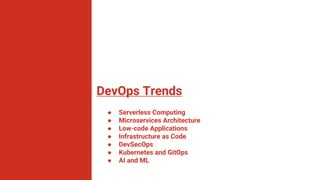
DevOps Trends
● Serverless Computing
● Microservices Architecture
● Low-code Applications
● Infrastructure as Code
● DevSecOps
● Kubernetes and GitOps
● AI and ML
Serverless Computing
1.
Serverless Computing
Serverless computing is a type of cloud computing where developers can write code and run applications
without worrying about the underlying infrastructure. It has been growing in popularity over the past few
years as organizations have realized how much easier serverless computing allows them to work with
cloud providers. And as a result, this trend will continue to grow rapidly in 2022. Serverless computing will
help DevOps teams reduce costs, increase developer productivity, and simplify continuous deployment
processes.
2. Microservices Architecture
Microservices Architecture
With the microservices architecture, each team focuses on building small pieces of functionality that can
then be combined into larger applications or systems. This approach enables greater efficiencies in
software delivery, allowing teams to release smaller features more frequently. In 2022, we can expect
microservices architecture to make processes faster, cheaper, and safer for organizations that adopt
DevOps practices.
Low-code Applications
3.
Low-code Applications
To keep up with the demand for new applications and features, many organizations have turned to low-
code/no-code development to deploy applications swiftly. Adopting a low-code approach with DevOps is a
game-changer. It enables developers to experience higher agility and gives the organization a competitive
advantage in the fast-paced, demanding software market.
Low-code applications allow non-technical ‘citizen developers’ to contribute to software development with
the help of visual interface integration. In addition to end users, developers and DevOps engineers are set
to play a crucial role in this trend, using low-code platforms and tools that offer drag-and-drop elements
and other extensions. These low-code application development tools support every aspect of software
development, including app ideation, analysis, software design, code development, quality assurance,
deployment and documentation.
Infrastructure as Code
4.
Infrastructure as Code
Infrastructure as Code (IaC) is a development practice that automates the deployment and ongoing
operation of application and service infrastructures. Managing infrastructure isn’t easy, so why not
automate it? With IaC, you don’t have to worry about manually configuring new resources or updating
your infrastructure. As a result, organizations can spend less time managing infrastructure and more time
focusing on developing and deploying apps.
DevSecOps
5.
DevSecOps
Security is becoming increasingly important for all types of applications and infrastructure. This means
that DevOps engineers must work closely with security experts to ensure that sensitive data remains safe
while applications are deployed and updated. DevSecOps is a term that describes these kinds of
collaborations between technical teams and security experts. Organizations that have adopted
DevSecOps strategies report better security outcomes, so you can expect this trend to continue in 2022.
Kubernetes and GitOps
6.
Kubernetes and GitOps
Kubernetes is an open source container orchestration platform emerging as an infrastructure trend on the
operations side. Kubernetes will expand further into the software development space in 2022 and beyond.
It will ease the task of starting a local Kubernetes cluster on a developer’s machine. Kubernetes security
is expected to take center stage as well, through infrastructure-as-code (IaC) scanning.
GitOps is a Kubernetes-related infrastructure trend that allows developers and IT operators to use Git to
manage clusters and deliver efficient, secure applications without misconfigurations. It automates
releasing incremental updates, and consistent delivery will enable developers to build, test and deploy
software rapidly.
AI and ML
7.
AI and ML
Artificial intelligence and machine learning have already transformed the way businesses operate
nowadays. In 2022, it is anticipated that AI/ML will further streamline and accelerate every phase of the
SDLC. It enables DevOps teams to enhance their performance through intelligent automation, improving
feedback and managing alerts.
Advanced analytical methods like predictive analytics are becoming increasingly important as the market
evolves. AI can enable proactive investigation of the DevOps pipeline to identify problems and offer
possible solutions. AI and ML integration also enable deep learning, data mining, statistics and modeling,
becoming an integral part of your business’ workflow.
Credit by:
- Devops
- Techbeatly
Conclusion
DevOps continues to evolve and pivot to drive significant IT transformations that directly bolster business
goals and objectives. It will assist in enhancing the company’s ability to design, produce, launch and
maintain high-quality software development solutions. The above trends will help organizations move
rapidly beyond automation, focusing on continuously improving outcomes. These trends are catalysts for
creating a regular and dependable release pipeline and building better communication between
development, IT and business teams.: Visit our website @ WeCode
DevOps Development
Mobile Application Development
Cloud Computing Services
Quality Assurance
Digital Marketing
Visit: www.wecode-inc.com
Email: sales@wecode-inc.com

Future Of DevOps Trends 2023

  • 2.
    Introduction: Technology is transformingevery aspect of industry, and digitalization and automation have flourished in the past few years. DevOps has established itself as an indispensable software development methodology for successful digital transformation. According to a recent market survey, the DevOps market will exceed $20 billion by 2026, growing at a CAGR of 24.7% from 2019 to 2026. DevOps has facilitated rapid and dependable software development, delivery, improved quality and higher customer satisfaction. As DevOps becomes more widespread, it will be used by more companies to achieve greater levels of efficiency and cost savings. As a result, more trends related to DevOps will emerge. Here are the Future of DevOps trends we expect to see in 2023:
  • 3.
    DevOps Trends ● ServerlessComputing ● Microservices Architecture ● Low-code Applications ● Infrastructure as Code ● DevSecOps ● Kubernetes and GitOps ● AI and ML
  • 4.
  • 5.
    Serverless Computing Serverless computingis a type of cloud computing where developers can write code and run applications without worrying about the underlying infrastructure. It has been growing in popularity over the past few years as organizations have realized how much easier serverless computing allows them to work with cloud providers. And as a result, this trend will continue to grow rapidly in 2022. Serverless computing will help DevOps teams reduce costs, increase developer productivity, and simplify continuous deployment processes.
  • 6.
  • 7.
    Microservices Architecture With themicroservices architecture, each team focuses on building small pieces of functionality that can then be combined into larger applications or systems. This approach enables greater efficiencies in software delivery, allowing teams to release smaller features more frequently. In 2022, we can expect microservices architecture to make processes faster, cheaper, and safer for organizations that adopt DevOps practices.
  • 8.
  • 9.
    Low-code Applications To keepup with the demand for new applications and features, many organizations have turned to low- code/no-code development to deploy applications swiftly. Adopting a low-code approach with DevOps is a game-changer. It enables developers to experience higher agility and gives the organization a competitive advantage in the fast-paced, demanding software market. Low-code applications allow non-technical ‘citizen developers’ to contribute to software development with the help of visual interface integration. In addition to end users, developers and DevOps engineers are set to play a crucial role in this trend, using low-code platforms and tools that offer drag-and-drop elements and other extensions. These low-code application development tools support every aspect of software development, including app ideation, analysis, software design, code development, quality assurance, deployment and documentation.
  • 10.
  • 11.
    Infrastructure as Code Infrastructureas Code (IaC) is a development practice that automates the deployment and ongoing operation of application and service infrastructures. Managing infrastructure isn’t easy, so why not automate it? With IaC, you don’t have to worry about manually configuring new resources or updating your infrastructure. As a result, organizations can spend less time managing infrastructure and more time focusing on developing and deploying apps.
  • 12.
  • 13.
    DevSecOps Security is becomingincreasingly important for all types of applications and infrastructure. This means that DevOps engineers must work closely with security experts to ensure that sensitive data remains safe while applications are deployed and updated. DevSecOps is a term that describes these kinds of collaborations between technical teams and security experts. Organizations that have adopted DevSecOps strategies report better security outcomes, so you can expect this trend to continue in 2022.
  • 14.
  • 15.
    Kubernetes and GitOps Kubernetesis an open source container orchestration platform emerging as an infrastructure trend on the operations side. Kubernetes will expand further into the software development space in 2022 and beyond. It will ease the task of starting a local Kubernetes cluster on a developer’s machine. Kubernetes security is expected to take center stage as well, through infrastructure-as-code (IaC) scanning. GitOps is a Kubernetes-related infrastructure trend that allows developers and IT operators to use Git to manage clusters and deliver efficient, secure applications without misconfigurations. It automates releasing incremental updates, and consistent delivery will enable developers to build, test and deploy software rapidly.
  • 16.
  • 17.
    AI and ML Artificialintelligence and machine learning have already transformed the way businesses operate nowadays. In 2022, it is anticipated that AI/ML will further streamline and accelerate every phase of the SDLC. It enables DevOps teams to enhance their performance through intelligent automation, improving feedback and managing alerts. Advanced analytical methods like predictive analytics are becoming increasingly important as the market evolves. AI can enable proactive investigation of the DevOps pipeline to identify problems and offer possible solutions. AI and ML integration also enable deep learning, data mining, statistics and modeling, becoming an integral part of your business’ workflow. Credit by: - Devops - Techbeatly
  • 18.
    Conclusion DevOps continues toevolve and pivot to drive significant IT transformations that directly bolster business goals and objectives. It will assist in enhancing the company’s ability to design, produce, launch and maintain high-quality software development solutions. The above trends will help organizations move rapidly beyond automation, focusing on continuously improving outcomes. These trends are catalysts for creating a regular and dependable release pipeline and building better communication between development, IT and business teams.: Visit our website @ WeCode
  • 19.
    DevOps Development Mobile ApplicationDevelopment Cloud Computing Services Quality Assurance Digital Marketing Visit: www.wecode-inc.com Email: sales@wecode-inc.com