Implementation Failure.
Save It Before You Fail It!
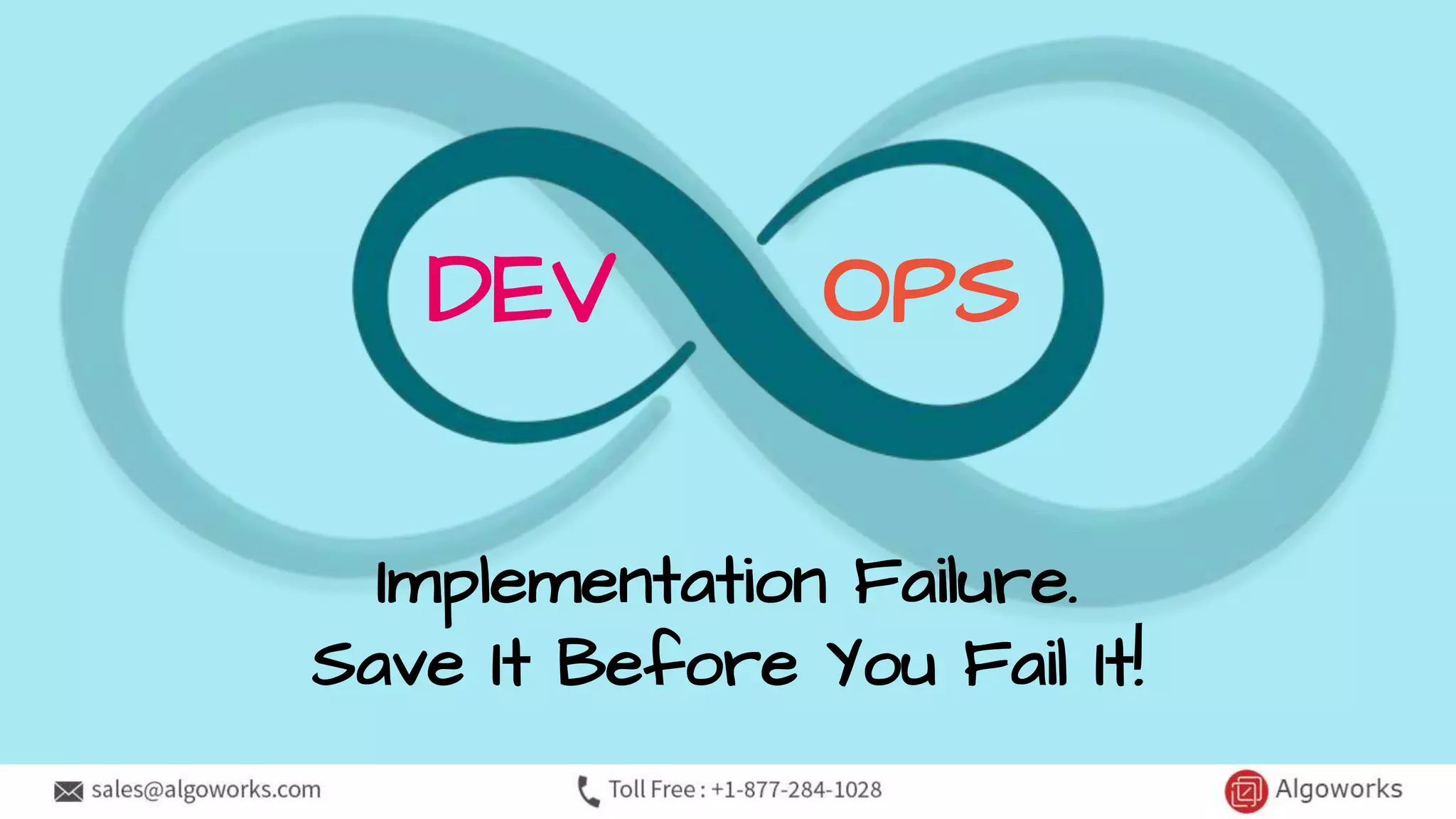
DEV OPS
We are halfway through 2018, and
at the epicenter of a gargantuan
digital transformation !
Customer experience and
superior delivery is the crux of all
businesses. Hence, all the
businesses are looking forward
to efficient methods of breaking
down the silos between
development and operations.
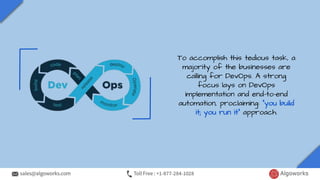
To accomplish this tedious task, a
majority of the businesses are
calling for DevOps. A strong
focus lays on DevOps
implementation and end-to-end
automation, proclaiming: ”you build
it; you run it” approach.
For DevOps implementation, a
radical overhaul of Operations is
needed. It needs to switch from a
system’s management approach to
a much more programmatic
approach.
Operations need to work in close
collaboration with Development to
figure out the automation needed
in order to successfully deploy
the application.
Why DevOps for your
organization?
DevOps is all about continuous
development and delivery.
➢ It came into being with the growing need for frequent releases
and disruption in the market dynamics.
➢ It breaks down the silos between Development and Operation
and enhances the ability to deliver superior quality software.
➢ DevOps approach helps you to stay upbeat in the cutting edge
competition.
We tend to talk a lot about DevOps, but usually, forget to
mention what role it has got to play for the organizations.
The DevOps approach has a myriad of quantifiable
business and technical benefits, some of which are:
It lays a huge focus on collaboration and
effective communication amongst the teams,
thereby, also impacting the organization culture.
higher deployment
frequencies
shortened
development cycles
faster time to
market
What leads to its failure?
Misplaced efforts
The real challenge begins to surface post-implementation. There is the 80/20
rule for the efforts, and the last 20% of automation is the toughest.
Often, the focus shifts from the early adoption areas, though the efforts
remain at 80%, it is unable to reap the benefits.
This leads to the deterioration of practices, though keeping the maintenance at
high, but unable to reap maximum benefits.
Local Optimization
Sometimes, the organizations fail to realize the benefit of implementing DevOps
among all of their groups, as the different practices are not compatible or
there may be too many dependencies.
The test automation that is run in the application test environment is different
from the ones that are run in pre-production tests. The cloud-based
environment for developers is not compatible with the production
environment’s operation guidelines. Hence, collaborating these practices
becomes costly and the related change management becomes hectic.
Roadmap to Successful
DevOps Implementation
The creation of a roadmap begins with an in-depth assessment.
It is basically all about collaboration and the important first
task definitely involves visualizing what it will mean in practice,
which teams will be participating, and how they will be working
together.
So underlying this agenda there would be a set of more
fundamental questions like:
➢ What is the organization’s goal?
➢ Why is it looking for an organizational change in the first
place?
➢ Why adopt DevOps?
In short, the objectives driving the company should align with
the DevOps model.
1
After making the decision, the next step involves breaking
down the silos between the various teams.
Encourage communication and timely collaboration amongst the
teams. The barrier between the Development and Operations
should be broken and they should be kept on the same page.
The roadmap should define communication channels through
which stakeholders will collaborate and this may involve the
creation of new structures.
2
The next step involves setting fast feedback loops. Agility is
the most vital aspect of DevOps model and by adopting it,
organizations step into a digital transformation that gives them
the provision to think and act at lightning pace to change
course if necessary.
So, the processes and structure should have built-in feedback
loops to keep the leaders informed if something is falling
apart.
3
The customer should be the center of focus and all possible
measures should be taken to ensure end-user satisfaction.
The key ‘mantra’ being breaking up your goals into quick wins
and approach them with baby steps and eventually scale up.
4
Lastly, automation is the key. You need to try and figure out
and implement automation wherever it is an option.
You have to select the most appropriate and most compatible
tools and ensure real-time visibility into the projects. The last
step of successful DevOps implementation definitely involves
proper integration and continuous delivery.
5
Official Blog Link -
http://www.algoworks.com/blog/guide-to-a-successful-devops-implementation/
Mail us at: sales@algoworks.com
Contact us at: +1-877-284-1028

[Business Strategy] DevOps Implementation Failure. Save It Before You Fail It!

  • 1.
    Implementation Failure. Save ItBefore You Fail It! DEV OPS
  • 2.
    We are halfwaythrough 2018, and at the epicenter of a gargantuan digital transformation ! Customer experience and superior delivery is the crux of all businesses. Hence, all the businesses are looking forward to efficient methods of breaking down the silos between development and operations.
  • 3.
    To accomplish thistedious task, a majority of the businesses are calling for DevOps. A strong focus lays on DevOps implementation and end-to-end automation, proclaiming: ”you build it; you run it” approach.
  • 5.
    For DevOps implementation,a radical overhaul of Operations is needed. It needs to switch from a system’s management approach to a much more programmatic approach.
  • 6.
    Operations need towork in close collaboration with Development to figure out the automation needed in order to successfully deploy the application.
  • 7.
    Why DevOps foryour organization?
  • 8.
    DevOps is allabout continuous development and delivery. ➢ It came into being with the growing need for frequent releases and disruption in the market dynamics. ➢ It breaks down the silos between Development and Operation and enhances the ability to deliver superior quality software. ➢ DevOps approach helps you to stay upbeat in the cutting edge competition. We tend to talk a lot about DevOps, but usually, forget to mention what role it has got to play for the organizations.
  • 9.
    The DevOps approachhas a myriad of quantifiable business and technical benefits, some of which are: It lays a huge focus on collaboration and effective communication amongst the teams, thereby, also impacting the organization culture. higher deployment frequencies shortened development cycles faster time to market
  • 10.
    What leads toits failure?
  • 11.
    Misplaced efforts The realchallenge begins to surface post-implementation. There is the 80/20 rule for the efforts, and the last 20% of automation is the toughest. Often, the focus shifts from the early adoption areas, though the efforts remain at 80%, it is unable to reap the benefits. This leads to the deterioration of practices, though keeping the maintenance at high, but unable to reap maximum benefits. Local Optimization Sometimes, the organizations fail to realize the benefit of implementing DevOps among all of their groups, as the different practices are not compatible or there may be too many dependencies. The test automation that is run in the application test environment is different from the ones that are run in pre-production tests. The cloud-based environment for developers is not compatible with the production environment’s operation guidelines. Hence, collaborating these practices becomes costly and the related change management becomes hectic.
  • 12.
  • 13.
    The creation ofa roadmap begins with an in-depth assessment. It is basically all about collaboration and the important first task definitely involves visualizing what it will mean in practice, which teams will be participating, and how they will be working together. So underlying this agenda there would be a set of more fundamental questions like: ➢ What is the organization’s goal? ➢ Why is it looking for an organizational change in the first place? ➢ Why adopt DevOps? In short, the objectives driving the company should align with the DevOps model. 1
  • 14.
    After making thedecision, the next step involves breaking down the silos between the various teams. Encourage communication and timely collaboration amongst the teams. The barrier between the Development and Operations should be broken and they should be kept on the same page. The roadmap should define communication channels through which stakeholders will collaborate and this may involve the creation of new structures. 2
  • 15.
    The next stepinvolves setting fast feedback loops. Agility is the most vital aspect of DevOps model and by adopting it, organizations step into a digital transformation that gives them the provision to think and act at lightning pace to change course if necessary. So, the processes and structure should have built-in feedback loops to keep the leaders informed if something is falling apart. 3
  • 16.
    The customer shouldbe the center of focus and all possible measures should be taken to ensure end-user satisfaction. The key ‘mantra’ being breaking up your goals into quick wins and approach them with baby steps and eventually scale up. 4
  • 17.
    Lastly, automation isthe key. You need to try and figure out and implement automation wherever it is an option. You have to select the most appropriate and most compatible tools and ensure real-time visibility into the projects. The last step of successful DevOps implementation definitely involves proper integration and continuous delivery. 5
  • 18.
    Official Blog Link- http://www.algoworks.com/blog/guide-to-a-successful-devops-implementation/ Mail us at: sales@algoworks.com Contact us at: +1-877-284-1028