INTERNATIONAL RESEARCH JOURNAL OF ENGINEERING AND TECHNOLOGY (IRJET) E-ISSN: 2395-0056
VOLUME: 09 ISSUE: 03 | MAR 2022 WWW.IRJET.NET P-ISSN: 2395-0072
© 2022, IRJET | Impact Factor value: 7.529 | ISO 9001:2008 Certified Journal | Page 1221
DevOps CI Automation
Continuous Integration
Lipika Mohanty1
Department of Master of Computer Application
School of CS & IT
Jain (Deemed-to-be-University)
Bangalore, India
Dr Mohd Tajammul2
Assistant Professor
Department of Computer Application
School of CS & IT
Jain (Deemed-to-be-University)
Bangalore, India
---------------------------------------------------------------------***----------------------------------------------------------------------
Abstract- In the IT sector, DevOps is the trend. This is the
procedure for tying the Development and Operations
teams together. It will aid in the automatic completion of
the SDLC and STLC processes.
This project aims to put the DevOps automation
pipeline concept into practice. To achieve the purpose, a
variety of methods and technologies are employed. The
source codes are stored in GIT hub, and the Continuous
Integration process is handled by Jenkins. Web
applications are written in Java and stored in a GIT
repository. Similarly, for the purpose of test automation a
test framework is created and is stored in a separate GIT
repository. Selenium is the powerful tool for Test
Automation and TestNG add more flavors into it. Jenkins
automatically creates a build whenever any new test are
added/updated or commit is madein to GIT. The
automation tests are then executed.
Keywords—DevOps; GitHub; Jenkins; styling; frame
work; CI/CD; Maven;
I. INTRODUCTION
1.1 Overview
DevOps, is the new and updated method of software
development life cycle. It will not the same as the
traditional model like waterfall or V-V. By the help of
DevOps, both development and operation are able to
deliver defect free and smooth applications to the end
users.
DevOps is a combination of Development and
Operation tasks. To make it very clear it is the key
concept of Continuous Integration and Continuous
Deployment. Test Automation play a vital role in the
CI/CD pipeline. Since everything is automated here, once
any new change is implemented by any developer, the
same will be tested automatically and deployed in higher
environments if all required test cases are passed. Hence,
this is the wonderful approach for software development
and testing in the current IT market.
1.2 AIM OF THE PROJECT
To implement fully automated DevOps CI framework
for Test Automation.
1.3 SCOPE
Identify a good Web Application
Development of an Automation Test Framework
Implementation of DevOps CI Pipeline
1.4 PROBLEM STATEMENT:
The typical software development and testing approach
produces the following key issues when implementing
and deploying new software:
 Usually, conflicts happen between the
operation staffs and the development team
due to the demand of stable build after
deployment.
 Lack of Regression Testing leads to failure in
Live environment.
 More manual testing efforts in frequently
release cycle like Agile and DevOps
To eradicate the above issues, DevOps with CI
automation pipeline is created and an automation test
suite is created in order to identify the defects in each
code change. Whenever there is any change to the
application code or test framework, automatically the
software is built, tested and deployedon the production
system[6].
II. SIGNIFICANCE
The ideas of CI Automation in DevOps follow the agile
practice. It helps to refine the complete STLC life cycle in
an automated fashion.[5]. This is how a lot of bugs are
identified prior to release of any application to
production environment. Naturally, this CI and CD
INTERNATIONAL RESEARCH JOURNAL OF ENGINEERING AND TECHNOLOGY (IRJET) E-ISSN: 2395-0056
VOLUME: 09 ISSUE: 03 | MAR 2022 WWW.IRJET.NET P-ISSN: 2395-0072
© 2022, IRJET | Impact Factor value: 7.529 | ISO 9001:2008 Certified Journal | Page 1222
methodology help to both development & test team, and
operation team in a project.
III. RESEARCH METHODOLOGY
DevOps is recent and updated methodology in current
IT industry which aimed at bringing both software
development teams and operation teams together to
improve work throughout the software development
lifecycle (SDLC) and Software Testing Life
Cycle(STLC)[1].
CI/CD is the fashion for delivering application to end
users more frequently by incorporating automation
testing into the app development process[9].
Continuous Integration (CI) automation is the key
factor of the Test Framework in DevOps environment.
IV. REQUIREMENTS
SOFTWARE REQUIREMENTS:
 Source Code Repository: GIT, GitHub
 Programming Language: Java
 Test Automation: Selenium, Junit, TestNG
 CI Tool: Jenkins
 Build Tool: Maven
V. SYSTEMANALYSIS
A) Development
We can develop an application using Java and SQL.
Otherwise, we can take any reference Web Application
for automation purpose. In this project, a web
application is used- Orange HRM. This is basically used
for Human Resource management activities.
B) Test Automation Framework
A test automation framework will be designed for the
web application in order to validate the functionalities.
Selenium and TestNG will be used for writing the test
cases[6]. This framework contains basic packages for the
suitability of the user.
Page Object Model (POM) is the idea used in this
framework to store all the page objects in a designated
package. This package stores all the page class written in
Java. Encapsulation is used to bind both the variables and
methods in these classes for better use. All the pages
objects are class level variables and the methods are
created to use those variables in other areas of the
framework.
Test Cases are stored in another package. These are
the TestNG tests written for the Orange HRM application.
Basically @Test, @Before, and @After annotations are
used in the test classes. All the tests are defined by the
@Test annotation in the test framework. All main
functionalities are covered as part of the test cases.
TestNG assert statements are used to validate the
expected and actual outputs of a test result.
Utility is another package where TestBase class is
created. Basically, TestBase is a class where the
WebDriver instance is created once and is used across the
framework. Using Inheritance, all test case classes extend
the Base class to reuse the WebDriver instance and other
stuffs like browser instances, logs, screenshot, reports
etc.
A Constant class is created in order to stored all the
username, password and other URL. In this class, all the
variables are declared as public, static and final, because
the value of these variables should not be changed when
other classes want to use this. This is also part of the
utility package.
The framework contains a separate folder for drivers.
Since selenium provides different drives for different
browsers, this dedicated folder stores all the required
drivers such as Chrome, Mozilla, IE etc.
Logs is another folder which contains all the logs
during execution. Test Framework contains all the
logging mechanism during the execution. Date and Time
stamp is recorded for all the test executions.
Target folder is automatically created and the
necessary reports are generated at the end of the
execution. This report can be shared with other
stakeholders of the project.
C) DevOps- CI Automation Pipeline
All the codes are stored in GitHub repositories.
Jenkins is used to build the application. Maven is used to
create the build. TestNG is used for running the tests and
publish the HTML and Extended reports.
Continuous Integration is the technique where we
need to add our test cases to the existing suite in an
ongoing basic. In addition, we make sure that the exiting
functionalities of the application is not affected by the
INTERNATIONAL RESEARCH JOURNAL OF ENGINEERING AND TECHNOLOGY (IRJET) E-ISSN: 2395-0056
VOLUME: 09 ISSUE: 03 | MAR 2022 WWW.IRJET.NET P-ISSN: 2395-0072
© 2022, IRJET | Impact Factor value: 7.529 | ISO 9001:2008 Certified Journal | Page 1223
new change. This is why tests cases are executed on a
daily basis. Jenkins used to schedule the corn job which
helps the test automation framework to run based on the
schedule.
Apart from the above process, Jenkins also provides
another facility so that whenever there is any commit to
the Git repo, automatically the build will be triggered
which is called as Continuous Integration of test cases.
In this way we do achieve the regression testing of all
existing functionalities of the application. This CI idea of
DevOps methodology helps the project team members to
minimize a lot of production issue in live environment
We have the facility ton execute the job in Jenkins on
an ad-hoc basis just to ensure the local testing purpose is
fulfilled.
At the end of each execution, all stakeholders will
receive the email notification containing all detailed test
results.
VI. SYSTEM DESIGN & ARCHITECTURE
A. Proposed System Architecture
The heart of the system is the Test Automation
framework. It’s a java-based structure and selenium is
used for UI automation. TestNG is the framework used
for testing and reporting purpose.
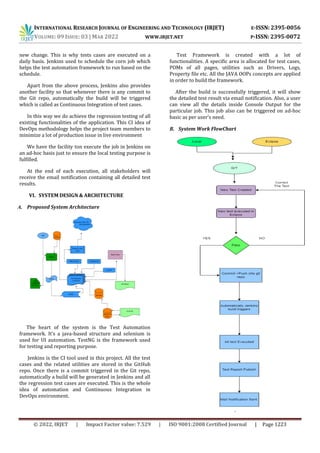
Jenkins is the CI tool used in this project. All the test
cases and the related utilities are stored in the GitHub
repo. Once there is a commit triggered in the Git repo,
automatically a build will be generated in Jenkins and all
the regression test cases are executed. This is the whole
idea of automation and Continuous Integration in
DevOps environment.
Test Framework is created with a lot of
functionalities. A specific area is allocated for test cases,
POMs of all pages, utilities such as Drivers, Logs,
Property file etc. All the JAVA OOPs concepts are applied
in order to build the framework.
After the build is successfully triggered, it will show
the detailed test result via email notification. Also, a user
can view all the details inside Console Output for the
particular job. This job also can be triggered on ad-hoc
basic as per user’s need.
B. System Work FlowChart
.
INTERNATIONAL RESEARCH JOURNAL OF ENGINEERING AND TECHNOLOGY (IRJET) E-ISSN: 2395-0056
VOLUME: 09 ISSUE: 03 | MAR 2022 WWW.IRJET.NET P-ISSN: 2395-0072
© 2022, IRJET | Impact Factor value: 7.529 | ISO 9001:2008 Certified Journal | Page 1224
C. Aim and Objectives
a) Choose any Web Application
b) Develop Automation Test Framework
c) Implement of DevOps-CI Automation Pipeline
VII. LITRETURE SURVEY
F. Leymann, V. Andrikopoulos, and J. Wettinger,[1].
DevOps is the new way of software development life
cycle. This helps both Dev and Test team to deliver a
defect free product within time and zero defect. The
concept of containerization also adds a lot of value to the
new era of software development. Instead of waiting for
the deployment team, now a days, everything is
automated fully. Hence, testing is also implemented in an
automated way so that if all testes pass, auto deployment
will happen in higher environments.
S. Latkowski, D. Pustakhod, M. Chatzimichailidis, W. Yao
and X. J. M. Leijtens,[2[ Testing in DevOps plays a vital
role. Specifically Test Automation is the key point in any
DevOps model. Since DevOps is the conceptual
framework for both Dev team and Ops team, Test
automation comes inside the Dev team in order to
provide a defect free delivery at the end. As a result, the
end users will not face any issues or failures in
production environment.
F. Zampetti, S. Geremia, G. Bavota and M.Di Penta, "CI/CD
Pipelines Evolution and Restructuring: Continuous
Integration and Continuous Delivery is the new method
of software integration with the existing repo. Usually,
developers push their changes into a repository such as
Git hub, Bit bucket, SVN, VSS, AWS Code Commit etc.
Since the work culture is now distributed in nature, each
commit from different developers is stored in the repo in
a distributed fashion. As a result, dependency is
minimized in order to push the code into a
release/master branch of the repo. Since Test
Automation plays a vital role to identify the test failures
in any new code, Continuous Integration (CI) provides
the way to find out the regression issues from existing
test cases as well which helps preventing defect leakage
to production environment. Deployment in any higher
instance is completely depends upon the test cases
result. If all test pass, automatically the branch will be
deployed in the higher environment. This is why we can
call the full process as the CI/CD pipeline. In market,
Jenkins, Bamboo, AWS Code Pipeline etc. tools are used
in order to achieve the CI/CD. Normally CI/CD is the key
concept in DevOps methodology [6].
VIII. CONCLUSION
DevOps is the new way of working in current era.
CI/CD is the key concept of DevOps. When DevOps joins
hand with test automation it will be a fully-fledged
automated system.
DevOps is a fantastic tool for businesses. It establishes
a smooth path for Continuous Development and
Continuous Integration. It helps to bridge the gap
between developers' demand for change and operations'
resistance to change in every project.
All the IT giants like Netflix, Amazon, Etsy and Google
used to use this approach successfully. It’s not limited to
any specific industry. Mostly all the industries like
Healthcare, Finance, Mining, Banking, Insurance etc. are
using CI/CD automation frequently to update the delivery
and test automation process
IX. ACKNOWLEDGEMENT
I would like to convey my heartfelt gratitude to Dr.
Dinesh Nilkhant Director, Dr. M N Nachappa, HOD of
Computer Science & IT, Prof. Dr. Bhuvana J, Mentor and
Programme Co-Ordinator Dept. Of MCA-JGI Knowledge
campus Bangalore and Jain Deemed University, for their
support and and valuable suggestions to get complete my
project work successfully
I would like to give deep gratitude to Dr. Mohd
Tajammul Assistant Professor Department Of MCA-
School of Computer Science and IT for his ideas during
the planning and implementation of this research project.
His willingness to give his time so freely has been greatly
appreciated.
X. REFERENCES
1) J. Wettinger, V. Andrikopoulos and F. Leymann,
"Automated Capturing and Systematic Usage of
DevOps Knowledge for Cloud Applications,"
2015 IEEE International Conference on Cloud
Engineering, 2015, pp. 60-65, doi:
10.1109/IC2E.2015.23.
2) S. Latkowski, D. Pustakhod, M. Chatzimichailidis,
W. Yao and X. J. M. Leijtens, "Open Standards for
Automation of Testing of Photonic Integrated
Circuits," in IEEE Journal of Selected Topics in
Quantum Electronics, vol. 25, no. 5, pp. 1-8,
Sept.-Oct. 2019, Art no. 6100608, doi:
10.1109/JSTQE.2019.2921401.
3) Spinellis, "State-of-the-Art Software Testing," in
IEEE Software, vol. 34, no. 5, pp. 4-6, 2017, doi:
10.1109/MS.2017.3571564.
INTERNATIONAL RESEARCH JOURNAL OF ENGINEERING AND TECHNOLOGY (IRJET) E-ISSN: 2395-0056
VOLUME: 09 ISSUE: 03 | MAR 2022 WWW.IRJET.NET P-ISSN: 2395-0072
© 2022, IRJET | Impact Factor value: 7.529 | ISO 9001:2008 Certified Journal | Page 1225
4) Zampetti, S. Geremia, G. Bavota and M. Di Penta,
"CI/CD Pipelines Evolution and Restructuring: A
Qualitative and Quantitative Study," 2021 IEEE
International Conference on Software
Maintenance and Evolution (ICSME), 2021, pp.
471-482, doi:
10.1109/ICSME52107.2021.00048.
5) Zampetti, S. Geremia, G. Bavota and M. Di Penta,
"CI/CD Pipelines Evolution and Restructuring: A
Qualitative and Quantitative Study," 2021 IEEE
International Conference on Software
Maintenance and Evolution (ICSME), 2021, pp.
471-482, doi:
10.1109/ICSME52107.2021.00048.
6) M. Soni, "End to End Automation on Cloud with
Build Pipeline: The Case for DevOps in Insurance
Industry, Continuous Integration, Continuous
Testing, and Continuous Delivery," 2015 IEEE
International Conference on Cloud Computing in
Emerging Markets (CCEM), 2015, pp. 85-89, doi:
10.1109/CCEM.2015.29.
7) Moutaman Kamal Aldeen Abbass;Rahama
Ibrahim Elyass Osman;Abubaker Motasem
Hmad Mohammed;Mohannad Waheed Ahmed
Alshaikh 2019 International Conference on
Computer, Control, Electrical, and Electronics
8) Exploiting DevOps Practices for Dependable and
Secure Continuous Delivery Pipelines
9) Thomas F. Düllmann;Christina Paule;André van
Hoorn 2018 IEEE/ACM 4th International
Workshop on Rapid Continuous Software
Engineering (RCoSE)
10) End to End Automation on Cloud with Build
Pipeline: The Case for DevOps in Insurance
Industry, Continuous Integration, Continuous
Testing, and Continuous Delivery
11) Mitesh Soni 2015 IEEE International Conference
on Cloud Computing in Emerging Markets
(CCEM)
12) Year: 2015 | Conference Paper | Publisher: IEEE
13) DevOpsEnvy: An Education Support System
for DevOps Guoping Rong;Shenghui Gu;He
Zhang;Dong Shao 2017 IEEE 30th Conference on
Software Engineering Education and Training
(CSEE&T)
14) Alam T., Tajammul M., Gupta R. (2022) Towards
the Sustainable Development of Smart Cities
Through Cloud Computing. In: Piuri V., Shaw
R.N., Ghosh A., Islam R. (eds) AI and IoT for
Smart City Applications. Studies in
Computational Intelligence, vol 1002.
15) Tajammul, M., Shaw R.N., Ghosh A., Parveen R.
(2021) Error Detection Algorithm for Cloud
Outsourced Big Data. In: Bansal J.C., Fung L.C.C.,
Simic M., Ghosh A. (eds) Advances in
Applications of Data-Driven Computing.
Advances in Intelligent Systems and Computing,
vol 1319.
16) Tajammul, M, Parveen, R., “Cloud Storage in
Context of Amazon Web Services”, International
Journal of All Research Education and Scientific
Methods, vol. 10, issue 01, pp. 442-446, 2021.
17) Tajammul, M., Parveen, R., “Auto Encryption
Algorithm for Uploading Data on Cloud Storage”,
BIJIT - BVICAM’s International Journal of
Information Technology, vol. 12, Issue 3, pp.
831-837, 2020.
18) Tajammul, M., Parveen, R., “Key Generation
Algorithm Coupled with DES for Securing Cloud
Storage,” International Journal of Engineering
and Advanced Technology (IJEAT) ISSN: 2249-
8958, Volume-8 Issue-5, June 2019 no. 5, pp.
1452–1458, 2019.
19) Tajammul M., Parveen R., “Two Pass
Multidimensional Key Generation and
Encryption Algorithm for Data Storage Security
in Cloud Computing”, International Journal of
Recent Technology in Engineering, Vol. 8, Issue-
2, pp. 4152–4158, 2019.
20) Tajammul M., Parveen R., “Algorithm for
Document Integrity Testing Pre-Upload and
Post- Download from Cloud Storage”,
International Journal of Recent Technology in
Engineering, Vol. 8, Issue-2S6, pp. 973–979,
2019.
21) Tajammul, M., Parveen, R., “Auto Encryption
Algorithm for Uploading Data on Cloud Storage”,
BIJIT - BVICAM’s International Journal of
Information Technology, vol. 12, Issue 3, pp.
831-837, 2020.
22) Tajammul, M., Parveen, R., and M. Shahnawaz,
“Cloud Computing Security Issues and Methods
to Resolve: Review,” Journal of Basic Applied
Engineering and Research, vol. 5, no. 7, pp. 545–
550, 2018.
23) Tajammul, M., Parveen, R., Delhi, N. (2018).
Comparative Study of Big Ten Information
INTERNATIONAL RESEARCH JOURNAL OF ENGINEERING AND TECHNOLOGY (IRJET) E-ISSN: 2395-0056
VOLUME: 09 ISSUE: 03 | MAR 2022 WWW.IRJET.NET P-ISSN: 2395-0072
© 2022, IRJET | Impact Factor value: 7.529 | ISO 9001:2008 Certified Journal | Page 1226
Security Management System Standards,
International Journal of Engineering Research in
Computer Science and Engineering (IJERCSE)
Vol 5, Issue 2, pp. 5-14, 2018
24) M. Tajammul, R. Parveen, N. K. Gaur and S. D,
"Data Sensitive Algorithm Integrated with
Compression Technique for Secured and
Efficient Utilization of Cloud Storage," 2021 IEEE
4th International Conference on Computing,
Power and Communication Technologies
(GUCON), 2021, pp. 1-9, doi:
10.1109/GUCON50781.2021.9573648.
25) Tajammul, M., Parveen, R., (2017). Comparative
Analysis of Big Ten ISMS Standards and Their
Effect on Cloud Computing, 978-1-5386-0627
8/17/31:00c2017IEEE; 9001; 362367.
26) Tajammul, M., and R. Parveen, "To Carve out
Private Cloud with Total Functionality," 2020
2nd International Conference on Advances in
Computing, Communication Control and
Networking (ICACCCN), 2020, pp. 831-835, doi:
10.1109/ICACCCN51052.2020.9362826.
27) M. Tajammul, R. Parveen and I. A. Tayubi,
"Comparative Analysis of Security Algorithms
used in Cloud Computing," 2021 8th
International Conference on Computing for
Sustainable Global Development (INDIACom),
2021, pp. 875-880, doi:
10.1109/INDIACom51348.2021.00157.

DevOps CI Automation Continuous Integration

  • 1.
    INTERNATIONAL RESEARCH JOURNALOF ENGINEERING AND TECHNOLOGY (IRJET) E-ISSN: 2395-0056 VOLUME: 09 ISSUE: 03 | MAR 2022 WWW.IRJET.NET P-ISSN: 2395-0072 © 2022, IRJET | Impact Factor value: 7.529 | ISO 9001:2008 Certified Journal | Page 1221 DevOps CI Automation Continuous Integration Lipika Mohanty1 Department of Master of Computer Application School of CS & IT Jain (Deemed-to-be-University) Bangalore, India Dr Mohd Tajammul2 Assistant Professor Department of Computer Application School of CS & IT Jain (Deemed-to-be-University) Bangalore, India ---------------------------------------------------------------------***---------------------------------------------------------------------- Abstract- In the IT sector, DevOps is the trend. This is the procedure for tying the Development and Operations teams together. It will aid in the automatic completion of the SDLC and STLC processes. This project aims to put the DevOps automation pipeline concept into practice. To achieve the purpose, a variety of methods and technologies are employed. The source codes are stored in GIT hub, and the Continuous Integration process is handled by Jenkins. Web applications are written in Java and stored in a GIT repository. Similarly, for the purpose of test automation a test framework is created and is stored in a separate GIT repository. Selenium is the powerful tool for Test Automation and TestNG add more flavors into it. Jenkins automatically creates a build whenever any new test are added/updated or commit is madein to GIT. The automation tests are then executed. Keywords—DevOps; GitHub; Jenkins; styling; frame work; CI/CD; Maven; I. INTRODUCTION 1.1 Overview DevOps, is the new and updated method of software development life cycle. It will not the same as the traditional model like waterfall or V-V. By the help of DevOps, both development and operation are able to deliver defect free and smooth applications to the end users. DevOps is a combination of Development and Operation tasks. To make it very clear it is the key concept of Continuous Integration and Continuous Deployment. Test Automation play a vital role in the CI/CD pipeline. Since everything is automated here, once any new change is implemented by any developer, the same will be tested automatically and deployed in higher environments if all required test cases are passed. Hence, this is the wonderful approach for software development and testing in the current IT market. 1.2 AIM OF THE PROJECT To implement fully automated DevOps CI framework for Test Automation. 1.3 SCOPE Identify a good Web Application Development of an Automation Test Framework Implementation of DevOps CI Pipeline 1.4 PROBLEM STATEMENT: The typical software development and testing approach produces the following key issues when implementing and deploying new software:  Usually, conflicts happen between the operation staffs and the development team due to the demand of stable build after deployment.  Lack of Regression Testing leads to failure in Live environment.  More manual testing efforts in frequently release cycle like Agile and DevOps To eradicate the above issues, DevOps with CI automation pipeline is created and an automation test suite is created in order to identify the defects in each code change. Whenever there is any change to the application code or test framework, automatically the software is built, tested and deployedon the production system[6]. II. SIGNIFICANCE The ideas of CI Automation in DevOps follow the agile practice. It helps to refine the complete STLC life cycle in an automated fashion.[5]. This is how a lot of bugs are identified prior to release of any application to production environment. Naturally, this CI and CD
  • 2.
    INTERNATIONAL RESEARCH JOURNALOF ENGINEERING AND TECHNOLOGY (IRJET) E-ISSN: 2395-0056 VOLUME: 09 ISSUE: 03 | MAR 2022 WWW.IRJET.NET P-ISSN: 2395-0072 © 2022, IRJET | Impact Factor value: 7.529 | ISO 9001:2008 Certified Journal | Page 1222 methodology help to both development & test team, and operation team in a project. III. RESEARCH METHODOLOGY DevOps is recent and updated methodology in current IT industry which aimed at bringing both software development teams and operation teams together to improve work throughout the software development lifecycle (SDLC) and Software Testing Life Cycle(STLC)[1]. CI/CD is the fashion for delivering application to end users more frequently by incorporating automation testing into the app development process[9]. Continuous Integration (CI) automation is the key factor of the Test Framework in DevOps environment. IV. REQUIREMENTS SOFTWARE REQUIREMENTS:  Source Code Repository: GIT, GitHub  Programming Language: Java  Test Automation: Selenium, Junit, TestNG  CI Tool: Jenkins  Build Tool: Maven V. SYSTEMANALYSIS A) Development We can develop an application using Java and SQL. Otherwise, we can take any reference Web Application for automation purpose. In this project, a web application is used- Orange HRM. This is basically used for Human Resource management activities. B) Test Automation Framework A test automation framework will be designed for the web application in order to validate the functionalities. Selenium and TestNG will be used for writing the test cases[6]. This framework contains basic packages for the suitability of the user. Page Object Model (POM) is the idea used in this framework to store all the page objects in a designated package. This package stores all the page class written in Java. Encapsulation is used to bind both the variables and methods in these classes for better use. All the pages objects are class level variables and the methods are created to use those variables in other areas of the framework. Test Cases are stored in another package. These are the TestNG tests written for the Orange HRM application. Basically @Test, @Before, and @After annotations are used in the test classes. All the tests are defined by the @Test annotation in the test framework. All main functionalities are covered as part of the test cases. TestNG assert statements are used to validate the expected and actual outputs of a test result. Utility is another package where TestBase class is created. Basically, TestBase is a class where the WebDriver instance is created once and is used across the framework. Using Inheritance, all test case classes extend the Base class to reuse the WebDriver instance and other stuffs like browser instances, logs, screenshot, reports etc. A Constant class is created in order to stored all the username, password and other URL. In this class, all the variables are declared as public, static and final, because the value of these variables should not be changed when other classes want to use this. This is also part of the utility package. The framework contains a separate folder for drivers. Since selenium provides different drives for different browsers, this dedicated folder stores all the required drivers such as Chrome, Mozilla, IE etc. Logs is another folder which contains all the logs during execution. Test Framework contains all the logging mechanism during the execution. Date and Time stamp is recorded for all the test executions. Target folder is automatically created and the necessary reports are generated at the end of the execution. This report can be shared with other stakeholders of the project. C) DevOps- CI Automation Pipeline All the codes are stored in GitHub repositories. Jenkins is used to build the application. Maven is used to create the build. TestNG is used for running the tests and publish the HTML and Extended reports. Continuous Integration is the technique where we need to add our test cases to the existing suite in an ongoing basic. In addition, we make sure that the exiting functionalities of the application is not affected by the
  • 3.
    INTERNATIONAL RESEARCH JOURNALOF ENGINEERING AND TECHNOLOGY (IRJET) E-ISSN: 2395-0056 VOLUME: 09 ISSUE: 03 | MAR 2022 WWW.IRJET.NET P-ISSN: 2395-0072 © 2022, IRJET | Impact Factor value: 7.529 | ISO 9001:2008 Certified Journal | Page 1223 new change. This is why tests cases are executed on a daily basis. Jenkins used to schedule the corn job which helps the test automation framework to run based on the schedule. Apart from the above process, Jenkins also provides another facility so that whenever there is any commit to the Git repo, automatically the build will be triggered which is called as Continuous Integration of test cases. In this way we do achieve the regression testing of all existing functionalities of the application. This CI idea of DevOps methodology helps the project team members to minimize a lot of production issue in live environment We have the facility ton execute the job in Jenkins on an ad-hoc basis just to ensure the local testing purpose is fulfilled. At the end of each execution, all stakeholders will receive the email notification containing all detailed test results. VI. SYSTEM DESIGN & ARCHITECTURE A. Proposed System Architecture The heart of the system is the Test Automation framework. It’s a java-based structure and selenium is used for UI automation. TestNG is the framework used for testing and reporting purpose. Jenkins is the CI tool used in this project. All the test cases and the related utilities are stored in the GitHub repo. Once there is a commit triggered in the Git repo, automatically a build will be generated in Jenkins and all the regression test cases are executed. This is the whole idea of automation and Continuous Integration in DevOps environment. Test Framework is created with a lot of functionalities. A specific area is allocated for test cases, POMs of all pages, utilities such as Drivers, Logs, Property file etc. All the JAVA OOPs concepts are applied in order to build the framework. After the build is successfully triggered, it will show the detailed test result via email notification. Also, a user can view all the details inside Console Output for the particular job. This job also can be triggered on ad-hoc basic as per user’s need. B. System Work FlowChart .
  • 4.
    INTERNATIONAL RESEARCH JOURNALOF ENGINEERING AND TECHNOLOGY (IRJET) E-ISSN: 2395-0056 VOLUME: 09 ISSUE: 03 | MAR 2022 WWW.IRJET.NET P-ISSN: 2395-0072 © 2022, IRJET | Impact Factor value: 7.529 | ISO 9001:2008 Certified Journal | Page 1224 C. Aim and Objectives a) Choose any Web Application b) Develop Automation Test Framework c) Implement of DevOps-CI Automation Pipeline VII. LITRETURE SURVEY F. Leymann, V. Andrikopoulos, and J. Wettinger,[1]. DevOps is the new way of software development life cycle. This helps both Dev and Test team to deliver a defect free product within time and zero defect. The concept of containerization also adds a lot of value to the new era of software development. Instead of waiting for the deployment team, now a days, everything is automated fully. Hence, testing is also implemented in an automated way so that if all testes pass, auto deployment will happen in higher environments. S. Latkowski, D. Pustakhod, M. Chatzimichailidis, W. Yao and X. J. M. Leijtens,[2[ Testing in DevOps plays a vital role. Specifically Test Automation is the key point in any DevOps model. Since DevOps is the conceptual framework for both Dev team and Ops team, Test automation comes inside the Dev team in order to provide a defect free delivery at the end. As a result, the end users will not face any issues or failures in production environment. F. Zampetti, S. Geremia, G. Bavota and M.Di Penta, "CI/CD Pipelines Evolution and Restructuring: Continuous Integration and Continuous Delivery is the new method of software integration with the existing repo. Usually, developers push their changes into a repository such as Git hub, Bit bucket, SVN, VSS, AWS Code Commit etc. Since the work culture is now distributed in nature, each commit from different developers is stored in the repo in a distributed fashion. As a result, dependency is minimized in order to push the code into a release/master branch of the repo. Since Test Automation plays a vital role to identify the test failures in any new code, Continuous Integration (CI) provides the way to find out the regression issues from existing test cases as well which helps preventing defect leakage to production environment. Deployment in any higher instance is completely depends upon the test cases result. If all test pass, automatically the branch will be deployed in the higher environment. This is why we can call the full process as the CI/CD pipeline. In market, Jenkins, Bamboo, AWS Code Pipeline etc. tools are used in order to achieve the CI/CD. Normally CI/CD is the key concept in DevOps methodology [6]. VIII. CONCLUSION DevOps is the new way of working in current era. CI/CD is the key concept of DevOps. When DevOps joins hand with test automation it will be a fully-fledged automated system. DevOps is a fantastic tool for businesses. It establishes a smooth path for Continuous Development and Continuous Integration. It helps to bridge the gap between developers' demand for change and operations' resistance to change in every project. All the IT giants like Netflix, Amazon, Etsy and Google used to use this approach successfully. It’s not limited to any specific industry. Mostly all the industries like Healthcare, Finance, Mining, Banking, Insurance etc. are using CI/CD automation frequently to update the delivery and test automation process IX. ACKNOWLEDGEMENT I would like to convey my heartfelt gratitude to Dr. Dinesh Nilkhant Director, Dr. M N Nachappa, HOD of Computer Science & IT, Prof. Dr. Bhuvana J, Mentor and Programme Co-Ordinator Dept. Of MCA-JGI Knowledge campus Bangalore and Jain Deemed University, for their support and and valuable suggestions to get complete my project work successfully I would like to give deep gratitude to Dr. Mohd Tajammul Assistant Professor Department Of MCA- School of Computer Science and IT for his ideas during the planning and implementation of this research project. His willingness to give his time so freely has been greatly appreciated. X. REFERENCES 1) J. Wettinger, V. Andrikopoulos and F. Leymann, "Automated Capturing and Systematic Usage of DevOps Knowledge for Cloud Applications," 2015 IEEE International Conference on Cloud Engineering, 2015, pp. 60-65, doi: 10.1109/IC2E.2015.23. 2) S. Latkowski, D. Pustakhod, M. Chatzimichailidis, W. Yao and X. J. M. Leijtens, "Open Standards for Automation of Testing of Photonic Integrated Circuits," in IEEE Journal of Selected Topics in Quantum Electronics, vol. 25, no. 5, pp. 1-8, Sept.-Oct. 2019, Art no. 6100608, doi: 10.1109/JSTQE.2019.2921401. 3) Spinellis, "State-of-the-Art Software Testing," in IEEE Software, vol. 34, no. 5, pp. 4-6, 2017, doi: 10.1109/MS.2017.3571564.
  • 5.
    INTERNATIONAL RESEARCH JOURNALOF ENGINEERING AND TECHNOLOGY (IRJET) E-ISSN: 2395-0056 VOLUME: 09 ISSUE: 03 | MAR 2022 WWW.IRJET.NET P-ISSN: 2395-0072 © 2022, IRJET | Impact Factor value: 7.529 | ISO 9001:2008 Certified Journal | Page 1225 4) Zampetti, S. Geremia, G. Bavota and M. Di Penta, "CI/CD Pipelines Evolution and Restructuring: A Qualitative and Quantitative Study," 2021 IEEE International Conference on Software Maintenance and Evolution (ICSME), 2021, pp. 471-482, doi: 10.1109/ICSME52107.2021.00048. 5) Zampetti, S. Geremia, G. Bavota and M. Di Penta, "CI/CD Pipelines Evolution and Restructuring: A Qualitative and Quantitative Study," 2021 IEEE International Conference on Software Maintenance and Evolution (ICSME), 2021, pp. 471-482, doi: 10.1109/ICSME52107.2021.00048. 6) M. Soni, "End to End Automation on Cloud with Build Pipeline: The Case for DevOps in Insurance Industry, Continuous Integration, Continuous Testing, and Continuous Delivery," 2015 IEEE International Conference on Cloud Computing in Emerging Markets (CCEM), 2015, pp. 85-89, doi: 10.1109/CCEM.2015.29. 7) Moutaman Kamal Aldeen Abbass;Rahama Ibrahim Elyass Osman;Abubaker Motasem Hmad Mohammed;Mohannad Waheed Ahmed Alshaikh 2019 International Conference on Computer, Control, Electrical, and Electronics 8) Exploiting DevOps Practices for Dependable and Secure Continuous Delivery Pipelines 9) Thomas F. Düllmann;Christina Paule;André van Hoorn 2018 IEEE/ACM 4th International Workshop on Rapid Continuous Software Engineering (RCoSE) 10) End to End Automation on Cloud with Build Pipeline: The Case for DevOps in Insurance Industry, Continuous Integration, Continuous Testing, and Continuous Delivery 11) Mitesh Soni 2015 IEEE International Conference on Cloud Computing in Emerging Markets (CCEM) 12) Year: 2015 | Conference Paper | Publisher: IEEE 13) DevOpsEnvy: An Education Support System for DevOps Guoping Rong;Shenghui Gu;He Zhang;Dong Shao 2017 IEEE 30th Conference on Software Engineering Education and Training (CSEE&T) 14) Alam T., Tajammul M., Gupta R. (2022) Towards the Sustainable Development of Smart Cities Through Cloud Computing. In: Piuri V., Shaw R.N., Ghosh A., Islam R. (eds) AI and IoT for Smart City Applications. Studies in Computational Intelligence, vol 1002. 15) Tajammul, M., Shaw R.N., Ghosh A., Parveen R. (2021) Error Detection Algorithm for Cloud Outsourced Big Data. In: Bansal J.C., Fung L.C.C., Simic M., Ghosh A. (eds) Advances in Applications of Data-Driven Computing. Advances in Intelligent Systems and Computing, vol 1319. 16) Tajammul, M, Parveen, R., “Cloud Storage in Context of Amazon Web Services”, International Journal of All Research Education and Scientific Methods, vol. 10, issue 01, pp. 442-446, 2021. 17) Tajammul, M., Parveen, R., “Auto Encryption Algorithm for Uploading Data on Cloud Storage”, BIJIT - BVICAM’s International Journal of Information Technology, vol. 12, Issue 3, pp. 831-837, 2020. 18) Tajammul, M., Parveen, R., “Key Generation Algorithm Coupled with DES for Securing Cloud Storage,” International Journal of Engineering and Advanced Technology (IJEAT) ISSN: 2249- 8958, Volume-8 Issue-5, June 2019 no. 5, pp. 1452–1458, 2019. 19) Tajammul M., Parveen R., “Two Pass Multidimensional Key Generation and Encryption Algorithm for Data Storage Security in Cloud Computing”, International Journal of Recent Technology in Engineering, Vol. 8, Issue- 2, pp. 4152–4158, 2019. 20) Tajammul M., Parveen R., “Algorithm for Document Integrity Testing Pre-Upload and Post- Download from Cloud Storage”, International Journal of Recent Technology in Engineering, Vol. 8, Issue-2S6, pp. 973–979, 2019. 21) Tajammul, M., Parveen, R., “Auto Encryption Algorithm for Uploading Data on Cloud Storage”, BIJIT - BVICAM’s International Journal of Information Technology, vol. 12, Issue 3, pp. 831-837, 2020. 22) Tajammul, M., Parveen, R., and M. Shahnawaz, “Cloud Computing Security Issues and Methods to Resolve: Review,” Journal of Basic Applied Engineering and Research, vol. 5, no. 7, pp. 545– 550, 2018. 23) Tajammul, M., Parveen, R., Delhi, N. (2018). Comparative Study of Big Ten Information
  • 6.
    INTERNATIONAL RESEARCH JOURNALOF ENGINEERING AND TECHNOLOGY (IRJET) E-ISSN: 2395-0056 VOLUME: 09 ISSUE: 03 | MAR 2022 WWW.IRJET.NET P-ISSN: 2395-0072 © 2022, IRJET | Impact Factor value: 7.529 | ISO 9001:2008 Certified Journal | Page 1226 Security Management System Standards, International Journal of Engineering Research in Computer Science and Engineering (IJERCSE) Vol 5, Issue 2, pp. 5-14, 2018 24) M. Tajammul, R. Parveen, N. K. Gaur and S. D, "Data Sensitive Algorithm Integrated with Compression Technique for Secured and Efficient Utilization of Cloud Storage," 2021 IEEE 4th International Conference on Computing, Power and Communication Technologies (GUCON), 2021, pp. 1-9, doi: 10.1109/GUCON50781.2021.9573648. 25) Tajammul, M., Parveen, R., (2017). Comparative Analysis of Big Ten ISMS Standards and Their Effect on Cloud Computing, 978-1-5386-0627 8/17/31:00c2017IEEE; 9001; 362367. 26) Tajammul, M., and R. Parveen, "To Carve out Private Cloud with Total Functionality," 2020 2nd International Conference on Advances in Computing, Communication Control and Networking (ICACCCN), 2020, pp. 831-835, doi: 10.1109/ICACCCN51052.2020.9362826. 27) M. Tajammul, R. Parveen and I. A. Tayubi, "Comparative Analysis of Security Algorithms used in Cloud Computing," 2021 8th International Conference on Computing for Sustainable Global Development (INDIACom), 2021, pp. 875-880, doi: 10.1109/INDIACom51348.2021.00157.