VISION 2030
THE HEALTH SECTOR
THE HEALTH SECTOR UNDER THE
KENYA VISION 2030
• The health sector is categorized under the social pillar of the project.
• This pillar aims to improve the quality of life for all Kenyans by targeting a cross-section of human and social
welfare projects and programs.
HEALTH TOURISM
• About :The specific strategies to achieve this will be :
I. Positioning the country as a destination for specialized health and medical services .
II. Training and retaining specialized expertise .
III.Giving Kenyans access to specialized medical services within the country .
IV.Creation of employment in specialized health care .
• Impact :Centre of excellence for medical tourism established; Specialized treatment facilities expanded.
HEALTH PRODUCTS AND
TECHNOLOGIES
• About :Policies, guidelines and legal frameworks to guide the process of procurement and quality of drugs at both
tiers of the governments will be institutionalized to ensure availability and rational drugs use. During the plan
period, the sector will employ different strategies to ensure quality drugs and commodities for service delivery and
include :
I. Defining and applying an evidenced based essential package of health products and technologies .
II. Establishing rational appraisal mechanism for health product and technologies .
III.Promoting local production, research and innovation of essential health products and technologies .
IV.Ensure availability of affordable, good quality health products and technologies .
• Impact :Regulatory framework for certification of locally derived value-added natural health products developed.
HUMAN RESOURCE STRATEGY
• About :The issue of human resource for the provision of health services continues to constrain health care delivery
due to the lack of adequate staff. Consequently, there is a need to develop a human resources strategy to balance the
supply and demand for human resources in the entire Public Health sector in the country. Similarly, the Human
Resources Information Systems will be implemented.
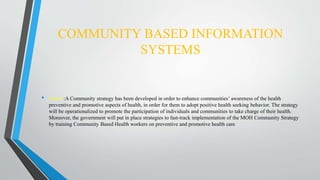
COMMUNITY BASED INFORMATION
SYSTEMS
• About :A Community strategy has been developed in order to enhance communities’ awareness of the health
preventive and promotive aspects of health, in order for them to adopt positive health seeking behavior. The strategy
will be operationalized to promote the participation of individuals and communities to take charge of their health.
Moreover, the government will put in place strategies to fast-track implementation of the MOH Community Strategy
by training Community Based Health workers on preventive and promotive health care
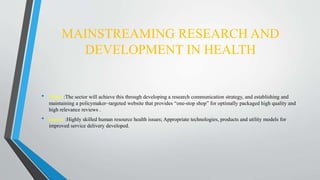
MAINSTREAMING RESEARCH AND
DEVELOPMENT IN HEALTH
• About :The sector will achieve this through developing a research communication strategy, and establishing and
maintaining a policymaker–targeted website that provides “one-stop shop” for optimally packaged high quality and
high relevance reviews .
• Impact :Highly skilled human resource health issues; Appropriate technologies, products and utility models for
improved service delivery developed.
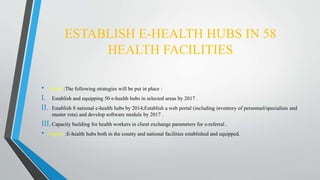
ESTABLISH E-HEALTH HUBS IN 58
HEALTH FACILITIES
• About :The following strategies will be put in place :
I. Establish and equipping 50 e-health hubs in selected areas by 2017 .
II. Establish 8 national e-health hubs by 2014;Establish a web portal (including inventory of personnel/specialists and
master rota) and develop software module by 2017 .
III.Capacity building for health workers in client exchange parameters for e-referral .
• Impact :E-health hubs both in the county and national facilities established and equipped.
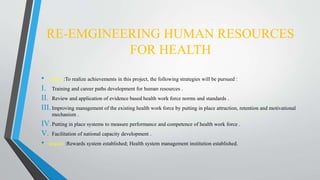
RE-EMGINEERING HUMAN RESOURCES
FOR HEALTH
• About :To realize achievements in this project, the following strategies will be pursued :
I. Training and career paths development for human resources .
II. Review and application of evidence based health work force norms and standards .
III.Improving management of the existing health work force by putting in place attraction, retention and motivational
mechanism .
IV.Putting in place systems to measure performance and competence of health work force .
V. Facilitation of national capacity development .
• Impact :Rewards system established; Health system management institution established.
HEALTH CARE SUBSIDIES FOR SOCIAL
HEALTH PROTECTION
• About : This will be achieved through the following strategies :
• Consolidating, expanding (new and existing) and coordinating social health subsidy mechanism for the poor with a view of achieving
universal coverage .
• Provision of free maternity services in all public health facilities.
• Expanding coverage of health benefits to all the indigents .
• Establishing a national social health insurance mechanism that caters for employees, employers and the informal sector with a view to gain
universal coverage .
• Reforming National Hospital Insurance Fund (NHIF) to effectively act as a vehicle to implement the National Health Insurance Scheme .
• Designing a harmonized and progressive resource mobilization strategies targeting all sources of funds, both domestic and international .
• Strengthening programming of external funding of health through improved harmonization and alignment to sector priorities and improved
reporting .
• Ensuring efficient allocation and utilization of resources .
• Progressively eliminating payment at the point of use of health services, especially by the marginalized .
• Impact : Framework for management of health subsidies established; Economically disadvantaged identified and benefiting; Free maternity
services at all public health facilities provided.
CONSTRUCT MODEL LEVEL 4
HOSPITALS
• About :The following strategies will be used :
• Review the health facility infrastructure norms to address emerging considerations such as
distance from facility (enforcement of norms and standards.
• Assessment of the status to identity candidate level 4 hospitals. Results from the Service
Availability and Readiness Assessment Mapping survey will inform this process.
• Constructing, upgrading and equipping 100 identified facilities to conform to the norms
and standards for level 4 hospitals .
• Impact :Improved access to comprehensive services; Model level 4 Hospitals
rehabilitated/upgrades.
IMPROVE ACCESS TO REFERRAL SYSTEMS
• About : This will be achieved through the following strategies :
• Increasing the utilization of services at lower levels of the health services and reduce self-referral to the higher levels of care.
• Developing the service provider’s capacity to offer services and appropriately refer at each level of the healthcare system.
• Improving the system’s ability to transfer clients and specimens between the different levels of the health care system.
• Improving supportive supervision thereby ensuring up to-date management practices in use across the country.
• Improving reverse referral and feedback information system.
• Improving preparedness and response to emergencies and disasters.
• Strengthen outreach systems for provision of health services to marginalized and vulnerable population ;
• Provision of quality emergency health services at the point of need regardless of ability to pay;
• Establishing fully edged low – cost diagnostic centers and provide adequate screening and treatment facilities for persons with chronic
or terminal conditions, including cancer, diabetes and kidney failure in every county .
• Impact : Legal and institutional framework developed; Communication, related equipment and ambulances for national and county
level procured
COUNTRY-WIDE SCALE UP OF COMMUNITY
HEALTH IMPACT INTERVENTIONS
• About :The priority focus areas will be achieved through the following strategies :
I. Provision of level 1 MNCH high impact interventions services for all cohorts and socioeconomic groups, including
the “differently-abled” taking into account their needs and priorities.
II. Building MNCH high impact interventions capacity of the Community Health Extension Workers (CHEWs) and
community based resource persons to provide services at level 1;Strengthening MNCH high impact interventions
health facility–community linkages through effective decentralization and partnership for the implementation of level
one MNCH high impact interventions services.
III.Strengthening the community to progressively realize their rights for accessible and quality care and to seek
accountability from facility based health services.
IV.Accelerating initiatives targeting nutrition services, family planning, immunization, sanitation and safe motherhood
• Impact :Community units established; Community strategy coverage for Nutrition, FP, immunization HIV and AIDS
and Malaria services expanded.
DEVELOP EQUITABLE FINANCING
MECHANISM
• About :An equitable financing mechanism will be developed through the introduction of a system to channel funds
directly to health care facilities to ensure that funds allocated are utilized for their intended purpose. The following
initiatives will be reviewed :
I. Implement the National Health Insurance Scheme as a means of financing curative and rehabilitative services thus
leaving the government health system to concentrate on prevention, research, and policy.
II. Channel health funds direct to Health facilities in line with the HSSF gazette notice.
III.Increase resources to underserved or disadvantaged areas.
IV.Scale up the Output Based Approach System for other health services.
V. Review the Public Health Act to allow disbursement of funds as grants directly to health facilities.
VI.Empower health facility boards to manage and supervise resources generated locally and those allocated from the
Central Government
• Impact : Efficient utilization of funds Operational Health Sector Service Fund National Social Health Insurance
Scheme put in place
STRENGTHEN KEMSA
• About :The management of procurement and the supply chain has been a major constraint in the effort to deliver
equitable, quality and efficient health care service. Since drugs and other medical supplies are paramount in the
delivery of quality health care, there is need to strengthen KEMSA to be a strategic procurement agency for the entire
health sector. This will be achieved through the following strategies:
I. Enhance KEMSA procurement system to avoid delays currently witnessed; KEMSA should be able to service a pull
system for all facilities in Kenya in the next five years.
II. Allow Mission for Essential Drugs (MEDs) to compete for supply of medical supplies and equipment to health
facilities.
III.Refurbishing and strengthening KEMSA regional depots .
• Impact :Effective supply of drugs through improved KEMSA
DE-LINKING THE MINISTRY OF HEALTH
FROM SERVICE DELIVERY
• About :The Ministry of Health continues to be both a health regulator as well as a service provider. However, it is
necessary to separate these roles by establishing a Health Service Commission which is separate from the Ministry
of Health. It is envisioned that the Health Service Commission will be mandated with Service delivery, while the
Ministry of Health will provide guidance on policies, standards and guidelines. The Ministry will also perform the
function of regulating service pension by health providers .
• Impact :Revised GoK health act MOH restructured
REHABILITATION OF HEALTH
FACILITIES
• About :The objective of this strategy is to provide a functional, efficient and sustainable health infrastructure
network in the country. Although the government has invested in the rehabilitation of the infrastructure in the last
few years, health facilities have been run down over the years due to lack of maintenance. Increased attention will be
given to improving the health infrastructure, particularly in rural and disadvantaged areas and communities .
• Impact :Functional rural health facilities providing integrated & comprehensive health services
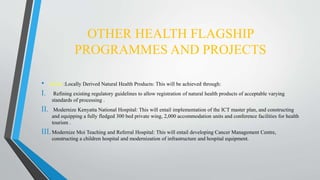
OTHER HEALTH FLAGSHIP
PROGRAMMES AND PROJECTS
• About :Locally Derived Natural Health Products: This will be achieved through:
I. Refining existing regulatory guidelines to allow registration of natural health products of acceptable varying
standards of processing .
II. Modernize Kenyatta National Hospital: This will entail implementation of the ICT master plan, and constructing
and equipping a fully fledged 300 bed private wing, 2,000 accommodation units and conference facilities for health
tourism .
III.Modernize Moi Teaching and Referral Hospital: This will entail developing Cancer Management Centre,
constructing a children hospital and modernization of infrastructure and hospital equipment.

leah and ann.pptx

  • 1.
  • 2.
    THE HEALTH SECTORUNDER THE KENYA VISION 2030 • The health sector is categorized under the social pillar of the project. • This pillar aims to improve the quality of life for all Kenyans by targeting a cross-section of human and social welfare projects and programs.
  • 3.
    HEALTH TOURISM • About:The specific strategies to achieve this will be : I. Positioning the country as a destination for specialized health and medical services . II. Training and retaining specialized expertise . III.Giving Kenyans access to specialized medical services within the country . IV.Creation of employment in specialized health care . • Impact :Centre of excellence for medical tourism established; Specialized treatment facilities expanded.
  • 4.
    HEALTH PRODUCTS AND TECHNOLOGIES •About :Policies, guidelines and legal frameworks to guide the process of procurement and quality of drugs at both tiers of the governments will be institutionalized to ensure availability and rational drugs use. During the plan period, the sector will employ different strategies to ensure quality drugs and commodities for service delivery and include : I. Defining and applying an evidenced based essential package of health products and technologies . II. Establishing rational appraisal mechanism for health product and technologies . III.Promoting local production, research and innovation of essential health products and technologies . IV.Ensure availability of affordable, good quality health products and technologies . • Impact :Regulatory framework for certification of locally derived value-added natural health products developed.
  • 5.
    HUMAN RESOURCE STRATEGY •About :The issue of human resource for the provision of health services continues to constrain health care delivery due to the lack of adequate staff. Consequently, there is a need to develop a human resources strategy to balance the supply and demand for human resources in the entire Public Health sector in the country. Similarly, the Human Resources Information Systems will be implemented.
  • 6.
    COMMUNITY BASED INFORMATION SYSTEMS •About :A Community strategy has been developed in order to enhance communities’ awareness of the health preventive and promotive aspects of health, in order for them to adopt positive health seeking behavior. The strategy will be operationalized to promote the participation of individuals and communities to take charge of their health. Moreover, the government will put in place strategies to fast-track implementation of the MOH Community Strategy by training Community Based Health workers on preventive and promotive health care
  • 7.
    MAINSTREAMING RESEARCH AND DEVELOPMENTIN HEALTH • About :The sector will achieve this through developing a research communication strategy, and establishing and maintaining a policymaker–targeted website that provides “one-stop shop” for optimally packaged high quality and high relevance reviews . • Impact :Highly skilled human resource health issues; Appropriate technologies, products and utility models for improved service delivery developed.
  • 8.
    ESTABLISH E-HEALTH HUBSIN 58 HEALTH FACILITIES • About :The following strategies will be put in place : I. Establish and equipping 50 e-health hubs in selected areas by 2017 . II. Establish 8 national e-health hubs by 2014;Establish a web portal (including inventory of personnel/specialists and master rota) and develop software module by 2017 . III.Capacity building for health workers in client exchange parameters for e-referral . • Impact :E-health hubs both in the county and national facilities established and equipped.
  • 9.
    RE-EMGINEERING HUMAN RESOURCES FORHEALTH • About :To realize achievements in this project, the following strategies will be pursued : I. Training and career paths development for human resources . II. Review and application of evidence based health work force norms and standards . III.Improving management of the existing health work force by putting in place attraction, retention and motivational mechanism . IV.Putting in place systems to measure performance and competence of health work force . V. Facilitation of national capacity development . • Impact :Rewards system established; Health system management institution established.
  • 10.
    HEALTH CARE SUBSIDIESFOR SOCIAL HEALTH PROTECTION • About : This will be achieved through the following strategies : • Consolidating, expanding (new and existing) and coordinating social health subsidy mechanism for the poor with a view of achieving universal coverage . • Provision of free maternity services in all public health facilities. • Expanding coverage of health benefits to all the indigents . • Establishing a national social health insurance mechanism that caters for employees, employers and the informal sector with a view to gain universal coverage . • Reforming National Hospital Insurance Fund (NHIF) to effectively act as a vehicle to implement the National Health Insurance Scheme . • Designing a harmonized and progressive resource mobilization strategies targeting all sources of funds, both domestic and international . • Strengthening programming of external funding of health through improved harmonization and alignment to sector priorities and improved reporting . • Ensuring efficient allocation and utilization of resources . • Progressively eliminating payment at the point of use of health services, especially by the marginalized . • Impact : Framework for management of health subsidies established; Economically disadvantaged identified and benefiting; Free maternity services at all public health facilities provided.
  • 11.
    CONSTRUCT MODEL LEVEL4 HOSPITALS • About :The following strategies will be used : • Review the health facility infrastructure norms to address emerging considerations such as distance from facility (enforcement of norms and standards. • Assessment of the status to identity candidate level 4 hospitals. Results from the Service Availability and Readiness Assessment Mapping survey will inform this process. • Constructing, upgrading and equipping 100 identified facilities to conform to the norms and standards for level 4 hospitals . • Impact :Improved access to comprehensive services; Model level 4 Hospitals rehabilitated/upgrades.
  • 12.
    IMPROVE ACCESS TOREFERRAL SYSTEMS • About : This will be achieved through the following strategies : • Increasing the utilization of services at lower levels of the health services and reduce self-referral to the higher levels of care. • Developing the service provider’s capacity to offer services and appropriately refer at each level of the healthcare system. • Improving the system’s ability to transfer clients and specimens between the different levels of the health care system. • Improving supportive supervision thereby ensuring up to-date management practices in use across the country. • Improving reverse referral and feedback information system. • Improving preparedness and response to emergencies and disasters. • Strengthen outreach systems for provision of health services to marginalized and vulnerable population ; • Provision of quality emergency health services at the point of need regardless of ability to pay; • Establishing fully edged low – cost diagnostic centers and provide adequate screening and treatment facilities for persons with chronic or terminal conditions, including cancer, diabetes and kidney failure in every county . • Impact : Legal and institutional framework developed; Communication, related equipment and ambulances for national and county level procured
  • 13.
    COUNTRY-WIDE SCALE UPOF COMMUNITY HEALTH IMPACT INTERVENTIONS • About :The priority focus areas will be achieved through the following strategies : I. Provision of level 1 MNCH high impact interventions services for all cohorts and socioeconomic groups, including the “differently-abled” taking into account their needs and priorities. II. Building MNCH high impact interventions capacity of the Community Health Extension Workers (CHEWs) and community based resource persons to provide services at level 1;Strengthening MNCH high impact interventions health facility–community linkages through effective decentralization and partnership for the implementation of level one MNCH high impact interventions services. III.Strengthening the community to progressively realize their rights for accessible and quality care and to seek accountability from facility based health services. IV.Accelerating initiatives targeting nutrition services, family planning, immunization, sanitation and safe motherhood • Impact :Community units established; Community strategy coverage for Nutrition, FP, immunization HIV and AIDS and Malaria services expanded.
  • 14.
    DEVELOP EQUITABLE FINANCING MECHANISM •About :An equitable financing mechanism will be developed through the introduction of a system to channel funds directly to health care facilities to ensure that funds allocated are utilized for their intended purpose. The following initiatives will be reviewed : I. Implement the National Health Insurance Scheme as a means of financing curative and rehabilitative services thus leaving the government health system to concentrate on prevention, research, and policy. II. Channel health funds direct to Health facilities in line with the HSSF gazette notice. III.Increase resources to underserved or disadvantaged areas. IV.Scale up the Output Based Approach System for other health services. V. Review the Public Health Act to allow disbursement of funds as grants directly to health facilities. VI.Empower health facility boards to manage and supervise resources generated locally and those allocated from the Central Government • Impact : Efficient utilization of funds Operational Health Sector Service Fund National Social Health Insurance Scheme put in place
  • 15.
    STRENGTHEN KEMSA • About:The management of procurement and the supply chain has been a major constraint in the effort to deliver equitable, quality and efficient health care service. Since drugs and other medical supplies are paramount in the delivery of quality health care, there is need to strengthen KEMSA to be a strategic procurement agency for the entire health sector. This will be achieved through the following strategies: I. Enhance KEMSA procurement system to avoid delays currently witnessed; KEMSA should be able to service a pull system for all facilities in Kenya in the next five years. II. Allow Mission for Essential Drugs (MEDs) to compete for supply of medical supplies and equipment to health facilities. III.Refurbishing and strengthening KEMSA regional depots . • Impact :Effective supply of drugs through improved KEMSA
  • 16.
    DE-LINKING THE MINISTRYOF HEALTH FROM SERVICE DELIVERY • About :The Ministry of Health continues to be both a health regulator as well as a service provider. However, it is necessary to separate these roles by establishing a Health Service Commission which is separate from the Ministry of Health. It is envisioned that the Health Service Commission will be mandated with Service delivery, while the Ministry of Health will provide guidance on policies, standards and guidelines. The Ministry will also perform the function of regulating service pension by health providers . • Impact :Revised GoK health act MOH restructured
  • 17.
    REHABILITATION OF HEALTH FACILITIES •About :The objective of this strategy is to provide a functional, efficient and sustainable health infrastructure network in the country. Although the government has invested in the rehabilitation of the infrastructure in the last few years, health facilities have been run down over the years due to lack of maintenance. Increased attention will be given to improving the health infrastructure, particularly in rural and disadvantaged areas and communities . • Impact :Functional rural health facilities providing integrated & comprehensive health services
  • 18.
    OTHER HEALTH FLAGSHIP PROGRAMMESAND PROJECTS • About :Locally Derived Natural Health Products: This will be achieved through: I. Refining existing regulatory guidelines to allow registration of natural health products of acceptable varying standards of processing . II. Modernize Kenyatta National Hospital: This will entail implementation of the ICT master plan, and constructing and equipping a fully fledged 300 bed private wing, 2,000 accommodation units and conference facilities for health tourism . III.Modernize Moi Teaching and Referral Hospital: This will entail developing Cancer Management Centre, constructing a children hospital and modernization of infrastructure and hospital equipment.