Download to read offline
![Journal of Education and Learning (EduLearn)
Vol.12, No.3, August 2018, pp. 450~456
ISSN: 2089-9823 DOI: 10.11591/edulearn.v12i3.7278 450
Journal homepage: http://journal.uad.ac.id/index.php/EduLearn
Developing STEM Based Student’s Book for Grade XII
Biotechnology Topics
Bevo Wahono1
, Aini Meitanti Rosalina2
, Anjar Putro Utomo3
, Erlia Narulita4
1,2,4
Department of Biology Education, University of Jember, 68121 East Java, Indonesia
3
Department of Science Education, University of Jember, 68121 East Java, Indonesia
Article Info ABSTRACT
Article history:
Received Sept 12, 2017
Revised Apr 21, 2018
Accepted May 05, 2018
The study aims to develop a valid, practical and effective Biology student’s
book based on Science Technology Engineering and Mathematics (STEM)
on the topic of biotechnology for Grade XII. The method applied for the
study was research and development with the 4-D model. The subjects were
58 Grade XII students of SMAN 1 Muncar, Banyuwangi-Indonesia. The
results showed that the average of validation result of STEM-based student’s
book was 86.4% which fell under a strong valid category. The average
percentage of legibility test and practicality were in very good category of
87.18% and 96.53%, respectively. Meanwhile, the average of effectiveness
test was 0.77 of normalized gain categorized in high criteria. In conclusion, it
could be determined that STEM-based student’s book of biotechnology is
valid, pratical, and effectively used in learning process.
Keywords:
Biotechnology
STEM approach
Students’book
Copyright © 2018 Institute of Advanced Engineering and Science.
All rights reserved.
Corresponding Author:
Erlia Narulita,
Department of Biology Education,
University of Jember,
68121 East Java, Indonesia.
Email: erlia.fkip@unej.ac.id
1. INTRODUCTION
The new curriculum 2013, the National Curriculum, was introduced in July 2013 as a way to
improve the quality of education in Indonesia. Curriculum 2013 aimed to encourage students to be better at
observing, inquiring, reasoning, and communicating what they have learnt or what they know after the
learning process. One of the supporting factors for the success of a curriculum is the learning materials [1, 2].
Learning materials are all kinds of materials such as a set of systematically arranged-teaching-material to
assist teachers in implementing learning activities and allowing students to study [3]. Textbooks are the main
learning material for achieving basic competencies and core competencies [4]. Therefore, innovation in
learning materials is necessary in order to produce good learning materials, one of which was by developing
student’s book based on Science Technology Engineering and Mathematics (STEM) approach in Senior High
School. Developing learning materials based on STEM approach is useful to facilitate the students to be in
touch with the world through activities such as identifying problems, gathering data to solve problems,
thinking of solutions, and considering the result multidiciplinarily. This learning material is an innovative
source of learning in accordance with the demands of curriculum and learning characteristics of 21st
century
students [5, 6].
Biotechnology is an important topic in Biology subject for Grade XII which is very complex,
multidimensional, highly scientific, technological, sociological and applicative [5]. Based on the need
assessment results of eighty students and three biology teachers in SMAN 1 Muncar, almost 90% students
faced problems in understanding and applying the biotechnology concepts in their daily life. The main
reasons were that there was no laboratory or practicum activities and no suitable leaning materials.
Developing science learning materials based on STEM approach may cater the needs of Grade XII students](https://image.slidesharecdn.com/1421apr1812sep177278artikel-1-bevo-proofread-sf-2ediqbal-220324060400/85/Developing-STEM-Based-Student-s-Book-for-Grade-XII-Biotechnology-Topics-1-320.jpg)
![Journal of Education and Learning (EduLearn)
Vol.12, No.3, August 2018, pp. 450~456
ISSN: 2089-9823 DOI: 10.11591/edulearn.v12i3.7278 450
Journal homepage: http://journal.uad.ac.id/index.php/EduLearn
Developing STEM Based Student’s Book for Grade XII
Biotechnology Topics
Bevo Wahono1
, Aini Meitanti Rosalina2
, Anjar Putro Utomo3
, Erlia Narulita4
1,2,4
Department of Biology Education, University of Jember, 68121 East Java, Indonesia
3
Department of Science Education, University of Jember, 68121 East Java, Indonesia
Article Info ABSTRACT
Article history:
Received Sept 12, 2017
Revised Apr 21, 2018
Accepted May 05, 2018
The study aims to develop a valid, practical and effective Biology student’s
book based on Science Technology Engineering and Mathematics (STEM)
on the topic of biotechnology for Grade XII. The method applied for the
study was research and development with the 4-D model. The subjects were
58 Grade XII students of SMAN 1 Muncar, Banyuwangi-Indonesia. The
results showed that the average of validation result of STEM-based student’s
book was 86.4% which fell under a strong valid category. The average
percentage of legibility test and practicality were in very good category of
87.18% and 96.53%, respectively. Meanwhile, the average of effectiveness
test was 0.77 of normalized gain categorized in high criteria. In conclusion, it
could be determined that STEM-based student’s book of biotechnology is
valid, pratical, and effectively used in learning process.
Keywords:
Biotechnology
STEM approach
Students’book
Copyright © 2018 Institute of Advanced Engineering and Science.
All rights reserved.
Corresponding Author:
Erlia Narulita,
Department of Biology Education,
University of Jember,
68121 East Java, Indonesia.
Email: erlia.fkip@unej.ac.id
1. INTRODUCTION
The new curriculum 2013, the National Curriculum, was introduced in July 2013 as a way to
improve the quality of education in Indonesia. Curriculum 2013 aimed to encourage students to be better at
observing, inquiring, reasoning, and communicating what they have learnt or what they know after the
learning process. One of the supporting factors for the success of a curriculum is the learning materials [1, 2].
Learning materials are all kinds of materials such as a set of systematically arranged-teaching-material to
assist teachers in implementing learning activities and allowing students to study [3]. Textbooks are the main
learning material for achieving basic competencies and core competencies [4]. Therefore, innovation in
learning materials is necessary in order to produce good learning materials, one of which was by developing
student’s book based on Science Technology Engineering and Mathematics (STEM) approach in Senior High
School. Developing learning materials based on STEM approach is useful to facilitate the students to be in
touch with the world through activities such as identifying problems, gathering data to solve problems,
thinking of solutions, and considering the result multidiciplinarily. This learning material is an innovative
source of learning in accordance with the demands of curriculum and learning characteristics of 21st
century
students [5, 6].
Biotechnology is an important topic in Biology subject for Grade XII which is very complex,
multidimensional, highly scientific, technological, sociological and applicative [5]. Based on the need
assessment results of eighty students and three biology teachers in SMAN 1 Muncar, almost 90% students
faced problems in understanding and applying the biotechnology concepts in their daily life. The main
reasons were that there was no laboratory or practicum activities and no suitable leaning materials.
Developing science learning materials based on STEM approach may cater the needs of Grade XII students](https://image.slidesharecdn.com/1421apr1812sep177278artikel-1-bevo-proofread-sf-2ediqbal-220324060400/75/Developing-STEM-Based-Student-s-Book-for-Grade-XII-Biotechnology-Topics-1-2048.jpg)
![EduLearn ISSN: 2089-9823
Developing STEM Based Student’s Book for Grade XII Biotechnology Topics (Bevo Wahono)
451
of this particular topic, because students are given the opportunities to construct its existing knowledge to
learn new knowledge. Learning from the real thing may be easier and be considered beneficial. Aspects of
experience can be drawn from the integration of science, technology, engineering and mathematics in solving
the everyday problems [7, 8].
The purpose of this study was to determine the process, validity and effectivity of learning material
development based on STEM approach on the subject of biotechnology of Grade XII.
2. RESEARCH METHOD
This study adopted research and development method. Learning materials were developed in the
form of student’s book. Development model of learning materials used in this study was a 4D Model) [9],
which consists of define, design, develop, and disseminate phase [10]. The draft of learning materials further
tested on nine Grade XII students, during which process the researchers acted as a teacher. Then, students
were asked to complete a questionnaire measuring the legibility and level of difficulty as well as students'
response. Data of legibility test and difficulty test were analyzed descriptively by examining the results of
student assessment given to the student book. Student questionnaire responses were used to determine
students’ opinion of the developed student’s book. Analysis of data obtained from the validators was
descriptive in the form of suggestions and comments. The data obtained was analyzed using percentage
techniques. Below is the formula for the overall data processing:
P =
∑
∑
X 100 (1)
x_i = number of answers to the assessment of the validator for the aspect -i
y_i = maximum value for the aspect -i
P = percentage of overall assessment
n = aspects were assessed
i = 1,2,3 ....., n
The students' cognitive results from the pre-test and post-test can be analyzed using the gain index
formula [11]:
N (gain) = (2)
3. RESULTS AND ANALYSIS
3.1. Developing Process of Student’s Book Based on STEM Approach
Define Phase
In the ‘define’ stage, there were basic problems in biotechnological topic, such as lack of concepts
application in daily life, lack of students’ knowledge about the application of biotechnology with STEM in
various science subject areas, thus they were lack of the understanding of the benefits of studying
biotechnology topic. The problems typically encountered in learning related to students were students' initial
knowledge and students' character.
Its fit with statement "Period III starting from 12 to 18 years is a stage of self discovery and
sensitivity of social taste as well as the period of developing thinking power under high school education"
[12]. The study was conducted on students of Grade XII who were 17-18 years of age in average. Based on
the results of the questionnaires, it was found that students were not accustomed to learning critical thinking
in solving problems around. It was used as a consideration in the preparation of developing students’ book
based on STEM approach. STEM approach can help students to be familiar to learning with critical thinking,
to thinking better and to be accustomed to developing curiosity to the problems around them.
Design Phase
The student’s book was developed by using a multiple choice test of 20 questions with five possible
answers and descriptions about the problem as much as 5. The student’s book was designed based on
Science Technology Engineering and Mathematics (STEM) approach. STEM approach encouraged students
to develop critical thinking processes such as solving problems, designing experiments, conducting
experiments, and reporting. The integration of the STEM approach in teaching and learning may be run at all
levels of education, from elementary schools to universities. This may be possible because aspects of STEM
implementation such as intelligence, creativity, and design skills are age independent. In addition to improve](https://image.slidesharecdn.com/1421apr1812sep177278artikel-1-bevo-proofread-sf-2ediqbal-220324060400/85/Developing-STEM-Based-Student-s-Book-for-Grade-XII-Biotechnology-Topics-2-320.jpg)
![ ISSN: 2089-9823
EduLearn Vol. 12, No. 3, August 2018 : 450 – 456
452
students' interest, the idea of integrating STEM is also the genesis of the view that science, technology,
engineering, and mathematics are inseparable in their application in the 21st
century education [13].
The students’ book based on STEM approach was developed in biotechnology topic and intended
for Grade XII. The student’s book composed of preface, table of contents, core competencies and base
competencies, the advantages of book, the character of the STEM approach, book manual, concept maps,
summaries, glossary and index. In addition to the designs described above, the cover of the student's book
developed was dominated by the color of green is shown in Figure 1. However, not all pages were dominated
by green. The selection of green color is meant for the student's book to have a bright appearance. The effect
of color on the learning process can bring more impact related to psychological effect. Broadly, the effect of
color provides a positive stimulus. Some interrelated influences are attraction, attention, distinction,
and warning [14].
Figure 1. The Cover of the Students’ Book Developed Based on STEM Approach
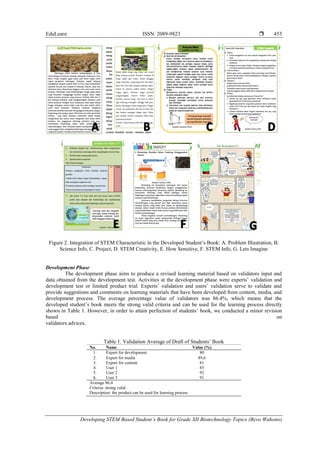
The characters of the STEM approach were shown in the developed-student book through several
activities as follows in Figure 2:
a. Requiring the students to identify social problem or issues in community from any sources (online
media/news/newspaper). The developed students’ book facilitates this first character through an activity
entitled "Ilustrasi Permasalahan (Problem Illustration)" shown in Figure 2A. It presents the agricultural
problems and students were required to identify problems and provide an alternative solution.
b. Involving students to find problems around them related to biotechnology and to provide solutionsto be
applied in daily life. This character is part of “STEM Creativity" shown in Figure 2D.
c. Involving students to seek scientific information as reference to provide solutions of problems related to
biotechnology. This character is visualized in the form of "Proyek (Project)" shown in Figure 2C. The
"Proyek" activity provides illustrations of problems, then students search for literature or references in
accordance with the illustrations provided and practice in groups beyond the class.
d. Using science and technology problems to learn the topic. The developed students’ book presents
knowledge related to the invention of biotechnology, which can be a new insight for students. It is
available in term of "STEM Info" and "Rumah Ilmu (Science Info)" shown in Figure 2E & 2B.
e. Increasing awareness of impact of science and technology development. Activities that directly nurture
students’ awareness are located before summary entitled "Seberapa Peka (How Sensitive)" shown in
Figure 2F. Students may assess their self-awareness in analyzing the impact of biotechnology upon
receiving the material. In addition, the developed students’ book also encourage fun learning for
students through humor described as "Yuk Berimajinasi (Lets imagine)" shown in Figure 2G.](https://image.slidesharecdn.com/1421apr1812sep177278artikel-1-bevo-proofread-sf-2ediqbal-220324060400/85/Developing-STEM-Based-Student-s-Book-for-Grade-XII-Biotechnology-Topics-3-320.jpg)
![ ISSN: 2089-9823
EduLearn Vol. 12, No. 3, August 2018 : 450 – 456
454
Test of legibility and the difficulty level were administered after the draft of student’s book was
validated and revised into second draft, and then continued by limited trial in a class of Grade XII. The
results obtained on the legibility and the difficulty of students’ book was good or positive. This was indicated
by an average of 87.18% of the overall aspects shown in Table 2. Students responded positively if value of
percentage of agreement ≥ 50% [10]. The result meant that the students easily understood the student books
and also shown that the developed book covered comprehensible contents and simple language. Legibility
level of the text were represented by the sentence structure, the density of words in sentences and difficult
words contained in the discourse [12]. It should match the reading ability of the reader [15].
Table 2. Result of Test of Legibility and Difficulty Level
No Statement Description
Easy Difficult
P % P %
1 Legibility of students' books:
1. The presented material
9 100 - -
2. The language used 9 100 - -
3. The presented table/graphic 9 100 - -
4. The presented image 9 100 - -
5. Completeness of presentation 5 55 4 44
Average 91.2 8.8
2 Components of activities that include:
1. The lab/practicum activities 9 100 - -
2. The inquiry presented 5 55 4 44
3. The presented material 9 100 - -
4. Completeness of presentation 6 66 3 33
Average
3 Evaluation questions 5 55 4 44
55
The overall average 87,18 12,13 44
P=number of students
3.2 Practicalities and Effectiveness of Student’s Book Based on STEM Approach
The students responded positively to the developed students’ book related to presentation materials,
presentation of student activities, the use of language, image selection, presentation layout, and choice of
STEM approach in accordance with the material. It was proven by the agreement of the 96.53% of 58
students as average percentage of students’ response to the developed book. The student response shown in
Table 3.
Table 3. Student Response
No Statements Average (%)
1. Interest 99
2. Material 93
3. Language 97,6
Overall average
Criteria: Strongly Agree
96,53
Teaching and learning activities were conducted to examine the effectiveness of the developed
student’s book. Before the lesson began, students answered the pre-test questions to see their initial
knowledge. At the end of the lesson, students were given post-test questions to determine the level of
objectives that can be achieved as well as see the effectiveness of the developed student’s book. The results
of the pre-test and post-test were analyzed by Normalized Gain and reached of 0.77 which indicated a high
level shown in Table 4; [9]). About 91% of the students passed the minimum criteria of mastery (KKM) of
75 and 9% took a remedial lesson. This showed that the students’ book based on the STEM approach on
biotechnology topic can be used as learning material effectively. The results of this study were similar to the
results of the study [15] that the synthesis results from eight research articles indicated that STEM integrated
learning had a positive effect on the learning outcomes of learners. Through STEM learning, students have
the scientific and technological literacy that emerge from reading, writing, observing, and doing science so
that it can be used to live in society and solve problems they may encounter in their daily life related to the
field of STEM [7].](https://image.slidesharecdn.com/1421apr1812sep177278artikel-1-bevo-proofread-sf-2ediqbal-220324060400/85/Developing-STEM-Based-Student-s-Book-for-Grade-XII-Biotechnology-Topics-5-320.jpg)
![EduLearn ISSN: 2089-9823
Developing STEM Based Student’s Book for Grade XII Biotechnology Topics (Bevo Wahono)
455
Integrated STEM, where the emphasis is E for Engineering, encouraged the students not only to
work cooperatively to develop problem solving and decision making skills but also to think critically and
creatively to demonstrate an actual understanding of concepts during science lessons. Engineering design on
STEM also promotes critical intelligence and intellectual traits, which are important components for
stimulating science especially in the purpose of fostering higher order thinking skills [17,18].
Table 4. Pretest-Posttest Result
Subject Pre-Test average Post-Test average Normalized Gain average Criteria
58 Students 45 87.5 0,77 High
4. CONCLUSION
In summarize, the developed-student’s book based on STEM approach was significantly valid,
practical and effective as learning material. The integrated STEM approach in student’s book enhanced
students’ learning experiences and encouraged them to become problem solvers, inventor, independent,
logical, and technology literate.
REFERENCES
[1] Kemendikbud. 2014. Permendikbud Nomor 103 Tahun 2014 Tentang Pembelajaran Pada Pendidikan Dasar dan
Pendidikan Menengah Jakarta: Kementerian Pendidikan dan Kebudayaan RI.
[2] Mulyasa, E. 2007. Kurikulum Tingkat Satuan Pendidikan. Bandung: PT. Remaja Rosdakarya.
[3] Prastowo. A. 2012. Panduan Kreatif Membuat Bahan Ajar Inovatif. Yogyakarta: Diva Press.
[4] Supriyadi Dedi. 2000. Anatomi Buku Sekolah di Indonesia. Yogyakarta: Adicita Karya Nusa.
[5] Moreland, J., A. Jones and B. Cowie. 2006. Developing pedagogical content knowledge for the new sciences: the
example of biotechnology. Teacher Education Journal, 17 (2), hlm. 143-155.
[6] Thiagarajan, S. Semmel, D.S dan Semmel, MI. 1974. Instructional Development for Training Teachers of
Exceptional Children. Indiana: Indiana University Bloomington.
[7] Utomo, A.P., Novenda, I. L., Budiarso, A.S., & Narulita, E. 2017. Development of learning material of
biotechnology based on STEAM-LW approach for secondary school in coastal area. Int. J. Human. Soc. Scie. Educ.
4(11): 121-127.
[8] Trianto. 2010. Mendesain Model Pembelajaran Inovatif-Progresif. Jakarta: Kencana.
[9] Comenius, Jo Ann. 2007. Introduction To Earlychildhood Education. USA: Pearson Education, Inc.
[10] Depdiknas. 2006. Permendiknas No 22 Tahun 2006 Tentang Standar Isi. Jakarta: Depdiknas.
[11] Becker. K. H. dan Park. K. 2011. Integrative Approaches among Science, Technology, Engineering, and
Mathematics (STEM) Subjects on Students’ Learning: A Meta-Analysis. Journal of STEM Education: Innovations
and Research, 12(5).
[12] Birren, Faber. 2010. Color Psychology and Color Theraphy: A Factual Study of the Influence of Color on Human
Life .Whitefish. Kessinger Publishing L.L.C.
[13] Majid, A. 2012. Perencanaan Pembelajaran Mengembangkan Standar Kompetensi Guru. Bandung: PT Remaja
Rosdakarya.
[14] Depdikbud. 2008. Kamus Besar Bahasa Indonesia. Jakarta: PT Gramedia.
[15] Aji, N. 2008. Jejak Manusia. (online). Available on: http://Kiftiya.Blogspot.Com/2008/07/keterbacaan-
readability.html (29 Juli 2017).
[16] Mayasari Tantri., Asep Kadarohman., Dadi Rusdiana. 2014. Pengaruh Pembelajaran Terintegrasi Science,
Technology, Engineering, And Mathematics (STEM) Pada Hasil Belajar Peserta Didik: Studi Meta Analisis.
Prosiding Semnas Pensa VI ”Peran Literasi Sains”. ISBN 978-979-028-686-3.Rusman. 2010. Model-Model
Pemebelajaran Mengembangkan Profesionalisme Guru. Bandung: Raja Grafindo Persada.
[17] Morrison, J. 2006. TIES STEM Education Monograph Series: Attributes.of STEM Education. Baltimore, MD:
TIES.
[18] Moore, T.J. et al. 2013. Implementation and Integration of Engineering in K-12 STEM Education. Nevada STEM
Coalition: Developing Criteria for Quality STEM Education in Nevada. Las Vegas: USA.](https://image.slidesharecdn.com/1421apr1812sep177278artikel-1-bevo-proofread-sf-2ediqbal-220324060400/85/Developing-STEM-Based-Student-s-Book-for-Grade-XII-Biotechnology-Topics-6-320.jpg)

The study developed a STEM-based biology student's book for Grade XII focusing on biotechnology, achieving a validation score of 86.4%, indicating strong validity. The book proved to be practical and effective, with students showing a normalized gain of 0.77 in understanding post-implementation. Overall, the developed book enhances students' learning experiences and critical thinking related to biotechnological concepts.


