Developing an effective staff teamA One-Day SeminarIrcel Harrison - Pinnacle Leadership Associates
IntroductionIrcel Harrison - Pinnacle Leadership Associates“Our church staff team just doesn’t get along!”--A pastor in Georgia
Goals of This WorkshopTo improve staff effectivenessHelp church staff teams that need improvementMake good staff teams betterIrcel Harrison - Pinnacle Leadership Associates
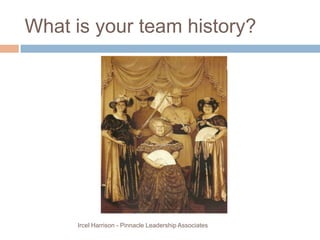
What is your team history?Ircel Harrison - Pinnacle Leadership Associates
Basic AssumptionsEvery staff member can make a unique contribution to the staff team.An effective staff team benefits the church it serves. An effective staff team helps each staff member develop his/her ministry gifts. An effective staff team requires mutual commitment. An effective staff team requires intentional leadership.Ircel Harrison - Pinnacle Leadership Associates
Overview of WorkshopWhat do you bring to your team?What are the four great barriers to teamwork?What are the three dimensions of team development?What are the five characteristics of effective teams?Developing a staff covenant.Ircel Harrison - Pinnacle Leadership Associates
What Do You Bring to Your Team?Behavior is:Observable.Situationally-based.	Flexible.Dynamic.Based on thoughts and beliefs.Ircel Harrison - Pinnacle Leadership Associates
What Do You Bring to Your Team? Behaviors are our distinct ways of thinking, feeling, and acting. Each of us has a central core way of behaving which tends to remain stable.If you know your behavioral style, you can maximize your effectiveness; if you know someone else’s style, you can work with them more effectively.Ircel Harrison - Pinnacle Leadership Associates
Marston’s ModelIrcel Harrison - Pinnacle Leadership Associates
ExerciseDiSC PreviewIrcel Harrison - Pinnacle Leadership Associates
High DSees an unfavorable environment that they want to overcome.Tries to change, fix, or control things.Ircel Harrison - Pinnacle Leadership Associates
High iSees a favorable environment in which they can influence others.Tries to persuade, promote, or influence others.Ircel Harrison - Pinnacle Leadership Associates
High SSees a favorable environment that they want to maintain.Tries to be cooperative, supportive, and agreeable while keeping things stable.Ircel Harrison - Pinnacle Leadership Associates
High CSees an unfavorable environment that they do not want to try to change.Tries to work within established rules, guidelines, and procedures to ensure accuracy and quality. Ircel Harrison - Pinnacle Leadership Associates
Working TogetherIrcel Harrison - Pinnacle Leadership Associates
Response “Is this like you?” “Do you disagree with this assessment?  Why?” “What does this say about your role in a team?”Ircel Harrison - Pinnacle Leadership Associates
Observations about Motivation You cannot motivate other people. All people are motivated. People do things for their reasons, not your reasons. A person’s strength, when overused, may become a limitation.Ircel Harrison - Pinnacle Leadership Associates
What are the four great barriers to teamwork?Exercise:    What do you think for the three primary barriers to effective staff teams?Ircel Harrison - Pinnacle Leadership Associates
What are the four great barriers to teamwork?The Barrier of Personal InsecurityThe Barrier of Unhealthy CompetitionThe Barrier of NoncommunicationThe Barrier of Being  Afraid to ChangeIrcel Harrison - Pinnacle Leadership Associates
The Barrier of Personal Insecurity Make sure everyone knows that they are valued.Assure that everyone is treated appropriately.Practice open, honest communication.Differentiate between acceptance and approval.Ircel Harrison - Pinnacle Leadership Associates
The Barrier of Unhealthy CompetitionAvoid a “silo” mentality.Align behind a shared vision that everyone helps achieveDeal honestly with scarcity of resources.Ircel Harrison - Pinnacle Leadership Associates
The Barrier of NoncommunicationAsk questions to clarify.Develop healthy relationships that make it possible to ask questions.Share information freely.Ircel Harrison - Pinnacle Leadership Associates
The Barrier of Being  Afraid to ChangeWhy do we resist change?We fear the unknown.  “Better the devil I know than the devil I don’t know.”We fear failure. “What if this doesn’t work?  Who will get the blame?”We fear commitment.  “Do I really want to be part of this?”We fear disapproval.  “Folks were really happier the way they were before.”We fear success.  If we don’t like the change, we may sabotage it.Ircel Harrison - Pinnacle Leadership Associates
The Barrier of Being  Afraid to Change How can we befriend change?Start with small, specific, limited goals in areas where you want to change.Proactive change will always be easier than reactive change.Choose to stretch yourself personally and as a team.Share the pain.  Support each other through times of change.Take care of yourself.Ircel Harrison - Pinnacle Leadership Associates
What are the three dimensions of team development? Growth in SpiritualityGrowth in CommunityGrowth in Ministry	12to prepare God's people for works of service, so that the body of Christ may be built up 13until we all reach unity in the faith and in the knowledge of the Son of God and become mature, attaining to the whole measure of the fullness of Christ. (Ephesians 4:12-13, NIV)Ircel Harrison - Pinnacle Leadership Associates
Three DimensionsIrcel Harrison - Pinnacle Leadership Associates
Three DimensionsTo prepare God’s people (“Equipping the saints,” NASB)—spiritualityFor works of service (“the work of ministry,” NASB)—ministrySo that the body of Christ may be built up (“building up the body of Christ,” NASB)—communityIrcel Harrison - Pinnacle Leadership Associates
Growth in SpiritualityBut grow in the grace and knowledge of our Lord and Savior Jesus Christ. To him be glory both now and forever! Amen. (2 Peter 3:18, NIV) Ircel Harrison - Pinnacle Leadership Associates
Growth in Community	And let us consider how we may spur one another on toward love and good deeds. (Hebrews 10:24, NIV)Ircel Harrison - Pinnacle Leadership Associates
Growth in Ministry	For we are God's workmanship, created in Christ Jesus to do good works, which God prepared in advance for us to do.  (Ephesians 2:10, NIV)Ircel Harrison - Pinnacle Leadership Associates
ExerciseSpiritualityCommunityMinistryIrcel Harrison - Pinnacle Leadership Associates
What are the five characteristics of effective teams?Trust each other.Effectively deal with conflict.Committed to team and team members.Have clear accountability structures.Produce results.Ircel Harrison - Pinnacle Leadership Associates
ExerciseTeam AssessmentAny indication of a team dysfunction that needs to be addressed?How might you go about doing that?Ircel Harrison - Pinnacle Leadership Associates
Developing a Staff CovenantOur God is a covenanting God.Covenants (agreements) between individuals and between nations were common in biblical times.God made covenants with humankind—examples are Abraham (personal) and Moses (corporate)God’s covenants are made between unequal parties—a sovereign and a servant. Biblical marriage is a form of covenant that imitates God’s covenants with us but it is between equals.Ircel Harrison - Pinnacle Leadership Associates
Workplace Covenants 	“The covenant is meant to give order to passion, to set forth respectful and honorable ways of living forth one’s heartfelt love.”	“Covenantal relationships . . .  induce freedom, not paralysis.  . . . Covenantal relationships reflect unity and grace and poise. They are an expression of the sacred nature of relationships.” --Max De Pree  Ircel Harrison - Pinnacle Leadership Associates
Workplace Covenants/Ground RulesShare all relevant information.Focus on interests, not positions.Disagree openly with any member of the group.Discuss undiscussable issues.All members are expected to participate in all phases of the process.Ircel Harrison - Pinnacle Leadership Associates
Church Staff CovenantsClarify working relationships.State clearly those things that are assumptions.Encourage everyone to do their part on the team.Provide a level of accountability.Ircel Harrison - Pinnacle Leadership Associates
Church Staff CovenantsExamples of statements:“Demonstrate respect for each other by affirming and encouraging each other.”“Support on another by avoiding calendar conflicts and negotiating use of resources on a win-win basis.”“Pray for each other.”“Avoid triangulation with church members and each other.”“Disagree openly in staff meetings.”“Speak well of other staff members to others.”Ircel Harrison - Pinnacle Leadership Associates
ExerciseDeveloping a Staff CovenantIrcel Harrison - Pinnacle Leadership Associates
Wrap-UpBack Home Application.How can I be a better team member?What do we need to do to be a more effective team? (be specific)Evaluation and ResourcesIrcel Harrison - Pinnacle Leadership Associates

Developing An Effective Staff Team

  • 1.
    Developing an effectivestaff teamA One-Day SeminarIrcel Harrison - Pinnacle Leadership Associates
  • 2.
    IntroductionIrcel Harrison -Pinnacle Leadership Associates“Our church staff team just doesn’t get along!”--A pastor in Georgia
  • 3.
    Goals of ThisWorkshopTo improve staff effectivenessHelp church staff teams that need improvementMake good staff teams betterIrcel Harrison - Pinnacle Leadership Associates
  • 4.
    What is yourteam history?Ircel Harrison - Pinnacle Leadership Associates
  • 5.
    Basic AssumptionsEvery staffmember can make a unique contribution to the staff team.An effective staff team benefits the church it serves. An effective staff team helps each staff member develop his/her ministry gifts. An effective staff team requires mutual commitment. An effective staff team requires intentional leadership.Ircel Harrison - Pinnacle Leadership Associates
  • 6.
    Overview of WorkshopWhatdo you bring to your team?What are the four great barriers to teamwork?What are the three dimensions of team development?What are the five characteristics of effective teams?Developing a staff covenant.Ircel Harrison - Pinnacle Leadership Associates
  • 7.
    What Do YouBring to Your Team?Behavior is:Observable.Situationally-based. Flexible.Dynamic.Based on thoughts and beliefs.Ircel Harrison - Pinnacle Leadership Associates
  • 8.
    What Do YouBring to Your Team? Behaviors are our distinct ways of thinking, feeling, and acting. Each of us has a central core way of behaving which tends to remain stable.If you know your behavioral style, you can maximize your effectiveness; if you know someone else’s style, you can work with them more effectively.Ircel Harrison - Pinnacle Leadership Associates
  • 9.
    Marston’s ModelIrcel Harrison- Pinnacle Leadership Associates
  • 10.
    ExerciseDiSC PreviewIrcel Harrison- Pinnacle Leadership Associates
  • 11.
    High DSees anunfavorable environment that they want to overcome.Tries to change, fix, or control things.Ircel Harrison - Pinnacle Leadership Associates
  • 12.
    High iSees afavorable environment in which they can influence others.Tries to persuade, promote, or influence others.Ircel Harrison - Pinnacle Leadership Associates
  • 13.
    High SSees afavorable environment that they want to maintain.Tries to be cooperative, supportive, and agreeable while keeping things stable.Ircel Harrison - Pinnacle Leadership Associates
  • 14.
    High CSees anunfavorable environment that they do not want to try to change.Tries to work within established rules, guidelines, and procedures to ensure accuracy and quality. Ircel Harrison - Pinnacle Leadership Associates
  • 15.
    Working TogetherIrcel Harrison- Pinnacle Leadership Associates
  • 16.
    Response “Is thislike you?” “Do you disagree with this assessment? Why?” “What does this say about your role in a team?”Ircel Harrison - Pinnacle Leadership Associates
  • 17.
    Observations about MotivationYou cannot motivate other people. All people are motivated. People do things for their reasons, not your reasons. A person’s strength, when overused, may become a limitation.Ircel Harrison - Pinnacle Leadership Associates
  • 18.
    What are thefour great barriers to teamwork?Exercise: What do you think for the three primary barriers to effective staff teams?Ircel Harrison - Pinnacle Leadership Associates
  • 19.
    What are thefour great barriers to teamwork?The Barrier of Personal InsecurityThe Barrier of Unhealthy CompetitionThe Barrier of NoncommunicationThe Barrier of Being Afraid to ChangeIrcel Harrison - Pinnacle Leadership Associates
  • 20.
    The Barrier ofPersonal Insecurity Make sure everyone knows that they are valued.Assure that everyone is treated appropriately.Practice open, honest communication.Differentiate between acceptance and approval.Ircel Harrison - Pinnacle Leadership Associates
  • 21.
    The Barrier ofUnhealthy CompetitionAvoid a “silo” mentality.Align behind a shared vision that everyone helps achieveDeal honestly with scarcity of resources.Ircel Harrison - Pinnacle Leadership Associates
  • 22.
    The Barrier ofNoncommunicationAsk questions to clarify.Develop healthy relationships that make it possible to ask questions.Share information freely.Ircel Harrison - Pinnacle Leadership Associates
  • 23.
    The Barrier ofBeing Afraid to ChangeWhy do we resist change?We fear the unknown. “Better the devil I know than the devil I don’t know.”We fear failure. “What if this doesn’t work? Who will get the blame?”We fear commitment. “Do I really want to be part of this?”We fear disapproval. “Folks were really happier the way they were before.”We fear success. If we don’t like the change, we may sabotage it.Ircel Harrison - Pinnacle Leadership Associates
  • 24.
    The Barrier ofBeing Afraid to Change How can we befriend change?Start with small, specific, limited goals in areas where you want to change.Proactive change will always be easier than reactive change.Choose to stretch yourself personally and as a team.Share the pain. Support each other through times of change.Take care of yourself.Ircel Harrison - Pinnacle Leadership Associates
  • 25.
    What are thethree dimensions of team development? Growth in SpiritualityGrowth in CommunityGrowth in Ministry 12to prepare God's people for works of service, so that the body of Christ may be built up 13until we all reach unity in the faith and in the knowledge of the Son of God and become mature, attaining to the whole measure of the fullness of Christ. (Ephesians 4:12-13, NIV)Ircel Harrison - Pinnacle Leadership Associates
  • 26.
    Three DimensionsIrcel Harrison- Pinnacle Leadership Associates
  • 27.
    Three DimensionsTo prepareGod’s people (“Equipping the saints,” NASB)—spiritualityFor works of service (“the work of ministry,” NASB)—ministrySo that the body of Christ may be built up (“building up the body of Christ,” NASB)—communityIrcel Harrison - Pinnacle Leadership Associates
  • 28.
    Growth in SpiritualityButgrow in the grace and knowledge of our Lord and Savior Jesus Christ. To him be glory both now and forever! Amen. (2 Peter 3:18, NIV) Ircel Harrison - Pinnacle Leadership Associates
  • 29.
    Growth in Community Andlet us consider how we may spur one another on toward love and good deeds. (Hebrews 10:24, NIV)Ircel Harrison - Pinnacle Leadership Associates
  • 30.
    Growth in Ministry Forwe are God's workmanship, created in Christ Jesus to do good works, which God prepared in advance for us to do. (Ephesians 2:10, NIV)Ircel Harrison - Pinnacle Leadership Associates
  • 31.
  • 32.
    What are thefive characteristics of effective teams?Trust each other.Effectively deal with conflict.Committed to team and team members.Have clear accountability structures.Produce results.Ircel Harrison - Pinnacle Leadership Associates
  • 33.
    ExerciseTeam AssessmentAny indicationof a team dysfunction that needs to be addressed?How might you go about doing that?Ircel Harrison - Pinnacle Leadership Associates
  • 34.
    Developing a StaffCovenantOur God is a covenanting God.Covenants (agreements) between individuals and between nations were common in biblical times.God made covenants with humankind—examples are Abraham (personal) and Moses (corporate)God’s covenants are made between unequal parties—a sovereign and a servant. Biblical marriage is a form of covenant that imitates God’s covenants with us but it is between equals.Ircel Harrison - Pinnacle Leadership Associates
  • 35.
    Workplace Covenants “Thecovenant is meant to give order to passion, to set forth respectful and honorable ways of living forth one’s heartfelt love.” “Covenantal relationships . . . induce freedom, not paralysis. . . . Covenantal relationships reflect unity and grace and poise. They are an expression of the sacred nature of relationships.” --Max De Pree Ircel Harrison - Pinnacle Leadership Associates
  • 36.
    Workplace Covenants/Ground RulesShareall relevant information.Focus on interests, not positions.Disagree openly with any member of the group.Discuss undiscussable issues.All members are expected to participate in all phases of the process.Ircel Harrison - Pinnacle Leadership Associates
  • 37.
    Church Staff CovenantsClarifyworking relationships.State clearly those things that are assumptions.Encourage everyone to do their part on the team.Provide a level of accountability.Ircel Harrison - Pinnacle Leadership Associates
  • 38.
    Church Staff CovenantsExamplesof statements:“Demonstrate respect for each other by affirming and encouraging each other.”“Support on another by avoiding calendar conflicts and negotiating use of resources on a win-win basis.”“Pray for each other.”“Avoid triangulation with church members and each other.”“Disagree openly in staff meetings.”“Speak well of other staff members to others.”Ircel Harrison - Pinnacle Leadership Associates
  • 39.
    ExerciseDeveloping a StaffCovenantIrcel Harrison - Pinnacle Leadership Associates
  • 40.
    Wrap-UpBack Home Application.Howcan I be a better team member?What do we need to do to be a more effective team? (be specific)Evaluation and ResourcesIrcel Harrison - Pinnacle Leadership Associates