D.E.V. PROJECT 2014 
ROCIO ALMARALES
INVERSES! 
Step #1: Switch f(x) in the 
equation to x=, also switch 
all x’s in the equation to 
y’s. 
Step #2: Multiply the 
denominator (y-2) to both 
sides. This way the y-2 on 
the original side cancels out 
the other.
INVERSES 
CONTINUED… 
Step #3: Next, Distribute the 
x into the (y-2) on the left 
side to get….. xy-2x=4y-9 
Step #4: Next we must get all 
the y’s on one side and x’s on 
the other side. In order to do 
this we must subtract xy from 
both sides of the equation. 
Then add 9 to both sides of 
the equation.
INVERSES 
CONTINUED… 
Step #5: Next we must factor 
out the y from 4y-xy in order 
to get the y by itself, 
considering that this is what 
we are trying to solve for. 
Step #6: Divide both sides of 
the equation by 4-x to get the 
y by itself. 
Step #7: Change the y at the 
end of the equation to f-1(x) 
to identify that it is the 
inverse of the function we 
began with.
FARMER TED TAKEOVER! 
Farmer Ted has 16,200ft. of fencing. He wants to fence off a 
rectangular field for his magical unicorns who desperately need a 
home. Please help Farmer Ted find the maximum area of his 
fenced off field! He’s running out of time!
FARMER TED! 
Step #1: We must help Farmer 
Ted get his fence built quick! But 
how do we begin? Well first we 
must be aware of the equations 
that take place when finding the 
maximum area. The two 
equations we use when 
searching for this maximum 
area is the area equation (A=xy) 
and the perimeter equation 
(2x=2y)
FARMER TED! 
Step #2:Next, we must insert 
the perimeter, which is 
16,200ft., into the perimeter 
equation. 
Step #3:We must try and get y 
by itself because we are going 
to need it later in this 
process! We are going to do 
this by dividing both sides y 
2! 
Step #4: After dividing both 
sides by 2, subtract x from 
both sides to finally get y by 
itself!
FARMER TED! 
 Step #5: Now going back to the 
perimeter equation, we are going 
to insert what we solved for y in 
the perimeter equation into the 
area equation. 
 Step#6: Next we distribute the x 
so we can get an A and a B value. 
 Step #7: Since we now do have an 
A and a B value we can use the 
equation –b/2a to find our x-value. 
 Step #8: Insert your A value, 
8,100, and your B value, -1, 
solve, and you will end up with 
4,050.
FARMER TED! 
Step #9: Insert this value into 
the equation we began with 
when we first inserted 8,100 
into the area equation. 
Step #10: Calculate your 
answer and you will see that 
we end up with 16,402,500 
square feet. Which is our 
maximum area!
SIMPLIFYING 
RATIONAL 
EXPRESSIONS 
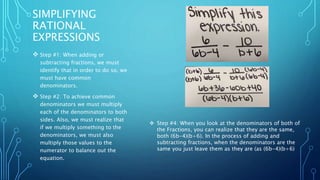
 Step #1: When adding or 
subtracting fractions, we must 
identify that in order to do so, we 
must have common 
denominators. 
 Step #2: To achieve common 
denominators we must multiply 
each of the denominators to both 
sides. Also, we must realize that 
if we multiply something to the 
denominators, we must also 
multiply those values to the 
numerator to balance out the 
equation. 
 Step #4: When you look at the denominators of both of 
the Fractions, you can realize that they are the same, 
both (6b-4)(b+6). In the process of adding and 
subtracting fractions, when the denominators are the 
same you just leave them as they are (as (6b-4)(b+6)
SIMPLIFYING 
RATIONAL 
EXPRESSIONS 
 Step #5: Next you will need to 
combine like terms in the 
numerator if possible. If it was 
not possible then you would just 
leave it as is, but in this case it is 
possible. 
 Step #6: After combining like 
terms you will end up with the 
most simplified form of this 
expression.
COMPLETING THE 
SQUARE 
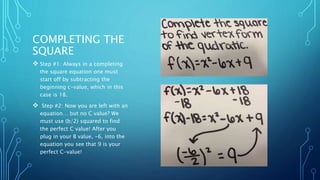
 Step #1: Always in a completing 
the square equation one must 
start off by subtracting the 
beginning c-value, which in this 
case is 18. 
 Step #2: Now you are left with an 
equation… but no C value? We 
must use (b/2) squared to find 
the perfect C value! After you 
plug in your B value, -6, into the 
equation you see that 9 is your 
perfect C-value!
COMPLETING THE 
SQUARE 
 Step #3: Since it is the perfect c-value you 
must also add it to the other side to keep the 
equation balanced. 
 Step#4: There are too ways to go about this 
next step. One way you could get the value 
(x-3) squared is to factor them. Factoring is 
just finding the two sets of factors that if 
distributed would give you the quadratic we 
began with. Since the factors of this equation 
are the same, they are both (x-3) you can 
write them as (x-3) squared. But there is also 
a shortcut, in all of these types of equations 
there is a pattern, you can just divide the B-value 
in the quadratic. As you can see that 
would also give you -3! 
 Step #5: After this long process, all that is 
left to do is add nine to both sides to get 
everything back on one side! And now your 
done! 

D.E.V. Project - Rose Almarales

  • 1.
    D.E.V. PROJECT 2014 ROCIO ALMARALES
  • 2.
    INVERSES! Step #1:Switch f(x) in the equation to x=, also switch all x’s in the equation to y’s. Step #2: Multiply the denominator (y-2) to both sides. This way the y-2 on the original side cancels out the other.
  • 3.
    INVERSES CONTINUED… Step#3: Next, Distribute the x into the (y-2) on the left side to get….. xy-2x=4y-9 Step #4: Next we must get all the y’s on one side and x’s on the other side. In order to do this we must subtract xy from both sides of the equation. Then add 9 to both sides of the equation.
  • 4.
    INVERSES CONTINUED… Step#5: Next we must factor out the y from 4y-xy in order to get the y by itself, considering that this is what we are trying to solve for. Step #6: Divide both sides of the equation by 4-x to get the y by itself. Step #7: Change the y at the end of the equation to f-1(x) to identify that it is the inverse of the function we began with.
  • 5.
    FARMER TED TAKEOVER! Farmer Ted has 16,200ft. of fencing. He wants to fence off a rectangular field for his magical unicorns who desperately need a home. Please help Farmer Ted find the maximum area of his fenced off field! He’s running out of time!
  • 6.
    FARMER TED! Step#1: We must help Farmer Ted get his fence built quick! But how do we begin? Well first we must be aware of the equations that take place when finding the maximum area. The two equations we use when searching for this maximum area is the area equation (A=xy) and the perimeter equation (2x=2y)
  • 7.
    FARMER TED! Step#2:Next, we must insert the perimeter, which is 16,200ft., into the perimeter equation. Step #3:We must try and get y by itself because we are going to need it later in this process! We are going to do this by dividing both sides y 2! Step #4: After dividing both sides by 2, subtract x from both sides to finally get y by itself!
  • 8.
    FARMER TED! Step #5: Now going back to the perimeter equation, we are going to insert what we solved for y in the perimeter equation into the area equation.  Step#6: Next we distribute the x so we can get an A and a B value.  Step #7: Since we now do have an A and a B value we can use the equation –b/2a to find our x-value.  Step #8: Insert your A value, 8,100, and your B value, -1, solve, and you will end up with 4,050.
  • 9.
    FARMER TED! Step#9: Insert this value into the equation we began with when we first inserted 8,100 into the area equation. Step #10: Calculate your answer and you will see that we end up with 16,402,500 square feet. Which is our maximum area!
  • 10.
    SIMPLIFYING RATIONAL EXPRESSIONS  Step #1: When adding or subtracting fractions, we must identify that in order to do so, we must have common denominators.  Step #2: To achieve common denominators we must multiply each of the denominators to both sides. Also, we must realize that if we multiply something to the denominators, we must also multiply those values to the numerator to balance out the equation.  Step #4: When you look at the denominators of both of the Fractions, you can realize that they are the same, both (6b-4)(b+6). In the process of adding and subtracting fractions, when the denominators are the same you just leave them as they are (as (6b-4)(b+6)
  • 11.
    SIMPLIFYING RATIONAL EXPRESSIONS  Step #5: Next you will need to combine like terms in the numerator if possible. If it was not possible then you would just leave it as is, but in this case it is possible.  Step #6: After combining like terms you will end up with the most simplified form of this expression.
  • 12.
    COMPLETING THE SQUARE  Step #1: Always in a completing the square equation one must start off by subtracting the beginning c-value, which in this case is 18.  Step #2: Now you are left with an equation… but no C value? We must use (b/2) squared to find the perfect C value! After you plug in your B value, -6, into the equation you see that 9 is your perfect C-value!
  • 13.
    COMPLETING THE SQUARE  Step #3: Since it is the perfect c-value you must also add it to the other side to keep the equation balanced.  Step#4: There are too ways to go about this next step. One way you could get the value (x-3) squared is to factor them. Factoring is just finding the two sets of factors that if distributed would give you the quadratic we began with. Since the factors of this equation are the same, they are both (x-3) you can write them as (x-3) squared. But there is also a shortcut, in all of these types of equations there is a pattern, you can just divide the B-value in the quadratic. As you can see that would also give you -3!  Step #5: After this long process, all that is left to do is add nine to both sides to get everything back on one side! And now your done! 