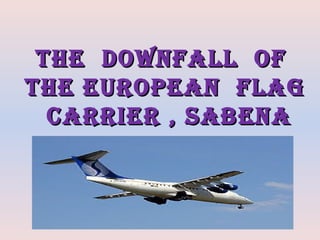
TTHHEE DDOOWWNNFFAALLLL OOFF 
TTHHEE EEUURROOPPEEAANN FFLLAAGG 
CCAARRRRIIEERR ,, SSAABBEENNAA
AABBOOUUTT SSWWIISSSS AAIIRR 
 Swissair was for many years, the national airline of Switzerland. 
 It was formed from a merger between Balair and Ad Astra Aero , 
in 1931. For most of its 71 years, Swissair was one of the major 
international airlines and known as the "Flying Bank" due to the 
financial stability of the airline, hence regarded as a Swiss national 
symbol and icon. 
 Advised by its long-term consultants, McKinsey, Swissair thought 
it had a great strategy. Under the banner of the “Quali-flyer” group, 
it sought links with other small European airlines: Sabena in 
Belgium; three small French carriers, Air Littoral, AOM and Air 
Liberté; LOTPolish Airlines; LTU in Germany; and TAP, Portugal's 
flag carrier. 
 Burdened by over-expansion due to the controversial “Hunter 
Strategy” in the late 1990s and after the economic downturn 
following the September 11 attacks, Swissair’s assets dramatically
AABBOOUUTT SSAABBEENNAA 
 SABENA began its operations on 23 May 1923 as the national 
carrier of Belgium. The airline was created by the Belgian 
government. The first commercial flight of Sabena was operated 
between Brussels and London (UK) on 1 July 1923. 
At the outbreak of World War II in 1939, SABENA's fleet were18 
aircrafts. During the war the airline managed to maintain their 
Belgian Congo routes, but all European services ceased. 
In 1990-95, After the liberalisation of the airline industry and 
the Gulf War, it became apparent that Sabena had little chance of 
surviving on its own in this very competitive market. The Belgian 
government, the main shareholder of the company, began searching 
for a suitable partner.
And so another optimistic era began for the airline. This time , the 
goal was for Swissair/Sabena to become the third most important 
airline grouping in Europe by 2000 (after Lufthansa and British 
Airways). To do that, however, meant breaking the POWER OF THE 
UNIONS. In November 1995 the airline cancelled all labour 
agreements with unions, leading to immediate strike action. The 
union uproar at the move and a damaging strike eventually led to 
the resignation of Godfroid. In April 1996 Swissair appointed Paul 
Reutlinger as his replacement. 
Reutlinger’s task was— cut costs by 4.7bn ($150m at the 1996 
exchange rate) by 1998. Reutlinger’s policy was unveiled in June 
1996- he gave the unions three choices — a 12% salary reduction, 
1,270 job losses, or revised work schedules. Any one of these 
would reduce labour costs by 2bn ($64m). The other 2.7bn ($86n) 
saving was to come via restructuring (i.e. fleet rationalisation, 
closing unprofitable routes, adding destinations, improving the 
brand, developing the Brussels hub, and even spinning off cargo and 
catering).
SSOOMMEE FFAACCTTSS .. 
The name Sabena stands for the Societe Anonyme Belge 
d'Exploitation de la Navigation Aerienne (Belgian Company for the 
Exploitation of Air Navigation). 
RRAAPPIIDD EEXXPPAANNSSIIOONN.. 
• Sabena was Europe's second oldest airline, having been set up in 
1923. 
• It launched transatlantic services in 1947, and in 1953 became the 
first airline in the world to offer a scheduled helicopter service to 
major European cities. 
FFAAIILLEEDD RREESSTTRRUUCCTTUURRIINNGG.. 
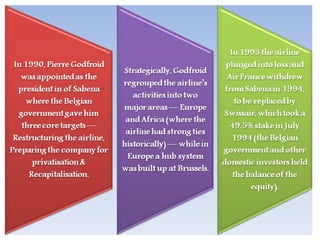
The 1980s and 90s saw successive attempts to restructure the 
airline as it struggled to come to terms with the liberalization which 
spread through the industry. In the 1990s , Sabena was converted 
into a private limited company, and in 1995 it signed a deal with 
Swissair to collaborate more closely. This led to Swissair taking a 
49.5% stake in Sabena, with the remaining 50.5% held by the 
government. In April 2000, Swissair announced plans to increase
HUNTER STRATEGY OOFF SSwwiiSSSS 
AAiiRR 
• In the 1990s Swissair initiated the controversial “Hunter 
Strategy”, a major expansion programme devised by the consulting 
firm, McKinsey & Co. Using this strategy, Swissair aimed to grow its 
market share through the acquisition of small airlines rather than 
entering into alliance agreements. 
• Swissair decided to acquire 49.5 percent of the very successful 
Italian charter airline Air Europe, the unprofitable Belgian flag 
carrier, Sabena and significant stakes in the carriers Air 
Liberté, AOM, Air Littoral, Volare, LOT, Turkish Airlines, South 
African Airways, Portugalia, etc. It later , promised to acquire 85 
percent. 
• During the so-called "Hotel agreement", signed on July 17, 2001, 
Belgian prime minister Guy Verhofstadt met with Swissair 
boss Mario Corti , who agreed to inject €258 million into SABENA.
FiNANCiAL RESULTS OOFF SSAABBEENNAA
 Other than labour , cost savings in four key divisions — 
cargo, catering, ground operations and technical were being 
focused upon. Particular progress was being made in one area 
— fleet rationalisation. 
 Belgian government, which owned a 50.5 per cent stake, 
blamed the demise of its flag carrier as a political hhuummiilliiaattiioonn. 
Even before 11 September, which provoked a slump in 
business for major carriers, Sabena was on the verge of 
financial ruin. 
 Some flight destinations of Sabena have been suppressed to 
the advantage of Swissair flights. Great suspicions exist about 
some expensive contracts with the Airbus manufacturers. 
Sabena workers have given hundreds of examples of how the 
Swissair shareholders have succeeded in enriching themselves 
at the expense of Sabena and public money.
BBAANNKKRRUUPPTTCCYY -- RREEAASSOONNSS 
FFOORR DDOOwwNNFFAALLLL .. 
Sabena, Belgium's long-suffering national airline, filed for 
bankruptcy on 7th Nov, 2001 , ending 78 years of service. 
Sabena's bankruptcy ended a tradition of Belgian commercial 
aviation that began in 1923. Although it built up a strong 
network of routes in Europe and Africa, Sabena suffered from 
labour unrest and high costs and accumulated more than 2bn 
euros (£1.2bn) of debt. 
 Poor Profits…The airline had only once made a profit since 
1958, and at the point of bankruptcy, it had debts estimated 
at around $2bn (£1.4bn). 
 Diverse Fleet… The purchase of 34 new Airbus planes, 
imposed by the Swiss, was a burden SABENA could not cope 
with. 
 Hunter Strategy of Swiss Air… Aggressive Expansion for the
 Too many accidents… 
 Poor service, union unrest, low load factors… high costs 
and accumulation of more than 2bn euros (£1.2bn) of debt. 
 Privatization & Crisis of Airline Industry… due to the 
Sept,11 terrorist attack . 
 Failure of living up to the contractual obligations by Swiss 
Air… unable to honor its promise to finance the bulk of a 
recapitalization for Sabena. 
‘‘ Despite all the good work on fleet restructuring and cost–cutting, 
Sabena still faced with the problem that Belgium was a high cost 
base for any airline to operate in. ’’
SSTTRRAATTEEGGYY
STRATEGY is a high level plan to achieve one or more 
goals under conditions of uncertainty. 
 Strategy is important because the resources available to 
achieve these goals are usually limited. Thus, Strategy 
generally involves setting goals, determining actions to 
achieve the goals, and mobilizing resources to execute the 
actions. A strategy describes how the ends (ggooaallss) will be 
achieved by the means (rreessoouurrcceess). Strategy can be intended 
or can emerge as a pattern of activity as the organization 
adapts to its environment or competes. 
 Strategy typically involves two major processes 
- FFoorrmmuullaattiioonn aanndd IImmpplleemmeennttaattiioonn. Formulation involves 
analyzing the environment or situation, making the diagnosis, 
and developing the guiding policy. Implementation refers to 
the action plans to achieve the goals .
In this case, Swiss air tried to purchase the existing non 
-profitable airlines (formulation). For this they used HHUUNNTTEERR 
SSTTRRAATTEEGGYY where they started searching for the airlines and 
partners for the purpose of acquisition. However, the strategy 
did not benefit Swiss air in the intended manner. It suffered 
from huge financial losses . Besides this, it became the reason 
for the downfall of Sabena as well. 
‘‘‘‘ FFAAIILLUURREE OOFF CCOORRPPOORRAATTEE GGOOVVEERRNNAANNCCEE AATT SSWWIISSSS AAIIRR ’’’’ 
The disastro us linkag e s with natio nal po litics be ing invo lve d in 
g lo bal busine ss, trade asso ciatio ns, big companie s, o ve rstre tche d 
strate g ic alliance s turne d Swiss air into an unto uchable symbo l. 
 We ak financial co ntro ls o f Swiss air which are e xtreme ly impo rtant 
fo r a g lo bal strate g y impleme ntatio n. 
 Ig no rance and de tachme nt o f Swiss air manag eme nt in guag ing the 
future and pre ve nting any disaste rs. 
 Inability to co pe with libe ralizatio n o f the aviatio n marke t and 
o the r marke t co nditio ns that le d to new playe rs in the industry.
STRATEGY FAILURE –– SSWWIISSSS AAIIRR.. 
Wrong decisions of Swiss air- 
-Staying as an independent airline. 
- Buying stakes in smaller airlines. 
- Become a partner of bigger European airline. 
-Blindly following Mc Kinsey’s advices. 
The dual strategy of Swiss air- 
1.GROW Swiss air & become attractive partner for Delta 
airlines 
2.Becoming a global player in airline related business such as 
catering, ground handling services and maintenance. 
* To pursue ag g re ssive acquisitio n strate g y , it acq uire d Sabina 
which alre ady had chro nic financial pro blems and a bad re putatio n 
fo r po o r se rvice . *
STRATEGY FFAAIILLUURREE –– SSAAbbEEnnAA.. 
o FFAAIILLEEDD PPEEOOPPLLEE IIMMPPLLEEMMEENNTTAATTIIOONN - Sabena workers were 
pressurised into accepting wage cuts (up to 17%), increase in 
productivity through the intensification of work (up to 200%) 
and of course, sackings. Sabena workers had a tradition of 
struggle against those "sacrifice packages". But their unions 
had always been on the defensive and had often justified the 
sacrifices in return for "social plans" to help improve their 
human cost. The division existed between the workers on the 
one hand and their union leaders and the government on the 
other. Sabena workers were not even informed by the 
management about their sudden fate but by the media. 
MMaannyy aaccttiivviissttss uunnddeerrssttoooodd tthhaatt SSaabbeennaa rreepprreesseenntteedd tthhee bbaannkkrruuppttccyy 
ooff tthhee ppoolliiccyy ooff pprriivvaattiissaattiioonn bbyy tthhee ggoovveerrnnmmeenntt aanndd aallssoo tthhee 
bbaannkkrruuppttccyy ooff tthhee ooffffiicciiaall uunniioonn ssttrraatteeggyy..
o INTERFERANCE BBYY GGOOVVEERRNNMMEENNTT - 
Sabena, until 1995 a public monopoly in the airline industry, 
was forced to open its capital to private shareholders. This 
privatisation imposed on the company by the European Union 
was to become the death knell of Sabena. After a wedding 
with the French company Air France that ended rapidly, 
Swissair proposed to be its partner. The Belgian state 
maintained formally a majority share of a little more than 
50%. In reality tthhee nneeww pprriivvaattee sshhaarreehhoollddeerr wwaass rruunnnniinngg 
SSaabbeennaa wwiitthh tthhee ggoovveerrnnmmeenntt ttuurrnniinngg aa bblliinndd eeyyee ttoo tthheeiirr 
pprraaccttiicceess.. 
The entry of Swissair is comparable to opening the door of 
your house to an unscrupulous thief. Swissair had made a lot 
of promises of investment but ran away with the money. The 
pilots' association had warned and given detailed proof to the 
government and the workers' unions of the modus operandi of 
this plundering. None of them wanted to listen. Swissair had
BByy -- 
SShhiivvaannggiinnii BBhhaasskkaarr && UUrrvvaasshhii 
SSaaxxeennaa ..

Presentation1 sabena

  • 1.
    TTHHEE DDOOWWNNFFAALLLL OOFF TTHHEE EEUURROOPPEEAANN FFLLAAGG CCAARRRRIIEERR ,, SSAABBEENNAA
  • 2.
    AABBOOUUTT SSWWIISSSS AAIIRR  Swissair was for many years, the national airline of Switzerland.  It was formed from a merger between Balair and Ad Astra Aero , in 1931. For most of its 71 years, Swissair was one of the major international airlines and known as the "Flying Bank" due to the financial stability of the airline, hence regarded as a Swiss national symbol and icon.  Advised by its long-term consultants, McKinsey, Swissair thought it had a great strategy. Under the banner of the “Quali-flyer” group, it sought links with other small European airlines: Sabena in Belgium; three small French carriers, Air Littoral, AOM and Air Liberté; LOTPolish Airlines; LTU in Germany; and TAP, Portugal's flag carrier.  Burdened by over-expansion due to the controversial “Hunter Strategy” in the late 1990s and after the economic downturn following the September 11 attacks, Swissair’s assets dramatically
  • 3.
    AABBOOUUTT SSAABBEENNAA SABENA began its operations on 23 May 1923 as the national carrier of Belgium. The airline was created by the Belgian government. The first commercial flight of Sabena was operated between Brussels and London (UK) on 1 July 1923. At the outbreak of World War II in 1939, SABENA's fleet were18 aircrafts. During the war the airline managed to maintain their Belgian Congo routes, but all European services ceased. In 1990-95, After the liberalisation of the airline industry and the Gulf War, it became apparent that Sabena had little chance of surviving on its own in this very competitive market. The Belgian government, the main shareholder of the company, began searching for a suitable partner.
  • 5.
    And so anotheroptimistic era began for the airline. This time , the goal was for Swissair/Sabena to become the third most important airline grouping in Europe by 2000 (after Lufthansa and British Airways). To do that, however, meant breaking the POWER OF THE UNIONS. In November 1995 the airline cancelled all labour agreements with unions, leading to immediate strike action. The union uproar at the move and a damaging strike eventually led to the resignation of Godfroid. In April 1996 Swissair appointed Paul Reutlinger as his replacement. Reutlinger’s task was— cut costs by 4.7bn ($150m at the 1996 exchange rate) by 1998. Reutlinger’s policy was unveiled in June 1996- he gave the unions three choices — a 12% salary reduction, 1,270 job losses, or revised work schedules. Any one of these would reduce labour costs by 2bn ($64m). The other 2.7bn ($86n) saving was to come via restructuring (i.e. fleet rationalisation, closing unprofitable routes, adding destinations, improving the brand, developing the Brussels hub, and even spinning off cargo and catering).
  • 6.
    SSOOMMEE FFAACCTTSS .. The name Sabena stands for the Societe Anonyme Belge d'Exploitation de la Navigation Aerienne (Belgian Company for the Exploitation of Air Navigation). RRAAPPIIDD EEXXPPAANNSSIIOONN.. • Sabena was Europe's second oldest airline, having been set up in 1923. • It launched transatlantic services in 1947, and in 1953 became the first airline in the world to offer a scheduled helicopter service to major European cities. FFAAIILLEEDD RREESSTTRRUUCCTTUURRIINNGG.. The 1980s and 90s saw successive attempts to restructure the airline as it struggled to come to terms with the liberalization which spread through the industry. In the 1990s , Sabena was converted into a private limited company, and in 1995 it signed a deal with Swissair to collaborate more closely. This led to Swissair taking a 49.5% stake in Sabena, with the remaining 50.5% held by the government. In April 2000, Swissair announced plans to increase
  • 7.
    HUNTER STRATEGY OOFFSSwwiiSSSS AAiiRR • In the 1990s Swissair initiated the controversial “Hunter Strategy”, a major expansion programme devised by the consulting firm, McKinsey & Co. Using this strategy, Swissair aimed to grow its market share through the acquisition of small airlines rather than entering into alliance agreements. • Swissair decided to acquire 49.5 percent of the very successful Italian charter airline Air Europe, the unprofitable Belgian flag carrier, Sabena and significant stakes in the carriers Air Liberté, AOM, Air Littoral, Volare, LOT, Turkish Airlines, South African Airways, Portugalia, etc. It later , promised to acquire 85 percent. • During the so-called "Hotel agreement", signed on July 17, 2001, Belgian prime minister Guy Verhofstadt met with Swissair boss Mario Corti , who agreed to inject €258 million into SABENA.
  • 8.
  • 9.
     Other thanlabour , cost savings in four key divisions — cargo, catering, ground operations and technical were being focused upon. Particular progress was being made in one area — fleet rationalisation.  Belgian government, which owned a 50.5 per cent stake, blamed the demise of its flag carrier as a political hhuummiilliiaattiioonn. Even before 11 September, which provoked a slump in business for major carriers, Sabena was on the verge of financial ruin.  Some flight destinations of Sabena have been suppressed to the advantage of Swissair flights. Great suspicions exist about some expensive contracts with the Airbus manufacturers. Sabena workers have given hundreds of examples of how the Swissair shareholders have succeeded in enriching themselves at the expense of Sabena and public money.
  • 10.
    BBAANNKKRRUUPPTTCCYY -- RREEAASSOONNSS FFOORR DDOOwwNNFFAALLLL .. Sabena, Belgium's long-suffering national airline, filed for bankruptcy on 7th Nov, 2001 , ending 78 years of service. Sabena's bankruptcy ended a tradition of Belgian commercial aviation that began in 1923. Although it built up a strong network of routes in Europe and Africa, Sabena suffered from labour unrest and high costs and accumulated more than 2bn euros (£1.2bn) of debt.  Poor Profits…The airline had only once made a profit since 1958, and at the point of bankruptcy, it had debts estimated at around $2bn (£1.4bn).  Diverse Fleet… The purchase of 34 new Airbus planes, imposed by the Swiss, was a burden SABENA could not cope with.  Hunter Strategy of Swiss Air… Aggressive Expansion for the
  • 11.
     Too manyaccidents…  Poor service, union unrest, low load factors… high costs and accumulation of more than 2bn euros (£1.2bn) of debt.  Privatization & Crisis of Airline Industry… due to the Sept,11 terrorist attack .  Failure of living up to the contractual obligations by Swiss Air… unable to honor its promise to finance the bulk of a recapitalization for Sabena. ‘‘ Despite all the good work on fleet restructuring and cost–cutting, Sabena still faced with the problem that Belgium was a high cost base for any airline to operate in. ’’
  • 12.
  • 13.
    STRATEGY is ahigh level plan to achieve one or more goals under conditions of uncertainty.  Strategy is important because the resources available to achieve these goals are usually limited. Thus, Strategy generally involves setting goals, determining actions to achieve the goals, and mobilizing resources to execute the actions. A strategy describes how the ends (ggooaallss) will be achieved by the means (rreessoouurrcceess). Strategy can be intended or can emerge as a pattern of activity as the organization adapts to its environment or competes.  Strategy typically involves two major processes - FFoorrmmuullaattiioonn aanndd IImmpplleemmeennttaattiioonn. Formulation involves analyzing the environment or situation, making the diagnosis, and developing the guiding policy. Implementation refers to the action plans to achieve the goals .
  • 14.
    In this case,Swiss air tried to purchase the existing non -profitable airlines (formulation). For this they used HHUUNNTTEERR SSTTRRAATTEEGGYY where they started searching for the airlines and partners for the purpose of acquisition. However, the strategy did not benefit Swiss air in the intended manner. It suffered from huge financial losses . Besides this, it became the reason for the downfall of Sabena as well. ‘‘‘‘ FFAAIILLUURREE OOFF CCOORRPPOORRAATTEE GGOOVVEERRNNAANNCCEE AATT SSWWIISSSS AAIIRR ’’’’ The disastro us linkag e s with natio nal po litics be ing invo lve d in g lo bal busine ss, trade asso ciatio ns, big companie s, o ve rstre tche d strate g ic alliance s turne d Swiss air into an unto uchable symbo l.  We ak financial co ntro ls o f Swiss air which are e xtreme ly impo rtant fo r a g lo bal strate g y impleme ntatio n.  Ig no rance and de tachme nt o f Swiss air manag eme nt in guag ing the future and pre ve nting any disaste rs.  Inability to co pe with libe ralizatio n o f the aviatio n marke t and o the r marke t co nditio ns that le d to new playe rs in the industry.
  • 15.
    STRATEGY FAILURE ––SSWWIISSSS AAIIRR.. Wrong decisions of Swiss air- -Staying as an independent airline. - Buying stakes in smaller airlines. - Become a partner of bigger European airline. -Blindly following Mc Kinsey’s advices. The dual strategy of Swiss air- 1.GROW Swiss air & become attractive partner for Delta airlines 2.Becoming a global player in airline related business such as catering, ground handling services and maintenance. * To pursue ag g re ssive acquisitio n strate g y , it acq uire d Sabina which alre ady had chro nic financial pro blems and a bad re putatio n fo r po o r se rvice . *
  • 16.
    STRATEGY FFAAIILLUURREE ––SSAAbbEEnnAA.. o FFAAIILLEEDD PPEEOOPPLLEE IIMMPPLLEEMMEENNTTAATTIIOONN - Sabena workers were pressurised into accepting wage cuts (up to 17%), increase in productivity through the intensification of work (up to 200%) and of course, sackings. Sabena workers had a tradition of struggle against those "sacrifice packages". But their unions had always been on the defensive and had often justified the sacrifices in return for "social plans" to help improve their human cost. The division existed between the workers on the one hand and their union leaders and the government on the other. Sabena workers were not even informed by the management about their sudden fate but by the media. MMaannyy aaccttiivviissttss uunnddeerrssttoooodd tthhaatt SSaabbeennaa rreepprreesseenntteedd tthhee bbaannkkrruuppttccyy ooff tthhee ppoolliiccyy ooff pprriivvaattiissaattiioonn bbyy tthhee ggoovveerrnnmmeenntt aanndd aallssoo tthhee bbaannkkrruuppttccyy ooff tthhee ooffffiicciiaall uunniioonn ssttrraatteeggyy..
  • 17.
    o INTERFERANCE BBYYGGOOVVEERRNNMMEENNTT - Sabena, until 1995 a public monopoly in the airline industry, was forced to open its capital to private shareholders. This privatisation imposed on the company by the European Union was to become the death knell of Sabena. After a wedding with the French company Air France that ended rapidly, Swissair proposed to be its partner. The Belgian state maintained formally a majority share of a little more than 50%. In reality tthhee nneeww pprriivvaattee sshhaarreehhoollddeerr wwaass rruunnnniinngg SSaabbeennaa wwiitthh tthhee ggoovveerrnnmmeenntt ttuurrnniinngg aa bblliinndd eeyyee ttoo tthheeiirr pprraaccttiicceess.. The entry of Swissair is comparable to opening the door of your house to an unscrupulous thief. Swissair had made a lot of promises of investment but ran away with the money. The pilots' association had warned and given detailed proof to the government and the workers' unions of the modus operandi of this plundering. None of them wanted to listen. Swissair had
  • 18.
    BByy -- SShhiivvaannggiinniiBBhhaasskkaarr && UUrrvvaasshhii SSaaxxeennaa ..