Detecting Hardware Keyloggers

Fabian Mihailowitsch
November 6, 2010
Who?
   Fabian Mihailowitsch

   Former Software Developer
       German energy combine

   IT-Security Consultant
       cirosec GmbH
       Penetration Tests
       Source Code Reviews

   Contact
       Email: fm@cirosec.de
       www.cirosec.de


Fabian Mihailowitsch (cirosec GmbH)   2 of 49
What?
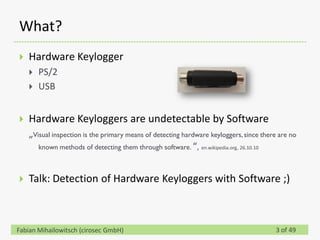
   Hardware Keylogger
       PS/2
       USB


   Hardware Keyloggers are undetectable by Software
    „Visual inspection is the primary means of detecting hardware keyloggers, since there are no
       known methods of detecting them through software. “, en.wikipedia.org, 26.10.10


   Talk: Detection of Hardware Keyloggers with Software ;)


Fabian Mihailowitsch (cirosec GmbH)                                                     3 of 49
Why?
   Less research on this topic
       Few information
       No practical way to detect HKL

   Because HKL are a threat
       2005 (GB): Sumitomo Bank
           Attackers tried to steal 423 million USD
           Multiple HKL were installed
       How about your company?

   Solution to identify HKL in large enterprises
       Visual inspection is impractical
       Only possible via software

Fabian Mihailowitsch (cirosec GmbH)                    4 of 49
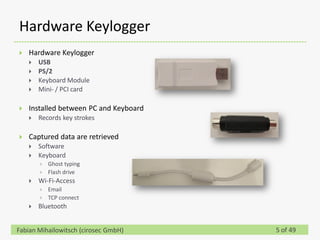
Hardware Keylogger
   Hardware Keylogger
       USB
       PS/2
       Keyboard Module
       Mini- / PCI card

   Installed between PC and Keyboard
       Records key strokes

   Captured data are retrieved
       Software
       Keyboard
           Ghost typing
           Flash drive
       Wi-Fi-Access
           Email
           TCP connect
       Bluetooth


Fabian Mihailowitsch (cirosec GmbH)     5 of 49
Hardware Keylogger
   Features
       Up to 2 GB flash memory
       Encryption
       Password protection
       Timestamping
       Time use charts
       Search functions
       Upgradeable firmware

   Pricing
       PS/2: 32.00 USD
       USB: 58.00 USD

Fabian Mihailowitsch (cirosec GmbH)   6 of 49
Hardware Keylogger – The companies
   Big ones
       KeyDemon, KeeLog, … (PL)
       KeyCarbon (US)

   Most companies rebrand KeyDemon
       KeyCobra
       KeyLlama (once own products)
       …


   Also „famous“ (older products)
       KEYKatcher (US)
       KeyGhost (NZ)
       KeyShark (DE)

   The others
       WirelessKeylogger (UK)
       Exotic Stuff (mostly CN)
       Some Open Source Keylogger


Fabian Mihailowitsch (cirosec GmbH)    7 of 49
PS/2 – How does it work
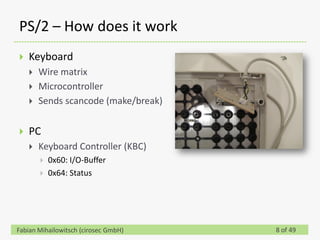
   Keyboard
       Wire matrix
       Microcontroller
       Sends scancode (make/break)


   PC
       Keyboard Controller (KBC)
           0x60: I/O-Buffer
           0x64: Status


Fabian Mihailowitsch (cirosec GmbH)   8 of 49
PS/2 – How does it work
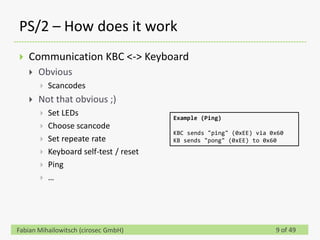
   Communication KBC <-> Keyboard
       Obvious
           Scancodes
       Not that obvious ;)
           Set LEDs                     Example (Ping)
           Choose scancode
                                         KBC sends "ping" (0xEE) via 0x60
           Set repeate rate             KB sends "pong" (0xEE) to 0x60
           Keyboard self-test / reset
           Ping
           …


Fabian Mihailowitsch (cirosec GmbH)                                   9 of 49
PS/2 – How does it work
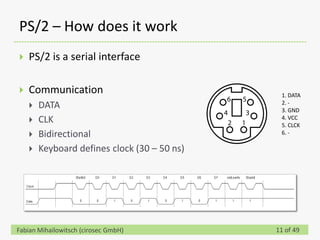
   PS/2 is a serial interface

   Communication                                                                 1. DATA
                                                                                  2. -
       DATA                                                                      3. GND
       CLK                                                                       4. VCC
                                                                                  5. CLCK
       Bidirectional                                                             6. -

       Keyboard defines clock (30 – 50 ns)


   Data frames
           KB (11 bit): startbit, D0-D7 [data], odd parity, stopbit
           KBC (12 bit): startbit, D0-D7 [data], odd parity, stopbit, ACK (KB)

Fabian Mihailowitsch (cirosec GmbH)                                           10 of 49
PS/2 – How does it work
   PS/2 is a serial interface

   Communication                              1. DATA
                                               2. -
       DATA                                   3. GND
       CLK                                    4. VCC
                                               5. CLCK
       Bidirectional                          6. -

       Keyboard defines clock (30 – 50 ns)


Fabian Mihailowitsch (cirosec GmbH)           11 of 49
Detecting PS/2 Hardware Keylogger
   Current measurement
     Additional electronic components
    = Additional power consumption ;)
           KeyDemon = 65 mA
           KeyKatcher = 54 mA
       More current is drawn
       Cannot be measured by software


Fabian Mihailowitsch (cirosec GmbH)      12 of 49
Detecting PS/2 Hardware Keylogger
   Keylogger are password protected
       Entered via Keyboard
       Ghost typing
       Shipped with default password
       Password restore is complex

   Brute Force password
       Via software
       Check ghost typing


Fabian Mihailowitsch (cirosec GmbH)     13 of 49
Detecting PS/2 Hardware Keylogger
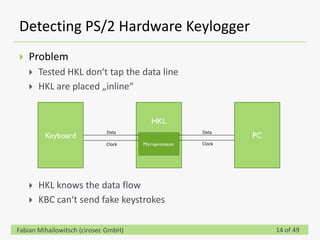
   Problem
       Tested HKL don‘t tap the data line
       HKL are placed „inline“


                                         HKL
                             Data                      Data
         Keyboard                                              PC
                             Clock    Microprocessor   Clock


       HKL knows the data flow
       KBC can‘t send fake keystrokes

Fabian Mihailowitsch (cirosec GmbH)                                 14 of 49
Detecting PS/2 Hardware Keylogger
   However
       Some KB commands (0x60) lead to fake key presses
       Maybe keyboard response is interpreted…

   Brute Force password
       Translation Table (KB command -> key press)
       Brute Force attack via Software

   Practical?
       Limited amount of chars (~10)
       Not all passwords can be Brute Forced
       Works for: KeyGhost, KEYKatcher (some)

Fabian Mihailowitsch (cirosec GmbH)                        15 of 49
Detecting PS/2 Hardware Keylogger


                                 Demo


Fabian Mihailowitsch (cirosec GmbH)     16 of 49
Detecting PS/2 Hardware Keylogger
   Changes on the line
       HKL are placed „inline“


   HKL might change signals on the line
       Different signals (data)
       Own clock (30-50 ns)
       Slight dislocation of data/clock signal
       Maybe more… ;)


Fabian Mihailowitsch (cirosec GmbH)               17 of 49
Detecting PS/2 Hardware Keylogger
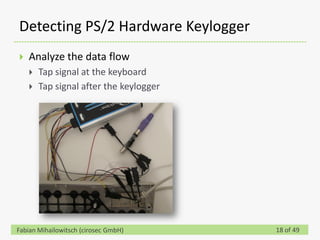
   Analyze the data flow
       Tap signal at the keyboard
       Tap signal after the keylogger


Fabian Mihailowitsch (cirosec GmbH)      18 of 49
Detecting PS/2 Hardware Keylogger
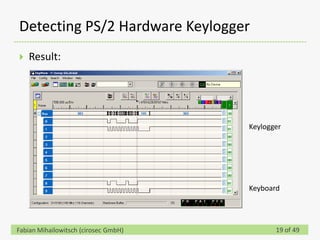
   Result:


                                      Keylogger


                                      Keyboard


Fabian Mihailowitsch (cirosec GmbH)          19 of 49
Detecting PS/2 Hardware Keylogger
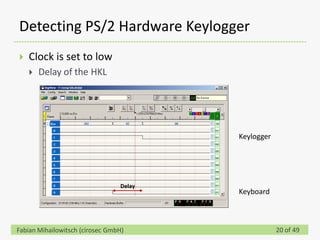
   Clock is set to low
       Delay of the HKL


                                         Keylogger


                                 Delay
                                         Keyboard


Fabian Mihailowitsch (cirosec GmbH)                  20 of 49
Detecting PS/2 Hardware Keylogger
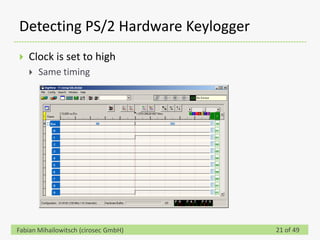
   Clock is set to high
       Same timing


Fabian Mihailowitsch (cirosec GmbH)   21 of 49
Detecting PS/2 Hardware Keylogger
   Clock cycles are shorter for HKL
       Probably HKL generates own clock signal
       Can be detected on the wire
       No possibility to detect via software
       Exact clock state cannot be retrieved by KBC

   But the clock signal starts later…
       Remember when clock was pulled low
       HKL might cause a delay on the wire


Fabian Mihailowitsch (cirosec GmbH)                    22 of 49
Detecting PS/2 Hardware Keylogger
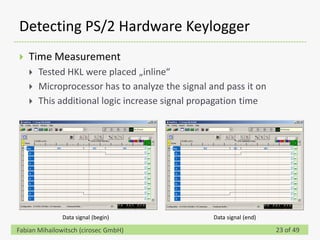
   Time Measurement
       Tested HKL were placed „inline“
       Microprocessor has to analyze the signal and pass it on
       This additional logic increase signal propagation time


              Data signal (begin)                 Data signal (end)

Fabian Mihailowitsch (cirosec GmbH)                                   23 of 49
Detecting PS/2 Hardware Keylogger
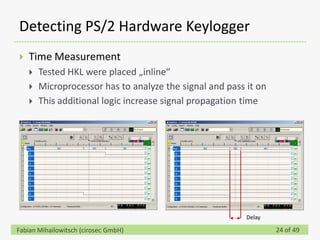
   Time Measurement
       Tested HKL were placed „inline“
       Microprocessor has to analyze the signal and pass it on
       This additional logic increase signal propagation time


                                                          Delay

Fabian Mihailowitsch (cirosec GmbH)                               24 of 49
Detecting PS/2 Hardware Keylogger
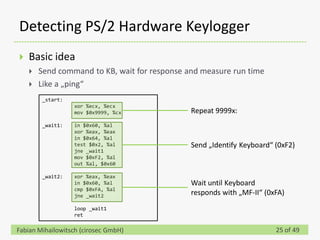
   Basic idea
       Send command to KB, wait for response and measure run time
       Like a „ping“
        _start:
                  xor %ecx, %ecx
                  mov $0x9999, %cx             Repeat 9999x:
        _wait1:   in $0x60, %al
                  xor %eax, %eax
                  in $0x64, %al
                  test $0x2, %al               Send „Identify Keyboard“ (0xF2)
                  jne _wait1
                  mov $0xF2, %al
                  out %al, $0x60

        _wait2:   xor %eax, %eax
                  in $0x60, %al                Wait until Keyboard
                  cmp $0xFA, %al
                  jne _wait2                   responds with „MF-II“ (0xFA)
                  loop _wait1
                  ret

Fabian Mihailowitsch (cirosec GmbH)                                     25 of 49
Detecting PS/2 Hardware Keylogger
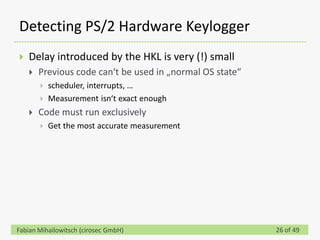
   Delay introduced by the HKL is very (!) small
       Previous code can‘t be used in „normal OS state“
           scheduler, interrupts, …
           Measurement isn‘t exact enough
       Code must run exclusively
           Get the most accurate measurement


Fabian Mihailowitsch (cirosec GmbH)                        26 of 49
Detecting PS/2 Hardware Keylogger
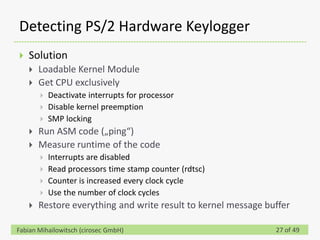
   Solution
       Loadable Kernel Module
       Get CPU exclusively
           Deactivate interrupts for processor
           Disable kernel preemption
           SMP locking
       Run ASM code („ping“)
       Measure runtime of the code
           Interrupts are disabled
           Read processors time stamp counter (rdtsc)
           Counter is increased every clock cycle
           Use the number of clock cycles
       Restore everything and write result to kernel message buffer

Fabian Mihailowitsch (cirosec GmbH)                             27 of 49
Detecting PS/2 Hardware Keylogger
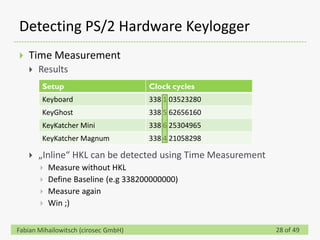
   Time Measurement
       Results
        Setup                         Clock cycles
        Keyboard                      338 1 03523280
        KeyGhost                      338 5 62656160
        KeyKatcher Mini               338 6 25304965
        KeyKatcher Magnum             338 4 21058298

       „Inline“ HKL can be detected using Time Measurement
           Measure without HKL
           Define Baseline (e.g 338200000000)
           Measure again
           Win ;)


Fabian Mihailowitsch (cirosec GmbH)                           28 of 49
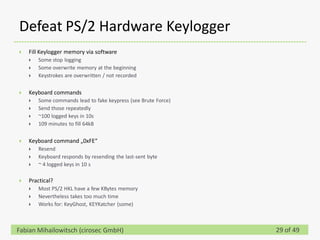
Defeat PS/2 Hardware Keylogger
   Fill Keylogger memory via software
       Some stop logging
       Some overwrite memory at the beginning
       Keystrokes are overwritten / not recorded

   Keyboard commands
       Some commands lead to fake keypress (see Brute Force)
       Send those repeatedly
       ~100 logged keys in 10s
       109 minutes to fill 64kB

   Keyboard command „0xFE“
       Resend
       Keyboard responds by resending the last-sent byte
       ~ 4 logged keys in 10 s

   Practical?
       Most PS/2 HKL have a few KBytes memory
       Nevertheless takes too much time
       Works for: KeyGhost, KEYKatcher (some)


Fabian Mihailowitsch (cirosec GmbH)                             29 of 49
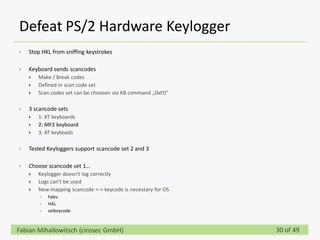
Defeat PS/2 Hardware Keylogger
   Stop HKL from sniffing keystrokes

   Keyboard sends scancodes
       Make / Break codes
       Defined in scan code set
       Scan codes set can be choosen via KB command „0xF0“

   3 scancode sets
       1: XT keyboards
       2: MF2 keyboard
       3: AT keyboads

   Tested Keyloggers support scancode set 2 and 3

   Choose scancode set 1…
       Keylogger doesn‘t log correctly
       Logs can‘t be used
       New mapping scancode <-> keycode is necessary for OS
           hdev
           HAL
           setkeycode


Fabian Mihailowitsch (cirosec GmbH)                            30 of 49
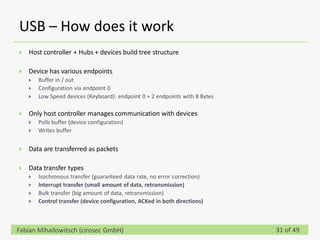
USB – How does it work
   Host controller + Hubs + devices build tree structure

   Device has various endpoints
       Buffer in / out
       Configuration via endpoint 0
       Low Speed devices (Keyboard): endpoint 0 + 2 endpoints with 8 Bytes

   Only host controller manages communication with devices
       Polls buffer (device configuration)
       Writes buffer


   Data are transferred as packets

   Data transfer types
       Isochronous transfer (guaranteed data rate, no error correction)
       Interrupt transfer (small amount of data, retransmission)
       Bulk transfer (big amount of data, retransmission)
       Control transfer (device configuration, ACKed in both directions)


Fabian Mihailowitsch (cirosec GmbH)                                           31 of 49
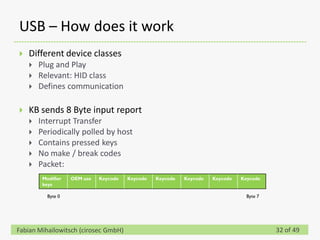
USB – How does it work
   Different device classes
       Plug and Play
       Relevant: HID class
       Defines communication

   KB sends 8 Byte input report
       Interrupt Transfer
       Periodically polled by host
       Contains pressed keys
       No make / break codes
       Packet:
         Modifier   OEM use   Keycode   Keycode   Keycode   Keycode   Keycode   Keycode
         keys

           Byte 0                                                                 Byte 7


Fabian Mihailowitsch (cirosec GmbH)                                                        32 of 49
USB – How does it work
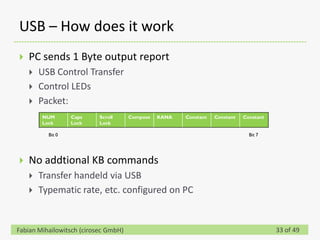
   PC sends 1 Byte output report
       USB Control Transfer
       Control LEDs
       Packet:
        NUM       Caps     Scroll     Compose   KANA   Constant   Constant   Constant
        Lock      Lock     Lock

          Bit 0                                                                Bit 7


   No addtional KB commands
       Transfer handeld via USB
       Typematic rate, etc. configured on PC


Fabian Mihailowitsch (cirosec GmbH)                                                     33 of 49
Detecting USB Hardware Keylogger
   Current Measurement
       Like PS/2
       More current is drawn
       Cannot be measured by software
           Device configuration contains current
           However no accurate information available


Fabian Mihailowitsch (cirosec GmbH)                     34 of 49
Detecting USB Hardware Keylogger
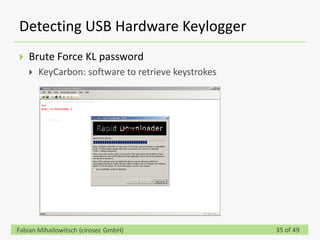
   Brute Force KL password
       KeyCarbon: software to retrieve keystrokes


Fabian Mihailowitsch (cirosec GmbH)                  35 of 49
Detecting USB Hardware Keylogger
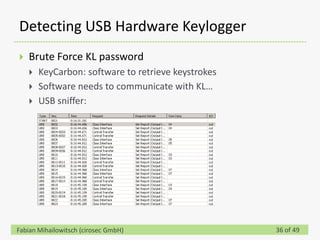
   Brute Force KL password
       KeyCarbon: software to retrieve keystrokes
       Software needs to communicate with KL…
       USB sniffer:


Fabian Mihailowitsch (cirosec GmbH)                  36 of 49
Detecting USB Hardware Keylogger
   Software needs to communicate with KL…
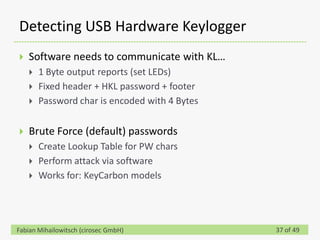
       1 Byte output reports (set LEDs)
       Fixed header + HKL password + footer
       Password char is encoded with 4 Bytes


   Brute Force (default) passwords
       Create Lookup Table for PW chars
       Perform attack via software
       Works for: KeyCarbon models


Fabian Mihailowitsch (cirosec GmbH)             37 of 49
Detecting USB Hardware Keylogger
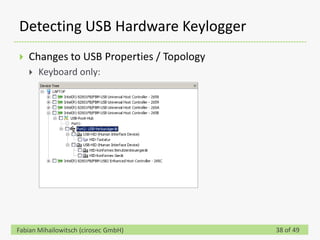
   Changes to USB Properties / Topology
       Keyboard only:


Fabian Mihailowitsch (cirosec GmbH)        38 of 49
Detecting USB Hardware Keylogger
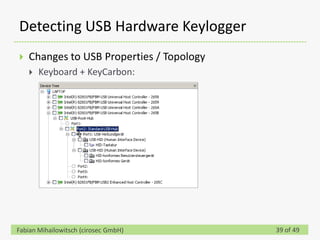
   Changes to USB Properties / Topology
       Keyboard + KeyCarbon:


Fabian Mihailowitsch (cirosec GmbH)        39 of 49
Detecting USB Hardware Keylogger
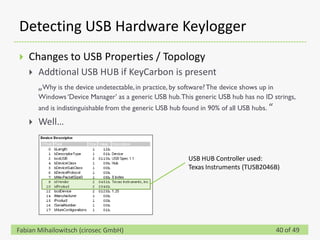
   Changes to USB Properties / Topology
       Addtional USB HUB if KeyCarbon is present
        „Why is the device undetectable, in practice, by software? The device shows up in
        Windows ‘Device Manager’ as a generic USB hub. This generic USB hub has no ID strings,
        and is indistinguishable from the generic USB hub found in 90% of all USB hubs. “

       Well…


                                                           USB HUB Controller used:
                                                           Texas Instruments (TUSB2046B)


Fabian Mihailowitsch (cirosec GmbH)                                                         40 of 49
Detecting USB Hardware Keylogger
   Changes to USB Properties / Topology
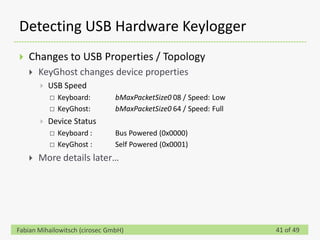
       KeyGhost changes device properties
           USB Speed
               Keyboard:       bMaxPacketSize0 08 / Speed: Low
               KeyGhost:       bMaxPacketSize0 64 / Speed: Full
           Device Status
               Keyboard :      Bus Powered (0x0000)
               KeyGhost :      Self Powered (0x0001)
       More details later…


Fabian Mihailowitsch (cirosec GmbH)                                41 of 49
Detecting USB Hardware Keylogger
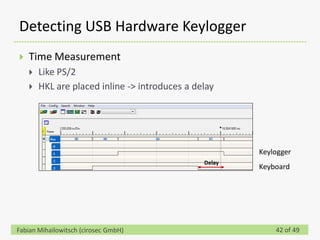
   Time Measurement
       Like PS/2
       HKL are placed inline -> introduces a delay


                                                        Keylogger
                                                Delay
                                                        Keyboard


Fabian Mihailowitsch (cirosec GmbH)                         42 of 49
Detecting USB Hardware Keylogger
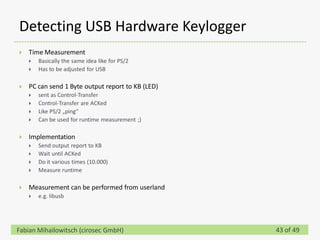
   Time Measurement
       Basically the same idea like for PS/2
       Has to be adjusted for USB

   PC can send 1 Byte output report to KB (LED)
       sent as Control-Transfer
       Control-Transfer are ACKed
       Like PS/2 „ping“
       Can be used for runtime measurement ;)

   Implementation
       Send output report to KB
       Wait until ACKed
       Do it various times (10.000)
       Measure runtime

   Measurement can be performed from userland
       e.g. libusb


Fabian Mihailowitsch (cirosec GmbH)                43 of 49
Detecting USB Hardware Keylogger
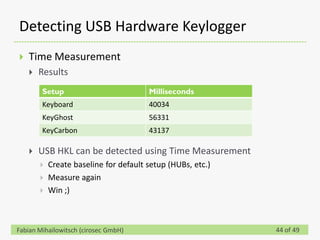
   Time Measurement
       Results
        Setup                           Milliseconds
        Keyboard                        40034
        KeyGhost                        56331
        KeyCarbon                       43137

       USB HKL can be detected using Time Measurement
           Create baseline for default setup (HUBs, etc.)
           Measure again
           Win ;)


Fabian Mihailowitsch (cirosec GmbH)                          44 of 49
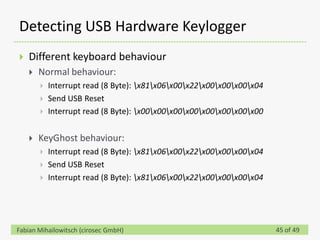
Detecting USB Hardware Keylogger
   Different keyboard behaviour
       Normal behaviour:
           Interrupt read (8 Byte): x81x06x00x22x00x00x00x04
           Send USB Reset
           Interrupt read (8 Byte): x00x00x00x00x00x00x00x00


       KeyGhost behaviour:
           Interrupt read (8 Byte): x81x06x00x22x00x00x00x04
           Send USB Reset
           Interrupt read (8 Byte): x81x06x00x22x00x00x00x04


Fabian Mihailowitsch (cirosec GmbH)                                     45 of 49
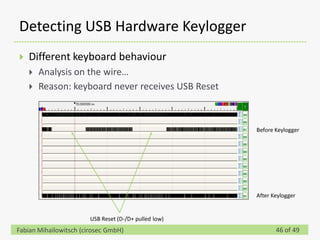
Detecting USB Hardware Keylogger
   Different keyboard behaviour
       Analysis on the wire…
       Reason: keyboard never receives USB Reset


                                                       Before Keylogger


                                                       After Keylogger


                        USB Reset (D-/D+ pulled low)
Fabian Mihailowitsch (cirosec GmbH)                           46 of 49
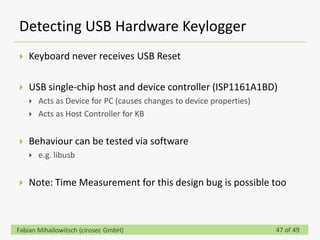
Detecting USB Hardware Keylogger
   Keyboard never receives USB Reset

   USB single-chip host and device controller (ISP1161A1BD)
       Acts as Device for PC (causes changes to device properties)
       Acts as Host Controller for KB


   Behaviour can be tested via software
       e.g. libusb


   Note: Time Measurement for this design bug is possible too


Fabian Mihailowitsch (cirosec GmbH)                                   47 of 49
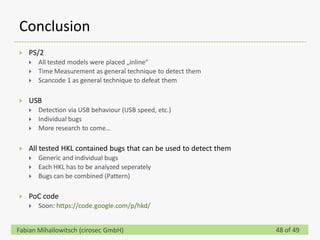
Conclusion
   PS/2
       All tested models were placed „inline“
       Time Measurement as general technique to detect them
       Scancode 1 as general technique to defeat them

   USB
       Detection via USB behaviour (USB speed, etc.)
       Individual bugs
       More research to come…

   All tested HKL contained bugs that can be used to detect them
       Generic and individual bugs
       Each HKL has to be analyzed seperately
       Bugs can be combined (Pattern)

   PoC code
       Soon: https://code.google.com/p/hkd/


Fabian Mihailowitsch (cirosec GmbH)                                 48 of 49
Thank you for your interest!


       Questions and Feedback


Fabian Mihailowitsch (cirosec GmbH)   49 of 49

Detectando Hardware keylogger

  • 1.
    Detecting Hardware Keyloggers FabianMihailowitsch November 6, 2010
  • 2.
    Who?  Fabian Mihailowitsch  Former Software Developer  German energy combine  IT-Security Consultant  cirosec GmbH  Penetration Tests  Source Code Reviews  Contact  Email: fm@cirosec.de  www.cirosec.de Fabian Mihailowitsch (cirosec GmbH) 2 of 49
  • 3.
    What?  Hardware Keylogger  PS/2  USB  Hardware Keyloggers are undetectable by Software „Visual inspection is the primary means of detecting hardware keyloggers, since there are no known methods of detecting them through software. “, en.wikipedia.org, 26.10.10  Talk: Detection of Hardware Keyloggers with Software ;) Fabian Mihailowitsch (cirosec GmbH) 3 of 49
  • 4.
    Why?  Less research on this topic  Few information  No practical way to detect HKL  Because HKL are a threat  2005 (GB): Sumitomo Bank  Attackers tried to steal 423 million USD  Multiple HKL were installed  How about your company?  Solution to identify HKL in large enterprises  Visual inspection is impractical  Only possible via software Fabian Mihailowitsch (cirosec GmbH) 4 of 49
  • 5.
    Hardware Keylogger  Hardware Keylogger  USB  PS/2  Keyboard Module  Mini- / PCI card  Installed between PC and Keyboard  Records key strokes  Captured data are retrieved  Software  Keyboard  Ghost typing  Flash drive  Wi-Fi-Access  Email  TCP connect  Bluetooth Fabian Mihailowitsch (cirosec GmbH) 5 of 49
  • 6.
    Hardware Keylogger  Features  Up to 2 GB flash memory  Encryption  Password protection  Timestamping  Time use charts  Search functions  Upgradeable firmware  Pricing  PS/2: 32.00 USD  USB: 58.00 USD Fabian Mihailowitsch (cirosec GmbH) 6 of 49
  • 7.
    Hardware Keylogger –The companies  Big ones  KeyDemon, KeeLog, … (PL)  KeyCarbon (US)  Most companies rebrand KeyDemon  KeyCobra  KeyLlama (once own products)  …  Also „famous“ (older products)  KEYKatcher (US)  KeyGhost (NZ)  KeyShark (DE)  The others  WirelessKeylogger (UK)  Exotic Stuff (mostly CN)  Some Open Source Keylogger Fabian Mihailowitsch (cirosec GmbH) 7 of 49
  • 8.
    PS/2 – Howdoes it work  Keyboard  Wire matrix  Microcontroller  Sends scancode (make/break)  PC  Keyboard Controller (KBC)  0x60: I/O-Buffer  0x64: Status Fabian Mihailowitsch (cirosec GmbH) 8 of 49
  • 9.
    PS/2 – Howdoes it work  Communication KBC <-> Keyboard  Obvious  Scancodes  Not that obvious ;)  Set LEDs Example (Ping)  Choose scancode KBC sends "ping" (0xEE) via 0x60  Set repeate rate KB sends "pong" (0xEE) to 0x60  Keyboard self-test / reset  Ping  … Fabian Mihailowitsch (cirosec GmbH) 9 of 49
  • 10.
    PS/2 – Howdoes it work  PS/2 is a serial interface  Communication 1. DATA 2. -  DATA 3. GND  CLK 4. VCC 5. CLCK  Bidirectional 6. -  Keyboard defines clock (30 – 50 ns)  Data frames  KB (11 bit): startbit, D0-D7 [data], odd parity, stopbit  KBC (12 bit): startbit, D0-D7 [data], odd parity, stopbit, ACK (KB) Fabian Mihailowitsch (cirosec GmbH) 10 of 49
  • 11.
    PS/2 – Howdoes it work  PS/2 is a serial interface  Communication 1. DATA 2. -  DATA 3. GND  CLK 4. VCC 5. CLCK  Bidirectional 6. -  Keyboard defines clock (30 – 50 ns) Fabian Mihailowitsch (cirosec GmbH) 11 of 49
  • 12.
    Detecting PS/2 HardwareKeylogger  Current measurement  Additional electronic components = Additional power consumption ;)  KeyDemon = 65 mA  KeyKatcher = 54 mA  More current is drawn  Cannot be measured by software Fabian Mihailowitsch (cirosec GmbH) 12 of 49
  • 13.
    Detecting PS/2 HardwareKeylogger  Keylogger are password protected  Entered via Keyboard  Ghost typing  Shipped with default password  Password restore is complex  Brute Force password  Via software  Check ghost typing Fabian Mihailowitsch (cirosec GmbH) 13 of 49
  • 14.
    Detecting PS/2 HardwareKeylogger  Problem  Tested HKL don‘t tap the data line  HKL are placed „inline“ HKL Data Data Keyboard PC Clock Microprocessor Clock  HKL knows the data flow  KBC can‘t send fake keystrokes Fabian Mihailowitsch (cirosec GmbH) 14 of 49
  • 15.
    Detecting PS/2 HardwareKeylogger  However  Some KB commands (0x60) lead to fake key presses  Maybe keyboard response is interpreted…  Brute Force password  Translation Table (KB command -> key press)  Brute Force attack via Software  Practical?  Limited amount of chars (~10)  Not all passwords can be Brute Forced  Works for: KeyGhost, KEYKatcher (some) Fabian Mihailowitsch (cirosec GmbH) 15 of 49
  • 16.
    Detecting PS/2 HardwareKeylogger Demo Fabian Mihailowitsch (cirosec GmbH) 16 of 49
  • 17.
    Detecting PS/2 HardwareKeylogger  Changes on the line  HKL are placed „inline“  HKL might change signals on the line  Different signals (data)  Own clock (30-50 ns)  Slight dislocation of data/clock signal  Maybe more… ;) Fabian Mihailowitsch (cirosec GmbH) 17 of 49
  • 18.
    Detecting PS/2 HardwareKeylogger  Analyze the data flow  Tap signal at the keyboard  Tap signal after the keylogger Fabian Mihailowitsch (cirosec GmbH) 18 of 49
  • 19.
    Detecting PS/2 HardwareKeylogger  Result: Keylogger Keyboard Fabian Mihailowitsch (cirosec GmbH) 19 of 49
  • 20.
    Detecting PS/2 HardwareKeylogger  Clock is set to low  Delay of the HKL Keylogger Delay Keyboard Fabian Mihailowitsch (cirosec GmbH) 20 of 49
  • 21.
    Detecting PS/2 HardwareKeylogger  Clock is set to high  Same timing Fabian Mihailowitsch (cirosec GmbH) 21 of 49
  • 22.
    Detecting PS/2 HardwareKeylogger  Clock cycles are shorter for HKL  Probably HKL generates own clock signal  Can be detected on the wire  No possibility to detect via software  Exact clock state cannot be retrieved by KBC  But the clock signal starts later…  Remember when clock was pulled low  HKL might cause a delay on the wire Fabian Mihailowitsch (cirosec GmbH) 22 of 49
  • 23.
    Detecting PS/2 HardwareKeylogger  Time Measurement  Tested HKL were placed „inline“  Microprocessor has to analyze the signal and pass it on  This additional logic increase signal propagation time Data signal (begin) Data signal (end) Fabian Mihailowitsch (cirosec GmbH) 23 of 49
  • 24.
    Detecting PS/2 HardwareKeylogger  Time Measurement  Tested HKL were placed „inline“  Microprocessor has to analyze the signal and pass it on  This additional logic increase signal propagation time Delay Fabian Mihailowitsch (cirosec GmbH) 24 of 49
  • 25.
    Detecting PS/2 HardwareKeylogger  Basic idea  Send command to KB, wait for response and measure run time  Like a „ping“ _start: xor %ecx, %ecx mov $0x9999, %cx Repeat 9999x: _wait1: in $0x60, %al xor %eax, %eax in $0x64, %al test $0x2, %al Send „Identify Keyboard“ (0xF2) jne _wait1 mov $0xF2, %al out %al, $0x60 _wait2: xor %eax, %eax in $0x60, %al Wait until Keyboard cmp $0xFA, %al jne _wait2 responds with „MF-II“ (0xFA) loop _wait1 ret Fabian Mihailowitsch (cirosec GmbH) 25 of 49
  • 26.
    Detecting PS/2 HardwareKeylogger  Delay introduced by the HKL is very (!) small  Previous code can‘t be used in „normal OS state“  scheduler, interrupts, …  Measurement isn‘t exact enough  Code must run exclusively  Get the most accurate measurement Fabian Mihailowitsch (cirosec GmbH) 26 of 49
  • 27.
    Detecting PS/2 HardwareKeylogger  Solution  Loadable Kernel Module  Get CPU exclusively  Deactivate interrupts for processor  Disable kernel preemption  SMP locking  Run ASM code („ping“)  Measure runtime of the code  Interrupts are disabled  Read processors time stamp counter (rdtsc)  Counter is increased every clock cycle  Use the number of clock cycles  Restore everything and write result to kernel message buffer Fabian Mihailowitsch (cirosec GmbH) 27 of 49
  • 28.
    Detecting PS/2 HardwareKeylogger  Time Measurement  Results Setup Clock cycles Keyboard 338 1 03523280 KeyGhost 338 5 62656160 KeyKatcher Mini 338 6 25304965 KeyKatcher Magnum 338 4 21058298  „Inline“ HKL can be detected using Time Measurement  Measure without HKL  Define Baseline (e.g 338200000000)  Measure again  Win ;) Fabian Mihailowitsch (cirosec GmbH) 28 of 49
  • 29.
    Defeat PS/2 HardwareKeylogger  Fill Keylogger memory via software  Some stop logging  Some overwrite memory at the beginning  Keystrokes are overwritten / not recorded  Keyboard commands  Some commands lead to fake keypress (see Brute Force)  Send those repeatedly  ~100 logged keys in 10s  109 minutes to fill 64kB  Keyboard command „0xFE“  Resend  Keyboard responds by resending the last-sent byte  ~ 4 logged keys in 10 s  Practical?  Most PS/2 HKL have a few KBytes memory  Nevertheless takes too much time  Works for: KeyGhost, KEYKatcher (some) Fabian Mihailowitsch (cirosec GmbH) 29 of 49
  • 30.
    Defeat PS/2 HardwareKeylogger  Stop HKL from sniffing keystrokes  Keyboard sends scancodes  Make / Break codes  Defined in scan code set  Scan codes set can be choosen via KB command „0xF0“  3 scancode sets  1: XT keyboards  2: MF2 keyboard  3: AT keyboads  Tested Keyloggers support scancode set 2 and 3  Choose scancode set 1…  Keylogger doesn‘t log correctly  Logs can‘t be used  New mapping scancode <-> keycode is necessary for OS  hdev  HAL  setkeycode Fabian Mihailowitsch (cirosec GmbH) 30 of 49
  • 31.
    USB – Howdoes it work  Host controller + Hubs + devices build tree structure  Device has various endpoints  Buffer in / out  Configuration via endpoint 0  Low Speed devices (Keyboard): endpoint 0 + 2 endpoints with 8 Bytes  Only host controller manages communication with devices  Polls buffer (device configuration)  Writes buffer  Data are transferred as packets  Data transfer types  Isochronous transfer (guaranteed data rate, no error correction)  Interrupt transfer (small amount of data, retransmission)  Bulk transfer (big amount of data, retransmission)  Control transfer (device configuration, ACKed in both directions) Fabian Mihailowitsch (cirosec GmbH) 31 of 49
  • 32.
    USB – Howdoes it work  Different device classes  Plug and Play  Relevant: HID class  Defines communication  KB sends 8 Byte input report  Interrupt Transfer  Periodically polled by host  Contains pressed keys  No make / break codes  Packet: Modifier OEM use Keycode Keycode Keycode Keycode Keycode Keycode keys Byte 0 Byte 7 Fabian Mihailowitsch (cirosec GmbH) 32 of 49
  • 33.
    USB – Howdoes it work  PC sends 1 Byte output report  USB Control Transfer  Control LEDs  Packet: NUM Caps Scroll Compose KANA Constant Constant Constant Lock Lock Lock Bit 0 Bit 7  No addtional KB commands  Transfer handeld via USB  Typematic rate, etc. configured on PC Fabian Mihailowitsch (cirosec GmbH) 33 of 49
  • 34.
    Detecting USB HardwareKeylogger  Current Measurement  Like PS/2  More current is drawn  Cannot be measured by software  Device configuration contains current  However no accurate information available Fabian Mihailowitsch (cirosec GmbH) 34 of 49
  • 35.
    Detecting USB HardwareKeylogger  Brute Force KL password  KeyCarbon: software to retrieve keystrokes Fabian Mihailowitsch (cirosec GmbH) 35 of 49
  • 36.
    Detecting USB HardwareKeylogger  Brute Force KL password  KeyCarbon: software to retrieve keystrokes  Software needs to communicate with KL…  USB sniffer: Fabian Mihailowitsch (cirosec GmbH) 36 of 49
  • 37.
    Detecting USB HardwareKeylogger  Software needs to communicate with KL…  1 Byte output reports (set LEDs)  Fixed header + HKL password + footer  Password char is encoded with 4 Bytes  Brute Force (default) passwords  Create Lookup Table for PW chars  Perform attack via software  Works for: KeyCarbon models Fabian Mihailowitsch (cirosec GmbH) 37 of 49
  • 38.
    Detecting USB HardwareKeylogger  Changes to USB Properties / Topology  Keyboard only: Fabian Mihailowitsch (cirosec GmbH) 38 of 49
  • 39.
    Detecting USB HardwareKeylogger  Changes to USB Properties / Topology  Keyboard + KeyCarbon: Fabian Mihailowitsch (cirosec GmbH) 39 of 49
  • 40.
    Detecting USB HardwareKeylogger  Changes to USB Properties / Topology  Addtional USB HUB if KeyCarbon is present „Why is the device undetectable, in practice, by software? The device shows up in Windows ‘Device Manager’ as a generic USB hub. This generic USB hub has no ID strings, and is indistinguishable from the generic USB hub found in 90% of all USB hubs. “  Well… USB HUB Controller used: Texas Instruments (TUSB2046B) Fabian Mihailowitsch (cirosec GmbH) 40 of 49
  • 41.
    Detecting USB HardwareKeylogger  Changes to USB Properties / Topology  KeyGhost changes device properties  USB Speed  Keyboard: bMaxPacketSize0 08 / Speed: Low  KeyGhost: bMaxPacketSize0 64 / Speed: Full  Device Status  Keyboard : Bus Powered (0x0000)  KeyGhost : Self Powered (0x0001)  More details later… Fabian Mihailowitsch (cirosec GmbH) 41 of 49
  • 42.
    Detecting USB HardwareKeylogger  Time Measurement  Like PS/2  HKL are placed inline -> introduces a delay Keylogger Delay Keyboard Fabian Mihailowitsch (cirosec GmbH) 42 of 49
  • 43.
    Detecting USB HardwareKeylogger  Time Measurement  Basically the same idea like for PS/2  Has to be adjusted for USB  PC can send 1 Byte output report to KB (LED)  sent as Control-Transfer  Control-Transfer are ACKed  Like PS/2 „ping“  Can be used for runtime measurement ;)  Implementation  Send output report to KB  Wait until ACKed  Do it various times (10.000)  Measure runtime  Measurement can be performed from userland  e.g. libusb Fabian Mihailowitsch (cirosec GmbH) 43 of 49
  • 44.
    Detecting USB HardwareKeylogger  Time Measurement  Results Setup Milliseconds Keyboard 40034 KeyGhost 56331 KeyCarbon 43137  USB HKL can be detected using Time Measurement  Create baseline for default setup (HUBs, etc.)  Measure again  Win ;) Fabian Mihailowitsch (cirosec GmbH) 44 of 49
  • 45.
    Detecting USB HardwareKeylogger  Different keyboard behaviour  Normal behaviour:  Interrupt read (8 Byte): x81x06x00x22x00x00x00x04  Send USB Reset  Interrupt read (8 Byte): x00x00x00x00x00x00x00x00  KeyGhost behaviour:  Interrupt read (8 Byte): x81x06x00x22x00x00x00x04  Send USB Reset  Interrupt read (8 Byte): x81x06x00x22x00x00x00x04 Fabian Mihailowitsch (cirosec GmbH) 45 of 49
  • 46.
    Detecting USB HardwareKeylogger  Different keyboard behaviour  Analysis on the wire…  Reason: keyboard never receives USB Reset Before Keylogger After Keylogger USB Reset (D-/D+ pulled low) Fabian Mihailowitsch (cirosec GmbH) 46 of 49
  • 47.
    Detecting USB HardwareKeylogger  Keyboard never receives USB Reset  USB single-chip host and device controller (ISP1161A1BD)  Acts as Device for PC (causes changes to device properties)  Acts as Host Controller for KB  Behaviour can be tested via software  e.g. libusb  Note: Time Measurement for this design bug is possible too Fabian Mihailowitsch (cirosec GmbH) 47 of 49
  • 48.
    Conclusion  PS/2  All tested models were placed „inline“  Time Measurement as general technique to detect them  Scancode 1 as general technique to defeat them  USB  Detection via USB behaviour (USB speed, etc.)  Individual bugs  More research to come…  All tested HKL contained bugs that can be used to detect them  Generic and individual bugs  Each HKL has to be analyzed seperately  Bugs can be combined (Pattern)  PoC code  Soon: https://code.google.com/p/hkd/ Fabian Mihailowitsch (cirosec GmbH) 48 of 49
  • 49.
    Thank you foryour interest! Questions and Feedback Fabian Mihailowitsch (cirosec GmbH) 49 of 49