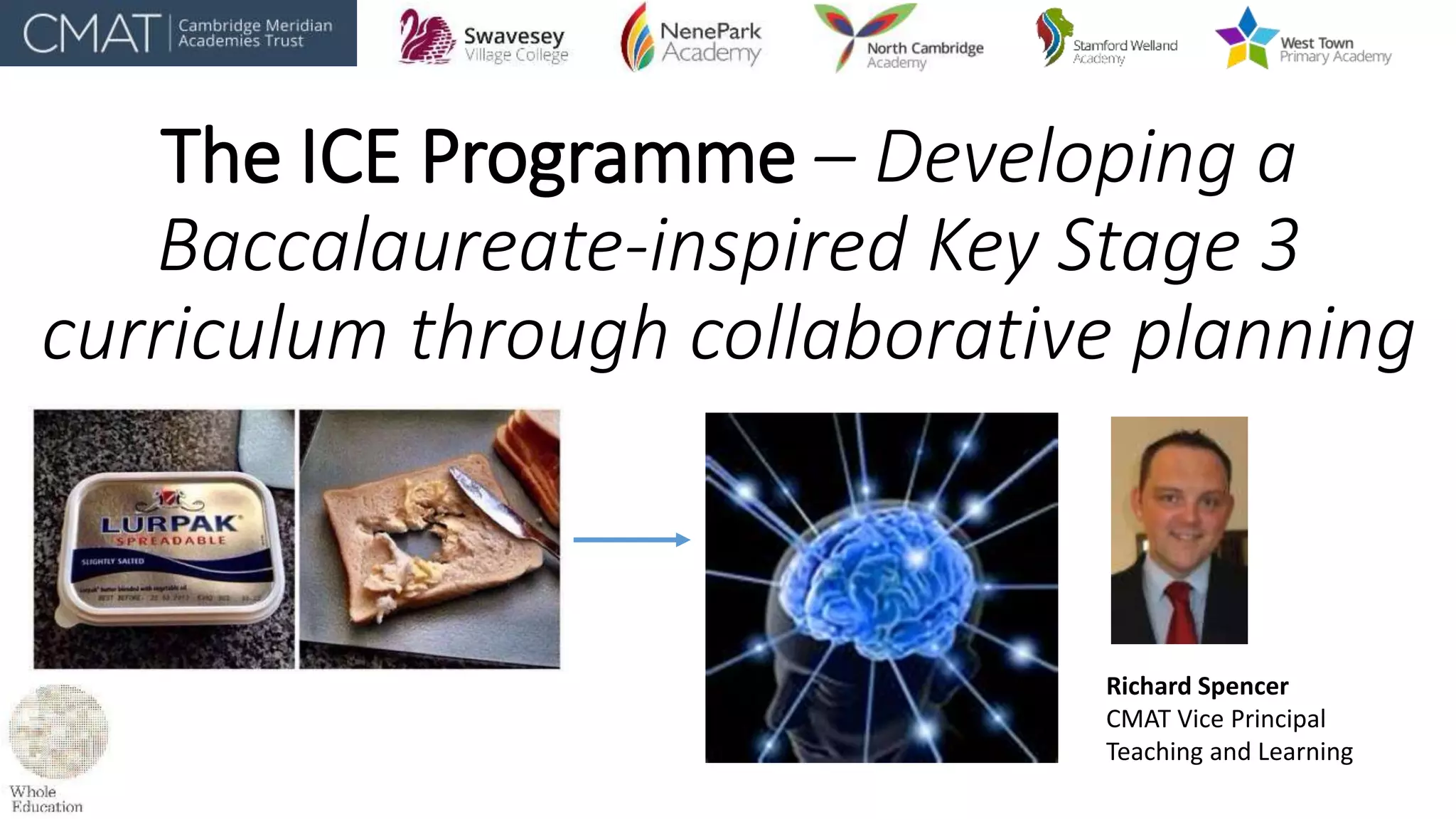
The ICE Programme – Developing a
Baccalaureate-inspired Key Stage 3
curriculum through collaborative planning
Richard Spencer
CMAT Vice Principal
Teaching and Learning
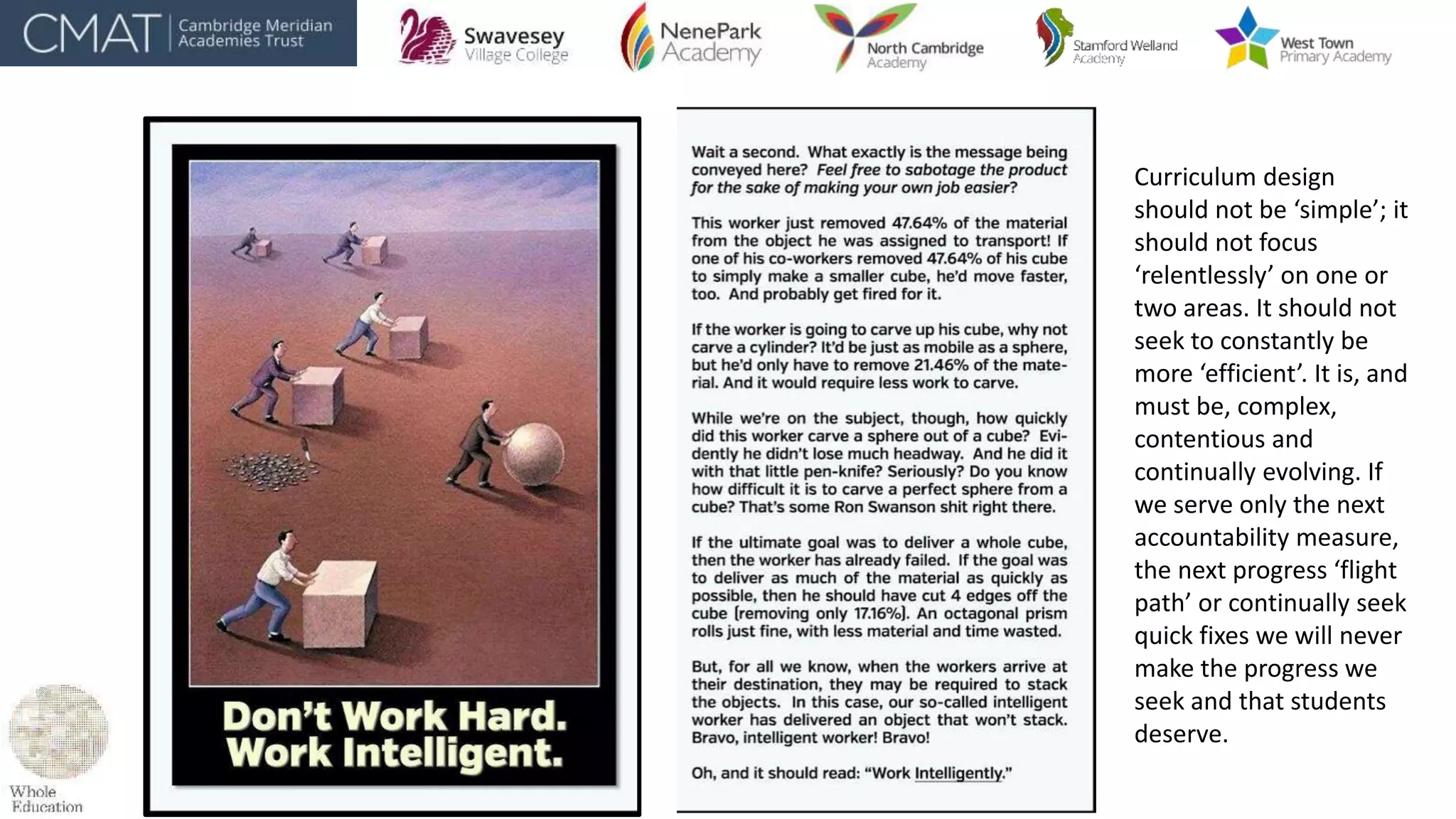
Curriculum design
should not be ‘simple’; it
should not focus
‘relentlessly’ on one or
two areas. It should not
seek to constantly be
more ‘efficient’. It is, and
must be, complex,
contentious and
continually evolving. If
we serve only the next
accountability measure,
the next progress ‘flight
path’ or continually seek
quick fixes we will never
make the progress we
seek and that students
deserve.
Building….
THE PROGRAMME
THE IMPINGTON CURRICULUM EXPERIENCE
An outstanding curriculum for the future.
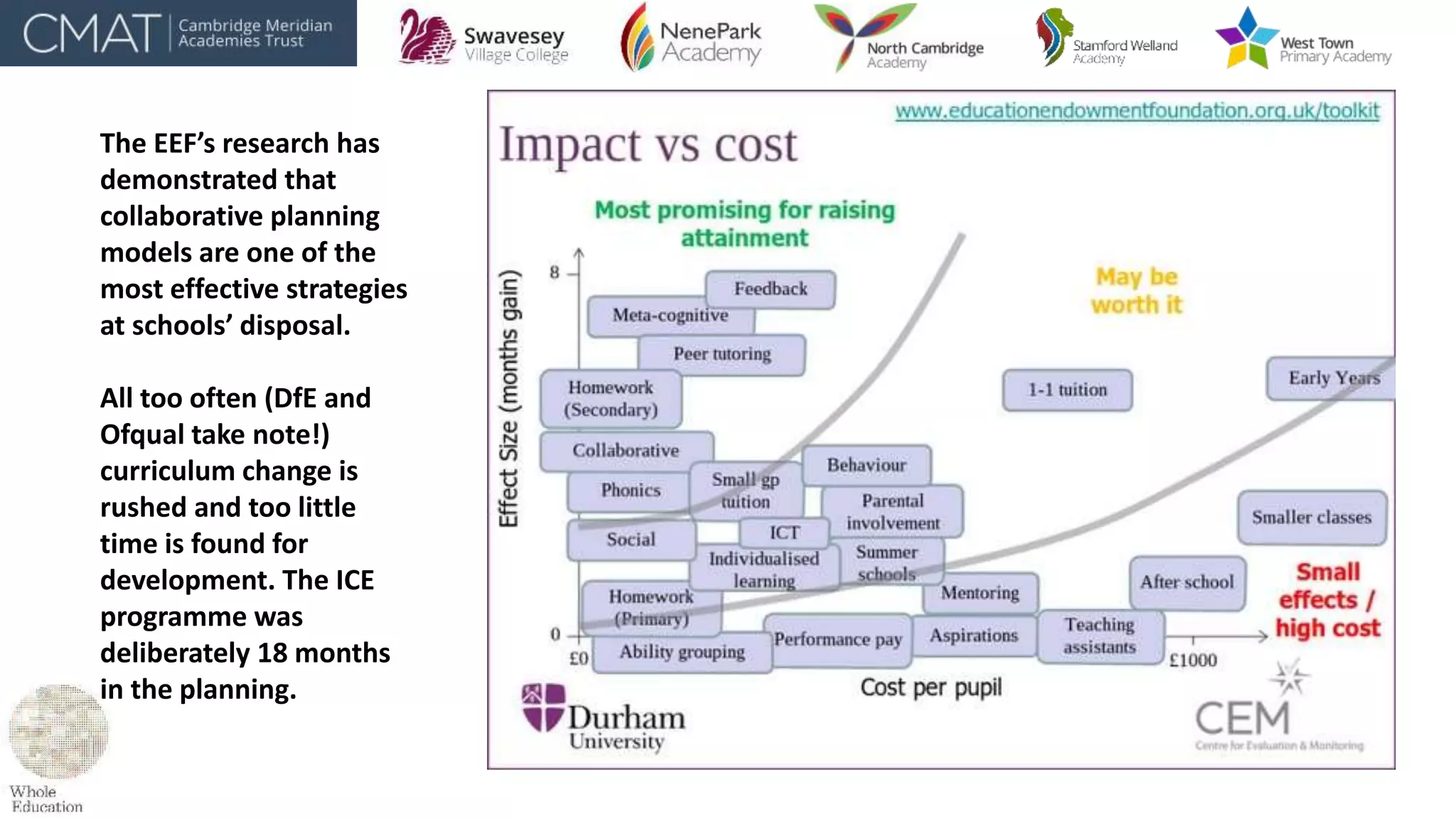
The EEF’s research has
demonstrated that
collaborative planning
models are one of the
most effective strategies
at schools’ disposal.
All too often (DfE and
Ofqual take note!)
curriculum change is
rushed and too little
time is found for
development. The ICE
programme was
deliberately 18 months
in the planning.
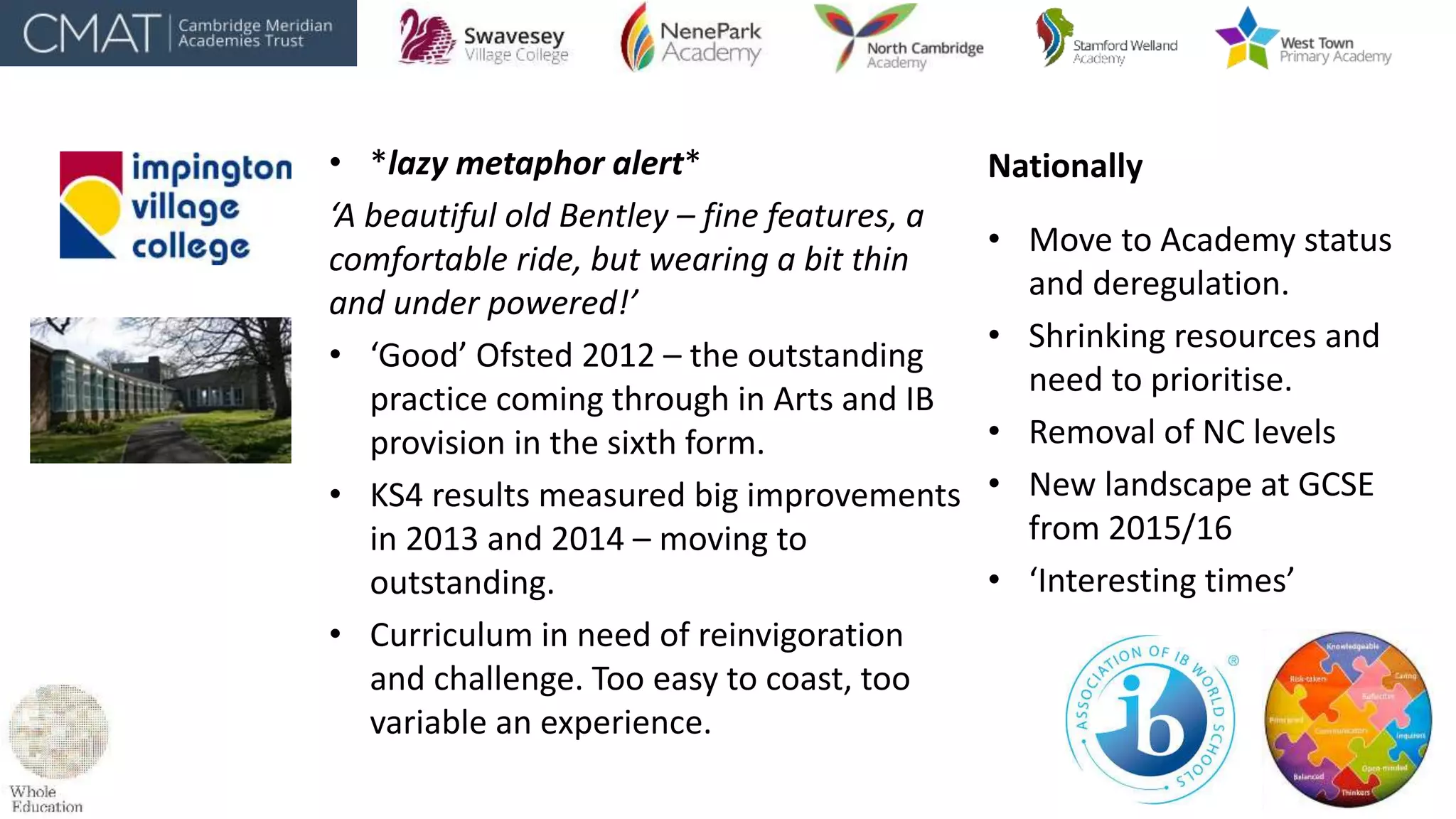
• *lazy metaphor alert*
‘A beautiful old Bentley – fine features, a
comfortable ride, but wearing a bit thin
and under powered!’
• ‘Good’ Ofsted 2012 – the outstanding
practice coming through in Arts and IB
provision in the sixth form.
• KS4 results measured big improvements
in 2013 and 2014 – moving to
outstanding.
• Curriculum in need of reinvigoration
and challenge. Too easy to coast, too
variable an experience.
Nationally
• Move to Academy status
and deregulation.
• Shrinking resources and
need to prioritise.
• Removal of NC levels
• New landscape at GCSE
from 2015/16
• ‘Interesting times’
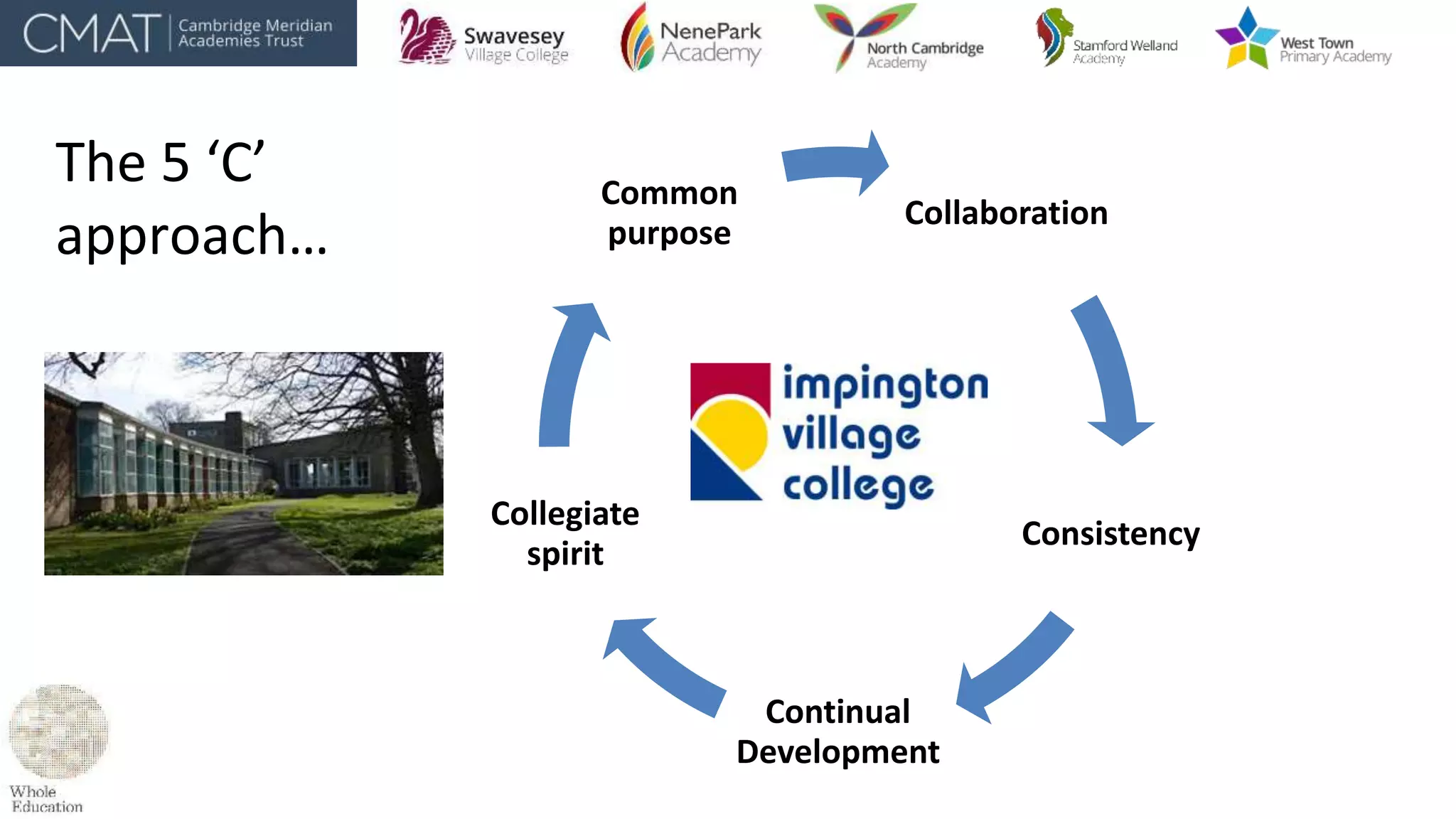
Collaboration
Consistency
Continual
Development
Collegiate
spirit
Common
purpose
The 5 ‘C’
approach…
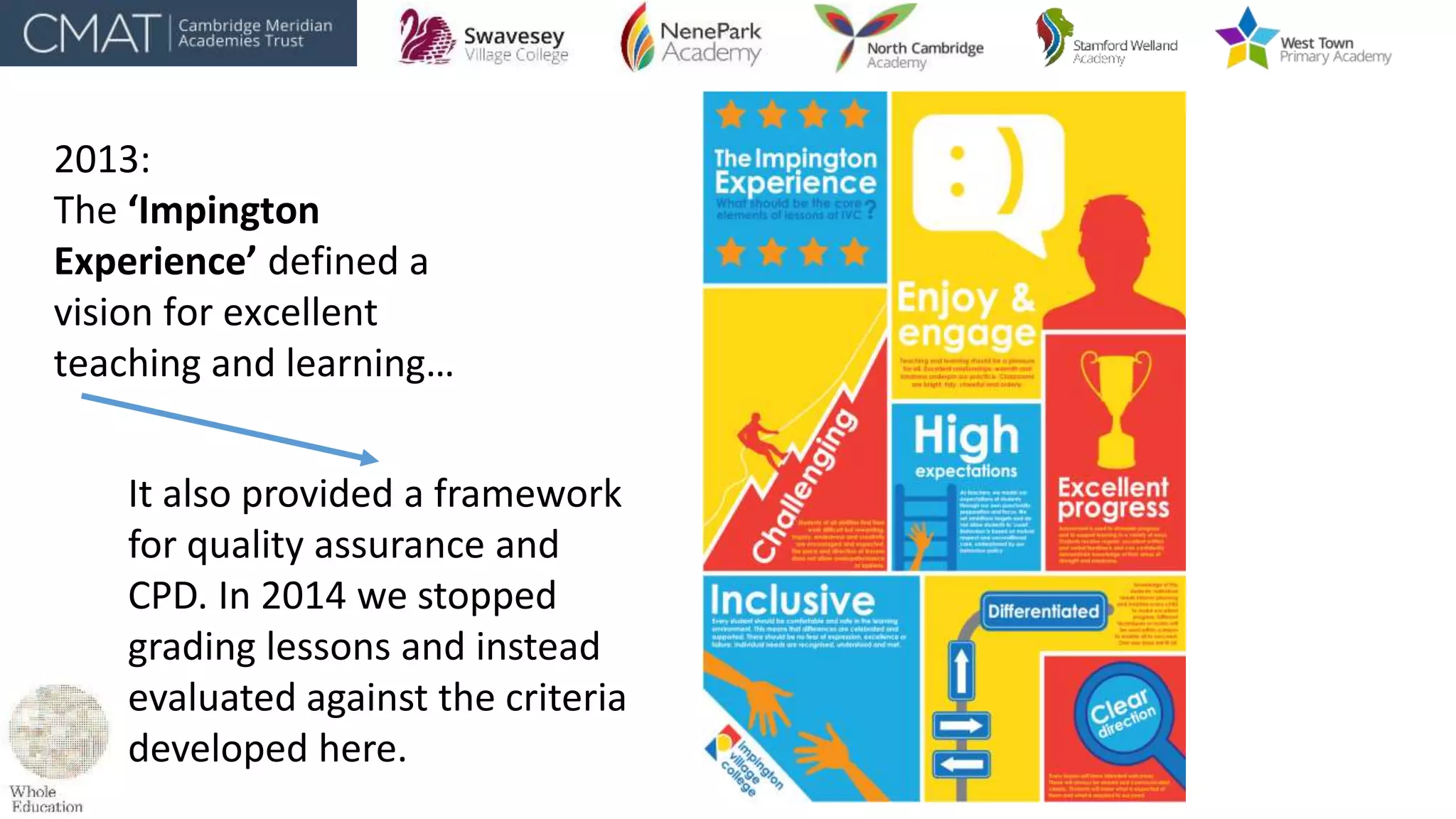
2013:
The ‘Impington
Experience’ defined a
vision for excellent
teaching and learning…
It also provided a framework
for quality assurance and
CPD. In 2014 we stopped
grading lessons and instead
evaluated against the criteria
developed here.
Timeline:
• January – March 2013: Initial discussions, direction
of travel and timeframes established
• April – July 2013: Consultation with staff and
Governors. Planning frameworks, curriculum
models and strands of interaction established with
working party of staff and Governors.
• Academic Year 2013/14. Two thirds of all INSET
time devolved to collaborative planning.
• September 2013: Full launch with staff and
Governors
• October 2013: ICE Programme launched with Year
6 parents and Partner Primaries
• All meeting time bar termly full staff meetings
devolved to Faculties for collaborative planning.
• Occasional ‘released’ days for teams to
collaboratively plan.
• December – February 2013/14: Assessment
criteria developed and moderated
• February – June 2014: Medium Term plans written and
resources prepared.
• May 2014: Initial Medium Term plans submitted and
moderated. Some rejected/edited. Quality control.
• July 2014: All MTP submitted, all homework and resources
for Term 1 added to MOODLE.
• September 2014: ICE Programme began for Year 7!
• September 2014: Staff MOODLE training needs identified.
• October 2014: Parents MOODLE training needs identified!
• October 2014: Evaluation of initial impact ahead of
presentation to Year 6 parents and planning of Year 8
Strands/ curriculum content.
• October 2014: Strand 1 (Ways of Learning) completed
• November 2014: 100% of Year 7 homework delivered
through MOODLE.
• December 2014: First Progress report using new ICE grades
sent home.
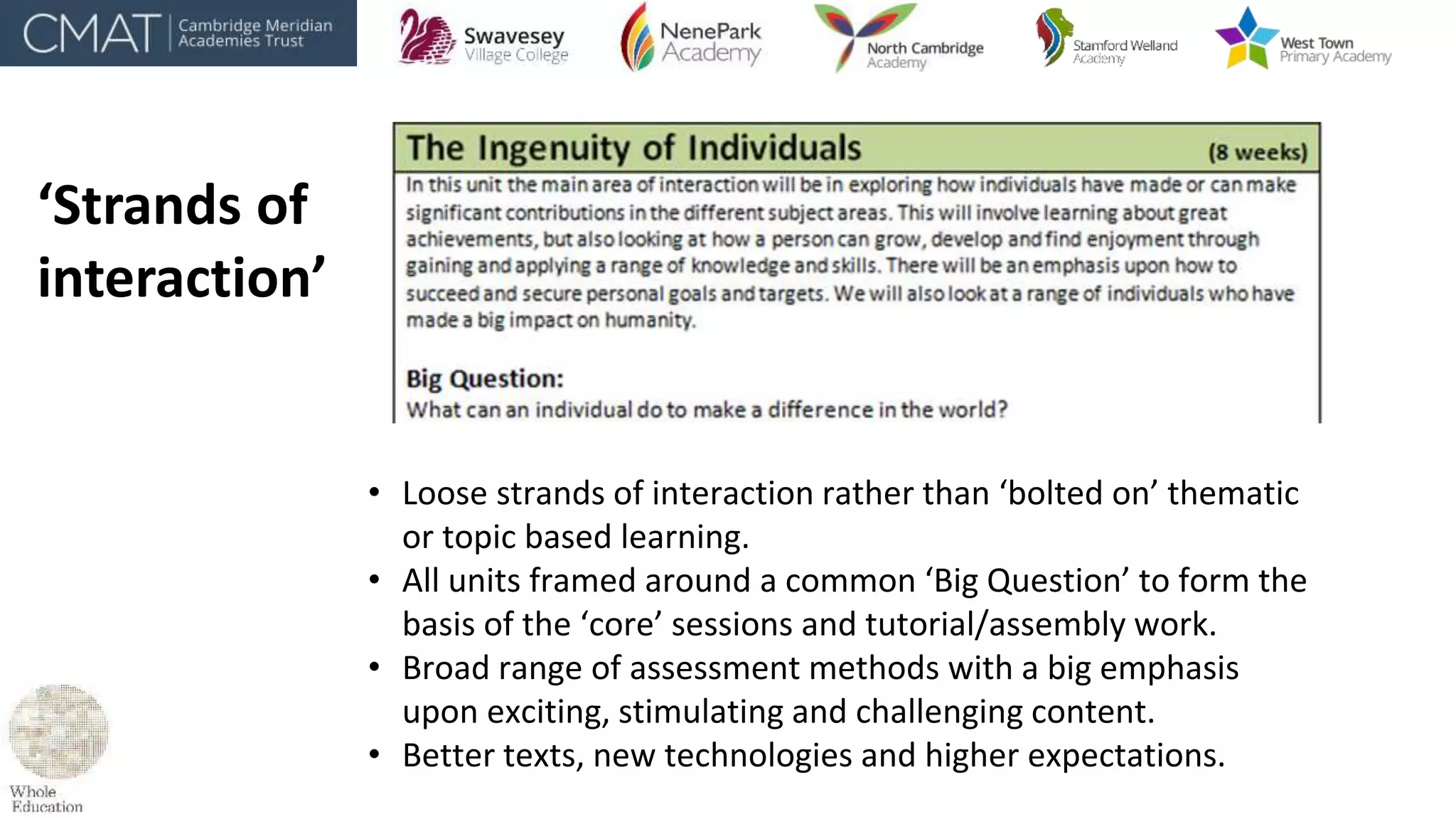
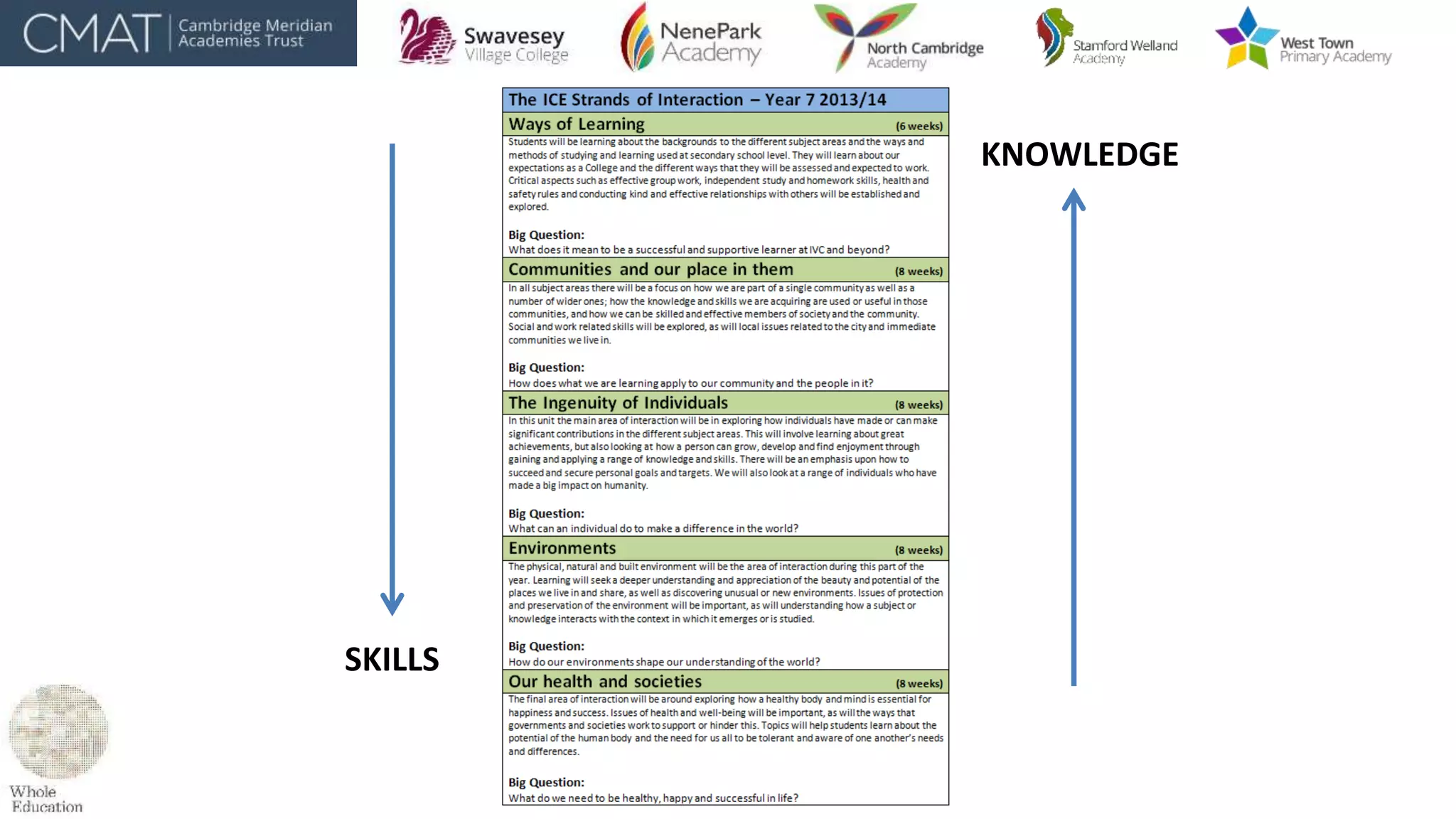
• Loose strands of interaction rather than ‘bolted on’ thematic
or topic based learning.
• All units framed around a common ‘Big Question’ to form the
basis of the ‘core’ sessions and tutorial/assembly work.
• Broad range of assessment methods with a big emphasis
upon exciting, stimulating and challenging content.
• Better texts, new technologies and higher expectations.
‘Strands of
interaction’
Big Question:
What does it mean to be a successful
and supportive learner at IVC and
beyond?
WAYS OF
LEARNING
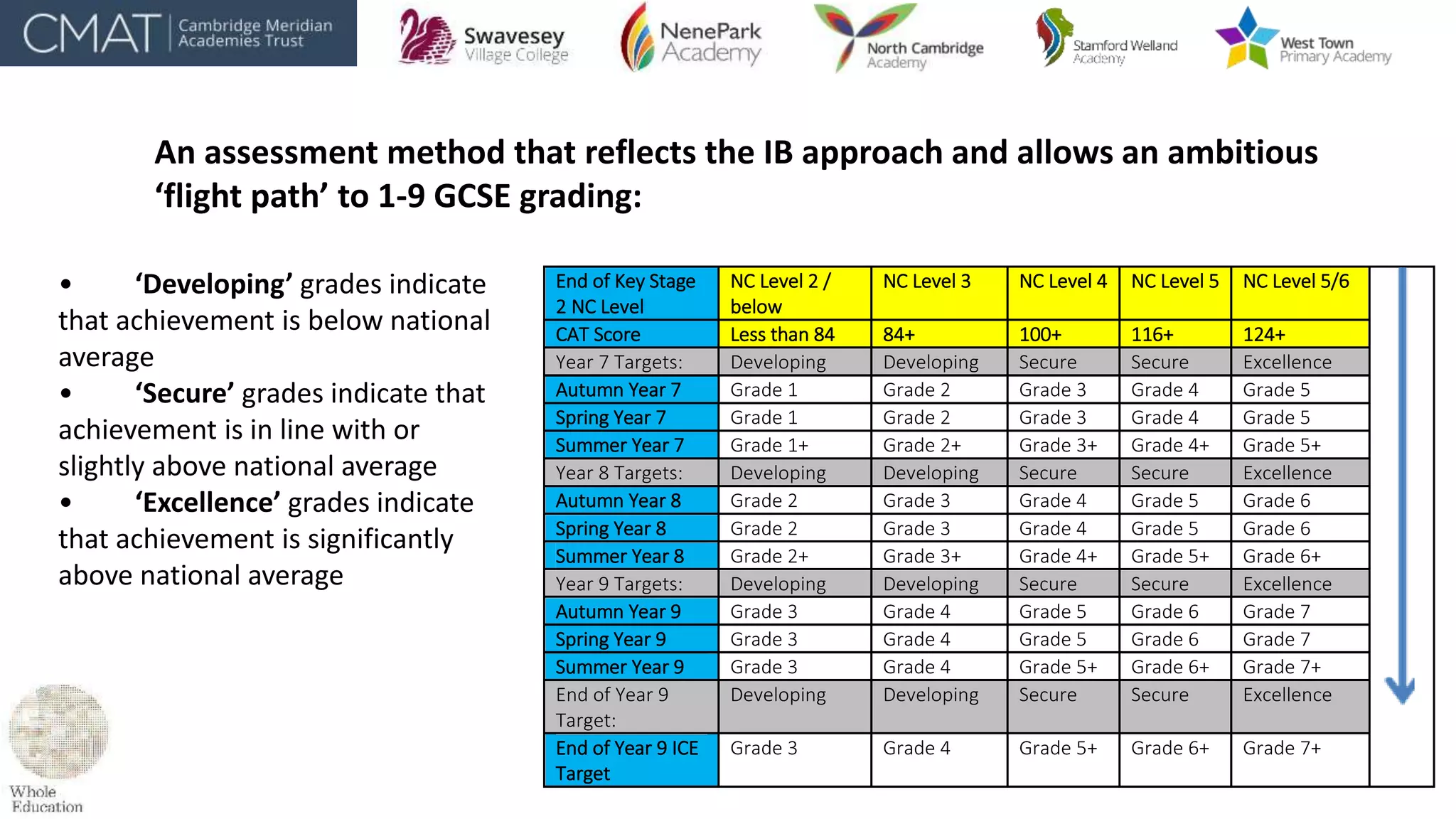
End of Key Stage
2 NC Level
NC Level 2 /
below
NC Level 3 NC Level 4 NC Level 5 NC Level 5/6
CAT Score Less than 84 84+ 100+ 116+ 124+
Year 7 Targets: Developing Developing Secure Secure Excellence
Autumn Year 7 Grade 1 Grade 2 Grade 3 Grade 4 Grade 5
Spring Year 7 Grade 1 Grade 2 Grade 3 Grade 4 Grade 5
Summer Year 7 Grade 1+ Grade 2+ Grade 3+ Grade 4+ Grade 5+
Year 8 Targets: Developing Developing Secure Secure Excellence
Autumn Year 8 Grade 2 Grade 3 Grade 4 Grade 5 Grade 6
Spring Year 8 Grade 2 Grade 3 Grade 4 Grade 5 Grade 6
Summer Year 8 Grade 2+ Grade 3+ Grade 4+ Grade 5+ Grade 6+
Year 9 Targets: Developing Developing Secure Secure Excellence
Autumn Year 9 Grade 3 Grade 4 Grade 5 Grade 6 Grade 7
Spring Year 9 Grade 3 Grade 4 Grade 5 Grade 6 Grade 7
Summer Year 9 Grade 3 Grade 4 Grade 5+ Grade 6+ Grade 7+
End of Year 9
Target:
Developing Developing Secure Secure Excellence
End of Year 9 ICE
Target
Grade 3 Grade 4 Grade 5+ Grade 6+ Grade 7+
• ‘Developing’ grades indicate
that achievement is below national
average
• ‘Secure’ grades indicate that
achievement is in line with or
slightly above national average
• ‘Excellence’ grades indicate
that achievement is significantly
above national average
An assessment method that reflects the IB approach and allows an ambitious
‘flight path’ to 1-9 GCSE grading:
SKILLS
KNOWLEDGE
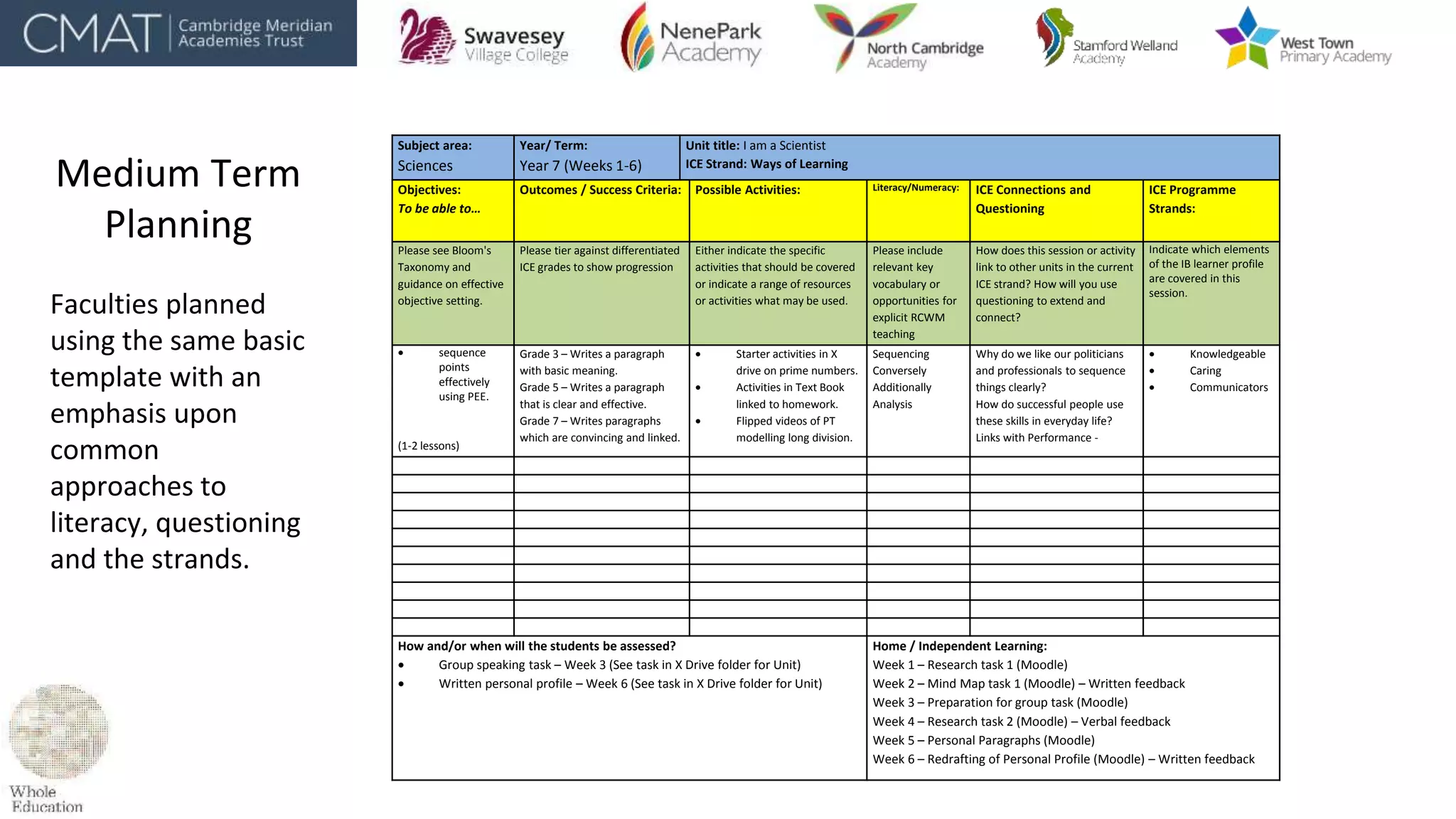
Subject area:
Sciences
Year/ Term:
Year 7 (Weeks 1-6)
Unit title: I am a Scientist
ICE Strand: Ways of Learning
Objectives:
To be able to…
Outcomes / Success Criteria: Possible Activities: Literacy/Numeracy: ICE Connections and
Questioning
ICE Programme
Strands:
Please see Bloom's
Taxonomy and
guidance on effective
objective setting.
Please tier against differentiated
ICE grades to show progression
Either indicate the specific
activities that should be covered
or indicate a range of resources
or activities what may be used.
Please include
relevant key
vocabulary or
opportunities for
explicit RCWM
teaching
How does this session or activity
link to other units in the current
ICE strand? How will you use
questioning to extend and
connect?
Indicate which elements
of the IB learner profile
are covered in this
session.
 sequence
points
effectively
using PEE.
(1-2 lessons)
Grade 3 – Writes a paragraph
with basic meaning.
Grade 5 – Writes a paragraph
that is clear and effective.
Grade 7 – Writes paragraphs
which are convincing and linked.
 Starter activities in X
drive on prime numbers.
 Activities in Text Book
linked to homework.
 Flipped videos of PT
modelling long division.
Sequencing
Conversely
Additionally
Analysis
Why do we like our politicians
and professionals to sequence
things clearly?
How do successful people use
these skills in everyday life?
Links with Performance -
 Knowledgeable
 Caring
 Communicators
How and/or when will the students be assessed?
 Group speaking task – Week 3 (See task in X Drive folder for Unit)
 Written personal profile – Week 6 (See task in X Drive folder for Unit)
Home / Independent Learning:
Week 1 – Research task 1 (Moodle)
Week 2 – Mind Map task 1 (Moodle) – Written feedback
Week 3 – Preparation for group task (Moodle)
Week 4 – Research task 2 (Moodle) – Verbal feedback
Week 5 – Personal Paragraphs (Moodle)
Week 6 – Redrafting of Personal Profile (Moodle) – Written feedback
Medium Term
Planning
Faculties planned
using the same basic
template with an
emphasis upon
common
approaches to
literacy, questioning
and the strands.
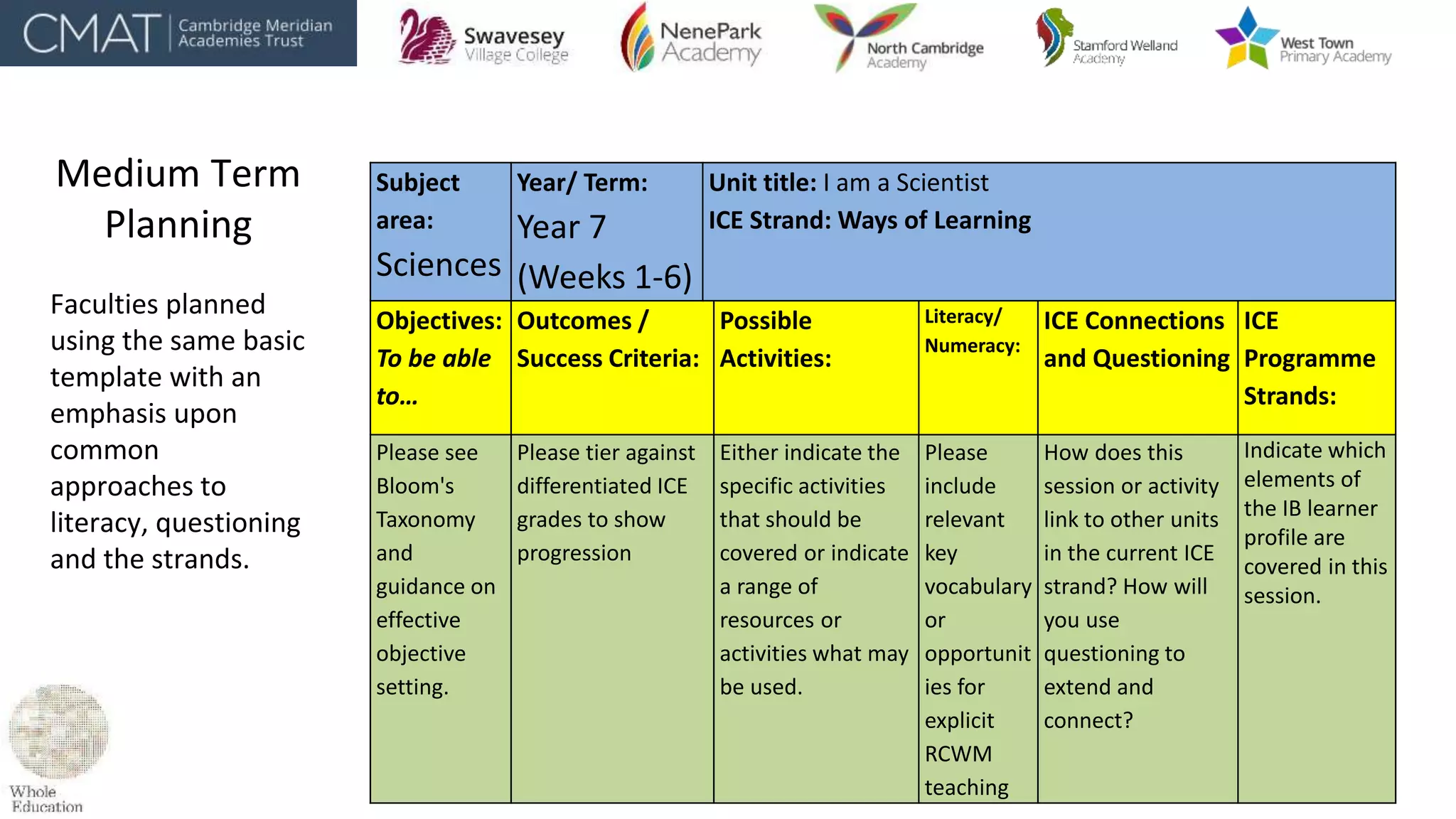
Medium Term
Planning
Faculties planned
using the same basic
template with an
emphasis upon
common
approaches to
literacy, questioning
and the strands.
Subject
area:
Sciences
Year/ Term:
Year 7
(Weeks 1-6)
Unit title: I am a Scientist
ICE Strand: Ways of Learning
Objectives:
To be able
to…
Outcomes /
Success Criteria:
Possible
Activities:
Literacy/
Numeracy:
ICE Connections
and Questioning
ICE
Programme
Strands:
Please see
Bloom's
Taxonomy
and
guidance on
effective
objective
setting.
Please tier against
differentiated ICE
grades to show
progression
Either indicate the
specific activities
that should be
covered or indicate
a range of
resources or
activities what may
be used.
Please
include
relevant
key
vocabulary
or
opportunit
ies for
explicit
RCWM
teaching
How does this
session or activity
link to other units
in the current ICE
strand? How will
you use
questioning to
extend and
connect?
Indicate which
elements of
the IB learner
profile are
covered in this
session.
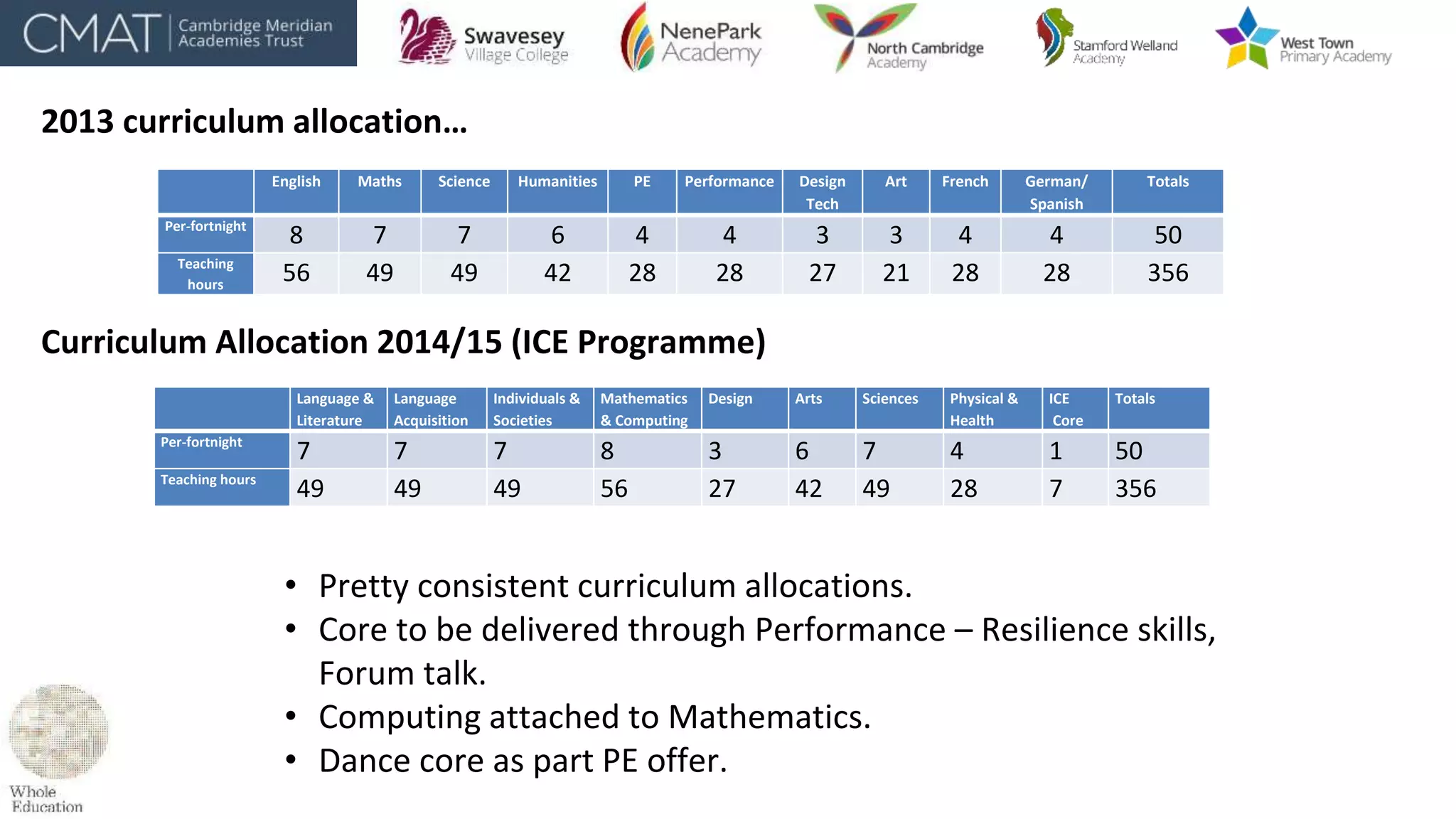
English Maths Science Humanities PE Performance Design
Tech
Art French German/
Spanish
Totals
Per-fortnight
8 7 7 6 4 4 3 3 4 4 50
Teaching
hours
56 49 49 42 28 28 27 21 28 28 356
2013 curriculum allocation…
Language &
Literature
Language
Acquisition
Individuals &
Societies
Mathematics
& Computing
Design Arts Sciences Physical &
Health
ICE
Core
Totals
Per-fortnight
7 7 7 8 3 6 7 4 1 50
Teaching hours
49 49 49 56 27 42 49 28 7 356
Curriculum Allocation 2014/15 (ICE Programme)
• Pretty consistent curriculum allocations.
• Core to be delivered through Performance – Resilience skills,
Forum talk.
• Computing attached to Mathematics.
• Dance core as part PE offer.
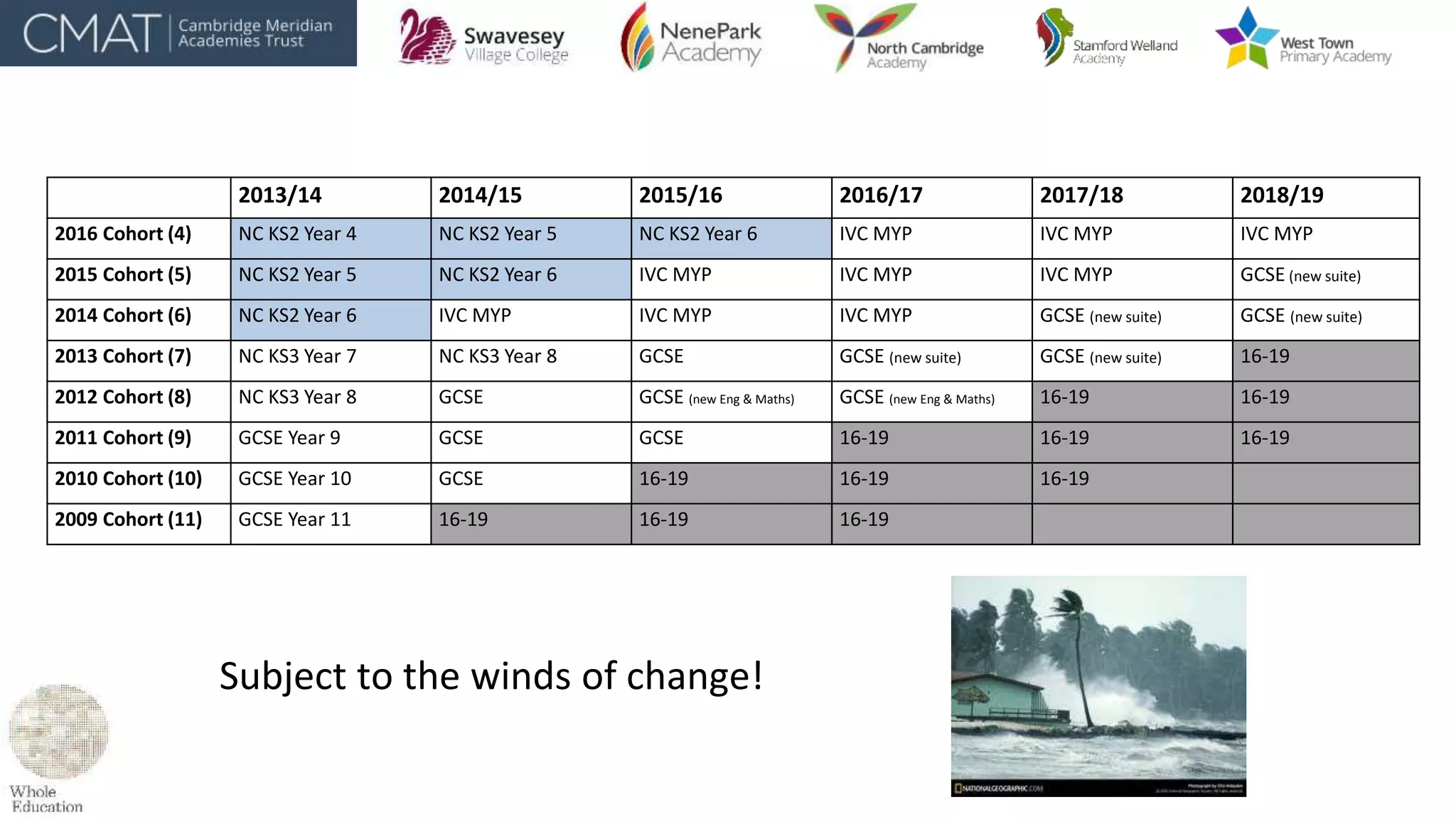
2013/14 2014/15 2015/16 2016/17 2017/18 2018/19
2016 Cohort (4) NC KS2 Year 4 NC KS2 Year 5 NC KS2 Year 6 IVC MYP IVC MYP IVC MYP
2015 Cohort (5) NC KS2 Year 5 NC KS2 Year 6 IVC MYP IVC MYP IVC MYP GCSE (new suite)
2014 Cohort (6) NC KS2 Year 6 IVC MYP IVC MYP IVC MYP GCSE (new suite) GCSE (new suite)
2013 Cohort (7) NC KS3 Year 7 NC KS3 Year 8 GCSE GCSE (new suite) GCSE (new suite) 16-19
2012 Cohort (8) NC KS3 Year 8 GCSE GCSE (new Eng & Maths) GCSE (new Eng & Maths) 16-19 16-19
2011 Cohort (9) GCSE Year 9 GCSE GCSE 16-19 16-19 16-19
2010 Cohort (10) GCSE Year 10 GCSE 16-19 16-19 16-19
2009 Cohort (11) GCSE Year 11 16-19 16-19 16-19
Subject to the winds of change!
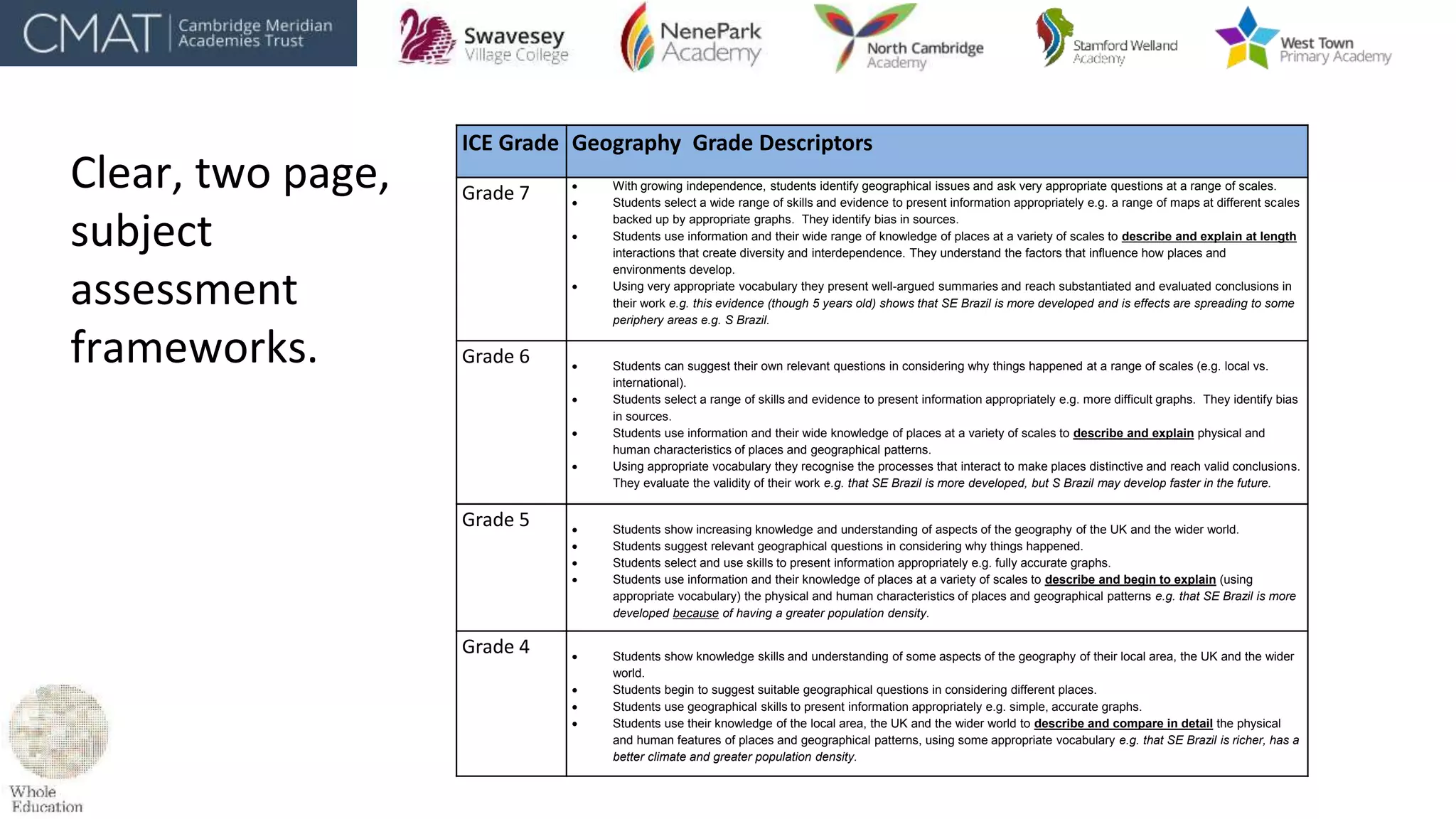
ICE Grade Geography Grade Descriptors
Grade 7  With growing independence, students identify geographical issues and ask very appropriate questions at a range of scales.
 Students select a wide range of skills and evidence to present information appropriately e.g. a range of maps at different scales
backed up by appropriate graphs. They identify bias in sources.
 Students use information and their wide range of knowledge of places at a variety of scales to describe and explain at length
interactions that create diversity and interdependence. They understand the factors that influence how places and
environments develop.
 Using very appropriate vocabulary they present well-argued summaries and reach substantiated and evaluated conclusions in
their work e.g. this evidence (though 5 years old) shows that SE Brazil is more developed and is effects are spreading to some
periphery areas e.g. S Brazil.
Grade 6  Students can suggest their own relevant questions in considering why things happened at a range of scales (e.g. local vs.
international).
 Students select a range of skills and evidence to present information appropriately e.g. more difficult graphs. They identify bias
in sources.
 Students use information and their wide knowledge of places at a variety of scales to describe and explain physical and
human characteristics of places and geographical patterns.
 Using appropriate vocabulary they recognise the processes that interact to make places distinctive and reach valid conclusions.
They evaluate the validity of their work e.g. that SE Brazil is more developed, but S Brazil may develop faster in the future.
Grade 5  Students show increasing knowledge and understanding of aspects of the geography of the UK and the wider world.
 Students suggest relevant geographical questions in considering why things happened.
 Students select and use skills to present information appropriately e.g. fully accurate graphs.
 Students use information and their knowledge of places at a variety of scales to describe and begin to explain (using
appropriate vocabulary) the physical and human characteristics of places and geographical patterns e.g. that SE Brazil is more
developed because of having a greater population density.
Grade 4  Students show knowledge skills and understanding of some aspects of the geography of their local area, the UK and the wider
world.
 Students begin to suggest suitable geographical questions in considering different places.
 Students use geographical skills to present information appropriately e.g. simple, accurate graphs.
 Students use their knowledge of the local area, the UK and the wider world to describe and compare in detail the physical
and human features of places and geographical patterns, using some appropriate vocabulary e.g. that SE Brazil is richer, has a
better climate and greater population density.
Clear, two page,
subject
assessment
frameworks.
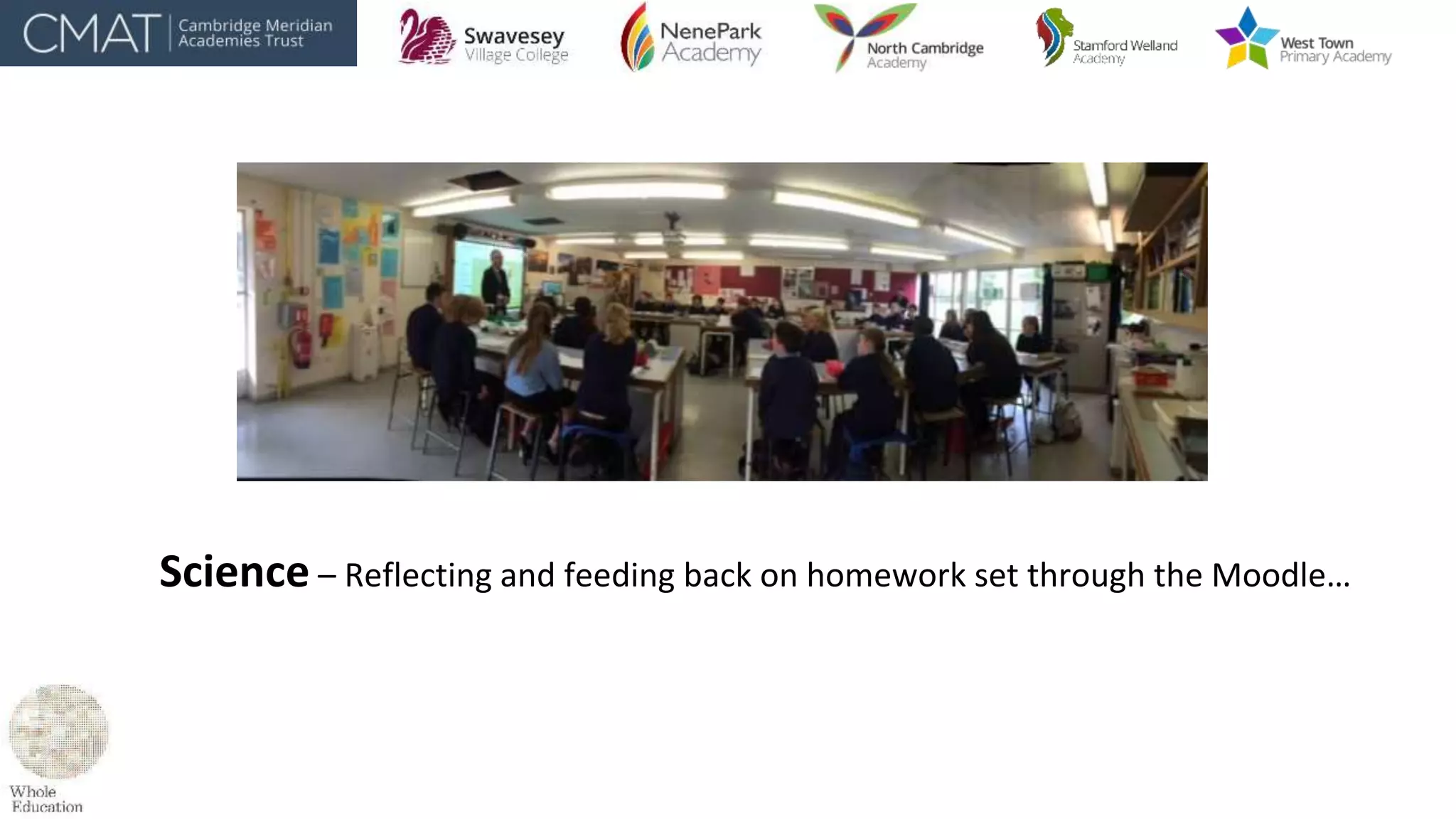
Science – Reflecting and feeding back on homework set through the Moodle…
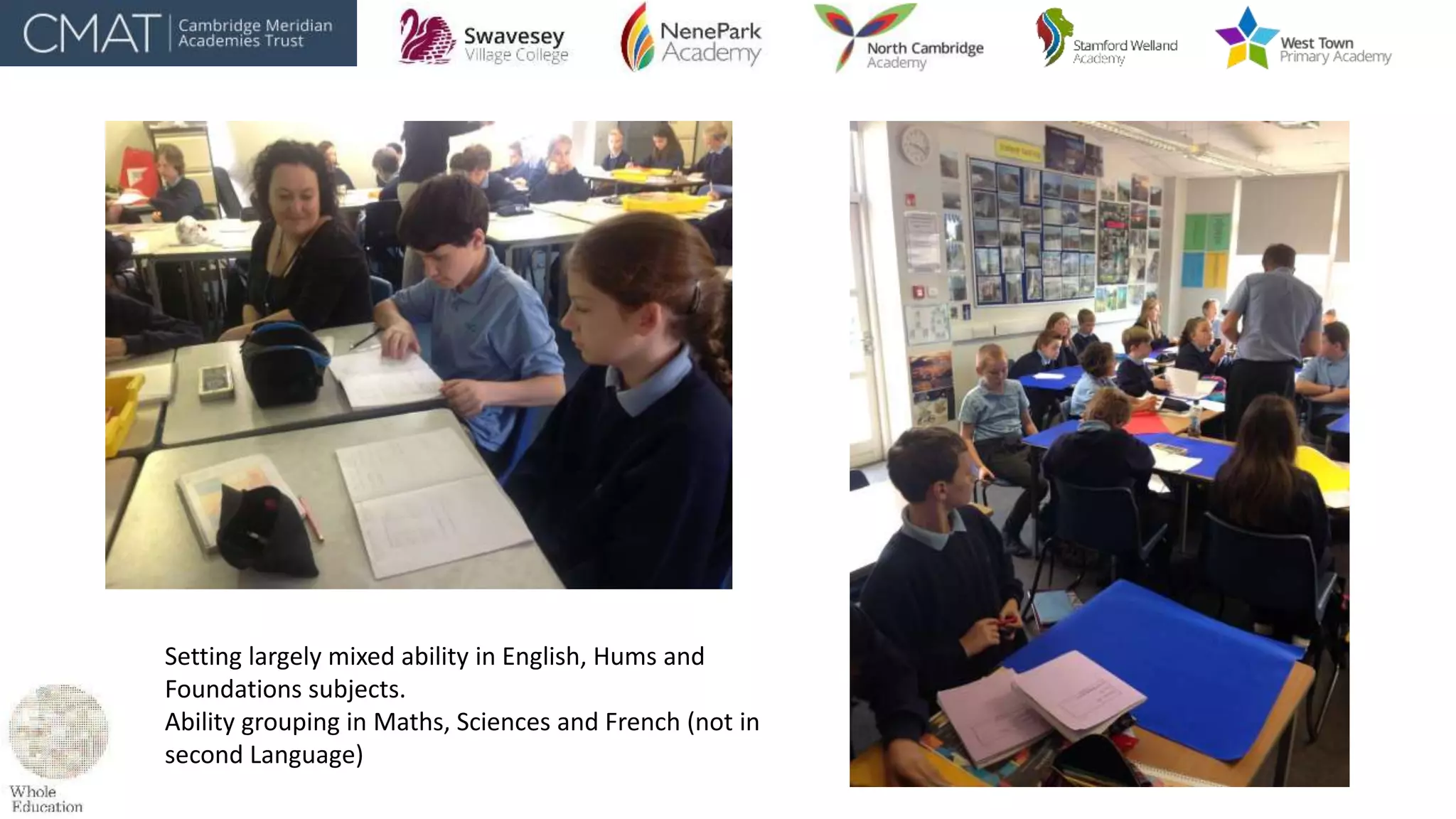
Setting largely mixed ability in English, Hums and
Foundations subjects.
Ability grouping in Maths, Sciences and French (not in
second Language)
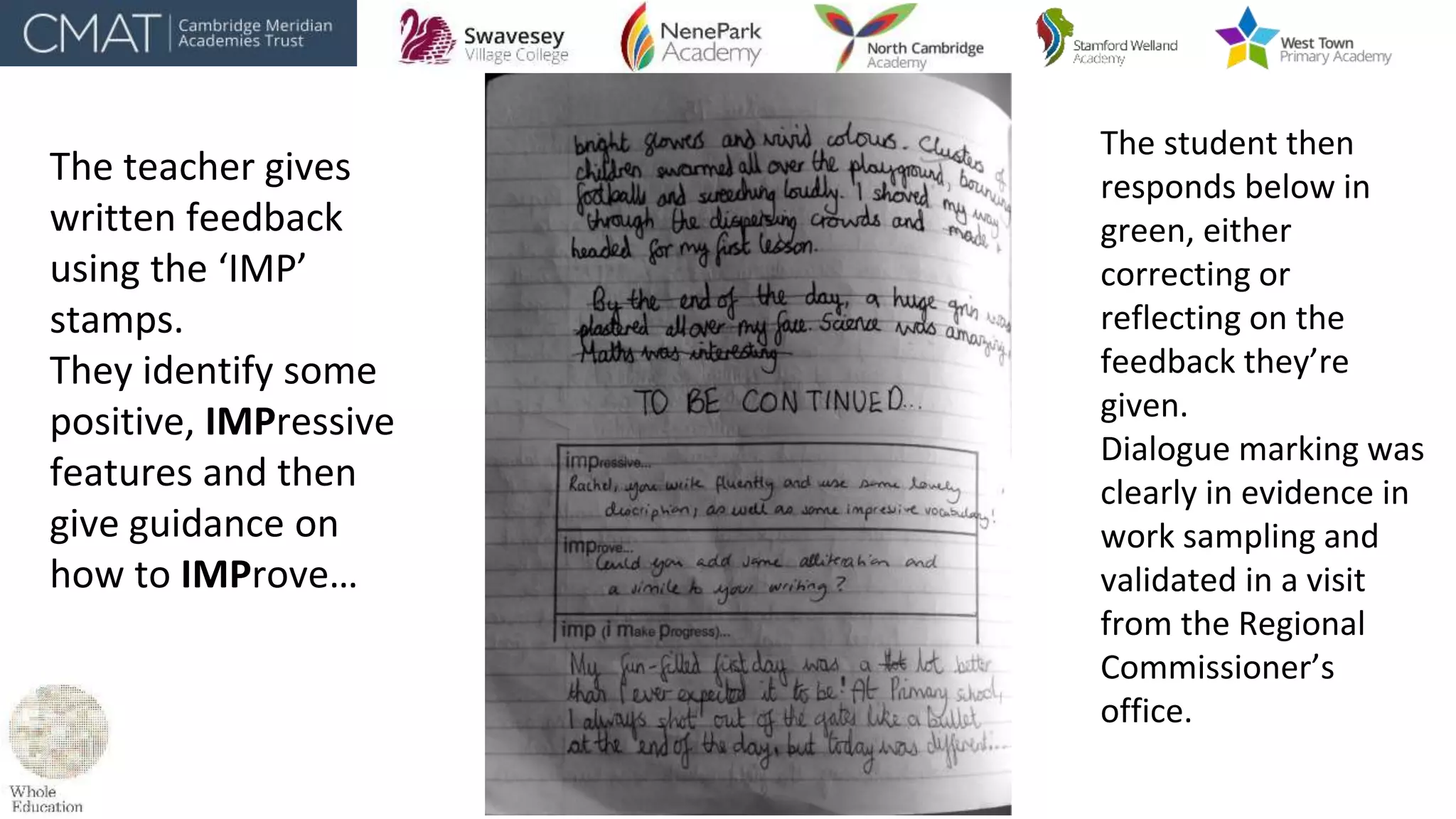
The teacher gives
written feedback
using the ‘IMP’
stamps.
They identify some
positive, IMPressive
features and then
give guidance on
how to IMProve…
The student then
responds below in
green, either
correcting or
reflecting on the
feedback they’re
given.
Dialogue marking was
clearly in evidence in
work sampling and
validated in a visit
from the Regional
Commissioner’s
office.
How did we attempt to measure the early
impact?
• In term one we conducted
extensive Climate walks and
monitored homework allocation by
moving to 100% MOODLE set
homework.
• Autumn term lesson observations
were weighted towards Year 7. The
% of Good/Outstanding teaching in
Year 7 lessons was 90% (previously
75%).
• Student feedback was measured
through focus groups and was
largely very positive.
• Parent feedback was measured
through the ‘settling in’ Parent and
tutor evenings held in October.
• We expected to receive an increase
in queries and complaints following
the first Progress report in
December – these actually
declined.
Future challenges…The assessment model may
prove too ambitious. We will
need to carefully evaluate the
progress students make and the
targets we set.
Year 8 is currently being
planned but the directed time
allocation for planning in
14/15 is not as generous.
Staffing changes (I left for
example!) means that the key
staff championing the
curriculum will need to
revolve. Succession planning
and long term thinking.
External factors. Political
change, Ofsted, exam
specifications.
Continual review and peer review. We need to ensure
that we get external appraisal of the impact and quality
soon and make changes accordingly.
Designing an impact curriculum | The ICE Programme | Richard Spencer, Cambridge Meridian Academies Trust

Designing an impact curriculum | The ICE Programme | Richard Spencer, Cambridge Meridian Academies Trust

  • 1.
    The ICE Programme– Developing a Baccalaureate-inspired Key Stage 3 curriculum through collaborative planning Richard Spencer CMAT Vice Principal Teaching and Learning
  • 2.
    Curriculum design should notbe ‘simple’; it should not focus ‘relentlessly’ on one or two areas. It should not seek to constantly be more ‘efficient’. It is, and must be, complex, contentious and continually evolving. If we serve only the next accountability measure, the next progress ‘flight path’ or continually seek quick fixes we will never make the progress we seek and that students deserve.
  • 3.
    Building…. THE PROGRAMME THE IMPINGTONCURRICULUM EXPERIENCE An outstanding curriculum for the future.
  • 4.
    The EEF’s researchhas demonstrated that collaborative planning models are one of the most effective strategies at schools’ disposal. All too often (DfE and Ofqual take note!) curriculum change is rushed and too little time is found for development. The ICE programme was deliberately 18 months in the planning.
  • 5.
    • *lazy metaphoralert* ‘A beautiful old Bentley – fine features, a comfortable ride, but wearing a bit thin and under powered!’ • ‘Good’ Ofsted 2012 – the outstanding practice coming through in Arts and IB provision in the sixth form. • KS4 results measured big improvements in 2013 and 2014 – moving to outstanding. • Curriculum in need of reinvigoration and challenge. Too easy to coast, too variable an experience. Nationally • Move to Academy status and deregulation. • Shrinking resources and need to prioritise. • Removal of NC levels • New landscape at GCSE from 2015/16 • ‘Interesting times’
  • 6.
  • 7.
    2013: The ‘Impington Experience’ defineda vision for excellent teaching and learning… It also provided a framework for quality assurance and CPD. In 2014 we stopped grading lessons and instead evaluated against the criteria developed here.
  • 8.
    Timeline: • January –March 2013: Initial discussions, direction of travel and timeframes established • April – July 2013: Consultation with staff and Governors. Planning frameworks, curriculum models and strands of interaction established with working party of staff and Governors. • Academic Year 2013/14. Two thirds of all INSET time devolved to collaborative planning. • September 2013: Full launch with staff and Governors • October 2013: ICE Programme launched with Year 6 parents and Partner Primaries • All meeting time bar termly full staff meetings devolved to Faculties for collaborative planning. • Occasional ‘released’ days for teams to collaboratively plan. • December – February 2013/14: Assessment criteria developed and moderated • February – June 2014: Medium Term plans written and resources prepared. • May 2014: Initial Medium Term plans submitted and moderated. Some rejected/edited. Quality control. • July 2014: All MTP submitted, all homework and resources for Term 1 added to MOODLE. • September 2014: ICE Programme began for Year 7! • September 2014: Staff MOODLE training needs identified. • October 2014: Parents MOODLE training needs identified! • October 2014: Evaluation of initial impact ahead of presentation to Year 6 parents and planning of Year 8 Strands/ curriculum content. • October 2014: Strand 1 (Ways of Learning) completed • November 2014: 100% of Year 7 homework delivered through MOODLE. • December 2014: First Progress report using new ICE grades sent home.
  • 10.
    • Loose strandsof interaction rather than ‘bolted on’ thematic or topic based learning. • All units framed around a common ‘Big Question’ to form the basis of the ‘core’ sessions and tutorial/assembly work. • Broad range of assessment methods with a big emphasis upon exciting, stimulating and challenging content. • Better texts, new technologies and higher expectations. ‘Strands of interaction’
  • 11.
    Big Question: What doesit mean to be a successful and supportive learner at IVC and beyond? WAYS OF LEARNING
  • 12.
    End of KeyStage 2 NC Level NC Level 2 / below NC Level 3 NC Level 4 NC Level 5 NC Level 5/6 CAT Score Less than 84 84+ 100+ 116+ 124+ Year 7 Targets: Developing Developing Secure Secure Excellence Autumn Year 7 Grade 1 Grade 2 Grade 3 Grade 4 Grade 5 Spring Year 7 Grade 1 Grade 2 Grade 3 Grade 4 Grade 5 Summer Year 7 Grade 1+ Grade 2+ Grade 3+ Grade 4+ Grade 5+ Year 8 Targets: Developing Developing Secure Secure Excellence Autumn Year 8 Grade 2 Grade 3 Grade 4 Grade 5 Grade 6 Spring Year 8 Grade 2 Grade 3 Grade 4 Grade 5 Grade 6 Summer Year 8 Grade 2+ Grade 3+ Grade 4+ Grade 5+ Grade 6+ Year 9 Targets: Developing Developing Secure Secure Excellence Autumn Year 9 Grade 3 Grade 4 Grade 5 Grade 6 Grade 7 Spring Year 9 Grade 3 Grade 4 Grade 5 Grade 6 Grade 7 Summer Year 9 Grade 3 Grade 4 Grade 5+ Grade 6+ Grade 7+ End of Year 9 Target: Developing Developing Secure Secure Excellence End of Year 9 ICE Target Grade 3 Grade 4 Grade 5+ Grade 6+ Grade 7+ • ‘Developing’ grades indicate that achievement is below national average • ‘Secure’ grades indicate that achievement is in line with or slightly above national average • ‘Excellence’ grades indicate that achievement is significantly above national average An assessment method that reflects the IB approach and allows an ambitious ‘flight path’ to 1-9 GCSE grading:
  • 13.
  • 14.
    Subject area: Sciences Year/ Term: Year7 (Weeks 1-6) Unit title: I am a Scientist ICE Strand: Ways of Learning Objectives: To be able to… Outcomes / Success Criteria: Possible Activities: Literacy/Numeracy: ICE Connections and Questioning ICE Programme Strands: Please see Bloom's Taxonomy and guidance on effective objective setting. Please tier against differentiated ICE grades to show progression Either indicate the specific activities that should be covered or indicate a range of resources or activities what may be used. Please include relevant key vocabulary or opportunities for explicit RCWM teaching How does this session or activity link to other units in the current ICE strand? How will you use questioning to extend and connect? Indicate which elements of the IB learner profile are covered in this session.  sequence points effectively using PEE. (1-2 lessons) Grade 3 – Writes a paragraph with basic meaning. Grade 5 – Writes a paragraph that is clear and effective. Grade 7 – Writes paragraphs which are convincing and linked.  Starter activities in X drive on prime numbers.  Activities in Text Book linked to homework.  Flipped videos of PT modelling long division. Sequencing Conversely Additionally Analysis Why do we like our politicians and professionals to sequence things clearly? How do successful people use these skills in everyday life? Links with Performance -  Knowledgeable  Caring  Communicators How and/or when will the students be assessed?  Group speaking task – Week 3 (See task in X Drive folder for Unit)  Written personal profile – Week 6 (See task in X Drive folder for Unit) Home / Independent Learning: Week 1 – Research task 1 (Moodle) Week 2 – Mind Map task 1 (Moodle) – Written feedback Week 3 – Preparation for group task (Moodle) Week 4 – Research task 2 (Moodle) – Verbal feedback Week 5 – Personal Paragraphs (Moodle) Week 6 – Redrafting of Personal Profile (Moodle) – Written feedback Medium Term Planning Faculties planned using the same basic template with an emphasis upon common approaches to literacy, questioning and the strands.
  • 15.
    Medium Term Planning Faculties planned usingthe same basic template with an emphasis upon common approaches to literacy, questioning and the strands. Subject area: Sciences Year/ Term: Year 7 (Weeks 1-6) Unit title: I am a Scientist ICE Strand: Ways of Learning Objectives: To be able to… Outcomes / Success Criteria: Possible Activities: Literacy/ Numeracy: ICE Connections and Questioning ICE Programme Strands: Please see Bloom's Taxonomy and guidance on effective objective setting. Please tier against differentiated ICE grades to show progression Either indicate the specific activities that should be covered or indicate a range of resources or activities what may be used. Please include relevant key vocabulary or opportunit ies for explicit RCWM teaching How does this session or activity link to other units in the current ICE strand? How will you use questioning to extend and connect? Indicate which elements of the IB learner profile are covered in this session.
  • 16.
    English Maths ScienceHumanities PE Performance Design Tech Art French German/ Spanish Totals Per-fortnight 8 7 7 6 4 4 3 3 4 4 50 Teaching hours 56 49 49 42 28 28 27 21 28 28 356 2013 curriculum allocation… Language & Literature Language Acquisition Individuals & Societies Mathematics & Computing Design Arts Sciences Physical & Health ICE Core Totals Per-fortnight 7 7 7 8 3 6 7 4 1 50 Teaching hours 49 49 49 56 27 42 49 28 7 356 Curriculum Allocation 2014/15 (ICE Programme) • Pretty consistent curriculum allocations. • Core to be delivered through Performance – Resilience skills, Forum talk. • Computing attached to Mathematics. • Dance core as part PE offer.
  • 17.
    2013/14 2014/15 2015/162016/17 2017/18 2018/19 2016 Cohort (4) NC KS2 Year 4 NC KS2 Year 5 NC KS2 Year 6 IVC MYP IVC MYP IVC MYP 2015 Cohort (5) NC KS2 Year 5 NC KS2 Year 6 IVC MYP IVC MYP IVC MYP GCSE (new suite) 2014 Cohort (6) NC KS2 Year 6 IVC MYP IVC MYP IVC MYP GCSE (new suite) GCSE (new suite) 2013 Cohort (7) NC KS3 Year 7 NC KS3 Year 8 GCSE GCSE (new suite) GCSE (new suite) 16-19 2012 Cohort (8) NC KS3 Year 8 GCSE GCSE (new Eng & Maths) GCSE (new Eng & Maths) 16-19 16-19 2011 Cohort (9) GCSE Year 9 GCSE GCSE 16-19 16-19 16-19 2010 Cohort (10) GCSE Year 10 GCSE 16-19 16-19 16-19 2009 Cohort (11) GCSE Year 11 16-19 16-19 16-19 Subject to the winds of change!
  • 18.
    ICE Grade GeographyGrade Descriptors Grade 7  With growing independence, students identify geographical issues and ask very appropriate questions at a range of scales.  Students select a wide range of skills and evidence to present information appropriately e.g. a range of maps at different scales backed up by appropriate graphs. They identify bias in sources.  Students use information and their wide range of knowledge of places at a variety of scales to describe and explain at length interactions that create diversity and interdependence. They understand the factors that influence how places and environments develop.  Using very appropriate vocabulary they present well-argued summaries and reach substantiated and evaluated conclusions in their work e.g. this evidence (though 5 years old) shows that SE Brazil is more developed and is effects are spreading to some periphery areas e.g. S Brazil. Grade 6  Students can suggest their own relevant questions in considering why things happened at a range of scales (e.g. local vs. international).  Students select a range of skills and evidence to present information appropriately e.g. more difficult graphs. They identify bias in sources.  Students use information and their wide knowledge of places at a variety of scales to describe and explain physical and human characteristics of places and geographical patterns.  Using appropriate vocabulary they recognise the processes that interact to make places distinctive and reach valid conclusions. They evaluate the validity of their work e.g. that SE Brazil is more developed, but S Brazil may develop faster in the future. Grade 5  Students show increasing knowledge and understanding of aspects of the geography of the UK and the wider world.  Students suggest relevant geographical questions in considering why things happened.  Students select and use skills to present information appropriately e.g. fully accurate graphs.  Students use information and their knowledge of places at a variety of scales to describe and begin to explain (using appropriate vocabulary) the physical and human characteristics of places and geographical patterns e.g. that SE Brazil is more developed because of having a greater population density. Grade 4  Students show knowledge skills and understanding of some aspects of the geography of their local area, the UK and the wider world.  Students begin to suggest suitable geographical questions in considering different places.  Students use geographical skills to present information appropriately e.g. simple, accurate graphs.  Students use their knowledge of the local area, the UK and the wider world to describe and compare in detail the physical and human features of places and geographical patterns, using some appropriate vocabulary e.g. that SE Brazil is richer, has a better climate and greater population density. Clear, two page, subject assessment frameworks.
  • 19.
    Science – Reflectingand feeding back on homework set through the Moodle…
  • 20.
    Setting largely mixedability in English, Hums and Foundations subjects. Ability grouping in Maths, Sciences and French (not in second Language)
  • 22.
    The teacher gives writtenfeedback using the ‘IMP’ stamps. They identify some positive, IMPressive features and then give guidance on how to IMProve… The student then responds below in green, either correcting or reflecting on the feedback they’re given. Dialogue marking was clearly in evidence in work sampling and validated in a visit from the Regional Commissioner’s office.
  • 24.
    How did weattempt to measure the early impact? • In term one we conducted extensive Climate walks and monitored homework allocation by moving to 100% MOODLE set homework. • Autumn term lesson observations were weighted towards Year 7. The % of Good/Outstanding teaching in Year 7 lessons was 90% (previously 75%). • Student feedback was measured through focus groups and was largely very positive. • Parent feedback was measured through the ‘settling in’ Parent and tutor evenings held in October. • We expected to receive an increase in queries and complaints following the first Progress report in December – these actually declined.
  • 25.
    Future challenges…The assessmentmodel may prove too ambitious. We will need to carefully evaluate the progress students make and the targets we set. Year 8 is currently being planned but the directed time allocation for planning in 14/15 is not as generous. Staffing changes (I left for example!) means that the key staff championing the curriculum will need to revolve. Succession planning and long term thinking. External factors. Political change, Ofsted, exam specifications. Continual review and peer review. We need to ensure that we get external appraisal of the impact and quality soon and make changes accordingly.