PW 2011/1
SMALL WASTE WATER TREATMENT WORKS
DPW DESIGN GUIDELINES
JUNE 2012
CONTENTS PAGE
1. INTRODUCTION 1
2. LEGISLATIVE FRAMEWORK 2
2.1 INTRODUCTION 2
2.2 APPLICABLE LEGISLATION 2
2.2.1 CONSTITUTION OF THE REPUBLIC OF SOUTH AFRICA, 1996 2
2.2.2 NATIONAL ENVIRONMENTAL MANAGEMENT ACT
No 107 of 1998 2
2.2.3 NATIONAL WATER ACT, No 36 of 1998 3
2.2.4 WATER SERVICES ACT, No 108 of 1997 3
2.2.5 ENVIRONMENT CONSERVATION ACT, No 73 OF 1989 4
2.2.6 OCCUPATIONAL HEALTH & SAFETY ACT, No 85 of 1993 5
2.2.7 OTHER LEGISLATION 5
2.3 WASTEWATER TREATMENT WORKS REGULATIONS 5
2.4 LEGAL CONSIDERATIONS 6
2.5 PERMIT FOR PLANT 6
3. BASIC DESIGN CONSIDERATIONS 7
3.1 GENERAL 7
3.1.1 DOMESTIC SEWAGE FLOW 7
3.1.2 SEWAGE STRENGTH 8
3.2 SITE SELECTION 9
3.3 FLOOD PROTECTION 9
3.4 STAFF FACILITIES 9
3.5 ESSENTIAL FACILITIES FOR SEWAGE PUMP STATIONS 11
3.6 EMERGENCY POWER SUPPLY 11
3.7 OPERABILITY AND RELIABILITY 11
3.8 WARNING SYSTEMS 11
3.9 SAMPLING EQUIPMENT 12
3.9.1 AUTOMATIC SAMPLING 12
3.9.2 MANUAL SAMPLING 12
3.10 NEW TECHNOLOGY 13
3.11 HYDRAULICS 13
3.12 HEALTH AND SAFETY 13
3.13 OPERATOR REQUIREMENTS 14
3.14 OPERATION AND MAINTENANCE 15
3.15 GENERAL OPERATION AND MAINTENANCE MANUAL 15
3.16 SITE REQUIREMENTS 15
3.17 MECHANICAL & ELECTRICAL EQUIPMENT AND PIPEWORK 15
3.18 CORROSION PROTECTION 16
4. DECISION MAKING PROCESS 18
4.1 NATIONAL WATER ACT, 1998, WASTEWATER DISCHARGE
STANDARDS DWA 2010 GUIDELINES 18
4.2 MAIN FLOW SHEET 19
4.3 CHECKLISTS FOR FIGURE 1 20
4.4 CHECKLIST FOR FIGURE 2, 3, 4 & 5 21
4.5 FLOW SHEETS AND NOTES 21
4.6 SA SPECIAL STANDARDS FLOW SHEET 1 22
4.7 SA SPECIAL STANDARDS FLOW NOTES 1 23
4.8 SA SPECIAL STANDARDS FLOW SHEET 2 28
4.9 SA SPECIAL STANDARDS FLOW NOTES 2 29
4.10 SA GENERAL STANDARDS FLOW SHEET 3 36
4.11 SA GENERAL STANDARDS FLOW NOTES 3 37
4.12 SA GENERAL STANDARDS FLOW SHEET 4 41
4.13 SA GENERAL STANDARDS FLOW NOTES 4 42
5. LIFE CYCLE COST 49
5.1 INSTRUCTIONS FOR USING LIFE CYCLE COST/MODEL 49
5.2 LIFE CYCLE COST MODEL FOR WATER, WASTEWATER SYSTEMS 53
6. REFERENCES 61
6.1 PUBLICATIONS 61
6.2 LEGISLATION 62
6.2.1 STATUTES 62
6.2.2 REGULATIONS 62
7. APPENDICES 63
APPENDIX 1: GENERAL INFORMATION ON SLUDGE CO-DISPOSAL
ON LANDFILL 65
APPEXDIX 2: GUIDE: PERMISSIBLE UTILISATION AND DISPOSAL
OF TREATED SEWAGE EFFLUENT 72
APPENDIX 3: ABSTRACTS OF A GUIDE TO THE DESIGN OF SEWAGE
PURIFICATION WORKS 81
Chapter 3 - Nightsoil Intakes 81
Chapter 6- Maturation Ponds 82
Chapter 7- Sludge Digestion and Processing 84
APPENDIX 4: SCHEDULES FOR WASTEWATER TREATMENT WORKS 91 – 96
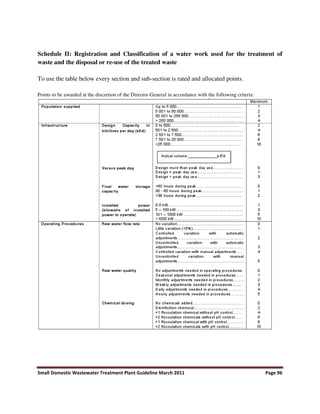
Schedule II: Registration and Classification of a water works used for
the treatment of waste and the disposal or re-use of treated water
Schedule III: Waterworks process controller registration
TABLES PAGE
Table 1: National Water Act waste discharge standards DWA 2010 guidelines ......................... 16
Table 2: Checklist A ..................................................................................................................... 18
Table 3: Checklist B...................................................................................................................... 18
Table 4: Checklist C...................................................................................................................... 18
Table 5: Checklist D ..................................................................................................................... 19
Table 6: Checklist E...................................................................................................................... 19
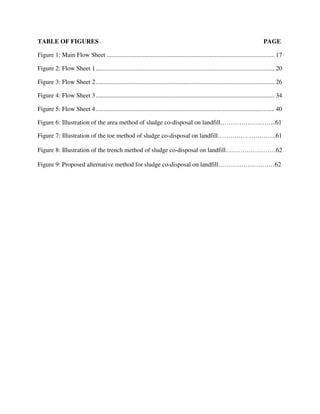
TABLE OF FIGURES PAGE
Figure 1: Main Flow Sheet ........................................................................................................... 17
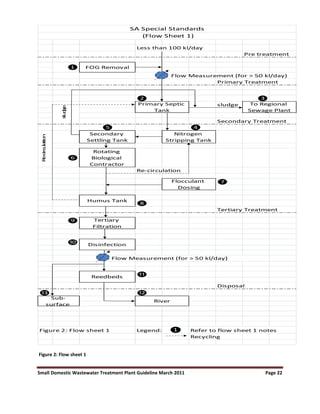
Figure 2: Flow Sheet 1.................................................................................................................. 20
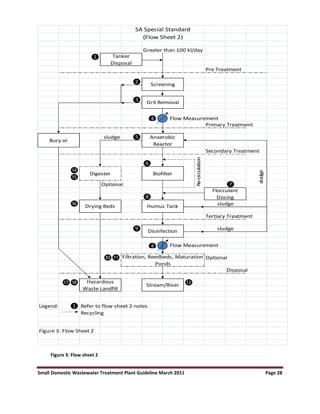
Figure 3: Flow Sheet 2.................................................................................................................. 26
Figure 4: Flow Sheet 3.................................................................................................................. 34
Figure 5: Flow Sheet 4.................................................................................................................. 40
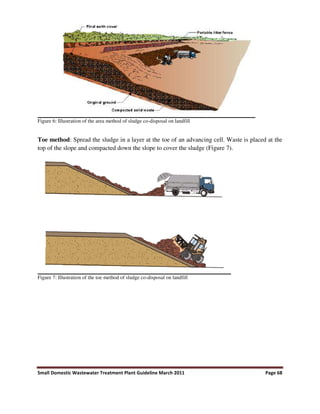
Figure 6: Illustration of the area method of sludge co-disposal on landfill……………………...61
Figure 7: Illustration of the toe method of sludge co-disposal on landfill……………………….61
Figure 8: Illustration of the trench method of sludge co-disposal on landfill……………………62
Figure 9: Proposed alternative method for sludge co-disposal on landfill………………………62
GLOSSARY OF ACRONYMS
ADWF Average Dry Weather Flow
AE Acceptable Exposure
BOD Biochemical Oxygen Demand
BPEO Best Practical Environmental Option
CIGMAT Center Grouting Materials and Technology
COD Chemical Oxygen Demand
DEA Department of Environmental Affairs
DEAT Department of Environmental Affairs and Tourism
DOJ Department of Justice
DPW Department of Public Works
DWA Department of Water Affairs
DWF Dry Weather Flow
EA Environmental Authorisation
ECA Environment Conservation Act
EEC Estimated Environmental Concentration
EIA Environmental Impact Assessment
EMP Environmental Management Plan
FOG Fat, Oil and Grease
HD Household Density
HR Hazard Rating
I Infiltration
kPa Kilo Pascal
LCC Life Cycle Cost
LCCA Life Cycle Cost Analysis
NEMA National Environmental Management Act
NH4 Ammonium
NWA National Water Act
O & M Operation and Maintenance
OD Oxidation Pond
OHS Occupational Health and Safety
PDEA Provincial Departments of Environmental Affairs
PDWF Peak Dry Weather Flow
PL Pipe Length
PLH Pipe Length per House Hold
PS Primary and Secondary Treatment
RBC Rotating Biological Contactors
SG Specific Gravity
SP-STD Special Standard
SS Stainless Steel
STD General Standard
TSS Total Suspended Solids
UPVC Unplasticised Poly Vinyl Chloride
UV Ultra Violet
WSA Water Service Act
WWF Wet Weather Flow
WWTP Wastewater treatment plant
Small Wastewater Treatment Design Manual March 2011 Page 1
1. INTRODUCTION
This document’s purpose is to direct the design process for designing the best and most
appropriate wastewater process for effluent which is generated by small scale on site operations,
up to 100 m3
/day such as police stations, border posts, DOJ etc. Larger plants are also addressed
to some extent. In this manual, the best appropriate process for such small waste water treatment
plants has already been identified as the Rotating Biological Contactors (biodiscs) systems and
biological trickling filters (biofiters) for larger quantities. Consultants designing such plants for
the DPW need to take cognizance of all the criteria set out herein and must ensure that apart from
that the best available practices as regards such processes are incorporated into the design. The
designers of such plants are however still to consider other alternatives if the circumstances so
dictate.
The Consulting Engineer will still be responsible for the process of the sewage treatment works
irrespective of whether he/she incorporates a patented or package plant in his/her design
The Consulting Engineer is also responsible to ensure that the plant finally conforms to the
process requirements and shall provide the necessary assistance to the Department until the plant
has reached stability and the effluent complies with the specified design parameters on a yearly
basis.
In all designs, cognisance must be taken of:
1) Legislative requirements
2) Environmental aspects
3) Critical design and planning criteria
4) Reliability and power consumption
5) Best practice and operations
6) Health and safety
7) Maintenance
Small Domestic Wastewater Treatment Plant Guideline March 2011 Page 2
2. LEGISLATIVE FRAMEWORK
2.1 INTRODUCTION
Designers of wastewater treatment works are responsible for the understanding and
implementation of all relevant legislation regarding the planning, design, construction and
operation of wastewater treatment works according to the Internal Guideline: Generic Water Use
Authorisation Application Process, August 2007 by DWA. It is of utmost importance for the
designers to be aware of such legislative requirements and make use of the most up to date
versions.
2.2 APPLICABLE LEGISLATION
2.2.1 CONSTITUTION OF THE REPUBLIC OF SOUTH AFRICA ACT, 1996
The Constitution, which is the cornerstone of the democracy in South Africa, lays the foundation
of a more just and equitable society. It guarantees everyone the right to an environment that is
not harmful to their health or wellbeing and guarantees the right to have the environment
protected, for the benefit of present and future generations, through reasonable legislative and
other measures. It also guarantees all citizens the right of access to water. The full statute can be
accessed from www.info.gov.za.
2.2.2 NATIONAL ENVIRONMENTAL MANAGEMENT ACT (NEMA), No 107 of 1998
NEMA reiterates the provisions of section 24 of the Constitution, and contains the internationally
accepted principles of sustainability. It is therefore a legal requirement that these principles must
be taken into consideration in all decisions that may affect the environment. Furthermore, the
need for intergovernmental co-ordination and harmonisation of policies, legislation, and actions
relating to the environment, is emphasised. It is also important to note that the Best Practical
Environmental Option (BPEO) is defined in NEMA as “the option that provides the most benefit
or causes the least damage to the environment as a whole, at a cost acceptable to society, in the
long term as well as the short term”.
The Environmental Management Plan (EMP) is recognised as the tool that can provide the
assurance that the project proponent has made suitable provisions for mitigation. The EMP is the
document that provides a description of the methods and procedures for mitigating and
monitoring impacts. The EMP also contains environmental objectives and targets which the
project proponent or developer needs to achieve in order to reduce or eliminate negative impacts.
The EMP document can be used throughout the project life cycle. It is regularly updated to be
aligned with the project progress from construction, operation to decommissioning. EMPs
provide a link between the impacts predicted and mitigation measures specified within the
Small Domestic Wastewater Treatment Plant Guideline March 2011 Page 3
Environmental Impact Assessment (EIA) report, and the implementation and operational
activities of the project. EMPs outline the environmental impacts, the mitigation measures, roles
and responsibilities, timescales and cost of mitigation. NEMA states that before certain listed
development activities can be undertaken, an EIA must be undertaken and Environmental
Authorisation obtained. The Department of Environmental Affairs and Development Planning is
responsible for evaluating applications in terms of the EIA Regulations. This written decision is
now called either an Environmental Authorisation or Environmental Refusal and is listed in a
Environmental Authorisation (EA). The full statute can be accessed from www.info.gov.za.
2.2.3 NATIONAL WATER ACT (NWA), No 36 of 1998
The NWA introduces several new concepts, and regulates all water-related aspects in South
Africa based on the above-mentioned Constitutional rights. The principles support the objectives
of sustainability and equity which underpin the entire NWA as central guiding principles in the
protection, use, development, conservation, management and control of our water resources.
A Water Act license from the DWA and a Waste Act license from the DEA are necessary for the
erection of any new wastewater treatment works in South Africa. The full statute can be accessed
from www.info.gov.za.
2.2.4 WATER SERVICES ACT, No 108 of 1997
The Water Services Act (WSA), No 108 of 1997, provides the framework for the provision of
water services. Developments for the provision of such water services will usually result in a
water use that requires authorisation, irrespective the source of funding for such developments.
This implies that the authorisation process should be followed in harmony with the funding
mechanisms that are in place, as well as with the EIA-Regulations, if applicable. The purpose of
these EIA-Regulations is to regulate the procedure and criteria relating to the submission,
processing and consideration of, and decision on, applications for environmental authorisations
for the commencement of activities in order to avoid detrimental impacts on the environment, or
where it cannot be avoided, ensure mitigation and management of impacts to acceptable levels,
and to optimise positive environmental impacts, and for matters pertaining thereto.
On the basis of the constitutional obligation to protect the environment, stringent pollution
prevention measures and the “polluter pays” principle are incorporated into the NWA. According
to Fundamental Principle 16: “Water quality management options shall include the use of
economic incentives and penalties to reduce pollution and the possibility of irretrievable
environmental degradation as a result of pollution shall be prevented”. In fulfillment of this
principle “waste discharge charges”, as intended under section 56(5) of the NWA can be set for
uses that may impact on the resource quality. The full statute can be accessed from
www.info.gov.za.
Small Domestic Wastewater Treatment Plant Guideline March 2011 Page 4
2.2.5 ENVIRONMENT CONSERVATION ACT (ECA), No 73 OF 1989
Of importance in the ECA are the regulations made in terms of section 26, which relate to EIA’s
provided for in sub-section 21 and 22 of the ECA, and the provisions dealing with waste
management under section 20. Policies promulgated in terms of the ECA are also relevant. The
General Policy on Environmental Conservation (January 1994), states that measures should be
employed to support economic growth and social welfare without affecting, overstraining or
irreversibly damaging the natural environment and natural resources in the process. The principle
that the polluter should pay for the negative environmental consequences of disposal or
discharge actions is incorporated in the Policy on Hazardous Waste Management (September
1994).
Section 26 states that the Minister or a competent authority, as the case may be, may make
regulations with regard to any activity identified in terms of section 21(1) or prohibited in terms
of section 23(2), concerning:
a) The scope and content of environmental impact reports, which may include, but are not
limited to:
i) a description of the activity in question and of alternative activities;
ii) the identification of the physical environment which may be affected by the
activity in question and by the alternative activities;
iii) an estimation of the nature and extent of the effect of the activity in question and
of the alternative activities on the land, air, water, biota and other elements or
features of the natural and man-made environments;
iv) the identification of the economic and social interests which may be affected by
the activity in question and by the alternative activities;
v) an estimation of the nature and extent of the effect of the activity in question and
the alternative activities on the social and economic interests;
vi) a description of the design or management principles proposed for the reduction
of adverse environmental effects; and
vii) a concise summary of the finding of the environmental impact report;
b) The drafting and evaluation of environmental impact reports and of the effect of the
activity in question and of the alternative activities on the environment; and
c) The procedure to be followed in the course of and after the performance of the activity in
question or the alternative activities in order to substantiate the estimations of the
Small Domestic Wastewater Treatment Plant Guideline March 2011 Page 5
environmental impact report and to provide for preventative or additional actions if
deemed necessary or desirable.
Regulations promulgated in terms of section 26 of the ECA aim to control activities that may
have a detrimental effect on the environment, as prescribed under sub-section 21 and 22. These
regulations identify certain activities, which are regarded as “controlled activities”. In terms of
the regulations, any new development that may entail one of these controlled activities, must be
subjected to an environmental impact assessment (EIA) process, and an EIA Report must be
submitted in order to obtain authorization for the continuation of the development. The
administration of these regulations, including the granting or refusal of authorisations, has been
delegated to the Provincial Departments of Environmental Affairs (PDEA).
EIAs are submitted to departments that deal with Environmental matters in provinces if the
activity falls only in that province or are not a major impact. In Gauteng they are the Gauteng
Department of Agriculture, Conservation and Environment. Transboundary EIAs are submitted
to the National Department responsible for Environmental Affairs. EIAs of a sensitive nature or
major importance are also submitted to National Government. The full statute can be accessed
from www.info.gov.za.
2.2.6 OCCUPATIONAL HEALTH AND SAFETY ACT No 85 of 1993
Apart the performance of the plant, remains a sewage treatment plant a “production” process and
is it required to comply with the OHSA. The plant shall be so designed that all the requirements
of the OHSA, and its regulations, be adhered to.
2.2.7 OTHER LEGISLATION
The legal framework contained in this paragraph is only intended to direct the user of this
document towards provisions that are, or could be applicable to a particular application for a
water use license, and with which such a person should familiarise him or herself. This is by no
means a complete list, since several other provisions, such as servitudes, regulations relating to
geographical areas, the zoning of land, historic artifacts, etc., could also influence an application
for a water use license. Water use activities that relate to land-use will also be strongly
influenced by the development strategies and plans for a specific area. Some statutes that could
play a role in determining such strategies include the Development Facilitation Act, No 67 of
1985, the Local Government Transition Act, No 61 of 1995, the Conservation of Agricultural
Resources Act, No 43 of 1983 and the National Forests Act, No 84 of 1998.
2.3 WASTEWATER TREATMENT WORKS REGULATIONS
The designers should refer to the effluent discharge standards stipulated by the Department of
Water Affairs (DWA) for the specific area in which the WWTW is to be designed and
constructed. The updated discharge standards can be found on the DWA website
www.dwa.gov.za. The latest discharge standards at the time of going to print appear later in this
document. The designers should determine which effluent quality criteria is required in that
specific area. DWA works on two discharge standards namely the general standards and special
Small Domestic Wastewater Treatment Plant Guideline March 2011 Page 6
standards. These standards should be clearly understood by the designers before attempting the
design of the sewage works. The designers should also familiarize themselves with the Water
Supply and Sanitation Policy by the DWA. This policy can also be found on the DWA website
and discusses the roles and responsibilities of different involved bodies. In addition the designers
should refer to the following documents:
• General information on sludge co-disposal on landfill, in the document by DWA which
discusses the regulations regarding the disposal of sludge on landfills. This document can
be found on the DWA website www.dwa.gov.za.
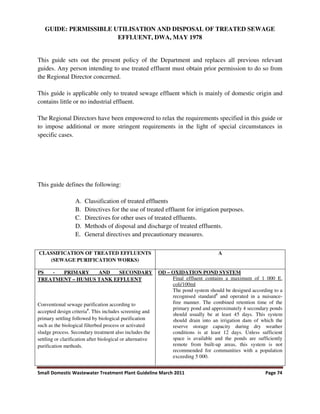
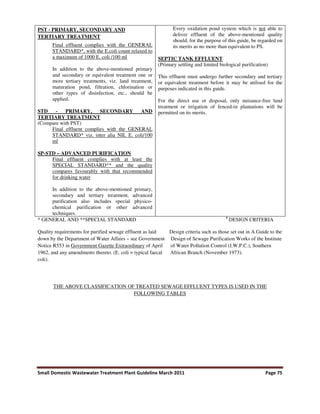
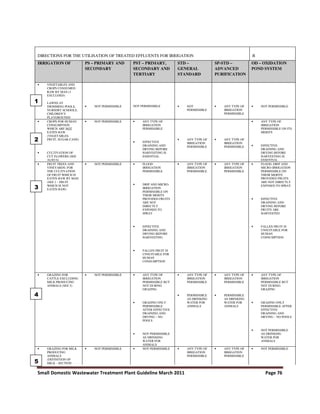
• Permissible utilisation and disposal of treated sewage effluent, in the document by DWA
which discusses the disposal of effluent through irrigation. This document can be found
on the DWA website www.dwa.gov.za.
• A Guide to the Design of Sewage Purification Works by the Institute for Water Pollution
Control, Southern Africa, November 1973, for design guidelines. This document can be
purchased from the WISA office 1st
Floor, Building No. 5, Constantia Park, 546 16th
Road, Randjespark Ext 7, Midrand.
The designer should ensure that the most current versions of the guidelines and procedures are
being used.
2.4 LEGAL CONSIDERATIONS
The designer should determine applicable statutes, regulations, guidelines and procedures for the
proposed sewage works and ensure familiarity with the treatment, design and approvals
requirements. There is a wide range of legislation that may apply to the planning, design,
construction and operation of sewage works. While some are referenced here, no attempt is made
for this listing to be complete. The user of this guide should obtain legal advice and understand
and abide by any applicable legal requirements.
2.5 PERMIT FOR PLANT
It will be the responsibility of the Consulting Engineer to obtain a valid permit for the plant, as
an agent of the DPW, from the Department of Water Affairs, in terms of the National Water Act
No 36 of 1998.
Small Domestic Wastewater Treatment Plant Guideline March 2011 Page 7
3. BASIC DESIGN CONSIDERATIONS
3.1 GENERAL
3.1.1 DOMESTIC SEWAGE FLOW
The designer needs to determine the current population and then estimate the future expected
population depending on estimated growth of the population. Domestic sewage flows are
conveniently expressed in terms of litres per capita per day. The figure for the existing
population should be cross-checked against the size of the sewered area and the likely population
density in the various zones. Particular care is needed in establishing the full number of
contributors in all areas.
Forecasting the future growth of the population is a beneficial task for which no firm rules can be
given. Basic assumptions made may be upset by unforeseeable circumstances and factors beyond
the designer’s control so that a high degree of accuracy is not to be expected. Nevertheless, the
best possible estimates must be made because under-estimation will make it necessary to extend
the works more quickly than anticipated, giving rise to uneconomical design, and over-
estimation may lead to difficulties in paying for too large a scheme and be a waste or
underutilization of resources.
Domestic sewage flow may be expressed in terms of litres per capita per day (l/capita/d). Typical
figures for fully sewered housing units with bathrooms, basins and kitchen sinks are:
Housing Standard Number of Houses per Net Ha. l/capita/d
Below Average
Average
Above Average
20 or more
3 to 20
3 or less
80 to 150
120 to 200
180 to 500
Flow in excess of those tabled above are likely where water supplies are not metered and lower
flows will prevail in residential areas without normal internal plumbing in the dwellings. No
reliable correlation between the sewage flow and the number of sanitary fittings in a dwelling
has yet been established..
Where people visit the sewered area, either daily or seasonally, from places outside the
catchment, additional allowances should be made as per the following guide:
Housing Standard Unit litres/day
Day workers in shops,
offices, etc.
Per capita 50 to 70
Small Domestic Wastewater Treatment Plant Guideline March 2011 Page 8
The flow used when designing treatment units will be the total domestic sewage flow and is
known as the Average Dry Weather Flow (ADWF) and is measured in kl/d. The normal daily
peak flow, without allowing stormwater inflow, exceeds the ADWF by a factor that is generally
highest when the population and the area served is small. This flow is called the Peak Dry
Weather Flow (PDWF) and is measured in l/s.
Population Served Peak Factor
20
100
500
1 000
2 000
10 000
30 000
8,5
6,5
5,0
4,4
3.5
3.0
2.5
Alternatively for smaller or larger populations the peak factor can be estimated from:
Peak Factor = 14 P-1/6
where P is the population served
The PDWF for a works receiving sewage by pumping may vary considerably from that of a fully
gravitational system because pumps tend to equalize the flow thereby reducing the peak factor.
Such cases should be investigated in more detail and the peak factor determined at the hand of
flow recordings and data.
3.1.2 SEWAGE STRENGTH
The strength of sewage arriving at a sewage treatment works varies considerably, depending on
the domestic living standards of the contributors. Strength of sewage is not easy to measure, as it
may include the unpredictable factor of “amenability to treatment”. This needs to be determined
by the design engineer.
Domestic water usage, and hence the daily volume per person which arrives at a sewage works,
varies from one group of persons to another. If it is assumed that each person, of whatever group,
sends the same daily mass of waste matter to the sewer, then sewage from the group using most
water, while being more voluminous, would be weaker in concentration than that from users of
less water, but the actual load (volume multiplied by strength) on the sewage works would be the
same for each person. However, this is not necessarily the case.
The daily load per person can be expressed by various parameters and these will also vary
depending on the diet and social structure of the population served. For design purposes the
following loads are suggested:
Small Domestic Wastewater Treatment Plant Guideline March 2011 Page 9
Parameter Design Loads (g)/capita
Oxygen Demand
BOD (as oxygen)
COD (as oxygen)
Solids
Dissolved solids
Suspended solids
50 to 80 (Ave. 65)
100 to 160
100
90 (60 = settleable and
30 = non-settleable)
3.2 SITE SELECTION
The location of any wastewater treatment plant should be as far as practical from dwellings,
public places and any sites which will possibly be built on within the life of the plant. There
should also be sufficient land set aside to allow for any future alterations and
additions/extensions so that no offensive odours are detected at the property boundary.
Buffer distances are established where surrounding terrain or prevailing wind will affect the
dispersion or spread of odours.
The Consulting Engineer shall obtain all the relevant available information from the DPW with
regard to the location of the works, available area for the plant, site contours, geotechnical and
geohydrological data, type of development to be served and population.
Sewage pump stations should be located as far as practicable from present or proposed built-up
residential areas, and an all-weather road should be provided. Noise control, odour control, and
station architectural design should be taken into consideration. Sites for stations shall be of
sufficient size for future expansion or addition, if applicable.
3.3 FLOOD PROTECTION
The wastewater pumping stations and treatment plants should be protected against flooding.
Every treatment plant must be so positioned that it is not subject to flooding or is otherwise
protected from flooding and has all weather road access. The treatment process units should be
located at an elevation higher than the 100-year flood level or otherwise be adequately protected
against 100-year flood damage. Newly constructed plants should remain fully operational during
a 100-year flood event.
3.4 STAFF FACILITIES
A wastewater treatment plant staffed for 8 hours or more each day should contain support facilities for the
staff. Toilets shall be provided in conformance with applicable building codes. The following should be
provided:
Small Domestic Wastewater Treatment Plant Guideline March 2011 Page 10
a) Wash-up and changing facilities: Showers, lockers, sinks, and toilets sufficient for the entire staff
at design conditions. A heated and ventilated mudroom is desirable for changing and storage of
boots, jackets, gloves, and other outdoor garments worn on the job. Each staff member should
have separate lockers for street clothes and plant clothes. Separate wash-up and changing
facilities should be available for men and women, with the exception of the mudroom.
b) Eating Facilities: A clean, quiet area with facilities for storage and eating of light meals.
c) Meeting facilities: A place to assemble the plant staff and visitors. In many cases, meeting
facilities and the eating facilities will be the same depending on plant size.
d) Supervisors' facilities: A place where discussion and writing can be carried out in private. A desk
station should be provided for data entry. Facilities should be provided for the storage of
analytical methods and records, catalogs, as-built plans, operation and maintenance manual(s),
etc.
e) Area for basic analysis with appropriate laboratory and wash up facilities.
Small mechanical treatment plants that are not manned 8 hours per day need not contain all of the
personnel facilities required for larger plants, but shall contain a lavatory, and a storage area.
Laboratory facilities required will depend on the amount of analytical work conducted onsite.
Generally, regulatory samples are sent to an offsite certified laboratory for analysis while process
sampling and analysis are done onsite or at a centralized regional laboratory.
A laboratory should be located at ground level and easily accessible to all sampling points. To
assure sufficient environmental control, the laboratory should be located away from vibrating
machinery, corrosive atmospheres, or equipment which might have adverse effects on the
performance of laboratory instruments or the analyst.
Facilities should be provided to allow for adequate maintenance of equipment. Such facilities
generally include a maintenance shop, garage, storage space and yard maintenance facilities, e.g.
grass cutting where snakes are prevalent. Access to nearby municipal garages and other
maintenance centres should be considered and duplication of facilities avoided where possible.
Storage space should be provided for spare parts, fuel supplies, oils and lubricants, grounds
maintenance equipment and collection system equipment.
In smaller facilities it may be desirable to combine storage with the maintenance shop or garage
so that the stored material can be protected against unauthorized access and use. Oxidants like
chlorine must be stored separately to oils and lubricants.
Small Domestic Wastewater Treatment Plant Guideline March 2011 Page 11
3.5 ESSENTIAL FACILITIES FOR SEWAGE PUMP STATIONS
• Screening facility
• Grit removal
• Sequential pumps combined with storage to cater for Peak Wet Weather Flow
• Emergency power supply
• Routing for inadvertent spilling
• Toilet and hand wash basin
• Security fence
• Alarm systems (visible and audible).
3.6 EMEGERNCY POWER SUPPLY
Emergency power supply for pumping stations and treatment plants should be made by provision
of in-place internal combustion engine equipment that will generate electrical or mechanical
energy, or by the provision of portable pumping equipment. Engine unit size should be adequate to
provide power for lighting and ventilating systems and such further systems that affect capability and
safety as well as the pumps. Emergency power shall be provided that will prevent overflows from
occurring during any power outage that is equal to the maximum outage in the immediate area.
Due to the large power consumption of activated sludge treatment plants, it is considered not feasible to
provide emergency power to the aerators but only to minimum pumping, mixing, dosing and metering
equipment.
3.7 OPERABILITY AND RELIABILITY
The objective of reliability is to prevent the discharge of raw or partially treated sewage to any
waters and to protect public health by preventing backup of sewage and subsequent discharge to
basements, streets, and other public and private property. A minimum of an installed duty-
standby pump shall be provided in each pumping station in accordance. Operation and
maintenance must be carefully considered in the design of the treatment plant. Instrumentation
must be designed for simplicity in operation.
If centralised control boards are supplied, they shall only indicate where faults occur. The
operator shall however be forced to attend to problems at the locations where they occur.
Flow measuring operations shall as far as possible be manual and the Consultant shall prepare
easy-to-read-and-understand charts and tables for the operators.
Small Domestic Wastewater Treatment Plant Guideline March 2011 Page 12
3.8 WARNING SYSTEMS
An alarm system should be provided for all disinfecting systems and all remote pumping
stations. Consideration of telemetry alarm to 24-hour monitoring stations or telephone alarms
(SMS system) to duty personnel should be given when reliability classification or property
damage warrants it. An alarm system may not be needed, in certain cases, where a plant has
adopted a daily inspection routine. A statement from the plant, indicating that is has a daily
inspection program, will be required. In certain cases, an alarm system may be required
regardless of any other practices.
Alarms for high wet well and power failure shall be provided, as a minimum, for all pump
stations. For larger stations, alarms signalizing pump and other component failures or
malfunctions should also be provided.
3.9 SAMPLING EQUIPMENT
3.9.1 AUTOMATIC SAMPLING
The following general guidelines should be adhered to in the use of automatic samplers:
• Automatic samplers shall be used where composite sampling is necessary.
• The sampling device shall be located near the source being sampled, to prevent sample
degradation in the line.
• Long sampling transmission lines should be avoided.
• If sampling transmission lines are used, they shall be large enough to prevent plugging,
yet have velocities sufficient to prevent sedimentation. Provisions shall be included to
make sample lines cleanable. Minimum velocities in sample lines shall be 1 meter per
second under all operating conditions.
• Samples shall be refrigerated unless the samples will not be affected by biological
degradation.
3.9.2 MANUAL SAMPLING
Snap samples must be taken once a day at appropriate points around the plant to confirm
performance and compliance with the applicable discharge standards. Unmanned plants shall be
sampled at least once a month. A sampling plan shall be provided and approved. Should snap
samples show non compliance, further composite sampling shall be done.
Small Domestic Wastewater Treatment Plant Guideline March 2011 Page 13
Appropriate points for sampling:
COD - inlet & outlet
TSS - inlet & outlet
Ammonia - inlet & outlet
Nitrates - outlet
Phosphates - outlet
Faecal coliforms - outlet
3.10 NEW TECHNOLOGY
New technology is defined as any method, process, or equipment which is used to treat or
convey wastewater and which is not discussed in this manual.
After review of treatability data and the complete engineering report, the Department of Water
Affairs (DWA) may approve the plans if it is satisfied that the method, process or equipment will
efficiently operate and meet the treatment requirements. Pilot plants may be required or special
restrictions may be placed on the system in terms of operational control aspects, sampling,
monitoring, etc. Additionally, the number of systems approved initially may be limited until the
technology is demonstrated to the satisfaction of the DWA.
3.11 HYDRAULICS
The designer of new sewage works needs to evaluate the existing and proposed hydraulic
profiles (grade lines) to ensure raw sewage or effluent pumping requirements are met under
steady state and peak flow conditions for the design life of the facility. The use of gravity flow,
where appropriate, may result in lower capital and operating costs, but generally restricts the
siting of the treatment works and may not be suitable for use with some treatment processes.
Such factors should be carefully evaluated to determine the best possible hydraulic and siting
configuration. A hydraulic profile (gradient) through the wastewater treatment works plus the
calculations to support such profile shall be made available to DPW with each Preliminary and
final design report. The designer is to establish discharge height and inflow/start height. Upon
completion of the WWTW, the designer shall submit to DPW a hydraulic profile of the as built
WWTW.
3.12 HEALTH AND SAFETY
Adequate provisions shall be included in the design of all wastewater treatment facilities to
minimize exposure of facility personnel and visitors to safety hazards. Treatment facilities shall
Small Domestic Wastewater Treatment Plant Guideline March 2011 Page 14
be designed in full compliance with the Occupational Health and Safety Act, No. 85 of 1993 of
South Africa.
3.13 OPERATOR REQUIREMENTS
In the water sector, the requirements for operator skills and classification are regulated by
regulation No. R2834 of 1985 in terms of the Water Act, No 54 of 1956 and then updated by the
National Water Act, No 36 of 1998. With the ensuing promulgation of the new Regulations
regarding the classification and registration of Waterworks and personnel, an attempt is being
made to ensure that the different classes of Wastewater Treatment Works have adequate
personnel with appropriate knowledge and skills.
The new Regulations have five (5) Schedules to assist with the classification of Water Care
Works and its operating Personnel (Operators).
• Schedule I - Registration of Water Treatment Works
• Schedule II – Registration of Wastewater Treatment Works
• Schedule III – Process controller Registration
• Schedule IV & V - Minimum staff requirements ( operator & supervisor ) per shift
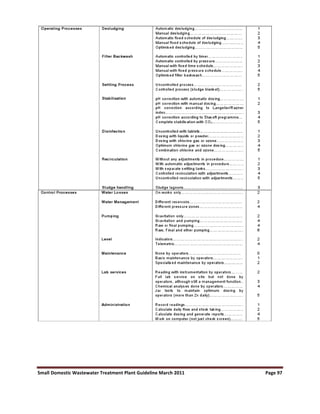
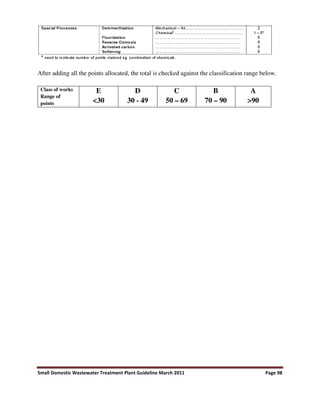
The schedules for classification of Water Works (Schedule I and II) were revised to ensure that
the classification is appropriately influenced by the complexity and design of the works. The
parameters included for the classification of Wastewater Treatment Works (Schedule II) now
include:
• Infrastructure,
• Quality of intake water,
• Process parameters,
• Control Processes,
• Sensitivity of receiving water.
Schedule III in the new Regulations aligns with the South African Qualifications Authority Act,
1995, as well as the Skills Development Act of 1998. The Schedules therefore provide for
persons trained and educated according to the National Qualifications Framework (NQF) at
various levels and makes provision for assessment in terms of the concept of recognition of prior
learning. This will provide alternative paths towards registration. Schedules IV and V of the
Regulations set out the minimum process personnel requirements in accordance with the
classification of the works. These schedules outline the minimum class of process personnel per
shift as well as the support personnel requirements, such as fitters, electricians and
Small Domestic Wastewater Treatment Plant Guideline March 2011 Page 15
instrumentation technicians for a Wastewater Treatment Works. It does not however indicate
specific requirements or general maintenance or laboratory/testing related functions.
These regulations are in the process of being updated to comply with the new act and to shift the
focus from operator qualifications to competency that will ensure improved operation and
consequent compliance.
3.14 OPERATION AND MAINTENANCE
In selecting the type of treatment process, the designers should also take due consideration of the
availability of competent operators. Only competent technicians should be assigned to operate
the wastewater treatment works. The operator should be fully conversant with the recommended
operating procedures as stipulated in the operation and maintenance manual.
An operation and maintenance manual, which complies with DPW’s O & M manual
requirements, shall be submitted.
3.15 GENERAL OPERATION AND MAINTENANCE MANUAL
While completing the project, the Consulting Engineer shall compile a comprehensive operating
manual as prescribed in “O & M Manual for WWTP – DPW’s basic requirements” which is
obtainable from DPW – Division Water Management at Head Office
In addition to the above, the Consulting Engineer, and where necessary the suppliers of
equipment, will be required to instruct the works personnel in the proper and correct operation of
the equipment installed for at least 3 days but a maximum period of 21 days. The timing of this
training will be determined in consultation with the Employer and the Engineer.
3.16 SITE REQUIREMENTS
Ideally, all facilities (except where facility consists of septic tank plus French drain only) should
have an approved security fence around the perimeter with approved access gate. All gates
should be locked with chains and a tamper-resistance padlock. Other barriers such as concrete
barriers can be considered to guard certain critical components from accidental or intentional
vehicle intrusion. Post signs restricting entry to authorized personnel. Adequate lighting of the
exterior of the facility and warning signs can be effective to deter unauthorized entry. Motion
detectors that activate lights to turn on or trigger an alarm also enhance security. Vehicle access
shall be provided to all portions of the Works and shall at least comprise of well-designed gravel roads
with a designed surface storm water runoff system.
3.17 MECHANICAL AND ELECTRICAL EQUIPMENT & PIPEWORK
All flanges shall comply with SABS 1123 Class 1000/3 minimum.
Every pump label shall include the pump manufacturer’s name and the pump serial number as
well as the pump duty point (kl/h @ head – m).
Small Domestic Wastewater Treatment Plant Guideline March 2011 Page 16
Motors smaller than 0,75kW may be single phase
Pumping systems shall be designed to ensure that motors do not start more than 6 times per
hour under worst conditions.
Pressure gauges shall be manufactured from stainless steel, shall be of the heavy duty glycerine
filled type and shall be calibrated in SI units. It shall have a minimum gauge dial diameter of
50mm, shall be calibrated over at least 270° of the diameter with the maximum reading not
exceeding 150% of the normal working pressure of the pumpline or 110% of the maximum
developed pressure of the pump (inclusive of surges), whichever is higher.
Strainers utilized on the treated effluent shall be of the Y type, shall be manufactured of
stainless steel and shall have screwed ends op to 50mm size. Larger strainers shall have flanged
ends. The screen area shall be at least three times the pipe area served. The strainer shall be
easily extractable for cleaning purposes without removing the assembly from the pipe.
All valves and accessories shall be installed with removable end connections or unions for
servicing purposes or replacing the valve.
Gearboxes shall be selected for continuous operation and shall have a service factor of not les
than 2,0 based on installed motor power. All gears shall be hardened and ground after cutting
Starters shall be suitable for manual as well as automatic operation and shall comply with the
requirements of BS 587. For motors up to 7,5 kW the starters shall be of the direct-on-line type
while for motors of more than 7,5 kW, the starters shall be of the star-delta type. Starters shall be
provided with thermal overload trip relays, under-voltage release mechanism and protection
against single phasing. The motors will not be started more than 10 times per hour. The starters
shall be provided with an isolating switch mechanically interlocked with the door of the housing,
cable entry glands and an ammeter on one of the phases except for motors of less than 0,75kW
for which ammeters are not required. Starters may not hum or chatter in service and the contacts
may not bounce on closing.
Voltmeters shall be of the flush panel mounting type. Phase selector switches shall be fitted.
Ammeters shall be flush panel mounting type. Phase selector switches shall be fitted. The
meters shall be able to withstand over currents resulting under starting conditions and the full
load current of the relevant motor shall be clearly marked in red on the face of the meter. The
ammeter’s range shall be such that this red mark will not fall below the halfway mark on the face
of the ammeter.
Kilowatt-hour meters shall be of the integrating type. The current rating of the meter shall be
suitable for the maximum requirements.
Running hour meters shall be fitted to all pumps, aerators, and other power consuming
equipment and shall have cyclometer dials indicating up to 5 digits and two decimals.
Phase selector switches shall be of the four-position rotary type.
Earth leakage protection units shall be rated as follows:
Small Domestic Wastewater Treatment Plant Guideline March 2011 Page 17
(a) For motor and motor control circuits: 250 mA.
(b) For plug circuits: 50 mA.
Labels: All switching gear on electrical panels (including all circuit breakers) shall be properly
and clearly marked with acceptable and approved labels – so also shall the corresponding motors
and equipment be clearly marked. Labels shall be in white letters on a black background. Small
wiring shall be identified by means of a numbered ferrule of an approved type on each end of
each wire.
Electrical Control Boards for outside erection shall be constructed of stainless steel. The boards
and doors shall be weather proof.
3.18 CORROSION PROTECTION
Inert materials shall be used as far as possible and painting restricted to the minimum.
Primers, undercoats and finishing coats shall all comply with the relevant SABS specifications.
Paintwork may be subjected to specialist inspection and the findings of the inspection shall be
binding on the Contractor.
Small Domestic Wastewater Treatment Plant Guideline March 2011 Page 18
4. DECISION MAKING PROCESS
4.1 NATIONAL WATER ACT, 1998, WASTEWATER DISCHARGE STANDARDS
DWA 2010 GUIDELINES
In South Africa the use of water, whether from a river, dam or underground source, for industrial
purposes (which includes domestic use in urban areas) is governed by the National Water Act,
No 36 of 1998 as amended. The Act states that: "... water extracted for industrial purposes shall
be returned to the source from which it was abstracted, in accordance with quality standards
gazetted by the Minister from time to time."
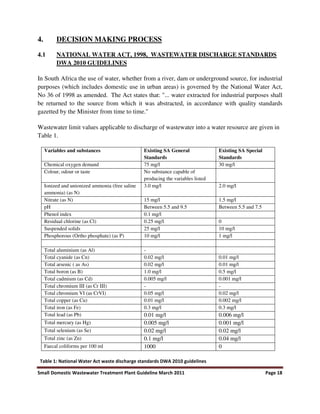
Wastewater limit values applicable to discharge of wastewater into a water resource are given in
Table 1.
Variables and substances Existing SA General
Standards
Existing SA Special
Standards
Chemical oxygen demand 75 mg/l 30 mg/l
Colour, odour or taste No substance capable of
producing the variables listed
Ionized and unionized ammonia (free saline
ammonia) (as N)
3.0 mg/l 2.0 mg/l
Nitrate (as N) 15 mg/l 1.5 mg/l
pH Between 5.5 and 9.5 Between 5.5 and 7.5
Phenol index 0.1 mg/l
Residual chlorine (as Cl) 0.25 mg/l 0
Suspended solids 25 mg/l 10 mg/l
Phosphorous (Ortho phosphate) (as P) 10 mg/l 1 mg/l
Total aluminium (as Al) -
Total cyanide (as Cn) 0.02 mg/l 0.01 mg/l
Total arsenic ( as As) 0.02 mg/l 0.01 mg/l
Total boron (as B) 1.0 mg/l 0.5 mg/l
Total cadmium (as Cd) 0.005 mg/l 0.001 mg/l
Total chromium III (as Cr III) - -
Total chromium VI (as CrVI) 0.05 mg/l 0.02 mg/l
Total copper (as Cu) 0.01 mg/l 0.002 mg/l
Total iron (as Fe) 0.3 mg/l 0.3 mg/l
Total lead (as Pb) 0.01 mg/l 0.006 mg/l
Total mercury (as Hg) 0.005 mg/l 0.001 mg/l
Total selenium (as Se) 0.02 mg/l 0.02 mg/l
Total zinc (as Zn) 0.1 mg/l 0.04 mg/l
Faecal coliforms per 100 ml 1000 0
Table 1: National Water Act waste discharge standards DWA 2010 guidelines
Small Domestic Wastewater Treatment Plant Guideline March 2011 Page 19
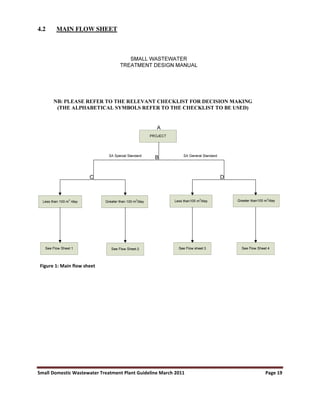
4.2 MAIN FLOW SHEET
Figure 1: Main flow sheet
Small Domestic Wastewater Treatment Plant Guideline March 2011 Page 20
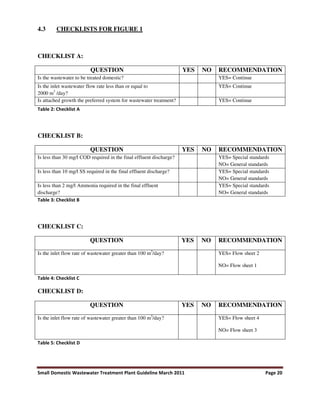
4.3 CHECKLISTS FOR FIGURE 1
CHECKLIST A:
QUESTION YES NO RECOMMENDATION
Is the wastewater to be treated domestic? YES= Continue
Is the inlet wastewater flow rate less than or equal to
2000 m3
/day?
YES= Continue
Is attached growth the preferred system for wastewater treatment? YES= Continue
Table 2: Checklist A
CHECKLIST B:
QUESTION YES NO RECOMMENDATION
Is less than 30 mg/l COD required in the final effluent discharge? YES= Special standards
NO= General standards
Is less than 10 mg/l SS required in the final effluent discharge? YES= Special standards
NO= General standards
Is less than 2 mg/l Ammonia required in the final effluent
discharge?
YES= Special standards
NO= General standards
Table 3: Checklist B
CHECKLIST C:
QUESTION YES NO RECOMMENDATION
Is the inlet flow rate of wastewater greater than 100 m3
/day? YES= Flow sheet 2
NO= Flow sheet 1
Table 4: Checklist C
CHECKLIST D:
QUESTION YES NO RECOMMENDATION
Is the inlet flow rate of wastewater greater than 100 m3
/day? YES= Flow sheet 4
NO= Flow sheet 3
Table 5: Checklist D
Small Domestic Wastewater Treatment Plant Guideline March 2011 Page 21
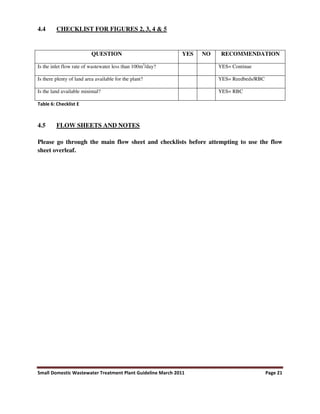
4.4 CHECKLIST FOR FIGURES 2, 3, 4 & 5
QUESTION YES NO RECOMMENDATION
Is the inlet flow rate of wastewater less than 100m3
/day? YES= Continue
Is there plenty of land area available for the plant? YES= Reedbeds/RBC
Is the land available minimal? YES= RBC
Table 6: Checklist E
4.5 FLOW SHEETS AND NOTES
Please go through the main flow sheet and checklists before attempting to use the flow
sheet overleaf.
Small Domestic Wastewater Treatment Plant Guideline March 2011 Page 22
Less than 100 kl/day
Pre treatment
Primary Treatment
❷ ❸
sludge
Secondary Treatment
❺ ❹
Secondary
Settling Tank
❻
Rotating
Biological
Contractor
Re-circulation
❼
❽
Tertiary Treatment
❾
❿
⓫
Disposal
⓭ ⓬
Figure 2: Flow sheet 1 Legend: ❶ Refer to flow sheet 1 notes
Recycling
R
e
-c
irc
u
la
t
io
n
Reedbeds
Flow Measurement (for > 50 kl/day)
To Regional
Sewage Plant
s
lu
d
g
e
❶ FOG Removal
Flow Measurement (for > 50 kl/day)
SA Special Standards
(Flow Sheet 1)
Sub-
surface
River
Disinfection
Primary Septic
Tank
Nitrogen
Stripping Tank
Flocculant
Dosing
Humus Tank
Tertiary
Filtration
Figure 2: Flow sheet 1
Small Domestic Wastewater Treatment Plant Guideline March 2011 Page 23
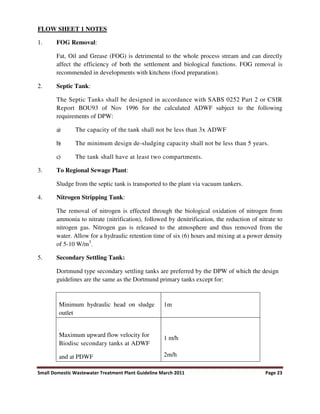
FLOW SHEET 1 NOTES
1. FOG Removal:
Fat, Oil and Grease (FOG) is detrimental to the whole process stream and can directly
affect the efficiency of both the settlement and biological functions. FOG removal is
recommended in developments with kitchens (food preparation).
2. Septic Tank:
The Septic Tanks shall be designed in accordance with SABS 0252 Part 2 or CSIR
Report BOU93 of Nov 1996 for the calculated ADWF subject to the following
requirements of DPW:
a) The capacity of the tank shall not be less than 3x ADWF
b) The minimum design de-sludging capacity shall not be less than 5 years.
c) The tank shall have at least two compartments.
3. To Regional Sewage Plant:
Sludge from the septic tank is transported to the plant via vacuum tankers.
4. Nitrogen Stripping Tank:
The removal of nitrogen is effected through the biological oxidation of nitrogen from
ammonia to nitrate (nitrification), followed by denitrification, the reduction of nitrate to
nitrogen gas. Nitrogen gas is released to the atmosphere and thus removed from the
water. Allow for a hydraulic retention time of six (6) hours and mixing at a power density
of 5-10 W/m3
.
5. Secondary Settling Tank:
Dortmund type secondary settling tanks are preferred by the DPW of which the design
guidelines are the same as the Dortmund primary tanks except for:
Minimum hydraulic head on sludge
outlet
1m
Maximum upward flow velocity for
Biodisc secondary tanks at ADWF
and at PDWF
1 m/h
2m/h
Small Domestic Wastewater Treatment Plant Guideline March 2011 Page 24
Maximum upward flow velocity for
activated sludge plants at PDWF tanks
1 m/h
Minimum diameter of humus outlet
pipe
150 mm
Flat bottomed mechanical desludging secondary tanks shall have the same design
guidelines as above.
Reference: Manual on the Design of Small Sewage Works — WISA
6. Rotating Biological Contactors:
Rotating biological contactors (biodiscs), are especially suitable for small treatment
plants in warmer regions. The main design standards for these plants are:
a) The biodisc plant shall be preceded by a septic tank of capacity not less than 24h
designed as specified.
b) The disc area shall not be less than 6m2
/capita in areas with average winter
sewage temperatures above 15°C or the disc loading shall not exceed 10
g/m2
/day COD and 3g/m2
/day NH4.
c) The disc area shall not be less than 9m2
/capita in areas with average winter
sewage temperatures between 10 and 15°C.
d) The disc area shall not be less than 12m2
/capita in areas with average
winter sewage temperatures below 10°C.
Mechanical and Electrical design shall cater for cases of extended periods of non-
operation which may cause drying of exposed sections of the discs, resulting in a
complete imbalance of the whole mechanism.
7. Flocculant Dosing:
Phosphorus removal can also be achieved by chemical precipitation, usually with metal
salts of iron (e.g. ferric chloride), aluminium (e.g. alum), or lime. Chemical phosphorus
removal requires significantly smaller equipment footprint than biological removal, is
easier to operate and is often more reliable than biological phosphorus removal. Dosing
rate of metal salts is recommended at 30-40 mg/l subject to jar testing. (Allow 4,5 mg
ferric chloride for every mg phosphorous to be removed.). Dosing should be done prior to
the clarifier (humus tank). An in-line mixer (or weir) must be installed downstream of the
dosing point to guarantee thorough mixing of chemicals and effluent.
Small Domestic Wastewater Treatment Plant Guideline March 2011 Page 25
8. Humus Tank:
Same as point 5 above. Arrange for recycling back to septic tank.
9. Tertiary Filtration:
The tertiary filter system provides for additional removal of suspended solids from the
secondary effluent and a further reduction of the chemical oxygen demand (COD). The
treated water is filtered down to 100 micron. Woven-wire screen filters are
recommended. Filter system should treat effluent to special standards quality.
10. Disinfection:
Chlorination of waste water of small sewage plants shall only be implemented if required
to attain the effluent standards of the DWA or for health reasons.
For very small plants chlorination can be by means of tablets or manual dosing.
For larger installations gas chlorination will be required. Chlorine contact tanks or
channels shall have a minimum retention time of not less than 30 min at mean DWF.
The chlorine rooms shall be designed with all the safety requirements stipulated by the
most recent edition of the OSH Act, No 85 of 1993.
Electrical equipment and dosing pumps (if utilised) shall not be in the same room as
the chlorinator and chlorine bottles.
No mild steel or galvanised mild steel fittings, bolts, nuts, washers etc shall be used in
the chlorination room.
Chlorine dosing pipes shall be of welded UPVC and all clamps, bolts, nuts and
washers shall be of 304 SS.
Chlorine bottles shall preferably not be larger than the 67 kg standard and sufficient
storage space shall be provided for at least 1.5 months supply.
Ultraviolet (UV) light can be used to disinfect effluent instead of chlorine, iodine, or
other chemicals. Because no chemicals are used, the treated water has no adverse effect
on organisms that later consume it, as may be the case with other methods. UV radiation
causes damage to the genetic structure of bacteria, viruses, and other pathogens, making
them incapable of reproduction. The key disadvantages of UV disinfection are the need
for frequent lamp maintenance and replacement and the need for a highly treated effluent
to ensure that the target microorganisms are not shielded from the UV radiation (i.e., any
solids present in the treated effluent may protect microorganisms from the UV light). UV
units to operate at a minimum dosage of 40,000 W-sec/cm2
.
Small Domestic Wastewater Treatment Plant Guideline March 2011 Page 26
Disinfection can also be accomplished by the dosing of Ozone instead of using chlorine
or UV light.
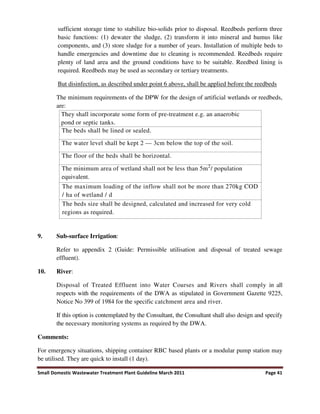
11. Reedbeds:
The minimum requirements of the DPW for the design of artificial wetlands or reedbeds,
are:
They shall incorporate some form of pre-treatment e.g. an anaerobic
pond or septic tanks.
The beds shall be lined or sealed.
The water level shall be kept 2 — 3cm below the top of the soil.
The floor of the beds shall be horizontal.
The minimum area of wetland shall not be less than 5m2
/ population
equivalent.
The maximum loading of the inflow shall not be more than 270kg COD
/ ha of wetland / d
The beds size shall be designed, calculated and increased for very cold
regions as required
12. River:
Disposal of Treated Effluent into Water Courses and Rivers shall comply in all
respects with the requirements of the DWA as stipulated in Government Gazette 9225,
Notice No 399 of 1984 for the specific catchment area and river.
If this option is contemplated by the Consultant, the Consultant shall also design and specify
the necessary monitoring systems as required by the DWA.
13. Sub-surface Irrigation:
Refer to appendix 2 (Guide: Permissible utilisation and disposal of treated sewage
effluent).
Comments:
French drains are not included in this guideline as they do not comply with the South African
general standards for discharge quality. Where there are existing French drains, the consultant
should advise on suitable upgrade. RBC can be added to an existing septic tank system (refer to
flow sheet 3 and follow option 2).
Small Domestic Wastewater Treatment Plant Guideline March 2011 Page 27
For emergency situations, shipping container RBC based plants or a modular pump station may
be utilised. They are quick to install (1 day).
Small Domestic Wastewater Treatment Plant Guideline March 2011 Page 28
Greater than 100 kl/day
❶
Pre Treatment
❷
❸
❹
Primary Treatment
❺
Secondary Treatment
❻
⓮
⓯
Optional ❼
❽
⓰
Tertiary Treatment
❾
❹
❿⓫ Optional
Disposal
⓱⓲ ⓬
Legend: ❶ Refer to flow sheet 2 notes
Recycling
Figure 3: Flow Sheet 2
sludge
SA Special Standard
(Flow Sheet 2)
Flocculant
Dosing
Screening
Grit Removal
Hazardous
Waste Landfill
Flow Measurement
Flow Measurement
Tanker
Disposal
sludge
Re-circulation
sludge
Disinfection
Filtration, Reedbeds, Maturation
Ponds
Stream/River
sludge
Bury or
Digester
Drying Beds
Anaerobic
Reactor
Biofilter
Humus Tank
Figure 3: Flow sheet 2
Small Domestic Wastewater Treatment Plant Guideline March 2011 Page 29
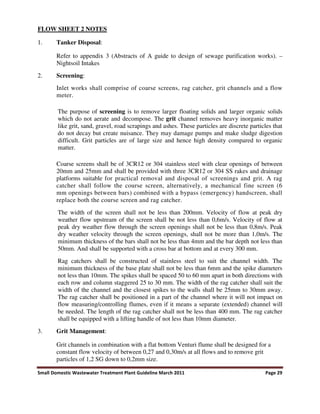
FLOW SHEET 2 NOTES
1. Tanker Disposal:
Refer to appendix 3 (Abstracts of A guide to design of sewage purification works). –
Nightsoil Intakes
2. Screening:
Inlet works shall comprise of coarse screens, rag catcher, grit channels and a flow
meter.
The purpose of screening is to remove larger floating solids and larger organic solids
which do not aerate and decompose. The grit channel removes heavy inorganic matter
like grit, sand, gravel, road scrapings and ashes. These particles are discrete particles that
do not decay but create nuisance. They may damage pumps and make sludge digestion
difficult. Grit particles are of large size and hence high density compared to organic
matter.
Coarse screens shall be of 3CR12 or 304 stainless steel with clear openings of between
20mm and 25mm and shall be provided with three 3CR12 or 304 SS rakes and drainage
platforms suitable for practical removal and disposal of screenings and grit. A rag
catcher shall follow the course screen, alternatively, a mechanical fine screen (6
mm openings between bars) combined with a bypass (emergency) handscreen, shall
replace both the course screen and rag catcher.
The width of the screen shall not be less than 200mm. Velocity of flow at peak dry
weather flow upstream of the screen shall be not less than 0,6m/s. Velocity of flow at
peak dry weather flow through the screen openings shall not be less than 0,8m/s. Peak
dry weather velocity through the screen openings, shall not be more than 1,0m/s. The
minimum thickness of the bars shall not be less than 4mm and the bar depth not less than
50mm. And shall be supported with a cross bar at bottom and at every 300 mm.
Rag catchers shall be constructed of stainless steel to suit the channel width. The
minimum thickness of the base plate shall not be less than 6mm and the spike diameters
not less than 10mm. The spikes shall be spaced 50 to 60 mm apart in both directions with
each row and column staggered 25 to 30 mm. The width of the rag catcher shall suit the
width of the channel and the closest spikes to the walls shall be 25mm to 30mm away.
The rag catcher shall be positioned in a part of the channel where it will not impact on
flow measuring/controlling flumes, even if it means a separate (extended) channel will
be needed. The length of the rag catcher shall not be less than 400 mm. The rag catcher
shall be equipped with a lifting handle of not less than 10mm diameter.
3. Grit Management:
Grit channels in combination with a flat bottom Venturi flume shall be designed for a
constant flow velocity of between 0,27 and 0,30m/s at all flows and to remove grit
particles of 1,2 SG down to 0,2mm size.
Small Domestic Wastewater Treatment Plant Guideline March 2011 Page 30
Grit storage in the grit recess shall be provided for grit accumulation of not less than
72 h at ADWF when grit contents is 1,5 liters per 100 kl.
Side slopes of grit channels, shall not be less than 45˚.
Handstops shall be of aluminium, stainless steel or 3CR12 steel.
4. Flow Metering:
Where specified and as required for the sewage treatment plant, the influent flow meter
should be situated on the influent side after screening, rag catcher and grit removal (as
applicable). Where sludge removal is periodically from a septic tank, the flow meter
could be situated on the effluent side. Manual flow metering shall be in a stilling
chamber connected to a venturi flume or at a weir by means of an adjustable stainless
steel pointer gauge against a fixed graduated stainless steel ruler. When electricity is
available on the site, an ultrasonic flow meter equipped with indication and integration,
shall be supplied. The venturi stilling chamber shall be designed in accordance with BS
3680. A V-notch weir shall have a 90° notch and shall be provided with a removable
aluminium or stainless steel scum plate chained to the channel at least 5 channel widths
upstream of the V-notch weir to create an effective stilling chamber.
Other flow metering principles may be considered in liaison with DPW
5. Anaerobic Reactor:
In lieu of a primary settling tank in combination with a digester to cater for sludge, DPW
will settle for an appropriately designed “Anaerobic Reactor”.
The reactor shall consist of a rectangular pond with water depth at least 4 m deep. The
screened sewage shall enter the pond at bottom level. Provision shall be made to
withdraw sludge (after it has been sufficiently digested) from the bottom at different
(appropriate) positions and convey it to sludge drying beds. Withdrawal pipe work shall
not be less than 150 ND and hydraulic head not less than 2 m.
Top water level of the pond shall be constant and controlled by a baffled weir. In every
corner of the pond, provision shall be made to withdraw or skim floating matter (like
scum, plastic, wood, etc.) and an appropriate manner in disposing thereof.
The interior sides of the walls shall be as steep as can be safely accommodated by the soil
conditions. The entire interior surface, up to 300 mm above top water level, shall be lined
with 80 mm thick lightly reinforced concrete slabs with expansion joints at appropriate
intervals which are suitably sealed to prevent contamination of ground water.
The size of the pond: The water holding volume of the pond shall be 1,8 times ADWF.
This allows for sludge accumulation for 80 days, if the raw sewage consists of the normal
approximately 1 % sludge in domestic sewages; plus 24 hours retention time for the raw
sewage at ADWF as required for anaerobic septic tanks. Retention time is required to
separate the solids from the liquid and deliver settled sewage to the biofilter.
Small Domestic Wastewater Treatment Plant Guideline March 2011 Page 31
Sludge withdrawal shall only commence after at least 80 days (preferably 100 days) after
commissioning of the anaerobic reactor in order to allow sufficient time for the sludge to
be properly digested. After this digestion period, the volume of sludge to be withdrawn
regularly, shall be equal to the volume of fresh sludge added via the raw sewage. If more
digested sludge is withdrawn than raw sludge added, the sludge age will drop and
digestion impaired. If less sludge is withdrawn, the pond will fill up and the retention
time will be impaired.
6. Biological Trickling Filter
Biological filters are not filters in the usual sense of the word. A better description would
be "bacteria beds" or "percolating beds". However, the expression "biological filtration"
or “Biofilter” is in such general use that it will be used here.
Biofilters for DPW shall be designed to conform at least to the requirements as set out in
“Manual on Design of Small Sewage Works” by WISA with further guidelines as
follows:
Design loads on biofilters for DPW shall be based on the following table:
DESIGN LOADING in g/m³.day (for average winter temperature of sewage)
Filter depth and mode of
operation
Temp up to 9º C Temp 10 to 15º C Temp above 15º C
COD N/NH4 COD N/NH4 COD N/NH4
2 m Single 150 8 200 16 270 20
2 m Single with
recirculation
190 10 250 20 340 25
2 m Double 190 19 250 20 340 25
4 m Single 190 10 250 20 340 25
4 m Single with
recirculation
225 12 300 25 400 31
4 m Double 260 15 350 30 470 37
Recirculation: Biofilters for DPW shall also incorporate RECIRCULATION at a rate of
at least 1:1 at ADWF.
Ventilation is crucial. Since aeration tiles are not readily available anymore, the
Consultant shall employ innovative but effective measures to ensure proper ventilation
through the entire filter media body.
Media: Filter media for DPW biofilters shall consist of single graded crushed stone of
size 50 mm, with rough surfaces which comply with the grading limits shown in the table
Small Domestic Wastewater Treatment Plant Guideline March 2011 Page 32
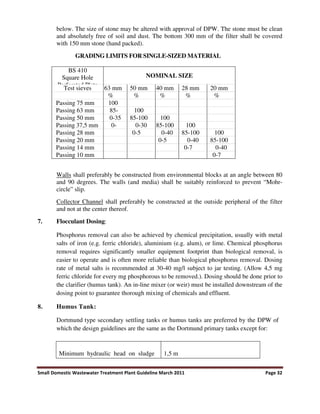
below. The size of stone may be altered with approval of DPW. The stone must be clean
and absolutely free of soil and dust. The bottom 300 mm of the filter shall be covered
with 150 mm stone (hand packed).
GRADING LIMITS FOR SINGLE-SIZED MATERIAL
BS 410
Square Hole
Perforated Plate
NOMINAL SIZE
Test sieves 63 mm 50 mm 40 mm 28 mm 20 mm
% % % % %
Passing 75 mm 100
Passing 63 mm 85- 100
Passing 50 mm 0-35 85-100 100
Passing 37,5 mm 0- 0-30 85-100 100
Passing 28 mm 0-5 0-40 85-100 100
Passing 20 mm 0-5 0-40 85-100
Passing 14 mm 0-7 0-40
Passing 10 mm 0-7
Walls shall preferably be constructed from environmental blocks at an angle between 80
and 90 degrees. The walls (and media) shall be suitably reinforced to prevent “Mohr-
circle” slip.
Collector Channel shall preferably be constructed at the outside peripheral of the filter
and not at the center thereof.
7. Flocculant Dosing:
Phosphorus removal can also be achieved by chemical precipitation, usually with metal
salts of iron (e.g. ferric chloride), aluminium (e.g. alum), or lime. Chemical phosphorus
removal requires significantly smaller equipment footprint than biological removal, is
easier to operate and is often more reliable than biological phosphorus removal. Dosing
rate of metal salts is recommended at 30-40 mg/l subject to jar testing. (Allow 4,5 mg
ferric chloride for every mg phosphorous to be removed.). Dosing should be done prior to
the clarifier (humus tank). An in-line mixer (or weir) must be installed downstream of the
dosing point to guarantee thorough mixing of chemicals and effluent.
8. Humus Tank:
Dortmund type secondary settling tanks or humus tanks are preferred by the DPW of
which the design guidelines are the same as the Dortmund primary tanks except for:
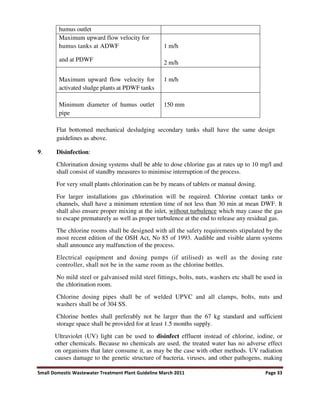
Minimum hydraulic head on sludge 1,5 m
Small Domestic Wastewater Treatment Plant Guideline March 2011 Page 33
humus outlet
Maximum upward flow velocity for
humus tanks at ADWF
and at PDWF
1 m/h
2 m/h
Maximum upward flow velocity for
activated sludge plants at PDWF tanks
1 m/h
Minimum diameter of humus outlet
pipe
150 mm
Flat bottomed mechanical desludging secondary tanks shall have the same design
guidelines as above.
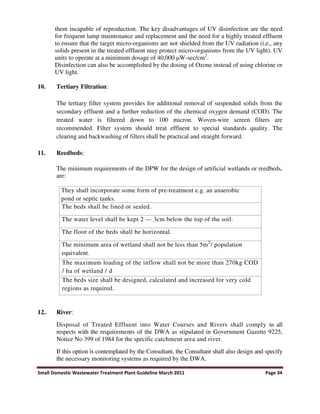
9. Disinfection:
Chlorination dosing systems shall be able to dose chlorine gas at rates up to 10 mg/l and
shall consist of standby measures to minimise interruption of the process.
For very small plants chlorination can be by means of tablets or manual dosing.
For larger installations gas chlorination will be required. Chlorine contact tanks or
channels, shall have a minimum retention time of not less than 30 min at mean DWF. It
shall also ensure proper mixing at the inlet, without turbulence which may cause the gas
to escape prematurely as well as proper turbulence at the end to release any residual gas.
The chlorine rooms shall be designed with all the safety requirements stipulated by the
most recent edition of the OSH Act, No 85 of 1993. Audible and visible alarm systems
shall announce any malfunction of the process.
Electrical equipment and dosing pumps (if utilised) as well as the dosing rate
controller, shall not be in the same room as the chlorine bottles.
No mild steel or galvanised mild steel fittings, bolts, nuts, washers etc shall be used in
the chlorination room.
Chlorine dosing pipes shall be of welded UPVC and all clamps, bolts, nuts and
washers shall be of 304 SS.
Chlorine bottles shall preferably not be larger than the 67 kg standard and sufficient
storage space shall be provided for at least 1.5 months supply.
Ultraviolet (UV) light can be used to disinfect effluent instead of chlorine, iodine, or
other chemicals. Because no chemicals are used, the treated water has no adverse effect
on organisms that later consume it, as may be the case with other methods. UV radiation
causes damage to the genetic structure of bacteria, viruses, and other pathogens, making
Small Domestic Wastewater Treatment Plant Guideline March 2011 Page 34
them incapable of reproduction. The key disadvantages of UV disinfection are the need
for frequent lamp maintenance and replacement and the need for a highly treated effluent
to ensure that the target micro-organisms are not shielded from the UV radiation (i.e., any
solids present in the treated effluent may protect micro-organisms from the UV light). UV
units to operate at a minimum dosage of 40,000 W-sec/cm2
.
Disinfection can also be accomplished by the dosing of Ozone instead of using chlorine or
UV light.
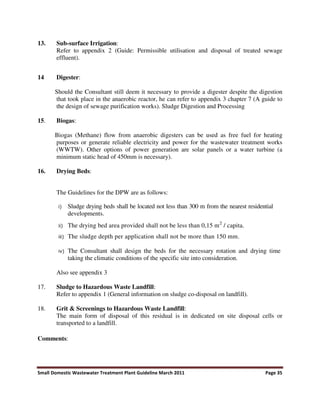
10. Tertiary Filtration:
The tertiary filter system provides for additional removal of suspended solids from the
secondary effluent and a further reduction of the chemical oxygen demand (COD). The
treated water is filtered down to 100 micron. Woven-wire screen filters are
recommended. Filter system should treat effluent to special standards quality. The
clearing and backwashing of filters shall be practical and straight forward.
11. Reedbeds:
The minimum requirements of the DPW for the design of artificial wetlands or reedbeds,
are:
They shall incorporate some form of pre-treatment e.g. an anaerobic
pond or septic tanks.
The beds shall be lined or sealed.
The water level shall be kept 2 — 3cm below the top of the soil.
The floor of the beds shall be horizontal.
The minimum area of wetland shall not be less than 5m2
/ population
equivalent.
The maximum loading of the inflow shall not be more than 270kg COD
/ ha of wetland / d
The beds size shall be designed, calculated and increased for very cold
regions as required.
12.. River:
Disposal of Treated Effluent into Water Courses and Rivers shall comply in all
respects with the requirements of the DWA as stipulated in Government Gazette 9225,
Notice No 399 of 1984 for the specific catchment area and river.
If this option is contemplated by the Consultant, the Consultant shall also design and specify
the necessary monitoring systems as required by the DWA.
Small Domestic Wastewater Treatment Plant Guideline March 2011 Page 35
13. Sub-surface Irrigation:
Refer to appendix 2 (Guide: Permissible utilisation and disposal of treated sewage
effluent).
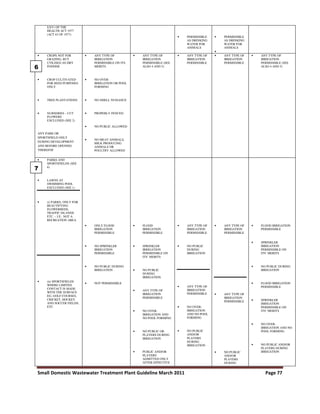
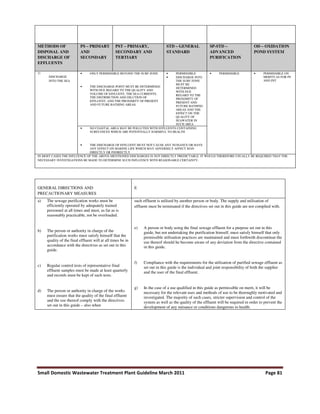
14 Digester:
Should the Consultant still deem it necessary to provide a digester despite the digestion
that took place in the anaerobic reactor, he can refer to appendix 3 chapter 7 (A guide to
the design of sewage purification works). Sludge Digestion and Processing
15. Biogas:
Biogas (Methane) flow from anaerobic digesters can be used as free fuel for heating
purposes or generate reliable electricity and power for the wastewater treatment works
(WWTW). Other options of power generation are solar panels or a water turbine (a
minimum static head of 450mm is necessary).
16. Drying Beds:
The Guidelines for the DPW are as follows:
Sludge drying beds shall be located not less than 300 m from the nearest residential
developments.
The drying bed area provided shall not be less than 0,15 m2
/ capita.
The sludge depth per application shall not be more than 150 mm.
The Consultant shall design the beds for the necessary rotation and drying time
taking the climatic conditions of the specific site into consideration.
Also see appendix 3
17. Sludge to Hazardous Waste Landfill:
Refer to appendix 1 (General information on sludge co-disposal on landfill).
18. Grit & Screenings to Hazardous Waste Landfill:
The main form of disposal of this residual is in dedicated on site disposal cells or
transported to a landfill.
Comments:
Small Domestic Wastewater Treatment Plant Guideline March 2011 Page 36
For emergency situations, shipping container RBC based or modular pump station plants may be
utilised. They are quick to install (1 day).
Small Domestic Wastewater Treatment Plant Guideline March 2011 Page 37
Pre Treatment
❶
Primary Treatment
❷ ❸
Secondary Treatment
❹
❺
Tertiary Treatment
Disposal
❾ ❿
Figure 4: Flow Sheet 3 Option-Refer to flow sheet 3 notes
Legend: ❶ Refer to flow sheet 3 notes
Recycling
SA General Standards
(Flow Sheet 3)
Less than 100 kl/day
Flow Measurement (for > 50 kl/day)
❽
sludge
Flow Measurement
FOG Removal
Humus Tank
❻
Septic Tank
2 Options
Flow Measurement (for > 50 kl/day)
To Regional
Sewage Plant
Reedbeds
Disinfection
❻
❼
Sub-Surface
Irrigation
Re-Circulation
+
Sludge
River
Maturation
Ponds
Disinfection
Rotating
Biological
Contractors
2
1
Figure 4: Flow sheet 3
Small Domestic Wastewater Treatment Plant Guideline March 2011 Page 38
FLOW SHEET 3 NOTES
1. FOG Removal:
Fat, Oil and Grease (FOG) is detrimental to the whole process stream and can directly
affect the efficiency of both the settlement and biological functions. FOG removal is
recommended in developments with kitchens (food preparation).
2. Septic Tank:
The Septic Tanks shall be designed in accordance with SABS 0252 Part 2 or CSIR
Report BOU93 of Nov 1996 for the calculated ADWF subject to the following
requirements of DPW:
a) The capacity of the tank shall not be less than 3x ADWF
b) The minimum design de-sludging capacity shall not be less than 5 years.
c) The tank shall have at least two compartments.
3. To Regional Sewage Plant:
Sludge from septic tank is transported to the regional sewage plant via vacuum tankers.
SECONDARY TREATMENT: TWO OPTIONS
OPTION 1: Rotating Biological Contactors plus Humus Tank (plus Maturation
Ponds)
4. Rotating Biological Contactors
Rotating biological contactors (RBC) are mechanical secondary treatment systems, which
are robust and capable of withstanding surges in organic load. RBCs require less space
than trickling filters and are more efficient and stable. They produce no aerosols and they
are successful in treating both domestic and industrial sewage. RBCs require less power
to run and they operate quietly. If there is a lack of land area, this option can do away
with the maturation ponds as long as the final effluent complies with the SA general
standards for discharge.
Rotating biological contactors (biodiscs), are especially suitable for small treatment
plants in warmer regions. The main design standards for these plants are:
a) The biodisc plant shall be preceded by a septic tank of capacity not less than 24
hr designed as specified.
Small Domestic Wastewater Treatment Plant Guideline March 2011 Page 39
b) The disc area shall not be less than 6m2
/capita in areas with average winter
sewage temperatures above 15°C or the disc loading shall not exceed 10
g/m2
/day COD and 3g/m2
/day NH4.
c) The disc area shall not be less than 9m2
/capita in areas with average winter
sewage temperatures between 10 and 15°C.
d) The disc area shall not be less than 12m2
/capita in areas with average
winter sewage temperatures below 10°C.
Mechanical and Electrical design shall cater for cases of extended periods of non-
operation which may cause drying of exposed sections of the discs, resulting in a
complete imbalance of the whole mechanism.
5. Humus Tank:
Dortmund type secondary settling tanks are preferred by the DPW of which the design
guidelines are the same as the Dortmund primary tanks except for:
Minimum hydraulic head on sludge
outlet
1,5 m
Maximum upward flow velocity for
Biodisc secondary tanks at ADWF
and at PDWF
1 m/h
2m/h
Maximum upward flow velocity for
activated sludge plants at PDWF tanks
1 m/h
Minimum diameter of humus outlet
pipe
150 mm
Flat bottomed mechanical desludging secondary tanks shall have the same design
guidelines as above.
Reference: Manual on the Design of Small Sewage Works — WISA
6. Disinfection:
Chlorination dosing systems shall be able to dose chlorine gas at rates up to 10 mg/l and
shall consist of standby measures to minimise interruption of the process.
Small Domestic Wastewater Treatment Plant Guideline March 2011 Page 40
For very small plants chlorination can be by means of tablets or manual dosing.
For larger installations gas chlorination will be required. Chlorine contact tanks or
channels, shall have a minimum retention time of not less than 30 min at mean DWF. It
shall also ensure proper mixing at the inlet, without turbulence which may cause the gas
to escape prematurely as well as proper turbulence at the end to release any residual gas.
The chlorine rooms shall be designed with all the safety requirements stipulated by the
most recent edition of the OSH Act, No 85 of 1993. Audible and visible alarm systems
shall announce any malfunction of the process.
Electrical equipment and dosing pumps (if utilised) as well as the dosing rate
controller, shall not be in the same room as the chlorine bottles.
No mild steel or galvanised mild steel fittings, bolts, nuts, washers etc shall be used in
the chlorination room.
Chlorine dosing pipes shall be of welded UPVC and all clamps, bolts, nuts and
washers shall be of 304 SS.
Chlorine bottles shall preferably not be larger than the 67 kg standard and sufficient
storage space shall be provided for at least 1.5 months supply.
Ultraviolet (UV) light can be used to disinfect effluent instead of chlorine, iodine, or
other chemicals. Because no chemicals are used, the treated water has no adverse effect
on organisms that later consume it, as may be the case with other methods. UV radiation
causes damage to the genetic structure of bacteria, viruses, and other pathogens, making
them incapable of reproduction. The key disadvantages of UV disinfection are the need
for frequent lamp maintenance and replacement and the need for a highly treated effluent
to ensure that the target microorganisms are not shielded from the UV radiation (i.e., any
solids present in the treated effluent may protect microorganisms from the UV light). UV
units to operate at a minimum dosage of 40,000 W-sec/cm2
.
Disinfection can also be accomplished by the dosing of Ozone instead of using chlorine or
UV light.
7. Maturation Ponds:
Refer to appendix 3 chapter 6 (A guide to the design of sewage purification works.) –
Maturation Ponds
OPTION 2: Reedbeds
8. Reedbeds
Reedbeds provide long-term storage and volume reduction of bio-solids. Reedbed
technology features low construction costs and minimal day-to-day operation and
maintenance costs. The system reduces water content, minimises solids, and provides
Small Domestic Wastewater Treatment Plant Guideline March 2011 Page 41
sufficient storage time to stabilize bio-solids prior to disposal. Reedbeds perform three
basic functions: (1) dewater the sludge, (2) transform it into mineral and humus like
components, and (3) store sludge for a number of years. Installation of multiple beds to
handle emergencies and downtime due to cleaning is recommended. Reedbeds require
plenty of land area and the ground conditions have to be suitable. Reedbed lining is
required. Reedbeds may be used as secondary or tertiary treatments.
But disinfection, as described under point 6 above, shall be applied before the reedbeds
The minimum requirements of the DPW for the design of artificial wetlands or reedbeds,
are:
They shall incorporate some form of pre-treatment e.g. an anaerobic
pond or septic tanks.
The beds shall be lined or sealed.
The water level shall be kept 2 — 3cm below the top of the soil.
The floor of the beds shall be horizontal.
The minimum area of wetland shall not be less than 5m2
/ population
equivalent.
The maximum loading of the inflow shall not be more than 270kg COD
/ ha of wetland / d
The beds size shall be designed, calculated and increased for very cold
regions as required.
9. Sub-surface Irrigation:
Refer to appendix 2 (Guide: Permissible utilisation and disposal of treated sewage
effluent).
10. River:
Disposal of Treated Effluent into Water Courses and Rivers shall comply in all
respects with the requirements of the DWA as stipulated in Government Gazette 9225,
Notice No 399 of 1984 for the specific catchment area and river.
If this option is contemplated by the Consultant, the Consultant shall also design and specify
the necessary monitoring systems as required by the DWA.
Comments:
For emergency situations, shipping container RBC based plants or a modular pump station may
be utilised. They are quick to install (1 day).
Small Domestic Wastewater Treatment Plant Guideline March 2011 Page 42
Greater than 100 kl/day
(1)
Pre Treatment
(2)
(3)
(4)
Primary Treatment
(5)
Secondary Treatment
(6)
Optional (7)
(8)
(15)
Tertiary Treatment
(9)
(4)
(10) Optional
Disposal
(16) (17) (11)
Legend: (1) Refer to flow sheet 4 notes
Recycling
Figure 5: Flow Sheet 4
Bury or
Digester
Drying Beds
Screening
Grit Removal
Anaerobic
Reactor
Biofilter
Humus Tank
(13) (14)
Disinfection
Stream/River
sludge
Maturation
Ponds
Optional
sludge
SA General Standards
(Flow Sheet 4)
Flocculant
Dosing
Hazardous
Waste Landfill
Flow Measurement
Flow Measurement
Tanker
Disposal
sludge
Re-circulation
sludge
Small Domestic Wastewater Treatment Plant Guideline March 2011 Page 43
FLOW SHEET 4 NOTES
1. Tanker Disposal:
Refer to appendix 3 (Abstracts of A guide to design of sewage purification works). –
Nightsoil Intakes
2. Screening:
Inlet works shall comprise of coarse screens, rag catcher, grit channels and a flow
meter.
The purpose of screening is to remove larger floating solids and larger organic solids
which do not aerate and decompose. The grit channel removes heavy inorganic matter
like grit, sand, gravel, road scrapings and ashes. These particles are discrete particles that
do not decay but create nuisance. They may damage pumps and make sludge digestion
difficult. Grit particles are of large size and hence high density compared to organic
matter.
Coarse screens shall be of 3CR12 or 304 stainless steel with clear spacings of between
20mm and 25mm and shall be provided with three 3CR12 or 304 SS rakes and drainage
platforms suitable for practical removal and disposal of screenings and grit. A rag
catcher shall follow the course screen, alternatively, a mechanical fine screen (6
mm openings between bars) combined with a bypass (emergency) handscreen, shall
replace both the course screen and rag catcher.
The width of the screen shall not be less than 200mm. Velocity of flow at peak dry
weather flow upstream of the screen shall be not less than 0,6m/s. Velocity of flow at
peak dry weather flow through the screen openings shall not be less than 0,8m/s. Peak
dry weather velocity through the screen openings, shall not be more than 1,0m/s. The
minimum thickness of the bars shall not be less than 4mm and the bar depth not less than
50mm. And shall be supported with a cross bar at bottom and at every 300 mm.
Rag catchers shall be constructed of stainless steel to suit the channel width. The
minimum thickness of the base plate shall not be less than 6mm and the spike diameters
not less than 10mm. The spikes shall be spaced 50 to 60 mm apart in both directions with
each row and column staggered 25 to 30 mm. The width of the rag catcher shall suit the
width of the channel and the closest spikes to the walls shall be 25mm to 30mm away.
The rag catcher shall be positioned in a part of the channel where it will not impact on
flow measuring/controlling flumes, even if it means a separate (extended) channel will
be needed. The length of the rag catcher shall not be less than 400 mm. The rag catcher
shall be equipped with a lifting handle of not less than 10mm diameter.
Small Domestic Wastewater Treatment Plant Guideline March 2011 Page 44
3. Grit Management:
Grit channels in combination with a flat bottom Venturi flume shall be designed for a
constant flow velocity of between 0,27 and 0,30m/s at all flows and to remove grit
particles of 1,2 SG down to 0,2mm size.
Grit storage in the grit recess shall be provided for grit accumulation of not less than
72 h at ADWF when grit contents is 1,5 liters per 100 kl.
Side slopes of grit channels, shall not be less than 45˚.
Handstops shall be of aluminium, stainless steel or 3CR12 steel.
4. Flow Metering:
Where specified and as required for the sewage treatment plant, the influent flow meter
should be situated on the influent side after screening, rag catcher and grit removal (as
applicable). Where sludge removal is periodically from a septic tank, the flow meter
could be situated on the effluent side. Manual flow metering shall be in a stilling
chamber connected to a venturi flume or at a weir by means of an adjustable stainless
steel pointer gauge against a fixed graduated stainless steel ruler. When electricity is
available on the site, an ultrasonic flow meter equipped with indication and integration,
shall be supplied. The venturi stilling chamber shall be designed in accordance with BS
3680. A V-notch weir shall have a 90° notch and shall be provided with a removable
aluminium or stainless steel scum plate chained to the channel at least 5 channel widths
upstream of the V-notch weir to create an effective stilling chamber.
Other flow metering principles may be considered in liaison with DPW
5. Anaerobic Reactor:
In lieu of a primary settling tank in combination with a digester to cater for sludge, DPW
will settle for an appropriately designed “Anaerobic Reactor”.
The reactor shall consist of a rectangular pond with water depth at least 4 m deep. The
screened sewage shall enter the pond at bottom level. Provision shall be made to
withdraw sludge (after it has been sufficiently digested) from the bottom at different
(appropriate) positions and convey it to sludge drying beds. Withdrawal pipe work shall
not be less than 150 ND and hydraulic head not less than 2 m.
Top water level of the pond shall be constant and controlled by a baffled weir. In every
corner of the pond, provision shall be made to withdraw or skim floating matter (like
scum, plastic, wood, etc.) and an appropriate manner in disposing thereof.
The interior sides of the walls shall be as steep as can be safely accommodated by the soil
conditions. The entire interior surface, up to 300 mm above top water level, shall be lined
with 80 mm thick lightly reinforced concrete slabs with expansion joints at appropriate
intervals which are suitably sealed to prevent contamination of ground water.
Small Domestic Wastewater Treatment Plant Guideline March 2011 Page 45
The size of the pond: The water holding volume of the pond shall be 1,8 times ADWF.
This allows for sludge accumulation for 80 days, if the raw sewage consists of the normal
approximately 1 % sludge in domestic sewages; plus 24 hours retention time for the raw
sewage at ADWF as required for anaerobic septic tanks. Retention time is required to
separate the solids from the liquid and deliver settled sewage to the biofilter.
Sludge withdrawal shall only commence after at least 80 days (preferably 100 days) after
commissioning of the anaerobic reactor in order to allow sufficient time for the sludge to
be properly digested. After this digestion period, the volume of sludge to be withdrawn
regularly, shall be equal to the volume of fresh sludge added via the raw sewage. If more
digested sludge is withdrawn than raw sludge added, the sludge age will drop and
digestion impaired. If less sludge is withdrawn, the pond will fill up and the retention
time will be impaired.
6. Biological Trickling Filter
Biological filters are not filters in the usual sense of the word. A better description would
be "bacteria beds" or "percolating beds". However, the expression "biological filtration"
or “Biofilter” is in such general use that it will be used here.
Biofilters for DPW shall be designed to conform at least to the requirements as set out in
“Manual on Design of Small Sewage Works” by WISA with further guidelines as
follows:
Design loads on biofilters for DPW shall be based on the following table:
DESIGN LOADING in g/m³.day (for average winter temperature of sewage)
Filter depth and mode of
operation
Temp up to 9º C Temp 10 to 15º C Temp above 15º C
COD N/NH4 COD N/NH4 COD N/NH4
2 m Single 150 8 200 16 270 20
2 m Single with
recirculation
190 10 250 20 340 25
2 m Double 190 19 250 20 340 25
4 m Single 190 10 250 20 340 25
4 m Single with
recirculation
225 12 300 25 400 31
4 m Double 260 15 350 30 470 37
Recirculation: Biofilters for DPW shall also incorporate RECIRCULATION at a rate of
at least 1:1 at ADWF.
Small Domestic Wastewater Treatment Plant Guideline March 2011 Page 46
Ventilation is crucial. Since aeration tiles are not readily available anymore, the
Consultant shall employ innovative but effective measures to ensure proper ventilation
through the entire filter media body.
Media: Filter media for DPW biofilters shall consist of single graded crushed stone of
size 50 mm, with rough surfaces which comply with the grading limits shown in the table
below. The size of stone may be altered with approval of DPW. The stone must be clean
and absolutely free of soil and dust. The bottom 300 mm of the filter shall be covered
with 150 mm stone (hand packed).
GRADING LIMITS FOR SINGLE-SIZED MATERIAL
BS 410
Square Hole
Perforated Plate
NOMINAL SIZE
Test sieves 63 mm 50 mm 40 mm 28 mm 20 mm
% % % % %
Passing 75 mm 100
Passing 63 mm 85- 100
Passing 50 mm 0-35 85-100 100
Passing 37,5 mm 0- 0-30 85-100 100
Passing 28 mm 0-5 0-40 85-100 100
Passing 20 mm 0-5 0-40 85-100
Passing 14 mm 0-7 0-40
Passing 10 mm 0-7
Walls shall preferably be constructed from environmental blocks at an angle between 80
and 90 degrees. The walls (and media) shall be suitably reinforced to prevent “Mohr-
circle” slip.
Collector Channel shall preferably be constructed at the outside peripheral of the filter
7. Flocculant Dosing:
This is optional – if the phosphorous in the raw sewage is less than 11 mg/l, ‘flocculant
dosing’ will not be required.
Phosphorus removal can also be achieved by chemical precipitation, usually with metal
salts of iron (e.g. ferric chloride), aluminium (e.g. alum), or lime. Chemical phosphorus
removal requires significantly smaller equipment footprint than biological removal, is
easier to operate and is often more reliable than biological phosphorus removal. Dosing
rate of metal salts is recommended at 30-40 mg/l subject to jar testing. (Allow 4,5 mg
ferric chloride for every mg phosphorous to be removed.). Dosing should be done prior to
the clarifier (humus tank). An in-line mixer (or weir) must be installed downstream of the
dosing point to guarantee thorough mixing of chemicals and effluent.
Small Domestic Wastewater Treatment Plant Guideline March 2011 Page 47
8. Humus Tank:
Dortmund type secondary settling tanks or humus tanks are preferred by the DPW of
which the design guidelines are the same as the Dortmund primary tanks except for:
Minimum hydraulic head on humus
outlet 1,5 m
Maximum upward flow velocity for
Biofilter humus tanks at ADWF
and at PDWF
1 m/h
2 m/h
Maximum upward flow velocity for
activated sludge plants at PDWF tanks 1 m/h
Minimum diameter of humus outlet
pipe 150 mm
Flat bottomed mechanical desludging secondary tanks shall have the same design
guidelines as above.
Reference: Manual on the Design of Small Sewage Works — WISA
9. Disinfection:
Chlorination dosing systems shall be able to dose chlorine gas at rates up to 10 mg/l and
shall consist of standby measures to minimise interruption of the process
For very small plants chlorination can be by means of tablets or manual dosing.
For larger installations gas chlorination will be required. Chlorine contact tanks or
channels, shall have a minimum retention time of not less than 30 min at mean DWF. It
shall also ensure proper mixing at the inlet, without turbulence which may cause the gas
to escape prematurely as well as proper turbulence at the end to release any residual gas.
The chlorine rooms shall be designed with all the safety requirements stipulated by the
most recent edition of the OSH Act, No 85 of 1993. Audible and visible alarm systems
shall announce any malfunction of the process.
Electrical equipment and dosing pumps (if utilised) as well as the dosing rate
controller, shall not be in the same room as the chlorine bottles.
No mild steel or galvanised mild steel fittings, bolts, nuts, washers etc shall be used in
the chlorination room.
Chlorine dosing pipes shall be of welded UPVC and all clamps, bolts, nuts and
washers shall be of 304 SS.
Small Domestic Wastewater Treatment Plant Guideline March 2011 Page 48
Chlorine bottles shall preferably not be larger than the 67 kg standard and sufficient
storage space shall be provided for at least 1.5 months supply.
Ultraviolet (UV) light can be used to disinfect effluent instead of chlorine, iodine, or
other chemicals. Because no chemicals are used, the treated water has no adverse effect
on organisms that later consume it, as may be the case with other methods. UV radiation
causes damage to the genetic structure of bacteria, viruses, and other pathogens, making
them incapable of reproduction. The key disadvantages of UV disinfection are the need
for frequent lamp maintenance and replacement and the need for a highly treated effluent
to ensure that the target microorganisms are not shielded from the UV radiation (i.e., any
solids present in the treated effluent may protect microorganisms from the UV light). UV
units to operate at a minimum dosage of 40,000 W-sec/cm2
.
Disinfection can also be accomplished by the dosing of Ozone instead of using chlorine or
UV light.
10. Maturation Ponds:
Refer to appendix 3 chapter 6 (A guide to the design of sewage purification works.)
11. River:
Disposal of Treated Effluent into Water Courses and Rivers shall comply in all
respects with the requirements of the DWA as stipulated in Government Gazette 9225,
Notice No 399 of 1984 for the specific catchment area and river.
If this option is contemplated by the Consultant, the Consultant shall also design and specify
the necessary monitoring systems as required by the DWA.
12. Sub-surface Irrigation:
Refer to appendix 2 (Guide: Permissible utilisation and disposal of treated sewage
effluent).
13. Digester:
Refer to appendix 3 chapter 7 (A guide to the design of sewage purification works).
Sludge Digestion and Processing
14. Biogas:
Biogas (Methane) flow from anaerobic digesters can be used as free fuel for heating
purposes or generate reliable electricity and power for the wastewater treatment works
(WWTW). Other options of power generation are solar panels or a water turbine (a
minimum static head of 450mm is necessary).
15. Drying Beds:
Refer to appendix 3 (A guide to the design of sewage purification works). Sludge
Digestion and Processing – Sludge Dewatering and Disposal.
Small Domestic Wastewater Treatment Plant Guideline March 2011 Page 49
The Guidelines for the DPW are as follows:
a) Sludge drying beds shall be located not less than 300m from the nearest residential
developments.
b) The drying bed area provided shall not be less than 0,15 m2
/ capita.
c) The sludge depth per application shall not be more than 150 mm.
d) The Consultant shall design the beds for the necessary rotation and drying time
taking the climatic conditions of the specific site into consideration.
16. Grit & Screenings to Hazardous Waste Landfill:
The main form of disposal of this residual is in dedicated on site disposal cells or
transported to a landfill.
17. Sludge to Hazardous Waste Landfill:
Refer to appendix 1 (General information on sludge co-disposal on landfill.)
Comments:
For emergency situations, shipping container RBC based or modular pump station plants may be
utilised. They are quick to install (1 day).
Small Domestic Wastewater Treatment Plant Guideline March 2011 Page 50
5. LIFE CYCLE COST
Apart from the instructions in 5.1 and 5.2 below, the life cycle cost shall also be based on the
following additional factors:
Design life .................................................... 20 years
Depreciation and maintenance costs
of concrete structures................................... 5%/year
Depreciation and maintenance costs
of steel structures and steel pipelines............ 8%/year
Depreciation and maintenance costs
of plastic structures and pipelines subject
to direct sunlight at any time of the year....... 20%/year
Depreciation and maintenance costs
of surface mounted plastic structures and
pipelines not subjected to direct sunlight at
any time of the year....................................... 10%/year
Depreciation and maintenance costs
of buried UPVC and plastic pipelines............ 5%/year
Depreciation and maintenance costs
of electric motors and switchgear.................. 10%/year
Depreciation and maintenance costs
of mechanical equipment eg. aerators,
rotating discs, valves, pumps etc. ................ 8%/year
Depreciation and maintenance costs
of electronic equipment................................. 15%/year
5.1 INSTRUCTIONS FOR USING LIFE CYCLE COST/ MODEL
The LCC model spreadsheet can be downloaded at:
http://cigmat.cive.uh.edu/cigmat%20Folder/research.htm
When starting the LCC model it may ask to enable macros. Please enable
macros and then proceed:
Small Domestic Wastewater Treatment Plant Guideline March 2011 Page 51
MAJOR COMPONENTS:
Input Sheet:
Values for all the parameters are to be entered in this sheet. The columns
coloured Red are the entry columns. Default values of each parameter are
provided next to the entry column. The user can enter values as per their system
requirements.
• Total Population: The population at the beginning of
the design study.
• Percent of Population: Percentage of total population
working with or directly associated with various types
of associations. This data is needed to generate the
base flow in the model.
• Establishments: Number of housing, industrial,
business, educational and recreational establishments
in the study area. The numbers of units are based on
population of the city/wastewater district. Note that
the number of persons is an important parameter and
can be obtained from the RSA census data.
• Length of sewer per Unit: Length of sewer line added
by each unit to the total length of the main lines.
Trunk sewer will be a percentage of main sewer
pipeline length.
• Sewer pipe classification: Pipe sizes are classified in
standard sizes. For laterals pipe sizes ranges from 117
and 203 millimeter diameter while Main lines ranges
from 203, 254 and 305 millimeter diameter pipes and
trunk sewer are 610, 762, 914, 1067 and 1219
millimeter diameter. The laterals, main and trunk are
equally divided among the sizes. User can change the
percentage of various sewer pipe sizes according to
the system to be designed.
Small Domestic Wastewater Treatment Plant Guideline March 2011 Page 52
• Pipe Joint spacing: The joints in pipeline are
classified in three categories. Lateral-Main joints
(joints at the intersection of lateral with main line
sewer), Mainline joints (joints between the pipes of
the mainline sewer) trunk line joints (joints between
the pipes of the trunk sewer). The default spacing is
6.1 meters. User can change the spacing as per their
system.
• Manhole spacing: Manholes at mainlines and trunk
sewers are placed at a default distance of 91.4 meters
and 122 meters apart respectively.
• Manhole sizes: Manhole sizes vary from 1.23 to 2.44
meter diameter based on the diameter of the pipe
where the manhole is placed.
• Infiltration: Infiltration considered is the model is rain
induced infiltration and ground water infiltration.
Infiltration takes place through manholes, pipeline
(cracks in main line and trunk line) and pipe joints
(main-lateral joints, main line joints, trunk line
joints). The intensity of infiltration varies from day to
day; the user can determine the intensity of
infiltration and number of days associated with it. The
default value is 0% infiltration for 250 days, 10% for
100 days and 30 % for 15 days. The percent
infiltration and number of days are on a sliding scale;
infiltration increases every year with no maintenance
performed, so do the number of days associated with
the infiltration.
• Per capita Flow: Per capita flow is the individual
discharge made by per person per day on an average
associated with various establishments. Default
values are provided.
• Transportation cost: Transportation cost is the cost
associated with the collection and conveyance of
waste water this includes the cost of minor sewer
Small Domestic Wastewater Treatment Plant Guideline March 2011 Page 53
repair, sewer maintenance, pumping station,
Operation and Maintenance and other miscellaneous
expenses.
• Treatment cost: Treatment cost is the cost of treating
per kl. of wastewater. Treatment cost depends on the
capacity of the treatment plant and the capacity
utilized. Treatment plants are classified into three
sizes small, mid size and large treatment plants.
Basic Model Sheet:
This sheet provides the data for a single event (one day) of occurrence of infiltration in the
system. Various parameters can be verified from this sheet; the length of the sewer system,
number of manholes, per day sewer flow, treatment cost per 1000 litres etc; of the
city/wastewater district under consideration. The model can be further calibrated for a particular
city by making corresponding changes in the input sheet to achieve city specifications.
Capital Cost:
The capital cost sheet shows the cost associated with laying out a wastewater system of the size
obtained in the basic model sheet.
Model Sheet 5, 10, 15, 20, 25, 30:
These model sheets incorporate the change in population every 5 years. Infiltration in the system
is increased by one percent every year. Default Model values are provided in the Input sheet.
This sheet helps to check when the system flow exceeds the treatment plant capacity and the
prescribed regulations for excessive infiltration (average dry weather flow not exceeding 500
l/c/d-litres per capita per day). Rehabilitation is performed at the end of every 10 years period,
when rehabilitation is performed the infiltration is dropped by 50%.
Rehabilitation Cost:
Rehabilitation is performed every 10 years cycle. Rehabilitation is performed on 10% of the
system. The cost calculation is done as per rehabilitation costs provided by the user (default
values are also provided). 30 years rehabilitation cost is calculated based on two rehabilitation
cycles.
Life Cycle Cost:
Small Domestic Wastewater Treatment Plant Guideline March 2011 Page 54
The Life Cycle Cost sheet gives us the cost of Wastewater treatment for 30 years period when
rehabilitation is performed every 10 years on the system.
Life Cycle Cost (No Maintenance):
Alternate Life Cycle Cost is achieved for no rehabilitation on the system. The difference in the
life cycle cost with maintenance and no maintenance is obtained.
5.2 LIFE CYCLE COST MODEL FOR WATER, WASTEWATER SYSTEMS
A Life Cycle Cost (LCC) model for operating and maintaining wastewater sewer system has
been developed at the Center Grouting Materials and Technology (CIGMAT) at the University
of Houston, Houston, TX.
The LLC model is based on population and average household occupancy with the essential
components of water and wastewater systems identified and divided into sectors such as housing,
commercial, educational and recreational facilities. Life cycle cost includes transportation,
maintenance and rehabilitation of water and wastewater systems to control exfiltration in water
systems and infiltration in wastewater systems over the life cycle period.
The model can be used to compare different rehabilitation and maintenance scenarios and
identify the most cost effective approach to rehabilitate and maintain water and wastewater
systems. The model (LCC-CIGMAT) has been calibrated using published data on various water
and wastewater systems.
Advancements in technology have led to new cost effective methods being developed for the
inspection and rehabilitation of wastewater systems, which have made rehabilitation and
maintenance a cost effective alternative to replacement/new construction. With the correct
features, a LCC model can be used to compare various rehabilitation and maintenance plans and
new construction cost [Vipulanandan et al., 2005]. There are a number of models used for
wastewater system design, but most if not all of these models have not incorporated the LCC or
infiltration [Ardit, 1999]. Also, the GASB 34 (Governmental Accounting Standards Board
Statement # 34) requires reports of the asset value of the wastewater system (the best estimate of
the main components of the system).
Hence, there is need for developing new models to overcome some of the current shortcomings
and to estimate the extent and needs of a wastewater system based on population.
Objective
The study was developed to determine the LCC for water and wastewater systems. The specific
objectives are:
Small Domestic Wastewater Treatment Plant Guideline March 2011 Page 55
1. To identify the important parameters that influences the cost of water and wastewater
systems;
2. To develop a LCC model for a selected life cycle period (10 to 50 years);
3. To incorporate the various rehabilitation and maintenance methods to identify the most
cost effective plan; and
4. Calibrate and verify the model with published data.
Model development
A spreadsheet model in MS Excel was developed based on the population and average household
density [CIGMAT, 2003]. The population of a city was divided in these basic units: (1) Housing
units (H); (2) Industrial park (I); (3) Commercial establishment (C); (4) Educational
establishments (E); and (5) Recreation and other facilities (R).
The model comprises several modules on an input sheet for the user to enter values specific to a
selected city (default values are provided); a basic model worksheet to estimate the size of the
wastewater system (length of sewer line, number of manholes, connections, pipe joints); daily
wastewater flow in the system; amount of infiltration; and cost associated with treatment and
transportation.
A capital cost worksheet estimates the cost for a new wastewater system. The rehabilitation
section lays out the rehab plan of the city over the life cycle study period for the wastewater
system and calculates the cost for rehabilitation for different rehabilitation plans. The Life Cycle
Cost section analyzes the life cycle cost of the wastewater system based on the rehabilitation and
the operation and maintenance (O & M) plans selected for the city.
Individual components of the wastewater system were estimated based on all of the elements.
Estimating the sewer length, infiltration and LCC are discussed in detail.
Pipe Length (PL)
The total pipe length (water or sewer) comprises main lines and trunk lines.
PL = [PL.sub.m] + [PL.sub.t]
Where
[PL.sub.m] = Main Pipe Line
[PL.sub.t] = Trunk Pipe Line
Main Pipe Line ([PL.sub.m])
Main sewer lines connect to trunk sewers. The default pipe sizes for main sewer lines range from
203 to 305 millimeter in diameter.
Small Domestic Wastewater Treatment Plant Guideline March 2011 Page 56
[PL.sub.m] = [n.summation over (i=1)] [a.sub.i] [H.sub.i] + [n.summation over (i=1)] [b.sub.i]
[C.sub.i] + [n.summation over (i=1)] [c.sub.i] [E.sub.i] + [n.summation over (i=1)] [d.sub.i]
[R.sub.i] + [e.sub.i] ln
Where
i = number of sectors for the wastewater system under study.
H = number of Housing units in each sector.
I = number of Industrial units in each sector.
C = number of Commercial units in each sector.
E = number of Educational establishments in each sector.
R = number of Recreational units in each sector.
a, b, c, d, e are factors representing the length of the sewer contributed to the Main Sewer Line
by Housing units, Commercial units, Educational establishments, Recreational units and
Industrial establishments respectively. The values of a, b, c, d and e are to be obtained for each
city. The default values are a = 0.008, b = 0.015, c = 0.02, d = 0.04 and e = 0.015.
Trunk Pipe Line ([SL.sub.t])
Trunk sewer is considered as a percentage of Main Pipe Line ([PL.sub.m]). Main sewer lines are
connected to the trunk sewer line, which transports sewer to the treatment plant.
[PL.sub.t] = f[PL.sub.m]
Where f is a factor represented in terms of percentage. It is a variable needed to be obtained for
the city. Default value is 10%.
Infiltration (I)
Infiltration (for sewer) is rain induced and ground water. Infiltration can take place through
sewer lines (main sewer line, trunk sewer), manholes, pipe line joints (main sewers, trunk
sewers) and lateral joints.
I = [I.sub.sl] + [I.sub.m] + [I.sub.j]
Where [I.sub.sl], [I.sub.m], [I.sub.j]. represents infiltration through sewer lines, manholes and
joints respectively.
Infiltration at sewer line ([I.sub.sl])
Infiltration can take place at the sewer pipeline due to various reasons; cracks and root intrusion
can happen both at the trunk sewer line and main pipeline.
[I.sub.sl] = [I.sub.m] + [I.sub.t]
Small Domestic Wastewater Treatment Plant Guideline March 2011 Page 57
Where Im, It is infiltration at main sewer line and trunk sewer.
Infiltration at main sewer line ([I.sub.m])
Infiltration takes place along the main sewer line excluding the infiltration through pipe joints in
the main sewer line.
[I.sub.m] = u [n.summation over (j=1)] [SL.sub.m] [s.sub.j][t.sub.j]
Where
"j" represents different diameter sizes of main sewer line in millimeter.
"[t.sub.j]" is the diameter of the j size main sewer line.
"[s.sub.j]" is the percentage of main sewer line for each diameter "tj".
"[t.sub.j]" x [n.summation over (j=1)] [s.sub.j] = 1
[SL.sub.m] is the total main line sewer length.
"u" is the infiltration in litres per meter per millimeter of the diameter of the main sewer line.
Infiltration at trunk sewer line ([I.sub.m])
[I.sub.t] = u [n.summation over (k=1)] [SL.sub.t] [v.sub.j][w.sub.j]
Where
"k" represents different diameters of trunk sewer.
"v" is the diameter of various trunk sewer.
"w" is the percentage of main sewer line for each diameter represented as "t". [n.summation over
(k=1)] [w.sub.k] = 1
[SL.sub.t] is the total main line sewer length.
"u" is the infiltration per litres per square millimeter of the diameter of the main pipeline.
Life Cycle Cost
Life Cycle Cost (LCC) calculates the total cost of ownership over the life span of an asset. Initial
cost and all subsequent expected costs are included in the calculation as well as disposal (or
residual) value and any other quantifiable benefits to be derived. The larger the investment, the
more important LCC analysis becomes. The application of LCC is generally on non-revenue
producing projects where the objective is to minimize cost and maximize benefits.
Wastewater systems have a long life expectancy with a life span varying from 30 to 100 years.
The initial capital cost to set up a wastewater system for a city is high and the subsequent O & M
Small Domestic Wastewater Treatment Plant Guideline March 2011 Page 58
and rehabilitation cost have a significant impact on the life cycle cost of the system. An effective
Life Cycle Cost Analysis will be very beneficial for the asset management of a wastewater
system.
In this study, the following cost components are considered in the life cycle cost of a wastewater
system:
* Capital cost
* O & M cost
* Rehabilitation cost
* Residual cost
Capital cost
The capital cost includes design, planning cost, material and installation cost for pipeline,
manholes, pump stations and the treatment plant. While developing the capital cost Model,
significant variables determining the capital cost were identified. The data available in the
literature and the data provided by the city of Victoria, TX (bid data by various contractors for
wastewater construction projects) were used to verify the relationship developed in this study.
Multiple regression analysis was performed and correlation was developed between various
factors while developing the model to best estimate the capital cost of a wastewater system.
Capital Cost Model development
The model was developed by breaking down capital cost into three major components.
1) Material cost;
2) Installation cost; and
3) Miscellaneous cost (involves administrative and other expenses).
CC = [C.sub.PM] + CL + [C.sub.MH] + [C.sub.TP] + [C.sub.PS] + OC + M
Where
CC = Total capital cost
CPM = Total cost of pipe material.
CL = Total cost of pipeline installation.
CMH = Cost of manhole material installation.
Small Domestic Wastewater Treatment Plant Guideline March 2011 Page 59
CTP = Cost of wastewater treatment plant (WWTP) based on capacity in mega litres per day
(Ml/day) (includes material and installation cost).
CPS = Cost of pump stations based on capacity in Ml/day (includes material and installation
costs).
OC = Other costs (includes major cost components like trench system design, mobilization of
manpower and machinery, repair existing roads, traffic control, etc).
M = Miscellaneous (includes minor cost components like site preparation and taxes).
Steps in developing the model include:
* Estimate the various components of the sanitary sewer system based on the population and
average household density;
* Quantify the amount of wastewater flow based on infiltration in the existing wastewater
system;
* Develop Life Cycle Cost Analysis (LCCA) for a wastewater system with infiltration;
* Estimate infiltration cost, wastewater treatment cost and transportation cost associated with the
wastewater system;
* Estimate O & M and rehabilitation costs associated with various rehabilitation activities;
* Perform parametric study with various factors of the wastewater system and identify the most
important cost contributing factors;
* Compare various rehabilitation alternatives and perform breakeven analysis with operation cost
of the wastewater system; and
* Estimate the asset value of the wastewater system.
Calibration of model
The model was calibrated based on published wastewater system data from cities of various
population sizes from different regions in the United States [U.S. Census, 2004]. Only the sewer
length results are discussed in detail in this paper.
Sewer Length Calibration (Actual vs. Model)
The model was calibrated for the sewer length of cities from a population of 10,000 to 2 million.
The actual sewer length [Nelson et al., 1999] is compared to predicted sewer length using the
model [CIGMAT, 2003]. Of the 40 cases compared, the relationship is as follows:
Model Sewer Length = 1.005 * Actual Sewer Length.
For this relationship, the correlation coefficient (R) was 0.93.
Small Domestic Wastewater Treatment Plant Guideline March 2011 Page 60
Similar analyses were done for manholes, average annual daily flow and treatment plant
capacity.
Sewer Length Calibration (Effect of Household Density (HD))
The sewer length of a city can be calibrated by varying the average household density (number
of persons per household
Sewer Length Calibration (Effect of Pipe Length per House Hold (PLH))
Medium size population in the USA
For a medium size population (100,000 to 500,000) the average house spacing decreased from
0.016 to 0.0145 kilometer. A wide variation in house spacing was observed in this population
range--70% of the cities were above the 0.0129 kilometer house spacing line. According to the
residual plot, the 0.0145 kilometer house spacing was the best fit for mid size population range.
Entire population with sewer length in the USA
For the entire population, the range of sewer lengths obtained from the model by varying the
house spacing is plotted against population. The default value for the model house spacing was
0.0129 kilometers per housing unit. It can be concluded that a spacing of about 0.0129
kilometers gave the best fit for all the wastewater systems. The default house spacing value for
the model was 0.0129 kilometers per housing unit.
Using the study, it can be concluded that average house spacing decreased with increase in
population. The houses in cities with a higher population are denser than cities with a lesser
population.
Wet Weather Flow Calibration (Effect of Infiltration)
Entire population with wet weather flow
The average wet weather flow with the population for various wastewater systems and the model
prediction of infiltration. Infiltration in the range of 10% to 40% gave the best fit for the entire
population range. In the small population range (up to 100,000), the model predicted all the cities
have infiltration. For a medium size population, over 80% of the cities had infiltration where as
for large system (up to 500,000) there are 47% cities with infiltration. The analysis showed that
the default values set for the wastewater flow per person in the system needed to be reduced to
accommodate the change in wastewater flow due to the change in population. The average per
capita flow was less in bigger cities compared to the flow in smaller cities.
Small Domestic Wastewater Treatment Plant Guideline March 2011 Page 61
LCC-CIGMAT model verification
There have been several case studies documented in literature for cities with different
populations. One example is Norfolk, VA, with a population of 260,000 [Curtis et al., 1995]. A
study on the infiltration problem was conducted based on the data provided by the city.
Information on the treatment and transportation cost were $1.40/3785 litres ($ 0.37 / kl) and
$1.29/3785 litres ($ 0.341 / kl) respectively [Curtis et al., 1995]. Based on the census data, the
household occupancy was 2.5 per unit [U.S, Census, 2004]. The model was used to generate the
data for a period of 30 years and various analyses were performed.
This study shows the changes in the percent infiltration as the spacing is increased between
various pipe joints. LCC for various infiltration reductions is compared with the repair and
treatment costs. Based on the cost results, up to 50% reduction in infiltration by repair method is
cost effective. Higher reductions in infiltration will result in greater repair cost and greater total
cost.
Conclusion
The model is based on population and household occupancy of the area that is being designed.
The lumped parameter model can be easily used to estimate size of the water and wastewater
system. The model is very flexible--it can be calibrated for a specific location by modifying the
default values provided. The model parameters are being updated by calibrating the model with
published data.
Small Domestic Wastewater Treatment Plant Guideline March 2011 Page 62
Small Domestic Wastewater Treatment Plant Guideline March 2011 Page 63
6. REFERENCES
6.1 PUBLICATIONS
1. Manual on the design of small sewage works, 1st
edition 1988, The Water Institute of
Southern Africa.
2. A Guide to the Design of Sewage Purification Works, November 1973, Institute for
Water Pollution Control.
3. Water treatment handbook, Lavoisier, 6th
edition 1991 volume 1 and 2.
4. Wastewater Engineering: Treatment and Reuse, by Metcalf and Eddy
5. Design Criteria for Sewage Works; State of Tennessee Department of Health and Environment-
Division of Water Pollution Control; April 1989.
6. Guidelines for sewage works; Ontario ministry of the environment; 2008.
7. Code of practice for small wastewater treatment plants; State government of Victoria;
June 1997.
8. ASTM C 1131-95, "Standard Practice for Least Cost (Life Cycle) Analysis of Concrete
Culverts, Storm Sewer, and Sanitary Sewer Systems", Annual Book of ASTM Standards,
Vol. 04.07, ASTM International, West Conshohocken, PA.
9. Ardit, D., (1999) "Life Cycle Cost Analysis (LCCA) in Municipal Organization",
Journal of Infrastructure Systems Vol. 5, No. 1, pp. 1-10.
10. CIGMAT Website, (2003), Research Report, http://cigmat.cive.uh.edu.
11. Curtis, W. L. and Anderson, K. G., "Determining the Cost-Effectiveness of Sanitary
Sewer Rehabilitation in Norfolk, Virginia", Proceedings, National Conference on
Sanitary Sewer Overflows (SSOs), April 24-26, 1995, Washington, DC.
12. Nelson, E. R., Hsiung, H. P. and Witt, A. A., (1999), "Optimization of Collection System
Maintenance Frequencies and System Performance", Report by Black and Veatch Under
Cooperative Agreement with U.S. Environmental Protection Agency (Agreement
#CX824902-01-0).
13. United States Census Data, www.census.gov.
14. Vipulanandan, C., and Pasari, G. "Life Cycle Cost Model (LCC-CIGMAT) for
Wastewater Systems", Proceedings, Pipelines 2005, ASCE, Houston, TX, pp. 740-751,
August 2005.
Small Domestic Wastewater Treatment Plant Guideline March 2011 Page 64
15. Wade, M., (2000) "Controlling Inflow and Infiltration in Wastewater Collection
Systems",http://www.wadeinc.com/articles/asce.htm.
6.2 LEGISLATION
6.1.1 STATUTES
Constitution of The Republic Of South Africa Act, 1996
National Environmental Management Act (Nema), No 107 of 1998
National Water Act (Nwa), No 36 of 1998
Water Services Act, No 108 of 1997
Environment Conservation Act (Eca), No 73 of 1989
Development Facilitation Act, No 67 of 1985
Local Government Transition Act, No 61 of 1995
Conservation of Agricultural Resources Act, No 43 of 1983
National Forests Act, No 84 of 1998
South African Qualifications Authority Act, 1995
Skills Development Act of 1998
Occupational Healthe and Safety Act, No 85 of 1993
7.1.2 REGULATIONS
Internal Guideline: Generic Water Use Authorisation Application Process, August 2007
by DWA
The General Policy on Environmental Conservation (January 1994)
Policy on Hazardous Waste Management (September 1994).
Regulation No. R2834 of 1985 in terms of the Water Act, No 54 of 1956
Minimum Requirements for the Handling, Classification and Disposal of Hazardous
Waste, DWA, 2nd
edition 1998
Minimum Requirements for Waste Disposal by Landfill, DWA, 2nd
edition 1998
General information on sludge co-disposal on landfill, DWA, March 2007
Permissible utilisation and disposal of treated sewage effluent, DWA, May 1978
Construction regulations promulgated under the OHS Act, in 2003
Small Domestic Wastewater Treatment Plant Guideline March 2011 Page 65
6. APPENDICES
Small Domestic Wastewater Treatment Plant Guideline March 2011 Page 66
APPENDIX 1
GENERAL INFORMATION ON SLUDGE CO-DISPOSAL ON LANDFILL, DWA,
MARCH 2007
Small Domestic Wastewater Treatment Plant Guideline March 2011 Page 67
GENERAL INFORMATION ON SLUDGE CO-DISPOSAL ON LANDFILL, DWA,
MARCH 2007
This deals with specific restrictions and requirements for sludge co-disposal on a General or
Hazardous landfill. The co-disposal of sewage sludge with municipal solid waste on landfills in
South Africa is dealt with in the Minimum Requirements for the Handling, Classification and
Disposal of Hazardous Waste, DWA, 2nd
edition 1998 and Minimum Requirements for Waste
Disposal by Landfill, DWA, 2nd
edition 1998. All actions required in the design, operation,
monitoring and closure of landfill sites in South Africa are described in the publication. This
document presents procedural guidelines for co-disposal of sludge on landfill.
BACKGROUND INFORMATION
The following apply for wastewater sludge:
• sludge disposed at a site other than the WWTP itself, falls under the definition of waste
as stipulated in Section 1 of the Environmental Conservation Act, 1989
• sludge falls under the definition of a high volume/low hazard waste.
Sludge co-disposal in general landfill has the following benefits:
• sludge increases the moisture storage in the landfill and therefore reduce the leachate
volumes;
• sludge decreases the mobility of metals due to an increase in pH and precipitation of
metals, and
• sludge increase the compaction density achieved in a landfill.
These benefits also apply to the use of sludge as landfill cover (described in Volume 4) and
therefore the beneficial use option should rather be considered.
Sludge co-disposal methods
Area method: Spread sludge as a thin layer on the waste body, cover with a relatively thin layer
of waste and compact with a landfill compactor (Figure 6).
Small Domestic Wastewater Treatment Plant Guideline March 2011 Page 68
Figure 6: Illustration of the area method of sludge co-disposal on landfill
Toe method: Spread the sludge in a layer at the toe of an advancing cell. Waste is placed at the
top of the slope and compacted down the slope to cover the sludge (Figure 7).
Figure 7: Illustration of the toe method of sludge co-disposal on landfill
Small Domestic Wastewater Treatment Plant Guideline March 2011 Page 69
Trenching: Sludge is deposited in trenches and filled over with waste immediately after filling
(Figure 8).
Figure 8: Illustration of the trench method of sludge co-disposal on landfill
Alternative method: This co-disposal option has been researched in SA and found to be a good
alternative to other methods. A pile of waste is placed at the toe of the slope. A pile of sludge is
then placed against this. A second pile of refuse is then placed against the sludge (i.e. the sludge
is sandwiched between two piles of refuse). The compactor then moves these piles up the
working face. The advantages of this method are that good mixing is achieved and the compactor
does not slip on or sink into the sludge (Figure 9).
Figure 9: Proposed alternative method for sludge co-disposal on landfill
Small Domestic Wastewater Treatment Plant Guideline March 2011 Page 70
LANDFILL CLASSIFICATION
The Minimum Requirements detail landfill designs based on the specific landfill classification
defined in the Minimum Requirements for Waste Disposal by Landfill, DWA, 2nd
edition 1998.
Waste type, waste volumes and the water balance determine the landfill classification.
• General waste can be disposed of at general landfill sites denoted G;
• Hazardous waste site are denoted H.
Based on waste volumes, landfills are classed as:
· Communal (C) – sites designed to receive <25 t/day;
· Small (S) – sites designed to receive 25-150 t/day;
· Medium (M) – sites designed to receive 150-500 t/day;
· Large (L) - sites designed to receive >500 t/day.
Climatic and/or site specific water balances are used to determine whether a site has a positive
(B+; precipitation exceeds potential evaporation) or negative water balance (B-; evaporation
exceeds potential precipitation). Sites accepting general waste (municipal and delisted hazardous
waste) have a classification describing these three aspects.
Example: GLB+ landfill - receives more than 500 tons per day of general waste and is
expected to generate leachate more than one year out of five.
Sludge co-disposal affects the classification of proposed landfills, and may only be practiced at
GMB+ and GLB+ sites provided that the site is equipped with an appropriate leachate
management system. When sludge co-disposal is planned at a B- site, the site should be
engineered as a B+ site with the appropriate liners and leachate collection system.
Note: These restrictions may be relaxed in certain areas on a site specific basis, if adequate
proof is provided to the authorities that no leachate will be generated at the landfill site.
BASIC PROCEDURE FOR CO-DISPOSAL
The basic procedure followed for co-disposal is as follows:
1. Classify the waste;
2. Obtain a hazard rating using test results (in the case of sludge it is the TCLP test);
3. Find the LD50’s and LC50’s for the compounds required (Acceptable Exposure; AE);
4. Calculate the Estimated Environmental Concentration (EEC) and total load; and
5. Determine the hazard rating (HR) and the potential to delist the sludge to a lower HR;
Small Domestic Wastewater Treatment Plant Guideline March 2011 Page 71
6. HR2 - HR4 waste may be delisted and disposed on a GLB+ or GMB+ site
7. HR1 waste should be disposed on H:H or H:h sites.
TRANSPORTATION OF SLUDGE
Due to the potentially high microbiological content of sludge, it should be handled as a
hazardous waste (containing infectious substances) during transportation. The following aspects
should receive attention during the transportation of the sludge from the WWTW to the off-site
disposal site:
· Identification of waste - the transporters must be provided with accurate
information about the nature and properties of the load.
· Documentation - the transport operator must be provided with the relevant
transportation documentation.
· Hazchem placard - the transport operator must be supplied with the appropriate
Hazchem placards which should be properly fitted to the vehicle.
· Protection against the effect of an accident - the sludge generator - or his
representative, i.e., transporter - must ensure that adequate steps are taken to
minimise the effect an accident or incident may have on the public and on the
environment.
· Notification - all road accidents must be reported to the Department of Transport
on the prescribed documentation and a full report should be sent to the Local
Authorities, the Competent Authority and the Department of Water Affairs.
DOCUMENT ROADMAP (Please see overleaf)
Small Domestic Wastewater Treatment Plant Guideline March 2011 Page 72
Small Domestic Wastewater Treatment Plant Guideline March 2011 Page 73
APPENDIX 2
GUIDE: PERMISSIBLE UTILISATION AND DISPOSAL OF TREATED SEWAGE
EFFLUENT, DWA, MAY 1978
Small Domestic Wastewater Treatment Plant Guideline March 2011 Page 74
GUIDE: PERMISSIBLE UTILISATION AND DISPOSAL OF TREATED SEWAGE
EFFLUENT, DWA, MAY 1978
This guide sets out the present policy of the Department and replaces all previous relevant
guides. Any person intending to use treated effluent must obtain prior permission to do so from
the Regional Director concerned.
This guide is applicable only to treated sewage effluent which is mainly of domestic origin and
contains little or no industrial effluent.
The Regional Directors have been empowered to relax the requirements specified in this guide or
to impose additional or more stringent requirements in the light of special circumstances in
specific cases.
This guide defines the following:
A. Classification of treated effluents
B. Directives for the use of treated effluent for irrigation purposes.
C. Directives for other uses of treated effluents.
D. Methods of disposal and discharge of treated effluents.
E. General directives and precautionary measures.
CLASSIFICATION OF TREATED EFFLUENTS
(SEWAGE PURIFICATION WORKS)
A
PS - PRIMARY AND SECONDARY
TREATMENT – HUMUS TANK EFFLUENT
Conventional sewage purification according to
accepted design criteria#
. This includes screening and
primary settling followed by biological purification
such as the biological filterbed process or activated
sludge process. Secondary treatment also includes the
settling or clarification after biological or alternative
purification methods.
OD – OXIDATION POND SYSTEM
Final effluent contains a maximum of 1 000 E.
coli/100ml
The pond system should be designed according to a
recognised standard#
and operated in a nuisance-
free manner. The combined retention time of the
primary pond and approximately 4 secondary ponds
should usually be at least 45 days. This system
should drain into an irrigation dam of which the
reserve storage capacity during dry weather
conditions is at least 12 days. Unless sufficient
space is available and the ponds are sufficiently
remote from built-up areas, this system is not
recommended for communities with a population
exceeding 5 000.
Small Domestic Wastewater Treatment Plant Guideline March 2011 Page 75
PST - PRIMARY, SECONDARY AND
TERTIARY TREATMENT
Final effluent complies with the GENERAL
STANDARD*, with the E.coli count relaxed to
a maximum of 1000 E. coli /100 ml
In addition to the above-mentioned primary
and secondary or equivalent treatment one or
more tertiary treatments, viz. land treatment,
maturation pond, filtration, chlorination or
other types of disinfection, etc., should be
applied.
STD - PRIMARY, SECONDARY AND
TERTIARY TREATMENT
(Compare with PST)
Final effluent complies with the GENERAL
STANDARD* viz. inter alia NIL E. coli/100
ml
SP-STD – ADVANCED PURIFICATION
Final effluent complies with at least the
SPECIAL STANDARD** and the quality
compares favourably with that recommended
for drinking water
In addition to the above-mentioned primary,
secondary and tertiary treatment, advanced
purification also includes special physico-
chemical purification or other advanced
techniques.
Every oxidation pond system which is not able to
deliver effluent of the above-mentioned quality
should, for the purpose of this guide, be regarded on
its merits as no more than equivalent to PS.
SEPTIC TANK EFFLUENT
(Primary settling and limited biological purification)
This effluent must undergo further secondary and tertiary
or equivalent treatment before it may be utilised for the
purposes indicated in this guide.
For the direct use or disposal, only nuisance-free land
treatment or irrigation of fenced-in plantations will be
permitted on its merits.
* GENERAL AND **SPECIAL STANDARD #
DESIGN CRITERIA
Quality requirements for purified sewage effluent as laid Design criteria such as those set out in A Guide to the
down by the Department of Water Affairs – see Government Design of Sewage Purification Works of the Institute
Notice R553 in Government Gazette Extraordinary of April of Water Pollution Control (I.W.P.C.), Southern
1962, and any amendments thereto. (E. coli = typical faecal African Branch (November 1973).
coli).
THE ABOVE CLASSIFICATION OF TREATED SEWAGE EFFLUENT TYPES IS USED IN THE
FOLLOWING TABLES
Small Domestic Wastewater Treatment Plant Guideline March 2011 Page 76
DIRECTIONS FOR THE UTILISATION OF TREATED EFFLUENTS FOR IRRIGATION B
IRRIGATION OF PS – PRIMARY AND
SECONDARY
PST – PRIMARY,
SECONDARY AND
TERTIARY
STD –
GENERAL
STANDARD
SP-STD –
ADVANCED
PURIFICATION
OD – OXIDATION
POND SYSTEM
• VEGETABLES AND
CROPS CONSUMED
RAW BY MAN (3
EXCLUDED)
• LAWNS AT
SWIMMING POOLS,
NURSERY SCHOOLS,
CHILDREN’S
PLAYGROUNDS
• NOT PERMISSIBLE NOT PERMISSIBLE • NOT
PERMISSIBLE
• ANY TYPE OF
IRRIGATION
PERMISSIBLE
• NOT PERMISSIBLE
• CROPS FOR HUMAN
CONSUMPTION
WHICH ARE NOT
EATEN RAW
(VEGETABLES,
FRUIT, SUGAR-CANE)
• CULTIVATION OF
CUT FLOWERS (SEE
ALSO 6)
• NOT PERMISSIBLE • ANY TYPE OF
IRRIGATION
PERMISSIBLE
• EFFECTIVE
DRAINING AND
DRYING BEFORE
HARVESTING IS
ESSENTIAL
• ANY TYPE OF
IRRIGATION
PERMISSIBLE
• ANY TYPE OF
IRRIGATION
PERMISSIBLE
• ANY TYPE OF
IRRIGATION
PERMISSIBLE ON ITS
MERITS
• EFFECTIVE
DRAINING AND
DRYING BEFORE
HARVESTING IS
ESSENTIAL
• FRUIT TREES AND
VINEYARDS: FOR
THE CULTIVATION
OF FRUIT WHICH IS
EATEN RAW BY MAN
(SEE 2 – FRUIT
WHICH IS NOT
EATEN RAW)
• NOT PERMISSIBLE • FLOOD
IRRIGATION
PERMISSIBLE
• DRIP AND MICRO-
IRRIGATION
PERMISSIBLE ON
THEIR MERITS
PROVIDED FRUITS
ARE NOT
DIRECTLY
EXPOSED TO
SPRAY
• EFFECTIVE
DRAINING AND
DRYING BEFORE
HARVESTING
• FALLEN FRUIT IS
UNSUITABLE FOR
HUMAN
CONSUMPTION
• ANY TYPE OF
IRRIGATION
PERMISSIBLE
• ANY TYPE OF
IRRIGATION
PERMISSIBLE
• FLOOD, DRIP AND
MICRO-IRRIGATION
PERMISSIBLE ON
THEIR MERITS
PROVIDED FRUITS
ARE NOT DIRECTLY
EXPOSED TO SPRAY
• EFFECTIVE
DRAINING AND
DRYING BEFORE
FRUITS ARE
HARVESTED
• FALLEN FRUIT IS
UNSUITABLE FOR
HUMAN
CONSUMPTION
• GRAZING FOR
CATTLE EXCLUDING
MILK PRODUCING
ANIMALS (SEE 5)
• NOT PERMISSIBLE • ANY TYPE OF
IRRIGATION
PERMISSIBLE BUT
NOT DURING
GRAZING
• GRAZING ONLY
PERMISSIBLE
AFTER EFFECTIVE
DRAINING AND
DRYING – NO
POOLS
• NOT PERMISSIBLE
AS DRINKING
WATER FOR
ANIMALS
• ANY TYPE OF
IRRIGATION
PERMISSIBLE
• PERMISSIBLE
AS DRINKING
WATER FOR
ANIMALS
• ANY TYPE OF
IRRIGATION
PERMISSIBLE
• PERMISSIBLE
AS DRINKING
WATER FOR
ANIMALS
• ANY TYPE OF
IRRIGATION
PERMISSIBLE BUT
NOT DURING
GRAZING
• GRAZING ONLY
PERMISSIBLE AFTER
EFFECTIVE
DRAINING AND
DRYING – NO POOLS
• NOT PERMISSIBLE
AS DRINKING
WATER FOR
ANIMALS
• GRAZING FOR MILK
PRODUCING
ANIMALS
(DEFINITION OF
MILK – SECTION
• NOT PERMISSIBLE • NOT PERMISSIBLE • ANY TYPE OF
IRRIGATION
PERMISSIBLE
• ANY TYPE OF
IRRIGATION
PERMISSIBLE
• NOT PERMISSIBLE
Small Domestic Wastewater Treatment Plant Guideline March 2011 Page 77
I(XV) OF THE
HEALTH ACT 1977
(ACT 63 OF 1977)
• PERMISSIBLE
AS DRINKING
WATER FOR
ANIMALS
• PERMISSIBLE
AS DRINKING
WATER FOR
ANIMALS
•
• CROPS NOT FOR
GRAZING, BUT
UTILISED AS DRY
FODDER
• CROP CULTIVATED
FOR SEED PURPOSES
ONLY
• TREE PLANTATIONS
• NURSERIES – CUT
FLOWERS
EXCLUDED (SEE 2)
ANY PARK OR
SPORTSFIELD ONLY
DURING DEVELOPMENT
AND BEFORE OPENING
THEREFOF
• ANY TYPE OF
IRRIGATION
PERMISSIBLE ON ITS
MERITS
• NO OVER-
IRRIGATION OR POOL
FORMING
• NO SMELL NUISANCE
• PROPERLY FENCED
• NO PUBLIC ALLOWED
• NO MEAT ANIMALS,
MILK PRODUCING
ANIMALS OR
POULTRY ALLOWED
• ANY TYPE OF
IRRIGATION
PERMISSIBLE (SEE
ALSO 4 AND 5)
• ANY TYPE OF
IRRIGATION
PERMISSIBLE
• ANY TYPE OF
IRRIGATION
PERMISSIBLE
• ANY TYPE OF
IRRIGATION
PERMISSIBLE (SEE
ALSO 4 AND 5)
• PARKS AND
SPORTSFIELDS (SEE
6)
• LAWNS AT
SWIMMING POOL
EXCLUDED (SEE 1)
• (i) PARKS, ONLY FOR
BEAUTIFYING
FLOWERBEDS,
TRAFFIC ISLANDS
ETC. – I.E.. NOT A
RECREATION AREA
• (ii) SPORTSFIELDS
WHERE LIMITED
CONTACT IS MADE
WITH THE SURFACE
EG. GOLF COURSES,
CRICKET, HOCKEY
AND SOCCER FIELDS,
ETC.
• ONLY FLOOD
IRRIGATION
PERMISSIBLE
• NO SPRINKLER
IRRIGATION
PERMISSIBLE
• NO PUBLIC DURING
IRRIGATION
• NOT PERMISSIBLE
• FLOOD
IRRIGATION
PERMISSIBLE
• SPRINKLER
IRRIGATION
PERMISSIBLE ON
ITS’ MERITS
• NO PUBLIC
DURING
IRRIGATION
• ANY TYPE OF
IRRIGATION
PERMISSIBLE
• NO OVER-
IRRIGATION AND
NO POOL FORMING
• NO PUBLIC OR
PLAYERS DURING
IRRIGATION
• PUBLIC AND/OR
PLAYERS
ADMITTED ONLY
AFTER EFFECTIVE
• ANY TYPE OF
IRRIGATION
PERMISSIBLE
• NO PUBLIC
DURING
IRRIGATION
• ANY TYPE OF
IRRIGATION
PERMISSIBLE
• NO OVER-
IRRIGATION
AND NO POOL
FORMING
• NO PUBLIC
AND/OR
PLAYERS
DURING
IRRIGATION
• ANY TYPE OF
IRRIGATION
PERMISSIBLE
• ANY TYPE OF
IRRIGATION
PERMISSIBLE
• NO PUBLIC
AND/OR
PLAYERS
DURING
• FLOOD IRRIGATION
PERMISSIBLE
• SPRINKLER
IRRIGATION
PERMISSIBLE ON
ITS’ MERITS
• NO PUBLIC DURING
IRRIGATION
• FLOOD IRRIGATION
PERMISSIBLE
• SPRINKLER
IRRIGATION
PERMISSIBLE ON
ITS’ MERITS
• NO OVER-
IRRIGATION AND NO
POOL FORMING
• NO PUBLIC AND/OR
PLAYERS DURING
IRRIGATION
Small Domestic Wastewater Treatment Plant Guideline March 2011 Page 78
DRAINING AND
DRYING
IRRIGATION • PUBLIC AND/OR
PLAYERS ADMITTED
ONLY AFTER
EFFECTIVE
DRAINING AND
DRYING
•
•
IRRIGATION OF PS – PRIMARY AND
SECONDARY
PST – PRIMARY,
SECONDARY AND
TERTIARY
STD – GENERAL
STANDARD
SP-STD –
ADVANCED
PURIFICATION
OD – OXIDATION POND
SYSTEM
• (iii) SPORTSFIELDS
WHERE CONTACT IS
OFTEN MADE WITH
THE SURFACE , EG.
RUGBY FIELDS,
ATHLETICS TRACKS,
ETC.
• SCHOOL GROUNDS
• PUBLIC PARKS –
SPECIAL CHILDREN’S
PLAYGROUNDS
EXCLUDED (SEE 1
• NOT PERMISSIBLE • FLOOD
IRRIGATION
PERMISSIBLE
• SPRINKLER
IRRIGATION
PERMISSIBLE ON
ITS’ MERITS
• NO OVER-
IRRIGATION AND
NO POOL FORMING
• ANY TYPE OF
IRRIGATION
PERMISSIBLE
• NO OVER-
IRRIGATION
AND NO POOL
FORMING
• ANY TYPE OF
IRRIGATION
PERMISSIBLE
• ONLY FLOOD
IRRIGATION
PERMISSIBLE
• SPRINKLER
IRRIGATION NOT
PERMISSIBLE
• NO OVER-
IRRIGATION AND NO
POOL FORMING
• NO PUBLIC OR PLAYERS DURING IRRIGATION
• PUBLIC AND/OR PLAYERS ADMITTED ONLY AFTER EFFECTIVE DRAINING AND DRYING
IRRIGATION – GENERAL REMARKS AND PRECAUTIONS
a) In order to obviate the irrigation system causing a nuisance in time,
evidence must be produced that the type of soil and the size of the
surface as well as the type of crop concerned are suitable for
irrigation with the proposed quantity and quality of effluent.
b) The piping used for effluent be markedly different from the piping
used for drinking water in respect of colour, type of material and
construction. This precaution is necessary in order to obviate
accidental cross-coupling of piping.
c) In order to prevent persons from unwittingly drinking effluent
water or washing with it, the taps, valves and sprayers of the
irrigation system must be so designed that only authorised persons
can open them or bring them into operation.
d) Every water point where uninformed persons could possibly drink
effluent water must be provided with a notice in clearly legible
English, Afrikaans and any other appropriate official languages,
indicating that it is potentially dangerous to drink the water.
e) The expression ‘after effective draining and drying” in the above-
mentioned table means that the particular act may take place only
when no pools or drops of effluent are evident in the irrigation area
concerned.
f) All possible precautions should be taken to ensure that no surface or
underground water is contaminated by the irrigation water, especially
where the latter does not comply with the General Standard.
Excessive irrigation must therefore be avoided and the irrigation area
protected against stormwater by means of suitable contours and
screening walls.
g) Sprinkler irrigation shall be permitted only if no spray is blown over
to areas where, such irrigation is forbidden. In this connection the
quality of the effluent, the use of such adjoining area and its distance
from the irrigation area must be taken into consideration before
sprinkler irrigation is permitted.
Small Domestic Wastewater Treatment Plant Guideline March 2011 Page 79
DIRECTIVES FOR OTHER USES OF TREATED EFFLUENTS
C
OTHER USES OF
EFFLUENTS
PS – PRIMARY
AND SECONDARY
PST – PRIMARY,
SECONDARY AND
TERTIARY
STD – GENERAL
STANDARD
SP-STD –
ADVANCED
PURIFICATION
OD – OXIDATION
POND SYSTEM
• INDUSTRIAL AND
SUNDRY USES
NOT MENTIONED
BEFORE
• PERMISSIBLE ON
MERITS IN
EXCEPTIONAL
CASES ONLY
• EACH CASE WILL BE TREATED ON ITS MERITS
• THE EMPHASIS WILL BE ON THE E.COLI COUNT
• IN GENERAL THE EFFLUENT MUST BE FREE FROM PARASITIC OVA,
PATHOGENIC ORGANISMS, TOXIC SUBSTANCE, ETC.
PERMISSIBLE ON MERITS
IN EXCEPTIONAL CASES
ONLY
• FOOD INDUSTRY
(ALSO COOLING
WATER)
• NOT PERMISSIBLE • NOT PERMISSIBLE • NOT PERMISSIBLE • NOT PERMISSIBLE • NOT PERMISSIBLE
• MINES AND
INDUSTRIES: ORE
TREATMENT,
DUST CONTROL
ETC.
• PERMISSIBLE ON
MERITS IN
EXCEPTIONAL
CASES ONLY
• PERMISSIBLE ON
MERITS PROVIDED
HUMAN CONTACT
IS EXCLUDED.
• PERMISSIBLE • PERMISSIBLE • PERMISSIBLE ON
MERITS IN
EXCEPTIONAL
CASES ONLY
• ALL TAPS AND WATER DRAW-OFF POINTS IN THE EFFLUENT DISTRIBUTION
SYSTEM MUST BE PROVIDE WITH CLEARLY LEGIBLE NOTICES IN ENGLISH,
AFRIKAANS AND ANY OTHER APPROPRIATE OFFICIAL LANGUAGES,
INDICATING THAT THE WATER IS NOT SUITABLE FOR HUMAN
CONSUMPTION.
• HUMAN
WASHING
PURPOSES
• NOT PERMISSIBLE • NOT PERMISSIBLE • NOT PERMISSIBLE • PERMISSIBLE ON
MERITS
• CLEARLY LEGIBLE
NOTICES MUST BE
DISPLAYED
INDICATING THAT
THE WATER IS NOT
FIT FOR HUMAN
CONSUMPTION OR
FOOD
PREPARATION
• NOT PERMISSIBLE
• FLUSH TOILETS • NOT PERMISSIBLE • PERMISSIBLE ON MERITS
• IN ORDER TO PREVENT THE USE OF EFFLUENT FOR UNAUTHORISED
PURPOSES, NO OTHER DRAW-OFF BIB-COCKS SHALL BE AFFIXED TO
EFFLUENT MAINS
• NOT PERMISSIBLE
• DUST CONTROL
ON ROADS
• NOT PERMISSIBLE • PERMISSIBLE
• EXCESSIVE SPRAYING AND POOL FORMING
MUST BE AVOIDED
• NO SURFACE OR UNDERGROUND WATER MAY
BE POLLUTED
• PERMISSIBLE • NOT PERMISSIBLE
• NO SMELL NUISANCE MAY BE CREATED
• ANY DIRECT HUMAN CONTACT WITH THE SPRAY MUST BE PREVENTED AS
FAR AS IS PRACTICABLE
• STEPS MUST BE TAKEN TO ENSURE THAT NO EFFLUENT IS USED DIRECTLY
OR INDIRECTLY FOR DOMESTIC PURPOSES
• CONTAINERS USED FOR THE TRANSPORTATION OF EFFLUENT MUST NOT BE
USED THEREAFTER FOR THE TRANSPORTATION OF DRINKING WATER
BEFORE THEY HAVE BEEN EFFECTIVELY CLEANED OUT AND DISINFECTED
GENERAL REMARKS: IT IS COMPULSORY THAT THE NECESSARY PRECAUTIONARY MEASURES BE TAKEN WITH EACH OF THE
ABOVE-MENTIONED USES IN ORDER TO PREVENT THE USE OF THE TREATED EFFLUENT FOR DRINKING OR DOMESTIC
PURPOSES. IN ADDITION, IT IS ALSO COMPULSORY THAT THE MATERIAL AND/OR THE COLOUR OF THE EFFLUENT PIPELINE BE
SUCH AS TO PREVENT ACCIDENTAL CROSS-COUPLING WITH DRINKING WATER PIPELINES. SEE ALSO (b) UNDER THE HEADING
“IRRIGATION – GENERAL REMARKS AND PRECAUTIONS ON PAGE 7.
Small Domestic Wastewater Treatment Plant Guideline March 2011 Page 80
METHODS OF DISPOSAL AND DISCHARGE OF TREATED EFFLUENTS
D
METHODS OF
DISPOSAL AND
DISCHARGE OF
EFFLUENTS
PS – PRIMARY
AND
SECONDARY
PST – PRIMARY,
SECONDARY AND
TERTIARY
STD – GENERAL
STANDARD
SP-STD –
ADVANCED
PURIFICATION
OD – OXIDATION
POND SYSTEM
1) DISCHARGE INTO
RIVERS AND
WATER COURSES,
EXCLUDING
ESTUARIES, DAMS
AND LAGOONS –
SEE 2
• NOT
PERMISSIBL
E
• PERMISSIBLE ON
MERITS WITH DUE
REGARD TO LOCAL
CIRCUMSTANCES SUCH
AS THE DILUTION
FACTOR IN THE RIVER
OR STREAM, RAINFALL
ETC.
• THE PERMISSIBILITY
OF DISCHARGE MUST
BE DETERMINED WITH
DUE REGARD TO THE
USE OF THE RIVER
WATER DOWNSTREAM
• THE DISCHARGE POINT
MUST BE DETERMINED
WITH DUE REGARD TO
THE POSITION OF
WATER ABSTRACTION
POINT(S) FOR
DOMESTIC PURPOSES
LOWER DOWN THE
RIVER
• THE EFFLUENT MUST
CONTAIN NO HARMFUL
SUBSTANCES IN
CONCENTRATIONS
DANGEROUS TO
HEALTH
• PERMISSIBLE,
PROVIDED THE
EFFLUENT
CONTAINS NO
HARMFUL
SUBSTANCES IN
CONCENTRATION
S DANGEROUS TO
HEALTH
• NOT PERMISSIBLE • NOT PERMISSIBLE
2)
DISCHARGE
INTO ESTUARIES,
DAMS, LAKES,
LAGOONS OR
OTHER MASSES
OF WATER (SEA
EXCLUDED – SEE
3)
• NOT
PERMISSIBL
E
• PERMISSIBLE ON
MERITS IF
REASONABLE
ASSURANCE EXISTS
THAT THE QUALITY
AND VOLUME ARE
SUCH AS NOT TO
CAUSE NUISANCES OR
HEALTH HAZARDS
• ONCE MIXED WITH THE
EFFLUENT THE WATER
MUST NOT BECOME
LESS SUITABLE FOR
DOMESTIC USE AND/OR
RECREATION
• THE EFFLUENT MUST
CONTAIN NO HARMFUL
SUBSTANCES IN
CONCENTRATIONS
DANGEROUS TO
HEALTH
• PERMISSIBLE,
PROVIDED THE
EFFLUENT
CONTAINS NO
HARMFUL
SUBSTANCES IN
CONCENTRATION
S DANGEROUS TO
HEALTH
• PERMISSIBLE NOT PERMISSIBLE
Small Domestic Wastewater Treatment Plant Guideline March 2011 Page 81
METHODS OF
DISPOSAL AND
DISCHARGE OF
EFFLUENTS
PS – PRIMARY
AND
SECONDARY
PST – PRIMARY,
SECONDARY AND
TERTIARY
STD – GENERAL
STANDARD
SP-STD –
ADVANCED
PURIFICATION
OD – OXIDATION
POND SYSTEM
3)
DISCHARGE
INTO THE SEA
• ONLY PERMISSIBLE BEYOND THE SURF ZONE
• THE DISCHARGE POINT MUST BE DETERMINED
WITH DUE REGARD TO THE QUALITY AND
VOLUME OF EFFLUENT, THE SEA CURRENTS,
THE DISTRIBUTION AND DILUTION OF
EFFLUENT, AND THE PROXIMITY OF PRESENT
AND FUTURE BATHING AREAS.
• PERMISSIBLE
• DISCHARGE INTO
THE SURF ZONE
MUST BE
DETERMINED
WITH DUE
REGARD TO THE
PROXIMITY OF
PRESENT AND
FUTURE BATHING
AREAS AND THE
EFFECT ON THE
QUALITY OF
SEAWATER IN
SUCH AREA
• PERMISSIBLE • PERMISSIBLE ON
MERITS AS FOR PS
AND PST
• NO COASTAL AREA MAY BE POLLUTED WITH EFFLUENTS CONTAINING
SUBSTANCES WHICH ARE POTENTIALLY HARMFUL TO HEALTH
• THE DISCHARGE OF EFFLUENT MUST NOT CAUSE ANY NUISANCE OR HAVE
ANY EFFECT ON MARINE LIFE WHICH MAY ADVERSELY AFFECT MAN
DIRECTLY OR INDIRECTLY
IN MOST CASES THE INFLUENCE OF THE ABOVE-MENTIONED DISCHARGES IS NOT DIRECTLY PREDICTABLE. IT WOULD THEREFORE USUALLY BE REQUIRED THAT THE
NECESSARY INVESTIGATIONS BE MADE TO DETERMINE SUCH INFLUENCE WITH REASONABLE CERTAINTY.
GENERAL DIRECTIONS AND
PRECAUTIONARY MEASURES
E
a) The sewage purification works must be
efficiently operated by adequately trained
personnel at all times and must, as far as is
reasonably practicable, not be overloaded.
b) The person or authority in charge of the
purification works must satisfy himself that the
quality of the final effluent will at all times be in
accordance with the directives as set out in this
guide.
c) Regular control tests of representative final
effluent samples must be made at least quarterly
and records must be kept of such tests.
d) The person or authority in charge of the works
must ensure that the quality of the final effluent
and the use thereof comply with the directives
set out in this guide – also when
such effluent is utilised by another person or body. The supply and utilisation of
effluent must be terminated if the directives set out in this guide are not complied with.
e) A person or body using the final sewage effluent for a purpose set out in this
guide, but not undertaking the purification himself, must satisfy himself that only
permissible utilisation practices are maintained and must forthwith discontinue the
use thereof should he become aware of any deviation from the directive contained
in this guide.
f) Compliance with the requirements for the utilisation of purified sewage effluent as
set out in this guide is the individual and joint responsibility of both the supplier
and the user of the final effluent.
g) In the case of a use qualified in this guide as permissible on merit, it will be
necessary for the relevant uses and methods of use to be thoroughly motivated and
investigated. The majority of such cases, stricter supervision and control of the
system as well as the quality of the effluent will be required in order to prevent the
development of any nuisance or conditions dangerous to health.
Small Domestic Wastewater Treatment Plant Guideline March 2011 Page 82
Small Domestic Wastewater Treatment Plant Guideline March 2011 Page 83
APPENDIX 3
ABSTRACTS FROM A GUIDE TO DESIGN OF SEWAGE PURIFICATION WORKS,
INSTITUTE FOR WATER POLLUTION CONTROL, NOVEMBER 1973
Small Domestic Wastewater Treatment Plant Guideline March 2011 Page 84
ABSTRACTS FROM A GUIDE TO DESIGN OF SEWAGE PURIFICATION WORKS,
INSTITUTE FOR WATER POLLUTION CONTROL, NOVEMBER 1973
CHAPTER 3 : NIGHTSOIL INTAKES
3.1 General
When nightsoil is to be treated in conjunction with waterborne sewage it should be introduced into the
sewer system upstream of the preliminary treatment at the purification works, or into a suitable main
sewer of the drainage system. In either case properly designed intakes should be provided.
3.2 Intake System
Nightsoil should be deposited into a shallow basin from which it should be washed through robust
screens into a small sump drained to the sewer. The screens should be robustly constructed with
openings not less than 50 mm If the receiving basin is at a higher level than the sump the screens may
be arranged for the nightsoil to fall through them, in which case the screens may be inclined at 12° to 20°
to the horizontal.
A drainage platform should be provided for screenings.
All portions of the intake should be self-draining to the sewer.
An adequate supply of water should be provided for washing die nightsoil into the sewer.
3.3 Storm water protection
The nightsoil intake must be so designed to prevent the ingress of storm-water to the sewer.
The intake should be surrounded bya slab raised above ground level and dished to the intake.
The area of the dished slab should be roofed.
Small Domestic Wastewater Treatment Plant Guideline March 2011 Page 85
CHAPTER 6: MATURATION PONDS
6.1 General
Maturation ponds should be used only in conjunction with well purified humus tank or sand filtered
effluents. They are not intended to cater for under-designed conventional sewage purification facilities
or to obviate the extension of an overloaded works, or to save on costs of operation and supervision.
Maturation ponds offer a high safety barrier against bacteriological pollution of the receiving
water. These ponds should be divided into as many ponds in series as possible — preferably 6 or 8, in
order to eliminate short-circuiting and to ensure the greatest possible retention for pond area provided.
Minimum overall detention period, days 10
Minimum area of pond system, ha/Ml/day 1
Minimum depth of ponds, metres 1
NB: In areas where bulrush growths are prevalent, maturation ponds may have to be 2 or 3 m
deep, and banks should slope down to full depth over minimum distance compatible with stability.
6.2 Inlet and Outlet arrangements
1) Water discharging from the inlet pipe often has considerable momentum, which may
lead to short-circuiting. The inlet, which should discharge near the bottom of the pond, should
be directed away from the outlet end and preferably into likely stagnant pockets, which may
occur in pond corners. If this is not possible some means of dispersal of the flow should
be adopted.
2) Outlets taking water off the surface are not recommended, as short-circuiting along the surface
may then occur. A deep sub-surface draw-off creates short-circuiting in summer, since the
cooler influent tends to move along the bottom. As a compromise, a baffle (reaching to about
300 or 500 mm below the surface) should be provided around the outlet pipe from each pond.
Consideration should also be given to the alternate use of top and bottom connections between
consecutive ponds.
3) When succeeding ponds are at the same level, submerged connection pipes could be used which
should be of large cross-sectional area to reduce the momentum of the water.
4) Where possible or feasible multiple outlets should be provided to counteract stagnation in the
corners of a pond.
Small Domestic Wastewater Treatment Plant Guideline March 2011 Page 86
6.3 Construction
Particular care should be paid to construction. It is advantageous if walls between ponds at top water level
are not less than 3 m in width so as to permit proper compaction and to provide access for
maintenance. Bank slopes should not be steeper than 1 to 2.
The walls, for about 300 mm above and 300 mm below the water line should be protected by rock-fill
or concrete against wind erosion and weed infestation. As an alternative to earth bank division
between ponds some kind of low-cost baffle wall could be used, especially as these baffle walls
need not be completely watertight.
6.4 Mosquito Control
If vegetation is allowed to grow at the water's edge mosquitoes may breed on the pond surface;
but a rock-fill or concrete lining will prevent this. Failure to provide this lining may necessitate a
costly weed control programme.
6.5 Irrigation pfpond effluent
Ponds proper should preferably not be used as irrigation dams, since the level in the ponds must
not fluctuate below design depths. A special pond should be constructed for use as an irrigation
dam. Only overflow from the last pond should flow into the irrigation dam.
If irrigation is the sole permitted means of effluent disposal the irrigation dam should have a
capacity equal to 14 days average flow. This dam must be operated such that there is always a 12-
day reserve capacity to store effluent in wet weather.
Small Domestic Wastewater Treatment Plant Guideline March 2011 Page 87
CHAPTER 7: SLUDGE DIGESTION AND PROCESSING
7.1 General
The purpose of sewage sludge digestion is to produce a stable, non-objectionable material
unattractive to house-flies, as well as a reduction in the solids content of the sludge. Digestion renders
the sludge suitable for drying and subsequent use as a fertilizer or soil conditioner.
This objective is obtained by anaerobic fermentation under controlled conditions in a digester.
The following factors must be taken into consideration in the design of sludge digesters with their
necessary control accessories:
(a) Quantity of raw sludge
(b) Temperature of digestion
(c) Whether removal of supernatant liquor is necessary
(d) Sludge composition
(e) Required degree of digestion
(f) Mixing
(g) Method of feeding raw sludge.
Depending on the treatment processes in use or to be used, the amount of solids to be treated must
be considered and this important factor primarily dictates capacity and period of retention.
Raw sludge can vary between
Dense sludge containing 8 to 12% solids
Thick sludge containing 5 to 7% solids
Thin sludge containing 2 to 5% solids.
Additional capacity must be provided if humus tank sludge or excess activated sludge as well as
primary sludge has to be digested.
If sludge of industrial origin forms a significant part of the load, due consideration must be paid to the
following requirements:
% Reduction of solids by digestion
Actual mass of sludge produced
Small Domestic Wastewater Treatment Plant Guideline March 2011 Page 88
% Solids in digested sludge
Digestion period required.
With raw sludge above 5% solids single stage digestion can be employed without the necessity of
removing supernatant liquor.
Below 5% solids in the raw sludge, and in all cases where digester capacities are in excess of 85
litres/capita, the removal of supernatant liquor from the digesters is necessary, thus requiring extra
digester pipework or two stage digestion, or even prior thickening of the raw sludge.
7.3 ALLOWANCES FOR DIGESTION TANK CAPACITIES
7.3.1 On population basis
Dortmund type sedimentation tanks, yielding raw sludge of 5% solids and over and followed by single
stage digestion:
Unheated with recirculation using an external pump
Unheated with *satisfactory mixing
Heated to 32°C-35°C with satisfactory mixing
*Satisfactory mixing means that the tank contents are adequately turned over within 8 2 to 3 hours.
If humus sludge from biological filters or excess activated sludge from aeration tanks is not to be
included, decrease capacity by 10%.
Clarifiers or mechanically scraped sedimentation tanks yielding raw sludge under 4% solids:
Two-stage digestion is required with pipework for supernatant liquor removal.
Capacity requirements are as for single stage digestion without mixing or heating, in the
secondaries and a volume ratio of primary to secondary tanks not less than 3 to 1.
If a reduced sludge digester volume is contemplated the litres per capita requirements may be reduced
provided operations are controlled and carried out under the following conditions:
Digester contents are continuously agitated, maintaining a thorough mixture of raw and
digesting solids
Temperatures are maintained between 32°C — 35°C
Small Domestic Wastewater Treatment Plant Guideline March 2011 Page 89
Raw sludge is concentrated or thickened before addition.
When operating primary and secondary digesters provision must be made in the secondary digesters
for supernatant draw-off pipes to extend through the wall at levels where the supernatant liquor may
be expected to prevail.
7.3.2 CAPACITY REQUIRED ON HYDRAULIC RESIDENCE PERIOD
Basis Unheated, but with recirculation, using an external pump 80 days
Pump Unheated, with satisfactory mixing 50 days
Heated to 32°C — 35°C, with satisfactory mixing 30 days
7.4. DESIGN OF DIGESTERS
7.4.1 Number and shape of tanks
It is preferable that there be at least two primary tanks cylindrically shaped with conical bottoms and
roofs. This shape is recommended as it facilitates good mixing.
7.4.2 Floor and roof characteristics
Slope of bottom cone: 35° — 45° from the horizontal, except where mechanically driven
scrapers are employed.
Two types of roof are usual, i.e. fixed and floating, though there is a tendency to build only fixed
roofs with sludge gas collection in a separate water-sealed gasholder. (Effluents are not acceptable
in the seal; clean water must be used).
Fixed roofs can be domed or conical but with the introduction of mixing equipment, and in an
endeavour to minimise scum formation, conical roofs are preferable.
Access manholes in the roof should be at least 750 mm in size to allow for easy entry into the
digester when renewals and repairs are made. Very large digesters should be provided with entry
points at ground level to permit the easy access of personnel and equipment.
All enclosed tanks must be provided with pressure and vacuum relief valves and flame traps.
A high level overflow manhole connected by pipe to the digester is desirable for observation of the
sludge level in the tank. This can be used as a means of adjusting accurately the level in the
digester before mixing, if displacement rings are provided to the connecting pipe.
Small Domestic Wastewater Treatment Plant Guideline March 2011 Page 90
7.5 GAS COLLECTION
Gas is usually collected in floating digester covers or separate gasholders, to be utilized for
heating the digesters, incineration purposes, or merely burnt in a waste-gas burner to prevent
nuisance.
If gas storage is practised, it is desirable to provide a storage capacity of 25 to 50% of the average
daily gas production. Average daily gas production amounts to about 30 litres per person per day.
Metering of the gas production must be provided as the quantity is an important indicator of the
digester performance.
Adequate flame arrestors must be provided at suitable points where sludge gas is used or
discharged, and water traps at low points in as delivery lines are of the utmost importance due to
condensation as gas coos from 35°C to ambient temperature.
Minimum and maximum rates of gas production can vary from 45% to 200% and momentary
peak rates may approach 270% of the average annual production, thus the sizing of gas lines is of
great importance. Sludge gas collection systems for large installations may require gas pipes
200 mm or more in diameter. The maximum velocity in sludge-gas piping is usually limited to
from 3,3 m to 3,6 m per second. Steel pipes for gas lines should be avoided where possible, asbestos
cement piping being more suitable.
Gas pressure is controlled with pressure relief devices, either the weight or liquid level type, which
can be set to release gas exceeding from 200 to 300 mm water gauge 2 to 3 kPa depending on
design factors of the digester.
A vacuum relief feature is incorporated to prevent partial vacuum and possible cover collapse.
Spring type pressure-vacuum relief valves are to be avoided due to hydrogen sulphide corrosion.
7.6 HEATINGOFDIGESTERCONTENTS
7.6.1 Temperature requirement
Most digestion systems are designed for operation in the mesophilic range with temperatures between
32°C and 35°C.
Sources of heat are commonly, sludge gas, fuel oil and coal.
Small Domestic Wastewater Treatment Plant Guideline March 2011 Page 91
To maintain an uninsulated digester at the optimum digesting temperature under average winter
conditions in Southern Africa an amount of 4 470 kilojoules per day per kilolitre of digester capacity
will be necessary.
7.6.2 Methods used in heating
The heating of sludge has largely been accomplished using hot water by heat exchange, and few other
methods were used before 1945. However, the use of steam injection and direct heating by submerged
burning of sludge gas have now become recognised.
Summarising, methods of supplying heat to digesters are as follows:
a) Internal heating — pipe coils
b) External heating—heat exchangers
c) Direct flame — submerged burning
d) Steam injection — directly into the digester.
7.6.3 Thermometers
Large, clear indicating, dial thermometers mounted conveniently for ease of reading are all that is
required. The sensitive bulb is usually in an oil-filled sheath or pipe built into the digester side wall
below the scum level at an angle of 30° to the vertical to prevent materials accumulating on the
surface of the pipe.
7.7 SLUDGE MIXING IN DIGESTERS
The mixing of the raw sludge with the digesting contents is of paramount importance. This promotes
rapid digestion of the newly supplied organic material and furthers the breakdown of already partially
digested sludge.
Some difference of opinion still exists as to whether intermittent or continuous mixing is the most
satisfactory. However, fill and draw requirements dictate that mixing cannot be entirely continuous.
The most widely used methods can be classified as follows:
a) Draught-tube mixing
b) Recirculation by pumping
c) Sludge gas recirculation
d) Turbine blade mixing, without draught tube
Small Domestic Wastewater Treatment Plant Guideline March 2011 Page 92
e) Large bubble draught-tube mixing, using digester gas.
Recommendations given in respect of mixing by the various methods are tentative and can vary
widely depending on digester design.
a) For draught-tube mixing, the mixer should be capable of at least 75 litres per second pumping
rate per 425 kilolitres of digester capacity, i.e. the entire contents of the digester should be
turned over in approximately 9 hours.
b) Recirculation by external pumps is usually insufficient for satisfactory mixing as the pumps are
often dual purpose, being used for recirculation after lifting the raw sludge to the digester.
c) Gas recirculation for mixing requires at least 30 litres of sludge gas per minute per 14 kilolitres of
digester capacity.
(d)& (e) For turbine blade and gaslift forms of recirculation no specific information is available as to rate of
mixing.
If careful records of sludge gas production are kept, it will be found that satisfactory mixing will produce
exceptional quantifies of gas indicating rapid and good digestion. Scum formation at the surface of
digesters is reduced and more easily kept under control when mixing can adequately return the scum-
forming material to the body of the digester.
7.8 GAS UTILIZATION
If sludge gas is to be used extensively for purposes other than digester heating or mixing, scrubbing to
remove the hydrogen sulphide and reduce pipe corrosion should receive attention, using iron oxide
sponge or well rusted turnings.
Uses are many, of which a few only are listed:
a) Heating with sludge gas (e.g. steam raising)
b) Drying and incineration (e.g. of screenings)
c) Power from sludge gas (e.g. electricity by gas engine)
d) Specialised local utility use (e.g. enrichment of town gas)
e) Raw material for synthesis of substances (e.g. calcium cyanide).
7.9 SLUDGE DEWATERING AND DISPOSAL
Sludge dewatering and disposal in Southern Africa is confined to relatively few methods:
Small Domestic Wastewater Treatment Plant Guideline March 2011 Page 93
a) Sludge Drying Beds
Sludge drying beds are the most commonly used means for dewatering sludges. This method of sludge
drying is often accompanied by odours; therefore open drying beds must be located at least 300 m from
dwellings. As it is desirable economically to gravity-feed drying beds their location is important and a
total head of at least 1,5 m is needed for gravity discharge to the beds.
The usual pattern is a rectangular bed with the length twice the dimension of the width; with a concrete
floor sloping to a central channel which drains to one end of the bed. Stone media, sand, ash or fine
gravel allow for filtering and seepage of the water from the sludge. On top of the media, a layer loose paved
bricks (with holes) are provided to aid removal of dry sludge. The size of the bed shall cater for a specific
number of days. If it is one-day beds, 15 beds must be provided; if two-daybeds, 8 must be provided etc.
Area of beds required on a population basis is 0,15 m2
per capita.
Depth of liquid sludge applied should not be more than 150 mm for the sludge to dry within bout 14
days.
If maturation of the sludge after removal from the bed, in order to reduce viable pathogenic ova, is
contemplated, the moisture content of the sludge must be less than 60% before it is made into as high a
heap as possible. Turning the outside layers of the heap into the body of the sludge is advantageous to bring
as much of the total sludge to the matured up to a high temperature. Final disposal of dried sludge should
be in accordance with health regulations.
b) Land Irrigation
The sludge is disposed of by spreading thinly on the land, allowing to dry and then ploughing in This
process can be practised repeatedly if the soil is of good texture which drains easily.
Approximately 1 ha of ploughed land are required for a daily application of 6 kl of wet sludge.
c) Lagooning
Lagoons, whether natural or artificially built dams, are used either for peak loads or for regular sludge
disposal.
Lagoons receiving digested solids act as storage basins and may be loaded over several years, and then
dried out and cleaned.
d) Barging to Sea
e) Vacuum Filtration
f) Incineration
Small Domestic Wastewater Treatment Plant Guideline March 2011 Page 94
Methods(d),(e)and(f)arewellknownbutarenotas yetofsignificanceinSouthern Africa.
Small Domestic Wastewater Treatment Plant Guideline March 2011 Page 95
APPENDIX 4
SCHEDULES FOR WASTEWATER TREATMENT WORKS
Small Domestic Wastewater Treatment Plant Guideline March 2011 Page 96
Schedule II: Registration and Classification of a water work used for the treatment of
waste and the disposal or re-use of the treated waste
To use the table below every section and sub-section is rated and allocated points.
Points to be awarded at the discretion of the Director-General in accordance with the following criteria:
Small Domestic Wastewater Treatment Plant Guideline March 2011 Page 97
Small Domestic Wastewater Treatment Plant Guideline March 2011 Page 98
After adding all the points allocated, the total is checked against the classification range below.
Class of works
Range of
points
E
<30
D
30 - 49
C
50 – 69
B
70 – 90
A
>90
Small Domestic Wastewater Treatment Plant Guideline March 2011 Page 99
Schedule III: Waterworks process controller registration
Class Operator Unit standards/ Skills programme / Qualification Level Credits Years of proven
experience
0 First year of employment – ABET level 4 1 1
I
Process
operator 1
I
Operate The Chlorine Dosing Process
Demonstrate Knowledge Of Mechanical And
Electrical Equipment
Entry level skills programme
60 credits to be specified from the level 2 national
certificate
2
2
1/2
2
5
4
57
60
II
Process
operator 2
II
Communication studies and language & Numeracy
Plus the core National Certificate In Water
Purification Process Operations NQF level 2
National Certificate in Water Purification Process
Operations NQF level 2 or
Matric certificate with science & maths plus entry
level skills programme
National Certificate in Water Purification Process
Operations NQF level 2
1
2
2
2
20+16
68
120
120
2
1
III
Process
operator 3
III
National Certificate In Water Purification Process
Operations NQF level 2
National Certificate in Water Purification Process
Operations NQF level 2 plus electives for NQF 4or
National Diploma in Water Care
National Certificate in Water Purification Process
Operations NQF level 2 plus 60 credits from NQF 4
2
2
2/4
120
120
180
3
1
IV
Process
controller 1
Communication studies and language
Numeracy
Plus the core National Certificate In Water
Purification Process Control NQF level 4
National Certificate in Water Purification Process
Control NQF level 4 or
National Diploma in Water Care or
B Tech Water Care or
BSc (Hons) Water
3
3
4
4
20
16
75
143 5
3
2
1
Small Domestic Wastewater Treatment Plant Guideline March 2011 Page 100
IV National Certificate in Water Purification Process
Control NQF level 4
4 145
V
Process
controller 2
V
National Certificate In Water Purification Process
Control NQF level 4
Minimum requirements for Class IV plus 2 extra
Years
National Certificate in Water Purification Process
Control NQF level 4 plus supervisory &
management skills
4
4/5
143
143+
VI Management qualification NQF level 5 5

Design_guidline_for_Small_Waste_Water_Tr(1).pdf

  • 1.
    PW 2011/1 SMALL WASTEWATER TREATMENT WORKS DPW DESIGN GUIDELINES JUNE 2012
  • 2.
    CONTENTS PAGE 1. INTRODUCTION1 2. LEGISLATIVE FRAMEWORK 2 2.1 INTRODUCTION 2 2.2 APPLICABLE LEGISLATION 2 2.2.1 CONSTITUTION OF THE REPUBLIC OF SOUTH AFRICA, 1996 2 2.2.2 NATIONAL ENVIRONMENTAL MANAGEMENT ACT No 107 of 1998 2 2.2.3 NATIONAL WATER ACT, No 36 of 1998 3 2.2.4 WATER SERVICES ACT, No 108 of 1997 3 2.2.5 ENVIRONMENT CONSERVATION ACT, No 73 OF 1989 4 2.2.6 OCCUPATIONAL HEALTH & SAFETY ACT, No 85 of 1993 5 2.2.7 OTHER LEGISLATION 5 2.3 WASTEWATER TREATMENT WORKS REGULATIONS 5 2.4 LEGAL CONSIDERATIONS 6 2.5 PERMIT FOR PLANT 6 3. BASIC DESIGN CONSIDERATIONS 7 3.1 GENERAL 7 3.1.1 DOMESTIC SEWAGE FLOW 7 3.1.2 SEWAGE STRENGTH 8 3.2 SITE SELECTION 9 3.3 FLOOD PROTECTION 9 3.4 STAFF FACILITIES 9 3.5 ESSENTIAL FACILITIES FOR SEWAGE PUMP STATIONS 11 3.6 EMERGENCY POWER SUPPLY 11 3.7 OPERABILITY AND RELIABILITY 11 3.8 WARNING SYSTEMS 11 3.9 SAMPLING EQUIPMENT 12 3.9.1 AUTOMATIC SAMPLING 12 3.9.2 MANUAL SAMPLING 12 3.10 NEW TECHNOLOGY 13 3.11 HYDRAULICS 13 3.12 HEALTH AND SAFETY 13 3.13 OPERATOR REQUIREMENTS 14 3.14 OPERATION AND MAINTENANCE 15 3.15 GENERAL OPERATION AND MAINTENANCE MANUAL 15 3.16 SITE REQUIREMENTS 15 3.17 MECHANICAL & ELECTRICAL EQUIPMENT AND PIPEWORK 15 3.18 CORROSION PROTECTION 16
  • 3.
    4. DECISION MAKINGPROCESS 18 4.1 NATIONAL WATER ACT, 1998, WASTEWATER DISCHARGE STANDARDS DWA 2010 GUIDELINES 18 4.2 MAIN FLOW SHEET 19 4.3 CHECKLISTS FOR FIGURE 1 20 4.4 CHECKLIST FOR FIGURE 2, 3, 4 & 5 21 4.5 FLOW SHEETS AND NOTES 21 4.6 SA SPECIAL STANDARDS FLOW SHEET 1 22 4.7 SA SPECIAL STANDARDS FLOW NOTES 1 23 4.8 SA SPECIAL STANDARDS FLOW SHEET 2 28 4.9 SA SPECIAL STANDARDS FLOW NOTES 2 29 4.10 SA GENERAL STANDARDS FLOW SHEET 3 36 4.11 SA GENERAL STANDARDS FLOW NOTES 3 37 4.12 SA GENERAL STANDARDS FLOW SHEET 4 41 4.13 SA GENERAL STANDARDS FLOW NOTES 4 42 5. LIFE CYCLE COST 49 5.1 INSTRUCTIONS FOR USING LIFE CYCLE COST/MODEL 49 5.2 LIFE CYCLE COST MODEL FOR WATER, WASTEWATER SYSTEMS 53 6. REFERENCES 61 6.1 PUBLICATIONS 61 6.2 LEGISLATION 62 6.2.1 STATUTES 62 6.2.2 REGULATIONS 62 7. APPENDICES 63 APPENDIX 1: GENERAL INFORMATION ON SLUDGE CO-DISPOSAL ON LANDFILL 65 APPEXDIX 2: GUIDE: PERMISSIBLE UTILISATION AND DISPOSAL OF TREATED SEWAGE EFFLUENT 72 APPENDIX 3: ABSTRACTS OF A GUIDE TO THE DESIGN OF SEWAGE PURIFICATION WORKS 81 Chapter 3 - Nightsoil Intakes 81 Chapter 6- Maturation Ponds 82 Chapter 7- Sludge Digestion and Processing 84 APPENDIX 4: SCHEDULES FOR WASTEWATER TREATMENT WORKS 91 – 96 Schedule II: Registration and Classification of a water works used for the treatment of waste and the disposal or re-use of treated water Schedule III: Waterworks process controller registration
  • 4.
    TABLES PAGE Table 1:National Water Act waste discharge standards DWA 2010 guidelines ......................... 16 Table 2: Checklist A ..................................................................................................................... 18 Table 3: Checklist B...................................................................................................................... 18 Table 4: Checklist C...................................................................................................................... 18 Table 5: Checklist D ..................................................................................................................... 19 Table 6: Checklist E...................................................................................................................... 19
  • 5.
    TABLE OF FIGURESPAGE Figure 1: Main Flow Sheet ........................................................................................................... 17 Figure 2: Flow Sheet 1.................................................................................................................. 20 Figure 3: Flow Sheet 2.................................................................................................................. 26 Figure 4: Flow Sheet 3.................................................................................................................. 34 Figure 5: Flow Sheet 4.................................................................................................................. 40 Figure 6: Illustration of the area method of sludge co-disposal on landfill……………………...61 Figure 7: Illustration of the toe method of sludge co-disposal on landfill……………………….61 Figure 8: Illustration of the trench method of sludge co-disposal on landfill……………………62 Figure 9: Proposed alternative method for sludge co-disposal on landfill………………………62
  • 6.
    GLOSSARY OF ACRONYMS ADWFAverage Dry Weather Flow AE Acceptable Exposure BOD Biochemical Oxygen Demand BPEO Best Practical Environmental Option CIGMAT Center Grouting Materials and Technology COD Chemical Oxygen Demand DEA Department of Environmental Affairs DEAT Department of Environmental Affairs and Tourism DOJ Department of Justice DPW Department of Public Works DWA Department of Water Affairs DWF Dry Weather Flow EA Environmental Authorisation ECA Environment Conservation Act EEC Estimated Environmental Concentration EIA Environmental Impact Assessment EMP Environmental Management Plan FOG Fat, Oil and Grease HD Household Density HR Hazard Rating I Infiltration kPa Kilo Pascal LCC Life Cycle Cost LCCA Life Cycle Cost Analysis NEMA National Environmental Management Act NH4 Ammonium NWA National Water Act O & M Operation and Maintenance OD Oxidation Pond
  • 7.
    OHS Occupational Healthand Safety PDEA Provincial Departments of Environmental Affairs PDWF Peak Dry Weather Flow PL Pipe Length PLH Pipe Length per House Hold PS Primary and Secondary Treatment RBC Rotating Biological Contactors SG Specific Gravity SP-STD Special Standard SS Stainless Steel STD General Standard TSS Total Suspended Solids UPVC Unplasticised Poly Vinyl Chloride UV Ultra Violet WSA Water Service Act WWF Wet Weather Flow WWTP Wastewater treatment plant
  • 8.
    Small Wastewater TreatmentDesign Manual March 2011 Page 1 1. INTRODUCTION This document’s purpose is to direct the design process for designing the best and most appropriate wastewater process for effluent which is generated by small scale on site operations, up to 100 m3 /day such as police stations, border posts, DOJ etc. Larger plants are also addressed to some extent. In this manual, the best appropriate process for such small waste water treatment plants has already been identified as the Rotating Biological Contactors (biodiscs) systems and biological trickling filters (biofiters) for larger quantities. Consultants designing such plants for the DPW need to take cognizance of all the criteria set out herein and must ensure that apart from that the best available practices as regards such processes are incorporated into the design. The designers of such plants are however still to consider other alternatives if the circumstances so dictate. The Consulting Engineer will still be responsible for the process of the sewage treatment works irrespective of whether he/she incorporates a patented or package plant in his/her design The Consulting Engineer is also responsible to ensure that the plant finally conforms to the process requirements and shall provide the necessary assistance to the Department until the plant has reached stability and the effluent complies with the specified design parameters on a yearly basis. In all designs, cognisance must be taken of: 1) Legislative requirements 2) Environmental aspects 3) Critical design and planning criteria 4) Reliability and power consumption 5) Best practice and operations 6) Health and safety 7) Maintenance
  • 9.
    Small Domestic WastewaterTreatment Plant Guideline March 2011 Page 2 2. LEGISLATIVE FRAMEWORK 2.1 INTRODUCTION Designers of wastewater treatment works are responsible for the understanding and implementation of all relevant legislation regarding the planning, design, construction and operation of wastewater treatment works according to the Internal Guideline: Generic Water Use Authorisation Application Process, August 2007 by DWA. It is of utmost importance for the designers to be aware of such legislative requirements and make use of the most up to date versions. 2.2 APPLICABLE LEGISLATION 2.2.1 CONSTITUTION OF THE REPUBLIC OF SOUTH AFRICA ACT, 1996 The Constitution, which is the cornerstone of the democracy in South Africa, lays the foundation of a more just and equitable society. It guarantees everyone the right to an environment that is not harmful to their health or wellbeing and guarantees the right to have the environment protected, for the benefit of present and future generations, through reasonable legislative and other measures. It also guarantees all citizens the right of access to water. The full statute can be accessed from www.info.gov.za. 2.2.2 NATIONAL ENVIRONMENTAL MANAGEMENT ACT (NEMA), No 107 of 1998 NEMA reiterates the provisions of section 24 of the Constitution, and contains the internationally accepted principles of sustainability. It is therefore a legal requirement that these principles must be taken into consideration in all decisions that may affect the environment. Furthermore, the need for intergovernmental co-ordination and harmonisation of policies, legislation, and actions relating to the environment, is emphasised. It is also important to note that the Best Practical Environmental Option (BPEO) is defined in NEMA as “the option that provides the most benefit or causes the least damage to the environment as a whole, at a cost acceptable to society, in the long term as well as the short term”. The Environmental Management Plan (EMP) is recognised as the tool that can provide the assurance that the project proponent has made suitable provisions for mitigation. The EMP is the document that provides a description of the methods and procedures for mitigating and monitoring impacts. The EMP also contains environmental objectives and targets which the project proponent or developer needs to achieve in order to reduce or eliminate negative impacts. The EMP document can be used throughout the project life cycle. It is regularly updated to be aligned with the project progress from construction, operation to decommissioning. EMPs provide a link between the impacts predicted and mitigation measures specified within the
  • 10.
    Small Domestic WastewaterTreatment Plant Guideline March 2011 Page 3 Environmental Impact Assessment (EIA) report, and the implementation and operational activities of the project. EMPs outline the environmental impacts, the mitigation measures, roles and responsibilities, timescales and cost of mitigation. NEMA states that before certain listed development activities can be undertaken, an EIA must be undertaken and Environmental Authorisation obtained. The Department of Environmental Affairs and Development Planning is responsible for evaluating applications in terms of the EIA Regulations. This written decision is now called either an Environmental Authorisation or Environmental Refusal and is listed in a Environmental Authorisation (EA). The full statute can be accessed from www.info.gov.za. 2.2.3 NATIONAL WATER ACT (NWA), No 36 of 1998 The NWA introduces several new concepts, and regulates all water-related aspects in South Africa based on the above-mentioned Constitutional rights. The principles support the objectives of sustainability and equity which underpin the entire NWA as central guiding principles in the protection, use, development, conservation, management and control of our water resources. A Water Act license from the DWA and a Waste Act license from the DEA are necessary for the erection of any new wastewater treatment works in South Africa. The full statute can be accessed from www.info.gov.za. 2.2.4 WATER SERVICES ACT, No 108 of 1997 The Water Services Act (WSA), No 108 of 1997, provides the framework for the provision of water services. Developments for the provision of such water services will usually result in a water use that requires authorisation, irrespective the source of funding for such developments. This implies that the authorisation process should be followed in harmony with the funding mechanisms that are in place, as well as with the EIA-Regulations, if applicable. The purpose of these EIA-Regulations is to regulate the procedure and criteria relating to the submission, processing and consideration of, and decision on, applications for environmental authorisations for the commencement of activities in order to avoid detrimental impacts on the environment, or where it cannot be avoided, ensure mitigation and management of impacts to acceptable levels, and to optimise positive environmental impacts, and for matters pertaining thereto. On the basis of the constitutional obligation to protect the environment, stringent pollution prevention measures and the “polluter pays” principle are incorporated into the NWA. According to Fundamental Principle 16: “Water quality management options shall include the use of economic incentives and penalties to reduce pollution and the possibility of irretrievable environmental degradation as a result of pollution shall be prevented”. In fulfillment of this principle “waste discharge charges”, as intended under section 56(5) of the NWA can be set for uses that may impact on the resource quality. The full statute can be accessed from www.info.gov.za.
  • 11.
    Small Domestic WastewaterTreatment Plant Guideline March 2011 Page 4 2.2.5 ENVIRONMENT CONSERVATION ACT (ECA), No 73 OF 1989 Of importance in the ECA are the regulations made in terms of section 26, which relate to EIA’s provided for in sub-section 21 and 22 of the ECA, and the provisions dealing with waste management under section 20. Policies promulgated in terms of the ECA are also relevant. The General Policy on Environmental Conservation (January 1994), states that measures should be employed to support economic growth and social welfare without affecting, overstraining or irreversibly damaging the natural environment and natural resources in the process. The principle that the polluter should pay for the negative environmental consequences of disposal or discharge actions is incorporated in the Policy on Hazardous Waste Management (September 1994). Section 26 states that the Minister or a competent authority, as the case may be, may make regulations with regard to any activity identified in terms of section 21(1) or prohibited in terms of section 23(2), concerning: a) The scope and content of environmental impact reports, which may include, but are not limited to: i) a description of the activity in question and of alternative activities; ii) the identification of the physical environment which may be affected by the activity in question and by the alternative activities; iii) an estimation of the nature and extent of the effect of the activity in question and of the alternative activities on the land, air, water, biota and other elements or features of the natural and man-made environments; iv) the identification of the economic and social interests which may be affected by the activity in question and by the alternative activities; v) an estimation of the nature and extent of the effect of the activity in question and the alternative activities on the social and economic interests; vi) a description of the design or management principles proposed for the reduction of adverse environmental effects; and vii) a concise summary of the finding of the environmental impact report; b) The drafting and evaluation of environmental impact reports and of the effect of the activity in question and of the alternative activities on the environment; and c) The procedure to be followed in the course of and after the performance of the activity in question or the alternative activities in order to substantiate the estimations of the
  • 12.
    Small Domestic WastewaterTreatment Plant Guideline March 2011 Page 5 environmental impact report and to provide for preventative or additional actions if deemed necessary or desirable. Regulations promulgated in terms of section 26 of the ECA aim to control activities that may have a detrimental effect on the environment, as prescribed under sub-section 21 and 22. These regulations identify certain activities, which are regarded as “controlled activities”. In terms of the regulations, any new development that may entail one of these controlled activities, must be subjected to an environmental impact assessment (EIA) process, and an EIA Report must be submitted in order to obtain authorization for the continuation of the development. The administration of these regulations, including the granting or refusal of authorisations, has been delegated to the Provincial Departments of Environmental Affairs (PDEA). EIAs are submitted to departments that deal with Environmental matters in provinces if the activity falls only in that province or are not a major impact. In Gauteng they are the Gauteng Department of Agriculture, Conservation and Environment. Transboundary EIAs are submitted to the National Department responsible for Environmental Affairs. EIAs of a sensitive nature or major importance are also submitted to National Government. The full statute can be accessed from www.info.gov.za. 2.2.6 OCCUPATIONAL HEALTH AND SAFETY ACT No 85 of 1993 Apart the performance of the plant, remains a sewage treatment plant a “production” process and is it required to comply with the OHSA. The plant shall be so designed that all the requirements of the OHSA, and its regulations, be adhered to. 2.2.7 OTHER LEGISLATION The legal framework contained in this paragraph is only intended to direct the user of this document towards provisions that are, or could be applicable to a particular application for a water use license, and with which such a person should familiarise him or herself. This is by no means a complete list, since several other provisions, such as servitudes, regulations relating to geographical areas, the zoning of land, historic artifacts, etc., could also influence an application for a water use license. Water use activities that relate to land-use will also be strongly influenced by the development strategies and plans for a specific area. Some statutes that could play a role in determining such strategies include the Development Facilitation Act, No 67 of 1985, the Local Government Transition Act, No 61 of 1995, the Conservation of Agricultural Resources Act, No 43 of 1983 and the National Forests Act, No 84 of 1998. 2.3 WASTEWATER TREATMENT WORKS REGULATIONS The designers should refer to the effluent discharge standards stipulated by the Department of Water Affairs (DWA) for the specific area in which the WWTW is to be designed and constructed. The updated discharge standards can be found on the DWA website www.dwa.gov.za. The latest discharge standards at the time of going to print appear later in this document. The designers should determine which effluent quality criteria is required in that specific area. DWA works on two discharge standards namely the general standards and special
  • 13.
    Small Domestic WastewaterTreatment Plant Guideline March 2011 Page 6 standards. These standards should be clearly understood by the designers before attempting the design of the sewage works. The designers should also familiarize themselves with the Water Supply and Sanitation Policy by the DWA. This policy can also be found on the DWA website and discusses the roles and responsibilities of different involved bodies. In addition the designers should refer to the following documents: • General information on sludge co-disposal on landfill, in the document by DWA which discusses the regulations regarding the disposal of sludge on landfills. This document can be found on the DWA website www.dwa.gov.za. • Permissible utilisation and disposal of treated sewage effluent, in the document by DWA which discusses the disposal of effluent through irrigation. This document can be found on the DWA website www.dwa.gov.za. • A Guide to the Design of Sewage Purification Works by the Institute for Water Pollution Control, Southern Africa, November 1973, for design guidelines. This document can be purchased from the WISA office 1st Floor, Building No. 5, Constantia Park, 546 16th Road, Randjespark Ext 7, Midrand. The designer should ensure that the most current versions of the guidelines and procedures are being used. 2.4 LEGAL CONSIDERATIONS The designer should determine applicable statutes, regulations, guidelines and procedures for the proposed sewage works and ensure familiarity with the treatment, design and approvals requirements. There is a wide range of legislation that may apply to the planning, design, construction and operation of sewage works. While some are referenced here, no attempt is made for this listing to be complete. The user of this guide should obtain legal advice and understand and abide by any applicable legal requirements. 2.5 PERMIT FOR PLANT It will be the responsibility of the Consulting Engineer to obtain a valid permit for the plant, as an agent of the DPW, from the Department of Water Affairs, in terms of the National Water Act No 36 of 1998.
  • 14.
    Small Domestic WastewaterTreatment Plant Guideline March 2011 Page 7 3. BASIC DESIGN CONSIDERATIONS 3.1 GENERAL 3.1.1 DOMESTIC SEWAGE FLOW The designer needs to determine the current population and then estimate the future expected population depending on estimated growth of the population. Domestic sewage flows are conveniently expressed in terms of litres per capita per day. The figure for the existing population should be cross-checked against the size of the sewered area and the likely population density in the various zones. Particular care is needed in establishing the full number of contributors in all areas. Forecasting the future growth of the population is a beneficial task for which no firm rules can be given. Basic assumptions made may be upset by unforeseeable circumstances and factors beyond the designer’s control so that a high degree of accuracy is not to be expected. Nevertheless, the best possible estimates must be made because under-estimation will make it necessary to extend the works more quickly than anticipated, giving rise to uneconomical design, and over- estimation may lead to difficulties in paying for too large a scheme and be a waste or underutilization of resources. Domestic sewage flow may be expressed in terms of litres per capita per day (l/capita/d). Typical figures for fully sewered housing units with bathrooms, basins and kitchen sinks are: Housing Standard Number of Houses per Net Ha. l/capita/d Below Average Average Above Average 20 or more 3 to 20 3 or less 80 to 150 120 to 200 180 to 500 Flow in excess of those tabled above are likely where water supplies are not metered and lower flows will prevail in residential areas without normal internal plumbing in the dwellings. No reliable correlation between the sewage flow and the number of sanitary fittings in a dwelling has yet been established.. Where people visit the sewered area, either daily or seasonally, from places outside the catchment, additional allowances should be made as per the following guide: Housing Standard Unit litres/day Day workers in shops, offices, etc. Per capita 50 to 70
  • 15.
    Small Domestic WastewaterTreatment Plant Guideline March 2011 Page 8 The flow used when designing treatment units will be the total domestic sewage flow and is known as the Average Dry Weather Flow (ADWF) and is measured in kl/d. The normal daily peak flow, without allowing stormwater inflow, exceeds the ADWF by a factor that is generally highest when the population and the area served is small. This flow is called the Peak Dry Weather Flow (PDWF) and is measured in l/s. Population Served Peak Factor 20 100 500 1 000 2 000 10 000 30 000 8,5 6,5 5,0 4,4 3.5 3.0 2.5 Alternatively for smaller or larger populations the peak factor can be estimated from: Peak Factor = 14 P-1/6 where P is the population served The PDWF for a works receiving sewage by pumping may vary considerably from that of a fully gravitational system because pumps tend to equalize the flow thereby reducing the peak factor. Such cases should be investigated in more detail and the peak factor determined at the hand of flow recordings and data. 3.1.2 SEWAGE STRENGTH The strength of sewage arriving at a sewage treatment works varies considerably, depending on the domestic living standards of the contributors. Strength of sewage is not easy to measure, as it may include the unpredictable factor of “amenability to treatment”. This needs to be determined by the design engineer. Domestic water usage, and hence the daily volume per person which arrives at a sewage works, varies from one group of persons to another. If it is assumed that each person, of whatever group, sends the same daily mass of waste matter to the sewer, then sewage from the group using most water, while being more voluminous, would be weaker in concentration than that from users of less water, but the actual load (volume multiplied by strength) on the sewage works would be the same for each person. However, this is not necessarily the case. The daily load per person can be expressed by various parameters and these will also vary depending on the diet and social structure of the population served. For design purposes the following loads are suggested:
  • 16.
    Small Domestic WastewaterTreatment Plant Guideline March 2011 Page 9 Parameter Design Loads (g)/capita Oxygen Demand BOD (as oxygen) COD (as oxygen) Solids Dissolved solids Suspended solids 50 to 80 (Ave. 65) 100 to 160 100 90 (60 = settleable and 30 = non-settleable) 3.2 SITE SELECTION The location of any wastewater treatment plant should be as far as practical from dwellings, public places and any sites which will possibly be built on within the life of the plant. There should also be sufficient land set aside to allow for any future alterations and additions/extensions so that no offensive odours are detected at the property boundary. Buffer distances are established where surrounding terrain or prevailing wind will affect the dispersion or spread of odours. The Consulting Engineer shall obtain all the relevant available information from the DPW with regard to the location of the works, available area for the plant, site contours, geotechnical and geohydrological data, type of development to be served and population. Sewage pump stations should be located as far as practicable from present or proposed built-up residential areas, and an all-weather road should be provided. Noise control, odour control, and station architectural design should be taken into consideration. Sites for stations shall be of sufficient size for future expansion or addition, if applicable. 3.3 FLOOD PROTECTION The wastewater pumping stations and treatment plants should be protected against flooding. Every treatment plant must be so positioned that it is not subject to flooding or is otherwise protected from flooding and has all weather road access. The treatment process units should be located at an elevation higher than the 100-year flood level or otherwise be adequately protected against 100-year flood damage. Newly constructed plants should remain fully operational during a 100-year flood event. 3.4 STAFF FACILITIES A wastewater treatment plant staffed for 8 hours or more each day should contain support facilities for the staff. Toilets shall be provided in conformance with applicable building codes. The following should be provided:
  • 17.
    Small Domestic WastewaterTreatment Plant Guideline March 2011 Page 10 a) Wash-up and changing facilities: Showers, lockers, sinks, and toilets sufficient for the entire staff at design conditions. A heated and ventilated mudroom is desirable for changing and storage of boots, jackets, gloves, and other outdoor garments worn on the job. Each staff member should have separate lockers for street clothes and plant clothes. Separate wash-up and changing facilities should be available for men and women, with the exception of the mudroom. b) Eating Facilities: A clean, quiet area with facilities for storage and eating of light meals. c) Meeting facilities: A place to assemble the plant staff and visitors. In many cases, meeting facilities and the eating facilities will be the same depending on plant size. d) Supervisors' facilities: A place where discussion and writing can be carried out in private. A desk station should be provided for data entry. Facilities should be provided for the storage of analytical methods and records, catalogs, as-built plans, operation and maintenance manual(s), etc. e) Area for basic analysis with appropriate laboratory and wash up facilities. Small mechanical treatment plants that are not manned 8 hours per day need not contain all of the personnel facilities required for larger plants, but shall contain a lavatory, and a storage area. Laboratory facilities required will depend on the amount of analytical work conducted onsite. Generally, regulatory samples are sent to an offsite certified laboratory for analysis while process sampling and analysis are done onsite or at a centralized regional laboratory. A laboratory should be located at ground level and easily accessible to all sampling points. To assure sufficient environmental control, the laboratory should be located away from vibrating machinery, corrosive atmospheres, or equipment which might have adverse effects on the performance of laboratory instruments or the analyst. Facilities should be provided to allow for adequate maintenance of equipment. Such facilities generally include a maintenance shop, garage, storage space and yard maintenance facilities, e.g. grass cutting where snakes are prevalent. Access to nearby municipal garages and other maintenance centres should be considered and duplication of facilities avoided where possible. Storage space should be provided for spare parts, fuel supplies, oils and lubricants, grounds maintenance equipment and collection system equipment. In smaller facilities it may be desirable to combine storage with the maintenance shop or garage so that the stored material can be protected against unauthorized access and use. Oxidants like chlorine must be stored separately to oils and lubricants.
  • 18.
    Small Domestic WastewaterTreatment Plant Guideline March 2011 Page 11 3.5 ESSENTIAL FACILITIES FOR SEWAGE PUMP STATIONS • Screening facility • Grit removal • Sequential pumps combined with storage to cater for Peak Wet Weather Flow • Emergency power supply • Routing for inadvertent spilling • Toilet and hand wash basin • Security fence • Alarm systems (visible and audible). 3.6 EMEGERNCY POWER SUPPLY Emergency power supply for pumping stations and treatment plants should be made by provision of in-place internal combustion engine equipment that will generate electrical or mechanical energy, or by the provision of portable pumping equipment. Engine unit size should be adequate to provide power for lighting and ventilating systems and such further systems that affect capability and safety as well as the pumps. Emergency power shall be provided that will prevent overflows from occurring during any power outage that is equal to the maximum outage in the immediate area. Due to the large power consumption of activated sludge treatment plants, it is considered not feasible to provide emergency power to the aerators but only to minimum pumping, mixing, dosing and metering equipment. 3.7 OPERABILITY AND RELIABILITY The objective of reliability is to prevent the discharge of raw or partially treated sewage to any waters and to protect public health by preventing backup of sewage and subsequent discharge to basements, streets, and other public and private property. A minimum of an installed duty- standby pump shall be provided in each pumping station in accordance. Operation and maintenance must be carefully considered in the design of the treatment plant. Instrumentation must be designed for simplicity in operation. If centralised control boards are supplied, they shall only indicate where faults occur. The operator shall however be forced to attend to problems at the locations where they occur. Flow measuring operations shall as far as possible be manual and the Consultant shall prepare easy-to-read-and-understand charts and tables for the operators.
  • 19.
    Small Domestic WastewaterTreatment Plant Guideline March 2011 Page 12 3.8 WARNING SYSTEMS An alarm system should be provided for all disinfecting systems and all remote pumping stations. Consideration of telemetry alarm to 24-hour monitoring stations or telephone alarms (SMS system) to duty personnel should be given when reliability classification or property damage warrants it. An alarm system may not be needed, in certain cases, where a plant has adopted a daily inspection routine. A statement from the plant, indicating that is has a daily inspection program, will be required. In certain cases, an alarm system may be required regardless of any other practices. Alarms for high wet well and power failure shall be provided, as a minimum, for all pump stations. For larger stations, alarms signalizing pump and other component failures or malfunctions should also be provided. 3.9 SAMPLING EQUIPMENT 3.9.1 AUTOMATIC SAMPLING The following general guidelines should be adhered to in the use of automatic samplers: • Automatic samplers shall be used where composite sampling is necessary. • The sampling device shall be located near the source being sampled, to prevent sample degradation in the line. • Long sampling transmission lines should be avoided. • If sampling transmission lines are used, they shall be large enough to prevent plugging, yet have velocities sufficient to prevent sedimentation. Provisions shall be included to make sample lines cleanable. Minimum velocities in sample lines shall be 1 meter per second under all operating conditions. • Samples shall be refrigerated unless the samples will not be affected by biological degradation. 3.9.2 MANUAL SAMPLING Snap samples must be taken once a day at appropriate points around the plant to confirm performance and compliance with the applicable discharge standards. Unmanned plants shall be sampled at least once a month. A sampling plan shall be provided and approved. Should snap samples show non compliance, further composite sampling shall be done.
  • 20.
    Small Domestic WastewaterTreatment Plant Guideline March 2011 Page 13 Appropriate points for sampling: COD - inlet & outlet TSS - inlet & outlet Ammonia - inlet & outlet Nitrates - outlet Phosphates - outlet Faecal coliforms - outlet 3.10 NEW TECHNOLOGY New technology is defined as any method, process, or equipment which is used to treat or convey wastewater and which is not discussed in this manual. After review of treatability data and the complete engineering report, the Department of Water Affairs (DWA) may approve the plans if it is satisfied that the method, process or equipment will efficiently operate and meet the treatment requirements. Pilot plants may be required or special restrictions may be placed on the system in terms of operational control aspects, sampling, monitoring, etc. Additionally, the number of systems approved initially may be limited until the technology is demonstrated to the satisfaction of the DWA. 3.11 HYDRAULICS The designer of new sewage works needs to evaluate the existing and proposed hydraulic profiles (grade lines) to ensure raw sewage or effluent pumping requirements are met under steady state and peak flow conditions for the design life of the facility. The use of gravity flow, where appropriate, may result in lower capital and operating costs, but generally restricts the siting of the treatment works and may not be suitable for use with some treatment processes. Such factors should be carefully evaluated to determine the best possible hydraulic and siting configuration. A hydraulic profile (gradient) through the wastewater treatment works plus the calculations to support such profile shall be made available to DPW with each Preliminary and final design report. The designer is to establish discharge height and inflow/start height. Upon completion of the WWTW, the designer shall submit to DPW a hydraulic profile of the as built WWTW. 3.12 HEALTH AND SAFETY Adequate provisions shall be included in the design of all wastewater treatment facilities to minimize exposure of facility personnel and visitors to safety hazards. Treatment facilities shall
  • 21.
    Small Domestic WastewaterTreatment Plant Guideline March 2011 Page 14 be designed in full compliance with the Occupational Health and Safety Act, No. 85 of 1993 of South Africa. 3.13 OPERATOR REQUIREMENTS In the water sector, the requirements for operator skills and classification are regulated by regulation No. R2834 of 1985 in terms of the Water Act, No 54 of 1956 and then updated by the National Water Act, No 36 of 1998. With the ensuing promulgation of the new Regulations regarding the classification and registration of Waterworks and personnel, an attempt is being made to ensure that the different classes of Wastewater Treatment Works have adequate personnel with appropriate knowledge and skills. The new Regulations have five (5) Schedules to assist with the classification of Water Care Works and its operating Personnel (Operators). • Schedule I - Registration of Water Treatment Works • Schedule II – Registration of Wastewater Treatment Works • Schedule III – Process controller Registration • Schedule IV & V - Minimum staff requirements ( operator & supervisor ) per shift The schedules for classification of Water Works (Schedule I and II) were revised to ensure that the classification is appropriately influenced by the complexity and design of the works. The parameters included for the classification of Wastewater Treatment Works (Schedule II) now include: • Infrastructure, • Quality of intake water, • Process parameters, • Control Processes, • Sensitivity of receiving water. Schedule III in the new Regulations aligns with the South African Qualifications Authority Act, 1995, as well as the Skills Development Act of 1998. The Schedules therefore provide for persons trained and educated according to the National Qualifications Framework (NQF) at various levels and makes provision for assessment in terms of the concept of recognition of prior learning. This will provide alternative paths towards registration. Schedules IV and V of the Regulations set out the minimum process personnel requirements in accordance with the classification of the works. These schedules outline the minimum class of process personnel per shift as well as the support personnel requirements, such as fitters, electricians and
  • 22.
    Small Domestic WastewaterTreatment Plant Guideline March 2011 Page 15 instrumentation technicians for a Wastewater Treatment Works. It does not however indicate specific requirements or general maintenance or laboratory/testing related functions. These regulations are in the process of being updated to comply with the new act and to shift the focus from operator qualifications to competency that will ensure improved operation and consequent compliance. 3.14 OPERATION AND MAINTENANCE In selecting the type of treatment process, the designers should also take due consideration of the availability of competent operators. Only competent technicians should be assigned to operate the wastewater treatment works. The operator should be fully conversant with the recommended operating procedures as stipulated in the operation and maintenance manual. An operation and maintenance manual, which complies with DPW’s O & M manual requirements, shall be submitted. 3.15 GENERAL OPERATION AND MAINTENANCE MANUAL While completing the project, the Consulting Engineer shall compile a comprehensive operating manual as prescribed in “O & M Manual for WWTP – DPW’s basic requirements” which is obtainable from DPW – Division Water Management at Head Office In addition to the above, the Consulting Engineer, and where necessary the suppliers of equipment, will be required to instruct the works personnel in the proper and correct operation of the equipment installed for at least 3 days but a maximum period of 21 days. The timing of this training will be determined in consultation with the Employer and the Engineer. 3.16 SITE REQUIREMENTS Ideally, all facilities (except where facility consists of septic tank plus French drain only) should have an approved security fence around the perimeter with approved access gate. All gates should be locked with chains and a tamper-resistance padlock. Other barriers such as concrete barriers can be considered to guard certain critical components from accidental or intentional vehicle intrusion. Post signs restricting entry to authorized personnel. Adequate lighting of the exterior of the facility and warning signs can be effective to deter unauthorized entry. Motion detectors that activate lights to turn on or trigger an alarm also enhance security. Vehicle access shall be provided to all portions of the Works and shall at least comprise of well-designed gravel roads with a designed surface storm water runoff system. 3.17 MECHANICAL AND ELECTRICAL EQUIPMENT & PIPEWORK All flanges shall comply with SABS 1123 Class 1000/3 minimum. Every pump label shall include the pump manufacturer’s name and the pump serial number as well as the pump duty point (kl/h @ head – m).
  • 23.
    Small Domestic WastewaterTreatment Plant Guideline March 2011 Page 16 Motors smaller than 0,75kW may be single phase Pumping systems shall be designed to ensure that motors do not start more than 6 times per hour under worst conditions. Pressure gauges shall be manufactured from stainless steel, shall be of the heavy duty glycerine filled type and shall be calibrated in SI units. It shall have a minimum gauge dial diameter of 50mm, shall be calibrated over at least 270° of the diameter with the maximum reading not exceeding 150% of the normal working pressure of the pumpline or 110% of the maximum developed pressure of the pump (inclusive of surges), whichever is higher. Strainers utilized on the treated effluent shall be of the Y type, shall be manufactured of stainless steel and shall have screwed ends op to 50mm size. Larger strainers shall have flanged ends. The screen area shall be at least three times the pipe area served. The strainer shall be easily extractable for cleaning purposes without removing the assembly from the pipe. All valves and accessories shall be installed with removable end connections or unions for servicing purposes or replacing the valve. Gearboxes shall be selected for continuous operation and shall have a service factor of not les than 2,0 based on installed motor power. All gears shall be hardened and ground after cutting Starters shall be suitable for manual as well as automatic operation and shall comply with the requirements of BS 587. For motors up to 7,5 kW the starters shall be of the direct-on-line type while for motors of more than 7,5 kW, the starters shall be of the star-delta type. Starters shall be provided with thermal overload trip relays, under-voltage release mechanism and protection against single phasing. The motors will not be started more than 10 times per hour. The starters shall be provided with an isolating switch mechanically interlocked with the door of the housing, cable entry glands and an ammeter on one of the phases except for motors of less than 0,75kW for which ammeters are not required. Starters may not hum or chatter in service and the contacts may not bounce on closing. Voltmeters shall be of the flush panel mounting type. Phase selector switches shall be fitted. Ammeters shall be flush panel mounting type. Phase selector switches shall be fitted. The meters shall be able to withstand over currents resulting under starting conditions and the full load current of the relevant motor shall be clearly marked in red on the face of the meter. The ammeter’s range shall be such that this red mark will not fall below the halfway mark on the face of the ammeter. Kilowatt-hour meters shall be of the integrating type. The current rating of the meter shall be suitable for the maximum requirements. Running hour meters shall be fitted to all pumps, aerators, and other power consuming equipment and shall have cyclometer dials indicating up to 5 digits and two decimals. Phase selector switches shall be of the four-position rotary type. Earth leakage protection units shall be rated as follows:
  • 24.
    Small Domestic WastewaterTreatment Plant Guideline March 2011 Page 17 (a) For motor and motor control circuits: 250 mA. (b) For plug circuits: 50 mA. Labels: All switching gear on electrical panels (including all circuit breakers) shall be properly and clearly marked with acceptable and approved labels – so also shall the corresponding motors and equipment be clearly marked. Labels shall be in white letters on a black background. Small wiring shall be identified by means of a numbered ferrule of an approved type on each end of each wire. Electrical Control Boards for outside erection shall be constructed of stainless steel. The boards and doors shall be weather proof. 3.18 CORROSION PROTECTION Inert materials shall be used as far as possible and painting restricted to the minimum. Primers, undercoats and finishing coats shall all comply with the relevant SABS specifications. Paintwork may be subjected to specialist inspection and the findings of the inspection shall be binding on the Contractor.
  • 25.
    Small Domestic WastewaterTreatment Plant Guideline March 2011 Page 18 4. DECISION MAKING PROCESS 4.1 NATIONAL WATER ACT, 1998, WASTEWATER DISCHARGE STANDARDS DWA 2010 GUIDELINES In South Africa the use of water, whether from a river, dam or underground source, for industrial purposes (which includes domestic use in urban areas) is governed by the National Water Act, No 36 of 1998 as amended. The Act states that: "... water extracted for industrial purposes shall be returned to the source from which it was abstracted, in accordance with quality standards gazetted by the Minister from time to time." Wastewater limit values applicable to discharge of wastewater into a water resource are given in Table 1. Variables and substances Existing SA General Standards Existing SA Special Standards Chemical oxygen demand 75 mg/l 30 mg/l Colour, odour or taste No substance capable of producing the variables listed Ionized and unionized ammonia (free saline ammonia) (as N) 3.0 mg/l 2.0 mg/l Nitrate (as N) 15 mg/l 1.5 mg/l pH Between 5.5 and 9.5 Between 5.5 and 7.5 Phenol index 0.1 mg/l Residual chlorine (as Cl) 0.25 mg/l 0 Suspended solids 25 mg/l 10 mg/l Phosphorous (Ortho phosphate) (as P) 10 mg/l 1 mg/l Total aluminium (as Al) - Total cyanide (as Cn) 0.02 mg/l 0.01 mg/l Total arsenic ( as As) 0.02 mg/l 0.01 mg/l Total boron (as B) 1.0 mg/l 0.5 mg/l Total cadmium (as Cd) 0.005 mg/l 0.001 mg/l Total chromium III (as Cr III) - - Total chromium VI (as CrVI) 0.05 mg/l 0.02 mg/l Total copper (as Cu) 0.01 mg/l 0.002 mg/l Total iron (as Fe) 0.3 mg/l 0.3 mg/l Total lead (as Pb) 0.01 mg/l 0.006 mg/l Total mercury (as Hg) 0.005 mg/l 0.001 mg/l Total selenium (as Se) 0.02 mg/l 0.02 mg/l Total zinc (as Zn) 0.1 mg/l 0.04 mg/l Faecal coliforms per 100 ml 1000 0 Table 1: National Water Act waste discharge standards DWA 2010 guidelines
  • 26.
    Small Domestic WastewaterTreatment Plant Guideline March 2011 Page 19 4.2 MAIN FLOW SHEET Figure 1: Main flow sheet
  • 27.
    Small Domestic WastewaterTreatment Plant Guideline March 2011 Page 20 4.3 CHECKLISTS FOR FIGURE 1 CHECKLIST A: QUESTION YES NO RECOMMENDATION Is the wastewater to be treated domestic? YES= Continue Is the inlet wastewater flow rate less than or equal to 2000 m3 /day? YES= Continue Is attached growth the preferred system for wastewater treatment? YES= Continue Table 2: Checklist A CHECKLIST B: QUESTION YES NO RECOMMENDATION Is less than 30 mg/l COD required in the final effluent discharge? YES= Special standards NO= General standards Is less than 10 mg/l SS required in the final effluent discharge? YES= Special standards NO= General standards Is less than 2 mg/l Ammonia required in the final effluent discharge? YES= Special standards NO= General standards Table 3: Checklist B CHECKLIST C: QUESTION YES NO RECOMMENDATION Is the inlet flow rate of wastewater greater than 100 m3 /day? YES= Flow sheet 2 NO= Flow sheet 1 Table 4: Checklist C CHECKLIST D: QUESTION YES NO RECOMMENDATION Is the inlet flow rate of wastewater greater than 100 m3 /day? YES= Flow sheet 4 NO= Flow sheet 3 Table 5: Checklist D
  • 28.
    Small Domestic WastewaterTreatment Plant Guideline March 2011 Page 21 4.4 CHECKLIST FOR FIGURES 2, 3, 4 & 5 QUESTION YES NO RECOMMENDATION Is the inlet flow rate of wastewater less than 100m3 /day? YES= Continue Is there plenty of land area available for the plant? YES= Reedbeds/RBC Is the land available minimal? YES= RBC Table 6: Checklist E 4.5 FLOW SHEETS AND NOTES Please go through the main flow sheet and checklists before attempting to use the flow sheet overleaf.
  • 29.
    Small Domestic WastewaterTreatment Plant Guideline March 2011 Page 22 Less than 100 kl/day Pre treatment Primary Treatment ❷ ❸ sludge Secondary Treatment ❺ ❹ Secondary Settling Tank ❻ Rotating Biological Contractor Re-circulation ❼ ❽ Tertiary Treatment ❾ ❿ ⓫ Disposal ⓭ ⓬ Figure 2: Flow sheet 1 Legend: ❶ Refer to flow sheet 1 notes Recycling R e -c irc u la t io n Reedbeds Flow Measurement (for > 50 kl/day) To Regional Sewage Plant s lu d g e ❶ FOG Removal Flow Measurement (for > 50 kl/day) SA Special Standards (Flow Sheet 1) Sub- surface River Disinfection Primary Septic Tank Nitrogen Stripping Tank Flocculant Dosing Humus Tank Tertiary Filtration Figure 2: Flow sheet 1
  • 30.
    Small Domestic WastewaterTreatment Plant Guideline March 2011 Page 23 FLOW SHEET 1 NOTES 1. FOG Removal: Fat, Oil and Grease (FOG) is detrimental to the whole process stream and can directly affect the efficiency of both the settlement and biological functions. FOG removal is recommended in developments with kitchens (food preparation). 2. Septic Tank: The Septic Tanks shall be designed in accordance with SABS 0252 Part 2 or CSIR Report BOU93 of Nov 1996 for the calculated ADWF subject to the following requirements of DPW: a) The capacity of the tank shall not be less than 3x ADWF b) The minimum design de-sludging capacity shall not be less than 5 years. c) The tank shall have at least two compartments. 3. To Regional Sewage Plant: Sludge from the septic tank is transported to the plant via vacuum tankers. 4. Nitrogen Stripping Tank: The removal of nitrogen is effected through the biological oxidation of nitrogen from ammonia to nitrate (nitrification), followed by denitrification, the reduction of nitrate to nitrogen gas. Nitrogen gas is released to the atmosphere and thus removed from the water. Allow for a hydraulic retention time of six (6) hours and mixing at a power density of 5-10 W/m3 . 5. Secondary Settling Tank: Dortmund type secondary settling tanks are preferred by the DPW of which the design guidelines are the same as the Dortmund primary tanks except for: Minimum hydraulic head on sludge outlet 1m Maximum upward flow velocity for Biodisc secondary tanks at ADWF and at PDWF 1 m/h 2m/h
  • 31.
    Small Domestic WastewaterTreatment Plant Guideline March 2011 Page 24 Maximum upward flow velocity for activated sludge plants at PDWF tanks 1 m/h Minimum diameter of humus outlet pipe 150 mm Flat bottomed mechanical desludging secondary tanks shall have the same design guidelines as above. Reference: Manual on the Design of Small Sewage Works — WISA 6. Rotating Biological Contactors: Rotating biological contactors (biodiscs), are especially suitable for small treatment plants in warmer regions. The main design standards for these plants are: a) The biodisc plant shall be preceded by a septic tank of capacity not less than 24h designed as specified. b) The disc area shall not be less than 6m2 /capita in areas with average winter sewage temperatures above 15°C or the disc loading shall not exceed 10 g/m2 /day COD and 3g/m2 /day NH4. c) The disc area shall not be less than 9m2 /capita in areas with average winter sewage temperatures between 10 and 15°C. d) The disc area shall not be less than 12m2 /capita in areas with average winter sewage temperatures below 10°C. Mechanical and Electrical design shall cater for cases of extended periods of non- operation which may cause drying of exposed sections of the discs, resulting in a complete imbalance of the whole mechanism. 7. Flocculant Dosing: Phosphorus removal can also be achieved by chemical precipitation, usually with metal salts of iron (e.g. ferric chloride), aluminium (e.g. alum), or lime. Chemical phosphorus removal requires significantly smaller equipment footprint than biological removal, is easier to operate and is often more reliable than biological phosphorus removal. Dosing rate of metal salts is recommended at 30-40 mg/l subject to jar testing. (Allow 4,5 mg ferric chloride for every mg phosphorous to be removed.). Dosing should be done prior to the clarifier (humus tank). An in-line mixer (or weir) must be installed downstream of the dosing point to guarantee thorough mixing of chemicals and effluent.
  • 32.
    Small Domestic WastewaterTreatment Plant Guideline March 2011 Page 25 8. Humus Tank: Same as point 5 above. Arrange for recycling back to septic tank. 9. Tertiary Filtration: The tertiary filter system provides for additional removal of suspended solids from the secondary effluent and a further reduction of the chemical oxygen demand (COD). The treated water is filtered down to 100 micron. Woven-wire screen filters are recommended. Filter system should treat effluent to special standards quality. 10. Disinfection: Chlorination of waste water of small sewage plants shall only be implemented if required to attain the effluent standards of the DWA or for health reasons. For very small plants chlorination can be by means of tablets or manual dosing. For larger installations gas chlorination will be required. Chlorine contact tanks or channels shall have a minimum retention time of not less than 30 min at mean DWF. The chlorine rooms shall be designed with all the safety requirements stipulated by the most recent edition of the OSH Act, No 85 of 1993. Electrical equipment and dosing pumps (if utilised) shall not be in the same room as the chlorinator and chlorine bottles. No mild steel or galvanised mild steel fittings, bolts, nuts, washers etc shall be used in the chlorination room. Chlorine dosing pipes shall be of welded UPVC and all clamps, bolts, nuts and washers shall be of 304 SS. Chlorine bottles shall preferably not be larger than the 67 kg standard and sufficient storage space shall be provided for at least 1.5 months supply. Ultraviolet (UV) light can be used to disinfect effluent instead of chlorine, iodine, or other chemicals. Because no chemicals are used, the treated water has no adverse effect on organisms that later consume it, as may be the case with other methods. UV radiation causes damage to the genetic structure of bacteria, viruses, and other pathogens, making them incapable of reproduction. The key disadvantages of UV disinfection are the need for frequent lamp maintenance and replacement and the need for a highly treated effluent to ensure that the target microorganisms are not shielded from the UV radiation (i.e., any solids present in the treated effluent may protect microorganisms from the UV light). UV units to operate at a minimum dosage of 40,000 W-sec/cm2 .
  • 33.
    Small Domestic WastewaterTreatment Plant Guideline March 2011 Page 26 Disinfection can also be accomplished by the dosing of Ozone instead of using chlorine or UV light. 11. Reedbeds: The minimum requirements of the DPW for the design of artificial wetlands or reedbeds, are: They shall incorporate some form of pre-treatment e.g. an anaerobic pond or septic tanks. The beds shall be lined or sealed. The water level shall be kept 2 — 3cm below the top of the soil. The floor of the beds shall be horizontal. The minimum area of wetland shall not be less than 5m2 / population equivalent. The maximum loading of the inflow shall not be more than 270kg COD / ha of wetland / d The beds size shall be designed, calculated and increased for very cold regions as required 12. River: Disposal of Treated Effluent into Water Courses and Rivers shall comply in all respects with the requirements of the DWA as stipulated in Government Gazette 9225, Notice No 399 of 1984 for the specific catchment area and river. If this option is contemplated by the Consultant, the Consultant shall also design and specify the necessary monitoring systems as required by the DWA. 13. Sub-surface Irrigation: Refer to appendix 2 (Guide: Permissible utilisation and disposal of treated sewage effluent). Comments: French drains are not included in this guideline as they do not comply with the South African general standards for discharge quality. Where there are existing French drains, the consultant should advise on suitable upgrade. RBC can be added to an existing septic tank system (refer to flow sheet 3 and follow option 2).
  • 34.
    Small Domestic WastewaterTreatment Plant Guideline March 2011 Page 27 For emergency situations, shipping container RBC based plants or a modular pump station may be utilised. They are quick to install (1 day).
  • 35.
    Small Domestic WastewaterTreatment Plant Guideline March 2011 Page 28 Greater than 100 kl/day ❶ Pre Treatment ❷ ❸ ❹ Primary Treatment ❺ Secondary Treatment ❻ ⓮ ⓯ Optional ❼ ❽ ⓰ Tertiary Treatment ❾ ❹ ❿⓫ Optional Disposal ⓱⓲ ⓬ Legend: ❶ Refer to flow sheet 2 notes Recycling Figure 3: Flow Sheet 2 sludge SA Special Standard (Flow Sheet 2) Flocculant Dosing Screening Grit Removal Hazardous Waste Landfill Flow Measurement Flow Measurement Tanker Disposal sludge Re-circulation sludge Disinfection Filtration, Reedbeds, Maturation Ponds Stream/River sludge Bury or Digester Drying Beds Anaerobic Reactor Biofilter Humus Tank Figure 3: Flow sheet 2
  • 36.
    Small Domestic WastewaterTreatment Plant Guideline March 2011 Page 29 FLOW SHEET 2 NOTES 1. Tanker Disposal: Refer to appendix 3 (Abstracts of A guide to design of sewage purification works). – Nightsoil Intakes 2. Screening: Inlet works shall comprise of coarse screens, rag catcher, grit channels and a flow meter. The purpose of screening is to remove larger floating solids and larger organic solids which do not aerate and decompose. The grit channel removes heavy inorganic matter like grit, sand, gravel, road scrapings and ashes. These particles are discrete particles that do not decay but create nuisance. They may damage pumps and make sludge digestion difficult. Grit particles are of large size and hence high density compared to organic matter. Coarse screens shall be of 3CR12 or 304 stainless steel with clear openings of between 20mm and 25mm and shall be provided with three 3CR12 or 304 SS rakes and drainage platforms suitable for practical removal and disposal of screenings and grit. A rag catcher shall follow the course screen, alternatively, a mechanical fine screen (6 mm openings between bars) combined with a bypass (emergency) handscreen, shall replace both the course screen and rag catcher. The width of the screen shall not be less than 200mm. Velocity of flow at peak dry weather flow upstream of the screen shall be not less than 0,6m/s. Velocity of flow at peak dry weather flow through the screen openings shall not be less than 0,8m/s. Peak dry weather velocity through the screen openings, shall not be more than 1,0m/s. The minimum thickness of the bars shall not be less than 4mm and the bar depth not less than 50mm. And shall be supported with a cross bar at bottom and at every 300 mm. Rag catchers shall be constructed of stainless steel to suit the channel width. The minimum thickness of the base plate shall not be less than 6mm and the spike diameters not less than 10mm. The spikes shall be spaced 50 to 60 mm apart in both directions with each row and column staggered 25 to 30 mm. The width of the rag catcher shall suit the width of the channel and the closest spikes to the walls shall be 25mm to 30mm away. The rag catcher shall be positioned in a part of the channel where it will not impact on flow measuring/controlling flumes, even if it means a separate (extended) channel will be needed. The length of the rag catcher shall not be less than 400 mm. The rag catcher shall be equipped with a lifting handle of not less than 10mm diameter. 3. Grit Management: Grit channels in combination with a flat bottom Venturi flume shall be designed for a constant flow velocity of between 0,27 and 0,30m/s at all flows and to remove grit particles of 1,2 SG down to 0,2mm size.
  • 37.
    Small Domestic WastewaterTreatment Plant Guideline March 2011 Page 30 Grit storage in the grit recess shall be provided for grit accumulation of not less than 72 h at ADWF when grit contents is 1,5 liters per 100 kl. Side slopes of grit channels, shall not be less than 45˚. Handstops shall be of aluminium, stainless steel or 3CR12 steel. 4. Flow Metering: Where specified and as required for the sewage treatment plant, the influent flow meter should be situated on the influent side after screening, rag catcher and grit removal (as applicable). Where sludge removal is periodically from a septic tank, the flow meter could be situated on the effluent side. Manual flow metering shall be in a stilling chamber connected to a venturi flume or at a weir by means of an adjustable stainless steel pointer gauge against a fixed graduated stainless steel ruler. When electricity is available on the site, an ultrasonic flow meter equipped with indication and integration, shall be supplied. The venturi stilling chamber shall be designed in accordance with BS 3680. A V-notch weir shall have a 90° notch and shall be provided with a removable aluminium or stainless steel scum plate chained to the channel at least 5 channel widths upstream of the V-notch weir to create an effective stilling chamber. Other flow metering principles may be considered in liaison with DPW 5. Anaerobic Reactor: In lieu of a primary settling tank in combination with a digester to cater for sludge, DPW will settle for an appropriately designed “Anaerobic Reactor”. The reactor shall consist of a rectangular pond with water depth at least 4 m deep. The screened sewage shall enter the pond at bottom level. Provision shall be made to withdraw sludge (after it has been sufficiently digested) from the bottom at different (appropriate) positions and convey it to sludge drying beds. Withdrawal pipe work shall not be less than 150 ND and hydraulic head not less than 2 m. Top water level of the pond shall be constant and controlled by a baffled weir. In every corner of the pond, provision shall be made to withdraw or skim floating matter (like scum, plastic, wood, etc.) and an appropriate manner in disposing thereof. The interior sides of the walls shall be as steep as can be safely accommodated by the soil conditions. The entire interior surface, up to 300 mm above top water level, shall be lined with 80 mm thick lightly reinforced concrete slabs with expansion joints at appropriate intervals which are suitably sealed to prevent contamination of ground water. The size of the pond: The water holding volume of the pond shall be 1,8 times ADWF. This allows for sludge accumulation for 80 days, if the raw sewage consists of the normal approximately 1 % sludge in domestic sewages; plus 24 hours retention time for the raw sewage at ADWF as required for anaerobic septic tanks. Retention time is required to separate the solids from the liquid and deliver settled sewage to the biofilter.
  • 38.
    Small Domestic WastewaterTreatment Plant Guideline March 2011 Page 31 Sludge withdrawal shall only commence after at least 80 days (preferably 100 days) after commissioning of the anaerobic reactor in order to allow sufficient time for the sludge to be properly digested. After this digestion period, the volume of sludge to be withdrawn regularly, shall be equal to the volume of fresh sludge added via the raw sewage. If more digested sludge is withdrawn than raw sludge added, the sludge age will drop and digestion impaired. If less sludge is withdrawn, the pond will fill up and the retention time will be impaired. 6. Biological Trickling Filter Biological filters are not filters in the usual sense of the word. A better description would be "bacteria beds" or "percolating beds". However, the expression "biological filtration" or “Biofilter” is in such general use that it will be used here. Biofilters for DPW shall be designed to conform at least to the requirements as set out in “Manual on Design of Small Sewage Works” by WISA with further guidelines as follows: Design loads on biofilters for DPW shall be based on the following table: DESIGN LOADING in g/m³.day (for average winter temperature of sewage) Filter depth and mode of operation Temp up to 9º C Temp 10 to 15º C Temp above 15º C COD N/NH4 COD N/NH4 COD N/NH4 2 m Single 150 8 200 16 270 20 2 m Single with recirculation 190 10 250 20 340 25 2 m Double 190 19 250 20 340 25 4 m Single 190 10 250 20 340 25 4 m Single with recirculation 225 12 300 25 400 31 4 m Double 260 15 350 30 470 37 Recirculation: Biofilters for DPW shall also incorporate RECIRCULATION at a rate of at least 1:1 at ADWF. Ventilation is crucial. Since aeration tiles are not readily available anymore, the Consultant shall employ innovative but effective measures to ensure proper ventilation through the entire filter media body. Media: Filter media for DPW biofilters shall consist of single graded crushed stone of size 50 mm, with rough surfaces which comply with the grading limits shown in the table
  • 39.
    Small Domestic WastewaterTreatment Plant Guideline March 2011 Page 32 below. The size of stone may be altered with approval of DPW. The stone must be clean and absolutely free of soil and dust. The bottom 300 mm of the filter shall be covered with 150 mm stone (hand packed). GRADING LIMITS FOR SINGLE-SIZED MATERIAL BS 410 Square Hole Perforated Plate NOMINAL SIZE Test sieves 63 mm 50 mm 40 mm 28 mm 20 mm % % % % % Passing 75 mm 100 Passing 63 mm 85- 100 Passing 50 mm 0-35 85-100 100 Passing 37,5 mm 0- 0-30 85-100 100 Passing 28 mm 0-5 0-40 85-100 100 Passing 20 mm 0-5 0-40 85-100 Passing 14 mm 0-7 0-40 Passing 10 mm 0-7 Walls shall preferably be constructed from environmental blocks at an angle between 80 and 90 degrees. The walls (and media) shall be suitably reinforced to prevent “Mohr- circle” slip. Collector Channel shall preferably be constructed at the outside peripheral of the filter and not at the center thereof. 7. Flocculant Dosing: Phosphorus removal can also be achieved by chemical precipitation, usually with metal salts of iron (e.g. ferric chloride), aluminium (e.g. alum), or lime. Chemical phosphorus removal requires significantly smaller equipment footprint than biological removal, is easier to operate and is often more reliable than biological phosphorus removal. Dosing rate of metal salts is recommended at 30-40 mg/l subject to jar testing. (Allow 4,5 mg ferric chloride for every mg phosphorous to be removed.). Dosing should be done prior to the clarifier (humus tank). An in-line mixer (or weir) must be installed downstream of the dosing point to guarantee thorough mixing of chemicals and effluent. 8. Humus Tank: Dortmund type secondary settling tanks or humus tanks are preferred by the DPW of which the design guidelines are the same as the Dortmund primary tanks except for: Minimum hydraulic head on sludge 1,5 m
  • 40.
    Small Domestic WastewaterTreatment Plant Guideline March 2011 Page 33 humus outlet Maximum upward flow velocity for humus tanks at ADWF and at PDWF 1 m/h 2 m/h Maximum upward flow velocity for activated sludge plants at PDWF tanks 1 m/h Minimum diameter of humus outlet pipe 150 mm Flat bottomed mechanical desludging secondary tanks shall have the same design guidelines as above. 9. Disinfection: Chlorination dosing systems shall be able to dose chlorine gas at rates up to 10 mg/l and shall consist of standby measures to minimise interruption of the process. For very small plants chlorination can be by means of tablets or manual dosing. For larger installations gas chlorination will be required. Chlorine contact tanks or channels, shall have a minimum retention time of not less than 30 min at mean DWF. It shall also ensure proper mixing at the inlet, without turbulence which may cause the gas to escape prematurely as well as proper turbulence at the end to release any residual gas. The chlorine rooms shall be designed with all the safety requirements stipulated by the most recent edition of the OSH Act, No 85 of 1993. Audible and visible alarm systems shall announce any malfunction of the process. Electrical equipment and dosing pumps (if utilised) as well as the dosing rate controller, shall not be in the same room as the chlorine bottles. No mild steel or galvanised mild steel fittings, bolts, nuts, washers etc shall be used in the chlorination room. Chlorine dosing pipes shall be of welded UPVC and all clamps, bolts, nuts and washers shall be of 304 SS. Chlorine bottles shall preferably not be larger than the 67 kg standard and sufficient storage space shall be provided for at least 1.5 months supply. Ultraviolet (UV) light can be used to disinfect effluent instead of chlorine, iodine, or other chemicals. Because no chemicals are used, the treated water has no adverse effect on organisms that later consume it, as may be the case with other methods. UV radiation causes damage to the genetic structure of bacteria, viruses, and other pathogens, making
  • 41.
    Small Domestic WastewaterTreatment Plant Guideline March 2011 Page 34 them incapable of reproduction. The key disadvantages of UV disinfection are the need for frequent lamp maintenance and replacement and the need for a highly treated effluent to ensure that the target micro-organisms are not shielded from the UV radiation (i.e., any solids present in the treated effluent may protect micro-organisms from the UV light). UV units to operate at a minimum dosage of 40,000 W-sec/cm2 . Disinfection can also be accomplished by the dosing of Ozone instead of using chlorine or UV light. 10. Tertiary Filtration: The tertiary filter system provides for additional removal of suspended solids from the secondary effluent and a further reduction of the chemical oxygen demand (COD). The treated water is filtered down to 100 micron. Woven-wire screen filters are recommended. Filter system should treat effluent to special standards quality. The clearing and backwashing of filters shall be practical and straight forward. 11. Reedbeds: The minimum requirements of the DPW for the design of artificial wetlands or reedbeds, are: They shall incorporate some form of pre-treatment e.g. an anaerobic pond or septic tanks. The beds shall be lined or sealed. The water level shall be kept 2 — 3cm below the top of the soil. The floor of the beds shall be horizontal. The minimum area of wetland shall not be less than 5m2 / population equivalent. The maximum loading of the inflow shall not be more than 270kg COD / ha of wetland / d The beds size shall be designed, calculated and increased for very cold regions as required. 12.. River: Disposal of Treated Effluent into Water Courses and Rivers shall comply in all respects with the requirements of the DWA as stipulated in Government Gazette 9225, Notice No 399 of 1984 for the specific catchment area and river. If this option is contemplated by the Consultant, the Consultant shall also design and specify the necessary monitoring systems as required by the DWA.
  • 42.
    Small Domestic WastewaterTreatment Plant Guideline March 2011 Page 35 13. Sub-surface Irrigation: Refer to appendix 2 (Guide: Permissible utilisation and disposal of treated sewage effluent). 14 Digester: Should the Consultant still deem it necessary to provide a digester despite the digestion that took place in the anaerobic reactor, he can refer to appendix 3 chapter 7 (A guide to the design of sewage purification works). Sludge Digestion and Processing 15. Biogas: Biogas (Methane) flow from anaerobic digesters can be used as free fuel for heating purposes or generate reliable electricity and power for the wastewater treatment works (WWTW). Other options of power generation are solar panels or a water turbine (a minimum static head of 450mm is necessary). 16. Drying Beds: The Guidelines for the DPW are as follows: Sludge drying beds shall be located not less than 300 m from the nearest residential developments. The drying bed area provided shall not be less than 0,15 m2 / capita. The sludge depth per application shall not be more than 150 mm. The Consultant shall design the beds for the necessary rotation and drying time taking the climatic conditions of the specific site into consideration. Also see appendix 3 17. Sludge to Hazardous Waste Landfill: Refer to appendix 1 (General information on sludge co-disposal on landfill). 18. Grit & Screenings to Hazardous Waste Landfill: The main form of disposal of this residual is in dedicated on site disposal cells or transported to a landfill. Comments:
  • 43.
    Small Domestic WastewaterTreatment Plant Guideline March 2011 Page 36 For emergency situations, shipping container RBC based or modular pump station plants may be utilised. They are quick to install (1 day).
  • 44.
    Small Domestic WastewaterTreatment Plant Guideline March 2011 Page 37 Pre Treatment ❶ Primary Treatment ❷ ❸ Secondary Treatment ❹ ❺ Tertiary Treatment Disposal ❾ ❿ Figure 4: Flow Sheet 3 Option-Refer to flow sheet 3 notes Legend: ❶ Refer to flow sheet 3 notes Recycling SA General Standards (Flow Sheet 3) Less than 100 kl/day Flow Measurement (for > 50 kl/day) ❽ sludge Flow Measurement FOG Removal Humus Tank ❻ Septic Tank 2 Options Flow Measurement (for > 50 kl/day) To Regional Sewage Plant Reedbeds Disinfection ❻ ❼ Sub-Surface Irrigation Re-Circulation + Sludge River Maturation Ponds Disinfection Rotating Biological Contractors 2 1 Figure 4: Flow sheet 3
  • 45.
    Small Domestic WastewaterTreatment Plant Guideline March 2011 Page 38 FLOW SHEET 3 NOTES 1. FOG Removal: Fat, Oil and Grease (FOG) is detrimental to the whole process stream and can directly affect the efficiency of both the settlement and biological functions. FOG removal is recommended in developments with kitchens (food preparation). 2. Septic Tank: The Septic Tanks shall be designed in accordance with SABS 0252 Part 2 or CSIR Report BOU93 of Nov 1996 for the calculated ADWF subject to the following requirements of DPW: a) The capacity of the tank shall not be less than 3x ADWF b) The minimum design de-sludging capacity shall not be less than 5 years. c) The tank shall have at least two compartments. 3. To Regional Sewage Plant: Sludge from septic tank is transported to the regional sewage plant via vacuum tankers. SECONDARY TREATMENT: TWO OPTIONS OPTION 1: Rotating Biological Contactors plus Humus Tank (plus Maturation Ponds) 4. Rotating Biological Contactors Rotating biological contactors (RBC) are mechanical secondary treatment systems, which are robust and capable of withstanding surges in organic load. RBCs require less space than trickling filters and are more efficient and stable. They produce no aerosols and they are successful in treating both domestic and industrial sewage. RBCs require less power to run and they operate quietly. If there is a lack of land area, this option can do away with the maturation ponds as long as the final effluent complies with the SA general standards for discharge. Rotating biological contactors (biodiscs), are especially suitable for small treatment plants in warmer regions. The main design standards for these plants are: a) The biodisc plant shall be preceded by a septic tank of capacity not less than 24 hr designed as specified.
  • 46.
    Small Domestic WastewaterTreatment Plant Guideline March 2011 Page 39 b) The disc area shall not be less than 6m2 /capita in areas with average winter sewage temperatures above 15°C or the disc loading shall not exceed 10 g/m2 /day COD and 3g/m2 /day NH4. c) The disc area shall not be less than 9m2 /capita in areas with average winter sewage temperatures between 10 and 15°C. d) The disc area shall not be less than 12m2 /capita in areas with average winter sewage temperatures below 10°C. Mechanical and Electrical design shall cater for cases of extended periods of non- operation which may cause drying of exposed sections of the discs, resulting in a complete imbalance of the whole mechanism. 5. Humus Tank: Dortmund type secondary settling tanks are preferred by the DPW of which the design guidelines are the same as the Dortmund primary tanks except for: Minimum hydraulic head on sludge outlet 1,5 m Maximum upward flow velocity for Biodisc secondary tanks at ADWF and at PDWF 1 m/h 2m/h Maximum upward flow velocity for activated sludge plants at PDWF tanks 1 m/h Minimum diameter of humus outlet pipe 150 mm Flat bottomed mechanical desludging secondary tanks shall have the same design guidelines as above. Reference: Manual on the Design of Small Sewage Works — WISA 6. Disinfection: Chlorination dosing systems shall be able to dose chlorine gas at rates up to 10 mg/l and shall consist of standby measures to minimise interruption of the process.
  • 47.
    Small Domestic WastewaterTreatment Plant Guideline March 2011 Page 40 For very small plants chlorination can be by means of tablets or manual dosing. For larger installations gas chlorination will be required. Chlorine contact tanks or channels, shall have a minimum retention time of not less than 30 min at mean DWF. It shall also ensure proper mixing at the inlet, without turbulence which may cause the gas to escape prematurely as well as proper turbulence at the end to release any residual gas. The chlorine rooms shall be designed with all the safety requirements stipulated by the most recent edition of the OSH Act, No 85 of 1993. Audible and visible alarm systems shall announce any malfunction of the process. Electrical equipment and dosing pumps (if utilised) as well as the dosing rate controller, shall not be in the same room as the chlorine bottles. No mild steel or galvanised mild steel fittings, bolts, nuts, washers etc shall be used in the chlorination room. Chlorine dosing pipes shall be of welded UPVC and all clamps, bolts, nuts and washers shall be of 304 SS. Chlorine bottles shall preferably not be larger than the 67 kg standard and sufficient storage space shall be provided for at least 1.5 months supply. Ultraviolet (UV) light can be used to disinfect effluent instead of chlorine, iodine, or other chemicals. Because no chemicals are used, the treated water has no adverse effect on organisms that later consume it, as may be the case with other methods. UV radiation causes damage to the genetic structure of bacteria, viruses, and other pathogens, making them incapable of reproduction. The key disadvantages of UV disinfection are the need for frequent lamp maintenance and replacement and the need for a highly treated effluent to ensure that the target microorganisms are not shielded from the UV radiation (i.e., any solids present in the treated effluent may protect microorganisms from the UV light). UV units to operate at a minimum dosage of 40,000 W-sec/cm2 . Disinfection can also be accomplished by the dosing of Ozone instead of using chlorine or UV light. 7. Maturation Ponds: Refer to appendix 3 chapter 6 (A guide to the design of sewage purification works.) – Maturation Ponds OPTION 2: Reedbeds 8. Reedbeds Reedbeds provide long-term storage and volume reduction of bio-solids. Reedbed technology features low construction costs and minimal day-to-day operation and maintenance costs. The system reduces water content, minimises solids, and provides
  • 48.
    Small Domestic WastewaterTreatment Plant Guideline March 2011 Page 41 sufficient storage time to stabilize bio-solids prior to disposal. Reedbeds perform three basic functions: (1) dewater the sludge, (2) transform it into mineral and humus like components, and (3) store sludge for a number of years. Installation of multiple beds to handle emergencies and downtime due to cleaning is recommended. Reedbeds require plenty of land area and the ground conditions have to be suitable. Reedbed lining is required. Reedbeds may be used as secondary or tertiary treatments. But disinfection, as described under point 6 above, shall be applied before the reedbeds The minimum requirements of the DPW for the design of artificial wetlands or reedbeds, are: They shall incorporate some form of pre-treatment e.g. an anaerobic pond or septic tanks. The beds shall be lined or sealed. The water level shall be kept 2 — 3cm below the top of the soil. The floor of the beds shall be horizontal. The minimum area of wetland shall not be less than 5m2 / population equivalent. The maximum loading of the inflow shall not be more than 270kg COD / ha of wetland / d The beds size shall be designed, calculated and increased for very cold regions as required. 9. Sub-surface Irrigation: Refer to appendix 2 (Guide: Permissible utilisation and disposal of treated sewage effluent). 10. River: Disposal of Treated Effluent into Water Courses and Rivers shall comply in all respects with the requirements of the DWA as stipulated in Government Gazette 9225, Notice No 399 of 1984 for the specific catchment area and river. If this option is contemplated by the Consultant, the Consultant shall also design and specify the necessary monitoring systems as required by the DWA. Comments: For emergency situations, shipping container RBC based plants or a modular pump station may be utilised. They are quick to install (1 day).
  • 49.
    Small Domestic WastewaterTreatment Plant Guideline March 2011 Page 42 Greater than 100 kl/day (1) Pre Treatment (2) (3) (4) Primary Treatment (5) Secondary Treatment (6) Optional (7) (8) (15) Tertiary Treatment (9) (4) (10) Optional Disposal (16) (17) (11) Legend: (1) Refer to flow sheet 4 notes Recycling Figure 5: Flow Sheet 4 Bury or Digester Drying Beds Screening Grit Removal Anaerobic Reactor Biofilter Humus Tank (13) (14) Disinfection Stream/River sludge Maturation Ponds Optional sludge SA General Standards (Flow Sheet 4) Flocculant Dosing Hazardous Waste Landfill Flow Measurement Flow Measurement Tanker Disposal sludge Re-circulation sludge
  • 50.
    Small Domestic WastewaterTreatment Plant Guideline March 2011 Page 43 FLOW SHEET 4 NOTES 1. Tanker Disposal: Refer to appendix 3 (Abstracts of A guide to design of sewage purification works). – Nightsoil Intakes 2. Screening: Inlet works shall comprise of coarse screens, rag catcher, grit channels and a flow meter. The purpose of screening is to remove larger floating solids and larger organic solids which do not aerate and decompose. The grit channel removes heavy inorganic matter like grit, sand, gravel, road scrapings and ashes. These particles are discrete particles that do not decay but create nuisance. They may damage pumps and make sludge digestion difficult. Grit particles are of large size and hence high density compared to organic matter. Coarse screens shall be of 3CR12 or 304 stainless steel with clear spacings of between 20mm and 25mm and shall be provided with three 3CR12 or 304 SS rakes and drainage platforms suitable for practical removal and disposal of screenings and grit. A rag catcher shall follow the course screen, alternatively, a mechanical fine screen (6 mm openings between bars) combined with a bypass (emergency) handscreen, shall replace both the course screen and rag catcher. The width of the screen shall not be less than 200mm. Velocity of flow at peak dry weather flow upstream of the screen shall be not less than 0,6m/s. Velocity of flow at peak dry weather flow through the screen openings shall not be less than 0,8m/s. Peak dry weather velocity through the screen openings, shall not be more than 1,0m/s. The minimum thickness of the bars shall not be less than 4mm and the bar depth not less than 50mm. And shall be supported with a cross bar at bottom and at every 300 mm. Rag catchers shall be constructed of stainless steel to suit the channel width. The minimum thickness of the base plate shall not be less than 6mm and the spike diameters not less than 10mm. The spikes shall be spaced 50 to 60 mm apart in both directions with each row and column staggered 25 to 30 mm. The width of the rag catcher shall suit the width of the channel and the closest spikes to the walls shall be 25mm to 30mm away. The rag catcher shall be positioned in a part of the channel where it will not impact on flow measuring/controlling flumes, even if it means a separate (extended) channel will be needed. The length of the rag catcher shall not be less than 400 mm. The rag catcher shall be equipped with a lifting handle of not less than 10mm diameter.
  • 51.
    Small Domestic WastewaterTreatment Plant Guideline March 2011 Page 44 3. Grit Management: Grit channels in combination with a flat bottom Venturi flume shall be designed for a constant flow velocity of between 0,27 and 0,30m/s at all flows and to remove grit particles of 1,2 SG down to 0,2mm size. Grit storage in the grit recess shall be provided for grit accumulation of not less than 72 h at ADWF when grit contents is 1,5 liters per 100 kl. Side slopes of grit channels, shall not be less than 45˚. Handstops shall be of aluminium, stainless steel or 3CR12 steel. 4. Flow Metering: Where specified and as required for the sewage treatment plant, the influent flow meter should be situated on the influent side after screening, rag catcher and grit removal (as applicable). Where sludge removal is periodically from a septic tank, the flow meter could be situated on the effluent side. Manual flow metering shall be in a stilling chamber connected to a venturi flume or at a weir by means of an adjustable stainless steel pointer gauge against a fixed graduated stainless steel ruler. When electricity is available on the site, an ultrasonic flow meter equipped with indication and integration, shall be supplied. The venturi stilling chamber shall be designed in accordance with BS 3680. A V-notch weir shall have a 90° notch and shall be provided with a removable aluminium or stainless steel scum plate chained to the channel at least 5 channel widths upstream of the V-notch weir to create an effective stilling chamber. Other flow metering principles may be considered in liaison with DPW 5. Anaerobic Reactor: In lieu of a primary settling tank in combination with a digester to cater for sludge, DPW will settle for an appropriately designed “Anaerobic Reactor”. The reactor shall consist of a rectangular pond with water depth at least 4 m deep. The screened sewage shall enter the pond at bottom level. Provision shall be made to withdraw sludge (after it has been sufficiently digested) from the bottom at different (appropriate) positions and convey it to sludge drying beds. Withdrawal pipe work shall not be less than 150 ND and hydraulic head not less than 2 m. Top water level of the pond shall be constant and controlled by a baffled weir. In every corner of the pond, provision shall be made to withdraw or skim floating matter (like scum, plastic, wood, etc.) and an appropriate manner in disposing thereof. The interior sides of the walls shall be as steep as can be safely accommodated by the soil conditions. The entire interior surface, up to 300 mm above top water level, shall be lined with 80 mm thick lightly reinforced concrete slabs with expansion joints at appropriate intervals which are suitably sealed to prevent contamination of ground water.
  • 52.
    Small Domestic WastewaterTreatment Plant Guideline March 2011 Page 45 The size of the pond: The water holding volume of the pond shall be 1,8 times ADWF. This allows for sludge accumulation for 80 days, if the raw sewage consists of the normal approximately 1 % sludge in domestic sewages; plus 24 hours retention time for the raw sewage at ADWF as required for anaerobic septic tanks. Retention time is required to separate the solids from the liquid and deliver settled sewage to the biofilter. Sludge withdrawal shall only commence after at least 80 days (preferably 100 days) after commissioning of the anaerobic reactor in order to allow sufficient time for the sludge to be properly digested. After this digestion period, the volume of sludge to be withdrawn regularly, shall be equal to the volume of fresh sludge added via the raw sewage. If more digested sludge is withdrawn than raw sludge added, the sludge age will drop and digestion impaired. If less sludge is withdrawn, the pond will fill up and the retention time will be impaired. 6. Biological Trickling Filter Biological filters are not filters in the usual sense of the word. A better description would be "bacteria beds" or "percolating beds". However, the expression "biological filtration" or “Biofilter” is in such general use that it will be used here. Biofilters for DPW shall be designed to conform at least to the requirements as set out in “Manual on Design of Small Sewage Works” by WISA with further guidelines as follows: Design loads on biofilters for DPW shall be based on the following table: DESIGN LOADING in g/m³.day (for average winter temperature of sewage) Filter depth and mode of operation Temp up to 9º C Temp 10 to 15º C Temp above 15º C COD N/NH4 COD N/NH4 COD N/NH4 2 m Single 150 8 200 16 270 20 2 m Single with recirculation 190 10 250 20 340 25 2 m Double 190 19 250 20 340 25 4 m Single 190 10 250 20 340 25 4 m Single with recirculation 225 12 300 25 400 31 4 m Double 260 15 350 30 470 37 Recirculation: Biofilters for DPW shall also incorporate RECIRCULATION at a rate of at least 1:1 at ADWF.
  • 53.
    Small Domestic WastewaterTreatment Plant Guideline March 2011 Page 46 Ventilation is crucial. Since aeration tiles are not readily available anymore, the Consultant shall employ innovative but effective measures to ensure proper ventilation through the entire filter media body. Media: Filter media for DPW biofilters shall consist of single graded crushed stone of size 50 mm, with rough surfaces which comply with the grading limits shown in the table below. The size of stone may be altered with approval of DPW. The stone must be clean and absolutely free of soil and dust. The bottom 300 mm of the filter shall be covered with 150 mm stone (hand packed). GRADING LIMITS FOR SINGLE-SIZED MATERIAL BS 410 Square Hole Perforated Plate NOMINAL SIZE Test sieves 63 mm 50 mm 40 mm 28 mm 20 mm % % % % % Passing 75 mm 100 Passing 63 mm 85- 100 Passing 50 mm 0-35 85-100 100 Passing 37,5 mm 0- 0-30 85-100 100 Passing 28 mm 0-5 0-40 85-100 100 Passing 20 mm 0-5 0-40 85-100 Passing 14 mm 0-7 0-40 Passing 10 mm 0-7 Walls shall preferably be constructed from environmental blocks at an angle between 80 and 90 degrees. The walls (and media) shall be suitably reinforced to prevent “Mohr- circle” slip. Collector Channel shall preferably be constructed at the outside peripheral of the filter 7. Flocculant Dosing: This is optional – if the phosphorous in the raw sewage is less than 11 mg/l, ‘flocculant dosing’ will not be required. Phosphorus removal can also be achieved by chemical precipitation, usually with metal salts of iron (e.g. ferric chloride), aluminium (e.g. alum), or lime. Chemical phosphorus removal requires significantly smaller equipment footprint than biological removal, is easier to operate and is often more reliable than biological phosphorus removal. Dosing rate of metal salts is recommended at 30-40 mg/l subject to jar testing. (Allow 4,5 mg ferric chloride for every mg phosphorous to be removed.). Dosing should be done prior to the clarifier (humus tank). An in-line mixer (or weir) must be installed downstream of the dosing point to guarantee thorough mixing of chemicals and effluent.
  • 54.
    Small Domestic WastewaterTreatment Plant Guideline March 2011 Page 47 8. Humus Tank: Dortmund type secondary settling tanks or humus tanks are preferred by the DPW of which the design guidelines are the same as the Dortmund primary tanks except for: Minimum hydraulic head on humus outlet 1,5 m Maximum upward flow velocity for Biofilter humus tanks at ADWF and at PDWF 1 m/h 2 m/h Maximum upward flow velocity for activated sludge plants at PDWF tanks 1 m/h Minimum diameter of humus outlet pipe 150 mm Flat bottomed mechanical desludging secondary tanks shall have the same design guidelines as above. Reference: Manual on the Design of Small Sewage Works — WISA 9. Disinfection: Chlorination dosing systems shall be able to dose chlorine gas at rates up to 10 mg/l and shall consist of standby measures to minimise interruption of the process For very small plants chlorination can be by means of tablets or manual dosing. For larger installations gas chlorination will be required. Chlorine contact tanks or channels, shall have a minimum retention time of not less than 30 min at mean DWF. It shall also ensure proper mixing at the inlet, without turbulence which may cause the gas to escape prematurely as well as proper turbulence at the end to release any residual gas. The chlorine rooms shall be designed with all the safety requirements stipulated by the most recent edition of the OSH Act, No 85 of 1993. Audible and visible alarm systems shall announce any malfunction of the process. Electrical equipment and dosing pumps (if utilised) as well as the dosing rate controller, shall not be in the same room as the chlorine bottles. No mild steel or galvanised mild steel fittings, bolts, nuts, washers etc shall be used in the chlorination room. Chlorine dosing pipes shall be of welded UPVC and all clamps, bolts, nuts and washers shall be of 304 SS.
  • 55.
    Small Domestic WastewaterTreatment Plant Guideline March 2011 Page 48 Chlorine bottles shall preferably not be larger than the 67 kg standard and sufficient storage space shall be provided for at least 1.5 months supply. Ultraviolet (UV) light can be used to disinfect effluent instead of chlorine, iodine, or other chemicals. Because no chemicals are used, the treated water has no adverse effect on organisms that later consume it, as may be the case with other methods. UV radiation causes damage to the genetic structure of bacteria, viruses, and other pathogens, making them incapable of reproduction. The key disadvantages of UV disinfection are the need for frequent lamp maintenance and replacement and the need for a highly treated effluent to ensure that the target microorganisms are not shielded from the UV radiation (i.e., any solids present in the treated effluent may protect microorganisms from the UV light). UV units to operate at a minimum dosage of 40,000 W-sec/cm2 . Disinfection can also be accomplished by the dosing of Ozone instead of using chlorine or UV light. 10. Maturation Ponds: Refer to appendix 3 chapter 6 (A guide to the design of sewage purification works.) 11. River: Disposal of Treated Effluent into Water Courses and Rivers shall comply in all respects with the requirements of the DWA as stipulated in Government Gazette 9225, Notice No 399 of 1984 for the specific catchment area and river. If this option is contemplated by the Consultant, the Consultant shall also design and specify the necessary monitoring systems as required by the DWA. 12. Sub-surface Irrigation: Refer to appendix 2 (Guide: Permissible utilisation and disposal of treated sewage effluent). 13. Digester: Refer to appendix 3 chapter 7 (A guide to the design of sewage purification works). Sludge Digestion and Processing 14. Biogas: Biogas (Methane) flow from anaerobic digesters can be used as free fuel for heating purposes or generate reliable electricity and power for the wastewater treatment works (WWTW). Other options of power generation are solar panels or a water turbine (a minimum static head of 450mm is necessary). 15. Drying Beds: Refer to appendix 3 (A guide to the design of sewage purification works). Sludge Digestion and Processing – Sludge Dewatering and Disposal.
  • 56.
    Small Domestic WastewaterTreatment Plant Guideline March 2011 Page 49 The Guidelines for the DPW are as follows: a) Sludge drying beds shall be located not less than 300m from the nearest residential developments. b) The drying bed area provided shall not be less than 0,15 m2 / capita. c) The sludge depth per application shall not be more than 150 mm. d) The Consultant shall design the beds for the necessary rotation and drying time taking the climatic conditions of the specific site into consideration. 16. Grit & Screenings to Hazardous Waste Landfill: The main form of disposal of this residual is in dedicated on site disposal cells or transported to a landfill. 17. Sludge to Hazardous Waste Landfill: Refer to appendix 1 (General information on sludge co-disposal on landfill.) Comments: For emergency situations, shipping container RBC based or modular pump station plants may be utilised. They are quick to install (1 day).
  • 57.
    Small Domestic WastewaterTreatment Plant Guideline March 2011 Page 50 5. LIFE CYCLE COST Apart from the instructions in 5.1 and 5.2 below, the life cycle cost shall also be based on the following additional factors: Design life .................................................... 20 years Depreciation and maintenance costs of concrete structures................................... 5%/year Depreciation and maintenance costs of steel structures and steel pipelines............ 8%/year Depreciation and maintenance costs of plastic structures and pipelines subject to direct sunlight at any time of the year....... 20%/year Depreciation and maintenance costs of surface mounted plastic structures and pipelines not subjected to direct sunlight at any time of the year....................................... 10%/year Depreciation and maintenance costs of buried UPVC and plastic pipelines............ 5%/year Depreciation and maintenance costs of electric motors and switchgear.................. 10%/year Depreciation and maintenance costs of mechanical equipment eg. aerators, rotating discs, valves, pumps etc. ................ 8%/year Depreciation and maintenance costs of electronic equipment................................. 15%/year 5.1 INSTRUCTIONS FOR USING LIFE CYCLE COST/ MODEL The LCC model spreadsheet can be downloaded at: http://cigmat.cive.uh.edu/cigmat%20Folder/research.htm When starting the LCC model it may ask to enable macros. Please enable macros and then proceed:
  • 58.
    Small Domestic WastewaterTreatment Plant Guideline March 2011 Page 51 MAJOR COMPONENTS: Input Sheet: Values for all the parameters are to be entered in this sheet. The columns coloured Red are the entry columns. Default values of each parameter are provided next to the entry column. The user can enter values as per their system requirements. • Total Population: The population at the beginning of the design study. • Percent of Population: Percentage of total population working with or directly associated with various types of associations. This data is needed to generate the base flow in the model. • Establishments: Number of housing, industrial, business, educational and recreational establishments in the study area. The numbers of units are based on population of the city/wastewater district. Note that the number of persons is an important parameter and can be obtained from the RSA census data. • Length of sewer per Unit: Length of sewer line added by each unit to the total length of the main lines. Trunk sewer will be a percentage of main sewer pipeline length. • Sewer pipe classification: Pipe sizes are classified in standard sizes. For laterals pipe sizes ranges from 117 and 203 millimeter diameter while Main lines ranges from 203, 254 and 305 millimeter diameter pipes and trunk sewer are 610, 762, 914, 1067 and 1219 millimeter diameter. The laterals, main and trunk are equally divided among the sizes. User can change the percentage of various sewer pipe sizes according to the system to be designed.
  • 59.
    Small Domestic WastewaterTreatment Plant Guideline March 2011 Page 52 • Pipe Joint spacing: The joints in pipeline are classified in three categories. Lateral-Main joints (joints at the intersection of lateral with main line sewer), Mainline joints (joints between the pipes of the mainline sewer) trunk line joints (joints between the pipes of the trunk sewer). The default spacing is 6.1 meters. User can change the spacing as per their system. • Manhole spacing: Manholes at mainlines and trunk sewers are placed at a default distance of 91.4 meters and 122 meters apart respectively. • Manhole sizes: Manhole sizes vary from 1.23 to 2.44 meter diameter based on the diameter of the pipe where the manhole is placed. • Infiltration: Infiltration considered is the model is rain induced infiltration and ground water infiltration. Infiltration takes place through manholes, pipeline (cracks in main line and trunk line) and pipe joints (main-lateral joints, main line joints, trunk line joints). The intensity of infiltration varies from day to day; the user can determine the intensity of infiltration and number of days associated with it. The default value is 0% infiltration for 250 days, 10% for 100 days and 30 % for 15 days. The percent infiltration and number of days are on a sliding scale; infiltration increases every year with no maintenance performed, so do the number of days associated with the infiltration. • Per capita Flow: Per capita flow is the individual discharge made by per person per day on an average associated with various establishments. Default values are provided. • Transportation cost: Transportation cost is the cost associated with the collection and conveyance of waste water this includes the cost of minor sewer
  • 60.
    Small Domestic WastewaterTreatment Plant Guideline March 2011 Page 53 repair, sewer maintenance, pumping station, Operation and Maintenance and other miscellaneous expenses. • Treatment cost: Treatment cost is the cost of treating per kl. of wastewater. Treatment cost depends on the capacity of the treatment plant and the capacity utilized. Treatment plants are classified into three sizes small, mid size and large treatment plants. Basic Model Sheet: This sheet provides the data for a single event (one day) of occurrence of infiltration in the system. Various parameters can be verified from this sheet; the length of the sewer system, number of manholes, per day sewer flow, treatment cost per 1000 litres etc; of the city/wastewater district under consideration. The model can be further calibrated for a particular city by making corresponding changes in the input sheet to achieve city specifications. Capital Cost: The capital cost sheet shows the cost associated with laying out a wastewater system of the size obtained in the basic model sheet. Model Sheet 5, 10, 15, 20, 25, 30: These model sheets incorporate the change in population every 5 years. Infiltration in the system is increased by one percent every year. Default Model values are provided in the Input sheet. This sheet helps to check when the system flow exceeds the treatment plant capacity and the prescribed regulations for excessive infiltration (average dry weather flow not exceeding 500 l/c/d-litres per capita per day). Rehabilitation is performed at the end of every 10 years period, when rehabilitation is performed the infiltration is dropped by 50%. Rehabilitation Cost: Rehabilitation is performed every 10 years cycle. Rehabilitation is performed on 10% of the system. The cost calculation is done as per rehabilitation costs provided by the user (default values are also provided). 30 years rehabilitation cost is calculated based on two rehabilitation cycles. Life Cycle Cost:
  • 61.
    Small Domestic WastewaterTreatment Plant Guideline March 2011 Page 54 The Life Cycle Cost sheet gives us the cost of Wastewater treatment for 30 years period when rehabilitation is performed every 10 years on the system. Life Cycle Cost (No Maintenance): Alternate Life Cycle Cost is achieved for no rehabilitation on the system. The difference in the life cycle cost with maintenance and no maintenance is obtained. 5.2 LIFE CYCLE COST MODEL FOR WATER, WASTEWATER SYSTEMS A Life Cycle Cost (LCC) model for operating and maintaining wastewater sewer system has been developed at the Center Grouting Materials and Technology (CIGMAT) at the University of Houston, Houston, TX. The LLC model is based on population and average household occupancy with the essential components of water and wastewater systems identified and divided into sectors such as housing, commercial, educational and recreational facilities. Life cycle cost includes transportation, maintenance and rehabilitation of water and wastewater systems to control exfiltration in water systems and infiltration in wastewater systems over the life cycle period. The model can be used to compare different rehabilitation and maintenance scenarios and identify the most cost effective approach to rehabilitate and maintain water and wastewater systems. The model (LCC-CIGMAT) has been calibrated using published data on various water and wastewater systems. Advancements in technology have led to new cost effective methods being developed for the inspection and rehabilitation of wastewater systems, which have made rehabilitation and maintenance a cost effective alternative to replacement/new construction. With the correct features, a LCC model can be used to compare various rehabilitation and maintenance plans and new construction cost [Vipulanandan et al., 2005]. There are a number of models used for wastewater system design, but most if not all of these models have not incorporated the LCC or infiltration [Ardit, 1999]. Also, the GASB 34 (Governmental Accounting Standards Board Statement # 34) requires reports of the asset value of the wastewater system (the best estimate of the main components of the system). Hence, there is need for developing new models to overcome some of the current shortcomings and to estimate the extent and needs of a wastewater system based on population. Objective The study was developed to determine the LCC for water and wastewater systems. The specific objectives are:
  • 62.
    Small Domestic WastewaterTreatment Plant Guideline March 2011 Page 55 1. To identify the important parameters that influences the cost of water and wastewater systems; 2. To develop a LCC model for a selected life cycle period (10 to 50 years); 3. To incorporate the various rehabilitation and maintenance methods to identify the most cost effective plan; and 4. Calibrate and verify the model with published data. Model development A spreadsheet model in MS Excel was developed based on the population and average household density [CIGMAT, 2003]. The population of a city was divided in these basic units: (1) Housing units (H); (2) Industrial park (I); (3) Commercial establishment (C); (4) Educational establishments (E); and (5) Recreation and other facilities (R). The model comprises several modules on an input sheet for the user to enter values specific to a selected city (default values are provided); a basic model worksheet to estimate the size of the wastewater system (length of sewer line, number of manholes, connections, pipe joints); daily wastewater flow in the system; amount of infiltration; and cost associated with treatment and transportation. A capital cost worksheet estimates the cost for a new wastewater system. The rehabilitation section lays out the rehab plan of the city over the life cycle study period for the wastewater system and calculates the cost for rehabilitation for different rehabilitation plans. The Life Cycle Cost section analyzes the life cycle cost of the wastewater system based on the rehabilitation and the operation and maintenance (O & M) plans selected for the city. Individual components of the wastewater system were estimated based on all of the elements. Estimating the sewer length, infiltration and LCC are discussed in detail. Pipe Length (PL) The total pipe length (water or sewer) comprises main lines and trunk lines. PL = [PL.sub.m] + [PL.sub.t] Where [PL.sub.m] = Main Pipe Line [PL.sub.t] = Trunk Pipe Line Main Pipe Line ([PL.sub.m]) Main sewer lines connect to trunk sewers. The default pipe sizes for main sewer lines range from 203 to 305 millimeter in diameter.
  • 63.
    Small Domestic WastewaterTreatment Plant Guideline March 2011 Page 56 [PL.sub.m] = [n.summation over (i=1)] [a.sub.i] [H.sub.i] + [n.summation over (i=1)] [b.sub.i] [C.sub.i] + [n.summation over (i=1)] [c.sub.i] [E.sub.i] + [n.summation over (i=1)] [d.sub.i] [R.sub.i] + [e.sub.i] ln Where i = number of sectors for the wastewater system under study. H = number of Housing units in each sector. I = number of Industrial units in each sector. C = number of Commercial units in each sector. E = number of Educational establishments in each sector. R = number of Recreational units in each sector. a, b, c, d, e are factors representing the length of the sewer contributed to the Main Sewer Line by Housing units, Commercial units, Educational establishments, Recreational units and Industrial establishments respectively. The values of a, b, c, d and e are to be obtained for each city. The default values are a = 0.008, b = 0.015, c = 0.02, d = 0.04 and e = 0.015. Trunk Pipe Line ([SL.sub.t]) Trunk sewer is considered as a percentage of Main Pipe Line ([PL.sub.m]). Main sewer lines are connected to the trunk sewer line, which transports sewer to the treatment plant. [PL.sub.t] = f[PL.sub.m] Where f is a factor represented in terms of percentage. It is a variable needed to be obtained for the city. Default value is 10%. Infiltration (I) Infiltration (for sewer) is rain induced and ground water. Infiltration can take place through sewer lines (main sewer line, trunk sewer), manholes, pipe line joints (main sewers, trunk sewers) and lateral joints. I = [I.sub.sl] + [I.sub.m] + [I.sub.j] Where [I.sub.sl], [I.sub.m], [I.sub.j]. represents infiltration through sewer lines, manholes and joints respectively. Infiltration at sewer line ([I.sub.sl]) Infiltration can take place at the sewer pipeline due to various reasons; cracks and root intrusion can happen both at the trunk sewer line and main pipeline. [I.sub.sl] = [I.sub.m] + [I.sub.t]
  • 64.
    Small Domestic WastewaterTreatment Plant Guideline March 2011 Page 57 Where Im, It is infiltration at main sewer line and trunk sewer. Infiltration at main sewer line ([I.sub.m]) Infiltration takes place along the main sewer line excluding the infiltration through pipe joints in the main sewer line. [I.sub.m] = u [n.summation over (j=1)] [SL.sub.m] [s.sub.j][t.sub.j] Where "j" represents different diameter sizes of main sewer line in millimeter. "[t.sub.j]" is the diameter of the j size main sewer line. "[s.sub.j]" is the percentage of main sewer line for each diameter "tj". "[t.sub.j]" x [n.summation over (j=1)] [s.sub.j] = 1 [SL.sub.m] is the total main line sewer length. "u" is the infiltration in litres per meter per millimeter of the diameter of the main sewer line. Infiltration at trunk sewer line ([I.sub.m]) [I.sub.t] = u [n.summation over (k=1)] [SL.sub.t] [v.sub.j][w.sub.j] Where "k" represents different diameters of trunk sewer. "v" is the diameter of various trunk sewer. "w" is the percentage of main sewer line for each diameter represented as "t". [n.summation over (k=1)] [w.sub.k] = 1 [SL.sub.t] is the total main line sewer length. "u" is the infiltration per litres per square millimeter of the diameter of the main pipeline. Life Cycle Cost Life Cycle Cost (LCC) calculates the total cost of ownership over the life span of an asset. Initial cost and all subsequent expected costs are included in the calculation as well as disposal (or residual) value and any other quantifiable benefits to be derived. The larger the investment, the more important LCC analysis becomes. The application of LCC is generally on non-revenue producing projects where the objective is to minimize cost and maximize benefits. Wastewater systems have a long life expectancy with a life span varying from 30 to 100 years. The initial capital cost to set up a wastewater system for a city is high and the subsequent O & M
  • 65.
    Small Domestic WastewaterTreatment Plant Guideline March 2011 Page 58 and rehabilitation cost have a significant impact on the life cycle cost of the system. An effective Life Cycle Cost Analysis will be very beneficial for the asset management of a wastewater system. In this study, the following cost components are considered in the life cycle cost of a wastewater system: * Capital cost * O & M cost * Rehabilitation cost * Residual cost Capital cost The capital cost includes design, planning cost, material and installation cost for pipeline, manholes, pump stations and the treatment plant. While developing the capital cost Model, significant variables determining the capital cost were identified. The data available in the literature and the data provided by the city of Victoria, TX (bid data by various contractors for wastewater construction projects) were used to verify the relationship developed in this study. Multiple regression analysis was performed and correlation was developed between various factors while developing the model to best estimate the capital cost of a wastewater system. Capital Cost Model development The model was developed by breaking down capital cost into three major components. 1) Material cost; 2) Installation cost; and 3) Miscellaneous cost (involves administrative and other expenses). CC = [C.sub.PM] + CL + [C.sub.MH] + [C.sub.TP] + [C.sub.PS] + OC + M Where CC = Total capital cost CPM = Total cost of pipe material. CL = Total cost of pipeline installation. CMH = Cost of manhole material installation.
  • 66.
    Small Domestic WastewaterTreatment Plant Guideline March 2011 Page 59 CTP = Cost of wastewater treatment plant (WWTP) based on capacity in mega litres per day (Ml/day) (includes material and installation cost). CPS = Cost of pump stations based on capacity in Ml/day (includes material and installation costs). OC = Other costs (includes major cost components like trench system design, mobilization of manpower and machinery, repair existing roads, traffic control, etc). M = Miscellaneous (includes minor cost components like site preparation and taxes). Steps in developing the model include: * Estimate the various components of the sanitary sewer system based on the population and average household density; * Quantify the amount of wastewater flow based on infiltration in the existing wastewater system; * Develop Life Cycle Cost Analysis (LCCA) for a wastewater system with infiltration; * Estimate infiltration cost, wastewater treatment cost and transportation cost associated with the wastewater system; * Estimate O & M and rehabilitation costs associated with various rehabilitation activities; * Perform parametric study with various factors of the wastewater system and identify the most important cost contributing factors; * Compare various rehabilitation alternatives and perform breakeven analysis with operation cost of the wastewater system; and * Estimate the asset value of the wastewater system. Calibration of model The model was calibrated based on published wastewater system data from cities of various population sizes from different regions in the United States [U.S. Census, 2004]. Only the sewer length results are discussed in detail in this paper. Sewer Length Calibration (Actual vs. Model) The model was calibrated for the sewer length of cities from a population of 10,000 to 2 million. The actual sewer length [Nelson et al., 1999] is compared to predicted sewer length using the model [CIGMAT, 2003]. Of the 40 cases compared, the relationship is as follows: Model Sewer Length = 1.005 * Actual Sewer Length. For this relationship, the correlation coefficient (R) was 0.93.
  • 67.
    Small Domestic WastewaterTreatment Plant Guideline March 2011 Page 60 Similar analyses were done for manholes, average annual daily flow and treatment plant capacity. Sewer Length Calibration (Effect of Household Density (HD)) The sewer length of a city can be calibrated by varying the average household density (number of persons per household Sewer Length Calibration (Effect of Pipe Length per House Hold (PLH)) Medium size population in the USA For a medium size population (100,000 to 500,000) the average house spacing decreased from 0.016 to 0.0145 kilometer. A wide variation in house spacing was observed in this population range--70% of the cities were above the 0.0129 kilometer house spacing line. According to the residual plot, the 0.0145 kilometer house spacing was the best fit for mid size population range. Entire population with sewer length in the USA For the entire population, the range of sewer lengths obtained from the model by varying the house spacing is plotted against population. The default value for the model house spacing was 0.0129 kilometers per housing unit. It can be concluded that a spacing of about 0.0129 kilometers gave the best fit for all the wastewater systems. The default house spacing value for the model was 0.0129 kilometers per housing unit. Using the study, it can be concluded that average house spacing decreased with increase in population. The houses in cities with a higher population are denser than cities with a lesser population. Wet Weather Flow Calibration (Effect of Infiltration) Entire population with wet weather flow The average wet weather flow with the population for various wastewater systems and the model prediction of infiltration. Infiltration in the range of 10% to 40% gave the best fit for the entire population range. In the small population range (up to 100,000), the model predicted all the cities have infiltration. For a medium size population, over 80% of the cities had infiltration where as for large system (up to 500,000) there are 47% cities with infiltration. The analysis showed that the default values set for the wastewater flow per person in the system needed to be reduced to accommodate the change in wastewater flow due to the change in population. The average per capita flow was less in bigger cities compared to the flow in smaller cities.
  • 68.
    Small Domestic WastewaterTreatment Plant Guideline March 2011 Page 61 LCC-CIGMAT model verification There have been several case studies documented in literature for cities with different populations. One example is Norfolk, VA, with a population of 260,000 [Curtis et al., 1995]. A study on the infiltration problem was conducted based on the data provided by the city. Information on the treatment and transportation cost were $1.40/3785 litres ($ 0.37 / kl) and $1.29/3785 litres ($ 0.341 / kl) respectively [Curtis et al., 1995]. Based on the census data, the household occupancy was 2.5 per unit [U.S, Census, 2004]. The model was used to generate the data for a period of 30 years and various analyses were performed. This study shows the changes in the percent infiltration as the spacing is increased between various pipe joints. LCC for various infiltration reductions is compared with the repair and treatment costs. Based on the cost results, up to 50% reduction in infiltration by repair method is cost effective. Higher reductions in infiltration will result in greater repair cost and greater total cost. Conclusion The model is based on population and household occupancy of the area that is being designed. The lumped parameter model can be easily used to estimate size of the water and wastewater system. The model is very flexible--it can be calibrated for a specific location by modifying the default values provided. The model parameters are being updated by calibrating the model with published data.
  • 69.
    Small Domestic WastewaterTreatment Plant Guideline March 2011 Page 62
  • 70.
    Small Domestic WastewaterTreatment Plant Guideline March 2011 Page 63 6. REFERENCES 6.1 PUBLICATIONS 1. Manual on the design of small sewage works, 1st edition 1988, The Water Institute of Southern Africa. 2. A Guide to the Design of Sewage Purification Works, November 1973, Institute for Water Pollution Control. 3. Water treatment handbook, Lavoisier, 6th edition 1991 volume 1 and 2. 4. Wastewater Engineering: Treatment and Reuse, by Metcalf and Eddy 5. Design Criteria for Sewage Works; State of Tennessee Department of Health and Environment- Division of Water Pollution Control; April 1989. 6. Guidelines for sewage works; Ontario ministry of the environment; 2008. 7. Code of practice for small wastewater treatment plants; State government of Victoria; June 1997. 8. ASTM C 1131-95, "Standard Practice for Least Cost (Life Cycle) Analysis of Concrete Culverts, Storm Sewer, and Sanitary Sewer Systems", Annual Book of ASTM Standards, Vol. 04.07, ASTM International, West Conshohocken, PA. 9. Ardit, D., (1999) "Life Cycle Cost Analysis (LCCA) in Municipal Organization", Journal of Infrastructure Systems Vol. 5, No. 1, pp. 1-10. 10. CIGMAT Website, (2003), Research Report, http://cigmat.cive.uh.edu. 11. Curtis, W. L. and Anderson, K. G., "Determining the Cost-Effectiveness of Sanitary Sewer Rehabilitation in Norfolk, Virginia", Proceedings, National Conference on Sanitary Sewer Overflows (SSOs), April 24-26, 1995, Washington, DC. 12. Nelson, E. R., Hsiung, H. P. and Witt, A. A., (1999), "Optimization of Collection System Maintenance Frequencies and System Performance", Report by Black and Veatch Under Cooperative Agreement with U.S. Environmental Protection Agency (Agreement #CX824902-01-0). 13. United States Census Data, www.census.gov. 14. Vipulanandan, C., and Pasari, G. "Life Cycle Cost Model (LCC-CIGMAT) for Wastewater Systems", Proceedings, Pipelines 2005, ASCE, Houston, TX, pp. 740-751, August 2005.
  • 71.
    Small Domestic WastewaterTreatment Plant Guideline March 2011 Page 64 15. Wade, M., (2000) "Controlling Inflow and Infiltration in Wastewater Collection Systems",http://www.wadeinc.com/articles/asce.htm. 6.2 LEGISLATION 6.1.1 STATUTES Constitution of The Republic Of South Africa Act, 1996 National Environmental Management Act (Nema), No 107 of 1998 National Water Act (Nwa), No 36 of 1998 Water Services Act, No 108 of 1997 Environment Conservation Act (Eca), No 73 of 1989 Development Facilitation Act, No 67 of 1985 Local Government Transition Act, No 61 of 1995 Conservation of Agricultural Resources Act, No 43 of 1983 National Forests Act, No 84 of 1998 South African Qualifications Authority Act, 1995 Skills Development Act of 1998 Occupational Healthe and Safety Act, No 85 of 1993 7.1.2 REGULATIONS Internal Guideline: Generic Water Use Authorisation Application Process, August 2007 by DWA The General Policy on Environmental Conservation (January 1994) Policy on Hazardous Waste Management (September 1994). Regulation No. R2834 of 1985 in terms of the Water Act, No 54 of 1956 Minimum Requirements for the Handling, Classification and Disposal of Hazardous Waste, DWA, 2nd edition 1998 Minimum Requirements for Waste Disposal by Landfill, DWA, 2nd edition 1998 General information on sludge co-disposal on landfill, DWA, March 2007 Permissible utilisation and disposal of treated sewage effluent, DWA, May 1978 Construction regulations promulgated under the OHS Act, in 2003
  • 72.
    Small Domestic WastewaterTreatment Plant Guideline March 2011 Page 65 6. APPENDICES
  • 73.
    Small Domestic WastewaterTreatment Plant Guideline March 2011 Page 66 APPENDIX 1 GENERAL INFORMATION ON SLUDGE CO-DISPOSAL ON LANDFILL, DWA, MARCH 2007
  • 74.
    Small Domestic WastewaterTreatment Plant Guideline March 2011 Page 67 GENERAL INFORMATION ON SLUDGE CO-DISPOSAL ON LANDFILL, DWA, MARCH 2007 This deals with specific restrictions and requirements for sludge co-disposal on a General or Hazardous landfill. The co-disposal of sewage sludge with municipal solid waste on landfills in South Africa is dealt with in the Minimum Requirements for the Handling, Classification and Disposal of Hazardous Waste, DWA, 2nd edition 1998 and Minimum Requirements for Waste Disposal by Landfill, DWA, 2nd edition 1998. All actions required in the design, operation, monitoring and closure of landfill sites in South Africa are described in the publication. This document presents procedural guidelines for co-disposal of sludge on landfill. BACKGROUND INFORMATION The following apply for wastewater sludge: • sludge disposed at a site other than the WWTP itself, falls under the definition of waste as stipulated in Section 1 of the Environmental Conservation Act, 1989 • sludge falls under the definition of a high volume/low hazard waste. Sludge co-disposal in general landfill has the following benefits: • sludge increases the moisture storage in the landfill and therefore reduce the leachate volumes; • sludge decreases the mobility of metals due to an increase in pH and precipitation of metals, and • sludge increase the compaction density achieved in a landfill. These benefits also apply to the use of sludge as landfill cover (described in Volume 4) and therefore the beneficial use option should rather be considered. Sludge co-disposal methods Area method: Spread sludge as a thin layer on the waste body, cover with a relatively thin layer of waste and compact with a landfill compactor (Figure 6).
  • 75.
    Small Domestic WastewaterTreatment Plant Guideline March 2011 Page 68 Figure 6: Illustration of the area method of sludge co-disposal on landfill Toe method: Spread the sludge in a layer at the toe of an advancing cell. Waste is placed at the top of the slope and compacted down the slope to cover the sludge (Figure 7). Figure 7: Illustration of the toe method of sludge co-disposal on landfill
  • 76.
    Small Domestic WastewaterTreatment Plant Guideline March 2011 Page 69 Trenching: Sludge is deposited in trenches and filled over with waste immediately after filling (Figure 8). Figure 8: Illustration of the trench method of sludge co-disposal on landfill Alternative method: This co-disposal option has been researched in SA and found to be a good alternative to other methods. A pile of waste is placed at the toe of the slope. A pile of sludge is then placed against this. A second pile of refuse is then placed against the sludge (i.e. the sludge is sandwiched between two piles of refuse). The compactor then moves these piles up the working face. The advantages of this method are that good mixing is achieved and the compactor does not slip on or sink into the sludge (Figure 9). Figure 9: Proposed alternative method for sludge co-disposal on landfill
  • 77.
    Small Domestic WastewaterTreatment Plant Guideline March 2011 Page 70 LANDFILL CLASSIFICATION The Minimum Requirements detail landfill designs based on the specific landfill classification defined in the Minimum Requirements for Waste Disposal by Landfill, DWA, 2nd edition 1998. Waste type, waste volumes and the water balance determine the landfill classification. • General waste can be disposed of at general landfill sites denoted G; • Hazardous waste site are denoted H. Based on waste volumes, landfills are classed as: · Communal (C) – sites designed to receive <25 t/day; · Small (S) – sites designed to receive 25-150 t/day; · Medium (M) – sites designed to receive 150-500 t/day; · Large (L) - sites designed to receive >500 t/day. Climatic and/or site specific water balances are used to determine whether a site has a positive (B+; precipitation exceeds potential evaporation) or negative water balance (B-; evaporation exceeds potential precipitation). Sites accepting general waste (municipal and delisted hazardous waste) have a classification describing these three aspects. Example: GLB+ landfill - receives more than 500 tons per day of general waste and is expected to generate leachate more than one year out of five. Sludge co-disposal affects the classification of proposed landfills, and may only be practiced at GMB+ and GLB+ sites provided that the site is equipped with an appropriate leachate management system. When sludge co-disposal is planned at a B- site, the site should be engineered as a B+ site with the appropriate liners and leachate collection system. Note: These restrictions may be relaxed in certain areas on a site specific basis, if adequate proof is provided to the authorities that no leachate will be generated at the landfill site. BASIC PROCEDURE FOR CO-DISPOSAL The basic procedure followed for co-disposal is as follows: 1. Classify the waste; 2. Obtain a hazard rating using test results (in the case of sludge it is the TCLP test); 3. Find the LD50’s and LC50’s for the compounds required (Acceptable Exposure; AE); 4. Calculate the Estimated Environmental Concentration (EEC) and total load; and 5. Determine the hazard rating (HR) and the potential to delist the sludge to a lower HR;
  • 78.
    Small Domestic WastewaterTreatment Plant Guideline March 2011 Page 71 6. HR2 - HR4 waste may be delisted and disposed on a GLB+ or GMB+ site 7. HR1 waste should be disposed on H:H or H:h sites. TRANSPORTATION OF SLUDGE Due to the potentially high microbiological content of sludge, it should be handled as a hazardous waste (containing infectious substances) during transportation. The following aspects should receive attention during the transportation of the sludge from the WWTW to the off-site disposal site: · Identification of waste - the transporters must be provided with accurate information about the nature and properties of the load. · Documentation - the transport operator must be provided with the relevant transportation documentation. · Hazchem placard - the transport operator must be supplied with the appropriate Hazchem placards which should be properly fitted to the vehicle. · Protection against the effect of an accident - the sludge generator - or his representative, i.e., transporter - must ensure that adequate steps are taken to minimise the effect an accident or incident may have on the public and on the environment. · Notification - all road accidents must be reported to the Department of Transport on the prescribed documentation and a full report should be sent to the Local Authorities, the Competent Authority and the Department of Water Affairs. DOCUMENT ROADMAP (Please see overleaf)
  • 79.
    Small Domestic WastewaterTreatment Plant Guideline March 2011 Page 72
  • 80.
    Small Domestic WastewaterTreatment Plant Guideline March 2011 Page 73 APPENDIX 2 GUIDE: PERMISSIBLE UTILISATION AND DISPOSAL OF TREATED SEWAGE EFFLUENT, DWA, MAY 1978
  • 81.
    Small Domestic WastewaterTreatment Plant Guideline March 2011 Page 74 GUIDE: PERMISSIBLE UTILISATION AND DISPOSAL OF TREATED SEWAGE EFFLUENT, DWA, MAY 1978 This guide sets out the present policy of the Department and replaces all previous relevant guides. Any person intending to use treated effluent must obtain prior permission to do so from the Regional Director concerned. This guide is applicable only to treated sewage effluent which is mainly of domestic origin and contains little or no industrial effluent. The Regional Directors have been empowered to relax the requirements specified in this guide or to impose additional or more stringent requirements in the light of special circumstances in specific cases. This guide defines the following: A. Classification of treated effluents B. Directives for the use of treated effluent for irrigation purposes. C. Directives for other uses of treated effluents. D. Methods of disposal and discharge of treated effluents. E. General directives and precautionary measures. CLASSIFICATION OF TREATED EFFLUENTS (SEWAGE PURIFICATION WORKS) A PS - PRIMARY AND SECONDARY TREATMENT – HUMUS TANK EFFLUENT Conventional sewage purification according to accepted design criteria# . This includes screening and primary settling followed by biological purification such as the biological filterbed process or activated sludge process. Secondary treatment also includes the settling or clarification after biological or alternative purification methods. OD – OXIDATION POND SYSTEM Final effluent contains a maximum of 1 000 E. coli/100ml The pond system should be designed according to a recognised standard# and operated in a nuisance- free manner. The combined retention time of the primary pond and approximately 4 secondary ponds should usually be at least 45 days. This system should drain into an irrigation dam of which the reserve storage capacity during dry weather conditions is at least 12 days. Unless sufficient space is available and the ponds are sufficiently remote from built-up areas, this system is not recommended for communities with a population exceeding 5 000.
  • 82.
    Small Domestic WastewaterTreatment Plant Guideline March 2011 Page 75 PST - PRIMARY, SECONDARY AND TERTIARY TREATMENT Final effluent complies with the GENERAL STANDARD*, with the E.coli count relaxed to a maximum of 1000 E. coli /100 ml In addition to the above-mentioned primary and secondary or equivalent treatment one or more tertiary treatments, viz. land treatment, maturation pond, filtration, chlorination or other types of disinfection, etc., should be applied. STD - PRIMARY, SECONDARY AND TERTIARY TREATMENT (Compare with PST) Final effluent complies with the GENERAL STANDARD* viz. inter alia NIL E. coli/100 ml SP-STD – ADVANCED PURIFICATION Final effluent complies with at least the SPECIAL STANDARD** and the quality compares favourably with that recommended for drinking water In addition to the above-mentioned primary, secondary and tertiary treatment, advanced purification also includes special physico- chemical purification or other advanced techniques. Every oxidation pond system which is not able to deliver effluent of the above-mentioned quality should, for the purpose of this guide, be regarded on its merits as no more than equivalent to PS. SEPTIC TANK EFFLUENT (Primary settling and limited biological purification) This effluent must undergo further secondary and tertiary or equivalent treatment before it may be utilised for the purposes indicated in this guide. For the direct use or disposal, only nuisance-free land treatment or irrigation of fenced-in plantations will be permitted on its merits. * GENERAL AND **SPECIAL STANDARD # DESIGN CRITERIA Quality requirements for purified sewage effluent as laid Design criteria such as those set out in A Guide to the down by the Department of Water Affairs – see Government Design of Sewage Purification Works of the Institute Notice R553 in Government Gazette Extraordinary of April of Water Pollution Control (I.W.P.C.), Southern 1962, and any amendments thereto. (E. coli = typical faecal African Branch (November 1973). coli). THE ABOVE CLASSIFICATION OF TREATED SEWAGE EFFLUENT TYPES IS USED IN THE FOLLOWING TABLES
  • 83.
    Small Domestic WastewaterTreatment Plant Guideline March 2011 Page 76 DIRECTIONS FOR THE UTILISATION OF TREATED EFFLUENTS FOR IRRIGATION B IRRIGATION OF PS – PRIMARY AND SECONDARY PST – PRIMARY, SECONDARY AND TERTIARY STD – GENERAL STANDARD SP-STD – ADVANCED PURIFICATION OD – OXIDATION POND SYSTEM • VEGETABLES AND CROPS CONSUMED RAW BY MAN (3 EXCLUDED) • LAWNS AT SWIMMING POOLS, NURSERY SCHOOLS, CHILDREN’S PLAYGROUNDS • NOT PERMISSIBLE NOT PERMISSIBLE • NOT PERMISSIBLE • ANY TYPE OF IRRIGATION PERMISSIBLE • NOT PERMISSIBLE • CROPS FOR HUMAN CONSUMPTION WHICH ARE NOT EATEN RAW (VEGETABLES, FRUIT, SUGAR-CANE) • CULTIVATION OF CUT FLOWERS (SEE ALSO 6) • NOT PERMISSIBLE • ANY TYPE OF IRRIGATION PERMISSIBLE • EFFECTIVE DRAINING AND DRYING BEFORE HARVESTING IS ESSENTIAL • ANY TYPE OF IRRIGATION PERMISSIBLE • ANY TYPE OF IRRIGATION PERMISSIBLE • ANY TYPE OF IRRIGATION PERMISSIBLE ON ITS MERITS • EFFECTIVE DRAINING AND DRYING BEFORE HARVESTING IS ESSENTIAL • FRUIT TREES AND VINEYARDS: FOR THE CULTIVATION OF FRUIT WHICH IS EATEN RAW BY MAN (SEE 2 – FRUIT WHICH IS NOT EATEN RAW) • NOT PERMISSIBLE • FLOOD IRRIGATION PERMISSIBLE • DRIP AND MICRO- IRRIGATION PERMISSIBLE ON THEIR MERITS PROVIDED FRUITS ARE NOT DIRECTLY EXPOSED TO SPRAY • EFFECTIVE DRAINING AND DRYING BEFORE HARVESTING • FALLEN FRUIT IS UNSUITABLE FOR HUMAN CONSUMPTION • ANY TYPE OF IRRIGATION PERMISSIBLE • ANY TYPE OF IRRIGATION PERMISSIBLE • FLOOD, DRIP AND MICRO-IRRIGATION PERMISSIBLE ON THEIR MERITS PROVIDED FRUITS ARE NOT DIRECTLY EXPOSED TO SPRAY • EFFECTIVE DRAINING AND DRYING BEFORE FRUITS ARE HARVESTED • FALLEN FRUIT IS UNSUITABLE FOR HUMAN CONSUMPTION • GRAZING FOR CATTLE EXCLUDING MILK PRODUCING ANIMALS (SEE 5) • NOT PERMISSIBLE • ANY TYPE OF IRRIGATION PERMISSIBLE BUT NOT DURING GRAZING • GRAZING ONLY PERMISSIBLE AFTER EFFECTIVE DRAINING AND DRYING – NO POOLS • NOT PERMISSIBLE AS DRINKING WATER FOR ANIMALS • ANY TYPE OF IRRIGATION PERMISSIBLE • PERMISSIBLE AS DRINKING WATER FOR ANIMALS • ANY TYPE OF IRRIGATION PERMISSIBLE • PERMISSIBLE AS DRINKING WATER FOR ANIMALS • ANY TYPE OF IRRIGATION PERMISSIBLE BUT NOT DURING GRAZING • GRAZING ONLY PERMISSIBLE AFTER EFFECTIVE DRAINING AND DRYING – NO POOLS • NOT PERMISSIBLE AS DRINKING WATER FOR ANIMALS • GRAZING FOR MILK PRODUCING ANIMALS (DEFINITION OF MILK – SECTION • NOT PERMISSIBLE • NOT PERMISSIBLE • ANY TYPE OF IRRIGATION PERMISSIBLE • ANY TYPE OF IRRIGATION PERMISSIBLE • NOT PERMISSIBLE
  • 84.
    Small Domestic WastewaterTreatment Plant Guideline March 2011 Page 77 I(XV) OF THE HEALTH ACT 1977 (ACT 63 OF 1977) • PERMISSIBLE AS DRINKING WATER FOR ANIMALS • PERMISSIBLE AS DRINKING WATER FOR ANIMALS • • CROPS NOT FOR GRAZING, BUT UTILISED AS DRY FODDER • CROP CULTIVATED FOR SEED PURPOSES ONLY • TREE PLANTATIONS • NURSERIES – CUT FLOWERS EXCLUDED (SEE 2) ANY PARK OR SPORTSFIELD ONLY DURING DEVELOPMENT AND BEFORE OPENING THEREFOF • ANY TYPE OF IRRIGATION PERMISSIBLE ON ITS MERITS • NO OVER- IRRIGATION OR POOL FORMING • NO SMELL NUISANCE • PROPERLY FENCED • NO PUBLIC ALLOWED • NO MEAT ANIMALS, MILK PRODUCING ANIMALS OR POULTRY ALLOWED • ANY TYPE OF IRRIGATION PERMISSIBLE (SEE ALSO 4 AND 5) • ANY TYPE OF IRRIGATION PERMISSIBLE • ANY TYPE OF IRRIGATION PERMISSIBLE • ANY TYPE OF IRRIGATION PERMISSIBLE (SEE ALSO 4 AND 5) • PARKS AND SPORTSFIELDS (SEE 6) • LAWNS AT SWIMMING POOL EXCLUDED (SEE 1) • (i) PARKS, ONLY FOR BEAUTIFYING FLOWERBEDS, TRAFFIC ISLANDS ETC. – I.E.. NOT A RECREATION AREA • (ii) SPORTSFIELDS WHERE LIMITED CONTACT IS MADE WITH THE SURFACE EG. GOLF COURSES, CRICKET, HOCKEY AND SOCCER FIELDS, ETC. • ONLY FLOOD IRRIGATION PERMISSIBLE • NO SPRINKLER IRRIGATION PERMISSIBLE • NO PUBLIC DURING IRRIGATION • NOT PERMISSIBLE • FLOOD IRRIGATION PERMISSIBLE • SPRINKLER IRRIGATION PERMISSIBLE ON ITS’ MERITS • NO PUBLIC DURING IRRIGATION • ANY TYPE OF IRRIGATION PERMISSIBLE • NO OVER- IRRIGATION AND NO POOL FORMING • NO PUBLIC OR PLAYERS DURING IRRIGATION • PUBLIC AND/OR PLAYERS ADMITTED ONLY AFTER EFFECTIVE • ANY TYPE OF IRRIGATION PERMISSIBLE • NO PUBLIC DURING IRRIGATION • ANY TYPE OF IRRIGATION PERMISSIBLE • NO OVER- IRRIGATION AND NO POOL FORMING • NO PUBLIC AND/OR PLAYERS DURING IRRIGATION • ANY TYPE OF IRRIGATION PERMISSIBLE • ANY TYPE OF IRRIGATION PERMISSIBLE • NO PUBLIC AND/OR PLAYERS DURING • FLOOD IRRIGATION PERMISSIBLE • SPRINKLER IRRIGATION PERMISSIBLE ON ITS’ MERITS • NO PUBLIC DURING IRRIGATION • FLOOD IRRIGATION PERMISSIBLE • SPRINKLER IRRIGATION PERMISSIBLE ON ITS’ MERITS • NO OVER- IRRIGATION AND NO POOL FORMING • NO PUBLIC AND/OR PLAYERS DURING IRRIGATION
  • 85.
    Small Domestic WastewaterTreatment Plant Guideline March 2011 Page 78 DRAINING AND DRYING IRRIGATION • PUBLIC AND/OR PLAYERS ADMITTED ONLY AFTER EFFECTIVE DRAINING AND DRYING • • IRRIGATION OF PS – PRIMARY AND SECONDARY PST – PRIMARY, SECONDARY AND TERTIARY STD – GENERAL STANDARD SP-STD – ADVANCED PURIFICATION OD – OXIDATION POND SYSTEM • (iii) SPORTSFIELDS WHERE CONTACT IS OFTEN MADE WITH THE SURFACE , EG. RUGBY FIELDS, ATHLETICS TRACKS, ETC. • SCHOOL GROUNDS • PUBLIC PARKS – SPECIAL CHILDREN’S PLAYGROUNDS EXCLUDED (SEE 1 • NOT PERMISSIBLE • FLOOD IRRIGATION PERMISSIBLE • SPRINKLER IRRIGATION PERMISSIBLE ON ITS’ MERITS • NO OVER- IRRIGATION AND NO POOL FORMING • ANY TYPE OF IRRIGATION PERMISSIBLE • NO OVER- IRRIGATION AND NO POOL FORMING • ANY TYPE OF IRRIGATION PERMISSIBLE • ONLY FLOOD IRRIGATION PERMISSIBLE • SPRINKLER IRRIGATION NOT PERMISSIBLE • NO OVER- IRRIGATION AND NO POOL FORMING • NO PUBLIC OR PLAYERS DURING IRRIGATION • PUBLIC AND/OR PLAYERS ADMITTED ONLY AFTER EFFECTIVE DRAINING AND DRYING IRRIGATION – GENERAL REMARKS AND PRECAUTIONS a) In order to obviate the irrigation system causing a nuisance in time, evidence must be produced that the type of soil and the size of the surface as well as the type of crop concerned are suitable for irrigation with the proposed quantity and quality of effluent. b) The piping used for effluent be markedly different from the piping used for drinking water in respect of colour, type of material and construction. This precaution is necessary in order to obviate accidental cross-coupling of piping. c) In order to prevent persons from unwittingly drinking effluent water or washing with it, the taps, valves and sprayers of the irrigation system must be so designed that only authorised persons can open them or bring them into operation. d) Every water point where uninformed persons could possibly drink effluent water must be provided with a notice in clearly legible English, Afrikaans and any other appropriate official languages, indicating that it is potentially dangerous to drink the water. e) The expression ‘after effective draining and drying” in the above- mentioned table means that the particular act may take place only when no pools or drops of effluent are evident in the irrigation area concerned. f) All possible precautions should be taken to ensure that no surface or underground water is contaminated by the irrigation water, especially where the latter does not comply with the General Standard. Excessive irrigation must therefore be avoided and the irrigation area protected against stormwater by means of suitable contours and screening walls. g) Sprinkler irrigation shall be permitted only if no spray is blown over to areas where, such irrigation is forbidden. In this connection the quality of the effluent, the use of such adjoining area and its distance from the irrigation area must be taken into consideration before sprinkler irrigation is permitted.
  • 86.
    Small Domestic WastewaterTreatment Plant Guideline March 2011 Page 79 DIRECTIVES FOR OTHER USES OF TREATED EFFLUENTS C OTHER USES OF EFFLUENTS PS – PRIMARY AND SECONDARY PST – PRIMARY, SECONDARY AND TERTIARY STD – GENERAL STANDARD SP-STD – ADVANCED PURIFICATION OD – OXIDATION POND SYSTEM • INDUSTRIAL AND SUNDRY USES NOT MENTIONED BEFORE • PERMISSIBLE ON MERITS IN EXCEPTIONAL CASES ONLY • EACH CASE WILL BE TREATED ON ITS MERITS • THE EMPHASIS WILL BE ON THE E.COLI COUNT • IN GENERAL THE EFFLUENT MUST BE FREE FROM PARASITIC OVA, PATHOGENIC ORGANISMS, TOXIC SUBSTANCE, ETC. PERMISSIBLE ON MERITS IN EXCEPTIONAL CASES ONLY • FOOD INDUSTRY (ALSO COOLING WATER) • NOT PERMISSIBLE • NOT PERMISSIBLE • NOT PERMISSIBLE • NOT PERMISSIBLE • NOT PERMISSIBLE • MINES AND INDUSTRIES: ORE TREATMENT, DUST CONTROL ETC. • PERMISSIBLE ON MERITS IN EXCEPTIONAL CASES ONLY • PERMISSIBLE ON MERITS PROVIDED HUMAN CONTACT IS EXCLUDED. • PERMISSIBLE • PERMISSIBLE • PERMISSIBLE ON MERITS IN EXCEPTIONAL CASES ONLY • ALL TAPS AND WATER DRAW-OFF POINTS IN THE EFFLUENT DISTRIBUTION SYSTEM MUST BE PROVIDE WITH CLEARLY LEGIBLE NOTICES IN ENGLISH, AFRIKAANS AND ANY OTHER APPROPRIATE OFFICIAL LANGUAGES, INDICATING THAT THE WATER IS NOT SUITABLE FOR HUMAN CONSUMPTION. • HUMAN WASHING PURPOSES • NOT PERMISSIBLE • NOT PERMISSIBLE • NOT PERMISSIBLE • PERMISSIBLE ON MERITS • CLEARLY LEGIBLE NOTICES MUST BE DISPLAYED INDICATING THAT THE WATER IS NOT FIT FOR HUMAN CONSUMPTION OR FOOD PREPARATION • NOT PERMISSIBLE • FLUSH TOILETS • NOT PERMISSIBLE • PERMISSIBLE ON MERITS • IN ORDER TO PREVENT THE USE OF EFFLUENT FOR UNAUTHORISED PURPOSES, NO OTHER DRAW-OFF BIB-COCKS SHALL BE AFFIXED TO EFFLUENT MAINS • NOT PERMISSIBLE • DUST CONTROL ON ROADS • NOT PERMISSIBLE • PERMISSIBLE • EXCESSIVE SPRAYING AND POOL FORMING MUST BE AVOIDED • NO SURFACE OR UNDERGROUND WATER MAY BE POLLUTED • PERMISSIBLE • NOT PERMISSIBLE • NO SMELL NUISANCE MAY BE CREATED • ANY DIRECT HUMAN CONTACT WITH THE SPRAY MUST BE PREVENTED AS FAR AS IS PRACTICABLE • STEPS MUST BE TAKEN TO ENSURE THAT NO EFFLUENT IS USED DIRECTLY OR INDIRECTLY FOR DOMESTIC PURPOSES • CONTAINERS USED FOR THE TRANSPORTATION OF EFFLUENT MUST NOT BE USED THEREAFTER FOR THE TRANSPORTATION OF DRINKING WATER BEFORE THEY HAVE BEEN EFFECTIVELY CLEANED OUT AND DISINFECTED GENERAL REMARKS: IT IS COMPULSORY THAT THE NECESSARY PRECAUTIONARY MEASURES BE TAKEN WITH EACH OF THE ABOVE-MENTIONED USES IN ORDER TO PREVENT THE USE OF THE TREATED EFFLUENT FOR DRINKING OR DOMESTIC PURPOSES. IN ADDITION, IT IS ALSO COMPULSORY THAT THE MATERIAL AND/OR THE COLOUR OF THE EFFLUENT PIPELINE BE SUCH AS TO PREVENT ACCIDENTAL CROSS-COUPLING WITH DRINKING WATER PIPELINES. SEE ALSO (b) UNDER THE HEADING “IRRIGATION – GENERAL REMARKS AND PRECAUTIONS ON PAGE 7.
  • 87.
    Small Domestic WastewaterTreatment Plant Guideline March 2011 Page 80 METHODS OF DISPOSAL AND DISCHARGE OF TREATED EFFLUENTS D METHODS OF DISPOSAL AND DISCHARGE OF EFFLUENTS PS – PRIMARY AND SECONDARY PST – PRIMARY, SECONDARY AND TERTIARY STD – GENERAL STANDARD SP-STD – ADVANCED PURIFICATION OD – OXIDATION POND SYSTEM 1) DISCHARGE INTO RIVERS AND WATER COURSES, EXCLUDING ESTUARIES, DAMS AND LAGOONS – SEE 2 • NOT PERMISSIBL E • PERMISSIBLE ON MERITS WITH DUE REGARD TO LOCAL CIRCUMSTANCES SUCH AS THE DILUTION FACTOR IN THE RIVER OR STREAM, RAINFALL ETC. • THE PERMISSIBILITY OF DISCHARGE MUST BE DETERMINED WITH DUE REGARD TO THE USE OF THE RIVER WATER DOWNSTREAM • THE DISCHARGE POINT MUST BE DETERMINED WITH DUE REGARD TO THE POSITION OF WATER ABSTRACTION POINT(S) FOR DOMESTIC PURPOSES LOWER DOWN THE RIVER • THE EFFLUENT MUST CONTAIN NO HARMFUL SUBSTANCES IN CONCENTRATIONS DANGEROUS TO HEALTH • PERMISSIBLE, PROVIDED THE EFFLUENT CONTAINS NO HARMFUL SUBSTANCES IN CONCENTRATION S DANGEROUS TO HEALTH • NOT PERMISSIBLE • NOT PERMISSIBLE 2) DISCHARGE INTO ESTUARIES, DAMS, LAKES, LAGOONS OR OTHER MASSES OF WATER (SEA EXCLUDED – SEE 3) • NOT PERMISSIBL E • PERMISSIBLE ON MERITS IF REASONABLE ASSURANCE EXISTS THAT THE QUALITY AND VOLUME ARE SUCH AS NOT TO CAUSE NUISANCES OR HEALTH HAZARDS • ONCE MIXED WITH THE EFFLUENT THE WATER MUST NOT BECOME LESS SUITABLE FOR DOMESTIC USE AND/OR RECREATION • THE EFFLUENT MUST CONTAIN NO HARMFUL SUBSTANCES IN CONCENTRATIONS DANGEROUS TO HEALTH • PERMISSIBLE, PROVIDED THE EFFLUENT CONTAINS NO HARMFUL SUBSTANCES IN CONCENTRATION S DANGEROUS TO HEALTH • PERMISSIBLE NOT PERMISSIBLE
  • 88.
    Small Domestic WastewaterTreatment Plant Guideline March 2011 Page 81 METHODS OF DISPOSAL AND DISCHARGE OF EFFLUENTS PS – PRIMARY AND SECONDARY PST – PRIMARY, SECONDARY AND TERTIARY STD – GENERAL STANDARD SP-STD – ADVANCED PURIFICATION OD – OXIDATION POND SYSTEM 3) DISCHARGE INTO THE SEA • ONLY PERMISSIBLE BEYOND THE SURF ZONE • THE DISCHARGE POINT MUST BE DETERMINED WITH DUE REGARD TO THE QUALITY AND VOLUME OF EFFLUENT, THE SEA CURRENTS, THE DISTRIBUTION AND DILUTION OF EFFLUENT, AND THE PROXIMITY OF PRESENT AND FUTURE BATHING AREAS. • PERMISSIBLE • DISCHARGE INTO THE SURF ZONE MUST BE DETERMINED WITH DUE REGARD TO THE PROXIMITY OF PRESENT AND FUTURE BATHING AREAS AND THE EFFECT ON THE QUALITY OF SEAWATER IN SUCH AREA • PERMISSIBLE • PERMISSIBLE ON MERITS AS FOR PS AND PST • NO COASTAL AREA MAY BE POLLUTED WITH EFFLUENTS CONTAINING SUBSTANCES WHICH ARE POTENTIALLY HARMFUL TO HEALTH • THE DISCHARGE OF EFFLUENT MUST NOT CAUSE ANY NUISANCE OR HAVE ANY EFFECT ON MARINE LIFE WHICH MAY ADVERSELY AFFECT MAN DIRECTLY OR INDIRECTLY IN MOST CASES THE INFLUENCE OF THE ABOVE-MENTIONED DISCHARGES IS NOT DIRECTLY PREDICTABLE. IT WOULD THEREFORE USUALLY BE REQUIRED THAT THE NECESSARY INVESTIGATIONS BE MADE TO DETERMINE SUCH INFLUENCE WITH REASONABLE CERTAINTY. GENERAL DIRECTIONS AND PRECAUTIONARY MEASURES E a) The sewage purification works must be efficiently operated by adequately trained personnel at all times and must, as far as is reasonably practicable, not be overloaded. b) The person or authority in charge of the purification works must satisfy himself that the quality of the final effluent will at all times be in accordance with the directives as set out in this guide. c) Regular control tests of representative final effluent samples must be made at least quarterly and records must be kept of such tests. d) The person or authority in charge of the works must ensure that the quality of the final effluent and the use thereof comply with the directives set out in this guide – also when such effluent is utilised by another person or body. The supply and utilisation of effluent must be terminated if the directives set out in this guide are not complied with. e) A person or body using the final sewage effluent for a purpose set out in this guide, but not undertaking the purification himself, must satisfy himself that only permissible utilisation practices are maintained and must forthwith discontinue the use thereof should he become aware of any deviation from the directive contained in this guide. f) Compliance with the requirements for the utilisation of purified sewage effluent as set out in this guide is the individual and joint responsibility of both the supplier and the user of the final effluent. g) In the case of a use qualified in this guide as permissible on merit, it will be necessary for the relevant uses and methods of use to be thoroughly motivated and investigated. The majority of such cases, stricter supervision and control of the system as well as the quality of the effluent will be required in order to prevent the development of any nuisance or conditions dangerous to health.
  • 89.
    Small Domestic WastewaterTreatment Plant Guideline March 2011 Page 82
  • 90.
    Small Domestic WastewaterTreatment Plant Guideline March 2011 Page 83 APPENDIX 3 ABSTRACTS FROM A GUIDE TO DESIGN OF SEWAGE PURIFICATION WORKS, INSTITUTE FOR WATER POLLUTION CONTROL, NOVEMBER 1973
  • 91.
    Small Domestic WastewaterTreatment Plant Guideline March 2011 Page 84 ABSTRACTS FROM A GUIDE TO DESIGN OF SEWAGE PURIFICATION WORKS, INSTITUTE FOR WATER POLLUTION CONTROL, NOVEMBER 1973 CHAPTER 3 : NIGHTSOIL INTAKES 3.1 General When nightsoil is to be treated in conjunction with waterborne sewage it should be introduced into the sewer system upstream of the preliminary treatment at the purification works, or into a suitable main sewer of the drainage system. In either case properly designed intakes should be provided. 3.2 Intake System Nightsoil should be deposited into a shallow basin from which it should be washed through robust screens into a small sump drained to the sewer. The screens should be robustly constructed with openings not less than 50 mm If the receiving basin is at a higher level than the sump the screens may be arranged for the nightsoil to fall through them, in which case the screens may be inclined at 12° to 20° to the horizontal. A drainage platform should be provided for screenings. All portions of the intake should be self-draining to the sewer. An adequate supply of water should be provided for washing die nightsoil into the sewer. 3.3 Storm water protection The nightsoil intake must be so designed to prevent the ingress of storm-water to the sewer. The intake should be surrounded bya slab raised above ground level and dished to the intake. The area of the dished slab should be roofed.
  • 92.
    Small Domestic WastewaterTreatment Plant Guideline March 2011 Page 85 CHAPTER 6: MATURATION PONDS 6.1 General Maturation ponds should be used only in conjunction with well purified humus tank or sand filtered effluents. They are not intended to cater for under-designed conventional sewage purification facilities or to obviate the extension of an overloaded works, or to save on costs of operation and supervision. Maturation ponds offer a high safety barrier against bacteriological pollution of the receiving water. These ponds should be divided into as many ponds in series as possible — preferably 6 or 8, in order to eliminate short-circuiting and to ensure the greatest possible retention for pond area provided. Minimum overall detention period, days 10 Minimum area of pond system, ha/Ml/day 1 Minimum depth of ponds, metres 1 NB: In areas where bulrush growths are prevalent, maturation ponds may have to be 2 or 3 m deep, and banks should slope down to full depth over minimum distance compatible with stability. 6.2 Inlet and Outlet arrangements 1) Water discharging from the inlet pipe often has considerable momentum, which may lead to short-circuiting. The inlet, which should discharge near the bottom of the pond, should be directed away from the outlet end and preferably into likely stagnant pockets, which may occur in pond corners. If this is not possible some means of dispersal of the flow should be adopted. 2) Outlets taking water off the surface are not recommended, as short-circuiting along the surface may then occur. A deep sub-surface draw-off creates short-circuiting in summer, since the cooler influent tends to move along the bottom. As a compromise, a baffle (reaching to about 300 or 500 mm below the surface) should be provided around the outlet pipe from each pond. Consideration should also be given to the alternate use of top and bottom connections between consecutive ponds. 3) When succeeding ponds are at the same level, submerged connection pipes could be used which should be of large cross-sectional area to reduce the momentum of the water. 4) Where possible or feasible multiple outlets should be provided to counteract stagnation in the corners of a pond.
  • 93.
    Small Domestic WastewaterTreatment Plant Guideline March 2011 Page 86 6.3 Construction Particular care should be paid to construction. It is advantageous if walls between ponds at top water level are not less than 3 m in width so as to permit proper compaction and to provide access for maintenance. Bank slopes should not be steeper than 1 to 2. The walls, for about 300 mm above and 300 mm below the water line should be protected by rock-fill or concrete against wind erosion and weed infestation. As an alternative to earth bank division between ponds some kind of low-cost baffle wall could be used, especially as these baffle walls need not be completely watertight. 6.4 Mosquito Control If vegetation is allowed to grow at the water's edge mosquitoes may breed on the pond surface; but a rock-fill or concrete lining will prevent this. Failure to provide this lining may necessitate a costly weed control programme. 6.5 Irrigation pfpond effluent Ponds proper should preferably not be used as irrigation dams, since the level in the ponds must not fluctuate below design depths. A special pond should be constructed for use as an irrigation dam. Only overflow from the last pond should flow into the irrigation dam. If irrigation is the sole permitted means of effluent disposal the irrigation dam should have a capacity equal to 14 days average flow. This dam must be operated such that there is always a 12- day reserve capacity to store effluent in wet weather.
  • 94.
    Small Domestic WastewaterTreatment Plant Guideline March 2011 Page 87 CHAPTER 7: SLUDGE DIGESTION AND PROCESSING 7.1 General The purpose of sewage sludge digestion is to produce a stable, non-objectionable material unattractive to house-flies, as well as a reduction in the solids content of the sludge. Digestion renders the sludge suitable for drying and subsequent use as a fertilizer or soil conditioner. This objective is obtained by anaerobic fermentation under controlled conditions in a digester. The following factors must be taken into consideration in the design of sludge digesters with their necessary control accessories: (a) Quantity of raw sludge (b) Temperature of digestion (c) Whether removal of supernatant liquor is necessary (d) Sludge composition (e) Required degree of digestion (f) Mixing (g) Method of feeding raw sludge. Depending on the treatment processes in use or to be used, the amount of solids to be treated must be considered and this important factor primarily dictates capacity and period of retention. Raw sludge can vary between Dense sludge containing 8 to 12% solids Thick sludge containing 5 to 7% solids Thin sludge containing 2 to 5% solids. Additional capacity must be provided if humus tank sludge or excess activated sludge as well as primary sludge has to be digested. If sludge of industrial origin forms a significant part of the load, due consideration must be paid to the following requirements: % Reduction of solids by digestion Actual mass of sludge produced
  • 95.
    Small Domestic WastewaterTreatment Plant Guideline March 2011 Page 88 % Solids in digested sludge Digestion period required. With raw sludge above 5% solids single stage digestion can be employed without the necessity of removing supernatant liquor. Below 5% solids in the raw sludge, and in all cases where digester capacities are in excess of 85 litres/capita, the removal of supernatant liquor from the digesters is necessary, thus requiring extra digester pipework or two stage digestion, or even prior thickening of the raw sludge. 7.3 ALLOWANCES FOR DIGESTION TANK CAPACITIES 7.3.1 On population basis Dortmund type sedimentation tanks, yielding raw sludge of 5% solids and over and followed by single stage digestion: Unheated with recirculation using an external pump Unheated with *satisfactory mixing Heated to 32°C-35°C with satisfactory mixing *Satisfactory mixing means that the tank contents are adequately turned over within 8 2 to 3 hours. If humus sludge from biological filters or excess activated sludge from aeration tanks is not to be included, decrease capacity by 10%. Clarifiers or mechanically scraped sedimentation tanks yielding raw sludge under 4% solids: Two-stage digestion is required with pipework for supernatant liquor removal. Capacity requirements are as for single stage digestion without mixing or heating, in the secondaries and a volume ratio of primary to secondary tanks not less than 3 to 1. If a reduced sludge digester volume is contemplated the litres per capita requirements may be reduced provided operations are controlled and carried out under the following conditions: Digester contents are continuously agitated, maintaining a thorough mixture of raw and digesting solids Temperatures are maintained between 32°C — 35°C
  • 96.
    Small Domestic WastewaterTreatment Plant Guideline March 2011 Page 89 Raw sludge is concentrated or thickened before addition. When operating primary and secondary digesters provision must be made in the secondary digesters for supernatant draw-off pipes to extend through the wall at levels where the supernatant liquor may be expected to prevail. 7.3.2 CAPACITY REQUIRED ON HYDRAULIC RESIDENCE PERIOD Basis Unheated, but with recirculation, using an external pump 80 days Pump Unheated, with satisfactory mixing 50 days Heated to 32°C — 35°C, with satisfactory mixing 30 days 7.4. DESIGN OF DIGESTERS 7.4.1 Number and shape of tanks It is preferable that there be at least two primary tanks cylindrically shaped with conical bottoms and roofs. This shape is recommended as it facilitates good mixing. 7.4.2 Floor and roof characteristics Slope of bottom cone: 35° — 45° from the horizontal, except where mechanically driven scrapers are employed. Two types of roof are usual, i.e. fixed and floating, though there is a tendency to build only fixed roofs with sludge gas collection in a separate water-sealed gasholder. (Effluents are not acceptable in the seal; clean water must be used). Fixed roofs can be domed or conical but with the introduction of mixing equipment, and in an endeavour to minimise scum formation, conical roofs are preferable. Access manholes in the roof should be at least 750 mm in size to allow for easy entry into the digester when renewals and repairs are made. Very large digesters should be provided with entry points at ground level to permit the easy access of personnel and equipment. All enclosed tanks must be provided with pressure and vacuum relief valves and flame traps. A high level overflow manhole connected by pipe to the digester is desirable for observation of the sludge level in the tank. This can be used as a means of adjusting accurately the level in the digester before mixing, if displacement rings are provided to the connecting pipe.
  • 97.
    Small Domestic WastewaterTreatment Plant Guideline March 2011 Page 90 7.5 GAS COLLECTION Gas is usually collected in floating digester covers or separate gasholders, to be utilized for heating the digesters, incineration purposes, or merely burnt in a waste-gas burner to prevent nuisance. If gas storage is practised, it is desirable to provide a storage capacity of 25 to 50% of the average daily gas production. Average daily gas production amounts to about 30 litres per person per day. Metering of the gas production must be provided as the quantity is an important indicator of the digester performance. Adequate flame arrestors must be provided at suitable points where sludge gas is used or discharged, and water traps at low points in as delivery lines are of the utmost importance due to condensation as gas coos from 35°C to ambient temperature. Minimum and maximum rates of gas production can vary from 45% to 200% and momentary peak rates may approach 270% of the average annual production, thus the sizing of gas lines is of great importance. Sludge gas collection systems for large installations may require gas pipes 200 mm or more in diameter. The maximum velocity in sludge-gas piping is usually limited to from 3,3 m to 3,6 m per second. Steel pipes for gas lines should be avoided where possible, asbestos cement piping being more suitable. Gas pressure is controlled with pressure relief devices, either the weight or liquid level type, which can be set to release gas exceeding from 200 to 300 mm water gauge 2 to 3 kPa depending on design factors of the digester. A vacuum relief feature is incorporated to prevent partial vacuum and possible cover collapse. Spring type pressure-vacuum relief valves are to be avoided due to hydrogen sulphide corrosion. 7.6 HEATINGOFDIGESTERCONTENTS 7.6.1 Temperature requirement Most digestion systems are designed for operation in the mesophilic range with temperatures between 32°C and 35°C. Sources of heat are commonly, sludge gas, fuel oil and coal.
  • 98.
    Small Domestic WastewaterTreatment Plant Guideline March 2011 Page 91 To maintain an uninsulated digester at the optimum digesting temperature under average winter conditions in Southern Africa an amount of 4 470 kilojoules per day per kilolitre of digester capacity will be necessary. 7.6.2 Methods used in heating The heating of sludge has largely been accomplished using hot water by heat exchange, and few other methods were used before 1945. However, the use of steam injection and direct heating by submerged burning of sludge gas have now become recognised. Summarising, methods of supplying heat to digesters are as follows: a) Internal heating — pipe coils b) External heating—heat exchangers c) Direct flame — submerged burning d) Steam injection — directly into the digester. 7.6.3 Thermometers Large, clear indicating, dial thermometers mounted conveniently for ease of reading are all that is required. The sensitive bulb is usually in an oil-filled sheath or pipe built into the digester side wall below the scum level at an angle of 30° to the vertical to prevent materials accumulating on the surface of the pipe. 7.7 SLUDGE MIXING IN DIGESTERS The mixing of the raw sludge with the digesting contents is of paramount importance. This promotes rapid digestion of the newly supplied organic material and furthers the breakdown of already partially digested sludge. Some difference of opinion still exists as to whether intermittent or continuous mixing is the most satisfactory. However, fill and draw requirements dictate that mixing cannot be entirely continuous. The most widely used methods can be classified as follows: a) Draught-tube mixing b) Recirculation by pumping c) Sludge gas recirculation d) Turbine blade mixing, without draught tube
  • 99.
    Small Domestic WastewaterTreatment Plant Guideline March 2011 Page 92 e) Large bubble draught-tube mixing, using digester gas. Recommendations given in respect of mixing by the various methods are tentative and can vary widely depending on digester design. a) For draught-tube mixing, the mixer should be capable of at least 75 litres per second pumping rate per 425 kilolitres of digester capacity, i.e. the entire contents of the digester should be turned over in approximately 9 hours. b) Recirculation by external pumps is usually insufficient for satisfactory mixing as the pumps are often dual purpose, being used for recirculation after lifting the raw sludge to the digester. c) Gas recirculation for mixing requires at least 30 litres of sludge gas per minute per 14 kilolitres of digester capacity. (d)& (e) For turbine blade and gaslift forms of recirculation no specific information is available as to rate of mixing. If careful records of sludge gas production are kept, it will be found that satisfactory mixing will produce exceptional quantifies of gas indicating rapid and good digestion. Scum formation at the surface of digesters is reduced and more easily kept under control when mixing can adequately return the scum- forming material to the body of the digester. 7.8 GAS UTILIZATION If sludge gas is to be used extensively for purposes other than digester heating or mixing, scrubbing to remove the hydrogen sulphide and reduce pipe corrosion should receive attention, using iron oxide sponge or well rusted turnings. Uses are many, of which a few only are listed: a) Heating with sludge gas (e.g. steam raising) b) Drying and incineration (e.g. of screenings) c) Power from sludge gas (e.g. electricity by gas engine) d) Specialised local utility use (e.g. enrichment of town gas) e) Raw material for synthesis of substances (e.g. calcium cyanide). 7.9 SLUDGE DEWATERING AND DISPOSAL Sludge dewatering and disposal in Southern Africa is confined to relatively few methods:

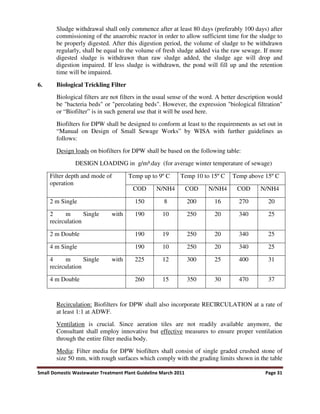
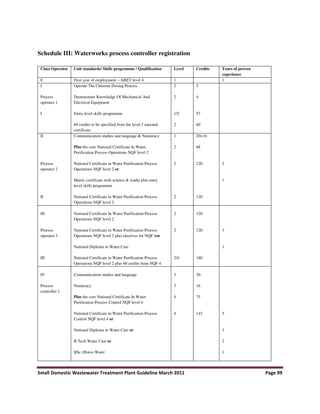
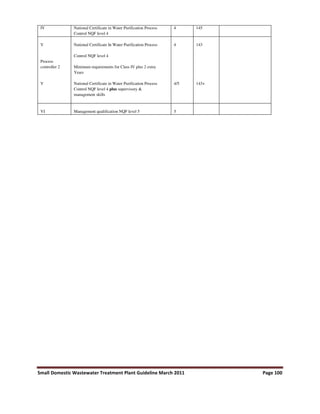
  • 100.
    Small Domestic WastewaterTreatment Plant Guideline March 2011 Page 93 a) Sludge Drying Beds Sludge drying beds are the most commonly used means for dewatering sludges. This method of sludge drying is often accompanied by odours; therefore open drying beds must be located at least 300 m from dwellings. As it is desirable economically to gravity-feed drying beds their location is important and a total head of at least 1,5 m is needed for gravity discharge to the beds. The usual pattern is a rectangular bed with the length twice the dimension of the width; with a concrete floor sloping to a central channel which drains to one end of the bed. Stone media, sand, ash or fine gravel allow for filtering and seepage of the water from the sludge. On top of the media, a layer loose paved bricks (with holes) are provided to aid removal of dry sludge. The size of the bed shall cater for a specific number of days. If it is one-day beds, 15 beds must be provided; if two-daybeds, 8 must be provided etc. Area of beds required on a population basis is 0,15 m2 per capita. Depth of liquid sludge applied should not be more than 150 mm for the sludge to dry within bout 14 days. If maturation of the sludge after removal from the bed, in order to reduce viable pathogenic ova, is contemplated, the moisture content of the sludge must be less than 60% before it is made into as high a heap as possible. Turning the outside layers of the heap into the body of the sludge is advantageous to bring as much of the total sludge to the matured up to a high temperature. Final disposal of dried sludge should be in accordance with health regulations. b) Land Irrigation The sludge is disposed of by spreading thinly on the land, allowing to dry and then ploughing in This process can be practised repeatedly if the soil is of good texture which drains easily. Approximately 1 ha of ploughed land are required for a daily application of 6 kl of wet sludge. c) Lagooning Lagoons, whether natural or artificially built dams, are used either for peak loads or for regular sludge disposal. Lagoons receiving digested solids act as storage basins and may be loaded over several years, and then dried out and cleaned. d) Barging to Sea e) Vacuum Filtration f) Incineration
  • 101.
    Small Domestic WastewaterTreatment Plant Guideline March 2011 Page 94 Methods(d),(e)and(f)arewellknownbutarenotas yetofsignificanceinSouthern Africa.
  • 102.
    Small Domestic WastewaterTreatment Plant Guideline March 2011 Page 95 APPENDIX 4 SCHEDULES FOR WASTEWATER TREATMENT WORKS
  • 103.
    Small Domestic WastewaterTreatment Plant Guideline March 2011 Page 96 Schedule II: Registration and Classification of a water work used for the treatment of waste and the disposal or re-use of the treated waste To use the table below every section and sub-section is rated and allocated points. Points to be awarded at the discretion of the Director-General in accordance with the following criteria:
  • 104.
    Small Domestic WastewaterTreatment Plant Guideline March 2011 Page 97
  • 105.
    Small Domestic WastewaterTreatment Plant Guideline March 2011 Page 98 After adding all the points allocated, the total is checked against the classification range below. Class of works Range of points E <30 D 30 - 49 C 50 – 69 B 70 – 90 A >90
  • 106.
    Small Domestic WastewaterTreatment Plant Guideline March 2011 Page 99 Schedule III: Waterworks process controller registration Class Operator Unit standards/ Skills programme / Qualification Level Credits Years of proven experience 0 First year of employment – ABET level 4 1 1 I Process operator 1 I Operate The Chlorine Dosing Process Demonstrate Knowledge Of Mechanical And Electrical Equipment Entry level skills programme 60 credits to be specified from the level 2 national certificate 2 2 1/2 2 5 4 57 60 II Process operator 2 II Communication studies and language & Numeracy Plus the core National Certificate In Water Purification Process Operations NQF level 2 National Certificate in Water Purification Process Operations NQF level 2 or Matric certificate with science & maths plus entry level skills programme National Certificate in Water Purification Process Operations NQF level 2 1 2 2 2 20+16 68 120 120 2 1 III Process operator 3 III National Certificate In Water Purification Process Operations NQF level 2 National Certificate in Water Purification Process Operations NQF level 2 plus electives for NQF 4or National Diploma in Water Care National Certificate in Water Purification Process Operations NQF level 2 plus 60 credits from NQF 4 2 2 2/4 120 120 180 3 1 IV Process controller 1 Communication studies and language Numeracy Plus the core National Certificate In Water Purification Process Control NQF level 4 National Certificate in Water Purification Process Control NQF level 4 or National Diploma in Water Care or B Tech Water Care or BSc (Hons) Water 3 3 4 4 20 16 75 143 5 3 2 1
  • 107.
    Small Domestic WastewaterTreatment Plant Guideline March 2011 Page 100 IV National Certificate in Water Purification Process Control NQF level 4 4 145 V Process controller 2 V National Certificate In Water Purification Process Control NQF level 4 Minimum requirements for Class IV plus 2 extra Years National Certificate in Water Purification Process Control NQF level 4 plus supervisory & management skills 4 4/5 143 143+ VI Management qualification NQF level 5 5