Designer Pulse

Medical Device Developers Survey
January, 2014
Sponsored by eInfochips
Designer Pulse

This survey is part of the Designer Pulse research program designed to
keep tabs on the pulse of the design engineering community.

Designer Pulse survey results are shared with the engineering community
on the eInfochips and IT Brand Pulse pages at slideshare.com.

2
IT Pro Survey Methodology
•

The IT Pro Survey was conducted in January, 2014.
–

–
–

•

Respondents were solicited from more than 600 members of our medical device designers
database and from our LinkedIn medical device designers groups membership totaling around
250,000 members.
35 medical device design professionals completed this survey.
Responses were collected using an online survey engine.

The survey was segmented into four sections:
–
–
–
–

Participant Profile
Medical Device Design
Development Platforms
Critical Engineering Expertise

3
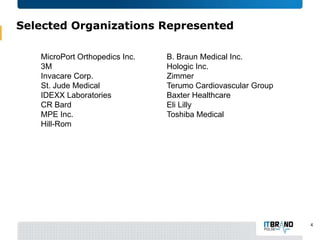
Selected Organizations Represented
MicroPort Orthopedics Inc.
3M
Invacare Corp.
St. Jude Medical
IDEXX Laboratories
CR Bard
MPE Inc.
Hill-Rom

B. Braun Medical Inc.
Hologic Inc.
Zimmer
Terumo Cardiovascular Group
Baxter Healthcare
Eli Lilly
Toshiba Medical

4
Highlights
•
•

•

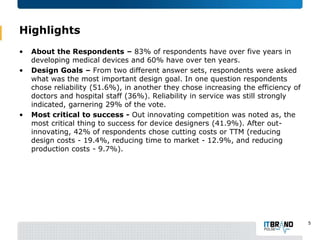
About the Respondents – 83% of respondents have over five years in
developing medical devices and 60% have over ten years.
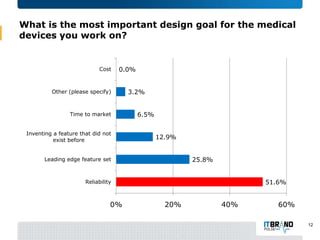
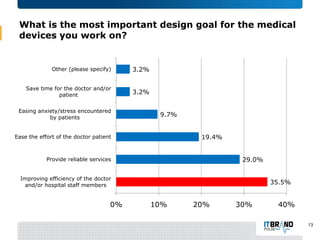
Design Goals – From two different answer sets, respondents were asked
what was the most important design goal. In one question respondents
chose reliability (51.6%), in another they chose increasing the efficiency of
doctors and hospital staff (36%). Reliability in service was still strongly
indicated, garnering 29% of the vote.
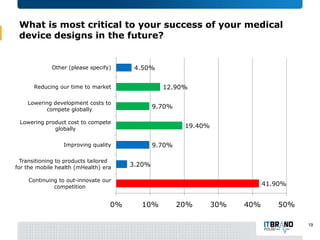
Most critical to success - Out innovating competition was noted as, the
most critical thing to success for device designers (41.9%). After outinnovating, 42% of respondents chose cutting costs or TTM (reducing
design costs - 19.4%, reducing time to market - 12.9%, and reducing
production costs - 9.7%).

5
Summary Analysis
•
•

•
•

•

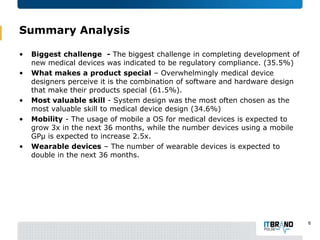
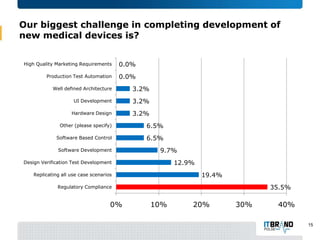
Biggest challenge - The biggest challenge in completing development of
new medical devices was indicated to be regulatory compliance. (35.5%)
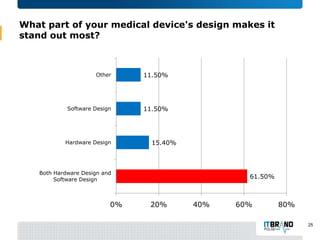
What makes a product special – Overwhelmingly medical device
designers perceive it is the combination of software and hardware design
that make their products special (61.5%).
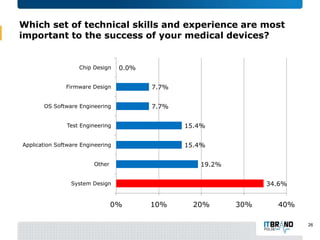
Most valuable skill - System design was the most often chosen as the
most valuable skill to medical device design (34.6%)
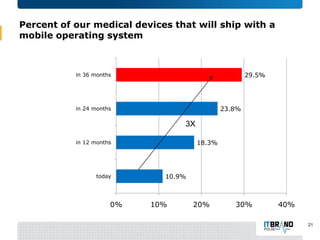
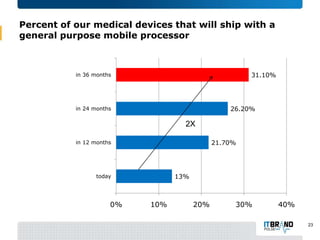
Mobility - The usage of mobile a OS for medical devices is expected to
grow 3x in the next 36 months, while the number devices using a mobile
GPµ is expected to increase 2.5x.
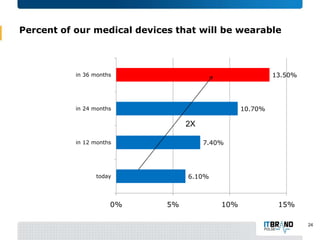
Wearable devices – The number of wearable devices is expected to
double in the next 36 months.

6
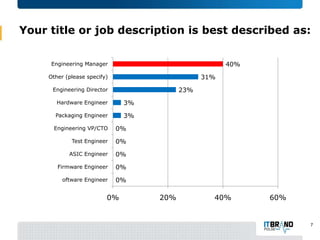
Your title or job description is best described as:
40%

Engineering Manager

31%

Other (please specify)

23%

Engineering Director
Hardware Engineer

3%

Packaging Engineer

3%

Engineering VP/CTO

0%

Test Engineer

0%

ASIC Engineer

0%

Firmware Engineer

0%

oftware Engineer

0%

0%

20%

40%

60%

7
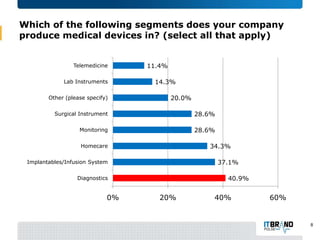
Which of the following segments does your company
produce medical devices in? (select all that apply)
Telemedicine
Lab Instruments
Other (please specify)

11.4%
14.3%
20.0%

Surgical Instrument

28.6%

Monitoring

28.6%
34.3%

Homecare

37.1%

Implantables/Infusion System

40.9%

Diagnostics

0%

20%

40%

60%

8
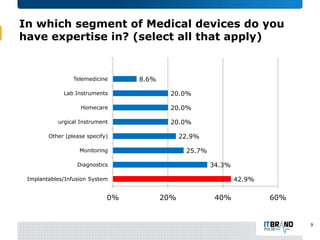
In which segment of Medical devices do you
have expertise in? (select all that apply)

Telemedicine

8.6%

Lab Instruments

20.0%

Homecare

20.0%

urgical Instrument

20.0%
22.9%

Other (please specify)

25.7%

Monitoring

34.3%

Diagnostics

42.9%

Implantables/Infusion System

0%

20%

40%

60%

9
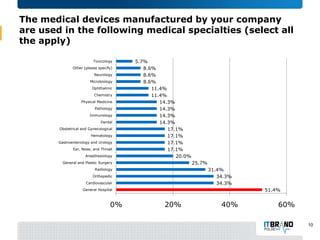
The medical devices manufactured by your company
are used in the following medical specialties (select all
the apply)
Toxicology
Other (please specify)
Neurology

Microbiology
Ophthalmic
Chemistry
Physical Medicine
Pathology
Immunology
Dental
Obstetrical and Gynecological
Hematology
Gastroenterology and Urology
Ear, Nose, and Throat

Anesthesiology

5.7%
8.6%
8.6%
8.6%
11.4%
11.4%
14.3%
14.3%
14.3%
14.3%
17.1%
17.1%
17.1%
17.1%
20.0%
25.7%

General and Plastic Surgery

31.4%
34.3%
34.3%

Radiology
Orthopedic
Cardiovascular

51.4%

General Hospital

0%

20%

40%

60%
10
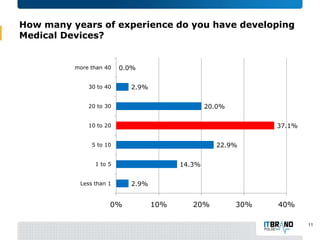
How many years of experience do you have developing
Medical Devices?

more than 40

0.0%

30 to 40

2.9%
20.0%

20 to 30

37.1%

10 to 20

22.9%

5 to 10

14.3%

1 to 5
Less than 1

0%

2.9%

10%

20%

30%

40%
11
What is the most important design goal for the medical
devices you work on?

Cost

0.0%

Other (please specify)

Time to market
Inventing a feature that did not
exist before

3.2%
6.5%
12.9%
25.8%

Leading edge feature set

51.6%

Reliability

0%

20%

40%

60%
12
What is the most important design goal for the medical
devices you work on?

Other (please specify)

3.2%

Save time for the doctor and/or
patient

3.2%

Easing anxiety/stress encountered
by patients

9.7%
19.4%

Ease the effort of the doctor patient

29.0%

Provide reliable services
Improving efficiency of the doctor
and/or hospital staff members

0%

35.5%

10%

20%

30%

40%
13
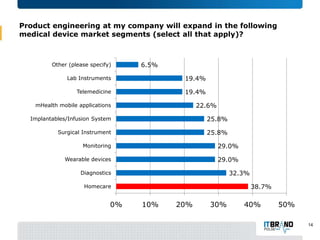
Product engineering at my company will expand in the following
medical device market segments (select all that apply)?

Other (please specify)

6.5%

Lab Instruments

19.4%

Telemedicine

19.4%
22.6%

mHealth mobile applications
Implantables/Infusion System

25.8%

Surgical Instrument

25.8%

Monitoring

29.0%

Wearable devices

29.0%
32.3%

Diagnostics

38.7%

Homecare

0%

10%

20%

30%

40%

50%
14
Our biggest challenge in completing development of
new medical devices is?
High Quality Marketing Requirements

0.0%

Production Test Automation

0.0%

Well defined Architecture

3.2%

UI Development

3.2%

Hardware Design

3.2%

Other (please specify)

6.5%

Software Based Control

6.5%

Software Development

9.7%
12.9%

Design Verification Test Development

19.4%

Replicating all use case scenarios

35.5%

Regulatory Compliance

0%

10%

20%

30%

40%
15
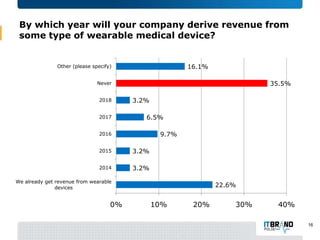
By which year will your company derive revenue from
some type of wearable medical device?
16.1%

Other (please specify)

35.5%

Never
2018
2017

3.2%
6.5%
9.7%

2016
2015

3.2%

2014

3.2%

We already get revenue from wearable
devices

0%

22.6%

10%

20%

30%

40%
16
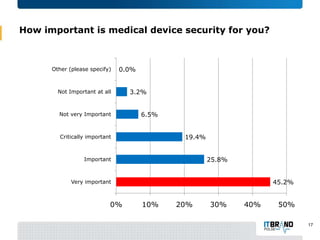
How important is medical device security for you?

Other (please specify)

0.0%

Not Important at all

Not very Important

3.2%
6.5%
19.4%

Critically important

25.8%

Important

45.2%

Very important

0%

10%

20%

30%

40%

50%
17
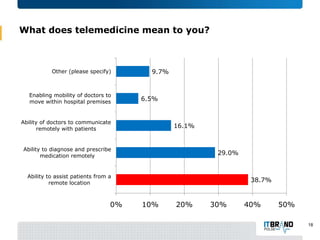
What does telemedicine mean to you?

Other (please specify)

Enabling mobility of doctors to
move within hospital premises

9.7%

6.5%

Ability of doctors to communicate
remotely with patients

16.1%

Ability to diagnose and prescribe
medication remotely

29.0%

Ability to assist patients from a
remote location

0%

38.7%

10%

20%

30%

40%

50%
18
What is most critical to your success of your medical
device designs in the future?

Other (please specify)

4.50%
12.90%

Reducing our time to market
Lowering development costs to
compete globally

9.70%

Lowering product cost to compete
globally

19.40%
9.70%

Improving quality
Transitioning to products tailored
for the mobile health (mHealth) era

3.20%

Continuing to out-innovate our
competition

0%

41.90%

10%

20%

30%

40%

50%
19
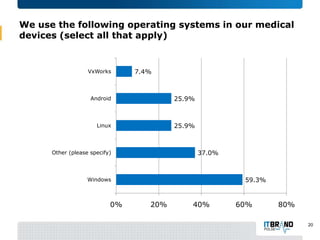
We use the following operating systems in our medical
devices (select all that apply)

VxWorks

7.4%

Android

25.9%

Linux

25.9%

37.0%

Other (please specify)

59.3%

Windows

0%

20%

40%

60%

80%
20
Percent of our medical devices that will ship with a
mobile operating system

29.5%

in 36 months

23.8%

in 24 months

3X
18.3%

in 12 months

today

0%

10.9%

10%

20%

30%

40%
21
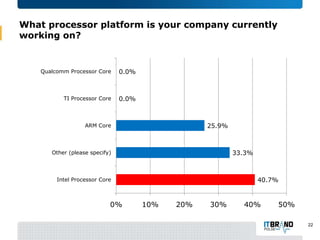
What processor platform is your company currently
working on?

Qualcomm Processor Core

0.0%

TI Processor Core

0.0%

25.9%

ARM Core

33.3%

Other (please specify)

40.7%

Intel Processor Core

0%

10%

20%

30%

40%

50%
22
Percent of our medical devices that will ship with a
general purpose mobile processor

31.10%

in 36 months

26.20%

in 24 months

2X
21.70%

in 12 months

13%

today

0%

10%

20%

30%

40%
23
Percent of our medical devices that will be wearable

13.50%

in 36 months

10.70%

in 24 months

2X
7.40%

in 12 months

6.10%

today

0%

5%

10%

15%
24
What part of your medical device's design makes it
stand out most?

Other

11.50%

Software Design

11.50%

Hardware Design

15.40%

Both Hardware Design and
Software Design

0%

61.50%

20%

40%

60%

80%
25
Which set of technical skills and experience are most
important to the success of your medical devices?

Chip Design

0.0%

Firmware Design

7.7%

OS Software Engineering

7.7%

Test Engineering

15.4%

Application Software Engineering

15.4%
19.2%

Other

34.6%

System Design

0%

10%

20%

30%

40%
26
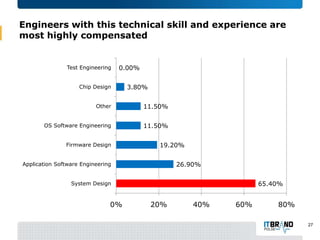
Engineers with this technical skill and experience are
most highly compensated

Test Engineering

0.00%

Chip Design

3.80%

Other

11.50%

OS Software Engineering

11.50%

Firmware Design

19.20%
26.90%

Application Software Engineering

65.40%

System Design

0%

20%

40%

60%

80%
27
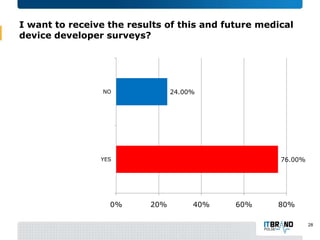
I want to receive the results of this and future medical
device developer surveys?

24.00%

NO

76.00%

YES

0%

20%

40%

60%

80%
28
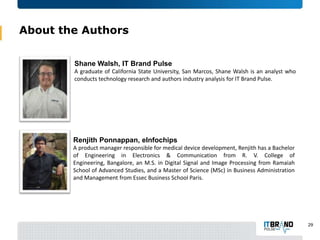
About the Authors
Shane Walsh, IT Brand Pulse
A graduate of California State University, San Marcos, Shane Walsh is an analyst who
conducts technology research and authors industry analysis for IT Brand Pulse.

Renjith Ponnappan, eInfochips
A product manager responsible for medical device development, Renjith has a Bachelor
of Engineering in Electronics & Communication from R. V. College of
Engineering, Bangalore, an M.S. in Digital Signal and Image Processing from Ramaiah
School of Advanced Studies, and a Master of Science (MSc) in Business Administration
and Management from Essec Business School Paris.

29

Designer Pulse: Medical Device Developers Survey

  • 1.
    Designer Pulse Medical DeviceDevelopers Survey January, 2014 Sponsored by eInfochips
  • 2.
    Designer Pulse This surveyis part of the Designer Pulse research program designed to keep tabs on the pulse of the design engineering community. Designer Pulse survey results are shared with the engineering community on the eInfochips and IT Brand Pulse pages at slideshare.com. 2
  • 3.
    IT Pro SurveyMethodology • The IT Pro Survey was conducted in January, 2014. – – – • Respondents were solicited from more than 600 members of our medical device designers database and from our LinkedIn medical device designers groups membership totaling around 250,000 members. 35 medical device design professionals completed this survey. Responses were collected using an online survey engine. The survey was segmented into four sections: – – – – Participant Profile Medical Device Design Development Platforms Critical Engineering Expertise 3
  • 4.
    Selected Organizations Represented MicroPortOrthopedics Inc. 3M Invacare Corp. St. Jude Medical IDEXX Laboratories CR Bard MPE Inc. Hill-Rom B. Braun Medical Inc. Hologic Inc. Zimmer Terumo Cardiovascular Group Baxter Healthcare Eli Lilly Toshiba Medical 4
  • 5.
    Highlights • • • About the Respondents– 83% of respondents have over five years in developing medical devices and 60% have over ten years. Design Goals – From two different answer sets, respondents were asked what was the most important design goal. In one question respondents chose reliability (51.6%), in another they chose increasing the efficiency of doctors and hospital staff (36%). Reliability in service was still strongly indicated, garnering 29% of the vote. Most critical to success - Out innovating competition was noted as, the most critical thing to success for device designers (41.9%). After outinnovating, 42% of respondents chose cutting costs or TTM (reducing design costs - 19.4%, reducing time to market - 12.9%, and reducing production costs - 9.7%). 5
  • 6.
    Summary Analysis • • • • • Biggest challenge- The biggest challenge in completing development of new medical devices was indicated to be regulatory compliance. (35.5%) What makes a product special – Overwhelmingly medical device designers perceive it is the combination of software and hardware design that make their products special (61.5%). Most valuable skill - System design was the most often chosen as the most valuable skill to medical device design (34.6%) Mobility - The usage of mobile a OS for medical devices is expected to grow 3x in the next 36 months, while the number devices using a mobile GPµ is expected to increase 2.5x. Wearable devices – The number of wearable devices is expected to double in the next 36 months. 6
  • 7.
    Your title orjob description is best described as: 40% Engineering Manager 31% Other (please specify) 23% Engineering Director Hardware Engineer 3% Packaging Engineer 3% Engineering VP/CTO 0% Test Engineer 0% ASIC Engineer 0% Firmware Engineer 0% oftware Engineer 0% 0% 20% 40% 60% 7
  • 8.
    Which of thefollowing segments does your company produce medical devices in? (select all that apply) Telemedicine Lab Instruments Other (please specify) 11.4% 14.3% 20.0% Surgical Instrument 28.6% Monitoring 28.6% 34.3% Homecare 37.1% Implantables/Infusion System 40.9% Diagnostics 0% 20% 40% 60% 8
  • 9.
    In which segmentof Medical devices do you have expertise in? (select all that apply) Telemedicine 8.6% Lab Instruments 20.0% Homecare 20.0% urgical Instrument 20.0% 22.9% Other (please specify) 25.7% Monitoring 34.3% Diagnostics 42.9% Implantables/Infusion System 0% 20% 40% 60% 9
  • 10.
    The medical devicesmanufactured by your company are used in the following medical specialties (select all the apply) Toxicology Other (please specify) Neurology Microbiology Ophthalmic Chemistry Physical Medicine Pathology Immunology Dental Obstetrical and Gynecological Hematology Gastroenterology and Urology Ear, Nose, and Throat Anesthesiology 5.7% 8.6% 8.6% 8.6% 11.4% 11.4% 14.3% 14.3% 14.3% 14.3% 17.1% 17.1% 17.1% 17.1% 20.0% 25.7% General and Plastic Surgery 31.4% 34.3% 34.3% Radiology Orthopedic Cardiovascular 51.4% General Hospital 0% 20% 40% 60% 10
  • 11.
    How many yearsof experience do you have developing Medical Devices? more than 40 0.0% 30 to 40 2.9% 20.0% 20 to 30 37.1% 10 to 20 22.9% 5 to 10 14.3% 1 to 5 Less than 1 0% 2.9% 10% 20% 30% 40% 11
  • 12.
    What is themost important design goal for the medical devices you work on? Cost 0.0% Other (please specify) Time to market Inventing a feature that did not exist before 3.2% 6.5% 12.9% 25.8% Leading edge feature set 51.6% Reliability 0% 20% 40% 60% 12
  • 13.
    What is themost important design goal for the medical devices you work on? Other (please specify) 3.2% Save time for the doctor and/or patient 3.2% Easing anxiety/stress encountered by patients 9.7% 19.4% Ease the effort of the doctor patient 29.0% Provide reliable services Improving efficiency of the doctor and/or hospital staff members 0% 35.5% 10% 20% 30% 40% 13
  • 14.
    Product engineering atmy company will expand in the following medical device market segments (select all that apply)? Other (please specify) 6.5% Lab Instruments 19.4% Telemedicine 19.4% 22.6% mHealth mobile applications Implantables/Infusion System 25.8% Surgical Instrument 25.8% Monitoring 29.0% Wearable devices 29.0% 32.3% Diagnostics 38.7% Homecare 0% 10% 20% 30% 40% 50% 14
  • 15.
    Our biggest challengein completing development of new medical devices is? High Quality Marketing Requirements 0.0% Production Test Automation 0.0% Well defined Architecture 3.2% UI Development 3.2% Hardware Design 3.2% Other (please specify) 6.5% Software Based Control 6.5% Software Development 9.7% 12.9% Design Verification Test Development 19.4% Replicating all use case scenarios 35.5% Regulatory Compliance 0% 10% 20% 30% 40% 15
  • 16.
    By which yearwill your company derive revenue from some type of wearable medical device? 16.1% Other (please specify) 35.5% Never 2018 2017 3.2% 6.5% 9.7% 2016 2015 3.2% 2014 3.2% We already get revenue from wearable devices 0% 22.6% 10% 20% 30% 40% 16
  • 17.
    How important ismedical device security for you? Other (please specify) 0.0% Not Important at all Not very Important 3.2% 6.5% 19.4% Critically important 25.8% Important 45.2% Very important 0% 10% 20% 30% 40% 50% 17
  • 18.
    What does telemedicinemean to you? Other (please specify) Enabling mobility of doctors to move within hospital premises 9.7% 6.5% Ability of doctors to communicate remotely with patients 16.1% Ability to diagnose and prescribe medication remotely 29.0% Ability to assist patients from a remote location 0% 38.7% 10% 20% 30% 40% 50% 18
  • 19.
    What is mostcritical to your success of your medical device designs in the future? Other (please specify) 4.50% 12.90% Reducing our time to market Lowering development costs to compete globally 9.70% Lowering product cost to compete globally 19.40% 9.70% Improving quality Transitioning to products tailored for the mobile health (mHealth) era 3.20% Continuing to out-innovate our competition 0% 41.90% 10% 20% 30% 40% 50% 19
  • 20.
    We use thefollowing operating systems in our medical devices (select all that apply) VxWorks 7.4% Android 25.9% Linux 25.9% 37.0% Other (please specify) 59.3% Windows 0% 20% 40% 60% 80% 20
  • 21.
    Percent of ourmedical devices that will ship with a mobile operating system 29.5% in 36 months 23.8% in 24 months 3X 18.3% in 12 months today 0% 10.9% 10% 20% 30% 40% 21
  • 22.
    What processor platformis your company currently working on? Qualcomm Processor Core 0.0% TI Processor Core 0.0% 25.9% ARM Core 33.3% Other (please specify) 40.7% Intel Processor Core 0% 10% 20% 30% 40% 50% 22
  • 23.
    Percent of ourmedical devices that will ship with a general purpose mobile processor 31.10% in 36 months 26.20% in 24 months 2X 21.70% in 12 months 13% today 0% 10% 20% 30% 40% 23
  • 24.
    Percent of ourmedical devices that will be wearable 13.50% in 36 months 10.70% in 24 months 2X 7.40% in 12 months 6.10% today 0% 5% 10% 15% 24
  • 25.
    What part ofyour medical device's design makes it stand out most? Other 11.50% Software Design 11.50% Hardware Design 15.40% Both Hardware Design and Software Design 0% 61.50% 20% 40% 60% 80% 25
  • 26.
    Which set oftechnical skills and experience are most important to the success of your medical devices? Chip Design 0.0% Firmware Design 7.7% OS Software Engineering 7.7% Test Engineering 15.4% Application Software Engineering 15.4% 19.2% Other 34.6% System Design 0% 10% 20% 30% 40% 26
  • 27.
    Engineers with thistechnical skill and experience are most highly compensated Test Engineering 0.00% Chip Design 3.80% Other 11.50% OS Software Engineering 11.50% Firmware Design 19.20% 26.90% Application Software Engineering 65.40% System Design 0% 20% 40% 60% 80% 27
  • 28.
    I want toreceive the results of this and future medical device developer surveys? 24.00% NO 76.00% YES 0% 20% 40% 60% 80% 28
  • 29.
    About the Authors ShaneWalsh, IT Brand Pulse A graduate of California State University, San Marcos, Shane Walsh is an analyst who conducts technology research and authors industry analysis for IT Brand Pulse. Renjith Ponnappan, eInfochips A product manager responsible for medical device development, Renjith has a Bachelor of Engineering in Electronics & Communication from R. V. College of Engineering, Bangalore, an M.S. in Digital Signal and Image Processing from Ramaiah School of Advanced Studies, and a Master of Science (MSc) in Business Administration and Management from Essec Business School Paris. 29