Accelera'ng Medical Device Development
with Lean and Agile Methods
Presented	to	PATCA	-	February	9,	2017	
	
Aaron	Joseph	
Medical	Devices	Consultant		
Consensia,	Inc.	-	hDp://consensiainc.com/zipquality/
What’s	the	Problem?	
• Design	flaws	discovered	late	in	development	leading	to	
expensive	delays	
• Schedule	overruns	with	soRware	development	
• Compliance	problems	with	design	controls	
• High	manufacturing	costs	
• Product	recalls	
Lean	and	agile	methods	can	address	all	of	these	problems	but	incorporaVng	them	into	the	highly	
regulated	medical	device	industry	presents	mulVple	challenges	
PATCA	-	2/9/17	 Copyright	2016-2017	Aaron	Joseph	ConsulVng	 2
Outline	
1.  The	Story	of	2	projects	(comparing	lean-agile	approach	to	
tradiVonal)	
2.  Agile	SW	methods	adapted	to	medical	device	soRware	
3.  AdapVng	lean-agile	methods	to	regulated	industry	
4.  AdapVng	quality	system	procedures	to	support	lean-agile	methods	
5.  ConsideraVons	for	DHF	documentaVon	and	SW	tools	
6.  Summary	and	Q&A	
PATCA	-	2/9/17	 Copyright	2016-2017	Aaron	Joseph	ConsulVng	 3
Balancing 3 Customers
Medical	
Device	
Development	
Product	Users	
(clinicians	&	
paVents)	
Manufacturing	
Regulators	
(FDA,	etc.)	
PATCA	-	2/9/17	 Copyright	2016-2017	Aaron	Joseph	ConsulVng	 4
The	Story:	Real-life	(hypotheVcal)	Comparison	
Walter’s	Team	
•  Tradi.onal	(waterfall)	approach	
Grace’s	Team	
•  Lean-Agile	approach					NEW!	
•  Company	wants	to	develop	a	next	
generaVon	infusion	pump			
•  Key	product	pillars:	smaller,	lighter,	
easier	to	use	
•  Aggressive	schedule:	24	months	to	
launch;	16	months	to	submission	
•  Two	teams:	
PATCA	-	2/9/17	 Copyright	2016-2017	Aaron	Joseph	ConsulVng	 5
Lean: methods to maximize value and minimize waste
Value-Added	
Total	Work	Performed	
Type	I	Waste		
(necessary)	
Type	II	Waste	
(unnecessary)	
Value-Added	
Type	I	Waste	
(necessary)	
ELIMINATE!	
PATCA	-	2/9/17	 Copyright	2016-2017	Aaron	Joseph	ConsulVng	 6	
Knowledge	Management	
Agile: methods for rapid learning and communica'on
(highly itera've)
Both	Lean	and	Agile	are	based	on
The Knowledge Timeline
Don’t	force	team	to	make	key	
decisions	early	based	on	
incomplete	knowledge	
Knowlege	
Product	Launch	
Product	Development	Timeline	
What	happens	to	the	knowledge	a0er	product	launch?	
Concept	 Planning	 Pre-Produc.on	 Produc.on	Development	 Verifica.on	
PATCA	-	2/9/17	 Copyright	2016-2017	Aaron	Joseph	ConsulVng	 7
Knowledge-Driven Product Development
•  Successful	new	product	development	demands	deep	
knowledge	of:	
1.  Product	applicaVon	
2.  Product	technology	
3.  Manufacturing	process	technology	
•  For	Medical	Devices:	
4.  Regulatory	Approval	(approval	process	and	key	
concerns	of	regulators)	
5.  Compliance	(requirements	of	all	applicable	
regulaVons	and	standards)	
Medical	Devices:	understand	
the	clinical	environment	and	
the	needs	of	clinicians	
PATCA	-	2/9/17	 Copyright	2016-2017	Aaron	Joseph	ConsulVng	 8
Expensive design and process changes (loopbacks) caused by late learning
Concept	
Phase	
Feasibility	
Phase	
Development	
Phase	
Valida.on	
Phase	
Produc.on	
Phase	
IdenVfy	a	few	
product	
concepts	
Select	one	
concept	
Perform	detailed	design;	build	
prototypes	and	test	
Pilot	mfg;	
Clinical	tesVng	
ProducVon	in	
volume	
Learn	about	problems	with	design	of	
product	and	manufacturing	processes	
$$$$	$$	$	
Problems with Tradi'onal (waterfall) Approach
GATE	
GATE	
GATE	
GATE	
PATCA	-	2/9/17	 Copyright	2016-2017	Aaron	Joseph	ConsulVng	 9
Comparison: A Story of 2 Projects
A	real-life	example	of	(hypotheVcal)	product	development	project	
PATCA	-	2/9/17	 Copyright	2016-2017	Aaron	Joseph	ConsulVng	 10
The	Story:	Real-life	(hypotheVcal)	Comparison	
Walter’s	Team	
•  Experienced	project	lead	
•  Fully	resourced	cross-funcVonal	team	(ME,	EE,	
SW,	clinical,	UX,	Mfg,	Quality,	Purchasing,	
Regulatory,	etc.)	
•  Tradi.onal	(waterfall)	approach	
Grace’s	Team	
•  Experienced	project	lead	
•  Fully	resourced	cross-funcVonal	team	(ME,	EE,	
SW,	clinical,	UX,	Mfg,	Quality,	Purchasing,	
Regulatory,	etc.)	
•  Lean-Agile	approach					NEW!	
•  Advanced	Research	Dept.:		
•  designed	a	new	pump	mechanism	that	is	
more	precise	and	lower	power	than	
exisVng	technology	
•  IdenVfied	new	baNery	technology	
(smaller,	faster	charging)	
•  Launch	in	2	years	
PATCA	-	2/9/17	 Copyright	2016-2017	Aaron	Joseph	ConsulVng	 11
Product Development Phases
3	
Verifica.on	
4	
Pre-Produc.on	
5	
Produc.on	
0	
Concept	
510k	submission	
Product	Launch	
Project	begins	at	Planning	Phase	with	the	
following	key	inputs:	
•  Product	intended	use	and	user	needs	
•  Business	case	including	MarkeVng,	Legal,	
Regulatory,	Financial,	and	Technological	
consideraVons	
•  Product	Concept	
GATE	
GATE	
1	
Planning	
2	
Development	
GATE	
GATE	
-Product	
development	
planning,	
-Hazard	Analysis,	
-Requirements	&	
architecture	
-Regulatory	
strategy	
Mfg	
Process	
valida.on	
+	
Launch	
readiness	
-HW	&	SW	design,	
-Detailed	Risk	Analysis,	
-Prototyping	
-Test	method	
development	
-Mfg	process	development	
-Design	freeze	
-Design	verifica.on	
-Mfg	process	
development	
-Clinical	tes.ng,	
-Human	factors	
tes.ng	
-Prepare	
submission	
PATCA	-	2/9/17	 Copyright	2016-2017	Aaron	Joseph	ConsulVng	 12
Comparison	Story:	Start	
Walter’s	Team	
•  Begin	detailed	project	planning	
•  Begin	wriVng	product	requirements	and	
soRware	requirements	
•  Perform	hazard	analysis	
	
Grace’s	Team	
•  Begin	high-level	project	planning	
•  Begin	wriVng	preliminary	requirements		
•  Perform	hazard	analysis	
•  IdenVficaVon	of	knowledge	gaps:	
•  Plan	tesVng	of	new	pump	mechanism		
•  Plan	tesVng	of	new	baDery	
•  Plan	tesVng	of	UI	designs	
Year	1	 Year	2	
+Set	up	project	“War	Room”		(obeya)	
Expensive!		
TesVng	uses	up	
Vme	and	scarce	
resources	
Product	Development	Timeline	
PATCA	-	2/9/17	 Copyright	2016-2017	Aaron	Joseph	ConsulVng	 13
Comparison	Story:	Year	1-Q1	
Walter’s	Team	
•  Comprehensive	detailed	project	planning	
•  Comprehensive	product	requirements	and	
soRware	requirements	
•  Perform	hazard	analysis	
•  Phase	1/	Gate	1	completed	✔	
	
Grace’s	Team	
•  High-level	project	planning	
•  Preliminary	requirements	and	hazard	analysis	
•  Closing	knowledge	gaps:	
•  EvaluaVon	of	new	pump	mechanism		
•  EvaluaVon	of	new	baDery	
•  EvaluaVon	of	UI	designs	
•  MulVple	trips	to	hospitals	to	observe	use	of	drug	
infusion	pumps	
•  SoRware	team	sprints	produced	series	of	rough	
SW	demos	for	evaluaVon	
Year	1	 Year	2	
PATCA	-	2/9/17	 Copyright	2016-2017	Aaron	Joseph	ConsulVng	 14
Agile SoLware Development
Example	of	integraVng	new	methods	into	a	highly	regulated	environment	
PATCA	-	2/9/17	 Copyright	2016-2017	Aaron	Joseph	ConsulVng	 15
Agile has many proven advantages for SW
Agile	improves:	
•  Visibility	of	SW	project	to	
stakeholders	
•  Flexibility	in	responding	to	
changing	user	needs	
•  Managing	SW	project	risks		
•  Quality	of	released	SW	
PATCA	-	2/9/17	 Copyright	2016-2017	Aaron	Joseph	ConsulVng	 16
The Agile Manifesto (2001)
We	are	uncovering	beDer	ways	of	developing	soRware	by	doing	it	and	helping	
others	do	it.	Through	this	work	we	have	come	to	value:	
	
Individuals	and	interac.ons	over	processes	and	tools	
Working	so]ware	over	comprehensive	documentaVon	
Customer	collabora.on	over	contract	negoVaVon	
Responding	to	change	over	following	a	plan	
	
That	is,	while	there	is	value	in	the	items	on	the	right,		
we	value	the	items	on	the	leR	more.	
	
Feb.	2001	-	hDp://agilemanifesto.org/	
Medical	Device	RegulaVons	è	processes	&	documentaVon	
SoluVon:	find	a	balance	to	maintain	benefits	of	Agile	while	sVll	fulfilling	regulatory	requirements	
AAMI	TIR45:2012	–	Guidance	on	Use	of	Agile	for	Medical	Device	So]ware		
PATCA	-	2/9/17	 Copyright	2016-2017	Aaron	Joseph	ConsulVng	 17
2-week	Sprint	
Agile Scrum: Developing
SoLware in Short Sprints
Product	
Backlog	
Sprint	
Backlog	 Sprint	Tasks	
Daily	
Scrum	
Daily	Scrum:	team	
shares	status	and	
idenVfies	issues	
Review	of	SW	with	
stakeholders	
			+	
Sprint	
Retrospec.ve	
Sprint	Planning:	
define	work	tasks	
for	next	sprint	
Highest	
priority	
features	
Working	
SoRware	
PATCA	-	2/9/17	 Copyright	2016-2017	Aaron	Joseph	ConsulVng	 18
Waterfalls
FDA Design Controls (21CFR820.30)
IEC	62304	Medical	Device	So]ware	Standard	
5.1	SW	Development	Planning	
5.2	SW	
Requirements	
Analysis	
5.3	SW	
Architectural	
Design	
5.4	SW	
Detailed		
Design	
5.5	SW	Unit	
ImplementaVon	
&	VerificaVon	
5.6	SW		
IntegraVon	&		
IntegraVon	TesVng	
5.7	SW	
System	
TesVng	
5.8	SW	
Release	
PATCA	-	2/9/17	 Copyright	2016-2017	Aaron	Joseph	ConsulVng	 19
5.1	SW	Development	Planning	
5.2	SW	
Requirements	
Analysis	
5.3	SW	
Architectural	
Design	
5.4	SW	
Detailed		
Design	
5.5	SW	Unit	
ImplementaVon	
&	VerificaVon	
5.6	SW		
IntegraVon	&		
IntegraVon	TesVng	
5.7	SW	
System	
TesVng	
5.8	SW	
Release	
7.	Risk	
Mgmt	
7.	Risk	
Mgmt	
7.	Risk	
Mgmt	
Transposing	Waterfall	to	Agile	(IEC	62304	Medical	SW	Standard)	
5.1	SW	Development	Planning	(sprint	planning)	
5.2	SW	Requirements	Analysis	
5.3	SW	Architectural	Design	
5.4	SW	Detailed	Design	
5.5	SW	Unit	ImplementaVon	&	VerificaVon	
5.6	SW	IntegraVon	&	IntegraVon	TesVng	
5.7	SW	System	TesVng	&	Regression	TesVng	
5.8	SW	Release	
For	each	Sprint	
AAMI	TIR45:2012	–	Guidance	on	Use	of	Agile	for	Medical	Device	So]ware		
For	each	Release	
5.7	SW	System	
TesVng	
5.1	SW	Development	Planning	(release	planning)	
For	each	Project	 5.1	SW	Development	Planning	(project)	
5.2	SW	Requirements	Analysis	(high-level,	backlog	mgmt)		
5.3	SW	Architectural	Design	(infrastructure)	
5.6	SW		
IntegraVon	&		
IntegraVon	TesVng	
PATCA	-	2/9/17	 Copyright	2016-2017	Aaron	Joseph	ConsulVng	 20
Agile Cycles and Design Planning
Day	
Plan	
Sprint	Plan	
Release	Plan	
Project	Plan	•  Design	controls	are	organized	around	
mulVple	cycles	(layers)	
•  Project	=	one	or	more	Releases	
•  Release	=	one	or	more	Sprints	
•  Planning	performed	at	all	layers	
•  UVlizes	rolling	wave	planning	
•  Regular	updates	to	DHF	documentaVon	
PATCA	-	2/9/17	 Copyright	2016-2017	Aaron	Joseph	ConsulVng	 21
Agile Methods Break Up the Work 
Design	Input	Ac.vi.es	 Design	Output	Ac.vi.es	
Design	Input	Ac.vi.es	
Design	Output	Ac.vi.es	
Design	Input	Ac.vi.es	
…	 …	
Design	Input	Ac.vi.es	 Design	Output	Ac.vi.es	
Design	Output	Ac.vi.es	Design	Input	Ac.vi.es	
Design	Input	Ac.vi.es	 Design	Output	Ac.vi.es	
Design	Output	Ac.vi.es	Design	Input	Ac.vi.es	
Waterfall	(batch)	Agile		
PATCA	-	2/9/17	 Copyright	2016-2017	Aaron	Joseph	ConsulVng	 22
The Story Con'nues
“An	investment	in	knowledge	pays	the	best	interest”	–	Benjamin	Franklin	
PATCA	-	2/9/17	 Copyright	2016-2017	Aaron	Joseph	ConsulVng	 23
Success	Assured!	
Knowledge First (then everything else)
Concept	
Learning	
Dominant	
Focus	of	Project	Team	
Product	Launch	
Planning	 Pre-Produc.on	
Product	Development	Timeline	
Task	
Dominant	
100%	
Produc.on	Development	 Verifica.on	
PATCA	-	2/9/17	 Copyright	2016-2017	Aaron	Joseph	ConsulVng	 24
Comparison	Story:		Year	1-Q3	
Walter’s	Team	
•  Hardware	design	completed	(mech/elec)	✔	
•  Prototype	build	completed	✔		
•  SoRware	team	doing	integraVon	
•  Detailed	risk	analysis	completed	(dFMEA)	✔	
•  Test	method	development	underway	
•  Manufacturing	process	development	underway,	
including	qualificaVon	of	suppliers	
•  Preparing	documents	for	Gate	2	
	
Grace’s	Team	
•  Finished	extensive	tesVng	of	new	pump	mechanism	
as	well	as	2	backup	designs	
•  Finished	extensive	tesVng	of	new	baDery	as	well	as	
3	backup	designs	
•  Conducted	mulVple	formaVve	human	factors	tests	
of	UI	designs,	using	prototype	soRware	generated	
every	2	weeks	running	on	HW	testbed	
•  Phase	1/	Gate	1	completed	✔	
Why	is	Grace’s	team	so	
far	behind?	
PROBLEMS!	
1.  Reliability:	new	pump	mechanism	someVmes	fails	aRer	3000	cycles	
2.  OverheaVng:	new	baDeries	overheat	when	fully	assembled	in	product	
housing	
3.  User	Interface:	first	and	second	designs	were	a	failure	(but	third	design	
tests	well	with	lots	of	posiVve	user	feedback)	
Year	1	 Year	2	
PATCA	-	2/9/17	 Copyright	2016-2017	Aaron	Joseph	ConsulVng	 25
Quality System Adapta'ons
Make	your	SOPs	and	Lean-Agile	methods	fit	together	
PATCA	-	2/9/17	 Copyright	2016-2017	Aaron	Joseph	ConsulVng	 26
The	Facts:	
•  Lean-agile	methods	do	not	conflict	with	the	
requirements	of	FDA	regulaVons,	ISO	13485,	IEC	62304,	
or	other	medical	device	standards	
•  Lean-agile	methods	do	conflict	with	the	quality	systems	
of	many	medical	device	companies	
•  Quality	system	procedures	must	be	adapted	for	lean-
agile	methods	and	likewise	the	methods	must	be	
adapted	for	compliance	(addiVonal	documentaVon	and	
approval	steps)	
PATCA	-	2/9/17	 Copyright	2016-2017	Aaron	Joseph	ConsulVng	 27
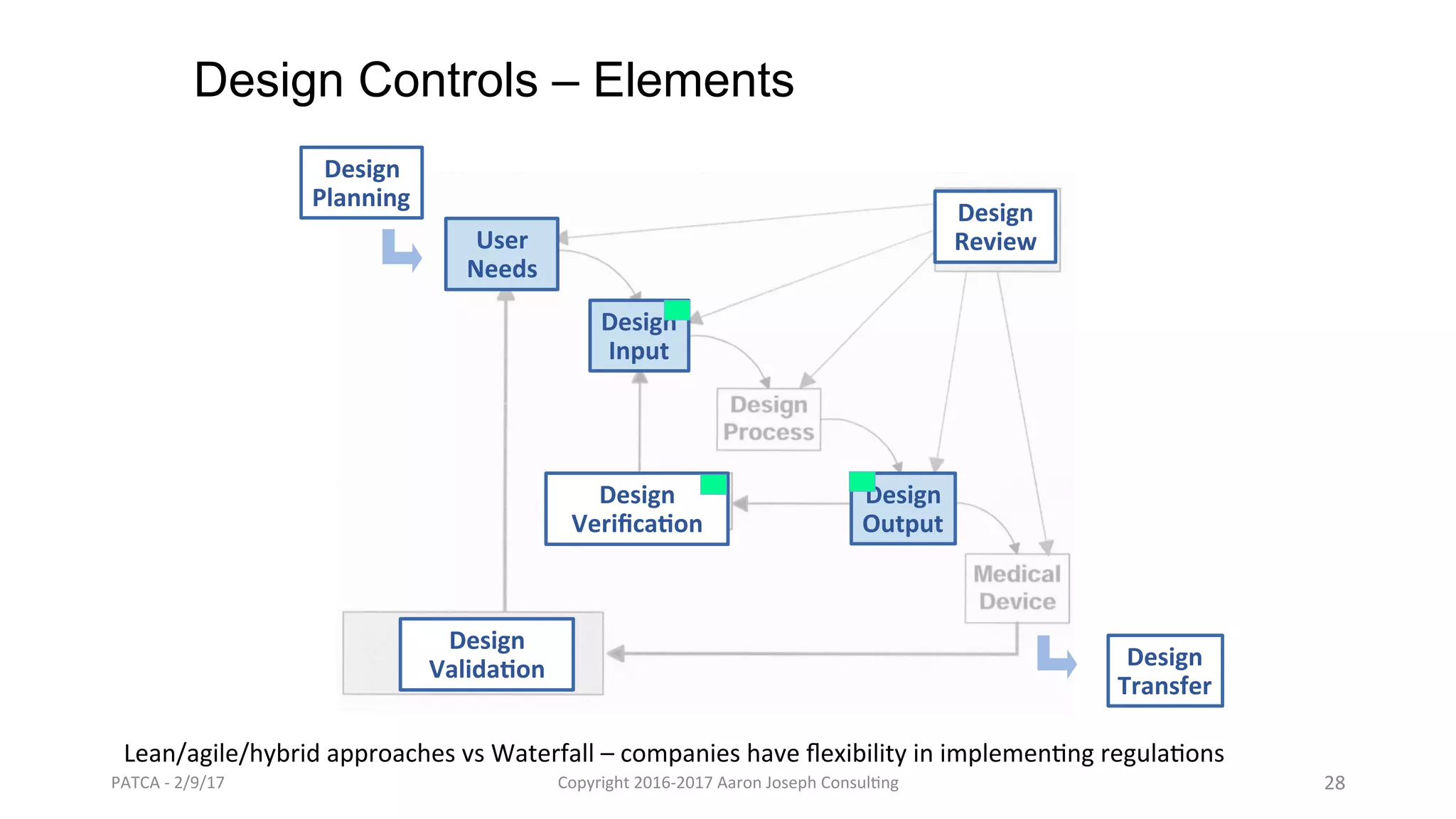
Design Controls – Elements
Design	
Planning	
Design	
Transfer	
Design	
Output	
Design	
Input	
Design	
Valida.on	
Design	
Review	User	
Needs	
Design	
Verifica.on	
Lean/agile/hybrid	approaches	vs	Waterfall	–	companies	have	flexibility	in	implemenVng	regulaVons		
PATCA	-	2/9/17	 Copyright	2016-2017	Aaron	Joseph	ConsulVng	 28
Business	Case	&	
Product	Concept	
Intended	Use		
Clinical	purpose,	types	of	
users/	paVents,	usage	
environment	
Regulatory	Strategy		
Hazard	Analysis	
Design	Requirements	 Tes.ng	
Design	IteraVons	
Design	Space	Limits	
Applicable	Standards	
Establish Regulatory-Risk Framework First
PATCA	-	2/9/17	 Copyright	2016-2017	Aaron	Joseph	ConsulVng	 29
Risk	Management	(Product	Safety)	
•  Need	‘upfront’	risk	assessment:		
•  needs	to	be	fast	but	comprehensive	and	cannot	require	detailed	design		
•  High-level/	top-down	
•  Example:	“System	Hazard	Analysis”	provides	the	framework	and	is	
complementary	to	subsequent	detailed	risk	assessments	(dFMEA,	uFMEA,	
pFMEA)	
•  Lean-agile	methods	improve	risk	management:	
•  IteraVons	improve	idenVficaVon	and	assessment	of	risks	
•  IteraVons	improve	design	and	tesVng	of	miVgaVons	
•  Use	error	and	miVgaVons	can	be	addressed	early	in	development	
•  Risk	traceability	needs	to	be	maintained	throughout	development	
(riskà	reqtàdesignàtest);		–don’t	try	to	do	tracing	just	at	the	end	
PATCA	-	2/9/17	 Copyright	2016-2017	Aaron	Joseph	ConsulVng	 30
Phases	without	Gates	
•  Phases	organize	large	numbers	of	interrelated	acVviVes	and	deliverables	(good!)	
-BUT-	
•  “Rigid	Gates”	(determining	whether	team	can	proceed)	assume	product	
development	is	purely	sequenVal	and	insVtute	batched	hand-offs	where	lots	of	
work	and	lots	of	knowledge	is	transferred	at	one	Vme	across	groups:	
Planning	 Pre-Produc.on	 Produc.on	Development	 Verifica.on	
•  Instead,	allow	work	to	be	done	in	mulVple	phases	simultaneously;	use	Phase	End	
Review	to	mark	successful	compleVon	of	each	phase:	
GATE	
GATE	
GATE	
GATE	
Planning	
Pre-Produc.on	 Produc.on	
Development	
Verifica.on	
PATCA	-	2/9/17	 Copyright	2016-2017	Aaron	Joseph	ConsulVng	 31
AdapVng	Design	Controls	for	Lean-Agile	
Design	Control	
Element	
Adapta.ons	
Design	Planning	 High-level	planning	covering	enVre	project;	detailed	planning	only	for	
short-term;	make	planning	VISUAL—all	team	members	and	stakeholders	
can	clearly	see	all	key	aspects	of	project	at	all	Vmes	
Requirements	 Don’t	mandate	complete	and	detailed	requirements	to	start	project;	allow	
requirements	to	be	elaborated	and	refined	throughout	development	
Design	V&V	TesVng	 Don’t	mandate	that	all	verificaVon	tesVng	be	completed	before	validaVon	
begins;	allow	for	staged	design	freeze	where	verificaVon	can	be	
performed	on	some	parts	of	product	while	other	parts	of	design	are	being	
finalized	(allows	maximum	flexibility	to	the	project	team	to	make	design	
changes	up	to	the	“last	responsible	moment”)	
Regulatory	submissions	 Communicate	early	to	enVre	team	everything	required	for	the	submission	
(all	test	evidence,	key	areas	of	concern,	etc.)	
PATCA	-	2/9/17	 Copyright	2016-2017	Aaron	Joseph	ConsulVng	 32
Design	History	File	(DHF)	
•  DHF	should	serve	as	a	knowledge	repository,	not	just	compliance	documentaVon	
•  Include	raVonale	for	design	requirements,	background	for	test	methods,	etc.	
•  Organize	for	easy	retrieval	of	informaVon	(searchable,	cross-linked)	
•  Manage	DHF	documentaVon	so	that	work	can	be	done	on	many	documents	
simultaneously	(de-centralized)	with	many	iteraVons,	while	sVll	maintaining	
integrity	and	consistency	and	traceability	
•  IteraVons	during	early	development	can	improve	compliance:	
•  Everyone	learns	more	about	the	quality	system	processes	
•  Helps	ensure	the	final	output	is	complete	and	consistent	
•  Methods	can	be	refined	as	needed	before	product	is	finalized	
•  ExponenVal	increase	in	compliance/	documentaVon	effort	near	product	launch	
(don’t	iterate	at	this	point!!!)	
=	relaVonal	database		
PATCA	-	2/9/17	 Copyright	2016-2017	Aaron	Joseph	ConsulVng	 33
The Story Finishes
What	can	we	learn	from	Walter	and	Grace’s	teams?	
PATCA	-	2/9/17	 Copyright	2016-2017	Aaron	Joseph	ConsulVng	 34
Comparison	Story:		Year	2-Q1	
Walter’s	Team	
•  Phase	2/	Gate	2	completed	✔	
•  Phase	3	integraVon	tesVng	and	system	tesVng	
revealed	problem	with	baDery	overheaVng;	team	
has	begun	invesVgaVng	alternaVve	designs	
•  SoRware	tesVng	revealed	a	large	number	of	bugs	
(SoRware	team	now	fixing	them)	
•  Human	factors	tesVng	delayed	unVl	SW	fixed	
•  Test	protocols	being	wriDen	for	V&V	tesVng	
•  Manufacturing	process	development	conVnuing	
	
Grace’s	Team	
•  Phase	2/	Gate	2	completed	✔	
•  Design	verificaVon	tesVng	completed,	including	
60601	cerVficaVon	(elec	safety,	EMC,	etc.)	
•  Phase	3/	Gate	3	completed	✔	
•  Preparing	for	Phase	4	validaVon	tesVng	
	
PROBLEMS!	
1.  Reliability:	new	pump	mechanism	someVmes	fails	aRer	3000	cycles	
2.  OverheaVng:	new	baDeries	overheat	when	fully	assembled	in	product	
housing	
3.  User	Interface:	first	and	second	designs	were	a	failure	(but	third	design	
tests	well	with	lots	of	posiVve	user	feedback)	
When	will	Walter’s	team	discover	
the	problems	with	the	pump	
mechanism	and	UI	design?	
Year	1	 Year	2	
PATCA	-	2/9/17	 Copyright	2016-2017	Aaron	Joseph	ConsulVng	 35
When were design issues iden'fied?
•  Lean-Agile	methods	encourage	rapid	
idenVficaVon	of	design	issues	early	in	
development	(and	therefore	more	rapid	
soluVons)	
•  Peak	problem	solving	acVvity	in	the	
tradiVonal	approach	(blue)	happens	near	
the	end	of	development	and	oRen	
extends	beyond	the	deadline	(“100%”)	
Based	on	presentaVon	by	Takashi	Tanaka	-	Lean	Summit	2011	
(Lean	Enterprise	Academy)	
Grace’s	
Team	
Walter’s	
Team	
PATCA	-	2/9/17	 Copyright	2016-2017	Aaron	Joseph	ConsulVng	 36
The	Moral	of	the	Story	
Walter’s	Team	
•  Tradi.onal	(waterfall)	approach	
Grace’s	Team	
•  Lean-Agile	approach					NEW!	
•  Regulatory	submission	on	.me	✔		
•  Product	launch	on	.me	✔		
•  InnovaVve	new	product	development	always	
involves	risks	
•  Focusing	early	efforts	on	project	risks	makes	
later	stages	predictable	(fast	learning	to	
close	knowledge	gaps)		
•  A	project	that	is	on	schedule	during	its	early	
phases	does	not	mean	it	will	deliver	on	
schedule	at	the	end	
PATCA	-	2/9/17	 Copyright	2016-2017	Aaron	Joseph	ConsulVng	 37
Success	Assured!	
Product Development with “Two Minds”
Concept	
Learning	
Dominant	
Focus	of	Project	Team	
Product	Launch	
Planning	 Pre-Produc.on	
Product	Development	Timeline	
Task	
Dominant	
100%	
Produc.on	Development	 Verifica.on	
PATCA	-	2/9/17	 Copyright	2016-2017	Aaron	Joseph	ConsulVng	 38
Summary
“A	bad	system	will	beat	a	good	person	every	Vme.”	–	W.	Edwards	Deming	
PATCA	-	2/9/17	 Copyright	2016-2017	Aaron	Joseph	ConsulVng	 39
Is	It	Really	Faster?	
Key	ways	that	Lean-Agile	methods	shorten	Vme	to	market:	
1.  IdenVfy	knowledge	gaps	early	and	tackle	them	
aggressively	(avoid	late-breaking	problems	that	lead	to	big	
delays)	
2.  At	a	medical	device	company	late-breaking	problems	can	
trigger	a	cascade	of	issues—can	lead	to	regulatory	
problems	on	top	of	technical	problems	(re-submit,	etc.)	
3.  Frequent	tesVng	and	feedback	to	find	design	defects	early	
and	adjust	development	accordingly	
4.  Only	spend	Vme	on	what	customers	really	need	and	want	
(free	up	engineering	Vme	from	non-value	added	tasks)	
+	there	are	more	ways	that	Lean-Agile	methods	accelerate	product	
development	which	are	not	as	straighyorward	to	see	(e.g.,	beDer	
communicaVon,	increased	moVvaVon,	process	opVmizaVon,	etc.)	
Cost	of	Delay		
=	$$$	
PATCA	-	2/9/17	 Copyright	2016-2017	Aaron	Joseph	ConsulVng	 40
Knowledge-Driven Product Development
•  Successful	new	product	development	demands	deep	
knowledge	of:	
1.  Product	applicaVon	
2.  Product	technology	
3.  Manufacturing	process	technology	
•  For	Medical	Devices:	
4.  Regulatory	Approval	(approval	process	and	key	
concerns	of	regulators)	
5.  Compliance	(requirements	of	all	applicable	
regulaVons	and	standards)	
Medical	Devices:	understand	
the	clinical	environment	and	
the	needs	of	clinicians	
PATCA	-	2/9/17	 Copyright	2016-2017	Aaron	Joseph	ConsulVng	 41
Challenges in Adop'ng Lean and Agile Methods
Undermining	Lean-Agile	Methods:	
•  Decision	by	HiPPO	
•  Employee	turnover	
•  Knowledge	handoffs	(scaDer)	
•  Overloaded	engineers	
•  Responsibility	separated	from	
control	
•  Fear	
Why	do	some	organizaVons	feel	threatened	by	these	principles	of	lean-agile	methods?	
•  Design	decisions	based	on	knowledge	
•  VisualizaVon	(transparency)	of	product	development	
PATCA	-	2/9/17	 Copyright	2016-2017	Aaron	Joseph	ConsulVng	 42
Lean-Agile	Methods	for	Medical	Device	Development	
1. Lean-agile	methods	accelerate	medical	device	development	
2. If	the	team	can’t	solve	the	technical	challenge	of	‘X’	then	all	other	
work	on	the	product	is	useless		
3. Focus	on	knowledge,	not	just	tasks	
4. Minimizing	tesVng	=	minimizing	knowledge	gained	
5. Quality	system	procedures	need	to	be	adapted	to	support	lean-agile	
methods		
PATCA	-	2/9/17	 Copyright	2016-2017	Aaron	Joseph	ConsulVng	 43
Two Different Approaches for Product Development
TradiVonal	(waterfall)	
•  Design	then	test	
•  Upfront	planning	
•  Manage	task	compleVon	
•  Work	transferred	in	large	
batches	
•  Maximize	uVlizaVon	
Lean-Agile	
•  Test	then	design	
•  Rolling	wave	planning	
•  Manage	knowledge	compleVon	
•  Work	transferred	in	small	
batches	on	a	cadence	
•  Maximize	throughput	
•  ConVnuous	improvement	
PATCA	-	2/9/17	 Copyright	2016-2017	Aaron	Joseph	ConsulVng	 44
Suggested	Resources	for	Lean	and	Agile	Product	Development	
Websites:	
•  hDp://www.leanprimer.com/downloads/lean_primer.pdf		-	good	overview	of	lean	principles	wriDen	by	two	soRware	
management	consultants	(Craig	Larman	and	Bas	Vodde)	who	include	aspects	of	soRware	agile	methods	as	well.	
•  hDp://theleanthinker.com/			-	a	blog	by	Mike	Rother	with	lots	of	good	observaVons	and	real-life	issues	involved	in	
changing	an	organizaVon	to	lean	
•  hDp://www.coe.montana.edu/IE/faculty/sobek/A3/index.htm		-	a	short	tutorial	on	the	Toyota	A3	technique	for	
problem	solving	by	Durward	Sobek	
•  hDp://www.lean.org/		-	Lean	Enterprise	InsVtute	(consulVng	firm	and	forum);	large	collecVon	of	arVcles	and	online	
forums	discussing	aspects	of	lean	product	development,	lean	mfg,	and	lean	services	
•  hDp://theleanedge.org/	-	a	forum	for	discussions	of	lean	management	issues	with	contribuVons	from	many	of	the	
thought	leaders	in	the	lean	community		
•  hDp://playbookhq.co/blog/	-	lots	of	good	blog	posVngs	on	concepts	and	methods	for	lean-agile	product	development;	
links	to	lots	of	addiVonal	resources	
•  hDps://www.scrumalliance.org	-	Scrum	Alliance	is	a	non-profit	organizaVon;	has	arVcles	and	links	on	agile	methods	
•  hDps://www.mountaingoatsoRware.com/agile	-	extensive	set	of	blog	posVngs	on	mulVple	aspects	of	agile	soRware	
development	by	consultant	Mike	Cohn	
•  hDps://less.works/	-	Large	Scale	Scrum	(LeSS)	framework	for	large	scale	projects	
•  hDp://www.scaledagileframework.com/	-	a	management	system	for	large	scale	projects	(SaFE)	
PATCA	-	2/9/17	 Copyright	2016-2017	Aaron	Joseph	ConsulVng	 45
Suggested	Resources	for	Lean	and	Agile	Product	Development	
Books:	
•  "Mastering	Lean	Product	Development"	by	Ronald	Mascitelli	-	a	collecVon	of	pracVcal	methods	to	improve	everything	
a	product	development	organizaVon	does	from	product	strategy	to	running	efficient	design	reviews	(includes	extensive	
bibliography).	
•  "The	Principles	of	Product	Development	Flow"	by	Donald	Reinertsen	-	detailed	explanaVons	of	key	principles	to	
accelerated	product	development,	based	on	Theory	of	Constraints,	queuing	theory,	and	more.		
•  "Lean	Product	and	Process	Development"	by	Allen	C	Ward	-	a	spirited	presentaVon	of	the	philosophy	and	techniques	
for	lean	product	development	from	the	guy	who	inspired	many	others	(published	posthumously)	
•  "Ready,	Set,	Dominate"	by	Michael	Kennedy	et	al	-	a	more	evolved	presentaVon	of	the	ideas	from	Ward's	book,	based	
on	the	real-life	experiences	of	Kennedy's	consulVng	clients.	Includes	case	studies	of	two	companies	going	through	lean	
transformaVons.	
•  “Managing	to	Learn”	by	John	Shook	–	an	excellent	introducVon	to	the	use	of	the	‘A3	method’	for	problem	solving,	
communicaVon,	learning,	and	lean	management.		
•  “The	Lean	Startup”	by	Eric	Ries	–	a	must	read	for	entrepreneurs	and	anyone	managing	projects	to	create	something	
new	under	condiVons	of	extreme	uncertainty.	
•  “The	Elements	of	Scrum”	by	Chris	Sims	and	Hillary	Louise	Johnson	–	a	simple	but	comprehensive	descripVon	of	one	of	
the	most	popular	aspects	of	agile	methods	for	soRware	development	
PATCA	-	2/9/17	 Copyright	2016-2017	Aaron	Joseph	ConsulVng	 46
3	Ways	to	SystemaVcally	Accelerate	Medical	
Device	Development	
Copyright	2016-2017	Aaron	Joseph	ConsulVng	 47	
1.	Lean	and	agile	methods		
																										+	
2.	Leveraging	HW	/	SW	technology	playorms	
																										+	
3.	Streamlined	compliance	
(	this	presentaVon)	
See	hDp://consensiainc.com/zipquality/
ADDITIONAL SLIDES
PATCA	-	2/9/17	 Copyright	2016-2017	Aaron	Joseph	ConsulVng	 48
Old Way: Product Documenta'on Stored in Documents
Risk	
Analysis	
SW	Reqts	
Test	
Protocol	
Product	
Reqts	
Test	
Report	
Revision	control	per	document	
DHF
Documents are Not a Good Way to
Manage Product Documenta'on
Managing	design	requirements	and	other	product	development	informaVon	in	text	or	spreadsheet	
documents	(MS	Word	or	Excel)	is	a	common	approach	but	has	these	serious	drawbacks:	
•  Traceability	is	staVc—because	traces	must	be	maintained	manually,	these	are	typically	defined	
retrospecVvely	(aRer	the	work	is	done)	instead	of	prospecVvely;		trace	informaVon	is	likely	to	degrade	
over	Vme	with	changes	to	the	product	(post-launch)		
•  No	support	for	process	workflow:	who	can	change	what	and	when?		What	informaVon	must	be	linked	
and	changed	together?	
•  Difficult	to	manage	changes	post-launch,	to	know	all	the	documents	affected	by	a	change	
•  Difficult	to	search	across	documents	
•  Change	control	is	per	document—difficult	to	track	which	requirements	changed,	who	changed	them,	and	
when	
•  No	way	to	efficiently	manage	product	variants	where	there	is	a	lot	of	overlap	of	risks/requirements/tests	
+	document-centric	approach	tends	to	reinforce	a	“batch	mindset”	
which	is	contrary	to	lean	and	agile	methods
Test	
Protocol	
New Way: Product Documenta'on Stored in a Rela'onal
Database
Risk	
Analysis	


SW	Reqts	


SW	Test	
Protocol	


Product	
Reqts	


SW	Test	
Report	


Revision	control	per	document	and	per	element	
Documents	are	groupings	of	DHF	elements	
PR-1020:	System	shall	provide	…	
Text	of	requirement	
Test	
Protocol	
ADributes	(status,	etc.)	
Export	a	set	of	
documents	from	the	
database	for	submissions

Lean agile feb2017-patca_a_joseph_ss