www.emmainternational.com
Medical Device Product
Development
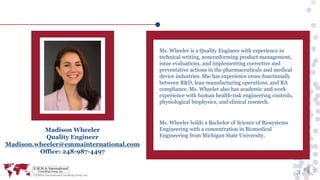
Madison Wheeler
Quality Engineer
Webinar Overview
• The purpose of this webinar is to discuss the characteristics of
an efficient product development process for medical devices.
• The ultimate takeaway is that medical device product
development should incorporate Quality, Regulatory, and
Business needs in parallel.
Madison Wheeler
Quality Engineer
Madison.wheeler@emmainternational.com
Office: 248-987-4497
Ms. Wheeler is a Quality Engineer with experience in
technical writing, nonconforming product management,
issue evaluations, and implementing corrective and
preventative actions in the pharmaceuticals and medical
device industries. She has experience cross-functionally
between R&D, lean manufacturing operations, and RA
compliance. Ms. Wheeler also has academic and work
experience with human health-risk engineering controls,
physiological biophysics, and clinical research.
Ms. Wheeler holds a Bachelor of Science of Biosystems
Engineering with a concentration in Biomedical
Engineering from Michigan State University.
3
Leaders in Compliance
Consulting and
Enterprise Quality
Management Software
• EMMA International Consulting Group, Inc. is a global leader in
management consulting services and headquartered in
Farmington Hills, MI.
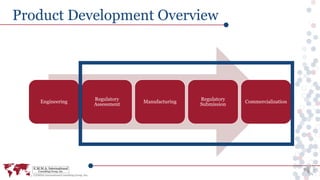
Product Development Overview
Engineering
Regulatory
Assessment
Manufacturing
Regulatory
Submission
Commercialization
Product Development Overview
Engineering
Regulatory
Assessment
Manufacturing
Regulatory
Submission
Commercialization
Regulatory Assessment
• Will need to define the Product Requirements Document
(PRD) and the Marketing Requirements Document (MRD)
• Basic specs of the device
• Intended Use
• Market Population
• Plan for FDA Submission
• What classification your device falls under
• Predicate devices
• What type of pre-market submission your device requires
Product Requirements:
• Will define device’s
intended use, features,
and functionality
• Requirements should be
specific and measurable
• Will tie into design
controls and User Needs
traceability[1]
Regulatory Assessment: Developing Requirements
This Photo by Unknown Author is licensed under CC BY-SA-NC
Regulatory Assessment: Developing Requirements
Marketing Requirements:
• Regulatory and business
need
• Why is your device
needed?
• Target user population
• You want to develop the
right product for the right
users
This Photo by Unknown Author is licensed under CC BY
Regulatory Assessment: Planning for FDA Submission
• Determine what premarket
submission type, if any, is required
for your device
• 510(k) (Premarket Notification)
• PMA (Premarket Approval)
• De Novo Classification Request
• Determine what requirements your
device will have to comply with[2]
• Design Controls
• Clinical Testing
This Photo by Unknown Author is licensed under CC BY-SA-NC
Manufacturing
• You want to find a manufacturer
that is compliant to the regulatory
and quality requirements for your
medical device
• Exercise caution when picking a
manufacturer
• Pick a manufacturer who is
flexible to meet your needs and
will ensure compliance
• Manufacturer’s are subject to FDA
inspections
This Photo by Unknown Author is licensed under CC BY-SA-NC
Manufacturing:Various Requirements
• There are several different types
of assembly and environments
your device may require
• ISO 14644-1 Cleanrooms and
associated controlled
environments[3]
• Overmolding for medical devices
• Medical device assembly
precision
• A robust QMS will need to be
built for device manufacturing
Regulatory Submission
• It is important to understand why type of submission is
necessary for your device
• Be prepared to answer follow-up questions from the
FDA
• Understand all the logistical requirements for
submitting
• Have a realistic plan for timelines
Regulatory Submission: Acceptance Review
The FDA can
Refuse-To-Accept
(RTA) any
submission that
doesn’t meet
specific
requirements
There are
different
requirements
depending on
different
classifications and
submissions
The purpose is to
allow the agency to
focus resources for
substantive review
on complete and
quality submissions
only
Regulatory Submission: Acceptance Review
• “Is the Submission with the
appropriate Center?”
• “Submission contains a Table of
Contents”
• “Each Section is Labeled”
• File type is also important (PDF vs.
Word)
• Each file must follow a specific
naming convention
• 180 day deadline for re-
submission[4]
This Photo by Unknown Author is licensed under CC BY-SA
Commercialization
• There are still many things to consider, even after
your device is on the market:
• Maintaining a robust QMS
• Additional regulatory submissions
• Expanding into different
markets
• EU MDR
• Medical Device Single
Audit Program (MDSAP)
Commercialization
• MDSAP: Australia, Brazil, Canada,
Japan, U.S.
• Harmonized to 13485: 2016[5]
• More robust than 21 CFR 820
• More ties to ISO 14971 (Risk
Management)[6]
[7]
So what does this mean for you?
• Product development
for your medical device
can be confusing and
time-consuming
• Experts (like EMMA!)
can help you make
sense of it all and ensure
compliance
Farmington Hills, MI:
Headquarters
27600 Farmington Rd., Suite 100
Farmington Hills, MI 48334
Phone (248) 987-4497
References
1 Church, Voler Systems (February 2018) Developing Product Requirements for Medical Devices retrieved from:
(https://www.fda.gov/MedicalDevices/DeviceRegulationandGuidance/MedicalDeviceQualityandCompliance/ucm590419.htm
2 FDA (December 2019) How to Study and Market Your Device retrieved from: https://www.fda.gov/medical-devices/device-
advice-comprehensive-regulatory-assistance/how-study-and-market-your-device
3 ISO (December 2015) ISO 14644-1:2015 Cleanrooms and associated controlled environments – Part 1: Classification of air
cleanliness by particle concentration retrieved from: https://www.iso.org/standard/53394.html
4 FDA (September 2019) Refuse to Accept Policy for 510(k)s retrieved from: https://www.fda.gov/media/83888/download
5 FDA (December 2018) FDA Update Transition to ISO 13485:2016 retrieved from: https://www.fda.gov/media/123488/download
6 BSI Group (n.d.) Medical Device Single Audit Program (MDSAP) retrieved from: https://www.bsigroup.com/en-GB/medical-
devices/our-services/Medical-Device-Single-Audit-Program/
7 Mulero (May 2018) MDSAP Sees Site Participation Increase retrieved from: https://www.raps.org/news-and-articles/news-
articles/2018/5/mdsap-sees-site-participation-increase

Medical Device Product Development

  • 1.
  • 2.
    Webinar Overview • Thepurpose of this webinar is to discuss the characteristics of an efficient product development process for medical devices. • The ultimate takeaway is that medical device product development should incorporate Quality, Regulatory, and Business needs in parallel.
  • 3.
    Madison Wheeler Quality Engineer Madison.wheeler@emmainternational.com Office:248-987-4497 Ms. Wheeler is a Quality Engineer with experience in technical writing, nonconforming product management, issue evaluations, and implementing corrective and preventative actions in the pharmaceuticals and medical device industries. She has experience cross-functionally between R&D, lean manufacturing operations, and RA compliance. Ms. Wheeler also has academic and work experience with human health-risk engineering controls, physiological biophysics, and clinical research. Ms. Wheeler holds a Bachelor of Science of Biosystems Engineering with a concentration in Biomedical Engineering from Michigan State University. 3
  • 4.
    Leaders in Compliance Consultingand Enterprise Quality Management Software • EMMA International Consulting Group, Inc. is a global leader in management consulting services and headquartered in Farmington Hills, MI.
  • 5.
  • 6.
  • 7.
    Regulatory Assessment • Willneed to define the Product Requirements Document (PRD) and the Marketing Requirements Document (MRD) • Basic specs of the device • Intended Use • Market Population • Plan for FDA Submission • What classification your device falls under • Predicate devices • What type of pre-market submission your device requires
  • 8.
    Product Requirements: • Willdefine device’s intended use, features, and functionality • Requirements should be specific and measurable • Will tie into design controls and User Needs traceability[1] Regulatory Assessment: Developing Requirements This Photo by Unknown Author is licensed under CC BY-SA-NC
  • 9.
    Regulatory Assessment: DevelopingRequirements Marketing Requirements: • Regulatory and business need • Why is your device needed? • Target user population • You want to develop the right product for the right users This Photo by Unknown Author is licensed under CC BY
  • 10.
    Regulatory Assessment: Planningfor FDA Submission • Determine what premarket submission type, if any, is required for your device • 510(k) (Premarket Notification) • PMA (Premarket Approval) • De Novo Classification Request • Determine what requirements your device will have to comply with[2] • Design Controls • Clinical Testing This Photo by Unknown Author is licensed under CC BY-SA-NC
  • 11.
    Manufacturing • You wantto find a manufacturer that is compliant to the regulatory and quality requirements for your medical device • Exercise caution when picking a manufacturer • Pick a manufacturer who is flexible to meet your needs and will ensure compliance • Manufacturer’s are subject to FDA inspections This Photo by Unknown Author is licensed under CC BY-SA-NC
  • 12.
    Manufacturing:Various Requirements • Thereare several different types of assembly and environments your device may require • ISO 14644-1 Cleanrooms and associated controlled environments[3] • Overmolding for medical devices • Medical device assembly precision • A robust QMS will need to be built for device manufacturing
  • 13.
    Regulatory Submission • Itis important to understand why type of submission is necessary for your device • Be prepared to answer follow-up questions from the FDA • Understand all the logistical requirements for submitting • Have a realistic plan for timelines
  • 14.
    Regulatory Submission: AcceptanceReview The FDA can Refuse-To-Accept (RTA) any submission that doesn’t meet specific requirements There are different requirements depending on different classifications and submissions The purpose is to allow the agency to focus resources for substantive review on complete and quality submissions only
  • 15.
    Regulatory Submission: AcceptanceReview • “Is the Submission with the appropriate Center?” • “Submission contains a Table of Contents” • “Each Section is Labeled” • File type is also important (PDF vs. Word) • Each file must follow a specific naming convention • 180 day deadline for re- submission[4] This Photo by Unknown Author is licensed under CC BY-SA
  • 16.
    Commercialization • There arestill many things to consider, even after your device is on the market: • Maintaining a robust QMS • Additional regulatory submissions • Expanding into different markets • EU MDR • Medical Device Single Audit Program (MDSAP)
  • 17.
    Commercialization • MDSAP: Australia,Brazil, Canada, Japan, U.S. • Harmonized to 13485: 2016[5] • More robust than 21 CFR 820 • More ties to ISO 14971 (Risk Management)[6]
  • 18.
  • 19.
    So what doesthis mean for you? • Product development for your medical device can be confusing and time-consuming • Experts (like EMMA!) can help you make sense of it all and ensure compliance
  • 20.
    Farmington Hills, MI: Headquarters 27600Farmington Rd., Suite 100 Farmington Hills, MI 48334 Phone (248) 987-4497
  • 21.
    References 1 Church, VolerSystems (February 2018) Developing Product Requirements for Medical Devices retrieved from: (https://www.fda.gov/MedicalDevices/DeviceRegulationandGuidance/MedicalDeviceQualityandCompliance/ucm590419.htm 2 FDA (December 2019) How to Study and Market Your Device retrieved from: https://www.fda.gov/medical-devices/device- advice-comprehensive-regulatory-assistance/how-study-and-market-your-device 3 ISO (December 2015) ISO 14644-1:2015 Cleanrooms and associated controlled environments – Part 1: Classification of air cleanliness by particle concentration retrieved from: https://www.iso.org/standard/53394.html 4 FDA (September 2019) Refuse to Accept Policy for 510(k)s retrieved from: https://www.fda.gov/media/83888/download 5 FDA (December 2018) FDA Update Transition to ISO 13485:2016 retrieved from: https://www.fda.gov/media/123488/download 6 BSI Group (n.d.) Medical Device Single Audit Program (MDSAP) retrieved from: https://www.bsigroup.com/en-GB/medical- devices/our-services/Medical-Device-Single-Audit-Program/ 7 Mulero (May 2018) MDSAP Sees Site Participation Increase retrieved from: https://www.raps.org/news-and-articles/news- articles/2018/5/mdsap-sees-site-participation-increase

Editor's Notes

  • #13 https://www.iso.org/standard/53394.html https://genesisplasticswelding.com/capabilities/clean-room-manufacturing/
  • #16 https://www.fda.gov/media/83888/download
  • #18 https://www.fda.gov/media/123488/download https://www.fda.gov/medical-devices/cdrh-international-programs/medical-device-single-audit-program-mdsap https://www.bsigroup.com/en-GB/medical-devices/our-services/Medical-Device-Single-Audit-Program/
  • #19 https://www.raps.org/news-and-articles/news-articles/2018/5/mdsap-sees-site-participation-increase