Design Verification: The Past,
       Present and Future

       Sean Smith, Juniper Networks, RTP,
       NC


1 | Copyright © 2009 Juniper Networks, Inc. | www.juniper.net
Agenda

   Introduction to Sean & Juniper
   A little background on DV Past
   An overview of where DV is today?
   Where is DV Going?
   Summary and Q&A


2 | Copyright © 2009 Juniper Networks, Inc. | www.juniper.net
Who is Juniper at a Glance?
                Snapshot:
                     Founded: 1996
                    NASDAQ: JNPR
                      Headquarters:
                     Sunnyvale, CA
SECTION Employees: 7,000
         TITLE
WITH IMAGEemployees in
                             offices in 47
                              countries.

                          Customer Profile:
                          We serve the top
                          100 global service
                            providers more
                               than 30,000
                         enterprises, as well
                            as hundreds of
                               government
3 |   Copyright © 2009 Juniperagencies and
                              Networks, Inc. | www.juniper.net
DV: The Past

    DV has been a tremendously evolutionary field
        –   As recent as 15 years ago
        –   There was little research on DV
        –   There were no published texts on DV (until 2000)
        –   A large void compared to logic design.
        –   Considered by many to be the n00b job
    Common DV Techniques
        –   Visual inspection
        –   Diff the golden log files
        –   Directed self checking tests
        –   Code coverage was in its infancy
        –   C++ was a common choice in the high end

4 | Copyright © 2009 Juniper Networks, Inc. | www.juniper.net
DV: The Present

  Wow! DV has Evolved!
      –   Lots of research on DV including DV centric conference
      –   Dozens of published texts
      –   Still a void compared to logic design but narrowing
      –   Not necessarily a newbie job but there is a delta in
          compensation & respect
  Common DV Techniques
      –   Self checking constrained random
      –   Objective metrics for measuring completeness
      –   Static verification has become almost mainstream
      –   SystemVerilog provided the unification


5 | Copyright © 2009 Juniper Networks, Inc. | www.juniper.net
DV: The Future

  How are we going to deal with capacity?
      – Current simulation techniques are running out steam?
      – Emulation?
      – Formal?
  How can we be smarter about reaching our
   verification goals?
  Are the traditional problems where we should be
   focusing our energy?


6 | Copyright © 2009 Juniper Networks, Inc. | www.juniper.net
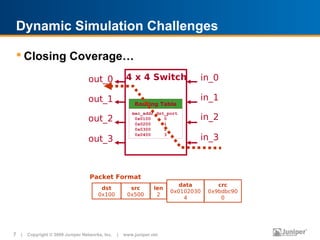
Dynamic Simulation Challenges

  Closing Coverage…

                               out_0           4 x 4 Switch              in_0

                               out_1                                     in_1
                                                   Routing Table
                                                  mac_addr dst_port
                               out_2               0x0100     0          in_2
                                                   0x0200     1
                                                   0x0300     2

                               out_3
                                                   0x0400     3
                                                                         in_3


                                Packet Format
                                                                    data        crc
                                    dst          src       len
                                                                 0x0102030   0x9bdbc90
                                   0x100        0x500       2
                                                                     4           0


7 | Copyright © 2009 Juniper Networks, Inc. | www.juniper.net
Closing coverage continued…

  Constrained random tests are generally not
   coverage aware so they generate a lot of duplicate
   transactions….
  New Approaches are emerging to try and automate
   coverage specification and closure!
      – Graph and Genetic based algorithms for stimulus and
        coverage generation.
      – Algorithms to mutate stimulus code
      – Context aware simulators
      – Formal Verification


8 | Copyright © 2009 Juniper Networks, Inc. | www.juniper.net
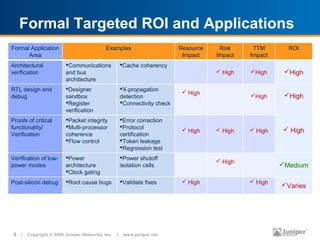
Formal Targeted ROI and Applications
Formal Application                     Examples                    Resource    Risk     TTM       ROI
      Area                                                          Impact    Impact   Impact
Architectural          Communications       Cache coherency
verification           and bus                                                 High   High     High
                       architecture
RTL design and         Designer             X-propagation
                                                                     High
debug                  sandbox               detection                                 High     High
                       Register             Connectivity check
                       verification
Proofs of critical     Packet integrity     Error correction
functionality/         Multi-processor      Protocol
                                                                     High     High    High    High
Verification           coherence             certification
                       Flow control         Token leakage
                                             Regression test
Verification of low-   Power                Power shutoff
                                                                               High
power modes            architecture          isolation cells                                    Medium
                       Clock gating
Post-silicon debug     Root cause bugs      Validate fixes         High              High
                                                                                                Varies


9 | Copyright © 2009 Juniper Networks, Inc. | www.juniper.net
DV: The Future

   But are there bigger looming challenges?
   We need to step back and consider the big picture.
       – The goal of verification is deliver a quality product to
         market in a timely fashion.
       – There is an increasing software component of silicon
         and systems we build.
       – There is also the redundancy of pre versus post silicon
         verification.
   The future of DV is much broader than the current
    focus!


10 | Copyright © 2009 Juniper Networks, Inc. | www.juniper.net
Reuse Starts with Specification

   IP blocks need consistent specification format
       – Ensure quick and easy integration into SOC level
         reference manual, users guides, and programmers
         guides
       – Modular & consistent document structure, formatting,
         look and feel are key
       – Need to minimize hand editing when going from block to
         SOC
   Standards like IP-Xact and SystemRDL from the
    SPIRIT Consortium are driving the future.


11 | Copyright © 2009 Juniper Networks, Inc. | www.juniper.net
SPIRIT and SystemRDL
        SystemRDL is a language for specifying register
         architectures and implimentations.
        SPIRIT Consortium has accepted the donation of
         SystemRDL on May 21, 2007
        On May 18th 2009, The SystemRDL 1.0 standard
         was released.


                               http://www.spiritconsortium.org/


12 | Copyright © 2009 Juniper Networks, Inc. | www.juniper.net
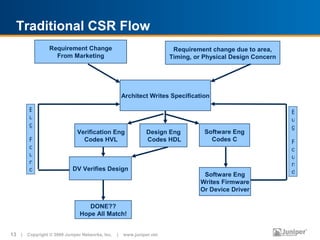
Traditional CSR Flow
                Requirement Change                                Requirement change due to area,
                  From Marketing                                 Timing, or Physical Design Concern


                                              Architect Writes Specification

       B                                                                                              B
       u                                                                                              u
       g                                                                                              g
                            Verification Eng             Design Eng         Software Eng
       F                      Codes HVL                  Codes HDL            Codes C                 F
       o                                                                                              o
       u                                                                                              u
       n                                                                                              n
       d                  DV Verifies Design                                                          d
                                                                           Software Eng
                                                                          Writes Firmware
                                                                          Or Device Driver

                                DONE??
                             Hope All Match!


13 | Copyright © 2009 Juniper Networks, Inc. | www.juniper.net
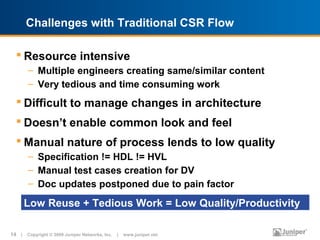
Challenges with Traditional CSR Flow

   Resource intensive
       – Multiple engineers creating same/similar content
       – Very tedious and time consuming work
   Difficult to manage changes in architecture
   Doesn’t enable common look and feel
   Manual nature of process lends to low quality
       – Specification != HDL != HVL
       – Manual test cases creation for DV
       – Doc updates postponed due to pain factor

     Low Reuse + Tedious Work = Low Quality/Productivity

14 | Copyright © 2009 Juniper Networks, Inc. | www.juniper.net
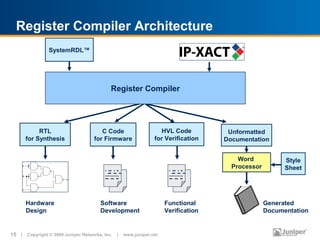
Register Compiler Architecture
                SystemRDL™


                                          Register Compiler


           RTL                        C Code                   HVL Code          Unformatted
      for Synthesis                for Firmware             for Verification    Documentation


                                                                                    Word            Style
                                                                                  Processor         Sheet


      Hardware                       Software                    Functional                   Generated
      Design                         Development                 Verification                 Documentation


15 | Copyright © 2009 Juniper Networks, Inc. | www.juniper.net
www.spiritconsortium.org

   Simple high level syntax defines registers
       // This register is a inline register definition.
       // It defines a simple ID register. A flip-flop is implemented
       //
       reg chip_id_r {
          name = "This chip part number and revision #";
          desc = "This register contains the part # and revision # for
                   XYZ ASIC";
          field {
            hw    = rw; // This combination of attr creates a flip flop
            sw    = r;
            desc = "This field represents the chips part number";
          } part_num[28] = 28'h12_34_56_7;
       };


16 | Copyright © 2009 Juniper Networks, Inc. | www.juniper.net
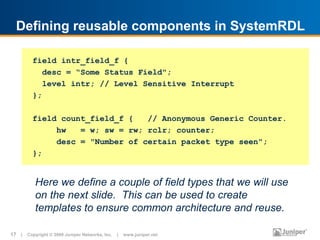
Defining reusable components in SystemRDL

         field intr_field_f {
            desc = “Some Status Field";
            level intr; // Level Sensitive Interrupt
         };

         field count_field_f {   // Anonymous Generic Counter.
              hw   = w; sw = rw; rclr; counter;
              desc = "Number of certain packet type seen";
         };


          Here we define a couple of field types that we will use
          on the next slide. This can be used to create
          templates to ensure common architecture and reuse.

17 | Copyright © 2009 Juniper Networks, Inc. | www.juniper.net
www.systemrdl.org
        reg vc_pkt_count_r {
           count_field_f vc_count[29:0]=0x0;
           field { desc="VC is Active"; } active;
           intr_field_f cntr_overflow=0;
           cntr_overflow->next = vc_count->overflow;
        };

        addrmap some_register_map {
          chip_id_r chip_id @0x0110;

          external vc_pkt_count_r vc_pkt_count[256]
                   @0x200 +=0x10; // External Interface
        }; // End some_register_map


18 | Copyright © 2009 Juniper Networks, Inc. | www.juniper.net
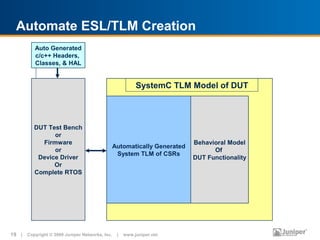
Automate ESL/TLM Creation
          Auto Generated
          c/c++ Headers,
          Classes, & HAL


                                                    SystemC TLM Model of DUT


          DUT Test Bench
                or
            Firmware                                                Behavioral Model
                                          Automatically Generated
                or                                                        Of
                                           System TLM of CSRs
           Device Driver                                            DUT Functionality
                Or
          Complete RTOS


19 | Copyright © 2009 Juniper Networks, Inc. | www.juniper.net
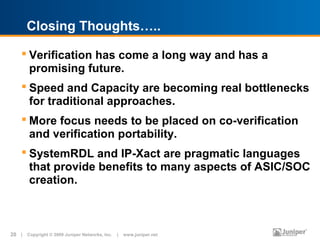
Closing Thoughts…..

     Verification has come a long way and has a
      promising future.
     Speed and Capacity are becoming real bottlenecks
      for traditional approaches.
     More focus needs to be placed on co-verification
      and verification portability.
     SystemRDL and IP-Xact are pragmatic languages
      that provide benefits to many aspects of ASIC/SOC
      creation.


20 | Copyright © 2009 Juniper Networks, Inc. | www.juniper.net
Juniper advantage

   The POWER of


             Architecture                      Operating System   Open Network
                          •••


21 | Copyright © 2009 Juniper Networks, Inc. | www.juniper.net

Design verification--the-past-present-and-future

  • 1.
    Design Verification: ThePast, Present and Future Sean Smith, Juniper Networks, RTP, NC 1 | Copyright © 2009 Juniper Networks, Inc. | www.juniper.net
  • 2.
    Agenda Introduction to Sean & Juniper A little background on DV Past An overview of where DV is today? Where is DV Going? Summary and Q&A 2 | Copyright © 2009 Juniper Networks, Inc. | www.juniper.net
  • 3.
    Who is Juniperat a Glance? Snapshot: Founded: 1996 NASDAQ: JNPR Headquarters: Sunnyvale, CA SECTION Employees: 7,000 TITLE WITH IMAGEemployees in offices in 47 countries. Customer Profile: We serve the top 100 global service providers more than 30,000 enterprises, as well as hundreds of government 3 | Copyright © 2009 Juniperagencies and Networks, Inc. | www.juniper.net
  • 4.
    DV: The Past  DV has been a tremendously evolutionary field – As recent as 15 years ago – There was little research on DV – There were no published texts on DV (until 2000) – A large void compared to logic design. – Considered by many to be the n00b job  Common DV Techniques – Visual inspection – Diff the golden log files – Directed self checking tests – Code coverage was in its infancy – C++ was a common choice in the high end 4 | Copyright © 2009 Juniper Networks, Inc. | www.juniper.net
  • 5.
    DV: The Present  Wow! DV has Evolved! – Lots of research on DV including DV centric conference – Dozens of published texts – Still a void compared to logic design but narrowing – Not necessarily a newbie job but there is a delta in compensation & respect  Common DV Techniques – Self checking constrained random – Objective metrics for measuring completeness – Static verification has become almost mainstream – SystemVerilog provided the unification 5 | Copyright © 2009 Juniper Networks, Inc. | www.juniper.net
  • 6.
    DV: The Future  How are we going to deal with capacity? – Current simulation techniques are running out steam? – Emulation? – Formal?  How can we be smarter about reaching our verification goals?  Are the traditional problems where we should be focusing our energy? 6 | Copyright © 2009 Juniper Networks, Inc. | www.juniper.net
  • 7.
    Dynamic Simulation Challenges  Closing Coverage… out_0 4 x 4 Switch in_0 out_1 in_1 Routing Table mac_addr dst_port out_2 0x0100 0 in_2 0x0200 1 0x0300 2 out_3 0x0400 3 in_3 Packet Format data crc dst src len 0x0102030 0x9bdbc90 0x100 0x500 2 4 0 7 | Copyright © 2009 Juniper Networks, Inc. | www.juniper.net
  • 8.
    Closing coverage continued…  Constrained random tests are generally not coverage aware so they generate a lot of duplicate transactions….  New Approaches are emerging to try and automate coverage specification and closure! – Graph and Genetic based algorithms for stimulus and coverage generation. – Algorithms to mutate stimulus code – Context aware simulators – Formal Verification 8 | Copyright © 2009 Juniper Networks, Inc. | www.juniper.net
  • 9.
    Formal Targeted ROIand Applications Formal Application Examples Resource Risk TTM ROI Area Impact Impact Impact Architectural Communications Cache coherency verification and bus  High High High architecture RTL design and Designer X-propagation  High debug sandbox detection High High Register Connectivity check verification Proofs of critical Packet integrity Error correction functionality/ Multi-processor Protocol  High  High  High  High Verification coherence certification Flow control Token leakage Regression test Verification of low- Power Power shutoff  High power modes architecture isolation cells Medium Clock gating Post-silicon debug Root cause bugs Validate fixes  High  High Varies 9 | Copyright © 2009 Juniper Networks, Inc. | www.juniper.net
  • 10.
    DV: The Future  But are there bigger looming challenges?  We need to step back and consider the big picture. – The goal of verification is deliver a quality product to market in a timely fashion. – There is an increasing software component of silicon and systems we build. – There is also the redundancy of pre versus post silicon verification.  The future of DV is much broader than the current focus! 10 | Copyright © 2009 Juniper Networks, Inc. | www.juniper.net
  • 11.
    Reuse Starts withSpecification  IP blocks need consistent specification format – Ensure quick and easy integration into SOC level reference manual, users guides, and programmers guides – Modular & consistent document structure, formatting, look and feel are key – Need to minimize hand editing when going from block to SOC  Standards like IP-Xact and SystemRDL from the SPIRIT Consortium are driving the future. 11 | Copyright © 2009 Juniper Networks, Inc. | www.juniper.net
  • 12.
    SPIRIT and SystemRDL  SystemRDL is a language for specifying register architectures and implimentations.  SPIRIT Consortium has accepted the donation of SystemRDL on May 21, 2007  On May 18th 2009, The SystemRDL 1.0 standard was released. http://www.spiritconsortium.org/ 12 | Copyright © 2009 Juniper Networks, Inc. | www.juniper.net
  • 13.
    Traditional CSR Flow Requirement Change Requirement change due to area, From Marketing Timing, or Physical Design Concern Architect Writes Specification B B u u g g Verification Eng Design Eng Software Eng F Codes HVL Codes HDL Codes C F o o u u n n d DV Verifies Design d Software Eng Writes Firmware Or Device Driver DONE?? Hope All Match! 13 | Copyright © 2009 Juniper Networks, Inc. | www.juniper.net
  • 14.
    Challenges with TraditionalCSR Flow  Resource intensive – Multiple engineers creating same/similar content – Very tedious and time consuming work  Difficult to manage changes in architecture  Doesn’t enable common look and feel  Manual nature of process lends to low quality – Specification != HDL != HVL – Manual test cases creation for DV – Doc updates postponed due to pain factor Low Reuse + Tedious Work = Low Quality/Productivity 14 | Copyright © 2009 Juniper Networks, Inc. | www.juniper.net
  • 15.
    Register Compiler Architecture SystemRDL™ Register Compiler RTL C Code HVL Code Unformatted for Synthesis for Firmware for Verification Documentation Word Style Processor Sheet Hardware Software Functional Generated Design Development Verification Documentation 15 | Copyright © 2009 Juniper Networks, Inc. | www.juniper.net
  • 16.
    www.spiritconsortium.org Simple high level syntax defines registers // This register is a inline register definition. // It defines a simple ID register. A flip-flop is implemented // reg chip_id_r { name = "This chip part number and revision #"; desc = "This register contains the part # and revision # for XYZ ASIC"; field { hw = rw; // This combination of attr creates a flip flop sw = r; desc = "This field represents the chips part number"; } part_num[28] = 28'h12_34_56_7; }; 16 | Copyright © 2009 Juniper Networks, Inc. | www.juniper.net
  • 17.
    Defining reusable componentsin SystemRDL field intr_field_f { desc = “Some Status Field"; level intr; // Level Sensitive Interrupt }; field count_field_f { // Anonymous Generic Counter. hw = w; sw = rw; rclr; counter; desc = "Number of certain packet type seen"; }; Here we define a couple of field types that we will use on the next slide. This can be used to create templates to ensure common architecture and reuse. 17 | Copyright © 2009 Juniper Networks, Inc. | www.juniper.net
  • 18.
    www.systemrdl.org reg vc_pkt_count_r { count_field_f vc_count[29:0]=0x0; field { desc="VC is Active"; } active; intr_field_f cntr_overflow=0; cntr_overflow->next = vc_count->overflow; }; addrmap some_register_map { chip_id_r chip_id @0x0110; external vc_pkt_count_r vc_pkt_count[256] @0x200 +=0x10; // External Interface }; // End some_register_map 18 | Copyright © 2009 Juniper Networks, Inc. | www.juniper.net
  • 19.
    Automate ESL/TLM Creation Auto Generated c/c++ Headers, Classes, & HAL SystemC TLM Model of DUT DUT Test Bench or Firmware Behavioral Model Automatically Generated or Of System TLM of CSRs Device Driver DUT Functionality Or Complete RTOS 19 | Copyright © 2009 Juniper Networks, Inc. | www.juniper.net
  • 20.
    Closing Thoughts…..  Verification has come a long way and has a promising future.  Speed and Capacity are becoming real bottlenecks for traditional approaches.  More focus needs to be placed on co-verification and verification portability.  SystemRDL and IP-Xact are pragmatic languages that provide benefits to many aspects of ASIC/SOC creation. 20 | Copyright © 2009 Juniper Networks, Inc. | www.juniper.net
  • 21.
    Juniper advantage The POWER of Architecture Operating System Open Network ••• 21 | Copyright © 2009 Juniper Networks, Inc. | www.juniper.net