16
9
aC
t
I
VI
t
y
d
esI
gn
169
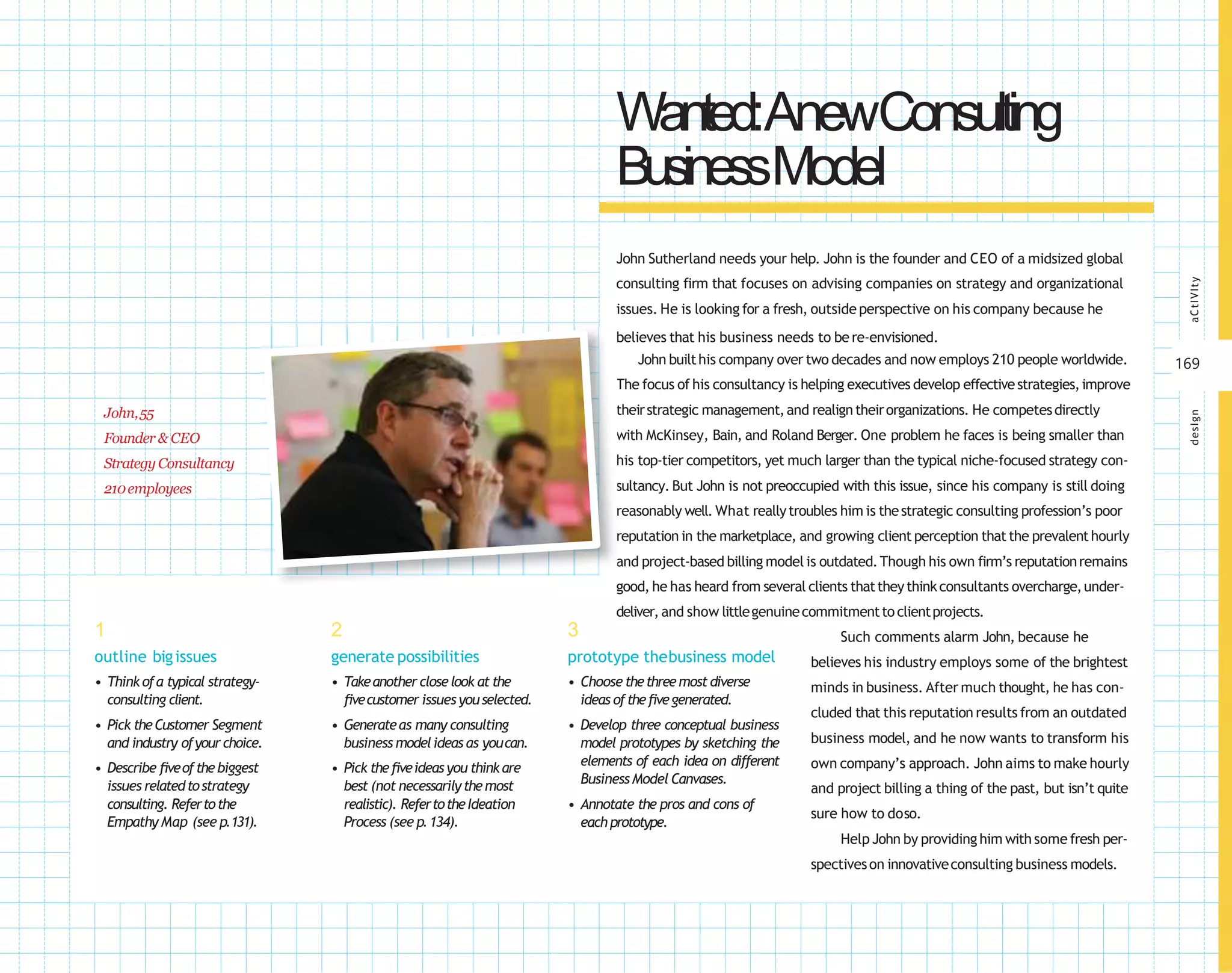
John,55
Founder & CEO
Strategy Consultancy
210employees
1
outline bigissues
• Thinkofa typical strategy-
consulting client.
• Pick theCustomer Segment
and industry ofyourchoice.
• Describe fiveofthebiggest
issues relatedtostrategy
consulting. Refertothe
Empathy Map (see p.131).
2
generate possibilities
• Takeanothercloselook at the
fivecustomer issues youselected.
• Generateas many consulting
business modelideas as youcan.
• Pick thefiveideas you thinkare
best (not necessarilythemost
realistic). RefertotheIdeation
Process (see p.134).
3
prototype thebusiness model
• Choosethethreemostdiverse
ideas ofthefivegenerated.
• Develop three conceptual business
model prototypes by sketching the
elements of each idea on different
BusinessModel Canvases.
• Annotate the pros and cons of
eachprototype.
Wanted:AnewConsulting
BusinessModel
John Sutherland needs your help. John is the founder and CEO of a midsized global
consulting firm that focuses on advising companies on strategy and organizational
issues. He is looking for a fresh, outside perspective on his company because he
believes that his business needs to bere-envisioned.
John builthis company over two decades and now employs 210 people worldwide.
The focus of his consultancy is helping executives develop effectivestrategies,improve
theirstrategic management,and realigntheirorganizations. He competesdirectly
with McKinsey, Bain, and Roland Berger. One problem he faces is being smaller than
his top-tier competitors, yet much larger than the typical niche-focused strategy con-
sultancy. But John is not preoccupied with this issue, since his company is still doing
reasonably well. What reallytroubles him is thestrategic consulting profession’s poor
reputation in the marketplace, and growing client perception that the prevalenthourly
and project-based billing model is outdated.Though his own firm’s reputationremains
good, he has heard from several clients thattheythinkconsultants overcharge,under-
deliver, and show littlegenuinecommitmenttoclientprojects.
Such comments alarm John, because he
believes his industry employs some of the brightest
minds in business. After much thought, he has con-
cluded that this reputation results from an outdated
business model, and he now wants to transform his
own company’s approach. John aims to make hourly
and project billing a thing of the past, but isn’t quite
sure how to doso.
Help John by providinghim with some fresh per-
spectiveson innovativeconsulting business models.

Design part-2

  • 1.
    16 9 aC t I VI t y d esI gn 169 John,55 Founder & CEO StrategyConsultancy 210employees 1 outline bigissues • Thinkofa typical strategy- consulting client. • Pick theCustomer Segment and industry ofyourchoice. • Describe fiveofthebiggest issues relatedtostrategy consulting. Refertothe Empathy Map (see p.131). 2 generate possibilities • Takeanothercloselook at the fivecustomer issues youselected. • Generateas many consulting business modelideas as youcan. • Pick thefiveideas you thinkare best (not necessarilythemost realistic). RefertotheIdeation Process (see p.134). 3 prototype thebusiness model • Choosethethreemostdiverse ideas ofthefivegenerated. • Develop three conceptual business model prototypes by sketching the elements of each idea on different BusinessModel Canvases. • Annotate the pros and cons of eachprototype. Wanted:AnewConsulting BusinessModel John Sutherland needs your help. John is the founder and CEO of a midsized global consulting firm that focuses on advising companies on strategy and organizational issues. He is looking for a fresh, outside perspective on his company because he believes that his business needs to bere-envisioned. John builthis company over two decades and now employs 210 people worldwide. The focus of his consultancy is helping executives develop effectivestrategies,improve theirstrategic management,and realigntheirorganizations. He competesdirectly with McKinsey, Bain, and Roland Berger. One problem he faces is being smaller than his top-tier competitors, yet much larger than the typical niche-focused strategy con- sultancy. But John is not preoccupied with this issue, since his company is still doing reasonably well. What reallytroubles him is thestrategic consulting profession’s poor reputation in the marketplace, and growing client perception that the prevalenthourly and project-based billing model is outdated.Though his own firm’s reputationremains good, he has heard from several clients thattheythinkconsultants overcharge,under- deliver, and show littlegenuinecommitmenttoclientprojects. Such comments alarm John, because he believes his industry employs some of the brightest minds in business. After much thought, he has con- cluded that this reputation results from an outdated business model, and he now wants to transform his own company’s approach. John aims to make hourly and project billing a thing of the past, but isn’t quite sure how to doso. Help John by providinghim with some fresh per- spectiveson innovativeconsulting business models.