• Elements ofa System
1.Architecture: This is the conceptual model that defines the structure,
behavior, and views of a system. We can use flowcharts to represent
and illustrate the architecture.
2.Modules: These are components that handle one specific task in a
system. A combination of the modules makes up the system.
3.Components: This provides a particular function or group of related
functions. They are made up of modules.
4.Interfaces: This is the shared boundary across which the
components of a system exchange information and relate.
5.Data: This is the management of the information and data flow.
19.
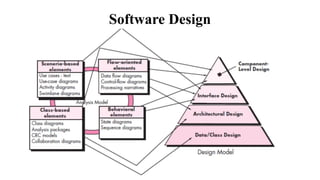
What is SoftwareDesign?
It is the most important part of software development. Software design is the process that helps in creating the plan,
foundation, or blueprint of software. It is divided into three levels namely the interface design, the architectural design, and
the detailed design.
• Interface Design
• Interface design is the specification of the
interaction between a system and its environment.
This phase proceeds at a high level of abstraction
with respect to the inner workings of the system
20.
• Architectural Design
•Architectural design is the specification of the major
components of a system, their responsibilities, properties,
interfaces, and the relationships and interactions between
them.
21.
• Detailed Design
•Design is the specification of the internal elements of all
major system components, their properties, relationships,
processing, and often their algorithms and the data
structures.
• 1. AbstractionAsolution is stated in large terms using
the language of the problem environment at the highest
level abstraction.
• The lower level of abstraction provides a more detail
description of the solution.
• A sequence of instruction that contain a specific and
limited function refers in a procedural abstraction.
• A collection of data that describes a data object is a
data abstraction.
24.
• 2. ArchitectureThecomplete structure of the software is known
as software architecture.
• Structure provides conceptual integrity for a system in a number
of ways.
• The architecture is the structure of program modules where they
interact with each other in a specialized way.
• The components use the structure of data.
• The aim of the software design is to obtain an architectural
framework of a system.
• The more detailed design activities are conducted from the
framework.
25.
• 3. Patterns
Adesign pattern describes a design structure and that structure solves a particular
design problem in a specified content.
• 5. Information hiding
Modules must be specified and designed so that the information like algorithm and
data presented in a module is not accessible for other modules not requiring that
information.
6. Functional independenceThe functional independence is the concept of
separation and related to the concept of modularity, abstraction and information
hiding.
• The functional independence is accessed using two criteria i.e Cohesion and
coupling.
• CohesionCohesion is an extension of the information hiding concept.
• A cohesive module performs a single task and it requires a small interaction with
the other components in other parts of the program.
• Coupling
Coupling is an indication of interconnection between modules in a structure of
software.
26.
• 7. RefinementRefinementis a top-down design approach.
• It is a process of elaboration.
• A program is established for refining levels of procedural details.
• A hierarchy is established by decomposing a statement
of function in a stepwise manner till the programming language
statement are reached.
• 8. RefactoringIt is a reorganization technique which simplifies
the design of components without changing its function behaviour.
• Refactoring is the process of changing the software system in a
way that it does not change the external behaviour of the code
still improves its internal structure.
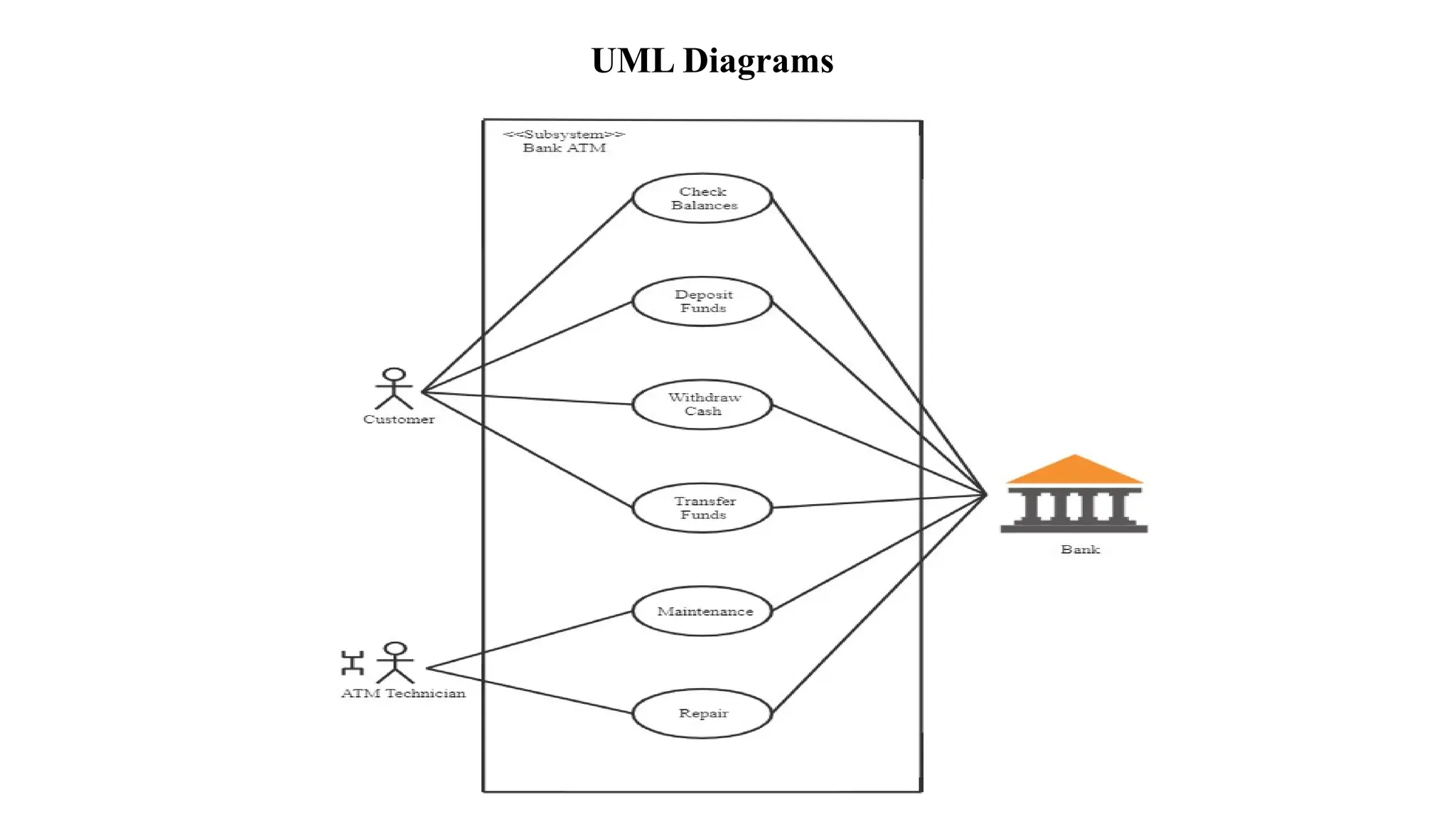
1.User interface classesdefine abstraction that mandatory for human-computer
interaction [HCI]. In cases, HCI occurs within the context of metaphor, and design
classes for the interface may be visible representations of elements of metaphor.
2.Business domain classes are often refinements of analysis classes defined earlier.
The class identifies the attributes that are required to implement some elements
of the business domain.
3.Process classes implement lower-level business Preoccupation need to manage
business domain classes.
4.Persistent classes represent the data stores that will persist beyond the
execution of software.
5.System classes implement software management and control function that
permits the system to operate and convey within its computing environment and
with the outside world

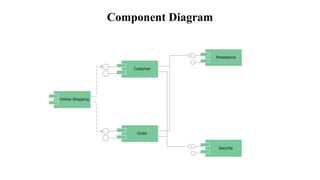
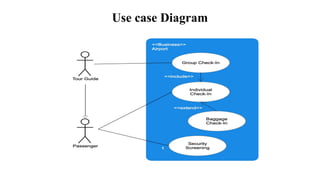
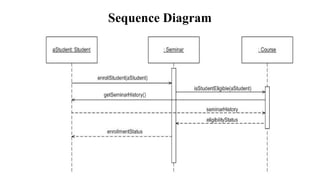
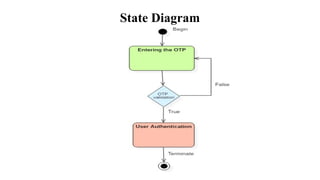

![1.User interface classes define abstraction that mandatory for human-computer
interaction [HCI]. In cases, HCI occurs within the context of metaphor, and design
classes for the interface may be visible representations of elements of metaphor.
2.Business domain classes are often refinements of analysis classes defined earlier.
The class identifies the attributes that are required to implement some elements
of the business domain.
3.Process classes implement lower-level business Preoccupation need to manage
business domain classes.
4.Persistent classes represent the data stores that will persist beyond the
execution of software.
5.System classes implement software management and control function that
permits the system to operate and convey within its computing environment and
with the outside world](https://image.slidesharecdn.com/presentation1-251008062238-03b3e661/85/Software-engineering-power-point-presentation-29-320.jpg)


