
The Descriptive/ Exploratory
           Essay


          (With thanks to Jesse Seldess)
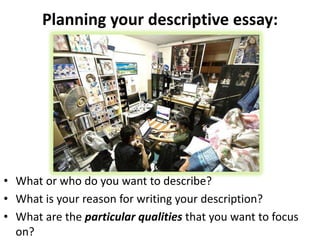
Planning your descriptive essay:


• What or who do you want to describe?
• What is your reason for writing your description?
• What are the particular qualities that you want to focus
  on?
Principles
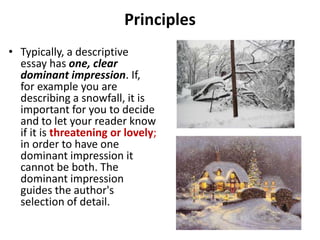
• Typically, a descriptive
  essay has one, clear
  dominant impression. If,
  for example you are
  describing a snowfall, it is
  important for you to decide
  and to let your reader know
  if it is threatening or lovely;
  in order to have one
  dominant impression it
  cannot be both. The
  dominant impression
  guides the author's
  selection of detail.
Q. What if I      A. You should think about what links
choose to write      the objects together. Do they
                     remind you of a place, group of
about 3 objects      people, events that are related? Are
                     you nostalgic when you describe
that are very        these objects? Are you sad? Are you
                     angry? Are you happy? Choose
different and        objects that have connections to
                     one another and to your past. Keep
evoke different      the essay focused on a dominant
                     impression or story about your life.
memories and
meanings?
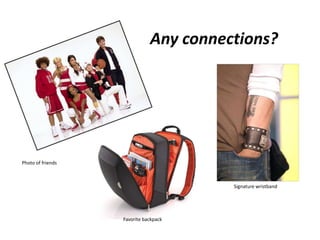
Any connections?


Photo of friends


                                        Signature wristband


                   Favorite backpack
Drafting your descriptive essay:

• What sights, sounds, smells, tastes, and
  textures are important for developing your
  description?
• Which details can you include to ensure that
  your readers gain a vivid impression imbued
  with your emotion or perspective?
• What details should be left out?
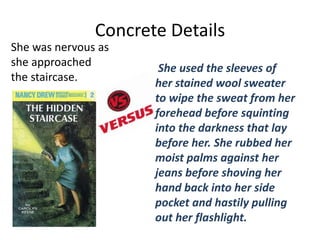
Concrete Details
She was nervous as
she approached         She used the sleeves of
the staircase.        her stained wool sweater
                      to wipe the sweat from her
                      forehead before squinting
                      into the darkness that lay
                      before her. She rubbed her
                      moist palms against her
                      jeans before shoving her
                      hand back into her side
                      pocket and hastily pulling
                      out her flashlight.
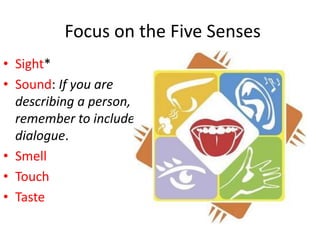
Focus on the Five Senses
• Sight*
• Sound: If you are
  describing a person,
  remember to include
  dialogue.
• Smell
• Touch
• Taste
Show: Don’t Tell
But what's the difference between showing and
  telling? Consider these two simple examples:
• I grew tired after dinner.

• As I leaned back and rested my head against
  the top of the chair, my eyelids began to feel
  heavy, and the edges of the empty plate in
  front of me blurred with the white tablecloth.
Word Choice:


• The courthouse sagged
• A black dog suffered
• Men’s stiff collars wilted
Tips for Organization
• Try moving your reader through space and
  time chronologically.
• Use a then-and-now approach to show decay,
  change, or improvement. The house where
  you grew up might now be a rambling shack.
  The variations on this strategy are endless.
• You may also use a topic-by-topic approach,
  especially if you are describing a person.
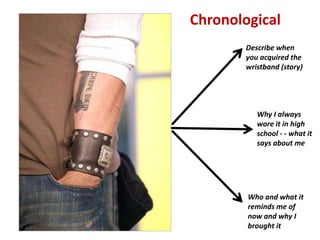
Chronological
        Describe when
        you acquired the
        wristband (story)


           Why I always
           wore it in high
           school - - what it
           says about me


        Who and what it
        reminds me of
        now and why I
        brought it
Remember to
    come up with a
    clear thesis
    statement/focus.
    However, this
    thesis does not
    necessarily have
    to come at the
    beginning of the
    essay.
In this case, you may come to your overall statement about the value of the object(s)
in your conclusion.
Revising your descriptive essay:

• Have you provided enough details and descriptions to
  enable your readers to gain a complete and vivid
  perception?
• Have you left out any minor but important details?
• Have you used words that convey your emotion or
  perspective?
• Are there any unnecessary details in your description?
• Does each paragraph of your essay focus on one aspect
  of your description?
• Are you paragraphs ordered in the most effective way?

Descriptive essay ppt 2012

  • 1.
    The Descriptive/ Exploratory Essay (With thanks to Jesse Seldess)
  • 2.
    Planning your descriptiveessay: • What or who do you want to describe? • What is your reason for writing your description? • What are the particular qualities that you want to focus on?
  • 3.
    Principles • Typically, adescriptive essay has one, clear dominant impression. If, for example you are describing a snowfall, it is important for you to decide and to let your reader know if it is threatening or lovely; in order to have one dominant impression it cannot be both. The dominant impression guides the author's selection of detail.
  • 4.
    Q. What ifI A. You should think about what links choose to write the objects together. Do they remind you of a place, group of about 3 objects people, events that are related? Are you nostalgic when you describe that are very these objects? Are you sad? Are you angry? Are you happy? Choose different and objects that have connections to one another and to your past. Keep evoke different the essay focused on a dominant impression or story about your life. memories and meanings?
  • 5.
    Any connections? Photo offriends Signature wristband Favorite backpack
  • 6.
    Drafting your descriptiveessay: • What sights, sounds, smells, tastes, and textures are important for developing your description? • Which details can you include to ensure that your readers gain a vivid impression imbued with your emotion or perspective? • What details should be left out?
  • 7.
    Concrete Details She wasnervous as she approached She used the sleeves of the staircase. her stained wool sweater to wipe the sweat from her forehead before squinting into the darkness that lay before her. She rubbed her moist palms against her jeans before shoving her hand back into her side pocket and hastily pulling out her flashlight.
  • 8.
    Focus on theFive Senses • Sight* • Sound: If you are describing a person, remember to include dialogue. • Smell • Touch • Taste
  • 9.
    Show: Don’t Tell Butwhat's the difference between showing and telling? Consider these two simple examples: • I grew tired after dinner. • As I leaned back and rested my head against the top of the chair, my eyelids began to feel heavy, and the edges of the empty plate in front of me blurred with the white tablecloth.
  • 10.
    Word Choice: • Thecourthouse sagged • A black dog suffered • Men’s stiff collars wilted
  • 11.
    Tips for Organization •Try moving your reader through space and time chronologically. • Use a then-and-now approach to show decay, change, or improvement. The house where you grew up might now be a rambling shack. The variations on this strategy are endless. • You may also use a topic-by-topic approach, especially if you are describing a person.
  • 12.
    Chronological Describe when you acquired the wristband (story) Why I always wore it in high school - - what it says about me Who and what it reminds me of now and why I brought it
  • 13.
    Remember to come up with a clear thesis statement/focus. However, this thesis does not necessarily have to come at the beginning of the essay. In this case, you may come to your overall statement about the value of the object(s) in your conclusion.
  • 14.
    Revising your descriptiveessay: • Have you provided enough details and descriptions to enable your readers to gain a complete and vivid perception? • Have you left out any minor but important details? • Have you used words that convey your emotion or perspective? • Are there any unnecessary details in your description? • Does each paragraph of your essay focus on one aspect of your description? • Are you paragraphs ordered in the most effective way?