•The Public HealthAct, 2009 Section 137 states that;
“Subject to the provisions of the Meat Industry Act, the Authority
shall make necessary procedures to ensure that all meat or
poultry intended for human consumption is inspected both at the
ante mortem and post mortem.”
Authority" means a district authority or an urban authority
3.
Objectives
• To ensurethat only apparently healthy, physiologically normal animals
are slaughtered for human consumption and that abnormal animals
are separated and dealt with accordingly
• To ensure that meat from animals is free from disease, wholesome
and of no risk to human health
4.
ANTEMORTEM AND POSTMORTEM
INSPECTION
Ante mortem Inspection
• is a health check performed on live animals before slaughter
Objectives of ante mortem inspection
• To screen all animals destined to slaughter
• To ensure that animals are properly rested and that proper clinical
information, which will assist in the disease diagnosis and judgment,
is obtained
• To reduce contamination on the killing floor by separating the dirty
animals and condemning the diseased animals if required by
regulation
• To ensure that injured animals or those with pain and suffering
receive emergency slaughter and that animals are treated humanely
5.
Ante mortem Inspection
•To identify reportable animal diseases to prevent killing floor
contamination
• To identify sick animals and those treated with antibiotics,
chemotherapeutic agents, insecticides and pesticides
• To require and ensure the cleaning and disinfection of trucks used to
transport livestock
6.
Ante mortem Inspection
•Both sides of an animal should be examined at rest and in motion
• Ante mortem examination should be done within 24 hours of slaughter
and repeated if slaughter has been delayed over a day
• Animals affected with extensive bruising or fractures require emergency
slaughter. Animals showing clinical signs of disease should be held for
veterinary examination and judgment
• They are treated as “suspects” and should be segregated from the
healthy animals.
7.
Antemortem Inspection
Antemortem inspectionshould be carried out in adequate lighting
where the animals can be observed both collectively and individually
at rest and motion.
The general behaviour of animals should be observed, as well as their
nutritional status, cleanliness, signs of diseases and abnormalities.
• Abnormalities which are checked on antemortem examination
include:
Abnormalities in respiration
Abnormalities in behaviour
Abnormalities in gait
Abnormalities in posture
Abnormalities in structure and
conformation
Abnormal discharges or protrusions from
body openings
Abnormal colour
8.
Antemortem Inspection...
Abnormalities inrespiration commonly refer to frequency of respiration. If
the breathing pattern is different from normal the animal should be
segregated as a suspect
Abnormalities in behaviour are manifested by one or more of the following
signs:
The animal may be:
• Walking in circles or show an abnormal gait or posture
• Pushing its head against a wall
• Acting aggressively
• Showing a dull and anxious expression in the eyes
9.
Antemortem Inspection...
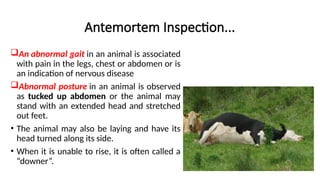
An abnormalgait in an animal is associated
with pain in the legs, chest or abdomen or is
an indication of nervous disease
Abnormal posture in an animal is observed
as tucked up abdomen or the animal may
stand with an extended head and stretched
out feet.
• The animal may also be laying and have its
head turned along its side.
• When it is unable to rise, it is often called a
“downer”.
10.
Antemortem Inspection...
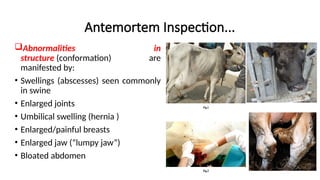
Abnormalities in
structure(conformation) are
manifested by:
• Swellings (abscesses) seen commonly
in swine
• Enlarged joints
• Umbilical swelling (hernia )
• Enlarged/painful breasts
• Enlarged jaw (“lumpy jaw”)
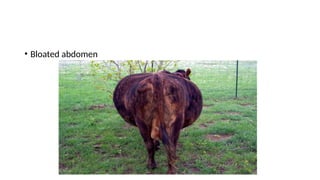
• Bloated abdomen
Antemortem Inspection...
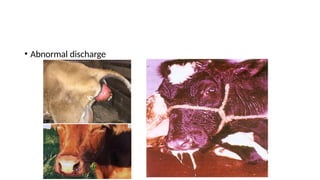
Abnormal discharge
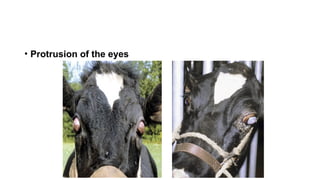
Examplesof abnormal discharges or protrusions from the body
• Discharges from the nose, excessive saliva from the mouth, afterbirth
• Protruding from the vulva, intestine
• Protruding from the rectum (prolapsed rectum) or uterus
• Protruding from the vagina (prolapsed uterus)
• Growths on the eye and bloody diarrhoea
Antemortem Inspection...
Abnormal coloursuch as black areas on horses and swine, red areas
on light coloured skin (inflammation), dark blue areas on the skin or
udder (gangrene)
An abnormal odour is difficult to detect on routine A/M examination.
The odour of an abscess, a medicinal odour, an acetone odour of
ketosis may be observed
• Since many abattoirs in developing countries have not
accommodation station or yards for animals, Inspector's antemortem
judgement must be performed at the admission of slaughter animals.
16.
Antemortem actions
• Suspectsare tagged, the inspector in charge is informed about the
findings.
• If found necessary, the suspect animal is killed in the emergency
slaughter hall or after the normal slaughter of the day is ended.
•Animals showing signs of diseases or conditions that would
necessitate condemnation of the carcase on post mortem inspection
shall be marked CONDEMNED
17.
Postmortem Inspection
Postmortem inspection
•Routine postmortem examination of a carcass should be carried out as
soon as possible after the completion of dressing in order to detect any
abnormalities so that products only conditionally fit for human
consumption are not passed as food.
• All organs and carcass portions should be kept together and correlated
for inspection before they are removed from the slaughter floor
18.
Postmortem Inspection...
Professional andtechnical knowledge to be utilized when performing
Postmortem inspection
• Postmortem inspection should involve viewing, incision, palpation and
olfaction techniques
• Classifying the lesions into one of two major categories - acute or
chronic
• Establishing whether the condition is localized or generalized
• Coordinating all the components of antemortem and postmortem
findings to make a final diagnosis
• submitting the samples to the laboratory for diagnostic support, if
abattoir has holding and refrigeration facilities for carcasses under
19.
Carcass Judgement
Trimming orcondemnation may involve
• Any portion of a carcass or a carcass that is abnormal or diseased
• Any portion of a carcass or a carcass affected with a condition that may
present a hazard to human health
• Any portion of a carcass or a carcass that may be repulsive (disgustive)
to the consumer
Localized versus generalized conditions
• It is important to differentiate between a localized or a generalized
condition in the judgement of an animal carcass.
• In a localized condition, a lesion is restricted by the animal defense
mechanisms to a certain area or organ.
20.
• Systemic changesassociated with a localized condition may also occur.
Example: jaundice caused by liver infection
• In a generalized condition, the animal's defense mechanisms are unable
to stop the spread of the disease process by way of the circulatory or
lymphatic systems.
• The lymph nodes of the carcass should be examined if pathological
lesions are generalized.
21.
Signs of ageneralized disease
• Generalized inflammation of lymph nodes including the lymph nodes
of the head, viscera and/or the lymph nodes of the carcass
• Inflammation of joints
• Lesions in different organs including liver, spleen kidneys and heart
• The presence of multiple abscesses in different portions of the carcass
including the spine of ruminants
Generalized lesions usually require more severe judgement than
localized lesions.
22.
Acute vs chronicconditions
•The acute stage is manifested by inflammation of different
organs or tissues.
•Enlarged hemorrhagic lymph nodes and hemorrhage of the
mucosal and serous membranes and different organs such as
heart, kidney and liver.
• An acute stage parallels with the generalized disease
23.
Chronic conditions
•In achronic condition, inflammation associated with congestion
is replaced by adhesions, necrotic and fibrotic tissue or
abscesses.
•The judgement in the chronic stage is less severe and
frequently the removal of affected portions is required without
the condemnation of the carcass



![CASE_PRESENTATION_ON_subdural_hematoma(SDH)[1 FINAL PPT]-1.pptx](https://cdn.slidesharecdn.com/ss_thumbnails/casepresentationonsubduralhematomasdh1finalppt-1-260129172522-d405d375-thumbnail.jpg?width=640&height=640&fit=bounds)


