Transition Management for
sustainable cities
insights from five European cities

Chris Roorda

DRIFT, Dutch Research Institute for Transitions
Erasmus University Rotterdam

Ecocities 2013, Nantes
Session RG5
25 September 2013
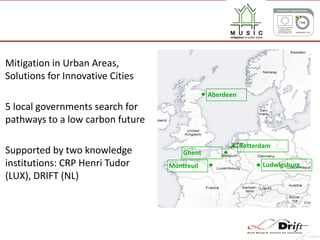
Mitigation in Urban Areas,
Solutions for Innovative Cities
Aberdeen

5 local governments search for
pathways to a low carbon future
Supported by two knowledge
institutions: CRP Henri Tudor
(LUX), DRIFT (NL)

Ghent
Montreuil

Rotterdam
Ludwigsburg
TM as a response to persistent unsustainability
• Ambitious targets, but issues are deeply rooted in societal
structures.
– need for fundamental change of paradigms, routines and structures
– complexity: non-linear; multiple actors, scales and domains involved.
– requires additional policy instruments

• Aiming for a sustainable future is about finding fundamental new
ways of thinking, working, organising – by all kinds of actors.
– impossible to ‘command and control’

• Transition Management aims to influence the pace and direction
of societal change by creating space for systems innovation
Transition Management - Basics
• Insight into the system
•

Understand dynamics and interlinkages of multiple domains, actors and scale-levels

• System innovation in incremental steps
•

Take small but radical steps, guided by a long-term perspective

• Diversity and flexibility
•

Don’t pretend the future can be predicted nor planned

• Co-creation
•

Realize everybody is a decision maker in some way

• Creating opportunities for change-agents
•

Go beyond vested interests and stakes

• Social and institutional learning
•

Take time for reflection & learning, this is essential for challenging paradigms and routines
4
Central method in TM: Transition Arena
“protected” setting with new connections
to think & act beyond business-as-usual
selective, involving± 15 change-agents
≠ stakeholders
diverse backgrounds and opinions
policy, business, civil society
complementary to “regular” policy
(and also not to be confused with participation)
Transition Management process
Problem
structuring
Vision
Agenda

Systemic
change
perspective

analysis

T-team

Transition
networks

Transition
Arena

Action
perspective

Transition
experiments
Example: Arena process in Ghent
Arena impulse concentrated in 2011
• With transition team (5 members): 4 months of
preparation
• With transition arena (17 members): 7 months
(6 meetings) from analysis to vision to agenda.
• „Launch“ at Climate Forum, 22/11/2011
Example Ghent: From understanding the
current system to vision images

Emerging
niches

• Ghent, great place to live
• Locally creating added value

• Energetic city, intelligent cycles
• Ghentenaar home in the city
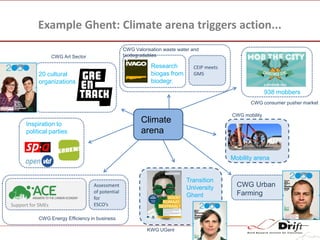
Example Ghent: Climate arena triggers action...
CWG Valorisation waste water and
biodegradables

CWG Art Sector

Research
biogas from
biodegr.

20 cultural
organizations

CEIP meets
GMS

938 mobbers
CWG consumer pusher market
CWG mobility

Climate
arena

Inspiration to
political parties

Mobility arena

Support for SMEs

Transition
University
Ghent

Assessment
of potential
for
ESCO’s

CWG Energy Efficiency in business
KWG UGent

CWG Urban
Farming
Example Ghent: Quotes from Arena Participants
Participants
“Most valuable was the dynamic atmosphere of people who want to
be the change”
“I learned a lot thanks to the different backgrounds”
“We built mutual trust, we showed openness and respect”

City officers
“I was amazed how much vigor such a group can have”
“I realized how little I knew of what is going on in my own hometown”
“This helps to get climate neutrality on the agenda in every
department”
10
Reflection

11
Experiences in 5 cities - reflecting on…
Aberdeen, Ghent, Ludwigsburg, Montreuil, Rotterdam

 about 150 interviews preparing the arenas
 arena groups in cities developed a total of 5 transition
agendas (including problem framing, vision and agenda)
 After the arena’s, 30 transition projects started up
some spin-offs, some experiments, some just seeds, even 2 new arena’s.

 All in all, the ideas and actions from the arenas reached
thousands of followers and motivated a part of them to
engage in working towards a low-carbon future.
General results within municipalities
 Better understanding of complexity and the societal
context of the low-carbon challenges through interaction
 Shifting view on participation  co-production
& inspiring contact with the change-agents

‐ More space in organization for new ways of working
it created a comfort zone to come out of the comfort zone
‐ more building upon societal dynamics
‐ more collaboration within municipality

‐ more reflexivity
‐ less SMART
Lessons learned
 Tap into city dynamics
 Explore / connect to / learn from what happens in the city

 Invest time and take time
 have patience, some things need time to grow
 selection of change-agents is key

 Don’t underestimate “setting the scene”
 preparing, creating support, finding a way that it fits in the context

 Elevate the level of knowledge of all involved
Overall outcomes of Transition Management
 Creating joined understanding & responsibility for the challenges
 Empowerment and learning
 Bundling of innovation
new networks and constellations

 Changing roles and relationships
incl interaction top-down/bottom-up and radical/moderate innovators

 Giving an impulse to a movement for a sustainable city

15
Thank you for your attention

For more information and publications:
roorda@drift.eur.nl
www.drift.eur.nl
www.themusicproject.eu
Tip: visit Eurocities Ghent, 27-29 November
17

RG5-Chris ROORDA

  • 1.
    Transition Management for sustainablecities insights from five European cities Chris Roorda DRIFT, Dutch Research Institute for Transitions Erasmus University Rotterdam Ecocities 2013, Nantes Session RG5 25 September 2013
  • 2.
    Mitigation in UrbanAreas, Solutions for Innovative Cities Aberdeen 5 local governments search for pathways to a low carbon future Supported by two knowledge institutions: CRP Henri Tudor (LUX), DRIFT (NL) Ghent Montreuil Rotterdam Ludwigsburg
  • 3.
    TM as aresponse to persistent unsustainability • Ambitious targets, but issues are deeply rooted in societal structures. – need for fundamental change of paradigms, routines and structures – complexity: non-linear; multiple actors, scales and domains involved. – requires additional policy instruments • Aiming for a sustainable future is about finding fundamental new ways of thinking, working, organising – by all kinds of actors. – impossible to ‘command and control’ • Transition Management aims to influence the pace and direction of societal change by creating space for systems innovation
  • 4.
    Transition Management -Basics • Insight into the system • Understand dynamics and interlinkages of multiple domains, actors and scale-levels • System innovation in incremental steps • Take small but radical steps, guided by a long-term perspective • Diversity and flexibility • Don’t pretend the future can be predicted nor planned • Co-creation • Realize everybody is a decision maker in some way • Creating opportunities for change-agents • Go beyond vested interests and stakes • Social and institutional learning • Take time for reflection & learning, this is essential for challenging paradigms and routines 4
  • 5.
    Central method inTM: Transition Arena “protected” setting with new connections to think & act beyond business-as-usual selective, involving± 15 change-agents ≠ stakeholders diverse backgrounds and opinions policy, business, civil society complementary to “regular” policy (and also not to be confused with participation)
  • 6.
  • 7.
    Example: Arena processin Ghent Arena impulse concentrated in 2011 • With transition team (5 members): 4 months of preparation • With transition arena (17 members): 7 months (6 meetings) from analysis to vision to agenda. • „Launch“ at Climate Forum, 22/11/2011
  • 8.
    Example Ghent: Fromunderstanding the current system to vision images Emerging niches • Ghent, great place to live • Locally creating added value • Energetic city, intelligent cycles • Ghentenaar home in the city
  • 9.
    Example Ghent: Climatearena triggers action... CWG Valorisation waste water and biodegradables CWG Art Sector Research biogas from biodegr. 20 cultural organizations CEIP meets GMS 938 mobbers CWG consumer pusher market CWG mobility Climate arena Inspiration to political parties Mobility arena Support for SMEs Transition University Ghent Assessment of potential for ESCO’s CWG Energy Efficiency in business KWG UGent CWG Urban Farming
  • 10.
    Example Ghent: Quotesfrom Arena Participants Participants “Most valuable was the dynamic atmosphere of people who want to be the change” “I learned a lot thanks to the different backgrounds” “We built mutual trust, we showed openness and respect” City officers “I was amazed how much vigor such a group can have” “I realized how little I knew of what is going on in my own hometown” “This helps to get climate neutrality on the agenda in every department” 10
  • 11.
  • 12.
    Experiences in 5cities - reflecting on… Aberdeen, Ghent, Ludwigsburg, Montreuil, Rotterdam  about 150 interviews preparing the arenas  arena groups in cities developed a total of 5 transition agendas (including problem framing, vision and agenda)  After the arena’s, 30 transition projects started up some spin-offs, some experiments, some just seeds, even 2 new arena’s.  All in all, the ideas and actions from the arenas reached thousands of followers and motivated a part of them to engage in working towards a low-carbon future.
  • 13.
    General results withinmunicipalities  Better understanding of complexity and the societal context of the low-carbon challenges through interaction  Shifting view on participation  co-production & inspiring contact with the change-agents ‐ More space in organization for new ways of working it created a comfort zone to come out of the comfort zone ‐ more building upon societal dynamics ‐ more collaboration within municipality ‐ more reflexivity ‐ less SMART
  • 14.
    Lessons learned  Tapinto city dynamics  Explore / connect to / learn from what happens in the city  Invest time and take time  have patience, some things need time to grow  selection of change-agents is key  Don’t underestimate “setting the scene”  preparing, creating support, finding a way that it fits in the context  Elevate the level of knowledge of all involved
  • 15.
    Overall outcomes ofTransition Management  Creating joined understanding & responsibility for the challenges  Empowerment and learning  Bundling of innovation new networks and constellations  Changing roles and relationships incl interaction top-down/bottom-up and radical/moderate innovators  Giving an impulse to a movement for a sustainable city 15
  • 16.
    Thank you foryour attention For more information and publications: roorda@drift.eur.nl www.drift.eur.nl www.themusicproject.eu Tip: visit Eurocities Ghent, 27-29 November
  • 17.