Gathering Open Source Information and Turning it into Intelligence [email_address] Horizon Scanning Applied:
Scope OSINF: A paradigm shift Improving the Intelligence Cycle Beyond the current framework
Key Conclusions Visualise Share Contextualise
Scope OSINF: A paradigm shift Improving the Intelligence Cycle Beyond the current framework
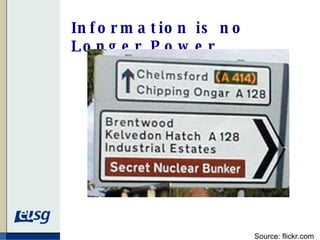
Information is no Longer Power Source: flickr.com
About OSINT  Open Source Intelligence involves: collecting information from open sources; analysing it to produce actionable recommendations.  Open sources include (inter alia): Media - newspapers, magazines, radio, television, and computer-based information (free or paying); Official data – e.g. government reports, budgets, demographics, hearings, press conferences, speeches; Professional and academic – e.g. conferences, symposia, professional associations, academic papers, and experts; Other sources - e.g. Commercial satellite imagery, weblogs, social networking on the internet, youtube videos. Source: EUROSINT FORUM
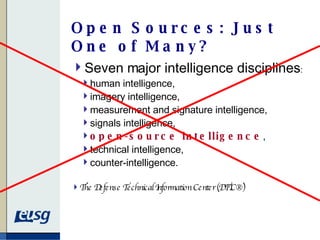
Open Sources: Just One of Many? Seven major intelligence disciplines   :  human intelligence,  imagery intelligence,  measurement and signature intelligence,  signals intelligence,  open-source intelligence ,  technical intelligence,  counter-intelligence.  The Defense Technical Information Center (DTIC®)
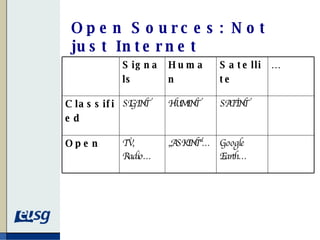
Open Sources: Not just Internet SATINT HUMINT SIGINT Classified Google Earth… „ ASKINT“… TV, Radio… Open … Satellite Human Signals
The Similarities & Differences A wide variety A wide variety Impact/speed is essential Accuracy is essential Vast quantity Limited quantity Many collectors/views Few collectors/views Can be wrong Can be wrong Open sources Classified sources
OSINF = A Flood of Information Source: Flickr.com
Hence the Challenges Complexity Information overload Immediate response fire-fighting
Key Conclusions Visualise complexity to use the right brain  Share perspectives to minimise overload Contextualise responses in the bigger picture
Scope OSINF: A new paradigm Improving the Intelligence Cycle Beyond the current framework
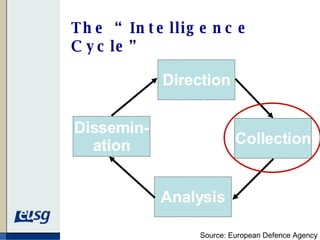
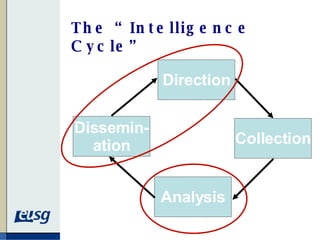
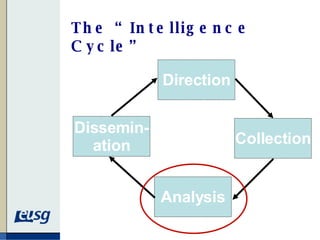
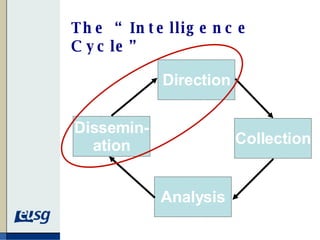
The “Intelligence Cycle” Direction Collection Analysis Dissemin- ation Source: European Defence Agency
Why the Focus on Collection? “ We have information coming out of our ears, but we just cannot analyse it. Yet governments persist in spending 95% of their budgets on collecting more information rather than filtering and analysing it!”    A government official at the EUROSINT FORUM
The “Intelligence Cycle” Direction Collection Analysis Dissemin- ation
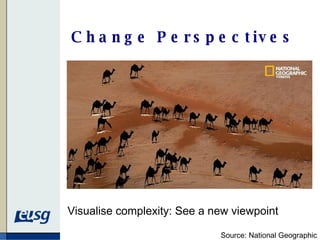
Change Perspectives Visualise complexity: See a new viewpoint Source: National Geographic
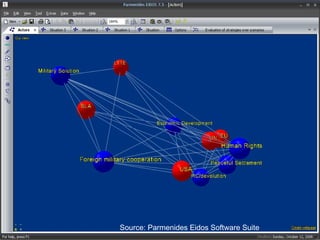
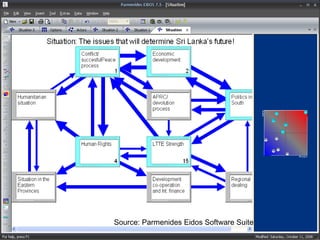
Source: Parmenides Eidos Software Suite
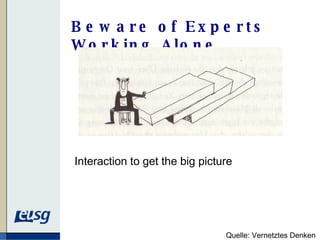
Beware of Experts Working Alone Interaction to get the big picture Quelle: Vernetztes Denken
Source:   Parmenides Eidos Software Suite
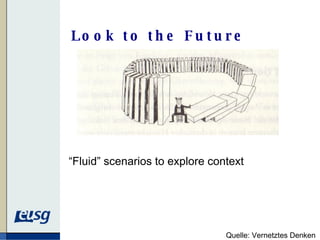
Look to the Future “ Fluid” scenarios to explore context   Quelle: Vernetztes Denken
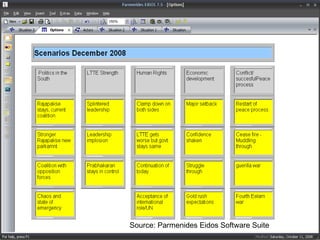
Source:   Parmenides Eidos Software Suite
Push the Limits of Scenarios Group Diversity Introduce “wild cards“/”black swans” Play and playact
The “Intelligence Cycle” Direction Collection Analysis Dissemin- ation
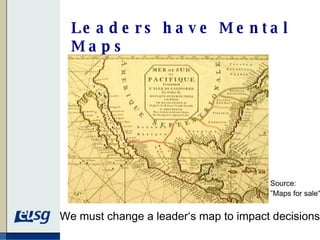
Leaders have Mental Maps We must change a leader‘s map to impact decisions  Source:   ” Maps for sale“
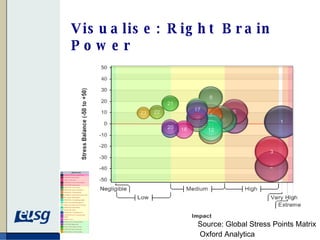
Visualise: Right Brain Power  Source: Global Stress Points Matrix Oxford Analytica
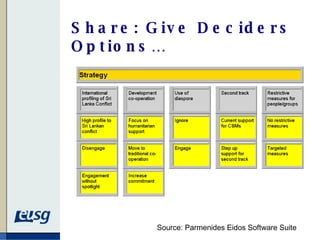
Share: Give Deciders Options… Source:   Parmenides Eidos Software Suite
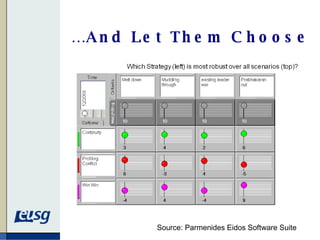
… And Let Them Choose Source:   Parmenides Eidos Software Suite
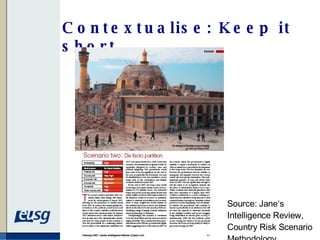
Contextualise: Keep it short… Source: Jane‘s Intelligence Review, Country Risk Scenario Methodology
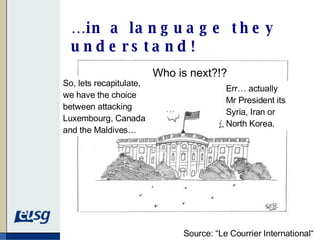
… in a language they understand! Source: “Le Courrier International“ So, lets recapitulate, we have the choice between attacking Luxembourg, Canada and the Maldives… Err… actually Mr President its Syria, Iran or North Korea. Who is next?!?
Key Conclusions Visualise Share Contextualise
Scope OSINF: A new paradigm Improving the Intelligence Cycle Beyond the current framework
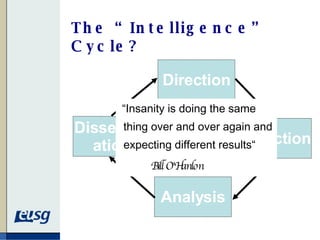
The “Intelligence” Cycle? “ Insanity is doing the same thing over and over again and expecting different results “ Bill O'Hanlon   Direction Collection Analysis Dissemin- ation
Why Scan the Horizon ? “ Luck is when planning meets opportunity“  Seneca the Younger
But who should have planned? The key actors in finance: Government Bankers Insurance brokers Hedge Fund managers Parliamentarians Media Citizens Security = Multi-Stakeholder & Public Planning
Long Term Loses to Short Term Elections in 5 not 50 years! Lobbyists: why change unless forced? Fear of revealing a problem (secrecy) So: Build pressure with society-wide debates!
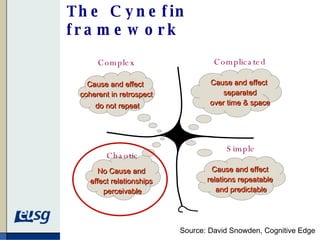
The Cynefin framework Source:   David Snowden, Cognitive Edge Simple Cause and effect  relations repeatable  and predictable Complicated Cause and effect  separated over time & space Complex Cause and effect  coherent in   retrospect do not repeat Chaotic No Cause and  effect   relationships  perceivable
Financial Meltdown: Chaos? But is the current world chaotic? Time for tools beyond reason? Source:   Rex Babin, the Sacramento Bee We must break out of the box
The Ultimate OSINT? Make citizens your analysts Keep the process public Tap the Collective Unconscious

Deriving Intelligence from Open Source Information

  • 1.
    Gathering Open SourceInformation and Turning it into Intelligence [email_address] Horizon Scanning Applied:
  • 2.
    Scope OSINF: Aparadigm shift Improving the Intelligence Cycle Beyond the current framework
  • 3.
    Key Conclusions VisualiseShare Contextualise
  • 4.
    Scope OSINF: Aparadigm shift Improving the Intelligence Cycle Beyond the current framework
  • 5.
    Information is noLonger Power Source: flickr.com
  • 6.
    About OSINT Open Source Intelligence involves: collecting information from open sources; analysing it to produce actionable recommendations. Open sources include (inter alia): Media - newspapers, magazines, radio, television, and computer-based information (free or paying); Official data – e.g. government reports, budgets, demographics, hearings, press conferences, speeches; Professional and academic – e.g. conferences, symposia, professional associations, academic papers, and experts; Other sources - e.g. Commercial satellite imagery, weblogs, social networking on the internet, youtube videos. Source: EUROSINT FORUM
  • 7.
    Open Sources: JustOne of Many? Seven major intelligence disciplines : human intelligence, imagery intelligence, measurement and signature intelligence, signals intelligence, open-source intelligence , technical intelligence, counter-intelligence. The Defense Technical Information Center (DTIC®)
  • 8.
    Open Sources: Notjust Internet SATINT HUMINT SIGINT Classified Google Earth… „ ASKINT“… TV, Radio… Open … Satellite Human Signals
  • 9.
    The Similarities &Differences A wide variety A wide variety Impact/speed is essential Accuracy is essential Vast quantity Limited quantity Many collectors/views Few collectors/views Can be wrong Can be wrong Open sources Classified sources
  • 10.
    OSINF = AFlood of Information Source: Flickr.com
  • 11.
    Hence the ChallengesComplexity Information overload Immediate response fire-fighting
  • 12.
    Key Conclusions Visualisecomplexity to use the right brain Share perspectives to minimise overload Contextualise responses in the bigger picture
  • 13.
    Scope OSINF: Anew paradigm Improving the Intelligence Cycle Beyond the current framework
  • 14.
    The “Intelligence Cycle”Direction Collection Analysis Dissemin- ation Source: European Defence Agency
  • 15.
    Why the Focuson Collection? “ We have information coming out of our ears, but we just cannot analyse it. Yet governments persist in spending 95% of their budgets on collecting more information rather than filtering and analysing it!” A government official at the EUROSINT FORUM
  • 16.
    The “Intelligence Cycle”Direction Collection Analysis Dissemin- ation
  • 17.
    The “Intelligence Cycle”Direction Collection Analysis Dissemin- ation
  • 18.
    Change Perspectives Visualisecomplexity: See a new viewpoint Source: National Geographic
  • 19.
  • 20.
    Beware of ExpertsWorking Alone Interaction to get the big picture Quelle: Vernetztes Denken
  • 21.
    Source: Parmenides Eidos Software Suite
  • 22.
    Look to theFuture “ Fluid” scenarios to explore context Quelle: Vernetztes Denken
  • 23.
    Source: Parmenides Eidos Software Suite
  • 24.
    Push the Limitsof Scenarios Group Diversity Introduce “wild cards“/”black swans” Play and playact
  • 25.
    The “Intelligence Cycle”Direction Collection Analysis Dissemin- ation
  • 26.
    Leaders have MentalMaps We must change a leader‘s map to impact decisions Source: ” Maps for sale“
  • 27.
    Visualise: Right BrainPower Source: Global Stress Points Matrix Oxford Analytica
  • 28.
    Share: Give DecidersOptions… Source: Parmenides Eidos Software Suite
  • 29.
    … And LetThem Choose Source: Parmenides Eidos Software Suite
  • 30.
    Contextualise: Keep itshort… Source: Jane‘s Intelligence Review, Country Risk Scenario Methodology
  • 31.
    … in alanguage they understand! Source: “Le Courrier International“ So, lets recapitulate, we have the choice between attacking Luxembourg, Canada and the Maldives… Err… actually Mr President its Syria, Iran or North Korea. Who is next?!?
  • 32.
    Key Conclusions VisualiseShare Contextualise
  • 33.
    Scope OSINF: Anew paradigm Improving the Intelligence Cycle Beyond the current framework
  • 34.
    The “Intelligence” Cycle?“ Insanity is doing the same thing over and over again and expecting different results “ Bill O'Hanlon Direction Collection Analysis Dissemin- ation
  • 35.
    Why Scan theHorizon ? “ Luck is when planning meets opportunity“ Seneca the Younger
  • 36.
    But who shouldhave planned? The key actors in finance: Government Bankers Insurance brokers Hedge Fund managers Parliamentarians Media Citizens Security = Multi-Stakeholder & Public Planning
  • 37.
    Long Term Losesto Short Term Elections in 5 not 50 years! Lobbyists: why change unless forced? Fear of revealing a problem (secrecy) So: Build pressure with society-wide debates!
  • 38.
    The Cynefin frameworkSource: David Snowden, Cognitive Edge Simple Cause and effect relations repeatable and predictable Complicated Cause and effect separated over time & space Complex Cause and effect coherent in retrospect do not repeat Chaotic No Cause and effect relationships perceivable
  • 39.
    Financial Meltdown: Chaos?But is the current world chaotic? Time for tools beyond reason? Source: Rex Babin, the Sacramento Bee We must break out of the box
  • 40.
    The Ultimate OSINT?Make citizens your analysts Keep the process public Tap the Collective Unconscious

Editor's Notes

  • #2 Myself: ex President of the EUROSINT FORUM