The European
Open Source Intelligence
Forum
(EUROSINT FORUM)
http://www.eurosint.eu
2
This Presentation
 What is OSINT
 Why is OSINT important?
 What objectives for the EUROSINT FORUM ?
 Who is involved?
3
Open Source Intelligence
 OSINT is an intelligence discipline that involves:
 collecting information from open sources;
 analysing it to produce actionable recommendations.
 Open sources include:
 Media - newspapers, magazines, radio, television, and computer-
based information (free or paying);
 Official data – e.g. government reports, budgets, demographics,
hearings, press conferences, speeches;
 Professional and academic – e.g. conferences, symposia,
professional associations, academic papers, and interviews with
experts;
 Other sources - e.g. Commercial satellite imagery, weblogs,
social networking on the internet, youtube videos.
4
OSINT : The old way of seeing it
 Seven major intelligence disciplines :
 human intelligence,
 imagery intelligence,
 measurement and signature intelligence,
 signals intelligence,
 open-source intelligence,
 technical intelligence,
 counter-intelligence.
 The Defense Technical Information Center (DTIC®)
5
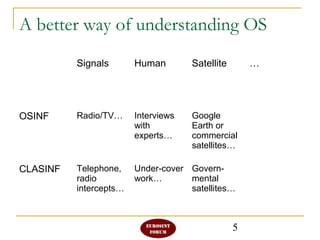
A better way of understanding OS
Signals Human Satellite …
OSINF Radio/TV… Interviews
with
experts…
Google
Earth or
commercial
satellites…
CLASINF Telephone,
radio
intercepts…
Under-cover
work…
Govern-
mental
satellites…
6
This Presentation
 What is OSINT
 Why is OSINT important?
 What objectives for the EUROSINT FORUM ?
 Who is involved?
7
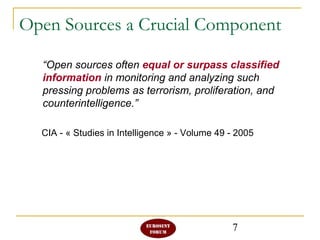
Open Sources a Crucial Component
“Open sources often equal or surpass classified
information in monitoring and analyzing such
pressing problems as terrorism, proliferation, and
counterintelligence.”
CIA - « Studies in Intelligence » - Volume 49 - 2005
8
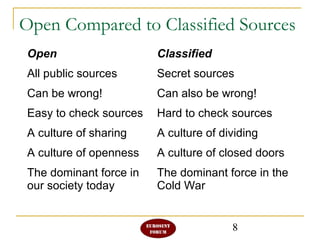
Open Compared to Classified Sources
Open Classified
All public sources Secret sources
Can be wrong! Can also be wrong!
Easy to check sources Hard to check sources
A culture of sharing A culture of dividing
A culture of openness A culture of closed doors
The dominant force in
our society today
The dominant force in the
Cold War
9
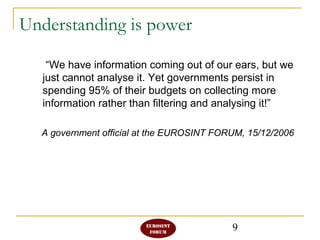
Understanding is power
“We have information coming out of our ears, but we
just cannot analyse it. Yet governments persist in
spending 95% of their budgets on collecting more
information rather than filtering and analysing it!”
A government official at the EUROSINT FORUM, 15/12/2006
10
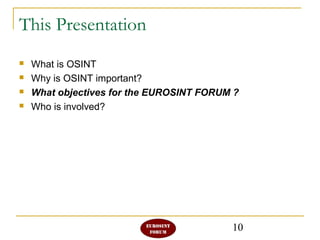
This Presentation
 What is OSINT
 Why is OSINT important?
 What objectives for the EUROSINT FORUM ?
 Who is involved?
11
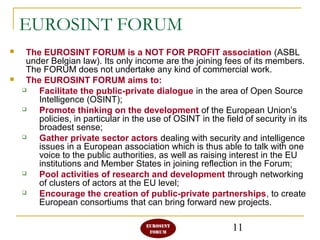
EUROSINT FORUM
 The EUROSINT FORUM is a NOT FOR PROFIT association (ASBL
under Belgian law). Its only income are the joining fees of its members.
The FORUM does not undertake any kind of commercial work.
 The EUROSINT FORUM aims to:
 Facilitate the public-private dialogue in the area of Open Source
Intelligence (OSINT);
 Promote thinking on the development of the European Union’s
policies, in particular in the use of OSINT in the field of security in its
broadest sense;
 Gather private sector actors dealing with security and intelligence
issues in a European association which is thus able to talk with one
voice to the public authorities, as well as raising interest in the EU
institutions and Member States in joining reflection in the Forum;
 Pool activities of research and development through networking
of clusters of actors at the EU level;
 Encourage the creation of public-private partnerships, to create
European consortiums that can bring forward new projects.
12
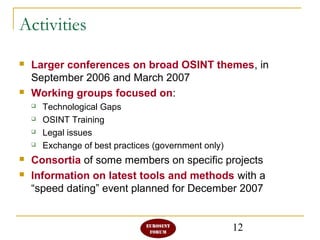
Activities
 Larger conferences on broad OSINT themes, in
September 2006 and March 2007
 Working groups focused on:
 Technological Gaps
 OSINT Training
 Legal issues
 Exchange of best practices (government only)
 Consortia of some members on specific projects
 Information on latest tools and methods with a
“speed dating” event planned for December 2007
13
The Overarching Aim
To create a European « intelligence ecology »: a
Forum dedicated to provoking thought on OSINT and
its use in the intelligence and security spheres by
public and private organisations
14
This Presentation
 What is OSINT
 Why is OSINT important?
 What objectives for the EUROSINT FORUM?
 Who is involved?
15
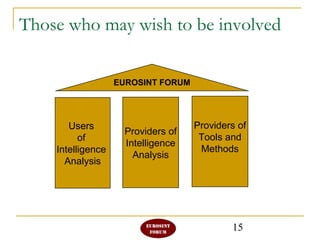
Those who may wish to be involved
Users
of
Intelligence
Analysis
Providers of
Intelligence
Analysis
Providers of
Tools and
Methods
EUROSINT FORUM
16
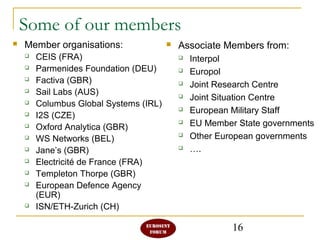
Some of our members
 Associate Members from:
 Interpol
 Europol
 Joint Research Centre
 Joint Situation Centre
 European Military Staff
 EU Member State governments
 Other European governments
 ….
 Member organisations:
 CEIS (FRA)
 Parmenides Foundation (DEU)
 Factiva (GBR)
 Sail Labs (AUS)
 Columbus Global Systems (IRL)
 I2S (CZE)
 Oxford Analytica (GBR)
 WS Networks (BEL)
 Jane’s (GBR)
 Electricité de France (FRA)
 Templeton Thorpe (GBR)
 European Defence Agency
(EUR)
 ISN/ETH-Zurich (CH)
17
Contact Us
Please write to Caroline Calvez,
secretary of the EUROSINT FORUM:
Caroline.Calvez@eurosint.eu

Eurosint Forum Presentation

  • 1.
    The European Open SourceIntelligence Forum (EUROSINT FORUM) http://www.eurosint.eu
  • 2.
    2 This Presentation  Whatis OSINT  Why is OSINT important?  What objectives for the EUROSINT FORUM ?  Who is involved?
  • 3.
    3 Open Source Intelligence OSINT is an intelligence discipline that involves:  collecting information from open sources;  analysing it to produce actionable recommendations.  Open sources include:  Media - newspapers, magazines, radio, television, and computer- based information (free or paying);  Official data – e.g. government reports, budgets, demographics, hearings, press conferences, speeches;  Professional and academic – e.g. conferences, symposia, professional associations, academic papers, and interviews with experts;  Other sources - e.g. Commercial satellite imagery, weblogs, social networking on the internet, youtube videos.
  • 4.
    4 OSINT : Theold way of seeing it  Seven major intelligence disciplines :  human intelligence,  imagery intelligence,  measurement and signature intelligence,  signals intelligence,  open-source intelligence,  technical intelligence,  counter-intelligence.  The Defense Technical Information Center (DTIC®)
  • 5.
    5 A better wayof understanding OS Signals Human Satellite … OSINF Radio/TV… Interviews with experts… Google Earth or commercial satellites… CLASINF Telephone, radio intercepts… Under-cover work… Govern- mental satellites…
  • 6.
    6 This Presentation  Whatis OSINT  Why is OSINT important?  What objectives for the EUROSINT FORUM ?  Who is involved?
  • 7.
    7 Open Sources aCrucial Component “Open sources often equal or surpass classified information in monitoring and analyzing such pressing problems as terrorism, proliferation, and counterintelligence.” CIA - « Studies in Intelligence » - Volume 49 - 2005
  • 8.
    8 Open Compared toClassified Sources Open Classified All public sources Secret sources Can be wrong! Can also be wrong! Easy to check sources Hard to check sources A culture of sharing A culture of dividing A culture of openness A culture of closed doors The dominant force in our society today The dominant force in the Cold War
  • 9.
    9 Understanding is power “Wehave information coming out of our ears, but we just cannot analyse it. Yet governments persist in spending 95% of their budgets on collecting more information rather than filtering and analysing it!” A government official at the EUROSINT FORUM, 15/12/2006
  • 10.
    10 This Presentation  Whatis OSINT  Why is OSINT important?  What objectives for the EUROSINT FORUM ?  Who is involved?
  • 11.
    11 EUROSINT FORUM  TheEUROSINT FORUM is a NOT FOR PROFIT association (ASBL under Belgian law). Its only income are the joining fees of its members. The FORUM does not undertake any kind of commercial work.  The EUROSINT FORUM aims to:  Facilitate the public-private dialogue in the area of Open Source Intelligence (OSINT);  Promote thinking on the development of the European Union’s policies, in particular in the use of OSINT in the field of security in its broadest sense;  Gather private sector actors dealing with security and intelligence issues in a European association which is thus able to talk with one voice to the public authorities, as well as raising interest in the EU institutions and Member States in joining reflection in the Forum;  Pool activities of research and development through networking of clusters of actors at the EU level;  Encourage the creation of public-private partnerships, to create European consortiums that can bring forward new projects.
  • 12.
    12 Activities  Larger conferenceson broad OSINT themes, in September 2006 and March 2007  Working groups focused on:  Technological Gaps  OSINT Training  Legal issues  Exchange of best practices (government only)  Consortia of some members on specific projects  Information on latest tools and methods with a “speed dating” event planned for December 2007
  • 13.
    13 The Overarching Aim Tocreate a European « intelligence ecology »: a Forum dedicated to provoking thought on OSINT and its use in the intelligence and security spheres by public and private organisations
  • 14.
    14 This Presentation  Whatis OSINT  Why is OSINT important?  What objectives for the EUROSINT FORUM?  Who is involved?
  • 15.
    15 Those who maywish to be involved Users of Intelligence Analysis Providers of Intelligence Analysis Providers of Tools and Methods EUROSINT FORUM
  • 16.
    16 Some of ourmembers  Associate Members from:  Interpol  Europol  Joint Research Centre  Joint Situation Centre  European Military Staff  EU Member State governments  Other European governments  ….  Member organisations:  CEIS (FRA)  Parmenides Foundation (DEU)  Factiva (GBR)  Sail Labs (AUS)  Columbus Global Systems (IRL)  I2S (CZE)  Oxford Analytica (GBR)  WS Networks (BEL)  Jane’s (GBR)  Electricité de France (FRA)  Templeton Thorpe (GBR)  European Defence Agency (EUR)  ISN/ETH-Zurich (CH)
  • 17.
    17 Contact Us Please writeto Caroline Calvez, secretary of the EUROSINT FORUM: Caroline.Calvez@eurosint.eu