EE 201 dependent sources – 1
Dependent sources
As we begin to use simple circuits to model more complex circuit
behavior, we need to add some items to our tool kit.
Dependent sources behave just like independent voltage and current
sources, except that the voltage or current depends in some way on
another voltage or current in the circuit.
This seems a bit odd, but this behavior corresponds very closely to the
way a number of interesting and useful electronic devices behave.
We’re not to try to get a detailed understanding of how these devices
work internally – that’s the subject for an electronics or semiconductor
class. However, we can form a reasonable model of how the
electronic devices behaves in a circuit by using dependent sources.
EE 201 dependent sources – 2
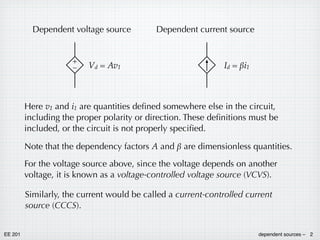
–
+
Dependent voltage source
Vd = Av1
Dependent current source
Id = βi1
Here v1 and i1 are quantities defined somewhere else in the circuit,
including the proper polarity or direction. These definitions must be
included, or the circuit is not properly specified.
Note that the dependency factors A and β are dimensionless quantities.
For the voltage source above, since the voltage depends on another
voltage, it is known as a voltage-controlled voltage source (VCVS).
Similarly, the current would be called a current-controlled current
source (CCCS).
EE 201 dependent sources – 3
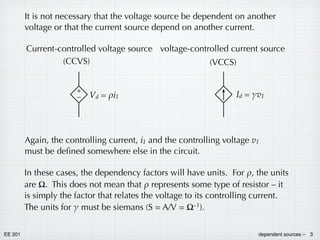
It is not necessary that the voltage source be dependent on another
voltage or that the current source depend on another current.
–
+
Current-controlled voltage source
Vd = ρi1 Id = γv1
voltage-controlled current source
Again, the controlling current, i1 and the controlling voltage v1
must be defined somewhere else in the circuit.
In these cases, the dependency factors will have units. For ρ, the units
are Ω. This does not mean that ρ represents some type of resistor – it
is simply the factor that relates the voltage to its controlling current.
The units for γ must be siemans (S = A/V = Ω–1).
(CCVS) (VCCS)
EE 201 dependent sources – 4
Once the dependent source are located in circuit, along with the
definitions for the controlling currents or voltages, then circuit analysis
proceeds as always. Kirchoff’s current and voltage laws still apply and
all of the techniques derived from those still apply. In particular,
voltage dividers, the node-voltage method, and the loop current
technique are unchanged.
Source transformations must be used with caution. Since the
dependent source in defined in terms of a particular voltage or current,
you must be careful about changing the definitions – the overall circuit
behavior must remain unchanged.
EE 201 dependent sources – 5
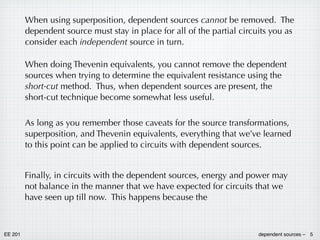
When using superposition, dependent sources cannot be removed. The
dependent source must stay in place for all of the partial circuits you as
consider each independent source in turn.
When doing Thevenin equivalents, you cannot remove the dependent
sources when trying to determine the equivalent resistance using the
short-cut method. Thus, when dependent sources are present, the
short-cut technique become somewhat less useful.
As long as you remember those caveats for the source transformations,
superposition, and Thevenin equivalents, everything that we’ve learned
to this point can be applied to circuits with dependent sources.
Finally, in circuits with the dependent sources, energy and power may
not balance in the manner that we have expected for circuits that we
have seen up till now. This happens because the
EE 201 dependent sources – 6
+
–
+
–
R1
R2
–
+
vR2 AvR2
R3
R4
–
+
vR4
VS
Example 1 (amplifier)
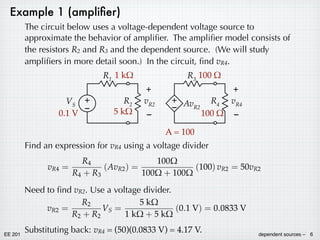
The circuit below uses a voltage-dependent voltage source to
approximate the behavior of amplifier. The amplifier model consists of
the resistors R2 and R3 and the dependent source. (We will study
amplifiers in more detail soon.) In the circuit, find vR4.
0.1 V
1 k!
5 k!
100 !
100 !
A = 100
Find an expression for vR4 using a voltage divider
Need to find vR2. Use a voltage divider.
vR2 =
R2
R2 + R2
VS =
5 kΩ
1 kΩ + 5 kΩ
(0.1 V) = 0.0833 V
Substituting back: vR4 = (50)(0.0833 V) = 4.17 V.
vR4 =
R4
R4 + R3
(AvR2) =
100Ω
100Ω + 100Ω
(100) vR2 = 50vR2
EE 201 dependent sources – 7
Example 2 (transistors)
A bipolar junction transistor (BJT) is an extremely non-linear (but
extremely useful!) circuit element that will studied in detail in EE 230
(and later).
Even though it is fundamentally non-linear, in one particular mode of
operation it behaves in a somewhat linear fashion and can be modeled
using linear components, as shown at right. The primary feature of the
BJT in this mode is current gain – a small current (iB) flowing in at one
terminal leads to an “amplified” current flowing in another terminal.
B
C
E
iB
iC
modeled as
+
–
VBE
iB
IC
= βiB
B
E
C
= 0.7 V
EE 201 dependent sources – 8
A BJT is used in a circuit as shown
at right. Use the circuit to find the
resistor voltage vRC. For the
transistor β = 100.
B
C
E
iB iC
+
–
+
–
VSB
VSC
RB
RC
– +
vRC
+
–
VBE
iB
IC
= βiB
B
E
C
+
–
+
–
RB
RC
– vRC +
VSB
VSC
= 0.7 V
3 V
10 V
100 k!
2 k!
3 V
100 k!
2 k!
10 V
Around the left-hand loop:
VSB – iBRB – VBE = 0.
VSB VBE
RB
=
3 V 0.7 V
100 kΩ
= 0.023 mA
On the right: IC = βiB = (100)(0.023 mA) = 2.3 mA.
Then: vRC = RCIC = (2 k!)(2.3 mA) = 4.6 V. So easy!
EE 201 dependent sources – 9
Example 3 (node-voltage)
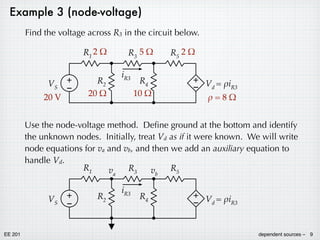
Find the voltage across R3 in the circuit below.
ρ = 8 !
Use the node-voltage method. Define ground at the bottom and identify
the unknown nodes. Initially, treat Vd as if it were known. We will write
node equations for va and vb, and then we add an auxiliary equation to
handle Vd.
+
–
+
–
VS
R1 R3
R5
R2
R4 Vd
= ρiR3
iR3
20 V
2 !
20 !
5 ! 2 !
10 !
va
vb
+
–
+
–
VS
R1 R3
R5
R2
R4 Vd
= ρiR3
iR3
EE 201 dependent sources – 10
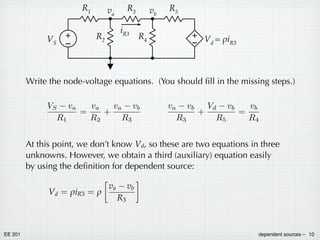
Write the node-voltage equations. (You should fill in the missing steps.)
VS va
R1
=
va
R2
+
va vb
R3
va vb
R3
+
Vd vb
R5
=
vb
R4
At this point, we don’t know Vd, so these are two equations in three
unknowns. However, we obtain a third (auxiliary) equation easily
by using the definition for dependent source:
va
vb
+
–
+
–
VS
R1 R3
R5
R2
R4 Vd
= ρiR3
iR3
Vd = ρiR3 = ρ
va vb
R3
EE 201 dependent sources – 11
Inserting the expression for Vd into the second node-voltage
equation:
Along with the first node-voltage equation,
this gives us two equations in the two
unknowns.
Solving gives: va = 16 V and vb = 10 V, and the
voltage across R3 is va – vb = 6 V.
va vb
R3
+
1
R5
ρ
va vb
R3
vb =
vb
R4
VS va
R1
=
va
R2
+
va vb
R3
1 +
R1
R2
+
R1
R3
va
R1
R3
vb = VS
1 +
ρ
R5
va + 1 +
ρ
R5
+
R3
R5
+
R3
R4
vb = 0
1.5va 0.4vb = 20 V
5va + 8vb = 0
Working out the algebra: Inserting numbers:

dependent_sources.pdf

  • 1.
    EE 201 dependentsources – 1 Dependent sources As we begin to use simple circuits to model more complex circuit behavior, we need to add some items to our tool kit. Dependent sources behave just like independent voltage and current sources, except that the voltage or current depends in some way on another voltage or current in the circuit. This seems a bit odd, but this behavior corresponds very closely to the way a number of interesting and useful electronic devices behave. We’re not to try to get a detailed understanding of how these devices work internally – that’s the subject for an electronics or semiconductor class. However, we can form a reasonable model of how the electronic devices behaves in a circuit by using dependent sources.
  • 2.
    EE 201 dependentsources – 2 – + Dependent voltage source Vd = Av1 Dependent current source Id = βi1 Here v1 and i1 are quantities defined somewhere else in the circuit, including the proper polarity or direction. These definitions must be included, or the circuit is not properly specified. Note that the dependency factors A and β are dimensionless quantities. For the voltage source above, since the voltage depends on another voltage, it is known as a voltage-controlled voltage source (VCVS). Similarly, the current would be called a current-controlled current source (CCCS).
  • 3.
    EE 201 dependentsources – 3 It is not necessary that the voltage source be dependent on another voltage or that the current source depend on another current. – + Current-controlled voltage source Vd = ρi1 Id = γv1 voltage-controlled current source Again, the controlling current, i1 and the controlling voltage v1 must be defined somewhere else in the circuit. In these cases, the dependency factors will have units. For ρ, the units are Ω. This does not mean that ρ represents some type of resistor – it is simply the factor that relates the voltage to its controlling current. The units for γ must be siemans (S = A/V = Ω–1). (CCVS) (VCCS)
  • 4.
    EE 201 dependentsources – 4 Once the dependent source are located in circuit, along with the definitions for the controlling currents or voltages, then circuit analysis proceeds as always. Kirchoff’s current and voltage laws still apply and all of the techniques derived from those still apply. In particular, voltage dividers, the node-voltage method, and the loop current technique are unchanged. Source transformations must be used with caution. Since the dependent source in defined in terms of a particular voltage or current, you must be careful about changing the definitions – the overall circuit behavior must remain unchanged.
  • 5.
    EE 201 dependentsources – 5 When using superposition, dependent sources cannot be removed. The dependent source must stay in place for all of the partial circuits you as consider each independent source in turn. When doing Thevenin equivalents, you cannot remove the dependent sources when trying to determine the equivalent resistance using the short-cut method. Thus, when dependent sources are present, the short-cut technique become somewhat less useful. As long as you remember those caveats for the source transformations, superposition, and Thevenin equivalents, everything that we’ve learned to this point can be applied to circuits with dependent sources. Finally, in circuits with the dependent sources, energy and power may not balance in the manner that we have expected for circuits that we have seen up till now. This happens because the
  • 6.
    EE 201 dependentsources – 6 + – + – R1 R2 – + vR2 AvR2 R3 R4 – + vR4 VS Example 1 (amplifier) The circuit below uses a voltage-dependent voltage source to approximate the behavior of amplifier. The amplifier model consists of the resistors R2 and R3 and the dependent source. (We will study amplifiers in more detail soon.) In the circuit, find vR4. 0.1 V 1 k! 5 k! 100 ! 100 ! A = 100 Find an expression for vR4 using a voltage divider Need to find vR2. Use a voltage divider. vR2 = R2 R2 + R2 VS = 5 kΩ 1 kΩ + 5 kΩ (0.1 V) = 0.0833 V Substituting back: vR4 = (50)(0.0833 V) = 4.17 V. vR4 = R4 R4 + R3 (AvR2) = 100Ω 100Ω + 100Ω (100) vR2 = 50vR2
  • 7.
    EE 201 dependentsources – 7 Example 2 (transistors) A bipolar junction transistor (BJT) is an extremely non-linear (but extremely useful!) circuit element that will studied in detail in EE 230 (and later). Even though it is fundamentally non-linear, in one particular mode of operation it behaves in a somewhat linear fashion and can be modeled using linear components, as shown at right. The primary feature of the BJT in this mode is current gain – a small current (iB) flowing in at one terminal leads to an “amplified” current flowing in another terminal. B C E iB iC modeled as + – VBE iB IC = βiB B E C = 0.7 V
  • 8.
    EE 201 dependentsources – 8 A BJT is used in a circuit as shown at right. Use the circuit to find the resistor voltage vRC. For the transistor β = 100. B C E iB iC + – + – VSB VSC RB RC – + vRC + – VBE iB IC = βiB B E C + – + – RB RC – vRC + VSB VSC = 0.7 V 3 V 10 V 100 k! 2 k! 3 V 100 k! 2 k! 10 V Around the left-hand loop: VSB – iBRB – VBE = 0. VSB VBE RB = 3 V 0.7 V 100 kΩ = 0.023 mA On the right: IC = βiB = (100)(0.023 mA) = 2.3 mA. Then: vRC = RCIC = (2 k!)(2.3 mA) = 4.6 V. So easy!
  • 9.
    EE 201 dependentsources – 9 Example 3 (node-voltage) Find the voltage across R3 in the circuit below. ρ = 8 ! Use the node-voltage method. Define ground at the bottom and identify the unknown nodes. Initially, treat Vd as if it were known. We will write node equations for va and vb, and then we add an auxiliary equation to handle Vd. + – + – VS R1 R3 R5 R2 R4 Vd = ρiR3 iR3 20 V 2 ! 20 ! 5 ! 2 ! 10 ! va vb + – + – VS R1 R3 R5 R2 R4 Vd = ρiR3 iR3
  • 10.
    EE 201 dependentsources – 10 Write the node-voltage equations. (You should fill in the missing steps.) VS va R1 = va R2 + va vb R3 va vb R3 + Vd vb R5 = vb R4 At this point, we don’t know Vd, so these are two equations in three unknowns. However, we obtain a third (auxiliary) equation easily by using the definition for dependent source: va vb + – + – VS R1 R3 R5 R2 R4 Vd = ρiR3 iR3 Vd = ρiR3 = ρ va vb R3
  • 11.
    EE 201 dependentsources – 11 Inserting the expression for Vd into the second node-voltage equation: Along with the first node-voltage equation, this gives us two equations in the two unknowns. Solving gives: va = 16 V and vb = 10 V, and the voltage across R3 is va – vb = 6 V. va vb R3 + 1 R5 ρ va vb R3 vb = vb R4 VS va R1 = va R2 + va vb R3 1 + R1 R2 + R1 R3 va R1 R3 vb = VS 1 + ρ R5 va + 1 + ρ R5 + R3 R5 + R3 R4 vb = 0 1.5va 0.4vb = 20 V 5va + 8vb = 0 Working out the algebra: Inserting numbers: