OBJECTIVES
What iswater line disinfection system
Waterline in dental unit is accessed
If not treated the water what is the cause effected
How to improve the water quality and monitor
Cleaning of dental unit waterline system
Training and educating
3.
Introduction
Outbreaks ofwaterborne disease have occurred in a
broad range of facilities although there is no evidence
of a widespread public-health problem, published
reports have associated illness with exposure to water
from dental units. The fact that bacteria capable of
causing disease in human beings are found in DUWLs
is reason for concern.
In community water, the number of water borne
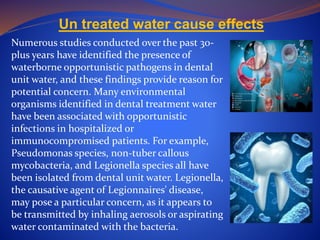
bacteria is kept to fewer than 500 colony-forming units
(CFUs) per milliliter
4.
Introduction….cont.
The waterfrom air-water syringes & dental hand
pieces often has bacterial levels hundreds or
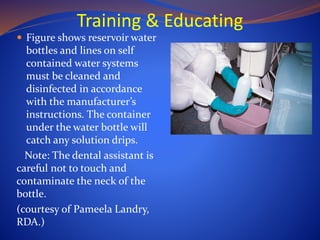
thousands of times greater than those permissible in
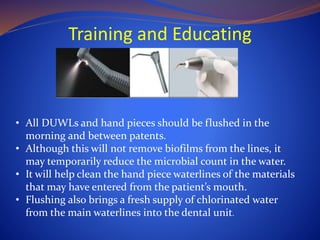
drinking water.
The types of bacteria that are found in dental-unit
water are frequently the same types found in
community water, but the levels of bacteria found in
the dental units are almost always higher.
5.
Background
Dental healthcareworkers are exposed to legionella
bacteria at a much higher rate than are members of the
general public.
Dental personnel are exposed to contaminated DUWLs
through inhalation of the aerosol generated by the hand
piece and air-water syringe
At least one suspected fatality of a dentist resulting from
legionellosis has been recorded.
Published case reports have described
immunocompromised patients in whom post operative
infections developed as a result of contaminated dental
water.
6.
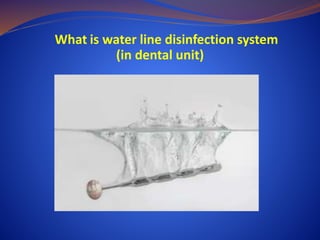
What is waterline disinfection system
(in dental unit)
7.
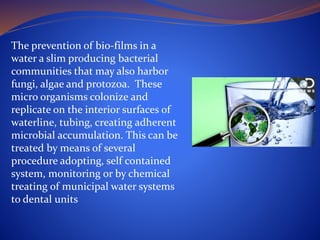
The prevention ofbio-films in a
water a slim producing bacterial
communities that may also harbor
fungi, algae and protozoa. These
micro organisms colonize and
replicate on the interior surfaces of
waterline, tubing, creating adherent
microbial accumulation. This can be
treated by means of several
procedure adopting, self contained
system, monitoring or by chemical
treating of municipal water systems
to dental units
8.
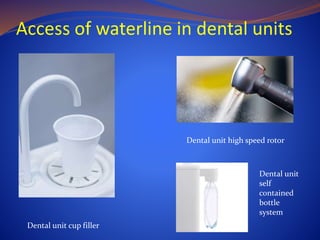
Access of waterlinein dental units
Dental unit cup filler
Dental unit high speed rotor
Dental unit
self
contained
bottle
system
9.
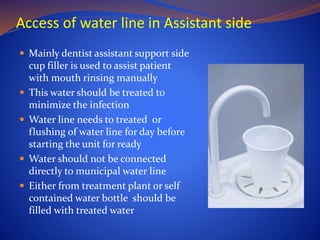
Access of waterline in Assistant side
Mainly dentist assistant support side
cup filler is used to assist patient
with mouth rinsing manually
This water should be treated to
minimize the infection
Water line needs to treated or
flushing of water line for day before
starting the unit for ready
Water should not be connected
directly to municipal water line
Either from treatment plant or self
contained water bottle should be
filled with treated water
10.
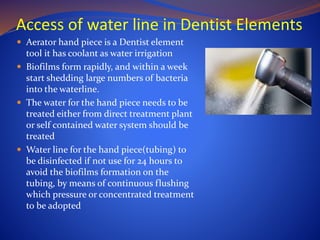
Access of waterline in Dentist Elements
Aerator hand piece is a Dentist element
tool it has coolant as water irrigation
Biofilms form rapidly, and within a week
start shedding large numbers of bacteria
into the waterline.
The water for the hand piece needs to be
treated either from direct treatment plant
or self contained water system should be
treated
Water line for the hand piece(tubing) to
be disinfected if not use for 24 hours to
avoid the biofilms formation on the
tubing, by means of continuous flushing
which pressure or concentrated treatment
to be adopted
11.
Access of waterline in Dentist Elements
The primary source of microorganisms in DUWLs is
the public water supply.
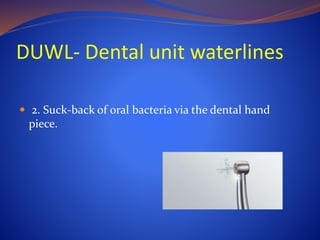
Saliva can be retracted into DUWLs during treatment.
This process is called “suck back”.
Non retraction valves (NRV) on dental units or for
hand piece coupling and thorough flushing of dental
lines between patients minimize the chance of suck
back.
12.
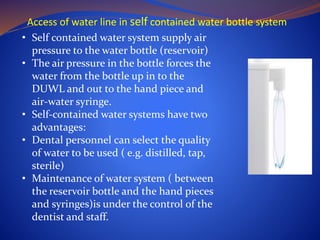
Access of waterline in self contained water bottle system
• Self contained water system supply air
pressure to the water bottle (reservoir)
• The air pressure in the bottle forces the
water from the bottle up in to the
DUWL and out to the hand piece and
air-water syringe.
• Self-contained water systems have two
advantages:
• Dental personnel can select the quality
of water to be used ( e.g. distilled, tap,
sterile)
• Maintenance of water system ( between
the reservoir bottle and the hand pieces
and syringes)is under the control of the
dentist and staff.
13.
DUWL- Dental unitwaterlines
2. Suck-back of oral bacteria via the dental hand
piece.
14.
DUWL methods ofmaintaining
Disinfect reservoir bottles with a biocide before refilling to
prevent biofilm formation in both the bottle and the
waterlines.
Drain down the DUWL at the end of the day. Self-
contained water bottles should be removed, disinfected
with a compatible biocide, flushed with distilled or reverse
osmosis water and left open to air dry. Store inverted
overnight. If you are using a system where the
manufacturers don’t recommend the removal of the bottle
then this advice should be followed.
Flush dental chairs that are not used, or sporadically used,
at least twice a week
15.
DUWL- Dental unitwaterlines
Dental Unit Waterlines (DUWL) can be
contaminated by microbes coming from three
different sources:
1. Incoming mains water which is a possible source of
legionella and mycobacteria spp.
16.
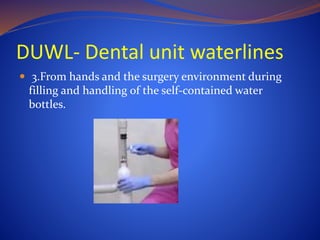
DUWL- Dental unitwaterlines
3.From hands and the surgery environment during
filling and handling of the self-contained water
bottles.
17.
Un treated watercause effects
Numerous studies conducted over the past 30-
plus years have identified the presence of
waterborne opportunistic pathogens in dental
unit water, and these findings provide reason for
potential concern. Many environmental
organisms identified in dental treatment water
have been associated with opportunistic
infections in hospitalized or
immunocompromised patients. For example,
Pseudomonas species, non-tuber callous
mycobacteria, and Legionella species all have
been isolated from dental unit water. Legionella,
the causative agent of Legionnaires' disease,
may pose a particular concern, as it appears to
be transmitted by inhaling aerosols or aspirating
water contaminated with the bacteria.
18.
Key Disease CausingMicrobes in DUWL
A variety of organisms are found in DUWL including
bacteria, fungi and protozoa. Of particular concern to
health are the respiratory disease causing bacteria such
as legionella spp, atypical mycobacterium spp and
pseudomonas spp
NOTE – spp means species
19.
Key Disease CausingMicrobes in DUWL
The high speed rotation of the air turbine aerosolizes the
DUWL microbes providing a route of transmission
particularly for respiratory bacteria.
Contaminated aerosols can be inhaled (portal of entry
described in the chain of infection) by both the dental
team and patients during treatment.
The dental team is exposed to contaminated aerosols on a
daily basis over the long term, and patients are exposed in
the short term during treatments.
The overall microbial quality is also of importance as high
levels of bacteria in DUWL have been associated with
occupational asthma in dentists.
20.
How to improvewater quality
• Independent water reservoirs –
dedicated water tank with centralized
treatment plant
• Chemical treatment regimens
• Source water treatment systems- inbuilt
water treatment system in dental unit
• Daily draining and air purging regimens
– flush of water from line during daily
start up, drying the line at the end of the
day ( flush out water & air)
• Point-of-use filters – bacterial filter in
each stage of water line
• DUWL – dental unit water line system,
self disinfection of line procedure
adaptation on dental units
21.
DUWL methods ofmaintaining
In order to prevent back-siphonage of clinical material
into the municipal water supply, all dental equipment
that is supplied by mains water must have a ‘Type A’ air
gap separating it from the mains water.
Flush the DUWL at the start of every day for two
minutes, and between patients for 20-30 seconds.
Manufacturer guidelines should be followed for the
end of day procedure. Flushing reduces the number of
free floating bacteria but has no impact on biofilm
formation. Therefore flushing is insufficient on its
own to control the bacterial count in the DUWL.
22.
DUWL methods ofmaintaining
Use continuous or short purges of disinfection with a
biocide (daily or weekly according to the
manufacturer’s instructions). Only use a product that
is compatible with your dental chair.
Service and maintain dental hand piece anti-retraction
valves and DUWL waterlines check valves.
Use distilled or reverse osmosis water in the self-
contained water bottle. Tap water is to be avoided as
this will introduce respiratory bacteria into the
DUWL.
23.
Training & Educating
Figure shows reservoir water
bottles and lines on self
contained water systems
must be cleaned and
disinfected in accordance
with the manufacturer’s
instructions. The container
under the water bottle will
catch any solution drips.
Note: The dental assistant is
careful not to touch and
contaminate the neck of the
bottle.
(courtesy of Pameela Landry,
RDA.)
24.
Training and Educating
•All DUWLs and hand pieces should be flushed in the
morning and between patents.
• Although this will not remove biofilms from the lines, it
may temporarily reduce the microbial count in the water.
• It will help clean the hand piece waterlines of the materials
that may have entered from the patient’s mouth.
• Flushing also brings a fresh supply of chlorinated water
from the main waterlines into the dental unit.
25.
Training and Educating
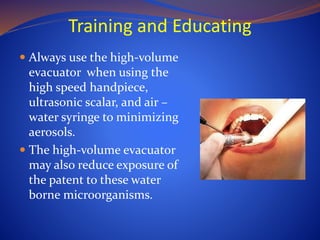
Always use the high-volume
evacuator when using the
high speed handpiece,
ultrasonic scalar, and air –
water syringe to minimizing
aerosols.
The high-volume evacuator
may also reduce exposure of
the patent to these water
borne microorganisms.
26.
Training and Educating
USEProactive Barriers
The dental dam greatly reduces direct contact
The dam also greatly reduces the aerosolization
and spattering of the patient’s oral
microorganisms on to the dental team.
Protective barriers, including masks, eyewear, and
face shields, also serve as barriers for the dental
team.
27.
Reference & Resource
Organization for Safety, Asepsis and Prevention.
Dental Unit Waterlines: Dental unit waterline fact
sheet.
USAF Dental Evaluation & consultation service Dental
Unit Waterlines
www.osap.org for a dental knowledge center.




![Infection Control Guidelines for Dental Clinics [compatibility mode]](https://cdn.slidesharecdn.com/ss_thumbnails/icguidelinesfordentalclinicscompatibilitymode-131231001855-phpapp01-thumbnail.jpg?width=640&height=640&fit=bounds)
![Infection Control Guidelines for Dental Clinics [compatibility mode]](https://cdn.slidesharecdn.com/ss_thumbnails/icguidelinesfordentalclinicscompatibilitymode-131231000324-phpapp02-thumbnail.jpg?width=640&height=640&fit=bounds)


