Asperger syndrome and the interbrainDigby TantamClinical Professor of Psychotherapy, University of Sheffield
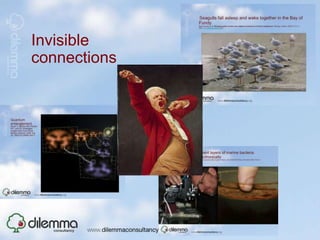
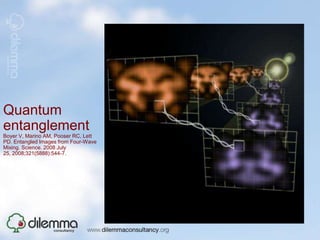
Quantum entanglementBoyer V, Marino AM, Pooser RC, Lett PD. Entangled Images from Four-Wave Mixing. Science. 2008 July 25, 2008;321(5888):544-7.
Invisible connections
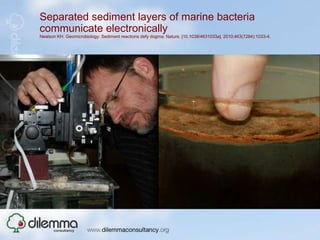
Separated sediment layers of marine bacteria communicate electronicallyNealson KH. Geomicrobiology: Sediment reactions defy dogma. Nature. [10.1038/4631033a]. 2010;463(7284):1033-4.
Invisible connections
 Seagulls fall asleep and wake together in the Bay of FundyBeauchamp et al. Sleeping gulls monitor the vigilance behaviour of their neighbours. Biology Letters, 2009; 5 (1): 9 DOI: 10.1098/rsbl.2008.0490
Invisible connections
An idea whose time has come?
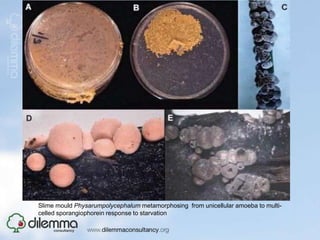
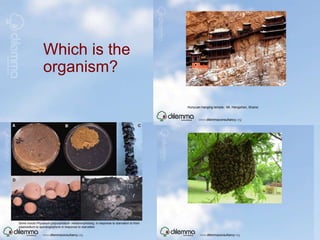
Slime mould Physarumpolycephalum metamorphosing  from unicellular amoeba to multi-celled sporangiophorein response to starvation
Hunyuan hanging temple,  Mt. Hengshan, Shanxi
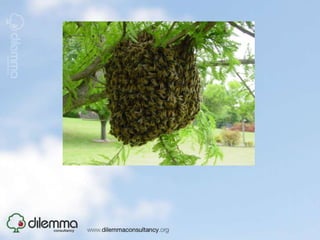
Which is the organism?
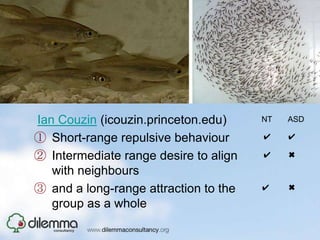
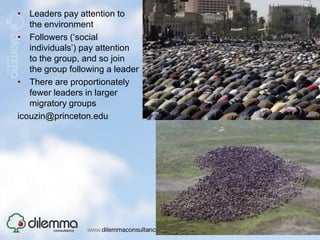
 Ian Couzin (icouzin.princeton.edu)Short-range repulsive behaviour Intermediate range desire to align with neighbours and a long-range attraction to the group as a whole NTASD✔✔✖✔✖✔
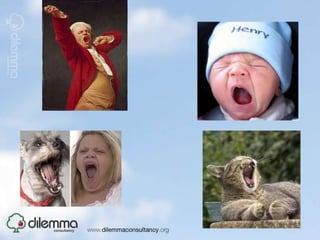
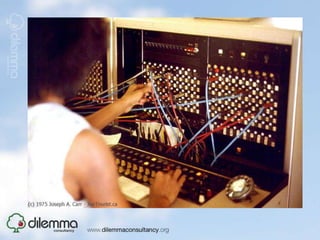
Neurons are linked by electrical impulses and chemicals into a networkOur brains can be linked to other brains the way that one computer can be linked to another via the internetThese links are the nonverbal communications that pass between us, principally consisting of imitation and of gaze followingImitation and gaze following are automatically initiated by local brain networks apparently specialized for this
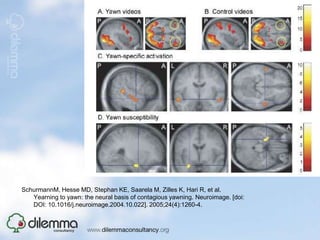
SchurmannM, Hesse MD, Stephan KE, Saarela M, Zilles K, Hari R, et al. Yearning to yawn: the neural basis of contagious yawning. Neuroimage. [doi: DOI: 10.1016/j.neuroimage.2004.10.022]. 2005;24(4):1260-4.
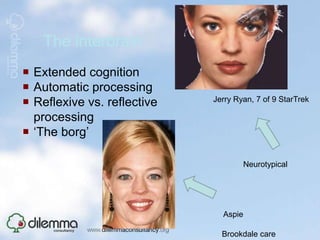
The interbrainExtended cognition
Automatic processing
Reflexive vs. reflective processing
‘The borg’Jerry Ryan, 7 of 9 StarTrekNeurotypicalAspieBrookdale care conference, London
On sale here
Themes in adulthood Ryan, S,Räisänen, U "It's like you are just a spectator in this thing": Experiencing social life the  [`]aspie' way. Emotion, Space and Society 2008;  1: 135-43.feeling differenttrying to fit insafe spaces  uncommon sense
Feeling differentBeing disconnected from the interbrain
ContributorsAston Bullying ProjectPaul NaylorJeremy DawsonEric EmersonLaura VazquezSheffield surveyMyles BalfeTing ChenMike CampbellSheffield Bullying projectPaul NaylorJenny WainscotJenna Williams15 medical studentsParents, teachers, and people with Asperger syndromeSheffield Asperger Parents Action Group
                     Project Development23
Green et al compared 20 adolescent men with AS with 20 with conduct problemsAS groupSeverely impaired practical social functioning AnxietyObsessionaldisordersBoth groups hadDepressionSuicidal ideationTempers and defiance
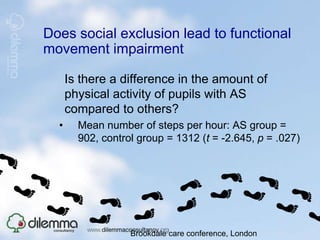
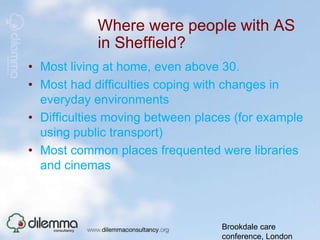
Outstanding areas for concern: Sheffield surveyReduction of available support in adulthoodLack of paid work (36%, 6% of whom supported)Lack of independence60% living with parents21% living independently56% thought they could be more independent with supportBrookdale care conference, London
Emotional problems in adolescents and adults with Asperger syndrome(findings from Sheffield survey)Self-harm: thoughts 50%, actual 11%Violence: threats 83%, actual 34%Bullied 90%, 30% currently (includes adults)Majority have anxiety-related disorder
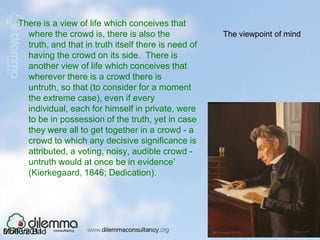
‘There is a view of life which conceives that where the crowd is, there is also the truth, and that in truth itself there is need of having the crowd on its side.  There is another view of life which conceives that wherever there is a crowd there is untruth, so that (to consider for a moment the extreme case), even if every individual, each for himself in private, were to be in possession of the truth, yet in case they were all to get together in a crowd - a crowd to which any decisive significance is attributed, a voting, noisy, audible crowd - untruth would at once be in evidence’ (Kierkegaard, 1846; Dedication).The viewpoint of mind2/28/11Modum Bad27
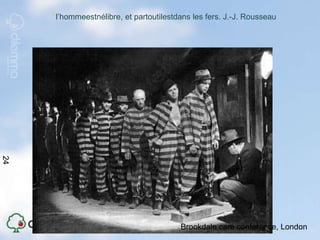
24 November 2009Brookdale care conference, London“l’hommeestnélibre, et partoutilestdans les fers. J.-J. Rousseau
Is it better not to be so connected to the interbrain?Fewer informational virusesUnderstand machines in their own right not as defective peopleFairness is not prejudiced by sympathyNot in chains
Trying to fit inMany other educational obstacles, plus emotional difficultiesBrookdale care conference, London
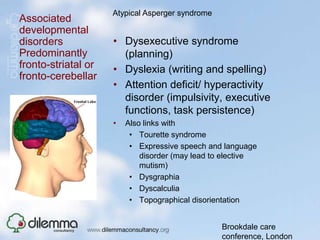
Atypical Asperger syndromeAssociated developmental disordersPredominantly fronto-striatal or fronto-cerebellarDysexecutive syndrome (planning)Dyslexia (writing and spelling)Attention deficit/ hyperactivity disorder (impulsivity, executive functions, task persistence)Also links withTourette syndromeExpressive speech and language disorder (may lead to elective mutism)DysgraphiaDyscalculiaTopographical disorientationBrookdale care conference, London
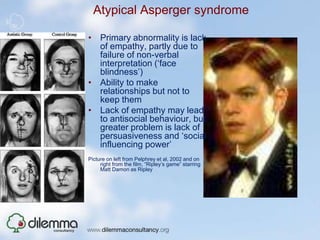
Atypical Asperger syndrome Primary abnormality is lack of empathy, partly due to failure of non-verbal interpretation (‘face blindness’)Ability to make relationships but not to keep themLack of empathy may lead to antisocial behaviour, but greater problem is lack of persuasiveness and ‘social influencing power’Picture on left from Pelphrey et al, 2002 and on right from the film, “Ripley’s game” starring Matt Damon as Ripley24 November 2009
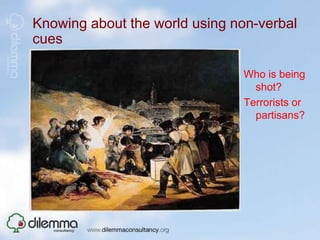
Knowing about the world using non-verbal cuesWho is being shot? Terrorists or partisans?
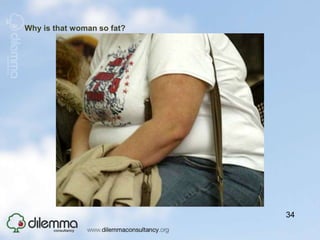
Why is that woman so fat?34
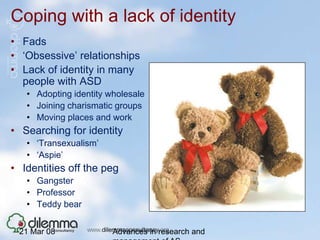
Coping with a lack of identityFads‘Obsessive’ relationshipsLack of identity in many people with ASDAdopting identity wholesaleJoining charismatic groupsMoving places and workSearching for identity‘Transexualism’‘Aspie’Identities off the pegGangsterProfessorTeddy bear21 Mar 08Advances in research and management of AS
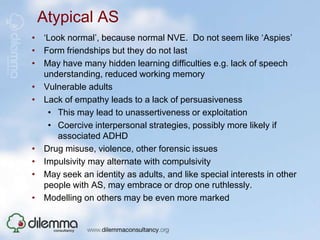
Atypical AS‘Look normal’, because normal NVE.  Do not seem like ‘Aspies’Form friendships but they do not lastMay have many hidden learning difficulties e.g. lack of speech understanding, reduced working memoryVulnerable adultsLack of empathy leads to a lack of persuasivenessThis may lead to unassertiveness or exploitationCoercive interpersonal strategies, possibly more likely if associated ADHDDrug misuse, violence, other forensic issuesImpulsivity may alternate with compulsivityMay seek an identity as adults, and like special interests in other people with AS, may embrace or drop one ruthlessly.Modelling on others may be even more marked
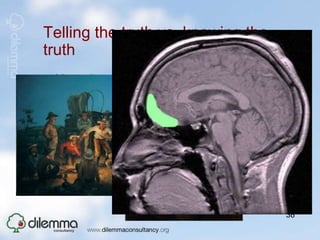
Telling the truth vs. knowing the truthNarrative38
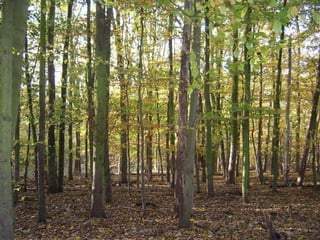
Implications for witness statementsPeople with AS do see the trees for the woodAnd may reliably apply a correspondence theory of truthBut they may not have a narrative theory Bruck, M., K. London, et al. (2007). "Autobiographical memory and suggestibility in children with autism spectrum disorder." Dev.Psychopathol.19(1): 73-95; AS McCrory, E., L. A. Henry, et al. (2007). "Eye-witness memory and suggestibility in children with Asperger syndrome. [Article]." Journal of Child Psychology & Psychiatry48(5): 482-489..As witnesses they may correctly memorize and reports factsmay not report the story of what happened, including the intentions of or  provocations to the the actorsThis may limit the value of their evidenceIt may also go against them when they witness to their own defenceWhen people with AS report intentions, one should consider external influenceQuestions should focus on facts and not interpretationwww.existentialacademy.com39
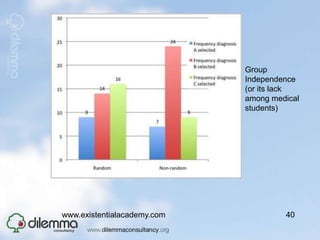
Group Independence (or its lack among medical students)www.existentialacademy.com40
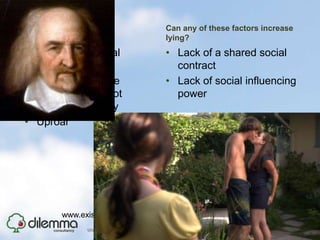
Other contributors to inconsequentialityLack of emotional empathyNeurotypicals are united, and do not deserve empathyUproarCan any of these factors increase lying?Lack of a shared social contractLack of social influencing powerwww.existentialacademy.com41
Safe spacesBullying and exclusion at and from school begin a process of narrowing the number of safe spaces
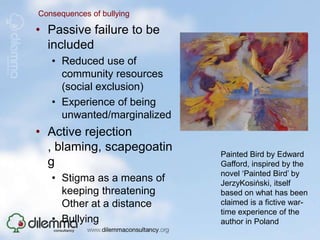
Consequences of bullyingPassive failure to be includedReduced use of community resources (social exclusion)Experience of being unwanted/marginalizedActive rejection , blaming, scapegoatingStigma as a means of keeping threatening Other at a distanceBullyingPainted Bird by Edward Gafford, inspired by the novel ‘Painted Bird’ by JerzyKosiński, itself based on what has been claimed is a fictive war-time experience of the author in Poland
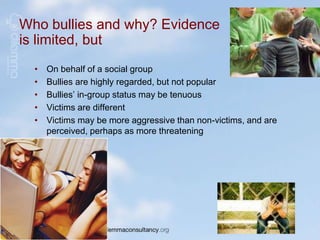
Who bullies and why? Evidence is limited, butOn behalf of a social groupBullies are highly regarded, but not popularBullies’ in-group status may be tenuousVictims are differentVictims may be more aggressive than non-victims, and are perceived, perhaps as more threateningBrookdale care conference, London
A particularly wide ranging tool kitReadiness to consider the most intense emotional issues and in the next moment, the most practical and cognitive onesHaving a clear grasp of the individual in front of you, not just in life experience, or temperament, but in cognitive abilitiesBe aware of shame and shamingThe limitless potential of social control by shamingBrookdale care conference, London

As and the interbrain

  • 1.
    Asperger syndrome andthe interbrainDigby TantamClinical Professor of Psychotherapy, University of Sheffield
  • 2.
    Quantum entanglementBoyer V,Marino AM, Pooser RC, Lett PD. Entangled Images from Four-Wave Mixing. Science. 2008 July 25, 2008;321(5888):544-7.
  • 3.
  • 4.
    Separated sediment layersof marine bacteria communicate electronicallyNealson KH. Geomicrobiology: Sediment reactions defy dogma. Nature. [10.1038/4631033a]. 2010;463(7284):1033-4.
  • 5.
  • 6.
     Seagulls fall asleepand wake together in the Bay of FundyBeauchamp et al. Sleeping gulls monitor the vigilance behaviour of their neighbours. Biology Letters, 2009; 5 (1): 9 DOI: 10.1098/rsbl.2008.0490
  • 8.
  • 9.
    An idea whosetime has come?
  • 10.
    Slime mould Physarumpolycephalummetamorphosing from unicellular amoeba to multi-celled sporangiophorein response to starvation
  • 12.
    Hunyuan hanging temple, Mt. Hengshan, Shanxi
  • 13.
    Which is theorganism?
  • 14.
     Ian Couzin (icouzin.princeton.edu)Short-range repulsivebehaviour Intermediate range desire to align with neighbours and a long-range attraction to the group as a whole NTASD✔✔✖✔✖✔
  • 16.
    Neurons are linkedby electrical impulses and chemicals into a networkOur brains can be linked to other brains the way that one computer can be linked to another via the internetThese links are the nonverbal communications that pass between us, principally consisting of imitation and of gaze followingImitation and gaze following are automatically initiated by local brain networks apparently specialized for this
  • 17.
    SchurmannM, Hesse MD,Stephan KE, Saarela M, Zilles K, Hari R, et al. Yearning to yawn: the neural basis of contagious yawning. Neuroimage. [doi: DOI: 10.1016/j.neuroimage.2004.10.022]. 2005;24(4):1260-4.
  • 18.
  • 19.
  • 20.
  • 21.
    ‘The borg’Jerry Ryan,7 of 9 StarTrekNeurotypicalAspieBrookdale care conference, London
  • 22.
  • 23.
    Themes in adulthoodRyan, S,Räisänen, U "It's like you are just a spectator in this thing": Experiencing social life the [`]aspie' way. Emotion, Space and Society 2008; 1: 135-43.feeling differenttrying to fit insafe spaces  uncommon sense
  • 24.
  • 25.
    ContributorsAston Bullying ProjectPaulNaylorJeremy DawsonEric EmersonLaura VazquezSheffield surveyMyles BalfeTing ChenMike CampbellSheffield Bullying projectPaul NaylorJenny WainscotJenna Williams15 medical studentsParents, teachers, and people with Asperger syndromeSheffield Asperger Parents Action Group
  • 26.
    Project Development23
  • 27.
    Green et alcompared 20 adolescent men with AS with 20 with conduct problemsAS groupSeverely impaired practical social functioning AnxietyObsessionaldisordersBoth groups hadDepressionSuicidal ideationTempers and defiance
  • 28.
    Outstanding areas forconcern: Sheffield surveyReduction of available support in adulthoodLack of paid work (36%, 6% of whom supported)Lack of independence60% living with parents21% living independently56% thought they could be more independent with supportBrookdale care conference, London
  • 29.
    Emotional problems inadolescents and adults with Asperger syndrome(findings from Sheffield survey)Self-harm: thoughts 50%, actual 11%Violence: threats 83%, actual 34%Bullied 90%, 30% currently (includes adults)Majority have anxiety-related disorder
  • 30.
    ‘There is aview of life which conceives that where the crowd is, there is also the truth, and that in truth itself there is need of having the crowd on its side. There is another view of life which conceives that wherever there is a crowd there is untruth, so that (to consider for a moment the extreme case), even if every individual, each for himself in private, were to be in possession of the truth, yet in case they were all to get together in a crowd - a crowd to which any decisive significance is attributed, a voting, noisy, audible crowd - untruth would at once be in evidence’ (Kierkegaard, 1846; Dedication).The viewpoint of mind2/28/11Modum Bad27
  • 31.
    24 November 2009Brookdalecare conference, London“l’hommeestnélibre, et partoutilestdans les fers. J.-J. Rousseau
  • 32.
    Is it betternot to be so connected to the interbrain?Fewer informational virusesUnderstand machines in their own right not as defective peopleFairness is not prejudiced by sympathyNot in chains
  • 33.
    Trying to fitinMany other educational obstacles, plus emotional difficultiesBrookdale care conference, London
  • 34.
    Atypical Asperger syndromeAssociateddevelopmental disordersPredominantly fronto-striatal or fronto-cerebellarDysexecutive syndrome (planning)Dyslexia (writing and spelling)Attention deficit/ hyperactivity disorder (impulsivity, executive functions, task persistence)Also links withTourette syndromeExpressive speech and language disorder (may lead to elective mutism)DysgraphiaDyscalculiaTopographical disorientationBrookdale care conference, London
  • 35.
    Atypical Asperger syndromePrimary abnormality is lack of empathy, partly due to failure of non-verbal interpretation (‘face blindness’)Ability to make relationships but not to keep themLack of empathy may lead to antisocial behaviour, but greater problem is lack of persuasiveness and ‘social influencing power’Picture on left from Pelphrey et al, 2002 and on right from the film, “Ripley’s game” starring Matt Damon as Ripley24 November 2009
  • 36.
    Knowing about theworld using non-verbal cuesWho is being shot? Terrorists or partisans?
  • 37.
    Why is thatwoman so fat?34
  • 38.
    Coping with alack of identityFads‘Obsessive’ relationshipsLack of identity in many people with ASDAdopting identity wholesaleJoining charismatic groupsMoving places and workSearching for identity‘Transexualism’‘Aspie’Identities off the pegGangsterProfessorTeddy bear21 Mar 08Advances in research and management of AS
  • 39.
    Atypical AS‘Look normal’,because normal NVE. Do not seem like ‘Aspies’Form friendships but they do not lastMay have many hidden learning difficulties e.g. lack of speech understanding, reduced working memoryVulnerable adultsLack of empathy leads to a lack of persuasivenessThis may lead to unassertiveness or exploitationCoercive interpersonal strategies, possibly more likely if associated ADHDDrug misuse, violence, other forensic issuesImpulsivity may alternate with compulsivityMay seek an identity as adults, and like special interests in other people with AS, may embrace or drop one ruthlessly.Modelling on others may be even more marked
  • 41.
    Telling the truthvs. knowing the truthNarrative38
  • 42.
    Implications for witnessstatementsPeople with AS do see the trees for the woodAnd may reliably apply a correspondence theory of truthBut they may not have a narrative theory Bruck, M., K. London, et al. (2007). "Autobiographical memory and suggestibility in children with autism spectrum disorder." Dev.Psychopathol.19(1): 73-95; AS McCrory, E., L. A. Henry, et al. (2007). "Eye-witness memory and suggestibility in children with Asperger syndrome. [Article]." Journal of Child Psychology & Psychiatry48(5): 482-489..As witnesses they may correctly memorize and reports factsmay not report the story of what happened, including the intentions of or provocations to the the actorsThis may limit the value of their evidenceIt may also go against them when they witness to their own defenceWhen people with AS report intentions, one should consider external influenceQuestions should focus on facts and not interpretationwww.existentialacademy.com39
  • 43.
    Group Independence (orits lack among medical students)www.existentialacademy.com40
  • 44.
    Other contributors toinconsequentialityLack of emotional empathyNeurotypicals are united, and do not deserve empathyUproarCan any of these factors increase lying?Lack of a shared social contractLack of social influencing powerwww.existentialacademy.com41
  • 45.
    Safe spacesBullying andexclusion at and from school begin a process of narrowing the number of safe spaces
  • 46.
    Consequences of bullyingPassivefailure to be includedReduced use of community resources (social exclusion)Experience of being unwanted/marginalizedActive rejection , blaming, scapegoatingStigma as a means of keeping threatening Other at a distanceBullyingPainted Bird by Edward Gafford, inspired by the novel ‘Painted Bird’ by JerzyKosiński, itself based on what has been claimed is a fictive war-time experience of the author in Poland
  • 47.
    Who bullies andwhy? Evidence is limited, butOn behalf of a social groupBullies are highly regarded, but not popularBullies’ in-group status may be tenuousVictims are differentVictims may be more aggressive than non-victims, and are perceived, perhaps as more threateningBrookdale care conference, London
  • 48.
    A particularly wideranging tool kitReadiness to consider the most intense emotional issues and in the next moment, the most practical and cognitive onesHaving a clear grasp of the individual in front of you, not just in life experience, or temperament, but in cognitive abilitiesBe aware of shame and shamingThe limitless potential of social control by shamingBrookdale care conference, London

Editor's Notes

  • #3 In this photo montage of actual quantum images, two laser beams coming from the bright glare in the distance transmit images of a cat-like face at two slightly different frequencies (represented by the orange and the purple colors). The twisted lines indicate that the seemingly random changes or fluctuations that occur over time in any part of the orange image are strongly interconnected or "entangled" with the fluctuations of the corresponding part in the purple image. Though false color has been added to the cats' faces, they are otherwise actual images obtained in the experiment. To create quantum images, the researchers use a simple yet powerful method known as "four-wave mixing," a technique in which incoming light waves enter a gas and interact to produce outgoing light waves. In the setup, a faint "probe" beam passes through a stencil-like "mask" with a visual pattern. Imprinted with an image, the probe beam joins an intense "pump" beam inside a cell of rubidium gas. The atoms of the gas interact with the light, absorbing energy and re-emitting an amplified version of the original image. In addition, a complementary second image is created by the light emitted by the atoms. To satisfy nature's requirement for the set of outgoing light beams to have the same energy and momentum as the set of incoming light beams, the second image comes out as an inverted, upside-down copy of the first image, rotated by 180 degrees with respect to the pump beam and at a slightly different color
  • #5 News and Views: Geomicrobiology: Sediment reactions defy dogmaRedox reactions in widely spatially separated layers of marine sediments are coupled to each other. This suggests that bacteria mediate the flow of electrons between the layers — an idea that would previously have been dismissed.Kenneth H. Nealsondoi:10.1038/4631033aFull Text | PDF (1,451K)Letter: Electric currents couple spatially separated biogeochemical processes in marine sedimentLars Peter Nielsen, Nils Risgaard-Petersen, HenrikFossing, Peter Bondo Christensen & MikioSayamadoi:10.1038/nature08790First paragraph | Full Text | PDF (244K)
  • #39 Lev Vygotsky with daughter: inner speech guides action. Inner speech is one way of understanding theory of mind: what a person would say if they were there. May be particularly absent in ADHD
  • #40 People with ASD tend to see trees for wood, and may be more field independent
  • #41 Replication of Asch experiment
  • #42 Thomas Hobbes the social contract