Flow of Presentation
Meaning
History
Demonetisation of Indian Currency- 2016
• Procedure
• Tax Aspects
• Reactions
• Effects and aftermaths
• Evasion Attempts
• Conclusion
Bibliography
Meaning
• Demonetisation is the act of stripping a currency unit
of its status as legal tender.
• The old unit of currency must be retired and replaced
with a new currency unit.
• Some reasons for demonetisation include to combat
inflation, to combat corruption and to discourage a
cash system
History
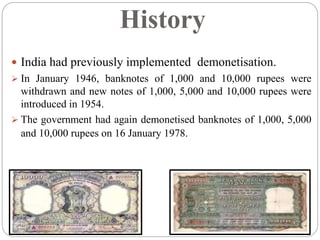
 India had previously implemented demonetisation.
 In January 1946, banknotes of 1,000 and 10,000 rupees were
withdrawn and new notes of 1,000, 5,000 and 10,000 rupees were
introduced in 1954.
 The government had again demonetised banknotes of 1,000, 5,000
and 10,000 rupees on 16 January 1978.
 Demonetisation was also taken up by many
countries such as Ghana, Nigeria, North Korea,
European Union, Pakistan, Zimbabwe, Myanmar,
Australia and Switzerland.
Some of them were successful while some of
them had a bad impact on the economy.
Demonetisation of Indian
Currency- Nov 2016
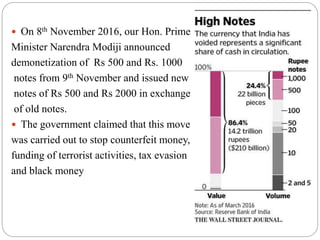
 On 8th November 2016, our Hon. Prime
Minister Narendra Modiji announced
demonetization of Rs 500 and Rs. 1000
notes from 9th November and issued new
notes of Rs 500 and Rs 2000 in exchange
of old notes.
 The government claimed that this move
was carried out to stop counterfeit money,
funding of terrorist activities, tax evasion
and black money
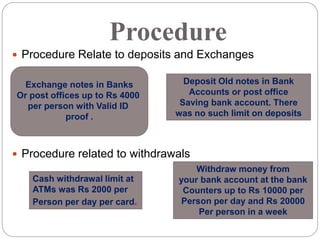
Procedure
 Procedure Relate to deposits and Exchanges
 Procedure related to withdrawals
Exchange notes in Banks
Or post offices up to Rs 4000
per person with Valid ID
proof .
Deposit Old notes in Bank
Accounts or post office
Saving bank account. There
was no such limit on deposits
Cash withdrawal limit at
ATMs was Rs 2000 per
Person per day per card.
Withdraw money from
your bank account at the bank
Counters up to Rs 10000 per
Person per day and Rs 20000
Per person in a week
Tax Aspect of Demonetisation
 If the amount deposited in the bank Exceeds Rs 2.5
Lakhs it was immediately reported to the IT
Department.
 If amount so deposited does not match the income
declared in IT Return Then a penalty of 200% was
levied.
 If a person buys jewelry he has to give his PAN details
and person who has sold shall also obtain PAN details
of the buyer
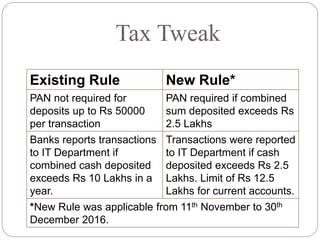
Tax Tweak
Existing Rule New Rule*
PAN not required for
deposits up to Rs 50000
per transaction
PAN required if combined
sum deposited exceeds Rs
2.5 Lakhs
Banks reports transactions
to IT Department if
combined cash deposited
exceeds Rs 10 Lakhs in a
year.
Transactions were reported
to IT Department if cash
deposited exceeds Rs 2.5
Lakhs. Limit of Rs 12.5
Lakhs for current accounts.
*New Rule was applicable from 11th November to 30th
December 2016.
Reactions
Support
 The demonetization move was supported by the
chairpersons of State Bank of India, ICICI Bank and
HDFC Bank.
 It was also supported by the big businessmen such as
head of Mahindra Group, JSW Group, Snapdeal and
FreeCharge. Infosys founder N. R. Narayana Murthy
also praised the move.
 The Chief Ministers of Bihar, Andhra Pradesh,the
Chief election Minister of India and President
welcomed the move.
Reactions
Criticism
 A Public Interest Litigation (PIL) was filed
in Madras High Court to scrap the decision. The
High Court dismissed the PIL stating that it could
not interfere in monetary policies of the
government.
 Similar PILs were also filed in the Supreme Court
of India.
Reactions
Strikes
 As the demonetization was opposed in both houses
of the parliament, it triggered organized
nationwide strikes across India on 28 November
2016.
 Strikes and rallies were observed in the states of
Bihar, West Bengal, Maharashtra, Uttar Pradesh,
Kerala.
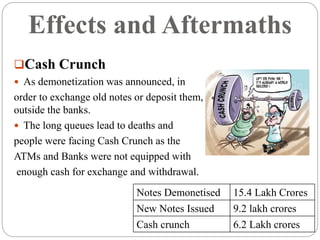
Effects and Aftermaths
Cash Crunch
 As demonetization was announced, in
order to exchange old notes or deposit them, lead to long queues
outside the banks.
 The long queues lead to deaths and
people were facing Cash Crunch as the
ATMs and Banks were not equipped with
enough cash for exchange and withdrawal.
Notes Demonetised 15.4 Lakh Crores
New Notes Issued 9.2 lakh crores
Cash crunch 6.2 Lakh crores
Effects and Aftermaths
 Stock Market
As a combined effect of demonetization and US presidential election,
The BSE SENSEX dropped by 1689 points and NSE Nifty dropped
by 541 Points on 8th November 2016.
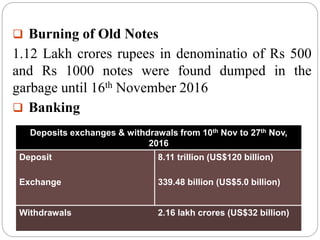
 Burning of Old Notes
1.12 Lakh crores rupees in denominatio of Rs 500
and Rs 1000 notes were found dumped in the
garbage until 16th November 2016
 Banking
Deposits exchanges & withdrawals from 10th Nov to 27th Nov,
2016
Deposit 8.11 trillion (US$120 billion)
Exchange 339.48 billion (US$5.0 billion)
Withdrawals 2.16 lakh crores (US$32 billion)
E-Payments
Cash Seizure
Until 16th November 2016, the police had seized cash
in denominations of Rs. 500 and Rs. 1000 notes which
amounted to Rs. 1.12crores.
Railways
 As of November 2015, Indian Railways did not have
the option to make payment with cards at the
counters. After the demonetization move, the
government announced to make card payment
options available at railway counters in the country.
Evasion Attempts
Gold Purchases
In Gujarat, Delhi and many other major cities, sales of gold increased
on 9 November, with an increased 20 to 30% premium surging the
price as much as 45,000 (US$670) from the ruling price
of 31,900 (US$470) per 10 grams (0.35 oz).
Multiple bank Transactions
There have also been reports of people circumventing the restrictions
imposed on exchange transactions and also attempting to convert
black money into white by making multiple transactions at different
bank branches
Donations
Authorities of Sri Jalakanteswarar temple
at Vellore discovered cash worth 4.4
million (US$65,000) from the temple Hundi.
Advance Salaries
As the employer is allowed to pay advance salary of 3 to 8
months, many employers have paid advance salaries upto Rs 2.5
lakhs.
There were many other ways in which black money
was converted into white one…
Conclusions
 The advantages are much dominating and it will be in the
long term interest of our country comfortably outweighing
the disadvantages.
 Government need to take all the necessary steps so as to
ensure that there will be a smooth flow of currency
exchanges. It would turn into chaos if government takes no
necessary steps to circulate money correctly.
 It will make a massive change in our economy. We
congratulate the entire government and those hidden brains
of our democracy who brought this decision.
Bibliography
 https://en.wikipedia.org/wiki/2016_Indian_banknot
e_demonetisation
 http://www.bseindia.com/
 www.investopedia.com/terms/d/demonetization.
asp
 www.google.com
 Hindustan Times newspaper dated 19/01/2017
 Economic Times News
 http://economictimes.indiatimes.com/img/559064
36/Master.jpg
THANK YOU

Demonetisation

  • 2.
    Flow of Presentation Meaning History Demonetisationof Indian Currency- 2016 • Procedure • Tax Aspects • Reactions • Effects and aftermaths • Evasion Attempts • Conclusion Bibliography
  • 3.
    Meaning • Demonetisation isthe act of stripping a currency unit of its status as legal tender. • The old unit of currency must be retired and replaced with a new currency unit. • Some reasons for demonetisation include to combat inflation, to combat corruption and to discourage a cash system
  • 4.
    History  India hadpreviously implemented demonetisation.  In January 1946, banknotes of 1,000 and 10,000 rupees were withdrawn and new notes of 1,000, 5,000 and 10,000 rupees were introduced in 1954.  The government had again demonetised banknotes of 1,000, 5,000 and 10,000 rupees on 16 January 1978.
  • 5.
     Demonetisation wasalso taken up by many countries such as Ghana, Nigeria, North Korea, European Union, Pakistan, Zimbabwe, Myanmar, Australia and Switzerland. Some of them were successful while some of them had a bad impact on the economy.
  • 6.
  • 7.
     On 8thNovember 2016, our Hon. Prime Minister Narendra Modiji announced demonetization of Rs 500 and Rs. 1000 notes from 9th November and issued new notes of Rs 500 and Rs 2000 in exchange of old notes.  The government claimed that this move was carried out to stop counterfeit money, funding of terrorist activities, tax evasion and black money
  • 8.
    Procedure  Procedure Relateto deposits and Exchanges  Procedure related to withdrawals Exchange notes in Banks Or post offices up to Rs 4000 per person with Valid ID proof . Deposit Old notes in Bank Accounts or post office Saving bank account. There was no such limit on deposits Cash withdrawal limit at ATMs was Rs 2000 per Person per day per card. Withdraw money from your bank account at the bank Counters up to Rs 10000 per Person per day and Rs 20000 Per person in a week
  • 9.
    Tax Aspect ofDemonetisation  If the amount deposited in the bank Exceeds Rs 2.5 Lakhs it was immediately reported to the IT Department.  If amount so deposited does not match the income declared in IT Return Then a penalty of 200% was levied.  If a person buys jewelry he has to give his PAN details and person who has sold shall also obtain PAN details of the buyer
  • 10.
    Tax Tweak Existing RuleNew Rule* PAN not required for deposits up to Rs 50000 per transaction PAN required if combined sum deposited exceeds Rs 2.5 Lakhs Banks reports transactions to IT Department if combined cash deposited exceeds Rs 10 Lakhs in a year. Transactions were reported to IT Department if cash deposited exceeds Rs 2.5 Lakhs. Limit of Rs 12.5 Lakhs for current accounts. *New Rule was applicable from 11th November to 30th December 2016.
  • 11.
    Reactions Support  The demonetizationmove was supported by the chairpersons of State Bank of India, ICICI Bank and HDFC Bank.  It was also supported by the big businessmen such as head of Mahindra Group, JSW Group, Snapdeal and FreeCharge. Infosys founder N. R. Narayana Murthy also praised the move.  The Chief Ministers of Bihar, Andhra Pradesh,the Chief election Minister of India and President welcomed the move.
  • 12.
    Reactions Criticism  A PublicInterest Litigation (PIL) was filed in Madras High Court to scrap the decision. The High Court dismissed the PIL stating that it could not interfere in monetary policies of the government.  Similar PILs were also filed in the Supreme Court of India.
  • 13.
    Reactions Strikes  As thedemonetization was opposed in both houses of the parliament, it triggered organized nationwide strikes across India on 28 November 2016.  Strikes and rallies were observed in the states of Bihar, West Bengal, Maharashtra, Uttar Pradesh, Kerala.
  • 14.
    Effects and Aftermaths CashCrunch  As demonetization was announced, in order to exchange old notes or deposit them, lead to long queues outside the banks.  The long queues lead to deaths and people were facing Cash Crunch as the ATMs and Banks were not equipped with enough cash for exchange and withdrawal. Notes Demonetised 15.4 Lakh Crores New Notes Issued 9.2 lakh crores Cash crunch 6.2 Lakh crores
  • 15.
    Effects and Aftermaths Stock Market As a combined effect of demonetization and US presidential election, The BSE SENSEX dropped by 1689 points and NSE Nifty dropped by 541 Points on 8th November 2016.
  • 16.
     Burning ofOld Notes 1.12 Lakh crores rupees in denominatio of Rs 500 and Rs 1000 notes were found dumped in the garbage until 16th November 2016  Banking Deposits exchanges & withdrawals from 10th Nov to 27th Nov, 2016 Deposit 8.11 trillion (US$120 billion) Exchange 339.48 billion (US$5.0 billion) Withdrawals 2.16 lakh crores (US$32 billion)
  • 17.
  • 18.
    Cash Seizure Until 16thNovember 2016, the police had seized cash in denominations of Rs. 500 and Rs. 1000 notes which amounted to Rs. 1.12crores. Railways  As of November 2015, Indian Railways did not have the option to make payment with cards at the counters. After the demonetization move, the government announced to make card payment options available at railway counters in the country.
  • 19.
    Evasion Attempts Gold Purchases InGujarat, Delhi and many other major cities, sales of gold increased on 9 November, with an increased 20 to 30% premium surging the price as much as 45,000 (US$670) from the ruling price of 31,900 (US$470) per 10 grams (0.35 oz). Multiple bank Transactions There have also been reports of people circumventing the restrictions imposed on exchange transactions and also attempting to convert black money into white by making multiple transactions at different bank branches
  • 20.
    Donations Authorities of SriJalakanteswarar temple at Vellore discovered cash worth 4.4 million (US$65,000) from the temple Hundi. Advance Salaries As the employer is allowed to pay advance salary of 3 to 8 months, many employers have paid advance salaries upto Rs 2.5 lakhs. There were many other ways in which black money was converted into white one…
  • 21.
    Conclusions  The advantagesare much dominating and it will be in the long term interest of our country comfortably outweighing the disadvantages.  Government need to take all the necessary steps so as to ensure that there will be a smooth flow of currency exchanges. It would turn into chaos if government takes no necessary steps to circulate money correctly.  It will make a massive change in our economy. We congratulate the entire government and those hidden brains of our democracy who brought this decision.
  • 22.
    Bibliography  https://en.wikipedia.org/wiki/2016_Indian_banknot e_demonetisation  http://www.bseindia.com/ www.investopedia.com/terms/d/demonetization. asp  www.google.com  Hindustan Times newspaper dated 19/01/2017  Economic Times News  http://economictimes.indiatimes.com/img/559064 36/Master.jpg
  • 23.