
Global Powers
of Retailing 2015
Embracing innovation
Contents
Retail trends 2015: Embracing innovation	 G3
Global economic outlook	 G7
Top 250 global retailers 2013	 G11
Global Powers of Retailing Top 250 highlights	 G19
Global Powers of Retailing geographical analysis	 G21
Global Powers of Retailing product sector analysis	 G25
Top 250 newcomers	 G28
Global Powers of Retailing Fastest 50	 G29
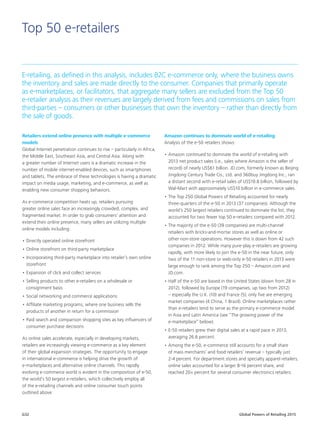
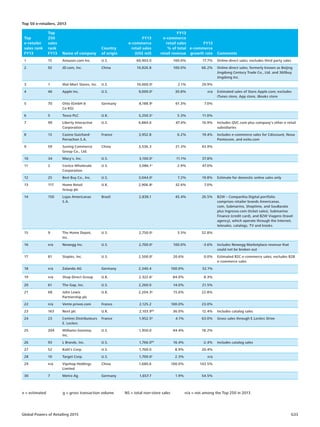
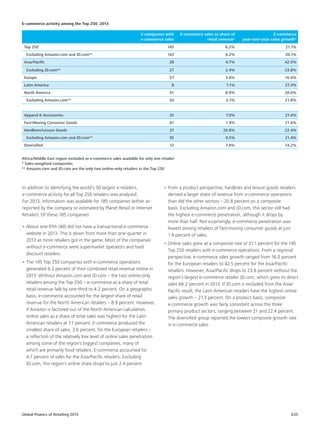
Top 50 e-retailers	 G32
Q ratio analysis for Global Powers	 G37
Study methodology and data sources	 G40
Contacts 	 G41
Global Powers of Retailing 2015 G3
Retail trends 2015: Embracing innovation
Welcome to Deloitte’s 18th annual Global Powers of Retailing report. This report identifies
the 250 largest retailers around the world based on publicly available data for fiscal 2013
(encompassing companies’ fiscal years ended through June 2014) and analyzes their
performance based on geographic region, product sector, e-commerce activity, and
other factors.
This year’s report focuses on the theme of “embracing innovation,” and looks at the retail
trends for 2015 as well as retailers creatively utilizing innovations to address the disruptive
changes currently impacting the marketplace. It also provides a look at the world’s 50 largest
e-retailers, an outlook for the global economy, and an analysis of market capitalization in the
retail industry.
Retail trends for 2015 are shaped by the disruptive changes
currently impacting the marketplace. Here we focus on five main
trends. The first is travel retailing, which is redefining notions of
customer base and transforming the role airport retail plays in
a company’s strategy. The second is mobile retailing, a rapidly
growing business that is expected to approach US$640 billion
in annual global sales within just a few years. The third is faster
retailing, which is just what the name implies: speed to market,
speed to response, speed to deliver. The fourth is experience
retailing, which takes shopping and adds entertainment, emotion,
deeper engagement, and sometimes even an entire environment.
And finally there is innovative retailing, which responds to market
disruption with disruptive creativity of its own.
While these trends are not new, what is interesting for 2015 is that
even though the advances in technologies available to consumers
and retailers have been exponential, consumers and retailers are
more and more willing and quicker to experiment, adopt and move
on to the latest technologies in more creative and innovative ways.
Some retailers are even keeping up with the neck-breaking speed
of change, leveraging innovation and big data to their advantage;
rethinking their business model and adapting every aspect of their
operations; executing marketing, product and service on every
channel necessary; and responding 24/7 to 24/7 consumers with
increasing expectations.
With market disruption comes opportunities, and obviously, the
retailers who can be nimble, adapt, and innovate in the face of
these changes will be in a better position for success than those
who cannot.
Travel retailing
Over a billion people travel internationally each year –
approximately 15 percent of the global population – and they
spend the equivalent of more than a trillion US dollars in the
process.1
As a result, companies such as Pernod Ricard and L’Oréal
refer to travel retail as their “sixth continent,” and Luxottica
describes airport sales as “the Formula One of retail.”
International tourism continues to rise above expectations despite
continuing global geopolitical and economic challenges, and sales
have grown by more than 12 percent a year since 2009.2
Half of
that growth has come from an increase in travelers, especially
from emerging countries like China. Much of the rest is due to the
willingness of travelers to shop en route and abroad (and retailers’
improved capability to serve them).
The expanding middle classes of emerging markets are traveling
to the world’s capitals and boosting sales, especially of luxury
products, and this is benefiting the developed economies of the
U.S. and Europe. Over half of France’s 16 billion Euros luxury
industry depends on tourists.3
Therefore, in 2015, expect retailers
to continue catering to high-spending travelers, especially emerging
market tourists, to drive growth.
1 Travel Retail: A Sixth Continent with 1 Billion Consumers, Luxury Society,
24 June 2014. http://luxurysociety.com/articles/2014/06/travel-retail-a-sixth-
continent-with-1-billion-consumersinside-frances-168-billion-luxury-goods-
market
2	Airport shopping: The sixth continent, The Economist, 10 May 2014. http://
www.economist.com/news/business/21601885-battle-catch-people-golden-
hour-they-board-getting-ever-more
3	Inside France’s €16.8 Billion Luxury Goods Market, Luxury Society,
13 February 2014. http://luxurysociety.com/articles/2014/02/
inside-frances-168-billion-luxury-goods-market
Global Powers of Retailing 2015G4
Travel retail provides new opportunities to engage with consumers.
Travelers often have time for leisurely shopping due to lengthy
wait times at airports, and international travel often promotes a
sense of personal achievement, both conditions providing a good
atmosphere for experimentation and indulgence.
In response to these opportunities many companies are investing
in building brand awareness in emerging countries, even when the
targeted consumers may not purchase those brands at home. This
is because these consumers are keen to acquire foreign and luxury
brands while travelling, especially in developed markets which offer
superior product selection and availability as well as advantageous
price comparisons due to high import taxes in home countries.
As a result, airports have become retail destinations and airport
retail design has evolved, now dominated by luxury fashion trends
rather than the duty free shops of the past. Airports have also
become laboratories and an important source of data, allowing
companies to experiment. For example, World Duty Free Group
(WDFG), Heathrow Airport’s “anchor” retailer, uses airport data
to better prepare for international arrivals, such as ensuring that
speakers of the right languages and cultural sensitivities will be on
hand. They can even reconfigure shop displays to suit the national
tastes of travelers passing through.
Mobile retailing
A projected 65 percent of the global population will be using a
mobile phone by 2015 and an estimated 83 percent of internet
usage will be through handheld devices.4
It is no surprise then that
mobile retailing is expected to continue to grow aggressively. In the
next three years, global e-commerce sales made via mobile devices
are expected to top US$638 billion, which is about the size of the
world’s entire e-commerce market just a year ago.5
The introduction of wearables, such as Google Glass and Apple
Watch, opens new opportunities for reaching consumers, and
retailers will keep an eye on developments in this arena. The
smart watch sector is currently estimated at US$1.4 billion to
US$1.8 billion but is expected to surge to US$10 billion by 2018.6
The full range of the wearable technology market is projected to
hit US$30 billion in sales during the same period. Some predictions
have shoppers purchasing via wearable devices as early as 2015.
Retailers will need to respond by offering free in-store Wi-Fi and
mobile-friendly retail websites optimized for different kinds of
personal devices. Mobile payments will play a large role – Forrester
expects mobile payments to amount to US$90 billion by 2017 –
as will location-based marketing. Wal-Mart, eBay and Amazon
have already created convenient mobile customer experiences
and others will follow. However, while shoppers want real-time,
relevant, and personalized information and offers, retailers will
need to surround this service with very strong privacy and security.
Trust, transparency, and protecting customer information will be
critical in retaining loyalty as mobile retailing becomes the norm.
Faster retailing
Speed has been an important trend in retail for over a decade.
This includes: “fast fashion” (getting runway styles to the stores as
soon as possible); limited-time-only products and flash sales to drive
urgency and immediate purchase; pop-up establishments to quickly
get products and services to market and build buzz; and self-service
check-out and kiosks to reduce or eliminate waiting.
In 2015, expect retailing to get even faster to meet consumers’
desires. Millennials will be driving much of this as they are the
largest generation, with a lot of spending power, and carry a lot of
influence. They prefer fast response and immediate gratification,
and retailers will cater to that. With Amazon and Google offering
same‑day delivery in certain areas, expect other companies to
follow; the delivery window will become more narrow and specific.
This won’t happen overnight, of course, but the first-movers in
this area are aggressively testing possibilities. Amazon expanded
its same-day delivery service in parts of the U.S. to certain cities in
the UK, Germany, and Canada. It recently tested delivery by taxi,
and is waiting for FAA permission to begin their Prime Air service in
which drones will deliver packages within 30 minutes. The ability to
meet the consumer’s need for speed makes an efficient end-to-end
supply chain more important than ever.
While same-day product delivery will not likely be the norm for
everyone, instant availability of information will be. More and
more consumers are expecting it and retailers will need to deliver.
Retailers will need to optimize their information to provide as much
content as shoppers need without the load time, especially over
Wi-Fi and cell networks on mobile devices, so shoppers can easily
and quickly find the information or product they need.
4	Two Billion Smartphone Users By 2015: 83% of Internet Usage From
Mobiles, DazeInfo, 23 January 2014. http://www.dazeinfo.com/2014/01/23/
smartphone-users-growth-mobile-internet-2014-2017/
5	US E-Commerce Growth Is Now Far Outpacing Overall Retail Sales,
Business Insider, 2 April 2014. http://www.businessinsider.com/
us-e-commerce-growth-is-now-far-outpacing-overall-retail-sales-2014-4
6	Apple Smartwatch Launch Boost to Wearables, Women’s Wear
Daily, 10 October 2014. http://www.wwd.com/media-news/digital/
apple-unveils-smartwatch-7890678?src=n/newsAlert/20140909-3
Global Powers of Retailing 2015 G5
Experience retailing
Retailing is no longer just about the product, but the experience.
Consumers want shopping to include entertainment, education,
emotion, engagement, and enlightenment. Retailers are exploring
innovative ways to enhance the buying experience for their
customers: fashion shows, music festivals, tablet and interactive
displays, social media campaigns, and product and marketing
co‑creation. The Legaspi Company has even rebuilt failing shopping
malls into Hispanic cultural centers serving all the needs of a family:
grocery stores, dental and medical care, clothes, entertainment,
banking, a department of motor vehicles, and spaces for religious
activities; and seen income and foot traffic increase at these
locations, typically by 30 percent.
It should be noted that with all these new forms of engagement,
regardless of in-store, online, at home, or on the street, consumers
still want a seamless and consistent experience. They expect to
be able to view online information, access coupons, learn about
promotions, and review inventory at any time on any device.
They expect messaging and product and pricing information to be
consistent across all channels: advertising and social media; in-store
and online; pushed or pulled; the sales people on the floor as well
as the customer service representative on the phone. They want
to order, pick up, ship, receive, and return anywhere. To become
nimble enough to respond to these consumer expectations, some
retailers may have to change their internal operations, removing
silos and improving cross-functional collaboration.
Personalized websites and emails have become the norm, and
consumers are looking for this personalization to extend into
their in-store experiences. Retailers can now send customized
text messages to shoppers in-store, and adapt interactions to
each individual. Retailers will therefore be investing in analysis of
big data to enable personalization. However, trust will be critical
since violation of privacy will be a concern for consumers. Retailers
will need to be transparent in their collection and use of data,
and educate shoppers about the value they are delivering with
personalized shopping experience.
Innovative retailing
In 2015, the retail industry will continue to be disrupted by new
technologies and innovative competition. There will be no single
formula for success, which will come in all shapes and sizes,
formats and channels. We will continue to see the blurring of
sectors as well as single product retailing, such as Warby Parker.
There will continue to be non-traditional retailers innovating in the
retail space, such as Verizon with its Mall of America destination
store. Mobile POS systems will continue to enable inventive pop-up
stores, trucks, and kiosks. Retailers will be vertically integrated and
vertically transparent, such as Zady. In some cases the middleman
will be cut out completely, with no physical stores, no inventory, no
warehouses, but rather made-to-order direct from manufacturer,
such as Awl  Sundry and Made.com. The line between retailer and
producer will begin to blur in new ways, such as Amazon’s Creative
Expressions, part of their 3-D Printing Store.
Expect more retailers to be innovators. Numerous retailers have
invested heavily in their own innovation labs, including Nordstrom,
Wal-Mart, Staples, Amazon, and The Home Depot. Retailers are
embracing technology and using it in creative ways. For example,
Lowe’s has introduced a multi-lingual robot that can scan a part
a shopper brings in, identify it, instantly access information about
it, and help the customer find it in the store. With the internet
of things, we can soon expect retail innovations like automatic
purchasing and delivery with connected homes and refrigerators.
The near future of the retail industry is about adaptation and
embracing change. The speed of innovation and the disruption it
causes won’t cease, and the demands of customers will continue to
escalate. To thrive in this environment retailers will respond quickly
to threats and opportunities with innovations of their own. This
requires connecting strategy, capabilities, and specific initiatives,
guided by the insights provided by market data.
The right talent with the right skill set is key to successful execution,
of course. Retailers will need to focus on finding, recruiting, and
retaining the best people. But the reality is that no retailer will have
all the appropriate talent in-house, making it essential that they
develop an arrangement of partnerships and specialized resources.
So when needed, they can quickly call upon the right expertise to
drive the kind of innovation in product offerings, business models,
and customer engagement that will enable them to stay ahead of
the competition.
Global Powers of Retailing 2015G6
Global Powers of Retailing 2015 G7
Global economic outlook
The global economy appears to be decelerating as several large
economies face increasing trouble. The main ones of concern are
China and the Eurozone as well as a few key emerging markets
such as Brazil and Russia. China has experienced decelerating
growth as it struggles to balance the need to avoid excessive credit
growth with a desire to keep the economy moving. In Europe,
weakness in credit markets is preventing economic growth from
resuming at a normal pace.
On the other hand, the brightest spots in the global panorama
are the US and British economies. The US appears to be on
a self‑sustaining path of faster growth combined with low
inflation. One factor driving that growth is the huge increase in oil
production which, in turn, has led to lower energy prices globally.
The low energy prices are a problem for oil exporters such as Russia
and Venezuela, while this is benefitting oil consumers such as India
and Japan.
Among the big issues having a global impact are the following:
The shift in US monetary policy
The Federal Reserve has ended its program of asset purchases and
is now assessing when to raise short term interest rates for the first
time in eight years. This transition, and the expectation of higher
rates, is driving up the value of the US dollar and putting downward
pressure on other currencies. That, in turn, has forced emerging
market central banks to raise interest rates, thus slowing the
growth of these economies. That slower growth is evident in such
diverse places as Brazil, Turkey, Indonesia, South Africa, Russia, and
Argentina. Once US monetary policy returns to normal, emerging
countries will be better able to shift toward stable interest rates.
Energy production in the US
This has risen precipitously due to the new technology of
horizontal hydraulic fracturing of shale rock – better known simply
as fracking. The rise in US energy output has lowered global
energy prices, reduced the US trade deficit, boosted US economic
growth, improved the competitiveness of energy-intensive US
manufacturers, and suppressed global inflation – especially in
developed economies. It has also hurt competing energy producers
such as Russia, Venezuela, and Nigeria. From a retail perspective,
lower energy prices have added to the purchasing power of
consumers in energy consuming countries – thus providing a boost
for retailers.
The crisis in Ukraine
The conflict between Russia and the West over Ukraine, which
has resulted in punitive sanctions imposed on Russia by the EU
and the US, is hurting the Russian economy and, by extension, the
Eurozone economy. Fear of further sanctions is having a chilling
effect on investment in Russia as well as in Germany. The German
economy has slowed significantly, in part, due to problems in
Russia. About 6,000 German companies have investments in Russia
and are dependent on sales of their products and services in Russia.
Each time the crisis worsens there is a flight to safety which results
in a stronger US dollar and lower US bond yields.
A slowdown in Chinese investment
The deceleration of the Chinese economy, which has involved a
slowdown in the growth of fixed asset investment, has led to a
sharp drop in global commodity prices. This has hurt such countries
as Australia, Brazil, Indonesia, and Chile. Plus, China’s financial
system is at risk due to a sharp rise in shadow banking debt, thus
boding poorly for growth if a financial crisis emerges. For the
world’s leading commodity producers, this suggests a need to
focus on other sources of growth in the future.
Demographics
A slowing of labor force growth and an increase in the retired
populations of the US, Japan, Europe, and China are all
playing a role in reducing growth prospects. In addition, these
demographic trends are putting pressure on governments
which must spend more on pensions and healthcare. Different
countries are approaching the problem in different ways.
In China, the government is gradually lifting the restrictions on
numbers of children and, in the process, promoting a higher birth
rate. In Japan, the government is encouraging greater female
participation in the labor force. In Europe and the US, a debate
rages as to the degree to which immigration should be allowed
and encouraged. Supporters of immigration see it as a vehicle
for boosting the ratio of workers to retirees and, in the process,
alleviating pressure on pensions. In addition, immigration is a
tool for boosting the rate of economic growth. Meanwhile, those
countries with youthful demographics are poised for relatively
strong economic growth. These include India, much of Latin
America, and much of the Middle East and Africa.
The ubiquity of the internet
This has already significantly altered countless industries such as
bookselling, music, travel, insurance, banking, entertainment, and
even tax preparation and consulting. The effect is to put downward
pressure on the prices of everything, eliminate countless mid-level
jobs, increase demand for highly skilled workers, and exacerbate
income inequality. Also, the internet is leading more people to work
and shop from home, thus reducing demand for cars, energy, and
commercial property.
Global Powers of Retailing 2015G8
What follows is a closer look at the world’s major economies and
the implications for the retailing industry:
United States
The US economy has been doing very well. Most indicators now
point to the likelihood of strong growth in 2015 and possibly
beyond. Industrial output, employment, and retail sales have been
performing well. Even housing, which had shown signs of trouble
earlier in 2014, has lately staged a modest comeback. The end
of aggressive monetary policy (QE) is being absorbed well by the
economy. The only uncertainty concerns when the Federal Reserve
will eventually raise short term interest rates – something it hasn’t
done in eight years. As of late 2014, inflation remains very low and
the labor market continues to exhibit slack as evidenced by weak
wage growth, thus possibly extending the period of low interest
rates. The Federal Reserve is tasked with balancing two goals:
low inflation and low unemployment. A decision about the timing
of an increase in short term interest rates will depend on where
these indicators stand and, perhaps more importantly, where
expectations of inflation stand.
Consumers, having substantially paid off debts, are spending at
a brisk pace – even though wages have been relatively dormant.
Businesses have hoarded cash and engaged in a flurry of stock
buybacks. Yet there is reason to expect a boost to investment
in the coming year given rising demand. Despite weak overseas
growth, exports are performing reasonably well due to increased
competiveness, especially on the back of low domestic gas prices.
Fiscal policy is essentially neutral and is not likely to change much
for the remainder of the current presidency.
On the other hand, income inequality continues to increase,
thus hurting consumer spending because only a small share of
consumers are experiencing significant income gains. The failure
of the government to enact immigration reform means that the
country continues to face a shortage of skilled workers, especially
in the realm of information technology. Finally, there is a risk that
some members of Congress will, once again, make raising the
debt ceiling a contentious issue. If this happens, it could have a
temporary negative impact on asset prices, business investment,
and hiring.
Europe
The Eurozone is in trouble. After a promising start to the year,
the region’s economy has decelerated quickly, led by Germany –
traditionally the engine of European growth. Also France is weak
and Italy is back in recession. Among major Eurozone economies,
only Spain is experiencing a significant rebound in growth –
although unemployment remains ruinously high. The region suffers
from several problems:
•	First, credit markets continue to fail. Despite an increasing money
supply, bank lending is declining. This reflects the fact that
many banks in the region remain laden with bad debts and are
attempting to recapitalize by cutting lending and selling risky
assets. This is especially problematic in southern Europe where,
as a result of perceived banking problems, risk spreads remain
high. This discourages borrowing. Plus, the fear of deflation
is discouraging businesses from borrowing for the purpose of
investment.
•	Second, fiscal austerity has had a negative impact on growth.
In Germany, where there is now a balanced budget, the
government insists on further cuts in spending in order
to produce a surplus. Some critics, including the IMF, US
government, ECB, and many countries within the Eurozone, have
called on Germany to borrow cheaply in order to boost spending
on infrastructure. The idea is that such spending would boost
domestic demand in both Germany and the rest of Europe.
Yet Germany insists that it will not revert to fiscal stimulus.
•	Third, many countries, such as France and Italy, remain mired
in onerous regulations – especially of their labor markets. This
depresses productivity, elevates unemployment, and hurts
exports. While both governments intend to reform their labor
laws, the pace of reform has been modest.
•	Fourth, the Russian/Ukraine crisis has had a negative impact
on Europe’s economies, especially those of Germany, Finland,
Poland, and the Baltics – all of which have significant economic
relations with Russia.
The only major effort to reverse Europe’s dilemma comes from
the European Central Bank (ECB), which has implemented a more
aggressive monetary policy involving low interest rates, direct loans
to banks, and purchases of securitized assets. Some critics fear that
the program will not be sufficient. Moreover, it is not clear that the
ECB will be willing to go further and purchase government bonds
given substantial German opposition. Initially, the take-up on the
lending program was weak given that banks are not confident
that there would be sufficient demand for cheap loans. Hence,
the outlook for the Eurozone is modest at best. There remains
a significant risk of a regional recession.
Global Powers of Retailing 2015 G9
There are a few bright spots in Europe: Britain, Ireland, and
Spain. The British economy is growing rapidly following an
aggressive monetary policy and government subsidies for housing.
On the other hand, there is increasing concern that Britain may
ultimately exit the EU. In Ireland, growth has resumed at a strong
pace as the economy recovers from a very deep recession. The
Spanish economy is rebounding nicely following productivity
gains and wage restraint, both of which have buttressed export
competitiveness. Yet Spain faces very high unemployment as well
as a separatist movement in Catalonia.
China
China’s economy has slowed down and continues to show signs
of weakness despite government efforts to reverse the slowdown.
Growth is now slightly above 7.0 percent which, if sustained, would
be the slowest pace of growth in nearly two decades. While this
seems high in comparison to developed economies, it is low by
recent historical standards in China. Moreover, growth below this
level would mean an inability to absorb workers migrating from
rural to urban areas. The result would be high unemployment and
social unrest. And, if the workers didn’t migrate, China wouldn’t
grow since there would be zero productivity gains that come from
switching workers from farms to factories. Thus, China cannot
afford to grow any slower. Why is China decelerating?
•	First, export markets such as Europe have been dormant. Even
the US market isn’t what it used to be for China. Plus, China’s
wages and currency have increased, thereby reducing the
competitiveness of Chinese exports. The result has been that
some manufacturing capacity has moved outside of China.
Companies are looking elsewhere to produce goods for export.
Basic assembly is moving from China to Vietnam, Indonesia, and
elsewhere.
•	Second, the government has attempted to limit the growth
of the shadow banking system. Lending outside traditional
banking channels has resulted in excess investment in property,
infrastructure, and heavy industry. The result is a growing volume
of non-performing assets which threatens the stability of the
financial system. Yet efforts to limit this activity have contributed
to the slowdown in growth. The government is torn between
a desire to limit financial risk and a desire to avoid a sharp
slowdown. It has taken measures to limit the growth of shadow
banking while, at the same time, attempted to stimulate more
traditional forms of credit. Yet it has so far failed to liberalize the
financial system.
•	Third, a modest fiscal stimulus implemented in 2014 appears to
be unwinding, thus removing stimulation for the economy.
•	Fourth, a government crackdown on corruption has had a chilling
effect on high end retail spending as well as on some areas of
business investment.
Going forward, China will require significant reforms if it is to retain
strong growth. The government has proposed such reforms, but
has not acted. These would entail liberalizing financial services,
improving management of state-run companies, creating a level
playing field for private companies, protecting property rights,
boosting the social safety net for consumers in order to stimulate
more spending, and investing more in education and public
health. For now, the outlook for reform is murky as the leadership
struggles to choose between short term and long term goals.
Japan
Under Prime Minister Shinzo Abe, Japan has engaged in a very
aggressive monetary policy involving massive purchases of assets
– similar to the quantitative easing undertaken by the US Federal
Reserve. In late 2014, the Bank of Japan increased the pace of
asset purchases in an effort to boost expectations for higher
inflation. The policy boosted inflation, suppressed the value of the
yen, increased equity prices, and reduced real borrowing costs.
Yet although the policy initially boosted economic activity in early
2013, it has since abated. Moreover, a major tax increase in April
2014 caused a rapid drop in economic activity from which Japan
is still reeling. Another scheduled tax increase in 2015 threatens
to undermine recovery and, as of this writing, it is not clear if the
government will go through with the second tax increase. Wages
are not rising in line with inflation, which means that real consumer
purchasing power is declining. And businesses are reluctant to
invest until it is clear that inflation is here to stay. They fear that
a return to deflation will reduce the return on any investment.
Thus, the growth outlook is uncertain. Many businesses are
hoping that Prime Minister Abe will implement the deregulatory
component of “Abenomics.” But Abe has been reluctant to act on
issues that are politically difficult.
The one issue on which the Prime Minister has been quite
aggressive is his effort to boost female participation in the labor
force. In Japan, female participation is considerably lower than
in other developed economies. Abe believes that, if participation
increases, economic growth will accelerate during the period
that participation increases. In addition, increased participation
would alleviate pension difficulties. From a retail perspective,
increased female participation would probably lead to increased
modernization and consolidation of retailing.
Global Powers of Retailing 2015G10
Other emerging markets
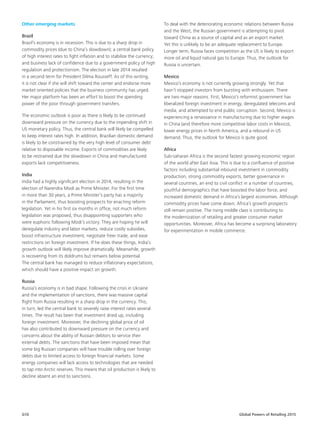
Brazil
Brazil’s economy is in recession. This is due to a sharp drop in
commodity prices (due to China’s slowdown); a central bank policy
of high interest rates to fight inflation and to stabilize the currency;
and business lack of confidence due to a government policy of high
regulation and protectionism. The election in late 2014 resulted
in a second term for President Dilma Rousseff. As of this writing,
it is not clear if she will shift toward the center and endorse more
market oriented policies that the business community has urged.
Her major platform has been an effort to boost the spending
power of the poor through government transfers.
The economic outlook is poor as there is likely to be continued
downward pressure on the currency due to the impending shift in
US monetary policy. Thus, the central bank will likely be compelled
to keep interest rates high. In addition, Brazilian domestic demand
is likely to be constrained by the very high level of consumer debt
relative to disposable income. Exports of commodities are likely
to be restrained due the slowdown in China and manufactured
exports lack competitiveness.
India
India had a highly significant election in 2014, resulting in the
election of Narendra Modi as Prime Minister. For the first time
in more than 30 years, a Prime Minister’s party has a majority
in the Parliament, thus boosting prospects for enacting reform
legislation. Yet in his first six months in office, not much reform
legislation was proposed, thus disappointing supporters who
were euphoric following Modi’s victory. They are hoping he will
deregulate industry and labor markets, reduce costly subsidies,
boost infrastructure investment, negotiate freer trade, and ease
restrictions on foreign investment. If he does these things, India’s
growth outlook will likely improve dramatically. Meanwhile, growth
is recovering from its doldrums but remains below potential.
The central bank has managed to reduce inflationary expectations,
which should have a positive impact on growth.
Russia
Russia’s economy is in bad shape. Following the crisis in Ukraine
and the implementation of sanctions, there was massive capital
flight from Russia resulting in a sharp drop in the currency. This,
in turn, led the central bank to severely raise interest rates several
times. The result has been that investment dried up, including
foreign investment. Moreover, the declining global price of oil
has also contributed to downward pressure on the currency and
concerns about the ability of Russian debtors to service their
external debts. The sanctions that have been imposed mean that
some big Russian companies will have trouble rolling over foreign
debts due to limited access to foreign financial markets. Some
energy companies will lack access to technologies that are needed
to tap into Arctic reserves. This means that oil production is likely to
decline absent an end to sanctions.
To deal with the deteriorating economic relations between Russia
and the West, the Russian government is attempting to pivot
toward China as a source of capital and as an export market.
Yet this is unlikely to be an adequate replacement to Europe.
Longer term, Russia faces competition as the US is likely to export
more oil and liquid natural gas to Europe. Thus, the outlook for
Russia is uncertain.
Mexico
Mexico’s economy is not currently growing strongly. Yet that
hasn’t stopped investors from bursting with enthusiasm. There
are two major reasons. First, Mexico’s reformist government has
liberalized foreign investment in energy, deregulated telecoms and
media, and attempted to end public corruption. Second, Mexico is
experiencing a renaissance in manufacturing due to higher wages
in China (and therefore more competitive labor costs in Mexico),
lower energy prices in North America, and a rebound in US
demand. Thus, the outlook for Mexico is quite good.
Africa
Sub-saharan Africa is the second fastest growing economic region
of the world after East Asia. This is due to a confluence of positive
factors including substantial inbound investment in commodity
production, strong commodity exports, better governance in
several countries, an end to civil conflict in a number of countries,
youthful demographics that have boosted the labor force, and
increased domestic demand in Africa’s largest economies. Although
commodity prices have come down, Africa’s growth prospects
still remain positive. The rising middle class is contributing to
the modernization of retailing and greater consumer market
opportunities. Moreover, Africa has become a surprising laboratory
for experimentation in mobile commerce.
Global Powers of Retailing 2015 G11
Retail
revenue
rank
(FY13) Name of company
Country
of origin
2013
net retail
revenue
(US$m)
2013
parent
company/
group
revenue¹
(US$m)
2013
parent
company/
group
net income¹
(US$m) Dominant operational format 2013
#
countries
of
operation
2013
2008-
2013
retail
revenue
CAGR²
1 Wal-Mart Stores, Inc. U.S. 476,294 476,294 16,695 Hypermarket/Supercenter/Superstore 28 3.3%
2 Costco Wholesale Corporation U.S. 105,156 105,156 2,061 Cash  Carry/Warehouse Club 9 7.7%
3 Carrefour S.A. France 98,688 101,844 1,812 Hypermarket/Supercenter/Superstore 33 -3.0%
4 Schwarz Unternehmens Treuhand KG Germany 98,662e
98,662e
n/a Discount Store 26 6.5%
5 Tesco PLC U.K. 98,631 100,213 1,529 Hypermarket/Supercenter/Superstore 13 2.9%
6 The Kroger Co. U.S. 98,375 98,375 1,531 Supermarket 1 5.3%
7 Metro Ag3
Germany 86,393e
86,393e
588e
Cash  Carry/Warehouse Club 32 -0.9%
8 Aldi Einkauf GmbH  Co. oHG Germany 81,090e
81,090e
n/a Discount Store 17 5.5%
9 The Home Depot, Inc. U.S. 78,812 78,812 5,385 Home Improvement 4 2.0%
10 Target Corporation U.S. 72,596 72,596 1,971 Discount Department Store 2 2.9%
11 Walgreen Co. U.S. 72,217 72,217 2,450 Drug Store/Pharmacy 2 4.1%
12 CVS Caremark Corporation U.S. 65,618 126,761 4,592 Drug Store/Pharmacy 3 6.0%
13 Casino Guichard-Perrachon S.A. France 63,468**
64,613**
2,023 Hypermarket/Supercenter/Superstore 29 11.1%
14 Groupe Auchan SA France 62,444 63,859 1,109 Hypermarket/Supercenter/Superstore 13 4.0%
15 Amazon.com, Inc. U.S. 60,903 74,452 274 Non-Store 14 26.7%
16 Edeka Zentrale AG  Co. KG Germany 59,704**
61,399**
n/a Supermarket 1 5.9%
17 Aeon Co., Ltd. Japan 57,986**
64,271**
835 Hypermarket/Supercenter/Superstore 10 3.9%
18 Woolworths Limited Australia 54,457 55,974 2,258 Supermarket 2 4.3%
19 Seven  i Holdings Co., Ltd. Japan 54,258**
56,600**
1,890 Convenience/Forecourt Store 18 -0.1%
20 Lowe's Companies, Inc. U.S. 53,417 53,417 2,286 Home Improvement 4 2.1%
21 Rewe Combine Germany 51,109**
55,745**
266 Supermarket 11 3.5%
22 Wesfarmers Limited Australia 50,711 55,265 2,076 Supermarket 2 4.8%
23 Centres Distributeurs E. Leclerc France 47,671e**
60,569g**
n/a Hypermarket/Supercenter/Superstore 7 5.4%
24 Koninklijke Ahold N.V. Netherlands 43,321**
43,321**
3,370 Supermarket 7 4.9%
25 Best Buy Co., Inc. U.S. 42,410 42,410 523 Electronics Specialty 5 -1.2%
26 J Sainsbury plc U.K. 38,031 38,076 1,138 Supermarket 1 4.8%
27 ITM Développement International
(Intermarché)
France 37,351e**
52,998g**
n/a Supermarket 6 2.0%
28 The IKEA Group (INGKA Holding B.V.) Netherlands 36,495 37,288 4,339 Other Specialty 43 5.6%
29 Sears Holdings Corp. U.S. 36,188 36,188 -1,116 Department Store 3 -5.0%
30 Safeway Inc. U.S. 35,011 36,139 3,522 Supermarket 3 -4.1%
31 Loblaw Companies Limited Canada 30,697**
31,446**
612 Hypermarket/Supercenter/Superstore 2 0.5%
32 Publix Super Markets, Inc. U.S. 29,148 29,148 1,654 Supermarket 1 3.9%
33 Delhaize Group SA Belgium 28,037**
28,037**
243 Supermarket 9 2.1%
34 Macy's, Inc. U.S. 27,931**
27,931**
1,486 Department Store 3 2.3%
35 Wm Morrison Supermarkets PLC U.K. 27,739 27,739 -373 Supermarket 1 4.0%
36 The TJX Companies, Inc. U.S. 27,423 27,423 2,137 Apparel/Footwear Specialty 7 7.6%
37 Rite Aid Corporation U.S. 25,526 25,526 249 Drug Store/Pharmacy 1 -0.6%
Top 250 global retailers 2013
¹ Revenue and net income for the parent company or group may include results
from non-retail operations
² Compound annual growth rate
3
Metro changed its fiscal year from end of December to end of September. Fiscal
2013 results reported here include the 9 months ended 30 September 2013 plus
the quarter ended 31 December 2013 to create a 12-month period equivalent to
prior years.
e = estimate	
g = gross turnover as reported by company
n/a = not available
ne = not in existence (created by merger or divestiture)
* Revenue reflects wholesale sales
** Revenue includes wholesale and retail sales
Top 250 global retailers, 2013
Global Powers of Retailing 2015G12
¹ Revenue and net income for the parent company or
group may include results from non-retail operations
² Compound annual growth rate
e = estimate	
g = gross turnover as reported by company
n/a = not available
ne = not in existence (created by merger or divestiture)
* Revenue reflects wholesale sales
** Revenue includes wholesale and retail sales
Top 250 global retailers, 2013
Retail
revenue
rank
(FY13) Name of company
Country
of origin
2013
net retail
revenue
(US$m)
2013
parent
company/
group
revenue¹
(US$m)
2013
parent
company/
group
net income¹
(US$m) Dominant operational format 2013
#
countries
of
operation
2013
2008-
2013
retail
revenue
CAGR²
38 Migros-Genossenschafts Bund Switzerland 25,010e**
28,863**
847 Hypermarket/Supercenter/Superstore 3 1.4%
39 Système U, Centrale Nationale France 24,706e**
31,413g**
n/a Supermarket 5 5.4%
40 Lotte Shopping Co., Ltd. S. Korea 24,601 25,955 810 Hypermarket/Supercenter/Superstore 6 17.5%
41 LVMH Moët Hennessy-
Louis Vuitton S.A.
France 24,392e
38,717**
5,243 Other Specialty 76 14.6%
42 Mercadona, S.A. Spain 23,954 23,954 684 Supermarket 1 4.8%
43 Albertson's LLC U.S. 23,000e
23,000e
n/a Supermarket 1 38.6%
44 Inditex, S.A. Spain 22,265**
22,265**
3,171 Apparel/Footwear Specialty 89 10.0%
45 H.E. Butt Grocery Company U.S. 20,330e
20,330e
n/a Supermarket 2 6.3%
46 Apple Inc./Apple Retail Stores U.S. 20,228 170,910 37,037 Electronics Specialty 14 22.6%
47 Cencosud S.A. Chile 19,855 20,889 505 Supermarket 5 11.3%
48 Empire Company Limited Canada 19,829**
19,890**
230 Supermarket 1 7.3%
49 H  M Hennes  Mauritz AB Sweden 19,729 19,729 2,632 Apparel/Footwear Specialty 54 7.7%
50 Coop Group Switzerland 19,529 29,111**
592 Supermarket 1 1.1%
51 A.S. Watson Group Hong Kong
SAR
19,230**
19,230**
n/a Drug Store/Pharmacy 25 4.7%
52 Kohl's Corporation U.S. 19,031 19,031 889 Department Store 1 3.0%
53 Yamada Denki Co., Ltd. Japan 18,921**
18,921**
199 Electronics Specialty 7 0.2%
54 Groupe Adeo SA France 18,197e**
18,197e**
n/a Home Improvement 13 10.0%
55 OJSC Magnit Russia 18,197 18,202**
1,118 Convenience/Forecourt Store 1 27.9%
56 Dollar General Corporation U.S. 17,504 17,504 1,025 Discount Store 1 10.9%
57 Kingfisher plc U.K. 17,454 17,454 1,114 Home Improvement 9 2.1%
58 X5 Retail Group N.V. Russia 16,785 16,785 345 Discount Store 2 15.0%
59 Suning Commerce Group Co., Ltd. China 16,616 17,010 60 Electronics Specialty 3 16.3%
60 Marks and Spencer Group plc U.K. 16,391 16,391 804 Department Store 48 2.6%
61 The Gap, Inc. U.S. 16,148 16,148 1,280 Apparel/Footwear Specialty 54 2.1%
62 Jerónimo Martins, SGPS, S.A. Portugal 15,712 15,712 521 Discount Store 3 12.3%
63 Coop Italia Italy 15,211e
16,901g
n/a Hypermarket/Supercenter/Superstore 1 -0.2%
64 Meijer, Inc. U.S. 15,000e
15,000e
n/a Hypermarket/Supercenter/Superstore 1 1.8%
65 ICA Gruppen AB Sweden 14,952**
15,274**
219 Supermarket 6 1.7%
66 El Corte Inglés, S.A. Spain 14,789 19,055 232 Department Store 5 -4.4%
67 Conad Consorzio Nazionale,
Dettaglianti Soc. Coop. a.r.l.
Italy 14,438e**
15,408g**
n/a Supermarket 2 5.8%
68 John Lewis Partnership plc U.K. 14,164**
14,164**
159 Supermarket 3 7.6%
69 Gome Home Appliance Group China 13,441e
13,782ge
n/a Electronics Specialty 1 3.2%
70 Otto (GmbH  Co KG) Germany 13,355 17,100 239 Non-Store 54 2.5%
71 S Group Finland 13,233 15,080 300 Supermarket 5 6.2%
72 Distribuidora Internacional de
Alimentación, S.A. (Dia, S.A.)
Spain 13,076**
13,076**
260 Discount Store 6 ne
73 Whole Foods Market, Inc. U.S. 12,917 12,917 551 Supermarket 3 10.2%
74 Isetan Mitsukoshi Holdings Ltd. Japan 12,856 13,202 217 Department Store 9 -1.5%
75 Co-operative Group Ltd. U.K. 12,652 16,484 -3,601 Supermarket 1 8.7%
76 Fast Retailing Co., Ltd. Japan 12,639**
12,664**
1,033 Apparel/Footwear Specialty 30 14.3%
77 Toys R Us, Inc. U.S. 12,543 12,543 -1,036 Other Specialty 38 -1.8%
78 China Resources Enterprise,
Limited
Hong Kong
SAR
12,258 18,877**
406 Hypermarket/Supercenter/Superstore 5 22.4%
79 Alliance Boots GmbH Switzerland 12,170 37,150**
1,544 Drug Store/Pharmacy 14 1.4%
Global Powers of Retailing 2015 G13
Top 250 global retailers, 2013
Retail
revenue
rank
(FY13) Name of company
Country
of origin
2013
net retail
revenue
(US$m)
2013
parent
company/
group
revenue¹
(US$m)
2013
parent
company/
group
net income¹
(US$m) Dominant operational format 2013
#
countries
of
operation
2013
2008-
2013
retail
revenue
CAGR²
80 Nordstrom, Inc. U.S. 12,166 12,540 734 Department Store 1 8.0%
81 Staples, Inc. U.S. 12,160e
23,114 620 Other Specialty 13 -1.0%
82 J. C. Penney Company, Inc. U.S. 11,859 11,859 -1,388 Department Store 2 -8.5%
83 BJ's Wholesale Club, Inc. U.S. 11,800e
11,800e
n/a Cash  Carry/Warehouse Club 1 3.3%
84 Louis Delhaize S.A. Belgium 11,689e
11,689e
n/a Hypermarket/Supercenter/Superstore 6 -4.4%
85 Dixons Retail plc U.K. 11,560 11,560 -113 Electronics Specialty 7 -2.9%
86 Bed Bath and Beyond Inc. U.S. 11,504**
11,504**
1,022 Other Specialty 4 9.8%
87 Spar Holding AG (formerly SPAR
Österreichische Warenhandels-AG)
Austria 11,411**
11,518**
251 Supermarket 8 2.2%
88 S.A.C.I. Falabella Chile 11,377 12,523 1,004 Department Store 5 11.4%
89 Metro Inc. Canada 11,236**
11,236**
711 Supermarket 1 1.2%
90 E-MART Co., Ltd. S. Korea 11,164 11,992 438 Hypermarket/Supercenter/Superstore 2 ne
91 NorgesGruppen ASA Norway 11,054**
11,483**
306 Discount Store 1 6.6%
92 JD.com, Inc. (formerly Beijing
Jingdong Century Trade Co., Ltd.
and 360buy Jingdong Inc.)
China 10,827 11,202 -8 Non-Store 78 123.6%
93 L Brands, Inc. U.S. 10,773**
10,773**
903 Apparel/Footwear Specialty 58 3.6%
94 Shoppers Drug Mart Corporation Canada 10,742 10,742 584 Drug Store/Pharmacy 1 3.3%
95 J. Front Retailing Co., Ltd. Japan 10,411 11,521 348 Department Store 2 1.5%
96 Family Dollar Stores, Inc. U.S. 10,391 10,391 444 Discount Store 1 8.3%
97 Canadian Tire Corporation, Limited Canada 10,385**
11,449**
548 Other Specialty 1 4.9%
98 Dairy Farm International Holdings
Limited
Hong Kong
SAR
10,357 10,357 513 Supermarket 12 9.0%
99 Liberty Interactive Corporation U.S. 10,307 11,252 580 Non-Store 9 5.0%
100 Ross Stores, Inc. U.S. 10,230 10,230 837 Apparel/Footwear Specialty 1 9.5%
101 Uny Group Holdings Co., Ltd. Japan 10,156**
10,373**
66 Convenience/Forecourt Store 3 -2.8%
102 Southeastern Grocers, LLC
(formerly BI-LO Holding, LLC)
U.S. 10,126e
10,126e
n/a Supermarket 1 32.2%
103 Tengelmann
Warenhandelsgesellschaft KG
Germany 10,072e**
10,390**
n/a Home Improvement 13 -12.0%
104 Chow Tai Fook Jewellery Group
Limited
Hong Kong
SAR
9,979**
9,979**
960 Other Specialty 6 33.3%
105 Dansk Supermarked A/S Denmark 9,921 9,974 315 Discount Store 4 -0.5%
106 Giant Eagle, Inc. U.S. 9,900e**
9,900e**
n/a Supermarket 1 3.8%
107 Shoprite Holdings Ltd. S. Africa 9,869**
9,869**
361 Supermarket 15 11.5%
108 Oxylane Groupe France 9,829 9,829 n/a Other Specialty 22 8.3%
109 CA Europe Belgium/
Germany
9,733e
9,733e
n/a Apparel/Footwear Specialty 21 3.0%
110 Menard, Inc. U.S. 9,500e
9,500e
n/a Home Improvement 1 3.2%
111 Jumbo Groep Holding B.V. Netherlands 9,420g
9,420g
n/a Supermarket 1 36.9%
112 Globus Holding GmbH  Co. KG Germany 9,349g
9,349g
n/a Hypermarket/Supercenter/Superstore 4 4.0%
113 CP ALL Public Company Limited Thailand 9,286 9,300**
347 Convenience/Forecourt Store 1 17.5%
114 AutoZone, Inc. U.S. 9,148 9,148 1,016 Other Specialty 4 7.0%
115 GameStop Corp. U.S. 9,040 9,040 354 Other Specialty 16 0.5%
116 dm-drogerie markt GmbH + Co. KG Germany 9,009e
10,090g
n/a Drug Store/Pharmacy 12 10.1%
117 Home Retail Group plc U.K. 8,929 8,929 85 Other Specialty 3 -0.8%
118 SuperValu Inc. U.S. 8,879**
17,155**
182 Supermarket 1 -23.8%
119 Bic Camera Inc. Japan 8,827 8,924 40 Electronics Specialty 1 5.8%
120 Dirk Rossmann GmbH Germany 8,820 8,820 n/a Drug Store/Pharmacy 6 11.5%
121 Kesko Corporation ” Finland 8,776e**
12,373**
245 Supermarket 8 1.5%
¹ Revenue and net income for the parent company or
group may include results from non-retail operations
² Compound annual growth rate
e = estimate	
g = gross turnover as reported by company
n/a = not available
ne = not in existence (created by merger or divestiture)
* Revenue reflects wholesale sales
** Revenue includes wholesale and retail sales
Global Powers of Retailing 2015G14
Top 250 global retailers, 2013
¹ Revenue and net income for the parent company or
group may include results from non-retail operations
² Compound annual growth rate
e = estimate	
g = gross turnover as reported by company
n/a = not available
ne = not in existence (created by merger or divestiture)
* Revenue reflects wholesale sales
** Revenue includes wholesale and retail sales
Retail
revenue
rank
(FY13) Name of company
Country
of origin
2013
net retail
revenue
(US$m)
2013
parent
company/
group
revenue¹
(US$m)
2013
parent
company/
group
net income¹
(US$m) Dominant operational format 2013
#
countries
of
operation
2013
2008-
2013
retail
revenue
CAGR²
122 Colruyt Group Belgium 8,760 11,598**
469 Supermarket 3 6.2%
123 Reitan Group Norway 8,512 9,754 341 Discount Store 7 11.2%
124 Esselunga S.p.A. Italy 8,474e
9,241g
279 Hypermarket/Supercenter/Superstore 1 3.8%
125 Takashimaya Co., Ltd. Japan 8,390 9,087 196 Department Store 4 -1.8%
126 Army  Air Force Exchange
Service (AAFES)
U.S. 8,308 8,308 167 Hypermarket/Supercenter/Superstore 26 -1.3%
127 Organización Soriana,
S.A.B. de C.V.
Mexico 8,240**
8,240**
245 Hypermarket/Supercenter/Superstore 1 1.9%
128 Steinhoff International Holdings Ltd. S. Africa 8,217 11,333 952 Other Specialty 26 31.5%
129 Shanghai Friendship Group
Incorporated Co.
China 8,166**
8,389**
202 Supermarket 1 14.8%
130 Hy-Vee, Inc. U.S. 8,014 8,014 n/a Supermarket 1 5.3%
131 Beisia Group Co., Ltd. Japan 7,885e
8,524e
n/a Home Improvement 1 1.7%
132 Compagnie Financière
Richemont SA
Switzerland 7,841 14,275**
2,771 Other Specialty 170 20.5%
133 Dollar Tree, Inc. U.S. 7,840 7,840 597 Discount Store 2 11.0%
134 FEMSA Comercio, S.A. de C.V. Mexico 7,655 7,655 n/a Convenience/Forecourt Store 2 15.7%
135 SHV Holdings N.V./Makro Netherlands 7,621 23,377 4,727 Cash  Carry/Warehouse Club 6 6.5%
136 Grupo Eroski Spain 7,585e
7,829 -136 Supermarket 2 -6.2%
137 Edion Corporation Japan 7,277e**
7,659**
52 Electronics Specialty 1 -0.9%
138 K's Holdings Corporation Japan 7,005**
7,005**
175 Electronics Specialty 1 4.1%
139 Wegmans Food Markets, Inc. U.S. 7,000e
7,000e
n/a Supermarket 1 7.8%
140 PetSmart, Inc. U.S. 6,917 6,917 420 Other Specialty 3 6.4%
141 Yodobashi Camera Co., Ltd. Japan 6,901e
6,901e
n/a Electronics Specialty 1 -0.3%
142 Coop Danmark A/S Denmark 6,859**
7,071**
10 Supermarket 2 1.3%
143 Kering S.A. France 6,732 12,948**
53 Apparel/Footwear Specialty 90 -18.5%
144 Associated British Foods plc/
Primark
U.K. 6,673 20,792 990 Apparel/Footwear Specialty 8 17.2%
145 O'Reilly Automotive, Inc. U.S. 6,649**
6,649**
670 Other Specialty 1 13.2%
146 Dillard's, Inc. U.S. 6,599e
6,692 324 Department Store 1 -0.9%
147 Foot Locker, Inc. U.S. 6,505 6,505 429 Apparel/Footwear Specialty 30 4.4%
148 Pick n Pay Stores Limited S. Africa 6,351 6,351 59 Supermarket 7 4.8%
149 Coppel S.A. de C.V. Mexico 6,304 6,304 850 Department Store 3 17.1%
150 Lojas Americanas S.A. Brazil 6,247 6,247 188 Discount Department Store 1 14.0%
151 BİM Birleşik Mağazalar A.Ş. Turkey 6,242 6,242 218 Discount Store 3 22.8%
152 Dick's Sporting Goods, Inc. U.S. 6,213 6,213 338 Other Specialty 1 8.5%
153 Central Retail Corporation Ltd. Thailand 6,207e
6,207e
n/a Department Store 4 17.2%
154 Advance Auto Parts, Inc. U.S. 6,171**
6,494**
392 Other Specialty 2 4.4%
155 Sonae, SGPS, SA Portugal 6,144 6,404 616 Supermarket 16 1.9%
156 President Chain Store Corp. Taiwan 6,136e
6,771**
312 Convenience/Forecourt Store 4 8.1%
157 Bauhaus GmbH  Co. KG Germany 6,073e
6,073e
n/a Home Improvement 17 8.8%
158 Office Depot, Inc. U.S. 6,015e
11,242 -20 Other Specialty 21 -4.7%
159 The Sherwin-Williams Company/
Paint Stores Group
U.S. 6,002 10,186**
753 Home Improvement 8 4.4%
160 Defense Commissary Agency
(DeCA)
U.S. 5,900 5,900 n/a Supermarket 13 0.3%
161 The Great Atlantic  Pacific Tea
Company, Inc.
U.S. 5,900e
5,900e
n/a Supermarket 1 -9.1%
162 Belle International Holdings
Limited
Hong Kong
SAR
5,856 5,856 726 Apparel/Footwear Specialty 3 15.2%
Global Powers of Retailing 2015 G15
Top 250 global retailers, 2013
¹ Revenue and net income for the parent company or
group may include results from non-retail operations
² Compound annual growth rate
e = estimate	
g = gross turnover as reported by company
n/a = not available
ne = not in existence (created by merger or divestiture)
* Revenue reflects wholesale sales
** Revenue includes wholesale and retail sales
Retail
revenue
rank
(FY13) Name of company
Country
of origin
2013
net retail
revenue
(US$m)
2013
parent
company/
group
revenue¹
(US$m)
2013
parent
company/
group
net income¹
(US$m) Dominant operational format 2013
#
countries
of
operation
2013
2008-
2013
retail
revenue
CAGR²
163 Next plc U.K. 5,843 5,868**
868 Apparel/Footwear Specialty 74 3.8%
164 Don Quijote Co., Ltd. Japan 5,842 6,063 238 Discount Department Store 2 5.0%
165 WinCo Foods LLC U.S. 5,700e 5,700e n/a Supermarket 1 7.3%
166 OJSC Dixy Group Russia 5,628 5,679 96 Supermarket 1 30.2%
167 Izumi Co., Ltd. Japan 5,564 5,596 176 Hypermarket/Supercenter/Superstore 1 3.0%
168 KF Gruppen Sweden 5,449e**
5,854**
-8 Supermarket 1 1.3%
169 Deichmann SE Germany 5,313 6,110g
n/a Apparel/Footwear Specialty 23 8.3%
170 Nike, Inc. U.S. 5,304 27,799**
2,693 Apparel/Footwear Specialty 49 19.5%
171 Big Lots, Inc. U.S. 5,302 5,302 125 Discount Store 2 2.7%
172 H2O Retailing Corporation Japan 5,270 5,763 3 Department Store 1 2.0%
173 Life Corporation Japan 5,226 5,376 38 Supermarket 1 2.9%
174 The SPAR Group Limited S. Africa 5,175**
5,175**
129 Supermarket 7 12.1%
175 Tractor Supply Company U.S. 5,165 5,165 328 Other Specialty 1 11.4%
176 Grupo Comercial Chedraui,
S.A.B. de C.V.
Mexico 5,157 5,207 134 Hypermarket/Supercenter/Superstore 2 10.4%
177 El Puerto de Liverpool,
S.A.B. de C.V.
Mexico 5,156 5,814 604 Department Store 1 9.7%
178 Coop Norge, the Group Norway 5,133**
5,362**
-7 Supermarket 1 3.2%
179 Dashang Co., Ltd. China 5,047 5,452 203 Department Store 1 12.2%
180 Shimamura Co., Ltd. Japan 5,044 5,044 267 Apparel/Footwear Specialty 3 4.1%
181 Hudson's Bay Company Canada 5,034 5,034 -249 Department Store 2 n/a
182 Foodstuffs North Island Ltd. New
Zealand
5,021e**
5,021e**
127 Hypermarket/Supercenter/Superstore 1 ne
183 Emke Group/Lulu Group
International
UAE 5,000e
5,000e
n/a Hypermarket/Supercenter/Superstore 10 18.7%
184 Groupe FNAC S.A. France 4,932**
5,187**
20 Other Specialty 7 ne
185 MatsumotoKiyoshi Holdings Co., Ltd. Japan 4,919**
4,949**
134 Drug Store/Pharmacy 1 4.8%
186 E.Land World Ltd. S. Korea 4,914e**
5,683**
111 Apparel/Footwear Specialty 15 11.4%
187 Darty plc U.K. 4,821 4,821 -9 Electronics Specialty 5 -9.5%
188 Chongqing Department Store
Co., Ltd.
China 4,733 4,886 126 Department Store 1 36.0%
189 Yonghui Superstores Co., Ltd. China 4,733 4,934 117 Hypermarket/Supercenter/Superstore 1 38.8%
190 Ascena Retail Group, Inc. U.S. 4,715 4,715 151 Apparel/Footwear Specialty 3 26.7%
191 Harris Teeter Supermarkets, Inc. U.S. 4,710 4,710 108 Supermarket 1 5.1%
192 OJSC Company M.video Russia 4,657 4,657 180 Electronics Specialty 1 16.8%
193 Neiman Marcus Group LTD Inc. U.S. 4,648 4,648 164 Department Store 2 0.2%
194 Michaels Stores, Inc. U.S. 4,570 4,570 264 Other Specialty 2 3.7%
195 Arcs Co., Ltd. Japan 4,554 4,567 64 Supermarket 1 13.8%
196 Lenta Group Russia 4,539 4,539 223 Hypermarket/Supercenter/Superstore 1 23.2%
197 Nonggongshang Supermarket
(Group) Co. Ltd.
China 4,538e
4,538g
n/a Supermarket 1 5.2%
198 Douglas Holding AG Germany 4,532e
4,532e
n/a Other Specialty 18 1.9%
199 Celesio AG Germany 4,532 28,435**
221 Drug Store/Pharmacy 7 -0.8%
200 Sundrug Co., Ltd. Japan 4,474**
4,474**
157 Drug Store/Pharmacy 1 14.2%
201 Burlington Coat Factory
Investments Holdings, Inc.
U.S. 4,462 4,462 44 Department Store 2 4.6%
202 Tokyu Corporation Japan 4,432 10,820 574 Department Store 3 -5.2%
203 Save Mart Supermarkets U.S. 4,390e
4,390e
n/a Supermarket 1 -3.0%
204 Williams-Sonoma, Inc. U.S. 4,388 4,388 279 Other Specialty 10 5.5%
205 DCM Holdings Co., Ltd. Japan 4,361 4,364 103 Home Improvement 1 0.7%
Global Powers of Retailing 2015G16
Top 250 global retailers, 2013
¹ Revenue and net income for the parent company or
group may include results from non-retail operations
² Compound annual growth rate
e = estimate	
g = gross turnover as reported by company
n/a = not available
ne = not in existence (created by merger or divestiture)
* Revenue reflects wholesale sales
** Revenue includes wholesale and retail sales
Retail
revenue
rank
(FY13) Name of company
Country
of origin
2013
net retail
revenue
(US$m)
2013
parent
company/
group
revenue¹
(US$m)
2013
parent
company/
group
net income¹
(US$m) Dominant operational format 2013
#
countries
of
operation
2013
2008-
2013
retail
revenue
CAGR²
206 O’Key Group S.A. Russia 4,330 4,387 157 Hypermarket/Supercenter/Superstore 1 22.3%
207 Valor Co., Ltd. Japan 4,324 4,537 92 Supermarket 2 5.8%
208 Iceland Topco Limited U.K. 4,309**
4,309**
n/a Supermarket 7 5.4%
209 Coach, Inc. U.S. 4,303e
4,806**
781 Other Specialty 17 9.6%
210 Demoulas Super Markets, Inc. U.S. 4,300e
4,300e
n/a Supermarket 1 9.0%
211 Barnes  Noble, Inc. U.S. 4,295 6,381**
-47 Other Specialty 1 -3.5%
212 Berkshire Hathaway Inc./Retail
operations
U.S. 4,288 182,150 19,845 Other Specialty 8 6.7%
213 Arcadia Group Limited U.K. 4,277**
4,277**
693 Apparel/Footwear Specialty 46 8.2%
214 SM Investments Corporation Philippines 4,276 5,988 904 Department Store 1 9.5%
215 Lawson, Inc. Japan 4,229**
4,877**
384 Convenience/Forecourt Store 4 6.6%
216 GS Retail Co., Ltd. S. Korea 4,223 4,332 110 Convenience/Forecourt Store 1 7.4%
217 Signet Jewelers Limited Bermuda 4,209 4,209 368 Other Specialty 3 4.7%
218 HORNBACH-Baumarkt-AG Group Germany 4,202 4,202 75 Home Improvement 9 3.9%
219 Abercrombie  Fitch Co. U.S. 4,117 4,117 55 Apparel/Footwear Specialty 22 3.1%
220 RONA Inc. Canada 4,072**
4,072**
-149 Home Improvement 1 -3.0%
221 Belk, Inc. U.S. 4,038 4,038 159 Department Store 1 2.9%
222 Agrokor d.d. Croatia 4,011**
5,291**
6 Supermarket 3 n/a
223 East Japan Railway Company
(JR East)
Japan 4,005 27,002 2,008 Convenience/Forecourt Store 1 -0.7%
224 Forever 21, Inc. U.S. 4,000e
4,000e
n/a Apparel/Footwear Specialty 39 18.7%
225 PRADA Group Italy 3,989 4,776 849 Apparel/Footwear Specialty 42 28.0%
226 Axfood AB Sweden 3,989 5,763**
153 Supermarket 1 2.4%
227 Gruppo Eurospin Italy 3,985e**
4,317g**
n/a Discount Store 2 7.8%
228 Groupe Vivarte France 3,977 3,977 n/a Apparel/Footwear Specialty 64 0.9%
229 Norma Lebensmittelfilialbetrieb
Stiftung  Co. KG
Germany 3,958e
3,958e
n/a Discount Store 4 3.2%
230 Roundy's, Inc. U.S. 3,950 3,950 35 Supermarket 1 0.4%
231 Systembolaget AB Sweden 3,948 3,948 44 Other Specialty 1 3.9%
232 Academy Sports + Outdoors U.S. 3,900e
3,900e
n/a Other Specialty 1 11.5%
233 Tsuruha Holdings Inc. Japan 3,864 3,865 148 Drug Store/Pharmacy 2 9.1%
234 Heiwado Co., Ltd. Japan 3,863 4,066 81 Hypermarket/Supercenter/Superstore 2 -0.4%
235 Joshin Denki Co., Ltd. Japan 3,863**
4,014**
30 Electronics Specialty 1 2.1%
236 Stater Bros. Holdings Inc. U.S. 3,860 3,860 30 Supermarket 1 1.2%
237 Müller Ltd.  Co. KG Germany 3,854e
4,582ge
n/a Drug Store/Pharmacy 7 6.5%
238 XXXLutz Group Austria 3,852e
3,852e
n/a Other Specialty 8 4.7%
239 Woolworths Holdings Limited S. Africa 3,834 3,834 289 Department Store 17 13.4%
240 Nitori Holdings Co., Ltd. Japan 3,831 3,895 386 Other Specialty 3 9.5%
241 SMU S.A. Chile 3,823**
3,857**
-1,073 Supermarket 2 29.8%
242 Lagardère Services SA France 3,810 4,974 n/a Other Specialty 34 4.3%
243 Reinalt-Thomas Corporation
(dba Discount Tire/America's Tire)
U.S. 3,800e
3,800e
n/a Other Specialty 1 9.5%
244 Tiffany  Co. U.S. 3,800e
4,031**
181 Other Specialty 25 7.1%
245 Ralph Lauren Corporation U.S. 3,798 7,450**
776 Apparel/Footwear Specialty 47 14.4%
246 Liquor Control Board of Ontario Canada 3,773e
4,750**
1,659 Other Specialty 1 3.1%
247 Magazine Luiza SA Brazil 3,758 4,063 53 Electronics Specialty 1 27.5%
248 HTM-Group France 3,706e
3,706e
n/a Electronics Specialty 1 19.1%
249 Welcia Holdings Co., Ltd. Japan 3,705 3,705 89 Drug Store/Pharmacy 2 ne
250 Overwaitea Food Group Canada 3,700e
3,700e
n/a Supermarket 1 6.5%
Global Powers of Retailing 2015 G17
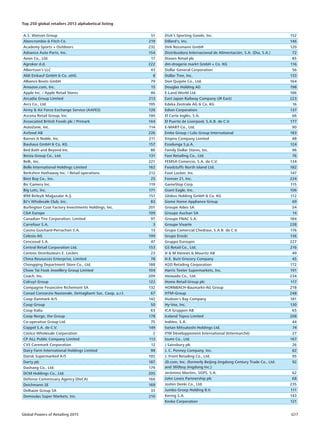
A.S. Watson Group 51
Abercrombie  Fitch Co. 219
Academy Sports + Outdoors 232
Advance Auto Parts, Inc. 154
Aeon Co., Ltd. 17
Agrokor d.d. 222
Albertson's LLC 43
Aldi Einkauf GmbH  Co. oHG 8
Alliance Boots GmbH 79
Amazon.com, Inc. 15
Apple Inc. / Apple Retail Stores 46
Arcadia Group Limited 213
Arcs Co., Ltd. 195
Army  Air Force Exchange Service (AAFES) 126
Ascena Retail Group, Inc. 190
Associated British Foods plc / Primark 144
AutoZone, Inc. 114
Axfood AB 226
Barnes  Noble, Inc. 211
Bauhaus GmbH  Co. KG 157
Bed Bath and Beyond Inc. 86
Beisia Group Co., Ltd. 131
Belk, Inc. 221
Belle International Holdings Limited 162
Berkshire Hathaway Inc. / Retail operations 212
Best Buy Co., Inc. 25
Bic Camera Inc. 119
Big Lots, Inc. 171
BİM Birleşik Mağazalar A.Ş. 151
BJ's Wholesale Club, Inc. 83
Burlington Coat Factory Investments Holdings, Inc. 201
CA Europe 109
Canadian Tire Corporation, Limited 97
Carrefour S.A. 3
Casino Guichard-Perrachon S.A. 13
Celesio AG 199
Cencosud S.A. 47
Central Retail Corporation Ltd. 153
Centres Distributeurs E. Leclerc 23
China Resources Enterprise, Limited 78
Chongqing Department Store Co., Ltd. 188
Chow Tai Fook Jewellery Group Limited 104
Coach, Inc. 209
Colruyt Group 122
Compagnie Financière Richemont SA 132
Conad Consorzio Nazionale, Dettaglianti Soc. Coop. a.r.l. 67
Coop Danmark A/S 142
Coop Group 50
Coop Italia 63
Coop Norge, the Group 178
Co-operative Group Ltd. 75
Coppel S.A. de C.V. 149
Costco Wholesale Corporation 2
CP ALL Public Company Limited 113
CVS Caremark Corporation 12
Dairy Farm International Holdings Limited 98
Dansk Supermarked A/S 105
Darty plc 187
Dashang Co., Ltd. 179
DCM Holdings Co., Ltd. 205
Defense Commissary Agency (DeCA) 160
Deichmann SE 169
Delhaize Group SA 33
Demoulas Super Markets, Inc. 210
Dick's Sporting Goods, Inc. 152
Dillard's, Inc. 146
Dirk Rossmann GmbH 120
Distribuidora Internacional de Alimentación, S.A. (Dia, S.A.) 72
Dixons Retail plc 85
dm-drogerie markt GmbH + Co. KG 116
Dollar General Corporation 56
Dollar Tree, Inc. 133
Don Quijote Co., Ltd. 164
Douglas Holding AG 198
E.Land World Ltd. 186
East Japan Railway Company (JR East) 223
Edeka Zentrale AG  Co. KG 16
Edion Corporation 137
El Corte Inglés, S.A. 66
El Puerto de Liverpool, S.A.B. de C.V. 177
E-MART Co., Ltd. 90
Emke Group / Lulu Group International 183
Empire Company Limited 48
Esselunga S.p.A. 124
Family Dollar Stores, Inc. 96
Fast Retailing Co., Ltd. 76
FEMSA Comercio, S.A. de C.V. 134
Foodstuffs North Island Ltd. 182
Foot Locker, Inc. 147
Forever 21, Inc. 224
GameStop Corp. 115
Giant Eagle, Inc. 106
Globus Holding GmbH  Co. KG 112
Gome Home Appliance Group 69
Groupe Adeo SA 54
Groupe Auchan SA 14
Groupe FNAC S.A. 184
Groupe Vivarte 228
Grupo Comercial Chedraui, S.A.B. de C.V. 176
Grupo Eroski 136
Gruppo Eurospin 227
GS Retail Co., Ltd. 216
H  M Hennes  Mauritz AB 49
H.E. Butt Grocery Company 45
H2O Retailing Corporation 172
Harris Teeter Supermarkets, Inc. 191
Heiwado Co., Ltd. 234
Home Retail Group plc 117
HORNBACH-Baumarkt-AG Group 218
HTM-Group 248
Hudson's Bay Company 181
Hy-Vee, Inc. 130
ICA Gruppen AB 65
Iceland Topco Limited 208
Inditex, S.A. 44
Isetan Mitsukoshi Holdings Ltd. 74
ITM Développement International (Intermarché) 27
Izumi Co., Ltd. 167
J Sainsbury plc 26
J. C. Penney Company, Inc. 82
J. Front Retailing Co., Ltd. 95
JD.com, Inc. (formerly Beijing Jingdong Century Trade Co., Ltd.
and 360buy Jingdong Inc.)
92
Jerónimo Martins, SGPS, S.A. 62
John Lewis Partnership plc 68
Joshin Denki Co., Ltd. 235
Jumbo Groep Holding B.V. 111
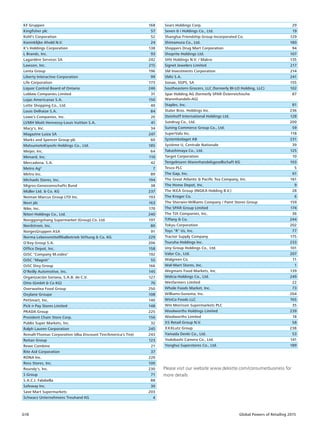
Kering S.A. 143
Kesko Corporation 121
Top 250 global retailers 2013 alphabetical listing
Global Powers of Retailing 2015G18
KF Gruppen 168
Kingfisher plc 57
Kohl's Corporation 52
Koninklijke Ahold N.V. 24
K's Holdings Corporation 138
L Brands, Inc. 93
Lagardère Services SA 242
Lawson, Inc. 215
Lenta Group 196
Liberty Interactive Corporation 99
Life Corporation 173
Liquor Control Board of Ontario 246
Loblaw Companies Limited 31
Lojas Americanas S.A. 150
Lotte Shopping Co., Ltd. 40
Louis Delhaize S.A. 84
Lowe's Companies, Inc. 20
LVMH Moët Hennessy-Louis Vuitton S.A. 41
Macy's, Inc. 34
Magazine Luiza SA 247
Marks and Spencer Group plc 60
MatsumotoKiyoshi Holdings Co., Ltd. 185
Meijer, Inc. 64
Menard, Inc. 110
Mercadona, S.A. 42
Metro Ag3
7
Metro Inc. 89
Michaels Stores, Inc. 194
Migros-Genossenschafts Bund 38
Müller Ltd.  Co. KG 237
Neiman Marcus Group LTD Inc. 193
Next plc 163
Nike, Inc. 170
Nitori Holdings Co., Ltd. 240
Nonggongshang Supermarket (Group) Co. Ltd. 197
Nordstrom, Inc. 80
NorgesGruppen ASA 91
Norma Lebensmittelfilialbetrieb Stiftung  Co. KG 229
O’Key Group S.A. 206
Office Depot, Inc. 158
OJSC Company M.video 192
OJSC Magnit 55
OJSC Dixy Group 166
O'Reilly Automotive, Inc. 145
Organización Soriana, S.A.B. de C.V. 127
Otto (GmbH  Co KG) 70
Overwaitea Food Group 250
Oxylane Groupe 108
PetSmart, Inc. 140
Pick n Pay Stores Limited 148
PRADA Group 225
President Chain Store Corp. 156
Publix Super Markets, Inc. 32
Ralph Lauren Corporation 245
Reinalt-Thomas Corporation (dba Discount Tire/America's Tire) 243
Reitan Group 123
Rewe Combine 21
Rite Aid Corporation 37
RONA Inc. 220
Ross Stores, Inc. 100
Roundy's, Inc. 230
S Group 71
S.A.C.I. Falabella 88
Safeway Inc. 30
Save Mart Supermarkets 203
Schwarz Unternehmens Treuhand KG 4
Sears Holdings Corp. 29
Seven  i Holdings Co., Ltd. 19
Shanghai Friendship Group Incorporated Co. 129
Shimamura Co., Ltd. 180
Shoppers Drug Mart Corporation 94
Shoprite Holdings Ltd. 107
SHV Holdings N.V. / Makro 135
Signet Jewelers Limited 217
SM Investments Corporation 214
SMU S.A. 241
Sonae, SGPS, SA 155
Southeastern Grocers, LLC (formerly BI-LO Holding, LLC) 102
Spar Holding AG (formerly SPAR Österreichische
Warenhandels-AG)
87
Staples, Inc. 81
Stater Bros. Holdings Inc. 236
Steinhoff International Holdings Ltd. 128
Sundrug Co., Ltd. 200
Suning Commerce Group Co., Ltd. 59
SuperValu Inc. 118
Systembolaget AB 231
Système U, Centrale Nationale 39
Takashimaya Co., Ltd. 125
Target Corporation 10
Tengelmann Warenhandelsgesellschaft KG 103
Tesco PLC 5
The Gap, Inc. 61
The Great Atlantic  Pacific Tea Company, Inc. 161
The Home Depot, Inc. 9
The IKEA Group (INGKA Holding B.V.) 28
The Kroger Co. 6
The Sherwin-Williams Company / Paint Stores Group 159
The SPAR Group Limited 174
The TJX Companies, Inc. 36
Tiffany  Co. 244
Tokyu Corporation 202
Toys R Us, Inc. 77
Tractor Supply Company 175
Tsuruha Holdings Inc. 233
Uny Group Holdings Co., Ltd. 101
Valor Co., Ltd. 207
Walgreen Co. 11
Wal-Mart Stores, Inc. 1
Wegmans Food Markets, Inc. 139
Welcia Holdings Co., Ltd. 249
Wesfarmers Limited 22
Whole Foods Market, Inc. 73
Williams-Sonoma, Inc. 204
WinCo Foods LLC 165
Wm Morrison Supermarkets PLC 35
Woolworths Holdings Limited 239
Woolworths Limited 18
X5 Retail Group N.V. 58
XXXLutz Group 238
Yamada Denki Co., Ltd. 53
Yodobashi Camera Co., Ltd. 141
Yonghui Superstores Co., Ltd. 189
Please visit our website www.deloitte.com/consumerbusiness for
more details
Global Powers of Retailing 2015 G19
2013 a challenging year for retailers as global economy
decelerates
As a whole, 2013 was another challenging year for retailers.
Europe remained in recession during most of 2013, although it
began to recover modestly by the end of the year and heading into
2014 – but growth remained poor. The economy continued to be
afflicted by weak credit markets, fiscal austerity, and weak export
markets. The U.S. economy grew slowly in 2013 largely due to a
tightening of fiscal policy. Wages were relatively stagnant except
for households at the upper end. In Japan, there were signs of an
economic recovery owing mainly to the government’s economic
stimulus measures, but the economy slowed in the second half of
the year. Efforts to create some inflation did not yield wage gains,
and real purchasing power for consumers continued to decline.
The Chinese economy decelerated sharply in 2013, and similar slow
growth continued into 2014. Inflation decelerated and producer
prices declined, indicating lots of excess capacity in the economy.
The government cracked down on lavish spending by officials and
luxury gift giving, creating problems for high-end retailing. On the
positive side, a shortage of labor boosted wages.
Many emerging countries saw their economies decelerate during
this period as capital flowed back to the United States following
talks of a change in U.S. monetary policy. Emerging market
central banks tightened monetary policy in order to stabilize
their currencies. This had a chilling effect on investment and
slowed growth.
The continued weak global economy left many consumers
financially constrained and retail sales under pressure. Revenue
growth for the Top 250 Global Powers of Retailing, which began
decelerating in 2011, continued to slow in 2013. Sales-weighted,
currency-adjusted retail revenue increased 4.1 percent in 2013
for the Top 250, following a 4.9 percent gain in 2012, 5.1 percent
growth in 2011, and an increase of 5.3 percent in 2010. Although
growth continued to decelerate, nearly 80 percent of the Top 250
(199 companies) posted an increase in retail revenue in 2013.
Despite softer growth, profitability for the Top 250 improved.
Net income/loss figures were available for 195 of the Top 250
companies in 2013. More than 90 percent of the reporting
companies (179) were profitable, a slight increase over 2012 results.
The composite net profit margin advanced to 3.4 percent from
3.1 percent the year before. A higher profit margin boosted
composite return on assets to 5.3 percent from 5.0 percent
in 2012. (Note: Comparisons with prior year Top 250 results should
be interpreted with caution due to changes in the composition of
the Top 250 group over time).
Top 250 quick stats 2013
•	$4.35 trillion – aggregate retail revenue of Top 250
•	$17.42 billion – average size of Top 250 (retail revenue)
•	$3.7 billion – minimum retail revenue required to be among
Top 250
•	4.1% – composite year-over-year retail revenue growth
•	4.2% – 2008-2013 composite compound annual growth
rate in retail revenue
•	3.4% – composite net profit margin
•	5.3% – composite return on assets
•	24.2% – percent of Top 250 retail revenue from foreign
operations
•	10.2 – average # of countries with retail operations per
Top 250 company
•	65.2% – Top 250 retailers with foreign operations
Net profits for Top 250 companies that are not primarily
retailers are excluded from the composite net profit
margin and return on assets calculations. Because these
companies do not derive the majority of their revenue
from retail operations, their consolidated profits mostly
reflect their non-retail activities. Nine such companies
were excluded in 2013: Alliance Boots, Apple, Associated
British Foods, Berkshire Hathaway, Celesio, East Japan
Railway, Nike, SHV Holdings, and Tokyu Corp.
The Top 250 Global Powers of Retailing generated retail revenue
approaching $4.4 trillion in 2013, with an average size of more
than $17.4 billion (all monetary amounts shown in U.S. dollars).
To earn a spot on the list required fiscal 2013 retail revenue of
$3.7 billion, down from 2012’s $3.8 billion. The lower threshold
is the result of a decision to exclude convenience store companies
from consideration if the majority of their retail revenue is derived
from the sale of motor fuel. This resulted in the elimination of seven
former Top 250 companies, which made room at the bottom of
the list for newcomers.
Competition to be among the Top 250 is keen at the bottom of the
list as most retailers are not mega-sized companies. More than one
quarter of the Top 250 (68 companies) had retail revenue of less
than $5 billion in 2013. Only 46 companies, or less than 20 percent,
had retail sales of $20 billion or greater. Knocking on the door
were 39 companies between $3.0 billion and $3.7 billion in 2013
retail revenue.
Global Powers of Retailing Top 250 highlights
Global Powers of Retailing 2015G20
Compared with the Top 250 overall, the 10 largest retailers have
a much bigger global footprint. On average, the top 10 had retail
operations in 16.5 countries compared with 10.2 countries for the
Top 250. Nearly one-third of the top 10’s total retail revenue came
from foreign operations, while the entire group derived about
one-quarter of its collective business outside the retailers’ home
country. Four of the world’s largest retailers – Carrefour, Schwarz,
Metro, and Aldi – depended on foreign markets for the majority
of their sales. Target’s expansion into Canada in 2013 left Kroger
as the lone single-country operator among the world’s 10 largest
retailers.
*Compound annual growth rate
¹ Metro changed its fiscal year from end of December to end of September.
Fiscal 2013 results reported here include the 9 months ended 30
September 2013 plus the quarter ended 31 December 2013 to create a
12-month period equilvalent to prior years.
Sources: Published company data and Planet Retail
² Sales-weighted, currency-adjusted composites
³ Average
e = estimate
n/a = not available
Top 10 retailers worldwide, 2013
Top 250
rank Name of company
Country
of origin
2013
Retail
revenue
(US$mil)
2013
Retail
revenue
growth
2013
Net
profit
margin
2013
Return
on
assets
CAGR*
Retail
revenue
2008-2013
# countries
of operation
% retail
revenue
from foreign
operations
1 Wal-Mart Stores, Inc. U.S. 476,294 1.5% 3.5% 8.2% 3.3% 28 28.9%
2 Costco Wholesale
Corporation
U.S. 105,156 6.1% 2.0% 6.8% 7.7% 9 28.2%
3 Carrefour S.A. France 98,688 -2.4% 1.8% 3.1% -3.0% 33 52.7%
4 Schwarz Unternehmens
Treuhand KG
Germany 98,662e 9.5% n/a n/a 6.5% 26 58.2%
5 Tesco PLC U.K. 98,631 -2.0% 1.5% 1.9% 2.9% 13 32.3%
6 The Kroger Co. U.S. 98,375 1.7% 1.6% 5.2% 5.3% 1 0.0%
7 Metro Ag¹ Germany 86,393e -2.5% 0.7% 1.4% -0.9% 32 62.3%
8 Aldi Einkauf GmbH 
Co. oHG
Germany 81,090e 4.7% n/a n/a 5.5% 17 59.2%
9 The Home Depot, Inc. U.S. 78,812 5.4% 6.8% 13.3% 2.0% 4 10.8%
10 Target Corporation U.S. 72,596 0.9% 2.7% 4.4% 2.9% 2 1.8%
Top 102
    $1,294,698 2.0% 2.8% 6.0% 3.0% 16.5³ 32.5%
Top 2502
    $4,354,562 4.1% 3.4% 5.3% 4.2% 10.2³ 24.2%
Top 10 share of Top 250 retail revenue 29.7%
Revenue declines for three top 10 retailers; Costco moves into
second place
Costco’s steady sales growth boosted the company into second place
in 2013 from third in 2012, continuing its ascent up the top 10 leader
board. Carrefour, Schwarz Group, Tesco, and Kroger – ranked in
marginal descending order – all achieved 2013 retail revenue of $98+
billion. Despite lower sales in 2013, Carrefour, which ranked fourth
in 2012, assumed third place, while Schwarz Group moved up two
spots into fourth place. Tesco dropped from second place in 2012 to
fifth in 2013 as a result of both declining sales and a weaker British
pound against the U.S. dollar. Sixth-ranked Kroger may overtake all
three of these companies in the future as a result of its January 2014
acquisition of Harris Teeter Supermarkets, which had revenues of
$4.7 billion in fiscal year 2013.
Further down the league table, Metro – despite a 2.5 percent sales
decline – maintained its ranking as the world’s seventh largest
retailer based on 2013 annualized sales. (Metro changed its fiscal
year from the end of December to the end of September. The
company’s 2013 results reported here include the 9 months ended
30 September – its shortened fiscal year – plus the three months
ended 31 December to create a 12-month period equivalent to
prior years.) Aldi overtook Home Depot on the back of a stronger
euro, moving into eighth place. Tenth-ranked Target, which joined
the top 10 for the first time in 2012, retained its position. However,
it will likely be surpassed in 2014 by eleventh-ranked Walgreen,
which acquired the remaining 55 percent of Alliance Boots in
August 2014.
Changes in the overall ranking from year-to-year are
generally driven by increases or decreases in companies’
sales. However, a stronger currency vis-à-vis the dollar in
2013 means that companies reporting in that currency
may rank higher in 2013 than they did in 2012, all other
things being equal. Conversely, companies reporting in
a weaker currency may rank lower. Among the major
currencies in 2013, the euro strengthened against the
dollar, as did China’s yuan renminbi to a lesser degree.
The Japanese yen, South African rand, Brazilian real,
and Indian rupee all depreciated sharply while the
British pound was slightly weaker.
Global Powers of Retailing 2015 G21
Global Powers of Retailing geographical analysis
Region/country profiles, 2013
#
companies
Average
retail revenue
(US$mil)
Share of
Top 250
Companies
Share of
Top 250
Revenue
Top 250 250 $17,418 100.0% 100.0%
Africa/Middle East 7 $6,384 2.8% 1.0%
Asia/Pacific 55 $11,121 22.0% 14.0%
Japan 31 $9,835 12.4% 7.0%
Other Asia/Pacific 24 $12,782 9.6% 7.0%
Europe 90 $18,840 36.0% 38.9%
France 14 $29,279 5.6% 9.4%
Germany 17 $27,060 6.8% 10.6%
U.K. 14 $19,391 5.6% 6.2%
Other Europe 45 $12,316 18.0% 12.7%
Latin America 10 $7,757 4.0% 1.8%
North America 88 $21,875 35.2% 44.2%
U.S. 79 $23,108 31.6% 41.9%
Canada 9 $11,052 3.6% 2.3%
Results reflect Top 250 retailers headquartered in each region/country	
		
For purposes of geographical analysis, companies are assigned to a region based on their
headquarters location, which may not always coincide with where they derive the majority of
their sales. Although many companies derive sales from outside their region, 100 percent of
each company’s sales are accounted for within that company’s region.
% retail
revenue
from foreign
operations
Average #
of countries
% single-
country
operators
Top 250 24.2% 10.2 34.8%
Africa/Middle East 25.1% 12.1 0.0%
Asia/Pacific 14.0% 5.4 43.6%
Japan 9.4% 3.9 45.2%
Other Asia/Pacific 18.9% 7.4 41.7%
Europe 38.6% 16.2 22.2%
France 43.6% 28.6 7.1%
Germany 45.4% 15.4 5.9%
U.K. 21.5% 16.1 21.4%
Latin America 22.9% 2.3 40.0%
North America 14.7% 7.8 44.3%
U.S. 15.4% 8.5 40.5%
Results reflect Top 250 retailers headquartered in each region/country	
	
Level of globalization by region/country, 2013
Growth falls to four-year low for European and North
American retailers in 2013
The European region, with 90 companies, accounted for the largest
share of the world’s Top 250 retailers in 2013. However, North
America, with 88 companies averaging nearly $22 billion in retail
sales, maintained the largest share of Top 250 revenue. Despite
their number and size, the European and North American retailers
posted the lowest composite growth rates in 2013 at 2.6 percent
and 3.1 percent, respectively. For both regions, top-line revenue
grew at the slowest pace since 2009.
Nearly one-quarter of the Top 250’s European retailers (22 of
90 companies) and North American retailers (20 of 88 companies)
experienced declining retail revenue in 2013. Many of these
companies continue to rationalize their portfolios and disengage
from difficult markets with the effect of reducing the overall size of
their businesses.
Tesco’s operations in China, the United States, and Japan were all
treated as discontinued in 2013. Tesco has teamed up with China
Resources Enterprise to combine its 134 Chinese stores with CRE’s
Vanguard unit, which operates almost 3,000 hypermarkets and
supermarkets across China and Hong Kong. Tesco will be a minority
partner in the joint venture. This move follows decisions to abandon
the United States and Japan and focus on investing in its home market.
In line with Carrefour’s turnaround plan that includes reducing
its presence in Asia and refocusing on core activities, the French
retailer sold its 60 percent stake in Carrefour Indonesia to its local
partner CT Corp in January 2013. This came shortly after the sale
of its Malaysian business to Aeon in November 2012. Carrefour
also reorganized its partnership in Turkey, with its Turkish partner
becoming the majority shareholder of the joint venture. Metro,
Dixons, Delhaize, Makro, Darty, and Dia also disposed of non-core
operations in 2013.
Global Powers of Retailing 2015G22
Sales growth and profitability by region/country¹ (%)
2008-2013 retail revenue CAGR² 2013 retail revenue growth 2013 net profit margin 2013 ROA
Results reflect Top 250 companies headquartered in each region/country
1 Sales-weighted, currency-adjusted composites 2 Compound annual growth rate
Source: Published company data and Planet Retail
Top250
4.2
4.1
3.4
5.3
15.2
12.9
4.7
6.8
5.6
9.7
3.2
4.0
2.1
10.0
2.5
3.1
10.6
11.9
10.4
3.4
3.1
3.5
6.8
3.3
3.7
3.8
3.0
3.5
7.1
9.2
3.8
5.1
3.2
3.8
2.6
4.5
3.5
0.0
1.2
0.9
3.4
3.5
1.5
0.7
2.9
3.3
3.6
4.0
3.6
Africa/
MiddleEast
Asia/Pacific
Japan
Other
Asia/Pacific
Europe
France
Germany
U.K.
Latin
America
North
America
U.S.
0
5
10
15
20
In North America, Safeway completed the sale of Canada
Safeway to Sobeys, a wholly-owned subsidiary of Empire
Company, in November 2013. With Canada Safeway considered
a discontinued operation, the company’s revenue dropped
19.2 percent. (Note: In March 2014, Safeway announced it had
entered into a definitive merger agreement with Albertsons.)
Best Buy divested its Best Buy Europe joint venture in June 2013,
resulting in a 14.5 percent revenue reduction.
While growth moderated, profitability improved for both regions in
2013. North American retailers reported a 3.5 percent composite
net profit margin. For the European region, the composite net
profit margin was 3.2 percent. North American retailers made
more profitable use of their resources compared with European
retailers, generating a 6.8 percent return on assets versus Europe’s
4.5 percent.
Among the big three European economies, German retailers saw
the strongest top-line growth, albeit a modest 3.5 percent. This
compares with 3.3 percent for the French retailers and no growth
for the U.K.-based companies on a composite basis. More than
one-third (5 of 14 U.K. companies) witnessed declining sales in
2013. On the bottom line, French retailers were the most profitable,
posting a composite net profit margin of 3.6 percent.
European retailers are, by far, the most globally active – especially
those based in Germany and France where revenue from foreign
operations exceeds 40 percent. On average, Europe’s Top 250
retailers operated in 16.2 countries in 2013 compared with 10.2 for
the Top 250 as a whole and more than twice the North American
average of 7.8 countries. While the share of Top 250 retailers
that operate outside their home country continues to grow, the
North American region maintained the highest percentage of
single‑country operators (44.3 percent in 2013).
In the Asia/Pacific region, retail revenue grew a robust 9.7 percent
in 2013, fueled by Japanese retailers’ 10 percent increase in sales.
Nearly one-third of Japan’s Top 250 retailers (10 companies)
enjoyed double-digit sales growth in 2013. Part of the increase
– especially late in the fiscal year – was the result of a consumer
spending spree that occurred prior to the national sales tax hike
that took effect on April 1, 2014.
Acquisitions also played a significant role. Japan’s leading
electronics and appliance specialty retailer Yamada Denki
increased its shareholding to a majority stake in Best Denki in
December 2012, making it a consolidated subsidiary and boosting
the company’s revenue 11.3 percent in 2013. Aeon undertook
a series of acquisitions that helped grow the retail giant’s 2013
retail revenue by 11.9 percent. Revenue for Bic Camera soared
56.2 percent in 2013 following the acquisition of a controlling
stake in its smaller rival Kojima, creating the second-biggest group
in Japan’s electronics retail industry. Japanese drug store retailers
Tsuruha Holdings and Welcia Holdings also made acquisitions
during the fiscal year, driving further consolidation in that industry.
The average number of countries with retail operations
includes the location of franchised, licensed and joint venture
operations in addition to corporate-owned channels of
distribution. Where information was available, the number
of countries reflects non-store sales channels, such as
consumer-oriented e-commerce sites, catalogs and TV
shopping programs, as well as store locations. However, for
many retailers, specific information about non-store activity
was not available.
Global Powers of Retailing 2015 G23
It should be noted that the continued depreciation of the Japanese
yen in 2013 eliminated a number of Japanese retailers who, except
for the currency headwinds, would have remained among the Top
250. In 2013, there were 31 Japanese retailers in the Top 250 down
from 39 in 2012.
All but one of the 10 Latin American retailers in the Top 250 saw
their top-line sales increase in 2013 – seven at a double-digit
pace. As a result, composite revenue growth was up 10.4 percent,
second only to the Africa/Middle East region. Nevertheless, both
sales growth and profitability for the region declined from their
2012 levels, dragged down by Chilean retailer SMU’s results as the
company implemented a plan to strengthen its financing, including
the sale of assets.
Strong growth continued to yield above-average profitability in the
Africa/Middle East region in 2013. All seven of the region’s Top 250
retailers posted revenue increases, which ranged from 6.5 percent
(Pick n Pay Stores) to 21.6 percent (Steinhoff International) and
resulted in composite retail revenue growth of 12.9 percent – the
highest of any region. The group’s composite net profit margin
of 4.7 percent also led the industry. The region’s six publicly held
retailers all operated profitably during the year.
Top 10 retailers by region
Carrefour slipped into the top spot as Europe’s largest retailer in
2013, marginally ahead of Schwarz and Tesco. Schwarz moved into
second place from third in 2012, the only retailer of the three to
post an increase in retail revenue in 2013. Tesco, which had been
the top-ranked retailer in 2012, fell to number three as the U.K.
retailer offloaded its operations in the United States and Japan and
scaled back its ambitions for China. After taking control of Pão de
Açúcar in July 2012, Casino rose from eighth place in 2012 to sixth
in 2013. Despite these changes to the order, these 10 companies
have constituted the region’s leader board since 2011.
The top 10 North American retailers, all U.S.-based, did not
change in name or ranking in 2013, with Wal-Mart the undisputed
leader both regionally and globally. Costco widened its lead
over third-ranked Kroger in 2013, having surpassed the region’s
largest supermarket operator for the first time in 2012. However,
Costco may face a challenge in 2014 following Kroger’s January
2014 acquisition of Harris Teeter. Best Buy maintained its position
as the region’s tenth-ranked retailer despite a double-digit sales
decline. The U.S. electronics giant sold its 50% ownership interest
in Best Buy Europe to Carphone Warehouse, its former partner,
in June 2013.
Region
rank
Top
250
rank Company
Country of
origin
2013
retail
revenue
(US$ mil)
2013
retail
revenue
growth
Top 10 European retailers, 2013
1 3 Carrefour S.A. France $98,688 -2.4%
2 4 Schwarz
Unternehmens
Treuhand KG
Germany $98,662e
9.5%
3 5 Tesco PLC U.K. $98,631 -2.0%
4 7 Metro Ag¹ Germany $86,393e
-2.5%
5 8 Aldi Einkauf GmbH
 Co. oHG
Germany $81,090e
4.7%
6 13 Casino Guichard-
Perrachon S.A.
France $63,468**
15.1%
7 14 Groupe Auchan SA France $62,444 2.4%
8 16 Edeka Zentrale AG
 Co. KG
Germany $59,704**
3.3%
9 21 Rewe Combine Germany $51,109**
1.0%
10 23 Centres Distributeurs
E. Leclerc
France $47,671e**
4.1%
Top 10 North American retailers, 2013
1 1 Wal-Mart Stores, Inc. U.S. $476,294 1.5%
2 2 Costco Wholesale
Corporation
U.S. $105,156 6.1%
3 6 The Kroger Co. U.S. $98,375 1.7%
4 9 The Home Depot, Inc. U.S. $78,812 5.4%
5 10 Target Corporation U.S. $72,596 0.9%
6 11 Walgreen Co. U.S. $72,217 0.8%
7 12 CVS Caremark
Corporation
U.S. $65,618 3.1%
8 15 Amazon.com, Inc. U.S. $60,903 17.7%
9 20 Lowe's Companies,
Inc.
U.S. $53,417 5.7%
10 25 Best Buy Co., Inc. U.S. $42,410 -14.5%
¹ Metro changed its fiscal year from end of December to end of September.
Fiscal 2013 revenue reported here includes the 9 months ended 30
September plus the 3 months ended 31 December.
e = estimate
** Revenue includes wholesale and retail sales
Global Powers of Retailing 2015G24
Region
rank
Top
250
rank Company
Country of
origin
2013
retail
revenue
(US$ mil)
2013
retail
revenue
growth
Top 10 Asia/Pacific retailers, 2013
1 17 Aeon Co., Ltd. Japan $57,986**
11.9%
2 18 Woolworths Limited Australia $54,457 3.9%
3 19 Seven  i Holdings
Co., Ltd.
Japan $54,258**
13.3%
4 22 Wesfarmers Limited Australia $50,711 4.6%
5 40 Lotte Shopping Co.,
Ltd.
S. Korea $24,601 13.4%
6 51 A.S. Watson Group Hong
Kong SAR
$19,230**
0.4%
7 53 Yamada Denki Co.,
Ltd.
Japan $18,921**
11.3%
8 59 Suning Commerce
Group Co., Ltd.
China $16,616 4.6%
9 69 Gome Home
Appliance Group
China $13,441e
9.6%
10 74 Isetan Mitsukoshi
Holdings Ltd.
Japan $12,856 6.7%
Top 10 Latin American retailers, 2013
1 47 Cencosud S.A. Chile $19,855 13.1%
2 88 S.A.C.I. Falabella Chile $11,377 13.0%
3 127 Organización Soriana,
S.A.B. de C.V.
Mexico $8,240**
0.4%
4 134 FEMSA Comercio, S.A.
de C.V.
Mexico $7,655 12.9%
5 149 Coppel S.A. de C.V. Mexico $6,304 17.0%
6 150 Lojas Americanas S.A. Brazil $6,247 18.2%
7 176 Grupo Comercial
Chedraui, S.A.B. de
C.V.
Mexico $5,157 3.8%
8 177 El Puerto de Liverpool,
S.A.B. de C.V.
Mexico $5,156 11.8%
9 241 SMU S.A. Chile $3,823**
-9.2%
10 247 Magazine Luiza SA Brazil $3,758 14.5%
Top Africa/Middle East retailers, 2013
1 107 Shoprite Holdings Ltd. S. Africa $9,869**
10.2%
2 128 Steinhoff International
Holdings Ltd.
S. Africa $8,217 21.6%
3 148 Pick n Pay Stores
Limited
S. Africa $6,351 6.5%
4 151 BİM Birleşik
Mağazalar A.Ş.
Turkey $6,242 19.6%
5 174 The SPAR Group
Limited
S. Africa $5,175**
9.7%
6 183 Emke Group/Lulu
Group International
UAE $5,000e
9.6%
7 239 Woolworths Holdings
Limited
S. Africa $3,834 12.7%
e = estimate
** Revenue includes wholesale and retail sales
A recent series of acquisitions kept Japan’s Aeon in the lead as the
largest retailer in the Asia/Pacific region. Following the November
2012 acquisition of Carrefour Malaysia, Aeon bought a 50 percent
stake in Tesco Japan in January 2013. In March, the company
acquired Peacock Stores, a Japanese supermarket chain, from
J. Front Retailing. In September 2014, Aeon agreed to acquire the
remaining shares in struggling supermarket operator Daiei that it
does not already own, making it a wholly owned subsidiary in 2015.
In October 2014, it made an offer to acquire the remaining stake
in supermarket operator Maruetsu. Also in October, the company
offered to acquire an additional stake in Welcia Holdings, a Japanese
drug store chain that just made its debut among the Top 250 (see
Top 250 newcomers, p.29. The transaction will increase Aeon’s
shareholding to 50.01 percent and is expected to create the largest
drug store retailer in Japan.
There were only two minor changes to the Asia/Pacific region’s top
10 in 2013. A.S. Watson ranked ahead of Yamada Denki due to
the relative strength of the Hong Kong dollar versus the yen in the
dollar-denominated ranking. Gome Home Appliance Group rejoined
the leader board following a one-year absence. The retailer fell
out of the top 10 in 2012 when its revenue and store count both
dropped significantly, the result of slower economic growth in China
and competition from online channels.
In 2013, the Latin American region included 10 Top 250 companies
compared with nine in 2012. Magazine Luiza, occupying tenth
place, is Brazil’s second-largest retailer. Except for this newcomer,
the list is virtually unchanged from the prior year. Mexico’s Coppel,
a retailer of electronics and household goods to low-income
consumers, moved ahead of Brazil’s Lojas Americanas, although
both retailers reported strong, double-digit sales growth in 2013.
The depreciation of the Brazilian real in 2013 was responsible for the
change in the companies’ relative ranking.
The Africa/Middle East region continued to be represented by
seven retailers in 2013. Five are based in South Africa, including
top-ranked Shoprite Holdings. The country’s largest food retailer,
Shoprite operates in 15 markets across sub-Saharan Africa.
Expansion continues mainly organically at home and abroad.
Fast‑growing furniture retailer Steinhoff International was the
region’s second-largest retailer in 2013. Also based in South Africa,
the company operates in 26 markets, primarily in Africa and Europe.
In November 2013, Steinhoff acquired the kika-Leiner Group,
a furniture retailer with 73 shops in Austria, Central and Eastern
Europe. With annual sales of approximately 1.2 billion euros, the
acquisition will enable Steinhoff to challenge Shoprite for the top
spot in the future.
Global Powers of Retailing 2015 G25
Product sector profiles, 2013
#
companies
Average
retail revenue
(US$mil)
Share of
Top 250
Companies
Share of
Top 250
Revenue
Top 250 250 $17,418 100.0% 100.0%
Apparel 
Accessories
44 $9,145 17.6% 9.2%
Fast-Moving
Consumer
Goods
132 $22,269 52.8% 67.5%
Hardlines 
Leisure Goods
52 $12,620 20.8% 15.1%
Diversified 22 $16,200 8.8% 8.2%
Source: Published company data and Planet Retail
Global Powers of Retailing product
sector analysis
Softlines and hardlines retailers outpace fast-moving
consumer goods in 2013
0
2
4
6
8
10
Sales growth and profitability by product sector1
(%)
2008-2013 retail revenue
CAGR²
4.2
4.1
3.4
5.3
5.1
5.8
7.6
8.2
4.3
4.0
2.8
4.8
4.9
5.3
3.8
5.8
2.0
1.0
2.1
2.9
Top 250 Apparel 
Accessories
Fast-moving
Consumer
Goods
Hardlines
 Leisure
Goods
Diversified
2013 retail revenue growth
2013 net profit margin 2013 ROA
1 Sales-weighted, currency-adjusted composites
2 Compound annual growth rate
Source: Published company data and Planet Retail
The Global Powers of Retailing analyzes retail performance by primary retail product sector as
well as by geography. Four sectors are used for analysis: Apparel  Accessories, Fast-Moving
Consumer Goods, Hardlines  Leisure Goods, and Diversified. A company is assigned to one of
three specific product sectors if at least half of its sales are derived from that broadly defined
product category. If none of the three specific product sectors account for at least 50 percent
of a company’s sales, it is considered to be diversified.
Retailers of food and other fast-moving consumer goods
(FMCG) continue to dominate the Top 250 in number and size of
companies. However, unlike in 2011 and 2012 when this sector
enjoyed stronger growth than the other product groups, in
2013, it took a back seat to both softlines and hardlines retailers.
Still, composite retail revenue grew 4.0 percent, and profitability
remained solid at 2.8 percent. In the aggregate, the 132 FMCG
retailers accounted for over half of Top 250 companies and more
than two-thirds of Top 250 retail revenue.
Despite their large size – retailers of fast-moving consumer goods
generated average 2013 retail revenue of more than $22 billion
– companies in this sector are the least geographically dispersed,
concentrating their operations in an average of 4.9 countries.
More than 40 percent continue to operate only within their
domestic borders. Nevertheless, foreign operations generated
a sizeable 23.2% share of FMCG retailers’ combined sales.
And, it should be noted, the overall sector results disguise the
global expansion activity of several of the largest companies that
operate in dozens of countries and derive the majority of their sales
from foreign operations.
The high-margin apparel  accessories sector was the fastest-
growing product group in 2013 with 5.8 percent composite
revenue growth.
Global Powers of Retailing 2015G26
Level of globalization by product sector, 2013
% retail revenue
from foreign
operations
Average #
countries
% single-
country
operators
Top 250 24.2% 10.2 34.8%
Apparel  Accessories 31.6% 27.3 15.9%
Fast-Moving Consumer
Goods
23.2% 4.9 41.7%
Hardlines  Leisure Goods 25.2% 8.7 36.5%
Diversified 23.5% 11.2 27.3%
Source: Published company data and Planet Retail
This group of companies – although relatively small in size with
average retail revenue of $9.1 billion – has the distinction of
being the most global. Thirty-seven of the 44 Top 250 apparel 
accessories retailers operated internationally in 2013. On average,
retailers in this product sector have expanded their operations to
more than 27 countries around the globe and generated nearly
one-third of their revenues outside their home country.
International expansion also continues to be an important growth
strategy for many retailers of hardlines  leisure goods, particularly
for European companies, many of which have expanded into a
number of neighboring countries within their region. In 2013, the
52 companies in this sector operated in 8.7 countries, on average.
As a group, they generated one-quarter of their total retail revenue
from foreign operations. In 2013, this sector saw an improvement
in both top-line sales and bottom-line profits. Composite retail
revenue grew a healthy 5.3 percent. The group produced a
composite net profit margin of 3.8 percent.
Diversified retailers sell a broad product offering and often operate
a range of formats including department stores, hypermarkets,
general merchandise discount stores, specialty stores, and
non‑store channels. This group was represented by 22 companies
in 2013. Including the likes of Germany’s Metro group, Target and
Sears Holdings in the United States, and British retailer Marks 
Spencer, the average size of the companies in this group was more
than $16 billion.
Historically, the diversified group has underperformed compared
with the three specific product sectors, and 2013 was no
exception. Composite revenue growth was an anemic 1.0%.
The group’s composite net profit margin, at 2.1%, was also subpar.
However, diversified companies from emerging growth markets
– South Korea’s Lotte Shopping Co., Chile’s Falabella, Brazil’s
Lojas Americanas, Thailand’s Central Retail Corp., Philippines’
SM Investments Corp., and South Africa’s Woolworths Holdings –
greatly outperformed the group’s composite results.
Top 10 retailers by product sector
The eight largest fast-moving consumer goods retailers have been
ranked among the sector’s top 10 since 2006 when Walgreen first
joined the leader board. CVS moved into the FMCG top 10 in 2009
following the acquisition of Longs Drug Stores in October 2008.
In 2013, the sector’s tenth-ranked company, Casino, rose to 13th
place overall among the Top 250 from 20th place in 2012, mainly
reflecting the full consolidation of Pão de Açúcar (now called GPA)
from July 2012 and Monoprix from April 2013. Japan’s Aeon was
bumped from the FMCG top 10 by Casino despite a double-digit
sales increase, a result of the weak yen. Other noteworthy changes
are Costco’s continued ascent into second place behind Wal-Mart
and the battle for third place among Carrefour, Schwarz, Tesco,
and Kroger – all with 2013 retail revenue of $98+ billion.
Sector
rank
Top
250
rank Company
Country of
origin
2013
retail
revenue
(US$ mil)
2013
retail
revenue
growth
Top 10 fast-moving consumer goods retailers, 2013
1 1 Wal-Mart Stores, Inc. U.S. $476,294 1.5%
2 2 Costco Wholesale
Corporation
U.S. $105,156 6.1%
3 3 Carrefour S.A. France $98,688 -2.4%
4 4 Schwarz
Unternehmens
Treuhand KG
Germany $98,662e
9.5%
5 5 Tesco PLC U.K. $98,631 -2.0%
6 6 The Kroger Co. U.S. $98,375 1.7%
7 8 Aldi Einkauf GmbH 
Co. oHG
Germany $81,090e
4.7%
8 11 Walgreen Co. U.S. $72,217 0.8%
9 12 CVS Caremark
Corporation
U.S. $65,618 3.1%
10 13 Casino Guichard-
Perrachon S.A.
France $63,468**
15.1%
e = estimate
** Revenue includes wholesale and retail sales
Global Powers of Retailing 2015 G27
Macy’s held onto its lead as the top apparel  accessories retailer
– but not by much, with TJX right on its heels. HM moved into
fifth place ahead of Kohl’s whose sales declined in 2013. The
biggest changes, however, took place at the bottom of the list.
Sales soared in 2013 for Japan’s Fast Retailing, best known for its
UNIQLO casualwear brand, boosting the fashion retailer into the
sector’s top 10 for the first time. Sustained growth also propelled
Nordstrom back into the top 10, while J.C. Penney, once one of the
sector’s largest players, fell out of contention altogether in 2013 as
sales declined for the third consecutive year. Japanese department
store retailer J. Front Retailing dropped out of the top 10 in 2013,
another victim of the depreciating yen.
The five largest retailers on the 2013 hardlines  leisure goods
top 10 were the same as the year before with Home Depot as
the frontrunner. Amazon remained as the sector’s second biggest
retailer despite a change in how its retail revenue was calculated
for purposes of the Top 250 ranking. For the first time in 2013,
retail revenue was defined as the company’s net product sales
where Amazon is the seller of record. It now excludes the sale
of “services,” which represent third-party seller fees and digital
content subscriptions, as well as non-retail activities such as
Amazon Web Services, advertising services, and its co-branded
credit card agreements. Fourth-ranked Best Buy’s lead over fifth-
ranked IKEA continued to narrow following back-to-back years of
declining sales for Best Buy. As already noted, Best Buy sold its
50% ownership interest in Best Buy Europe to Carphone
Warehouse in June 2103. In August 2014, Carphone Warehouse
and Dixons Retail merged to create Dixons Carphone, a contender
for top 10 status in the future. On the bottom half of the list, the
companies remained the same as in 2012 although in slightly
different order.
The top 10 diversified retailers did not change in 2013 except at the
very bottom of the list where Finland’s Kesko – a multi-format food
and general merchandise retailer – ranked tenth, displacing Beisia
Group, which fell out of contention due to the yen’s unfavorable
currency exchange rate.
Metro maintained its lead as the largest diversified retailer even
though sales declined as the company continued to reshape the
group for the future. It should be noted that the ranking is based
on annualized revenue for Metro Group, which changed its fiscal
year from the end of December to the end of September in 2013.
Sector
rank
Top
250
rank Company
Country of
origin
2013
retail
revenue
(US$ mil)
2013
retail
revenue
growth
Top 10 apparel  accessories retailers, 2013
1 34 Macy's, Inc. U.S. $27,931**
0.9%
2 36 The TJX Companies,
Inc.
U.S. $27,423 6.0%
3 41 LVMH Moët
Hennessy-
Louis Vuitton S.A.
France $24,392e
3.7%
4 44 Inditex, S.A. Spain $22,265**
4.9%
5 49 H  M Hennes 
Mauritz AB
Sweden $19,729 6.4%
6 52 Kohl's Corporation U.S. $19,031 -1.3%
7 61 The Gap, Inc. U.S. $16,148 3.2%
8 74 Isetan Mitsukoshi
Holdings Ltd.
Japan $12,856 6.7%
9 76 Fast Retailing Co.,
Ltd.
Japan $12,639**
23.2%
10 80 Nordstrom, Inc. U.S. $12,166 3.4%
Top 10 hardlines  leisure goods retailers, 2013
1 9 The Home Depot, Inc. U.S. $78,812 5.4%
2 15 Amazon.com, Inc. U.S. $60,903 17.7%
3 20 Lowe's Companies,
Inc.
U.S. $53,417 5.7%
4 25 Best Buy Co., Inc. U.S. $42,410 -14.5%
5 28 The IKEA Group
(INGKA Holding B.V.)
Netherlands $36,495 3.3%
6 46 Apple Inc./Apple
Retail Stores
U.S. $20,228 7.4%
7 53 Yamada Denki Co.,
Ltd.
Japan $18,921**
11.3%
8 54 Groupe Adeo SA France $18,197e**
5.3%
9 57 Kingfisher plc U.K. $17,454 5.2%
10 59 Suning Commerce
Group Co., Ltd.
China $16,616 4.6%
Top 10 diversified retailers, 2013
1 7 Metro Ag¹ Germany $86,393e
-2.5%
2 10 Target Corporation U.S. $72,596 0.9%
3 29 Sears Holdings Corp. U.S. $36,188 -9.2%
4 40 Lotte Shopping Co.,
Ltd.
S. Korea $24,601 13.4%
5 60 Marks and Spencer
Group plc
U.K. $16,391 2.8%
6 66 El Corte Inglés, S.A. Spain $14,789 -2.4%
7 70 Otto (GmbH  Co KG) Germany $13,355 -0.4%
8 88 S.A.C.I. Falabella Chile $11,377 13.0%
9 99 Liberty Interactive
Corporation
U.S. $10,307 2.9%
10 121 Kesko Corporation Finland $8,776e**
-7.2%
¹ Metro changed its fiscal year from end of December to end of September.
Fiscal 2013 revenue reported here includes the 9 months ended
30 September plus the 3 months ended 31 December.
e = estimate
** Revenue includes wholesale and retail sales
Global Powers of Retailing 2015G28
Top 250 newcomers
Top 250
rank Name of company
Country
of origin Dominant format
2013 retail
revenue
growth
104 Chow Tai Fook Jewellery Group Limited Hong Kong SAR Other Specialty 9,979.3**
182 Foodstuffs North Island Ltd New Zealand Hypermarket/Supercenter/Superstore 5,021.2e**
189 Yonghui Superstores Co., Ltd. China Hypermarket/Supercenter/Superstore 4,733.1
190 Ascena Retail Group, Inc. U.S. Apparel/Footwear Specialty 4,714.9
196 Lenta Group Russia Hypermarket/Supercenter/Superstore 4,538.6
206 O’Key Group S.A. Russia Hypermarket/Supercenter/Superstore 4,330.1
214 SM Investments Corporation Philippines Department Store 4,275.8
224 Forever 21, Inc. U.S. Apparel/Footwear Specialty 4,000.0e
225 PRADA Group Italy Apparel/Footwear Specialty 3,989.3
227 Gruppo Eurospin Italy Discount Store 3,984.8e**
232 Academy Sports + Outdoors U.S. Other Specialty 3,900.0e
243 Reinalt-Thomas Corporation (dba Discount Tire/America's Tire) U.S. Other Specialty 3,800.0e
244 Tiffany  Co. U.S. Other Specialty 3,800.0e
245 Ralph Lauren Corporation U.S. Apparel/Footwear Specialty 3,798.0
247 Magazine Luiza SA Brazil Electronics Specialty 3,757.6
248 HTM-Group France Electronics Specialty 3,705.8e
249 Welcia Holdings Co., Ltd. Japan Drug Store/Pharmacy 3,705.1
Top 250 newcomers, 2013
Seventeen retailers joined the ranks of the Top 250 for the first time
in 2013. The exclusion of seven gasoline station/convenience store
companies in 2013 made way for many of the newcomers on the list.
Chow Tai Fook Jewellery Group, ranked 104th, is a leading jeweler
in Mainland China, Hong Kong, and Macau. The company has an
extensive retail network with over 2,100 points of sale spanning
more than 480 cities in Greater China, Singapore, Malaysia, and
South Korea as well as a strong presence on various e-tail platforms.
Four of the newcomers operate hypermarkets and supermarkets.
Foodstuffs North Island Ltd. was created on 1 September 2013
through the merger of Foodstuffs Wellington and Foodstuffs
Auckland, two of New Zealand’s leading grocery retailer and
wholesaler cooperatives. Yonghui Superstores, the second-fastest-
growing retailer over the past five years (see Fastest 50, p. G31),
is aggressively expanding across China. Lenta Group and O’Key
Group are leading hypermarket operators in Russia.
Six U.S. retailers moved into the Top 250 for the first time in 2013.
Ascena Retail Group, formerly The Dress Barn, acquired Charming
Shoppes – a retailer specializing in women’s plus-size apparel – in
June 2012, which boosted the company into the Top 250 in 2013
following a full year of consolidation.
Successive years of solid growth propelled fashion retailer Forever
21; full-line sporting goods chain Academy Sports; tire and wheel
retailer Discount Tire; Tiffany, a retailer of fine jewelry and other
luxury items; and Ralph Lauren, designer and marketer of apparel
and other premium lifestyle products, into the Top 250 for the first
time in 2013.
Two Italian retailers targeting opposite ends of the socioeconomic
spectrum made their Top 250 debut: Prada Group, a brand
synonymous with luxury, and economy chain Gruppo Eurospin,
the leading discount store banner in Italy. Two consumer electronics
retailers are also new to the list. Magazine Luiza is one of Brazil’s
largest electronics and furniture retailers. France’s HTM‑Group
operates a network of consumer electronics retail chains.
Other Top 250 newcomers in 2013 include SM Investments,
a dominant retail player in its home market of the Philippines.
The company has a strong presence with its multi-format
operations consisting of department stores, supermarkets, and
hypermarkets. Welcia Holdings is Japan’s only newcomer in 2013.
However, its tenure as a Top 250 retailer will likely be short lived.
In April 2014, Aeon announced that, by February 2015, it plans to
make the drug store operator its consolidated subsidiary, increasing
its stake to more than 50 percent from its current 29.4 percent.
e = estimate	 ** Revenue includes wholesale and retail sales
Source: Published company data and Planet Retail
Global Powers of Retailing 2015 G29
Global Powers of Retailing Fastest 50
The Fastest 50 is based on compound annual revenue growth over a five-year period. Fastest
50 companies that were also among the 50 fastest-growing retailers in 2013 make up an even
more elite group. These retailers are designated in italicized bold type on the list.
Chinese online retailer JD.com heads Fastest 50
Retailers headquartered in emerging markets accounted for the
majority of the Fastest 50 in 2013 (29 companies). In particular,
Chinese retailers (including Hong-Kong-based companies) and
Russian retailers are well represented among the 50 fastest-
growing retailers over the 2008 through 2013 period, with nine
and six companies, respectively.
Thirty-three Fastest 50 companies in 2013 were also among
the Fastest 50 in 2012, as they continued to be propelled by
acquisitions made over the five-year period and/or robust organic
growth. Eleven companies on the list are 2013 Top 250 newcomers.
JD.com, the largest online direct sales company in China was the
fastest-growing Top 250 retailer with compound annual growth
of 123.6 percent. The company was founded in 2004 and went
public in May 2014. In March 2013, Albertson’s LLC – third on the
list – acquired 870 Albertsons, Acme, Jewel-Osco, Shaw’s and Star
Market sites from Supervalu Inc., which had owned them since
2006 when Albertsons Inc. was broken up and sold. As a result,
Albertson’s generated the fastest year-over-year growth in 2013 –
489.7 percent.
Chilean supermarket operator SMU has the dubious distinction
of being the only company in the Fastest 50 to report a decline
in revenue in 2013. Although the company’s compound annual
growth rate ranked among the Fastest 50 due to a flurry of
acquisitions over the five-year period, 2013 saw major financial
restructuring as SMU closed a number of outlets and put three
chains up for sale.
As a group, the 50 fastest-growing retailers increased retail revenue
at a compound annual rate of 20.6 percent between 2008 and
2013, nearly five times the rate of the Top 250 overall. Fastest
50 retailers also significantly outperformed the Top 250 on the
bottom line with a composite net profit margin of 4.9 percent,
1.5 percentage points higher than that of the Top 250. Twenty-
nine Fastest 50 retailers were also among the 50 fastest-growing
retailers in 2013.
Global Powers of Retailing 2015G30
Growth
rank
Top
250
rank Name of company
Country
of origin
2013
retail
revenue
(US $mil) Dominant operational format
2008-2013
retail
revenue
CAGR¹
2013
retail
revenue
growth
2013
net
profit
margin
1 92 JD.com, Inc. China 10,827 Non-Store 123.6% 66.2% -0.1%
2 189 Yonghui Superstores
Co., Ltd.
China 4,733 Hypermarket/Supercenter/Superstore 38.8% 23.4% 2.4%
3 43 Albertson's LLC U.S. 23,000e
Supermarket 38.6% 489.7% n/a
4 111 Jumbo Groep Holding B.V. Netherlands 9,420g
Supermarket 36.9% 1.9% n/a
5 188 Chongqing Department
Store Co., Ltd.
China 4,733 Department Store 36.0% 7.1% 2.6%
6 104 Chow Tai Fook Jewellery
Group Limited
Hong Kong
SAR
9,979**
Other Specialty 33.3% 34.8% 9.6%
7 102 Southeastern Grocers,
LLC
U.S. 10,126e
Supermarket 32.2% 19.2% n/a
8 128 Steinhoff International
Holdings Ltd.
S. Africa 8,217 Other Specialty 31.5% 21.6% 8.4%
9 166 OJSC Dixy Group Russia 5,628 Supermarket 30.2% 22.8% 1.7%
10 241 SMU S.A. Chile 3,823**
Supermarket 29.8% -9.2% -27.8%
11 225 PRADA Group Italy 3,989 Apparel/Footwear Specialty 28.0% 12.5% 17.8%
12 55 OJSC Magnit Russia 18,197 Convenience/Forecourt Store 27.9% 26.2% 6.1%
13 247 Magazine Luiza SA Brazil 3,758 Electronics Specialty 27.5% 14.5% 1.3%
14 15 Amazon.com, Inc. U.S. 60,903 Non-Store 26.7% 17.7% 0.4%
15 190 Ascena Retail Group,
Inc.
U.S. 4,715 Apparel/Footwear Specialty 26.7% 40.6% 3.2%
16 196 Lenta Group Russia 4,539 Hypermarket/Supercenter/Superstore 23.2% 31.3% 4.9%
17 151 BİM Birleşik
Mağazalar A.Ş.
Turkey 6,242 Discount Store 22.8% 19.6% 3.5%
18 46 Apple Inc./Apple Retail
Stores
U.S. 20,228 Electronics Specialty 22.6% 7.4% 21.7%
19 78 China Resources
Enterprise, Limited
Hong Kong
SAR
12,258 Hypermarket/Supercenter/Superstore 22.4% 14.0% 2.2%
20 206 O’Key Group S.A. Russia 4,330 Hypermarket/Supercenter/Superstore 22.3% 18.8% 3.6%
21 132 Compagnie Financière
Richemont SA
Switzerland 7,841 Other Specialty 20.5% 7.5% 19.4%
22 170 Nike, Inc. U.S. 5,304 Apparel/Footwear Specialty 19.5% 22.6% 9.7%
23 248 HTM-Group France 3,706e
Electronics Specialty 19.1% 1.5% n/a
24 183 Emke Group/Lulu Group
International
UAE 5,000e
Hypermarket/Supercenter/Superstore 18.7% 9.6% n/a
25 224 Forever 21, Inc. U.S. 4,000e
Apparel/Footwear Specialty 18.7% 8.1% n/a
26 40 Lotte Shopping Co., Ltd. S. Korea 24,601 Hypermarket/Supercenter/Superstore 17.5% 13.4% 3.1%
27 113 CP ALL Public Company
Limited
Thailand 9,286 Convenience/Forecourt Store 17.5% 46.0% 3.7%
28 144 Associated British Foods
plc/Primark
U.K. 6,673 Apparel/Footwear Specialty 17.2% 22.0% 4.8%
29 153 Central Retail
Corporation Ltd.
Thailand 6,207e
Department Store 17.2% 25.8% n/a
30 149 Coppel S.A. de C.V. Mexico 6,304 Department Store 17.1% 17.0% 13.5%
31 192 OJSC Company
M.video
Russia 4,657 Electronics Specialty 16.8% 10.8% 3.9%
32 59 Suning Commerce Group
Co., Ltd.
China 16,616 Electronics Specialty 16.3% 4.6% 0.4%
33 134 FEMSA Comercio, S.A.
de C.V.
Mexico 7,655 Convenience/Forecourt Store 15.7% 12.9% n/a
Source: Published company data and Planet Retail
Companies in bold italic type were also among the 50 fastest-growing retailers in 2013.
Fastest 50 and Top 250 composite net profit margins exclude results for companies that are not primarily retailers.
¹Compound annual growth rate
** Revenue includes wholesale and retail sales
e = estimate
g = gross turnover as reported by company
50 fastest-growing retailers, 2008-2013
Global Powers of Retailing 2015 G31
50 fastest-growing retailers, 2008-2013
Source: Published company data and Planet Retail
Companies in bold italic type were also among the 50 fastest-growing retailers in 2013.
Fastest 50 and Top 250 composite net profit margins exclude results for companies that are not primarily retailers.
¹Compound annual growth rate
** Revenue includes wholesale and retail sales
e = estimate
g = gross turnover as reported by company
Growth
rank
Top
250
rank Name of company
Country
of origin
2013
retail
revenue
(US $mil) Dominant operational format
2008-2013
retail
revenue
CAGR¹
2013
retail
revenue
growth
2013
net
profit
margin
34 162 Belle International
Holdings Limited
Hong Kong
SAR
5,856 Apparel/Footwear Specialty 15.2% 10.3% 12.4%
35 58 X5 Retail Group N.V. Russia 16,785 Discount Store 15.0% 6.3% 2.1%
36 129 Shanghai Friendship
Group Incorporated Co.
China 8,166**
Supermarket 14.8% 6.2% 2.4%
37 41 LVMH Moët Hennessy-
Louis Vuitton S.A.
France 24,392e
Other Specialty 14.6% 3.7% 13.5%
38 245 Ralph Lauren Corporation U.S. 3,798 Apparel/Footwear Specialty 14.4% 4.8% 10.4%
39 76 Fast Retailing Co., Ltd. Japan 12,639**
Apparel/Footwear Specialty 14.3% 23.2% 8.2%
40 200 Sundrug Co., Ltd. Japan 4,474**
Drug Store/Pharmacy 14.2% 9.9% 3.5%
41 150 Lojas Americanas S.A. Brazil 6,247 Discount Department Store 14.0% 18.2% 3.0%
42 195 Arcs Co., Ltd. Japan 4,554 Supermarket 13.8% 4.8% 1.4%
43 239 Woolworths Holdings
Limited
S. Africa 3,834 Department Store 13.4% 12.7% 7.5%
44 145 O'Reilly Automotive, Inc. U.S. 6,649**
Other Specialty 13.2% 7.6% 10.1%
45 62 Jerónimo Martins, SGPS,
S.A.
Portugal 15,712 Discount Store 12.3% 10.7% 3.3%
46 179 Dashang Co., Ltd. China 5,047 Department Store 12.2% 5.8% 3.7%
47 174 The SPAR Group Limited S. Africa 5,175**
Supermarket 12.1% 9.7% 2.5%
48 232 Academy Sports +
Outdoors
U.S. 3,900e
Other Specialty 11.5% 11.4% n/a
49 120 Dirk Rossmann GmbH Germany 8,820 Drug Store/Pharmacy 11.5% 11.6% n/a
50 107 Shoprite Holdings Ltd. S. Africa 9,869**
Supermarket 11.5% 10.2% 3.7%
Fastest 50 sales-weighted, currency-adjusted composite 20.6% 19.2% 4.9%
Top 250 sales-weighted, currency-adjusted composite 4.2% 4.1% 3.4%
Global Powers of Retailing 2015G32
Top 50 e-retailers
E-retailing, as defined in this analysis, includes B2C e-commerce only, where the business owns
the inventory and sales are made directly to the consumer. Companies that primarily operate
as e-marketplaces, or facilitators, that aggregate many sellers are excluded from the Top 50
e-retailer analysis as their revenues are largely derived from fees and commissions on sales from
third-parties – consumers or other businesses that own the inventory – rather than directly from
the sale of goods.
Amazon continues to dominate world of e-retailing
Analysis of the e-50 retailers shows:
•	Amazon continued to dominate the world of e-retailing with
2013 net product sales (i.e., sales where Amazon is the seller of
record) of nearly US$61 billion. JD.com, formerly known as Beijing
Jingdong Century Trade Co., Ltd. and 360buy Jingdong Inc., ran
a distant second with e-retail sales of US$10.8 billion, followed by
Wal-Mart with approximately US$10 billion in e-commerce sales.
•	The Top 250 Global Powers of Retailing accounted for nearly
three-quarters of the e-50 in 2013 (37 companies). Although the
world’s 250 largest retailers continued to dominate the list, they
accounted for two fewer top 50 e-retailers compared with 2012.
•	The majority of the e-50 (39 companies) are multi-channel
retailers with bricks-and-mortar stores as well as online or
other non-store operations. However this is down from 42 such
companies in 2012. While many pure-play e-retailers are growing
rapidly, with more likely to join the e-50 in the near future, only
two of the 11 non-store or web-only e-50 retailers in 2013 were
large enough to rank among the Top 250 – Amazon.com and
JD.com.
•	Half of the e-50 are based in the United States (down from 28 in
2012), followed by Europe (19 companies, up two from 2012)
– especially the U.K. (10) and France (5); only five are emerging
market companies (4 China, 1 Brazil). Online marketplaces rather
than e-retailers tend to serve as the primary e-commerce model
in Asia and Latin America (see “The growing power of the
e-marketplace” below).
•	E-50 retailers grew their digital sales at a rapid pace in 2013,
averaging 26.6 percent.
•	Among the e-50, e-commerce still accounts for a small share
of mass merchants’ and food retailers’ revenue – typically just
2-4 percent. For department stores and specialty apparel retailers,
online sales accounted for a larger 8-16 percent share, and
reached 20+ percent for several consumer electronics retailers.
Retailers extend online presence with multiple e-commerce
models
Global Internet penetration continues to rise – particularly in Africa,
the Middle East, Southeast Asia, and Central Asia. Along with
a greater number of Internet users is a dramatic increase in the
number of mobile internet-enabled devices, such as smartphones
and tablets. The embrace of these technologies is having a dramatic
impact on media usage, marketing, and e-commerce, as well as
enabling new consumer shopping behaviors.
As e-commerce competition heats up, retailers pursuing
greater online sales face an increasingly crowded, complex, and
fragmented market. In order to grab consumers’ attention and
extend their online presence, many sellers are utilizing multiple
online models including:
•	Directly operated online storefront
•	Online storefront on third-party marketplace
•	Incorporating third-party marketplace into retailer’s own online
storefront
•	Expansion of click and collect services
•	Selling products to other e-retailers on a wholesale or
consignment basis
•	Social networking and commerce applications
•	Affiliate marketing programs, where one business sells the
products of another in return for a commission
•	Paid search and comparison shopping sites as key influencers of
consumer purchase decisions
As online sales accelerate, especially in developing markets,
retailers are increasingly viewing e-commerce as a key element
of their global expansion strategies. The opportunity to engage
in international e-commerce is helping drive the growth of
e-marketplaces and alternative online channels. This rapidly
evolving e-commerce world is evident in the composition of e-50,
the world’s 50 largest e-retailers, which collectively employ all
of the e-retailing channels and online consumer touch points
outlined above.
Global Powers of Retailing 2015 G33
Top
e-retailer
sales rank
FY13
Top
250
sales
rank
FY13 Name of company
Country
of origin
FY13
e-commerce
retail sales
(US$ mil)
FY13
e-commerce
retail sales
% of total
retail revenue
FY13
e-commerce
growth rate Comments
1 15 Amazon.com Inc. U.S. 60,903.0 100.0% 17.7% Online direct sales; excludes third party sales
2 92 JD.com, Inc. China 10,826.8 100.0% 66.2% Online direct sales; formerly known as Beijing
Jingdong Century Trade Co., Ltd. and 360buy
Jingdong Inc.
3 1 Wal-Mart Stores, Inc. U.S. 10,000.0e
2.1% 29.9%
4 46 Apple Inc. U.S. 9,000.0e
30.8% n/a Estimated sales of Store.Apple.com; excludes
iTunes store, App store, iBooks store
5 70 Otto (GmbH 
Co KG)
Germany 8,188.9e
61.3% 7.0%
6 5 Tesco PLC U.K. 5,250.5e
5.3% 11.0%
7 99 Liberty Interactive
Corporation
U.S. 4,884.0 47.4% 10.9% Includes QVC.com plus company's other e-retail
subsidiaries
8 13 Casino Guichard-
Perrachon S.A.
France 3,952.8 6.2% 19.4% Includes e-commerce sales for Cdiscount, Nova
Pontocom, and exito.com
9 59 Suning Commerce
Group Co., Ltd.
China 3,536.3 21.3% 43.9%
10 34 Macy's, Inc. U.S. 3,100.0e
11.1% 37.8%
11 2 Costco Wholesale
Corporation
U.S. 3,086.1e
2.9% 47.0%
12 25 Best Buy Co., Inc. U.S. 3,044.0e
7.2% 19.8% Estimate for domestic online sales only
13 117 Home Retail
Group plc
U.K. 2,906.8e
32.6% 7.0%
14 150 Lojas Americanas
S.A.
Brazil 2,838.1 45.4% 26.5% B2W – Companhia Digital portfolio
comprises retailer brands Americanas.
com, Submarino, Shoptime, and SouBarato
plus Ingresso.com (ticket sales), Submarino
Finance (credit card), and B2W Viagens (travel
agency), which operate through the Internet,
telesales, catalogs, TV and kiosks.
15 9 The Home Depot,
Inc.
U.S. 2,750.0e
3.5% 52.8%
16 n/a Newegg Inc. U.S. 2,700.0e
100.0% -3.6% Includes Newegg Marketplace revenue that
could not be broken out
17 81 Staples, Inc. U.S. 2,500.0e
20.6% 0.0% Estimated B2C e-commerce sales; excludes B2B
e-commerce sales
18 n/a Zalando AG Germany 2,340.4 100.0% 52.1%
19 n/a Shop Direct Group U.K. 2,322.6e
84.0% 8.3%
20 61 The Gap, Inc. U.S. 2,260.0 14.0% 21.5%
21 68 John Lewis
Partnership plc
U.K. 2,204.3g
15.6% 22.8%
22 n/a Vente.privee.com France 2,125.2 100.0% 23.0%
23 163 Next plc U.K. 2,103.9NS
36.0% 12.4% Includes catalog sales
24 23 Centres Distributeurs
E. Leclerc
France 1,952.5g
4.1% 63.0% Gross sales through E.Leclerc Drive
25 204 Williams-Sonoma,
Inc.
U.S. 1,950.0 44.4% 18.2%
26 93 L Brands, Inc. U.S. 1,766.0NS
16.4% -2.4% Includes catalog sales
27 52 Kohl's Corp. U.S. 1,700.0 8.9% 20.4%
28 10 Target Corp. U.S. 1,700.0e
2.3% n/a
29 n/a Vipshop Holdings
Limited
China 1,680.6 100.0% 143.5%
30 7 Metro Ag Germany 1,657.7 1.9% 54.5%
Top 50 e-retailers, 2013
e = estimated	 g = gross transaction volume	 NS = total non-store sales	 n/a = not among the Top 250 in 2013
Global Powers of Retailing 2015G34
e = estimated	 g = gross transaction volume	 NS = total non-store sales	 n/a = not among the Top 250 in 2013
Top
e-retailer
sales rank
FY13
Top
250
sales
rank
FY13 Name of company
Country
of origin
FY13
e-commerce
retail sales
(US$ mil)
FY13
e-commerce
retail sales
% of total
retail revenue
FY13
e-commerce
growth rate Comments
31 80 Nordstrom, Inc. U.S. 1,622.0 13.3% 27.8%
32 85 Dixons Retail plc U.K. 1,601.6 13.9% 16.0%
33 26 J Sainsbury plc U.K. 1,589.9e
4.2% 12.4%
34 n/a HSN, Inc. U.S. 1,582.9e
46.5% 9.0%
35 n/a Tencent Holdings
Limited
China 1,582.5 100.0% 121.2% Mostly 51Buy.com (Yixun in Chinese). Includes
some marketplace revenue that could not be
broken out.
36 14 Groupe Auchan SA France 1,507.6 2.4% 11.9%
37 24 Koninklijke Ahold
N.V.
Netherlands 1,442.5 3.3% 30.8%
38 3 Carrefour S.A. France 1,395.6e
1.4% 5.0%
39 n/a Overstock.com, Inc. U.S. 1,304.2 100.0% 18.6%
40 n/a Lands' End, Inc. U.S. 1,303.9NS
83.4% 0.0% Includes catalog sales
41 60 Marks  Spencer
Group plc
U.K. 1,272.0 7.8% 22.8%
42 n/a Ocado Group plc U.K. 1,239.5 100.0% 16.7%
43 n/a L.L. Bean, Inc. U.S. 1,200.0e
76.9% 5.3%
44 29 Sears Holdings Corp. U.S. 1,200.0e
3.3% n/a Estimate excludes sales on Sears Marketplace
45 n/a Systemax Inc. U.S. 1,193.9NS
100.0% -18.2% Includes catalog sales
46 n/a ASOS Plc U.K. 1,178.7 100.0% 40.0% Online direct sales; excludes third party
revenues and delivery receipts
47 77 Toys R Us, Inc. U.S. 1,157.0e
9.2% 2.5%
48 18 Woolworths Limited Australia 1,102.0e
2.0% 50.0%
49 82 J. C. Penney
Company, Inc.
U.S. 1,079.0 9.1% 5.8%
50 20 Lowe's Companies,
Inc.
U.S. 1,068.0e
2.0% 40.9%
Top 50 e-retailers, 2013
Global Powers of Retailing 2015 G35
•	From a product perspective, hardlines and leisure goods retailers
derived a larger share of revenue from e-commerce operations
than did the other sectors – 20.8 percent on a composite
basis. Excluding Amazon.com and JD.com, this sector still had
the highest e-commerce penetration, although it drops by
more than half. Not surprisingly, e-commerce penetration was
lowest among retailers of fast-moving consumer goods at just
1.9 percent of sales.
•	Online sales grew at a composite rate of 21.1 percent for the 145
Top 250 retailers with e-commerce operations. From a regional
perspective, e-commerce sales growth ranged from 16.0 percent
for the European retailers to 42.5 percent for the Asia/Pacific
retailers. However, Asia/Pacific drops to 23.8 percent without the
region’s largest e-commerce retailer JD.com, which grew its direct
sales 66.2 percent in 2013. If JD.com is excluded from the Asia/
Pacific result, the Latin American retailers have the highest online
sales growth – 27.3 percent. On a product basis, composite
e-commerce growth was fairly consistent across the three
primary product sectors, ranging between 21 and 22.4 percent.
The diversified group reported the lowest composite growth rate
in e-commerce sales.
In addition to identifying the world’s 50 largest e-retailers,
e-commerce activity for all Top 250 retailers was analyzed.
For 2013, information was available for 185 companies (either as
reported by the company or estimated by Planet Retail or Internet
Retailer). Of these 185 companies:
•	About one-fifth (40) did not have a transactional e-commerce
website in 2013. This is down from more than one-quarter in
2012 as more retailers got in the game. Most of the companies
without e-commerce were supermarket operators and hard
discount retailers.
•	The 145 Top 250 companies with e-commerce operations
generated 6.2 percent of their combined retail revenue online in
2013. Without Amazon.com and JD.com – the two online-only
retailers among the Top 250 – e-commerce as a share of total
retail revenue falls by one-third to 4.2 percent. On a geographic
basis, e-commerce accounted for the largest share of retail
revenue for the North American retailers – 8.9 percent. However,
if Amazon is factored out of the North American calculation,
online sales as a share of total sales was highest for the Latin
American retailers at 7.1 percent. E-commerce produced the
smallest share of sales, 3.6 percent, for the European retailers –
a reflection of the relatively low level of online sales penetration
among some of the region’s biggest companies, many of
which are primarily food retailers. E-commerce accounted for
4.7 percent of sales for the Asia/Pacific retailers. Excluding
JD.com, this region’s online share drops to just 2.4 percent.
# companies with
e-commerce sales
E-commerce sales as share of
retail revenue*
E-commerce
year-over-year sales growth*
Top 250 145 6.2% 21.1%
Excluding Amazon.com and JD.com** 143 4.2% 20.1%
Asia/Pacific 28 4.7% 42.5%
Excluding JD.com** 27 2.4% 23.8%
Europe 57 3.6% 16.0%
Latin America 8 7.1% 27.3%
North America 51 8.9% 20.0%
Excluding Amazon.com** 50 5.1% 21.8%
Apparel  Accessories 35 7.0% 21.0%
Fast-Moving Consumer Goods 61 1.9% 21.6%
Hardlines/Leisure Goods 37 20.8% 22.4%
Excluding Amazon.com and JD.com** 35 9.5% 21.4%
Diversified 12 7.8% 14.2%
Africa/Middle East region excluded as e-commerce sales available for only one retailer
* Sales-weighted composites
** Amazon.com and JD.com are the only two online-only retailers in the Top 250	
E-commerce activity among the Top 250, 2013
Global Powers of Retailing 2015G36
Amazon continues to disrupt markets whenever it enters a new
category. The company is expanding AmazonFresh, an online
grocery service it first began testing in Seattle in 2007. Amazon
Fashion is another emerging business. While Amazon has sold
apparel, shoes and accessories for years, the company has
intensified its focus on the fashion category in the past few years,
targeting contemporary, high-end brands.
eBay ranks as the third-largest e-marketplace with total GMV
of US$76.4 billion. While it offers only third-party products, the
company’s reported GMV does not distinguish its B2C business
from its C2C business.
Japan’s Rakuten operates the world’s fourth-largest e-marketplace.
Total GMV of US$18.1 billion is derived primarily from its domestic
online shopping mall, Rakuten Ichiba. The company launched its
first e-commerce operation overseas in Taiwan in 2008. In 2010,
Rakuten acquired Buy.com, one of the leading U.S. e-marketplace
companies (now Rakuten.com).
MercadoLibre (literally “free market” in Spanish) hosts the largest
online commerce platform in Latin America. It began operations
in Argentina in 1999 and rapidly expanded to Brazil, other South
American countries, and Mexico. In 2001, MercadoLibre entered
into a strategic alliance with eBay, gaining proprietary market
information and acquiring eBay’s Brazilian unit, which helped to
consolidate the company’s leadership position in the region.
The strategic alliance ended in 2006, just prior to MercadoLibre’s
IPO in 2007. The company’s GMV in 2013 was US$7.3 billion.
In addition, a growing list of retailers including Sears, Wal-Mart,
Best Buy, and Tesco are incorporating third-party marketplaces into
their own online storefronts. This provides their customers with
much greater choice without having to look elsewhere and allows
the retailer to capture a greater share of e-commerce revenue.
The growing power of the e-marketplace
As many globally minded retailers have already learned on the
ground, competing against well-entrenched domestic players is
difficult. To gain acceptance with foreign consumers online is no
different than through bricks and mortar expansion – you need to
localize your offer and your operations.
Capitalizing on that reality, third-party marketplaces have become
an increasingly important driver of growth for online retailers.
This is especially evident in developing markets where consumers
often navigate directly to these marketplaces, many of which
have become well-recognized and trusted brands. Their selection
and convenience provide value for consumers, while their scale
and reach provide merchants access to a large base of potential
customers.
In addition to cost-effective customer acquisition in often unfamiliar
territory, the marketplace infrastructure offers sellers a range of
essential support services--including payment, fulfillment, customer
service, marketing, and promotion – necessary to operate their
businesses. Without the capital investment, time, and risk required
to launch their own country- or region-specific e-commerce
operations, many retailers are finding that e-marketplaces can be a
quicker, easier, and more efficient way to tap into growth markets
around the world.
Alibaba Group, China’s most-popular e-commerce destination,
is the world’s largest e-marketplace company with gross
merchandise value (GMV) – the value of all merchandise sold
– of US$272.8 billion in 2013, nearly twice that of Amazon.
Alibaba operates exclusively a third-party platform business
model consisting of two main e-commerce sites: Taobao, where
consumers sell to other consumers, and Tmall, where retailers sell
directly to consumers.
Amazon, the world’s largest e-retailer, offers products from its
own inventory as well as products sold by others on Amazon
Marketplace. The company’s total GMV in 2013 is estimated at
more than US$140 billion, with US$73.5 billion generated by
third‑party sellers.
* Gross Merchandise Value, or the value of all merchandise sold
Top e-marketplace sites, 2013
Company Country of origin Year founded IPO date
2013 parent
company net
revenue (US $mil)
2013 parent
company net
profit margin
2013
retail GMV*
(US $mil)
Alibaba Group Holding Limited China 1999 2014 8,537 44.6% 272,826
Taobao C2C marketplace 2003 190,718
Tmall B2C marketplace 2008 82,108
Amazon.com, Inc. U.S. 1995 1997 74,452 0.4% 140,610e
Amazon Marketplace 2000 73,500e
eBay, Inc. U.S. 1995 1998 16,047 17.8% 76,431
Rakuten, Inc. Japan 1997 2000 5,321 8.4% 18,112
Rakuten Ichiba marketplace 1997 17,442
Rakuten Overseas marketplace 2008 670
MercadoLibre, Inc. Argentina 1999 2007 473 24.9% 7,300
Global Powers of Retailing 2015 G37
Q ratio analysis for Global Powers
Over the last ten years, this report has offered an analysis of the
Q ratios of publicly traded retailers from our Top 250 list. Before
explaining the inferences to be drawn from this analysis, let us
consider the meaning and importance of the Q ratio.
What is the Q ratio, and why is it important?
In today’s world, the global business environment is characterized
by intense competition combined with downward pressure on
retail prices, slow growth in major developed markets such as
Europe, slower growth in emerging markets than in recent years,
volatile input prices combined with consumer resistance to higher
retail prices, excess store capacity in many developed markets,
and a continued shift toward online retailing in which consumers
often perceive everything to be a commodity. What this means
is that, in order for retailers to prosper, they must distinguish
themselves from competitors in order to have pricing power that
leads to higher margins. This means having strong brand identity,
offering consumers a superior shopping experience, and being
clearly differentiated from competitors. The latter can entail
unique merchandise offerings including private brands, unique
store formats and designs, and superior customer experience.
If a publicly traded retailer has these characteristics, the financial
markets are likely to reward such a retailer. That is where the
Q ratio comes in.
The Q ratio is the ratio of a publicly traded company’s market
capitalization to the value of its tangible assets. If this ratio is
greater than one, it means that financial market participants believe
that part of a company’s value comes from its non-tangible assets.
These can include such things as brand equity, differentiation,
innovation, customer experience, market dominance, customer
loyalty, and skillful execution. The higher the Q ratio, the greater
share of a company’s value that stems from such non-tangibles.
A Q ratio of less than one, on the other hand, indicates failure to
generate value on the basis of non-tangible assets. It indicates
that the financial markets view a retailer’s strategy as unable to
generate a sufficient return on physical assets. Indeed it suggests
an arbitrage opportunity. That is, if a company’s Q ratio is less than
one, theoretically a company could be purchased through equity
markets and the tangible assets could then be sold at a profit.
In our analysis, we have calculated the Q ratio for all 156 publicly
traded retailers on our top 250 list. The calculation is based on
companies’ assets at the end of the latest fiscal year as well as the
market capitalization as calculated in late October 2014.
Which companies have notable Q ratios?
Once again, the top spot on our Q ratio list goes to HM, the
legendary Swedish apparel retailer. HM has been at or near
the top of this list since we started compiling this information.
It is clear that HM has been successful in differentiating from
competitors and building strong brand equity around the world.
Thus, its position on the list is no surprise. This, however, is not a
skill possessed by HM alone. Indeed seven of the top ten retailers
on our Q ratio list are in the apparel/footwear specialty category.
Four are European, two are from the U.S., and one is from Japan.
In addition, the top ten includes two discount stores. Plus, two of
the seven apparel/footwear specialty retailers (TJX and Ross) are
principally discount oriented. Thus, four of the top ten are focused
on offering consumers low prices.
Also, of the top 20 retailers on our Q ratio list, eleven are in the
United States and three are based in emerging markets, down from
four last year. On the other hand, of the bottom 20 retailers on
our list, nine are based in Japan, down from 11 last year. Evidently,
U.S.-based retailers account for a disproportionate share of those
that have generated considerable value through their non-tangible
assets. Japanese retailers disproportionately represent those
that have not – although the situation for Japanese retailers has
evidently improved – possibly due to greater optimism about the
future of the Japanese economy.
Highlights
This year we analyzed the financial results of 156 publicly traded
companies on our list of the top 250 retailers in the world. This
is down from 159 companies analyzed last year. The composite
Q ratio for all companies was 1.130, down from 1.297 last year.
Yet this year’s composite Q remains well below the 1.57 recorded
in 2008 just before the start of the global financial crisis. Of the
156 companies on the list, 73 have Q ratios above one and 83
have Q ratios below one. We also examined the composite Q ratio
by country, region, retail format, and dominant product category.
We only calculated a composite ratio when there were three or
more companies in a particular category.
Global Powers of Retailing 2015G38
The retail formats with the highest composite Q ratios are
electronics, apparel/footwear, home improvement, and other
specialty. The electronics specialty category is dominated by
Apple, Inc. which accounts for more than 94 percent of the
market capitalization of the electronics specialty companies on
our list. If Apple is excluded from the list, the composite Q ratio
for the electronics category drops from 2.392 to 0.512. This is not
entirely surprising. Most electronics retailers now face considerable
competition from online sellers, online sites of manufacturers, and
discounters. It is difficult to differentiate when selling products that
are often perceived as commodities. Apparel retailers have become
extremely important global players, with a combined market
capitalization more than three times higher than the department
store industry. The Q ratio of apparel retailers (1.727) is nearly three
times higher than that of the department store industry (0.599).
Yet this is down from last year when apparel retailers beat
department store retailers by nearly four to one. The lowest
composite Q ratio belongs to the electronics industry less Apple.
After that, the lowest ratios are for convenience retailers and
hypermarkets. The latter is an industry that has faced considerable
competitive challenges in recent years. Moreover, it is a format
where clear differentiation is difficult and where price competition
is brutal. Hence, the low Q ratio is not entirely surprising. Notably,
the composite Q ratio for discounters is considerably higher
than that of hypermarkets. This is not surprising given that two
discounters are among the top ten retailers ranked by Q ratio.
Of the four merchandise categories, the two with the highest
composite Q ratios are hardlines/leisure (2.085) and apparel and
accessories (1.230). Yet given the dominance of Apple in the
hardlines category (accounting for more than half the market
capitalization of the category), it is notable that the apparel and
accessories category has the highest composite Q ratio when Apple
is excluded from this analysis. As usual, the category of diversified
retailers has the lowest composite Q ratio. Of the 15 retailers in the
category, only three have Q ratios above one. Retailers specializing
in fast moving consumer goods (FMCG), once again, have a
composite Q ratio lower than one.
We also analyzed the composite Q ratios of countries, provided that
there are three or more companies from a given country.
We excluded countries with only one or two retailers from this
analysis. The weakest composite Q ratios are those of China,
Germany, and South Korea in that order. The highest composite
Q ratios are found in Sweden, the U.S., and Russia. By region, there
is a stark divide between North America (1.760) and the Africa/
Middle East region (1.315) and every other region (ranging from
0.469 for Asia Pacific to 0.847 for Europe). Moreover, the higher
Q ratio for North America is due to the higher Q ratio for the U.S.
The other North American country, Canada, has a relatively low
Q ratio. There are many possible explanations for the relatively
high Q ratio for the United States. Some observers will say that it
reflects strong brand equity, clear differentiation, and a successful
transition to online retailing in the United States. Others will note
that these trends are often absent in other regions. Still others,
however, might argue that the higher ratio for the U.S. simply
reflects the inflated values of U.S. equities in general, itself the
result of aggressive U.S. monetary policy. Of course Japan has had
an aggressive monetary policy and its equity market has soared.
Still, the composite Q ratio for Japan is relatively low. As for Europe,
its economy has been weak and this has been reflected in poorer
performance of its equity market in general.
Top retailers by Q ratio
Name of Company Country Q ratio
H  M Hennes  Mauritz AB Sweden 6.465
Tractor Supply Company U.S. 5.176
BİM Birleşik Mağazalar A.Ş. Turkey 4.759
Next plc U.K. 4.679
Inditex, S.A. Spain 4.570
Dollar Tree, Inc. U.S. 4.514
Nike, Inc. U.S. 4.353
The TJX Companies, Inc. U.S. 4.338
Ross Stores, Inc. U.S. 4.331
Fast Retailing Co., Ltd. Japan 3.951
Global Powers of Retailing 2015 G39
Q ratio by country
Canada 0.520
China 0.252
France 0.502
Germany 0.282
Hong Kong 0.838
Japan 0.427
Mexico 1.023
Russia 1.086
South Africa 0.568
South Korea 0.295
Sweden 3.473
UK 0.634
US 1.819
Q ratio by region
Africa/Middle East 1.315
Asia Pacific 0.469
Asia Pacfic less Japan 0.510
Europe 0.847
Latin America 0.837
North America 1.760
Q ratio by retail segment
Apparel/Footwear specialty 1.727
Convenience 0.533
Department stores 0.599
Discount department stores 0.601
Discount stores 0.997
Drug stores 1.250
Electronics 2.392
Electronics less Apple 0.512
Home improvement 1.696
Hypermarkets 0.657
Other specialty 1.212
Supermarkets 0.804
Q ratio by product sector
Apparel and accessories 1.238
Diversified 0.468
FMCG 0.817
Hardlines/leisure 2.085
Composite Q for all retailers 1.130
Average Q for all retailers 1.410
Global Powers of Retailing 2015G40
Study methodology and data sources
Companies were included in the Top 250 Global Powers of
Retailing based on their non-auto retail revenue for fiscal year
2013 (encompasses fiscal years ended through June 2014). To
be included on the list, a company does not have to derive the
majority of its revenue from retailing so long as its retailing activity
is large enough to qualify. Private equity and other investment
firms are not considered as retail entities in this report – only the
individual operating companies.
A number of sources were consulted to develop the Top 250
list. The principal data sources for financial and other company
information were annual reports, SEC filings, and information
found in company press releases and fact sheets or on company
websites. If company-issued information was not available, other
public-domain sources were used, including trade journal estimates,
industry analyst reports, and various business information databases.
Much of the data for non-U.S. retailers came from Planet Retail,
a leading provider of global intelligence, analysis, news, and data
covering more than 9,000 retail operations across 211 markets
around the world. Planet Retail has offices in London, Frankfurt,
New York, Tokyo, Hong Kong, and Qingdao, China. For more
information please visit www.planetretail.net.
Group Revenue reflects the consolidated net revenue of a retailer’s
parent company, whether or not that company itself is primarily
a retailer. Similarly, the income/loss and total assets figures also
reflect the consolidated results of the parent organization. If a
privately held company reports gross turnover only, this figure
is reported as Group Revenue and footnoted as “g.” Revenue
figures do not include operations in which a company has only a
minority interest.
The Retail Revenue figures in this report reflect only the retail
portion of the company’s consolidated net revenue. As a result,
they may reflect adjustments to reported revenue figures to exclude
non-retail operations. Retail Revenue includes foodservice sales
if foodservice is sold as one of the merchandise offerings inside
the retail store or if restaurants are located within the company’s
stores, but excludes separate foodservice/restaurant operations
where it is possible to break them out. Retail Revenue also includes
sales of services related to the company’s retail activities, such as
alterations, repair, maintenance, installation, etc.; fuel sales; and
membership fees. However, retailers that derive the majority of
their retail revenue from the sale of motor fuel are considered to be
primarily gas stations and are excluded from Top 250 consideration.
Revenue figures do not include the retail banner sales of franchised,
licensed, or independent cooperative member stores; they do
include royalties and franchising or licensing fees. Group Revenue
includes wholesale sales to such networked operations – both
member stores and other supplied stores.
Retail Revenue includes wholesale sales to affiliated/member stores
but excludes traditional wholesale or other business-to-business
revenue (except where such revenue is derived from retail stores),
where it is possible to break them out.
For e-commerce companies, retail revenue includes only direct
B2C sales where the company is the seller of record. It excludes
the sales of third-party sellers as well as third-party seller fees
and commissions.
In order to provide a common base from which to rank companies
by their Retail Revenue results, fiscal year 2013 revenues for non-
U.S. companies were converted to U.S. dollars. Exchange rates,
therefore, have an impact on the results. OANDA.com is the
source for the exchange rates. The average daily exchange rate
corresponding to each company’s fiscal year was used to convert
that company’s results to U.S. dollars. Individual companies’ 2013
year-over-year growth rate and 2008-2013 compound annual
growth rate (CAGR) for Retail Revenue, however, were calculated
in each company’s local currency.
Group financial results
This report uses sales-weighted composites rather than simple
arithmetic averages as the primary measure for understanding
group financial results. Therefore, results of larger companies
contribute more to the composite than do results of smaller
companies. Because the data has been converted to U.S. dollars
for ranking purposes and to facilitate comparison among groups,
composite growth rates also have been adjusted to correct for
currency movement. While these composite results generally
behave in a similar fashion to arithmetic averages, they provide
better representative values for benchmarking purposes.
Group financial results are based only on companies with data.
Not all data elements were available for all companies. Top 250
companies that did not derive the majority of their revenue from
retail operations were excluded from the calculation of group
profitability ratios as their consolidated profits mostly reflect non-
retail activities.
It should also be noted that the financial information used for each
company in a given year is accurate as of the date the financial
report was originally issued. Although a company may have
restated prior-year results to reflect a change in its operations or
as a result of an accounting change, such restatements are not
reflected in this data.
This study is not an accounting report. It is intended to provide an
accurate reflection of market dynamics and their impact on the
structure of the retailing industry over a period of time. As a result
of these factors, growth rates for individual companies may not
correspond to other published results.
Global Powers of Retailing 2015 G41
Contacts
Retail contacts for Deloitte Touche Tohmatsu Limited (DTTL) and its member firms
Global
Deloitte Global Leader, Consumer
Business
Antoine de Riedmatten
aderiedmatten@deloitte.fr
Deloitte Global Sector Leader,
Retail
Vicky Eng
veng@deloitte.com
Chief Global Economist
Ira Kalish
ikalish@deloitte.com
Consumer Business Marketing
Kathryn Cordes
kcordes@deloitte.com
North America
Canada
Ryan Brain
rbrain@deloitte.ca
United States
Alison Paul
Deloitte Consulting LLP
alpaul@deloitte.com
Europe, Middle East and Africa
(EMEA)
Belgium
Olivier de Groote
oldegroote@deloitte.com
Central Europe
Aaron Martin
aamartin@deloittece.com
Czech Republic
Martin Tesař
mtesar@deloittece.com
Denmark
Jesper Povlsen
jepovlsen@deloitte.dk
East Africa
John Kiarie
jkiarie@deloitte.co.ke
Finland
Jussi Sairanen
jussi.sairanen@deloitte.fi
France
Stephane Rimbeuf
srimbeuf@deloitte.fr
Germany
Karsten Hollasch
khollasch@deloitte.de
Greece
Dimitris Koutsopoulos
dkoutsopoulos@deloitte.gr
Ireland
Kevin Sheehan
kesheehan@deloitte.ie
Israel
Israel Nakel
inakel@deloitte.co.il
Italy
Dario Righetti
drighetti@deloitte.it
Middle East
Herve Ballantyne
hballantyne@deloitte.com
Netherlands
Erik Nanninga
enanninga@deloitte.nl
Norway
Jonathan Farnell
jfarnell@deloitte.no
Poland
Dariusz Kraszewski
dkraszewski@deloittece.com
Portugal
Luís Belo
lbelo@deloitte.pt
Russia/CIS
Vladimir Biryukov
vbiryukov@deloitte.ru
South Africa
Andre Dennis
adennis@deloitte.co.za
Spain
Fernando Pasamon
fpasamon@deloitte.es
Sweden
Joakim Torbjorn
jtorbjorn@deloitte.se
Switzerland
Howard da Silva
hdasilva@deloitte.ch
Turkey
Ozgur Yalta
oyalta@deloitte.com
United Kingdom
Ian Geddes
igeddes@deloitte.co.uk
West Africa
Alain Penanguer
apenanguer@deloitte.fr
Latin America
Latin America Consumer Business
Leader
Reynaldo Saad
rsaad@deloitte.com
Argentina/LATCO
Daniel Varde
dvarde@deloitte.com
Brazil
Reynaldo Saad
rsaad@deloitte.com
Chile
Cristian Alvarez
cralvarez@deloitte.com
Colombia
Juan Sanchez
jsancheznino@deloitte.com
Mexico
Luis Castañeda
castaneda@deloittemx.com
Omar Camacho
ocamacho@deloittemx.com
Peru
Francisco Revelo
frevelo@deloitte.com
Venezuela
Ignacio Rodriguez
igrodriguez@deloitte.com
Asia Pacific
Asia Pacific Consumer Business
Leader
Haruhiko Yahagi
hyahagi@tohmatsu.co.jp
Australia
David White
davidwhite@deloitte.com.au
China
David Lung
dalung@deloitte.com.cn
Indonesia
Jose Sabater
josabater@deloitte.com
Japan
Haruhiko Yahagi
hyahagi@tohmatsu.co.jp
Korea
Jae Hoon Lee
jaehoolee@deloitte.com
Malaysia
Jeffrey Soo
jefsoo@deloitte.com
Philippines
Bonifacio Lumacang
blumacang@deloitte.com
SEA  Singapore
Eugene Ho
eugeneho@deloitte.com
Taiwan
Jason Ke
jasonke@deloitte.com.tw
Thailand
Manoon Manusook
mmanusook@deloitte.com
Vietnam
Nguyen Vu Duc
nguyenvu@deloitte.co
Global Powers of Retailing 2015G42
Notes
Deloitte refers to one or more of Deloitte Touche Tohmatsu Limited, a UK private company limited by guarantee, and its network
of member firms, each of which is a legally separate and independent entity. Please see www.deloitte.com/about for a detailed
description of the legal structure of Deloitte Touche Tohmatsu Limited and its member firms.
Deloitte provides audit, tax, consulting, and financial advisory services to public and private clients spanning multiple industries.
With a globally connected network of member firms in more than 150 countries, Deloitte brings world-class capabilities and high
quality service to clients, delivering the insights they need to address their most complex business challenges. Deloitte has in the
region of 200,000 professionals, all committed to becoming the standard of excellence.
This publication is for internal distribution and use only among personnel of Deloitte Touche Tohmatsu Limited, its member
firms, and its and their affiliates.
None of Deloitte Touche Tohmatsu Limited, Deloitte Global Services Limited, Deloitte Global Services Holdings Limited, the
Deloitte Touche Tohmatsu Verein, any of their member firms, or any of the foregoing’s affiliates shall be responsible for any loss
whatsoever sustained by any person who relies on this publication.
© 2015. For more information, contact Deloitte Touche Tohmatsu Limited.
Designed and produced by The Creative Studio at Deloitte, London. 40350A

Deloitte Global-Powers-of-Retailing

  • 1.
    Global Powers of Retailing2015 Embracing innovation
  • 2.
    Contents Retail trends 2015:Embracing innovation G3 Global economic outlook G7 Top 250 global retailers 2013 G11 Global Powers of Retailing Top 250 highlights G19 Global Powers of Retailing geographical analysis G21 Global Powers of Retailing product sector analysis G25 Top 250 newcomers G28 Global Powers of Retailing Fastest 50 G29 Top 50 e-retailers G32 Q ratio analysis for Global Powers G37 Study methodology and data sources G40 Contacts G41
  • 3.
    Global Powers ofRetailing 2015 G3 Retail trends 2015: Embracing innovation Welcome to Deloitte’s 18th annual Global Powers of Retailing report. This report identifies the 250 largest retailers around the world based on publicly available data for fiscal 2013 (encompassing companies’ fiscal years ended through June 2014) and analyzes their performance based on geographic region, product sector, e-commerce activity, and other factors. This year’s report focuses on the theme of “embracing innovation,” and looks at the retail trends for 2015 as well as retailers creatively utilizing innovations to address the disruptive changes currently impacting the marketplace. It also provides a look at the world’s 50 largest e-retailers, an outlook for the global economy, and an analysis of market capitalization in the retail industry. Retail trends for 2015 are shaped by the disruptive changes currently impacting the marketplace. Here we focus on five main trends. The first is travel retailing, which is redefining notions of customer base and transforming the role airport retail plays in a company’s strategy. The second is mobile retailing, a rapidly growing business that is expected to approach US$640 billion in annual global sales within just a few years. The third is faster retailing, which is just what the name implies: speed to market, speed to response, speed to deliver. The fourth is experience retailing, which takes shopping and adds entertainment, emotion, deeper engagement, and sometimes even an entire environment. And finally there is innovative retailing, which responds to market disruption with disruptive creativity of its own. While these trends are not new, what is interesting for 2015 is that even though the advances in technologies available to consumers and retailers have been exponential, consumers and retailers are more and more willing and quicker to experiment, adopt and move on to the latest technologies in more creative and innovative ways. Some retailers are even keeping up with the neck-breaking speed of change, leveraging innovation and big data to their advantage; rethinking their business model and adapting every aspect of their operations; executing marketing, product and service on every channel necessary; and responding 24/7 to 24/7 consumers with increasing expectations. With market disruption comes opportunities, and obviously, the retailers who can be nimble, adapt, and innovate in the face of these changes will be in a better position for success than those who cannot. Travel retailing Over a billion people travel internationally each year – approximately 15 percent of the global population – and they spend the equivalent of more than a trillion US dollars in the process.1 As a result, companies such as Pernod Ricard and L’Oréal refer to travel retail as their “sixth continent,” and Luxottica describes airport sales as “the Formula One of retail.” International tourism continues to rise above expectations despite continuing global geopolitical and economic challenges, and sales have grown by more than 12 percent a year since 2009.2 Half of that growth has come from an increase in travelers, especially from emerging countries like China. Much of the rest is due to the willingness of travelers to shop en route and abroad (and retailers’ improved capability to serve them). The expanding middle classes of emerging markets are traveling to the world’s capitals and boosting sales, especially of luxury products, and this is benefiting the developed economies of the U.S. and Europe. Over half of France’s 16 billion Euros luxury industry depends on tourists.3 Therefore, in 2015, expect retailers to continue catering to high-spending travelers, especially emerging market tourists, to drive growth. 1 Travel Retail: A Sixth Continent with 1 Billion Consumers, Luxury Society, 24 June 2014. http://luxurysociety.com/articles/2014/06/travel-retail-a-sixth- continent-with-1-billion-consumersinside-frances-168-billion-luxury-goods- market 2 Airport shopping: The sixth continent, The Economist, 10 May 2014. http:// www.economist.com/news/business/21601885-battle-catch-people-golden- hour-they-board-getting-ever-more 3 Inside France’s €16.8 Billion Luxury Goods Market, Luxury Society, 13 February 2014. http://luxurysociety.com/articles/2014/02/ inside-frances-168-billion-luxury-goods-market
  • 4.
    Global Powers ofRetailing 2015G4 Travel retail provides new opportunities to engage with consumers. Travelers often have time for leisurely shopping due to lengthy wait times at airports, and international travel often promotes a sense of personal achievement, both conditions providing a good atmosphere for experimentation and indulgence. In response to these opportunities many companies are investing in building brand awareness in emerging countries, even when the targeted consumers may not purchase those brands at home. This is because these consumers are keen to acquire foreign and luxury brands while travelling, especially in developed markets which offer superior product selection and availability as well as advantageous price comparisons due to high import taxes in home countries. As a result, airports have become retail destinations and airport retail design has evolved, now dominated by luxury fashion trends rather than the duty free shops of the past. Airports have also become laboratories and an important source of data, allowing companies to experiment. For example, World Duty Free Group (WDFG), Heathrow Airport’s “anchor” retailer, uses airport data to better prepare for international arrivals, such as ensuring that speakers of the right languages and cultural sensitivities will be on hand. They can even reconfigure shop displays to suit the national tastes of travelers passing through. Mobile retailing A projected 65 percent of the global population will be using a mobile phone by 2015 and an estimated 83 percent of internet usage will be through handheld devices.4 It is no surprise then that mobile retailing is expected to continue to grow aggressively. In the next three years, global e-commerce sales made via mobile devices are expected to top US$638 billion, which is about the size of the world’s entire e-commerce market just a year ago.5 The introduction of wearables, such as Google Glass and Apple Watch, opens new opportunities for reaching consumers, and retailers will keep an eye on developments in this arena. The smart watch sector is currently estimated at US$1.4 billion to US$1.8 billion but is expected to surge to US$10 billion by 2018.6 The full range of the wearable technology market is projected to hit US$30 billion in sales during the same period. Some predictions have shoppers purchasing via wearable devices as early as 2015. Retailers will need to respond by offering free in-store Wi-Fi and mobile-friendly retail websites optimized for different kinds of personal devices. Mobile payments will play a large role – Forrester expects mobile payments to amount to US$90 billion by 2017 – as will location-based marketing. Wal-Mart, eBay and Amazon have already created convenient mobile customer experiences and others will follow. However, while shoppers want real-time, relevant, and personalized information and offers, retailers will need to surround this service with very strong privacy and security. Trust, transparency, and protecting customer information will be critical in retaining loyalty as mobile retailing becomes the norm. Faster retailing Speed has been an important trend in retail for over a decade. This includes: “fast fashion” (getting runway styles to the stores as soon as possible); limited-time-only products and flash sales to drive urgency and immediate purchase; pop-up establishments to quickly get products and services to market and build buzz; and self-service check-out and kiosks to reduce or eliminate waiting. In 2015, expect retailing to get even faster to meet consumers’ desires. Millennials will be driving much of this as they are the largest generation, with a lot of spending power, and carry a lot of influence. They prefer fast response and immediate gratification, and retailers will cater to that. With Amazon and Google offering same‑day delivery in certain areas, expect other companies to follow; the delivery window will become more narrow and specific. This won’t happen overnight, of course, but the first-movers in this area are aggressively testing possibilities. Amazon expanded its same-day delivery service in parts of the U.S. to certain cities in the UK, Germany, and Canada. It recently tested delivery by taxi, and is waiting for FAA permission to begin their Prime Air service in which drones will deliver packages within 30 minutes. The ability to meet the consumer’s need for speed makes an efficient end-to-end supply chain more important than ever. While same-day product delivery will not likely be the norm for everyone, instant availability of information will be. More and more consumers are expecting it and retailers will need to deliver. Retailers will need to optimize their information to provide as much content as shoppers need without the load time, especially over Wi-Fi and cell networks on mobile devices, so shoppers can easily and quickly find the information or product they need. 4 Two Billion Smartphone Users By 2015: 83% of Internet Usage From Mobiles, DazeInfo, 23 January 2014. http://www.dazeinfo.com/2014/01/23/ smartphone-users-growth-mobile-internet-2014-2017/ 5 US E-Commerce Growth Is Now Far Outpacing Overall Retail Sales, Business Insider, 2 April 2014. http://www.businessinsider.com/ us-e-commerce-growth-is-now-far-outpacing-overall-retail-sales-2014-4 6 Apple Smartwatch Launch Boost to Wearables, Women’s Wear Daily, 10 October 2014. http://www.wwd.com/media-news/digital/ apple-unveils-smartwatch-7890678?src=n/newsAlert/20140909-3
  • 5.
    Global Powers ofRetailing 2015 G5 Experience retailing Retailing is no longer just about the product, but the experience. Consumers want shopping to include entertainment, education, emotion, engagement, and enlightenment. Retailers are exploring innovative ways to enhance the buying experience for their customers: fashion shows, music festivals, tablet and interactive displays, social media campaigns, and product and marketing co‑creation. The Legaspi Company has even rebuilt failing shopping malls into Hispanic cultural centers serving all the needs of a family: grocery stores, dental and medical care, clothes, entertainment, banking, a department of motor vehicles, and spaces for religious activities; and seen income and foot traffic increase at these locations, typically by 30 percent. It should be noted that with all these new forms of engagement, regardless of in-store, online, at home, or on the street, consumers still want a seamless and consistent experience. They expect to be able to view online information, access coupons, learn about promotions, and review inventory at any time on any device. They expect messaging and product and pricing information to be consistent across all channels: advertising and social media; in-store and online; pushed or pulled; the sales people on the floor as well as the customer service representative on the phone. They want to order, pick up, ship, receive, and return anywhere. To become nimble enough to respond to these consumer expectations, some retailers may have to change their internal operations, removing silos and improving cross-functional collaboration. Personalized websites and emails have become the norm, and consumers are looking for this personalization to extend into their in-store experiences. Retailers can now send customized text messages to shoppers in-store, and adapt interactions to each individual. Retailers will therefore be investing in analysis of big data to enable personalization. However, trust will be critical since violation of privacy will be a concern for consumers. Retailers will need to be transparent in their collection and use of data, and educate shoppers about the value they are delivering with personalized shopping experience. Innovative retailing In 2015, the retail industry will continue to be disrupted by new technologies and innovative competition. There will be no single formula for success, which will come in all shapes and sizes, formats and channels. We will continue to see the blurring of sectors as well as single product retailing, such as Warby Parker. There will continue to be non-traditional retailers innovating in the retail space, such as Verizon with its Mall of America destination store. Mobile POS systems will continue to enable inventive pop-up stores, trucks, and kiosks. Retailers will be vertically integrated and vertically transparent, such as Zady. In some cases the middleman will be cut out completely, with no physical stores, no inventory, no warehouses, but rather made-to-order direct from manufacturer, such as Awl Sundry and Made.com. The line between retailer and producer will begin to blur in new ways, such as Amazon’s Creative Expressions, part of their 3-D Printing Store. Expect more retailers to be innovators. Numerous retailers have invested heavily in their own innovation labs, including Nordstrom, Wal-Mart, Staples, Amazon, and The Home Depot. Retailers are embracing technology and using it in creative ways. For example, Lowe’s has introduced a multi-lingual robot that can scan a part a shopper brings in, identify it, instantly access information about it, and help the customer find it in the store. With the internet of things, we can soon expect retail innovations like automatic purchasing and delivery with connected homes and refrigerators. The near future of the retail industry is about adaptation and embracing change. The speed of innovation and the disruption it causes won’t cease, and the demands of customers will continue to escalate. To thrive in this environment retailers will respond quickly to threats and opportunities with innovations of their own. This requires connecting strategy, capabilities, and specific initiatives, guided by the insights provided by market data. The right talent with the right skill set is key to successful execution, of course. Retailers will need to focus on finding, recruiting, and retaining the best people. But the reality is that no retailer will have all the appropriate talent in-house, making it essential that they develop an arrangement of partnerships and specialized resources. So when needed, they can quickly call upon the right expertise to drive the kind of innovation in product offerings, business models, and customer engagement that will enable them to stay ahead of the competition.
  • 6.
    Global Powers ofRetailing 2015G6
  • 7.
    Global Powers ofRetailing 2015 G7 Global economic outlook The global economy appears to be decelerating as several large economies face increasing trouble. The main ones of concern are China and the Eurozone as well as a few key emerging markets such as Brazil and Russia. China has experienced decelerating growth as it struggles to balance the need to avoid excessive credit growth with a desire to keep the economy moving. In Europe, weakness in credit markets is preventing economic growth from resuming at a normal pace. On the other hand, the brightest spots in the global panorama are the US and British economies. The US appears to be on a self‑sustaining path of faster growth combined with low inflation. One factor driving that growth is the huge increase in oil production which, in turn, has led to lower energy prices globally. The low energy prices are a problem for oil exporters such as Russia and Venezuela, while this is benefitting oil consumers such as India and Japan. Among the big issues having a global impact are the following: The shift in US monetary policy The Federal Reserve has ended its program of asset purchases and is now assessing when to raise short term interest rates for the first time in eight years. This transition, and the expectation of higher rates, is driving up the value of the US dollar and putting downward pressure on other currencies. That, in turn, has forced emerging market central banks to raise interest rates, thus slowing the growth of these economies. That slower growth is evident in such diverse places as Brazil, Turkey, Indonesia, South Africa, Russia, and Argentina. Once US monetary policy returns to normal, emerging countries will be better able to shift toward stable interest rates. Energy production in the US This has risen precipitously due to the new technology of horizontal hydraulic fracturing of shale rock – better known simply as fracking. The rise in US energy output has lowered global energy prices, reduced the US trade deficit, boosted US economic growth, improved the competitiveness of energy-intensive US manufacturers, and suppressed global inflation – especially in developed economies. It has also hurt competing energy producers such as Russia, Venezuela, and Nigeria. From a retail perspective, lower energy prices have added to the purchasing power of consumers in energy consuming countries – thus providing a boost for retailers. The crisis in Ukraine The conflict between Russia and the West over Ukraine, which has resulted in punitive sanctions imposed on Russia by the EU and the US, is hurting the Russian economy and, by extension, the Eurozone economy. Fear of further sanctions is having a chilling effect on investment in Russia as well as in Germany. The German economy has slowed significantly, in part, due to problems in Russia. About 6,000 German companies have investments in Russia and are dependent on sales of their products and services in Russia. Each time the crisis worsens there is a flight to safety which results in a stronger US dollar and lower US bond yields. A slowdown in Chinese investment The deceleration of the Chinese economy, which has involved a slowdown in the growth of fixed asset investment, has led to a sharp drop in global commodity prices. This has hurt such countries as Australia, Brazil, Indonesia, and Chile. Plus, China’s financial system is at risk due to a sharp rise in shadow banking debt, thus boding poorly for growth if a financial crisis emerges. For the world’s leading commodity producers, this suggests a need to focus on other sources of growth in the future. Demographics A slowing of labor force growth and an increase in the retired populations of the US, Japan, Europe, and China are all playing a role in reducing growth prospects. In addition, these demographic trends are putting pressure on governments which must spend more on pensions and healthcare. Different countries are approaching the problem in different ways. In China, the government is gradually lifting the restrictions on numbers of children and, in the process, promoting a higher birth rate. In Japan, the government is encouraging greater female participation in the labor force. In Europe and the US, a debate rages as to the degree to which immigration should be allowed and encouraged. Supporters of immigration see it as a vehicle for boosting the ratio of workers to retirees and, in the process, alleviating pressure on pensions. In addition, immigration is a tool for boosting the rate of economic growth. Meanwhile, those countries with youthful demographics are poised for relatively strong economic growth. These include India, much of Latin America, and much of the Middle East and Africa. The ubiquity of the internet This has already significantly altered countless industries such as bookselling, music, travel, insurance, banking, entertainment, and even tax preparation and consulting. The effect is to put downward pressure on the prices of everything, eliminate countless mid-level jobs, increase demand for highly skilled workers, and exacerbate income inequality. Also, the internet is leading more people to work and shop from home, thus reducing demand for cars, energy, and commercial property.
  • 8.
    Global Powers ofRetailing 2015G8 What follows is a closer look at the world’s major economies and the implications for the retailing industry: United States The US economy has been doing very well. Most indicators now point to the likelihood of strong growth in 2015 and possibly beyond. Industrial output, employment, and retail sales have been performing well. Even housing, which had shown signs of trouble earlier in 2014, has lately staged a modest comeback. The end of aggressive monetary policy (QE) is being absorbed well by the economy. The only uncertainty concerns when the Federal Reserve will eventually raise short term interest rates – something it hasn’t done in eight years. As of late 2014, inflation remains very low and the labor market continues to exhibit slack as evidenced by weak wage growth, thus possibly extending the period of low interest rates. The Federal Reserve is tasked with balancing two goals: low inflation and low unemployment. A decision about the timing of an increase in short term interest rates will depend on where these indicators stand and, perhaps more importantly, where expectations of inflation stand. Consumers, having substantially paid off debts, are spending at a brisk pace – even though wages have been relatively dormant. Businesses have hoarded cash and engaged in a flurry of stock buybacks. Yet there is reason to expect a boost to investment in the coming year given rising demand. Despite weak overseas growth, exports are performing reasonably well due to increased competiveness, especially on the back of low domestic gas prices. Fiscal policy is essentially neutral and is not likely to change much for the remainder of the current presidency. On the other hand, income inequality continues to increase, thus hurting consumer spending because only a small share of consumers are experiencing significant income gains. The failure of the government to enact immigration reform means that the country continues to face a shortage of skilled workers, especially in the realm of information technology. Finally, there is a risk that some members of Congress will, once again, make raising the debt ceiling a contentious issue. If this happens, it could have a temporary negative impact on asset prices, business investment, and hiring. Europe The Eurozone is in trouble. After a promising start to the year, the region’s economy has decelerated quickly, led by Germany – traditionally the engine of European growth. Also France is weak and Italy is back in recession. Among major Eurozone economies, only Spain is experiencing a significant rebound in growth – although unemployment remains ruinously high. The region suffers from several problems: • First, credit markets continue to fail. Despite an increasing money supply, bank lending is declining. This reflects the fact that many banks in the region remain laden with bad debts and are attempting to recapitalize by cutting lending and selling risky assets. This is especially problematic in southern Europe where, as a result of perceived banking problems, risk spreads remain high. This discourages borrowing. Plus, the fear of deflation is discouraging businesses from borrowing for the purpose of investment. • Second, fiscal austerity has had a negative impact on growth. In Germany, where there is now a balanced budget, the government insists on further cuts in spending in order to produce a surplus. Some critics, including the IMF, US government, ECB, and many countries within the Eurozone, have called on Germany to borrow cheaply in order to boost spending on infrastructure. The idea is that such spending would boost domestic demand in both Germany and the rest of Europe. Yet Germany insists that it will not revert to fiscal stimulus. • Third, many countries, such as France and Italy, remain mired in onerous regulations – especially of their labor markets. This depresses productivity, elevates unemployment, and hurts exports. While both governments intend to reform their labor laws, the pace of reform has been modest. • Fourth, the Russian/Ukraine crisis has had a negative impact on Europe’s economies, especially those of Germany, Finland, Poland, and the Baltics – all of which have significant economic relations with Russia. The only major effort to reverse Europe’s dilemma comes from the European Central Bank (ECB), which has implemented a more aggressive monetary policy involving low interest rates, direct loans to banks, and purchases of securitized assets. Some critics fear that the program will not be sufficient. Moreover, it is not clear that the ECB will be willing to go further and purchase government bonds given substantial German opposition. Initially, the take-up on the lending program was weak given that banks are not confident that there would be sufficient demand for cheap loans. Hence, the outlook for the Eurozone is modest at best. There remains a significant risk of a regional recession.
  • 9.
    Global Powers ofRetailing 2015 G9 There are a few bright spots in Europe: Britain, Ireland, and Spain. The British economy is growing rapidly following an aggressive monetary policy and government subsidies for housing. On the other hand, there is increasing concern that Britain may ultimately exit the EU. In Ireland, growth has resumed at a strong pace as the economy recovers from a very deep recession. The Spanish economy is rebounding nicely following productivity gains and wage restraint, both of which have buttressed export competitiveness. Yet Spain faces very high unemployment as well as a separatist movement in Catalonia. China China’s economy has slowed down and continues to show signs of weakness despite government efforts to reverse the slowdown. Growth is now slightly above 7.0 percent which, if sustained, would be the slowest pace of growth in nearly two decades. While this seems high in comparison to developed economies, it is low by recent historical standards in China. Moreover, growth below this level would mean an inability to absorb workers migrating from rural to urban areas. The result would be high unemployment and social unrest. And, if the workers didn’t migrate, China wouldn’t grow since there would be zero productivity gains that come from switching workers from farms to factories. Thus, China cannot afford to grow any slower. Why is China decelerating? • First, export markets such as Europe have been dormant. Even the US market isn’t what it used to be for China. Plus, China’s wages and currency have increased, thereby reducing the competitiveness of Chinese exports. The result has been that some manufacturing capacity has moved outside of China. Companies are looking elsewhere to produce goods for export. Basic assembly is moving from China to Vietnam, Indonesia, and elsewhere. • Second, the government has attempted to limit the growth of the shadow banking system. Lending outside traditional banking channels has resulted in excess investment in property, infrastructure, and heavy industry. The result is a growing volume of non-performing assets which threatens the stability of the financial system. Yet efforts to limit this activity have contributed to the slowdown in growth. The government is torn between a desire to limit financial risk and a desire to avoid a sharp slowdown. It has taken measures to limit the growth of shadow banking while, at the same time, attempted to stimulate more traditional forms of credit. Yet it has so far failed to liberalize the financial system. • Third, a modest fiscal stimulus implemented in 2014 appears to be unwinding, thus removing stimulation for the economy. • Fourth, a government crackdown on corruption has had a chilling effect on high end retail spending as well as on some areas of business investment. Going forward, China will require significant reforms if it is to retain strong growth. The government has proposed such reforms, but has not acted. These would entail liberalizing financial services, improving management of state-run companies, creating a level playing field for private companies, protecting property rights, boosting the social safety net for consumers in order to stimulate more spending, and investing more in education and public health. For now, the outlook for reform is murky as the leadership struggles to choose between short term and long term goals. Japan Under Prime Minister Shinzo Abe, Japan has engaged in a very aggressive monetary policy involving massive purchases of assets – similar to the quantitative easing undertaken by the US Federal Reserve. In late 2014, the Bank of Japan increased the pace of asset purchases in an effort to boost expectations for higher inflation. The policy boosted inflation, suppressed the value of the yen, increased equity prices, and reduced real borrowing costs. Yet although the policy initially boosted economic activity in early 2013, it has since abated. Moreover, a major tax increase in April 2014 caused a rapid drop in economic activity from which Japan is still reeling. Another scheduled tax increase in 2015 threatens to undermine recovery and, as of this writing, it is not clear if the government will go through with the second tax increase. Wages are not rising in line with inflation, which means that real consumer purchasing power is declining. And businesses are reluctant to invest until it is clear that inflation is here to stay. They fear that a return to deflation will reduce the return on any investment. Thus, the growth outlook is uncertain. Many businesses are hoping that Prime Minister Abe will implement the deregulatory component of “Abenomics.” But Abe has been reluctant to act on issues that are politically difficult. The one issue on which the Prime Minister has been quite aggressive is his effort to boost female participation in the labor force. In Japan, female participation is considerably lower than in other developed economies. Abe believes that, if participation increases, economic growth will accelerate during the period that participation increases. In addition, increased participation would alleviate pension difficulties. From a retail perspective, increased female participation would probably lead to increased modernization and consolidation of retailing.
  • 10.
    Global Powers ofRetailing 2015G10 Other emerging markets Brazil Brazil’s economy is in recession. This is due to a sharp drop in commodity prices (due to China’s slowdown); a central bank policy of high interest rates to fight inflation and to stabilize the currency; and business lack of confidence due to a government policy of high regulation and protectionism. The election in late 2014 resulted in a second term for President Dilma Rousseff. As of this writing, it is not clear if she will shift toward the center and endorse more market oriented policies that the business community has urged. Her major platform has been an effort to boost the spending power of the poor through government transfers. The economic outlook is poor as there is likely to be continued downward pressure on the currency due to the impending shift in US monetary policy. Thus, the central bank will likely be compelled to keep interest rates high. In addition, Brazilian domestic demand is likely to be constrained by the very high level of consumer debt relative to disposable income. Exports of commodities are likely to be restrained due the slowdown in China and manufactured exports lack competitiveness. India India had a highly significant election in 2014, resulting in the election of Narendra Modi as Prime Minister. For the first time in more than 30 years, a Prime Minister’s party has a majority in the Parliament, thus boosting prospects for enacting reform legislation. Yet in his first six months in office, not much reform legislation was proposed, thus disappointing supporters who were euphoric following Modi’s victory. They are hoping he will deregulate industry and labor markets, reduce costly subsidies, boost infrastructure investment, negotiate freer trade, and ease restrictions on foreign investment. If he does these things, India’s growth outlook will likely improve dramatically. Meanwhile, growth is recovering from its doldrums but remains below potential. The central bank has managed to reduce inflationary expectations, which should have a positive impact on growth. Russia Russia’s economy is in bad shape. Following the crisis in Ukraine and the implementation of sanctions, there was massive capital flight from Russia resulting in a sharp drop in the currency. This, in turn, led the central bank to severely raise interest rates several times. The result has been that investment dried up, including foreign investment. Moreover, the declining global price of oil has also contributed to downward pressure on the currency and concerns about the ability of Russian debtors to service their external debts. The sanctions that have been imposed mean that some big Russian companies will have trouble rolling over foreign debts due to limited access to foreign financial markets. Some energy companies will lack access to technologies that are needed to tap into Arctic reserves. This means that oil production is likely to decline absent an end to sanctions. To deal with the deteriorating economic relations between Russia and the West, the Russian government is attempting to pivot toward China as a source of capital and as an export market. Yet this is unlikely to be an adequate replacement to Europe. Longer term, Russia faces competition as the US is likely to export more oil and liquid natural gas to Europe. Thus, the outlook for Russia is uncertain. Mexico Mexico’s economy is not currently growing strongly. Yet that hasn’t stopped investors from bursting with enthusiasm. There are two major reasons. First, Mexico’s reformist government has liberalized foreign investment in energy, deregulated telecoms and media, and attempted to end public corruption. Second, Mexico is experiencing a renaissance in manufacturing due to higher wages in China (and therefore more competitive labor costs in Mexico), lower energy prices in North America, and a rebound in US demand. Thus, the outlook for Mexico is quite good. Africa Sub-saharan Africa is the second fastest growing economic region of the world after East Asia. This is due to a confluence of positive factors including substantial inbound investment in commodity production, strong commodity exports, better governance in several countries, an end to civil conflict in a number of countries, youthful demographics that have boosted the labor force, and increased domestic demand in Africa’s largest economies. Although commodity prices have come down, Africa’s growth prospects still remain positive. The rising middle class is contributing to the modernization of retailing and greater consumer market opportunities. Moreover, Africa has become a surprising laboratory for experimentation in mobile commerce.
  • 11.
    Global Powers ofRetailing 2015 G11 Retail revenue rank (FY13) Name of company Country of origin 2013 net retail revenue (US$m) 2013 parent company/ group revenue¹ (US$m) 2013 parent company/ group net income¹ (US$m) Dominant operational format 2013 # countries of operation 2013 2008- 2013 retail revenue CAGR² 1 Wal-Mart Stores, Inc. U.S. 476,294 476,294 16,695 Hypermarket/Supercenter/Superstore 28 3.3% 2 Costco Wholesale Corporation U.S. 105,156 105,156 2,061 Cash Carry/Warehouse Club 9 7.7% 3 Carrefour S.A. France 98,688 101,844 1,812 Hypermarket/Supercenter/Superstore 33 -3.0% 4 Schwarz Unternehmens Treuhand KG Germany 98,662e 98,662e n/a Discount Store 26 6.5% 5 Tesco PLC U.K. 98,631 100,213 1,529 Hypermarket/Supercenter/Superstore 13 2.9% 6 The Kroger Co. U.S. 98,375 98,375 1,531 Supermarket 1 5.3% 7 Metro Ag3 Germany 86,393e 86,393e 588e Cash Carry/Warehouse Club 32 -0.9% 8 Aldi Einkauf GmbH Co. oHG Germany 81,090e 81,090e n/a Discount Store 17 5.5% 9 The Home Depot, Inc. U.S. 78,812 78,812 5,385 Home Improvement 4 2.0% 10 Target Corporation U.S. 72,596 72,596 1,971 Discount Department Store 2 2.9% 11 Walgreen Co. U.S. 72,217 72,217 2,450 Drug Store/Pharmacy 2 4.1% 12 CVS Caremark Corporation U.S. 65,618 126,761 4,592 Drug Store/Pharmacy 3 6.0% 13 Casino Guichard-Perrachon S.A. France 63,468** 64,613** 2,023 Hypermarket/Supercenter/Superstore 29 11.1% 14 Groupe Auchan SA France 62,444 63,859 1,109 Hypermarket/Supercenter/Superstore 13 4.0% 15 Amazon.com, Inc. U.S. 60,903 74,452 274 Non-Store 14 26.7% 16 Edeka Zentrale AG Co. KG Germany 59,704** 61,399** n/a Supermarket 1 5.9% 17 Aeon Co., Ltd. Japan 57,986** 64,271** 835 Hypermarket/Supercenter/Superstore 10 3.9% 18 Woolworths Limited Australia 54,457 55,974 2,258 Supermarket 2 4.3% 19 Seven i Holdings Co., Ltd. Japan 54,258** 56,600** 1,890 Convenience/Forecourt Store 18 -0.1% 20 Lowe's Companies, Inc. U.S. 53,417 53,417 2,286 Home Improvement 4 2.1% 21 Rewe Combine Germany 51,109** 55,745** 266 Supermarket 11 3.5% 22 Wesfarmers Limited Australia 50,711 55,265 2,076 Supermarket 2 4.8% 23 Centres Distributeurs E. Leclerc France 47,671e** 60,569g** n/a Hypermarket/Supercenter/Superstore 7 5.4% 24 Koninklijke Ahold N.V. Netherlands 43,321** 43,321** 3,370 Supermarket 7 4.9% 25 Best Buy Co., Inc. U.S. 42,410 42,410 523 Electronics Specialty 5 -1.2% 26 J Sainsbury plc U.K. 38,031 38,076 1,138 Supermarket 1 4.8% 27 ITM Développement International (Intermarché) France 37,351e** 52,998g** n/a Supermarket 6 2.0% 28 The IKEA Group (INGKA Holding B.V.) Netherlands 36,495 37,288 4,339 Other Specialty 43 5.6% 29 Sears Holdings Corp. U.S. 36,188 36,188 -1,116 Department Store 3 -5.0% 30 Safeway Inc. U.S. 35,011 36,139 3,522 Supermarket 3 -4.1% 31 Loblaw Companies Limited Canada 30,697** 31,446** 612 Hypermarket/Supercenter/Superstore 2 0.5% 32 Publix Super Markets, Inc. U.S. 29,148 29,148 1,654 Supermarket 1 3.9% 33 Delhaize Group SA Belgium 28,037** 28,037** 243 Supermarket 9 2.1% 34 Macy's, Inc. U.S. 27,931** 27,931** 1,486 Department Store 3 2.3% 35 Wm Morrison Supermarkets PLC U.K. 27,739 27,739 -373 Supermarket 1 4.0% 36 The TJX Companies, Inc. U.S. 27,423 27,423 2,137 Apparel/Footwear Specialty 7 7.6% 37 Rite Aid Corporation U.S. 25,526 25,526 249 Drug Store/Pharmacy 1 -0.6% Top 250 global retailers 2013 ¹ Revenue and net income for the parent company or group may include results from non-retail operations ² Compound annual growth rate 3 Metro changed its fiscal year from end of December to end of September. Fiscal 2013 results reported here include the 9 months ended 30 September 2013 plus the quarter ended 31 December 2013 to create a 12-month period equivalent to prior years. e = estimate g = gross turnover as reported by company n/a = not available ne = not in existence (created by merger or divestiture) * Revenue reflects wholesale sales ** Revenue includes wholesale and retail sales Top 250 global retailers, 2013
  • 12.
    Global Powers ofRetailing 2015G12 ¹ Revenue and net income for the parent company or group may include results from non-retail operations ² Compound annual growth rate e = estimate g = gross turnover as reported by company n/a = not available ne = not in existence (created by merger or divestiture) * Revenue reflects wholesale sales ** Revenue includes wholesale and retail sales Top 250 global retailers, 2013 Retail revenue rank (FY13) Name of company Country of origin 2013 net retail revenue (US$m) 2013 parent company/ group revenue¹ (US$m) 2013 parent company/ group net income¹ (US$m) Dominant operational format 2013 # countries of operation 2013 2008- 2013 retail revenue CAGR² 38 Migros-Genossenschafts Bund Switzerland 25,010e** 28,863** 847 Hypermarket/Supercenter/Superstore 3 1.4% 39 Système U, Centrale Nationale France 24,706e** 31,413g** n/a Supermarket 5 5.4% 40 Lotte Shopping Co., Ltd. S. Korea 24,601 25,955 810 Hypermarket/Supercenter/Superstore 6 17.5% 41 LVMH Moët Hennessy- Louis Vuitton S.A. France 24,392e 38,717** 5,243 Other Specialty 76 14.6% 42 Mercadona, S.A. Spain 23,954 23,954 684 Supermarket 1 4.8% 43 Albertson's LLC U.S. 23,000e 23,000e n/a Supermarket 1 38.6% 44 Inditex, S.A. Spain 22,265** 22,265** 3,171 Apparel/Footwear Specialty 89 10.0% 45 H.E. Butt Grocery Company U.S. 20,330e 20,330e n/a Supermarket 2 6.3% 46 Apple Inc./Apple Retail Stores U.S. 20,228 170,910 37,037 Electronics Specialty 14 22.6% 47 Cencosud S.A. Chile 19,855 20,889 505 Supermarket 5 11.3% 48 Empire Company Limited Canada 19,829** 19,890** 230 Supermarket 1 7.3% 49 H M Hennes Mauritz AB Sweden 19,729 19,729 2,632 Apparel/Footwear Specialty 54 7.7% 50 Coop Group Switzerland 19,529 29,111** 592 Supermarket 1 1.1% 51 A.S. Watson Group Hong Kong SAR 19,230** 19,230** n/a Drug Store/Pharmacy 25 4.7% 52 Kohl's Corporation U.S. 19,031 19,031 889 Department Store 1 3.0% 53 Yamada Denki Co., Ltd. Japan 18,921** 18,921** 199 Electronics Specialty 7 0.2% 54 Groupe Adeo SA France 18,197e** 18,197e** n/a Home Improvement 13 10.0% 55 OJSC Magnit Russia 18,197 18,202** 1,118 Convenience/Forecourt Store 1 27.9% 56 Dollar General Corporation U.S. 17,504 17,504 1,025 Discount Store 1 10.9% 57 Kingfisher plc U.K. 17,454 17,454 1,114 Home Improvement 9 2.1% 58 X5 Retail Group N.V. Russia 16,785 16,785 345 Discount Store 2 15.0% 59 Suning Commerce Group Co., Ltd. China 16,616 17,010 60 Electronics Specialty 3 16.3% 60 Marks and Spencer Group plc U.K. 16,391 16,391 804 Department Store 48 2.6% 61 The Gap, Inc. U.S. 16,148 16,148 1,280 Apparel/Footwear Specialty 54 2.1% 62 Jerónimo Martins, SGPS, S.A. Portugal 15,712 15,712 521 Discount Store 3 12.3% 63 Coop Italia Italy 15,211e 16,901g n/a Hypermarket/Supercenter/Superstore 1 -0.2% 64 Meijer, Inc. U.S. 15,000e 15,000e n/a Hypermarket/Supercenter/Superstore 1 1.8% 65 ICA Gruppen AB Sweden 14,952** 15,274** 219 Supermarket 6 1.7% 66 El Corte Inglés, S.A. Spain 14,789 19,055 232 Department Store 5 -4.4% 67 Conad Consorzio Nazionale, Dettaglianti Soc. Coop. a.r.l. Italy 14,438e** 15,408g** n/a Supermarket 2 5.8% 68 John Lewis Partnership plc U.K. 14,164** 14,164** 159 Supermarket 3 7.6% 69 Gome Home Appliance Group China 13,441e 13,782ge n/a Electronics Specialty 1 3.2% 70 Otto (GmbH Co KG) Germany 13,355 17,100 239 Non-Store 54 2.5% 71 S Group Finland 13,233 15,080 300 Supermarket 5 6.2% 72 Distribuidora Internacional de Alimentación, S.A. (Dia, S.A.) Spain 13,076** 13,076** 260 Discount Store 6 ne 73 Whole Foods Market, Inc. U.S. 12,917 12,917 551 Supermarket 3 10.2% 74 Isetan Mitsukoshi Holdings Ltd. Japan 12,856 13,202 217 Department Store 9 -1.5% 75 Co-operative Group Ltd. U.K. 12,652 16,484 -3,601 Supermarket 1 8.7% 76 Fast Retailing Co., Ltd. Japan 12,639** 12,664** 1,033 Apparel/Footwear Specialty 30 14.3% 77 Toys R Us, Inc. U.S. 12,543 12,543 -1,036 Other Specialty 38 -1.8% 78 China Resources Enterprise, Limited Hong Kong SAR 12,258 18,877** 406 Hypermarket/Supercenter/Superstore 5 22.4% 79 Alliance Boots GmbH Switzerland 12,170 37,150** 1,544 Drug Store/Pharmacy 14 1.4%
  • 13.
    Global Powers ofRetailing 2015 G13 Top 250 global retailers, 2013 Retail revenue rank (FY13) Name of company Country of origin 2013 net retail revenue (US$m) 2013 parent company/ group revenue¹ (US$m) 2013 parent company/ group net income¹ (US$m) Dominant operational format 2013 # countries of operation 2013 2008- 2013 retail revenue CAGR² 80 Nordstrom, Inc. U.S. 12,166 12,540 734 Department Store 1 8.0% 81 Staples, Inc. U.S. 12,160e 23,114 620 Other Specialty 13 -1.0% 82 J. C. Penney Company, Inc. U.S. 11,859 11,859 -1,388 Department Store 2 -8.5% 83 BJ's Wholesale Club, Inc. U.S. 11,800e 11,800e n/a Cash Carry/Warehouse Club 1 3.3% 84 Louis Delhaize S.A. Belgium 11,689e 11,689e n/a Hypermarket/Supercenter/Superstore 6 -4.4% 85 Dixons Retail plc U.K. 11,560 11,560 -113 Electronics Specialty 7 -2.9% 86 Bed Bath and Beyond Inc. U.S. 11,504** 11,504** 1,022 Other Specialty 4 9.8% 87 Spar Holding AG (formerly SPAR Österreichische Warenhandels-AG) Austria 11,411** 11,518** 251 Supermarket 8 2.2% 88 S.A.C.I. Falabella Chile 11,377 12,523 1,004 Department Store 5 11.4% 89 Metro Inc. Canada 11,236** 11,236** 711 Supermarket 1 1.2% 90 E-MART Co., Ltd. S. Korea 11,164 11,992 438 Hypermarket/Supercenter/Superstore 2 ne 91 NorgesGruppen ASA Norway 11,054** 11,483** 306 Discount Store 1 6.6% 92 JD.com, Inc. (formerly Beijing Jingdong Century Trade Co., Ltd. and 360buy Jingdong Inc.) China 10,827 11,202 -8 Non-Store 78 123.6% 93 L Brands, Inc. U.S. 10,773** 10,773** 903 Apparel/Footwear Specialty 58 3.6% 94 Shoppers Drug Mart Corporation Canada 10,742 10,742 584 Drug Store/Pharmacy 1 3.3% 95 J. Front Retailing Co., Ltd. Japan 10,411 11,521 348 Department Store 2 1.5% 96 Family Dollar Stores, Inc. U.S. 10,391 10,391 444 Discount Store 1 8.3% 97 Canadian Tire Corporation, Limited Canada 10,385** 11,449** 548 Other Specialty 1 4.9% 98 Dairy Farm International Holdings Limited Hong Kong SAR 10,357 10,357 513 Supermarket 12 9.0% 99 Liberty Interactive Corporation U.S. 10,307 11,252 580 Non-Store 9 5.0% 100 Ross Stores, Inc. U.S. 10,230 10,230 837 Apparel/Footwear Specialty 1 9.5% 101 Uny Group Holdings Co., Ltd. Japan 10,156** 10,373** 66 Convenience/Forecourt Store 3 -2.8% 102 Southeastern Grocers, LLC (formerly BI-LO Holding, LLC) U.S. 10,126e 10,126e n/a Supermarket 1 32.2% 103 Tengelmann Warenhandelsgesellschaft KG Germany 10,072e** 10,390** n/a Home Improvement 13 -12.0% 104 Chow Tai Fook Jewellery Group Limited Hong Kong SAR 9,979** 9,979** 960 Other Specialty 6 33.3% 105 Dansk Supermarked A/S Denmark 9,921 9,974 315 Discount Store 4 -0.5% 106 Giant Eagle, Inc. U.S. 9,900e** 9,900e** n/a Supermarket 1 3.8% 107 Shoprite Holdings Ltd. S. Africa 9,869** 9,869** 361 Supermarket 15 11.5% 108 Oxylane Groupe France 9,829 9,829 n/a Other Specialty 22 8.3% 109 CA Europe Belgium/ Germany 9,733e 9,733e n/a Apparel/Footwear Specialty 21 3.0% 110 Menard, Inc. U.S. 9,500e 9,500e n/a Home Improvement 1 3.2% 111 Jumbo Groep Holding B.V. Netherlands 9,420g 9,420g n/a Supermarket 1 36.9% 112 Globus Holding GmbH Co. KG Germany 9,349g 9,349g n/a Hypermarket/Supercenter/Superstore 4 4.0% 113 CP ALL Public Company Limited Thailand 9,286 9,300** 347 Convenience/Forecourt Store 1 17.5% 114 AutoZone, Inc. U.S. 9,148 9,148 1,016 Other Specialty 4 7.0% 115 GameStop Corp. U.S. 9,040 9,040 354 Other Specialty 16 0.5% 116 dm-drogerie markt GmbH + Co. KG Germany 9,009e 10,090g n/a Drug Store/Pharmacy 12 10.1% 117 Home Retail Group plc U.K. 8,929 8,929 85 Other Specialty 3 -0.8% 118 SuperValu Inc. U.S. 8,879** 17,155** 182 Supermarket 1 -23.8% 119 Bic Camera Inc. Japan 8,827 8,924 40 Electronics Specialty 1 5.8% 120 Dirk Rossmann GmbH Germany 8,820 8,820 n/a Drug Store/Pharmacy 6 11.5% 121 Kesko Corporation ” Finland 8,776e** 12,373** 245 Supermarket 8 1.5% ¹ Revenue and net income for the parent company or group may include results from non-retail operations ² Compound annual growth rate e = estimate g = gross turnover as reported by company n/a = not available ne = not in existence (created by merger or divestiture) * Revenue reflects wholesale sales ** Revenue includes wholesale and retail sales
  • 14.
    Global Powers ofRetailing 2015G14 Top 250 global retailers, 2013 ¹ Revenue and net income for the parent company or group may include results from non-retail operations ² Compound annual growth rate e = estimate g = gross turnover as reported by company n/a = not available ne = not in existence (created by merger or divestiture) * Revenue reflects wholesale sales ** Revenue includes wholesale and retail sales Retail revenue rank (FY13) Name of company Country of origin 2013 net retail revenue (US$m) 2013 parent company/ group revenue¹ (US$m) 2013 parent company/ group net income¹ (US$m) Dominant operational format 2013 # countries of operation 2013 2008- 2013 retail revenue CAGR² 122 Colruyt Group Belgium 8,760 11,598** 469 Supermarket 3 6.2% 123 Reitan Group Norway 8,512 9,754 341 Discount Store 7 11.2% 124 Esselunga S.p.A. Italy 8,474e 9,241g 279 Hypermarket/Supercenter/Superstore 1 3.8% 125 Takashimaya Co., Ltd. Japan 8,390 9,087 196 Department Store 4 -1.8% 126 Army Air Force Exchange Service (AAFES) U.S. 8,308 8,308 167 Hypermarket/Supercenter/Superstore 26 -1.3% 127 Organización Soriana, S.A.B. de C.V. Mexico 8,240** 8,240** 245 Hypermarket/Supercenter/Superstore 1 1.9% 128 Steinhoff International Holdings Ltd. S. Africa 8,217 11,333 952 Other Specialty 26 31.5% 129 Shanghai Friendship Group Incorporated Co. China 8,166** 8,389** 202 Supermarket 1 14.8% 130 Hy-Vee, Inc. U.S. 8,014 8,014 n/a Supermarket 1 5.3% 131 Beisia Group Co., Ltd. Japan 7,885e 8,524e n/a Home Improvement 1 1.7% 132 Compagnie Financière Richemont SA Switzerland 7,841 14,275** 2,771 Other Specialty 170 20.5% 133 Dollar Tree, Inc. U.S. 7,840 7,840 597 Discount Store 2 11.0% 134 FEMSA Comercio, S.A. de C.V. Mexico 7,655 7,655 n/a Convenience/Forecourt Store 2 15.7% 135 SHV Holdings N.V./Makro Netherlands 7,621 23,377 4,727 Cash Carry/Warehouse Club 6 6.5% 136 Grupo Eroski Spain 7,585e 7,829 -136 Supermarket 2 -6.2% 137 Edion Corporation Japan 7,277e** 7,659** 52 Electronics Specialty 1 -0.9% 138 K's Holdings Corporation Japan 7,005** 7,005** 175 Electronics Specialty 1 4.1% 139 Wegmans Food Markets, Inc. U.S. 7,000e 7,000e n/a Supermarket 1 7.8% 140 PetSmart, Inc. U.S. 6,917 6,917 420 Other Specialty 3 6.4% 141 Yodobashi Camera Co., Ltd. Japan 6,901e 6,901e n/a Electronics Specialty 1 -0.3% 142 Coop Danmark A/S Denmark 6,859** 7,071** 10 Supermarket 2 1.3% 143 Kering S.A. France 6,732 12,948** 53 Apparel/Footwear Specialty 90 -18.5% 144 Associated British Foods plc/ Primark U.K. 6,673 20,792 990 Apparel/Footwear Specialty 8 17.2% 145 O'Reilly Automotive, Inc. U.S. 6,649** 6,649** 670 Other Specialty 1 13.2% 146 Dillard's, Inc. U.S. 6,599e 6,692 324 Department Store 1 -0.9% 147 Foot Locker, Inc. U.S. 6,505 6,505 429 Apparel/Footwear Specialty 30 4.4% 148 Pick n Pay Stores Limited S. Africa 6,351 6,351 59 Supermarket 7 4.8% 149 Coppel S.A. de C.V. Mexico 6,304 6,304 850 Department Store 3 17.1% 150 Lojas Americanas S.A. Brazil 6,247 6,247 188 Discount Department Store 1 14.0% 151 BİM Birleşik Mağazalar A.Ş. Turkey 6,242 6,242 218 Discount Store 3 22.8% 152 Dick's Sporting Goods, Inc. U.S. 6,213 6,213 338 Other Specialty 1 8.5% 153 Central Retail Corporation Ltd. Thailand 6,207e 6,207e n/a Department Store 4 17.2% 154 Advance Auto Parts, Inc. U.S. 6,171** 6,494** 392 Other Specialty 2 4.4% 155 Sonae, SGPS, SA Portugal 6,144 6,404 616 Supermarket 16 1.9% 156 President Chain Store Corp. Taiwan 6,136e 6,771** 312 Convenience/Forecourt Store 4 8.1% 157 Bauhaus GmbH Co. KG Germany 6,073e 6,073e n/a Home Improvement 17 8.8% 158 Office Depot, Inc. U.S. 6,015e 11,242 -20 Other Specialty 21 -4.7% 159 The Sherwin-Williams Company/ Paint Stores Group U.S. 6,002 10,186** 753 Home Improvement 8 4.4% 160 Defense Commissary Agency (DeCA) U.S. 5,900 5,900 n/a Supermarket 13 0.3% 161 The Great Atlantic Pacific Tea Company, Inc. U.S. 5,900e 5,900e n/a Supermarket 1 -9.1% 162 Belle International Holdings Limited Hong Kong SAR 5,856 5,856 726 Apparel/Footwear Specialty 3 15.2%
  • 15.
    Global Powers ofRetailing 2015 G15 Top 250 global retailers, 2013 ¹ Revenue and net income for the parent company or group may include results from non-retail operations ² Compound annual growth rate e = estimate g = gross turnover as reported by company n/a = not available ne = not in existence (created by merger or divestiture) * Revenue reflects wholesale sales ** Revenue includes wholesale and retail sales Retail revenue rank (FY13) Name of company Country of origin 2013 net retail revenue (US$m) 2013 parent company/ group revenue¹ (US$m) 2013 parent company/ group net income¹ (US$m) Dominant operational format 2013 # countries of operation 2013 2008- 2013 retail revenue CAGR² 163 Next plc U.K. 5,843 5,868** 868 Apparel/Footwear Specialty 74 3.8% 164 Don Quijote Co., Ltd. Japan 5,842 6,063 238 Discount Department Store 2 5.0% 165 WinCo Foods LLC U.S. 5,700e 5,700e n/a Supermarket 1 7.3% 166 OJSC Dixy Group Russia 5,628 5,679 96 Supermarket 1 30.2% 167 Izumi Co., Ltd. Japan 5,564 5,596 176 Hypermarket/Supercenter/Superstore 1 3.0% 168 KF Gruppen Sweden 5,449e** 5,854** -8 Supermarket 1 1.3% 169 Deichmann SE Germany 5,313 6,110g n/a Apparel/Footwear Specialty 23 8.3% 170 Nike, Inc. U.S. 5,304 27,799** 2,693 Apparel/Footwear Specialty 49 19.5% 171 Big Lots, Inc. U.S. 5,302 5,302 125 Discount Store 2 2.7% 172 H2O Retailing Corporation Japan 5,270 5,763 3 Department Store 1 2.0% 173 Life Corporation Japan 5,226 5,376 38 Supermarket 1 2.9% 174 The SPAR Group Limited S. Africa 5,175** 5,175** 129 Supermarket 7 12.1% 175 Tractor Supply Company U.S. 5,165 5,165 328 Other Specialty 1 11.4% 176 Grupo Comercial Chedraui, S.A.B. de C.V. Mexico 5,157 5,207 134 Hypermarket/Supercenter/Superstore 2 10.4% 177 El Puerto de Liverpool, S.A.B. de C.V. Mexico 5,156 5,814 604 Department Store 1 9.7% 178 Coop Norge, the Group Norway 5,133** 5,362** -7 Supermarket 1 3.2% 179 Dashang Co., Ltd. China 5,047 5,452 203 Department Store 1 12.2% 180 Shimamura Co., Ltd. Japan 5,044 5,044 267 Apparel/Footwear Specialty 3 4.1% 181 Hudson's Bay Company Canada 5,034 5,034 -249 Department Store 2 n/a 182 Foodstuffs North Island Ltd. New Zealand 5,021e** 5,021e** 127 Hypermarket/Supercenter/Superstore 1 ne 183 Emke Group/Lulu Group International UAE 5,000e 5,000e n/a Hypermarket/Supercenter/Superstore 10 18.7% 184 Groupe FNAC S.A. France 4,932** 5,187** 20 Other Specialty 7 ne 185 MatsumotoKiyoshi Holdings Co., Ltd. Japan 4,919** 4,949** 134 Drug Store/Pharmacy 1 4.8% 186 E.Land World Ltd. S. Korea 4,914e** 5,683** 111 Apparel/Footwear Specialty 15 11.4% 187 Darty plc U.K. 4,821 4,821 -9 Electronics Specialty 5 -9.5% 188 Chongqing Department Store Co., Ltd. China 4,733 4,886 126 Department Store 1 36.0% 189 Yonghui Superstores Co., Ltd. China 4,733 4,934 117 Hypermarket/Supercenter/Superstore 1 38.8% 190 Ascena Retail Group, Inc. U.S. 4,715 4,715 151 Apparel/Footwear Specialty 3 26.7% 191 Harris Teeter Supermarkets, Inc. U.S. 4,710 4,710 108 Supermarket 1 5.1% 192 OJSC Company M.video Russia 4,657 4,657 180 Electronics Specialty 1 16.8% 193 Neiman Marcus Group LTD Inc. U.S. 4,648 4,648 164 Department Store 2 0.2% 194 Michaels Stores, Inc. U.S. 4,570 4,570 264 Other Specialty 2 3.7% 195 Arcs Co., Ltd. Japan 4,554 4,567 64 Supermarket 1 13.8% 196 Lenta Group Russia 4,539 4,539 223 Hypermarket/Supercenter/Superstore 1 23.2% 197 Nonggongshang Supermarket (Group) Co. Ltd. China 4,538e 4,538g n/a Supermarket 1 5.2% 198 Douglas Holding AG Germany 4,532e 4,532e n/a Other Specialty 18 1.9% 199 Celesio AG Germany 4,532 28,435** 221 Drug Store/Pharmacy 7 -0.8% 200 Sundrug Co., Ltd. Japan 4,474** 4,474** 157 Drug Store/Pharmacy 1 14.2% 201 Burlington Coat Factory Investments Holdings, Inc. U.S. 4,462 4,462 44 Department Store 2 4.6% 202 Tokyu Corporation Japan 4,432 10,820 574 Department Store 3 -5.2% 203 Save Mart Supermarkets U.S. 4,390e 4,390e n/a Supermarket 1 -3.0% 204 Williams-Sonoma, Inc. U.S. 4,388 4,388 279 Other Specialty 10 5.5% 205 DCM Holdings Co., Ltd. Japan 4,361 4,364 103 Home Improvement 1 0.7%
  • 16.
    Global Powers ofRetailing 2015G16 Top 250 global retailers, 2013 ¹ Revenue and net income for the parent company or group may include results from non-retail operations ² Compound annual growth rate e = estimate g = gross turnover as reported by company n/a = not available ne = not in existence (created by merger or divestiture) * Revenue reflects wholesale sales ** Revenue includes wholesale and retail sales Retail revenue rank (FY13) Name of company Country of origin 2013 net retail revenue (US$m) 2013 parent company/ group revenue¹ (US$m) 2013 parent company/ group net income¹ (US$m) Dominant operational format 2013 # countries of operation 2013 2008- 2013 retail revenue CAGR² 206 O’Key Group S.A. Russia 4,330 4,387 157 Hypermarket/Supercenter/Superstore 1 22.3% 207 Valor Co., Ltd. Japan 4,324 4,537 92 Supermarket 2 5.8% 208 Iceland Topco Limited U.K. 4,309** 4,309** n/a Supermarket 7 5.4% 209 Coach, Inc. U.S. 4,303e 4,806** 781 Other Specialty 17 9.6% 210 Demoulas Super Markets, Inc. U.S. 4,300e 4,300e n/a Supermarket 1 9.0% 211 Barnes  Noble, Inc. U.S. 4,295 6,381** -47 Other Specialty 1 -3.5% 212 Berkshire Hathaway Inc./Retail operations U.S. 4,288 182,150 19,845 Other Specialty 8 6.7% 213 Arcadia Group Limited U.K. 4,277** 4,277** 693 Apparel/Footwear Specialty 46 8.2% 214 SM Investments Corporation Philippines 4,276 5,988 904 Department Store 1 9.5% 215 Lawson, Inc. Japan 4,229** 4,877** 384 Convenience/Forecourt Store 4 6.6% 216 GS Retail Co., Ltd. S. Korea 4,223 4,332 110 Convenience/Forecourt Store 1 7.4% 217 Signet Jewelers Limited Bermuda 4,209 4,209 368 Other Specialty 3 4.7% 218 HORNBACH-Baumarkt-AG Group Germany 4,202 4,202 75 Home Improvement 9 3.9% 219 Abercrombie Fitch Co. U.S. 4,117 4,117 55 Apparel/Footwear Specialty 22 3.1% 220 RONA Inc. Canada 4,072** 4,072** -149 Home Improvement 1 -3.0% 221 Belk, Inc. U.S. 4,038 4,038 159 Department Store 1 2.9% 222 Agrokor d.d. Croatia 4,011** 5,291** 6 Supermarket 3 n/a 223 East Japan Railway Company (JR East) Japan 4,005 27,002 2,008 Convenience/Forecourt Store 1 -0.7% 224 Forever 21, Inc. U.S. 4,000e 4,000e n/a Apparel/Footwear Specialty 39 18.7% 225 PRADA Group Italy 3,989 4,776 849 Apparel/Footwear Specialty 42 28.0% 226 Axfood AB Sweden 3,989 5,763** 153 Supermarket 1 2.4% 227 Gruppo Eurospin Italy 3,985e** 4,317g** n/a Discount Store 2 7.8% 228 Groupe Vivarte France 3,977 3,977 n/a Apparel/Footwear Specialty 64 0.9% 229 Norma Lebensmittelfilialbetrieb Stiftung Co. KG Germany 3,958e 3,958e n/a Discount Store 4 3.2% 230 Roundy's, Inc. U.S. 3,950 3,950 35 Supermarket 1 0.4% 231 Systembolaget AB Sweden 3,948 3,948 44 Other Specialty 1 3.9% 232 Academy Sports + Outdoors U.S. 3,900e 3,900e n/a Other Specialty 1 11.5% 233 Tsuruha Holdings Inc. Japan 3,864 3,865 148 Drug Store/Pharmacy 2 9.1% 234 Heiwado Co., Ltd. Japan 3,863 4,066 81 Hypermarket/Supercenter/Superstore 2 -0.4% 235 Joshin Denki Co., Ltd. Japan 3,863** 4,014** 30 Electronics Specialty 1 2.1% 236 Stater Bros. Holdings Inc. U.S. 3,860 3,860 30 Supermarket 1 1.2% 237 Müller Ltd. Co. KG Germany 3,854e 4,582ge n/a Drug Store/Pharmacy 7 6.5% 238 XXXLutz Group Austria 3,852e 3,852e n/a Other Specialty 8 4.7% 239 Woolworths Holdings Limited S. Africa 3,834 3,834 289 Department Store 17 13.4% 240 Nitori Holdings Co., Ltd. Japan 3,831 3,895 386 Other Specialty 3 9.5% 241 SMU S.A. Chile 3,823** 3,857** -1,073 Supermarket 2 29.8% 242 Lagardère Services SA France 3,810 4,974 n/a Other Specialty 34 4.3% 243 Reinalt-Thomas Corporation (dba Discount Tire/America's Tire) U.S. 3,800e 3,800e n/a Other Specialty 1 9.5% 244 Tiffany Co. U.S. 3,800e 4,031** 181 Other Specialty 25 7.1% 245 Ralph Lauren Corporation U.S. 3,798 7,450** 776 Apparel/Footwear Specialty 47 14.4% 246 Liquor Control Board of Ontario Canada 3,773e 4,750** 1,659 Other Specialty 1 3.1% 247 Magazine Luiza SA Brazil 3,758 4,063 53 Electronics Specialty 1 27.5% 248 HTM-Group France 3,706e 3,706e n/a Electronics Specialty 1 19.1% 249 Welcia Holdings Co., Ltd. Japan 3,705 3,705 89 Drug Store/Pharmacy 2 ne 250 Overwaitea Food Group Canada 3,700e 3,700e n/a Supermarket 1 6.5%
  • 17.
    Global Powers ofRetailing 2015 G17 A.S. Watson Group 51 Abercrombie Fitch Co. 219 Academy Sports + Outdoors 232 Advance Auto Parts, Inc. 154 Aeon Co., Ltd. 17 Agrokor d.d. 222 Albertson's LLC 43 Aldi Einkauf GmbH Co. oHG 8 Alliance Boots GmbH 79 Amazon.com, Inc. 15 Apple Inc. / Apple Retail Stores 46 Arcadia Group Limited 213 Arcs Co., Ltd. 195 Army Air Force Exchange Service (AAFES) 126 Ascena Retail Group, Inc. 190 Associated British Foods plc / Primark 144 AutoZone, Inc. 114 Axfood AB 226 Barnes Noble, Inc. 211 Bauhaus GmbH Co. KG 157 Bed Bath and Beyond Inc. 86 Beisia Group Co., Ltd. 131 Belk, Inc. 221 Belle International Holdings Limited 162 Berkshire Hathaway Inc. / Retail operations 212 Best Buy Co., Inc. 25 Bic Camera Inc. 119 Big Lots, Inc. 171 BİM Birleşik Mağazalar A.Ş. 151 BJ's Wholesale Club, Inc. 83 Burlington Coat Factory Investments Holdings, Inc. 201 CA Europe 109 Canadian Tire Corporation, Limited 97 Carrefour S.A. 3 Casino Guichard-Perrachon S.A. 13 Celesio AG 199 Cencosud S.A. 47 Central Retail Corporation Ltd. 153 Centres Distributeurs E. Leclerc 23 China Resources Enterprise, Limited 78 Chongqing Department Store Co., Ltd. 188 Chow Tai Fook Jewellery Group Limited 104 Coach, Inc. 209 Colruyt Group 122 Compagnie Financière Richemont SA 132 Conad Consorzio Nazionale, Dettaglianti Soc. Coop. a.r.l. 67 Coop Danmark A/S 142 Coop Group 50 Coop Italia 63 Coop Norge, the Group 178 Co-operative Group Ltd. 75 Coppel S.A. de C.V. 149 Costco Wholesale Corporation 2 CP ALL Public Company Limited 113 CVS Caremark Corporation 12 Dairy Farm International Holdings Limited 98 Dansk Supermarked A/S 105 Darty plc 187 Dashang Co., Ltd. 179 DCM Holdings Co., Ltd. 205 Defense Commissary Agency (DeCA) 160 Deichmann SE 169 Delhaize Group SA 33 Demoulas Super Markets, Inc. 210 Dick's Sporting Goods, Inc. 152 Dillard's, Inc. 146 Dirk Rossmann GmbH 120 Distribuidora Internacional de Alimentación, S.A. (Dia, S.A.) 72 Dixons Retail plc 85 dm-drogerie markt GmbH + Co. KG 116 Dollar General Corporation 56 Dollar Tree, Inc. 133 Don Quijote Co., Ltd. 164 Douglas Holding AG 198 E.Land World Ltd. 186 East Japan Railway Company (JR East) 223 Edeka Zentrale AG Co. KG 16 Edion Corporation 137 El Corte Inglés, S.A. 66 El Puerto de Liverpool, S.A.B. de C.V. 177 E-MART Co., Ltd. 90 Emke Group / Lulu Group International 183 Empire Company Limited 48 Esselunga S.p.A. 124 Family Dollar Stores, Inc. 96 Fast Retailing Co., Ltd. 76 FEMSA Comercio, S.A. de C.V. 134 Foodstuffs North Island Ltd. 182 Foot Locker, Inc. 147 Forever 21, Inc. 224 GameStop Corp. 115 Giant Eagle, Inc. 106 Globus Holding GmbH Co. KG 112 Gome Home Appliance Group 69 Groupe Adeo SA 54 Groupe Auchan SA 14 Groupe FNAC S.A. 184 Groupe Vivarte 228 Grupo Comercial Chedraui, S.A.B. de C.V. 176 Grupo Eroski 136 Gruppo Eurospin 227 GS Retail Co., Ltd. 216 H M Hennes Mauritz AB 49 H.E. Butt Grocery Company 45 H2O Retailing Corporation 172 Harris Teeter Supermarkets, Inc. 191 Heiwado Co., Ltd. 234 Home Retail Group plc 117 HORNBACH-Baumarkt-AG Group 218 HTM-Group 248 Hudson's Bay Company 181 Hy-Vee, Inc. 130 ICA Gruppen AB 65 Iceland Topco Limited 208 Inditex, S.A. 44 Isetan Mitsukoshi Holdings Ltd. 74 ITM Développement International (Intermarché) 27 Izumi Co., Ltd. 167 J Sainsbury plc 26 J. C. Penney Company, Inc. 82 J. Front Retailing Co., Ltd. 95 JD.com, Inc. (formerly Beijing Jingdong Century Trade Co., Ltd. and 360buy Jingdong Inc.) 92 Jerónimo Martins, SGPS, S.A. 62 John Lewis Partnership plc 68 Joshin Denki Co., Ltd. 235 Jumbo Groep Holding B.V. 111 Kering S.A. 143 Kesko Corporation 121 Top 250 global retailers 2013 alphabetical listing
  • 18.
    Global Powers ofRetailing 2015G18 KF Gruppen 168 Kingfisher plc 57 Kohl's Corporation 52 Koninklijke Ahold N.V. 24 K's Holdings Corporation 138 L Brands, Inc. 93 Lagardère Services SA 242 Lawson, Inc. 215 Lenta Group 196 Liberty Interactive Corporation 99 Life Corporation 173 Liquor Control Board of Ontario 246 Loblaw Companies Limited 31 Lojas Americanas S.A. 150 Lotte Shopping Co., Ltd. 40 Louis Delhaize S.A. 84 Lowe's Companies, Inc. 20 LVMH Moët Hennessy-Louis Vuitton S.A. 41 Macy's, Inc. 34 Magazine Luiza SA 247 Marks and Spencer Group plc 60 MatsumotoKiyoshi Holdings Co., Ltd. 185 Meijer, Inc. 64 Menard, Inc. 110 Mercadona, S.A. 42 Metro Ag3 7 Metro Inc. 89 Michaels Stores, Inc. 194 Migros-Genossenschafts Bund 38 Müller Ltd. Co. KG 237 Neiman Marcus Group LTD Inc. 193 Next plc 163 Nike, Inc. 170 Nitori Holdings Co., Ltd. 240 Nonggongshang Supermarket (Group) Co. Ltd. 197 Nordstrom, Inc. 80 NorgesGruppen ASA 91 Norma Lebensmittelfilialbetrieb Stiftung Co. KG 229 O’Key Group S.A. 206 Office Depot, Inc. 158 OJSC Company M.video 192 OJSC Magnit 55 OJSC Dixy Group 166 O'Reilly Automotive, Inc. 145 Organización Soriana, S.A.B. de C.V. 127 Otto (GmbH Co KG) 70 Overwaitea Food Group 250 Oxylane Groupe 108 PetSmart, Inc. 140 Pick n Pay Stores Limited 148 PRADA Group 225 President Chain Store Corp. 156 Publix Super Markets, Inc. 32 Ralph Lauren Corporation 245 Reinalt-Thomas Corporation (dba Discount Tire/America's Tire) 243 Reitan Group 123 Rewe Combine 21 Rite Aid Corporation 37 RONA Inc. 220 Ross Stores, Inc. 100 Roundy's, Inc. 230 S Group 71 S.A.C.I. Falabella 88 Safeway Inc. 30 Save Mart Supermarkets 203 Schwarz Unternehmens Treuhand KG 4 Sears Holdings Corp. 29 Seven i Holdings Co., Ltd. 19 Shanghai Friendship Group Incorporated Co. 129 Shimamura Co., Ltd. 180 Shoppers Drug Mart Corporation 94 Shoprite Holdings Ltd. 107 SHV Holdings N.V. / Makro 135 Signet Jewelers Limited 217 SM Investments Corporation 214 SMU S.A. 241 Sonae, SGPS, SA 155 Southeastern Grocers, LLC (formerly BI-LO Holding, LLC) 102 Spar Holding AG (formerly SPAR Österreichische Warenhandels-AG) 87 Staples, Inc. 81 Stater Bros. Holdings Inc. 236 Steinhoff International Holdings Ltd. 128 Sundrug Co., Ltd. 200 Suning Commerce Group Co., Ltd. 59 SuperValu Inc. 118 Systembolaget AB 231 Système U, Centrale Nationale 39 Takashimaya Co., Ltd. 125 Target Corporation 10 Tengelmann Warenhandelsgesellschaft KG 103 Tesco PLC 5 The Gap, Inc. 61 The Great Atlantic Pacific Tea Company, Inc. 161 The Home Depot, Inc. 9 The IKEA Group (INGKA Holding B.V.) 28 The Kroger Co. 6 The Sherwin-Williams Company / Paint Stores Group 159 The SPAR Group Limited 174 The TJX Companies, Inc. 36 Tiffany Co. 244 Tokyu Corporation 202 Toys R Us, Inc. 77 Tractor Supply Company 175 Tsuruha Holdings Inc. 233 Uny Group Holdings Co., Ltd. 101 Valor Co., Ltd. 207 Walgreen Co. 11 Wal-Mart Stores, Inc. 1 Wegmans Food Markets, Inc. 139 Welcia Holdings Co., Ltd. 249 Wesfarmers Limited 22 Whole Foods Market, Inc. 73 Williams-Sonoma, Inc. 204 WinCo Foods LLC 165 Wm Morrison Supermarkets PLC 35 Woolworths Holdings Limited 239 Woolworths Limited 18 X5 Retail Group N.V. 58 XXXLutz Group 238 Yamada Denki Co., Ltd. 53 Yodobashi Camera Co., Ltd. 141 Yonghui Superstores Co., Ltd. 189 Please visit our website www.deloitte.com/consumerbusiness for more details
  • 19.
    Global Powers ofRetailing 2015 G19 2013 a challenging year for retailers as global economy decelerates As a whole, 2013 was another challenging year for retailers. Europe remained in recession during most of 2013, although it began to recover modestly by the end of the year and heading into 2014 – but growth remained poor. The economy continued to be afflicted by weak credit markets, fiscal austerity, and weak export markets. The U.S. economy grew slowly in 2013 largely due to a tightening of fiscal policy. Wages were relatively stagnant except for households at the upper end. In Japan, there were signs of an economic recovery owing mainly to the government’s economic stimulus measures, but the economy slowed in the second half of the year. Efforts to create some inflation did not yield wage gains, and real purchasing power for consumers continued to decline. The Chinese economy decelerated sharply in 2013, and similar slow growth continued into 2014. Inflation decelerated and producer prices declined, indicating lots of excess capacity in the economy. The government cracked down on lavish spending by officials and luxury gift giving, creating problems for high-end retailing. On the positive side, a shortage of labor boosted wages. Many emerging countries saw their economies decelerate during this period as capital flowed back to the United States following talks of a change in U.S. monetary policy. Emerging market central banks tightened monetary policy in order to stabilize their currencies. This had a chilling effect on investment and slowed growth. The continued weak global economy left many consumers financially constrained and retail sales under pressure. Revenue growth for the Top 250 Global Powers of Retailing, which began decelerating in 2011, continued to slow in 2013. Sales-weighted, currency-adjusted retail revenue increased 4.1 percent in 2013 for the Top 250, following a 4.9 percent gain in 2012, 5.1 percent growth in 2011, and an increase of 5.3 percent in 2010. Although growth continued to decelerate, nearly 80 percent of the Top 250 (199 companies) posted an increase in retail revenue in 2013. Despite softer growth, profitability for the Top 250 improved. Net income/loss figures were available for 195 of the Top 250 companies in 2013. More than 90 percent of the reporting companies (179) were profitable, a slight increase over 2012 results. The composite net profit margin advanced to 3.4 percent from 3.1 percent the year before. A higher profit margin boosted composite return on assets to 5.3 percent from 5.0 percent in 2012. (Note: Comparisons with prior year Top 250 results should be interpreted with caution due to changes in the composition of the Top 250 group over time). Top 250 quick stats 2013 • $4.35 trillion – aggregate retail revenue of Top 250 • $17.42 billion – average size of Top 250 (retail revenue) • $3.7 billion – minimum retail revenue required to be among Top 250 • 4.1% – composite year-over-year retail revenue growth • 4.2% – 2008-2013 composite compound annual growth rate in retail revenue • 3.4% – composite net profit margin • 5.3% – composite return on assets • 24.2% – percent of Top 250 retail revenue from foreign operations • 10.2 – average # of countries with retail operations per Top 250 company • 65.2% – Top 250 retailers with foreign operations Net profits for Top 250 companies that are not primarily retailers are excluded from the composite net profit margin and return on assets calculations. Because these companies do not derive the majority of their revenue from retail operations, their consolidated profits mostly reflect their non-retail activities. Nine such companies were excluded in 2013: Alliance Boots, Apple, Associated British Foods, Berkshire Hathaway, Celesio, East Japan Railway, Nike, SHV Holdings, and Tokyu Corp. The Top 250 Global Powers of Retailing generated retail revenue approaching $4.4 trillion in 2013, with an average size of more than $17.4 billion (all monetary amounts shown in U.S. dollars). To earn a spot on the list required fiscal 2013 retail revenue of $3.7 billion, down from 2012’s $3.8 billion. The lower threshold is the result of a decision to exclude convenience store companies from consideration if the majority of their retail revenue is derived from the sale of motor fuel. This resulted in the elimination of seven former Top 250 companies, which made room at the bottom of the list for newcomers. Competition to be among the Top 250 is keen at the bottom of the list as most retailers are not mega-sized companies. More than one quarter of the Top 250 (68 companies) had retail revenue of less than $5 billion in 2013. Only 46 companies, or less than 20 percent, had retail sales of $20 billion or greater. Knocking on the door were 39 companies between $3.0 billion and $3.7 billion in 2013 retail revenue. Global Powers of Retailing Top 250 highlights
  • 20.
    Global Powers ofRetailing 2015G20 Compared with the Top 250 overall, the 10 largest retailers have a much bigger global footprint. On average, the top 10 had retail operations in 16.5 countries compared with 10.2 countries for the Top 250. Nearly one-third of the top 10’s total retail revenue came from foreign operations, while the entire group derived about one-quarter of its collective business outside the retailers’ home country. Four of the world’s largest retailers – Carrefour, Schwarz, Metro, and Aldi – depended on foreign markets for the majority of their sales. Target’s expansion into Canada in 2013 left Kroger as the lone single-country operator among the world’s 10 largest retailers. *Compound annual growth rate ¹ Metro changed its fiscal year from end of December to end of September. Fiscal 2013 results reported here include the 9 months ended 30 September 2013 plus the quarter ended 31 December 2013 to create a 12-month period equilvalent to prior years. Sources: Published company data and Planet Retail ² Sales-weighted, currency-adjusted composites ³ Average e = estimate n/a = not available Top 10 retailers worldwide, 2013 Top 250 rank Name of company Country of origin 2013 Retail revenue (US$mil) 2013 Retail revenue growth 2013 Net profit margin 2013 Return on assets CAGR* Retail revenue 2008-2013 # countries of operation % retail revenue from foreign operations 1 Wal-Mart Stores, Inc. U.S. 476,294 1.5% 3.5% 8.2% 3.3% 28 28.9% 2 Costco Wholesale Corporation U.S. 105,156 6.1% 2.0% 6.8% 7.7% 9 28.2% 3 Carrefour S.A. France 98,688 -2.4% 1.8% 3.1% -3.0% 33 52.7% 4 Schwarz Unternehmens Treuhand KG Germany 98,662e 9.5% n/a n/a 6.5% 26 58.2% 5 Tesco PLC U.K. 98,631 -2.0% 1.5% 1.9% 2.9% 13 32.3% 6 The Kroger Co. U.S. 98,375 1.7% 1.6% 5.2% 5.3% 1 0.0% 7 Metro Ag¹ Germany 86,393e -2.5% 0.7% 1.4% -0.9% 32 62.3% 8 Aldi Einkauf GmbH Co. oHG Germany 81,090e 4.7% n/a n/a 5.5% 17 59.2% 9 The Home Depot, Inc. U.S. 78,812 5.4% 6.8% 13.3% 2.0% 4 10.8% 10 Target Corporation U.S. 72,596 0.9% 2.7% 4.4% 2.9% 2 1.8% Top 102     $1,294,698 2.0% 2.8% 6.0% 3.0% 16.5³ 32.5% Top 2502     $4,354,562 4.1% 3.4% 5.3% 4.2% 10.2³ 24.2% Top 10 share of Top 250 retail revenue 29.7% Revenue declines for three top 10 retailers; Costco moves into second place Costco’s steady sales growth boosted the company into second place in 2013 from third in 2012, continuing its ascent up the top 10 leader board. Carrefour, Schwarz Group, Tesco, and Kroger – ranked in marginal descending order – all achieved 2013 retail revenue of $98+ billion. Despite lower sales in 2013, Carrefour, which ranked fourth in 2012, assumed third place, while Schwarz Group moved up two spots into fourth place. Tesco dropped from second place in 2012 to fifth in 2013 as a result of both declining sales and a weaker British pound against the U.S. dollar. Sixth-ranked Kroger may overtake all three of these companies in the future as a result of its January 2014 acquisition of Harris Teeter Supermarkets, which had revenues of $4.7 billion in fiscal year 2013. Further down the league table, Metro – despite a 2.5 percent sales decline – maintained its ranking as the world’s seventh largest retailer based on 2013 annualized sales. (Metro changed its fiscal year from the end of December to the end of September. The company’s 2013 results reported here include the 9 months ended 30 September – its shortened fiscal year – plus the three months ended 31 December to create a 12-month period equivalent to prior years.) Aldi overtook Home Depot on the back of a stronger euro, moving into eighth place. Tenth-ranked Target, which joined the top 10 for the first time in 2012, retained its position. However, it will likely be surpassed in 2014 by eleventh-ranked Walgreen, which acquired the remaining 55 percent of Alliance Boots in August 2014. Changes in the overall ranking from year-to-year are generally driven by increases or decreases in companies’ sales. However, a stronger currency vis-à-vis the dollar in 2013 means that companies reporting in that currency may rank higher in 2013 than they did in 2012, all other things being equal. Conversely, companies reporting in a weaker currency may rank lower. Among the major currencies in 2013, the euro strengthened against the dollar, as did China’s yuan renminbi to a lesser degree. The Japanese yen, South African rand, Brazilian real, and Indian rupee all depreciated sharply while the British pound was slightly weaker.
  • 21.
    Global Powers ofRetailing 2015 G21 Global Powers of Retailing geographical analysis Region/country profiles, 2013 # companies Average retail revenue (US$mil) Share of Top 250 Companies Share of Top 250 Revenue Top 250 250 $17,418 100.0% 100.0% Africa/Middle East 7 $6,384 2.8% 1.0% Asia/Pacific 55 $11,121 22.0% 14.0% Japan 31 $9,835 12.4% 7.0% Other Asia/Pacific 24 $12,782 9.6% 7.0% Europe 90 $18,840 36.0% 38.9% France 14 $29,279 5.6% 9.4% Germany 17 $27,060 6.8% 10.6% U.K. 14 $19,391 5.6% 6.2% Other Europe 45 $12,316 18.0% 12.7% Latin America 10 $7,757 4.0% 1.8% North America 88 $21,875 35.2% 44.2% U.S. 79 $23,108 31.6% 41.9% Canada 9 $11,052 3.6% 2.3% Results reflect Top 250 retailers headquartered in each region/country For purposes of geographical analysis, companies are assigned to a region based on their headquarters location, which may not always coincide with where they derive the majority of their sales. Although many companies derive sales from outside their region, 100 percent of each company’s sales are accounted for within that company’s region. % retail revenue from foreign operations Average # of countries % single- country operators Top 250 24.2% 10.2 34.8% Africa/Middle East 25.1% 12.1 0.0% Asia/Pacific 14.0% 5.4 43.6% Japan 9.4% 3.9 45.2% Other Asia/Pacific 18.9% 7.4 41.7% Europe 38.6% 16.2 22.2% France 43.6% 28.6 7.1% Germany 45.4% 15.4 5.9% U.K. 21.5% 16.1 21.4% Latin America 22.9% 2.3 40.0% North America 14.7% 7.8 44.3% U.S. 15.4% 8.5 40.5% Results reflect Top 250 retailers headquartered in each region/country Level of globalization by region/country, 2013 Growth falls to four-year low for European and North American retailers in 2013 The European region, with 90 companies, accounted for the largest share of the world’s Top 250 retailers in 2013. However, North America, with 88 companies averaging nearly $22 billion in retail sales, maintained the largest share of Top 250 revenue. Despite their number and size, the European and North American retailers posted the lowest composite growth rates in 2013 at 2.6 percent and 3.1 percent, respectively. For both regions, top-line revenue grew at the slowest pace since 2009. Nearly one-quarter of the Top 250’s European retailers (22 of 90 companies) and North American retailers (20 of 88 companies) experienced declining retail revenue in 2013. Many of these companies continue to rationalize their portfolios and disengage from difficult markets with the effect of reducing the overall size of their businesses. Tesco’s operations in China, the United States, and Japan were all treated as discontinued in 2013. Tesco has teamed up with China Resources Enterprise to combine its 134 Chinese stores with CRE’s Vanguard unit, which operates almost 3,000 hypermarkets and supermarkets across China and Hong Kong. Tesco will be a minority partner in the joint venture. This move follows decisions to abandon the United States and Japan and focus on investing in its home market. In line with Carrefour’s turnaround plan that includes reducing its presence in Asia and refocusing on core activities, the French retailer sold its 60 percent stake in Carrefour Indonesia to its local partner CT Corp in January 2013. This came shortly after the sale of its Malaysian business to Aeon in November 2012. Carrefour also reorganized its partnership in Turkey, with its Turkish partner becoming the majority shareholder of the joint venture. Metro, Dixons, Delhaize, Makro, Darty, and Dia also disposed of non-core operations in 2013.
  • 22.
    Global Powers ofRetailing 2015G22 Sales growth and profitability by region/country¹ (%) 2008-2013 retail revenue CAGR² 2013 retail revenue growth 2013 net profit margin 2013 ROA Results reflect Top 250 companies headquartered in each region/country 1 Sales-weighted, currency-adjusted composites 2 Compound annual growth rate Source: Published company data and Planet Retail Top250 4.2 4.1 3.4 5.3 15.2 12.9 4.7 6.8 5.6 9.7 3.2 4.0 2.1 10.0 2.5 3.1 10.6 11.9 10.4 3.4 3.1 3.5 6.8 3.3 3.7 3.8 3.0 3.5 7.1 9.2 3.8 5.1 3.2 3.8 2.6 4.5 3.5 0.0 1.2 0.9 3.4 3.5 1.5 0.7 2.9 3.3 3.6 4.0 3.6 Africa/ MiddleEast Asia/Pacific Japan Other Asia/Pacific Europe France Germany U.K. Latin America North America U.S. 0 5 10 15 20 In North America, Safeway completed the sale of Canada Safeway to Sobeys, a wholly-owned subsidiary of Empire Company, in November 2013. With Canada Safeway considered a discontinued operation, the company’s revenue dropped 19.2 percent. (Note: In March 2014, Safeway announced it had entered into a definitive merger agreement with Albertsons.) Best Buy divested its Best Buy Europe joint venture in June 2013, resulting in a 14.5 percent revenue reduction. While growth moderated, profitability improved for both regions in 2013. North American retailers reported a 3.5 percent composite net profit margin. For the European region, the composite net profit margin was 3.2 percent. North American retailers made more profitable use of their resources compared with European retailers, generating a 6.8 percent return on assets versus Europe’s 4.5 percent. Among the big three European economies, German retailers saw the strongest top-line growth, albeit a modest 3.5 percent. This compares with 3.3 percent for the French retailers and no growth for the U.K.-based companies on a composite basis. More than one-third (5 of 14 U.K. companies) witnessed declining sales in 2013. On the bottom line, French retailers were the most profitable, posting a composite net profit margin of 3.6 percent. European retailers are, by far, the most globally active – especially those based in Germany and France where revenue from foreign operations exceeds 40 percent. On average, Europe’s Top 250 retailers operated in 16.2 countries in 2013 compared with 10.2 for the Top 250 as a whole and more than twice the North American average of 7.8 countries. While the share of Top 250 retailers that operate outside their home country continues to grow, the North American region maintained the highest percentage of single‑country operators (44.3 percent in 2013). In the Asia/Pacific region, retail revenue grew a robust 9.7 percent in 2013, fueled by Japanese retailers’ 10 percent increase in sales. Nearly one-third of Japan’s Top 250 retailers (10 companies) enjoyed double-digit sales growth in 2013. Part of the increase – especially late in the fiscal year – was the result of a consumer spending spree that occurred prior to the national sales tax hike that took effect on April 1, 2014. Acquisitions also played a significant role. Japan’s leading electronics and appliance specialty retailer Yamada Denki increased its shareholding to a majority stake in Best Denki in December 2012, making it a consolidated subsidiary and boosting the company’s revenue 11.3 percent in 2013. Aeon undertook a series of acquisitions that helped grow the retail giant’s 2013 retail revenue by 11.9 percent. Revenue for Bic Camera soared 56.2 percent in 2013 following the acquisition of a controlling stake in its smaller rival Kojima, creating the second-biggest group in Japan’s electronics retail industry. Japanese drug store retailers Tsuruha Holdings and Welcia Holdings also made acquisitions during the fiscal year, driving further consolidation in that industry. The average number of countries with retail operations includes the location of franchised, licensed and joint venture operations in addition to corporate-owned channels of distribution. Where information was available, the number of countries reflects non-store sales channels, such as consumer-oriented e-commerce sites, catalogs and TV shopping programs, as well as store locations. However, for many retailers, specific information about non-store activity was not available.
  • 23.
    Global Powers ofRetailing 2015 G23 It should be noted that the continued depreciation of the Japanese yen in 2013 eliminated a number of Japanese retailers who, except for the currency headwinds, would have remained among the Top 250. In 2013, there were 31 Japanese retailers in the Top 250 down from 39 in 2012. All but one of the 10 Latin American retailers in the Top 250 saw their top-line sales increase in 2013 – seven at a double-digit pace. As a result, composite revenue growth was up 10.4 percent, second only to the Africa/Middle East region. Nevertheless, both sales growth and profitability for the region declined from their 2012 levels, dragged down by Chilean retailer SMU’s results as the company implemented a plan to strengthen its financing, including the sale of assets. Strong growth continued to yield above-average profitability in the Africa/Middle East region in 2013. All seven of the region’s Top 250 retailers posted revenue increases, which ranged from 6.5 percent (Pick n Pay Stores) to 21.6 percent (Steinhoff International) and resulted in composite retail revenue growth of 12.9 percent – the highest of any region. The group’s composite net profit margin of 4.7 percent also led the industry. The region’s six publicly held retailers all operated profitably during the year. Top 10 retailers by region Carrefour slipped into the top spot as Europe’s largest retailer in 2013, marginally ahead of Schwarz and Tesco. Schwarz moved into second place from third in 2012, the only retailer of the three to post an increase in retail revenue in 2013. Tesco, which had been the top-ranked retailer in 2012, fell to number three as the U.K. retailer offloaded its operations in the United States and Japan and scaled back its ambitions for China. After taking control of Pão de Açúcar in July 2012, Casino rose from eighth place in 2012 to sixth in 2013. Despite these changes to the order, these 10 companies have constituted the region’s leader board since 2011. The top 10 North American retailers, all U.S.-based, did not change in name or ranking in 2013, with Wal-Mart the undisputed leader both regionally and globally. Costco widened its lead over third-ranked Kroger in 2013, having surpassed the region’s largest supermarket operator for the first time in 2012. However, Costco may face a challenge in 2014 following Kroger’s January 2014 acquisition of Harris Teeter. Best Buy maintained its position as the region’s tenth-ranked retailer despite a double-digit sales decline. The U.S. electronics giant sold its 50% ownership interest in Best Buy Europe to Carphone Warehouse, its former partner, in June 2013. Region rank Top 250 rank Company Country of origin 2013 retail revenue (US$ mil) 2013 retail revenue growth Top 10 European retailers, 2013 1 3 Carrefour S.A. France $98,688 -2.4% 2 4 Schwarz Unternehmens Treuhand KG Germany $98,662e 9.5% 3 5 Tesco PLC U.K. $98,631 -2.0% 4 7 Metro Ag¹ Germany $86,393e -2.5% 5 8 Aldi Einkauf GmbH Co. oHG Germany $81,090e 4.7% 6 13 Casino Guichard- Perrachon S.A. France $63,468** 15.1% 7 14 Groupe Auchan SA France $62,444 2.4% 8 16 Edeka Zentrale AG Co. KG Germany $59,704** 3.3% 9 21 Rewe Combine Germany $51,109** 1.0% 10 23 Centres Distributeurs E. Leclerc France $47,671e** 4.1% Top 10 North American retailers, 2013 1 1 Wal-Mart Stores, Inc. U.S. $476,294 1.5% 2 2 Costco Wholesale Corporation U.S. $105,156 6.1% 3 6 The Kroger Co. U.S. $98,375 1.7% 4 9 The Home Depot, Inc. U.S. $78,812 5.4% 5 10 Target Corporation U.S. $72,596 0.9% 6 11 Walgreen Co. U.S. $72,217 0.8% 7 12 CVS Caremark Corporation U.S. $65,618 3.1% 8 15 Amazon.com, Inc. U.S. $60,903 17.7% 9 20 Lowe's Companies, Inc. U.S. $53,417 5.7% 10 25 Best Buy Co., Inc. U.S. $42,410 -14.5% ¹ Metro changed its fiscal year from end of December to end of September. Fiscal 2013 revenue reported here includes the 9 months ended 30 September plus the 3 months ended 31 December. e = estimate ** Revenue includes wholesale and retail sales
  • 24.
    Global Powers ofRetailing 2015G24 Region rank Top 250 rank Company Country of origin 2013 retail revenue (US$ mil) 2013 retail revenue growth Top 10 Asia/Pacific retailers, 2013 1 17 Aeon Co., Ltd. Japan $57,986** 11.9% 2 18 Woolworths Limited Australia $54,457 3.9% 3 19 Seven i Holdings Co., Ltd. Japan $54,258** 13.3% 4 22 Wesfarmers Limited Australia $50,711 4.6% 5 40 Lotte Shopping Co., Ltd. S. Korea $24,601 13.4% 6 51 A.S. Watson Group Hong Kong SAR $19,230** 0.4% 7 53 Yamada Denki Co., Ltd. Japan $18,921** 11.3% 8 59 Suning Commerce Group Co., Ltd. China $16,616 4.6% 9 69 Gome Home Appliance Group China $13,441e 9.6% 10 74 Isetan Mitsukoshi Holdings Ltd. Japan $12,856 6.7% Top 10 Latin American retailers, 2013 1 47 Cencosud S.A. Chile $19,855 13.1% 2 88 S.A.C.I. Falabella Chile $11,377 13.0% 3 127 Organización Soriana, S.A.B. de C.V. Mexico $8,240** 0.4% 4 134 FEMSA Comercio, S.A. de C.V. Mexico $7,655 12.9% 5 149 Coppel S.A. de C.V. Mexico $6,304 17.0% 6 150 Lojas Americanas S.A. Brazil $6,247 18.2% 7 176 Grupo Comercial Chedraui, S.A.B. de C.V. Mexico $5,157 3.8% 8 177 El Puerto de Liverpool, S.A.B. de C.V. Mexico $5,156 11.8% 9 241 SMU S.A. Chile $3,823** -9.2% 10 247 Magazine Luiza SA Brazil $3,758 14.5% Top Africa/Middle East retailers, 2013 1 107 Shoprite Holdings Ltd. S. Africa $9,869** 10.2% 2 128 Steinhoff International Holdings Ltd. S. Africa $8,217 21.6% 3 148 Pick n Pay Stores Limited S. Africa $6,351 6.5% 4 151 BİM Birleşik Mağazalar A.Ş. Turkey $6,242 19.6% 5 174 The SPAR Group Limited S. Africa $5,175** 9.7% 6 183 Emke Group/Lulu Group International UAE $5,000e 9.6% 7 239 Woolworths Holdings Limited S. Africa $3,834 12.7% e = estimate ** Revenue includes wholesale and retail sales A recent series of acquisitions kept Japan’s Aeon in the lead as the largest retailer in the Asia/Pacific region. Following the November 2012 acquisition of Carrefour Malaysia, Aeon bought a 50 percent stake in Tesco Japan in January 2013. In March, the company acquired Peacock Stores, a Japanese supermarket chain, from J. Front Retailing. In September 2014, Aeon agreed to acquire the remaining shares in struggling supermarket operator Daiei that it does not already own, making it a wholly owned subsidiary in 2015. In October 2014, it made an offer to acquire the remaining stake in supermarket operator Maruetsu. Also in October, the company offered to acquire an additional stake in Welcia Holdings, a Japanese drug store chain that just made its debut among the Top 250 (see Top 250 newcomers, p.29. The transaction will increase Aeon’s shareholding to 50.01 percent and is expected to create the largest drug store retailer in Japan. There were only two minor changes to the Asia/Pacific region’s top 10 in 2013. A.S. Watson ranked ahead of Yamada Denki due to the relative strength of the Hong Kong dollar versus the yen in the dollar-denominated ranking. Gome Home Appliance Group rejoined the leader board following a one-year absence. The retailer fell out of the top 10 in 2012 when its revenue and store count both dropped significantly, the result of slower economic growth in China and competition from online channels. In 2013, the Latin American region included 10 Top 250 companies compared with nine in 2012. Magazine Luiza, occupying tenth place, is Brazil’s second-largest retailer. Except for this newcomer, the list is virtually unchanged from the prior year. Mexico’s Coppel, a retailer of electronics and household goods to low-income consumers, moved ahead of Brazil’s Lojas Americanas, although both retailers reported strong, double-digit sales growth in 2013. The depreciation of the Brazilian real in 2013 was responsible for the change in the companies’ relative ranking. The Africa/Middle East region continued to be represented by seven retailers in 2013. Five are based in South Africa, including top-ranked Shoprite Holdings. The country’s largest food retailer, Shoprite operates in 15 markets across sub-Saharan Africa. Expansion continues mainly organically at home and abroad. Fast‑growing furniture retailer Steinhoff International was the region’s second-largest retailer in 2013. Also based in South Africa, the company operates in 26 markets, primarily in Africa and Europe. In November 2013, Steinhoff acquired the kika-Leiner Group, a furniture retailer with 73 shops in Austria, Central and Eastern Europe. With annual sales of approximately 1.2 billion euros, the acquisition will enable Steinhoff to challenge Shoprite for the top spot in the future.
  • 25.
    Global Powers ofRetailing 2015 G25 Product sector profiles, 2013 # companies Average retail revenue (US$mil) Share of Top 250 Companies Share of Top 250 Revenue Top 250 250 $17,418 100.0% 100.0% Apparel Accessories 44 $9,145 17.6% 9.2% Fast-Moving Consumer Goods 132 $22,269 52.8% 67.5% Hardlines Leisure Goods 52 $12,620 20.8% 15.1% Diversified 22 $16,200 8.8% 8.2% Source: Published company data and Planet Retail Global Powers of Retailing product sector analysis Softlines and hardlines retailers outpace fast-moving consumer goods in 2013 0 2 4 6 8 10 Sales growth and profitability by product sector1 (%) 2008-2013 retail revenue CAGR² 4.2 4.1 3.4 5.3 5.1 5.8 7.6 8.2 4.3 4.0 2.8 4.8 4.9 5.3 3.8 5.8 2.0 1.0 2.1 2.9 Top 250 Apparel Accessories Fast-moving Consumer Goods Hardlines Leisure Goods Diversified 2013 retail revenue growth 2013 net profit margin 2013 ROA 1 Sales-weighted, currency-adjusted composites 2 Compound annual growth rate Source: Published company data and Planet Retail The Global Powers of Retailing analyzes retail performance by primary retail product sector as well as by geography. Four sectors are used for analysis: Apparel Accessories, Fast-Moving Consumer Goods, Hardlines Leisure Goods, and Diversified. A company is assigned to one of three specific product sectors if at least half of its sales are derived from that broadly defined product category. If none of the three specific product sectors account for at least 50 percent of a company’s sales, it is considered to be diversified. Retailers of food and other fast-moving consumer goods (FMCG) continue to dominate the Top 250 in number and size of companies. However, unlike in 2011 and 2012 when this sector enjoyed stronger growth than the other product groups, in 2013, it took a back seat to both softlines and hardlines retailers. Still, composite retail revenue grew 4.0 percent, and profitability remained solid at 2.8 percent. In the aggregate, the 132 FMCG retailers accounted for over half of Top 250 companies and more than two-thirds of Top 250 retail revenue. Despite their large size – retailers of fast-moving consumer goods generated average 2013 retail revenue of more than $22 billion – companies in this sector are the least geographically dispersed, concentrating their operations in an average of 4.9 countries. More than 40 percent continue to operate only within their domestic borders. Nevertheless, foreign operations generated a sizeable 23.2% share of FMCG retailers’ combined sales. And, it should be noted, the overall sector results disguise the global expansion activity of several of the largest companies that operate in dozens of countries and derive the majority of their sales from foreign operations. The high-margin apparel accessories sector was the fastest- growing product group in 2013 with 5.8 percent composite revenue growth.
  • 26.
    Global Powers ofRetailing 2015G26 Level of globalization by product sector, 2013 % retail revenue from foreign operations Average # countries % single- country operators Top 250 24.2% 10.2 34.8% Apparel Accessories 31.6% 27.3 15.9% Fast-Moving Consumer Goods 23.2% 4.9 41.7% Hardlines Leisure Goods 25.2% 8.7 36.5% Diversified 23.5% 11.2 27.3% Source: Published company data and Planet Retail This group of companies – although relatively small in size with average retail revenue of $9.1 billion – has the distinction of being the most global. Thirty-seven of the 44 Top 250 apparel accessories retailers operated internationally in 2013. On average, retailers in this product sector have expanded their operations to more than 27 countries around the globe and generated nearly one-third of their revenues outside their home country. International expansion also continues to be an important growth strategy for many retailers of hardlines leisure goods, particularly for European companies, many of which have expanded into a number of neighboring countries within their region. In 2013, the 52 companies in this sector operated in 8.7 countries, on average. As a group, they generated one-quarter of their total retail revenue from foreign operations. In 2013, this sector saw an improvement in both top-line sales and bottom-line profits. Composite retail revenue grew a healthy 5.3 percent. The group produced a composite net profit margin of 3.8 percent. Diversified retailers sell a broad product offering and often operate a range of formats including department stores, hypermarkets, general merchandise discount stores, specialty stores, and non‑store channels. This group was represented by 22 companies in 2013. Including the likes of Germany’s Metro group, Target and Sears Holdings in the United States, and British retailer Marks Spencer, the average size of the companies in this group was more than $16 billion. Historically, the diversified group has underperformed compared with the three specific product sectors, and 2013 was no exception. Composite revenue growth was an anemic 1.0%. The group’s composite net profit margin, at 2.1%, was also subpar. However, diversified companies from emerging growth markets – South Korea’s Lotte Shopping Co., Chile’s Falabella, Brazil’s Lojas Americanas, Thailand’s Central Retail Corp., Philippines’ SM Investments Corp., and South Africa’s Woolworths Holdings – greatly outperformed the group’s composite results. Top 10 retailers by product sector The eight largest fast-moving consumer goods retailers have been ranked among the sector’s top 10 since 2006 when Walgreen first joined the leader board. CVS moved into the FMCG top 10 in 2009 following the acquisition of Longs Drug Stores in October 2008. In 2013, the sector’s tenth-ranked company, Casino, rose to 13th place overall among the Top 250 from 20th place in 2012, mainly reflecting the full consolidation of Pão de Açúcar (now called GPA) from July 2012 and Monoprix from April 2013. Japan’s Aeon was bumped from the FMCG top 10 by Casino despite a double-digit sales increase, a result of the weak yen. Other noteworthy changes are Costco’s continued ascent into second place behind Wal-Mart and the battle for third place among Carrefour, Schwarz, Tesco, and Kroger – all with 2013 retail revenue of $98+ billion. Sector rank Top 250 rank Company Country of origin 2013 retail revenue (US$ mil) 2013 retail revenue growth Top 10 fast-moving consumer goods retailers, 2013 1 1 Wal-Mart Stores, Inc. U.S. $476,294 1.5% 2 2 Costco Wholesale Corporation U.S. $105,156 6.1% 3 3 Carrefour S.A. France $98,688 -2.4% 4 4 Schwarz Unternehmens Treuhand KG Germany $98,662e 9.5% 5 5 Tesco PLC U.K. $98,631 -2.0% 6 6 The Kroger Co. U.S. $98,375 1.7% 7 8 Aldi Einkauf GmbH Co. oHG Germany $81,090e 4.7% 8 11 Walgreen Co. U.S. $72,217 0.8% 9 12 CVS Caremark Corporation U.S. $65,618 3.1% 10 13 Casino Guichard- Perrachon S.A. France $63,468** 15.1% e = estimate ** Revenue includes wholesale and retail sales
  • 27.
    Global Powers ofRetailing 2015 G27 Macy’s held onto its lead as the top apparel accessories retailer – but not by much, with TJX right on its heels. HM moved into fifth place ahead of Kohl’s whose sales declined in 2013. The biggest changes, however, took place at the bottom of the list. Sales soared in 2013 for Japan’s Fast Retailing, best known for its UNIQLO casualwear brand, boosting the fashion retailer into the sector’s top 10 for the first time. Sustained growth also propelled Nordstrom back into the top 10, while J.C. Penney, once one of the sector’s largest players, fell out of contention altogether in 2013 as sales declined for the third consecutive year. Japanese department store retailer J. Front Retailing dropped out of the top 10 in 2013, another victim of the depreciating yen. The five largest retailers on the 2013 hardlines leisure goods top 10 were the same as the year before with Home Depot as the frontrunner. Amazon remained as the sector’s second biggest retailer despite a change in how its retail revenue was calculated for purposes of the Top 250 ranking. For the first time in 2013, retail revenue was defined as the company’s net product sales where Amazon is the seller of record. It now excludes the sale of “services,” which represent third-party seller fees and digital content subscriptions, as well as non-retail activities such as Amazon Web Services, advertising services, and its co-branded credit card agreements. Fourth-ranked Best Buy’s lead over fifth- ranked IKEA continued to narrow following back-to-back years of declining sales for Best Buy. As already noted, Best Buy sold its 50% ownership interest in Best Buy Europe to Carphone Warehouse in June 2103. In August 2014, Carphone Warehouse and Dixons Retail merged to create Dixons Carphone, a contender for top 10 status in the future. On the bottom half of the list, the companies remained the same as in 2012 although in slightly different order. The top 10 diversified retailers did not change in 2013 except at the very bottom of the list where Finland’s Kesko – a multi-format food and general merchandise retailer – ranked tenth, displacing Beisia Group, which fell out of contention due to the yen’s unfavorable currency exchange rate. Metro maintained its lead as the largest diversified retailer even though sales declined as the company continued to reshape the group for the future. It should be noted that the ranking is based on annualized revenue for Metro Group, which changed its fiscal year from the end of December to the end of September in 2013. Sector rank Top 250 rank Company Country of origin 2013 retail revenue (US$ mil) 2013 retail revenue growth Top 10 apparel accessories retailers, 2013 1 34 Macy's, Inc. U.S. $27,931** 0.9% 2 36 The TJX Companies, Inc. U.S. $27,423 6.0% 3 41 LVMH Moët Hennessy- Louis Vuitton S.A. France $24,392e 3.7% 4 44 Inditex, S.A. Spain $22,265** 4.9% 5 49 H M Hennes Mauritz AB Sweden $19,729 6.4% 6 52 Kohl's Corporation U.S. $19,031 -1.3% 7 61 The Gap, Inc. U.S. $16,148 3.2% 8 74 Isetan Mitsukoshi Holdings Ltd. Japan $12,856 6.7% 9 76 Fast Retailing Co., Ltd. Japan $12,639** 23.2% 10 80 Nordstrom, Inc. U.S. $12,166 3.4% Top 10 hardlines leisure goods retailers, 2013 1 9 The Home Depot, Inc. U.S. $78,812 5.4% 2 15 Amazon.com, Inc. U.S. $60,903 17.7% 3 20 Lowe's Companies, Inc. U.S. $53,417 5.7% 4 25 Best Buy Co., Inc. U.S. $42,410 -14.5% 5 28 The IKEA Group (INGKA Holding B.V.) Netherlands $36,495 3.3% 6 46 Apple Inc./Apple Retail Stores U.S. $20,228 7.4% 7 53 Yamada Denki Co., Ltd. Japan $18,921** 11.3% 8 54 Groupe Adeo SA France $18,197e** 5.3% 9 57 Kingfisher plc U.K. $17,454 5.2% 10 59 Suning Commerce Group Co., Ltd. China $16,616 4.6% Top 10 diversified retailers, 2013 1 7 Metro Ag¹ Germany $86,393e -2.5% 2 10 Target Corporation U.S. $72,596 0.9% 3 29 Sears Holdings Corp. U.S. $36,188 -9.2% 4 40 Lotte Shopping Co., Ltd. S. Korea $24,601 13.4% 5 60 Marks and Spencer Group plc U.K. $16,391 2.8% 6 66 El Corte Inglés, S.A. Spain $14,789 -2.4% 7 70 Otto (GmbH Co KG) Germany $13,355 -0.4% 8 88 S.A.C.I. Falabella Chile $11,377 13.0% 9 99 Liberty Interactive Corporation U.S. $10,307 2.9% 10 121 Kesko Corporation Finland $8,776e** -7.2% ¹ Metro changed its fiscal year from end of December to end of September. Fiscal 2013 revenue reported here includes the 9 months ended 30 September plus the 3 months ended 31 December. e = estimate ** Revenue includes wholesale and retail sales
  • 28.
    Global Powers ofRetailing 2015G28 Top 250 newcomers Top 250 rank Name of company Country of origin Dominant format 2013 retail revenue growth 104 Chow Tai Fook Jewellery Group Limited Hong Kong SAR Other Specialty 9,979.3** 182 Foodstuffs North Island Ltd New Zealand Hypermarket/Supercenter/Superstore 5,021.2e** 189 Yonghui Superstores Co., Ltd. China Hypermarket/Supercenter/Superstore 4,733.1 190 Ascena Retail Group, Inc. U.S. Apparel/Footwear Specialty 4,714.9 196 Lenta Group Russia Hypermarket/Supercenter/Superstore 4,538.6 206 O’Key Group S.A. Russia Hypermarket/Supercenter/Superstore 4,330.1 214 SM Investments Corporation Philippines Department Store 4,275.8 224 Forever 21, Inc. U.S. Apparel/Footwear Specialty 4,000.0e 225 PRADA Group Italy Apparel/Footwear Specialty 3,989.3 227 Gruppo Eurospin Italy Discount Store 3,984.8e** 232 Academy Sports + Outdoors U.S. Other Specialty 3,900.0e 243 Reinalt-Thomas Corporation (dba Discount Tire/America's Tire) U.S. Other Specialty 3,800.0e 244 Tiffany Co. U.S. Other Specialty 3,800.0e 245 Ralph Lauren Corporation U.S. Apparel/Footwear Specialty 3,798.0 247 Magazine Luiza SA Brazil Electronics Specialty 3,757.6 248 HTM-Group France Electronics Specialty 3,705.8e 249 Welcia Holdings Co., Ltd. Japan Drug Store/Pharmacy 3,705.1 Top 250 newcomers, 2013 Seventeen retailers joined the ranks of the Top 250 for the first time in 2013. The exclusion of seven gasoline station/convenience store companies in 2013 made way for many of the newcomers on the list. Chow Tai Fook Jewellery Group, ranked 104th, is a leading jeweler in Mainland China, Hong Kong, and Macau. The company has an extensive retail network with over 2,100 points of sale spanning more than 480 cities in Greater China, Singapore, Malaysia, and South Korea as well as a strong presence on various e-tail platforms. Four of the newcomers operate hypermarkets and supermarkets. Foodstuffs North Island Ltd. was created on 1 September 2013 through the merger of Foodstuffs Wellington and Foodstuffs Auckland, two of New Zealand’s leading grocery retailer and wholesaler cooperatives. Yonghui Superstores, the second-fastest- growing retailer over the past five years (see Fastest 50, p. G31), is aggressively expanding across China. Lenta Group and O’Key Group are leading hypermarket operators in Russia. Six U.S. retailers moved into the Top 250 for the first time in 2013. Ascena Retail Group, formerly The Dress Barn, acquired Charming Shoppes – a retailer specializing in women’s plus-size apparel – in June 2012, which boosted the company into the Top 250 in 2013 following a full year of consolidation. Successive years of solid growth propelled fashion retailer Forever 21; full-line sporting goods chain Academy Sports; tire and wheel retailer Discount Tire; Tiffany, a retailer of fine jewelry and other luxury items; and Ralph Lauren, designer and marketer of apparel and other premium lifestyle products, into the Top 250 for the first time in 2013. Two Italian retailers targeting opposite ends of the socioeconomic spectrum made their Top 250 debut: Prada Group, a brand synonymous with luxury, and economy chain Gruppo Eurospin, the leading discount store banner in Italy. Two consumer electronics retailers are also new to the list. Magazine Luiza is one of Brazil’s largest electronics and furniture retailers. France’s HTM‑Group operates a network of consumer electronics retail chains. Other Top 250 newcomers in 2013 include SM Investments, a dominant retail player in its home market of the Philippines. The company has a strong presence with its multi-format operations consisting of department stores, supermarkets, and hypermarkets. Welcia Holdings is Japan’s only newcomer in 2013. However, its tenure as a Top 250 retailer will likely be short lived. In April 2014, Aeon announced that, by February 2015, it plans to make the drug store operator its consolidated subsidiary, increasing its stake to more than 50 percent from its current 29.4 percent. e = estimate ** Revenue includes wholesale and retail sales Source: Published company data and Planet Retail
  • 29.
    Global Powers ofRetailing 2015 G29 Global Powers of Retailing Fastest 50 The Fastest 50 is based on compound annual revenue growth over a five-year period. Fastest 50 companies that were also among the 50 fastest-growing retailers in 2013 make up an even more elite group. These retailers are designated in italicized bold type on the list. Chinese online retailer JD.com heads Fastest 50 Retailers headquartered in emerging markets accounted for the majority of the Fastest 50 in 2013 (29 companies). In particular, Chinese retailers (including Hong-Kong-based companies) and Russian retailers are well represented among the 50 fastest- growing retailers over the 2008 through 2013 period, with nine and six companies, respectively. Thirty-three Fastest 50 companies in 2013 were also among the Fastest 50 in 2012, as they continued to be propelled by acquisitions made over the five-year period and/or robust organic growth. Eleven companies on the list are 2013 Top 250 newcomers. JD.com, the largest online direct sales company in China was the fastest-growing Top 250 retailer with compound annual growth of 123.6 percent. The company was founded in 2004 and went public in May 2014. In March 2013, Albertson’s LLC – third on the list – acquired 870 Albertsons, Acme, Jewel-Osco, Shaw’s and Star Market sites from Supervalu Inc., which had owned them since 2006 when Albertsons Inc. was broken up and sold. As a result, Albertson’s generated the fastest year-over-year growth in 2013 – 489.7 percent. Chilean supermarket operator SMU has the dubious distinction of being the only company in the Fastest 50 to report a decline in revenue in 2013. Although the company’s compound annual growth rate ranked among the Fastest 50 due to a flurry of acquisitions over the five-year period, 2013 saw major financial restructuring as SMU closed a number of outlets and put three chains up for sale. As a group, the 50 fastest-growing retailers increased retail revenue at a compound annual rate of 20.6 percent between 2008 and 2013, nearly five times the rate of the Top 250 overall. Fastest 50 retailers also significantly outperformed the Top 250 on the bottom line with a composite net profit margin of 4.9 percent, 1.5 percentage points higher than that of the Top 250. Twenty- nine Fastest 50 retailers were also among the 50 fastest-growing retailers in 2013.
  • 30.
    Global Powers ofRetailing 2015G30 Growth rank Top 250 rank Name of company Country of origin 2013 retail revenue (US $mil) Dominant operational format 2008-2013 retail revenue CAGR¹ 2013 retail revenue growth 2013 net profit margin 1 92 JD.com, Inc. China 10,827 Non-Store 123.6% 66.2% -0.1% 2 189 Yonghui Superstores Co., Ltd. China 4,733 Hypermarket/Supercenter/Superstore 38.8% 23.4% 2.4% 3 43 Albertson's LLC U.S. 23,000e Supermarket 38.6% 489.7% n/a 4 111 Jumbo Groep Holding B.V. Netherlands 9,420g Supermarket 36.9% 1.9% n/a 5 188 Chongqing Department Store Co., Ltd. China 4,733 Department Store 36.0% 7.1% 2.6% 6 104 Chow Tai Fook Jewellery Group Limited Hong Kong SAR 9,979** Other Specialty 33.3% 34.8% 9.6% 7 102 Southeastern Grocers, LLC U.S. 10,126e Supermarket 32.2% 19.2% n/a 8 128 Steinhoff International Holdings Ltd. S. Africa 8,217 Other Specialty 31.5% 21.6% 8.4% 9 166 OJSC Dixy Group Russia 5,628 Supermarket 30.2% 22.8% 1.7% 10 241 SMU S.A. Chile 3,823** Supermarket 29.8% -9.2% -27.8% 11 225 PRADA Group Italy 3,989 Apparel/Footwear Specialty 28.0% 12.5% 17.8% 12 55 OJSC Magnit Russia 18,197 Convenience/Forecourt Store 27.9% 26.2% 6.1% 13 247 Magazine Luiza SA Brazil 3,758 Electronics Specialty 27.5% 14.5% 1.3% 14 15 Amazon.com, Inc. U.S. 60,903 Non-Store 26.7% 17.7% 0.4% 15 190 Ascena Retail Group, Inc. U.S. 4,715 Apparel/Footwear Specialty 26.7% 40.6% 3.2% 16 196 Lenta Group Russia 4,539 Hypermarket/Supercenter/Superstore 23.2% 31.3% 4.9% 17 151 BİM Birleşik Mağazalar A.Ş. Turkey 6,242 Discount Store 22.8% 19.6% 3.5% 18 46 Apple Inc./Apple Retail Stores U.S. 20,228 Electronics Specialty 22.6% 7.4% 21.7% 19 78 China Resources Enterprise, Limited Hong Kong SAR 12,258 Hypermarket/Supercenter/Superstore 22.4% 14.0% 2.2% 20 206 O’Key Group S.A. Russia 4,330 Hypermarket/Supercenter/Superstore 22.3% 18.8% 3.6% 21 132 Compagnie Financière Richemont SA Switzerland 7,841 Other Specialty 20.5% 7.5% 19.4% 22 170 Nike, Inc. U.S. 5,304 Apparel/Footwear Specialty 19.5% 22.6% 9.7% 23 248 HTM-Group France 3,706e Electronics Specialty 19.1% 1.5% n/a 24 183 Emke Group/Lulu Group International UAE 5,000e Hypermarket/Supercenter/Superstore 18.7% 9.6% n/a 25 224 Forever 21, Inc. U.S. 4,000e Apparel/Footwear Specialty 18.7% 8.1% n/a 26 40 Lotte Shopping Co., Ltd. S. Korea 24,601 Hypermarket/Supercenter/Superstore 17.5% 13.4% 3.1% 27 113 CP ALL Public Company Limited Thailand 9,286 Convenience/Forecourt Store 17.5% 46.0% 3.7% 28 144 Associated British Foods plc/Primark U.K. 6,673 Apparel/Footwear Specialty 17.2% 22.0% 4.8% 29 153 Central Retail Corporation Ltd. Thailand 6,207e Department Store 17.2% 25.8% n/a 30 149 Coppel S.A. de C.V. Mexico 6,304 Department Store 17.1% 17.0% 13.5% 31 192 OJSC Company M.video Russia 4,657 Electronics Specialty 16.8% 10.8% 3.9% 32 59 Suning Commerce Group Co., Ltd. China 16,616 Electronics Specialty 16.3% 4.6% 0.4% 33 134 FEMSA Comercio, S.A. de C.V. Mexico 7,655 Convenience/Forecourt Store 15.7% 12.9% n/a Source: Published company data and Planet Retail Companies in bold italic type were also among the 50 fastest-growing retailers in 2013. Fastest 50 and Top 250 composite net profit margins exclude results for companies that are not primarily retailers. ¹Compound annual growth rate ** Revenue includes wholesale and retail sales e = estimate g = gross turnover as reported by company 50 fastest-growing retailers, 2008-2013
  • 31.
    Global Powers ofRetailing 2015 G31 50 fastest-growing retailers, 2008-2013 Source: Published company data and Planet Retail Companies in bold italic type were also among the 50 fastest-growing retailers in 2013. Fastest 50 and Top 250 composite net profit margins exclude results for companies that are not primarily retailers. ¹Compound annual growth rate ** Revenue includes wholesale and retail sales e = estimate g = gross turnover as reported by company Growth rank Top 250 rank Name of company Country of origin 2013 retail revenue (US $mil) Dominant operational format 2008-2013 retail revenue CAGR¹ 2013 retail revenue growth 2013 net profit margin 34 162 Belle International Holdings Limited Hong Kong SAR 5,856 Apparel/Footwear Specialty 15.2% 10.3% 12.4% 35 58 X5 Retail Group N.V. Russia 16,785 Discount Store 15.0% 6.3% 2.1% 36 129 Shanghai Friendship Group Incorporated Co. China 8,166** Supermarket 14.8% 6.2% 2.4% 37 41 LVMH Moët Hennessy- Louis Vuitton S.A. France 24,392e Other Specialty 14.6% 3.7% 13.5% 38 245 Ralph Lauren Corporation U.S. 3,798 Apparel/Footwear Specialty 14.4% 4.8% 10.4% 39 76 Fast Retailing Co., Ltd. Japan 12,639** Apparel/Footwear Specialty 14.3% 23.2% 8.2% 40 200 Sundrug Co., Ltd. Japan 4,474** Drug Store/Pharmacy 14.2% 9.9% 3.5% 41 150 Lojas Americanas S.A. Brazil 6,247 Discount Department Store 14.0% 18.2% 3.0% 42 195 Arcs Co., Ltd. Japan 4,554 Supermarket 13.8% 4.8% 1.4% 43 239 Woolworths Holdings Limited S. Africa 3,834 Department Store 13.4% 12.7% 7.5% 44 145 O'Reilly Automotive, Inc. U.S. 6,649** Other Specialty 13.2% 7.6% 10.1% 45 62 Jerónimo Martins, SGPS, S.A. Portugal 15,712 Discount Store 12.3% 10.7% 3.3% 46 179 Dashang Co., Ltd. China 5,047 Department Store 12.2% 5.8% 3.7% 47 174 The SPAR Group Limited S. Africa 5,175** Supermarket 12.1% 9.7% 2.5% 48 232 Academy Sports + Outdoors U.S. 3,900e Other Specialty 11.5% 11.4% n/a 49 120 Dirk Rossmann GmbH Germany 8,820 Drug Store/Pharmacy 11.5% 11.6% n/a 50 107 Shoprite Holdings Ltd. S. Africa 9,869** Supermarket 11.5% 10.2% 3.7% Fastest 50 sales-weighted, currency-adjusted composite 20.6% 19.2% 4.9% Top 250 sales-weighted, currency-adjusted composite 4.2% 4.1% 3.4%
  • 32.
    Global Powers ofRetailing 2015G32 Top 50 e-retailers E-retailing, as defined in this analysis, includes B2C e-commerce only, where the business owns the inventory and sales are made directly to the consumer. Companies that primarily operate as e-marketplaces, or facilitators, that aggregate many sellers are excluded from the Top 50 e-retailer analysis as their revenues are largely derived from fees and commissions on sales from third-parties – consumers or other businesses that own the inventory – rather than directly from the sale of goods. Amazon continues to dominate world of e-retailing Analysis of the e-50 retailers shows: • Amazon continued to dominate the world of e-retailing with 2013 net product sales (i.e., sales where Amazon is the seller of record) of nearly US$61 billion. JD.com, formerly known as Beijing Jingdong Century Trade Co., Ltd. and 360buy Jingdong Inc., ran a distant second with e-retail sales of US$10.8 billion, followed by Wal-Mart with approximately US$10 billion in e-commerce sales. • The Top 250 Global Powers of Retailing accounted for nearly three-quarters of the e-50 in 2013 (37 companies). Although the world’s 250 largest retailers continued to dominate the list, they accounted for two fewer top 50 e-retailers compared with 2012. • The majority of the e-50 (39 companies) are multi-channel retailers with bricks-and-mortar stores as well as online or other non-store operations. However this is down from 42 such companies in 2012. While many pure-play e-retailers are growing rapidly, with more likely to join the e-50 in the near future, only two of the 11 non-store or web-only e-50 retailers in 2013 were large enough to rank among the Top 250 – Amazon.com and JD.com. • Half of the e-50 are based in the United States (down from 28 in 2012), followed by Europe (19 companies, up two from 2012) – especially the U.K. (10) and France (5); only five are emerging market companies (4 China, 1 Brazil). Online marketplaces rather than e-retailers tend to serve as the primary e-commerce model in Asia and Latin America (see “The growing power of the e-marketplace” below). • E-50 retailers grew their digital sales at a rapid pace in 2013, averaging 26.6 percent. • Among the e-50, e-commerce still accounts for a small share of mass merchants’ and food retailers’ revenue – typically just 2-4 percent. For department stores and specialty apparel retailers, online sales accounted for a larger 8-16 percent share, and reached 20+ percent for several consumer electronics retailers. Retailers extend online presence with multiple e-commerce models Global Internet penetration continues to rise – particularly in Africa, the Middle East, Southeast Asia, and Central Asia. Along with a greater number of Internet users is a dramatic increase in the number of mobile internet-enabled devices, such as smartphones and tablets. The embrace of these technologies is having a dramatic impact on media usage, marketing, and e-commerce, as well as enabling new consumer shopping behaviors. As e-commerce competition heats up, retailers pursuing greater online sales face an increasingly crowded, complex, and fragmented market. In order to grab consumers’ attention and extend their online presence, many sellers are utilizing multiple online models including: • Directly operated online storefront • Online storefront on third-party marketplace • Incorporating third-party marketplace into retailer’s own online storefront • Expansion of click and collect services • Selling products to other e-retailers on a wholesale or consignment basis • Social networking and commerce applications • Affiliate marketing programs, where one business sells the products of another in return for a commission • Paid search and comparison shopping sites as key influencers of consumer purchase decisions As online sales accelerate, especially in developing markets, retailers are increasingly viewing e-commerce as a key element of their global expansion strategies. The opportunity to engage in international e-commerce is helping drive the growth of e-marketplaces and alternative online channels. This rapidly evolving e-commerce world is evident in the composition of e-50, the world’s 50 largest e-retailers, which collectively employ all of the e-retailing channels and online consumer touch points outlined above.
  • 33.
    Global Powers ofRetailing 2015 G33 Top e-retailer sales rank FY13 Top 250 sales rank FY13 Name of company Country of origin FY13 e-commerce retail sales (US$ mil) FY13 e-commerce retail sales % of total retail revenue FY13 e-commerce growth rate Comments 1 15 Amazon.com Inc. U.S. 60,903.0 100.0% 17.7% Online direct sales; excludes third party sales 2 92 JD.com, Inc. China 10,826.8 100.0% 66.2% Online direct sales; formerly known as Beijing Jingdong Century Trade Co., Ltd. and 360buy Jingdong Inc. 3 1 Wal-Mart Stores, Inc. U.S. 10,000.0e 2.1% 29.9% 4 46 Apple Inc. U.S. 9,000.0e 30.8% n/a Estimated sales of Store.Apple.com; excludes iTunes store, App store, iBooks store 5 70 Otto (GmbH Co KG) Germany 8,188.9e 61.3% 7.0% 6 5 Tesco PLC U.K. 5,250.5e 5.3% 11.0% 7 99 Liberty Interactive Corporation U.S. 4,884.0 47.4% 10.9% Includes QVC.com plus company's other e-retail subsidiaries 8 13 Casino Guichard- Perrachon S.A. France 3,952.8 6.2% 19.4% Includes e-commerce sales for Cdiscount, Nova Pontocom, and exito.com 9 59 Suning Commerce Group Co., Ltd. China 3,536.3 21.3% 43.9% 10 34 Macy's, Inc. U.S. 3,100.0e 11.1% 37.8% 11 2 Costco Wholesale Corporation U.S. 3,086.1e 2.9% 47.0% 12 25 Best Buy Co., Inc. U.S. 3,044.0e 7.2% 19.8% Estimate for domestic online sales only 13 117 Home Retail Group plc U.K. 2,906.8e 32.6% 7.0% 14 150 Lojas Americanas S.A. Brazil 2,838.1 45.4% 26.5% B2W – Companhia Digital portfolio comprises retailer brands Americanas. com, Submarino, Shoptime, and SouBarato plus Ingresso.com (ticket sales), Submarino Finance (credit card), and B2W Viagens (travel agency), which operate through the Internet, telesales, catalogs, TV and kiosks. 15 9 The Home Depot, Inc. U.S. 2,750.0e 3.5% 52.8% 16 n/a Newegg Inc. U.S. 2,700.0e 100.0% -3.6% Includes Newegg Marketplace revenue that could not be broken out 17 81 Staples, Inc. U.S. 2,500.0e 20.6% 0.0% Estimated B2C e-commerce sales; excludes B2B e-commerce sales 18 n/a Zalando AG Germany 2,340.4 100.0% 52.1% 19 n/a Shop Direct Group U.K. 2,322.6e 84.0% 8.3% 20 61 The Gap, Inc. U.S. 2,260.0 14.0% 21.5% 21 68 John Lewis Partnership plc U.K. 2,204.3g 15.6% 22.8% 22 n/a Vente.privee.com France 2,125.2 100.0% 23.0% 23 163 Next plc U.K. 2,103.9NS 36.0% 12.4% Includes catalog sales 24 23 Centres Distributeurs E. Leclerc France 1,952.5g 4.1% 63.0% Gross sales through E.Leclerc Drive 25 204 Williams-Sonoma, Inc. U.S. 1,950.0 44.4% 18.2% 26 93 L Brands, Inc. U.S. 1,766.0NS 16.4% -2.4% Includes catalog sales 27 52 Kohl's Corp. U.S. 1,700.0 8.9% 20.4% 28 10 Target Corp. U.S. 1,700.0e 2.3% n/a 29 n/a Vipshop Holdings Limited China 1,680.6 100.0% 143.5% 30 7 Metro Ag Germany 1,657.7 1.9% 54.5% Top 50 e-retailers, 2013 e = estimated g = gross transaction volume NS = total non-store sales n/a = not among the Top 250 in 2013
  • 34.
    Global Powers ofRetailing 2015G34 e = estimated g = gross transaction volume NS = total non-store sales n/a = not among the Top 250 in 2013 Top e-retailer sales rank FY13 Top 250 sales rank FY13 Name of company Country of origin FY13 e-commerce retail sales (US$ mil) FY13 e-commerce retail sales % of total retail revenue FY13 e-commerce growth rate Comments 31 80 Nordstrom, Inc. U.S. 1,622.0 13.3% 27.8% 32 85 Dixons Retail plc U.K. 1,601.6 13.9% 16.0% 33 26 J Sainsbury plc U.K. 1,589.9e 4.2% 12.4% 34 n/a HSN, Inc. U.S. 1,582.9e 46.5% 9.0% 35 n/a Tencent Holdings Limited China 1,582.5 100.0% 121.2% Mostly 51Buy.com (Yixun in Chinese). Includes some marketplace revenue that could not be broken out. 36 14 Groupe Auchan SA France 1,507.6 2.4% 11.9% 37 24 Koninklijke Ahold N.V. Netherlands 1,442.5 3.3% 30.8% 38 3 Carrefour S.A. France 1,395.6e 1.4% 5.0% 39 n/a Overstock.com, Inc. U.S. 1,304.2 100.0% 18.6% 40 n/a Lands' End, Inc. U.S. 1,303.9NS 83.4% 0.0% Includes catalog sales 41 60 Marks Spencer Group plc U.K. 1,272.0 7.8% 22.8% 42 n/a Ocado Group plc U.K. 1,239.5 100.0% 16.7% 43 n/a L.L. Bean, Inc. U.S. 1,200.0e 76.9% 5.3% 44 29 Sears Holdings Corp. U.S. 1,200.0e 3.3% n/a Estimate excludes sales on Sears Marketplace 45 n/a Systemax Inc. U.S. 1,193.9NS 100.0% -18.2% Includes catalog sales 46 n/a ASOS Plc U.K. 1,178.7 100.0% 40.0% Online direct sales; excludes third party revenues and delivery receipts 47 77 Toys R Us, Inc. U.S. 1,157.0e 9.2% 2.5% 48 18 Woolworths Limited Australia 1,102.0e 2.0% 50.0% 49 82 J. C. Penney Company, Inc. U.S. 1,079.0 9.1% 5.8% 50 20 Lowe's Companies, Inc. U.S. 1,068.0e 2.0% 40.9% Top 50 e-retailers, 2013
  • 35.
    Global Powers ofRetailing 2015 G35 • From a product perspective, hardlines and leisure goods retailers derived a larger share of revenue from e-commerce operations than did the other sectors – 20.8 percent on a composite basis. Excluding Amazon.com and JD.com, this sector still had the highest e-commerce penetration, although it drops by more than half. Not surprisingly, e-commerce penetration was lowest among retailers of fast-moving consumer goods at just 1.9 percent of sales. • Online sales grew at a composite rate of 21.1 percent for the 145 Top 250 retailers with e-commerce operations. From a regional perspective, e-commerce sales growth ranged from 16.0 percent for the European retailers to 42.5 percent for the Asia/Pacific retailers. However, Asia/Pacific drops to 23.8 percent without the region’s largest e-commerce retailer JD.com, which grew its direct sales 66.2 percent in 2013. If JD.com is excluded from the Asia/ Pacific result, the Latin American retailers have the highest online sales growth – 27.3 percent. On a product basis, composite e-commerce growth was fairly consistent across the three primary product sectors, ranging between 21 and 22.4 percent. The diversified group reported the lowest composite growth rate in e-commerce sales. In addition to identifying the world’s 50 largest e-retailers, e-commerce activity for all Top 250 retailers was analyzed. For 2013, information was available for 185 companies (either as reported by the company or estimated by Planet Retail or Internet Retailer). Of these 185 companies: • About one-fifth (40) did not have a transactional e-commerce website in 2013. This is down from more than one-quarter in 2012 as more retailers got in the game. Most of the companies without e-commerce were supermarket operators and hard discount retailers. • The 145 Top 250 companies with e-commerce operations generated 6.2 percent of their combined retail revenue online in 2013. Without Amazon.com and JD.com – the two online-only retailers among the Top 250 – e-commerce as a share of total retail revenue falls by one-third to 4.2 percent. On a geographic basis, e-commerce accounted for the largest share of retail revenue for the North American retailers – 8.9 percent. However, if Amazon is factored out of the North American calculation, online sales as a share of total sales was highest for the Latin American retailers at 7.1 percent. E-commerce produced the smallest share of sales, 3.6 percent, for the European retailers – a reflection of the relatively low level of online sales penetration among some of the region’s biggest companies, many of which are primarily food retailers. E-commerce accounted for 4.7 percent of sales for the Asia/Pacific retailers. Excluding JD.com, this region’s online share drops to just 2.4 percent. # companies with e-commerce sales E-commerce sales as share of retail revenue* E-commerce year-over-year sales growth* Top 250 145 6.2% 21.1% Excluding Amazon.com and JD.com** 143 4.2% 20.1% Asia/Pacific 28 4.7% 42.5% Excluding JD.com** 27 2.4% 23.8% Europe 57 3.6% 16.0% Latin America 8 7.1% 27.3% North America 51 8.9% 20.0% Excluding Amazon.com** 50 5.1% 21.8% Apparel Accessories 35 7.0% 21.0% Fast-Moving Consumer Goods 61 1.9% 21.6% Hardlines/Leisure Goods 37 20.8% 22.4% Excluding Amazon.com and JD.com** 35 9.5% 21.4% Diversified 12 7.8% 14.2% Africa/Middle East region excluded as e-commerce sales available for only one retailer * Sales-weighted composites ** Amazon.com and JD.com are the only two online-only retailers in the Top 250 E-commerce activity among the Top 250, 2013
  • 36.
    Global Powers ofRetailing 2015G36 Amazon continues to disrupt markets whenever it enters a new category. The company is expanding AmazonFresh, an online grocery service it first began testing in Seattle in 2007. Amazon Fashion is another emerging business. While Amazon has sold apparel, shoes and accessories for years, the company has intensified its focus on the fashion category in the past few years, targeting contemporary, high-end brands. eBay ranks as the third-largest e-marketplace with total GMV of US$76.4 billion. While it offers only third-party products, the company’s reported GMV does not distinguish its B2C business from its C2C business. Japan’s Rakuten operates the world’s fourth-largest e-marketplace. Total GMV of US$18.1 billion is derived primarily from its domestic online shopping mall, Rakuten Ichiba. The company launched its first e-commerce operation overseas in Taiwan in 2008. In 2010, Rakuten acquired Buy.com, one of the leading U.S. e-marketplace companies (now Rakuten.com). MercadoLibre (literally “free market” in Spanish) hosts the largest online commerce platform in Latin America. It began operations in Argentina in 1999 and rapidly expanded to Brazil, other South American countries, and Mexico. In 2001, MercadoLibre entered into a strategic alliance with eBay, gaining proprietary market information and acquiring eBay’s Brazilian unit, which helped to consolidate the company’s leadership position in the region. The strategic alliance ended in 2006, just prior to MercadoLibre’s IPO in 2007. The company’s GMV in 2013 was US$7.3 billion. In addition, a growing list of retailers including Sears, Wal-Mart, Best Buy, and Tesco are incorporating third-party marketplaces into their own online storefronts. This provides their customers with much greater choice without having to look elsewhere and allows the retailer to capture a greater share of e-commerce revenue. The growing power of the e-marketplace As many globally minded retailers have already learned on the ground, competing against well-entrenched domestic players is difficult. To gain acceptance with foreign consumers online is no different than through bricks and mortar expansion – you need to localize your offer and your operations. Capitalizing on that reality, third-party marketplaces have become an increasingly important driver of growth for online retailers. This is especially evident in developing markets where consumers often navigate directly to these marketplaces, many of which have become well-recognized and trusted brands. Their selection and convenience provide value for consumers, while their scale and reach provide merchants access to a large base of potential customers. In addition to cost-effective customer acquisition in often unfamiliar territory, the marketplace infrastructure offers sellers a range of essential support services--including payment, fulfillment, customer service, marketing, and promotion – necessary to operate their businesses. Without the capital investment, time, and risk required to launch their own country- or region-specific e-commerce operations, many retailers are finding that e-marketplaces can be a quicker, easier, and more efficient way to tap into growth markets around the world. Alibaba Group, China’s most-popular e-commerce destination, is the world’s largest e-marketplace company with gross merchandise value (GMV) – the value of all merchandise sold – of US$272.8 billion in 2013, nearly twice that of Amazon. Alibaba operates exclusively a third-party platform business model consisting of two main e-commerce sites: Taobao, where consumers sell to other consumers, and Tmall, where retailers sell directly to consumers. Amazon, the world’s largest e-retailer, offers products from its own inventory as well as products sold by others on Amazon Marketplace. The company’s total GMV in 2013 is estimated at more than US$140 billion, with US$73.5 billion generated by third‑party sellers. * Gross Merchandise Value, or the value of all merchandise sold Top e-marketplace sites, 2013 Company Country of origin Year founded IPO date 2013 parent company net revenue (US $mil) 2013 parent company net profit margin 2013 retail GMV* (US $mil) Alibaba Group Holding Limited China 1999 2014 8,537 44.6% 272,826 Taobao C2C marketplace 2003 190,718 Tmall B2C marketplace 2008 82,108 Amazon.com, Inc. U.S. 1995 1997 74,452 0.4% 140,610e Amazon Marketplace 2000 73,500e eBay, Inc. U.S. 1995 1998 16,047 17.8% 76,431 Rakuten, Inc. Japan 1997 2000 5,321 8.4% 18,112 Rakuten Ichiba marketplace 1997 17,442 Rakuten Overseas marketplace 2008 670 MercadoLibre, Inc. Argentina 1999 2007 473 24.9% 7,300
  • 37.
    Global Powers ofRetailing 2015 G37 Q ratio analysis for Global Powers Over the last ten years, this report has offered an analysis of the Q ratios of publicly traded retailers from our Top 250 list. Before explaining the inferences to be drawn from this analysis, let us consider the meaning and importance of the Q ratio. What is the Q ratio, and why is it important? In today’s world, the global business environment is characterized by intense competition combined with downward pressure on retail prices, slow growth in major developed markets such as Europe, slower growth in emerging markets than in recent years, volatile input prices combined with consumer resistance to higher retail prices, excess store capacity in many developed markets, and a continued shift toward online retailing in which consumers often perceive everything to be a commodity. What this means is that, in order for retailers to prosper, they must distinguish themselves from competitors in order to have pricing power that leads to higher margins. This means having strong brand identity, offering consumers a superior shopping experience, and being clearly differentiated from competitors. The latter can entail unique merchandise offerings including private brands, unique store formats and designs, and superior customer experience. If a publicly traded retailer has these characteristics, the financial markets are likely to reward such a retailer. That is where the Q ratio comes in. The Q ratio is the ratio of a publicly traded company’s market capitalization to the value of its tangible assets. If this ratio is greater than one, it means that financial market participants believe that part of a company’s value comes from its non-tangible assets. These can include such things as brand equity, differentiation, innovation, customer experience, market dominance, customer loyalty, and skillful execution. The higher the Q ratio, the greater share of a company’s value that stems from such non-tangibles. A Q ratio of less than one, on the other hand, indicates failure to generate value on the basis of non-tangible assets. It indicates that the financial markets view a retailer’s strategy as unable to generate a sufficient return on physical assets. Indeed it suggests an arbitrage opportunity. That is, if a company’s Q ratio is less than one, theoretically a company could be purchased through equity markets and the tangible assets could then be sold at a profit. In our analysis, we have calculated the Q ratio for all 156 publicly traded retailers on our top 250 list. The calculation is based on companies’ assets at the end of the latest fiscal year as well as the market capitalization as calculated in late October 2014. Which companies have notable Q ratios? Once again, the top spot on our Q ratio list goes to HM, the legendary Swedish apparel retailer. HM has been at or near the top of this list since we started compiling this information. It is clear that HM has been successful in differentiating from competitors and building strong brand equity around the world. Thus, its position on the list is no surprise. This, however, is not a skill possessed by HM alone. Indeed seven of the top ten retailers on our Q ratio list are in the apparel/footwear specialty category. Four are European, two are from the U.S., and one is from Japan. In addition, the top ten includes two discount stores. Plus, two of the seven apparel/footwear specialty retailers (TJX and Ross) are principally discount oriented. Thus, four of the top ten are focused on offering consumers low prices. Also, of the top 20 retailers on our Q ratio list, eleven are in the United States and three are based in emerging markets, down from four last year. On the other hand, of the bottom 20 retailers on our list, nine are based in Japan, down from 11 last year. Evidently, U.S.-based retailers account for a disproportionate share of those that have generated considerable value through their non-tangible assets. Japanese retailers disproportionately represent those that have not – although the situation for Japanese retailers has evidently improved – possibly due to greater optimism about the future of the Japanese economy. Highlights This year we analyzed the financial results of 156 publicly traded companies on our list of the top 250 retailers in the world. This is down from 159 companies analyzed last year. The composite Q ratio for all companies was 1.130, down from 1.297 last year. Yet this year’s composite Q remains well below the 1.57 recorded in 2008 just before the start of the global financial crisis. Of the 156 companies on the list, 73 have Q ratios above one and 83 have Q ratios below one. We also examined the composite Q ratio by country, region, retail format, and dominant product category. We only calculated a composite ratio when there were three or more companies in a particular category.
  • 38.
    Global Powers ofRetailing 2015G38 The retail formats with the highest composite Q ratios are electronics, apparel/footwear, home improvement, and other specialty. The electronics specialty category is dominated by Apple, Inc. which accounts for more than 94 percent of the market capitalization of the electronics specialty companies on our list. If Apple is excluded from the list, the composite Q ratio for the electronics category drops from 2.392 to 0.512. This is not entirely surprising. Most electronics retailers now face considerable competition from online sellers, online sites of manufacturers, and discounters. It is difficult to differentiate when selling products that are often perceived as commodities. Apparel retailers have become extremely important global players, with a combined market capitalization more than three times higher than the department store industry. The Q ratio of apparel retailers (1.727) is nearly three times higher than that of the department store industry (0.599). Yet this is down from last year when apparel retailers beat department store retailers by nearly four to one. The lowest composite Q ratio belongs to the electronics industry less Apple. After that, the lowest ratios are for convenience retailers and hypermarkets. The latter is an industry that has faced considerable competitive challenges in recent years. Moreover, it is a format where clear differentiation is difficult and where price competition is brutal. Hence, the low Q ratio is not entirely surprising. Notably, the composite Q ratio for discounters is considerably higher than that of hypermarkets. This is not surprising given that two discounters are among the top ten retailers ranked by Q ratio. Of the four merchandise categories, the two with the highest composite Q ratios are hardlines/leisure (2.085) and apparel and accessories (1.230). Yet given the dominance of Apple in the hardlines category (accounting for more than half the market capitalization of the category), it is notable that the apparel and accessories category has the highest composite Q ratio when Apple is excluded from this analysis. As usual, the category of diversified retailers has the lowest composite Q ratio. Of the 15 retailers in the category, only three have Q ratios above one. Retailers specializing in fast moving consumer goods (FMCG), once again, have a composite Q ratio lower than one. We also analyzed the composite Q ratios of countries, provided that there are three or more companies from a given country. We excluded countries with only one or two retailers from this analysis. The weakest composite Q ratios are those of China, Germany, and South Korea in that order. The highest composite Q ratios are found in Sweden, the U.S., and Russia. By region, there is a stark divide between North America (1.760) and the Africa/ Middle East region (1.315) and every other region (ranging from 0.469 for Asia Pacific to 0.847 for Europe). Moreover, the higher Q ratio for North America is due to the higher Q ratio for the U.S. The other North American country, Canada, has a relatively low Q ratio. There are many possible explanations for the relatively high Q ratio for the United States. Some observers will say that it reflects strong brand equity, clear differentiation, and a successful transition to online retailing in the United States. Others will note that these trends are often absent in other regions. Still others, however, might argue that the higher ratio for the U.S. simply reflects the inflated values of U.S. equities in general, itself the result of aggressive U.S. monetary policy. Of course Japan has had an aggressive monetary policy and its equity market has soared. Still, the composite Q ratio for Japan is relatively low. As for Europe, its economy has been weak and this has been reflected in poorer performance of its equity market in general. Top retailers by Q ratio Name of Company Country Q ratio H M Hennes Mauritz AB Sweden 6.465 Tractor Supply Company U.S. 5.176 BİM Birleşik Mağazalar A.Ş. Turkey 4.759 Next plc U.K. 4.679 Inditex, S.A. Spain 4.570 Dollar Tree, Inc. U.S. 4.514 Nike, Inc. U.S. 4.353 The TJX Companies, Inc. U.S. 4.338 Ross Stores, Inc. U.S. 4.331 Fast Retailing Co., Ltd. Japan 3.951
  • 39.
    Global Powers ofRetailing 2015 G39 Q ratio by country Canada 0.520 China 0.252 France 0.502 Germany 0.282 Hong Kong 0.838 Japan 0.427 Mexico 1.023 Russia 1.086 South Africa 0.568 South Korea 0.295 Sweden 3.473 UK 0.634 US 1.819 Q ratio by region Africa/Middle East 1.315 Asia Pacific 0.469 Asia Pacfic less Japan 0.510 Europe 0.847 Latin America 0.837 North America 1.760 Q ratio by retail segment Apparel/Footwear specialty 1.727 Convenience 0.533 Department stores 0.599 Discount department stores 0.601 Discount stores 0.997 Drug stores 1.250 Electronics 2.392 Electronics less Apple 0.512 Home improvement 1.696 Hypermarkets 0.657 Other specialty 1.212 Supermarkets 0.804 Q ratio by product sector Apparel and accessories 1.238 Diversified 0.468 FMCG 0.817 Hardlines/leisure 2.085 Composite Q for all retailers 1.130 Average Q for all retailers 1.410
  • 40.
    Global Powers ofRetailing 2015G40 Study methodology and data sources Companies were included in the Top 250 Global Powers of Retailing based on their non-auto retail revenue for fiscal year 2013 (encompasses fiscal years ended through June 2014). To be included on the list, a company does not have to derive the majority of its revenue from retailing so long as its retailing activity is large enough to qualify. Private equity and other investment firms are not considered as retail entities in this report – only the individual operating companies. A number of sources were consulted to develop the Top 250 list. The principal data sources for financial and other company information were annual reports, SEC filings, and information found in company press releases and fact sheets or on company websites. If company-issued information was not available, other public-domain sources were used, including trade journal estimates, industry analyst reports, and various business information databases. Much of the data for non-U.S. retailers came from Planet Retail, a leading provider of global intelligence, analysis, news, and data covering more than 9,000 retail operations across 211 markets around the world. Planet Retail has offices in London, Frankfurt, New York, Tokyo, Hong Kong, and Qingdao, China. For more information please visit www.planetretail.net. Group Revenue reflects the consolidated net revenue of a retailer’s parent company, whether or not that company itself is primarily a retailer. Similarly, the income/loss and total assets figures also reflect the consolidated results of the parent organization. If a privately held company reports gross turnover only, this figure is reported as Group Revenue and footnoted as “g.” Revenue figures do not include operations in which a company has only a minority interest. The Retail Revenue figures in this report reflect only the retail portion of the company’s consolidated net revenue. As a result, they may reflect adjustments to reported revenue figures to exclude non-retail operations. Retail Revenue includes foodservice sales if foodservice is sold as one of the merchandise offerings inside the retail store or if restaurants are located within the company’s stores, but excludes separate foodservice/restaurant operations where it is possible to break them out. Retail Revenue also includes sales of services related to the company’s retail activities, such as alterations, repair, maintenance, installation, etc.; fuel sales; and membership fees. However, retailers that derive the majority of their retail revenue from the sale of motor fuel are considered to be primarily gas stations and are excluded from Top 250 consideration. Revenue figures do not include the retail banner sales of franchised, licensed, or independent cooperative member stores; they do include royalties and franchising or licensing fees. Group Revenue includes wholesale sales to such networked operations – both member stores and other supplied stores. Retail Revenue includes wholesale sales to affiliated/member stores but excludes traditional wholesale or other business-to-business revenue (except where such revenue is derived from retail stores), where it is possible to break them out. For e-commerce companies, retail revenue includes only direct B2C sales where the company is the seller of record. It excludes the sales of third-party sellers as well as third-party seller fees and commissions. In order to provide a common base from which to rank companies by their Retail Revenue results, fiscal year 2013 revenues for non- U.S. companies were converted to U.S. dollars. Exchange rates, therefore, have an impact on the results. OANDA.com is the source for the exchange rates. The average daily exchange rate corresponding to each company’s fiscal year was used to convert that company’s results to U.S. dollars. Individual companies’ 2013 year-over-year growth rate and 2008-2013 compound annual growth rate (CAGR) for Retail Revenue, however, were calculated in each company’s local currency. Group financial results This report uses sales-weighted composites rather than simple arithmetic averages as the primary measure for understanding group financial results. Therefore, results of larger companies contribute more to the composite than do results of smaller companies. Because the data has been converted to U.S. dollars for ranking purposes and to facilitate comparison among groups, composite growth rates also have been adjusted to correct for currency movement. While these composite results generally behave in a similar fashion to arithmetic averages, they provide better representative values for benchmarking purposes. Group financial results are based only on companies with data. Not all data elements were available for all companies. Top 250 companies that did not derive the majority of their revenue from retail operations were excluded from the calculation of group profitability ratios as their consolidated profits mostly reflect non- retail activities. It should also be noted that the financial information used for each company in a given year is accurate as of the date the financial report was originally issued. Although a company may have restated prior-year results to reflect a change in its operations or as a result of an accounting change, such restatements are not reflected in this data. This study is not an accounting report. It is intended to provide an accurate reflection of market dynamics and their impact on the structure of the retailing industry over a period of time. As a result of these factors, growth rates for individual companies may not correspond to other published results.
  • 41.
    Global Powers ofRetailing 2015 G41 Contacts Retail contacts for Deloitte Touche Tohmatsu Limited (DTTL) and its member firms Global Deloitte Global Leader, Consumer Business Antoine de Riedmatten aderiedmatten@deloitte.fr Deloitte Global Sector Leader, Retail Vicky Eng veng@deloitte.com Chief Global Economist Ira Kalish ikalish@deloitte.com Consumer Business Marketing Kathryn Cordes kcordes@deloitte.com North America Canada Ryan Brain rbrain@deloitte.ca United States Alison Paul Deloitte Consulting LLP alpaul@deloitte.com Europe, Middle East and Africa (EMEA) Belgium Olivier de Groote oldegroote@deloitte.com Central Europe Aaron Martin aamartin@deloittece.com Czech Republic Martin Tesař mtesar@deloittece.com Denmark Jesper Povlsen jepovlsen@deloitte.dk East Africa John Kiarie jkiarie@deloitte.co.ke Finland Jussi Sairanen jussi.sairanen@deloitte.fi France Stephane Rimbeuf srimbeuf@deloitte.fr Germany Karsten Hollasch khollasch@deloitte.de Greece Dimitris Koutsopoulos dkoutsopoulos@deloitte.gr Ireland Kevin Sheehan kesheehan@deloitte.ie Israel Israel Nakel inakel@deloitte.co.il Italy Dario Righetti drighetti@deloitte.it Middle East Herve Ballantyne hballantyne@deloitte.com Netherlands Erik Nanninga enanninga@deloitte.nl Norway Jonathan Farnell jfarnell@deloitte.no Poland Dariusz Kraszewski dkraszewski@deloittece.com Portugal Luís Belo lbelo@deloitte.pt Russia/CIS Vladimir Biryukov vbiryukov@deloitte.ru South Africa Andre Dennis adennis@deloitte.co.za Spain Fernando Pasamon fpasamon@deloitte.es Sweden Joakim Torbjorn jtorbjorn@deloitte.se Switzerland Howard da Silva hdasilva@deloitte.ch Turkey Ozgur Yalta oyalta@deloitte.com United Kingdom Ian Geddes igeddes@deloitte.co.uk West Africa Alain Penanguer apenanguer@deloitte.fr Latin America Latin America Consumer Business Leader Reynaldo Saad rsaad@deloitte.com Argentina/LATCO Daniel Varde dvarde@deloitte.com Brazil Reynaldo Saad rsaad@deloitte.com Chile Cristian Alvarez cralvarez@deloitte.com Colombia Juan Sanchez jsancheznino@deloitte.com Mexico Luis Castañeda castaneda@deloittemx.com Omar Camacho ocamacho@deloittemx.com Peru Francisco Revelo frevelo@deloitte.com Venezuela Ignacio Rodriguez igrodriguez@deloitte.com Asia Pacific Asia Pacific Consumer Business Leader Haruhiko Yahagi hyahagi@tohmatsu.co.jp Australia David White davidwhite@deloitte.com.au China David Lung dalung@deloitte.com.cn Indonesia Jose Sabater josabater@deloitte.com Japan Haruhiko Yahagi hyahagi@tohmatsu.co.jp Korea Jae Hoon Lee jaehoolee@deloitte.com Malaysia Jeffrey Soo jefsoo@deloitte.com Philippines Bonifacio Lumacang blumacang@deloitte.com SEA Singapore Eugene Ho eugeneho@deloitte.com Taiwan Jason Ke jasonke@deloitte.com.tw Thailand Manoon Manusook mmanusook@deloitte.com Vietnam Nguyen Vu Duc nguyenvu@deloitte.co
  • 42.
    Global Powers ofRetailing 2015G42 Notes
  • 44.
    Deloitte refers toone or more of Deloitte Touche Tohmatsu Limited, a UK private company limited by guarantee, and its network of member firms, each of which is a legally separate and independent entity. Please see www.deloitte.com/about for a detailed description of the legal structure of Deloitte Touche Tohmatsu Limited and its member firms. Deloitte provides audit, tax, consulting, and financial advisory services to public and private clients spanning multiple industries. With a globally connected network of member firms in more than 150 countries, Deloitte brings world-class capabilities and high quality service to clients, delivering the insights they need to address their most complex business challenges. Deloitte has in the region of 200,000 professionals, all committed to becoming the standard of excellence. This publication is for internal distribution and use only among personnel of Deloitte Touche Tohmatsu Limited, its member firms, and its and their affiliates. None of Deloitte Touche Tohmatsu Limited, Deloitte Global Services Limited, Deloitte Global Services Holdings Limited, the Deloitte Touche Tohmatsu Verein, any of their member firms, or any of the foregoing’s affiliates shall be responsible for any loss whatsoever sustained by any person who relies on this publication. © 2015. For more information, contact Deloitte Touche Tohmatsu Limited. Designed and produced by The Creative Studio at Deloitte, London. 40350A