Delivery systems of siRNA
Introduction
• “RNA interference”- highly conserved natural mechanism that
controls gene expression.
• RNAi mediated gene silencing by synthetic siRNA, is a promising
approach in therapeutics.
• Variety of synthetic vectors based on cationic polymers, peptide &
lipids have been proposed to form compact micro and Nano sized
polyelectrolyte complexes.
• These polyelectrolyte complexes have a net positive charge thus can
be easily up taken via endocytosis through negatively charged cell
membrane
Image courtesy
Nature Material 12, 967–977 (2013)
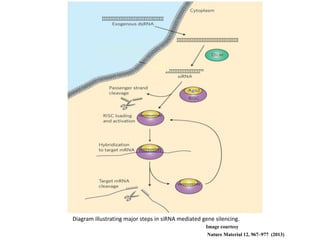
Diagram illustrating major steps in siRNA mediated gene silencing.
• Dicer processing step is not required.
• These attracted much attention as can be easily designed &
customized for any gene.
• Variety of synthetic vectors based on cationic polymers, peptide &
lipids have been proposed to form compact micro and Nano sized
polyelectrolyte complexes.
• These polyelectrolyte complexes have a net positive charge thus
can be easily up taken via endocytosis through negatively charged
cell membrane.
Advantages of producing synthetic siRNA
• Viral vectors
• siRNA polymer conjugate.
• siRNA encapsulated liposomes.
• Inorganic nanoparticles.
• Engineered siRNA based structures with RNAi activity.
Synthetic siRNA delivery system can be
siRNA Bioconjugates
• siRNA can be conjugated with a variety of molecules
including small molecules (e.g., cholesterol, bile acids, and
lipids), peptides (Cationic Cell-Penetrating Peptide),
polymers, proteins (e.g., antibody), and aptamers (e.g.,
RNAs)
• This improves the stability, cellular internalization, or cell-
specific active targeting delivery
• The cholesterol–siRNA conjugate showed greater stability
and, upon intravenous injection, was detected in the liver,
heart, lungs, kidneys, and fat tissues at 24 h (ref 1).
• Conjugation or complexation of siRNA to antibody increases
the specificity of siRNA delivery and minimize the off-target
effects.
Cationic liposomes
• Many cationic liposome/lipid-based systems can be
selected such as:
– lipofectamine2000,
– DOTAP (N-[1-(2,3-Dioleoyloxy)propyl]-N,N,N trimethyl
ammonium methyl-sulfate) and
– DOTMA (N-(1-(2,3-dioleyloxy)propyl)-N,N,N-trimethyl
ammonium chloride).
• Lipofectamine 2000 is a cationic liposome based
reagent that provides high transfection efficiency and
high level of transgene expression in a range of
mammalian cell types in vitro.
Polymer nanoparticles
• polyethyleneimine (PEI), chitosan (chitin
derivative), PLL (poly L-Lysine and PEG based
polymers
• Possess net positive charge.
• Strong electrostatic interactions between
oppositely charged polyelectrolytes allow for
“self-assembly”, which can substantially
hinder or prevent enzymatic degradation
Carbon based delivery systems
• Allotropic nanostructures of carbon nanotubes and
graphene nanosheets are hosting enormous interests
as shuttle nanovehicles for drug and siRNA delivery
applications. (ref.3)
• Their extremely large surface area, with every atom
exposed on its surface, allows for ultra-high
functionalization and loading capacities.
• In addition to excellent material properties such as
ultimate electrical and thermal conductivities and
mechanical strength, enlarge and intensify their
importance for a wide range of biomedical
applications.
Hydrogels
• Hydrogels can be defined as three-dimensional
networks of responsive polymer materials that
are hydrophilic in nature and able to retain large
amounts of water or biological fluids.
• Both macro-and micro-hydrogel particles were
previously prepared and applied for siRNA
delivery. (ref4 : abstract)
• Naked siRNA have been encapsulated and de-
livered by multiple hydrogel systems, including
alginate , collagen , dextran , poly-acrylamide,
chitosan, hyaluronic acid , PEG, PEI-catecholetc.,
Silica based nanoparticles
• Silica and silicon based nanoparticles have
been emerged recently in drug delivery due to
their controllability in Nano-pore formation
and surface modifications.
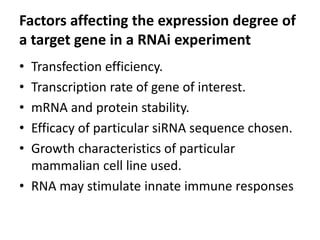
Factors affecting the expression degree of
a target gene in a RNAi experiment
• Transfection efficiency.
• Transcription rate of gene of interest.
• mRNA and protein stability.
• Efficacy of particular siRNA sequence chosen.
• Growth characteristics of particular
mammalian cell line used.
• RNA may stimulate innate immune responses
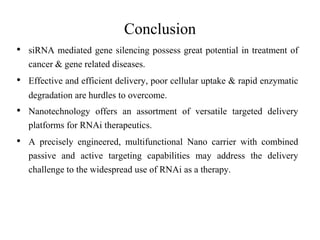
• siRNA mediated gene silencing possess great potential in treatment of
cancer & gene related diseases.
• Effective and efficient delivery, poor cellular uptake & rapid enzymatic
degradation are hurdles to overcome.
• Nanotechnology offers an assortment of versatile targeted delivery
platforms for RNAi therapeutics.
• A precisely engineered, multifunctional Nano carrier with combined
passive and active targeting capabilities may address the delivery
challenge to the widespread use of RNAi as a therapy.
Conclusion
references
• The AAPS Journal, Vol. 12, No. 4, December 2010
DOI:10.1208/s12248-010-9210-4
• Mohamed Shehata Draz et al; Theranostics. 2014; 4(9):
872–892. doi: 10.7150/thno.9404
• Liu Z, et.al. Preparation of carbon nanotube bioconjugates
for biomedical applications. Nature Protocols. 2009; 4:
1372-13 (abstract).
• Blackburn WH et.al. Peptide-Functionalized Nanogels for
Targeted siRNA Delivery. Bioconjugate Chem. 2009; 20:
960-968.
• Krebs MD et. al. Localized and Sustained Delivery of
Silencing RNA from Macroscopic Biopolymer Hydrogels. J
Am Chem Soc. 2009; 131: 9204-9206
Delivery systems

Delivery systems

  • 1.
  • 2.
    Introduction • “RNA interference”-highly conserved natural mechanism that controls gene expression. • RNAi mediated gene silencing by synthetic siRNA, is a promising approach in therapeutics. • Variety of synthetic vectors based on cationic polymers, peptide & lipids have been proposed to form compact micro and Nano sized polyelectrolyte complexes. • These polyelectrolyte complexes have a net positive charge thus can be easily up taken via endocytosis through negatively charged cell membrane
  • 3.
    Image courtesy Nature Material12, 967–977 (2013) Diagram illustrating major steps in siRNA mediated gene silencing.
  • 4.
    • Dicer processingstep is not required. • These attracted much attention as can be easily designed & customized for any gene. • Variety of synthetic vectors based on cationic polymers, peptide & lipids have been proposed to form compact micro and Nano sized polyelectrolyte complexes. • These polyelectrolyte complexes have a net positive charge thus can be easily up taken via endocytosis through negatively charged cell membrane. Advantages of producing synthetic siRNA
  • 5.
    • Viral vectors •siRNA polymer conjugate. • siRNA encapsulated liposomes. • Inorganic nanoparticles. • Engineered siRNA based structures with RNAi activity. Synthetic siRNA delivery system can be
  • 6.
    siRNA Bioconjugates • siRNAcan be conjugated with a variety of molecules including small molecules (e.g., cholesterol, bile acids, and lipids), peptides (Cationic Cell-Penetrating Peptide), polymers, proteins (e.g., antibody), and aptamers (e.g., RNAs) • This improves the stability, cellular internalization, or cell- specific active targeting delivery • The cholesterol–siRNA conjugate showed greater stability and, upon intravenous injection, was detected in the liver, heart, lungs, kidneys, and fat tissues at 24 h (ref 1). • Conjugation or complexation of siRNA to antibody increases the specificity of siRNA delivery and minimize the off-target effects.
  • 7.
    Cationic liposomes • Manycationic liposome/lipid-based systems can be selected such as: – lipofectamine2000, – DOTAP (N-[1-(2,3-Dioleoyloxy)propyl]-N,N,N trimethyl ammonium methyl-sulfate) and – DOTMA (N-(1-(2,3-dioleyloxy)propyl)-N,N,N-trimethyl ammonium chloride). • Lipofectamine 2000 is a cationic liposome based reagent that provides high transfection efficiency and high level of transgene expression in a range of mammalian cell types in vitro.
  • 8.
    Polymer nanoparticles • polyethyleneimine(PEI), chitosan (chitin derivative), PLL (poly L-Lysine and PEG based polymers • Possess net positive charge. • Strong electrostatic interactions between oppositely charged polyelectrolytes allow for “self-assembly”, which can substantially hinder or prevent enzymatic degradation
  • 9.
    Carbon based deliverysystems • Allotropic nanostructures of carbon nanotubes and graphene nanosheets are hosting enormous interests as shuttle nanovehicles for drug and siRNA delivery applications. (ref.3) • Their extremely large surface area, with every atom exposed on its surface, allows for ultra-high functionalization and loading capacities. • In addition to excellent material properties such as ultimate electrical and thermal conductivities and mechanical strength, enlarge and intensify their importance for a wide range of biomedical applications.
  • 10.
    Hydrogels • Hydrogels canbe defined as three-dimensional networks of responsive polymer materials that are hydrophilic in nature and able to retain large amounts of water or biological fluids. • Both macro-and micro-hydrogel particles were previously prepared and applied for siRNA delivery. (ref4 : abstract) • Naked siRNA have been encapsulated and de- livered by multiple hydrogel systems, including alginate , collagen , dextran , poly-acrylamide, chitosan, hyaluronic acid , PEG, PEI-catecholetc.,
  • 11.
    Silica based nanoparticles •Silica and silicon based nanoparticles have been emerged recently in drug delivery due to their controllability in Nano-pore formation and surface modifications.
  • 12.
    Factors affecting theexpression degree of a target gene in a RNAi experiment • Transfection efficiency. • Transcription rate of gene of interest. • mRNA and protein stability. • Efficacy of particular siRNA sequence chosen. • Growth characteristics of particular mammalian cell line used. • RNA may stimulate innate immune responses
  • 13.
    • siRNA mediatedgene silencing possess great potential in treatment of cancer & gene related diseases. • Effective and efficient delivery, poor cellular uptake & rapid enzymatic degradation are hurdles to overcome. • Nanotechnology offers an assortment of versatile targeted delivery platforms for RNAi therapeutics. • A precisely engineered, multifunctional Nano carrier with combined passive and active targeting capabilities may address the delivery challenge to the widespread use of RNAi as a therapy. Conclusion
  • 14.
    references • The AAPSJournal, Vol. 12, No. 4, December 2010 DOI:10.1208/s12248-010-9210-4 • Mohamed Shehata Draz et al; Theranostics. 2014; 4(9): 872–892. doi: 10.7150/thno.9404 • Liu Z, et.al. Preparation of carbon nanotube bioconjugates for biomedical applications. Nature Protocols. 2009; 4: 1372-13 (abstract). • Blackburn WH et.al. Peptide-Functionalized Nanogels for Targeted siRNA Delivery. Bioconjugate Chem. 2009; 20: 960-968. • Krebs MD et. al. Localized and Sustained Delivery of Silencing RNA from Macroscopic Biopolymer Hydrogels. J Am Chem Soc. 2009; 131: 9204-9206