Original Investigation
August 28, 2019
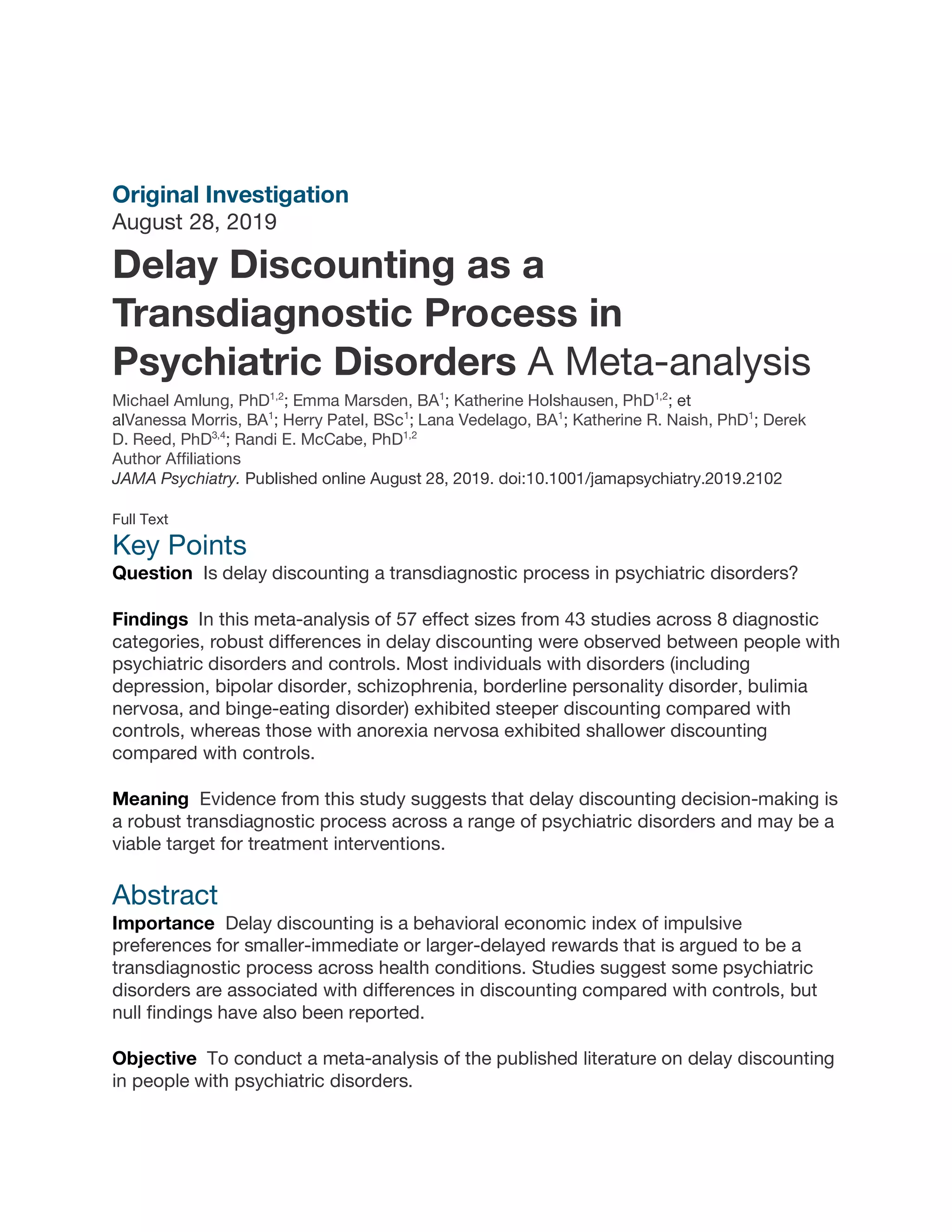
Delay Discounting as a
Transdiagnostic Process in
Psychiatric Disorders A Meta-analysis
Michael Amlung, PhD1,2
; Emma Marsden, BA1
; Katherine Holshausen, PhD1,2
; et
alVanessa Morris, BA1
; Herry Patel, BSc1
; Lana Vedelago, BA1
; Katherine R. Naish, PhD1
; Derek
D. Reed, PhD3,4
; Randi E. McCabe, PhD1,2
Author Affiliations
JAMA Psychiatry. Published online August 28, 2019. doi:10.1001/jamapsychiatry.2019.2102
Full Text
Key Points
Question Is delay discounting a transdiagnostic process in psychiatric disorders?
Findings In this meta-analysis of 57 effect sizes from 43 studies across 8 diagnostic
categories, robust differences in delay discounting were observed between people with
psychiatric disorders and controls. Most individuals with disorders (including
depression, bipolar disorder, schizophrenia, borderline personality disorder, bulimia
nervosa, and binge-eating disorder) exhibited steeper discounting compared with
controls, whereas those with anorexia nervosa exhibited shallower discounting
compared with controls.
Meaning Evidence from this study suggests that delay discounting decision-making is
a robust transdiagnostic process across a range of psychiatric disorders and may be a
viable target for treatment interventions.
Abstract
Importance Delay discounting is a behavioral economic index of impulsive
preferences for smaller-immediate or larger-delayed rewards that is argued to be a
transdiagnostic process across health conditions. Studies suggest some psychiatric
disorders are associated with differences in discounting compared with controls, but
null findings have also been reported.
Objective To conduct a meta-analysis of the published literature on delay discounting
in people with psychiatric disorders.
Data Sources PubMed, MEDLINE, PsycInfo, Embase, and Web of Science databases
were searched through December 10, 2018. The psychiatric keywords used were
based on DSM-IV or DSM-5 diagnostic categories. Collected data were analyzed from
December 10, 2018, through June 1, 2019.
Study Selection Following a preregistered Preferred Reporting Items for Systematic
Reviews and Meta-Analysis (PRISMA) protocol, 2 independent raters reviewed titles,
abstracts, and full-text articles. English-language articles comparing monetary delay
discounting between participants with psychiatric disorders and controls were
included.
Data Extraction and Synthesis Hedges g effect sizes were computed and random-
effects models were used for all analyses. Heterogeneity statistics, one-study-removed
analyses, and publication bias indices were also examined.
Main Outcomes and Measures Categorical comparisons of delay discounting
between a psychiatric group and a control group.
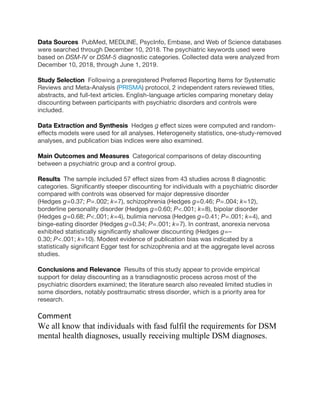
Results The sample included 57 effect sizes from 43 studies across 8 diagnostic
categories. Significantly steeper discounting for individuals with a psychiatric disorder
compared with controls was observed for major depressive disorder
(Hedges g = 0.37; P = .002; k = 7), schizophrenia (Hedges g = 0.46; P = .004; k = 12),
borderline personality disorder (Hedges g = 0.60; P < .001; k = 8), bipolar disorder
(Hedges g = 0.68; P < .001; k = 4), bulimia nervosa (Hedges g = 0.41; P = .001; k = 4), and
binge-eating disorder (Hedges g = 0.34; P = .001; k = 7). In contrast, anorexia nervosa
exhibited statistically significantly shallower discounting (Hedges g = –
0.30; P < .001; k = 10). Modest evidence of publication bias was indicated by a
statistically significant Egger test for schizophrenia and at the aggregate level across
studies.
Conclusions and Relevance Results of this study appear to provide empirical
support for delay discounting as a transdiagnostic process across most of the
psychiatric disorders examined; the literature search also revealed limited studies in
some disorders, notably posttraumatic stress disorder, which is a priority area for
research.
Comment
We all know that individuals with fasd fulfil the requirements for DSM
mental health diagnoses, usually receiving multiple DSM diagnoses.
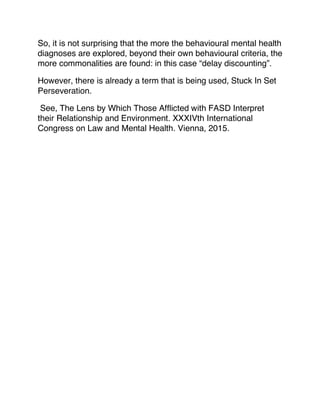
So, it is not surprising that the more the behavioural mental health
diagnoses are explored, beyond their own behavioural criteria, the
more commonalities are found: in this case “delay discounting”.
However, there is already a term that is being used, Stuck In Set
Perseveration.
See, The Lens by Which Those Afflicted with FASD Interpret
their Relationship and Environment. XXXIVth International
Congress on Law and Mental Health. Vienna, 2015.

Delay discounting

  • 1.
    Original Investigation August 28,2019 Delay Discounting as a Transdiagnostic Process in Psychiatric Disorders A Meta-analysis Michael Amlung, PhD1,2 ; Emma Marsden, BA1 ; Katherine Holshausen, PhD1,2 ; et alVanessa Morris, BA1 ; Herry Patel, BSc1 ; Lana Vedelago, BA1 ; Katherine R. Naish, PhD1 ; Derek D. Reed, PhD3,4 ; Randi E. McCabe, PhD1,2 Author Affiliations JAMA Psychiatry. Published online August 28, 2019. doi:10.1001/jamapsychiatry.2019.2102 Full Text Key Points Question Is delay discounting a transdiagnostic process in psychiatric disorders? Findings In this meta-analysis of 57 effect sizes from 43 studies across 8 diagnostic categories, robust differences in delay discounting were observed between people with psychiatric disorders and controls. Most individuals with disorders (including depression, bipolar disorder, schizophrenia, borderline personality disorder, bulimia nervosa, and binge-eating disorder) exhibited steeper discounting compared with controls, whereas those with anorexia nervosa exhibited shallower discounting compared with controls. Meaning Evidence from this study suggests that delay discounting decision-making is a robust transdiagnostic process across a range of psychiatric disorders and may be a viable target for treatment interventions. Abstract Importance Delay discounting is a behavioral economic index of impulsive preferences for smaller-immediate or larger-delayed rewards that is argued to be a transdiagnostic process across health conditions. Studies suggest some psychiatric disorders are associated with differences in discounting compared with controls, but null findings have also been reported. Objective To conduct a meta-analysis of the published literature on delay discounting in people with psychiatric disorders.
  • 2.
    Data Sources PubMed,MEDLINE, PsycInfo, Embase, and Web of Science databases were searched through December 10, 2018. The psychiatric keywords used were based on DSM-IV or DSM-5 diagnostic categories. Collected data were analyzed from December 10, 2018, through June 1, 2019. Study Selection Following a preregistered Preferred Reporting Items for Systematic Reviews and Meta-Analysis (PRISMA) protocol, 2 independent raters reviewed titles, abstracts, and full-text articles. English-language articles comparing monetary delay discounting between participants with psychiatric disorders and controls were included. Data Extraction and Synthesis Hedges g effect sizes were computed and random- effects models were used for all analyses. Heterogeneity statistics, one-study-removed analyses, and publication bias indices were also examined. Main Outcomes and Measures Categorical comparisons of delay discounting between a psychiatric group and a control group. Results The sample included 57 effect sizes from 43 studies across 8 diagnostic categories. Significantly steeper discounting for individuals with a psychiatric disorder compared with controls was observed for major depressive disorder (Hedges g = 0.37; P = .002; k = 7), schizophrenia (Hedges g = 0.46; P = .004; k = 12), borderline personality disorder (Hedges g = 0.60; P < .001; k = 8), bipolar disorder (Hedges g = 0.68; P < .001; k = 4), bulimia nervosa (Hedges g = 0.41; P = .001; k = 4), and binge-eating disorder (Hedges g = 0.34; P = .001; k = 7). In contrast, anorexia nervosa exhibited statistically significantly shallower discounting (Hedges g = – 0.30; P < .001; k = 10). Modest evidence of publication bias was indicated by a statistically significant Egger test for schizophrenia and at the aggregate level across studies. Conclusions and Relevance Results of this study appear to provide empirical support for delay discounting as a transdiagnostic process across most of the psychiatric disorders examined; the literature search also revealed limited studies in some disorders, notably posttraumatic stress disorder, which is a priority area for research. Comment We all know that individuals with fasd fulfil the requirements for DSM mental health diagnoses, usually receiving multiple DSM diagnoses.
  • 3.
    So, it isnot surprising that the more the behavioural mental health diagnoses are explored, beyond their own behavioural criteria, the more commonalities are found: in this case “delay discounting”. However, there is already a term that is being used, Stuck In Set Perseveration. See, The Lens by Which Those Afflicted with FASD Interpret their Relationship and Environment. XXXIVth International Congress on Law and Mental Health. Vienna, 2015.