JAMA Psychiatry
January 29, 2020
Outcomes of Online Mindfulness-Based Cognitive Therapy for
Patients With Residual Depressive SymptomsA Randomized Clinical
Trial
Zindel V. Segal, PhD1
; Sona Dimidjian, PhD2
; Arne Beck, PhD3
; et
alJennifer M. Boggs, PhD3
; Rachel Vanderkruik, MA2
; Christina
A. Metcalf, MA2
; Robert Gallop, PhD4
; Jennifer
N. Felder, PhD5
; Joseph Levy, BA2
Author Affiliations
JAMA Psychiatry. Published online January 29, 2020.
doi:10.1001/jamapsychiatry.2019.4693
Full Text
Key Points
Question Can web-based treatment of residual depressive symptoms
lead to incremental benefits for adults when added to usual depression
care?
Finding In this randomized clinical trial of 460 participants with
residual depressive symptoms, those who received an online version of
mindfulness-based cognitive therapy in addition to usual care had
greater reductions in depressive and anxiety symptoms, higher rates of
remission, and higher levels of quality of life compared with participants
who received usual care only.
Meaning The findings support the value of online mindfulness-based
cognitive therapy as an adjunctive, scalable approach for the
management of residual depressive symptoms.
Abstract
Importance Patients with residual depressive symptoms face a gap in
care because few resources, to date, are available to manage the
lingering effects of their illness.
Objective To evaluate the effectiveness for treating residual depressive
symptoms with Mindful Mood Balance (MMB), a web-based
application that delivers mindfulness-based cognitive therapy, plus usual
depression care compared with usual depression care only.
Design, Setting, and Participants This randomized clinical trial was
conducted in primary care and behavioral health clinics at Kaiser
Permanente Colorado, Denver. Adults identified with residual
depressive symptoms were recruited between March 2, 2015, and
November 30, 2018. Outcomes were assessed for a 15-month period,
comprising a 3-month intervention interval and a 12-month follow-up
period.
Interventions Patients were randomized to receive usual depression
care (UDC; n = 230) or MMB plus UDC (n = 230), which included 8
sessions delivered online for a 3-month interval plus minimal phone or
email coaching support.
Main Outcomes and Measures Primary outcomes were reduction in
residual depressive symptom severity, assessed using the Patient Health
Questionaire-9 (PHQ-9); rates of depressive relapse (PHQ-9 scores
≥15); and rates of remission (PHQ-9 scores <5). Secondary outcomes
included depression-free days, anxiety symptoms (General Anxiety
Disorder–7 Item Scale), and functional status (12-Item Short Form
Survey).
Results Among 460 randomized participants (mean [SD] age, 48.30
[14.89] years; 346 women [75.6%]), data were analyzed for the intent-
to-treat sample, which included 362 participants (78.7%) at 3 months
and 330 (71.7%) at 15 months. Participants who received MMB plus
UDC had significantly greater reductions in residual depressive
symptoms than did those receiving UDC only (mean [SE] PHQ-9 score,
0.95 [0.39], P < .02). A significantly greater proportion of patients
achieved remission in the MMB plus UDC group compared with the
UDC only group (PHQ-9 score, <5: β [SE], 0.38 [0.14], P = .008), and
rates of depressive relapse were significantly lower in the MMB plus
UDC group compared with the UDC only group (hazard ratio, 0.61;
95% CI, 0.39-0.95; P < .03). Compared with the UDC only group, the
MMB plus UDC group had decreased depression-free days (mean [SD],
281.14 [164.99] days vs 247.54 [158.32] days; difference, −33.60
[154.14] days; t = −2.33; P = .02), decreased anxiety (mean [SE] General
Anxiety Disorder–7 Item Scale score, 1.21 [0.42], P = .004), and
improved mental functioning (mean [SE] 12-Item Short Form Survey
score, −5.10 [1.37], P < .001), but there was no statistically significant
difference in physical functioning.
Conclusions and Relevance Use of MMB plus UDC resulted in
significant improvement in depression and functional outcomes
compared with UDC only. The MMB web-based treatment may offer a
scalable approach for the management of residual depressive symptoms.
Trial Registration ClinicalTrials.gov identifier: NCT02190968
Comment - Outcomes of Online Mindfulness-Based Cognitive
Therapy for Patients With Residual Depressive SymptomsA
Randomized Clinical Trial
This paper does not make reference of prenatal alcohol/fasd to
mindfulness or depression. However, the relationship of pae and fasd to
depression is well documented. While there is less research into
mindfulness as a therapy for fasd, clinical experience and the few papers
published do indicate a relationship.
.1- Prenatal alcohol exposure and offspring mental health: A systematic
review doi: 10.1016/j.drugalcdep.2019.01.007
“Of these studies, 9 (69%) found evidence to support a positive
association of increased maternal prenatal alcohol exposure and
increased offspring anxiety/depression”
2- Prenatal alcohol exposure: Fetal programming and later life
vulnerability to stress, depression and anxiety disorders
ARTICLE in NEUROSCIENCE & BIOBEHAVIORAL REVIEWS ·
JULY 2009
DOI: 10.1016/j.neubiorev.2009.06.004 · Source: PubMed
“We submit that prenatal exposure to alcohol can be viewed as an
adverse early life experience that programs neurobiological and
neuroadaptive mechanisms such that vulnerability to subsequent life
stressors is increased, and, in turn, the vulnerability to depressive and
anxiety disorders also increases.”
3- Mental Illness in Adults With Fetal Alcohol Syndrome or Fetal
Alcohol Effects
Am J Psychiatry 155:4, April 1998
4- Evaluation of FASD Prevention and FASD SUPPORT PROGRAMS
Participant Outcomes: Mindfulness and Self-Regulation Skills
www.fasd-evaluation.ca
British Columbia Centre of Excellence for Women’s Health
5- Physiological self-regulation and mindfulness in children with a
diagnosis of fetal alcohol spectrum disorder
doi.org/10.1080/17518423.2018.1461948
6- Adolescents with FASD: Education-Based Strategies for Social Skills
Development. Samantha Louise Wiendels The
University of Western Ontario A thesis submitted in partial fulfillment
of the requirements for the degree in Master of Arts
“This proves that mindfulness-based strategies can be a part of a
universal program. It helps students develop and practice skills of
positive coping and self-care strategies.”
Empirical, clinical, statistical, biological, neurological, and epigenetic
correlations connecting pae/fasd to DSM diagnoses continue to
accumulate. Yet Psychiatry continues to ignore them. This would not be
tolerated for any other medical condition. The professions and
governments have an ethical and moral obligation to explore such
correlations.
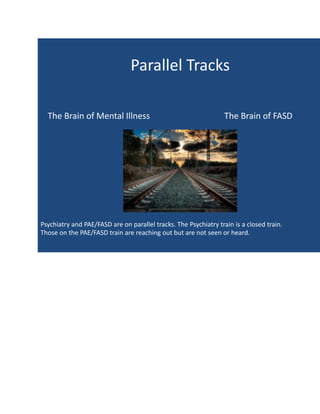
Parallel Tracks
The Brain of Mental Illness The Brain of FASD
Psychiatry and PAE/FASD are on parallel tracks. The Psychiatry train is a closed train.
Those on the PAE/FASD train are reaching out but are not seen or heard.

Parallel Tracks

  • 1.
    JAMA Psychiatry January 29,2020 Outcomes of Online Mindfulness-Based Cognitive Therapy for Patients With Residual Depressive SymptomsA Randomized Clinical Trial Zindel V. Segal, PhD1 ; Sona Dimidjian, PhD2 ; Arne Beck, PhD3 ; et alJennifer M. Boggs, PhD3 ; Rachel Vanderkruik, MA2 ; Christina A. Metcalf, MA2 ; Robert Gallop, PhD4 ; Jennifer N. Felder, PhD5 ; Joseph Levy, BA2 Author Affiliations JAMA Psychiatry. Published online January 29, 2020. doi:10.1001/jamapsychiatry.2019.4693 Full Text Key Points Question Can web-based treatment of residual depressive symptoms lead to incremental benefits for adults when added to usual depression care? Finding In this randomized clinical trial of 460 participants with residual depressive symptoms, those who received an online version of mindfulness-based cognitive therapy in addition to usual care had greater reductions in depressive and anxiety symptoms, higher rates of remission, and higher levels of quality of life compared with participants who received usual care only. Meaning The findings support the value of online mindfulness-based cognitive therapy as an adjunctive, scalable approach for the management of residual depressive symptoms. Abstract Importance Patients with residual depressive symptoms face a gap in care because few resources, to date, are available to manage the lingering effects of their illness.
  • 2.
    Objective To evaluatethe effectiveness for treating residual depressive symptoms with Mindful Mood Balance (MMB), a web-based application that delivers mindfulness-based cognitive therapy, plus usual depression care compared with usual depression care only. Design, Setting, and Participants This randomized clinical trial was conducted in primary care and behavioral health clinics at Kaiser Permanente Colorado, Denver. Adults identified with residual depressive symptoms were recruited between March 2, 2015, and November 30, 2018. Outcomes were assessed for a 15-month period, comprising a 3-month intervention interval and a 12-month follow-up period. Interventions Patients were randomized to receive usual depression care (UDC; n = 230) or MMB plus UDC (n = 230), which included 8 sessions delivered online for a 3-month interval plus minimal phone or email coaching support. Main Outcomes and Measures Primary outcomes were reduction in residual depressive symptom severity, assessed using the Patient Health Questionaire-9 (PHQ-9); rates of depressive relapse (PHQ-9 scores ≥15); and rates of remission (PHQ-9 scores <5). Secondary outcomes included depression-free days, anxiety symptoms (General Anxiety Disorder–7 Item Scale), and functional status (12-Item Short Form Survey). Results Among 460 randomized participants (mean [SD] age, 48.30 [14.89] years; 346 women [75.6%]), data were analyzed for the intent- to-treat sample, which included 362 participants (78.7%) at 3 months and 330 (71.7%) at 15 months. Participants who received MMB plus UDC had significantly greater reductions in residual depressive symptoms than did those receiving UDC only (mean [SE] PHQ-9 score, 0.95 [0.39], P < .02). A significantly greater proportion of patients achieved remission in the MMB plus UDC group compared with the UDC only group (PHQ-9 score, <5: β [SE], 0.38 [0.14], P = .008), and
  • 3.
    rates of depressiverelapse were significantly lower in the MMB plus UDC group compared with the UDC only group (hazard ratio, 0.61; 95% CI, 0.39-0.95; P < .03). Compared with the UDC only group, the MMB plus UDC group had decreased depression-free days (mean [SD], 281.14 [164.99] days vs 247.54 [158.32] days; difference, −33.60 [154.14] days; t = −2.33; P = .02), decreased anxiety (mean [SE] General Anxiety Disorder–7 Item Scale score, 1.21 [0.42], P = .004), and improved mental functioning (mean [SE] 12-Item Short Form Survey score, −5.10 [1.37], P < .001), but there was no statistically significant difference in physical functioning. Conclusions and Relevance Use of MMB plus UDC resulted in significant improvement in depression and functional outcomes compared with UDC only. The MMB web-based treatment may offer a scalable approach for the management of residual depressive symptoms. Trial Registration ClinicalTrials.gov identifier: NCT02190968 Comment - Outcomes of Online Mindfulness-Based Cognitive Therapy for Patients With Residual Depressive SymptomsA Randomized Clinical Trial This paper does not make reference of prenatal alcohol/fasd to mindfulness or depression. However, the relationship of pae and fasd to depression is well documented. While there is less research into mindfulness as a therapy for fasd, clinical experience and the few papers published do indicate a relationship. .1- Prenatal alcohol exposure and offspring mental health: A systematic review doi: 10.1016/j.drugalcdep.2019.01.007
  • 4.
    “Of these studies,9 (69%) found evidence to support a positive association of increased maternal prenatal alcohol exposure and increased offspring anxiety/depression” 2- Prenatal alcohol exposure: Fetal programming and later life vulnerability to stress, depression and anxiety disorders ARTICLE in NEUROSCIENCE & BIOBEHAVIORAL REVIEWS · JULY 2009 DOI: 10.1016/j.neubiorev.2009.06.004 · Source: PubMed “We submit that prenatal exposure to alcohol can be viewed as an adverse early life experience that programs neurobiological and neuroadaptive mechanisms such that vulnerability to subsequent life stressors is increased, and, in turn, the vulnerability to depressive and anxiety disorders also increases.” 3- Mental Illness in Adults With Fetal Alcohol Syndrome or Fetal Alcohol Effects Am J Psychiatry 155:4, April 1998 4- Evaluation of FASD Prevention and FASD SUPPORT PROGRAMS Participant Outcomes: Mindfulness and Self-Regulation Skills www.fasd-evaluation.ca British Columbia Centre of Excellence for Women’s Health 5- Physiological self-regulation and mindfulness in children with a diagnosis of fetal alcohol spectrum disorder doi.org/10.1080/17518423.2018.1461948 6- Adolescents with FASD: Education-Based Strategies for Social Skills Development. Samantha Louise Wiendels The University of Western Ontario A thesis submitted in partial fulfillment of the requirements for the degree in Master of Arts
  • 5.
    “This proves thatmindfulness-based strategies can be a part of a universal program. It helps students develop and practice skills of positive coping and self-care strategies.” Empirical, clinical, statistical, biological, neurological, and epigenetic correlations connecting pae/fasd to DSM diagnoses continue to accumulate. Yet Psychiatry continues to ignore them. This would not be tolerated for any other medical condition. The professions and governments have an ethical and moral obligation to explore such correlations.
  • 6.
    Parallel Tracks The Brainof Mental Illness The Brain of FASD Psychiatry and PAE/FASD are on parallel tracks. The Psychiatry train is a closed train. Those on the PAE/FASD train are reaching out but are not seen or heard.