Rolls-RoyceDefence | © 2018
Commercial-in-Confidence
No Export Controlclassification
Naval Propulsion – The 21st Century and
Beyond
Facilitating the needs of future surface combatants
Simon O’Connor BEng MIMarEst
Principal Marine Engineer
© Rolls-Royce plc 2018. The information in this document is the property of Rolls-Royce plc and may not be copied, communicated to a third party, or used for any purpose other than that
for which it is supplied, without the express written consent of Rolls-Royce plc.
While the information is given in good faith based upon the latest information available to Rolls-Royce plc, no warranty or representation is given concerning such information, which must not
be taken as establishing any contractual or other commitment binding upon Rolls-Royce plc or any of its subsidiary or associated companies.
Rolls-RoyceDefence| © 2018 Rolls-Royce
No Export Controlclassification
Agenda
2
Introduction
01
02 Overview & Trends in Power &
Propulsion
03
04
Single GT Hybrid – an Enabler for
Future Proofing
05
Next Generation Large Surface
Combatants
Conclusions
Rolls-RoyceDefence| © 2018 Rolls-Royce
No Export Controlclassification3
Introduction
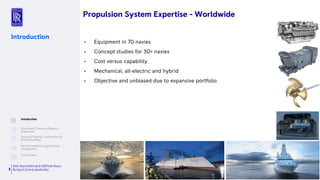
Propulsion System Expertise - Worldwide
 Equipment in 70 navies
 Concept studies for 30+ navies
 Cost versus capability
 Mechanical, all-electric and hybrid
 Objective and unbiased due to expansive portfolio
Rolls-RoyceDefence| © 2018 Rolls-Royce
No Export Controlclassification4
Overview &
Trends in Power &
Propulsion
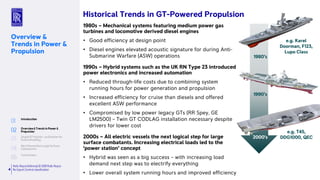
1980s – Mechanical systems featuring medium power gas
turbines and locomotive derived diesel engines
• Good efficiency at design point
• Diesel engines elevated acoustic signature for during Anti-
Submarine Warfare (ASW) operations
1990s – Hybrid systems such as the UK RN Type 23 introduced
power electronics and increased automation
• Reduced through-life costs due to combining system
running hours for power generation and propulsion
• Increased efficiency for cruise than diesels and offered
excellent ASW performance
• Compromised by low power legacy GTs (RR Spey, GE
LM2500) – Twin GT CODLAG installation necessary despite
drivers for lower cost
2000s – All electric vessels the next logical step for large
surface combatants. Increasing electrical loads led to the
‘power station’ concept
• Hybrid was seen as a big success – with increasing load
demand next step was to electrify everything
• Lower overall system running hours and improved efficiency
e.g. T45,
DDG1000, QEC2000’s
1990’s
1980’s
e.g. Karel
Doorman, F123,
Lupo Class
Historical Trends in GT-Powered Propulsion
Rolls-RoyceDefence| © 2018 Rolls-Royce
No Export Controlclassification5
Overview &
Trends in Power &
Propulsion
2000’s
1
2
3
4
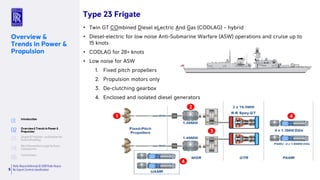
• Twin GT COmbined Diesel eLectric And Gas (CODLAG) – hybrid
• Diesel-electric for low noise Anti-Submarine Warfare (ASW) operations and cruise up to
15 knots
• CODLAG for 28+ knots
• Low noise for ASW
1. Fixed pitch propellers
2. Propulsion motors only
3. De-clutching gearbox
4. Enclosed and isolated diesel generators
Type 23 Frigate
4
Rolls-RoyceDefence| © 2018 Rolls-Royce
No Export Controlclassification6
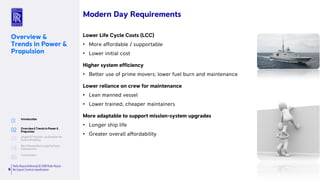
Lower Life Cycle Costs (LCC)
• More affordable / supportable
• Lower initial cost
Higher system efficiency
• Better use of prime movers; lower fuel burn and maintenance
Lower reliance on crew for maintenance
• Lean manned vessel
• Lower trained, cheaper maintainers
More adaptable to support mission-system upgrades
• Longer ship life
• Greater overall affordability
Overview &
Trends in Power &
Propulsion
Modern Day Requirements
Rolls-RoyceDefence| © 2018 Rolls-Royce
No Export Controlclassification7
Single GT Hybrid
– an Enabler for
Future Proofing
0%
5%
10%
15%
20%
25%
0
5000
10000
15000
20000
25000
30000
35000
40000
45000
50000
0 5 10 15 20 25 30
%timeperannum
Deliveredpower(KWe)
Knots
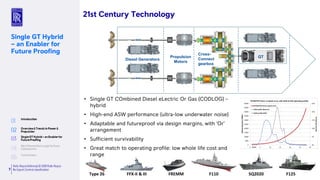
ESTIMATED Power-Speed curve
ASW profile (Generic)
AAW profile (D32)
ESTIMATED Power vs Speed curve, with AAW & ASW operating profiles• Single GT COmbined Diesel eLectric Or Gas (CODLOG) –
hybrid
• High-end ASW performance (ultra-low underwater noise)
• Adaptable and futureproof via design margins, with ‘Or’
arrangement
• Sufficient survivability
• Great match to operating profile: low whole life cost and
range
Type 26 FFX-II & III FREMM F110 SQ2020 F125
Diesel Generators
Propulsion
Motors
Cross-
Connect
gearbox
GT
21st Century Technology
Rolls-RoyceDefence| © 2018 Rolls-Royce
No Export Controlclassification8
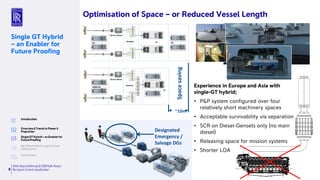
Designated
Emergency /
Salvage DGs
~10m
Spacesaving
Experience in Europe and Asia with
single-GT hybrid;
• P&P system configured over four
relatively short machinery spaces
• Acceptable survivability via separation
• SCR on Diesel-Gensets only (no main
diesel)
• Releasing space for mission systems
• Shorter LOA
Single GT Hybrid
– an Enabler for
Future Proofing
Optimisation of Space – or Reduced Vessel Length
Rolls-RoyceDefence| © 2018 Rolls-Royce
No Export Controlclassification9
Next Generation
Large Surface
Combatants
Chief of Naval Operations (CNO),
Admiral John Richardson
United States Navy
2018, Defense News
“ Buy as much power as you
can afford because it’s like
RAM on your computer,
you’re going to need more
as soon as you buy it. ”
Rolls-RoyceDefence| © 2018 Rolls-Royce
No Export Controlclassification10
Next Generation
Large Surface
Combatants
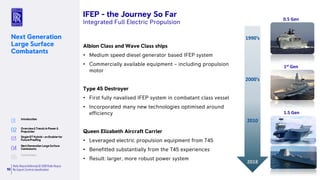
1990’s
2000’s
2010
2018
1st Gen
0.5 Gen
1.5 Gen
Albion Class and Wave Class ships
• Medium speed diesel generator based IFEP system
• Commercially available equipment – including propulsion
motor
Type 45 Destroyer
• First fully navalised IFEP system in combatant class vessel
• Incorporated many new technologies optimised around
efficiency
Queen Elizabeth Aircraft Carrier
• Leveraged electric propulsion equipment from T45
• Benefitted substantially from the T45 experiences
• Result: larger, more robust power system
IFEP - the Journey So Far
Integrated Full Electric Propulsion
Rolls-RoyceDefence| © 2018 Rolls-Royce
No Export Controlclassification11
Next Generation
Large Surface
Combatants
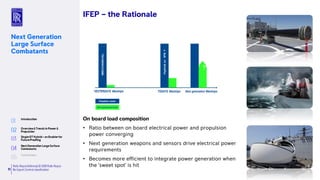
On board load composition
• Ratio between on board electrical power and propulsion
power converging
• Next generation weapons and sensors drive electrical power
requirements
• Becomes more efficient to integrate power generation when
the ‘sweet spot’ is hit
?
IFEP – the Rationale
Rolls-RoyceDefence| © 2018 Rolls-Royce
No Export Controlclassification12
Next Generation
Large Surface
Combatants
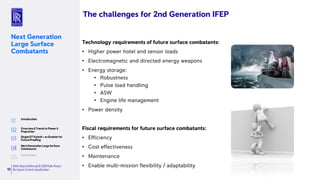
Technology requirements of future surface combatants:
• Higher power hotel and sensor loads
• Electromagnetic and directed energy weapons
• Energy storage:
• Robustness
• Pulse load handling
• ASW
• Engine life management
• Power density
Fiscal requirements for future surface combatants:
• Efficiency
• Cost effectiveness
• Maintenance
• Enable multi-mission flexibility / adaptability
The challenges for 2nd Generation IFEP
Rolls-RoyceDefence| © 2018 Rolls-Royce
No Export Controlclassification13
Next Generation
Large Surface
Combatants
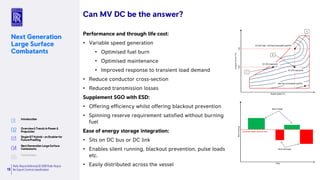
Performance and through life cost:
• Variable speed generation
• Optimised fuel burn
• Optimised maintenance
• Improved response to transient load demand
• Reduce conductor cross-section
• Reduced transmission losses
Supplement SGO with ESD:
• Offering efficiency whilst offering blackout prevention
• Spinning reserve requirement satisfied without burning
fuel
Ease of energy storage integration:
• Sits on DC bus or DC link
• Enables silent running, blackout prevention, pulse loads
etc.
• Easily distributed across the vessel
Can MV DC be the answer?
Rolls-RoyceDefence| © 2018 Rolls-Royce
No Export Controlclassification14
Conclusions
Power and propulsion must be designed around modern arrangements and equipment
• Electrical power generation is a strategic resource
• Thinking about technology insertion through-life, system growth – margins are
essential!
• Avoid obsolescence – naval procurement programmes may extend beyond ten years
• Military relevance must be maintained – the P&P system is at the core of this
Next generation large surface combatants will likely feature IFEP
• More robust power system design
• Integration of energy storage
• Facilitating high energy / directed energy weapons
• Enabling variable speed prime mover operation
Staying Ahead of the Curve
Rolls-RoyceDefence| © 2018 Rolls-Royce
No Export Controlclassification

Defsec 2018-presentation-rolls royce

  • 1.
    Rolls-RoyceDefence | ©2018 Commercial-in-Confidence No Export Controlclassification Naval Propulsion – The 21st Century and Beyond Facilitating the needs of future surface combatants Simon O’Connor BEng MIMarEst Principal Marine Engineer © Rolls-Royce plc 2018. The information in this document is the property of Rolls-Royce plc and may not be copied, communicated to a third party, or used for any purpose other than that for which it is supplied, without the express written consent of Rolls-Royce plc. While the information is given in good faith based upon the latest information available to Rolls-Royce plc, no warranty or representation is given concerning such information, which must not be taken as establishing any contractual or other commitment binding upon Rolls-Royce plc or any of its subsidiary or associated companies.
  • 2.
    Rolls-RoyceDefence| © 2018Rolls-Royce No Export Controlclassification Agenda 2 Introduction 01 02 Overview & Trends in Power & Propulsion 03 04 Single GT Hybrid – an Enabler for Future Proofing 05 Next Generation Large Surface Combatants Conclusions
  • 3.
    Rolls-RoyceDefence| © 2018Rolls-Royce No Export Controlclassification3 Introduction Propulsion System Expertise - Worldwide  Equipment in 70 navies  Concept studies for 30+ navies  Cost versus capability  Mechanical, all-electric and hybrid  Objective and unbiased due to expansive portfolio
  • 4.
    Rolls-RoyceDefence| © 2018Rolls-Royce No Export Controlclassification4 Overview & Trends in Power & Propulsion 1980s – Mechanical systems featuring medium power gas turbines and locomotive derived diesel engines • Good efficiency at design point • Diesel engines elevated acoustic signature for during Anti- Submarine Warfare (ASW) operations 1990s – Hybrid systems such as the UK RN Type 23 introduced power electronics and increased automation • Reduced through-life costs due to combining system running hours for power generation and propulsion • Increased efficiency for cruise than diesels and offered excellent ASW performance • Compromised by low power legacy GTs (RR Spey, GE LM2500) – Twin GT CODLAG installation necessary despite drivers for lower cost 2000s – All electric vessels the next logical step for large surface combatants. Increasing electrical loads led to the ‘power station’ concept • Hybrid was seen as a big success – with increasing load demand next step was to electrify everything • Lower overall system running hours and improved efficiency e.g. T45, DDG1000, QEC2000’s 1990’s 1980’s e.g. Karel Doorman, F123, Lupo Class Historical Trends in GT-Powered Propulsion
  • 5.
    Rolls-RoyceDefence| © 2018Rolls-Royce No Export Controlclassification5 Overview & Trends in Power & Propulsion 2000’s 1 2 3 4 • Twin GT COmbined Diesel eLectric And Gas (CODLAG) – hybrid • Diesel-electric for low noise Anti-Submarine Warfare (ASW) operations and cruise up to 15 knots • CODLAG for 28+ knots • Low noise for ASW 1. Fixed pitch propellers 2. Propulsion motors only 3. De-clutching gearbox 4. Enclosed and isolated diesel generators Type 23 Frigate 4
  • 6.
    Rolls-RoyceDefence| © 2018Rolls-Royce No Export Controlclassification6 Lower Life Cycle Costs (LCC) • More affordable / supportable • Lower initial cost Higher system efficiency • Better use of prime movers; lower fuel burn and maintenance Lower reliance on crew for maintenance • Lean manned vessel • Lower trained, cheaper maintainers More adaptable to support mission-system upgrades • Longer ship life • Greater overall affordability Overview & Trends in Power & Propulsion Modern Day Requirements
  • 7.
    Rolls-RoyceDefence| © 2018Rolls-Royce No Export Controlclassification7 Single GT Hybrid – an Enabler for Future Proofing 0% 5% 10% 15% 20% 25% 0 5000 10000 15000 20000 25000 30000 35000 40000 45000 50000 0 5 10 15 20 25 30 %timeperannum Deliveredpower(KWe) Knots ESTIMATED Power-Speed curve ASW profile (Generic) AAW profile (D32) ESTIMATED Power vs Speed curve, with AAW & ASW operating profiles• Single GT COmbined Diesel eLectric Or Gas (CODLOG) – hybrid • High-end ASW performance (ultra-low underwater noise) • Adaptable and futureproof via design margins, with ‘Or’ arrangement • Sufficient survivability • Great match to operating profile: low whole life cost and range Type 26 FFX-II & III FREMM F110 SQ2020 F125 Diesel Generators Propulsion Motors Cross- Connect gearbox GT 21st Century Technology
  • 8.
    Rolls-RoyceDefence| © 2018Rolls-Royce No Export Controlclassification8 Designated Emergency / Salvage DGs ~10m Spacesaving Experience in Europe and Asia with single-GT hybrid; • P&P system configured over four relatively short machinery spaces • Acceptable survivability via separation • SCR on Diesel-Gensets only (no main diesel) • Releasing space for mission systems • Shorter LOA Single GT Hybrid – an Enabler for Future Proofing Optimisation of Space – or Reduced Vessel Length
  • 9.
    Rolls-RoyceDefence| © 2018Rolls-Royce No Export Controlclassification9 Next Generation Large Surface Combatants Chief of Naval Operations (CNO), Admiral John Richardson United States Navy 2018, Defense News “ Buy as much power as you can afford because it’s like RAM on your computer, you’re going to need more as soon as you buy it. ”
  • 10.
    Rolls-RoyceDefence| © 2018Rolls-Royce No Export Controlclassification10 Next Generation Large Surface Combatants 1990’s 2000’s 2010 2018 1st Gen 0.5 Gen 1.5 Gen Albion Class and Wave Class ships • Medium speed diesel generator based IFEP system • Commercially available equipment – including propulsion motor Type 45 Destroyer • First fully navalised IFEP system in combatant class vessel • Incorporated many new technologies optimised around efficiency Queen Elizabeth Aircraft Carrier • Leveraged electric propulsion equipment from T45 • Benefitted substantially from the T45 experiences • Result: larger, more robust power system IFEP - the Journey So Far Integrated Full Electric Propulsion
  • 11.
    Rolls-RoyceDefence| © 2018Rolls-Royce No Export Controlclassification11 Next Generation Large Surface Combatants On board load composition • Ratio between on board electrical power and propulsion power converging • Next generation weapons and sensors drive electrical power requirements • Becomes more efficient to integrate power generation when the ‘sweet spot’ is hit ? IFEP – the Rationale
  • 12.
    Rolls-RoyceDefence| © 2018Rolls-Royce No Export Controlclassification12 Next Generation Large Surface Combatants Technology requirements of future surface combatants: • Higher power hotel and sensor loads • Electromagnetic and directed energy weapons • Energy storage: • Robustness • Pulse load handling • ASW • Engine life management • Power density Fiscal requirements for future surface combatants: • Efficiency • Cost effectiveness • Maintenance • Enable multi-mission flexibility / adaptability The challenges for 2nd Generation IFEP
  • 13.
    Rolls-RoyceDefence| © 2018Rolls-Royce No Export Controlclassification13 Next Generation Large Surface Combatants Performance and through life cost: • Variable speed generation • Optimised fuel burn • Optimised maintenance • Improved response to transient load demand • Reduce conductor cross-section • Reduced transmission losses Supplement SGO with ESD: • Offering efficiency whilst offering blackout prevention • Spinning reserve requirement satisfied without burning fuel Ease of energy storage integration: • Sits on DC bus or DC link • Enables silent running, blackout prevention, pulse loads etc. • Easily distributed across the vessel Can MV DC be the answer?
  • 14.
    Rolls-RoyceDefence| © 2018Rolls-Royce No Export Controlclassification14 Conclusions Power and propulsion must be designed around modern arrangements and equipment • Electrical power generation is a strategic resource • Thinking about technology insertion through-life, system growth – margins are essential! • Avoid obsolescence – naval procurement programmes may extend beyond ten years • Military relevance must be maintained – the P&P system is at the core of this Next generation large surface combatants will likely feature IFEP • More robust power system design • Integration of energy storage • Facilitating high energy / directed energy weapons • Enabling variable speed prime mover operation Staying Ahead of the Curve
  • 15.
    Rolls-RoyceDefence| © 2018Rolls-Royce No Export Controlclassification