Definite and Indefinite
Articles
Use of articles with specific and
unspecified things
Definite articles
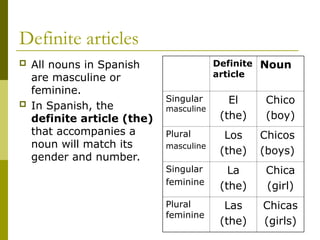
 All nouns in Spanish
are masculine or
feminine.
 In Spanish, the
definite article (the)
that accompanies a
noun will match its
gender and number.
Definite
article
Noun
Singular
masculine
El
(the)
Chico
(boy)
Plural
masculine
Los
(the)
Chicos
(boys)
Singular
feminine
La
(the)
Chica
(girl)
Plural
feminine
Las
(the)
Chicas
(girls)
Definite articles (continued)
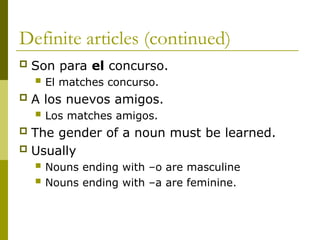
 Son para el concurso.
 El matches concurso.
 A los nuevos amigos.
 Los matches amigos.
 The gender of a noun must be learned.
 Usually
 Nouns ending with –o are masculine
 Nouns ending with –a are feminine.
Indefinite articles
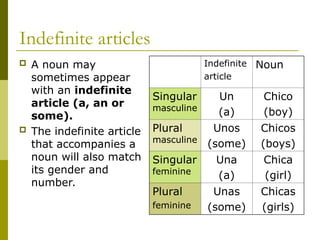
 A noun may
sometimes appear
with an indefinite
article (a, an or
some).
 The indefinite article
that accompanies a
noun will also match
its gender and
number.
Indefinite
article
Noun
Singular
masculine
Un
(a)
Chico
(boy)
Plural
masculine
Unos
(some)
Chicos
(boys)
Singular
feminine
Una
(a)
Chica
(girl)
Plural
feminine
Unas
(some)
Chicas
(girls)
Modelos
 El sombrero es rojo.
 The hat is red
 La blusa es azul.
 The blouse is blue
 Una camisa es buena.
 A shirt is good.
 Un chico es un estudiante.
 A boy is a student.
 Unas camisetas son marrónes.
 Some T-shirts are brown.
Sustantivos y adjetivos plurales
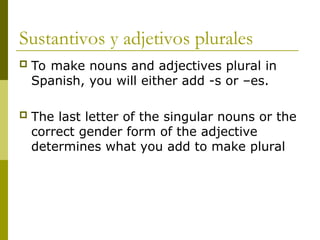
 To make nouns and adjectives plural in
Spanish, you will either add -s or –es.
 The last letter of the singular nouns or the
correct gender form of the adjective
determines what you add to make plural
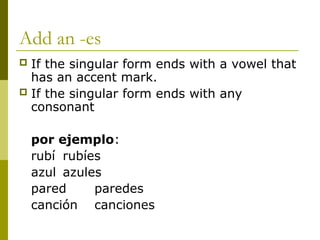
Add an -es
 If the singular form ends with a vowel that
has an accent mark.
 If the singular form ends with any
consonant
por ejemplo:
rubí rubíes
azul azules
pared paredes
canción canciones
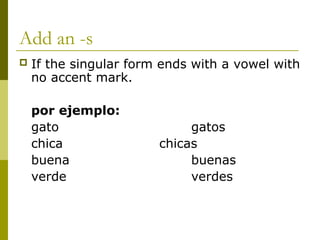
Add an -s
 If the singular form ends with a vowel with
no accent mark.
por ejemplo:
gato gatos
chica chicas
buena buenas
verde verdes
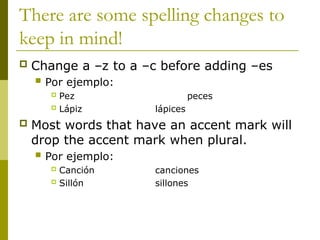
There are some spelling changes to
keep in mind!
 Change a –z to a –c before adding –es
 Por ejemplo:
 Pez peces
 Lápiz lápices
 Most words that have an accent mark will
drop the accent mark when plural.
 Por ejemplo:
 Canción canciones
 Sillón sillones

Definite and indefinite articles in Englsih.ppt

  • 1.
    Definite and Indefinite Articles Useof articles with specific and unspecified things
  • 2.
    Definite articles  Allnouns in Spanish are masculine or feminine.  In Spanish, the definite article (the) that accompanies a noun will match its gender and number. Definite article Noun Singular masculine El (the) Chico (boy) Plural masculine Los (the) Chicos (boys) Singular feminine La (the) Chica (girl) Plural feminine Las (the) Chicas (girls)
  • 3.
    Definite articles (continued) Son para el concurso.  El matches concurso.  A los nuevos amigos.  Los matches amigos.  The gender of a noun must be learned.  Usually  Nouns ending with –o are masculine  Nouns ending with –a are feminine.
  • 4.
    Indefinite articles  Anoun may sometimes appear with an indefinite article (a, an or some).  The indefinite article that accompanies a noun will also match its gender and number. Indefinite article Noun Singular masculine Un (a) Chico (boy) Plural masculine Unos (some) Chicos (boys) Singular feminine Una (a) Chica (girl) Plural feminine Unas (some) Chicas (girls)
  • 5.
    Modelos  El sombreroes rojo.  The hat is red  La blusa es azul.  The blouse is blue  Una camisa es buena.  A shirt is good.  Un chico es un estudiante.  A boy is a student.  Unas camisetas son marrónes.  Some T-shirts are brown.
  • 6.
    Sustantivos y adjetivosplurales  To make nouns and adjectives plural in Spanish, you will either add -s or –es.  The last letter of the singular nouns or the correct gender form of the adjective determines what you add to make plural
  • 7.
    Add an -es If the singular form ends with a vowel that has an accent mark.  If the singular form ends with any consonant por ejemplo: rubí rubíes azul azules pared paredes canción canciones
  • 8.
    Add an -s If the singular form ends with a vowel with no accent mark. por ejemplo: gato gatos chica chicas buena buenas verde verdes
  • 9.
    There are somespelling changes to keep in mind!  Change a –z to a –c before adding –es  Por ejemplo:  Pez peces  Lápiz lápices  Most words that have an accent mark will drop the accent mark when plural.  Por ejemplo:  Canción canciones  Sillón sillones